Category Archives: Television

For All Mankind: The Life and Career of Mick Foley

For All Mankind:  The Life and Career of Mick Foley (2013)

For All Mankind: The Life and Career of Mick Foley (2013)

A great source of nostalgia for me is the mid to late 90’s wrestling scene.  Any time a DVD or Blu Ray is released high-lighting the career of a popular wrestler from that era it always grabs my attention.  I’m usually able to resist and wait for the price to come down, but every now and then I feel compelled to jump in right form the start and that was the case for me with the latest Mick Foley collection titled For All Mankind:  The Life and Career of Mick Foley.

Foley is the wrestling superstar who was never meant to be a superstar.  Bad-bodied and lacking any sort of flash, Foley seemed destined for mid-card status.  His defining trait was a willingness to sacrifice his body for whatever promotion he happened to be working for in such a way that it made other wrestlers look good.  This lead to the occasional program with some main event types like Sting and Stone Cold Steve Austin, but the glass ceiling was always firmly kept in place.  This changed though in large part to the WWF’s Attitude Era which gave wrestlers the freedom to express themselves to the audience on a more personal level.  The rise of the internet also helped spread the tale of Foley’s hardcore exploits in smaller territories and he fast became a legend amongst the diehard crowd.  As wrestling gained in popularity, the diehard audience became the mainstream crowd and the WWF saw fit to throw Foley a bone in the form of a (brief) reign as WWF Champion.

The story of the unlikely hero rising to the top is a familiar one, but Foley’s always felt special.  A major assist for that goes to Foley’s best-selling autobiography Have A Nice Day! which he wrote without the aid of a ghost writer.  When the book hit newsstands, Foley had already risen to the top so the book can’t take credit for that, but it can take credit for making Foley something more important to me than just another wrestler.  Foley’s writing was both witty and articulate.  He has a natural sense of humor and he comes across as 100% authentic.  He’s not afraid to boast of his good qualities, but he’s also quick to point out when he stinks up a match.  I can see how his willingness to pat himself on the back could rub people the wrong way, but I never found it off-putting.  He takes his job and his legacy seriously and he has a strong opinion of how the business of wrestling should be run.  This did get him into some trouble when he spoke ill of Nature Boy Ric Flair’s booking, but it’s the kind of thing readers are looking for when they buy this type of book.
With his unkempt hair and gap-toothed smile, Mick Foley never really embodied the image of WWF Superstar.

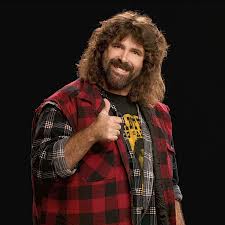
With his unkempt hair and gap-toothed smile, Mick Foley never really embodied the image of WWF Superstar.

Foley’s reputation for being a hardcore legend naturally sparked a great deal of curiosity on the part of wrestling fans who missed out.  A lot of these matches occurred in Japan or smaller promotions in the US which were never commercially released.  Fans were forced to purchase low-quality VHS bootlegs and trade them amongst each other.  As a result, Foley’s career has lent itself well to home video.  For All Mankind is his second major collection released by WWE following the more match-oriented Mick Foley’s Greatest Hits and Misses.  That collection contained a lot of the matches fans really wanted to see.  For All Mankind chooses to focus on Foley’s life and in many ways is like a visual complement to his written autobiographies.  There are matches included as well, but they’re secondary in this case.

I own The Greatest Hits and Misses set so I was more interested in the documentary this time around.  It runs around 2 hours and covers a lot of the same ground the books do but the visuals are a great benefit as some of the wrestlers Foley talks about have been almost forgotten.  It’s certainly familiar territory but the documentary livens things up with interviews from wrestlers past and present as well as some of Foley’s friends and family.  Surprisingly, we never hear from Foley’s wife which is too bad as I would have liked to have heard what was going through her mind every time her husband agreed to partake in some crazy barbed-wire death match or whatever.  Less surprising, but equally disappointing, is the absence of the Undertaker who was a big part of Foley’s WWE career.  The Undertaker is one of the few wrestlers left who basically refuses to break character so I didn’t expect to hear from him, but it didn’t stop me from holding out hope for it.

The documentary basically covers Foley’s entire profressional career, though it does refrain from acknowledging Foley’s run with TNA which is understandable.  There’s probably close to 45 minutes of outtakes on the Blu Ray release.  Most of these include funny stories from other wrestlers such as Triple H recalling a doomed attempt at a top-rope dive from Foley while other wrestlers rib him for his cheapness.  Foley himself comes across as a charming sort and it’s fun to hear him talk about all of the things he’s done.  He’s a natural story-teller that can draw in non-wrestling fans with little effort.
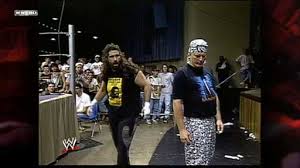
The set is light on matches, but does include a few bright spots including this barbed wire match with the Sandman.

The set is light on matches, but does include a few bright spots including this barbed wire match with the Sandman.

The other large portion of the release is dedicated to actual matches from throughout Foley’s career.  The set, like most WWE sets, seeks to avoid repeating matches that appeared on other sets which is good for the wrestling diehard that buys everything, but it prevents the WWE from ever putting out a definitive collection of matches for any one wrestler.  Foley is no exception as his best matches are on the previously mentioned Mick Foley’s Greatest Hits and Misses.  There are two repeat matches from the set; Foley’s debut match as Jack Foley and his infamous Hell in a Cell bout with the Undertaker from King of the Ring ’98.  The good thing about the HIAC match being repeated is that the WWE has now finally ceased censoring out the old WWF logo from its matches which helps enhance the viewing experience.  The previous release also was only available on DVD, but seeing these matches on Blu Ray does very little to enhance the experience as so many of them are taken from old masters.  A lot of the new matches added are from Foley’s early run with WCW including one against Sting.  There’s also a few choice ECW fights with the Sandman in a barbed wire match and a humorous bout with Shane Douglas during Foley’s final days with the promotion.  Unfortunately, a lot of the other matches are pretty forgetable but one match I was happy to see included was Foley’s original farewell match at No Way Out against Triple H.  It’s not the best match they ever had with each other, but I like having it for the sake of completion.

This set works best when viewed as a complement to Foley’s previous releases, including both print and DVD.  If you’re a Foley fan who hasn’t read his books for several years this should be a fun trip down memory lane for you.  Others looking for Foley’s craziest matches will be let down by what they find here.  It’s all about expectations.  I got a lot out of this release and if it’s something you’re interested in checking out definitely opt for the Blu Ray if possible as the extra content is worth the extra five bucks.  Foley’s documentary is good!


The Adventures of Super Mario Bros. 3

The Adventures of Super Mario Bros. 3 (1990)

The Adventures of Super Mario Bros. 3 (1990)

It seems to me that video game cartoons are much less popular today than they were when I was young.  Then again, I don’t have any kids so I’m not often watching children’s programming so I could be mistaken.  I’m sure Pokemon is still kicking around some network and Sonic may be running in syndication, but that’s all I can come up with off the top of my head.  When I was young there were several video game adaptations for the small screen.  Just going off the top of my head I can come up with Dragon Lair, Super Mario, Zelda, Captain N (not a strict adaptation of a game, but comprised almost entirely of characters from popular games), Sonic, Battletoads, Mega Man, Street Fighter, and Mortal Kombat.  I’m almost positive I’m forgetting some but that’s still a pretty solid sample for comparison.  Maybe it’s because so many popular games these days seem to be of the M and T rated variety that we don’t see many cartoon adaptations.  Or maybe it’s because companies like Nintendo are still shell-shocked from less than stellar cartoons based on their properties.  If that is the case, then we can lay a lot of the blame on The Adventures of Super Mario Bros. 3.

The Adventures of Super Mario Bros. 3 was, naturally, based on the video game Super Mario Bros. 3.  It was also the sequel of sorts to the more popular Super Maro Bros. Super Show which featured Mario cartoons that took place in a world based off of Super Mario Bros. 2 (the American version).  That show is mostly remembered for the live-action Mario and Luigi and the songs the welcomed viewers and saw them off (Do the Mario!).  The Super Mario Bros. 3 adaptation contained no live actors and no such songs.  The opening is simply a narrator talking over an animated sequence that sets up the series.  There’s no continuity from one episode to the next and each one runs a little over 10 minutes with 26 total episodes.  The retail release is three discs worth of content and I would be surprised if any of the discs is filled to near capacity.  Mario and Luigi had their voice actors recast to Walker Boone and Tony Rosato but the rest of the cast remains intact.  The animation style is also slightly different, most notably Mario is a little trimmer and the Koopa Troopa design from the previous show was scrapped.

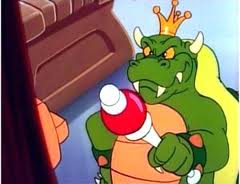
The Koopa Kids are probably the best thing going in this show.

The Koopa Kids are probably the best thing going in this show.

The biggest changes from the previous show to this one occurred with the villains and the location.  Location wise, this is a more faithful depiction of the Mushroom Kingdom from the game complete with numerous warp pipes and floating blocks.  For the villains, King Koopa is still the antagonist but now he’s accompanied by his seven Koopa Kids.  The Koopalings resemble their video game counterparts in design but all have different names.  Allegedly, this was due to the series being developed before Nintendo had provided the names.  The characters, for the most part, have pretty stupid and unimaginative names.  Morton Koopa Jr. is now just called Big Mouth, because he has a (you guessed it) big mouth.  There’s a Bully Koopa, Cheatsy, and Wendy is now Kootie Pie.  It’s not very important what their names are but I’ll give credit to the writers for mostly giving each of the seven a distinct personality (with the exception of the twins Hip and Hop, who are basically the same).  The ones that end up standing out include Cheatsy, who’s cunning seems to surpass his father’s as he is often able to manipulate him (usually with flattery).  Cookie is the evil genius of the kids and is definitely the most insane.  And Kootie Pie, being Koopa’s only daughter, is not surprisingly a spoiled brat and her father is a slave to her whims.

Apparently the eyes are fully-functioning on the frog suit.  Does that mean Mario can see out of them?  I must know!

Apparently the eyes are fully-functioning on the frog suit. Does that mean Mario can see out of them? I must know!

The Koopa Kids are perhaps the only bright spot of this program.  Well, that and the power-ups.  Super Mario Bros. 3 is famous for its numerous power-ups and they’re all represented here, for the most part.  For some reason I get a giddy thrill from seeing them used in the show from the common raccoon tail to the absurd frog suit.  Even Koopa gets in on the action in the series finale which is certainly noteworthy.  The rest of the show though is comprised of tired writing and simple plots.  Not much has changed from the previous show and the majority of the episodes follow the same formula of the Mario Bros. having to foil one of Koopa’s attempts at taking over the Mushroom Kingdom.  There’s usually a chase sequence or montage set to a parody of a licensed song which had to be removed from the DVD release.  There is one exception in the episode “Recycled Koopa” which contains a song called “Trash City USA” (2:05 mark in video link).  It sounds suspiciously like the Glenn Danzig song “Spook City USA” and I wonder if it was intended by someone as a parody of that.  Since the song is so obscure it wouldn’t surprise me if it snuck past the legal team (at the time the episode was produced, the song only existed as a B side to the single “Who Killed Marlyn?” which was not exactly a wide release).  There’s also the requisite episode where things get turned around and Mario and Luigi have to be saved by the Princess and Toad.  There’s also a celebrity appearance by Milli Vanilli in one episode, “Kootie Pie Rocks.”  This may be the most hilarious episode in hindsight.

Koopa is backed, armed with an assortment of magic wands this time around.

Koopa is backed, armed with an assortment of magic wands this time around.

This series also establishes the existence of the home world of the Mario brothers as The Real World.  This means several episodes take place on earth and in places like New York and Venice.  There’s even one episode where each koopaling takes over a continent.  This labeling of this world as The Real World bugs the crap out of me.  This show isn’t like Teenage Mutant Ninja Turtles with characters often breaking the fourth wall, instead that’s how the characters view this supposed real world.  What does that make the Mushroom Kingdom then?  The fake world?  I’m surprised the princess would stand for that!

Because of the short run-time, plots are often resolved quickly and haphazardly.  It’s clear the writers had little respect for children as the show is fairly thoughtless.  The animation isn’t anything to get excited over either.  For the most part, it’s fairly typical of its era but there are other shortcuts that bother me.  Most notably, whenever a character morphs into another form there’s no transition animation, it just happens, which is utter laziness.  Unfortunately, the transfers by Shout! Factory for the DVD release are atrocious.  Some episodes are okay while others drop out and look worse than what can be found on the internet.  Supposedly the master tapes for the series no longer exist, so I don’t know what the source was for the DVD, but clearly it sucked and no attempt was made for the episodes that are really bad.  The last two episodes on the set are especially bad and should have never been released in such a state.

I bought this set when I found it on sale and did so only for nostalgic purposes.  I liked the show enough when I was a kid but my memory of it wasn’t strong.  It didn’t last long as it was quickly replaced by a Super Mario World themed cartoon.  Even though the set was relatively cheap, it still wasn’t worth the purchase.  Don’t make the same mistake I did, just let this one pass, as your memories of the show are likely much better than the actual product.


The Legend of Zelda (The Animated Series)

Title screen from the Zelda cartoon (1989).

Title screen from the Zelda cartoon (1989).

Back in the 1980’s you could not get away from Nintendo.  The Nintendo Entertainment System was flying off store shelves and Super Mario was turned into a household name.  It only made sense that Mario and other Nintendo properties would have a lot of marketing power.  There were toys, pencils, lunch boxes, cereal, soda and so on.  It was Mario Mania!  Not surprisingly, Nintendo licensed the stomper of koopas for television and it wasn’t long before kids were sitting down in front of the tube to watch the Super Mario Bros. Super Show.  Hosted by former WWF personality Captain Lou Albano, as Mario, and Danny Wells (Luigi), the Super Mario Bros. Super Show began with two in a live-action setting before leading into a cartoon.  The live-action segments are probably the best remembered parts of the show because they’re quite absurd by any standard, especially for people who didn’t live through it.  The theme song was also pretty memorable, “The Plumber’s Rap,” and the ending theme “Do the Mario!” has enjoyed a second life on youtube.

The show only ran from September 1989 to December of the same year but since it aired every weekday afternoon it spawned 65 episodes worth of content.  It would be replaced with new Mario cartoons that didn’t feature the live-action segments and were based on later games in the Super Mario Bros. series.  They would be featured with another Nintendo cartoon, Captain N:  The Game Master, as part of the Nintendo Power Hour on Saturday mornings.  Before that though, Mario was on five times a week in live-action form, and four times in cartoon form.  The cartoon was mostly based on the American version of Super Mario Bros. 2 but with some differences.  The creators wisely left out the whole vegetable tossing angle in favor of fire flowers and the antagonist of the series was King Bowser Koopa instead of Wart.  It was basically an adventure type of show where Mario, Luigi, Toad, and the Princess Toadstool would travel to different parts of the Mushroom Kingdom while foiling the schemes of Koopa.  There would often be a musical number and many episodes were parodies of popular movies and stories.  It was a very gimmicky show, like a lot of cartoons from that era, and it’s one that really hasn’t aged that well.

Remember these guys?

Remember these guys?

Now the show aired five days a week, but the Super Mario Bros. cartoon only aired four days a week.  That’s because every Friday Mario took a day off and made room for another hero:  Link.  Link, of course, is the hero of the Legend of Zelda games who was also pretty popular at that time.  The Zelda cartoon was different in tone from the Mario one.  Yes, it was still geared towards kids but it shunned a lot of the tired chase sequences and movie parodies that were commonplace in the Mario cartoon.  The show revolves around Link, the hero of Hyrule, as he defends the castle and its coveted Triforce of Wisdom from the forces of the evil sorcerer Ganon.  The show is based off of the first Zelda game with some references made to its sequel as well.  Link is pretty clearly modeled after the character illustrations from those booklets and wields the same dinky little sword he has in Zelda II.  Ganon, on the other hand, looks to be more of a concept.  In both games, he’s pictured as a big green/blue pig who does have some magical powers.  In the show, he has more of a wizardly look with an ugly pig-like face.  He’s actually more menacing looking this way, but he’s not going to get in there and mix things up with Link.  He’d rather stand back and let his minions do the fighting, who are not surprisingly incompetent.  He’s in possession of the Triforce of Power (the show makes no mention of the Triforce of Courage) and has an endless supply of Moblins and Stalfos.

Other characters include a fairy named Spryte, who is likely modeled after the generic fairies from the Zelda games.  She is kind of the Tinker Bell to Link’s Pan in that she likes Link, but he only has eyes for the princess Zelda.  Zelda appears in each episode and is portrayed in a way that probably surprised viewers at the time.  Zelda shuns the traditional princess attire and instead sports trousers and tunic much like Link.  She’s not the typical damsel in distress and seems pretty capable of taking care of herself.  She does have a snotty side, and because she’s the target of many of Ganon’s schemes, she does often require saving from her “hero.”

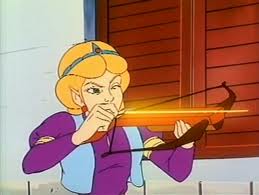
Zelda is not afraid to get her hands dirty.

Zelda is not afraid to get her hands dirty.

The portrayal of Link in this series is what many fans dislike about the show most.  Link, in the games, really had no personality.  Even in the modern games, he doesn’t have much of a personality so I don’t know what fans were expecting from the character, it just wasn’t this.  Link is a brash, cocky, and kind of lazy character.  He views his title of “hero” as a job and one that just gets in the way of his pursuit of Zelda.  Not an episode goes by where Link doesn’t beg the princess for a kiss, and because viewers need a reason to tune in, he never gets one.  He’s also been given a catch phrase, “Excuuuuuse me, princess!”  Some day I would like to watch the entire series and count how many times Link says that line (according to Wikipedia, it was 29 times).  The show only produced 13 15-minute Zelda cartoons, but I’m willing to bet that Link easily averaged more than two occurrences of that catch phrase an episode.  Sometimes the line makes sense, and sometimes it’s just shoe-horned into the script.  It even occurs during the opening credits.  Link may have said that stupid line more often than Michelangelo said “Cowabunga” on the TMNT cartoon, on a per episode basis.

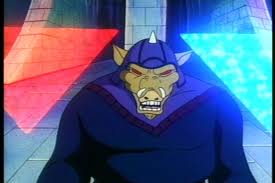
Ganon and the two things he covets most.

Ganon and the two things he covets most.

Anyways, that aside, the show is of a better quality than the Mario cartoons, though that isn’t saying much.  In general, each episode features Ganon executing a new plan to capture the Triforce.  Some of these are more clever and entertaining than others.  There’s one where Ganon goes Robin Hood and to sneak into a magic contest, there’s another where a Zelda clone infiltrates Hyrule, and there’s even a frog prince story-line where Link finds himself the victim of a magic spell (and if you’re wondering, no, Zelda doesn’t break the curse with a kiss).  That said, there isn’t anything in the writing to this show that’s going to impress.  It’s pretty standard fare for the period.  One thing I can appreciate though is the attempt of the writers to explain a few loose ends from the video game.  Namely, how can Link carry so much crap around with him?  Apparently, he has a magic pouch that causes items to shrink down to micro size to fit in.  Throughout the series he and Zelda will often pull out items from the games like the boomerang, bow, and bombs.  Other enemies make appearances too like the octoroks and just about every boss character from the original game.  If you’re watching it to spot items from the game, you’ll have some fun with the show.

Animation wise, the show is mostly crap.  It’s not awful to look at but this is a DiC produced show and DiC liked to put out lots of licensed cartoons on the cheap.  They would get a large amount of cartoons made in a short amount of time so that the shows could go direct to syndication and exist for a few years and bounce around several channels.  I think, on average, the animation here is better than what’s in the Mario cartoons but that’s not saying a whole lot.  The audio is okay though and the Zelda theme is used throughout, which doesn’t hurt it.  Link’s voice, when he’s not saying that regrettable line, is all right.  Ganon is voiced by Len Carlson who should be familiar to fans of 80’s and early 90’s cartoons as he got around.  He uses a shrill voice for Ganon that works for this portrayal of the character.  Zelda is voiced by Cynthia Preston and I always enjoyed her voice.  I don’t really know why but I was drawn to it as a kid.  Maybe because Link sexualized her and I wasn’t accustomed to seeing that in other kid shows of the time.

She's such a tease.

She’s such a tease.

The Legend of Zelda cartoon is not something that is remembered because it’s a wonderful companion piece to the video games, it’s remembered for nostalgic purposes only and is a kind of humorous reminder of how games were marketed back in the day.  A lot of fans prefer the Zelda themed episodes of Captain N to this show because Link was more of a hero type in that show than he is here.  That show really isn’t any better on the whole as it was just another marketing tool (and all of these old cartoons are basically shunned by Nintendo today) to move video games.  This isn’t a show that most adults can turn on and digest over an hour as it’s pretty damn bad.  It’s kind of funny to laugh at, and I can say I do enjoy it more than the Mario cartoons, but if I didn’t watch it as a kid there’s no way I’m making it thru more than one episode.  The complete series was released by Shout a few years ago and can probably be had on the cheap for those looking to experience it.  Those that have never seen it would probably be better off just watching some clips on the internet as opposed to spending real money on the series.


WWE ’13 – The Attitude Era

WWE '13 (2012)

WWE ’13 (2012)

Let it be known, nostalgia sells!  Too many of us overgrown children have disposable income to throw at DVD collections and old toys and publishers are well aware of this.  Just look no further than this year’s entry in the WWE video game catalog:  WWE ’13.  Now, there’s nothing nostalgic about the title but the focus of the game’s single player mode is the now much celebrated Attitude Era of the WWE.  I’ve spoken fondly of it in the past, but that’s definitely my favorite era for the then WWF, even surpassing Hulkamania for me in terms of pure enjoyment.  Vince McMahon’s promotion was arguably never more popular or culturally significant at any other point in time, including today.  It made a lot of sense to revisit it (even if it seems strange to almost ignore the current product by doing so) and without it I’m not certain I would have purchased the game.

This review is going to mostly focus on the Attitude Era mode, but before diving into it I will provide an overview of the rest of the game.  This is the second game since THQ/Yukes dropped the Smackdown vs Raw title and refined the gameplay.  I didn’t play last year’s game, but the differences from the last Smackdown vs Raw and this one are minor.  They brought back the limb targeting system and modified the chain grapple slightly.  The changes are mostly superficial, but not to the detriment of the gameplay.  The havok engine the game makes use of was overhauled to a point as well.  The ring now reacts better to what’s going on, as do objects in the field of play.  Though overall, the visual quality looks to have taken a slight step back.  The audio is kind of all over the place in terms of levels, and the new dynamic camera system is wretched (but thankfully something you can turn off).  The create modes are unchanged.  Some moves have been returned to the game and some have disappeared.  It’s pretty disappointing that the create-a-finisher mode is still as limited as it was when it first debuted several years ago now.  There’s also a create-an-arena that is new but not very exciting.  I haven’t checked out the create-a-scenario but I suspect it hasn’t been improved upon much, if at all.  WWE Universe mode is also back for the third year in a row.  Expect more of the same.

Fans get to relive some of the biggest feuds from the Attitude Era, including Hart vs Michaels.

Fans get to relive some of the biggest feuds from the Attitude Era, including Hart vs Michaels.

The gameplay is solid enough, and it’s probably one of the better grapplers put out by Yukes, but I’m only interested in the Attitude Era.  The Attitude Era mode basically replaces the single player storylines from past games.  It’s divided into multiple parts that put the focus on a different wrestler from the era.  The scenarios are:  DX, Stone Cold, The Brothers of Destruction, The Rock, Mankind, and Wrestlemania XV.  The first scenario starts off in the summer of 1997 and the scenario ends after Wrestlemania XV.  Once complete though, some bonus challenges open up featuring wrestlers such as Edge, The Godfather, and Lita.  I was rather impressed with how many old wrestlers were included in this mode considering some of them are no longer with the company.  Expect to take on the British Bulldog, the Road Warriors, and even Vader as you progress through the scenario.  During each match, the game will also assign special objectives that unlock additional content along the way.  Most of these objectives refer back to the real match and encourage you to recreate it as best as possible.  None stand out to me as being particularly challenging so expect to unlock them all with little trouble.

Since the Attitude Era has, until now really, been something only fans recognize it makes it difficult to get a consensus on when it started and ended.  Some think it started as far back as “Austin 3:16,” while others maintain it was the infamous Montreal Screwjob.  THQ decided to go with the formation of Degeneration X when Shawn Michaels and Triple H turned their backstage “Kliq” into an actual onscreen stable.  The game also constantly references the Monday Night Wars, the ratings battle between WWF’s Raw and WCW’s Nitro, as an ongoing storyline throughout the Attitude Era.  DX ends up being pretty well represented in the game, with the only notable exclusion being Chyna (probably due to her being an adult film actress now).  Even Mike Tyson is present for Wrestlemania XIV, which makes sense given that he was inducted into the WWE’s Hall of Fame earlier this year.

The roster includes expected stars such as The Rock, as well as some of the era's lesser stars like Ken Shamrock.

The roster includes expected stars such as The Rock, as well as some of the era’s lesser stars like Ken Shamrock.

The characters THQ chose to focus on for the era were logical.  They were certainly the most recognizable  from the era.  A lot of the big matches are covered including Michaels vs Hart at Survivor Series ’97, the inaugural Hell in a Cell match, the more famous Undertaker vs Mankind Hell in a Cell match, and the mode culminates in Austin vs Rock.  The only matches I missed that weren’t included was the Monday night match between Mick Foley and Terry Funk (who’s not included in the game unless you want to pay for him as Chainsaw Charlie) which took place in between the Austin vs Dude Love Pay-Per-View bouts; and the Austin vs Undertaker Buried Alive match at Rock Bottom ’98.  In the case of the second one, Yukes probably didn’t feel like coming up with a Buried Alive match again (they did at least bring back the I Quit match for the Rock vs Mankind feud) or the WWE felt like it wasn’t appropriate for their audience.  That last excuse seems unlikely as the game doesn’t shy away much from the content of the era.  There are some annoying inconsistencies though with the liberties taken by THQ.  For instance, Billy Gun is able to use his Bad Ass gimmick but Road Dogg can’t say the word “ass” as part of his intro.  The raunch is mostly absent though beyond a few utterances of the phrase “suck it.”  Austin’s middle finder is annoyingly censored, and the audio is as well whenever a character says “WWF” (it sounds like a lot of the audio was lifted directly from broadcast tapes excepting Jim Ross and Jerry Lawler’s commentary) which is distracting, but not as distracting as if they were saying WWE instead.

Current stars, like Triple H, are also depicted as their Attitude Era selves.

Current stars, like Triple H, are also depicted as their Attitude Era selves.

The game mode makes frequent references to WCW and its Nitro program but focuses solely on Raw.  It would have been cool to bounce back and forth considering WWE owns all of the WCW stuff at this point, plus a lot of WCW’s wrestlers from that era eventually ended up in WWE.  Perhaps THQ will one day give fans a WWE vs WCW game.  It’s also a little disappointing that the scenario ends before the end of the Attitude Era.  Like the start date, the end is hard to define but most everyone would agree that Wrestlemani XV is not the endpoint.  It’s more logical end would either be the start of the Invasion storyline, the introduction of the nWo into WWE programming, or Wrestlemania XIX where Stone Cold wrestled his final match.  Perhaps THQ is saving that for future downloadable content, a sequel, or maybe it was just too burdensome to pull off.  In order to accurately depict that era wrestlers such as the Dudley Boys, Hardys, and Kurt Angle would have to be included and all are currently with TNA Impact Wrestling.  TNA has in the past allowed its wrestlers to appear on WWE programs, usually limited to Hall of Fame related stuff, so maybe those guys could appear in a WWE game, but maybe at an unattractive price for THQ.

Regardless of the mode’s shortcomings, it was by and large a fun experience for me to take a trip down memory lane with some of my favorite characters from yesterday.  The mode got a lot right, and I appreciated the subtle details such as making all of Foley’s alter-egos their own selectable character, same for making the Hunter Hearst Helmsley character different from Triple H.  There is quite a bit of content in the scenario, though probably not enough to make purchasing the game solely for the Attitude Era mode a wise one.  I think I’ll get enough mileage out of the rest of the game to make it worthwhile, but I still have yet to fully dive into the other modes.  I’m glad to see the WWE and THQ recognizing that there’s a large market for the Attitude Era and hopefully this isn’t the last we see of it.


Teenage Mutant Ninja Turtles: The Complete Series

The Complete Series!

Ask most any guy my age what their favorite television show was when they were in elementary school and I be the most popular answer will be Teenage Mutant Ninja Turtles.  The heroes in a half shell were on weekday afternoons and then eventually Saturday morning from 1987 to 1996.  Their popularity was at its highest during the first three years or so but during their run they managed to rack up a total of 193 episodes.  The show was a merchandising behemoth, just look at a list for the action figures alone!  There were also clothes, toothbrushes, cereal bowls, pillows, and on and on.  You name it, and the Turtles were on it.  To a kid, they were a lot of fun and my days revolved around their television show, so when it was announced that the full series was getting released (housed in a replica Turtle Van, no less) I was all over it.

Packaging rear.

The DVDs have been receiving a steady release for awhile now, but they were always on the cheap.  Not cheap in terms of price, but light on episodes and content.  I have the first two volumes, but stopped there.  The show is pretty much as a I remembered.  It’s pretty silly and full of bad jokes but there are some worthwhile ones sprinkled in here and there.  I remember the characters broke the fourth well quite regularly, but what I didn’t remember was how often the show seems to poke fun at itself.  It’s probably something that disappoints those who want a show to take itself seriously, but come on, this is Teenage Mutant Ninja Turtles!  How could anyone take a show like that seriously?  Livening things up are numerous cameos (got to sell more action figures) on both the side of the Turtles and as antagonists.  I always liked the show’s take on Baxter Stockman, and the Rat King was also a personal favorite.

A look at the discs.

Those who have kept up with the show throughout the DVD releases are well aware of the fact that Lionsgate missed some episodes along the way, specifically “Planet of the Turtleoids and “Once Upon a Time Machine,” which have finally been released alongside season 10 as bonus features.  The complete series collection is just a collection of all of the previously released discs, so it does not correct the continuity issues, but does include everything.  This also means that if you’ve purchased every DVD along the way that this set probably isn’t for you, unless you really love the packaging.

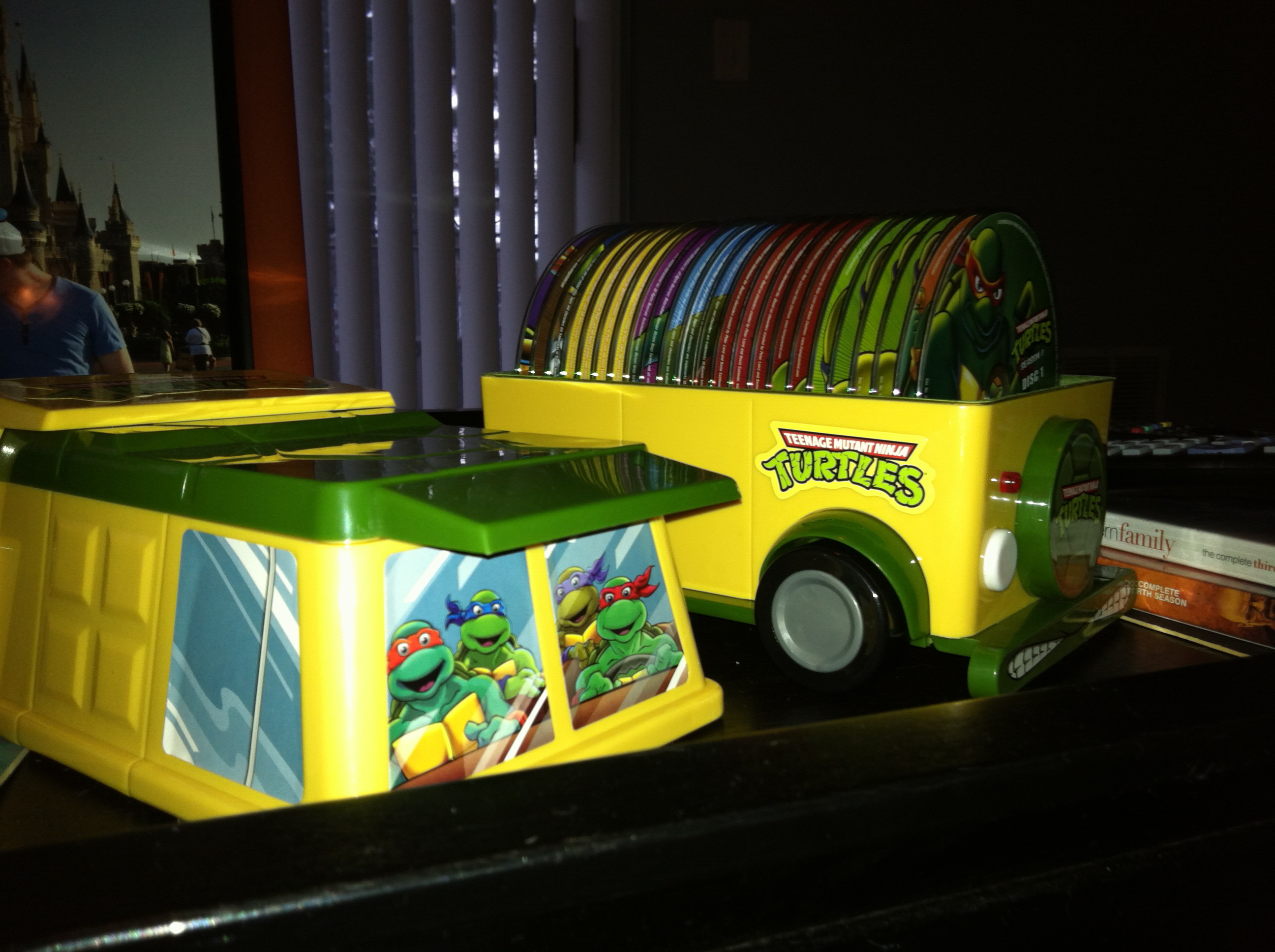
The packaging is definitely the selling point for this set.  The Turtle Van (or Party Wagon, as it was called on the packaging of the toy release) is a pretty solid likeness of the old toy.  It’s missing the bells and whistles like guns and so forth, but does feature rolling wheels.  The interior contains a green Styrofoam mold that the discs slide into.  It can be a bit tricky to get the discs lined up properly so I wonder how well it will take care of them, but it works.  There’s a booklet too with a full episode list by disc, but that’s it.  One pet peeve of mine is the sticker on the front of the van features the Turtles as if they’re riding in it, but the side window stickers don’t.

And lastly, an unboxed view of the complete van.

If you’re looking for a great show, this isn’t it.  This collection is strictly for the collector who can’t say “No” to things from his or her childhood.  For what it is, it’s a cool set and I fully intend on watching each disc.  I outgrew the Turtles before the show ended its original run so I’m kind of looking forward to watching more of the “Red Sky” episodes from the show’s final seasons that I missed out on.  If you’re a fan like me that has yet to get the DVDs then this is a worthwhile set for you.


Teenage Mutant Ninja Turtles – Nick Series Episode 1

You can’t keep a good turtle down.

When I was younger I don’t think I ever expected the shows and properties I was into at the time to still be popular when I was an adult.  I had a similar conversation with a cousin of mine who happens to be the father of a five-year-old boy.  We were talking about how it was kind of funny you could replace one of our childhood birthday or Christmas gift wish lists with one of his and not notice.  His list was full of Transformers, Spider-Man, Star Wars, and so on.  Some things are expected to stand the test of time, like Spider-Man and Star Wars, but intellectual properties like the Transformers and The Teenage Mutant Ninja Turtles?  Those were kind of unexpected.

The Teenage Mutant Ninja Turtles have sometimes struggled to stay relevant.  After the bubble burst on the 80’s and early 90’s hysteria they kind of went away.  There was a television show on Fox Kids called The Next Mutation that only last one season and that show was the first attempt at bringing them back.  It was live action and since the budget was so low compared to the popular films it wasn’t received too well by older fans and the younger kids who had missed out didn’t seem to care for it.  After that failure, TMNT co-creator Peter Laird kept the franchise on life support with hopes of bringing the boys into the world of CGI.  I was unable to find anything on the internet, but I recall seeing some rather ugly mock-ups for it on ninjaturtles.com (now owned by Nick) back around 2000 or so.

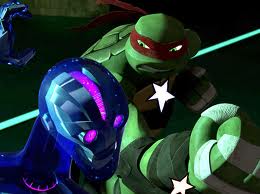
There’s lots of little 2D visual effects in the show like stars or anime styled throbbing veins and such.

The CG proposal was never picked up, but the Turtles did resurface in 2003 with a new traditionally animated show put out by Fox and 4 Kids Entertainment.  Much like the first film, the new show combined the origins of the comic Turtles with the cartoon series adored by millions to create something that was both respectful to the origins but kept the kids in mind.  I only watched the first season but remember it being a fairly entertaining show.  Certainly if I were a parent I wouldn’t mind sitting thru it with my kid.  It kept the tone some-what serious with comedic breaks to liven the mood, most involving Michelangelo.  From what I could gather from a distance, the show would eventually splinter off away from any of the older versions of the Turtles and establish its own sense of self.  There was even a series titled Flash Forward that took place in the future.  The success of the show, though never approaching the height of Turtle-Mania, probably helped get the 2007 film, TMNT, made.  That’s when the Turtles finally got their CG debut and the results were mixed.  Financially, it did all right but the plot was rather poor and the Turtles looked more like frogs than turtles.  It did have its moments, but no new films in the series (TMNT was a sequel to Teenage Mutant Ninja Turtles III) were planned and if a Turtles film is ever produced expect it to be a reboot.

Anyone who has kept up with the Turtles knows by now that a new film was in the works.  Titled Ninja Turtles, it was going to be a Michael Bay production and was likely to be a major reboot for the franchise with the Turtles actually being aliens or something.  Intense negative reactions on the internet and a reportedly terrible script got the project put on indefinite hold.  Alongside it, a new television show and comic book series have been in the works.  The various mediums are not related other than the source material, but it was likely hoped that all of this cross-promotion would really help invigorate the franchise.  The comic has been out for about a year now and is okay, from what I’ve heard, and the television show premiered this morning.

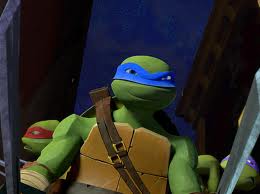
There’s a blockiness, as seen in Leo’s shoulder, to the design of the Turtles that I find off-putting.

Teenage Mutant Ninja Turtles (Nick Turtles?) is the CG series that never was from the past.  The Turtles have been given a modified look and the show is separate from other incarnation of the Turtles.  One of the larger changes resides in the April O’Neil character who is now a teenaged ally of the Turtles.  For the most part, it’s pretty standard.  We have four teenaged turtles living in the sewer with their sensei, Splinter, who once was a man named Hamato Yoshi.  The Shredder is back as the main villain, and so is Krang who hasn’t been heard from in a long time.  The tone of the show is definitely reminiscent of the old cartoon as this is aimed primarily at kids new to the property.  One actual throwback to the old show for older viewers is the use of voice actor Rob Paulsen who was the original voice of Raphael but will now be handling the Donatello duties.

Visually these turtles look a lot like the ones from the 2003 cartoon.  Each turtle retains his trademarked mask but features brown pads everywhere else.  Their skin tone varies slightly from turtle to turtle and some have freckles while Don even sports a gap in his teeth.  Each one has extra bandages for some reason, I guess to make them look edgier, and retains their standard weapons.  In comparison to the CG film, these turtles are less frog-like but since it’s television the quality is lower.  They’re kind of blocky looking and sometimes they get these weird flat “panels” on their skin that seems inconsistent from shot to shot.  It makes me think of the old 32 bit video games when developers were first getting their feet wet with 3D.  The overall design is fine, but does leave something to be desired.  Splinter has often been portrayed either gray or brown, but in this one he’s multi-colored.  He’s also much taller than the Turtles this time around, which is a departure for the character, and he’s less feeble looking.

The first episode, which was an hour long, serves as the introduction for the Turtles.  Right from the start we’re shown who the dominant turtle is (Raph) and also given a glimpse of their individual personalities.  Nothing surprising here, though each turtle is a little sillier than how they’re usually portrayed, including Mike who’s not only the party dude but also a moron.  Their origin is relayed and it’s fairly close to the one from the old animated series only this time it was Hamato Yoshi carrying the bowl full of turtles and he got into a scuffle with the holders of the ooze, or mutagen, that would come into contact with our protagonists.  The flashback, and others in this episode, are told via hand drawn stills with minimal animation which was kind of a fun break from the CG.  Later in the episode we’re told that Yoshi had a wife and daughter and lost both to the Shredder.  He confirms his wife is dead but uses the word “lost” when speaking of his daughter so expect her to surface at some point (perhaps as Kiara?).

Expect to see more of this guy in future episodes.

The animation is better than I expected.  The Turtles and other inhabitants of the world move well enough and it’s on par with the best CG one can find on television.  There is a bit of a disconnect between the Turtles and their environment that may or may not be apparent to all viewers.  Most of the backgrounds are fairly dark as well to probably make it easier on the artists.  Sometimes this leads to backgrounds that are mostly black which doesn’t look good on TV.  The music is mostly a collection of electronic instruments, the only notable moment for me was the chase sequence about halfway thru.  The new theme song is basically a hip hop remake of the original television theme.  The less said the better.

The tone of the show reminds me more of the ’07 film than the animated series.  It’s light on one-liners but definitely aims to keep things upbeat.  When the fighting starts the Turtles do get serious, to a point, and a visual cue kicks in where their eyes become completely white.  It’s kind of interesting, but also kind of odd.  They’ll still pause during battle though at inappropriate times to make a humorous observation.  At first the Turtles appear to subsist on traditional turtle food, but early on in the episode are introduced to pizza and are hooked instantly.  They’re shown to have a television (and Leonardo appears to model himself after a Captain Kirk like TV character) but appear mostly ignorant to the outside world.  Either they don’t watch much TV or they just don’t pay attention.

The show itself introduces us to the Utroms of this universe.  When I said Krang was coming back I may have spoke too soon as the Utroms are now called Krangs.  They operate in the same way but are depicted as villains.  They kidnap April and her scientist father, which is how the Turtles meet her.  Donatello is instantly smitten with her, so we’ll have to see where that goes, but the Krangs are the primary antagonist for this hour of the show.  Shredder is only shown in a cameo, but we can see he’s still the leader of the Foot (unless they choose to rename it) and it appears his head and face has been severely burnt (probably as a result of his last encounter with Yoshi).

This is definitely a kid’s show and older viewers should not expect this program to elevate itself beyond that.  I kind of wish I had watched it with a kid to see how they would have reacted to the jokes and visual gags, most of which are standard kids show clichés.  For me, none of it was very funny but the plot surprised me in that it kept me interested for an hour.  I expected worse, but it seems like the Turtles have a legitimate chance to recapture the hearts of kids once again.  I’ll probably tune in to a couple more of the episodes just to see what other characters from the past return but it’s not something I plan on sticking with.

Post script:  I would categorize my early impressions of this show as tempered enthusiasm.  I expected it would succeed at hitting its target audience but probably not those who grew up with the original cartoon series.  I may have been wrong.  I watched the first few episodes out of sheer curiosity, but now find myself watching them out of sheer enjoyment.  The show is a lot wittier than I could have ever expected.  Some of the Mikey humor is still a little much for adult tastes, but a lot of it is pretty clever and dialogue driven.  The action pieces have also exceeded expectations.  And the many nods to the old series (such as the ringtone on each turtle’s cell phone) is much appreciated.  A lot of my early criticisms about the show’s visuals still remain and it’s become obvious the show doesn’t have the budget to create a thriving New York (seriously, there’s almost no traffic in the city when the turtles are out and about) but that should be expected given this is television and not a feature film.  In short, this show is genuinely enjoyable and I have yet to view an episode that I did not enjoy on some level.  That may not always be the case, but so far so good.

Teenage Mutant Ninja Turtles airs at 11 AM Saturdays on Nick.


TMNT Classic Collection

Teenage Mutant Ninja Turtles Classics are here!

I’ve been out of the toy collecting game for several years now.  I used to enjoy it as a hobby and it was a nice way to link my childhood to my adult life as I pursued action figures of characters I loved as a kid.  It became a compulsion eventually.  I started off just buying the characters I was particularly fond of like Venom and Iceman, but once it became a full-fledged hobby I was suddenly finding myself scouring department store toy aisles six at a time looking for an obscure Man-Thing or Warbird.  That’s when it became about the hunt.  Tracking down the exclusive Wal-Mart wave of Marvel Legends was especially thrilling.  It seems silly in hindsight, but it was kind of addicting.  Eventually though the quality of the figures declined and I also ran out of room for all of these toys.

I got a little taste of that rush today when I tracked down a set of Teenage Mutant Ninja Turtles Classics.  It was a pretty easy hunt as I found a full set at the first place I went to, but I can’t deny it was a lot of fun.  The wondering, the hoping they’d be there.  I credit my interest in the line to my love for the TMNT as a kid and the new collections put out by IDW Publishing of the old books.  I’m currently onto volume 3, expect a review once I finish it.

The reverse side of the packaging.

I’ve talked about it many times, so I won’t go into too much detail here, but I did love the TMNT as a kid and they still hold a soft spot in my heart.  One of my last toy-related purchases before today was for a set of the turtles puts out by NECA.  I dubbed them my all time favorite as they’re a wonderful representation of the turtles as they appeared in the pages of Mirage Studios brand comic books back in the 80’s.  These collections, plus a new line of comics launched by TMNT co-creator Kevin Eastman, have helped to contribute to a renaissance for the turtles that will soon culminate in a new television show aimed at kids on the Nickelodeon network.  To capitalize on this, and the original cartoon’s coming 25th anniversary, Playmates has launched a new line of toys aimed at those who fell in love with the turtles through the toys and cartoon back in 1988.

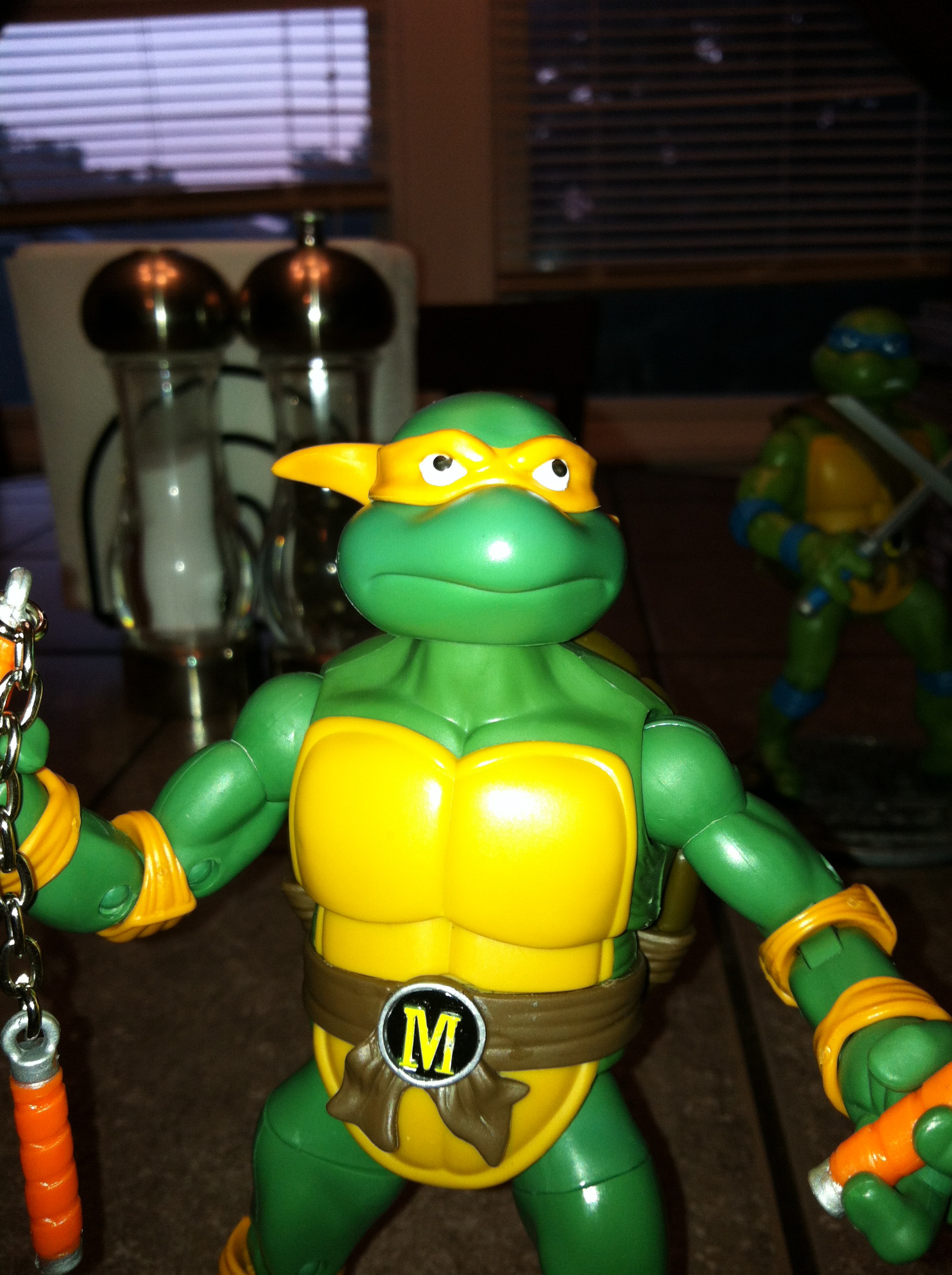
This new line, appropriately titled TMNT Classics, was first shown last February at the New York Toy Fair and has recently hit shelves in speciality shops and big box stores like Toys R’ Us.  The packaging on these new turtles states that they’re based on the look of the turtles from the old cartoon, but it would be more appropriate to say they’re combination of that look along with the style of the old toys.  Back in the 80’s, kid’s shows were basically extended commercials for toy lines and the turtles were no exception.  The toys were developed alongside the show and since Playmates only had concept art to go off of they ended up having their own look.  Each turtles had his own unique skin-tone and all sported solid, white eyes.  It was basically a hybrid of the comic look and the one the cartoon would go with.  These new toys sport the rounded features of the cartoon along with pupils in their eyes but retain their unique skin-tones, though they’ve been changed some.  Raphael has a darker green complexion while Don isn’t as brown as he used to be.  Donatello and Leonardo also retain their shoulder straps and each turtle, excepting Donatello, has wraps around the handles of their respective weapons featuring their trademark color (Raph’s sais are red, Leo’s katana handles are blue, etc).  It’s an interesting approach though I do kind of find myself wishing that Playmates just went all out in trying to make these turtles television accurate.  We already have comic accurate turtles, and the 2003 toy line paid homage to the original toy line, but we’ve never had cartoon accurate turtles.  Yes there was a wave of Toon Turtles in the 90’s but they were pretty crappy looking.

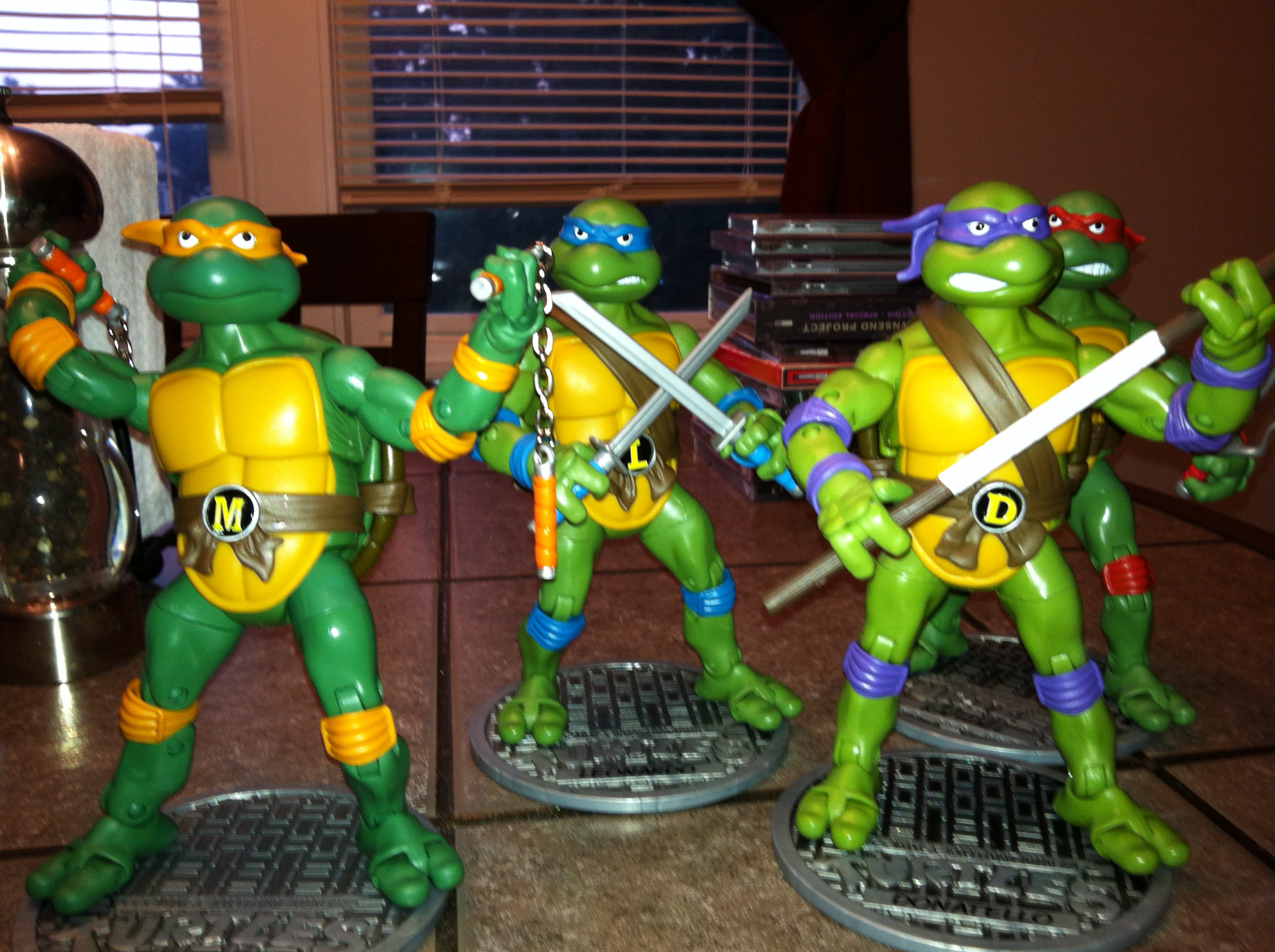
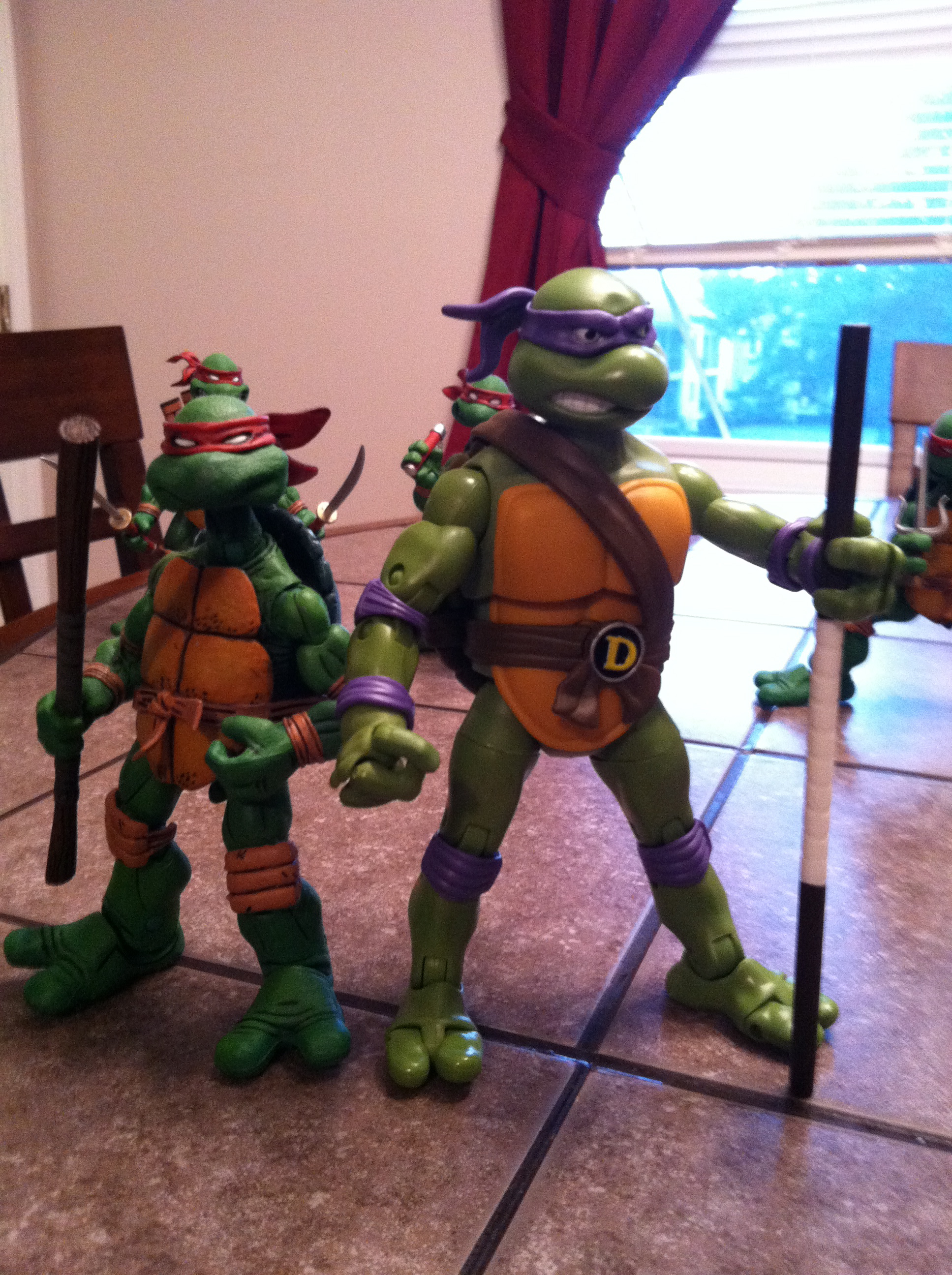
Group shot! Notice how some of the pupils are oddly placed.

Even though they’re not entirely cartoon accurate, these turtles are pretty nice to look at.  They’re loaded with articulation but their features are more reminiscent of the TMNT movie line of figures than the NECA one.  NECA went through the trouble of trying to hide the articulation but Playmates didn’t see need to, so while a lot of poses are possible, the numerous holes and joints do detract from the look of the figures.  And if the joints aren’t tight, it really hinders the amount of poses one can achieve.  My Raph has pretty loose leg joints which makes standing him a chore.  The hands on all of them are particularly combative as each features articulated fingers and thumb.  The finger piece on the left hand of my Leo figure even fell off in the packaging.  They can never get a good, solid grip on their weapons and the hands on all four definitely feel fragile.  There’s also an abdominal joint in each turtle that’s kind of odd.  The show’s animators definitely did take liberties in how the turtles could bend and move in those shells but I’m not sure the abdominal joint adds much.  Playmates at least had the foresight to only insert the joint in the front and not the rear of the shell, which would have looked horrible.

I’m pretty disappointed with Mike’s face sculpt. It just doesn’t suit the character.

Scultp wise, all four turtles are the same with the exception of a unique head sculpt.  The head sculpts are a call back to the original toy line as each turtle features the same or similar expression he had back in 1988.  This means they all look angry and I kind of wish they had gone with less intense expressions.  Leonardo should probably be grim and serious, but Raph and Mike definitely shouldn’t be.  The figures are tall, around six inches, so they don’t fit in with any other TMNT toy line.  They’re not too stocky looking either, and their proportions do remind me a bit of the movie line for the TMNT film.  They have kind of odd looking forearms and really long arms in relation to their legs.  Overall though, the sculpt is pretty solid for each turtle and they look good side by side though I really do wish Mike had a better face sculpt.

As far as accessories go, these are pretty bare-boned.  While the original toy line came with a bunch of ninja stars and other oddities, these turtles only come with their trademark weapons and Don only comes with one bo staff.  Each turtle also comes with a personalized manhole cover stand and their belts can hold their weapons easily.  Some toon specific items would have been fun like a mouser or turtle-com, but oh well.  The quality of the weapons is pretty standard, though Playmates did go above and beyond with Mike and gave him actual chains on his nunchaku which is a nice addition.  I never want to see another Mike action figure that doesn’t feature this.

NECA Don with TMNT Classics Don.

The paint job for each turtle is solid, though not very demanding.  Playmates opted for colored plastic for most of the parts with the paint only really coming into play with the bandanas, eyes, and teeth.  In the case of the eyes, it leaves something to be desired.  The rounded shape of each turtle’s head makes it difficult to paint on pupils that appear to be focusing on the same spot.  As a result, both my Don and Mike almost look like they have a lazy eye.  This has convinced some collectors to just paint over the pupils on their figures and go with the classic all white look.  From what I’ve seen, this actually looks pretty good but does take away from the cartoon look.  I’m not one to modify my toys anyways.

So did Playmates deliver with their classic TMNT line?  Mostly.  These are the most cartoon accurate turtles to date and they feature a lot of articulation which will allow fans to pose them in almost any position they can dream up, provided the joints are tight enough.  Even though they are the most cartoon accurate figures of the turtles to date, they’re still not the definitive take on the source material and the copious amounts of articulation does take away from the look a bit.  They’re also light on accessories which is hard to take considering these are the most expensive turtle figures I’ve ever bought.  I paid 20 bucks a turtle at a specialty shop, though the MSRP is said to be $18.  That’s still a lot of money for an action figure that’s pretty basic but hardcore fans will probably pay it.  I’ll have a hard time finding display space for these guys, but the nostalgic factor alone makes me mostly happy with my purchase.  They don’t top what NECA did with the turtles a few years ago, but they’re pretty damn good in their own right.  If you’re the sort of fan that’s really in love with the TMNT, then these figures are for you.


Dragon Ball – Season Two

Dragon Ball – Season Two

Last Summer I acquired the entire series of Dragon Ball on DVD when amazon.com was having a big sale on anime.  I had seen some of the series, but not all of it, and what I had seen was edited for television.  I had always wanted to revisit the series as the little of it I saw was charming, but just never got around to it.  That sale presented the perfect opportunity and by summer’s end I had seen every episode.  In December of last year, I made my first entry on the subject and promised to review the entire series on a season by season basis.  My initial idea was to post one review a month, but as is plainly obvious considering it is now past Memorial Day, that didn’t happen.  Better late than never!

Season one ended with Goku striking out on his own to find his grandpa’s four-star dragon ball.  By taking Goku and sending him off on another adventure, it brings the series back to how it started, only this time Goku is flying solo.  Let’s get it out of the way up front:  season one of Dragon Ball is the best season.  Everything is new and fresh from Goku’s indomitable will to Master Roshi’s inappropriate advances towards the show’s female characters.  That’s not to say the rest of the series is lackluster, not at all, but some of the shine does ware off.  Akira Toriyama must subscribe to the theory that you should stick with what got you there.  He’ll re-use a lot of the same gags and gimmicks, and while Roshi’s perverted nature is usually pretty funny, the more dramatic elements become tiresome (such as when a villain disappears in a cloud of smoke and the heroes foolishly think it’s dead, oh yeah, that one will be used a lot).

While Toriyama is comfortable sticking with what he knows, changing the show’s focus to just Goku is a pretty bold move.  He has essentially removed the entire supporting cast from season one (I should point out, the “seasons” are pretty much arbitrarily broken out by Funimation for the localization process and DVD releases and aren’t true seasons in the literal sense) and is relying on Goku to carry the show.  That doesn’t mean Goku is going to go it alone entirely.  Along his travels he’ll meet several new friends and many new foes.  Some exist to better serve the plot, and some for comic relief, but there are some pretty good characters introduced in season two that will make a lasting impression on the series and our hero.

General Blue; he’s basically a massive douche.

The major conflict of season two revolves around Goku V.S. the Red Ribbon Army.  The Red Ribbon Army (RRA) was introduced at the tail end of season one and is an organization after the dragon balls(what else?).  Emperor Pilaf was the main villain in the first part of season one and he too was after the dragon balls, but at no point does the audience consider him a threat.  He’s a bumbling sort of villain used mostly for comedic relief.  Even Goku has trouble remembering who he is and clearly doesn’t take him seriously.  The Red Ribbon Army, on the other hand, is well equipped to give our hero fits and is considerably more dangerous than Pilaf.  Early on, that won’t be quite as clear as they feel out Goku and learn (slowly) that conventional means will have little to no effect on him.

While some of their membership is quite nefarious, others are here to make us laugh.  When Goku’s travels lead him to a remote mountain village he agrees to help free their chief, who has been captured by the RRA.  This brings him to Muscle Tower, where he has to work his way from the bottom to the top in true video game fashion.  Along the way he encounters various foes, including the imbecile Ninja Murasaki.  Initially Murasaki seems like a foe worthy to take on Goku, but over the course of several episodes we realize that isn’t the case.  Their encounter is best described as slapstick and there’s some nice visual gags (particularly when Murasaki has a painful encounter with Goku’s power pole).

Along the way Goku encounters his first android.  Dragon Ball Z fans know the androids as homicidal robots created by Dr. Gero with the sole purpose to kill Goku, but Goku’s first android encounters go much different.  One is the Arnold Schwarzenegger inspired Major Metallitron.  He’s pretty much a rampaging killing maching, but Android 8 ends up being a gentle giant.  The Frankenstein-inspired 8 is quickly dubbed Eighter by Goku and they become fast friends.

Muscle Tower ends up being little trouble for our hero (hope that isn’t spoiling anything), but when Goku doesn’t find his beloved 4-star dragon ball, he seeks out Bulma once more.  This brings the old gang together for The General Blue Saga.  This saga further brings along the RRA and introduces the pirate robot too.  The heroes (Goku, Krillen, and Bulma) go on a wild run thru the maze-like undersea base of the RRA and there’s a lot of action and a healthy dose of comedy.  The saga runs perhaps a touch too long but it’s good to have Bulma and Krillen back in the fold for a few episodes.  As the name of the saga implies, General Blue is the main adversary here and he has enough tricks that he can put up a fight against Goku, something few have managed up to this point.  His “threat” is kind of short-lived and he soon ends up as another slapstick villain, especially when he and Goku end up in Penguin Village where things get a bit weird.

Mercenary Tao ends up being Goku’s most formidable opponent yet.

The last part of the season has Goku off on his own once more.  The RRA send the famed Mercenary Tao after him this time, who actually proves to be a very capable opponent for the young hero.  Here, Toriyama will employ an effective tool for the first time to get the viewer emotionally invested in the conflict:  death.  Tao is a cold-blooded killer with no redeeming qualities, and Goku figures this out pretty quickly.  He’s a true threat, and the season ends with Goku setting off on a strange quest of sorts to gather enough strength to make sure he can stop Tao for good.

Season two contains a lot of the charms that made season one so enjoyable.  Goku is off on his own for a large portion of it, but he’s never truly alone as other allies fill the void.  Few of these allies are as entertaining as Bulma or Master Roshi, but it’s nice to change things up.  Of the new characters, I find Blue, Tao, and Korin the most interesting though Korin only appears in the season’s finale.  Season three is probably a little better as Goku’s conflict with the Red Ribbon Army gets ratcheted up a notch and the next round of the World’s Martial Arts tournament begins again.  Season two establishes Dragon Ball as a fun and pretty consistent television show.  Don’t watch it for depth, just watch it for the sheer enjoyment of it.


The Simpsons – Season One

The list of television shows that were on the air when I was a kid and are still on the air as I near 30 is a pretty short one.  Not including non-fiction news stories, there’s really only one that was there when I was a kid and is still airing new episodes today, and that show is The Simpsons.  There are many characters that had shows when I was younger that have shows today.  There’s always a new take on Batman or Spider-Man and I lost count when it comes to the different iterations of the Teenage Mutant Ninja Turtles (there’s a new one set to air this fall).  South Park came around when I was in my early teens, and Futurama began airing when I was in high school.  The Simpsons though, that came when I was in the first grade and it’s quite amazing that it’s still on television today.
That said, there are some that would argue the show should not still be one and that it should have ended years ago.  From a business standpoint, if people are still consuming the product and it’s making money then why not keep producing episodes?  And apparently there’s a dedicated core of fans out there that will probably watch it until they can’t.  What will ultimately end that show will be rising costs, or if enough key members of the cast decide to retire.  And even though there’s a loud contingent of people on the internet decrying the quality of the show, there’s still plenty who insist it’s as funny and fresh as ever.

As for me, I guess I’m in the middle when it comes to that debate regarding the current quality of The Simpsons, but I lean towards the side that says the show is well past its prime.  I really don’t watch it anymore and haven’t for years.  When I do catch an episode I’m usually left underwhelmed.  Rarely do I hate it, but I forget about them pretty fast.  The only one I’ll go out of my way to watch is the annual “Treehouse of Horror,” and that’s mostly just out of tradition.

Recently The Simpsons has been on my mind.  I’m not sure why.  As I see other animated programs start to lose “it” and diminish in quality, it makes me wonder how much of that stems from me, the viewer, getting bored with the same old thing or if the show is actually getting worse.  To answer this question I decided to buy the first season of The Simpsons and relive some of those cartoons that I used to watch religiously.  The Simpsons was on weekly initially, but soon had enough episodes to enter into syndication.  When I was probably around 11 or 12 I would watch an hour of The Simpsons every weeknight I was home via syndication.  I got a lot of enjoyment out of it and it was my routine, so I have a lot of fond memories when it comes to those early seasons of The Simpsons.  The die hard fans insist the show started off a bit uneven, and outside of a few special moments in the first two seasons, it really didn’t take off until season three.  I’m not sure when this golden age is said to have concluded, but I suppose it doesn’t matter.

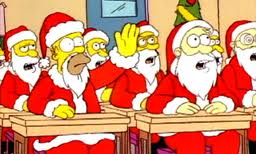
One of the more memorable scenes from the debut episode; Homer in Santa Class.

The first season of The Simpsons is the shortest season the show had.  This is pretty common of first seasons, especially animation, as networks don’t want to order too many episodes only to see the show fail.  Half seasons are pretty typical, and the first season of The Simpsons contains thirteen episodes beginning with  the Christmas themed “Simpsons Roasting on an Open Fire” and concluding with “Some Enchanted Evening.”  Not only is the first season the shortest, it’s also the most crudely drawn.  Again, not surprising as I’m sure the budget was pretty tight, but it at least looks a lot better than the shorts that used to air on the Tracey Ullman Show.  The characters are actually less defined in their roles, though the base is still there.  Homer is dim-witted and selfish, Bart is a troublemaker, Lisa a poindexter, and Marge is a stereotypical house wife.  Maggie is there too, but being that she’s a baby there isn’t much of a personality to her.  A lot of the secondary characters are introduced as well including Moe, Flanders, and Mr. Burns.  Still, there are differences and some moments where characters act in a manner that is perhaps inconsistent with how they’ll be presented in future seasons.  Some fans consider this a negative, but I kind of appreciate these moments.  Just like a real person would do, these characters have grown and changed over time.

What I hoped to see in season one was a more focused show, less reliant on Homer’s buffoonery and more reliant on the concept of the Simpsons being America’s most dysfunctional family.  For the most part, that ended up being true.  Homer wasn’t the dominant presense that he would become and while he’s definitely not a smart man, he’s not absurdly stupid either.  There’s definitely a lot of Bart though, and there would be a lot more in season two as he was the early star of the show.  I almost forgot how huge Bart Simpson was when I was a kid and he was definitely pushed as the fan favorite.  And it’s easy to see, he’s a fun character.  He’s rebellious and does whatever he wants but does pause to let us know he’s a good kid at heart.  In his first lead episode, “Bart the Genius,” he’s actually the target and the one we feel bad for and he reacts by pulling a prank that gets overblown (and earns Bart some green skin in the process).

The animation was a bit more crude in the early going.

The series premiere, “Simpsons Roasting on an Open Fire,” introduces the whole family and some of the extended family (Grampa and Marge’s sisters).  We see how the family dynamic works and the themes established by the episode are still alive today.  Homer tries hard to be a good father and husband, but his low level of skills and lack of a sharp mind ultimately doom him.  And yet, they still all come out okay in the end.  From there, the writers of the show definitely wanted us to get a good look at each member of the Simpson family in season one and would devote an episode to each key member of the family.  It’s a good strategy and the writers were able to pull it off organicly.  In later seasons, it sometimes would feel like a Marge or Lisa episode was forced into the season just for the sake of having one which always drove me nuts.  Those episodes often fail because they don’t bring anything new to the table, and usually include some silly gimmick (like Marge becoming a cop).  In Lisa’s episode, “Moaning Lisa,” we’re shown just how different she is from both her peers and her family.  It’s done well enough that we really don’t need future episodes that center on that premise, but there’s dozens.

That’s not to say it’s all gravy.  Some of the episodes go for cheap laughs and the story attached isn’t very engaging.  “The Call of The Simpsons” is one such episode that relies mostly on visual gags and absurd situations.  Other episodes just don’t appeal to me too much, like “The Crepes of Wrath” which sees Bart switch places with an Albanian kid as part of a foreign exchange program.  The writers also seem to enjoy getting Homer into trouble with Marge, as it feels like their marriage is tested in every other episode.  Homer routinely does things that should probably get him in trouble, but I always felt Marge’s reaction to Homer dancing with a stripper in “Homer’s Night Out” was particularly over the top.

“The Telltale Head” features perhaps Bart’s most infamous prank.

Some of my all-time favorite episodes are in season one though, including “The Telltale Head” and “Krusty Gets Busted.”  The first is the infamous episode where Bart cuts off the head of a statue of the town’s founder, triggering a wave of patriotic anger from the locals.  It uses the story-telling gimmick of starting the episode at the end and having the events that lead the characters into their current situation relayed as a flashback.  “Krusty Gets Busted” is the first time we’re introduced to Sideshow Bob as a villain. Voiced by Kelsey Grammer, Sideshow Bob would make many returns often with the intent to kill Bart Simpson.  Grammer is one of the few guest stars of season one, which I find immensely refreshing.  So many of the newer episodes have fallen into this trap where the writers feel like each episode needs a celebrity guest of some sort.  They also don’t follow the simple format adopted by later episodes where the plot opens with one story that leads into a completely different one.

There’s some other differences and quirks I noticed about season one that separates it from future seasons.  For one, the intro is different and I had forgotten just how different.  It’s longer and features some generic characters that would be replaced for season 2 with actual supporting characters from the show.  The couch gag is in place, but there were only a couple different ones in season one, most revolving around the theme of one character getting forced off the couch.  The premiere episode actually doesn’t feature an opening at all.  There’s some other character changes too.  Smithers makes his debut in “Homer’s Odyssey” (as does Mr. Burns, voiced by a different actor) as a black man, which is kind of funny.  Apparently this was an error and is corrected for his next appearance.  Chief Wiggum also looks pretty different as he sports black hair and an odd skin complexion of his own.  In general, there’s also less use of music in each episode as well, and the transition from one scene to the next is usually sudden which gives the show a different “feel” when compared with future seasons.

Currently, The Simpsons is nearing the end of its 23rd season with a 24th already in production.  Obviously, any show that has been on that long is going to change over the years and The Simpsons has certainly undergone numerous changes.  I don’t know if season one is necessarily better than season 23.  I definitely enjoyed reliving it, and I’m currently enjoying reliving season two as well, and my opinion is tainted by nostalgia.  It’s a simpler show and I do find that more enjoyable than the current stuff.  The characters seem slightly less typecast and are a little more exciting as a result.  And whatever your opinion is of the current season, I think we can all agree it’s pretty damn amazing for a show, especially a prime-time animated one, to be on the air as long as The Simpsons have been.


Catching Up With WWF: No Mercy

WWF: No Mercy (2000)

It’s been awhile since my last post, 3 weeks to be exact.  It’s been a busy time and for me, and a busy time of year.  There were concerts to attend, personal relationships to pursue, Game of Thrones to catch up on, and WrestleMania!  Yes, even though I do not really consider myself an active wrestling fan I do get caught up once a year for WrestleMania as that’s traditionally when the company is at its best.  It also helps that the NFL season is over and there’s usually a lull in television programming all around (though this year, video games have been kicking my ass).  This year’s WrestleMania, like most of them, failed to live up to expectations.  I think I’m in the minority when I say that, but I really didn’t enjoy it.  I thought CM Punk and Chris Jericho put on a good show, and it’s always a nostalgic trip to see The Rock in action, but the rest of the card under-performed.  It certainly didn’t help things when one of the better matches, featuring perhaps the company’s best worker in Daniel Bryan, lasted a mere 10 seconds or so to kick off the show.  It’s one thing when an unscripted boxing match or shoot fight lasts seconds, but for a booked match like that (featuring one of the company’s major championships) to last only seconds is just cheap.  Especially when several less interesting matches receive more time, or when the show stops for terrible hip hop concerts.  Blah!

This isn’t about WrestleMania though, it’s about a little game called WWF:  No Mercy.  WrestleMania, for me, means a gathering of friends and a wrestling theme gathering pretty much requires a working Nintendo 64 and some wrestling action.  This year’s event featured WCW/nWo:  Revenge, No Mercy, and Virtual Pro-Wrestling 2.  For fans of wrestling games, the connection is obvious.  All three were developed by AKI Corporation who have become synonymous with wrestling games.  American audiences were first introduced to them in 1997 when WCW vs. nWo:  World Tour was released for the Nintendo 64 and was a major success.  The game laid the groundwork for the company’s many future games.

World Tour was fairly straight-forward in its game modes.  It was basically just one on one, two on two, or battle royal which put four wrestlers in the ring at the same time.  There were no over-the-top entrances and the single player mode just put the player up against a series of opponents culminating in a title match.  The roster was huge and included all of the main wrestlers from WCW at the time and even a bunch of wrestlers from Japan.  All of the wrestlers controlled the same, which is good because that’s what won fans over.

Stay away from this game. Far away.

AKI’s approach to gameplay for this title revolved around the grapple button.  The B button made wrestlers throw punches and kicks, but the A button caused them to tie-up by grabbing each other’s shoulders.  From there, the player who initiated the grapple could initiate a move with either the A or B button plus a direction on the D-Pad for a total of 10 possible moves.  Holding the grapple button caused the wrestler to use a strong grapple, opening up another 10 potential moves.  Most wrestlers had several repeat moves but the potential to really flesh out an arsenal was there.  And more over, the gameplay system worked.  Up to this point, most wrestling games tried too hard to emulate the ever popular fighting genre of video games.  This would peak with the WWF game In Your House for the Playstation, which was basically a straight-up fighting game complete with fireballs and everything.  It was absolutely atrocious and not at all what wrestling fans wanted.  Acclaim was the developer with the WWF license and essentially owned the wrestling video game world in America.  World Tour changed that, and for the better.

World Tour was followed by Revenge which was basically more of the same but with a little more of that American wrestling flair.  The graphics were better, the individual wrestlers had a bit more personality, and wrestling fans were genuinely happy.  Acclaim tried to counter with WWF: Warzone and its successor WWF:  Attitude.  Both games were successful for the time and generally well received, but just about any unbiased fan of wrestling knew AKI (with THQ) had the better game.  Acclaim was still going with a pseudo-fighting game approach.  Each move required a series of directional buttons followed by an action button.  They did introduce some good things, particularly running grapple attacks, signature moves, and the create-a-wrestler feature (though that had been available in Japanese games dating back to the Super Nintendo, as did others, but Acclaim popularized them with American audiences and AKI would soon adopt all).  Even so, WWF’s marketing arm must have noticed how well received the WCW games were and when their contract with Acclaim was up, and WCW’s with THQ, WWF was there to pounce.

This resulted in big switch of brands and developers.  Acclaim reached an agreement with ECW and would make a couple of games for them using their Attitude engine.  WCW would sign a lucrative deal with EA which lead to the ambitious, but lousy, WCW:  Mayhem.  THQ and WWF soon became a very profitable alliance and is the only one left today.  For the Playstation, THQ enlisted the support of Yukes which developed the Smackdown games and continues to do so.  AKI was left on the Nintendo 64 and was pretty much tasked with making their WCW games into WWF games.

The ladder match was a big addition for WWF: No Mercy.

Wrestlemania 2000 was the first game under this partnership, and a good one, but the follow-up is the one fans seem to remember the most fondly.  No Mercy arrived in November of 2000 and was an instant success.  The same gameplay that originated with World Tour was left mostly the same but with a few additions.  AKI had now finally adopted the running grapple maneuver, a simple addition but a welcomed one.  AKI also took a stab at new gimmick matches such as the steel cage match and the ladder match.  The announcer’s table was also available to smash opponents thru, and a new story-line mode added some spice to the single player action.  Tons of unlockables gave gamers incentive to keep playing to earn Smackdown Cash to purchase new create-a-wrestler attires, moves, weapons, and even additional superstars including Cactus Jack and Andre the Giant.  And it’s a good thing there was so much to do because No Mercy would be AKI’s last with THQ.

I’ve always felt this fact, plus nostalgia for WWF’s “Attitude Era,” has made fans remember No Mercy more fondly than they perhaps should.  It’s remembered so well that there is still a large section of fans that feel No Mercy is the best grappler ever, and certainly the best to feature the WWF (now WWE) branding.  That’s rather high praise for a game over 10 years old and a testament for how good the basic gameplay system is.

At the time No Mercy came out, it was the fourth game in four years to feature basically the same gameplay.  Other than a few small additions and a fresh coat of paint, this was still World Tour.  It’s a system that works extremely well to make the game playable even if it’s not entirely authentic.  How many wrestling matches take place in a similar manner where every move is initiated by a tie-up?  None I’ve seen.  If the gameplay is fun though, should gamers and wrestling fans care?

I have fired up No Mercy several times over the last couple of weeks.  My first reaction when I did was at the visuals and general presentation.  The presentation for this game was never its strong point and at this point in time it’s fairly ugly.  The graphics engine though is still passable.  It’s no secret this era of video games has aged rather poorly as far as looks go, but each wrestler is easily identifiable, though the height is kind of off.  There’s little or no difference between a monster like Kane and a little guy like Taka Michinoku.  It’s one of those things that took a while for wrestling developers to get right.

The game's story mode was a mixed bag, but it did give gamers incentive to keep playing.

The story mode shows a lot of age.  Developers were trying really hard at this point in time to create games that let players experience the television product for themselves.  Great emphasis was placed on making the story-lines feel random and yet authentic, but in the end it’s still just a series of matches with some distractions in between.  The game, for some reason, loves putting the player in handicap matches.  Handicap matches are no fun no matter what side you’re on.  If you’re part of a team of two going against one it’s just a squash.  If you’re the one taking on two then it becomes a frustrating game of trying to exploit the weaknesses within the game’s artificial intelligence (top rope moves work well here).  Gimmick matches and the Royal Rumble often play a role too, but unfortunately nothing is as fun as the standard one on one or triple threat.

In those matches where the gameplay is the focus, this one still holds up pretty well.  Fans used to current wrestling games will definitely notice the slower pace.  The wrestlers all have a slightly clunky feel to them.  When just striking and grappling, it’s fine, but they don’t run too well and lining up running attacks can be a chore.  It would be fine if the larger wrestlers handled this way and the cruiser-weights speedier, but that’s not the case.  The A.I. is at least competent and won’t let you get away with spamming wake-up attacks, for example, to gain an upper hand.  I’m definitely rusty, and most of my gaming was spent on Sony consoles, but my matches aren’t automatic wins for me which is actually a welcomed thing.

Admittedly, a big part of No Mercy's appeal today is the era from which it came.

There are a couple of other glaring negatives with this title.  One of which is the slowdown that takes place with four wrestlers in the ring.  In normal matches, it’s not too bad but gimmick matches can get clippy.  Collision detection is very spotty, but perhaps the worst is for the early adopters.  The first batch of games have a defect that THQ didn’t offer to correct aside from fixing future releases.  This defect causes the saved data to become corrupt and the game erases itself.  This includes unlocked items and created wrestlers.  Mine seemed fine for several years but last week I turned it on and found my unlocked items were gone.  It’s definitely frustrating, and when buying copies on eBay you’re forced to rely on the word of the seller because there’s no obvious way to tell a good copy from a bad one.

There are a lot of little things that drag this game down, but even so I found myself having a blast with it.  There’s still so much depth to this game and that couldn’t have been more apparent than when two of my buddies hooked up for a one on one match of old veterans.  They spent far more time with this title and other AKI ones when they first came out.  It took a few minutes for them to get their legs back under them, but before long the match was a series of reversals and set-ups that spanned about 15 minutes before a victor was decided.  It was fun to watch and a reminder of how well developed the basic gameplay is.

It may not be perfect, but get a group of friends together and No Mercy is still a damn good time.

AKI did not leave the wrestling world after THQ dropped them.  I don’t know why the two companies ended their relationship.  I assume it was a cost-cutting move on the part of THQ who basically handed over the WWF license to Yukes.  I’m guessing it was sales related as even though most fans preferred No Mercy to Smackdown 2, there were still far more Playstations out there than Nintendo 64s so it wouldn’t surprise me if Smackdown 2 was the better seller.  And Smackdown 2 was a good game in its own right, just entirely different in approach.  AKI would go on to use it’s engine to create the Def Jam wrestling game as well as several in the anime Ultimate Muscle universe.  I never played any of them, but I understand the same basic principles still apply with obvious changes to suit the subject matter.

WWF:  No Mercy is still a great grappler.  It’s really a shame AKI hasn’t been able to take another shot at developing a WWF game for American audiences.  Yukes has put out some excellent Smackdown themed games since, but it’s not surprising that there still exists a strong fan-base for No Mercy.  A fan-base that still considers it king.  While I don’t consider it the best one out there, I really can’t begrudge any who do and it’s still easily in the top 5, and for a genre as bloated as the wrestling one, that’s some pretty high praise.