Category Archives: Comics

#8 Best in TV Animation: Gargoyles

disney-has-gargoyles-legally-streaming-on-youtube-socialWhen I started this feature I swear I did not intend to list the best cartoons aimed at children, that’s just how it’s worked out so far. I promise the next few are going to trend older. That said, Gargoyles is a pretty terrific show whether you’re 8 or 18. The show borrowed heavily from comics and was obviously influenced by the likes of Batman and X-Men. Like most cartoons geared towards boys, the show featured plenty of action but also contained plenty of drama. It asked a lot of its viewers, opting for a more serialized narrative structure with numerous callbacks to older episodes. Sometimes, plots required multiple episodes to develop and pay-off which is probably one reason why the show aired weekdays as opposed to Saturday mornings (though the final season was moved to Saturdays). Lastly, as a Disney produced and developed cartoon show, the program featured slick animation and stellar production values all around.

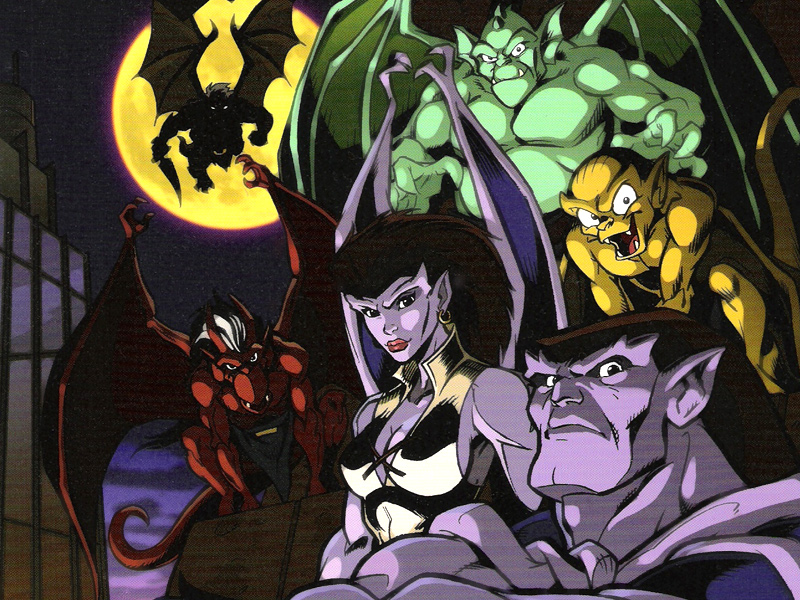
Gargoyles first began airing in 1994 and centered around the character Goliath, the leader of a clan of Gargoyles displaced by time and forced to adapt to life in New York City. The premise for the show was established over the first five episodes and the lore of the world is firmly established here. Gargoyles are beast-like creatures that are active at night, and stone by day. During the middle ages they protected a castle inhabited by humans in Scotland but were betrayed with most of the gargoyles destroyed while they slept. Magic is also a part of this world, and the remaining gargoyles that survived the attack were placed under a spell that would keep them stone until the castle they inhabited rose above the clouds. Of course, this would happen when a man by the name of David Xanatos purchased the castle and placed it atop a skyscraper in New York.
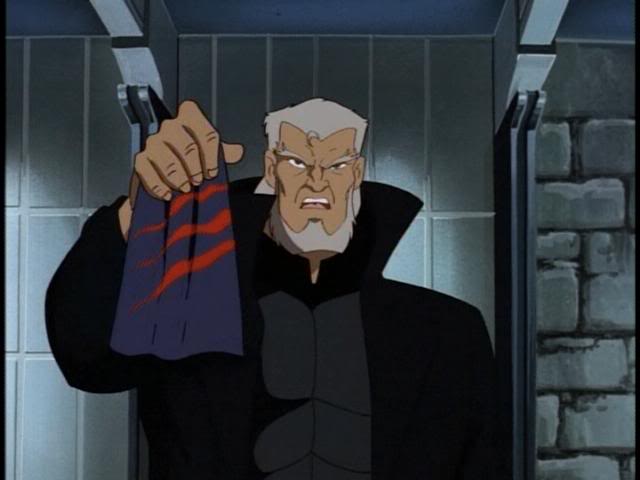
MacBeth is one of the more prominent antagonists in the series.

MacBeth is one of the more prominent antagonists in the series.

Over the resulting episodes, the gargoyles would come to view Xanatos as an enemy, as well as many others. Surviving outside of the curse is Goliath’s old flame, Demona, a female gargoyle who is like the Magneto to Goliath’s Xavier. She wishes to exterminate humanity while Goliath sees value in forging alliances with people and serving as their protectors. Goliath and his clan, consisting of fellow gargoyles Hudson, Broadway, Lexington, Brooklyn, and Bronx, forge a bond with detective Elisa Maza and basically become protectors of New York. They don’t run around like Batman, but their presence draws out and attracts the attention of various foes, many from the past. Some are more interesting than others. Throughout the series, Demona is a worthy foe for the clan. She’s ruthless and cunning, and even though she often finds herself on the losing side the writers manage to maintain her credibility as a villain. MacBeth is another stand-out foe. He and Demona share a bond as a result of a curse and neither one can die unless the other is killed which makes for an interesting dynamic. MacBeth is no friend to Goliath and company, leading to numerous instances where the gargoyles are caught between MacBeth and Demona, who despise one another.

Stylistically, the show is quite dark. This is to be expected since the primary protagonists are only active at night. The gothic influence in the look and music invite comparisons to another well-regarded cartoon; Batman: The Animated Series. So natural was the likeness that Batman producer Bruce Timm was asked about the show more than once and was said to be not a fan of Gargoyles. The tone of the show was certainly quite serious, even melodramatic. The serialized nature of the show and the human/gargoyle dynamic make it seem more comparable to X-Men, particularly the first two seasons. There’s even a beauty and the beast vibe going on (and the allusions were quite literal in one episode) between Elisa and Goliath. Their relationship starts off professional early on and gradually develops into something more. If you’re looking for pay-off though, you’ll have to consult the not safe for work fan-fiction of a few a diehards (you may want to enable safe search between doing a google image search of Elisa and Goliath) scattered across the internet.

Goliath and Elisa share a bond bordering on love that only intensifies as the series goes on.

Goliath and Elisa share a bond bordering on love that only intensifies as the series goes on.

One thing that Gargoyles did that I can appreciate is that it added to its cast. In X-Men, several mutants and other heroes would cameo on various episodes. These characters, like Archangel and Nightcrawler, were members of the team in the comics but would never join the roster on the television show. This used to bug me, though I understand why the show runners would want to try and keep the cast as manageable as possible. Gargoyles expanded its roster during the second season and it was cool to see. Villains were also eliminated or changed while others, like Xanatos, would become grayer as the series progressed.

Where the show opens itself up for criticism is within its tone and scope. Two things that I consider a strength, do sometimes bog it down. The show is so grim at times it feels joyless. There’s moments for comedic relief but not a lot when compared with contemporary programs. The show also became burdened with the lore it created, particularly during the last half of season two, and sometimes the show felt like it was becoming too big for its own good. It’s no surprise that the show kind of fizzled out towards the end and the final third season is rather poor.

Gargoyles earns its place on my list of top animated television shows because it scores very well across the board, even though it doesn’t quite knock-it-out-of-the-park in any one category. Though maybe I should amend that last sentiment because I’ve underplayed how stellar the animation is for a televised program. The first season especially is borderline feature-film worthy, which is something Batman can’t even boast. Gargoyles is a really unique program when compared with the other Disney Afternoon shows and it would be nice to see Disney try to revive the franchise in at least a small way (cough KingdomHeartsThree cough).

If you’re interested in reading more of my thoughts on Gargoyles, you can fine reviews for the three DVD releases here, here, and here as well as read my arguments for why it should be included in a popular gaming franchise here. Enjoy.


#10 The Best in TV Animation: X-Men

SF.Graz.1.0317––HANDOUT ART OF THE X–MEN CARTOON SERIES.

When I settled on doing a top ten for animation on television there were eight entrants I felt rather strongly about, and a ninth I was pretty content with. The tenth spot was the wildcard and a number of programs were considered, but since this is my list (and it’s not exactly an original topic) I decided I should use this spot to highlight a personal favorite of mine, so I went with X-Men. That’s a pretty flimsy lead-in but it’s not as if X-Men is undeserving of praise. I’ve wrote about the series quite a bit, even going so far as to do a mini review for each of the show’s 76 episodes during this blog’s first year of existence. At the time, I was using the show as a device to keep me posting but I was also reliving what was probably my favorite show as a kid.

X-Men launched on the Fox network in October of 1992, and at the time, was another attempt to re-ignite Marvel’s television properties. Prior to its debut, a pilot had been produced in the late 80’s called “Pryde of the X-Men” which focused on a much different cast of mutants. It was never picked up, and Marvel’s television properties were fading from memory. The same could be said for superhero cartoons in general, as only recently did Batman return to animation shortly before X-Men debuted. X-Men was the best-selling comic at the time, so it made sense for a cartoon to finally break through. Before X-Men (and Batman), cartoons based on comic book heroes tended to be pretty generic and bland. They usually took the form of the hero, or heroes, taking on the villain of the week and toppling whatever hair-brained scheme had been concocted by said villain to take-over the world or just cause general mayhem. Other shows, like Teenage Mutant Ninja Turtles, were just severely watered-down aspects of the source material intended to move action figures, which in the 80’s became frequently attached to various cartoon properties (He-Man being the best example of a cartoon existing solely to sell toys).

Wolverine and Gambit were likely to two most popular characters on the show, but that didn't stop the writers from developing many others.

Wolverine and Gambit were likely to two most popular characters on the show, but that didn’t stop the writers from developing many others.

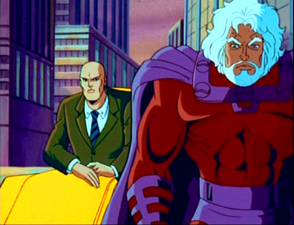
X-Men was different. This was a show that, while aimed at children, wanted to bring legitimacy to the medium. The show placed its brightly colored heroes against the backdrop of an easy to grasp civil rights movement. Enemies were no longer defined as simply bad guys but were colored with shades of gray and given real motivations for their actions. Magneto was the prime example. Had “Pryde of the X-Men” been picked up, Magneto would have just been another super villain with a motley crew of evil mutants willing to do his bidding and match up against the heroic X-Men. In the Fox show, he was a Holocaust survivor which had convinced him that humanity could not accept the differences within its own kind, and therefore, could never accept anyone outside humanity. In this case, that was mutant-kind, often referred to as homo-superior by Magneto. Mutants often took the form of normal looking people but with special gifts. We the audience took those gifts to be super powers, and in the case of the X-Men, most could be described as such. They did often come with costs that were more obvious for certain individuals. Cyclops could not open his eyes without a special visor or else risk destroying anything in his line of sight. Rogue could not even touch another person skin-to-skin without putting them in a coma. And Beast was simply covered in blue fur. This take, later admitted by creator Stan Lee as a lazy way to explain how the X-Men got their powers, freed the writers from having to come up with yet another experiment gone wrong origin story for every mutant under the sun.

This civil rights narrative is what framed the first two seasons of the show. The opening plot revolved around an organization funded by the government who would pose as friends to mutants but was really secretly creating a database of mutants from which it could target them and, though only hinted at during the show since it was for kids, cull them from society. The X-Men could not simply fight this opponent and beat them into submission, but had to convince the United States government that this was the wrong course of action. As a child, some of this went over my head. When Beast was put on trial in episode three I did not understand why the X-Men did not simply break him out of jail. Such would have likely been the course of action in many of the show’s contemporaries with the plot either being resolved at the episode’s conclusion or just dropped entirely. Instead, Beast spent the bulk of the first season in jail awaiting a formal trial before finally being pardoned after the X-Men were able to win-over at least one prominent political figure.

Magneto was easily the show's most successful attempt at blurring the lines between hero and villain.

Magneto was easily the show’s most successful attempt at blurring the lines between hero and villain.

After the first season, it seemed like all was right with the world but the show once more took a more sophisticated approach. With mutants gaining more legal freedoms, bigoted members of society sprung up to do what they felt the government failed to do. Once more, the show mirrored society in that the X-Men couldn’t hope to ever win over everybody to their side. The show would lose touch with this narrative after season two, instead opting to take the show in a more sci-fi direction while focusing on more condensed plots, but in those two seasons X-Men did a lot to legitimize the superhero genre outside of the comic book world. It’s the strength of those two first seasons, merely 26 episodes, that vaults the X-Men into this position, but the show also got a lot else right.

For starters, the voice cast (comprised of Canadian voice actors mostly unknown to American audiences) did an excellent job with the often weighty material. The show could, at times, be joyless and very melodramatic and the scripts would often contain superhero jargon that probably read poorly, but the actors were able to step up and deliver. Some characters, like the perennially wooden Storm, were always lacking but others shined very bright. For me, I will always hear Cal Dodd’s voice in my head whenever I read a line from Wolverine. His raspy, quiet, delivery perfectly suited the sometimes explosive Wolverine. When the show needed him to get loud and angry, Dodd was able to come through time and time again. David Hemblen’s Magneto was another highlight. This show is one of the few that actually depict the Austrian Magneto with an accent, something even the films chose to ignore. George Buza’s Beast was so good that it obviously formed the template for the Kelsey Grammer version of the character that appeared in X-Men 3. The soundtrack was also a standout, mixing orchestral instruments with electronic aspects that suited the show’s somewhat futuristic-like setting. The theme song should be considered a cartoon classic at this point.

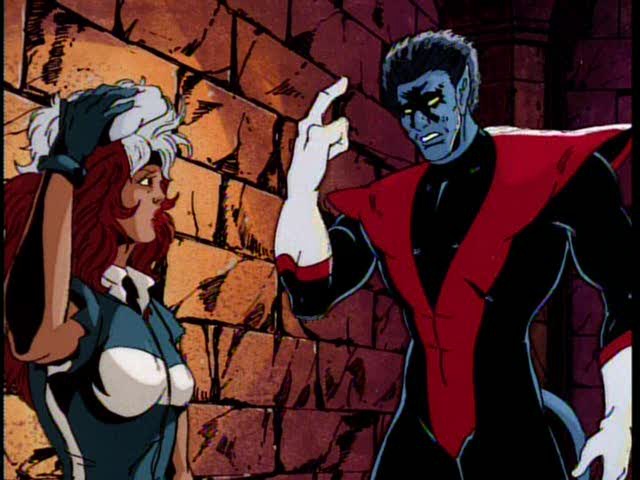
The show never added to its core cast of X-Men, but that didn't stop other fan-favorites from appearing in the show, like Nightcrawler.

The show never added to its core cast of X-Men, but that didn’t stop other fan-favorites from appearing in the show, like Nightcrawler.

Visually, the show adopted the look of Jim Lee’s X-Men quite well with some minor alterations. Most of what makes up the Jim Lee style was still retained though, with the men having bulging physiques and the woman looking like super models. Even the extras in society tend to look idealized. It’s a legitimate criticism of Lee’s work but I’m sure the animators were happy that the vast majority of characters were basically the same shape. There is enough detail in the work that the show looks quite nice in still-shots. The animation, especially in the first season when the budget presumably was at its smallest, could be stiff at times. The animators were obviously under some constraints as well as to what kind of violence could be depicted. After the first season though, the animation improved noticeably. X-Men was not the best looking of its kind, but it certainly was not among the worst. I enjoyed it far more than I would Spider-Man, which came in 1994 and featured some primitive, and mostly ugly, computer-enhanced imagery as well as a softer color palette.

X-Men was able to leave a mark on the world of cartoons. It’s solid production values combined with its mature approach to story-telling is what makes it standout amongst other Saturday morning fare. X-Men is still the gold standard for the super hero ensemble show, and still stands as the best thing Marvel has ever done on television. X-Men took risks in a world where risk-taking is often frowned upon. Most people think kids want a mindless program where the hero always wins and everything is wrapped up in 22 minutes. Children are capable of so much more and the success of X-Men is proof of that.

If you want to read more about the X-Men animated series, there’s plenty to be found on this blog. In addition to numerous posts that summarize and review every episode, I also made an entry on what I considered to be the best episodes the show ever produced.


Teenage Mutant Ninja Turtles (Nickelodeon) Season 2

TMNTThe resurgence of the Teenage Mutant Ninja Turtles has been one of the more fun story lines from pop culture for me over the past two years. With an all new comic line, cartoon, and feature film, the TMNT are almost as relevant today as they were in 1990. Considering other old properties from the 80’s have been successfully resurrected recently, perhaps it’s not all that surprising the Turtles were able to accomplish the same. What has been surprising though is how successful the relaunch has been from an artistic standpoint. The general consensus for the vast majority of new films based on properties from the 80’s is that the material has been lacking. While no one can dispute how commercially successful a franchise like the Transformers has been for Hollywood, the movies themselves come across as overstuffed toy commercials. Like the Transformers, the return to the big screen for the Turtles was decidedly lacking when the new film was released in 2014 (I’d call the film trash but I personally have not watched it and don’t plan to). However, the comic book line launched in 2012 has been pretty well-received while the television show has been a smashing success.

When the cartoon was announced by Nickelodeon I was not optimistic about its chances at success. I was borderline indifferent, but my past romance with the Turtles was enough to make me curious. I set the DVR to record season one, and by its end, I was a fan. The show is witty, action-packed, and stuffed with enough in-jokes and material to appeal to 30-somethings who grew up with the Turtles. The cartoon successfully melds the old cartoon with the comic books while also taking its own path. The 2003 cartoon attempted the same, but was probably too reliant on the original Mirage comics. The old comics are an entertaining read, though nothing magical, but they do not possess an energy that lends itself well to animation. While on the other hand, the original cartoon was set on creating a fun series that appealed only to children. It never put the characters in any real danger and would eventually lose its audience as it grew up and acquired an appetite for more mature material. When the show finally made an attempt at change, it was too late.

What's old is new.

What’s old is new.

Like with season one, season two of Teenage Mutant Ninja Turtles opts for a more serialized nature with plots carrying over from one episode into another with few stand-alone episodes and characters. When a stand-alone episode does pop up, it serves as a palette cleanser from the main plot and is often a more offbeat episode. Most of these episodes are packed with humor with season two’s “Mazes & Mutants” topping the list of funniest TMNT episodes so far. The writers have found a nice balance in the humor for the show with it coming up at opportune times and resisting the urge to go for the easiest joke or pun. The show is genuinely funny, but it also knows when to let up on the humor and isn’t overly-reliant on the Michelangelo character.

Season two picks up right where season one left off with The Kraang being beaten back temporarily. Shredder and The Kraang have appeared to have forged an alliance, and an early mishap with a canister of mutagen mutates April’s father, Kirby, into a bat monster causing tension between the Turtles and their lone human friend. Meanwhile, Splinter (and this is a spoiler for those who missed season one) is coming to terms with the fact that his daughter is alive and well but has been brainwashed by the Shredder into believing she is actually the daughter of the Foot Clan’s leader and not Splinter. These two threads, April’s distrust of the Turtles and Karai’s lineage, are major plot points for the bulk of season two. The Karai plot twist could be seen coming from a mile away, but it was still effective as the writers handle it well. Karai naturally does not react well when the truth is first presented to her, and her response to it is complicated and appropriately remains unresolved for several episodes. The Kraang maintain a healthy presence throughout the season as well, often playing a role in a small way in most of the episodes. The season concludes with another big face-off between the Turtles and Kraang and it would seem the alien race will not be going anywhere anytime soon.

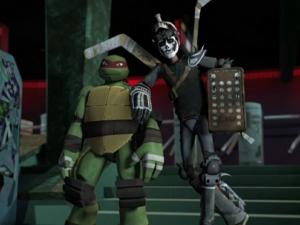
Casey Jones and Raph team-up yet again.

Casey Jones and Raph team-up yet again.

Season two introduces several characters, old and new. As was revealed in press kits, Casey Jones made his series debut in season two. Like April, he has been aged-down for the show from his original depiction but remains a vigilante of sorts. And like the Casey of old, he forms a bond with Raph pretty quickly and the two are a crime-fighting duo in some episodes. And as predicted by me (and likely many others), Casey forms the third corner of a pseudo love triangle with Donatello over April. Naturally, April is more taken with the human and this creates tension between Don and Casey that is sometimes entertaining, and sometimes feels a little stuffy, but is one of the ongoing aspects of the show that serves to remind the audience that these characters are, in fact, teenagers after all. Other characters familiar to fans of the old show that make their debut in season two include Slash, Mutagen Man, and Pizza Face while other characters are obvious references to old ones (Kirby bares an uncanny resemblance to Wingnut, for example). The show also does a good job of hinting at future characters. When a thief with a purple mohawk shows up it’s only natural for fans of the old show to assume this character has a date with a warthog and some mutagen in his future.

Don't be surprised if Kirby's Party Wagon gets a make-over in season 3.

Don’t be surprised if Kirby’s Party Wagon gets a make-over in season 3.

My main point of criticism with the show early on was for its lifeless take on the city of New York, and while the show has done a better job of making it look like people actually inhabit this city, it’s still a relevant criticism for season two. The character designs though have improved. Some of the villains in season one were pretty boring to look at, and that has mostly been remedied (though some are underwhelming, I’m looking at you Tiger Claw). There’s very little for me to complain about when it comes to this show. The writers have also wisely made the Foot Clan robots in season two (and not just randomly, it’s explained in an episode) so the Turtles are free to user their weapons against them. The more graphic violence is handled offscreen, but the consequences are shown. When Leonardo gets isolated from his brothers in the season finale and beat-up by Shredder, we don’t see any of Shredder’s bladed strikes landing. However, when an unconscious Leo is tossed through the window in April’s apartment where the other turtles are holed up (awesome reference to the comic and original film, by the way) his body is cut and bruised.

Just like with season one, season two does a great job of tossing in winks and nods to the old material that came before it. They’re sometimes hidden in the background and other times in your face (the party wagon!). Shredder remains a credible threat to the Turtles throughout the season and is a more than competent ass-kicker when pressed into battle. And while the April plot is resolved during the season, the other big ones are still open heading into season three. The season concluded with an hour long special that was perhaps the best in the show’s short existence thus far. It was satisfying on an emotional level while also delivering the humor and action the show has become known for. I’m even more enthusiastic for the show’s third season than I was the second (aside from the fact that Seth Green is set to takeover the voice-acting duties for Leonardo). If you were a fan of the Turtles in your youth and still have a fondness for them residing somewhere inside of you then you should be watching this show.


Teenage Mutant Ninja Turtles – NES

Teenage Mutant Ninja Turtles (1989)

Teenage Mutant Ninja Turtles (1989)

One of the most successful games of all time, and one of the most divisive, Teenage Mutant Ninja Turtles, arrived in 1989 for the Nintendo Entertainment System and flew off the shelves or retailers and rental stores across the United States. Turtle-mania had a strong grip on the nation’s adolescent and it would have been a huge embarrassment if the game actually failed. And while it was named as 1989’s Game of the Year by Nintendo Power, the first ever NES TMNT game is often regarded as a disappointment. Calling it divisive in the opening line may have been misleading, for the game is almost universally loathed for numerous reasons: too hard, not enough recognizable characters from the cartoon, no multi-player, and not the game fans wanted. In 1989, another game based on the TMNT was released, the equally successful arcade game. Based on the animated series, the arcade game boasted 2 to 4 player play allowing each kid to select his or her favorite turtle and wail away on an almost endless supply of Foot Soldiers, Bebop, Rocksteady, and of course, Shredder. When it was announced the Turtles were coming to the NES, many fans expected a port of the arcade game, but instead they got a solo side-scrolling adventure with few recognizable elements from the cartoon making an appearance.

The original Teenage Mutant Ninja Turtles game is best called infamous than famous. It was notably the subject of one of the earliest Angry Video Game Nerd videos in which The Nerd (James Rolfe) reminded many of us of the same frustrations we experienced as children playing this maddeningly frustrating game. As a kid, I never was able to beat the game without the near essential Game Genie peripheral, usually failing to make it beyond the battle with Slash/Mecha-Turtle/whatever the Hell that thing is at the end of act three. And like many, I preferred pretty much every other TMNT based game that followed over this one, which all took the form of arcade style beat-em-ups. I’ve since relived this game many times as a teen and adult but recently felt compelled to revisit it and see if the reputation this game had acquired was entirely justified. Just what is that reputation? Many Google searches will return this game on the list of hardest NES titles as well as worst or most disappointing NES games. The only way to answer my questions was to dust off the old NES and sit down in front of the TV.

Definitely not the arcade game...

Definitely not the arcade game…

For starters, the game was developed by Konami’s Ultra division, a secondary label created to circumvent Nintendo’s then policy of limiting publishers to how many games they could release in a year. Konami probably paid a boatload of cash for the TMNT franchise, and considering Konami was known to gamers for its Contra and Castlevania franchises, it seemed like the TMNT license was in good hands. Right from the start though, some things seem out of place. For one, the cover art depicts the four turtles all sporting red bandanas. For kids accustomed to the television show, this looked wrong while comic book readers would have recognized the cover to issue number 4. When the game boosts up, an unfamiliar tune plays as the four turtles are introduced. No player select screen is displayed once start is pressed, instead the game drops the player right onto a map-like screen with a tiny Leonardo in the center and some steam-roller like vehicle driving around. To summarize, there’s no licensed music, no option for 2-player, and no option to select which turtle to play as.

As the game unfolds, things start to become clearer. This overhead, Zelda-like perspective, leads into more traditional side-scrolling levels whenever the player enters an open manhole or building. A quick look at the pause screen is enough to clue the player in on the objective (rescue April, big surprise) and the ability to switch between turtles. The player is free to change-out a turtle on the fly. Each one has his own health bar, and since the game has no 1-up pickups, they function as extra lives. If a turtle loses all of his health, he’s out of action until the final level where a turtle can be rescued. Each turtle uses his own unique weapon and it will soon become obvious which turtle to use. Donatello, with his boring but long-reaching bo-staff, is easily the superior turtle in this game. When walking or standing still, Don thrusts his bo-staff out in front a great distance and even slightly behind him as well. He can thrust up and down as well with a press of the D-pad and take out multiple foes at once as a result. Because the animation for his attack lingers so long, he even seems to benefit from a double-hit, and as a result, does more damage per strike than the other turtles. If you lose Don, you’re in big trouble because the drop-off is huge to the next most useful turtle, which should be obvious for those familiar with the four heroes in a half-shell, Leonardo. Leo swings a lone katana in a downward arc when attacking and it’s useful for enemies at eye-level, but his reduced range and damage when compared with Donatello makes him far less suitable for the environments ahead. After Leo, Michelangelo is probably the next-best option as his nunchaku has slightly better reach than Raphael’s sai, which is pathetically useless. Raph and Mike are best treated like canon fodder and used only when attacking is not an option, such as when driving the turtle van or during the infamous swimming level. Each turtle can hold one secondary weapon, most of which appear as pickups randomly and range from throwing stars to boomerangs, to a weird energy wave that kicks a whole ton of ass (shell).

What the hell are these things attack Don, and is that a Foot Balloon?!

What the Hell are these things attacking Don, and is that a Foot Balloon?!

Gameplay wise, Teenage Mutant Ninja Turtles is fairly straight-forward. The turtles can attack and jump as they move left to right, right to left, and across gaps and platforms. The pace is fairly slow and reminiscent of Castlevania, including the ever annoying jump-backwards animation after being struck. If you’re not familiar with Castlevania, when the character takes damage they always jump backwards. This is ever annoying when trying to negotiate a series of platforms as enemies frequently appear in mid-jump leaving the player helpless to defend. The turtles handle kind of like trucks as they’re heavy and clunky. Pressing fully on the jump button will cause them to go into a ninja flip of sorts that has a floaty affect on the character, which sometimes helps to re-align a jump but mostly just seems to cause panic in the player leading them to miss a platform. Enemies are numerous, and for the most part, unrecognizable from the show. There’s foot soldiers and mousers here and there, as well as boss encounters with Bebop and Rocksteady early on, but aside from that there’s a lot of just weird enemies. There’s some chainsaw-wielding maniac, a guy composed entirely of fire, and weird butterfly enemies that dive-bomb the turtles, among others. The obstacles are pretty standard for the era and take on the form of conveyor belts, water, and spiked floors/walls. The game gets bogged down frequently when too many enemies are on screen and slowdown is a frequent annoyance. Enemies on the map scenarios tend to flicker in and out which harms the presentation elements of an otherwise underwhelming looking game.

So what makes Teenage Mutant Ninja Turtles so difficult? Well, for one, three out of the four turtles are borderline useless. As I mentioned earlier, Donatello is by far the best suited to overcome the various obstacles placed in the turtles’ path. The other three are so bad that you might as well quit if Don falls in battle. Enemies who can be felled in one strike are manageable, but the ones that require multiple hits pose a challenge as they do not react to taking damage. The game also loves having the player enter a new screen with an enemy literally right on top of you, forcing the player to take at least some damage. The pizza power-ups, which restore health, become scarce the deeper into the game you go and are sometimes intentionally placed in impossible to reach locations. Platforms are often placed above turtles, making some jumps particularly challenging as if the turtle hits his head on a platform above, his forward progress is stunted and the jump falls short. There’s one really annoying jump in a sewer scenario that’s actually impossible in the PC port. There’s also no password feature, but unlimited continues, so this is one that has to be completed in one sitting which adds to the challenge. And if the game wasn’t annoying enough, Ultra did include a beeping alarm for when the selected turtle is low on health.

Even though this level isn't as bad as people make it out to be, Leo is totally about to end up dead.

Even though this level isn’t as bad as people make it out to be, Leo is definitely about to end up dead.

All of that said, this game does do some things well and some of the things it has become known for (negatively speaking) aren’t as bad as they’ve been made out. For one, the ability to swap the turtles into and out of battle is pretty cool. Yeah, it sucks that there’s no two-player and it really sucks that three of the four turtles are horrible to play as, but the thought was a good one and one I’d like to see revisited in a new game. The under water level that has become so reviled and is the part of the game often cited as being hard, unfair, and noteworthy, isn’t as bad as its reputation. If you get to it with little health on each turtle, then it’s pretty damn hard. As a kid, I failed many times. As an adult, I just save Raph for it and have no problem making it out with minimal damage taken. It, like just about every swimming level in recorded existence, is not a fun stage by any means, but it’s far from being among the hardest sequences in gaming history (and is among the easier parts of this game). And aside from the turtles not really handling like ninjas, the control is satisfactory and the ability to drive the turtle van is pretty cool (though why it doesn’t have its own health bar is a mystery still to this day). The soundtrack is actually enjoyable, even if it doesn’t contain any music from the TV show, and isn’t something I’d change about the game.

In conclusion, Teenage Mutant Ninja Turtles was destined for commercial success just because of the license alone, but doomed to disappoint gamers for not being the game they truly wanted. Unfortunately, the game was not able to make-up for not being the arcade game by offering a lesser experience. The good news is that gamers didn’t have to wait long as a port of the arcade game arrived on NES consoles in 1990 as Teenage Mutant Ninja Turtles II: The Arcade Game. Yes, it wasn’t a perfect port due to the system limitations of the NES, but it was suitably fun and is often remembered fondly by gamers from that era. The one that arrived first though is not, and it’s hard to defend the title even today. While it’s far from being the worst NES game, and certainly not the most difficult, it’s definitely not good and just another example of a licensed game gone wrong, but at least it’s not as bad as E.T.


Beware the Batman: “Hunted”

bewarethebatmantitlescreenIt’s hard to imagine a world where Batman isn’t a pop culture force to reckoned with.  He’s arguably the most popular comic book originated character today and easily has had more success than any other comic character in transitioning from one medium to another.  His popularity is not absent of peaks and valleys.  Batman is currently coming off one such peak following the conclusion of his most successful endeavor yet, Christopher Nolan’s Dark Knight trilogy, and DC Comics is looking to keep the fire going with a new animated series:  Beware the Batman.

Batman is, first and foremost, a comic book superhero.  His overall popularity though, is tied more to his forays outside comics.  Batman’s television and film works have a chance at reaching the comic book audience and non alike.  His first exposure of merit was the television show in the 1960’s.  It’s easy to dismiss the campy program today as being inauthentic, but the Batman of the comics at that time wasn’t far removed from Adam West’s portrayal.  It wasn’t until the 70’s that Batman would rediscover his edge, completing the transformation in the 80’s which helped influence his next cultural milestone, Tim Burton’s Batman.  Batman:  The Animated Series would follow, and despite it being a cartoon aimed at younger audiences, it too managed to attract a wide audience and even spawned the theatrically released Batman:  Mask of the Phantasm.  Of course, a cartoon is unlikely to reach the same audience as a film and that has held mostly true, but the cartoons to follow have been even more obvious in their target audience, so much so as to alienate the comic book fans.

Beware the Batman, in response to series such as The Batman and The Brave and the Bold, feels like an attempt to keep comic fans and attract more than just the Saturday morning crowd.  Time will tell if it can duplicate the success of TAS, but it’s nice to see DC give it a shot.  With no clear plans for where Batman is headed on the big screen, it makes sense to try to build a bridge between the two.  The only complication is where do the creators of Beware the Batman take the series that TAS didn’t?  Bruce Timm and Paul Dini, the masterminds behind TAS, piggy-backed off of Burton to establish the look of Gotham, and then created a tone to suit the show.  Visually, it was unique and thematically it was too when compared with its peers.  The show was not afraid to make broad use of Batman’s rogue’s gallery and took chances on lesser villains Killer Croc and Scarface, while also not being afraid to introduce villains like Roland Dagget and Ruper Thorne, gangsters with no sexy gimmick to speak of.  Beware the Batman has been developed by Glen Murakami, a veteran of TAS spin-off Batman Beyond, and is being produced in tandem with Mitch Watson.  Greg Weisman is on board as a writer and he’s done extensive work with other comics and comic TV shows but is probably best known as the creator for Disney’s Gargoyles.

Anarky is expected to play a large role in Beware the Batman.

Anarky is expected to play a large role in Beware the Batman.

The talent appears to be in place to make BTB a success, and the show’s creators have come up with a vision for the program to help differentiate it from its predecessors.  For starters, the show is animated entirely in CG in a style similar to the Green Lantern series already airing.  In terms of color palette, it actually looks similar to TAS as there’s a lot of black and gray.  Batman, himself, is sporting a black and gray costume similar to the one he wore in the final season of TAS (often referred to as The New Animated Series) but with a more triangular head.  Alfred is said to have a larger role in this program, with his past exploits as a secret agent being a central part of the show’s plot.  Batman also has a new sidekick, Katana, a character first conceived in the 80’s who just this year received her own limited series.  Her design is unique to the show and seems to be, in part, due to wanting her to resemble Batman to some degree.  No word on how her presence will affect Robin.  The show’s brain-trust made the decision to avoid The Joker early on, and as a result, Batman’s primary antagonist appears to be Anarky.  Anarky is another 80’s character and in tone he’s similar to Allen Moore’s V from V for Vendetta, though Anarky has been forced to change to mirror whatever the current political climate of the world is.  There’s been little said on how he’ll be portrayed in the show, but it’s definitely a bold choice for what is a “kid’s show.”  If the character appears dumbed-down for television it will likely disappoint the comic book fans who tune in and could turn them off.

Beware the Batman seems to have a solid groundwork to start.  In addition to Anarky, the creators want to continue to use villains not previously seen on television to help further differentiate the show from the ones that came before.  This direction should be commended, as it’s certainly the bravest route, though I do expect some of Batman’s more popular villains will eventually show up if the program is allowed to continue for multiple seasons.  In order for that to happen though, season one needs to be a success.

Batman's look comes across as a mix of old and new.

Batman’s look comes across as a mix of old and new.

The first episode aired today and is titled “Hunted.”  As is the case with most series premieres, the episode is concerned with introducing the main cast of the show to viewers while also giving us a taste for the action and spectacles we can expect going forward. Right off the bat (no pun intended), we’re shown Batman taking down some small-time thugs.  Disappointingly, the firearms used by the enemies look like toy squirt guns and fire lasers.  Beware the Batman is not the first cartoon to eschew realistic firearms, but it looks especially ridiculous here given the otherwise realistic look of the setting (the guns initially were going to look realistic following in the footsteps of TAS, but after the Aurora shooting the show was changed).  Realism does seem like it may be in short supply with this show.  While no one would expect a Batman show to possess a high degree of realism, it does seem like this one will at least be less so than TAS.  The villains in this first episode are Professor Pyg and Mr. Toad.  Professor Pyg is just a fellow with a pig mask, while Mr. Toad is some kind of mutant toad man (that looks more like a frog) with a super-sonic breath attack of some kind.  Professor Pyg arms himself with a saw that can apparently cut through anything except Batman’s gauntlets, and Mr. Toad likes wielding bombs that look like they were taken straight from a Bugs Bunny cartoon.

I’ll never prefer CG animation to traditional hand drawn animation, but the new Teenage Mutant Ninja Turtles cartoon did leave me pleasantly surprised with how it turned out.  That show is not without faults, and those same faults are shared by BTB plus a few more.  It must consume too many resources to create an authentic looking city, because the streets of Gotham are empty aside from the main characters of a scene.  This means during the debut episode’s car chase sequence, the only cars on the road appear to be Batman, his enemy, and the enemy’s target.  The characters also do not animate as well as those on TMNT as they seem stiff.  When Batman runs, his body doesn’t look in sync with itself and he resembles a wind-up toy that’s supposed to mimic running.

Professor Pyg and Mr. Toad add a dash of comic relief while still retaining an element of danger.

Professor Pyg and Mr. Toad add a dash of comic relief while still retaining an element of danger.

Design wise, I already mentioned Batman.  The Batmobile is present in this debut episode and it resembles a Lamborghini and apparently it’s dual flame spouts on the back are meant to distinguish it from its predecessors.  Alfred is a mountain of a man who towers over Bruce Wayne.  His role as a bodyguard is emphasized in this episode with part of the plot revolving around his wanting to protect both Bruce Wayne and Batman, with Batman preferring he only concern himself with Bruce Wayne.  The individual who will become Katana is also shown.  Her design of a small asian woman is unremarkable, though she’s seen driving a red and yellow motorcycle which had me wondering if that was a Robin reference.

The voice work seemed more than capable, though getting used to the new Batman (Anthony Ruivivar) and Alfred (J.B. Blanc) will take some getting used to.  Professor Pyg (Brian George) was the stand-out from a voice acting perspective, his tone adding a layer of menace to an already unsettling looking character.  Simon Stagg was present, and I wonder what role he’ll play going forward.  The previously mentioned Anarky is not seen so apparently they’re holding off on his debut for a later episode.

The plot for this first episode revolves around Pyg and Toad kidnapping billionaires who are not eco-friendly.  Batman has to use some of his detective skills to determine who their targets are before the villains strike next.  There’s also the previously mentioned Alfred conflict, with him also wanting to find his own successor for when he can no longer protect Bruce/Batman.  Batman is shown to be somewhat sloppy, though we’re given no indication of how long he’s been at this whole crime-fighting vigilante business.  The creators of the show in all of the pre-release press boasted about how this show was going to show off Batman’s detective skills, but this episode mostly followed the same formula as TAS with Batman turning to his trusty super-computer to do most of the work for him.  Since much of the plot of this first episode is devoted to setting the series up for future episodes, there’s very little resolution to the Batman conflict with Professor Pyg and Mr. Toad.  We’re also only given a snippet of what drives the villains with hopefully more to come.

Expect Katana's full debut to occur in the coming episodes.

Expect Katana’s full debut to occur in the coming episodes.

Overall, I appreciate the direction the show’s creators are pushing it in, but I’m less in favor of the execution.  Pyg and Toad have potential as villains, though I would have preferred something more grounded for Mr. Toad.  The animation is what it is and unfortunately this is the most cost-effective way to do most shows these days.  I’ll reserve final judgement on the show until more episodes have aired though this debut was more of a C effort.  It’s probably unfair of me to compare this to The Animated Series, but if it can’t approach that level of quality, then what’s the point of it existing?  Hopefully the show is able to carve out its own niche that can be enjoyed by Batman fans of all ages.


Spider-Man and the X-Men in Arcade’s Revenge

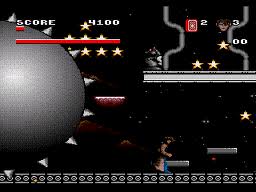
Spider-Man and the X-Men in Arcade's Revenge (1992)

Spider-Man and the X-Men in Arcade’s Revenge (1992)

Expectations influence just about everything we come in contact with.  Expectations can help lead to a more fulfilling experience when those expectations are met.  Other times, they can help make the bad seem worse when something fails to meet those expectations.  When I was a kid and I heard there was going to be a video game featuring a team-up between Spider-Man, possibly the most popular character ever created by Marvel Comics, and the X-Men, easily the hottest comic at the time, I was giddy with anticipation.  This seemed like a no lose situation and Spider-Man and the X-Men in Arcade’s Revenge vaulted to the top of my list of must own Super Nintendo games along with Teenage Mutant Ninja Turtles IV:  Turtles in Time.  One of those games would turn out well and provide me with hours of entertainment, the other game was Spider-Man and the X-Men.

What went wrong?  Well, let’s backtrack a bit first and see how this all came together and if my expectations were even justified.  At the time of the game’s release, Spider-Man had already been enjoying a run on the Sega Genesis and Game Boy as a platform star.  Perhaps star is a bit strong as his games weren’t really great, but they also weren’t particularly awful.  The best was definitely The Amazing Spider-Man vs The Kingpin for the Genesis.  The game was pretty difficult, at times frustratingly so, but it did a great job of making use of the Spider-Man license.  It was also quite popular and one of the best-selling titles at the time.  The X-Men, on the other hand, really only had the one NES game titled The Uncanny X-Men.  It was horrible and it tricked many uninformed gamers into renting or buying it with it’s X-Men branding.  Arguably, the best games for both franchises were the arcade beat-em-ups Spider-Man:  The Video Game and X-Men.  The Spider-Man game came first in 1991 and for some reason it isn’t as well loved and remembered as the X-Men game that followed in ’92.  It was a typical brawler allowing up to four players to join in and included playable characters Spider-Man, Black Cat, Hawkeye, and Sub-Mariner.  It’s selling feature was a more platform inspired design where the camera would zoom out allowing the players to take on gigantic enemies including a super-sized Venom at the end of the first stage.  The X-Men game was similar, but it’s defining characteristic (aside from the comical mistranslations) was the double-monitor cabinet allowing up to six players at once.  Both games were hard as they were designed to suck quarters out of its audience but they were a lot of fun, especially with a group of friends.

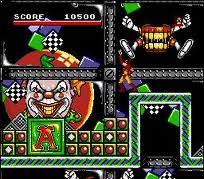
I hate these stupid clowns and their stupid stage.

I hate these stupid clowns and their stupid stage.

It would seem to me that a track record was in place that at least suggested a console game featuring these two franchises could be great.  If I had been a little wiser as a kid and more aware I would have taken note of the LJN logo on the box and realized right away the game was going to be a giant turd, but sadly I just wasn’t.  Before I get into what the game did wrong I suppose I should point out what it did right.  First of, Spider-Man is represented fairly well given that he is able to stick to walls, shoot webs, and even make use of his spider-sense in the game.  The roster for the X-Men side is pretty solid as well as it features the obvious choice of Wolverine along with Cyclops, Storm, and Gambit.  Wolverine has an interesting dynamic to him as he retains his mutant healing power but it only works when his claws are retracted.  The game is packed with villains too like Apocalypse, Shocker, Juggernaut, and Carnage.  Arcade is kind of a weird choice for the main villain, but at least his Murderworld offers a lot of possibilities for level-design.

That’s basically it as far as what Spider-Man and the X-Men gets right, and unfortunately it’s a pretty small list.  So what makes this game suck so hard?  Well, lets first start with the presentation.  I’m usually not one to have much of an opinion on the audio within a game.  I expect it to do its job and often times I have to make it a point to touch upon it when doing these reviews because I tend to overlook it.  Here it’s easy to not overlook because the sound is so bad.  The score is okay at times, though certain levels (Wolverine’s) feature an annoying soundtrack.  It’s the FX that really bug me though as they just sound like, for lack of a better word, shit.  A lot of the characters, good and bad, let out a scream when they die that sounds fuzzy and distorted.  The machine sounds are just as bad and Spidey’s web blasts sound like they could be grenades.  The graphics are also piss-poor.  The characters are really small, except Storm but I’ll get to her later, and lacking in any sort of detail.  Wolverine even looks like he only has two claws on each hand while Gambit doesn’t have a face.  Some of the villains are almost unrecognizable, especially Apocalypse who looks like a blue bug or something.

Hey Gambit, where's your face?

Hey Gambit, where’s your face?

Perhaps what bugged me more than anything as a kid was just how un-super these super heroes felt.  Spider-Man and the X-Men is a pretty hard game made so mostly because these characters can’t seem to take a punch.  They die so easily and it’s a frustrating experience.  I get that it’s hard to make a super hero game because on one hand the super heroes need to be super powerful, but the game also needs some challenge.  That’s why we have super villains though, and Wolverine shouldn’t be getting annihilated by a jack-in-the-box with a tommy gun.  The X-Men games that would follow on the Genesis were hard, but at least those X-Men felt like powerful super heroes (well, for the most part), these ones are push-overs.  The level designs are also fairly lacking.  Spider-Man’s are just weird looking and kind of confusing as they’re intended to be maze-like.  The player is supposed to use his spider-sense to navigate but it just gets tiresome.  Cyclops’ stages feature an annoying mine cart premise where touching the tracks means death.  Gambit has to outrun a giant deathball and might be the best levels, which isn’t saying much.  Wolverine is in a circus and there’s nothing noteworthy about the first stage while the second stage he has to outrun the Juggernaut.  It’s basically the same concept as the Gambit stages, though at least LJN incorporated something from the comics to make it feel relevant.  Storm’s stages are quite different and probably everyone’s most hated as she has to navigate a flooded laboratory.  They’re swimming levels, but unfortunately Storm’s mutant powers over the weather don’t let her breath underwater.  Just about everyone hates the underwater Sonic the Hedgehog levels for the same reason, this is worse times ten.

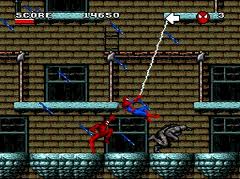
The red guy is Carnage. That gray blob?  He's Rhino.  I think.

The red guy is Carnage. That gray blob? He’s Rhino. I think.

If the player manages to actually beat all of the levels then they get to take on Arcade as Spider-Man.  You kind of have to be a glutton for punishment to even make it that far as the game is both really hard and really bad.  That’s the worst combination.  As a kid, I never had much success and never made it past any character’s second stage so making it all the way to Arcade wasn’t in the cards.  Playing this game was a depressing endeavor as a game featuring a team-up between these two should have been awesome.  I remember a few years after I got it Toys R Us started their first trade-in program where people could trade in games they no longer wanted for store credit.  I grabbed my copy of Spider-Man and the X-Men and, thinking I’d get maybe 15 or 20 bucks, was offered only four.  I elected not to trade it in but in hindsight I should have taken the four Jeffry Dollars.  I could have used it for some Fruit Stripe gum or something.


Teenage Mutant Ninja Turtles: The Ultimate Collection Vol. 3

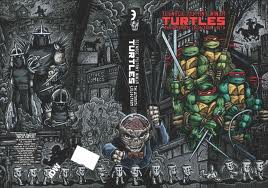
Wrap-around cover of Volume 3, notice the little robots holding the black space where the barcode goes.  Nice touch!

Wrap-around cover of Volume 3, notice the little robots holding the black space where the barcode goes. Nice touch!

I’ve been rather slow lately when it comes to posts, and especially so with getting to this one in particular.  I can’t even remember when volume 3 of the Teenage Mutant Ninja Turtles Ultimate Collection arrived at my front door but I do know it was several months ago.  I’ve put off posting on it in part because I made a couple of other Turtles related posts in the interim and just plain laziness.

I suppose it would be fair to say that had I been blown away by what I saw and read in volume 3 that I would have posted sooner.  Volume 3 is a bit of a mixed bag and not as strong as the two preceding it.  The collection contains issues 12, 14, 15, 17, and 19-21.  The first four are one-shot stories that Eastman and Laird were involved with to varying degrees while the last three cover the “Return to New York” plot jointly worked on by the two.  At this point, the TMNT franchise was much bigger elsewhere and the original comics were starting to feel like an afterthought.  Playmates and the networks that aired the cartoon probably weren’t crazy about the idea of kids (and parents) stumbling onto these more violent turtles while the creators were suffering from turtle-induced burnout.  Simply put, the money wasn’t in the comics and it was in part out of obligation that Eastman and Laird continued with them.  Their working relationship had also soured, meaning they worked on few issues together and instead relied on the talents of guys like Jim Lawson and Steve Lavigne.  If you’re wondering why there appears to be some missing issues in this collection, it’s because Eastman and Laird didn’t work on them at all.  This Ultimate Collection represents the Eastman/Laird era and is set to conclude with volume 5, which will presumably arrive in the fall (volume 4 is currently scheduled to start shipping at the end of March).

The one-shots in volume 2 really made the set.  The individual micro series issues that focused on a sole turtle were among my favorites and succeeded in distinguishing each turtle from one-another.  In this volume the opposite seems to be the case as the one shots are lacking in focus and creativity.  The first one, “Survivalists,” is a Laird story and places our heroes out in the country with Master Splinter where they encounter an outlaw group fixing to steal a nuclear bomb.  It’s rather absurd, even for a TMNT story, but does feature Splinter in some action scenes which is always nice to see.  What follows is “The Unmentionables,” an Eastman story that puts Casey Jones in detective mode as he looks to solve the mystery of a stolen landmark.  The setting takes place in a small town and it’s genuinely interesting to read the notes following the story from Eastman and Laird about the real-life connections of the fictional town to the real town (Northampton, MA), but aside from that I found the story to be poorly paced and dull.

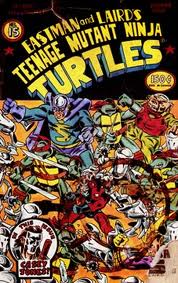
The original cover for "Dome Doom" was made to look like an old, beat-up comic.

The original cover for “Dome Doom” was made to look like an old, beat-up comic.

Things start to get a bit more interesting with “Dome Doom,” a story inspired by silver age comics.  It’s the type of story that a lot of modern comics have utilized where the current heroes are paired up with the heroes of a prior generation.  In this one, the TMNT help the retired Justice Force take down an old foe.  The plot is ludicrously corny, but I think that was intentional, and also seems to be a response to claims that Eastman and Laird are now sell-outs for licensing the TMNT (the retired Justice Force all sold their likenesses for millions in the comic’s plot).  This is some of Laird’s best artwork and I enjoyed the design of the little dome robots.  The story is kind of a throw-away, but I had some fun with the issue.  “Distractions” seems to take place in the far east sometime in the past with a TMNT-like protagonist helping out a damsel in distress that looks a lot like April.  It contains some samurai story cliches and all seems kind of corny, at which point the story ends and we find out it’s source is Mikey as he’s trying to write his own comic.  The artwork (by Eric Talbot) saves the day here with some really cool shading and a lot of violence.  I like this feudal looking turtle and I’m surprised he wasn’t made into an action figure (or maybe he was and I just forgot).  I could have done without the dinosaur though.

Most people who pick this volume up will do so for the “Return to New York” arc which features the return of a very popular villain.  “Return to New York” captures the spirit of the first issue of TMNT with a slightly more advanced approach.  There’s actual character development this time around and we finally get some good Leo vs Raph moments, including an all out brawl in issue 19.  The fight is pretty vicious considering it pits brother vs brother and ends up being really satisfying.  Unfortunately, the black and white nature of the comic makes it really hard to distinguish between which one is Raph and which one is Leo throughout much of the fight.  The first issue ends up dealing with the notion of teamwork and captures a lot of the same messages contained in the first two Turtle films.  It’s a bit of a re-tread, but this is also the type of story the TMNT are good at telling.

Look who's back!

Look who’s back!

The rest of the story revolves around the return of the Foot clan, and of course, the Shredder.  Shredder was famously slain in the first issue by Leonardo, but he’s back from the dead through odd means.  I didn’t quite get it, he’s composed by worms or something weird, but didn’t really care.  It’s basically all action as the Turtles storm the Foot’s base (with an unlikely ally too) and the whole thing builds towards a Leonardo vs Shredder re-match.  The fight is a vicious one that goes back and forth, but I don’t think it’s spoiling much to say that the heroes prevail.  The battle serves as a bit of redemption for Leo and Raph too, as Raph was able to pull out a victory in his one-on-one battle with Leo but was unable to take down the Shredder by himself.  Laird and Eastman actually take the time to show that Raph’s headstrong mentality can work for him in certain settings, but not all.

As was the case with the previous volumes, this one contains new artwork by Kevin Eastman on the cover.  It’s a mash-up of the stories contained within.  The notes from both of the creators are quite extensive and genuinely fun to read.  The interior art is presented in its original black and white and is enlarged to fit this over-sized format.  The quality is top-notch, and this is still a nice piece for any TMNT collector out there.


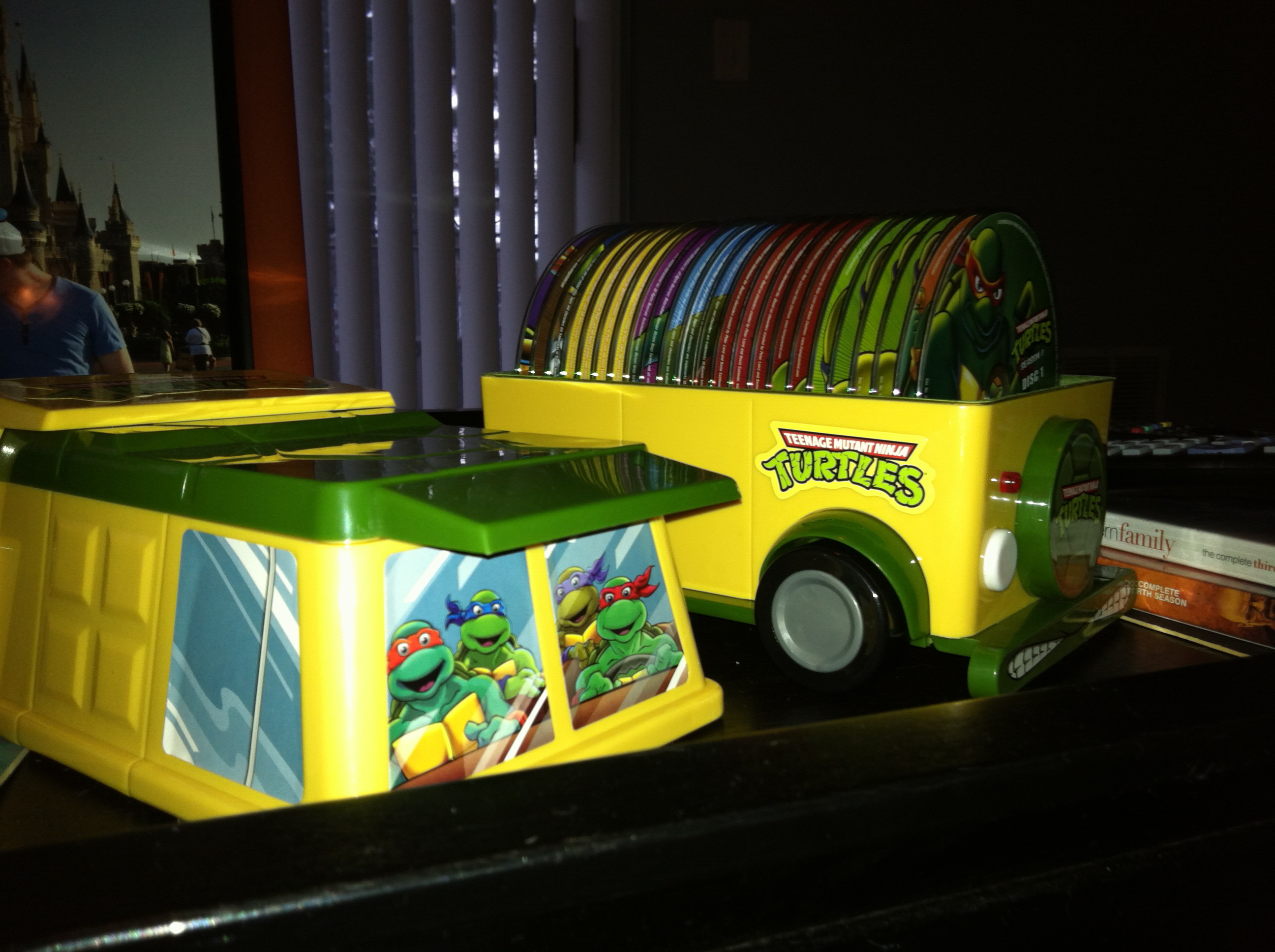
Teenage Mutant Ninja Turtles: The Complete Series

The Complete Series!

Ask most any guy my age what their favorite television show was when they were in elementary school and I be the most popular answer will be Teenage Mutant Ninja Turtles.  The heroes in a half shell were on weekday afternoons and then eventually Saturday morning from 1987 to 1996.  Their popularity was at its highest during the first three years or so but during their run they managed to rack up a total of 193 episodes.  The show was a merchandising behemoth, just look at a list for the action figures alone!  There were also clothes, toothbrushes, cereal bowls, pillows, and on and on.  You name it, and the Turtles were on it.  To a kid, they were a lot of fun and my days revolved around their television show, so when it was announced that the full series was getting released (housed in a replica Turtle Van, no less) I was all over it.

Packaging rear.

The DVDs have been receiving a steady release for awhile now, but they were always on the cheap.  Not cheap in terms of price, but light on episodes and content.  I have the first two volumes, but stopped there.  The show is pretty much as a I remembered.  It’s pretty silly and full of bad jokes but there are some worthwhile ones sprinkled in here and there.  I remember the characters broke the fourth well quite regularly, but what I didn’t remember was how often the show seems to poke fun at itself.  It’s probably something that disappoints those who want a show to take itself seriously, but come on, this is Teenage Mutant Ninja Turtles!  How could anyone take a show like that seriously?  Livening things up are numerous cameos (got to sell more action figures) on both the side of the Turtles and as antagonists.  I always liked the show’s take on Baxter Stockman, and the Rat King was also a personal favorite.

A look at the discs.

Those who have kept up with the show throughout the DVD releases are well aware of the fact that Lionsgate missed some episodes along the way, specifically “Planet of the Turtleoids and “Once Upon a Time Machine,” which have finally been released alongside season 10 as bonus features.  The complete series collection is just a collection of all of the previously released discs, so it does not correct the continuity issues, but does include everything.  This also means that if you’ve purchased every DVD along the way that this set probably isn’t for you, unless you really love the packaging.

The packaging is definitely the selling point for this set.  The Turtle Van (or Party Wagon, as it was called on the packaging of the toy release) is a pretty solid likeness of the old toy.  It’s missing the bells and whistles like guns and so forth, but does feature rolling wheels.  The interior contains a green Styrofoam mold that the discs slide into.  It can be a bit tricky to get the discs lined up properly so I wonder how well it will take care of them, but it works.  There’s a booklet too with a full episode list by disc, but that’s it.  One pet peeve of mine is the sticker on the front of the van features the Turtles as if they’re riding in it, but the side window stickers don’t.

And lastly, an unboxed view of the complete van.

If you’re looking for a great show, this isn’t it.  This collection is strictly for the collector who can’t say “No” to things from his or her childhood.  For what it is, it’s a cool set and I fully intend on watching each disc.  I outgrew the Turtles before the show ended its original run so I’m kind of looking forward to watching more of the “Red Sky” episodes from the show’s final seasons that I missed out on.  If you’re a fan like me that has yet to get the DVDs then this is a worthwhile set for you.


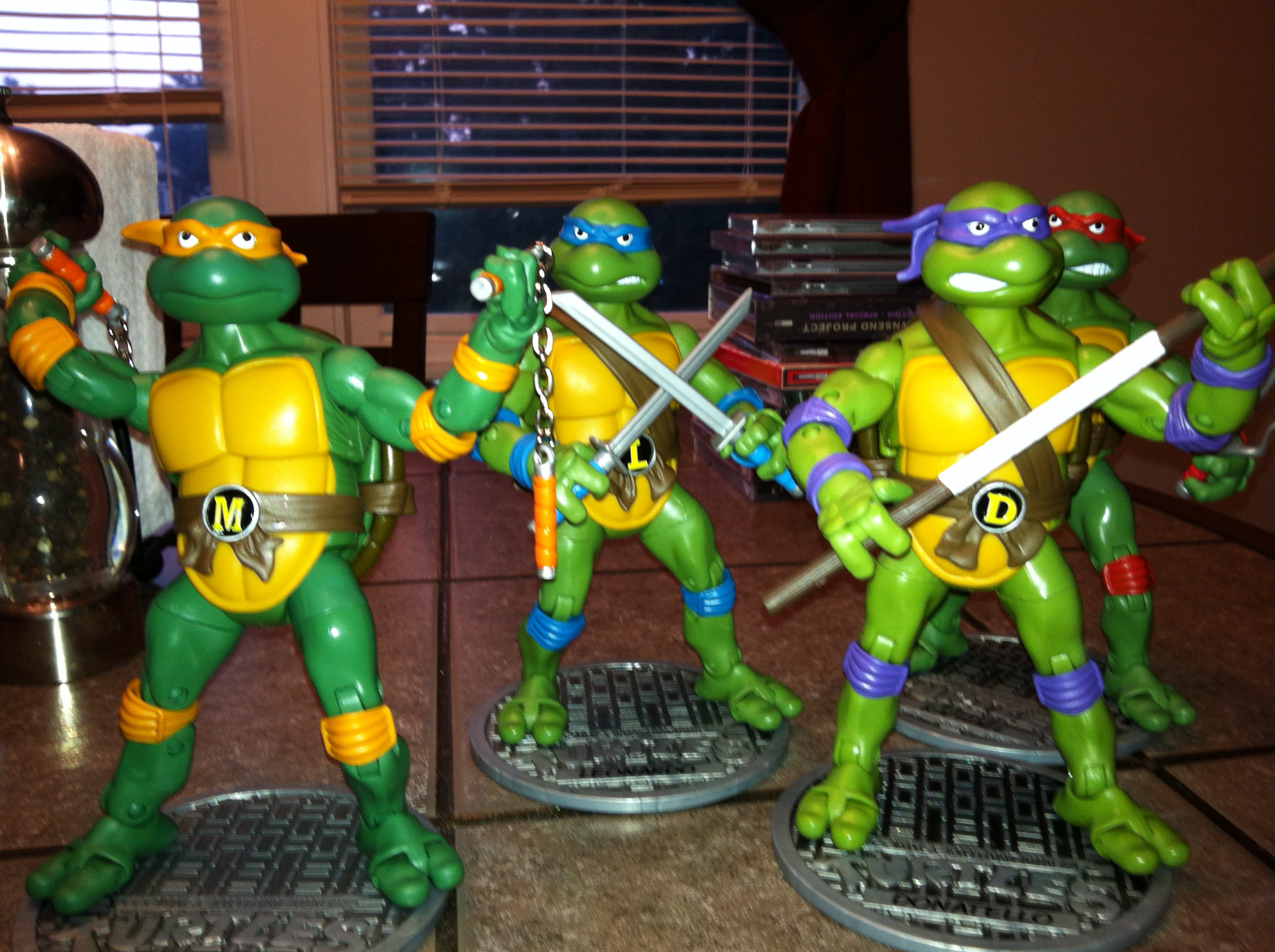
TMNT Classic Collection

Teenage Mutant Ninja Turtles Classics are here!

I’ve been out of the toy collecting game for several years now.  I used to enjoy it as a hobby and it was a nice way to link my childhood to my adult life as I pursued action figures of characters I loved as a kid.  It became a compulsion eventually.  I started off just buying the characters I was particularly fond of like Venom and Iceman, but once it became a full-fledged hobby I was suddenly finding myself scouring department store toy aisles six at a time looking for an obscure Man-Thing or Warbird.  That’s when it became about the hunt.  Tracking down the exclusive Wal-Mart wave of Marvel Legends was especially thrilling.  It seems silly in hindsight, but it was kind of addicting.  Eventually though the quality of the figures declined and I also ran out of room for all of these toys.

I got a little taste of that rush today when I tracked down a set of Teenage Mutant Ninja Turtles Classics.  It was a pretty easy hunt as I found a full set at the first place I went to, but I can’t deny it was a lot of fun.  The wondering, the hoping they’d be there.  I credit my interest in the line to my love for the TMNT as a kid and the new collections put out by IDW Publishing of the old books.  I’m currently onto volume 3, expect a review once I finish it.

The reverse side of the packaging.

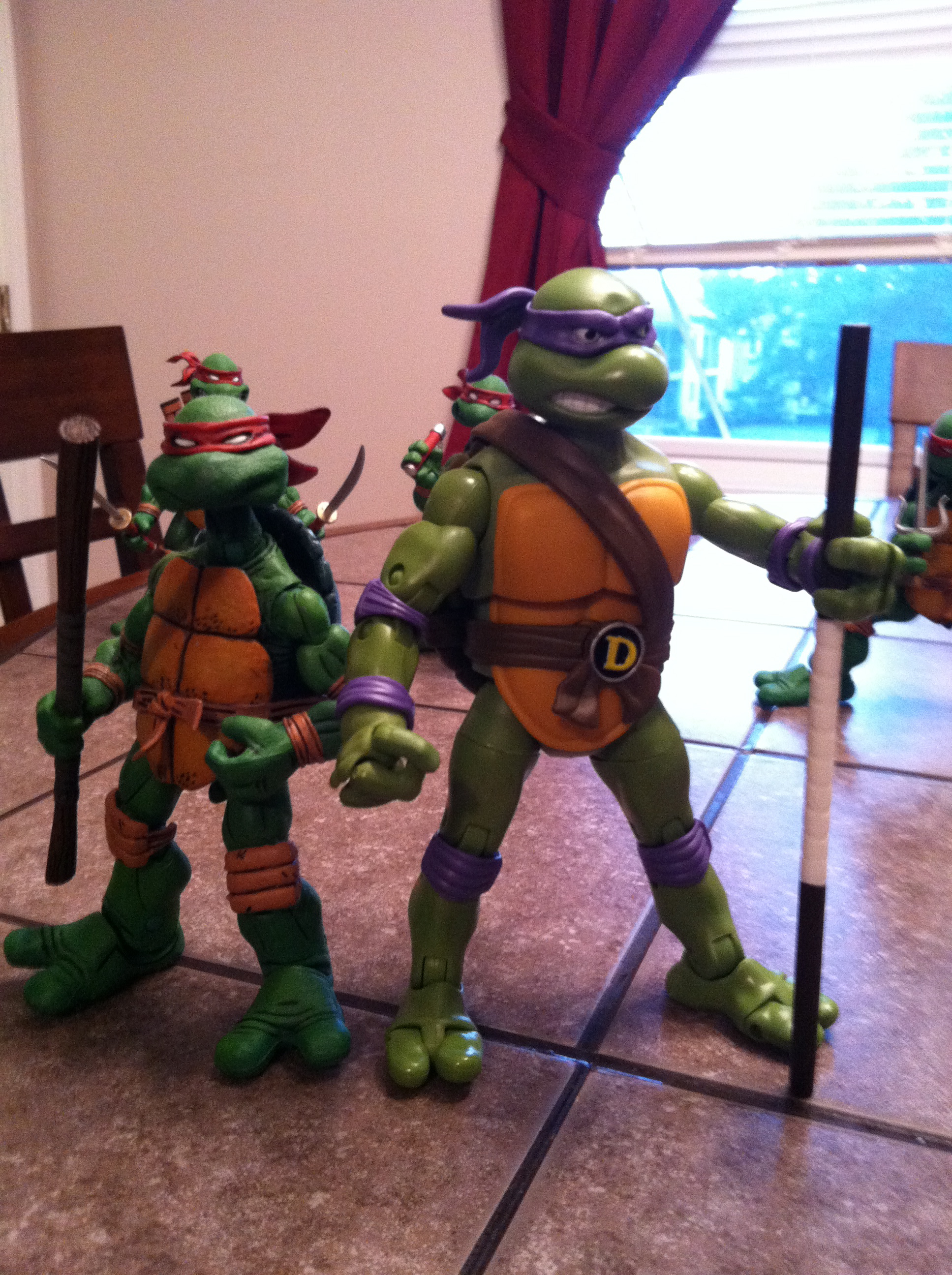
I’ve talked about it many times, so I won’t go into too much detail here, but I did love the TMNT as a kid and they still hold a soft spot in my heart.  One of my last toy-related purchases before today was for a set of the turtles puts out by NECA.  I dubbed them my all time favorite as they’re a wonderful representation of the turtles as they appeared in the pages of Mirage Studios brand comic books back in the 80’s.  These collections, plus a new line of comics launched by TMNT co-creator Kevin Eastman, have helped to contribute to a renaissance for the turtles that will soon culminate in a new television show aimed at kids on the Nickelodeon network.  To capitalize on this, and the original cartoon’s coming 25th anniversary, Playmates has launched a new line of toys aimed at those who fell in love with the turtles through the toys and cartoon back in 1988.

This new line, appropriately titled TMNT Classics, was first shown last February at the New York Toy Fair and has recently hit shelves in speciality shops and big box stores like Toys R’ Us.  The packaging on these new turtles states that they’re based on the look of the turtles from the old cartoon, but it would be more appropriate to say they’re combination of that look along with the style of the old toys.  Back in the 80’s, kid’s shows were basically extended commercials for toy lines and the turtles were no exception.  The toys were developed alongside the show and since Playmates only had concept art to go off of they ended up having their own look.  Each turtles had his own unique skin-tone and all sported solid, white eyes.  It was basically a hybrid of the comic look and the one the cartoon would go with.  These new toys sport the rounded features of the cartoon along with pupils in their eyes but retain their unique skin-tones, though they’ve been changed some.  Raphael has a darker green complexion while Don isn’t as brown as he used to be.  Donatello and Leonardo also retain their shoulder straps and each turtle, excepting Donatello, has wraps around the handles of their respective weapons featuring their trademark color (Raph’s sais are red, Leo’s katana handles are blue, etc).  It’s an interesting approach though I do kind of find myself wishing that Playmates just went all out in trying to make these turtles television accurate.  We already have comic accurate turtles, and the 2003 toy line paid homage to the original toy line, but we’ve never had cartoon accurate turtles.  Yes there was a wave of Toon Turtles in the 90’s but they were pretty crappy looking.

Group shot! Notice how some of the pupils are oddly placed.

Even though they’re not entirely cartoon accurate, these turtles are pretty nice to look at.  They’re loaded with articulation but their features are more reminiscent of the TMNT movie line of figures than the NECA one.  NECA went through the trouble of trying to hide the articulation but Playmates didn’t see need to, so while a lot of poses are possible, the numerous holes and joints do detract from the look of the figures.  And if the joints aren’t tight, it really hinders the amount of poses one can achieve.  My Raph has pretty loose leg joints which makes standing him a chore.  The hands on all of them are particularly combative as each features articulated fingers and thumb.  The finger piece on the left hand of my Leo figure even fell off in the packaging.  They can never get a good, solid grip on their weapons and the hands on all four definitely feel fragile.  There’s also an abdominal joint in each turtle that’s kind of odd.  The show’s animators definitely did take liberties in how the turtles could bend and move in those shells but I’m not sure the abdominal joint adds much.  Playmates at least had the foresight to only insert the joint in the front and not the rear of the shell, which would have looked horrible.

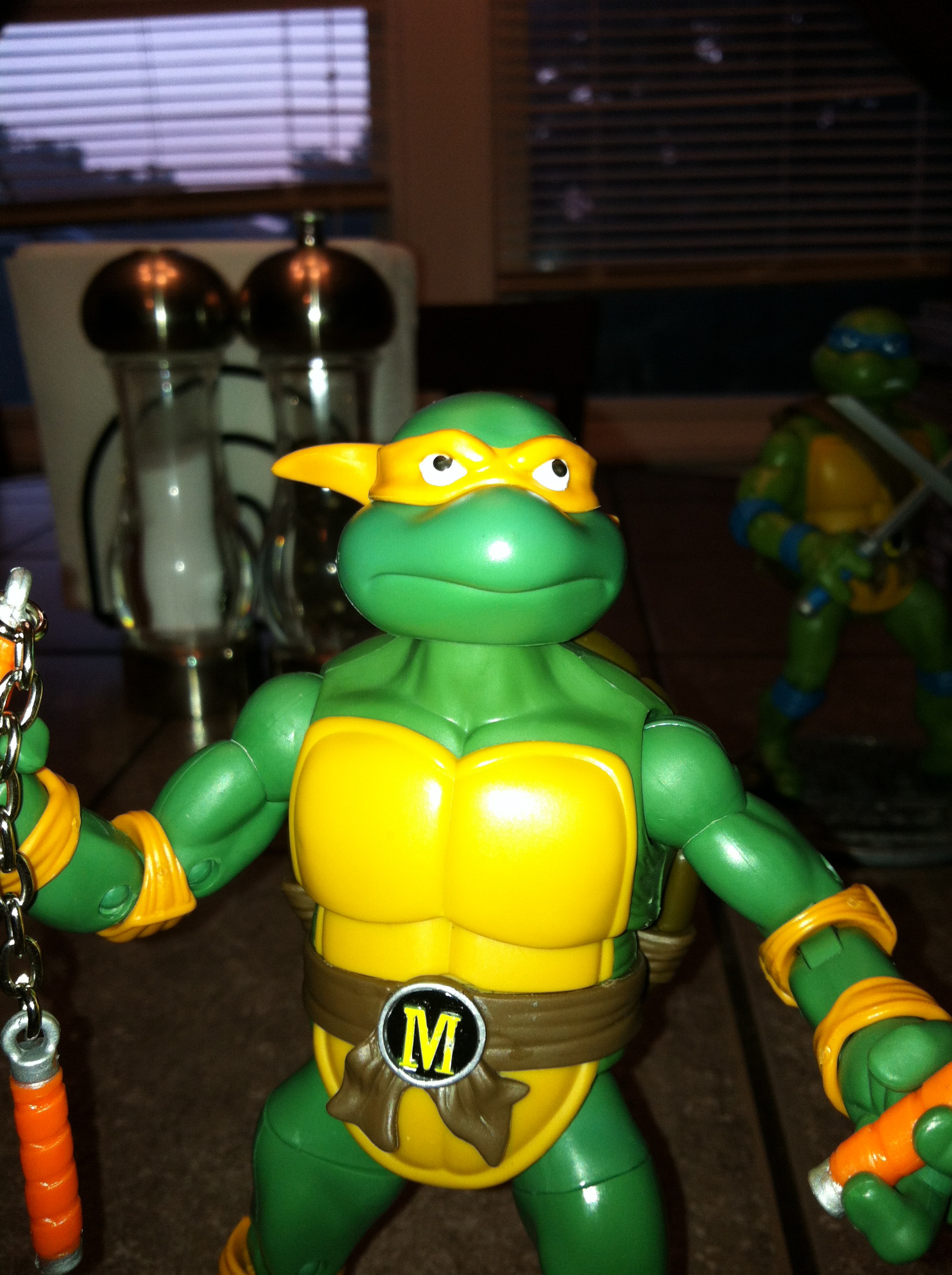
I’m pretty disappointed with Mike’s face sculpt. It just doesn’t suit the character.

Scultp wise, all four turtles are the same with the exception of a unique head sculpt.  The head sculpts are a call back to the original toy line as each turtle features the same or similar expression he had back in 1988.  This means they all look angry and I kind of wish they had gone with less intense expressions.  Leonardo should probably be grim and serious, but Raph and Mike definitely shouldn’t be.  The figures are tall, around six inches, so they don’t fit in with any other TMNT toy line.  They’re not too stocky looking either, and their proportions do remind me a bit of the movie line for the TMNT film.  They have kind of odd looking forearms and really long arms in relation to their legs.  Overall though, the sculpt is pretty solid for each turtle and they look good side by side though I really do wish Mike had a better face sculpt.

As far as accessories go, these are pretty bare-boned.  While the original toy line came with a bunch of ninja stars and other oddities, these turtles only come with their trademark weapons and Don only comes with one bo staff.  Each turtle also comes with a personalized manhole cover stand and their belts can hold their weapons easily.  Some toon specific items would have been fun like a mouser or turtle-com, but oh well.  The quality of the weapons is pretty standard, though Playmates did go above and beyond with Mike and gave him actual chains on his nunchaku which is a nice addition.  I never want to see another Mike action figure that doesn’t feature this.

NECA Don with TMNT Classics Don.

The paint job for each turtle is solid, though not very demanding.  Playmates opted for colored plastic for most of the parts with the paint only really coming into play with the bandanas, eyes, and teeth.  In the case of the eyes, it leaves something to be desired.  The rounded shape of each turtle’s head makes it difficult to paint on pupils that appear to be focusing on the same spot.  As a result, both my Don and Mike almost look like they have a lazy eye.  This has convinced some collectors to just paint over the pupils on their figures and go with the classic all white look.  From what I’ve seen, this actually looks pretty good but does take away from the cartoon look.  I’m not one to modify my toys anyways.

So did Playmates deliver with their classic TMNT line?  Mostly.  These are the most cartoon accurate turtles to date and they feature a lot of articulation which will allow fans to pose them in almost any position they can dream up, provided the joints are tight enough.  Even though they are the most cartoon accurate figures of the turtles to date, they’re still not the definitive take on the source material and the copious amounts of articulation does take away from the look a bit.  They’re also light on accessories which is hard to take considering these are the most expensive turtle figures I’ve ever bought.  I paid 20 bucks a turtle at a specialty shop, though the MSRP is said to be $18.  That’s still a lot of money for an action figure that’s pretty basic but hardcore fans will probably pay it.  I’ll have a hard time finding display space for these guys, but the nostalgic factor alone makes me mostly happy with my purchase.  They don’t top what NECA did with the turtles a few years ago, but they’re pretty damn good in their own right.  If you’re the sort of fan that’s really in love with the TMNT, then these figures are for you.


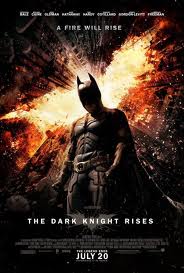
The Dark Knight Rises

The Dark Knight Rises (2012)

I mentioned in my look at Batman’s best films that I had gone into total lockdown mode for The Dark Knight Rises.  I got off of social media, stayed away from review sites, and just basically blocked the world out where Batman was concerned.  I wanted to walk into this film with an unformed opinion.  I wanted to be outside the hype.  The first two Christopher Nolan directed Batman films are fantastic.  That’s not to say they are instantly in the running for best movies ever, but in the world of entertainment (and comic book adaptations especially) they are certainly worthy of the highest praise.  The hype surrounding The Dark Knight was intense, and the film actually lived up to it.  I assumed the hype could only grow louder for the trilogy’s conclusion.

It’s a poorly kept secret in Hollywood that trilogies often end badly.  I won’t cite examples as I don’t want to distract from the review of this film, but I’m sure most people reading this can think of at least one trilogy that lost a lot of luster in the third and final act.  And I don’t consider this a spoiler since it’s been stated numerous times by both Nolan and Batman himself, Christian Bale, that this is it for the two of them where Batman is concerned.  And since it was reportedly never a sure thing that Nolan would even return for a third film I’m going to take the both of them at their word.  Warner Bros. may back a truckload of money up to both of their doorsteps but I think this is it.  And if you’re a concerned fan fearing that Batman may end up like Spider-Man (there I go, making an example), worry not:  The Dark Knight Rises delivers.

If you’re concerned about spoilers, this is a spoiler-free review.  Basically all of mine are, even for films that are over ten years old.  With that said, I’m going to talk about the plot to some degree and anything in the trailers or that is considered common knowledge (basically anything I knew going in) is on the table.  If you want as pure an experience as possible though, I do recommend doing what I did and avoid all reviews until after you’ve seen it.  If you’re a Batman fan or just a fan of either of the other two films, you should definitely see this.

Easily the most iconic image of Bane from the “Knightfall” arc.

The movie starts out in a similar manner to The Dark Knight; by introducing the main antagonist for the film.  In this case we have Bane, played by Tom Hardy.  For those of you unfamiliar with Bane, you don’t need to know anything about him going in.  For those who do, know that this is a much better incarnation than what was presented in Batman & Robin, though I imagine that goes without saying.  Many writers of comics, television, and even video games have often chosen to focus on the brawn that is Bane.  That’s to be expected as Bane first and foremost exists as a physical threat to Batman.  He is someone Batman can’t simply engage in a one on one fight and expect to beat, unlike most of his rogue’s gallery.  However, Bane has a tactical side to his character which makes him especially deadly.  The film wishes to display Bane in that light, though don’t worry, he still possesses impressive brute strength.  The character was introduced in the “Knightfall” story arc from the 90’s, which makes Bane a rather recent addition to Batman’s rogue’s gallery when compared with others.  Some of that persona is adapted here, and some of the plot from that arc is as well, which kind of surprised me though I suppose it shouldn’t have.

In the comics Bane is a big guy made bigger when he pumps a fictional type of steroid into his noggin called venom.  In this film there is no such serum and the many tubes going into the character’s head are not needed.  He does sport a mask, though it looks more like a gas mask than the luchador style one he wears in the comics.  The mask does serve a purpose, though the film never makes it clear.  I assume he can survive without it since a guy’s got to eat.  There’s no way he can get a physique like that living off a liquid diet.  The mask necessitates his speech to be dubbed.  Early viewings of the initial teaser for the film left several fans complaining about how inaudible Bane’s speech was.  I assume Nolan wanted to go a realistic route with the character, but pressure from the audience did apparently bring about change.  He’s not always clear in the picture, but his voice is quite loud and almost jarringly so.  It reminds me of Shredder’s voice from the first Teenage Mutant Ninja Turtles film.  It may not be realistic, but it beats the alternative.

In the trailers we are shown not just Bane, but Catwoman (Anne Hathaway) as well.  Her lines to Bruce Wayne at a costume ball recall some of the sentiments being thrown about in the Occupy Wall Street movement from last summer.  And yes, that is part of the film’s central plot, to a degree.

Campy? Perhaps, but given the source material I think they did all right.

After Bane is introduced in a most menacing fashion, we are taken back to Gotham where eight years have passed since the death of Harvey Dent.  Bruce Wayne has become a recluse and all of those years playing Batman have taken a toll as well.  The cast from the previous films is returned.  Gary Oldman is back as Commissioner Gordon and Michael Caine as Alfred.  Morgan Freeman is there as well and there’s a couple of new comers in officer Blake (Joseph Gordon-Levitt) and Miranda Tate (Marion Cotillard).  The three veterans of the films are just as good as always, with Caine especially being effective as Alfred.  I feared the Alfred character would get too preachy, and almost too omnipotent much like Rosemary Hariss’ Aunt May in the Spider-Man films, but my fears proved unfounded.  The new-comers serve a nice role with the Blake character mirroring Gordon’s from Batman Begins.

Tate is an ally to Bruce in his corporate life, which we soon learn is not going well.  With Gotham now at peace and organized crime all but exterminated, there’s no need for Batman so Wayne tried devoting all of his resources at Wayne Tech to making the world a better place.  In doing so he has stymied profits but Tate seems to share his outlook.  Selina Kyle, aka Catwoman, makes her presence felt early on as well by swiping some jewelry from Wayne which gets her into the story.

I was on the fence about the Catwoman character being used here and thought the film may become too crowded, but again my fears are mostly unfounded.  While there are a couple of scenes between Batman and Catwoman that border on camp, the film soon remembers what it is and distances itself from any such thing.  In the comics, Catwoman is known for being a tweener in that she isn’t really a villain but isn’t necessarily a hero either.  In TDKR she’s played pretty much the same way.  Her character is definitely adapted in part from Frank Miller’s Year One arc, which was used as a basis for Batman Begins, minus the prostitution angle (which DC has always tried to distance itself from). Her character views herself as a sort of Robin Hood, though her motives are entirely selfish.  She gets herself mixed up with Bane, which is how she stays in the picture.  And her presence doesn’t crowd anything or take away from the film’s hero, Batman.  He’s in this one just the right amount, and his heroic appearances are staged exceptionally well.

Gordon-Levitt’s Blake is a welcomed addition to the cast.

The main plot for the film involves Bane trying to basically pick up where Ras al Ghul left off and bring down Gotham.  He infiltrates the corporate sector, the market, and even the physical infrastructure of Gotham itself (as evidenced in the trailer).  Make no mistake, he’s a real threat to the city in an even bigger way than Ras could have hoped to be and his motives and actions help tie the trilogy together.  A lot of TDKR harkens back to Batman Begins which helps maintain a feeling of continuity and in the end makes for a better pay-off for longtime fans.

That’s the film, in a nutshell, but how does it fare as entertainment and how does it stack up with the other two films in the trilogy?  To put it simply, The Dark Knight Rises is a hard film to watch.  I don’t say that because it’s long (approximately two hours and forty-five minutes) but because it’s pretty bleak.  For most of the film’s running time there’s not a lot of reason for optimism.  The Dark Knight was a pretty dreary movie at times, but even that had little moments of triumph throughout.  The Dark Knight Rises has fewer of those moments which make it one exhausting movie to watch.  I went back for seconds and thirds on The Dark Knight during it’s theatrical run, once is enough for me with this film (though I’ll definitely be a day one buyer when it hits stores).

Oh yeah, expect to see some new “toys.”

Don’t confuse my proclamation that this is a hard film to watch as a criticism.  Some films are truly brilliant but hard to sit thru.  Think Schindler’s List or Grave of the Fireflies, though certainly not on that scale.  There is a real danger to this film.  I think part of it is born from knowing that this is the final film in this trilogy, and possibly this “universe,” which makes it feel like anything is fair game.  I would like to think though, that even without knowing that, I’d still feel the same unease I felt throughout this film.  Bane is a truly monstrous individual on a different level than The Joker.  That doesn’t make him better, just different.  Many were likely worried about how Nolan could possibly move on after The Joker but he found a way.  I found myself hating him and I really was hoping he’d get his due in the end, which is an emotion I never really felt towards The Joker.

The Dark Knight Rises is a very good film and quite exceptional, though it doesn’t top Batman Begins for sheer entertainment value and will probably wind up behind The Dark Knight for most.  There’s no shame in that and I feel quite confident in saying that Christopher Nolan’s Batman trilogy will go down as one of the all-time greats.  There’s certainly no comparison as far as comic book movies go, and I doubt it will ever be as beloved as the original Star Wars trilogy, but from start to finish this is the most consistent.  The films are connected not just by style and the names attached but in theme and narrative.  The Dark Knight Rises is a grueling experience at times, but is the pay-off the fans wanted.  I feel slightly stupid for even having my doubts about this one, but Christopher Nolan once again delivers a fantastic piece of art.  I will never doubt that man again.