Tag Archives: arcade

Numskull BurgerTime Quarter Scale Arcade Cabinet

It’s time! It’s time! It’s Burger Time!

For a few years now, Numskull has been releasing scaled down versions of arcade classics. It’s a strategy similar to Arcade1Up which managed to worm its way into big box retail with its smaller versions of classic and not so classic arcade games, but with Numskull they’ve gone even smaller. Their quarter scale machines are just that – a classic arcade machine at one fourth the size. At least, I take them at their word in that regard since the game we’re talking about today is one I don’t have access to in its original form so if this is not exactly to scale then that’s for someone else to confirm. These releases though caught my eye when they first showed up and have continued to do so, but the price has always kept me from biting. After all, this is certainly not the ideal way to play an arcade game. Most of these are 40+ years old and available virtually everywhere which makes this type of release more of a gimmick or decorative item than anything. However, I do love a good micro version of a popular item. In that, I’m like Myron Reducto from Harvey Birdman: Attorney At Law who has an obsession with tiny things. I don’t know what it is, but when something I like is available in a tinier version it makes me happy, but only if it doesn’t lose function and Numskull would seem to fit that description.
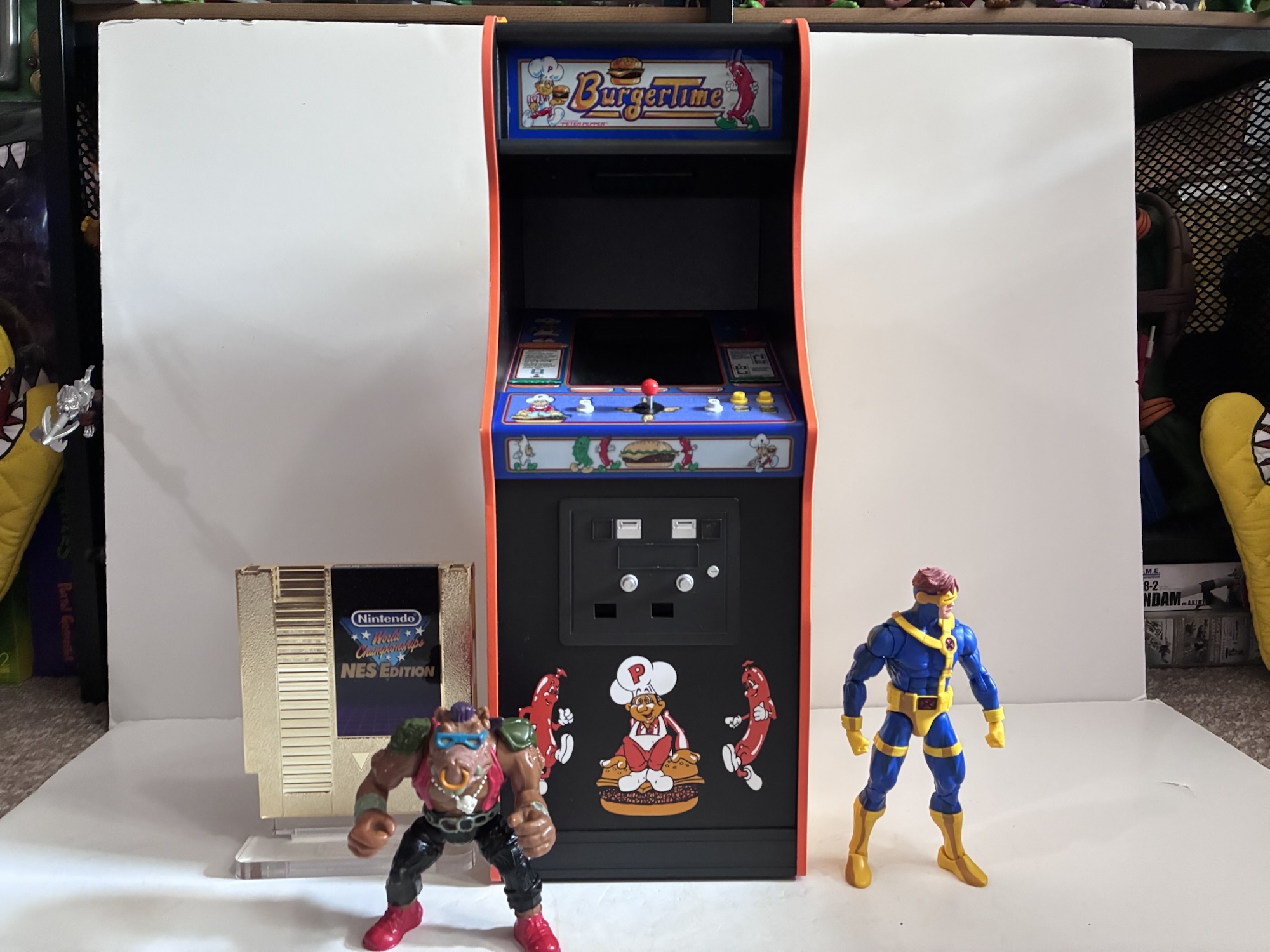
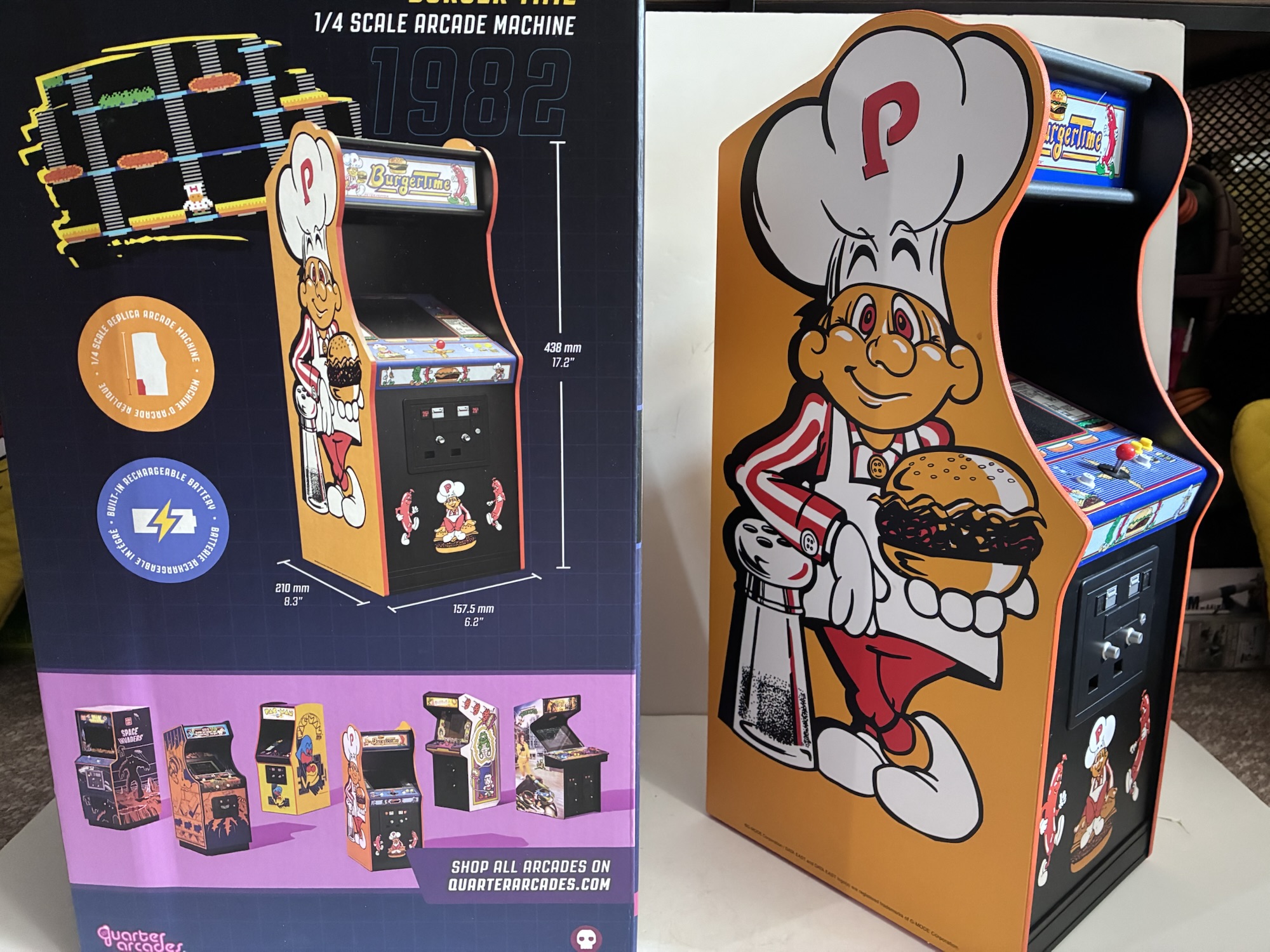
A size comparison that hopefully suits everyone: (left to right) replica NES cart, Playmates Toys Bebop, Burger Time, Marvel Legends Cyclops

Of course, if someone were to go out and buy one of these things that’s only part of the decision. The other is to decide on just what to get? For Arcade1Up, I have just two releases: The Simpsons and Marvel Super Heroes. The Simpsons is the only “full size” cabinet I own with the Marvel one being a “barcade” which is just a smaller version that sits on a table or bar. The Marvel one I received as a gift and it’s a solid one to have since it contains three 2D fighting games on it and that’s a style of game that works well on repeat plays. The Simpsons, in contrast, does not. It’s a brawler and they’re shallow, but I just love The Simpsons so I wanted to add it to my rec room and I waited for it to go on clearance before finally taking the plunge. With Numskull, a lot of the games are classic, see if you can get the high score, sort of things. They do work well to some degree as a game designed to be replayed and mastered, but they’re also old and it can be hard to justify playing such games when so many other, more modern titles are constantly available in a given household. The thing is though, the $250-300 starting point for a lot of these meant it didn’t really matter. I was not going to spend that kind of dough on a gimmick. If any were to go on steep discount then sure, but I honestly didn’t think that would ever happen.
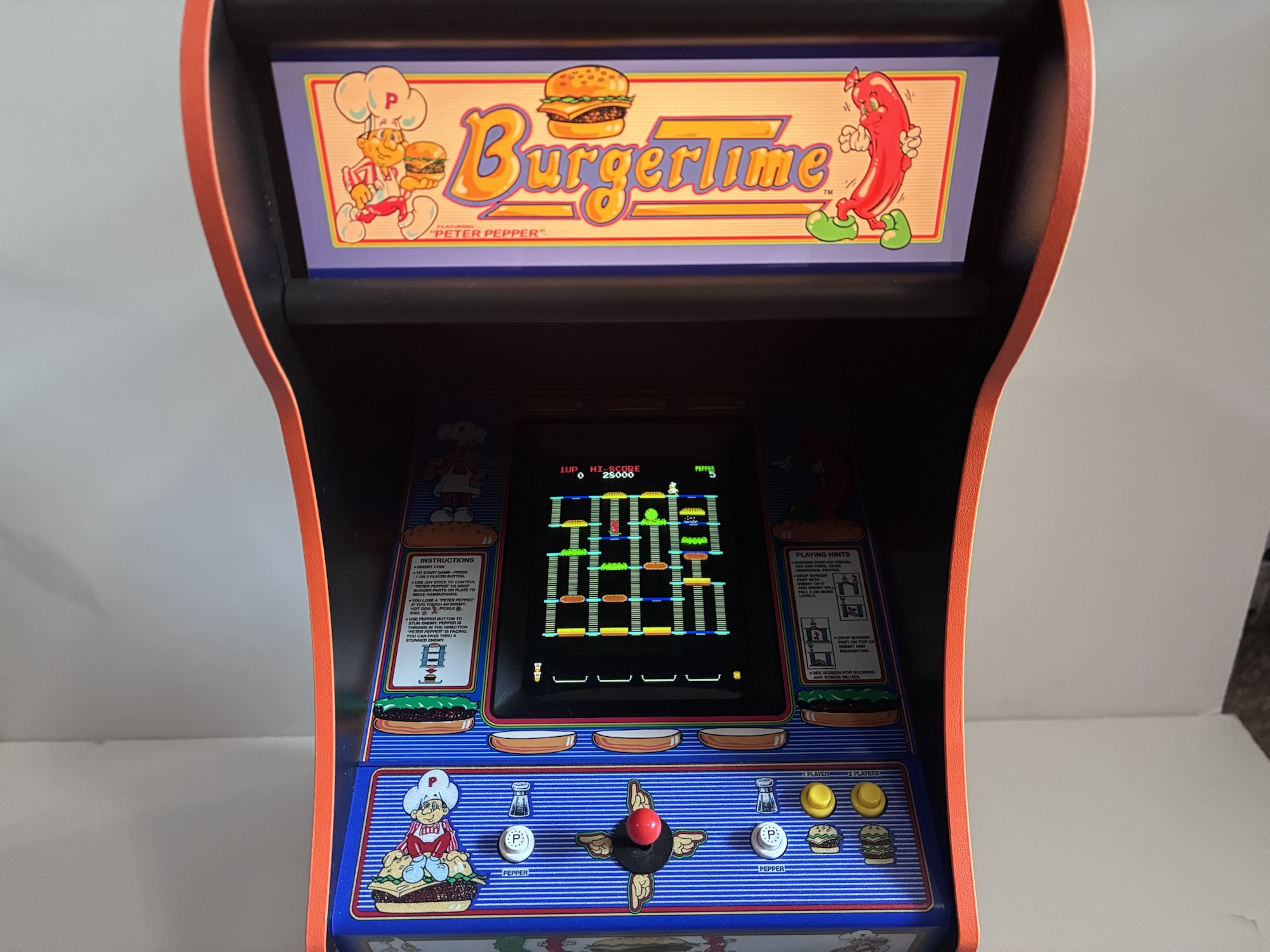
The marque lights up when turned on.

Enter Woot, Amazon’s discount storefront. It was in the spring that they had the Numskull version of BurgerTime available for $70. This ordinarily would cost $230 so while $70 is still a lot for a gimmick, it’s also a pretty sizeable discount. While it wasn’t the game I had my eye on, it certainly fit the bill as something that would be worthy of replaying. And for the record, the game I was hoping would hit such a price was Teenage Mutant Ninja Turtles, but really just so I could stick it with my quarter scale action figures. I didn’t actually want to play it, I can do that far more easily in other ways, but thus far that has only hit as low as $200 from its MSRP of $300 and it’s unlikely to ever dip below $100 so BurgerTime it is.
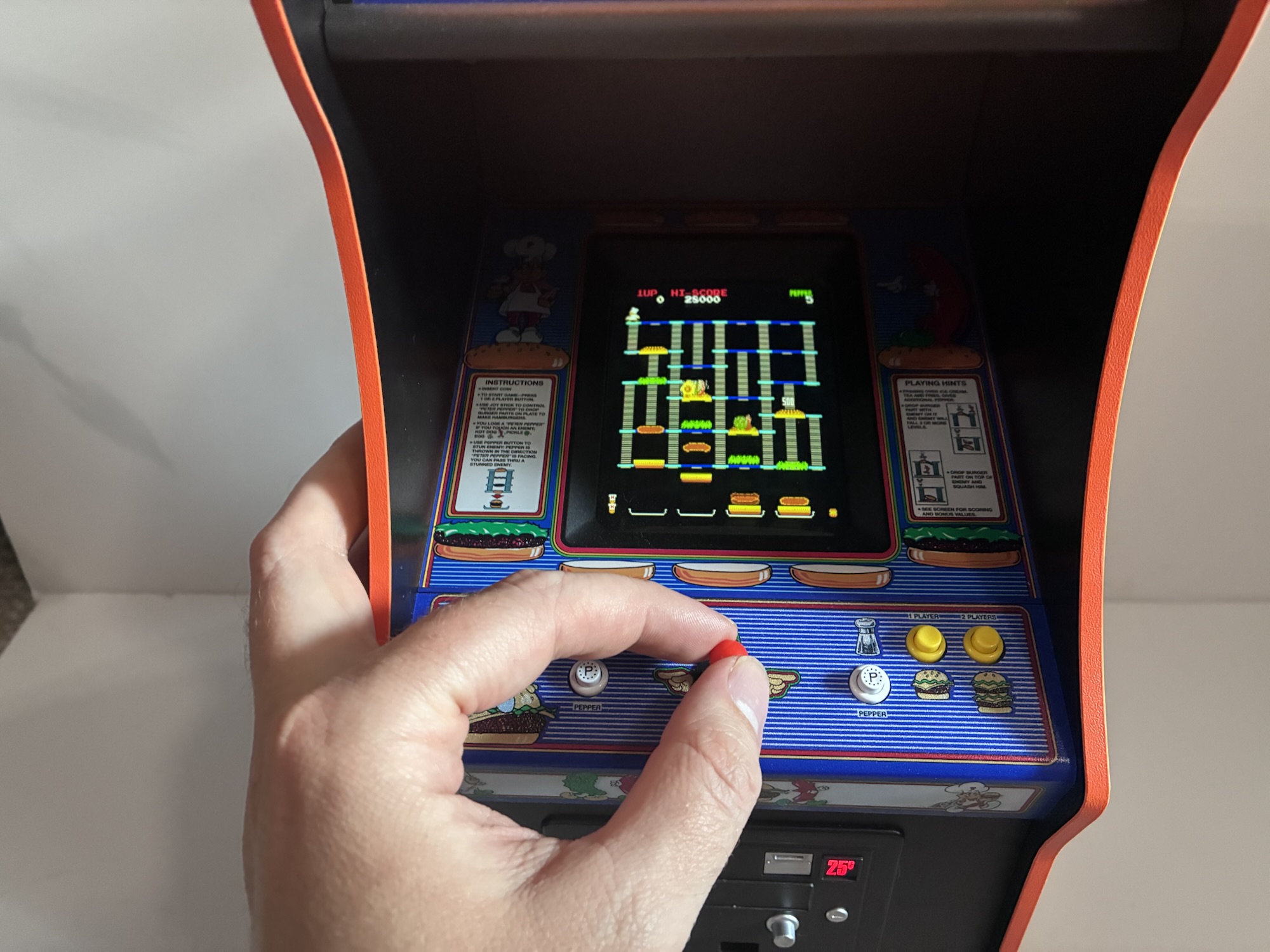
It’s a little cramped, but playable.

BurgerTime is a game originally released in 1982 by Data East for the DECO Cassette System. That was a series of arcade cabinets designed to be altered and have their game swapped out when things started to get stale. It was one of the early platform titles following in the footsteps of Nintendo’s legendary Donkey Kong. In it, the player takes control of a chef by the name of Peter Pepper tasked with assembling a series of hamburgers. Trying to prevent Peter from doing so are some enemy foot items. What’s the hamburger’s greatest enemy? Why, the hot dog (or sausage) of course! Joining the hot dog is a fried egg and a pickle slice. I’m not sure why the egg and pickle, both solid additions to any burger, are trying to obstruct Peter, but perhaps we shouldn’t pay it any mind. The game tasks the player with navigating a sequence of platforms via ladders to walk over ingredients for the burgers that need to be constructed. Walk over them and they drop a level. Peter must get all of the ingredients to fall through the level and into place in order to clear the level.
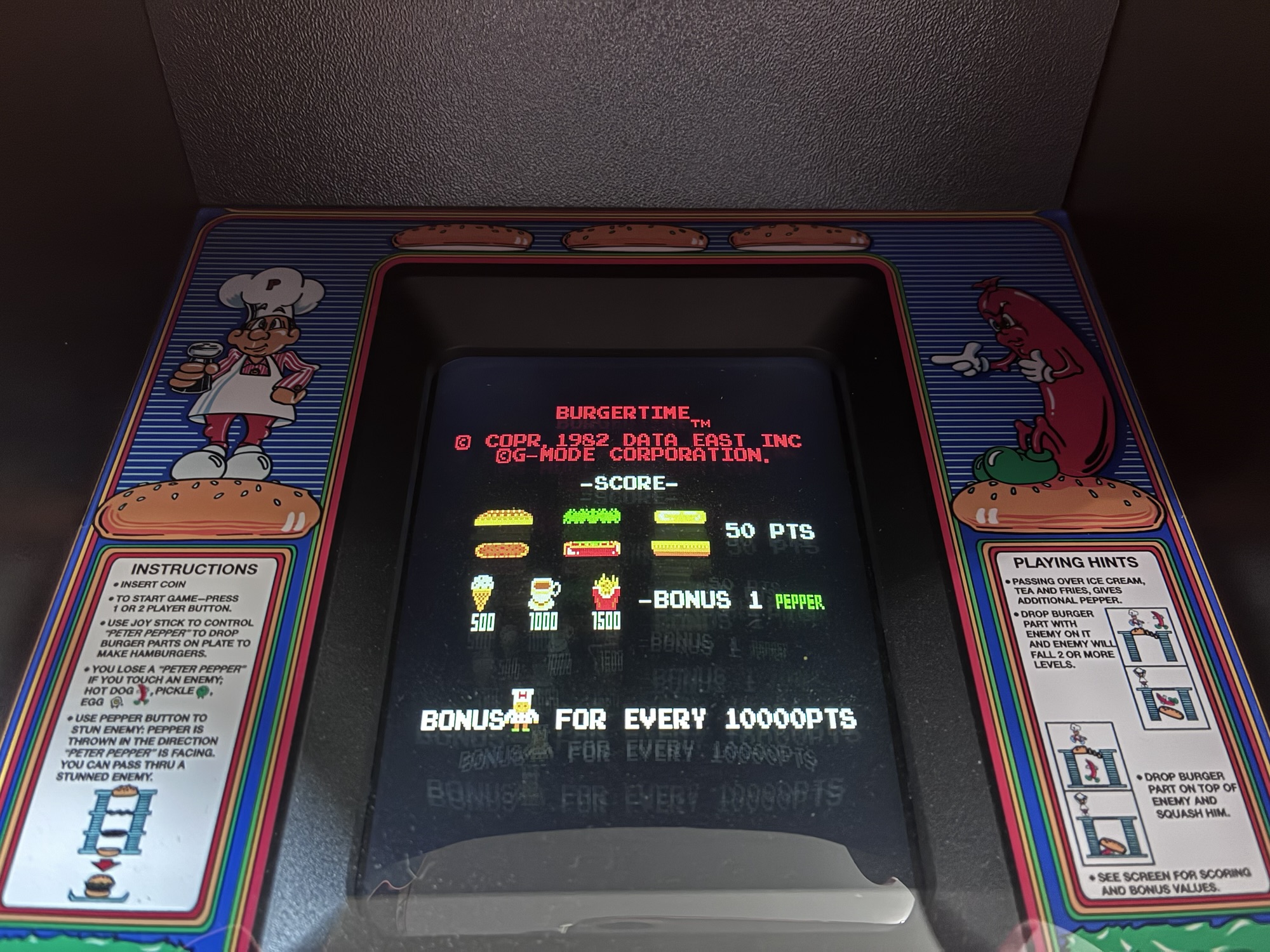
The resolution is pretty nice.

BurgerTime has six, looping, levels and the ultimate goal is to collect the highest score. Peter has few maneuvers at his disposal to avoid enemies as he can only walk along platforms and scale ladders. He does have access to pepper and hitting an enemy with pepper both stuns them and makes it possible for Peter to pass through them. Peter only has five doses of pepper to start, but collecting points will cause power-ups to appear on the screen for a short amount of time which can replenish Peter’s pepper reserves. The real skill of the game is in navigating the baddies and using them to your advantage. When Peter walks across a portion of a burger, it drops one level. However, if it has an enemy on it then it will drop multiple levels which can help speed things along and increase your point totals. The game basically turns Peter into a pied piper of sorts as you want to get enemies following you so that you can drop ingredients with them on it. Enemies located below falling ingredients will also get taken out by them, though they can re-enter the fray. As levels advance, the game gets harder by creating more choke points on the map. The first map is pretty basic while the second is shaped like an inverted pyramid. It’s much easier to avoid enemies near the top, but towards the bottom they can more easily box the player in. Contacting an enemy is death and Peter has just three lives, but can accumulate more at certain point total intervals.
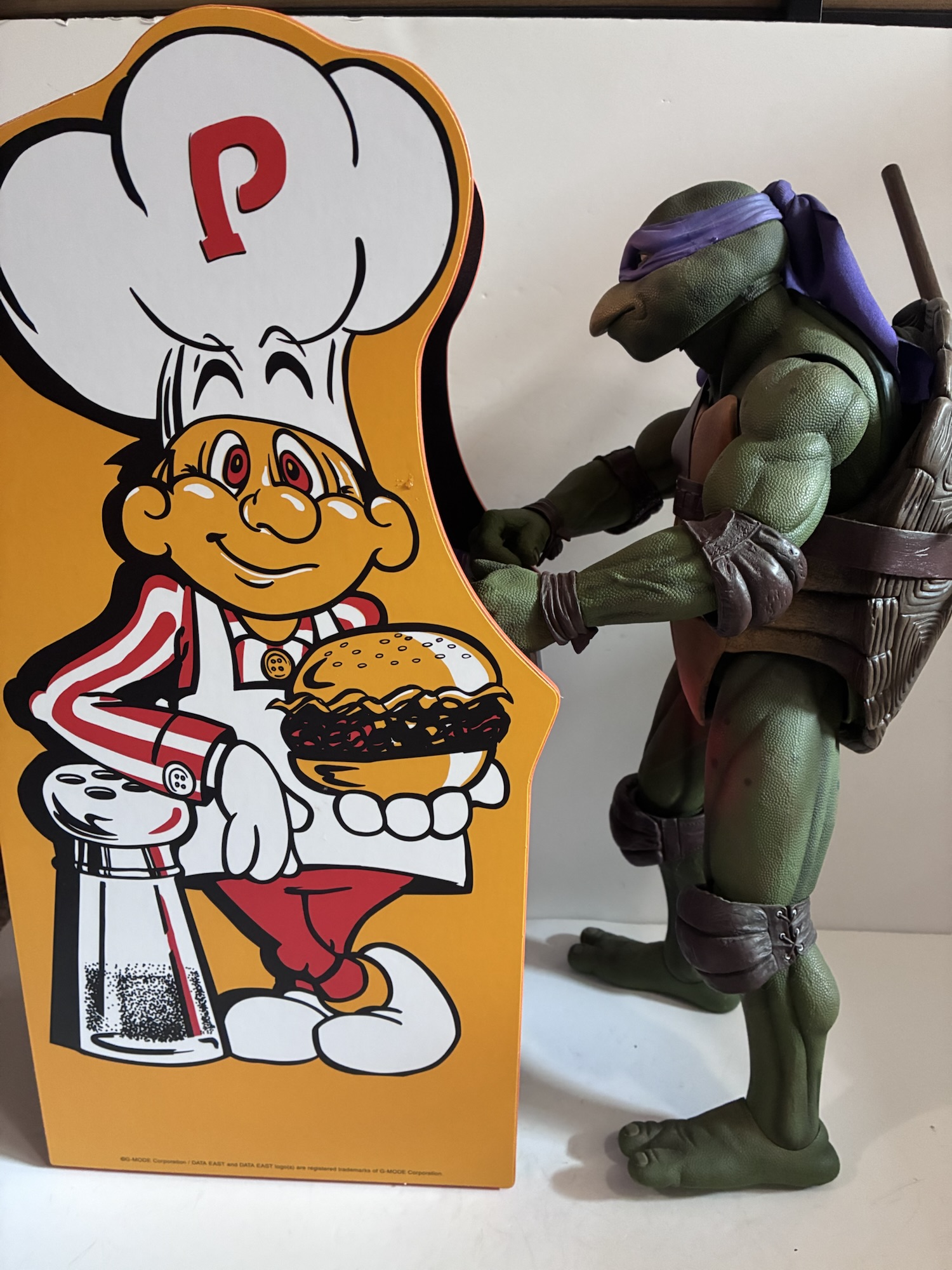
“Should have been Pizza Time.”

BurgerTime is a simple game, so it translates pretty well to a tiny arcade cabinet. It requires just two inputs to play: the four-way joystick and the pepper button. The joystick does have a touch more play to it than I’d like as sometimes I feel like it’s not as responsive as it could be, but that could also be the game which requires some precise positioning in order to ascend or descend a ladder. Repeated plays have helped me to largely improve in that respect, but it does make me wish I had access to an actual arcade cabinet to see if it feels the same (I haven’t played BurgerTime prior to this in 30+ years). The screen is nice and bright and the sound comes through cleanly. The cabinet works best when placed on a table, but it’s not too big to just plop on your lap as well. The build quality feels really nice and it’s quite lovely to look at. The marquee lights up when it’s on and there are buttons for player select and the coin returns, though they don’t all actually do anything in the game. The cabinet can be played plugged into a wall outlet, but it also has an internal battery that is advertised to get over 2 hours of playtime. In my experience that seems to be pretty accurate and it comes in at the high end of the estimated time. Since this is an emulated arcade game, Numskull did add some features via the bios so if you just want to see everything the game has to have without the necessary skills needed to get there you can toggle on invincibility or infinite lives to do so. And like the real deal, it will keep track of high scores so it gives you something to shoot for. That’s right, I’m coming for you Ken!
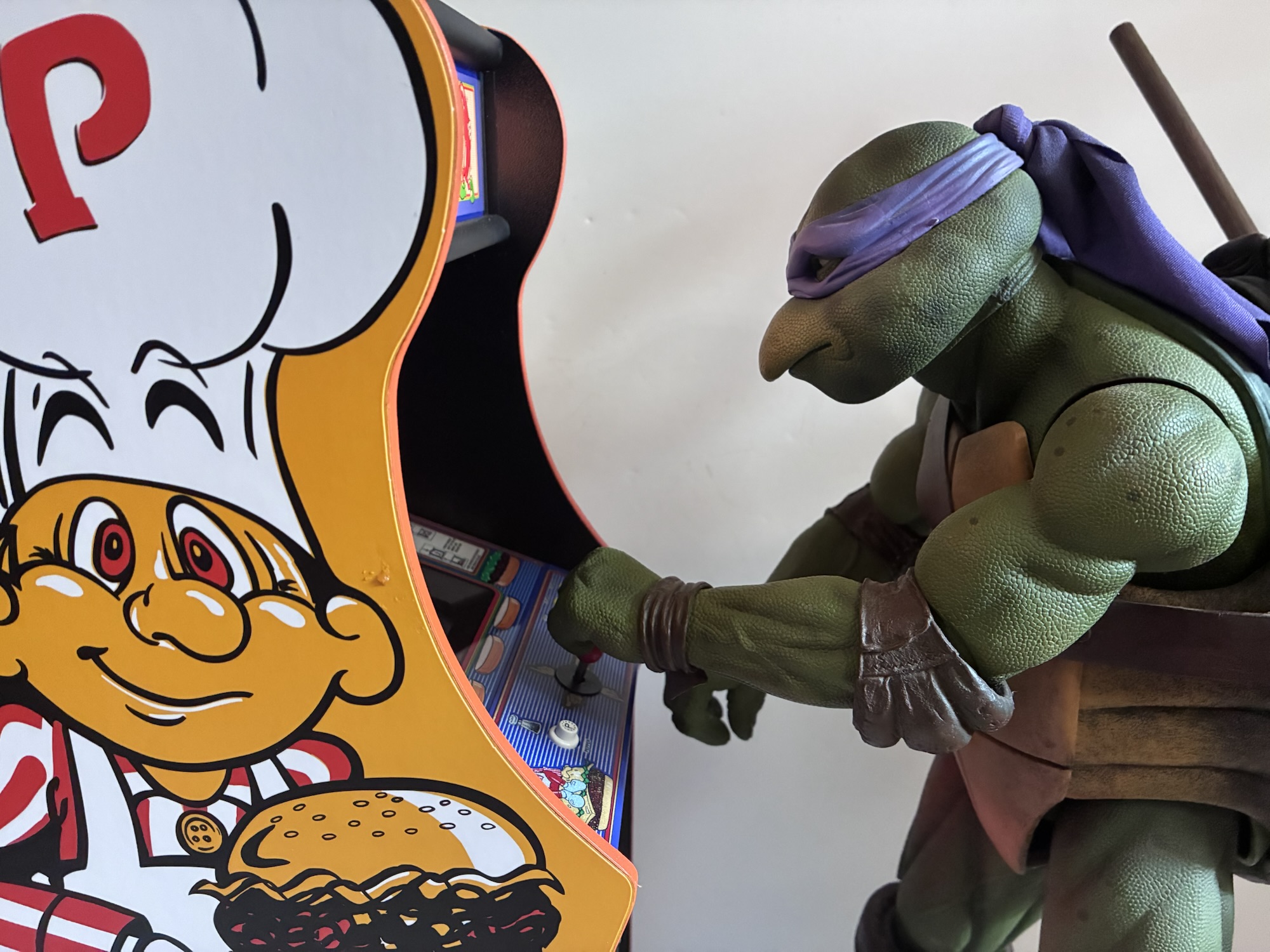
He’s going for my high score.

Numskull’s quarter scale arcade cabinet is about what I expected. It’s a quality machine that is quite fun to look at, but is also surprisingly fun to play as well. Is this the best way to experience BurgerTime (or any of the games available)? Probably not, but it’s also not the worst as there were plenty of ports to home consoles for BurgerTime that came up lacking. This is a 1:1 recreation of the arcade experience just in a smaller package. It’s pretty addicting, though also dated. BurgerTime has never been my favorite game from this era, but it’s one of the better ones. I mentioned that TMNT was the cabinet I was really hoping to land some day, but for superficial reasons and to sate my TMNT fandom. As far as actual games that I’d want to play, it’s pretty much BurgerTime, Ms. Pac-Man, and Bubble Bobble of the available games. I’m not a big shooter fan so I wouldn’t want any of those so I can’t be disappointed with the fact that it was BurgerTime that ended up being the one I got. Will I get more? Probably not. They would have to hit a similar low price point and be one of the few games I have my eye on. And now that I have one, I don’t feel the same level of curiosity that I felt before. If this is something that interests you and you can get it for a similar price then I think it’s worth it. It’s hard to set an actual price on it because it is pretty superfluous. I know I wouldn’t pay the original sticker price, but I might have been willing to go more than the $70 I got it for.

For more video game talk, check these out:
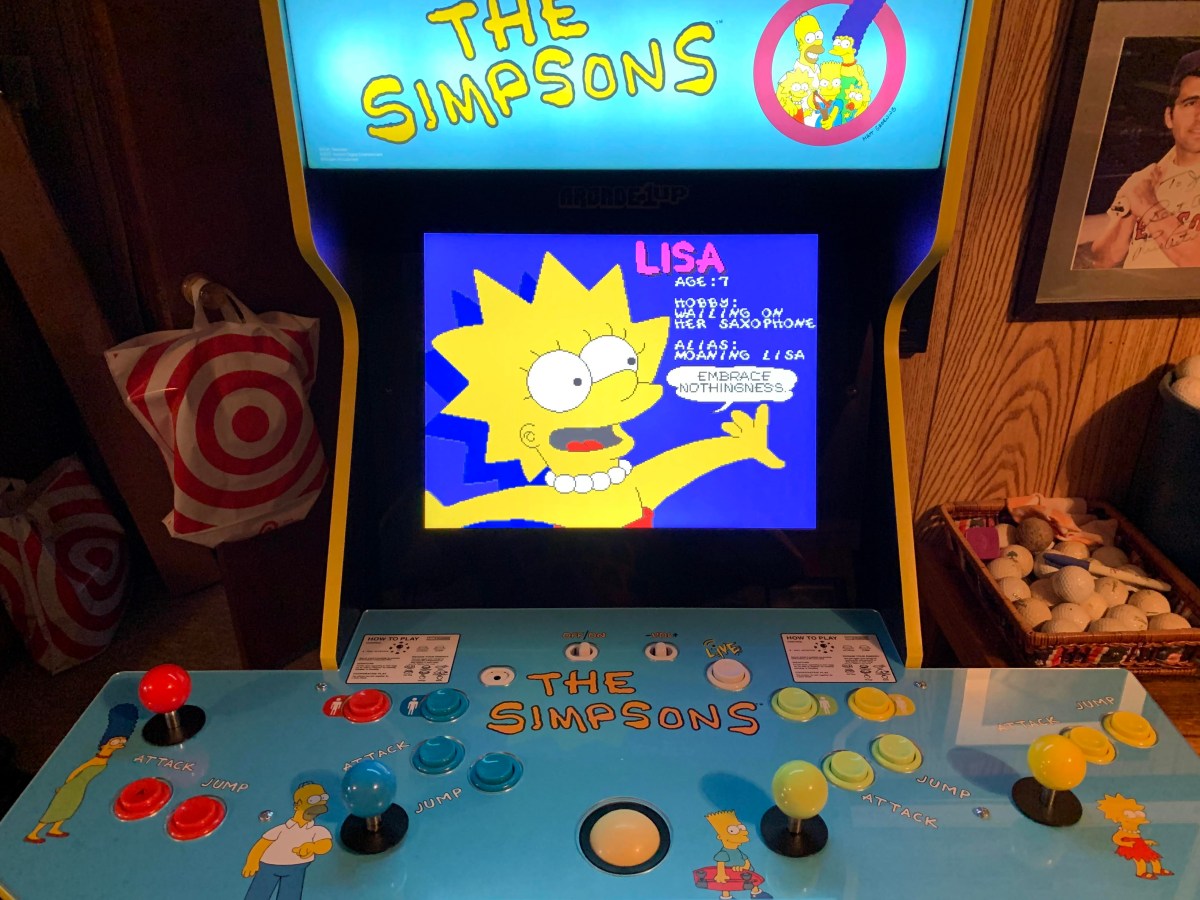
Arcade1Up – The Simpsons

When it comes to arcade cabinets, there are few that would interest me as far as a purchasing decision is concerned. One such cabinet though has always been The Simpsons arcade game, and it’s not really because of the game’s quality. The game is fine, one of the better brawlers out there, it’s just limited…

Keep reading
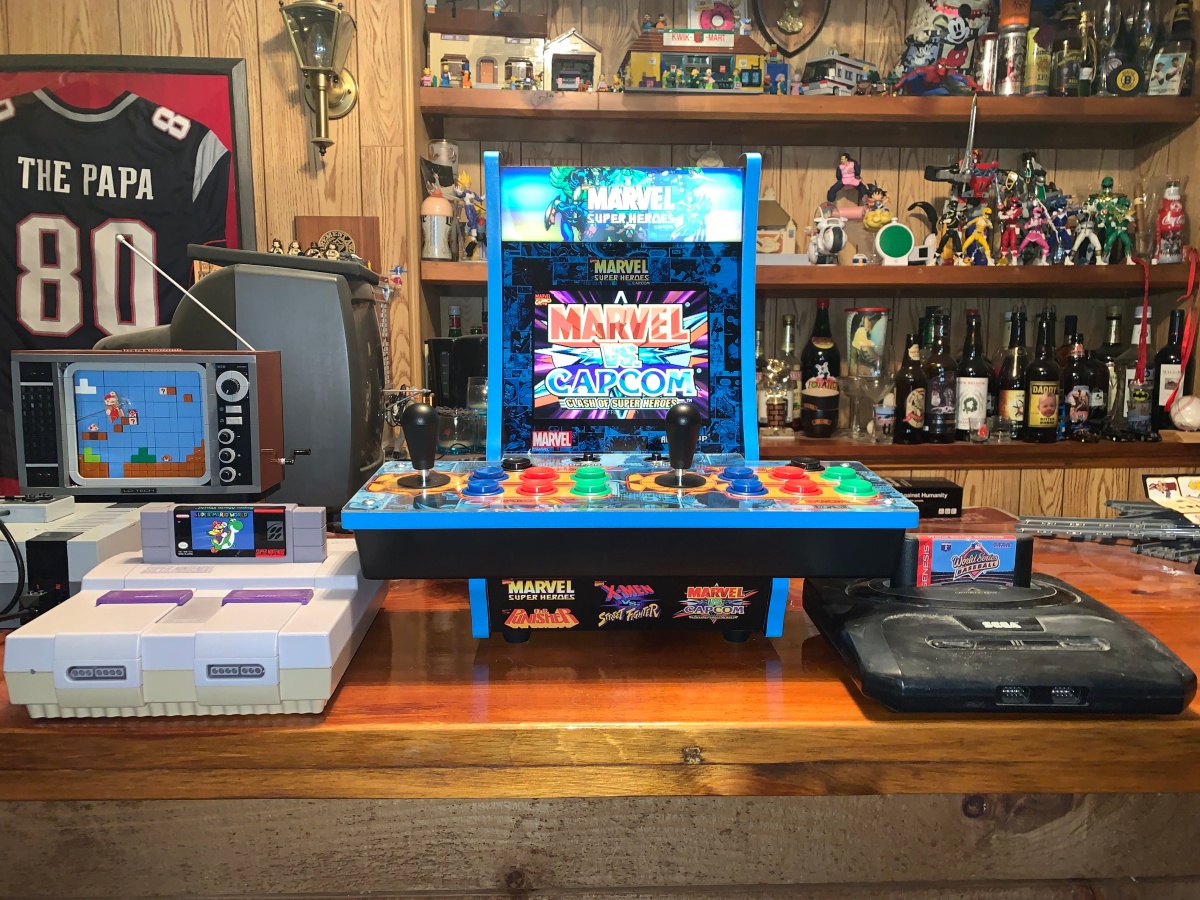
Arcade 1Up Marvel Super Heroes Counter-Cade

Arcade 1Up has been around for a few years now selling arcade cabinets at a reduced size and also a reduced price. The cabinets are significantly smaller than an actual arcade cabinet, but still plenty large enough to take up a lot of floor space in your home. And while they’re cheaper than the “real…

Keep reading
Teenage Mutant Ninja Turtles (1989 Arcade)

What began as a joke between aspiring comic book creators, Kevin Eastman and Peter Laird, eventually morphed into a multi-media juggernaut bestowing wealth and status upon the two. Along the way though, few predicted such big things out of a property titled Teenage Mutant Ninja Turtles. The books sold well, but they were independently produced…

Keep reading

Teenage Mutant Ninja Turtles (1989 Arcade)

Teenage_Mutant_Ninja_Turtles_(1989_arcade_game)

Faithful to the cartoon in every way except the cabinet art. It has since become charming on its own.

What began as a joke between aspiring comic book creators, Kevin Eastman and Peter Laird, eventually morphed into a multi-media juggernaut bestowing wealth and status upon the two. Along the way though, few predicted such big things out of a property titled Teenage Mutant Ninja Turtles. The books sold well, but they were independently produced and in small numbers limiting how much money could be earned. Plus they were pretty violent and would never be considered suitable for a general audience. Eastman and Laird believed in it though, they just needed to convince those with the means to catapult their franchise to believe in it. Toy companies passed though, but eventually doll maker Playmates, needing to add a “boy’s toy” to its portfolio decided to take a chance. In order to help market the toys though, they needed something more suitable than the black and white, ultra-violent, comics that existed and a cartoon was born.

The Teenage Mutant Ninja Turtles cartoon was conceived basically as a means of promotion. A direct-to-syndication order was out of the question, and even a full season was apparently deemed too extravagant. Instead, a five episode mini-series was produced for air in 1987. The confidence in the property was still too low to even warrant a more traditional half-season order of 13 episodes. Five episodes was all it took though, and kids were hooked pretty quickly causing them to flock to stores and leave bare the TMNT section of the action figures aisle. A second season would be ordered, and apparently confidence was still a bit tepid as that was only 13 episodes. It wasn’t until the third season, which premiered in 1989, that the property received a direct-to-syndication massive order of episodes.

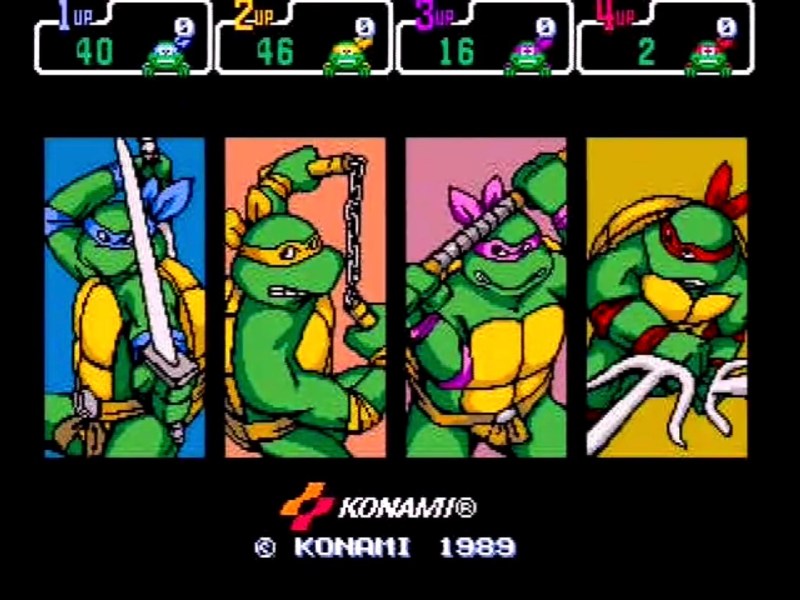
Because of the wavering, Turtle-mania basically had to wait until 1989 to really flourish. That’s when all of the merchandise started to arrive now that it was a proven hit. The first movie would arrive the following year, with the second close behind in 1991. 1989 was also the first year when video games started to arrive, and the no doubt biggest video game release of the year for Teenage Mutant Ninja Turtles was the arcade game of the same name.

img_1185

The Turtles made their arcade debut in 1989.

The Teenage Mutant Ninja Turtles arcade game gave fans a chance to basically play through an episode of the show. It was as true to the cartoon as any game would get and even featured voice talent from the show. The very first stage has Splinter sending the Turtles into a burning building to rescue April O’Neil and culminates in a showdown with Rocksteady and ends with Shredder making an appearance. The game throws a seemingly endless supply of Foot Soldiers at the Turtles and brings in more characters from the show such as Baxter Stockman (in human form), Bebop, Krang, among others and ends with a showdown against Shredder himself.

The game was created by Konami, who was awarded the license for all of the video games for this era. At this stage, Double Dragon had taken arcades by storm ushering in the era of the Beat-Em-Up genre of games. This genre, in which one or more players controlled a character who fended off wave after wave of enemies, became the preferred dumping ground for licensed software. Konami was arguably the leader in this development as it looked to the genre to support not just the Turtles, but also The Simpsons and X-Men. Konami’s take on the genre was far simpler when compared with rival Capcom or Sega. Rather than introduce complicated maneuvers to the action, Konami focused mostly on performance and presentation making sure their game resembled the source material while remaining accessible.

img_1186

Battling Bebop and Rocksteady with all four Turtles at the same time was something few thought was possible at the time.

Even by Konami standards, Teenage Mutant Ninja Turtles is a fairly simple gameplay experience. Players control one of the four Turtles with each one being mapped to a specific joystick on the four-player version of the arcade cabinet (the less popular two-player edition allowed players to select a character). Michelangelo was oddly assigned the color yellow instead of orange, a mistake Konami would double-down on with the sequel, Turtles in Time. Each Turtle could perform just two actions:  jump and attack. Players could combine them for a jump attack, but special super moves were years away. Players simply walked right for the most part and took down whatever came their way. A skateboarding level was tossed in to mix things up, though that just made the level auto-scroll instead of the usual deliberate pace. Still, little tricks like that work wonders on kids and most cited the skateboarding level as the highlight of the gameplay experience. Stages also introduced multi-level layouts and there were some interactive elements in the stages too. The only power-up was a pizza to restore health, a logical decision.

img_1187

The skateboarding level was just as mindless as the others, if not more so, but damn was it cool!

The music and visuals were where Konami really distinguished itself. The gameplay may be shallow, but there was enough glitz to sort of hide that. The Turtles looked and moved great and the boss characters were often bigger and a touch more elaborate. It felt like a real technological marvel to battle Rocksteady at the end of stage 1 followed by Bebop in the next stage, only to later take on both of them at the same time! The game was also murder on quarters as it was primarily designed to extract as much money as possible out of kids (or more appropriately, parents) and the game was pretty long to boot. Enemies are not staggered easily, or at all, forcing the players to either be deliberate or just charge in. The game is noticeably easier with 4 players, especially for the final boss who splits into three enemies. My most vivid memory of the game is playing it at a cousin’s birthday party at a roller-skating rink (yeah, dated). We made it to the Technodrome and were in the midst of battling Krang, the penultimate confrontation before Shredder arrives, when a kid who had been hanging around watching the whole time accidentally stepped on the power chord ending the game. My cousin, the birthday boy, was apoplectic while my aunt was probably relieved that she no longer had to feed us quarters. I was disappointed as I think it was the first time I even saw that much of the game, but I couldn’t help but feel bad for the kid who accidentally stepped on the thing.

tora

The NES port was woefully inferior, but it gave us Tora!

As was the case with any popular arcade game, Konami moved to release the title to home consoles. Since it arrived after Teenage Mutant Ninja Turtles (NES), it had to be re-titled as Teenage Mutant Ninja Turtles II:  The Arcade Game. It was a severe downgrade as the sprites all had to be redone with less detail and fewer colors. The Turtles were just green and whatever color their mask was, while the boss characters often were limited to two or three colors as well. Konami tried to make up for this by adding additional stages, but you can’t put lipstick on a pig. It was also a lot easier so the game was actually beatable without a ton of quarters, but it was an immensely inferior experience.

arcade1up_tmnt

The Arcade1Up release bundles the game with its sequel, but it’ll cost ya. Plus the smaller scale makes playing as Leo and Raph more than a little awkward.

Teenage Mutant Ninja Turtles was a huge thrill for arcade-goers and fans of the cartoon in 1989. It had the look, the sounds, and the swagger to get attention and mostly satisfy. In 2020, the nostalgia does make up for the diminished returns, but only so much. This is a simple and depth-free gameplay experience so it’s really only worth playing for the experience of seeing everything, before it runs out of steam. It makes it hard to recommend as an arcade cabinet for one’s home, whether you’re talking about buying an old cabinet or investing in Arcade1Up’s emulation machine as you’re not only devoting a considerable sum of money towards such a thing, but also the space it will occupy in your home or place of business. The NES port holds up even worse, and while I considered it a passable experience as a kid, I think I’d rather play any of the other TMNT NES games over it. The time to get one has mostly passed on it as in the late 90s one could have acquired a cabinet in decent shape for a reasonable sum as the nostalgia wasn’t quite there yet to drive up the price. Still, there are other ways to experience it and those might be worth a look for individuals wanting to take a stroll down memory lane or introduce a kid to the game. If you’re in the right headspace, you can have a bit of fun with this one, just don’t expect the fun to last very long.


Spider-Man and the X-Men in Arcade’s Revenge

Spider-Man and the X-Men in Arcade's Revenge (1992)

Spider-Man and the X-Men in Arcade’s Revenge (1992)

Expectations influence just about everything we come in contact with.  Expectations can help lead to a more fulfilling experience when those expectations are met.  Other times, they can help make the bad seem worse when something fails to meet those expectations.  When I was a kid and I heard there was going to be a video game featuring a team-up between Spider-Man, possibly the most popular character ever created by Marvel Comics, and the X-Men, easily the hottest comic at the time, I was giddy with anticipation.  This seemed like a no lose situation and Spider-Man and the X-Men in Arcade’s Revenge vaulted to the top of my list of must own Super Nintendo games along with Teenage Mutant Ninja Turtles IV:  Turtles in Time.  One of those games would turn out well and provide me with hours of entertainment, the other game was Spider-Man and the X-Men.

What went wrong?  Well, let’s backtrack a bit first and see how this all came together and if my expectations were even justified.  At the time of the game’s release, Spider-Man had already been enjoying a run on the Sega Genesis and Game Boy as a platform star.  Perhaps star is a bit strong as his games weren’t really great, but they also weren’t particularly awful.  The best was definitely The Amazing Spider-Man vs The Kingpin for the Genesis.  The game was pretty difficult, at times frustratingly so, but it did a great job of making use of the Spider-Man license.  It was also quite popular and one of the best-selling titles at the time.  The X-Men, on the other hand, really only had the one NES game titled The Uncanny X-Men.  It was horrible and it tricked many uninformed gamers into renting or buying it with it’s X-Men branding.  Arguably, the best games for both franchises were the arcade beat-em-ups Spider-Man:  The Video Game and X-Men.  The Spider-Man game came first in 1991 and for some reason it isn’t as well loved and remembered as the X-Men game that followed in ’92.  It was a typical brawler allowing up to four players to join in and included playable characters Spider-Man, Black Cat, Hawkeye, and Sub-Mariner.  It’s selling feature was a more platform inspired design where the camera would zoom out allowing the players to take on gigantic enemies including a super-sized Venom at the end of the first stage.  The X-Men game was similar, but it’s defining characteristic (aside from the comical mistranslations) was the double-monitor cabinet allowing up to six players at once.  Both games were hard as they were designed to suck quarters out of its audience but they were a lot of fun, especially with a group of friends.

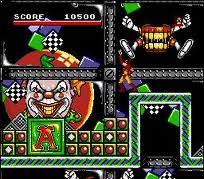
I hate these stupid clowns and their stupid stage.

I hate these stupid clowns and their stupid stage.

It would seem to me that a track record was in place that at least suggested a console game featuring these two franchises could be great.  If I had been a little wiser as a kid and more aware I would have taken note of the LJN logo on the box and realized right away the game was going to be a giant turd, but sadly I just wasn’t.  Before I get into what the game did wrong I suppose I should point out what it did right.  First of, Spider-Man is represented fairly well given that he is able to stick to walls, shoot webs, and even make use of his spider-sense in the game.  The roster for the X-Men side is pretty solid as well as it features the obvious choice of Wolverine along with Cyclops, Storm, and Gambit.  Wolverine has an interesting dynamic to him as he retains his mutant healing power but it only works when his claws are retracted.  The game is packed with villains too like Apocalypse, Shocker, Juggernaut, and Carnage.  Arcade is kind of a weird choice for the main villain, but at least his Murderworld offers a lot of possibilities for level-design.

That’s basically it as far as what Spider-Man and the X-Men gets right, and unfortunately it’s a pretty small list.  So what makes this game suck so hard?  Well, lets first start with the presentation.  I’m usually not one to have much of an opinion on the audio within a game.  I expect it to do its job and often times I have to make it a point to touch upon it when doing these reviews because I tend to overlook it.  Here it’s easy to not overlook because the sound is so bad.  The score is okay at times, though certain levels (Wolverine’s) feature an annoying soundtrack.  It’s the FX that really bug me though as they just sound like, for lack of a better word, shit.  A lot of the characters, good and bad, let out a scream when they die that sounds fuzzy and distorted.  The machine sounds are just as bad and Spidey’s web blasts sound like they could be grenades.  The graphics are also piss-poor.  The characters are really small, except Storm but I’ll get to her later, and lacking in any sort of detail.  Wolverine even looks like he only has two claws on each hand while Gambit doesn’t have a face.  Some of the villains are almost unrecognizable, especially Apocalypse who looks like a blue bug or something.

Hey Gambit, where's your face?

Hey Gambit, where’s your face?

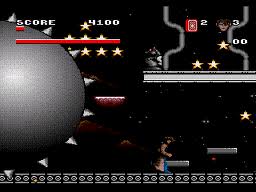
Perhaps what bugged me more than anything as a kid was just how un-super these super heroes felt.  Spider-Man and the X-Men is a pretty hard game made so mostly because these characters can’t seem to take a punch.  They die so easily and it’s a frustrating experience.  I get that it’s hard to make a super hero game because on one hand the super heroes need to be super powerful, but the game also needs some challenge.  That’s why we have super villains though, and Wolverine shouldn’t be getting annihilated by a jack-in-the-box with a tommy gun.  The X-Men games that would follow on the Genesis were hard, but at least those X-Men felt like powerful super heroes (well, for the most part), these ones are push-overs.  The level designs are also fairly lacking.  Spider-Man’s are just weird looking and kind of confusing as they’re intended to be maze-like.  The player is supposed to use his spider-sense to navigate but it just gets tiresome.  Cyclops’ stages feature an annoying mine cart premise where touching the tracks means death.  Gambit has to outrun a giant deathball and might be the best levels, which isn’t saying much.  Wolverine is in a circus and there’s nothing noteworthy about the first stage while the second stage he has to outrun the Juggernaut.  It’s basically the same concept as the Gambit stages, though at least LJN incorporated something from the comics to make it feel relevant.  Storm’s stages are quite different and probably everyone’s most hated as she has to navigate a flooded laboratory.  They’re swimming levels, but unfortunately Storm’s mutant powers over the weather don’t let her breath underwater.  Just about everyone hates the underwater Sonic the Hedgehog levels for the same reason, this is worse times ten.

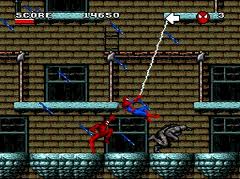
The red guy is Carnage. That gray blob?  He's Rhino.  I think.

The red guy is Carnage. That gray blob? He’s Rhino. I think.

If the player manages to actually beat all of the levels then they get to take on Arcade as Spider-Man.  You kind of have to be a glutton for punishment to even make it that far as the game is both really hard and really bad.  That’s the worst combination.  As a kid, I never had much success and never made it past any character’s second stage so making it all the way to Arcade wasn’t in the cards.  Playing this game was a depressing endeavor as a game featuring a team-up between these two should have been awesome.  I remember a few years after I got it Toys R Us started their first trade-in program where people could trade in games they no longer wanted for store credit.  I grabbed my copy of Spider-Man and the X-Men and, thinking I’d get maybe 15 or 20 bucks, was offered only four.  I elected not to trade it in but in hindsight I should have taken the four Jeffry Dollars.  I could have used it for some Fruit Stripe gum or something.