Category Archives: Television

Essential Halloween Viewing

When it comes to holiday themed television specials and films, Christmas leads the way with its countless amount. Coming in second is likely Halloween. Unlike Christmas, there usually isn’t some serious undercurrent to Halloween specials. It also feels less sinister when it comes to marketing, even though there’s certainly lots of money to be made off of Halloween by costume and candy suppliers. For the most part, Halloween is just fun and it’s emphasis on scares helps to distinguish it from other holidays. Like many people, I enjoy a good Halloween special whenever the season rolls around, but with so many out there it can be hard to make time for them all in what amounts to only a month. There are some modern ones out there, like the entertaining Toy Story of Terror, but for the most part I like to watch the specials I watched as a kid. Without further adieu, here’s The Nostalgia Spot’s Halloween viewing guide.

Mickey Mouse in “Lonesome Ghosts”

220px-Lonesome_GhostsHere’s an oldie from way back in 1937, something that would have entertained my adolescent grandfather. Since I only discovered it a few years back, it’s not exactly something I remember from my childhood but certainly fits the theme of this blog. In this cartoon, professional ghost exterminators Mickey, Donald, and Goofy investigate paranormal activities in an old house. The twist is that the trio were hired by the ghosts themselves because no one ever enters their haunted house anymore and they’re just plain bored. Less creepy than it is humorous, it’s mostly a slapstick affair as the ghosts play tricks on their would-be exterminators. It’s an entertaining short, and one can’t help but wonder if it maybe partly inspired Ghostbuster, or at least the theme song, especially when Goofy declares, “I ain’t afraid of no ghosts!” The short has been shown on television numerous times over the years as part of Halloween specials. It was also re-released to theaters in the 1960’s and has been released on VHS and DVD as well. The easiest way to see it these days is probably youtube.

Donald Duck in “Trick or Treat”

By the late 40’s and into the 1950’s, Donald Duck was basically the only classic Disney character still receiving new short films. There just wasn’t much money in the format anymore and the budget for each short was scaled back considerably. For the 1952 short “Trick or Treat,” Disney decided to increase the budget to give Donald a proper Halloween special. It has its own theme song and the animation is quite nicely done in comparison with other shorts from around that time. In this one, Donald’s nephews Huey, Duey, and Louie are out trick or treating and come upon their uncle’s house. When the boys knock on his door and request their tricks or treats, Donald (not surprisingly) elects trick. A witch, Witch Hazel, passing by happens to see this and decides to help the boys get their treats out of Donald. Apparently, the Halloween spirit does not include the tricks portion of the ages old phrase. Hazel uses her magic on Donald and a lot of physical comedy follows. Like “Lonesome Ghosts,” this one has been released on VHS and DVD over the years either on Halloween compilations or as a bonus feature with certain films. There’s a chance it could pop up on one of the Disney channels this Halloween, but if you want to see it better head to youtube.

The Real Ghostbusters – “When Halloween Was Forever”

Samhain, the spirit of Halloween!

Samhain, the spirit of Halloween!

A cartoon that centers around four guys (and a ghost) who hunt down paranormal creatures naturally lends itself well to Halloween. Pretty much any episode could qualify for such a holiday, but the episode “When Halloween Was Forever” happens to deal with the holiday directly. This episode features the ghost Samhain, the spirit of Halloween, who decides to freeze time on Halloween night so that it lasts forever. Since Halloween is said to be derived from the Pagan holiday Samhain, it’s a nice touch to name the ghost after it. The Real Ghostbusters was a DIC production and if you’re familiar with any of their cartoons from the 80’s then you likely know what to expect out of the audio and animation. It’s standard for the era, with the soundtrack being appropriately spooky. While no episode of this cartoon can come close to matching the film it was based on, it’s actually not a bad show and time has been far kinder to it than it has the more popular Teenage Mutant Ninja Turtles.

Ren & Stimpy – “Haunted House”

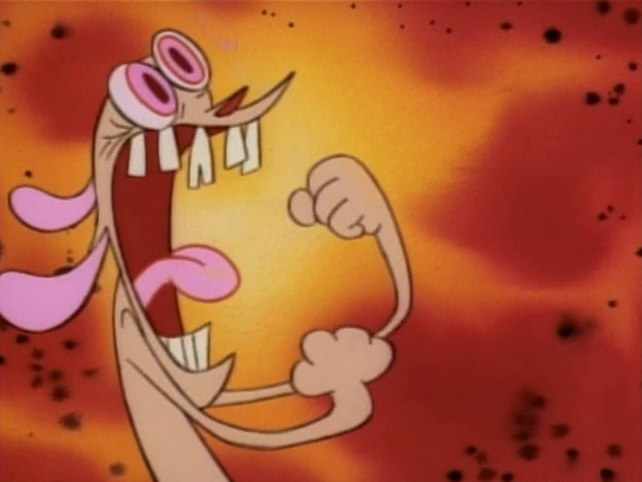
The premise for this one is conventional, Ren and Stimpy stumble upon a creepy looking house and, in need of shelter for the night, decide to head inside. Unbeknownst to them, the house is haunted and a malicious ghost lurks inside who can’t wait to scare them. The twist here is that Ren and Stimpy are seemingly in on the joke as they break the fourth wall and end up impervious to the ghost’s efforts. This naturally frustrates the ghost, to the point that he becomes depressed and suicidal (apparently, ghosts can “die” in Ren and Stimpy’s world). Highlights of the episode include a Psycho shower-scene parody and the previously mentioned fourth-wall breaking remarks (“This looks like a good place to kill 12 minutes!”). There’s also the usual random humor found in a Ren and Stimpy short that people either find amusing or stupid. This one is unlikely to show up on television so anyone looking to watch it will either have to pick it up on DVD or turn to the internet. Be warned, the version found on the official Ren & Stimpy Volume 1 is censored with the Bloody Head Fairy bit removed completely. Apparently it was considered too gruesome after the fact.

Beavis and Butt-Head – “Bungholio:  Lord of the Harvest”

Beavis and Butt-Head on a quest for candy.

Beavis and Butt-Head on a quest for candy.

Sometimes referred to as “Buttoween,” this episode features everyone’s favorite dim-witted duo as they go trick or treating in search of free candy. Since they weren’t even aware Halloween was coming until trick or treaters showed up at their house, the two do not have costumes so Butt-Head covers his head in cheese sauce (“I’m nachos.”) while Beavis wears his underwear on his head (“I’m a nad!”). Beavis eventually has too much sugar and his alter-ego, The Great Cornholio, shows itself. The two soon find themselves on a farm ripped right from a slasher film. Most of the humor comes from watching the two try and get some candy in the first part of the episode, while the second part puts the two in an obvious bad situation that they’re apparently oblivious to. The animation is pretty terrible, but anyone who has seen an episode of Beavis and Butt-Head before should already be aware of this. It’s stupid humor, but it is pretty funny. You either like it or you don’t.

South Park – “Pinkeye”

South Park is more known for its numerous Christmas specials, but early seasons often featured other holiday themed episodes. The first season episode, “Pinkeye,” remains the show’s top Halloween special. In this one, a mishap with worcestershire sauce causes a dead Kenny to turned into a zombie. Kenny, as patient zero, spreads a zombie plague all through-out South Park that a clueless doctor mistakes as a severe case of pinkeye. It’s up to Chef and the boys to put a stop to the zombie menace so they can go trick or treating and get some candy. The episode includes some notable gags such as Cartman’s mom on the cover of Crack Whore Magazine and a memorable parody of Michael Jackson’s “Thriller.” It also features Cartman’s attempt to find a non-offensive Halloween costume.

The Simpsons – “Treehouse of Horror V”

Treehouse of Horror V is best-remembered for its parody of Stephen King's "The Shining."

Treehouse of Horror V is best-remembered for its parody of Stephen King’s “The Shining.”

The Simpsons Halloween special, Treehouse of Horror, has become an annual tradition. With 24 to choose from, some may consider it a daunting task to select only one. As is the case with most things “Simpsons,” the earlier episodes are usually considered the better, and for me, it came down to a choice between Treehouse of Horror II and V. V is just slightly stronger and a little more horror-themed than the more sci-fi II. Treehouse of Horror V features parodies of The Shining, The Sound of Thunder, and Soylent Green. In the first segment, “The Shinning,” the Simpsons are basically dropped into the plot of its source material and includes the memorable line “No beer and no TV make Homer go something, something.” The second segment, “Time and Punishment,” puts a time-traveling toaster in Homer’s hands resulting in Homer unintentionally creating a new present time ruled by Flanders. The third segment, “Nightmare Cafeteria,” has Principal Skinner resort to cannibalism of the student body to cope with budget cuts at Springfield Elementary. If a Treehouse of Horror is able to hit on two out of three, it’s generally considered a good iteration of the venerable television special, but Treehouse of Horror V is the rare one where all three are pretty entertaining. With The Simpsons now being featured on the FXX channel, hopefully a Treehouse of Horror marathon is in the near future. The 25th version of the special is set to air tonight.


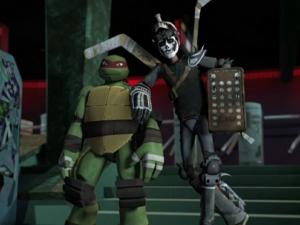
Teenage Mutant Ninja Turtles (Nickelodeon) Season 2

TMNTThe resurgence of the Teenage Mutant Ninja Turtles has been one of the more fun story lines from pop culture for me over the past two years. With an all new comic line, cartoon, and feature film, the TMNT are almost as relevant today as they were in 1990. Considering other old properties from the 80’s have been successfully resurrected recently, perhaps it’s not all that surprising the Turtles were able to accomplish the same. What has been surprising though is how successful the relaunch has been from an artistic standpoint. The general consensus for the vast majority of new films based on properties from the 80’s is that the material has been lacking. While no one can dispute how commercially successful a franchise like the Transformers has been for Hollywood, the movies themselves come across as overstuffed toy commercials. Like the Transformers, the return to the big screen for the Turtles was decidedly lacking when the new film was released in 2014 (I’d call the film trash but I personally have not watched it and don’t plan to). However, the comic book line launched in 2012 has been pretty well-received while the television show has been a smashing success.

When the cartoon was announced by Nickelodeon I was not optimistic about its chances at success. I was borderline indifferent, but my past romance with the Turtles was enough to make me curious. I set the DVR to record season one, and by its end, I was a fan. The show is witty, action-packed, and stuffed with enough in-jokes and material to appeal to 30-somethings who grew up with the Turtles. The cartoon successfully melds the old cartoon with the comic books while also taking its own path. The 2003 cartoon attempted the same, but was probably too reliant on the original Mirage comics. The old comics are an entertaining read, though nothing magical, but they do not possess an energy that lends itself well to animation. While on the other hand, the original cartoon was set on creating a fun series that appealed only to children. It never put the characters in any real danger and would eventually lose its audience as it grew up and acquired an appetite for more mature material. When the show finally made an attempt at change, it was too late.

What's old is new.

What’s old is new.

Like with season one, season two of Teenage Mutant Ninja Turtles opts for a more serialized nature with plots carrying over from one episode into another with few stand-alone episodes and characters. When a stand-alone episode does pop up, it serves as a palette cleanser from the main plot and is often a more offbeat episode. Most of these episodes are packed with humor with season two’s “Mazes & Mutants” topping the list of funniest TMNT episodes so far. The writers have found a nice balance in the humor for the show with it coming up at opportune times and resisting the urge to go for the easiest joke or pun. The show is genuinely funny, but it also knows when to let up on the humor and isn’t overly-reliant on the Michelangelo character.

Season two picks up right where season one left off with The Kraang being beaten back temporarily. Shredder and The Kraang have appeared to have forged an alliance, and an early mishap with a canister of mutagen mutates April’s father, Kirby, into a bat monster causing tension between the Turtles and their lone human friend. Meanwhile, Splinter (and this is a spoiler for those who missed season one) is coming to terms with the fact that his daughter is alive and well but has been brainwashed by the Shredder into believing she is actually the daughter of the Foot Clan’s leader and not Splinter. These two threads, April’s distrust of the Turtles and Karai’s lineage, are major plot points for the bulk of season two. The Karai plot twist could be seen coming from a mile away, but it was still effective as the writers handle it well. Karai naturally does not react well when the truth is first presented to her, and her response to it is complicated and appropriately remains unresolved for several episodes. The Kraang maintain a healthy presence throughout the season as well, often playing a role in a small way in most of the episodes. The season concludes with another big face-off between the Turtles and Kraang and it would seem the alien race will not be going anywhere anytime soon.

Casey Jones and Raph team-up yet again.

Casey Jones and Raph team-up yet again.

Season two introduces several characters, old and new. As was revealed in press kits, Casey Jones made his series debut in season two. Like April, he has been aged-down for the show from his original depiction but remains a vigilante of sorts. And like the Casey of old, he forms a bond with Raph pretty quickly and the two are a crime-fighting duo in some episodes. And as predicted by me (and likely many others), Casey forms the third corner of a pseudo love triangle with Donatello over April. Naturally, April is more taken with the human and this creates tension between Don and Casey that is sometimes entertaining, and sometimes feels a little stuffy, but is one of the ongoing aspects of the show that serves to remind the audience that these characters are, in fact, teenagers after all. Other characters familiar to fans of the old show that make their debut in season two include Slash, Mutagen Man, and Pizza Face while other characters are obvious references to old ones (Kirby bares an uncanny resemblance to Wingnut, for example). The show also does a good job of hinting at future characters. When a thief with a purple mohawk shows up it’s only natural for fans of the old show to assume this character has a date with a warthog and some mutagen in his future.

Don't be surprised if Kirby's Party Wagon gets a make-over in season 3.

Don’t be surprised if Kirby’s Party Wagon gets a make-over in season 3.

My main point of criticism with the show early on was for its lifeless take on the city of New York, and while the show has done a better job of making it look like people actually inhabit this city, it’s still a relevant criticism for season two. The character designs though have improved. Some of the villains in season one were pretty boring to look at, and that has mostly been remedied (though some are underwhelming, I’m looking at you Tiger Claw). There’s very little for me to complain about when it comes to this show. The writers have also wisely made the Foot Clan robots in season two (and not just randomly, it’s explained in an episode) so the Turtles are free to user their weapons against them. The more graphic violence is handled offscreen, but the consequences are shown. When Leonardo gets isolated from his brothers in the season finale and beat-up by Shredder, we don’t see any of Shredder’s bladed strikes landing. However, when an unconscious Leo is tossed through the window in April’s apartment where the other turtles are holed up (awesome reference to the comic and original film, by the way) his body is cut and bruised.

Just like with season one, season two does a great job of tossing in winks and nods to the old material that came before it. They’re sometimes hidden in the background and other times in your face (the party wagon!). Shredder remains a credible threat to the Turtles throughout the season and is a more than competent ass-kicker when pressed into battle. And while the April plot is resolved during the season, the other big ones are still open heading into season three. The season concluded with an hour long special that was perhaps the best in the show’s short existence thus far. It was satisfying on an emotional level while also delivering the humor and action the show has become known for. I’m even more enthusiastic for the show’s third season than I was the second (aside from the fact that Seth Green is set to takeover the voice-acting duties for Leonardo). If you were a fan of the Turtles in your youth and still have a fondness for them residing somewhere inside of you then you should be watching this show.


Teenage Mutant Ninja Turtles – NES

Teenage Mutant Ninja Turtles (1989)

Teenage Mutant Ninja Turtles (1989)

One of the most successful games of all time, and one of the most divisive, Teenage Mutant Ninja Turtles, arrived in 1989 for the Nintendo Entertainment System and flew off the shelves or retailers and rental stores across the United States. Turtle-mania had a strong grip on the nation’s adolescent and it would have been a huge embarrassment if the game actually failed. And while it was named as 1989’s Game of the Year by Nintendo Power, the first ever NES TMNT game is often regarded as a disappointment. Calling it divisive in the opening line may have been misleading, for the game is almost universally loathed for numerous reasons: too hard, not enough recognizable characters from the cartoon, no multi-player, and not the game fans wanted. In 1989, another game based on the TMNT was released, the equally successful arcade game. Based on the animated series, the arcade game boasted 2 to 4 player play allowing each kid to select his or her favorite turtle and wail away on an almost endless supply of Foot Soldiers, Bebop, Rocksteady, and of course, Shredder. When it was announced the Turtles were coming to the NES, many fans expected a port of the arcade game, but instead they got a solo side-scrolling adventure with few recognizable elements from the cartoon making an appearance.

The original Teenage Mutant Ninja Turtles game is best called infamous than famous. It was notably the subject of one of the earliest Angry Video Game Nerd videos in which The Nerd (James Rolfe) reminded many of us of the same frustrations we experienced as children playing this maddeningly frustrating game. As a kid, I never was able to beat the game without the near essential Game Genie peripheral, usually failing to make it beyond the battle with Slash/Mecha-Turtle/whatever the Hell that thing is at the end of act three. And like many, I preferred pretty much every other TMNT based game that followed over this one, which all took the form of arcade style beat-em-ups. I’ve since relived this game many times as a teen and adult but recently felt compelled to revisit it and see if the reputation this game had acquired was entirely justified. Just what is that reputation? Many Google searches will return this game on the list of hardest NES titles as well as worst or most disappointing NES games. The only way to answer my questions was to dust off the old NES and sit down in front of the TV.

Definitely not the arcade game...

Definitely not the arcade game…

For starters, the game was developed by Konami’s Ultra division, a secondary label created to circumvent Nintendo’s then policy of limiting publishers to how many games they could release in a year. Konami probably paid a boatload of cash for the TMNT franchise, and considering Konami was known to gamers for its Contra and Castlevania franchises, it seemed like the TMNT license was in good hands. Right from the start though, some things seem out of place. For one, the cover art depicts the four turtles all sporting red bandanas. For kids accustomed to the television show, this looked wrong while comic book readers would have recognized the cover to issue number 4. When the game boosts up, an unfamiliar tune plays as the four turtles are introduced. No player select screen is displayed once start is pressed, instead the game drops the player right onto a map-like screen with a tiny Leonardo in the center and some steam-roller like vehicle driving around. To summarize, there’s no licensed music, no option for 2-player, and no option to select which turtle to play as.

As the game unfolds, things start to become clearer. This overhead, Zelda-like perspective, leads into more traditional side-scrolling levels whenever the player enters an open manhole or building. A quick look at the pause screen is enough to clue the player in on the objective (rescue April, big surprise) and the ability to switch between turtles. The player is free to change-out a turtle on the fly. Each one has his own health bar, and since the game has no 1-up pickups, they function as extra lives. If a turtle loses all of his health, he’s out of action until the final level where a turtle can be rescued. Each turtle uses his own unique weapon and it will soon become obvious which turtle to use. Donatello, with his boring but long-reaching bo-staff, is easily the superior turtle in this game. When walking or standing still, Don thrusts his bo-staff out in front a great distance and even slightly behind him as well. He can thrust up and down as well with a press of the D-pad and take out multiple foes at once as a result. Because the animation for his attack lingers so long, he even seems to benefit from a double-hit, and as a result, does more damage per strike than the other turtles. If you lose Don, you’re in big trouble because the drop-off is huge to the next most useful turtle, which should be obvious for those familiar with the four heroes in a half-shell, Leonardo. Leo swings a lone katana in a downward arc when attacking and it’s useful for enemies at eye-level, but his reduced range and damage when compared with Donatello makes him far less suitable for the environments ahead. After Leo, Michelangelo is probably the next-best option as his nunchaku has slightly better reach than Raphael’s sai, which is pathetically useless. Raph and Mike are best treated like canon fodder and used only when attacking is not an option, such as when driving the turtle van or during the infamous swimming level. Each turtle can hold one secondary weapon, most of which appear as pickups randomly and range from throwing stars to boomerangs, to a weird energy wave that kicks a whole ton of ass (shell).

What the hell are these things attack Don, and is that a Foot Balloon?!

What the Hell are these things attacking Don, and is that a Foot Balloon?!

Gameplay wise, Teenage Mutant Ninja Turtles is fairly straight-forward. The turtles can attack and jump as they move left to right, right to left, and across gaps and platforms. The pace is fairly slow and reminiscent of Castlevania, including the ever annoying jump-backwards animation after being struck. If you’re not familiar with Castlevania, when the character takes damage they always jump backwards. This is ever annoying when trying to negotiate a series of platforms as enemies frequently appear in mid-jump leaving the player helpless to defend. The turtles handle kind of like trucks as they’re heavy and clunky. Pressing fully on the jump button will cause them to go into a ninja flip of sorts that has a floaty affect on the character, which sometimes helps to re-align a jump but mostly just seems to cause panic in the player leading them to miss a platform. Enemies are numerous, and for the most part, unrecognizable from the show. There’s foot soldiers and mousers here and there, as well as boss encounters with Bebop and Rocksteady early on, but aside from that there’s a lot of just weird enemies. There’s some chainsaw-wielding maniac, a guy composed entirely of fire, and weird butterfly enemies that dive-bomb the turtles, among others. The obstacles are pretty standard for the era and take on the form of conveyor belts, water, and spiked floors/walls. The game gets bogged down frequently when too many enemies are on screen and slowdown is a frequent annoyance. Enemies on the map scenarios tend to flicker in and out which harms the presentation elements of an otherwise underwhelming looking game.

So what makes Teenage Mutant Ninja Turtles so difficult? Well, for one, three out of the four turtles are borderline useless. As I mentioned earlier, Donatello is by far the best suited to overcome the various obstacles placed in the turtles’ path. The other three are so bad that you might as well quit if Don falls in battle. Enemies who can be felled in one strike are manageable, but the ones that require multiple hits pose a challenge as they do not react to taking damage. The game also loves having the player enter a new screen with an enemy literally right on top of you, forcing the player to take at least some damage. The pizza power-ups, which restore health, become scarce the deeper into the game you go and are sometimes intentionally placed in impossible to reach locations. Platforms are often placed above turtles, making some jumps particularly challenging as if the turtle hits his head on a platform above, his forward progress is stunted and the jump falls short. There’s one really annoying jump in a sewer scenario that’s actually impossible in the PC port. There’s also no password feature, but unlimited continues, so this is one that has to be completed in one sitting which adds to the challenge. And if the game wasn’t annoying enough, Ultra did include a beeping alarm for when the selected turtle is low on health.

Even though this level isn't as bad as people make it out to be, Leo is totally about to end up dead.

Even though this level isn’t as bad as people make it out to be, Leo is definitely about to end up dead.

All of that said, this game does do some things well and some of the things it has become known for (negatively speaking) aren’t as bad as they’ve been made out. For one, the ability to swap the turtles into and out of battle is pretty cool. Yeah, it sucks that there’s no two-player and it really sucks that three of the four turtles are horrible to play as, but the thought was a good one and one I’d like to see revisited in a new game. The under water level that has become so reviled and is the part of the game often cited as being hard, unfair, and noteworthy, isn’t as bad as its reputation. If you get to it with little health on each turtle, then it’s pretty damn hard. As a kid, I failed many times. As an adult, I just save Raph for it and have no problem making it out with minimal damage taken. It, like just about every swimming level in recorded existence, is not a fun stage by any means, but it’s far from being among the hardest sequences in gaming history (and is among the easier parts of this game). And aside from the turtles not really handling like ninjas, the control is satisfactory and the ability to drive the turtle van is pretty cool (though why it doesn’t have its own health bar is a mystery still to this day). The soundtrack is actually enjoyable, even if it doesn’t contain any music from the TV show, and isn’t something I’d change about the game.

In conclusion, Teenage Mutant Ninja Turtles was destined for commercial success just because of the license alone, but doomed to disappoint gamers for not being the game they truly wanted. Unfortunately, the game was not able to make-up for not being the arcade game by offering a lesser experience. The good news is that gamers didn’t have to wait long as a port of the arcade game arrived on NES consoles in 1990 as Teenage Mutant Ninja Turtles II: The Arcade Game. Yes, it wasn’t a perfect port due to the system limitations of the NES, but it was suitably fun and is often remembered fondly by gamers from that era. The one that arrived first though is not, and it’s hard to defend the title even today. While it’s far from being the worst NES game, and certainly not the most difficult, it’s definitely not good and just another example of a licensed game gone wrong, but at least it’s not as bad as E.T.


Lego Simpsons

lego-simpsons-minifigs-01When I was a kid, the coolest and most colossal Lego sets were often pirate ships or castles. These things required hours upon hours to assemble and cost a lot of money. My parents, when looking to spend money on me at Christmas or for a birthday, opted for video games or a bicycle as a “big” present, not massive Lego sets. I had a cousin who was rather fortunate when it came to gifts. He usually had all of the best stuff before anyone else, be they new Ghostbusters vehicles, gaming consoles, and so on. He also had some of these massive Lego sets but anytime I would visit his home they were always just partially assembled, as if construction was started one day and then forgotten. I always wanted to get my hands on such a set (the commercials made them seem like they contained endless amounts of fun) but the closest I ever got was a lone keep that came with a dragon. It was rather small, but I liked it plenty and got many hours of enjoyment out of it. Prior to that, I only ever had a general set of Legos. They were housed in a hard, red, plastic case and I would just build whatever. There was an included book that contained plans for numerous objects but rarely did I ever make use of it. Typically, I would build a pick-up truck or Jeep but then wouldn’t want to disassemble it to create anything else.

Among those bricks was a lone Lego mini figure. This was the 1980’s so the mini figure might have been new, or maybe not. I had other generic Legos before this collection and never had I come across a little figure before. He was rather plain: a black shirt and blue pants with a black baseball cap. I thought he was pretty cool though and started noticing these more and more in toy stores and commercials. I especially liked that I could rip him apart and even take off his head without breaking him. It seemed absurd but was a lot of fun especially when I would later get mini figures dressed as knights and armed with swords to apply a purpose for figure decapitation. Over the years the mini figure has become quite popular and in the last dozen years or so the mini figure is no longer just a generic pirate or knight, it’s Luke Skywalker or Batman. The mini figure is now sold both with sets and separately, and for a brand, having a Lego version of one of your characters is like a new rite of passage. Lego, because of its popularity, is able to strike deals amongst rivals so that consumers are able to pit Lego Superman against Lego Hulk. Lego has spread to video games, and most recently, to film. The brand has never been more popular than it is today which is why we now have The Simpsons in Lego form.

I’m not sure how the agreement started, if those behind The Simpsons reached out first to Lego or vice versa, but The Simpsons entered the Lego universe in 2014 in both television and the material world. An episode of The Simpsons aired this past May featuring the show’s many characters in a Lego setting. Interestingly, these Lego versions of the Springfield residents were more faithful to the Lego brand than the actual Lego product which arrived at retailers a couple of weeks before the episode. The Lego version of The Simpsons characters are unique, though represent a new trend not solely reserved for The Simpsons brand, in that they make use of the standard mini figure body but have unique head pieces. This creates a more aesthetically pleasing mini figure, though it does disappoint the Lego purists out there. In my hunt for these, I encountered one girl who was a Lego fan, not really a Simpsons fan, who wanted a couple of Marge figures thinking her hair would just be a Lego piece that attached to the usuall Lego head piece. She was likely disappointed to find that it wasn’t when she got home.

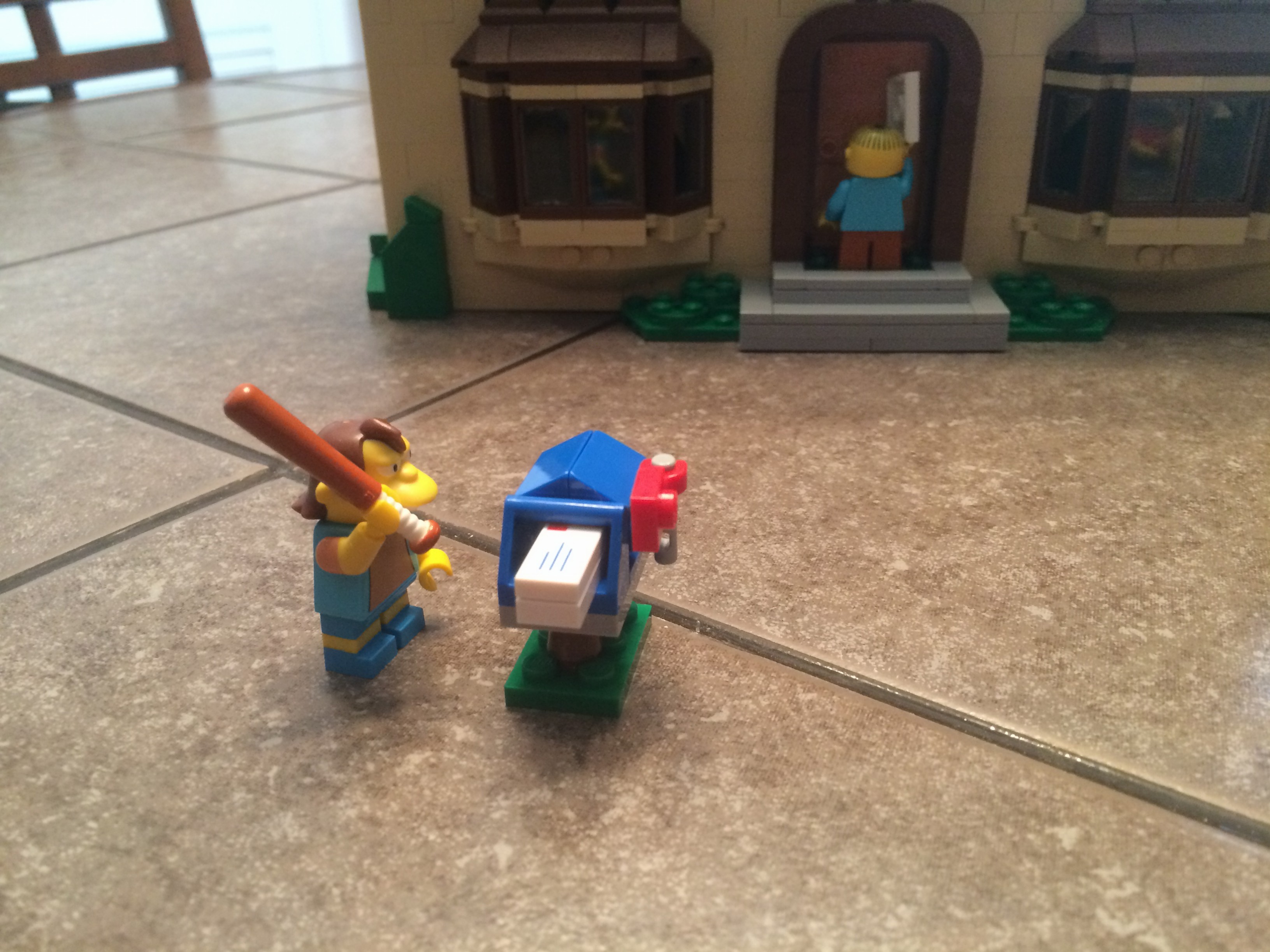
Nelson doing what Nelson does.

Nelson doing what Nelson does.

Lego put out sixteen figures in May, and they are a collection of usuals and some that may have surprised fans:  Homer, Marge, Bart, Lisa, Maggie, Grandpa, Ned Flanders, Milhouse, Ralph, Nelson, Chief Wiggum, Apu, Mr. Burns, Krusty, Itchy, and Scratchy. A pretty solid collection, especially when one considers Lego’s policy of no alcohol references which may have played a role in not having a Moe or Barney. Itchy and Scratchy are the sort of oddball choices given that they’re cartoon characters in the show, but few are likely to complain. Because the show’s cast is so massive, there’s going to be characters missing and it would have been impossible to satisfy fans with just one wave (I’m not aware of a planned second wave, but these seemed to sell well so it wouldn’t be a surprise to see more). Wiggum could certainly use some help on the force, while Flanders is missing his boys, and what’s a Burns without a Smithers? There’s tons of characters people likely want, so hopefully if a wave two does come around Lego doesn’t waste slots on variants of Homer and Bart.

Each mini figure comes in a plastic pouch that conceals the identity of the figure inside. Retailing for about four dollars, some may be willing to give in to chance and pick them blind but anyone with some extra time and a little determination can prod at the bags and figure out who’s in each one. The head sculpts of the figures make this easy, but also the included accessories. Bart’s skateboard is pretty easy to pick out, as is Nelson’s baseball bat. The hardest ones for me were Ralph and Milhouse as both characters are the same size and their accessory is a flat square Lego piece. This meant finding the head, and being extra certain. I ended up with three Ralphs before I found a Milhouse. The accessories are pretty cool though. The piece that comes with Ralph and Milhouse is a bit overused, but they’re all printed differently and contain some classic show references such as Ralph’s “I Choo Choo Choose You” valentine and Grandpa comes with his newspaper with the headline “Old Man Yells at Cloud.” Homer comes with a unique donut piece and TV remote and Burns has a transparent Lego head piece with Blinky the fish printed on it. Maggie has Bobo the teddy bear, and Itchy and Scratchy each come with an instrument of violence. All of the figures look really good, the only one that looks off to me is Wiggum because he should be morbidly obese. Instead, he uses the same body as every other figure with no attachments to make him look fatter. Homer, since his shirt is white, has a line printed on him to mark his bulging stomach, but since Wiggum wears dark blue, the same technique doesn’t really work.

If Lego had stopped there with The Simpsons it still would have been cool, but they didn’t. Enter The Simpsons House!

IMG_0153

Consisting of over 2500 pieces, the home of The Simpsons is a large set that is a site to behold. I couldn’t resist the call

The Couch.

The Couch.

of it, even if it was excessive, and purchased my own set. The set contains bricks to construct the house and also Homer’s famous pink car complete with dents. Included with the set is another version of The Simpson family plus another Flanders. Each figure differs slightly from the stand-alone ones; Homer is dressed for work and Marge has an apron, Ned is dressed for grilling while Bart is missing his slingshot from his back pocket. Most also have half-closed eyes while Maggie has a more neutral expression compared with her other figure’s concerned look. The differences are minor, and while some may see this as a missed opportunity to get more figures, Lego pretty much had to include a set of the family in both the house set and the retail figures. Perhaps the addition of Flanders could have been re-evaluated. Lego could have just made him exclusive to the house set and put someone else in the mini figure release. The only thing I feel they really messed up on was not including Lego versions of Santa’s Little Helper and Snowball II. Both pets are featured on the box as part of the family but are strangely absent from the set.

The cut-away view of the house.

The cut-away view of the house.

Lego had a somewhat difficult task of creating a three-dimensional set of an animated home. Early in the show’s life, the house didn’t seem to always have a defined layout but over the years the animators and artists have clarified this more. The first floor is pretty standard though: through the front door is a short hallway with a closet at the end and stairs on the right. To the left is the den, to the right the dining room. Up from the den is the living room which has an entryway on the top right which goes into the kitchen which wraps around to connect with the dining room. On a few occasions there’s been a bathroom on the first floor as well as a rumpus room. There’s also a basement entrance somewhere and the door to the garage. Lego, perhaps fearing the set would be much too large, chose not to really adapt the true layout of the house and attempted to just hit on the important stuff.

The other side of the cut-away. The room on top is removable.

The other side of the cut-away. The room on top is removable.

From the outside, the house looks pretty great, almost perfect. There’s the bay windows on the front, the ancient TV antennae on the roof, and even the chimney looks good. Veteran viewers will notice that while the garage is in the right place, the house doesn’t wrap around behind it like on the show. This becomes a bit of an issue when constructing the second floor as it’s pretty cramped. Aside from that though, the house looks great. Inside on the first floor there are just two rooms: the kitchen on the left and living room on the right. The living room is kind of an amalgamation of the den and living room from the show. The famous couch and TV are present (modeled after the old tube TV from the earlier seasons) from the living room, while the rug and piano are there from the den. Missing is the fireplace since the chimney is on the other side of the house and there’s no ceiling fan, as well as other things. There’s a closet of sorts tucked behind the stairs where
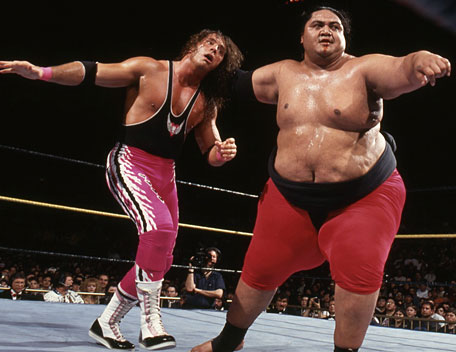
Marge can store her vacuum, and the sailboat picture is above the couch where it should be. Breaking from logic though, is the entryway to the garage being right in the living room with no door to separate it. This doesn’t make much sense and is kind of disappointing. Over in the kitchen, the color scheme is pretty faithful to the show between the two-toned floor and the pink and orange cabinets. The included table is kind of odd looking but more odd is the absence of a fridge. How are The Simpsons supposed to live without a refrigerator? Plus that ugly green fridge is kind of iconic, isn’t it? The kitchen is also pretty cramped, especially with the table in it, but space had to be sacrificed in order to make the living room larger.


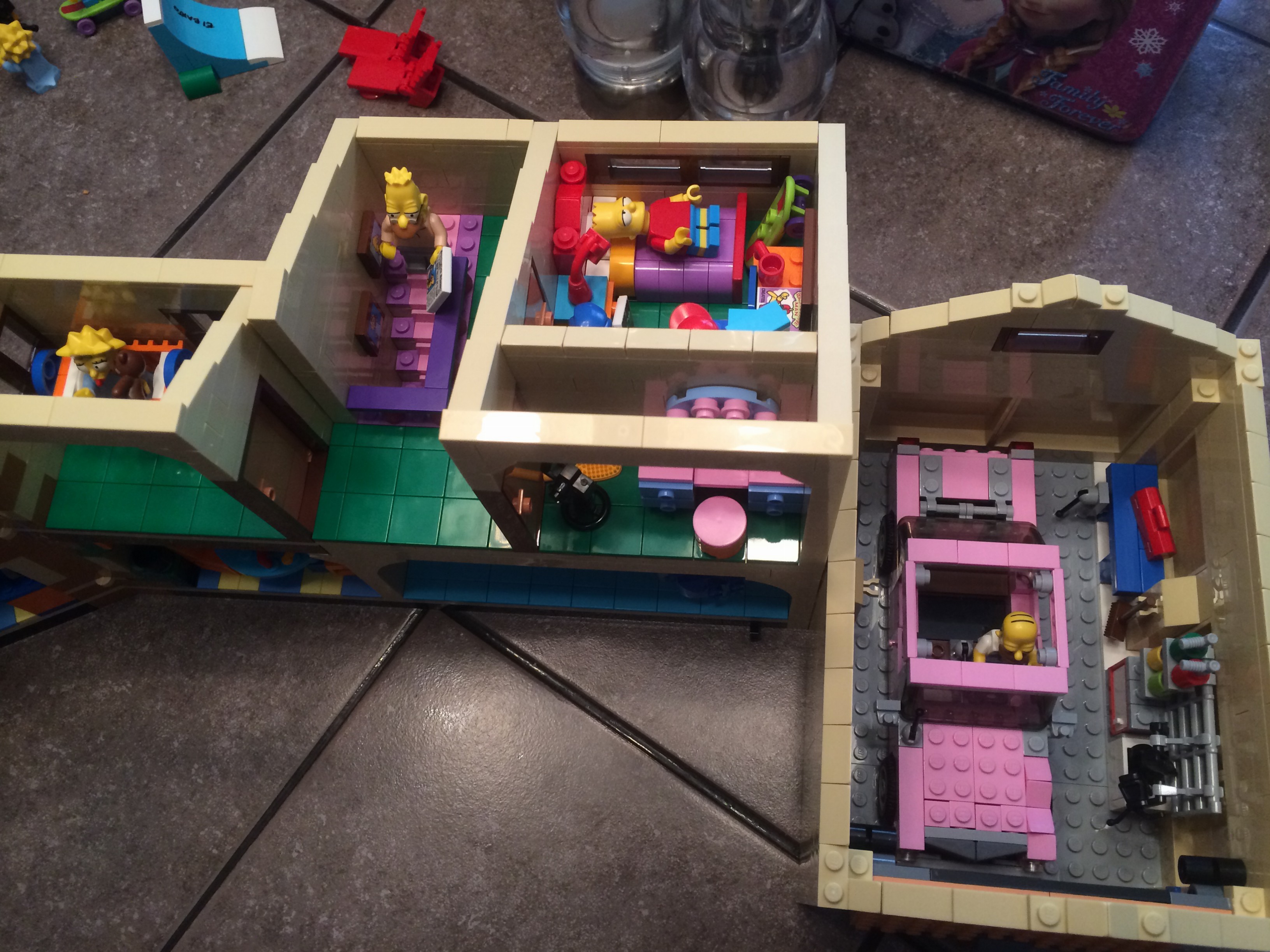
A bird's eye view of Bart's room and part of Lisa's, as well as the garage. Grandpa is apparently over for a visit.

A bird’s eye view of Bart’s room and part of Lisa’s, as well as the garage. Grandpa is apparently over for a visit.

On the second floor, the biggest casualty is Maggie as she doesn’t get her own room. Instead, she gets a crib in Homer and Marge’s bedroom. Bart and Lisa’s rooms are done rather well with Bart’s shining brighter because his personality is captured well. Homer and Marge have a larger room but it’s strangely empty and doesn’t connect to the bathroom. The second floor should have two bathrooms, but there’s only one and it’s too small to even get a bathtub. The roof rests right on top of the house and garage as opposed to snapping on so that users can easily remove it to access the rooms underneath. Bart’s room and the top of the stairs also just rest on top of the second floor so it too can easily be lifted out to access the living room while the whole house can open vertically for a cut-away look at everything. The garage is roomy enough to fit the car in comfortably, and even includes numerous power tools for Homer to neglect. Outside the house is the mailbox as well as Ned’s grill. There’s also two lawn chairs and Bart has a skateboard ramp. The wife and I assembled the entire house over the course of about a week. We didn’t do construction on it daily and took our time though impatient builders could likely put this thing together in a day with some determination. The instructions were easy enough to follow and thankfully only a few stickers are involved (I assume hatred for stickers is pretty much universal amongst Lego builders).

We're all filthy perverts for looking at this.

We’re all filthy perverts for looking at this.

It’s easy to nitpick this set because it’s not all that faithful to the show and the show has been around for over twenty years. Fans of The Simpsons are intimately familiar with how the house is supposed to look so it must have been intimidating for Lego to even tackle it. Inaccuracies and all, this is a set worth investing the time in for Simpsons enthusiasts. Lego did do a good job of getting the smaller details right like Bart’s half-open desk drawer and the “Property of Ned Flanders” sticker adorning the air conditioner hanging off the house. It’s my hope that Lego does not stop here. We already have an Apu mini figure so how about a Kwik-E-Mart? And it would be a shame if The Android’s Dungeon were not created, at the very least, as a Comic Con exclusive or something (I assume Moe’s Tavern is a no-go considering the alcohol policy). Lego could easily milk this franchise for a lot more, so we’ll see what the future holds, but if this is all we get then at least it looks cool and The Simpsons have a place to sleep and watch TV.


The Ren & Stimpy Show: Seasons 1 & 2

51KRQ4AZ4SL._SY300_It’s probably safe to say that there has never been a more controversial Nickelodeon show than Ren & Stimpy. Conceived by John Kricfalusi and his team of writers/animators at Spumco, The Ren & Stimpy show was a throwback to the days of Tex Avery and Chuck Jones when cartoons didn’t need a message or contain any sort of educational content. Beyond the format, there were numerous controversies behind the scenes as well as Spumco was slow to deliver new episodes and John K. was constantly fighting with the censors at Nick over the content of his show, eventually leading to his firing with Nickelodeon/Viacom still holding the rights to the characters. Because of this, seasons 1 and 2 of The Ren & Stimpy Show are easily the seasons held in the highest regard by cartoon fans as they’re the only two series creator John K. worked on. The show would last another 34 episodes after John K’s firing and would eventually be revived in the new millennium when the rights reverted back to Kricfalusi as the short-lived Adult Party Cartoon. Kricfalusi’s right-hand man, Bob Camp, remained onboard with Nickelodeon and there were some good episodes released in season 3 and beyond, but the best was definitely contained in the first two seasons.

Ren & Stimpy was another take on the venerable cat and dog genre of comics and cartoons. The two were designed to play off each other with Ren being the smart, cunning, and less conscionable one, and Stimpy the dim-witted, good-natured character. There was no continuity from one short to the next allowing Ren and Stimpy to hold-down whatever kind of job fit the mood of the short, live in any part of the world, or just plain exist in a more ridiculous version of reality than the next. Sometimes they lived in a house, sometimes a trailer, sometimes a tree, though usually they were poor and sometimes even homeless (as was the case in the pilot). Spumco’s addition to the genre was more gross-out humor, more surrealist imagery, and just out and out lunacy. Save for perhaps Marvin The Martian, most Loony Tunes shorts occurred in reality with anthropomorphic characters. There were different rules for physics, and firearms certainly never functioned as intended, but there did seem to be clearly defined rules. The Ren & Stimpy show shunned such rules. Ren, in particular, seemed to lack a definite form as his face and body would constantly change shape to suit the scene. Expression was important to John K. and his characters often exhibited new and interesting expressions, with Kricfalusi allegedly demanding his animators not repeat expressions in subsequent cartoons. The backgrounds often lacked form and were more interested in surrealism. The pilot, “Big House Blues,” is probably the best example of this. Whether it was by design or to keep costs down, I’m not sure, but it added a unique dimension to the show.

Backgrounds weren't always clearly defined and often used to evoke a certain emotion.

Backgrounds weren’t always clearly defined and often used to evoke a certain emotion.

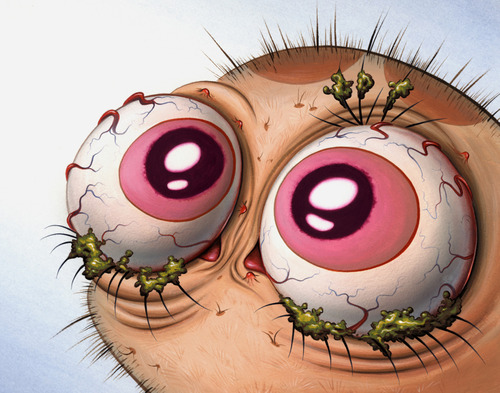
Aside form the presentation aspects, The Ren & Stimpy Show differentiated itself from other programs of its day and past with its own brand of humor. Violence was a staple of the program with Ren often getting irritated with Stimpy and resorting to slapping him across the face while berating him for being a “fat, bloated, eeeediot!” Even the characters would react to a situation in a violent fashion with their eyes bugging out impossibly far and their brain smashing through their skull. The show also delighted in poking fun at its audience by creating parody commercials for children’s products that really weren’t that far off from the real thing (I bet 90% of the viewing audience wanted some powdered toast). There was also plenty of gross gags throughout the show. The gross humor is probably what the show is remembered for best over 20 years since its debut. If it wasn’t Stimpy’s hairballs making you gag, it was the close-up still shots of characters like the fat lady from “Fire Dogs.” These hyper-detailed, unanimated sights, were another unique feature of the show often utilized to show just how ugly the world of Ren & Stimpy was. There was plenty of scatological humor as well surrounding used kitty litter or even Stimpy’s personified fart.

It should be pretty obvious at this point that The Ren & Stimpy Show was not for everyone. For those of us who grew up with Bugs Bunny and Daffy Duck, it wasn’t such a radical departure but the inclusion of the gross elements turned off a lot of the older generation. Kids like gross stuff though, well, some do. I was probably the right age when the show premiered for it to leave an impression on me. Sometimes the humor was over my head, and it took me several years to notice the not-so-subtle homosexual innuendo between the main characters, but for the most part I got it and it worked for me. And now when I re-watch it, it’s almost better because a part of me is surprised at just how much made it to air and how Ren & Stimpy couldn’t exist in today’s world. Seasons 1 and 2, in particular, hold a special place in my heart. I watched the show until the end, but these episodes are the ones I remember the best and the ones I enjoyed the most. If I were to make a top ten list of my favorite Ren & Stimpy cartoons, all ten would likely come from this set.

The show often utilized highly detailed still shots to illustrate gross imagery.

The show often utilized highly detailed still shots to illustrate gross imagery.

The first DVD release of The Ren & Stimpy Show took awhile to arrive, and when it finally did it was greeted with a mixed reaction. Not because of the episode selection though. Sorted in their original air date order, the episodes span the best of the era. There’s “Stimpy’s Invention” and its memorable “Happy, Happy, Joy, Joy” sequence. There’s the visit from Ren’s cousin Sven and the absurdity of that ending. The trilogy of Commander Hoek and Cadet Stimpy are here as well, along with other notable episodes such as “Rubber Nipple Salesmen,” “Fire Dogs,” and “In the Army.” This set basically could be titled the John K. era, and while John K. proved with the Adult Party Cartoon that he didn’t exactly possess the golden touch, the show was at its best when he was in control and voicing Ren. His Ren is a little more sinister sounding than Billy West’s, who voiced Stimpy and would voice Ren for season three and beyond (he also voiced him in a couple of season two episodes, though I am not certain why). The show embodied those surrealist elements more freely under John K’s watch and following his departure the show focused in more on the gross aspects. It lost a little bit of its soul, but I suppose that should have been expected.

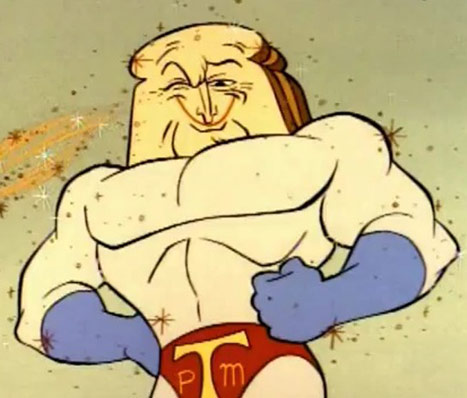
The show created other stars other than just Ren and Stimpy, probably none no bigger than Powdered Toast Man.

The show created other stars other than just Ren and Stimpy, probably none no bigger than Powdered Toast Man.

This DVD set’s biggest selling point was the inclusion of the original pilot and the infamous “banned” episode, “Man’s Best Friend,” starring George Liquor. Emblazoned in bold letters on the cover of the DVD is the word “UNCUT” designed to grab the attention of any who see it. What isn’t explained, is that the word only applies to a select few episodes. By the time this DVD was created, Ren & Stimpy were airing on the Spike network in conjunction with the new Adult Party Cartoon. The Adult cartoon was cancelled almost immediately, but Spike continued to air what it dubbed the “Remastered Classics” of old Ren & Stimpy cartoons. Unfortunately, the television landscape had changed and Spike demanded more time for commercials so these remastered classics were less remastered, and would have been more appropriately titled as edited for time. These new masters served as the basis for most of this set and some things were lost. “Ren’s Toothache” seems to be the biggest casualty as much of Stimpy’s oral hygiene sequence is missing, which was an excellent example of the show’s use of sound effects to create an uncomfortable reaction. The other big victim is “Haunted House” and its removal of the insane Bloody Head Fairy. Basically, the cover is a lie and a pretty cheap trick to attract attention. It’s for that reason I actually waffled on buying this set until recently when it was down to around ten bucks. I don’t regret my purchase, but it still bugs me that many of these episodes have been edited and aren’t the episodes I saw as a kid.

At least we now have “Man’s Best Friend” and didn’t have to resort to the internet to view it. It’s not the best episode of Ren & Stimpy, but it’s a solid B+ affair with perhaps the show’s most violent sequence. It’s also nice to finally see the unedited version of “Big House Blues” and the full scenes we’ve been seeing in brief clip form during the show’s opening sequence for years (specifically, Ren drinking from a very gross looking toilet). There’s some bonus content in the form of a brief documentary on the show’s creation and around half a dozen commentaries. Because the show was only a half hour, this set is the type you can basically blow through in a weekend, but it will be a pretty good weekend.


Ranking the WrestleMania Main Events: The Top 3

We are now just a little over 24 hours away from WrestleMania XXX. Considering it’s the 30th edition of the WWE’s flagship show we should expect something grand and whether we get it or not will surely be debated come Monday. What has come before it has been a mix of good and bad, immortal and forgettable, but these last three main events have all been great, for one reason or another. Though as a sort-of final thought on the WrestleMania main events on the whole, I would offer that they do not represent the best of WrestleMania. In doing this feature I realized that most of the greatest matches of all time occurred during the undercard. I’m not sure what that says about the event, other than that Hulk Hogan was a pretty poor and predictable wrestler, but I suppose it doesn’t matter much in the long-run so long as the entire show is good. That said, these last three matches actually do represent the best of the card from their respective WrestleManias and the fans should have been sent home happy after witnessing these three.

wrestlemania153. The Rock vs Stone Cold Steve Austin (WrestleMania XV)

The main event for WrestleMania XV is your classic good guy battles through adversity and comes out on top at the biggest show of the year. It’s a pretty common formula for the industry and that’s because it works. WrestleMania often has the good-guy challenger come out on top in the main event with successful title defenses being pretty rare. Successful heel title defenses are even rarer. For XV, The Rock was the undisputed top heel in the business, and fresh off a long feud with Mankind, he was set to take on Austin. Austin and The Rock had previously battled over the Intercontinental title so a match between the two wasn’t foreign to wrestling fans, but by 1999 both were so huge that it felt like an all new feud. Austin was coming off of his feud with Vince McMahon which had finally resulted in an actual match between the two at St. Valentine’s Day Massacre the previous month. The feud would carry-over in the next pay-per view, Backlash, but was at long last starting to wane.

Austin and The Rock put on a great show for the fans with lots of outside the ring work and humorous character spots. This match strikes a nice balance between wrestling and entertainment. The Rock’s character was so over-the-top that his main event matches needed to have something special added to them to take advantage. Their follow-up WrestleMania match at XVII had a little more of this extra-curricular stuff, but the finish to it was too drawn out and I disliked Austin’s heel turn, which is why I rank this one ahead of it. Hopefully we one day get another match-up between two huge superstars like this in a WrestleMania main event (some would argue we did with Rock and Cena, but Cena’s love from fans is not universal like Austin and Rock’s was in 1999) because it is awesome when the crowd is this into it.

Two of the best.

Two of the best.

2. Shawn Michaels vs The Undertaker (WrestleMania XXVI)

Shawn Michaels and The Undertaker stole the show at WrestleMania XXV in what many fans consider the greatest WrestleMania match of all time. WWE recognized how well-received it was so they did it again at WrestleMania XXVI only this time in the main event and with Michaels’ career on the line as the match stipulation. Other than the career vs streak booking, there were no actual titles on the line in this main event and no one cared. At this point, Undertaker’s “streak” is bigger than any belt when it comes to WrestleMania. Maybe next year I’ll rank his best WrestleMania matches and that way I can find out just when the streak became a major plot device for the WWE. It’s now the only time The Undertaker even wrestles giving WrestleMania this video game vibe where Undertaker is like the final boss of the last level.

I believe I am in the minority when I say the rematch between Michaels and Undertaker is actually my favorite of the two. They’re both excellent, but I enjoy the added drama of Michaels’s career being on the line (though I also love the moonsault-tombstone ending of the previous match) which helps add even greater weight to the whole thing. This match seemed quicker with fewer pauses for rest holds and such (aided greatly by Undertaker not botching a suicided dive to the outside of the ring). Undertaker and HBK just work exceptionally well as opponents. HBK has always been able to effectively sell his own offense despite often being much smaller than his opponents. Michaels is also the perfect size to sell Undertaker’s more high impact offense as he can carry Michaels around the ring and toss him like a rag doll, if he so pleases.

The two go all out, which is something a superstar can do if he knows it’s his last match or that it will be his only match of the year. There’s a nice diving moonsault to the outside by Michaels and plenty of stiff shots. As I mentioned earlier, the storyline ending is just icing on the cake and Michaels gets the send-off he deserves as one of the greatest of all time. This one was a strong contender for greatest WrestleMania main event of all time, but it comes up just a little bit short to the next one.

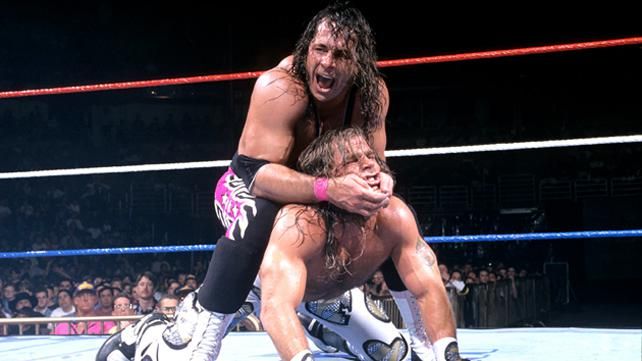
Michales and Hart would battle for over an hour to determine the WWF Champion.

Michales and Hart would battle for over an hour to determine the WWF Champion.

1. Shawn Michaels vs Brett Hart (WrestleMania XII)

The Iron Man Match. That’s all that really needs to be said to any wrestling fan and they’ll know what you’re talking about. Iron Man Matches had occurred before but most fans had never heard of it. Even today, it’s not a common match type as it requires its competitors be willing and able to wrestle for an hour. I think many guys could pull it off, but not sell it as a great match. Even two guys in excellent physical shape like Shawn Michaels and Brett Hart had to stop for rest holds and such, but the vigor at which they’re able to go at each other impresses me every time I view this match.

For those unaware, an iron match is a timed match in which the competitor who scores the most “falls” in the allotted time limit wins the match. For this contest that meant pinfalls, submissions, count outs, and disqualifications were all on the table. The beauty of this match was that there were no falls recorded during the sixty minute time limit. When it seemed like the match would end in a draw, Brett Hart was ordered back to the ring to continue into overtime where Michaels eventually won via pinfall for his first WWF Championship. The finish is great, but getting to it was better. Yes, there are the previously mentioned rest holds and slow parts, but the match really takes off during the middle stages and the two competitors somehow keep it going. There are great moments of aerial superiority from Michaels, while Hart is able to sink in a  sharpshooter at one point as well. Michaels and Hart worked so well together that it’s a shame they didn’t have more main events at WrestleMania (they were supposed to main event WrestleMania XIII, but Michaels pulled out due to injury). Their chemistry in the ring is unrivaled as they’re able to realistically sell each other’s offense and pull off what should be unrealistic counters. They have a flow like two expert dancers and their contrasting personalities help to elevate the show side of the match. The Iron Man Match is not only the greatest main event in WrestleMania history, it’s also the greatest match in WrestleMania history and it will take one-hell-of-a-match to knock it off the top of the mountain.


Ranking the WrestleMania Main Events (11-4)

We’re now just one week away from WrestleMani XXX, which means I need to get this feature wrapped up!


Triple H and Jericho felt like natural rivals whenever they matched-up.

Triple H and Jericho felt like natural rivals whenever they matched-up.

11. Triple H vs Chris Jericho (WrestleMania XVIII)

WrestleMania XVIII is remembered for pretty much one match:  Hollywood Hogan vs The Rock.  It was Hogan’s first official match since re-signing with the WWF and the Montreal crowd didn’t seem to care that he was supposed to be the heel heading into it. It was a fun match, but the main event was pretty damn good too. It featured the newly crowned Undisputed Champion Chris Jericho vs Triple H, making his second appearance in a WrestleMania main event. Jericho and Triple H are a natural pairing. Both guys are good, technical wrestlers and Triple H’s more power-oriented offense complements Jericho’s up-tempo maneuvers just fine. The only thing that kind of sucks about this match is that the outcome is never really in doubt as it was pretty much a given that the WWF would put the strap on Triple H after letting Jericho have his fun for a bit. It was nice while it lasted though.

10. John Cena vs The Rock (WrestleMania XXVIII)

The first match-up between John Cena and The Rock is markedly better than the second. The year-long build-up worked well and seeing The Rock back in the ring was a novelty that hadn’t grown stale. Yes, he still wasn’t in great ring shape as the match was plagued some-what by rest holds and the like, but the two guys played off each other well and the finish was well-executed. This was one of the few matches in recent years where I had an interest in the outcome. Would the WWE let its top star get disrespected over and over by a visitor ultimately losing to said visitor in the main event of its most prestigious event? Would The Rock bother making a comeback just to lose to an opponent he seems to genuinely consider inferior to himself? The capper was the event being held in Miami, Rock’s hometown, so I was pretty sure Cena would be asked to take the loss. What I wasn’t expecting was the finish to be a clean loss, with Cena attempting to humiliate The Rock by performing the People’s Elbow only to have Rock bounce-up and nail him with the Rock Bottom for the 1-2-3.


Note to aspiring wrestlers:  this is not how to land a shooting-star press.

Note to aspiring wrestlers: this is not how to land a shooting-star press.

9. Kurt Angle vs Brock Lesnar (WrestleMania XIX)

This match is mostly remembered for Lesnar’s botched shooting-star press towards the end. Lesnar had created a buzz for himself long before he debuted on WWE television by performing the shooting-star press at Ohio Valley. For a man his size to be able to pull off such a crazy maneuver was unheard of. Turns out, big men aren’t meant to fly like that because when he unveiled it at WrestleMania he damn-near killed himself. It overshadows what is a great match of technical excellence. The only low-note for me is the early going where Angle and Lesnar both try to one-up each other with amateur wrestling maneuvers. I never understood why guys would choose to go in such a direction. Pro Wrestling is popular because it’s not the ground-based amateur style. We want flashy! Whenever guys with that kind of background step into a ring though it’s as if they feel they need to acknowledge where they came from. I’m very impressed by the fact that Kurt Angle has won Olympic gold in wrestling, but I don’t want to watch it.

8. Triple H vs The Rock vs Mick Foley vs The Big Show (WrestleMania XXVI)

The only four-way-dance in WrestleMania main event history! The genesis for this match was unconventional. Most had assumed that The Rock and Triple H were destined to headline WrestleMania 2000 as The Rock was the hottest thing going and Triple H was the company’s biggest heel (and Austin was still on the shelf following neck surgery). To keep Hunter’s momentum going, they had him battle Foley for two pay-per-views ultimately defeating him a retirement match at No Way Out. Vince McMahon, in a rare bit of booking with his heart, wanted Foley to realize his dream of main eventing a WrestleMania so he convinced him to come back for this one match just a month after his retirement. Foley was apprehensive, but went ahead with it as it’s just not something any pro wrestler can turn down. And since The Big Show wasn’t doing anything, they added him to the mix as well as part of this four-way feud between the McMahons. It wasn’t a classic match, and the most memorable spot is probably Foley coming up well short on a diving elbow to the announcer’s table, but it ended with Triple H vs The Rock anyways so it’s not like the fans were denied the match they were probably supposed to have. And with Triple H coming out on top it was really the first time in WrestleMania history that the event ended with a bad guy wearing the WWF Championship.


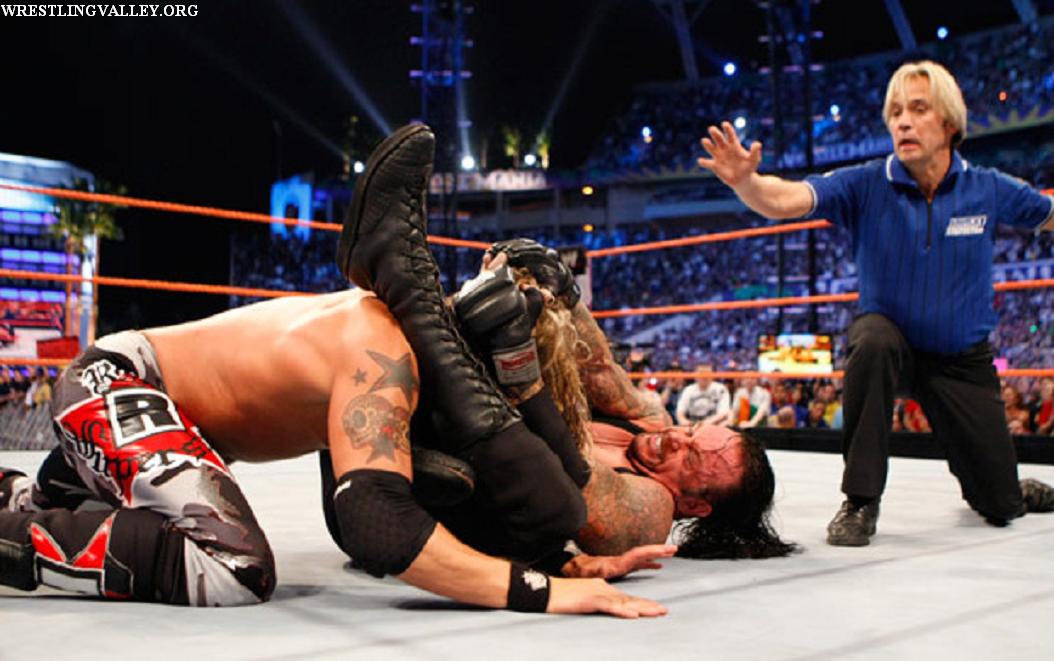
Undertaker earned a rare WrestleMania main event submission victory over Edge.

Undertaker earned a rare WrestleMania main event submission victory over Edge.

7. The Undertaker vs Edge (WrestleMania XXIV)

For all of the success that The Undertaker has enjoyed at WrestleMania, he really hasn’t appeared in many main events. At least he can say the ones he’s appeared in were all pretty good. This match with Edge is a pretty good representation of a good Undertaker match. Edge and Taker work really well together with Edge being one of my favorite opponents for The Undertaker for that very reason. At this point, The Streak was a plot line so there was little doubt that The Undertaker would come out on top, but despite that, the finish was still surprising and even a bit sudden with Undertaker locking in his Hell’s Gate submission maneuver for the victory allowing The Phenom to hoist a major championship at the show’s close for just the second time in his career.

6. John Cena vs Shawn Michaels (WrestleMania XXIII)

Shawn Michaels can wrestle a great match with seemingly anyone. Not that John Cena is an Ultimate Warrior or anything, but he’s certainly not one of my favorite workers. This match may not be a WrestleMania classic, but it’s great entertainment. It starts off kind of slow but the two eventually pick-up with the pace with a lot of back and forth momentum swings. HBK is the heel here and it’s the role I’ve always preferred for him. Once again he proves he belongs in the WrestleMania main event and it kind of makes me wish he could be included in all of them. Certainly he should have been in more during his career but at least the ones we have are preserved forever.

5. Triple H vs Shawn Michaels vs Chris Benoit (WrestleMania XX)

Oh boy, how do you rank this one? I suppose the easiest thing to do is to just judge it based on the merits of the match alone, which to probably no longtime wrestling fan’s surprise, is to say it’s fantastic. These are three of the best workers in the history of the business on the grandest stage going all out to entertain the masses. The only negative thing I can say about the match itself is that too often one guy gets taken out for too long of a time. It would be one thing if a guy was taking a piledriver to the concrete and being down for five minutes but it mostly seemed like generic maneuvers were keeping guys down just to keep the match a series of one on one confrontations. Such is the weakness of the triple threat match. Of course, judging the match in such a way ignores the elephant in the room which is that Chris Benoit is a known murderer who committed the unthinkable act of killing his own family. It’s impossible to separate the wrestler from the man when such has taken place, so I do not blame anyone if they have no interest in watching this match today. For me, it does harm the match quite a bit as the big storyline within the match is Benoit trying to win his first major championship in WWE, and at the time, the ending was immensely satisfying and one of the best examples of pure joy being on display in the ring. Sadly, the image of Eddie Guerrero and Chris Benoit celebrating at the conclusion of the match is beyond bittersweet today.


One of the more memorable images from any WrestleMania conclusion.

One of the more memorable images from any WrestleMania conclusion.

4. Stone Cold Steve Austin vs The Rock (WrestleMania XVII)

WrestleMania XVII is justifiably remembered as one of the best WrestleManias of all time. It’s main event was a pretty big deal at the time too with two mega-stars in Austin and The Rock. The only other main event that even compares in terms of how popular both guys were heading into the match is Hogan vs The Giant; these two guys were just hugely over with the fans. Austin was competing for the Championship for the first time since his return from neck surgery and The Rock was not expected to just role over for the big star. With Rock becoming the top baby face in Austin’s absence, the decision to turn Stone Cold heel at the match’s conclusion was reached. Austin was the main driver behind this as he was concerned his character was growing stale. Plus he liked playing the bad guy. He also admits that if he could push the reset button on anything in his career it would be the end of this match. The two battled and had an astoundingly entertaining match with good in-ring spots as well as out of the ring spots. There was violence and comedy, and the end certainly left people talking. I too think the heel turn for Austin was a bad move. Not because he shouldn’t be a bad guy, but just the way it was done to have him suddenly align himself with Vince McMahon in such a way. It just wasn’t believable for his character. If he had used McMahon to win and then nailed Vince with a stunner or something it would have made more sense and let Austin play a tweener kind of role. Instead he became a sniveling coward which effectively killed his character.


Ranking the WrestleMania Main Events (19-12)

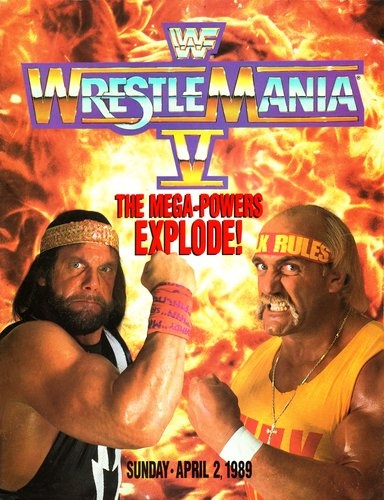
The year long feud between Macho Man and Hulk Hogan came to a head at WrestleMania V.

The year long feud between Macho Man and Hulk Hogan came to a head at WrestleMania V.

19. Hulk Hogan vs Macho Man Randy Savage (WrestleMania V)

The clash of the Mega Powers!  The WrestleMania V main event was another early WrestleMania main event that wasn’t much to write home about, but one thing it did have was legs.  The main event for WrestleMania V was unofficially booked at the conclusion of WrestleMania IV when Savage won the WWF Championship to close out the night with the aid of Hogan.  For the next year the two would tag team and feud with Dibiase and The Giant until conflict would surface between the two.  With both guys being pretty popular with fans, the WWF needed to turn one heel and it unsurprisingly went with Savage, who despite being the champion, was not as over with the fans as Hogan.  When the two finally collided, it was a case of excellent booking with a good pay-off, the type of thing that doesn’t really happen in today’s world of short attention span fans.   As I alluded to at the start, the match itself was rather poor.  Savage was a real in-ring talent, but there was nothing he could really do to elevate Hogan and the match ended up being a typical Hulk Hogan match.

18. Triple H vs Batista (WrestleMania XXI)

Batista was a real throw-back superstar.  The only things separating him from guys like Hogan and The Warrior were tattoos and a crew cut.  He had the look of the behemoth and the grace to match.  His matches never did much for me and this encounter with Triple H was a dud.  The two would go on to have better match-ups centered more around gimmicks (maybe someone realized a straight wrestling match just wasn’t playing to their strengths), but never any real classics.  Triple H has also been a pretty good worker and he has the reputation of being a technical wrestler.  Personally, I’ve always felt his reputation was forced.  Great technical wrestlers can elevate their opponents and find a way to have good matches, I don’t think Triple H has ever been that guy and he certainly wasn’t able to pull a good match out of Batista at WrestleMania XXI.

17. The Undertaker vs Sycho Sid (WrestleMania XIII)

This is a match that really has no business being as good as it is.  That’s not to say it’s a classic by any means, but before I sat down to re-watch it recently after all of these years I was expecting the worst.  My preliminary thoughts on this list had this match coming in at around number 27 or so, but here it is at 17.  Sid Justice, at the time going as Sycho Sid, is not much of a wrestler.  He was a big guy and could do some big moves, but when it came to selling a match he was awful and that part of his game is on display in this one.  Despite that, there were some good moments and he and Undertaker were able to tell a pretty decent story.  By contrast, Undertaker has always been a big guy who was a plus worker, a hard combination to find, and both guys aren’t so big that they can’t take each other’s big moves and make them look good.  The match does suffer from too many interruptions (I’m not sure if Sid was balking at losing clean to Undertaker or if the Brett Hart run-ins were just meant to setup a new feud), but otherwise is solid entertainment.

16. Triple H vs John Cena (WrestleMania XXII)

With these last few matches, we’ve entered into the part of the list where the matches aren’t bad matches, but they’re not exactly main event at the biggest show of the year quality matches.  This is another match that kind of surprised me when I watched it recently.  I’m not a John Cena fan.  Like Batista, he’s a throwback to the eighties.  He’s a superman like Hogan was where he’ll take a beating and then suddenly kick-out of a big move and hit his finisher for the win.  He’s an attraction as he was in his match with Big Show years earlier where he got the giant up onto his shoulders.  This match though is a pretty hard hitting affair with some good pacing (after a slow start).  It’s nothing to write home about, but the fact that it’s not one of the worst matches is an accomplishment I wasn’t sure it would have.

The Rock loomed large at WrestleMania XXVII despite not even being on the card.

The Rock loomed large at WrestleMania XXVII despite not even being on the card.

15. John Cena vs The Miz (WrestleMania XXVII)

As a match, this one is probably worse than the previous two.  I’ve already shared my thoughts on Cena, but The Miz is no better.  He’s Cena without the look.  As a heel, which he was at the time of this match, he was pretty good at getting heat.  In the ring though he’s sloppy, lacks polish, and has a pedestrian arsenal.   The build-up to this match though had almost nothing to do with The Miz, who was actually the champion heading into WrestleMania!  No, the storyline centered around John Cena and the host of WrestleMania XXVII:  The Rock.  When The Rock returned to Monday Night Raw he almost immediately began picking a fight with John Cena.  Their feud would carry over into the next year’s WrestleMania, especially after The Rock played a role in the outcome of this match between Cena and The Miz, and it’s the buzz that surrounded this match that helps elevate it.  Otherwise, this was a main event more befitting of Raw than WrestleMania.

I'm pretty sure there's a law somewhere that says I have to post this picture if I'm going to talk about WrestleMania III.

I’m pretty sure there’s a law somewhere that says I have to post this picture if I’m going to talk about WrestleMania III.

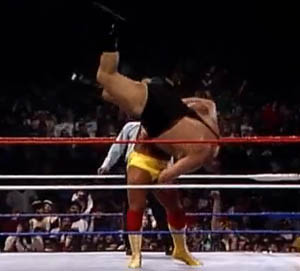
14. Hulk Hogan vs André the Giant (WrestleMania III)

In terms of build-up and anticipation, there is no equal when it comes to Hogan vs The Giant.  This is the main event that shattered the all-time attendance record and would stand for a long, long time.  The Giant was a huge attraction and was billed as being undefeated over his career.  Hogan was Hogan, the biggest current attraction in the wrestling world. André had also never wrestled for the championship, mostly because promoters didn’t need him to and allowed for them to have two big matches on a card: an André the Giant match, and a world championship match.  Of course, come 1987 André was a shell of his old self and nearing the end, and Hogan was…well, I think I’ve ripped on him enough at this point.  This match is awful.  The Giant can barely move and Hogan is forced to try to sell his limited offense.  The only part of the match worth watching is “The Slam” at the end.  That was a huge moment and the crowd reaction sells it perfectly.  If this were a list of best moments from a WrestleMania main event, that would be the easy choice for number one.  It’s a big enough moment that it elevates a garbage match up to number 14, which isn’t too bad if you ask me.  It was one Hell of a slam.

13. Stone Cold Steve Austin vs Shawn Michaels (WrestleMania XIV)

Transitioning from the original mega stars of wrestling to perhaps two of the biggest in recent memory, here we have a match that really could have been something special.  It is special, but only because it marked the first time Austin won the WWF Championship and the added Mike Tyson factor at ring-side.  Unfortunately though, this was when Michaels was in tremendous pain following a serious back injury at Royal Rumble.  The injury would force him into retirement for four years before a comeback, but during the match it’s clear that Michaels isn’t right.  Some of it is a sell-job since play-by-play man Jim Ross wasn’t hiding the fact that Michaels was hurt, but a lot of it is legit discomfort.  Because of this, the match is real slow-paced with lots of rest holds and a feeling of restraint throughout.  It’s disjointed, but the finish was strong and the crowd certainly didn’t seem to mind once Austin hit the stunner.  Still, it’s hard to watch this and not wonder what could have been.
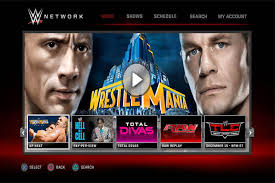
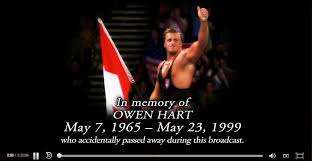
12. John Cena vs The Rock (WrestleMania XXIX)

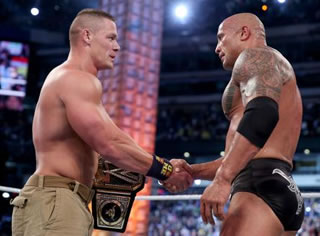
Cena and The Rock ended their three year long feud at the conclusion of WrestleMania XXIX.

Cena and The Rock ended their three year long feud at the conclusion of WrestleMania XXIX.

The most recent main event, and part two of the Cena/Rock feud (unless you count their confrontation at WrestleMania XXVII as part one, then it’s part three) and at this point it was starting to run out of steam.  As much as people loved The Rock, myself included, it was hard to disagree with Cena’s assertions that at least he was a full-time wrestler, unlike The Rock.  The Rock was coming off as disingenuous, but he was still making people laugh.  In the ring though, it was becoming clear that Rock wasn’t the same guy as he was years ago, which is understandable.  This version of The Rock was really bulky, and since he wasn’t a full-time wrestler, he really didn’t have the stamina to carry a one-on-one match.  The two made it work the prior year, but come WrestleMania XXIX it was clear they were out of ideas as both guys resort to hitting their signature moves over and over.  Having a wrestler kick out of another guy’s big move can be a really effective way to sell the enormity of a match, but three times?  Four times?  It just loses impact.  In defense of The Rock, he did get injured during the match which may have affected his performance.  The enormity of the feud and star power of the characters is what elevates this match to this spot, not the in-ring performance.


Ranking the WrestleMania Main Events (29-20)

images-202It’s that time of year when WWE programming is officially declared as being “on the road to WrestleMania!”  This year, WrestleMania will be on April 6th and the main event will likely be a triple-threat match consisting of WWE Heavyweight Champion Randy Orton, Batista, and Daniel Bryan.  I say “will likely be” because technically Bryan needs to defeat Triple H in a one-on-one contest earlier in the card to secure his spot in the main event, which feels like a certainty considering the hostile crowd reactions of late towards the original main event of Orton and Batista.  No matter who is in the main event, this WrestleMania will be historic for the simple fact that it’s WrestleMania XXX.  Back in 1984 when the first WrestleMania hit pay-per-view it was considered a huge gamble for the then World Wrestling Federation.  The fact that we’re approaching the 30th edition of this event is remarkable.

WrestleMania is the big one.  For the WWE, it’s the Superbowl of professional wrestling.  And as we’ve learned over the years, just because the Superbowl contains the top two teams in the NFL each year, it doesn’t mean we’re about to see the best game of the year.  WrestleMania, and its main event in particular, is guilty of that same phenomenon.  WrestleMania has been host to some of the best matches in professional wrestling history, some of which have been main event matches, but there have been a whole host of bad ones too.  The early events are particularly guilty of this as the main event was dominated by Hulk Hogan.  Hogan is arguably the most popular wrestler in history.  Kids loved him because he was basically a super hero in the ring, but from a wrestling perspective he was awful.  His arsenal of moves was pedestrian and his no-sell antics were cartoonish.  For wrestling fans, particularly modern ones, his matches are terrible.

Hulk Hogan was involved in some capacity with the WrestleMania main event a record nine times, all of which occurred within the first nine WrestleManias.  WrestleMania IV was the only one he did not compete in, while WrestleMania IX was billed as Bret Hart versus Yokozuna, only for an impromptu match between Hogan and Yokozuna to come together after the fact (it lasted for all of a minute).  And in those eight matches Hogan participated in, he only would lose one.  Yes, Hogan dominated the early period of WrestleMania.  Since his departure, other wrestlers have come close to matching the amount of main events that Hogan amassed.  Triple H has logged six main event appearances while Shawn Michaels has managed five.  John Cena, who currently is very much active in the WWE and not likely to quit anytime soon, has also managed five giving him a legit shot at matching, or even surpassing, Hulk Hogan for main event appearances.

Hulk Hogan was synonymous with WrestleMania for the better part of its first decade.

Hulk Hogan was synonymous with WrestleMania for the better part of its first decade.

As far as the WWE is concerned, Cena or Triple H probably already holds the record.  That’s because the WWE often likes to declare multiple main events for WrestleMania (which is why when discussing Stone Cold and the Rock you will often hear it said that Austin vs Rock is the only match to be included in the main event three times at WrestleMania, even though it was the final match of the night only twice).  As far as I’m concerned, the main event is a singular phrase, and therefore, there can be only one per card.  For this feature, I’ve decided to rank the final matches on each WrestleMania card one through twenty-nine to name a best match.  It should be said that a list of the twenty-nine best WrestleMania matches would likely look very different.  After all, some of the most talked-about matches in the history of the event did not occur in the main event.  I’m talking about matches like Steamboat vs Savage, Undertaker vs HBK, or any of the many ladder matches that have taken place over the years at WrestleMania.  Coming up with the thirty or so best matches would just be too daunting a task for me, but with the help of the brand new WWE Network, revisiting and ranking the best main events is a task I think I can handle.

29. Lawrence Taylor vs Bam Bam Bigelow (WrestleMania XI)

When it comes to WrestleMania, one thing fans are certainly assured of is a celebrity appearance or two.  Vince McMahon seems to love it when he can get a celebrity to participate in his events as a way of legitimizing what the WWE does, even if most of these appearances are looked-down upon by his hardcore fan base.  This trend began with the very first WrestleMania and continues today.  When a celebrity takes on the form of a guest ring announcer or valet most fans can excuse it, but when they get in the ring?  And when that celebrity is in the main event?!  It’s nothing short of awful.  To his credit, professional football player Lawrence Taylor doesn’t embarrass himself in the ring against Bam Bam Bigelow, but the two hardly put on on a match worthy of occupying any main event, let alone the main event at WrestleMania.

28. Hulk Hogan and Mr. T vs Rowdy Roddy Piper and Mr. Wonderful Paul Orndorff (WrestleMania)

The very first WrestleMania was the riskiest, and to make sure the event was a success, McMahon recruited any celebrity he could and even found one to include in the main event.  Mr. T, star of The A-Team, made numerous appearances for the WWF and was able to attract a lot of attention from the mainstream media.  Piper was able to get legitimate heat and people genuinely wanted to see Hogan and Mr. T kick he and Paul Orndorff’s ass.  The crowd was into it, which is the only good thing I can say about this main event.  Other than that, it’s awful.  Mr. T looks the part of a wrestler when he’s standing still, but when he tries to get involved he’s sloppy and out of place.  The other guys are unable to direct him and coach him to a decent match.  Hogan and T come out on top, but it’s not a fun ride getting to the finish.

Hulk Hogan vs King Kon Bundy at WrestleMania 2 has never been confused with a "classic" Mania match.

Hulk Hogan vs King Kon Bundy at WrestleMania 2 has never been confused with a “classic” Mania match.

27. Hulk Hogan vs King Kong Bundy (WrestleMania 2)

It’s somewhat surprising that WrestleMania has been the success that it is considering two of the first three matches on my list are occupied by the first two WrestleMania main events.  Hogan was able to avoid being in, what I consider, the worst main event in WrestleMania history, but the next few spots aren’t going to be too kind to the Hulkster.  This match appears in this spot not because it’s awful, but mostly because it’s so uneventful.  It took place in a steel cage and I can’t decide if that helped or hurt it as it limited what the already limited competitors were able to do.  Bundy was a mountain of a man whose size limited what Hogan could do to him.  He was also too big to scale the cage walls, not that he and Hogan were likely to orchestrate a big spot from up high even if he could.  At least Hogan won by going over the cage instead of out the door, because it always sucks when a cage match ends without someone at least climbing over it.

26. Hulk Hogan vs Sid Justice (WrestleMania VIII)

If you wanted to find a silver lining for the previous match, at least it was for the WWF Championship so that gives it some buzz.  This match between Hogan and Sid Justice was a non-title match, but the fans didn’t seem to care as they were pretty loud and solidly behind the Hulkster.  Sid is about as limited in the ring as Hogan, and when two big men with limited arsenals clash there just isn’t much room for a good match.  By now, Hulkamania was nearing its expiration date and the Hogan formula was well-established which meant there were no surprises, aside from the match ending in a DQ victory for Hogan.  This was a pointless main event at a forgettable WrestleMania.

25. Hulk Hogan vs Sgt. Slaughter (WrestleMania VII)

The main event for WrestleMania VII was supposed to mirror the conflict in Operation Desert Storm with the American aligned Hulk Hogan taking on the champion and Iraq sympathizer Sergeant Slaughter.  Slaughter was portrayed as a turncoat and traitor to America, which helped get the crowd into it.  In the ring, it was just another Hogan match where two guys wail on each other for ten minutes or so before Hogan “Hulks up” and takes care of business.

WrestleMania VI was hyped as The Ultimate Challenge by the WWF.

WrestleMania VI was hyped as The Ultimate Challenge by the WWF.

24. Hulk Hogan vs The Ultimate Warrior (WrestleMania VI)

Some things that seem awesome when you’re a kid appear totally different through the eyes of an adult.  By WrestleMania VI, Hulkamania was running wild.  The super hero thing was working for Hogan, so why couldn’t it work for someone else?  Enter the Ultimate Warrior, who was basically an even more cartoonish version of Hogan.    He did everything Hogan did but just seemed crazier and looked more wild with his flowing locks and wild tassels.  He was impressive looking to me when I was a kid, but when I look at him now he just looks like a steroid junkie.  In the ring, he was arguably worse than Hogan as his arsenal consisted of clotheslines, shoulder tackles, and slams with the guerrilla press followed by a running splash being his version of Hogan’s big boot and leg drop.  He would even “Hulk-up” like Hogan, often running in place or grabbing the ropes for power, according to the announcers.  The whole show of the Warrior was ridiculous, and it’s no surprise he didn’t have the lasting power that Hogan did.  This match is now mostly just notable for being the only time Hogan lossed clean as a baby-face to someone.  Considering how much of a rip-off the Warrior was, it’s almost shocking that Hogan agreed to it.  The match itself is terrible, with Hogan either teasing a heel turn at one point or just plain forgetting that he was supposed to sell a leg injury.  Warrior even botches the press slam, but at least his splash looked okay.

23. Brett “The Hitman” Hart vs Yokozuna (WrestleMania IX)

Vince McMahon, and the rest of the wrestling industry, seems to love big men.  They’re viewed as attractions on their own and usually don’t even need an interesting opponent to be a draw.  Unfortunately, they’re also usually terrible in the ring due to their size.  Yokozuna is one such big man.  Billed as over 500 pounds, he’s every bit that and more.  He was supposed to be a sumo wrestler, though like most gimmicks, this was untrue but it didn’t matter because he looked the part.  He was huge and fat, and as a result, he couldn’t do much in the ring, and when he did, he became winded pretty quickly.  Brett Hart, one of the all-time great technical wrestlers, deserved better for his first WrestleMania main event.  Hart’s the type of performer that can elevate a poor opponent, but there was no elevating Yokozuna.  You either liked the spectacle or did not.  I did not, and this match is a series of clotheslines and rest holds.  Hart did manage to apply the sharpshooter, though it was kind of silly looking.  After the match ended in a Yokozuna victory, his manager Mr. Fuji quickly challenged Hogan to a match that the Hulkster would win in less than a minute.  This ridiculous finish is why I rate this match as slightly worse than the next one…

Yokozuna was a very big man.

Yokozuna was a very big man.

22. Brett Hart vs Yokozuna (WrestleMania X)

A rematch of WrestleMania IX, only with the roles reversed with Yokozuna now the defending champion.  Both guys had to wrestle a match on the undercard, and the short-of-breath Yokozuna had even less stamina than usual for the main event.  This match is actually probably worse than the one at WrestleMania IX, but without the stupid finish.  Instead Hart wins and a bunch of wrestlers come out and celebrate with him.  Yokozuna, mercifully, never appears in another WrestleMania main event.

21. Triple H vs Randy Orton (WrestleMania XXV)

This was a joyless match.  Both guys are solid technical wrestlers, with Triple H probably being the better of the two.  Neither guy is so good that on paper this would be expected to be a classic, but a good, solid match was certainly likely.  I don’t know why these guys didn’t try to put on a better showing.  It was the main event of WrestleMania XXV for crying out loud!  Instead, this was a main even fitting of television.  They just don’t do anything to make it feel special, and adding to the lack of atmosphere is the fact that the crowd isn’t into it.  Both guys immediately blow through their special moves and a lot of the early part of the match consists of both men laying on the canvas.  It picks up slightly in the second half, but never to an exciting level.  This match just sucks, and for now, is the last main event Triple H has appeared in at WrestleMania.

20. Macho Man Randy Savage vs The Million Dollar Man Ted DiBiase

Randy Savage spent the better part of the 80’s playing second fiddle to Hulk Hogan, even though he was clearly the superior wrestler.  His match with Ricky The Dragon Steamboat at WrestleMania III is one of the all-time classics.  Come WrestleMania IV, the WWF finally saw fit to put the strap on him, but of course, Hogan was involved.  DiBiase was one of the great workers of his generation and a classic heel.  Given different circumstances, these two could have had a great match, but the format for WrestleMania IV was not conducive to that.  WrestleMania IV consisted of a tournament for the vacated title (Hogan and André the Giant battled to a double DQ which is why he wasn’t in the main event) which meant both Savage and DiBiase had wrestled multiple times already.  As a result, the main event was pretty conventional, with both Hogan and The Giant getting involved on the outside.  Savage would get the win with the flying elbow drop, setting the stage for a year-long storyline that would lead into WrestleMania V.


A Week With the WWE Network

sg-ntwk_sizzle_today_revIt’s been a long road for World Wrestling Entertainment to launch its own network.  As early as September 2011, the WWE was teasing the network to its fans.  Once the calendar flipped from 2011 to 2012, WWE was ready to announce that its own network would launch by year’s end.  2012 came and went, with nary a word spoken about the network.  Fans were left to wonder if the network would go the way of GTV and vanish from thought.  After all, no one even knew what the WWE was trying to do with its own network.  Was it to be a premium cable channel?  An on-demand network?  What kind of content would fill the network?  Did anyone even really want a channel dedicated to wrestling 24/7?

WWE was quiet until late in 2013 when it came to the subject of its seemingly dead-on-arrival network.  And then, like a perfectly executed heal turn, the network was announced to great fanfare.  The long hiatus was put to good use by WWE as nearly every question that could be asked was answered immediately.  The WWE Network would be an on-demand internet channel in the same style as Netflix or Hulu.  For ten dollars a month, fans would receive access to the network and their ten dollars would go a long way:  access to new series, access to every WWF/WWE/WCW/ECW pay-per view, on-demand episodes of Raw, Smackdown, Nitro, Hardcore TV, etc.  And the kicker, every new WWE pay-per view was included live.  That meant that individuals who subscribed in April would get all of the historical content plus Wrestlemania XXX for just ten bucks.  The catch?  Well, the only catch was the announcement that a subscription was a six month commitment making the entry level price sixty bucks for Network access.  As far as catches go, this is a perfectly reasonable one otherwise fans would be constantly signing up and canceling their subscriptions just for ten dollar pay-per views (for those unaware, a WWE PPV usually runs fifty to sixty dollars, with Wrestlemania sometimes going higher).

The WWE Network has a very simple and easy to use interface, though improved search features would be appreciated.

The WWE Network has a very simple and easy to use interface, though improved search features would be appreciated.

This past Monday, the WWE Network was officially launched.  The Network is available on several platforms including PC, Mac, iPod/iPad, smart phones, PS3/PS4, Xbox 360, Roku, and probably some I’m forgetting.  The only notable exclusions right now are Smart TVs (other than Samsung), Nintendo devices, and Xbox One.  Some Smart TVs will receive support this summer, as well as Xbox One, though no word on the Wii U.  Regardless, most households have at least one of those things and should be able to access the WWE Network provided they have a broadband connection.  The first week is free on laptop and desktop devices, but I was intrigued enough to pay the sixty bucks for the six month commitment.  After one week, how do I feel about my purchase?

Initially, a little wary.  Because of the hype, and because of the free access, the servers were absolutely flooded when the Network launched on the 24th of February.  I didn’t have any problems signing up for it (unlike many folks), but when it came time to watch it quickly became obvious that the Network could not meet the demands of wrestling fans.  I first tried watching Wrestlemania XIV on my PS3.  My PS3 is on a wired connection (unlike my PS4, plus I have a remote for the PS3) so it seemed like the best way to view the network.  The PPV started with no problems and I was having a pretty damn good time with it.  The picture, up-converted since it wasn’t originally aired in HD, was sharp.  Best of all, the old WWF logo wasn’t blurred out, nor were Stone Cold Steve Austin’s one-finger salutes.  I was quite impressed and genuinely surprised at how well the experience was going, until I tried to fast-forward.  That’s when everything went to Hell and the PPV endlessly went into a buffering loop until eventually the PPV quit and I was back at the main menu.  Repeated attempts to re-launch the event stalled, and I eventually gave up.

Night two went even worse.  It started off the same, but when trying to launch an event it would only last a few minutes before crapping out.  I tried the Network on my laptop over Wi-fi, just for the Hell of it, and had the same results.  Night three was more of the same as well, and it wasn’t until Thursday that I finally was able to view an entire PPV event.  By then, the interface had been improved slightly by adding chapters to each event, making navigating to a favorite match a lot easier.  And ever since then, everything has been running smooth as silk.

As you may have guessed, I’ve been practically glued to my couch all weekend basking in wrestling nostalgia.  I’ve watched several events at this point, mostly reliving the glory of the Attitude era, but also pausing for some WCW and ECW events.  I made it a point to check out some of the more controversial items to see how WWE handled them, below:

The brief Owen Hart tribute that appears before Over the Edge '99.

The brief Owen Hart tribute that appears before Over the Edge ’99.

Over the Edge 1999 – this is the event made famous for tragic reasons as Owen Hart fell from the rafters and perished in the ring.  The camera did not catch the accident live, but the original broadcast obviously couldn’t ignore it.  WWF chose to continue with the show, but it has never been aired since or released to home video.  The WWE Network version contains a tribute to Owen at the beginning, and all mention of the accident has been cut from the program.  It’s pretty eerie watching the matches that took place after it, as it’s easy to see the concern and dread on some of the wrestlers faces.

Chris Benoit – Benoit is famous for pretty horrific reasons, and ever since he murdered his wife and son in 2007 he has not been mentioned or shown in video by the WWE.  All events that he took place in are here on the Network, uncut.  I heard there was to be a disclaimer before events containing him, but when I watched Wrestlemania XX and ECW One Night Stand there was none.  I though perhaps they would cut some of the praise aimed at Benoit from the announcers or promos, but no alterations appear to have been made.  Benoit and Eddie Guerrero’s past match celebration at the end of Wrestlemania XX is even still intact.

Other censorship – WWE promised there would be no censorship, but there are edits made to some programs.  Brief nudity, such as was the case at Fully Loaded ’98, has been blurred.  Some licensed music tracks have been removed as well, and oddly, some wrestlers have their entrance music changed.  I watched a match between Chris Jericho and Fake Goldberg which took place at WCW Fall Brawl and Jericho’s music had been replaced with his WWF Y2J theme.

In addition to all of the past PPV events, the WWE Network will have original programming as well. Of the ones announced, the Monday Night War has the most potential.

In addition to all of the past PPV events, the WWE Network will have original programming as well. Of the ones announced, the Monday Night War has the most potential.

Currently, there are no episodes of Nitro on the network and the advertised Monday Night Wars program has not been added yet either.  One surprising inclusion so far has been DVD only programs.  Last night I enjoyed watching Stone Cold Steve Austin:  The Bottom Line on The Most Popular Superstar of All Time, the documentary released on home video in 2011.  Either WWE is pulling out all the stops early, or this is a sign that other wrestler documentaries will be added that were previously only available on DVD/Blu Ray.  Other original programs, such as Legends House, have yet to be added but I don’t know if anyone is really looking forward to that one…

The real test for the WWE Network is coming:  Wrestlemania XXX.  Will the servers be able to handle it?  I’m also curious about their plans for the future, as right now all of the press releases for the Network make it a point to say 12 pay-per view events are included.  Does that mean the pay structure will change by this time next year for pay-per view events?  Questions aside, right now I would call the WWE Network a success.  It’s quite possible that after six months I’ll have had my fill, as I’m not huge into the current product, but maybe I’ll be convinced to keep it.  If you’re a long-time fan though, or someone who’s into the current product, this is for you!