Author Archives: Joe

The Adventures of Ichabod and Mister Toad

The Adventures of Ichabod and Mister Toad (1949)

The Adventures of Ichabod and Mister Toad (1949)

Walt Disney was a household name in the 1930’s due in large part to the success of characters such as Mickey Mouse and Donald Duck, as well as for being really the only producer of feature-length animated films. Snow White and the Seven Dwarfs was a massive success for the company, and though its follow-ups are well-regarded today, they struggled to turn to a profit at the time. With the onset of World War II, the company found its resources spread quite thin making war propaganda films for the government with little time and money available to produce more feature-length animated tales. Thus, the company resorted to shorter “package” films where two stories not really worthy of feature-length treatment were packaged together as one feature and released to the public. Some of these, such as Fun and Fancy Free, would mix live-action and animation in presenting its multiple tales. And others, like The Adventures of Ichabod and Mister Toad, would simply combine two animated shorts into one feature-length experience.

The Adventures of Ichabod and Mister Toad was released in 1949. The two were seemingly paired as a result of both stories being British in origen, though both were considered for feature-lenght treatment at one point or another. The Mister Toad portion, based on the story The Wind in the Willows by Kenneth Grahame, was a natural fit for Disney as it already starred several anthropomorphic characters and had an easy to adapt plot line. The Ichabod portion, based on The Legend of Sleepy Hollow by Washington Irving, was a tougher piece to adapt to a feature length, and while its source material may seem too scary by today’s standards, would slide in rather seamlessly given the presentation of recent films Pinocchio and Fantasia. And given the eventual release date of October 5th, it possessed the Halloween spirit movie-goers likely would be looking for.

For various reasons, neither tale was able to secure a feature-length production and release. The Wind in the Willows was especially affected by the war and budget, with the finished product omitting numerous planned sequences adapted from the novel. This release would end up being the last of package films, as the follow-up Cinderella would get the Disney company back on track. Over the years, Ichabod would become a regular on television around Halloween time, while Mr. Toad would be immortalized as an attraction at both Disneyland and Walt Disney World (though in the case of the latter, Mr. Toad’s Wild Ride has since been demolished). Children today may not be familiar with Disney’s version of Ichabod as the sequence is rarely shown on television. And if they’re at all familiar with the characters from Mr. Toad, it’s likely thru their many cameos in Mickey’s Christmas Carol or the previously mentioned theme park ride. However, those of an older generation seem to remember this feature quite fondly just judging by the ratings it has accumulated around the internet. In perusing them, it seems most viewers have a stronger connection to the Ichabod sequence than the Mr. Toad one, likely due to the television airings during the 1980’s, but do have a fondness for Mr. Toad and his compadres.

I recently purchased the feature on Blu Ray. Given that Halloween is just around the corner, it made sense for Disney to get a truckload of copies onto retail shelves. It was modestly priced, which makes sense given that it’s only 68 minutes long and the release is light on special features. I had seen both sequences from the feature as a child, but really didn’t recall much. I am not sure if I saw them together or spread apart. My memory was slightly stronger when it came to the Ichabod portion, probably due to the scary visuals and the unique look of the Ichabod character. Given that I only vaguely recalled viewing these two shorts as a kid, watching them on Blu Ray felt more like watching them for the first time. My reaction was muted at best.

Toad, together with his partner in crime, Cyril.

Toad, together with his partner in crime, Cyril.

The Adventures of Mister Toad is up first. A brief live-action sequence introduces the tale as a camera pans around a library and settles on the book the story is adapted from. Basil Rathbone is our narrator and the narrators chosen for both shorts is where Disney paid for any sort of name recognition. They are both used quite differently though with Rathbone just introducing the tale and interjecting some thoughts and explanations throughout the story. Toad and the rest of the cast are fully voiced and are appropriately presented with British accents. This is actually somewhat noteworthy as most of the early Disney films were set in Europe but the characters possessed American accents. The story obviously centers on the Toad character who’s a carefree toad of wealth (and debt) consumed by a passion for anything trendy, which at the moment is motor cars. His plainly named associates either approve of his actions or disapprove while all try to keep him out of trouble. He ends up being taken advantage of and framed which lands him jail for Christmas, and the most exciting part of the short centers around his escape and attempt to clear his name. Despite the brief running time, I found the sequence to be rather slow-moving, and at times, downright boring. The film takes time to set-up the story, but the characters are drawn in the broadest of strokes and little time is really needed to establish who they are. It’s easy to tell right form the start that Toad is a compulsive and sheltered individual. His exuberance makes him the most interesting of the small cast, and he’s certainly likable as a lead.

The voice acting is mostly adequate but I couldn’t help but feel that some of the voices chosen did not suit the character. Few of the voices seem like they should be coming from the characters, with the most jarring being the horse, Cyril, who had me wishing he was a silent character. The animation could also be described as adequate which I suppose is expected given the studio’s financial situation at the time. It’s basically on par with the theatrical shorts the company was known for as opposed to the feature-length pictures. All in all, I found it hard to care about the characters as presented, and when the sequence was over I was ready for it to end.

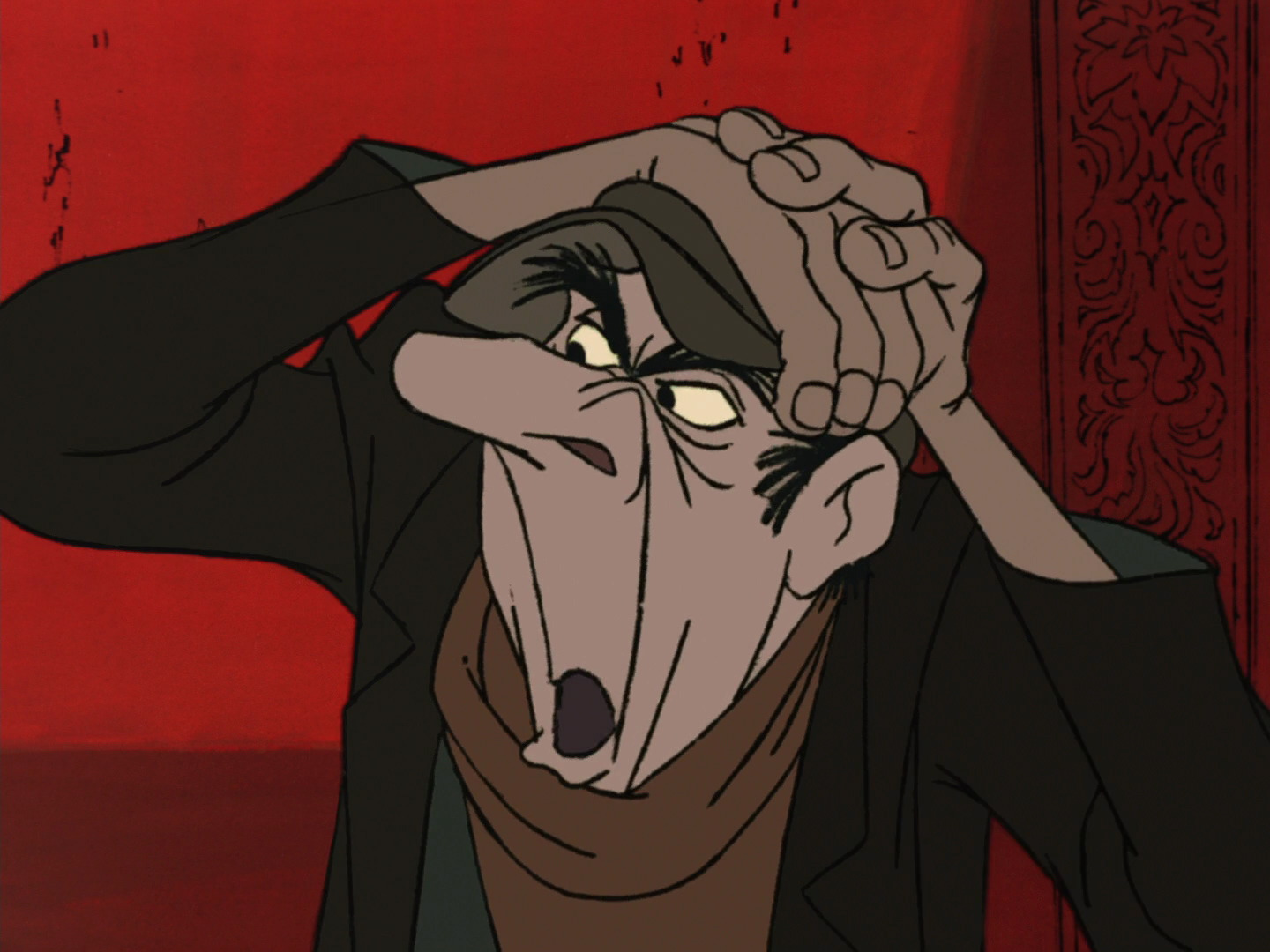
The Headless Horseman is the true star of the second act.

The Headless Horseman is the true star of the second act.

The Sleepy Hollow portion follows and was the sequence I was most interested in. While I was curious to see how The Wind in the Willows was adapted, I never had a strong affinity for Mr. Toad. The Legend of Sleepy Hollow is also a story I’m more familiar with, as I assume most people are. Ichabod’s last ride and the specter of the Headless Horseman have been recounted numerous times in popular media either as a direct adaptation or as a spiritual retelling. It’s a timeless tale and little effort is needed to convey the doom possessed by the Horseman. It’s really quite hard to make a headless knight riding a black stallion not look scary.

This segment is narrated, and sung, by Bing Crosby as a true narrator. If you’re looking for an example, think Boris Karloff from How the Grinch Stole Christmas. Crosby narrates the entire portion and sings at times. Ichabod and the characters do not actually speak, instead Crosby narrates the whole damn thing. It’s not the approach I would have taken if I were placed in the director’s chair, but there’s no reason why this shouldn’t work either.

As was the case with the Mister Toad sequence, the Ichabod portion suffers from pacing issues as well. This is partly to be expected as anyone familiar with the story knows the Headless Horseman shows up at the end. Leading up to it we’re essentially shown how Ichabod is basically a conman who’s motivated by wealth and food. He’s the local school teacher, and despite being a rather ugly looking fellow, is able to woo the local women with his singing voice and charm. When a wealthy individual comes to town with a fetching daughter by the name of Katrina, Ichabod sets his sights on a new prize. This puts him in competition with a local man by the name of Brom Bones, who is basically a lunkhead (he must have been inspiration for the much later Disney character, Gaston, from Beauty and the Beast) who is outsmarted by Ichabod when trying to court Katrina. It’s at a Halloween party hosted by Katrina’s father that Brom gets the idea to tell the tale of the Headless Horseman in an effort to scare Ichabod, who is revealed to be a superstitious man at the very same party. Given how slow-moving the story is, I found it lazy that Ichabod’s superstitious ways were not revealed throughout the picture in a more subtle fashion. Anyways, it’s when Ichabod leaves the party the he encounters the ghostly horseman.

If they had just committed to the horror, and left comedy to Toad, the Sleepy Hollow segment would have been better for it.

If they had just committed to the horror, and left comedy to Toad, the Sleepy Hollow segment would have been better for it.

The sequence where Ichabod is chased by the Headless Horseman is easily the highlight for both pictures. The setting is chilling and the Horseman looks particularly menacing. Ichabod, seated atop a very unimpressive horse, is forced to run for his life and the music and animation does a decent enough job of allowing the audience to share in his terror. There are some disappointments to be had, however. As mentioned during the Mr. Toad portion, the animation is merely serviceable and not feature-length quality. As a result, there is really no use of shadows or shading on Ichabod who pops too much against the background. Perhaps feeling the ride was too scary, some comedy was also added to the chase which really disrupts the mood. It’s basically screwball comedy not unlike what would appear in a Bugs Bunny cartoon and feels woefully out of place. At the end of the picture, there are some scenes that also detract from what should have been a more ambiguous ending, which also felt like a cop-out.

Overall, I was unimpressed by The Adventures of Ichabod and Mister Toad. As someone who loves and appreciates animation from all eras, I can easily forgive the films technological short-comings there as I wasn’t expecting it to be up to Disney’s usual standards from that era. I can’t really excuse either film for the pacing issues, and if given the chance, I probably wouldn’t have purchased this had I seen it first. The DVD release for the film a few years ago at least included a Mickey Mouse short that for some reason isn’t included here. And while I have all of the Mickey Mouse cartoons on DVD already, it would be nice for others if it had been included on the Blu Ray too. If you happen to be in the mood for a re-telling of The Legend of Sleepy Hollow, I’d suggest looking elsewhere (or scanning the various Disney channels to see if they show their version for free) this Halloween. As for The Adventures of Mister Toad, the weasel characters for the film inspired the same for Who Framed Roger Rabbit?, an immensely more enjoyable film. And if you really want to see the characters from the original, just wait for Mickey’s Christmas Carol which undoubtedly will start showing up on television before Thanksgiving arrives.


Teenage Mutant Ninja Turtles (Nickelodeon) Season 2

TMNTThe resurgence of the Teenage Mutant Ninja Turtles has been one of the more fun story lines from pop culture for me over the past two years. With an all new comic line, cartoon, and feature film, the TMNT are almost as relevant today as they were in 1990. Considering other old properties from the 80’s have been successfully resurrected recently, perhaps it’s not all that surprising the Turtles were able to accomplish the same. What has been surprising though is how successful the relaunch has been from an artistic standpoint. The general consensus for the vast majority of new films based on properties from the 80’s is that the material has been lacking. While no one can dispute how commercially successful a franchise like the Transformers has been for Hollywood, the movies themselves come across as overstuffed toy commercials. Like the Transformers, the return to the big screen for the Turtles was decidedly lacking when the new film was released in 2014 (I’d call the film trash but I personally have not watched it and don’t plan to). However, the comic book line launched in 2012 has been pretty well-received while the television show has been a smashing success.

When the cartoon was announced by Nickelodeon I was not optimistic about its chances at success. I was borderline indifferent, but my past romance with the Turtles was enough to make me curious. I set the DVR to record season one, and by its end, I was a fan. The show is witty, action-packed, and stuffed with enough in-jokes and material to appeal to 30-somethings who grew up with the Turtles. The cartoon successfully melds the old cartoon with the comic books while also taking its own path. The 2003 cartoon attempted the same, but was probably too reliant on the original Mirage comics. The old comics are an entertaining read, though nothing magical, but they do not possess an energy that lends itself well to animation. While on the other hand, the original cartoon was set on creating a fun series that appealed only to children. It never put the characters in any real danger and would eventually lose its audience as it grew up and acquired an appetite for more mature material. When the show finally made an attempt at change, it was too late.

What's old is new.

What’s old is new.

Like with season one, season two of Teenage Mutant Ninja Turtles opts for a more serialized nature with plots carrying over from one episode into another with few stand-alone episodes and characters. When a stand-alone episode does pop up, it serves as a palette cleanser from the main plot and is often a more offbeat episode. Most of these episodes are packed with humor with season two’s “Mazes & Mutants” topping the list of funniest TMNT episodes so far. The writers have found a nice balance in the humor for the show with it coming up at opportune times and resisting the urge to go for the easiest joke or pun. The show is genuinely funny, but it also knows when to let up on the humor and isn’t overly-reliant on the Michelangelo character.

Season two picks up right where season one left off with The Kraang being beaten back temporarily. Shredder and The Kraang have appeared to have forged an alliance, and an early mishap with a canister of mutagen mutates April’s father, Kirby, into a bat monster causing tension between the Turtles and their lone human friend. Meanwhile, Splinter (and this is a spoiler for those who missed season one) is coming to terms with the fact that his daughter is alive and well but has been brainwashed by the Shredder into believing she is actually the daughter of the Foot Clan’s leader and not Splinter. These two threads, April’s distrust of the Turtles and Karai’s lineage, are major plot points for the bulk of season two. The Karai plot twist could be seen coming from a mile away, but it was still effective as the writers handle it well. Karai naturally does not react well when the truth is first presented to her, and her response to it is complicated and appropriately remains unresolved for several episodes. The Kraang maintain a healthy presence throughout the season as well, often playing a role in a small way in most of the episodes. The season concludes with another big face-off between the Turtles and Kraang and it would seem the alien race will not be going anywhere anytime soon.

Casey Jones and Raph team-up yet again.

Casey Jones and Raph team-up yet again.

Season two introduces several characters, old and new. As was revealed in press kits, Casey Jones made his series debut in season two. Like April, he has been aged-down for the show from his original depiction but remains a vigilante of sorts. And like the Casey of old, he forms a bond with Raph pretty quickly and the two are a crime-fighting duo in some episodes. And as predicted by me (and likely many others), Casey forms the third corner of a pseudo love triangle with Donatello over April. Naturally, April is more taken with the human and this creates tension between Don and Casey that is sometimes entertaining, and sometimes feels a little stuffy, but is one of the ongoing aspects of the show that serves to remind the audience that these characters are, in fact, teenagers after all. Other characters familiar to fans of the old show that make their debut in season two include Slash, Mutagen Man, and Pizza Face while other characters are obvious references to old ones (Kirby bares an uncanny resemblance to Wingnut, for example). The show also does a good job of hinting at future characters. When a thief with a purple mohawk shows up it’s only natural for fans of the old show to assume this character has a date with a warthog and some mutagen in his future.

Don't be surprised if Kirby's Party Wagon gets a make-over in season 3.

Don’t be surprised if Kirby’s Party Wagon gets a make-over in season 3.

My main point of criticism with the show early on was for its lifeless take on the city of New York, and while the show has done a better job of making it look like people actually inhabit this city, it’s still a relevant criticism for season two. The character designs though have improved. Some of the villains in season one were pretty boring to look at, and that has mostly been remedied (though some are underwhelming, I’m looking at you Tiger Claw). There’s very little for me to complain about when it comes to this show. The writers have also wisely made the Foot Clan robots in season two (and not just randomly, it’s explained in an episode) so the Turtles are free to user their weapons against them. The more graphic violence is handled offscreen, but the consequences are shown. When Leonardo gets isolated from his brothers in the season finale and beat-up by Shredder, we don’t see any of Shredder’s bladed strikes landing. However, when an unconscious Leo is tossed through the window in April’s apartment where the other turtles are holed up (awesome reference to the comic and original film, by the way) his body is cut and bruised.

Just like with season one, season two does a great job of tossing in winks and nods to the old material that came before it. They’re sometimes hidden in the background and other times in your face (the party wagon!). Shredder remains a credible threat to the Turtles throughout the season and is a more than competent ass-kicker when pressed into battle. And while the April plot is resolved during the season, the other big ones are still open heading into season three. The season concluded with an hour long special that was perhaps the best in the show’s short existence thus far. It was satisfying on an emotional level while also delivering the humor and action the show has become known for. I’m even more enthusiastic for the show’s third season than I was the second (aside from the fact that Seth Green is set to takeover the voice-acting duties for Leonardo). If you were a fan of the Turtles in your youth and still have a fondness for them residing somewhere inside of you then you should be watching this show.


Teenage Mutant Ninja Turtles – NES

Teenage Mutant Ninja Turtles (1989)

Teenage Mutant Ninja Turtles (1989)

One of the most successful games of all time, and one of the most divisive, Teenage Mutant Ninja Turtles, arrived in 1989 for the Nintendo Entertainment System and flew off the shelves or retailers and rental stores across the United States. Turtle-mania had a strong grip on the nation’s adolescent and it would have been a huge embarrassment if the game actually failed. And while it was named as 1989’s Game of the Year by Nintendo Power, the first ever NES TMNT game is often regarded as a disappointment. Calling it divisive in the opening line may have been misleading, for the game is almost universally loathed for numerous reasons: too hard, not enough recognizable characters from the cartoon, no multi-player, and not the game fans wanted. In 1989, another game based on the TMNT was released, the equally successful arcade game. Based on the animated series, the arcade game boasted 2 to 4 player play allowing each kid to select his or her favorite turtle and wail away on an almost endless supply of Foot Soldiers, Bebop, Rocksteady, and of course, Shredder. When it was announced the Turtles were coming to the NES, many fans expected a port of the arcade game, but instead they got a solo side-scrolling adventure with few recognizable elements from the cartoon making an appearance.

The original Teenage Mutant Ninja Turtles game is best called infamous than famous. It was notably the subject of one of the earliest Angry Video Game Nerd videos in which The Nerd (James Rolfe) reminded many of us of the same frustrations we experienced as children playing this maddeningly frustrating game. As a kid, I never was able to beat the game without the near essential Game Genie peripheral, usually failing to make it beyond the battle with Slash/Mecha-Turtle/whatever the Hell that thing is at the end of act three. And like many, I preferred pretty much every other TMNT based game that followed over this one, which all took the form of arcade style beat-em-ups. I’ve since relived this game many times as a teen and adult but recently felt compelled to revisit it and see if the reputation this game had acquired was entirely justified. Just what is that reputation? Many Google searches will return this game on the list of hardest NES titles as well as worst or most disappointing NES games. The only way to answer my questions was to dust off the old NES and sit down in front of the TV.

Definitely not the arcade game...

Definitely not the arcade game…

For starters, the game was developed by Konami’s Ultra division, a secondary label created to circumvent Nintendo’s then policy of limiting publishers to how many games they could release in a year. Konami probably paid a boatload of cash for the TMNT franchise, and considering Konami was known to gamers for its Contra and Castlevania franchises, it seemed like the TMNT license was in good hands. Right from the start though, some things seem out of place. For one, the cover art depicts the four turtles all sporting red bandanas. For kids accustomed to the television show, this looked wrong while comic book readers would have recognized the cover to issue number 4. When the game boosts up, an unfamiliar tune plays as the four turtles are introduced. No player select screen is displayed once start is pressed, instead the game drops the player right onto a map-like screen with a tiny Leonardo in the center and some steam-roller like vehicle driving around. To summarize, there’s no licensed music, no option for 2-player, and no option to select which turtle to play as.

As the game unfolds, things start to become clearer. This overhead, Zelda-like perspective, leads into more traditional side-scrolling levels whenever the player enters an open manhole or building. A quick look at the pause screen is enough to clue the player in on the objective (rescue April, big surprise) and the ability to switch between turtles. The player is free to change-out a turtle on the fly. Each one has his own health bar, and since the game has no 1-up pickups, they function as extra lives. If a turtle loses all of his health, he’s out of action until the final level where a turtle can be rescued. Each turtle uses his own unique weapon and it will soon become obvious which turtle to use. Donatello, with his boring but long-reaching bo-staff, is easily the superior turtle in this game. When walking or standing still, Don thrusts his bo-staff out in front a great distance and even slightly behind him as well. He can thrust up and down as well with a press of the D-pad and take out multiple foes at once as a result. Because the animation for his attack lingers so long, he even seems to benefit from a double-hit, and as a result, does more damage per strike than the other turtles. If you lose Don, you’re in big trouble because the drop-off is huge to the next most useful turtle, which should be obvious for those familiar with the four heroes in a half-shell, Leonardo. Leo swings a lone katana in a downward arc when attacking and it’s useful for enemies at eye-level, but his reduced range and damage when compared with Donatello makes him far less suitable for the environments ahead. After Leo, Michelangelo is probably the next-best option as his nunchaku has slightly better reach than Raphael’s sai, which is pathetically useless. Raph and Mike are best treated like canon fodder and used only when attacking is not an option, such as when driving the turtle van or during the infamous swimming level. Each turtle can hold one secondary weapon, most of which appear as pickups randomly and range from throwing stars to boomerangs, to a weird energy wave that kicks a whole ton of ass (shell).

What the hell are these things attack Don, and is that a Foot Balloon?!

What the Hell are these things attacking Don, and is that a Foot Balloon?!

Gameplay wise, Teenage Mutant Ninja Turtles is fairly straight-forward. The turtles can attack and jump as they move left to right, right to left, and across gaps and platforms. The pace is fairly slow and reminiscent of Castlevania, including the ever annoying jump-backwards animation after being struck. If you’re not familiar with Castlevania, when the character takes damage they always jump backwards. This is ever annoying when trying to negotiate a series of platforms as enemies frequently appear in mid-jump leaving the player helpless to defend. The turtles handle kind of like trucks as they’re heavy and clunky. Pressing fully on the jump button will cause them to go into a ninja flip of sorts that has a floaty affect on the character, which sometimes helps to re-align a jump but mostly just seems to cause panic in the player leading them to miss a platform. Enemies are numerous, and for the most part, unrecognizable from the show. There’s foot soldiers and mousers here and there, as well as boss encounters with Bebop and Rocksteady early on, but aside from that there’s a lot of just weird enemies. There’s some chainsaw-wielding maniac, a guy composed entirely of fire, and weird butterfly enemies that dive-bomb the turtles, among others. The obstacles are pretty standard for the era and take on the form of conveyor belts, water, and spiked floors/walls. The game gets bogged down frequently when too many enemies are on screen and slowdown is a frequent annoyance. Enemies on the map scenarios tend to flicker in and out which harms the presentation elements of an otherwise underwhelming looking game.

So what makes Teenage Mutant Ninja Turtles so difficult? Well, for one, three out of the four turtles are borderline useless. As I mentioned earlier, Donatello is by far the best suited to overcome the various obstacles placed in the turtles’ path. The other three are so bad that you might as well quit if Don falls in battle. Enemies who can be felled in one strike are manageable, but the ones that require multiple hits pose a challenge as they do not react to taking damage. The game also loves having the player enter a new screen with an enemy literally right on top of you, forcing the player to take at least some damage. The pizza power-ups, which restore health, become scarce the deeper into the game you go and are sometimes intentionally placed in impossible to reach locations. Platforms are often placed above turtles, making some jumps particularly challenging as if the turtle hits his head on a platform above, his forward progress is stunted and the jump falls short. There’s one really annoying jump in a sewer scenario that’s actually impossible in the PC port. There’s also no password feature, but unlimited continues, so this is one that has to be completed in one sitting which adds to the challenge. And if the game wasn’t annoying enough, Ultra did include a beeping alarm for when the selected turtle is low on health.

Even though this level isn't as bad as people make it out to be, Leo is totally about to end up dead.

Even though this level isn’t as bad as people make it out to be, Leo is definitely about to end up dead.

All of that said, this game does do some things well and some of the things it has become known for (negatively speaking) aren’t as bad as they’ve been made out. For one, the ability to swap the turtles into and out of battle is pretty cool. Yeah, it sucks that there’s no two-player and it really sucks that three of the four turtles are horrible to play as, but the thought was a good one and one I’d like to see revisited in a new game. The under water level that has become so reviled and is the part of the game often cited as being hard, unfair, and noteworthy, isn’t as bad as its reputation. If you get to it with little health on each turtle, then it’s pretty damn hard. As a kid, I failed many times. As an adult, I just save Raph for it and have no problem making it out with minimal damage taken. It, like just about every swimming level in recorded existence, is not a fun stage by any means, but it’s far from being among the hardest sequences in gaming history (and is among the easier parts of this game). And aside from the turtles not really handling like ninjas, the control is satisfactory and the ability to drive the turtle van is pretty cool (though why it doesn’t have its own health bar is a mystery still to this day). The soundtrack is actually enjoyable, even if it doesn’t contain any music from the TV show, and isn’t something I’d change about the game.

In conclusion, Teenage Mutant Ninja Turtles was destined for commercial success just because of the license alone, but doomed to disappoint gamers for not being the game they truly wanted. Unfortunately, the game was not able to make-up for not being the arcade game by offering a lesser experience. The good news is that gamers didn’t have to wait long as a port of the arcade game arrived on NES consoles in 1990 as Teenage Mutant Ninja Turtles II: The Arcade Game. Yes, it wasn’t a perfect port due to the system limitations of the NES, but it was suitably fun and is often remembered fondly by gamers from that era. The one that arrived first though is not, and it’s hard to defend the title even today. While it’s far from being the worst NES game, and certainly not the most difficult, it’s definitely not good and just another example of a licensed game gone wrong, but at least it’s not as bad as E.T.


The Ghostbusters Get the Lego Treatment

IMG_0052It’s been thirty years since Ghostbusters first hit the big screen ushering in a new era of special effects-laden blockbusters.The film made unlikely heroes out of middle-aged comedians Dan Aykroyd, Bill Murray, and Harold Ramis while lesser known Ernie Hudson got a taste of stardom. The film was immensely successful and soon a cartoon was spun-off from its success which lead to even more opportunities for merchandise. Lots and lots of merchandise.
Ghostbusters is one of those rare franchises that has a lot of appeal for both kids and adults. Many have tried to achieve the same thing, but aside from those that can lean heavily on nostalgia, most fail to achieve the same level of success. The adults had the films, which kids enjoyed as well, while the cartoon was aimed directly at adolescents. The personalities of the main characters were unique to whatever version was being watched with only the broader traits (such as Egon being the brainy Ghostbuster) carrying over.
I was introduced to the Ghostbusters via the cartoon, and as a child, probably assumed it came first. When Ghostbusters 2 arrived in theaters it was a pretty big deal. I liked the films, though my assortment of toys were obviously born from the cartoon. I can recall having at least three of the Ecto vehicles, the firehouse, and numerous action figures. I also remember a Transformers-inspired Volkswagon Beetle that turned into a grasshopper. Sadly, once the Teenage Mutant Ninja Turtles arrived the Ghostbusters began to lose the battle for my attention, and my parents’ money. Most, if not all, of those old toys have been either sold, given away, or tossed, though my love for the original film (and to a lesser extant, its sequel) still exists.

The finished product.

The finished product.

This weekend, Ghostbusters is back in theaters for those who wish to see it on the big screen. If the lure of the theater isn’t your cup of tea, then might I suggest celebrating 30 years of ghost-busting goodness with Lego?
Earlier this year, as part of the 30 year anniversary celebration, Lego released the infamous Ecto-1 in Lego form along with mini figures of the four Ghostbusters: Peter, Ray, Egon, and Winston. The set was the result of a fan vote on sets created by avid Lego builders. A firehouse was part of the original fan-set, but sadly Lego passed (with no indication the franchise would be revisited, but who knows?). The Ecto-1 is a solid overall set for Lego collectors and Ghostbusters fans. Its external likeness is nearly spot-on and likely only the most avid Ghostbusters fans can spot any shortcomings. This set is obviously of the Ecto-1 vehicle from the first film, and not the more flashy edition from Ghostbusters 2. It took me a full evening to assemble, and once completed I was more than satisfied with the end result.
The fours figures feature a reasonable likeness to the characters they’re meant to resemble. Lego figures are rather limited in what they can do, but little touches such as the lines on Venkman’s face and Egon’s hair do a solid job of giving these figures some character. I would have preferred to see Lego attempt a receding hairline on Pete, and Winston looks more like Billy Dee Williams than Ernie Hudson, but oh well. Their proton packs are a combination of several Lego pieces and have to be assembled. The end result looks pretty good and Lego’s approach proved accurate. The trap, on the other hand, is just so-so but clearly Lego didn’t want to spend extra cash on creating a unique piece of plastic for one lone set. There’s also a build-able stand to display the figures which is a nice touch considering the majority of those who purchase this will likely be adult collectors.

The fab four ready for some bustin'!

The fab four ready for some bustin’!

When it comes to the actual vehicle in the set, Lego surprises with numerous unique pieces. This means no stickers, which is always a welcomed trait for a Lego set. The doors for the Ecto-1 all have printed Ghostbuster logos on them and even the license plates are sticker-free. The general shape of the Ecto-1 is captured quite well, and the mass of junk on top seems accurate enough. There’s a hose piece that’s a little odd, but it was on the original so it’s here as well! There’s really very little to nitpick here as even the rear wheels are covered by the frame of the vehicle. The only real issue with the car is the scale. It’s slightly under scale to the figures and can only hold three figures, seated single file, at a time. Since most are likely to display the characters on their stand, this isn’t that big of an issue and probably the right move. A vehicle that could actually hold all four figures may have ended up being out of scale for the opposite reason.
All in all, this is a great little set. It will set you back around fifty bucks which is pretty much on par for similar Lego collections, though may be just a tad too pricey for impulse buyers. For those that want to see their beloved Ghostbusters in Lego form, this is damn near perfect. Hopefully Lego reconsiders and comes thru with a firehouse (that’s to scale with the Ecto-1) so I can finally replace the toy one I sold at a yard sale so long ago.


Final Fantasy X HD Remaster

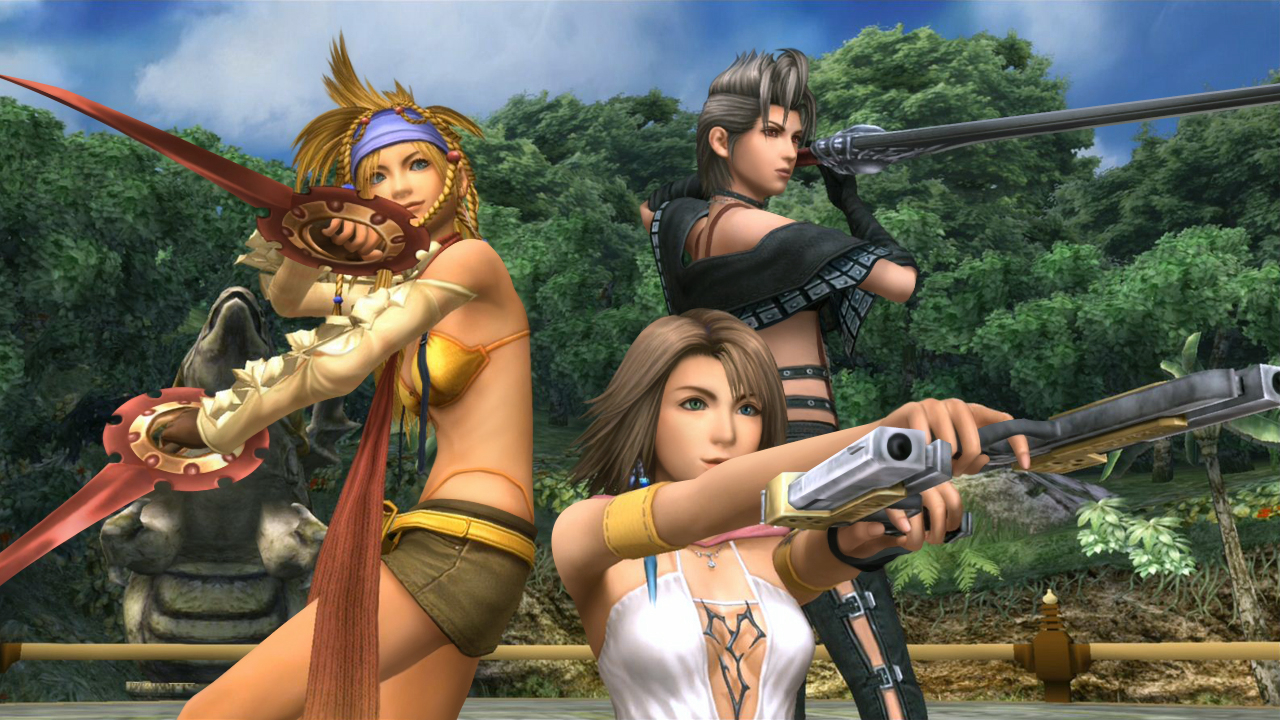
Final-Fantasy-X-X-2-HD-Remaster-1Over the years I’ve talked a lot about Final Fantasy but I’ve never posted a game review for any of the numeric titles in the long-running series. Well that ends today as I post my thoughts on the somewhat recently released Final Fantasy X HD Remaster.

One opinion I have stated on more than one occasion here is my affinity for Final Fantasy X, the Playstation 2 RPG released back in 2001. I consider X the last great Final Fantasy game to be released while some want to lump it in with the lesser received post Final Fantasy VII games. Some of these games have been a bit underwhelming while some of the criticism is likely born from the series’ rise in popularity. Prior to VII, Final Fantasy was a niche title with a small but devoted following. Once a bandwagon becomes crowded, the older fans tend to shun the new ones. It happens all of the time within the music industry and video games are no stranger to it as well. Final Fantasy X though took what made the series so great and made some noteworthy improvements to the tried-and-true formula. It took chances too, by eliminating the world map and adding spoken dialogue for the first time in the series. The game was a commercial and critical success even if it’s not often cited as one of the best Final Fantasy games in the series. And since it’s a PS2 game, upgrading the visuals to high definition and re-releasing it makes sense and the world is better for it!

A composite shot featuring the original game merged with the HD version.

A composite shot featuring the original game merged with the HD version.

For those who missed out when the game debuted over ten years ago, Final Fantasy X is a pretty familiar experience for those who played any of the nine previous titles in the series. Players maneuver a character amongst towns, dungeons, and open areas to get from one place to another. Players can interact and speak with other characters while non-interactive moments move the story along. In battle, characters take turns attacking, stealing, casting spells, or defending in an effort to win the fight. A menu screen is used to outfit characters with weapons and armor to boost their stats and make them more formidable foes or to tailor their character for a certain approach. Where X departed from past games was with just about everything else. Some changes, like the new Conditional Turn-Based Battle, are subtle but different enough to leave an impression. In many of the previous games, each character had a meter that would fill gradually during battle before an action could be taken. This was dubbed the Active Time Battle System by developer Squaresoft. The Conditional Turn-Based Battle creates a list of both enemies and player characters determining the order of battle. The list can be altered by certain spells, actions, and effects but overall it creates a more tactical experience, which is enhanced further with the ability to swap characters in and out of battle on the fly. The removal of the world map was a change that felt big at the time but played much smaller. Removing the world map just meant that each area of the game world was integrated seamlessly with one another. The world map had really only existed in prior games as a technological limitation or as a trick to make the game feel bigger than it is. When it was first announced that Final Fantasy X would not include a world map scenario it seemed scary, almost unthinkable, but it ended up being a change for the better.

The main cast.

The main cast.

A much bigger change for Final Fantasy X’s gameplay is the Sphere Grid. Just about every Final Fantasy game has its own unique way of evolving the characters throughout the game to make them better suited for combat. In the original game it was all based on experience points and each character had its own special class be it warrior or black mage. Final Fantasy III and V both made use of what was termed the Job System where the player was free to assign a character’s class making it possible to have a party of all black mages if one so desired. Other additions over the years were the Espers in Final Fantasy VI which allowed characters to learn spells and abilities while being paired with a unique creature, VII had the materia system which was dependent on amassing a bunch of materia and weapons with ample space to use it, and so on. Final Fantasy X’s Sphere Grid was perhaps the most radical departure from the other games. Characters no longer earned experience points, something that was common to all prior Final Fantasy games, and instead earn sphere points. Once a character gains enough sphere points, he gains a sphere level. One sphere level can then be spent to move the character one space on the Sphere Grid. The grid itself is outfitted with several nodes that can be activated with special spheres collected during battle. These nodes can have anything from a point of strength to a spell like Flare. All character evolution takes place on the Sphere Grid. It’s the only way to improve a character’s base stats, like strength, defense, magic, and so on, as well as hit points and abilities. No spells or special moves need to be acquired by beating a special boss or finding it as a prize in some mini game, it’s all right there on the Sphere Grid for you to see from the start. Of course, acquiring a spell like Ultima is going to take lots of time and many sphere levels to get there, but you’re free to plot your own course. The Sphere Grid in the original game starts each character in their own section, and while you’re free to do with them as you please, the game clearly intends for Lulu to be a black mage, Rikku a thief, and so on.

It may not be PS3 quality, but the game is far from an eyesore.

It may not be PS3 quality, but the game is far from an eyesore.

For the international edition of Final Fantasy X, some additional content was added and this HD remaster includes all of it. The Sphere Grid from the original game is present, but if you wish, you can opt to use the expert grid. This grid starts every character right in the center freeing them up to pursue whatever abilities they wish. In general, a balanced attack is preferred and most anybody who plays this game is going to take a character like Lulu down the black mage path, but I found there was more opportunity to diversify with this version of the grid than before. I was able to have Yuna, the summoner/white mage of the group, bounce between the white and black mage paths giving her some punch in battle she didn’t have when I played the game for the first time. Khimari, the blue mage of the original game, was basically my version of the red mage from III and V as I was able to grant him white and black magic while keeping his base stats high enough to make him a suitable physical attacker early on. Like the red mage of prior games, he would eventually outgrow his usefulness but for the early part of the game he was a frequent contributor.

Another big change for X was with the summons. Squaresoft seemed to always be searching for a way to make the summon magic more interactive. Once VII arrived with the Playstation it meant the summons could be more of a spectacle as full-motion video sequences captured the awesome power of Bahamut and did so with gusto. For X, Square opted to let the players control the summoned beasts, dubbed aeons, directly. They’re fully integrated into the plot of the game and only Yuna can summon one at a time. When she does, the rest of the party vacates the battlefield and the aeon takes over. Their overdrive meter fills rapidly (X’s version of the limit break) and once full they can unleash the mega attacks we’re used to seeing. Outside of battle, a special item allows the player to improve the base stats of the aeons or even teach them new spells and abilities. They’re limited in their usefulness, but at the very least they make good cannon fodder against enemies that have devastating special attacks as once an aeon dies in battle they’re just replaced by the battle party.

My journey through Spira was much as I remembered it. The HD upscaling is welcome though it does not disguise the fact that this is a PS2 game. SquareEnix apparently re-did the faces of Tidus and Yuna to make them more expressive but they’re still a little wooden by today’s standards. The game is only noticeably better looking when compared directly with the PS2 game. Otherwise, it’s bright and colorful setting is still mostly pleasing to the eye. The game really only shows its age with the limited animations. There’s a sequence where the characters ride snow mobiles and it’s painfully obvious that the game could not handle animated hair, aside from a ponytail or something, so Tidus’ hairstyle remains frozen in place while he zips along. You’ll also see the same character models used over and over among non-player characters and enemies. The audio is quite nice though and the game’s musical score is fitting for a Final Fantasy title. The voice acting was somewhat maligned the first time around, but I found no obvious faults with it then or now. The poor lip-syncing is still an issue and can be distracting, though I found it never took me out of a scene completely.

The game's stoyline has room for cheer and also for more emotionally weighty moments.

The game’s stoyline has room for cheer and also for more emotionally weighty moments.

Final Fantasy X HD was released for the PS3 and the Vita with the two platforms supporting cross-save functionality but not cross-buy. As such, I only purchased the game for the Vita, and it’s been a great experience taking Final Fantasy X on the go. The load times have been the only detraction. I do not know what the situation is like on the PS3, but on the Vita there’s a delay of a couple seconds going from the field to the menu as well as when going from one screen to another. It took some getting used to and I still don’t understand why the Vita’s load times aren’t better considering the medium is flash-based. I got used to the load times, but it’s still annoying. There’s also no soft reset function that I could find which stinks because there are multiple screens to navigate just to get to the game. One area of the game that wasn’t as good as I remembered was Blitz Ball, the underwater sport that’s a popular mini game. It’s still fun, but it’s so painfully easy and you have to play hours of it to acquire some special items for Wakka. They’re totally optional, but who is going to pass on getting Wakka’s best weapon?

Other than the new Sphere Grid, the other additions of the international version of the game are less impactful but still welcome. The most obvious is the addition of the Dark Aeons, optional boss battles that spring up very late in the game. These represent a new challenge for veteran players. Defeating them is purely for pride as there’s nothing of importance gained from toppling them. Beating all of them will likely mean maxing out the base stats of most of the characters in your party, which means lots and lots of level grinding. I had every intention of beating them, which is one reason why this post took nearly three months for me to get to, but eventually I just got too bored. I beat some of the easiest ones, one of which I had to beat to regain access to one of the game’s towns, but never attempted the toughest. There’s really not that much strategy to beating them, it’s more an investment of time crafting armor and weapons that best suit the confrontation, but it’s cool that it’s there. Another addition is the Eternal Calm, which is basically an epilogue. It’s a fifteen minute movie meant to serve as the bridge between this game and its direct sequel, but it’s pretty unnecessary. I watched it once, and I’ll probably never watch it again, as the early parts of Final Fantasy X-2 do a good enough job of bridging the two games.

Plot-wise, I enjoyed Final Fantasy X just as much this time around as I did in 2001. It’s likable cast of characters are charming and portrayed well. The game actually feels pretty quick even though it will take most players 40 hours to beat the main plot (defeating all of the optional bosses will likely take over 100) and I attribute that to the game’s exceptional pacing. I very much enjoy the fact that the game has its own distinct look. It’s not a medieval or steam punk setting but more of an asian one with a lot of subtropical climates as well. I find it kind of funny that this was the first Final Fantasy game to have asian-looking characters considering they were all made in Japan, as opposed to a european look. Mostly, this is just a really well-executed Final Fantasy title and I had a great time with it. And since it comes bundled with a copy of Final Fantasy X-2, my adventure in Spira is not over yet. Look for a post on that game in another two to three months.


Lego Simpsons

lego-simpsons-minifigs-01When I was a kid, the coolest and most colossal Lego sets were often pirate ships or castles. These things required hours upon hours to assemble and cost a lot of money. My parents, when looking to spend money on me at Christmas or for a birthday, opted for video games or a bicycle as a “big” present, not massive Lego sets. I had a cousin who was rather fortunate when it came to gifts. He usually had all of the best stuff before anyone else, be they new Ghostbusters vehicles, gaming consoles, and so on. He also had some of these massive Lego sets but anytime I would visit his home they were always just partially assembled, as if construction was started one day and then forgotten. I always wanted to get my hands on such a set (the commercials made them seem like they contained endless amounts of fun) but the closest I ever got was a lone keep that came with a dragon. It was rather small, but I liked it plenty and got many hours of enjoyment out of it. Prior to that, I only ever had a general set of Legos. They were housed in a hard, red, plastic case and I would just build whatever. There was an included book that contained plans for numerous objects but rarely did I ever make use of it. Typically, I would build a pick-up truck or Jeep but then wouldn’t want to disassemble it to create anything else.

Among those bricks was a lone Lego mini figure. This was the 1980’s so the mini figure might have been new, or maybe not. I had other generic Legos before this collection and never had I come across a little figure before. He was rather plain: a black shirt and blue pants with a black baseball cap. I thought he was pretty cool though and started noticing these more and more in toy stores and commercials. I especially liked that I could rip him apart and even take off his head without breaking him. It seemed absurd but was a lot of fun especially when I would later get mini figures dressed as knights and armed with swords to apply a purpose for figure decapitation. Over the years the mini figure has become quite popular and in the last dozen years or so the mini figure is no longer just a generic pirate or knight, it’s Luke Skywalker or Batman. The mini figure is now sold both with sets and separately, and for a brand, having a Lego version of one of your characters is like a new rite of passage. Lego, because of its popularity, is able to strike deals amongst rivals so that consumers are able to pit Lego Superman against Lego Hulk. Lego has spread to video games, and most recently, to film. The brand has never been more popular than it is today which is why we now have The Simpsons in Lego form.

I’m not sure how the agreement started, if those behind The Simpsons reached out first to Lego or vice versa, but The Simpsons entered the Lego universe in 2014 in both television and the material world. An episode of The Simpsons aired this past May featuring the show’s many characters in a Lego setting. Interestingly, these Lego versions of the Springfield residents were more faithful to the Lego brand than the actual Lego product which arrived at retailers a couple of weeks before the episode. The Lego version of The Simpsons characters are unique, though represent a new trend not solely reserved for The Simpsons brand, in that they make use of the standard mini figure body but have unique head pieces. This creates a more aesthetically pleasing mini figure, though it does disappoint the Lego purists out there. In my hunt for these, I encountered one girl who was a Lego fan, not really a Simpsons fan, who wanted a couple of Marge figures thinking her hair would just be a Lego piece that attached to the usuall Lego head piece. She was likely disappointed to find that it wasn’t when she got home.

Nelson doing what Nelson does.

Nelson doing what Nelson does.

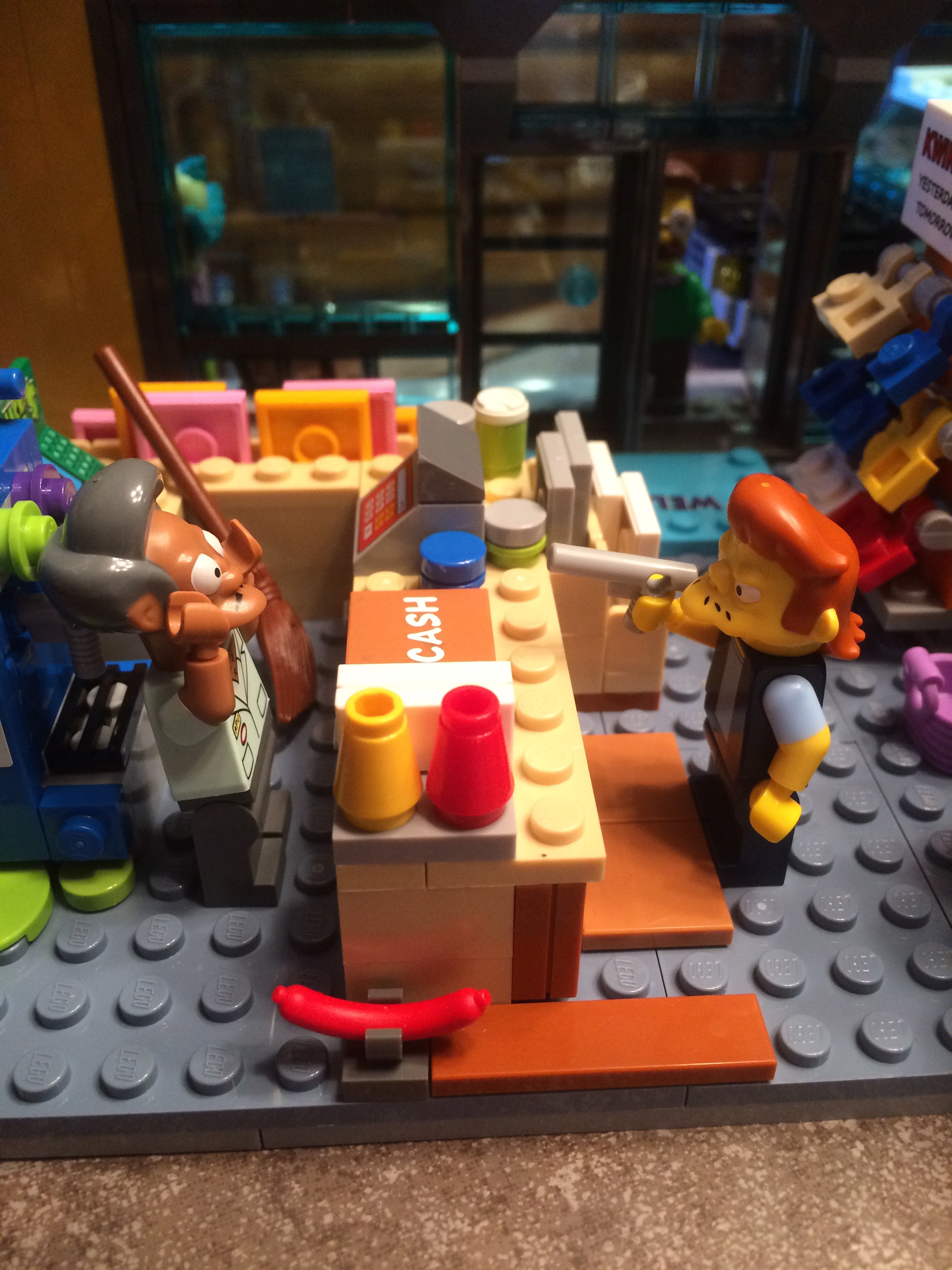
Lego put out sixteen figures in May, and they are a collection of usuals and some that may have surprised fans:  Homer, Marge, Bart, Lisa, Maggie, Grandpa, Ned Flanders, Milhouse, Ralph, Nelson, Chief Wiggum, Apu, Mr. Burns, Krusty, Itchy, and Scratchy. A pretty solid collection, especially when one considers Lego’s policy of no alcohol references which may have played a role in not having a Moe or Barney. Itchy and Scratchy are the sort of oddball choices given that they’re cartoon characters in the show, but few are likely to complain. Because the show’s cast is so massive, there’s going to be characters missing and it would have been impossible to satisfy fans with just one wave (I’m not aware of a planned second wave, but these seemed to sell well so it wouldn’t be a surprise to see more). Wiggum could certainly use some help on the force, while Flanders is missing his boys, and what’s a Burns without a Smithers? There’s tons of characters people likely want, so hopefully if a wave two does come around Lego doesn’t waste slots on variants of Homer and Bart.

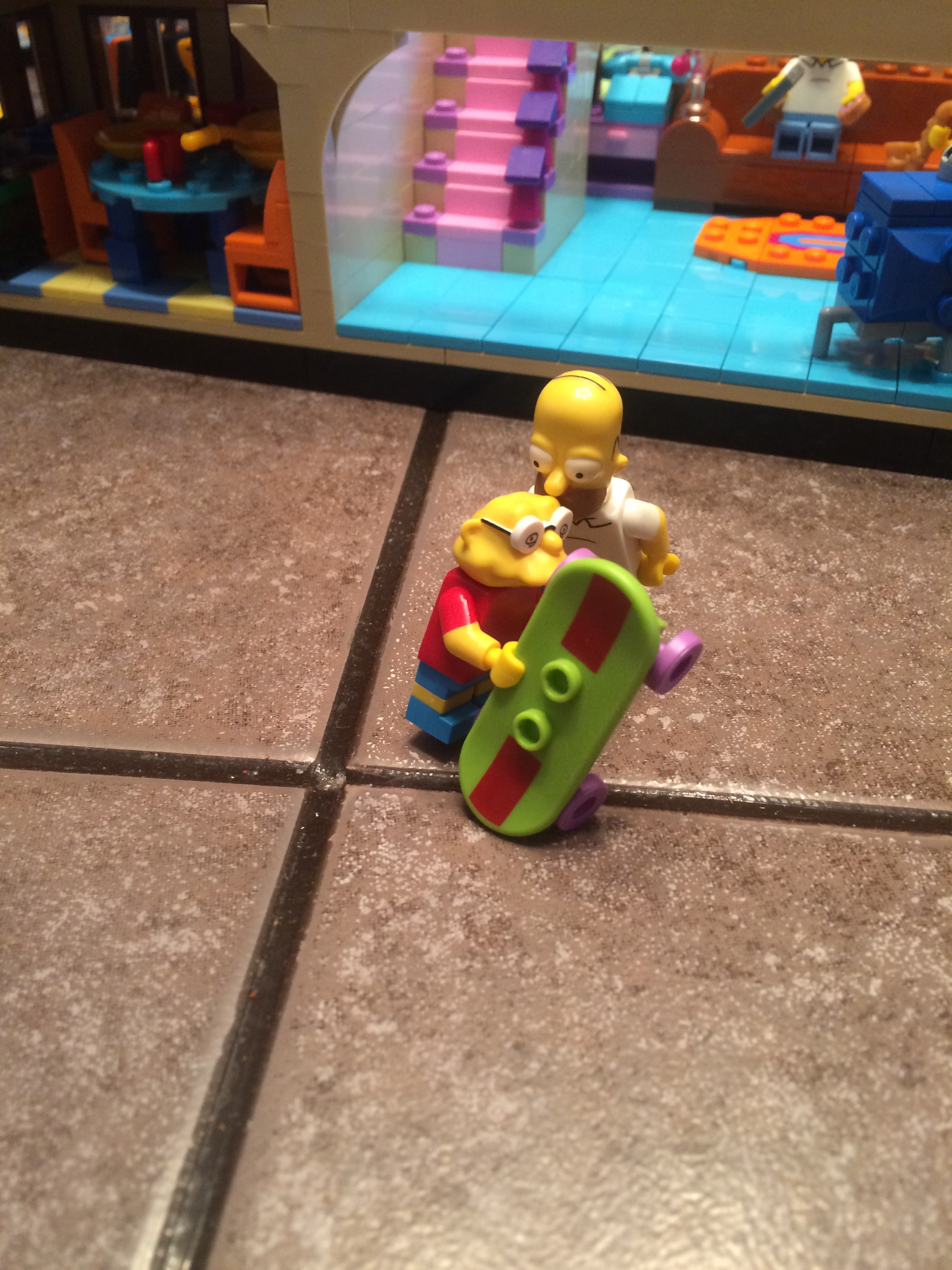
Each mini figure comes in a plastic pouch that conceals the identity of the figure inside. Retailing for about four dollars, some may be willing to give in to chance and pick them blind but anyone with some extra time and a little determination can prod at the bags and figure out who’s in each one. The head sculpts of the figures make this easy, but also the included accessories. Bart’s skateboard is pretty easy to pick out, as is Nelson’s baseball bat. The hardest ones for me were Ralph and Milhouse as both characters are the same size and their accessory is a flat square Lego piece. This meant finding the head, and being extra certain. I ended up with three Ralphs before I found a Milhouse. The accessories are pretty cool though. The piece that comes with Ralph and Milhouse is a bit overused, but they’re all printed differently and contain some classic show references such as Ralph’s “I Choo Choo Choose You” valentine and Grandpa comes with his newspaper with the headline “Old Man Yells at Cloud.” Homer comes with a unique donut piece and TV remote and Burns has a transparent Lego head piece with Blinky the fish printed on it. Maggie has Bobo the teddy bear, and Itchy and Scratchy each come with an instrument of violence. All of the figures look really good, the only one that looks off to me is Wiggum because he should be morbidly obese. Instead, he uses the same body as every other figure with no attachments to make him look fatter. Homer, since his shirt is white, has a line printed on him to mark his bulging stomach, but since Wiggum wears dark blue, the same technique doesn’t really work.

If Lego had stopped there with The Simpsons it still would have been cool, but they didn’t. Enter The Simpsons House!

IMG_0153

Consisting of over 2500 pieces, the home of The Simpsons is a large set that is a site to behold. I couldn’t resist the call

The Couch.

The Couch.

of it, even if it was excessive, and purchased my own set. The set contains bricks to construct the house and also Homer’s famous pink car complete with dents. Included with the set is another version of The Simpson family plus another Flanders. Each figure differs slightly from the stand-alone ones; Homer is dressed for work and Marge has an apron, Ned is dressed for grilling while Bart is missing his slingshot from his back pocket. Most also have half-closed eyes while Maggie has a more neutral expression compared with her other figure’s concerned look. The differences are minor, and while some may see this as a missed opportunity to get more figures, Lego pretty much had to include a set of the family in both the house set and the retail figures. Perhaps the addition of Flanders could have been re-evaluated. Lego could have just made him exclusive to the house set and put someone else in the mini figure release. The only thing I feel they really messed up on was not including Lego versions of Santa’s Little Helper and Snowball II. Both pets are featured on the box as part of the family but are strangely absent from the set.

The cut-away view of the house.

The cut-away view of the house.

Lego had a somewhat difficult task of creating a three-dimensional set of an animated home. Early in the show’s life, the house didn’t seem to always have a defined layout but over the years the animators and artists have clarified this more. The first floor is pretty standard though: through the front door is a short hallway with a closet at the end and stairs on the right. To the left is the den, to the right the dining room. Up from the den is the living room which has an entryway on the top right which goes into the kitchen which wraps around to connect with the dining room. On a few occasions there’s been a bathroom on the first floor as well as a rumpus room. There’s also a basement entrance somewhere and the door to the garage. Lego, perhaps fearing the set would be much too large, chose not to really adapt the true layout of the house and attempted to just hit on the important stuff.

The other side of the cut-away. The room on top is removable.

The other side of the cut-away. The room on top is removable.

From the outside, the house looks pretty great, almost perfect. There’s the bay windows on the front, the ancient TV antennae on the roof, and even the chimney looks good. Veteran viewers will notice that while the garage is in the right place, the house doesn’t wrap around behind it like on the show. This becomes a bit of an issue when constructing the second floor as it’s pretty cramped. Aside from that though, the house looks great. Inside on the first floor there are just two rooms: the kitchen on the left and living room on the right. The living room is kind of an amalgamation of the den and living room from the show. The famous couch and TV are present (modeled after the old tube TV from the earlier seasons) from the living room, while the rug and piano are there from the den. Missing is the fireplace since the chimney is on the other side of the house and there’s no ceiling fan, as well as other things. There’s a closet of sorts tucked behind the stairs where

Marge can store her vacuum, and the sailboat picture is above the couch where it should be. Breaking from logic though, is the entryway to the garage being right in the living room with no door to separate it. This doesn’t make much sense and is kind of disappointing. Over in the kitchen, the color scheme is pretty faithful to the show between the two-toned floor and the pink and orange cabinets. The included table is kind of odd looking but more odd is the absence of a fridge. How are The Simpsons supposed to live without a refrigerator? Plus that ugly green fridge is kind of iconic, isn’t it? The kitchen is also pretty cramped, especially with the table in it, but space had to be sacrificed in order to make the living room larger.


A bird's eye view of Bart's room and part of Lisa's, as well as the garage. Grandpa is apparently over for a visit.

A bird’s eye view of Bart’s room and part of Lisa’s, as well as the garage. Grandpa is apparently over for a visit.

On the second floor, the biggest casualty is Maggie as she doesn’t get her own room. Instead, she gets a crib in Homer and Marge’s bedroom. Bart and Lisa’s rooms are done rather well with Bart’s shining brighter because his personality is captured well. Homer and Marge have a larger room but it’s strangely empty and doesn’t connect to the bathroom. The second floor should have two bathrooms, but there’s only one and it’s too small to even get a bathtub. The roof rests right on top of the house and garage as opposed to snapping on so that users can easily remove it to access the rooms underneath. Bart’s room and the top of the stairs also just rest on top of the second floor so it too can easily be lifted out to access the living room while the whole house can open vertically for a cut-away look at everything. The garage is roomy enough to fit the car in comfortably, and even includes numerous power tools for Homer to neglect. Outside the house is the mailbox as well as Ned’s grill. There’s also two lawn chairs and Bart has a skateboard ramp. The wife and I assembled the entire house over the course of about a week. We didn’t do construction on it daily and took our time though impatient builders could likely put this thing together in a day with some determination. The instructions were easy enough to follow and thankfully only a few stickers are involved (I assume hatred for stickers is pretty much universal amongst Lego builders).

We're all filthy perverts for looking at this.

We’re all filthy perverts for looking at this.

It’s easy to nitpick this set because it’s not all that faithful to the show and the show has been around for over twenty years. Fans of The Simpsons are intimately familiar with how the house is supposed to look so it must have been intimidating for Lego to even tackle it. Inaccuracies and all, this is a set worth investing the time in for Simpsons enthusiasts. Lego did do a good job of getting the smaller details right like Bart’s half-open desk drawer and the “Property of Ned Flanders” sticker adorning the air conditioner hanging off the house. It’s my hope that Lego does not stop here. We already have an Apu mini figure so how about a Kwik-E-Mart? And it would be a shame if The Android’s Dungeon were not created, at the very least, as a Comic Con exclusive or something (I assume Moe’s Tavern is a no-go considering the alcohol policy). Lego could easily milk this franchise for a lot more, so we’ll see what the future holds, but if this is all we get then at least it looks cool and The Simpsons have a place to sleep and watch TV.


The World and The Land: A Disney Comparison

orl-disneyland-vs-disney-world-castles-pictureIt has been a long time between posts for me. Never since I started this blog have I only made one post for an entire month, but my personal life left little time for leisure throughout the month of June. Without getting into too much detail, I spent the end of June and the start of July honeymooning in Disneyland: The Happiest Place on Earth.  As a dweller of the east coast, I have been fortunate enough to vacation in Disney World several times as both a kid and adult (it’s actually where I “popped the question” to my now wife) but I had never left the east coast for the west and visited the original park, Disneyland.

Growing up, Disneyland was sold to me as the lesser Disney World. As such, I never had any desire to really see Disneyland if Disney World was better. When vacationing at Disney World, the cast members there love sharing the fact that the entire Disneyland park (and the new park, California Adventure) could fit inside the parking lot of Disney World’s Magic Kingdom. The common thing I heard from people who had been to both was that Disneyland was something to do on a weekend, while Disney World was a destination worthy of a week’s investment. Recently though I became interested in the historical aspect of Disneyland. As many know, Disneyland was the original park and its construction was orchestrated by Walt Disney himself, while Disney World was in the early planning stages when Disney passed away in 1966. And while many attractions are shared between the two resorts, Disneyland does have a few unique rides and also still has some of the older rides that have vanished from Disney World over the years. When it came time to settle on a honeymoon, going back to Disney World was certainly an option for my wife and I but we both had a desire to do something at least a little different. It seemed like the right time to hop on a plane bound for California and check out the original and see for ourselves which was best. In the end, we came to find the two were comparable, but also different enough to possess their own charm. It didn’t seem right to necessarily pit the two against each other, which is why this post is merely a comparison and not a contest. After a week (with a five day park hopper pass) at the Disneyland Resort, this is the impression it left upon me:

Size

A map of Disney World, Disneyland is said to be able to fit in the Magic Kingdom's parking lot.

A map of Disney World, Disneyland is said to be able to fit in the Magic Kingdom’s parking lot.

The first thing that comes to mind when comparing the two resorts is size. Disneyland started off as one theme park with Sleeping Beauty’s castle serving as the central hub for park goers looking to experience the wonder of Fantasyland, the thrill of Adventureland, and the mystique of Tomorrowland. Since 2001, California Adventure has existed opposite Disneyland on the site of the original Disneyland parking lot. Loosely inspired by Disney World’s Hollywood Studios park, California Adventure is home to Pixar and the unique Paradise Pier and Cars Land attractions. Disneyland covers approximately 160 acres with California Adventure an additional 67 acres. By comparison, Disney World’s four parks and several hotels occupy 40 square miles, with the Magic Kingdom totaling 107 acres, Hollywood Studios 135, Epcot 300, and Animal Kingdom a whopping 500 acres. There are also two water parks at Disney World and both have a Downtown Disney area but it should be clear that it’s an apples and oranges comparison when it comes to size.

The size of Disney World was the main draw for Disney as he wanted an area with limitless potential. As a result, Disney World still has tremendous room for expansion should the need or desire arrive while Disneyland is basically locked in. The added size means more room for guests and more variety, but it also means a heavier reliance on transportation. Get used to waiting in lines for a bus at Disney World, while Disneyland’s compact size means everything, including most hotels, is within walking distance. The size of each resort is both a pro and a con, and Disney World at least gives patrons multiple options for park hopping via the shuttle lines, monorail, or ferry boats (the only exception being Animal Kingdom, which is basically isolated from the other three parks). I love the variety of Disney World, but I also really loved going back and forth between Disneyland and California Adventure throughout the day, gaming the fast pass system or just trying to avoid whichever park was more crowded.

Rides and Attractions

Disneyland's current biggest attraction:  Radiator Springs Racers.

Disneyland’s current biggest attraction: Radiator Springs Racers.

The size of both resorts is obviously of no consequence if there’s nothing worth seeing and experiencing at the parks. To make comparing the two easy, many rides are duplicated across the parks while some of the seemingly unique rides share the same technology or format as a ride at the other park.

Disneyland and The Magic Kingdom are the easiest to compare as The Magic Kingdom is essentially the sister park to Disneyland. They have the same layout and general design with a castle serving as the central hub of everything. In Disneyland, it’s Sleeping Beauty Castle while The Magic Kingdom is home to the colossal Cinderella’s Castle. Cinderella’s Castle is the representation of the size difference between the two resorts as it dwarfs Sleeping Beauty Castle. When it comes to the surrounding lands, the only major difference is the northern most land at each. In Disneyland there’s Mickey’s Toon Town while Disney World boasts a larger version of Fantasyland (and at one point in time, had its own Toon Town). Originally, many of the classic Disneyland dark rides existed at Disney World, such as Snow White’s Scary Adventure and Mr. Toad’s Wild Ride. These have been replaced at Disney World in favor of an additional Dumbo ride, a small Goofy coaster, and the new Seven Dwarves Mine Train, a ride unique to Disney World.

And here's Disney World's newest ride:  The Seven Dwarfs Mine Train.

And here’s Disney World’s newest ride: The Seven Dwarfs Mine Train.

The dark rides are mostly for kids. As an adult, I find myself only riding them to escape the heat. Between the two parks, the only one to really leave an impression on me is the Disneyland version of Peter Pan’s Flight which seemed faster and appeared to be kept in better shape than its Disney World counterpart. Disneyland has some unique dark rides such as the Monsters Inc. ride and Alice in Wonderland, but none are difference makers. As for the rides the two parks share, I prefer Splash Mountain at Disney World to the one at Disneyland. Disney World’s version has a bigger car and a bigger drop at the end. Disney World’s Space Mountain is a bit better, though I’m personally not a fan of the ride. A lot of people prefer Disneyland’s version of Pirates of the Caribbean, but I don’t find either ride compelling. Disneyland has a newly refurbished Big Thunder Mountain that’s noticeably smoother than Disney World’s, and therefore better. The original Tower of Terror at Disney World is a more immersive ride experience, but I actually preferred the shorter and quick to the point version at California Adventure. Disneyland also has the superior version of Buzz Lightyear thanks to the non-mounted gun, though both versions of Buzz pale in comparison to Toy Story Mania, which is the same experience at each park.

The unique rides offer the best way for the two parks to stand out. I haven’t been on the newest ride at Disney World, the Seven Dwarfs Mine Train, but it does look pretty rad. A unique ride at Disneyland that I wasn’t able to experience is the Finding Nemo Submarine Voyage due to an expansive refurbishment going on right now. The ride is a rebranding of the old submarine ride that also existed at Disney World and was pretty hokey, so I can’t say with any certainty that it’s a worthwhile experience. Seemingly unique rides like the Indiana Jones ride at Disneyland, exist at Disney World but under a different theme, in this case the DINOSAUR ride at Animal Kingdom. Of the two, I prefer Indy but the experience is pretty comparable. Another one is Epcot’s Test Track, which basically exists at Cars Land as Radiator Springs Racers. Again, if given the choice between the two, I’ll take the Disneyland version because of the fun theme though Test Track offers a bit more thrills than its counterpart and both are awesome. The two resorts also each sport their own roller coaster: California Screamin’ at California Adventure and Rock n’ Roller Coaster at Hollywood Studios. Both start off with a bang and contain sharp turns and an inverted loop. The Rock n’ Roller Coaster is indoors and features an Aerosmith theme while Screamin’ is outdoors, is longer, and overlooks the Paradise Pier area. Of the two, again I side with Disneyland as California Screamin’ offers the overall better experience. And for some reason it’s not very popular and boasts consistently short wait times. Animal Kingdom has the safari ride which is obviously an experience unique to that park. It also has the Expedition Everest ride which also does not have a Disneyland counterpart and is a pretty thrilling experience.

Both parks feature shows and fireworks displays to entertain guests when they’re not eating or enjoying the rides. Every night at Disney World’s Magic Kingdom, there’s “Wishes” the fireworks show. It’s a love letter to the Disney films of old (and some new) that will stir the emotions of anyone with fond memories for such films. The outdoor spectacular “Fantasmic” at Hollywood Studios is something to be seen if you’re a kid or adult. One part water show, one part broadway, and one part fireworks, it’s probably the best thing going at either resort. Not to be outdone, Disneyland has the Magical Fireworks each night which are entertaining but not quite on the same level as “Wishes.” Disneyland also has its own version of “Fantasmic,” but without a dedicated amphitheater setting, it’s not as grand, but gets the job done. California Adventure boasts “The Wonderful World of Color” which is basically a laser water show out in front of Mickey’s Fun Wheel. It’s unique and pretty neat to experience, and the special Glow With the Show edition of the famous Mickey Ear Hat is a fun, albeit pricey, addition to the experience. It’s not quite on the same level as “Fantasmic,” but is something visitors to Disneyland should go out of their way to experience at least once.

Making its debut in 2013, Disney World's Magic Band is the new fast pass.

Making its debut in 2013, Disney World’s Magic Band is the new fast pass.

One huge difference between the two resorts is the Fast Pass system. At Disneyland, patrons are able to visit kiosks throughout the parks and essentially reserve time in the future to experience a certain ride or attraction. For most rides, it means avoiding a line and returning to the attraction in an hour or so (for the mega-popular Radiator Springs Racers, it may mean returning to the ride in several hours) at no additional cost. The downside to this is that only certain rides are equipped for Fast Pass with some popular rides like The Matterhorn or Toy Story left off. The system was in place at Disney World for years until recently when Disney introduced the Magic Band and Fast Pass Plus. Basically, now park goers decide before they even enter the park what rides they want to fast pass and for when. The downside is that each person gets only three fast passes per day so if you want to experience an entire park in a day you’re going to have to wait in some uncomfortable lines. Especially if you have kids that want to go on Peter Pan, Dumbo, It’s a Small World, Splash Mountain, Big Thunder Mountain, etc. On one hand, it’s convenient to be able to decide ahead of time what rides you want to go on (you can also make changes at the locations in the park or via a smart phone app), but only having three and being limited to one park per day kind of sucks. It would be nice if they added one or two more, or at least let you spread the three across parks, but I don’t know if Disney really has any incentive to do so (aside from the potential to sell more park hoppers).

Dining and Accommodations

Epcot; otherwise known as my home away from home.

Epcot; otherwise known as my home away from home.

Disney World, being true to its name, is expansive and boasts numerous Disney brand hotels. It’s one of the main advantages the resort has over Disneyland for The Walt Disney Company was able to control all of the land surrounding the parks. By contrast, Disneyland is literally surrounded by tons of hotels, all but three are independently owned by non-Disney corporations. For the consumer, this means some very reasonably priced rooms, but a lack of Disney flair.

Even though Disney owns nearly all of the hotels in Disney World, it is possible to stay onsite without breaking the bank. The “value” hotels are fairly priced and offer free transportation to the park via shuttle. The moderate and premium resorts will make a dent on your wallet, but offer better locations and grounds. Conversely, if you want to stay at a Disney hotel at Disneyland expect to pay, at minimum, $300 a night for a bland room. I did stay at the Disneyland Hotel, and even though I can freely admit it’s overpriced, it is a really great hotel for Disney fans. Nearly everything in the hotel room is adorned with a Mickey Mouse head and the swimming pool boasts a monorail themed water slide. Ultimately, a room usually just ends up being a place to sleep but if you want to go nuts both resorts have plenty to offer, but Disneyland on the cheap pretty much can’t be done at a Disney hotel.

While I feel both resorts compare quite favorably with one another in most areas, one they do not on is dining. As far as dining and food go, Disney World is hands-down the better experience and that’s almost entirely due to Epcot. Both resorts offer the same old stuff in the parks and at the hotels, but Epcot’s World Showcase is the only place where you can sample all kinds of different cuisine and get a stiff drink too. California Adventure offers beer, wine, and frozen margaritas, but both the wife and I found the margaritas and mixed drinks to be a little on the weak side. By contrast, even hint at Epcot’s La Hacienda that you want a little kick to your margarita and you’ll be going home in a wheelbarrow. My wife and I very much enjoyed Disneyland, but on more than one occasion we both voiced our disappointment at the lack of an Epcot.

Final Words

fantasmicIn the end, Disney is Disney and if you like the Disney experience you’ll love Disney World and Disneyland. It’s charming and familiar and both feature a lot of the same rides, attractions, merchandise, and so on. If you just want to go and enjoy the rides, you’ll have a blast but if you only have a day to spend there then Disneyland will let you see more. If you’re interested in the history of Disney, both parks offer very well done tours including Disneyland’s Walk in Walt’s Footsteps which takes you inside Walt Disney’s private apartment atop the Main Street firehouse. Disneyland will also provide the more casual experience, with cast members heading to and from work a common site outside the park. Disney World will go the extra mile to make you feel as if you’ve left the country and entered another world. The workers seem more devoted to maintaining the illusion at Disney World and it definitely attracts a more diverse workforce. My wife and I will never forget the dinner and waitress who served us at Be Our Guest following our engagement at Disney World. She was superb!

Because I live in the northeast, Disney World will likely be my preferred destination for a Disney vacation for as long as I live here. It’s more of a destination and it’s designed to be seen and experienced in a week as opposed to a weekend. That’s a not a slight against Disneyland, they just serve different purposes. I loved my Disneyland experience and I recommend anyone who loves Disney and has never been there to make the trip out to California. See and experience where it all started, just know you’ll probably only need a three day pass (with park hopper) as opposed to a five day one. And if you’ve never been to either resort, well then I just feel sorry for you.


Walt Disney’s Sleeping Beauty

Sleeping Beauty (1959)

Sleeping Beauty (1959)

If you played a word association game with random people and asked them to say the first thing that comes to mind when they hear the word Disney I’d be willing to bet that the top three responses would probably be Mickey Mouse, theme parks, and princesses. It’s that third word I’m keying in on for this post as the princess character has seemingly become synonymous with the Disney brand. This is mostly due to the creation of the Disney Princess line of clothing, toys, and such marketed at young girls as well as attractions like the Bibbidi Bobbidi Boutique at the theme parks. This gives off the impression that the Disney films, particularly the golden age unofficially beginning in 1937 and ending in 1967, are overstuffed with princess stories but that’s really not the case. Of the films spanning those forty years, only two star an actual princess; Snow White and the Seven Dwarfs and Sleeping Beauty, with a third, Cinderella, featuring a woman who would end the film a princess by marriage.

In recent times, the princess as a character has become somewhat controversial as many people feel like these characters are poor role models for young girls. Snow White flees her unhappy life in the castle but assures her audience that someday her prince will come and save her. Cinderella, on the other hand, passively escapes her droll existence through her dreams and is too content to wait around for a fairy and a prince to save her from her wicked stepmother. These are admittedly cynical ways to view what are otherwise considered timeless classics. Parents are free to decide what is and what isn’t appropriate for their children but I don’t think kids necessarily take anything from these, aside from maybe that Cinderella has a pretty dress or Snow White a nice singing voice.

As a result of these portrayals, many movie-goers these days want a stronger female lead. And lately, that’s become true with films such as Frozen and even Beauty and the Beast back in the 90s. Unfortunately, in 1959 this trend was still far away when Walt Disney released Sleeping Beauty. If viewers are uncomfortable with the female leads in Cinderella and Snow White and the Seven Dwarfs, well then they really won’t like Aurora.

Some of the backgrounds are truly stunning, but unfortunately give the film a flat look.

Some of the backgrounds are truly stunning, but unfortunately give the film a flat look.

Aurora is the title character of Sleeping Beauty, an animated film more famous for its villain and the castle that inspired the famous one at the entrance to Disneyland than for its lead. Aurora has the misfortune of being cursed at her royal unveiling by the evil fairy Maleficent and is fated to die on her sixteenth birthday. The three good fairies decide to take her into hiding and raise her as a peasant girl in order to hide her from Maleficent and hopefully prevent her curse from becoming reality. Aurora assumes the identity of Briar Rose and lives there until her sixteenth birthday when she meets the charming Prince Phillip, and after sharing a song in the forest, the two decide they’ve fallen in love. Of course, Aurora ends up being lured to that famous spinning wheel by Maleficent where she pricks her finger and falls into a deathlike sleep and only true love’s kiss can ever hope to wake her.

Aurora appears in less than 18 minutes in the film as a result of her coma, leaving most of the screen time to the three fairies; Flora, Fauna, and Merryweather, as well as Maleficent. Aurora has no real personality and is completely defined by her situation and is quite literally dependent on the Phillip character. Phillip, in turn has little personality of his own save for he is a good and just person willing to do what is necessary to save his princess. Maleficent is the true star of the film, though she is pretty much a by-the-numbers villain with a cool look and an even cooler ability to change into a menacing dragon. The good fairies provide some laughs, as do the royal parents of the two leads, but this is a fairly weak Disney film where plot is concerned.

Maleficent has proven over the years that it is she who is the star of Sleeping Beauty.

Maleficent has proven over the years that it is she who is the star of Sleeping Beauty.

For many, these classic Disney animated features are less about the story and more about the look and score. This version of Sleeping Beauty is adapted from the ballet by Tchaikovsky and is appropriately scored. It’s lone drawback from a musical standpoint is the one song sung by the main character, “Once Upon A Dream,” is too similar to Cinderella’s signature “A Dream is a Wish Your Heart Makes” and not as memorable. The scene in which it’s sung is also too similar to Cinderella’s as Aurora dances in the forest with animals of high intelligence. For the visuals, Disney made use of Super Technirama 70, which allows for more detail and complexity in the backgrounds. Walt Disney also wanted the film to separate itself from the previous fairy tales the studio had done and requested his artists employ a sharper look. Aurora’s face is noticeably more angular than Cinderella and Snow White’s rounded look and the backgrounds resemble still paintings as opposed to fully realized environments. The approach comes at a cost as the film has a very flat look to it. The colors are rich though, and I’m reviewing this as a blu ray feature, which help separate it form its peers. This was the last Disney film to use hand-inked cells as the following ones would utilize xerox. I like the direction the studio took, but I do think it needed further refinement to remove that flat look. The image where Aurora is found unconscious after pricking her finger on the spinning wheel is particularly ugly as her body looks like it’s been run-over by a steamroller.

I can't believe this shot made it into the final film. Aurora looks like a piece of paper.

I can’t believe this shot made it into the final film. Aurora looks like a piece of paper.

The standout scene for Sleeping Beauty is unquestionably Maleficent’s battle with Phillip, in which she takes on the form of a massive, black dragon. Prior to that, Phillip is blocked by a massive wall of thorns that are wonderfully illustrated and appropriately vicious looking.  Maleficent’s menacing transformation is foreboding and her green-tinted flames eerie. It’s a classic sequence and among Disney’s top ten. It doesn’t save the film, but is an accomplishment by itself.

When I was a kid, Sleeping Beauty was probably my favorite of the princess movies. That was entirely due to the fact that it had a cool looking dragon at the end while Cinderella and Snow White were boring by comparison. As an adult, I view the prior two films in a much stronger light and even enjoy the both of them. They aren’t my favorite Disney films, but they do charm me. Sleeping Beauty is able engage me visually, but even there it’s a bit of a mixed bag. While I enjoy the art direction and use of color, I find the earlier films from Disney to be overall better visual experiences. As a story, it’s rather bland with uninteresting main characters and little to get attached to. There are some decent funny-points, but nothing gut-busting by any means. Maleficent is the most engaging character defined as much by her interesting visual style as she is by her voice actress, Eleanor Audley, who should have been everyone’s go to voice for evil women. As such, it’s not at all surprising that Disney has chosen to place the spotlight on her for a feature film starring Angelina Jolie. I have not seen the film, but it won’t have to do much to top Sleeping Beauty.


Mario Kart 8

Mario Kart 8 (2014)

Mario Kart 8 (2014)

Over the years, Nintendo has acquired the reputation of pushing innovation over technical marvel when it comes to video game development. As has been the case with the past two generations of hardware, Nintendo’s machine has lagged behind its competitors in the raw power department in favor of pushing a new method of gameplay. When taking a glance at the comments section of any gaming website, it’s hard to determine which party is more responsible for pushing this image: Nintendo or its fan base. And in 2014, is the reputation earned?

The notion that Nintendo is advancing gaming through innovation is as much a business strategy as it is a marketing one. When your console can’t do what the competition can, it becomes necessary to sell it on different terms. I do believe the brains behind Nintendo’s games buy into this direction, but it would be naive of me to suggest those sitting in the board room are removed from the process. Nintendo, even after some lackluster years recently, sits on piles of money thanks in large part to a strategy that is rather risk-averse. Unlike most companies who are content to sell hardware at a loss and profit off of software, Nintendo chooses to keep costs down so that it can make money on everything it sells. Nintendo did buck tradition with the Wii U and sold the console at a small loss, but the company also expected to erase such pretty quickly, though reportedly it has yet to.

Things have not gone well for Nintendo when it comes to the Wii U. Nintendo was hugely successful in convincing consumers that the Wii was something new and exciting and soared to new heights behind the console. With the Wii U, Nintendo has failed to do so and the responsibility lies with Nintendo. The company has failed to demonstrate to consumers that the new GamePad is the innovation people have been unknowingly looking for. With Nintendo’s poor leadership creatively, third party developers have been unable to see the worth in developing titles for the GamePad and third party support has been ghostly for the Wii U. Head on over to those comments sections though, and you can expect to find Nintendo fans content to trumpet the company motto of innovation vs shiny visuals and point to the future releases of Super Smash Bros. U and Mario Kart 8.

Well, here we are on June 1st and Mario Kart 8 has arrived in stores across America ready to be gobbled up by hungry gamers seeking validation for their Wii U hardware. In Mario Kart 8, Nintendo has delivered a fun and clever slice of kart racing that rivals the best the series has done. Those captivated by nostalgia may still cite Mario Kart 64 as their favorite, while the popular pick in recent years often falls to the Gamecube’s Double Dash installment, but Mario Kart 8 does nothing to tarnish the legacy of the franchise and should give fans of the series something to chew on.

Expect to find yourself in odd places thanks to the anti-gravity portions.

Expect to find yourself in odd places thanks to the anti-gravity portions.

One aspect of Mario Kart 8 that no one can deny improves upon all of its predecessors resides in the game’s visuals. For the first time ever, Mario Kart is running in high definition and the tracks have never before held as much personality as they do now. The game is very sharp looking even when the action is cruising at a neat 60 frames-per-second and this level of detail is even more apparent when accessing the slow-motion replays. Each tire has individual treads, spectators jump and wave flags, and characters proudly display that red turtle shell high above their head before chucking it at an unsuspecting foe. Not only is Mario Kart 8 the best looking Mario Kart game, it may be the best looking Wii U game thus far. It does push the Wii U with its visuals, though I have yet to encounter any slowdown, but have noticed some pop-in with objects in the distance. When playing with other gamers in your living room via split-screen, the game does drop to 30 fps but with the action confined to a smaller area for each person it’s not very noticeable. The only other critique I can levy at the game’s visuals are with the character faces. They all look fine and how one would expect Bowser or Daisy to look at this point, but their expressions don’t change much at all while driving. There’s no teeth-gritting when entering into a tight turn or other subtle changes, but I admit that’s nit-picking. I also would have liked to see a little more personality in the actual kart designs as most of them are pretty much carbon copies of what has come in a previous game.

Mario Kart 8 may look great but the game lives and dies with its unique brand of kart racing, which has been often imitated but never surpassed by other franchises. Mario Kart 8 should feel familiar to those who have been playing since Mario Kart Wii. The controls are basically the same and drifting remains a timing-based game instead of the left-right-left-right method of Mario Kart games preceding the Wii edition (this change was allegedly made to remove the “snaking” technique from older titles). Most of the items from Mario Kart 7 return, and as usual, there are a couple of new ones. The boomerang flower gives racers a weapon to toss at foes that comes back, just as it does in the Super Mario series. The super horn is the long-awaited answer to the spiny blue shell that is universally despised by all Mario Kart gamers. The blue shell is easily the worst item Nintendo introduced to the series. First used in Mario Kart 64, the blue shell heads straight for the lead racer and is an unavoidable obstacle. I’m not against an item that can help someone lagging in the rear make a move in the final lap, but the blue shell does not do this. All it does is grant a racer from the back of the pack some influence over the outcome, which is unjust and ridiculous. If it took out most of the racers in its path it would make more sense. Anyways, the super horn can deflect any weapon, including the spiny blue shell, but it’s pretty rare to come across one when leading a race.

Mount Wario is my pick for best new track.

Mount Wario is my pick for best new track.

The new courses present in Mario Kart 8 should be met with open arms by most Mario Kart vets. The new emphasis this time around is anti-gravity racing. This allows tracks to have impossible slopes and the game really seems to enjoy bending the course that will make many crane their neck to follow the action. Anti-gravity racing is more than just a visual trick, as when racers are on this portion of a track colliding with one another creates exaggerated bumps that can be used as a speed burst. Certain obstacles on the track can do the same and while anti-gravity portions have been added into some of the old tracks, the new ones designed for Mario Kart 8 make the best use of it. Of the new tracks, I particularly enjoyed Sunshine Airport and Mount Wario, both of which reside in the Star Cup. Sunshine Airport is just a really visually entertaining course with a lot that can distract one from the race while Mount Wario takes on the form of a downhill ski race that starts off in the belly of a massive airplane. It’s a great high-speed run with plenty of challenge and few “cheap” moments. Just about every new course contains some kind of shortcut that can be exploited. Usually they require a mushroom item or star item to pull off so lead cars are often unable to use these to extend their lead leaving those hanging around in the middle the ones best equipped to make use of them.

I love the addition of the Koopa Kids, but could do without the baby characters.

I love the addition of the Koopa Kids, but could do without the baby characters.

As with every Mario Kart game, the love it or hate it rubber-band AI exists. What this means is expect to receive little more than coins and banana peels when leading the race while those cars further back get all of the fun and chaotic items. The Mario Kart games practically discourage getting to the front of the race early on but I’ve yet to meet a person with the discipline to play these games any other way. On the slowest setting, 50cc, expect to dominate the AI if you’re at all familiar with the franchise while the fastest setting, 150cc, should make for some pretty hectic finishes to your races. The game contains quite a few unlock able items and characters. Completing a grand prix event on any difficulty setting unlocks new characters (random order, it would seem) and courses while collecting coins during races unlocks new kart parts. There are some special gold parts that can be unlocked as well through special means but if you want info on all of that stuff it’s readily available on the internet. Even semi-dedicated gamers who picked the game up on Friday will have just about everything unlocked by the time Game of Thrones starts Sunday.

This setup is beyond stupid.

This setup is beyond stupid.

Mario Kart 8 is a fun experience and is likely what Nintendo fans have been waiting for. For its bluster about being an innovative developer of games, Nintendo continues to disappoint with the Wii U and Mario Kart 8 is no stranger. It may be fun, but it’s hardly unique and that’s no more apparent than with its use of the GamePad. The GamePad is practically an after-thought with this game. In some ways its a hindrance, as normally a course map and leaderboard is part of the onscreen HUD but has been relegated to the GamePad’s screen. You can opt to use the GamePad in lieu of a television display, but it’s strangely missing-in-action when it comes to two-player. When playing with one other person locally, the game opts for a vertical split-screen which gets the job done but is hardly ideal. What I don’t understand is why Nintendo did not include an option to have one player’s screen be the GamePad and the other the television. Instead, the GamePad just mirrors the TV, split-screen and all, or can function as a giant horn button (I’m sure that’s exactly what gamers had in mind for the GamePad when it was announced). Sonic All-Star Racing got this right, which is just embarrassing for Nintendo that it couldn’t. Nintendo has also chosen to follow the path set by other publishers of not including an instruction booklet and would rather have a digital one. The digital one is clunky, and I had to just hit buttons until I found the right one that displayed the stats of the karts on the character select screen. Battle Mode has also been redone. Before Battle Mode had its own arenas to select from based off of tracks in the game, now it just uses the actual tracks leading to many moments of just driving around with no one to shoot at. It’s not even worth playing.

This is all to say the Mario Kart 8 is more of the same, like New Super Mario Bros. U and Pikmin 3. If you’re looking for a new Mario Kart title to play on your Wii U, it certainly gets the job done as it has been over six years since the release of the Wii edition. Which means expect the same, fun, frenetic gameplay the series is known for along with the not-so-good things the series is known for such as a clunky online interface and annoying rubber-band logic. I suspect Mario Kart 8 will quickly become the best selling title for the Wii U making the game a success, but the elephant in the room is still that Nintendo has yet to do much of anything worthwhile with its now not-so-new controller. I doubt very much that the next big title, Super Smash Bros. U, will do anything to change that.


The Ren & Stimpy Show: Seasons 1 & 2

51KRQ4AZ4SL._SY300_It’s probably safe to say that there has never been a more controversial Nickelodeon show than Ren & Stimpy. Conceived by John Kricfalusi and his team of writers/animators at Spumco, The Ren & Stimpy show was a throwback to the days of Tex Avery and Chuck Jones when cartoons didn’t need a message or contain any sort of educational content. Beyond the format, there were numerous controversies behind the scenes as well as Spumco was slow to deliver new episodes and John K. was constantly fighting with the censors at Nick over the content of his show, eventually leading to his firing with Nickelodeon/Viacom still holding the rights to the characters. Because of this, seasons 1 and 2 of The Ren & Stimpy Show are easily the seasons held in the highest regard by cartoon fans as they’re the only two series creator John K. worked on. The show would last another 34 episodes after John K’s firing and would eventually be revived in the new millennium when the rights reverted back to Kricfalusi as the short-lived Adult Party Cartoon. Kricfalusi’s right-hand man, Bob Camp, remained onboard with Nickelodeon and there were some good episodes released in season 3 and beyond, but the best was definitely contained in the first two seasons.

Ren & Stimpy was another take on the venerable cat and dog genre of comics and cartoons. The two were designed to play off each other with Ren being the smart, cunning, and less conscionable one, and Stimpy the dim-witted, good-natured character. There was no continuity from one short to the next allowing Ren and Stimpy to hold-down whatever kind of job fit the mood of the short, live in any part of the world, or just plain exist in a more ridiculous version of reality than the next. Sometimes they lived in a house, sometimes a trailer, sometimes a tree, though usually they were poor and sometimes even homeless (as was the case in the pilot). Spumco’s addition to the genre was more gross-out humor, more surrealist imagery, and just out and out lunacy. Save for perhaps Marvin The Martian, most Loony Tunes shorts occurred in reality with anthropomorphic characters. There were different rules for physics, and firearms certainly never functioned as intended, but there did seem to be clearly defined rules. The Ren & Stimpy show shunned such rules. Ren, in particular, seemed to lack a definite form as his face and body would constantly change shape to suit the scene. Expression was important to John K. and his characters often exhibited new and interesting expressions, with Kricfalusi allegedly demanding his animators not repeat expressions in subsequent cartoons. The backgrounds often lacked form and were more interested in surrealism. The pilot, “Big House Blues,” is probably the best example of this. Whether it was by design or to keep costs down, I’m not sure, but it added a unique dimension to the show.

Backgrounds weren't always clearly defined and often used to evoke a certain emotion.

Backgrounds weren’t always clearly defined and often used to evoke a certain emotion.

Aside form the presentation aspects, The Ren & Stimpy Show differentiated itself from other programs of its day and past with its own brand of humor. Violence was a staple of the program with Ren often getting irritated with Stimpy and resorting to slapping him across the face while berating him for being a “fat, bloated, eeeediot!” Even the characters would react to a situation in a violent fashion with their eyes bugging out impossibly far and their brain smashing through their skull. The show also delighted in poking fun at its audience by creating parody commercials for children’s products that really weren’t that far off from the real thing (I bet 90% of the viewing audience wanted some powdered toast). There was also plenty of gross gags throughout the show. The gross humor is probably what the show is remembered for best over 20 years since its debut. If it wasn’t Stimpy’s hairballs making you gag, it was the close-up still shots of characters like the fat lady from “Fire Dogs.” These hyper-detailed, unanimated sights, were another unique feature of the show often utilized to show just how ugly the world of Ren & Stimpy was. There was plenty of scatological humor as well surrounding used kitty litter or even Stimpy’s personified fart.

It should be pretty obvious at this point that The Ren & Stimpy Show was not for everyone. For those of us who grew up with Bugs Bunny and Daffy Duck, it wasn’t such a radical departure but the inclusion of the gross elements turned off a lot of the older generation. Kids like gross stuff though, well, some do. I was probably the right age when the show premiered for it to leave an impression on me. Sometimes the humor was over my head, and it took me several years to notice the not-so-subtle homosexual innuendo between the main characters, but for the most part I got it and it worked for me. And now when I re-watch it, it’s almost better because a part of me is surprised at just how much made it to air and how Ren & Stimpy couldn’t exist in today’s world. Seasons 1 and 2, in particular, hold a special place in my heart. I watched the show until the end, but these episodes are the ones I remember the best and the ones I enjoyed the most. If I were to make a top ten list of my favorite Ren & Stimpy cartoons, all ten would likely come from this set.

The show often utilized highly detailed still shots to illustrate gross imagery.

The show often utilized highly detailed still shots to illustrate gross imagery.

The first DVD release of The Ren & Stimpy Show took awhile to arrive, and when it finally did it was greeted with a mixed reaction. Not because of the episode selection though. Sorted in their original air date order, the episodes span the best of the era. There’s “Stimpy’s Invention” and its memorable “Happy, Happy, Joy, Joy” sequence. There’s the visit from Ren’s cousin Sven and the absurdity of that ending. The trilogy of Commander Hoek and Cadet Stimpy are here as well, along with other notable episodes such as “Rubber Nipple Salesmen,” “Fire Dogs,” and “In the Army.” This set basically could be titled the John K. era, and while John K. proved with the Adult Party Cartoon that he didn’t exactly possess the golden touch, the show was at its best when he was in control and voicing Ren. His Ren is a little more sinister sounding than Billy West’s, who voiced Stimpy and would voice Ren for season three and beyond (he also voiced him in a couple of season two episodes, though I am not certain why). The show embodied those surrealist elements more freely under John K’s watch and following his departure the show focused in more on the gross aspects. It lost a little bit of its soul, but I suppose that should have been expected.

The show created other stars other than just Ren and Stimpy, probably none no bigger than Powdered Toast Man.

The show created other stars other than just Ren and Stimpy, probably none no bigger than Powdered Toast Man.

This DVD set’s biggest selling point was the inclusion of the original pilot and the infamous “banned” episode, “Man’s Best Friend,” starring George Liquor. Emblazoned in bold letters on the cover of the DVD is the word “UNCUT” designed to grab the attention of any who see it. What isn’t explained, is that the word only applies to a select few episodes. By the time this DVD was created, Ren & Stimpy were airing on the Spike network in conjunction with the new Adult Party Cartoon. The Adult cartoon was cancelled almost immediately, but Spike continued to air what it dubbed the “Remastered Classics” of old Ren & Stimpy cartoons. Unfortunately, the television landscape had changed and Spike demanded more time for commercials so these remastered classics were less remastered, and would have been more appropriately titled as edited for time. These new masters served as the basis for most of this set and some things were lost. “Ren’s Toothache” seems to be the biggest casualty as much of Stimpy’s oral hygiene sequence is missing, which was an excellent example of the show’s use of sound effects to create an uncomfortable reaction. The other big victim is “Haunted House” and its removal of the insane Bloody Head Fairy. Basically, the cover is a lie and a pretty cheap trick to attract attention. It’s for that reason I actually waffled on buying this set until recently when it was down to around ten bucks. I don’t regret my purchase, but it still bugs me that many of these episodes have been edited and aren’t the episodes I saw as a kid.

At least we now have “Man’s Best Friend” and didn’t have to resort to the internet to view it. It’s not the best episode of Ren & Stimpy, but it’s a solid B+ affair with perhaps the show’s most violent sequence. It’s also nice to finally see the unedited version of “Big House Blues” and the full scenes we’ve been seeing in brief clip form during the show’s opening sequence for years (specifically, Ren drinking from a very gross looking toilet). There’s some bonus content in the form of a brief documentary on the show’s creation and around half a dozen commentaries. Because the show was only a half hour, this set is the type you can basically blow through in a weekend, but it will be a pretty good weekend.