The Ultimate Danzig Song Ranking – Part II

images-240Two days ago we covered the first 40 songs of this countdown. In the span of those 40 songs we mostly covered the truly bad, the less bad, and the mediocre. We’re now into the songs that I think are objectively good, or at least solid, which bodes well since we still have 89 songs to go! If you’re just hopping in and want an explanation for how I arrived at these songs, check out part one, because away we go:

89. Satan’s Child (Satan’s Child) – Our final entry in part 1 was for the song “Unspeakable,” also off of Satan’s Child. This song is practically the same. Very sparse verse with an equally simple chorus that’s stretched out by elongating a syllable or two. They’re so similar it must be why they were pretty far apart on the album. The only real difference for “Satan’s Child” is it has a bridging pre-chorus, the “Turn it up/Turn it loose” part. They’re both effective tracks, I just prefer this one slightly more.

88. But a Nightmare (Black Laden Crown) – “But a Nightmare” relies on a groove to drive it along. Very 70s sounding, it doesn’t attempt to do too much, but what it does it does well. It picks up in intensity as it moves along, and it’s just a solid head-banger.

87. Malefical (Lost Tracks of Danzig) – Another big bottom-end song that ended up on the Last Tracks compilation. “Malefical” started off as “Malefical Bride of Hell” and it doesn’t sound like the song changed much with the name change as the song is essentially about a malefical (sic) bride of Hell. It’s slow, but thunderous, and quite evil sounding. The type of song Glenn has written more than once, but always seems to work on some level.

93d62e7889eb2a88776614273506fb31--snake-girl-danzig-misfits

Danzig with one of the stars of the “She Rides” video.

86. She Rides (Danzig) – The album that inspired this ranking makes its debut in part II. “She Rides” is possibly most famous for its lurid music video that MTV wouldn’t air. I also hear it’s rather popular in strip clubs. It has a nice groove to it, and while the lyrics are perhaps cartoonishly sexy, they mostly work. It just drags on a little too long and overstays its welcome and might be too on the nose in its approach, but it’s mostly a nice little break on the first album since its tempo is noticeably more deliberate than the other songs on the album.

85. Naked Witch (I Luciferi) – Thematically similar to our last entry, “Naked Witch” is a bit of a jam track only held back by some iffy production, in particular the vocals. It rolls along with nice intensity and drummer Joey Castillo is unleashed in a nice showcase. Really, with better production on the vocals and maybe better lyrics on the outro, this one would leap several spots on this ranking.

84. Pyre of Souls (Deth Red Sabaoth) – If the two halves of “Pyre of Souls” are considered one song, then it’s the longest Danzig song recorded. It basically relies on a  simple melody that is repeated throughout. In part one, that melody is played on an acoustic guitar with some piano flourishes. Part two switches those instruments out for the traditional electric guitar/bass combo while Danzig bellows out his vocals from the back of a flying demon. At least, that’s how I picture him in my head with fire flaring all about. It’s another good groove track that probably didn’t need to be as long as it is, but it mostly works.

83. Lilin (Satan’s Child) – Apparently we’re in the part of the list of slow, brooding, groove tracks because we have another here in “Lilin.” This one separates itself by being more of an industrial rock track, one of the more overtly so from Satan’s Child. It’s another long track too, by Danzig standards, and might also have the best lyrics of any song from this album as they’re very descriptive and work well to conjure an image in one’s mind. Yes, it’s about another sexy snake girl, though with a tragic spin as there’s a slight hint of sorrow in Danzig’s vocals. It’s enough to vault this one up a few pegs, and the chorus is really catchy.

82. Lick the Blood Off My Hands (Lost Tracks of Danzig) – I’m still unclear if this is a Danzig 5 holdover or a Danzig 6 one, either way it probably should have been included on the album it was recorded for. This song is, stop me if you’ve heard me say this before, another groove track that rests in a slow to mid-tempo range. It doesn’t boast much variety, but it works with what it does. I can’t decide if the song should have featured a true crescendo towards the end or if it was better to resist and keep it in its lane.

81. Blackness Falls (Black Laden Crown) – A lot of Black Laden Crown offers solid structuring without much reliance on hooks or even a chorus. “Blackness Falls” is no different in that regard, but it follows the script a bit better than some of the other songs on the album and it has a nice punch to it.

maxresdefault-37

Johnny Cash was the first to record the song “Thirteen,” even though it was written by Glenn.

80. Thirteen (Satan’s Child) – The only song written and performed by Danzig that was first recorded and released by someone else. That someone being Johnny Cash for his album American Recordings. For his version, Danzig restored a verse Cash omitted and added some atmospheric elements which creates an image of a sullen vagabond roaming through a desert or something. There’s a lot of wind effects which makes me think of dryness, but maybe it was supposed to create a cooling feeling. Director of The Hangover Todd Phillips must agree with me since he used the song over a desert montage to open that film. The song’s placement there lead to a minor renaissance for it and Danzig started playing it live, which was pretty cool. It may have also lead to it being a little overrated since that was the most exposure a Danzig song has received since “Mother.”

79. Girl (Lucifuge) – Maybe the best example of filler from Danzig II, “Girl” is more or less a straight up rock track. It’s trying to be sexual in the same manner as “She Rides,” though its probably less successful. It’s catchier though, but I wish it had more of a chorus as Danzig kind of just wails like he didn’t know what to do. A filler track for Lucifuge is still a pretty good track though.

78. Five Finger Crawl (Satan’s Child) – We’re almost out of tracks from this album, but this one was the lead-off hitter, so to speak. There’s some slight distortion on the vocals, and the omnipresent whisper track is utilized, but it all builds to an excellent outro where Glenn’s vocals are freed from all of that. I kind of wish more of the album sounded like this one, or at least the last 30 seconds of it, but beggar’s can’t be choosers.

77. The Mandrake’s Cry (Lost Tracks of Danzig) – This one is a bit an odd duck as the subject matter, a mandrake, doesn’t strike me as Danzig material. It feels more like Harry Potter, though since this was recorded for Danzig IV I think we can rule out any influence there (plus I very much doubt Danzig partakes in that franchise). It’s a fun little track, and for awhile it was one of my favorites from disc one of this collection. I think I got a little sick of it, but it gets my head bobbing every time I revisit it. It’s also another track that may have necessitated some new vocals before release as Glenn sounds more like 2007 Glenn than 1994 Glenn.

76. The Violet Fire (Thrall-Demonsweatlive) – One of two original tracks from the Thrall EP, I also waver between which of the two I prefer. They’re both kind of quick and dirty songs that probably didn’t spend much time in the cooker. They both work though, and “The Violet Fire” separates itself from its album-mate by having a slower tempo in which Glenn practically purrs his vocals throughout the verse. There’s some nice drum work in the end by Chuck Biscuits which brings the whole thing home.

danziglegacyfireletters-2

A still from the “Black Hell” video that closes out The Legacy TV Taping.

75. Black Hell (The Hangover II Motion Picture Soundtrack) – The only song from a movie soundtrack to appear on our list, “Black Hell” has yet to have an opportunity to jump to a proper Danzig release. It did get a music video as part of The Legacy TV Taping which was trapped on Vimeo, but is now unavailable (I think). It’s similar to “Thirteen” in that it seems to be channelling some Johnny Cash imagery, but it’s a more fully fleshed-out Danzig tune. I wish I could say the rest of the soundtrack was good, but if you’re a Danzig fan I guess it won’t matter. It’s also probably pretty cheap at this point if you’re looking for used copies.

74. Cold Eternal (Satan’s Child) – The last song from Satan’s Child to appear in our list, giving that album a bit of a dubious honor as its the first to be completed. This also means it’s the best song from that album. It’s probably the most unique as it’s very slow, somewhat sorrowful, and features an abundant use of slide guitar. Session guitarist Jeff Chambers apparently used a ginseng bottle to achieve the effect, and it sounds pretty neat as it’s slightly unpleasant which adds to the song’s mood. A solid, though perhaps understated, vocal performance rounds things out. It’s a song that never explodes, and it doesn’t need to.

73. Until You Call on the Dark (Danzig IV) – Another Danzig song, another music video rejected by MTV. This one is notable since it came after “Mother,” and the video wasn’t all that bad. I think it did end up getting shown a few times, but not as much as “Cantspeak” or “I Don’t Mind the Pain.” This is a slow jam with a nice guitar lick. Glenn keeps in time with the drum pattern and the chorus features a simple, but catchy, guitar riff as well. If on a lesser album, it might have stood out more, but on Danzig IV it ends up being one of the lesser tracks.

72. Skulls & Daisies (Black Laden Crown) – Danzig conjures up the mystique of an old story-teller on this one, recounting some tale about a girl picking skulls and daisies. Like a lot of Danzig lyrics, it’s probably inspired by some old folktale or B-movie, but I’m not certain of where it comes from. This is a song that manages to be catchy without having a chorus. It’s reminiscent of “Ju Ju Bone,” though that song is able to place higher because it actually does feature a chorus. Nonetheless, this song was frequently cited by fans as being one of the standout tracks from the most recent Danzig release.

71. Skull Forest (Circle of Snakes) – This haunting little tune from Circle of Snakes was supposedly inspired by a dream Glenn had in which he saw his father’s head imbedded in a tree. Pretty creepy, but perhaps tame compared to his other dreams? This one has Glenn almost talking over the verse rather than singing, but it builds into a trademarked wailing Danzig chorus. Simple and effective.

81iaqDcWhdL._SY445_

Most fans were introduced to “When Death Had No Name” via the band’s home video.

70. When Death Had No Name (Lost Tracks of Danzig) – Originally released on the first Danzig home video, the song was properly released as a B-Side to “Dirty Black Summer” in 92, albeit a different version. Both versions were included on The Lost Tracks of Danzig and of the two I would say the 1992 version is superior. It’s slightly slower, but more methodic. It leans heavy on its main riff for much of the song’s duration before things pick up towards the end. Perhaps a little too long, it’s still a really cool track with some biblical imagery with a neat story to it.

69. Pain in the World (Lucifuge) – This is a song I’ve always wanted to like more than I do. It’s the closing track on Danzig II, and it’s meant to be an epic track with a similar style to “When Death Had No Name.” It’s just never quite clicked for me, and maybe it’s because I think it’s better than it is I’m ranking it this high. As someone who enjoys long compositions, I find myself losing interest in this one about halfway through. It might just a be a case of this being the most overtly Black Sabbath-like of all of the tracks on Lucifuge, when the rest of the album really didn’t sound like a Sabbath inspired release. Maybe it should have been flipped with the closer to How the Gods Kill, the more bluesy “When the Dying Calls,” and it would have felt more at home. Or maybe it’s just a failing in my own personal taste.

68. It’s Coming Down (Thrall-Demonsweatlive) – The other original track from the Thrall EP, “It’s Coming Down” is the more popular of the two because it’s been played live during many tours and also received a rather infamous music video (don’t watch it if you can’t stomach genital mutilation). This one is more up-tempo than “The Violet Fire,” making it a more natural setlist inclusion. It comes in, blows off the doors, and exits fairly quickly before you can get tired of the formula. A quick and dirty piece of early 90s metal.

67. Black Laden Crown (Black Laden Crown) – The title track from what is currently the last Danzig album, “Black Laden Crown” is one part album opener and one part bitching metal track. The first half of the song has a sort of black mass kind of vibe to it (not to be confused with the song of the same name), while the second half is an instrumental head-banger. I love the mood it sets for the album, but I’m not sure the rest of it lives up to the beginning. I also wish there was some sort of vocal pay-off during that last part. Even with the flaws, I think it would have made for an interesting way to start the live shows on that tour, as opposed to sticking with “Skin Carver.”

66. Angel Blake (I Luciferi) – Thematically, this one is a throwback to The Misfits days of song-writing for Glenn as its origins are in some campy movie. Musically it’s not at all like a Misfits track, and even by Danzig standards, it’s fairly unique. There’s a clean guitar tone used on most of it with Glenn’s voice doubled or tripled-up on. It has that ethereal quality I mentioned on “Firemass” because of its lighter tone. The chorus brings in a crunchy bottom-end though, so this one does pack a punch. The recorder solo might also be a first for Danzig.

65. End of Time (Danzig) – This is probably the softest track from the debut album, though the subject matter is hardly fluffy. “End of Time” is about a damned individual and it starts off as a fairly straight-forward rock track which brings in this sweet sounding lyrical bridge before a thunderous chorus. It’s perfectly paced, and in the right spot on the album too. I suppose it would be considered album “filler,” and if so it’s certainly a quality filler track.
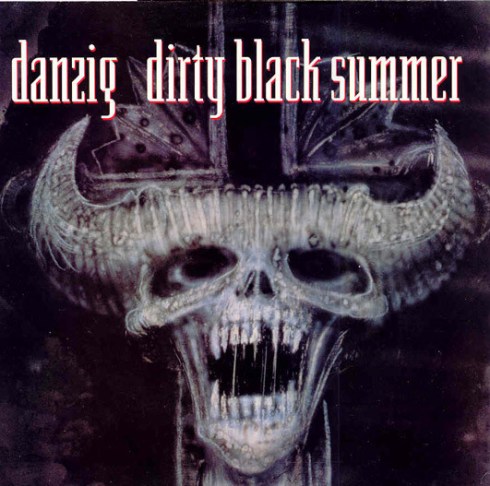
R-562567-1131857556.jpeg64. Dirty Black Summer (How the Gods Kill) – This one was probably the first single to get any sort of consistent airplay on MTV. It was hardly a hit, but if you tuned into Headbanger’s Ball around release you probably saw it. It features what I would call a typical Danzig riff, but it dresses it up enough to form something catchy. Glenn does this odd vocal hiccup in between lines during the chorus, which definitely is a unique touch for the song. I know a few who find this one a bit annoying as it might be the most commercial sounding song Glenn has ever released, but I’ve always found it rather catchy.

63. Pull the Sun (Black Laden Crown) – The closing track from Black Laden Crown follows the same general format as a lot of Danzig closers. It’s a slow to mid tempo track with a wailing chorus, though the chorus isn’t leaned on as heavily as it is with “Left Hand Rise Above” or “Without Light, I Am.” The novelty of this song structure has some-what worn off as a result, which is why this one is ranked behind those two tracks. It’s a great song on its own though that is perhaps just missing one special, hard to pin down, ingredient to make it truly exceptional which is how I feel about a lot of the material from this album.

62. Satan’s Crucifiction (Lost Tracks of Danzig) – This one is essentially a joke song, but it’s so heavy and so evil that it actually works. This song is all about the bottom end and it’s particularly brutal. And I think knowing the lyrics were intended as a joke makes them work better than if they seemed sincere. Truly, they’re not all that much more campy than some of the “real” songs Danzig has put out. And in case you need a refresher, this one was recorded after the success of “Mother” when the label requested the new album not be “Satanic.” Supposedly, the joke had the desired effect.

61. Rebel Spirits (Deth Red Sabaoth) – One of the more understated songs from Deth Red Sabaoth, “Rebel Spirits” settles into that mid-tempo groove we know so well but it kicks things up with the chorus. The vocal production could have been better, but it’s not as bad as other Danzig songs out there. It has this apocalyptic quality to the drumming compliments of Johnny Kelly and the subject matter is very appropriate for Danzig.

60. I Luciferi (I Luciferi) – This is one of Danzig’s shortest songs, but it does all that it needs to in its brief runtime. “I Luciferi” takes a fun guitar riff and dresses it up with cartoonishly Satanic imagery that morphs into a hard-hitting chorus complete with a nice, dense, crunchy, guitar riff. I’ve always enjoyed this rockin’ little number and it makes for a good title track.

59. Possession (Danzig) – Originally recorded with Samhain, “Possession” might be known more for featuring guest backing vocals by Metallica’s James Hetfield. The version from Danzig is much better than what was included in the Samhain Box Set. It has that simple blues-rock base to it featured prominently on the debut album with a rolling, thunderous chorus. The subject matter may border on misogyny, but it’s more of a power fantasy than anything. It definitely was more effective at captivating me as a teenager than as an adult.

src=http---images.blastro.com-images-artist_images-full-full_danzigcrawlacrossyourkillingfloor.jpg&w=610&h=457&zc=2&a=T

The video for “Crawl Across Your Killing Floor” featured a rather interesting concept, but the execution was pretty lackluster.

58. Crawl Across Your Killing Floor (Lost Tracks of Danzig) – Guitarist Todd Youth dazzles on this piece of atmospheric, vagabond, music. It’s the best song to come out of the Danzig 6 sessions, and yet I kind of understand why it was left off the album. It doesn’t fit well with the rest of the album. I suppose they could have bumped “Thirteen” for it and it would have made for a similar closer, but at least it finally saw the light of day with The Lost Tracks of Danzig.

57. Liberskull (I Luciferi) – Another kind of “off its era” cut from I Luciferi, “Liberskull” relies on a “Korn” riff to hum along and leans heavy on its catchy chorus. The chorus is similar in structure to “Satan’s Child” in that it relies on a long wail, but it’s arguably what Glenn Danzig does best. The very nu-metal sound to this one used to lead to me referring to it as a guilty pleasure, but now I feel I’ve grown beyond such silly notions and it’s just a song I like.

56. The Revengeful (Deth Red Sabaoth) – Pinch harmonics city! If you dislike Danzig’s reliance on that guitar technique, then “The Revengeful” might grate on you a bit. I have neither a strong dislike nor a particular fondness for them, and “The Revengeful” straddles the line of practical taste. It’s a good fist-pumper that really helps sustain the momentum of Deth Red Sabaoth following the rocking opener “Hammer of the Gods.” It was also the B-Side to the album’s first single though surprisingly it never became a concert staple where it feels like a role it was born to play.

55. NetherBound (Circle of Snakes) – “NetherBound” is often cited as a favorite from Circle of Snakes. It has a somber tone and enjoys existing in the mid-tempo range. It’s very simple with a dry production sound that gives it an older texture, which fits the song’s mood. The melody is pleasant, and Danzig’s vocals are almost sweet sounding, a good penultimate track for the album.

54. Stalker Song (Danzig IV) – One of Danzig’s creepier songs, the title basically lets you know what it’s about. Glenn lets his vocals take center stage, something it feels he was more willing to do during this era of the band, and it’s what helps carry the song. It’s fairly simple in its execution, but those Danzig wails that sustain the closing moments are what puts it all together. I liked this song more as a teen when the subject matter felt more risqué, but as an adult I still start belting out the lines with Glenn when I’m driving in my car (alone).

53. When the Dying Calls (How the Gods Kill) – A little southern sludge closes out Danzig’s third album, and if it weren’t for the inconsistent production, it possibly could have rated higher. Danzig’s vocals have an almost R&B flow to them throughout the verse that gives the song a very playful quality and it courses along to a big finish. It’s during that big finish where the vocal production sounds off, as if Danzig is going louder than the master intended. I suppose it’s not surprising this album had some issues in that department since it was the first Rick Rubin supposedly had little involvement with. It’s a minor thing though as the song still rocks.

52. Black Candy (Deth Red Sabaoth) – The title may seem off-putting and silly, but this is one heavy-ass track. Glenn handles the drumming, and it’s like he had something to prove. It’s not a complex drum pattern utilized, but it is loud and powerful. He really beats the Hell out of the skins and relies a lot on the double bass and it’s what gives the song its character. Danzig’s voice is able to keep up with it too and manages to not get drowned out. Glenn must have really admired Chuck Biscuits when he was with the band as his style is a little similar with a no fills approach. The rest of the song is appropriately dense and this one is almost a sonic overload which makes up for its lack of true hooks.
hqdefault-45

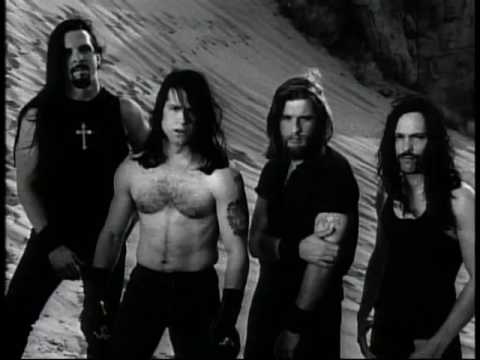
A band shot from the video for “Dirty Black Summer” during the How the Gods Kill era.

51. Do You Wear the Mark? (How the Gods Kill) – Almost a straight rip-off of Sabbath’s “Into the Void,” “Do You Wear the Mark?” at least does well by that old riff in crafting another dangerously dark Danzig tune. It’s so blatant though which is why I’ve never had much sympathy for Glenn anytime he mentions someone ripping him off (most notably Stone Temple Pilots). This one has always worked really well as a concert song, and the finish is great. I don’t know why, but I love the inclusion of the word “darling” amongst the song title’s question. Maybe because it subconsciously reminds me of “Die, Die, My Darling” or maybe because it just works. I’ll always associate this song with my first Danzig show in 2000 when an old guy probably in his sixties strutted into the show late. Wearing his white hair in a ponytail and clad in a beaten up leather jacket, he stood stoically as the band went through its set. When this song hit though that man opened up and just started going off. I hope he’s still rocking out to Danzig somewhere.

50. Not of this World (Danzig) – One of the band’s old concert staples that usually closed out shows, this one is the second track off the band’s debut album and it still kicks a lot of ass today. The production on the studio version is almost a bit too simple and bare bones. It has its tempo and it works well with it, but live the band plays it faster and that’s where it really comes alive. If they could have captured that intensity for the studio it probably would have vaulted the song higher, but it’s still a great track no matter how you experience it.


We’re going to cut this one off here. We’ve got 49 songs left to get through and I anticipate that being split into two parts. Check back tomorrow for Part III as we continue our sonic exploration of every Danzig song ever.

Batman: The Animated Series – “I Am The Night”

I_Am_the_Night-Title_CardEpisode Number:  49

Original Air Date:  November 9, 1992

Directed by:  Boyd Kirkland

Written by:  Michael Reaves

First Appearance(s):  The Jazzman

“I Am The Night” is perhaps our most introspective episode thus far. It borrows its title from the “catch phrase” Batman used to psyche himself up and overcome The Scarecrow’s fear toxin way back in episode 3. It’s a very melodramatic episode where Batman, facing a crisis, ponders his own worth. Should he let the past murder of his parents dictate his life? Is he really making a difference in Gotham by being Batman? Because it’s so heavily focused on the Batman character, this is an episode that doesn’t need a big name villain, so we get The Jazzman (Brian George) instead. He’s pretty much a run-of-the-mill Gotham City gangster type. He doesn’t have an outlandish gimmick, though he is fond of music puns. The episode also returns both Leslie Thompkins (Diana Muldaur) and Barbara Gordon (Melissa Gilbert), with the latter showing further signs of the woman she will become.

stonechair

A tired Batman.

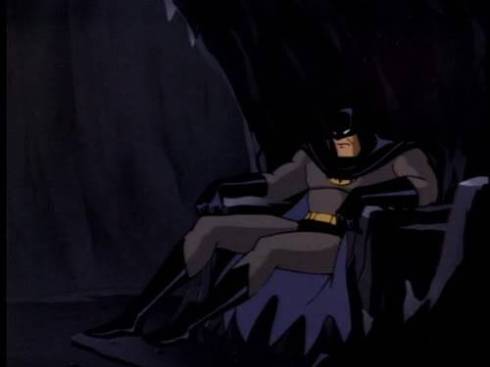
The episode opens in the Batcave. A weary Batman is seated staring down at his feet as Alfred enters the picture with a newspaper and what looks to be coffee. Batman remarks he’s tired, and not just physically as Alfred comments on how little he’s slept in recent days. The newspaper brings more depressing news. The Penguin, presumably caught doing something illegal by Batman, has had his conviction overturned and will be set free. Batman angrily tosses the paper aside while questioning if he’s making a difference. Alfred is reassuring, but apparently not convincing. He hands over “it” which Batman had requested – a long yellow box.

Jazzman

Our villain of the day is the Jazzman. You don’t need to know anything about him.

Our attention shifts to some kid working a street corner. His street name is Wizard (voiced by a teenaged Seth Green) and he’s conning folks for spare change under the guise of needing bus faire to get home. The camera pans on a gift shop selling Batman merchandise that Wizard scoffs at. We’re also shown that Commissioner Gordon and Detective Bullock are positioned outside a building with a bunch of armed cops. The Jazzman is inside apparently conducting a big time drug deal and they’re just waiting on Batman, but he’s occupied. It’s the anniversary of the murder of the Waynes, and Dr. Thompkins is at the scene waiting for Batman. When he arrives he confesses he wonders each year if he should be doing this, if this year should be the last. It’s a similar conversation to the one he had with Alfred. And like Alfred, Thompkins is reassuring, though I’m a little surprised that as a friend to Bruce’s parents she doesn’t try to persuade him to hang up the tights.

As Batman finishes up his ritual of laying a pair of roses at the spot of the crime, a commotion gets his attention. Wizard is being accosted by a couple of thugs. Apparently, they allow him to work that little corner for money, but he’s supposed to pay up. Things are about to get out of hand when Batman steps in and puts a stop to it. Wizard is not impressed, but Batman grabs him by the collar and asks Leslie if there’s room for one more at the house she works at.

gordon shot better

This is hardly the time for a nap, Jim.

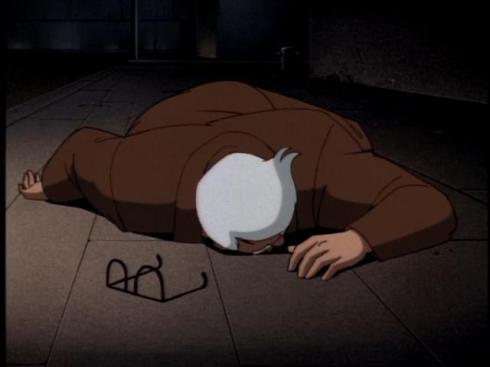
Meanwhile, the bust has taken a turn. Jazzman was setting up the police as he’s got a vendetta against Gordon for a prior arrest. He and his associates open fire on police, and things are getting out of hand. Batman finally shows up, striking a rather impressive pose atop the building the Jazzman is occupying. Using one of his many ropes, he runs alongside the building tossing tear gas into the windows. This flushes out the bad guys and Bullock and the police are able to apprehend the Jazzman. When he turns to celebrate with Gordon, we get our second “Oh, my God,” of the series as Bullock sees Gordon lying face down on the ground. Batman sees it too, and the look of shock on his face is surprisingly emotive for a man in a mask.

iamthenight8

Paying a visit to a fallen friend.

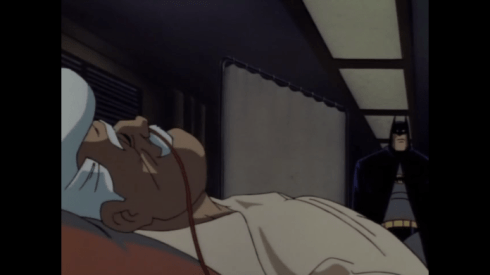
Gordon is rushed to a nearby hospital and stabilized. A news report is played to relay just what happened. They never actually say Gordon was shot, but they mention removing a bullet from him that was matched to the weapon the Jazzman was using. Gordon is placed in the ICU, and Batman soon pays a visit. It’s surprisingly easy for Batman to enter through the window even though an armed guard has been placed outside Gordon’s door. He apologizes to the unconscious Gordon and blames himself. Barbara Gordon emerges from the shadows to console Batman and assure him it isn’t his fault. Bullock bursts in with the opposite opinion. He berates Batman, blaming him for not sniffing out the setup to begin with and for being late to the action. He screams at him, and Batman offers only a small amount of resistance before leaving out the window he came in while Bullock hollers challenges at him.

Batman returns to the Batcave and does what every protagonist in a melodrama would do – he smashes stuff. Alfred apparently knew to stay away as he never interrupts. The Jazzman is then shown being ordered held without bail, but at a prison outside of Gotham due to overcrowding. He quickly puts a plan into motion that allows him to escape. Apparently jails around Gotham suffer from the same problems as the ones in Gotham. He’s not satisfied with wounding Gordon and wants to “send him to Harpland,” so he’s hellbent on returning to Gotham to finish the job.

17

Man wasn’t supposed to live in darkness, Bruce.

Dick enters the Batcave at Alfred’s insistence in hopes of cheering up Bruce. He’s been down in the cave for days. Dick finds him, still in costume, and the two rehash what happened. Like the others, Dick tries to assure Bruce of his worth, but he won’t hear it. He sneaks in the tidbit that Gordon is the same age as his father, adding a little gravitas to the situation and hinting that Bruce looks to Jim as a father figure. Dick is about as successful as the others, or perhaps even less so as the scene ends with Bruce denouncing Batman and tossing his mask down a chasm seemingly giving it all up.

Dick is then shown paying a visit to Gordon. For the first time, Dick and Barbara share a scene together. It’s not explained why the two would be friendly, but I think it’s mentioned in another episode that they attend the same university and know each other through that. Barbara bemoans that she can’t do more (foreshadowing!). They know the Jazzman has escaped from prison, and she’s certain he’ll be returning to finish what he started. Dick then returns to Wayne Manor to try and convince Bruce to put the tights back on and get out there. Bruce just sits quietly at a desk in his pajamas as Dick declares that if Bruce won’t stop the Jazzman, then he will. The scene cuts to the Batcave with Robin heading for one of the Batcycles when a gloved hand clamps down on his shoulder. Batman declares this is his hunt, and we’re off!

I_am_the_night_friends

Crisis averted.

True to his word, the Jazzman is found at the hospital. He takes out a window washer and begins using his equipment to scale the side of the building to get to Gordon’s room. How he knew which room Gordon was in is not explained, nor is it explained how Gotham PD could be so foolish as to allow window washing in the area. Jazzman raises the scaffolding up to Gordon’s room and produces a handgun. He takes aim intending to shoot through the window when Batman swoops in at the last second to redirect the shot. The commotion gets the attention of Bullock, who was at ground level, and he races back inside. Batman is left hanging from the scaffolding as the Jazzman tries to knock him off, but he ends up going through the window. A guard bursts in, but Jazzman slams the door on him causing him to drop his weapon. Jazzman is able to gain possession of the weapon and take aim at Gordon as Barbara screams and throws herself onto her father. Batman recovers outside the window and lets loose a shuriken as Jazzman fires. The projectile flies true and sticks into the end of the barrel of the gun, causing it to backfire. Bullock bursts in and Jazzman is apprehended once again.

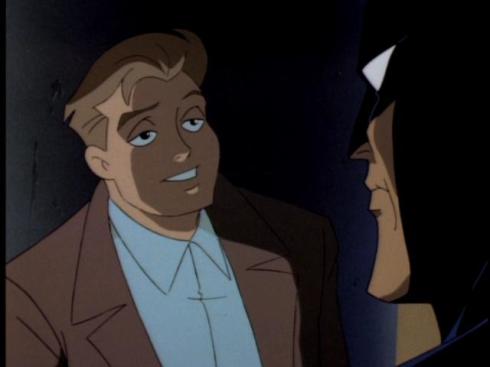
As the commotion dies down, Gordon wakes up to see Batman and Barbara at his bed side. He offers words of encouragement, first making sure the bust was a success. He then expresses his admiration for Batman, who in turn encourages him to get some rest. As Batman swings away, he settles in on a rooftop and notices the kid from earlier, Wizard, picking up an unattended suitcase by a bus stop. He swoops in, questioning who’s briefcase he stole, only to find out he misread the situation. Wizard tells him it’s his, then says he was hoping he’d run into Batman. He explains he’s been to many halfway houses before and heard the same schtick about getting on the right track and how it never worked. This time though, it did. He offers Batman the two words he needs most right now, “Thank you.” Wizard then hops on the bus intending to head home. Batman looks a bit stunned at first, then smiles as he heads back for the rooftops. The camera lingers on his face as the episode closes – still smiling.

wizard

The kid with the stupid name telling Batman exactly what he needs to hear.

“I Am The Night” is a pretty weighty episode. There’s a lot to unpack with this one. It tiptoes around the theme of escalation a bit and how Batman could potentially be doing more harm than good, though it doesn’t really go too far down that road. Really, it focuses its attention on Batman himself and how easy it would be for a guy in his situation to feel depressed. As viewers, we look to Batman as a hero and this series presents him in that light in an unquestioning manner without ever really stopping to show us how Batman might view himself. Many episodes are even light on Batman as the villains absorb a tremendous amount of the spotlight. As such, it’s nice to see an episode focus almost entirely on Batman for a change. This episode also deals with consequences in a manner many children’s shows of its ilk ignore. For once, someone actually got caught in a hail of gunfire and we’re reminded of the stakes. While I don’t think anyone really felt that Commissioner Gordon would die, the image of him lying there in the street and the genuine look of fear on both Batman and Bullock is affecting.

The joyless portrayal of Batman in this episode comes across as more authentic than many of the others. Batman isn’t effortlessly fighting off bad guys or solving riddles. He’s tangling with something more human that probably anyone can relate to. Because of this, “I Am The Night” probably isn’t a favored episode for many children especially since it doesn’t feature a noteworthy criminal. For adult viewers though, it’s hard to deny that this one isn’t one of the better episodes. It toes the line of melodrama and corn, but I don’t think it ever goes over it. If you want to nitpick the episode you could certainly mock it for how easy it is for Jazzman to escape prison or how quickly Bruce goes from his pajamas to Batman. I definitely can suggest that naming a street kid Wizard was an odd move. This is a pretty intense episode though and one I enjoy. It also helps that it looks pretty great with several shots of Batman really standing out. His dejected mood at the episode’s beginning, his heroic pose from the top of the building the Jazzman was hiding in, the way he runs across the wall, it’s all very dynamic. Sunrise handled this one and they did a good job. About the only thing I don’t like is the slow-mo when Jazzman is about to shoot Gordon and that Batman can toss a throwing star into the barrel of a handgun. Even for a cartoon, that seems implausible. This is a good one though even with the nitpicks. I take him for granted, but lastly I should say this is Kevin Conroy’s best performance to date in the role of Batman. It’s hard to imagine anyone else being able to capture the humanity of the character the way he did in this episode.


The Ultimate Danzig Song Ranking – Part I

danzig_bannerThis day marks the 30th anniversary of the self-titled debut album of Danzig. It was thirty years ago that the album was unleashed by then label Def American alongside Geffen Records. So shaken up by the imagery and subject matter of the group was executive David Geffen that Geffen’s logo didn’t appear on the release. Which is kind of amusing as the album isn’t what many would consider controversial in this day and age featuring no profanity or overly violent lyrics, but this was a different time.

The album has gone on to be the best-selling record released by the group and the only LP to go platinum. It did not happen overnight and most of its success is attributed to a surge in popularity for the song “Mother” which was re-released as a single in 1993 to promote the EP Thrall-Demonsweatlive. As my favorite band, this blog tends to celebrate all things Danzig related, so marking this milestone makes sense. You may recall I ranked all of the albums Glenn Danzig was involved with back in April to mark the 400th post on this blog. Last Halloween, a similar ranking for all of the songs recorded by The Misfits was also done. The Misfits, with Glenn Danzig at the helm, lasted approximately six years spanning from 1977 to 1983. As a result, I only had to rank 50 or so songs. Danzig has understandably output more since it has existed five times as long. I count 129 unique songs that need to be ranked making this largely an exercise in futility, but that’s never stopped me before!

How did I arrive at that total, you may be wondering. Well, I’m not considering live recordings since that would be silly and duplicative. I am also not counting remixes and only considering the original version of a given song. This mostly affects Danzig 5 era tracks which largely aren’t that great to begin with. I also decided to exclude covers. While you may argue that some of Danzig’s covers offer a unique take on an old song, they’re still not exactly Danzig songs. This eliminates the entire Skeletons album and also disqualifies the following:  The Hunter, Trouble, Hand of Doom: Version, Buick McKane, Cat People, Caught in my Eye. I’m also not counting the song credited to Glenn Danzig and the Power and Fury Orchestra, which was “You and Me (Less than Zero)” from the Less Than Zero motion picture soundtrack. While the orchestra was basically the band Danzig, minus bassist Eerie Von, it wasn’t credited to the band so I won’t rank it (even though it’s a fantastic track). And lastly, I’m not going to rank the instrumental intro songs that appear on I Luciferi and Circle of Snakes and I’m also counting “Pyre of Souls: Incanticle” and “Pyre of Souls:  Seasons of Pain” as one song. Hopefully these ground rules are not too complicated or controversial. With each ranking I’ll include the easiest way to find the song, not necessarily the first. Some songs debuted on singles, but were eventually released on a re-issue or as part of The Lost Tracks of Danzig. With that all out of the way though, let’s get to the music:

129. Don’t Be Afraid (Blackacidevil 2000 re-issue) – The dubious one. The one that is considered the absolute worst. “Don’t Be Afraid” was originally released on a promotional sampler for Danzig 5 and later included on the E-Magine re-issue. It’s basically a noise track, with a simple electronic beat and instrumentation moving things along as Danzig sings over it with vocals so distorted they’re basically unintelligible (aside from when he repeats the song’s title over and over). If you were excited to hear this one for the first time after getting that 2000 re-issue then boy were you disappointed.

27904b052c35e6e70d82224f00796ffd

Danzig enjoys seductive snake girls.

128. Serpentia (Blackacidevil) – The worst track from Danzig’s worst album, as originally released. “Serpentia” is mostly just annoying, an attempt to be sexually charged with snake imagery. Danzig’s vocals are not distorted, but they’re also not very good. The song is poorly paced and feels half-baked. Somehow, the various remixes that followed are even worse.

127. Sadistikal (Danzig IV) – This one is less a song and more an intermission for Danzig IV. It’s largely industrial, serving I suppose as a preview of sorts for Danzig 5, and it offers little value aside from the mood it attempts to create. Danzig’s lyrics come across as corny and cliche, so it’s debatable if it really works as an intermission. The worst track on the best album.

126. Lady Lucifera (The Lost Tracks of Danzig) – A holdover from Circle of Snakes, “Lady Lucifera” is a song Danzig claims to love and I’ve encountered a few fans that seem to enjoy it, but I find it repulsive. Muddy, plodding, instrumentation with a weird vocal delivery. The song just meanders round and round without going anywhere. It sounds more like a concept than a fully realized song.

125. East Indian Devil (Kali’s Song)(Satan’s Child) – The most industrial track of Danzig’s sixth album is also its worst. The vocals are largely indecipherable and there’s no real hooks or chorus present. Not sure why it made the album over better songs.

124. Blackacidevil (Blackacidevil) – There’s some disagreement over how this song title is pronounced. Some read is as “Black as a devil” and others as “Black acid evil.” The pronunciation of it in the actual song sounds to me like it is “Black acid devil.” I just call it crap. The only compliment I can pay it is the song has a build to it and increases with intensity the longer it goes, but it lacks a true crescendo to really pay it off. Otherwise, just more Danzig 5 fuzz junk with camp lyrics.

123. White Devil Rise (Lost Tracks of Danzig) – Banal and simple, “White Devil Rise” sounds like an alt-right anthem these days. The less said the better.

122. Into the Mouth of Abandonment (Satan’s Child) – This one is similar to “Sadistikal” in that it feels more like an intermission track than a true song. This one tries a bit harder and since it’s past the midway point of the record it probably wouldn’t qualify as an intermission anyway. It’s simple and mostly understated, slightly notable for being the rare Danzig cut to actually contain the word “fuck.” We’re gradually moving away from the songs that are truly poor to the ones that just aren’t particularly noteworthy.

121. Hint of Her Blood (Blackacidevil) – A slow, brooding song. The lyrics are less camp and more traditional Danzig. It’s sort of like our previous entry, “Into the Mouth of Abandonment,” but without the explosive moments, so maybe I should have actually ranked that one ahead of this one. I guess I like the subject matter here a little more, both songs are rather boring in the end.

120. Bleedangel (Blackacidevil 2000 reissue) – The other original track added to the reissue of Blackacidevil, “Bleedangel” is better than “Don’t Be Afraid,” though it’s another song that kind of goes no where. It’s rather atmospheric and at least it doesn’t feature heavily distorted vocals, but what’s there also isn’t all that exciting. The most interesting thing about this song is that at one point in time it was supposed to be released as a single, and according to then bassist Josh Lazie, that single was going to include a cover of The Misfits classic “Bloodfeast.” It never happened, and many doubt that cover actually exists anywhere since no one else has been able to confirm its existence.

119. Power of Darkness (Blackacidevil) – Disco Danzig! This song is straight-up techno garbage. I guess if you like techno maybe you would like this song. I suppose it’s rather danceable. I personally never needed to hear Danzig tackle this genre.

118. You Should be Dying (Lost Tracks of Danzig) – Supposedly left off of Lucifuge, this is one of the tracks from the Lost Tracks compilation that sounds like the vocals were re-recorded for that release. It definitely doesn’t sound like Glenn Danzig circa 1990. Regardless, I don’t think even a vintage vocal performance would save this one. It has a decent, very Sabbath-like riff going for it during the intro, but then it devolves into nothing. Very bland, and the chorus is kind of annoying. A rare clunker on disc 1 of that set.

117. Hellmask (Circle of Snakes) – “Hellmask” marks the return of Glenn Danzig’s “Cookie Monster” vocals. Lots of screaming, and the mix makes it sound like Glenn is battling with the guitar and drums for audio supremacy on the track, and losing. He hasn’t really revisited that sound since.

239801193710-danzig-wicked-pussycat_music_video_ov

Danzig also enjoys six foot cat women. I’m not kink-shaming, I swear!

116. Wicked Pussycat (I Luciferi) – “Wicked Pussycat” contains a very modern, nu-metal sound for 2002. The subject matter is cartoonish even by Danzig’s standards, and the rap-rock chorus is kind of embarrassing. There is a catchiness to it, I suppose, but it’s not something I return to often.

115. Invocation/Demon’s Call (Danzig IV) – The title of this one is confusing. For years it was referred to as “Invocation,” though I’m not sure if Glenn himself ever confirmed it. When mp3 distribution showed up, Apple listed it as “Demon’s Call” in iTunes and I have no idea where they got that title. It’s all confusing because this is an unlabeled bonus track from Danzig IV, track 66. It’s a classic bonus track in that it’s experimental and kind of weird, which is on purpose. Those were kind of the best bonus tracks as they were a fun little treat for those who left their CD player on after the last song. This one is basically a hymn, and it’s about a demon that seduces its victims. It’s basically just Danzig’s heavily layered vocals and an electric organ. Pretty cool, a little creepy, and mostly fun though it’s also not likely to be anyone’s favorite song due to its unique nature.

114. I Know Your Lie (Lost Tracks of Danzig) – Another leftover from Danzig 6, this one was probably left off of the final release because it sounds very similar to “Five Finger Crawl.” Had it been on the album it would have been a filler track, neither good nor bad, which is what it is on The Lost Tracks of Danzig.

113. My Darkness (Circle of Snakes) – So I kind of hate this one, but also kind of love it. I never seem to enjoy hearing it, but it gets stuck in my head. It’s also really annoying, but also fairly catchy. I didn’t know where to rank this and honestly considered it more towards the back, but it’s fine right here.

4e5a42e73e70657d448598a83cf5a1d3

A band still from the “Circle of Snakes” video. It’s mostly the band posing menacingly while snake girls do their thing.

112. Circle of Snakes (Circle of Snakes) – This is like a sludge version of “Twist of Cain.” Riffs and song structure are similar, though it lacks that bridging second chorus. I mostly hate the guitar tone on this album, and this song in particular.

111. 7th House (Blackacidevil) – This song may have been okay if it wasn’t so distorted. It’s basically like “Brand New God” if that song just stayed with the up-tempo, thrash sound it starts with. The lyrics are pretty stupid though, so maybe the distortion helps there. It’s one of the songs from Danzig V that works a lot better live than it does on the album.

110. God of Light (I Luciferi) – I dislike this song less now than I did in 2002. It used to annoy me, and it still possesses a rather weak chorus, but when I listen to it now I appreciate the odd time signature of it because it’s very different from basically every other Danzig song. I’m ranking it as high as I am because of that uniqueness, though it’s still one of the weaker tracks on Danzig 7.

109. Apokalips (Satan’s Child) – This song has a good structure to it. It starts slow, slightly quiet, and then ratchets that up when the chorus kicks in. There’s a dense bottom-end, and the production helps add to the apocalyptic atmosphere the lyrics are going for. The problem then? The vocals. They’re oddly pitched and Glenn’s voice is borderline annoying at times. There was supposedly a lot of post-production nonsense done on Glenn’s voice, as he stated at the time he tried to achieve a sound closer to how he hears himself, so maybe that’s what is going on here. Whatever the case, it doesn’t work.

108. Skin Carver (Circle of Snakes) – Frustratingly, the song that has been opening every Danzig show since 2004. It’s a head-banger, and most concert openers are designed to fire up the crowd and set the tone, there’s just so many other songs in the Danzig catalog that work better. The silly whisper first chorus does nothing for the song’s mood, and the shouting version that follows is just kind of dull. It’s just the song’s title, over and over. I do like Tommy Victor’s guitar work on this one, and the bass is thunderous, it’s the other parts that lag.

107. Night Star Hel (Deth Red Sabaoth) – Our first song from 2010’s Deth Red Sabaoth is that album’s most boring song. It’s not terrible, but it’s very reminiscent of the lower points from the preceding albums. A nothing chorus with a slow, brooding verse with iffy production.

106. Deep (Lost Tracks of Danzig) – This one was originally released on an X-Files compilation album of songs, Songs in the Key of X. They were supposed to be inspired by the show, but I think it was just David Duchovny reaching out to artists he liked for music to fill an album with. “Deep” was not written for the album and was basically a holdover from Danzig 5. Interestingly, it would have been one of the better tracks on that record (the reissue included a remix of this one called “Deeper”) instead of being one of the lesser tracks on disc one of The Lost Tracks of Danzig. It’s a bit slow, with imagery reminiscent of “Sadistikal” that tries to build towards a big chorus, but it doesn’t deliver.

105. Dead Inside (I Luciferi) – This is a song undone by its chorus. The verse is simple with some sweet Danzig crooning. It builds into a faster verse following the first chorus that’s really satisfying, but that damn chorus. It’s just screaming with machine-gun drumming that doesn’t suit the song. It almost betrays the verse which is very melodious by being so simple. A missed opportunity.

104. Cult w/o a Name (Satan’s Child) – This song might be Danzig’s worst written when it comes to nonsense lyrics. “I am teeth of fire/taste a thousand shames,” – what? Teeth don’t taste, Glenn, but I guess tongue doesn’t sound very menacing. The song has a solid groove to it, it suffers some of the same vocal shortcomings as “Apokalips,” but it’s not a bad song. Just flawed.

103. Devil on Hwy 9 (Black Laden Crown) – Okay, maybe this one has dumber lyrics than “Cult w/o a Name.” Driving on an evil highway? Sure, whatever, as long as it sounds good. And the music mostly delivers, but the vocal production is wretched. I was shocked the first time I heard it that it was released like this. This one definitely was let down by its production. Every time I listen to it that opening piece tricks me into thinking maybe this song isn’t so bad, but those vocals bring me back down to earth. Still, as the first song to show up from Black Laden Crown, I’d say that’s a pretty good showing from the most recent Danzig albums, though we’re about to start a little run on songs from this album.

102. Eyes Ripping Fire (Black Laden Crown) – The song that immediately follows “Devil on Hwy 9” is this one, and it’s title seems to imply something more like the previous song, but it’s rather muted. It’s just a song I want to find another gear, but it just meanders. It has kind of a meaningless existence.

101. Night, BeSodom (Circle of Snakes) – This is another song that finds a nice groove, but it’s all it has. It gets what it can out of that groove though, and then quickly ends so that it doesn’t overstay its welcome. If it had an actual chorus it might have been able to climb higher.

4ba08d8572da798a3beae731f0e21ca6

Danzig contemplating what it means to feel all sacrificed.

100. Sacrifice (Blackacidevil) – The lead single from Danzig 5 was kind of a red herring. This one is very Nine Inch Nails-like, and some of that Trent Reznor’s remixes of “Closer” really drive that point home. It’s simple, has an electronic base to it, but the vocals are mostly clean and the chorus explosive. It has kind of a cheapness to it though, like it’s relying on the most basic hooks for success. At least it has hooks though, something a lot of the other songs from this album are sorely lacking in. I’ve picked on Danzig 5 a lot so far, but we’re actually going to leave that album alone for a good while now as it’s surprisingly top heavy relative to other Danzig releases.

99. The Witching Hour (Black Laden Crown) – Another brooder from Black Laden Crown, “The Witching Hour” is an unremarkable track. Not particularly great, but far from bad. It’s the definition of filler.

98. Kiss the Skull (I Luciferi) – This one was originally going to be the title track for Danzig 7, but it lost out to a better song. It’s also inspired by Gary Glitter, he of “Rock n’ Roll Part 2” fame, as well as a noted child molester. It’s kind of a goofy track, but it does possess some catchy qualities and it’s also fun hearing Glenn dust off his “Whoa oh” he so frequently resorted to with The Misfits.

97. Soul Eater (Lost Tracks of Danzig) – If “Kiss the Skull” is goofy, the this one is positively ridiculous. “Soul Eater” is one of the catchiest songs Danzig has ever recorded, but the lyrics are so stupid and silly, which makes them strangely endearing. Even though I consider it only the 97th best Danzig song, I’d love to hear a live version. I even think it was written with that in mind as it references “Blackest of the Black,” the lyric that leads off “Her Black Wings” and is also the namesake of Glenn Danzig’s festival of extreme music, which was in the planning stages during the recording of this song.

96. Firemass (Satan’s Child) – This one is part of the easy listening middle section of Danzig 6. It has a very effervescent guitar tone and there’s an ethereal quality to Danzig’s vocals on the chorus. It was one of my favorite songs on this album when it first came out, and maybe I listened to it too much then because I find it a tad unremarkable now. It’s almost too understated to really stand-out.

95. Belly of the Beast (Satan’s Child) – This is yet another decent song somewhat undone by the lyrics from Danzig 6. This was definitely a creative low point for Danzig, and a lot of the songs show. The song is perfectly catchy, simply but logically constructed, it’s just got this annoying rhyme scheme to the verse. It just sounds like amateur hour, but I’ve always liked the vocal melody on the chorus.

94. When We Were Dead (Circle of Snakes) – An interesting song title that doesn’t really lead to an equally interesting song. The lyrics are actually a strong part to this one as they’re morbidly descriptive. The time signature is a bit interesting, but I feel like the song is building to a conclusion it never reaches, it just devolves into Glenn repeating the song’s title over and over.

93. 777 (Lucifuge) – We’ve kind of reached the first song from the original four. The first four albums are widely considered the band’s best. How much that had to do with Rick Rubin or it containing the original lineup is anyone’s guess. We had picked on Danzig IV’s “Sadistikal” earlier, but like I said, that one feels less like a song and more like an intermission and “Invocation” is just a weird little nugget of a track. “777” sits right in the middle of what many consider the band’s best album. Its twangy acoustic elements overlaying traditional blues rock makes it stand out, but I hate this song’s chorus. The lyrics are just really stupid to me, and I’m not particularly crazy about the verse either. I know a lot of people who like this song a lot, but for me it’s never clicked.

f250c9caf49bfdc671c8260bd3ee01f5

Just jamming to “Bodies.”

92. Bodies (How the Gods Kill) – If you’re worried I’m about to start ripping on those first four albums, don’t worry. We have a few more tracks to cull before we really get into those albums, but “Bodies” is an especially notable track for being not great. It’s very bluesy, so it has its admirers, but the over-the-top “Cookie Monster” vocals nearly ruin the experience. I often wonder if anyone ever asked Glenn why he chose this approach, it sounds brutal for one’s vocal chords. Rick Rubin had less involvement with this album than the first two, leading to Glenn himself receiving a producer credit on it, and I do wonder if Rubin would have steered him away from this sound had he been around more.

91. Who Claims the Soulless (Lost Tracks of Danzig) – A Danzig 7 reject, “Who Claims the Soulless” is a perfectly forgettable track. There is some merit to the notion that it deserved to make the album over something like “Dead Inside,” but there are also better tracks left off of that release. It doesn’t quite fit with the other material on that record, so there’s an equally valid reason for leaving it off. Is it better than “Kiss the Skull”? Maybe, but does it fit within that album as well? Probably not.

90. Unspeakable (Satan’s Child) – While “Five Finger Crawl” received the first (and only) video from Danzig 6, “Unspeakable” was the lead single sent to radio. It’s not really traditional rock or metal, nor is it really nu-metal. It’s kind of an odd song, and like a lot of that album, it’s not easy to shoe-horn into one of the many sub-genres of rock that were dominating the airwaves. The verse is very simple, and the chorus is really catchy. It’s a straight-forward track that serves its purpose, though it could use some more flourish with either the verse or guitar licks.

DANZIG_UNSPEAKABLE-152608

“Unspeakable” was the lead single for Danzig 6:66 Satan’s Child.

I’m going to cut this post off right here as we’re nearing 4,000 words which is just too long for a blog entry. Tomorrow is this blog’s usual Batman Day, so check back on Saturday for Part 2 of this massive entry. And if you have a copy of the first Danzig record laying around, turn that sum-bitch on real loud in honor of its 30th birthday.


Dragon Ball Z: Broly – Second Coming

190px-DBZ_THE_MOVIE_NO._10Japanese Title:  The Dangerous Duo! Super Warriors Never Rest
Original Release Date:  March 12, 1994

English Release:  April 5, 2005

Directed by:  Shigeyasu Yamauchi

Screenplay by:  Takao Koyama

Running Time:  52 minutes

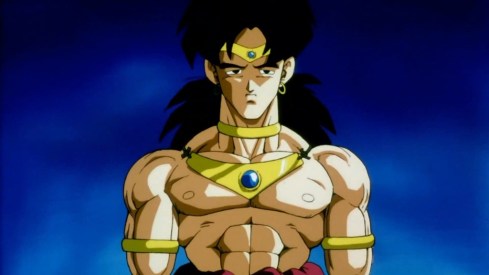
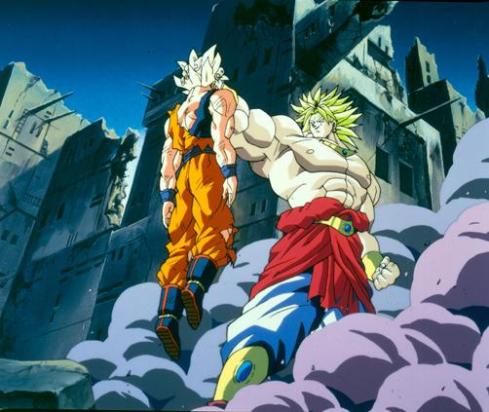
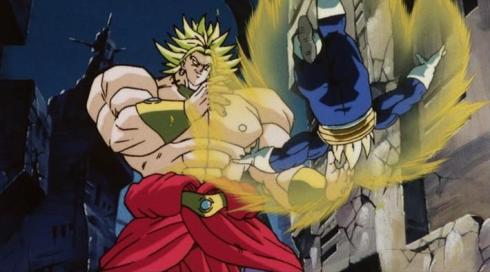
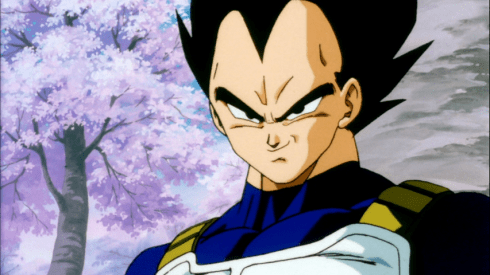
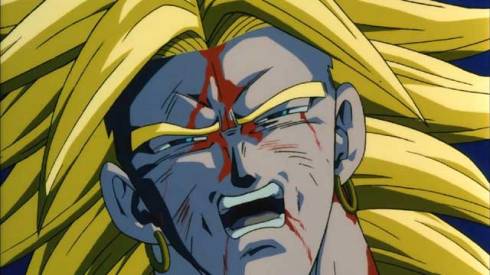
With Broly being an overnight sensation following his debut film, it was no surprise to see him turn up again. The problem with Broly though is that he’s all style and no substance. He’s motivated by his mostly irrational hatred of the one he calls Kakarot, whom we all affectionately refer to as Goku. He barely speaks and is essentially raw power unrestrained. Making things harder on him for his return engagement is that Goku is dead, so his boys are left to pick up the slack. Unsurprisingly, this makes Broly – Second Coming the first DBZ movie to not star Goku in some capacity. He may have been dead in our last film, but he still had a pretty commanding presence over the film. He makes an appearance in this one, but it’s definitely understated compared with the prior movie. This is also the first movie to not feature Piccolo, though there’s a joke at his expense in it. Another surprising stalwart of the movies, Oolong, won’t cameo either. And after appearing in the last four features, Vegeta will be a surprising omission here. It’s always tough to figure out when these movies are supposed to take place so it’s possible Vegeta is dead. Really, this movie and the next features a really small cast of characters and it’s anchored by the debut of Goten and Young Trunks. Lastly, it’s also the first to feature Dragon Ball Z‘s second theme song over the opening credits, the underwhelming “We Gotta Power.” We’ll miss you, “Cha-la…”

Broly-Second-Coming

A dying Broly crash lands on Earth. That’s some sense of direction.

The movie opens on an old but familiar sight – a Saiyan Space Pod zooming towards Earth. It smashes into the planet’s surface and from it emerges Broly (Vic Mignogna). Having apparently escaped the destruction of New Vegeta in just the nick of time, he’s in bad shape and the wound left by Goku is still open. He soon powers down from his Super Saiyan form and collapses into the snow, ice forming over him. He’ll lay there for seven years, and of course he’s just bound to wake up all kinds of pissed off.

400full-dragon-ball-z--broly----second-coming-photo

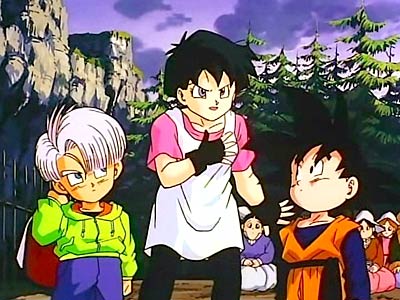
Kid Trunks, Videl, and Goten make their film debuts.

Videl (Kara Edwards), Goten (Edwards), and Trunks (Laura Bailey) are out hunting Dragon Balls. Videl is sporting her short-haired look so this movie takes place after her training with Gohan, meaning she can fly and fight a little. She apparently asked Goten and Trunks to tag along to aid in her search for the Dragon Balls since Trunks’ mother Bulma possesses the Dragon Radar. Trunks and Goten are a handful given that they’re just kids, and they’ll test the patience of Videl and also likely force her to question why she brought them along in the first place when all she desires is to just see the Eternal Dragon, Shenron.

Their search leads them to a small village in the mountains – Nataday. The villagers there are preparing for a sacrifice, a young girl is to be offered to some monster in order to spare their village destruction and misfortune. The sacrifice is the brainchild of the village shaman, Maloja (Robert McCollum) and Videl is disgusted by the whole thing. Other villagers share her views, and Trunks offers to take care of this supposed monster for them.

t7ympl6zcv0ko4abuueb

The village shaman Miloja – he’s a dick.

Videl, Trunks, and Goten all hide in a nearby altar and wait for the monster to show. There’s an offering of food for the beast, and Trunks swipes some which just makes Goten jealous. Video instructs him to keep quiet and stay put, but when goes for an apple she slaps him in response causing Goten to cry. Goten is apparently an impressive cryer, for his howls reach Broly himself. Baring a remarkable similarity to the cries of his infant father, they’re enough to agitate and awaken Broly from his long slumber. In case you have forgotten, Broly is driven by his hatred for Goku whom cried a lot when he was an infant, and it bothered the infant Broly enough to scar him as an adult.

maxresdefault-43

They’re quite good at irritating Videl.

Videl, feeling bad for making Goten cry, apologizes and swipes a dumpling for him. Trunks laughs and lets her know she’s been conned by the diminutive Saiyan, which just makes her more frustrated and annoyed by the whole situation. Soon the monster shows itself to be a mere dinosaur (in case you forgot, dinosaurs exist in this world) and Trunks and Goten are unimpressed. They toy with the beast a little, before eventually returning to the village with its carcass. The villagers are overjoyed to see the beast has been slain, all except Maloja who is banished by the elders for his sacrificial methods. With that out of the way, the heroes are able to resume their Dragon Ball hunt.

broly-11-999485

Broly has awakened!

The trio calls it a night, but a loud sound wakes Videl early in the morning. That sound is Broly, emerging from his ice prison and powering up to his Super Saiyan, but not his Legendary, form. Videl finds and confronts him and, not knowing who he is, tries to attack. Broly is far too powerful for her to handle though. Goten and Trunks soon awaken to the sounds of the fight and they rush to see what’s going on. They have no idea who Broly is, but Broly sees Goten and immediately is sent into a rage due to the child’s resemblance to his father, Goku. Broly is easily able to knock the two boys around, but during the fight they’re able to spot the last Dragon Ball. Trunks devises a plan where Goten is to retrieve the Dragon Ball while he distracts Broly. This is where the movie takes a silly turn as Trunks moons the Saiyan warrior while Goten also pauses to take a pee.

Goten urinating

When ya gotta go…

Goten is successful in retrieving the ball, but soon loses it amongst a bunch of crystal balls. Trunks is dismayed by his friend’s clumsiness, especially because he too really has to pee. He manages to avoid most of Broly’s most damaging moves, but eventually ends up in the arms of the monster when his bladder gives out. Goten does however manage to gather all of the Dragon Balls and he takes them behind a waterfall where he can safely summon the Eternal Dragon Shenron. Unfortunately, Goten realizes he doesn’t actually know how to summon the dragon and sits there perplexed. Trunks manages to retreat behind the waterfall too and doesn’t know how to summon the dragon either. They’re forced to confront Broly, who whips them around pretty well until their savior arrives in the form of Gohan (Kyle Hebert).

C2qXs5jWgAEPrwx

Don’t worry kid, I got this.

Gohan had sensed the fighting, and unlike the other three, he’s faced Broly before and knows what he’s up against. Gohan is definitely stronger than he was when he faced Broly the first time, but he might not even be as strong as he was when he defeated Cell since this is Buu Saga Gohan before his training with the Elder Kai. He’s still able to power-up to Super Saiyan 2, but all that does is force Broly into his more monstrous Legendary Super Saiyan form. Broly is able to physically dominate Gohan in this form, but the resourceful Saiyan is able to break free of Broly’s hold and lure him into a nearby volcano where the lava engulfs Broly. Gohan collapses on a nearby rock as the lava inches closer to him. A caped warrior swoops in though to rescue him. Piccolo? No, it’s Krillin (Sonny Strait) dressed in Piccolo’s attire for some reason. I can only assume this is a metta joke for the audience since Piccolo often drops in unannounced to rescue Gohan in virtually every movie.

Krillico

Not what anyone was expecting…

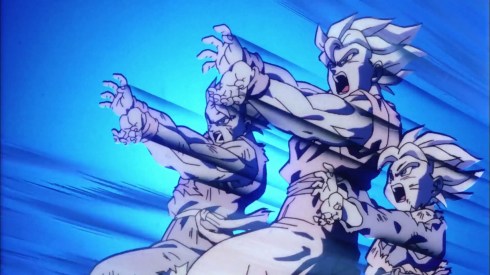
The two share a nice moment, and then Broly returns. You didn’t really think lava could kill him, right? He’s surrounded himself with an energy shield and quickly takes out Krillin. Gohan is too weak and exhausted to offer much resistance, and Broly begins to torture him. He’s very much enjoying himself, until Videl tosses a rock at him. It doesn’t hurt him, but it does distract him and he turns to look as Videl collapses, the effort of just throwing a rock seemingly exhausting what little energy she had left. The sight of her falling enrages Gohan enough to tap into his reserves, forcing himself from Broly’s hold. Announcing he’d had enough, Gohan powers up to Super Saiyan and unleashes a Kamehameha attack against Broly, who counters with a blast of his own. The force of the attack knocks Goten’s bag over and the Dragon Balls spill out awakening the young child. He transforms into his Super Saiyan form and joins his older brother in firing a Kamehameha at Broly. Together, the brothers appear to be holding their own, but it’s still not enough. Goten then silently makes a wish that their dad was there with them.

Broly blast

Broly has an answer for Gohan’s attack.

The Dragon Balls, apparently hearing Goten’s silent plea, flash and the skies darken. No dragon appears, but Goku does! He encourages his sons and powers up to his Super Saiyan form and joins his Kamehameha blast with theirs. And yet it’s still not enough! Trunks awakens as well and sends a last ditch effort Broly’s way. His blast is enough to sneak in behind Broly’s and throw off the timing of his own ki blast. Goku sees this, and implores his boys to give it their all. Their combined might overwhelms Broly, who cries out in pain as he’s blasted from the Earth and into the sun, seemingly gone for good (yeah, right),

Goku vanishes as quickly as he appeared, and Goten and Gohan are left to wonder if he was really ever there. The Dragon Balls seem to confirm that he was, as they’ve turned to stone and rocketed away. Videl awakens and admonishes Gohan for taking so long to get there, while Trunks remarks he wants a snack. They all set off for wherever, while poor Krillin remains where he was following Broly’s attack wondering if they’ve forgotten about him.

Gokugohangotenkamehameah

The lasting image from this movie is at least a good one.

Broly – Second Coming, unlike the first film to feature Broly, is almost entirely reliant upon comedy for its entertainment value. There’s the little setup with the village before the main event, but the movie is fairly straight-forward in its execution like many DBZ films before it. I did appreciate the little bit of adventuring we saw early, and the visual of Goku joining his sons for a triple attack is surprisingly emotional, but the movie earns very little of the payoffs it tries to cash-in. Broly is even more one-dimensional than before, and he’s little more than a video game boss character. The repeated near-saves have become a trope, though at least the movie seems to poke fun at that with the Krillen rescue effort. The juvenile nature of the humor involving Goten and Trunks is sometimes charming, sometimes humorous, but hard to sustain a picture with. The arrival of Goku breaks all of the rules of the Dragon Balls, as Shenron isn’t properly summoned, never even appears, and also disappears after only fulfilling one wish. As much as I like the image of all three combining for an attack, it would have probably been better to just leave Goku out of this one. With him dead, it could have been an opportune time to have Piccolo stand-in considering he’s been a second father to Gohan, or even a more mature Vegeta finally stepping in and embracing his role as a father-figure for the younger Saiyans.

Adding to the tonal problems is a rather bland presentation. The backgrounds are kind of typical DBZ and don’t really offer up much. The visuals are more in-line with the main series as well and do not have that extra special ingredient that most of the films have. Maybe Toei knew this one wasn’t going to be as good as the others because of the lack of Goku and just didn’t sink as much money into the production as they normally would. It all adds up to a very subpar experience, and Broly – Second Coming just may be the worst of all of the Dragon Ball Z films. It has some inherent entertainment value, so I would still say watch it if you have never seen it, but it’s one you’ll only revisit out of a feeling of obligation or when you’re just sick of watching the other, better, films.


Batman: The Animated Series – “What Is Reality?”

What_is_RealityEpisode Number:  48

Original Air Date:  November 24, 1992

Directed by:  Dick Sebast

Written by:  Marty Isenberg, Robert N. Skir

First Appearance(s):  None

After having escaped both Batman and the Gotham PD, The Riddler (John Glover) is back to erase his criminal history and likely get some measure of revenge against Batman and Robin for ruining his prior plans. It’s a rare example of the show having a direct follow-up to a prior episode as villains are often captured and released from Arkham or jail offscreen. It’s not often we have a villain escape and then make reference to their fugitive state, but that’s what we have here in what is only the second appearance of the quite popular Riddler character.

The episode opens with a jogger running through the Gotham night. He decides to withdraw some money from an ATM only to find it’s spitting out riddles instead of cash. Not only that, it shows his balance as zero which enrages the man. The scene jumps to Gotham’s version of Wall Street where investors are being taunted by the scroll not by failing prices, but by riddles. We then see the Gotham Department of Motor Vehicles suffer a similar fate as Dick and Alfred wait in line to dispute a ticket of some sort. All of this brings us to Gotham PD where Batman and Gordon are discussing the obvious – this is the work of Edward Nygma, aka The Riddler. He’s been on the run ever since the events of “If You’re So Smart Why Aren’t You Rich?” and has so far managed to illude capture. Gordon then notices that all online records of Nygma’s very existence are being deleted at an alarming pace to make it appear like he does not, and has never, exist. Before Batman can ask about the hard copies of his records, they’re informed that a package has arrived at headquarters and it’s ticking.

riddlers console

The shipping on that must have cost a fortune.

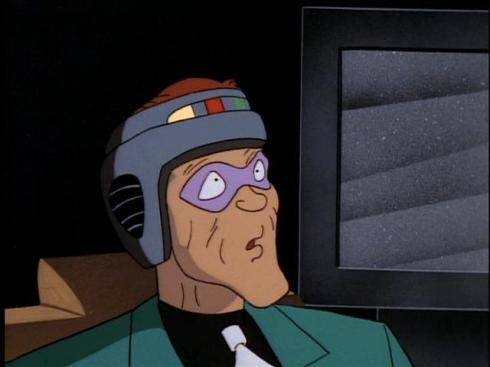
Gordon is apparently comfortable with letting Batman and Robin handle this potential explosive device as the two are seen examining the rather large package. Robin notes that the blocky structure is a puzzle and boasts that he was able to complete a Baxter’s Box puzzle in record time, so this should be no problem. A Baxter’s Box, as best as I can tell, is this world’s version of a Rubik’s Cube. I guess even referencing that famous toy could fall into a copyright area? Robin is able to get the box to open and inside they find a large console complete with a monitor, two seats, a massive keyboard, and a pair of headsets. Not knowing what to immediately make of it, Batman leaves Robin to check it out. Meanwhile, some cops have stolen the hard copies of Nygma’s records and are shown delivering them to Nygma himself who is watching all of this via a monitor in an undisclosed location.

Batman looks to the various riddles that Nygma left behind via the ATM, stock market, and DMV. They’re simple riddles, so Alfred and he deduce they should focus on the numbers contained in the riddles, which when translated to roman numerals, leads Batman to the DMV. There he finds some goons accessing the hard copy records there, likely searching for Nygma’s files. Batman engages them which leads to the action spilling outside where a Riddler Van tries to run down the caped crusader. When Batman winds up on the hood of the vehicle, he finds it’s being driven by a robot with a camera for a head. Nygma is able to taunt him as well, and points out the vast amounts of explosives in the back of the van. Batman is able to avoid a rather explosive demise, but not without detonating the van making quite the mess. Riddler is able to leave him another clue though, because that’s what he does, about where to turn his attention to next.

batman chess

Riddler’s virtual world.

At Gotham PD, Robin has discovered that the console delivered there is actually a virtual reality machine. He demonstrates how it works to Gordon before taking off for a snack leaving Gordon plugged into the machine. Once gone, Riddler appears in the virtual world and is able to trap Gordon. When Robin returns, he receives an electrical shock from Gordon’s headset when he tries to remove it. Batman soon arrives as Riddler’s most recent riddle directed him to Gotham PD headquarters. Robin gives him the rundown and Batman is left with no alternative but to enter the VR machine and rescue Gordon. Riddler has placed Gordon in a high velocity device within the world similar to what astronauts use to train for the force of space travel. Riddler claims Gordon’s heart can’t last in the machine indefinitely injecting a time component into the situation. Robin warns Batman that he’s basically entering a world controlled entirely by The Riddler which prompts Batman to insert an ear piece into one ear so he can maintain a link with Robin while inside the game. Robin is also able to watch what is going on via the rather large monitor Riddler included.

batman dark knight

If you’re going to call yourself the Dark Knight then you should look the part.

Once in the world, the episode’s perspective shifts to that. It’s mostly a world depicted in shades of red not unlike a Virtual Boy, but with some black and white as well. Riddler pushes Batman along via clues which leads him to a chessboard. Batman is forced to literally adopt his Dark Knight persona to sneak past which just leads to a constellation based puzzle for him to solve, with Robin’s help (he’s big on astronomy apparently). Eventually, Batman finds himself face to face with The Riddler and a giant version of a Baxter’s Cube. Not wanting to waste more time in figuring out the puzzle, Batman realizes he has some control over himself in this virtual world and imagines he has mallets instead of hands. He bashes the cube, which just prompts the Riddler to attack. He splits himself into multiple Riddlers, and Batman responds by doing the same. As they engage in a competition of who can create more versions of themself, Batman points out how hard it must be for Riddler to maintain control over his virtual world when splitting his focus amongst the many duplicates he’s made. Just pointing this out causes the world to collapse, and the Baxter’s Cube breaks away revealing Gordon.

many riddlers

Well this presents a problem.

Batman and Gordon are able to escape the virtual world. Once outside, The Riddler returns to the monitor to taunt them and leave them one final clue about where he could be. Just after doing so, he lets out a horrible scream indicating he’s in some trouble. His clue was enough for Batman to figure out his location, and when Batman, Robin, and Gordon find the Riddler he’s still connected to his game unable to remove himself much in the same manner as Gordon previously. Batman remarks getting him out of there may be a riddle no one can solve (spoiler: this isn’t the last we’ll see of The Riddler!) as the credits roll.

“What is Reality?” is a decent follow-up the The Riddler’s debut. It doubles-down on Riddler’s fascination with video games and virtual worlds, which is an interesting take on the character, and one that feels very of the times. I mentioned previously how I liked that this episode directly deals with the fallout of the previous one, even though it isn’t a two-parter. The writers seemed to not want to really bother with riddles this time around though, opting to deliberately have The Riddler use simple riddles but with a bit of a convoluted message hidden in each one. I’m not particularly good at riddles so I feel a little uncomfortable for criticizing the episode for going easy on them, but maybe they should have hired somebody who could craft a good riddle? As a result, The Riddler seems rather stupid as his efforts are not even remotely challenging for Batman to figure out. Batman also easily bringing an end to the VR world is rather underwhelming, but maybe they wrote themselves into a corner since they gave Riddler complete control over the world. The ending is kind of chilling though. After almost rooting for The Riddler in his debut he’s a bit more of a conventional villain here, but his actions never make us desire a fate like that for him.

riddler trapped

Riddler’s in a rather sorry state at the episode’s conclusion, but he’ll bounce back.

This episode marks the final contribution from Akom Productions. They were let go after the some-what disastrous “Joker’s Wild” episode. Perhaps because of this they did an especially careful job with this episode. It looks fine and I have no complaints about the animation. There are some very minor errors, but most episodes contain one or two. It’s not a hugely ambitious episode, though some fun things were done with the virtual world. I’m glad only a few minutes are spent there though as that red palette gets kind of irritating to look at.

This isn’t the last we’ll see of The Riddler, which I can’t imagine comes as a surprise to anyone. It is the last we’ll see of him for a while though and his last appearance of season one. Unfortunately, his next appearance doesn’t mirror this one by dealing with the fallout. He’ll just be his normal self leaving us to wonder how he extricated himself from the VR world. I guess for them not to tell us means it wasn’t a very interesting story. I bet they just unplugged the thing, that seems to be the solution for most electronic mishaps.


DuckTales Season One Review

ducktales newRebooting an old cartoon property has its pluses and minuses. On the one hand, reviving an old brand means the core of what you’re trying to build is already in place. Characters, relationships, stories, even music can all be mined from the old and adapted for the new. There are often tweaks made to the look of the show, new voices to cast, and a whole new team to assemble, but it’s undoubtedly easier and less expensive than starting from scratch. And it also allows a new generation of creators to take something they enjoyed as youngsters and mold it into something else. It also comes with risks, and as we’ve seen all too often recently there is an aspect of fandom that is, well, toxic to say the least. Take She-Ra, for example. Originally conceived as a way to market action figures to girls, She-Ra was integrated into He-Man and the Masters of the Universe, itself a show designed simply to sell toys to boys, and the backlash was swift and quick. Even those behind the creation of He-Man looked down on She-Ra and blamed her for hastening the decline of the franchise as a whole, “Now my sister wants to play with me? Gross!” This is all captured quite well in the documentary series The Toys That Made Us, if you want to know more.
She-Ra, I’m sure, had fans of her own, but they definitely were small in numbers, relatively speaking. Rarely did I ever hear anyone in conversation bring her up in a positive light and I literally met no one pining for a reboot in the same mold as He-Man himself. And yet, when a new concept was recently unveiled for She-Ra online the He-Man fandom and nerd culture as a whole was swift to pounce on it. Blaming it for ruining the character or for unoriginally adhering to the “CalArts style,” these fans were loud and largely obnoxious. It was similar to the backlash towards a new ThunderCats show that has yet to air. Did you ever watch ThunderCats back when it was originally aired? That show, just like She-Ra and He-Man and countless other programs, was terrible. It’s fine to be nostalgic for them because you grew up with them. I certainly watched a lot of crappy cartoons, but I don’t want to subject my kids to the same. If there are to be new versions of these shows I want them to be good! Not some 23 minute toy commercial. Fans should be happy these things still exist for a new audience. And the beauty of it all is, if you don’t like what’s new, you still have what’s old. It doesn’t go away or vanish the moment a new version shows up.

scrooge winter

The cast is much larger, but many episodes still revolve around Scrooge and his nephews (plus Webby).

It’s interesting that one of the companies behind the pivot from making shows that sell toys to just making good animated programming was Disney with its Disney Afternoon programming block. The original Disney Afternoon toon was Adventures of the Gummi Bears, but the show most associate with the block is none other than DuckTales. Basically a loose adaptation of the Carl Barks comics for television, DuckTales centered not around Donald Duck but around his rich Uncle Scrooge McDuck. He was partnered with his grand nephews Huey, Duey, and Louie along with his personal pilot Launchpad. Together they went on grand adventures searching for treasure. They wouldn’t just travel to far away places, but backwards and even forward in time! It was memorable for its lavish animation that went far beyond the likes of Dic and Hanna-Barbera. Not to mention for its incredibly catchy theme song.

As such, it seems appropriate that when it came time for Disney to adapt DuckTales for a new audience it largely escaped the internet backlash that had befallen other properties. Oh, I’m sure there are detractors that do not like the new visual style or the Felicia Barton sung intro, but by and large the response I have seen online and in person has been overwhelmingly positive. DuckTales just concluded its first season. Commercially, I have no idea how well the show has done, though it’s done well enough to receive a second season. It’s hard to judge that sort of thing in this day and age when ratings mean almost nothing thanks to streaming options and DVR. There hasn’t even been a tie-in toy-line until very recently so sales of that aren’t going to offer much of a measure. Creatively though, it’s hard to think of a cartoon reboot that has been more successful than DuckTales. The Teenage Mutant Ninja Turtles come close with their 2012 reboot, and really that ThunderCats reboot of a few years ago was miles ahead of the original, though it did not last very long. DuckTales is on another level though, and there are a lot of reasons why.

ducktales-donald-duck-header

After mostly chilling on the sidelines in the original series, Donald is a part of the main cast this time around. He doesn’t get to relax as much as this image suggests.

First and foremost, the work of Carl Barks has not been ignored. Scrooge is back to his red overcoat and he’s partnered with all of his nephews this time – including Donald Duck! Back when the original Disney Afternoon was conceived, Disney was hesitant about letting any of its big stars headline a show. Landing Donald for the few episodes he was in was a huge get, as characters like Mickey, Minnie, and Goofy were completely shut-out at the onset. That stigma has long since passed allowing Donald to finally star alongside his uncle as he should. Huey, Dewey, Louie are still around and now they have distinct looks and personalities all to themselves. The prior nephews in basically every iteration were interchangeable. It was part of their charm, but also pretty limiting from a character perspective. Now they’re free to be themselves and the writers are allowed to explore each individual duckling. Huey is the closest to the original mold, the burgeoning Junior Woodchuck. Louie is more slothful and laid back while Dewey embodies the adventurous spirit of his great-uncle with perhaps a touch too much enthusiasm. Webby is also back and she’s no longer the little girl who seems to get in the way, rather she’s an adventurer herself who looks upon the likes of Scrooge and Donald as something close to legendary figures. She’s good-natured, and her grannie Mrs. Beakly is still around to look after her. Oh, and Mrs. Beakly is no longer the meek maid to Scrooge but a former covert agent herself with a rather massive and intimidating physique.

beakley

One of the more radical redesigns is that of Mrs. Beakley, who went from doting old maid to a tank-like brawler who still has a soft touch.

The show’s approach is similar to the original DuckTales, take Scrooge and the gang on adventures to fantastic worlds with treasures to uncover and villains to foil. Since the cast is larger, episodes will often pairs things down to just a handful and save the full cast for the most important episodes. It also includes more structured story-telling and the first season revolves around a character we’ve only ever seen mentioned, and rarely at that – Della Duck. Della is the sister to Donald and the mother to the boys, and at the end of the second episode (aired as one long episode for the premiere) the boys uncover a painting that depicts her alongside her brother and uncle. Della previously was basically only mentioned in the cartoon short “Donald’s Nephews” with Donald shown reading a letter from her asking her to watch her kids. She’s basically never been mentioned again and never seen, as far as I can recall. The boys start off knowing something happened to her and it may or may not have led to a falling out between Scrooge and Donald. The first episode deals with Donald reluctantly going to his uncle for help in watching the boys so he can go on a job interview, and that arch ends with Donald and the boys moving in as Donald seems to understand its best for his nephews (plus his house boat was destroyed in the process). The boys spend parts of the first season secretly investigating what happened to Della, and the mystery is unraveled slowly and takes some twists and turns. It even threatens to split the brothers apart as Dewey discovers something and decides to keep it from his brothers. Things come to a head in the penultimate episode leaving the finale, which just aired this past Saturday, to deal with the fall-out.

lena and webby

Lena and Webby’s friendship is one of the main plot points weaved throughout the first season.

The other big teaser throughout the first season revolves around Scrooge’s old enemy – Magica De Spell (Catherine Tate)! She was a frequent foil in the original series so naturally she’s back. As basically the big baddie of the whole thing, it’s a lot of fun to see the show treat her as such. When the season begins she’s magically sealed away and only able to interact with the world through her niece Lena (Kimiko Glenn) who poses as a friendly sort in order to gain the trust of Scrooge and thus somehow free Magica from whatever keeps her sealed away. To do so she gets close to Webby and the two become best friends. Throughout much of the second half of the season we get to see Lena being pulled between the two forces in her life; her friendship with Webby and her loyalty to Magica. It’s nothing new, but it’s handled well and there are some genuinely emotional moments that come of this and there’s a lot of payoff in the end. Plus, the animators used this really creepy effect where Lena’s eyes turn black and “spill” shadows to form Magica. It’s genuinely unsettling.

The original DuckTales cartoon dealt with plots that continued from one episode into the other. There were even changes to the main cast as was the case with the introduction of Bubba and Gizmoduck. Those storyline pay-offs though were not on the equal with the new show. The main theme of family is at the core of this new show and it never strays too far from that. Very few of the episodes in the first season felt like filler as all seemed to serve some purpose. Either a character learns something about themself or their relationship to the others or something else happens to move the overall story along. It’s a great way to structure a show and I always love seeing what is primarily children’s programming take this sort of risk. There will always be television executives who look down on children and think the simpler the better, but trust me, kids notice this stuff and appreciate it when a show doesn’t treat them like brainless buffoons.

magica

Many of Scrooge’s old villains have returned.

Additional challenges arise when creating a new version of a 30-year-old show. Namely, the voice talent available isn’t the same anymore. Alan Young, who provided the voice of Scrooge for decades, is no longer with us. And since it was decided that the nephews would be approached differently this time around, the talents of Russi Taylor were declined and instead each was given a unique voice. These changes are often the hardest for the old fans since not only do these characters barely resemble what we fell in love with as children, but they also sound very different. Once you get past that change though, it’s hard to say bad things about this cast. David Tennant is a great Scrooge with a natural Scottish accent. He brings everything you need from a voice actor to the character. He can be gentle, intimidating, enthusiastic, and even sad. It was hard to say good-bye to Young, but Tennant has done a remarkable job in his first season at the helm. The nephews are voiced by Danny Pudi (Huey), Ben Schwartz (Dewey) and Bobby Moynihan (Louie) and they all impart their own personality on the characters. If there is one negative to this season, it’s that Dewey definitely feels more developed than the other two and thus Schwartz shines brighter than the others, but season 2 could easily rectify that. Kate Micucci is Webby and she was perfect in the role while Toks Olagundoye voices her grandmother Beakley. Beck Bennett plays a more aloof Launchpad, but otherwise kind of sounds like he’s trying to do Terry McGovern which is a little sad because I know McGovern really wanted the part. If you’re feeling uncomfortable with all of the newness in the cast then at least you have Tony Anselmo reprising his role as Donald Duck, as it should be.

The new visual style of the show is bright and expressive. It’s a bit flat, which seems to be a trend in 2D digital animation, but it has its own look which helps differentiate it from the original series. The look of the old series just can’t be duplicated in today’s environment, so the show was smart to not even try. I really like the new look for Scrooge and Donald and feel it suits them well. The nephews have taken some getting used to as they have really large heads and in some respects resemble chickens more than ducks. The backgrounds are all really well done and there’s plenty of variety to be found from suburban settings to creepy castles. There’s also more imaginative and fantastic settings to be found and the show does an admirable job of mixing things up. It does the same with the villains and guest spots and virtually everyone you know and love from the original series makes an appearance or two here. There are also a few new characters thrown around, some inconsequential and some rather imaginative (I’m looking at you statue-headed horse) and almost all have some pay-off.

gizmoduck

And many old allies are back as well.

Of the first season’s 23 episodes (25 if you count the premier and finale as two episodes) it’s hard to pick a favorite. The first episode, “Woo-oo” was wonderful for its patient and rewarding reintroduction of these timeless characters. Any episode that pits Scrooge against Glomgold was usually humorous and entertaining to watch and the episode “Beware the B.U.D.D.Y. System” was equally humorous for its focus on Launchpad, plus it had Gizmoduck! Some of the episodes have some rather delightful Easter Eggs in them. You have undoubtedly seen or heard about the numerous Darkwing Duck ones, and the finale included one Easter Egg from the old NES game. And it’s really hard for me to not just pick the last three episodes as my favorites. They’re the most weighty with the biggest emotional moments in the whole season. I even get a lump in my throat just thinking about them.

As I said earlier, it’s hard to imagine a reboot having as successful a reintroduction as DuckTales did in 2017 and into 2018. The new show proves the old comics and original series still have legs, their foundation was one that can anchor any show in any era. This is the rare reboot that should have little trouble appealing to the old fans while also being something new for a younger generation that may never have even heard of DuckTales before 2017. If nothing else, my own children have proven to me time and again that the old theme song will never go out of style as the two will happily sing it at the dinner table, from their car seats, or while they play. It’s really rewarding as a parent to see your children embrace something you loved as a kid yourself, even if it’s not the same and in a new form. I have no doubt that DuckTales is in good hands right now and I look forward to watching the second season with my kids, or even on my own after they go to bed (it can be hard to focus on these things with a pair of short-attention span toddlers).


Dragon Ball Z: Bojack Unbound

DBZ_THE_MOVIE_NO._9_(wiki)Japanese Title:  The Galaxy’s at the Brink!! The Super Incredible Guy
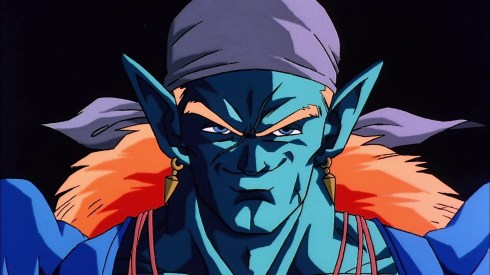
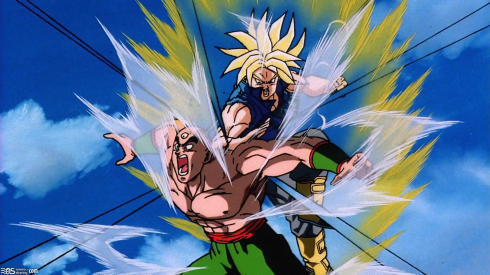
Original Release Date:  July 10, 1993

English Release Date:  August 17, 2004

Directed by:  Yoshihiro Ueda

Screenplay by:  Takao Koyama

Running time:  51 minutes

Dragon Ball Z:  Bojack Unbound is the rare DBZ movie that actually could be considered canon, should someone want to. Like most, the stakes and impact of the film are basically nil in the grand scheme of things, but it takes place during the period following the Cell Saga but before the Buu Saga that the manga and anime both skip over. This movie is also the last to use the classic opening theme song of “CHA-LA HEAD-CHA-LA” and also the last to feature an appearance from Future Trunks (Eric Vale). It is the first to feature the bumbling World Martial Arts Champion Mr. Satan (Chris Rager), who plays a role in the film’s plot. And it’s also the first to feature a dead Goku (Sean Schemmel), which doesn’t seem that weird for DBZ, but it’s a pretty odd concept nonetheless. With Goku only playing a minor role, this is essentially Gohan’s (Stephanie Nadolny, making her last appearance as the voice of Gohan) chance to assume the starring role for a change.

Bojack Unbound essentially takes place in one location. A martial arts tournament is being thrown by a mega wealthy individual who is basically just trying to please his young son. To make things more interesting, his son requests that the tournament feature alien warriors from another planet, and his dad promises to make it happen. And waiting at the end of the tournament for whoever can topple the aliens will be the champion himself – Mr. Satan.

maxresdefault-34

Bojack – the villain of the day.

This tournament has attracted a lot of media attention, and with a large purse as reward, a great many warriors have turned up for it including most of our favorite characters and Yamcha (Christopher Sabat). The tournament differs from the ones we saw in Dragon Ball. It’s a multi-tiered, open-air arena where the goal is to either incapacitate your opponent or knock them into the water. Water you say? That’s because the whole thing is on a man-made, movable island. It’s a pretty neat design and basically every background in this movie is quite unique in relation to what we’re accustomed to seeing. The tournament opens with a massive melee. Gohan (dressed in his father’s gi), Trunks (sporting his long hair and blue jacket but the sleeves have been cut off), Piccolo (Sabat), Krillin (Sonny Strait), and Tien (John Burgmeier) all advance out of the melee along with some no-names to the second round. Bulma (with baby Trunks) and Chi-Chi (Cynthia Cranz) watch from the stands while Oolong (Brad Jackson) and Master Roshi (Mike McFarland) scope out the babes around the area. Goku and King Kai (Schemmel), along with Bubbles and Gregory, are watching via broadcast TV from beneath Snake Way since King Kai’s planet was blown up by Goku during the events of the anime.

Tien vs Trunks

Tien gives Trunks a match, but in the end he falls as expected.

Notably missing from the action is Vegeta (Sabat). We learn via conversation between Bulma (Tiffany Vollmer) and Chi-Chi that Vegeta has lost his fighting spirit since the death of Goku. He’s shown briefly watching the broadcast of the fight on television before turning it off in disgust. Trunks’ sword is in the foreground of the shot and Vegeta is strangely laying on a bed wearing his full armor. It’s a pretty interesting way to approach Vegeta. He has never had warm feelings for Goku, but Goku did represent a rival for him and his constant superiority over Vegeta was a prime motivating factor for Vegeta in his training. Seeing Goku’s son Gohan surpass him during the fight with Cell probably damaged his ego, and add that in with Goku’s death and you’re left with a Vegeta suffering from depression.

Mr. Satan Bojack

Making his film debut, the incomparable Mr. Satan!

The tournament moves onto one on one battles and by now Mr. Satan has taken note of who’s participating. He immediately starts feigning a stomach ache to hopefully get out of any obligation to fight since he knows he can’t compete with the likes of Gohan and co. Meanwhile, Trunks and Tien get to have a match and it’s pretty entertaining. Tien gets to save some face by forcing Trunks to go super, but the outcome of the match is obviously never in doubt. Krillin has to face Piccolo, and while he stands there shivering bemoaning his poor luck, Piccolo shows disgust and decides to bail on the whole tournament deeming it not worth his time allowing Krillin to win by forfeit. I get that Piccolo wouldn’t have any interest in a monetary prize, but surely he would have relished the thought of having a real battle with either Trunks or Gohan so I don’t really get why he would bail like that. I guess I should just laugh like the movie wants me to and move on.

Gohan is matched-up with just some guy who he’s able to take out with ease, and the four semi-finalists move onto the next round. That’s where things get weird as the third round is apparently a race. Each contestant is put in some Tron-like rocket car that will jet them off to a new island where one of the four alien contestants that have been hyped are waiting. Whoever beats their opponent and gets to a certain spot the fastest wins and gets to move onto the final round with Mr. Satan.

lhVMdpUGrDs07iXk1JiF3DxHB81

Krillin’s got a thing for redheads, it would seem.

Gohan, Krillin, and Trunks, along with another random guy, head off to meet their new opponents, only what they encounter is not what was expected. It would seem the alien warriors have been replaced, and Krillin encounters his one weakness. Well, actually Krillin has many weaknesses, but his biggest are the ladies. The mysterious Zangya (Colleen Clinkenbeard) appears before him and he’s pretty much too charmed to put up a fight and she takes him out easily. Trunks is matched off with the sword-wielding Kogu (Ethan Rains), who appears to be a worthy adversary, but has to power-up into this green-skinned super state to bring out Trunks’ true power. Trunks eventually seizes the upper hand, and punches a hole right through Kogu, but is immediately assailed from behind after the fact. Gohan is left to face the diminutive Bujin (Christopher Bevins), but soon is forced into fighting all of the victors of the other bouts, which also include Bido (Robert McCollum) who took out the random fighter who joined the three.

It’s at this point that Bojack (Bob Carter) shows himself. He’s the leader of this gang of djinn-like fiends and he offers no explanation for why they’re there. King Kai is able to fill-in Goku on just who this guy is. Apparently he’s just some asshole who loves genocide that King Kai and the other Kais were able to seal away long ago. When King Kai’s home world was blown up by Goku, the seal was broken and Bojack became unbound. King Kai just sort of forgot about this guy until now. He stresses that Gohan and the Earth is in a lot of danger, but Goku isn’t too concerned.

Bojack2

Here comes Vegeta!

At least he isn’t at first. Gohan more than holds his own against the lot of Bojack’s men, though they soon demonstrate this technique that’s similar to spider webs that can hold people in place and drain their energy. When Gohan gets into some trouble, Piccolo makes the save as he does in basically every movie. Trunks re-enters the fight and when it looks like he’s about to bite the dust Vegeta is there to provide the assist (with Trunks’ sword, no less). Vegeta tries to take on Bojack himself, but he’s no match for him once he powers-up into his green-skinned form. Trunks tries to help him out, but Vegeta is not too receptive which only really leads to the two of them eventually unconscious.

Vegeta elbows Trunks

Good talk, Dad.

It basically comes down to Gohan, and as a Super Saiyan he’s able to stand his own but the numbers are against him. He gets caught in that web stuff, but Mr. Satan (who was basically forced into one of those rocket cars) crashes into the scene and makes the save inadvertently. He also takes out the cameras, so suddenly the audience has no idea what’s going on. Bojack gets ahold of Gohan though, and it starts to look bad for the young warrior. Goku can’t take it, and he uses his instant transmission technique to warp in and punch Bojack in the face. He gives Gohan a quick pep talk, before he has to bail, but it’s enough to convince Gohan to unlock his true power and go Super Saiyan 2.

Bojack1_small

Even when dead, Goku can still make the save.

Now fully powered-up, Bojack’s minions stand no chance. Gohan literally punches one guy in half and kicks another in two. When Zangya is in his crosshairs, the fine folks at Toei wisely made the call to not have their hero butcher a woman and instead Bojack uses her as a shield and fires a massive blast at Gohan from behind which kills her in the process. It does nothing to phase Gohan and it soon becomes apparent that Bojack is no match for Gohan in this form. He dispatches him with ease while Goku and King Kai look on (apparently their Other World television set is not reliant on cameras).

dragon-ball-z-movie-collection-4-bojack-unbound-screenshot5

Now he’s serious.

The film ends with Gohan, Trunks, and Krillin in hospital beds (must be a senzu bean shortage) yukking it up with the other characters. It’s revealed that Mr. Satan received all of the credit for killing Bojack and Oolong encourages Gohan to try and get a piece of the pie for himself. Piccolo and Vegeta, in a familiar nod to Super Android 13, quietly sit on the hospital roof away from the main throng of folks in silence as the picture comes to an end. During the credits, we’re treated to images of Gohan and his family from throughout the events of the anime which are rather sweet. It’s like a final farewell to the child version of Gohan and a surprising touch for a Dragon Ball Z film.

BojackZangya.BojackUnbound

When shit gets real, Bojack finds some cover in the form of his underling.

Bojack Unbound is a solid entry into the Dragon Ball Z film-verse. Actually, it’s more than solid as it might be my favorite thus far. It’s a tight, simple story, but the premise makes sense given the source material. Everyone is given a logical motivation for wanting to participate given the huge cash outlay, and the film even explains why Future Trunks is there and why Vegeta is not, and usually these films see no need to explain much of anything. The villain still shows up largely out of no where and with little reason. The film decides to just say “screw it” in giving Bojack any real goal and literally just decides he loves killing and genocide. I guess if you don’t want to have to bother with developing a villain just make him love genocide. Like a lot of the films before it, this one does mostly take a large arc from the anime (The Cell Games) and condenses it into a brisk film. We get a few shining moments from Trunks, a Vegeta cameo, Mr. Satan hijinks, and a Super Saiyan 2 transformation and subsequent domination by Gohan. The fighting prior to that transformation is fun and imaginative, so it doesn’t bother me so much that we have another movie where a hero powers-up and effortlessly disposes of the bad guy in the end. I was a bit surprised they didn’t go for another Father-Son Kamehameha, but not disappointed. Gohan does use his father’s most famous technique as part of the dismantling of Bojack, and he actually does it in a really bad ass way.

Mr. Satan poops

Speaking of shit getting real…

Bojack Unbound is also possibly the best looking Dragon Ball Z movie so far. I was pretty impressed with Broly – The Legendary Super Saiyan, but this one ups the ante by having more diverse backgrounds and even unique character designs for our heroes. Gohan, for the first time since his early days in the anime, sports an orange gi just like his father. Toei didn’t have to do that, but given his dad has died, it makes sense why Gohan would want to wear that and honor his memory in a tournament. Trunks also gets a design unique to this movie and he looks pretty cool. I’m not a huge fan of his long-haired look, but he pulls it off with the sleeve-less jacket combo. Mr. Satan also gets some new duds and he’s pretty regal-looking as the World Champ. The villains also have a neat look as they’re all this blue-skinned djinn-like race of beings with orange hair. Series creator Akira Toriyama actually designed Bojack, though I’m not sure if he had a hand in designing the others. There isn’t much personality on display beyond cocky, evil people who like inflicting pain, but at least they mostly look cool. They remind me of Zelda’s Ganondorf, who was still a few years away from making his debut in Ocarina of Time.

tumblr_m5y2jqX1GF1ryrpaxo1_500

The ending credits feature some fairly adorable depictions of Gohan and his loved ones.

Bojack Unbound is a movie I had seen long ago as a fansub but remembered little of it beyond the unique character designs. I wasn’t that eager to revisit it, but I’m glad I did as this is my favorite DBZ movie so far. There’s still some nits to pick here and there. Bojack is just all style as a villain and Goku breaking the rules of the after-life to just pop-in is kind of dumb. I also wanted to get a little more out of Vegeta given the depressed state of mind he was in. That just seems like an interesting layer to add to the character and I’ve also been fascinated by the Vegeta/Trunks dynamic as well so more of that would have been appreciated. Coming in at 51 minutes though puts this one right in line with the other movies and it’s a solid running time for a DBZ feature. There isn’t enough plot to typically sustain these things past the one hour mark, though given the story-telling possibilities I mentioned in regards to Vegeta, maybe this one could have gone past that with some success. It’s still a tight story with plenty of action, a lot of humor from the supporting cast, and a mostly satisfying conclusion which is where so many of these films seem to stumble. If this ends up being my favorite of them all, then I’m fine with that.


Batman: The Animated Series – “Birds of a Feather”

Birds_of_a_FeatherEpisode Number:  47

Original Air Date:  February 8, 1993

Directed by:  Frank Paur

Written by:  Chuck Menville, Brynne Stephens

First Appearance(s):  Veronica Vreeland, The Duck Boat


It would seem the writers of Batman:  The Animated Series had the hardest time with the two primary antagonists from the then recently released Batman Returns:  Catwoman and The Penguin. We’ve seen Catwoman portrayed as a cat burglar with a heart of gold, but following her debut she’s been in flux relegated to damsel in distress and sometimes vigilante. With The Penguin, he debuted in the divisive “I’ve Got Batman in my Basement” in which he’s outwitted by a bunch of kids. Because it was so obviously pandering to its young audience, that episode is often cited as one of the worst in the series, but since it was effective at that pandering, there seem to be an equal amount of folks who really enjoyed it. Since that episode though, The Penguin has been more of a side character as he was in “The Strange Secret of Bruce Wayne” and “Almost Got ‘Im.” We haven’t seen The Penguin in another solo outing, until now that is. And even here, we have an atypical episode as it’s not focused on Penguin’s next scheme, but on his reform. In that, it is somewhat similar to Batman Returns because we’re going to see Penguin engage with high society and try to find social acceptance among the elite, only to be humiliated and lash out in only a way a super villain can.

veronica

Prepare to meet Veronica Vreeland.

The episode opens with Penguin (Paul Williams) robbing a museum. In a bid to remain classy, he probably dilly-dallies too long trying to impress the guards giving Batman time to show up and put a stop to the robbery. Penguin is sent off to prison, since he’s not considered insane and thus not bound for Arkham Asylum, and it’s there he serves out his sentence to the end. At which point he declares himself reformed, and whether or not he’s sincere is unknown. He expects his old entourage to arrive with a limo to pick him up, but when no one shows he’s forced to ride the bus in disgrace. He has the bus drop him off at his penthouse where he walks in expecting to find a party celebrating his release. He even indicates he expects the other various rogues to be present like Joker and Two-Face, but instead he finds an empty home with sheets draped over the furniture. Penguin isn’t alone though as Batman is there to remind him that he’ll be keeping an eye on him. Penguin asserts that he’s reformed, but Batman doesn’t seem convinced, though he leaves him be.

Pan03-3

Not the entourage Penguin was expecting.

Elsewhere, socialite Veronica Vreeland (Marilu Henner) is bemoaning her plummeting social status to her associate Pierce (Sam McMurray) who suggests she throw a party to improve her reputation. She seems skeptical, but when he reminds her how another individual saw their reputation skyrocket following The Joker crashing her party, she starts to warm to the idea of a party. Pierce waves the front page of the local newspaper to her declaring The Penguin has been released, and we have our plot.

penguin laugh

Veronica, obviously charmed.

The Penguin is more than enthusiastic about dinner with Vreeland, who takes him to a fancy restaurant where he dines on sardines or whole fish of some kind. His presence is found to be a major turn-off for the other patrons, partly because of his grotesque eating habits and probably also because he’s a known criminal. Penguin is enjoying the dinner regardless, but he’s suspicious of Vreeland who insists she just wants to get to know him. Satisfied, he requests the check but the waiter tells him the meal is free if he leaves now. Thinking this is an acknowledgement of his high society status, Penguin happily leaves with Vreeland on his arm. Outside the restaurant, the two are accosted by a trio of muggers. Penguin looks the part of hero as he fights them off, but Batman shows up to clean up the mess. He grabs Penguin and assumes he was robbing Vreeland, but she steps in to correct him giving Penguin a moment to admonish Batman which he seems to enjoy. Just before the mugging, Penguin was invited to the party Vreeland is planning and he accepted, making this quite the night for the portly little fellow.

penguin reformed

Penguin showing off his heroic side. Never mug a man with an umbrella.

Veronica and Pierce are then shown discussing the events of the evening. Pierce finds The Penguin laughable and seems to think this party will be a huge hit at Penguin’s expense. Veronica though demonstrates that she may be warming to the former criminal as she found his behaviour with the thugs charming and sweet. Bruce Wayne interrupts their conversation and asks whom they’re discussing. Pierce spills the beans that Veronica is dating The Penguin as a publicity stunt, which concerns Bruce, naturally. He leaves them with a warning about The Penguin, but it doesn’t seem likely that they’ll actually take it to heart. That night, she and Penguin attend an opera and she’s obviously not taken by his horrid singing. She still doesn’t let her revulsion seem obvious when he turns to her and even permits him to lay a smooch on her hand. Bruce is there as well, being kind of a creeper, but he seems to notice that Penguin is genuinely showing affection for Veronica which only worries him more.

scheme revealed

Penguin looking dejected as he finds out he’s been played a fool.

Presumably the next night, Veronica’s party is underway. The Penguin feels he’s in his own element schmoozing with Gotham’s wealthy socialites, cracking witty jokes and attempting charming behaviour. He’s oblivious to the fact that everyone else is seemingly appalled by his appearance and is making jokes at his expense whenever he moves onto another conversation. Pierce is especially enjoying this, while Veronica is clearly feeling guilty. When Penguin steps out onto a balcony for a few quiet moments, he’s joined by Bruce Wayne. Penguin shows him a special brooch he plans to gift Veronica, and Bruce looks nearly distraught as he knows what’s going on. When Penguin heads back inside, he overhears Pierce and Veronica talking about what’s going on. Realizing he’s been played a fool, he lashes out blasting them in the face with knock-out gas from his umbrella (apparently he wasn’t reformed enough to cease carrying armed umbrellas). Bruce tries to intervene, but he’s unable to stop Penguin from kidnapping Vreeland.

BF_23_-_Duck_Boat

It’s the duck boat!

Pierce is forced to head to the police where our always right Commissioner Gordon is correct in placing much of the blame for the current circumstances on he and Vreeland. Even so, it doesn’t excuse the fact that The Penguin has unlawfully abducted a woman ending his short-lived reform. Pierce is also a total jerk to Gordon, which is what prompted Gordon’s dressing him down. They soon receive a ransome note from The Penguin, and it demands that Pierce has to deliver the ransom of one million dollars personally. When the police bring Pierce to the drop-off location they find a pay phone and Penguin promptly calls him on it instructing him to head to a new spot without company. The new spot is a trap, of course, and Pierce finds himself dumped into the sewers where he lands on a big, yellow, duck boat! Yes, the very same one from Batman Returns, though this one looks a bit angrier.

BF_23.2_-_Trap

Not a place you want to find yourself.

The boat takes Pierce to a new location, and upon ascending some stairs, he finds himself in an opera house. There he finds Veronica chained to a chandelier. She pleads with Penguin to free her, and even confesses she was growing fond of him, but he doesn’t believe her. He’s too far gone now. Pierce is chained to a platform below the chandelier, and Penguin rummages threw the money and discovers a Bat-tracer (really, Batman, be more discrete). Enraged, Penguin goes to cut the rope on the chandelier which will surely kill both Vreeland and Pierce. She tries to talk him out of it, once more claiming to have grown fond of him, but it’s no good. Batman shows up to prevent the double homicide. Since Penguin can’t go one on one with Batman, he hops on a dragon prop that also apparently breathes fire. In what is possibly the most ludicrous visual we’ve seen on this show, Penguin flies around on this dragon with a viking helmet and sword. Batman has seen worse, and he takes the bird-boy down and frees the two wealthy jerks.

BF_25_-_Viking_Penguin

Now here’s something you don’t see every day.

As the cops lead Penguin away, Veronica once again approaches him and tells him that she was really growing fond of him. Penguin, with perhaps a touch of sadness, rebuffs her once more, “I suppose it’s true what they say; society is to blame. High society.” Batman also looks on with no indication of satisfaction over what he’s seen. This one has no happy ending for anyone.

Birds_of_a_Feather_Over

Normally a triumphant scene, but here there’s a somber air over Penguin being lead away in handcuffs.

“Birds of a Feather” is a pretty weird episode for what is ostensibly a kid’s show. A reformed criminal trying to ingratiate himself into a wealthy circle, only to find he can never hope to fit in where he feels he belongs most. Thus, he turns back to crime and is reformed no more. It’s a very mature storyline, which I suppose he was owed after his debut. Kids are capable of empathy though, and I think this episode successfully makes Penguin out to be a sympathetic figure similar to what happened with The Riddler. Only in this case, The Penguin doesn’t get to escape in the end. He’s returned to jail, and the next time we see him he’s back to his old ways as he’s apparently abandoned all notions of reform. Vreeland will return as well as mostly the same character we see here, so she has apparently learned nothing in the end.

PierceChapman

We’ll see more of Vreeland, but Pierce and his smug, stupid, face are confined to just this episode.

This episode is one of the few that seems to successfully merge the classic portrayal of The Penguin, as an odd-looking but refined criminal, with the grotesque one from Batman Returns. He’s always been deformed in this show, but it’s never been a focal point as he mostly embodies the characteristics of the comic book character. In the restaurant scene we get a glimpse at the more monstrous side and Veronica is obviously grossed out by his appearance. The other wealthy characters poke fun at his appearance as well behind his back. There is humor though in seeing him try to fit in, especially when he, at the party, advises the manager of a bank he knocked off in the past to bolster security. His speech patterns and mannerisms embody the role he’s trying to play, but the subject matter is obviously inappropriate for the setting. Those little bits of humor play well and are needed since most of the episode is uncomfrotable to watch. We know The Penguin is being played, and he seems genuine in his attempt at reforming, but he’s also bound to find out he’s being made fun of and won’t respond well. The duck boat is a nice callback to the movie as well, and I can’t remember if it makes another appearance or not.

“Birds of a Feather” is an overlooked episode, but it’s also probably the best Penguin episode. I never count it among the show’s best, but whenever I sit down to watch it I’m entertained and pulled in by the story. It’s light on action, but the character development and setup is well done. It helps that it doesn’t need a lot of screentime to develop a character like Vreeland or Pierce,  and they’re not short-shrifted at all. It’s a dense episode and it makes good use of what time it has. There’s not a lot of Batman, but the episode doesn’t need it and his presence is still felt throughout. I really like how the episode is able to get the audience to turn on Batman in some respects, as I recall watching this as a kid and being irritated with Batman for going after Penguin when he had done nothing wrong. Then I ultimately felt conflicts when Penguin did do something wrong, but still felt like he was justified in his actions. The episode needed to have him basically attempt murder in order to make it acceptable to see him sent off to jail in the end. If this is an episode you’ve either slept on or forgotten about, give it a look. And if it’s one you may not have liked much as a kid, you may find it more enjoyable as an adult. This isn’t the last we’ll see of The Penguin bringing Batman Returns to the small screen, but it was the most well done.


NECA 1990 TMNT Movie SDCC Set

neca TMNTFor the past several years, the folks over at NECA have been making San Diego Comic Con an annual event for fans of the Teenage Mutant Ninja Turtles. I mean, it’s always an event, but it’s been especially fun for TMNT fans because NECA has been able to release limited action figure sets based on the property. These sets have been wildly popular and thus a bit hard to get ahold of for fans not attending the event. They often sell-out and command big mark-ups on the secondary market. As a result, while enthusiasm remains high, there can be some backlash for those who are unable to secure a copy at MSRP.

The reason for all of this is essentially Playmates. Playmates was a partner with Mirage Studios and Fred Wolf Productions in bringing the TMNT from print to the small-screen. In the 1980s, getting a show to air for boys often necessitated a pairing of show with toys in a symbiotic relationship. The franchise was viewed as risky, and creators Kevin Eastman and Peter Laird had a hard time finding a toy company to make their dream happen. Playmates eventually jumped-in, but got a pretty nice deal out of the whole thing thanks to the desperation of those trying to make money off of this thing. As a result, they still hold the master toy license for the franchise and can dictate who can and can’t make toys based on the franchise here in the United States.

About 10 years ago, NECA was able to release a set of TMNT based on their original Mirage look. They were specialty shop toys and were very well received. NECA would also release an April O’Neil and show-off a Shredder, but it never made it to retail. At this time, Playmates was still consumed with making toys based on the Fast Forward cartoon produced by 4Kids and likely didn’t feel threatened by another company releasing collector toys based on the comics. Eventually, maybe after seeing the success NECA was having or due to diminished interest in the cartoon, Playmates would engage the collector crowd with their own Mirage Turtles which may be why NECA’s line ended with April.

Ever since then, NECA has had to find a way to create product based on the franchise (a favorite of NECA Director of Product Development Randy Falk) that works for them as well as Playmates and Nickelodeon (the current owner of TMNT). As a sort-of compromise, NECA has been allowed to produce 6″ scale figures as convention exclusives only. In addition to being allowed to sell them at conventions, they’re also permitted to sell them online as a pre-sale in advance of the event, but not after or in perpetuity. The only exception has been the quarter-scale line which NECA has been allowed to produce and release to retail, presumably because Playmates has no interest in figures at that scale.

Via these convention exclusives, NECA has been able to finish off their old Mirage line by releasing a set containing Shredder and some Foot soldiers. They also did figures based on the original TMNT arcade game and just last year released a massive set of 8 figures based on the first season of the 1987 cartoon. For 2018, NECA may have felt pressure to out-do that 2017 set and once again turned to the 1990 film – which is perhaps the greatest version of these classic characters. For the past two years, NECA has been releasing these figures in its quarter-scale line, a line I loved and own each figure from. A lot of fans have been begging for a release of these same figures in a 6″ scale and now they finally have their wish.

I was one of the lucky few to score a set during the pre-sale on NECA’s website. Two versions were offered:  the set of four turtles and a set of four turtles with a diorama. The set ran for $125, and the diorama set was $250. The diorama is going to be released to retail in a slightly more generic format, but it captures the grit of NYC from the 1990 movie. It’s also huge, which is why I passed on it as I don’t really have room for it. I was content to just settle for the set of action figures, and I am quite pleased with the product delivered to me roughly two weeks after San Diego Comic Con commenced.

The four brothers come housed in packaging designed to mimic the original VHS release of the 1990 film. It’s obviously over-sized to properly house the figures and all of the images of the characters have been replaced with photos of the actual action figures and it’s pretty damn remarkable how close to the actual thing these look. If it weren’t for the fact that Donatello is smiling on the original release, you probably would be fooled by the cover. The reverse side has the film critic quotes replaced with quotes from folks in the toy (and wrestling) world praising the set. It’s not as durable or as resplendent as the case released with last year’s set, but my fondness for this movie means I probably prefer this one to last year’s Archie inspired case.

The outer case is a sleeve that slides right off once you get past some tape. Behind it are the figures in a window box setup. They’re not as easy to remove from the packaging as last year’s action figure case inspired design as the feet are actually through some holes, but you’re unlikely to destroy the packaging when removing these treasures. In addition to the four turtles and their weapons, NECA also included a second set of bandana tassels, four sets of interchangeable hands, an ooze canister with removable top, and an entire pizza broken out into individual slices housed in a paper box. The sets of hands should be familiar to those with the quarter-scale versions as they’re all from there: a set of slightly open hands, a set of completely open “high-five” hands, a set of thumb’s up hands, and a set of pointing hands. It’s slightly disappointing that we don’t have four open palm hands to recreate a cowabunga pose, but otherwise it’s more than adequate. The turtles themselves have tighter fist hands by default for holding their weapons.

The hands and bandana tassels are all easily swapped in and out. Action figures that take advantage of swappable parts are often tight and even a little scary, but these figures are pretty effortless. If anything, the pegs on the other hands are moved too freely as that’s the only challenge in pushing them in as they want to move around on you a bit, but it’s no big deal. The wrist bands on each turtles are now molded to the figure which also makes swapping the hands easier. The bandanas are just as easy. The quarter-scale version had fabric tassels, but these versions opted for plastic which is why there’s some options presented. You basically can just decide if you want your turtle’s tassel to flow left or right. It’s not as good as the quarter-scale ones, but it’s fine.

The real star of the accessories though has to be that pizza. It may sound ridiculous, but it might be my favorite part of the set. NECA earlier this year released a set of baby turtles for their quarter-scale line that contained a box for the pizza released with the main figures as well as the rest of the pizza. This is basically a down-scaled version of the same. The box is designed to resemble a Domino’s box as seen in the film only it’s from Tile Game Pizza instead due to obvious licensing issues. It looks remarkable and there’s tons of little detail including a coupon taped to the top and little grease smears. It’s so lovingly detailed that it borders on absurd and it makes me want to order some pizza every time I look at it.

IMG_2609

It slices, it dices…

The figures themselves, the real stars of the set, are down-scaled versions of their quarter-scale cousins. This means they possess basically all of the pros and cons of those figures, and in case you’re wondering, there were very few cons. Let’s get to the few differences first, shall we? I already mentioned the bandana and wrist band difference, but the only other main difference is the loss of Donatello’s straps for his bo staff. You can basically just jam his bo under his belt to achieve the same thing though. This also may be unique to my set, but my Raph is also a bit cross-eyed in comparison with the quarter-scale version with his right eye looking down instead of straight-ahead. He has really narrow eyes so it’s not that noticeable unless you’re holding the figure right in front of your face. A difference in a positive area though is these guys have slightly more articulation than the larger toys. And since they’re lighter, their joints don’t have to be as tight and they can be posed a lot easier as a result.

IMG_2625

Do you like penicillin on your pizza?

The figures are a nice, soft, plastic that reminds me of the old Playmates Movie Star Turtles I adored as a kid (and still have). The texture on the flesh is exquisite and perfectly captures the look of the film. Each figures uses the same base body with a different belt, head, and shell. The shell itself is actually the same, but each turtle has unique blemishes and such with Raph’s being significantly more battle-damaged. The only drawback to the figures using the same base is that they’re all the same height. It’s an issue the quarter-scale ones possess as well. They were all different heights in the film, though the only one that stood out is Mikey who was shorter than his brothers. He looks a little off as a result, but it’s obviously not a deal breaker.

If you were lucky enough to get ahold of this set then you will likely have a ton of fun trying to recreate poses from the film. Especially if you grabbed that diorama or have some fun custom ones of your own. These guys really look stripped from the film and it’s so rewarding to pair them up with the quarter-scale versions. NECA is prepping an already gave a peek at their quarter-scale Foot Soldier and a Shredder is expected as well. Naturally, this has fans hoping for 6″ versions of the same to pair with these to really complete the set.

If you were unable to score one of these sets then I have some good news for you. NECA recently reached a deal that will allow them release TMNT product at retail in a 6″ scale. Randy did say the movie figures will remain convention exclusives, but maybe that only refers to this specific set. Could single-packed figures make it to retail? Who knows? I don’t want to get anyone’s hopes up, but maybe hold off on paying eBay prices for now and take a wait and see approach. These figures are so damn good that it’s kind of a shame if they remain exclusive to this one set, but at least we have them as-is and I can’t wait to see what NECA does next with the franchise. They have yet to disappoint.


Dragon Ball Z: Broly – The Legendary Super Saiyan

Dragon_Ball_Z_Broly_–_The_Legendary_Super_Saiyan_(Movie)Japanese Title:  Burn Up!! A Close Fight – A Violent Fight – A Super Fierce Fight

Original Release Date:  March 6, 1993

English Release:  August 26, 2003

Directed by:  Shigeyasu Yamauchi

Screenplay by:  Takao Koyama

Running Time:  72 minutes

If there is an MVP of the Dragon Ball Z movies then it might be Broly by default. Starring in a record three films, Broly is the most over-exposed of the movie villains. Thankfully, he doesn’t appear in three consecutive films and there’s a film in between this one and his second appearance as three in a row really would have felt like overkill. Probably owing to his exposure, Broly has become a some-what polarizing villain among DBZ fans. He’s very recognizable and his appearance is striking so he has a tendency to show up across all media related to the franchise. He’s featured prominently in video games, toys, and other merchandise though he’s been kept out of the main series as well as Dragon Ball GT (or at least he was, until it was announced in July that he’ll be the featured villain in the upcoming Dragon Ball Super movie due to hit theaters in Japan this December). His status as the Super Saiyan of Legend gives him instant credibility to go along with his menacing appearance. He’ll never be as overpowered as he is here, nor will he ever be as interesting, but for a first appearance this one is pretty good. This is also the longest DBZ film thus far and will remain so until Battle of Gods. Most of these movies are kept under an hour, but this one is over 70 minutes and it feels pretty long as a result. Is it too long? Maybe, but we’ll get to that.

drunk roshi

Master Roshi enjoying himself during a picnic.

The film opens with King Kai (Sean Schemmel) sensing the destruction of a planet in the south galaxy. It’s an ominous piece of foreshadowing and I think it’s safe to say we’ll unravel the mystery of who’s responsible in short order. He reaches out to Goku (Schemmel), who is preparing for a school interview with his wife Chi-Chi (Cynthia Cranz). Chi-Chi is trying to enroll Gohan (Stephanie Nadolny) in a fancy school and needs Goku to be on his best behavior during the interview process in order to get him in. Goku has been forced to put on a suit and is clearly out of his element as Chi-Chi coaches him on the right things to say. She’s more than a little annoyed when King Kai starts butting in to fill Goku in on what’s transpiring in space.

dragon_ball_z_movie_collection5_broly_legendary_super_saiyan7

Paragus, along with his son Broly, claim to be among the few remaining Saiyans to survive the destruction of their home world.

Elsewhere, the rest of the Z Warriors are enjoying a picnic. Master Roshi (Mike McFarland) is looking pretty toasted as he makes a fool of himself. A spaceship touches down and a Saiyan male named Paragus (Dameon Clarke) emerges and immediately swears fealty to Vegeta (Christopher Sabat) who apparently wears his battle armor when attending a picnic. Paragus claims to be one of the last remaining Saiyans and informs Vegeta that they’ve settled on a new planet Vegeta (not to be confused with our Saiyan prince), and he wants Vegeta to rule them. There’s also a problem as the Super Saiyan of Legend has emerged and is wreaking havoc across the galaxy. Paragus needs Vegeta to take care of him, and Vegeta is ready to go. Vegeta, surprisingly, buys the story hook, line, and sinker and doesn’t even question how Paragus could be alive. The others are skeptical, and Gohan, Trunks (Eric Vale), Krillin (Sonny Strait), Master Roshi, and Oolong (Bradford Jackson) decide to board the spaceship and tag along.

Brolynormalform

The quiet and docile son of Paragus – Broly.

Paragus takes the group to New Vegeta, a ruinous planet where the others await. Paragus introduces his mostly mute son Broly (Vic Mignogna), and Vegeta decides to take Broly with him to look for the Legendary Super Saiyan as he’s grown annoyed by his own son, Trunks, who has voiced his doubts about Paragus. Broly is a tall, somewhat lanky, black-haired man with a  soft expression. Paragus seems to suggest he’s not very powerful, but we’ve seen the title of this movie and we know better. As Vegeta and Broly search for the Legendary Super Saiyan, Trunks, Gohan, and Krillin explore the rest of the planet. They soon encounter the other inhabitants of the planet, a cute, small, race of creatures who have been enslaved by the forces of Paragus. They’re horrified by what they see, and Gohan jumps in to fight the slave masters. During the fight, Goku arrives via his instant transmission technique as he’s interested in meeting this Legendary Super Saiyan.

maxresdefault-42

When Broly powers up his hair takes on a purple, and eventually a blue, hue.

Back at the palace, Vegeta and Broly return empty handed. Vegeta is a bit annoyed to see Goku, but it’s Broly who really seems agitated. He begins to grow angry at the sight of Goku, forcing Paragus to raise his hand upon which a golden gauntlet shines. It seems to react with a tiara that Broly wears and the boy is soon calmed while Goku is puzzled. That night, Goku is attacked in his sleep by Broly. The two trade blows until Paragus arrives, calming his son once again with the device on his hand. As he leads Broly away, Goku begins to suspect that it’s Broly who is the Legendary Super Saiyan.

Paragus returns to his room and questions if his mind control device is malfunctioning, or if Broly is just becoming too strong. We’re then shown the origins of the two. Broly and Goku were born on the same day and were placed beside each other in the nursery. It was obvious to all that Broly possessed incredible power from birth, but the constant crying of Goku beside him basically drove him mad. King Vegeta, fearing what Broly would become, ordered the execution of both him and Paragus, but Broly proved hard to kill. He saved his father, and the two were exiled following the destruction of the original  planet Vegeta. Paragus has been using his mind control device ever since to keep Broly’s power in check, as without, he becomes lost in his own power.

maxresdefault-41

The Legendary Super Saiyan revealed!

Goku confronts Paragus about Broly, while Vegeta has decided he’d rather just head back to Earth. Paragus denies the accusations, but eventually the slaves see Broly and confirm that he is indeed the Legendary Super Saiyan for he’s the own who destroyed their home planet. At the sight of Goku, Broly is unable to control his rage. He breaks free of the mind control device and his power is unleashed. He bulks up to an outlandish size as his hair takes on the traditional Super Saiyan look and his eyes go completely white. A green aura envelopes him, giving his hair a slightly different tint to what we’re accustomed to seeing from the other Super Saiyans, and the battle is on.

BROLY

Probably the film’s most famous shot.

Goku and Broly battle, but Goku is overmatched. Trunks and Gohan join the fray, but Vegeta is too paralyzed with fear to do the same. He’s spent a lifetime hearing about the Legendary Super Saiyan, and views him as unbeatable (why he was so eager to find him early in the film isn’t explained, maybe he just doubted that the being could possibly exist). Paragus sees this as an opportunity to taunt Vegeta and fill him in on he and Broly’s backstory. This is Paragus’s way to get revenge against Vegeta’s father for nearly killing he and his son years ago, and as icing on the cake he reveals that a comet is heading straight for New Vegeta and will destroy them all.

DragonballZ-Movie08_1399

Vegeta finally enters the fray, but is just as helpless as the others.

The other Saiyans are having no luck against Broly, until Piccolo (Sabat) shows up with some senzu beans. Adding Piccolo to the mix changes the outcome little, as Broly is still just too powerful. Piccolo realizes they’ll need Vegeta’s help if they’re to have any chance, and he basically shames the proud warrior into action, though he’s just as successful as the others. Paragus tries to escape in a Saiyan Space Pod, feeling it’s probably best to let the comet kill his son, but Broly catches him. He kills his father by throwing the pod into the incoming comet, and he’s now free to set his sights on the others.

1153117-goku-vs-broly-wallpaper-1920x1080-for-android-40

A powered-up Goku and Broly clash.

Goku realizes the only way to destroy Broly is for the others to lend him their power to concentrate it into a super attack. I suppose it’s the same concept as a spirit bomb, but instead it requires the others to just give them his power directly. They all do as requested, even though they’ve all been beaten to a pulp themselves, but Vegeta is the lone holdout. Goku still doesn’t have enough power, and eventually Vegeta relents. Bathed in a tremendous glow, Goku is finally able to go toe to toe with Broly. The fight is brief, and he concentrates his attack into a single punch aimed at Broly’s abdomen. It was there Broly was stabbed and left for dead as an infant, and the impact of Goku’s fist causes the old wound to reopen. Broly explodes, and the remaining warriors round up the slaves and pile into the spaceship Piccolo used to reach New Vegeta. They all escape before the comet’s arrival. Goku teleports he and Gohan home, where an angry Chi-Chi awaits. Goku is able to recite his scripted interview responses, causing Chi-Chi to faint and allowing our film to end on the usual humorous note.

Broly – The Legendary Super Saiyan makes good use of its long run time by bringing us along slowly. If not for the film’s title, the mystery of the Legendary Super Saiyan would probably be more satisfying, though it would probably still be fairly obvious that Broly is connected to the figure of legend. It’s an interesting setup though, and it’s different from what we’re used to as the heroes are whisked away to a new world and new location instead of having some alien invader come to Earth seeking Goku or whatever. I like the tragic backstory of Paragus and Broly, though the trauma inflicted upon Broly of a crying baby Goku is pretty stupid. I don’t know if Toriyama came up with that as it’s kind of in-line with his brand of humor, but it misses the mark. If they wanted a comical reason for Broly to hate Goku I feel like they could have come up with something better. If they wanted it to seem sincere, then they really missed the mark. The film also largely looks awesome, with some different backgrounds to take advantage. In particular, I really enjoyed setting of the picnic at the beginning of the movie with all of the cherry blossoms in the background. It would have been neat to see a fight unfold there.

2mrtock

This movies takes an interesting look at Vegeta, that works in some ways and doesn’t in others.

The portrayal of Vegeta feels inconsistent and kind of off. Vegeta has always been the proud warrior, so it made sense to me why he would want to seek out the Legendary Super Saiyan. He welcomes a challenge, but he apparently also has respect for the myths and legends of his deceased people. He’s unusually quiet, and just goes along with Paragus, when I feel like he should have been more cocky and proclaimed himself the actual Legendary Super Saiyan. When Broly’s power is revealed, seeing him a puddle is really bizarre. I have no problem with exploring a different side of Vegeta, and in fact it’s something I really like about our next movie, but I think they took it too far and it feels like too much of a betrayal of who Vegeta is.

Trunks_Preparing_to_Fight_Broly_Alongside_Goku_&_Gohan

This one features the film debut of Super Saiyan Gohan as well as Trunks’ long-haired look.

These movies have a hard time coming up with unique ways to end the conflict. It’s disappointing that this one basically utilized the same method as our previous film, Super Android 13!, with Goku borrowing a bunch of power in order to deliver a killing blow. The problem with this movie is that we have no even fights at all, save for maybe the very first, brief, encounter between Goku and Broly. A large portion of the film’s run time is devoted to the fight with Broly and it’s mostly a slaughter. He’s so effectively violent though that it remains engaging watching him decimate the heroes. It’s just disappointing that when Goku does power-up, he basically ends the fight with one blow. I would have preferred to see a more even matched confrontation that lasted some length of time, but oh well. The side-story with the enslaved race also felt rushed. It’s crazy that with the film running as long as it did that some stuff still felt under-developed, but I guess that’s what happens with a more ambitious plot.

Even with its problems, I still came out of this one really enjoying it. It’s one of the better Dragon Ball Z movies, and say what you want about Broly, he comes across as a legitimate villain with a cool design. He resembles the bulky Trunks from the main series, only he’s even bigger and isn’t penalized in the speed department by his massive physique. It’s kind of a novelty to see Goku dominated so convincingly, though the final outcome was cheap. As a result, it’s not surprising that the films would want to revisit Broly even if his demise seemed pretty damn final. It’s just too bad that the rematch is going to be a pretty underwhelming affair.