Beavis and Butt-Head Do Christmas

Beavis and Butt-head Do Christmas (1995)

Beavis and Butt-head Do Christmas (1995)

Last year, I posted about the many Christmas specials featured in the animated series South Park. Well, before South Park came Beavis and Butt-head: the subversive, moronic duo who entertained millions during the 1990s on MTV. Created by Mike Judge, who’s now probably more famous for King of the Hill and Office Space, Beavis and Butt-head were basically a rip on the MTV generation. They were dim, violence obsessed, and wasted away their lives in front of the television watching music videos and eating nachos. Despite the fact that the two were clearly presented as losers on their own show, kids liked to emulate them and if the duo approved of a band or video on MTV it offered a credibility boost to said band. Every rock and metal act wanted to be endorsed by Beavis and Butt-head, because it’s what the kids were into at the time.

Beavis and Butt-head embrace the holiday spirit. Kind of.

Beavis and Butt-head embrace the holiday spirit. Kind of.

Beavis and Butt-head first debuted with “Frog Baseball” on MTV’s Liquid Television block. It was so successful that it was spun-off into its own show which ran from 1993 until 1997 with a brief one season return in 2011. Along the way there was also a feature-length movie, television specials, and a spin-off called Daria. A few years ago, I made an entry of what I considered essential Christmas viewing and among the many movies and specials was Beavis and Butt-head Do Christmas. Well here’s a full write-up on the special from 1995.

Beavis and Butt-Head Do Christmas refers to two shorts with other holiday content woven in. Do Christmas has been released on DVD and VHS though is likely out of print at this point. The two shorts are parodies of classic Christmas stories/movies that should be obvious just by reading the titles of the two cartoons: “Huh-Huh Humbug” and “It’s a Miserable Life.” First stars Beavis and the second Butt-head and are roughly 12 minutes a piece. This was one of the few episodes of Beavis and Butt-head that didn’t have any music videos (a prior Christmas special for the show featured nothing but the two riffing on Christmas videos) but is still pretty hilarious, nonetheless.

In "Huh-Huh-Humbug," Beavis just wants to enjoy a porno but various ghost won't let him.

In “Huh-Huh-Humbug,” Beavis just wants to enjoy a porno but various ghost won’t let him.

“Huh-Huh-Humbug” puts Beavis in the role of Scrooge only he’s more of an idealized version Beavis sees of himself as opposed to a truly financially successful human being. The cartoon opens with Beavis squishing a rat on the grill at Burger World on Christmas when his boss comes over to admonish him for his lack of ambition and to brag about his position of assistant manager of a fast food restaurant. Beavis soon falls asleep on the job and dreams he is the manager of Burger World who gets to boss around Butt-head and Principal McVicker and make them work on Christmas while he goes home to watch a porno and jerk-off. When Beavis settles in to watch his porno, the various ghosts from A Christmas Carol start interrupting him beginning with Butt-head playing the role of Marley. The other ghosts admonish Beavis and point out how awful he treats McVickers, to which Beavis shows no empathy. He even disagrees with the Ghost of Christmas Yet-to-Come’s version of the future, instead choosing to imagine himself as a Terminator-like robot laying waste to the customers of Burger World.

A horrible future, indeed.

A horrible future, indeed.

The cartoon works because there’s no attempt to show one worthwhile quality within Beavis. He’s a selfish, stupid, person who is incapable of any kind of empathy. To add to the humor, there’s a lot of one-liners and the porno Beavis watches (also a parody of A Christmas Carol) is a great source for gags.

The second cartoon, “It’s a Miserable Life” stars Butt-head, but like the prior one, still features plenty of Beavis too. The twist on this parody is that the guardian angel for Beavis and Butt-head is sent to kill the two after God received numerous requests to make them disappear. The Clarence character here first tries to simply kill the two by freezing a bridge they’re walking on in hopes the two will slip and fall to their deaths. When that fails, he opts to show Butt-head what the world would be like if he never existed and how much better off people would be. Naturally, without Butt-head everyone is a lot happier and more successful. Bevies, in particular, is best friends with the dorky Stuart and volunteers at the soup kitchen on Christmas. After seeing all of this, Butt-head just gets pissed off and he and Beavis just determine that the world sucks, but would suck even more without them. The guardian angel tries to kill them again, but just ends up killing himself by accident.

Once again, the cartoon works by not resorting to any kind of Christmas sentimentality at all. Butt-head is portrayed as a parasite on society who refuses to embrace anything remotely “good.” It’s amusing to see the Butt-head-less world, but it’s more amusing to see Butt-head’s reaction to it. “Huh-Huh-Humbug” is probably my favorite of the two, but they’re both entertaining and pretty much for the same reasons.

Butt-head's guardian angel isn't here to help him, he's here to kill him.

Butt-head’s guardian angel isn’t here to help him, he’s here to kill him.

In between the specials we’re also tested to the Ask Santa Butt-head segments and a scene of a burning Yule log that the two riff over in place of music videos. The Santa Butt-head segments feature the duo playing Santa and reindeer, with Butt-head as Santa and Beavis the reindeer. Butt-head reads fan letters, with most of them being from women who want to have carnal relations with Beavis. Butt-head doesn’t understand this and refuses to give Beavis the letters. Since he’s roped up to the sleigh in his reindeer costume, there’s little he can do about it. When a letter-writer requests Butt-head kick Beavis’ ass, he’s happy to oblige by whipping the day-lights out of him. These segments are brief but do bring about a good amount of laughs with the two staying true to their characters even while playing other characters.

Beavis and Butt-head Do Christmas is not your typical holiday special. There’s no holiday cheer, unless you consider any amount of laughter brought on by a Christmas special a form of holiday cheer. It’s mean-spirited, low-brow, but also full of good satire that will make most people who remember the 90’s laugh often and frequently. Beavis and Butt-head are dumb, but the humor really isn’t which some people failed to “get.” I’ve always felt they were underrated in that regard, and perhaps South Park would end up better combining toilet humor with biting satire, but it doesn’t diminish what Mike Judge did with Beavis and Butt-head beforehand.


Home Alone 2: Lost in New York

Home Alone 2:  Lost in New York (1992)

Home Alone 2: Lost in New York (1992)

Home Alone, the John Hughes produced and Christopher Columbus directed film that dominated the holiday season of 1990, demanded a sequel. The film starred ten-year old Macaulay Culkin as Kevin McCallister, who was eight according to the film’s script. Considering the star was already two years older than the character he was playing, and getting older every day, a sequel had to be written, produced, and filmed rather quickly. The problem, of course, is that Home Alone is the sort of movie that really shouldn’t have a sequel, but given the economics of film-making, it was going to have to make do with one.

A friend of mine and I had a disagreement over the Home Alone series. I consider the original a Christmas Classic. It’s not a perfect movie, by any means, but it is entertaining and I enjoy my annual viewings almost as much now as I did when I was young. As for the sequel, well, I’ve never had much love for it. Even when I saw it in the theater as a kid I knew what it was:  a cash-grab, carbon-copy of the original. I never saw much use for it after that initial viewing. My friend, on the other hand, considers the sequel the superior film (we both consider the franchise concluded with Home Alone 2) which I strongly disagreed with. Having not really spent much time with it over the years, I wasn’t well-equipped to defend my position. When browsing the Christmas section at a local store, I happened upon the Home Alone and Home Alone 2 Blu Ray combo-pack and decided now would be a good time to revisit this film and either reaffirm my position or discover a new holiday favorite.

Kevin is back to make the adults of New York look like fools.

Kevin is back to make the adults of New York look like fools.

As I mentioned in the intro, the writers for Home Alone 2 were being put in a tough spot. The plot for Home Alone, of a family rushing off on a vacation to Paris forgets their son at home, is ridiculous on the surface but presented in a way that makes it believable enough for a comedy. Now what isn’t easy is convincing an audience that it could happen again. To forget one’s child at home is a pretty serious infraction. Most of us would jump to conclusions and suggest that anyone who did that is not fit to be a parent, but as I said, the first film does a well-enough job convincing us that the McCallisters aren’t the worst parents in the world. If they were to forget young Kevin again though…

Home Alone 2:  Lost in New York takes Kevin out of the home and drops him in New York City. Leaving him at home again was out of the question, so a new location had to be picked. And in order for Kevin to be left behind once again, a new variation had to be found.

How does Kevin wind up in New York? Well, let’s start from the beginning. Pretty much everyone who worked on the first film returned for the sequel including the cast, writers, and other talents that made the first film such a huge success. And once again, the McCallisters and their extended family are preparing to head out on vacation for the holidays. It’s been one year since the events of the first film and everyone is in Chicago to spend the night before flying off to Miami in the morning. Before the family can take off though, they have to attend a Christmas recital that Kevin and Buzz are both singing in. When Buzz, standing behind Kevin onstage, acts out during Kevin’s solo the younger McCallister is embarrassed and slugs his older brother in response, which somehow collapses the scaffolding on the stage. Back at home, both boys are expected to apologize to the family and make-up before everyone can go to bed and rest-up for the morning. Kevin, feeling that he’s done nothing wrong, refuses to apologize and insists he’s still being dumped on by the family. He and his mother exchange words, and everyone goes to bed angry with one another.

Of course, these guys are back too and somehow bump into Kevin in the middle of the city.

Of course, these guys are back too and somehow bump into Kevin in the middle of the city.

This, of course, is basically how the first film started with only minor modifications and everything here is presented worse than it was in the prior film. Kevin is angry, and rightfully so. In the first film we could see that he’s kind of a pain in the ass and could understand the family’s position. Here it’s just stupid. Buzz’s actions during the recital get a huge reaction from the crowd, and even Uncle Frank concludes they were “pretty god-damned hilarious,” which is just over the top. It’s not that funny, and no reasonable person would be angry with Kevin, and it makes me feel like my intelligence is being insulted. Also of annoyance to me, is the fact that Kevin is ten years old in this film, despite it only being a year after the events of the first movie when Kevin was eight. Now, normally this wouldn’t be that big of a deal but in both movies Kevin makes it a point to remind people how old he is on multiple occasions. Why didn’t they just make him nine? It just bothers me. And Kevin and his mom’s conversation prior to him going to bed is so similar to the first movie it hardly seems worth having. He even wishes to have a vacation without his family and she basically challenges him to make it happen, like she did in the first film when he said he didn’t want to see her again for the rest of his life. Does no one in this family learn anything?!

The setup of the movie is lazy at best, awful at worst, but it’s not going to make or break the film. So how does Kevin wind-up in New York? He gets separated from his family at the airport while fishing through his dad’s carry-on for batteries for his Talkboy (in stores this holiday season!) and then mistakes another man in the same coat as his dad for his dad. Like the first movie, it’s a mad dash to the gate for the family to make the flight so they lose track of Kevin. They get on the correct flight, but Kevin winds up on a flight to New York thanks to a collision with a worker at the terminal. Kevin, who seems like a smart and crafty young boy, gets on the plane and never notices that his rather large family is missing. Meanwhile, no one on the correct flight thinks to double-check and make sure Kevin is there. Considering this has happened before, why wouldn’t they?! Instead, it’s not noticed until the family is at baggage claim.

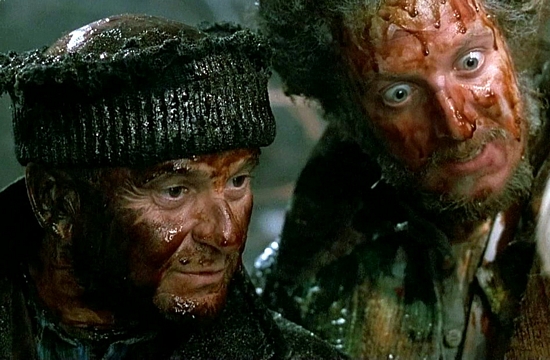
Meanwhile, Kevin checks into a fancy hotel in New York quite happy to have ditched his family. He makes fools of the adults running the hotel, and thanks to the large amount of cash in his dad’s luggage, has no trouble seeing the sights and having fun. Unfortunately, the Wet Bandits are in New York too, and somehow in a city of millions end up running into Kevin. Marv is quite eager to tell anyone their new master plan of knocking off a toy store on Christmas Eve, and Kevin decides it’s up to him to stop them (apparently the police can’t be trusted) by luring them to his uncle’s vacant house full of booby traps.

They should probably be dead at this point.

They should probably be dead at this point.

What does this movie get right? Not much, I’m afraid. I’ve already expressed my displeasure in the ridiculous setup but I can say the film does improve once Kevin is in New York. This is where the writers actually do a decent job of making Kevin’s actions believable. As he did in the first film, he takes advantage of adults who just think of him as a kid and is able to utilize his VCR and Talkboy in ways that trick adults into thinking they’re being scolded or even shot at. It is just as far-fetched as anything else, but feels smarter and does produce laughs. The main event, so to speak, is Kevin’s repeat encounter with the burglars from the first film. Here the writers are challenged to top what they did in the first film and the director is expected to make the visuals stand-up. Unfortunately, their attempts to top the first end up being just as lazy as the first scenes. Variations of the paint can, blow torch, and other gags are repeated. A few new ones are added, but few are all that memorable. Instead they end up being more absurd. While the damage sustained by the two in the first film certainly would have resulted in lasting damage, many of the traps in this one would have ended in death. Of course they don’t, but they’re certainly harder to believe.

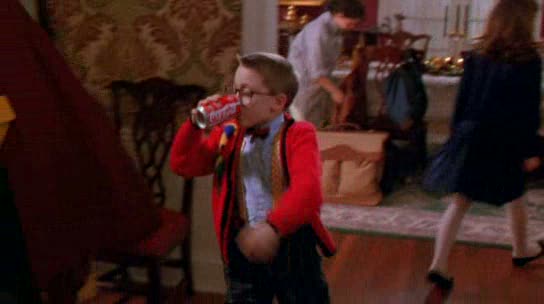
When a sequel is so similar to the movie it's following you look for any difference between the two, like Fuller's new affinity for Coke instead of Pepsi.

When a sequel is so similar to the movie it’s following you look for any difference between the two, like Fuller’s new affinity for Coke instead of Pepsi.

There’s also a B story at play, much like Kevin’s encounter with his elderly neighbor in the first film, only now it’s with a homeless pigeon lady in the park. It’s very derivative of the first, though I will say the acting of Brenda Fricker is not the reason why. Which brings up a larger point of contention that I have with this film:  the acting. If I’m going to accuse the writers of being lazy with this film I could certainly say the same of the actors and actresses present as well. The established ones seem to just phone it in or ham it up. Macaulay Culkin is pretty terrible, especially in the early scenes of the film. The actors aren’t presented with great material to work with, but they still don’t exactly step up to the plate. At least the John Williams score is still good.

In conclusion, I cannot agree with my friend that Home Alone 2 is superior to the original Home Alone. Everything about it feels too familiar and the gags just aren’t as funny the second time around. There’s nothing plausible about it and the only reason the film exists is because it had to. It was a major box office success, not on the level of the first but it still basically printed money. And that’s really all the film was supposed to do. I’m sure everyone working on it expected it to be worse than the first but were happy to take home some nice checks. Watch this one only if you’ve seen the first one too many times and just need something else to watch. Even after you do, you’ll likely end up wishing you just watched Home Alone instead.


A Flintstones Christmas Carol + Christmas Flintstone

A Flintstones Christmas Carol (1994)

A Flintstones Christmas Carol (1994)

That’s right, it’s December! Which means The Nostalgia Spot starts to become more like The Christmas Spot as I attempt to spread holiday cheer through my little blog-spot. The first (and last? I’ve been slacking lately) Christmas entry this year belongs to The Flintstones: The Modern Stone Age Family. The Flintstones were the first cartoon family to break through in prime-time television slots in the 1960s paving the way for future animated shows like The Simpsons and Family Guy. Even though the last episode of The Flintstones debuted in 1966, the family maintained a strong presence through spin-offs and television specials for years to come, even into the 90s.

One such special from the 1990s is A Flintstones Christmas Carol, yet another take on the venerable Dickens story of A Christmas Carol. The special first aired in 1994, and naturally, a lot of the actors who made these characters famous were no longer around. The two most notable were Mel Blanc, the man of a thousand voices, who voiced Barney Rubble and Alan Reed who voiced Fred. Taking over for those two, are Frank Welker and Henry Corden. Welker is quite famous for his voice-over roles on numerous programs, but the less known Corden is the standout as his Fred is nearly indistinguishable from Reed’s. The cast, as a whole, is quite fine and the improved animation of the 1990s serves the Flintstones quite well.

The DVD release of the special includes the classic episode from the original series, Christmas Flintstone. This was the first Christmas episode of the series and was a part of season 5. In it, Fred decides he needs to earn a little extra money for Christmas shopping so he gets a part-time job as a Santa Claus impersonator at a local department store. He does such a good job that he attracts the attention of Santa’s elves, who are looking for someone to fill-in for the big guy as he’s come down with a bad illness. Fred, who is a lover of all things Christmas, obliges and accompanies the elves in the sleigh as they fly around the world delivering presents. Santa even takes care of Fred in the end by getting gifts for the family.

In Christmas Flintstone, Fred fills in for an ailing Santa Claus.

In Christmas Flintstone, Fred fills in for an ailing Santa Claus.

If this sounds familiar to A Flintstones Christmas, well it is. A Flintstones Christmas is often thought of as a remake of this episode. It aired as a one hour special in the 70s, and aside from some minor changes, is more or less the same thing. I’m actually torn as to which one is the better Christmas special. A Flintstones Christmas is longer and includes more characters, but Christmas Flintstone is the tighter story and gets some bonus points for coming first. The two are not related from a continuity perspective. I don’t know if either is truly considered canon by Flintstones aficionados but the two definitely don’t exist in the same universe.

As far as bonus features go, Christmas Flintstone is pretty awesome but the main event is A Flintstones Christmas Carol. With a running time of 70 minutes, it’s clearly the main course. In this special, the Rubbles and Flintstones are taking part in a local play of A Christmas Carol. Fred landed the lead of Scrooge and has let stardom go to this head. He’s consumed with his acting and inadvertently ends up coming across as rather mean when engaging with his costars. Naturally, they’re all pretty fed up with Fred as a result. In addition to being a jerk, Fred forgets to purchase presents for his family and neglects his daughter by not picking her up at “cave care.” When the play starts, several actors and actresses end up coming down with the Bedrock Bug, a flu-like illness making the rounds, forcing Wilma to step in for several parts. The whole thing takes on a metta feel as Wilma’s real frustrations with Fred rear themselves during the play, forcing Fred to reflect on what an ass he’s been. As the play goes on, Fred experiences the same emotions as Scrooge, and like Scrooge, is a better person in the end.

In A Flintstones Christmas Carol, Fred plays a convincing version of Scrooge, too convincing for Wilma.

In A Flintstones Christmas Carol, Fred plays a convincing version of Scrooge, too convincing for Wilma.

A Christmas Carol re-telling is the most tired version of any Christmas special. A Flintstones Christmas Carol at least attempts something different with how it’s version of Scrooge is forced to confront his past transgressions and improve himself in the end. It’s a little annoying how little it regards the past Christmas specials. Previously we were shown that Fred is a Christmas die-hard but in this special he’s almost indifferent to the season. Perhaps he’s just so consumed with his own brand of method acting that his usual Christmas spirit is suppressed, but it’s still hard to accept. Especially considering the inclusion of Christmas Flintstone as a bonus feature. The end result is that the bonus episode is the better viewing experience. One thing that does bother me about this special is the lack of creativity with the Flintstones technology. During the series, modern technology was included in creative ways, mostly by having the dinosaurs act as pseudo slaves to the people of Bedrock. Here there’s really no attempt to explain how they’re able to include holograms in their play or how a department store could possess a silent alarm. It feels rather lazy, and it’s something I noticed in another 90s Flintstones Christmas special:  A Flintstone Family Christmas. Nonetheless, A Flintstones Christmas Carol is entertaining by itself, if a bit redundant considering all of the other versions of A Christmas Carol out there. It’s cheap in most places though, so if you’re out at the store looking to pick-up something to add to your Christmas queue this holiday season, it won’t hurt to drop five bucks on A Flintstones Christmas Carol.


Demon’s Crest

Demon's Crest (1994)

Demon’s Crest (1994)

There is something about the 16bit era of gaming that I just find inherently charming. This is the era where games started to grow up, tell complex stories, but without losing site of what makes games fun. The visuals, music, sound effects, pacing – it was like gaming nirvana. That’s not to say it’s been all downhill since; far from it, actually, but I always enjoy going back to these games. And when I can find a good, quality game from that era that I’ve never played? Well, that’s just divine.

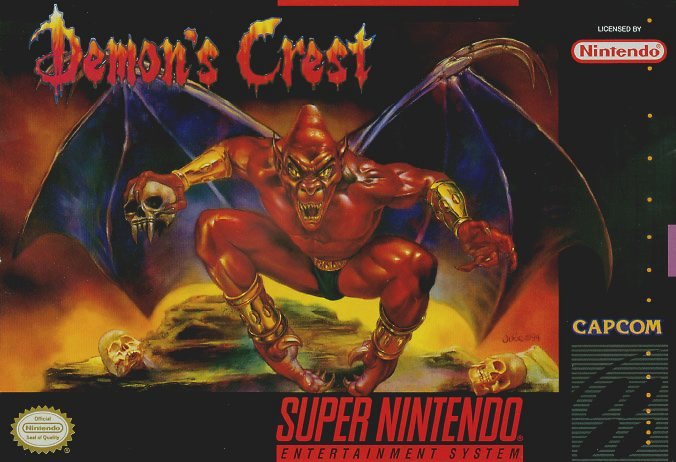
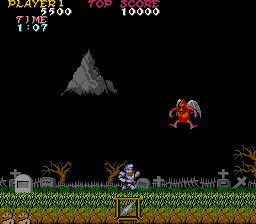
Demon’s Crest is one such game. Released by Capcom late in the Super Nintendo’s life-cycle, Demon’s Crest has garnered a reputation as a cult classic. Because of its late arrival, few people actually picked up a copy and experienced it in 1994. The Gargoyle franchise also has never been one of great importance for Capcom. For those unaware, Demon’s Crest is the third game in the Gargoyle trilogy which started on the GameBoy. The main character of these games, Firebrand, is that annoying red, flying enemy from the Ghosts ‘N Goblins games thrust into a starring role. The storyline for these games isn’t all that interesting or important, but credit Capcom for spinning off a seemingly random enemy into its own franchise. Since the end of the 16bit era and the dawn of the retro era, Demon’s Crest has become one of those handful of SNES carts that fetches over 100 bucks routinely on the secondary market. Thankfully, the Virtual Console exists so these games can be experienced by anyone with a Wii/Wii U console and a game like Demon’s Crest can get the recognition it deserves.

Cap com apparently saw something in this little, red, demon to warrant giving him his own game.

Cap com apparently saw something in this little, red, demon to warrant giving him his own game.

Demon’s Crest is essentially a side-scrolling platform game, but it’s a hybrid title in that it incorporates elements from the run and gun genre and the RPG. As Firebrand, the player explores various stages from the ground, in the air, and underwater. At the start, Firebrand can shoot a fireball as his lone attack, cling to walls, and fly through the air. The flying mechanic is neat and doesn’t feel cheap, as it often does in many games like Super Mario Bros. 3. By pressing the jump button while in air, Firebrand deploys his wings and can hover indefinitely. He can move side-to-side but cannot gain altitude (a power-up later in the game allows him to ascend in the air from a flying position). He can still attack, and pressing the jump button again causes him to drop and re-pressing the button at anytime while falling will initiate the process all over again.

After the first level is completed, the player gains access to a world map not unlike what is seen in the Final Fantasy titles from that era. Firebrand can fly to any stage from here and the game can essentially be completed at any point, though playing thru every stage multiple times is encouraged to collect power-ups and explore every nook and cranny. Firebrand is on a quest to recover various crests, each one grants him a new power. The earth crest, the only one that basically can’t be missed, removes Firebrands wings but gives him access to a dash move and a ground-hugging projectile. The water crest lets Firebrand breath underwater, the air crest lets him fly freely, and the best crests are basically a jack-of-all trades kind of power. Additional projectile attacks for Firebrand’s normal form can also be found, along with other power-ups, bottles for storing potions, and vellum for spells. The goal is to conquer the enemy Phalanx, but the secondary goal is to collect everything and get the best ending plus additional content in the form of power-ups and additional boss battles.

Some of the game's bosses dominate the screen.

Some of the game’s bosses dominate the screen.

At first, the game seems like it’s going to be massive, but it can be completed in an afternoon, especially if you’re not after the best, ultimate, ending. There’s an element of trial and error at play, as the game intends for the player to acquire new powers to advance past certain spots. The game is forgiving in this regard as it grants unlimited continues and you can always quit to the map if a scenario seems too difficult. The levels are not simply “go right” kind of levels. They encourage exploration in all directions, and additional gargoyle powers will open up new sections so re-playing levels is practically essential to completing the game. Uncovering new powers is addicting and fulfilling and I was always eager to try out each new one I found.

Acquiring these new special abilities make the game easier, which is welcomed since the game is fairly challenging. No, Demon’s Crest is not among the most difficult of games to grace the SNES (like the title it’s spun-off from) but it isn’t a breeze. Most of the early challenge involves getting used to Firebrand’s controls. He handles easy enough, but the mind needs to be trained in order to best utilize the hover/flying ability. There are usually numerous enemies at ground level and in the air to contend with, and learning to dodge is the best way to succeed. The game is also fairly cryptic in that it doesn’t explicitly tell you what your new powers are capable of. As a result, the player has to experiment a little which may lead to some deaths here and there, but it’s not too bad. The game is fairly generous with restorative items and the in-game currency allows the player to stockpile health potions and the like. There are also some mini games to spend time on, though nothing exciting. The boss fights are usually a test to figure out what the best approach/power to use is. Some boss fights will seem impossible without the right ability, but once found, they’re a piece of cake. The hardest bosses are a challenge no matter what. They’re not controller-tossing hard, but will offer a nice test for the player.

Acquiring new crests opens up new forms and powers for Firebrand.

Acquiring new crests opens up new forms and powers for Firebrand.

The music in the game is heavily reminiscent of other gothic-inspired titles, most notably Castlevania. It’s tempo is slower and Demon’s Crest finds it’s own sound. It’s not on Castlevania’s level, but it’s very enjoyable. As a later era SNES title, the game is pretty nice to look at. Firebrand is nice and big without dominating the screen. Many of the boss characters have a lot of personality or take up the entire height of the screen. The regular enemies, the canon fodder, are a little boring though and the game gets bogged down at times when a lot is going on. Sometimes the slowdown is actually helpful, but it is a weak point of the game. The controls are quite good, but there’s some missed opportunities to be found here. The shoulder buttons are not utilized when they could have at least been devoted to cycling thru Firebrand’s gargoyle forms. It gets tiresome having to constantly pause the game to switch relics, and many boss encounters require this very thing. The spells available to Firebrand are also fairly useless, and the only potion worth spending money on is the best one which restores all of Firebrand’s health.

When it comes to old games, I always prefer to experience them as they were intended: on their original console. When that is not possible (or in this case, too expensive), the Virtual Console is more than adequate. I played the game exclusively on the Wii U Gamepad utilizing the Gamepad’s screen instead of a television. The game plays just fine, and the ability to save is definitely welcomed. The original cart only provides a password save functionality, and while the game isn’t terribly long, it’s one I chose to experience in one or two hour at most sessions. It probably took me around six hours to finish the game, with some additional time spent after the fact going back and finding the items I missed to tackle the secret boss. This strikes me as being a pretty average game for the era in terms of length making it comparable to Super Metroid and Super Mario World.

Demon’s Crest is an excellent example of a forgotten classic. It’s probably not a top 10 game on the SNES, but that’s only because the SNES has arguably the greatest library of games of any console. Demon’s Crest is a unique blend of several genres, and its setting and style help set it apart from many of its contemporaries. If it sounds like something you would enjoy, I can’t recommend it enough as it’s worth the 8 bucks Nintendo is charging. And if you’re on the fence, I still say give it a shot because it’s a game that’s just inherently fun. Hopefully, this re-release on the Virtual Console makes Capcom some money and inspires them to revisit the Gargoyle series. A modern take on the franchise would be a most welcomed thing, indeed.


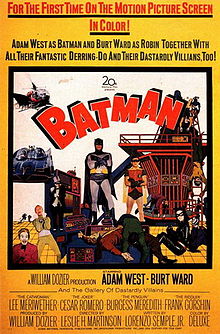
Batman: The Movie

Batman:  The Movie (1966)

Batman: The Movie (1966)

The Batman character certainly has changed a lot over the past 50 years. Sure, under the mask he’s still Bruce Wayne, his parents are still dead, and he can usually be found prowling the streets of Gotham City by night accompanied by a juvenile in a red and yellow costume. Many things have changed though. For one, Bruce Wayne is no longer content to be a millionaire so he’s jumped into the billionaire ranks. The blue and gray spandex Batman used to wear is now often black and gray and even armor-plated, depending on the artist. Robin, thankfully, isn’t parading around in tights either or a bright yellow cape (no wonder why he’s usually the one getting picked off as opposed to Batman) and sometimes he even gets to be an adult. Mostly though, the tone of the work has changed. A lot of writers have received credit for turning Batman into a more serious and mature character during the 70’s and 80’s with most of it going to Frank Miller, but the change was actually rather gradual. In order for a character to survive decades upon decades and remain relevant, he has to change with the times as the general tastes of the public are always evolving.

In 1965, Batman was faced with becoming irrelevant. His comic book sales were down and he hadn’t appeared in a film reel in decades. Television was still pretty new, and pretty limited, but the idea to give the caped crusader a shot at television came up and by 1966 Batman was more than relevant once again; he was a star! Starring Adam West and Burt Ward as the dynamic duo, Batman appeared twice a week (a rarity at the time) on television in a serialized nature, often with the first night’s program continuing into the second’s. The show was a hit with children mostly, but also adults who grew up reading the Batman comics. Color TV was new at the time, and Batman was presented in eye-popping color for those fortunate enough to have a color set. The jazz-infused soundtrack was catchy, and the wild cast of villains gave the show a new flavor each week. Stars were born, of course, with classic comic villains such as The Joker and The Penguin seeing their star burn even brighter while villains mostly abandoned by the books, such as Catwoman and The Riddler, found a new lease on life. The show was basically a farce, with Batman and Robin presented in an ever serious manner oblivious to the ridiculous circumstances they would find themselves in week after week. The supporting cast of Commissioner Gordon (Neil Hamilton) and Chief O’Hara (Stafford Repp) were equally oblivious while the villains came across as the only ones in on the joke. Batman and Robin would find themselves in dire situations often, but would always get out of it either thru ingenuity, sheer coincidence, or via an oddly situation specific “Bat” gadget. This was Batman in the 60’s and it’s what people wanted.

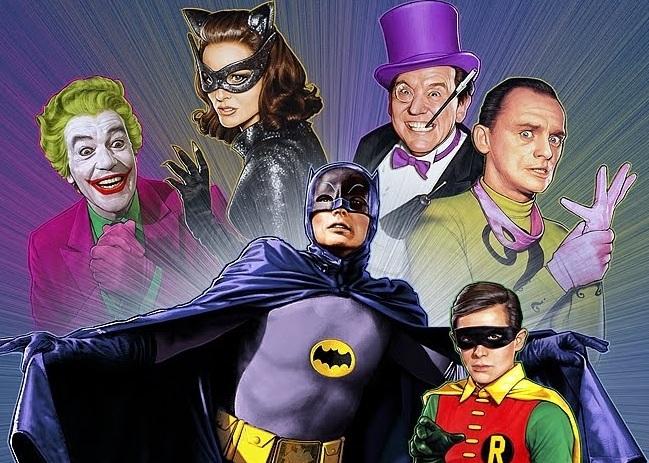
Look out, caped crusaders! The Joker, Catwoman, Penguin, and Riddler have joined forces!

Look out, caped crusaders! The Joker, Catwoman, Penguin, and Riddler have joined forces!

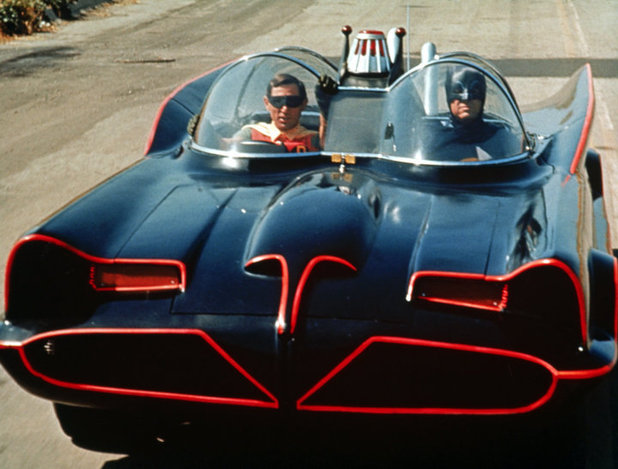
When the show was first conceived, it was decided that a movie would be created to help launch the program. Plans changed, however, when the network involved surprisingly picked up the show with production needing to start immediately to meet a January air date. The movie was back-burnered for awhile in order to focus on the television show, but filming resumed in the early spring to make a summer release possible. This ended up being a boon for the show, and the film as well, as Batman took off and created great anticipation for the film. The increased budget for a feature also meant that new gadgets and vehicles, such as the Batcopter and Batcycle, could be created for the film and then used again for the television show. In order to make the film feel bigger than the show, four villains were present instead of the usual one: Joker, Penguin, Riddler, and Catwoman. The only complication was Julie Newmar, Catwoman on the show, was unavailable so the part had to be recast and went to Lee Meriwether. Cesar Romero, Burgess Meredith, and Frank Gorshin were able to play their roles as Joker, Penguin, and Riddler, respectively, and the rest of the television cast was available for the film as well.

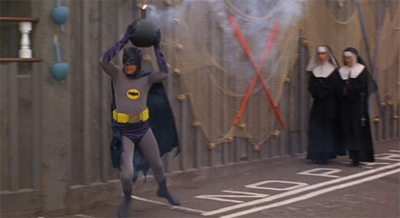
The style of the television show was incorporated into the film. The art direction is distinctly pop for the era. There’s an abundance of bright, primary colors. When the characters are put into a more realistic setting, such as Batman during the infamous bomb segment, they stand-out against the background and appear as out of place as a man in a batsuit should (though the extras in the shots carry on as if this is business as usual). The action sequences are surprisingly kept to a minimum, but when a fight breaks out expect many haymakers and somersaults (the editors saved the famous “pow” animations for the film’s climactic battle). The Batman theme is present but in small doses. The film’s main theme is perhaps relied upon a bit too heavily as it’s used for every long shot of Batman and Robin in their various vehicles used throughout the film.

Still the coolest Batmobile ever created.

Still the coolest Batmobile ever created.

The plot from the film is rather rudimentary. The four villains have teamed up to kidnap the world leaders using a bizarre dehydrating ray that reduces any human it touches into a pile of dust to be rehydrated later. The protagonists deduce their foes’ motives thru absurd means presented as deductive reasoning but are either lazy writing or an attempt at humor. Batman is the straight man while Robin is more of a hot-head (and possibly a sociopath who wants to murder alcoholics). The villains are as over-the-top as their TV personalities. Gorshin and Romero present their characters as cackling madmen with The Riddler having the added flaw of feeling compelled to leave Batman and Robin clues in the form of riddles. The film actually draws attention to how similar the two villains became once they hit television, but both actors perform so well in their roles it’s mostly forgiven. Meredith is a delight as The Penguin. He waddles everywhere and gets so much personality out of that long cigarette holder always stuck between his teeth. Meriwether’s Catwoman is basically the same as Newmar’s with her always feeling compelled to use the word “perfect” when describing something she approves of, but drawing it out into a long “purrrrrfect” because she is, after all, a crazy cat-person. Catwoman also gets to have an alter-ego in the form of Miss Kitka, who seduces Bruce Wayne to lure him into a trap so that he may be used as bait for Batman. As a kid, I found it odd how easily Batman is able to see thru a disguise The Penguin uses later in the film, but he’s blind to Catwoman’s. Apparently, even Batman sometimes ends up thinking with the wrong head from time to time.

The special effects in the film will impress no one accustomed to the movies of today. When Batman is attacked by a shark early in the film it’s clearly made of rubber and its teeth leave no imprint on Batman or draw blood. A scene of some ducks in the water are obviously decoys, and every character who throws a punch whiffs by about six inches on their target. And who could forget the climbing scenes? Scene thru the lens of today, these shortcomings just add to the campy charm. The comical bomb Batman is forced to dispose of is cheeky and the ray-gun effects are delightfully cliche.

Some days, you just can't get rid of a bomb (I had to do it!).

Some days, you just can’t get rid of a bomb (I had to do it!).

The film is a farce, an exercise in the absurd, and it is entertaining. I grew up watching the television show in syndication during the 80’s. I suspect my generation may be the last who can say that as I assume most kids today have never seen Adam West as Batman and I wonder if they would appreciate it. Perhaps if this is the fist Batman they’re exposed to they’ll see what the kids of the 60’s saw, or maybe they’ll just see a very ordinary looking man in gray and blue spandex. Batman was fun for me as a kid with all of the different villains and bat-gadgets and as an adult I find it funny and charming. It’s not really clever comedy, but I wouldn’t call it stupid either. The Batman premise is one that’s far-fetched and unrealistic, and the writers approach the character as such. While writers and filmmakers today are more interested in a realistic portrayal of a masked vigilante, it’s kind of fun to see the character portrayed in the only manner he could actually exist. The entire 1960’s television series is finally set for release this holiday season in a massive, and expensive, box set. That might be overload but for anyone seeking out just a taste of the Batman from 1966, the movie represents a good, and cheap, snap-shot. The blu ray from which this review is for, looks great considering the film’s age. The colors pop as they should, the picture is sharp, and there’s quite a bit of extra content. The film doesn’t look as old as it really is, which is often the best compliment one can give to such an old movie. This was my first Batman on television and I would go on to enjoy Tim Burton’s take on the character and fall in love with The Animated Series. I never lost my affection for this Batman though, and even though I view it in a different way than I did as a five year old, I am still charmed by it. Hopefully, I’m not the only one.


Devin Townsend – Z2

10255853_869783999713590_2547487351900039123_n

It feels like it has been a long while since I’ve made a “Music” entry here. That’s probably due to music not having an inherently nostalgic feel for me, especially when compared with television, movies, and video games. Truthfully, nothing about this particular post is really nostalgic for me, but it is one I feel compelled to make.

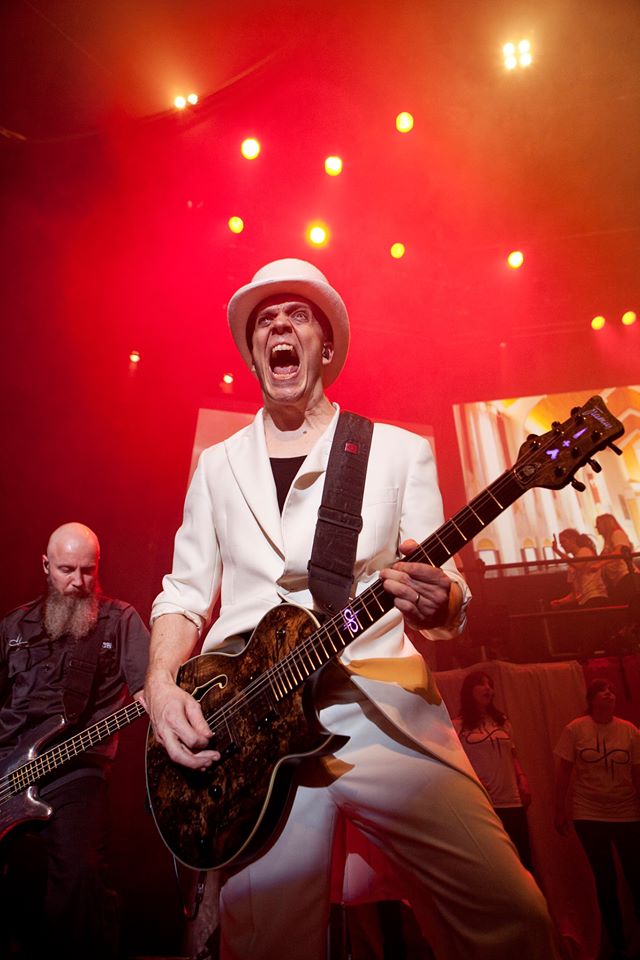
Devin Townsend is back once again, and this time he brought Ziltoid along.

Devin Townsend is back once again, and this time he brought Ziltoid along.

Devin Townsend has been at this whole music thing for quite a long time now. Whether you associate him more with Strapping Young Lad, Steve Vai, or as a solo artist it’s possible you’ve been listening to him for twenty plus years. He’s released a lot of material under various guises and umbrellas and he is one of the rare artists I feel has produced something for everyone. He’s best known for his extreme brand of heavy metal but he’s also done rock, country, punk and pop while taking time out for more obscure designs that may not appeal to anyone (I’m talking about DevLab here)! One of Mr. Townsend’s most noteworthy and recognizable creations is Ziltoid, The Omniscient. The fourth-dimensional intergalactic guitar hero first debuted on 2007’s Devin Townsend Presents: Ziltoid The Omniscient, heavy metal meets old-time radio show mash-up that took listeners on a journey through space as Ziltoid sought to find the universe’s ultimate cup of coffee. The album is basically a cult classic at this point, and if you are unfamiliar with it one I highly recommend. After Ziltoid, Townsend formed the Devin Townsend Project and set his mind on releasing records under that moniker. Ziltoid has been a part of the live show and even made an appearance on the DTP album Deconstructed, but a sequel to the Ziltoid record was only speculated upon. It seemed obvious that Townsend would revisit the material and he would acknowledge as much in various interviews with the media while promoting one of his other albums. Fans wanted a Ziltoid 2, but at the same time, Townsend’s other works were being received quite well so while there was demand, fans were uncharacteristically patient when the Ziltoid 2 conversation would come up. This past summer, Townsend took to the internet and crowd-funding to create a passion project he dubbed Casualties of Cool, a hybrid rock-country record. As part of his promise to those who pledged, any dollars raised, but not spent, on Casualties would be directed towards the Z2 record. Proving once again that he is the hardest working man in music, Townsend not only found the time to produce the Casualties double-record, but also what has become a double-album itself, Z2, and release everything in the span of a few months.

For Z2, Townsend wanted to play up the radio show angle even more and his story about an alien kidnapping a being called a Poozer and igniting an intergalactic war over it was a hard sell to his label. Devin has his own label, but he apparently still has people he needs to answer to, so in order to get everyone on board with the Z2 project he agreed to make it a double-album. In what is probably a rare event, Z2 arrived in stores with two discs that were actually two separate albums. On one disc is Devin Townsend Presents: Dark Matters, which is the Ziltoid disc. The other disc is Sky Blue, the latest album from the Devin Townsend Project. Even though both discs contain essentially the same band, they’re intended to represent two distinct artists, if you will, much as the Devin Townsend Band is considered different from the Devin Townsend Project. If all of that is confusing to you then that is okay, as it’s really not important. The important take-away here is that Devin Townsend released two albums at the same time for little more than the price of one, and to top it all off, they’re both pretty good.

Devin Townsend Project - Sky Blue

Devin Townsend Project – Sky Blue

Sky Blue is essentially the bonus disc here, but it also seems like it’s intended to be disc one, so let’s start there. Sky Blue sounds very much like a continuation of the last Devin Townsend Project album, Epicloud, and contains the same supporting cast including vocalist (and now frequent Devin collaborator) Anneke van Giersbergen, best known as the former front-woman for The Gathering. Sky Blue is essentially a pop-metal album. There’s a strong electronic component to the songs and Anneke’s vocals dominate the majority of the record as opposed to Townsend’s. There are plenty of Townsend’s trademark hooks and his “wall of sound” approach to the production. Guitar tones are unusually bright in tone compared with other DTP records with few “crunchy” riffs present. Townsend still employs his old screaming voice in some parts, notably the opener “Rejoice” and “Silent Militia.” The album comes across as being very danceable and some songs wouldn’t seem out of place in a discotheque. The chorus for each song is usually quite catchy, but the album does slow down at parts and becomes more introspective and contemplative. “Before We Die” is the big set piece of the album and it’s positive outlook on life and love makes it a fair representation of the album as a whole. Other highlights include the very catchy title track, which according to the liner notes, is inspired by the Usher track “DJ Got Us Fallin’ in Love.” Raise your hand if you never thought you’d see Devin Townsend giving his interpretation of an Usher track.

Sky Blue is an album that could have been released by itself and appreciated by the Devin Townsend fanbase, but I suspect most of the people who scoop this release up are most interested in the second disc: Dark Matters. The first Ziltoid record was pretty unique when it came out, but it was also basically just a Devin Townsend album with some entertaining bits of dialogue inserted in between some of the tracks. Dark Matters, on the other hand, plays more like a radio show with the music appearing just to enhance the setting and presentation of the unconventional story. It doesn’t really work as a metal album in that sense, but that also doesn’t mean it isn’t any good or lacking of quality material. There are a few tracks that stand-out as entertaining songs, such as the Soilwork inspired “Ziltoid Goes Home” or the punishing “Deathray.” However, those looking for the same experience as was found on the first Ziltoid record may be let down.

Ziltoid returns in Dark Matters!

Ziltoid returns in Dark Matters!

Ziltoid The Omniscient was an extreme metal album. There were some lighter moments to be found, but there was also “By Your Command” and “Planet Smasher.” The previously mentioned “Ziltoid Goes Home” is probably the heaviest moment of Dark Matters, but it doesn’t really approach the heaviness of the first record. The glossy production and electronic elements found on Sky Blue are present here, making the two discs more similar than anticipated, and also making Dark Matters feel more contemporary. The first Ziltoid sounded similar in approach to the material Devin Townsend was releasing at the time, so naturally Dark Matters sounds similar to the more recent Devin Townsend Project albums of today.

How does Dark Matters work as a radio show? Pretty well, though if you’re expecting high art out of the story you won’t find it. It’s basically on the same level as the first album in terms of ridiculousness. Townsend pretty much made that album by himself, but here has the whole DTP band and some guests for other roles. The two most noteworthy additions include WWE personality (and fellow Canadian) Chris Jericho as Captain Spectacular (who was voiced by Townsend on the first Ziltoid album) and Stolen Babies member Dominique Lenore Persi as the war princess. Jericho’s role is basically just a speaking one and he is appropriately cheesy in his presentation of Captain Spectacular while Persi is asked to sing on her character’s main track, “War Princess.” The story as presented is entertaining, though not hilariously so, and some of the charm has definitely faded a bit. It doesn’t really have a lot to do with the events of the first record (which were implied to be the delusions of an overworked barista) but all of the characters that make a return for this record behave in a manner consistent with how they were presented on the first record.

Dark Matters is an entertaining ride, though it’s function as more of a theatrical release make its lasting appeal questionable when compared with the first record. And in a somewhat surprising twist, it’s actually the package’s other disc, Sky Blue, that shines brightest. The two work surprisingly well as a package release, and as a fan of Townsend’s work, I must say it’s pretty awesome to receive a third album from him this calendar year. Dark Matters concludes with a “To Be Continued” message so it appears we’re set for more Ziltoid in the future, which is fine by me. Hopefully, the Devin Townsend Project, which was originally supposed to just be four albums but has now become six, continues long into the future as well.


Top Tracks

  • Universal Flame
  • Sky Blue
  • Before We Die
  • War Princess
  • Deathray
  • Ziltoid Goes Home

The Princess and the Frog

The Princess and the Frog (2009)

The Princess and the Frog (2009)

When Walt Disney unveiled Snow White and the Seven Dwarfs back in the 1930’s, many critics saw the move as a foolish one. Who wanted to pay to see a feature-length cartoon? Apparently, many folks as Snow White became one of the most successful movies of all time. Ever since, Walt Disney Productions has specialized in feature-length animated films with fifty-three produced and released to theaters, not to mention numerous direct-to-video films and television specials. Ever since 2004’s disappointing Home on the Range, all of the Disney films have undergone a major change. The traditional hand-drawn animation of classics such as Snow White, Pinocchio, and Bambi have been abandoned in favor of computer-generated characters. When CG movies started showing up in the 90’s the medium was met with skepticism, but following the success of Pixar’s Toy Story, it became apparent that CG was the future of animation. Still, few could have predicted CG would reduce hand-drawn animation to near extinction. And with Pixar and Disney partnering up, it seemed like Pixar would be the vehicle for CG animated films while Walt Disney Animation Studios would continue to churn out the more traditional stuff. That was not to be.

When Disney first announced The Frog Princess in 2007 it came as a surprise. Disney had previously declared 2-D animation dead in ’04 and for a new hand-drawn film to show up just three years later was definitely unexpected. The film, which starred an African-American girl from New Orleans named Maddy, was also met with a whole bunch of criticism from various groups. If Disney had thought a non-white female lead would garner it lots of positive press it was unfortunately mistaken. Having a black lead seemed to place a microscope on the film and the early press package was nit-picked to near death. The setting, the main character’s name, occupation, the ethnicity of the film’s prince – all received some criticism. Even the film’s title was somehow offensive to French people. To Disney’s credit, a lot of the criticisms were taken to heart and applied to the film. The new title became The Princess and the Frog. The main character was given the name Tiana and made a waitress and Oprah Winfrey was hired as a consultant. What was not changed was the setting which the directors felt was important to the story. Other criticisms, such as a black man for the villain, were also kept. This didn’t free Disney from further criticism though, but at least it showed the company was sincere.

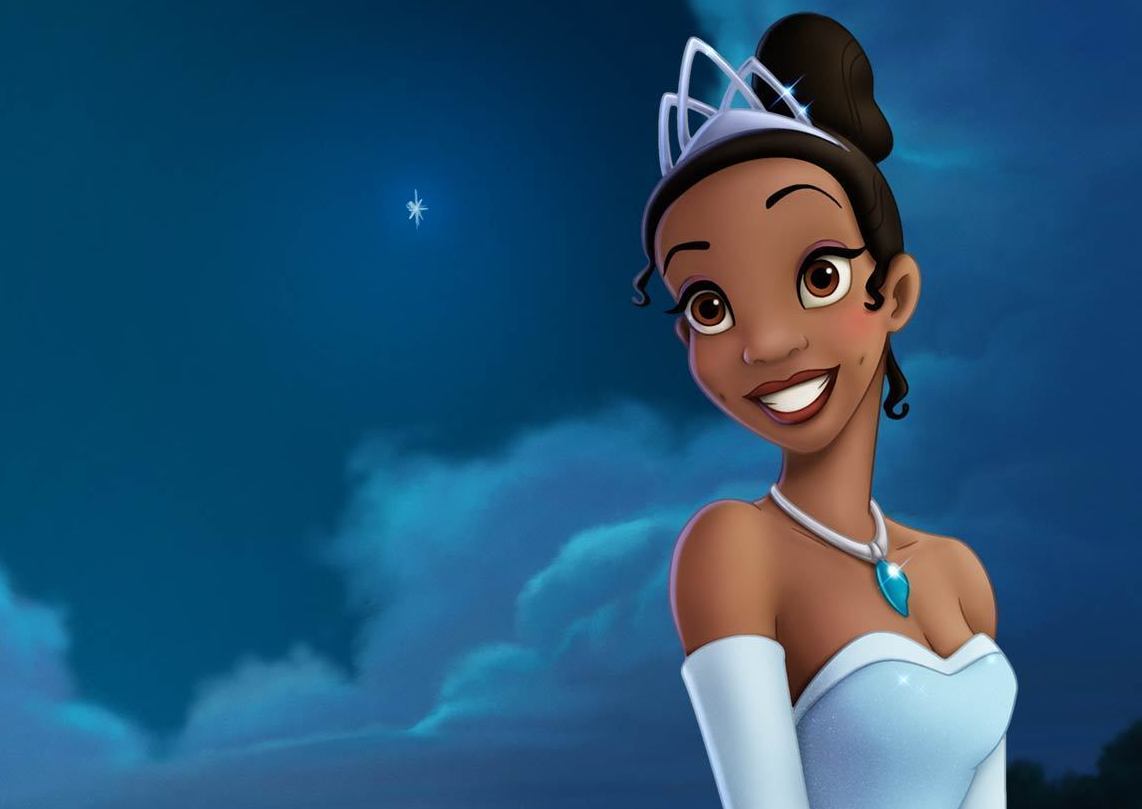
Tiana's ethnicity was cause for celebration in some circles, but it also opened her up to more scrutiny than usual.

Tiana’s ethnicity was cause for celebration in some circles, but it also opened her up to more scrutiny than usual.

With the hand-drawn animation decision out of the way, directors Ron Clements and John Musker (Aladdin, The Little Mermaid, The Great Mouse Detective) also wanted to bring back more traits of the old Disney films. The Princess and the Frog was based off of a fairy tale, The Frog Prince, and a retelling The Frog Princess, using elements of both. It was also decided the film would be a broadway-style musical like the films of the 90’s. For the film’s look, producer John Lasseter wanted the animation to draw comparisons to Disney’s Lady and the Tramp, which he considered to be the pinnacle of Disney animation. Many veteran animators who had been laid off following the decision to abandon hand-drawn animation were re-hired, and Disney’s outdated CAPS software was replaced by Toon Boom Harmony. The film was cast, and production was underway.

As expected, a modern hand-drawn animated film from Disney looks spectacular. The Princess and the Frog is Disney’s sharpest looking production to date. The animation is warm, fluid, and full of personality. The backgrounds are astonishing and are so much more alive when compared with the animated features that came before it. The film was produced using actual sheets of paper as opposed to having the animators draw on tablets and many of the film’s backgrounds are painted as well. CG effects are applied for smoke, shadows, and other lighting. If the film has one visual drawback, it’s that some of the objects look flat against the expressive backgrounds. This limitation is contained to background characters, but is noticeable at times. Otherwise, the film looks fantastic and is a true love letter to the animated films of old.

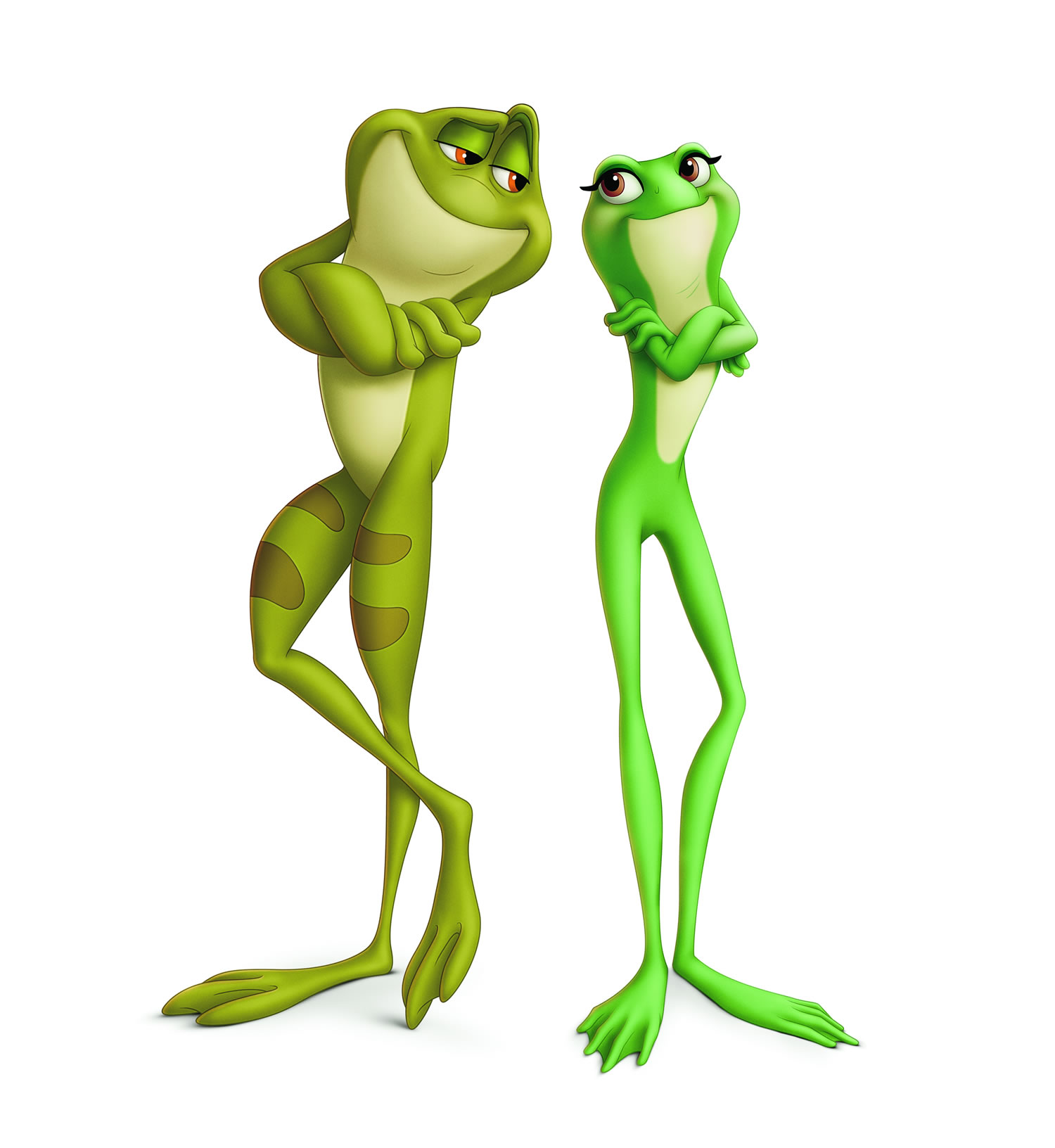
For the frog versions of the two leads, Disney wanted their look to draw from the example set by Jiminy Cricket: make the characters pleasing to look at as opposed to realistic.

For the frog versions of the two leads, Disney wanted their look to draw from the example set by Jiminy Cricket: make the characters pleasing to look at as opposed to realistic.

The plot unfortunately is not the equal of the animation. While the performances of the actors involved is quite good, the actual pacing of the film is pretty ho-hum. Aside from the twist of having the film’s “princess” turned into a frog, it’s fairly predictable. The film’s villain, Dr. Facilier, is basically a bad guy for the sake of being a bad guy. There’s not much depth to him. Tiana is a strong female lead who’s a hard-working girl scraping by with the dream of one day opening her own restaurant. She’s juxtaposed by her best friend, Charlotte, the daughter of the wealthiest man in town who has had everything handed to her. Charlotte’s prime goal in life is to marry a prince so she can be a princess. Clearly, Tiana is expected to fulfill the role of a modern woman (despite the film’s 1920’s setting) while Charlotte is meant to represent the outdated princess of old who is defined by her prince. The film is definitely successful at making Tiana a positive role model for young girls (or really, for any child), but it isn’t done in an organic way. Tiana, either through spoken dialogue or song, is determined to let us know over and over how she has had to work hard for everything she has. And while some of that is intended to be a trait of the character, one does get the feeling the film could have used some more subtlety. Future Disney films would better create a compelling female lead, which isn’t to say that Tiana is a disappointment, she just lacks refinement.

Taken on the whole, the film is an enjoyable adventure thru the Louisiana bayou that feels pretty light-hearted. There’s comedy, and of course, music that is entertaining if nothing else. The fact that the film doesn’t have some big, important, message to convey is forgivable, though the lightness of the tale keeps it from being among the best of the best. The film does shine amongst its predecessors when the film’s music is considered. Written primarily by Randy Newman, it does a good job of taking the audience to New Orleans and the opening number, performed by Newman with vocals by Dr. John, is one of my favorites from any Disney film. I normally loathe the musical parts, and for some of the ones in this film that sentiment remains, but I was surprisingly captivated by a few. They’re not overdone, and unlike the more recent Frozen, I never felt like the music was used as a substitute for dialogue. The film also doesn’t shy away from adding a dangerous element to its villain. Too many parent-centered reviewers will remark that Dr. Facilier is too scary for young kids, but he’s supposed to be scary! What’s the point of a villain that doesn’t come across as a threat to the protagonists? There’s even a death in this film, and I was happy to see there wasn’t some lame cop-out to follow, even though I was expecting one.

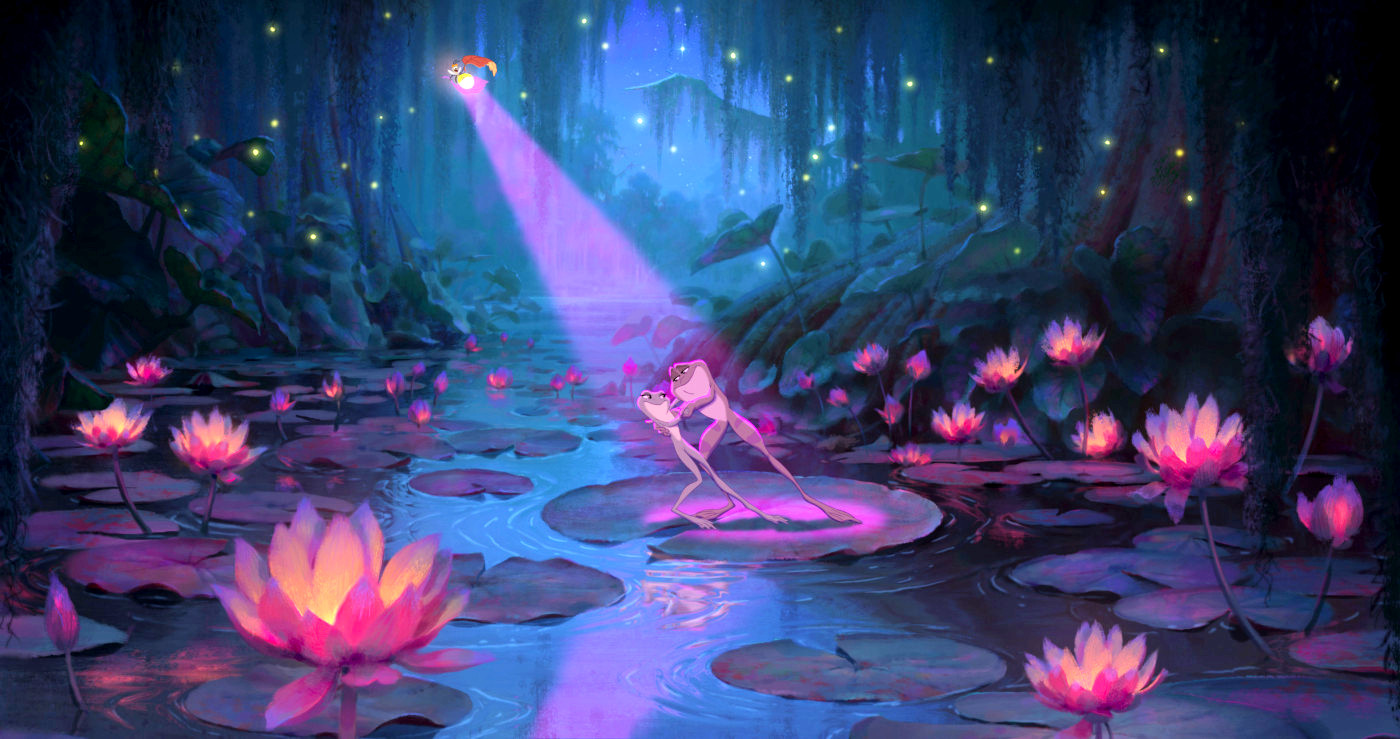
There's no denying the film is stunning to behold.

There’s no denying the film is stunning to behold.

The Princess and the Frog was met with positive reviews upon its release and was a financial success. It wasn’t the smashing success of some of the older Disney films, and because of that, the hand-drawn animation wing has been shelved indefinitely. The Blu Ray special features contain numerous interviews with the creators of the film who speak glowingly about hand-drawn animation with an eye towards the future. During the run-up to the film’s release, Disney was boasting that a hand-drawn feature could be expected every two years. The film was released in 2009, and today in 2014, there still hasn’t been another hand-drawn feature from Disney. The Snow Queen, retitled as Frozen, was supposed to be the next hand-drawn feature but was converted to CG and went on to become a massive success for Disney. Who knows if the choice of animation would have had any impact on the finished product. I personally do not feel the general movie-going public is averse to hand-drawn animation or even has a preference. The luster of CG has long since worn off as it has now become the standard. The Princess and the Frog likely did not perform up to expectations at the box office for reasons completely unrelated to its animation style. If anything, the animation style likely drew additional patrons since hand-drawn is no longer the norm. I personally believe the film wasn’t a huge hit because the plot seemed too familiar. Most people have already seen numerous animated fairy tales and a film with the word “princess” in the title probably isn’t going to draw the attention of young boys. Disney’s attempt at creating a modern princess for young girls to look up to effectively alienated them from a large portion of their audience:  young boys. The studio is definitely wise to this as more recent films have opted for a more ambiguous title like the previously mentioned Frozen or Tangled.

It is my sincere hope that The Princess and the Frog is not the last feature-length production from Disney to feature hand-drawn animation. The film is proof that the medium still has a lot to offer and I just find it so much more engaging than CG features. While I love and appreciate much of what Pixar has put out I’ll likely always prefer the hand-drawn look. The sad thing is, as fewer and fewer films and cartoons are done in that style, the people who specialize in it are likely retiring or no longer with us. The younger generation is being raised on CG and lacks the skills to create hand-drawn animation. Hopefully, Disney realizes this and elects to take on the responsibility of keeping the art form alive. Perhaps releasing a hand-drawn feature every other year was too ambitious, but every five years seems like a reasonable goal. With no hand-drawn features announced as of this writing, the future of the medium is very much in question and that’s a shame. The only company that seems to care is Japan’s Studio Ghibli which thankfully continues to output hand-drawn features even with its beloved leader’s, Hayao Miyazaki, retirement. To all lovers of hand-drawn animation, I say treasure The Princess and the Frog, because you may not see another Disney film like it.


Essential Halloween Viewing

When it comes to holiday themed television specials and films, Christmas leads the way with its countless amount. Coming in second is likely Halloween. Unlike Christmas, there usually isn’t some serious undercurrent to Halloween specials. It also feels less sinister when it comes to marketing, even though there’s certainly lots of money to be made off of Halloween by costume and candy suppliers. For the most part, Halloween is just fun and it’s emphasis on scares helps to distinguish it from other holidays. Like many people, I enjoy a good Halloween special whenever the season rolls around, but with so many out there it can be hard to make time for them all in what amounts to only a month. There are some modern ones out there, like the entertaining Toy Story of Terror, but for the most part I like to watch the specials I watched as a kid. Without further adieu, here’s The Nostalgia Spot’s Halloween viewing guide.

Mickey Mouse in “Lonesome Ghosts”

220px-Lonesome_GhostsHere’s an oldie from way back in 1937, something that would have entertained my adolescent grandfather. Since I only discovered it a few years back, it’s not exactly something I remember from my childhood but certainly fits the theme of this blog. In this cartoon, professional ghost exterminators Mickey, Donald, and Goofy investigate paranormal activities in an old house. The twist is that the trio were hired by the ghosts themselves because no one ever enters their haunted house anymore and they’re just plain bored. Less creepy than it is humorous, it’s mostly a slapstick affair as the ghosts play tricks on their would-be exterminators. It’s an entertaining short, and one can’t help but wonder if it maybe partly inspired Ghostbuster, or at least the theme song, especially when Goofy declares, “I ain’t afraid of no ghosts!” The short has been shown on television numerous times over the years as part of Halloween specials. It was also re-released to theaters in the 1960’s and has been released on VHS and DVD as well. The easiest way to see it these days is probably youtube.

Donald Duck in “Trick or Treat”

By the late 40’s and into the 1950’s, Donald Duck was basically the only classic Disney character still receiving new short films. There just wasn’t much money in the format anymore and the budget for each short was scaled back considerably. For the 1952 short “Trick or Treat,” Disney decided to increase the budget to give Donald a proper Halloween special. It has its own theme song and the animation is quite nicely done in comparison with other shorts from around that time. In this one, Donald’s nephews Huey, Duey, and Louie are out trick or treating and come upon their uncle’s house. When the boys knock on his door and request their tricks or treats, Donald (not surprisingly) elects trick. A witch, Witch Hazel, passing by happens to see this and decides to help the boys get their treats out of Donald. Apparently, the Halloween spirit does not include the tricks portion of the ages old phrase. Hazel uses her magic on Donald and a lot of physical comedy follows. Like “Lonesome Ghosts,” this one has been released on VHS and DVD over the years either on Halloween compilations or as a bonus feature with certain films. There’s a chance it could pop up on one of the Disney channels this Halloween, but if you want to see it better head to youtube.

The Real Ghostbusters – “When Halloween Was Forever”

Samhain, the spirit of Halloween!

Samhain, the spirit of Halloween!

A cartoon that centers around four guys (and a ghost) who hunt down paranormal creatures naturally lends itself well to Halloween. Pretty much any episode could qualify for such a holiday, but the episode “When Halloween Was Forever” happens to deal with the holiday directly. This episode features the ghost Samhain, the spirit of Halloween, who decides to freeze time on Halloween night so that it lasts forever. Since Halloween is said to be derived from the Pagan holiday Samhain, it’s a nice touch to name the ghost after it. The Real Ghostbusters was a DIC production and if you’re familiar with any of their cartoons from the 80’s then you likely know what to expect out of the audio and animation. It’s standard for the era, with the soundtrack being appropriately spooky. While no episode of this cartoon can come close to matching the film it was based on, it’s actually not a bad show and time has been far kinder to it than it has the more popular Teenage Mutant Ninja Turtles.

Ren & Stimpy – “Haunted House”

The premise for this one is conventional, Ren and Stimpy stumble upon a creepy looking house and, in need of shelter for the night, decide to head inside. Unbeknownst to them, the house is haunted and a malicious ghost lurks inside who can’t wait to scare them. The twist here is that Ren and Stimpy are seemingly in on the joke as they break the fourth wall and end up impervious to the ghost’s efforts. This naturally frustrates the ghost, to the point that he becomes depressed and suicidal (apparently, ghosts can “die” in Ren and Stimpy’s world). Highlights of the episode include a Psycho shower-scene parody and the previously mentioned fourth-wall breaking remarks (“This looks like a good place to kill 12 minutes!”). There’s also the usual random humor found in a Ren and Stimpy short that people either find amusing or stupid. This one is unlikely to show up on television so anyone looking to watch it will either have to pick it up on DVD or turn to the internet. Be warned, the version found on the official Ren & Stimpy Volume 1 is censored with the Bloody Head Fairy bit removed completely. Apparently it was considered too gruesome after the fact.

Beavis and Butt-Head – “Bungholio:  Lord of the Harvest”

Beavis and Butt-Head on a quest for candy.

Beavis and Butt-Head on a quest for candy.

Sometimes referred to as “Buttoween,” this episode features everyone’s favorite dim-witted duo as they go trick or treating in search of free candy. Since they weren’t even aware Halloween was coming until trick or treaters showed up at their house, the two do not have costumes so Butt-Head covers his head in cheese sauce (“I’m nachos.”) while Beavis wears his underwear on his head (“I’m a nad!”). Beavis eventually has too much sugar and his alter-ego, The Great Cornholio, shows itself. The two soon find themselves on a farm ripped right from a slasher film. Most of the humor comes from watching the two try and get some candy in the first part of the episode, while the second part puts the two in an obvious bad situation that they’re apparently oblivious to. The animation is pretty terrible, but anyone who has seen an episode of Beavis and Butt-Head before should already be aware of this. It’s stupid humor, but it is pretty funny. You either like it or you don’t.

South Park – “Pinkeye”

South Park is more known for its numerous Christmas specials, but early seasons often featured other holiday themed episodes. The first season episode, “Pinkeye,” remains the show’s top Halloween special. In this one, a mishap with worcestershire sauce causes a dead Kenny to turned into a zombie. Kenny, as patient zero, spreads a zombie plague all through-out South Park that a clueless doctor mistakes as a severe case of pinkeye. It’s up to Chef and the boys to put a stop to the zombie menace so they can go trick or treating and get some candy. The episode includes some notable gags such as Cartman’s mom on the cover of Crack Whore Magazine and a memorable parody of Michael Jackson’s “Thriller.” It also features Cartman’s attempt to find a non-offensive Halloween costume.

The Simpsons – “Treehouse of Horror V”

Treehouse of Horror V is best-remembered for its parody of Stephen King's "The Shining."

Treehouse of Horror V is best-remembered for its parody of Stephen King’s “The Shining.”

The Simpsons Halloween special, Treehouse of Horror, has become an annual tradition. With 24 to choose from, some may consider it a daunting task to select only one. As is the case with most things “Simpsons,” the earlier episodes are usually considered the better, and for me, it came down to a choice between Treehouse of Horror II and V. V is just slightly stronger and a little more horror-themed than the more sci-fi II. Treehouse of Horror V features parodies of The Shining, The Sound of Thunder, and Soylent Green. In the first segment, “The Shinning,” the Simpsons are basically dropped into the plot of its source material and includes the memorable line “No beer and no TV make Homer go something, something.” The second segment, “Time and Punishment,” puts a time-traveling toaster in Homer’s hands resulting in Homer unintentionally creating a new present time ruled by Flanders. The third segment, “Nightmare Cafeteria,” has Principal Skinner resort to cannibalism of the student body to cope with budget cuts at Springfield Elementary. If a Treehouse of Horror is able to hit on two out of three, it’s generally considered a good iteration of the venerable television special, but Treehouse of Horror V is the rare one where all three are pretty entertaining. With The Simpsons now being featured on the FXX channel, hopefully a Treehouse of Horror marathon is in the near future. The 25th version of the special is set to air tonight.


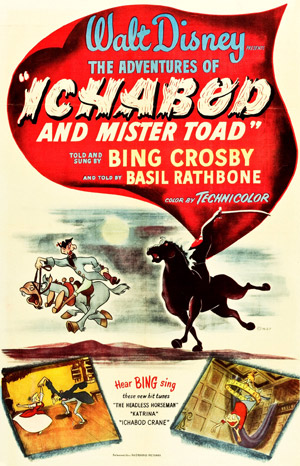
The Adventures of Ichabod and Mister Toad

The Adventures of Ichabod and Mister Toad (1949)

The Adventures of Ichabod and Mister Toad (1949)

Walt Disney was a household name in the 1930’s due in large part to the success of characters such as Mickey Mouse and Donald Duck, as well as for being really the only producer of feature-length animated films. Snow White and the Seven Dwarfs was a massive success for the company, and though its follow-ups are well-regarded today, they struggled to turn to a profit at the time. With the onset of World War II, the company found its resources spread quite thin making war propaganda films for the government with little time and money available to produce more feature-length animated tales. Thus, the company resorted to shorter “package” films where two stories not really worthy of feature-length treatment were packaged together as one feature and released to the public. Some of these, such as Fun and Fancy Free, would mix live-action and animation in presenting its multiple tales. And others, like The Adventures of Ichabod and Mister Toad, would simply combine two animated shorts into one feature-length experience.

The Adventures of Ichabod and Mister Toad was released in 1949. The two were seemingly paired as a result of both stories being British in origen, though both were considered for feature-lenght treatment at one point or another. The Mister Toad portion, based on the story The Wind in the Willows by Kenneth Grahame, was a natural fit for Disney as it already starred several anthropomorphic characters and had an easy to adapt plot line. The Ichabod portion, based on The Legend of Sleepy Hollow by Washington Irving, was a tougher piece to adapt to a feature length, and while its source material may seem too scary by today’s standards, would slide in rather seamlessly given the presentation of recent films Pinocchio and Fantasia. And given the eventual release date of October 5th, it possessed the Halloween spirit movie-goers likely would be looking for.

For various reasons, neither tale was able to secure a feature-length production and release. The Wind in the Willows was especially affected by the war and budget, with the finished product omitting numerous planned sequences adapted from the novel. This release would end up being the last of package films, as the follow-up Cinderella would get the Disney company back on track. Over the years, Ichabod would become a regular on television around Halloween time, while Mr. Toad would be immortalized as an attraction at both Disneyland and Walt Disney World (though in the case of the latter, Mr. Toad’s Wild Ride has since been demolished). Children today may not be familiar with Disney’s version of Ichabod as the sequence is rarely shown on television. And if they’re at all familiar with the characters from Mr. Toad, it’s likely thru their many cameos in Mickey’s Christmas Carol or the previously mentioned theme park ride. However, those of an older generation seem to remember this feature quite fondly just judging by the ratings it has accumulated around the internet. In perusing them, it seems most viewers have a stronger connection to the Ichabod sequence than the Mr. Toad one, likely due to the television airings during the 1980’s, but do have a fondness for Mr. Toad and his compadres.

I recently purchased the feature on Blu Ray. Given that Halloween is just around the corner, it made sense for Disney to get a truckload of copies onto retail shelves. It was modestly priced, which makes sense given that it’s only 68 minutes long and the release is light on special features. I had seen both sequences from the feature as a child, but really didn’t recall much. I am not sure if I saw them together or spread apart. My memory was slightly stronger when it came to the Ichabod portion, probably due to the scary visuals and the unique look of the Ichabod character. Given that I only vaguely recalled viewing these two shorts as a kid, watching them on Blu Ray felt more like watching them for the first time. My reaction was muted at best.

Toad, together with his partner in crime, Cyril.

Toad, together with his partner in crime, Cyril.

The Adventures of Mister Toad is up first. A brief live-action sequence introduces the tale as a camera pans around a library and settles on the book the story is adapted from. Basil Rathbone is our narrator and the narrators chosen for both shorts is where Disney paid for any sort of name recognition. They are both used quite differently though with Rathbone just introducing the tale and interjecting some thoughts and explanations throughout the story. Toad and the rest of the cast are fully voiced and are appropriately presented with British accents. This is actually somewhat noteworthy as most of the early Disney films were set in Europe but the characters possessed American accents. The story obviously centers on the Toad character who’s a carefree toad of wealth (and debt) consumed by a passion for anything trendy, which at the moment is motor cars. His plainly named associates either approve of his actions or disapprove while all try to keep him out of trouble. He ends up being taken advantage of and framed which lands him jail for Christmas, and the most exciting part of the short centers around his escape and attempt to clear his name. Despite the brief running time, I found the sequence to be rather slow-moving, and at times, downright boring. The film takes time to set-up the story, but the characters are drawn in the broadest of strokes and little time is really needed to establish who they are. It’s easy to tell right form the start that Toad is a compulsive and sheltered individual. His exuberance makes him the most interesting of the small cast, and he’s certainly likable as a lead.

The voice acting is mostly adequate but I couldn’t help but feel that some of the voices chosen did not suit the character. Few of the voices seem like they should be coming from the characters, with the most jarring being the horse, Cyril, who had me wishing he was a silent character. The animation could also be described as adequate which I suppose is expected given the studio’s financial situation at the time. It’s basically on par with the theatrical shorts the company was known for as opposed to the feature-length pictures. All in all, I found it hard to care about the characters as presented, and when the sequence was over I was ready for it to end.

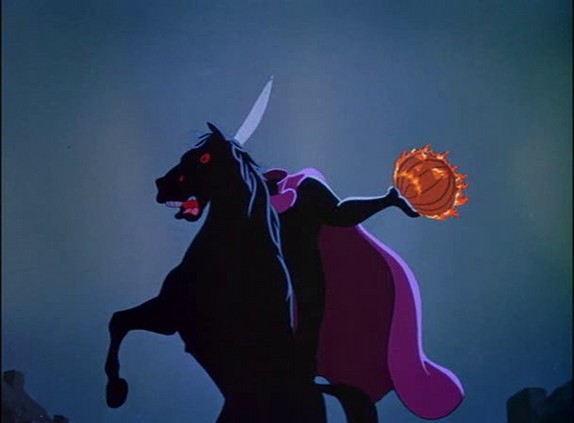
The Headless Horseman is the true star of the second act.

The Headless Horseman is the true star of the second act.

The Sleepy Hollow portion follows and was the sequence I was most interested in. While I was curious to see how The Wind in the Willows was adapted, I never had a strong affinity for Mr. Toad. The Legend of Sleepy Hollow is also a story I’m more familiar with, as I assume most people are. Ichabod’s last ride and the specter of the Headless Horseman have been recounted numerous times in popular media either as a direct adaptation or as a spiritual retelling. It’s a timeless tale and little effort is needed to convey the doom possessed by the Horseman. It’s really quite hard to make a headless knight riding a black stallion not look scary.

This segment is narrated, and sung, by Bing Crosby as a true narrator. If you’re looking for an example, think Boris Karloff from How the Grinch Stole Christmas. Crosby narrates the entire portion and sings at times. Ichabod and the characters do not actually speak, instead Crosby narrates the whole damn thing. It’s not the approach I would have taken if I were placed in the director’s chair, but there’s no reason why this shouldn’t work either.

As was the case with the Mister Toad sequence, the Ichabod portion suffers from pacing issues as well. This is partly to be expected as anyone familiar with the story knows the Headless Horseman shows up at the end. Leading up to it we’re essentially shown how Ichabod is basically a conman who’s motivated by wealth and food. He’s the local school teacher, and despite being a rather ugly looking fellow, is able to woo the local women with his singing voice and charm. When a wealthy individual comes to town with a fetching daughter by the name of Katrina, Ichabod sets his sights on a new prize. This puts him in competition with a local man by the name of Brom Bones, who is basically a lunkhead (he must have been inspiration for the much later Disney character, Gaston, from Beauty and the Beast) who is outsmarted by Ichabod when trying to court Katrina. It’s at a Halloween party hosted by Katrina’s father that Brom gets the idea to tell the tale of the Headless Horseman in an effort to scare Ichabod, who is revealed to be a superstitious man at the very same party. Given how slow-moving the story is, I found it lazy that Ichabod’s superstitious ways were not revealed throughout the picture in a more subtle fashion. Anyways, it’s when Ichabod leaves the party the he encounters the ghostly horseman.

If they had just committed to the horror, and left comedy to Toad, the Sleepy Hollow segment would have been better for it.

If they had just committed to the horror, and left comedy to Toad, the Sleepy Hollow segment would have been better for it.

The sequence where Ichabod is chased by the Headless Horseman is easily the highlight for both pictures. The setting is chilling and the Horseman looks particularly menacing. Ichabod, seated atop a very unimpressive horse, is forced to run for his life and the music and animation does a decent enough job of allowing the audience to share in his terror. There are some disappointments to be had, however. As mentioned during the Mr. Toad portion, the animation is merely serviceable and not feature-length quality. As a result, there is really no use of shadows or shading on Ichabod who pops too much against the background. Perhaps feeling the ride was too scary, some comedy was also added to the chase which really disrupts the mood. It’s basically screwball comedy not unlike what would appear in a Bugs Bunny cartoon and feels woefully out of place. At the end of the picture, there are some scenes that also detract from what should have been a more ambiguous ending, which also felt like a cop-out.

Overall, I was unimpressed by The Adventures of Ichabod and Mister Toad. As someone who loves and appreciates animation from all eras, I can easily forgive the films technological short-comings there as I wasn’t expecting it to be up to Disney’s usual standards from that era. I can’t really excuse either film for the pacing issues, and if given the chance, I probably wouldn’t have purchased this had I seen it first. The DVD release for the film a few years ago at least included a Mickey Mouse short that for some reason isn’t included here. And while I have all of the Mickey Mouse cartoons on DVD already, it would be nice for others if it had been included on the Blu Ray too. If you happen to be in the mood for a re-telling of The Legend of Sleepy Hollow, I’d suggest looking elsewhere (or scanning the various Disney channels to see if they show their version for free) this Halloween. As for The Adventures of Mister Toad, the weasel characters for the film inspired the same for Who Framed Roger Rabbit?, an immensely more enjoyable film. And if you really want to see the characters from the original, just wait for Mickey’s Christmas Carol which undoubtedly will start showing up on television before Thanksgiving arrives.


Teenage Mutant Ninja Turtles (Nickelodeon) Season 2

TMNTThe resurgence of the Teenage Mutant Ninja Turtles has been one of the more fun story lines from pop culture for me over the past two years. With an all new comic line, cartoon, and feature film, the TMNT are almost as relevant today as they were in 1990. Considering other old properties from the 80’s have been successfully resurrected recently, perhaps it’s not all that surprising the Turtles were able to accomplish the same. What has been surprising though is how successful the relaunch has been from an artistic standpoint. The general consensus for the vast majority of new films based on properties from the 80’s is that the material has been lacking. While no one can dispute how commercially successful a franchise like the Transformers has been for Hollywood, the movies themselves come across as overstuffed toy commercials. Like the Transformers, the return to the big screen for the Turtles was decidedly lacking when the new film was released in 2014 (I’d call the film trash but I personally have not watched it and don’t plan to). However, the comic book line launched in 2012 has been pretty well-received while the television show has been a smashing success.

When the cartoon was announced by Nickelodeon I was not optimistic about its chances at success. I was borderline indifferent, but my past romance with the Turtles was enough to make me curious. I set the DVR to record season one, and by its end, I was a fan. The show is witty, action-packed, and stuffed with enough in-jokes and material to appeal to 30-somethings who grew up with the Turtles. The cartoon successfully melds the old cartoon with the comic books while also taking its own path. The 2003 cartoon attempted the same, but was probably too reliant on the original Mirage comics. The old comics are an entertaining read, though nothing magical, but they do not possess an energy that lends itself well to animation. While on the other hand, the original cartoon was set on creating a fun series that appealed only to children. It never put the characters in any real danger and would eventually lose its audience as it grew up and acquired an appetite for more mature material. When the show finally made an attempt at change, it was too late.

What's old is new.

What’s old is new.

Like with season one, season two of Teenage Mutant Ninja Turtles opts for a more serialized nature with plots carrying over from one episode into another with few stand-alone episodes and characters. When a stand-alone episode does pop up, it serves as a palette cleanser from the main plot and is often a more offbeat episode. Most of these episodes are packed with humor with season two’s “Mazes & Mutants” topping the list of funniest TMNT episodes so far. The writers have found a nice balance in the humor for the show with it coming up at opportune times and resisting the urge to go for the easiest joke or pun. The show is genuinely funny, but it also knows when to let up on the humor and isn’t overly-reliant on the Michelangelo character.

Season two picks up right where season one left off with The Kraang being beaten back temporarily. Shredder and The Kraang have appeared to have forged an alliance, and an early mishap with a canister of mutagen mutates April’s father, Kirby, into a bat monster causing tension between the Turtles and their lone human friend. Meanwhile, Splinter (and this is a spoiler for those who missed season one) is coming to terms with the fact that his daughter is alive and well but has been brainwashed by the Shredder into believing she is actually the daughter of the Foot Clan’s leader and not Splinter. These two threads, April’s distrust of the Turtles and Karai’s lineage, are major plot points for the bulk of season two. The Karai plot twist could be seen coming from a mile away, but it was still effective as the writers handle it well. Karai naturally does not react well when the truth is first presented to her, and her response to it is complicated and appropriately remains unresolved for several episodes. The Kraang maintain a healthy presence throughout the season as well, often playing a role in a small way in most of the episodes. The season concludes with another big face-off between the Turtles and Kraang and it would seem the alien race will not be going anywhere anytime soon.

Casey Jones and Raph team-up yet again.

Casey Jones and Raph team-up yet again.

Season two introduces several characters, old and new. As was revealed in press kits, Casey Jones made his series debut in season two. Like April, he has been aged-down for the show from his original depiction but remains a vigilante of sorts. And like the Casey of old, he forms a bond with Raph pretty quickly and the two are a crime-fighting duo in some episodes. And as predicted by me (and likely many others), Casey forms the third corner of a pseudo love triangle with Donatello over April. Naturally, April is more taken with the human and this creates tension between Don and Casey that is sometimes entertaining, and sometimes feels a little stuffy, but is one of the ongoing aspects of the show that serves to remind the audience that these characters are, in fact, teenagers after all. Other characters familiar to fans of the old show that make their debut in season two include Slash, Mutagen Man, and Pizza Face while other characters are obvious references to old ones (Kirby bares an uncanny resemblance to Wingnut, for example). The show also does a good job of hinting at future characters. When a thief with a purple mohawk shows up it’s only natural for fans of the old show to assume this character has a date with a warthog and some mutagen in his future.

Don't be surprised if Kirby's Party Wagon gets a make-over in season 3.

Don’t be surprised if Kirby’s Party Wagon gets a make-over in season 3.

My main point of criticism with the show early on was for its lifeless take on the city of New York, and while the show has done a better job of making it look like people actually inhabit this city, it’s still a relevant criticism for season two. The character designs though have improved. Some of the villains in season one were pretty boring to look at, and that has mostly been remedied (though some are underwhelming, I’m looking at you Tiger Claw). There’s very little for me to complain about when it comes to this show. The writers have also wisely made the Foot Clan robots in season two (and not just randomly, it’s explained in an episode) so the Turtles are free to user their weapons against them. The more graphic violence is handled offscreen, but the consequences are shown. When Leonardo gets isolated from his brothers in the season finale and beat-up by Shredder, we don’t see any of Shredder’s bladed strikes landing. However, when an unconscious Leo is tossed through the window in April’s apartment where the other turtles are holed up (awesome reference to the comic and original film, by the way) his body is cut and bruised.

Just like with season one, season two does a great job of tossing in winks and nods to the old material that came before it. They’re sometimes hidden in the background and other times in your face (the party wagon!). Shredder remains a credible threat to the Turtles throughout the season and is a more than competent ass-kicker when pressed into battle. And while the April plot is resolved during the season, the other big ones are still open heading into season three. The season concluded with an hour long special that was perhaps the best in the show’s short existence thus far. It was satisfying on an emotional level while also delivering the humor and action the show has become known for. I’m even more enthusiastic for the show’s third season than I was the second (aside from the fact that Seth Green is set to takeover the voice-acting duties for Leonardo). If you were a fan of the Turtles in your youth and still have a fondness for them residing somewhere inside of you then you should be watching this show.