Author Archives: Joe

SNES Classic – Some Quick Thoughts

IMG_1711

The UK box had a bit of a rough ride across the Atlantic, it would seem.

So the SNES Classic is out and has been for a week. As expected, it’s been rather difficult to get one if you weren’t fortunate enough to land a pre-order (which was also rather difficult to obtain). Scalpers are out in full force, and based on the few bits of feedback I’ve received from some of those who waited in line on launch day, it’s the scalpers who are making up the largest portion of the buyers. That’s too bad, because this is a rather awesome gaming device. Niche it may be, it still contains some of the greatest games ever developed. I was fortunate enough to land two pre-orders:  one for the SNES Classic and one for the UK SNES Classic. It took my UK version an extra week to make it to my door, but I’m now ready to offer up some thoughts.

If you’re unfamiliar with the UK version of the Super Nintendo, it’s basically the same as the Japanese Super Famicom. Nintendo of America felt it needed to market the original NES as more of a secondary entertainment platform as opposed to a toy, and thus they redesigned the look of the machine for release in the US. For the Super Nintendo, they too also went with their own case design, though this one was far more in-line with the Japanese version as the carts were basically the same. I don’t know why they did this, and some speculate it was an ego thing, but I’ve always been partial to the Super Famicom design. When I first saw the Super Nintendo, I was underwhelmed as a child as I didn’t think it looked too “super.” Boxy with purple accents, it was kind of ugly. I got over it, of course, when I played Super Mario World, but I always wondered why some of those early games have a diamond shaped logo featuring three circular colors:  blue, red, green, and yellow. Years later I’d come to know that was the logo for the Super Famicom and it referred to the colored face buttons on the controller. I’ve never gone the extra mile and acquired a Super Famicom, but when I saw the UK SNES Classic, which is identical to the US one aside from the case and controllers, I knew that was the version for me.

IMG_1703Both editions of the SNES Classic are, naturally, pretty cute. Like the NES Classic they’re tiny and are closer in size to a game cartridge for the original system than the old system itself. They’re light, and pretty simple devices. Both feature working power and reset buttons that function the same as the ones on the original consoles. The eject buttons and cartridge door are non-functioning, and the there’s a little snap-off piece where the controller “ports” are that pop off to reveal the actual controller ports for the Classic edition. In the box, both units come with two controllers, an HDMI cable, and a micro USB cable. The US version has a USB to wall adapter that the UK one lacks, but any such adapter will work. The US version also comes with a poster with instructions on the reverse side while the UK version comes with an instruction manual designed to mimic the original. The UK version also comes with My Nintendo reward points, I’m not sure why the US version does not.

The software for both systems is the same. If you go out and import a Japanese unit you’ll get a few different games, but the UK and US get the same ones. The dashboard is slightly different as each one is mean to resemble the visual style of the actual unit, so the US dashboard has purple accents and the UK one has a power light in the bottom right hand corner. The little graphic of a controller beside a game is also updated to reflect the proper controller for each unit, so purple buttons for the US and multi-colored ones for the UK. Other features, like CRT mode, widescreen, and so on are all the same.

I’ve only had time to play a little, but the first game I fired up was Super Mario World. I wanted to test the game out and see if it felt like how I felt it should. Testing for things like input lag and any graphical stretching, I found the game to be picture-perfect. The emulation Nintendo has pulled off with both the SNES Classic and the NES Classic is fantastic and miles ahead of what the company did on the Virtual Console. It’s why whenever someone poo-poos these things and suggests just getting a Raspberry Pi I laugh at them. I think the Raspberry Pi is great, but games on that do not look and play as well as they do on these devices. There’s also something to be said for having an actual Nintendo controller in hand to play these things, which just feels right.

Following Super Mario World I made sure to play and beat the first level of Star Fox. I may want to redo my rankings and kick Star Fox to the end of the line because that game is a tad rough to play these days. I played it though because you have to beat the first level in order to unlock Star Fox 2. Truth be told, I don’t look really look forward to playing Star Fox 2 for any reason other than sheer curiosity. I suspect it has aged just as poorly, if not worse since it attempts to do more than just be a flight sim, and probably isn’t nearly as enjoyable an experience as most of the other titles on this collection. If I see fit to do so, I’ll post a review of it. Some day.

IMG_1710If you’re still unsure I can safely say the SNES Classic is worth the 80 dollar price tag Nintendo has placed on it. It’s a great little machine full of some truly excellent games, some of which would cost you hundreds to purchase on the secondary market. Like the NES Classic, it’s also not something you need to drop hundreds of dollars on to own so if you’re still looking for one I encourage you to be patient and not feed the scalpers. For now, Nintendo is claiming these will be shipped in abundance so hopefully they’re sincere and these are attainable for everyone who wants one. They’ll probably remain hard to get through the holidays, but if Nintendo keeps supplying them past 2017 they should get a bit easier to track down. If you live in an area with Amazon Prime Now, keep an eye on their social media accounts as it seems like they’ll be selling these exclusively through that service as well through their few retail locations and that truck thing they do. Supposedly, people who were able to pre-order through the US Amazon site are still waiting for them to be fulfilled. Meanwhile, Amazon’s European web stores seem to be getting stock regularly for their versions and most ship to the US. Sometimes they claim not to (when I pre-ordered my UK edition it said UK only, but it still went through), but will ship anyways. Just make sure to select the global shipping option, if offered. You’ll pay a few more bucks, but it might be worth your while, especially if you’re like me and prefer the UK look of the console.

As for my two units, I only wanted one. I plan to keep the UK version and gift the US one to my best friend who was not as fortunate as I. If you were concerned I’d betray my fellow retro-gaming enthusiasts and flip it on eBay, rest assured I have no plans to do so. I also do not need to collect mini systems and have a version of each. Hopefully who ever wants one will be able to get one because this thing is pretty cool. Don’t screw over your fans, Nintendo, and discontinue it while demand remains high.


Batman: The Animated Series – “The Underdwellers”

The_Underdwellers-Title_CardEpisode Number:  6

Original Air Date:  October 21, 1992

Directed by:  Frank Paur

Written by:  Tom Ruegger

First Appearance(s):  The Sewer King

For a long time, children’s shows were required to have some education content. That’s why we have such memorable segments from G.I. Joe with one of the Joe’s letting us know that “Knowing is half the battle.” These standards were either omitted or relaxed by the time the 90s rolled around, but this episode of Batman feels like it could have been made in the 80s.

The episode opens with a couple of kids playing chicken by riding on the roof of a train. Whoever bails first loses. Batman takes note and swoops in to put an end to such foolishness, and it’s a good thing too because one of the kids gets his foot caught on some cables and might have perished had he not. The boys are admonished by Batman with the line, “Play chicken long enough and you get fried.” See, Batman doesn’t just fight crime!

UDThumbsup

Batman says, “Thumbs up, dude!”

Shortly after, a woman is robbed by a little person wearing a green cloak, prompting her to declare she was victimized by a leprechaun. Batman oversees this but is unable to catch the culprit, but seems to be buying her description for some reason. This even leads to a scene at the Batcave with Bruce asking Alfred if he thinks he’s crazy for claiming to see a leprechaun. Alfred smartly responds with sarcasm, before Batman heads out for further investigation. He ends up finding a secret entrance to Gotham’s sewer system, where he finds his leprechaun:  a young boy who’s apparently been living down there. For some reason, Batman deems it necessary to take the kid home with him and have Alfred look after him. I have no idea why he doesn’t bring him to the police and continue nosing around in the sewers, and sadly Alfred doesn’t question Master Bruce.

SK

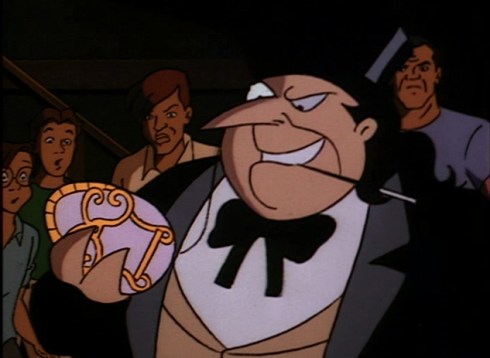
This is The Sewer King. He sucks, though Michael Pataki gives a pretty good performance, all things considered.

The real reason for bringing the kid back is likely to pad out the episode as we get to watch Alfred struggle through a day trying to wash the kid, feed him, and even get him to do some chores. He’s a mute with a dislike of sunlight. In a separate scene we learn his name is Frog via his surrogate father:  The Sewer King. The Sewer King (Michael Pataki) is never named in the episode, and his name only appears as graffiti throughout the sewers. He’s some kind of madman dressed kind of like a pirate (complete with the eye patch) who has some obedient pet alligators to make him seem menacing. He also lords over a bunch of orphaned children who do his bidding. They’re forbidden to speak, and are only allowed above ground to steal for him. He’s cruel, but only emotionally. Apparently Standards & Practices wouldn’t let him be physically cruel to the children, which probably would have added more menace to the character. He’s enraged when a child other than Frog brings him his rolls for his dinner, and as the tired and malnourished children look on, he throws the food on the ground and sends them all away to find Frog.

hqdefault-9

The Misadventures of Frog and The Butler

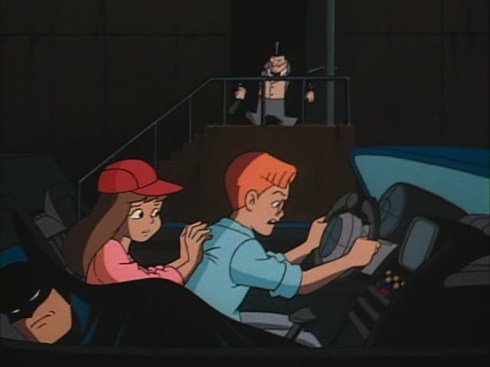
Meanwhile, Frog finds Bruce’s room full of antique weapons and plucks an old rifle off of a display. Batman shows up and is quick to remind the audience that children and guns don’t mix. Hey Bruce, I don’t disagree with that sentiment, but if you want to keep guns out of the hands of children maybe don’t just casually hang them on your wall within reach?

Batman and Frog head back to the sewers, where Batman is finally able to confront The Sewer King. He gets to do battle with the gators, and even dislocates the jaw of one of them in unrealistic fashion, but you don’t need me to tell you that Batman isn’t losing to some guy named The Sewer King. When he does finally catch The Sewer King, Batman implies he’s really tempted in this instance to take his life which apparently director Paur felt was necessary in establishing that Batman is a friend to all children.

The Underdwellers 2

Shots like this are probably what caused Bruce Timm to declare it too anime-like in appearance, but I do think it works in places and love the blacks and blues seen here.

This is probably not a well-remembered episode of Batman. It deals with a D-level villain who will never resurface and is clearly aimed at just connecting Batman with a young audience. That said, I don’t feel it’s necessarily written poorly, I just wish it wasn’t so hammy with the lessons. The opening scene exists only for the show to make the statement that riding on top of trains is a bad idea, which feels like something that doesn’t need stating. If those kids were somehow followed-up on at the episode’s conclusion maybe it would have been worthwhile. Instead it feels like an episode that had a 15 minute story, and that scene, as well as Frog and Alfred, needed to be added to add more time. Though I should say, the scenes with Alfred and Frog might be the best of the episode as they are kind of funny, and the villain is so hard to be invested in that those lighter scenes end up working better.

Visually, Bruce Timm expressed dissatisfaction with the episode, saying it too resembled anime. I can kind of see that in the design of the children, but the episode is actually animated rather well. Better than the previous episode, “Pretty Poison.” The lighting in the sewer, something which could have proved challenging, looks great and I felt Batman’s movements were noticeably smoother than they’ve been in some of the other episodes.

There’s no covering up for a mediocre antagonist, and while The Sewer King is easy to root against, he’s also hard to take seriously. With the way these episodes are structured, when the villain stinks the episode tends to follow which is why “The Underdwellers” is probably nobody’s favorite episode. I should add though, I was not looking forward to re-watching this episode for this feature, but I ended up enjoying it more than I thought I would, some of that was ironically. Still, probably not my least favorite episode of season one.


The Scariest Story Ever – A Mickey Mouse Halloween Spooktacular!

Scariest_Story_Ever_Mickey(1)The new Mickey Mouse cartoons are pretty spectacular. They’re funny, look great, and best of all they’re keeping Mickey and the gang relevant as television stars and not just amusement park fixtures. And best of all, they seem to be embarking on a trend of holiday specials! I adore holiday themed specials, in particular Christmas and Halloween. They’re the two holidays that lend themselves the best to a special because they’re so visual. Last year, we received a brand new Mickey Mouse Christmas special called “Duck the Halls” and it was pretty great. As a follow-up, this year we’re getting a brand new Halloween special:  The Scariest Story Ever – A Mickey Mouse Halloween Spooktacular! The new special will debut on television this Sunday, October 8th, on the Disney Channel, but you can check it out right now by heading to your local big box retailer and picking it up on DVD as part of the Merry and Scary collection which includes “Duck the Halls” and an assortment of spooky shorts.

Scariest_Story_Ever_Mickey(2)

Mickey’s house all tricked out for Halloween.

The special opens with Mickey, Donald, and Goofy out trick or treating with the nephews Huey, Dewey, Louie and the seldom seen mouse nephews Ferdi and Morty. Right away, this special is after my heart as the duck nephews are sporting the same costumes they wore in the classic Donald Duck short “Trick or Treat.” A nice little bobbing tune plays as the group does Halloween stuff before returning to Mickey’s house which is decked out in full Halloween decor. It’s there the story comes into focus as the kids demand a scary story from Uncle Mickey who is happy to oblige.

The special takes on an anthology format and parodies three classic tales:  Frankenstein, Dracula, and a take on Hansel and Gretel. The Frankenstein one features Goofy as Dr. Frankenstein and Donald as his assistant as they construct a monster who’s not quite what the kids are expecting. Unsatisfied with Mickey’s ability to spin a scary tale, Goofy and Donald assist with the second one which casts the trio as vampire hunters after Dracula. The Hansel and Gretel tale is the third and final one as the kids weren’t scared by either of the first two. In that one, the kids are inserted into the tale as a gang of rotten kids who steal pies and find themselves seduced by the tastiest pie of all which happens to be baked by a witch who wants to eat them.

484M-201_257_0025

Mickey trying to scare the kids.

By and large, this special is designed to induce laughter. They’re more joke-reliant than the usual Mickey cartoons which tend to heavily rely on visual gags. That’s not to say there are no visual gags to be found. In fact, there are some pretty good ones especially in the Dracula portion in particular. I really liked the one where the vampire places Donald’s stretched out neck in a hot dog bun as he prepares to indulge himself in some duck blood. The more traditional jokes involve Goofy freaking himself out with a sock puppet and Donald trying to tell a scary story but no one can understand him.

Visually the show looks great. I love how vibrant the colors are and the backgrounds have a gritty quality at times that lends itself well to the Halloween vibe. Mickey is in a costume that features a sunflower on his hat and the flower always takes the place of one of his ears, which is a fun visual treat to follow throughout the episode. Goofy is in his Super Goof attire which is a nice callback as well to that version of the character. There’s a musical number early on that’s pretty silly and thus amusing and the usual voice cast appears. If you like your duck nephews voiced by Russi Taylor, as they were in the 80s, then you’ll be happy to know she voices them in this special, as she did in the previous one as well. The special also has some genuinely spooky imagery, but not enough to frighten my 2 and half year old (he refers to this as the Scary Mickey Cartoon and has been watching it incessantly the past week) so I wouldn’t be too concerned about it being too scary for kids. As always though, if you have an easily frightened child you’re best off watching it by yourself first to see if you think it’s something that will frighten your kid. The only thing about the special I don’t particularly care for is the obvious “made for TV” breaks inserted into it when scenes just end and fade to black. They could have created transitions and just edit them out for TV. I always appreciate it when a retail version of a TV special has slightly more content than what ends up on television.

Merry-Scary-box-art

Can’t wait for the TV broadcast? You can pick this one up on DVD with the Christmas special as well.

“The Scariest Story Ever” is likely to be repeated quite a bit this month. As of this writing, I’m not aware of any non cable airings planned, but it would be nice to see this paired with the “Toy Story of Terror” TV special and aired on a major network so more people can see it. I love that Mickey and the gang are being revived for a new audience so getting them on major networks would really help boost the popularity of the brand. Every kid should get to grow up with Mickey, Donald, Goofy and all the rest. Here’s hoping more holiday specials are on the way in the years to come.


Neca 1/4 Scale TMNT Movie Michelangelo

IMG_1679The good thing about NECA’s Michelangelo, the final turtle to be released from their quarter-scale line of action figures based on the 1990 film, is that it’s just like the previous three turtles to be released. The bad thing about it is that it’s just like the previous three turtles to be released.

Let’s start with the good. Mikey is made of the same high quality parts that his brothers are made up of. The paint applications are excellent, the texture of the skin spot-on, and the articulation better than you would expect of a 16″ turtle. He comes with an assortment of extra hands, which are basically identical to what his brothers feature, as well as the customary slice of pizza which fits so much better with Mikey than it does the other three. He has his twin nunchaku which are connected by a pair of nylon ropes to simulate his ‘chuks from the film which did not feature actual chains. He also sports a sublime bag of pork rinds, a unique accessory exclusive to Mikey and another that feels oh so appropriate. His head sculpt, which is naturally the only part of his body different from the others, features a happy expression as opposed to a grim one which also feels appropriate for the character. His wide-eyed gaze makes him look a bit less “alive” than his narrow-eyed brothers, but I wouldn’t trade this head sculpt for another.

Mikey is also just as poseable as the other three, though his choice of weaponry makes finding good poses a little more challenging. The rope between each end of the nunchaku  is pretty short. On the back of his packaging, there’s a picture of him with one end of his nunchaku going over his shoulder so his left hand can grasp it under his arm while his right hand holds the other end. Try as I might, I can’t come close to replicating this pose with my figure. I don’t know if they had to stretch the ropes to pull it off or dislocate the left arm or something. That’s okay though, Mikey isn’t really itching for a fight anyways and I’ve chosen to pose him on my shelf without his weapons at the ready opting instead for pizza and pork rinds.

That’s basically the good stuff. However, there are some flaws with Mikey not really shared by his brothers. For one, he has no holsters for his weapons. There’s a gap between the shell and belt under each arm that they can be wedged into, but in the 1990 film he had holsters on the rear of his shell (they would be moved to under the arm for the sequel) that NECA opted not to include. Curiously, NECA also sent out a promotional image to most retailers featuring Mikey balancing his nunchaku on his finder, but this special piece is not included. Supposedly it’s part of an upcoming set of baby turtles. If that’s the case, the image probably should have been circulated to promote that set and not this figure. However, the thing that bothers me the most about Mikey is his size. Since he uses the same body as his brothers he’s the same height as them as well. In the film, Mikey is noticeably shorter than his brothers and it really stands out to me when he’s posed alongside them. I suppose I could drop him to one knee or try to pose him sitting to hide this fact, but it does bother me, probably more so than it will most people though.

Because of the inaccuracies of this figure, I do feel Michelangelo is probably the worst of the four turtles released. That doesn’t mean he’s a bad figure though. I still think he looks great on his own, and I’d never buy three quarters of the TMNT and not the fourth. I love his head sculpt and I really love that he came with the bag of pork rinds. It’s such a throw-away moment in the film, but for some reason I always loved that scene of Don and Mike avoiding another Leo and Raph confrontation by stuffing pork rinds in their faces.  It also amused me as a kid to see the turtles eating something other than pizza.

This isn’t the end of NECA’s quarter scale line of figures based on the original film. As I mentioned earlier, a set of four baby turtles based on the origin flashback scene is on the way and they’ll also come with a box of pizza in addition to Mikey’s extra piece. I will admit I’m really not interested in that set, so don’t expect a review here. What I am interested in is the Shredder due out sometime next year. He hasn’t been unveiled yet, and NECA isn’t displaying anything at the New York Comic Con so we probably have to wait until Toy Faire to see him. I have high expectations. Another version of Raph is also coming and as far as I can tell it’s a re-release of the figure we have, but with a trench coat, hat, and backpack in addition to his sai. Supposedly, sales of this edition of Raph will determine if NECA goes ahead with a foot soldier figure. I kind of hate it when toy companies do this as it’s basically a lesser form of blackmail, “Re-buy this figure if you want this one. Oh, but he has a new hat!” I would have loved it if NECA had included the coat and hat with the first release, or made it available by itself, but I’m not buying another 100 dollar figure that’s essentially one I already have in the hope that it will lead to a future figure. That and honestly I don’t have much interest in a quarter scale foot solider. I would just want multiples for a small army, but at $99.99 there’s no way I’m buying more than one. So Shredder will likely be the final piece of this line I collect, and that’s fine as I primarily want the four turtles and their arch nemesis. If a Casey Jones comes around I’ll give it some thought.

Donatello was slightly scarce, as was Raph, but it seems NECA has upped their production numbers so a set of the four turtles is not hard to come by. You can find them at various specialty shops online and NECA sells direct through eBay too. And sometimes they even show up at Toys R Us. This is probably the best set of TMNT figures I own, and I own some good ones. I know some out there are holding out for a smaller scale version, but at this large scale I can’t deny they look awesome. I heartily recommend all four, but I understand that at $99.99 MSRP they’re not for everyone. It’s still great to finally have a quartet of turtles based on the original movie as that’s the best they’ve ever looked, in any medium. Don’t sleep on this set.


Batman: The Animated Series – “Pretty Poison”

Pretty_Poison-Title_CardEpisode Number: 5

Original Air Date:  September 14, 1992

Directed by:  Boyd Kirkland

Written by:  Paul Dini, Michael Reaves

First Appearance(s): Poison Ivy, Renée Montoya

“Pretty Poison” is another early production episode that’s confident to give viewers a lesser villain rather than a heavy hitter. As the title implies, this episode is the introduction of Poison Ivy (Diane Pershing) and she’s debuting as a new villain, not as one with a prior relationship with Batman (so far, only Joker has been introduced as an already existing villain) making this an origin story for her. Also central to the plot is Harvey Dent (Richard Moll). We saw him briefly in the pilot “On Leather Wings,” but this episode is really his introduction to the audience.

The episode opens in black and white as we see a pair of hands saving a wild rose from being torn up to make way for a new prison in Gotham. An old news broadcast serves to provide a framing device for this prison as it’s the brainchild of Gotham’s new district attorney, Dent, with considerable financial backing from some guy named Bruce Wayne. The show uses colored images to take us to the present, five years later, and a current prisoner of that fancy new establishment is making an escape with the help of a helicopter. This sets up a fun little back and forth where we’re shown scenes of Batman going after this guy and a scene of Dent enjoying dinner with a dashing redhead. They’re waiting for Wayne, and we get some humorous comments from Dent about his boring buddy who is always late while Batman is shown doing mostly Batman things. It’s a scene that will basically be adapted for the first Spider-Man movie.

1280x720-sxZ

Bruce meets Harvey and his new girlfriend Pam for dinner.

Bruce eventually shows up at dinner, having thwarted the escape, and is introduced to Dent’s fiancé, Pam Isely. After she gives him a long, lingering, kiss she departs and Bruce begins to caution Dent on moving too fast (he’s only known her a few weeks). Dent begins to complain about not feeling well, and then passes out into his pudding and Gotham PD is alerted. Dent’s been poisoned, and Wayne naturally is on the case as Batman.

Through the use of his awesome computer, Batman discovers the poison is derived from an extinct species of rose. He also learns that Dent’s new flame is a botanist, who is currently giving a lecture on extinct plants. You would think Batman’s villains would be more careful? Anyway, it’s pretty clear who’s behind the poisoning and Batman confronts Isley, who’s hopped into a backless green outfit with a wrist-strapped crossbow and is now calling herself Poison Ivey. She has some sentient plants that do her bidding and basically makes it clear she values the life of the plant Dent drove into extinction by building his prison (apparently Gotham has a bad environmental works department) more than the life of Dent. I can’t help but wonder if Ivy was created by someone who thought vegetarians were crazy and that they valued animal life more than human life and decided to make a more extreme version?

hqdefault-8

I always thought Poison Ivy’s mini crossbow was pretty cool.

Nonetheless, this is a good episode with some pacing problems. I really enjoy the setup, and it’s great that we get to see the Bruce/Harvey friendship before a different tragedy befalls the Dent character. I like that Isley is not too on the nose at first. While it’s not hard to figure out who poisoned Dent, it’s handled about as well as it can be. Ivy does come across as a bit incompetent, even basically just giving up in the end after almost losing her precious plant. It’s always a challenge to put Batman at odds with a female because the censors don’t want Batman handling them in the same manner he would The Joker, but Ivy’s plant monsters work well to take a beating and they’re pretty cool looking. I can’t help but think this episode would have benefitted from being a two-parter though, as it wraps really fast. A second part would have allowed for the introduction of some red herrings to make things seem less obvious leading to a better pay-off in the end.

Captur2e_zpse0f51feb

Given how Ivy’s feminine features are very much a part of her arsenal, I really hope that mutant plant isn’t supposed to be representative of a certain part of the female anatomy.

Visually, this is a solid episode. There’s some stiff animation at times, but I liked the artistic take of utilizing black and white and color as a way to distinguish the past and present. Batman gets a little beat up too which is always kind of fun to see. There’s also a little visual humor as we get Gordon and his subordinates racing out of the police headquarters when that unnamed prisoner attempts a break-out repeated when they find out Dent gets poisoned. Both times Bullock is just trying to enjoy some donuts because he’s a cop, and he’s fat. Cheap humor, but for some reason it made me laugh a bit when the scenario was repeated. Alfred also gets some nice lines here, and he’ll be even better in the next episode, making him a dark horse early favorite for season MVP.

This episode is a good introduction for Poison Ivy, who could be considered one of the break-out players from this series. Prior to The Animated Series, Ivy wasn’t a big player in the comics, but this series treated her as Batman’s #1 female adversary (it would mishandle Catwoman, coming later), and yes I realize this is the show that gave us Harley Quinn. Without this show, she probably isn’t a featured villain in Batman & Robin, which was a pretty big moment for the character, even if the film is trash.


Batman: The Animated Series – “The Last Laugh”

The_Last_Laugh-Title_CardEpisode Number:  4

Original Air Date:  September 22, 1992

Directed by:  Kevin Altieri

Written by:  Carl Swenson

First Appearance (s):  Batboat, Joker Gas

Despite the finality of the title, “The Last Laugh” is not the last appearance of The Joker, Batman’s greatest foil. While The Joker’s first production appearance in “Christmas With The Joker” featured a pretty slap-stick version of the character, The Joker depicted in “The Last Laugh” is a bit more dangerous and more in-line with his future appearances. Even though “The Last Laugh” marks The Joker’s second appearance in the series, it still isn’t the first appearance the character would make on television as we haven’t come to his broadcast debut yet. This is also the second holiday themed episode of the show, in this case April Fool’s Day, though thankfully The Joker would refrain from only appearing on holidays.

April Fool’s Day has arrived in Gotham, and with it a barge full of garbage is sailing down a canal in the city sending a foul order through-out that also happens to make all who inhale burst into uncontrollable laughter. This is obviously the work of The Joker, and our hero makes the same connection just as quickly as the viewer when the news reports break. Strangely, Batman doesn’t actually set out to put a stop to this until the gas creeps into Wayne Manor, turning Alfred (now voiced by Efrem Zimbalist Jr.) into a destructive force as he happily smashes various objects around the mansion.

The Last Laugh 1

Joker, breaking the fourth wall, declares “When the going gets tough, the tough go shopping,” which is a line I can’t decide if it’s just not funny, or intentionally not funny.

Meanwhile, Joker and his goons are galavanting around Gotham happily looting stores and emptying the pockets of those who are paralyzed with laughter. Unlike other depictions of Joker’s famous Laughing Gas, this version appears to only induce laughter without the fatal component; appropriate for a kid’s show. Batman eventually tracks down the barge with the debuting Batboat, which also appears to function as a submarine (surprisingly, it does not resemble the Bat Ski-Boat from Batman Returns) when needed. Batman is forced into conflict with Joker’s henchman, where one turns out to be not a henchman at all, but an android that is able to surprise and overpower Batman. Captain Clown, as The Joker affectionately refers to his robotic minion, stuffs Batman in a trashcan with a lockable lid and tosses it into the bay, but not before Joker stabs a few air-holes in it. Batman, naturally, avoids death by drowning and tracks the Joker down to a waste management facility where he dispatches with the goons, and eventually corrals The Joker himself.

lastlaugh2

The Joker always brings out Batman’s playful side.

Despite the title, this episode is some-what short on laughs as writer Carl Swenson seems to view The Joker as the type of comedian who just makes bad jokes that only he finds funny. While it may not be all that humorous, the visual style is exceptional. There’s some wonky animation early in the episode with Bruce and a shower scene (not as sexy as it sounds), but after that the rest is gorgeous. The initial fight scene between Batman and The Joker’s men features Batman ably darting around and throwing punches. Captain Clown, being a robot, allows for Batman to really tee-off on him in a manner the censors likely wouldn’t allow had the character been human. He even gets to smash him repeatedly in the head with a steel pipe, the clown’s frozen expression is probably rather creepy for those who hate clowns. Batman’s eyes are also allowed to emote in their most expressive manner yet as they’re constantly changing shapes to show fear, worry, and even dizziness. Joker is allowed to get serious and even a little scary when he reacts to Batman “killing” Captain Clown. There’s also a fun playful moment at the end between Joker and Batman, and Bruce even gets to make a joke to close the episode out at Alfred’s expense. The only other criticisms I can levy at the episode from a technical perspective is one shoddy-looking Batman chest emblem at the 9:40 mark and the abundance of eye black on The Joker, which at times makes it look like he’s wearing a bandit mask. The animators also, at times, appeared to have trouble with Joker’s mouth movements. Either that, or they re-recorded some lines after the fact. I’ll have to be on the look-out for this in future episodes featuring The Joker.

960-2

I’m not sure he’d still be smiling if he could help it.

Not to be outdone, the audio section of the episode is particularly lively this time around. Normally, the show can be a bit understated, relying on the Batman theme for its big moments. Joker has his jubilant theme which the series will return to time and again, and this episode has its own unique opening theme that’s really good. It has a nice build and I wish the show had returned to it more in other episodes, but then maybe it wouldn’t be as special.

This is a very good episode for the series, even if it probably isn’t among the very best. It’s harmed some-what by the mostly directionless Joker who has no real motivation here other than to rob Gotham. The show kind of does that sometimes with him as his primary goal appears to just be to stir up trouble and draw Batman out. Maybe I’d feel satisfied if we saw Joker just casually toss all of the stolen goods into the pile of garbage and not really care about it. Instead we don’t really see it at all. Even so, The Joker is easy to write as he’s Batman’s polar opposite so as long as the two get to share some screen time the results are typically entertaining.


Batman: The Animated Series – “Nothing to Fear”

Nothing_To_Fear-Title_CardEpisode Number:  3

Original Air Date:  September 15, 1992

Directed by:  Boyd Kirkland

Written by:  Henry T. Gilroy and Sean Catherine Derek

First Appearance (s):  The Scarecrow, Thomas Wayne

Episode 3 of Batman:  The Animated Series introduces us to what is probably the standard episode template. A physically unimposing villain with a gimmick shows up to cause some sort of havoc while leading a gang of incompetent muscle who mostly exist just to get pummeled by Batman. That’s not necessarily a criticism as its a format that works just fine so long as the main villain is interesting enough.

Enter The Scarecrow (Henry Polic II), a costumed villain armed with a fear-inducing toxin and a grudge. The Scarecrow will see a redesign later this season, but for his first appearance he’s uniquely toon-like with a tear-drop shaped masked head that’s not at all indicative of the shape of the skull beneath it. His eyes, like Batman’s, are void of pupils and his head will curve in natural ways. He’s rail-thin with claw-tipped fingers with a rather ordinary looking attire to go with it. He’s fairly creepy looking, probably because of the unique shape of his model. His future version will add pupils and a more natural shaped head as well as teeth to the hideous moth and some straw hair. This original version is basically the under-stated version, though I like it, despite the simplicity.

NtF_12_-_Scarecrow_and_thugs

The Scarecrow as seen in this episode. He will undergo a redesign before his next appearance in “Fear of Victory.”

This episode also introduces us to the Bruce Wayne character by showing us how some in the public view him. The episode opens with Gotham University head Dr. Long (Kevin McCarthy) fretting over a recent crime wave impacting the school and being chased down by Summer Gleason for comment. A chance encounter with Wayne, in which Long refuses to shake his hand before admonishing him, shows us that some view Bruce as just some billionaire play boy not living up to the Wayne name. It’s an aspect of the character that’s really not going to be explored much outside of this episode, but I’m glad it’s at least touched upon here. The comments naturally sting Bruce, even if his actions as Bruce are just an intentional cover for his Batman persona.

Batman soon has his first encounter with The Scarecrow, who appears to be robbing a vault on university grounds but may in fact just be looking to harm the university by any means. He’s able to show off his toxin, first on a hapless guard and then on Batman himself. Dr. Long’s words come back in a big way by unveiling to the viewer that Batman’s greatest fear is that he’s letting his parents down. The Scarecrow escapes, but the effects of the toxin linger throughout the episode. It’s not until the climax, where Batman being confronted by a vision of his dead father as a giant skeleton, utters his most famous line from this show:  “I am vengeance! I am the night! I. Am. Batman!” It’s a bit corny, but I know at the time I thought it was awesome and it’s a still a fun little catch-phrase for Batman.

thomas-wayne-2

That’s probably not how your dad wants you to remember him looking, Batman.

Batman naturally figures out The Scarecrow’s identity as that of Johnathon Crane, a former university employee specializing in fear. I should say, Batman’s computer figures out who Scarecrow is in what is easily my biggest pet peeve with this show. Batman’s computer basically knows everything and responds to voice commands in 1992 better than Siri does in 2017. The computer is often the detective with Batman taking all of the credit.

There are some fun little easter eggs in this episode. When Batman is confronted by Bullock after Scarecrow escapes, Bullock refers to him as Zorro with a mocking tone. Zorro is often cited as the real-life inspiration for the Batman character, although the in-universe inspiration will be established later. Also, when Batman is looking at a list of possible sources of The Scarecrow’s mask, Axis Chemicals pops up which is the same name as the chemical plant from the Batman movie that gave birth to The Joker. The vault guard from early in the episode is also seen reading an issue of Tiny Toon Adventures, and enjoying it immensely.

ntf27

If this is how everyone on Scarecrow’s toxin would view him, then maybe Batman should start arming himself with it.

Plot wise, this is the best episode so far and The Scarecrow is an interesting villain in his own right. Unfortunately, it’s a low point for the animation quality of the program. I already covered the minimalist approach taken in designing The Scarecrow, but also the character just animates unnaturally. Bruce looks especially off-model in his appearance early in the episode and we get a really bad shot of the Batmobile at one point, as well as the first instance of bendy Batmobile. The vault guard who is the first affected by The Scarecrow’s fear toxin hallucinates spiders all over his body, which strangely only appear to have four legs apiece. On the plus side, I like the added stubble on Bruce when he’s in the Batcave essentially withdrawing from The Scarecrow’s fear toxin. His hands are shaky as he tries to pick up a picture of his parents and he looks appropriately disheveled. There’s also a nice bit of artistic licensing in the closing shot of the episode where Bruce’s shadow is cast as Batman.

This is a good episode, and for a lot of kids this was probably their first look at The Scarecrow. He’s a unique villain who has a good look that gets better and his fear toxin is a fun weapon for the writers to play with. He’ll actually be one of the most used villains by the show which is a bit surprising on the surface, but his episodes tend to deliver which is why the show runners kept returning to him. Also of note, we get to see Batman actually driven to strike Bullock over his mocking, heightening their rivalry. We also get to see one of The Scarecrow’s henchmen, after being exposed to the toxin and revealing his fear as returning to prison, basically kill himself by jumping out of a zeppelin rather than risk capture by Batman. He lands on some trees with a nice leafy canopy. The censors probably intended for us to think those leaves cushioned his fall, but I’m not buying it. That guy is dead. This is also the last episode for Clive Revill as Alfred who will be recast. We hardly knew ye, Clive.


The Legend of Zelda: Breath of the Wild

BreathoftheWildFinalCoverIt has taken me quite a few months, but I’m finally ready to offer up my full thoughts on the latest entry in The Legend of Zelda series:  Breath of the Wild. I first wrote about it as part of my initial thoughts on the Nintendo Switch. I was able to secure a unit at launch and naturally Zelda was the title I paired with it. Since its release, Breath of the Wild has been almost universally praised as not just one of the best titles in the series but as one of the greatest video games ever made. Currently it ranks fourth all time on game rankings.com, right in between Grand Theft Auto IV and Super Mario Galaxy 2 with an aggregate score of 97.28%. On metaritic.com, the game is in a massive tie for 6th all-time with a score of 97. The highest score of all time just happens to be 99, held by The Legend of Zelda:  Ocarina of Time.

The Zelda series is accustomed to tremendous accolades upon release. In some ways it’s Nintendo’s most pure franchise. While Mario will dabble in virtually every genre imaginable, the Zelda franchise is content to largely remain the same with some tweaks here and there. I’ve argued the franchise was starting become stale because of its reliance on its classic formula. The last main entry on a home console, Skyward Sword, was the tipping point for me as I found the game to be an un-fun chore that drew out the worst in the franchise. Perhaps Nintendo felt some of that as well as Breath of the Wild is the first Zelda title on a home console since maybe Zelda II to really try and break the mold.

As some have pointed out, part of what makes Breath of the Wild feel so fresh for the franchise in 2017 is an approach to the gameplay that’s reminiscent of the very first title in the series. In The Legend of Zelda, the player is dropped into the world with very little direction on what to do. There’s a cave immediately in front of the player’s character inhabited by the famous old man who bestows upon the player the sword they’ll most likely need to get their quest underway. After that, it’s basically figure it out, kid. Breath of the Wild begins with Link awakening in a cave. He’s an amnesiac with no knowledge of why he’s there. He’s immediately given the Skeikah Slate, a device that bares an uncanny resembled to the Wii U’s Gamepad that will play a pivotal role in the journey to come. Aside from that, Link merely possesses some ragged clothes and a voice in his head. That voice belongs to the princess Zelda, and she’ll urge Link to leave the cave and stop Calamity Ganon, who has overrun Hyrule Castle and imprisoned the princess 100 years ago.

Main-Day

If the world looks big it’s because it is.

As is the case with most Zelda titles, plot isn’t always important. When Link emerges from that cave the game’s primary objective is clear, but overcoming it is not. An old man emerges to act as a bit of a guide in the game’s earliest portion. He’ll introduce Link to the towers that dot the landscape. Climbing them allows Link to download a map of the surrounding area to his Sheikah Slate (similar to the map function of Assassin’s Creed) and survey the land for shrines. The first part of the game takes place on a giant plateau that Link cannot leave. There are four shrines on this plateau Link must visit before departing. Each shrine contains a new function for his slate, and these new powers are what Link will rely on to complete his quest.

The shrines are not quite the dungeon replacement some though they would be. The shrines are mostly small areas that are puzzle driven and each one typically utilizes one of the powers of the Sheikah Slate. Those powers are:  remote bombs, cryonis, stasis, and magnesis. The remote bombs are straight-forward and reminiscent of the bombs in virtually all Zelda games. There are two shapes for the bombs:  rectangular and spherical. These bombs can be placed one each at a time and then detonated remotely. There’s a cool-down meter after each detonation to prevent spamming of the bombs and they’re about as useful as bombs usually are. The cryonis ability is mostly limited to being useful in the game’s early going. The ability allows Link to create up to three ice pillars on the surface of the water. Early in the game when Link’s stamina is low, this ability comes in handy to traverse large bodies of water he wouldn’t have the stamina to swim across. It also can be used to lift floating objects, such as a wooden treasure chest, out of the water by creating a pillar beneath the item. Stasis allows Link to freeze an object in time. When the object is frozen, Link can smash it repeatedly which stores potential energy in the object that will be unleashed all at once as kinetic energy once the stasis wares off. This allows Link to move heavy objects he can’t pick up. Later, it can even be upgraded to work on organic objects like enemies, which comes in handy for really tough enemies like the Lynels. Magnesis basically turns Link into a lesser version of Marvel’s Magneto as he can magnetically move and manipulate metal objects. He can’t, unfortunately, use the ability on himself or something he’s directly standing on for flight (though if you stack two metal objects on each other you can kind of create a rudimentary flying machine). This ability has pretty obvious uses and is probably overall the most useful ability Link acquires.

Zelda-and-Link

The game tries to inject some true emotion into the plot, but it’s not all that successful.

Unlike past Zelda games, those core four abilities are pretty much it for Link as far as acquiring new abilities is concerned. There are no main dungeons to conquer containing a new permanent item, which is probably the most radical departure. Instead, Link can acquire equipment constantly throughout his journey. Armor is the only permanent equipment Link can acquire and he does so through conventional means such as buying it or by finding it in hidden treasures and shrines. Armor typically comes in sets with a head, torso, and leg component. Often these bestow abilities upon Link aside from just damage resistance and they can be upgraded at Great Fairy Fountains a maximum of four times each. Typically an armor set allows Link to resist elemental damage or move stealthily. Some of it is also just to look neat. Link’s offensive equipment, and shields, all have a durability score and will eventually break. Link is not a blacksmith and cannot repair his equipment, nor can seemingly anyone in all of Hyrule so once it breaks it’s gone. There’s basically no point in getting attached to anything. In addition to swords, Link can wield poles, axes, hammers, great swords, wands, and bows offering up some distinct combat style approaches. The only problem with that is that most gamers will naturally prefer one over the other, but sometimes all you have is one weapon type. Basically every enemy will drop whatever weapon they were using and Link can claim it, so weapons are easy to find, but good ones are not. There is, of course, a version of the Master Sword in this game. It too can break, but unlike the other items, once it breaks it just needs to recharge so at least you don’t have to go back and find it.

the_legend_of_zelda_breath_of_the_wild-10

The lumbering Hinox has one very obvious weak point.

As I mentioned before, the shrines are a main focus of this game though completing them all is not necessary to beat it. Once you leave the game’s first area, The Great Plateau, you’re actually free to beat the game whenever you wish. Completing all 120 shrines obviously is a help as each one gives Link a shrine sphere and those spheres are how Link expands both his maximum health and stamina. Health is self-explanatory, but stamina is just as vital as it allows Link to run, climb, and glide. Climbing is a huge part of Breath of the Wild as exploration is the name of the game with such a vast map. Link can climb almost any surface, as long as it isn’t raining, and the player is often rewarded for doing so. The map is gigantic, so crossing it on foot would take an extremely long time. When Link completes a shrine, it becomes a fast travel point adding even more of a necessity to find them all. Many are hidden in plain sight from the several great towers dotting the landscape, but several others are well-hidden, some even behind a side quest.  Most are fun, if not all  that challenging. They tend to be puzzle-like in nature, but the kind of puzzle where the objective is clear, but pulling it off is tricky. Some of them are strictly combat shrines where Link has to defeat a certain enemy to clear it. These were my least favorite as the combat never changes, it’s always the same enemy, and there are way too many combat shrines. Three shrines are hidden in large labyrinths which is kind of fun, and one great one exists on an island that setting foot on causes Link to lose all of his equipment. It’s definitely the most inventive out of all 120 of them.

Breath of the Wild subboss guide

The spider-like guardians are probably the best of the new additions to Link’s cast of foes.

Separate from the shrines are the guardian beasts. These four beings are the closest things to dungeons the game has, aside from Hyrule Castle where Ganon resides. They’re colossal mechanical beasts that Link must first gain entry to in some cinematic fashion. Once inside, Link can manipulate the movements of the beast to make certain areas accessible. This is necessary to not only find treasure, but also activate nodes inside the beast to gain entry to the boss. As you may have guessed, these beasts are more puzzling than anything and it’s a test of mind more than a test of strength. Clearing each one gives Link a special ability, some more useful than others, and also weakens Calamity Ganon for Link’s final confrontation. As such, they’re optional, but only by clearing them will you experience the full story. And they’re fun, so why not?

Breath of the Wild’s defining feature is clearly its size. The world is vast and rewarding to explore, even if it’s not as exciting as some other open worlds from other games. There isn’t much civilization for Link to find outside of a few towns, it’s just mostly vast emptiness. Link will encounter a lot of the same enemies throughout his journey, but there are always some super-powered beings lurking here and there. These include the centaur-like Lynels, probably the most challenging foe Link will cross paths with. There’s also large ogre-like beings called a Hinox, and the very durable stone-beasts known as the Talus. While it does get tiring fighting moblins over and over, those three at least liven things up when they’re around. There’s also the guardians which can be pretty challenging at first, though like basically every enemy, once you figure them out they’re not as bad. Combat is largely the same as it has been in all of the 3D Zelda adventures. The notable distinction is that locking onto an enemy doesn’t protect Link from being attacked by other enemies anymore. Well-timed dodges allow for a special follow-up attack which is very useful against tougher enemies, though not essential for clearing the game. All in all, the combat is fine, but it’s definitely one area where Breath of the Wild feels perhaps too familiar as combat sometimes feels like an obstacle to exploration, and not just as a fun game mechanic.


Where-To-Buy-A-House-In-Zelda-Breath-Of-The-Wild

Look at me; I’m Link:  home owner!

Breath of the Wild is unquestionably a great game, but I can’t help but feel that Zelda sometimes gets too much credit for the changes it makes. The open world format is a great addition, but it really shows that this is Nintendo’s first real stab at this type of game. The land is huge, but lacking in variety. Sure there’s your typical layout of snowy landscapes, deserts, and lush forests, but the NPCs don’t bring much life to the scenery. There are not scores of diversions as there are with a Grand Theft Auto game, nor is there the wonder of encountering something really special like there is with an Elder Scrolls game. The game has numerous side quests like most open world games, but they’re painfully boring fetch quests with little or no pay-off. The crafting system is also cumbersome requiring Link to hold the components and then drop them into a pot. The end results aren’t particularly worthwhile either, and I know many people who basically ignored the cooking component in the game all together. Once I saw everything the game had to offer, I basically busied myself farming resources to better my equipment. This meant chasing down the mystical dragons (not as cool as that sounds) and hunting Lynels, the latter of which appear in only certain spots and once killed you need to wait for them to respawn. The whole map gets reset by the moon cycle, a red moon will rise and all defeated enemies rise with it. The sequence is particularly annoying since a cinematic comes along with it that also brings load times.

2017030608591500-F1C11A22FAEE3B82F21B330E1B786A39

The great fairies allow Link to upgrade his armor, as long as he has the necessary components to do so.

The game does boast weather affects and a day/night cycle, like Zelda titles before it. At night is when the skeletal stalfos emerge from the ground and serve as more annoyance than anything. The weather in most parts of the game means very little, but in the desert the nights get extremely cold necessitating Link to wear appropriate clothing or use an elixir to keep warm. And during the day it naturally gets quite hot requiring Link to do the opposite. Lightning storms can pose a problem if Link is wearing anything metallic, and rain is the biggest obstacle of all as slick surfaces are essentially impossible to climb. I mostly like the inclusion of these effects, but the rain one is extremely annoying as if you’re in the middle of scaling a mountain or tower you either have to give up or wait it out, and who plays a video game just to stare at the screen and wait for the rain to go away? In that sense, the rain is a lot like the weapon durability. It’s kind of neat and certainly adds realism, but does it make the game more fun? I don’t think so, and I hope the weapon durability in place here is never repeated. Same for the more realistic approach to horses. In past games Link had Epona who could be summoned when needed, in Breath of the Wild Link has to capture and train horses and stable them at one of the many stables. He can’t though, just call on his horse whenever he wants which, for me, resulted in me basically ignoring the horse component of the game. On the plus side, Link can ride bears and deer, which is kind of fun.

Technically, this version of Breath of the Wild is essentially a port. The game was developed for the Wii U and ported to the Switch for a simultaneous release on both platforms. As a result, the game looks like a Wii U game and it even possesses a few relics of bygone eras. I can’t recall the last time I played a game with this much pop-in as the game sometimes struggles to populate areas, especially when gliding. Frame-rate drops are frequent, those most noticeable when the Switch is docked, and there are a lot of vast open areas to likely limit the strain on the processor. Artistically speaking, the game is nice to look at and is similar in style to Skyward Sword. Voice acting has been introduced, but only sparingly and Link is still mute. What’s there seems fine to me, but I know some have been very critical of the voice acting. The music, often a major component of Zelda games, has been de-emphaiszed as well. I assume it was a style choice to emphasize how large the world is and how alone Link is, but I’ve also seen a few complaints in this regard. I for one was fine with that aspect of the game. As for the final dungeon and battle with Ganon, I don’t want to say too much because I don’t want to spoil anything, but it’s thankfully not a re-tread battle. While not the best, I found it satisfactory, if a bit on the easy side. Hyrule Castle, on the other hand, is pretty fun to explore. The only drawback is that it does make me wish the game had more dungeons like it, instead of just the one.

On the Switch, I mostly played the game in portable form. Playing it docked with a pro controller is probably a slightly better experience, but being able to just play it off TV is too convenient for me at this stage of my life. As a portable, it’s not the greatest as open world games tend to want to demand at least an hour, if not more, per session so playing in 20-30 minute bursts during a commute isn’t very rewarding. The game does allow you to save whenever you want and the Switch seems pretty good at conserving battery life when in sleep mode. I could basically get a little over 2 hours out of the console in handheld mode before needing to charge it. The back of the system does get pretty hot though after just a half hour, but so far I’ve seen no signs of over-heating. The game does offer gyro-scoping controls for aiming the bow and looking through a scope, which I find cumbersome in handheld mode. Disengaging the two joycons does minimize this, and even comes in handy for a couple of gyro-puzzles as you can move the controller while keeping the screen stationary. Doing those puzzles any other way is practically impossible.

Breath of the Wild Best Recipes Header

Cooking is part of the game, though not a particularly fun or essential part.

Criticisms aside, Breath of the Wild is one of the best Zelda games made and it feels like the most important since Ocarina of Time. Many reviewers rushed to give it a perfect score when it was released alongside the Switch, but I think the extra months have given me some clarity. It’s by no means a perfect game, and some of the changes made to the old Zelda formula are not for the better, but the overall product is still excellent. After playing Breath of the Wild I can say i never want Zelda to not be an open world experience. I never want a map to be smaller than what is here. What I do want though is more dungeons, refined combat that is actually fun, and for some of those old items to return. This game badly misses the hookshot which could have made mountain climbing more tolerable, especially in the rain, and some more inventive enemies would really add to the wonder of the experience. And while I never expect much from the storyline of a Nintendo game, I do still want the ultimate goal to be something more imaginative than simply saving the princess from the bad guy. Calamity Ganon is a step back for the Ganon character as he’s just an ancient evil in this world who exists to cause destruction. Though really, all he did was take over the castle and unleash his incompetent minions across Hyrule. The towns and villages seem fine, and I bet they don’t miss those expensive Hylian taxes! Seriously though, this is a game that’s not to be missed. If you have a Switch, you don’t need me to tell you to buy it because you already have. If you have a Wii U, but no Switch, I don’t think you need to wait for a Switch to experience it since it’s a port. And if you’re on the fence about getting either of those consoles, I can say this game is probably worth it, but it’s totally understandable to wait for the Switch’s library to expand or for the Wii U’s price to come crashing down further. I’ve also updated my Zelda rankings to include this game, and I do think it’s one of the best in the series, just don’t expect perfection when you go to play it or else you may be setting yourself up for some mild disappointment. Hopefully Breath of the Wild is the game we look back on as Nintendo’s baby steps into the open world genre that was but a precursor of the greatness that was yet to come.


Batman: The Animated Series – “Christmas With The Joker”

Christmas_With_the_Joker-Title_CardEpisode Number: 2

Original Air Date: November 13, 1992

Directed By: Kent Butterworth

Written By: Eddie Gorodetsky

First Appearance(s):  Robin, Joker, Summer Gleason, Arkham Asylum

An interesting choice for a second episode of a series. It’s a Christmas episode, which feels kind of inline with Batman thanks to Batman Returns. It’s also the debut of The Joker, and introducing him through a Christmas themed episode also feels odd. Naturally, since the show premiered in September this episode was held back to be more topical when it did eventually air, though its original air date still came before Thanksgiving which still feels off.

In this episode, we are immediately introduced to The Joker, who with other inmates at the famed Arkham Asylum, is decorating a Christmas tree and singing “Jingle Bells.” In a moment that would probably now be described as “metta,” Joker adds in the “Batman smells,” variation which probably delighted 8 year old me at the time while he improbably blasts away on a rocket-powered Christmas tree just as he arrives at the “and The Joker got away,” part of the song. Right away, we see this episode isn’t going to care much for realism as Joker is going to quickly establish lots of unique traps and engineer a few kidnappings in a short amount of time with zero explanation on how he accomplished any of that. And unlike many of the villains who will follow, this is not a depiction of Batman’s first encounter with The Joker. It’s pretty clear that the two have a relationship that predates the events of this show and have been at this game for years, assumedly, just as this isn’t Robin’s first foray into crime-fighting even though it’s his first appearance in the show (we’ll get to see his origin later).

joker02

The Joker’s humorous, but improbable, escape from Arkham.

Batman is naturally unnerved by The Joker’s Christmas break-out, while Robin (Loren Lester) thinks even villains prefer to spend the holidays with family. Batman is quick to remind him that The Joker has no family. Naturally, Batman is right and when Bruce Wayne and Dick Grayson sit down to watch a television broadcast of It’s A Wonderful Life they soon find the airwaves taken over by The Joker. Joker has kidnapped three pretty important figures in Gotham:  Commissioner Gordon, Detective Bullock, and television news reporter Summer Gleeson (Mari Devon). Joker, lacking a family to spend the holidays with, has dubbed this trio the Awful Lawful Family and given them personalities of Mommy, Daddy, and Baby (Bullock gets to wear the adorable bonnet). They’re hog-tied, and presumably in danger, as are other citizens of Gotham.

christmas-with-the-joker-batman-4673283-512-384

The Joker and his “family.”

Joker lays some traps, including taking out a railroad bridge and arming an observatory with a giant cannon, all while tormenting his captors in a mostly PG sort of way on television. His use of a discontinued toy is what clues Batman in on the fact that The Joker must be housed in an abandoned toy factory and he and Robin race to the rescue. They have a mostly slapstick encounter with The Joker and his toy-themed gadgets, and Robin even gets to make a pretty terrible bat pun when Batman makes use of a baseball bat. The ultimate goal of The Joker’s crime is to get Batman to open a Christmas present from him, and it’s genuinely amusing and makes The Joker look like a psycho, albeit a G-rated one, and I kind of appreciated that fact.

joker08

Merry Christmas, Batman.

“Christmas With The Joker” is a middling episode of this series that’s neither great nor bad. It’s hamstrung somewhat by the Christmas theme and just feels inappropriate as the debut for The Joker. Of course, if I were going in broadcast order it wouldn’t be The Joker’s debut, and those of us watching at the time were introduced to the character in a better fashion. As the debut of The Joker though, it still is a fine reception for Mark Hamill in his second most famous role. His Joker is often regarded as the best voice for the character. It’s mostly goofy and fun, especially in this episode, but when he needs to get a little more malevolent he can slip into a darker tone with ease. And his laugh is brilliant.

BTAS - S1E2 First Appearance - Robin

Not to be forgotten, this episode also marks the first appearance of Robin.

As a Christmas episode, I will give this one props for not being an adaptation of a more popular Christmas story. At first, I was afraid it would go in a It’s A Wonderful Life direction (a non-Christmas episode kind of will much later this season) when Robin name-dropped the film, but it thankfully did not. I do hate how Gordon and Bullock are just assumed kidnapped, and the episode is too eager to “yada yada” over such details. It’s the only episode written by Eddie Gorodetsky, and if he could do better it’s too bad he didn’t get a chance to show it. For a show that does a good job of elevating what children’s entertainment could be, this one feels too close to the cartoons of the 80s which treated its audience as imbeciles. It’s not as bad as those old shows, but definitely lacking when compared to future episodes. I’m probably being a little too hard on it, as even this mostly serious show is entitled to just have fun now and then. It’s still a worthwhile episode to toss into your Christmas viewing experience though.


Do We Really Want a Nintendo 64 Classic?

N64-20th-anniversary-625x352You’ve probably heard by now about the SNES Classic coming later this month. If you’re even remotely interested in owning one, you’re also either happy you have a pre-order, concerned your pre-order could be cancelled at any moment, or absolutely furious that you couldn’t secure a pre-order. The NES Classic released in 2016 was notoriously difficult to obtain before being abruptly cancelled all together after just a few months of shipments. As a result, demand for the SNES Classic is at an absurd level as fans who want one are worried about having to pay the ridiculous scalper rates on eBay or else risk never getting one.

Wal-Mart was the first to release pre-orders for the SNES Classic in late July, only for the company to pull an “oops” and say they didn’t mean to release them when they did. All of those happy gamers who secured one that evening (they went live online at around 11 PM EST) were crushed when the company cancelled all of the orders. Things were quiet until the wee morning hours on August 22nd when Best Buy released pre-orders on their website. Amazon followed, but rather than post them on the placeholder page for the product, the company created a new listing and anyone that had signed up for alerts through Amazon or third party sites weren’t notified. That didn’t stop them from selling out in mere minutes. Later that morning, the other retailers went live and they too sold out in minutes. GameStop opened up pre-orders for instore customers only setting off a mad dash to all of the retail outlets. Many secured their orders, and many more were turned away. Eventually GameStop, as well as its sister site Think Geek, offered up expensive bundles for pre-order. Even though they were loaded with crap no one likely wanted and were thus much more expensive, those too sold out. Lastly, Wal-Mart released a few more pre-orders in the evening hours of the 25th, since then it’s been dry with pre-orders likely done.

If you did not get a pre-order then you’re likely holding out hope for release date, but getting one then will likely require hours camped outside a store hoping there will be enough for everyone in line. Toys R Us elected not to do pre-orders of any kind so they’ll likely have the most supply on September 29th. The other big box retailers are expected to have some as well, but no one is releasing numbers at this time and likely won’t until the 28th, if at all. Wal-Mart recently cancelled several pre-orders made by people attempting to order more than one device, so there’s perhaps a sliver of hope they’ll release a few more pre-orders, or perhaps they’ll just include those items previously spoken for in the launch day release. Amazon will likely do what it did with the NES Classic and reserve the bulk of its units for its Prime Now delivery service. It’s few brick and mortar locations may have some as well. And if you’re in New York City, the Nintendo Store will have probably the most SNES Classics in one place. Like Toys R Us, the Nintendo Store did not do any pre-orders.

n64_ctl_gray_p_sq6u26

This goofy three-handled controller is possibly the determining factor on if we get a N64 Classic.

And all of this madness is to secure a plug and play gaming device that has 21 games built into it, 20 of which have been available in various forms for 20 years. It’s easy to be dismissive of the device as a gimmick, but if you’re a gamer it’s hard to argue that the SNES Classic isn’t going to be a pretty great way to experience some of the best video games ever made, which makes it all the more frustrating that it’s a limited release. Simply put, this is Nintendo’s fault. They’re making a device that people want and there’s great demand for, but they’re creating this scarcity by intentionally only offering it for a limited time. They’re emboldening scalpers and retailers like GameStop that will jack up the price for their fans, and it’s not as if Nintendo profits off of any of that. Nintendo could likely manufacture twice the amount of SNES Classics it plans to release and still guarantee itself a sell-through. There’s no reason to have even stopped production on the NES Classic! People want it, so why won’t Nintendo make it?

Naturally, as consumers prepare for the launch of the SNES Classic many are wondering what will follow it. Does Nintendo continue along with these mini retro machines? One would assume a mini Nintendo 64 would be next. The technology in the NES Classic is rumored to be powerful enough to handle Gamecube titles, so it’s not a question of if it can be done, it’s will it? And more importantly, as consumers do we want it?

Nintendo could continue making retro machines that aren’t the N64. A retro GameBoy that is both portable but can plug into a television is possible. Perhaps the screen would be too expensive to keep the current price point, though if the screen were the equal of the original GameBoy I can’t imagine it would be that expensive. Nintendo could release a Super GameBoy edition of the SNES Mini to get around that. Still, the most likely is a mini N64, but it too presents challenges. The NES and SNES controller is pretty simple and cheap to produce, but the N64 controller is more complex and likely more expensive to manufacture, especially if one wants to include rumble. And the software is a bit murkier as well. Game development windows were growing wider come the era of the N64 and fewer first party titles were available. After all, there was only one Mario game made for the N64. Rare, at the time a second-party developer for Nintendo, made a lot of the most popular titles for the N64 and the royalties may be a bit complicated concerning sales of the N64 Mini. Still, I suppose we should speculate on what would be included before getting dismissive. The SNES Mini has 21 games, 20 of which were previously released. The N64 Classic would likely have fewer, so for the sake of simplicity let’s speculate on 15.

Super-Mario-64-Star

  1. Super Mario 64 – obviously. A launch title and the one everyone was talking about in 1996.
  2. The Legend of Zelda:  Ocarina of Time – one of the most beloved games of all time.
  3. The Legend of Zelda:  Majora’s Mask – the NES Classic included both Zelda and Zelda II, so it’s likely the N64 Classic would include its two Zelda titles as well.
  4. Mario Kart 64 – another no-brainer. Many people still consider this the best in the series. They’re crazy, but it’s certainly a beloved classic.
  5. Paper Mario – the unofficial sequel to Super Mario RPG, an underrated classic, by Mario standards.
  6. Mario Party – I don’t think much of this series, but it’s been a big seller for Nintendo and it all started on the N64.
  7. Donkey Kong 64 – a Rare developed titled, but it’s Donkey Kong so they kind of have to include it.
  8. Super Smash Bros. – the one that started it all
  9. Wave Race 64 – a Nintendo developed racing title. It’s fine, but it was pretty popular at the time so it likely gets included.
  10. Kirby 64 – it’s not a great game, like most Kirby titles, but it’s also not a bad one. Nintendo likes to push Kirby (the SNES Classic has two Kirby games!) so it probably gets included.
  11. Pokemon Snap – in case you haven’t heard, these pocket monsters are pretty popular. Snap is a better game than it has any right to be, though few would miss it if Nintendo left it off.
  12. 1080 Snowboarding – it’s a Nintendo produced title so that gives it a leg-up on other titles. It’s a fine snowboarding game, if you like snowboarding games.
  13. Excitebike 64 –  a call-back to an original NES game? Seems like it would be included for that reason alone.
  14. Star Fox 64 – another obvious one to include. Probably the best game in the series (unless Star Fox 2 is a lot better than the leaks make it out to be).
  15. F-Zero X – it’s not a particularly good game, in my opinion, but since F-Zero is included on the SNES Classic I would guess it would be included here.
n64_conkers_bad_fur_day_p_y8nou1

It’s worth mentioning, despite how unlikely it is to be included.

Other titles worthy of consideration:

Yoshi’s Story – it’s not a good game, but it stars a prominent Nintendo character.

Dr. Mario 64 – Dr. Mario was included on the NES Classic, that’s pretty much the only reason to include it here though.

Banjo-Kazooie – the Banjo games were really popular on the N64, so they feel like they should be included, but Rare owns the characters and DK 64 is essentially the same game.

Pokemon Puzzle League – it’s Tetris Attack but with Pokemon. It’s an excellent puzzle game, but Nintendo left Tetris Attack off of the SNES Classic so they may do it again here. The Super Famicom Classic will have Tetris Attack, so maybe Japanese gamers would get it. I’d personally take this over Pokemon Snap any day of the week, but it’s just my gut telling me that Snap is more likely.

Blast Corps –  a pretty fun Nintendo/Rare game that probably should be included, but probably won’t be.

Conker’s Bad Fur Day – I probably don’t need to explain why this won’t be included, but it’s the best thing Rare ever did with the 3D platformer genre.

GoldenEye – it’s a beloved game for the N64, and it recently turned 20, but licensing issues will keep it, and it’s spiritual sequel Perfect Dark, off of any N64 Classic (though if an exception were made this is the game Nintendo would make one for).

Pilotwings 64 – certainly worthy of inclusion, but Nintendo didn’t see fit to include the original on the SNES Classic so it doesn’t bode well for the sequel.

Mario Golf/Mario Tennis – these are solid games, and would stand a chance at inclusion if Nintendo felt it needed a sports title to round out the mix.

WWF No Mercy – I just felt it merited discussion since it and the other THQ wrestling games were so popular, but licensing issues would keep it out

n64_paper_mario_p_kbu98s

A N64 Classic would be a great excuse to revisit this little gem.

After running through the games, I’m actually slightly more optimistic at the prospect of it. Nintendo published a lot of worthwhile software, more than I remembered, to easily ignore the holes left by third parties on the N64. While it’s crazy to exclude Capcom and Konami after both had such a large presence on the NES and SNES Classic, neither company really did much on the N64 that warrants inclusion. If Nintendo wants to completely ignore the contributions of Rare it probably could, though it would feel a bit dishonest since Rare came up huge for the N64.

20-years-of-the-nintendo-64-the-console-s-10-best-games

You kind of need to be able to have 4-player play, right?

Still, it begs the question, do I want nintendo to put out a Nintendo 64 Classic Edition? It’s not just about the games, wanting one also means dealing with intentional scarcity likely to follow. It also probably means paying a higher price. The NES Classic was $60, and the SNES Classic is $80, the N64 Classic could command $100. And unlike the other two, the N64 Classic practically requires four controllers to truly replicate the experience and spare controllers for the NES Classic were the only things harder to find than the NES Classic itself! Could Nintendo package it with four controllers to help soften the $100 price point? Maybe, but if those controllers are expensive to produce then it may not be possible. And do we really want to spend $100 or more on a mini N64? An actual one with multiple controllers would run you about the same and those cartridges aren’t super scarce and quite durable. It’s certainly not the nostalgia boner the NES and SNES induce. So really – I don’t know. I look at that list of games, factor in the cost and aggravation, and I really don’t get the same sense of want that the SNES Classic gives me. Part of that is just that the games from the N64 era haven’t aged particularly well, so my desire to revisit them isn’t particularly strong. On the other hand, I know me and I tend to want what’s new and what’s popular where games are concerned so there’s a good chance I’d try to get one. Unlike with the SNES Classic though, I don’t think I’d go above and beyond to secure one. I need the SNES Classic (obviously I don’t, but the level of want I’m experiencing feels like need) and will get one no matter what, but I could probably go without a Nintendo 64 Classic and not feel too bad about it.