Category Archives: Television

Gargoyles: Season 2 – Volume 2

Gargoyles:  Season 2 - Volume 2 (2013)

Gargoyles: Season 2 – Volume 2 (2013)

It was a long wait for fans of Disney’s Gargoyles in between DVD releases.  Volume 1 of the second season was released back in 2005 in an attractive three-disc set.  Apparently the sales for the set were not up to Disney’s standards and volume 2 of the set was either pushed back or outright cancelled.  Volume 2 was only recently released this past summer, nearly six years following the release of volume 1 and it was done in a quiet fashion.  Now Disney has its own movie club which it uses as a vehicle for delivering to people DVD sets of their less popular shows as movie club exclusives.  These sets are cheaply done but for fans of the obscure it is currently the only avenue for them to get a physical copy of their beloved programs.  Such was the fate of volume 2 for Gargoyles.  The movie club exclusive contains a minimalist jacket with a gaudy yellow border.  The DVD case itself is like that of a standard DVD with a larger central tab where all three discs are stacked one on top of the other.  The only insert is an ad for the movie club and a number to register the DVD with.  The actual DVDs contain no bonus features of any kind, just the episodes and a mostly ugly DVD menu.  It’s about as bare-bones as it gets, but for fans waiting six years for the episodes, I suppose it’s better than nothing.

The set contains the final 26 episodes for season two.  It starts with the episode “Monsters,” which if one were to look at an official episode list for the show, should have been the final episode of volume 1.  Instead, the episode “Kingdom” was moved to volume 1 for pacing issues with “Monsters” getting pushed back.  That’s because these episodes comprise the World Tour section of season 2 where Goliath, Elisa, Angela, and Bronx are being sent to all parts of the world by the island Avalon for unknown reasons.  As a result, much of season 2 does not include the other characters such as Broadway or even Xanatos.  Often times, Goliath and co. will encounter a villain from back home while on their travels but just as often they’re paired with someone new.  They also encounter many new gargoyles as Goliath gradually learns that gargoyles are alive and well all around the globe.
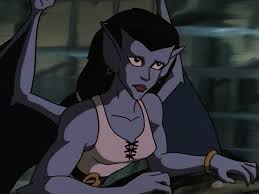
Angela is added as a member of the main cast in the second half of season two and plays an important role in the development of the Goliath character.

Angela is added as a member of the main cast in the second half of season two and plays an important role in the development of the Goliath character.

Because of the World Tour format, the second half of season 2 is even more episodic than the first half, meaning the episodes function mostly as stand-alone stories.  I suppose one could argue there’s an overall plot since it’s Avalon that is sending them to these destinations, but it’s a fairly loose one.  Having the setting change each episode is an easy way to inject variety into the show, but the format grows stale.  The stories often feel like filler, and as a viewer I just wanted the group to get back home or for Avalon to finally unveil it’s true intentions.  Not all of the episodes follow the Would Tour group, as there are a couple that take place back in Manhattan.  In one such episode, “Pendragon,” the legendary King Arthur and the gargoyle Griff, two individuals encountered by Goliath and co. during their travels, wind up in New York and interact with the remaining members of the Manhattan Clan.  The World Tour basically lasts for 17 additional episodes of volume 2, with the two-part “The Gathering” representing its conclusion.  It’s far too long, and getting through those episodes started to feel like a chore for me (hence why it took me so long to get to reviewing this set) which is never a good feeling for television viewing.

Thankfully, the remaining handful of episodes are pretty interesting, as is the two-part “The Gathering,” though it’s not as grand as some of the series’ other multi-part arcs.  In that story, the god Oberon is attempting to steal the newborn son of Fox and Xanatos for he possesses some unusual abilities for a mortal.  It is interesting to see Xanatos and the gargoyles take on a god, though the resolution felt a little too neat and tidy for my tastes, but I can’t deny the alternative would have worked much better.  We learn some interesting tidbits about some of the supporting characters of the show, which is one of its great strengths.  The writers never miss an opportunity to focus on a secondary character and add importance to it.  As a result, just about any character who ever had even a minor role in a prior story returns at some point, including one background character viewers likely never noticed in “Vendettas.”  This type of writing helps make the show feel more rewarding for loyal viewers and it does add depth to what would otherwise be shallow characters.

The production values for volume 2 are largely the same as that for volume 1, though the DVDs this time around are of a lower quality.  The colors aren’t as rich and sometimes the image can be grainy, but that’s expected considering this was done on the cheap.  There are still episodes where the animation is of a noticeable lower quality, while others more resemble the quality of season one.  The A+ animation is largely reserved for the bigger stories, but even a stand-alone episode here and there (like “Future Tense”) is given a more striking look.  The score remains excellent as well and the voice acting is the usual high quality Disney output.
The alternate future depicted in "Future Tense" is one of the more fun stand-alone episodes in volume 2.

The alternate future depicted in “Future Tense” is one of the more fun stand-alone episodes in volume 2.

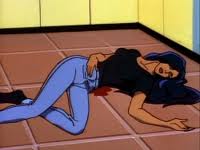
While from an episode quality standpoint I enjoyed this set less than the previous two, there are still some excellent stand-out episodes.  I mentioned “Future Tense” already as being a stand-out in terms of production values, but it’s also a really fun story that looks at an alternate future for Manhattan.  “Sanctuary” is one of the better World Tour episodes as it includes MacBeth, Demona, and Thailog.  Thailog also makes an appearance in another strong episode back in New York, “The Reckoning,” which contains the long anticipated confrontation between Angela and Demona.  The Goliath, Angela, Demona triangle is an anchor in a few stories, and the tension between Goliath and Angela over her lineage is done well.  I don’t think it’s giving away anything to reveal that Angela is the biological daughter of Goliath and Demona, but the writers do a good job of explaining Goliath’s and the clan’s view on children, which is that all gargoyles are children of the clan.  Angela, having been raised by humans, has a human’s perspective when it comes to parents and longs for Goliath to acknowledge her as his daughter.  She has similar feelings towards Demona, though they’re obviously complicated by the fact that Demona isn’t the most likable person/gargoyle.

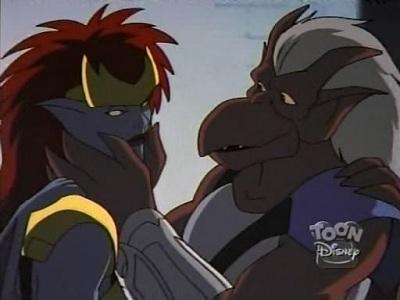
The Goliath/Elisa relationship is handled quite tastefully by the writers of the show.

The Goliath/Elisa relationship is handled quite tastefully by the writers of the show.

Another tension of the series is the obvious affection Goliath and Elisa feel for each other that largely goes unstated between the two.  The conclusion to the set, “Hunter’s Moon,” addresses it for the first time in a very satisfying way.  It’s hard to write such a relationship because it takes care to make it believable that an attractive woman like Elisa would have romantic feelings for Goliath.  The writers sell it well though, and while I’m not sure they could have ever pulled off a full-on romance for the two, they did find a way to get the point across.  That conclusion, by the way, is a three-part story that actually brings everything full-circle for the gargoyles.  It would have been a fine way to end the series, but a thirteen episode season 3 was picked up by ABC for their then Saturday morning block.  Series creator Greg Weisman wrote the premier for that season, dubbed The Goliath Chronicles by ABC, but had no involvement in the remaining twelve episodes.  As a result, they are not considered canon by Weisman and the series actually continued in comic book form years later.  I may look into checking out those comics but I need to know more about them first and if they’re worthwhile.  I’m pretty happy with “Hunter’s Moon” as a conclusion, as I don’t expect a season three set, and I may choose to just leave Gargoyles with how season two ended.

As for this set, it is what it is.  For those who just want the episodes, it’s the only option save for bootlegs that are probably even worse quality.  When it was released last summer, it was available for a short time on eBay through Buena Vista’s store but once those copies were gone the movie club and secondary market were the only options.  The movie club is actually worth looking into for those looking to start a Disney collection.  For those (like me) who already own a ton of Disney DVDs and Blu Rays, it doesn’t make financial sense.  Very quietly though the set moves to the traditional Disney Store website and is available there for twenty bucks.  The secondary market has yet to adjust, it would seem, as the copies are still routinely priced in excess of forty dollars.  Even so, this is likely not going to be produced in large numbers so if you’re a fan of the show it’s probably a good idea to get it while it’s relatively cheap.  Bland set or not, it’s still 26 episodes of a pretty strong show for twenty bucks and if you already have the first two it’s basically a must-have.  Gargoyles is among the elite action cartoons of the 90’s, and for me it ranks among Batman and X-Men as the best of the best.

Space Dandy – Live With the Flow, Baby

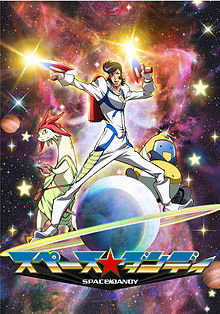
Space_Dandy_promotional_imageA new anime series premiered last night on Cartoon Network’s Toonami block:  Space Dandy.  Space Dandy is the latest series from Shinichiro Watanabe (which is how it got my attention, it also didn’t hurt that Toonami used a Misfits song in the TV spots leading up the premier), best known for  being the director of Cowboy Bebop and Samurai Champloo.  I never got into Samurai Champloo (never really tried to, either), but I love Cowboy Bebop and consider it the finest anime series I’ve ever experienced.  Granted, my experiences with anime have decreased in volume over the years.  As a kid and teen I took in quite a bit.  I’m familiar with pretty much all of the big ones from the 80’s and 90’s such as Akira, Neon Genesis Evangelion, Dragonball, Fist of the North Star, and so on.  Like any medium, there are good and bad representatives.  There are also common threads amongst the various programs.  Most anime certainly shares similarities in look and appearance.  There are also certain tricks that have become cliché since, like the screaming hero jumping through the air, still frames with nothing but a mouth moving, mouths going from being really small to really large, etc.  Even so, it’s not fair to generalize and say that anime is either good or bad, or that someone is an anime fan or non fan.  Anyone with an open mind can find anime they like and don’t like, just as they can with live-action movies and television shows.

All of that was a long-winded way of saying that the success Watanabe has had in the past has little baring on Space Dandy.  Cowboy Bebop is among the greats, and holding Space Dandy up to that standard seems unfair, and yet they invite comparisons due to the Watanabe connection.  They also share other similarities.  For one, Space Dandy takes place in space (big shocker there) and the main character, Dandy, is an alien hunter.  That is quite similar to the space bounty hunter profession of the Bebop crew.  And like the Bebop crew, Dandy doesn’t appear to be very good at his job.  He’s alone on his space ship when the episode begins accompanied only by his robot assistant QT.  We soon learn QT is out-dated and becoming obsolete and the spaceship is in need of some repair as well.  Dandy’s occupation as a space hunter is to apprehend unclassified aliens, and then turn them in for profit.  I presume they need to be alive, but I’m not positive.

Expect to see lots of T&A with this program.

Expect to see lots of T&A with this program.

That’s the basic premise.  Where Space Dandy seeks to differentiate itself from prior Watanabe programs is with its look and humor.  Space Dandy is riddled with sophomoric humor.  The first episode opens with Dandy debating the merits of ass-men and boob-men before going to his favorite hang-out, the Hooters parody simply known as BooBies.  The show is accompanied by a narrator, who informs us that Dandy hopes to one day own his very own BooBies.  This narrator is really a third character, and the other characters in the show break the fourth wall more than once to acknowledge him.  The narrator is forgetful and provides updates throughout the show and fills in some of the back story, which in the first episode, almost seems irrelevant.

Dandy himself is rather dim-witted and perverted.  He’s a slow thinker, though he’s not obviously dumb like a Homer Simpson or Peter Griffen.  He’s also really self-absorbed and appears to have an obsession with his own hair.  He’s also a pretty lousy shot and poor judge of situations.  He’s not mean-spirited though, which makes him likable.  QT is similarly incompetent at its job, some of that due to the fact that its obsolete.  QT, despite being a robot, also doesn’t seem to mind being lazy.  Other characters introduced in the first episode include an alien from Betelgeuse with an unpronounceable name (he looks like some kind of space cat, so Dandy dubs him Meow against his will) and a mysterious ape-like scientist named Dr. Gel.  Dr. Gel is an ominous figure in the debut episode who is pursuing Dandy as he is the key to a war raging on.  Gel answers to a strange monarch-like figure with a flaming skull for a head and pilots a spaceship that contains the head of the Statue of Liberty with a ball-gag in its mouth.  Clearly it’s a reference to Planet of the Apes though I do wonder if it will have any relevance beyond that or if it’s just a visual gag (no pun intended).

The main goal of the show appears to be to induce laughter.  The tone is very silly and the neon colors and up-beat electronic music add to the feeling.  The plot of the first episode mostly exists to introduce the characters and then show us just how bad Dandy is in action.  It ends on an apocalyptic note, and I wonder how the second episode will open.  It’s possible there will be an absence of continuity from one episode to another though I personally doubt that.  It’s impossible to judge a series based on one episode, but Space Dandy did not make an overly strong impression on me.  It seems fun enough, but I do wonder if it will have much staying power.  It may prove too silly for my taste, but I am comforted by the fact that it took a few episodes for Cowboy Bebop to hook me so it’s possible Space Dandy will require the same.  To make myself stick with it, I’ve programmed my DVR to record it each week.  Maybe I’ll have reason to revisit this topic in a few months.


Christmas Time in South Park

Christmas Time in South Park (2007)

Christmas Time in South Park (2007)

South Park famously began as a video Christmas card, so it should come as no surprise that the television series (which just concluded its 17th season) has spawned many Christmas specials of its own.  Series creators Trey Parker and Matt Stone actually haven’t done a new one since 2004’s Woodland Critter Christmas, but still have output seven Christmas specials which have been conveniently compiled for the DVD release Christmas Time in South Park.  The first run of Christmas specials for the show actually felt connected to one another as they all explored the spirit of Christmas:  what is it?  What does Christmas mean?  Of course, this being South Park, don’t expect a lot of feel-good and overly sentimental holiday themes as is found in most Christmas specials, though surprisingly some of these episodes echo their tamer counterparts and some even have a good heart at the center of the story.

Lets talk about these episodes, and specifically, the DVD release of Christmas Time in South Park.  The DVD case and menus echo those Little Golden Book releases you may remember from your childhood.  The menus are animated and the characters will berate you for taking too long to select a feature.  The cursor of your DVD player, naturally, is represented by a smear of Mr. Hankey leavings.  All seven Christmas specials are featured in chronological order.  Unfortunately, all seven are also censored like their season release counterparts (for South Park’s older episodes, uncensored versions do not exist as no one anticipated there being a huge market for full seasons of TV shows) which means you’ll be hearing beeps whenever the characters utter a colorful phrase.  Also missing, is the short that started it all:  The Spirit of Christmas.  This seems like a huge and careless omission to me.  Why go through the effort of putting out a compilation of Christmas specials and leave out the very first one? My only guess is that the studio felt that The Spirit of Christmas was too strong a selling point for releases like South Park:  The Hits and its inclusion would harm other DVD sales.  Quite possibly, it was just forgotten as this DVD was slapped together quickly to cash-in on the holiday season.

The first Christmas special, and the one that introduced Mr. Hankey to the world.

The first Christmas special, and the one that introduced Mr. Hankey to the world.

At least there are still seven, mostly excellent, Christmas episodes for your viewing pleasure.  The first being Mr. Hankey the Christmas Poo.  This was South Park’s first Christmas special and apparently Parker and Stone wanted to create a new Christmas icon for the world they created so they turned to a talking piece of shit.  Parker and Stone hold nothing back when it comes to Mr. Hankey.  He’s disgusting, and they don’t want you to forget that so we get bits of him leaving poo trails everywhere he goes and even bathing in Mr. Mackey’s coffee, while he sips it.  The framework of the episode is Kyle feeling excluded from all of the Christmas excitement on account of him being Jewish.  Simultaneously, Kyle’s mother (the Jewish community) is upset about the inclusion of the nativity in a school Christmas play.  Her complaining to the mayor sets off a chain reaction where in response the devout Catholics in town demand to see Santa removed from the play, hippies want to get rid of Christmas trees, epileptics demand the removal of Christmas lights, and the virgins (presumably) want to get rid of mistletoe.  The show is clearly poking fun at all of the people that get uptight over Christmas, and Mr. Hankey is called on to save the day.  That the town needs to listen to crap in order to see the error of its ways is probably a commentary on something too.  Everyone thinks Kyle is insane for seeing and believing in Mr. Hankey, until the boys find out Chef does as well.  Once everyone believes, Mr. Hankey reminds everyone that Christmas is a time to be nice to one another, forget about all of the bad stuff in the world, and bake cookies.  Kyle is released from the nut house, and Kenny lives to see the end credits for the first time.  It’s a wacky Christmas special, that may still be the show’s best, with tons of gross-out and hilarious moments.

Merry Christmas, Charlie Manson! is the second season’s Christmas special and it’s subversive in a different way.  Rather than try to be absurd and gross people out with singing poop, Parker and Stone decided to use an unlikely character and have him saved by Christmas.  Enter mass-murderer Charlie Manson, faithfully depicted with a swastika tattooed on his forehead.  Cartman and his mom are heading to Nebraska to visit family for Christmas, and the boys have been invited along.  Kyle is allowed to go presumably because his family is Jewish and couldn’t care less that it’s Christmas while Kenny’s family is sending him on a  mission to bring back leftovers.  Stan’s mom is the only one who has a problem with her son being away from the family at Christmas, so Stan sneaks out and tells the Cartmans that his family is dead.  When the boys get to Nebraska (after a long and torturous car ride full of singing) they find that a house full of Cartmans is a horrible place to be as all of them basically act just like their own Eric Cartman.  They soon find out that Cartman has an incarcerated Uncle Howard, as he breaks out of jail and (stupidly) returns to hide-out in his parent’s basement.  He brings along his buddy, Charlie Manson, whom the boys are ignorant of.  When no one will take them to the mall to see Mr. Hankey, Manson offers to do it himself to avoid sitting and watching Christmas specials all day.  At the mall though, he watches a poop version of How the Grinch Stole Christmas and begins to see the light.  He gets his tattoo altered into a smiley face, and takes the kids home, but not before attracting the attention of the local police.  They’re soon all trapped in the house as Uncle Howard takes the family hostage.  Manson, now full of Christmas spirit, convinces Howard to surrender and even reminds Stan that Christmas is a time for family.  The episode ends with the characters from the episode in Manson’s jail cell wishing him a merry Christmas, Charlie Brown style.  As Stan reminds us, this is some pretty fucked up shit right here.

If you don't like his special, he has some balls you can suck.

If you don’t like his special, he has some balls you can suck.

Season Three’s Christmas special is Mr. Hankey’s Christmas Classics.  It’s just a collection of songs, some traditional and some new, sung by the characters of South Park.  It’s kind of a love it or hate it episode, and one I’m not really fond of.  However, Mr. Hankey instructs the audience during the intro that if we don’t like it we can suck his tiny little balls.  As small as they may be, I don’t want to suck any poo balls so I’ll cease to speak of this episode right here.

Season Four brings us A Very Crappy Christmas and it could basically be re-titled as The Story of South Park.  That’s because in it the boys actually create and animate The Spirit of Christmas just like their creators.  Following the events of the first two Christmas specials, the people of South Park now understand that Christmas is a time for being merry and spending with one’s family.  The commercialism is gone, and the boys are pretty pissed off about not getting presents so they go looking for a strangely absent Mr. Hankey.  They find their favorite piece of crap has been MIA because he now has a wife and turds of his own.  As the boys lament the absence of what they perceive to be the Christmas spirit, they get the idea to make their very own Christmas special.  The mayor, who needs the commercialism to spur the economy, agrees to fund their little project.  Nothing goes right, but when Kyle channels his own inner Christmas spirit (and the Rankin/Bass feature Twas the Night Before Christmas) he gets everyone back on track.  Most of the episode is a parody of Twas the Night Before Christmas while also containing numerous in-jokes for longtime South Park fans.  In the end, they’re able to show the town The Spirit of Christmas and everyone realizes that Christmas is about one thing:  presents.  Everyone starts shopping immediately and the town’s economy is saved.  Yay!

The Hankey family expands in A Very Crappy Christmas.

The Hankey family expands in A Very Crappy Christmas.

Season Five was the first to not feature a Christmas episode, but season six restored order with Red Sleigh Down, a parody of Black Hawk Down and the conclusion of what I see as the Christmas story started in season one.  In it,  Cartman desperately wants some slick new toy but realizes he’s been far too naughty to hope to get anything from Santa so he goes all out to be nice at the last minute.  His scheming leads him to believe that if he helps Santa bring Christmas to Iraq that will be enough, so he enlists the help of Stan and Kyle (Kenny’s been dead all season) and eventually Mr. Hankey in order to do so.  Mr. Hankey is thrilled at Cartman’s Christmas spirit and agrees to help by taking the boys to the North Pole aboard the Poo-Choo Express (it’s just as disgusting as you imagine).  Santa agrees that Christmas should be brought to Iraq, and the boys watch from the North Pole as Santa’s sleigh is shot down by an RPG over Iraq.  Now feeling guilty and terrified by the prospects of no more Christmas presents, the boys enlist the help of the one man who can save Santa:  Jesus.  They all take Santa’s back-up sleigh to Iraq where Jesus becomes a one-man death machine as he takes out numerous soldiers to save Santa.  Their escape goes wrong when Jesus is shot from behind and dies in Santa’s arms.  They’re able to escape, but not before a vengeful Claus does finally bring Christmas to Iraq.  Back in South Park, the townspeople have been distracted by the speech impediment of Jimmy who’s attempting to recite The Twelve Days of Christmas, an episode-long gag.  Santa lights the town tree and addresses the crowd telling them that Christmas should be a day to reflect on the sacrifice one man-made to save Christmas:  Jesus.  And with that, the spirit of Christmas is modified once again in the South Park canon to be a day dedicated to Jesus.

Santa and Jesus team-up in Red Sleigh Down.

Santa and Jesus team-up in Red Sleigh Down.

With the spirit of Christmas now fully defined, Parker and Stone decided to take the boys on a Christmas adventure to Canada, of all places.  The new Canadian Prime Minister has decided that all Canadian born children be returned to Canada, which means Kyle’s adopted brother Ike is required to go.  Kyle enlists the help of his friends to go appeal to the Prime Minister, though they’re all reluctant to risk missing Christmas.  They go anyway, and in Canada they find a world not unlike Oz where the locals instruct them to “follow the only road.”  Just like The Wizard of Oz, the boys encounter other Canadian citizens looking to appeal to the Prime Minister about something, while the villainous Scott, from the Terence and Philip special, makes a return.  In the end, they discover the new Prime Minister is actually Saddam Hussein in hiding, and his new laws are overturned while the boys do in fact miss Christmas.  Cartman is unable to see the bright-side in Kyle getting his brother back, while Stan laments on missing out on a Christmas adventure, oblivious to what just happened.  It’s Christmas in Canada is not one of my favorites, and it’s probably the weak link on this DVD, though I do know more than one person who finds the episode hilarious.  I think I would like it more if it had more to do with Christmas.  It’s not really a Christmas special, just an episode that takes place during Christmas.

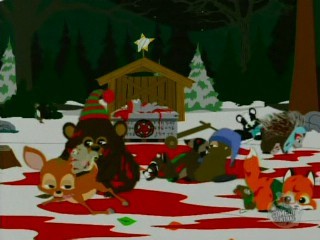
"It's Critter Christmas, dude, it sucks ass!"

“It’s Critter Christmas, dude, it sucks ass!”

This brings me to the last episode on the DVD, and so far, the last Christmas episode South Park has done:  Woodland Critter Christmas.  Seemingly out of ideas for a Christmas special, Parker and Stone decide to just completely subvert the idea of a Christmas special.  In this episode we have an innocent sounding narrator tell the story of a boy trying to help a group of talking woodland critters so that they can have a merry Christmas.  The critters are intentionally made to seem sterile and innocent while the episode is also intended to appear to be a cookie-cutter Christmas special with little thought or effort (the main character has no name, all of the animals names are just the name of the animal with a long “e” sound at the end, such as Deery the deer, Rabbity the rabbit, and so on).  Of course, the catch is that these animals are trying to bring about the birth of their lord and saviour.  Porcupinie has been impregnated by their god, but a mean old mountain lion wants to kill her, so the boy (Stan) is enlisted to help.  He succeeds by killing the mountain lion, who also happened to be a mother to three cubs, only to find out the critters worship Satan and the porcupine is set to deliver the anti-christ.  The tables are turned and soon Stan is left trying to prevent the coming of the anti-christ and he’ll receive help from Santa and a little thing called abortion.  Woodland Critter Christmas basically sets out to be the most obscene Christmas special one could dream up.  It’s almost as if Parker and Stone just wanted to top their prior specials in terms of shock-appeal and perhaps because they haven’t thought up a way to top this one is why we haven’t seen any new Christmas specials from South Park.  If this is the type of thing you can laugh at, then Woodland Critter Christmas should do the trick.  It’s ridiculous, but also pretty damn hilarious.

These specials are a big part of my memories growing up, even into college.  It seemed like each one was a topic of conversation when it originally aired because people generally couldn’t believe what they just saw.  South Park has had a lot of moments like that over the years, and for whatever reason, Christmas seems to bring out the best in it.  I love the sappy, sentimental Christmas specials that dominate the air during this time of year, but sometimes it’s nice to watch something that is decidedly less reverential towards the holiday season.  South Park does the trick, and Christmas Time in South Park is a convenient release and a suitable way to get my laugh on during the month of December.


A Mickey Mouse Christmas

Mickey Mouse has appeared in many Christmas themed specials and shorts over the years.  I suppose that should be expected of a character who has been around for over 80 years.  I don’t think he’s appeared in more Christmas specials than any other popular character (the boys in South Park actually had a nice streak going on of a Christmas special nearly every year) but he’s certainly in the discussion.  Many of Mickey’s Christmas exploits took place on the big screen in the form of shorts, but have since become television staples during the Christmas season.  Rather than make an individual post here and there on certain ones, I’ve decided to make one long post that hits on the ones I’m most familiar with.  This list isn’t exhaustive as I’m sure there are more modern television specials that I’m not familiar with, but consider this a good start.  The following list is in chronological order, starting with the earliest.  They’re all available on DVD in some fashion, and the old shorts can be found on youtube as well (Disney is pretty lax with its old shorts when it comes to youtube, probably because the Treasures line of DVDs is out of print)
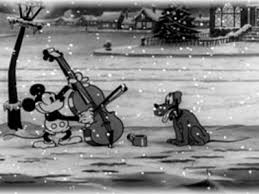
Mickey’s Good Deed (1932)

The original version was in black and white, but colorized versions exist today.

The original version was in black and white, but colorized versions exist today.

Mickey’s rise to fame nearly coincided with The Great Depression.  As such, it’s a pretty common site to see Mickey depicted poor and penniless.  In Mickey’s Good Deed, he’s a street performer looking to make a buck.  As far as we know, his only possessions are his cello and Pluto.  After a day of playing, Mickey and Pluto look to score some dinner and find that passer-byes have been tossing nuts and bolts into Mickey’s cup instead of coins.  Down on their luck, Mickey has a mishap that leads to the destruction of his cello, while a rich pig offers to buy Pluto for his bratty kid.  Mickey, of course, refuses but he soon happens upon a family of poor cats.  Wanting to give them a good Christmas, Mickey reluctantly sells his dog, dresses up as Santa, and gives the cat family a nice Christmas.  Pluto, meanwhile, is miserable as he’s abused by the bratty boy pig leading to the father tossing him out and spanking his kid.  Pluto is able to happen upon a despondent Mickey and we get a nice, happy ending.  It’s a cute little Christmas short that unfortunately is never shown on air because of one instance of perceived racist imagery.  A little balloon the Santa Mickey carries appears to depict a blackface character portrait on it.  This means the short is relegated to the vault section on the release Mickey Mouse In Black and White Volume 2.  Despite that, it’s actually been released here and there on VHS and DVD, including a colorized version on the most recent release Holiday Celebration with Mickey and Pals.

Toy Tinkers (1949)

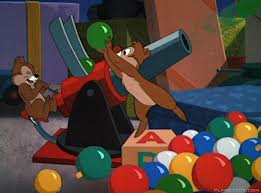
It's all-out war when Chip and Dale sneak into Donald's house.

It’s all-out war when Chip and Dale sneak into Donald’s house.

I’m cheating here, because this is actually a Donald Duck short and does not feature Mickey, but who cares?  This Christmas themed short pits Donald versus perhaps his most famous antagonists:  Chip and Dale.  While out chopping down a Christmas tree, the mischievous chipmunks take notice and follow Donald back to his home where they see a nice, warm environment and bowls full of nuts.  The duo slip in and immediately start using the toys around the tree to transport the nuts out of there.  Donald, not one for charity, takes note and a full-scale battle breaks out over the nuts with the two using pop guns and toy cannons on each other.  It’s a silly, and fun short where Donald is mostly punished for his cruelty (and because it’s more fun to see Donald lose his temper) and things mostly work out for Chip and Dale.  Unlike Mickey’s Good Deed, this one will pop up from time to time on the Disney channel during the holiday season.  Otherwise, it can be found on some compilation releases and the Treasures release The Chronological Donald Volume 3.

Pluto’s Christmas Tree (1952)

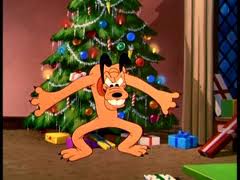
Pluto is very protective of his Christmas tree.

Pluto is very protective of his Christmas tree.

Despite what it’s title suggests, Pluto’s Christmas Tree is actually considered a Mickey Mouse short instead of a Pluto one, for some reason.  It’s also one of the few shorts to feature Jimmy Macdonald as Mickey Mouse, as Walt found he didn’t have the time to voice the character any longer.  Pluto’s Christmas Tree is actually fairly similar to Toy Tinkers.  Mickey and Pluto set out to get a Christmas tree and they settle on one that happens to be occupied by Chip and Dale.  Once inside the house, Chip and Dale immediately start to make themselves comfortable in the Christmas tree while Pluto takes notice.  Pluto tries, in vain, to point out the chipmunks to Mickey who just sees Pluto’s antics as the usual.  Eventually he can’t take it anymore and attacks the tree, finally revealing the chipmunks to Mickey who basically has the opposite reaction as Pluto.  The short ends with Christmas carols, where the chipmunks take issue with Pluto’s singing voice.  This is another wildly entertaining Chip and Dale story mostly full of slapstick humor.  This one is really easy to get ahold of as it’s been released several times on VHS and DVD and is one of the most well-received Disney shorts.

Mickey’s Christmas Carol (1983)

Not a Christmas season goes by where I don't watch this one numerous times.

Not a Christmas season goes by where I don’t watch this one numerous times.

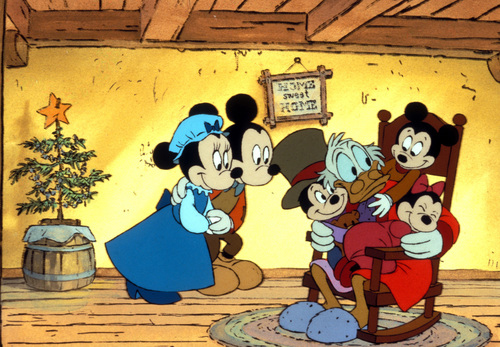
Mickey’s Christmas Carol is fairly recent compared with the other shorts.  It’s also quite easy to catch on television or find on DVD and was even recently rereleased on Blu Ray (along with Pluto’s Christmas Tree, among others) this year.  It’s the classic Dickens’ tale with Mickey as Bob Cratchit and Minnie as his wife.  Scrooge McDuck is, naturally, the film’s Scrooge while other Disney characters show up in supporting roles.  As far as takes on A Christmas Carol go, this one is my favorite as it’s both funny and poignant and the inclusion of Disney characters somehow makes it more relatable.  The recent re-release does make it all the more obvious that one giant Christmas release from Disney is necessary.  Mickey’s Christmas Carol is also how many were first introduced to the longest running voice of Mickey Mouse, Wayne Allwine (who passed away in 2009), and also marks the final performance of the original Donald, Clarence “Ducky” Nash.

Mickey’s Once Upon a Christmas (1999)

Once Upon a Christmas is far from timeless, but it is nice to see all of the Disney characters together at Christmas time once again.

Once Upon a Christmas is far from timeless, but it is nice to see all of the Disney characters together at Christmas time once again.

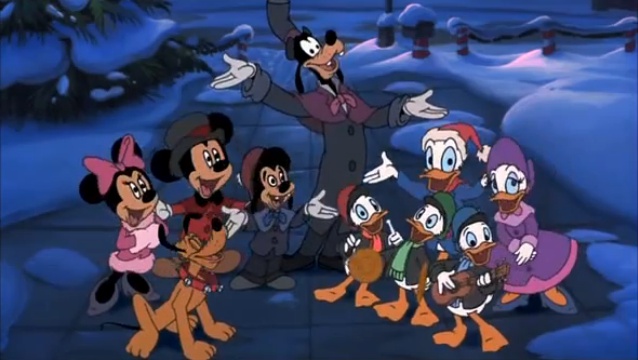
Once Upon a Christmas is a traditionally animated direct-to-video collection of three shorts starring Donald, Goofy, and Mickey.  It’s shown annually on television still and represents the modern Mickey Mouse and friends.  The first short, titled Stuck on Christmas, stars Donald and his nephews Huey, Dewey, and Louie and is a take on the story of What if Christmas Were Every Day?  In it, the three boys wish it could be Christmas every day and are then forced to deal with the consequences.  It’s a bit like Groundhog Day, in that the boys need to be considerate of others and have the perfect day to undo the spell.  The second short, A Very Goofy Christmas, stars Goofy and his son Max as Goofy tries to prove to Max that there is a Santa Claus after their neighbor Pete informs him there’s no such thing.  The third short, Mickey and Minnie’s The Gift of the Magi, once again depicts Mickey as rather poor as both he and Minnie try to scrounge up some money to buy each other the perfect Christmas gift with both discovering the only thing that matters is having each other.  The animation on all three is pretty well done and it’s kind of fun to see modernized versions of the characters.  Aside from the Mickey short, the others tend to run a bit too long and run out of steam towards the end.  It’s a solid Christmas special but falls short of being a classic due mostly to the pacing issues.

Mickey’s Twice Upon a Christmas (2004)

Another direct-to-video Christmas special, Mickey’s Twice Upon a Christmas is naturally the sequel to Once Upon

The CG look for the characters just doesn't do it for me, and as you can see here, the backgrounds suffer too.

The CG look for the characters just doesn’t do it for me, and as you can see here, the backgrounds suffer too.

a Christmas, though the stories contain no obvious references to the previous ones.  Differing itself from its predecessor, Twice Upon a Christmas is entirely computer animated and the results are something less than spectacular.  The characters are mostly harmed by the transition to 3D models which makes sense considering they were never drawn for such a look to begin with.  This collection also contains five shorts which does address the pacing issues from the first set.  The shorts are:  Belles on Ice, Christmas: Impossible, Christmas Maximus, Donald’s Gift, and Mickey’s Dog-Gone Christmas.  The first one stars Minnie and Daisy as competitive figure skaters and is easily the worst of the set.  There just isn’t much to it.  Christmas: Impossible stars Huey, Dewey, and Louie as they sneak into Santa’s workshop to get on the nice list.  It’s kind of cute, but the CG really shows its limitations as the should-be wondrous Santa’s workshop is really unimpressive looking.  Christmas Maximus stars Goofy and Max, who’s now returning home for the holidays from college with his new sweetheart.  It’s only slightly better than Belles on Ice but is ultimately forgettable.  I also found Max’s look to be really off-putting for some reason.  Donald’s Gift is a rather simple Donald tale where his grumpiness and overall bad demeanor nearly ruin Christmas for his family, but he redeems himself in the end.  I’m a Donald sucker, so I was entertained by this one but it can’t hold a candle to Donald’s classic shorts.  Mickey’s Dog-Gone Christmas is definitely the strongest of the collection as Pluto runs away to the North Pole after Mickey gets mad at him.  There he befriends Santa’s reindeer and adopts the moniker Murray (Murray Christmas, get it?!) and even gets to fly.  The reindeer characters are entertaining, and the CG look actually works for Pluto, though I still prefer the traditional look.  Eventually Pluto is reunited by Santa with his depressed owner and everyone’s happy in the end.  Overall, this is a weak collection and the CG makes it hard to watch.  Check it out if you happen to catch it on TV, but don’t feel like you need to go out of your way to see it.


Teenage Mutant Ninja Turtles (4Kids): The Christmas Aliens

images-166In 2003, Fox and 4Kids Entertainment launched a brand new Teenage Mutant Ninja Turtles cartoon series.  This series was the first re-launch for the TMNT after a long hiatus from both film and television and was an attempt at introducing the Turtles to a whole new generation.  One of the consultants for the show was TMNT co-creator Peter Laird and his Mirage Studios.  Something everyone seemed to be in agreement on was that this new show would borrow more heavily from the original comic book run of the Turtles while still keeping a general audience in mind.  This is, of course, in stark contrast to the original cartoon which all but abandoned the comics as both Laird and Kevin Eastman felt it was impossible to adapt that for a children’s show.  It would be easy to point to that decision as a mistake, but really that original show gave the world a whole separate take on the Turtles that proved endearing, if nothing else.

The 2003 series was more mature, but still pretty much directed at kids.  It took a lot from the old comics but also did its own thing.  Eventually, it would more or less go off on its own, especially once it hit the Fast Forward seasons towards the end of its run.  I can’t pretend to be an expert on the series as I really only watched the first season before eventually losing interest.  The show seemed to be fairly successful, though not a huge hit, with kids.  There was a new toy line and I’m sure the show’s success had some part in the decision to do the feature-length TMNT film.

The source material for this episode.

The source material for this episode.

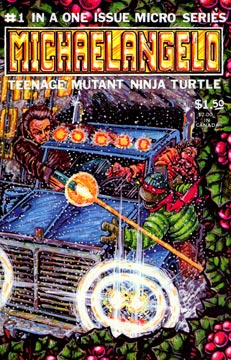
Something unique to this series is that it contains what is, so far, the only animated Christmas special the Turtles have ever done.  It seems crazy to me that there was a never a Christmas episode during the original cartoon run, but I checked, and there isn’t!  The new series has also yet to do one, but it wouldn’t shock me to see one pop up eventually.  The only Christmas special featuring the TMNT so far is the live-action “We Wish You a Turtle Christmas” and if you’ve never seen it, DON’T WATCH IT!  The 4Kids series decided for its third season to adapt the Michelangelo (then Michaelangelo) Micro Series story for its first episode, “The Christmas Aliens.”  Having read that issue, I was interested in checking this episode out as that story is one of my favorites from the comics as it puts Michelangelo in the starring role as he attempts to make sure a donation of Christmas toys gets to a local orphanage.

Each episode of the series opens with a scene from later on in the episode, usually with a turtle or turtles in some kind of trouble.  This one opens with Michelangelo driving a truck as he’s being chased by some crooks before the opening credits hit.  The opening song for this show is one of its weak points.  I don’t care for the song on the new series, but it’s at least a throwback to the old series so I give it some points.  This one is just lazy.  When we get to the episode it shows Michelangelo strolling through the park on Christmas Eve.  The other guys are back at home in the sewer decorating for the evening’s festivities while Mike befriends some kids in the park and finds a stray kitten he dubs Klunk.  It doesn’t take long for Mikey to stumble upon a toy store that’s in the process of being robbed.  Apparently, this season’s hottest toy is a Christmas Alien doll (I believe in the comics it was intended to be a parody of the then mega-popular Cabbage Patch Kids) and it’s sold out everywhere.  A delivery truck loaded with them is the target of the thieves, but Mikey overhears the truck driver tell the crooks it’s intended for a local orphanage.  The crooks obviously don’t care as they make off with the truck and Mikey feels compelled to stop them.

That's one weird looking Santa.  I can't imagine he smells all that great as well.

That’s one weird looking Santa. I can’t imagine he smells all that great as well.

At the lair, various other characters start piling in.  I actually can’t name any of them since I didn’t watch the show regularly, except for Usagi Yojimbo who arrives with two other characters via some kind of portal.  All of the Turtles’ friends are here though to celebrate Christmas and some mischief is made.  Casey tries in vain to score a kiss under the mistletoe from April, while everyone tries their luck at beating the resident superhero in an arm-wrestling contest.  Everything has to be put on hold though as they all wait for Michelangelo to get home.

Meanwhile, Michelangelo has to contend with a bunch of crooks and even the police as he overtakes the delivery truck and heads for the orphanage.  The majority of the episode is a chase sequence, first with Mikey hanging onto the truck as he tries to take it over, then with more bad guys, and eventually the police.  The animation shows its limitations here as the truck looks extremely heavy.  It strikes parked cars and other moving vehicles and goes right through them without even the slightest wobble.  It’s an okay sequence, but not a very exciting one.  The Michelangelo character in this series is enjoyable though, and Klunk is supremely cute as he hides in Mike’s coat and pops his head out to take a look.

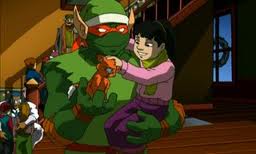
Michelangelo is eventually able to lose his pursuers and wind up back at the lair.  Everyone is ready to scold him for being late, but he of course explains himself and everyone heads to the orphanage.  The Turtles don elf costumes while Splinter goes as Santa and all the kids get their alien dolls.  We get a final lesson on giving, and everyone feels like a good person in the end.

Elf Mike and Klunk.

Elf Mike and Klunk.

As Christmas specials go, this is a solid entry.  It’s not too sentimental, there’s no silly drama, and everyone ends up with a good feeling when all is said and done.  There’s some light humor that is, while not inventive, at least amusing.  Michelangelo is a good choice for the lead role in this one as he’s always been the one that’s easiest to relate to.  His child-like state of mind doesn’t need to be exaggerated any further to make the story work.  In the comics, Klunk stayed around and would show up in future issues.  I don’t know if that was the case here or not but I never mind the addition of a kitten to story.  This episode was released on DVD as a Michelangelo’s Christmas Rescue and if you stumble upon it in your travels it wouldn’t be a horrible pick-up.  The running time is only around 22 minutes so definitely don’t pay too much should you come across it.  Since Nickelodeon launched the new series last year, episodes from this show are no longer on television so don’t expect to find it airing on any channels this season.  As always, there’s youtube if you really want to watch it.


Gargoyles: Season 2 Volume 1

Gargoyles_DVD_2The cover of the DVD release of Gargoyles Season 2 dubs it as Volume 1 of the second season.  At first glance, that may seem like a greedy way to release a show to DVD, but that is not the case.  A common practice of children’s animated television was to order 65 episodes as early in the life of the series as possible to make the programming eligible for syndication where more money could be made off of it.  I say “was” because I’m not sure if that is still the case with numerous cable outlets now providing a lot of the entertainment these days.  Gargoyles was not originally broadcast on cable though, which is why season 2 is 52 episodes long, which following the 13 episode first season, gets the series to 65 total episodes.  Sometimes networks are so confident the show will be a hit they go right from the pilot to a 65 episode order.  This was the case for the still popular Batman:  The Animated Series which featured a pretty bankable star in Batman, but Gargoyles was an all new intellectual property so Disney opted to go for a trial run with the first 13 episodes before going all in.

The process of large season orders seems like a win for fans of the show.  After all, a 52 episode season would theoretically allow for a new episode every week for an entire year, though this wasn’t the case for Gargoyles since it was an afternoon program.  It does usually mean shorter wait times between new episodes, but things can get a little erratic since the season will usually begin airing while a lot of episodes are still in production.  There’s also the other downside to a large season such as this which is these episodes need to get produced quickly, and more people are needed for production and story-writing.  The first season of Gargoyles was a tight, neat collection of episodes with high-quality animation for television.  Season 2 sometimes has the feel of “too many cooks in the kitchen” and episodes become more stand-alone in nature.  The animation is still among the best when Gargoyles is compared with its contemporaries, but there are some drop-offs and it’s apparent that the show had multiple teams for animation.  Some episodes feature sharp lines and tight animation while others are more rounded and toon-like with characters often making over-exaggerated gestures (those familiar with X-Men likely have an idea of what I’m talking about).  Which one looks best is a matter of taste though (I prefer the harder look for this program) at least, with the overall animation quality usually pretty strong from episode to episode.

There are some pretty interesting plot twists to find in season two.

There are some pretty interesting plot twists to find in season two.

Inconsistent animation is expected when a show requires a large amount of episodes be produced, but my main concern for Gargoyles was how the writers would respond when tasked with filling so many hours.  The first season largely operated in a serial format with each episode tied to one overall plot.  Some felt more stand-alone than others, but all plots were referenced at one point or another and the overall quality of the story-telling was quite good.  I knew season 2 would have to feature more stand-alone episodes, but thankfully very few feel like throw-away or filler episodes.  Many of these one-shots still contain plot devices that have repercussions on the episodes to follow, such is the case with the conclusion of the episode “The Mirror” when Demona gains a new power.  Many others choose to introduce new villains or allies that will pop up in later episodes, as is the case with the characters Doctor Sevarius and Jeffrey Robbins.  In short, the structure of the show remains rewarding for longtime fans.  This does come at the cost of making the show a little harder to jump into at any point for newcomers, but since it’s no longer on television, this is really no longer a concern.

There are many stand-alone episodes, but there’s also no shortage of multi-part arcs.  The first half of season two contains the four part “City of Stone” and the three part “Avalon.”  Both are heavily reliant on flashbacks as it seems one goal for season 2 was to flesh out the villains even further, specifically Demona and MacBeth.  We learn about their history together and how Demona has survived the centuries and remained largely the same in appearance.  In season one, we the viewers were basically left to assume that gargoyles are extremely long-lived given that Demona was not affected by the Masgus’ spell like the others, but we learn in season 2 that is not the case.  There are lots of other recurring characters in season 2 such as The Pack, Tony Dracon, Derek Maza, Coldstone, and of course Xanatos.  Xanatos is still primarily an adversary of the Manhattan Clan, but he’s also an unlikely ally in several episodes.  One could even suggest that the writers go to this well a bit too often, but such is the case when 52 episodes have to be written in a short amount of time.  Still, I like the role Xanatos plays on this show of the equal opportunist who has his own agenda that isn’t always clear.  By the end of the first half of the season viewers, and even Goliath to some degree, have mostly caught on to Xanatos and the game he plays making me wonder what role he’ll play going forward (as I honestly can’t recall from my days of watching this as a kid).  Xanatos is also paired this time around with Fox, of The Pack, as his love interest which is a rather interesting dynamic.

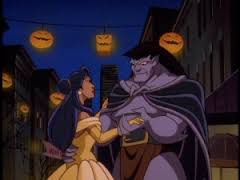
Now where have I seen that dress before?

Now where have I seen that dress before?

Another part of the plot the writers seemed eager to explore in season 2 was the relationship between Elisa and Goliath.  Elisa was Goliath’s main confident, along with Hudson, by season one’s end and he (as well as the other gargoyles) clearly feel a strong sense of protection with her.  In season 2 it’s becoming more obvious that they have a stronger bond than just friends.  Sometimes the show is pretty obvious about it, but for the most part they let it go unstated and attempt to keep things subtle.  It has a nice progression throughout.  Disney fans will also particularly enjoy a scene from the episode “Eye of the Beholder.”

Gargoyles was never a series afraid to introduce characters, and many new villains are brought into the fold in season 2.  New allies, as well.  A pet peeve of mine with X-Men was always how the writers would tease a new character joining the X-Men but would never go through with it.  Towards the end of season 2, the writers chose to add a new member to the clan.  To better introduce this character, the writers shrink the cast down to just Goliath, Elisa, Bronx, and the new-comer for the unofficially titles World Tour episodes.  These episodes spill over into the second part, and series creator Greg Weisman actually bumps up one episode from the second half, “Kingdom,” to serve as the final episode in this collection.  This final episode takes place in New York and we get to see what the rest of the clan is up to with Goliath missing.  This is probably something Weisman regretted not doing originally, as when these aired we went 10 episodes without seeing the other characters which seems much too long.  The World Tour will continue well into the second half though I do not suspect any other episodes were re-arranged as no one affiliated with the show had any say in the release of volume 2, that I know of.

The relationship between Demona and MacBeth is fully revealed in season two.

The relationship between Demona and MacBeth is fully revealed in season two.

Gargoyles:  Season 2 Volume One largely carries over the quality of the first season and only enhances the show’s reputation as one of the better animated programs from the 1990’s.  Season One is probably superior when judged on quality, but the second DVD release for the series obviously boasts more content.  The release itself is also much nicer and includes some bonus features in comparison with the bare-bones season one release.  Unfortunately, season two did not meet the sales expectations of Disney and volume two was never commercially released until just recently.  Volume two is even more sparse than the first season release, and is currently only available to members of Disney’s Movie Club.  I’m not a member of that club, but did find out Buena Vista has an ebay account that basically specializes in selling these exclusives and was able to get one from there.  I don’t know if they restock or not, but that is definitely the best bet for those who want a copy as the secondary market is a little inflated right now.


Teenage Mutant Ninja Turtles (2012) Season One Review

nick_tmnt_wallpaper1280x1024_02Back in September of 2012, Nickelodeon unveiled the newest incarnation of the Teenage Mutant Ninja Turtles in a one-hour season premiere.  On August 8th, 2013, the first season came to a close with a one-hour season finale.  The symmetrical first season had its ups and downs, but no one can deny it was a smashing success from a commercial standpoint as Nickelodeon has already commissioned a second and third season.  Once again, the Turtles franchise has proven that it’s harder to squish than a cock roach as it rolls on into its fourth decade of cultural relevance.  Such was likely never predicted of the franchise back when it burst onto the scene in the late 1980’s.  I would be willing to bet most adults viewed it as the latest flavor of the month they had to endure to keep their kids happy as toys and various other merchandise was consumed by the millions.  Perhaps more importantly to fans, the first season of Teenage Mutant Ninja Turtles was not only a commercial success, but a creative one as well as it successfully melded the various depictions of the Turtles over the years into an all new show.

I watched and wrote about the season premiere when it first aired and described my reaction as tempered enthusiasm towards the show.  That would eventually be replaced with full-on enthusiasm as I set my DVR to record each new episode (which became a challenge to keep track of as the broadcast schedule was all over the place) to watch at my leisure.  The show got better as the weeks rolled by and the writers seemed to become more comfortable with the characters.  A lot of the humor early on missed the mark but eventually the show found its groove in that department and routinely was able to bring a smile to my face.  The show also introduced a major plot thread that was woven through the entire first season revolving around the alien race known as the Kraang which helped make the show feel more significant for regular viewers.  I’ve always been a big fan of this approach for television over stand-alone episodes.

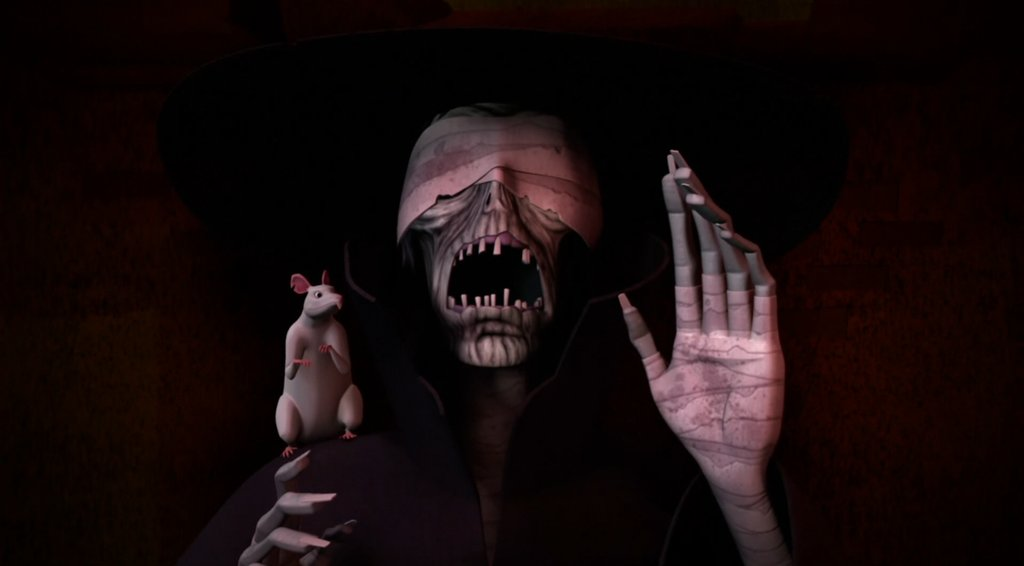
The Rat King was one of the better redesigns for the show.

The Rat King was one of the better redesigns for the show.

That’s not to say the show didn’t have stand-alone episodes here and there.  And quite frankly, that was when the show was its most uninteresting.  There was a period in the early part of the season where each episode felt like The Villain of the Week where some poor soul would be mutated into a monster the Turtles had to stop.  There was still humor to be found in these episodes and some nice action, but there was little lasting appeal.  Some of these monsters were also severely lacking in the personality department, both in a behavioral sense and visually speaking.  That is definitely one area where the old cartoon still reigns supreme as the villains often had a pretty interesting and fun look to them.  That was probably due to Playmates wanting a fun toy to market, but it worked.  The show did get better as the season went along, with one of my favorite looks for a villain popping up towards the end in the form of a newt with a Punisher-like pattern to his spots.

Overall, when compared with the old cartoon, the show was less reliant on guest spots and was content to rely primarily on a core group of characters.  The Shredder, obviously, was a big part of the first season even if he was secondary to the Kraang threat.  The writers wisely kept him out of action though, which made the episodes where he took up arms against the Turtles extra special.  He’s also a total bad ass when in combat, a far cry from the bumbling Shredder of the 80’s or even the original comic book Shredder who is famously decapitated by Leonardo at the end of the series’ first book.  This Shredder still retains his old look but with more black and bigger blades.  He’s also far more scarred than any other as his face has been badly burned and he appears to be blind in one eye.  Like the old Shredder, this one also has two mutant henchmen:  Dogpound and Fishface.  While these two are not as stupid as Bebop and Rocksteady, they’re not any more successful and are often beaten back by the Turtles.  Baxter Stockman also falls in with the Shredder during season one and provides him with some heightened technology.  Karai, Shredder’s daughter, is also introduced as a bit of tweener villain in that she has a bit of a friendship with Leonardo which serves as the backbone for a series of episodes during the middle part of the first season.  Other characters familiar to longtime fans also show up, such as Leatherhead and the Rat King, sporting new designs and new personalities.  I particularly enjoyed the new design for the Rat King and thought he was among the best of the villains shown off.  I hope to see more of him in the future.

The Karai/Leo subplot was one of the more interesting parts of season one.

The Karai/Leo subplot was one of the more interesting parts of season one.

On the Turtle front, the cast basically stayed the same throughout the first season.  A lot of old favorites were brought back though such as a new take on the Turtle Van which is now a subway car.  The Turtles retain their signature personality traits but they feel more honest this time around.  Raphael, for example, doesn’t just get pissed-off because he’s supposed to and Leonardo is far from being an emotionless robot.  All of them have strengths and weaknesses, and for the most part, they also feel like teenagers.

Of particular enjoyment for long-time fans were all of the little easter eggs and throwbacks inserted into this series.  Metalhead was brought back as a robot constructed by Donatello.  He looks fairly similar to the old one, only much smaller.  There’s even a spot during the episode were one of the bran-like Kraang latches onto his head, which I have to believe is a nod to the original action figure’s sculpted brain.  The leader of the Kraang also inhabits a giant robot body and the antenna on its head evokes images of Krang’s body from the old cartoon.  Little things like that go a long way towards pleasing the older fans and trying to spot them is part of the enjoyment in watching the show for me.  The Technodrome is also introduced during the season finale, and the long-awaited Splinter vs Shredder confrontation takes place as well.  There’s a big reveal in the season finale that I think anyone familiar with the franchise saw from a mile away, but it was still done well and, despite being predictable, is actually a new direction for an old character.

The Donatello/April relationship could have felt forced, but the writers have handled it well and I'm actually curious to see where it goes (expect Casey Jones to eventually butt-in).

The Donatello/April relationship could have felt forced, but the writers have handled it well and I’m actually curious to see where it goes (expect Casey Jones to eventually butt-in).

From an artistic standpoint, the show animates quite well and is far superior to the DC CG cartoons currently airing on Cartoon Network.  The city streets of New York remained pretty barren for the whole of season one with some signs of life in the finale, but otherwise the show looks good.  I like the fact that each turtle has his own shape and anatomy instead of basically looking exactly like the others with the exception of the mask.

All in all, Teenage Mutant Ninja Turtles is a good show that strikes the perfect balance between action and comedy.  The story-telling was also better than could be expected and the writing staff will have a hard time topping season one.  Its start reminds me quite a bit of the 2003 cartoon which, for me anyway, fell off quite a bit in the second season and seasons to follow.  Hopefully this show doesn’t meet the same fate.  Because season one was spread out over so many months, the wait for season two to begin is actually a fairly brief one as its set to kick off in late September.  This version of the Turtles may not be violent like the originals, or say “Cowabunga!” like the old toons, but they have a chance to go down as the best Teenage Mutant Ninja Turtles yet!


Dragon Ball: Season 3

Dragon Ball:  Season 3 (2010)

Dragon Ball: Season 3 (2010)

Apparently I’ve settled into a once a year pattern with Dragon Ball.  I have all five seasons, and I’ve viewed them all, but it’s taking me a long while to write about them.  That’s ok, as sometimes this blog becomes too video game centered and it’s nice to have something like Dragon Ball to fall back on when I want to post about something other than gaming.

Because these seasons are not actual seasons, season 3 of Dragon Ball picks up right where season 2 left off with Goku trying to defeat the evil Mercenary Tao.  In order to do so, he has scaled Korin Tower to enlist the help of Master Korin who’s training is said to make the most formidable warriors even stronger.  With Korin’s help, Goku is confident he can topple Tao and avenge the death of his friend, Bora.  Korin, the dimunitive cat-like creature, seems unwilling to offer much assistance to our young hero and the ensuing “training” Goku goes through contains a heaping dose of comedy for the viewers, which works well following the rather heavy close to season 2.

The over-reaching conflict of the first part of season 3 is still General Red and the Red Ribbon Army.  It is they who hired Tao to take out Goku and eliminate their greatest obstacle in recovering the seven dragon balls.  Goku will have a satisfying encounter with Tao following his training with Korin and then go on to assault the home base of the Red Ribbon Army to put a stop to them once and for all.  It’s here Dragon Ball settles into its pattern of Goku easily dispatching most foes before tasting defeat, training with a powerful warrior, and then returning to topple the previously unstoppable.  There’s a lot of good action pieces, and the whole Dragon Ball gang gets involved which is nice after the Goku heavy season 2.

Sometimes Master Roshi's perversions can be useful.

Sometimes Master Roshi’s perversions can be useful.

Following the end of the Red Ribbon Army conflict, the heroes seek out the help of Fortune Teller Baba in order to find the final dragon ball so that Goku can restore Bora to life.  It turns out that Baba’s services come with a steep price that can either be paid with money or blood, and since Goku has no money, he opts for the latter.  Baba pits Goku and his pals against her warriors, and if he wins, she’ll help him.  Most of the matches here exist for comedic relief as the first combatant for Baba is a vampire and another, invisible opponent, is defeated when Master Roshi’s nose explodes with blood to cover him at the sight at Bulma’s breasts.  There is one serious fight between Goku and a masked man who turns out to be someone very important to Goku and is a mostly entertaining affair.

Following the Baba portion are a bunch of filler episodes of Goku traveling the world and helping people along the way.  These are the most boring sections of Dragon Ball for me as it’s just Goku and he’s usually not given anyone to play off of.  He tends to encounter these overly nice and kind characters and he tends to work better when paired with the impatient types like Bulma and Krillin or the perverse like Roshi.  Along his travels he does encounter Tien Shinhan and Chiaotzu for the first time who will play a bigger role going forward.  They’re depicted as talented and powerful fighters who lack character, which makes them natural foils for Goku.

Chiaotzu, Crane, and Tien Shinhan are the main foes for Goku and his friends during the final act of season 3.

Chiaotzu, Crane, and Tien Shinhan are the main foes for Goku and his friends during the final act of season 3.

The final act of season 3 covers the World Martial Arts Tournament once again, with the natural goal of pitting Goku against his newest rival Tien.  There are several lesser characters inserted into the tournament for comedic relief, but the main players are mostly the same from last the time:  Goku, Krillin, Yamcha, and Jackie Chun, with new-comers Tien and Chiaotzu.  Master Crane is the one who trained Tien and Chiaotzu and it’s revealed early on during the tournament that he is the older brother of Mercenary Tao.  It’s the clear the two did not have much love for each other, but pride dictates that Shen must avenge the death of his brother at the hands of Goku.  This just adds another layer of conflict to the main tease of the tournament.  Unfortunately, because of FUNimation’s arbitrary end points for its seasons, the bulk of the tournament falls to season 4 giving season 3 a mostly unsatisfying conclusion.

Season 3 of Dragon Ball, as defined by FUNimation, might be my least favorite of the five, though season five is also a bit slow.  It’s very top heavy with the early part being fairly entertaining but the last 15 or so episodes are a bit of a slog.  For whatever reason, Dragon Ball (and it’s successors) are bogged down by a lot of filler episodes and a great many of them found their way into season 3.  The seasons preceding it were not absent of them, and the ones to follow aren’t as well, but they just felt less entertaining here.  Hurting it too is the fact that the main enemy, the Red Ribbon Army, is never really billed as a credible threat to Goku outside of Tao.  At no point during Goku’s assault on the RRR HQ am I lead to believe that he might actually fail.  This tends to be one of the problems of the show as Goku’s enemies are either woefully under-powered or obviously over-powered.  The exceptions usually end up being the final matches in the martial arts tournaments, but unfortunately, that falls to season 4.  That said, there are some nice moments on season 3 and there’s also a good dose of comedy.  Some fans could probably skip it entirely if they’re mostly interested in the biggest fights the series has, but if you want the full Dragon Ball experience there’s still some must-see episodes contained here.


Gargoyles: Season One

Gargoyles - The Complete First Season (2004)

Gargoyles – The Complete First Season (2004)

In the early 90’s, Fox cornered the market when it came to television shows for young demographics, particularly boys in that 7-12 age group.  They had hit shows with Batman The Animated Series, X-Men, and Power Rangers and their Saturday morning programming was unrivaled.  Batman, in particular, ushered in an era of cartoons where the writers didn’t feel like they had to dumb-down the show to please its audience.  The stories were mostly grounded within the fantasy world the show created, while X-Men wasn’t afraid of creating serialized episodes that asked more from its viewers.  These weren’t stand-alone episodes with the same throw-away clichés prevalent in most children’s programming.  And while the shows were, first and fore-most, children’s shows they didn’t make adults feel like idiots for watching.

Disney, by contrast, had seen its viewership decline.  The once popular Disney Afternoon programming was mostly content to keep things the same.  Duck Tales and Tailspin were successful early on, and Darkwing Duck was Disney’s own answer to Batman but with a comedic core.  If Darkwing Duck was supposed to reel in Batman viewers then Disney missed the point.  Putting a cape and mask on a character and having him fight crime isn’t what people tuned into Batman for.  Those viewers wanted to see the show take itself seriously, present real threats, and overall just make it a credible show.  Disney needed a show that matched Batman’s tone and not his costume, so they turned to comic book writer Greg Weisman and from that relationship came Gargoyles.

Gargoyles could be described as modern fantasy mixed with Greek tragedy.  Stylistically, the show is reminiscent of the aforementioned Batman and X-Men with similarities to contemporary cartoon Jim Lee’s Wild C.A.T.S.  The color palette is muted with lots of deep violets and blues and plenty of black.  The first season has a split setting between modern-day New York and turn of the first millennium Scotland.  The gargoyles, lead by the hulking Goliath, are a humanoid, bat-like race that spends the daylight hours encased in stone and owns the night.  In 994 Scotland, they’re protectors of a castle inhabited by humans that, for the most part, view the gargoyles in an unfavorable light.  When the gargoyle clan finds itself betrayed by those it trusted, most are smashed to death during the day while the few survivors are magically encased within stone until the castle they inhabit rises above the clouds.

The Manhattan Clan (left to right):  Lexington, Brooklyn, Goliath, Hudson, and Broadway.

The Manhattan Clan (left to right): Lexington, Brooklyn, Goliath, Hudson, and Broadway.

The existence of the extraordinary gargoyle race is all but wiped away from history, but one noted wealthy individual by the name of David Xanatos, is well-aware of their past.  It is he who purchases the castle along with the gargoyles and moves them to Manhattan where he places it atop a massive skyscraper, thus ending the spell placed upon them.  The rest of the first season deals with the gargoyles coming to terms with what happened to them a thousand years ago and finding a way to relate to this new, modern world and find their place in it.  Themes of tragedy, isolation, trust, family, and acceptance help frame the show.  In this there are many similarities to X-Men as both the gargoyles and mutants find themselves as unwelcomed protectors of humanity.  Their isolation, seemingly alone in this world with the exception of their one human ally, Elisa, helps evoke the Batman similarities.

Detective Elisa Maza heads the short list of allies for the Manhattan Clan.

Detective Elisa Maza heads the short list of allies for the Manhattan Clan.

The remaining gargoyles, now known as the Manhattan Clan, are a small group of varying personalities.  Goliath is the unquestioned leader.  He’s noble, proud and a bit stubborn at times.  He’s always learning and isn’t immune to mistakes, but he does everything with purpose and conviction.  Hudson is the elder statesman of the clan and its former leader.  He prefers to stay on the sidelines and leave the fighting to the younger gargoyles.  Brooklyn, Broadway, and Lexington are the younger members of the clan and rookery mates, which is gargoyle speak for siblings.  Brooklyn is a curious sort who seems to model himself after Goliath while Lexington is consumed by modern technology.  The gluttonous Broadway is sometimes relegated to comic relief though the show mostly avoid slapstick and jokes.  Rounding out the clan is the dog-like Bronx who is the only gargoyle incapable of speech and lacking in wings.  Detective Elisa Maza is the sole ally of the gargoyles in season one.  She’s a strong-willed character who is able to give the gargoyles leads on the goings-on of their enemies while also sometimes acting as almost a mentor to Goliath.

Much like the clan itself, the rogues gallery for the show is kept fairly compact for the first season.  It’s dominated by Xanatos, who poses as an ally early on to the clan but is soon revealed as duplicitous and self-serving.  His main weapons are cunning and money, but he also possesses some high-tech weaponry including his own cybernetic army of gargoyles.  He splits time as the main foe for the clan with Demona, Goliath’s former lover who was complicit in the destruction of their clan a thousand years ago.  While her intentions were without malice, her persona is consumed with a bloodlust for humanity as she blames them for their near extinction.  She is the Magneto to Goliath’s Charles Xavier.  Other villains include the sportsmen MacBeth and the television actors turned criminals The Pack, a group of men and women who fashion their personas after wild canines.

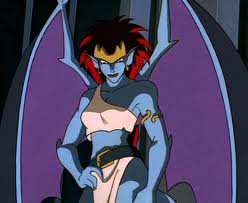
Demona, Goliath's former lover, is one of the primary antagonists for season one and beyond.

Demona, Goliath’s former lover, is one of the primary antagonists for season one and beyond.

The show opens with a very ambitious five-part mini-series titled “Awakening” (it was also released direct-to-video as Gargoyles:  The Movie) that sets up the series.  Right from the start, viewers are able to get a sense of the large-scale story-telling the show is aiming for while also being able to take in the peak of the show’s production values.  The animation quality is a grade above the usual afternoon cartoon fare, making it possibly the best looking cartoon of the mid 90’s.  The score is also exemplary and the voice acting contains notable actors such as Keith David (Goliath, various voices) and Edward Asner (Hudson) as well as numerous vets of various Star Trek programs.  Following the five-part debut, the show mostly settles into stand-alone episodes that also call upon happenings in previous ones.  Each gargoyle, with the exception of Bronx, is basically given his own episode to star in which helps the viewers get better acquainted with each one individually.  It’s similar to the tactic utilized by X-Men in season two and is an effective way to flesh out an ensemble cast.  There are thirteen episodes in total for season one, and pretty much all of them are good.  Some standouts include “Deadly Force,” which stresses the importance of gun safety without being ham-fisted (possibly created because main character Elisa is shown wielding realistic weaponry as opposed to fantasy, laser type devices).  “Her Brother’s Keeper” helps define what family means to the gargoyles and how it’s not so different from what it means to humans.  “Reawakening” is the bookend for the season and is a satisfying conclusion for the show’s first major arch.

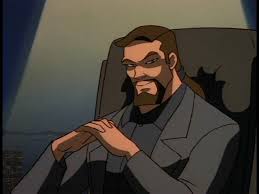
Xanatos would be the other main foe for the gargoyles.

Xanatos would be the other main foe for the gargoyles.

What I appreciate most about the show is its commitment to realism.  This is a show starring unreal creatures but it takes them very seriously.  Their culture is defined as is their biology when Goliath points out early on that they can’t fly, merely glide on air currents.  As previously mentioned, Elisa is armed with a realistic handgun as are most of the police force.  Many of the villains do use lasers and other such fantasy fare but they come across as credible, in part due to a willingness to throw around phrases like “Die!” at their targets.  And when it’s called for, the show is not afraid to show blood which helps add severity to a scene.  The show also wasn’t afraid to be a little progressive as it’s revealed (casually) that Elisa is of mixed-race, having a white father and black mother.  And if you’re a fan of keeping movies and television as they were, you’ll be happy to know that the numerous shots of the New York skyline have not been edited to remove the twin towers.  Recent shows like Teenage Mutant Ninja Turtles and Beware the Batman have mostly empty city streets and lifeless scenery, it was refreshing to watch Gargoyles with its fully realized and very much alive New York.

The DVD release for season one is fairly basic.  There are animated menu screens depicting the gargoyles emerging from their stone prisons accompanied by music and sound effects.  The transfer is of good quality for this type of release and the case is a standard DVD case with a hinged insert for the second disc.  Bonus features include the original show pitch by Weisman which is worth a look just to see the original designs of the gargoyles.  There’s also a brief feature on The Gathering of the Gargoyles, a convention that used to be held in the US for fans of the show, that I suppose is worth a look though it’s basically just a bunch of fanboys and girls gushing over the program.  There’s also audio commentary on the fist five episodes, but I have yet to check it out (and probably won’t as it’s just not my kind of thing).

The show did not shy away from placing its characters in real danger.

The show did not shy away from placing its characters in real danger.

Gargoyles felt overlooked during its hey-day and today feels kind of like a forgotten series.  This is due, in part, to Disney’s stubbornness over releasing the entire series on DVD.  Season one was released in 2004 with the first half of season two following in 2005.  The rest of season 2 was in limbo until recently when it was released quietly as part of the Disney Movie Club.  Still remaining are the thirteen episodes from the abbreviated season three, rebranded as The Goliath Chronicles .  While fans would likely appreciate having those thirteen released, all but the season premiere were done without Weisman and thus are not considered canon by him for the show’s storyline, which lived on in comic book form for a short while following the show’s cancellation.  Unlike many cartoons from my youth that I have chosen to revisit, Gargoyles still holds up and impressed me a great deal.  I would love to see Disney revisit the show with Weisman for either a short fourth season or direct-to-video movie to provide additional closure.  Expect to see more of Gargoyles from me as I make my way through both volumes of season 2.


Beware the Batman: “Hunted”

bewarethebatmantitlescreenIt’s hard to imagine a world where Batman isn’t a pop culture force to reckoned with.  He’s arguably the most popular comic book originated character today and easily has had more success than any other comic character in transitioning from one medium to another.  His popularity is not absent of peaks and valleys.  Batman is currently coming off one such peak following the conclusion of his most successful endeavor yet, Christopher Nolan’s Dark Knight trilogy, and DC Comics is looking to keep the fire going with a new animated series:  Beware the Batman.

Batman is, first and foremost, a comic book superhero.  His overall popularity though, is tied more to his forays outside comics.  Batman’s television and film works have a chance at reaching the comic book audience and non alike.  His first exposure of merit was the television show in the 1960’s.  It’s easy to dismiss the campy program today as being inauthentic, but the Batman of the comics at that time wasn’t far removed from Adam West’s portrayal.  It wasn’t until the 70’s that Batman would rediscover his edge, completing the transformation in the 80’s which helped influence his next cultural milestone, Tim Burton’s Batman.  Batman:  The Animated Series would follow, and despite it being a cartoon aimed at younger audiences, it too managed to attract a wide audience and even spawned the theatrically released Batman:  Mask of the Phantasm.  Of course, a cartoon is unlikely to reach the same audience as a film and that has held mostly true, but the cartoons to follow have been even more obvious in their target audience, so much so as to alienate the comic book fans.

Beware the Batman, in response to series such as The Batman and The Brave and the Bold, feels like an attempt to keep comic fans and attract more than just the Saturday morning crowd.  Time will tell if it can duplicate the success of TAS, but it’s nice to see DC give it a shot.  With no clear plans for where Batman is headed on the big screen, it makes sense to try to build a bridge between the two.  The only complication is where do the creators of Beware the Batman take the series that TAS didn’t?  Bruce Timm and Paul Dini, the masterminds behind TAS, piggy-backed off of Burton to establish the look of Gotham, and then created a tone to suit the show.  Visually, it was unique and thematically it was too when compared with its peers.  The show was not afraid to make broad use of Batman’s rogue’s gallery and took chances on lesser villains Killer Croc and Scarface, while also not being afraid to introduce villains like Roland Dagget and Ruper Thorne, gangsters with no sexy gimmick to speak of.  Beware the Batman has been developed by Glen Murakami, a veteran of TAS spin-off Batman Beyond, and is being produced in tandem with Mitch Watson.  Greg Weisman is on board as a writer and he’s done extensive work with other comics and comic TV shows but is probably best known as the creator for Disney’s Gargoyles.

Anarky is expected to play a large role in Beware the Batman.

Anarky is expected to play a large role in Beware the Batman.

The talent appears to be in place to make BTB a success, and the show’s creators have come up with a vision for the program to help differentiate it from its predecessors.  For starters, the show is animated entirely in CG in a style similar to the Green Lantern series already airing.  In terms of color palette, it actually looks similar to TAS as there’s a lot of black and gray.  Batman, himself, is sporting a black and gray costume similar to the one he wore in the final season of TAS (often referred to as The New Animated Series) but with a more triangular head.  Alfred is said to have a larger role in this program, with his past exploits as a secret agent being a central part of the show’s plot.  Batman also has a new sidekick, Katana, a character first conceived in the 80’s who just this year received her own limited series.  Her design is unique to the show and seems to be, in part, due to wanting her to resemble Batman to some degree.  No word on how her presence will affect Robin.  The show’s brain-trust made the decision to avoid The Joker early on, and as a result, Batman’s primary antagonist appears to be Anarky.  Anarky is another 80’s character and in tone he’s similar to Allen Moore’s V from V for Vendetta, though Anarky has been forced to change to mirror whatever the current political climate of the world is.  There’s been little said on how he’ll be portrayed in the show, but it’s definitely a bold choice for what is a “kid’s show.”  If the character appears dumbed-down for television it will likely disappoint the comic book fans who tune in and could turn them off.

Beware the Batman seems to have a solid groundwork to start.  In addition to Anarky, the creators want to continue to use villains not previously seen on television to help further differentiate the show from the ones that came before.  This direction should be commended, as it’s certainly the bravest route, though I do expect some of Batman’s more popular villains will eventually show up if the program is allowed to continue for multiple seasons.  In order for that to happen though, season one needs to be a success.

Batman's look comes across as a mix of old and new.

Batman’s look comes across as a mix of old and new.

The first episode aired today and is titled “Hunted.”  As is the case with most series premieres, the episode is concerned with introducing the main cast of the show to viewers while also giving us a taste for the action and spectacles we can expect going forward. Right off the bat (no pun intended), we’re shown Batman taking down some small-time thugs.  Disappointingly, the firearms used by the enemies look like toy squirt guns and fire lasers.  Beware the Batman is not the first cartoon to eschew realistic firearms, but it looks especially ridiculous here given the otherwise realistic look of the setting (the guns initially were going to look realistic following in the footsteps of TAS, but after the Aurora shooting the show was changed).  Realism does seem like it may be in short supply with this show.  While no one would expect a Batman show to possess a high degree of realism, it does seem like this one will at least be less so than TAS.  The villains in this first episode are Professor Pyg and Mr. Toad.  Professor Pyg is just a fellow with a pig mask, while Mr. Toad is some kind of mutant toad man (that looks more like a frog) with a super-sonic breath attack of some kind.  Professor Pyg arms himself with a saw that can apparently cut through anything except Batman’s gauntlets, and Mr. Toad likes wielding bombs that look like they were taken straight from a Bugs Bunny cartoon.

I’ll never prefer CG animation to traditional hand drawn animation, but the new Teenage Mutant Ninja Turtles cartoon did leave me pleasantly surprised with how it turned out.  That show is not without faults, and those same faults are shared by BTB plus a few more.  It must consume too many resources to create an authentic looking city, because the streets of Gotham are empty aside from the main characters of a scene.  This means during the debut episode’s car chase sequence, the only cars on the road appear to be Batman, his enemy, and the enemy’s target.  The characters also do not animate as well as those on TMNT as they seem stiff.  When Batman runs, his body doesn’t look in sync with itself and he resembles a wind-up toy that’s supposed to mimic running.

Professor Pyg and Mr. Toad add a dash of comic relief while still retaining an element of danger.

Professor Pyg and Mr. Toad add a dash of comic relief while still retaining an element of danger.

Design wise, I already mentioned Batman.  The Batmobile is present in this debut episode and it resembles a Lamborghini and apparently it’s dual flame spouts on the back are meant to distinguish it from its predecessors.  Alfred is a mountain of a man who towers over Bruce Wayne.  His role as a bodyguard is emphasized in this episode with part of the plot revolving around his wanting to protect both Bruce Wayne and Batman, with Batman preferring he only concern himself with Bruce Wayne.  The individual who will become Katana is also shown.  Her design of a small asian woman is unremarkable, though she’s seen driving a red and yellow motorcycle which had me wondering if that was a Robin reference.

The voice work seemed more than capable, though getting used to the new Batman (Anthony Ruivivar) and Alfred (J.B. Blanc) will take some getting used to.  Professor Pyg (Brian George) was the stand-out from a voice acting perspective, his tone adding a layer of menace to an already unsettling looking character.  Simon Stagg was present, and I wonder what role he’ll play going forward.  The previously mentioned Anarky is not seen so apparently they’re holding off on his debut for a later episode.

The plot for this first episode revolves around Pyg and Toad kidnapping billionaires who are not eco-friendly.  Batman has to use some of his detective skills to determine who their targets are before the villains strike next.  There’s also the previously mentioned Alfred conflict, with him also wanting to find his own successor for when he can no longer protect Bruce/Batman.  Batman is shown to be somewhat sloppy, though we’re given no indication of how long he’s been at this whole crime-fighting vigilante business.  The creators of the show in all of the pre-release press boasted about how this show was going to show off Batman’s detective skills, but this episode mostly followed the same formula as TAS with Batman turning to his trusty super-computer to do most of the work for him.  Since much of the plot of this first episode is devoted to setting the series up for future episodes, there’s very little resolution to the Batman conflict with Professor Pyg and Mr. Toad.  We’re also only given a snippet of what drives the villains with hopefully more to come.

Expect Katana's full debut to occur in the coming episodes.

Expect Katana’s full debut to occur in the coming episodes.

Overall, I appreciate the direction the show’s creators are pushing it in, but I’m less in favor of the execution.  Pyg and Toad have potential as villains, though I would have preferred something more grounded for Mr. Toad.  The animation is what it is and unfortunately this is the most cost-effective way to do most shows these days.  I’ll reserve final judgement on the show until more episodes have aired though this debut was more of a C effort.  It’s probably unfair of me to compare this to The Animated Series, but if it can’t approach that level of quality, then what’s the point of it existing?  Hopefully the show is able to carve out its own niche that can be enjoyed by Batman fans of all ages.