Category Archives: Television

Teenage Mutant Ninja Turtles (2012) Season One Review

nick_tmnt_wallpaper1280x1024_02Back in September of 2012, Nickelodeon unveiled the newest incarnation of the Teenage Mutant Ninja Turtles in a one-hour season premiere.  On August 8th, 2013, the first season came to a close with a one-hour season finale.  The symmetrical first season had its ups and downs, but no one can deny it was a smashing success from a commercial standpoint as Nickelodeon has already commissioned a second and third season.  Once again, the Turtles franchise has proven that it’s harder to squish than a cock roach as it rolls on into its fourth decade of cultural relevance.  Such was likely never predicted of the franchise back when it burst onto the scene in the late 1980’s.  I would be willing to bet most adults viewed it as the latest flavor of the month they had to endure to keep their kids happy as toys and various other merchandise was consumed by the millions.  Perhaps more importantly to fans, the first season of Teenage Mutant Ninja Turtles was not only a commercial success, but a creative one as well as it successfully melded the various depictions of the Turtles over the years into an all new show.

I watched and wrote about the season premiere when it first aired and described my reaction as tempered enthusiasm towards the show.  That would eventually be replaced with full-on enthusiasm as I set my DVR to record each new episode (which became a challenge to keep track of as the broadcast schedule was all over the place) to watch at my leisure.  The show got better as the weeks rolled by and the writers seemed to become more comfortable with the characters.  A lot of the humor early on missed the mark but eventually the show found its groove in that department and routinely was able to bring a smile to my face.  The show also introduced a major plot thread that was woven through the entire first season revolving around the alien race known as the Kraang which helped make the show feel more significant for regular viewers.  I’ve always been a big fan of this approach for television over stand-alone episodes.

The Rat King was one of the better redesigns for the show.

The Rat King was one of the better redesigns for the show.

That’s not to say the show didn’t have stand-alone episodes here and there.  And quite frankly, that was when the show was its most uninteresting.  There was a period in the early part of the season where each episode felt like The Villain of the Week where some poor soul would be mutated into a monster the Turtles had to stop.  There was still humor to be found in these episodes and some nice action, but there was little lasting appeal.  Some of these monsters were also severely lacking in the personality department, both in a behavioral sense and visually speaking.  That is definitely one area where the old cartoon still reigns supreme as the villains often had a pretty interesting and fun look to them.  That was probably due to Playmates wanting a fun toy to market, but it worked.  The show did get better as the season went along, with one of my favorite looks for a villain popping up towards the end in the form of a newt with a Punisher-like pattern to his spots.

Overall, when compared with the old cartoon, the show was less reliant on guest spots and was content to rely primarily on a core group of characters.  The Shredder, obviously, was a big part of the first season even if he was secondary to the Kraang threat.  The writers wisely kept him out of action though, which made the episodes where he took up arms against the Turtles extra special.  He’s also a total bad ass when in combat, a far cry from the bumbling Shredder of the 80’s or even the original comic book Shredder who is famously decapitated by Leonardo at the end of the series’ first book.  This Shredder still retains his old look but with more black and bigger blades.  He’s also far more scarred than any other as his face has been badly burned and he appears to be blind in one eye.  Like the old Shredder, this one also has two mutant henchmen:  Dogpound and Fishface.  While these two are not as stupid as Bebop and Rocksteady, they’re not any more successful and are often beaten back by the Turtles.  Baxter Stockman also falls in with the Shredder during season one and provides him with some heightened technology.  Karai, Shredder’s daughter, is also introduced as a bit of tweener villain in that she has a bit of a friendship with Leonardo which serves as the backbone for a series of episodes during the middle part of the first season.  Other characters familiar to longtime fans also show up, such as Leatherhead and the Rat King, sporting new designs and new personalities.  I particularly enjoyed the new design for the Rat King and thought he was among the best of the villains shown off.  I hope to see more of him in the future.

The Karai/Leo subplot was one of the more interesting parts of season one.
The Karai/Leo subplot was one of the more interesting parts of season one.

On the Turtle front, the cast basically stayed the same throughout the first season.  A lot of old favorites were brought back though such as a new take on the Turtle Van which is now a subway car.  The Turtles retain their signature personality traits but they feel more honest this time around.  Raphael, for example, doesn’t just get pissed-off because he’s supposed to and Leonardo is far from being an emotionless robot.  All of them have strengths and weaknesses, and for the most part, they also feel like teenagers.

Of particular enjoyment for long-time fans were all of the little easter eggs and throwbacks inserted into this series.  Metalhead was brought back as a robot constructed by Donatello.  He looks fairly similar to the old one, only much smaller.  There’s even a spot during the episode were one of the bran-like Kraang latches onto his head, which I have to believe is a nod to the original action figure’s sculpted brain.  The leader of the Kraang also inhabits a giant robot body and the antenna on its head evokes images of Krang’s body from the old cartoon.  Little things like that go a long way towards pleasing the older fans and trying to spot them is part of the enjoyment in watching the show for me.  The Technodrome is also introduced during the season finale, and the long-awaited Splinter vs Shredder confrontation takes place as well.  There’s a big reveal in the season finale that I think anyone familiar with the franchise saw from a mile away, but it was still done well and, despite being predictable, is actually a new direction for an old character.

The Donatello/April relationship could have felt forced, but the writers have handled it well and I'm actually curious to see where it goes (expect Casey Jones to eventually butt-in).

The Donatello/April relationship could have felt forced, but the writers have handled it well and I’m actually curious to see where it goes (expect Casey Jones to eventually butt-in).

From an artistic standpoint, the show animates quite well and is far superior to the DC CG cartoons currently airing on Cartoon Network.  The city streets of New York remained pretty barren for the whole of season one with some signs of life in the finale, but otherwise the show looks good.  I like the fact that each turtle has his own shape and anatomy instead of basically looking exactly like the others with the exception of the mask.

All in all, Teenage Mutant Ninja Turtles is a good show that strikes the perfect balance between action and comedy.  The story-telling was also better than could be expected and the writing staff will have a hard time topping season one.  Its start reminds me quite a bit of the 2003 cartoon which, for me anyway, fell off quite a bit in the second season and seasons to follow.  Hopefully this show doesn’t meet the same fate.  Because season one was spread out over so many months, the wait for season two to begin is actually a fairly brief one as its set to kick off in late September.  This version of the Turtles may not be violent like the originals, or say “Cowabunga!” like the old toons, but they have a chance to go down as the best Teenage Mutant Ninja Turtles yet!

Dragon Ball: Season 3

Dragon Ball:  Season 3 (2010)

Dragon Ball: Season 3 (2010)

Apparently I’ve settled into a once a year pattern with Dragon Ball.  I have all five seasons, and I’ve viewed them all, but it’s taking me a long while to write about them.  That’s ok, as sometimes this blog becomes too video game centered and it’s nice to have something like Dragon Ball to fall back on when I want to post about something other than gaming.

Because these seasons are not actual seasons, season 3 of Dragon Ball picks up right where season 2 left off with Goku trying to defeat the evil Mercenary Tao.  In order to do so, he has scaled Korin Tower to enlist the help of Master Korin who’s training is said to make the most formidable warriors even stronger.  With Korin’s help, Goku is confident he can topple Tao and avenge the death of his friend, Bora.  Korin, the dimunitive cat-like creature, seems unwilling to offer much assistance to our young hero and the ensuing “training” Goku goes through contains a heaping dose of comedy for the viewers, which works well following the rather heavy close to season 2.

The over-reaching conflict of the first part of season 3 is still General Red and the Red Ribbon Army.  It is they who hired Tao to take out Goku and eliminate their greatest obstacle in recovering the seven dragon balls.  Goku will have a satisfying encounter with Tao following his training with Korin and then go on to assault the home base of the Red Ribbon Army to put a stop to them once and for all.  It’s here Dragon Ball settles into its pattern of Goku easily dispatching most foes before tasting defeat, training with a powerful warrior, and then returning to topple the previously unstoppable.  There’s a lot of good action pieces, and the whole Dragon Ball gang gets involved which is nice after the Goku heavy season 2.

Sometimes Master Roshi's perversions can be useful.

Sometimes Master Roshi’s perversions can be useful.

Following the end of the Red Ribbon Army conflict, the heroes seek out the help of Fortune Teller Baba in order to find the final dragon ball so that Goku can restore Bora to life.  It turns out that Baba’s services come with a steep price that can either be paid with money or blood, and since Goku has no money, he opts for the latter.  Baba pits Goku and his pals against her warriors, and if he wins, she’ll help him.  Most of the matches here exist for comedic relief as the first combatant for Baba is a vampire and another, invisible opponent, is defeated when Master Roshi’s nose explodes with blood to cover him at the sight at Bulma’s breasts.  There is one serious fight between Goku and a masked man who turns out to be someone very important to Goku and is a mostly entertaining affair.

Following the Baba portion are a bunch of filler episodes of Goku traveling the world and helping people along the way.  These are the most boring sections of Dragon Ball for me as it’s just Goku and he’s usually not given anyone to play off of.  He tends to encounter these overly nice and kind characters and he tends to work better when paired with the impatient types like Bulma and Krillin or the perverse like Roshi.  Along his travels he does encounter Tien Shinhan and Chiaotzu for the first time who will play a bigger role going forward.  They’re depicted as talented and powerful fighters who lack character, which makes them natural foils for Goku.

Chiaotzu, Crane, and Tien Shinhan are the main foes for Goku and his friends during the final act of season 3.

Chiaotzu, Crane, and Tien Shinhan are the main foes for Goku and his friends during the final act of season 3.

The final act of season 3 covers the World Martial Arts Tournament once again, with the natural goal of pitting Goku against his newest rival Tien.  There are several lesser characters inserted into the tournament for comedic relief, but the main players are mostly the same from last the time:  Goku, Krillin, Yamcha, and Jackie Chun, with new-comers Tien and Chiaotzu.  Master Crane is the one who trained Tien and Chiaotzu and it’s revealed early on during the tournament that he is the older brother of Mercenary Tao.  It’s the clear the two did not have much love for each other, but pride dictates that Shen must avenge the death of his brother at the hands of Goku.  This just adds another layer of conflict to the main tease of the tournament.  Unfortunately, because of FUNimation’s arbitrary end points for its seasons, the bulk of the tournament falls to season 4 giving season 3 a mostly unsatisfying conclusion.

Season 3 of Dragon Ball, as defined by FUNimation, might be my least favorite of the five, though season five is also a bit slow.  It’s very top heavy with the early part being fairly entertaining but the last 15 or so episodes are a bit of a slog.  For whatever reason, Dragon Ball (and it’s successors) are bogged down by a lot of filler episodes and a great many of them found their way into season 3.  The seasons preceding it were not absent of them, and the ones to follow aren’t as well, but they just felt less entertaining here.  Hurting it too is the fact that the main enemy, the Red Ribbon Army, is never really billed as a credible threat to Goku outside of Tao.  At no point during Goku’s assault on the RRR HQ am I lead to believe that he might actually fail.  This tends to be one of the problems of the show as Goku’s enemies are either woefully under-powered or obviously over-powered.  The exceptions usually end up being the final matches in the martial arts tournaments, but unfortunately, that falls to season 4.  That said, there are some nice moments on season 3 and there’s also a good dose of comedy.  Some fans could probably skip it entirely if they’re mostly interested in the biggest fights the series has, but if you want the full Dragon Ball experience there’s still some must-see episodes contained here.


Gargoyles: Season One

Gargoyles - The Complete First Season (2004)

Gargoyles – The Complete First Season (2004)

In the early 90’s, Fox cornered the market when it came to television shows for young demographics, particularly boys in that 7-12 age group.  They had hit shows with Batman The Animated Series, X-Men, and Power Rangers and their Saturday morning programming was unrivaled.  Batman, in particular, ushered in an era of cartoons where the writers didn’t feel like they had to dumb-down the show to please its audience.  The stories were mostly grounded within the fantasy world the show created, while X-Men wasn’t afraid of creating serialized episodes that asked more from its viewers.  These weren’t stand-alone episodes with the same throw-away clichés prevalent in most children’s programming.  And while the shows were, first and fore-most, children’s shows they didn’t make adults feel like idiots for watching.

Disney, by contrast, had seen its viewership decline.  The once popular Disney Afternoon programming was mostly content to keep things the same.  Duck Tales and Tailspin were successful early on, and Darkwing Duck was Disney’s own answer to Batman but with a comedic core.  If Darkwing Duck was supposed to reel in Batman viewers then Disney missed the point.  Putting a cape and mask on a character and having him fight crime isn’t what people tuned into Batman for.  Those viewers wanted to see the show take itself seriously, present real threats, and overall just make it a credible show.  Disney needed a show that matched Batman’s tone and not his costume, so they turned to comic book writer Greg Weisman and from that relationship came Gargoyles.

Gargoyles could be described as modern fantasy mixed with Greek tragedy.  Stylistically, the show is reminiscent of the aforementioned Batman and X-Men with similarities to contemporary cartoon Jim Lee’s Wild C.A.T.S.  The color palette is muted with lots of deep violets and blues and plenty of black.  The first season has a split setting between modern-day New York and turn of the first millennium Scotland.  The gargoyles, lead by the hulking Goliath, are a humanoid, bat-like race that spends the daylight hours encased in stone and owns the night.  In 994 Scotland, they’re protectors of a castle inhabited by humans that, for the most part, view the gargoyles in an unfavorable light.  When the gargoyle clan finds itself betrayed by those it trusted, most are smashed to death during the day while the few survivors are magically encased within stone until the castle they inhabit rises above the clouds.

The Manhattan Clan (left to right):  Lexington, Brooklyn, Goliath, Hudson, and Broadway.

The Manhattan Clan (left to right): Lexington, Brooklyn, Goliath, Hudson, and Broadway.

The existence of the extraordinary gargoyle race is all but wiped away from history, but one noted wealthy individual by the name of David Xanatos, is well-aware of their past.  It is he who purchases the castle along with the gargoyles and moves them to Manhattan where he places it atop a massive skyscraper, thus ending the spell placed upon them.  The rest of the first season deals with the gargoyles coming to terms with what happened to them a thousand years ago and finding a way to relate to this new, modern world and find their place in it.  Themes of tragedy, isolation, trust, family, and acceptance help frame the show.  In this there are many similarities to X-Men as both the gargoyles and mutants find themselves as unwelcomed protectors of humanity.  Their isolation, seemingly alone in this world with the exception of their one human ally, Elisa, helps evoke the Batman similarities.

Detective Elisa Maza heads the short list of allies for the Manhattan Clan.

Detective Elisa Maza heads the short list of allies for the Manhattan Clan.

The remaining gargoyles, now known as the Manhattan Clan, are a small group of varying personalities.  Goliath is the unquestioned leader.  He’s noble, proud and a bit stubborn at times.  He’s always learning and isn’t immune to mistakes, but he does everything with purpose and conviction.  Hudson is the elder statesman of the clan and its former leader.  He prefers to stay on the sidelines and leave the fighting to the younger gargoyles.  Brooklyn, Broadway, and Lexington are the younger members of the clan and rookery mates, which is gargoyle speak for siblings.  Brooklyn is a curious sort who seems to model himself after Goliath while Lexington is consumed by modern technology.  The gluttonous Broadway is sometimes relegated to comic relief though the show mostly avoid slapstick and jokes.  Rounding out the clan is the dog-like Bronx who is the only gargoyle incapable of speech and lacking in wings.  Detective Elisa Maza is the sole ally of the gargoyles in season one.  She’s a strong-willed character who is able to give the gargoyles leads on the goings-on of their enemies while also sometimes acting as almost a mentor to Goliath.

Much like the clan itself, the rogues gallery for the show is kept fairly compact for the first season.  It’s dominated by Xanatos, who poses as an ally early on to the clan but is soon revealed as duplicitous and self-serving.  His main weapons are cunning and money, but he also possesses some high-tech weaponry including his own cybernetic army of gargoyles.  He splits time as the main foe for the clan with Demona, Goliath’s former lover who was complicit in the destruction of their clan a thousand years ago.  While her intentions were without malice, her persona is consumed with a bloodlust for humanity as she blames them for their near extinction.  She is the Magneto to Goliath’s Charles Xavier.  Other villains include the sportsmen MacBeth and the television actors turned criminals The Pack, a group of men and women who fashion their personas after wild canines.

Demona, Goliath's former lover, is one of the primary antagonists for season one and beyond.

Demona, Goliath’s former lover, is one of the primary antagonists for season one and beyond.

The show opens with a very ambitious five-part mini-series titled “Awakening” (it was also released direct-to-video as Gargoyles:  The Movie) that sets up the series.  Right from the start, viewers are able to get a sense of the large-scale story-telling the show is aiming for while also being able to take in the peak of the show’s production values.  The animation quality is a grade above the usual afternoon cartoon fare, making it possibly the best looking cartoon of the mid 90’s.  The score is also exemplary and the voice acting contains notable actors such as Keith David (Goliath, various voices) and Edward Asner (Hudson) as well as numerous vets of various Star Trek programs.  Following the five-part debut, the show mostly settles into stand-alone episodes that also call upon happenings in previous ones.  Each gargoyle, with the exception of Bronx, is basically given his own episode to star in which helps the viewers get better acquainted with each one individually.  It’s similar to the tactic utilized by X-Men in season two and is an effective way to flesh out an ensemble cast.  There are thirteen episodes in total for season one, and pretty much all of them are good.  Some standouts include “Deadly Force,” which stresses the importance of gun safety without being ham-fisted (possibly created because main character Elisa is shown wielding realistic weaponry as opposed to fantasy, laser type devices).  “Her Brother’s Keeper” helps define what family means to the gargoyles and how it’s not so different from what it means to humans.  “Reawakening” is the bookend for the season and is a satisfying conclusion for the show’s first major arch.

Xanatos would be the other main foe for the gargoyles.

Xanatos would be the other main foe for the gargoyles.

What I appreciate most about the show is its commitment to realism.  This is a show starring unreal creatures but it takes them very seriously.  Their culture is defined as is their biology when Goliath points out early on that they can’t fly, merely glide on air currents.  As previously mentioned, Elisa is armed with a realistic handgun as are most of the police force.  Many of the villains do use lasers and other such fantasy fare but they come across as credible, in part due to a willingness to throw around phrases like “Die!” at their targets.  And when it’s called for, the show is not afraid to show blood which helps add severity to a scene.  The show also wasn’t afraid to be a little progressive as it’s revealed (casually) that Elisa is of mixed-race, having a white father and black mother.  And if you’re a fan of keeping movies and television as they were, you’ll be happy to know that the numerous shots of the New York skyline have not been edited to remove the twin towers.  Recent shows like Teenage Mutant Ninja Turtles and Beware the Batman have mostly empty city streets and lifeless scenery, it was refreshing to watch Gargoyles with its fully realized and very much alive New York.

The DVD release for season one is fairly basic.  There are animated menu screens depicting the gargoyles emerging from their stone prisons accompanied by music and sound effects.  The transfer is of good quality for this type of release and the case is a standard DVD case with a hinged insert for the second disc.  Bonus features include the original show pitch by Weisman which is worth a look just to see the original designs of the gargoyles.  There’s also a brief feature on The Gathering of the Gargoyles, a convention that used to be held in the US for fans of the show, that I suppose is worth a look though it’s basically just a bunch of fanboys and girls gushing over the program.  There’s also audio commentary on the fist five episodes, but I have yet to check it out (and probably won’t as it’s just not my kind of thing).

The show did not shy away from placing its characters in real danger.

The show did not shy away from placing its characters in real danger.

Gargoyles felt overlooked during its hey-day and today feels kind of like a forgotten series.  This is due, in part, to Disney’s stubbornness over releasing the entire series on DVD.  Season one was released in 2004 with the first half of season two following in 2005.  The rest of season 2 was in limbo until recently when it was released quietly as part of the Disney Movie Club.  Still remaining are the thirteen episodes from the abbreviated season three, rebranded as The Goliath Chronicles .  While fans would likely appreciate having those thirteen released, all but the season premiere were done without Weisman and thus are not considered canon by him for the show’s storyline, which lived on in comic book form for a short while following the show’s cancellation.  Unlike many cartoons from my youth that I have chosen to revisit, Gargoyles still holds up and impressed me a great deal.  I would love to see Disney revisit the show with Weisman for either a short fourth season or direct-to-video movie to provide additional closure.  Expect to see more of Gargoyles from me as I make my way through both volumes of season 2.


Beware the Batman: “Hunted”

bewarethebatmantitlescreenIt’s hard to imagine a world where Batman isn’t a pop culture force to reckoned with.  He’s arguably the most popular comic book originated character today and easily has had more success than any other comic character in transitioning from one medium to another.  His popularity is not absent of peaks and valleys.  Batman is currently coming off one such peak following the conclusion of his most successful endeavor yet, Christopher Nolan’s Dark Knight trilogy, and DC Comics is looking to keep the fire going with a new animated series:  Beware the Batman.

Batman is, first and foremost, a comic book superhero.  His overall popularity though, is tied more to his forays outside comics.  Batman’s television and film works have a chance at reaching the comic book audience and non alike.  His first exposure of merit was the television show in the 1960’s.  It’s easy to dismiss the campy program today as being inauthentic, but the Batman of the comics at that time wasn’t far removed from Adam West’s portrayal.  It wasn’t until the 70’s that Batman would rediscover his edge, completing the transformation in the 80’s which helped influence his next cultural milestone, Tim Burton’s Batman.  Batman:  The Animated Series would follow, and despite it being a cartoon aimed at younger audiences, it too managed to attract a wide audience and even spawned the theatrically released Batman:  Mask of the Phantasm.  Of course, a cartoon is unlikely to reach the same audience as a film and that has held mostly true, but the cartoons to follow have been even more obvious in their target audience, so much so as to alienate the comic book fans.

Beware the Batman, in response to series such as The Batman and The Brave and the Bold, feels like an attempt to keep comic fans and attract more than just the Saturday morning crowd.  Time will tell if it can duplicate the success of TAS, but it’s nice to see DC give it a shot.  With no clear plans for where Batman is headed on the big screen, it makes sense to try to build a bridge between the two.  The only complication is where do the creators of Beware the Batman take the series that TAS didn’t?  Bruce Timm and Paul Dini, the masterminds behind TAS, piggy-backed off of Burton to establish the look of Gotham, and then created a tone to suit the show.  Visually, it was unique and thematically it was too when compared with its peers.  The show was not afraid to make broad use of Batman’s rogue’s gallery and took chances on lesser villains Killer Croc and Scarface, while also not being afraid to introduce villains like Roland Dagget and Ruper Thorne, gangsters with no sexy gimmick to speak of.  Beware the Batman has been developed by Glen Murakami, a veteran of TAS spin-off Batman Beyond, and is being produced in tandem with Mitch Watson.  Greg Weisman is on board as a writer and he’s done extensive work with other comics and comic TV shows but is probably best known as the creator for Disney’s Gargoyles.

Anarky is expected to play a large role in Beware the Batman.

Anarky is expected to play a large role in Beware the Batman.

The talent appears to be in place to make BTB a success, and the show’s creators have come up with a vision for the program to help differentiate it from its predecessors.  For starters, the show is animated entirely in CG in a style similar to the Green Lantern series already airing.  In terms of color palette, it actually looks similar to TAS as there’s a lot of black and gray.  Batman, himself, is sporting a black and gray costume similar to the one he wore in the final season of TAS (often referred to as The New Animated Series) but with a more triangular head.  Alfred is said to have a larger role in this program, with his past exploits as a secret agent being a central part of the show’s plot.  Batman also has a new sidekick, Katana, a character first conceived in the 80’s who just this year received her own limited series.  Her design is unique to the show and seems to be, in part, due to wanting her to resemble Batman to some degree.  No word on how her presence will affect Robin.  The show’s brain-trust made the decision to avoid The Joker early on, and as a result, Batman’s primary antagonist appears to be Anarky.  Anarky is another 80’s character and in tone he’s similar to Allen Moore’s V from V for Vendetta, though Anarky has been forced to change to mirror whatever the current political climate of the world is.  There’s been little said on how he’ll be portrayed in the show, but it’s definitely a bold choice for what is a “kid’s show.”  If the character appears dumbed-down for television it will likely disappoint the comic book fans who tune in and could turn them off.

Beware the Batman seems to have a solid groundwork to start.  In addition to Anarky, the creators want to continue to use villains not previously seen on television to help further differentiate the show from the ones that came before.  This direction should be commended, as it’s certainly the bravest route, though I do expect some of Batman’s more popular villains will eventually show up if the program is allowed to continue for multiple seasons.  In order for that to happen though, season one needs to be a success.

Batman's look comes across as a mix of old and new.

Batman’s look comes across as a mix of old and new.

The first episode aired today and is titled “Hunted.”  As is the case with most series premieres, the episode is concerned with introducing the main cast of the show to viewers while also giving us a taste for the action and spectacles we can expect going forward. Right off the bat (no pun intended), we’re shown Batman taking down some small-time thugs.  Disappointingly, the firearms used by the enemies look like toy squirt guns and fire lasers.  Beware the Batman is not the first cartoon to eschew realistic firearms, but it looks especially ridiculous here given the otherwise realistic look of the setting (the guns initially were going to look realistic following in the footsteps of TAS, but after the Aurora shooting the show was changed).  Realism does seem like it may be in short supply with this show.  While no one would expect a Batman show to possess a high degree of realism, it does seem like this one will at least be less so than TAS.  The villains in this first episode are Professor Pyg and Mr. Toad.  Professor Pyg is just a fellow with a pig mask, while Mr. Toad is some kind of mutant toad man (that looks more like a frog) with a super-sonic breath attack of some kind.  Professor Pyg arms himself with a saw that can apparently cut through anything except Batman’s gauntlets, and Mr. Toad likes wielding bombs that look like they were taken straight from a Bugs Bunny cartoon.

I’ll never prefer CG animation to traditional hand drawn animation, but the new Teenage Mutant Ninja Turtles cartoon did leave me pleasantly surprised with how it turned out.  That show is not without faults, and those same faults are shared by BTB plus a few more.  It must consume too many resources to create an authentic looking city, because the streets of Gotham are empty aside from the main characters of a scene.  This means during the debut episode’s car chase sequence, the only cars on the road appear to be Batman, his enemy, and the enemy’s target.  The characters also do not animate as well as those on TMNT as they seem stiff.  When Batman runs, his body doesn’t look in sync with itself and he resembles a wind-up toy that’s supposed to mimic running.

Professor Pyg and Mr. Toad add a dash of comic relief while still retaining an element of danger.

Professor Pyg and Mr. Toad add a dash of comic relief while still retaining an element of danger.

Design wise, I already mentioned Batman.  The Batmobile is present in this debut episode and it resembles a Lamborghini and apparently it’s dual flame spouts on the back are meant to distinguish it from its predecessors.  Alfred is a mountain of a man who towers over Bruce Wayne.  His role as a bodyguard is emphasized in this episode with part of the plot revolving around his wanting to protect both Bruce Wayne and Batman, with Batman preferring he only concern himself with Bruce Wayne.  The individual who will become Katana is also shown.  Her design of a small asian woman is unremarkable, though she’s seen driving a red and yellow motorcycle which had me wondering if that was a Robin reference.

The voice work seemed more than capable, though getting used to the new Batman (Anthony Ruivivar) and Alfred (J.B. Blanc) will take some getting used to.  Professor Pyg (Brian George) was the stand-out from a voice acting perspective, his tone adding a layer of menace to an already unsettling looking character.  Simon Stagg was present, and I wonder what role he’ll play going forward.  The previously mentioned Anarky is not seen so apparently they’re holding off on his debut for a later episode.

The plot for this first episode revolves around Pyg and Toad kidnapping billionaires who are not eco-friendly.  Batman has to use some of his detective skills to determine who their targets are before the villains strike next.  There’s also the previously mentioned Alfred conflict, with him also wanting to find his own successor for when he can no longer protect Bruce/Batman.  Batman is shown to be somewhat sloppy, though we’re given no indication of how long he’s been at this whole crime-fighting vigilante business.  The creators of the show in all of the pre-release press boasted about how this show was going to show off Batman’s detective skills, but this episode mostly followed the same formula as TAS with Batman turning to his trusty super-computer to do most of the work for him.  Since much of the plot of this first episode is devoted to setting the series up for future episodes, there’s very little resolution to the Batman conflict with Professor Pyg and Mr. Toad.  We’re also only given a snippet of what drives the villains with hopefully more to come.

Expect Katana's full debut to occur in the coming episodes.

Expect Katana’s full debut to occur in the coming episodes.

Overall, I appreciate the direction the show’s creators are pushing it in, but I’m less in favor of the execution.  Pyg and Toad have potential as villains, though I would have preferred something more grounded for Mr. Toad.  The animation is what it is and unfortunately this is the most cost-effective way to do most shows these days.  I’ll reserve final judgement on the show until more episodes have aired though this debut was more of a C effort.  It’s probably unfair of me to compare this to The Animated Series, but if it can’t approach that level of quality, then what’s the point of it existing?  Hopefully the show is able to carve out its own niche that can be enjoyed by Batman fans of all ages.


For All Mankind: The Life and Career of Mick Foley

For All Mankind:  The Life and Career of Mick Foley (2013)

For All Mankind: The Life and Career of Mick Foley (2013)

A great source of nostalgia for me is the mid to late 90’s wrestling scene.  Any time a DVD or Blu Ray is released high-lighting the career of a popular wrestler from that era it always grabs my attention.  I’m usually able to resist and wait for the price to come down, but every now and then I feel compelled to jump in right form the start and that was the case for me with the latest Mick Foley collection titled For All Mankind:  The Life and Career of Mick Foley.

Foley is the wrestling superstar who was never meant to be a superstar.  Bad-bodied and lacking any sort of flash, Foley seemed destined for mid-card status.  His defining trait was a willingness to sacrifice his body for whatever promotion he happened to be working for in such a way that it made other wrestlers look good.  This lead to the occasional program with some main event types like Sting and Stone Cold Steve Austin, but the glass ceiling was always firmly kept in place.  This changed though in large part to the WWF’s Attitude Era which gave wrestlers the freedom to express themselves to the audience on a more personal level.  The rise of the internet also helped spread the tale of Foley’s hardcore exploits in smaller territories and he fast became a legend amongst the diehard crowd.  As wrestling gained in popularity, the diehard audience became the mainstream crowd and the WWF saw fit to throw Foley a bone in the form of a (brief) reign as WWF Champion.

The story of the unlikely hero rising to the top is a familiar one, but Foley’s always felt special.  A major assist for that goes to Foley’s best-selling autobiography Have A Nice Day! which he wrote without the aid of a ghost writer.  When the book hit newsstands, Foley had already risen to the top so the book can’t take credit for that, but it can take credit for making Foley something more important to me than just another wrestler.  Foley’s writing was both witty and articulate.  He has a natural sense of humor and he comes across as 100% authentic.  He’s not afraid to boast of his good qualities, but he’s also quick to point out when he stinks up a match.  I can see how his willingness to pat himself on the back could rub people the wrong way, but I never found it off-putting.  He takes his job and his legacy seriously and he has a strong opinion of how the business of wrestling should be run.  This did get him into some trouble when he spoke ill of Nature Boy Ric Flair’s booking, but it’s the kind of thing readers are looking for when they buy this type of book.

With his unkempt hair and gap-toothed smile, Mick Foley never really embodied the image of WWF Superstar.

With his unkempt hair and gap-toothed smile, Mick Foley never really embodied the image of WWF Superstar.

Foley’s reputation for being a hardcore legend naturally sparked a great deal of curiosity on the part of wrestling fans who missed out.  A lot of these matches occurred in Japan or smaller promotions in the US which were never commercially released.  Fans were forced to purchase low-quality VHS bootlegs and trade them amongst each other.  As a result, Foley’s career has lent itself well to home video.  For All Mankind is his second major collection released by WWE following the more match-oriented Mick Foley’s Greatest Hits and Misses.  That collection contained a lot of the matches fans really wanted to see.  For All Mankind chooses to focus on Foley’s life and in many ways is like a visual complement to his written autobiographies.  There are matches included as well, but they’re secondary in this case.

I own The Greatest Hits and Misses set so I was more interested in the documentary this time around.  It runs around 2 hours and covers a lot of the same ground the books do but the visuals are a great benefit as some of the wrestlers Foley talks about have been almost forgotten.  It’s certainly familiar territory but the documentary livens things up with interviews from wrestlers past and present as well as some of Foley’s friends and family.  Surprisingly, we never hear from Foley’s wife which is too bad as I would have liked to have heard what was going through her mind every time her husband agreed to partake in some crazy barbed-wire death match or whatever.  Less surprising, but equally disappointing, is the absence of the Undertaker who was a big part of Foley’s WWE career.  The Undertaker is one of the few wrestlers left who basically refuses to break character so I didn’t expect to hear from him, but it didn’t stop me from holding out hope for it.

The documentary basically covers Foley’s entire profressional career, though it does refrain from acknowledging Foley’s run with TNA which is understandable.  There’s probably close to 45 minutes of outtakes on the Blu Ray release.  Most of these include funny stories from other wrestlers such as Triple H recalling a doomed attempt at a top-rope dive from Foley while other wrestlers rib him for his cheapness.  Foley himself comes across as a charming sort and it’s fun to hear him talk about all of the things he’s done.  He’s a natural story-teller that can draw in non-wrestling fans with little effort.

The set is light on matches, but does include a few bright spots including this barbed wire match with the Sandman.

The set is light on matches, but does include a few bright spots including this barbed wire match with the Sandman.

The other large portion of the release is dedicated to actual matches from throughout Foley’s career.  The set, like most WWE sets, seeks to avoid repeating matches that appeared on other sets which is good for the wrestling diehard that buys everything, but it prevents the WWE from ever putting out a definitive collection of matches for any one wrestler.  Foley is no exception as his best matches are on the previously mentioned Mick Foley’s Greatest Hits and Misses.  There are two repeat matches from the set; Foley’s debut match as Jack Foley and his infamous Hell in a Cell bout with the Undertaker from King of the Ring ’98.  The good thing about the HIAC match being repeated is that the WWE has now finally ceased censoring out the old WWF logo from its matches which helps enhance the viewing experience.  The previous release also was only available on DVD, but seeing these matches on Blu Ray does very little to enhance the experience as so many of them are taken from old masters.  A lot of the new matches added are from Foley’s early run with WCW including one against Sting.  There’s also a few choice ECW fights with the Sandman in a barbed wire match and a humorous bout with Shane Douglas during Foley’s final days with the promotion.  Unfortunately, a lot of the other matches are pretty forgetable but one match I was happy to see included was Foley’s original farewell match at No Way Out against Triple H.  It’s not the best match they ever had with each other, but I like having it for the sake of completion.

This set works best when viewed as a complement to Foley’s previous releases, including both print and DVD.  If you’re a Foley fan who hasn’t read his books for several years this should be a fun trip down memory lane for you.  Others looking for Foley’s craziest matches will be let down by what they find here.  It’s all about expectations.  I got a lot out of this release and if it’s something you’re interested in checking out definitely opt for the Blu Ray if possible as the extra content is worth the extra five bucks.  Foley’s documentary is good!


The Adventures of Super Mario Bros. 3

The Adventures of Super Mario Bros. 3 (1990)

The Adventures of Super Mario Bros. 3 (1990)

It seems to me that video game cartoons are much less popular today than they were when I was young.  Then again, I don’t have any kids so I’m not often watching children’s programming so I could be mistaken.  I’m sure Pokemon is still kicking around some network and Sonic may be running in syndication, but that’s all I can come up with off the top of my head.  When I was young there were several video game adaptations for the small screen.  Just going off the top of my head I can come up with Dragon Lair, Super Mario, Zelda, Captain N (not a strict adaptation of a game, but comprised almost entirely of characters from popular games), Sonic, Battletoads, Mega Man, Street Fighter, and Mortal Kombat.  I’m almost positive I’m forgetting some but that’s still a pretty solid sample for comparison.  Maybe it’s because so many popular games these days seem to be of the M and T rated variety that we don’t see many cartoon adaptations.  Or maybe it’s because companies like Nintendo are still shell-shocked from less than stellar cartoons based on their properties.  If that is the case, then we can lay a lot of the blame on The Adventures of Super Mario Bros. 3.

The Adventures of Super Mario Bros. 3 was, naturally, based on the video game Super Mario Bros. 3.  It was also the sequel of sorts to the more popular Super Maro Bros. Super Show which featured Mario cartoons that took place in a world based off of Super Mario Bros. 2 (the American version).  That show is mostly remembered for the live-action Mario and Luigi and the songs the welcomed viewers and saw them off (Do the Mario!).  The Super Mario Bros. 3 adaptation contained no live actors and no such songs.  The opening is simply a narrator talking over an animated sequence that sets up the series.  There’s no continuity from one episode to the next and each one runs a little over 10 minutes with 26 total episodes.  The retail release is three discs worth of content and I would be surprised if any of the discs is filled to near capacity.  Mario and Luigi had their voice actors recast to Walker Boone and Tony Rosato but the rest of the cast remains intact.  The animation style is also slightly different, most notably Mario is a little trimmer and the Koopa Troopa design from the previous show was scrapped.

The Koopa Kids are probably the best thing going in this show.

The Koopa Kids are probably the best thing going in this show.

The biggest changes from the previous show to this one occurred with the villains and the location.  Location wise, this is a more faithful depiction of the Mushroom Kingdom from the game complete with numerous warp pipes and floating blocks.  For the villains, King Koopa is still the antagonist but now he’s accompanied by his seven Koopa Kids.  The Koopalings resemble their video game counterparts in design but all have different names.  Allegedly, this was due to the series being developed before Nintendo had provided the names.  The characters, for the most part, have pretty stupid and unimaginative names.  Morton Koopa Jr. is now just called Big Mouth, because he has a (you guessed it) big mouth.  There’s a Bully Koopa, Cheatsy, and Wendy is now Kootie Pie.  It’s not very important what their names are but I’ll give credit to the writers for mostly giving each of the seven a distinct personality (with the exception of the twins Hip and Hop, who are basically the same).  The ones that end up standing out include Cheatsy, who’s cunning seems to surpass his father’s as he is often able to manipulate him (usually with flattery).  Cookie is the evil genius of the kids and is definitely the most insane.  And Kootie Pie, being Koopa’s only daughter, is not surprisingly a spoiled brat and her father is a slave to her whims.

Apparently the eyes are fully-functioning on the frog suit.  Does that mean Mario can see out of them?  I must know!

Apparently the eyes are fully-functioning on the frog suit. Does that mean Mario can see out of them? I must know!

The Koopa Kids are perhaps the only bright spot of this program.  Well, that and the power-ups.  Super Mario Bros. 3 is famous for its numerous power-ups and they’re all represented here, for the most part.  For some reason I get a giddy thrill from seeing them used in the show from the common raccoon tail to the absurd frog suit.  Even Koopa gets in on the action in the series finale which is certainly noteworthy.  The rest of the show though is comprised of tired writing and simple plots.  Not much has changed from the previous show and the majority of the episodes follow the same formula of the Mario Bros. having to foil one of Koopa’s attempts at taking over the Mushroom Kingdom.  There’s usually a chase sequence or montage set to a parody of a licensed song which had to be removed from the DVD release.  There is one exception in the episode “Recycled Koopa” which contains a song called “Trash City USA” (2:05 mark in video link).  It sounds suspiciously like the Glenn Danzig song “Spook City USA” and I wonder if it was intended by someone as a parody of that.  Since the song is so obscure it wouldn’t surprise me if it snuck past the legal team (at the time the episode was produced, the song only existed as a B side to the single “Who Killed Marlyn?” which was not exactly a wide release).  There’s also the requisite episode where things get turned around and Mario and Luigi have to be saved by the Princess and Toad.  There’s also a celebrity appearance by Milli Vanilli in one episode, “Kootie Pie Rocks.”  This may be the most hilarious episode in hindsight.

Koopa is backed, armed with an assortment of magic wands this time around.

Koopa is backed, armed with an assortment of magic wands this time around.

This series also establishes the existence of the home world of the Mario brothers as The Real World.  This means several episodes take place on earth and in places like New York and Venice.  There’s even one episode where each koopaling takes over a continent.  This labeling of this world as The Real World bugs the crap out of me.  This show isn’t like Teenage Mutant Ninja Turtles with characters often breaking the fourth wall, instead that’s how the characters view this supposed real world.  What does that make the Mushroom Kingdom then?  The fake world?  I’m surprised the princess would stand for that!

Because of the short run-time, plots are often resolved quickly and haphazardly.  It’s clear the writers had little respect for children as the show is fairly thoughtless.  The animation isn’t anything to get excited over either.  For the most part, it’s fairly typical of its era but there are other shortcuts that bother me.  Most notably, whenever a character morphs into another form there’s no transition animation, it just happens, which is utter laziness.  Unfortunately, the transfers by Shout! Factory for the DVD release are atrocious.  Some episodes are okay while others drop out and look worse than what can be found on the internet.  Supposedly the master tapes for the series no longer exist, so I don’t know what the source was for the DVD, but clearly it sucked and no attempt was made for the episodes that are really bad.  The last two episodes on the set are especially bad and should have never been released in such a state.

I bought this set when I found it on sale and did so only for nostalgic purposes.  I liked the show enough when I was a kid but my memory of it wasn’t strong.  It didn’t last long as it was quickly replaced by a Super Mario World themed cartoon.  Even though the set was relatively cheap, it still wasn’t worth the purchase.  Don’t make the same mistake I did, just let this one pass, as your memories of the show are likely much better than the actual product.


The Legend of Zelda (The Animated Series)

Title screen from the Zelda cartoon (1989).

Title screen from the Zelda cartoon (1989).

Back in the 1980’s you could not get away from Nintendo.  The Nintendo Entertainment System was flying off store shelves and Super Mario was turned into a household name.  It only made sense that Mario and other Nintendo properties would have a lot of marketing power.  There were toys, pencils, lunch boxes, cereal, soda and so on.  It was Mario Mania!  Not surprisingly, Nintendo licensed the stomper of koopas for television and it wasn’t long before kids were sitting down in front of the tube to watch the Super Mario Bros. Super Show.  Hosted by former WWF personality Captain Lou Albano, as Mario, and Danny Wells (Luigi), the Super Mario Bros. Super Show began with two in a live-action setting before leading into a cartoon.  The live-action segments are probably the best remembered parts of the show because they’re quite absurd by any standard, especially for people who didn’t live through it.  The theme song was also pretty memorable, “The Plumber’s Rap,” and the ending theme “Do the Mario!” has enjoyed a second life on youtube.

The show only ran from September 1989 to December of the same year but since it aired every weekday afternoon it spawned 65 episodes worth of content.  It would be replaced with new Mario cartoons that didn’t feature the live-action segments and were based on later games in the Super Mario Bros. series.  They would be featured with another Nintendo cartoon, Captain N:  The Game Master, as part of the Nintendo Power Hour on Saturday mornings.  Before that though, Mario was on five times a week in live-action form, and four times in cartoon form.  The cartoon was mostly based on the American version of Super Mario Bros. 2 but with some differences.  The creators wisely left out the whole vegetable tossing angle in favor of fire flowers and the antagonist of the series was King Bowser Koopa instead of Wart.  It was basically an adventure type of show where Mario, Luigi, Toad, and the Princess Toadstool would travel to different parts of the Mushroom Kingdom while foiling the schemes of Koopa.  There would often be a musical number and many episodes were parodies of popular movies and stories.  It was a very gimmicky show, like a lot of cartoons from that era, and it’s one that really hasn’t aged that well.

Remember these guys?

Remember these guys?

Now the show aired five days a week, but the Super Mario Bros. cartoon only aired four days a week.  That’s because every Friday Mario took a day off and made room for another hero:  Link.  Link, of course, is the hero of the Legend of Zelda games who was also pretty popular at that time.  The Zelda cartoon was different in tone from the Mario one.  Yes, it was still geared towards kids but it shunned a lot of the tired chase sequences and movie parodies that were commonplace in the Mario cartoon.  The show revolves around Link, the hero of Hyrule, as he defends the castle and its coveted Triforce of Wisdom from the forces of the evil sorcerer Ganon.  The show is based off of the first Zelda game with some references made to its sequel as well.  Link is pretty clearly modeled after the character illustrations from those booklets and wields the same dinky little sword he has in Zelda II.  Ganon, on the other hand, looks to be more of a concept.  In both games, he’s pictured as a big green/blue pig who does have some magical powers.  In the show, he has more of a wizardly look with an ugly pig-like face.  He’s actually more menacing looking this way, but he’s not going to get in there and mix things up with Link.  He’d rather stand back and let his minions do the fighting, who are not surprisingly incompetent.  He’s in possession of the Triforce of Power (the show makes no mention of the Triforce of Courage) and has an endless supply of Moblins and Stalfos.

Other characters include a fairy named Spryte, who is likely modeled after the generic fairies from the Zelda games.  She is kind of the Tinker Bell to Link’s Pan in that she likes Link, but he only has eyes for the princess Zelda.  Zelda appears in each episode and is portrayed in a way that probably surprised viewers at the time.  Zelda shuns the traditional princess attire and instead sports trousers and tunic much like Link.  She’s not the typical damsel in distress and seems pretty capable of taking care of herself.  She does have a snotty side, and because she’s the target of many of Ganon’s schemes, she does often require saving from her “hero.”

Zelda is not afraid to get her hands dirty.

Zelda is not afraid to get her hands dirty.

The portrayal of Link in this series is what many fans dislike about the show most.  Link, in the games, really had no personality.  Even in the modern games, he doesn’t have much of a personality so I don’t know what fans were expecting from the character, it just wasn’t this.  Link is a brash, cocky, and kind of lazy character.  He views his title of “hero” as a job and one that just gets in the way of his pursuit of Zelda.  Not an episode goes by where Link doesn’t beg the princess for a kiss, and because viewers need a reason to tune in, he never gets one.  He’s also been given a catch phrase, “Excuuuuuse me, princess!”  Some day I would like to watch the entire series and count how many times Link says that line (according to Wikipedia, it was 29 times).  The show only produced 13 15-minute Zelda cartoons, but I’m willing to bet that Link easily averaged more than two occurrences of that catch phrase an episode.  Sometimes the line makes sense, and sometimes it’s just shoe-horned into the script.  It even occurs during the opening credits.  Link may have said that stupid line more often than Michelangelo said “Cowabunga” on the TMNT cartoon, on a per episode basis.

Ganon and the two things he covets most.

Ganon and the two things he covets most.

Anyways, that aside, the show is of a better quality than the Mario cartoons, though that isn’t saying much.  In general, each episode features Ganon executing a new plan to capture the Triforce.  Some of these are more clever and entertaining than others.  There’s one where Ganon goes Robin Hood and to sneak into a magic contest, there’s another where a Zelda clone infiltrates Hyrule, and there’s even a frog prince story-line where Link finds himself the victim of a magic spell (and if you’re wondering, no, Zelda doesn’t break the curse with a kiss).  That said, there isn’t anything in the writing to this show that’s going to impress.  It’s pretty standard fare for the period.  One thing I can appreciate though is the attempt of the writers to explain a few loose ends from the video game.  Namely, how can Link carry so much crap around with him?  Apparently, he has a magic pouch that causes items to shrink down to micro size to fit in.  Throughout the series he and Zelda will often pull out items from the games like the boomerang, bow, and bombs.  Other enemies make appearances too like the octoroks and just about every boss character from the original game.  If you’re watching it to spot items from the game, you’ll have some fun with the show.

Animation wise, the show is mostly crap.  It’s not awful to look at but this is a DiC produced show and DiC liked to put out lots of licensed cartoons on the cheap.  They would get a large amount of cartoons made in a short amount of time so that the shows could go direct to syndication and exist for a few years and bounce around several channels.  I think, on average, the animation here is better than what’s in the Mario cartoons but that’s not saying a whole lot.  The audio is okay though and the Zelda theme is used throughout, which doesn’t hurt it.  Link’s voice, when he’s not saying that regrettable line, is all right.  Ganon is voiced by Len Carlson who should be familiar to fans of 80’s and early 90’s cartoons as he got around.  He uses a shrill voice for Ganon that works for this portrayal of the character.  Zelda is voiced by Cynthia Preston and I always enjoyed her voice.  I don’t really know why but I was drawn to it as a kid.  Maybe because Link sexualized her and I wasn’t accustomed to seeing that in other kid shows of the time.

She's such a tease.

She’s such a tease.

The Legend of Zelda cartoon is not something that is remembered because it’s a wonderful companion piece to the video games, it’s remembered for nostalgic purposes only and is a kind of humorous reminder of how games were marketed back in the day.  A lot of fans prefer the Zelda themed episodes of Captain N to this show because Link was more of a hero type in that show than he is here.  That show really isn’t any better on the whole as it was just another marketing tool (and all of these old cartoons are basically shunned by Nintendo today) to move video games.  This isn’t a show that most adults can turn on and digest over an hour as it’s pretty damn bad.  It’s kind of funny to laugh at, and I can say I do enjoy it more than the Mario cartoons, but if I didn’t watch it as a kid there’s no way I’m making it thru more than one episode.  The complete series was released by Shout a few years ago and can probably be had on the cheap for those looking to experience it.  Those that have never seen it would probably be better off just watching some clips on the internet as opposed to spending real money on the series.


WWE ’13 – The Attitude Era

WWE '13 (2012)

WWE ’13 (2012)

Let it be known, nostalgia sells!  Too many of us overgrown children have disposable income to throw at DVD collections and old toys and publishers are well aware of this.  Just look no further than this year’s entry in the WWE video game catalog:  WWE ’13.  Now, there’s nothing nostalgic about the title but the focus of the game’s single player mode is the now much celebrated Attitude Era of the WWE.  I’ve spoken fondly of it in the past, but that’s definitely my favorite era for the then WWF, even surpassing Hulkamania for me in terms of pure enjoyment.  Vince McMahon’s promotion was arguably never more popular or culturally significant at any other point in time, including today.  It made a lot of sense to revisit it (even if it seems strange to almost ignore the current product by doing so) and without it I’m not certain I would have purchased the game.

This review is going to mostly focus on the Attitude Era mode, but before diving into it I will provide an overview of the rest of the game.  This is the second game since THQ/Yukes dropped the Smackdown vs Raw title and refined the gameplay.  I didn’t play last year’s game, but the differences from the last Smackdown vs Raw and this one are minor.  They brought back the limb targeting system and modified the chain grapple slightly.  The changes are mostly superficial, but not to the detriment of the gameplay.  The havok engine the game makes use of was overhauled to a point as well.  The ring now reacts better to what’s going on, as do objects in the field of play.  Though overall, the visual quality looks to have taken a slight step back.  The audio is kind of all over the place in terms of levels, and the new dynamic camera system is wretched (but thankfully something you can turn off).  The create modes are unchanged.  Some moves have been returned to the game and some have disappeared.  It’s pretty disappointing that the create-a-finisher mode is still as limited as it was when it first debuted several years ago now.  There’s also a create-an-arena that is new but not very exciting.  I haven’t checked out the create-a-scenario but I suspect it hasn’t been improved upon much, if at all.  WWE Universe mode is also back for the third year in a row.  Expect more of the same.

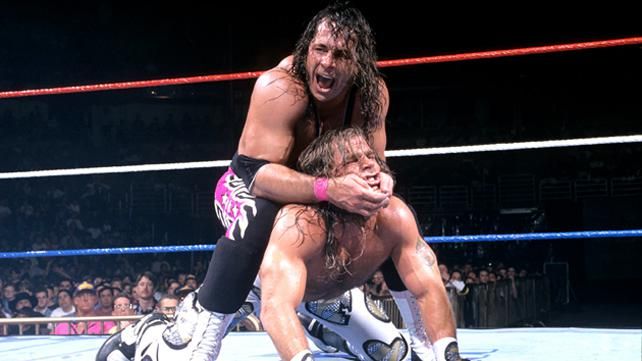
Fans get to relive some of the biggest feuds from the Attitude Era, including Hart vs Michaels.

Fans get to relive some of the biggest feuds from the Attitude Era, including Hart vs Michaels.

The gameplay is solid enough, and it’s probably one of the better grapplers put out by Yukes, but I’m only interested in the Attitude Era.  The Attitude Era mode basically replaces the single player storylines from past games.  It’s divided into multiple parts that put the focus on a different wrestler from the era.  The scenarios are:  DX, Stone Cold, The Brothers of Destruction, The Rock, Mankind, and Wrestlemania XV.  The first scenario starts off in the summer of 1997 and the scenario ends after Wrestlemania XV.  Once complete though, some bonus challenges open up featuring wrestlers such as Edge, The Godfather, and Lita.  I was rather impressed with how many old wrestlers were included in this mode considering some of them are no longer with the company.  Expect to take on the British Bulldog, the Road Warriors, and even Vader as you progress through the scenario.  During each match, the game will also assign special objectives that unlock additional content along the way.  Most of these objectives refer back to the real match and encourage you to recreate it as best as possible.  None stand out to me as being particularly challenging so expect to unlock them all with little trouble.

Since the Attitude Era has, until now really, been something only fans recognize it makes it difficult to get a consensus on when it started and ended.  Some think it started as far back as “Austin 3:16,” while others maintain it was the infamous Montreal Screwjob.  THQ decided to go with the formation of Degeneration X when Shawn Michaels and Triple H turned their backstage “Kliq” into an actual onscreen stable.  The game also constantly references the Monday Night Wars, the ratings battle between WWF’s Raw and WCW’s Nitro, as an ongoing storyline throughout the Attitude Era.  DX ends up being pretty well represented in the game, with the only notable exclusion being Chyna (probably due to her being an adult film actress now).  Even Mike Tyson is present for Wrestlemania XIV, which makes sense given that he was inducted into the WWE’s Hall of Fame earlier this year.

The roster includes expected stars such as The Rock, as well as some of the era's lesser stars like Ken Shamrock.

The roster includes expected stars such as The Rock, as well as some of the era’s lesser stars like Ken Shamrock.

The characters THQ chose to focus on for the era were logical.  They were certainly the most recognizable  from the era.  A lot of the big matches are covered including Michaels vs Hart at Survivor Series ’97, the inaugural Hell in a Cell match, the more famous Undertaker vs Mankind Hell in a Cell match, and the mode culminates in Austin vs Rock.  The only matches I missed that weren’t included was the Monday night match between Mick Foley and Terry Funk (who’s not included in the game unless you want to pay for him as Chainsaw Charlie) which took place in between the Austin vs Dude Love Pay-Per-View bouts; and the Austin vs Undertaker Buried Alive match at Rock Bottom ’98.  In the case of the second one, Yukes probably didn’t feel like coming up with a Buried Alive match again (they did at least bring back the I Quit match for the Rock vs Mankind feud) or the WWE felt like it wasn’t appropriate for their audience.  That last excuse seems unlikely as the game doesn’t shy away much from the content of the era.  There are some annoying inconsistencies though with the liberties taken by THQ.  For instance, Billy Gun is able to use his Bad Ass gimmick but Road Dogg can’t say the word “ass” as part of his intro.  The raunch is mostly absent though beyond a few utterances of the phrase “suck it.”  Austin’s middle finder is annoyingly censored, and the audio is as well whenever a character says “WWF” (it sounds like a lot of the audio was lifted directly from broadcast tapes excepting Jim Ross and Jerry Lawler’s commentary) which is distracting, but not as distracting as if they were saying WWE instead.

Current stars, like Triple H, are also depicted as their Attitude Era selves.

Current stars, like Triple H, are also depicted as their Attitude Era selves.

The game mode makes frequent references to WCW and its Nitro program but focuses solely on Raw.  It would have been cool to bounce back and forth considering WWE owns all of the WCW stuff at this point, plus a lot of WCW’s wrestlers from that era eventually ended up in WWE.  Perhaps THQ will one day give fans a WWE vs WCW game.  It’s also a little disappointing that the scenario ends before the end of the Attitude Era.  Like the start date, the end is hard to define but most everyone would agree that Wrestlemani XV is not the endpoint.  It’s more logical end would either be the start of the Invasion storyline, the introduction of the nWo into WWE programming, or Wrestlemania XIX where Stone Cold wrestled his final match.  Perhaps THQ is saving that for future downloadable content, a sequel, or maybe it was just too burdensome to pull off.  In order to accurately depict that era wrestlers such as the Dudley Boys, Hardys, and Kurt Angle would have to be included and all are currently with TNA Impact Wrestling.  TNA has in the past allowed its wrestlers to appear on WWE programs, usually limited to Hall of Fame related stuff, so maybe those guys could appear in a WWE game, but maybe at an unattractive price for THQ.

Regardless of the mode’s shortcomings, it was by and large a fun experience for me to take a trip down memory lane with some of my favorite characters from yesterday.  The mode got a lot right, and I appreciated the subtle details such as making all of Foley’s alter-egos their own selectable character, same for making the Hunter Hearst Helmsley character different from Triple H.  There is quite a bit of content in the scenario, though probably not enough to make purchasing the game solely for the Attitude Era mode a wise one.  I think I’ll get enough mileage out of the rest of the game to make it worthwhile, but I still have yet to fully dive into the other modes.  I’m glad to see the WWE and THQ recognizing that there’s a large market for the Attitude Era and hopefully this isn’t the last we see of it.


Teenage Mutant Ninja Turtles: The Complete Series

The Complete Series!

Ask most any guy my age what their favorite television show was when they were in elementary school and I be the most popular answer will be Teenage Mutant Ninja Turtles.  The heroes in a half shell were on weekday afternoons and then eventually Saturday morning from 1987 to 1996.  Their popularity was at its highest during the first three years or so but during their run they managed to rack up a total of 193 episodes.  The show was a merchandising behemoth, just look at a list for the action figures alone!  There were also clothes, toothbrushes, cereal bowls, pillows, and on and on.  You name it, and the Turtles were on it.  To a kid, they were a lot of fun and my days revolved around their television show, so when it was announced that the full series was getting released (housed in a replica Turtle Van, no less) I was all over it.

Packaging rear.

The DVDs have been receiving a steady release for awhile now, but they were always on the cheap.  Not cheap in terms of price, but light on episodes and content.  I have the first two volumes, but stopped there.  The show is pretty much as a I remembered.  It’s pretty silly and full of bad jokes but there are some worthwhile ones sprinkled in here and there.  I remember the characters broke the fourth well quite regularly, but what I didn’t remember was how often the show seems to poke fun at itself.  It’s probably something that disappoints those who want a show to take itself seriously, but come on, this is Teenage Mutant Ninja Turtles!  How could anyone take a show like that seriously?  Livening things up are numerous cameos (got to sell more action figures) on both the side of the Turtles and as antagonists.  I always liked the show’s take on Baxter Stockman, and the Rat King was also a personal favorite.

A look at the discs.

Those who have kept up with the show throughout the DVD releases are well aware of the fact that Lionsgate missed some episodes along the way, specifically “Planet of the Turtleoids and “Once Upon a Time Machine,” which have finally been released alongside season 10 as bonus features.  The complete series collection is just a collection of all of the previously released discs, so it does not correct the continuity issues, but does include everything.  This also means that if you’ve purchased every DVD along the way that this set probably isn’t for you, unless you really love the packaging.

The packaging is definitely the selling point for this set.  The Turtle Van (or Party Wagon, as it was called on the packaging of the toy release) is a pretty solid likeness of the old toy.  It’s missing the bells and whistles like guns and so forth, but does feature rolling wheels.  The interior contains a green Styrofoam mold that the discs slide into.  It can be a bit tricky to get the discs lined up properly so I wonder how well it will take care of them, but it works.  There’s a booklet too with a full episode list by disc, but that’s it.  One pet peeve of mine is the sticker on the front of the van features the Turtles as if they’re riding in it, but the side window stickers don’t.

And lastly, an unboxed view of the complete van.

If you’re looking for a great show, this isn’t it.  This collection is strictly for the collector who can’t say “No” to things from his or her childhood.  For what it is, it’s a cool set and I fully intend on watching each disc.  I outgrew the Turtles before the show ended its original run so I’m kind of looking forward to watching more of the “Red Sky” episodes from the show’s final seasons that I missed out on.  If you’re a fan like me that has yet to get the DVDs then this is a worthwhile set for you.


Teenage Mutant Ninja Turtles – Nick Series Episode 1

You can’t keep a good turtle down.

When I was younger I don’t think I ever expected the shows and properties I was into at the time to still be popular when I was an adult.  I had a similar conversation with a cousin of mine who happens to be the father of a five-year-old boy.  We were talking about how it was kind of funny you could replace one of our childhood birthday or Christmas gift wish lists with one of his and not notice.  His list was full of Transformers, Spider-Man, Star Wars, and so on.  Some things are expected to stand the test of time, like Spider-Man and Star Wars, but intellectual properties like the Transformers and The Teenage Mutant Ninja Turtles?  Those were kind of unexpected.

The Teenage Mutant Ninja Turtles have sometimes struggled to stay relevant.  After the bubble burst on the 80’s and early 90’s hysteria they kind of went away.  There was a television show on Fox Kids called The Next Mutation that only last one season and that show was the first attempt at bringing them back.  It was live action and since the budget was so low compared to the popular films it wasn’t received too well by older fans and the younger kids who had missed out didn’t seem to care for it.  After that failure, TMNT co-creator Peter Laird kept the franchise on life support with hopes of bringing the boys into the world of CGI.  I was unable to find anything on the internet, but I recall seeing some rather ugly mock-ups for it on ninjaturtles.com (now owned by Nick) back around 2000 or so.

There’s lots of little 2D visual effects in the show like stars or anime styled throbbing veins and such.

The CG proposal was never picked up, but the Turtles did resurface in 2003 with a new traditionally animated show put out by Fox and 4 Kids Entertainment.  Much like the first film, the new show combined the origins of the comic Turtles with the cartoon series adored by millions to create something that was both respectful to the origins but kept the kids in mind.  I only watched the first season but remember it being a fairly entertaining show.  Certainly if I were a parent I wouldn’t mind sitting thru it with my kid.  It kept the tone some-what serious with comedic breaks to liven the mood, most involving Michelangelo.  From what I could gather from a distance, the show would eventually splinter off away from any of the older versions of the Turtles and establish its own sense of self.  There was even a series titled Flash Forward that took place in the future.  The success of the show, though never approaching the height of Turtle-Mania, probably helped get the 2007 film, TMNT, made.  That’s when the Turtles finally got their CG debut and the results were mixed.  Financially, it did all right but the plot was rather poor and the Turtles looked more like frogs than turtles.  It did have its moments, but no new films in the series (TMNT was a sequel to Teenage Mutant Ninja Turtles III) were planned and if a Turtles film is ever produced expect it to be a reboot.

Anyone who has kept up with the Turtles knows by now that a new film was in the works.  Titled Ninja Turtles, it was going to be a Michael Bay production and was likely to be a major reboot for the franchise with the Turtles actually being aliens or something.  Intense negative reactions on the internet and a reportedly terrible script got the project put on indefinite hold.  Alongside it, a new television show and comic book series have been in the works.  The various mediums are not related other than the source material, but it was likely hoped that all of this cross-promotion would really help invigorate the franchise.  The comic has been out for about a year now and is okay, from what I’ve heard, and the television show premiered this morning.

There’s a blockiness, as seen in Leo’s shoulder, to the design of the Turtles that I find off-putting.

Teenage Mutant Ninja Turtles (Nick Turtles?) is the CG series that never was from the past.  The Turtles have been given a modified look and the show is separate from other incarnation of the Turtles.  One of the larger changes resides in the April O’Neil character who is now a teenaged ally of the Turtles.  For the most part, it’s pretty standard.  We have four teenaged turtles living in the sewer with their sensei, Splinter, who once was a man named Hamato Yoshi.  The Shredder is back as the main villain, and so is Krang who hasn’t been heard from in a long time.  The tone of the show is definitely reminiscent of the old cartoon as this is aimed primarily at kids new to the property.  One actual throwback to the old show for older viewers is the use of voice actor Rob Paulsen who was the original voice of Raphael but will now be handling the Donatello duties.

Visually these turtles look a lot like the ones from the 2003 cartoon.  Each turtle retains his trademarked mask but features brown pads everywhere else.  Their skin tone varies slightly from turtle to turtle and some have freckles while Don even sports a gap in his teeth.  Each one has extra bandages for some reason, I guess to make them look edgier, and retains their standard weapons.  In comparison to the CG film, these turtles are less frog-like but since it’s television the quality is lower.  They’re kind of blocky looking and sometimes they get these weird flat “panels” on their skin that seems inconsistent from shot to shot.  It makes me think of the old 32 bit video games when developers were first getting their feet wet with 3D.  The overall design is fine, but does leave something to be desired.  Splinter has often been portrayed either gray or brown, but in this one he’s multi-colored.  He’s also much taller than the Turtles this time around, which is a departure for the character, and he’s less feeble looking.

The first episode, which was an hour long, serves as the introduction for the Turtles.  Right from the start we’re shown who the dominant turtle is (Raph) and also given a glimpse of their individual personalities.  Nothing surprising here, though each turtle is a little sillier than how they’re usually portrayed, including Mike who’s not only the party dude but also a moron.  Their origin is relayed and it’s fairly close to the one from the old animated series only this time it was Hamato Yoshi carrying the bowl full of turtles and he got into a scuffle with the holders of the ooze, or mutagen, that would come into contact with our protagonists.  The flashback, and others in this episode, are told via hand drawn stills with minimal animation which was kind of a fun break from the CG.  Later in the episode we’re told that Yoshi had a wife and daughter and lost both to the Shredder.  He confirms his wife is dead but uses the word “lost” when speaking of his daughter so expect her to surface at some point (perhaps as Kiara?).

Expect to see more of this guy in future episodes.

The animation is better than I expected.  The Turtles and other inhabitants of the world move well enough and it’s on par with the best CG one can find on television.  There is a bit of a disconnect between the Turtles and their environment that may or may not be apparent to all viewers.  Most of the backgrounds are fairly dark as well to probably make it easier on the artists.  Sometimes this leads to backgrounds that are mostly black which doesn’t look good on TV.  The music is mostly a collection of electronic instruments, the only notable moment for me was the chase sequence about halfway thru.  The new theme song is basically a hip hop remake of the original television theme.  The less said the better.

The tone of the show reminds me more of the ’07 film than the animated series.  It’s light on one-liners but definitely aims to keep things upbeat.  When the fighting starts the Turtles do get serious, to a point, and a visual cue kicks in where their eyes become completely white.  It’s kind of interesting, but also kind of odd.  They’ll still pause during battle though at inappropriate times to make a humorous observation.  At first the Turtles appear to subsist on traditional turtle food, but early on in the episode are introduced to pizza and are hooked instantly.  They’re shown to have a television (and Leonardo appears to model himself after a Captain Kirk like TV character) but appear mostly ignorant to the outside world.  Either they don’t watch much TV or they just don’t pay attention.

The show itself introduces us to the Utroms of this universe.  When I said Krang was coming back I may have spoke too soon as the Utroms are now called Krangs.  They operate in the same way but are depicted as villains.  They kidnap April and her scientist father, which is how the Turtles meet her.  Donatello is instantly smitten with her, so we’ll have to see where that goes, but the Krangs are the primary antagonist for this hour of the show.  Shredder is only shown in a cameo, but we can see he’s still the leader of the Foot (unless they choose to rename it) and it appears his head and face has been severely burnt (probably as a result of his last encounter with Yoshi).

This is definitely a kid’s show and older viewers should not expect this program to elevate itself beyond that.  I kind of wish I had watched it with a kid to see how they would have reacted to the jokes and visual gags, most of which are standard kids show clichés.  For me, none of it was very funny but the plot surprised me in that it kept me interested for an hour.  I expected worse, but it seems like the Turtles have a legitimate chance to recapture the hearts of kids once again.  I’ll probably tune in to a couple more of the episodes just to see what other characters from the past return but it’s not something I plan on sticking with.

Post script:  I would categorize my early impressions of this show as tempered enthusiasm.  I expected it would succeed at hitting its target audience but probably not those who grew up with the original cartoon series.  I may have been wrong.  I watched the first few episodes out of sheer curiosity, but now find myself watching them out of sheer enjoyment.  The show is a lot wittier than I could have ever expected.  Some of the Mikey humor is still a little much for adult tastes, but a lot of it is pretty clever and dialogue driven.  The action pieces have also exceeded expectations.  And the many nods to the old series (such as the ringtone on each turtle’s cell phone) is much appreciated.  A lot of my early criticisms about the show’s visuals still remain and it’s become obvious the show doesn’t have the budget to create a thriving New York (seriously, there’s almost no traffic in the city when the turtles are out and about) but that should be expected given this is television and not a feature film.  In short, this show is genuinely enjoyable and I have yet to view an episode that I did not enjoy on some level.  That may not always be the case, but so far so good.

Teenage Mutant Ninja Turtles airs at 11 AM Saturdays on Nick.