Author Archives: Joe

The Amazing Spider-Man and Reboots

The Amazing Spider-Man (2012)

There are two big superhero movies set to hit theaters this summer.  One, The Dark Knight Rises, figures to close out a trilogy that could go down as the best superhero trilogy ever conceived to this point (and one of the all-time best trilogies in general).  The other, The Amazing Spider-Man, hopes to launch a new franchise that could one day be among the best.  The two films are not very similar, but The Amazing Spider-Man hopes to do for Spider-Man what Batman Begins did for Batman.  That’s a tall order and complicating things is the fact that not a lot of time has elapsed between the original Spider-Man film franchise and this new one Sony is looking to start.

How much time needs to pass between two films based on the same property before a reboot can be introduced?  A reboot refers to a new beginning for a character.  The Amazing Spider-Man will ignore the three previous Spider-Man films directed by Sam Raimi.  When it hits theaters it will have been 5 years since Spider-Man 3 was in theaters.  For Batman Begins, 8 years had elapsed between that film and the most recent Batman film before it, Batman & Robin.  In the case of both, these new films are arriving after the last one was poorly received, though to different degrees.  Batman & Robin was panned by critics and filmgoers alike.  There is almost nothing positive that can be said about it.  It was the sequel to Batman Forever, a film that received a mixed reaction, and was also the fourth film in a line of movies but introduced its third actor to play the starring role.  There was little continuity in that series following Batman Returns and every film seemed to be worse than the one that preceded it.

For Spider-Man, Spider-Man 3 returned the same cast and crew as the previous two.  The first film was received warmly and accomplished what it set out to do, and the second was roundly praised as one of the best comic-to-film adaptations ever.  Spider-Man 3 had a lot to live up to, and though it was not as good as the first two, it actually has a “fresh” rating on rottentomatoes.com, albeit barely so.  It wasn’t a terrible film, but it was a mess of a movie that encountered numerous problems.

What the Hell were they thinking?

I’m not sure if it was the intention from the start, but it felt like going into Spider-Man 3 that this could be the endpoint for the Rami directed movies.  The third one rounds out a trilogy and there seems to be a natural tendency to view films within a franchise in groups of three.  I’m not sure why, but that tends to be the reality of things.  The main actors were originally signed for three films so a potential fourth one was likely to get expensive.  As such, both Raimi and Sony/Marvel tried to cram everything into Spider-Man 3 they ever wanted to address on film.  From the onset, Raimi and star Tobey Maguire had mentioned they liked The Sandman and wanted to get him into a film.  There was also the Green Goblin plot which developed over the course of the first two films that had to be addressed in the third.  And then there was Sony and Marvel (and to a certain extent, the fans) who wanted to see Venom make his big screen debut.  If they had bothered to do any fan research though, I think they would have found most fans would not have wanted Venom in this film and would have preferred to see him introduced slowly across multiple films like he wan in both the comics and television show.

It’s no surprise then that Spider-Man 3 became a bloated mess.  Raimi tried to bring everything full circle for Peter Parker by revealing another piece of the puzzle where Uncle Ben’s murder was concerned.  And not content to let Mary Jane and Peter have a conflict free movie, he put a lot of focus on their relationship and tried to create a love triangle with Harry, the New Goblin (who looked ridiculous).  And then they had to get Gwen Stacey in for some reason, and introduce Eddie Brock and the black costume.  The fact that the movie actually does have a coherent plot is some-what commendable, even if it’s not a good one.

The film made a ton of money riding on the strength of the franchise more so than on the merits of the film itself.  The ending tied up some loose ends for the trilogy, mostly the Green Goblin story, but left things open where MJ and Peter were concerned.  I hated this ending, though the film did such a good job of making both Peter and MJ unlikable that I really didn’t care what became of their relationship once the credits began to roll.  Because it did make so much money, there was some speculation that Raimi and the main cast would return for a fourth film.  Things appeared to be moving in that direction until Sony abruptly cut ties with all involved.  This actually was met with a positive reaction by the fan-base, or seemed to be.  Fans actually seemed on board with a reboot of sorts for Spider-Man, partly because the existing films seemed to lose their way with all the melodrama thrown into the films, and because the Venom character was so thoroughly botched.

The new leads: Emma Stone and Andrew Garfield

A fresh start was definitely in order, but I’m not sure if The Amazing Spider-Man is what fans had in mind.  This new film is copying the Batman Begins formula perhaps too much by re-telling Spider-Man’s origin.  When Begins came out it had been well over a decade since Batman in 1989 and his origin really wasn’t explored in as great of detail as Begins set out to do.  With Spider-Man that’s not the case.  This film does give film-goers a look at Peter’s parents, which was never addressed in the previous trilogy, but it also goes through the whole bitten by a spider thing again.  I don’t speak for everyone, but I have no interest in seeing that re-hashed.  The film’s main villain is going to be The Lizard, who supposedly would have been the villain had Raimi’s franchise continued for a fourth film as well.  He’s another scientist with good intentions who has a horrible accident that leads to him becoming a super-villain.  That type is quite common in the Spider-Man universe, but The Lizard may be one of the most boring.  The film could portray him differently than most mediums, but for the most parts he’s just a mindless rampaging creature that tests Spider-Man physically, not so much intellectually.  He’s been around for a long time so he’s had other portrayals, but that’s the basic one.

If this isn’t the reboot fans were looking for, then what was?  Well, I think fans would have been happy to see a new actor dawn the red and blue tights without an origin story.  The film could have still ignored the Raimi trilogy and laid the groundwork for a new one.  It makes sense to go with a villain that wasn’t captured in the first three films already to provide some added freshness, though I’m not sure The Lizard was the right one.  Ideally, Eddie Brock would be in it to set the stage for Venom in a later film, but a main villain would be needed for the first one.  A grounded, real world type of villain might have worked best just to get away from the whole science gone wrong angle.  He may have shown up in Daredevil already, but The Kingpin could have been utilized again, maybe even the Spider Slayers?  The plot could show how Spider-Man, portrayed as a teen out having a good time stopping muggings and other petty crimes, confronts an enemy far more dangerous than anything he’s confronted before.  Kingpin could even have a lackey to beat the tar out of Spider-Man, someone like Hammerhead, Tombstone, or The Rhino.

The new costume has a Ben Reilly feel to it. That's not a good thing.

Or my concerns could amount to nothing.  It’s not impossible that The Amazing Spider-Man turns into a great movie, though I don’t consider it likely.  Maybe I’m just being pessimistic, but this thing looks dead in the water.  I expect it to do well at the box office, but perhaps not so well critically.  This may just end up being the example of what not to do when rebooting a franchise.  It has a “too soon” feeling already, and if a large chunk of the film’s run time is spent going over things the previous films already covered people may react negatively.  Then again, maybe the casual movie-goer doesn’t care and just wants to be entertained.  Spider-Man bouncing around and wailing on a CGi Lizard may delight audiences, and a lot of people seem to like Emma Stone who plays Gwen Stacy (whom has the misfortune of expectation as comic fans will basically just be waiting for her to die).  The trailer is linked below, so you can form your own early opinion on the film.  Mine seems obvious, but in the interest of spelling things out, I don’t expect this to end well.


Danzig: Thrall-Demonsweatlive +

Danzig: Thrall-Demonsweatlive (1993)

Last weekend I posted my final review for the Danzig LP’s, but that doesn’t mean I’m done with Danzig!  Far from it, as there’s still a few more items that require attention.  If you’ve been keeping track, I’ve posted a review for all nine studio albums plus a summary of the soundtrack only songs that have seen release over the last 20+ years.  That still leaves the EP’s, The Lost Tracks compilation, and the Black Aria releases; all to be addressed in good time.  This post will take a look at live releases and the EP’s, specifically Thrall-Demonsweatlive.

It might surprise you to know that the two best selling Danzig releases (and the only two to reach gold status) are the 1988 self-titled album and the 1993 EP Thrall-Demonsweatlive.  This is, of course, due to the popularity of the “Mother” track which saw a re-release for radio and MTV when Thrall hit stores.  “Mother” was originally released as a single for the first album, but it struggled to find airplay on mainstream rock radio stations.  It had an even harder time finding an audience with MTV and the network determined the video was “too Satanic” and refused to play it without some editing done.  Danzig balked at censoring the video, so the label instead released a home video (simply titled “Danzig”) that contained all of the music videos shot for the first album as well as some behind the scenes interviews with the band.

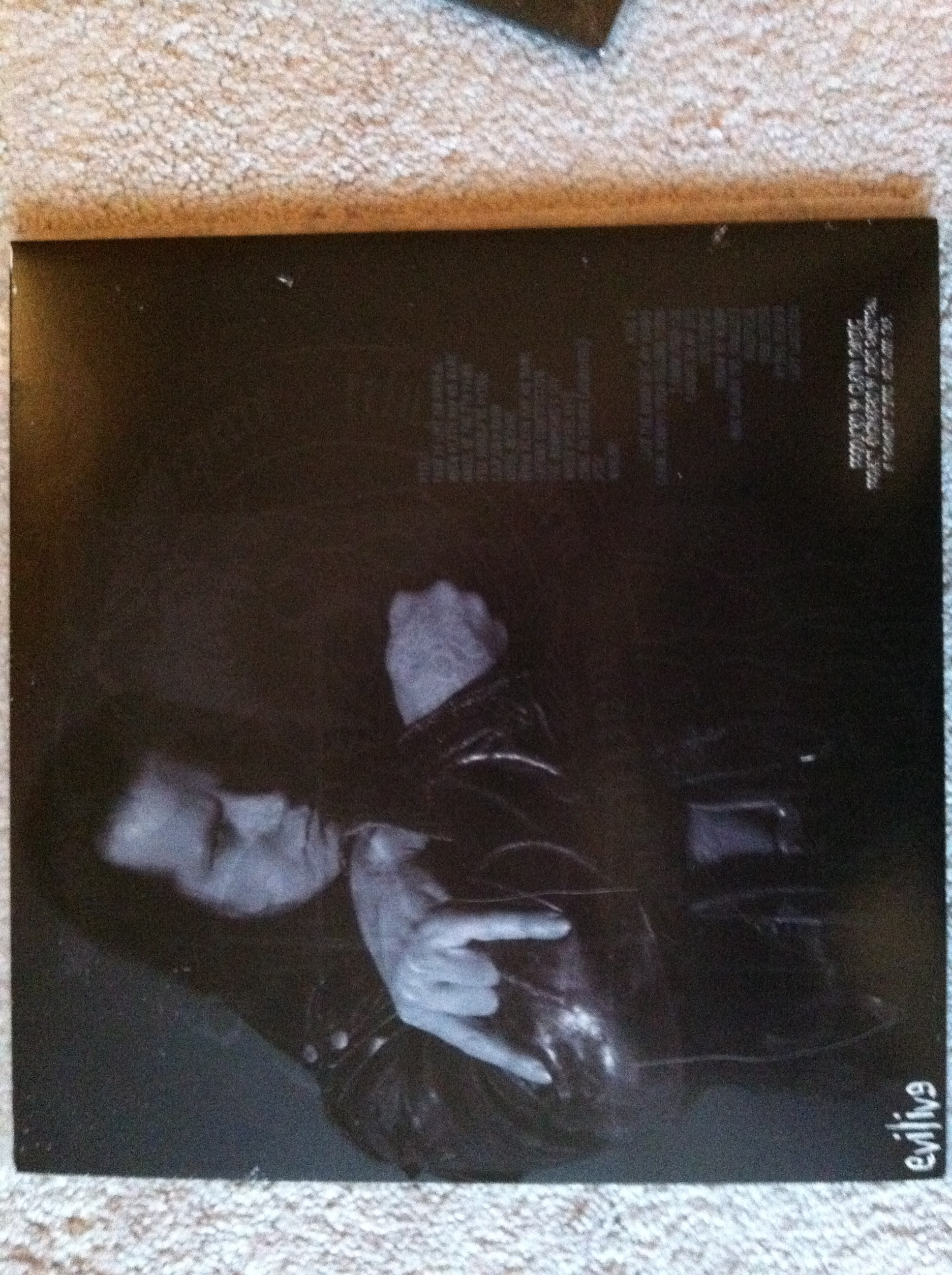
Side B of the picture disc release.

In between Danzig III and Danzig IV, Glenn Danzig approached the label about doing an EP.  The label wasn’t too keen on the idea, but according to Glenn he was able to to get them to agree to put one out after pointing out how well Alice in Chains had done with the Jar of Flies EP.  Once the agreement was in place, the band hit the studio in between tours to record a couple of original tracks and one cover.  The two originals ended up being “It’s Coming Down” and “The Violet Fire.”  Joining them for the Thrall portion of the release was a cover of the Elvis tune “Trouble.”  The band had been working on this cover ever since the Samhain days but had never found an appropriate place to release it.  Those three tracks comprised what was called the “Thrall” portion of the release, and were paired up with four live tracks that made up the “Demonsweatlive” part of the album.  These four tracks were all taken from the band’s Halloween gig at Irvine Meadows in 1992, they are:  “Snakes of Christ”, “Am I Demon”, “Sistinas”, and “Mother.”  There’s also one hidden track on most releases, a slightly remixed version of “Mother” often referred to as “Mother ’93.”  To my ears, it doesn’t sound any different than the original version.  It was this version of the song that was made into a new music video featuring nothing but live shots which found an audience on MTV.

The studio tracks on this release are pretty solid, with “It’s Coming Down” becoming a staple of most live setlists ever since.  I personally prefer “The Violet Fire” for its more groove-oriented pacing.  The live tracks are all pretty ferocious and played faster than they were on the albums.  Glenn almost growls the lyrics for most of them, with the exception of “Sistinas” which features his signature croon.  I know a lot of people who prefer the live version of “Sistinas” to the album version, to me, both are excellent.  The live version of “Mother” is superior to the album version as it captures a different kind of energy that really lends itself well to the rebellious lyrics.

Danzig: Live on the Black Hand Side (2001)

The rest of the setlist from the Irvine Meadows show would pop up here and there one track at a time on various singles.  The majority of it would be released on 2001’s Live on the Black Hand Side.  Live on the Black Hand Side is Danzig’s only other live release and the band’s only full-length live album.  It’s a two disc set that captures the band’s peak in the mid 90’s as well as the Satan’s Child tour from 2000.  Disc 1 is split between the Irvine show and a Seattle show from the 4p tour.  The track-listing is like a greatest hits album, and the first disc is a nice piece to own.  Disc 2, on the other hand, is a disaster.  The audio quality, perhaps because the shows took place in smaller venues, is garbage.  The track-list is pretty solid, though there are a couple clunkers, but the quality ruins it.  Glenn’s vocals are often hard to make out and the band sounds thin.  Live on the Black Hand Side can be a tough album to track down these days, but is only worth doing so for the hardcore.

Danzig: Sacrifice (EP, 2000 E-Magine release)

The only other EP put out by Danzig is the Sacrifice EP.  It was originally released as a single that contained six tracks, all remixes of the of the song “Sacrifice.”  It was re-released in 2000 by E-Magine with additional tracks added; remixes of “Deep” and “Serpentia.”  The original version did have a limited vinyl pressing for you completists out there, while the re-release was CD only.  It’s a release for the hardcore only, as none of the remixes improve upon the original songs, and in the case of both “Deep” and “Serpentia,” the original song wasn’t that great to begin with.

Thrall-Demonsweatlive is a must own for Danzig fans.  The studio tracks are solid and the live ones entertaining.  It was released on CD and cassette initially, but also had a German picture disc release that can be hard to track down these days.  The front cover of all of the releases features artwork by Simon “Biz” Bisley who would go on to do a lot of illustrations for Danzig.  The reverse image of the picture disc features a bare-chested Glenn Danzig from Irvine Meadows, an image also included inside the CD booklet.  The booklet for Live on the Black Hand Side features dozens of live shots from throughout the band’s existence and is arguably the best thing about the release.  The front cover is atrocious though and very amateurish.  There’s not much noteworthy to say about the packaging for any of the Sacrifice releases, save for it does include that image of Glenn spreading his arms melded with the skull logo.


Twisted Metal (2012)

Twisted Metal (2012)

If you frequent this blog you may have noticed that I do not post many negative reviews.  That’s because, for the most part, I’d rather talk about things I like and enjoy and not things that irritate me or make me mad.  There have been some exceptions.  I set out to review all of the Danzig releases which meant reviewing the good and the bad.  I also reviewed the X-Men trilogy which meant having to review the less than stellar third film.  Otherwise, I think most reviews have been fairly positive, especially the video game ones.  I suppose there’s a first time for everything, but it does pain me that my first negative video game review on this blog is going to be about a franchise I adore; Twisted Metal.

Twisted Metal made its return to livingrooms across the globe this past Valentine’s Day.  I recently made an entry in my Greatest Games feature praising the last home entry in this series, Twisted Metal Black, which came out over 10 years ago.  The new game, simply titled Twisted Metal, was announced a couple of years ago at E3 in grand fashion complete with a live-action Sweet Tooth driving his famous ice cream truck onto the stage during Sony’s conference.  Long-time fans of the series had been nearly driven insane wondering when, if, Sony would return to one of its oldest franchises.  The wait was long, but it did have an end, unfortunately it wasn’t really worth the effort.

Twisted Metal is not a bad game in the strictest sense.  Visually it’s quite nice to look at though not breath-taking.  The textures on the scenery are minimalist but that’s because the game was built for speed and there’s little need for gorgeous textures when the player is going to spend the majority of the game zipping around the various levels.  The cars look great, though from an artistic standpoint they do seem to lack in personality when compared with the older games.  Perhaps that’s nostalgia getting the best of me and an over-compensation on my part considering the drivers are no longer unique (more on that to come), but it is the impression that I get.  The soundtrack features a mix of original compositions that mostly trend towards hard rock and some licensed tracks featuring a return of Rob Zombie (which is actually kind of odd, considering he was only featured on the much-maligned third and fourth entries in the series).  It’s been quite a long time since I’ve driven around a war zone with “Dragula” booming through my television speakers.

The game mechanics of Twisted Metal remain largely unchanged as well.  You still drive around blasting opponents with fire, power, homing, and all sorts of other missiles all the while relying on powered-up special attacks.  A lot of the vehicles have a familiar feel as well.  Sweet Tooth (the truck, not the character) still handles like a bath tub on wheels and Dark Side has a punishing ram attack.  Some vehicles return with new special attacks this time out, such as Roadkill’s mini gun and Junkyard Dog’s Taxi.  This one even includes a helicopter for the player to try out, something that was to be included in Black but had to scrapped at the eleventh hour.

Cut scenes are done with live actors. Also, Mr. Grimm isn’t dead.

If a lot of the game is more of the same, why am I threatening a negative review?  Well, a lot of reasons really.  While the gameplay is fairly consistent with prior games, there’s a different feel to the physics this time out.  It’s as if the development team decided the more chaotic the battles, the better.  Now it seems like only the slightest bump or the most insignificant weapon can send your vehicle bouncing around like a tennis ball.  This causes vehicles to get hung-up on walls and proves especially annoying during the games racing levels.  You read that correctly, there are racing levels this time around and they are atrocious.  Twisted Metal was never designed to be a racing game and that is more than evident when it tries to be one.  The levels are still wide open but force you to travel through gates or checkpoints along the course.  The thing is, there is no set course so the whole thing becomes an exercise of trial and error as you try to figure out which way the game wants you to drive.  The final race is particularly annoying as it has you speed over ramps and rooftops where one error spells doom.  And passing through all of the checkpoints first is something only required of you, the player, the AI controlled opponents are free from that restriction.  This is a pretty big deal for the final race because finishing in first is meaningless, it just reveals on your map where the final, mobile, checkpoint is.  Activating this final checkpoint causes all of the other cars to explode, which means if one of the AI cars activates it first, you lose.  And since they don’t have to pass through all of the checkpoints it really becomes a crap shoot.  If there’s one silver lining for the racing levels it’s that there are only three, but you’re likely going to hate all of them.

And that wasn’t the only way the team “spiced” things up with the single player, there’s also electric cage and endurance matches.  Electric cage match sounds pretty cool, but it’s not.  Again, it just turns into another gameplay tweak that’s annoying, not enjoyable.  In these levels a laser cage surrounds an area for a set amount of time.  While inside it, you’re fine but leave it and a timer is activated.  Once that timer reaches zero you begin to take damage.  Every minute or so, the cage vanishes and reappears at another part of the level setting off a mad dash to find it.  One of these levels occurs in an amusement park and the serpentine like roads make it a challenge to find the damn thing once it re-spawns.  It just doesn’t add anything enjoyable to the experience.  The endurance rounds are actually okay.  These require the player to kill a certain amount of enemies while keeping a large number of them on the map throughout.  This creates a more chaotic experience that actually works.  I still prefer the more traditional levels, but this one’s okay.

Since the game only has three characters, each one can drive whatever vehicle he or she chooses.

Then there’s the Juggernaut levels.  The Juggernaut is a semi with a full trailer armed to the teeth.  It also spawns a new enemy every thirty seconds.  In these levels you have to kill the Juggernaut as well as all other combatants.  Later levels introduce a second Juggernaut and a more powerful version at that.  These levels are okay and do prove challenging and serve as a sort-of mid-point boss fight for the three single player scenarios.  The true boss battles comprise their own level, though usually play out in stages.  The first one was pretty cool and pits the player against two over-sized monster trucks. The second, a battle against a mech-like enemy, was annoying.  Part of the reason for its annoyance is the inclusion of the dreaded electric cage for a portion.  The final boss, a Sweet Tooth themed one, is much better.  It’s both over-the-top and inventive and a good way to close out the third and final story.

And yes, that is also correct, there are only three single player stories.  This has been known for awhile and dreaded by me.  My hope was that since only three existed they would be more involved and longer than before.  Instead, they’re shorter than what was in Black and can be completed in less than an hour a piece.  They kind of form one long story and have to be played in succession from Sweet Tooth, to Mr. Grimm, and to Dollface.  Sweet Tooth is pretty much the same Sweet Tooth from Black.  In his scenario we get to see the origins of this Sweet Tooth and what he hopes to get from Calypso when he wins.  The story unfolds in three parts, an intro movie, a middle, and an end.  These are done with live actors instead of CGi.  It’s actually not bad, and Sweet Tooth’s story, while predictable, was entertaining.  Grimm’s was less so, and Dollface’s more like Grimm’s.  There are a couple of ending movies that serve as epilogues that bring the focus back to Sweet Tooth, which proves to be a good thing.  This game’s Calypso is also very different from previous ones.  He kind of looks like Jack Black from The White Stripes and is some sort of entrepreneur and has his own company.  He still bestows wishes on the victors but I found him less entertaining this time around.  The twists were all very predictable and thus less amusing.

The single-player was a tack-on thing and definitely feels that way.  It’s a shame, because I loved playing through each one in Black.  Sure the writing wasn’t anything fantastic in that game but it was entertaining.  This game’s primary focus is on multi-player, something I rarely engage in.  I’ve never touched the online component of most of my games including Red Dead Redemption, Uncharted 2, Mortal Kombat, Smackdown vs Raw, and so on.  Because this one includes such a small amount of content, I’ll pretty much have to give it a shot.  It could be good, but right now the servers are all messed up leading to numerous network connection errors.  This appears to be a wide-spread issue and a patch is set for release next week.  Online is still playable for the truly determined, I’m just not among them.

I suppose that makes this verdict incomplete, but in truth, no amount of multi-player action can change my mind at this point.  Online matches may help alleviate the notion that I just wasted sixty bucks but it won’t change the fact that, as a single player game, Twisted Metal isn’t very good.  There’s not much content and the gameplay engine just isn’t up to par with past efforts.  I looked forward to the return of this franchise more than any other and I’m really disappointed it could not meet my expectations.  Now, if you’ll excuse me, I’m gonna go fire up Twisted Metal Black and try to recapture those glory days long since passed.


Danzig: Circle of Snakes

Danzig: Circle of Snakes (2004)

2004 was a great year for me.  That year started off with a Superbowl victory by my New England Patriots and culminated in one of the happiest moments of my life; the Red Sox victory over the St. Louis Cardinals in the World Series.  2004 was also the year I began my junior year of college which would be a fun and memorable one and not long after the year’s close the Patriots would capture their third (and despite the team’s best efforts, most recent) Superbowl win.

2004 also saw another release from Danzig; Circle of Snakes.  After releases in 1999 and 2002, Danzig appeared to be back on track in terms of an established release schedule.  There was also a live album during that timeframe and some other re-releases as well as plenty of touring.  And while 1999’s Satan’s Child wasn’t that great, the follow-up I Luciferi showed some promise.  Circle of Snakes was heralded as yet another return to form for Danzig, with pre-release hype claiming Glenn Danzig had gone back to his roots.  This sort of hype had become tired at this point, since both of the previous efforts were described in a similar fashion and yet both were quite different from older works.  I’m not even sure fans ever really wanted Danzig to sound like it did back in 1988, most just didn’t want the band to sound like a NIN knock-off.

Even so, Circle of Snakes was more of a return to form than either of the previous records.  The approach the band took to the record was simplified when compared with prior works.  Basically all of the extraneous effects have been removed from the production and replaced with a pervasive heavy-ness.  Like the prior two records, Circle of Snakes features down-tuned guitars that go lower than the popular drop D technique.  The mastering of the record was either bare-bones or not done at all giving everything a rough quality.  The guitars dominate this release and if their tuning wasn’t heavy enough, the tone used added even more thickness to the sound.

The end result is a sound that works in some parts, but not in others.  Unfortunately, the latter is more common.  The opening instrumental, “Wotan’s Procession,” features that distinct guitar tone right off the bat.  It’s rather ugly, though some would argue it works here and in the following song, “SkinCarver.”  “SkinCarver” is designed to be a destructive album (and show) opener.  It’s fairly straight-forward and one of Glenn’s heaviest compositions.  It’s not among the best openers on a Danzig album, but provides a good preview of what’s to come.  The title track contains a variation on that classic Danzig riff we’ve been hearing since ’88 which adds a groove to the track, in contrast with “SkinCarver.”  The tone of the guitars is more pervasive here though and quite jarring and once everything gets brought in on the chorus Glenn’s vocals get drowned out.  The song is mildly catchy though and not unbearable, if one overlooks the campy-ness of the lyrics.  “1000 Devils Reign” follows and represents the album’s strongest track.  A catchy little drum pattern kicks things off before giving way to a simple three-chord progression and some silky Glenn Danzig croons.  The chorus is classic Danzig, and the whole package comes together extremely well.  The heaviness of the guitars feels a little out-of-place on such a melodic track, but they’re not over-powering.

Unfortunately, the album kind of falls off a cliff shortly after.  “Skull Forest” is a decent semi-ballad with perhaps the best vocal performance on the album.  The end of the song almost drowns out and ruins the vocal performance but it does give the song a bigger sound.  The rest of the album bounces around from forgetful to annoying.  “Hellmask” and “My Darkness” represent some of the worst of the worst from Danzig; just obnoxious, direction-less tracks with no redeeming qualities.  “NetherBound” is starts to make up for things while “Black Angel, White Angel” is a pretty effective hard rock track, but by then it’s too little too late.

The musicianship from the Danzig lineup is pretty solid, if unspectacular.  The whole band was replaced following I Luciferi and the recording lineup this time included Bevan Davies on drums, Jerry Montano on bass, and ex-Prong main-man Tommy Victor on guitar.  Victor had played with the live band on several occasions before so this was a return engagement for him and one that has continued to this day.  The other two would eventually be replaced by Steve Zing and Johnny Kelly (who Danzig really wanted to use for this album but was unavailable).  The mix is where things fall apart for Circle of Snakes as Glenn wanted to achieve a heavy, analog sound.  The successor, Deth Red Sabaoth, would actually be recorded via tape to better achieve this sound, though mixing and mastering would still be an issue.

Circle of Snakes on blue vinyl.

Release wise, Circle of Snakes shines as one the more diverse albums in the Danzig catalog.  It received a standard CD release with a minimalist booklet complete with C-grade porn stars in place of lyrics for some songs.  Glenn Danzig is once again pictured with his black, latex, monster gloves though he decided to keep his shirt on this time.  Circle of Snakes received a true vinyl release, something that really hadn’t occurred since Danzig 4.  Satan’s Child did receive a very limited run as a picture disc, but Circle of Snakes received something close to a full-scale roll-out.  The album was available on blue vinyl and as a picture disc for the first pressing, and then on clear vinyl and another picture disc for the second pressing.  The first pressing totaled 1,400 and the second 880 with both editions evenly pressed.  I believe these were only available in Europe, but I’m not certain.  They’re fairly easy to come by on eBay and copies have worked their way into American second-hand shops.  Needless to say, there’s plenty for the completest collector to go after.

Circle of Snakes brought the band back to its more stripped-down roots, but introduces enough newness to make it stand out from the pack.  Unfortunately, it stands out for all the wrong reasons.  Where the heavy sound of the record works it creates a head-banging, hard rockin’ tune but for many of the songs it becomes oppressive.  Even without it, many of the songs just sound tired and uninspired.  There’s not a whole lot going on from a musical standpoint or a lyrical one.  Given that, it’s not surprising that the band would have a long hiatus between albums with six years lapsing before 2010’s Deth Red Sabaoth.  The break was apparently needed, as Deth Red Sabaoth is a heavy but far superior effort to this one.  Circle of Snakes does have a few good tracks which keeps it from being the band’s worst, but it’s probably the most forgettable.

Top Tracks:

  • 1000 Devils Reign
  • NetherBound
  • Black Angel, White Angel

Greatest Games: Twisted Metal Black

Twisted Metal Black (2001)

The vehicular combat genre of games has been around for almost as long as video games have.  They either take the form of a more traditional tank battle or a more outlandish game of chicken with machine guns and rocket launchers.  As such, tracing its origins proves quite difficult.  For me, the vehicular combat genre as I know it originated with a surprising title; Super Mario Kart.

Super Mario Kart was primarily a go-kart racing game with characters from Nintendo’s Super Mario series of games.  It was a wacky take on the genre, but it also was more than just a racing game.  Around the time it came out, competitive gaming was becoming more and more popular.  Either at the arcades with fighting games or on the computer with death match modes in first-person shooters.  Nintendo, recognizing this, implemented a battle mode in Super Mario Kart that dropped the racers into an arena with the goal of being the last man standing.  Players used the various power-ups to target their opponents with turtle shells and banana peels in an effort to incapacitate their opponents.  Three strikes and you were out.  This mode proved highly addictive and whenever I got together with friends to play Super Mario Kart we pretty much always played battle mode and hardly ever touched the main game.

Other publishers must have taken note, because it wasn’t long until games started showing up that relied almost entirely on this battle mode concept introduced by Super Mario Kart.  It especially exploded during the Playstation era.  By the time that era came to a close the market was saturated with games of varying quality including licensed games like WWE Crush Hour, which was the breaking point for the genre.  It has been de-emphasized by publishers and developers alike and it remains to be seen if it can ever become a major genre again.

Super Mario Kart may have been the originator, but the title most cite as the launching point for the modern genre of car combat is Twisted Metal.  Twisted Metal was one of Sony’s earliest first-party titles for the Playstation, arriving in stores roughly two months after the system’s launch in North America.  Original launch units of the Playstation included a video demo of the game as part of the pack-in demo disc along with games like Tekken and Warhawk.  Critically, it wasn’t well received for the most part but gamers seemed to enjoy it well enough.  For me, it was the first game I ever bought for my brand new Playstation game console and an early favorite.

The original Twisted Metal, in its original case too. Sony would eventually ditch these cases in favor of standard jewel ones.

Had I seen the initial reviews I may have never purchased it.  My introduction to the Playstation seemed to happen fast and came out of no where.  My grandmother on my mother’s side lived for Christmas when I was younger.  She would get all of those gigantic wish catalogs put out by the major department stores and have me and my sister pick through them to make our Christmas list.  She always wanted to be the one to get us that gift we wanted most.  That year I remember picking through one such catalog with her and pointing out things I wanted.  They must have been all little things like action figures and movies and I remember her almost getting frustrated.  She asked me if there was something big I wanted and I turned the page and saw “Sony Playstation $299.99” on the bottom right-hand corner.  I pointed to that, almost as a joke because to an 11 year old a $300 system seems way too big.  My mom had a similar reaction but then my grandmother started to reason it.  She more or less agreed to get it for me with the caveat that it would be the only thing I’d get.  I knew next to nothing about the Playstation, only that it was new and seemed exotic compared to my Genesis and Super Nintendo and was more than happy to concede other gifts in exchange for a hot new console.  Little did I know, my grandmother had been notified that my nana (dad’s mother) had told my mom she was giving me a television for Christmas which was like declaring war with grandma.  I got caught in the cross-hairs of a grandmother battle and reaped the benefits.

Because I really knew nothing about the Playstation, I had no idea what games to get.  For Christmas that year my parents gave me Doom, a familiar title to me since I had played it on my friend’s PC a few times.  There was no Mario or Sonic though to fall back on, all I had was that demo disc.  Twisted Metal looked pretty cool, so I bought it with some Christmas money.  Not long after I got Street Fighter Alpha, but all I would really play for the next six months (until my birthday) was Twisted Metal.  I would end up beating it with every character, I’d play my friends in death match, and just enjoyed the Hell out of it.  Twisted Metal 2 would arrive the following year and improve upon the original in almost every way.  Then something terrible would happen.

Singletrac, the developer of Twisted Metal, would leave Sony over a contract dispute.  Twisted Metal was owned by Sony though, so they just handed it off to internal studio 989 who was best known for crafting Sony’s licensed sports games.  989 would release the next two Twisted Metal games and both were disasters.  Singletrac put out the acceptable Rogue Trip and other studios were putting out car combat games that now surpassed the Twisted Metal brand.

This was unacceptable.  When Singletrac folded and some of the key members went on to form Incognito, Sony gobbled them up and immediately handed them the Twisted Metal franchise in an effort to bring it back.  And bring it back they did, for that team basically erased everything 989 had done with one game; Twisted Metal Black.

Levels became more expansive in Twisted Metal Black.

Released on the Playstation 2 in the summer of 2001, Twisted Metal Black returned the series to the more gritty atmosphere present in the original game.  The cartoonish antics of the sequel were gone and few righteous characters remained.  All of the drivers of the various cars were now mental patients.  Some were noble, like the driver of the police SUV Outlaw, but even the noble ones were twisted somehow.  The levels throughout the game depicted a bleak and desolate world on the brink of ruin.  Calypso was still the ring-leader and organizer of the Twisted Metal competition, but it was unclear if he still possessed super natural powers in most of the story modes (he did) and he came across as just some sick freak looking to get off on the misfortunes of others.  All of the characters had their own tragic back-story.  Each would narrate it him or herself with an opening video, a mid-point video revealing what led them to a mental institution, and an ending.  Calypso was never given a voice.

The main title menu opened with a still image of exploding cars with the opening notes of The Rolling Stones’ “Paint it Black” playing.  It was creepy and the song suited the game’s mood quite well (the full song played over the ending credits making this one of the few games where I always watch the ending credits).  Graphically, the game was exceptional.  Up until that point, few games had really done a good job of showing off what the Playstation 2 could do.  The best we had at that point was a demo for Metal Gear Solid 2 that came bundled with the game Zone of the Enders.  Twisted Metal Black had smooth visuals with lots of detail.  The levels were huge and expansive.  Each car had lots of little touches sprinkled on them as well be it riveted plates or bullet holes.  Missile launchers would roll out when equipped and any first-time player was wowed when Sweet Tooth’s ice cream truck transformed into a mech-like killer clown.  Gameplay was fast and the controls tight.  A twin analog stick approach made quick turns easy to pull off and arcade physics meant cars weren’t flipping over constantly.  Each car handled differently giving the game a great deal of variety and just about all of the special weapons had their uses.

Sweet Tooth's re-vamped special attack remains as the stand-out visual image from Twisted Metal Black.

The cast included a nice amount of familiar faces and new entrants.  Some old cars, like Outlaw, were completely different from the car that had preceded it.  Some of the returning ones also had new special attacks like Darkside’s ram attack, a great improvement over the old laser weapon.  My favorite was Roadkill, who now sported a charge-up homing missile weapon.  All of the special weapons had two methods of deployment, a standard one and a more technical one.  The technical one was harder to pull off, but dealt more damage and figuring them out was part of the fun.  Every car also had an energy bar for special attacks like freeze balls and shields that could easily change the tide of battle when deployed properly.  A lot of the levels also had hidden areas or visual gags that were fun to exploit.  There were hidden characters too that had to be found throughout the game, some were harder than others.

While the game is head and shoulders above all others in its genre, it did have a couple minor short-comings.  One thing none of the Twisted Metal games ever got right was enemy AI.  Each level is supposed to be a free-for-all but it always felt like the AI was programmed to go after the player and not each other.  While this does enhance the game’s difficulty, it always felt a little cheap.  The game’s final boss also wasn’t the best.  While he was difficult, he didn’t seem to really test the player’s skills.  I have always felt that a good boss battle is like a final exam meant to test how much the player has learned over the course of the game.  This game’s final boss is a helicopter and the approach to beating him is completely different from the approach taken to go after virtually every other enemy.  Vehicles that do not have some kind of missile attack as a special weapon are at an extreme disadvantage too as they have to rely mostly on weak homing missile pick-ups.  And since vehicles can’t really adjust their aim it makes targeting the final boss a pain.  Every encounter just ends up being a case of driving around waiting for either the special weapon to regenerate or for some homing missiles to appear.

Twisted Metal's mascot Sweet Tooth now finds his head permanently aflame.

Aside from that though, I really have few complaints with Twisted Metal Black.  The gameplay is so tight and so fun that I’ve never truly gotten sick of it.  The storylines for each car are also interesting in their own right which lead me to beating it with every single driver.  Death match was just as fun as ever too, though it would have been nice if all of the single player levels were available.  An online edition of Twisted Metal Black was released later on for free for early adopters of Sony’s online network.  I never played it but it always made sense to bring Twisted Metal to the internet.  This Tuesday, the latest game in the series arrives.  Simply titled Twisted Metal, it actually puts more emphasis on the online component.  It was initially conceived as an online only game but Sony was impressed with it so much they decided to make it a full game and had developer Eat, Sleep, Play (made up of ex Incognito/Singletrac members) craft a story mode.  It sounds like the story mode will mostly be an after-thought and only focus on three participants which has me feeling rather disappointed.  I hope to be pleasantly surprised though.  Twisted Metal also appears to be taking the Mario Kart approach of letting the player pick the car’s driver and then choose the vehicle.  This must be how the game can supply all of the old favorites while only having three storylines.

Regardless of how the new Twisted Metal turns out, I can’t imagine it topping Twisted Metal Black.  Sure it will look better, it might even control better, but if the total package exceeds Black’s I’ll be shocked.  This Greatest Games feature I’m doing is not in any particular order, but if it was, Twisted Metal Black would be a strong number two.  I love this game and I’ll never get rid of my copy.  For those who missed out, the new Twisted Metal is being released with a download code to get the original Twisted Metal Black which is one of the best bonus features in gaming history.  You now have no excuse for missing this one.


Action Figures!

It’s been almost a year since I made my initial entry talking about my affection for collecting things.  In that entry, I mentioned how I used to collect action figures.  I loved action figures as a kid, even more so than video games.  Action figures were my go-to toy when I needed to entertain myself.  I even separate my childhood into phases based on what line of action figures dominated my playtime.  In chronological order, they are:  Ghostbusters, TMNT, and X-Men/Spider-Man.  That basically took me from age four to ten or eleven.  Around that age playing with action figures and acting out climactic battles starts to feel childish, plus puberty kicks in which brings along a whole host of new interests and time-wasters.  Most of those toys are gone now, either sold at yard sales or thrown away.  I have most of my X-Men and Spider-Man ones, and I did save the original TMNT line and movie line, not because they’re worth anything, just because I’m sentimental.

Once I hit my late teens I started working a part-time job and soon found myself with disposable income for the first time in my life.  Most kids my age probably spent their money on booze and drugs, I ended up buying toys.  I’m not saying that makes me better than most of my peers, actually it kind of makes me a dork.  New action figures were way better than anything I ever had and they impressed the Hell out of me.  It didn’t make much sense to me, but I started buying more and more.  At first it was a figure here or there, then it started to become whole lines.  I’d buy what I thought looked cool, and then I’d just buy everything.  It was a compulsion.  This lasted probably from the time I was 16 until 22.  At that point in time I was living on my own, I had no place to really put more toys, and the Marvel Legends line switched from Toy Biz to Hasbro and went down the crapper.  Since then I’ve bought a few toys here and there, but by and large I’m done unless I have a kid who gets action figures.

To break up the monotony of all of these video game posts of late, I thought now would be a good time to go digging through some boxes and come up with my 10 favorite action figures.  And by favorite, I mostly mean favorite looking with some addition of intrinsic value taking hold as well.  If I were to make a list of my favorite and most played with toys it would have been an entirely different list.  These are, for the most part, all modern action figures that I acquired in my teens and twenties.  Most of them are from the world of comics, with some cartoon characters as well.  Before I get to my list, let’s take some time out for one honorable mention:

Turtle Trolls

There are some pretty cool gimmick action figures out there.  Lego versions of popular characters come to mind as well as Lego-type toys like Mini Mates and Kubricks.  The Teenage Mutant Ninja Turtles have had many such gimmicks that range from cool to embarrassing.  This one such cross-over falls somewhere in between, though for many it might fall into the embarrassing category.  Treasure Trolls were really popular in the early ’90s.  They didn’t do anything and were cheaply made, but for some reason kids had to have them.  Seeing an opportunity for a cross-over, Playmates and whoever made Treasure Trolls combined the TMNT brand with the trolls and the result was Turtle Trolls.  These things are quite silly, but terribly cute.  They still look mostly like turtles, just with big, colorful hair.  The accessories they came with were mined from existing Turtles figures and really don’t make much sense (Leonardo has the stone katanas that came with Cave Turtle Leo, for instance) but I guess Playmates felt they couldn’t just go with normal weapons.  For whatever reason, I liked this gimmick as a kid and still like it today which is why I still have a set of Turtle Trolls.

Honorable mention out of the way, time for the The Nostalgia Spot’s Top 10 Action Figures!

10. Marvel Legends Green Goblin/Spider-Man Classics Hobgoblin

I couldn’t separate these two, and since they’re so similar, they both get to share spot #10.  Hobgoblin was treated quite well by Toy Biz in the aughts as he received two really sharp figures.  The first Spider-Man Classics Hobgoblin was based on his demonic appearance.  Creatively, the sculpt took some liberties in making him look quite fearsome and the sculpter opted for brown instead of orange for the costume which gave the character a certain gritty-ness not seen in the comics.  As cool as it was, I prefer the more traditional take that came later.  This Hobgoblin is picture perfect when compared with the comic book character.  The colors are vibrant and clean and he wasn’t given some cheesy action feature that could detract from the sculpt.  The pumpkin bomb is permanently affixed to his left hand, but that doesn’t really bother me.  The Green Goblin is every bit as good.  He’s from the Marvel Legends line from the Onslaught wave.  The colors are a bit darker as the Legends line tried to appeal more to adults than the Spider-Man Classics line.  Perhaps a more vibrant paint job would have been more comic accurate, but this works just fine.  It’s not the worst thing in the world to downplay the purple and green color scheme.  Like Hobgoblin, his pumpkin bomb is also permanently attached to his hand.  His glider also has a nice stand for displaying instead of the more cartoonish smoke cloud that Hobgoblin has.  I like the angle the glider’s wings are at too, as it makes the figure much easier to pose.

9.  IF Labs Super Saiyan Vegeta

Dragon Ball Z was a big reason for my renewed interest in action figures.  I got into the series as a teen which made the action figures suddenly appealing.  For awhile, they were terrible as the US distributer, Irwin,  just re-released the old Bandai and AB figures which had long since become outdated.  Eventually, Irwin would start producing its own figures.  There were some growing pains, and the normal five inch line was geared more towards kids than collectors, but they ended up putting out some worthwhile stuff.  Their high grade collector line, IF Labs, had its share of misses but had some hits as well.  IF Labs focused more on the DBZ films, and this version of Vegeta is from the The Return of Cooler OVA.  Articulation wise, the figure leaves something to be desired as its pretty basic, but the sculpt and paint job is bad ass.  Vegeta was one of my favorites from the show, and I was stoked to pick this one up.  He’s around 7″ tall, making him short compared to the rest of the line but still larger than the standard line of action figures.  Irwin/IF never made a better Vegeta than this one, and arguably never produced a better figure than this one.

8. Marvel Legends Apocalypse

Not to be confused with the series 7 Apocalypse action figure, this is the massive build-a-figure Apocalypse from series 12.  At that point, Toy Biz had started releasing each figure in a wave with a piece of a larger figure.  This particular wave of figures came with a piece of the world’s oldest mutant, Apocalypse.  This was a welcomed figure as the series 7 Apocalypse was not well-received.  He was short and fat and a rather poor representation of the figure.  Most figures in the Legends line could trace their appearance to a certain point in time, but that Apocalypse really had no comic counterpart.  This one was true to the likeness of Apocalypse from the ’80s, just huge.  Yeah it would have been nice to have a 6″ scaled Apocalypse as this one is perhaps too big (even though one of Apocalypse’s many mutant powers was the ability to grow in size) but still pretty awesome.  He’s hefty too and one solid figure.  This Apocalypse was the last of the standard waves of figures to feature a build-a-figure of this size.  Future ones were much smaller in scale, which really diminished their coolness (especially for the series 13 Onslaught).  This Apocalypse is a mix of blue and black, though apparently some pieces were colored black where they should have been blue so there are a few more black Apocalypse’s floating around.  The range of motion on his legs is a bit limited, and he’s so top-heavy that he can be hard to stand.  The rest of the figure features typical Marvel Legends articulation.  In the original batch of figures one of his cables was missing and collectors had to go to Toy Biz for a replacement.  As you can see, I went through the effort to have a complete Apocalypse.

7. Unifive Ultimate Saiyan Vegeta

The only character to appear twice on my list, this Vegeta is of a much smaller scale than the previous one and attempts to capture the character in all of his forms from the anime.  It doesn’t quite pull that trick off, but he’s pretty cool nonetheless.  Unifive is a Japanese company and as such this is a Japanese figure that was never released in the US.  He was pretty costly at the time, and has only become more costly since release.  The figure is probably less than 5″ tall though I assume that’s so he can fit in with the other figures from the line (I don’t own any of the other ones).  His coloring is also supposed to resemble the manga more than the anime which basically just means he’s a little darker than usual.  The articulation is rather interesting as it’s mostly cut joints instead of ball joints.  He’s capable of a variety of poses but the cut joints hide the articulation well and make him easy to display.  He comes with a bunch of accessories that I didn’t feel like digging out.  As such, only a couple are displayed in the picture.  He came with four heads:  regular, super saiyan, majin, and oozaru (great ape).  The oozaru head includes damaged saiyan armor like what he wore in his first appearance.  He has a display base that’s just some barren ground with little saibamen heads poking out.  There’s an attachable mountain to cover-up the heads and a little tiny Goku clicks into it so you can display Vegeta in his ape form and he’s actually to scale with Goku!  He also has a removable tail and scouter.  It would have been nice if he had some shoulder pads to more accurately depict him in his Saiyan Saga attire.  There’s also no top to pair with the Majin Vegeta head for an accurate portrayal of that character.  The second set of figures from Unifive (featuring Trunks and Gohan) would do a much better job of accounting for the different looks of the characters.  Short-comings aside, this is my favorite 5″ scale DBZ figure.

6.  Marvel Legends Sentinel

Another build-a-figure, and this one really made use of the format.  This is a more modern take on the Sentinel character from X-Men and he’s pretty bad ass.  Pieces of this figure were distributed in wave 10 which had a very X-Men feel to it.  The coloring is muted and gritty and great care was taken to sculpt the more mechanical parts of the figure making a giant red and purple robot seem almost believable.  Like Apocalypse, there’s a tremendous heft to this figure that’s quite satisfying.  Unlike Apocalypse, his feet are huge making him easy to stand and pose.  He came with a couple of detachable cables (the same that were used for Omega Red from the same series) to coil around various mutants.  Not surprisingly, this one was a real hit with collectors as this was one giant figure that was mostly in scale with the others.  Many would buy multiples of the figures in wave 10 to create their own Sentinel army.  I was satisfied to just have one.

5.  Marvel Select Ultimate Venom

While Toy Biz was releasing highly articulated action figures to toy stores across the globe, Diamond was releasing high grade figures to specialty shops.  Their Marvel Select line had its own scale and focused more on creating a dynamic scene as opposed to making an actual action figure.  Most of the toys featured little articulation but usually came with a display base of some kind.  They also weren’t afraid to tackle some of Marvel’s more obscure characters and embraced the Ultimate Universe that was fairly popular at the time.  I was always a big Venom fan and I always bought the latest action figure to depict him.  Perhaps my standards were set too high considering he was my favorite character, but I often wasn’t completely happy with Venom figures.  This one though is the first I can ever recall being truly satisfied with.  He’s based on his appearance in Ultimate Spider-Man, but Diamond put out two versions of him and this one featured the iconic white spider logo that wasn’t present on the character in the pages of Ultimate Spider-Man.  Like most Venom figures, he’s black but with some purple accents.  He’s a solid and heavy figure and has many sculpted pseudopods protruding from his costume.  I especially like the work done on the head and claws.  He also came with a frightened Peter Parker to torment eternally.  This is easily my favorite Venom action figure and there really isn’t a close runner-up.

4. Masterpiece Optimus Prime and Megatron

I’ve never been anything more than a casual fan of Transformers.  The cartoon never grabbed me like the TMNT cartoon, and I just wasn’t that interested in cars that transformed into robots, as cool a concept as that is.  That concept was cool enough for me to acquire a few Transformers here and there.  As a little guy, I had a couple that I only vaguely remember.  When Hasbro released the Generation 2 wave I bought a couple including the Generation 2 Grimlock and Optimus Prime.  When Takara/Hasbro unveiled the Masterpiece Optimus Prime a few years ago the collector in me had to have it.  Here was the perfect Transformer.  Not only does Optimus look like he was pulled from the cartoon, he also transforms into a perfect rendition of his truck form.  No sacrifices had to be made for one form or the other.  The one pictured is the US version which had smaller smoke stacks (apparently we can’t handle longer ones) but he’s still just as cool.  He came with several accessories, and is actually fairly easy to transform.  My favorite touch is the little button on the back of his head that makes his mouth-piece move like he’s talking.  It kind of makes me want to play with him right now.  And after Optimus was released, it was only a matter of time before a Megatron came out as well.  Like Optimus, Megatron is designed to resemble his cartoon form.  Here the designers weren’t as successful which isn’t surprising considering Megatron’s transformation is the most absurd one in the cartoon.  Still, they did a good job with what they had to work with.  His legs did come out skinny making him hard to stand.  Adding the tremendous weight of his arm cannon just makes posing him even more difficult.  When transformed, he makes for a pretty convincing replica of a Walther P38.  Gun enthusiasts won’t be fooled, but others might.  As a result, the US forced Hasbro to put a bright orange cap on the end which is why I got the Japanese version.  Unlike Prime though, transforming Megatron is a total bitch and is something I’ve only done a couple of times.  He has less die-cast than Prime too, making him more fragile.  He’s definitely the lesser of the two, and other Masterpiece figures like Starscream and Grimlock are probably better, but what’s Optimus Prime without his arch nemesis?  I had to include him.

3. Marvel Legends Deadpool

A piece of advice for any toy manufacturers trying to win me over; I love accessories!  When an action figure comes with everything it’s supposed to I get excited.  Marvel Legends Deadpool is a great example of a character coming with just the right amount of accessories.  He’s got a 9mm, two AK’s, two katanas, and a pair of sai.  He even comes with a second, mask-less head that’s totally creepy and an action stand for cool poses.  All of the details are in place including the goofy Deadpool mask-logo on his belt.  This figure reused probably the most popular sculpt Toy Biz would produce, the Daredevil sculpt, and even left Daredevil’s leg pouch on the right leg.  Reusing sculpts kind of sucks, but if it’s done well I can forgive it and this one is.  The only negative I can say about it are that the shoulders are a bit too bulky.  In that case, appearance was sacrificed some for articulation and Deadpool is loaded with articulation.  He can be posed in just about any position one can dream up and I love that all of his accessories have a place they can be stored on his belt.  The paint scheme is very clean and the costume is spot-on.  He is a perfect action figure.  Toy Biz either underestimated the character’s popularity or just plain had distribution issues because he was a bitch to find in stores.  Not long after Marvel Legends Series 6 was released, Deadpool was showing up on eBay for big bucks.  Really, that whole series was botched as Juggernaut and Phoenix were a colossal pain in the ass to find which is a shame because that was one of the better waves of figures Toy Biz ever put out.  Deadpool also came with Doop from X-Force, the slimer wannabe.  I don’t like Doop, so he’s not pictured.

2.  Hot Toys Dark Knight Batman

You may have noticed that some of these toys appeared in my original post about collections.  That’s not a coincidence because most of my favorite toys are still on display in my home, while the rest are sealed away in the basement.  This one was featured in that post and represents one of the last figures I ever bought.  Normally movie themed lines are terrible.  Action figures seem to always come out better when they’re trying to resemble a piece of art and not an actual person.  Action figures can sometimes point out how absurd a character would look in the real world making the figures totally undesirable or just plain ugly.  This is no such toy.  Hot Toys puts out high grade action figures that are more like dolls than what most would consider an action figure.  These things are stupidly expensive, which is why I only bought one from the series, but are extremely nice.  This take on Batman is from the film The Dark Knight and depicts his updated costume in that film.  He comes with a stand and a bunch of little accessories including an assortment of bat-a-rangs, bombs, and even a second head.  I’ve never bothered to switch him to the Bruce Wayne head because why would I ever want to?  His costume is a rubbery material that works really well because it’s how I imagine the costume would actually feel.  All of the little details are present making this probably the most accurate movie-based figure in existence.  He also came with an extra set of hands but good luck getting the factory attached ones off, I never could.  That’s okay though, because he looks cool as is.  He also sports quite a bit of articulation.  I’ve never gone through the trouble to really pose him but there’s plenty of pictures online of people who have.  If you’ve got about $150 burning a hole in your pocket and really want an awesome Batman toy, you can’t go wrong with this one.

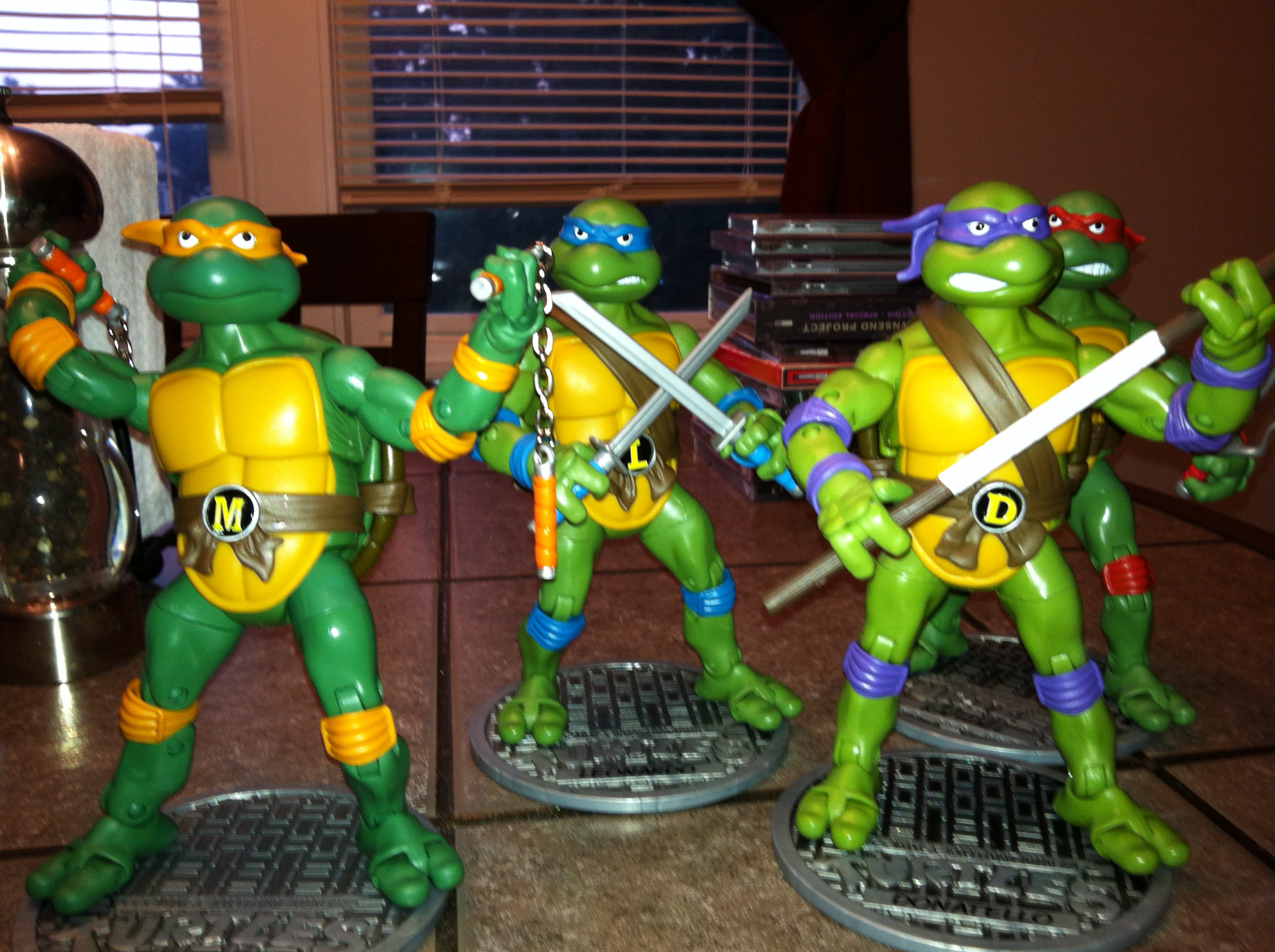
1.  NECA Teenage Mutant Ninja Turtles

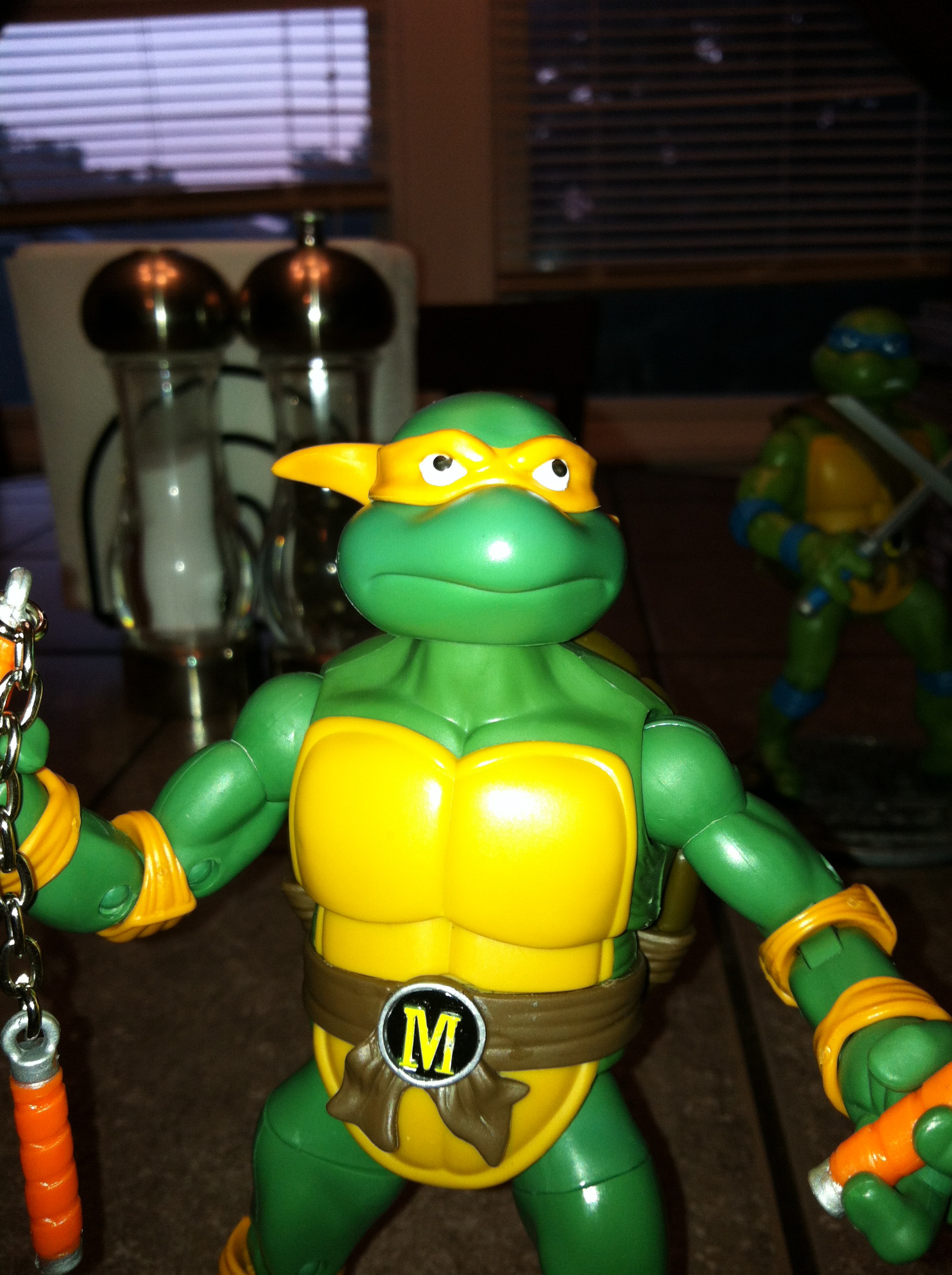
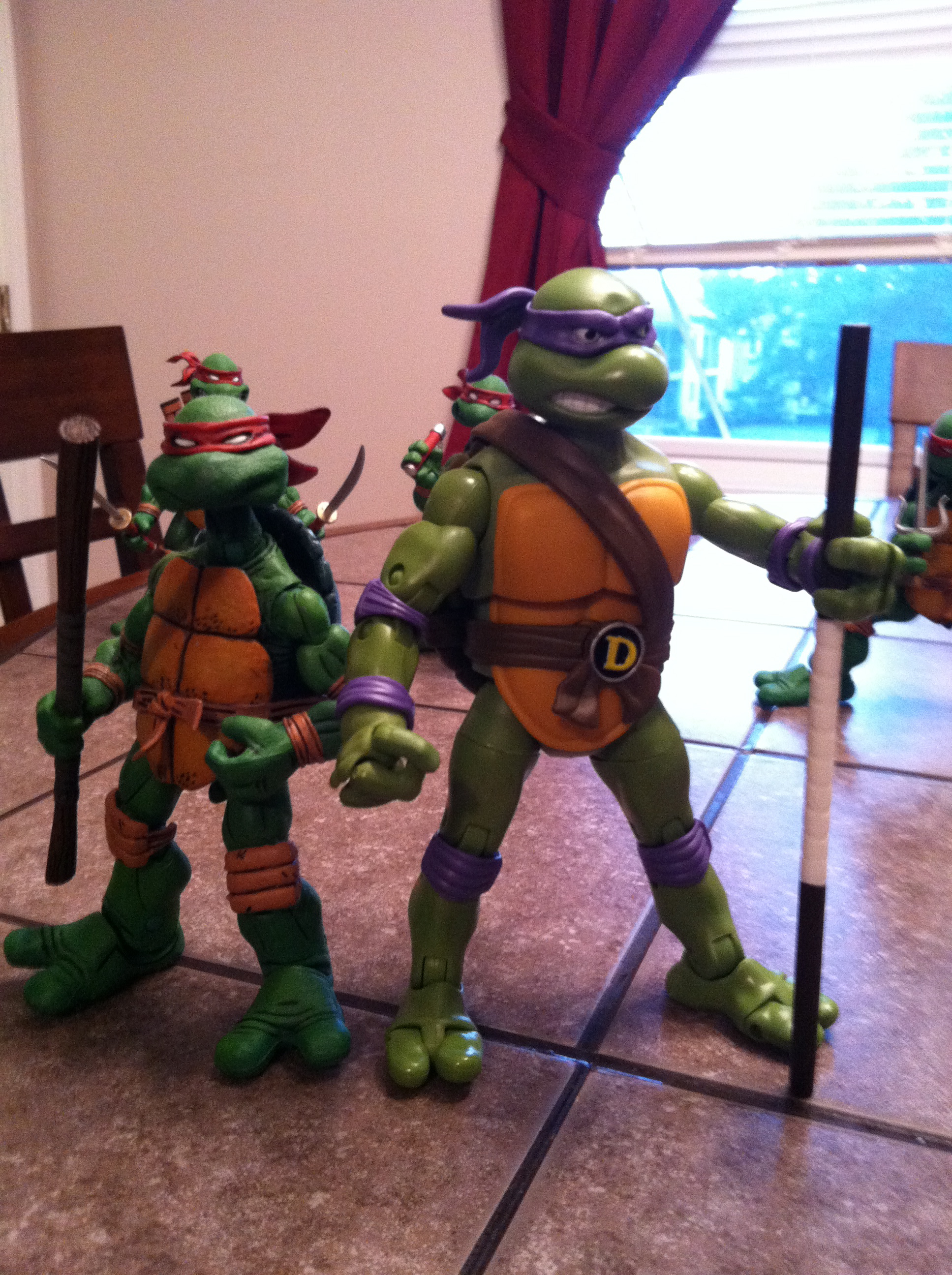
Maybe I’m cheating again by making my number 1 action figure four figures, but as you can see, it couldn’t be done any other way.  The Ghostbusters got me into action figures, but my obsession exploded with the TMNT and they were really my first love.  These toys are everything I love about action figures.  They look great, move great, are loaded with accessories, and are of characters that I adore.  Each one has just the right amount of personality to separate it form the rest, perhaps even more so than the comics they come from.  And as you can see, these turtles are based on the ones from Mirage Comics.  Each one comes with a base, some knives, their turtle specific weapons, a little turtle, and an extra set of climbing hands.  That’s all well and good, but all I really care about is that each turtle has his weapons.  Mikey stands out in this regard as his nunchaku have real chains, how awesome is that?!  Every incarnation of the character released before that had all plastic nunchaku and never in my wildest dreams did I ever think one would come along with actual chains.  Raph’s sai are just wide enough that he can fit his fingers within the blades which is cool for display purposes (though I’m too scared to do it as I’m afraid the sai will stretch and break after awhile).  I love the expression on Donatello’s face, it just looks exactly how I picture him.  And Leo is Leo, which means he’s awesome.  Somehow, some way, NECA did not sell enough of these figures to warrant future ones.  They did do an April O’Neil figure that was just as ugly as the source material.  I’m guessing that one sold poorly which is why we never got a Mirage Shredder to join these turtles.  One was unveiled at a Toy Fair along with a Foot soldier, but he has never been released which is a shame.  At least we got four comic accurate turtles that kick all kinds of ass.  And if you really want a comic accurate set, NECA released a four-pack of the Turtles that are colored in black and white.  I prefer the colored ones, but it’s pretty cool they went through the effort of putting out a second set.


SNK’s Multi-Video System

Remember going to the arcade as a kid?  Man, that was a blast!  Whenever a friend was having a birthday party I would always hope it would be at Chuck E Cheese’s or a similar establishment.  The roller skating party was also pretty common and there were always a few arcade cabinets in those places, same with bowling alleys.  Most of the time the most popular game would be the latest licensed beat ’em up such as Teenage Mutant Ninja Turtles or The Simpsons.  If enough quarters were on hand it was possible for four buddies to battle it out to the game’s end (or in the case of the awesome X-Men game, six friends) and then move onto the next one.

Aside from the brawlers of the day, fighting games were really popular as well.  There was Capcom with Street Fighter 2 and its various incarnations.  Midway really took hold of the scene when Mortal Kombat arrived with its copious amounts of blood and gore.  There was always one other cabinet though that usually featured not one, but as many as six games on it.  I’m talking about that red cabinet with SNK emblazoned on the sides.  These cabinets usually included multiple fighters like Fatal Fury, The Art of Fighting, The King of Fighters as well as the popular Bust-A-Move puzzle game.  SNK was not entirely well known in the US, mostly because its games usually remained in the arcade while others were ported to the Super Nintendo and so on.  SNK was quite popular in its native Japan though and it has developed the reputation as being one of the finest publishers of 2D arcade games.

SNK games actually were available for home play, it’s just few could afford them.  SNK put out its own console called the Neo Geo (later dubbed the Advanced Entertainment System, or AES for short).  It was a cartridge based system that had perfect arcade ports.  It was basically the company’s arcade cabinet crammed into a console.  The games were huge in actual size to accommodate this demand for perfection.  While most companies use boards for arcade games, SNK’s cabinets took cartridges, which made porting to the home console relatively easy.  That’s also why it was common to see an SNK cabinet with multiple games on it as they just built multiple cartridge slots into the cabinet’s motherboard.  Because of their size, this made the games really expensive.  Some new titles cost as much as $300 alone, and with the system running for around twice that at retail, it put the Neo Geo out of reach for many consumers.

Just how big is an MVS game cart? Here's how it compares with some well-known cartridge and disc-based games.

The Neo Geo was basically there to serve a niche market.  For those dying for SNK at home it was available, just costly.  When it first came out in 1990, it was far and away the most powerful home console on the market and would remain so really until the Playstation era.  And even then, many argued those later systems couldn’t out-do the Neo Geo at what it did best, 2D sprites.  It has obviously been surpassed at this point by titles like BlazBlue but the visuals still hold up well, especially later titles (the last official title was released in 2004).  Because the Neo Geo was never really popular, it’s still an expensive piece of hardware to acquire today.  Even more expensive though are the games.  The most popular titles, like Samurai Shodown II, can be found for under $100 but the later and more obscure titles can total well over $500 on online auction sites.  Collecting Neo Geo AES games is an expensive hobby, but some people are only interested in playing the games and not collecting them, so they’ve found a cheaper alternative.

The home console was later termed the AES, while the arcade hardware was referred to as the Multi-Video System (MVS).  This distinguishing was necessary because even though the hardware was the same, the cartridges were not.  Probably to prevent arcade owners from buying the cheaper AES games, SNK made the AES and MVS cartridges a different size.  Physically, they’re actually very close in size but the pin-out is different making it impossible to play an AES game on an MVS board and vice versa.  The AES games were originally cheaper, but have become the more desirable collector’s item over the years due to them being physically more appealing and were often produced in smaller numbers.  AES games came in a large box and were decorated nicely while MVC games usually just have a label on the spine.  They’re also rectangular and visually kind of ugly as they were never meant to be seen.  Because the hardware that runs each system is essentially the same, some people have started taking arcade motherboards and have converted them into home consoles.  This has been dubbed consolizing.

A "consolized" MVS system.

I fit into the crowd that just wanted to play some SNK games.  While my inner collector would love to amass a collection of AES hardware and software, I’ve resisted the temptation (I have enough stuff anyways).  There are devices out there that can allow the playing of an MVS cart on an AES system.  Similar to a Game Genie, it plugs into the AES and then the MVS cart is plugged in on top.  I researched it though and found few worked flawlessly.  There is a third option, the Neo Geo CD, but being an early CD console it has some atrocious load times.  The ports for it also aren’t quite arcade perfect, which kind of defeats the purpose.  I’m not a tech savy person and consolizing my own system was not an option so I kept my eyes open on eBay.  I was pretty close to getting an AES machine but a consolized MVS popped up one day for an acceptable price and I jumped on it.

Since acquiring this machine late last summer, I’ve acquired three games:  King of Fighters ’98, Metal Slug 3, and The Last Blade.  The machine works exceptionally well.  All three carts work fine and all three controllers I have also work.  The system was soldered with component cable hook-ups and is fairly small.  It’s also pretty light, but feels sturdy.  Still, I take great care when plugging in a controller or something as I don’t want to break anything.  Because this is arcade hardware all of the games function like an arcade game.  There’s a bios installed on the hardware that lets me access the normal arcade functions like free play.  The machine seems to work with all Neo Geo accessories as well.  I was initially concerned the later paddles that came with the Neo Geo CD wouldn’t work as they require a different electrical current than the joysticks but the one I bought works fine.

Best analog thumb pad ever!

In addition to the Neo Geo CD controller, I have two Neo Geo CD era joysticks.  The quality is fairly high on both with arcade-like buttons and responsive joysticks.  I bought the controller mostly as a curiosity piece.  It came out in 1994, well before the Nintendo 64, and features an analog directional pad.  I know Atari had an analog pad back in the day, but for me (and I assume most people) I didn’t encounter one until the Nintendo 64 and wanted to see how SNK’s earlier design compared to that one as well as the current ones.  Not surprisingly, it’s awesome.  SNK just seems to put out quality hardware and their analog thumb-pad may be the best one I’ve ever used.  It has some resistance to it and even a satisfying “click” when used.  While the joystick pads are preferable, this controller is actually usable for fighting games unlike most analog pads which are just atrocious when used that way.

Despite only having four face buttons, SNK fighters prove quite complex in their controls.  This just points out how redundant modern fighters are with their six button layouts.  I have especially enjoyed my time with The Last Blade.  The Last Blade is the spiritual successor to the Samurai Shodown series and arrived late in the Neo Geo life cycle.  It had one sequel, and both are extremely expensive to acquire for AES owners but the MVS cart is less so.  The sprites are large and the color palette is vibrant.  The gameplay focuses on weapon-based combat and each fighter has two modes; speed and power.  This gives the game tremendous variety and it’s a must play for fans of 2D fighters. By comparison, King of Fighters ’98 is a more traditional fighter and one most people have likely experienced in the arcades.  It’s basically an all-star game with characters from the Fatal Fury and Art of Fighting series.

Metal Slug 3 is arguably the best in the Metal Slug series.  It’s just a side-scrolling shooter like Contra but it’s even more relentless with the enemies.  The sprites are especially enjoyable for this one and a lot of the levels feature an amusing gimmick like vehicles of some kind or the ability to become a zombie.  The boss battles are intense as this game was designed to devour quarters.  I can’t imagine beating this game on one set of credits.  As it stands, I can usually only make it to level 3 without free play on.

This game is sweet.

I’m not sure how many games I’ll eventually get for this machine.  There are several other series of games put out by SNK that I’ve never experienced that may be worth visiting.  I wish  I had a buddy close by who was really into SNK’s fighters so I’d have someone to duel with.  The fact that I don’t is why I never really entertained the idea of getting a full-fledged cabinet (though the kid in me would have loved to) as it would have become a space occupier after six months or so.  I may one day dabble a bit in the AES market, but for those just wanting to experience the games, a consolized MVS is a pretty attractive option.  They’re not cheap and the initial investment will easily dwarf the cost of getting an AES, but if all you have is an AES you’ll likely never experience a game like The Last Blade.  And in the end, getting my hands on some of these forgotten gems is the whole purpose of getting an SNK system.


Circle Pad Pro: Revelation or Ruination?

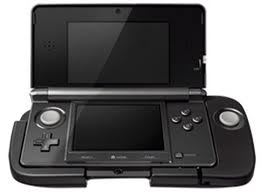
Today Nintendo released a new peripheral for its handheld system, the 3DS.  Dubbed the Circle Pad Pro, this attachment adds additional buttons to the 3DS along with an additional circle pad.  To make things slightly more annoying for gamers, it’s only available through Gamestop and will set you back $20.  Me, being the curious person I am (and since I received a gift card to Gamestop for Christmas), I hit the store and picked one up for myself.

The Circle Pad Pro, the best friend of the 3DS or hungry parasite? You decide.

An additional analog stick, or circle pad, is something many gamers wanted on the 3DS from the start.  While it certainly wasn’t a make or break feature, it’s nice to have.  Ever since Sony released its first version of the Dual Shock controller for the Playstation, the dual analog setup has become commonplace on controllers.  Often one stick controls player movement and the other manipulates the camera.  Other games, like first-person shooters, use one stick for movement and the other to aim.  A genre that was once cumbersome with a controller now has gamers feeling right at home.  And going from that setup to a non dual analog setup can be a bit odd, which is probably why upcoming Playstation Vita sports two analog “nubs.”  As I played through Ocarina of Time 3D I sometimes would find myself feeling for another analog stick out of habit to move the camera, and finding none.

Even though an additional analog input is something I would like to have, my initial reaction to the Circle Pad Pro was muted.  Peripherals often never work out well for consumers.  They’re often expensive, cumbersome, and lacking in support beyond an initial batch of games.  Very few end up being worthwhile.  Then again, no one has really tried to release something like this for a portable.  I’m trying to come up with something similar and the best I can come up with is the Gameboy Printer and Camera.  Neither was worth owning.

It looks like it's trying to swallow the 3DS.

The Circle Pad Pro almost looks like it could be a stand-alone device.  It’s much bigger than the 3DS as it’s meant to house the system like a cradle.  The 3DS fits into it snugly without any locking mechanism that could scratch the system or wind up broken.  The fit is tight enough that there’s really no worry about the system sliding out, but just in case Nintendo did include a wrist strap.  The Circle Pad Pro runs off a single AAA battery (included) which is a good thing because the battery life on the 3DS is bad enough as is. For some reason Nintendo decided to fasten the battery cover in place with a non-removable screw.  It’s good that the screw can’t fall out and get lost, but why was that even necessary?  It’s annoying.  The Circle Pad Pro does add considerable weight to the system, making it weigh just about as much as a first generation PSP.  It’s also quite bulky and definitely detracts from the portability of the system. This isn’t something that fits in most pockets.  And as far as I know, the Circle Pad Pro only comes in matte black, so if you have a blue or a pink 3DS it’s going to be quite the eye sore.

The peripheral may be bulky, but how does it feel?  Pretty nice, actually.  The 3DS is small and the rectangular shape may be efficient but it’s far from comfortable.  Often my hands are pretty tired and cramp after 45 minutes with the system, especially after some Mario Kart.  I’ve spent roughly the same amount of time with my first play session with the Circle Pad Pro and can report little to no discomfort.  The attachment makes the system feel more like a controller and the added weight is actually a welcome thing when it comes to the ergonomics of the device.  The second circle pad feels just like the one on the system, which means it’s a tad loose for my taste but it certainly gets the job done.  In addition to the additional circle pad, the Circle Pad Pro also adds two additional shoulder buttons to the 3DS.  They’re clicky buttons, not triggers, but feel fine.

Rear view, for those who like that sort of thing.

It’s not all gravy though.  The peripheral does cover up the game card slot so the 3DS needs to be removed from the Circle Pad Pro to switch out games.  It also covers up the wireless switch and stylus port, which is kind of annoying.  The added plastic on the right side of the system also makes reaching the face buttons a little awkward.  That will definitely take some getting used to.  Nintendo at least wisely left space for the AC input so you can use the Circle Pad Pro while the 3DS is plugged into a wall outlet.

The Circle Pad Pro could be a flawless addition to the 3DS but it would be terribly useless without software that supports it.  That’s why Nintendo held it back for today which just so happens to be the day Resident Evil: Revelations arrived in stores.  Some of you may have already read about that one and how Capcom released it with an embarrassing typo on the game case’s spin, and if you’re wondering, yes it appears every copy is like that.  Apparently anyone who picks up a copy of the game with the typo can get a free replacement insert but I have no idea why anyone would be bothered to go through the trouble.

Oops.

I picked up a copy of Revelaitons (sic) alongside the Circle Pad Pro.  I was surprised to see that there’s no mention of the device on the game’s packaging.  I figured there would be a tell-tale graphic of some kind alerting would-be consumers that the software supports the Circle Pad Pro but I guess not.  Worry not gamers, Revelations does indeed support the Circle Pad Pro and firing up the game with the Circle Pad Pro attached will cause the game to ask if you wish to make use of it.  I obviously haven’t played enough of the game to render a verdict on how good or bad it is, but I can report that the Circle Pad Pro works, for the most part.

The left circle pad controls your character, Jill, and the right circle pad pivots the camera and makes her turn, pretty much just like a first-person shooter.  When a baddie appears on the screen, pressing the new ZL button causes Jill to draw her firearm and the ZR button shoots.  The regular old R button (actually, that’s kind of new too as the Circle Pad Pro replaces the R button on the 3DS with a new button) causes Jill to bust out her knife or other equipped secondary weapon.  When running around, the ZR button appears to function as the action button which feels kind of odd but I imagine I’ll get used to it.  The face buttons do not appear to be used much though one uses herbs to restore Jill’s health when prompted.  I actually didn’t try the game without the Circle Pad Pro, but I can’t imagine the control scheme working better.

Ready for action!

Visually, Revelations appears to be a stunner.  It’s comparable to Resident Evil 4 or some of the best looking games on the PSP.  A lot of time was definitely invested in Jill as she looks noticeably better than some of the scenery.  The backgrounds I’ve seen have been a little drab but there was some nice lighting on the first scenario which takes place on a darkened ship.  The game immediately places the player in some close quarters which is an uncomfortable feeling, a good thing for a survival horror game.  There’s a lot to take in on the 3DS’s rather small screen and I did experience some minor eye strain after a little while.  And if you’re curious, most of that was spent with the 3D featured turned off (I mostly hate 3D).

I’m pretty optimistic for Revelations.  It feels like Resident Evil and it’s pretty nice looking.  I do find aiming kind of cumbersome as hitting the ZL button immediately brings you into a first-person perspective.  Jill feels kind of slow but the enemies seem pretty quick.  I’ll have to see if that becomes frustrating or not further into the game.  As for the Circle Pad Pro, it does get the job done but if no one supports it then it will just collect dust.  Metal Gear Solid 3D figures to make use of it, and there’s rumors Kid Icarus might as well.  We’ll just have to wait and see.  If it doesn’t bother you to spend the extra dough to get a little more out of Revelations, then I say go for it.  At least it’s not as expensive as the 32X.


Nightwish: Imaginaerum

Nightwish: "Imaginaerum" (2011)

From time to time I like to break format and post my thoughts on a current game or album.  It helps to keep things interesting, and even though I love things from my past, I’m actually a pretty forward thinking individual.  And lately I feel like this blog has become a video game one because there’s just been so much to talk about where games are concerned.  Which makes this a perfect time to post a new entry on something that’s both current and not a video game.

2011 was not a banner year for music.  At least, not for me.  I made a couple of posts on new albums in 2011 but none were glowing.  And it’s a shame because there was some stuff in 2011 I was really looking forward to, most notably Opeth’s latest album Heritage.  Heritage ended up being a bit on the underwhelming side.  There was some good stuff, but it fell short of my admittedly lofty expectations, and it had nothing to do with the lack of any true metal moments on the album.  There were some albums that impressed me to various degrees.  Symphony X released Iconoclast and the double album version is an enjoyable listen.  Mastodon’s The Hunter was a big surprise for many as the prog-metal masters decided to go in a more rock n’ roll direction.  I enjoyed it, though it lacks true staying power.  Devin Townsend released two albums under the Devin Townsend Project moniker that had their pluses and minuses.  Deconstruction was an abusive, relentless, heavy piece of music that’s so destructive it borders on unlistenable.  Fantastic in small doses, but tough to digest as a whole.  On the other hand, Ghost is extremely accessible and damn near dull by comparison.  There are some moments where Townsend stumbles on some truly memorable hooks and melodies, though ultimately the album’s style is not my kind of thing.

Sneaking in at the end of the year though was the latest album from Finnish symphonic metal maestros Nightwish; Imaginaerum.  It had been over four years since Nightwish’s last album (and first without longtime vocalist Tarja Turunen) Dark Passion Play and I’m sure the die hard fans were eager for something new.  I’ve never been among the die hards and only own two Nightiwish albums in addition to this one, Once and Dark Passion Play.  Nightwish is a band I’ve often enjoyed in small doses.  Keyboardist and lead composer Tuomas Holopainen has always had a gift for composition, especially when crafting a chorus, but has the tendency to over dramatize the music.  This can, at times, give Nightwish a pretentious air to it.  Not that such a feeling is bad in itself as many bands convey that sentiment as well (Tool and Opeth immediately come to mind), it’s just that Nightwish goes for an almost Hollywood sound that doesn’t agree with me all the time.  Often I actually find myself enjoying their more complex pieces and only some of the considered accessible stuff.  The ones I enjoy the least tend to be the heavier tracks where the band almost tries to be too metal.  My least favorite track on the last album was “Master Passion Greed” which just so happened to be the heaviest.

Nightwish: Jukka Nevalainen, Emppu Vuorinen, Anette Olzon, Marco Hietala, Tuomas Holopainen

Nightwish also has a reputation amongst the metal community as being “girl metal” or other terms too derogatory for me to list.  I kind of get it, the metal community is always going to be this ultra macho thing and women always have a harder time winning over a metal audience than men.  Especially women who earn the label of pop singer.  Nightwish has also invited drama in the past with their handling of Tarja Turunen’s dismissal by publishing an open letter to her on their web page.  The whole scenario had a very high school feel to it and I legitimately felt bad for newcomer Anette Olzon who had to walk into this mess, though I’m sure she’s been well compensated for the aggravation.  Olzon has had a seemingly difficult time winning over the fans as her vocals are more “poppy” than Turunen’s operatic vocals.  I find them too different to really compare to one another, but Olzon is by no means a deficient vocalist and the music the band is producing now suits her style quite well.  I’m closer to 30 than 20 these days and labels like “girl metal” are juvenile and, quite frankly, beneath me.  Good music is good music, and I don’t care about labels (I’m listening to country while writing this), and Nightwish has made a better album in 2011 than Megadeth, In Flames, and just about everybody else.

That said, Imaginaerum is one finely crafted piece of art and would be considered such no matter what year it was released in.  This is the first Nightwish album I’ve listened to from start to finish and can honestly say I enjoy every song.  I don’t love every part of every song, but this is a complete album and quite possibly the best of 2011.  It’s a concept album and Holopainen explains it as being from the point of view of an old composer looking back on his life.  This seems to take the form of the protagonist longing to be a child again where imagination rules supreme.  There are many references to fairy tales and folklore and the album has a story book quality to it.  The first single and second track, “Storytime,” captures this beautifully.  If the opening track “Taikatalvi” is an intro then “Storytime” is the launching point.  It’s a catchy, bombastic song with the type of chorus Nightwish is adept at crafting.  Seriously, if I made a list of the 10 catchiest choruses I’ve ever heard there’s a good chance Nightwish would have as many as 5 of them.  Holopainen seems to be well aware of this strength as just about every song is chorus heavy and the band is not above doubling or tripling up on the chorus to close out a track.  My only complaint with the lead single is the speed at which it shoots on by.  It almost sounds like the vocals have been artificially sped up.  As a result, this one had to kind of grow on me even though it’s supremely catchy.

With "Imaginaerum" the band is going for a creepy, fairy tale vibe which has shown up in the artwork.

There are some heavy tracks too, and the third track is one of them.  “Ghost River” is perhaps the most experimental track on the album as it contains some odd time changes.  It’s hard to digest on the first listen due to its placement in the album, but it has its own hooks that will eventually take root.  “Slow Love Slow” is the only track that falls a bit flat for me.  Nightwish attempts an old style lounge song with this one that doesn’t quite fit.  It does start off well, and vocalist Anette Olzon proves more than capable for the material, but the band doesn’t really know where to take the song.  It almost sounds like they want it to have a more bombastic second half but there’s restraint in the air.  Even Olzon sounds like she doesn’t really know what to do with the vocals towards the end and the song never reaches the crescendo it seeks.

“I Want My Tears Back” is the album’s most accessible song.  Similar in structure to “Wish I Had an Angel” from Once, it’s a faster number that gives considerable room for bassist Marco Hietala to stretch his vocal chords.  The song’s title makes it sound like some teenage angst song, but it’s a reflection on nightmares with the twist that the protagonist is sad dreams can no longer frighten him.  It almost seems like fluff on the first listen, but it’s too catchy to remain so and I like the interesting angle the lyrics put on the song.  “Scaretale” is anything but conventional and is the album’s most daring track.  It’s a circus with Olzon producing the creepiest, scariest vocals she can.  She doesn’t cheapen out by just using a growl she just creates this maniacal persona that’s insanely fun to listen to.  Hietala does the same, but to lesser effect.  It’s certainly a wild one!

The album has an extremely well-rounded second act.  “Turn Loose the Mermaids” is a celtic kind of ballad that has its moments, while “Rest Calm” is a doom-laden track with some wonderful layers.  “The Crow, the Owl, and the Dove” is a more traditional ballad that has a nice vocal duet between Olzon and Hietala.  It’s one of the simpler compositions on the album but extremely effective.  “Last Ride of The Day” is fittingly a roller coaster of a track with a fist-pumping, bombastic chorus that will likely delight live audiences on the tour.  “Song of Myself” is actually one of the more disappointing tracks for me.  It starts off flawlessly and feels like it’s building towards something fantastic before it just kind of gets ground to a halt halfway through.  The rest of the “song” is just spoken word and where Nightwish decides to overdue the pretentious angle.  There’s nothing particularly worth saying within the spoken word section and it goes on for over six minutes.  I kind of wish it either wasn’t there or was considerably shorter.  The final, title track is just an instrumental medley of the entire album that’s actually pretty enjoyable, and I’m not usually one for instrumentals.

As with most releases these days, numerous special editions exist for the collector market.

The band’s playing is also top notch here.  The lead guitar riffs have a stronger presence and more variety than what was on Dark Passion Play as Emppu Vuorinen is given plenty of room to breath.  Holopainen’s keys are consistently strong and actually aren’t the overbearing presence they sometimes are on other Nightwish compositions (call it the Steve Harris effect where the main composer is perhaps too audible in the song at times).  Most of the tracks contain some kind of orchestration, and like with their previous albums, these are real orchestras and not electronic.  The album has a rich and full sound as a result.  Olzon’s vocals are wonderfully diverse and she’s really given room to express herself on several tracks.  At times it felt like Dark Passion Play’s songs weren’t crafted to fit her strengths while every track on Imaginaerum has been.  Hietala’s vocals are also quite good and more dynamic than they have been in the past.  Musically there’s plenty of celtic influences sprinkled about as well as a Danny Elfman influence on others.

The album is wonderfully arranged and even tracks that sound out of place on the first listen start to make sense on subsequent ones.  Imaginaerum is a rollicking journey through the fantastic that proves quite charming and a real joy to experience.  Nightwish’s older records never grabbed me like this one.  And even though the Tarja vs Anette debate likely rages on amongst Nightwish fans I consider this Nightwish’s finest hour.  It’s actually really hard to even pick a favorite track off of this one as I tend to enjoy all of them for different reasons.  This is a surprise favorite of mine for 2011 and I hope to get a lot of milage out of it.

Top Tracks

  • Scaretale
  • Rest Calm
  • The Crow, the Owl, and the Dove


Requiem for the PSP

The Sony Playstation Portable was first released in the US in 2005.

I was shocked when I realized that Sony’s Playstation Portable (PSP) has been on the market for nearly 7 years.  That’s quite a long time for any hardware to remain relevant, but then again portables have always had a longer shelf life than their console cousins.  The original Gameboy was around for a decade or so before Nintendo finally added color to it, and longer still before a true successor was released.  Handhelds do benefit from redesigns though.  The original bulky Gameboy was originally replaced by the Gameboy Pocket just as the PSP received multiple updates, including one radical re-design in the form of the PSP Go.  This post wouldn’t exist though if it wasn’t for the Playstation Vita, which is set to replace the PSP in less than two weeks.

I have always felt like the PSP was viewed as a failure by the gaming community, or at least only a minor hit.  It was crushed in sales when compared with its nearest competitor, the Nintendo DS.  The two systems have always been intertwined, and even though the DS beat the PSP to market it felt like Nintendo’s retaliation towards Sony.  Nintendo has always dominated the portable landscape.  While systems like Sega’s Game Gear and Atari’s Lynx failed to win over consumers Ninendo’s Gameboy steadily found homes in the back pocket of gamers across the world.  The Gameboy was not a technological marvel by any stretch of the imagination.  Even when it was first released it seemed little better than one of those Tiger handheld games.  When I was a kid, the only people who had Gameboys were those who had parents that weren’t willing to spend a bunch of money on a Nintendo Entertainment System or Super Nintendo once that came out.  It really didn’t become a truly viable system for me until Pokemon in 1998 and the Gameboy Color.  That’s when I jumped on board and I’ve owned every Nintendo portable since.

The PSP has not been a failure, but the redesigned UMD-less PSP Go sure as Hell was.

Sony has been the only real threat to Nintendo’s portable dominance.  Even though it failed to beat out Nintendo’s handheld, it’s actually done fairly well for itself.  Sony has sold approximately 17 million units in North America since 2005, but it’s in Japan where the system really did well as its sold 15 million units there.  It goes without saying, that Japan is much smaller than North America and its rare to see sales figures that are so close when comparing the two territories.  For the sake of comparison, the Nintendo DS has moved nearly 58 million units in North America, and around 33 million in Japan.  It’s those staggerring numbers for the DS that make the PSP seem like a failure.  The PSP has always been the more expensive piece of hardware, debuting at around $100 higher than the cost of the DS in the US, and it has mostly appealed to traditional gamers.  The DS also appealed to gamers, but Nintendo also had great success reaching the non gamers and children as well.  That and the Nintendo brand definitely helped move units.  And for the sake of objectivity, I’ll even go out on a limb and say the DS has the better software as well.  While I actually didn’t get a ton of milage out of either handheld, I did get considerably more out of my DS.

Despite that, I still have great affection for the PSP.  Technologically speaking, it’s the most impressive handheld I’ve ever owned, even more so than the 3DS.  Visually it’s quite the looker, and the weight and feel of the device just give it a aura of high quality.  And I have the original model, now referred to as the PSP-1000.  The subsequent redesigns have slimmed the unit down some and even increased the power of the screen, which to me is borderline shocking as the screen on this thing is beautiful.  Even when I fired it up for the first time in years last week to play Tactics Ogre I was impressed by the clarity of the image.  I never did watch a UMD movie on my PSP, but I imagine they looked just fine.  Sony wisely incorporated analog control for the PSP in the form of the analogy “nub” located under the D-Pad.  If there is one design flaw though, it’s that the nub wasn’t placed in the more prominent position as most games make use of it as the primary means of control.  Nonetheless, it’s textured and grips your thumb as you play and there’s plenty of resistance.  Because of its size and placement, I do consider the circle pad of the 3DS superior but this one gets the job done.

Pretty much the reason why I got a PSP to begin with, Twisted Metal: Head-On, which was basically a remake of the super popular Twisted Metal 2: World Tour.

The medium that the PSP used for games is one not likely to be seen or heard from ever again.  While Nintendo has always stuck with cartridges of some kind for its handhelds, the PSP used an optical disc format that Sony dubbed the Universal Media Disc.  UMD actually worked better than expected.  Yes there are load times, but aside from a handful of early titles, they’re not that bad.  Sony tried to get production companies to put movies out on UMD which mostly failed.  While a UMD disc can hold nearly 2 GB of data, that’s still far short of what a DVD can hold.  This meant most UMD movies came with fewer special features and yet still cost about the same as a DVD version.  Most studios abandoned the UMD format within the first year of the system’s life and never returned.  Utilizing UMD also meant that games lacked a save function and owners were forced to purchase memory sticks for game saves and any other media they wished to put on their PSP.  And since Sony loves going rogue with its devices, it forced gamers to use its own brand of memory sticks called the Memory Stick Pro Duo, instead of allowing gamers to just use any flash card.  Not surprisingly, Sony’s memory sticks were always more expensive than traditional cards which made the entry price of the PSP quite steep.

The UMD format proved adequate for games but never caught on as a film medium.

Short-comings aside, I still love my PSP.  I never acquired much of a gaming library on it, mostly because it just came at a bad time for me.  I really got into portable gaming in the last couple of years, and even though I’ve had a PSP since 2006, I rarely found a reason to play it.  Because the system was so powerful most developers just spent time porting their console games to the device as opposed to making new titles.  There was definitely a lack of truly compelling software to pull me back in.  Square-Enix tried pretty hard though with Crisis Core and the Dissidia franchise.  I have both, but never got into Dissidia’s frantic style.  I did play a lot of MLB The Show on my PSP, and though it wasn’t as good as the PS2 version, it was certainly playable.  I also never took advantage of Sony’s download service that allowed you to download PSOne games and put them on the PSP, though I was tempted to do so with Final Fantasy VII.

The Playstation Vita will arrive on February 15th for those who want the bundle version out there, and a week later for those interested in the stand-alone unit.  Like the PSP, it’s going to cost a lot.  When Sony first unveiled the $250 price point (the same price the PSP debuted at) most were actually pretty happy as that’s the same price the 3DS came out at.  And just like how the PSP far outclassed the DS in terms of raw power, the Vita wipes the floor with the 3DS.  The Vita should be a technological beast and the games we’ll see on it should be comparable in terms of visual quality with what we’re seeing on the PS3 and 360.  The Vita also adds a second analog nub, something gamers were disappointed the 3DS didn’t include, and even has a gimmicky touch pad on the back.  The Vita has also ditched the UMD medium and is opting for flash cards instead.  Prices range from $30 to $50 for games, with most looking like they’ll settle in the middle at $40 a piece.  The memory issue though is the big kick to the crotch that most gamers hate.  Just like how they did with the PSP, Sony has opted to use its own memory card device with the Vita and the prices are outrageous when compared with a standard SD card.  A 4GB card for the Vita will set you back $25.  I have no idea how big a game save figures to be, but 4GB seems awfully tiny considering my PS3 at 60GB is far too small.  A 16GB card will set you back $60 and a 32GB card a whipping $100!  Again, I have no idea what the ideal size will end up being, but if you’re looking to get a Vita with a 16GB card and one game in a couple of weeks that will set you back $350 which is a pretty step entry fee.

The Playstation Vita has obviously adopted the "If it ain't broke, don't fix it" approach in terms of its general design.

And since it’s going to cost so much to be an early adopter, it’s a damn good thing that the launch games actually look pretty awesome.  There’s some first-party favorites like a brand new Uncharted game and the latest Hot Shots Golf game.  The following month Little Big Planet and MLB 12 The Show arrive with a new Resistance game following in May.  On the third party front, ports of Ultimate Marvel Vs Capcom 3 and Ninja Gaiden Sigma Plus arrive alongside new titles like Army Corps of Hell and Ridge Racer.  The Vita is basically the opposite of the 3DS when it launched, as the immediate future looks awesome but I don’t see anything truly compelling on the horizon (not that I expect future software to suck, there’s just nothing comparable to Super Mario 3D Land set for the fall) and I expect a lot of the game’s software to consist of ports.  That’s not the worst thing in the world as ports of sports games are worth owning alongside their console counterparts and some games, like Rayman Origins, almost feel better suited for on the go gaming.  The Vita will also (finally!) incorporate more cross platform features allowing players of The Show to take their franchise from the PS3 to the Vita when leaving the house.  For me, this is something I’ve always wanted out of a portable making it basically a new way to interact with my console.  I also want original content too, and hope the Vita can deliver.

Gameplay shot of Army Corps of Hell on the Vita, a Square-Enix strategy-action hybrid that figures to be interesting, if nothing else.

Because of the cost to be an early adopter though, and the fact that I currently have plenty of gaming to do on my 3DS and PSP, I won’t be getting a Vita this month.  I’ll hold off for now and maybe benefit from a future price drop or something as the Vita has failed to gain much traction so far in Japan and may meet a similar reception in the US.  With the economy the way it is I can’t see the Vita getting off to a great start here.  It will move some units, but probably won’t have a better launch than the 3DS which was pretty slow to start off (again, probably because of cost though the lack of games certainly didn’t help).  When I do eventually get a Vita, I’ll be a little sad to say goodbye to my PSP.  Even though it probably has been a commercial success for Sony, I feel like the PSP has been the most under-appreciated gaming device of the last 7 years, maybe even the most under-appreciated ever!  The device, in its original release, still holds up from a technological standpoint when compared with the 3DS and I think it was a great thing that Sony entered the handheld market and forced Nintendo’s hand.  Sony raised the bar and brought console gaming to a portable device, something even Nintendo and other developers have been more willing to adopt recently.  The soon to be released Resident Evil Revelations for the 3DS is basically a console experience on a handheld, and I find that awesome.  For a long time portable gaming did not interest me because it just seemed like a watered down version of what I could experience in my living room.  I didn’t care to do that and wanted a truly rich experience.  Portable gaming has finally caught up with consoles and it’s no surprise I’m playing more portable games now than I ever have before.  I plan to treat Tactics Ogre like a great encore for my PSP, and I’ll enjoy every minute of it.