Tag Archives: donald duck

24 Hours of Disney+

disney+_welcome.jpgIt’s a bit funny to me what we get excited for in our modern era. If you had told me when I was a kid that people would be geeking out over new phones, subscriptions, and chicken sandwiches I probably would have wanted time to slow down even more than I already did. That’s where we are though and on November 12, 2019 the world paused for Disney+, the first dedicated streaming service from the massively popular (and just plain massive) Walt Disney Corporation.
We’re now well into the streaming era for entertainment consumption. The old days of Netflix sending a DVD in the mail feels like the stone age by comparison. Netflix helped push us into this new frontier, with an assist from rapidly rising cable costs and a government-sanctioned monopoly, and the concept of chord-cutting is no longer a radical one as more and more streaming platforms keep coming. Netflix was initially just a means to an end as it licensed content people wanted and then delivered it to them. It’s no surprise that the content producers were taking notice and weighing the pros and cons of licensing out its media to a third party versus just creating the infrastructure to deliver it themselves. Netflix was quick to notice as it got into the content producing business and now has a whole bunch of shows and movies under its umbrella as it battles with other providers for non-Netflix content. Meanwhile, the biggest media creators are striking out on their own.

Disney is no stranger to production and delivery. Gamers will recall when Disney decided to stop licensing its characters for video games instead taking things in-house to create its own product. Eventually, game production grew too costly and Disney shuttered its studios to go back to licensing. With a streaming platform, costs are more fixed and Disney can charge whatever it wants to consumers. Some might question why Disney decided to create Disney+ since it already had a controlling stake in Hulu, but it’s all about branding. Disney+ is now the home for all things Disney. Those 20th Century Fox productions not named Star Wars can go to Hulu. Oh, and don’t forget they also own ESPN which has its own streaming platform as well. Yeah, there really are a lot of options out there now.

Since this is hardly uncharted territory, consumers have expectations of what a streaming platform should look like and how it should function. Disney was able to basically just do what Netflix did before it and give it a new coat of paint. Disney+ is a very boring interface, though hardly ugly, as it just lays everything in front of the user in a familiar form. Users can browse by genre, media type, character, brand, and so on. Everything is accompanied by a thumbnail image and a larger splash image meant to attract eyes. There are trailers for some films and new series and a summary of the program as well.

img_0561

Disney+ means access to classic movies and new shows, but it also means some older shows that never got the DVD treatment are finally viewable in their entirety.

Even though this is all well-trod territory, Disney+ still has a few odd quirks or missing features. For one, it’s not obvious what the runtime is for anything you’re looking at or considering. It’s not a big deal for old television shows which are fairly standard, but I had no idea how long any of the new programs were or some films. I had to start them and then pause them to see the counter displayed on the screen. The app also doesn’t remember where you left off with a given series. This is a standard feature on other platforms and it’s puzzling to see it not present here. Basically, it’s on you to remember how many episodes of a show you just watched and where to go next. You’re probably thinking that’s not a particularly difficult thing to remember, but it’s a lot trickier to remember where you kids left off watching a show you don’t care about. And they typically have no idea until the episode starts forcing you to embark on a series of trial and error until you get it right.

Those are small quirks that I expect will be remedied fairly soon. Others may take longer. By far, the biggest issue consumers encountered on launch day was performance-related issues. Slow buffering, shows disappearing, or the app completely crashing were frequently cited problems across social media. That was to be expected given that Disney didn’t allow users to preload the app before launch and is also giving curious consumers the option to partake in a free trial. Demand was going to be high, though that doesn’t absolve Disney as the company should have been prepared for this and able to address it quickly. Shows disappearing may have been part of that corrective action just to shrink the library temporarily. I saw quite a few complaints from users that Gargoyles wasn’t available for a period of time, though I didn’t encounter this. I did view the new documentary Imagineering and then found it unavailable after viewing when I went to go back and add it to my watch list. Aside from that though, I was actually rather fortunate to not encounter many issues. When I first logged in and got going around 6:30 AM EST I found the app slow to navigate. By 7:30, it was taking so long I gave up, but I was also heading out to work. My wife dropped our kid off at school shortly after and then resumed streaming with no issues. It was on basically all day with no further issues in my household.

I did a little research on social media and asked folks what they went to first upon signing up yesterday and got a variety of responses. A lot of folks were eager to view shows from their childhood, mainly those from the beloved Disney Afternoon. Some were also excited to check out the old Marvel cartoons like X-Men and Spider-Man. Many were eager to check out the Disney+ original The Mandalorian, a live-action series set in the Star Wars universe. There was certainly a lot of enthusiasm for the app, and most respondents had a list of things they wanted to check-out on day one.

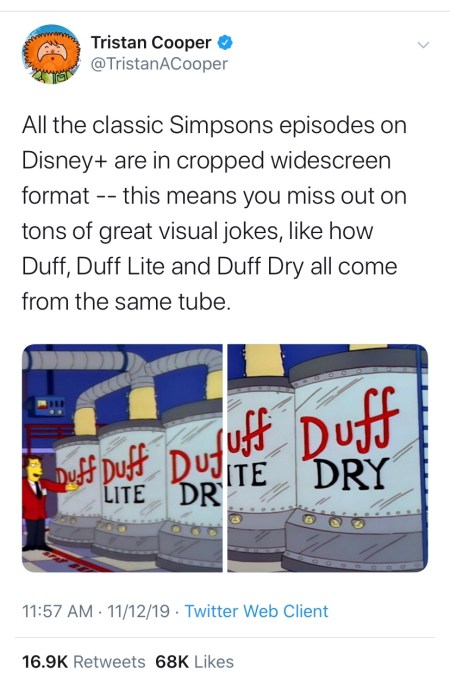
img_0566Perhaps not surprising, the most frequent response I received was for The Simpsons. Disney made a pretty big deal about having 30 seasons worth of The Simpsons on Disney+ on day one. Unfortunately, the biggest complaint outside of technical problems from users was directed at The Simpsons. You may recall, when FXX started airing “Every Simpsons Ever” a few years ago they made the controversial call to crop the image on the seasons shot in 4:3 and adapt them for 16:9. The accompanying app did the same much to the annoyance of longtime fans. Eventually, the app was corrected and both versions were able to stream and they even added commentary tracks. As a result, fans expected the same on Disney+ and there were reports that the early seasons would be presented in the correct aspect ratio. Unfortunately, that wasn’t the case. Not having the commentary is not a surprise, but the 16:9 presentation is horrid. If this were the first time those old seasons were being made available it would be temporarily excusable, as it was with FXX, but in 2019 it most certainly is not. I think Disney will correct this, but it’s something the company needs to get out in front of.

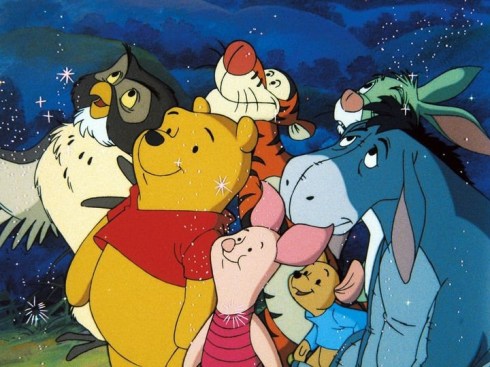
As for me, I have had a pretty good 24 hours at this point with Disney+. My first view was for The New Adventures of Winnie the Pooh. As it was 6:30 in the morning and my kids were up, it felt like a good way to start the day. My kids watched a lot of Disney Afternoon content during the day as well as some movies they’re more than familiar with. In the evening, I checked in on some of my own personal favorite cartoons and also was able to check out The Legend of the Three Caballeros, the previously UK only show starring Donald Duck (and it was great). When the kids went to bed, my wife and I checked out The Mandalorian as it easily is the most hyped original program on the platform right now. The production values are high, and while the story and character so far seem conventional and even cliché, it was entertaining enough that I’ll continue to check it out as episodes are added. We also watched the first episode of the Imagineering docuseries which focuses on the creation of Disneyland and goes up to the death of Walt and early concepts for Disney World. It was very familiar territory for me, but still enjoyable. I’m probably looking forward to episode two of that series more than I am for The Mandalorian.

3caballeros

We had to wait over a year, but now US audiences can finally (legally) view Legend of the Three Caballeros.

There is some other original content I intend to check out, in time. Lady and the Tramp is one of my favorite films from Disney so I feel obligated to at least give the live-action version a chance. I have low expectations, as it’s not something that needs to exist, but it’s there. There is also a collection of classic Mickey Mouse shorts which have been upconverted to HD that I’d like to see. I’m pretty sure they’re the same as what was present on the Blu Ray compilation released last year for Mickey’s 90th, but I passed on that set (since I have all of the DVDs) and I’d like to see how the conversion came out. I hope more classic shorts will be added, though I doubt that’s a priority for Disney right now. Hopefully we at least get the Christmas ones next month.

Disney+ launched with a few stumbles, but the framework is there for a successful existence. More importantly, Disney is rich in content and should have no issues getting people hooked at least in the short term. Right now, the service is cheap compared to Netflix and if you’re part of a Disney family like I am then you’re probably locked in for the next three years. Disney has been systematically pulling content from cable and streaming providers so my children’s addiction to Disney content will definitely keep Disney+ in my house for awhile. What will spur growth for Disney will be how the original content turns out. The platform is off to a good start, but it might take more to convince people adverse to multiple streaming subscriptions to drop Netflix in favor of Disney+. Disney will also have to make the difficult choice over what it releases on its cable channel versus what it reserves for Disney+. And how will competitors, and cable, respond? Disney+ is undercutting Netflix by quite a lot and I’m curious if Netflix will respond. I suspect it will wait it out at least a year to see if and when Disney ups the monthly rate, but if it starts losing subscribers it may have to do something about it. This is our new reality though and it feels like, if anything, the biggest casualty of all of this may be cable itself.


Funko Pop! Halloween Huey, Dewey, and Louie

There’s a scourge taking over our local record stores, clothing outlets, and gaming boutiques. It comes in mass quantities dominating its chosen territory at the expense of other merch. It swears no allegiance to anyone and will even place mortal enemies side by side as it amasses an army of licensed property of yesterday and today. I am, of course, speaking of Funko Pop! vinyl figurines. Where I once had a local record store, I now see what is practically a dedicated Pop! outlet. Gamestop devotes considerable shelf space to them and they even show up in drug stores. It’s hard to find a licensed property that isn’t in Pop! form these days and since they keep on coming it leads me to believe they’ll be around for some time to come.
And considering the brand’s scope, it’s obvious people are into these things. Funko sells special cases to keep your Pop! mint-in-box and I do see people get legitimately excited for new releases, even though every time I’m at a store that features these things prominently I rarely see someone actually pick one up and head for the register. I don’t think they’ve reached the level of Beanie Baby popularity from the 90s, but they must be doing well for them to persist.

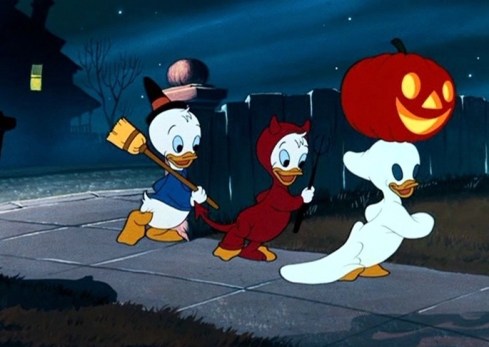
The source material for today’s subject.

If you’re not familiar with Pop! figurines then you’re probably not human, but I’ll indulge you anyway. They’re essentially little plastic statues that adhere to a standard form. They all feature an oversized, oval, head with a tiny body. They’re either non-articulated or just the head swivels. The eyes are always circles and one color, typically black. Most characters don’t have a mouth, but as the line has persisted I’ve noticed more unique head-sculpts that do indeed feature a mouth. It’s a simple, identifiable, style that can be applied to virtually anything depending on how much effort Funko puts into the sculpt. It seems to work well for cartoon characters, especially anthropomorphic characters, but it’s not universal. For one, I think the ones based on The Simpsons look awful, but I’ve encountered many that look fine. Live-action personalities can also be adapted and they typically turn out all right. It’s a brand, and it’s obviously successful. I would rather purchase a Kid Robot mini-figure, but at least these ones don’t come in blind boxes.


When it comes to my own interaction with Funko Pop! I am merely a casual participant. I wouldn’t even call myself a casual fan or collector, I’ve just somehow managed to end up with some here and there. I used to buy the Frozen ones for my wife as she expressed a fondness for them and I’ve picked up other Disney ones here and there. I currently have a Remy from Ratatouille in my kitchen because he looks cute and fits in with the setting. Mostly, they end up being the occasional thing I’ll buy for my desk at work, but I’ve mostly reached my limit there. I don’t seek out any particular license, it’s more just a case-by-case thing where if I really like how something turned out then I may buy it. That’s how I ended up with Rocko, Scrooge McDuck, and Stimpy. Rocko in particular works well in this style, and I liked the personality on display of the other two. I considered getting Ren to pair with Stimpy, but I just didn’t like how he turned out. Normally I can’t leave a character all by itself, especially from a famous duo, but with Pop! I just don’t have much of a collector’s impulse.


What I do have a weakness for though is Donald Duck, especially limited merchandise based on him or one of his cartoons. I am especially fond of the classic shorts, and there isn’t many better than 1952’s Trick or Treat. That’s the cartoon where Huey, Dewey, and Louie team up with a new character, Witch Hazel, to get back at Donald for refusing to treat on Halloween. In that cartoon, the nephews are depicted in Halloween costumes and they’re quite adorable. The designs are so popular and beloved that they were reprised for the 2017 Mickey Mouse special The Scariest Story Ever.


In celebration of that short, Funko did a special release of Huey, Dewey, and Louie in costume as Pop! figurines. This isn’t their first Pop! exposure as they were part of the DuckTales wave as well. They were sold exclusively on Funko’s website as a three pack and I just couldn’t resist.

A little defect on Dewey’s broom.

The trio are each packaged separately in a box under the Mickey Mouse and Friends banner. I wish they had come in a special box together, but that adds cost and companies are usually loathe to do that. It also would have been nice to see some artwork from the sour material, but oh well. Since their costumes are quite different, Funko wasn’t able to do the usual of creating one figure and painting them different colors. The likenesses are quite good, though obviously they’re in that Pop! style. It helps for Louie in particular that his character was pupil-less in the cartoon so the Pop! dead eyes aren’t as noticeable here. The paint applications are mostly clean and I like that they included Louie’s pumpkin on his head. Only Dewey appears to have any defects as he has some slop on his hat and feet plus an odd mark on his broom handle (pictured).


Even though Pop! figurines are sold at toy stores, I wouldn’t call these toys. My kids certainly like the aesthetic of the figures and were pretty excited when they came in the mail, but there isn’t anything they can really do with them. These guys are destined for a shelf, and I was even tempted to leave them in their boxes, but found they didn’t display as nice. These will be a part of my annual Halloween décor like the Grinch Pop! figures I own and display at Christmas. One thing I appreciate about these figurines is the packaging is easy to utilize for storage. There’s a plastic, molded, tray inside the box that is easy to remove and reinsert. There’s no tape on the top flap so you don’t even need to bust out a razor blade to get into these things.

I had to include a picture with their Uncle Donald.

If you’re interested in acquiring these yourself, they’re currently for sale on Funko’s website. They’re sold together for $45 plus shipping and taxes which is pretty close to the retail price most Funko figures sell for. If you don’t like Pop! figures then these aren’t going to change your mind. For Pop! figures, I think these are well done and there is enough of the classic design of these characters contained in the figures while conforming them to Funko’s brand. And they’re fun, decorative, seasonal figures that aren’t horribly priced. I do wish they were closer to the 10 dollar range as opposed to 15 as the current price point is basically the maximum Funko can charge without really turning folks off. It’s especially attractive for people who like to acquire merchandise related to the Trick or Treat short, as the Walt Disney Classic Collection of ceramics are way beyond my price range.


The Chronological Donald Duck Volume 4

donald vol 4For the third year in a row, we’re marking the birthday of Donald Duck with a post about The Walt Disney Treasures releases baring his name. Today is Donald Duck’s 85h birthday dating back to June 9, 1934 when the theatrical short The Wise Little Hen was released to theaters. Donald may not be the star today that he was back in the 40s, but he’s still one of the most recognizable cartoon characters around the world and it’s hard to imagine that changing anytime soon.

On November 11, 2008 Disney released the final edition of The Chronological Donald Duck. Allegedly, the company was going to stop at Volume 3, but enough fans made their voices heard and Disney finished off the series in proper fashion. I’m not sure why Disney would have stopped before this. Certainly, the amount of cartoons remaining may have been less celebrated than those on Volumes 2 and 3, but there were still enough remaining that Disney should have basically felt obligated to finish. Then again, the company is somewhat famous for incomplete releases as they just now finished releasing all of the episodes to the show DuckTales.

Volume 4 of The Chronological Donald Duck was limited to 39,500 copies. The original pressing also contained an error with one short, Bee on Guard, in which about five seconds were missing. Disney issued replacement discs, which probably won’t help you out in 2019 if you go seeking a set on the after market. Over 39k being issued seems like a lot for what is probably a niche release, but it’s a small enough printing that this volume is hardest to acquire. It routinely sells for well over $100 and I wonder if some of its scarcity is due to Disney collectors buying them when they first came out with the intention of sitting on them. With Disney+ on the way this fall, maybe prices will start to come down if these shorts wind up there, but for now this set is all we have if we want to see late era Donald Duck from the 1950s.

Test_pilot_donald_poster

Donald was basically the only character at Disney still getting the short treatment, which included a poster for every release. If I were a rich man I’d be a collector of these posters. They’re beautiful.

If you’re a Donald Duck fan and you don’t already have this set, then you’re probably looking at those after market prices and wondering if you should bite the bullet and grab a set. I’ll do my best in this post to help you make an informed decision, though it should be said if you’re staring at an eBay listing for $250 then there is probably no way a collection of old cartoons could live up to that price point (unless you’re quite wealthy and that kind of price tag is meaningless to you). I’ll say upfront that if all four volumes were readily available at retail then this set would be the least desirable, though certainly still worth the MSRP.

The cartoons in Volume 4 span almost the entirety of the 1950s beginning in 1951 with Dude Duck. It also contains the educational Donald shorts from 1959 and 1961. In addition, there are also 10 Mickey Mouseworks shorts starring Donald Duck from 1999-2000 included as bonus features. They’re not as good as the classics, but still a welcomed edition. Some of the shorts on this set are quite popular and probably the most popular is Trick or Treat, the 1952 short featuring Donald playing a trick on his nephews at Halloween rather than treating which invokes the wrath of the witch Hazel (voiced by the legendary June Foray). There are also encounters with Chip and Dale to be found here, Donald’s best foils.

nephews and witch hazel

Trick or Treat is probably the most famous short from this collection.

Chip and Dale do some heavy lifting, but they aren’t the only foils who show up. The set begins with Donald opposite a reluctant horse when he visits the Bar None Ranch (maybe that’s where Nickelodeon’s Hey Dude got the idea) in Dude Duck. Humphrey Bear makes his second ever appearance in the short Rugged Bear in which he hides from hunters in Donald’s cabin and disguises himself as a bear skin rug. It’s good fun to see Donald unwittingly interacting with a bear. Humphrey also returns in Grin and Bear It where he’s basically a precursor to Yogi Bear as he seeks to steal Donald’s food. He’ll make a few more appearances as well making the second disc feel like The Humphrey Disc. There’s also a one-off adversary in The Flying Squirrel in which Donald is victimized once more by a rodent, only now this one can fly! Louie the Mountain Lion also returns in Donald’s first exposure to CinemaScope in Grand Canyonscope. Obviously, the cartoon wanted to take advantage of the aspect ratio by setting it at the Grand Canyon, but it’s still a worthwhile short to take in, especially since it actually includes Donald Duck basically destroying a national treasure.

img_4110

Grand Canyonscope also featured a new widescreen intro for Donald.

In addition to the usual, there are also some experimental shorts on this set. Probably the most entertaining is Donald’s Diary in which a narration (performed by Leslie Denison) of Donald’s life via his diary accompanies the visuals of Donald falling in love with Daisy and then having his life ruined by her. It livens up the format, though some of the humor may be a bit outdated, I still had fun with it, nonetheless. And then there are the two How to Have An Accident shorts, one being set in the home and the other at work. They’re hosted by a character named Fate and they’re basically slapstick cautionary tales imparting some pretty basic advice. I’m surprised Donald was called on to star in these as it feels more like a Goofy concept, but Donald is pretty entertaining when he’s getting hurt. The second of these shorts, How to Have An Accident at Work, is confined to the Vault section due to an offensive Chinese impression, but by Volume 4 the disclaimers have grown less intrusive.

bambi no hunting

No Hunting features a rather hard to miss cameo.

Speaking of the Vault, there are only four additional shorts deemed “worthy” of the section. Uncle Donald’s Ants landed in the section due to an insensitive portrayal of Indigenous Africans via some ant characters. A couple of others are apparently there due to violent imagery. The previously mentioned Rugged Bear is a vaulted cartoon probably due to some uncomfortable gunplay and Donald “mowing” Humphrey with a lawnmower. No Hunting features more gunplay, though it’s a short that’s mostly known for featuring a cameo by Bambi and his mother. Spare the Rod also contains some characters called Pygmy Cannibals that are certainly offensive by today’s standards though also commonplace in media from the era. I would say, in general, the vaulted cartoons on this set are the least offensive we’ve seen, but I also grew up seeing worse on television as a kid.

alice donald

Bugs Bunny wasn’t the only one doing drag in the 50s.

This set also includes Donald’s brief foray into the world of “edutainment.” Depending on your age, you may have even seen some of these in school, in particular Donald in Mathmagic Land. The other two are Donald and the Wheel and The Litterbug. None are particularly entertaining, but worth a watch for the hell of it, I suppose. I can’t really attest to the educational value of them, but I suppose you could do worse. Surprisingly, Disney elected not to include Scrooge McDuck and Money which I actually would have liked to have seen here for the simple reason it was Scrooge McDuck’s first appearance outside of the opening credits to The Mickey Mouse Club show.  Donald also had other educational cartoons not featured, but I can’t say it’s a great loss. Sure, as a completionist, I’d have liked to have seen Donald’s Fire Survival Plan and Steel and America, but I can’t honestly say I miss them.

img_4108

When Disney started making new shorts for television in the late 90s of course Donald got to star again!

Lastly, we have the 10 shorts from the Mickey Mouseworks line of the late 90s and 2000s. I do enjoy the fact that Disney tried to resurrect the cartoon short and these characters specifically, but there’s definitely something missing. They don’t look as good as the old cartoons, despite being more recent, though they’re hardly ugly or anything. The characters often look and animate just fine, it’s the backgrounds that tend to be sparse and flat. Still, I’m glad someone like Tony Anselmo got the chance to voice Donald in proper shorts after voicing the character for so long. Daisy and the nephews get to appear as well and there are a handful of good gags, and a lot of recycled material. They’re worth watching, even more so than the educational stuff, but you’ll likely prefer the older cartoons to these.

img_4109

The Mouseworks shorts look pretty good for what they were, late 90s television animation.

The Mouseworks cartoons comprise the bulk of the special features. Leonard Maltin and Jerry Beck provide audio commentary on two shorts and it’s another thing worth a listen at least once. There’s also a walkthrough hosted by Eric Goldberg of an unproduced Donald Duck storyboard from 1946 called Trouble Shooters and it actually looks like we missed out on a pretty good cartoon. Lastly, there’s a little feature on Donald Duck’s foray into the world of comics. It only really covers the comics of the era these shorts are from and into the 60s, so Don Rosa fans might be let down. It’s a suitable overview though.

It was at this point that Donald Duck was showing some age. In particular, the shorts starring Chip and Dale can get a bit too familiar. There are three shorts here in which the plot is basically Chip and Dale getting involved in some miniature hobby of Donald’s:  a small house and village in Out of Scale, a miniature airplane in Test Pilot Donald, and a miniature sailboat in Chips Ahoy. Individually, they’re all pretty good but if you’re binging these (and they were never created with that idea in mind, to be fair) then you may experience a feeling of diminishing returns. There also appears to be a desire to shake things up here and there. In Lucky Number, for instance, the nephews appear to be teenaged as they are able to drive a car. Then, of course, there was also gimmicky stuff like the Cinemascope debut and even a 3D cartoon, Working for Peanuts, which is understandably not presented in 3D on the set.

humphrey and donald

Humphrey Bear and Donald are a somewhat forgotten, but quite entertaining, pairing.

Volume 4 of The Chronological Donald Duck is a good finale for the character. There are some great shorts on this set, some that should be celebrated more than they are, and they are definitely worth owning if you’re a fan of Donald Duck or a fan of animation in general. Sure, some of the gags presented here are a bit too familiar and may have been done better in a previous short, but they’re still entertaining. The quality in the production is also still there. These may not be the very best looking Donald or Disney shorts, but they still hold up as a wonderful example of the type of animation we’ve lost. I don’t know what a fair price is for this set and thankfully I’ve owned it long enough at this point that I can’t remember what I personally paid for it. I don’t think I’d ever pay upwards of $200 for it, but I’d probably pay half that and even a bit more because I’m such an enthusiastic fan of Donald Duck. If you’re more of a casual fan then feel free to ignore this set. Get Volume 2 which is the cheapest and if you really want more after watching all of the cartoons on that one then you’ll have a better idea of what you’re willing to pay. And like a lot of classic Disney shorts, if you really just want to watch them they’re not hard to find streaming for free online.

The Shorts

1951

  • Dude Duck
  • Corn Chips
  • Test Pilot Donald
  • Lucky Number
  • Out of Scale
  • Bee on Guard

1952

  • Donald Applecore
  • Let’s Stick Together
  • Trick or Treat

1953

  • Don’s Fountain of Youth
  • The New Neighbor
  • Working for Peanuts
  • Canvas Back Duck

1954

  • Donald’s Diary
  • Dragon Around
  • Grin and Bear It
  • The Flying Squirrel
  • Grand Canyonscope

1955

  • Bearly Asleep
  • Beezy Bear
  • Up a Tree

1956

  • Chips Ahoy
  • How to Have an Accident In the Home

1959

  • Donald in Mathmagic Land

1961

  • Donald and the Wheel
  • The Litterbug

The Vault

  • Uncle Donald’s Ants (1952)
  • Rugged Bear (1953)
  • Spare the Road (1954)
  • No Hunting (1955)
  • How to Have An Accident at Work (1959)

Mickey Mouseworks (1999-2000)

  • Bird Brained Donald
  • Donald and the Big Nut
  • Donald’s Charmed Date
  • Donald’s Dinner Date
  • Donald’s Failed Fourth
  • Donald’s Rocket Ruckus
  • Donald’s Shell Shots
  • Donald’s Valentine Dollar
  • Music Store Donald
  • Survival of the Woodchucks

Della Duck Comes Home

della flashbackIn the 1938 short Donald’s Nephews, Donald Duck received a postcard from sister Dumbella asking him to look after her three boys:  Huey, Dewey, and Louie. Who knew that afternoon would turn into nearly a century? Along the way, sister Dumbella would undergo a name change and the boys would even change guardians, but after many long years, Donald’s sister has finally made her way back to her children.
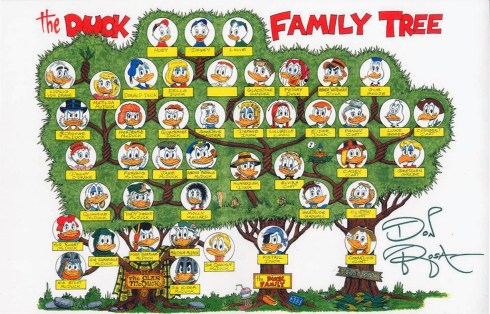
Airing last week was the episode of DuckTales titled “Nothing Stops Della Duck!” detailing the character’s journey from the moon to Duckberg and into the lives of her children for the first time. Interestingly, prior to the revamped DuckTales, Della had done little of note. She never appeared in a Donald Duck cartoon, nor did she have a meaningful appearance in the comics by Carl Barks or Don Rosa. She was Della in the Sunday strip, but Barks would rename her as Thelma with Rosa reestablishing the name Della years later. She appeared as a child in The Life and Times of Scrooge McDuck, albeit briefly. Aside from that, her most notable appearance is in the often circulated Donald Duck family tree in which she’s just a headshot.

dumbellas letter

The infamous postcard, back when Della was Dumbella.

Most of the canon surrounding Della has been recent and has trended towards her being a pilot or astronaut and she’s either missing or presumed dead. This was established in the 2014 Dutch comic 80 is prachtig which was part of a celebration of Donald Duck’s 80th birthday. The story is by Evert Geradts and is drawn by Maximino Tortajada and appeared in a Donald Duck magazine. It’s unknown these days what Disney considers canon, but her backstory there is similar to what has been introduced in DuckTales. The boys have, on occasion, identified themselves as orphans suggesting they believe she’s dead, but for the most part the subject of their parentage has been avoided. It’s likely the characters of Donald’s nephews, first introduced in a 1937 comic strip illustrated by Al Taliaferro from which the cartoon short was based on, were just created to give Donald some juveniles to bounce off of without saddling him with kids of his own. It was the 1930s, so Donald being a single father with three kids out of wedlock was probably too taboo, and having him marry would make him too domesticated. As nephews, the trio could simply come and go, which is largely what they did on film though it became clear in the printed world of Donald Duck these boys were here to stay.

don rosa duck family tree

One of the few canonical images of Della has been confined to a family tree.

Scrooge McDuck would eventually come along and he and his nephews would form a grand, adventuring, team which eventually found its way to television in the form of DuckTales. There Scrooge was in charge of the boys while Donald went off and joined the Navy and the subject of Della Duck was never broached. When the show re-launched in 2017, things were different. The ending of the premiere included the boys stumbling across a painting of Scrooge, Donald, and their mother Della in the midst of some heroics on a pirate ship. Throughout the first season, the boys would search for clues about what happened to their mother, the truth of which nearly driving them away from their Uncle Scrooge. The final shot of the first season revealed that Della was still alive, but trapped on the moon.

dellas debut

Della’s fate was revealed in the first season finale of DuckTales.

Season Two has partly followed Della and her trials on the moon. There she fended off monsters (and lost a leg) and befriended a peaceful race of moon people that aided her in rebuilding her rocket to get back home. Prior to this show’s creation, Della Duck was a character I paid no mind to. I’m sure many others did the same considering how little impact she’s had over the years. DuckTales though has made me interested in her, and “Nothing Can Stop Della Duck!” only amplified that.

della knock

Della is too nervous to knock.

The episode wastes little time in cutting to the chase. The previous episode ended (agonizingly on a Friday) with Della (Paget Brewster) blasting off so she’s outside of Scrooge’s estate when the episode begins. Donald Duck (Tony Anselmo) is waiting for a bus which is to take him away on vacation for a month and he sees the rocket crash and races over to find his sister, but she’s already gone. She quickly makes her way to Scrooge’s front door eager to see her uncle again and finally meet the children she left behind as eggs.

scrooge sees della

Scrooge seeing Della will break you.

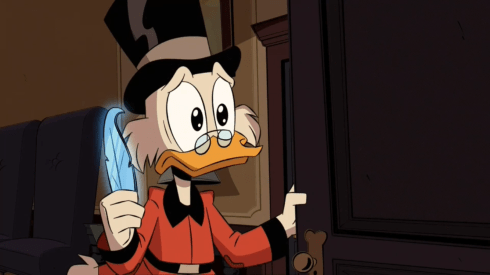
It’s in the moments outside of Scrooge’s door where the episode shines brightest. Della is eager, but also terrified of what her first impression will be like. She can’t bring herself to knock or ring the bell and instead starts trying out first impressions. It’s partly played for laughs to lessen the obvious tension. On the other side of the door, Scrooge (David Tennant) is armed with some priceless artifact in the shape of a quill that can magically lead him to any treasure if he uses it to sketch a map. He, the boys, and Webby (Kate Micucci) are ready to leave, but when Scrooge opens the door he’s stopped dead in his tracks as the quill falls to the floor shattering into a million pieces.

dellas boys and webby

The boys appear guarded and unsure initially.

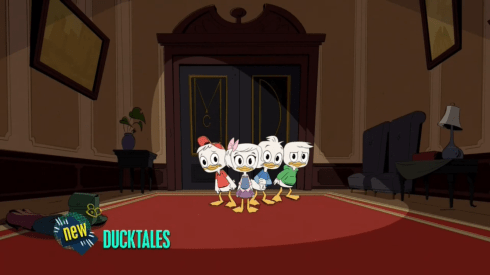
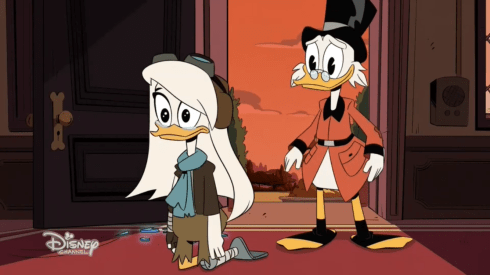
Della then basically cracks a joke of an introduction as we see the tears well up in Scrooge’s eyes. It’s beautifully illustrated and the two share a warm embrace. When the camera pans to the children, they’ve become withdrawn and are looking on cautiously. Webby is casually positioned in front of them just taking everything in and it’s she who first posits that the woman at the door is their mother. Della enters and drops to her knees with tear-filled eyes as Scrooge introduces her. The scene is paced so intelligently as the boys are both excited but also very guarded. Dewey (Ben Schwartz) is the most exuberant and the firs to embrace his mother, while Huey (Danny Pudi) needs to only hear her quote the Junior Woodchuck handbook to know he’s found his mom. Louie (Bobby Moynihan), the most casual and laid back of the three, is also the most hesitant. He justifiably wonders if this is some weird trick and Della is going to turn into a ghoul or monster. He eventually gives in, and the three share a heartwarming group hug.

della knees

Della falling to her knees feels like her succumbing to the weight of the moment. 

The scene dealing with both the joy of an unexpected, but welcomed, reunion coupled with some degree of trepidation and fear of the unknown is handled about as well here as it is in any medium. I was so impressed with the moment, but not surprised, because the bread crumbs this show had laid down gave me the confidence in knowing it could handle this kind of material and do it well. I was so convinced of that going into it that I made it a point to view this one by myself without my children. I love them dearly, but my son especially is at that stage where he asks 20 questions a minute when watching a TV show or movie so it can be trying to actually absorb and enjoy something when he’s around.

della embrace

The well-earned payoff.

The rest of the episode remained poignant and clever as Della tries to get readjusted to life within a family she hardly knows. She has to find her place and also figure out how to be a mother overnight. There’s confusion on all sides, and there’s a sense that Della is trying to force affection and a motherly persona onto her boys and all of them will adapt at different speeds. The show is establishing rather quickly that Della and Dewey will be kindred spirits and that bonding with him will come easier than it will with Huey and Louie. Della will have to spend time getting to know her boys and they will have to do the same. They love each other right now out of obligation and duty, but a more natural affection will take time. I think it will be an interesting experience to take in and you know the writers of the show will handle it deftly, mixing in plenty of humor and adventure.

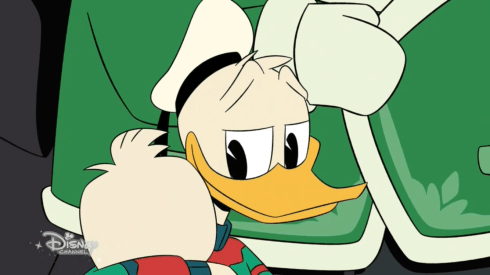
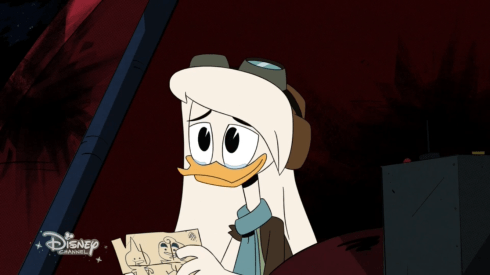
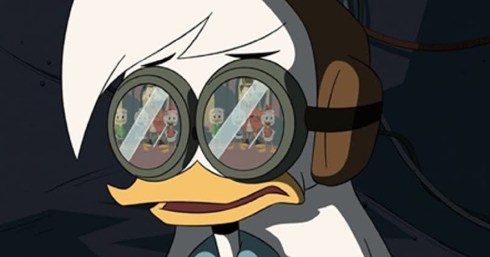
Perhaps well aware that something they setup in the first episode was now being paid off, the writers saved one reunion for later. For when Donald stumbled into his sister’s spaceship he accidentally reactivated it sending himself to the moon. Della left behind a ruler who was scheming a way to motivate his people out of their docile, comfort, zone and into a more aggressive position by portraying Della as a villain to his people upon her departure. As a result, the environment Della found welcoming will not be so for poor Donald. Worse for him is that they all think he’s gone on vacation so they won’t even be looking for him. Eventually, they’ll have to go searching for him or Della will realize her ship is missing, but for now viewers will have to wait for the reunion of brother and sister. It was teased slightly in the episode with a cautiously optimistic and slightly excited Donald looking through the wreckage for Della. Meanwhile, Della has a moment by herself where she looks at a picture of Donald and the boys and thanks her brother for raising them so well (even if he didn’t give them the names she wanted). That moment to come may not be as satisfying as a reunion of mother and child, but I have a sneaking suspicion this show will handle it just fine.


Dec. 13 – Donald Duck in Christmas on Bear Mountain

bear mountain original

Four Color Comics #178 (1947)

For these features, I like to do something a little different at the midway point. This year I’m going to take a look at the classic Donald Dock comic “Christmas on Bear Mountain.” Donald Duck wasn’t just a movie star back in the day, but he also starred in his own line of comics published by Walt Disney. The author and illustrator was the renowned Carl Barks, who also would pen the Uncle Scrooge comics as well. Barks didn’t get to enjoy being celebrated for many years as anything published by Walt Disney was attributed to just one man – Walt Disney. He got to take credit for everything. I don’t necessarily think the intent was malicious or ego-driven, but a marketing one. If people thought these were coming from Disney himself then they would be more likely to buy them. This was a problem in those days across the comics world as the people with money got to take most of the credit, and royalties, away from the actual creators. It’s a problem that has thankfully largely been solved, but there’s still plenty of old wounds out there.

scrooge debut

The first page, with Scrooge’s debut at the bottom.

In terms of Donald Duck comics, “Christmas on Bear Mountain” is one of the most famous. It was first published in December 1947 by Dell Comics as part of their Four Color Comics. It’s most notable for being the first appearance of Scrooge McDuck, Donald’s wealthy uncle who would go on to star in his own line of comics as well as the DuckTales cartoons. For his debut, Scrooge is a bit more like his eventual adversary Flintheart Glomgold. He’s a bearded Scottsman with a rather lousy disposition. He claims he hates everybody and everybody hates him. He lives alone in a mansion in Duckberg with just his attendants. He appears to be a cross between Xanadu from Citizen Kane and Ebenezer Scrooge from A Christmas Carol. There’s no hint at his adventuring past as much of what will define Scrooge is yet to come, making this version of the character feel more like a prototype Scrooge than the actual Scrooge McDuck we’ll come to know and love.

The comic opens with Donald Duck bemoaning his lack of money in front of his nephews Huey, Dewey, and Louie. He doesn’t have enough money for food, let alone presents for Christmas. He openly wishes his rich uncle Scrooge were more generous, but dismisses that possibility pretty quickly. It’s a convenient thought though as we’re whisked away to Scrooge’s mansion on the other side of town where the old man is bemoaning the oncoming holiday as well. He’s a miserable sort, but also a bit mischievous, and he decides that for Christmas he would like to test the mettle of his cowardly nephew. Scrooge admires bravery and repeatedly references his stingy ways. He never gives anything away for free, but he’s willing to bestow food and presents upon his nephew if he can have a bit of fun at his expense and test his courage. And if he passes his test, he’ll reward him further. He instructs his butler to send Donald a telegram offering the use of his cabin on Bear Mountain where Scrooge intends to spring a surprise on his nephew.

barks scrooge

Many years later, Barks would do paintings of his prized creations and sell them for a tidy sum.

Donald and his nephews are surprised and delighted to receive the telegram from Scrooge offering the use of his cabin for the holidays. The boys set off immediately, though Donald is a little unnerved by the warning in the telegram to watch out for bears. In a bit of role reversal from a popular short like Duck Pimples, it’s Donald who is cowardly while the nephews are dismissive of the warning. They tell their uncle there are no bears around, and the thought is almost put out of Donald’s mind when they arrive at the cabin to find presents and food, lots and lots of food.

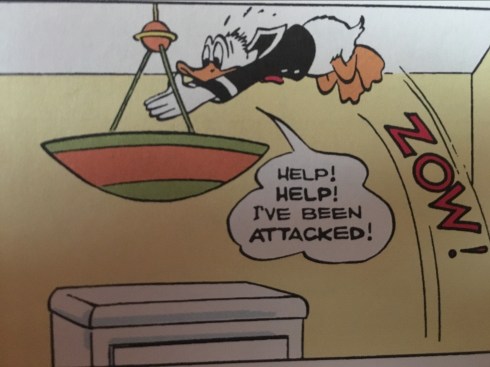
Meanwhile, Scrooge is eagerly anticipating pulling his little prank on his nephew. He plans on heading to the cabin himself, but first he must test his prank on his butler, Edgerton. When he summons the unassuming butler to his room he bursts forth in a bear costume prompting Edgerton to dive out of a window declaring he’ll take his holiday now. Scrooge is delighted with the result and immediately calls for his driver to take him to Bear Mountain.

At the cabin, night has fallen and Donald is on the look-out for bears. As the snow starts to come down the nephews declare there are no bears, but Donald is not satisfied. He peers outside through a telescope and is terrified at the sight of a creature, which turns out to be a squirrel. It’s enough to get him to jump into the chandelier and cower in fear, a frequent gag in the coming pages. Scrooge is on his way, but the snow is falling too fast. The roads are impassible, and the driver tells Scrooge they need to turn back. He’s not bothered as he’ll just pull his prank the next day, though he’s not crazy about his nephews getting to eat and sleep on his dime another night revealing he’s never provided a man a free meal in his life.

img_2869

The story goes out of its way to reveal just how much of a penny-pincher Scrooge is.

The next morning the boys have fun playing in the snow while Donald enjoys rummaging through the fridge for breakfast. When the boys request oatmeal, he tells them they’ll eat their lobster newburg and like it! Later on, Donald tries to relax by the fire but the nephews inform him they need a Christmas tree. It’s the one thing missing from Scrooge’s cabin, and given that it’s Christmas Eve, the place really needs one. Donald has no intention of going off into bear-infested woods looking for a tree, but the kids cry and complain and eventually he gives in. When they first set out, Donald thinks he sees bear tracks and runs back inside to hide under the bed while the boys point out they’re just rabbit tracks. Donald angrily grabs an axe and mutters his way through the snow. Finding only a single hollowed-out tree, the boys are forced to settle and they haul it back to the cabin.

The boys make the most of their sad tree by hanging colored soda bottles from it. Donald is more interested in finding some dessert and the kids are onboard as well. When they leave the living room it’s revealed their tree has a stow-away. A little bear cub emerges from his slumber and climbs out of the tree. He takes note of a teddy bear nearby and gives it a whack with his paw, startling the ducks in the other room. When the nephews come in they don’t notice the cub by the teddy bear, and Donald cowardly asks them to check the other rooms.

img_2870

Chandeliers make for great hiding places.

The little cub runs off undetected to the kitchen where he finds the strawberry shortcake the ducks were planning on eating, and consumes it himself. After finding no sign of bears, the others return to the kitchen and are shocked to see their cake has vanished. Donald immediately returns to the chandelier for cover, while the boys nervously tiptoe around the house. The cub though has returned to the tree for cover, and when he sees the boys leave he re-emerges. He drops out of the tree only to land on a roller skate just as Donald hops out of his hiding place. The bear goes rolling along and plows into Donald, who still doesn’t get a look at him but does notice the bear fur left behind. He then returns to his chandelier in terror.

Hearing the commotion, the boys return to the living room but again find no bears. Donald tells them his assailant fled through the door and the boys hear the sound of their roller skate on the floor. They angrily give charge only to slip on the discarded skate and crash into the wall. The bear has a look at the dazed ducklings, before he cheerfully resumes his skating. Donald asks what happened, and the boys don’t know, but they hear the skates and give charge once more. The cub hears them, and grabbing a box of chocolates, jumps back into his tree. When the boys enter the room they see no sign of the bear, but then one of them gets knocked on the head by the discarded chocolate box. They now know the bear is hiding in the tree and one of the nephews angrily yanks the cub out of his hiding place.

Just then, the mother of the cub awakens in the stump the ducks left behind and she is not happy to find her cub missing. She tracks them back to the cabin and smashes the door down. The cub though has managed to escape the ducklings, and after they failed to find him, they plead with their uncle to come out of his hiding place. Assuring him it’s just a tiny bear, Donald finally emerges to aid his nephews in their search. He confidently strides into another room expecting to find a cub, but naturally he finds the cub and his mother. He runs off and dives out the window as the bear gives chase and his nephews follow.

Night falls and the boys are forced to watch from outside as the bear and her cub enjoy the food and warmth of the cabin. After a satisfying meal, the bear lays down to sleep by the fire while the cub plays with the roller skate once more. The nephews then urge their uncle to go inside and tie the bear up while she sleeps while they’ll take care of the cub. Donald does not want to do this, but since the alternative is freezing to death, he has little choice. They slip in, and the boys start chasing the cub around. Donald, shaking uncontrollably, sneaks up to the mother bear. Before he can begin tying her up, the bear lets out a great sigh causing Donald to faint in fright right beside the bear who wraps an arm around him.

img_2871

Aww, they look so sweet together.

Just then, Scrooge shows up in his bear costume. He sneaks into the cabin and is immediately met by the cub who is being chased by his youngest nephews. He’s amazed at their bravery, even if it is just a cub, but not as amazed as he is when he looks into the next room. There he sees the slumbering mama bear, with Donald sleeping right beside her. He’s proud to see his nephew in so brave a state and even remarks the boy is like him and doesn’t know the meaning of the word fear. The bear then lets out another sigh, terrifying Scrooge who bolts out of the cabin. He’s not too scared to be proud of his nephew though, as he shares what happened with his driver, James. He intends to host the boys for Christmas dinner the next morning and instructs James to give them the good news.

img_2872

I love how Donald’s feathers explode when he’s frightened.

At Scrooge’s the next day, the boys enjoy a hearty meal. The youngest ducks get to consume liters of pop while Donald and Scrooge down lemonade. Scrooge is cheerful and supremely generous, all because he thinks his nephew is the bravest duck in town. To reward his bravery, Scrooge tells Donald he has a special gift for him:  a bear skin rug. When Donald sees the head of the rug he shrieks and faints. Scrooge is confused, but the nephews insist he just fainted from too much turkey. Scrooge actually seems to buy the explanation, but remarks in the final panel he thought Donald might actually be scared.

Like basically every Donald Duck story I’ve ever read, “Christmas on Bear Mountain” is a charming little tale. The humor is not explosive, but will probably produce a smile for most readers. Seeing Donald in such a cowardly role is a little different, not that Donald is ever a model for bravery, but often he’s too stubborn to be truly scared. There’s no real build-up for Scrooge, but it’s fine that he’s ushered in so conveniently and quickly since the story unfolds rather briskly. It’s interesting to see this early Scrooge, which is basically a magnified version of the character that focuses on his less admirable traits while also introducing a playful side. That playful side is seldom explored, so it’s an interesting way to see the character introduced.

fanta bear mountain

Fantagraphics has re-released a vast assortment of duck comics and they’re the easiest way to acquire them today.

Also like most Donald Duck stories, the artwork of Carl Barks is expressive and detailed. I love the shape of his ducks which are more rounded than the film counterparts. The pages are consistently laid out in a 2×4 format which helps to move the story along quickly in the 20 pages present though I do wish there was a splash page or two. In particular one that revealed more of Scrooge’s mansion or that captured the presents and Christmas setting of the cabin. It’s a minor quibble though. The backgrounds are actually quite populated without appearing busy and the action shots utilize minimal effects. Just the occasional dash line or sweat drops. It gives the comic a very clean, professional, look.

If you’re interested in reading this story yourself then it’s actually rather easy these days. Fantagraphics has republished several Scrooge and Donald Duck comics in large, hardbound, full-colored trades. A lot of bonus content is included and even some panels that were rejected by Barks’ editor at the time which were preserved and restored. The trades total about 200 pages and retail with an MSRP of $28.99 but usually are sold for less. Some are even sold in two-packs with a nice, hard, box holding the books in place. I highly recommend them if you’re a fan of these classic characters. Alternatively, you could also seek out older prints or even an original comic, but that might set you back a bit more depending on the condition and rarity of the edition.

And I also must take a minute to point out that this is post number 500 for this blog. Whether you’re reading your first or if yo’ve read the other 499: Thank you. As an unabashed fan of Donald Duck, I am happy the 500th post ended up relating to him.


DuckTales Season One Review

ducktales newRebooting an old cartoon property has its pluses and minuses. On the one hand, reviving an old brand means the core of what you’re trying to build is already in place. Characters, relationships, stories, even music can all be mined from the old and adapted for the new. There are often tweaks made to the look of the show, new voices to cast, and a whole new team to assemble, but it’s undoubtedly easier and less expensive than starting from scratch. And it also allows a new generation of creators to take something they enjoyed as youngsters and mold it into something else. It also comes with risks, and as we’ve seen all too often recently there is an aspect of fandom that is, well, toxic to say the least. Take She-Ra, for example. Originally conceived as a way to market action figures to girls, She-Ra was integrated into He-Man and the Masters of the Universe, itself a show designed simply to sell toys to boys, and the backlash was swift and quick. Even those behind the creation of He-Man looked down on She-Ra and blamed her for hastening the decline of the franchise as a whole, “Now my sister wants to play with me? Gross!” This is all captured quite well in the documentary series The Toys That Made Us, if you want to know more.
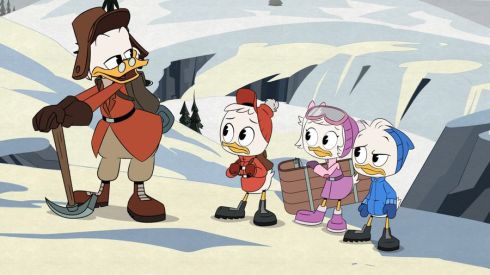
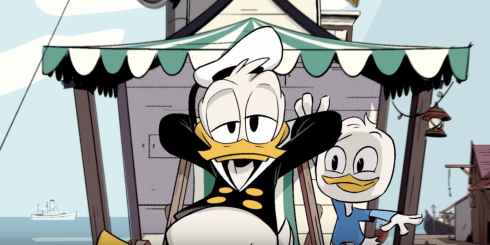
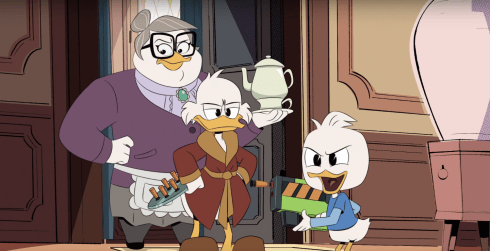
She-Ra, I’m sure, had fans of her own, but they definitely were small in numbers, relatively speaking. Rarely did I ever hear anyone in conversation bring her up in a positive light and I literally met no one pining for a reboot in the same mold as He-Man himself. And yet, when a new concept was recently unveiled for She-Ra online the He-Man fandom and nerd culture as a whole was swift to pounce on it. Blaming it for ruining the character or for unoriginally adhering to the “CalArts style,” these fans were loud and largely obnoxious. It was similar to the backlash towards a new ThunderCats show that has yet to air. Did you ever watch ThunderCats back when it was originally aired? That show, just like She-Ra and He-Man and countless other programs, was terrible. It’s fine to be nostalgic for them because you grew up with them. I certainly watched a lot of crappy cartoons, but I don’t want to subject my kids to the same. If there are to be new versions of these shows I want them to be good! Not some 23 minute toy commercial. Fans should be happy these things still exist for a new audience. And the beauty of it all is, if you don’t like what’s new, you still have what’s old. It doesn’t go away or vanish the moment a new version shows up.

scrooge winter

The cast is much larger, but many episodes still revolve around Scrooge and his nephews (plus Webby).

It’s interesting that one of the companies behind the pivot from making shows that sell toys to just making good animated programming was Disney with its Disney Afternoon programming block. The original Disney Afternoon toon was Adventures of the Gummi Bears, but the show most associate with the block is none other than DuckTales. Basically a loose adaptation of the Carl Barks comics for television, DuckTales centered not around Donald Duck but around his rich Uncle Scrooge McDuck. He was partnered with his grand nephews Huey, Duey, and Louie along with his personal pilot Launchpad. Together they went on grand adventures searching for treasure. They wouldn’t just travel to far away places, but backwards and even forward in time! It was memorable for its lavish animation that went far beyond the likes of Dic and Hanna-Barbera. Not to mention for its incredibly catchy theme song.

As such, it seems appropriate that when it came time for Disney to adapt DuckTales for a new audience it largely escaped the internet backlash that had befallen other properties. Oh, I’m sure there are detractors that do not like the new visual style or the Felicia Barton sung intro, but by and large the response I have seen online and in person has been overwhelmingly positive. DuckTales just concluded its first season. Commercially, I have no idea how well the show has done, though it’s done well enough to receive a second season. It’s hard to judge that sort of thing in this day and age when ratings mean almost nothing thanks to streaming options and DVR. There hasn’t even been a tie-in toy-line until very recently so sales of that aren’t going to offer much of a measure. Creatively though, it’s hard to think of a cartoon reboot that has been more successful than DuckTales. The Teenage Mutant Ninja Turtles come close with their 2012 reboot, and really that ThunderCats reboot of a few years ago was miles ahead of the original, though it did not last very long. DuckTales is on another level though, and there are a lot of reasons why.

ducktales-donald-duck-header

After mostly chilling on the sidelines in the original series, Donald is a part of the main cast this time around. He doesn’t get to relax as much as this image suggests.

First and foremost, the work of Carl Barks has not been ignored. Scrooge is back to his red overcoat and he’s partnered with all of his nephews this time – including Donald Duck! Back when the original Disney Afternoon was conceived, Disney was hesitant about letting any of its big stars headline a show. Landing Donald for the few episodes he was in was a huge get, as characters like Mickey, Minnie, and Goofy were completely shut-out at the onset. That stigma has long since passed allowing Donald to finally star alongside his uncle as he should. Huey, Dewey, Louie are still around and now they have distinct looks and personalities all to themselves. The prior nephews in basically every iteration were interchangeable. It was part of their charm, but also pretty limiting from a character perspective. Now they’re free to be themselves and the writers are allowed to explore each individual duckling. Huey is the closest to the original mold, the burgeoning Junior Woodchuck. Louie is more slothful and laid back while Dewey embodies the adventurous spirit of his great-uncle with perhaps a touch too much enthusiasm. Webby is also back and she’s no longer the little girl who seems to get in the way, rather she’s an adventurer herself who looks upon the likes of Scrooge and Donald as something close to legendary figures. She’s good-natured, and her grannie Mrs. Beakly is still around to look after her. Oh, and Mrs. Beakly is no longer the meek maid to Scrooge but a former covert agent herself with a rather massive and intimidating physique.

beakley

One of the more radical redesigns is that of Mrs. Beakley, who went from doting old maid to a tank-like brawler who still has a soft touch.

The show’s approach is similar to the original DuckTales, take Scrooge and the gang on adventures to fantastic worlds with treasures to uncover and villains to foil. Since the cast is larger, episodes will often pairs things down to just a handful and save the full cast for the most important episodes. It also includes more structured story-telling and the first season revolves around a character we’ve only ever seen mentioned, and rarely at that – Della Duck. Della is the sister to Donald and the mother to the boys, and at the end of the second episode (aired as one long episode for the premiere) the boys uncover a painting that depicts her alongside her brother and uncle. Della previously was basically only mentioned in the cartoon short “Donald’s Nephews” with Donald shown reading a letter from her asking her to watch her kids. She’s basically never been mentioned again and never seen, as far as I can recall. The boys start off knowing something happened to her and it may or may not have led to a falling out between Scrooge and Donald. The first episode deals with Donald reluctantly going to his uncle for help in watching the boys so he can go on a job interview, and that arch ends with Donald and the boys moving in as Donald seems to understand its best for his nephews (plus his house boat was destroyed in the process). The boys spend parts of the first season secretly investigating what happened to Della, and the mystery is unraveled slowly and takes some twists and turns. It even threatens to split the brothers apart as Dewey discovers something and decides to keep it from his brothers. Things come to a head in the penultimate episode leaving the finale, which just aired this past Saturday, to deal with the fall-out.

lena and webby

Lena and Webby’s friendship is one of the main plot points weaved throughout the first season.

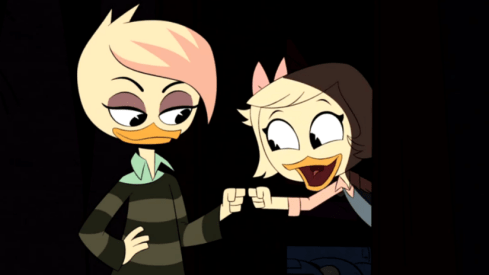
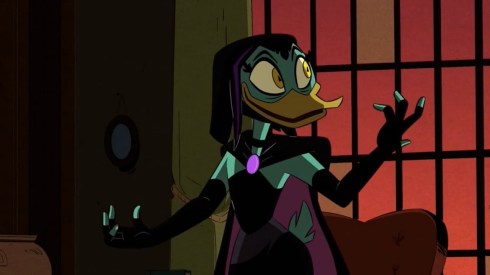
The other big teaser throughout the first season revolves around Scrooge’s old enemy – Magica De Spell (Catherine Tate)! She was a frequent foil in the original series so naturally she’s back. As basically the big baddie of the whole thing, it’s a lot of fun to see the show treat her as such. When the season begins she’s magically sealed away and only able to interact with the world through her niece Lena (Kimiko Glenn) who poses as a friendly sort in order to gain the trust of Scrooge and thus somehow free Magica from whatever keeps her sealed away. To do so she gets close to Webby and the two become best friends. Throughout much of the second half of the season we get to see Lena being pulled between the two forces in her life; her friendship with Webby and her loyalty to Magica. It’s nothing new, but it’s handled well and there are some genuinely emotional moments that come of this and there’s a lot of payoff in the end. Plus, the animators used this really creepy effect where Lena’s eyes turn black and “spill” shadows to form Magica. It’s genuinely unsettling.

The original DuckTales cartoon dealt with plots that continued from one episode into the other. There were even changes to the main cast as was the case with the introduction of Bubba and Gizmoduck. Those storyline pay-offs though were not on the equal with the new show. The main theme of family is at the core of this new show and it never strays too far from that. Very few of the episodes in the first season felt like filler as all seemed to serve some purpose. Either a character learns something about themself or their relationship to the others or something else happens to move the overall story along. It’s a great way to structure a show and I always love seeing what is primarily children’s programming take this sort of risk. There will always be television executives who look down on children and think the simpler the better, but trust me, kids notice this stuff and appreciate it when a show doesn’t treat them like brainless buffoons.

magica

Many of Scrooge’s old villains have returned.

Additional challenges arise when creating a new version of a 30-year-old show. Namely, the voice talent available isn’t the same anymore. Alan Young, who provided the voice of Scrooge for decades, is no longer with us. And since it was decided that the nephews would be approached differently this time around, the talents of Russi Taylor were declined and instead each was given a unique voice. These changes are often the hardest for the old fans since not only do these characters barely resemble what we fell in love with as children, but they also sound very different. Once you get past that change though, it’s hard to say bad things about this cast. David Tennant is a great Scrooge with a natural Scottish accent. He brings everything you need from a voice actor to the character. He can be gentle, intimidating, enthusiastic, and even sad. It was hard to say good-bye to Young, but Tennant has done a remarkable job in his first season at the helm. The nephews are voiced by Danny Pudi (Huey), Ben Schwartz (Dewey) and Bobby Moynihan (Louie) and they all impart their own personality on the characters. If there is one negative to this season, it’s that Dewey definitely feels more developed than the other two and thus Schwartz shines brighter than the others, but season 2 could easily rectify that. Kate Micucci is Webby and she was perfect in the role while Toks Olagundoye voices her grandmother Beakley. Beck Bennett plays a more aloof Launchpad, but otherwise kind of sounds like he’s trying to do Terry McGovern which is a little sad because I know McGovern really wanted the part. If you’re feeling uncomfortable with all of the newness in the cast then at least you have Tony Anselmo reprising his role as Donald Duck, as it should be.

The new visual style of the show is bright and expressive. It’s a bit flat, which seems to be a trend in 2D digital animation, but it has its own look which helps differentiate it from the original series. The look of the old series just can’t be duplicated in today’s environment, so the show was smart to not even try. I really like the new look for Scrooge and Donald and feel it suits them well. The nephews have taken some getting used to as they have really large heads and in some respects resemble chickens more than ducks. The backgrounds are all really well done and there’s plenty of variety to be found from suburban settings to creepy castles. There’s also more imaginative and fantastic settings to be found and the show does an admirable job of mixing things up. It does the same with the villains and guest spots and virtually everyone you know and love from the original series makes an appearance or two here. There are also a few new characters thrown around, some inconsequential and some rather imaginative (I’m looking at you statue-headed horse) and almost all have some pay-off.

gizmoduck

And many old allies are back as well.

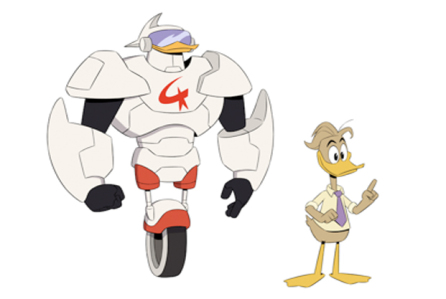
Of the first season’s 23 episodes (25 if you count the premier and finale as two episodes) it’s hard to pick a favorite. The first episode, “Woo-oo” was wonderful for its patient and rewarding reintroduction of these timeless characters. Any episode that pits Scrooge against Glomgold was usually humorous and entertaining to watch and the episode “Beware the B.U.D.D.Y. System” was equally humorous for its focus on Launchpad, plus it had Gizmoduck! Some of the episodes have some rather delightful Easter Eggs in them. You have undoubtedly seen or heard about the numerous Darkwing Duck ones, and the finale included one Easter Egg from the old NES game. And it’s really hard for me to not just pick the last three episodes as my favorites. They’re the most weighty with the biggest emotional moments in the whole season. I even get a lump in my throat just thinking about them.

As I said earlier, it’s hard to imagine a reboot having as successful a reintroduction as DuckTales did in 2017 and into 2018. The new show proves the old comics and original series still have legs, their foundation was one that can anchor any show in any era. This is the rare reboot that should have little trouble appealing to the old fans while also being something new for a younger generation that may never have even heard of DuckTales before 2017. If nothing else, my own children have proven to me time and again that the old theme song will never go out of style as the two will happily sing it at the dinner table, from their car seats, or while they play. It’s really rewarding as a parent to see your children embrace something you loved as a kid yourself, even if it’s not the same and in a new form. I have no doubt that DuckTales is in good hands right now and I look forward to watching the second season with my kids, or even on my own after they go to bed (it can be hard to focus on these things with a pair of short-attention span toddlers).


PhatMojo DuckTales – Scrooge McDuck and Donald Duck

IMG_2498It’s been nearly a year since DuckTales returned to television airwaves. Scrooge McDuck, along with his nephews and surrogate niece Webby are back to solve mysteries and rewrite history. It’s a fun show that adheres more to the work of Carl Barks than to the series that ran in the 1980s while also doing its own thing. For the first time really ever, the nephews Huey, Dewey, and Louie are distinguishable by more than just the color of their clothes and the cast is large enough that the writers don’t seem to feel pressured into fitting everyone into every episode. Sometimes Scrooge will be missing, other times Donald will be. It seems to be a show more about the kids and how they view the almost mythological Scrooge. And it also has other mysteries to uncover and it’s mostly good fun.

Back when the original series ran it surprisingly did not coincide with a ton of merchandise. Maybe this was a deliberate attempt by Disney to distinguish its cartoons from the competition which were often toys first, shows second. The only DuckTales toy I can remember owning was a Gizmoduck that came in a box of cereal. It seemed like this new incarnation was going to befall the same fate, but along came PhatMojo to rectify that. Now, I know nothing of this company and this is my first introduction to them, but I’ll say it’s mostly a positive one. Alongside some figurines and plush dolls, PhatMojo has put out its first line of DuckTales actions figures. Apparently exclusive to Target, the inaugural line contains single-carded figures of Scrooge, Donald, Launchpad, and Flintheart Glomgold. In addition to those figures are a pair of two-packs of Huey and Dewey and one of Webby and Louie. Also available is Launchpad’s airplane which also comes with his figure and Scrooge’s Money Bin playset, which seems more like a storage device for your toys than a full-fledged play set.

I have a weakness for toys, that is obvious to anyone who reads this blog, and perhaps a greater weakness for Donald Duck merchandise. Despite that, I’ve actually never owned a proper Donald Duck figure until now. I have statues and Lego mini-figures, but no action figures. Most of the is due to scarcity. There is a phenomenal Donald Duck figure available by a company called Herocross, but to import him is over $100. Yikes! There have been some Kingdom Hearts Donald Duck figures, but those have never spoke to me for one reason or another. Years ago there was a line of figures based on Mickey’s Christmas Carol and I do kind of kick myself for not collecting it. I was in high school when those came out and just didn’t have much money for action figures. I’m guessing if I looked them up on eBay right now I would not like what I see in terms of price too. As for Scrooge, he received a pretty darn good figure just last year from Funko, purveyors of those Pop! figures you’ve probably seen everywhere. That Scrooge was part of a line based on the old Disney Afternoon so it’s Scrooge with his blue coat. Herocross also released a version of Scrooge from that series and it’s both awesome and terribly expensive.

IMG_2502

“Hello?”

Not wanting to get too far into another line of toys, I forced myself to just stick with Donald and Scrooge when I encountered them over the weekend at my local Target. Might as well start with an overview of the line as a whole. These are mass-market retail figures, and even though I’m a man in his mid-30s, I can admit these are aimed at children. As such, it stands to reason you shouldn’t expect collector grade quality with these figures, and the price of 8.99 a piece captures that. The figures have unique sculpts with simple paint apps and even simpler articulation. The heads sit on a ball-joint that offers solid range of motion, but that’s it for fancy joints. The shoulders are on simple pegs and there’s no elbow or wrist articulation. The legs are also on simple peg joints at the hip with no knee articulation. As a result, these figures are very limited in what they can do as far as posing goes, but what’s there has a solid build and isn’t flimsy or anything.

IMG_2503

That’s the best he can do as far as taking a picture goes.

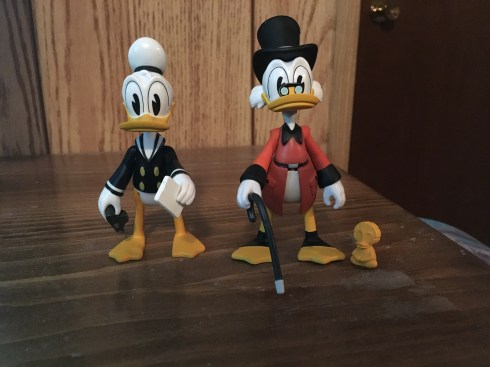
Let’s talk Donald Duck first. In case you are unfamiliar with the show or the work of Carl Barks, this Donald is in his comic accurate attire, which is how he’s presented in the show (his more popular light blue shirt gets set on fire in the first episode). His shirt is black with gold buttons and he wears a white hat instead of a blue one. The character is brought to life once again by Tony Anselmo and it’s really fun to see this Donald on television for the first time. He’s not as quick to anger as his personality in the cartoon shorts dictates and he’s very much a doting uncle most interested in the well-being of his nephews. Donald stands just under 4″ and comes with two accessories:  a camera and a smart phone.

IMG_2505

What you see is what you get, but what you see also is pretty good.

First of all, this figure is a dead-ringer for the show. He has that rounded look in the head with harder lines on the beak. The paint app is simple because it doesn’t call for much, and my figure looks pretty good in that area (some on the pegs were less impressive). Because of the limited articulation, he can’t really do much with his accessories, but he can kind of hold the phone like he’s talking into it. My only criticism of the sculpt is in how the legs meet the body which looks odd, but it was obviously done this way to keep it simple. The little tassel on his hat is also molded to his head and I wish it was jutting out on its own to impart a touch more personality, but again, this is the simple approach. Donald has a sunny disposition to him which may have felt out of place for his toon counterpart, but for DuckTales this feels appropriate. Overall, this is a very solid figure that, while not much fun to pose, definitely nails the likeness.

For Scrooge, we have a slightly more ambitious design. His tophat, glasses, and overcoat make him slightly harder to sculpt, but once again PhatMojo pretty much nails it. His hat pushes him close to 4 1/2″ and he has his little tuffs of hair pushing out from underneath it. Some may be disappointed that the hat is non-removable, but I think it looks better this way. Like Donald, this Scrooge is more in-line with the design of Barks and features a red coat instead of the blue one from the 1980s. Voicing him in the show is David Tennant, and man did he have some pretty big shoes to fill, but so far he’s pretty much nailed it. He comes with two accessories of his own, his trusty cane and a little gold colored idol that just sort of sits there. His articulation is the same as his nephew, only his overcoat really limits what can be done with his legs. In fact, I can’t even tell if his legs are articulated or not since they basically can’t move.

Paint-wise, he’s a bit more of a mixed bag. I had a hard time finding a good one at the store and had to settle for what I have. He has a little red dot on the brim of his hat and in a few places on his coat is a dab of white or black that shouldn’t be there. It’s not killer, but I notice these things. His eyeglasses are also kind of funky. Rather than use a piece of transparent plastic like Funko did with their Scrooge, PhatMojo just made a block of plastic to place on his beak and painted on glasses. This means the open area where there are no glasses is just painted yellow. It looks okay from a head-on perspective, as his nose should probably be there anyway, but from an angle of any kind it’s a bit clumsy. Again, this feels like a cost-cutting move as cutting out the dead-space would mean a more fragile piece in the end, but I wish they did a little better here. All of the figures I saw also had a weird little gap underneath Scrooge’s belt buckle. Not really noticeable when the figure is just displayed, but pick it up and you’ll see it. It’s probably the result of how the bottom part of his overcoat was connected to his torso.

Even with the problems I highlighted with Scrooge, I still think he’s a sound figure and he looks great on my desk alongside Donald and Funko’s Scrooge. Both Donald and Scrooge look like they’re supposed to given the source material. And considering the price, it’s hard to quibble with them too much. When I was a kid, I paid upwards of 7.99 for ToyBiz figures and that was in the early and mid 90s. To only pay 8.99 for these in 2018 is a pretty tremendous value. I don’t know how fun they are for kids given how limited they are in what they can do, but I played with similar as a kid and had no shortage of good times. If you like the look of the new DuckTales and want some figures from it, give these a look. You may want to catch them in person rather than through the web given the paint issues I saw. And if you’re a stickler for scale you may be a little disappointed with the others as Launchpad is definitely on the small side and the kids a little too big relative to Scrooge and Donald. The two-packs also run a tad more expensive at 12.99 each, but given you’re getting two 3″ figures instead of one 4″ the value seems about equal. For me, I’m probably content to just stick with these two. If a Darkwing Duck or Gizmoduck shows up I may give them a look. I’ll also probably try and push my kid towards these things as I’m always looking to foster more duck-enthusiasm in him. Got to start them young!


Who Framed Roger Rabbit (1988)

220px-Movie_poster_who_framed_roger_rabbitNormally, I don’t like doubling-up on posts in a single day on this blog, and ever since last fall Friday has belonged to Batman. Well, I’m breaking my own self-imposed rule today, but it’s for a very good reason. Today is the 30th anniversary of the film Who Framed Roger Rabbit. On this day in 1988, the then most expensive movie in film history was released to the general public with a lot of buzz and a lot of trepidation. It was a collaborative effort between some of Hollywood’s hottest names; Steven Spielberg, Robert Zemeckis, and Walt Disney Studios. Adapted from the Gary Wolf novel Who Censored Roger Rabbit?, there was a lot of fear that the movie would be too “out there” for a general audience. So uncertain about how the film was to be received, actress Kathleen Turner, who voiced Jessica Rabbit, declined to be credited for her role in the film. There was some fear this thing would be received about as well as Howard the Duck, a notorious flop at the time, but it ended up being so much more.

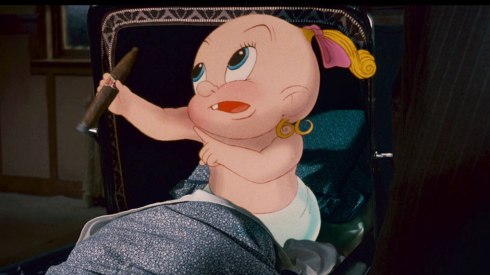
Who Framed Roger Rabbit is the story of a rabbit named Roger (voiced by Charlie Fleischer) who is framed for a murder he did not commit. Aside from the fact that he’s a rabbit, the plot sounds rather pedestrian at face value. What sets the film apart is its world and the world it shares with the “real world.” Roger Rabbit is a toon. He is a literal cartoon character. In the world created by this work of fiction, cartoons are just as real as you and me. They go to work, make cartoons, and go home. The toons behave like golden era cartoons – they’re wacky, prone to accidents, and always on the lookout for a laugh. At one point in the film, Roger is handcuffed and needs to get himself out. He ends up simply removing his hand from the cuff at one point, then putting it back. When his partner, Eddie, notices and gets furious with him for not just doing that to begin with, Roger explains he could only remove his hand when it was funny.

whoframedrogerrabbit

Bob Hoskins stars alongside Robert as private eye Eddie Valiant.

Roger works for R.K. Maroon (Alan Tilvern) and is a star of Maroon Cartoons. Set in 1947, the film basically takes place during the waning days of the animated cartoon short. He is married to the impossibly attractive Jessica Rabbit, a buxom, hourglass figured toon who more or less resembles a human. The film starts out with Roger stressed out because there are rumors that Jessica has been up to no good with another man. Maroon wants private investigator Eddie Valiant (Bob Hoskins) to do some digging to help his star out. The problem is, Eddie hates toons, but he loves money more. Eddie takes the job, and finds out that Jessica has actually been playing pat-a-cake with Marvin Acme (Stubby Kaye), the owner of Toon Town. When shown the images of his wife playing such a lurid game with another man, Roger goes off the deep end and is plunged into a depression (pat-a-cake is serious business to a toon, apparently). Then things take a dark turn when Marvin Acme turns up dead, and Roger is suspect number 1. Roger proclaims his innocence to Eddie, and Eddie is forced to decide if he wants to help out the incredibly annoying, but likely innocent, Roger or just walk away from the whole thing.

brig

Even humans are drawn to Jessica Rabbit.

The story unfolds like a classic mystery. You have the gruff detective, the innocent victim, and the femme fatale. Of course, nothing is ever truly what it seems. Shadowing the protagonists is the villainous Judge Doom (Christopher Lloyd) who too seems to have a hatred for toons. Eddie and Roger are going to have to do some sleuthing, and even take a trip to Toon Town where all of the toons reside, in order to solve this case.

2728670.jpg-r_1280_720-f_jpg-q_x-xxyxx

Roger’s co-star, Baby Herman, is used sparingly, but he’s a scene-stealer.

The story is admittedly fairly simple. The character of Jessica Rabbit is the most intriguing, and not because of her figure, but because she is a femme fatale done well. She possesses an air of mystery and uncertainty, the fact that she is apparently the most attractive toon and is attached to the rather goofy Roger helps to play this up. What truly sets Who Framed Roger Rabbit apart is the presentation. Live actors mix with cartoon ones in truly spectacular ways. We’ve seen this before from Walt Disney with the likes of Mary Poppins and Bedknobs and Broomsticks, but not on this level. Those films merely feature a few sequences of cartoons and actors co-mingling, where as Who Framed Roger Rabbit is built around that dynamic, and it looks spectacular! When Eddie rides along in the toon cab, Benny, he looks like he’s really riding in it. When he wields a toon gun, it’s convincing. And the world of Toon Town is especially marvelous to look at with its impossible architecture and lavish color scheme. The movie is so visually stimulating that you could watch it in mute and still enjoy it.

who-framed-roger-rabbit

Christopher Lloyd is appropriately sinister as Judge Doom.

Even with the flashy presentation, the film still needed true chemistry between its real-life lead Eddie, and it’s toon co-lead Roger. Hoskins is fantastic at playing the straight-man Eddie. He takes everything seriously and has explosive reactions to all of the nonsense around him, but not in such a manner that would break the film. Helping to make sure he was able to form good chemistry with Roger, voice actor Charlie Fleischer dressed up as the character and would voice it off-camera. Seth McFarlane utilized a similar method when filming the more recent Ted to similar effect. I suppose it’s impossible to say if this truly worked or did not, but the results speak for themselves.

who-framed-roger-rabbit-bob-hoskins-roger-rabbit-cab

Eddie and Roger go for a ride in Benny the Cab.

Who Framed Roger Rabbit was a unique looking film that was impossible to ignore when it was released, but it was still relying on a lead that had never been seen before in Roger. That’s why to help spruce up the film, Spielberg and Zemeckis wanted to make sure that Roger’s world was inhabited by recognizable cartoon characters. That ended up being the film’s strongest selling point as it promised, for the first time ever, that characters from both Disney and Warner Bros. would share scenes together. This leads to the wild team-up between Donald Duck (Tony Anselmo, with some archivable Clarence Nash) and Daffy Duck (Mel Blanc, in one of his last performances) who have a dueling pianos scene where the more outlandish Daffy seems to get on Donald’s nerves more and more as the scene goes on. Mickey Mouse (Wayne Allwine) and Bugs Bunny (Blanc) also get to share a brief scene, which contains an easter egg of Bugs flipping Mickey the bird (apparently, Disney was a bit of a pain to work with concerning how the characters could be portrayed and this was one way for the animators to have a little fun at their expense). Those represent the biggest cameos, but there are many, many more throughout the film from both companies, both major and minor. Part of the fun of watching the film is looking out for them and there’s always a chance that on re-watch you’ll see another you may have missed.

framed201

Toon Town is a rather chaotic place.

There are so many things to pick out of Who Framed Roger Rabbit that it’s way too much for me to cover here. Suffice to say, if you’ve never seen this baby then you owe it to yourself to check it out. Much of the effects still stand up today, and much of the credit is owed to animation director Richard Williams. The toons are two-dimensional, but a lot of effort is made to make sure they look like they’re really inhabiting this world in the manner in which lighting is utilized and how often the camera moves. Working on this film must have been exhausting, but oh so rewarding in the end. Due to the nature of the license rights, the complexity of it shots, and incredible of expense of animating over live-action, a sequel has never truly got off the ground. Author Gary West has returned to the character for his novels, and Disney and Spielberg would probably both love to cash-in on the brand, but there are just too many hurdles to clear. Zemeckis has campaigned for a sequel on multiple occasions, but he’s been less vocal about it in recent years. Additional Maroon Cartoon shorts of Roger Rabbit were produced after the film, but even that was a touchy subject as Spielberg wanted to run them alongside his films while Disney wanted them for theirs. And supposedly Disney wanted to create a television show starring Roger Rabbit for their Disney Afternoon block, but Spielberg who was working on televised cartoons of his own (Tiny Toon Adventures, Animaniacs, etc) wouldn’t allow Roger to be utilized forcing Disney to create the character Bonkers the Bobcat. Roger has at least been allowed to live on in Disneyland’s Toon Town where he still has a dark ride to this day. Given that Disney has been replacing a lot of older dark rides to make way for more current franchises, one has to wonder if Roger’s days there could be numbered.

RR_tf

One of the more character-packed shots in the whole film.

Who Framed Roger Rabbit is likely one of the most popular and successful films to never get a sequel. It took in around $330M in 1988 dollars, a pretty substantial haul, which more than covered its estimated $50M cost. Its story and presentation are both timeless and also proof that Tex Avery styled humor and gags may never truly go out of style. The rather manic Roger Rabbit can appear off-putting to some, especially younger folks who may not have grown up on Looney Tunes, but apprehensions tend to fade away once the movie really gets going. I’ve introduced this film to a few people that weren’t enthusiastic about giving it a shot, only to see them won over in short order. It’s really one of the best things the Walt Disney Company has ever produced, even if it was released on their Touchstone label. I know it’s a Friday, but if you don’t have plans tonight, you could do a lot worse than settling in on the couch with your favorite snack and beverage for a showing of Who Framed Roger Rabbit.


The Chronological Donald – Volume 2

1e_66925_0_TheChronologicalDonaldVolume21What day is today? It’s Donald’s birthday! He made his debut in the Silly Symphonies short “The Wise Little Hen” on this day back in 1934 making him one of the oldest reoccurring characters at Disney. And while he may not be the oldest, he’s the most entertaining. Yes, more so than Mickey Mouse, Goofy, and all the rest. He was basically the star of Disney’s shorts in the 40’s and 50’s when other characters were seeing their workload reduced. It was basically the creation of Donald that allowed Mickey to settle into his more everyman role as the wholesome and unblemished face of the brand. And while Goofy and Pluto continued to receive steady work during these years, they never came very close to eclipsing Donald Duck who proved to be the most versatile and naturally funny character in the company’s arsenal. He was likable enough that the audience could be asked to root for him, but possessed enough bad qualities that audiences could also delight in seeing him get his comeuppance.

donaldv2-04

Volume Two of The Chronological Donald is best known for containing the WWII cartoons.

The Walt Disney Treasures collection is a series of DVD releases now long out of print. They fetch a pretty penny on the resale market now mostly because Disney has never really revisited them or printed them in mass quantities. They were the brainchild of film critic/historian Leonard Maltin, who felt these treasured shorts that defined Disney in the early days should be celebrated and made available. Since Disney no longer directly profits off of these cartoons, save for a bonus feature here and there on conventional releases, most of the shorts can actually be viewed on various streaming platforms online at no cost. Disney is expected to launch its own streaming service next year, so it will be interesting to see if lots of copyright claims start going up this year to get them pulled down.

Donald_Duck_-_In_Der_Fuehrer's_Face_2

“Der Furher’s Face” contains some rather surreal imagery.

The DVDs are the way to go though if you want to watch these treasured shorts. Donald Duck had enough material to span four volumes, each being two discs, and of the four I think it’s safe to say the best overall collection is Volume 2. This captures the era of cartoons when Donald had settled into a nice groove, but had yet to become too formulaic. Released just after the Great Depression, there’s a lot of historical nuggets to chew on during disc one with Donald being rather poor and forced to ration things like rubber and gas. Perhaps most famously, are the World War II era cartoons contained in the “Vault” section on disc one. A lot of these could best be described as propaganda today, with Donald excitedly signing up for war in one and tackling Adolf Hitler in another.

hqdefault-42

The boys have some fun at the expense of their uncle in “Donald’s Off Day.”

A great many Donald Duck cartoons typically place Donald in a fairly ordinary role, maybe in a conventional job or portraying a farmer, and then have him face-off with an adversary. In “Bellboy Donald,” he’s a bellhop on his last chance on the job to keep guests happy and he’s forced to deal with Pete’s punk kid who really tries his patience. In “Donald’s Garden” he’s a simple farmer with a rodent problem. A gopher, perhaps a precursor to the more famous duo of Chip and Dale, wants to eat his crops but Donald isn’t about to share. And then of course there’s his nephews which he clashes with at times such as in “Donald’s Snow Fight,” in which Donald wrecks their snowman and they plot revenge via a spectacular, over the top, snowball fight.

Other cartoons basically pit Donald against himself. In “The Plastic Inventor,” Donald tries to build a plane out of plastic, but he makes the mistake of getting it exposed to water while flying causing it to melt. In perhaps the best cartoon on disc two (and maybe the whole set), “Donald’s Crime,” he steals from his nephews’ piggy bank for a night on the town and is forced to confront the guilt he feels. And sometimes he’s also basically just playing the victim and we laugh at his misfortune, like in “Donald’s Off Day” where he just want to golf on his day off but the weather won’t allow it, forcing him to stay home with his nephews who play a vicious prank on him.

DonaldDuckInNutziLand_zpscc10584aThe war cartoons though, are definitely the most infamous on this set. Because they’re in The Vault and contain politically incorrect humor, they have a sort of forbidden fetish attached to them. They’re not all straight propaganda though. In “Donald Gets Drafted,” we see our duck protagonist in a very eager mood to enlist while a song cheerily lets us know that the Army is better than it’s ever been before. In the end though, while Donald hopes to be a fighter pilot, he just ends up going through basic training and is forced to peel potatoes. He gets some revenge against his mean drill sergeant, played by Pete, in the next cartoon, “The Vanishing Private,” when Donald uses invisible paint to disappear and harass his sergeant causing the general to think he’s crazy. “Der Fuehrer’s Face” is probably the most famous of these shorts, and not simply because it won an Academy Award. It depicts Donald in Nazi Germany being subjected to Hitler’s numerous brainwashing techniques and portraying daily life as horrible there. It also contains a rather unflattering portrayal of the Japanese, which also shows up in other shorts. It’s a surreal short though, and in the end it’s revealed to be a dream and Donald wakes up in the most garishly decorated bedroom of an unabashed American patriot. Everything about the cartoon is over the top, but it’s just so fascinating to watch as someone very far removed from that era.

ccf7a09

Goofy isn’t too good to appear in a Donald Duck cartoon.

If there is a shortcoming to this era of cartoons it’s that they’re not always the best looking. Some just weren’t properly taken care of, like “The Village Smithy” in which the film had aged so poorly Donald is basically yellow. Money was tight because of the war effort, so backgrounds are sometimes bland or sparse. The animation, by and large though, is still exceptional Disney quality animation. Another drawback though is perhaps the absence of more classic adversaries for Donald. Chip and Dale won’t show up until Volume 3, and they’re often thought of as Donald’s best foils. Pete is present in several shorts, and Donald pairs up with Goofy in a few others. There’s no Mickey though as he always receives top billing in any cartoon he shows up in. There are some one-off villains like a buzzard and gorilla, and if anything it’s nice to see some variety. The cartoons featuring Chip and Dale are more of a novelty than anything, as those two basically possess the same qualities as the gopher from “Donald’s Garden,” they just happen to be more recognizable.

vlcsnap-2012-01-30-14h14m12s52

“A Day In The Life of Donald Duck” is probably my favorite special feature across the entirety of The Walt Disney Treasures line.

Volume 2 not only perhaps possesses the best set of Donald Duck cartoons ever created, but it also has arguably the best bonus features of any of the four. “A Day in the Life of Donald Duck” highlights the first disc and it’s a fake documentary of Donald’s day to day life from the old Disneyland TV series. He’s super imposed over live-action as he visits the Disney Studios in Burbank and even runs into his voice actor, Clarence Nash, at one point. It’s pretty funny and the effects still hold up well enough today. My own kids are convinced Donald is really interacting with the environment in it. Disc Two contains a sit-down between Maltin and current Donald Duck voice actor, Tony Anselmo. It’s a great interview and Anselmo details how he got the role, what it’s like to play Donald, and even discusses drawing and animating him. There’s also a retrospective on Carl Barks, long somewhat forgotten and ignored, Barks was the writer and artist for the Donald Duck and Scrooge McDuck comic books that often didn’t even bare his name. He has since experienced somewhat of a renaissance as Disney tried to remedy that during the 90’s and 2000’s. It’s nice finally seeing him get his due.

4-2

“Donald’s Crime” may not be as famous as the WWII cartoons, but it might be the best on the set.

If you wanted to get just one collection of Donald Duck cartoons, then Volume Two of The Chronological Donald is the way to go. It tends to be the cheapest due in part to 125,000 sets being produced, which is more than Volumes 3 and 4 combined, though not as many as Volume One. You may not get the fun first appearances of Daisy, the nephews, or Chip and Dale, but what you do get is a collection of really entertaining cartoons. All of the sets are pretty entertaining in their own right, but Volume Two is the one I come back to most frequently. The cartoons are just really funny and feature good variety, though I could understand if someone preferred Volume Three over this one since it has more familiar adversaries, some great cartoons in its own right, plus it features the more memorable Donald Duck theme song. If you’re a fan of The Duck, or a fan of classic animation in general, then you should probably just try and get all four volumes because I don’t think you can count on Disney re-releasing these anytime soon or in a better package.

The Shorts

1940

  • The Volunteer Worker (presented as a Bonus Cartoon on disc two)

1942

  • Bellboy Donald
  • The Village Smithy
  • Donald’s Snow Fight
  • Donald’s Garden
  • Donald’s Gold Mine

1943

  • Donald’s Tire Trouble
  • Flying Jalopy

1944

  • Trombone Trouble
  • The Plastics Inventor
  • Donald’s Off Day
  • Donald Duck and the Gorilla
  • Contrary Condor

1945

  • The Eyes Have It
  • Donald’s Crime
  • Duck Pimples
  • No Sail
  • Cured Duck
  • The Clock Watcher
  • Old Sequoia

1946

  • Donald’s Double Trouble
  • Wet Paint
  • Dumb Bell of the Yukon
  • Lighthouse Keeping
  • Frank Duck Brings ‘Em Back Alive

The Vault

  • Donald Gets Drafted (1942)
  • The Vanishing Private
  • Sky Trooper
  • Der Fuehrer’s Face (1943)
  • Fall Out – Fall In
  • The Old Army Game
  • Home Defense
  • Commando Duck (1944)

Dec. 3 – Duck the Halls: A Mickey Mouse Christmas Special

Duck_the_Halls_-_TitleBy the time 2016 drew to a close I got the sense that people were ready to say goodbye to the year. It may have brought some bad times, but lets at least remember it for one of the good things it contributed to society:  a brand new Mickey Mouse Christmas special! Not since 2004’s Mickey’s Twice Upon A Christmas had television been blessed with a new holiday special starring Disney’s world renowned mascot, and best of all, it was a Donald Duck special!

“Duck the Halls:  A Mickey Mouse Christmas Special” is a roughly 21 minute Mickey Mouse cartoon set in the new Mickey Mouse cartoon universe which launched in 2013. Most of those cartoons are around 4 minutes in length making “Duck the Halls” by far the longest of the bunch. The series has a distinctive look that’s well animated using modern techniques and features the voice cast you know and love. And for basically the first time ever, Mickey himself is actually very funny and the series is reliant on visual gags more so than jokes to induce laughter. It feels like an animator’s show which naturally draws comparisons to 90’s animated shows like Ren & Stimpy, Rocko’s Modern Life, and Animaniacs.

GOOFY, DONALD DUCK, MICKEY MOUSE, MINNIE MOUSE

Donald is looking forward to celebrating his first Christmas with his friends.

The cartoon opens with an intentionally classic Christmas vibe. There’s shots of the various characters welcoming Christmas set to song which is being sung in a crooner style meant to evoke memories of Bing Crosby. We see Goofy (Bill Farmer) sloppily wrapping gifts, Pluto pulling Donald (Tony Anselmo) around in a make-shift sleigh, and Minnie (Russi Taylor) baking fruit cake. The sequence ends on Mickey (Chris Diamontopoulis) trimming the tree with the reveal that he’s the one singing with his voice suddenly shifting from the Crosby-esq voice to a more traditionally high-pitched Mickey. Daisy (Tress MacNeille) then shows up to spoil all of the fun as she reminds Donald they need to get the hell out of there and migrate, despite Donald’s protesting to stay and enjoy Christmas just once.

Mickey and the gang are borderline cruel in talking up Christmas as Donald struggles with his reality. Mickey recounts the Christmases of his youth when he strangely spoke with an old english accent. We get to see images of Mickey’s family, which I don’t recall any other short ever doing before. It’s probably not considered canon, but it is pretty neat. Goofy chimes in to talk-up Christmas too and his toes even turn into “missile-toes” and explode. None of this stops Daisy from dragging Donald out of there, but not before Mickey can give Donald his Christmas present:  a snowglobe that says “Wish You Were Here.”

MICKEY MOUSE, GOOFY, DONALD DUCK

Mickey wants Donald to experience everything Christmas has to offer.

Donald has a crisis of conscious as they head down the highway, the present from Mickey and a billboard proclaiming X-Mas is Awesome!! being the last straw to cause him to jump out of Daisy’s SUV and send him running back to Mickey’s house. The gang is delighted to have Donald for the holidays, while down south Uncle Scrooge (John Kassir), Professor Ludwig Von Drake (Corey Burton), and the nephews (Taylor) are all bummed that Donald isn’t there for them to pull pranks on, experiment on, and do other activities Donald likely won’t miss. Back north, we get a montage set to song sung by Mickey all about his enthusiasm for sharing Christmas with Donald. Throughout the song they’re doing “Christmasy” things while Donald gets progressively sicker and sicker, due to the cold, culminating in his beak falling off while singing carols.

duck_the_halls_002

The southern gang, all wondering when Donald is going to give up on Christmas and show up.

Following the musical number, Donald is in rough shape. His feathers are falling off and he had to tape his beak back on. Goofy makes the obvious observation that he looks like death, before giving him some hot coco that is much too hot. Meanwhile, Daisy and the gang miss their duck and all have begun to worry about Donald’s well-being. They had expected him to give up on Christmas by now. Mickey is worried about Donald too as he’s getting really bad, and when Daisy calls it’s decided that Donald needs to get south pronto, the only problem is Donald is so close to Christmas morning at this point that he’s not giving up. He snaps, and runs out of Mickey’s house featherless wearing a tree skirt as a cape and other trimmings as an outfit. They chase after him and Donald eventually crashes through a barn and ends up in a manger in a scene that might border on sacrilege for some, but not me as Donald is bigger than Jesus.

1481297987984

Donald’s finally lost it.

They get Donald back to Mickey’s house where things look dire. Mickey makes a Christmas wish to save his friend’s life, and on cue, Santa arrives. He promptly gets stuck in the chimney, so Mickey and the gang steal his sleigh resolved to get Donald south. It’s at this point that “Duck the Halls” passes my personal reindeer test as the sleigh has all eight reindeer, plus Pluto for good measure (so many specials are too lazy to animate all eight reindeer, nine if you include the one with the shiny nose). They get south, and it includes a pretty good “warp speed” gag that I appreciate (since a warp speed button as exhibited in other specials makes no sense, even for flying reindeer), just as Daisy and the others were getting ready to head north to rescue Donald. They crash into the resort and it appears for a minute that Donald is dead, but he rises from a hot tub reborn! Santa even shows up to use some Christmas magic to clean up the mess and even turn Pluto into an actual reindeer. He explains to Donald that Christmas doesn’t have to be celebrated exclusively in cold climates, Christmas is in your heart and is to be shared with the people you love! After these wise words, everyone has a wonderful Christmas celebration.

screenshot-627

Pluto living his dream.

“Duck the Halls” is a lot of fun. It has laughs, music, Santa, a wholesome Christmas message, and the production values to wrap it all up in a nice package. Tony Anselmo shines bright in his familiar role as Donald Duck as he’s able to capture Donald’s enthusiasm and joy for the holiday as well as his deteriorating physical condition throughout the show.  John Kassir debuts as Scrooge, and is notable as this was basically the first performance of Scrooge by someone not named Alan Young, who was one of 2016’s many victims. Interestingly, they could have given the role to David Tennant who is now voicing Scrooge in the DuckTales reboot, but perhaps they wanted to save his debut for that show’s premiere. Also, Young had voiced Scrooge previously in some shorts for this series and they may have wanted to cast someone who sounded like Young’s Scrooge as opposed to Tennant who is basically doing his own thing. Russi Taylor also gets to voice Donald’s nephews again, as they were also recast for the new DuckTales. They don’t really say or do much in this special, but it’s cool to hear Taylor’s version of the nephews once more. I also really like the look of Santa Claus in this one, as he basically looks like the old Santa from the Silly Symphony short, red nose and all.

Duck_the_Halls_Mickey_Mouse_final_shotBeing a relatively new addition to the Christmas television landscape, “Duck the Halls” is likely airing multiple times this year on television, which is why I wanted to feature it early in this year’s countdown so you had a chance to find it on TV for yourself if you missed it in 2016. It’s also available on DVD as part of a collection that includes a Halloween special and some other shorts from the Mickey Mouse series. The set was released in August in limited numbers before receiving a wide release in September. I assume it will be well-stocked throughout the holidays should you desire to add this one to your collection. And why wouldn’t you? Mickey Mouse and Christmas go together like egg nog and bourbon. Actually, even better, because you can never have too much Mickey around the holidays where as too much egg nog can go south real fast. As for where it ranks among other Mickey/Donald Christmas cartoons? That’s hard to say as the old shorts are among my all-time favorites and I also adore Mickey’s Christmas Carol. This one is so decidedly different in its brand of humor that it really stands on its own, making comparisons difficult. Just the fact that it stands among those without feeling inferior is a good enough endorsement.