 Japanese Title: Son Goku the Super Saiyan
Original Release Date: March 9, 1991
English Release Date: August 7, 2001
Directed by: Mitsuo Hashimoto
Screenplay by: Takao Koyama
Running Time: 52 minutes
Going into this, I didn’t have the highest opinion of Dragon Ball Z movies. They’re good fun and all, but they’re so simple and derivative that they hardly seem worth praise. In spite of that though, I’ve very much enjoyed revisiting the first three films. They vary in quality to some degree, but all three have made for some good entertainment. When it comes to the fourth Dragon Ball Z feature, Lord Slug, I’m actually just now sitting down and watching it for the first time. Back in the Toonami days, the first three films were shown on Cartoon Network often so I saw quite a bit of them. It was a long while before Funimation resumed dubbing the films, so most fans outside of Japan had to resort to the dreaded fansub. Basically, fans would take episodes of anime and subtitle it themselves then hawk them on the internet for a not insubstantial sum. A kid in my neighborhood went through the effort of purchasing a VHS tape of Dragon Ball Z movies from one such source and was happy to share the wealth when it actually arrived. Most charged for the tape plus the movies, so the incentive was to cram as many movies onto each tape as possible. Lord Slug had a reputation online as being one of the worst Dragon Ball Z movies, so this kid didn’t include it and instead opted for the consensus better flicks. I borrowed that tape and watched the movies on it, and by the time Funimation actually put out the movies officially I had moved onto other things.

A new enemy for Goku – a runaway planet!
For this feature of mine, Lord Slug was actually a movie I was really looking forward to despite its reputation considering it would be entirely new to me. Even though it has a reputation, I didn’t really hold that against it. These movies may not be high art, but they’re so simple that it seems hard to totally botch it. Plus the villain seemed interesting to me considering his ties to Piccolo, one of my favorite characters. It was my hope going into it that because of that connection a certain Namekian might actually get to do something other than show up and get obliterated.
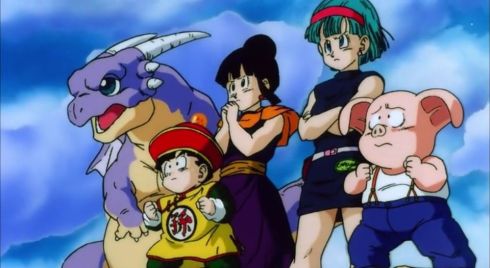
The others are forced to watch as Goku and Krillin go to work.
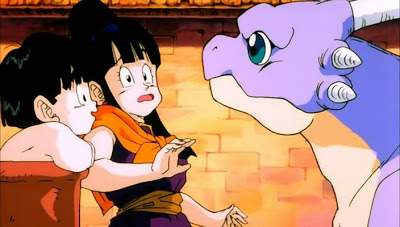
The movies opens in familiar fashion, perhaps too familiar at this point, with Piccolo (Christopher Sabat) quietly meditating by a waterfall. Gohan (Stephanie Nadolny) shows up with his dragon pal Icarus (Sabat), making his second appearance, wearing his old school traditional attire from the very first movie and episodes of the show. Gohan is apparently excited to unveil some sort of song and dance routine he’s been working on with Icarus. It’s kind of cute to see Gohan acting like a child, even if it feels like an atypical scene for Dragon Ball Z. When Gohan starts whistling Piccolo starts to freak out. Apparently the high-pitched noise of Gohan’s whistling bothers Piccolo’s super sensitive ears. Oddly enough, Piccolo seems surprised by it so apparently he’s never heard a human whistle before (which is actually believable since he’s basically been a hermit his whole life).

Lord Slug begins he film as a pretty old, and decrepit looking individual, but he won’t stay that way.
After that episode is concluded, Piccolo notices something heading towards Earth. We get a cut-up of a bunch of folks picking up on the same thing. Instead of the usual, a super-powered being only the Z Fighters can sense, it’s actually a giant, frozen, planet that’s on a collision course with Earth. As the whole world prepares for Dooms Day, Goku (Sean Schemmel) and Krillin (Sonny Strait) fly up to meet it. They unleash twin Kamehameha attacks that entwine and then combine into one super Kamehameha wave, but it seems to have little effect on the onrushing planet. Goku and Krillin are thrust aside and it looks like the planet won’t be spared a direct impact. As the others at ground level take cover, the Earth’s atmosphere goes to work. The giant, ice ball is melted away revealing a colossal spaceship underneath that lands on the surface. Even though the majority of the planet melted away, it still caused a ton of damage.

Chi-Chi gets in on the action, for a moment.
Bulma (Tiffany Volmer), Oolong (Brad Jackson), Chi-Chi (Cynthia Cranz), and Gohan race toward the downed spaceship along with hordes of onlookers to see what happened. A bunch of soldiers emerge and declare that the Earth now belongs to Lord Slug (Brice Armstrong). Interestingly, everyone laughs at them except Oolong, who rightly identifies them as a threat. The soldiers inform the onlookers that Lord Slug intends to “terra-freeze” the planet to use as a new ship, the why of that is never really explained, and then they start firing on everyone. Gohan decides to spring into action and proves himself more than capable of handling these low-level grunts.
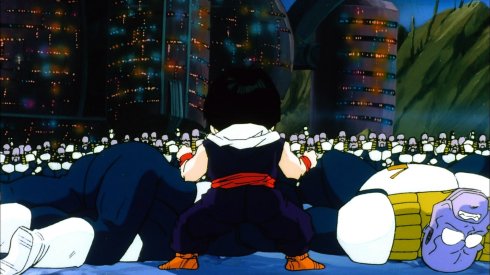
Random minions never fare too well in Dragon Ball Z.
Meanwhile, inside the ship Lord Slug and his handlers look on. We get the usual display of tyrannical power as Slug kills a few minions that displease him in some minor way. They watch what’s happening outside the ship via a video link and Slug notices the Dragon Ball atop Gohan’s hat and recognizes it for what it is. They head outside where Gohan is fleeing with his mother in his arms after she took a rather nasty gut punch. He lost his hat in the melee, and Slug scoops it up lovingly. Bulma stupidly comments on the Dragon Ball, and Slug realizes she knows more than she’s letting on. He grabs ahold of her and demonstrates one of his abilities – the power to read minds. In seconds he knows all and steals Bulma’s dragon radar. Without much of a time jump, Slug is shown on the roof of his ship with all seven dragon balls. Slug, who is green of skin and some-what elderly looking, summons Shenron (Sabat) and wishes for eternal youth. Shenron, apparently being kinder than most wish-granting beings in other media, restores Slug to his physical prime much to his delight. They soon begin the terra-freezing process and the Earth rapidly cools.

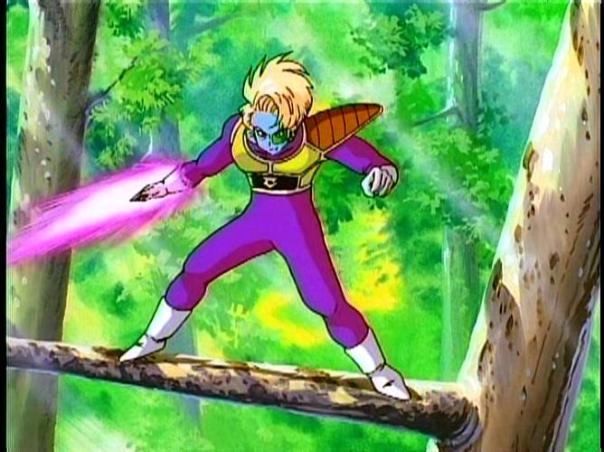
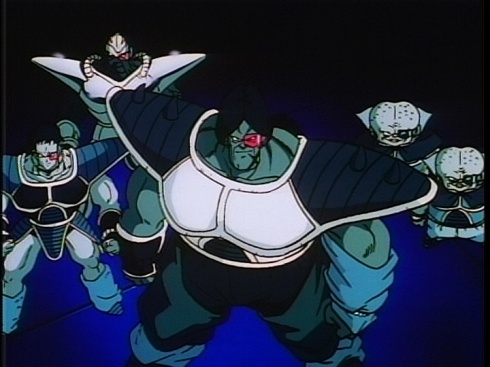
The henchmen of Lord Slug (left to right): Wings, Angila, Medamatcha
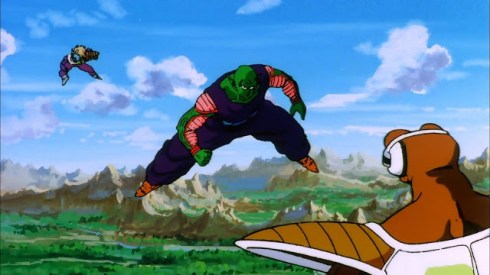
Back at their home, Chi-Chi prepares tea and soup for everyone to fight off the cold. She’s still a bit sore from the beating she took earlier. When she goes to give Gohan his soup she finds him gone, and he’s taken his Piccolo attire. The Gohan-Oolong team from The World’s Strongest has been re-formed, with Oolong even sporting the same outfit from their previous arctic journey. Icarus is along too, and they’re spying on the goings-on around Slug’s ship. They soon attract some unwanted attention from Slug’s men, and unable to escape, Gohan prepares for a fight. Per usual, his guardian angel of sorts, Piccolo, shows up to give him a hand just when it seems like he’s about to be bested. Piccolo squares off with a demonic looking henchman named Wings (John Freeman), while Gohan takes on Medamatcha (Kent Williams). Piccolo finds he’s much stronger than his adversary and kind of toys with him a bit, which ends up being a foolish move because Gohan has more than he can handle with Medamatcha, who has a unique ability to sprout four mini versions of himself that are capable of draining energy.
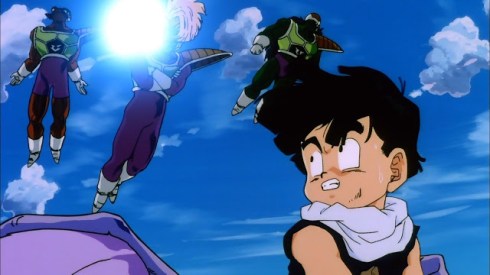
Piccolo finally obliterates Wings, just as Gohan looks like he’s about to go down for the count. As he rushes to help him, Slug’s other henchman Angila (John Burgmeier) takes notice. They try to finish Gohan off, but Piccolo is able to absorb their blasts. The two may be alive, but Piccolo is in bad shape. Without being able to muster a defense, they’ll soon perish.
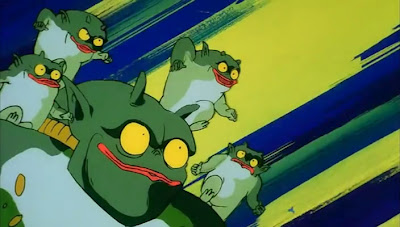
Medamatcha is one of the crazier villains we’ve seen thus far.
Goku awakens somewhere nearby and is shocked to see the world is basically frozen. Yajirobe (Mike McFarland) had witnessed what happened from Koren’s Tower and brought some senzu beans to revive Goku and Krillin. They can’t waste time though as Gohan and Piccolo are in need of some aid and they rush to help out. Goku is able to prevent Medamatcha and Angila from killing his son and friends, and offers his usual warning to his foes before getting to it. Medamatcha and Angila at first appear to be doing well in their coordinated effort to take out Goku. Angila is able to stretch his arms out and grab ahold of Goku while Medamatcha sets his mini-me’s to work in draining Goku’s energy. It’s all for naught as Goku easily overpowers the duo forcing Lord Slug to come out and face him.

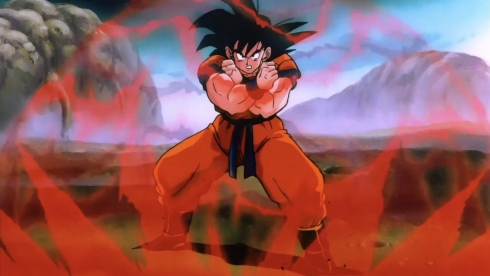
Goku taps into his rage to into Not-Super Saiyan mode.
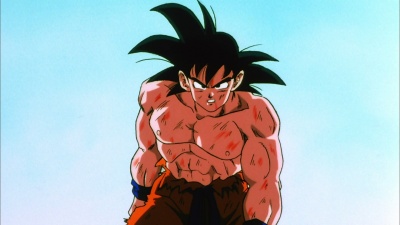
Krillin is apparently unimpressed by the imposing looking Lord Slug and attempts to take care of him all by himself which just results in a comedic moment of Slug batting the fool away about 1,000 meters. Goku correctly notes that Lord Slug has tremendous power, and he even finds himself overmatched. King Kai, who has popped in here and there through-out the film with an anecdote or two, telepathically warns Goku about Slug. When things seem to be at their most dire, Goku is able to summon the strength to battle back. He tries to implore his friends to lend him their energy, but King Kai (Schemmel) lets him know they have nothing left to give. This causes Goku to transform – sort of. He acquires the yellow aura of a Super Saiyan, but nothing else. Since this film came out during the battle with Frieza, but before Goku entered the fray, he’s apparently not quite a Super Saiyan yet making this moment a sort of halfway point. It’s kind of silly, but his form is obviously effective in that he beats back Slug.
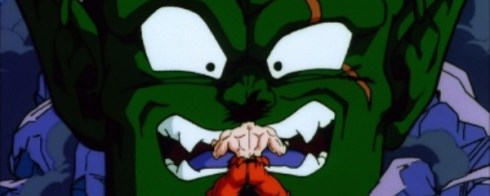
Slug turns the tables by making himself taller than a skyscraper.
Slug, fearing defeat, decides now is the time to unleash his full power. He tears off his arm, which had been broken by this enraged Goku, and regenerates it back confirming what most viewers probably already figured out – Lord Slug is a Namek. Not just any Namek though – a Super Namek! At least, that’s what King Kai calls him. He gives Goku a quick history lesson. Apparently Slug is an exclusive Namek in that he and a small number of others attainted this power. They were evil though, and the other Nameks used the power of the Dragon Balls to banish them from Planet Namek. Slug then grows to a gargantuan size, similar to what King Piccolo and Piccolo Jr. demonstrated in Dragon Ball. They fight, but Goku has seemingly lost the power surge from earlier, or he just can’t match Slug’s.
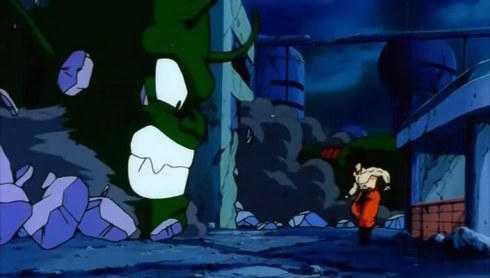
“Hey Goku, what do you think of my smile? That Eternal Dragon sure did a good job of restoring my grill.”
As Slug prepares to squish Goku like a bug, Piccolo pops in to grab Slug’s antennae. Echoing something Goku said to Raditz about Saiyan tails, Piccolo suggests grabbing a Namek by the antennae is especially painful. If so, it doesn’t appear to bother Slug a whole lot as he tosses Goku aside and grabs Piccolo instead. Piccolo then does an odd thing – he rips off his own ears. He calls out to Gohan to do his whistling from earlier. Gohan, still laying on the ground half-dead, hears Piccolo and does as he’s told. Slug’s gigantic, Super Namekian ears pick-up on the noise and he starts freaking out much like Piccolo did earlier. He drops Piccolo, who then transfers his energy to Goku, so he can finish the job. Just as he did as a boy to King Piccolo, Goku launches himself directly into Slug’s chest and then through it. Slug isn’t dead just yet though, as Goku flies into the sky to prepare a Spirit Bomb to destroy Slug’s ship, the Super Namek grabs him by the foot forcing Goku to instead use the bomb on him. No harm, no foul though as the bomb is able to take out both Slug and his horrible ship and the Earth is safe once again. The movie ends on a joke, as others have before it, only this one is pretty bad. I won’t spoil it for you if you haven’t seen it though.
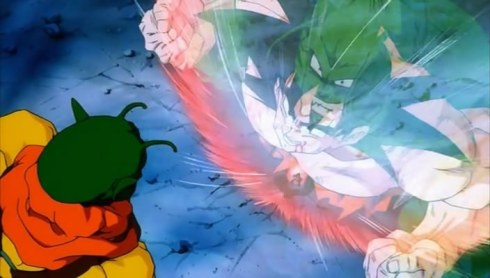
Piccolo at least gets to play more prominent role in this one.
It would seem the consensus on the internet is actually right about this one, at least as it compares with the first three Dragon Ball Z films. Lord Slug is indeed the worst of the three. Alien invaders seeking to freeze the entire planet to use as some sort of vessel is pretty bizarre. Maybe if Toei could have come up with a valid reason for why this was necessary it could have worked, but instead they just let it hang in the air. Worse is the rather lazy writing. Goku and Krillin get taken out by Slug’s ship, but they’re out of action for way too long. At the same time, it takes Slug no time at all to amass the Dragon Balls. Way too much happens between Goku getting knocked out and returning to battle. Furthermore, the Super Saiyan transformation isn’t discussed as a possibility though-out the picture, so when Goku “transforms” it’s not earned. Instead, he just goes from getting pummeled to suddenly dominating.
The one-sided fights are too frequent in Lord Slug. There are basically no even matches. Either a hero is over-powered or a villain is, and there’s a seesaw effect at play. It makes for boring action sequences. I don’t mind seeing a couple instances of this, but it usually leads to a fight where both competitors are on relatively equal footing, at least it has in prior films so far. As a result, Lord Slug has some of the weakest action sequences so far, and worst of all it also doesn’t look so great in places. In particular, when powered-up Goku goes on the attack the effects look awful. Buildings look like they’re made of cardboard and the debris is all floaty. Even the big attacks aren’t particularly interesting looking, though I did appreciate the nod to Dragon Ball with Goku’s super headbutt attack.
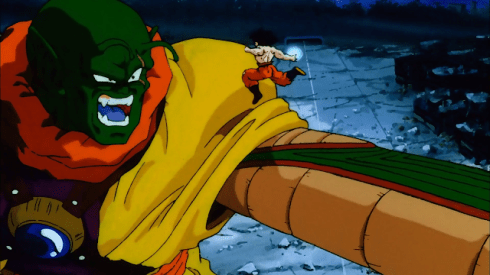
The movie isn’t the best, but I don’t lay that on the massive shoulders of Lord Slug himself.
As a villain, Lord Slug doesn’t bother me much. He has a solid design, and the slow reveal that he’s a Namekian is kind of fun, though if you were paying attention you probably would have noticed the signs. He wears a helmet throughout the film leading up to the reveal, which is why it isn’t obvious. The whole Super Namekian is kind of cheesy sounding, but I like the little built-in lore, even if I find the King Kai narration bits intrusive. The whole high-pitched sound weakness thing though is pretty stupid. I guess it’s better than having Slug get dispatched in the same manner as so many other villains, but if Namekians really had such a weakness wouldn’t it show up more often?
Lord Slug was under-served by the movie that bares his name (in English anyway). It’s the first, and likely not the last, Dragon Ball Z film that really feels half-assed. Lord Slug is an interesting villain, and it wouldn’t have bothered me to see the other Super Nameks come into play in a future film, though it never happened. They probably would have used that silly whistle thing to topple them anyway, so maybe it’s good this is the last Super Namek we see. Lord Slug is a movie of recycled bits and half measures, it’s entirely forgettable. Is it actually bad though? I suppose it’s like a bad episode of the show – it’s not particularly memorable, and doesn’t have a signature dazzling moment, but it doesn’t feel like a total waste of time. You just likely won’t feel like watching it again for a long time, if ever.

 Dragon Ball Super did to me what basically every cartoon/anime does: it made me want toys based on it. It’s a compulsion I’ve never outgrown, apparently, and Bandai has made it fairly easy (but not cheap) to get what I want. Months ago I did an entry on the SH Figuarts Super Saiyan Vegeta. That line is like the premium action figure line for Dragon Ball Z (as well as other franchises) and a single figure from that line routinely sells for over $50. Not all fans are into 6″ figures at such a price point, and even though I have two such figures I can’t say I’m really into it myself, and for those fans Bandai has its Dragon Stars brand. These action figures are more in-line with what you would get from Hasbro. They’re super articulated figures that run for around $20, which is sadly the going rate for such toys in this day and age. They often have a few interchangeable parts and also come bundled with a piece of another figure. Collect the whole line and you can assemble a sort of bonus figure. Back in the days of ToyBiz and its Marvel Legends line that bonus figure was often a giant figure twice the size of a standard one, but in today’s world it’s just a standard sized figure.


 Japanese Title: Clash!! The Power of 10 Billion Warriors





 Episode Number: 44



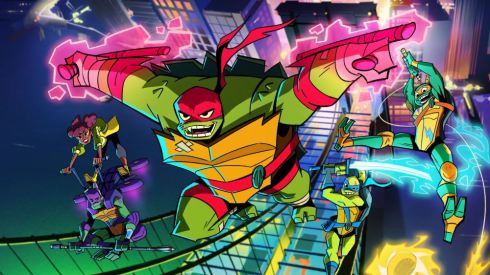 On July 20th, Nickelodeon offered up a preview of its newest take on the Teenage Mutant Ninja Turtles. Dubbed Rise of the Teenage Mutant Ninja Turtles, the new show is the heir-apparent to the one Nick ran from 2012-2017. Simply titled Teenage Mutant Ninja Turtles, that show was a modern re-telling of the story we’re all familiar with. It was presented in CG and featured the main characters from the comics and older television shows while mostly adhering to the personalities that had been long established throughout the various media. It was the fourth attempt at bringing the Turtles to television, and by all accounts it was pretty successful. Likely no future version of gang green will ever be as impactful as the 1987 series, but that doesn’t mean it can’t still be a success.
 Rise of the Teenage Mutant Ninja Turtles is an entirely new show with a new cast of characters. In some ways, this is the most ambitious reboot we have ever seen for the franchise. The 1987 series took the most recognizable characters from the Mirage comics and adapted them for television while also stripping out the violence. Each turtle was given his own personality, something they kind of lacked in the comics, and Shredder was made the main villain and given an accomplice in Krang. Ever since that series found success, it would seem each successive iteration tried to incorporate more of the original comic. Starting with the 1990 movie, Raphael would see his prickly and combative nature made his default personality, the tone would be a touch more serious, and Shredder more deadly. The 2003 4Kids series practically adapted the early books, and even Michael Bay’s turtles tried to keep some of that spirit, while also bringing the turtles closer to their cartoon counterparts.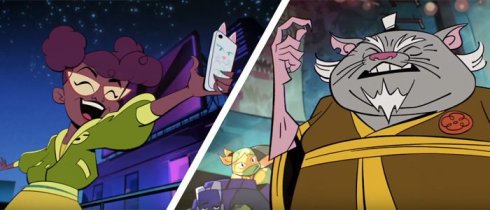


 Japanese Title: The Incredible Mightiest vs. Mightiest




 Episode Number: 43


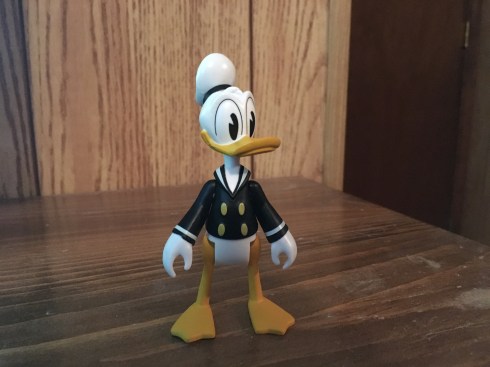
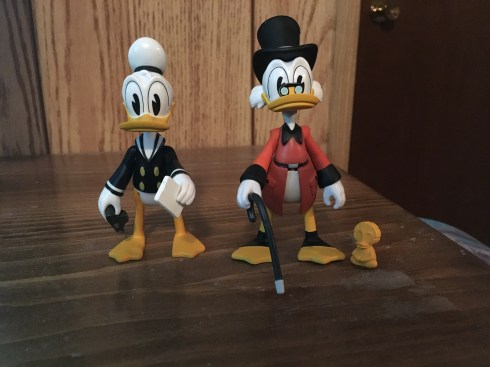 It’s been nearly a year since DuckTales returned to television airwaves. Scrooge McDuck, along with his nephews and surrogate niece Webby are back to solve mysteries and rewrite history. It’s a fun show that adheres more to the work of Carl Barks than to the series that ran in the 1980s while also doing its own thing. For the first time really ever, the nephews Huey, Dewey, and Louie are distinguishable by more than just the color of their clothes and the cast is large enough that the writers don’t seem to feel pressured into fitting everyone into every episode. Sometimes Scrooge will be missing, other times Donald will be. It seems to be a show more about the kids and how they view the almost mythological Scrooge. And it also has other mysteries to uncover and it’s mostly good fun.




 Episode Number: 42


 Japanese Title: The Decisive Battle for the Entire Earth




 The Nostalgia Spot