Tag Archives: fighting games

S.H.Figuarts Marvel Gamerverse Cyclops

A new challenger has arrived.

A funny thing happened in 2025 where two companies revealed they were going to be making action figures based on the hit video game series Marvel vs Capcom only for neither company to actually mention the words Marvel vs Capcom. It would seem that neither Hasbro nor Bandai wanted to compensate the Capcom portion of that pairing so instead we’re getting “Gamerverse” figures based on “the popular video game series.” Yes, it was kind of amusing watching the people at Hasbro try to talk around that fact, but to the initiated these action figures are clearly based on that series of games which began way back in 1994 as X-Men: Children of the Atom before morphing into the tag team video game confrontation series it’s most known for today. To see Hasbro mine this franchise for characters was hardly a surprise. They had basically already begun as much with their release of a yellow and blue Cable in 2024 and the Iron Man with proton canon set that came before it. 2025 was just the year they leaned into it more heavily and it so far has produced some pretty nice results. As for Bandai, I’m not sure if anyone saw that coming. It makes more sense for the company since they have had the Street Fighter license in the past and seem to still do though their output has dwindled more recently (which probably has to do with that I.P. getting licensed out to several companies now). Making some Marvel characters to scale with those seems like a natural pivot, but I wasn’t sure if it was something they were allowed to do. Most of the Bandai figures I’ve seen are based on film franchises, but I guess someone at Disney felt that video games was a natural extension of that.
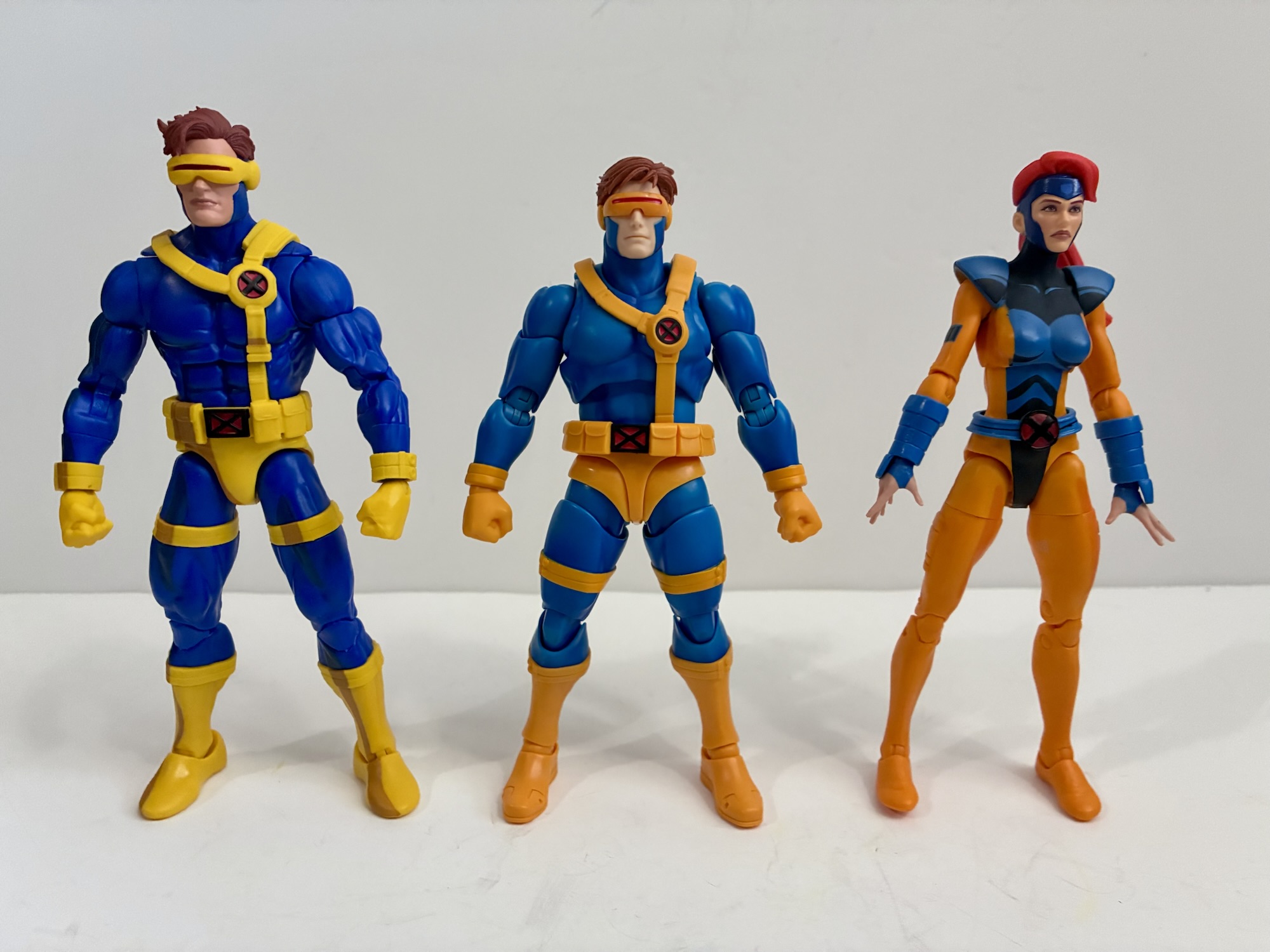
He’s shorter and stockier than his Legends counterpart, though the picture makes it look more apparent than it does in reality.

I’m not sure if either company had advance warning of what the other was up to, but it seemed to work out nicely for Bandai that their first ended up being the leader of the X-Men: Cyclops. Hasbro didn’t touch the character in their own Gamerverse line and even Bandai’s follow-up, Spider-Man, has so far not made an appearance for Hasbro (Wolverine follows who was the star of the Hasbro releases last year). The X-Men are pretty damn popular and it was their video game that got the ball rolling so it makes sense to turn to one of them first, though Cyclops can probably be thought of as a slight surprise. Wolverine will always be the expectation, but even someone like Gambit could have lead the way or even Rogue or Psylocke. Cyclops has been featured rather prominently in marketing materials though so it’s hardly an upset that Slim would get the coveted debut slot. And as a character who fires lasers out of his eyes, he tends to lend himself rather well to action figures. And then there’s the fact that Hasbro has kind of struggled with this design at times. I think most agree the figure based on his look in the animated series has been their best take, but that was a pretty bare bones release that was also a Pulse exclusive. He also has that controversial cel-shading much of the collector community seems to despise. The figure was essentially re-released to general retail as part of the X-Men ’97 wave of figures, but it had a new, and terrible, portrait. Many have taken to swapping the portraits between the ’92 and ’97 versions finding it’s much easier to remove the cel-shading on just a head as opposed to a whole figure.
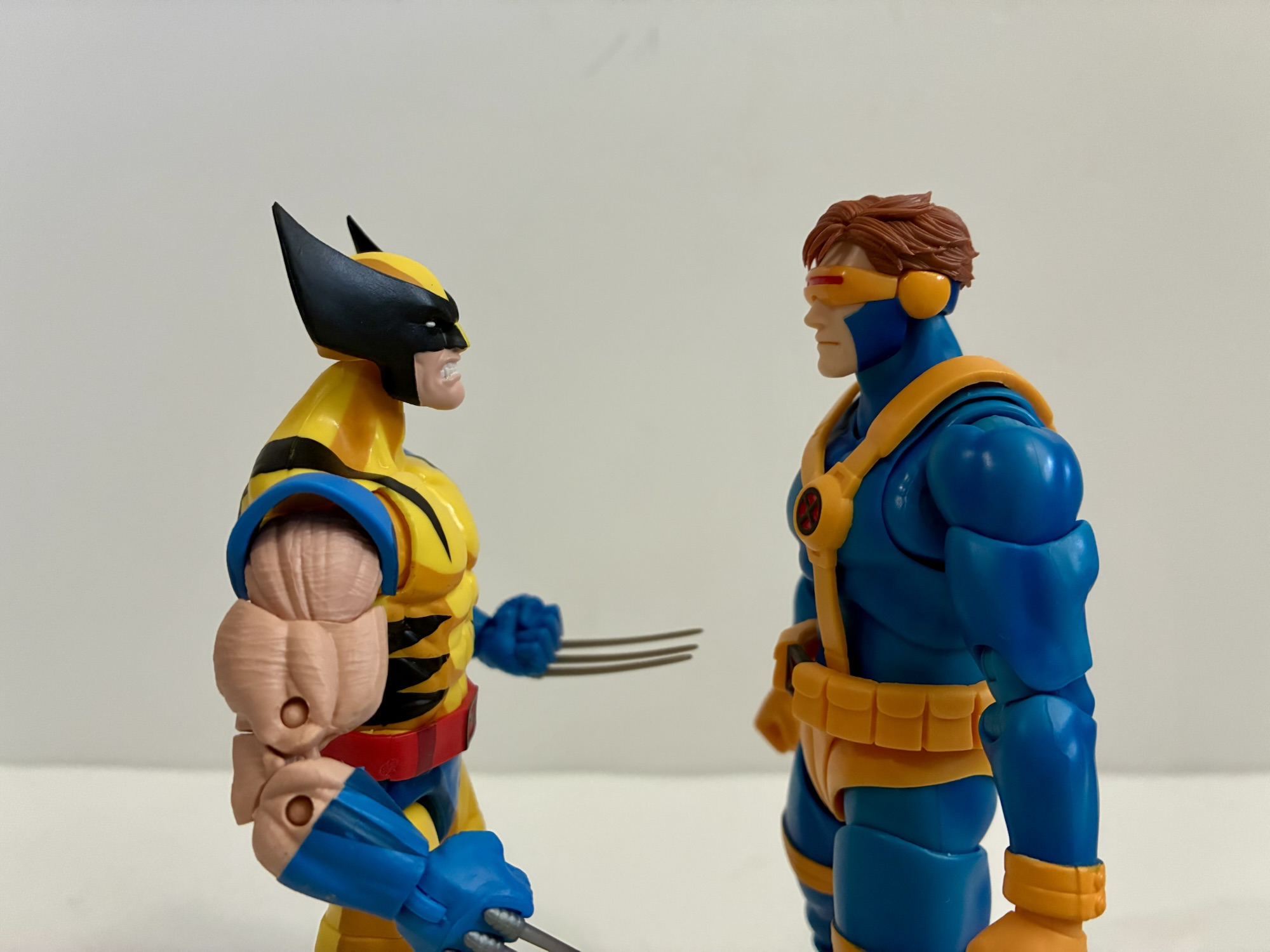
He still looks down on a standard Wolverine, but perhaps not to the degree most would want.

As for me, my goal with my X-Men collecting is always to assemble that ’92 animated team on my shelf in the most authentic way possible. The Hasbro figure is fine, but it does bother me he has no effect parts and the portrait is pretty off-model for the show. Not terrible, but certainly not perfect. This Gamerverse Cyclops isn’t really going to get me closer to my ideal take on the character, but it did look like a figure that was just a whole lot more fun. There are caveats though. For one, he retails for around $100 for North American buyers. That’s a big price, and even though I was able to get that mark down to $89 that’s still an expensive action figure in this scale. He’s also shorter and there’s a question of scale where the figure is concerned. It wasn’t enough to get me to bail, but now that he’s in-hand it’s time to figure out if this was money well spent.
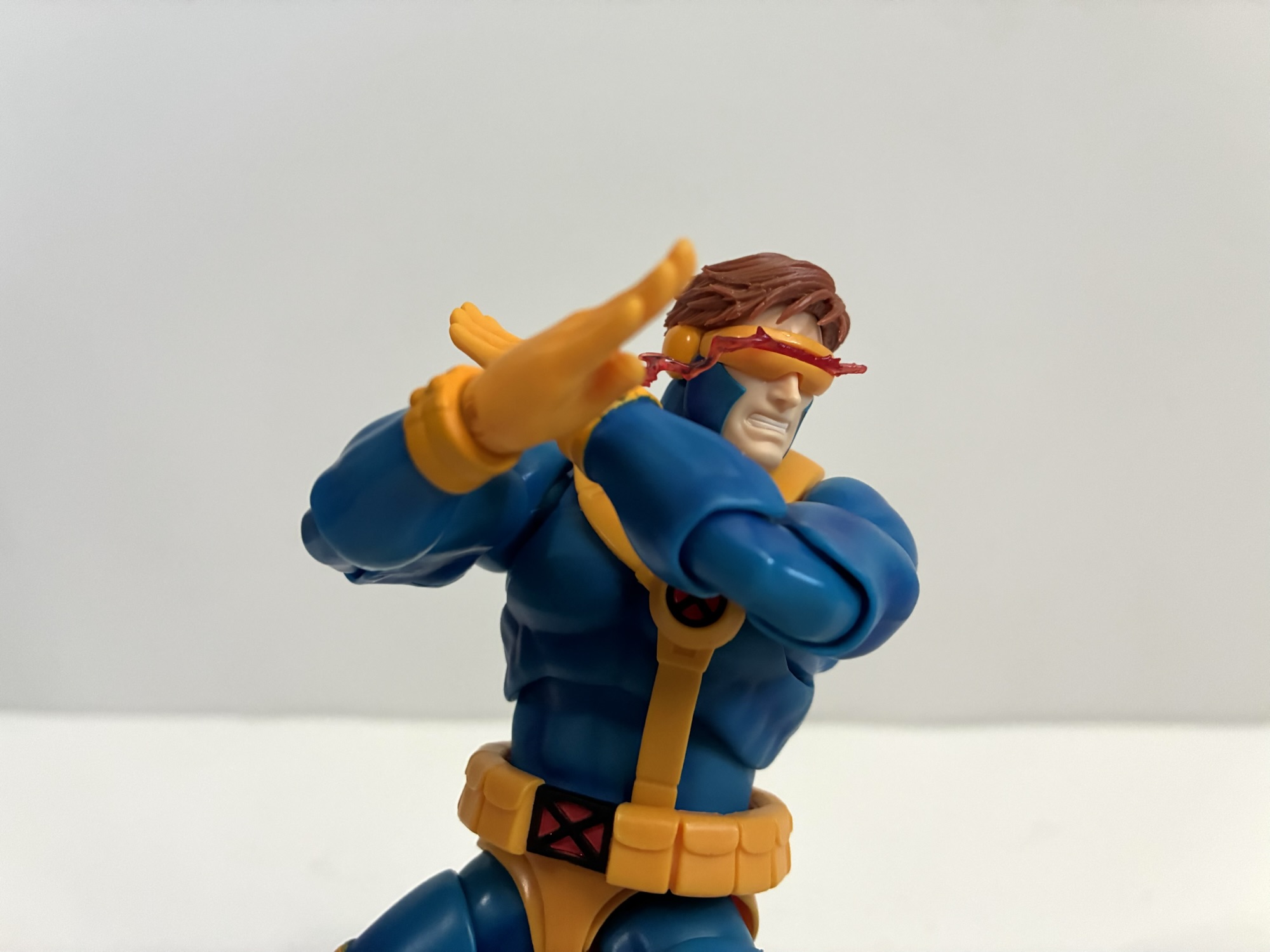
He’s got enough stuff to duplicate a lot of poses from the games.

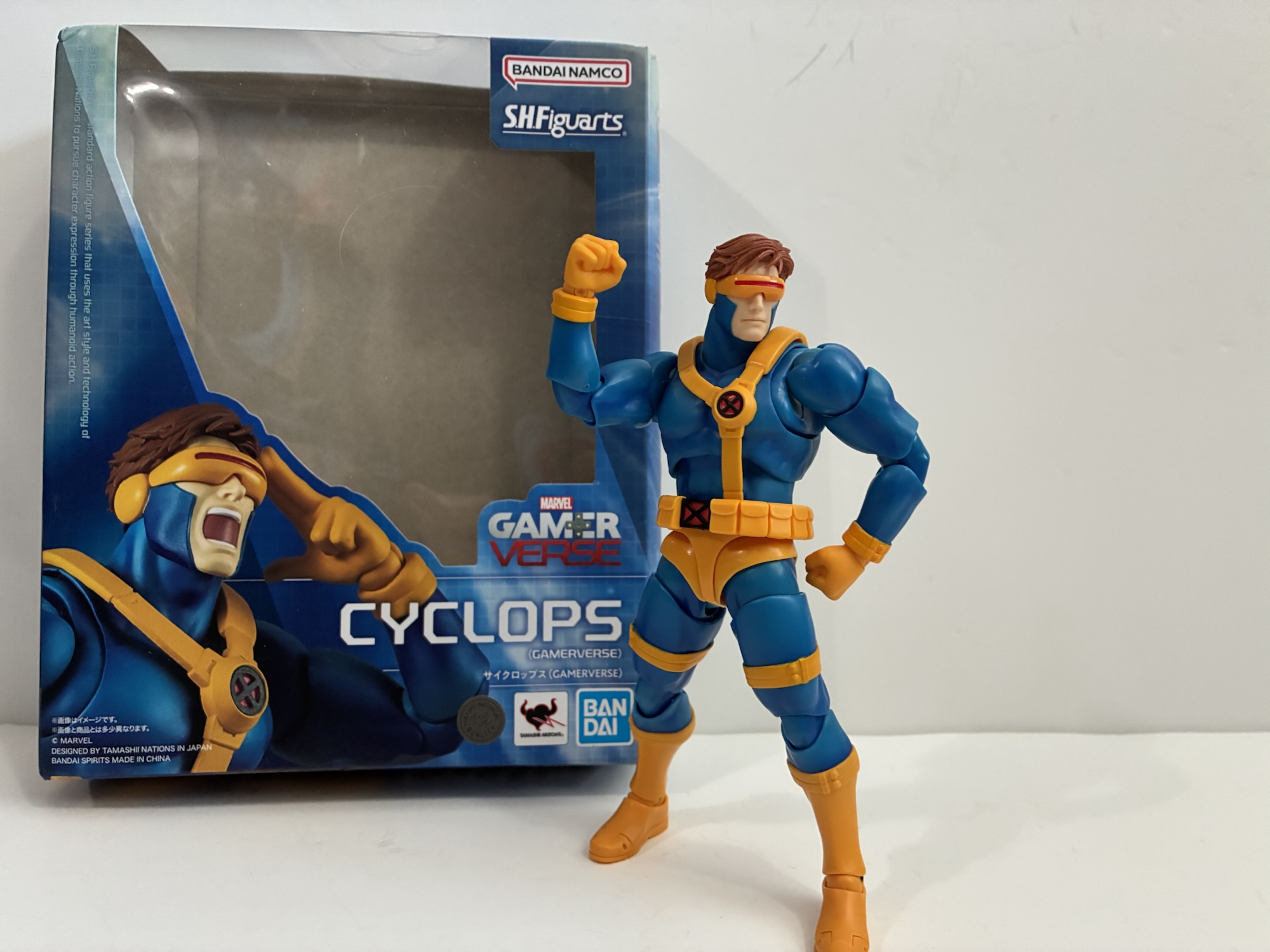
The Gamerverse packaging is pretty much like any other SHF release. My box got pretty well mangled in shipping since I got it through Amazon and they decided that $100 figures should just be placed in brown paper bags (meanwhile, my sub $10 manga gets the box treatment). They’re lucky I’m not an in-box collector. Out of the box, Cyclops stands at around 6.125″ to the top of his hair. If Bandai is going for true 1:12 scale then this might be okay. This is video game Cyclops, not comic or cartoon Cyclops. In the game, he’s pretty much average height and if they’re saying he’s a bit over 6′ tall then that seems to conform well enough. Where it will cause issues is for those who just want to slot him in with some Marvel Legends figures. Compared to the VHS series Cyclops referenced earlier, he is indeed shorter as I have that guy at about a quarter of an inch taller. Is that a meaningful distinction? That I can’t really answer as it’s going to be pretty subjective. He’s still taller than the ’92 Wolverine and ever so slightly taller than my ’92 Jean (with a ’97 head). That’s in just a straight up and down stance for all figures. Crouch Wolverine down or put some bend in the knees of Jean and he starts to look taller. For me though, the real thing that stands out is that this is a thick Cyclops. He has a big neck and something of a square head. Cyclops traditionally has a taller, slimmer, head in this costume, but with this design the head is more in-line with the neck. It’s an all-together different silhouette. His torso comes across as more compact, though in reality it’s the same size as the Hasbro figure if not a little taller. It’s the thickness and his unique belt that give off the appearance of a stockier torso. The legs are indeed shorter than usual though while his arms might be a touch longer than average or it’s just his big mitts that make it appear that way. This is the point where I mention that some folks who have this figure have purchased an aftermarket double ball peg for the inner torso that does make the figure taller. I think his issue, if there is one, rests with the legs though so I’m not too keen to fork over the $30 for a piece of plastic to see if I like it better, but it’s out there if that’s your thing.
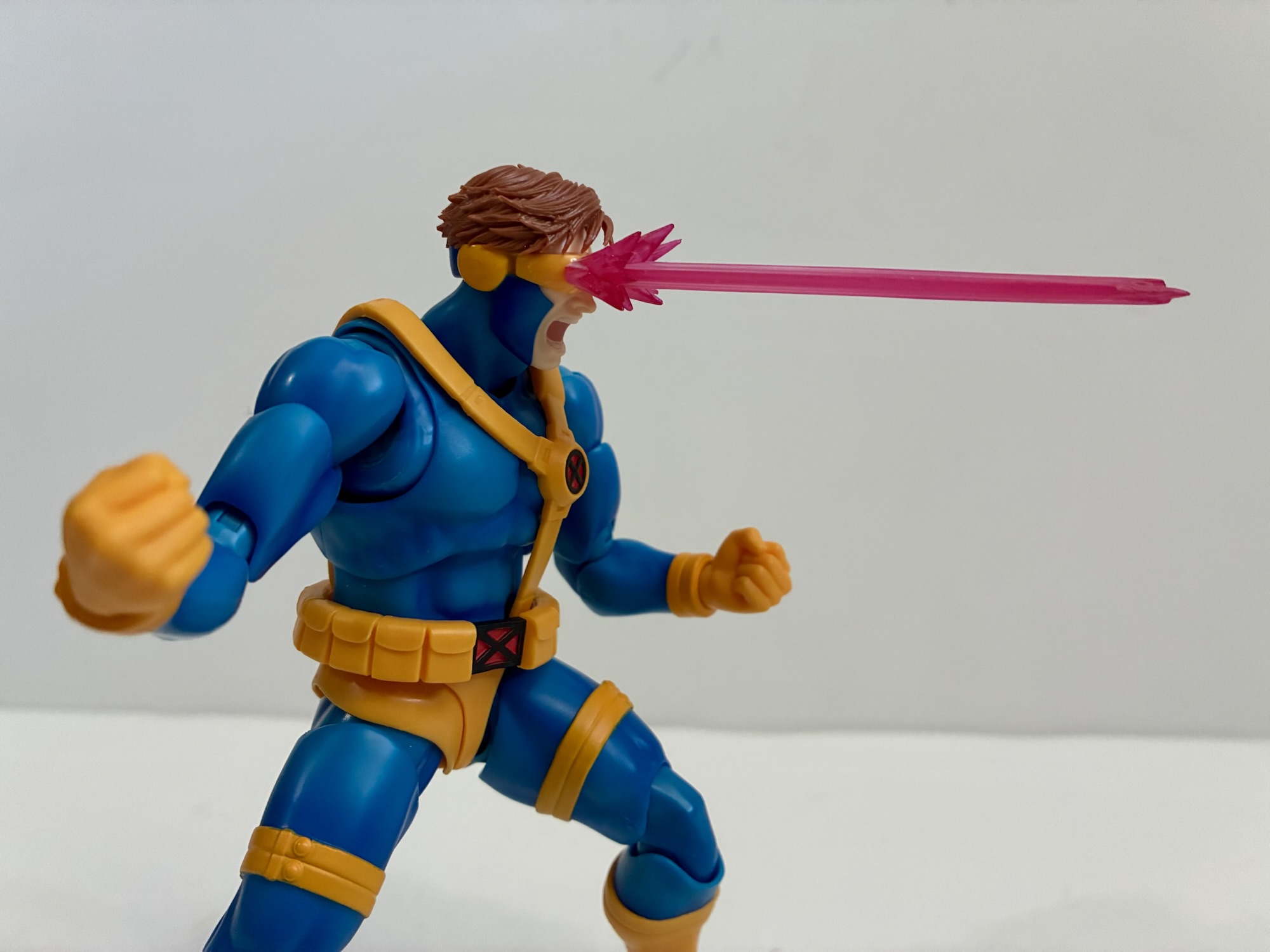
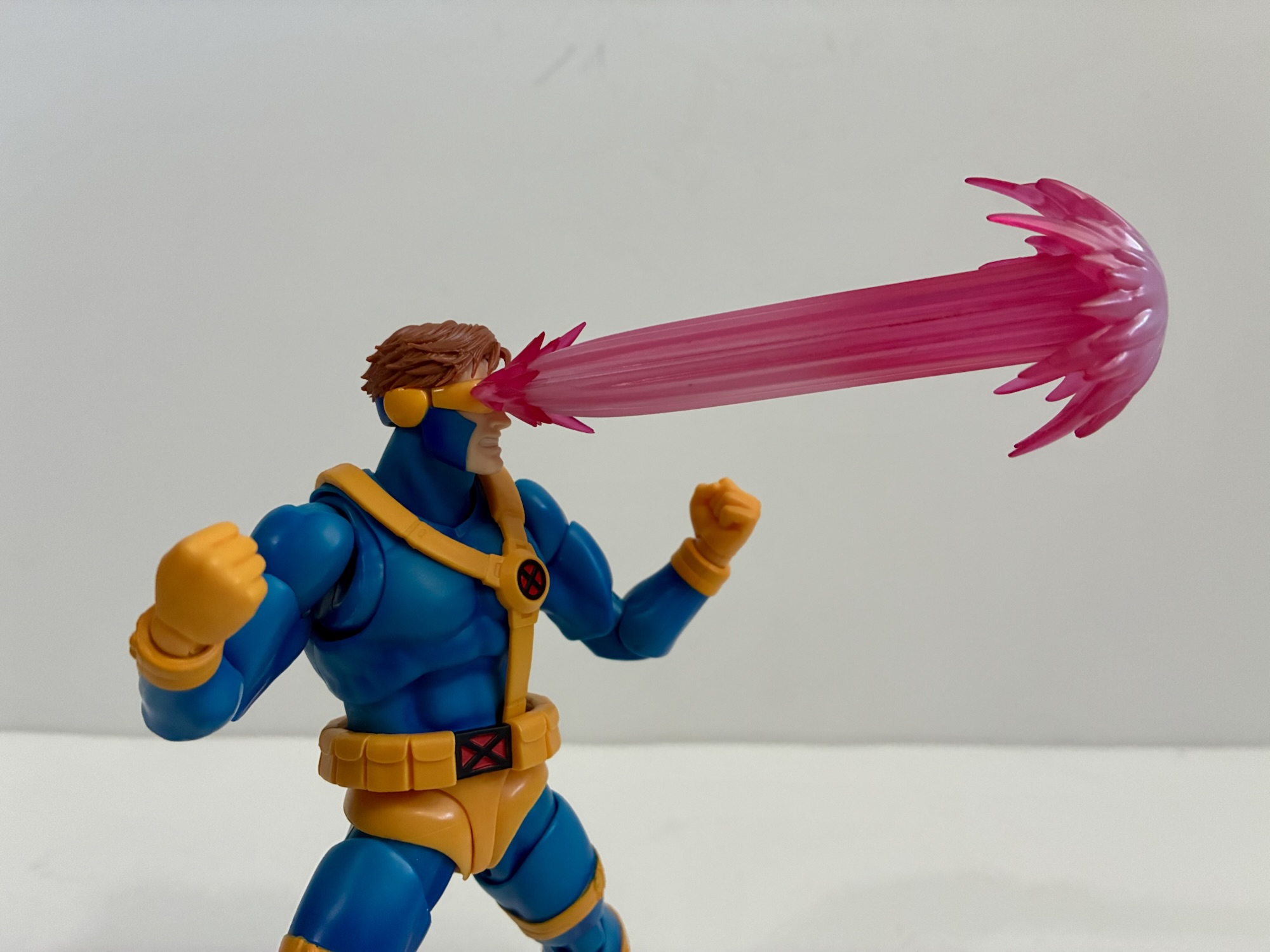
The other thing that stands out with this figure when grouped with your Legends is the shade of yellow in use. With Hasbro, recent editions of Cyclops have gone very yellow – a bright, lemony, shade. With this figure we’re back to that orange-yellow which Hasbro used to use for Cyclops. It wasn’t super obvious to me in the solicitation shots, but in-hand it most certainly is. I prefer this costume go more yellow as it plays off the darker blues better, but his bodysuit also isn’t the same shade of blue that Hasbro has been using. For that, we get a lighter blue with almost a metallic finish. It’s subtle, but there’s a purposeful shine to it. There’s also shading in the lines for the muscles and around the joints which does look nice in person. It’s just a shame the orange-yellow parts lack the same care. Those parts are basically all bare plastic and some take on a non-purposeful shine that looks cheap. In particular is the crotch area where Bandai is utilizing hard plastic caps to fill gaps like we used to see with the Dragon Ball line. The visor, unfortunately, suffers from the same. The painted yellow at the thighs and wrists looks better as it absorbs more light while the boots, unfortunately are colored plastic though they’re not the same material as those harder pieces. The skin tone is also extremely pale, almost a bone white. The hair is unpainted, but sculpted in a very convincing manner that’s almost too realistic, but otherwise looks nice. I should also point out that this design uses the non-traditional “A” shape for the rear of the harness that’s true to the game (and if you had the classic Toy Biz figure it was the same there) while most illustrations of this costume just have the rear mirror the front without the X logo.
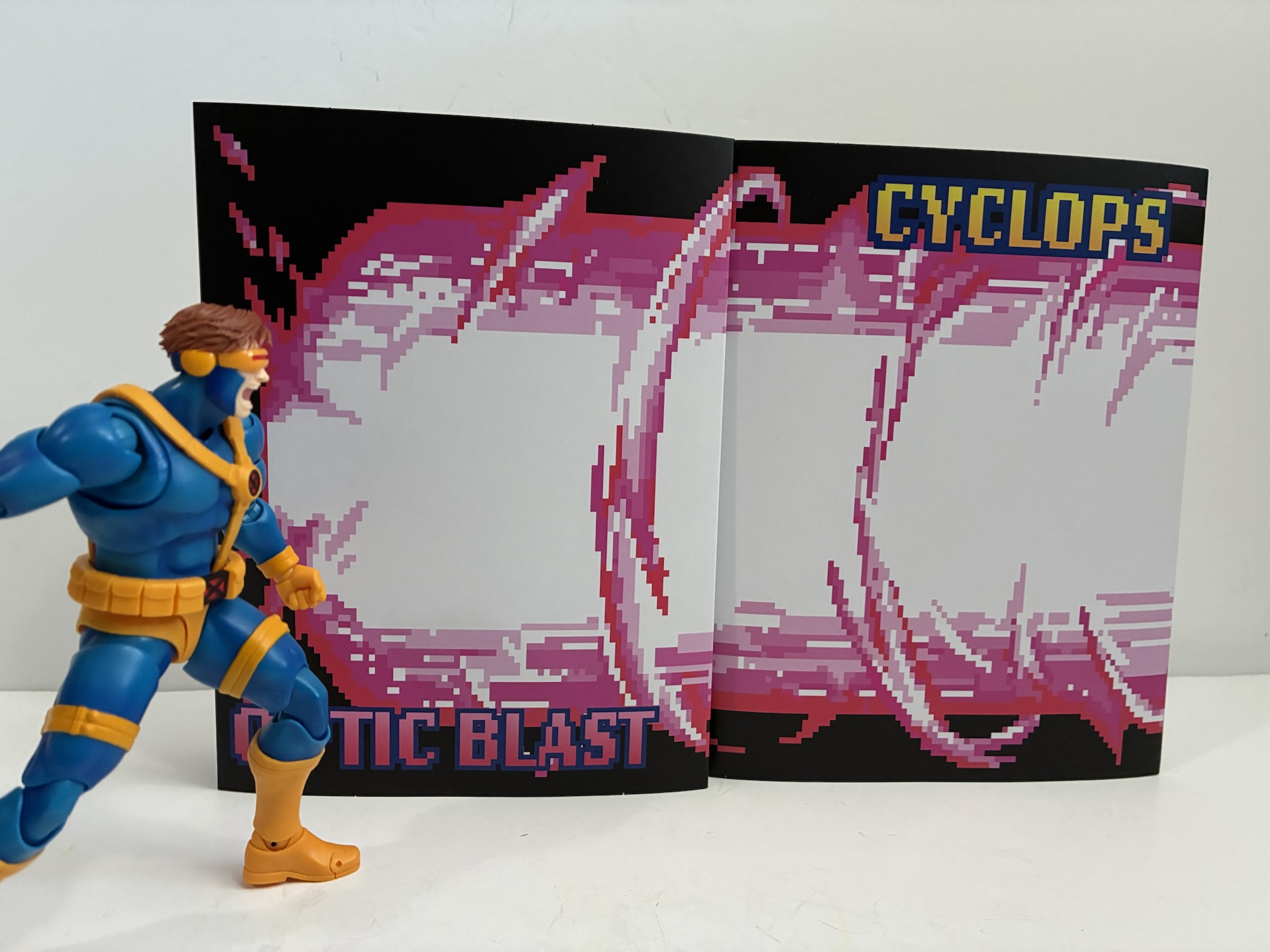
Bandai also threw in this cardboard accessory that’s…interesting.

Those unsure of the overall look of the figure will likely need to be sold on the next two parts: accessories and articulation. At least in the accessory department, this figure is a clear upgrade over most others. Cyclops comes with five sets of hands: fists, two-finger pointing, open, clenching, and chop. The two-finger pose is for when he manually activates his optic blasts at the visor and also his pointing gesture for a victory pose in the games. The chop also comes from the games where he makes an X with his arms before unleashing his super. They’re all good choices, but more exciting are the effects. For optional expressions, we get a teeth-gritting and a yelling head to go with his default neutral expression. The hair swaps to all of the heads while the visors do as well. And for those we get a total of four: standard, power “leaking,” short blast, and long blast. The standard one is just that, it’s a shiny plastic piece with a red line painted on. The “leaking” one has a translucent, red, piece which mimics a lot of the game art for the character and is a pretty fun look for your self. That is, if you can resist using one of the blasting visors. The shorter one is more narrow and kind of like a blade while the longer one mushrooms at the end. Both are done with translucent red plastic sprayed with white for a nice look. Both are pretty great and shelf space may be the driving force over which one you prefer. Or how they fit since that’s a bit of an issue. The optional visors have a hard time sitting flush with the portraits and can leave a tiny gap near the ear. Heating the head you wish to use and softening the plastic can help, as can just plain old elbow grease. I haven’t had any issues getting them to stay on and I even placed Cyclops on my shelf with the heavier of the two blasts for a couple of weeks before getting to this review and his head never drooped and the part never fell out. Still, after my experience with the interchangeable face plats on the recently released Super Saiyan Goku, it’s a bummer to see a similar issue here albeit one that isn’t to the same degree.
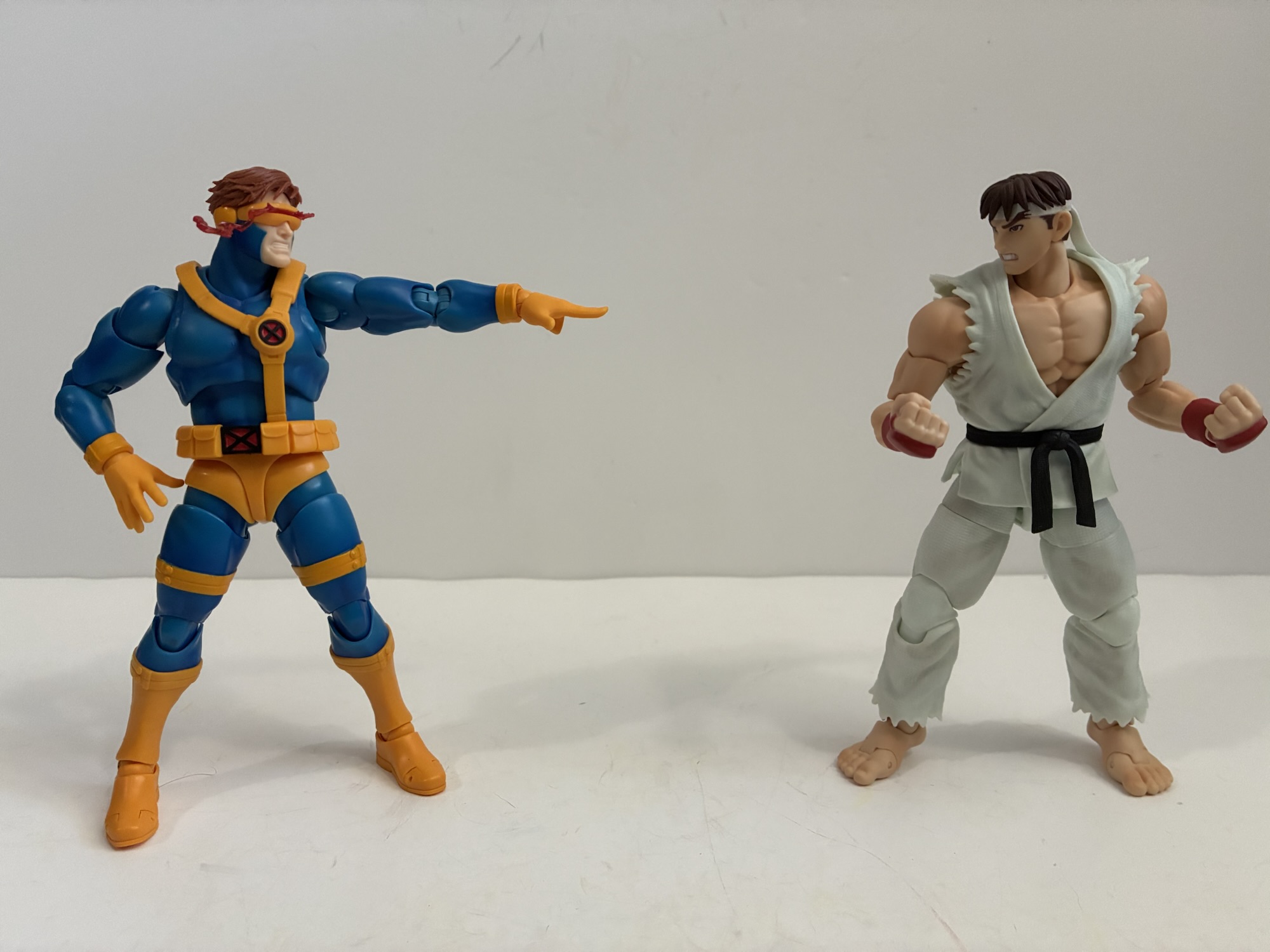
This seems like a more relevant size comparison than perhaps one to Legends figures.

Rounding out the package is a cardboard standee of Cyclops’ massive optic blast from the game. It’s two pieces of cardstock and I guess it looks fine, but it’s a pretty cheap presentation no matter the quality of the print. I suppose it didn’t cost them much of anything to include, but I can’t see using this thing. Of more note are the optional neck parts. Of which there are two. They pop in and out very easily and the intent seems to be to provide a more stable base for the heavier effect parts. Both basically remove the ability for the neck to do much where it meats the torso while retaining the head articulation. One piece is more straight on while the other is angled up slightly. It’s a good thought and a bit of a fail safe in case the default neck proved to be too loose, but I haven’t experienced any issues with the standard one. For my two week experiment from before, I kept the standard neck in place just to see what would happen and it held up fine. Would it still after six months? A year? I don’t know, but it certainly doesn’t seem any looser. These extra parts can perhaps get a more natural looking curve to the neck for those blasting poses so they’re not worthless or anything, just interesting. And in case you were wondering, even the longer one doesn’t materially change the profile of the figure. It sits lower in the torso and I still have him at 6 and an eighth with the longest neck in place.
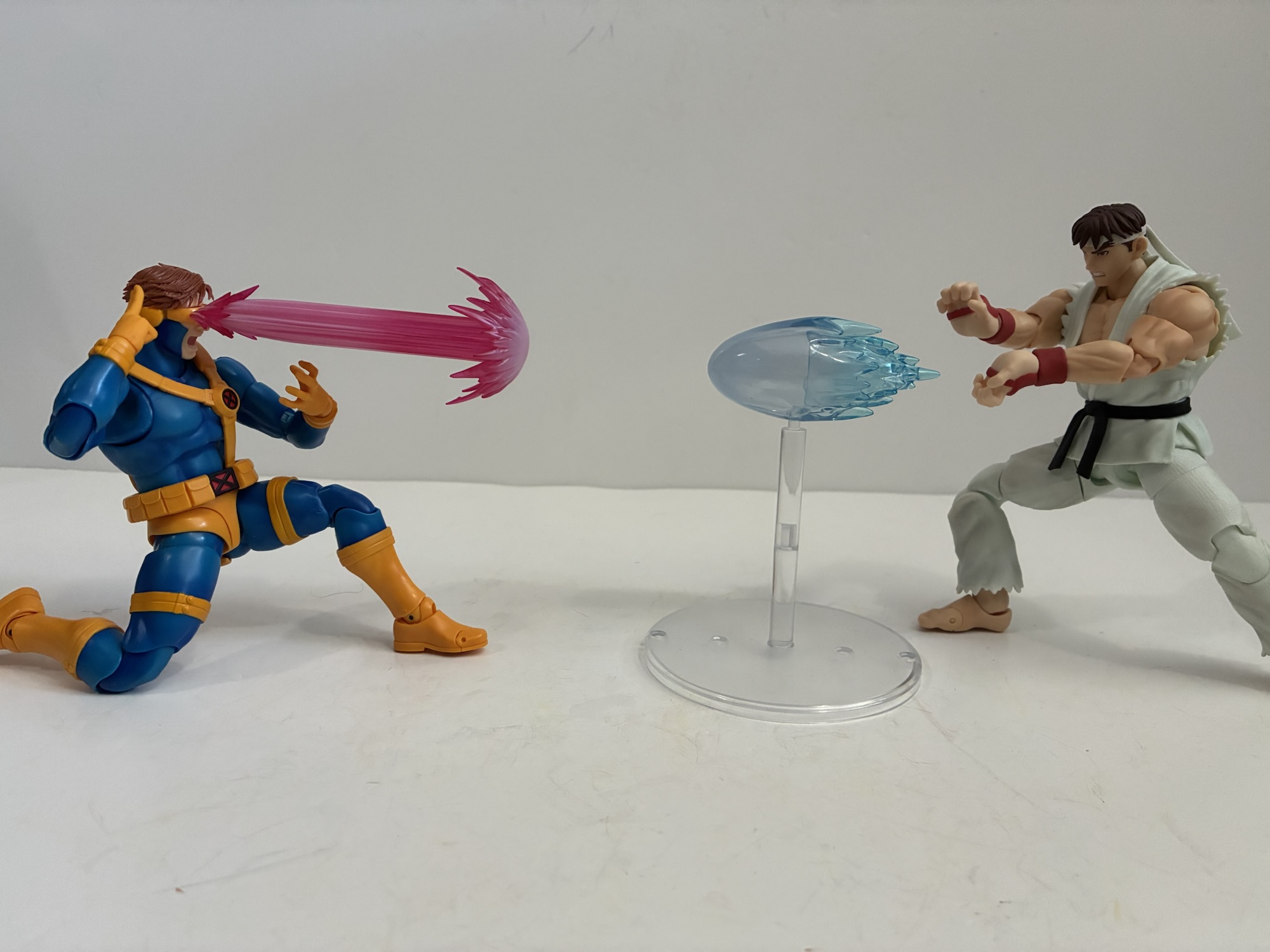
Natural rivals.

The other most likely area for this Cyclops to shine when compared with the cheaper alternatives is with the articulation. It’s what Tamashii Nations has staked its reputation on. With Cyclops, he seems to follow a lot of the same design philosophies as the recently released Scarlet Spider and that’s not exactly welcomed news for me. We do get a mostly typical load-out for a SHF release: double ball head, ball neck, shoulder hinges that peg in, butterfly, bicep, double elbows, wrist ball-hinge joints, diaphragm double ball joint, hips, thighs, double knees, ankle swivel, ankle rocker, ankle hinge, toe hinge. What’s missing? A damn waist joint. Why is Bandai omitting waist articulation from its Marvel figures lately? I don’t understand it. With Scarlet Spider, the culprit is a lower back piece that’s part of the waist sculpt and seems to only exist to prevent gaps from appearing at the waist. The joint itself is a simple ball peg, like most SHF releases, and it’s just this spacer that prevents rotation. With Cyclops, perhaps it has something to do with these straps that go over the shoulders. They connect underneath the abdomen and there’s actually some play here. You can pull them out and push them back in to provide for more articulation in the diaphragm. It’s a sound concept, but practically speaking offers little. That joint is pretty limited as it mostly tilts and barely rotates. There isn’t an obvious spacer like Scarlet Spider, but there is a blue piece that appears to be doing essentially the same thing and that is preventing the figure from rotating. The hips with the old cap system in place at least work well going forward and back as well as out to the side – certainly more than a Cyclops likely needs. I do like the more traditional thigh cut instead of that hideous thing they’ve been giving us in the Dragon Ball line and the ankles work well. There is an exposed, metal, ring on the hinge at the ankles which some may not like to see. They also did the same thing with the shoulders as we saw with Scarlet Spider where the inside of the shoulder is quite flat. If you put him in a standard T-pose he’ll look pretty weird, but I guess that’s a pose you’re probably not likely to do so does it matter? The butterfly joint is okay and doesn’t break up the sculpt much so we’ll call it a plus. Really, it’s just the torso that blows, but that is kind of a big deal since the torso is most of the figure. Nothing is stuck or floppy so the quality control where articulation is concerned is at least a positive.
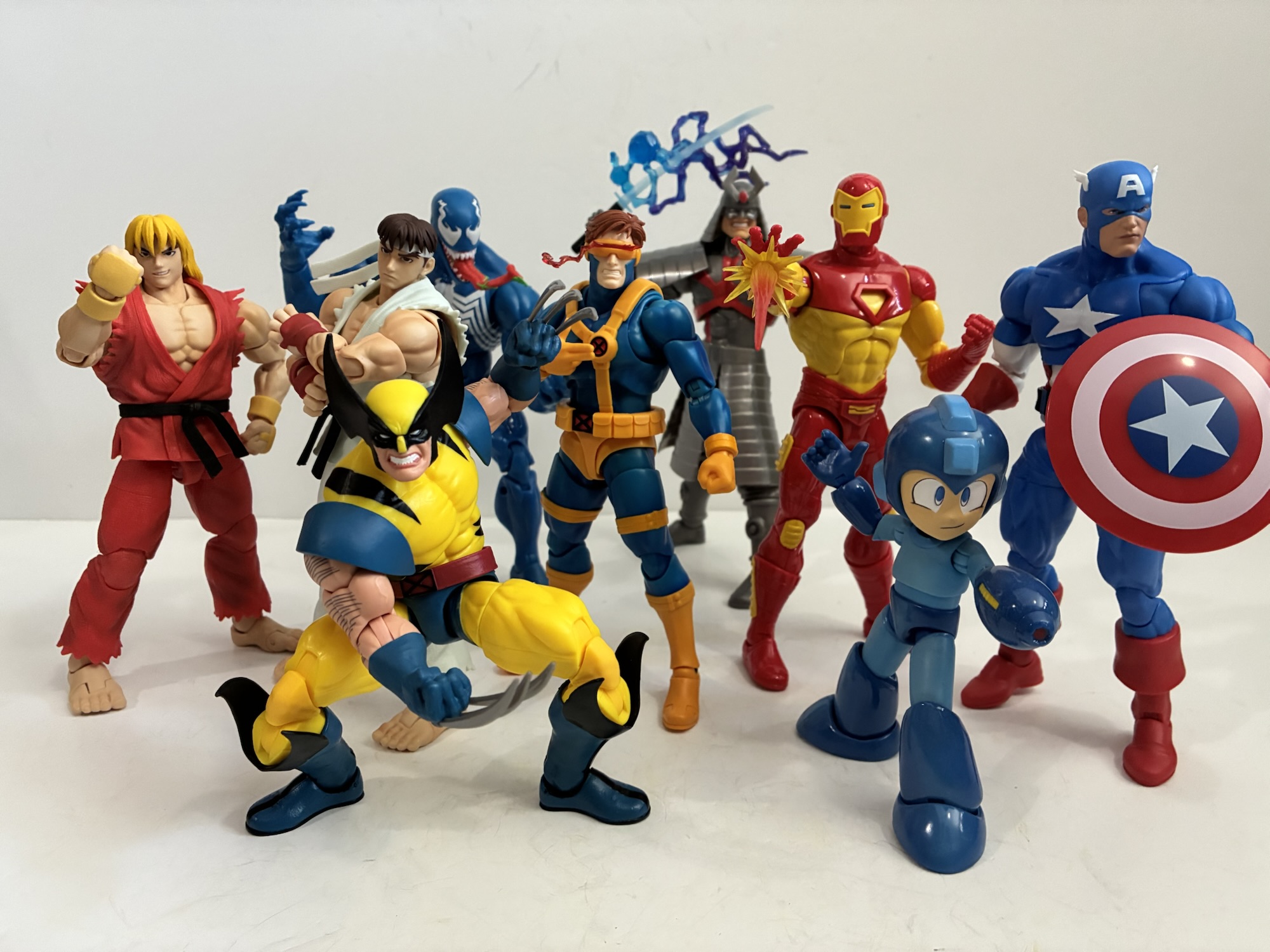
I have some nits to pick with a lot of the figures here, but I don’t hate how this looks.

At the end of the day, I’m a little conflicted here. This isn’t my ideal interpretation of Cyclops, but I can’t really say it’s off compared with the game it’s drawing inspiration from so I don’t think it’s fair to knock it for that. If you want to get more into it, this figure more embodies the artwork associated with the Capcom games as opposed to the sprite and that’s potentially a conversation worth having for those building out a Marvel vs Capcom collection. His scale is certainly off with Marvel Legends, but again, that’s not really this figure’s problem. Sure, I would have personally preferred him to scale better with Legends, but it’s not an expectation I can put on it either. It needs to scale with the figures Bandai is releasing though in that regard it’s impossible to say since he’s the first. He does seem to scale fine with Storm Arena which may matter more in this case for those building out that MvC display. What truly irritates me though is the articulation in the torso and the lack of paint on the yellow parts. He looks a little too cheap to be a $100 figure. Bandai doesn’t typically occupy that price range save for their more limited offerings, but maybe the Marvel tax is a significant one. If he were more at that mid-tier SHF price point, say $65, I’d feel better about the lack of paint, but at $100 this doesn’t really cut it. I’m left with a figure that I’m happy to have in my collection, but I don’t think he’s really worth the ask. I would not be shocked if this line dies because Marvel is fairly oversaturated at this point and the price is pretty insane. There may be deals in the future. I’m also less inclined to continue down this path despite my positive reaction to the Spider-Man they showed off. I need to think on that one some more and see how he turns out before committing to purchasing it. The same is true for Wolverine and whatever follows. If this line is one that interests you I’d recommend seeking out multiple opinions and going from there. Yeah, this hobby is an expensive one these days and six months from now you probably won’t miss that $100 too much no matter how you feel about this thing, but we probably should expect more for our buck.

There’s a lot of stuff I could list here that is likely of interest, but I can only select three. Maybe check out my Toy Review Archive if you want to know more of my thoughts on all of the figures that could relate tot his one:
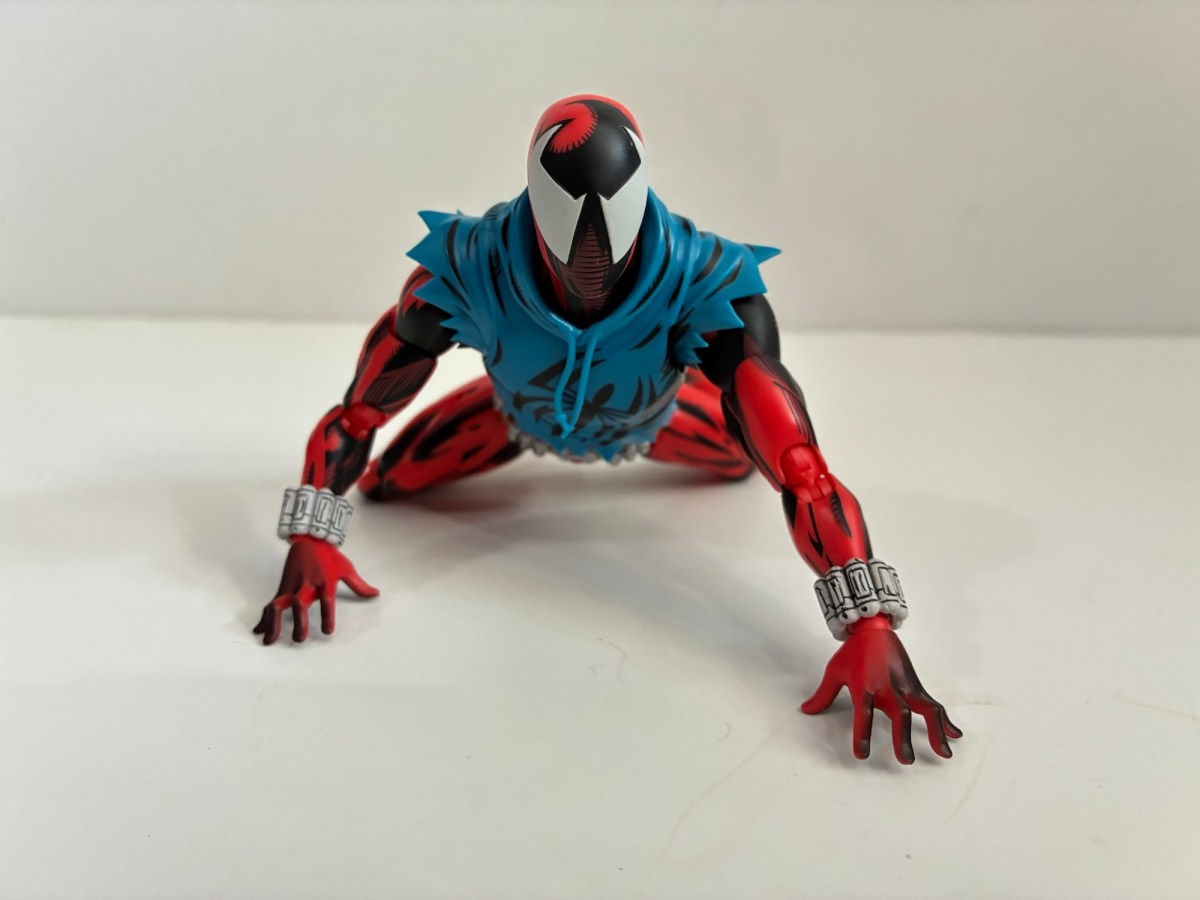
S.H.Figuarts Across the Spider-Verse Scarlet Spider

In the two reviews I did of Scarlet Spider action figures I shared the origins of my love for the character’s design. To make it short, I found the appearance of him on a cover of a Spider-Man comic intriguing, but more is as a young artist I much preferred to doodle him in my…

Keep reading

Marvel Legends Gamerverse Wolverine vs Silver Samurai

Video game inspired action figures are quite the hot ticket right now. I’m not entirely sure why that is, but maybe some of that is owed to Jada Toys and how well received their line of Ultra Street Fighter 2 action figures have been received. Hasbro, for their part, has had a “Gamerverse” subline of…

Keep reading
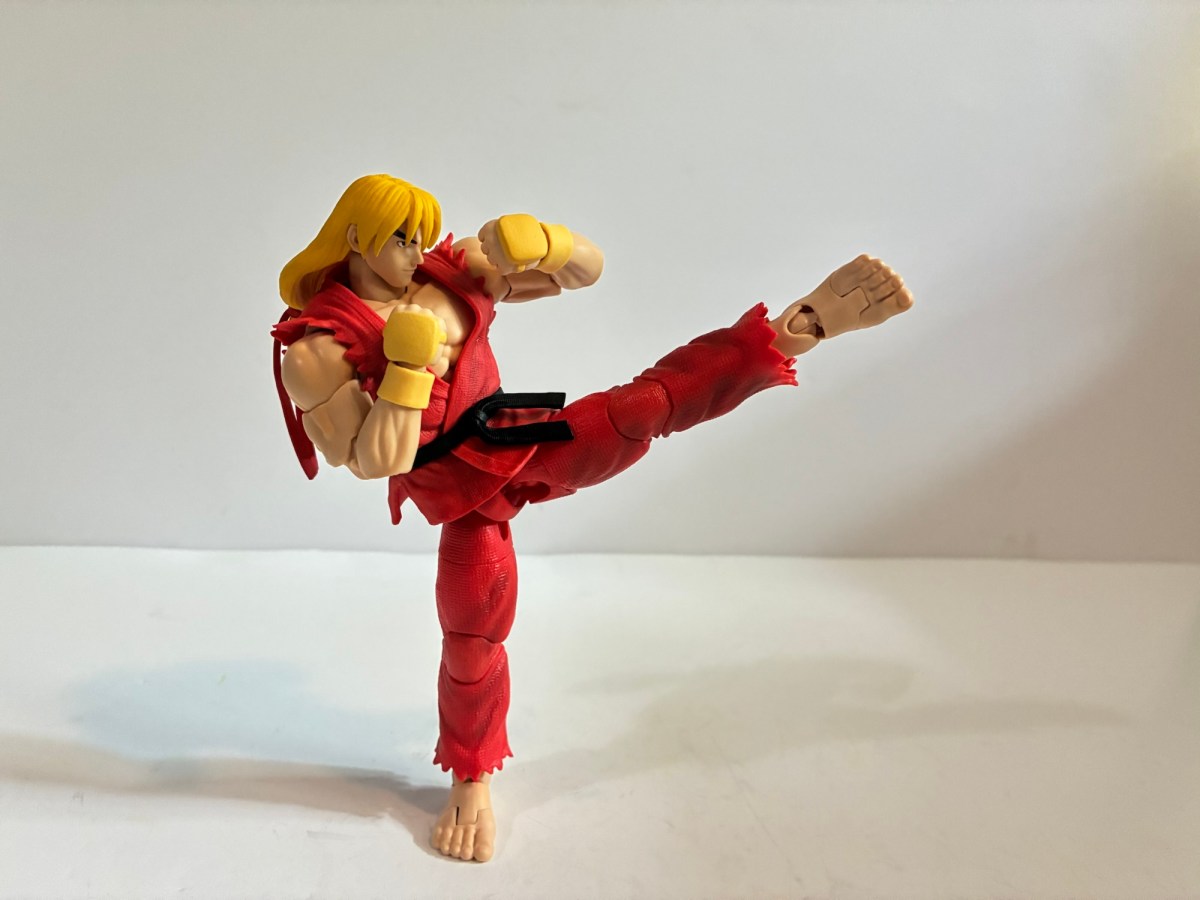
Storm Arena Street Fighter Alpha 3 Ken

One of my most anticipated releases of 2025 came out of no where. I was a kid during the early 90s and into video games so I know a thing or two about Street Fighter. Street Fighter II was everywhere and is pretty much the reason why the one-on-one fighting game became a huge genre…

Keep reading
Arcade 1Up Marvel Super Heroes Counter-Cade

Arcade 1Up has been around for a few years now selling arcade cabinets at a reduced size and also a reduced price. The cabinets are significantly smaller than an actual arcade cabinet, but still plenty large enough to take up a lot of floor space in your home. And while they’re cheaper than the “real thing,” they’re hardly what I would call cheap. Many of the full-size units will set you back over 500 big ones, and newer models have eclipsed the $700 price tag as components become harder to come by and virtually everything has become more expensive. Even when the units were cheaper, I was never able to bring myself to spend hundreds of dollars on what is essentially a novelty item. The cabinets, being smaller than the real thing, are less functional. You can’t physically accommodate four adults for a game of Teenage Mutant Ninja Turtles, for instance. And these are all games that can be experienced in a far more convenient and cheaper manner. Only some of the side-scrolling beat-em-ups are unavailable for purchase these days, but they’re also games not really designed for home consumption. They were made to entertain in bursts and consume quarters, with free play they last less than an hour and have little to no replay value once completed.

There’s nothing particularly practical about what Arcade 1Up sells, but that doesn’t mean it’s worthless. I already used the term novelty when talking about them, and that’s really what they are. They liven up a room at your house, give people something to talk about when they come over for the first time, and do offer some entertainment value. Especially when it comes to skill-based games. And I certainly am willing to spend money on novelty items as I own several mini consoles and recently reviewed the Zelda Game & Watch. I just have a limit on what I want to spend on such a device and on how much room I want to dedicate to one. I’ve often considered buying an arcade cabinet for my bar room at home. I was really close to doing so with an SNK cabinet more than 10 years ago since those can actually swap games. And when a local arcade closed-up shop near me five years ago I strongly considered making an offer on their Simpsons cabinet, but thought better of it in the end. Arcade 1Up has always had some appeal to me, but nothing got me to bite. The Teenage Mutant Ninja Turtles one came the closest because of my love for that IP, but realistically I’d play it a couple of times and then never touch it again. I thought I might take the plunge if Arcade 1Up ever did The Simpsons and they did in 2021, but the $700 price tag was a non-starter for me.

Now isn’t that cute.

Arcade 1Up seems to know there are lots of folks like me out there that want their product, but are hesitant either due to cost or space concerns. Enter the Counter-Cade! This is a smaller version of an arcade cabinet intended to be placed on a counter, or better yet, a bar. And I have a bar! Aside from a bar-top juke box, I can’t think of a better accessory than a small arcade cabinet. And that’s what the Counter-Cade is, it’s just a small arcade cabinet with a short base. Since they’re even smaller than the normal Arcade 1Up, they’re only suitable for 2 players so no four-player models exist (that I’m aware of) and it looks like many have fewer games loaded on them than the bigger model, which makes sense as Arcade 1Up needs something more than size to entice folks to pony up the big bucks. There’s no wi-fi either, but you can plug in a controller if you find it too small to comfortably accommodate two players (though I tried it and didn’t have much luck). I was interested when I first saw the Counter-Cade, but I wanted it to contain games I’d actually play. My wife seemed to pick-up on this for underneath my Christmas tree was the Arcade 1Up Marvel Super Heroes edition of the Counter-Cade.

The games that come pre-loaded.

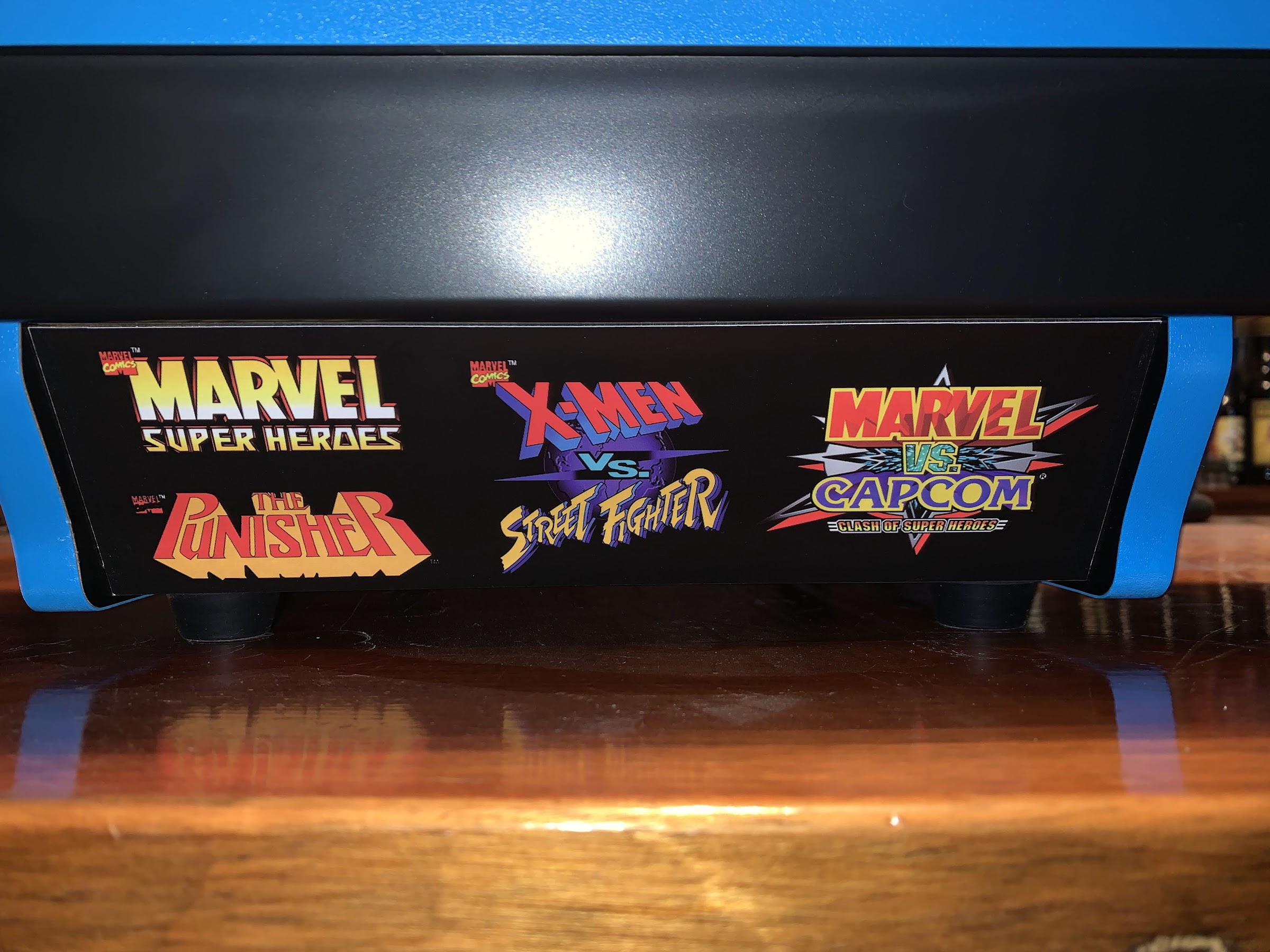
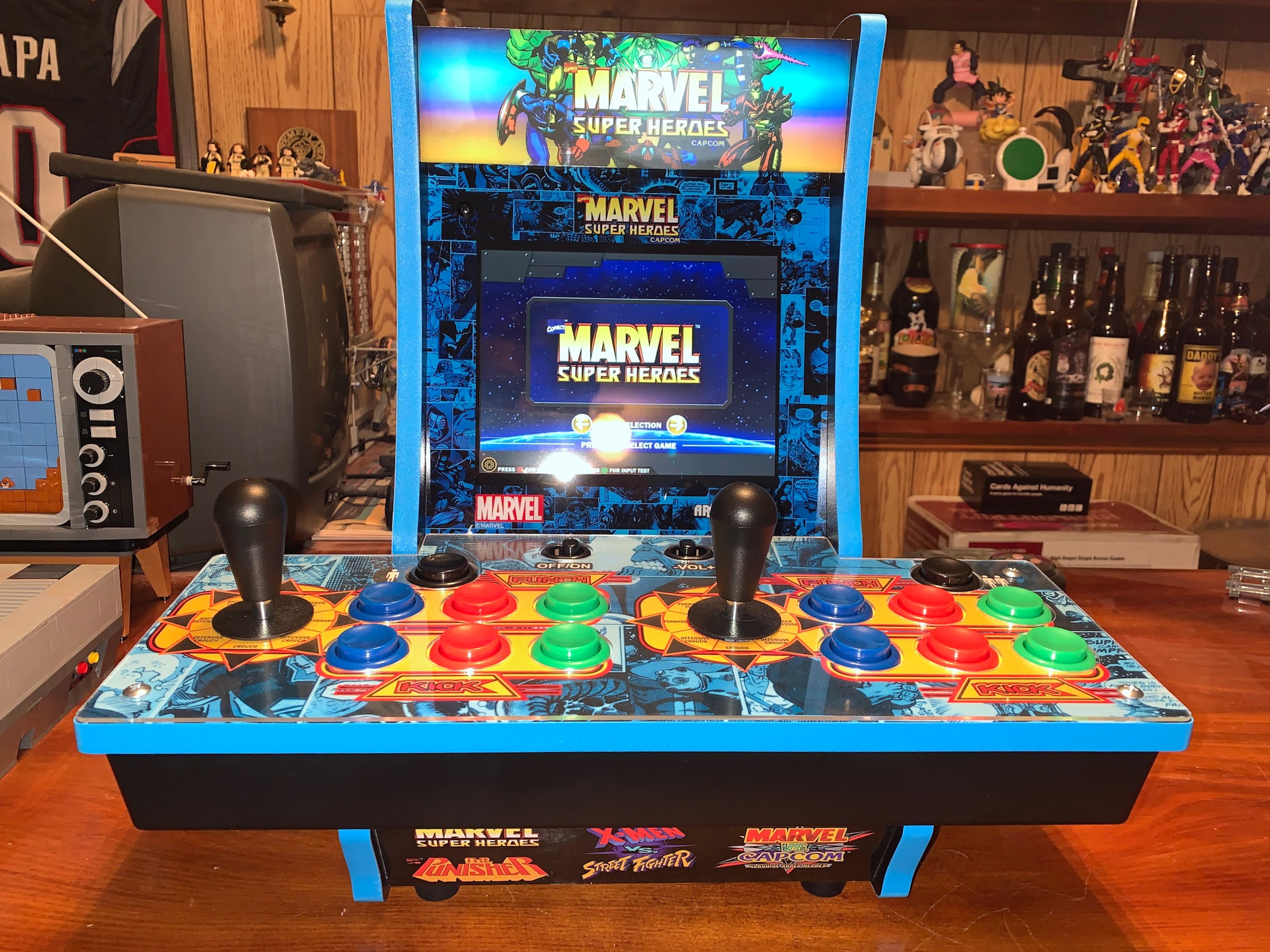
The Marvel Super Heroes Counter-Cade from Arcade 1Up comes with four games pre-loaded onto it: Marvel Super Heroes, X-Men vs Street Fighter, Marvel vs Capcom, and The Punisher. All four are developed by Capcom and obviously contain characters from the world of Marvel Comics. Three of the four are 2D fighters, while The Punisher is a two-player beat-em-up. It’s a solid assortment of games as you get a traditional 2D fighter in Marvel Super Heroes and a pair of tag-fighters. I would have preferred it if Arcade 1Up had made this an X-Men themed unit based on Children of the Atom, but oh well. I’m sure almost everyone would have preferred another “VS” title in place of The Punisher, but I’m okay with it as it gets another style of game into the set.

There’s a USB port on the right side for a controller, though when I plugged in my 8bitdo controller it didn’t map the buttons properly.

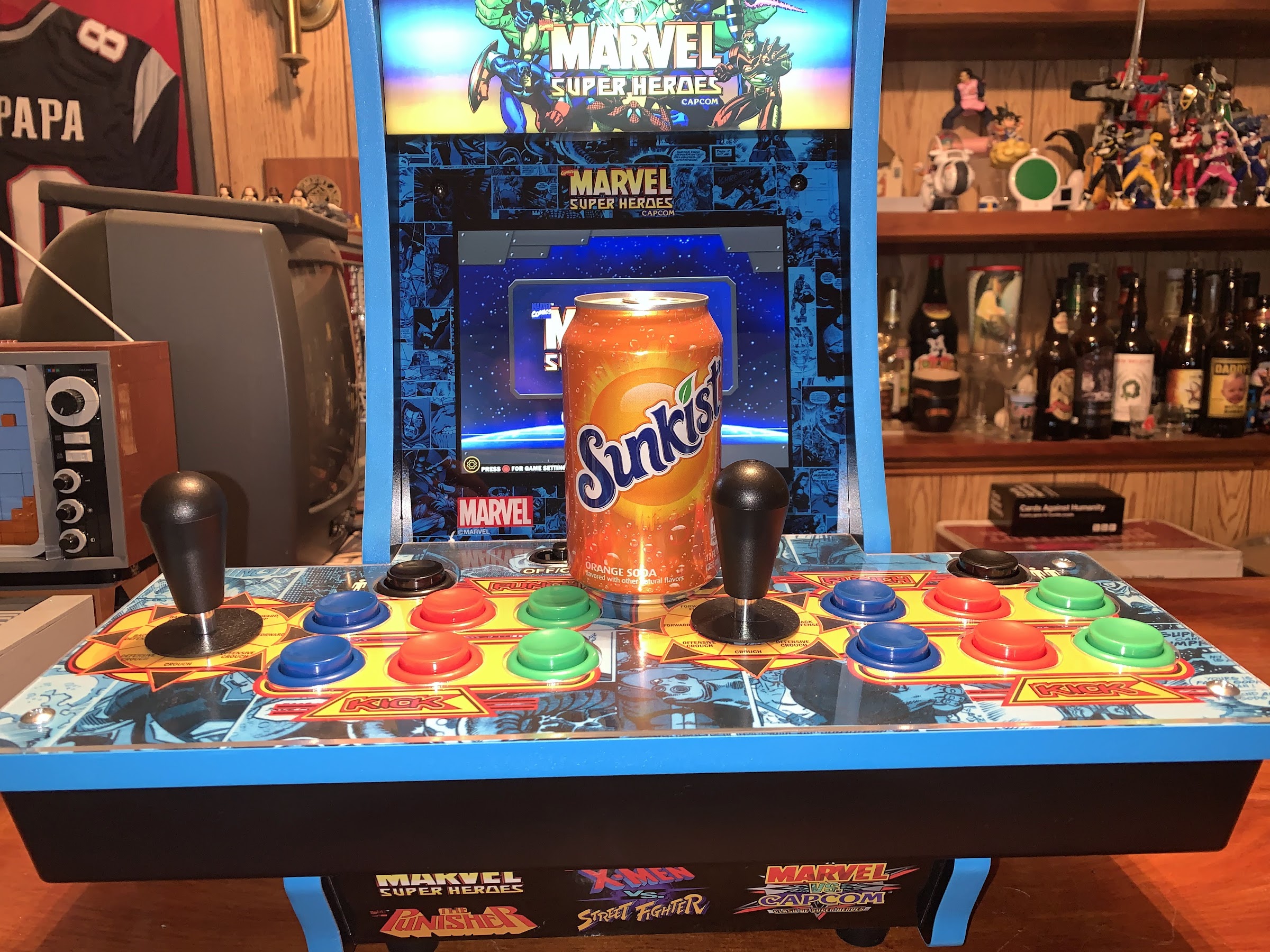
What’s going to sell this unit is the size, price, and game selection. As far as size goes, the cabinet basically takes up a space of 16.5″ wide, 16 1/8″ high, and 13″ depth. That’s me measuring the unit at it’s widest part, which is the platform where the controls are mounted, but that’s roughly the area this thing occupies. It runs off of an AC adapter so you do need to be relatively close to an outlet as the chord is only about 4′ long. The screen is approximately 6.5″ wide x 5″ high and it’s suitable for the software. The colors are vibrant and there’s no taring of the sprites. It’s also pretty loud so if you were worried about the audio I think most will be fine. There is a headphones jack for those who want to game without disturbing others, though the clicky joystick and buttons will prevent truly silent play.

Soda can for scale.

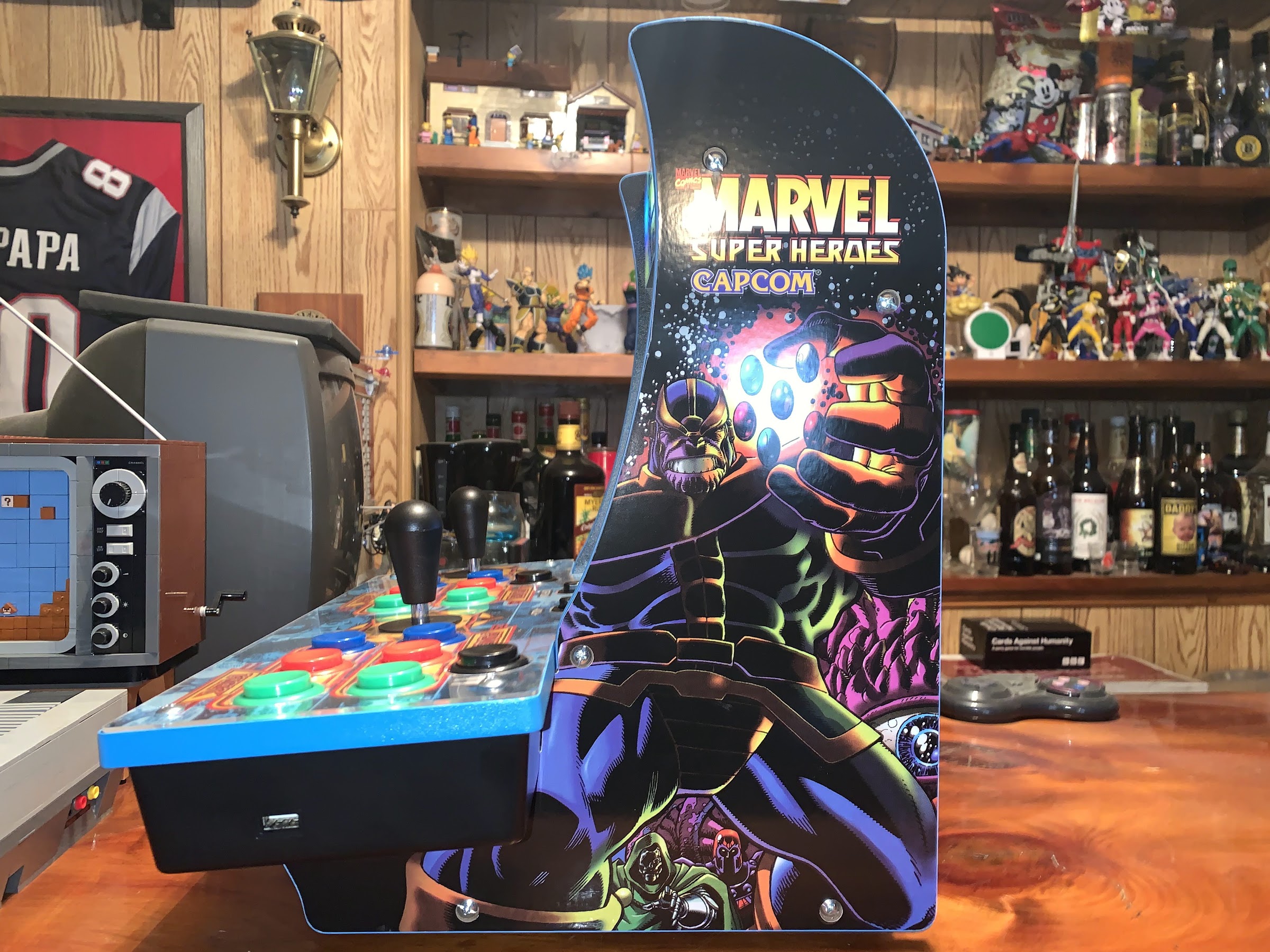
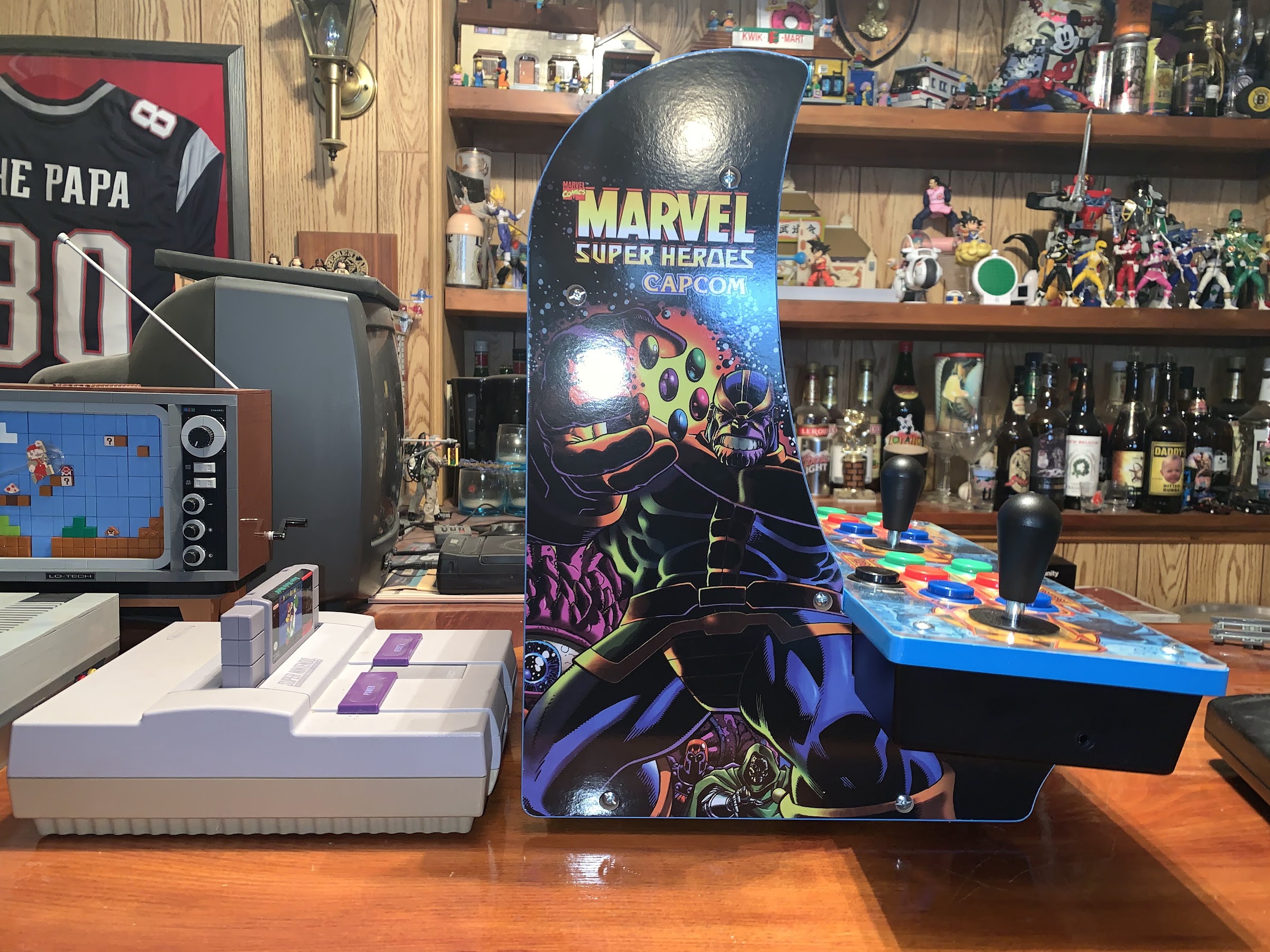
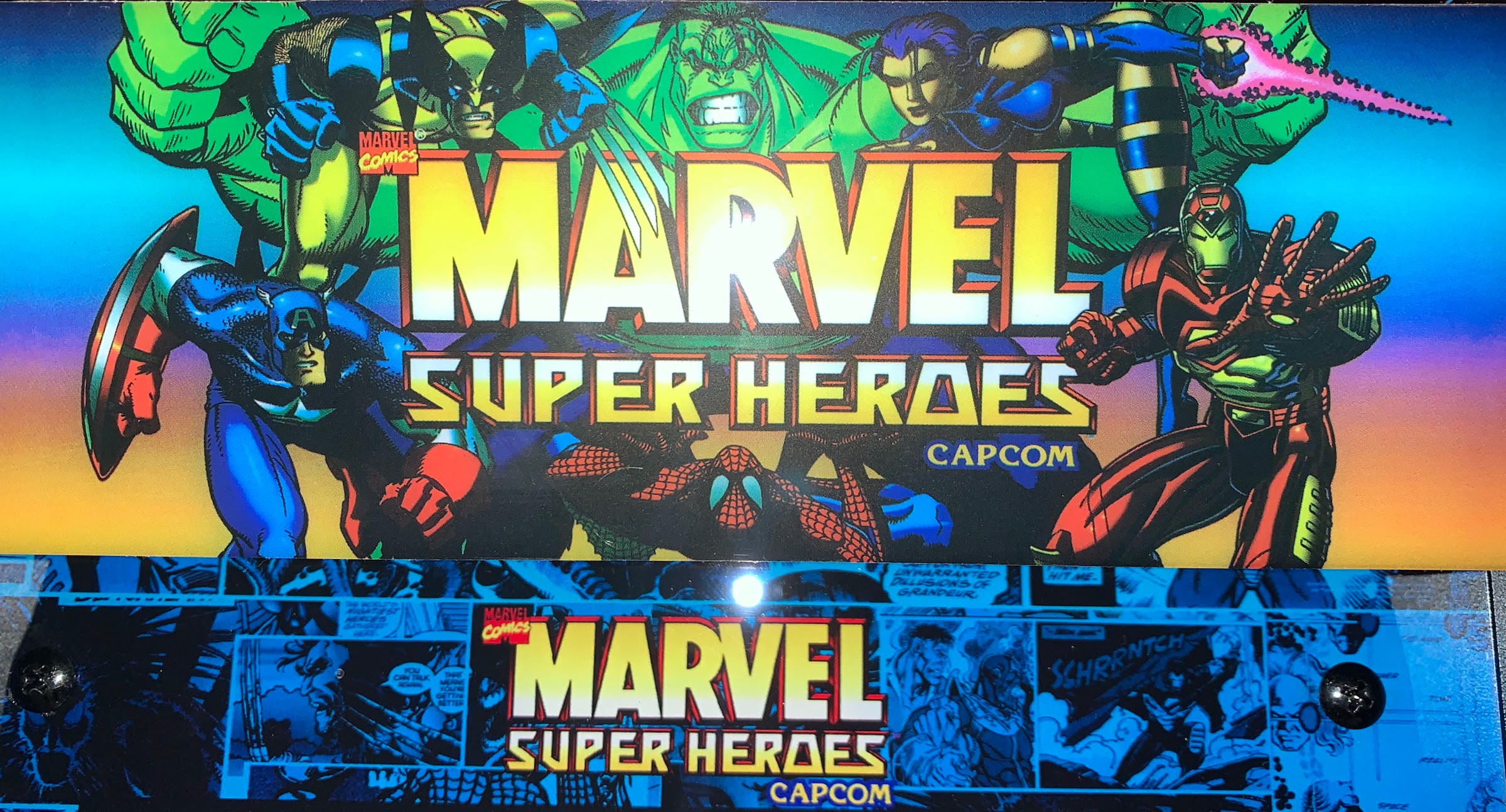
The components outside of the screen seem fine. I don’t know that the joystick is quite on the level with a true Capcom unit, but it’s better than a lot of third party joysticks I used long ago (granted, I have not bought an arcade style controller for about 25 years). There are seven buttons for each player with one of those being a Start or Credit button to enter the game. There are six buttons for actual gameplay, which is all you need for the software present here. The buttons feel okay, I feel like they’re a little soft and could rebound a touch firmer, but are otherwise fine. The theme is Marvel Super Heroes so you get Thanos on each side with blue filtered comic art on the front and platform. The marquee does light up when the unit is on and features the cast from that game so if you were hoping to see Rogue or Ken on the cabinet you’ll be disappointed.

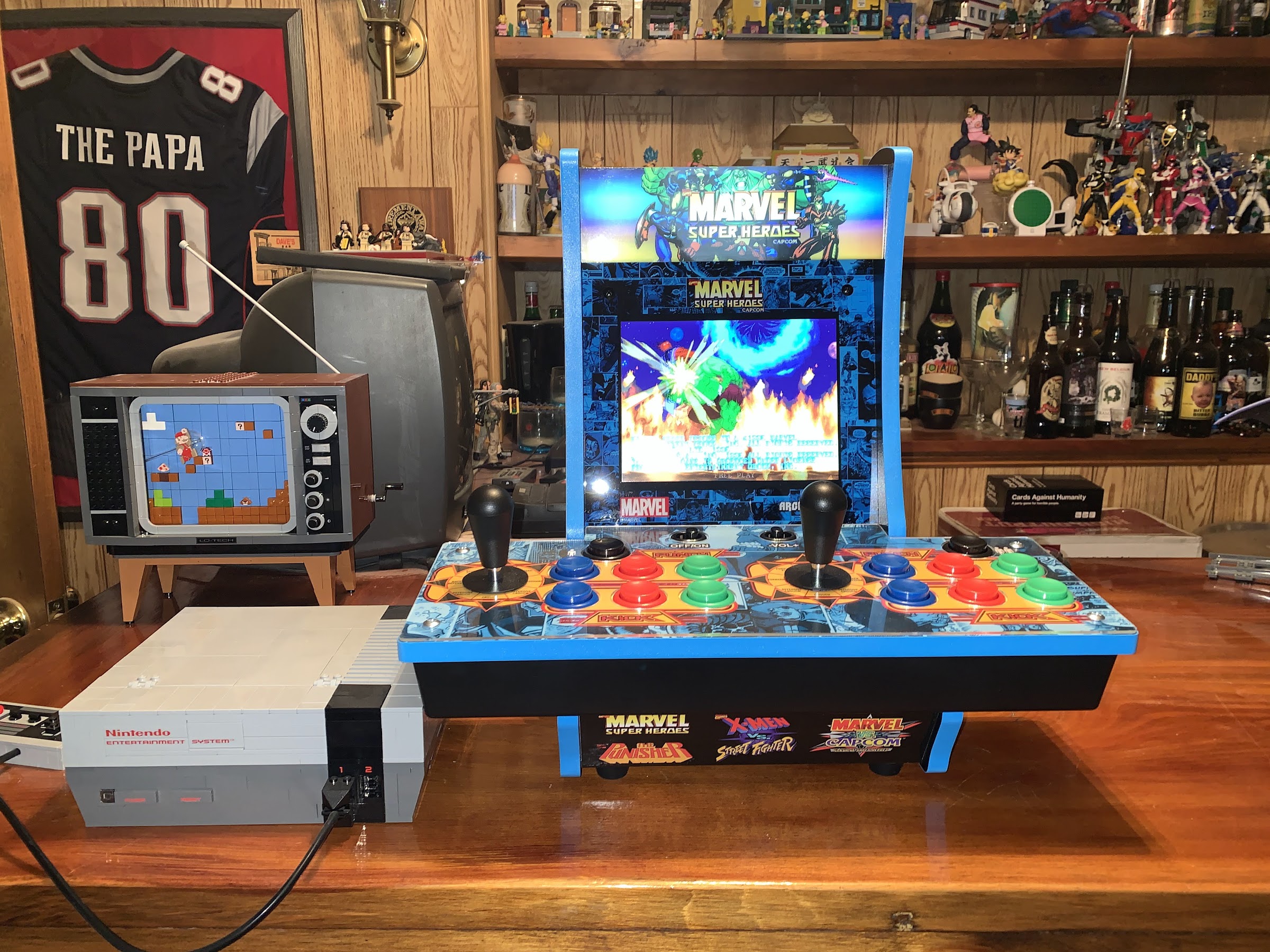
This bad boy is going to live beside my Lego NES.

When the unit is powered on it takes you to a simple screen with the highlighted game displayed. You can cycle through and upon selecting a game a quick controls dashboard is displayed. It’s not entirely useful as it basically just tells you what each button does in the game. It won’t tell you, for instance, how to tag out in the VS titles or how to use grenades in The Punisher which stinks. Once you select a game, the unit basically becomes an arcade cabinet. If you leave it alone you’re effectively in “Attract Mode” for the selected game, which is definitely a fun thing to have in a rec room, even if it isn’t practical from a power consumption point of view. Everything is set to free play and there are no coin slots anyway so you can’t make money off of your friends directly. It’s easy to get out of and into another game and the interface is simple and intuitive enough.

As for the games, well, reviewing each one individually would take some time. Basically, if you’ve played a Capcom fighter then you probably know what to expect. Marvel Super Heroes is the most straight-forward as it’s a one on one fighter starring some of the heroes and villains from the Marvel Universe. It’s always been a little odd in that respect (Shuma-Gorath?), but it’s actually probably better received now than it was in the 90s given how popular the Avengers are now versus then. Still, it was pretty cool to get a dedicated Marvel fighter in 1995 and the fact that it was dedicated to Jack Kirby gives it a little extra sweetness. I don’t consider it a great 2D fighter, but it’s a perfectly fine alternative to Street Fighter 2 for the Marvel fan.

SNES and Genesis model 2 for scale.

The VS games are probably want most fans will play the most. X-Men vs Street Fighter is what got the whole thing rolling. It features a terrific roster from both franchises and it actually feels more focused than the games that followed. If X-Men is your jam, then this might be your favorite from the set. Marvel vs Capcom is very similar, but bigger. This was the last 2 vs 2 fighter as its sequel would up things to 3 on 3 and get almost too big for my liking. You may notice one game was skipped, Marvel vs Street Fighter, but you’re not missing much by going straight to Marvel vs Capcom. This lets other Capcom stars get a chance to shine and help even the sides as it was pretty rough for the World Warriors to have to take on the entire Marvel Universe.

Lastly, we have The Punisher. It’s a perfectly cromulent brawler. Player One controls the Punisher while a second player can join in as Nick Fury. The two will banter a bit (via text) to liven things up while battling through the criminal underworld leading to a final confrontation with the Kingpin. It’s less impressive than the fighters from a presentation aspect and the mechanics of the game are pretty standard: attack, jump, and a special attack that drains life when it connects. Sometimes The Punisher and Fury will be allowed to use guns, usually in response to when the villains do the same, but mostly it’s a melee affair. There’s an abundance of temporary weapons to bash foes with that helps add a little variety, though most are just something to bash a foe with. A playthrough will take most around 45 minutes and when it’s over there likely will be little appetite in venturing forth again. There’s no reason to from a gameplay perspective aside from achieving a better score, it’s just the video game equivalent of chewing gum. At least it’s a longer experience than what Fruit Stripe offers.

One last shot for scale. It’s certainly not small, but definitely not as big as a true stand-up cabinet.

I had a desire to add an arcade machine to my bar room, and this Counter-Cade from Arcade 1Up gets the job done. It’s an attractive piece with a solid selection of games which 3 of the 4 offer incentive to play and replay while the 4th is certainly good for entertaining younger gamers (ignoring the violence). And the other important selling point, maybe the most important, is it’s not ludicrously expensive. The MSRP on this is $229 at most stores and many offered discounts during the holidays. Since this was a gift, I don’t know exactly how much my wife paid, but I know it was less than $200 due to sales and the use of good old Kohl’s Cash. At the high end of $229, I do think it’s a tougher sell, but not terrible. If you really love the games included and want something to bring your room together then I think it’s doable. On sale though, it becomes a much easier call. You’re still better off going in a different direction if your goal is simply to play these games, but as we established earlier, if you’re interested in this set then you’re in it for the novelty more so than the software.


Dragon Ball Z – Budokai HD Collection

budokai hdOh, you thought we were done with DBZ?! Oh no, I have some more Dragon Ball related material to share with you and even though we’re done with the movies, I thought now was as good a time as any to talk about some video games. If you’re a usual reader, you may recall I did a post earlier this year on Super Dragon Ball Z, the Street Fighter inspired fighter for the PS2. It was the upcoming release of Arc System Works’ Dragon Ball FighterZ that inspired me to revisit that old game, and the same can be said of the Budokai series.
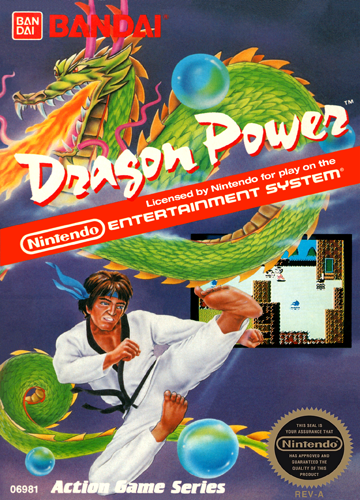
In case you need a refresher, Dragon Ball Z – Budokai was the Infogrames fighting game franchise of the early 2000’s and it was also the first real entry point for DBZ into global gaming. Prior to Budokai, the only Dragon Ball video games to make it out of Japan were the NES platformer, renamed Dragon Power in the US, based on Dragon Ball and the PSX fighting game Dragon Ball GT – Final Bout. Yes, somehow a game based on Dragon Ball GT made it to American soil before a Dragon Ball Z game. That early Dragon Ball game for the NES was simply a case of anything being available in Japan was brought over to other markets. It was altered so that it barely resembled Dragon Ball and there’s a chance that gamers who owned the abysmal title and went on to become fans of the franchise likely needed to read about it later in life to make the connection. Final Bout was likely released outside of Japan because it coincided with the 3D fighting game craze and the first real attempt at bringing the anime to America as well. It was a truly abysmal game that sold poorly. The anime was a flop initially so it kind of went away, but once the show became popular via Cartoon Network the after market price on Final Bout went crazy as it was the only video game released in the territory and fans wanted something, even if it was terrible.

dragon power

Technically, this was the first Dragon Ball game released outside of Japan, though you wouldn’t know it by the cover.

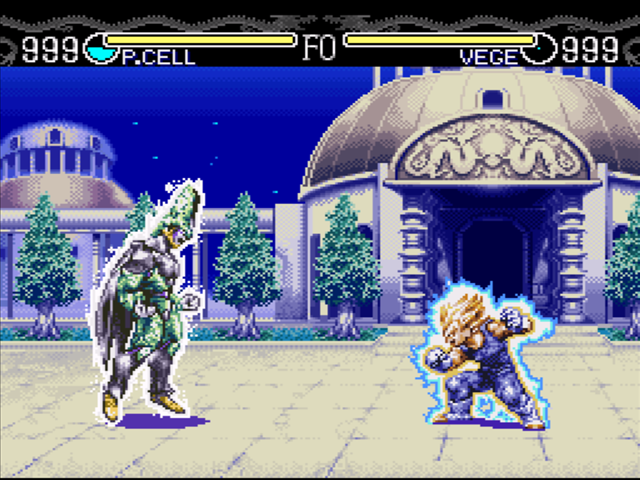
Of course, if you were living in Japan you had plenty of options when it came to DBZ fighters. The Super Famicom especially had a bunch of them and the PSX had an additional 2 and all were based on Dragon Ball Z as opposed to the far less popular Dragon Ball GT. Fans desperate for some DBZ content for their video game machines, like myself, turned to imports and emulation to get their fix, but in truth few of these games were worth playing. The only ones I can recommend half-heartedly were Dragon Ball Z – Hyper Dimension, a 16-bit fighter that didn’t control particularly well, but the visuals were impressive. On the PSX, Dragon Ball Z – Legends was a pretty ugly looking early PSX game, but it’s 3 on 3 simultaneous combat was really interesting and the simple, timing based, combat was actually pretty satisfying. It was just a shallow experience and once you saw everything the game offered there was little reason to return.

Once the show finally became popular around the turn of the millennium, there was a substantial rush to get content to the newly created global audience. Irwin Toys started cranking out new action figures and accessories while clothing and posters started popping up everywhere. The games took some time, and Bandai was awarded distribution for Japan while Infogrames, and later Atari, received the North American license. Dimps was selected as the developer and they got set to creating Budokai. Simultaneously, a Game Boy Advance game was also developed and released as The Legacy of Goku, an action-RPG that was at least interesting though not particularly fun. Because there was such an appetite for DBZ anything, Budokai really didn’t need to be a good game to sell well. It also didn’t need to be particularly good to immediately become the best DBZ fighting game ever released. Review-wise, it received a somewhat ho-hum reaction from critics, but fans seemed relatively pleased. It sold well enough to spawn two sequels, and 10 years after its initial 2002 release it received a high-definition makeover alongside Dragon Ball Z – Budokai 3.

hyper dimension

If you absolutely need to import a DBZ game, I’d suggest Hyper Dimension.

If you have never played a Budokai game, then let me tell you how it works. At its cores, it’s a simple 3D fighter. Characters can move in the foreground and background and are capable of attacking, blocking, firing ki blasts, and charging up their power meter. Each character typically has multiple health bars so stronger fighters will have additional health over weaker ones that’s clearly illustrated. Characters can also fly, but not at will. Instead, if a combo attack sends a fighter into the air they’ll kind of just hover in place once they recover from the attack. Simply pushing the directional pad towards an airborne fighter will cause the player-character to take to the air in pursuit.

final bout

Before Budokai, this was the best American fans had.

The main criticism of the original Budokai was the lack of beam attacks. Rather than simply ordering Goku to unleash a Kamehameha wave, the move was affixed to the end of a combo. A series of punches would end in Goku performing his signature attack, but at very close range so it was hardly spectacular looking. Instead, the eye-catching attacks were left to the super moves which are the moves that are designed to be difficult to pull off, but when successfully deployed, unleash devastating amounts of damage via a cinematic. These moves include Vegeta’s Final Flash and the like.

goku vs vegeta

The original Budokai does a decent job of laying the groundwork, though the visuals were never considered great even for the time.

Dimps seemed to target two important factors when creating the game:  make it look authentic and make it easy to play. As a result, all of the fighters essentially feel the same and have the same move-set, just with different results. In order to make the game feel authentic though, Dimps made sure to include various transformations in its games. Once advancing passed the Freiza arc, Goku could unlock his Super Saiyan transformation and use that in battle. Prior to getting it, he also had his Kaio-ken technique. Dimps even gave Piccolo his fusions from the series with Nail and Kame as transformations. The game featured a story mode that went up through the Cell Games and featured a roster of 23 characters. Later games would focus on expanding upon the roster to include practically anyone who ever partook in a fight during the series.

budokai story

The first game does at least boast better presentation in terms of its story mode, though these visuals are kind of “yuck.”

Budokai was a success, and it soon became an annual franchise. Budokai 2, released the following year and not included in this collection, corrected a lot of what people disliked about the original. Ki blasts and flying were now more manual than before and the story mode received more cinematics and was overall more rewarding (though it featured a weird board game interface). The roster was also greatly expanded upon due in large part to the game featuring the Buu Saga. More transformations were available and the game was largely just more fun. Budokai 3 arrived the following year with even more characters and moves and yet another revamped story mode. Instead of playing through the events of the show, players could select specific characters and experience the story from their perspective. And doing so also allowed the player to simply fly around the world looking for the next event as well as hidden ones. It felt less restrictive, and was thus pretty exciting.

budokai 3 story

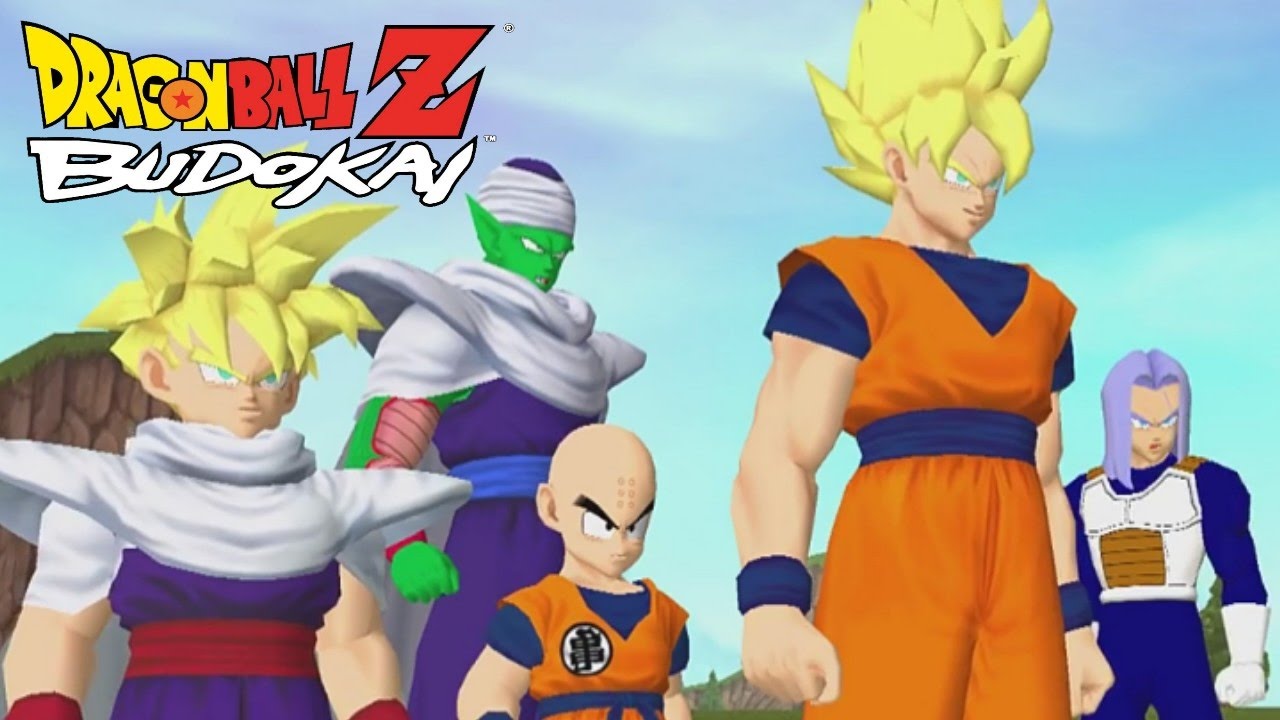
Budokai 3’s story mode was more engaging, if lacking in the presentation department. It makes up for it though with much improved graphics and styling.

So how do these games hold up in 2018? Well, not surprisingly the original Budokai is showing its age. The visuals have been upgraded to HD, but the textures were so bland and basic to start-off that there’s virtually no improvement. It makes everyone look like vinyl dolls and the empty battle maps are even more boring than before. The simple combat is easy to grasp, but also not particularly engaging. This game is basically here as a nostalgia trip and to illustrate how the series began. Fire it up if you either never played it or just want to relive it, but after that you probably won’t play it again.

Budokai 3 is the main attraction of this set. There’s still a section of the fandom that considers it the best DBZ fighter ever released. It was the last main Budokai title as the many sequels saw the series move in a different direction, sometimes for the better and sometimes not. There was a PSP edition of the franchise called Shin Budokai and some place the 2006 title Infinite World in the Budokai series, but this was the last numbered entry. It’s quite easy to see how refined the game is in comparison with its predecessor. The visuals took on a more cell-shaded approach with additional detail and the move to HD doesn’t highlight the imperfections like it does with the first game. DBZ has a pretty simple, yet distinct, look and it doesn’t require incredible processing power to do it justice.

dragon rush 2

Dragon Rush adds some chaos to battles, but at the cost of skill.

From a gameplay perspective, the game is not quite as fast as I remembered. You will still spend most fights dashing at your opponent to unleash combos attacks and build towards bigger moves. I had forgotten how odd the gameplay structure was. Much of the fights hinge on your ability to pull off super moves and Dragon Rush attacks. The Dragon Rush is a bit convoluted, but it’s essentially a follow-up attack from a teleporting move. There’s a lengthy tutorial section in the game that’s not particularly helpful. It’s one of those things you just have to perform for yourself to get a feel for how it works. When connecting with one of these maneuvers, a quick-time event is enabled that’s basically a version of Rock-Paper-Scissors. The attacker selects a face button and the defender does as well. If the defender guesses right, the attack is thwarted. If not, it continues with both players now having only 3 face buttons to choose from. If the attacker is able to string together three successful attacks via this encounter, then a big move is unleashed and the opponent’s stamina (as well as some health) is knocked away leaving them more susceptible to damage. Actual super moves are done fairly easily by holding a shoulder button, but it starts a slow animation that can be tricky to connect with. And if you miss, you lose all of the energy stored for the attack. Connect and you get treated to another cinematic while also doling out some big damage. There’s always another QTE spot, this time with a meter rapidly filling and decreasing that you have to time properly, that determines how much damage the attack does.

gogeta fusion

There are lots of power-ups that take the form of transformations including fusion.

Fights have a tendency to be very reliant on those two moves. Whoever is better at pulling them off usually wins. The QTE spot injects some chaos as it’s entirely random, unless you’re playing against a human opponent and look at their controller. It’s not the most rewarding system, or perhaps it’s more appropriate to call it frustrating if you’re on the losing side. If you’re on the winning end then at least the cinematics are typically fun to see. The interesting change for the third game though was mostly in the stored energy each character has. Energy will gradually accumulate up to a certain point so you really need only charge your ki if you want to go for the biggest moves possible. This was a smart addition as the constant need to charge in other games was always the least enjoyable aspect. Transformations also aren’t the energy hogs they were in prior games so there’s more incentive to use the best ones.

The story mode felt revolutionary in 2004, though now it does feel more limited. Basically, you pick a character and fly around the world. Your character has a map and can also find a Dragon Radar to look for Dragon Balls. Activating your “senses” can sometimes turn-up hidden spots on the world that usually contain an item but sometimes contain a small story event – an easter egg, if you will. Various cities and popular landmarks appear on as well but you can’t really interact with them. If the name of the place displayed when flying over it then you can enter, but it just leads to a brief exchange with another character who may or may not provide an item. These are all done with still images and text – there are no cinematics in story mode which is rather bizarre. The most interesting aspect of the mode is that it can change depending on how many playthroughs you have done and if you have finished another character’s. Goku’s is the most robust, and if you play it a second time after getting through some of the other character’s stories you’ll take on some GT villains and even unlock Super Saiyan 4.

budokai 3 cooler

Budokai 3 expands upon the roster by drawing from the movies and Dragon Ball GT.

The goal of story mode is obviously to see it through, but it also features some RPG elements in the form of experience and stats. Leveling up a character gives you an ability point to place in various offensive and defensive categories. Each character also can equip a set number of items, with stronger items taking up multiple slots. This has been a feature in most DBZ games and allows for some level of customization. Frustratingly though, transformations always have a prerequisite that includes the prior transformation so if you want to use SS4 Goku you’ll need to devote 5 slots to transformations. If you want to fuse into Vegito then you’ll have to give up something. Characters can unlock a special Breakthrough capsule which contains all of their unique moves and abilities at the cost of taking up all of the ability slots. For a character like Goku who has the most unique capsules, it won’t include everything though which is kind of a bummer. The other short-coming of story mode is that it doesn’t include everyone. A lot of characters are playable including surprises like Tien and Yamcha, but only one villain has a story mode (and it kind of sucks) and characters you would expect to have one (namely Trunks) do not. There’s enough here to keep you busy for awhile, at least.

After getting caught up with these games, my main take-away was that anyone who thinks Budokai 3 is the best DBZ fighting game released has not spent enough time with newer entries. It’s not a bad game, but I’d rather play the Tenkaichi Budokai games over it. This game wants to capture the unique combat of the anime and sacrifices skill and control to do so. The Tenkaichi games were not difficult games to play, but their arena fighter approach made the games even more authentic and the super moves weren’t huge factors. With that out of the way, I will say I still had fun with Budokai 3. It took me a little while to get back into the flow of combat, but once I did I had a good enough time. There is a shallowness to the gameplay present so it doesn’t have the staying power of a more robust fighting game, and I wish they had dropped the Dragon Rush, but it does right by its license. I do wish the story mode featured actual moving images to tell its story, and the rewards for summoning the dragon are kind of lame. Considering I didn’t have to pay much to get this collection, I’d say it was money well spent. As for the original Budokai, it didn’t need to be included on this collection and I’m surprised it is. I would have much preferred Budokai 2, even if that game is pretty similar to 3. At least it featured a different story mode while including most of the gameplay enhancements featured in the third entry.


Super Dragon Ball Z

Super_Dragon_Ball_Z_CoverartRecently, Bandai-Namco conducted an open beta for its latest game based on the venerable Dragon Ball franchise:  Dragon Ball FighterZ. The game is a 3 on 3 tag-fighter that exists on a 2D plane but contains three-dimensional characters. The art style is done in such a way that it more closely resembles the 2D anime that’s recognized around the world. It’s a fast and beautiful looking fighter and yours truly did check out the beta. Like most open betas where an upcoming game is essentially free to play briefly, it was a bit of a challenge actually getting logged into the servers and paired up with a match. I mostly spent my time in the training area just checking out how the game handles and plays. It’s very similar to the old Budokai games in some respects, mostly the speed and the fact that all of the characters seem to have the same move-list, only the animations for each move are unique from character to character. For example, a traditional Ryu fireball motion for Goku results in his kamehameha wave while the same for Krillin is the destructo disc maneuver.
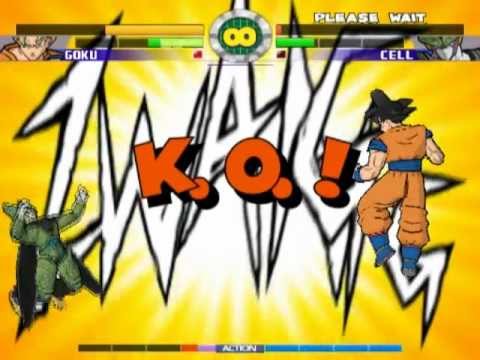
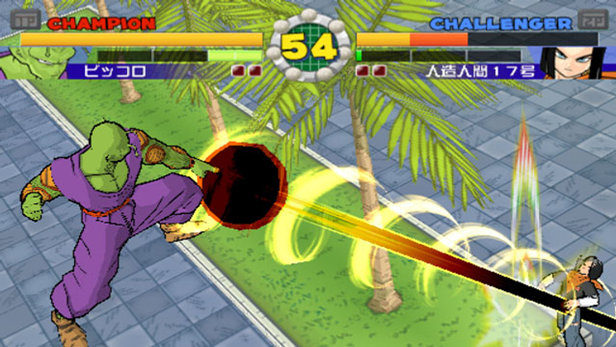
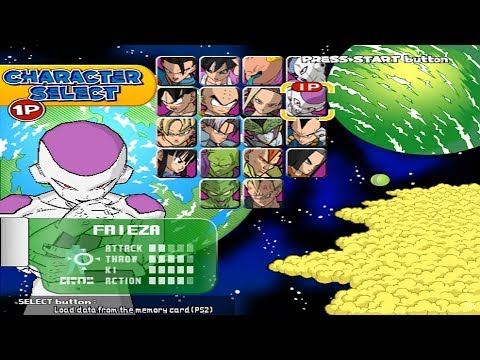
FighterZ seems like it will be a pretty entertaining game, but it’s not what I wanted or expected. The developer, Arc System Works, is best known for Blaz Blue so I expected a more traditional 2D fighting experience with some Dragon Ball styling. Instead, FighterZ is apparently courting a more casual crowd that grew up on those old DBZ games and Super Smash Bros. as opposed to Street Fighter. This naturally lead me back to an old favorite of mine:  Super Dragon Ball Z.

Not to be confused with the currently airing anime Dragon Ball Super, Super Dragon Ball Z is a 3D fighter that plays like a 2D fighter. It was developed by Arika, the company headed by Akira Nishitani who is best known as the brain behind Street Fighter 2. The company is known for its work Capcom on the Street Fighter EX series, a 2.5D fighting game that was relatively popular in the late 90s and early 2000s. As you would expect, a DBZ fighting game developed by the father of Street Fighter plays a lot more like a Street Fighter game than the casual arena brawlers that had become the norm for DBZ. It was released to arcades at the tail end of 2005 in Japan and Europe only before arriving on PS2 in 2006 worldwide. Because it’s not what people were used to out of a DBZ game, it went somewhat overlooked. While I would not consider it on par with the best the Street Fighter series has produced, Super Dragon Ball Z is a pretty damn fine game on its own.

hqdefault-29

End a battle with a super move and you’ll be treated to some manga-inspired word art.

Super Dragon Ball Z has the typical fighting game maneuvers you would expect of a Street Fighter clone. Think hadokens, shoryukens, and so on. Not every character has the same standard set of moves, but they do share some similarities so it’s not as streamlined as simpler games, nor as complex as the most hardcore fighters. The characters are presented in 3D with a cell-shading effect and the default colorization is meant to resemble the original Dragon Ball manga as opposed to the anime. The stages are arena types and characters can move into the foreground and background with relative ease. An action bar at the bottom of the screen controls movement within the foreground and background as well as dashing. Deplete that and you will find your movement severely hindered until it replenishes. It does refill rather quickly, but the gauge prevents characters from endlessly dodging to prolong a match or from spamming dash attacks.

The game’s button layout is a bit unique. The square and triangle buttons are your weak and strong melee attacks while circle is the jump/fly button and X is guard. The shoulder buttons contain both dash attacks and a dedicated throw button. Any fighter that utilizes a dedicated block button takes some getting used to, and the jump/fly dynamic is a bit wonky in execution. It’s mostly used to go after your opponent, as opposed to setting up an attack. The dash buttons are useful for closing the gap quickly with your opponent or just to get you on the same plane as your opponent.

slus-21442-game-ss-2

It may not be the flashiest DBZ game, but your favorite characters will still have their most recognizable moves.

The fighting mechanics are a mix of traditional fighters and DBZ fighters. Projectiles play a large role, but up close combos are also present and a major part of combat. Certain characters function better as ranged attackers versus up close ones and the AI for each character feels rather true to the source material in terms of how they attack the player. There’s a simple health gauge that needs to be depleted to end a round and there’s also an ultimate gauge that gradually fills up during a match. This gauge is expensed when using a character’s best attacks, but unlike other DBZ fighters, there is no charge button to build up ki forcing you to better manage the resources you have. The big moves are also less destructive than in other games. There’s more of an emphasis on dealing out damage gradually as opposed to in big chunks. Being able to dodge properly is the best way of avoiding damage as opposed to blocking and countering and canceling are certainly effective ways to victory.

The game is overall a lot slower and less manic than other DBZ fighters. Characters do not move at crazy speeds and only Frieza can do the popular teleport move in battle. Battles feel a bit more strategic as there’s still an environment to navigate with obstacles to hide behind or toss foes into. Combos are present and they’re more similar to Tekken style combos than Street Fighter ones requiring a series of well-timed button presses. With only two dedicated attack buttons, they’re fairly similar but the timing for each character is a little different and requires some practice. It may be different, and to someone just watching the game it will likely seem less authentic when compared with the anime, but it feels more strategic and ultimately it has its own rewards.

hqdefault-30

Even after unlocking the hidden characters the roster is still on the small side when compared with its contemporaries.

The character roster is much smaller than what fans are used to. At the onset, the characters available are:  Goku, Gohan, Vegeta, Trunks, Piccolo, Krillen, Chi Chi, Androids 16, 17, and 18, Frieza, and Cell. Additional characters can be unlocked and most are just variants of existing characters. The saiyan characters have the ability to go super in battle, and it’s an ability that rapidly depletes stamina so it’s not meant to be a permanent state. Only Super Saiyan level 1 is available, so there’s no going 2, but it does make those characters a bit more interesting than the non saiyans. Of course, every character has pluses and minuses. Piccolo, by virtue of his stretchy limbs, has incredible range and Krillen’s destructo disc can carve through every move in the game. It’s a roster a bit on the small side, but each character feels relevant and the secret characters are also fun too (and some of my favorites).

The game has a standard set of modes including Arcade and training as well as a survivor mode dubbed Z-Survivor. Arcade is a series of seven battles with five of them being random. Each subsequent opponent gets stronger and their strength is represented by a scouter reading before battle, which is kind of neat. The mode always ends with a battle against Frieza followed by a fight with Cell. There are no custom endings for each character, which is a bit disappointing, nor is there really much of an ending at all, but if you’ve seen the anime and played almost every DBZ fighter released then you’ve seen how the story ends more times than you can count. What is interesting is that after each victory you get one of the titular dragon balls. By collecting all seven, you can summon Shenron and make a wish. This is how you get additional characters, and also how you improve your existing ones.

super-dragon-ball-z-4e2609203a69e

Spend enough time collecting dragon balls and eventually you’ll unlock additional characters like cyborg Frieza.

By far, the most interesting aspect of Super Dragon Ball Z is the custom character process. Other games have dabbled with this, but Super Dragon Ball Z really seems to go for it. As you fight with a custom character, your character naturally gets stronger. Once you fill an experience bar, and completing arcade once is more than enough for the first go around, you can learn a new skill. The skills range from increased health to faster action regeneration time as well as to new and better moves. The most powerful attacks are reserved for custom characters, and some of them have to be wished for. This encourages you to pick a character and stick with it. As a bonus, if you max out a character you can then take another character and inherit moves from the previously maxed out character. For those who really want to craft the ultimate character, doing this is necessary since only some characters have the worthwhile Super Cancel ability.

The only real issue with the character customization is that there is little you can actually do while leveling-up your character. It’s only so amusing to beat the arcade mode over and over so if you don’t have a friend to play it can get a little old. The Z-Survivor mode helps out as this is a mode where you’re given one health bar to vanquish 10 foes in succession. After each conquest, a roulette wheel is spun to get a little power-up for the next fight and it’s not hard to stop the wheel on what you want. However, you can’t just repeatedly select the health restore option as it gets worse each time you land on it. It starts off with a 50% health recovery, but after the next round it will drop to 40% and so on. You have to be strategic with the best rewards if you want to survive to the end. If you do manage to defeat all challengers you’ll be confronted with one more and the fun part about that is you’re allowed to wager basically all of the experience you’ve gained throughout the mode in a bid to double it, if you win, of course. It’s definitely more challenging than Arcade mode and it might end up being the mode you spend the most time in.

Super_Dragon_Ball_Z

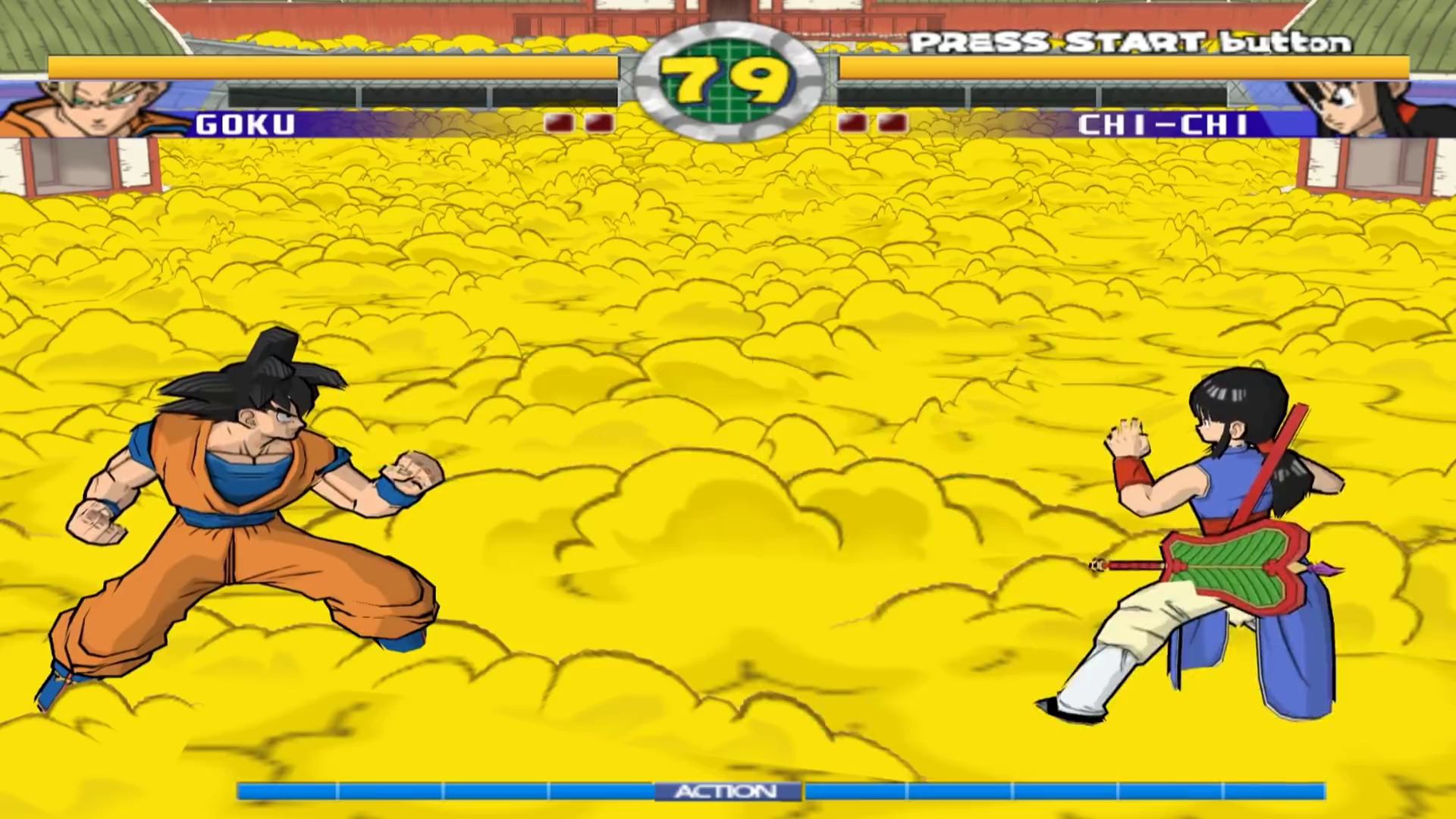
Few DBZ games let you play as Chi-Chi giving fans of that character some added incentive.

Visually the game holds up pretty well. The cel-shading approach helps give it a timeless look, though some characters come off better than others. Goku, for example, has always had a some-what tough time making the jump from flat 2D image to 3D polygon. The stages are, as a whole, more interesting to look at than other DBZ games and the manga approach to its styling helps to add a little extra charm to everything. Sadly for anime purists over here, the soundtrack for the US version is a mix of industrial music that’s designed to resemble the score to the Funimation dub of the show, though it’s an original score and not authentic so even Funimation purists have a reason to be irritated. Other versions utilized some of the actual music from the Japanese anime and I’m sure a lot of US fans would have preferred that. If you hate the manga look though, know that anime colorings do exist in the game so if you want your Future Trunks to sport a royal blue coat instead of teal you can certainly make it happen. Overall, the presentation is solid, though like the gameplay, you won’t get much in the way of flashy big graphical spectacles in the form of massive super moves. At least not on the level of other DBZ fighters.

Since this is a PS2 game, there’s no online mode to easily find other challengers. And even if there were, the servers would undoubtedly be shutdown by now anyway. Having a group of friends who all enjoy the game helps increase the amount of enjoyment you’ll get out of it, but that’s also true of basically every fighting game ever created. It would have been nice if each character had a story and an ending to uncover, but then again, that would work against the drive to just use the same character over and over to make them more powerful. How eager you are to see the secret attacks and unlock the hidden characters will be your primary motivation to revisit this one. If you’ve ever played a DBZ fighting game and wanted it to be more like a traditional fighter, then check out Super Dragon Ball Z. It’s very easy to find a copy for a relative pittance these days so you won’t be risking much by doing so.