Tag Archives: disney

Dec. 19 – Stitch and Santa!

StitchAndSanta

Originally aired in Japan on December 24, 2008

Stitch, of Lilo & Stitch fame, is apparently quite popular in Japan. Disney is popular in general over there, but it seems like Stitch struck a chord. He has a lot of Japan exclusive merchandise and his popularity has extended well past the movie from which he originated. In the US, Stitch and his pal Lilo did get an animated series as well as multiple direct-to-video films so it’s not as if he isn’t popular domestically as well. He’s just so popular in Japan that he’s received multiple anime series that ran from 2008-2011. Following that, a series of specials aired with the newest released as recently as 2015. Since then, Stitch has actually switched markets in Asia and gone to China, where a new series launched in 2017.
img_2880

Stitch! premiered just over 10 years ago in Japan.

The first of these anime was the Madhouse produced Stitch!. It premiered on October 8, 2008 so happy ten year anniversary to Stitch!. Unlike the American cartoon series, Stitch! is not a continuation of the story started in the film but a reinterpretation. Stitch (Ben Diskin) fell to Earth and is accompanied by Dr. Jumba (Jess Winfield) and Pleakley (Ted Biaselli). He ended up on the island of Izayoi which is near Okinawa where he encounters The Spiritual Stone. He befriends a young girl named Yuna (Eden Riegel), the Lilo of our story, and is promised by The Spiritual Stone to be made the strongest in the universe if he can complete 43 good deeds. Stitch is quite mischievous though, so completing these deeds will not be easy because a bad deed takes away from his total. Pleakley crafts him a counter to keep track of his deeds, and together with Yuna, they set out to complete the task.

Standing in Stitch’s way are other experiments of Dr. Jumba gone rogue. The main villain is Dr. Jacques von Hamsterviel (Kirk Thornton), who looks like a cross between a hamster and a rabbit. He attended college with Jumba and seems to just want more power and he sees a way to attain that via Stitch’s good deed counter, or something. He’s also not a new villain as he premiered in the direct-to-video sequel to the original movie, Stitch. Gantu (Keith Silverstein) from the film works for him after he was dishonorably discharged from the Galactic Federation for bad karaoke and he’s rather incompetent. He has an obsession with an Earth soap opera called The Young and the Stupid, in particular with its lead actress. Also joining them is Reuben (Dave Wittenberg), Experiment 625, who basically just makes comments and sandwiches. He loves sandwiches and he also previously debuted in Stitch.

img_2881

Stitch is quite excited about this whole Christmas thing.

Stitch! was first run in Japan, but was also dubbed in English for other regions, though surprisingly the US was not really one of them. Only five episodes aired in the US on Toon Disney before the show was abruptly pulled. It’s possible Disney just felt it was too different from the franchise that is featured here and didn’t want to confuse audiences. Or someone just didn’t like it. The main English cast also was not utilized for the show, but that’s not surprising. As you can imagine, the show has not been released in the US as a result.
img_2882

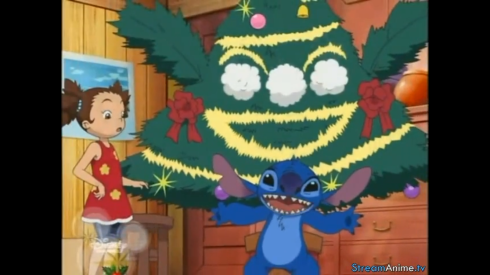
That’s quite a Christmas tree.

The episode opens with Yuna getting ready for Christmas. Stitch has no idea what Christmas is, but Pleakley is happy to inform him since he is an Earth expert and all. He confuses basically all of Earth’s holidays as one and even thinks part of Christmas is the consumption of red-nosed reindeer, which gets Stich quite excited. Venison and presents! His excitement messes up Yuna’s tree decorating, but he refashions it into a facsimile of himself. It’s an improvement. Pleakley did at least get the Santa stuff mostly right, giving Stitch something to look forward to that night. Yuna also gifts her alien friends stockings of their own so that Santa can leave them a present tonight.

img_2883

The villains of the show with really only Hamsterviel being an actual villain. Gantu only cares about a soap opera while Reuben is just really into sandwiches.

In space, Hamsterviel is plotting to utilize Christmas to get rid of Stitch. He is planning on masquerading as Santa Claus to gain the trust of the Earth children and Stitch, and launch a plan from there. Reuben and Gantu are expected to help, with Gantu to just seeing this scheme as a means to stop his favorite actress on The Young and the Stupid from getting married. On Earth, Yuna receives a letter from Santa instructing her to meet him in the forest for her Christmas present. She and Stitch are so excited they don’t notice the obvious Hamsterviel stamp on the envelope.
invited kids

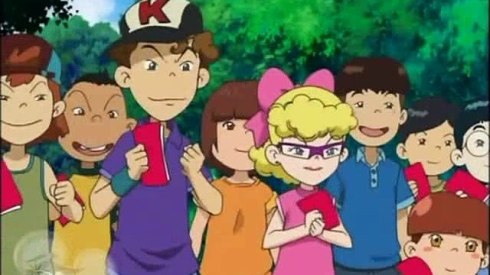
These kids want their present!

Turns out, more than just Yuna received a letter from Santa as the island’s children are shown heading for the designated spot. Along the way they talk amongst themselves trying to figure out why Santa would change things up. A particularly bratty girl named Penny (Meghan Strange) is the most vocal. When they arrive at the area, Hamsterviel is there floating in an egg-like device dressed as Santa. Gantu is dressed as a reindeer and is playing music while Reuben is just there making sandwiches. Santa Hamsterviel offers the children a cookie, and when they eat it they grow whiskers and buck teeth. It becomes clear they’re under Hamsterviel’s control, but he does still give them presents – sandwiches and plush versions of he and Gantu.
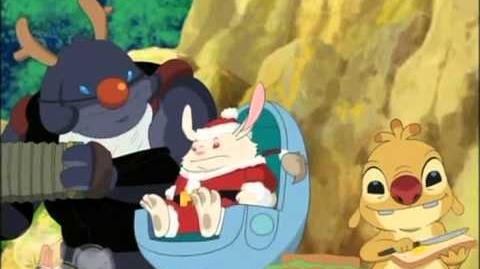
hamster claus

These kids aren’t very smart if they think that’s Santa.

Not present at the gift ceremony is Yuna, who with Stitch is running late. They’re hopeful that all of the presents aren’t gone. They’re intercepted by Kijimunaa, a little yokai who’s basically a mouth and a pair of nostrils with a mop of hair on top. He witnessed what happened with the kids and warns Yuna and Stitch that it isn’t Santa who’s giving out gifts. They confront Hamsterviel and see the transformed children who threaten to bite them and tickle them with their whiskers. Seeing there isn’t much they can do, Yuna and Stitch retreat to seek the help of Jumba. He’s irate to find out Hamsterviel stole his idea for mind-control cookies so he’s happy to help foil his scheme. He quickly builds a little, golden, cat idol that spits out cookies. These cookies should reverse the mind control Hamsterviel inflicted upon the children.
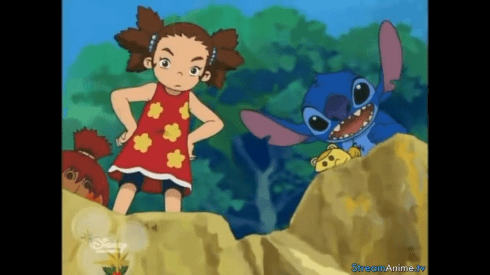
img_2885

Yuna and Stitch are not putting up with this crap, especially not on Christmas Eve!

Armed with the statue, Stitch and Yuna return to the forest where apparently Hamsterviel was content to just hang out and have the kids massage his feet. Stitch jumps around and fires cookies out of the idol at the children who consume them and return to normal. With the spell on them broken, Hamsterviel and company are forced to retreat. As the kids walk back to town, they’re all a bit dismayed they fell for such a scheme. It leads them back to the topic of Santa Claus, and Penny is that kid who wants to spoil everyone’s fun and insists that Santa is their fathers. Stitch is shocked to hear such a thing, but Yuna insists Santa is not their dads. Penny’s response is to point out that of course Santa isn’t Yuna’s dad because her dad is never home (unlike Lilo, Yuna’s dad is alive, he’s just always working so while this is a vicious burn it isn’t as vicious as it would be if she and Lilo shared the same origin) which upsets Yuna and causes her to stop dead in her tracks. She then sadly remarks, mostly to herself, that’s how she knows Santa isn’t her dad because he is never around.

img_2887

Santa apparently doesn’t dress lighter when delivering gifts in Hawaii.

At home, Yuna is a bit more upbeat than she was following her encounter with Penny. She writes a letter to Santa, but won’t tell Stitch what’s in it, that she places beside her pillow as she goes to bed. Stitch seems a bit thoughtful, but he too lays down to sleep but is soon awoken by a sound on the roof. He heads outside to find the big man himself, Santa Claus (Dave Wittenberg), on the roof. He thanks Stitch for what he did in stopping Hamsterviel earlier and also asks for his help. Stitch is very eager to help Santa, and the jolly old elf outfits him with his own Santa suit (Stitchy Claus!) and a tiny, one-deer, sleigh. Stitch surprisingly doesn’t seem tempted to eat his lone reindeer and Santa hands him a sack of toys to deliver throughout the island.
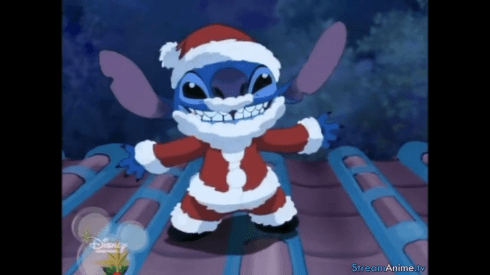
img_2888

All right, that’s pretty damn cute.

Stitch sets forth and the action unfolds as a montage. He visits most of the kids we saw earlier and places a gift in their stocking, which most seem to hang from their bed (a Hawaiian tradition?). He even gives that jerk Penny a gift, and saves Yuna for last. In the morning, the kids are gathered at Yuna’s house to show off their presents. Yuna got exactly what she wanted, while Penny got a book on how to be nice. Even Hamsterviel is shown as having received a gift – a giant hamster wheel because he’s out of shape. Gantu received a costume from his favorite soap opera, which brings him to tears, while Reuben has decorated their tree with nothing but sandwiches. On Earth, Kijimunaa asks Stitch what Santa got him, which causes Stitch to realise he didn’t receive a gift! He heads back to his room and finds a letter from Santa thanking him for all he’s done. Stitch then checks his good deed counter and watches it increase by five deeds. This excites him quite a bit as he looks to the heavens and the episode ends.

img_2889

But this is actually cuter.

“Stitch and Santa” was a pretty charming way for me to get acquainted with this series. Prior to this, I knew it existed but had never sought it out. It looks like a fairly typical anime, while the character designs of the characters we know from the films largely look the same. The voice cast is fine and Hawaii is still a lavish setting. I enjoyed the design of Hamsterviel who is so cute he isn’t threatening and it was interesting to see the new interpretation of Gantu. A lot happens in the 20 minutes the episode lasts to build up to the climax of Stitch helping Santa. There’s something really charming and cute about that whole sequence making it a really nice pay-off following the rather breezy scheme plot.

img_2890

Stitch saying “Thank you, Santa” is also pretty adorable. I can’t handle the cuteness!

Since the lore of the show is so different from the film it makes it a bit difficult to just drop-in. Stitch being friendly with Jumba and Pleakley isn’t too odd since that’s basically how the movie ended, though the presence of Yuna is confusing. I at first thought she was just an anime version of Lilo, but obviously I was mistaken. I had no idea about the deed counter though, so Stitch’s ultimate present was a bit of a head-scratcher until I read-up on the series. I’m a little disappointed this didn’t get a US broadcast and release as it seems like it has potential. Because it wasn’t released, it would seem Disney doesn’t care about protecting its asset so this was exceptionally easy to find streaming online. If you like Stitch and want to see a different take on him, go ahead and check it out. There’s enough Christmas feels here to make it a worthwhile holiday viewing experience.
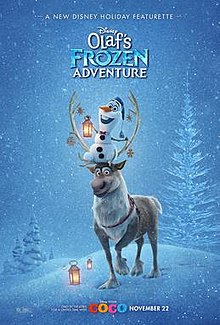

Dec. 14 – Olaf’s Frozen Adventure

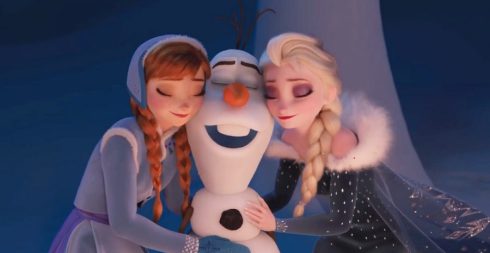
olaf frozen adventureJust past the halfway point is where our most controversial Christmas special appears:  Olaf’s Frozen Adventure. It’s not controversial for anything fun. No alluring scenes or hints of violence or anything like that. It’s controversial because of how poorly received it was when it was paired last year with the Pixar film Coco for it’s theatric release. Pixar and Disney films often have a short film that leads them off, but usually that short is from the same studio and it’s, well, short! Pixar may be owned by Disney, but the audience doesn’t entirely overlap. Pixar attracts an older audience while Disney still appeals more to children and families. And Coco was a pretty important film for a lot of people. Centered around the Mexican holiday Dia de los Muertos, a lot of people and families of hispanic origin were delighted to see Disney recognize their culture with such a film. That it was attached to a Frozen short that wasn’t very short could have been viewed as the studio not believing in Coco, that it needed the marketing might of Frozen behind it, in order to succeed. I like to think it didn’t, as Coco is one of the finest films ever released by Pixar. The backlash against the Frozen short though was enough to cause Disney to pull it after only a couple of weeks. It was then shown on television shortly after, where it belonged as a Christmas special considering it’s the exact length one would expect a half-hour television special to run at.
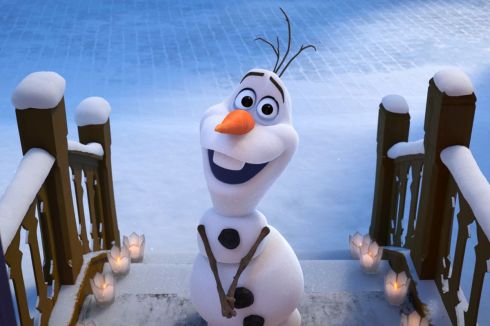
It’s possible that Disney didn’t believe in Coco, but I think the placement of Olaf’s Frozen Adventure is a bit less cynical. When Frozen was released in 2013 it was a huge success. Disney probably knew it had a hit on its hands, but you’d forgive the company if it was a bit hesitant. Frozen had a long, tortured, development cycle when it actually began as a 2D feature that ran into lots of problems, technical and with the story. Movies, music, video games – these things happen with art and entertainment that has long development cycles, but usually when a project runs into the problems Frozen did the end result is often underwhelming. Frozen bucked that trend though and it was pretty obvious this was the start of a new franchise. The problem is, no one really put much thought towards the future, so a Frozen sequel would be many years in the making. To try to keep Frozen in the hearts and minds of its audience, Disney commissioned some shorts. First was Frozen Fever, a true short released in 2015 (where it was more logically paired with the live-action Cinderella movie) followed by this one in 2017 (there was also a Lego Friends television special in 2016 called Frozen Northern Lights). This particular short seems to obviously have begun as a television special, but Disney wanted to give it the big-screen treatment, which obviously didn’t go so well. I did see this with Coco and I agree with those who felt it was far too long for that setting. I have no real affinity for the franchise, my kids love it and so does my wife, but I think it’s fine. I imagine those suffering from Frozen fatigue found it hard to sit through this one when they just wanted to see Coco. When are they going to get to the fireworks?!

olaf search

The world’s most popular snowman gets his own Christmas special.

With Disney making the move to television with Olaf’s Frozen Adventure, I’m more optimistic this story can find a home. I’m running it this early in the countdown in hopes that this beats it to air for 2018, if it is to air at all (check the bottom of the post if you’re only interested in that detail). It has the talent of Walt Disney Studios behind it so it looks every bit as good as other animated works to be released in theaters, and even looks better than the feature Frozen. And as the title implies, it’s going to feature a heavy dose of the snowman Olaf (Josh Gad). It’s sometimes dangerous to make the comedy relief character the main attraction, but considering this is a shorter piece than a movie it’s a safer move than say what Cars 2 did with Mater. And while it is a Christmas special, the actual holiday is rarely mentioned as it tries to be a catch-all for all of the winter solstice holidays.

party planning

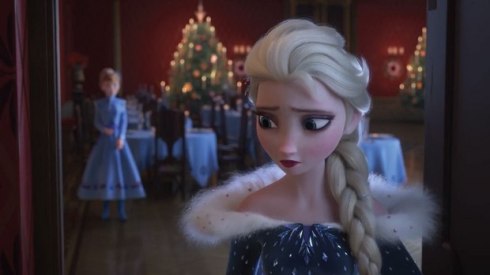
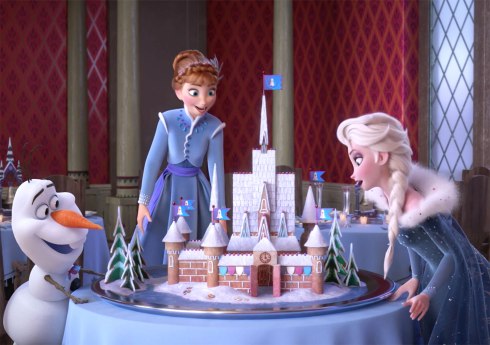
Anna and Elsa are getting ready to celebrate their first Christmas in forever and are planning a big celebration to kick things off.

The special opens with Olaf trying to surprise various attendants in the castle. They’re setting up for a big surprise party of some kind and the snowman is a little too eager to get the festivities underway. Anna (Kristen Bell) and Elsa (Idina Menzel) soon approach (in new winter attire; gotta think about the real world toys!) to explain to him that the surprise occurs after the ceremony unveiling the holiday bell. The characters break into song, “Ring in the Season,” and if you didn’t assume it let me explicitly state this thing is a full-blown musical. The songs aren’t written by Robert and Kristen Anderson Lopez this time around though, but by Kate Anderson and Elyssa Samsel. The pair manages to capture the sound of the film’s musical stylings, which is actually admirable considering they had less time to work with.

As the pair sing, we see a crowd of people enter the courtyard while Kristoff (Jonathan Groff) and Sven bring in the bell. It’s hoisted to the top of the tower and rung and everyone rejoices. Anna and Elsa then try to welcome everyone into their surprise party, but to their surprise, no one notices as they’re all leaving. When they go running up to individuals inviting them inside they’re basically met with the same response; they all have to return home to tend to their family’s holiday tradition. A sweet old couple even suggests they wouldn’t want to intrude on the royal family’s traditions. Olaf remarks that the surprise was that everyone left.

flemminggrad

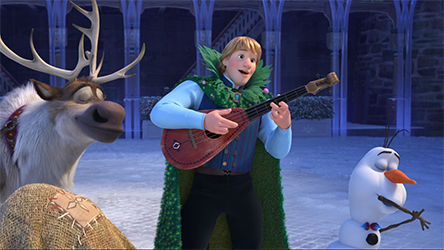
Kristoff getting in a little lute time.

Kristoff tries to cheer everyone up with our second song, “The Ballad of Flemmingrad.” In a style similar to his “Reindeer are Better than People” routine from the movie, Kristoff sings about some troll idol you stuff grass into the nostrils of and lick. Anna is almost delighted by the grossness of it, especially when Kristoff unveils the idol itself. Olaf just reminds her that she’s a princess and doesn’t need to settle. Elsa is legitimately grossed out and not at all interested in Kristoff’s tradition, but is at least polite. Kristoff assures them they’ll come around when they try his Flemmy Stew and takes his leave.

dramatic elsa

Elsa never misses an opportunity for drama.

Olaf is left to ask Anna and Elsa about their family traditions, which leads into a reprise of the “Ring in the Season” song in which Elsa remembers the bell ceremonies from their youth, before Anna’s accident. The two realize they don’t have any traditions, as they were never together for Christmas due to Elsa locking herself in her room. She rather dramatically apologizes to Anna for being the cause of their tradition-less solstice, and hastens off to (where else?) her room. Olaf’s a bit downtrodden to see his surrogate family so glum for the holiday, so he decides to set off into town with Sven and a sled to find traditions they can enjoy.

olaf candy cane

Pretty sure that’s a Funko Pop variant.

Olaf then goes door to door to every house in Arrendelle in search of traditions. Like some sort of anti-Claus, he collects traditions to fill his sleigh along his way. The people all seem helpful and cheerful, but I wonder if they fear reprisal if they deny the queen’s loyal attendant? As Olaf does this he breaks out into song, “That Time of Year,” in which Olaf asks what people do at that time of year. It’s a cute way to basically avoid saying Christmas so that they can include families that have obvious Jewish and even Pagan celebrations. This bit is mostly played for laughs as Olaf first receives a candy cane that gives him an intense sugar rush when he replaces his carrot nose with the candy cane. He also gets to comment on the dangers of leaving socks over an open flame and even encounters adorable kittens. Olaf plus kittens is indeed a cuteness overload. There’s also a fun sequence during the song’s climax where the visuals switch to resemble a Christmas sweater.

olaf kittens

Olaf + Kittens in sweaters = adorable

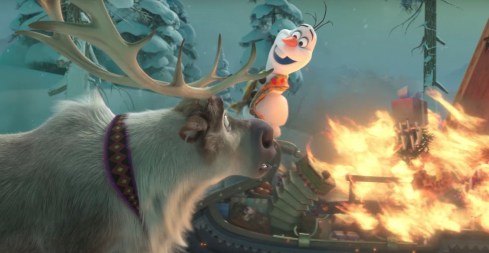
Olaf’s last stop ends up being the home of Oaken (Chris Williams) who invites Olaf into the sauna with his family. Olaf enjoys it, even though it causes him to melt leading to a fun visual of Oaken tossing a bucket of melted Olaf into the chill night air causing him to refreeze instantly. Oaken gifts Olaf a portable, personal-sized, sauna for his sleigh and one of his tastefully revealing towels. Olaf is excited and he and Sven head off back to the castle while Olaf improvises some words to the tune of “Jingle Bells” to show his excitement. While he rubs the towel across his rear he disturbs the sauna behind him, causing a piece of coal to pop out and hilariously find it’s way out of the sleigh, off the cranium of a squirrel, and back into the sleigh where a fire commences. Olaf is blissfully unaware as the flames roar behind him and the sleigh breaks off on one side from Sven’s reigns. As they were about to head down a hill, this poses a problem for poor Sven as the sleigh loops out in front of him and pulls him down. Olaf remains unaware of their predicament, instead remarking how they’re making wonderful time, until the sleigh breaks off from Sven completely and goes off a chasm. Olaf is tossed to the other side, but the sleigh does not make it and the tired joke of the sleigh falling out of sight down a cliff, only to explode upon impact with the ground, is recycled from the movie.

burning sleigh

Of course Olaf’s adventure ends in disaster.

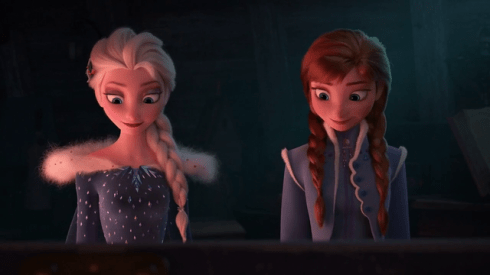
The setting shifts back to the castle where Elsa is approaching Anna’s room to apologize for apologizing earlier about being the cause of their lack of traditions (I guess?). She finds Anna is not in her room proper though, but above it in the attic. She’s rummaging though her old things looking for traditions. They try to make this scene cute and sweet, but it’s not really felt. There’s a joke made at Elsa’s expense regarding her gloves, but the two do find an old jewelry box. Elsa seems hopeful when she finds it and gives it to Anna imploring her to look inside. When Anna opens it she reacts with delight, but the audience doesn’t get to see the contents of the box (yet).

in the attic

The girls make a discovery in the attic that’s sure to be heartwarming and convenient.

With Olaf and Sven separated by the chasm, they’re forced to split up. Sven has a direct path back to the castle, but the cheerful snowman does not. Even though he lost all of his traditions, Olaf is at least comforted by the fact that he was able to save one:  a fruit cake. He then cheerfully tells Sven he’ll see him back at the castle, sensing there’s a harmless shortcut lurking in the doom-laden woods behind him. As he disappears into the darkness he exclaims “Oooo, puppies!” before the sound of wolves savaging the poor snowman are heard.

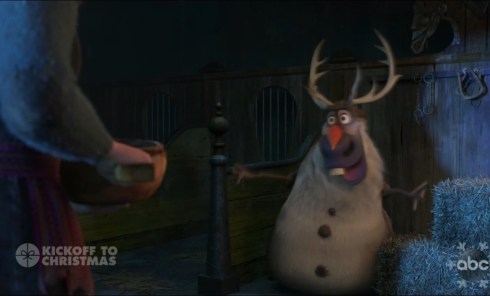
What do we call this Sven-Olaf mash-up? Svolaf? Olen? Maybe just “cute”?

Sven races back to the castle fearing his buddy’s life is in danger. He barges in on Kristoff who is happily finishing his stew. He presents Sven with a bowl, but when Sven puts a carrot in it to make the stew resemble Olaf’s face Kristoff just confuses the gesture for Sven wanting more carrots. Sven then mimes the danger Olaf is in and the visuals are pretty funny. It’s a bit awkward though since one of Kristoff’s gimmicks in the original film was that he had little trouble understanding the reindeer, but he’s now oblivious. Fortunately for Olaf, Anna and Elsa were in the doorway and they understand him perfectly, for the sake of humor. They quickly sound the bell to organize a search party, while Kristoff scolds Sven for sitting around while Olaf is in trouble.

sad snowman

One dejected snowman.

Back in the forest, a battered Olaf is running from some hungry wolves while trying to hang onto his fruit cake. He dives through the thick hemlock and emerges on the other side looking worse for ware, but he’s happy still because he was able to save the fruit cake. As he raises it in triumph to the heavens, a hawk swoops in and snatches it. Olaf now allows himself to feel sad and reprises “That Time of Year” but in a somber fashion. Blaming himself for failing to secure traditions for his friends, he wanders off into the darkening woods and slumps down beside a tree as the snow whips up.

olaf the tradition

Olaf set out to find a new tradition for Anna and Elsa, but it turns out he’s the tradition (aww!)

Elsa and Anna are shown, montage style, going door to door to organize a search party to find Olaf. Soon the whole town is out in the woods looking for Olaf. As Anna calls out for him, Olaf responds with a “Not here,” as the snow drifts have covered everything about him save for his nose and “hair.” Recognizing he’s a bit down, Anna and Elsa smile and play along with the game as they ask aloud where Olaf could be. Olaf responds in the third person explaining he set off to find traditions, and that they then caught fire, as Sven shows up to pull him out of the snow drift by the carrot. Olaf apologizes for losing the traditions, but they urge him to cheer up, and Anna pulls out that box from earlier. When Olaf looks inside he sees dozens of pictures of him, and even a crudely made doll. The sisters explain that when Elsa was exiled to her room, Anna would make her an Olaf card every year and slide it under her door. Olaf is their family tradition, and they embrace the little snowman and he starts to cheer up.

KRISTOFF, ANNA, ELSA, OLAF, SVEN

And we get to end on a happy Christmas visual.

Elsa then breaks into song, because of course this is going to end on a song. “When We’re Together” is the special’s big song that sums up its message. Elsa and Anna lead the townsfolk back towards the town and to the harbor coated in ice. Elsa magics up a banquet while people mostly just watch the sisters dance while some kids get involved a little bit. A big ice tree is created by Elsa’s magic, and Olaf gets to place the star on top and sing the song’s closing line. Their special photo-op is broken up though when the hawk from earlier returns the fruit cake, dropping it out of the sky to land on Olaf. He declares the return of the fruit cake a Christmas miracle as the special ends.

Olaf’s Frozen Adventure was certainly misplaced as a caddy to an unrelated film. It’s a TV special with feature quality presentation that’s best enjoyed by those who actually like the characters from Frozen. Disney had done this before with Mickey’s Christmas Carol, but that was paired with a re-release of The Rescuers and was included as a way to offer patrons something new. And even so, that special is best enjoyed on TV as well, even though it’s no longer an annual feature. This special leans heavy on its music and the Olaf character and the attempted humor through Olaf works quite well. He’s a very optimistic and excitable character, but he’s also prone to deadpan humor. It’s an interesting dichotomy that works. I don’t know if he could anchor something longer, but for a half-hour television special he’s suitable. The humor and drama shared between the sisters is less successful. It’s forced in there because it has to be. Anna and Elsa are mostly here to sing, and when they stick to that the special is more successful.

Anything based on Frozen is going to be judged by its songs. After the likes of “Let It Go” and “Do You Want to Build a Snowman?” were so well-received in 2013 it became clear that anything else involving Frozen would need songs to match. The “Ring in the Season” song is well-suited as a light opener, while the Olaf vehicle “That Time of Year” is cheery and the visuals that go with it help to make it an enjoyable song. “When We’re Together” feels like it’s meant to be the showcase. It has a nice melody, though some of the song’s drama, like the narrative of the short, feels forced. It’s trying too hard to be the special’s biggest moment. It’s redeemed by the big ending, but it feels like the kind of song made for TV as opposed to one intended for the theater.

olaf christian

“That Time of Year” gives the short a chance to show various holiday customs.

As a Christmas special, this one is plenty good enough. Perhaps those who feel there is a war on Christmas will turn up their noses at the sometimes reluctance of the special to even mention the holiday. Inclusivity is a virtue, and in being so inclusive the special is able to find interesting visual elements for Olaf’s journey through town. The special shows Jewish traditions, but it’s not as if it doesn’t show Christian ones as well amongst the townsfolk. They even allude to Santa at one point.

Olaf’s Frozen Adventure is available to purchase digitally and should also be available on Blu Ray and DVD when this post goes live. Since it was shown on television last year, it’s my expectation that Disney intends to include this with its annual holiday specials on ABC. It would be strange if it did not as the 21 minute runtime is perfectly suited for prime time viewing and the popularity of the franchise will likely equate to solid advertising revenues for the Disney owned network. If it’s anything like Disney’s other major Christmas specials, it will first air on ABC then receive encore runnings on either Freeform or The Disney Channel during the lead-up to Christmas allowing viewers plenty of opportunities to catch it. And if you couldn’t tell, I recommend this one. While I don’t think it’s as good as the excellent Prep & Landing, it’s certainly worth an annual viewing.

Olaf’s Frozen Adventure aired Thursday November 29th, but if you missed it then good news as it’s being shown again this coming Wednesday, December 19th, on ABC at 8:00 PM EST.


Previously on X-Men: The Making of an Animated Series

previously

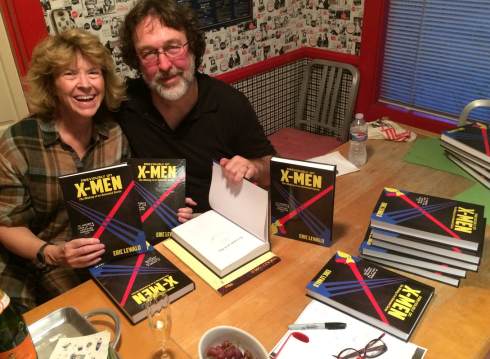
by Eric Lewald, published by Jacobs Brown Media Group LLC

A lot of cartoons made an impact on me as a child. My first love was The Real Ghostbusters. Its goofy cast of characters and excitement were plenty of fun and there were interesting toys to supplement the series with, which was pretty much the goal of all cartoons in the 80s. The Teenage Mutant Ninja Turtles would come along and supplant Ghostbusters for me. For several years I was all about the Turtles, with a flirtation with Bucky O’Hare mixed in, though sadly the funky fresh rabbit never made it past 13 episodes.

In 1992 things changed, in more ways than one. My family had just been uprooted moving from the cozy confines of New Hampshire to what felt like a different world down in Virginia. For the first time ever, I was a fish out of water. As I was gearing up to start 3rd grade in a new state, a new town, a new school, I would be tasked with forming all new friendships either at school or in my new neighborhood. It’s not a task I’ve ever been particularly good at. Shy and a tad awkward, I wasn’t outgoing, nor was I particularly talented in anything so I had few ways of attracting people. As a result, my television was sort of my best friend for a time and thankfully I had a new friend in Batman who had just debuted on week day afternoons on Fox Kids, a network I really only knew of thanks to The Simpsons. Batman was all fine and good, and I consumed every episode as it aired (and have since gone on to write about, if you hadn’t noticed), but it never hooked me like Teenage Mutant Ninja Turtles, even though that was a program I found myself outgrowing. What did resonate with me almost immediately though was the cartoon that premiered not long after Batman, I’m talking about X-Men.

The X-Men were known to me in basic terms before the animated series premiered on Fox. About a year prior to the show debuting Marvel had launched a toyline complete with TV spots, even though there was no companion television series to pair it with. I suppose the toys could have been developed in conjunction with the Pryde of the X-Men pilot that had premiered and failed in 1989. The roster was pretty similar, though then relative newcomer Archangel replaced Dazzler in that initial run of toys. Aside from that though, I don’t think I had ever picked up an X-Men comic book and I may or may not have played the side-scrolling beat-’em-up arcade game that was also based on Pryde of the X-Men. And I didn’t even actually catch the sneak peek preview, which aired on Halloween of 1992. I had seen all of the television spots leading up to it and was very interested in the show, but I had tricks or treats to get and wasn’t good at working a VCR.

X-men_pryde_of_the_x-men_cover

The first attempt at bringing the X-Men to television did not go very well.

At school, I would hear about it though. They had cool powers, but people hated them. Why? It seemed like such a foreign concept. One character got arrested and another died! Wow! Perhaps morbidly, I really wanted to see that character death, whom I’d come to know as Morph. Frustratingly, it would be awhile before I finally saw it. Somehow, whenever “Night of the Sentinels:  Part 2” was aired on television I would miss it. I wasn’t allowed to stay home alone, since I was only 8, so if my family had plans on Saturday morning I had little say. My mom even enrolled me in CCD, or church school, which convened at 11 on Saturdays, much to my horror. I think I only went to two of those classes before my mom got sick of the revolt each Saturday, finally freeing me to enjoy my new favorite program in relative peace.

In no time I was obsessed, and X-Men was my favorite show for basically as long as it aired. I still have the many toys I amassed during that period in my life, and though I no longer read the comics, I still enjoy revisiting this cartoon. It’s why when I heard that showrunner Eric Lewald was releasing a book all about his experience in making the show and bringing it to television that I had to get a copy. I received a copy last November, and I’m a bit disappointed in myself since it took me this long to finally finish it and get to writing this post, but life is hectic.

Previously on X-Men is an account of how this unlikely hit came to be. When Fox premiered X-Men and Batman it was still a fledgling network. The Tracey Ullman Show and Married… With Children got the network its initial audience, and The Simpsons would then establish it as a viable alternative to the big 3:  ABC, CBS, and NBC. It was still struggling during the other parts of the day with programming often ending before 11 PM. Recognizing that there was a place for children’s programming, Fox brought together a web of studios and producers in a mostly haphazard manner that somehow led to network dominance. Shows like Bobby’s World and Attack of the Killer Tomatoes were filling out the kids portion of the programming early on, and while it sounds like they did okay numbers, they weren’t going to raise the network’s profile much. It would fall to the superheroes to do that.

lewaldscelebrating_orig

Julia and Eric Lewald

Lewald’s book does a great job in capturing those early days while also contrasting X-Men with its daily counterpart Batman. Batman was a show with tremendous financial muscle behind it in the form of Warner Bros. and DC. It was coming off two successful Tim Burton movies and featured a character recognized around the globe. As a result, it was largely an internal production at Warner and Fox got to enjoy the benefits. And then there was X-Men, the troubled property that seemingly no one believed in. Thanks to so many television failures by Marvel in the past, there was almost zero enthusiasm for a show based on the property. Margaret Loesch, who formerly headed-up television at Marvel and was hired away to run Fox Kids, was one of the few who believed in it. Having failed to get the show going while at Marvel, she knew a producer who she had hired and fired on more than one occasion that could handle the task. That man was Sidney Iwanter, and he produced the show along with many others for Fox Kids. Citing a belief that kids were smarter than network executives gave them credit for, he demanded excellence from the writing staff of X-Men, who were overseen by Lewald. These three probably deserve the most credit in getting X-Men to television and for it being the number one kid’s show when it finally did get there.

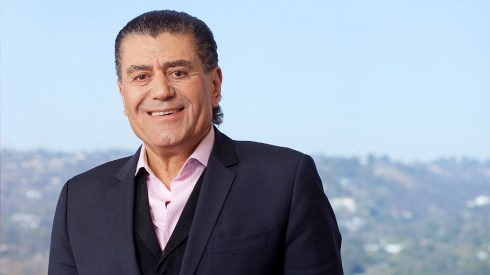
haim-saban

Haim Saban, who is both a hero and a villain in this story.

The first 200 pages of the 400 page book are devoted to the development process and it’s a fascinating read. Lewald, who had no experience with the X-Men before getting hired to run the show, was entrusted with those initial 13 episodes. He had people at Marvel he could go to with questions, but in a pre-internet world that meant a phone call, fax, or worse. It wasn’t like there was a Google equivalent in 1992. Artist Larry Houston is credited with the look of the series, as he was one of the few onboard who was a fan of the comic. Also the Edens brothers, Michael and Mark, were Lewald’s main contributors in the writing department. Lewald’s wife Julia was also a part in the initial season and contributed to the book as well. It’s very interesting to read as Lewald takes the reader through that initial writing process, and it’s easily the most captivating section of the book. Their approach to character showed in the episodes, so a lot of what is said here was previously assumed. Such as the belief that killing off poor Morph in the second episode would create stakes and pull the viewer in.

fox kids

The early days of Fox Kids.

If there is an MVP character for the book though it just might be Haim Saban. Saban was a newcomer to television when Fox Kids partnered with him to bring the X-Men to air. Saban collected a fee for those first 13 episodes, but then it was on him to pay the writers and editors. Graz handled the art, while AKOM was contracted to do the animation. Saban is a notoriously cheap man, and reading about all of the accounts of his cheapness is both hilarious and frustrating. It’s well known now, but bares repeating to emphasize how cheap he was that Saban docked the pay for all of the returning writers for season 2. His reasoning? The show was a success, so now more people would want to write for it and therefore he could pay them less. The man is now a billionaire, so obviously he’s pretty good at making money, though he’s also a reminder of a lot of what’s wrong with modern capitalism. The second half of the book is comprised of interviews with the cast, writers, producers, and other executives and almost all of them have a comment about how cheap Saban was, and likely still is.

Many battles took place to bring X-Men to Saturday morning. Some I knew about before reading this book, and others I did not. It’s probably common knowledge that the first episode from AKOM was utter garbage in terms of animation quality. It’s a big reason why the show had to premiere as a sneak preview because the studio couldn’t get the episodes ready to premiere in the normal Fall window due to all of the animation fixes that needed to take place. A lot of money was spent getting it right, and it almost blew everything up. The original voice cast also had to re-do the initial episodes because the first takes were so bad. Saban, in order to save money, hired Canadian actors to voice the show because they were famously non-union, so casting, supervising, and ultimately editing the audio for the show was cumbersome. Having to send individuals up to Canada in order to re-dub the initial episodes was obviously time consuming as well.

X-Men (FOX) [1992-1997]Shown from left: Wolverine, Morph, Beast

Oh Morph, I still mourn for thee.

And then there was Stan Lee. Stan Lee is a pretty famous guy. I’m not sure if he’s today more known for all of the comic characters he had a hand in creating or if he’s more famous for being that old guy who cameos in every Marvel film. Stan Lee created the X–Men alongside Jack Kirby in the 60s, but after that initial unsuccessful run, he turned it over to other writers and artists so he could focus on other things. As a result, come 1992 he basically knew nothing about the modern X-Men and yet he insisted he knew what was right for the show. Lewald and Iwanter had to fight with Stan on everything in those developmental days. He insisted on narrating the episodes, as he had done with previous Marvel television shows, and his approach was entirely wrong for the show they were trying to create. Supposedly, he even proposed the premise of the show should be a few members of the team driving around and solving mysteries. Imagine Wolverine in the role of Scooby Doo? Who would Shaggy be – Gambit?! They somehow managed to placate him, without really giving him a voice in the show, and eventually he went away as the show moved along through its first season and became a smash hit. The frustration in having to deal with Lee, and the many other challenges, is felt in reading this and I ached for Lewald even though he’s more than 25 years removed from this aggravation.

spiderman 94

The success of X-Men helped pave the way for more Marvel cartoons like Spider-Man.

That first season was only 13 episodes, a far cry from the 65 episode order Batman received. Fox was so unsure about the property that it wouldn’t commit beyond that, forcing basically everyone involved to move onto other shows. Lewald went on to helm Exosquad with the Edens, and thankfully that too only received a 13 episode order so he was available to return to X-Men when it finally received the full episode order. Others did not, because that’s how television works. If a show isn’t in production, you’re not getting paid. That first season’s decision to present itself in a serialized fashion also presented problems for the network, as production delays on one episode messed up the order of everything. As a result, the network demanded that season 2 be more episodic, but Lewald and his talented team of writers still managed to give it a serialized feel with The Savage Land segments and reoccurring villains like Mr. Sinister and The Friends of Humanity. A wise move, since the serialized nature of that first season is a big reason why it’s so special.

Nightcrawler (1)

“Nightcrawler” is frequently cited as a favorite episode of many of the creators involved with the show. The book also contains a deep dive into its creation.

Like the show itself, which I think produced its best work in those first two seasons, the book somewhat suffers from a strong first half that isn’t matched by the second. The many interviews that span roughly 200 pages are informative, but some more than others. The voice cast mostly repeats itself with remarks about how it was fun to work on something that felt different and how they came to understand their roles. The actual writers and producers offer the more interesting nuggets. There’s a lot of praise thrown around which might get tiresome for readers, though they all have reason to praise each other since it’s easy to forget how successful this show was. Especially when taken alongside the production and development hurdles. Of the interviews, I think I actually enjoyed the executive ones the most. Loesch and Iwanter were candid and did a great job of transporting me back to the early 90s and the hurdles they faced in backing this show. It’s fun to read about how close these people were with these characters that meant so much to me as a child. They cared about them, which is ultimately why the show ended up being as successful as it was.

X-Men-92

Marvel has resurrected the 92 X-Men for its comics line, but the results weren’t enjoyed by this blogger.

It should come as no surprise that, as a longtime fan of the show, I fully recommend Previously on X-Men to other fans of the show. Even if you were only a casual fan, but tuned into the animated scene at the time, you might enjoy reading this one. It’s fun to read the comparisons of how this show came to be with the experiences these people had with other shows. X-Men was a production mess, a wonderful, beautiful, mess. It was still garnering good numbers when it was cancelled, and one has to assume it was due to costs. By then, Saban had Power Rangers and was able to bring more stuff in house. X-Men had all kinds of hands on it so a lot of people had to get paid, and as we already covered, Saban wasn’t a fan of paying people. Even so, it’s hard to argue that the show was cut-down in its prime or anything, but reading this book and revisiting the show really made me realize how much I’d love to come back to this world. Marvel did launch an X-Men ’92 comic, but it did not satisfy me nor did it read like an episode of the beloved cartoon, rather it felt more like a parody. Marvel is now under the gigantic Disney umbrella and its films basically print money. With the Fox acquisition though, suddenly the X-Men are back in play. Marvel hasn’t bothered with animated films in awhile, though it’s sort of bringing that back with Into the Spider-Verse. Maybe a direct to video follow-up for the 92 X-Men could one day be in play. Pretty please? At the very least, how about a Blu Ray collection with episode commentaries, Disney? The people who created this wonderful show obviously wish to talk about it and they still have a lot to say.


DuckTales Season One Review

ducktales newRebooting an old cartoon property has its pluses and minuses. On the one hand, reviving an old brand means the core of what you’re trying to build is already in place. Characters, relationships, stories, even music can all be mined from the old and adapted for the new. There are often tweaks made to the look of the show, new voices to cast, and a whole new team to assemble, but it’s undoubtedly easier and less expensive than starting from scratch. And it also allows a new generation of creators to take something they enjoyed as youngsters and mold it into something else. It also comes with risks, and as we’ve seen all too often recently there is an aspect of fandom that is, well, toxic to say the least. Take She-Ra, for example. Originally conceived as a way to market action figures to girls, She-Ra was integrated into He-Man and the Masters of the Universe, itself a show designed simply to sell toys to boys, and the backlash was swift and quick. Even those behind the creation of He-Man looked down on She-Ra and blamed her for hastening the decline of the franchise as a whole, “Now my sister wants to play with me? Gross!” This is all captured quite well in the documentary series The Toys That Made Us, if you want to know more.
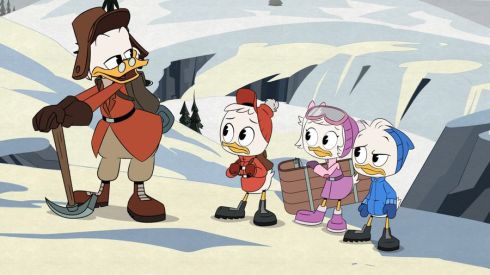
She-Ra, I’m sure, had fans of her own, but they definitely were small in numbers, relatively speaking. Rarely did I ever hear anyone in conversation bring her up in a positive light and I literally met no one pining for a reboot in the same mold as He-Man himself. And yet, when a new concept was recently unveiled for She-Ra online the He-Man fandom and nerd culture as a whole was swift to pounce on it. Blaming it for ruining the character or for unoriginally adhering to the “CalArts style,” these fans were loud and largely obnoxious. It was similar to the backlash towards a new ThunderCats show that has yet to air. Did you ever watch ThunderCats back when it was originally aired? That show, just like She-Ra and He-Man and countless other programs, was terrible. It’s fine to be nostalgic for them because you grew up with them. I certainly watched a lot of crappy cartoons, but I don’t want to subject my kids to the same. If there are to be new versions of these shows I want them to be good! Not some 23 minute toy commercial. Fans should be happy these things still exist for a new audience. And the beauty of it all is, if you don’t like what’s new, you still have what’s old. It doesn’t go away or vanish the moment a new version shows up.

scrooge winter

The cast is much larger, but many episodes still revolve around Scrooge and his nephews (plus Webby).

It’s interesting that one of the companies behind the pivot from making shows that sell toys to just making good animated programming was Disney with its Disney Afternoon programming block. The original Disney Afternoon toon was Adventures of the Gummi Bears, but the show most associate with the block is none other than DuckTales. Basically a loose adaptation of the Carl Barks comics for television, DuckTales centered not around Donald Duck but around his rich Uncle Scrooge McDuck. He was partnered with his grand nephews Huey, Duey, and Louie along with his personal pilot Launchpad. Together they went on grand adventures searching for treasure. They wouldn’t just travel to far away places, but backwards and even forward in time! It was memorable for its lavish animation that went far beyond the likes of Dic and Hanna-Barbera. Not to mention for its incredibly catchy theme song.

As such, it seems appropriate that when it came time for Disney to adapt DuckTales for a new audience it largely escaped the internet backlash that had befallen other properties. Oh, I’m sure there are detractors that do not like the new visual style or the Felicia Barton sung intro, but by and large the response I have seen online and in person has been overwhelmingly positive. DuckTales just concluded its first season. Commercially, I have no idea how well the show has done, though it’s done well enough to receive a second season. It’s hard to judge that sort of thing in this day and age when ratings mean almost nothing thanks to streaming options and DVR. There hasn’t even been a tie-in toy-line until very recently so sales of that aren’t going to offer much of a measure. Creatively though, it’s hard to think of a cartoon reboot that has been more successful than DuckTales. The Teenage Mutant Ninja Turtles come close with their 2012 reboot, and really that ThunderCats reboot of a few years ago was miles ahead of the original, though it did not last very long. DuckTales is on another level though, and there are a lot of reasons why.

ducktales-donald-duck-header

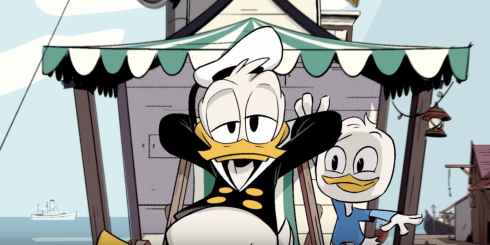
After mostly chilling on the sidelines in the original series, Donald is a part of the main cast this time around. He doesn’t get to relax as much as this image suggests.

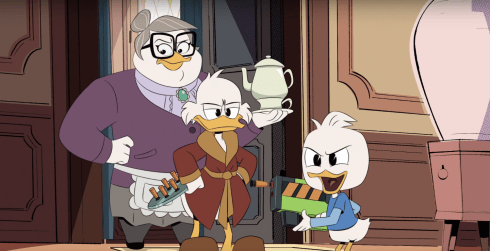
First and foremost, the work of Carl Barks has not been ignored. Scrooge is back to his red overcoat and he’s partnered with all of his nephews this time – including Donald Duck! Back when the original Disney Afternoon was conceived, Disney was hesitant about letting any of its big stars headline a show. Landing Donald for the few episodes he was in was a huge get, as characters like Mickey, Minnie, and Goofy were completely shut-out at the onset. That stigma has long since passed allowing Donald to finally star alongside his uncle as he should. Huey, Dewey, Louie are still around and now they have distinct looks and personalities all to themselves. The prior nephews in basically every iteration were interchangeable. It was part of their charm, but also pretty limiting from a character perspective. Now they’re free to be themselves and the writers are allowed to explore each individual duckling. Huey is the closest to the original mold, the burgeoning Junior Woodchuck. Louie is more slothful and laid back while Dewey embodies the adventurous spirit of his great-uncle with perhaps a touch too much enthusiasm. Webby is also back and she’s no longer the little girl who seems to get in the way, rather she’s an adventurer herself who looks upon the likes of Scrooge and Donald as something close to legendary figures. She’s good-natured, and her grannie Mrs. Beakly is still around to look after her. Oh, and Mrs. Beakly is no longer the meek maid to Scrooge but a former covert agent herself with a rather massive and intimidating physique.

beakley

One of the more radical redesigns is that of Mrs. Beakley, who went from doting old maid to a tank-like brawler who still has a soft touch.

The show’s approach is similar to the original DuckTales, take Scrooge and the gang on adventures to fantastic worlds with treasures to uncover and villains to foil. Since the cast is larger, episodes will often pairs things down to just a handful and save the full cast for the most important episodes. It also includes more structured story-telling and the first season revolves around a character we’ve only ever seen mentioned, and rarely at that – Della Duck. Della is the sister to Donald and the mother to the boys, and at the end of the second episode (aired as one long episode for the premiere) the boys uncover a painting that depicts her alongside her brother and uncle. Della previously was basically only mentioned in the cartoon short “Donald’s Nephews” with Donald shown reading a letter from her asking her to watch her kids. She’s basically never been mentioned again and never seen, as far as I can recall. The boys start off knowing something happened to her and it may or may not have led to a falling out between Scrooge and Donald. The first episode deals with Donald reluctantly going to his uncle for help in watching the boys so he can go on a job interview, and that arch ends with Donald and the boys moving in as Donald seems to understand its best for his nephews (plus his house boat was destroyed in the process). The boys spend parts of the first season secretly investigating what happened to Della, and the mystery is unraveled slowly and takes some twists and turns. It even threatens to split the brothers apart as Dewey discovers something and decides to keep it from his brothers. Things come to a head in the penultimate episode leaving the finale, which just aired this past Saturday, to deal with the fall-out.

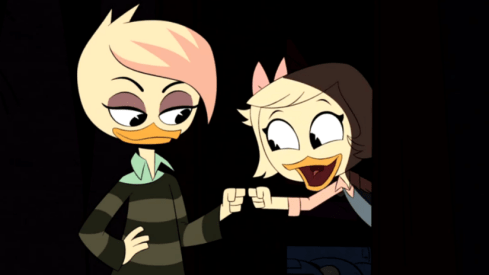
lena and webby

Lena and Webby’s friendship is one of the main plot points weaved throughout the first season.

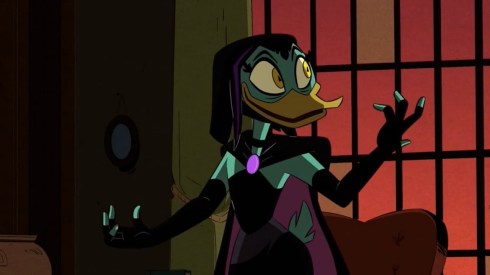
The other big teaser throughout the first season revolves around Scrooge’s old enemy – Magica De Spell (Catherine Tate)! She was a frequent foil in the original series so naturally she’s back. As basically the big baddie of the whole thing, it’s a lot of fun to see the show treat her as such. When the season begins she’s magically sealed away and only able to interact with the world through her niece Lena (Kimiko Glenn) who poses as a friendly sort in order to gain the trust of Scrooge and thus somehow free Magica from whatever keeps her sealed away. To do so she gets close to Webby and the two become best friends. Throughout much of the second half of the season we get to see Lena being pulled between the two forces in her life; her friendship with Webby and her loyalty to Magica. It’s nothing new, but it’s handled well and there are some genuinely emotional moments that come of this and there’s a lot of payoff in the end. Plus, the animators used this really creepy effect where Lena’s eyes turn black and “spill” shadows to form Magica. It’s genuinely unsettling.

The original DuckTales cartoon dealt with plots that continued from one episode into the other. There were even changes to the main cast as was the case with the introduction of Bubba and Gizmoduck. Those storyline pay-offs though were not on the equal with the new show. The main theme of family is at the core of this new show and it never strays too far from that. Very few of the episodes in the first season felt like filler as all seemed to serve some purpose. Either a character learns something about themself or their relationship to the others or something else happens to move the overall story along. It’s a great way to structure a show and I always love seeing what is primarily children’s programming take this sort of risk. There will always be television executives who look down on children and think the simpler the better, but trust me, kids notice this stuff and appreciate it when a show doesn’t treat them like brainless buffoons.

magica

Many of Scrooge’s old villains have returned.

Additional challenges arise when creating a new version of a 30-year-old show. Namely, the voice talent available isn’t the same anymore. Alan Young, who provided the voice of Scrooge for decades, is no longer with us. And since it was decided that the nephews would be approached differently this time around, the talents of Russi Taylor were declined and instead each was given a unique voice. These changes are often the hardest for the old fans since not only do these characters barely resemble what we fell in love with as children, but they also sound very different. Once you get past that change though, it’s hard to say bad things about this cast. David Tennant is a great Scrooge with a natural Scottish accent. He brings everything you need from a voice actor to the character. He can be gentle, intimidating, enthusiastic, and even sad. It was hard to say good-bye to Young, but Tennant has done a remarkable job in his first season at the helm. The nephews are voiced by Danny Pudi (Huey), Ben Schwartz (Dewey) and Bobby Moynihan (Louie) and they all impart their own personality on the characters. If there is one negative to this season, it’s that Dewey definitely feels more developed than the other two and thus Schwartz shines brighter than the others, but season 2 could easily rectify that. Kate Micucci is Webby and she was perfect in the role while Toks Olagundoye voices her grandmother Beakley. Beck Bennett plays a more aloof Launchpad, but otherwise kind of sounds like he’s trying to do Terry McGovern which is a little sad because I know McGovern really wanted the part. If you’re feeling uncomfortable with all of the newness in the cast then at least you have Tony Anselmo reprising his role as Donald Duck, as it should be.

The new visual style of the show is bright and expressive. It’s a bit flat, which seems to be a trend in 2D digital animation, but it has its own look which helps differentiate it from the original series. The look of the old series just can’t be duplicated in today’s environment, so the show was smart to not even try. I really like the new look for Scrooge and Donald and feel it suits them well. The nephews have taken some getting used to as they have really large heads and in some respects resemble chickens more than ducks. The backgrounds are all really well done and there’s plenty of variety to be found from suburban settings to creepy castles. There’s also more imaginative and fantastic settings to be found and the show does an admirable job of mixing things up. It does the same with the villains and guest spots and virtually everyone you know and love from the original series makes an appearance or two here. There are also a few new characters thrown around, some inconsequential and some rather imaginative (I’m looking at you statue-headed horse) and almost all have some pay-off.

gizmoduck

And many old allies are back as well.

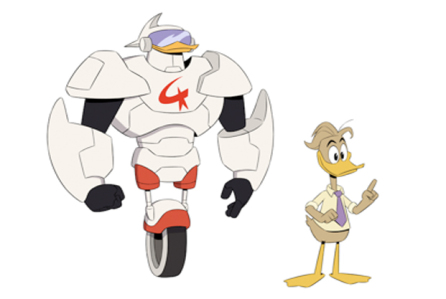
Of the first season’s 23 episodes (25 if you count the premier and finale as two episodes) it’s hard to pick a favorite. The first episode, “Woo-oo” was wonderful for its patient and rewarding reintroduction of these timeless characters. Any episode that pits Scrooge against Glomgold was usually humorous and entertaining to watch and the episode “Beware the B.U.D.D.Y. System” was equally humorous for its focus on Launchpad, plus it had Gizmoduck! Some of the episodes have some rather delightful Easter Eggs in them. You have undoubtedly seen or heard about the numerous Darkwing Duck ones, and the finale included one Easter Egg from the old NES game. And it’s really hard for me to not just pick the last three episodes as my favorites. They’re the most weighty with the biggest emotional moments in the whole season. I even get a lump in my throat just thinking about them.

As I said earlier, it’s hard to imagine a reboot having as successful a reintroduction as DuckTales did in 2017 and into 2018. The new show proves the old comics and original series still have legs, their foundation was one that can anchor any show in any era. This is the rare reboot that should have little trouble appealing to the old fans while also being something new for a younger generation that may never have even heard of DuckTales before 2017. If nothing else, my own children have proven to me time and again that the old theme song will never go out of style as the two will happily sing it at the dinner table, from their car seats, or while they play. It’s really rewarding as a parent to see your children embrace something you loved as a kid yourself, even if it’s not the same and in a new form. I have no doubt that DuckTales is in good hands right now and I look forward to watching the second season with my kids, or even on my own after they go to bed (it can be hard to focus on these things with a pair of short-attention span toddlers).


PhatMojo DuckTales – Scrooge McDuck and Donald Duck

IMG_2498It’s been nearly a year since DuckTales returned to television airwaves. Scrooge McDuck, along with his nephews and surrogate niece Webby are back to solve mysteries and rewrite history. It’s a fun show that adheres more to the work of Carl Barks than to the series that ran in the 1980s while also doing its own thing. For the first time really ever, the nephews Huey, Dewey, and Louie are distinguishable by more than just the color of their clothes and the cast is large enough that the writers don’t seem to feel pressured into fitting everyone into every episode. Sometimes Scrooge will be missing, other times Donald will be. It seems to be a show more about the kids and how they view the almost mythological Scrooge. And it also has other mysteries to uncover and it’s mostly good fun.

Back when the original series ran it surprisingly did not coincide with a ton of merchandise. Maybe this was a deliberate attempt by Disney to distinguish its cartoons from the competition which were often toys first, shows second. The only DuckTales toy I can remember owning was a Gizmoduck that came in a box of cereal. It seemed like this new incarnation was going to befall the same fate, but along came PhatMojo to rectify that. Now, I know nothing of this company and this is my first introduction to them, but I’ll say it’s mostly a positive one. Alongside some figurines and plush dolls, PhatMojo has put out its first line of DuckTales actions figures. Apparently exclusive to Target, the inaugural line contains single-carded figures of Scrooge, Donald, Launchpad, and Flintheart Glomgold. In addition to those figures are a pair of two-packs of Huey and Dewey and one of Webby and Louie. Also available is Launchpad’s airplane which also comes with his figure and Scrooge’s Money Bin playset, which seems more like a storage device for your toys than a full-fledged play set.

I have a weakness for toys, that is obvious to anyone who reads this blog, and perhaps a greater weakness for Donald Duck merchandise. Despite that, I’ve actually never owned a proper Donald Duck figure until now. I have statues and Lego mini-figures, but no action figures. Most of the is due to scarcity. There is a phenomenal Donald Duck figure available by a company called Herocross, but to import him is over $100. Yikes! There have been some Kingdom Hearts Donald Duck figures, but those have never spoke to me for one reason or another. Years ago there was a line of figures based on Mickey’s Christmas Carol and I do kind of kick myself for not collecting it. I was in high school when those came out and just didn’t have much money for action figures. I’m guessing if I looked them up on eBay right now I would not like what I see in terms of price too. As for Scrooge, he received a pretty darn good figure just last year from Funko, purveyors of those Pop! figures you’ve probably seen everywhere. That Scrooge was part of a line based on the old Disney Afternoon so it’s Scrooge with his blue coat. Herocross also released a version of Scrooge from that series and it’s both awesome and terribly expensive.

IMG_2502

“Hello?”

Not wanting to get too far into another line of toys, I forced myself to just stick with Donald and Scrooge when I encountered them over the weekend at my local Target. Might as well start with an overview of the line as a whole. These are mass-market retail figures, and even though I’m a man in his mid-30s, I can admit these are aimed at children. As such, it stands to reason you shouldn’t expect collector grade quality with these figures, and the price of 8.99 a piece captures that. The figures have unique sculpts with simple paint apps and even simpler articulation. The heads sit on a ball-joint that offers solid range of motion, but that’s it for fancy joints. The shoulders are on simple pegs and there’s no elbow or wrist articulation. The legs are also on simple peg joints at the hip with no knee articulation. As a result, these figures are very limited in what they can do as far as posing goes, but what’s there has a solid build and isn’t flimsy or anything.

IMG_2503

That’s the best he can do as far as taking a picture goes.

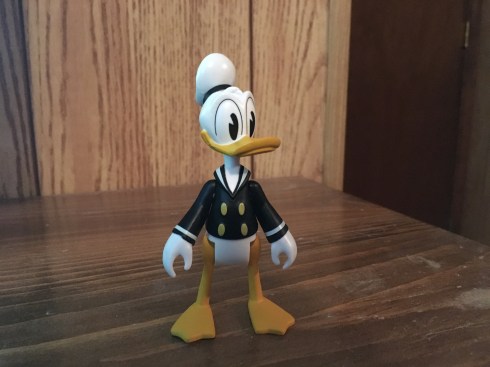
Let’s talk Donald Duck first. In case you are unfamiliar with the show or the work of Carl Barks, this Donald is in his comic accurate attire, which is how he’s presented in the show (his more popular light blue shirt gets set on fire in the first episode). His shirt is black with gold buttons and he wears a white hat instead of a blue one. The character is brought to life once again by Tony Anselmo and it’s really fun to see this Donald on television for the first time. He’s not as quick to anger as his personality in the cartoon shorts dictates and he’s very much a doting uncle most interested in the well-being of his nephews. Donald stands just under 4″ and comes with two accessories:  a camera and a smart phone.

IMG_2505

What you see is what you get, but what you see also is pretty good.

First of all, this figure is a dead-ringer for the show. He has that rounded look in the head with harder lines on the beak. The paint app is simple because it doesn’t call for much, and my figure looks pretty good in that area (some on the pegs were less impressive). Because of the limited articulation, he can’t really do much with his accessories, but he can kind of hold the phone like he’s talking into it. My only criticism of the sculpt is in how the legs meet the body which looks odd, but it was obviously done this way to keep it simple. The little tassel on his hat is also molded to his head and I wish it was jutting out on its own to impart a touch more personality, but again, this is the simple approach. Donald has a sunny disposition to him which may have felt out of place for his toon counterpart, but for DuckTales this feels appropriate. Overall, this is a very solid figure that, while not much fun to pose, definitely nails the likeness.

For Scrooge, we have a slightly more ambitious design. His tophat, glasses, and overcoat make him slightly harder to sculpt, but once again PhatMojo pretty much nails it. His hat pushes him close to 4 1/2″ and he has his little tuffs of hair pushing out from underneath it. Some may be disappointed that the hat is non-removable, but I think it looks better this way. Like Donald, this Scrooge is more in-line with the design of Barks and features a red coat instead of the blue one from the 1980s. Voicing him in the show is David Tennant, and man did he have some pretty big shoes to fill, but so far he’s pretty much nailed it. He comes with two accessories of his own, his trusty cane and a little gold colored idol that just sort of sits there. His articulation is the same as his nephew, only his overcoat really limits what can be done with his legs. In fact, I can’t even tell if his legs are articulated or not since they basically can’t move.

Paint-wise, he’s a bit more of a mixed bag. I had a hard time finding a good one at the store and had to settle for what I have. He has a little red dot on the brim of his hat and in a few places on his coat is a dab of white or black that shouldn’t be there. It’s not killer, but I notice these things. His eyeglasses are also kind of funky. Rather than use a piece of transparent plastic like Funko did with their Scrooge, PhatMojo just made a block of plastic to place on his beak and painted on glasses. This means the open area where there are no glasses is just painted yellow. It looks okay from a head-on perspective, as his nose should probably be there anyway, but from an angle of any kind it’s a bit clumsy. Again, this feels like a cost-cutting move as cutting out the dead-space would mean a more fragile piece in the end, but I wish they did a little better here. All of the figures I saw also had a weird little gap underneath Scrooge’s belt buckle. Not really noticeable when the figure is just displayed, but pick it up and you’ll see it. It’s probably the result of how the bottom part of his overcoat was connected to his torso.

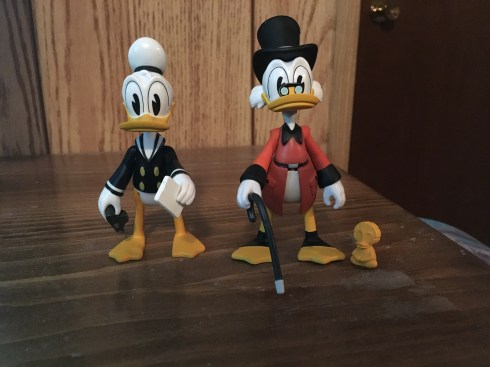
Even with the problems I highlighted with Scrooge, I still think he’s a sound figure and he looks great on my desk alongside Donald and Funko’s Scrooge. Both Donald and Scrooge look like they’re supposed to given the source material. And considering the price, it’s hard to quibble with them too much. When I was a kid, I paid upwards of 7.99 for ToyBiz figures and that was in the early and mid 90s. To only pay 8.99 for these in 2018 is a pretty tremendous value. I don’t know how fun they are for kids given how limited they are in what they can do, but I played with similar as a kid and had no shortage of good times. If you like the look of the new DuckTales and want some figures from it, give these a look. You may want to catch them in person rather than through the web given the paint issues I saw. And if you’re a stickler for scale you may be a little disappointed with the others as Launchpad is definitely on the small side and the kids a little too big relative to Scrooge and Donald. The two-packs also run a tad more expensive at 12.99 each, but given you’re getting two 3″ figures instead of one 4″ the value seems about equal. For me, I’m probably content to just stick with these two. If a Darkwing Duck or Gizmoduck shows up I may give them a look. I’ll also probably try and push my kid towards these things as I’m always looking to foster more duck-enthusiasm in him. Got to start them young!


Disney’s Best Five Film Run

walt_disney_pictures_logo_slice_01The Walt Disney Company has been producing animated features for 80 years now. In that time, the company has released 55 films with a 56th on the way later this year and others in development. I’m only talking about the animated ones, because if you add in live-action and all of the films released by Pixar or under the Marvel or Star Wars banner then you’ll easily eclipse 100 films. Disney’s bread and butter has been the animated feature though, beginning in 1937 with Snow White and the Seven Dwarfs. Over the years they’ve had ups and downs and had to keep up with changes in technology and film production techniques. It’s a very interesting history, and likely numerous rankings exist around the internet listing out the films in order of best to worst, or vice versa.
For this post, I wanted to do something different. I wanted to look more at the eras of the films produced. At first I thought about just going in 5 year chunks, but that made things unbalanced as Disney has had periods where they churn out a bunch of films and periods where they don’t. Instead, I felt it would be more interesting to just divide the films up into groups, and with there being 55 total films as of this writing, it made sense to go with groups of five. These groups seem to work well as they tend to span around 7 or 8 years and result in some fun pairings. At first, I listed them out and then just did a totally subjective ranking. I was fine with the end result, but just for some added fun I added a score to each film on a scale of one to five with five being the best and then ranked them by total score and I ended up with almost the exact same list. Since that ranking felt a little more interesting, I’ll keep it and include my totally subjective score for each film as we go along while also linking to any films I may have reviewed here, so let’s get to it.

MV5BZTgyMGI1YzUtNTI0ZC00MGM5LTk3MGYtOTkyYzMwMDBlYmM2XkEyXkFqcGdeQXVyNjI1Mjk4MTg@._V1_UX182_CR0,0,182,268_AL_

Saludos Amigos (1942)

1942 -1949 – 10 points

Well, this isn’t surprising. By going with groups of five I inadvertently grouped basically all of the package films together in one grouping. These were the films produced during World Word II when Disney was cut-off from overseas revenue streams on its films. As a result, the company had to settle for cheaper releases. None of these films are particularly good, though each also has its moments which is why they all scored a 2 across the board (you have to be pretty bad to score less than 2, and really great to score a 5 from me). Saludos Amigos is basically a propaganda film aiming to improve opinions of South America as Disney was not opposed to making such crap. At least it has Donald Duck in it though. The Adventures of Ichabod and Mr. Toad definitely has its fans too, but I personally don’t enjoy that picture very much. Basically anyone doing a ranking like this one is going to start with this quintet.

MV5BMTkwOTU5MTA2M15BMl5BanBnXkFtZTYwMjYyNTc3._V1_UY1200_CR89,0,630,1200_AL_

Lilo & Stitch (2002)

2002 – 2005 – 11.5 Points

  • Lilo & Stitch – 5
  • Treasure Planet – 2.5
  • Brother Bear – 2
  • Home on the Range – 1
  • Chicken Little – 1

Also not surprising for Disney fans, this era captures Disney’s struggle to stay relevant in the field of 2D animation while also exploring CGi. Treasure Planet is a hybrid picture that at least looks good, but doesn’t offer much else. Brother Bear is okay, but feels outdated and like a picture that’s struggling to match some of the old Disney classics. The latter two are just plain awful and probably the two worst Disney animated features. Home on the Range has the fun distinction of essentially being the film that killed 2D animation at Disney – thanks! Propping this group up and keeping it from a dismal finish behind even the package film era is Lilo & Stitch, a supremely wonderful picture about two sisters trying to cope and understand each other following the loss of their parents. It basically explores depression in adolescents, but kind of hides it by also injecting the incredibly fun Stitch to the mix and it’s also gorgeous to boot. It’s really on my short list of the best films put out by Disney.

51WA7XEB92L._SY445_

The Emperor’s New Groove (2000)

1999 – 2001 – 12.5 Points

  • Tarzan – 3
  • Fantasia 2000 – 2
  • Dinosaur – 2
  • The Emperor’s New Groove – 3.5
  • Atlantis – 2

This era represents the winding down of the New Renaissance era started in the late 1980s. You basically have two perfectly good Disney films in Tarzan and Emperor’s New Groove together with two forgettable ones and one sequel that really didn’t impress. Emperor’s New Groove might be on the studio’s most underrated films as it’s a really fun story with some great animation. Tarzan is the more popular due to its legendary character and for some reason the Phil Collins soundtrack was really popular. It’s one of those films that I think looks better than it is, but it’s fine. Dinosaur is pretty bad, it’s earnest so I won’t drop it to the dismal rankings but it just doesn’t work and has aged poorly. Atlantis, like Treasure Planet, is visually interesting and little else. And Fantasia 2000 was about as big a flop as the original. While the original benefits from being unique when it was released, and for containing the iconic Sorceror’s Apprentice (re-including that in 2000 doesn’t really count for as much) while the 2000 version just looks better and doesn’t introduce really anything noteworthy.

Unknown-40

The Many Adventures of Winnie the Pooh (1977)

1977 – 1986 – 14.5 Points

  • The Many Adventures of Winnie the Pooh – 3.5
  • The Rescuers – 3
  • The Fox and the Hound – 3
  • The Black Cauldron – 2
  • The Great Mouse Detective – 3

Commercially, this era of films is looked on rather badly. This is when critics were sounding the bells of doom for Disney wondering if the studio could turn it around. The Black Cauldron was one of the biggest flops the company ever endured, costing a boatload of money to produce while failing to connect with critics and audiences. Because of that status it might be lumped in with a few others as being among Disney’s worst, but it’s really not that bad. It at least contains a really memorable, and frightening, villain in The Horned King and brings back some of that old scary fairy tale vibe. It has its fans, like noted critic Roger Ebert. As for the rest, they’re all pretty good films just none are able to really rise above the cream of the crop. The Pooh shorts collected in The Many Adventures are pretty much considered classics by now while The Great Mouse Detective gets the credit for turning the studio around. It’s a fun adventure and one I’m a little surprised didn’t get a sequel. The Rescuers will get that honor a few years later, but the first outing for Bernard and Miss Bianca is the superior one. And then there’s The Fox and the Hound, a nice little buddy movie that aims big, but doesn’t quite deliver as impactful a story as it wants to. It’s still a nice little picture though.

tangled2010

Tangled (2010)

2007 – 2011 – 15 Points

If this era had a title it would probably be The Great Turn-Around. After bottoming out with the pair of Home on the Range and Chicken Little, Disney really needed to reassert itself as a leading producer of quality animated features. Pixar had eclipsed them and this group of films marks the moment when things finally started to get going in the right direction, though they still needed to take a couple more lumps. It’s also, sadly, the last of the 2D animation and marks the full commitment to CG pictures going forward. Meet the Robinsons and Bolt were another duo of clumsily animated CG pictures. Bolt is the better of the two, and I considered going with a 2.5 score, but in the end it’s also really not a film I care to watch again. The Princess and the Frog is gorgeous, and Winnie the Pooh is a delightful continuation of The Many Adventures that should please most children. Tangled is the clear star though and it’s the first CG film Disney made that is on par with Pixar in terms of visuals and it’s also a modern princess film that works. It helped lay what is a new foundation for that sub-genre of films and it kind of gets overlooked because of the success of another princess movie still to come, but I actually prefer it to all of the CG princess tales.

MV5BYTYxNGMyZTYtMjE3MS00MzNjLWFjNmYtMDk3N2FmM2JiM2M1XkEyXkFqcGdeQXVyNjY5NDU4NzI@._V1_UX182_CR0,0,182,268_AL_

The Lion King (1994)

1994 – 1998 – 15.5 Points

  • The Lion King – 4
  • Pocahontas – 2
  • The Hunchback of Notre Dame – 3
  • Hercules – 3
  • Mulan – 3.5

The coasting years. Hot off the success of early 90s films like Aladdin and Beauty and the Beast, Disney settled into a nice groove of pretty films with big songs and good enough stories. The Lion King is probably the studio’s last hallmark offering of the 90s. It’s a film some might give a higher score, but I think it’s definitely not as good as the group of films that preceded it. Meanwhile, the only dud of the group is Pocahontas, a film that has its heart in the right place, but plays too loose with actual history and is hampered by the G rating from telling the story it probably wants. The Hunchback of Notre Dame, on the other hand, found a way to tell a more mature story under the restraints placed upon it by the studio. Hercules is a fun film, nothing more and nothing less, while Mulan is a greater triumph than all but The Lion King. It tells its own Joan of Arc tale through the eyes of a strong, young Chinese woman. I wish it had a little better of a climax, which is the only thing keeping it from being among Disney’s best, but at the time it was a much needed film as it took the lead woman out of the damsel in distress role. All of these films follow the broadway format, which was getting tiresome by this stage, but all of them also look and sound fantastic. If we were ranking just by visual fidelity, then this group would probably place near the top.

220px-One_Hundred_and_One_Dalmatians_movie_poster

One Hundred and One Dalmatians (1961)

1961 – 1973 – 16 Points

The Xerox era. Finding animation was too costly, Disney turned to a new technique that utilized Xerox to copy cels and thus reduce the load on the animators. The studio basically gives credit to this process for even allowing them to create One Hundred and One Dalmatians as animating all of those puppies the old-fashioned way would have just been too daunting. As a group of films, that gives them a pretty distinct look as the earliest films done this way have a very rough, sketch quality to them. It has its own charm, though I prefer the old days. This is a solid, almost spectacular, grouping though. You have The Sword in the Stone and Robin Hood, both fun little tales that can please a gathering of all ages. And then you have One Hundred and One Dalmatians and The Jungle Book, two pretty big releases for the Disney company. Dalmatians, in particular, is one of the studio’s best and it’s a fun caper set in a modern setting that doesn’t beat you over the head with songs. The Jungle Book is just a good buddy comedy of sorts, and Mowgli is a relatable and sympathetic character throughout while the shadow of Shere Khan adds intrigue along the way. It also features some of the best work of the renowned Sherman Brothers. Lastly, there’s The Aristocats. If Dalmatians hadn’t come before it I wonder if I’d look upon it more fondly as it basically feels like a retread of that picture, but with cats instead. It has one pretty good song though, so at least there’s that.

921845-338

Lady and the Tramp (1955)

1950 – 1959 – 17 Points

Perhaps the most divisive grouping. This is a group of films lots of people grew up with, so they pack a lot of nostalgic value. They’re also a bit divisive as well since you have some old-fashioned princess tales where a kind, submissive woman is rescued by a dashing prince. There’s the racial imagery in Peter Pan, also not a high point for Disney, and then just the manic atmosphere of Alice in Wonderland that you either like or don’t like. As you can tell by my score, I’m among those who do not particularly care for Alice in Wonderland. I think it starts off fine, but then just gets too bogged down in being “wacky” and I struggle to remain invested whenever I watch it. Sleeping Beauty was another huge flop for the studio, but it seems like over time it’s become much more beloved. I don’t particularly enjoy the very angular features of the characters and the flatness of the visuals, plus the story is kind of the studio’s low point as far as making interesting leading women. It’s saved by the iconic Maleficent from being truly dreadful. At the other end of the spectrum is Cinderella, which tells the tale of a victim of circumstance who finds a way to be a decent person throughout it all and is rewarded in the end. By itself, it’s a nice film and I don’t find fault with the film’s message. It’s only when lumped in with other “princess” movies that it starts to feel problematic. Peter Pan is merely fine. I think it’s weak in terms of song and as an adventure it’s ho-hum. It’s more of a kid’s fantasy film, than anything. The best though is Lady and the Tramp, a really fun “dog movie” with interesting characters, a simple but effective premise, and the best visuals of any Disney movie. This one is beautiful and I get a little sad every time I watch it because Disney just doesn’t make movies that look like this anymore and maybe never will. It also doesn’t feature a ton of songs, which is a plus in my book. I understand those who may find it boring or slow, but for me it’s almost perfectly paced and just too visually stimulating for me to lose interest at any point.

pinocchio1sh

Pinocchio (1940)

1937 – 1942 – 17 Points

The group that started it all. It’s actually tied with the group preceding this one at 17 points a piece. My tiebreaker was simply to pick the best film of the bunch and go with that group, and if you’ve read my reviews for some of these films then you would know that Pinocchio is my all-time favorite Disney picture. It’s a great story that’s captivating, warm, scary, suspenseful and is pushed along by wonderful visuals and timeless songs. It’s the best example of Disney’s old way of creating an animated movie which wasn’t as reliant on song-breaks like the films of the late 80s and 90s. Joining Pinocchio is, of course, the one that started it all – Snow White and the Seven Dwarfs. I recently reviewed this one in light of the fact that it recently turned 80(!) and it seemed like a good time to revisit it. It’s breath-takingly beautiful, even by today’s standards, which helps to cover-up a sometimes slow moving plot. It may have scored a half-point for nostalgic reasons now that I think about it, but I’m sticking with the 3.5 since it feels like it should be elevated about the likes of Dumbo and Bambi, which round out this list. Both are adorably sweet films that also have moments of fear and sadness to balance them out. Dumbo is the simpler of the two, while Bambi is the more visually impressive. Fantasia was basically Walt’s pet project and something that I think was made to appeal to him first and foremost, which makes it rather interesting. It’s not really for me, but I recognize that it has value and The Sorcerer’s Apprentice segment is pretty wonderful. It also has the distinction of being one of the only Disney movies to never be aired on free television.

1200x630bb

Wreck-It Ralph (2012)

2012 – 2016 (Present) – 18 Points

  • Wreck-It Ralph – 4
  • Frozen – 4
  • Big Hero 6 – 3
  • Zootopia – 4
  • Moana – 3

You may think this one is up this high because of recency bias, but let me assure that is not the case. This is the first, and only, grouping of all CG films and it just so happens all of them are pretty damn good. While none managed a 5 rating from me, none also fell below a 3 which is also a first on our list. Let’s start with my pick of the worst, which is Big Hero 6. It’s a great visual film, but it suffers because it just feels too derivative of other Disney films in its turning points. It also is a victim of being essentially a super hero film and there’s certainly some fatigue associated with that genre these days. If you’re a younger person who is only familiar with Disney’s modern output then it might be more appealing to you since its tragic elements feel less repetitive, but for me it’s just okay. Moana is slightly better. It’s a pretty solid adventure with a fun pairing between its heroine and Maui, a god, that would probably be better if it was a bit shorter and knocked out a song or two. Zootopia is ambitiously serious and it’s a pretty fantastic one-time viewing experience. Its lack of “fun” and reliance on mystery and plot twists cause it to not hold up as well on repeated viewings, but just judged by itself it’s actually pretty great. Frozen is the most popular film on this list, though I think it’s visually the worst. It had a whole bunch of problems during production, originally starting off as a hand-drawn picture, so it’s not really surprising to see it doesn’t look its best, but it makes up for it in charm. This is a likable cast that puts a nice twist on the princess formula. I think, musically, it’s a bit overrated. Not “Let It Go,” that song is fantastic, but other than “Do You Want to Build A Snowman?” I could do without the rest. Wreck-It Ralph is the star for me, and not because it’s a video game movie, but because it best combines characters, heart, plot, and visuals into a total package. In looking at my ratings, I’m actually thinking maybe I should bump it up a half-point to separate it from the rest, but I’ll stick with what I’ve got. It’s only real failing is that it doesn’t really take advantage of the cameos from video games, outside of the therapy session, and it does feel a bit on the long side. Still, a great movie and one I tend to get sucked into whenever it’s on television (which is a lot, it seems).

61F14ZAHR6L._SY445_.gif

Aladdin (1992)

1988 – 1993 – 19 Points

At last, we’ve come to our top spot and perhaps not surprisingly it captures the peek of Disney’s New Renaissance. This is a three-headed monster of films that really changed the game on what an animated feature could deliver, including the first one to be nominated for an Academy Award for best picture. It’s also a gauntlet of pictures as each one was released in a different year – five pictures for five years. The amusing part is it also contains two films that are certainly not beloved. Oliver & Company holds some nostalgic value for me because it’s the first film I can recall seeing in a movie theater. As such, I probably like it a bit more than the 2 rating I gave it, but I can see it’s faults as a film. It does deserve credit for establishing the new format that our big three would adopt. The Rescuers Down Under has the distinction of being the only theatrically released direct sequel of any animated Disney feature, a distinction that will end later this year when the Wreck-It Ralph sequel is released. By itself, it’s fine and Bernard and Miss Bianca are actually interesting enough to justify another feature, even if no one was really begging for it. Hardly Disney’s worst, but possibly its most forgettable considering the film that preceded it and the ones to follow. This group is defined by the three big ones:  The Little Mermaid, Beauty and the Beast, and Aladdin. Some dislike The Little Mermaid for being another princess tale, with Ariel needing to be rescued from the likes of her father, King Triton, and her love interest Eric – the dashing prince. I see it more as a tale of adolescence with Ariel embodying the personality of many 16 year olds I’ve come across. She has passion, a rebel spirit, and is perhaps too quick to identify what she wants. Perhaps an ending where she decides that Eric isn’t all that great would have turned things on its head and been more interesting, but it’s not as if Eric is a bad person. He actually is pretty great, so maybe happily ever after isn’t so bad? It’s also Disney’s best film when judging it strictly on the merits of its soundtrack thanks to the triumvirate of “Under the Sea,” “Part of Your World,” and “Kiss the Girl.” With Beauty and the Beast we’re treated to a heroine that’s a bit more realistic and willing to take charge of her situation. She sacrifices herself to The Beast to free her father, a noble gesture for sure even though it’s not what any father would want for their daughter. The film is hurt slightly by the fact that they need to gloss over the warming-up of The Beast and Belle, but that’ what happens with 90 minute features. Lavishly animated and wonderfully scored, it’s not a surprise why so many think it’s the best the studio has produced to date. And lastly, there’s Aladdin – Disney’s greatest tale of adventure. It’s almost surprising it took the studio this long to tackle the story of Aladdin as it fits in with a lot of the adventure pieces from both the animation department and the live-action one from the decades before, but Aladdin benefits greatly from being made in the 90s because it looks incredible and packs an iconic performance from the late Robin Williams as The Genie. This is a supremely entertaining film that might be my favorite of the bunch, but really on  any given day I could make a case for why any of those three are the best.


Walt Disney’s Snow White and the Seven Dwarfs

Snow_White_1937_poster

Snow White and the Seven Dwarfs (1937)

This past December, Walt Disney’s Snow White and the Seven Dwarfs turned 80. On December 21, 1937 the world was introduced to feature-length animation. Well, maybe not the world since that date was just the premiere. It wasn’t until February 4, 1938 that the rest of the United States was introduced to the picture. The film was behest by production delays and budgeting concerns and the mood was that this would be Disney’s greatest failure before it arrived. That wasn’t the case, and it’s a good thing because had Snow White failed we likely would not have the many subsequent pictures, or maybe even a Disney. This post should have ran in December, but since I was elbow-deep in Christmas I sat on it until now, timing it with the picture’s wide release. Snow White and the Seven Dwarfs is a remarkable achievement and a film worth celebrating any day, but especially so when it turns 80.

Snow White and the Seven Dwarfs had to be a special film in order to justify the need for an extended running time. Prior to its release, cartoons were relegated to the pre-show, if you will. Theaters would run a Mickey Mouse or Betty Boop or some other toon before a picture along with news reels and other pieces of film. Since there was less competition from other past times, a trip to the movie theater was practically an all day affair as opposed to modern times when movie-goers are left griping that a cartoon short is too long. In order to make Snow White and the Seven Dwarfs stand out, Disney naturally injected a huge amount of cash into the production. Live footage was recorded to animate over, numerous backgrounds were painted in lovingly detail, and a new camera technique even had to be invented. The Multiplane camera is a massive structure that basically separates three backgrounds at three different distances from the camera. This creates a literal foreground, middle-ground, and background for a given scene and the camera can zoom or pan on the image creating an illusion of depth. It’s on display right at the beginning of the film and it’s a fun little trick that would be utilized for basically all of Disney’s animated films to come.

maxresdefault-20

The Queen approaches her magic mirror.

Originally, Walt Disney thought he could produce the film for around $250,000. That’s a tiny sum by today’s standards, but in the 1930’s a typical Silly Symphony cartoon cost about $25,000 to produce. Disney must have assumed the feature would be ten times as long and cost ten times as much money as a result. If that was his reasoning, he failed to account for all of improvements he wanted to make to the process as the picture ended up costing around 1.5 million dollars. That was a rather colossal sum at the time, especially for a cartoon few thought would be a success, including brother Roy and wife Lillian. Disney had to mortgage his own home and most likely put up every piece of collateral he could to get the picture made. It was a gamble, but it paid off since what makes the film so special is the production values which help to cover a fairly pedestrian story.

snow-white-and-the-seven-dwarfs-animals

Young Snow White will spend quite a bit of time socializing with the various animals of the forest.


Snow White and the Seven Dwarfs
basically establishes the template for the Disney “Princess Movie.” A kind and good-natured young woman is made the target of a ruthless villainess through no fault of her own. This young woman, either a princess or soon to be, then just sort of lets everything happen around her hoping against hope that a prince will come to her rescue and take her away to live happily ever after. It’s a common setup for fairy tales and it’s a pattern that will be reused in both Cinderella and Sleeping Beauty years down the road. Of the three, Snow White is the one that follows it most closely. When the film begins, we find out that Snow White has lost her parents and is left with only her cruel step-mother, the Queen Grimhilde (Lucille La Verne). Despite being a princess, she’s forced to tend to the castle like a commoner while her jealous step-mother looks on concerned that Snow White’s beauty will soon surpass her own. When her magic mirror on the wall confirms this, the Queen responds with violence and commands her huntsman to lead Snow White into the forest where he is to kill her and return to his queen with the maiden’s heart in a box.

Snow White (Adriana Caselotti) is a happy and contented young woman despite her station in life. I suppose being a servant in a castle is probably better than a peasant, but we are introduced to her washing the castle steps in a tattered dress while she sings a happy song (“I’m Wishing”) to the birds that swarm around her. A dashing prince (Harry Stockwell) hears her song from outside the castle walls, scales them, and surprises her by sneaking up alongside her and joining in her song. Frightened, Snow White retreats into the castle proper disappointing the prince, but a little peak his way lets us know she’s more than a little curious.

image_21459143

The box intended to hold Snow White’s heart.

Love will have to wait, as the Huntsman (Stuart Buchanan) leads Snow White off to pick wild flowers where he is to do as his queen commands and end her life. When first confronted by the Queen, he is alarmed at the request and once the moment is upon him he finds he is unable to go through with it. Sobbing, he begs Snow White to flee from the evil woman sending her into a panic. She runs through the forest which takes on a supernatural quality. Trees reach out to her with thorny fingers and hideous visages as she screams and runs this way and that. Her dress gets caught multiple times, she stumbles into a bog, and bats and owls frighten her further. When the animals of the forest come to her aid she reacts with fear once more causing them to flee. Seeing their fear seems to snap her back into reality, and Snow White is soon apologetic and gradually calms down.

1453901969_1

The cautious dwarfs return home to find an intruder in their house.

She walks through the forest which leads her to a little cottage. Inside she finds the place a mess with dust everywhere and dishes piled high in a wash basin. She notices the tiny furniture and the many beds upstairs adorned with silly names like Sneezy and Bashful and deduces this must be the home of some children. She happily cleans and prepares a meal while the many critters assist her. Of course, this home does not belong to children but to the seven dwarfs who are hard at work in a nearby mine harvesting various wonderful gems. They sing their little song as they work, which leads into perhaps the film’s most famous tune, “Heigh-Ho,” as their work day concludes and they set off for home.

snow-white1

Snow White meets the seven dwarfs.

Upon arrival, they find the house is occupied and they immediately suspect the worst. Doc, the dwarf with glasses, is apparently the leader of the troop but Grumpy is the one with the loudest opinions. Little, beardless Dopey, is apparently the one lacking in wits and he’s encouraged to venture upstairs and see who is sleeping in their beds. He sees Snow White and mistakes her for some kind of monster and the other six dwarfs need little convincing that he did not as they all scamper away in fright. Eventually, they return to the second level and see that the individual resting in their beds is not a monster, but a beautiful young maiden. She awakes to her own surprise that the inhabitants of the castle are not children, but seven dwarfs. The ice is broken almost immediately, and the new friends set in for a night of feasting, laughter, and dance.

Meanwhile, the evil queen knows her huntsman has betrayed her, and utilizing her magic mirror once more, she finds where Snow White is hiding. Turning to her book of spells, she concocts a potion that will disguise her as a hideous old hag and another that will coat an apple in poison. Any who consume a portion of the apple will fall into an eternal slumber. Only love’s first kiss can break the spell, and the Queen dismisses the possibility as soon as she reads it.

snow-white-and-dopey-500x365

Lots of singing, lots of dancing. This particular sequence will be re-animated numerous times in other productions, most notably in Sleeping Beauty when Aurora dances with the owl.

The rest of the story is likely not foreign to anyone reading this. The dwarfs head off to work the next morning while the Queen finds the cottage and is able to trick Snow White into taking a bite of the poisoned apple. The dwarfs, alerted by the forest critters wise to the Queen’s plan, are too late, but they do successfully chase off the Queen indirectly causing her to meet an untimely end. Unable to bring themselves to bury Snow White, they instead incase her in a glass coffin and stand vigil for many months until her prince eventually finds her and wakens her with a kiss. What convinced a prince to kiss a long-dead maiden is beyond me, but I suppose you can’t argue with results.

Snowwhite-disneyscreencaps_com-11655

The story is capable of charm especially when the dwarfs all line up for a goodbye kiss before work.

Snow White and the Seven Dwarfs is an achievement not because of its story, but because of its production. The plot is well-paced leading up to and including the introduction of the dwarfs to Snow White. The whole sequence of a frightened group of men tip-toeing through their cottage is a delight and genuinely amusing. Their warming period to Snow White is needed to make their reactions to her eventual “death” convincing, though it’s hard to argue that there isn’t a significant amount of padding at this point of the picture. Not accustomed to creating features, Snow White and the Seven Dwarfs falls victim to long stretches of time where nothing really happens. Just seeing characters dance and be merry might have been enough entertainment for a crowd in 1937, but to a modern audience it starts to feel long. Watching the film with young ones at home and this becomes even more obvious as their attention wanders. And yet, the film ends in a some-what rushed fashion reducing the emotional payoff of the moment when Snow White awakens. Despite that though, the dwarfs feel genuine in their remorse when they find Snow White apparently dead. From an emotional standpoint, it’s the film’s highest point as the little men, especially Grumpy, are reduced to tears at the horrible sight.

Evil_queen_as_old_lady

The Queen in her witch guise will probably put a little chill in the hearts of viewers even today.

Even 80 years after the fact, the animation of Snow White and the Seven Dwarfs is still remarkable to behold. Because live-action actors were utilized to map out the movement of the characters, everything has an elegant flow to it. It’s eerily realistic and the Queen looks especially splendid with her large flowing robes and dramatic movements. As an old hag she creeps along convincingly. If not for her cartoonish nose you’d think it was live footage and not animation. The only limitation of this approach, essentially tracing live footage onto animation cels, is in the facial animations. The small details and realistic proportions for Snow White are difficult to translate to a drawing (hence why so many animated characters have over-sized eyes and mouths) so her mouth kind of “floats” on her face and her eyes sometimes lack any semblance of life to them. The dwarfs, by comparison, have a more cartoonish appearance so they don’t have the same limitations. They mostly have large, bulbous noses and simple, but expressive, eyes. Live footage was tracked for them as well so their movements are not out of place when compared with the more human characters. All of this adds up to create one spectacularly animated film.

The backgrounds in the film are also lovingly crafted. Disney would perhaps learn eventually that not so much detail was required, but considering this was the first feature it’s not surprising they went a little overboard here. Every dusty little nook and cranny of the cottage is created. Wood grain appears on every wooden object and you can even see little hinges and bolts where appropriate. There’s also a nice water effect early in the film from the perspective of the wishing well that Snow White looks into. Such an animation trick is hard to pull off and I can only imagine how breath-taking it was in 1937. The scary forest and the Queen’s laboratory are also exquisitely drawn. In the case of the lab, it’s convincing to believe the Queen has been inhabiting this place for a long time. Her transformation into the old hag is perhaps not as ambitiously animated as it would be if done today, but is still effective and even a bit frightening. I also really enjoyed the little touches, such as a pair of buzzards stalking the old woman seemingly foretelling of her demise. And when she actually convinces Snow White to taste the poisoned apple we experience it through her eyes as she eagerly rubs her hands together and looks upon the girl with hungry eyes. When Snow White collapses, we just see her hand hit the ground by the witch’s feet as the apple rolls away. I don’t know if this was an artistic call or a bit of self-censorship on their part not wanting to show Snow White’s death onscreen, but it’s effective nonetheless.

snow-white-and-the-seven-dwarfs-31

The most iconic scene and song from the picture probably belongs to the “Heigh-Ho” sequence.

Snow White and the Seven Dwarfs is as much remembered for it’s stellar look as it is for its music. Music and Disney are intertwined and many of the studio’s animated productions are synonymous with their musical numbers. That is certainly the case for Snow White as many tracks have gone on to become celebrated and often associated with the Disney brand:  “Heigh-Ho,” “I’m Wishing,” “Whistle While You Work,” and “Someday My Prince Will Come.” These songs are all often referenced and sung today by children and adults alike. Though societal attitudes have somewhat tarnished “Someday My Prince Will Come” as this is an easy point of reference when deriding the trope of a young woman simply waiting for a man to come and better her life. A song that has aged just fine though has got to be “Heigh-Ho,” as who hasn’t left work on occasion singing that one to themselves?

Certainly the notion that a “Princess Movie” should seek to empower young women is perhaps the biggest obstacle for an old picture like Snow White and the Seven Dwarfs to be enjoyed by a modern audience. As an amateur animation historian, I enjoy this picture for the story behind the scenes, the real-world struggle to get it made and the fantastic artistic results. As for the actual story within the film, I do recognize the short-comings of the Snow White character. While it’s not a bad message to encourage unfailing optimism, like a character hoping against hope that their life will improve if they stay the course and be a good person, it is a bit unfortunate to see a young woman simply rely on a prince to carry them off to the happily ever after. I suppose it would have been nice to see more resolve from the title character. Instead of running off like a frightened child she could have shown some determination or maybe even fought off her attacker. The short run time necessitates a hastening of the romance in basically all of these films, so that part I can forgive. As a “Princess Move” though, Snow White is guilty of many of that genre’s sins. When compared with Disney’s other films, I’d probably slide the character ahead of the rather boring Aurora, but behind Cinderella who is at least more sympathetic given her relationship with her step-mother is explored in greater depth than what we have here.

Snow-White-And-The-Seven-Dwarfs

Given the film’s historical significance, it hardly comes as a surprise that the characters can still be found at the various Disney parks around the world.

Given that there are numerous “Princess Movies” to show your sons and daughters, I don’t think the message contained within Snow White and the Seven Dwarfs is particularly damaging or anything. Today’s kids can find better role models in modern pictures, but I also personally doubt many would seek to truly emulate the characters here because they’re fairly shallow. The dwarfs are the real stars are they’re consistently funny and charming and the Queen is memorable for being scary and cruel sure to leave a mark on a young child. Snow White, by comparison, is a bit boring and her look and even singing are some-what dated and not likely as captivating as modern characters. If your child prefers her to Elsa then consider me surprised. Because the film is a bit slow for children, Snow White and the Seven Dwarfs feels more like a picture that will entertain adults more than children, especially if the audience is just looking to drink-in the glorious animation. As the first feature-length animated production in the US, Snow White and the Seven Dwarfs is definitely worthy. Even with a pedestrian story, it looks fantastic and stands the test of time as a result. I imagine that when production began way back in 1934, that’s exactly what Walt Disney hoped to accomplish. Well done, Mr. Disney.


Dec. 11 – Beauty and the Beast: The Enchanted Christmas

51TJMMA0AVL._SY445_

November 1997

So this one is a little different. Basically all of the entries up until now have been for television specials and cartoon shorts. Beauty and the Beast: The Enchanted Christmas is a feature-length direct-to-video Christmas special based on Disney’s version of Beauty and the Beast. It’s sort of confusing to describe, because I guess you would call it a midquel (assuming that’s a real word), but it’s also a sequel since the events of the film are told via a flashback. See how that can get confusing? Anyways, I’ve mostly been running through the plots of these specials scene by scene, but doing so for a feature would take quite awhile, even though it’s admittedly a pretty short sequel since it only runs about 71 minutes, so I’ll try to be brief here, but probably won’t succeed.

The Enchanted Christmas was released in November of 1997 and is yet another direct-to-video film based on a popular animated one. Disney was churning these things out left and right during the 90s until John Lasseter was hired to oversee all of Disney’s animation and basically put an end to them. They’re mostly terrible and do nothing to enhance the value of the original films that spawned them. They’re basically cash grabs meant to capitalize on the popularity of those films without sinking in the capital required to make a legitimate sequel. They did more harm than good to both the Disney brand and the original films, and I honestly haven’t seen one that I consider good, though I admittedly haven’t seen many of them because of their subpar reputation.

As you may have guessed, The Enchanted Christmas is no exception. I did enter into this thing expecting the worst, and I can at least say my expectations were not met. This film isn’t terrible. On its own, its a serviceable piece of entertainment. It would probably be more fondly remembered if it had just been a television Christmas special rather than something you actually had to spend money on to either purchase or rent (and these videos usually weren’t any cheaper than the released to theaters features) in order to view.

beauty-and-the-beast-the-enchanted-christmas-robby-benson-paige-ohara-e1482392060443

Belle and The Beast get to enjoy a nice moment early in this one, but some meddlesome instruments mess it all up.

The Enchanted Christmas opens with the characters from the film preparing for Christmas. They’re human, so we know this is occurring after the events of the movie. They start talking about the previous Christmas, which is what sets up Mrs. Potts to tell us about the Christmas that almost wasn’t. Now we’re back in time and everyone is enchanted as household objects. Belle is imprisoned in the castle following her escape attempt and The Beast is somewhere licking his wounds. The main chunk of the movie is going to take place in this window, or essentially the montage from the original film in which Belle grows accustomed to The Beast and they have a snowball fight and it all leads to the ballroom sequence. The main plot of this story is Christmas is coming and Belle is a bit excited about it. The servants of the castle also view her enthusiasm for the holiday and the general good vibes it typically brings about as an opportunity to perhaps bring Belle and Beast closer. The problem is that the curse they’re all under was apparently inflicted upon The Beast and his subjects during the Christmas season, so Beast has a hatred for the holiday as a result. It’s a convoluted setup for a film, but in the end it’s a pretty conventional setup for a Christmas special.

0-3

This is Forte and he looks pretty terrible, but with Tim Curry’s voice at least he sounds good.

Surprisingly, basically everyone from the film has returned to voice their character for this. I’m not sure if they were contractually obligated to, but at least Disney was willing to spend money to make the characters sound the way they’re supposed to. There are some newcomers, of course, and one of them is unveiled early. Tim Curry is the voice of Forte, a large organ in the bowels of the castle. He apparently is a trusted advisor for The Beast and someone he confides in alone, making it at least somewhat believable that he could have existed during the events of the original film without our knowing. Forte is actually quite content as an organ since he’s essentially immortal. He doesn’t need to eat, or sleep, and is free to compose his music for as long as he pleases. Since he likes being this way, he has a vested interest in keeping The Beast from falling in love with Belle. He also has an assistant named Fife, a piccolo voiced by Paul Reubens. We’ll also be introduced to Angelique, the former castle decorator who was turned into a Christmas angel decoration and Axe, who works in the boiler room.

The gist of the movie is Belle trying to bring Christmas to the castle, and something preventing that from happening. Fife works for Forte because Forte promised him a solo in an opera he’s written. It seems like a pretty silly incentive, but I guess when you’re a literal musical instrument something like that sounds promising. He’s so eager that he interrupts Belle and Beast when they’re having a little moment while ice skating. He basically serves as Forte’s eyes and ears since Forte is immobile in his present form. Meanwhile, Belle sets out to decorate the castle, only for The Beast to intercede and forbid it.

Belle’s machinations lead her to finding Angelique among the castle’s Christmas decorations. Angelique is convinced that The Beast’s foul mood and general pessimism towards Christmas won’t end well and does not wish to participate. She’s also a bit glum, since being a Christmas decoration, she’s not really free to roam the castle either because she’s out of season or because The Beast hates Christmas – I’m not sure which is the reason. Belle uses her gift of song to raise Angelique’s spirits and gets her to come around to the whole Christmas idea allowing this feature to at least pretend that it’s a typical Disney movie.

12369514_1016802028363654_1846613750_o

Angelique, who as a Christmas decoration is apparently banished from sight until December, or at least until after Halloween.

Fife lets Forte know what Belle is planning, and he basically uses that info to further drive a wedge between she and The Beast. He tells Beast that Belle doesn’t care how Christmas makes him feel, only how it will make her feel and trys to play it off as Belle being selfish. It works too as we find out Beast is pretty easily swayed. This sets up a nasty confrontation between Belle and The Beast when she tries to secure a Yule log from Axe. She explains to Beast that everyone is to place their hand on the log and make a Christmas wish, to which The Beast mocks her by asking what her wish was last year, because it certainly could not have come true for her to be where she is now.

55

The little guy next to Chip is Fife, who is voiced by Paul Reubens.

Like most Christmas stories, a heartfelt gift is a way to thaw a frozen heart. Belle creates a book for Beast, and even though he’s put a wrench in her plans, she still gives it to him. When Beast is alone with Lumiere he ponders opening it, but the candlestick man says he can’t open it until Christmas, but does remind him that people typically make gifts for others they care about. This gets through to Beast, and he returns to Forte to command him to write a song for Belle as a gift. Forte is not surprisingly pretty irritated at this request, but he goes along with it and starts playing an enchanting melody. It gets the attention of Belle who comes into the room to check it out. Prior to this, she was talking about getting a Christmas tree, and Forte preys on that by telling her where to go for a tree:  The Black Forrest. Now, Belle is apparently none too bright because that sounds like a pretty ominous place to venture. Of course, Forte is setting her up, and Belle plays right into it.

maxresdefault-15

I bet you can’t guess which one is Axe.

To my surprise though, The Black Forrest isn’t so bad. All Forte wants is for Belle to break her promise to never leave the castle. Following that whole wolf attack in the first film, it sounds like a sensible idea anyways. Once Belle sets off with Chip and Axe, Forte brings her absence to the attention of The Beast which just sets him off. He destroys the Christmas decorations in the main hall and races off to bring her back. Before he gets there, Belle and her horse Philippe fall through some ice after Fife startles the horse. The Beast arrives in time to save her, but that doesn’t spare her from the dungeon.

Angelique visits Belle during her incarceration in the dungeon. She admits that she was wrong to deny Christmas and gives us our first lesson of the holiday:  Christmas isn’t about fancy decorations and gifts, it’s about being with those you love. They resolve to have the best Christmas they can, given the circumstances. Beast, after being told to destroy the rose by Forte and give up on being human again, finds himself alone with the enchanted rose and watches as another petal falls and lands on his gift from Belle. Opening it, his heart grows three sizes that day and the true meaning of Christmas enters his soul and The Beast gains the strength of ten Beasts – plus two! Maybe not exactly, but pretty much, and he goes and apologizes to Belle and lets her out.

beauty-and-the-beast-the-enchanted-christmas-flashback-e1482392861406

Forte, before the enchantment took hold. How did Beast not know this guy was a villain?!

Forte is pretty pissed at this point and decides it’s time to just reduce the castle to rubble. He begins playing as loudly as possible, and since his pipes run through the castle wall he’s capable of really getting the place shaking. Fife finally figures out a solo in some opera for no one probably isn’t a good enough reason to allow a bunch of people to die, and he gets The Beast. When The Beast enters the room he’s not really sure what to do, but Fife instructs him to destroy the keyboard on Forte. In doing so, Forte is unable to continue playing and he gets destroyed. The Beast mourns him a bit, but who’s going to let such a thing stop them from having a good Christmas? Certainly not The Beast! We jump back to the present and everyone seems happy to have relived those events through story and Belle receives a single rose from The Prince as a gift. She seems happy to have it, though I personally think he could do better.

83

Beast’s showdown with Forte is very…green.

Beauty and the Beast: The Enchanted Christmas is okay. I’ve seen worse. It kind of retreads a lot of tropes from Christmas specials that came before it. As a midquel, it does okay at fitting the story into the events of the movie. We can kind of believe that the story could have taken place without some of these extra characters showing up. It would have been nice if instead of creating new characters like Fife and Angelique if they could have just given a voice to a background character from the film, but I can’t say it really bothers me much. The animation is obviously not on par with the original film, and Forte is animated using some rather crude CGi. This is that era of film making where CGi was new and exciting and being shoe-horned into traditional animation even though it looks way out of place. Forte isn’t the worst instance of this sort of thing, but he doesn’t look good. Tim Curry gives a nice performance though, and I actually enjoyed the concept of Forte more than I expected. He works as a villain, just not as a visual. Had he been animated in the same style as the others he would have been all the better for it. The new songs are not memorable though, and it’s a major drop from the original film.

Beauty-Beast-Enchanted-Christmas-1997

And a merry Christmas was had by all! The end.

If you want to see this film you’re best bet is to just go out and get it. It went out of print for a little while, but I started seeing it show up at retail last year probably to capitalize on the excitement over the forthcoming live action film. My guess is that Disney probably prints off a few this year as well to sell at Christmas and that’s that. Whether or not you encounter a copy “in the wild” might be a matter of luck, but online retailers are likely to have some stock and it’s available digitally too. For a little while, it was a bit pricey on the second hand market, but that seems to have come down. I’ve never seen this film shown on television, and since most of these sequels, prequels, and midquels are kind of regarded as Disney’s dirty little secrets it’s probable that the studio likes to distance itself from them and not air them on television. Or they actually sell well enough on their own at retail and they don’t want to diminish that return (and this one has made a ton of money for Disney, reportedly almost $200 million). If you choose not to watch it though this holiday season you probably won’t be missing much. This basically exists for those who really adore the original film to the point that they don’t care about the quality of the story here, they just want a chance to spend some time with these characters once again.


Dec. 3 – Duck the Halls: A Mickey Mouse Christmas Special

Duck_the_Halls_-_TitleBy the time 2016 drew to a close I got the sense that people were ready to say goodbye to the year. It may have brought some bad times, but lets at least remember it for one of the good things it contributed to society:  a brand new Mickey Mouse Christmas special! Not since 2004’s Mickey’s Twice Upon A Christmas had television been blessed with a new holiday special starring Disney’s world renowned mascot, and best of all, it was a Donald Duck special!
“Duck the Halls:  A Mickey Mouse Christmas Special” is a roughly 21 minute Mickey Mouse cartoon set in the new Mickey Mouse cartoon universe which launched in 2013. Most of those cartoons are around 4 minutes in length making “Duck the Halls” by far the longest of the bunch. The series has a distinctive look that’s well animated using modern techniques and features the voice cast you know and love. And for basically the first time ever, Mickey himself is actually very funny and the series is reliant on visual gags more so than jokes to induce laughter. It feels like an animator’s show which naturally draws comparisons to 90’s animated shows like Ren & Stimpy, Rocko’s Modern Life, and Animaniacs.

GOOFY, DONALD DUCK, MICKEY MOUSE, MINNIE MOUSE

Donald is looking forward to celebrating his first Christmas with his friends.

The cartoon opens with an intentionally classic Christmas vibe. There’s shots of the various characters welcoming Christmas set to song which is being sung in a crooner style meant to evoke memories of Bing Crosby. We see Goofy (Bill Farmer) sloppily wrapping gifts, Pluto pulling Donald (Tony Anselmo) around in a make-shift sleigh, and Minnie (Russi Taylor) baking fruit cake. The sequence ends on Mickey (Chris Diamontopoulis) trimming the tree with the reveal that he’s the one singing with his voice suddenly shifting from the Crosby-esq voice to a more traditionally high-pitched Mickey. Daisy (Tress MacNeille) then shows up to spoil all of the fun as she reminds Donald they need to get the hell out of there and migrate, despite Donald’s protesting to stay and enjoy Christmas just once.

Mickey and the gang are borderline cruel in talking up Christmas as Donald struggles with his reality. Mickey recounts the Christmases of his youth when he strangely spoke with an old english accent. We get to see images of Mickey’s family, which I don’t recall any other short ever doing before. It’s probably not considered canon, but it is pretty neat. Goofy chimes in to talk-up Christmas too and his toes even turn into “missile-toes” and explode. None of this stops Daisy from dragging Donald out of there, but not before Mickey can give Donald his Christmas present:  a snowglobe that says “Wish You Were Here.”

MICKEY MOUSE, GOOFY, DONALD DUCK

Mickey wants Donald to experience everything Christmas has to offer.

Donald has a crisis of conscious as they head down the highway, the present from Mickey and a billboard proclaiming X-Mas is Awesome!! being the last straw to cause him to jump out of Daisy’s SUV and send him running back to Mickey’s house. The gang is delighted to have Donald for the holidays, while down south Uncle Scrooge (John Kassir), Professor Ludwig Von Drake (Corey Burton), and the nephews (Taylor) are all bummed that Donald isn’t there for them to pull pranks on, experiment on, and do other activities Donald likely won’t miss. Back north, we get a montage set to song sung by Mickey all about his enthusiasm for sharing Christmas with Donald. Throughout the song they’re doing “Christmasy” things while Donald gets progressively sicker and sicker, due to the cold, culminating in his beak falling off while singing carols.

duck_the_halls_002

The southern gang, all wondering when Donald is going to give up on Christmas and show up.

Following the musical number, Donald is in rough shape. His feathers are falling off and he had to tape his beak back on. Goofy makes the obvious observation that he looks like death, before giving him some hot coco that is much too hot. Meanwhile, Daisy and the gang miss their duck and all have begun to worry about Donald’s well-being. They had expected him to give up on Christmas by now. Mickey is worried about Donald too as he’s getting really bad, and when Daisy calls it’s decided that Donald needs to get south pronto, the only problem is Donald is so close to Christmas morning at this point that he’s not giving up. He snaps, and runs out of Mickey’s house featherless wearing a tree skirt as a cape and other trimmings as an outfit. They chase after him and Donald eventually crashes through a barn and ends up in a manger in a scene that might border on sacrilege for some, but not me as Donald is bigger than Jesus.

1481297987984

Donald’s finally lost it.

They get Donald back to Mickey’s house where things look dire. Mickey makes a Christmas wish to save his friend’s life, and on cue, Santa arrives. He promptly gets stuck in the chimney, so Mickey and the gang steal his sleigh resolved to get Donald south. It’s at this point that “Duck the Halls” passes my personal reindeer test as the sleigh has all eight reindeer, plus Pluto for good measure (so many specials are too lazy to animate all eight reindeer, nine if you include the one with the shiny nose). They get south, and it includes a pretty good “warp speed” gag that I appreciate (since a warp speed button as exhibited in other specials makes no sense, even for flying reindeer), just as Daisy and the others were getting ready to head north to rescue Donald. They crash into the resort and it appears for a minute that Donald is dead, but he rises from a hot tub reborn! Santa even shows up to use some Christmas magic to clean up the mess and even turn Pluto into an actual reindeer. He explains to Donald that Christmas doesn’t have to be celebrated exclusively in cold climates, Christmas is in your heart and is to be shared with the people you love! After these wise words, everyone has a wonderful Christmas celebration.

screenshot-627

Pluto living his dream.

“Duck the Halls” is a lot of fun. It has laughs, music, Santa, a wholesome Christmas message, and the production values to wrap it all up in a nice package. Tony Anselmo shines bright in his familiar role as Donald Duck as he’s able to capture Donald’s enthusiasm and joy for the holiday as well as his deteriorating physical condition throughout the show.  John Kassir debuts as Scrooge, and is notable as this was basically the first performance of Scrooge by someone not named Alan Young, who was one of 2016’s many victims. Interestingly, they could have given the role to David Tennant who is now voicing Scrooge in the DuckTales reboot, but perhaps they wanted to save his debut for that show’s premiere. Also, Young had voiced Scrooge previously in some shorts for this series and they may have wanted to cast someone who sounded like Young’s Scrooge as opposed to Tennant who is basically doing his own thing. Russi Taylor also gets to voice Donald’s nephews again, as they were also recast for the new DuckTales. They don’t really say or do much in this special, but it’s cool to hear Taylor’s version of the nephews once more. I also really like the look of Santa Claus in this one, as he basically looks like the old Santa from the Silly Symphony short, red nose and all.

Duck_the_Halls_Mickey_Mouse_final_shotBeing a relatively new addition to the Christmas television landscape, “Duck the Halls” is likely airing multiple times this year on television, which is why I wanted to feature it early in this year’s countdown so you had a chance to find it on TV for yourself if you missed it in 2016. It’s also available on DVD as part of a collection that includes a Halloween special and some other shorts from the Mickey Mouse series. The set was released in August in limited numbers before receiving a wide release in September. I assume it will be well-stocked throughout the holidays should you desire to add this one to your collection. And why wouldn’t you? Mickey Mouse and Christmas go together like egg nog and bourbon. Actually, even better, because you can never have too much Mickey around the holidays where as too much egg nog can go south real fast. As for where it ranks among other Mickey/Donald Christmas cartoons? That’s hard to say as the old shorts are among my all-time favorites and I also adore Mickey’s Christmas Carol. This one is so decidedly different in its brand of humor that it really stands on its own, making comparisons difficult. Just the fact that it stands among those without feeling inferior is a good enough endorsement.


DuckTales Premiere “Woo-oo”

ducktales_2017_by_xeternalflamebryx-db1zb8bWhen Disney set out to reintroduce DuckTales to a new generation of youngsters they clearly decided the most enduring legacy of the late 1980s cartoon series was its catchy theme song. Penned by Mark Mueller and covered in exhausting detail in a new Vanity Fair piece, the DuckTales theme has remained a unifying force of nostalgia for those who heard and watched cartoons during its run. It’s upbeat, poppy, and entrancingly catchy qualities are essentially the one aspect of the old cartoon preserved almost exactly for this new edition of DuckTales. Sure, it’s now sung by Felicia Barton and that final verse is altered ever so slightly, but it’s relatively unchanged from its origins and it still rocks.
The theme has been a central part to the advertising blitz laid out by Disney which seems to know it has something in DuckTales. So confident is the sense coming from the company that it’s a wonder this wasn’t attempted sooner. Is there something magical about waiting for the 30th anniversary of the original program as opposed to the 10th or 20th? Or have we just arrived at a moment in time technologically speaking where this show can be done at a reasonable cost without resorting to the 3D computer-generated imagery of many of Disney’s modern cartoons? Whatever the reason, the song appeared in a quick teaser for the show last year along with the unmistakable “Yeah!” of Donald Duck. The new cast was introduced via a YouTube video where they all sing the song with great exuberance and some pretty impressive timing. And why not? The song is perhaps the best cartoon theme ever concocted and should be leaned upon heavily to bring this franchise back.

DuckTales-2017-1

The money bin is still a thing, and looks to be harder to penetrate this time around.

And DuckTales is indeed back. Saturday August 12th marked the debut for the new series, and much like its predecessor, it debuted with an hour long special. Disney XD was the chosen landing spot and the entire day’s programming has been dedicated to airing the new episode of DuckTales, titled “Woo-oo”, for the entire duration of the day. It’s a bold way to announce a new show and it will also be streaming on Disney’s websites and apps presumably until the show’s re-debut in September.

Resurrecting a beloved franchise isn’t easy and often thankless. Fanbases seem to become increasingly protective of that which they love as time marches forward and the slightest change can cause the biggest disruptions. Perhaps that’s why the show has felt so secretive with Disney waiting what felt like an eternity before showing off even a still image from the show. In general, it seems most took the show’s new look with enthusiasm. Scrooge now sports his traditional red coat from the comics from which he first made his name. The show is presented in 2D as opposed to 3D, and all of the familiar faces are still there. The children have received a makeover, as expected, but they don’t feel as forced as the ones the nephews got for the short-lived Quack Pack program in which Disney seemed to be forcing teenaged culture into the show in a mostly unauthentic fashion. The show also promised to send its cast on more timeless adventures, seeking treasure and uncovering all manners fantastic all while maintaining not just the spirit of the original toon, but those Carl Barks stories as well.

DuckTales_2017_2

Expect to see some old foes pop-up eventually.

Naturally, some voices had to change as well and Disney kept its casting decisions under wraps for some time. Alan Young was basically the only Scrooge my generation knew, but Father Time made sure it wouldn’t be possible for him to continue the role for the new series (RIP). David Tennant has brought his Scottish charm to the new series. His Scrooge is a lot more youthful sounding, but comes across as authentic and dashing and I think it’s a voice that will suit him. Terry McGovern, who voiced Launchpad McQuack in the original series as well as in Darkwing Duck, lobbied hard for the role here but was passed over in favor of Beck Bennet. Bennett is fine, and I understand the feeling in the building that this should be a new show for a new generation, but Bennett basically sounds like he’s doing his best McGovern impression which makes me wonder what’s the point in re-casting him? The nephews Huey, Dewey, and Louie have unique voice actors for really the first time in their existence in Danny Pudi, Ben Schwartz, and Bobby Moynihan. I’ll miss the adorable duck voice of Russi Taylor, but I can’t argue against the decision to make the nephews feel like distinguishable characters from one another. It used to be that only the color of their shirt differentiated one from the other, but in this series all three have their own unique personality. It seems like Huey will be the boy scout, Dewey the crafty trouble-maker, and Louie more of a laid back sort. Kate Micucci is Webby, who too seems like she’ll have a more pronounced character other than girl duck. Mrs. Beakly has perhaps received the most pronounced makeover as she’s gone from grandma-like in appearance to a hulking behemoth. She’s voiced by Toks Olagundoye and I’m curious to see what kind of backstory has been crafted for her to explain this brawny physique. Last, but certainly not least, is Donald Duck voiced by the irreplaceable Tony Anselmo. Donald was reduced to a cameo role for the original DuckTales due in part to Disney being sensitive about using its classic characters for TV and over concerns of his sometimes unintelligible speech pattern. Thankfully Donald has been restored to full-time cast member as he was in the comics and DuckTales 2017 already has a huge leg-up over the original.

maxresdefault-10

Donald and his nephews have a very hum-drum sort of existence when the show opens.

The premiere opens with Donald and his nephews aboard a houseboat that they apparently live on. It’s seen better days, and Donald is preparing for a job interview. When he realizes he can’t leave his nephews home alone, he decides to ask his estranged uncle for a favor. We find Scrooge in a state of depression as his life has become rather mundane and unexciting. He’s still fabulously wealthy, but doesn’t appear to be living a truly rich life. He and Donald had an unexplained falling out and their first encounter in many years is hardly warm and fuzzy. Still, Scrooge agrees to help out his nephew by watching his grand-nephews, who before today had no idea they were related to the famous Scrooge McDuck. They think they’re meeting a great adventurer, but are pretty disappointed in what is presented to them. They soon meet Webby, the grand daughter of Mrs. Beakly who lives with Scrooge and takes care of the household. Webby is starved for adventure and her sheltered life in the mansion appears to be driving her a little crazy. The boys and Webby make some fun discoveries while poking around the mansion, which helps to bring out Scrooge’s adventurous side. Meanwhile, Donald gets his job, but his new employer is going to cause some problems for his uncle. Everyone ends up on a collision course for Atlantis, the adventure is appropriately grand.

MV5BYjFjMjMyNGUtMWM2OS00ZjZlLTg0NDUtMDgzZjEzMWQxN2RmXkEyXkFqcGdeQXVyNDQxNjcxNQ@@._V1_SY1000_CR0,0,1109,1000_AL_

Scrooge will have no shortage of enemies and challengers to his title of World’s Wealthiest Duck.

Right off the bat I find myself in love with the visual style of DuckTales. There’s a very Barksian quality to the look of the show with some of the images appearing very influenced by Barks’ later works of art. The animation is undoubtedly done on a computer, whether it’s done South Park style by creating 2D models that are animated or if they’re hand-drawn onto computer tablets I do not know, but it does work. It’s not stiff and it’s not lazy and it doesn’t really look like anything else on television right now. Scrooge warms up to his adventuring lifestyle pretty fast, but it’s fun so I’m not going to quibble with a fast-moving plot. The adolescents are convincing and there is room for exploration with all of them. Mostly, of course, I really am fascinated by this Donald Duck. He possesses his trademarked short temper, but it also appears he’ll be the voice of reason in the group who at least tries to keep everyone in check. It’s a role Donald has really never served on film and it will be a lot of fun exploring this rarely seen side of an 80 year old character. The easter eggs and callbacks are also handled as well as fan-service can be with only one line spoken by a reporter sounding forced, but I won’t pretend like I didn’t enjoy it. And I really loved the reveal at the very end of the episode, which I won’t spoil here, as it seems to suggest this version of DuckTales will have something very new to explore.

If you can’t tell, I’m pretty high on this new version of DuckTales. I may have done things a little differently if given the chance, but I can’t deny the finished product looks and feels great. This show has a lot of potential and something about the way it’s being marketed just exudes an infectious amount of confidence in the material that’s very reassuring. It sounds like there’s a lot of fun stuff to look forward to on the horizon, with other Disney Afternoon properties even rumored to resurface. Whether you loved the original series or never watched it, I encourage you to check out DuckTales as this looks like it’s going to be a really fun ride.