Category Archives: Video Games

Dec. 6 – Pokémon – “Holiday Hi-Jynx”

img_4289


Original English air date December 11, 1999.

Yesterday, we took a look at the so-called Pokémon killer, The Weekenders, so today we’re going to look at Pokémon itself. The Weekenders earned that nickname because it was the first to knock Pokémon off the top of the ratings charts for Saturday morning television after it had reigned for a year. The victory was short-lived, and it would seem Pokémon has fared far better in the long run than that forgotten Disney cartoon.

Santa Jynx

Yeah, we’re going to have a problem here.

“Holiday Hi-Jynx,” also known as “Rougela’s Christmas” in Japan, is one of the more controversial episodes of the long-running series (which has surpassed the 1,000 episode milestone) due to its focus on the character Jynx. Jynx, as you can see from the image above, seems to resemble a character in blackface. Now, in Japan this isn’t a thing, but in the US where an entire race of people were once enslaved, we have a few hang-ups about this sort of thing. And post slavery, people of color rather famously weren’t afforded the same opportunities as whites, some would say they still aren’t, which included depictions on stage or eventually on film. White actors would be cast to portray black individuals and utilize blackface. And then there were also minstrel shows which were also pretty damn racist, but also pretty common during the era.

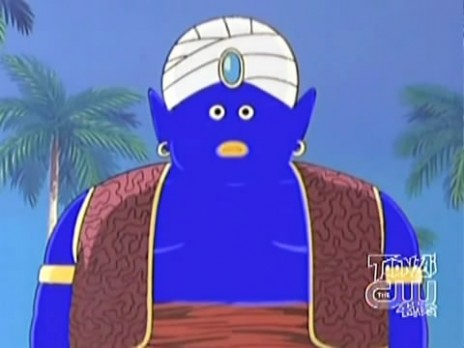
In television, characters like Jynx were once waved off. Similar characters have been showing up in animation since it started and some made it to television, and some did not. A contemporary to Pokémon in the late 90s (as far as American audiences are concerned) is Dragon Ball which also featured its own blackface character in Mr. Popo. Mr. Popo largely went unchallenged and was featured in Dragon Ball and Dragon Ball Z with no alterations or cuts for years. Only when the series returned to television as Dragon Ball Z Kai in 2010 was a change made. And in that case, it was only done for the episodes airing on broadcast television and not cable. For them, Mr. Popo was re-colored with an electric blue skin tone that did little to hide the racism, but I guess it allowed the network to say, “We tried.”

blue mr popo

The CW’s solution for Mr. Popo.

For Jynx, the solution was far simpler. Unlike Mr. Popo, Jynx is not often featured in the series. When Pokémon first aired, the character went unnoticed and the episode was allowed to air. Eventually, the character garnered some negative press and the episode was pulled sometime in 2000. And ever since, it’s essentially been banned. When Netflix and Amazon Prime eventually acquired Pokémon for streaming, this episode was not included. The only way to see it is to purchase a physical copy of the show on DVD, and not just any DVD, as you need to get the specific version that includes it. Future releases would omit the episode.

Is all of this necessary? It’s hard for me to say. I’m a white guy, so I’m naturally not as sensitive to the subject as others would be. Someone apparently didn’t see the value in giving Jynx the Mr. Popo treatment to get it back on air or into a streaming catalog, which is unfortunate since this is a Christmas episode! Poor little Pokémon fans are being deprived a Christmas special because of the stupid, racist, Pokémon it features. I suppose now with the show totaling over a thousand episodes no one sees a need to make sure this one, specific, episode makes it onto Netflix or wherever. Plus, the show has other Christmas episodes. What’s worse, is the episode did get recolored, but for Japan only. A “fixed” episode exists, it just needs to be dubbed. Did they lose the dub track or something? It seems like something that would be easy, and cheap, to correct.  It’s also annoying because Jynx is terrible, she is one of the worst of the original 151 Pokémon. As a human shape, she lacks the cuteness or the charm of someone like Squirtle or Cubone. She’s rather curvy too, which is just weird for a Pokémon.

purple jynx

Japanese audiences received a new version of this episode, but English audiences have not.

Anyways, that’s Jynx for you. She’s the reason this episode has been placed into purgatory which gives me a desire to take a look at it. Also, for me 2019 may very well be remembered as the year my son was properly introduced to Pokémon. Since getting him Let’s Go! Pikachu for his birthday, he’s been a walking, talking, Pokédex. Time will tell if this obsession will stick, but it’s been rather amusing for me to see him get into something so completely like he has Pokémon which has only further made me want to include the show in this year’s version of The Christmas Spot.

Jessie Xmas

A rather idyllic piece of Christmas imagery.

Let’s get to it then. This episode is from the first iteration of the show taking place in Kanto. It’s episode 65 of the English dub, though it was supposed to air sometime around episode 39 or so and there’s a continuity error as a result which I’ll note when we get there. And naturally, this is a Christmas episode and it’s going to go all in on that sentiment.

santa james

That’s no Santa!

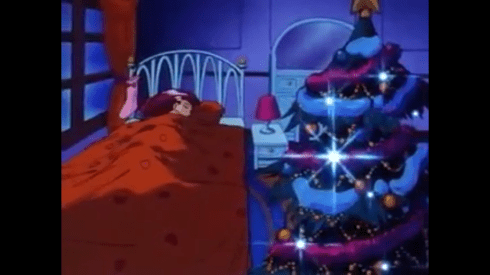
The episode opens and narrator Rodger Parsons brings us into a darkened bedroom with a girl asleep in bed. It’s Jessie (Rachael Lillis) of Team Rocket, so something must be up. A shadowy figure enters the room from the chimney, could it be Santa? As the figure approaches the bed, a trap is sprung and the old elf is caught in a large net. Jessie rejoices at the capture of Santa, as does their sometimes loyal sidekick Meowth (Madeleine Blaustein). After the title card is displayed, we discover that this is not Santa, but James (Eric Stuart) dressed-up as the Christmas icon in a dry run for a true Santa trap. Jessie has apparently been obsessed with capturing Santa dating back to her childhood when she made an important discovery. While asleep one Christmas Eve, she woke to find Santa in her room, only it wasn’t Santa it was a Jynx! The Santa Jynx picked up Jessie’s favorite doll and departed up the chimney with it infuriating the young girl. Ever since then, Santa has failed to pay her a visit and now it’s time for her revenge!

pokemon army crawl

We call this one the Pokémon army crawl

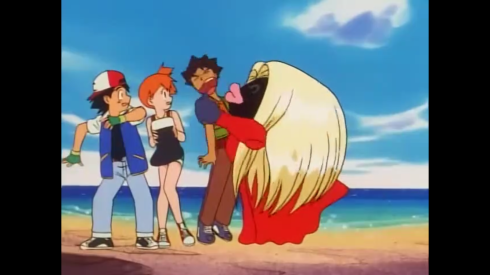
Elsewhere, Ash (Veronica Taylor), Brock (Stuart), and Misty (Lillis) have just made a discovery. They’ve spotted a lone Jynx on a beach and she’s holding what appears to be a boot. Jynx, being a rare Pokémon, immediately captures Ash’s attention and he decides he needs to catch this Pokémon. He deploys Pikachu who’s thundershock attack does little to bother the Jynx. She gets Pikachu in her arms and uses her signature maneuver, a kiss, to paralyze the electric rodent. Ash then deploys Charmander and commands him to flamethrower the Jynx. This is the continuity error I mentioned earlier as Ash’s Charmander had already evolved in a previously aired episode.

jynx brock

Because Jynx wasn’t content to just be racist…

Charmander’s flames subdue the rather docile Jynx, and Ash attempts to capture it with a Pokéball but it fails. Ash is confused, which is about when the group decides to diagnose this situation further such as why is Jynx holding a black boot? Misty takes a look at the boot Jynx is holding and finds it belongs to Santa Claus. How can she tell? He has a picture of himself in his boot, which is a pretty weird way to declare ownership over something (that’s because in the Japanese version, Santa’s name can fit on a postage stamp-sized image where as his English name would not, so he gets a portrait). Jynx then tries to tell them what happened, but like most Pokémon, she’s only capable of saying “Jynx.” Brock guesses she belongs to Santa, and Jynx gets all horny and tries to kiss him which he does not respond well to.

jynx power

Jynx’s power on display.

Jynx then does something she should have done from the start. She glows and shimmers with rainbow colors as her hair stretches out and touches everyone around her, including Charmander and Pikachu whom Charmander is adorably carrying on his back. It seems Jynx has the ability to psychically communicate with others. They see the Jynx in an arctic setting polishing Santa’s boot when suddenly a piece of the ice she’s standing on breaks apart from the mainland and drifts away. This Jynx is lost and needs to get back to Santa, and Ash vows to help her out which nearly earns him one of those undesirable kisses.

From atop a peek nearby, Team Rocket is watching and scheming. Since Jessie knows the “secret” about Santa, she’s naturally inclined to follow this Jynx. They intend to follow Ash and the others to Santa’s workshop to steal all of the toys – the horror!

img_4295

They live to serve

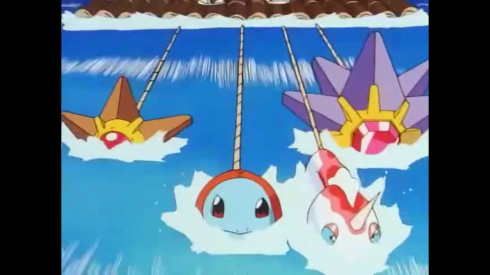
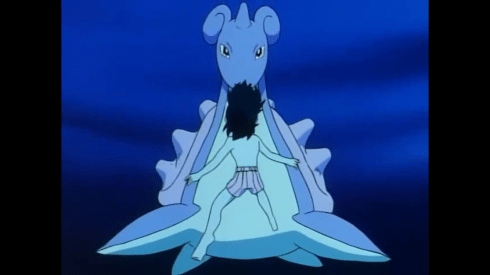
Ash’s grand plan is to board a raft and sail to Santa’s workshop using Misty’s water Pokémon to pull the raft. As they do so, Team Rocket boards a Gyarados submarine to give chase. Eventually, the water Pokémon get tired and Ash decides he can take over pulling the raft. He strips down to his boxers and dives in. He doesn’t appear to get very far before fatigue sets in as well. He starts to think about turning back, but hears a feminine voice in his head urging him on. When he asks Misty and Brock if they heard it they say they did not. Ash keeps going and the voice informs him he has a ways to go. Suddenly, a wave rises up and crashes into Ash. It severs the rope around his waist and pulls him underwater. He opens his eyes and sees a black void approaching him.

ash lapras

I bet Ash wishes he was wearing something other than just his underwear when meeting Lapras for the first time.

We’re interrupted with a “Whose that Pokémon?” (it’s Pidgeotto) bumper before returning to the show. The black void before Ash turns out to be a Lapras, a dinosaur-like Pokémon of the sea. It takes him to the surface with Ash upon its shell and Misty is able to get a Pokédex reading on the gentle beast. Turns out, Lapras is capable of telepathy and that’s the voice Ash had been hearing. Lapras (Jayne Grand) explains to everyone that Santa had asked it to find a missing Jynx. Lapras has been watching this trio for some time, and can take them to Santa’s work shop.

img_4297

So called they’re willing to get next to a racist, sexual harasser like Jynx.

Lapras pulls the raft ever faster, forcing Team Rocket to speed up. Their submarine is pedal-operated, so they have their work cut out for them. As Lapras pulls the raft along it starts to rain. Ash enjoys it, but Lapras cautions him that it will soon get really cold. Ash says he can handle it and we cut to later to find all three huddled for warmth amongst Jynx’s hair. Lapras informs them they’re almost there and we soon see what looks like a giant iceberg up ahead. Lapras informs the others this is the location of Santa’s workshop, but before they can get too excited the visage of Gyarados rises from the water’s surface.

team rocket cold

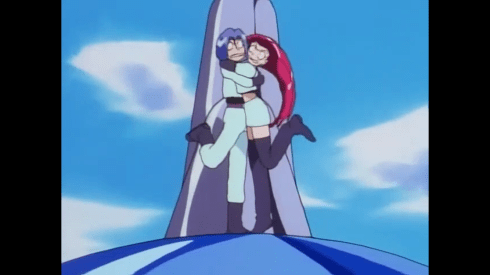
Team Rocket bringing new meaning to the term chilly reception.

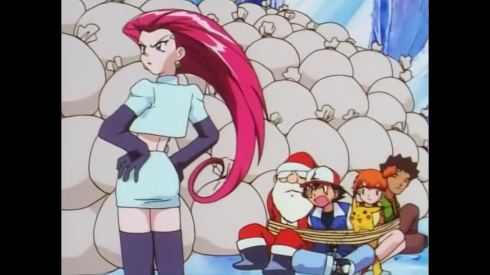
Team Rocket exits the submarine and breathlessly goes into their usual introductory routine. Eventually, Jesse and James are forced to embrace each other for warmth as Meowth makes his entrance. He quickly decides it’s way too cold and returns to the warm confines of the submarine. Jesse then demands that Ash hand over Santa Claus. When they express confusion, she clarifies she means Jynx. The others have a good laugh at her expense, while Jessie insists that Jynx is actually Santa Claus. Fed up with their laughter, Jessie orders Meowth to fire a missile from the submarine. It arcs into the sky, and as Ash and the others panic, Jessie and James make off with the Jynx. The missile explodes and a huge cargo net is draped over the good guys while Team Rocket heads to the workshop.

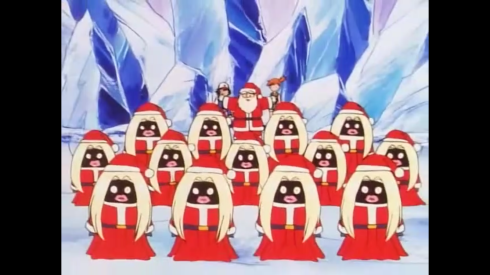
jynx elves

I suppose it makes sense that in this world Santa would have a team of Pokémon instead of elves.

Once there, we see a frozen Christmas tree and Team Rocket peering through the windows of the fabled shop. Inside they see numerous Jynx (which Jessie insists on referring to as Santas) doing the work we would normally associate with elves. They soon spy the real Santa, causing Jessie to question everything she’s thought up until now. Santa is seen fretting about his missing left boot to one of the Jynx, and Jessie pops in with the boot and presents it to him. He’s delighted and asks if she also found a Jynx with it, but before she can answer Ash and the others storm in. Ash informs Santa that these people are on his naughty list, and before he can inquire further James and Meowth tie him up. Jessie then tells them if they want to have a happy new year they better do as they command.

jessie and santa

What makes less sense is for Santa to possess no eyes.

With Ash and the others all tied and bound there’s nothing preventing Team Rocket from loading all of the Christmas presents onto their submarine. Santa tries reasoning with Jessie and he seems to be onto something. Jynx comes over and uses her psychic powers to show Jessie what really happened that night. When she woke from her slumber she knocked her favorite toy on the floor causing it to break. Jynx, who was assisting Santa that night, saw the broken toy and took it to have Santa fix it back at his workshop. She now returns it to Jessie good as new. When Jessie asks what took so long, Santa explains that after that Christmas Jessie sealed off her heart to Santa, and once a child stops believing he can no longer enter their home. Jessie’s eyes well up with tears, and James appears affected by this display of emotion. Jessie is thankful, but then informs Santa she’s still taking all of the toys anyways because she’s still Jessie.

img_4301

That’s a lot of presents.

As Team Rocket flees in its sub, Lapras emerges. Lapras tells them Christmas is for everyone, and can’t be stolen, before unleashing its ice breath attack on the submarine. It becomes frozen solid, and Ash uses the opportunity to summon Charmander once again. He instructs the Pokémon to free them first before turning its fire breath on Team Rocket. Charmander ends up thawing the ice, inadvertently freeing Team Rocket allowing it to call upon Weezing to take out Charmander and resume its escape.

jessies xmas moment

Is Jessie about to have a magical Christmas moment?

Ash apologizes to Santa for letting Team Rocket get away, but he’s not too concerned. He instructs the Jynx, dressed in little Santa suits of their own, to use their psywave technique. They do as instructed and telekinetically lift the submarine from the water and dump out the presents on the shore. The submarine is then destroyed, and Team Rocket “blasts off” as it always does.

jynx santa army

That would make me run too.

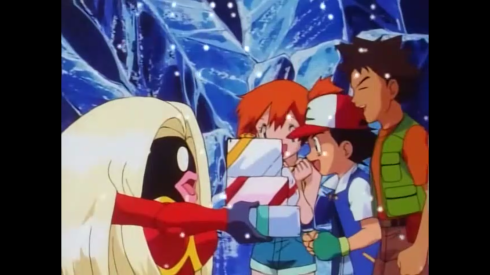
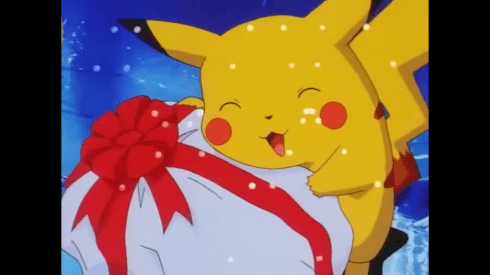
Santa is then shown in a one-Rapidash open sleigh piled high with presents. He thanks them for their help and instructs Lapras to take them home. As he flies away, Ash realizes he never told Santa what he wanted for Christmas. Lapras informs him that Santa knows as Jynx brings out presents for all of them, even Pikachu. Lapras wishes them a merry Christmas to finish things off here.

santa rapidash

This show found a clever way to avoid my reindeer criticism.

We’re then taken back to the castle-like structure on a cliffside that opened the episode. Team Rocket is shown all sharing a bed. They look a bit worse for ware. They’ve hung stockings, but Meowth doesn’t think they’ll be getting filled with presents. Just then, Jynx shows up outside the window. She winks and blows them a kiss, which puts all three to sleep. Santa is then shown flying past the moon, because all Christmas specials featuring Santa are required to include such a shot, and he too wishes us all a merry Christmas.

img_4305

Gifts for all!

That was a rather interesting approach to a Christmas episode. It turned an unpopular Pokémon into Santa’s elves and gave Team Rocket a Grinch-like plot. I suppose I should have foreseen a Grinch turn for Team Rocket, but it wasn’t something I ever considered. It’s always interesting to see how Santa is incorporated into a fictional world’s lore, and in this case his existence is unquestioned. It’s perhaps a touch light on Christmas sentiment, but it’s also nice when a special doesn’t beat the audience over the head with the same. I like the fake-out with Jessie who appeared to be having a happy Christmas moment, only to continue on with her plans of thievery. It genuinely fooled me and I thought the episode was going to take the sappy way out, but I’m happy it did not.

The decision to make Jynx essentially Santa’s elves was perplexing to me, then I remembered Black Pete. Yes, one final bit on the inherent racism of Jynx seems to come from Sweden. There, Santa has a servant named Black Pete who functions similarly to Krampus. He’s often depicted by a white actor in blackface, not unlike Jynx. Black Pete punishes bad kids, which is something Jynx apparently does not do (unless you view her putting Team Rocket to sleep at the episode’s conclusion a form of punishment or trickery), but the Jynx certainly are servants of Santa. The main Jynx was scrubbing his boots when she got lost, for goodness sake!

pikachu xmas gift

Even Pikachu!

As for the future of Jynx, she’d return without the Santa plot. Nintendo and Gamefreak also apparently took the issue of her appearance with western audiences to heart and her skin tone has been altered from black to purple. This change has carried over to the games and it’s definitely an improvement. She’s still an awful Pokémon, but at least her racism is less blatant.

santa pokemon

The natural closing shot for 99% of all Christmas specials.

Because of its controversial nature, “Holiday Hi-Jynx” isn’t the easiest Christmas special to view legally. It’s not streaming, and it obviously won’t be shown on television this year. You can either go out and buy the old DVD, or turn to the internet. It’s not particularly hard to find if that’s the route you take. As for me, I’d like to show this one to my Pokémon obsessed son. I don’t think the imagery will have a negative impact on him, and he’d probably like to see Ash and company interact with Santa this Christmas. Hopefully he’s not expecting a Jynx to visit him on Christmas Eve because there’s no way I’m letting one of them into my house. I have my limits.


The Sega Genesis Mini

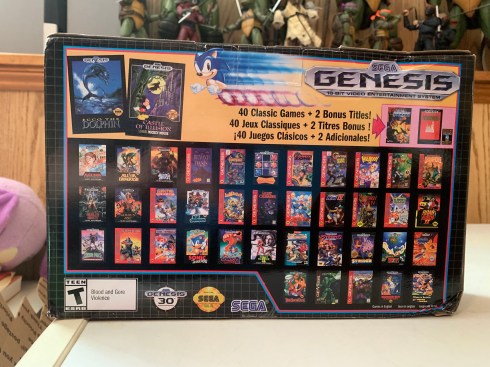
img_0206

The Sega Genesis Mini has arrived, though Amazon wasn’t particularly careful about packaging…

When it was a hardware manufacturer, Sega was often the company first to market with new technology. The Genesis (Mega Drive for non North American gamers) beat the Super Nintendo to market, the Sega CD beat the never released Super Nintendo CD, the 32X aggressively tried to make the 32 bit era begin early, the Saturn beget the PlayStation and Nintendo 64, and finally the Dreamcast arrived before the PlayStation 2 by over a year. When it came to the new mini consoles though, Sega was a laggard. I suppose you could credit the company with embracing this sort of plug and play retro gaming before the others as “flashback” systems have been at retail for years. Those releases were cheap though and the less said the better. Nintendo essentially saw what Sega was doing and decided to do it right when it released the NES Classic Edition in 2016 providing the blueprint for how these things should be done.

Sega saw the folly of its ways and for once decided to take things slow. The Genesis Mini was supposed to launch in 2018 and be yet another partnership with AtGames who had released the subpar Sega branded hardware already featured at retail. Sega understood the quality just wasn’t there, and the agreement between the two was either terminated or expired. Sega took development in-house, and also brought in M2 which had done the emulation for the well-received Sega Ages compilation. And thus Sega became a hardware manufacturer once again for the first time in nearly 20 years.

img_0208

That’s quite a lineup.

The Sega Genesis Mini is the latest in the mini console wave of devices that is now in its fourth year of relevancy. It follows the NES Classic, the SNES Classic, Neo Geo Mini, and PlayStation Classic and precedes the upcoming TurboGrafx-16 Mini which will bring this mini console era into 2020. The Genesis has been the missing link as it was one of the most popular video game consoles of its time and was arguably more deserving of such a release than the likes of the Neo Geo and PlayStation. There was considerably less demand for it though and I attribute that to the poor AtGames releases which really harmed the Sega brand in recent years.

Sega and its Genesis console have become a bit of a punching bag over the years. Most remember the marketing surrounding the machine than the actual games themselves. Sega was willing to go the distance to get noticed and basically every 90s cliché one can dream of can be found in Genesis marketing material. It aggressively promoted itself against the Super Nintendo by toting “Blast Processing” and that Genesis does what Nintendon’t. These marketing promotions are laughed at now because most admit that the Super Nintendo is among the greatest gaming devices ever invented. It’s almost absurd to suggest that the Genesis was superior, even if those marketing gimmicks kept Sega in the lead in terms of sales for much of the 90s.

img_0209

The size of these mini consoles will never not amuse me.

All of the retro silliness surrounding Sega these days tends to ignore the fact that the Genesis was pretty damn good in its own right. Sega was aggressive in acquiring licensed material for its machine and as a result the best selling Genesis titles tend to be not great. Those games overshadow the smaller releases that really were something special like Shining Force and Gunstar Heroes. Sega has either acknowledged that, or difficulties in getting those licensed games for its mini console has allowed the Sega Genesis Mini to function as a showcase for those forgotten gems. And the fact that the device comes packed with 42 games means there’s also plenty of room for Sonic.

If you have played one of the Nintendo mini consoles then you basically know what to expect with the Genesis Mini. It’s about half the size of the model one Genesis and comes with two controllers that connect via USB instead of the old Genesis pin connectors. The console looks great and it’s quite light because there’s really not a lot that needs to go into these things to make them functional. The device comes with an HDMI cable for hook-up to modern televisions as well as a USB to AC wall connector for power. The controller cables are about six feet long, which is neither good nor bad, and turning on the console brings you to a dashboard from which the games can be played. The Genesis Mini outputs an HD signal, but the quality of the emulation means there’s no input lag nor do the images look washed out. The games can be played in their native 4:3 aspect ratio, or zoomeded to 16:9 if you’re a monster. The games can also be played with a filter designed to mimic old scan lines if you choose, though I find the image to be darker and muddier as a result.

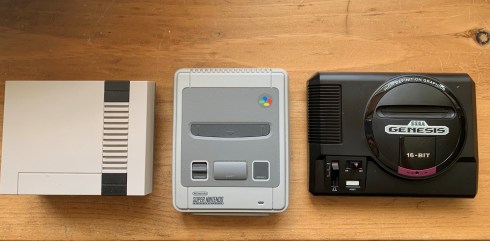
img_0233

It’s comparison time! Apologies for not having the US version of the SNES Mini

The Sega Genesis Mini doesn’t really distinguish itself from what Nintendo did in terms of function, and that’s because it doesn’t need to. This is an appropriate way to make these games available in 2019 and the emulation is top-notch. The controllers themselves feel a touch off when compared with the real thing, but they function perfectly fine. It is a shame that Sega included the 3-button controller instead of the six (which Japan received), but I suppose it was done to coordinate with the original release of the Genesis. It’s also disappointing that Nintendo utilized its own proprietary connector on its consoles instead of USB so the extension cables I bought for my Nintendo consoles won’t help me here. Sega did at least include a menu shortcut in its software that is achieved by simply holding down the start butto, something Nintendo didn’t even do with its SNES Classic. Where Sega differentiates itself from Nintendo further is in the celebration of the little things. The Mini is not region locked, and you can even experience this software in Japanese if you wish. This is pretty cool with a game like Dr. Robotnik’s Mean Bean Machine, which was a re-skin of Puyo Puyo for the North American market. Changing the region to Japan actually changes Dr. Robotnik to Puyo Puyo, even though that game wasn’t even emulated for the Japanese release of the Mini.


By now you have likely also seen where Sega separated itself from the other retro consoles by making everything on the Genesis Mini semi-functional. That means the flaps on the cartridge socket work and the expansion port for the Sega CD is also present. These things don’t actually do anything, but it’s such a simple and appreciated touch. Sega has even gone way beyond the extra mile in Japan by releasing a mini Sega Tower. By that I mean you can actually purchase mini versions of the Sega CD, 32X, Sonic & Knuckles lock-on cartridge, and a mini cartridge of Sonic the Hedgehog to connect to your Genesis Mini. Again, these serve no functional purpose what so ever, but it’s Sega celebrating what it’s known for. If that silly thing does indeed earn a North American release, you can bet your ass I’ll be all over it.

img_0210

I don’t have a model one Genesis, so this is the best I can do.

The Genesis Mini would be nothing without quality software, and here Sega has delivered as well. I previously ranked each game set for release and as I get reacquainted with these titles I see little reason to change those rankings. There are a few duds I won’t ever play, but mostly this is a collection of the best games available for the system as opposed to the most popular. I’m sure there are folks who will say something is missing. I know a lot of people were surprised to see no Sonic the Hedgehog 3 or Sonic & Knuckles, but it’s not like the hedgehog isn’t well represented as-is. I’m quite surprised that Mortal Kombat wasn’t included because of how important that game was for the Genesis, but I also can’t say I miss playing it as the game hasn’t aged particularly well. Licensing issues obviously prevented Sega from including one of the many well-received sports titles as well. And as Nintendo did with Star Fox 2 on its classic console release, Sega has included unreleased titles on this one as well including Monster World IV and Mega Man: The Wily Wars, games not sold at retail in North America. And as for games never released at all on the Genesis, there’s the Genesis version of Tetris and Darius.

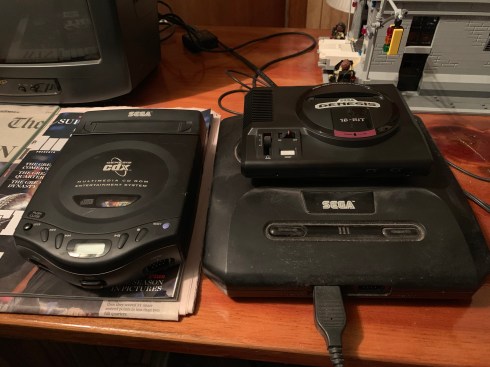
img_0211

And in case you were wondering, here is how the Mini compares with a Sega CDX.

All of this basically just means that Sega has gone out and released perhaps the best Mini console so far. The emulation is great and it’s packed with games that are still worth playing in 2019. Sega has also made sure to make this a fun release that celebrates both the Genesis and Sega as a whole. If you thought you didn’t need to experience the Genesis again then I encourage you to rethink that position.


The NEOGEO Mini


img_0003When I was a kid, there was a game console that was so unattainable it was practically mythical. And that console was SNK’s Neo Geo, the home console version of SNK’s popular arcade technology. I only heard about it through social circles, but never knew anyone who actually had one. And had I wanted to even see one I wouldn’t have known how to even go about that. Game magazine didn’t bother covering it and I can’t recall ever seeing one in a store. And that’s because the unit ran for around $650, and that was just for the console. The individual games were often sold for $150 a piece, some even more. And these things were behemoths! Just eyeballing it, they look to be around 8″ by 6″ and are about an inch and a half thick.

It’s sort of ironic that the Neo Geo was so expensive and rarely encountered because SNK’s arcade cabinets were the opposite. Those white, black, and red cabinets were pretty prolific in the 90s and that was because they were quite the value compared with other games. A SNK cabinet contained a board that usually had at least two cartridge slots and as many as five. These cabinets essentially functioned like a console, and arcade owners could swap out games whenever they wished if they felt they needed to change things up, which is a heck of a lot cheaper than buying an all new cabinet. Plus the owner gets to save on floor space, making SNK machines pretty popular for smaller venues looking to just add a game or two like a pizza place or a bowling alley.

The Neo Geo was also super expensive because SNK wasn’t really looking to compete with the likes of Nintendo and Sega. SNK knew what it did well, and it had a dedicated fanbase. The Neo Geo was for people who loved SNK’s arcade games and wanted to take the experience home without having to buy an actual cabinet. Because of this, the guts inside the Neo Geo is essentially identical to that of the arcade cabinet. Where other console developers looked to achieve a half measure or so, SNK said “screw that.” And the gigantic cartridges gave SNK plenty of room to increase the power in its games helping the Neo Geo to still be viable into the 2000s.

Something the Neo Geo brand has never really shook is its high cost. Even decades removed from its debut, a secondhand console will still set you back several hundreds of dollars. And the games might set you back even more since they weren’t produced in massive quantities. SNK’s home version of the Neo Geo hardware was referred to as the AES, with the arcade version referred to as the MVS. Since they were the same, SNK made the shape of the cartridges different between the two. The thinking was that SNK didn’t want Neo Geo owners just buying the cheaper MVS carts, which featured no artwork or case, and playing them at home. Over the years, third parties have come up with adapters so Neo Geo AES owners could indeed play the cheaper MVS carts on their home system. More experimental and determined gamers have even taken old cabinets and “consolized” them to create their own Neo Geo. Many years ago, I bought such a device as I wanted to get into Neo Geo. At the time, the MVS community was starting to take off and now collecting those instead of AES games isn’t the value it used to be. I made one post on that thing, and no more because I just wasn’t willing to devote all of those resources to Neo Geo.


Not surprisingly, SNK decided to get into the mini console business. It’s a business presently booming, and there’s money to be made. SNK also decided it needed to do things a bit different. While Nintendo and Sony had dedicated home consoles to celebrate from its respective pasts, SNK also wanted to acknowledge that Neo Geo wasn’t just a home brand, but an arcade as well. And in true SNK fashion, it also decided it needed to be the most expensive option in town.

The Neo Geo Mini was released late in 2018 for both Japan and the international market. Like other mini consoles, the lineup of software differed between the two regions and was supposedly tailored to the tastes of each. Considering SNK’s games span few genres, I’m not sure what differences there really is in terms of taste save for SNK’s football title. The Neo Geo Mini ran for as high as $130 on release, though of all the mini consoles this one seemed to vary the most in price depending on where you purchased it with some offering price points closer to $100 (which is what the Japanese version translated to in US dollars).

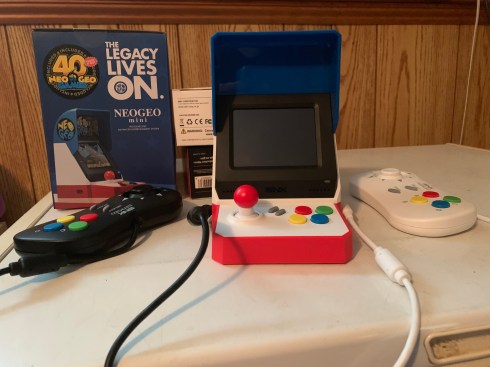
That price point may have seemed alarming at the time, but there was some justification behind it beyond the usual “it’s Neo Geo.” The Neo Geo Mini comes with 40 pre-loaded games, the most yet for these official mini consoles (the soon to be released Genesis Mini will top it with 42) so if you were placing a value of 2 bucks a piece on each game that would already get you to 80 dollars. And to celebrate the arcade legacy of Neo Geo, SNK opted to make its mini console a dedicated gaming device without the need of a television. The Neo Geo Mini is an adorable little arcade cabinet all by itself. It more resembles the barcade style than an actual SNK cabinet, but this makes it much easier to place the device on your lap. It has a 3.5″ LCD screen which is in a 4:3 format to preserve the native aspect ratio of the software. There’s a mini analog joystick on the left, and the four buttons are on the right. Because of the limited space, the buttons are arrayed in a diamond shape as opposed to in a row as they would have been on an actual cabinet or on the AES joysticks. The Mini is powered by a USB cable, but it does not come with a wall adapter. It also does not contain an internal battery, so it has to be plugged in. This is the first of many design flaws to come.

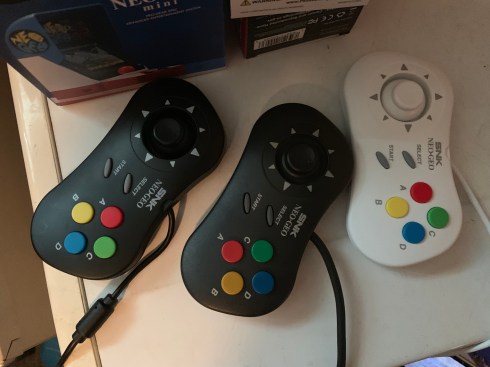
img_0009

Left to right: SNK Black controller for the Mini, Neo Geo CD controller, SNK White controller for the Mini.

The Neo Geo Mini is undeniably cute, but SNK made some odd choices with it. First of all, one such odd choice is not the screen. It may be LCD, but it looks just fine for these games. If you found these titles impressive to look at in the arcade, the same will be true here. Playing them though won’t be quite as fun. The joystick SNK went with is pretty basic. It’s floaty, like an analog stick on a modern console, which works okay for games like Metal Slug, but for fighters it’s problematic. It’s confounding because SNK has a history of making good analog sticks that are actually usable for fighters. The Neo Geo Pocket had a great one. It had plenty of resistance and had that satisfying click to it. The gamepads for the Neo Geo CD too had these clicky analog “discs” on them that were also usable in fighters. You would prefer to use a joystick, but you also didn’t feel severely limited if you had to use one of the gamepads. More confusing is SNK’s decision to change the layout of the buttons. On the old controllers where this diamond shape was utilized, the buttons went (starting at the top, clockwise):  D, B, A, C. On the Neo Geo Mini they go:  A, C, D, B. I’m not super familiar with old Neo Geo games, but even I’m thrown off with this new configuration. I have to assume it has something to do with how these games have been released in emulated form on modern consoles, but it’s weird that they opted to make things different here.

Making things even odder, is you can purchase additional controllers for the Mini. They’re styled after those Neo Geo CD gamepads, but they’re different in the worst ways. For one, they have the new button layout so if you thought you could get around that setup, well, you can’t. They’re also using new components, and sadly the analog disc is one of them. It’s no longer that satisfying clicky input. There’s even less resistance in it when compared with the Mini’s joystick, making it a downgrade if you want to play VS modes. They connect via USB Mini, so it’s possible that better joysticks are available, but it’s a shame that the official SNK controllers are so disappointing.

img_0010

When both controllers are plugged into each side of the Mini, the controls on the device go “dead” making this a maximum of 2 players only.

The Neo Geo Mini includes a TV out function via HDMI mini. Strangely, it did not come with a cable though so you had to buy a separate one. Thankfully, if you own any of the Nintendo mini consoles then you’re all set. I actually often just switch the cable between my mini consoles when I want to play since I don’t have enough inputs on my television. If you choose to go this route, know that it isn’t really optimal. SNK didn’t spend much time on this feature it would seem as the games all feature a noticeable downgrade in visual quality when played on a television. It’s not unplayable, but also not very kind to these otherwise lovely looking games. On the plus side, the controller cables are at least generous in length and the Neo Geo Mini is heavier than the Nintendo mini consoles so there’s less chance of yanking it accidentally off a TV stand. Though, if you happen to do so there’s also more risk of damage given the presence of the screen.

Because of the cost and shortcomings, I passed on the Neo Geo Mini last year. This summer though, a new bundle was released and it was enough to get me to jump onboard. The Neo Geo Mini bundle is available at Amazon and Wal-Mart and it includes:

  • The Neo Geo Mini International Edition
  • 2 SNK controllers (one black, one white)
  • 1 HDMI cable
  • $99

The bundle addresses the monetary shortcomings and puts the console closer in-line with the SNES Mini. Yes, it’s still more expensive than that device, but it also has nearly twice as many games and features the off-TV mode. In addition to all that I highlighted, the Mini also comes with stickers. The only graphics on the International version are the Neo Geo logos on each side of the cabinet so if you want to add some extra flash to it you have the stickers. I haven’t placed any on my unit, but I probably will stick one above the screen at least.

img_0007

You may bemoan the lack of variety, but there’s no denying this thing comes packed with a lot of games.

Of course, if you’re interested in this device then you probably want to know what you can play on it. The games on the International version are as follows:

  • Metal Slug 1 – 5
  • Metal Slug X
  • King of the Monsters 1 and 2
  • Sengoku 3
  • Magician Lord
  • Blue’s Journey
  • Shock Troopers
  • Shock Troopers 2nd Squad
  • Robo Army
  • Crossed Swords
  • Mutation Nation
  • 3 Count Bout
  • The King of Fighters 95, 97, 98, 2000, 2002
  • Art of Fighting
  • Fatal Fury Special
  • Real Bout Fatal Fury
  • Garou: Mark of the Wolves
  • Samurai Showdown II, IV, V Special
  • The Last Blade 2
  • World Heroes Perfect
  • Kizuna Encounter
  • Ninja Master’s
  • Top Player’s Golf
  • Super Sidekicks
  • Football Frenzy
  • Blazing Star
  • Last Resort
  • Ghost Pilots
  • Puzzled

That’s a lot of fighting games. Safe to say, if you don’t like fighters then this isn’t the machine for you (and you probably already knew that). I’ve tested all of the games in off-TV mode and all emulate very well with no input lag. If you liked these games before, you’ll like what you have here. The obvious shortcoming being the input method for the fighters. I’m not particularly good at SNK fighters, but I’m really not good on this machine. Maybe I can get used to it and get close to what I am when playing on a Neo Geo, but it’s going to take some practice. I should also note, that since this contains US versions of these games, Samurai Showdown features the censored green blood. If you want the red stuff you’ll have to get the Japanese version.

img_0011

There are some design shortcomings with this device, but there’s no denying the games look good on the small screen.

As for the lineup, it’s hard to argue it’s not a solid representation of what SNK’s legacy is. I would have preferred fewer fighting games, but there’s not a ton missing either. I’m surprised at the exclusion of Bust-A-Move, aka Puzzle Bobble, but that might be because SNK doesn’t own those characters. I would have liked to see Baseball Stars as well, and I’m surprised at its exclusion. Since these games are all essentially arcade games, they’re pretty damn hard since they were meant to guzzle quarters. You’ll be happy to know that there are Save State options present making these games a bit easier to manage. Simply pressing Start and Select together brings up the menu to do so which is also the way you exit a game without powering off the console. The user interface is bare bones, but gets the job done. If you happen to get the Japanese version you can even switch the language to English, though the in-game text will still be Japanese (not that any of these games contain required reading).

img_0013

Getting used to this little guy will be key to enjoying the fighting games. For games like Metal Slug though it works just fine.

Given all of this, it’s a bit hard to recommend the Neo Geo Mini as anything other than a novelty. If you like the idea of being able to play these games off-TV in a unique format then by all means give it a shot. The new bundle makes it a little easier to recommend, though the extra stuff also highlights what this system isn’t very good at doing. If you just want to experience SNK’s games on the cheap, or even on the go, you have lots of options now as most of these games can be purchased digitally for various platforms, including Nintendo Switch. Of course, the Switch will give you its own issues with inputs for fighting games, but it will also give you better on-TV emulation. These games are no longer prohibitively expensive to enjoy, which does harm the novelty of the Neo Geo Mini.

I find the aesthetic of the Neo Geo Mini to be so pleasing that I’m reluctant to say I find it disappointing. It’s too charming to be a dud. The only true disappointment for me is that the on-TV experience isn’t good enough to make me get rid of the few MVS games I own. Hopefully I keep at it with this thing and eventually get a little better at a few of the fighters. I’d also like to see SNK take at least one more stab at creating a dedicated gaming device that’s cost-effective and also sets a new standard for the best way to experience SNK’s games. The Neo Geo X and the Mini both were tantalizing, but come up a bit short. If you like SNK’s offerings and don’t mind the price tag, the Neo Geo Mini is fine. If you’re still on the fence, then maybe wait and see if the price comes down more or seek out a used one. I’ve seen stand-alone Minis for as low as $89 new. I don’t think it will crash to the levels of the PlayStation Classic (which I’ve seen for as low as $15!), but there may be some more room to fall.


Bring Arts Weltall Action Figure Review


img_4425One of my favorite games from my youth is the role-playing game Xenogears. I think I even declared it as my favorite game of all time when I reviewed it here a few years ago. I don’t know if it is my all-time favorite or not, but it’s still right up there because it did a lot of the things well that I enjoy in a game. Especially for a game released in 1998. In case you’re not familiar, Xenogears is a Japanese RPG published by then Squaresoft and released for the PlayStation game console. It was unique at the time because it chose to mostly stick with two-dimensional sprites for its characters, but placed them in a three-dimensional world. If you’re looking for a modern comp, think Octopath Traveler only with more jaggies – a lot more jaggies.

Xenogears told the story of Fei Fong Wong, an orphaned boy in his late teens with no memory of his past living in a quiet village that will not remain quiet for very long. The village ends up becoming a casualty of war, so to speak, as a battle causes a large robot to be deposited there. Fei ends up piloting this robot, referred to as a gear in the game, because he’s called to do so by an unspeakable force and he ends up bringing death and destruction to the village. Ostracized from the community, but in possession of this very lethal gear, Fei ends up getting caught up in something much bigger than he could have ever imagined. He’ll make new friends, encounter new foes, and even fall in love across two discs of gaming goodness. Things will get pretty wacky with split personalities and a destiny being revealed that seems to involve destroying God. It’s a head scratcher and probably more than a little pretentious, but damnit, that’s what we expected of JRPGs in the 90s!


I’ve played through and completed Xenogears on more than one occasion, and I’m sure every time I’ve engaged it I’ve thought to myself, “Man, it would be really cool if there were action figures for this game.” And for a long time, there were not. With 2018 marking the game’s 20th anniversary though, Square-Enix decided to partner with action figure company Bring Arts to do right by this game for the first time in a long time.

Bring Arts is known for collaborating with Square-Enix on several properties. The company’s figures are usually highly articulated and well-detailed, but also can be rather pricey. Finding places that carry them in the US can be troublesome, with places like GameStop usually only willing to stock a few figures of the most popular franchises. Xenogears, despite being permitted to brand itself as a Greatest Hit back in the day, is not a terribly popular franchise so I have not seen a single figure from the line in a physical store. That doesn’t mean there aren’t any carrying them, but it did mean I didn’t get too excited when I heard toys were coming.


Bring Arts first released last year a figure of Fei, as he being the star character that made sense. They then followed with a figure of Elly, one of the other central characters in the show. They look pretty good, but I took a pass because they’re not cheap and also not really what I dreamed of acquiring. Finally, Bring Arts just recently released it’s third figure:  Weltall. When I played Xenogears back in 98 it was Weltall and the other gears designed  by Kunihiko Tanaka that I was thinking of when I wished there were toys based on the property. Weltall is Fei’s gear, and he’s got a nice look to him. He comes across like a hybrid of a Gundam mixed with one of the orbital frames from Eva. It’s mostly blue with glowing red eyes and has wings, or fins, that don’t seem to do anything affixed to its back. Weltall doesn’t use any weapons in the game and instead fights as Fei does with martial arts techniques. It can shoot a Kamehameha like blast, but it doesn’t have guns or a giant sword

img_4451

SH Figuarts Vegeta for scale.

The Bring Arts version of Weltall is not to scale with the previous figures. It essentially exists in its own world as the figure itself is only slightly taller than Fei, even though Fei is meant to sit inside the gear and pilot it. It would have been cute if Bring Arts included a tiny Fei with the toy, but sadly the company opted not to. I don’t have Fei, or Elly, so it’s not something that really matters to me, but I suppose if you’re adding Weltall to a Xenogears display it might annoy you a bit.

img_4441

Weltall setting Vegeta up for his patented Stunner.

Weltall comes in a nice window box package that’s easy to get into. Once removed, Weltall has a nice feel to it. The figure is all plastic, but has a gun-metal finish to it that makes it at least resemble sheet metal from a distance. It would have been cool if Bring Arts could have included a lot of diecast with this piece, but considering the MSRP is around $90 maybe it’s good that it does not. The figure does feature swappable, diecast, feet which is pretty interesting. It reminds me a bit of the Teenage Mutant Ninja Turtles action figures from SH Figuarts which had diecast shins for balancing. Placing the diecast feet onto the figure allows it to more easily be posed in one-legged positions. Scratching is always a concern with diecast parts so you’ll want to take care when removing them, but they swap on and off easily and the paint application is consistent from plastic to diecast so they don’t look out of place.

img_4446

The feet, see if you can tell which is diecast and which is plastic.

Weltall comes with additional hands for posing, including a set of gripping hands. Considering the gear doesn’t use weapons I’m not really sure what good gripping hands are, but they’re included. He has some “chop” hands and energy blast hands, which are permanently bent back. Same for the two fingers pose hands he’s got. The wings, or whatever they are, need to be attached to the figure manually and they snap on easily enough. I was concerned these pieces would throw off the weight of the figure and make it harder to stand, but they’re nice and light and I didn’t have any issues there. I heard some folks were dissatisfied with the paint on the first figures in this series, but I’m happy to report my Weltall looks great.


Weltall has a lot of articulation, some of which is rather creative. There are numerous plates on the figures body, some of which you need to swivel a bit before moving a limb. This isn’t a toy you ever want a kid to just grab and start fiddling with as a lot could go wrong. There are some sliding joints in the shoulders and thigh area that help make the limbs clear some of these plates so that the arm or leg can have a full range of motion. The ankles also extend a few millimeters for enhanced positioning as well which is really cool. The extra hands and feet all snapped off and on for me rather easily and this toy in general required little in the way of breaking-in. The only limitation I could find articulation-wise was with the chest and abdomen, which really aren’t able to do much. Since this is a robot, I suppose it doesn’t need a true ab crunch. The sculpt of the torso is also quite nice so at least nothing was sacrificed for the sake of articulation.

img_4452

The beauty of diecast feet.

Weltall comes across as a pretty high quality piece of plastic. The likeness is dead-on, and the inclusion of diecast feet was pretty neat. It does mean the figure comes with that hefty price tag though. The MSRP appears to be around $90, but I’ve seen the figure for sale at marks both above and below that figure. Diligence and patience are your friends if you want to get this figure for as little as possible. It’s a niche product, so there’s always the chance Bring Arts ships too many and it ends up on sale, but it almost seems too niche for that. I was fortunate to find a brand new figure on eBay that was an actual auction listing that started at a penny. As result, I ended up only paying around $65 for my figure. I say “only” but that’s obviously in comparison with the asking price as $65 for a six-inch scale action figure is a lot of money. As a result, this isn’t a toy I can recommend to casual fans and collectors. If you’re a diehard Xenogears fan like myself that has always wanted a figure of Weltall then yeah, go ahead and splurge, but otherwise you’re probably better off staying away.

img_4453

The figure also comes with a stand, but honestly, it doesn’t need it.

I’ve seen some individuals in the Xenogears fanbase openly speculating on what’s to follow Weltall. I’ve even seen some say they’re waiting for the red version of Weltall from the game, Weltall-Id, but that seems a bit risky to me. Bring Arts has not announced or shown any other figures from Xenogears, and I don’t expect any to follow. Since Weltall-Id could be done fairly easily, I suppose a future variant is possible (maybe a convention exclusive?), but new sculpts seem unlikely to me. This line feels like a rather simple celebration of the game’s age and three figures based on the most recognizable characters/gear feels like a fitting tribute. Would I want more? That’s actually a tough question. I love Weltall, and Weltall II was fine, but also not much different from Weltall 1. Of the other gears, I suppose Andvari was pretty cool and I did enjoy Fenrir, I’m just not sure I liked any of them to want to drop another 80 or so bucks a piece. Most of my favorite designs actually belonged to the bad guys, live Alpha Weltall and Wyvern, and I don’t know if Bring Arts would dare make figures based on those instead of another hero character. I guess we’ll cross that bridge should we get there.

img_4449

Blast away.

For now, this Weltall action figure is a pretty neat way to celebrate 20 years of Xenogears. It’s basically exactly what I wanted, just at a price point higher than I would have liked. If more gears come along I’ll certainly take a look, but if this is the only action figure I ever own from Xenogears then that’s okay by me.


Ranking the Games of the Sega Genesis Mini

us genesis mini box

Commemorating 30 years of the Genesis, Mega Drive to you non-Yankees, in comes the Genesis Mini to go along with your other mini consoles.

Did you think the era of the mini console was over? You would be forgiven if you had. Last year’s Sony Playstation Classic arrived with a thud. Originally retailing for $100, you can probably score one now for less than half of that as they clogged shelves during the holiday season and failed to excite. And it wasn’t a surprise. Sony just didn’t have the software muscle to make the Playstation Classic a must-own console. It wasn’t for a lack of effort on Sony’s part. There was a clear desire to have this device harken back to the early days of the Playstation as a celebration of one of the most popular gaming devices of all time. The problem was it may have been too reverential for those early days as a lot of the software just hasn’t aged too well. And the games that had have been readily available for download or in compilation packages for years. Top it off with no dual shock and a hefty price tag just made the console undesirable. Maybe Sony still made money off of the machine, but it wouldn’t be surprising to learn the electronics giant took a loss either.
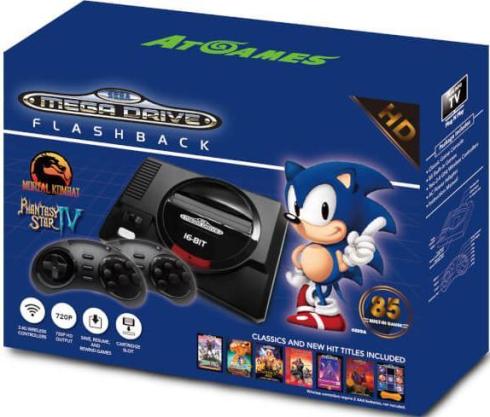
bad genesis mini

Not to be confused with the awful other mini Genesis units out there.

If you thought that high profile failure would deter others from following suit, well then you would be wrong. Throwing their hats back into the ring is Sega, who has been licensing its old software and hardware for years as part of third-party plug-and-play devices of less than desirable quality. Even when the NES Classic was available, Sega had a Genesis Mini on store shelves that boasted wireless controllers and a port on the console for an actual Genesis cartridge. Everything about it though was clunky and pretty awful. Since it was licensed out, it likely cost Sega nothing aside from a hit to its brand reputation. Maybe Sega decided it needed to help that brand out while making another effort at tapping into that mini console nostalgia that has boosted Nintendo’s bottom line for a few years now.

To do so, Sega has sought the services of M2, the developer behind the Sega Ages compilations which have been universally praised for their emulation quality. Sega also is apparently handling the actual hardware in-house, and actual Genesis controllers will ship with the system this fall. This smells like an honest attempt at a quality device, the only question really is can Sega still manufacture and produce quality hardware? It’s not something the company has been involved with for decades now since the high profile failure that was the Dreamcast. Considering there isn’t much to these mini consoles, there probably should be some degree of confidence Sega can pull it off. By sticking with wired controllers there’s no worry about cheap, wireless, devices which plagued the prior models. And we already know the emulation end should come out quite well.

genesis mini tower

Sega is apparently going all-in on the nostalgia and even releasing a non-functioning Sega CD and 32X mini in case you want to remember this abomination.

What we also know is the price ($79.99, same as the SNES Classic) and contents of the package. The US version will include two classic 3-button controllers and 42 games. Yes, it would have been preferential to have the six-button controller, which will apparently be included with the Japanese version so perhaps there will be some six-button controllers for sale, but it’s not a deal-breaker since every game had to utilize the 3-button layout. Mostly though, look at that games total:  42! Where Nintendo seemed careful about what it included with the SNES Classic, likely wanting to adhere to placing a dollar value on each game, Sega has simply said “Screw that!” and put a vast collection of games on this set that well-represent what the Genesis was famous for. Sure, there are some notable omissions. Mortal Kombat was huge for the Genesis, so it’s surprising to see it excluded. Considering the game doesn’t possess the gameplay to match its visuals, it’s only a sentimental loss. An actual good game that is missing is Sonic the Hedgehog 3 + Sonic & Knuckles. It’s possible the lock-on function was difficult to duplicate, or maybe Sega just felt that would be too much Sonic. Otherwise, there aren’t a lot of obvious omissions. Sports were huge on the Genesis, but licensing for sports titles is likely far too complex and expensive. Likely, most of your personal omissions are a preference for one game in a series (Shining Force vs Shining Force II, for example) vs another.

I’ve taken the time to rank the games of the other high-profile mini consoles, only skipping SNK’s, so I feel an obligation to do the same for the Genesis. This is the only negative for me of Sega including 42 games as I have to rank them all! This is no easy feat, but I’ll do my best. Now, I have played every game on this list, but that doesn’t mean I am supremely familiar with all of them. I’ll try to convey my familiarity where I can, but this is also just one man’s opinion so take it for what it is.

First of all, there are actually 2 games I have not played and they are the two most recent revelations:  Tetris and Darius. The Genesis Tetris was somewhat infamously discontinued before it got going. It’s one of the most expensive carts to this day. It’s Tetris, so you probably have played it before on another platform. I’m sure it’s good. The other game I have not played is the arcade-only Darius. A fan version of this game showed up on the internet and it’s speculated the version here is the same. It’s an auto-scrolling shooter from Taito so if you like that stuff I suppose you’ll be excited to play it. As for the other 40 games, well let’s just get right down to it.
altered beast boss 1

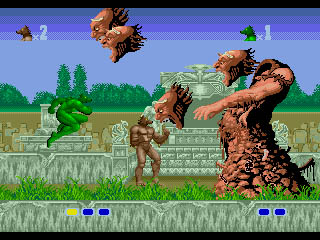
Altered Beast is memorable and was an early success story, but it was never really a good game.

40.  Altered BeastAltered Beast is an arcade classic, and as an early Genesis title, it does have some fans. On the other hand, it’s an example of how porting from arcade to the Genesis wasn’t entirely smooth and that arcade perfect ports were still years away. The transforming beast gimmick is neat, but everything else is rather terrible. It’s playable, and as a kid I liked it enough, so if it’s your worst title then that’s not too bad.

39.  Alex Kidd in the Enchanted Castle – The mascot before Sonic, Alex Kidd is perhaps best forgotten, a super floaty platformer that is representative of a lot of the shovel-ware that would clog game systems during the era. There’s at least some skill to be formed while playing this one, hence why I put it ahead of the vanilla brawler, Altered Beast.

38. Virtua Fighter 2Virtua Fighter 2 is a late era representative of how porting from the arcade to the home was hard. This time, it’s because arcade hardware had more than lapped what was available for most gamers at home. If playing this title on the Saturn, then it’s pretty good. On the Genesis? Well, let’s just say it’s a shocker they even bothered.

37. Eternal Champions – Sega’s in-house fighting game entry, Eternal Champions was the straight to home fighting game that wanted to be violent and shocking. Instead, it’s just a one on one fighter with little charm that’s also some-what bogged down by overly complex mechanics. The fact that it was developed for the Genesis, and not the arcade, made it noteworthy at the time because that was practically unheard of for fighting games. It ended up being a harbinger of things to come as the arcades became more marginalized as the 90s wore on. Playable, but hardly memorable unless you really like the fatality-like Overkills.

36. Ecco the Dolphin – Pretty nice looking for a Genesis title and certainly unique given that you play as a dolphin and solve puzzles. It’s also one of the most boring titles I’ve ever played. Some people love it, and it was a huge seller, so maybe others will too.

35. Ghouls ‘n Ghosts – I’m on the record as just not being a fan of this franchise. This version is naturally superior to what was on the NES, so if you like that game then you’ll love this one. I personally just find this game difficult to a fault, where it only cares about being hard and not being entertaining. Such a slog.

space harrier 2 4

Space Harrier 2 is certainly a unique shooter that was far more impressive back when it came out than it is today.

34. Space Harrier 2 – A strange behind-the-back on-rails shooter. You can move your character all over the screen to avoid attacks. It gets pretty chaotic, but if you’re a fan of on-rails shooters it might offer a nice change of pace from the typical approach.

33. Golden Axe – A solid arcade port that’s still plenty playable, Golden Axe is far more enjoyable with two-players. I’m surprised Sega went with the original here, but there’s not a ton separating the games in this franchise so I suppose it matters little. It’s fine, but I’ve played Golden Axe so much that it’s hard to get excited about it.

32. Kid Chameleon – A platformer in which you play as what appears to be a 50’s greaser and collect power-ups that impart new abilities. It’s a neat concept and if you stick with it you may find it rewarding. I’ve personally just always hated the “feel” of this one as the character is really floaty and slippery.

31. Comix Zone – One of the coolest looking games on the Genesis, Comix Zone has a great concept. You play as a comic book artist who gets sucked into his own panels. It’s just so unbelievably hard that all enjoyment is ruined. I guess you could save-skum your way through it, but that’s hardly what I consider fun.

30. Light Crusaders – An isometric RPG, it’s actually one of many RPGs on the Genesis Mini. It’s crazy how many there are. Is this one the worst? Probably. I’ve never spent a ton of time with it though so maybe I’m selling it short. I’m not a fan of the perspective or the visuals, finding it frustrating. It does at times feel like a precursor to the much superior Diablo given the perspective and the fact that there’s just one, really long, dungeon in the game. It did receive quite a bit of praise when it was released in 1995 so maybe I should give it another shot?
beyond oasis

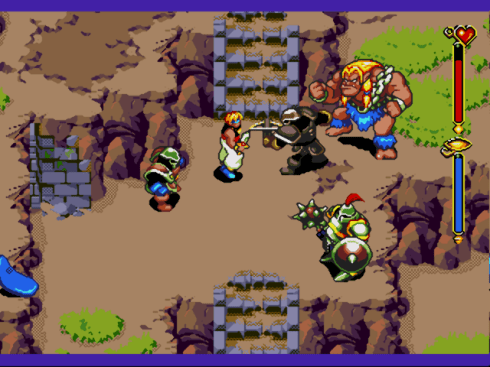
Visually, Beyond Oasis strikes me as Secret of Mana meets Dragon’s Lair.

29. Beyond Oasis – A top-down action RPG, this one reminds me of Secret of Mana. It has some distinctive visuals, but the animations can be a bit chunky. Not the greatest controls either as you’re most likely going to find little snakes you have to crouch to hit to be the biggest annoyance. It’s an interesting game, but it’s somewhat made worse for its RPG elements as dealing with NPCs just feels tedious and dry.

28. Super Fantasy Zone – a shooter, but one in which you have full control of the vehicle similar to TaleSpin on the NES. It’s a pleasing title to look at and an easy one to just pick up and play when you have a half hour to kill or something. I prefer this style to auto-scrolling, even if it’s still not the type of game I seek out. It was also never released on the Genesis in the US, but was released on the Virtual Console in 2008.

27. Castle of Illusion Starring Mickey Mouse – Disney and Sega had a nice thing going for awhile. Castle of Illusion was among the first and an early entrant on the Genesis. It’s a rather benign platforming title that might be easier than you remember if you last played it as a little kid. That is unless your skills in 2D have diminished, then it might be harder than you remember.

26. Earthworm Jim – This game was inescapable when it came out as the marketing was obnoxious. It’s a flashy looking shooter/platform type that gets pretty hard pretty fast. I think it’s a bit style over substance, but it does have an addictive quality to it. I know it still  has a strong fanbase to this day, which is probably why the character is set to attempt a comeback on the Intellivision Amico.

25. Thunder Force III – This game is a totally serviceable shooter in the same vein as R-Type. Not my cup of tea, but plenty fine. This is the best game in the franchise as it switched to the horizontal format and even introduced some elements that would be considered forgiving, a rarity in this genre.

24. Wonderboy in Monster World – Yet another RPG, this one is a side-scrolling action one. It’s perfectly playable and even enjoyable still today. It’s also a little boring when it comes to the RPG elements which is probably why Wonderboy never took off like Zelda did. Either that or it was because his name is Wonderboy. I mostly rank it this high on the list because I find the aesthetics of the game quite charming.

dynamite headdy

Dynamite Headdy was a later arrival on the Genesis so it may have been overlooked by many.

23. Dynamite Headdy – There were so many mascot plaformer types in the 90s that it’s forgivable if you forgot about Dynamite Headdy. He’s basically a bug without a neck who can throw his head at enemies. Interesting concept, for sure, and a totally fine platforming title. Headdy handles well and the game is bright colorful, what more do you want?

22. Alisia Dragoon – It’s kind of like Castlevania with lightning bolts and dragons. Alisia Dragoon is a side scroller in which you have lightning powers and multiple dragon sidekicks to cycle through. Like Castlevania, there’s exploration elements and hidden places to find. It’s also pretty relentless about attacking from all sides making it imperative to use your powers judiciously so they have time to recharge and strike out in all directions. This is a game I’ll likely spend more time with should I get a Genesis Mini.

21. Sonic Spinball – It’s pinball, but with Sonic the Hedgehog instead of a ball. I’m actually not sure if this title is overrated or underrated. When it came out, a lot of people were a little irritated it wasn’t a proper new Sonic game, but it’s hard to deny it’s a rather fun experience. It won’t blow you away, but you’re unlikely to have a bad time at least.

20. Columns – A Sega classic, of sorts, Columns was the brick-falling game not named Tetris. It’s a match 3 type of puzzler and it’s fine. It won’t wow you, but it’s easy to get absorbed in. I’d much rather play this than something like Yoshi’s Cookie, though I’d prefer to play one other puzzler on this set over it.

19. Landstalkers – Another isometric action RPG, this one is just much more enjoyable than Light Crusader. It’s nicer on the eyes, and while the story isn’t anything special the world is far more interesting to explore. The perspective is still more annoying than fun, but this is a title in need of some added exposure so hopefully the Genesis Mini is a benefit for it.
monster world iv

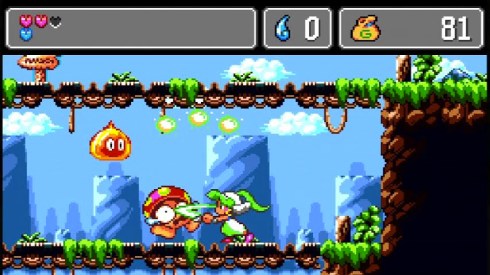
Monster World IV features a colorful and cute design that I just find so charming.

18. Monster World IV – The last entrant in the Wonderboy series on the Genesis and a game previously unreleased on the console outside of Japan. It has been included on compilations in recent years, but this will be the first time US gamers will get to experience it on Sega hardware. It’s yet another side-scrolling RPG, but it has charm and looks great. A surprise, but worthy, inclusion for the Genesis Mini.

17. Mega Man:  The Wily Wars – This one is almost like cheating as it’s a compilation of the first three Mega Man titles ported to the Genesis with enhanced visuals. It should be awesome, but I’ve never liked how it feels compared with the NES games. It seems slower and more deliberate almost as if Capcom went too far in updating the visuals and instead negatively impacted the gameplay. Maybe that’s why it originally went unreleased, being only available on the Sega Channel. I’ll give it another shot, for sure, as it’s still Mega Man and those three games are classics in their own right.

16. World of Illusion Starring Mickey Mouse and Donald Duck – I’m probably ranking this one too high, but it was a personal favorite of mine as a kid. It’s Castle of Illusion, but with two-players and much improved visuals. It’s a fun, breezy, platformer that should be beatable for even those who have let their skills diminish over the years. It just might take some practice.

sonic 1 main

Sonic’s gameplay is somewhat divisive, but what isn’t is the impact he had on Sega and video games as a whole in the 90s.

15. Sonic the Hedgehog – Sega’s first real answer to Mario, you either love it or you don’t. The game is a constant battle with the urge to travel at top speed, because once achieved, you open Sonic up to a world of hurt in the form of spike traps and death pits. It’s a game of trial and error, and had it not been a success back in the 90s we might not even be here having this conversation. Still very playable, just not the best Sonic title any longer.

14. Street Fighter II: Special Champion Edition – It’s the arcade classic now on the Genesis. This is about as competent a fighter as you’re going to find, it’s just hard to get excited about playing it in 2019. The 3-button controller is not the ideal way to experience Street Fighter, but it’s competent at least. It’s still Street Fighter II though, which is a nice floor to have.

13. Road Rash II – The motorcycle racer that was a staple on the Genesis, until it wasn’t. This game was largely popular amongst my friends because you could attack other racers, but even absent that it was still a damn good time and a fun racer. I’m a bit surprised it’s the only racer on this set though, but I’m not sure Outrun has aged all that well and Virtua Racing is probably too hard to emulate.

12. Dr. Robotnik’s Mean Bean Machine – Another stacking puzzle game, this is just Puyo Puyo but with a Sonic skin. Specifically, it’s done in the style of the cartoon Adventures of Sonic the Hedgehog. It’s the rare puzzler that’s better with two players. Probably the only puzzle game I prefer to it is Puzzle Fighter, which isn’t surprising since they’re pretty similar. Definitely check this one out if you never have.

11. Contra:  Hard Corps – The venerable Contra series on the Genesis. Some Contra fans cite this as their favorite entry in the series. I’m no Contra expert, so don’t ask me. It’s a fun and challenging shooter though. Too hard for me, and I’m not ashamed to admit that. Have fun using save states on this one.
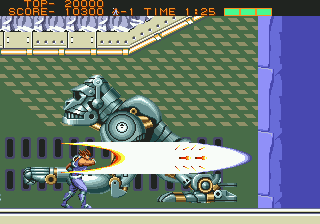
strider

Strider is Capcom’s forgotten hit franchise. Its visuals are a tad dated as this was an early Genesis title, but its gameplay is not.

10. Strider – This felt like Capcom’s answer to Tecmo’s Ninja Gaiden. Strider is a bit more vertical and the main character Hiryu has a lot of weapons at his disposal. Strider controls well and offers plenty of action, a good one to get lost in especially since the challenging difficulty will keep you busy.

9. Vectorman – Speaking of hard games, here’s another. Vectorman is a shooter/platformer with some gimmicky stuff as well as the titular character can change form. Visually distinctive, Vectorman is a game I enjoy despite the fact that I suck at it. Maybe I just need more practice. I’ll probably play this one a few times and struggle to make it to level 3.

8. Shinobi III – A challenging platformer, but one more deliberately paced. I’ve always preferred Shinobi to Ninja Gaiden or Strider because of that pacing. It’s easier to plot out an attack and feel out a boss fight. It’s also still hard, but often fair. Smart move by Sega to go with the third entry over the other two as this one has always felt like the most balanced entry in the series.

7. Phantasy Star IV – A more traditional JRPG, this series is basically Sega’s Dragon Quest or Final Fantasy. I’m a bit surprised they opted to go with IV over the more popular II, but either one is fine. I wish it looked and sounded better, but it’s strangely addicting thanks to its combat system and I look forward to playing through it.
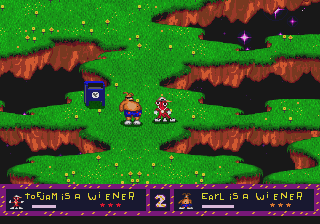
toejam_and_earl wiener

The only game brave enough to refer to its characters as wieners.

6. Toejam & Earl – Too high? Possibly. This game is just too weird not to love and represents the oddball nature of the Genesis so well. You practically have to play it with two players, but the journey to piece together the spaceship of a couple lost aliens is certainly memorable and humorous. This is also the rare game where the power-ups feel more like a curse as they make it so hard to control the characters. This is definitely the go-to game when a buddy stops over. Maybe now I can finally beat it?

5. Gunstar Heroes – A more forgiving run and gun game than Contra or SNK’s Metal Slug. It’s also faster and has its own distinct visual style. This is routinely cited by many as one of the best games on the Genesis so it was a must-include for Sega. It’s surprising that this series hasn’t been able to live on as a modern-looking version would be amazing. We’ll just have to settle for this release, I guess.

4. Sonic the Hedgehog 2 – It’s like the first game, only everything is better. Maybe you want to say the soundtrack is better on the original – that’s fine. Every level here though is probably superior to every level in the first game. The inclusion of Tails technically makes it two-player, but no one has fun controlling Tails. He’s the original “give this guy to your little brother/sister” character as he can’t die and has no control over what is happening on screen. Which is why if I play any game with one of my kids it will be this one.
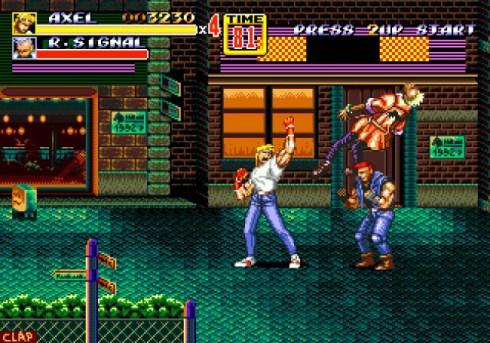
streets 2 uppercut

Arguably the best brawler ever created, it’s amazing that Streets of Rage 2 has maintained a stranglehold on that title for so many years.

3. Streets of Rage 2 – Considered by many to be the best brawler ever created. Even better than Final Fight or Double Dragon II. Streets of Rage 2 stretches the genre about as far as it can go. It has a surprisingly deep combat system and it looks great as well. So many games have attempted to rip it off, and none have come all that close.

2. Shining Force – If Phantasy Star was Sega’s answer to Dragon Quest, then Shining Force was its answer to Fire Emblem. Shining Force is a criminally under-appreciated strategy RPG. Maybe we just didn’t have the attention span for it back in the day, which explains why Nintendo never bothered with Fire Emblem until much later, but I never knew anyone who talked about this franchise. It’s great though, but I’m surprised Sega went with the original over the better sequel. It’s not a big deal though. If you don’t like this style of gameplay, then Shining Force won’t win you over. I’m a bit of a junkie for this stuff though, hence the placement here.
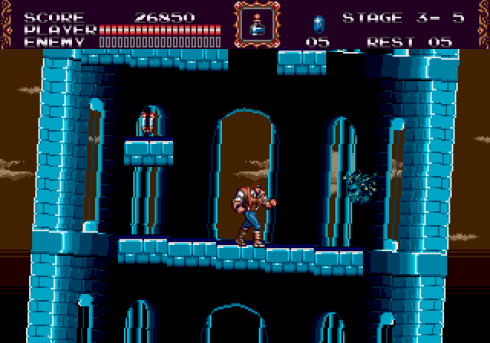
bloodlines 3

Bloodlines was sort of dismissed upon arrival, maybe due to Castlevania fatigue, but it’s one of the best games in the long-running franchise.

1. Castlevania:  Bloodlines – The secret best 16-bit Castlevania? A lot of praise gets tossed at Super Castlevania IV, but Bloodlines is the superior game. It returns the player’s sprite to a more diminutive size giving the game more space. It features tried and true Castlevania gameplay and a great soundtrack as well. Like a lot of games on this console, it wasn’t appreciated as much as it should have been at the time, but at least there’s time to rectify that. This is a fabulous game on the Genesis, and if you love Super Castlevania IV but haven’t played this one much or at all then now is as good a time as any to rectify that.

That’s my opinion of the Genesis Mini’s software. It’s a great collection of games and the sheer amount likely pushes this one ahead of the SNES Classic in terms of value. What remains to be seen is if Sega can deliver on the quality, and while I’m fairly confident the company can, it’s hardly a sure thing. Performing this exercise has, more or less, convinced me to get one myself. And thankfully, it looks like the Genesis Mini will be a lot easier to come by than either of Nintendo’s offerings initially were. And if you think we’re done with mini consoles, well you are mistaken. Konami just announced a TurboGrafx-16 Mini so there’s that to look forward to. And the specter of a Nintendo 64 Classic will continue to loom large over the market until it’s either released or we all collectively decide to believe Nintendo that it isn’t coming.


Pokémon: Let’s Go, Pikachu! or Baby’s First Pokémon

lets go pikachu boxI was four years old when I got my first video game. Like probably many individuals my age, that game was Super Mario Bros. for the Nintendo Entertainment System. Prior to that, I do not know where my exposure to video games came from. Most likely it was via television commercials and older cousins, though i have no specific memories. I certainly was a consumer of The Super Mario Bros. Super Show, but that arrived a year later. No matter, I was more or less hooked when I got my first game, and while games had a lot to compete with in my early years, eventually it became my number one hobby by the time I was 9 or 10.
This past April, my own son turned 4. It felt like a good time to properly introduce the boy to video games. Unlike me, he’s grown up with video games in his house since day one. Despite my rarely playing them when he’s awake, he’s still seen them and has always wanted to play them as well. And he has. Mostly he just plays Disney Infinity where he can run around in the Toy Box mode and is free to swap characters in and out. On occasion he also plays classic games as I’ve steered him towards old Sesame Street titles on the NES since they’re easy for him to understand and he learns something too. Sometimes he’ll want something else and he’ll struggle to make it more than a few screens in something like Rescue Rangers or The Magical Quest Starring Mickey Mouse, but he still insists he’s having fun and rarely wants to put the controller down.

lets go versions

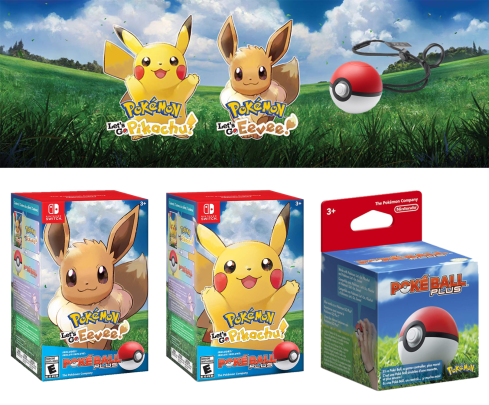
Pokémon Let’s Go is available in four versions: Let’s Go, Pikachu!, Let’s Go, Eevee!, and versions of each that come with the Pokéball Plus controller.

Seeing his enthusiasm for video games made me want to find something he could play and succeed at. I also wanted it to be a shared experience as I’m not ready for him to go close himself off to the world and get lost in a video game. That’s how Pokémon: Let’s Go, Pikachu! ended up on my radar. My son had already been exposed to Pokémon at a young age. He knew who Pikachu was and had messed around on my Pokémon Go! app. I had no reservations about the material, but just needed to make sure it was a game we could enjoy together. After doing some research, I was convinced the title would work and for his fourth birthday my son got his very first video game.

My experience with Pokémon goes all the way back to 1998 when the original Red and Blue titles made their way to US shores. They were the games that finally convinced me to pick up a GameBoy and I ended up with both versions of the title, beating both more than once. It was a fun, addicting, light role-playing-game and I stuck with the franchise into the Gold and Silver era, but after that I was mostly done. I checked out Pokémon Pearl for the DS, but never finished it. After a few years on the market, I eventually grabbed Pokémon Y to see how the franchise had changed over the years and mostly enjoyed it. And I was a day one downloader of the Go! app and I still play it today. I was pretty confident I could navigate my son though Let’s Go, Pikachu! which is basically a remake of the original games with some of the elements from Pokémon Go! integrated.

pikachu interact

My son could probably play with virtual Pikachu for hours if I let him.

I opted to get the version of Let’s Go, Pikachu! that comes bundled with a Pokéball Plus controller, figuring my son would get a kick out of it. Getting it up and running was a tad tricky. Like most games now, Let’s Go, Pikachu! does not come with formal instructions and you basically have to wing it. This caused confusion when I initially booted it up with Pro controller in hand. The game won’t even recognize a Pro controller though because it wants you to play with just a single Joycon. After messing around, I figured that out and was taken to the controller select screen. It displays both Joycons, a docked Switch, and the Pokéball controller and you have to press a button on the controller you wish to use. I always go with the Right Joycon because it has a Home button on it. Had Game Freak just included a little message that said “Pro controller not supported” when I tried to use it that would have saved me some time.

no randos

The Pokémon now appear on the screen. It’s a beautiful thing.

From there, I was further confused at how I could bring my son into the fold. I could not find options for 2 player, and when I would activate the Pokéball accessory it would de-activate my Joycon. Frustrated, I started the game and we went through all of the usual junk until you get to actually play. I don’t know how we ended up figuring it out, but in order to play with a second player they need to activate a controller while playing just by pressing a button, or in the case of the Pokéball, by shaking it. Then a second player, a gender-swapped version of the character you created, appears. When you encounter a wild Pokémon, two Pokéballs will appear and you can both throw to your heart’s content. In battle, the second player will deploy the Pokémon in the second position on your party screen effectively giving you two actions to your enemy’s one.

After finally figuring all of that out, things were mostly smooth. Let’s Go, Pikachu! is a 3D game that seems to share assets with Pokémon Go! It’s very much presented like modern Pokémon titles with the only differences being in how you interact with wild Pokémon. They now appear on the screen and you’re free to engage them or try to avoid them as you please removing random encounters. This has apparently been a controversial move in the Pokémon community as some prioritize the excitement of what wild Pokémon has been encountered. Personally, I never want to play another Pokémon title with random encounters again. Good riddance!

catching clefairy

Catching is just like in Go! only now you physically “throw” the ball. Landing the ball within the shrinking ring will earn you a bonus.

When you do come into contact with a wild Pokémon, you no longer battle them. This is where the Go! influence comes in as you now just throw Pokéballs until the creature is caught. And since this is Nintendo Switch, you literally make a throwing motion with the controller in hand to throw balls. It works fine, though I find the Pokéball Plus to be a tad more accurate. The rings from Go! are present as are the various items that can make catching a Pokémon easier. What’s gone is the curveball, but replacing it is the dual ball. My son and I didn’t even catch onto this until way late into our adventure, but if both players simultaneously hit a Pokémon with a ball then a special animation plays where the balls essentially combine into one. This makes the throw more likely to be successful and also adds extra experience to the encounter. That’s right. Catching Pokémon is now your primary method of accumulating experience so your Pokémon level-up and become stronger. Thankfully, since you’ll be catching a lot of Pokémon there is no longer a computer storage system. You simply possess a box that can store your extra Pokémon and you can access it at anytime.

Charizard battle

Battles are largely unchanged. Each Pokémon is limited to four moves and each can only be used a set amount of times before needing to be recharged with an item or at a Pokécenter. Only difference from the classic games is that everything is now animated.

Battles are still largely the same as before, though they do take on greater importance now that you literally have to keep catching ’em all if you want your Pokémon to get stronger. Battles allow you to earn experience, but also money. And you’ll need a lot of money so you can continue to buy more Pokéballs. The only wrinkle with battling is the inclusion of the second player that I mentioned earlier. This allows you to attack enemies 2 on 1. It does forfeit the free substitution between matches that you would normally get, but that’s a small price to pay. Strangely, on the rare occasion you find yourself in a 2 on 2 battle the second controller will be disabled and Player 1 will control both battlers. That was frustrating for my son. Ultimately though, because of the 2 on 1 nature 99% of the encounters in the game are much easier to breeze through, but that isn’t the only thing making Let’s Go, Pikachu! an easy experience.

surfing pikachu

Pikachu now learns all of the HMs for you. Here’s surfing Pikachu!

Game Freak has finally done away with those annoying Hidden Machines. Instead, Pikachu (or Eevee if you got the other version of the game) learns Secret Techniques that function the same way. Yes, even Fly which causes Pikachu to pull out a bunch of balloons to fly around with. These moves only work on the field of play and not in battle so they don’t affect Pikachu’s move set at all. No longer do you need to drag around a Pokémon just for HM access.

In addition to those techniques, your Pikachu will also have the option to learn new moves from a move tutor throughout the game. These moves really help to make Pikachu a well-rounded attacker, and frankly, he’s way over-powered. One of these moves is Zippy Zap, which is basically an electrified Quick Attack that always scores a critical hit. He’ll also be able to learn Splishy Splash, an electrified water attack so ground enemies are no longer an issue. He also now learns Double Kick just thru his basic leveling-up which is quite useful at parts. He can even learn an electric flying move too, though I opted to not add that. Basically, there was rarely a reason to pull Pikachu from battle and only the compulsion to mix things up provoked me and my son to do so.

metatron

A new Pokémon was created for this game, but you’ll need to catch him in Pokémon Go! if you want to use him in this game and complete your Pokédex.

The game is largely a remake of the originals, but there are some twists. The bicycle and fishing rod are gone and instead replaced with Pokémon actions. Pikachu can learn a Surf maneuver and when surfing you’ll encounter the many water Pokémon out in the wild. You can also ride on certain Pokémon to increase your movement speed on the field of play. And once you beat the Elite Four, you can even fly freely on the back of a Charizard or Dragonite. The Safari Zone is also no more and has been replaced by the Go Park, a place where you can import Pokémon from Pokémon Go! This is very useful for filling out the Pokédex as there are still Pokémon unique to each version of the game and some evolutions that still require trading (which you can bypass in Go!). There’s also a new Pokémon that can only be found in Pokémon Go! and it and its evolution can be transferred to Let’s Go, Pikachu!

flying charizard

No bike? No problem.

This is a solid Pokémon experience for me, but what about the boy I bought it for? Turns out, it’s pretty fantastic to him. He loves catching Pokémon, so much so that battles get boring fast for him. It’s a bit of a problem at times because there are points where you need to battle, especially since the kid flies through Pokéballs since he wants to catch everything he sees. He knows it’s a necessary evil though and trudges through the battles like a good soldier. It also stunk for him when we had to traverse water as that’s only one-player, but at least that didn’t take up vast sections of the game. I could even hand him the controller to catch anything I encountered too. He’s not great at moving the player in the field, but at least he mostly never had to since his job was to catch Pokémon. The other difficult part with a young kid playing is he has no interest in talking to non-player characters. This is a bit of a problem because you need to talk to everyone in this game because some give you important special moves and some might even give you a free Pokémon. His unwillingness to talk to people caused me to miss a few things that we eventually had to backtrack for. And any “dungeon” that didn’t contain wild Pokémon for him to catch was a real drag.

mega venusaur

In addition to the original 151 Pokémon, Mega Evolutions have also been added.

Shortcomings aside, the game largely did what I wanted it to do. It gave me something I could play with my son and we were both able to enjoy it. I’m not sure what we’re going to do now as we have already defeated the Elite Four and even captured Mewtwo. There’s still some slots on the Pokédex to fill out, but I wonder when my son will become bored with catching the same old Pokémon. There is some additional post game content, but it’s mostly battling related which isn’t very interesting for him, but we’ll see. We also have yet to utilize the external functions of the Pokéball controller. Like a Tamagotchi, you can load a Pokémon onto it and carry it around with you. It will earn experience and I think you can press a button on the ball to hear the critter chirp or something. The noises the Pokémon make are still the same as they were over 20 years ago, save for Pikachu and Eevee who have vocalizations from the anime. Nostalgia is nice, but it would have been neat if they went through and did the same for all of the Pokémon. And for that matter, how about some spoken dialog instead of text? I got sick of reading it aloud to my son and he seemed to as well.

Nonetheless, the game has been a big enough hit in my house to make my son a full-fledged Pokémaniac. He’s now watched all of season one of the anime on Netflix and loves watching YouTube videos on the subject. He’ll often tell anyone within earshot random Pokémon facts (“Hey mama! Did you know Haunter evolves into Gengar?!”) and I rarely see him without his Charmander plush. My daughter, who is only 2, has some-what embraced it as well. She loves Pikachu, and after we took the both of them to see Detective Pikachu in theaters (her first movie in a theater) she’s become a Psyduck fan as well. Eventually, I envision the two of them playing this game or a similar one together. In my dreams they’re enjoying themselves, though in reality there will probably be lots of fighting and arguing. That’s an issue for another day, for now, I’ve got a son who’s crazy about Pokémon and just beat his first video game (with some help from dad) which puts him way ahead of where I was at his age. Hopefully, a sequel is on the way that we can enjoy together in a similar manner. If it rights some of the few wrongs present here, then all the better.


Ranking the Games of the PlayStation Classic

psx classic gamesWhen the PlayStation Classic was announced a few months ago it was only revealed what 5 of the included 20 games were going to be. It was odd, but considering most places pre-sold out I suppose it didn’t matter. When Nintendo had success with the NES Classic Edition, it meant we were in for more of these devices. Myself and many others tried to predict what would be included on a potential SNES Classic and most people probably came pretty close to nailing the final line-up. Nintendo is heavy with first-party titles and its brand is forever connected with the likes of Mario and Link. With Sony, that first-party recognition isn’t there. During the height of the original PlayStation, Crash Bandicoot was positioned as the company’s mascot, but he wasn’t even owned by Sony. His games were just published by Sony, but the character would eventually come to be owned by Activision. Still, it seemed inconceivable that Sony would pass over Crash, and yet they did! He will not be appearing on the PlayStation Classic as Sony has finally unveiled the remaining 15. I knew predicting the line-up would be more difficult than doing so with the SNES Classic, but apparently I didn’t realize just how hard it would be as I went a putrid 1 for 15 with my predictions.
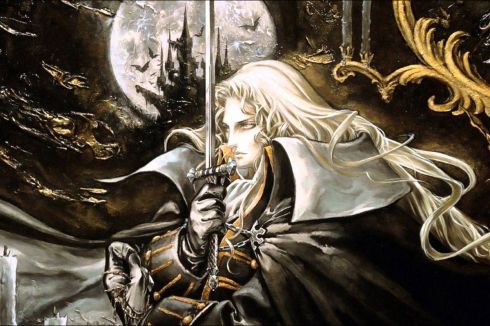
I suppose if I wanted to give myself bonus points I could dampen that showing by saying I at least hit on two additional franchises. And two of my requested titles (Intelligent Qube and Super Puzzle Fighter II Turbo) actually made it, even though I thought it would be a long shot to see them included. There’s no hiding from it though, I whiffed big time and I’ll own that. The actual line-up has likely surprised many and it has some nice surprises and some not-so-nice surprises. It’s a weird line-up, and since the PSX era did have some weird games I suppose that’s appropriate. There are three puzzle games among the 20, no 2D fighters, and only one title each from Konami, and Square-Enix. That means no Mega Man, Lara Croft, or Alucard. Were publishers not willing to “play ball” with Sony and its machine? Or was Sony just not willing to pay more for bigger titles? The Japanese version does have some different titles, including Parasite Eve and SaGa Frontier, but the Japanese market is a lot smaller than the North American one so maybe Sony is trying to maximize profits outside of Japan and is less concerned about the home country.

alucard

There are a lot of contenders for biggest snub, but Alucard might be the biggest.

This is not an optimal line-up of games, but does that make it bad? Lets suss it out and rank these titles starting with the least appetizing:

20. Battle Arena Toshinden – A decent looking launch title, it was quickly overwhelmed by Namco’s Tekken franchise. Most people forget about this franchise, and with good reason. It’s not a good game, and it’s odd to use this one instead of the better sequel, but even that game isn’t great.

destruction derby

Excited to revisit this one?

19. Destruction Derby – This game was a one-trick pony when it was released in the launch window of the PlayStation. It was cool to see cars explode and get smashed-up and it was sort-of perversely fun inflicting damage on other vehicles, but it was all empty calories. No one should be playing this game in 2018.

18. Tom Clancy’s Rainbow Six – This was one of the most heavily marketed games of its era. I probably saw more commercials for Rainbow Six than I did Final Fantasy VII. It’s okay, but the PSX port was pretty abysmal. Anyone playing Rainbow Six in 1998 probably shouldn’t have been playing it on PSX. Electronic Gaming Monthly even awarded it a dubious 3.8/10.

17. Jumping Flash! – We knew this one was included, and I even argued it had a place given it was a launch title and was just so very “of the era.” That doesn’t mean it’s particularly good and by today’s standards it’s quite ugly. Unlike the games listed before it though, it has a certain curiosity factor going for it that will make it worth a look when the PS Classic drops, but it might not be a game you actually stick with.

16. Cool Boarders 2 – If you like snowboarding and “extreme” sports games, then you’ll probably have this one ranked higher. It’s all right, but most people will probably wonder why it’s here and not Tony Hawk’s Pro Skater (it’s the licensing, folks).

twisted metal 1

I probably logged over 100 hours with this game, but I’ve never wanted to replay it after Twisted Metal 2 came out.

15. Twisted Metal – I loved this franchise on PlayStation, well the first two games at least. The first one though has not aged well at all, and even in the moment, I knew I was playing a junky game, but it had a certain fun factor. The sequel though is way better and actually still playable. I considered it the most obvious lock for the mini console even ahead of Metal Gear Solid so the fact that this game is included but the sequel is not blows my mind.

14. Oddworld:  Abe’s Odyssey – I said the PS Classic has three puzzle games, but you could make the case Oddworld is more of a puzzle game than a true platformer. This game was hyped a bunch as being a game that gave the player numerous ways to solve a problem, but it didn’t really play out that way. It was interesting, but hardly great. It’s graphical approach should hold up well enough though.

13. Wild Arms – One of the previously announced titles, I gave my speech on it already. It’s serviceable, and its simple JRPG mechanics mean it will always remain playable. It’s just a bit crazy to think that this machine has only three RPGs when the PSX was an RPG behemoth, and Wild Arms is one of the three.

12. Grand Theft Auto – GTA was a surprise hit for the PC when it was released, and it was somewhat surprising to see it get a PSX port. It was also the first title I was denied an ability to purchase at a GameStop. Like modern GTA titles, it was arguably at its best when it was just played like a sand box causing mayhem. Unlike modern GTA titles, the actual missions and story isn’t that rewarding and the game was really difficult. It was at least a little easier to handle on the PSX than with a keyboard. It should still be fun to screw around with, but might not have much legs with the PS Classic.

Intelligent-Qube

The inclusion of Intelligent Qube is a bit of a surprise. Is it a system-seller? Probably not, but it’s worth a look if you end up getting a PS Classic.

11. Intelligent Qube – This was a surprise inclusion, but a worthwhile one. It’s an interesting puzzle game that’s at least not another brick-falling puzzler. I don’t know how well it’s held up because it’s been many years, but it should be playable and may be a dark horse contender for many folks’ most played title on the Classic.

10. Resident Evil (Director’s Cut) – There’s no denying this title was huge for the PSX, and the Director’s Cut version was superior to the original. It is possibly the worst in the franchise on the PSX though and its controls are not something I look forward to returning to. It took many hours to get a handle on them in 1996 and I’m not sure I still have such skills. Maybe it’s like riding a bike?

9. Syphon Filter – This was basically Sony’s attempt at a first party MGS or Rainbow Six. It was fine for what it was, though I’d prefer a dual shock to play it. It’s going to look ugly, and even Gabe Logan’s running animation looked horrendous in ’99. It might surprise though, and the only reason why I didn’t include it in my prediction was because I didn’t think Sony would release it without dual shock support.

8. Ridge Racer Type 4 – A totally competent racer, but let’s face it, this isn’t the racing game you want. Gran Turismo was the first-party behemoth, but I’m guessing licensing issues made it impossible to include. WipeOut was an alternative racer, but one I’d consider more fun than Ridge Racer. I would have taken Crash Team Racing over this one, honestly, and I’m not sure if I’d even play this more than once on the PS Classic. The racing genre is one that basically improves a lot with better technology, so going back isn’t always fun unless it’s more of an off-beat title. I suspect this still plays well enough though, which is why I’m ranking it this high.

persona

I’m happy to see the original Persona included in this collection, but it’s also not a hard to find game so I wish something like Valkyrie Profile was included instead.

7. Revelations:  Persona – The first game in what is now known simply as the Persona series is the biggest surprise inclusion on the PS Classic. This was not a popular game when it was released, and Persona still has more of a cult franchise vibe than a mainstream one. The first game is not as good as more recent entries with the series really blossoming with Persona 3. It is still playable though, and it’s more strategy-oriented battle system differentiates it from Wild Arms and FFVII. This one is a nice surprise and unlike the original Final Fantasy on the NES Classic, fans who are only familiar with the newer entries might actually enjoy playing the first in the series as opposed to just checking it out for the sake of curiosity.

6. Mr. Driller – The nice thing about puzzle games is that they age well. Mr. Driller is another surprise inclusion. It was well-received in its day, but not really a system mover or anything. It’s fun and charming though and if you like puzzle games with a slight Tetris vibe then you’ll get some mileage out of this one.

5. RaymanRayman was all over the place in the mid-90s. He was so omnipresent that I kind of wrote him off for this system as I never associated him with PlayStation. His game is pretty good though, and its 2D approach should hold up just fine. I never loved Rayman, but I never hated his games either.

4. Metal Gear Solid – I’m not crazy about this list of games, if you haven’t noticed, but I do think it’s pretty top-heavy. The last four are mostly interchangeable, and I wouldn’t be surprised if Metal Gear Solid tops many lists such as this one. My reasoning for placing it 4th is because I think we’re missing out on some of the bells and whistles with this version by not having the dual shock support and a memory card full of Konami games. I also think the game hasn’t aged too well and recent entries in the series really helped to smooth out the gameplay experience. It’s still a fantastic game, it’s just not as fantastic as it could be on the PS Classic.

puzzle fiighter

This is a great choice for inclusion. I have nothing bad to say about Puzzle Fighter.

3. Super Puzzle Fighter II Turbo – This is probably my favorite puzzle game. It’s incredibly addicting and the rare puzzler that might be more fun in two-player mode than single-player. It’s got a lot of charm and personality and its sprites should hold up very well. I’m a bit surprised at its inclusion, especially given the omissions of traditional Capcom fighters, but also delighted.

2. Final Fantasy VII – We’ve all probably played it. And even though there’s been backlash towards this title over the years because it’s the most recognizable from the long-running series, that doesn’t mean it’s still not in the conversation for best Final Fantasy game. It’s readily available on other platforms so its inclusion isn’t sexy, but it’s also necessary. If you’ve got about 40 hours, you should give this one some time.

tekken 3 jin

The visuals may not wow you like they did in 98, but Tekken 3 is still a blast to play.

1. Tekken 3 – And the best game of the PS Classic is Tekken 3. A late era title, it actually holds up quite well in the visuals department and the game is simply one of the best 3D fighters ever made. It has a huge roster of characters, some fun additional modes and characters, and there should be something for everyone in terms of fighting styles. If you don’t like 3D fighters then maybe this won’t win you over, but I spent many hours with this one and I’d actually be excited to run through it again and try to unlock all of the additional characters and modes. Well, maybe not Tekken Force Mode.


So that’s it; the PlayStation Classic and its 20 games. Are you going to get one? Did you already pre-order one and are reconsidering that decision? I’m over-all not impressed with these 20 games, the majority of which I don’t need to revisit. Even some of the games that I think are fine I still don’t want to really play in 2018. Why play Twisted Metal when you can easily play Twisted Metal Black? Why play Rayman over the easily acquired (and cheap) Rayman Legends? I wasn’t that excited over this console to begin with, as the nostalgia factor just isn’t quite there for me with the PSX era. If the list had turned out to be something closer to what I predicted I might have been tempted. With this list, though? I’m looking at spending 100 bucks to play Persona, Intelligent Qube, and Mr. Driller as the other games I really enjoy I still own for PlayStation and can play them right now if I want. I have a first-gen PS3 hooked up to my TV right now so nothing is stopping me from popping in Tekken 3 if I wish to play it. I’m not everyone though, so for those who loved the PSX and maybe sold all of their old games I can at least see some appeal, but I still feel like this roster is one big missed opportunity.


Dragon Ball Z – Budokai HD Collection

budokai hdOh, you thought we were done with DBZ?! Oh no, I have some more Dragon Ball related material to share with you and even though we’re done with the movies, I thought now was as good a time as any to talk about some video games. If you’re a usual reader, you may recall I did a post earlier this year on Super Dragon Ball Z, the Street Fighter inspired fighter for the PS2. It was the upcoming release of Arc System Works’ Dragon Ball FighterZ that inspired me to revisit that old game, and the same can be said of the Budokai series.

In case you need a refresher, Dragon Ball Z – Budokai was the Infogrames fighting game franchise of the early 2000’s and it was also the first real entry point for DBZ into global gaming. Prior to Budokai, the only Dragon Ball video games to make it out of Japan were the NES platformer, renamed Dragon Power in the US, based on Dragon Ball and the PSX fighting game Dragon Ball GT – Final Bout. Yes, somehow a game based on Dragon Ball GT made it to American soil before a Dragon Ball Z game. That early Dragon Ball game for the NES was simply a case of anything being available in Japan was brought over to other markets. It was altered so that it barely resembled Dragon Ball and there’s a chance that gamers who owned the abysmal title and went on to become fans of the franchise likely needed to read about it later in life to make the connection. Final Bout was likely released outside of Japan because it coincided with the 3D fighting game craze and the first real attempt at bringing the anime to America as well. It was a truly abysmal game that sold poorly. The anime was a flop initially so it kind of went away, but once the show became popular via Cartoon Network the after market price on Final Bout went crazy as it was the only video game released in the territory and fans wanted something, even if it was terrible.

dragon power

Technically, this was the first Dragon Ball game released outside of Japan, though you wouldn’t know it by the cover.

Of course, if you were living in Japan you had plenty of options when it came to DBZ fighters. The Super Famicom especially had a bunch of them and the PSX had an additional 2 and all were based on Dragon Ball Z as opposed to the far less popular Dragon Ball GT. Fans desperate for some DBZ content for their video game machines, like myself, turned to imports and emulation to get their fix, but in truth few of these games were worth playing. The only ones I can recommend half-heartedly were Dragon Ball Z – Hyper Dimension, a 16-bit fighter that didn’t control particularly well, but the visuals were impressive. On the PSX, Dragon Ball Z – Legends was a pretty ugly looking early PSX game, but it’s 3 on 3 simultaneous combat was really interesting and the simple, timing based, combat was actually pretty satisfying. It was just a shallow experience and once you saw everything the game offered there was little reason to return.

Once the show finally became popular around the turn of the millennium, there was a substantial rush to get content to the newly created global audience. Irwin Toys started cranking out new action figures and accessories while clothing and posters started popping up everywhere. The games took some time, and Bandai was awarded distribution for Japan while Infogrames, and later Atari, received the North American license. Dimps was selected as the developer and they got set to creating Budokai. Simultaneously, a Game Boy Advance game was also developed and released as The Legacy of Goku, an action-RPG that was at least interesting though not particularly fun. Because there was such an appetite for DBZ anything, Budokai really didn’t need to be a good game to sell well. It also didn’t need to be particularly good to immediately become the best DBZ fighting game ever released. Review-wise, it received a somewhat ho-hum reaction from critics, but fans seemed relatively pleased. It sold well enough to spawn two sequels, and 10 years after its initial 2002 release it received a high-definition makeover alongside Dragon Ball Z – Budokai 3.

hyper dimension

If you absolutely need to import a DBZ game, I’d suggest Hyper Dimension.

If you have never played a Budokai game, then let me tell you how it works. At its cores, it’s a simple 3D fighter. Characters can move in the foreground and background and are capable of attacking, blocking, firing ki blasts, and charging up their power meter. Each character typically has multiple health bars so stronger fighters will have additional health over weaker ones that’s clearly illustrated. Characters can also fly, but not at will. Instead, if a combo attack sends a fighter into the air they’ll kind of just hover in place once they recover from the attack. Simply pushing the directional pad towards an airborne fighter will cause the player-character to take to the air in pursuit.

final bout

Before Budokai, this was the best American fans had.

The main criticism of the original Budokai was the lack of beam attacks. Rather than simply ordering Goku to unleash a Kamehameha wave, the move was affixed to the end of a combo. A series of punches would end in Goku performing his signature attack, but at very close range so it was hardly spectacular looking. Instead, the eye-catching attacks were left to the super moves which are the moves that are designed to be difficult to pull off, but when successfully deployed, unleash devastating amounts of damage via a cinematic. These moves include Vegeta’s Final Flash and the like.

goku vs vegeta

The original Budokai does a decent job of laying the groundwork, though the visuals were never considered great even for the time.

Dimps seemed to target two important factors when creating the game:  make it look authentic and make it easy to play. As a result, all of the fighters essentially feel the same and have the same move-set, just with different results. In order to make the game feel authentic though, Dimps made sure to include various transformations in its games. Once advancing passed the Freiza arc, Goku could unlock his Super Saiyan transformation and use that in battle. Prior to getting it, he also had his Kaio-ken technique. Dimps even gave Piccolo his fusions from the series with Nail and Kame as transformations. The game featured a story mode that went up through the Cell Games and featured a roster of 23 characters. Later games would focus on expanding upon the roster to include practically anyone who ever partook in a fight during the series.

budokai story

The first game does at least boast better presentation in terms of its story mode, though these visuals are kind of “yuck.”

Budokai was a success, and it soon became an annual franchise. Budokai 2, released the following year and not included in this collection, corrected a lot of what people disliked about the original. Ki blasts and flying were now more manual than before and the story mode received more cinematics and was overall more rewarding (though it featured a weird board game interface). The roster was also greatly expanded upon due in large part to the game featuring the Buu Saga. More transformations were available and the game was largely just more fun. Budokai 3 arrived the following year with even more characters and moves and yet another revamped story mode. Instead of playing through the events of the show, players could select specific characters and experience the story from their perspective. And doing so also allowed the player to simply fly around the world looking for the next event as well as hidden ones. It felt less restrictive, and was thus pretty exciting.

budokai 3 story

Budokai 3’s story mode was more engaging, if lacking in the presentation department. It makes up for it though with much improved graphics and styling.

So how do these games hold up in 2018? Well, not surprisingly the original Budokai is showing its age. The visuals have been upgraded to HD, but the textures were so bland and basic to start-off that there’s virtually no improvement. It makes everyone look like vinyl dolls and the empty battle maps are even more boring than before. The simple combat is easy to grasp, but also not particularly engaging. This game is basically here as a nostalgia trip and to illustrate how the series began. Fire it up if you either never played it or just want to relive it, but after that you probably won’t play it again.

Budokai 3 is the main attraction of this set. There’s still a section of the fandom that considers it the best DBZ fighter ever released. It was the last main Budokai title as the many sequels saw the series move in a different direction, sometimes for the better and sometimes not. There was a PSP edition of the franchise called Shin Budokai and some place the 2006 title Infinite World in the Budokai series, but this was the last numbered entry. It’s quite easy to see how refined the game is in comparison with its predecessor. The visuals took on a more cell-shaded approach with additional detail and the move to HD doesn’t highlight the imperfections like it does with the first game. DBZ has a pretty simple, yet distinct, look and it doesn’t require incredible processing power to do it justice.

dragon rush 2

Dragon Rush adds some chaos to battles, but at the cost of skill.

From a gameplay perspective, the game is not quite as fast as I remembered. You will still spend most fights dashing at your opponent to unleash combos attacks and build towards bigger moves. I had forgotten how odd the gameplay structure was. Much of the fights hinge on your ability to pull off super moves and Dragon Rush attacks. The Dragon Rush is a bit convoluted, but it’s essentially a follow-up attack from a teleporting move. There’s a lengthy tutorial section in the game that’s not particularly helpful. It’s one of those things you just have to perform for yourself to get a feel for how it works. When connecting with one of these maneuvers, a quick-time event is enabled that’s basically a version of Rock-Paper-Scissors. The attacker selects a face button and the defender does as well. If the defender guesses right, the attack is thwarted. If not, it continues with both players now having only 3 face buttons to choose from. If the attacker is able to string together three successful attacks via this encounter, then a big move is unleashed and the opponent’s stamina (as well as some health) is knocked away leaving them more susceptible to damage. Actual super moves are done fairly easily by holding a shoulder button, but it starts a slow animation that can be tricky to connect with. And if you miss, you lose all of the energy stored for the attack. Connect and you get treated to another cinematic while also doling out some big damage. There’s always another QTE spot, this time with a meter rapidly filling and decreasing that you have to time properly, that determines how much damage the attack does.

gogeta fusion

There are lots of power-ups that take the form of transformations including fusion.

Fights have a tendency to be very reliant on those two moves. Whoever is better at pulling them off usually wins. The QTE spot injects some chaos as it’s entirely random, unless you’re playing against a human opponent and look at their controller. It’s not the most rewarding system, or perhaps it’s more appropriate to call it frustrating if you’re on the losing side. If you’re on the winning end then at least the cinematics are typically fun to see. The interesting change for the third game though was mostly in the stored energy each character has. Energy will gradually accumulate up to a certain point so you really need only charge your ki if you want to go for the biggest moves possible. This was a smart addition as the constant need to charge in other games was always the least enjoyable aspect. Transformations also aren’t the energy hogs they were in prior games so there’s more incentive to use the best ones.

The story mode felt revolutionary in 2004, though now it does feel more limited. Basically, you pick a character and fly around the world. Your character has a map and can also find a Dragon Radar to look for Dragon Balls. Activating your “senses” can sometimes turn-up hidden spots on the world that usually contain an item but sometimes contain a small story event – an easter egg, if you will. Various cities and popular landmarks appear on as well but you can’t really interact with them. If the name of the place displayed when flying over it then you can enter, but it just leads to a brief exchange with another character who may or may not provide an item. These are all done with still images and text – there are no cinematics in story mode which is rather bizarre. The most interesting aspect of the mode is that it can change depending on how many playthroughs you have done and if you have finished another character’s. Goku’s is the most robust, and if you play it a second time after getting through some of the other character’s stories you’ll take on some GT villains and even unlock Super Saiyan 4.

budokai 3 cooler

Budokai 3 expands upon the roster by drawing from the movies and Dragon Ball GT.

The goal of story mode is obviously to see it through, but it also features some RPG elements in the form of experience and stats. Leveling up a character gives you an ability point to place in various offensive and defensive categories. Each character also can equip a set number of items, with stronger items taking up multiple slots. This has been a feature in most DBZ games and allows for some level of customization. Frustratingly though, transformations always have a prerequisite that includes the prior transformation so if you want to use SS4 Goku you’ll need to devote 5 slots to transformations. If you want to fuse into Vegito then you’ll have to give up something. Characters can unlock a special Breakthrough capsule which contains all of their unique moves and abilities at the cost of taking up all of the ability slots. For a character like Goku who has the most unique capsules, it won’t include everything though which is kind of a bummer. The other short-coming of story mode is that it doesn’t include everyone. A lot of characters are playable including surprises like Tien and Yamcha, but only one villain has a story mode (and it kind of sucks) and characters you would expect to have one (namely Trunks) do not. There’s enough here to keep you busy for awhile, at least.

After getting caught up with these games, my main take-away was that anyone who thinks Budokai 3 is the best DBZ fighting game released has not spent enough time with newer entries. It’s not a bad game, but I’d rather play the Tenkaichi Budokai games over it. This game wants to capture the unique combat of the anime and sacrifices skill and control to do so. The Tenkaichi games were not difficult games to play, but their arena fighter approach made the games even more authentic and the super moves weren’t huge factors. With that out of the way, I will say I still had fun with Budokai 3. It took me a little while to get back into the flow of combat, but once I did I had a good enough time. There is a shallowness to the gameplay present so it doesn’t have the staying power of a more robust fighting game, and I wish they had dropped the Dragon Rush, but it does right by its license. I do wish the story mode featured actual moving images to tell its story, and the rewards for summoning the dragon are kind of lame. Considering I didn’t have to pay much to get this collection, I’d say it was money well spent. As for the original Budokai, it didn’t need to be included on this collection and I’m surprised it is. I would have much preferred Budokai 2, even if that game is pretty similar to 3. At least it featured a different story mode while including most of the gameplay enhancements featured in the third entry.


Forecasting and Perfecting the PlayStation Classic

cute ps

Aww, it’s so adorable!

Sony announced the PlayStation Classic on September 19th and it is set to go on sale December 3rd. Following in Nintendo’s footsteps, the PlayStation Classic is a mini version of the original console with 20 pre-loaded games, a single controller, and HDMI output. It will have support for saves via a virtual memory card as well as numerous display modes to toggle through that will try and preserve the original look of the games or try to smooth them out and update them for today. At $100 MSRP, the PlayStation Classic finds itself priced in-between the SNES Classic and the soon to be released Neo Geo Mini. Making things more interesting, and also frustrating, is that Sony chose to only reveal 5 of the system’s 20 pre-loaded games:  Final Fantasy VII, Jumping Flash, Tekken 3, Ridge Racer Type 4, and Wild Arms. It’s an odd form of marketing, but Sony must feel confident it will have strong pre-sales to hold back that information for the time being. It also likely thinks it will help build excitement for the machine if they drip-feed consumers. Maybe it will be a weekly event to reveal another game or two. There are 10 weeks separating the system’s announcement and release so such a strategy is possible, or they could just come in bunches.

Choosing to withhold information on the included games is likely an annoyance for prospective consumers. I know I personally am not pre-ordering a gaming device in which I don’t even know what games I can play on it will be. It does however create the fun scenario in which people like me can speculate on what will be included and also what should be included. Those are two very different questions as if it were up to me I would load this thing up with RPGs, but I’m sure Sony will want a more balanced lineup. Adding further intrigue is the fact that Sony isn’t the first-party powerhouse that Nintendo is. With the SNES Classic, it was relatively easy to predict what games would be included because so many of them were Nintendo developed titles. Those games were not only among the best the system had, but also cost Nintendo next to nothing to include. With Sony’s machine, they’ll likely be cutting sizable checks to Capcom and Square-Enix with this thing.

Lets rundown the games I think Sony is going to include. Since we already know five of them, that means I need to only come up with 15 for this exercise. This is a prediction, so I’ll also include my opinion on if I think the game should be included, and where not, what I would include instead with the idea being I wouldn’t boot a fighting game to add a strategy one and will aim to stay within the genre. Let’s start with the included games:

cloud

This was expected.

Final Fantasy VII – This is likely the PlayStation’s biggest game, not the best-selling, but in terms of what it meant to the console. This legitimized Sony with the hardcore crowd since Sony was able to pry a successful Nintendo franchise away from The Big N. And even though it’s readily available on Sony’s Eshop and will soon be available on The Switch, Sony basically had to include it here.

Jumping Flash – This is a game that has not aged well. It’s going to be ugly, and may even make you nauseous due to the first-person perspective, but in terms of early launch window games few spring to mind as being of the era than Jumping Flash. It’s a relic, but one forever tied to Sony’s machine. As a legacy game, it feels appropriate to include.

Ridge Racer Type 4 – Squaresoft may have stole the headlines when it announced FFVII would be on a Sony console, but lets not forget how important Namco was for the PSX early on. Namco supported Sony’s machine rather extensively, and one of its signature series was Ridge Racer. Ridge Racer would eventually be over-shadows by the gear-head adored Gran Turismo series, but its arcade approach remained fun and Type 4 was probably the best of the bunch and is rightfully included.

Tekken 3 – Another Namco staple, the first Tekken was a launch window title and a worthy adversary for Sega’s Virtua Fighter series. It proved to be the best of the 3D brawlers on Sony’s machine far surpassing the likes of Battle Arena Toshinden. Tekken 3 was the final Tekken released for the original PlayStation and it represents the pinnacle for the franchise for the era. It was gorgeous for the time and felt like a game that pushed the system beyond what anyone thought it could do. It’s still my favorite entry in the series and it most certainly belongs here.

Wild Arms – The Sony produced RPG had the benefit of arriving before FFVII. While some blame that game for the lack of success enjoyed by Wild Arms, I knew more than one person who purchased this title simply because they couldn’t wait for FFVII. It’s a totally serviceable RPG and it has its share of fans, though it’s never been a favorite of mine. On one hand, it does represent the early era of PSX role-playing games, but I would not have included it.  Suggested replacementBlood Omen:  Legacy of Kain – a top-down action RPG, Blood Omen was the start of a successful Sony franchise for Kain and eventually Raziel. It had a lot of style, and as a fellow 1996 title and pseudo RPG it would be a suitable replacement. If something could be done about the horrendous load times in bringing it to the system then all the better. It’s possible the sequel, Soul Reaver, will be among the other 15 and if that is the case then I would not include this one.

And now for the predictions! I’m ordering them from most likely to least, and it should be noted, this is entirely subjective for the most part though I’m avoiding any game that was intended to be played with the Dual Shock controller (like Ape Escape), with one noted exception.

tm2 axl

Twisted Metal was arguably Sony’s premiere franchise in the 90s.

Twisted Metal 2:  World Tour – The most successful Sony first-party franchise during the PSX era was probably Twisted Metal, and that franchise’s best game was easily Twisted Metal 2:  World Tour. It took everything that made the first a surprise hit and improved upon it. Better presentation, better controls, a huge roster, and new gameplay additions made this one a blast to play. It’s probably pretty ugly by today’s standards, but still playable and likely still infectious.

Metal Gear Solid – FFVII was the signature third-party game, and franchise, for the PlayStation’s early days, but it feels like it was supplanted some-what by Metal Gear Solid. MGS revolutionized what could be done from a cinematic perspective and its attention to detail was something seldom seen in gaming. It was an instant masterpiece, and also the game that will most suffer by the lack of Dual Shock support. If It wasn’t so important to the legacy of the PlayStation I’d say hold off for an eventual Dual Shock version of the PlayStation Classic.

Final Fantasy Tactics – Another game that is readily available, but also one synonymous with the PlayStation. Final Fantasy Tactics took the guts of Tactics Ogre and gave it a new coat of paint. It’s also a bit more accessible, but just as serious about its story. FFT wasn’t what folks who had just played FFVII were expecting, so it got kind of lost in the shuffle, but has since been more appreciated and is routinely cited as one of the best RPGs ever released. It would feel weird to not include it.

crash bandicoot

I’ve never been a Crash guy, but I won’t deny him his rightful place.

Crash Bandicoot 2:  Cortex Strikes Back – Crash was conceived as the original PlayStation mascot meant to oppose Mario and Sonic. It didn’t really work out that way, since Sony didn’t even own the character, but for awhile he was utilized that way. Arguably his best contribution to that era were the commercials (“Hey, plumber boy!”), but the games were pretty good in their own right. Not really my cup of tea, it would be hard though to deny Crash a spot on the PlayStation Classic and most agree that his second outing was superior to the first. They would also probably argue the third was even better, but I’m guessing Sony is placing an emphasis on earlier games which is why they may opt for this one over Warped.

Resident Evil 2 – Really, the only thing that makes me thing think Resident Evil 2 might not be included is the fact that Capcom is working on a remake as we speak. For that reason, it may prefer to include the original or even the less celebrated third entry. Everyone likely agrees that RE2 was the superior title, so in the interest of keeping things simple, I say Capcom relents and lets Sony have it.

Castlevania:  Symphony of the Night – We’ve long since past the era when Symphony of the Night was an under-appreciated classic. Famously released to a hostile public because it dared to be 2D, most have come to realize how silly a notion it was to declare 2D gaming obsolete and have embraced SoTN as one of the very best games in the long-running franchise. And those that didn’t realize it at the time certainly did when Castlevania 64 was released.

Street Fighter Alpha 3 – Most associate the 16 bit era with the height of the fighting genre, but it was still alive and well come the 32/64 bit era as well. PlayStation was not known for its excellence with 2D fighters, leaving that to Saturn and eventually Dreamcast, but Street Fighter Alpha was an exception. And of the games released in that series for the system, Alpha 3 was the best.

wipeout xl

I had a lot of good times with Wipeout.

Wipeout XL – Perhaps an aggressive ranking, but Wipeout felt like an important franchise during the early days of the PlayStation. The Psygnosis developed futuristic racer could have been mistaken as an F-Zero clone, but the physics and course design made it so much more. XL was the pinnacle for the series, and assuming Sony can work out the licensing issues, I expect it will be included.

Tomb Raider – Lara Croft’s humble beginnings were as an ugly, pointy-breasted, mess of polygons that I’m not sure people even in the moment felt looked particularly good. She was tough to control, but wasn’t a tank like Jill Valentine, and her adventure was pretty damn difficult. She did move onto other consoles, but Tomb Raider always felt like a Sony franchise and it’s likely viewed as important to the console, even though I do not want to revisit it. Suggested ReplacementParasite Eve – not exactly a one for one, but the shooter/RPG hybrid was quite interesting for its era, and as a franchise that never made it off of the PSX, it would be nice to see it here. The sequel is better, but may be hard to get into without knowing what happened in the first.

The Legend of Dragoon – Seeing how successful Final Fantasy was on its machine, Sony decided to get into the RPG business with The Legend of Dragoon. Seemingly thinking RPG fans enjoyed length over anything else, TLoD was gigantic and is probably the longest RPG on the system. It also looked great, and its battle system was okay. Aside from that, it’s not very good, but since Sony produced this one it won’t cost them much to include it and they probably view it as a signature title for the system. Suggested ReplacementValkyrie Profile – Oh boy, does this system not lack for RPGs. You could easily fill the console with 20 RPGs and not run out of quality software. Xenogears is my favorite, and it has an outside shot of being included, but a game that’s also good and brutally expensive is Valkyrie Profile. It would be great to see Sony use the PlayStation Classic as a means of delivering hard to find games to the consumer, but I’d be shocked if they included this one. It would probably cause me to buy one though, since getting a PlayStation Classic is way cheaper than buying this one second-hand.

Gran Turismo 2 – Assuming Sony can sort out the licensing issues, this one feels like a no brainer. Gran Turismo is one of Sony’s premiere franchises, and even though it’s faded some, it’s still remembered quite fondly. And given that its sim approach makes it way different from Ridge Racer, there’s room for it on the Classic as well. Though for me personally, it’s also a game I wouldn’t play.  Suggested ReplacementCrash Team Racing – so it’s not exactly a sim, but I struggled to come up with a more appropriate replacement. CTR was stealthily the second best kart racer of the era, behind Diddy Kong Racing and ahead of Mario Kart 64. Yes, you read that correctly. MK64 is the most overrated game in that long running series and doesn’t hold up, but CTR is frantic, fast, and fun. The only problem is you’d pretty much need to get a second controller.

mega-man-x4

X found a home on Sony’s console, where Zero was allowed to flourish alongside him.

Mega Man X4 – Capcom is not shy about loaning out Mega Man for compilations, and since he’s featured on both the NES Classic and SNES Classic it stands to reason he’ll appear here. The X series was the most prominent on Sony’s console, and X4 was the best of the Mega Man games released for the system which also included the underrated Mega Man 8. And yet, it doesn’t feel like the most “PlayStation” of the Mega Man games…Suggested ReplacementMega Man LegendsMega Man X4 was just released as part of a compilation of X games. It’s easy to come by. What’s less easy is Mega Man’s first foray into RPGs on the PlayStation, Mega Man Legends. I won’t argue it’s better than Mega Man X4, because it’s not. It just feels like a more appropriate release. The only thing that would change my mind is if Nintendo is already developing a Nintendo 64 Classic and intends to include the port, Mega Man 64, on its machine. If that’s the case, then stick with X4.

Tony Hawk’s Pro Skater 2 – The Tony Hawk series was a huge hit on Sony’s machine, and the second game was the most well-received. It was basically the first and only skateboarding sim worth playing, and I knew many people obsessed with this game that weren’t even that into skating (but the ones who were into skating were even more obsessed). There are challenges in bringing it to the PlayStation Classic, but I would bet Sony finds a way to get it done. Suggested ReplacementBushido Blade – Confession time! I never liked the Tony Hawk games. Sorry! And since there is no skateboarding sim worth replacing it with, I’ll go with the sword-fighting sim from Squaresoft. Bushido Blade was a really neat take on fighting games as it aimed for more realism. Not total realism, just more. And it primarily did that via one-hit kills. If a guy gets slashed across the gut with a sword that shouldn’t merely take away some of his health bar, it’s going to incapacitate him. As a result, fights could be really brief, but most actually turned into endurance matches. They were tense, and in order to succeed you had to get your opponent to fall for a feint or just get careless leaving them open for an attack. It’s a toss-up which version is superior, this or the sequel, but most seem to lean towards the first since it had more weapon options.

Suikoden IISuikoden II has become such a popular game long after the PlayStation era came to a close that I think it’s actually likely that Sony includes it. It’s on their web store for Vita/PS3/PSP and it was presented as a pretty big deal when it first showed up. Sony probably has a solid relationship with Konami and won’t have too much trouble bringing this one to the PlayStation Classic, but it remains possible that Sony thinks this would be too many RPGs and leaves it out. That would be a very bad move.

parappa smooth

Expect PaRappa to appear on the PS Classic, but don’t expect him to look this smooth.

PaRappa The Rapper – Sony’s flagship rhythm game was pretty well-received. It also helped to popularize what came to be known as cell-shaded graphics. It was recently remastered and re-released, which is why I’ve placed it at the bottom of this list. It’s possible Sony doesn’t want to eat into that at all, plus it’s going to look pretty terrible in comparison, but it’s popular enough to merit inclusion. Had it not been for that re-release I’d have pushed this into the top 10 easily. Suggested ReplacementTobal 2 – I don’t really care for PaRappa, or rhythm games in general, so for my last slot how about something exciting? The SNES Classic certainly benefitted from including the previously unavailable Star Fox 2, and if Sony wants to drum-up some similar excitement announcing Tobal 2 for a North American release would be one way to do so. I believe it was prepped for one, but abruptly cancelled as the era was winding down and the first game did not sell particularly well. As a result, some of the localization may still exist, and if it doesn’t then that might not be much of a hurdle anyway as fighting games usually don’t require much, so how about it, Sony? Give us some sizzle!


Well, that’s it! What do you think? Is this something you would buy? Think I pretty much nailed it or did I miss something obvious? Surely, they’ll try and get a Spyro game onto this thing, but I’m not sure at what game’s expense (alright, probably Suikoden II, but maybe Sony will do the right thing and not include The Legend of Dragoon)? The PlayStation was perhaps my most favorite system as it came around when I was most interested in gaming. I was in my early teens so I was able to obsess over gaming without the distraction of what would follow in high school. Picking just 20 games just highlights how many games have to be excluded, so let’s go out with some honorable mentions. For the most part, these are games I would definitely include on my personal PlayStation Classic, but acknowledge Sony is unlikely to do so for one reason or another:

valkyrie profile

Oh please! Oh please! Oh please!

Xenogears, Final Fantasy IX, Chrono Cross, Tomba!, Klonoa: Door to Phantomile, Vagrant Story, Lunar: Silver Star Story Complete, Mega Man 8, Mega Man X5, Rogue Trip, Street Fighter EX Plus a, Brave Fencer Musashi, Colony Wars, Legacy of Kain: Soul Reaver, Front Mission 3, Spider-Man, Alundra, WWF Smackdown 2: Know Your Role, Super Puzzle Fighter II Turbo, IQ: Intelligent Qube


The Mini Console Wars are Upon Us

ps classicPlug and Play games have been around for several years now. They’re those cheap little Atari-styled joysticks you see at electronics stores that when plugged into a television allow one to play games like Pac-Man and Asteroid. They’re novelty machines and an inexpensive way to say to someone “Remember this?” I don’t know how successful they’ve ultimately been, but they’ve persisted and may be responsible for bigger publishers to look at and say there’s more here than meets the eye.

Companies love money, and they love finding ways to make money off of things that require little or no capital. When Nintendo launched its Virtual Console service with the Wii it was a simple and inexpensive way for the company to monetize outdated games. Previously, Nintendo’s path to doing so was via its portable line which was always a generation behind the main consoles in terms of power. Porting a SNES game to Gameboy Advance was cheap, and gamers liked playing games they enjoyed roughly five years past on-the-go. It was a novelty, but a good game is a good game. When consoles finally reached the point where DVD and Blu Ray mediums meant storage was no longer an issue, retro compilations came into fashion. Few sold big numbers, but they didn’t have to since the cost to emulate the software was fairly cheap.

pacman

The start of the retro craze?

All of that changed when Nintendo unveiled its NES Classic Edition System in 2016. The tiny device was immediately attractive to older gamers because it was so cute and tastefully done. Pre-packaged with 30 “classic” games at an attractive low MSRP of $60 helped to make it the hottest item of the 2016 holiday season. Nintendo famously could not meet demand, and it’s taken the company nearly two years to finally make the system readily available. Since then it’s also released the SNES Classic Edition. That came with a second controller and 21 games for the higher MSRP of $80, roughly approximating the price Nintendo has always placed on its NES games relative to its SNES games via the now dead Virtual Console service.

Since Nintendo had such unbelievable success with its products, it’s no surprise then that other companies have followed suit. Sega has licensed its Genesis hardware for similar mini consoles with the added feature that most have contained an actual cartridge slot to play physical Genesis software. The results have been less well received though as the Genesis knock-offs have been rather clunky. Prior to that, Sega was arguably ahead of the curve by licensing its product for portable systems. They too were pretty clunky though and I’ve never had someone actually recommend one to me.

neo geo x

SNK and Tommo tried to make the Neo Geo affordable and practical, but it didn’t work out.

The newest entrant to hit retail is actually an older one as well. SNK too was ahead of the curve with its Neo Geo X released in 2012. The NGX was basically the precursor to the Nintendo Switch. It was a handheld console with 20 pre-loaded Neo Geo games and room for expansion via game cards. It came with a dock that resembled the Neo Geo AES console and once placed inside that dock the games could be played on a television with the included AES style joystick. It was an ambitious, and expensive (but what Neo Geo item isn’t?), toy manufactured by Tommo as opposed to being a true SNK console. The hardcore fanbase didn’t have pleasant things to say. From stretched visuals to input lag, the NGX was more of a novelty than a true way to experience the Neo Geo. After all, most of the system’s best games are available across many consoles now and emulated quite well. SNK was so dissatisfied with the machine that it eventually ordered Tommo to cease and desist production less than a year after release.

The NGX may have been a failure, but it didn’t discourage SNK from trying something similar again. Likely influenced by Nintendo, the Neo Geo Mini is now a thing set for release next month. Unlike the Nintendo machines, the SNK Mini is both a portable and a dedicated home console machine. It resembles a little arcade cabinet and comes with 40 games pre-installed. It looks like it will be rather clunky and cramped when enjoyed as a portable, but it supports standard Neo Geo controller pads so it likely will get the job done when plugged into a television. Like all things Neo Geo, it’s pricier than the competition and will set you back 90-110 dollars, but SNK has an extremely loyal fanbase that will likely guarantee this thing is a sell-out.

neo geo mini

The Neo Geo Mini certainly scores points for cuteness, but how functional it is seems suspect when not plugged into a television.

And of course, the impetus for this post, is the just announced PlayStation Classic. Unlike the Neo Geo Mini, the PlayStation Classic looks to be a straight-up knock-off of Nintendo’s products. A mini PlayStation with 20 pre-loaded games and a single controller for $100, it’s a fairly no-frills duplicate. Sony has only announced 5 of the 20 games, and they’re a pretty representative snapshot of what the original PSX offered:  Final Fantasy VII, Jumping Flash, Wild Arms, Tekken 3, and Ridge Racer Type 4. Sony made the decision to package the system with one standard PlayStation controller, which means no analog. The choice to do so is being spun as a way to celebrate the original release of the console nearly 25 years ago, but I’m guessing it was really done for cost reasons. The machine also resembles the original launch model right down to the additional port on the system’s rear (it’s guarded by a removable plastic tab and I don’t know if its present for aesthetic reasons on the PS Mini or if it’s hiding an additional function).

genesis classic

Sega has made half-hearted attempts to duplicate Nintendo’s success, but the results have been subpar at best.

The PlayStation was the highest selling console of the 1990s so there’s likely a lot of gamers who hold the system in high regard. Even so, there are factors working against Sony with the PlayStation Classic. For one, Sony has actually been very good at making its classic games easily available. The PlayStation 4 may have been left in the dust in some respects, but both the Vita and PS3 can download and emulate almost all of the biggest games released for the original PSX. They’re not free, but they’re also not prohibitively expensive and the cost varies from publisher to publisher. Likely Sony’s biggest ally in those days was Squaresoft, now Square-Enix, which has made almost all of its PSX games available in Sony’s Eshop. And if you’re one of the few who (like me) purchased a PlayStation TV then you have yet another avenue for experiencing these games. Even games like the ultra rare Suikoden II can be played rather effortlessly these days.

ps classic close

The PlaySation Classic is about what you would expect.

The other issue Sony is going to run into is its price point and lack of analog support. Some classic PSX games made full use of the Dual Shock controller including Metal Gear Solid and Ape Escape. Other games were retro-fitted to utilize the new controller and made better, like Resident Evil 2. Since the console does utilize USB for its controller input it’s possible it will support the Dual Shock 3 and 4 as an input method, but it stinks to not just include that out of the box. And of course, the $100 price point is another tough sell. It follows the path Nintendo laid out with its retro machines of adding another 20 dollars for each successive console generation, but it does feel like there is a limit for what people are willing to spend. Gaming enthusiasts will still have interest, but will Sony be able to successfully attract that casual crowd that really drove sales for the Nintendo units? Considering the Sony brand isn’t as famous as Nintendo’s, despite the obvious success of the PlayStation consoles, it would appear that this unit is destined to be less popular. And on the business side of things, Sony just doesn’t have as many firs-party titles as Nintendo making the licensing more expensive. That’s likely reflected in the price-point, but it’s also possible that Sony also just isn’t going to pull in the same profit per unit that Nintendo can manage.

Revealing only 5 of the included 20 games from the start feels like a gamble on Sony’s part. Does the company think that the excitement of the initial announcement will be enough to drive pre-orders into near sell-out numbers? It’s possible, but it also feels like there’s a lack of confidence in the software. A lot of Sony’s biggest games come with obvious licensing hurdles. Gran Turismo boasted hundreds of actual vehicles. Tony Hark’s Pro Skater contains the likeness of dozens of unaffiliated skaters as well as sponsorships as well. Even Jet Moto and Wipeout featured in-game sponsorships or licensed music. It’s unlikely these licensing agreements factored in new retail releases down the road and license holders need to be re-engaged in some cases in order to include them. All of these things cost Sony money and might discourage the company from including some of the system’s most memorable games.

psc ad

The choice of controller may be a hindrance, but we’ll see.

Just like the remaining 15 games, it also remains to be seen how Sony views its newly launched Mini Console business. Does the world really need a PS2 Mini at this point? I’d argue no, but I also would not be surprised to see Sony try. They may wait to see if Sega or Nintendo jumps into that generation first though before dipping their toe into those waters. It’s also possible Sony sees this as the first of multiple mini PlayStation devices. Perhaps a second could mimic the redesign of the PSOne and include analog support. Maybe this one due out in December is to be expandable or new versions could arrive that include a different variety of games. We don’t yet know if there will be regional differences with these consoles as there were with the Nintendo ones too. And lastly, we don’t know how well this system will be at emulating these games. While many hold up from a fun-factor perspective, visually they have not aged well and may look troublesome on modern televisions. Sony at least has experience with the PlayStation TV (I bet Sony really kicks themselves now for not designing the PS TV to resemble a mini PlayStation) so we know they can make a quality plug and play device at a modest price point, but we also don’t know if we can expect the same level of quality from this device. All of these questions, and the fact that I still own most of my favorite PSX era games in a physical form, has me less than enthused about the PlayStation Classic. I’m not pre-ordering it, but I’m also not ruling out a purchase somewhere down the road. It is fun to think about though, and it certainly reaffirms the notion that we’re not through yet with mini consoles.