Category Archives: Video Games

Pokémon: Let’s Go, Pikachu! or Baby’s First Pokémon

lets go pikachu boxI was four years old when I got my first video game. Like probably many individuals my age, that game was Super Mario Bros. for the Nintendo Entertainment System. Prior to that, I do not know where my exposure to video games came from. Most likely it was via television commercials and older cousins, though i have no specific memories. I certainly was a consumer of The Super Mario Bros. Super Show, but that arrived a year later. No matter, I was more or less hooked when I got my first game, and while games had a lot to compete with in my early years, eventually it became my number one hobby by the time I was 9 or 10.

This past April, my own son turned 4. It felt like a good time to properly introduce the boy to video games. Unlike me, he’s grown up with video games in his house since day one. Despite my rarely playing them when he’s awake, he’s still seen them and has always wanted to play them as well. And he has. Mostly he just plays Disney Infinity where he can run around in the Toy Box mode and is free to swap characters in and out. On occasion he also plays classic games as I’ve steered him towards old Sesame Street titles on the NES since they’re easy for him to understand and he learns something too. Sometimes he’ll want something else and he’ll struggle to make it more than a few screens in something like Rescue Rangers or The Magical Quest Starring Mickey Mouse, but he still insists he’s having fun and rarely wants to put the controller down.
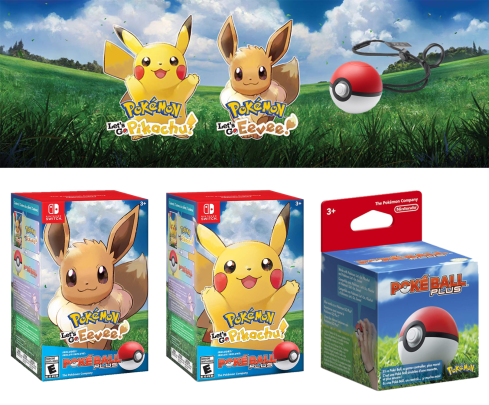
lets go versions

Pokémon Let’s Go is available in four versions: Let’s Go, Pikachu!, Let’s Go, Eevee!, and versions of each that come with the Pokéball Plus controller.

Seeing his enthusiasm for video games made me want to find something he could play and succeed at. I also wanted it to be a shared experience as I’m not ready for him to go close himself off to the world and get lost in a video game. That’s how Pokémon: Let’s Go, Pikachu! ended up on my radar. My son had already been exposed to Pokémon at a young age. He knew who Pikachu was and had messed around on my Pokémon Go! app. I had no reservations about the material, but just needed to make sure it was a game we could enjoy together. After doing some research, I was convinced the title would work and for his fourth birthday my son got his very first video game.

My experience with Pokémon goes all the way back to 1998 when the original Red and Blue titles made their way to US shores. They were the games that finally convinced me to pick up a GameBoy and I ended up with both versions of the title, beating both more than once. It was a fun, addicting, light role-playing-game and I stuck with the franchise into the Gold and Silver era, but after that I was mostly done. I checked out Pokémon Pearl for the DS, but never finished it. After a few years on the market, I eventually grabbed Pokémon Y to see how the franchise had changed over the years and mostly enjoyed it. And I was a day one downloader of the Go! app and I still play it today. I was pretty confident I could navigate my son though Let’s Go, Pikachu! which is basically a remake of the original games with some of the elements from Pokémon Go! integrated.

pikachu interact

My son could probably play with virtual Pikachu for hours if I let him.

I opted to get the version of Let’s Go, Pikachu! that comes bundled with a Pokéball Plus controller, figuring my son would get a kick out of it. Getting it up and running was a tad tricky. Like most games now, Let’s Go, Pikachu! does not come with formal instructions and you basically have to wing it. This caused confusion when I initially booted it up with Pro controller in hand. The game won’t even recognize a Pro controller though because it wants you to play with just a single Joycon. After messing around, I figured that out and was taken to the controller select screen. It displays both Joycons, a docked Switch, and the Pokéball controller and you have to press a button on the controller you wish to use. I always go with the Right Joycon because it has a Home button on it. Had Game Freak just included a little message that said “Pro controller not supported” when I tried to use it that would have saved me some time.

no randos

The Pokémon now appear on the screen. It’s a beautiful thing.

From there, I was further confused at how I could bring my son into the fold. I could not find options for 2 player, and when I would activate the Pokéball accessory it would de-activate my Joycon. Frustrated, I started the game and we went through all of the usual junk until you get to actually play. I don’t know how we ended up figuring it out, but in order to play with a second player they need to activate a controller while playing just by pressing a button, or in the case of the Pokéball, by shaking it. Then a second player, a gender-swapped version of the character you created, appears. When you encounter a wild Pokémon, two Pokéballs will appear and you can both throw to your heart’s content. In battle, the second player will deploy the Pokémon in the second position on your party screen effectively giving you two actions to your enemy’s one.

After finally figuring all of that out, things were mostly smooth. Let’s Go, Pikachu! is a 3D game that seems to share assets with Pokémon Go! It’s very much presented like modern Pokémon titles with the only differences being in how you interact with wild Pokémon. They now appear on the screen and you’re free to engage them or try to avoid them as you please removing random encounters. This has apparently been a controversial move in the Pokémon community as some prioritize the excitement of what wild Pokémon has been encountered. Personally, I never want to play another Pokémon title with random encounters again. Good riddance!

catching clefairy

Catching is just like in Go! only now you physically “throw” the ball. Landing the ball within the shrinking ring will earn you a bonus.

When you do come into contact with a wild Pokémon, you no longer battle them. This is where the Go! influence comes in as you now just throw Pokéballs until the creature is caught. And since this is Nintendo Switch, you literally make a throwing motion with the controller in hand to throw balls. It works fine, though I find the Pokéball Plus to be a tad more accurate. The rings from Go! are present as are the various items that can make catching a Pokémon easier. What’s gone is the curveball, but replacing it is the dual ball. My son and I didn’t even catch onto this until way late into our adventure, but if both players simultaneously hit a Pokémon with a ball then a special animation plays where the balls essentially combine into one. This makes the throw more likely to be successful and also adds extra experience to the encounter. That’s right. Catching Pokémon is now your primary method of accumulating experience so your Pokémon level-up and become stronger. Thankfully, since you’ll be catching a lot of Pokémon there is no longer a computer storage system. You simply possess a box that can store your extra Pokémon and you can access it at anytime.
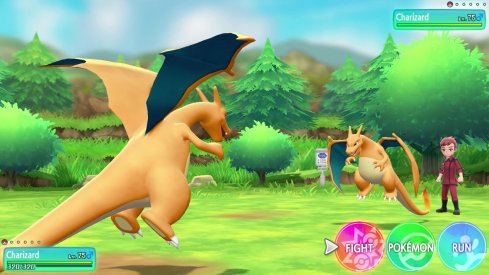
Charizard battle

Battles are largely unchanged. Each Pokémon is limited to four moves and each can only be used a set amount of times before needing to be recharged with an item or at a Pokécenter. Only difference from the classic games is that everything is now animated.

Battles are still largely the same as before, though they do take on greater importance now that you literally have to keep catching ’em all if you want your Pokémon to get stronger. Battles allow you to earn experience, but also money. And you’ll need a lot of money so you can continue to buy more Pokéballs. The only wrinkle with battling is the inclusion of the second player that I mentioned earlier. This allows you to attack enemies 2 on 1. It does forfeit the free substitution between matches that you would normally get, but that’s a small price to pay. Strangely, on the rare occasion you find yourself in a 2 on 2 battle the second controller will be disabled and Player 1 will control both battlers. That was frustrating for my son. Ultimately though, because of the 2 on 1 nature 99% of the encounters in the game are much easier to breeze through, but that isn’t the only thing making Let’s Go, Pikachu! an easy experience.
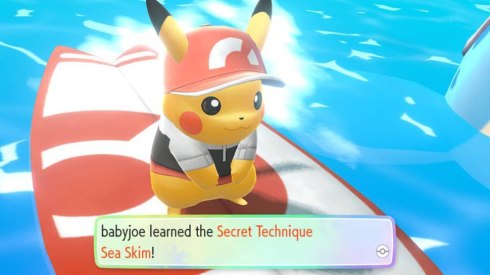
surfing pikachu

Pikachu now learns all of the HMs for you. Here’s surfing Pikachu!

Game Freak has finally done away with those annoying Hidden Machines. Instead, Pikachu (or Eevee if you got the other version of the game) learns Secret Techniques that function the same way. Yes, even Fly which causes Pikachu to pull out a bunch of balloons to fly around with. These moves only work on the field of play and not in battle so they don’t affect Pikachu’s move set at all. No longer do you need to drag around a Pokémon just for HM access.

In addition to those techniques, your Pikachu will also have the option to learn new moves from a move tutor throughout the game. These moves really help to make Pikachu a well-rounded attacker, and frankly, he’s way over-powered. One of these moves is Zippy Zap, which is basically an electrified Quick Attack that always scores a critical hit. He’ll also be able to learn Splishy Splash, an electrified water attack so ground enemies are no longer an issue. He also now learns Double Kick just thru his basic leveling-up which is quite useful at parts. He can even learn an electric flying move too, though I opted to not add that. Basically, there was rarely a reason to pull Pikachu from battle and only the compulsion to mix things up provoked me and my son to do so.

metatron

A new Pokémon was created for this game, but you’ll need to catch him in Pokémon Go! if you want to use him in this game and complete your Pokédex.

The game is largely a remake of the originals, but there are some twists. The bicycle and fishing rod are gone and instead replaced with Pokémon actions. Pikachu can learn a Surf maneuver and when surfing you’ll encounter the many water Pokémon out in the wild. You can also ride on certain Pokémon to increase your movement speed on the field of play. And once you beat the Elite Four, you can even fly freely on the back of a Charizard or Dragonite. The Safari Zone is also no more and has been replaced by the Go Park, a place where you can import Pokémon from Pokémon Go! This is very useful for filling out the Pokédex as there are still Pokémon unique to each version of the game and some evolutions that still require trading (which you can bypass in Go!). There’s also a new Pokémon that can only be found in Pokémon Go! and it and its evolution can be transferred to Let’s Go, Pikachu!
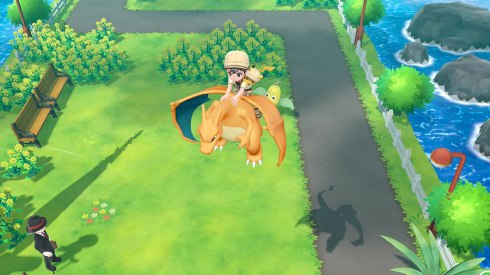
flying charizard

No bike? No problem.

This is a solid Pokémon experience for me, but what about the boy I bought it for? Turns out, it’s pretty fantastic to him. He loves catching Pokémon, so much so that battles get boring fast for him. It’s a bit of a problem at times because there are points where you need to battle, especially since the kid flies through Pokéballs since he wants to catch everything he sees. He knows it’s a necessary evil though and trudges through the battles like a good soldier. It also stunk for him when we had to traverse water as that’s only one-player, but at least that didn’t take up vast sections of the game. I could even hand him the controller to catch anything I encountered too. He’s not great at moving the player in the field, but at least he mostly never had to since his job was to catch Pokémon. The other difficult part with a young kid playing is he has no interest in talking to non-player characters. This is a bit of a problem because you need to talk to everyone in this game because some give you important special moves and some might even give you a free Pokémon. His unwillingness to talk to people caused me to miss a few things that we eventually had to backtrack for. And any “dungeon” that didn’t contain wild Pokémon for him to catch was a real drag.

mega venusaur

In addition to the original 151 Pokémon, Mega Evolutions have also been added.

Shortcomings aside, the game largely did what I wanted it to do. It gave me something I could play with my son and we were both able to enjoy it. I’m not sure what we’re going to do now as we have already defeated the Elite Four and even captured Mewtwo. There’s still some slots on the Pokédex to fill out, but I wonder when my son will become bored with catching the same old Pokémon. There is some additional post game content, but it’s mostly battling related which isn’t very interesting for him, but we’ll see. We also have yet to utilize the external functions of the Pokéball controller. Like a Tamagotchi, you can load a Pokémon onto it and carry it around with you. It will earn experience and I think you can press a button on the ball to hear the critter chirp or something. The noises the Pokémon make are still the same as they were over 20 years ago, save for Pikachu and Eevee who have vocalizations from the anime. Nostalgia is nice, but it would have been neat if they went through and did the same for all of the Pokémon. And for that matter, how about some spoken dialog instead of text? I got sick of reading it aloud to my son and he seemed to as well.

Nonetheless, the game has been a big enough hit in my house to make my son a full-fledged Pokémaniac. He’s now watched all of season one of the anime on Netflix and loves watching YouTube videos on the subject. He’ll often tell anyone within earshot random Pokémon facts (“Hey mama! Did you know Haunter evolves into Gengar?!”) and I rarely see him without his Charmander plush. My daughter, who is only 2, has some-what embraced it as well. She loves Pikachu, and after we took the both of them to see Detective Pikachu in theaters (her first movie in a theater) she’s become a Psyduck fan as well. Eventually, I envision the two of them playing this game or a similar one together. In my dreams they’re enjoying themselves, though in reality there will probably be lots of fighting and arguing. That’s an issue for another day, for now, I’ve got a son who’s crazy about Pokémon and just beat his first video game (with some help from dad) which puts him way ahead of where I was at his age. Hopefully, a sequel is on the way that we can enjoy together in a similar manner. If it rights some of the few wrongs present here, then all the better.


Ranking the Games of the PlayStation Classic

psx classic gamesWhen the PlayStation Classic was announced a few months ago it was only revealed what 5 of the included 20 games were going to be. It was odd, but considering most places pre-sold out I suppose it didn’t matter. When Nintendo had success with the NES Classic Edition, it meant we were in for more of these devices. Myself and many others tried to predict what would be included on a potential SNES Classic and most people probably came pretty close to nailing the final line-up. Nintendo is heavy with first-party titles and its brand is forever connected with the likes of Mario and Link. With Sony, that first-party recognition isn’t there. During the height of the original PlayStation, Crash Bandicoot was positioned as the company’s mascot, but he wasn’t even owned by Sony. His games were just published by Sony, but the character would eventually come to be owned by Activision. Still, it seemed inconceivable that Sony would pass over Crash, and yet they did! He will not be appearing on the PlayStation Classic as Sony has finally unveiled the remaining 15. I knew predicting the line-up would be more difficult than doing so with the SNES Classic, but apparently I didn’t realize just how hard it would be as I went a putrid 1 for 15 with my predictions.
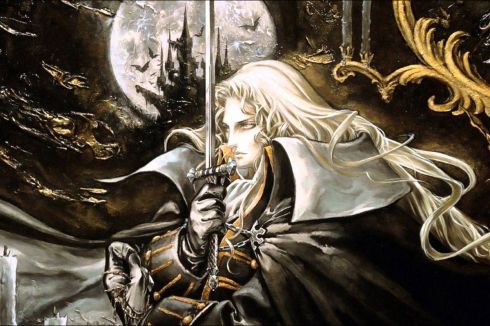
I suppose if I wanted to give myself bonus points I could dampen that showing by saying I at least hit on two additional franchises. And two of my requested titles (Intelligent Qube and Super Puzzle Fighter II Turbo) actually made it, even though I thought it would be a long shot to see them included. There’s no hiding from it though, I whiffed big time and I’ll own that. The actual line-up has likely surprised many and it has some nice surprises and some not-so-nice surprises. It’s a weird line-up, and since the PSX era did have some weird games I suppose that’s appropriate. There are three puzzle games among the 20, no 2D fighters, and only one title each from Konami, and Square-Enix. That means no Mega Man, Lara Croft, or Alucard. Were publishers not willing to “play ball” with Sony and its machine? Or was Sony just not willing to pay more for bigger titles? The Japanese version does have some different titles, including Parasite Eve and SaGa Frontier, but the Japanese market is a lot smaller than the North American one so maybe Sony is trying to maximize profits outside of Japan and is less concerned about the home country.

alucard

There are a lot of contenders for biggest snub, but Alucard might be the biggest.

This is not an optimal line-up of games, but does that make it bad? Lets suss it out and rank these titles starting with the least appetizing:

20. Battle Arena Toshinden – A decent looking launch title, it was quickly overwhelmed by Namco’s Tekken franchise. Most people forget about this franchise, and with good reason. It’s not a good game, and it’s odd to use this one instead of the better sequel, but even that game isn’t great.

destruction derby

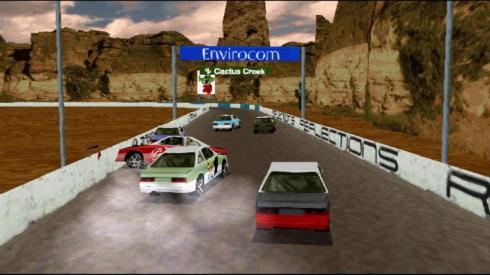
Excited to revisit this one?

19. Destruction Derby – This game was a one-trick pony when it was released in the launch window of the PlayStation. It was cool to see cars explode and get smashed-up and it was sort-of perversely fun inflicting damage on other vehicles, but it was all empty calories. No one should be playing this game in 2018.

18. Tom Clancy’s Rainbow Six – This was one of the most heavily marketed games of its era. I probably saw more commercials for Rainbow Six than I did Final Fantasy VII. It’s okay, but the PSX port was pretty abysmal. Anyone playing Rainbow Six in 1998 probably shouldn’t have been playing it on PSX. Electronic Gaming Monthly even awarded it a dubious 3.8/10.

17. Jumping Flash! – We knew this one was included, and I even argued it had a place given it was a launch title and was just so very “of the era.” That doesn’t mean it’s particularly good and by today’s standards it’s quite ugly. Unlike the games listed before it though, it has a certain curiosity factor going for it that will make it worth a look when the PS Classic drops, but it might not be a game you actually stick with.

16. Cool Boarders 2 – If you like snowboarding and “extreme” sports games, then you’ll probably have this one ranked higher. It’s all right, but most people will probably wonder why it’s here and not Tony Hawk’s Pro Skater (it’s the licensing, folks).

twisted metal 1

I probably logged over 100 hours with this game, but I’ve never wanted to replay it after Twisted Metal 2 came out.

15. Twisted Metal – I loved this franchise on PlayStation, well the first two games at least. The first one though has not aged well at all, and even in the moment, I knew I was playing a junky game, but it had a certain fun factor. The sequel though is way better and actually still playable. I considered it the most obvious lock for the mini console even ahead of Metal Gear Solid so the fact that this game is included but the sequel is not blows my mind.

14. Oddworld:  Abe’s Odyssey – I said the PS Classic has three puzzle games, but you could make the case Oddworld is more of a puzzle game than a true platformer. This game was hyped a bunch as being a game that gave the player numerous ways to solve a problem, but it didn’t really play out that way. It was interesting, but hardly great. It’s graphical approach should hold up well enough though.

13. Wild Arms – One of the previously announced titles, I gave my speech on it already. It’s serviceable, and its simple JRPG mechanics mean it will always remain playable. It’s just a bit crazy to think that this machine has only three RPGs when the PSX was an RPG behemoth, and Wild Arms is one of the three.

12. Grand Theft Auto – GTA was a surprise hit for the PC when it was released, and it was somewhat surprising to see it get a PSX port. It was also the first title I was denied an ability to purchase at a GameStop. Like modern GTA titles, it was arguably at its best when it was just played like a sand box causing mayhem. Unlike modern GTA titles, the actual missions and story isn’t that rewarding and the game was really difficult. It was at least a little easier to handle on the PSX than with a keyboard. It should still be fun to screw around with, but might not have much legs with the PS Classic.

Intelligent-Qube

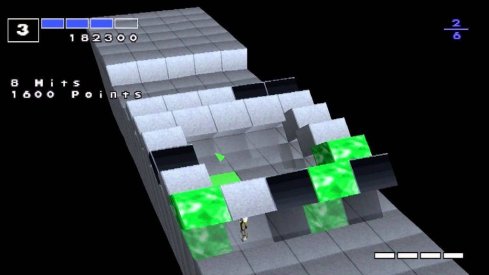
The inclusion of Intelligent Qube is a bit of a surprise. Is it a system-seller? Probably not, but it’s worth a look if you end up getting a PS Classic.

11. Intelligent Qube – This was a surprise inclusion, but a worthwhile one. It’s an interesting puzzle game that’s at least not another brick-falling puzzler. I don’t know how well it’s held up because it’s been many years, but it should be playable and may be a dark horse contender for many folks’ most played title on the Classic.

10. Resident Evil (Director’s Cut) – There’s no denying this title was huge for the PSX, and the Director’s Cut version was superior to the original. It is possibly the worst in the franchise on the PSX though and its controls are not something I look forward to returning to. It took many hours to get a handle on them in 1996 and I’m not sure I still have such skills. Maybe it’s like riding a bike?

9. Syphon Filter – This was basically Sony’s attempt at a first party MGS or Rainbow Six. It was fine for what it was, though I’d prefer a dual shock to play it. It’s going to look ugly, and even Gabe Logan’s running animation looked horrendous in ’99. It might surprise though, and the only reason why I didn’t include it in my prediction was because I didn’t think Sony would release it without dual shock support.

8. Ridge Racer Type 4 – A totally competent racer, but let’s face it, this isn’t the racing game you want. Gran Turismo was the first-party behemoth, but I’m guessing licensing issues made it impossible to include. WipeOut was an alternative racer, but one I’d consider more fun than Ridge Racer. I would have taken Crash Team Racing over this one, honestly, and I’m not sure if I’d even play this more than once on the PS Classic. The racing genre is one that basically improves a lot with better technology, so going back isn’t always fun unless it’s more of an off-beat title. I suspect this still plays well enough though, which is why I’m ranking it this high.

persona

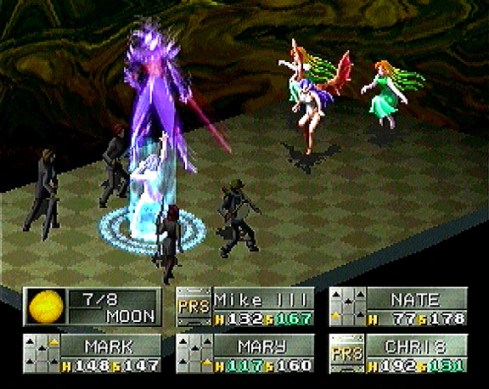
I’m happy to see the original Persona included in this collection, but it’s also not a hard to find game so I wish something like Valkyrie Profile was included instead.

7. Revelations:  Persona – The first game in what is now known simply as the Persona series is the biggest surprise inclusion on the PS Classic. This was not a popular game when it was released, and Persona still has more of a cult franchise vibe than a mainstream one. The first game is not as good as more recent entries with the series really blossoming with Persona 3. It is still playable though, and it’s more strategy-oriented battle system differentiates it from Wild Arms and FFVII. This one is a nice surprise and unlike the original Final Fantasy on the NES Classic, fans who are only familiar with the newer entries might actually enjoy playing the first in the series as opposed to just checking it out for the sake of curiosity.

6. Mr. Driller – The nice thing about puzzle games is that they age well. Mr. Driller is another surprise inclusion. It was well-received in its day, but not really a system mover or anything. It’s fun and charming though and if you like puzzle games with a slight Tetris vibe then you’ll get some mileage out of this one.

5. RaymanRayman was all over the place in the mid-90s. He was so omnipresent that I kind of wrote him off for this system as I never associated him with PlayStation. His game is pretty good though, and its 2D approach should hold up just fine. I never loved Rayman, but I never hated his games either.

4. Metal Gear Solid – I’m not crazy about this list of games, if you haven’t noticed, but I do think it’s pretty top-heavy. The last four are mostly interchangeable, and I wouldn’t be surprised if Metal Gear Solid tops many lists such as this one. My reasoning for placing it 4th is because I think we’re missing out on some of the bells and whistles with this version by not having the dual shock support and a memory card full of Konami games. I also think the game hasn’t aged too well and recent entries in the series really helped to smooth out the gameplay experience. It’s still a fantastic game, it’s just not as fantastic as it could be on the PS Classic.

puzzle fiighter

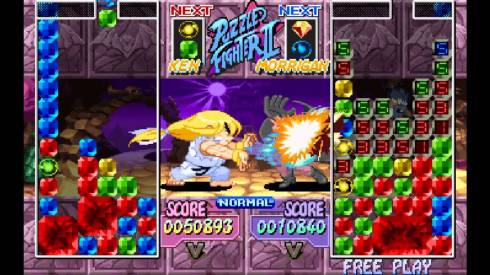
This is a great choice for inclusion. I have nothing bad to say about Puzzle Fighter.

3. Super Puzzle Fighter II Turbo – This is probably my favorite puzzle game. It’s incredibly addicting and the rare puzzler that might be more fun in two-player mode than single-player. It’s got a lot of charm and personality and its sprites should hold up very well. I’m a bit surprised at its inclusion, especially given the omissions of traditional Capcom fighters, but also delighted.

2. Final Fantasy VII – We’ve all probably played it. And even though there’s been backlash towards this title over the years because it’s the most recognizable from the long-running series, that doesn’t mean it’s still not in the conversation for best Final Fantasy game. It’s readily available on other platforms so its inclusion isn’t sexy, but it’s also necessary. If you’ve got about 40 hours, you should give this one some time.

tekken 3 jin

The visuals may not wow you like they did in 98, but Tekken 3 is still a blast to play.

1. Tekken 3 – And the best game of the PS Classic is Tekken 3. A late era title, it actually holds up quite well in the visuals department and the game is simply one of the best 3D fighters ever made. It has a huge roster of characters, some fun additional modes and characters, and there should be something for everyone in terms of fighting styles. If you don’t like 3D fighters then maybe this won’t win you over, but I spent many hours with this one and I’d actually be excited to run through it again and try to unlock all of the additional characters and modes. Well, maybe not Tekken Force Mode.


So that’s it; the PlayStation Classic and its 20 games. Are you going to get one? Did you already pre-order one and are reconsidering that decision? I’m over-all not impressed with these 20 games, the majority of which I don’t need to revisit. Even some of the games that I think are fine I still don’t want to really play in 2018. Why play Twisted Metal when you can easily play Twisted Metal Black? Why play Rayman over the easily acquired (and cheap) Rayman Legends? I wasn’t that excited over this console to begin with, as the nostalgia factor just isn’t quite there for me with the PSX era. If the list had turned out to be something closer to what I predicted I might have been tempted. With this list, though? I’m looking at spending 100 bucks to play Persona, Intelligent Qube, and Mr. Driller as the other games I really enjoy I still own for PlayStation and can play them right now if I want. I have a first-gen PS3 hooked up to my TV right now so nothing is stopping me from popping in Tekken 3 if I wish to play it. I’m not everyone though, so for those who loved the PSX and maybe sold all of their old games I can at least see some appeal, but I still feel like this roster is one big missed opportunity.


Dragon Ball Z – Budokai HD Collection

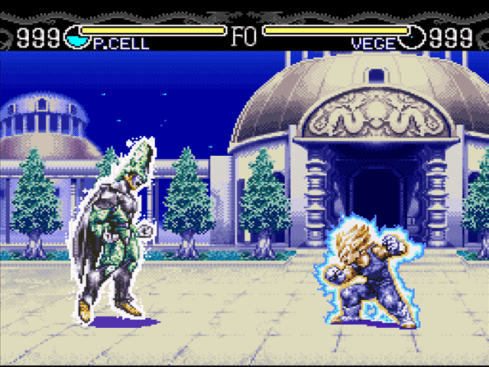
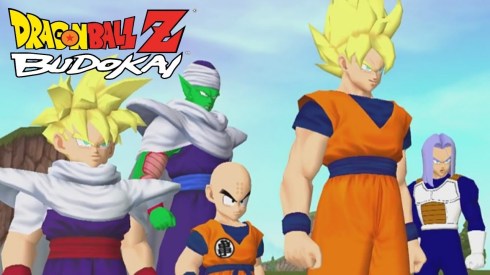
budokai hdOh, you thought we were done with DBZ?! Oh no, I have some more Dragon Ball related material to share with you and even though we’re done with the movies, I thought now was as good a time as any to talk about some video games. If you’re a usual reader, you may recall I did a post earlier this year on Super Dragon Ball Z, the Street Fighter inspired fighter for the PS2. It was the upcoming release of Arc System Works’ Dragon Ball FighterZ that inspired me to revisit that old game, and the same can be said of the Budokai series.

In case you need a refresher, Dragon Ball Z – Budokai was the Infogrames fighting game franchise of the early 2000’s and it was also the first real entry point for DBZ into global gaming. Prior to Budokai, the only Dragon Ball video games to make it out of Japan were the NES platformer, renamed Dragon Power in the US, based on Dragon Ball and the PSX fighting game Dragon Ball GT – Final Bout. Yes, somehow a game based on Dragon Ball GT made it to American soil before a Dragon Ball Z game. That early Dragon Ball game for the NES was simply a case of anything being available in Japan was brought over to other markets. It was altered so that it barely resembled Dragon Ball and there’s a chance that gamers who owned the abysmal title and went on to become fans of the franchise likely needed to read about it later in life to make the connection. Final Bout was likely released outside of Japan because it coincided with the 3D fighting game craze and the first real attempt at bringing the anime to America as well. It was a truly abysmal game that sold poorly. The anime was a flop initially so it kind of went away, but once the show became popular via Cartoon Network the after market price on Final Bout went crazy as it was the only video game released in the territory and fans wanted something, even if it was terrible.

dragon power

Technically, this was the first Dragon Ball game released outside of Japan, though you wouldn’t know it by the cover.

Of course, if you were living in Japan you had plenty of options when it came to DBZ fighters. The Super Famicom especially had a bunch of them and the PSX had an additional 2 and all were based on Dragon Ball Z as opposed to the far less popular Dragon Ball GT. Fans desperate for some DBZ content for their video game machines, like myself, turned to imports and emulation to get their fix, but in truth few of these games were worth playing. The only ones I can recommend half-heartedly were Dragon Ball Z – Hyper Dimension, a 16-bit fighter that didn’t control particularly well, but the visuals were impressive. On the PSX, Dragon Ball Z – Legends was a pretty ugly looking early PSX game, but it’s 3 on 3 simultaneous combat was really interesting and the simple, timing based, combat was actually pretty satisfying. It was just a shallow experience and once you saw everything the game offered there was little reason to return.

Once the show finally became popular around the turn of the millennium, there was a substantial rush to get content to the newly created global audience. Irwin Toys started cranking out new action figures and accessories while clothing and posters started popping up everywhere. The games took some time, and Bandai was awarded distribution for Japan while Infogrames, and later Atari, received the North American license. Dimps was selected as the developer and they got set to creating Budokai. Simultaneously, a Game Boy Advance game was also developed and released as The Legacy of Goku, an action-RPG that was at least interesting though not particularly fun. Because there was such an appetite for DBZ anything, Budokai really didn’t need to be a good game to sell well. It also didn’t need to be particularly good to immediately become the best DBZ fighting game ever released. Review-wise, it received a somewhat ho-hum reaction from critics, but fans seemed relatively pleased. It sold well enough to spawn two sequels, and 10 years after its initial 2002 release it received a high-definition makeover alongside Dragon Ball Z – Budokai 3.

hyper dimension

If you absolutely need to import a DBZ game, I’d suggest Hyper Dimension.

If you have never played a Budokai game, then let me tell you how it works. At its cores, it’s a simple 3D fighter. Characters can move in the foreground and background and are capable of attacking, blocking, firing ki blasts, and charging up their power meter. Each character typically has multiple health bars so stronger fighters will have additional health over weaker ones that’s clearly illustrated. Characters can also fly, but not at will. Instead, if a combo attack sends a fighter into the air they’ll kind of just hover in place once they recover from the attack. Simply pushing the directional pad towards an airborne fighter will cause the player-character to take to the air in pursuit.

final bout

Before Budokai, this was the best American fans had.

The main criticism of the original Budokai was the lack of beam attacks. Rather than simply ordering Goku to unleash a Kamehameha wave, the move was affixed to the end of a combo. A series of punches would end in Goku performing his signature attack, but at very close range so it was hardly spectacular looking. Instead, the eye-catching attacks were left to the super moves which are the moves that are designed to be difficult to pull off, but when successfully deployed, unleash devastating amounts of damage via a cinematic. These moves include Vegeta’s Final Flash and the like.

goku vs vegeta

The original Budokai does a decent job of laying the groundwork, though the visuals were never considered great even for the time.

Dimps seemed to target two important factors when creating the game:  make it look authentic and make it easy to play. As a result, all of the fighters essentially feel the same and have the same move-set, just with different results. In order to make the game feel authentic though, Dimps made sure to include various transformations in its games. Once advancing passed the Freiza arc, Goku could unlock his Super Saiyan transformation and use that in battle. Prior to getting it, he also had his Kaio-ken technique. Dimps even gave Piccolo his fusions from the series with Nail and Kame as transformations. The game featured a story mode that went up through the Cell Games and featured a roster of 23 characters. Later games would focus on expanding upon the roster to include practically anyone who ever partook in a fight during the series.

budokai story

The first game does at least boast better presentation in terms of its story mode, though these visuals are kind of “yuck.”

Budokai was a success, and it soon became an annual franchise. Budokai 2, released the following year and not included in this collection, corrected a lot of what people disliked about the original. Ki blasts and flying were now more manual than before and the story mode received more cinematics and was overall more rewarding (though it featured a weird board game interface). The roster was also greatly expanded upon due in large part to the game featuring the Buu Saga. More transformations were available and the game was largely just more fun. Budokai 3 arrived the following year with even more characters and moves and yet another revamped story mode. Instead of playing through the events of the show, players could select specific characters and experience the story from their perspective. And doing so also allowed the player to simply fly around the world looking for the next event as well as hidden ones. It felt less restrictive, and was thus pretty exciting.

budokai 3 story

Budokai 3’s story mode was more engaging, if lacking in the presentation department. It makes up for it though with much improved graphics and styling.

So how do these games hold up in 2018? Well, not surprisingly the original Budokai is showing its age. The visuals have been upgraded to HD, but the textures were so bland and basic to start-off that there’s virtually no improvement. It makes everyone look like vinyl dolls and the empty battle maps are even more boring than before. The simple combat is easy to grasp, but also not particularly engaging. This game is basically here as a nostalgia trip and to illustrate how the series began. Fire it up if you either never played it or just want to relive it, but after that you probably won’t play it again.

Budokai 3 is the main attraction of this set. There’s still a section of the fandom that considers it the best DBZ fighter ever released. It was the last main Budokai title as the many sequels saw the series move in a different direction, sometimes for the better and sometimes not. There was a PSP edition of the franchise called Shin Budokai and some place the 2006 title Infinite World in the Budokai series, but this was the last numbered entry. It’s quite easy to see how refined the game is in comparison with its predecessor. The visuals took on a more cell-shaded approach with additional detail and the move to HD doesn’t highlight the imperfections like it does with the first game. DBZ has a pretty simple, yet distinct, look and it doesn’t require incredible processing power to do it justice.

dragon rush 2

Dragon Rush adds some chaos to battles, but at the cost of skill.

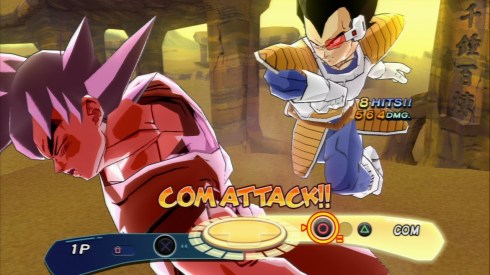
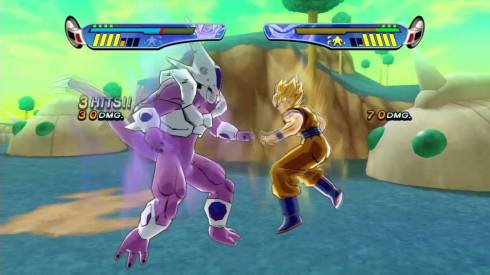
From a gameplay perspective, the game is not quite as fast as I remembered. You will still spend most fights dashing at your opponent to unleash combos attacks and build towards bigger moves. I had forgotten how odd the gameplay structure was. Much of the fights hinge on your ability to pull off super moves and Dragon Rush attacks. The Dragon Rush is a bit convoluted, but it’s essentially a follow-up attack from a teleporting move. There’s a lengthy tutorial section in the game that’s not particularly helpful. It’s one of those things you just have to perform for yourself to get a feel for how it works. When connecting with one of these maneuvers, a quick-time event is enabled that’s basically a version of Rock-Paper-Scissors. The attacker selects a face button and the defender does as well. If the defender guesses right, the attack is thwarted. If not, it continues with both players now having only 3 face buttons to choose from. If the attacker is able to string together three successful attacks via this encounter, then a big move is unleashed and the opponent’s stamina (as well as some health) is knocked away leaving them more susceptible to damage. Actual super moves are done fairly easily by holding a shoulder button, but it starts a slow animation that can be tricky to connect with. And if you miss, you lose all of the energy stored for the attack. Connect and you get treated to another cinematic while also doling out some big damage. There’s always another QTE spot, this time with a meter rapidly filling and decreasing that you have to time properly, that determines how much damage the attack does.

gogeta fusion

There are lots of power-ups that take the form of transformations including fusion.

Fights have a tendency to be very reliant on those two moves. Whoever is better at pulling them off usually wins. The QTE spot injects some chaos as it’s entirely random, unless you’re playing against a human opponent and look at their controller. It’s not the most rewarding system, or perhaps it’s more appropriate to call it frustrating if you’re on the losing side. If you’re on the winning end then at least the cinematics are typically fun to see. The interesting change for the third game though was mostly in the stored energy each character has. Energy will gradually accumulate up to a certain point so you really need only charge your ki if you want to go for the biggest moves possible. This was a smart addition as the constant need to charge in other games was always the least enjoyable aspect. Transformations also aren’t the energy hogs they were in prior games so there’s more incentive to use the best ones.

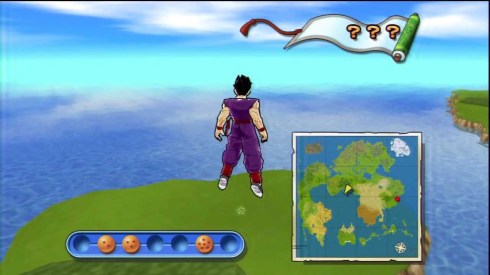
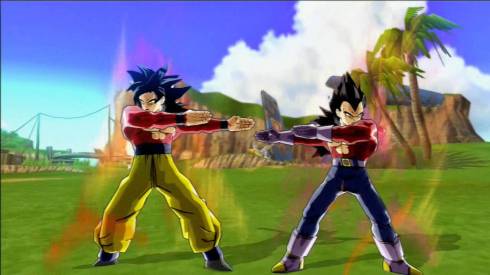
The story mode felt revolutionary in 2004, though now it does feel more limited. Basically, you pick a character and fly around the world. Your character has a map and can also find a Dragon Radar to look for Dragon Balls. Activating your “senses” can sometimes turn-up hidden spots on the world that usually contain an item but sometimes contain a small story event – an easter egg, if you will. Various cities and popular landmarks appear on as well but you can’t really interact with them. If the name of the place displayed when flying over it then you can enter, but it just leads to a brief exchange with another character who may or may not provide an item. These are all done with still images and text – there are no cinematics in story mode which is rather bizarre. The most interesting aspect of the mode is that it can change depending on how many playthroughs you have done and if you have finished another character’s. Goku’s is the most robust, and if you play it a second time after getting through some of the other character’s stories you’ll take on some GT villains and even unlock Super Saiyan 4.

budokai 3 cooler

Budokai 3 expands upon the roster by drawing from the movies and Dragon Ball GT.

The goal of story mode is obviously to see it through, but it also features some RPG elements in the form of experience and stats. Leveling up a character gives you an ability point to place in various offensive and defensive categories. Each character also can equip a set number of items, with stronger items taking up multiple slots. This has been a feature in most DBZ games and allows for some level of customization. Frustratingly though, transformations always have a prerequisite that includes the prior transformation so if you want to use SS4 Goku you’ll need to devote 5 slots to transformations. If you want to fuse into Vegito then you’ll have to give up something. Characters can unlock a special Breakthrough capsule which contains all of their unique moves and abilities at the cost of taking up all of the ability slots. For a character like Goku who has the most unique capsules, it won’t include everything though which is kind of a bummer. The other short-coming of story mode is that it doesn’t include everyone. A lot of characters are playable including surprises like Tien and Yamcha, but only one villain has a story mode (and it kind of sucks) and characters you would expect to have one (namely Trunks) do not. There’s enough here to keep you busy for awhile, at least.

After getting caught up with these games, my main take-away was that anyone who thinks Budokai 3 is the best DBZ fighting game released has not spent enough time with newer entries. It’s not a bad game, but I’d rather play the Tenkaichi Budokai games over it. This game wants to capture the unique combat of the anime and sacrifices skill and control to do so. The Tenkaichi games were not difficult games to play, but their arena fighter approach made the games even more authentic and the super moves weren’t huge factors. With that out of the way, I will say I still had fun with Budokai 3. It took me a little while to get back into the flow of combat, but once I did I had a good enough time. There is a shallowness to the gameplay present so it doesn’t have the staying power of a more robust fighting game, and I wish they had dropped the Dragon Rush, but it does right by its license. I do wish the story mode featured actual moving images to tell its story, and the rewards for summoning the dragon are kind of lame. Considering I didn’t have to pay much to get this collection, I’d say it was money well spent. As for the original Budokai, it didn’t need to be included on this collection and I’m surprised it is. I would have much preferred Budokai 2, even if that game is pretty similar to 3. At least it featured a different story mode while including most of the gameplay enhancements featured in the third entry.


Forecasting and Perfecting the PlayStation Classic

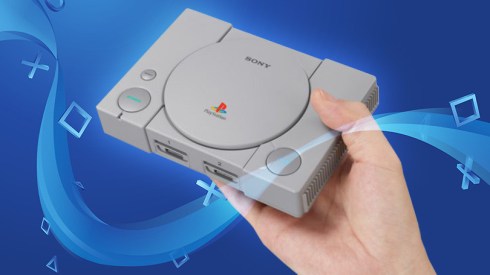
cute ps

Aww, it’s so adorable!

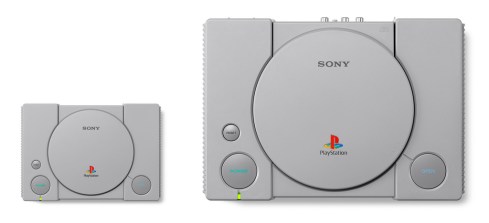
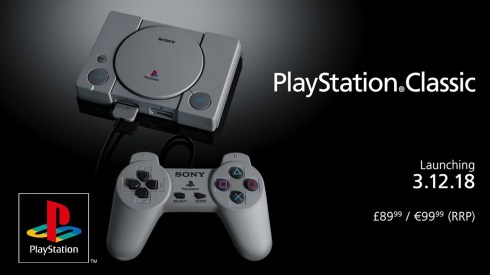
Sony announced the PlayStation Classic on September 19th and it is set to go on sale December 3rd. Following in Nintendo’s footsteps, the PlayStation Classic is a mini version of the original console with 20 pre-loaded games, a single controller, and HDMI output. It will have support for saves via a virtual memory card as well as numerous display modes to toggle through that will try and preserve the original look of the games or try to smooth them out and update them for today. At $100 MSRP, the PlayStation Classic finds itself priced in-between the SNES Classic and the soon to be released Neo Geo Mini. Making things more interesting, and also frustrating, is that Sony chose to only reveal 5 of the system’s 20 pre-loaded games:  Final Fantasy VII, Jumping Flash, Tekken 3, Ridge Racer Type 4, and Wild Arms. It’s an odd form of marketing, but Sony must feel confident it will have strong pre-sales to hold back that information for the time being. It also likely thinks it will help build excitement for the machine if they drip-feed consumers. Maybe it will be a weekly event to reveal another game or two. There are 10 weeks separating the system’s announcement and release so such a strategy is possible, or they could just come in bunches.

Choosing to withhold information on the included games is likely an annoyance for prospective consumers. I know I personally am not pre-ordering a gaming device in which I don’t even know what games I can play on it will be. It does however create the fun scenario in which people like me can speculate on what will be included and also what should be included. Those are two very different questions as if it were up to me I would load this thing up with RPGs, but I’m sure Sony will want a more balanced lineup. Adding further intrigue is the fact that Sony isn’t the first-party powerhouse that Nintendo is. With the SNES Classic, it was relatively easy to predict what games would be included because so many of them were Nintendo developed titles. Those games were not only among the best the system had, but also cost Nintendo next to nothing to include. With Sony’s machine, they’ll likely be cutting sizable checks to Capcom and Square-Enix with this thing.

Lets rundown the games I think Sony is going to include. Since we already know five of them, that means I need to only come up with 15 for this exercise. This is a prediction, so I’ll also include my opinion on if I think the game should be included, and where not, what I would include instead with the idea being I wouldn’t boot a fighting game to add a strategy one and will aim to stay within the genre. Let’s start with the included games:

cloud

This was expected.

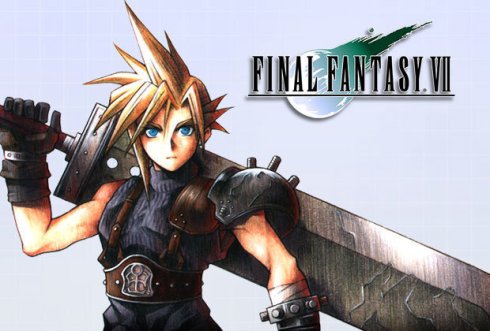
Final Fantasy VII – This is likely the PlayStation’s biggest game, not the best-selling, but in terms of what it meant to the console. This legitimized Sony with the hardcore crowd since Sony was able to pry a successful Nintendo franchise away from The Big N. And even though it’s readily available on Sony’s Eshop and will soon be available on The Switch, Sony basically had to include it here.

Jumping Flash – This is a game that has not aged well. It’s going to be ugly, and may even make you nauseous due to the first-person perspective, but in terms of early launch window games few spring to mind as being of the era than Jumping Flash. It’s a relic, but one forever tied to Sony’s machine. As a legacy game, it feels appropriate to include.

Ridge Racer Type 4 – Squaresoft may have stole the headlines when it announced FFVII would be on a Sony console, but lets not forget how important Namco was for the PSX early on. Namco supported Sony’s machine rather extensively, and one of its signature series was Ridge Racer. Ridge Racer would eventually be over-shadows by the gear-head adored Gran Turismo series, but its arcade approach remained fun and Type 4 was probably the best of the bunch and is rightfully included.

Tekken 3 – Another Namco staple, the first Tekken was a launch window title and a worthy adversary for Sega’s Virtua Fighter series. It proved to be the best of the 3D brawlers on Sony’s machine far surpassing the likes of Battle Arena Toshinden. Tekken 3 was the final Tekken released for the original PlayStation and it represents the pinnacle for the franchise for the era. It was gorgeous for the time and felt like a game that pushed the system beyond what anyone thought it could do. It’s still my favorite entry in the series and it most certainly belongs here.

Wild Arms – The Sony produced RPG had the benefit of arriving before FFVII. While some blame that game for the lack of success enjoyed by Wild Arms, I knew more than one person who purchased this title simply because they couldn’t wait for FFVII. It’s a totally serviceable RPG and it has its share of fans, though it’s never been a favorite of mine. On one hand, it does represent the early era of PSX role-playing games, but I would not have included it.  Suggested replacementBlood Omen:  Legacy of Kain – a top-down action RPG, Blood Omen was the start of a successful Sony franchise for Kain and eventually Raziel. It had a lot of style, and as a fellow 1996 title and pseudo RPG it would be a suitable replacement. If something could be done about the horrendous load times in bringing it to the system then all the better. It’s possible the sequel, Soul Reaver, will be among the other 15 and if that is the case then I would not include this one.

And now for the predictions! I’m ordering them from most likely to least, and it should be noted, this is entirely subjective for the most part though I’m avoiding any game that was intended to be played with the Dual Shock controller (like Ape Escape), with one noted exception.

tm2 axl

Twisted Metal was arguably Sony’s premiere franchise in the 90s.

Twisted Metal 2:  World Tour – The most successful Sony first-party franchise during the PSX era was probably Twisted Metal, and that franchise’s best game was easily Twisted Metal 2:  World Tour. It took everything that made the first a surprise hit and improved upon it. Better presentation, better controls, a huge roster, and new gameplay additions made this one a blast to play. It’s probably pretty ugly by today’s standards, but still playable and likely still infectious.

Metal Gear Solid – FFVII was the signature third-party game, and franchise, for the PlayStation’s early days, but it feels like it was supplanted some-what by Metal Gear Solid. MGS revolutionized what could be done from a cinematic perspective and its attention to detail was something seldom seen in gaming. It was an instant masterpiece, and also the game that will most suffer by the lack of Dual Shock support. If It wasn’t so important to the legacy of the PlayStation I’d say hold off for an eventual Dual Shock version of the PlayStation Classic.

Final Fantasy Tactics – Another game that is readily available, but also one synonymous with the PlayStation. Final Fantasy Tactics took the guts of Tactics Ogre and gave it a new coat of paint. It’s also a bit more accessible, but just as serious about its story. FFT wasn’t what folks who had just played FFVII were expecting, so it got kind of lost in the shuffle, but has since been more appreciated and is routinely cited as one of the best RPGs ever released. It would feel weird to not include it.

crash bandicoot

I’ve never been a Crash guy, but I won’t deny him his rightful place.

Crash Bandicoot 2:  Cortex Strikes Back – Crash was conceived as the original PlayStation mascot meant to oppose Mario and Sonic. It didn’t really work out that way, since Sony didn’t even own the character, but for awhile he was utilized that way. Arguably his best contribution to that era were the commercials (“Hey, plumber boy!”), but the games were pretty good in their own right. Not really my cup of tea, it would be hard though to deny Crash a spot on the PlayStation Classic and most agree that his second outing was superior to the first. They would also probably argue the third was even better, but I’m guessing Sony is placing an emphasis on earlier games which is why they may opt for this one over Warped.

Resident Evil 2 – Really, the only thing that makes me thing think Resident Evil 2 might not be included is the fact that Capcom is working on a remake as we speak. For that reason, it may prefer to include the original or even the less celebrated third entry. Everyone likely agrees that RE2 was the superior title, so in the interest of keeping things simple, I say Capcom relents and lets Sony have it.

Castlevania:  Symphony of the Night – We’ve long since past the era when Symphony of the Night was an under-appreciated classic. Famously released to a hostile public because it dared to be 2D, most have come to realize how silly a notion it was to declare 2D gaming obsolete and have embraced SoTN as one of the very best games in the long-running franchise. And those that didn’t realize it at the time certainly did when Castlevania 64 was released.

Street Fighter Alpha 3 – Most associate the 16 bit era with the height of the fighting genre, but it was still alive and well come the 32/64 bit era as well. PlayStation was not known for its excellence with 2D fighters, leaving that to Saturn and eventually Dreamcast, but Street Fighter Alpha was an exception. And of the games released in that series for the system, Alpha 3 was the best.

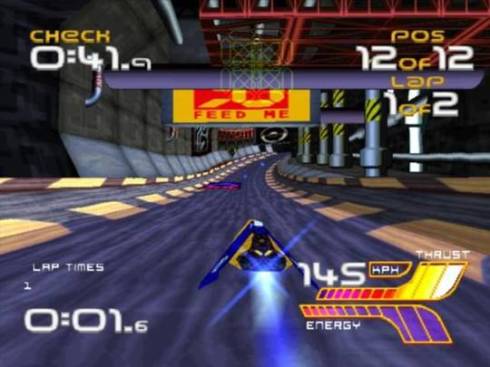
wipeout xl

I had a lot of good times with Wipeout.

Wipeout XL – Perhaps an aggressive ranking, but Wipeout felt like an important franchise during the early days of the PlayStation. The Psygnosis developed futuristic racer could have been mistaken as an F-Zero clone, but the physics and course design made it so much more. XL was the pinnacle for the series, and assuming Sony can work out the licensing issues, I expect it will be included.

Tomb Raider – Lara Croft’s humble beginnings were as an ugly, pointy-breasted, mess of polygons that I’m not sure people even in the moment felt looked particularly good. She was tough to control, but wasn’t a tank like Jill Valentine, and her adventure was pretty damn difficult. She did move onto other consoles, but Tomb Raider always felt like a Sony franchise and it’s likely viewed as important to the console, even though I do not want to revisit it. Suggested ReplacementParasite Eve – not exactly a one for one, but the shooter/RPG hybrid was quite interesting for its era, and as a franchise that never made it off of the PSX, it would be nice to see it here. The sequel is better, but may be hard to get into without knowing what happened in the first.

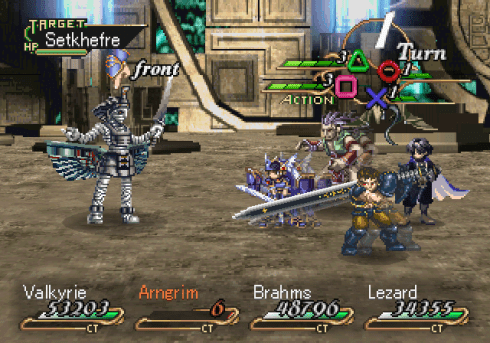
The Legend of Dragoon – Seeing how successful Final Fantasy was on its machine, Sony decided to get into the RPG business with The Legend of Dragoon. Seemingly thinking RPG fans enjoyed length over anything else, TLoD was gigantic and is probably the longest RPG on the system. It also looked great, and its battle system was okay. Aside from that, it’s not very good, but since Sony produced this one it won’t cost them much to include it and they probably view it as a signature title for the system. Suggested ReplacementValkyrie Profile – Oh boy, does this system not lack for RPGs. You could easily fill the console with 20 RPGs and not run out of quality software. Xenogears is my favorite, and it has an outside shot of being included, but a game that’s also good and brutally expensive is Valkyrie Profile. It would be great to see Sony use the PlayStation Classic as a means of delivering hard to find games to the consumer, but I’d be shocked if they included this one. It would probably cause me to buy one though, since getting a PlayStation Classic is way cheaper than buying this one second-hand.

Gran Turismo 2 – Assuming Sony can sort out the licensing issues, this one feels like a no brainer. Gran Turismo is one of Sony’s premiere franchises, and even though it’s faded some, it’s still remembered quite fondly. And given that its sim approach makes it way different from Ridge Racer, there’s room for it on the Classic as well. Though for me personally, it’s also a game I wouldn’t play.  Suggested ReplacementCrash Team Racing – so it’s not exactly a sim, but I struggled to come up with a more appropriate replacement. CTR was stealthily the second best kart racer of the era, behind Diddy Kong Racing and ahead of Mario Kart 64. Yes, you read that correctly. MK64 is the most overrated game in that long running series and doesn’t hold up, but CTR is frantic, fast, and fun. The only problem is you’d pretty much need to get a second controller.

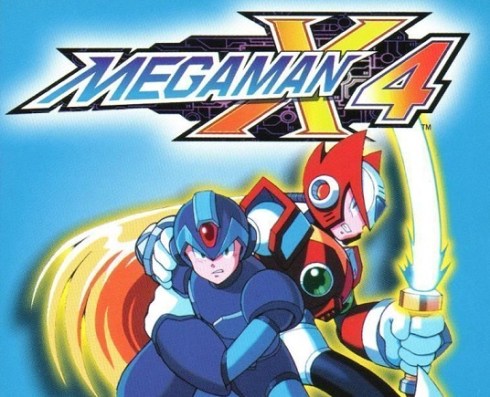
mega-man-x4

X found a home on Sony’s console, where Zero was allowed to flourish alongside him.

Mega Man X4 – Capcom is not shy about loaning out Mega Man for compilations, and since he’s featured on both the NES Classic and SNES Classic it stands to reason he’ll appear here. The X series was the most prominent on Sony’s console, and X4 was the best of the Mega Man games released for the system which also included the underrated Mega Man 8. And yet, it doesn’t feel like the most “PlayStation” of the Mega Man games…Suggested ReplacementMega Man LegendsMega Man X4 was just released as part of a compilation of X games. It’s easy to come by. What’s less easy is Mega Man’s first foray into RPGs on the PlayStation, Mega Man Legends. I won’t argue it’s better than Mega Man X4, because it’s not. It just feels like a more appropriate release. The only thing that would change my mind is if Nintendo is already developing a Nintendo 64 Classic and intends to include the port, Mega Man 64, on its machine. If that’s the case, then stick with X4.

Tony Hawk’s Pro Skater 2 – The Tony Hawk series was a huge hit on Sony’s machine, and the second game was the most well-received. It was basically the first and only skateboarding sim worth playing, and I knew many people obsessed with this game that weren’t even that into skating (but the ones who were into skating were even more obsessed). There are challenges in bringing it to the PlayStation Classic, but I would bet Sony finds a way to get it done. Suggested ReplacementBushido Blade – Confession time! I never liked the Tony Hawk games. Sorry! And since there is no skateboarding sim worth replacing it with, I’ll go with the sword-fighting sim from Squaresoft. Bushido Blade was a really neat take on fighting games as it aimed for more realism. Not total realism, just more. And it primarily did that via one-hit kills. If a guy gets slashed across the gut with a sword that shouldn’t merely take away some of his health bar, it’s going to incapacitate him. As a result, fights could be really brief, but most actually turned into endurance matches. They were tense, and in order to succeed you had to get your opponent to fall for a feint or just get careless leaving them open for an attack. It’s a toss-up which version is superior, this or the sequel, but most seem to lean towards the first since it had more weapon options.

Suikoden IISuikoden II has become such a popular game long after the PlayStation era came to a close that I think it’s actually likely that Sony includes it. It’s on their web store for Vita/PS3/PSP and it was presented as a pretty big deal when it first showed up. Sony probably has a solid relationship with Konami and won’t have too much trouble bringing this one to the PlayStation Classic, but it remains possible that Sony thinks this would be too many RPGs and leaves it out. That would be a very bad move.

parappa smooth

Expect PaRappa to appear on the PS Classic, but don’t expect him to look this smooth.

PaRappa The Rapper – Sony’s flagship rhythm game was pretty well-received. It also helped to popularize what came to be known as cell-shaded graphics. It was recently remastered and re-released, which is why I’ve placed it at the bottom of this list. It’s possible Sony doesn’t want to eat into that at all, plus it’s going to look pretty terrible in comparison, but it’s popular enough to merit inclusion. Had it not been for that re-release I’d have pushed this into the top 10 easily. Suggested ReplacementTobal 2 – I don’t really care for PaRappa, or rhythm games in general, so for my last slot how about something exciting? The SNES Classic certainly benefitted from including the previously unavailable Star Fox 2, and if Sony wants to drum-up some similar excitement announcing Tobal 2 for a North American release would be one way to do so. I believe it was prepped for one, but abruptly cancelled as the era was winding down and the first game did not sell particularly well. As a result, some of the localization may still exist, and if it doesn’t then that might not be much of a hurdle anyway as fighting games usually don’t require much, so how about it, Sony? Give us some sizzle!


Well, that’s it! What do you think? Is this something you would buy? Think I pretty much nailed it or did I miss something obvious? Surely, they’ll try and get a Spyro game onto this thing, but I’m not sure at what game’s expense (alright, probably Suikoden II, but maybe Sony will do the right thing and not include The Legend of Dragoon)? The PlayStation was perhaps my most favorite system as it came around when I was most interested in gaming. I was in my early teens so I was able to obsess over gaming without the distraction of what would follow in high school. Picking just 20 games just highlights how many games have to be excluded, so let’s go out with some honorable mentions. For the most part, these are games I would definitely include on my personal PlayStation Classic, but acknowledge Sony is unlikely to do so for one reason or another:

valkyrie profile

Oh please! Oh please! Oh please!

Xenogears, Final Fantasy IX, Chrono Cross, Tomba!, Klonoa: Door to Phantomile, Vagrant Story, Lunar: Silver Star Story Complete, Mega Man 8, Mega Man X5, Rogue Trip, Street Fighter EX Plus a, Brave Fencer Musashi, Colony Wars, Legacy of Kain: Soul Reaver, Front Mission 3, Spider-Man, Alundra, WWF Smackdown 2: Know Your Role, Super Puzzle Fighter II Turbo, IQ: Intelligent Qube


The Mini Console Wars are Upon Us

ps classicPlug and Play games have been around for several years now. They’re those cheap little Atari-styled joysticks you see at electronics stores that when plugged into a television allow one to play games like Pac-Man and Asteroid. They’re novelty machines and an inexpensive way to say to someone “Remember this?” I don’t know how successful they’ve ultimately been, but they’ve persisted and may be responsible for bigger publishers to look at and say there’s more here than meets the eye.
Companies love money, and they love finding ways to make money off of things that require little or no capital. When Nintendo launched its Virtual Console service with the Wii it was a simple and inexpensive way for the company to monetize outdated games. Previously, Nintendo’s path to doing so was via its portable line which was always a generation behind the main consoles in terms of power. Porting a SNES game to Gameboy Advance was cheap, and gamers liked playing games they enjoyed roughly five years past on-the-go. It was a novelty, but a good game is a good game. When consoles finally reached the point where DVD and Blu Ray mediums meant storage was no longer an issue, retro compilations came into fashion. Few sold big numbers, but they didn’t have to since the cost to emulate the software was fairly cheap.

pacman

The start of the retro craze?

All of that changed when Nintendo unveiled its NES Classic Edition System in 2016. The tiny device was immediately attractive to older gamers because it was so cute and tastefully done. Pre-packaged with 30 “classic” games at an attractive low MSRP of $60 helped to make it the hottest item of the 2016 holiday season. Nintendo famously could not meet demand, and it’s taken the company nearly two years to finally make the system readily available. Since then it’s also released the SNES Classic Edition. That came with a second controller and 21 games for the higher MSRP of $80, roughly approximating the price Nintendo has always placed on its NES games relative to its SNES games via the now dead Virtual Console service.

Since Nintendo had such unbelievable success with its products, it’s no surprise then that other companies have followed suit. Sega has licensed its Genesis hardware for similar mini consoles with the added feature that most have contained an actual cartridge slot to play physical Genesis software. The results have been less well received though as the Genesis knock-offs have been rather clunky. Prior to that, Sega was arguably ahead of the curve by licensing its product for portable systems. They too were pretty clunky though and I’ve never had someone actually recommend one to me.

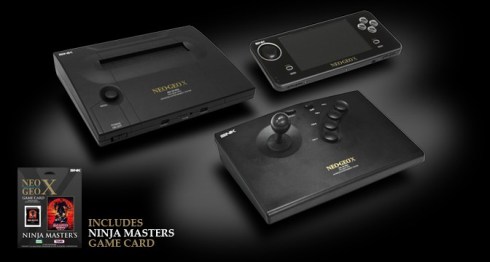
neo geo x

SNK and Tommo tried to make the Neo Geo affordable and practical, but it didn’t work out.

The newest entrant to hit retail is actually an older one as well. SNK too was ahead of the curve with its Neo Geo X released in 2012. The NGX was basically the precursor to the Nintendo Switch. It was a handheld console with 20 pre-loaded Neo Geo games and room for expansion via game cards. It came with a dock that resembled the Neo Geo AES console and once placed inside that dock the games could be played on a television with the included AES style joystick. It was an ambitious, and expensive (but what Neo Geo item isn’t?), toy manufactured by Tommo as opposed to being a true SNK console. The hardcore fanbase didn’t have pleasant things to say. From stretched visuals to input lag, the NGX was more of a novelty than a true way to experience the Neo Geo. After all, most of the system’s best games are available across many consoles now and emulated quite well. SNK was so dissatisfied with the machine that it eventually ordered Tommo to cease and desist production less than a year after release.

The NGX may have been a failure, but it didn’t discourage SNK from trying something similar again. Likely influenced by Nintendo, the Neo Geo Mini is now a thing set for release next month. Unlike the Nintendo machines, the SNK Mini is both a portable and a dedicated home console machine. It resembles a little arcade cabinet and comes with 40 games pre-installed. It looks like it will be rather clunky and cramped when enjoyed as a portable, but it supports standard Neo Geo controller pads so it likely will get the job done when plugged into a television. Like all things Neo Geo, it’s pricier than the competition and will set you back 90-110 dollars, but SNK has an extremely loyal fanbase that will likely guarantee this thing is a sell-out.

neo geo mini

The Neo Geo Mini certainly scores points for cuteness, but how functional it is seems suspect when not plugged into a television.

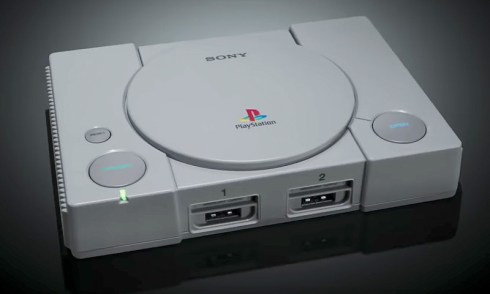
And of course, the impetus for this post, is the just announced PlayStation Classic. Unlike the Neo Geo Mini, the PlayStation Classic looks to be a straight-up knock-off of Nintendo’s products. A mini PlayStation with 20 pre-loaded games and a single controller for $100, it’s a fairly no-frills duplicate. Sony has only announced 5 of the 20 games, and they’re a pretty representative snapshot of what the original PSX offered:  Final Fantasy VII, Jumping Flash, Wild Arms, Tekken 3, and Ridge Racer Type 4. Sony made the decision to package the system with one standard PlayStation controller, which means no analog. The choice to do so is being spun as a way to celebrate the original release of the console nearly 25 years ago, but I’m guessing it was really done for cost reasons. The machine also resembles the original launch model right down to the additional port on the system’s rear (it’s guarded by a removable plastic tab and I don’t know if its present for aesthetic reasons on the PS Mini or if it’s hiding an additional function).

genesis classic

Sega has made half-hearted attempts to duplicate Nintendo’s success, but the results have been subpar at best.

The PlayStation was the highest selling console of the 1990s so there’s likely a lot of gamers who hold the system in high regard. Even so, there are factors working against Sony with the PlayStation Classic. For one, Sony has actually been very good at making its classic games easily available. The PlayStation 4 may have been left in the dust in some respects, but both the Vita and PS3 can download and emulate almost all of the biggest games released for the original PSX. They’re not free, but they’re also not prohibitively expensive and the cost varies from publisher to publisher. Likely Sony’s biggest ally in those days was Squaresoft, now Square-Enix, which has made almost all of its PSX games available in Sony’s Eshop. And if you’re one of the few who (like me) purchased a PlayStation TV then you have yet another avenue for experiencing these games. Even games like the ultra rare Suikoden II can be played rather effortlessly these days.

ps classic close

The PlaySation Classic is about what you would expect.

The other issue Sony is going to run into is its price point and lack of analog support. Some classic PSX games made full use of the Dual Shock controller including Metal Gear Solid and Ape Escape. Other games were retro-fitted to utilize the new controller and made better, like Resident Evil 2. Since the console does utilize USB for its controller input it’s possible it will support the Dual Shock 3 and 4 as an input method, but it stinks to not just include that out of the box. And of course, the $100 price point is another tough sell. It follows the path Nintendo laid out with its retro machines of adding another 20 dollars for each successive console generation, but it does feel like there is a limit for what people are willing to spend. Gaming enthusiasts will still have interest, but will Sony be able to successfully attract that casual crowd that really drove sales for the Nintendo units? Considering the Sony brand isn’t as famous as Nintendo’s, despite the obvious success of the PlayStation consoles, it would appear that this unit is destined to be less popular. And on the business side of things, Sony just doesn’t have as many firs-party titles as Nintendo making the licensing more expensive. That’s likely reflected in the price-point, but it’s also possible that Sony also just isn’t going to pull in the same profit per unit that Nintendo can manage.

Revealing only 5 of the included 20 games from the start feels like a gamble on Sony’s part. Does the company think that the excitement of the initial announcement will be enough to drive pre-orders into near sell-out numbers? It’s possible, but it also feels like there’s a lack of confidence in the software. A lot of Sony’s biggest games come with obvious licensing hurdles. Gran Turismo boasted hundreds of actual vehicles. Tony Hark’s Pro Skater contains the likeness of dozens of unaffiliated skaters as well as sponsorships as well. Even Jet Moto and Wipeout featured in-game sponsorships or licensed music. It’s unlikely these licensing agreements factored in new retail releases down the road and license holders need to be re-engaged in some cases in order to include them. All of these things cost Sony money and might discourage the company from including some of the system’s most memorable games.

psc ad

The choice of controller may be a hindrance, but we’ll see.

Just like the remaining 15 games, it also remains to be seen how Sony views its newly launched Mini Console business. Does the world really need a PS2 Mini at this point? I’d argue no, but I also would not be surprised to see Sony try. They may wait to see if Sega or Nintendo jumps into that generation first though before dipping their toe into those waters. It’s also possible Sony sees this as the first of multiple mini PlayStation devices. Perhaps a second could mimic the redesign of the PSOne and include analog support. Maybe this one due out in December is to be expandable or new versions could arrive that include a different variety of games. We don’t yet know if there will be regional differences with these consoles as there were with the Nintendo ones too. And lastly, we don’t know how well this system will be at emulating these games. While many hold up from a fun-factor perspective, visually they have not aged well and may look troublesome on modern televisions. Sony at least has experience with the PlayStation TV (I bet Sony really kicks themselves now for not designing the PS TV to resemble a mini PlayStation) so we know they can make a quality plug and play device at a modest price point, but we also don’t know if we can expect the same level of quality from this device. All of these questions, and the fact that I still own most of my favorite PSX era games in a physical form, has me less than enthused about the PlayStation Classic. I’m not pre-ordering it, but I’m also not ruling out a purchase somewhere down the road. It is fun to think about though, and it certainly reaffirms the notion that we’re not through yet with mini consoles.


Mega Man X

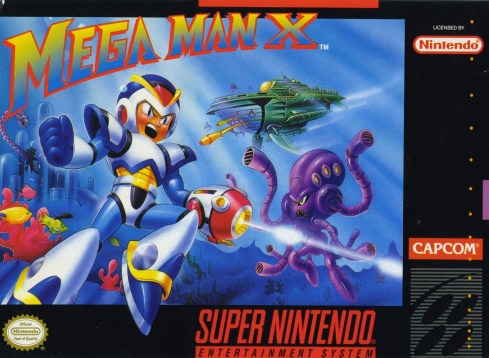
snes_mega_man_x_p_xky270When Mega Man X was released in 1993 I was so confused. I saw the X in the title and assumed it stood for 10. Back in the 90s, it wasn’t uncommon for games to not get localized and released in North America for various reasons. Famously, we only received 3 Final Fantasy titles in the same amount of time as Japan getting 6. At the time, there were 6 regular old Mega Man titles released, and the sixth one had just been released on the aging NES hardware, so it didn’t really make sense that there would be three titles missing. Of course, there wasn’t and Capcom had basically just felt it was a good idea to give Mega Man a slight rebranding when moving him to the new hardware – the Super Nintendo.
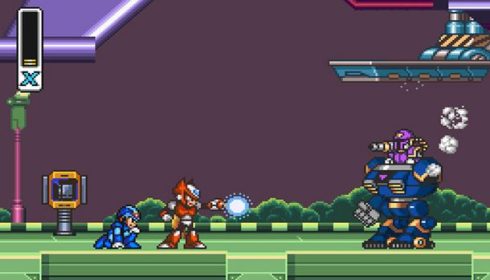
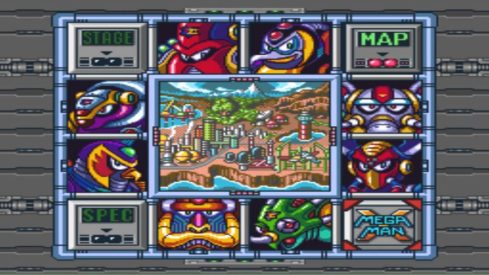
Mega Man X, or just X, is a future Mega Man who is just a bit more advanced than his predecessor, and yet it feels like he’s moved so far beyond what Mega Man was previously. When the game starts, X mostly looks like Mega Man but with a higher detail sprite making him look more like the character art than the old in-game models. He comes equipped with the X-Buster which mostly functions like the old Mega Buster including a charged shot. He’s lost the ability to slide, but instead can dash forward either with the press of a face button or a double tap of a directional. He can also do a wall kick which allows him to continuously jump off a wall and scale it. Combining the dash with a jump or a wall kick can open up new areas for X and adds a new level of exploration not really found in the prior games.

MegamanMHX

Minus the cool armor upgrades, X doesn’t look THAT different from the old Mega Man.

Aside from all of that, the conventions of the game are still really familiar. Dr. Light and Dr. Wiley are both dead, but in their place X has an ally in Zero, a Maverick Hunter who goes after rogue robots and mostly looks like a red version of X with a ponytail. The villain is the Incredible Crash Dummy look-alike Sigma, a former Maverick Hunter turned….Maverick. The plot is basically that X was the first robot created with free will, and fearing he was too strong and unpredictable, Dr. Light sealed him away. Well past his expiration date, a Dr. Cain found X and basically reverse engineered him to create Zero as well as legions of other robots. A bunch of them went nuts, became Mavericks, and here we are with X having finally awakened on his own. Like any other Mega Man game, the story is simply there for you to take in if you wish, but it’s hardly essential to enjoying the game.

megamanxreplay_610-610x349

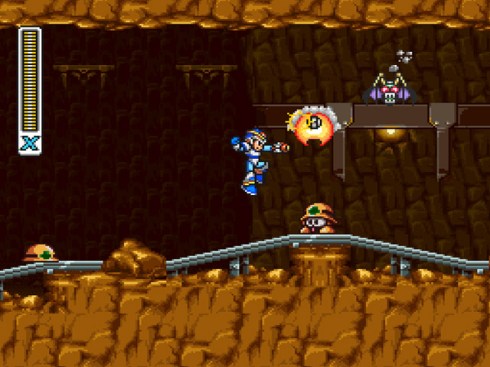
The opening stage introduces the player to ally Zero and enemy Vile.

The rest of the setup is also essentially the same. Eight robot masters stand in the way of X and a showdown with Sigma. There’s an intro level which introduces both Zero, as an ally who comes to Mega Man’s aid, and Vile, an enemy robot who pilots a mech suit. The robot masters are only changed in the sense that now they resemble an animal of some kind. They still possess unique weapons and each one is weak to another. Clearing a stage means X can re-enter it and exit it at will, which is important because there are numerous extra goodies to uncover. In addition to the familiar E-Tanks, now called Sub Tanks, X can also find health upgrades that extend his overall health meter. And more importantly, X can also find capsules Dr. Light left behind which contain new upgrades for X’s armor like a chest guard that allows him to absorb more damage and leg upgrades that let him break certain walls. There’s even a special upgrade that allows X to perform a famous maneuver from another popular Capcom series. These armor and weapon upgrades will become a staple of the X franchise, which now has as almost as many games in it it as the regular Mega Man series.

Mega-Man-X-Screen-1024x576

The eight robot masters are all now aligned with animals of some kind, a trait that will continue throughout the X series.

Once the robot masters have been dealt with, Sigma’s base opens up and X is free to pursue the ultimate enemy of the game. Sigma’s base is broken up into three stages, and unlike traditional Mega Man games, there’s no boss-rush room. Instead, X will encounter the defeated robot masters throughout the three stages which makes things a little more fun than the usual room full of capsules. There are also additional other bosses to take down, including a showdown with Vile, before Sigma can be challenged. Like Dr. Wiley before him, Sigma’s fight will encapsulate multiple parts (in this case, three including the fight with his mutt) and is designed to test X’s skills up to this point. Whether it does or not is a matter of opinion, I suppose, though like most boss battles, once you figure out the patterns he’s not particularly difficult. Especially with some fully stocked Sub Tanks.

34557-Megaman_X_(Europe)-10

Gameplay wise, you’re not getting anything you aren’t used to, and yet it feels new.

What makes Mega Man X such a resounding success is the sense of freedom within the game. The various health and armor upgrades are all basically optional and you’re free to make the game as easy or as challenging on yourself as you like. The X-Buster is fairly strong on its own, offering multiple levels of “charged” for damage output. As a result, the robot master weapons need to provide other functions to make them worthwhile and the game does an excellent job of just that. And once X acquires the X-Buster upgrade he can even charge all of the enemy weapons giving them new functions such as Chameleon Sting’s invincibility or the forcefield offered by Rolling Shield. There’s even one weapon that has a Cut Man property to it and can cut-off certain parts of enemies weaponry including some bosses. The generous amount of Sub Tanks that can be acquired also seems to encourage some experimentation as you can always farm power-ups and refill the tanks if you hit a tough part or happen to fail to recognize what weapon works best on a particular enemy.

Visually, Mega Man X looks great for an early Super Nintendo title and holds up quite well even today. The sprites are colorful and well-detailed and there’s very much a Cybertron-like quality to the design of X’s world that works for the franchise. There are numerous large-scale enemies that are common throughout the levels and the usual amount of setting variety as well such as more jungle-like levels and even an underwater one. The bosses are all pretty fun, and they seem a little more agile this time around since X is better equipped to dodge them. Some of the easier ones will let the player exploit X’s wall-kick, but later enemies will know how to get you off the wall and out of the corners. The music is also a strength. It may not be as classic as a Mega Man 2, but it’s still a high point for the franchise.

34559-Megaman_X_(USA)-40

X does look pretty bad ass once he gets all of his upgrades.

The only negative with Mega Man X is that the abundance of enemies and detailed graphics do lead to some slowdown. Even when playing on the SNES Classic, slowdown is pretty common at certain points. I especially notice it in Armored Armadillo’s stage when X has to ride a mine cart like device and the screen is loaded with enemies. The slowdown won’t really impact play, since X is largely required to be stationary throughout all of this, but it can be a bit frustrating. I at least can’t recall an instance of slowdown during a tricky platforming section or something.

s-l500

If you can find it, the 2006 X collection for PS2 and Gamecube is a worthwhile pick-up, though it probably makes more sense to wait for the PS4/Xbox One/Switch release.

If the only negative in your 15 year old game is occasional slowdown, then that’s a pretty good legacy to leave for Mega Man X. It was at the time, and still is today, a bright spot for the Mega Man franchise. It felt so fresh at a time when Mega Man was definitely growing stale and playing it today after recently playing both Mega Man 2 and Mega Man 8 it still feels that way. It injects a bit more fun into the formula by making the main character just more fun to handle. It’s the main reason why Mega Man X is arguably the greatest Mega Man game ever made. I’d rather play it over any of the mainline games, though I’d love to revisit Mega Man X4 before declaring it’s definitely the best. Like the regular series, the X series would also suffer from over-saturation as Capcom would fast track another pair of X games for the SNES and then continue along with the Playstation. The games would eventually add Zero as a playable character, which definitely helped reinvigorate the franchise as Zero played differently from X and offered a new set of challenges.

In the end, it doesn’t really matter where Mega Man X fits in the overall series because by itself it’s pretty damn awesome. And thankfully, it’s still pretty easy to come by. It sold really well when it came out so cartridges for the SNES can be found for a reasonable cost today. There was a compilation of X games released on both the Gamecube and PS2, but that’s actually a little harder to come by. Capcom is prepping a new collection of X titles for 2018, so it should be easily available relatively soon. And if you happen to find one, it’s also included among the 21 games on the SNES Classic, which is thankfully a lot easier to find than the NES Classic, but still not as easy as just walking into a store and buying it on any given day. However you go about experiencing it, it’s likely you’ll have a pretty good time with Mega Man X.


Mega Man 8

25576-mega-man-8-anniversary-edition-playstation-front-cover

Mega Man 8 (1996/1997)

Mega Man 8 is perhaps the most divisive game in the history of the Blue Bomber. The first developed without series creator Tokuro Fujiwara, it was the only mainline Mega Man game released during the 32 bit era, and for a long time, was the last to be made with current generation technology, even though it didn’t seem like that at the time. After the release of Mega Man 8, the series essentially disappeared in favor of the many Mega Man spin-off franchises such as X, Legends, Battle Network, and others. When Capcom finally reconvened to create a Mega Man 9 it opted to pretend as if this game (and to some extent its predecessor Mega Man 7) never existed going back to a visual style akin to the original NES games and a gameplay style that went even further back. Capcom would stay with that look for Mega Man 10, but finally announced in 2017 that a new Mega Man game is coming and it won’t feature illusory 8-bit images.

It’s interesting that the game has become so maligned over the years, since at the time Mega Man 8 was supposed to be a celebration of Mega Man and the impact he had made in the world of gaming. Coinciding with the 10 year anniversary of the first game, Mega Man 8 stayed true to the series roots by sticking with 2D gameplay when the whole world was demanding 3D. Sony Computer Entertainment of America (SCEA) initially wanted nothing to do with the game because of its use of 2D visuals. Wanting to highlight the processing power of the PlayStation, SCEA nearly prevented the release of the game in North America, but eventually relented when Capcom agreed to dress-up the packaging. Since it was also to be released on the Saturn, SCEA wanted exclusive content and thus received a little booklet to be included with each copy of the game recounting the legacy of Mega Man. Maybe out of spite, Capcom would introduce better, exclusive, content on the Saturn with optional hidden bosses.

Mm8promo

There’s a whole bunch of new enemies for Mega Man to vanquish.

Mega Man 8 largely follows the formula of the games that came before it building off of Mega Man 7. So unlike more recent entries in the series, this one still retains the charge shot and slide maneuver as well as the bolts currency which can be used between levels to purchase upgrades for Mega Man. Dr. Wiley is the main antagonist once again and Bass and Treble return from 7 to make Mega Man’s life more difficult. The plot isn’t of much importance, suffice to say that Wiley is up to no good and has created 8 robot masters that Mega Man has to get by before he can ultimately take on the mad scientist. A new character is introduced, Duo, who’s from outer space and brings with him some kind of weird energy that Wiley wants to make use of. He starts off as an ambiguous character, but will eventually become an ally when he “senses justice” within in Mega Man, or some nonsense.

PLAYSTATION-Mega-Man-8-_Jun1-13_51_20

Most of the levels have an appealing design that serves its robot master well.

What you need to know as a gamer is that Mega Man has roughly 12 new stages to topple. After a simple introductory level, four additional stages are open to Mega Man and each features a robot master to take down. Following their defeat, an intermission stage is unlocked before the final 4 robot masters are available and then eventually the multi-stage Wiley Tower. Splitting the 8 robot masters into two separate groupings of four does make it a little easier to determine an order to tackle them in. As is the case with virtually every Mega Man game, defeating a robot master earns Mega Man a new weapon and each one is a natural weakness for another robot master (Wiley should really avoid doing that when creating these things). There is an added challenge in introducing the robots this way as the player needs to figure out which robot to tackle first – twice! There’s no overlap in terms of weaknesses between the two groups of four, so the first boss you fight and the fifth will basically necessitate relying on the Mega Buster to topple. If you want my advice, I suggest starting with Grenade Man and Aqua Man, respectively. Although I did have this game before I had internet access and a boss order available to me so I have taken down more than just those two with the Mega Buster.

Mega-Man-8-228

Mega Man 8 is gorgeously animated, but few appreciated it in 1996 since it wasn’t 3D.

Scattered throughout the stages are bolts. There is a finite amount of them in the game and they serve as currency for Mega Man to purchase upgrades. Since you’re limited by the amount of bolts in the game, this also means you’ll be unable to purchase all of the upgrades in a single save file. Some of the upgrades available to Mega Man include a fast charge attachment, a shield that will prevent knock-backs, a laser shot, and a spread gun, among others. Basically all of them are useful to some degree, though I’d argue the most essential is probably the quick-charge. One annoyance, the ability to exit already completed stages must be purchased, so if you want to go back for bolts that you missed (and you will, since some require a weapon acquired later to access) you will have to either waste bolts on this feature or play through the entire level again.

343-Mega_Man_8_Anniversary_Collectors_Edition_(U)-14

There’s some auto-scrolling segments to break-up the gameplay. This Rush segment works well, but don’t ask me about the snowboarding one.

The stages feature a solid mix of run and gun and platforming gameplay, as well as a couple of auto-scrolling events. The levels offer a rather average level of difficulty for a Mega Man game sitting this one squarely in the middle of the pack if arranged accordingly, though perhaps closer to the easy side. Continues are unlimited, so the game is forgiving in that regard, but the checkpoints are spread out enough that having to use a continue does hurt a bit. There are no E Tanks in this game, which might explain why it’s a touch on the easier side, but there is a Rush attachment that can be used once per stage that summons Mega Man’s trusty robotic canine who will drop power-ups as he flies back and forth. It’s not as seamless as an E Tank since Mega Man still has to chase down the power-ups and there’s no guarantee that Rush will drop exactly what you want. This makes him a bit unreliable during the chaotic boss encounters in the game and he’s also basically useless if you’re in an area where Mega Man is limited by where he can stand (auto-scrolling segments, spike pits, etc.).

b963dfddf9672d1dd78d31d44c649b7d

In what was apparently common for Capcom at the time, fan input was sought for boss designs. Some of the original fan-submitted works appear in the credits.

Of the main stages available, none are probably memorable enough to supplant a Quick Man or Flash Man stage, but they mostly offer plenty of variety and avoid the pitfalls of tedium. Tengu Man’s stage features a pervasive gust of wind that extends Mega Man’s jumps when moving with it, but also hinders his ability to backtrack. This stage also features one of the auto-scrolling portions where Mega Man hops aboard Rush and uses him like a jet-board as he soars through the air. During these segments Mega Man can also summon his lesser allies like Auto and Beat to assist him in taking out the various enemies he encounters. Astro Man’s stage features some maze-like portions as well as a frantic escape from a sinking tower. Sword Man’s stage is broken up into sections that can be tackled in any order, sort of like the boss gauntlet that appears towards the end of every Wiley Castle. Some levels also feature a mid boss and defeating that boss unlocks a new Rush ability (4 in total) that include the health power-up, as well as a few other things that aren’t really essential but can be useful.

other-consoles-45995-21342332094

Mega Man has finally learned how to swim, but I’m not sure that’s a good thing.

Some levels, on the other hand, don’t go over as well. Frost Man’s stage features the snowboarding auto-scrolling bit and it is not enjoyable. The input feels laggy, and the developers apparently noticed this as well because they inserted audio prompts commanding the player to “Jump! Jump!” or “Slide! Slide!” These segments are mercifully short, but also short on fun and it’s a shame they recognized the need for the cues but not the need to just cut them entirely. Aqua Man’s stage also features scenarios completely submerged in water. Mega Man has apparently received a software upgrade that taught him how to swim, as he no longer just jumps around slowly in water. Swimming basically works the same way in Mega Man 8 as it does in Super Mario Bros, which is to say it’s not good. Mega Man is also a lot longer relative to Mario so it’s not easy to maneuver him around enemies. You’re better off to just plow through those segments and hope for the best.

Mega Man 8 35

Mega Man’s “sister” Roll runs Dr. Light’s shop which you can visit to purchase upgrades for Mega Man after acquiring enough bolts.

The bosses themselves are all fine. They’re fully voiced, like Mega Man (more on that later), and it’s kind of funny to hear them taunt Mega Man before and during confrontations. There’s nothing particularly logical about who is weak to who, unless you know more about the robot than the game presents. For example, Sword Man does have a fire element associated with him that’s not apparent just by looking at him and Aqua Man’s Aqua Bubble is his weakness. There’s also no weapon on par with the Metal Blade that makes life easier across the board, though the multi-hit Grenade Bomb is pretty good and seems to have the most uses. Other weapons are more utilitarian. The Tornado Hold can be used to levitate Mega Man or hit enemies that are high in the air and the Thunder Claw can be utilized like Bionic Commando’s claw at certain points in the game (another benefit to splitting the bosses in groups of four means levels can be designed to utilize certain weapons because it’s guaranteed the player will have it). There’s also a 9th weapon that Mega Man receives in the opening stage:  the Mega Ball. It’s basically a soccer ball and pressing the fire button causes Mega Man to drop the ball. He can then dribble it if he likes or even jump on it for a small height boost on his subsequent jump, or press the fire button again to kick it. The ball can ricochet off walls, but it’s mostly too unwieldy to properly utilize. Only one boss requires its use. Two other very useful weapons include the Homing Sniper, which can fire up to three homing missiles, and the Astro Crush which rains down death on the entire screen. As a result, it has a very limited amount of uses.

Wily-1-Boss

This is the only boss who requires the use of the Mega Ball, and as a result, he’s pretty annoying.

Where things start to fall apart with Mega Man 8 is after the eight robot masters have been vanquished. Wiley’s various stages are lackluster and downright annoying at times. The first opens with another snowboard segment, this one far more annoying and longer than the ones from Frost Man’s stage. Worse yet, it ends with the only boss fight that requires use of the Mega Ball, and as a result, it’s pretty tricky. If you have to resort to a continue you’ll be stuck playing through that snowboarding segment once again and you’ll want to snap the disc in half. After that is another Rush auto-scrolling segment that uses the scrolling gimmick to kill you if you’re not paying attention (and it’s mean enough that you probably will die at least once when you hit that part for the first time) and concludes with the worst boss fight in the game. It’s long and tedious, but as a plus it’s not particularly difficult so hopefully you take it out on the first try. The third level is better and finally presents what feels like a fair challenge plus a dual boss fight when you take on the Bass + Treble machination and then the Green Devil, or whatever it’s called. The Devil boss is probably the easiest one of them all, but if you don’t know its weakness it is considerably more difficult.

896456-mega-man-8-anniversary-edition-sega-saturn-screenshot-an-actual

Seriously, fuck this shit.

Finally, there’s Wiley, and unfortunately he kind of sucks too. He’s very similar to his Mega Man 2 version in which you take on his tank thing before fighting him in a floating capsule/bubble contraption. The tank is not terribly difficult, but it’s also not easy, and given the lack of E Tanks there is a bit of added challenge. The capsule part is a bit boring because he just doesn’t take much damage. He doesn’t appear to be weak to anything, so you just have to make sure you outlast him.

892726-mm8

The anime cut scenes by and large look great considering they’re stored on CD ROM, but the voice acting just kills it.

Since this was the 10 year celebration for Mega Man, Capcom decided to dress things up with some anime cut scenes! Xebec was contracted to do the scenes and they actually did a really nice job considering these are forever trapped on a PlayStation disc. Since the total run-time for all of the sequences put together is probably only 10-12 minutes, they could afford to take their time and put a lot of effort into making them look good. Unfortunately, the same degree of care was not put forth into the voice acting when it came time to localize the game for North America. I don’t know if the Japanese voice acting was equally terrible, but the English version is hilariously bad. It’s the most infamous part of the game and what people think of first when they think of Mega Man 8. Mega Man sounds like an adolescent high-voiced girl while apparently no one realized that the characters Bass and Treble refer to music and not fish. Dr. Light is especially bad and sounds like a bumbling old fool who refers to Dr. Wiley as “Dr. Wow-ee” while the voice actor for newcomer Duo just sounds like he would rather be anywhere than in a studio voicing this character.

The voice acting is a real shame because outside of that the production values are pretty great. While few wanted 2D games in 1996, no one could argue that Mega Man 8 wasn’t attractive to look at. It’s hand-drawn visuals have aged way better than basically anything else on the PlayStation. Mega Man is the right size in relation to the screen and is lovingly animated. Many of the generic enemies are brimming with personality and the bosses, in particular Frost Man and Sword Man, are also a lot of fun to look at. The music is solid as well, and while most are probably nostalgic for that 8 bit sound I doubt few would suggest the soundtrack is poor. And while the voice acting during the anime bits is atrocious, it does succeed in adding some personality to those bosses and its mostly welcome in that space.

Aqua-Man-Miniboss

An assortment of mini bosses keeps things interesting and provide a vehicle for awarding Mega Man with even more power-ups.

Mega Man 8 performed rather well at retail when it was released, but reviewers were far more mixed. Incidentally, what it was maligned most for (its visuals) is what it’s most likely celebrated most for today. There was an undercurrent of backlash from some outlets because of its simplified look and there was also some Mega Man fatigue at the time. After all, this wasn’t just the 8th Mega Man game. It also followed three Mega Man X titles and some handheld ones as well. That’s a lot of Mega Man games in the span of 10 years so reviewers and gamers could be forgiven if they weren’t as excited for a proper Mega Man title in 1996 as maybe they would be today. Opinions are still divided on this one though. As recently as 2010, IGN considered it the worst of the mainline Mega Man titles. More recently, Retronaut’s Jeremy Parish ranked it as high as 5th among all of the Mega Man games (did you know there’s 20 total as of this writing?) which is probably the most praise I’ve ever seen given to the game. Perhaps not surprisingly, I tend to fall somewhere in between those two extremes. It certainly is not the worst of the Mega Man games, but Mega Man 2 and 3 are probably superior, at least. I definitely would rather play this one than Mega Man 7, though I’m less sure when it comes to other games. I’m not an expert Mega Man gamer and I never touched the ultra hard Mega Man 10 because it sounded like something I wouldn’t enjoy. When I picked this game up in 1997 as a birthday present I had some fun with it and returning to it in 2018 was by no means a bad experience. If you like Mega Man, but have never played this one and have only heard bad things then I’d suggest giving it a shot. It’s not hard to come by thanks to the compilations put out by Capcom nor is it prohibitively expensive if you want an original PlayStation version (if you want it for Saturn you will have to pay a lot, though) so you only have yourself to blame if you haven’t played it.


Super Dragon Ball Z

Super_Dragon_Ball_Z_CoverartRecently, Bandai-Namco conducted an open beta for its latest game based on the venerable Dragon Ball franchise:  Dragon Ball FighterZ. The game is a 3 on 3 tag-fighter that exists on a 2D plane but contains three-dimensional characters. The art style is done in such a way that it more closely resembles the 2D anime that’s recognized around the world. It’s a fast and beautiful looking fighter and yours truly did check out the beta. Like most open betas where an upcoming game is essentially free to play briefly, it was a bit of a challenge actually getting logged into the servers and paired up with a match. I mostly spent my time in the training area just checking out how the game handles and plays. It’s very similar to the old Budokai games in some respects, mostly the speed and the fact that all of the characters seem to have the same move-list, only the animations for each move are unique from character to character. For example, a traditional Ryu fireball motion for Goku results in his kamehameha wave while the same for Krillin is the destructo disc maneuver.

FighterZ seems like it will be a pretty entertaining game, but it’s not what I wanted or expected. The developer, Arc System Works, is best known for Blaz Blue so I expected a more traditional 2D fighting experience with some Dragon Ball styling. Instead, FighterZ is apparently courting a more casual crowd that grew up on those old DBZ games and Super Smash Bros. as opposed to Street Fighter. This naturally lead me back to an old favorite of mine:  Super Dragon Ball Z.

Not to be confused with the currently airing anime Dragon Ball Super, Super Dragon Ball Z is a 3D fighter that plays like a 2D fighter. It was developed by Arika, the company headed by Akira Nishitani who is best known as the brain behind Street Fighter 2. The company is known for its work Capcom on the Street Fighter EX series, a 2.5D fighting game that was relatively popular in the late 90s and early 2000s. As you would expect, a DBZ fighting game developed by the father of Street Fighter plays a lot more like a Street Fighter game than the casual arena brawlers that had become the norm for DBZ. It was released to arcades at the tail end of 2005 in Japan and Europe only before arriving on PS2 in 2006 worldwide. Because it’s not what people were used to out of a DBZ game, it went somewhat overlooked. While I would not consider it on par with the best the Street Fighter series has produced, Super Dragon Ball Z is a pretty damn fine game on its own.

hqdefault-29

End a battle with a super move and you’ll be treated to some manga-inspired word art.

Super Dragon Ball Z has the typical fighting game maneuvers you would expect of a Street Fighter clone. Think hadokens, shoryukens, and so on. Not every character has the same standard set of moves, but they do share some similarities so it’s not as streamlined as simpler games, nor as complex as the most hardcore fighters. The characters are presented in 3D with a cell-shading effect and the default colorization is meant to resemble the original Dragon Ball manga as opposed to the anime. The stages are arena types and characters can move into the foreground and background with relative ease. An action bar at the bottom of the screen controls movement within the foreground and background as well as dashing. Deplete that and you will find your movement severely hindered until it replenishes. It does refill rather quickly, but the gauge prevents characters from endlessly dodging to prolong a match or from spamming dash attacks.

The game’s button layout is a bit unique. The square and triangle buttons are your weak and strong melee attacks while circle is the jump/fly button and X is guard. The shoulder buttons contain both dash attacks and a dedicated throw button. Any fighter that utilizes a dedicated block button takes some getting used to, and the jump/fly dynamic is a bit wonky in execution. It’s mostly used to go after your opponent, as opposed to setting up an attack. The dash buttons are useful for closing the gap quickly with your opponent or just to get you on the same plane as your opponent.

slus-21442-game-ss-2

It may not be the flashiest DBZ game, but your favorite characters will still have their most recognizable moves.

The fighting mechanics are a mix of traditional fighters and DBZ fighters. Projectiles play a large role, but up close combos are also present and a major part of combat. Certain characters function better as ranged attackers versus up close ones and the AI for each character feels rather true to the source material in terms of how they attack the player. There’s a simple health gauge that needs to be depleted to end a round and there’s also an ultimate gauge that gradually fills up during a match. This gauge is expensed when using a character’s best attacks, but unlike other DBZ fighters, there is no charge button to build up ki forcing you to better manage the resources you have. The big moves are also less destructive than in other games. There’s more of an emphasis on dealing out damage gradually as opposed to in big chunks. Being able to dodge properly is the best way of avoiding damage as opposed to blocking and countering and canceling are certainly effective ways to victory.

The game is overall a lot slower and less manic than other DBZ fighters. Characters do not move at crazy speeds and only Frieza can do the popular teleport move in battle. Battles feel a bit more strategic as there’s still an environment to navigate with obstacles to hide behind or toss foes into. Combos are present and they’re more similar to Tekken style combos than Street Fighter ones requiring a series of well-timed button presses. With only two dedicated attack buttons, they’re fairly similar but the timing for each character is a little different and requires some practice. It may be different, and to someone just watching the game it will likely seem less authentic when compared with the anime, but it feels more strategic and ultimately it has its own rewards.

hqdefault-30

Even after unlocking the hidden characters the roster is still on the small side when compared with its contemporaries.

The character roster is much smaller than what fans are used to. At the onset, the characters available are:  Goku, Gohan, Vegeta, Trunks, Piccolo, Krillen, Chi Chi, Androids 16, 17, and 18, Frieza, and Cell. Additional characters can be unlocked and most are just variants of existing characters. The saiyan characters have the ability to go super in battle, and it’s an ability that rapidly depletes stamina so it’s not meant to be a permanent state. Only Super Saiyan level 1 is available, so there’s no going 2, but it does make those characters a bit more interesting than the non saiyans. Of course, every character has pluses and minuses. Piccolo, by virtue of his stretchy limbs, has incredible range and Krillen’s destructo disc can carve through every move in the game. It’s a roster a bit on the small side, but each character feels relevant and the secret characters are also fun too (and some of my favorites).

The game has a standard set of modes including Arcade and training as well as a survivor mode dubbed Z-Survivor. Arcade is a series of seven battles with five of them being random. Each subsequent opponent gets stronger and their strength is represented by a scouter reading before battle, which is kind of neat. The mode always ends with a battle against Frieza followed by a fight with Cell. There are no custom endings for each character, which is a bit disappointing, nor is there really much of an ending at all, but if you’ve seen the anime and played almost every DBZ fighter released then you’ve seen how the story ends more times than you can count. What is interesting is that after each victory you get one of the titular dragon balls. By collecting all seven, you can summon Shenron and make a wish. This is how you get additional characters, and also how you improve your existing ones.

super-dragon-ball-z-4e2609203a69e

Spend enough time collecting dragon balls and eventually you’ll unlock additional characters like cyborg Frieza.

By far, the most interesting aspect of Super Dragon Ball Z is the custom character process. Other games have dabbled with this, but Super Dragon Ball Z really seems to go for it. As you fight with a custom character, your character naturally gets stronger. Once you fill an experience bar, and completing arcade once is more than enough for the first go around, you can learn a new skill. The skills range from increased health to faster action regeneration time as well as to new and better moves. The most powerful attacks are reserved for custom characters, and some of them have to be wished for. This encourages you to pick a character and stick with it. As a bonus, if you max out a character you can then take another character and inherit moves from the previously maxed out character. For those who really want to craft the ultimate character, doing this is necessary since only some characters have the worthwhile Super Cancel ability.

The only real issue with the character customization is that there is little you can actually do while leveling-up your character. It’s only so amusing to beat the arcade mode over and over so if you don’t have a friend to play it can get a little old. The Z-Survivor mode helps out as this is a mode where you’re given one health bar to vanquish 10 foes in succession. After each conquest, a roulette wheel is spun to get a little power-up for the next fight and it’s not hard to stop the wheel on what you want. However, you can’t just repeatedly select the health restore option as it gets worse each time you land on it. It starts off with a 50% health recovery, but after the next round it will drop to 40% and so on. You have to be strategic with the best rewards if you want to survive to the end. If you do manage to defeat all challengers you’ll be confronted with one more and the fun part about that is you’re allowed to wager basically all of the experience you’ve gained throughout the mode in a bid to double it, if you win, of course. It’s definitely more challenging than Arcade mode and it might end up being the mode you spend the most time in.

Super_Dragon_Ball_Z

Few DBZ games let you play as Chi-Chi giving fans of that character some added incentive.

Visually the game holds up pretty well. The cel-shading approach helps give it a timeless look, though some characters come off better than others. Goku, for example, has always had a some-what tough time making the jump from flat 2D image to 3D polygon. The stages are, as a whole, more interesting to look at than other DBZ games and the manga approach to its styling helps to add a little extra charm to everything. Sadly for anime purists over here, the soundtrack for the US version is a mix of industrial music that’s designed to resemble the score to the Funimation dub of the show, though it’s an original score and not authentic so even Funimation purists have a reason to be irritated. Other versions utilized some of the actual music from the Japanese anime and I’m sure a lot of US fans would have preferred that. If you hate the manga look though, know that anime colorings do exist in the game so if you want your Future Trunks to sport a royal blue coat instead of teal you can certainly make it happen. Overall, the presentation is solid, though like the gameplay, you won’t get much in the way of flashy big graphical spectacles in the form of massive super moves. At least not on the level of other DBZ fighters.

Since this is a PS2 game, there’s no online mode to easily find other challengers. And even if there were, the servers would undoubtedly be shutdown by now anyway. Having a group of friends who all enjoy the game helps increase the amount of enjoyment you’ll get out of it, but that’s also true of basically every fighting game ever created. It would have been nice if each character had a story and an ending to uncover, but then again, that would work against the drive to just use the same character over and over to make them more powerful. How eager you are to see the secret attacks and unlock the hidden characters will be your primary motivation to revisit this one. If you’ve ever played a DBZ fighting game and wanted it to be more like a traditional fighter, then check out Super Dragon Ball Z. It’s very easy to find a copy for a relative pittance these days so you won’t be risking much by doing so.


The Simpsons: Hit & Run

151790-the-simpsons-hit-run-windows-otherAfter a long stretch of posting about Christmas and Batman exclusively, it’s time to get things back on track here at The Nostalgia Spot. Here’s a subject I’ve been sitting on for quite some time. I love The Simpsons, and I also love video games, so it stands to reason I should love Simpsons video games! In a perfect world that would be true, but alas, we do not live in such a world.
The fact that Simpsons video games exist in the first place is kind of funny when you stop and think about it. After all, The Simpsons is essentially a family sitcom like Full House, except it’s actually good. I’ve never heard anyone sincerely bemoan the fact that there are no video games based on Full House, and yet we have around a dozen games based on The Simpsons. The most obvious difference between the two is that Full House is live action and The Simpsons is animated. Is that the criteria needed to enter into the world of video games?

the-simpsons-hit-and-run-download

The main stars of the game. Sorry, Maggie.

Not exactly, but we’re getting there. The wonderful folks over at Talking Simpsons, a podcast that is a chronological exploration of the series, spoke with writer and show-runner Bill Oakley about his time on the show and he revealed an interesting tidbit about The Simpsons that I wasn’t aware of:  the audience was predominantly children. It’s not a total surprise to hear that, but as someone who watched the show regularly growing up with his entire family it did surprise me some. Because the art form is most frequently used to create children’s content in the US, animation inherently appeals to kids. And Bart Simpson was a character most kids looked up to, rightly or wrongly. So given that, it’s not at all surprising why The Simpsons received so many video games in the early days because, back then, no one really associated video games with any demographic other than children.

1

Your first car is the (surprise!) famous Simpsons pink sedan which has inexplicably been turned into a convertible for this game.

Sadly, when the aim of a piece of media is to just appeal to children the end product is often pretty lackluster. The Simpsons were unremarkable in that respect as pretty much every licensed game from the 8-bit era was pretty terrible. The inaugural Bart vs The Space Mutants at least had an interesting They Live! inspired plot, but playing it was about as much fun as a trip to the dentist. The games that followed were the same, but without the quirky plot. Following the NES era the games became mini-game compilations on the GameBoy and SNES and the results were just as bad. The Playstation gave us Simpsons Wrestling, which the less said about that one the better. It wasn’t until we hit the PS2/Gamecube/Xbox generation where we actually received a home console game based on The Simpsons that was any good. Up first, was Road Rage, a Crazy Taxi parody that was decent, followed by Simpsons Skateboarding which was bad. The best though? A Grand Theft Auto parody called The Simpsons:  Hit & Run.

54286-the-simpsons-hit-run-windows-screenshot-in-game-locations-such

Basically every major Springfield landmark is in this game, some of which you can even enter.

Hit & Run took a lot of the assets created for Road Rage and made them more interesting. Road Rage was okay because the taxi setup leaves a lot of room for the characters to just be funny, but the gameplay gets a little old a little fast. Hit & Run slows things down and lets the player exit the vehicle. Even though it’s a GTA clone of sorts, the game plays more like a generic 3D platformer when not in a car. Characters can run, jump, double-jump, attack, and butt stomp just like Ratchet from the Ratchet & Clank series but without the awesome gadgets. Generic characters litter the virtual Springfield driving generic vehicles you’re free to commandeer at your leisure, though the best vehicles are the ones you actually have to purchase.

Hit & Run contains a fairly large version of Springfield that’s broken up into three main stages, so they’re not interconnected unfortunately. There’s a suburban setting that contains Evergreen Terrace as well as the projects and upscale neighborhoods. There’s a downtown setting where you can find Moe’s, the remnants of the monorail, and infamous Matlock Expressway. There’s also a waterfront setting that inexplicably contains The Android’s Dungeon but also features Duff Gardens and the Channel 6 lots home to fine programming such as Krusty the Clown. Just about every major landmark from the show is featured, though the layout of Springfield is definitely not canon.  There’s a sense that in creating the three main stages the game designers just wanted to make sure they had some important landmark reserved for each one. It’s not a big deal, but Springfield isn’t as cozy as it could have been. It’s also very limited by the technology of the time since no section is nearly as large as an open world from today (even GTA: San Andreas featured a much bigger setting).

174662_scr5_a.png

In a surprising move, Apu gets to take center stage for a level.

Springfield is the star of this game, but lets not forget about the playable characters. As you probably guessed, they include the main cast from the show:  Homer, Bart, Lisa and Marge. As you probably did not guess, there’s also a level for Apu. Why Apu? No idea, but it’s nice to play as someone who isn’t a member of the main family and Apu is better than Milhouse. Nobody wants to play as Milhouse. Each level stars one playable character and takes place in a different section of Springfield. Levels get recycled eventually, but with a slightly different take such as night vs day. The last level does something different that I don’t want to spoil, but I’ll say it’s pretty cool. At the start of each stage, your character has access to their default car plus any car that’s been acquired along the way. Naturally, the further into the game you go the better the cars get so you probably won’t use most of the earlier ones. Just about every car is taken from the series too so you’ll get to drive famous cars like Homer’s Mr. Plow truck and Martin’s Honor Roller.

Simpsons_Hit_And_Run_Level_2

Do it, Bart, take his head!

The setup of the game is pretty straight-forward. You’re given a task, and you need to drive over to a certain character to begin the mission. Just about every mission can be distilled into you driving to a checkpoint in a set amount of time. A timer counts down and often another character has hopped into the car with you to make fun of you while you drive. Complicating things is the hit & run meter. As you run over pedestrians and cause mayhem the meter fills. If it fills all the way you attract the attention of Springfield’s finest. Chief Wiggum and company are surprisingly capable of catching you, and unlike GTA they don’t have to yank you out of the car, just stop you. In the early stages you probably won’t have too much trouble, but as the game moves along things get harder and you’ll probably need to make sure you have the best vehicles available to complete the missions.

The plot of the game is unimportant and pretty weird, even for The Simpsons. Buzz Cola is spreading some new cola that turns people into zombies. It’s sort of a New Coke parody and for some reason there’s giant robot wasps. I mostly ignored it, but the plot pushes you along and into contact with basically every major character from the show. Since the game was released in 2003, it includes characters and references up to around season 13 of the show, so all of the best stuff was available and not as much of the not so great stuff. If you only like the old stuff, you shouldn’t feel too lost here. All of the voice actors contributed to the game and the dialogue is really funny. It’s easily the game’s best aspect.

207885-the-simpsons-hit-run-windows-screenshot-evil-homer-and-a-ufo

Say it with me now, “I am evil Homer! I am evil Homer!”

If Hit & Run did not possess The Simpsons license, it probably wouldn’t be remembered at all. The game probably runs about 8-10 hours depending on how thorough you are and towards the end the game’s structure does get a bit tiresome. There’s basically no mission variety to speak of, and while the game isn’t really hard some of the end stages will feature a mission or two that will likely get frustrating. I would often find myself getting bored and sloppy and that’s when my play quality would diminish leading to some angry moments. Usually putting the game away for a bit and returning another day remedied this and thankfully the game’s humor and charm were enough to keep me coming back. Once you’ve seen the three main hubs though the game does lose some luster since most of the Easter eggs have been explored by then.

screen_2

Of course the Monorail makes a cameo.

Hit & Run is at its best when you’re just exploring Springfield. Seeking out the special missions and homages throughout is definitely the most satisfying aspect of the game. The game keeps track of them too so you know if you’ve found them all or if there’s more out there. There’s some optional races too, but they’re sort of just padding. If that last level wasn’t so good I’d say you’ve probably seen enough after just level three. There’s also optional costumes to purchase in the game if you want to dress-up your character as Bartman or Evil Homer. Once you complete a stage too you’re free to jump back into it if you want in case there was something you failed to complete.

It’s debatable if Hit & Run is the best Simpsons game ever made. Virtual Springfield is much beloved by the community for its authenticity, though it isn’t really much of a game. Most people probably pick Konami’s arcade brawler, simply titled The Simpsons, as their favorite. It was available for a time on Xbox Live but I believe that is no longer the case. It is a fun game, though it’s also a traditional arcade game that exists mostly to devour quarters. It also was created during production of season 2 so it only contains references to the show’s first season, which is a bit disappointing. Hit & Run is definitely worth a look if you love The Simpsons. It was released across all three major consoles at the time, so it’s really easy to find a copy at a reasonable price. And if you like podcasts, definitely check out Talking Simpsons as, short of just watching the episodes, that’s the best way to enjoy the classic era of The Simpsons. The main podcast is free and is part of the Laser Time family of podcasts. There’s also a Patreon that has additional content (including the Bill Oakley interview I mentioned) most of which is available for just five bucks a month. I heartily recommend it (and no, I am not affiliated in any way with that show, I just enjoy it). However you go about, treasure The Simpsons since it won’t be around forever, as incredible as that may seem. Maybe we can even get one more game out of it. The Simpsons Game followed Hit & Run, and while the production values on that one blow away the other Simpsons games, the actual gameplay is atrocious and ruins the experience. A game that expands upon the basic formula of Hit & Run would probably work quite well, if enough time was sunk into it. I doubt we’ll receive another major Simpsons game, but it doesn’t hurt to wish.


Dec. 25 – Daze Before Christmas

maxresdefault-18Wait, what is this? We’ve reached the final day of this year’s advent calendar style countdown of Christmas specials and it’s not even a show, movie, or stupid commercial? No friends, for December 25th we’re taking a look at Daze Before Christmas, the Sunsoft produced 16-bit Christmas video game that never saw release in North America. Christmas and other holidays are rarely captured in video games. Sometimes a game might take place at Christmas time (Twisted Metal originally did), but few actually make the holiday a focal point of the game. Daze Before Christmas, developed by Norwegian outfit Funcom, said nuts to that and made a platform game starring St. Nick himself. And you know what? It’s actually not that bad.
1450370121408

Funcom was a little developer out of Norway that apparently liked Christmas a lot.

Daze Before Christmas was originally released in Australia for Sega’s Mega Drive console (Genesis to you Americans) in 1994. It was eventually ported to the Super Nintendo for release in Europe and Australia, but a planned North American version was scrapped. Apparently, Santa is more marketable outside of the US. In this game you play as Santa Claus. An evil snowman has taken over the North Pole while Santa was sleeping or something and everything is in disarray. The player controls Santa through 25 levels collecting presents, freeing elves and reindeer, and even delivering the presents as well. Along the way he’ll explore his work shop, ice caves, and the skies of the UK and other countries and even take on some bosses here and there. When Santa finds a cup of coffee though, he’ll turn into Anti-Claus – a devilish Santa wielding a sack. He’s impervious to damage, but can’t collect presents (a trade-off most will take). As Santa, players can run and jump and shoot some white substance at enemies. There’s also a power-up that allows Santa to shoot fire which comes in handy when battling snowy fiends.

daze-before-christmas-05

I get the impression that Anti-Claus was supposed to be the break-out star of this one. I wouldn’t mind seeing him come back in a game of his own, as unlikely as that sounds.

The levels in Daze Before Christmas vary from short, linear, bursts with traditional genre trappings (moving platforms, disappearing ones, blind jumps) and numerous enemies to other levels that are more expansive requiring Santa to explore vertically as well as horizontally. There are checkpoints in each level and finding the star icon will end the stage. In addition to surviving a level and finding the exit, Santa is tasked with recovering presents for the delivery stages. Those stages are few and far between, but in them the game becomes a horizontal scrolling flying game where Santa and his team of reindeer (only four, and I’m giving the game the benefit of the doubt there since only two are visible from the side view) have to avoid obstacles while dropping gifts down chimneys (we call that the Fred Flintstone method of gift delivery). Those levels are simple, but offer a nice diversion and it’s good to see that Funcom made an attempt at getting Santa’s central purpose into the game.

1.jpg

Santa coming face to face with his alter-ego.

The thing that sticks out most about Daze Before Christmas are its visuals. When I went to play this one, almost begrudgingly, I expected a very cheap looking game. And while some aspects of it are kind of cheap looking (namely the backgrounds), for the most part this looks like a game with some real resources behind it. The Santa sprite is pretty adorable. He’s short and round and has a red nose. When he ducks he goes into his hat and when standing idle he sways from side to side with a nice rotation effect on the sprite. He’s exceptionally well animated as everything is in motion as he runs and jumps through the air and overall he just plain looks great. The enemies have a lot of spunk and personality too, be they flying toys or angry rock creatures. My personal favorite was probably the snowmen that toss their own head at you. The bosses are well-animated as well and I particularly enjoyed the Louse the Mouse boss as he requires Santa to drop anvils on his head with some nice cartoon effects when successful.

1450369648449

Look out below!

The high number of animation frames seem to have one cost though, and that’s with collision detection. While I never felt robbed of a hit when attacking enemies, vanquishing them has little or no satisfaction as they kind of just disappear. There’s a disconnect there and it’s really felt with some of the bosses as I wasn’t even sure at times I was damaging them. Some of the levels, in particular the earliest stages, almost feel directionless and play rather bland. I couldn’t help but get the impression that Funcom spent most of the development time on making sure the game looked right first, then tried to construct something that was fun to play off of that with little idea for what makes a platform game fun and unique.

DBC-9

The flying levels are kind of ugly, but offer a nice change of pace. Norwegians also must think footballs are just constantly flying through American skies.

That’s not to say Daze Before Christmas isn’t fun, it’s a mostly solid play through with little frustration. It’s just not particularly ambitious in what it asks of the player. Even on the hardest difficulty setting, the game is a breeze for anyone with average skill and familiarity with games from this era. The biggest danger comes from blind or near blind jumps where the player might not be certain if they’re supposed to go down a certain gap or try to clear it. Actual fatalities from repeated collisions with enemies are pretty few, and the boss fights are pretty painless. Levels start to feel repetitive and too familiar by the time the game is nearing its end, and there’s even a pair of stages where Santa runs up and down a small hill and jumps into a hole, lasting all of 15 seconds or so, which feels like an obvious attempt at padding (the game operates like an advent calendar so Funcom needed 25 levels).

daze3

The pre-level title cards are actually pretty awesome.

The presentation extends beyond Santa’s well done sprite. The game, perhaps not surprisingly, makes liberal use of “Jingle Bells” throughout as well as other Christmas tunes, but they’re all handled rather well and I was surprised by the fact that I didn’t get annoyed with them. There’s some original music as well that’s actually really good, especially one of the cave levels. In between levels you also get some nice title cards that usually depict Santa confronting an enemy or something that are drawings as opposed to sprites from the game. The storyline, touched on earlier, is a bit confusing, but hardly essential. At the start of the game, it sounds like an evil snowman named Louse has screwed Christmas up for Santa, but the snowman is dispatched in level 5. Louse is actually the mouse character I mentioned as requiring anvils be dropped on his head. There’s a clock boss too, and the final boss is actually a cloud named Mr. Weather. Sadly, Rudolph does not offer an assist to take him out. The present delivery levels also occur in different countries and there’s little touches in each to refer to the country being presented. Maybe it’s because I live there, but the United States level amused me the most as Santa flies by the Statue of Liberty and you have to avoid footballs sailing through the air. Though Japan did feature a mouse with a rocket strapped to his back.

DBX-2

There are some nice touches to certain levels, such as these cartoony wrapping machines that can disguise Santa as a present.

Daze Before Christmas, due in part to its relative ease, is a game that’s probably completed in about an hour and a half. If you really know what you’re doing, where to jump, and care little about collecting presents, you can probably complete this one in under an hour. The only incentive to revisit is, as far as I can tell, is to get a higher score by finding all of the presents, but that’s not likely to motivate many. This is a pretty average platformer, though if you think the average platformer is actually pretty bad then maybe you’d consider this one slightly above average. It separates itself from the pack with its Christmas theme, and it got me thinking about the subject of Christmas games a bit more. Perhaps a game where Santa actually has to infiltrate houses to deliver gifts, avoiding detection by nosey kids, angry dogs, and cartoon wackiness would be a fun experience. It’s certainly not a genre that’s been tapped out and exploited by any means, as the most famous Christmas video game I could think of other than this one is maybe Elf Bowling. Because this wasn’t released in high quantities or in North America, it’s a pretty expensive cart to acquire. If you want to play it, it’s certainly not worth the dollars it commands on the secondary market and you’re better off experiencing it via other means you’re likely aware exist. If you want some Christmas cheer in your gaming life, you have few other options and this is certainly better than a lump of coal. Personally, I say get your Christmas cheer from other media and just grab Super Mario Odyssey instead.

Well folks, that’s a wrap. Hopefully you enjoyed this year’s countdown to Christmas. Tune in Friday for regularly schedule programming as we return to Batman: The Animated Series with an all-time classic episode. And by all means, have a very merry Christmas!