Author Archives: Joe

The Other Disney Afternoon Games

Capcom recently released a digital collection of NES games called The Disney Afternoon Collection. It’s available for Playstation 4, Steam, and Xbox One (though curiously not for a Nintendo console despite all of the games originating from one)and is a pretty solid collection of not quite classic games at a budget friendly price. And that last part can’t be understated since copies of DuckTales II sell for hundreds of dollars on the aftermarket thanks to low release totals. By most measures, the collection of games represent Capcom’s best licensed titles, but certainly not all of them. It also doesn’t capture every title released with the Disney Afternoon branding and this post is about the leftovers.

1Bonkers (Super Nintendo 1994)


Bonkers_SNES_ScreenShot2

Expect some indirect cameos from famous Disney characters.

Bonkers was a short-lived series that ran from September 1993 to February 1994. In that window, the show managed to feature 65 episodes, the magic number for most Disney cartoons as that met syndication guidelines. Bonkers is reminiscent of Who Framed Roger Rabbit? as it pairs a cartoon bobcat with a human who both work for the Toon Police. They go around solving crimes in a toon world that’s basically inhabited by all of Disney’s classic characters, many of whom make cameos in the show. Disney even allowed Mickey to cameo breaking with tradition that basically kept Mickey shielded from the television properties.


In December of ’94 Bonkers came to the Super Nintendo. In a game developed by Capcom (who else?), Bonkers allowed the player to play as the titular character as he tried to recover some famous cartoon assets stolen from a museum. His partner, Lucky, is laid up in a hospital bed forcing Bonkers to go solo. The items he needs to recover, and the places he visits to find them, should feel familiar to Disney fans young and old as they include Mickey’s iconic sorcerer’s hat and Ariel’s voice.

bonkers-usa-europe

The Genesis Bonkers wasn’t developed by Capcom and took the gameplay in a very different direction.

The gameplay for Bonkers is very similar to a Konami contemporary, Buster Busts Loose, released in ’93 and based on the Tiny Toons character Buster Bunny. Both games are platformers with large sprites where a main feature of gameplay is a dash meter. Bonkers can dash as a means of attack and to navigate the levels. Special items will bestow upon him invincibility and unlimited dash for a brief period, which is also a feature of an earlier Capcom Mega Drive/Genesis title Quackshot starring Donald Duck. The dash is your bread and butter and what a player needs to master in order to make it through the game. In addition to that, Bonkers can take out most enemies Mario style with a jump attack and he also can toss bombs, though his supply is limited. The game contains just five levels, with the first three being selectable from the game’s hub menu and can be completed in any order. Bonkers never earns additional power-ups or special abilities beyond what he starts with, so there’s no preferred order to them.


Bonkers for the SNES is a solid title, though not really spectacular so it’s not surprising to see it’s not a fondly remembered one. The cartoon from which it came is also not one that possesses a huge following, though it was an interesting premise and is probably worthy of revisiting. Bonkers also received another video game, this one for the Genesis and developed by Sega. It’s kind of like a tower defense game in which Bonkers is primarily featured in the foreground defending a position by tossing items at enemies in the background. There are some platforming parts as well, but most probably agree that the SNES game is superior. There was also a Brazil-only Game Gear title called Bonkers: Wax Up! that I know very little about. Judging it based on some YouTube long plays, it doesn’t look like a title that needs to be sought out.

250px-SNES_Goof_Troop_BoxGoof Troop (Super Nintendo 1993)

Following DuckTales, the flagship series for the Disney Afternoon seemed to shift to Goof Troop. Starring Goofy and his son Max, Goof Troop was a mostly wholesome program about adolescence and being a single parent. It’s really melancholy for a series starring Goofy and definitely added a new dimension to a mostly one-note character. For fans of the more action-oriented cartoons like Rescue Rangers and Darkwing Duck, Goof Troop was a bit of a hard sell, but I recall watching it somewhat frequently and thinking it all right.

33901-Goof_Troop_(USA)-1486776716

A standard screen in Goof Troop with a standard set of obstacles for Goofy to navigate.

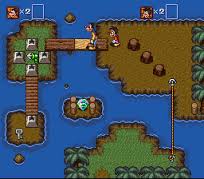
The game is definitely an odd duck amongst the other Disney Afternoon titles. Once again developed by Capcom, Goof Troop is an adventure game in which the player controls either Goofy or Max and simultaneous co-op is possible. I suppose it isn’t surprising that the game is unlike its sister titles since Goof Troop, being more of a sitcom than most cartoons, doesn’t have a natural ability to become a video game. In this one, Goofy and Max somehow end up ship-wrecked on an island and need to find a way off of it. It’s basically a survival game, and the player controls one of the two Goofs from a top-down perspective similar to The Legend of Zelda. Goofy and Max can hold a maximum of two items at a time, and the player has to constantly find and drop items in order to progress. The game is more puzzle-like than the others, and since Goofy and Max can’t directly damage the enemies they encounter you’re almost encouraged to avoid conflict.
images-233

Co-op is the preferred way to tackle this one.

The game was developed by Shinji Mikami, who was basically the mind behind Resident Evil. Yes, Resident Evil owes something to Goof Troop and it’s rather remarkable to see how some of the survival elements from that series were first born in Goof Troop. Even right down to how awkward it is to control Goofy and Max and how frustrating it can be to avoid enemies. The game feels like it’s designed for two players as opposed to one as some rooms are really hard to clear without the aid of a second player. The other player can help act as a lure for enemies allowing player one to activate a switch, move a block, or trigger something else on the screen. In two player mode, Goofy and Max can only hold one item each, but it’s an easy trade-off to make in order to gain an ally. Playing solo, I had a hell of a time trying to clear one room where the enemies could kick blocks, blocks that I needed to kick into a certain spot to pass the room. The problem was getting to the enemies and taking them out before they could kick one into a spot where I couldn’t make any use of it, forcing me to leave the screen and re-enter, also re-spawning the enemies.

Goof Troop is an interesting game, and played through the lens of knowing it’s a pseudo Resident Evil predecessor certainly adds to it. As a change of pace from the other Capcom developed Disney Afternoon games, it’s acceptable, but I found it a bit too frustrating to really want to come back to it again and again. Given the license though, this is probably the best Capcom could have done short of just making a platformer that made little thematic sense.
250px-Gargoyles_game_coverGargoyles (Genesis 1995)

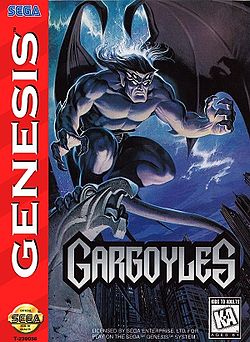
Lastly, we have Gargoyles, our only featured game to only be released on the Genesis without a SNES counterpart and (gasp!) to not be developed by Capcom. This one was done by Buena Vista Interactive, and if you know anything about Disney you know that’s likely the name for an internal studio. At some point, someone high up at the company must have got the bright idea that they could make more money if they developed their own games rather than licensing them out to Capcom. Big mistake, as doing so ultimately lead to a severe reduction in quality for Disney based video games and Gargoyles is no exception.

Gargoyles is a series I’ve covered pretty extensively here. It was basically The Disney Afternoon’s answer to WB’s Batman which aired during Fox’s afternoon block of programming. Batman was a hit, so naturally others copied it and Gargoyles was perhaps the most blatant. Don’t confuse that with criticism, as Gargoyles was a pretty entertaining show and was able to develop its own identity during its run. And unlike say Goof Troop, it pretty obviously lent itself well to video games being an action-oriented show starring some pretty bad ass characters.

Gargoyles_Sega_Genesis_Disney_retro_16-Bit_action_license_cartridge_childhood-1

At least it looks pretty good.

The game stars Goliath and is essentially another platform-styled action game with some exploration elements. It’s sort of like DuckTales on steroids and with an overt gothic theme. The game starts off in the past with the fall of the castle and the gargoyles being turned to stone before taking the player to the present timeline. All of the main baddies from the show make an appearance, and Goliath handles like Goliath should possessing powerful strikes, a running attack, and the ability to climb walls and double-jump with his wings.

Visually, the game is probably the best out of any Disney Afternoon title and is one of the better looking Genesis titles around. The music even sounds great and you could almost trick someone into believing it came from a Super Nintendo. Sadly, that’s where the positives mostly dry-up. While the music is great, the sound effects are horrendous with awful enemy death screams that sound like they were recorded through a tin can. Goliath is a chore to control as negotiating tight spaces is problematic and his ability to cling to walls is automatic, resulting in numerous occasions where he’ll grab a wall when you don’t want him to. The opening level is particularly frustrating as it features lots of tiny spaces and towers to ascend. Enemies will routinely strike from offscreen and finding enough room to get a running start to smash through a wall can also be harder than it should be. Goliath should feel like a powerful beast, but he’s too easily felled by the humans who serve as foes. The rotten icing on the cake is spotty collision detection when attacking enemies, making their defeat feel wholly unsatisfying.

Gargoyles3

There are plenty of familiar faces from the show.

Gargoyles is one of those games that I want to like, but it just makes it too hard to do so. It’s a great license that should have lead to a great, or at least passable, game and it looks awesome. Unfortunately, it just isn’t remotely fun and I’m sure lots of people were conned into buying, or renting, this one based on the track-record of Disney Afternoon titles and because the screenshots looked promising. The game ended up being released only in North America, and there was a Super Nintendo port planned but it was scrapped, either due to poor sales of the Genesis version or because the 16-bit era was essentially over. Stay away, stay far away.
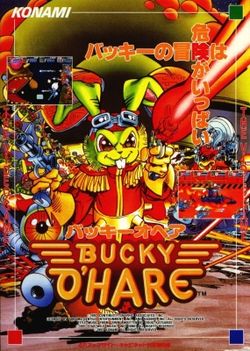
Bucky O’Hare – The Arcade Game

250px-Bucky_O'Hare_arcade_poster

Bucky O’Hare (1992)

One of the underplayed downsides to the death of the arcade in America is the amount of arcade games that remained solely in the arcade realm. Arcade technology was always ahead of what was available in-home. Arcade cabinets were also often equipped with 4 or 6 player possibilities while virtually every home console in the 80s and 90s could only natively handle 2 players. Sometimes, companies would release two distinct games for the arcade and the home console. While gamers were enjoying co-op play with X-Men at the arcade the home console gamer was forced to experience Marvel’s most famous mutant team via a hideous top-down shooter/action game with horrendous technical issues. X-Men was a popular enough arcade game that it would eventually be released digitally about 20 years after it first hit arcades. It took awhile, but it made it. Other games were not so lucky, and one of them is Bucky O’Hare.

Bucky O’Hare has been a topic more than once here as I take a small sense of pride in being one of the small areas of the internet where Bucky can still exist. Bucky originated in the comics, and when the Teenage Mutant Ninja Turtles exploded he was one of the main beneficiaries. Suddenly, toy companies and television studios were scooping up licenses for any kind of anthropomorphic action series that could be tossed in front of children to make piles of money. These properties were often fast-tracked to the consumer as everyone assumed the TMNT were just some fad that would die a quick death. This meant television shows, toys, and even games were all put into development at around the same time and Bucky O’Hare got the full treatment. So even though the cartoon series would only last 13 episodes and see a quiet cancellation, the aspects of the license that took the longest to develop would still see release after the fall of the show.

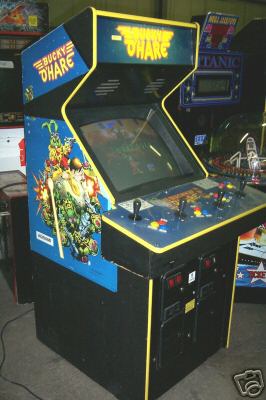
arcade1

Good luck finding one of these.

Most people into retro-gaming or who had a Nintendo Entertainment System back in the day are familiar with Konami’s Bucky O’Hare for the NES; the Mega Man clone of surprising depth and skill. It’s become a bit of a cult hit these days and copies of the NES cart fetch a pretty decent price on the after-market. Lesser known, is Konami’s Bucky O’Hare game for the arcade, also simply titled Bucky O’Hare.

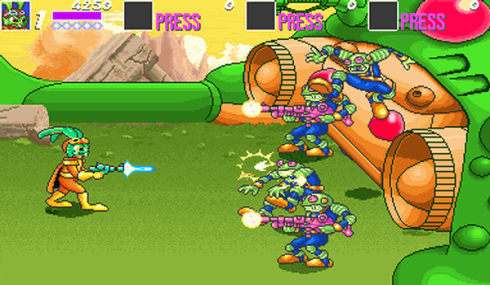
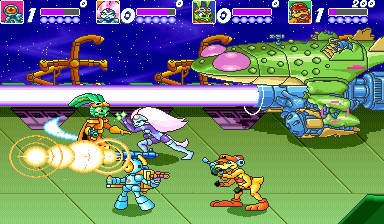
Like most of Konami’s  arcade games for licensed properties, Bucky O’Hare is a 4-player beat-em-up where the player takes on wave after wave of enemies before reaching the game’s conclusion. And like most games of this style, it sometimes feels like it was designed first and foremost to eat quarters and force gamers to spend a decent chunk of change in order to see the game to its conclusion. Where Bucky O’Hare differentiates itself from Konami’s other brawlers is in that the primary attack for each character is a projectile. All four characters; Bucky, Jenny, Deadeye, and Blinky – all possess a handgun to shoot at the bad guys with. This naturally allows the player to maintain some distance between them and the enemy which actually seems to result in fewer deaths when compared with X-Men or Turtles in Time. Each character also possesses a special attack, referred to as a gimmick weapon, that can be activated at any time and surprisingly doesn’t cost any health to activate. There’s also bomb attacks available and they’re pretty abundant and clear the screen of enemies or deal a significant chunk of damage to a boss, which feels really generous for a game of this genre.

buckyohare-11

The game is enjoyable with one of two players, but these ones are always best with four.

The game also further distinguishes itself in style. The previously mentioned gimmick weapons though are sadly the only thing that really differentiates the characters. Of the four, I found Deadeye to be the most useful (though you would think a four-armed duck would possess more than one pistol) as his weapon is basically a temporary shield that orbits around him until it hits something. Jenny’s is a homing attack that’s also useful, though her attack animation is a liability. Bucky just tosses a bomb forward, and Blinky has a flame-thrower. Most of the levels move from left to right, but there’s variety from stage to stage. Some levels have the characters moving at an angle towards the screen (think the second stage from the first TMNT arcade game) and there’s a stage where you’re falling and another where the characters are all riding Toad Croakers that can even stomp on the enemies. Brawlers can get quite stale by design, and Bucky O’Hare does as good a job as any in keeping things as fresh as possible for the game’s duration (of roughly 45 minutes).

bucky6

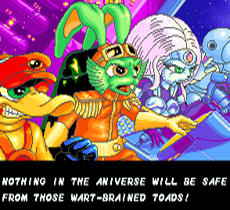
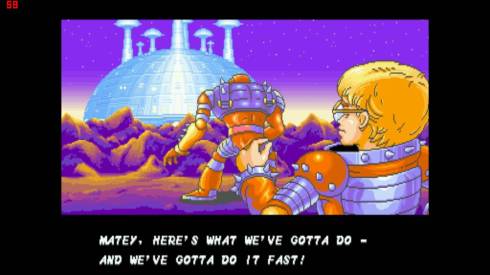
Minimally animated, but fully voiced, cut scenes help to move the story along.

Perhaps surprisingly, the production values on Bucky O’Hare are quite high. It’s very bright and visually appealing with all of the characters looking like the source material. Bucky is the only one that looks a bit off to me, and Blinky is definitely too tall, but for the most part the characters and animations look great. The enemies are especially striking, though the variety is not great as you’ll mostly spend the game fighting Toad Storm Troopers and these little robots. The boss characters look awesome though and they’re mostly taken straight from the cartoon series. Toadborg is appropriately menacing looking and the final battle is against a Komplex-to-Go contraption that even looks like it’s suffered some damage since its encounter against Bucky in episode 13 of the series.

bucky-ohare

You’ll be killing lots of Toad Storm Troopers in this one.

Which brings me to the aspect some Bucky fans seem to appreciate most is that this game seems to take place after the cartoon ended and serves as a nice book-end to the series. You take the fight straight to the Toad homeworld and vanquish Komplex seemingly forever. Konami made liberal use of the voice talent from the show and only a couple of voices are off (Blinky most notably being voiced by Scott McNeil). Even characters who aren’t playable still make voiced appearances like Willy and Bruiser. And if you’re into the comic, the omniscient mouse race that never made it into the series shows up in this game and it really feels like someone at Konami really cared about the representing the license as best as possible. It’s pretty cool considering they must have known already that this was to be the last major release for the license and that no season two was coming for the animated series.

maxresdefault-8

Willy and Bruiser even get to cameo in some cut scenes.

Bucky O’Hare for the arcade is a satisfying experience, especially so for fans of the license. It possesses some of the short-comings inherent with the genre, and I do wish a character like Bruiser or Dogstar was playable as neither was in the NES game, but this is a fun title worth tracking down. Of course, being that it’s been over 25 years since the game’s release, it’s unlikely you’ll be able to find a cabinet in the wild and it’s even rare to see them come up for sale on eBay. There are other means available to you, if you want to seek them out, and I’ll let you research that on your own should you wish to play it. Sadly, licensed games like these rarely receive a digital release in this day and age, but maybe this very mild Bucky comeback in 2017 could lead to a digital release of this game and the NES game, though I certainly wouldn’t hold my breath for either.


Danzig – Black Laden Crown

Cover_of_Black_Laden_Crown_(2017)_by_Danzig

Danzig – Black Laden Crown (2017)

Anytime something new related to Danzig arrives at my doorstep I wonder if this it’s the last. Glenn Danzig, the venerable punk-metal icon, is in his sixties. He’s released around two-dozen records at this point and has already reached the point in his career where he forgoes touring in favor of festivals and gigs located close to his SoCal home. The gap in years has only widened between album releases, and he’s taken time to do more passion projects like a covers record and compilations. Danzig’s last studio album, Deth Red Sabaoth, came out in 2010. Before that was 2004’s Circle of Snakes. Now in 2017, we have the latest from metal’s favorite crooner:  Black Laden Crown.

By pretty much everyone’s standards, Danzig the band has long since past its peak. Some feel the band peaked with 1992’s How the Gods Kill, others (myself included) would consider 1994’s Danzig: 4P as the real high point. Following that album was when the original lineup was disbanded, Danzig left the Def American label, and the direction of the band was forever changed. That was really the end for the band as a popular one, with nostalgia really only bringing the band back into the spotlight (a trend many bands of the 80s and 90s have benefitted from). Creatively though, Danzig has still made worthwhile music, even if it wasn’t always on par with the early days. Deth Red Sabaoth was probably the band’s best effort since 1994 with the only black marks on it being the subpar production (a frequent bane of recent Danzig releases) and the lack of a truly standout track. It would have been a fine album to go out on, but thankfully Danzig decided there was at least one more record left to make.

images-232

Back for the first time since 2002’s Danzig 7 is drummer Joey Castillo (center).

In many ways, Black Laden Crown is similar to Deth Red Sabaoth. The personel involved is largely the same, only this time with more drummers. Tommy Victor is back on guitar, and Glenn Danzig naturally is providing all of the vocals and doing all of the song writing, while also contributing on guitar, bass, piano and drums himself. Johnny Kelly returns to drum on two tracks, while former Danzig drummer Joey Castillo (Danzig 5, 6, and 7) also returned for a guest-spot on a couple of tracks. Karl Rokfist and Dick Verbeuren also contribute drums on a track each. Why so many drummers? Because the album has been in production off and on for years and Danzig would just grab whoever was available when in the studio. This means longtime collaborator Steve Zing is still basically just the live bass player as he is once again denied an album credit.

DZpress

Two things Glenn Danzig loves being photographed with:  porn stars and goat heads.

I’m going to detour away from the music for a minute and take a look at another aspect of Danzig albums that is also past its prime:  the album art. For whatever reason, the album artwork has been on a decline as well since the Def American days, though not always as drastic. I was mostly fine with the artwork for Danzig 5 and 6, the alternative cover for 5 is actually pretty awesome, but Black Laden Crown features some really cheesy artwork (done by the usually excellent Simon Bisley). The reverse cover image of a flaming Danzig head is even worse. There’s a t-shirt bundle being sold on the Nuclear Blast website and the shirt has a different version of the cover artwork (which is also featured on the interior slip-case for the CD) that is light-years better than the actual album cover. It’s sort of similar to the last album where the European version of the single featured superior artwork than the album. It’s not a big deal and it obviously doesn’t have any impact on the actual quality of the music, but as someone who still buys LPs it’s always a drag when the jacket has crappy artwork on it.

Black Laden Crown is best described as an album of mid-tempo, Sabbath influenced, metal. The opening track is a red herring of sorts, featuring a clean-tuned guitar and an uptempo second half, but it also embodies some of the flaws the rest of the album is going to face. And it should be discussed early in this review because there is no getting around it:  the production sucks. Perhaps sucks is too strong a word, but if you were disappointed with the production on Deth Red Sabaoth or the more recent covers record Skeletons, then you’ll be disappointed with Black Laden Crown. What is really unfortunate is that most of the poor production rests on the vocals. As the vocalist for the band, it’s surprising that producer Glenn Danzig doesn’t devote more resources to how his actual voice sounds. Time has obviously altered Danzig’s voice as it would anybody, but some of the songs sound like he just did a one take tracking spot, and decided to use that for the final mix. The lead single, “Devil on Hwy 9,” is especially bad with the vocals sounding dry and wooden. The production on the guitar and drums at least seems noticeably better than what was present on Deth Red Sabaoth. I haven’t seen Danzig discuss how this record was recorded, but the previous one was done with analog. Given that this one was done across so many different recording sessions, it wouldn’t surprise me to find out if it was done digitally since that method is more prevalent and easier.

images-231

If you like buying your albums multiple times, Danzig’s got you covered with all of the editions of this one.

The other main issue I take with the performance of the record is with Danzig’s vocals. The production may not be doing him any favors, but several songs just lack emotion out of the singer. “Eyes Ripping Fire” should be a track that rips, but Danzig sounds like he’s just going through the motions. I’m not sure what he was going for with his performance at times, but he just sounds bored in places. Maybe he thinks his voice isn’t suited for certain styles any longer, though I think it has more to do with a mood he was trying to convey. He may have been looking for a controlled, assertive style to his vocals, but it just comes across as uninspired.

Those are the negative take-aways I have with Black Laden Crown, but in spite of those I actually think the whole of the album is actually pretty good. The vocal production is consistently subpar, but not as varied as the past albums where some songs sounded okay and others like rubbish. I really dig the Tony Iommi-like guitar tones on this record and its a sound I’ve always found more suitable for Danzig than the drop-C tuning featured on some records. There are still some chugging low riffs to be found, but they’re not as prevalent and the album has a more crisp sound. Tommy Victor is perhaps at his best with this record, at least as well as he’s been on a Danzig release. He’s given room to work with the leads, and even gets a few chances to drop a solo. The pinch harmonics that some fans found distasteful on the last album have been scaled back tremendously here.

C-d2-WTUMAATC5q

I wish they had used the artwork present on this t-shirt as the main cover artwork on the actual LP.

Black Laden Crown is at its best when the band is moving at a methodical pace and letting Glenn Danzig’s presence shine. It’s perhaps no better illustrated than with the album’s second single (and first to receive a video) “Last Ride.” The song evokes a drifter, or maybe even an old cowboy, something very Eastwood-like, with its story and the mood is very Danzig. It’s perhaps comparable to the song “Black Hell” from The Hangover II soundtrack, but more refined and focused. The album’s closer, “Pull the Sun,” is another good track and is probably the high point for Danzig’s vocals on this release. It’s not one of the closing numbers where Danzig goes off with a series of wails, but it’s got a nice vocal melody. The lyrics though make me think of Mr. Burns blotting out the sun on The Simpsons, which gives me a little laugh.

If there’s one last piece of criticism I could lay at the feet of this record it’s that it is perhaps one track short. At nine tracks and just over 45 minutes in length, it could have really used one more track to round things out. And if that track had been something more up-tempo that would have helped to break up some very similar sounding songs on the album’s back-end. The most up-tempo track is also the album’s worst, “Devil on Hwy 9,” so another really would have helped out. Even still, I’m digging this album. Perhaps part of that is due to my low expectations going in. An album that has been in the works as long as this one has usually doesn’t come out too well in the end, but I think the album took so long to record not because Danzig was tinkering with the material, he just literally only recorded a song or two here and there until he eventually had enough material for an LP. It’s very comparable to Deth Red Sabaoth in terms of quality, and if it’s the last album for Danzig it’s not a bad way to wrap things up. I’m not sure if it’s better than that record though. At first listen I thought it might be, but then I remember the variety of Deth Red with tracks like “Hammer of the Gods,” “Deth Red Moon,” and even “Black Candy” and I start to think this one may end up ranking behind that release. Which isn’t bad, as I dubbed Deth Red Sabaoth Danzig’s best since splitting with Rick Rubin, so if Black Laden Crown is comparable to that record, then that’s pretty good company to keep.


Top Tracks

  • Black Laden Crown
  • Last Ride
  • Pull the Sun

DuckTales: Remastered

DuckTales_Remastered

DuckTales: Remastered (2013)

If you read yesterday’s post about DuckTales for the NES, you may have thought, “Wow, I’m surprised he didn’t mention anything about the re-make that came out in 2013.” Well, that’s because I was saving it for its own post! DuckTales: Remastered is a complete remake of the original NES game for Playstation 3, Xbox 360, and Nintendo Wii U. Initially a digital only release, DuckTales: Remastered would receive a tangible release as well, and for a game the started as a budget-friendly digital title, I can think of few others that received as much attention and fanfare as DuckTales: Remastered.

Capcom debuted the game at E3 with a memorable video hyping it up before indulging the audience in a sing-along of the memorable theme song from the show. The release of the game coincided with the 25th anniversary of the NES original, and it was a worthy title to revisit based on the fact that the original is still a ton of fun to play. Naturally, remaking a game many consider to be a classic is a tall task, but with such simple play mechanics, how could Capcom go wrong?

cd86dd950cf61320f768d1708052b37beaf5f292-498501

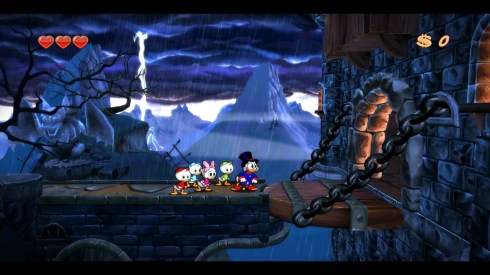
Transylvania got a lot scarier over the last 25 years.

DuckTales the game is largely unchanged at its core. The player still controls Scrooge who jumps and pogos his way through various levels (now six) in an effort to accumulate more wealth for himself and eventually to recover his lucky dime. What is changed are the production values. Modern game consoles can obviously handle quite a bit more, and this being tied to a Disney property, means a remake needs to meet the expectations and standards of The Walt Disney Company.

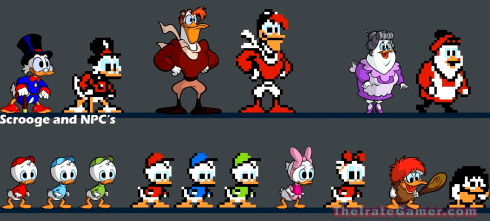
ducktales-remastered-npc-character-roster-wubba-duck1

A comparison of the sprites from the NES original and the Remastered version.

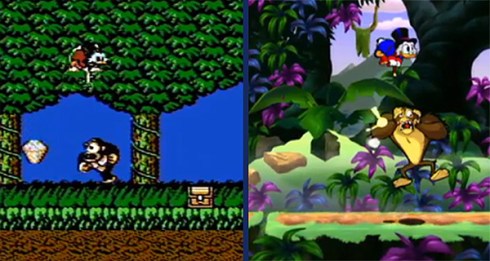
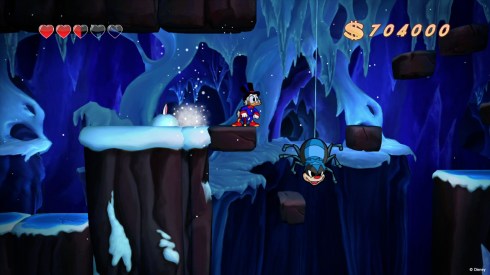
For the first time ever, a Disney Afternoon property can now basically look just like it does in game form as it did on television. The game is still a 2D side-scroller, but now the sprites for the characters are lovingly hand-drawn in great detail in bright, expressive colors. Scrooge will mostly sport a happy expression, but when he encounters the Beagle Boys or Magicka DeSpell he’ll scrunch his face up into a frown. The enemies too feature changing facial expressions, and not just the boss characters, but even lowly spiders and the like. The levels really come to life as the difference in climate is really accentuated by the enhanced presentation. All in all, DuckTales: Remastered is a beautiful game to behold and one of my very favorites from a visual point of view.

DuckTalesSideBySide

Another comparison shot to the original.

The enhanced fidelity of the game’s graphics are not the only aspect of the presentation to be enhanced with better technology. The audio is also greatly expanded upon featuring full-voiced characters with actors from the show as well as remastered music. Alan Young, in what is basically his swan-song as Scrooge, does a great job of voicing the greedy old duck and shows that time hasn’t taken much away from his vocal chords. Russi Taylor is on-hand to reprise her role as the nephews, Huey, Duey, and Louie, while  Terry McGovern returns as Launchpad. The wonderful June Foray was even brought back to voice Magicka DeSpell, making this a reunion of sorts for the cast. This seems all the more special since the new version of the cartoon set to launch this summer will feature an all new cast for these characters.

577660

I love how cold this cavern looks.

The downside to all of these resources is the need to make liberal use of them. DuckTales for the NES was a quick and fun to play title that would have worked even without the DuckTales license. For Remastered, a lot of cut scenes and cinematics were tacked onto the experience, not just in between levels, but even during them. They can be skipped, but even so they really break up the experience of playing the game and not in a welcomed way. Worse, I feel kind of guilty skipping over any line from Young and the other cast-mates, but it can get old hearing the same lines over and over if you’re forced to retry a stage. The game has also been lengthened quite a bit, not just with these scenes, but with a new level and longer boss encounters. Some of the boss fights are fine in their new form, while others do drag. I particularly hated the very final encounter with Magicka and Glomgold. What was a pretty simple race to the top of a rope in the first game, is now a death-defying escape from an active volcano with questionable hit detection. I had to replay the final, added level (which aside from the ending was quite good) repeatedly because I kept dying on this final part. Once I finally beat it I was too aggravated to enjoy it.

DuckTales CapCom Gold

And you thought only Zelda came in gold carts.

The game also adds additional collectibles that can be unlocked as you play, giving you something to do with all of the money Scrooge accumulates throughout the game. It’s mostly limited to concept art and background stills from the game but it’s still fun to look at, though not really enticing enough to encourage repeated play-throughs. I wish Capcom had gone the extra mile and included an unlockable version of the original game or its much rarer sequel. There was a press kit sent out to select individuals that included an actual copy of the original NES game, painted gold, and with the Remastered artwork on the cart. Acquiring one of those on the after-market will set you back a few grand, though it is a pretty neat collectible (and one that probably really irritated those select few that had a complete library of NES games in 2013).

Ultimately, DuckTales: Remastered is a fine enough love letter to the original game. It looks and sounds great, though it’s not quite as much fun to play as the original (though Scrooge’s pogo is still just as satisfying as it was back then) due to the pacing issues. It’s an odd duck (pun intended) in that regard, as most objective onlookers would take one look at both and immediately decide they’d rather play the remake. If you enjoyed the original, Remastered is still worth your time as it’s pretty cheap to acquire and includes enough fan-service to make you smile. And at the end of the day, it’s still DuckTales and still inherently fun, even if it could have been more.


DuckTales (1989)

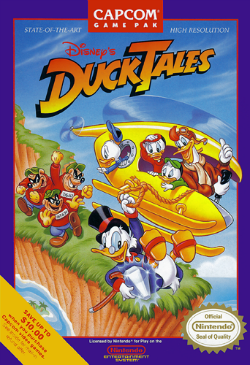
DuckTales_NES_Cover

DuckTales (1989)

Licensed games are trash, or at least, that was the lesson the video rental store taught me as a child. Renting a video game on a Friday night was a special occasion in my house. Maybe a friend was sleeping over, or my parents wanted to rent a movie they didn’t really want me watching, so they got a video game to keep me occupied. The only thing that could ruin the evening, or rather the weekend, was renting a bad game so early on I learned what games to avoid. Usually, those games featured a licensed tie-in:  Roadrunner, Roger Rabbit, Dick Tracy, X-Men – all terrible games with attractive box art.

One consistent exception to that rule were the Disney games, especially the ones centered around the Disney Afternoon programming block. Recently released in a bundle for modern consoles (though sadly no portable devices), The Disney Afternoon Collection is a reminder of just how much better these games were than the usual licensed junk. Developed by Capcom, these were real games meant to entertain with their play mechanics. The games didn’t need the license, the license needed the games. And the cream of the crop was DuckTales, released on the Nintendo Entertainment System in 1989.

DuckTales was not the first of the Disney Afternoon cartoons, but it soon became the flagship series for the block. Featuring a great cast, stories adapted from the renowned works of Carl Barks, and the best animation on television by a mile, DuckTales was an easy hit and it’s a cartoon that holds up remarkably well today. It’s adventure themes are easily adaptable for a video game, so in some ways it should come as no surprise that the game matches, even exceeds, the quality of the program.

dt1

In DuckTales, Scrooge’s adventures take him beyond Earth.

DuckTales is a pretty traditional game for its era. The player controls Scrooge, notably decked-out in his comic attire red coat instead of the blue from the show, who can run and jump his way through five stages collecting treasure as he attempts to recapture his lucky dime from the villainous Magica DeSpell and Flintheart Glomgold. Scrooge handles like a standard character from the era, with the notable distinction that he can’t simply stomp on the heads of his foes to defeat them. Instead he must utilize his cane. When standing next to certain objects, he can swing it like a golf club to knock objects into enemies or objects. Mostly though, he needs his cane to function like a pogo stick. Bouncing off the head of an enemy utilizing his cane in such a fashion is Scrooge’s primary method of dealing damage. It also helps to give his jump an extra boost allowing him to clear wide chasms or reach higher platforms.

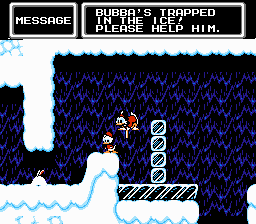
DuckTales1-24

I think every side-scroller was required to have an ice stage.

It’s the pogo quality of Scrooge’s cane that lies at the heart of what makes DuckTales so much fun, even today. Also playing a role are the large, open, levels. There may only be five of them, but they’re much larger than your garden-variety Mario or Mega Man stage. Scrooge can roam around them in basically any direction, and all are loaded with secret chests and treasures for Scrooge to find. Amassing a fortune is part of the game, and the amount of cash a player finishes the game with affects the ending cinematic, a rarity for 1989. Scattered through-out the levels are also other characters from the show, including Scrooge’s nephews and Launchpad, who are able to help out in small ways.

The visuals and sound of DuckTales are also areas where the game performs well. Naturally, the game makes liberal use of a digitized sample of the DuckTales theme, though I never found myself tiring of it. The sound effects are pretty standard for Capcom games of the era and are probably more enjoyable today with the aid of nostalgia. The graphics, while good for the time, are probably just a little above average for the NES. Some of the enemy sprites and character models are quite fun and expressive, though the bosses sometimes leave something to be desired.

DuckTales_NES_Scrooge_with_Launchpad

Launchpad isn’t totally useless, but he also could be more helpful here.

Games for the NES are sometimes considered quite difficult by today’s standards, but DuckTales is a fairly forgiving title in this regard. While it lacks a password or continue system, the adjustable difficulty makes it pretty easy to taylor the game to one’s skill level without making it embarrassingly easy. Changing the difficulty largely affects how much damage Scrooge receives from enemies, which is a simple and fair way to measure difficulty. The game doesn’t throw anything odd at the player, or introduce a foreign play mechanic at any point (unlike say Battletoads which just throws a racing level at the player out of no where), and anyone who has played a decent amount of 8-bit platformers can probably find a way to finish the game. It’s not a long game, though the desire to find all of the hidden treasures and achieve the best ending help provide incentive to play the game again and again.

Mostly, DuckTales is a really fun action-adventure game for the NES. It’s the type of game I can play today and hope that younger generations are able to see what made the game so much fun in 1989. As I mentioned early in the post, DuckTales was recently re-released as part of a bundle of Disney Afternoon titles so you don’t need to have a working NES on-hand to play it, though that’s currently how I enjoy it. And this is a game still worth playing, even after all these years.


The Final Word on the NES Classic

nes_classic_retro_blast_splashIf you read this blog even semi-regularly, you’ve probably seen me talk about the NES Classic already. When it came out I ranked the 30 games bundled with the device and also speculated on what could be included on a likely SNES Classic. What I didn’t do was actually come out and review the device. I figured I had nothing left to add to the general opinions that already existed across the internet. Which is to say, the NES Classic Edition is a fun little device, but it’s hampered by short controller cables and not every one of those games is really worth owning in 2016. Since then, the NES Classic became the hot holiday item and was also probably the hardest to come by. Nintendo evidently didn’t anticipate how popular it would be, as it couldn’t meet demand though it assured consumers more were on the way. Now we’re in April 2017, and the NES Classic has been discontinued.

If you were one of those individuals who got a NES Classic then you’re probably feeling pretty fortunate right now. It was never in stock to the point where you could walk into a store and take one-off the shelf. I suspect those who didn’t get one during the holiday rush probably expected them to eventually be in stock in reasonable numbers, just like Nintendo devices from years past. And while the fervor died down a bit following Christmas, consumers still needed to be vigilant in order to get one.

If you’re still pondering getting a NES Classic you’re probably down to third-party sellers as your only option. As of April 27th, the Nintendo store in NYC has stopped selling them and most big box retailers have either unloaded all of their stock or will do so this weekend. Online, no one has had stock since early April except Amazon’s Prime Now delivery service which has had flash sales sporadically and appears to be done as of this writing. And people selling Classics on Amazon or eBay know full well that the item is still highly sought after and essentially unavailable at retail and the prices reflect that. If you were lucky enough to encounter a Classic in the wild, you were likely charged 60 bucks to purchase the console which came bundled with one controller, a micro USB cable, wall adapter, and HDMI cable. A few places up-charged, and Gamestop offered mostly bundles full of other stuff no one wanted, but for the most part retailers stayed at the MSRP. During the lead-up to Christmas, prices climbed high enough to more than quadruple the MSRP with some even fetching around $300. After the holidays, the prices came down to the $120-$150 range, which was still a lot considering the MSRP, but perhaps not prohibitive. Now they’re back up to $300 and higher and who knows where they’ll settle at as they become more and more scarce.

nes_classic_sigh_01

The NES Classic! Available at all of these places! Maybe!

At $60, purchasing the NES Classic wasn’t much of a dilemma. At that price point it could be considered a novelty. Had it actually managed to be well stocked it probably would have been a popular impulse buy. At the prices they’re going for now though, it becomes a much tougher proposition. I was fortunate enough to purchase two NES Classics. When the item was first announced, I got it in my head that it would make a great Christmas gift for my best friend, so I went to great lengths to acquire one eventually scoring one on Prime Now in a city that wasn’t my own. I had to pay extra to have the item shipped by UPS after having it delivered to one of its stores, but it was a small price to pay to secure a cool gift for my buddy. After Christmas, I happened to be at my computer at the right moment when Best Buy’s website put some up for sale and was able to get one for myself. I’ve had the NES Classic for months, so I feel well equipped to tell you what it’s worth.

To properly judge the NES Classic, you have to consider what it does well and what it doesn’t and why you want it. It contains 30 Nintendo games, about half of which are classics. Some of that lesser half is still playable, and some of it are titles you’ll likely play once and then never again. For sixty bucks, you’re getting each game for essentially $2, so it’s hard to get upset about Ice Climber when you also have Super Mario Bros. 3. None of these games are particularly rare, but you’d be hard pressed to find many for less than $2 if you were trying to get actual NES carts. This makes getting a lot of the best Nintendo games pretty convenient and pretty affordable. Of course, this ignores emulation piracy which I know a lot of people engage in. You don’t need me to tell you that you could probably download all of these games at no expense to you with probably minimal risk of actually running afoul of the law. Don’t confuse that statement as an advocation for illegal ROM downloading, it’s just an acknowledgement of reality. In other words, these games are all easy to come by and probably for really cheap. And if you were an early adopter of Nintendo’s 3DS handheld, you even received a bunch of these games for free from Nintendo itself.

What it all comes down to, you only have a few reasons to actually buy an NES Classic:

  1. The emulation is great and probably the best way to play these games. There’s no latency even when played on a modern television. You can play these games in crisp, bright, HD or opt for a filter that mimics a CRT television (my preferred mode). Nothing else I’m aware of does a better job, including Nintendo’s own Virtual Console service. Simply put, while these games are of limited value visually speaking, they’ve also never looked better and likely never will.
  2. The novelty of it all. And really, this is probably the big reason why people want this thing. It’s cute. It’s a tiny Nintendo Entertainment System that fits in your hand. It’s exactly the type of thing people get nostalgic over and want. Even people that know they won’t actually use this thing much still want it because it looks cool.
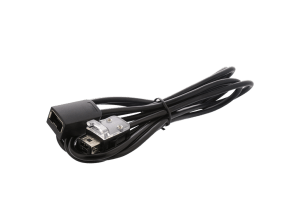
Extend_Link_1024x1024

If you actually get one, you probably should also get some controller extension cables. They’re practically mandatory.

There’s also a third reason, though it ties into number 2, and that’s this thing has no protection built-in really what-so-ever. It’s a popular item for modders to hack, and its storage capacity is vast enough that some claim it could store the entirety of the N64 library on it. For those who are really into emulation, it’s kind of the ultimate device because it’s an official Nintendo product capable of playing every single NES game in glorious HD with save states to boot. Considering most that are into emulation do so because they just want to play the games cheaply and easily, they’re probably no longer willing to pay hundreds of dollars to get a novelty box for their illegal games. Especially when you consider that if you mess up the ROM dump you can brick your tiny NES and that just doesn’t seem like a risk worth taking considering what they’re worth.

The decision to purchase or not purchase the NES Classic isn’t that complicated: you either really value silly little niche products or you don’t. If you have a ton of money at your disposal, then have at it, but if you just thought it would be fun to play these games again on a novelty device then passing on it at quadruple the retail price should be pretty easy. That said, if prices come down over the coming months then I could foresee a price range that would have made me comfortable that exceeded retail. At $100 to $120, I could probably talk myself into buying this thing all over again (if I for some reason wanted two of them), but I’d probably stop at around $150. If you really want to play a game or games that are included with the NES Classic, it’s just too easy to go elsewhere for a similar experience.

61YnQdeQnHL

What’s harder to get than the NES Classic? The extra controllers. If you have some old NES controllers hanging around, these work great, plus you can take advanage of the original’s  longer cord!

This whole post also assumes that the NES Classic has truly been discontinued. It makes little sense for Nintendo to cancel the thing. It costs them very little to produce, it likely has little or no impact on Switch production, and Nintendo probably isn’t selling tons of copies of these games via its Virtual Console platform. It’s possible Nintendo just wanted to make a quick buck, but was afraid of cannibalizing its virtual shop. It’s also possible the NES Classic was a bare-bones test run of a dedicated Virtual Console set-top box. Perhaps Nintendo will just release a new version later this year that is capable of adding software and likely would be harder for modders to crack, as it would seem the ease of doing so with the current NES Classic was a big factor in its cancellation. At least, that’s the only thing that makes sense. A rumored SNES Classic is on the way, so hopefully the scarcity of the NES Classic wasn’t intentional and the SNES Classic arrives in far greater numbers. If I can’t pre-order it I’ll probably lose my mind, or I’ll likely just end up outside a gaming store hours before it opens to get what I want silently cursing Nintendo the whole time.


From Up on Poppy Hill

Kokurikozaka_kara_film_poster

From Up on Poppy Hill (2011)

I don’t envy those who have chosen to follow in the footsteps of successful parents in the same field. Apparently, neither does Gorō Miyazaki who was long said to be reluctant to follow his parents, and specifically his legendary director of a father, into the world of animation. So against the notion was Miyazaki that he went to school for agriculture and took up landscaping for many years. It wasn’t until he was 39 that he made his directorial debut with the Studio Ghibli film Tales From Earthsea. It is said he worked his way into the role of director, first starting off as a storyboard artist which impressed his bosses enough to promote him to director. This was said to have gone against the wishes of his father, Hayao Miyazaki, who felt the younger Miyazaki wasn’t ready. As a result, the two did not collaborate at all on the film, though the father gave the film a positive endorsement upon release.

The film community was less kind to Tales From Earthsea. Commercially it was a success, and there were some positive reviews for it initially, but since it has come to be viewed as probably the worst film released by Studio Ghibli. It’s the only one with a negative rating on aggregate review websites, and it would not have been surprising to see Gorō Miyazaki return to a lesser role. He did not though, and returned in 2011 with a new film; From Up on Poppy Hill. Unlike with his first film, From Up on Poppy Hill was a collaboration with father Hayao Miyazaki, whom together with Keiko Niwa, wrote the screenplay for the feature. As a result, it feels very much like a Hayao Miyazaki work as it features a hard-working female protagonist trying to make sense of adolescence on her path towards adulthood.

from-up-on-poppy-hill-umi-and-shun

Umi and Shun’s first encounter leaves Umi feeling embarrassed and angry.

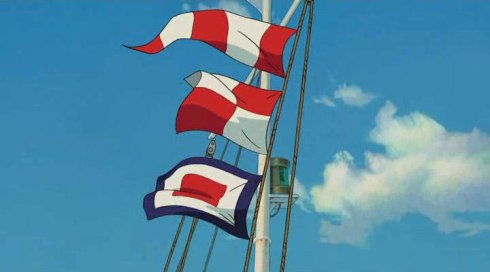
Umi Matsuzaki is a sixteen year old high school student who lives at, and more or less runs, her grandmother’s boarding house. She is the eldest of three girls and takes on a maternal role to her younger sisters while their mother is away in the United States studying abroad. Her father was the captain of a trade ship that was sunk during the Korean War. Every morning since she was a little girl, Umi has risen early to raise signal flags wishing safe passage for all sailors. It was a practice she undertook while her father was alive, and continues even past his death.

The film takes the viewer to a post-war Japan, where those wishing to usher the country into a new era are clashing with those who wish to preserve history. At the center of this is a clubhouse located at the high school. It’s an old, dilapidated, building that some would like to see bulldozed, but the students who use it view it as a haven for their various clubs that occupy it. One such club is the school newspaper, and within it a poem about Umi’s flags appears one morning. A chance encounter that day with the newspaper’s editor, Shun Kazama, initially sours Umi to the young man, but she soon finds herself wondering about the poem and if Shun was the author.

from-up-on-poppy-hill

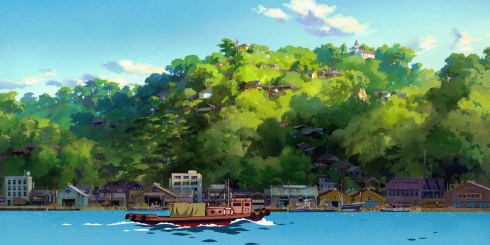
A tugboat proudly responds to Umi’s signal flags, leading to a poem appearing in the school newspaper.

The two end up striking up a fast friendship, due in part to Umi’s sister wanting to meet Shun following a daredevil stunt he performed at lunch the prior day. Umi was put-off by that same stunt, finding it reckless and foolish, but she comes to be drawn to Shun pretty easily. She agrees to help out with the paper, and things seem to be progressing the way a lot of young romances do, but soon something from Shun’s past pops up and things get complicated.

When the issue first surfaces, Shun becomes withdrawn from Umi and pays her only the bare minimum attention as she and her friends start helping out with the restoration of the clubhouse in an effort to change attitudes towards it. Umi is confused and hurt, not knowing what she did and interpreting Shun’s attitude towards her as being founded in anger. It’s a pretty relatable situation for anyone who went through high school and the awkward start to what seemed like a promising relationship. It’s a strength of so many Studio Ghibli pictures, the ability to authentically portray young adulthood, and they’re so well versed in doing it that it still translates across the ocean to a non Japanese audience.

screenshot_8_19669

The rundown old clubhouse is a character itself.

I don’t want to go into detail regarding Shun’s secret that he keeps from Umi as I don’t wish to spoil anything for those who have yet to see the film, though I’ll say it’s nothing nefarious or duplicitous. The silent treatment routine doesn’t last long, and the characters are forced to confront the new conflict, though just as quickly they’re ushered into a subplot about saving their old clubhouse. The clubhouse plot felt the most contrived of anything in the film, conjuring up memories of poorly executed teen dramas from the 80’s and 90’s where the characters seek to preserve a place of refuge for themselves. It’s not very compelling, but serves its purpose to force our two main characters into an awkward situation where they must work together and not let their personal lives disrupt their shared goal. The overarching conflict between the two is resolved in the end, and it was somewhat anti-climactic and not as rewarding as it probably could have been. It’s resolved in such a neat and tidy manner that I felt the issue wasn’t given its due. It could have been explored in greater detail, but perhaps those involved felt it couldn’t have been without straying into some weird, possibly taboo, places.

The resolution of the film may have been unsatisfying, but it didn’t ruin what came before it for me. The interactions between Umi and Shun are what drive the picture. We feel their quiet affection for each other as their relationship blossoms and we can cut the tension with a knife when things go wrong. They’re both strong, sympathetic, individuals and the film is able to say a lot with small, quiet, scenes. The supporting characters around them are only portrayed in the simplest of tones. We get some sense of the camaraderie that exists amongst the women staying at the boarding house, but we’re only given the bare minimum. Sometimes Ghibli movies are guilty of overstaying their welcome and upping the runtime needlessly, but this is the rare film in the studio’s catalog that probably could have benefitted from another twenty minutes or so (it’s listed runtime is 92 minutes).

01-Mm43ksS

Studio Ghibli’s scenic visuals have become routine, though no less breathtaking.

From Up on Poppy Hill is another Studio Ghibli production where the localization for english speaking audiences was not handled by Disney, but by GKIDS, who also handled other non-Hayao Miyazaki pictures like When Marnie Was There and The Tale of the Princess Kaguya. The GKIDS localizations tend to possess less star power than the Disney counterparts, but they’re of no less quality. I’m of the mind that voice acting and traditional acting in front of a camera are of limited relation; success with one does not guarantee success with the other. The cast assembled by GKIDS is talented and professional, and I very much enjoyed my viewing experience.

The soundtrack for the film is perhaps understated. Composed by Satoshi Takebe, it won’t be mistaken with the works of other Ghibli composers, but it’s not a fault of the picture. From Up on Poppy Hill is a grounded, quiet, story that does not need grandiose pieces of music to fill gaps between scenes. What’s here works, even if it’s not particularly memorable. The visuals in the film are of the same, superior, quality of other Ghibli works. The backgrounds are lush and vibrant and the characters expressive, even if a bit simple. My only complaint would be some awkward walking animations early in the picture, that were either absent from the rest of the film or just not picked up on by me as I became engrossed with what I was seeing.

I have some valid criticisms about From Up on Poppy Hill, but at the end of the day this is still a film I very much enjoyed. Studio Ghibli is simultaneously both masters of the fantastic and the mundane. This is one of the studio’s simpler pictures, and it’s a well done tale about two youths navigating the sea of young adulthood without resorting to corn or cliché. The conflict is legitimate, and not young adult camp, even if it’s resolved in perhaps a far too convenient manner. Perhaps it was a quiet, grounded, picture like this one needed to extract the talent present in Gorō Miyazaki, as opposed to the more fantastic Tales From Earthsea. The younger Miyazaki has not returned to the director’s chair since From Up on Poppy Hill for a Studio Ghibli feature, instead taking his talents to the small screen with Sanzoku no Musume Rōnya. Hopefully, he does get the opportunity to direct another feature as I very much look forward to what he does next.


My Neighbor Totoro

My_Neighbor_Totoro_-_Tonari_no_Totoro_(Movie_Poster)

My Neighbor Totoro (1988)

I am the father of an all most two year old boy who loves watching The Mickey Mouse Clubhouse on Disney Jr. I’m constantly trying to find new things for him to watch and get excited about just so I don’t have to watch more Mickey Mouse. And it’s not as if that show is particularly bad or anything, it’s just made for young kids and isn’t supposed to be stimulating for adult viewers. I’ve had some success getting him to watch Looney Tunes and even The Simpsons. He’ll rarely ask for either like he will with Mickey, but he’ll let me have them on the television with minimal fuss. The only show he really, actively, watches though is still Mickey, and that’s probably because of his enthusiasm for it and because the show is interactive with the characters constantly addressing the viewer. When he watches something like The Simpsons with me, it’s mostly in silence and he’ll occasionally point at an object in the show and tell me what it is.

For the first time in his short life, my son actively watched a movie. Often to get him to watch something non-Mickey, I’ll get it started on the TV before getting him up from his nap, which is what I did this past weekend with My Neighbor Totoro. I have been somewhat excitedly waiting for a time to introduce my son to this movie because it’s one I have a lot of affection for. A stuffed Totoro was even the first toy I ever bought for him before he was born. I’ve always been pretty certain that he would like Totoro, to a point, but I honestly felt like we were still a few years away from that day. To my surprise, I got him up from his nap and put him in our big recliner with a cup of juice without him even mentioning Mickey. He hadn’t been feeling well so I wasn’t sure what version of my son I would get, but he didn’t object to what was on the television and I went into the kitchen to finish up some dishes I had started before his nap ended. As I was busying myself, I could hear him laughing. I stopped and watched and he was smiling at the television. He would giggle when he was supposed to, he’d point to things on the screen, and bob his head to the music. What seems like a small, insignificant, moment is amazing through the eyes of a parent who is observing their child do something for the first time. He was engaging with a film, and it was beautiful. I chalk it up to the magic of Studio Ghibli and it’s extremely talented director and co-founder, Hayao Miyazaki.

images-230

No wonder why my kid liked this one, who wouldn’t want friends like these?

My Neighbor Totoro is a charming tale about two young girls, Satsuki and Mei. They have just recently moved to an old home in the countryside with their father while their mother is recovering from an illness at a nearby hospital. The precocious youngsters are intensely curious about their surroundings and new home and take to the country with intense optimism. This is a film devoid of any kind of cynicism. Satsuki is the older sister and helps out her dad around the house and also by looking after Mei, who I would guess is around 3 or 4. When Satsuki is in school and her father at work, a local old woman affectionately called Grannie looks after Mei.

images-229

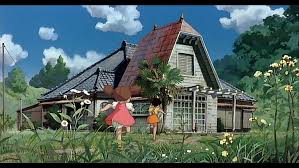
A little house in the country side.

Very early in the film the girls take-note of strange creatures in their new home. These soot spirits and their existence are not challenged by the adults in the story, and we see their father encourages his girls to think like children by doing so himself. The girls seem a little afraid at first, but their dad tells them laughter is the best cure for fear, and their laughter drives the little soot spirits away. When Satsuki is away at school though, Mei happens upon the dwellers of the forrest and the massive, cuddly, Totoro who resides there. When she tells her sister about the Totoro, Satsuki is skeptical, but once again their dad is encouraging and has the girls thank the forrest for allowing them to live with it. It’s hard not to imagine that Miyazaki, a noted environmentalist, didn’t see himself in the father character present here.

images-228

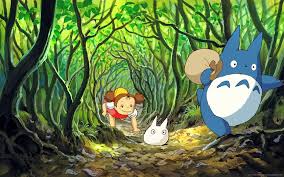
Mei in hot pursuit of two little forrest spirits.

The film follows the two girls closely and unfolds at a brisk pace. It’s an interesting tale in that there is very little conflict, danger, or suspense. There’s some implied with the film’s climax, but it’s never deceptive. My Neighbor Totoro takes your hand from the start to guide you through its story and we trust it implicitly. Perhaps more interesting, is that it all works so well. Someone who has never seen the picture would probably interpret my description of it as dull, but the film is so charming and positive that watching it is like a relaxing soak in a hot tub; it’s simple, obvious, but oh so good.

The art direction is wonderful, and the character designs for the forrest spirits are delightfully simple. Totoro and his little buddies are a bit rabbit-like in appearance, though cat-like in behavior. They’re cute, and it’s obvious why stuffed dolls of them exist in the first place. The Catbus, which appeared about halfway through the film, is pretty wild to take-in, but so much fun. It adds a little absurdity to the film that fits right in with the sometimes silly tone. That tone is mostly captured through Mei, who is perhaps the most authentic young person I’ve ever seen brought to life in an animated movie. Her movements, facial expressions, and behavior feel so spot-on and really add life to her character. I’m honestly a little sad whenever she’s absent from a scene, and it’s her character that lead to the biggest reactions from my own little guy as we watched.

images-227

Just two kids riding in a cat bus.

The forrest scenery is lush and dominated by shades of green. I love this countryside as presented here because there’s just so much nature. This is the kind of film that makes me think I’d be okay with a more relaxed lifestyle that isn’t so plugged-in. My copy of the film is on DVD, and Disney finally released a high definition version a couple of years ago, but I haven’t upgraded yet. The film is gorgeous, though I notice a little grain at times and I wonder if that would be present on the Blu Ray. Normally, I enjoy a little film grain and would prefer to watch a movie on actual film than digital, but this picture is so vibrant that I find myself longing for as clean and pristine an image as possible. The film’s score is done by Joe Hisaishi, and it’s effectively whimsical and beautifully composed. Hisaishi and Miyazaki have such an amazing ability to complement one another with music and picture and this rather simple score might be my favorite of the Ghibli movies. The closing title song is adorably sweet and poppy. It probably will appeal to children more than adults, but I find it undeniably charming.

myneighbortotoro1

Mei’s first encounter with Totoro.

This being a Walt Disney localized release, the english dub is of high quality and well done. Sisters Dakota and Elle Fanning play Satsuki and Mei. Tim Daly and Lea Solonga play the parents, and Hollywood’s go-to man for animal sounds, Frank Welker, plays Totoro. The cast is probably light on star power in comparison with other dubs of Ghibli films, but the actors are more than capable and make watching the english version of the film a real delight.

The film, at its heart, is also probably one that appeals more to children than adults, which makes it unique among Studio Ghibli films which don’t obviously focus on children the way Disney does. At least, my head tells me that My Neighbor Totoro is indeed a children’s movie, but I am so moved and delighted by it every time I view it that my heart has all but convinced me that this is a film anyone can enjoy and fall in love with. That doesn’t mean it’s a film for everybody, my own wife finds it criminally boring and weird, but it’s not a film confined by demographic. My Neighbor Totoro is a wonderfully charming story beautifully accented by gorgeous visuals and a moving score. It’s fantasy, but understated fantasy, and the movie effortlessly compels the viewer to buy into everything that’s on screen. It’s in some ways a perfect film, without obvious flaws, and I wouldn’t change a thing about it.


Switch Thoughts Part II (and more Zelda)

Nintendo-20161123-ZeldaWhen I first posted my reactions to the Nintendo Switch I had only owned the console/portable hybrid for a few hours, many of which were spent asleep. It’s now been more than a week since then and I’ve been able to spend a considerable amount of time with the latest from Nintendo and I wanted to post some additional thoughts.
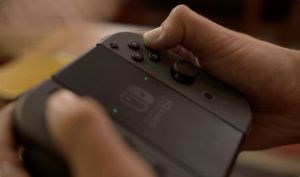
The Switch is both an under-powered console and an over-powered (if there is such a thing) handheld. The point is driven home each time I use my Switch. As a handheld, the battery life when playing Zelda: Breath of the Wild is around the two and a half hours Nintendo cited in the build-up to the Switch’s release. We don’t know if that will hold true for all titles, but I do wonder if that performance will represent the best Switch can do. After all, Zelda is a Wii U title ported to Switch and it’s reasonable to conclude it’s not fully utilizing the power of the console. Perhaps more demanding titles will drain the battery faster, or the opposite could be true if the games are better optimized for the Switch. Needless to say, the battery life isn’t very good and I’ll be curious to see how Super Mario Odyssey runs when it’s released later this year. The portable also runs pretty warm, and I guess that’s to be expected considering the tech underneath. The Switch is very thin, but it’s pretty well ventilated so I’m not worried about over-heating. The button layout is definitely not perfect. It’s so thin that the triggers aren’t particularly satisfying and they’re very close to the front shoulder buttons as well. The right analog stick is in an awkward position, as is the phony d-pad on the left. The small face buttons don’t really bother me at all though, perhaps because I’ve spent many hours with my 3DS, though the small plus and minus buttons can be tricky to find.

As a console, the Switch definitely struggles some with Zelda. I had read about framerate drops and can say they’re very real, and very noticeable. Sometimes the game gets really jittery, and it’s definitely not a good way to showcase the console. The transition from portable to television mode is indeed seamless, so at least that much works. I’ve played the game, and it’s still my only game, with both the joy con shell and a pro controller. I have never had the left joy con completely de-sync, as others have reported, but it still wasn’t seamless. Sometimes Link would keep running after I had stopped pushing a direction on the analog stick, and it did cause me to die at least once. Nintendo’s suggestions for people having the sync issue are pretty much a load of bullshit, wanting you to reduce interference from other wireless devices and so on. Most people probably have a bunch of connected devices at one time, be it game consoles, smart TVs, computers, tablets, etc and just reducing that type of noise is no longer realistic in 2017. The Switch also seems to struggle with its wireless connection to the internet at times, while other devices in my home experience no such issues. It would have been nice if Nintendo had included an ethernet port on the dock for a dedicated wired connection, but I assume they felt that would mess up with the quick turn-around from TV mode to portable mode. They still could have allowed the user to make that call themselves though if a wired connection was their preference.

Nintendo-Switch-games-price-Zelda-Mass-Effect-749578

Somewhat to my surprise, the joy con shell makes for an adequate, albeit small, controller.

Aside from the input lag I experienced with the joy con shell, I was mostly content with how the “controller” felt in my hands. I was some-what skeptical going in, but if it’s performance was perfect it’s possible I would have had some minor buyer’s remorse about the pro controller I picked up. Since I did experience such lag though, I’m naturally happy with my purchase of the pro controller. It’s still too expensive, but it at least works well. The layout is definitely far better than what’s present with the joy con setup, and it’s more or less an Xbox controller. I do wish the D-pad was more comfortable to use, as I suspect fighting games will feel awkward with it. It still takes some getting used to, being a new console and all, and I found myself having to look down at it to find the plus and minus buttons since they’re grouped in the middle with the capture and home buttons as well. And since the controller is all black, the buttons could be hard to find in low-light settings. I was accidentally snapping pictures instead of bringing up the map screen in Zelda on my first go-around with the pro. Since then I’ve grown used to it, though because of the framerate issues (and also partly because the 2 and a half hour battery life helps to remind me to stop playing and go to bed) playing the Switch in portable mode has been my preferred method. If the performance on television was better I’d likely prefer TV mode with the pro controller.

The Switch is fairly large, though thin, making it a cumbersome handheld for actual on the go play. I still haven’t taken it out for my usual commute, as Gamestop has yet to produce the case I pre-ordered in January (apparently I arbitrarily selected the case that would appear in the lowest numbers, or they all got ear-marked for bundles. Some retailers list it as being in stock next week so I’m hopeful for the same), but it’s clear this will be the hardest portable to lug around, though not impossible. I carry a messenger bag and I’m sure I’ll be able to make room for it. I can already do so with a Vita in a case, and it only becomes challenging if I’m carrying a laptop and a tupperware or pyrex dish with my lunch in it. It gets a little cozy in there, but I find a way. I find myself comparing the Switch to the Vita often as I play either one. There’s no comparison with the 3DS. While the older Nintendo handheld is definitely the most portable of the three devices, it’s also the least impressive with its low-res screen. I have an original launch Vita, and its OLED screen is still the best I’ve seen on any handheld, but the Switch’s compares quite well. And like the Vita, the Switch feels like a high quality device where as most Nintendo handhelds feel more like a toy. If the Switch can attract JRPGs like the Vita has then it will definitely become my go-to portable even with the poor battery life (the Vita at 3 to 3 1/2 hours isn’t much better).

Zelda: Breath of the Wild has been a fun experience thus far. I’m not sure how many hours I’ve been able to sink into it, but it’s been a lot and yet I don’t feel I’m at all close to being done with the game. I’ve probably found around 30 shrines so far, but I’ve only completed one out of the four mythical beast dungeons and uncovered maybe half of the game’s gigantic map. That’s definitely been the one aspect of the game that was not oversold:  it’s massive and it’s time consumingly so.

screen shot 2016-06-14 at 12.17.30 pm

The vastness of Zelda’s world is imposing and its best feature. I just wish the Switch could keep up with it and reduce all of the pop-in present.

Otherwise, I find it interesting how Zelda is both held to high standards by gaming critics, but also graded on a  curve at the same time. As the first open-world, or sandbox game, in the series it does a lot of interesting things, but also could do others better. There’s a day-night cycle, which isn’t new for Zelda, that also includes weather effects. Much of the game requires Link to scale mountains and sheer surfaces, but climbing in the rain is pretty much a no go. It makes sense, but as a gameplay device can be really frustrating when you’re in the middle of scaling a large mountain but you have to stop when rain strikes. There’s also a moon cycle, that so far feels random, but it’s possible that it’s not, where a blood moon will rise in the sky and resurrect all of the enemies Link has defeated. It probably exists as a device to keep the game populated with enemies to kill and providing an explanation for why a fort you may have cleared hours ago is suddenly overrun by enemies once again. I’m fine with that part of it, but every time this blood moon rises the game pauses and shows a cinematic. It can be skipped, but the loading time it creates is brutal. I’m not sure why the load time even exists given this isn’t a disc-based game, but maybe it has something to do with the game being a port. I had three “days” in a row while playing last night that ended with a blood moon and it drove me nuts. The cinematic was fine for the first instance, but I don’t know why the game plays it every damn time.

Weapon durability is new to Zelda, well, mostly new as there was a sword in Ocarina of Time that Link could break. Now though that durability applies to every weapon in the game, and they break pretty damn fast. It’s one of those gameplay mechanics that definitely adds something to the game, but I’m left feeling that Nintendo took it too far. There are numerous enemies I just bypass because I don’t want to “waste” my weapons on them, and that’s not really a fun way to play a Zelda game. Otherwise, I very much enjoy the weapon variety as well as the armor variety in the game. Since armor doesn’t deteriorate like weapons (except for shields), the new pieces you find kind of feel like the dungeon rewards from the past games. Some armor simply ups Link’s defense, but most will have some other benefit like heat resistance or stealth.

legend-of-zelda-breath-of-the-wild

While some have claimed to have made it through the game without cooking, it’s still pretty essential and pretty cumbersome in execution.

Cooking is another hyped gameplay element from Breath of the Wild that is present with mixed results. I like it on principle, and Link is able to craft health restoring items as well as status-altering elixirs from fruit, nuts, meat, and monster parts. The interface is poor though, requiring you to fumble through your inventory that’s not organized in any logical fashion and have Link hold the items he intends to cook. You then jump out of the menu to view Link holding everything and you have to drop it into a cooking pot, which can be found all over the place in the game. You will probably screw it up from time to time and Link will just drop everything on the ground, forcing you to pick it all up, go back into the menu, and re-find the ingredients once again. Once you cook something, it will be available in your inventory along with the recipe you used to craft it, but if you consume it that recipe is lost to you. I’m not sure why Nintendo didn’t just include a virtual recipe book along with the Adventure Log. While you’re limited to how many melee weapons, shields, and bows you can carry around, Link has unlimited space for ingredients which is both good and bad. Good because you’re free to pick up all of the spoils, bad because it makes finding what you want that much harder when sifting through your inventory.

A lot of what I just wrote about is what I don’t enjoy about the game, and part of that is a reaction to all of the perfect scores I’m seeing being handed out. And while I don’t view this game as perfect, I can say I am enjoying it quite a bit in spite of those above complaints. One thing I really like is how the elements play a role, specifically with heat and cold. If Link goes to the top of a snow-covered mountain in standard equipment, he will literally freeze to death. You have a variety of ways to get Link through these areas, and that’s something that adds realism to the game without detracting from the fun-factor (unlike the rain). Lightning is also one of your most formidable foes and it’s best to avoid trees and metal when a storm is raging, though you may also find it possible to use it to your advantage too. That’s the aspect of the game I like best, so far. There’s just a lot of things for Link to do, and multiple ways to solve a problem, and the game just lets you figure that out yourself. I saw a video online of a player tossing a chicken at a moblin while the moblin was attacking. It struck the chicken, which summoned a bunch of other chickens to attack just like what happens when Link gets abusive towards the farm animal. Link can also ride on shields, which the game doesn’t explicitly tell you about, and jump on the backs of large animals and ride them around.

zelda-horse-taming-1484333222326_large

Link can sneak up on an unsuspecting horse, mount it, and tame it. Don’t be shy about trying the same on similar animals. You may be surprised to find out what can happen, or not, since I basically just gave it away.

Mostly, I like that Breath of the Wild is trying something new, and it’s a throwback to the original Legend of Zelda. In that game, you’re basically dropped onto the map and given a sword. After that, it’s figure it out on your own. Breath of the Wild is basically the same thing, though the first hour or so of the game is a tutorial of sorts, but it’s done in a way that’s less boring than usual. This game doesn’t hold your hand and it will kill you a lot. Thankfully, it’s generous auto-save feature means death isn’t as big of a deal as it could be. I’ll hopefully eventually do a proper review of the game when I’m done, but I have no idea how long that will take. I’m pretty confident it will at least crack my top five as far as Zelda games go. While it’s refreshing, and I want to see Nintendo do more with this format going forward, I do miss the dungeons and the many shrines in the game aren’t really up to par as replacements. The shrines are mostly just quick little puzzles. They’re usually not hard to figure out, but execution can be tricky. Which is kind of funny, because they feel like a gameplay component that would be right at home on a portable adventure, which Breath of the Wild became when it was ported to Switch.

All in all, I’m pretty happy with my Switch purchase, though it’s also a bit of a luxury item for me as well. I could have just as easily picked up Zelda on the Wii U, where it’s performance is probably a little better than it is on the Switch. The only thing the Switch has going for it over the Wii U where Zelda is concerned is that it is a true portable. Aside from Zelda, the software is quite lackluster and is likely to remain so even through summer. I currently have no idea what my second Switch game will even be. There’s no Virtual Console service at the moment, so I can’t even turn there for additional games. The two games I’m most interested in right now are Super Mario Odyssey and Skyrim, and both of them are set to arrive in Q4 of this year. In other words, I could have very easily held off on buying a Switch until the fall and probably would have been just as happy. It’s also possible that by the holidays Nintendo will have better addressed some of the hardware issues and maybe will even smarten up and make a game like 1-2 Switch a bundled game. I personally have no interest in buying that game, especially at full retail price, but I’d welcome it as a pack-in. By the end of the year, we will also likely have a clearer picture of who’s supporting the Switch and what’s Nintendo doing with the online and Virtual Console. We may also know if the Switch is unofficially replacing the 3DS. Right now, there are still 3DS exclusive games coming our way, but maybe by the holidays we’ll know if Switch versions are coming or if future games will be available for both. That’s all just a long-winded way of saying that while the Switch is nice to have, you shouldn’t be kicking yourself if you didn’t get one at launch and are struggling to find any in stock. Don’t give Gamestop a stupid amount of money for one of their bundles they’re currently selling either, unless you really want everything in the bundle. I would guess the Switch will start becoming readily available during the summer and into the fall, where it could very well become scarce again around the holidays if its performing well. And even come then, it’s possible the only other great game available is Mario. At worst, by then most people will know if the Switch is something they have to have.


Logan

logan

Logan (2017)

A popular “gotcha” question from when I was a kid concerning comic books and the X-Men was, “What’s Wolverine’s mutant power?” The desired response was a reference to his claws, at which point one could interject with a “Nuh-uh! It’s his mutant healing factor!” Of course, later in the 90’s it would be revealed that his claws actually were a part of his mutation, thus putting an end to that one, but it was always kind of a stupid piece of trivia anyway. Wolverine’s defining trait are his claws, the healing stuff was just a way to excuse the beating he took in the pages of Incredible Hulk and X-Men. If he didn’t have those unbreakable claws, he probably never would have become the most popular member of the X-Men.

And yet, Wolverine’s claws were always a bit of an obstacle for comic writers and artists, and eventually animators and film makers as well. You have this violent, bad ass character, equipped with blades that can cut through almost anything, but he really can’t use them because of the obvious gore factor that would involve. Instead, Wolverine would often use the claws for show, deflect some attacks, cling to walls, cut through a fence, and everyone’s favorite – hack up some robots. That’s why it’s particularly liberating to see Wolverine go all out in the opening moments of Logan.

To a newcomer, or even someone who has just fancied themselves a casual fan, the violence and gore present in Logan will seem over the top, perhaps juvenile. The R rating the movie garnered may be viewed in a cynical fashion to appease young males who want f-bombs and blood out of their movies. For those who have been with this character since their childhood though, it’s a stark reveal of just who Wolverine is. This is the Wolverine we hear about from other characters, spoken of in hushed tones and feared by his enemies. This is a superhero who’s primary offense, and defense, is to just start hacking. And since this is applied to an older, very cynical, Wolverine we get a character who doesn’t operate in half measures – if you get in his way and threaten him or those who cares about, Wolverine won’t hesitate to remove your face from your skull.

maxresdefault-7

If you’ve always wanted to see Wolverine do this, then Logan will make you very happy.

Logan is a film set some 15 years or so in the future. It’s not a dystopian world or a wasteland. There are no flying cars or laser rifles, the setting is just an excuse to take a look at an aging, dying, Wolverine. When the film opens we see Wolverine has taken on a very mundane job as a limo driver. He walks with a limp, is an apparent alcoholic, and his wounds don’t close as quickly as they used to. When he’s not working, he’s scoring drugs and hopping the Mexican border where his perhaps only friends are hiding out:  Caliban (Stephen Merchant) and Charles Xavier (Patrick Stewart). The drugs Wolverine purchases are for Xavier, who’s past the ninety-year mark and struggling to keep his wits about him. When the world’s most dangerous telepath can’t control his old brain bad stuff can happen. Wolverine is apparently saving up some cash to buy a houseboat where he and Xavier can live out the rest of their days without fear of harming anyone, or anyone bothering them (in the case of Wolverine).

Wolverine’s day to day life is disrupted when a borderline hysterical woman (played by Elizabeth Rodriguez) comes seeking his aid. Offering a substantial amount of money, she wishes for Wolverine to smuggle her and her daughter into Canada. Wolverine wants nothing to do with her, apparently not wanting any trouble. Soon a young man barges into his limo looking for info on the woman. He is Donald Pierce (Boyd Holbrook), and we know from his demeanor and bad-ass cybernetic hand that he is certainly a bad dude and probably what the young woman is running from. Upon hearing this, Xavier naturally wants to help the woman as he senses a mutant presence, Caliban smells it as well (his mutant power). This is a big deal as there hasn’t been a mutant born in this world in over twenty years. Wolverine is sort of conned into helping the woman, and things get messy before they get any better.

Since she’s featured so heavily in the promotion, and the film makes little attempt to create any mystery about it, I might as well continue along and talk about Laura (Dafne Keen), the young mutant Wolverine and Co. end up taking in. Laura, known as X-23 in the comics, is a young girl with a very familiar set of powers and abilities, and also temperament. She is referred to by other characters as Wolverine’s daughter, but it might be more accurate to call her his clone. She’s on the run in search of a place called Eden and is running from Pierce and the people responsible for her existence. After the lengthy setup, the film turns into a road movie with Wolverine, Laura, and Xavier.

logan_charles

Jackman and Stewart are just beautiful in their portrayals of Logan and Xavier.

Logan is not a feel good movie, and it doesn’t offer much mystery. I found myself anticipating almost every beat the film hits, but I also didn’t care. The world of Logan is harsh and unfriendly, but there are small moments to break up the grim that either provide humor or just a small slice of life. Xavier and Laura make for a fun pair and easily form a warm relationship, even if Laura is essentially mute. Perhaps to the surprise of some, Xavier is the character most often relied upon for comic relief. He and Wolverine clash well, but underneath the surface conflict it’s obvious the two love and respect each other. Wolverine is a surrogate son of sorts to this version of Xavier, and waits on him like a doting son, though he seems to take some enjoyment in complaining about it every step of the way. The relationship feels very authentic, which is a word that kept coming to me as I took in this picture. Patrick Stewart comes across as especially authentic as Xavier. There’s a scene where the trio sits down to dinner with some strangers and Stewart plays Xavier in a way that’s reminiscent of every dinner I’ve ever had with an elderly person I had only just met. He’s delighted to speak with someone other than his irritable traveling companion, but his performance never teeters on parody.

Hugh Jackman is a captivating Wolverine in this film. I suppose that comes as no surprise since he’s been playing this character for almost twenty years now (the same can be said of Stewart). Jackman worked with director/writer James Mangold on the story, loosely adapted from the Old Man Logan story from the comics. It’s clear from interviews with Jackman that this was an important film for him and an important story for him to have a part in telling as Wolverine, for it’s to be his last turn as the character. The Wolverine of this film is best described as the exact assumption most would have of an old man Wolverine. All of his lesser traits -his irritability, cynicism, vices and so on have only been strengthened by father time. He’s still a good guy inside, but his pessimism makes him more of an introvert than he’s ever been. The film doesn’t dwell on the past, but it makes it obvious that all of the X-Men are dead. This is a Wolverine who has lost everything. He doesn’t want to start over, he’d rather just die. He’s pulled through this movie by other characters as well as his inner sense of duty, but it’s a struggle. The film tells this story through action and not so much dialogue. In doing so, Mangold is able to avoid a lot of the tropes that plague other films attempting to tell a similar story.

NEPbctPbbkOESW_2_b

I wonder where she gets it from…

Laura proves to be a compelling character in her own right. Portrayed by newcomer Dafne Keen, Laura is a wide-eyed girl experiencing the world for the first time. Everything is interesting and new to her, and Keen is forced to tell us what Laura is thinking through her actions alone while also being restricted from changing her usual stoic facial expression. She’s a fun character to watch when the film slows down, but also a sad character during the action sequences when we are forced to watch a young girl brutally eviscerate other people with cold precision. She’s in a way been denied humanity, while also being denied a childhood. Again, Mangold does a great job of just putting this out there in the film without editorializing it. We don’t need a character to tell us now depressing her upbringing was. The film slowly gives us more and more of the Laura character and it’s one of the few aspects that feels rewarding. I would guess most people will leave the theater wanting to see more of this character in the future.

All of this is to say the movie isn’t perfect. Like most superhero pictures, it’s probably longer than it needs to be. While there are no obvious scenes that could have been axed, the film does move slowly and if an editor had been ordered to keep the runtime under two hours they probably could have found a way without much compromise. The film is also so centered on Wolverine and Laura that the antagonists feel like after-thoughts at times. And as I mentioned, it is very predictable and there is a sequence in the middle of the movie that bothered me as a result because the characters should have been able to see the danger up ahead.

The flaws within Logan are minor and do little to bring down what some are calling the best superhero movie yet. I’m not sure that’s entirely accurate, as Logan could function as any kind of movie if you took away the super powers. The film isn’t centered on a conflict of good vs evil with the fate of the world in the balance. It’s a character driven film, and for people who have considered themselves fans of the Wolverine character, this is probably the film you’ve been waiting for. It’s a film for those who appreciate the essence of what makes Wolverine special, and it’s able to present the character in an authentic way without devolving into a ton of fan service. More importantly, this is also clearly a worthy story for Jackman to go out on. This is his finest performance not just as Wolverine, but of any film I’ve seen him in, and I assume that was the personal goal of Jackman going into it. I was totally fine with this being Jackman’s last time playing Wolverine, but once the credits started rolling I must admit I was starting to wish for more, and as they say in show business, always leave them wanting more.