Tag Archives: shredder

Teenage Mutant Ninja Turtles – NES

Teenage Mutant Ninja Turtles (1989)

Teenage Mutant Ninja Turtles (1989)

One of the most successful games of all time, and one of the most divisive, Teenage Mutant Ninja Turtles, arrived in 1989 for the Nintendo Entertainment System and flew off the shelves or retailers and rental stores across the United States. Turtle-mania had a strong grip on the nation’s adolescent and it would have been a huge embarrassment if the game actually failed. And while it was named as 1989’s Game of the Year by Nintendo Power, the first ever NES TMNT game is often regarded as a disappointment. Calling it divisive in the opening line may have been misleading, for the game is almost universally loathed for numerous reasons: too hard, not enough recognizable characters from the cartoon, no multi-player, and not the game fans wanted. In 1989, another game based on the TMNT was released, the equally successful arcade game. Based on the animated series, the arcade game boasted 2 to 4 player play allowing each kid to select his or her favorite turtle and wail away on an almost endless supply of Foot Soldiers, Bebop, Rocksteady, and of course, Shredder. When it was announced the Turtles were coming to the NES, many fans expected a port of the arcade game, but instead they got a solo side-scrolling adventure with few recognizable elements from the cartoon making an appearance.

The original Teenage Mutant Ninja Turtles game is best called infamous than famous. It was notably the subject of one of the earliest Angry Video Game Nerd videos in which The Nerd (James Rolfe) reminded many of us of the same frustrations we experienced as children playing this maddeningly frustrating game. As a kid, I never was able to beat the game without the near essential Game Genie peripheral, usually failing to make it beyond the battle with Slash/Mecha-Turtle/whatever the Hell that thing is at the end of act three. And like many, I preferred pretty much every other TMNT based game that followed over this one, which all took the form of arcade style beat-em-ups. I’ve since relived this game many times as a teen and adult but recently felt compelled to revisit it and see if the reputation this game had acquired was entirely justified. Just what is that reputation? Many Google searches will return this game on the list of hardest NES titles as well as worst or most disappointing NES games. The only way to answer my questions was to dust off the old NES and sit down in front of the TV.

Definitely not the arcade game...

Definitely not the arcade game…

For starters, the game was developed by Konami’s Ultra division, a secondary label created to circumvent Nintendo’s then policy of limiting publishers to how many games they could release in a year. Konami probably paid a boatload of cash for the TMNT franchise, and considering Konami was known to gamers for its Contra and Castlevania franchises, it seemed like the TMNT license was in good hands. Right from the start though, some things seem out of place. For one, the cover art depicts the four turtles all sporting red bandanas. For kids accustomed to the television show, this looked wrong while comic book readers would have recognized the cover to issue number 4. When the game boosts up, an unfamiliar tune plays as the four turtles are introduced. No player select screen is displayed once start is pressed, instead the game drops the player right onto a map-like screen with a tiny Leonardo in the center and some steam-roller like vehicle driving around. To summarize, there’s no licensed music, no option for 2-player, and no option to select which turtle to play as.

As the game unfolds, things start to become clearer. This overhead, Zelda-like perspective, leads into more traditional side-scrolling levels whenever the player enters an open manhole or building. A quick look at the pause screen is enough to clue the player in on the objective (rescue April, big surprise) and the ability to switch between turtles. The player is free to change-out a turtle on the fly. Each one has his own health bar, and since the game has no 1-up pickups, they function as extra lives. If a turtle loses all of his health, he’s out of action until the final level where a turtle can be rescued. Each turtle uses his own unique weapon and it will soon become obvious which turtle to use. Donatello, with his boring but long-reaching bo-staff, is easily the superior turtle in this game. When walking or standing still, Don thrusts his bo-staff out in front a great distance and even slightly behind him as well. He can thrust up and down as well with a press of the D-pad and take out multiple foes at once as a result. Because the animation for his attack lingers so long, he even seems to benefit from a double-hit, and as a result, does more damage per strike than the other turtles. If you lose Don, you’re in big trouble because the drop-off is huge to the next most useful turtle, which should be obvious for those familiar with the four heroes in a half-shell, Leonardo. Leo swings a lone katana in a downward arc when attacking and it’s useful for enemies at eye-level, but his reduced range and damage when compared with Donatello makes him far less suitable for the environments ahead. After Leo, Michelangelo is probably the next-best option as his nunchaku has slightly better reach than Raphael’s sai, which is pathetically useless. Raph and Mike are best treated like canon fodder and used only when attacking is not an option, such as when driving the turtle van or during the infamous swimming level. Each turtle can hold one secondary weapon, most of which appear as pickups randomly and range from throwing stars to boomerangs, to a weird energy wave that kicks a whole ton of ass (shell).

What the hell are these things attack Don, and is that a Foot Balloon?!

What the Hell are these things attacking Don, and is that a Foot Balloon?!

Gameplay wise, Teenage Mutant Ninja Turtles is fairly straight-forward. The turtles can attack and jump as they move left to right, right to left, and across gaps and platforms. The pace is fairly slow and reminiscent of Castlevania, including the ever annoying jump-backwards animation after being struck. If you’re not familiar with Castlevania, when the character takes damage they always jump backwards. This is ever annoying when trying to negotiate a series of platforms as enemies frequently appear in mid-jump leaving the player helpless to defend. The turtles handle kind of like trucks as they’re heavy and clunky. Pressing fully on the jump button will cause them to go into a ninja flip of sorts that has a floaty affect on the character, which sometimes helps to re-align a jump but mostly just seems to cause panic in the player leading them to miss a platform. Enemies are numerous, and for the most part, unrecognizable from the show. There’s foot soldiers and mousers here and there, as well as boss encounters with Bebop and Rocksteady early on, but aside from that there’s a lot of just weird enemies. There’s some chainsaw-wielding maniac, a guy composed entirely of fire, and weird butterfly enemies that dive-bomb the turtles, among others. The obstacles are pretty standard for the era and take on the form of conveyor belts, water, and spiked floors/walls. The game gets bogged down frequently when too many enemies are on screen and slowdown is a frequent annoyance. Enemies on the map scenarios tend to flicker in and out which harms the presentation elements of an otherwise underwhelming looking game.

So what makes Teenage Mutant Ninja Turtles so difficult? Well, for one, three out of the four turtles are borderline useless. As I mentioned earlier, Donatello is by far the best suited to overcome the various obstacles placed in the turtles’ path. The other three are so bad that you might as well quit if Don falls in battle. Enemies who can be felled in one strike are manageable, but the ones that require multiple hits pose a challenge as they do not react to taking damage. The game also loves having the player enter a new screen with an enemy literally right on top of you, forcing the player to take at least some damage. The pizza power-ups, which restore health, become scarce the deeper into the game you go and are sometimes intentionally placed in impossible to reach locations. Platforms are often placed above turtles, making some jumps particularly challenging as if the turtle hits his head on a platform above, his forward progress is stunted and the jump falls short. There’s one really annoying jump in a sewer scenario that’s actually impossible in the PC port. There’s also no password feature, but unlimited continues, so this is one that has to be completed in one sitting which adds to the challenge. And if the game wasn’t annoying enough, Ultra did include a beeping alarm for when the selected turtle is low on health.

Even though this level isn't as bad as people make it out to be, Leo is totally about to end up dead.

Even though this level isn’t as bad as people make it out to be, Leo is definitely about to end up dead.

All of that said, this game does do some things well and some of the things it has become known for (negatively speaking) aren’t as bad as they’ve been made out. For one, the ability to swap the turtles into and out of battle is pretty cool. Yeah, it sucks that there’s no two-player and it really sucks that three of the four turtles are horrible to play as, but the thought was a good one and one I’d like to see revisited in a new game. The under water level that has become so reviled and is the part of the game often cited as being hard, unfair, and noteworthy, isn’t as bad as its reputation. If you get to it with little health on each turtle, then it’s pretty damn hard. As a kid, I failed many times. As an adult, I just save Raph for it and have no problem making it out with minimal damage taken. It, like just about every swimming level in recorded existence, is not a fun stage by any means, but it’s far from being among the hardest sequences in gaming history (and is among the easier parts of this game). And aside from the turtles not really handling like ninjas, the control is satisfactory and the ability to drive the turtle van is pretty cool (though why it doesn’t have its own health bar is a mystery still to this day). The soundtrack is actually enjoyable, even if it doesn’t contain any music from the TV show, and isn’t something I’d change about the game.

In conclusion, Teenage Mutant Ninja Turtles was destined for commercial success just because of the license alone, but doomed to disappoint gamers for not being the game they truly wanted. Unfortunately, the game was not able to make-up for not being the arcade game by offering a lesser experience. The good news is that gamers didn’t have to wait long as a port of the arcade game arrived on NES consoles in 1990 as Teenage Mutant Ninja Turtles II: The Arcade Game. Yes, it wasn’t a perfect port due to the system limitations of the NES, but it was suitably fun and is often remembered fondly by gamers from that era. The one that arrived first though is not, and it’s hard to defend the title even today. While it’s far from being the worst NES game, and certainly not the most difficult, it’s definitely not good and just another example of a licensed game gone wrong, but at least it’s not as bad as E.T.


Teenage Mutant Ninja Turtles (2012) Season One Review

nick_tmnt_wallpaper1280x1024_02Back in September of 2012, Nickelodeon unveiled the newest incarnation of the Teenage Mutant Ninja Turtles in a one-hour season premiere.  On August 8th, 2013, the first season came to a close with a one-hour season finale.  The symmetrical first season had its ups and downs, but no one can deny it was a smashing success from a commercial standpoint as Nickelodeon has already commissioned a second and third season.  Once again, the Turtles franchise has proven that it’s harder to squish than a cock roach as it rolls on into its fourth decade of cultural relevance.  Such was likely never predicted of the franchise back when it burst onto the scene in the late 1980’s.  I would be willing to bet most adults viewed it as the latest flavor of the month they had to endure to keep their kids happy as toys and various other merchandise was consumed by the millions.  Perhaps more importantly to fans, the first season of Teenage Mutant Ninja Turtles was not only a commercial success, but a creative one as well as it successfully melded the various depictions of the Turtles over the years into an all new show.

I watched and wrote about the season premiere when it first aired and described my reaction as tempered enthusiasm towards the show.  That would eventually be replaced with full-on enthusiasm as I set my DVR to record each new episode (which became a challenge to keep track of as the broadcast schedule was all over the place) to watch at my leisure.  The show got better as the weeks rolled by and the writers seemed to become more comfortable with the characters.  A lot of the humor early on missed the mark but eventually the show found its groove in that department and routinely was able to bring a smile to my face.  The show also introduced a major plot thread that was woven through the entire first season revolving around the alien race known as the Kraang which helped make the show feel more significant for regular viewers.  I’ve always been a big fan of this approach for television over stand-alone episodes.

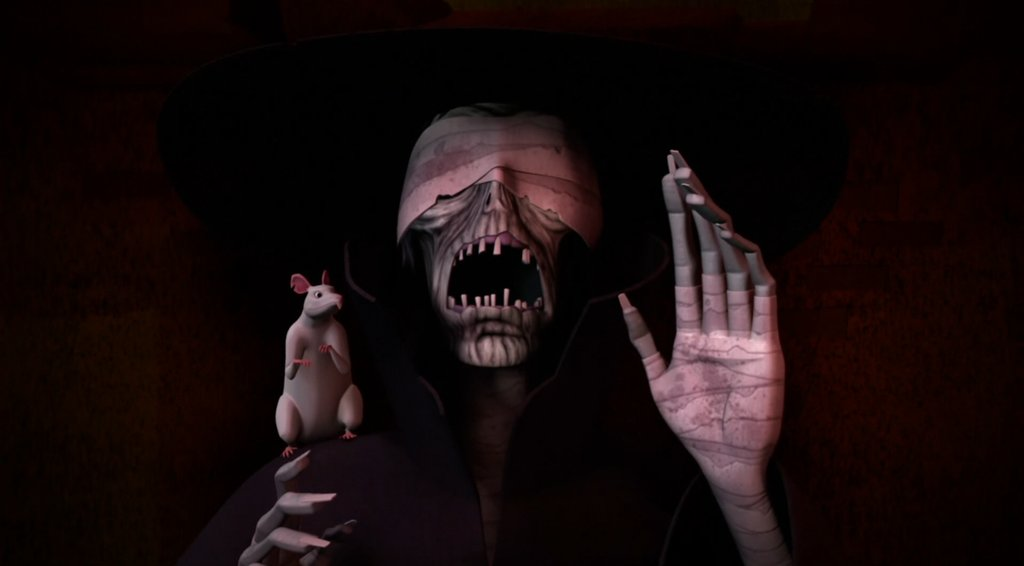
The Rat King was one of the better redesigns for the show.

The Rat King was one of the better redesigns for the show.

That’s not to say the show didn’t have stand-alone episodes here and there.  And quite frankly, that was when the show was its most uninteresting.  There was a period in the early part of the season where each episode felt like The Villain of the Week where some poor soul would be mutated into a monster the Turtles had to stop.  There was still humor to be found in these episodes and some nice action, but there was little lasting appeal.  Some of these monsters were also severely lacking in the personality department, both in a behavioral sense and visually speaking.  That is definitely one area where the old cartoon still reigns supreme as the villains often had a pretty interesting and fun look to them.  That was probably due to Playmates wanting a fun toy to market, but it worked.  The show did get better as the season went along, with one of my favorite looks for a villain popping up towards the end in the form of a newt with a Punisher-like pattern to his spots.

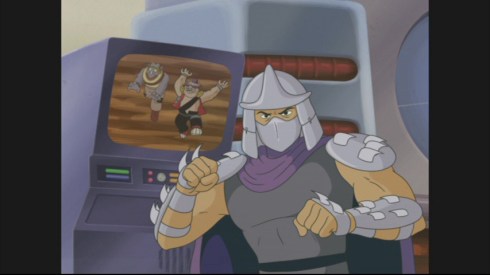
Overall, when compared with the old cartoon, the show was less reliant on guest spots and was content to rely primarily on a core group of characters.  The Shredder, obviously, was a big part of the first season even if he was secondary to the Kraang threat.  The writers wisely kept him out of action though, which made the episodes where he took up arms against the Turtles extra special.  He’s also a total bad ass when in combat, a far cry from the bumbling Shredder of the 80’s or even the original comic book Shredder who is famously decapitated by Leonardo at the end of the series’ first book.  This Shredder still retains his old look but with more black and bigger blades.  He’s also far more scarred than any other as his face has been badly burned and he appears to be blind in one eye.  Like the old Shredder, this one also has two mutant henchmen:  Dogpound and Fishface.  While these two are not as stupid as Bebop and Rocksteady, they’re not any more successful and are often beaten back by the Turtles.  Baxter Stockman also falls in with the Shredder during season one and provides him with some heightened technology.  Karai, Shredder’s daughter, is also introduced as a bit of tweener villain in that she has a bit of a friendship with Leonardo which serves as the backbone for a series of episodes during the middle part of the first season.  Other characters familiar to longtime fans also show up, such as Leatherhead and the Rat King, sporting new designs and new personalities.  I particularly enjoyed the new design for the Rat King and thought he was among the best of the villains shown off.  I hope to see more of him in the future.

The Karai/Leo subplot was one of the more interesting parts of season one.

The Karai/Leo subplot was one of the more interesting parts of season one.

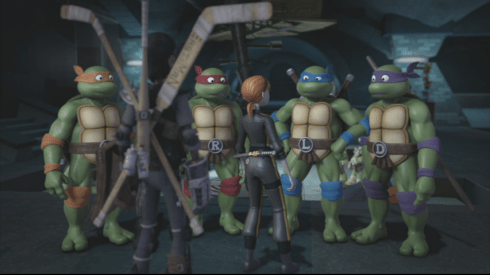
On the Turtle front, the cast basically stayed the same throughout the first season.  A lot of old favorites were brought back though such as a new take on the Turtle Van which is now a subway car.  The Turtles retain their signature personality traits but they feel more honest this time around.  Raphael, for example, doesn’t just get pissed-off because he’s supposed to and Leonardo is far from being an emotionless robot.  All of them have strengths and weaknesses, and for the most part, they also feel like teenagers.

Of particular enjoyment for long-time fans were all of the little easter eggs and throwbacks inserted into this series.  Metalhead was brought back as a robot constructed by Donatello.  He looks fairly similar to the old one, only much smaller.  There’s even a spot during the episode were one of the bran-like Kraang latches onto his head, which I have to believe is a nod to the original action figure’s sculpted brain.  The leader of the Kraang also inhabits a giant robot body and the antenna on its head evokes images of Krang’s body from the old cartoon.  Little things like that go a long way towards pleasing the older fans and trying to spot them is part of the enjoyment in watching the show for me.  The Technodrome is also introduced during the season finale, and the long-awaited Splinter vs Shredder confrontation takes place as well.  There’s a big reveal in the season finale that I think anyone familiar with the franchise saw from a mile away, but it was still done well and, despite being predictable, is actually a new direction for an old character.

The Donatello/April relationship could have felt forced, but the writers have handled it well and I'm actually curious to see where it goes (expect Casey Jones to eventually butt-in).

The Donatello/April relationship could have felt forced, but the writers have handled it well and I’m actually curious to see where it goes (expect Casey Jones to eventually butt-in).

From an artistic standpoint, the show animates quite well and is far superior to the DC CG cartoons currently airing on Cartoon Network.  The city streets of New York remained pretty barren for the whole of season one with some signs of life in the finale, but otherwise the show looks good.  I like the fact that each turtle has his own shape and anatomy instead of basically looking exactly like the others with the exception of the mask.

All in all, Teenage Mutant Ninja Turtles is a good show that strikes the perfect balance between action and comedy.  The story-telling was also better than could be expected and the writing staff will have a hard time topping season one.  Its start reminds me quite a bit of the 2003 cartoon which, for me anyway, fell off quite a bit in the second season and seasons to follow.  Hopefully this show doesn’t meet the same fate.  Because season one was spread out over so many months, the wait for season two to begin is actually a fairly brief one as its set to kick off in late September.  This version of the Turtles may not be violent like the originals, or say “Cowabunga!” like the old toons, but they have a chance to go down as the best Teenage Mutant Ninja Turtles yet!


Teenage Mutant Ninja Turtles: The Ultimate Collection Vol. 3

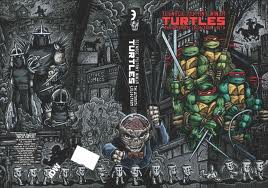
Wrap-around cover of Volume 3, notice the little robots holding the black space where the barcode goes.  Nice touch!

Wrap-around cover of Volume 3, notice the little robots holding the black space where the barcode goes. Nice touch!

I’ve been rather slow lately when it comes to posts, and especially so with getting to this one in particular.  I can’t even remember when volume 3 of the Teenage Mutant Ninja Turtles Ultimate Collection arrived at my front door but I do know it was several months ago.  I’ve put off posting on it in part because I made a couple of other Turtles related posts in the interim and just plain laziness.

I suppose it would be fair to say that had I been blown away by what I saw and read in volume 3 that I would have posted sooner.  Volume 3 is a bit of a mixed bag and not as strong as the two preceding it.  The collection contains issues 12, 14, 15, 17, and 19-21.  The first four are one-shot stories that Eastman and Laird were involved with to varying degrees while the last three cover the “Return to New York” plot jointly worked on by the two.  At this point, the TMNT franchise was much bigger elsewhere and the original comics were starting to feel like an afterthought.  Playmates and the networks that aired the cartoon probably weren’t crazy about the idea of kids (and parents) stumbling onto these more violent turtles while the creators were suffering from turtle-induced burnout.  Simply put, the money wasn’t in the comics and it was in part out of obligation that Eastman and Laird continued with them.  Their working relationship had also soured, meaning they worked on few issues together and instead relied on the talents of guys like Jim Lawson and Steve Lavigne.  If you’re wondering why there appears to be some missing issues in this collection, it’s because Eastman and Laird didn’t work on them at all.  This Ultimate Collection represents the Eastman/Laird era and is set to conclude with volume 5, which will presumably arrive in the fall (volume 4 is currently scheduled to start shipping at the end of March).

The one-shots in volume 2 really made the set.  The individual micro series issues that focused on a sole turtle were among my favorites and succeeded in distinguishing each turtle from one-another.  In this volume the opposite seems to be the case as the one shots are lacking in focus and creativity.  The first one, “Survivalists,” is a Laird story and places our heroes out in the country with Master Splinter where they encounter an outlaw group fixing to steal a nuclear bomb.  It’s rather absurd, even for a TMNT story, but does feature Splinter in some action scenes which is always nice to see.  What follows is “The Unmentionables,” an Eastman story that puts Casey Jones in detective mode as he looks to solve the mystery of a stolen landmark.  The setting takes place in a small town and it’s genuinely interesting to read the notes following the story from Eastman and Laird about the real-life connections of the fictional town to the real town (Northampton, MA), but aside from that I found the story to be poorly paced and dull.

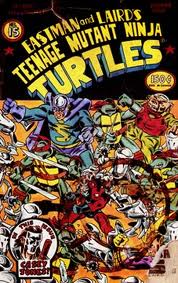
The original cover for "Dome Doom" was made to look like an old, beat-up comic.

The original cover for “Dome Doom” was made to look like an old, beat-up comic.

Things start to get a bit more interesting with “Dome Doom,” a story inspired by silver age comics.  It’s the type of story that a lot of modern comics have utilized where the current heroes are paired up with the heroes of a prior generation.  In this one, the TMNT help the retired Justice Force take down an old foe.  The plot is ludicrously corny, but I think that was intentional, and also seems to be a response to claims that Eastman and Laird are now sell-outs for licensing the TMNT (the retired Justice Force all sold their likenesses for millions in the comic’s plot).  This is some of Laird’s best artwork and I enjoyed the design of the little dome robots.  The story is kind of a throw-away, but I had some fun with the issue.  “Distractions” seems to take place in the far east sometime in the past with a TMNT-like protagonist helping out a damsel in distress that looks a lot like April.  It contains some samurai story cliches and all seems kind of corny, at which point the story ends and we find out it’s source is Mikey as he’s trying to write his own comic.  The artwork (by Eric Talbot) saves the day here with some really cool shading and a lot of violence.  I like this feudal looking turtle and I’m surprised he wasn’t made into an action figure (or maybe he was and I just forgot).  I could have done without the dinosaur though.

Most people who pick this volume up will do so for the “Return to New York” arc which features the return of a very popular villain.  “Return to New York” captures the spirit of the first issue of TMNT with a slightly more advanced approach.  There’s actual character development this time around and we finally get some good Leo vs Raph moments, including an all out brawl in issue 19.  The fight is pretty vicious considering it pits brother vs brother and ends up being really satisfying.  Unfortunately, the black and white nature of the comic makes it really hard to distinguish between which one is Raph and which one is Leo throughout much of the fight.  The first issue ends up dealing with the notion of teamwork and captures a lot of the same messages contained in the first two Turtle films.  It’s a bit of a re-tread, but this is also the type of story the TMNT are good at telling.

Look who's back!

Look who’s back!

The rest of the story revolves around the return of the Foot clan, and of course, the Shredder.  Shredder was famously slain in the first issue by Leonardo, but he’s back from the dead through odd means.  I didn’t quite get it, he’s composed by worms or something weird, but didn’t really care.  It’s basically all action as the Turtles storm the Foot’s base (with an unlikely ally too) and the whole thing builds towards a Leonardo vs Shredder re-match.  The fight is a vicious one that goes back and forth, but I don’t think it’s spoiling much to say that the heroes prevail.  The battle serves as a bit of redemption for Leo and Raph too, as Raph was able to pull out a victory in his one-on-one battle with Leo but was unable to take down the Shredder by himself.  Laird and Eastman actually take the time to show that Raph’s headstrong mentality can work for him in certain settings, but not all.

As was the case with the previous volumes, this one contains new artwork by Kevin Eastman on the cover.  It’s a mash-up of the stories contained within.  The notes from both of the creators are quite extensive and genuinely fun to read.  The interior art is presented in its original black and white and is enlarged to fit this over-sized format.  The quality is top-notch, and this is still a nice piece for any TMNT collector out there.


Teenage Mutant Ninja Turtles – Nick Series Episode 1

You can’t keep a good turtle down.

When I was younger I don’t think I ever expected the shows and properties I was into at the time to still be popular when I was an adult.  I had a similar conversation with a cousin of mine who happens to be the father of a five-year-old boy.  We were talking about how it was kind of funny you could replace one of our childhood birthday or Christmas gift wish lists with one of his and not notice.  His list was full of Transformers, Spider-Man, Star Wars, and so on.  Some things are expected to stand the test of time, like Spider-Man and Star Wars, but intellectual properties like the Transformers and The Teenage Mutant Ninja Turtles?  Those were kind of unexpected.

The Teenage Mutant Ninja Turtles have sometimes struggled to stay relevant.  After the bubble burst on the 80’s and early 90’s hysteria they kind of went away.  There was a television show on Fox Kids called The Next Mutation that only last one season and that show was the first attempt at bringing them back.  It was live action and since the budget was so low compared to the popular films it wasn’t received too well by older fans and the younger kids who had missed out didn’t seem to care for it.  After that failure, TMNT co-creator Peter Laird kept the franchise on life support with hopes of bringing the boys into the world of CGI.  I was unable to find anything on the internet, but I recall seeing some rather ugly mock-ups for it on ninjaturtles.com (now owned by Nick) back around 2000 or so.

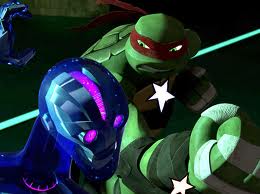
There’s lots of little 2D visual effects in the show like stars or anime styled throbbing veins and such.

The CG proposal was never picked up, but the Turtles did resurface in 2003 with a new traditionally animated show put out by Fox and 4 Kids Entertainment.  Much like the first film, the new show combined the origins of the comic Turtles with the cartoon series adored by millions to create something that was both respectful to the origins but kept the kids in mind.  I only watched the first season but remember it being a fairly entertaining show.  Certainly if I were a parent I wouldn’t mind sitting thru it with my kid.  It kept the tone some-what serious with comedic breaks to liven the mood, most involving Michelangelo.  From what I could gather from a distance, the show would eventually splinter off away from any of the older versions of the Turtles and establish its own sense of self.  There was even a series titled Flash Forward that took place in the future.  The success of the show, though never approaching the height of Turtle-Mania, probably helped get the 2007 film, TMNT, made.  That’s when the Turtles finally got their CG debut and the results were mixed.  Financially, it did all right but the plot was rather poor and the Turtles looked more like frogs than turtles.  It did have its moments, but no new films in the series (TMNT was a sequel to Teenage Mutant Ninja Turtles III) were planned and if a Turtles film is ever produced expect it to be a reboot.

Anyone who has kept up with the Turtles knows by now that a new film was in the works.  Titled Ninja Turtles, it was going to be a Michael Bay production and was likely to be a major reboot for the franchise with the Turtles actually being aliens or something.  Intense negative reactions on the internet and a reportedly terrible script got the project put on indefinite hold.  Alongside it, a new television show and comic book series have been in the works.  The various mediums are not related other than the source material, but it was likely hoped that all of this cross-promotion would really help invigorate the franchise.  The comic has been out for about a year now and is okay, from what I’ve heard, and the television show premiered this morning.

There’s a blockiness, as seen in Leo’s shoulder, to the design of the Turtles that I find off-putting.

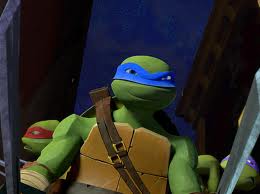
Teenage Mutant Ninja Turtles (Nick Turtles?) is the CG series that never was from the past.  The Turtles have been given a modified look and the show is separate from other incarnation of the Turtles.  One of the larger changes resides in the April O’Neil character who is now a teenaged ally of the Turtles.  For the most part, it’s pretty standard.  We have four teenaged turtles living in the sewer with their sensei, Splinter, who once was a man named Hamato Yoshi.  The Shredder is back as the main villain, and so is Krang who hasn’t been heard from in a long time.  The tone of the show is definitely reminiscent of the old cartoon as this is aimed primarily at kids new to the property.  One actual throwback to the old show for older viewers is the use of voice actor Rob Paulsen who was the original voice of Raphael but will now be handling the Donatello duties.

Visually these turtles look a lot like the ones from the 2003 cartoon.  Each turtle retains his trademarked mask but features brown pads everywhere else.  Their skin tone varies slightly from turtle to turtle and some have freckles while Don even sports a gap in his teeth.  Each one has extra bandages for some reason, I guess to make them look edgier, and retains their standard weapons.  In comparison to the CG film, these turtles are less frog-like but since it’s television the quality is lower.  They’re kind of blocky looking and sometimes they get these weird flat “panels” on their skin that seems inconsistent from shot to shot.  It makes me think of the old 32 bit video games when developers were first getting their feet wet with 3D.  The overall design is fine, but does leave something to be desired.  Splinter has often been portrayed either gray or brown, but in this one he’s multi-colored.  He’s also much taller than the Turtles this time around, which is a departure for the character, and he’s less feeble looking.

The first episode, which was an hour long, serves as the introduction for the Turtles.  Right from the start we’re shown who the dominant turtle is (Raph) and also given a glimpse of their individual personalities.  Nothing surprising here, though each turtle is a little sillier than how they’re usually portrayed, including Mike who’s not only the party dude but also a moron.  Their origin is relayed and it’s fairly close to the one from the old animated series only this time it was Hamato Yoshi carrying the bowl full of turtles and he got into a scuffle with the holders of the ooze, or mutagen, that would come into contact with our protagonists.  The flashback, and others in this episode, are told via hand drawn stills with minimal animation which was kind of a fun break from the CG.  Later in the episode we’re told that Yoshi had a wife and daughter and lost both to the Shredder.  He confirms his wife is dead but uses the word “lost” when speaking of his daughter so expect her to surface at some point (perhaps as Kiara?).

Expect to see more of this guy in future episodes.

The animation is better than I expected.  The Turtles and other inhabitants of the world move well enough and it’s on par with the best CG one can find on television.  There is a bit of a disconnect between the Turtles and their environment that may or may not be apparent to all viewers.  Most of the backgrounds are fairly dark as well to probably make it easier on the artists.  Sometimes this leads to backgrounds that are mostly black which doesn’t look good on TV.  The music is mostly a collection of electronic instruments, the only notable moment for me was the chase sequence about halfway thru.  The new theme song is basically a hip hop remake of the original television theme.  The less said the better.

The tone of the show reminds me more of the ’07 film than the animated series.  It’s light on one-liners but definitely aims to keep things upbeat.  When the fighting starts the Turtles do get serious, to a point, and a visual cue kicks in where their eyes become completely white.  It’s kind of interesting, but also kind of odd.  They’ll still pause during battle though at inappropriate times to make a humorous observation.  At first the Turtles appear to subsist on traditional turtle food, but early on in the episode are introduced to pizza and are hooked instantly.  They’re shown to have a television (and Leonardo appears to model himself after a Captain Kirk like TV character) but appear mostly ignorant to the outside world.  Either they don’t watch much TV or they just don’t pay attention.

The show itself introduces us to the Utroms of this universe.  When I said Krang was coming back I may have spoke too soon as the Utroms are now called Krangs.  They operate in the same way but are depicted as villains.  They kidnap April and her scientist father, which is how the Turtles meet her.  Donatello is instantly smitten with her, so we’ll have to see where that goes, but the Krangs are the primary antagonist for this hour of the show.  Shredder is only shown in a cameo, but we can see he’s still the leader of the Foot (unless they choose to rename it) and it appears his head and face has been severely burnt (probably as a result of his last encounter with Yoshi).

This is definitely a kid’s show and older viewers should not expect this program to elevate itself beyond that.  I kind of wish I had watched it with a kid to see how they would have reacted to the jokes and visual gags, most of which are standard kids show clichés.  For me, none of it was very funny but the plot surprised me in that it kept me interested for an hour.  I expected worse, but it seems like the Turtles have a legitimate chance to recapture the hearts of kids once again.  I’ll probably tune in to a couple more of the episodes just to see what other characters from the past return but it’s not something I plan on sticking with.

Post script:  I would categorize my early impressions of this show as tempered enthusiasm.  I expected it would succeed at hitting its target audience but probably not those who grew up with the original cartoon series.  I may have been wrong.  I watched the first few episodes out of sheer curiosity, but now find myself watching them out of sheer enjoyment.  The show is a lot wittier than I could have ever expected.  Some of the Mikey humor is still a little much for adult tastes, but a lot of it is pretty clever and dialogue driven.  The action pieces have also exceeded expectations.  And the many nods to the old series (such as the ringtone on each turtle’s cell phone) is much appreciated.  A lot of my early criticisms about the show’s visuals still remain and it’s become obvious the show doesn’t have the budget to create a thriving New York (seriously, there’s almost no traffic in the city when the turtles are out and about) but that should be expected given this is television and not a feature film.  In short, this show is genuinely enjoyable and I have yet to view an episode that I did not enjoy on some level.  That may not always be the case, but so far so good.

Teenage Mutant Ninja Turtles airs at 11 AM Saturdays on Nick.