Tag Archives: nintendo

Angry Video Game Nerd: The Movie

Angry Video Game Nerd:  The Movie (2014)

Angry Video Game Nerd: The Movie (2014)

For over ten years, James Rolfe’s Angry Video Game Nerd character has been entertaining viewers with humor-laden rants on “classic” video games and movies via that amazing thing known as the internet. The videos first appeared on his own website before migrating to Youtube where they gained a following that seems to still be growing. Today, the videos are contained and published on Rolfe’s own website, cinemassacre.com, along with his other films and humor shorts. Over the years Rolfe has added other characters to his stable including Board James and the Bullshit Man, but it’s the Nerd who is easily the most popular of them all.

The Nerd videos successfully tap into nostalgia by invoking memories of frustrating evenings spent with a terrible game just rented from the local video store. Everyone who grew up in the 80’s and 90’s who played video games can probably recall a few bad decisions that lead to tossed controllers or broken toys. For most kids of that era, picking a game at the rental store was like tossing darts. You could judge them only on so little. Some games would print screenshots on the back of the box while some would force you to go off of the cover art alone, which was often purposely misleading. I know I personally encountered many duds, usually selecting a game based on a license I was familiar with through television or film. That’s how I ended up getting stuck with Road Runner on the NES for a weekend. If you’ve never played Road Runner on the NES consider yourself lucky. Watching someone else slog through these games has proven to be entertaining, and Rolfe is able to blend in other elements to keep things fresh and entertaining. What once were simply clips of gameplay with cuts to the Nerd’s reactions have grown into elaborate skits and battles to the death with the likes of Bugs Bunny and R.O.B.

James Rolfe is the Angry Video Game Nerd; a beer-swilling, profanity-spewing, victim of bad games.

James Rolfe is the Angry Video Game Nerd; a beer-swilling, profanity-spewing, victim of bad games.

As the years have gone one, it has become harder to find games worthy of the Nerd’s time. One game though has been saved, the infamous E.T. for the Atari 2600, which is the so-called worst game ever. This was a game Rolfe and his friend and collaborator Kevin Finn decided could not be confined to the usual ten minute internet video and instead announced that they were pursuing a feature-length film for the Nerd. They attempted to get backing from actual production studios based in Hollywood, but when that didn’t work, they turned to crowd-funding and were able to come away with enough cash to make the film a reality. It took a long time for the movie to be filmed, edited, and eventually released, but hopefully the wait was worth it for those involved and those who were eager to see it.

When it was announced this summer that Angry Video Game Nerd: The Movie would receive a limited theatrical release, I was on my honeymoon, and as a result, missed out on the ticket pre-sale. The film was released digitally in the fall, but I opted to just wait for the Blu Ray which arrived the week before Christmas at my residence. As a fan of the web series, I was intrigued at how Rolfe and company would turn a ten minute video into a feature-length film. Would the Nerd prove interesting enough a character to command my attention for nearly two hours? And how would the production come across given the budget?

Well, I would say that, for the most part, the film works. The premise of the film is that everyone and their grandmother wants the Nerd to review E.T. (known as Eee Tee in the movie for obvious reasons), but because he has such bad memories of the game from his childhood, the Nerd refuses. A video game company, Cockburn Industries, takes note of the Nerd’s popularity and how his videos have actually lead to a demand for the bad games he reviews. They decide to green-light a sequel to Eee Tee and get the Nerd to review it, at which point he’ll condemn it and people will buy it. Cockburn sends one of their executives, Mandi (played by Sarah GlennDanzig, I mean, Sarah Glendening) to befriend the Nerd and his associate, Cooper (Jeremy Suarez), and get the Nerd to agree to a review. She poses as a nerd herself, and by getting Cooper and the Nerd to make a friendly wager over whether or not the Atari landfill story is true or not, finds a way to get the Nerd to agree to a review. She organizes a search team to scope out the landfill area in New Mexico, while those involved soon find themselves attracting the attention of a military group charged with protecting the secret of Area 51, which is located nearby. It’s all pretty crazy, but essentially the Nerd and his friends spend time illuding these military types and getting caught in a massive conspiracy theory surrounding the game and its ties to the existence extraterrestrial life. There are aliens, a massive god-like monster being, and even Howard Scott Warshaw himself (the creator of the actual E.T. 2600 game), along with a whole bunch of other stuff I’d rather not spoil.

Some of the actors joining Rolfe include (clockwise from top right) Time Winters, Sarah Glendening, and Jeremy Suarez.

Some of the actors joining Rolfe include (clockwise from top right) Time Winters, Sarah Glendening, and Jeremy Suarez.

The plot of the film is supposed to be “out there” with purposely telegraphed twists and over-the-top characters. The villainous General Dark Onward (Stephen Mendel) is especially creative as he’s a paraplegic with a tank for a lower body who has a penchant for losing limbs. Time Winters is entertaining playing the required illusive genius who clues the group in on the secret of Eee Tee while Helena Barrett plays a capable right-hand woman to Dark Onwardby the name of McButters. The actors are mostly veterans of small productions like soap operas and commercials who mostly handle themselves well. The script they’re given is full of silly, corny, lines that they sell well. One of my concerns going into the film was how Rolfe would stand-up amongst professional actors. Any concerns I had were remedied early on as Rolfe clearly knows how to both write for his venerable character and how to portray him. If there’s a weakness in the script, it’s with the Mandi character and McButter. Perhaps not accustomed to writing dialogue for women, Rolfe and Finn’s script for the two aims for cheese but often misses the mark. Their cat-fight scene meant to induce laughter instead brings about groans.

General Dark Onward is probably the most ambitious character in the film.

General Dark Onward is probably the most ambitious character in the film.

The production is noticeably done on the cheap, but it doesn’t limit the film’s scope or imagination which is all that matters. There are lots of easter eggs buried in both the plot devices and the way certain effects are handled (including an obvious homage to one of the worst films of the 1990’s, Teenage Mutant Ninja Turtles III). Rolfe opted primarily for practical effects in lieu of computer generated ones. The films makes frequent use of miniatures, which aren’t really designed to trick the viewer, but are instead meant to amuse. Some of them are quite spectacular and I found it enjoyable watching these scenes and trying to imagine what the crew went through bringing them to life. There are some computer effects, like a Mario inspired lava sequence, and they impressed me in their scope. The soundtrack was handled by Bear McCreary, whom fans of The Walking Dead should recognize. His score makes liberal use of video game sound effects from that era as well as the Angry Video Game Nerd theme song by Kyle Justin. It’s the film’s strongest point, and while not the type of soundtrack I’d seek out, it perfectly suits the film and enhances the viewing experience.

Angry Video Game Nerd: The Movie should satisfy fans of the Nerd and gaming culture alike. It’s also clearly a love-letter to classic sci-fi and adventure pictures and the influences of films like Raiders of the Lost Arc and Godzilla are easy to spot. The plot is large and as captivating as a film based on the Angry Video Game Nerd could possibly be. If I had one last nitpick with the movie it’s that the Nerd doesn’t get enough of an opportunity to really get angry, but I suppose it was necessary to present a slightly more humanized version of the character in order to get it to work on film. I enjoyed the movie, and the loads of bonus content contained on the Blu Ray gave me something fun and interesting to check out after the film was over. Watching an independent film come to life is a rewarding experience. The film obviously means a great deal to those involved with it and their enthusiasm is contagious. This is a film that would be hard to hate, so it’s a good thing it turned out as well as it did.
Demon’s Crest

Demon's Crest (1994)

Demon’s Crest (1994)

There is something about the 16bit era of gaming that I just find inherently charming. This is the era where games started to grow up, tell complex stories, but without losing site of what makes games fun. The visuals, music, sound effects, pacing – it was like gaming nirvana. That’s not to say it’s been all downhill since; far from it, actually, but I always enjoy going back to these games. And when I can find a good, quality game from that era that I’ve never played? Well, that’s just divine.

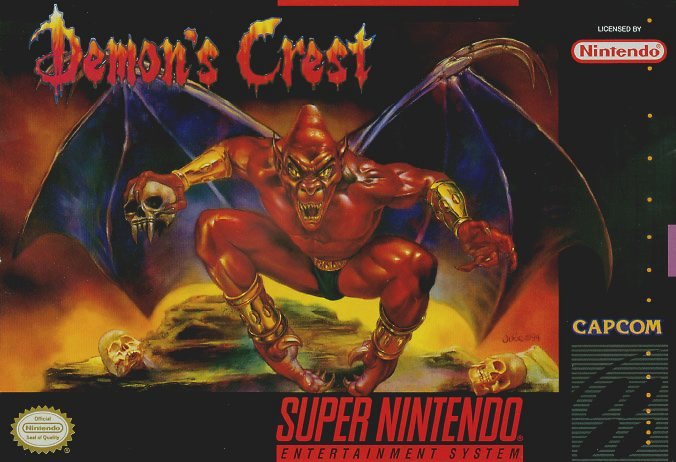
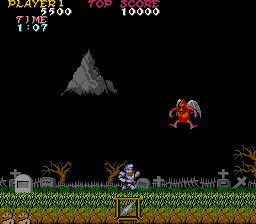
Demon’s Crest is one such game. Released by Capcom late in the Super Nintendo’s life-cycle, Demon’s Crest has garnered a reputation as a cult classic. Because of its late arrival, few people actually picked up a copy and experienced it in 1994. The Gargoyle franchise also has never been one of great importance for Capcom. For those unaware, Demon’s Crest is the third game in the Gargoyle trilogy which started on the GameBoy. The main character of these games, Firebrand, is that annoying red, flying enemy from the Ghosts ‘N Goblins games thrust into a starring role. The storyline for these games isn’t all that interesting or important, but credit Capcom for spinning off a seemingly random enemy into its own franchise. Since the end of the 16bit era and the dawn of the retro era, Demon’s Crest has become one of those handful of SNES carts that fetches over 100 bucks routinely on the secondary market. Thankfully, the Virtual Console exists so these games can be experienced by anyone with a Wii/Wii U console and a game like Demon’s Crest can get the recognition it deserves.

Cap com apparently saw something in this little, red, demon to warrant giving him his own game.

Cap com apparently saw something in this little, red, demon to warrant giving him his own game.

Demon’s Crest is essentially a side-scrolling platform game, but it’s a hybrid title in that it incorporates elements from the run and gun genre and the RPG. As Firebrand, the player explores various stages from the ground, in the air, and underwater. At the start, Firebrand can shoot a fireball as his lone attack, cling to walls, and fly through the air. The flying mechanic is neat and doesn’t feel cheap, as it often does in many games like Super Mario Bros. 3. By pressing the jump button while in air, Firebrand deploys his wings and can hover indefinitely. He can move side-to-side but cannot gain altitude (a power-up later in the game allows him to ascend in the air from a flying position). He can still attack, and pressing the jump button again causes him to drop and re-pressing the button at anytime while falling will initiate the process all over again.

After the first level is completed, the player gains access to a world map not unlike what is seen in the Final Fantasy titles from that era. Firebrand can fly to any stage from here and the game can essentially be completed at any point, though playing thru every stage multiple times is encouraged to collect power-ups and explore every nook and cranny. Firebrand is on a quest to recover various crests, each one grants him a new power. The earth crest, the only one that basically can’t be missed, removes Firebrands wings but gives him access to a dash move and a ground-hugging projectile. The water crest lets Firebrand breath underwater, the air crest lets him fly freely, and the best crests are basically a jack-of-all trades kind of power. Additional projectile attacks for Firebrand’s normal form can also be found, along with other power-ups, bottles for storing potions, and vellum for spells. The goal is to conquer the enemy Phalanx, but the secondary goal is to collect everything and get the best ending plus additional content in the form of power-ups and additional boss battles.

Some of the game's bosses dominate the screen.

Some of the game’s bosses dominate the screen.

At first, the game seems like it’s going to be massive, but it can be completed in an afternoon, especially if you’re not after the best, ultimate, ending. There’s an element of trial and error at play, as the game intends for the player to acquire new powers to advance past certain spots. The game is forgiving in this regard as it grants unlimited continues and you can always quit to the map if a scenario seems too difficult. The levels are not simply “go right” kind of levels. They encourage exploration in all directions, and additional gargoyle powers will open up new sections so re-playing levels is practically essential to completing the game. Uncovering new powers is addicting and fulfilling and I was always eager to try out each new one I found.

Acquiring these new special abilities make the game easier, which is welcomed since the game is fairly challenging. No, Demon’s Crest is not among the most difficult of games to grace the SNES (like the title it’s spun-off from) but it isn’t a breeze. Most of the early challenge involves getting used to Firebrand’s controls. He handles easy enough, but the mind needs to be trained in order to best utilize the hover/flying ability. There are usually numerous enemies at ground level and in the air to contend with, and learning to dodge is the best way to succeed. The game is also fairly cryptic in that it doesn’t explicitly tell you what your new powers are capable of. As a result, the player has to experiment a little which may lead to some deaths here and there, but it’s not too bad. The game is fairly generous with restorative items and the in-game currency allows the player to stockpile health potions and the like. There are also some mini games to spend time on, though nothing exciting. The boss fights are usually a test to figure out what the best approach/power to use is. Some boss fights will seem impossible without the right ability, but once found, they’re a piece of cake. The hardest bosses are a challenge no matter what. They’re not controller-tossing hard, but will offer a nice test for the player.
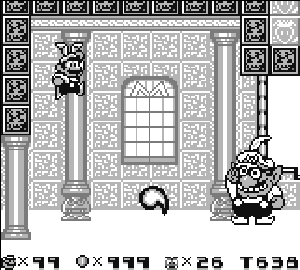
Acquiring new crests opens up new forms and powers for Firebrand.

Acquiring new crests opens up new forms and powers for Firebrand.

The music in the game is heavily reminiscent of other gothic-inspired titles, most notably Castlevania. It’s tempo is slower and Demon’s Crest finds it’s own sound. It’s not on Castlevania’s level, but it’s very enjoyable. As a later era SNES title, the game is pretty nice to look at. Firebrand is nice and big without dominating the screen. Many of the boss characters have a lot of personality or take up the entire height of the screen. The regular enemies, the canon fodder, are a little boring though and the game gets bogged down at times when a lot is going on. Sometimes the slowdown is actually helpful, but it is a weak point of the game. The controls are quite good, but there’s some missed opportunities to be found here. The shoulder buttons are not utilized when they could have at least been devoted to cycling thru Firebrand’s gargoyle forms. It gets tiresome having to constantly pause the game to switch relics, and many boss encounters require this very thing. The spells available to Firebrand are also fairly useless, and the only potion worth spending money on is the best one which restores all of Firebrand’s health.

When it comes to old games, I always prefer to experience them as they were intended: on their original console. When that is not possible (or in this case, too expensive), the Virtual Console is more than adequate. I played the game exclusively on the Wii U Gamepad utilizing the Gamepad’s screen instead of a television. The game plays just fine, and the ability to save is definitely welcomed. The original cart only provides a password save functionality, and while the game isn’t terribly long, it’s one I chose to experience in one or two hour at most sessions. It probably took me around six hours to finish the game, with some additional time spent after the fact going back and finding the items I missed to tackle the secret boss. This strikes me as being a pretty average game for the era in terms of length making it comparable to Super Metroid and Super Mario World.

Demon’s Crest is an excellent example of a forgotten classic. It’s probably not a top 10 game on the SNES, but that’s only because the SNES has arguably the greatest library of games of any console. Demon’s Crest is a unique blend of several genres, and its setting and style help set it apart from many of its contemporaries. If it sounds like something you would enjoy, I can’t recommend it enough as it’s worth the 8 bucks Nintendo is charging. And if you’re on the fence, I still say give it a shot because it’s a game that’s just inherently fun. Hopefully, this re-release on the Virtual Console makes Capcom some money and inspires them to revisit the Gargoyle series. A modern take on the franchise would be a most welcomed thing, indeed.


Teenage Mutant Ninja Turtles – NES

Teenage Mutant Ninja Turtles (1989)

Teenage Mutant Ninja Turtles (1989)

One of the most successful games of all time, and one of the most divisive, Teenage Mutant Ninja Turtles, arrived in 1989 for the Nintendo Entertainment System and flew off the shelves or retailers and rental stores across the United States. Turtle-mania had a strong grip on the nation’s adolescent and it would have been a huge embarrassment if the game actually failed. And while it was named as 1989’s Game of the Year by Nintendo Power, the first ever NES TMNT game is often regarded as a disappointment. Calling it divisive in the opening line may have been misleading, for the game is almost universally loathed for numerous reasons: too hard, not enough recognizable characters from the cartoon, no multi-player, and not the game fans wanted. In 1989, another game based on the TMNT was released, the equally successful arcade game. Based on the animated series, the arcade game boasted 2 to 4 player play allowing each kid to select his or her favorite turtle and wail away on an almost endless supply of Foot Soldiers, Bebop, Rocksteady, and of course, Shredder. When it was announced the Turtles were coming to the NES, many fans expected a port of the arcade game, but instead they got a solo side-scrolling adventure with few recognizable elements from the cartoon making an appearance.

The original Teenage Mutant Ninja Turtles game is best called infamous than famous. It was notably the subject of one of the earliest Angry Video Game Nerd videos in which The Nerd (James Rolfe) reminded many of us of the same frustrations we experienced as children playing this maddeningly frustrating game. As a kid, I never was able to beat the game without the near essential Game Genie peripheral, usually failing to make it beyond the battle with Slash/Mecha-Turtle/whatever the Hell that thing is at the end of act three. And like many, I preferred pretty much every other TMNT based game that followed over this one, which all took the form of arcade style beat-em-ups. I’ve since relived this game many times as a teen and adult but recently felt compelled to revisit it and see if the reputation this game had acquired was entirely justified. Just what is that reputation? Many Google searches will return this game on the list of hardest NES titles as well as worst or most disappointing NES games. The only way to answer my questions was to dust off the old NES and sit down in front of the TV.

Definitely not the arcade game...

Definitely not the arcade game…

For starters, the game was developed by Konami’s Ultra division, a secondary label created to circumvent Nintendo’s then policy of limiting publishers to how many games they could release in a year. Konami probably paid a boatload of cash for the TMNT franchise, and considering Konami was known to gamers for its Contra and Castlevania franchises, it seemed like the TMNT license was in good hands. Right from the start though, some things seem out of place. For one, the cover art depicts the four turtles all sporting red bandanas. For kids accustomed to the television show, this looked wrong while comic book readers would have recognized the cover to issue number 4. When the game boosts up, an unfamiliar tune plays as the four turtles are introduced. No player select screen is displayed once start is pressed, instead the game drops the player right onto a map-like screen with a tiny Leonardo in the center and some steam-roller like vehicle driving around. To summarize, there’s no licensed music, no option for 2-player, and no option to select which turtle to play as.

As the game unfolds, things start to become clearer. This overhead, Zelda-like perspective, leads into more traditional side-scrolling levels whenever the player enters an open manhole or building. A quick look at the pause screen is enough to clue the player in on the objective (rescue April, big surprise) and the ability to switch between turtles. The player is free to change-out a turtle on the fly. Each one has his own health bar, and since the game has no 1-up pickups, they function as extra lives. If a turtle loses all of his health, he’s out of action until the final level where a turtle can be rescued. Each turtle uses his own unique weapon and it will soon become obvious which turtle to use. Donatello, with his boring but long-reaching bo-staff, is easily the superior turtle in this game. When walking or standing still, Don thrusts his bo-staff out in front a great distance and even slightly behind him as well. He can thrust up and down as well with a press of the D-pad and take out multiple foes at once as a result. Because the animation for his attack lingers so long, he even seems to benefit from a double-hit, and as a result, does more damage per strike than the other turtles. If you lose Don, you’re in big trouble because the drop-off is huge to the next most useful turtle, which should be obvious for those familiar with the four heroes in a half-shell, Leonardo. Leo swings a lone katana in a downward arc when attacking and it’s useful for enemies at eye-level, but his reduced range and damage when compared with Donatello makes him far less suitable for the environments ahead. After Leo, Michelangelo is probably the next-best option as his nunchaku has slightly better reach than Raphael’s sai, which is pathetically useless. Raph and Mike are best treated like canon fodder and used only when attacking is not an option, such as when driving the turtle van or during the infamous swimming level. Each turtle can hold one secondary weapon, most of which appear as pickups randomly and range from throwing stars to boomerangs, to a weird energy wave that kicks a whole ton of ass (shell).

What the hell are these things attack Don, and is that a Foot Balloon?!

What the Hell are these things attacking Don, and is that a Foot Balloon?!

Gameplay wise, Teenage Mutant Ninja Turtles is fairly straight-forward. The turtles can attack and jump as they move left to right, right to left, and across gaps and platforms. The pace is fairly slow and reminiscent of Castlevania, including the ever annoying jump-backwards animation after being struck. If you’re not familiar with Castlevania, when the character takes damage they always jump backwards. This is ever annoying when trying to negotiate a series of platforms as enemies frequently appear in mid-jump leaving the player helpless to defend. The turtles handle kind of like trucks as they’re heavy and clunky. Pressing fully on the jump button will cause them to go into a ninja flip of sorts that has a floaty affect on the character, which sometimes helps to re-align a jump but mostly just seems to cause panic in the player leading them to miss a platform. Enemies are numerous, and for the most part, unrecognizable from the show. There’s foot soldiers and mousers here and there, as well as boss encounters with Bebop and Rocksteady early on, but aside from that there’s a lot of just weird enemies. There’s some chainsaw-wielding maniac, a guy composed entirely of fire, and weird butterfly enemies that dive-bomb the turtles, among others. The obstacles are pretty standard for the era and take on the form of conveyor belts, water, and spiked floors/walls. The game gets bogged down frequently when too many enemies are on screen and slowdown is a frequent annoyance. Enemies on the map scenarios tend to flicker in and out which harms the presentation elements of an otherwise underwhelming looking game.

So what makes Teenage Mutant Ninja Turtles so difficult? Well, for one, three out of the four turtles are borderline useless. As I mentioned earlier, Donatello is by far the best suited to overcome the various obstacles placed in the turtles’ path. The other three are so bad that you might as well quit if Don falls in battle. Enemies who can be felled in one strike are manageable, but the ones that require multiple hits pose a challenge as they do not react to taking damage. The game also loves having the player enter a new screen with an enemy literally right on top of you, forcing the player to take at least some damage. The pizza power-ups, which restore health, become scarce the deeper into the game you go and are sometimes intentionally placed in impossible to reach locations. Platforms are often placed above turtles, making some jumps particularly challenging as if the turtle hits his head on a platform above, his forward progress is stunted and the jump falls short. There’s one really annoying jump in a sewer scenario that’s actually impossible in the PC port. There’s also no password feature, but unlimited continues, so this is one that has to be completed in one sitting which adds to the challenge. And if the game wasn’t annoying enough, Ultra did include a beeping alarm for when the selected turtle is low on health.

Even though this level isn't as bad as people make it out to be, Leo is totally about to end up dead.

Even though this level isn’t as bad as people make it out to be, Leo is definitely about to end up dead.

All of that said, this game does do some things well and some of the things it has become known for (negatively speaking) aren’t as bad as they’ve been made out. For one, the ability to swap the turtles into and out of battle is pretty cool. Yeah, it sucks that there’s no two-player and it really sucks that three of the four turtles are horrible to play as, but the thought was a good one and one I’d like to see revisited in a new game. The under water level that has become so reviled and is the part of the game often cited as being hard, unfair, and noteworthy, isn’t as bad as its reputation. If you get to it with little health on each turtle, then it’s pretty damn hard. As a kid, I failed many times. As an adult, I just save Raph for it and have no problem making it out with minimal damage taken. It, like just about every swimming level in recorded existence, is not a fun stage by any means, but it’s far from being among the hardest sequences in gaming history (and is among the easier parts of this game). And aside from the turtles not really handling like ninjas, the control is satisfactory and the ability to drive the turtle van is pretty cool (though why it doesn’t have its own health bar is a mystery still to this day). The soundtrack is actually enjoyable, even if it doesn’t contain any music from the TV show, and isn’t something I’d change about the game.

In conclusion, Teenage Mutant Ninja Turtles was destined for commercial success just because of the license alone, but doomed to disappoint gamers for not being the game they truly wanted. Unfortunately, the game was not able to make-up for not being the arcade game by offering a lesser experience. The good news is that gamers didn’t have to wait long as a port of the arcade game arrived on NES consoles in 1990 as Teenage Mutant Ninja Turtles II: The Arcade Game. Yes, it wasn’t a perfect port due to the system limitations of the NES, but it was suitably fun and is often remembered fondly by gamers from that era. The one that arrived first though is not, and it’s hard to defend the title even today. While it’s far from being the worst NES game, and certainly not the most difficult, it’s definitely not good and just another example of a licensed game gone wrong, but at least it’s not as bad as E.T.


Mario Golf: Toadstool Tour

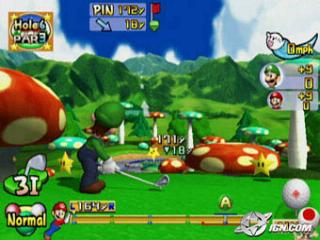
Toadstool_TourWith spring comes golf season and this spring brings a new Mario themed golf game as well.  Titled World Tour, the game is set for release this week on the Nintendo 3DS which got me to thinking about my favorite title in the Mario Golf series:  Toadstool Tour. Released in 2003 for the Nintendo Gamecube, Toadstool Tour was the sequel to the Nintendo 64 game (simply titled Mario Golf) and was the first Mario Golf title to really incorporate the over-the-top components of Mario’s Mushroom Kingdom setting.

Mario has a history of having various hobbies and other jobs. We first knew him as the Princess rescuing Jump Man in Donkey Kong before moving onto his more popular plumber gig for Mario Bros. and the Super Mario Bros. series. Not long after his previously mentioned debut he almost immediately jumped into the world of sports. Nintendo basically decided Mario was its most marketable persona and stuck him into everything. He had cameos in the likes of Tennis and Punch-Out!, but it was the original Golf game that first allowed users to control Mario as he took part in a sport.

Golf games in general have been around basically just as long as video games. Golf is one of the few sports that’s played all around the world so it makes sense that it would be well-represented in game form. Still, it can seem kind of surprising at just how many golf games there are considering it’s often not been a sport real popular with kids (before Tiger Woods, it wasn’t really popular at all). It works though in game form since it doesn’t really require much out of its AI opponents and the slow pace makes it easier to plan. And really, the basic gameplay hasn’t changed a whole lot between NES Golf and Toadstool Tour, though pro-oriented titles like Tiger Woods have made advancements with analog control.

Toadstool Tour is pretty basic on the surface. The user selects an onscreen avatar and a mode for play. Modes include tournament, match play, and Mario specialty modes like coin mode. Each character has its own unique attributes affecting power, control, and spin and also a natural ball trajectory. Mario is the most well-rounded and his ball travels straight while a power hitter like Bowser has a mean hook and less control over where his ball is going. Once on the course, the player has two main modes of play:  auto and manual. Auto is basically a one-button approach where the user lets the CPU take over after lining up a shot and pressing A twice. It’s good for kids but most gamers will find it unsatisfying and opt for manual. On manual, the player hits the A button to start the character’s swing and then a bar at the base of the screen starts to fill. The player has to hit the B button to stop the bar at the desired spot for power, and then stop it again as it comes back for control. Once the ball is in the air, the player can affect the spin of the ball in one of four ways: topspin, backspin, super topspin, and super backspin. For those unfamiliar with golf, topspin basically extends the distance of the shot a few yards by making sure the ball rolls forward once it strikes ground. Backspin does the opposite. The standard versions of both are pretty true to life, while the “super” versions can really exaggerate the movement of the ball. Pre-shot, the user can also affect what part of the ball the character strikes by using the D pad. Once the swing starts the player has to hold the analog stick to match the new strike point allowing the player to put more loft on the shot or hook/slice it in a certain direction.

Toadstool Tour may be nearing its eleventh birthday, but it's still a pretty nice game to look at.

Toadstool Tour may be nearing its eleventh birthday, but it’s still a pretty nice game to look at.

Players have access to a full arsenal of clubs. The game will make a default selection that 90% of the time works best. It’s usually on approach shots where you may opt to go for a different approach such as putting from the fringe as opposed to a chip-shot. The power meter can also be toggled from normal, power, and approach. If using the putter, there are three options for short, medium, and long range. The user is free to select whatever option he or she desires, though the power function has only six uses per round (a perfectly executed shot though, max power plus perfect accuracy, won’t consume a power shot reserve). There are enough options to approach any shot, though if the game has one short-coming it’s with the putting. Putting does not have an accuracy input, it’s simply a two-press function for power. Longer shots are actually fine, but the really short ones can be more troublesome because of how touchy the meter is. For short puts, you basically have to let the meter fill all the way and set your power when it’s coming back. This takes getting used to and novice players will likely miss some short ones as a result which can be really frustrating. Many golf games will have a “gimme” putt feature where a yard or less is automatically sunk by the game. Such a feature would be welcomed here.

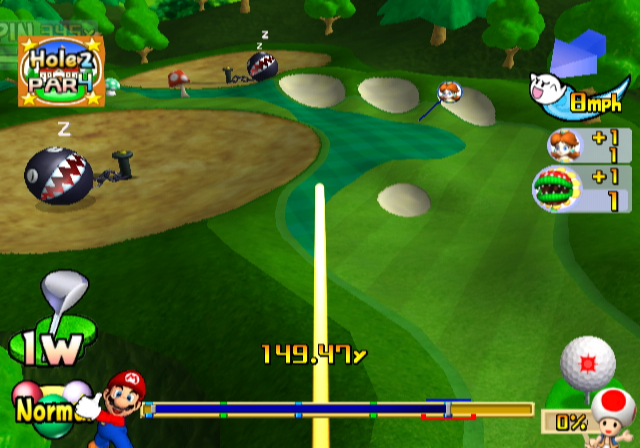
The basic gameplay works well, putting excluded, and it actually surprised me with how robust the shot options are. It wouldn’t be a very special game though if it ended there. This is a Mario sports title after all, so a certain amount of “wackiness” is expected and the game mostly delivers in that respect. There are six courses to unlock, not including the par 3 course, and each new one unlocked ups the difficulty factor as well as the amount of Mario-isms. The first course is fairly basic, as are the next couple, but later ones add things such as warp pipes and piranha plant hazards. The final course takes place at Bowser’s castle and features numerous lava hazards, thwomps, and other features common to such a setting. These courses can be pretty difficult, but are definitely more rewarding. Completing courses and certain game modes unlocks additional characters, and competing against individual characters in match play unlocks star versions of those characters. The star characters have improved base stats and are practically mandatory if you want to score under par on the most difficult courses.

It's not often you have to worry about chain-chomps when getting in a round of 18.

It’s not often you have to worry about chain-chomps when getting in a round of 18.

Even though the Mario theme is represented well here, I can’t help but wish there was more. Mario has visited all kinds of different worlds throughout his games and I feel like crazier courses could be designed to accentuate that even more. It is my hope that the new game does just that. Additional courses in general would also be welcomed. Six feels a little light. Eight, or even ten, would be best. There could be ice courses, pipe courses, even a floating airship course. And now that the Mario Galaxy series has come along, some funky gravity-defying course would likely be a fun experiment in course design. More courses would naturally lead to more variety. Most of the courses in Toadstool Tour encourage power over “target golf.” The hardest courses negate that to some degree, but the power golfers definitely seem to have an advantage on most courses. An ice course, for example, would definitely emphasize spin and control over power as the ball’s movements once it hit the ground could be pretty unpredictable.

Mario Golf: Toadstool Tour is currently the best Mario Golf game released and probably the best Mario sports title as well. It strikes a nice balance between the actual game of golf and the more off-beat qualities brought by the Mario gang. It could probably stand to be even more outlandish, and some minor control tweaks could also improve the experience, but as it stands it’s a fun game of golf and offers a different experience from the usual EA Sports type of game. If you’re looking for a home golf game and something to play with friends, Toadstool Tour is a cheap and effective solution.


The Legend of Zelda: A Link Between Worlds

images-194One of the greatest games of all time has to be The Legend of Zelda:  A Link to the Past for the Super Nintendo.  Following the misstep that was Zelda II:  The Adventure of Link, Nintendo put out what I consider the true sequel to the original Zelda.  A Link to the Past took the gameplay model established in the original game and expanded upon it tenfold.  A parallel world, new items and power-ups, a much better and more powerful gameplay engine.  Simply put, A Link to the Past was Zelda perfected and no title in the franchise has exceeded it, though some have come close.  As is the case with most Zelda games, A Link to the Past did not have a direct sequel (unless you count Link’s Awakening for the Gameboy) and subsequent games in the franchise basically function as a retelling of the Zelda legend.  That is, until now, with the release of A Link Between Worlds last fall for the 3DS.  Creating a direct sequel now for A Link to the Past could be viewed as an immense challenge on the part of Nintendo, or a sign that the company is running out of ideas and looking to cash-in on a classic game.  As far as I’m concerned, an all new Zelda title for the 3DS is a good thing regardless of what ties it has to other games, but I won’t deny it tickled me to go back to the Hyrule I knew over twenty years ago.

As best as I can tell, A Link Between Worlds takes place generations after the events of A Link to the Past.  The map layout is the same though and fans of the old game should feel right at home in this one.  Plot wise, it’s basically tried and true Zelda:  an evil wizard kidnaps the princess and wreaks havoc across the land and only Link can reunite the three components of the triforce and save the day.  Replacing the dark world from the first game is Lorule, an alternate Hyrule that uses a similar color palette to the familiar dark world but is broken apart with large chasms sealing off routes.  The game is quite pleasing to the eyes without being a graphical powerhouse.  Character and enemy designs from A Link to the Past are recreated here with more detail and more color.  The soundtrack is upbeat containing many familiar tunes as well as some new compositions.  It often suits the setting exceptionally well, and rarely ever does a Zelda soundtrack disappoint.

Link's newest ability allows him to become a painting on a wall and move around on it.

Link’s newest ability allows him to become a painting on a wall and move around on it.

A Link Between Worlds not only looks familiar, but also plays familiar.  Link obtains most of the items from the first game with really only one or two new ones playing any kind of significant role.  Link is controlled with the circle pad this time around instead of a directional pad, which is to be expected and functions fine, though I did find it challenging to be precise with projectile weapons, something I don’t remember being a problem in A Link to the Past.  There’s some emphasis placed on the early dungeons to show multiple levels at once for Link to traverse, presumably to take advantage of the 3D, but is mostly abandoned quickly.  I did not play the game in 3D, but I suppose it’s fine for those who like it.  As one can probably deduce from that statement, there are no 3D-specific puzzles in this game such as the ones found in Super Mario 3D Land that force the player to switch on the function, which is fine by me.

Where A Link Between Worlds looks to separate itself from other Zelda titles is with the merge ability Link acquires early in the game.  Merge allows Link to become a painting and move along walls.  He can go behind some objects this way or slip through cracks and around corners, as well as apply the power in other creative ways.  It did take me some getting used to, but overall I found it to be an enjoyable addition to the game and one of the better gimmicks to be featured in a Zelda game.  Utilizing the power is easy, but it does take some time to get one’s brain trained in a way to make use of it.  There were a few times I was stumped on how to reach a treasure chest or other location only to realize the solution was pretty obvious once my mind caught up and applied the merge ability correctly.  Aside from that, most of the other challenges and puzzles should feel familiar to Zelda veterans as they’ll know when to use the hookshot or drop a bomb.

Veterans of A Link to the Past should feel right at home here.

Veterans of A Link to the Past should feel right at home here.

The setup for A Link Between Worlds is basically identical to A Link to the Past.  The game starts off in Hyrule with Link having to make his way through three early dungeons before a confrontation at Hyrule Castle opens up a path to Lorule.  Link is able to traverse worlds via fissures that appear in walls and various structures that require him to merge with the surface and slide in.  As these fissures are found, they’ll appear on the map permanently and some areas are only reachable by exploiting them.  Surprisingly, only one dungeon requires the player to bounce between worlds which is something I thought would be exploited further.

The other heavily advertised feature of A Link Between Worlds is the non-linear nature of the game’s dungeons.  Once the player reaches Lorule, they can conquer the dungeons in any order they wish (save for one, which requires an item obtained from beating another) before heading off to Lorule Castle for the final battle.  This feature is enabled by having all of the traditional Zelda items available to Link from the get-go.  Very early in the game, a merchant by the name of Ravio opens up shop in Link’s house.  Here Link can rent any item for a small fee and hang onto it until he falls in battle.  Link can rent as many items as are available, so if the player enters a dungeon that requires the ice rod, for example, the player can simply go rent it if he hasn’t already.  Most players, myself included, will probably rent every item right away and risk having to rent them all again should a game over screen rear its ugly head.  Making the game non-linear in this way is kind of fun, but does lessen the reward for getting through a dungeon.  Each one still has something for the player to find, but not really on the same level as the usual.  It would have been nice if Nintendo added more items to the game for players to find to make-up for this, but oh well.

Many of the game's bosses feel familiar too.

Many of the game’s bosses feel familiar too.

A Link Between Worlds has one other distinguishing feature when compared with its predecessor:  it’s exceptionally easy.  Aside from Zelda II, no Zelda title really has a reputation for being a hard game, but most of them are challenging and have at least one dungeon that sends gamers running to the nearest FAQ.  A Link Between Worlds contains no such dungeons and most Zelda veterans will never see a game over screen when playing it.  I do not consider myself an exceptional gamer, but I did not die once while playing this game.  In addition to that, I had no trouble finding every heart piece, each of the lost maimais (little squid-crab hybrids hidden around Hyrule and Lorule), or toppling the game’s gauntlet scenario twice.  The dungeon puzzles are clever at times, but aren’t likely to leave gamers stumped for any significant length of time.  As for the enemies, I think many are made easier this time around because just about all of them can be taken down with the sword.  Even some enemies from A Link to the Past, such as those statues with a central eye, that required a certain item to fell can be taken down with the sword.  It’s also the type of game that starts off harder than it finishes, mostly because adding hearts remedies any challenging enemies or bosses weak.  Most of the bosses also are retreads of past ones, so there’s less trial and error.  Also making every item available at the start contributes to an easier game.  All of them consume stamina when used, which regenerates over a short period of time, so players can spam the powerful fire rod if they so desire and most enemies are susceptible to the freezing powers of the boomerang and hookshot (and if they aren’t, there’s the ice rod).

Difficulty issues aside, A Link Between Worlds is an enjoyable Zelda title that I was sad to see end.  It’s about as long as most handheld Zelda titles.  Playing at a very deliberate pace and obtaining all items, chests, and so on, the game lasted exactly 20 hours and 2 minutes for me according to the logs on my 3DS.  It was a fairly swift 20 hours with most of the game’s dungeons lasting anywhere from 15 minutes to a half hour at most.  A lot of my time was spent roaming Hyrule and Lorule and at least an hour was spent on the Octorok baseball mini-game.  Once the game is finished a harder hero mode becomes available.  I haven’t tried it, but apparently the only difference between that and the regular game is that enemies do more damage, which should help to make the game at least a little more challenging.  If Nintendo set out to eclipse A Link to the Past then it came up short, and from that perspective A Link Between Worlds is a disappointment.  As a Zelda game though, it’s great entertainment and something all 3DS owners should pick up.


Ranking the Mario Games – Conclusion

Part 1

Part 2

Part 3

images-155There’s certainly very little suspense with these kinds of things.  Anyone familiar with the Super Mario franchise can figure out at this point which two games are going to top my list, whether people disagree or not is another story.  Rather than dive right into these last two games, I think it is important to point out just how many of the games that I’ve talked about could have been number one.  Super Mario 64 seems like an easy one to argue in favor of.  What the original Super Mario Bros. did for the 2D side-scroller, Super Mario 64 did for the 3D platformer.  Only the games to follow in that genre have really done very little to deviate from the Super Mario 64 style of gameplay.  Sure the worlds have gotten bigger, and the graphics have certainly improved, but the core mechanics are still mostly in play.  Super Mario Galaxy 2 could also be argued as top dog.  The inventive gameplay of the Galaxy franchise has a ton of appeal, and Galaxy 2 is bigger and harder than its predecessor.  In a world where Mario games seem to be getting easier and easier, it’s nice to know some of the games are trying to hang onto some semblance of difficulty.  And of course Super Mario Bros. 3 will always have a claim to best Mario title on the planet.  It’s the game that really expanded on the Mario world for the first time giving gamers tons of variety in terms of level design, power-ups, boss fights, and basically every other aspect of the game.  Many of the titles today still borrow heavily from Super Mario Bros. 3, and I feel like I could go on for another two-thousand words on the subject and it still wouldn’t feel like enough.

In short, Mario has had a lot of great adventures over the years.  As overexposed as he tends to get, it can sometimes be easy to lose sight of just how important the character has been to gaming.  A lot of people my age claim to have outgrown Mario, but I don’t think that’s possible.  You can’t outgrow fun, just lose touch with it.

2.  Super Mario Galaxy (2007, Nintendo Wii)

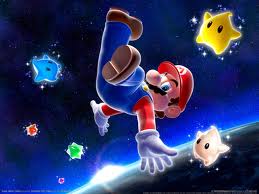
For the first time ever, Mario gets to spend an entire game in space.

For the first time ever, Mario gets to spend an entire game in space.

Super Mario Galaxy wasn’t the first title to take Mario into space, but it’s definitely the most memorable.  Galaxy is basically the sequel to Super Mario Sunshine and Super Mario 64 before it as Nintendo decided Mario’s 3D adventures were ready to continue on the Wii.  Many people were curious how the Wii’s motion controls and Mario would meld, as I think many assumed Nintendo would use the game as a way to showcase what the console was capable of.  Instead, the developers for the game mostly downplayed the Wii’s motion controls in favor of a fairly traditional scheme.  Mario was still controlled via analog stick and he could bounce around just as he could in the two previous 3D games.  The only addition for the Wii was a spin attack that could be initiated with a simple flick of the wrist.  The Wii remote could also function as a pointer and could fire star bits.  These star bits could momentarily stun enemies but it mostly was just a tack-on feature.  I assume most forgot the feature even existed while playing.

Where Nintendo sought to distinguish Galaxy from the prior Mario games was to place an emphasis on gravity.  Mario would travel from galaxy to galaxy, planet to planet, and encounter all kinds of unique situations.  Some levels had Mario sticking to tennis court sized planets that were still large enough to apparently have a gravitational pull.  This could lead to some really disorienting experiences with Mario basically upside down or sideways but the game’s camera was so well crafted, and Mario so weighty, that it rarely felt as bad to the player as it looked.  I know initially I was skeptical at just how good a game could be that focused so much on trying to disorient the player but Galaxy proved me way wrong.  Running and jumping from planet to planet, sometimes within a level, was pure joy. The only comparable experience I can even compare it to are those warm, fuzzy feelings I had when playing Super Mario 64 for the first time.  Mario handles so well and the level design is so spectacular that it’s hard to not constantly wonder what’s next while enjoying the present.

I think Donald Duck tried this once.  It didn't go too well for him, from what I recall.

I think Donald Duck tried this once. It didn’t go too well for him, from what I recall.

Since this is a Mario game, there are numerous power-ups available to experiment with.  Of the new ones, the best and most enjoyable is definitely the bee suit which allows Mario to fly for short bursts.  Bee Mario flys just by holding down the A button, but he can ascend for so long before he needs to “recharge.”  It’s all pretty quick, but the ability to fly is curbed just enough to keep the player from flying constantly.  For more intense flight, there’s a special power star that lets Super Mario impersonate Superman.  It only exists in kind of a bonus level, but is fun while it lasts.  Some of the new power-ups are duds, like spring Mario who can do nothing but bounce which gets frustrating, and there’s some sequences where Mario has to balance on a giant ball.  For the first time in a 3D Mario title, the fire flower makes an appearance as does its opposite, the ice flower.  Both are kind of interesting in that they function very much like an invincibility star in that they only bestow Mario with special abilities for a brief period of time.  This does lend itself well to some puzzle situations, but it is a little disappointing to not be able to remain as fire Mario until damage is taken.

Mario gets shot out of canons (pipes) quite frequently in this one.

Mario gets shot out of canons (pipes) quite frequently in this one.

From a technological standpoint, Super Mario Galaxy is a star.  The Wii was never considered a powerhouse by any means, but Galaxy looks great.  The environments are varied, the color pallet is gorgeous, and many of the enemies dwarf Mario, especially Bowser.  The music is high quality as well, composed mostly of orchestral instruments giving it a very “Zelda” feel.  The plot for the game is basically the same as always, though the character of Rosalina is introduced which makes things slightly more interesting.  The game’s storyline may not be enough to get gamers to keep coming back, but the numerous objectives and hidden stars will.  As with Super Mario 64, each level has stars for Mario to collect and after collecting a certain amount challenge stars begin to appear.  This is where the game really turns up the difficulty and gives Mario vets a true challenge.  It’s probably not as hard as its sequel, but it strikes a very nice balance between challenging and frustrating.  That, along with all of the other positives I’ve cited, is why Super Mario Galaxy is the best of the 3D Mario titles to date.

1. Super Mario World (1990, Super Nintendo)

The layout of the world according to Mario.

The layout of the world according to Mario.

The mark of a truly special game is one that is inherently fun.  There are many games where aspects of them fit this description.  Mindlessly rampaging in any of the Grand Theft Auto titles is always a blast, political correctness be damned.  When it comes to multi-player, I’m not sure I’ve ever had more fun with a  game than I did with Super Bomberman and three of my buddies.  Both of those games contain moments of pure joy, but neither is able to achieve that and hold it for the entire duration of the full game.  Super Mario World is a game that is non-stop entertainment from start to finish.  Expertly crafted level design, colorful visuals, and tweaks to the Mario formula helped introduce a legion of fans to the Super Nintendo making Super Mario World not just the best Mario game, but the best pack-in game of all time.

Super Mario World was not the leap forward for Mario that Super Mario Bros. 3 was.  It didn’t have to be as that game was nearly perfect itself.  It only needed to improve upon it and give gamers a reason to play Super Mario World other than its inherent “newness.”  Obviously, that’s easier said than done as many developers have tried to improve upon a game like Super Mario Bros. 3 and failed.  When it came time to create Super Mario World, it would seem Nintendo took a back to basics route when comparing it with its predecessor.  Power-ups were de-emphasizd as the game only included two permanent power-ups (aside from the mushroom) for Mario and Luigi:  the venerable fire flower and the shiny new super feather.  The fire flower worked the same as always, but the feather gave Mario a yellow cape and the ability to fly.  Rather than have the cape mimic the raccoon tail, it worked in an entirely different manner.  Mario still had to run to take-off, but once airborne Mario zoomed to the top of the screen before dive-bombing back to the ground below.  This could double as an attack, but if the player so desired Mario could be made to “parachute” his cape for extended flight.  It took some getting used to, but once mastered a player could easily soar Mario over an entire level.

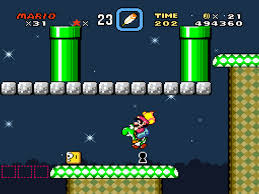
Mario's dino-buddy Yoshi, was the most talked about addition to the Mario universe.

Mario’s dino-buddy Yoshi, was the most talked about addition to the Mario universe.

The other major gameplay addition was Yoshi.  Yoshi functioned as a power-up himself, giving Mario not only an extra hit but also giving him a new attack.  Atop Yoshi, Mario could direct his dino servant to devour all kinds of enemies.  As a bonus, certain turtle shells gave Yoshi special abilities such as fireballs or his own ability to fly.  Mario could also use Yoshi to reach higher places or travel over certain terrain.  Green Yoshi was the standard, but different colored Yoshi’s existed in the secret Star Road area that had limited power-up potential, but also an exploitable skill (the blue Yoshi, for example, would sprout wings and fly with any turtle shell in his mouth, while green Yoshi could only do so with a blue shell) that had its own advantages.

The storyline for the game was really no different, other than the fact that Mario is on vacation in Dinosaur Land.  Mario still has to topple Bowser’s seven children before facing him to save the princess.  Where the game stands out is in its scope.  Super Mario World is appropriately titled.  It may not seem huge compared to today’s games, but at the time it seemed massive.  Each world is distinct and varied as well, and they’re full of hidden exits and secret levels.  This made Super Mario World both challenging and highly replayable.  Some staples of future Mario games were introduced in this one, such as the Ghost House or Wiggler enemy.  Furthermore, the game was hard.  It eased the player in with the deceptively tame first world but the difficulty increases as the game moves on.  There are plenty of scrolling levels, levels with small platforms for Mario to negotiate, and levels requiring some puzzle solving to escape.  The boss encounters with the koopalings were also more varied, and the final showdown with Bowser was satisfying as well.  And if the main game was too simple for some, the Special Zone provided its own brand of torture with many having their own personal nightmare level among one of them.

Secrets abound in Super Mario World.

Secrets abound in Super Mario World.

Aside from the bells and whistles, Mario also handled better than ever and the score was another strong addition to the Mario universe.  The main melody is used throughout, though I was also most fond of the subtle bongo notes introduced whenever Yoshi shows up (a trend that has continued over the years).  If the game has short-comings, it’s that there are less mini games when compared with Super Mario Bros. 3.  The lack of more power-ups is also a slight mark against the title when holding it up to the others, but it’s the gameplay that matters most.  Always.  When it comes to Super Mario World, there just isn’t a better Mario game on the planet.  Everything that came before it was refined and improved upon to craft the perfect platformer.  Nintendo wisely chose to not truly follow-up on the title for well over a decade because it couldn’t be topped.  There was nothing left for Mario and Nintendo to prove with this genre.  And over twenty years later, Mario still hasn’t appeared in a better game.


Ranking the Mario Games – Part 3

Part 1

Part 2

This edition of ranking the Mario games is going to be slightly different than the two previous ones.  In trying to summarize each game in my previous posts I tried to keep it to one paragraph, which lead to some really long paragraphs.  One paragraph is fine for the lesser Mario outings, but now as I enter the top 5 one paragraph seems like too few, so this post will capture the titles I ranked from position five to three, with one more post to follow for the top two.  This way I can elaborate more on each individual title and attempt to give each game the time it deserves.  These games are some of the best of the best, and while I feel very strongly about their position in the top five, it’s debatable how each should be ranked amongst each other, but that’s what makes these things so fun.

5. Super Mario Galaxy 2 (2010, Nintendo Wii)

Yoshi is the major selling point of Super Mario Galaxy 2.

Yoshi is the major selling point of Super Mario Galaxy 2.

Super Mario Galaxy 2 might be the favorite Mario game for some people, or a lot of people, and with good reason.  It falls to position five on my list not for quality but more for redundancy.  Super Mario Galaxy felt like a revelation while Galaxy 2 felt like a continuation of that game.  In a way, it’s Super Mario Galaxy’s Lost Levels.  That’s not to say it was entirely the same, as there are some obvious additions to the formula, just not necessarily worthwhile.

The premise of the Galaxy series of games takes Mario into space aboard a ship that serves as a hub world.  From there, Mario enters various levels that play out over a map similar to Super Mario Bros. 3, or more recently, New Super Mario Bros.  The levels themselves range in size, and the setup is similar to Super Mario 64 in that the game asks the player to re-play each level to collect stars by beating it in a specific manner.  Sometimes replaying the levels opens up larger parts while other times it just tasks Mario with a new objective in the same setting.

As with any new Mario game, new power-ups have been added to differentiate from prior games.  For Super Mario Galaxy 2, we have Cloud Mario, Rock Mario, and the Spin Drill.  Cloud Mario allows Mario to create cloud platforms to utilize to reach higher areas or cover wider gaps.  Rock Mario is basically a wrecking ball that powers through areas and certain pieces of the environment.  The Spin Drill isn’t a suit, but an object Mario can grab and use to drill through an entire level, emerging on the other side.  All three are kind of neat, but none are exceptional when compared with some of Mario’s other abilities.  The ice flower from the first game does not return, nor does the flying star, but Bee Mario is still around as are the other power-ups from Super Mario Galaxy.

Even though the more powerful Wii U console boasts a Mario title of its own, Galaxy 2 remains the best looking Mario game to date.

Even though the more powerful Wii U console boasts a Mario title of its own, Galaxy 2 remains the best looking Mario game to date.

The other major addition, and the one promoted right on the box, is the return of Yoshi.  Yoshi is more advanced than ever in Super Mario Galaxy 2 as he’s more than just a second power-up.  His tongue, controlled using the Wii remote’s pointer, can not only consume enemies from afar, but also trigger switches or be used to swing across gaps.  He can still flutter jump and give Mario a boast to his jumps, but he also has power-ups of his own that bestow special abilities for a limited time.  There are three fruits that do this:  a dash fruit, bulb fruit, and blimp fruit.  The dash one (actually dash pepper, making it a vegetable, I suppose) lets Yoshi dash at a high speed.  While dashing he can run up certain walls and across water.  The bulb fruit makes Yoshi glow and shows up primarily in Ghost Houses to illuminate pathways.  The blimp fruit is like the P Balloon from Super Mario World, only with the helium effects taking place on Yoshi this time allowing him to float through the air while Mario hangs on for dear life.  Of the three, the bulb fruit is the most conventional in that it doesn’t affect how Yoshi handles.  The dash pepper makes Yoshi dash almost uncontrollably and it can be a challenge to negotiate the various obstacles in the way.  That’s likely the whole point of the thing, but I never found it enjoyable.  I also loathed the P Balloon in Super Mario World, mostly thanks to the infamous Tubular special world, so blimp Yoshi does little for me.  Controlling Yoshi without the power-ups is infinitely more enjoyable, but few Yoshi levels don’t include a power-up of some sort.  And as you can probably guess, Yoshi is only usable in certain levels.

Super Mario Galaxy 2 does score points over its predecessor by being the more challenging of the two.  Getting to the final battle with Bowser is a moderate challenge, but the extra levels and special stars can be exceptionally difficult.  It tends to be challenging without being overly frustrating, though the hardest level in the game may drive you to break a controller or two.  Super Mario Galaxy 2, disappointing power-ups aside, is a marvel of game design that basically gave gamers more of what they wanted.  I personally found the original title more enjoyable as it was more new and I found some of the challenges less annoying (though both games contain balance ball levels, the shoe-horned Wii remote feature that most could do without.  And Spring Mario).  Every fan of the 3D Mario games should have this one in their library though, as should anyone who thinks modern Mario titles are too easy.

4. Super Mario 64 (1996, Nintendo 64)

Running through the early stages of Super Mario 64 was a kind of joy I can't begin to describe.

Running through the early stages of Super Mario 64 was a kind of joy I can’t begin to describe.

If you’re someone who grew up with a Gamecube or Playstation 2 as your first console, then you cannot possibly understand what it was like to play Super Mario 64 for the first time in 1996.  It only took a moment for Super Mario 64 to blow you away and convince you that you were playing something special.  It arrived at a really interesting time with Nintendo taking a backseat to Sega and Sony in getting its new hardware to market.  Sega’s Saturn never set the world on fire due to its hefty price tag and lacking software, but Sony’s Playstation was winning gamers over worldwide with new franchises and old, proving once and for all that a CD-ROM based console could work and work well.  Sony had even won Nintendo staples like Final Fantasy, and up till now it seemed like Nintendo was just going to stand and take it.  Then the public got a glimpse of the Nintendo 64.  Sure it was kind of plain looking and still boasted a cartridge medium, but with promises of 3D Mario and Zelda people were convinced it would succeed and the pre-orders came pouring in.

At this point in my life I felt I had “outgrown” Nintendo and the prospects of playing a new Mario game didn’t excite me in the least bit.  My first experience with the console should have been totally unremarkable as it occurred at a Toys “R” Us prior to the system’s launch at a demo kiosk.  It couldn’t have lasted more than ten minutes, and was maybe closer to five, but I remember it so well because of how incredible it felt to control Mario in 3D for the first time.  There was nothing like that currently available anywhere, and seeing Mario run around such an immersive world was shear joy.  The game was inherently fun, and I felt like I could have just run around in that first stage for hours.  I remember after playing it I went to the Saturn kiosk and tried the upcoming NiGHTS and frowned at the pixilated visuals.  Sony was demoing its Mario adversary, Crash Bandicoot, who’s commercials ended up being more fun than his games.  I probably tried to convince myself that Crash was superior, and that Mario was too kiddie, but deep down I knew I had just experienced the future.  The game was such an experience that I feel kind of stupid for not ranking it number one, though I know as I write about the games to follow I’ll feel better about my decision.

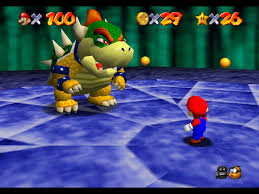
Bowser was very big, though not exactly frightening.

Bowser was very big, though not exactly frightening.

Years removed and numerous star challenges completed, I can still say that Super Mario 64 is an exceptional game, even if it’s imperfect.  Super Mario 64 was the first true attempt at a 3D platformer and it’s still the core of what all the games in the genre still follow, especially future Mario titles.  For the first time, Mario could jump, double jump, and triple jump his way to Bowser and free the princess.  Familiar foes returned like the goomba and koopa troopa, while new power-ups and locations were unveiled.  Super Mario 64 felt unique not just because of the new interface, but by creating its own world.  Traditional power-ups like the super mushroom and fire flower were absent from the game with Mario now having a life meter for the first time.  Mario could no longer breathe underwater or ride Yoshi or even partner with his brother Luigi.  There was more emphasis on exploration and uncovering hidden challenges and levels. Beating a stage once awarded Mario with a star and opened up additional challenges in the level.  To proceed further in the game Mario needed to collect a set amount of stars to face Bowser for a final time.  And for the first time, Bowser truly towered over Mario.  Looking more like a turtle than ever, it was intimidating encountering Bowser and also fairly challenging as the player needed to position Mario behind him in order to grab his tail.

The game was so flashy and new that many seemed to ignore the few areas it fell short, while time has made them more apparent.  As was the case with seemingly every 3D title from this era, the camera can be problematic and there will be times where the player is forced into making a leap of faith hoping there’s a platform out of sight.  And while controlling Mario in wide open spaces is a breeze, negotiating platforms and narrow ledges is less so, and there’s a reason why Mario hasn’t been able to punch and kick enemies following this game.  And other than the wing cap, the power-ups were decidedly un-fun, and no Luigi seems like borderline blasphemy.  In short, the Mario titles to follow were clear improvements on the interface enough to overcome nostalgia.  Or rather, I should say one title in the 3D Mario universe is clearly superior, though if someone held a gun to my head I might opt for Galaxy 2 over Super Mario 64, but that’s all right.  Here, nostalgia counts for something which puts Super Mario 64 at a strong number four on my list.

3. Super Mario Bros. 3 (1990, Nintendo Entertainment System)

The map layout common to many Mario games originated with Super Mario Bros. 3.

The map layout common to many Mario games originated with Super Mario Bros. 3.

It took me a long time to admit to myself that Super Mario Bros. 3 was no longer my preferred Mario game (and no, it’s not number 3 on my list because that number appears in it’s title), which is a testament to just how great it is.  I still consider it amongst the most highly anticipated video games of my lifetime.  Following the rather odd Super Mario Bros. 2, I think most people were excited about returning to what felt like the more traditional style of Mario games.  And knowing Mario was going to be able to fly was the kicker.  The game came out in 1988 for the Famicom in Japan, so US gamers had to endure nearly two years of screenshots in Nintendo Power (and a cameo in The Wizard) before getting to play the game, but it was worth the wait.

Super Mario Bros. 3 was the true sequel to Super Mario Bros. and the clearly superior one at that.  It was everything the original game was times 100.  It looked better, Mario and Luigi felt better (they could now slide down slopes and carry koppa shells), and the worlds of the game were so much more immersive and fun when compared to the original.  It felt huge having eight worlds with each map seemingly larger than the one before it.  It starts innocently enough with World 1 and its clear path to the castle.  Then World 2 stretches to a second screen, while World 3 has Mario sail across the map.  World 5 is basically two maps with one hidden from view at the start.  The game was always throwing new things at the player, especially when it came to the power-ups.

Super Mario Bros. 3 is remembered for a lot of reasons, but mostly it's for the power-ups.

Super Mario Bros. 3 is remembered for a lot of reasons, but mostly it’s for the power-ups.

Super Mario Bros. 3 can be credited as the game that really took the various power-ups to a new level.  It’s still the game I use as a measuring stick when evaluating all of the new and old abilities Mario acquires in his latest games.  The super leaf was the major and much hyped new ability which gave Mario a raccoon tail and ears and let him fly.  We excused the ridiculousness of the whole thing because, after all, MARIO COULD FUCKING FLY!  It blew my little mind that Mario could soar through the air like Superman.  It might seem like such a small thing younger gamers today, but it really was unheard of at the time.  The first time I laid eyes on Super Mario Bros. 3 it was all I wanted to see, just show me Mario flying so my head could finally wrap itself around the idea.  It didn’t just end there, of course.  World 3 introduced the frog suit which made swimming fun for the first time.  The water levels are kind of that thing we all overlook (except when it comes to the first Teenage Mutant Ninja Turtles game), but we all kind of secretly hate them.  The frog suit was a needed addition, even if trying to hang onto one through the land-based levels was a chore as Mario could only run in the suit if he was carrying a koopa shell.  The tanooki suit in World 5 was a cuter take on the super leaf, but it did allow Mario to turn into a statue and avoid damage, a deceptively useful tool.  World 5 was also the world that held the one stage (5-3) everyone remembers for the Kuribo’s Boot, a green boot Mario could steal from the goomba’s in the level and pound his way to victory.  The hammer bros. suit was the most sought after though.  Found in World 7, it was a more powerful take on the fire flower and most players would hang onto it until the final showdown with Bowser.

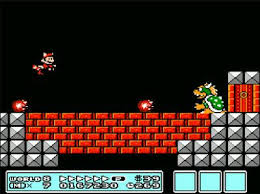
Now Bowser really has to contend with a "Super" Mario.

Now Bowser really has to contend with a “Super” Mario.

Super Mario Bros. 3 also introduced a lot of enemies that became staples of future titles.  The koopa kids made their first appearance as did the boo ghost and variations of the hammer bros. like the boomerang bros. and fire bros.  The airships were introduced for the first time and various mini games dotted the maps along with Toad Houses where power-ups could be found.  Mario and Luigi could also store power-ups for later use that could be activated from the world map.  Fortresses appeared and toppling them were necessary to reach the final fortress in each level.  The magic whistles replaced the secret warp zones and acquiring all three was the quickest way to reach the final stage.  With no game save feature, they were almost necessary for beating the game as the game was almost too big for on session forcing many gamers to leave their NES on all day to save their spot.

For the most part, Super Mario Bros. 3 is just a really fun game that keeps throwing new things at the player the further into the game they go.  It’s scope felt epic back in 1990, and it truly is the ultimate 8-bit Mario title.  Really, the only thing the top two games on my list succeed over it is with level design, but even they owe a lot to Super Mario Bros. 3 which really paved the way for all of the Mario games to follow.  It’s, simply put, among the greatest games ever made.


Ranking the Mario Games – Part 2

It’s part two of The Nostalgia Spot’s look at Super Mario games.  In this section, a couple of under-appreciated titles and a few too recent to benefit from the effects of nostalgia, but I’ll try not to hold that against them.  Part one can be found here.

10.  Super Mario Bros. 2/Super Mario USA (1988, Nintendo Entertainment System)

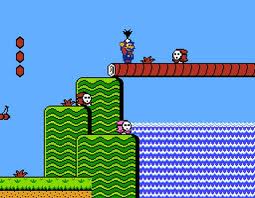
Mario throws vegetables now.  Accept it!

Mario throws vegetables now. Accept it!

The American version of Super Mario Bros. 2 has always been the black sheep of the Mario family.  It was pretty weird going from the original Super Mario Bros. to this game.  There were no fire flowers, no goombas, no koopas, no Bowser or green warp pipes.  In their place were shy guys, flying carpets, vases, an egg-shooting bird-dinosaur thing, and Wart. By now, most people know that Super Mario Bros. 2 was so odd compared to the first game because it actually wasn’t a Mario game.  Originally released as Doki Doki Panic in Japan, Nintendo re-skinned the characters and added a few Mario-type items to the game for the American audience after Nintendo of America rejected the Japanese Super Mario Bros. 2.  What most people didn’t know at the time, and what many still don’t realize, is that this Super Mario Bros. 2 is actually the REAL Super Mario Bros. 2!  The game that would be released as Doki Doki Panic in Japan actually started off as Super Mario Bros. 2.  Mario’s daddy, Shigeru Miyamoto, wanted to really change things up for the sequel with more characters and an emphasis on vertically scrolling levels.  A prototype was developed by Kensuke Tanabe, but when the project became too ambitious Nintendo basically got cold feet so they put the brakes on it and went the safe route for the Japanese Super Mario Bros. 2.  Not wanting to waste the foundation of the game, it was re-dressed for release as Doki Doki Panic.  By the time Nintendo of America was clamoring for a different sequel, Nintendo’s development techniques had improved enough to the point that it was comfortable going full speed ahead with this iteration of Super Mario Bros. 2.  It was so successful that it would be released in Japan later as Super Mario USA, and today it’s pretty much considered the preferred Super Mario Bros. 2 in all territories.  Even knowing that, it’s still a weird game and a lot of the sprites created for Doki Doki Panic were left in which is why there’s no familiar Mario enemies.  Instead of jumping on enemies to destroy them, Mario can stand on top of them and lift them up and hurl them as projectiles or do the same with vegetables.  The jumping and platforming is just as good as ever, and the soundtrack is beyond catchy.  The game looks nice, and the additions of Luigi, Toad, and Princess Toadstool as playable characters added variety.  One thing Miyamoto really wanted to get into the game was simultaneous co-op, but that would end up needing another 20 years for refinement.  Super Mario Bros. 2 is often overshadowed by the game that followed it, but it was an improvement on the original, albeit unconventional.  It’s odd take on the Super Mario franchise is what makes it endearing decades later.

9.  Super Mario Sunshine (2002, Gamecube)

Being a plumber is a stinky job.

Being a plumber is a stinky job.

I must confess, part of my placing Super Mario Sunshine immediately after Super Mario Bros. 2 is because it just seems so appropriate.  The games are both great examples of their genre, but both find themselves some-what unloved among the other Mario titles.  Super Mario Sunshine was a late arrival on the Gamecube, late in the sense that it wasn’t there for the system’s launch.  Mario had been a fixture at every Nintendo system launch of any consequence before, so gamers kind of just assumed he’d always be there.  With the Gamecube, Luigi got to bat lead-off for a change with his first solo outing leaving Mario to arrive a year later.  Super Mario Sunshine is the sequel to Super Mario 64 and just the second 3D Mario title in the span of six years.  1996-2002 was kind of a dry spell for Mario, but Super Mario Sunshine is another superb outing for the venerable plumber.  Unfortunately, Nintendo saw fit to saddle Mario with FLUDD, a water-powered jetpack type of thing that dominates a lot of the gameplay.  FLUDD really wasn’t well-received by Mario fans (though reviewers seemed to enjoy it) even though it was a rather fine gameplay addition for the most part.  With such an established star as Mario though, fans are often resistant to change.  Super Mario Sunshine brought back a lot of the platforming elements of prior games with an emphasis on level exploration.  It was well conceived, and using FLUDD as a means of propelling Mario along works quite well.  It’s the more mundane actions that become tiresome, such as needing to spray the environment clean incessantly.  As the player, you’ll do a lot of just standing around spraying water.  There’s also the need to replenish the water supply that’s not much fun.  Yoshi did make his return in Sunshine, and Bowser Jr. his official debut.  Super Mario Sunshine is a game that’s likely better than most people remember, and is absolutely still worth checking out.

8.  New Super Mario Bros. Wii (2009, Nintendo Wii)

New power-ups and co-op play; it's all you really need to know about New Super Mario Bros. Wii.

New power-ups and co-op play; it’s all you really need to know about New Super Mario Bros. Wii.

New Super Mario Bros. brought the plumbers back to 2D in a way that was commercially very successful, though creatively felt more like a straight nostalgia trip and little else.  Which was fine, but I’m not sure what people expected of the franchise going forward, or if it even would be a true franchise.  New Super Mario Bros. Wii arrived three years later and for a home console this time, the Nintendo Wii.  This is where the franchise really started to leave it’s mark, with more interesting power-ups and better level design.  For the first time a Mario game was also able to be played cooperatively with up to four players all at once.  This was something Nintendo wanted to do as early as Super Mario Bros. 2, but the technology just wasn’t there.  To be fair, it’s not New Super Mario Bros. Wii’s strongest point as only two players of equal skill will be able to find much enjoyment in co-op.  Otherwise, it feels more like Sonic the Hedgehog 2 with one player controlling the action and the other frantically trying to keep up.  The level design for the Wii game is much better though, after being mostly forgettable on the DS.  The added power-ups of the propeller suit and ice flower/penguin suit also add to the experience.  The propeller suit especially is one of the more fun power-ups to come along in a Mario game.  With a flick of the wrist, the propeller on the player’s head spins sending Mario ever higher on the screen and allowing for a slow descent.  Yoshi, again, is back but is limited only to certain stages which is kind of disappointing.  The challenge is a bit better than the DS title, though it’s still a pretty easy game for Mario veterans.  The final showdown with Bowser is both memorable and, if you’re aiming to collect all of the star coins, pretty tricky as well.  The reintroduction of the Koopalings is also a welcome development after the many repetitive boss battles in the first game.  New Super Mario Bros. Wii is another fun 2D Mario game, though it falls short of being a truly remarkable.

7.  New Super Mario Bros. U (2012, Nintendo Wii U)

For the first time ever, Mario is in HD but the end result won't knock your socks off.

For the first time ever, Mario is in HD but the end result won’t knock your socks off.

It should be considered a good thing that the most recent entry in the New Super Mario Bros. franchise is the best.  Though that does kind of ignore the fact that the edition released just a few months prior to New Super Mario Bros. U is the worst in the series.  The console editions are the stronger games, and they’ve apparently had a little more love during their development cycles.  New Super Mario Bros. U also has the distinction of being the first original Mario title to debut alongside new hardware since Super Mario 64 back in 1996.  Unfortunately for the Wii U, while New Super Mario Bros. U is a good and enjoyable title it’s not the system-seller that Super Mario 64 was.  Sales of the Wii U have been putrid, to put it nicely, so a lot of people still haven’t played this one.  Admittedly, when I first played it last year I was feeling a little fatigue after just recently finishing New Super Mario Bros. 2 and it took me awhile to actually play through this one.  That’s not the game’s fault, though I suppose it is a short-coming for the title that, despite being in HD, it still looks and plays more or less the same as the previous games.  The game borrows conceptually from Super Mario World in how the map is laid out.  There are several hidden paths and special levels to uncover throughout the game and each world has its own distinguishing features.  They’re also controlled by one of the seven Koopalings once again, with the King of Koopas waiting at Peach’s castle for Mario to arrive and save his princess.  All of the power-ups from New Super Mario Bros. Wii return though in a diminished capacity.  The main new power-up is the flying squirrel suit, which makes too much sense for a Mario game.  With it, Mario can glide and he knifes through the air rather quickly, as opposed to the slow descent of the super cape or tanooki suit.  He gets a one-time hop in flight that does bring him to that slow descent we’re used to.  He also has the ability to cling to walls, though he can’t move along them (which is what the new cat suit will allow in the upcoming Super Mario 3D World).  I was a bit lukewarm on the suit initially, but after extended playing time I’ve actually come to enjoy it quite a bit.  It’s different, and probably Mario’s best flying suit since the cape.  The best thing I can say about New Super Mario Bros. U though is the difficulty.  It’s still exceptionally easy to rack up 99 lives, but the levels in this game will actually force gamers to use those lives.  The star coins are also better hidden, and like previous games extra levels are unlocked after defeating Bowser for the first time.  If the main game isn’t challenging enough, there are extra challenge levels that are designed to bring about controller-smashing frustration.  Lastly, the game also makes use of the Wii U gamepad by allowing it to function as a second screen, meaning you don’t even need your television on to play the game.  I’ve said a lot about a game that basically feels like more of the same, but New Super Mario Bros. U is the best side-scrolling Mario game since Super Mario World, so I suppose it deserves all of these words.

6.  Super Mario 3D Land (2011, Nintendo 3DS)

Many of the stages in 3D Land exist in a three-dimensional environment but force Mario to a 2D-like path.

Many of the stages in 3D Land exist in a three-dimensional environment but force Mario to a 2D-like path.

Over the years, Mario fans have become divided into two camps:  the ones that prefer the 2D side-scrolling games and those that prefer the 3D titles.  In truth, most fans like both but there are preferences.  In general, those that grew up with the 8-bit NES tend to prefer the games that remind them of the old titles, while those who first experienced Mario via the Nintendo 64 tend to favor the 3D games.  For the first time, Nintendo decided to try and please both with a single title:  Super Mario 3D Land.  This was not just Mario’s first 3D portable adventure, but also his first trek on Nintendo’s new 3DS handheld and Mario was expected to demonstrate the advantages of stereoscopic 3D gaming.  I don’t know if Mario was able to sell audiences on that feature, but people in general seemed to love the game and with good reason.  The style of the game is basically an open world concept for each stage, but with each level being a small level reminiscent of the old games.  Some of these levels force Mario into more of a 2D plane that may allow Mario to hop in and out of the foreground and background.  The use of stereoscopic 3D meant a few stages at a high camera angle and some platforms are nearly impossible to negotiate without the 3D effect enabled.  For power-ups, the tanooki suit was brought back but in a diminished capacity as Mario could only slow his descent, not fly (the stone form ability from Super Mario Bros. 3 is only available after beating the game once), which was a shame.  The boomerang bros. suit was the other hyped addition and it’s a good alternative to the traditional fire flower (and a nice homage to the hammer bros. suit from Super Mario Bros. 3).  The layout of the map is as linear as it gets, but completing the game once opens up what amounts to a second game.  The first set of stages are fairly painless for Mario veterans, but the bonus worlds are much tougher and contain a good amount of challenge.  Mostly, the game works as designed, though I could do without the 3D effects.  Mario controls well and the approach allows the developers to pick and choose from the best of Mario’s past and stuff it all into one game.  Hopefully Nintendo is able to build off of this game and it ends up being the first game in another successful Mario franchise, the Wii U is banking on it.


Ranking the Mario Games – Part 1

images-142Super Mario, the portly plumber with the black moustache, is not just the mascot for Nintendo but the ambassador for all video games.  Gamers are intimately familiar with Mario, his history, forays into pop culture, and of course his games.  He was the nameless Jump Man before he was Mario and though early titles like Mario Bros., which introduced brother Luigi, kept true to the plumber occupation it was Super Mario Bros. that helped launch the Nintendo Entertainment System into video game legendary status.  Since then, Mario, usually alongside Luigi, has appeared in a great many games in either a starring or supporting role.  He’s dabbled in just about every genre save first-person shooter (don’t take that as a suggestion, Nintendo) and has done so successfully, for the most part.  He’s been challenged along the way by other would-be mascots and felled them all.

Mario’s games are typically of a high quality, and while some are better than others, there really are no true lemons.  These next few posts are going to attempt to distinguish the best from the not best, but in truth, all of the games to follow are still a good time, even today.  This list only concerns itself with Mario’s starring platform adventures which began with Super Mario Bros. in 1985 and will continue this fall with Super Mario 3D World.  Excluded are two titles which borrowed the Mario name for marketing purposes, namely Super Mario Land 3:  Wario Land and Super Mario World 2:  Yoshi’s Island.  I think most would agree those two games are actually the first in new franchises for Wario and Yoshi, respectively.  This also excludes those educational Mario titles that popped up on the Super Nintendo, and the few games starring Luigi.  I considered excluding Mario’s 3D adventures and relegating them to a separate ranking but decided against it.  They’re still Mario titles, and whether the game is a side-scroller or in 3D, they actually manage to play very similarly.  Maybe it would just be easier to list the games about to be ranked, so here they are in chronological order of release:  Super Mario Bros., Super Mario Bros. 2/The Lost Levels, Super Mario Bros. 2/Super Mario USA, Super Mario Bros. 3, Super Mario Land, Super Mario World, Super Mario Land 2, Super Mario 64, Super Mario Sunshine, New Super Mario Bros., Super Mario Galaxy, New Super Mario Bros. Wii, Super Mario Galaxy 2, Super Mario 3D Land, New Super Mario Bros. 2, New Super Mario Bros. U.  That’s 16 Mario titles in total, and if this thing drags on long enough, maybe I’ll do a 17th as a postscript for Super Mario 3D World, though the pile of dust that has collected on my Wii U suggests that won’t be happening.  On to the rankings!

16.  Super Mario Land (1989, Gameboy)

Different, but similar, Super Mario Land was a worthy first attempt at bringing Mario to the smallest of screens.

Different, but similar, Super Mario Land was a worthy first attempt at bringing Mario to the smallest of screens.

Perhaps it’s a bit unfair to immediately pick on the Mario title with the least amount of technological backing, but I’ll reiterate what I said in the intro which is that all of these games are worth playing and remain so.  That said, Super Mario Land is basically a scaled-down version of the original Super Mario Bros. for the then recently released Nintendo Gameboy.  Nintendo should be commended for actually not just porting Super Mario Bros. and actually giving Super Mario Land its own distinguishing characteristics.  Set in Sarasaland, the game puts Mario in an Egyptian inspired setting with tried and true Mario gameplay.  There are some noted differences from the console games, in that Mario’s fireballs shoot at an angle and bounce off walls and hearts are used for extra lives while coins function as a currency.  There are also some scrolling levels where Mario pilots a spaceship or submarine which help break up the routine.  Otherwise, it was a pretty basic platforming-side-scroller.  The Gameboy’s display made it a little tough on the eyes, and Mario felt a little loose as a result.  Gamers who had this title in 1989 mostly seemed to enjoy it, even though they knew they were getting a somewhat lesser experience than what they had on their home consoles, but considering the Gameboy’s main competition was Tiger handheld games, they were pretty content to have Super Mario Land.

15.  Super Mario Bros. 2/The Lost Levels (Nintendo Entertainment System, 1986)

One of the defining characteristics of Super Mario Bros. 2 was the emphasis on making the Luigi experience different from the Mario one.

One of the defining characteristics of Super Mario Bros. 2 was the emphasis on making the Luigi experience different from the Mario one.

By now, anyone with an interest in video games is well aware of the story of the “original” Super Mario Bros. 2.  It was a Japan only release for a couple of reasons.  The main reason was the difficulty which Nintendo of America thought would prove too frustrating for US gamers.  Also, Nintendo of America wasn’t very impressed with the title simply because it was too similar to the original Super Mario Bros.  For that, we should be thankful as NOA was absolutely right with that stance.  Super Mario Bros. 2 would eventually be released as The Lost Levels in the US alongside the other NES Mario titles in the Super Mario All-Stars compilation released on the Super Nintendo.  The game basically plays like a set of add-on levels for the original title.  The original was such a massive success, that Nintendo of Japan felt it had to strike quick with a sequel.  When early attempts at a sequel proved too ambitious (more on that to follow), this game was created in its stead.  It’s basically just a harder version of the original, with the addition of poison mushrooms and Luigi being given his own characteristics (higher jumps but slippery feet) to make him play different from Mario for the first time.  Needless to say, when the game was eventually released in the US, few American gamers felt like they had really been missing out on anything.

14.  Super Mario Bros. (NES, 1985)

Where it all began.

Where it all began.

The original, but not still the best, Super Mario Bros. set the standard for all Mario games to follow.  These types of lists are always a little tricky because one is forced to weigh present value against past value.  My take is always to just judge the games as they are.  Perhaps that gives the modern titles a huge advantage but a good game is a good game, regardless of era or graphical horse power.  Plus, games should be better today than they were 20 years ago as I’d like to think we’re always moving forward.  With that out of the way, it should be said that Super Mario Bros. still holds up today as a fun and challenging game, just one notably simplified.  It’s the classic “go right” game and the player is expected to run and bounce along to each stage’s flag pole in an attempt to rescue the princess.  The clock actually plays a role in this game, as opposed to the more recent games, and later levels force the player to hold the run button throughout.  The game’s challenge is mostly found in negotiating jumps and platforms that become smaller as the game goes along while dodging classic Mario enemies like koopa troopas and Lakitu.  It’s true that it may be hard to impress a young gamer today with the original Super Mario Bros., but it is a textbook take on the genre it launched even if its sequels have improved upon it immensely.

13.  Super Mario Land 2:  6 Golden Coins (Gameboy, 1992)

New bunny ears and a new villain are the defining characteristics of Super Mario Land 2.

New bunny ears and a new villain are the defining characteristics of Super Mario Land 2.

Super Mario Land 2 was a huge improvement over its predecessor.  It borrowed heavily from the the current console games in terms of defining Mario’s look and power-ups and pushed the Gameboy to produce one if its best looking and best playing titles.  This game also introduced Wario, who served as the primary antagonist for Mario for basically the only time before becoming a playable character in his own line of games.  Super Mario Land 2 held onto the first game’s quirks while giving Mario some new power-ups, most notably the bunny ears.  Mario being able to fly had been a big deal since Super Mario Bros. 3 so it’s no surprise he was able to do the same in this game.  Keeping things weird, as they were with a raccoon tail bestowing flying powers in SMB 3, the bunny ears let Mario fly by rapidly pressing the jump button.  Mario didn’t gradually descend, like he did with the cape and tail, so it gave Land 2 a unique feature.  The fireballs had their angled shot replaced with traditional fire power, and the game had a map layout like Super Mario World.  The worlds the map is segregated into can be played in any order, giving this game a less linear feel, and secrets abound which help the replay factor.  Which is a good thing, because the 32 levels will be breezed through by Mario veterans making Super Mario Land 2’s biggest weakness its short duration.  This is a fun game though, and it was the first Gameboy experience that came close to matching the console one where Mario titles are concerned.

12.  New Super Mario Bros. 2 (Nintendo 3DS, 2012)

I did a big write-up on this one around the time it was released, so I won’t go into too much detail here.  Suffice to say, if anything my opinion of the game has lessened since.  It’s a fun experience, but in general it did little to nothing as far as advancing the series goes.  The focus on coin collection was a mistake as it didn’t add to the experience.  The much publicized street pass functionality and downloadable content was basically a dud, and the game’s difficulty was basically non-existant.  This is a by-the-numbers Mario game, and its sister-title New Super Mario Bros. U is the far superior game, and not just because it’s on the more powerful console and in HD.  I did enjoy the return of the super leaf power-up as well as the inclusion of the Koopa Kids and the game does not have a shortage of levels.

11.  New Super Mario Bros. (Nintendo DS, 2006)

New Super Mario Bros. was a welcome return to the side-scrolling genre for Mario and Luigi.

New Super Mario Bros. was a welcome return to the side-scrolling genre for Mario and Luigi.

New Super Mario Bros. was a supremely refreshing title when it was first released in 2006.  A new side-scrolling Mario game had not been released since 1992’s Super Mario Land 2, unless you count the Wario and Yoshi games in between.  New Super Mario Bros. was a like a kid’s dream of what the original Super Mario Bros. could have been with mega mushroom power-ups and the mini mushroom, letting Mario shrink to a microscopic size.  Of the two, the mini mushroom was actually the better as controlling a lightning quick Mario was a lot of fun.  Not that it wasn’t fun to control the Godzilla-like Mega Mario, but it got old after a few experiences.  Mario also retained some of his 3D controls like the ability to double and triple jump.  Not very useful, but a lot of fun.  The game is also massive with 80 levels to explore, some of them only unlocked after finding the various star coins hidden in each stage.  Like its sequel, the game’s biggest drawback was its lack of challenge.  Notably trickier than the follow-up, but still lacking compared with the well-balanced Super Mario Bros. 3 or Super Mario 64.  This is a good game though, and as you can probably guess from these rankings, I actually recommend it over New Super Mario Bros. 2 for its tighter gameplay and better level design, though the level design is actually a weakness for the game when compared to other Mario titles.  This one was a nice nostalgia trip in 2006, and even though the New Super Mario Bros. franchise has had a hard time living up to the classics, I still think we’re better off for having it.


Bucky O’Hare – The Video Game

Bucky O'Hare - Nintendo Entertainment System (1992)

Bucky O’Hare – Nintendo Entertainment System (1992)

I’ve been away for awhile, a combination of life events and vacation, but I’m back and ready to talk about some old things.  Here is one such old thing and a topic I’ve discussed before:  Bucky O’Hare.  Bucky O’Hare was a part of that glut from the late 1980s into the 1990s of anthropomorphic cartoon characters riding on the coat tails of the Teenage Mutant Ninja Turtles.  Very few of these properties (Street Sharks, Biker Mice From Mars, Battle Toads) had any staying power and Bucky proved to be no exception.  His show lasted one season, and it was a half season at that, before getting cancelled.  There are a number of theories why from poor marketing decisions, bad distribution of the toys, too serious, though I personally think a lot of boys just didn’t buy into the idea of a green space bunny saving the galaxy.  Despite Bucky’s outward appearance, I liked him and the show quite a bit as did a number of my friends.  Bucky probably dominated a good six months of my young life and during that time period he was even able to overtake the TMNT for a brief spell.

Even though Bucky didn’t last long as a cartoon hero (he didn’t last long as a comic book hero either), he was still around long enough to have his likeness inserted onto just about every product imaginable.  From the obvious items like toys and clothing to the less obvious such as dishes and light-switch covers.  Not surprisingly, another item that took advantage of the Bucky O’Hare license was a video game, simply titled Bucky O’Hare.   The game was developed by Konami and released in 1992 a short while after the cartoon had finished its run.  Right away, it should be noted that Bucky dodged a major bullet in that his game was developed by Konami, and not LJN, whom Konami had a tendency to hand all of its licensed products to.  LJN is known as one of the worst game developers from that era; it possessed the opposite of the Midas Touch when it came to game development.  The fact that Bucky managed to avoid such a fate is really quite surprising, in hindsight.  Even more popular properties like the X-Men were unable to avoid LJN but somehow Bucky snuck through.

DownloadedFile-33Bucky O’Hare on the NES is an action platformer starring Bucky O’Hare himself.  Players control the funky fresh rabbit and navigate him through various levels, mostly going left to right but not always, as they run, jump, and gun down the evil toads to save Bucky’s crew.  The game starts off giving the player a choice of 4 different stages, represented by different planets, that Bucky can choose from.  On each planet, one of Bucky’s crew-mates is being held captive:  Blinky is on the green planet, Jenny is on the blue planet, Dead Eye the red, and Willy DuWitt is on the yellow planet.  Bucky can choose to rescue his mates in any order, though at least one planet requires the aid of one of Bucky’s comrades, for when Bucky rescues a character that character becomes playable.  The player can switch on the fly with a press of the select button.  All characters share the same health bar but have their own power bar.

The power bar is where the characters distinguish themselves.  Each character had a unique attack and unique ability.  Attacks are simply done by pressing the B button.  Bucky can shoot horizontally and vertically and his special ability is a super jump.  By pressing and holding the B button, Bucky crouches down and charges up a jump.  The power meter determines how high he can go and it can be increased in size by collecting certain power-ups.  Blinky has a jetpack that allows him to fly for a short duration.  His attack is a canon-ball like  weapon that fires in an arc.  It can also break certain blocks found in the environment.  It’s more powerful than Bucky’s attack, but has limited range.  Jenny fires a laser that may or may not inflict more damage than Bucky’s gun, though it’s rate of fire doesn’t seem to be as good.  Her special ability is some kind of telekinetic ball that the player can control with the d-pad once it’s been fired.  It’s useful in certain spots where the player can sit out of danger and attack from cover.  Dead Eye has a scatter-shot for his main weapon.  Think the spread gun from Konami’s much more popular Contra series. His special ability lets him crawl on walls for a short duration.  Not particularly useful.  Willy has a fairly normal attack with his special being a charged shot.  Unlike, say Mega Man, Willy is stationary when charging making his special ability the least useful.

Mega Man fans, does this look familiar?

Mega Man fans, does this look familiar?

Willy’s special ability isn’t the only comparison to Mega Man one will find when playing Bucky O’Hare.  In many ways, the game is like a Mega Man clone.  The non-linear setup at the start is certainly reminiscient of the blue bomber’s games and the general run, jump, shoot mechanics seem to be clearly inspired by Mega Man as well.  There’s also some levels, or parts of levels, that are inspired by some of Mega Man’s more famous levels such as the red planet’s nod to Quick Man and the vanishing blocks from the Toad Mother Ship.  A quick google search will reveal that, in some circles, this game is known as the Konami Mega Man.  I’ve never heard anyone actually refer to the game as such, but the internet never lies.  Bucky owes a lot to Mega Man, but it’s different enough to maintain integrity and similar enough that it’s safe to say most fans of the blue bomber will enjoy the green rabbit.

Bucky O’Hare may not be among the most popular NES games, but most people who are into NES games seem to know about it and associate it with one word:  hard.  Many games from this era are hard, but Bucky O’Hare is often placed in that upper tier of really difficult games.  I’ve never heard anyone outright call it the hardest NES game ever made, but I’ve seen it included in several lists or youtube videos amongst the elite.  This is mostly a good thing, as Bucky O’Hare is able to achieve it’s difficulty without being too cheap.  There are some areas, when playing for the first time, that will piss a gamer off.  The most obvious to me occurs on the yellow planet where the player has to hop on these futuristic mine carts that zip along a track.  Jumping from one to another is not difficult, as they slow down long enough to make the timing easy, but before long a wall of spikes will pop up that result in a one-hit death if the player doesn’t react fast enough.  These one-hit deaths comprise the majority of player fatalities in Bucky O’Hare.  Very rarely can I recall actually having my life depleted slowly during a non-boss encounter.  And even the boss fights, as one might imagine, include a number of instant death attacks that can put an end to the fight rather quickly.  What keeps Bucky O’Hare from being among the hardest of the hard is its generous continue system.  Each level is broken up into several acts which, by themselves, are pretty short.  If a player loses all of his or her lives the continue screen is displayed and electing to go on will bring the player to the start of the most recently completed act with a new set of lives.  Continues are unlimited, and completing a full level gives the player a password which isn’t overly complex or long.  This means anyone of moderate skill can probably complete Bucky O’Hare so long as they’re persistent.  And given that much of the game’s difficulty comes from being surprised, practice does indeed make perfect.

Right around the time it seems like the game has thrown everything it can at you, it introduces the flying stages.  Prepare to die.

Right around the time it seems like the game has thrown everything it can at you, it introduces the flying stages. Prepare to die.

Bucky O’Hare is deceptively long and offers a good amount of gameplay.  After completing the first four stages the player is abducted by the toads and (annoyingly) must also re-rescue the trio of Jenny, Dead Eye, and Willy.  The setup, beyond the run and gun nature of the game, is pretty straight-forward but there are areas later in the game that are non-linear as Bucky explores the Toad Mother Ship.  After the conclusion of each level, a boss encounter occurs.  They’re usually fairly challenging, but there are some easy ones, and part of the challenge is knowing which character works best.  For the most part, Bucky on his own is enough to take down a boss but I did find some uses for Jenny’s special attack (namely the yellow planet boss) and Blinky has his moments too.  Only Willy comes across as feeling useless as I was able to make regular use of the other four characters.  Bucky never had another console video game release, but he did have an arcade game released after this one though it wasn’t very popular.  This game, along with the cartoon’s catchy theme song, is probably the way most remember Bucky O’Hare.  Considering most of those other shows, TMNT included, received mediocre to terrible games, I’d say Bucky came out ahead in one respect.  If you like NES games and have never played this one, I whole-heartedly recommend it.