Tag Archives: platform games

Numskull BurgerTime Quarter Scale Arcade Cabinet

It’s time! It’s time! It’s Burger Time!

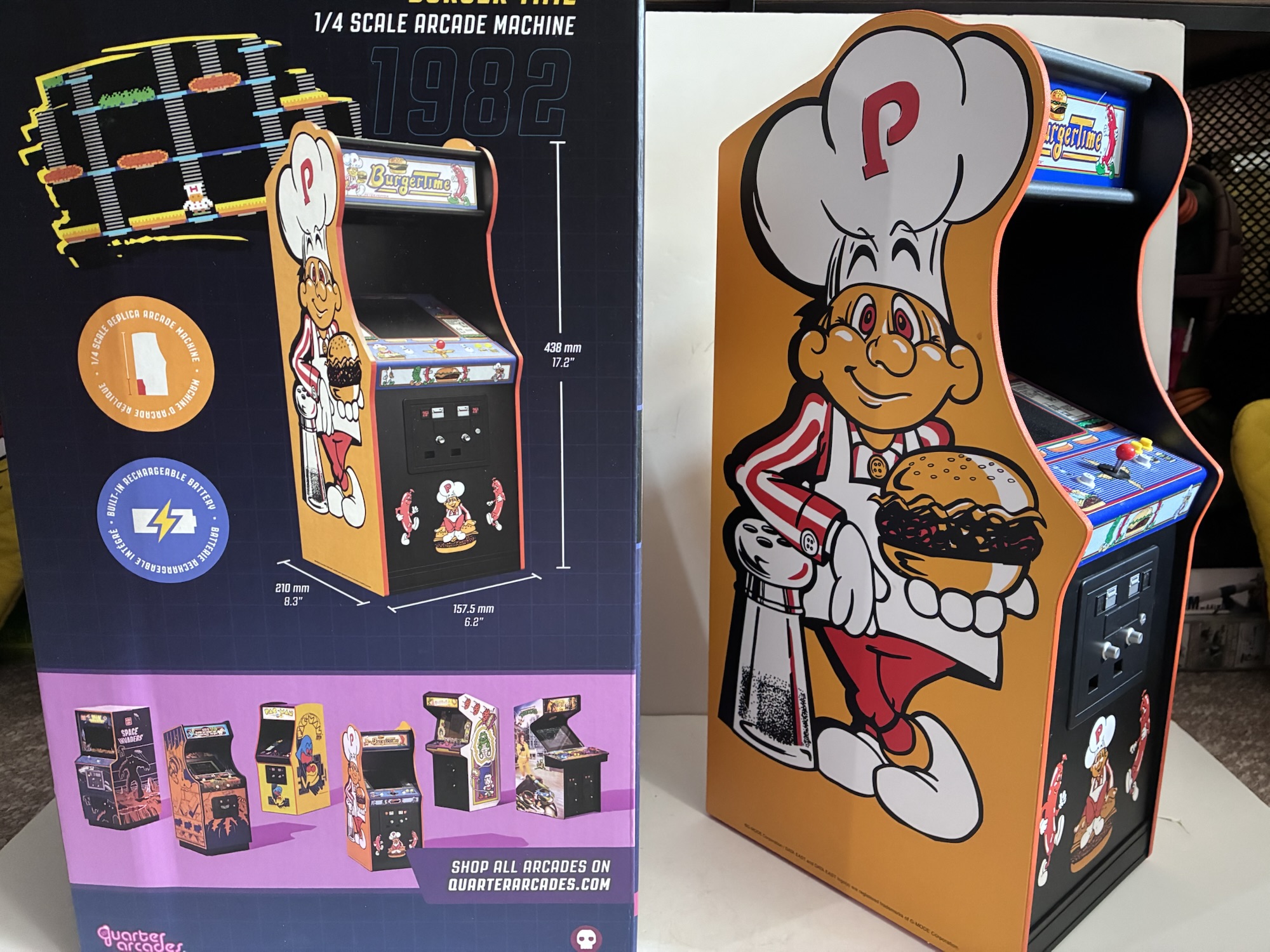
For a few years now, Numskull has been releasing scaled down versions of arcade classics. It’s a strategy similar to Arcade1Up which managed to worm its way into big box retail with its smaller versions of classic and not so classic arcade games, but with Numskull they’ve gone even smaller. Their quarter scale machines are just that – a classic arcade machine at one fourth the size. At least, I take them at their word in that regard since the game we’re talking about today is one I don’t have access to in its original form so if this is not exactly to scale then that’s for someone else to confirm. These releases though caught my eye when they first showed up and have continued to do so, but the price has always kept me from biting. After all, this is certainly not the ideal way to play an arcade game. Most of these are 40+ years old and available virtually everywhere which makes this type of release more of a gimmick or decorative item than anything. However, I do love a good micro version of a popular item. In that, I’m like Myron Reducto from Harvey Birdman: Attorney At Law who has an obsession with tiny things. I don’t know what it is, but when something I like is available in a tinier version it makes me happy, but only if it doesn’t lose function and Numskull would seem to fit that description.
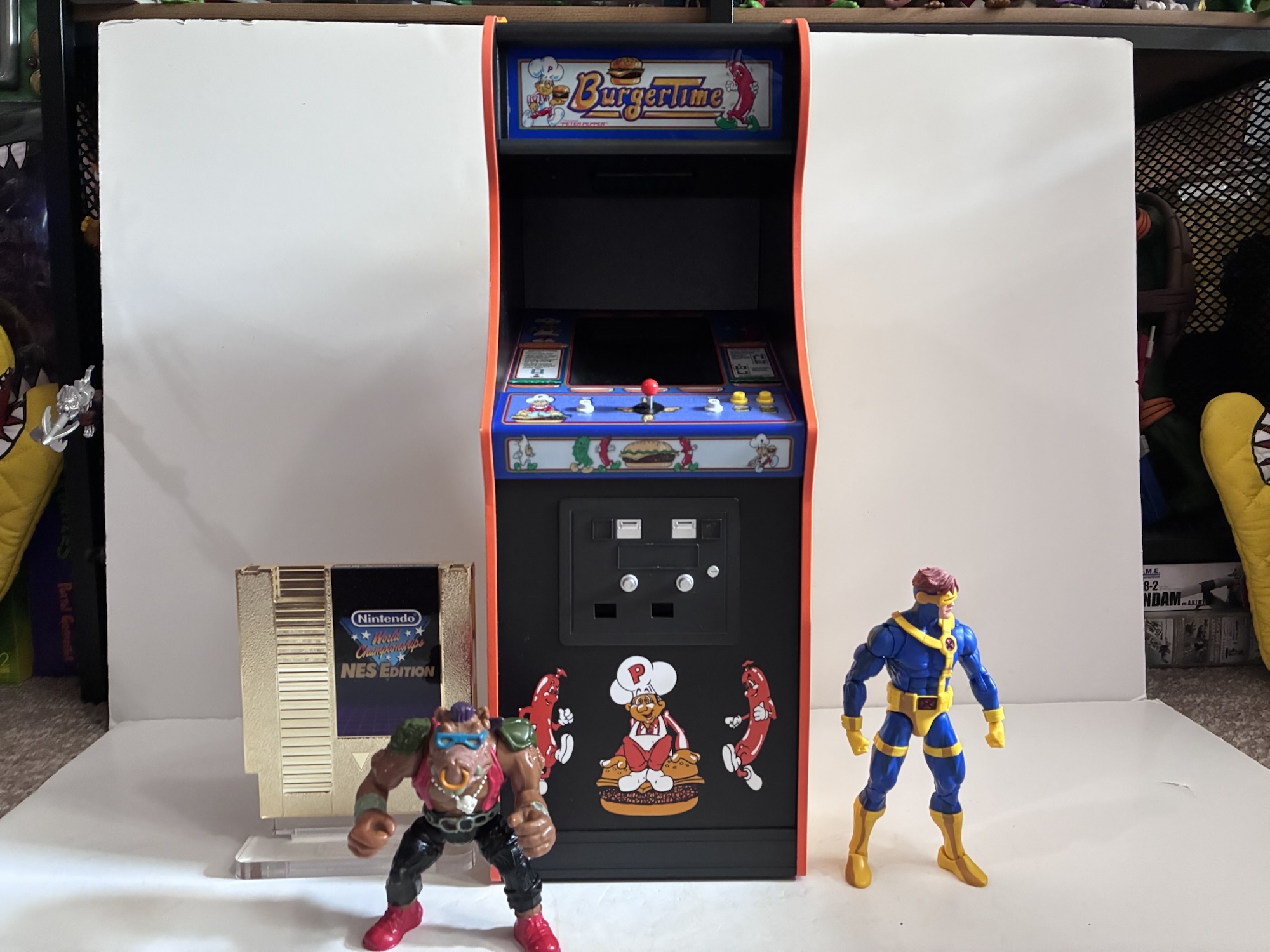
A size comparison that hopefully suits everyone: (left to right) replica NES cart, Playmates Toys Bebop, Burger Time, Marvel Legends Cyclops

Of course, if someone were to go out and buy one of these things that’s only part of the decision. The other is to decide on just what to get? For Arcade1Up, I have just two releases: The Simpsons and Marvel Super Heroes. The Simpsons is the only “full size” cabinet I own with the Marvel one being a “barcade” which is just a smaller version that sits on a table or bar. The Marvel one I received as a gift and it’s a solid one to have since it contains three 2D fighting games on it and that’s a style of game that works well on repeat plays. The Simpsons, in contrast, does not. It’s a brawler and they’re shallow, but I just love The Simpsons so I wanted to add it to my rec room and I waited for it to go on clearance before finally taking the plunge. With Numskull, a lot of the games are classic, see if you can get the high score, sort of things. They do work well to some degree as a game designed to be replayed and mastered, but they’re also old and it can be hard to justify playing such games when so many other, more modern titles are constantly available in a given household. The thing is though, the $250-300 starting point for a lot of these meant it didn’t really matter. I was not going to spend that kind of dough on a gimmick. If any were to go on steep discount then sure, but I honestly didn’t think that would ever happen.
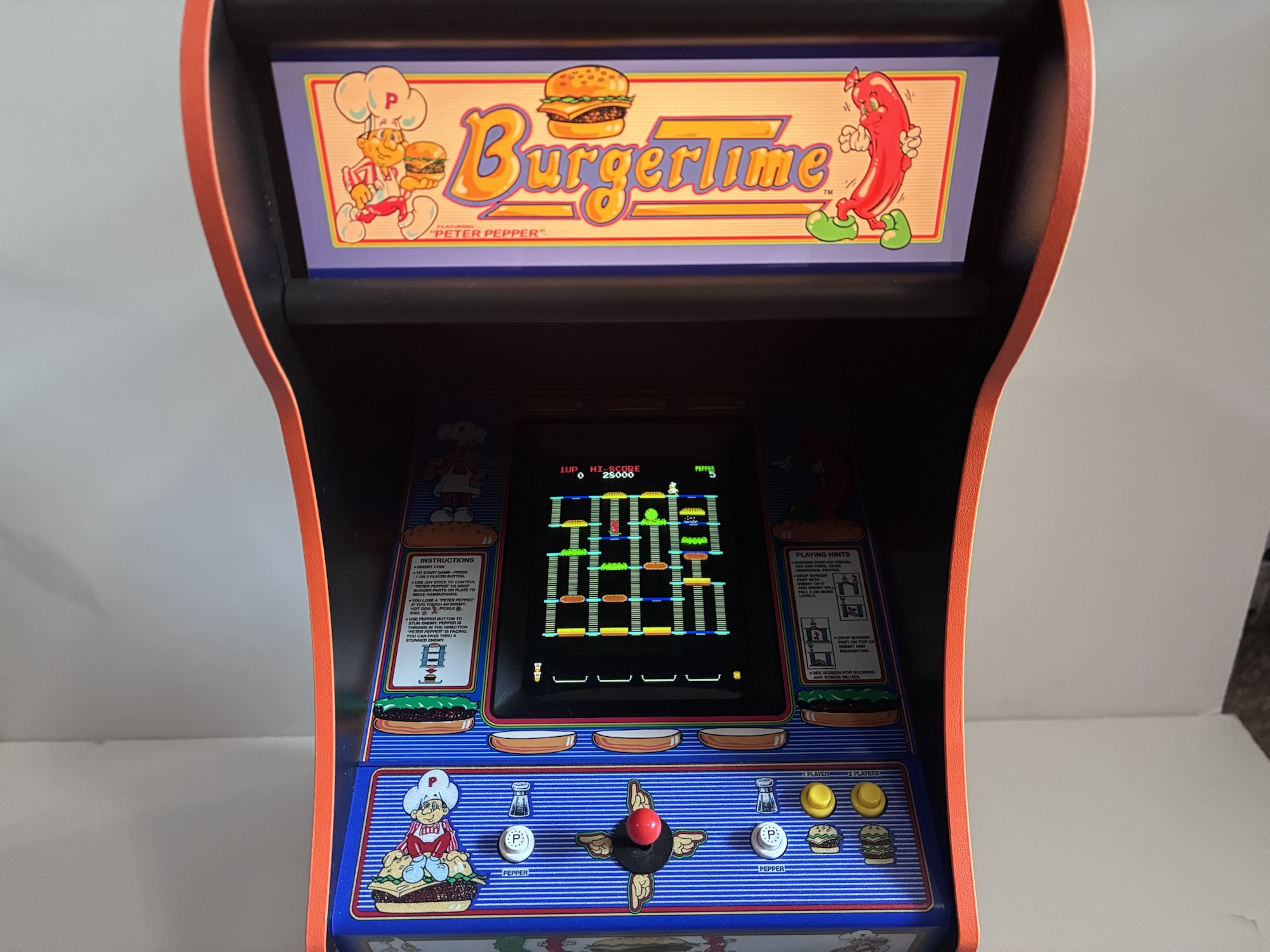
The marque lights up when turned on.

Enter Woot, Amazon’s discount storefront. It was in the spring that they had the Numskull version of BurgerTime available for $70. This ordinarily would cost $230 so while $70 is still a lot for a gimmick, it’s also a pretty sizeable discount. While it wasn’t the game I had my eye on, it certainly fit the bill as something that would be worthy of replaying. And for the record, the game I was hoping would hit such a price was Teenage Mutant Ninja Turtles, but really just so I could stick it with my quarter scale action figures. I didn’t actually want to play it, I can do that far more easily in other ways, but thus far that has only hit as low as $200 from its MSRP of $300 and it’s unlikely to ever dip below $100 so BurgerTime it is.
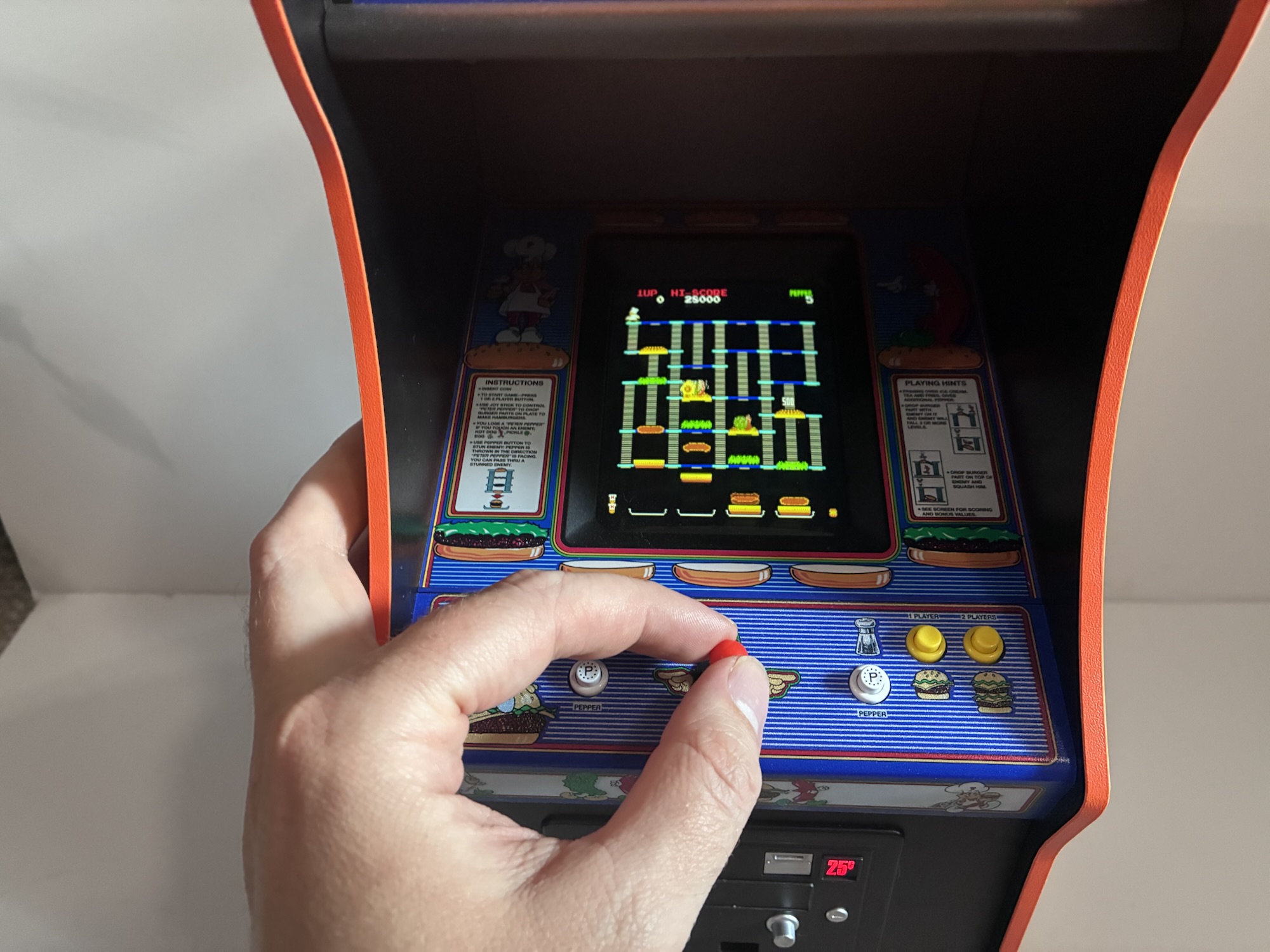
It’s a little cramped, but playable.

BurgerTime is a game originally released in 1982 by Data East for the DECO Cassette System. That was a series of arcade cabinets designed to be altered and have their game swapped out when things started to get stale. It was one of the early platform titles following in the footsteps of Nintendo’s legendary Donkey Kong. In it, the player takes control of a chef by the name of Peter Pepper tasked with assembling a series of hamburgers. Trying to prevent Peter from doing so are some enemy foot items. What’s the hamburger’s greatest enemy? Why, the hot dog (or sausage) of course! Joining the hot dog is a fried egg and a pickle slice. I’m not sure why the egg and pickle, both solid additions to any burger, are trying to obstruct Peter, but perhaps we shouldn’t pay it any mind. The game tasks the player with navigating a sequence of platforms via ladders to walk over ingredients for the burgers that need to be constructed. Walk over them and they drop a level. Peter must get all of the ingredients to fall through the level and into place in order to clear the level.
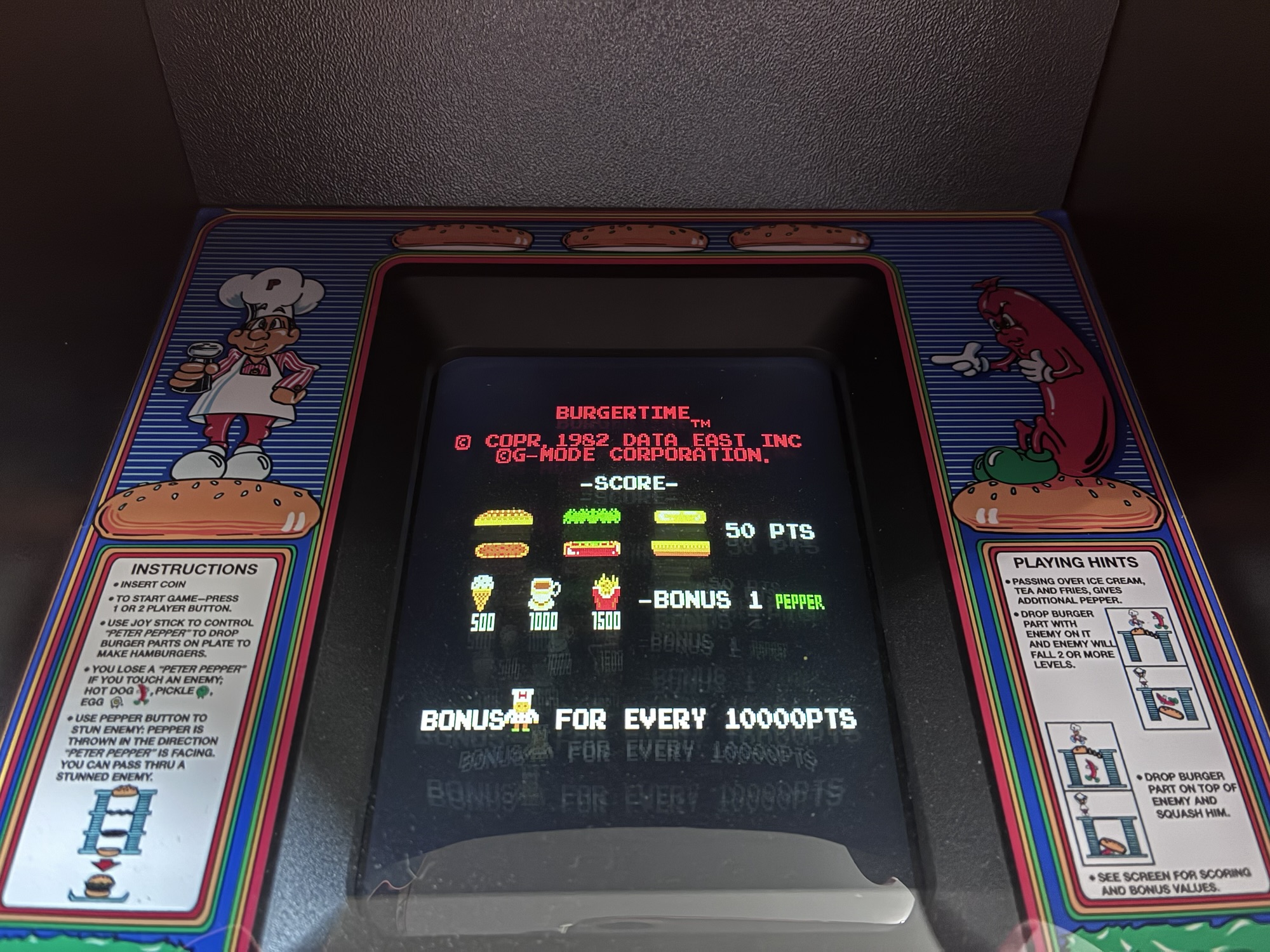
The resolution is pretty nice.

BurgerTime has six, looping, levels and the ultimate goal is to collect the highest score. Peter has few maneuvers at his disposal to avoid enemies as he can only walk along platforms and scale ladders. He does have access to pepper and hitting an enemy with pepper both stuns them and makes it possible for Peter to pass through them. Peter only has five doses of pepper to start, but collecting points will cause power-ups to appear on the screen for a short amount of time which can replenish Peter’s pepper reserves. The real skill of the game is in navigating the baddies and using them to your advantage. When Peter walks across a portion of a burger, it drops one level. However, if it has an enemy on it then it will drop multiple levels which can help speed things along and increase your point totals. The game basically turns Peter into a pied piper of sorts as you want to get enemies following you so that you can drop ingredients with them on it. Enemies located below falling ingredients will also get taken out by them, though they can re-enter the fray. As levels advance, the game gets harder by creating more choke points on the map. The first map is pretty basic while the second is shaped like an inverted pyramid. It’s much easier to avoid enemies near the top, but towards the bottom they can more easily box the player in. Contacting an enemy is death and Peter has just three lives, but can accumulate more at certain point total intervals.
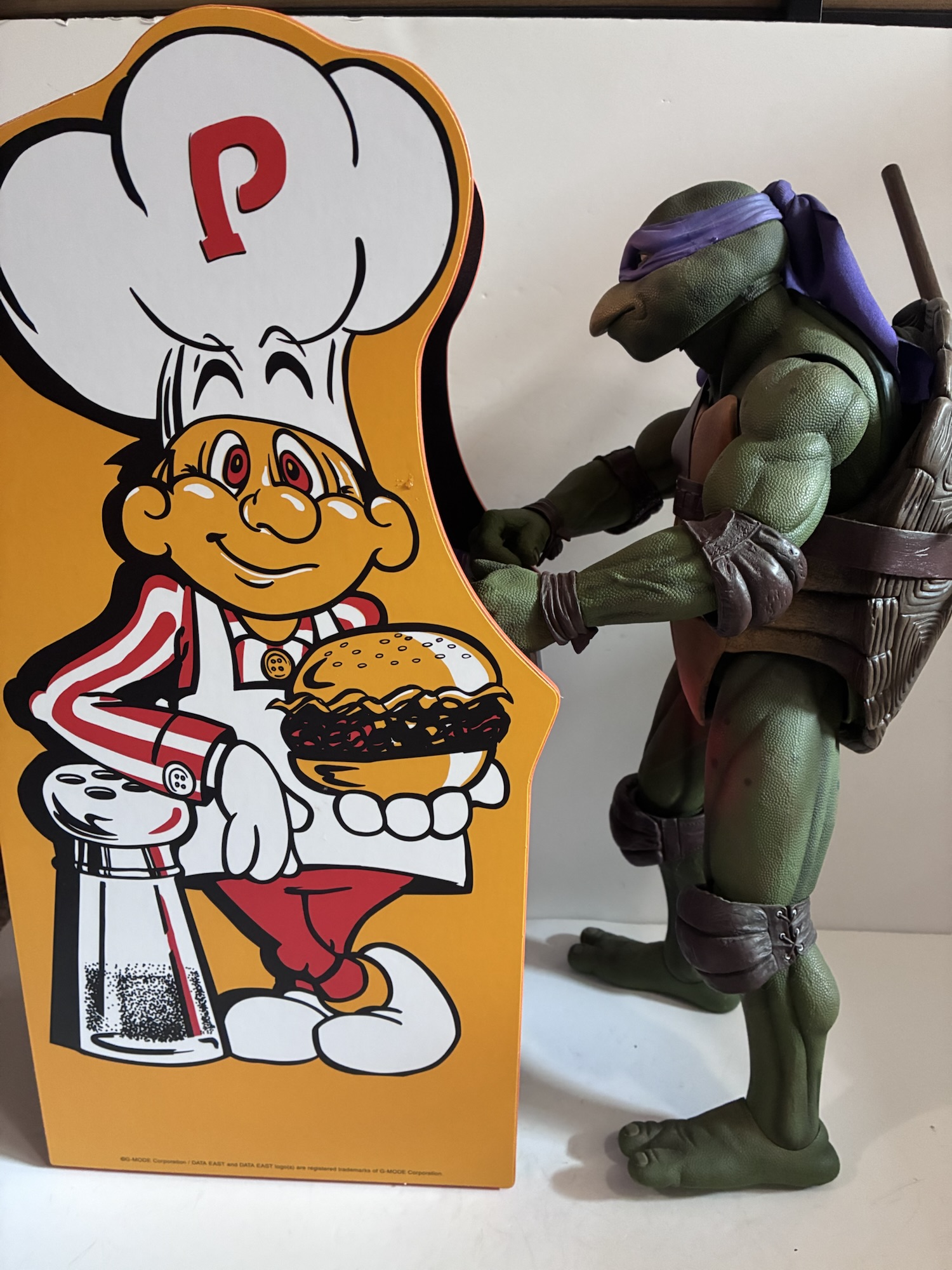
“Should have been Pizza Time.”

BurgerTime is a simple game, so it translates pretty well to a tiny arcade cabinet. It requires just two inputs to play: the four-way joystick and the pepper button. The joystick does have a touch more play to it than I’d like as sometimes I feel like it’s not as responsive as it could be, but that could also be the game which requires some precise positioning in order to ascend or descend a ladder. Repeated plays have helped me to largely improve in that respect, but it does make me wish I had access to an actual arcade cabinet to see if it feels the same (I haven’t played BurgerTime prior to this in 30+ years). The screen is nice and bright and the sound comes through cleanly. The cabinet works best when placed on a table, but it’s not too big to just plop on your lap as well. The build quality feels really nice and it’s quite lovely to look at. The marquee lights up when it’s on and there are buttons for player select and the coin returns, though they don’t all actually do anything in the game. The cabinet can be played plugged into a wall outlet, but it also has an internal battery that is advertised to get over 2 hours of playtime. In my experience that seems to be pretty accurate and it comes in at the high end of the estimated time. Since this is an emulated arcade game, Numskull did add some features via the bios so if you just want to see everything the game has to have without the necessary skills needed to get there you can toggle on invincibility or infinite lives to do so. And like the real deal, it will keep track of high scores so it gives you something to shoot for. That’s right, I’m coming for you Ken!
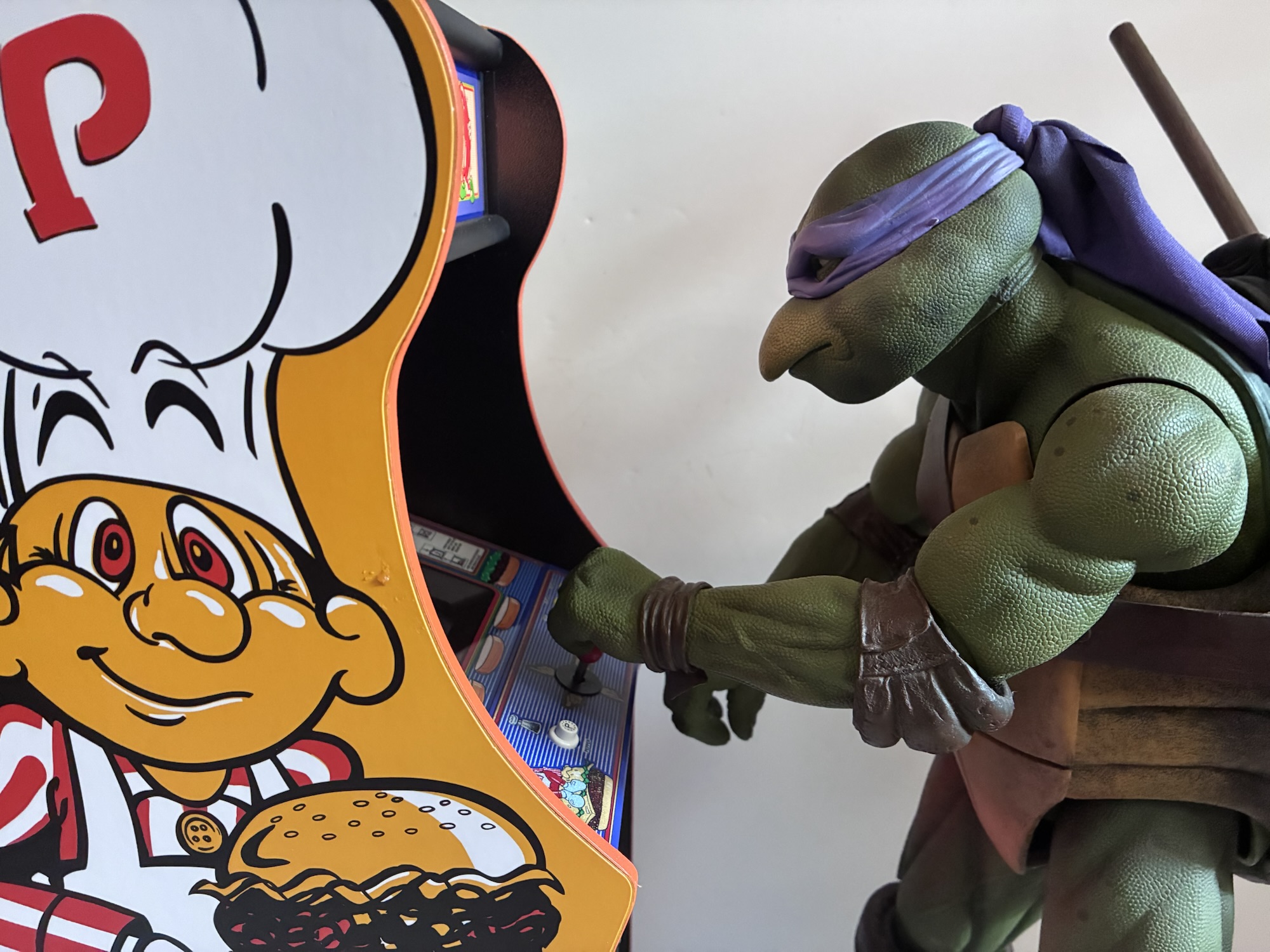
He’s going for my high score.

Numskull’s quarter scale arcade cabinet is about what I expected. It’s a quality machine that is quite fun to look at, but is also surprisingly fun to play as well. Is this the best way to experience BurgerTime (or any of the games available)? Probably not, but it’s also not the worst as there were plenty of ports to home consoles for BurgerTime that came up lacking. This is a 1:1 recreation of the arcade experience just in a smaller package. It’s pretty addicting, though also dated. BurgerTime has never been my favorite game from this era, but it’s one of the better ones. I mentioned that TMNT was the cabinet I was really hoping to land some day, but for superficial reasons and to sate my TMNT fandom. As far as actual games that I’d want to play, it’s pretty much BurgerTime, Ms. Pac-Man, and Bubble Bobble of the available games. I’m not a big shooter fan so I wouldn’t want any of those so I can’t be disappointed with the fact that it was BurgerTime that ended up being the one I got. Will I get more? Probably not. They would have to hit a similar low price point and be one of the few games I have my eye on. And now that I have one, I don’t feel the same level of curiosity that I felt before. If this is something that interests you and you can get it for a similar price then I think it’s worth it. It’s hard to set an actual price on it because it is pretty superfluous. I know I wouldn’t pay the original sticker price, but I might have been willing to go more than the $70 I got it for.

For more video game talk, check these out:
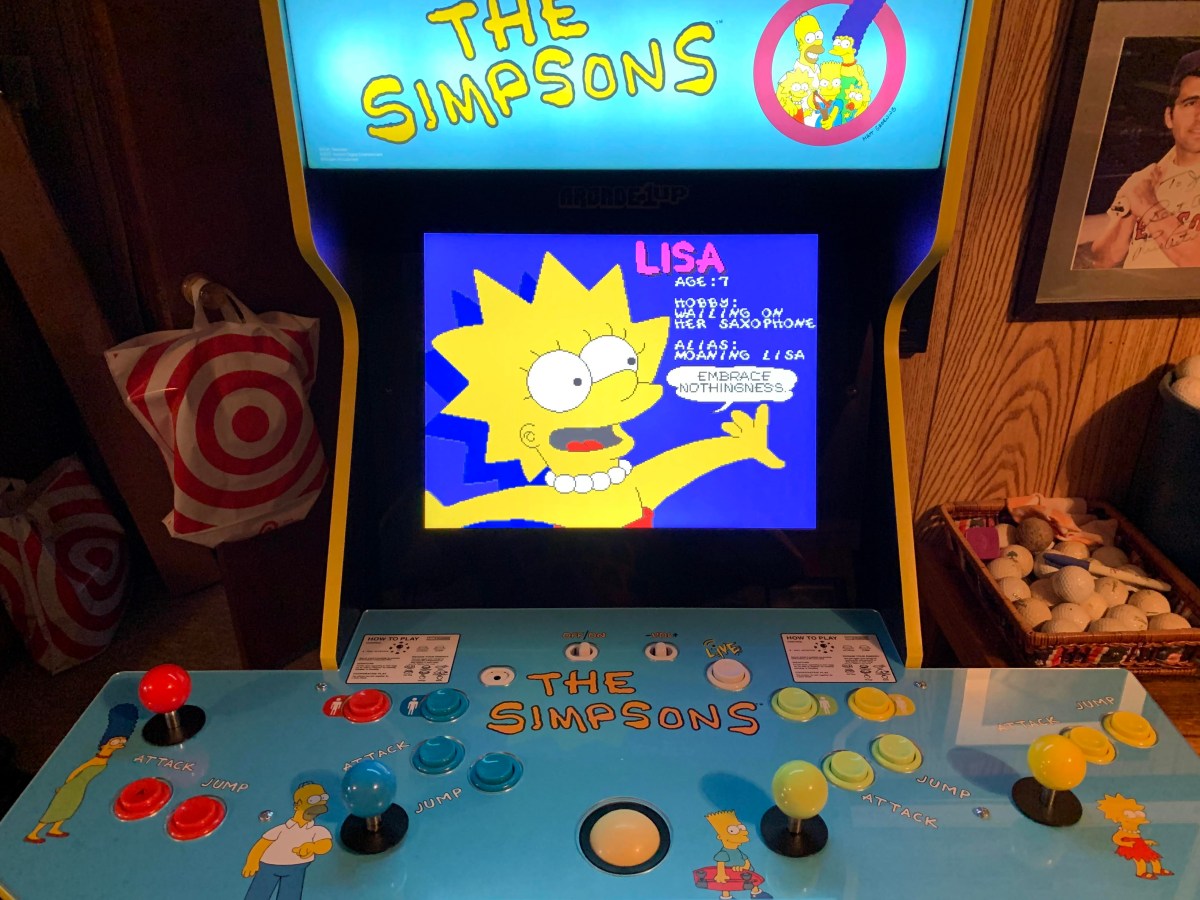
Arcade1Up – The Simpsons

When it comes to arcade cabinets, there are few that would interest me as far as a purchasing decision is concerned. One such cabinet though has always been The Simpsons arcade game, and it’s not really because of the game’s quality. The game is fine, one of the better brawlers out there, it’s just limited…

Keep reading
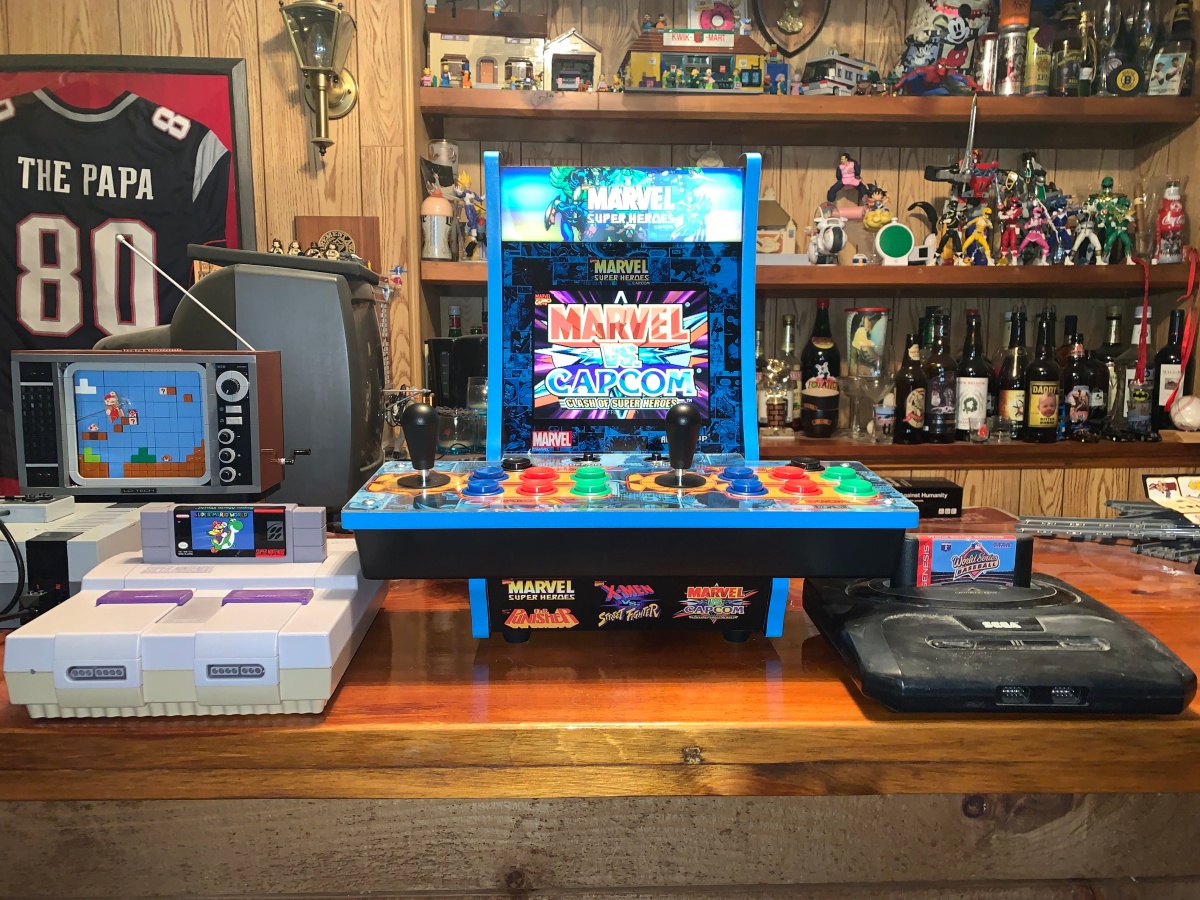
Arcade 1Up Marvel Super Heroes Counter-Cade

Arcade 1Up has been around for a few years now selling arcade cabinets at a reduced size and also a reduced price. The cabinets are significantly smaller than an actual arcade cabinet, but still plenty large enough to take up a lot of floor space in your home. And while they’re cheaper than the “real…

Keep reading
Teenage Mutant Ninja Turtles (1989 Arcade)

What began as a joke between aspiring comic book creators, Kevin Eastman and Peter Laird, eventually morphed into a multi-media juggernaut bestowing wealth and status upon the two. Along the way though, few predicted such big things out of a property titled Teenage Mutant Ninja Turtles. The books sold well, but they were independently produced…

Keep reading
Ranking the Mario Games – Conclusion

Part 1

Part 2

Part 3

images-155There’s certainly very little suspense with these kinds of things.  Anyone familiar with the Super Mario franchise can figure out at this point which two games are going to top my list, whether people disagree or not is another story.  Rather than dive right into these last two games, I think it is important to point out just how many of the games that I’ve talked about could have been number one.  Super Mario 64 seems like an easy one to argue in favor of.  What the original Super Mario Bros. did for the 2D side-scroller, Super Mario 64 did for the 3D platformer.  Only the games to follow in that genre have really done very little to deviate from the Super Mario 64 style of gameplay.  Sure the worlds have gotten bigger, and the graphics have certainly improved, but the core mechanics are still mostly in play.  Super Mario Galaxy 2 could also be argued as top dog.  The inventive gameplay of the Galaxy franchise has a ton of appeal, and Galaxy 2 is bigger and harder than its predecessor.  In a world where Mario games seem to be getting easier and easier, it’s nice to know some of the games are trying to hang onto some semblance of difficulty.  And of course Super Mario Bros. 3 will always have a claim to best Mario title on the planet.  It’s the game that really expanded on the Mario world for the first time giving gamers tons of variety in terms of level design, power-ups, boss fights, and basically every other aspect of the game.  Many of the titles today still borrow heavily from Super Mario Bros. 3, and I feel like I could go on for another two-thousand words on the subject and it still wouldn’t feel like enough.

In short, Mario has had a lot of great adventures over the years.  As overexposed as he tends to get, it can sometimes be easy to lose sight of just how important the character has been to gaming.  A lot of people my age claim to have outgrown Mario, but I don’t think that’s possible.  You can’t outgrow fun, just lose touch with it.

2.  Super Mario Galaxy (2007, Nintendo Wii)

For the first time ever, Mario gets to spend an entire game in space.

For the first time ever, Mario gets to spend an entire game in space.

Super Mario Galaxy wasn’t the first title to take Mario into space, but it’s definitely the most memorable.  Galaxy is basically the sequel to Super Mario Sunshine and Super Mario 64 before it as Nintendo decided Mario’s 3D adventures were ready to continue on the Wii.  Many people were curious how the Wii’s motion controls and Mario would meld, as I think many assumed Nintendo would use the game as a way to showcase what the console was capable of.  Instead, the developers for the game mostly downplayed the Wii’s motion controls in favor of a fairly traditional scheme.  Mario was still controlled via analog stick and he could bounce around just as he could in the two previous 3D games.  The only addition for the Wii was a spin attack that could be initiated with a simple flick of the wrist.  The Wii remote could also function as a pointer and could fire star bits.  These star bits could momentarily stun enemies but it mostly was just a tack-on feature.  I assume most forgot the feature even existed while playing.

Where Nintendo sought to distinguish Galaxy from the prior Mario games was to place an emphasis on gravity.  Mario would travel from galaxy to galaxy, planet to planet, and encounter all kinds of unique situations.  Some levels had Mario sticking to tennis court sized planets that were still large enough to apparently have a gravitational pull.  This could lead to some really disorienting experiences with Mario basically upside down or sideways but the game’s camera was so well crafted, and Mario so weighty, that it rarely felt as bad to the player as it looked.  I know initially I was skeptical at just how good a game could be that focused so much on trying to disorient the player but Galaxy proved me way wrong.  Running and jumping from planet to planet, sometimes within a level, was pure joy. The only comparable experience I can even compare it to are those warm, fuzzy feelings I had when playing Super Mario 64 for the first time.  Mario handles so well and the level design is so spectacular that it’s hard to not constantly wonder what’s next while enjoying the present.

I think Donald Duck tried this once.  It didn't go too well for him, from what I recall.

I think Donald Duck tried this once. It didn’t go too well for him, from what I recall.

Since this is a Mario game, there are numerous power-ups available to experiment with.  Of the new ones, the best and most enjoyable is definitely the bee suit which allows Mario to fly for short bursts.  Bee Mario flys just by holding down the A button, but he can ascend for so long before he needs to “recharge.”  It’s all pretty quick, but the ability to fly is curbed just enough to keep the player from flying constantly.  For more intense flight, there’s a special power star that lets Super Mario impersonate Superman.  It only exists in kind of a bonus level, but is fun while it lasts.  Some of the new power-ups are duds, like spring Mario who can do nothing but bounce which gets frustrating, and there’s some sequences where Mario has to balance on a giant ball.  For the first time in a 3D Mario title, the fire flower makes an appearance as does its opposite, the ice flower.  Both are kind of interesting in that they function very much like an invincibility star in that they only bestow Mario with special abilities for a brief period of time.  This does lend itself well to some puzzle situations, but it is a little disappointing to not be able to remain as fire Mario until damage is taken.

Mario gets shot out of canons (pipes) quite frequently in this one.

Mario gets shot out of canons (pipes) quite frequently in this one.

From a technological standpoint, Super Mario Galaxy is a star.  The Wii was never considered a powerhouse by any means, but Galaxy looks great.  The environments are varied, the color pallet is gorgeous, and many of the enemies dwarf Mario, especially Bowser.  The music is high quality as well, composed mostly of orchestral instruments giving it a very “Zelda” feel.  The plot for the game is basically the same as always, though the character of Rosalina is introduced which makes things slightly more interesting.  The game’s storyline may not be enough to get gamers to keep coming back, but the numerous objectives and hidden stars will.  As with Super Mario 64, each level has stars for Mario to collect and after collecting a certain amount challenge stars begin to appear.  This is where the game really turns up the difficulty and gives Mario vets a true challenge.  It’s probably not as hard as its sequel, but it strikes a very nice balance between challenging and frustrating.  That, along with all of the other positives I’ve cited, is why Super Mario Galaxy is the best of the 3D Mario titles to date.

1. Super Mario World (1990, Super Nintendo)

The layout of the world according to Mario.

The layout of the world according to Mario.

The mark of a truly special game is one that is inherently fun.  There are many games where aspects of them fit this description.  Mindlessly rampaging in any of the Grand Theft Auto titles is always a blast, political correctness be damned.  When it comes to multi-player, I’m not sure I’ve ever had more fun with a  game than I did with Super Bomberman and three of my buddies.  Both of those games contain moments of pure joy, but neither is able to achieve that and hold it for the entire duration of the full game.  Super Mario World is a game that is non-stop entertainment from start to finish.  Expertly crafted level design, colorful visuals, and tweaks to the Mario formula helped introduce a legion of fans to the Super Nintendo making Super Mario World not just the best Mario game, but the best pack-in game of all time.

Super Mario World was not the leap forward for Mario that Super Mario Bros. 3 was.  It didn’t have to be as that game was nearly perfect itself.  It only needed to improve upon it and give gamers a reason to play Super Mario World other than its inherent “newness.”  Obviously, that’s easier said than done as many developers have tried to improve upon a game like Super Mario Bros. 3 and failed.  When it came time to create Super Mario World, it would seem Nintendo took a back to basics route when comparing it with its predecessor.  Power-ups were de-emphasizd as the game only included two permanent power-ups (aside from the mushroom) for Mario and Luigi:  the venerable fire flower and the shiny new super feather.  The fire flower worked the same as always, but the feather gave Mario a yellow cape and the ability to fly.  Rather than have the cape mimic the raccoon tail, it worked in an entirely different manner.  Mario still had to run to take-off, but once airborne Mario zoomed to the top of the screen before dive-bombing back to the ground below.  This could double as an attack, but if the player so desired Mario could be made to “parachute” his cape for extended flight.  It took some getting used to, but once mastered a player could easily soar Mario over an entire level.

Mario's dino-buddy Yoshi, was the most talked about addition to the Mario universe.

Mario’s dino-buddy Yoshi, was the most talked about addition to the Mario universe.

The other major gameplay addition was Yoshi.  Yoshi functioned as a power-up himself, giving Mario not only an extra hit but also giving him a new attack.  Atop Yoshi, Mario could direct his dino servant to devour all kinds of enemies.  As a bonus, certain turtle shells gave Yoshi special abilities such as fireballs or his own ability to fly.  Mario could also use Yoshi to reach higher places or travel over certain terrain.  Green Yoshi was the standard, but different colored Yoshi’s existed in the secret Star Road area that had limited power-up potential, but also an exploitable skill (the blue Yoshi, for example, would sprout wings and fly with any turtle shell in his mouth, while green Yoshi could only do so with a blue shell) that had its own advantages.

The storyline for the game was really no different, other than the fact that Mario is on vacation in Dinosaur Land.  Mario still has to topple Bowser’s seven children before facing him to save the princess.  Where the game stands out is in its scope.  Super Mario World is appropriately titled.  It may not seem huge compared to today’s games, but at the time it seemed massive.  Each world is distinct and varied as well, and they’re full of hidden exits and secret levels.  This made Super Mario World both challenging and highly replayable.  Some staples of future Mario games were introduced in this one, such as the Ghost House or Wiggler enemy.  Furthermore, the game was hard.  It eased the player in with the deceptively tame first world but the difficulty increases as the game moves on.  There are plenty of scrolling levels, levels with small platforms for Mario to negotiate, and levels requiring some puzzle solving to escape.  The boss encounters with the koopalings were also more varied, and the final showdown with Bowser was satisfying as well.  And if the main game was too simple for some, the Special Zone provided its own brand of torture with many having their own personal nightmare level among one of them.

Secrets abound in Super Mario World.

Secrets abound in Super Mario World.

Aside from the bells and whistles, Mario also handled better than ever and the score was another strong addition to the Mario universe.  The main melody is used throughout, though I was also most fond of the subtle bongo notes introduced whenever Yoshi shows up (a trend that has continued over the years).  If the game has short-comings, it’s that there are less mini games when compared with Super Mario Bros. 3.  The lack of more power-ups is also a slight mark against the title when holding it up to the others, but it’s the gameplay that matters most.  Always.  When it comes to Super Mario World, there just isn’t a better Mario game on the planet.  Everything that came before it was refined and improved upon to craft the perfect platformer.  Nintendo wisely chose to not truly follow-up on the title for well over a decade because it couldn’t be topped.  There was nothing left for Mario and Nintendo to prove with this genre.  And over twenty years later, Mario still hasn’t appeared in a better game.