Tag Archives: dragon ball z

Dragon Ball Z – Resurrection ‘F’

Dbz_movie_2015_poster

Resurrection ‘F’ (2015)

Dragon Ball Super still feels very much like a new series to me, which is kind of funny since it just concluded with episode #131. Although it may have just ended (and production company Toei Animation has suggested it’s likely to continue), I’m currently about 80 episodes behind since I’ve been watching it on Cartoon Network’s Toonami block which just aired episode #59. It’s been really interesting seeing the franchise resurrected, no pun intended, after being seemingly relegated to video games for the foreseeable future. Maybe it was getting older, maybe there were just new stories to tell, but something compelled series creator Akira Toriyama to return to the franchise that made him famous around the world. And wouldn’t you know? The fans have been there and willing to re-embrace this franchise. It’s been something to behold as I personally never saw it coming after Dragon Ball GT was so poorly received, but here we are.

Battle of Gods was the film that got the ball rolling on this new era of Dragon Ball. It brought the old gang back together and introduced some new characters in Beerus, the God of Destruction, and his attendant Whis. It was a mostly fun little film that managed to rise above the Toei Dragon Ball Z films that were largely generic filler. It certainly helped that Toriyama wrote the picture, but it also really helped that it was both canon and it is basically a replacement for the unimpressive GT. Still, some fans were left feeling a bit underwhelmed. The movie was heavy on personality and humor and light on DBZ’s trademarked action. It may have also disappointed fans to see their hero, Goku, actually fail in his bid to top the God of Destruction giving the film a very different feel from the usual fair. I was actually pretty receptive to the film. While I could see the obvious faults and the age-old formula at play (minus the little twist ending) I found it very charming and really enjoyed the introduction of both Beerus and Whis.

Battle of Gods was a fairly simple reintroduction for the Dragon Ball franchise, enough so that it was adapted as the first arc of Dragon Ball Super (along with the movie I swear this post is about), but it was light on fan service. In to make up for that is 2015’s Resurrection ‘F,’ and make no mistake, the ‘F’ is for Frieza.
12647_5

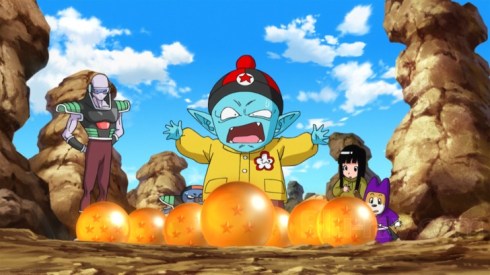
Pilaf always has to be starting trouble.

Frieza was the big baddie of DBZ’s second major story arc. In some ways, he was the ultimate villain of DBZ as he was responsible for the death of Goku’s father and his home world, though to Goku neither was a huge loss. Frieza was also the catalyst for Goku’s transformation into a Super Saiyan, the blond-haired ultra-powerful version of the character that’s almost now more famous than the old black-haired spiked version. He was an incredibly detestable villain, a ruthless tyrant willing to kill anyone who stood in his way – including children. He casually ended the lives of many of Planet Namek’s inhabitants as well as both Krillen and Vegeta, just when the audience was warming up to the Saiyan Prince.

Toriyama apparently felt there was more to do with old Frieza, even though the protagonists of Dragon Ball Z have long since surpassed the villain’s strength. Frieza barely survived his battle with Goku, needing to be partially rebuilt using cybernetics, and briefly returned to battle only to meet his end at the hands of a debuting new character – Trunks. Ever since then he’s been dead, confined to Hell which is where our story begins. What looks like the setting of a preschool show is actually Frieza’s own personal torment. Teddy bears and bunnies happily prance about playing happy songs in a pastel paradise where the once mighty Frieza (Chris Ayres) dangles from a tree like a pupa. He’s obviously agitated and the implication is this has been going on ever since the tyrant’s demise many years ago.

resurrection-f-frieza-dragon-ball

He’s back! Technically again, since Cyborg Frieza was his first surprising return.

In deep space, the remnants of the Frieza Force, lead by the diminutive Sorbet (Jeremy Schwartz), are struggling to maintain control over Frieza’s once vast empire. Sorbet has decided they can no longer continue without their lord, and having failed to locate the new Planet Namek, he decides that he and a small force need to head to Earth and find the Dragon Balls there to revive Frieza. He’s done his homework and knows that the fighters of Earth are capable of detecting power levels without a scouter and thus the decision to only bring along one attendant is made. Aiding him in his mission is that fact that both Goku and Vegeta have journeyed to the home world of Beerus to be trained by Whis while the other earthlings are too busy with their own day-to-day lives to notice Sorbet’s presence.

maxresdefault-25

Goku and Vegeta have been spending their time training with Whis, apparently ignoring their families back home.

Using the aid of an old enemy, Pilaf, Sorbet is able to locate the Dragon Balls and make his wish. Unfortunately for Frieza, since Trunks decimated his body the dragon can do little except restore life to a pile of flesh and cybernetics. Sorbet indicates they have the technology to heal Frieza, even from this state, without the need for cybernetics. Pilaf’s underling, the canine-like Shou, uses the second wish to acquire a million Zeni and Sorbet, along with the remnants of Frieza, take their leave.

In space, Frieza is healed and quickly decides his first order of business is revenge. When some of his followers politely suggest that this may be unwise, considering that Goku has since defeated Majin Buu who even Frieza feared in his old life, he lashes out killing some and making his point clear. For the first time in his life, Frieza decides to train and work hard to make himself stronger, which is how Toriyama is going to convince the audience that Frieza could perhaps go toe-to-toe with the current version of Goku. Apparently Frieza’s power before was just natural talent. He was never tested or forced to work and was able to effortlessly take whatever he wanted. He concludes four months should be enough, and thankfully, we’re in for a time jump.
dbzrf-still-1

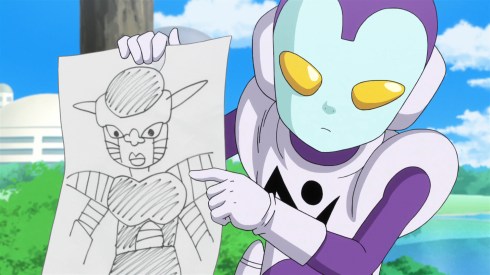
Making the leap from manga to anime is Jaco, and his impressive artist’s rendering of Frieza.

On earth, the Galactic Patrolman Jaco (Todd Haberkorn) makes his series debut when he arrives on Earth to warn Bulma (Monica Rial) that Frieza was alive and coming for Goku. Bulma is only slightly concerned, but there is the issue of Goku being too far away to get ahold of easily. She explains to Jaco that Whis can be lured to Earth with tantalizing sweets, and Jaco doubts that Beerus and Whis even exist assuming the God of Destruction is the stuff of fairy tales. Still, Bulma is only slightly annoyed when Whis fails to notice the strawberry sundae she’s waving at the sky, but then becomes a bit concerned when Jaco informs her that Frieza will be there within the hour. Well, that changes things a bit!
81YXcPJlykL._SL1500_

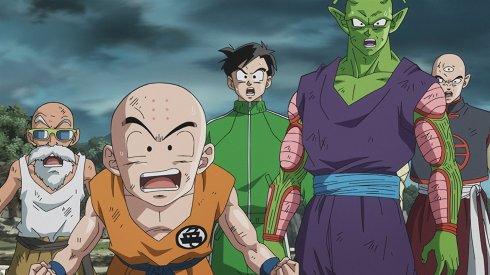
Some old friends are going to have to get their hands dirty while they wait for Goku and Vegeta to arrive. Nothing really changes.

Krillen (Sonny Strait), introduced doing some cop stuff, along with the other fighters assemble. Krillen even has his wife 18 (Meredith McCoy) shave his head so he can capture that classic Krillen look before he heads out to take on Frieza. 18 correctly reminds him that she’s stronger than he and should go, but he thinks it’s more important she stay behind to take care of their daughter and she puts forth no argument. She remarks that he’s so cool as he flies away, which is the most affection we’ve ever seen her show up to this point (that I can recall, anyway).

In the outer reaches of space, Goku (Sean Schemmel) and Vegeta (Christopher R. Sabat) are sparring with their latest teacher, Whis (Ian Sinclair). Unable to land even a single blow, Whis explains to the two their weaknesses. In his estimation, Vegeta is always one step behind Goku because of the rather large chip on his shoulder. Meanwhile, Goku is too arrogant and lets his guard down too easily, which Whis demonstrates with a sucker punch. Their training awakens Beerus, who nearly annihilates them all with a simple sneeze. Whis warns the Saiyans to be careful around him for Beerus once accidentally destroyed the sun their planet orbits around. Goku is pretty shocked to hear that and assumes they have the power to give birth to the very stars, but Whis corrects him by explaining he can actually rewind time by a few minutes and was able to undo Beerus’s mistake. Beerus is still agitated about being woken up from his slumber, but Whis cures his angst with some pizza he acquired on Earth. If you didn’t see Battle of Gods, the gimmick, if you will, of Beerus and Whis is their fascination with Earth cuisine. They love experiencing new dishes and could best be described as foodies. It’s also why Beerus decided to spare the Earth from destruction.

dbzf47

Goku’s got a new look to debut.

With Goku and Vegeta occupied, the other fighters of Earth are forced to confront Frieza and his army of 1,000 men when they show up. Leading the charge is Gohan (Kyle Hebert) along with Krillen, Piccolo (Chris Sabat), Tien (John Burgmeier), and Master Roshi (Mike McFarland). Two notable absentees are Trunks and Goten, and it’s explained that Bulma didn’t want them to know about Frieza to keep them safe. Frieza’s army offers little resistance when it engages the fighters, which is fine because it’s a way for the film to shine a light on some of these forgotten characters. It’s been a long time since Master Roshi, in particular, got to mix it up and do some damage and it’s definitely a whole bunch of fan service. When they’re out of the way, it’s down to Frieza who quickly puts Gohan on his back. Since this is a film, we don’t have time to mess around and Goku and Vegeta quickly show up to challenge the old tyrant.

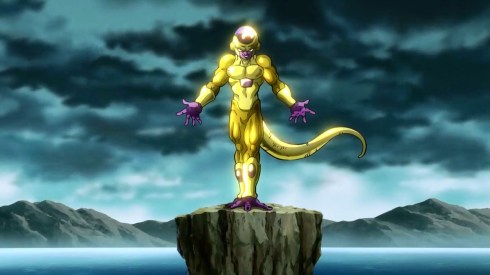
Frieza is delighted to see Goku and immediately goes to his final form. Goku does a lot of posturing while Vegeta angrily waits his turn. After some warming up, the two decide there’s no point in holding back. Goku unveils his new form, Super Saiyan God Super Saiayan. That mouthful of a form will eventually be simplified as Super Saiyan Blue as it’s basically just Super Saiyan but with blue hair instead of yellow. Of course, in terms of power it’s well beyond even Super Saiyan 3. Not to be outdone, Frieza unveils a new golden form that appears to be roughly equal with Goku’s new form. The two trade blows until Goku boasts about discovering Frieza’s weakness. When he starts to take control of the fight, Frieza resorts to some dastardly tricks and interference like a classic wrestling heel, forcing Vegeta to enter the fray. Frieza, holding out some hope that Vegeta will return to him and kill Goku, is shocked when Vegeta turns down his offer to be his Supreme Commander and he too transforms into this blue-haired form for a final showdown.
friezaj

Frieza’s new form is quite statuesque.

As a plot, it’s simple and fast-moving though the picture still ends up around 90 minutes. It doesn’t drag at all, unlike the Dragon Ball Super version of this arc which stretches it out over the course of 13 episodes. It’s packed with fan-service as a pretty sizable portion of the plot is devoted to the Goku/Vegeta rivalry and how the two view it and each other. It firmly confronts and establishes how those two coexist and view each other, and it’s kind of sweet to see it confronted openly. It’s also a source for a lot of humor and having both Beerus and Whis around adds to that. The film also teases a team-up between the two proud warriors, with both of the god-like characters remarking the two Saiyans would be unstoppable if they worked together.

Vegeta-Super-Saiyan-God-Dragon-Ball-Z

For once, Vegeta and Goku have reached a new level of power together making the two as close to equals as they’ve ever been.

Resurrection ‘F’ is also the best Dragon Ball Z has ever looked. There’s still some of that CG junk that marred Battle of Gods, but it’s relied upon sparingly here. The opening, featuring an underwater scene, is kind of ugly, but thankfully not a harbinger of things to come. The colors all pop and are richly vibrant. There are no obvious animation shortcuts and some genuinely nice uses of CG like a battle among some colossal trees that invokes images of Endor, only the speeder bikes have been replaced by supersonic warriors. The film also slightly upends the old formula of the other DBZ movies which often featured Goku having to clean-up after Vegeta was defeated. It’s a small change, but welcomed.

The score for the picture is also quite well done. It feels very much like a DBZ score, but with a modern touch. There’s some contributions from two noted Japanese bands, Momoiro Clover Z and Maximum the Hormone, the latter of which served as the inspiration for the plot as Toriyama was a fan of their song “F,” which was all about the villain, Frieza. It’s good stuff, and the English voice cast is pretty great as well. Voicing Frieza is Chris Ayres, who took over voicing duties for the character when Funimation went back and re-dubbed the series for Dragon Ball Z Kai. His Frieza is stupendous, and he does an especially great job of screaming as the character. And I continue to be a huge fan of both Whis and Beerus, even though their obsession with food will start to feel repetitive come Dragon Ball Super, but here it’s still funny.

maxresdefault-26

Oh, and this is apparently what Hell looks like.

Battle of Gods was the return to Dragon Ball Z I never knew I wanted. Resurrection ‘F’ manages to top it, even if it sounds kind of stupid on the surface. Somehow the film is able to make Frieza a compelling threat so many years after his defeat and I didn’t realize how much I appreciated him as a villain until I revisited him. It’s also nice that he’s just confined to this movie, as opposed to a massive arc where a single confrontation is spread over 30 episodes or whatever the old fight encompassed. And since I had already seen this plot covered in Dragon Ball Super, it was interesting to see what changed when they stretched it out over more than a dozen episodes. Super did deal with one long lingering pothole that the film does not touch, the frog version of Captain Ginyu, but other than that it doesn’t add anything important and really just contains a lot of subpar filler. That’s Dragon Ball though, you kind of have to both love it and hate it at the same time. At least here, for a brisk 94 minutes, you’re able to mostly just love it.


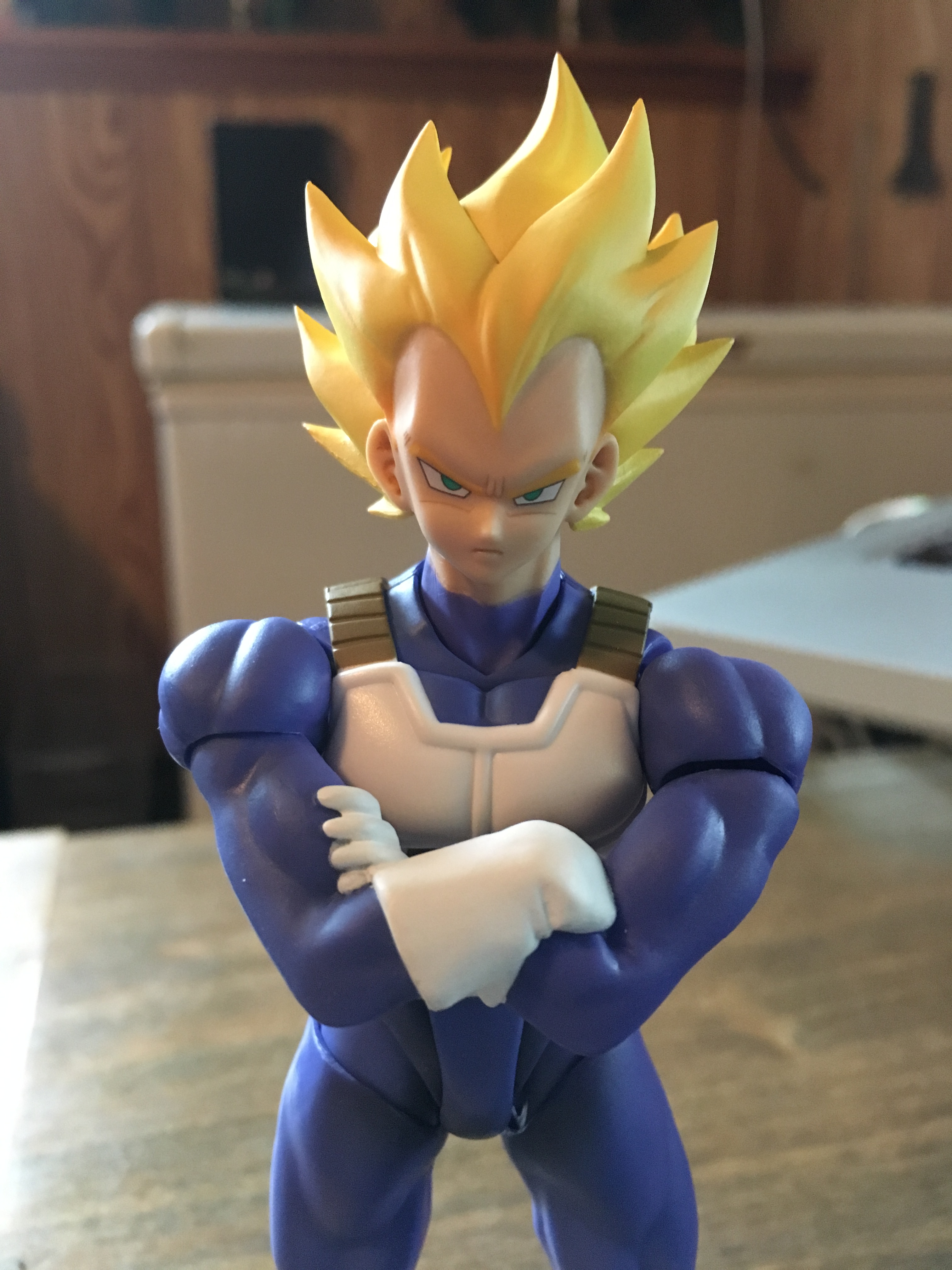
SH Figuarts Super Saiyan Vegeta

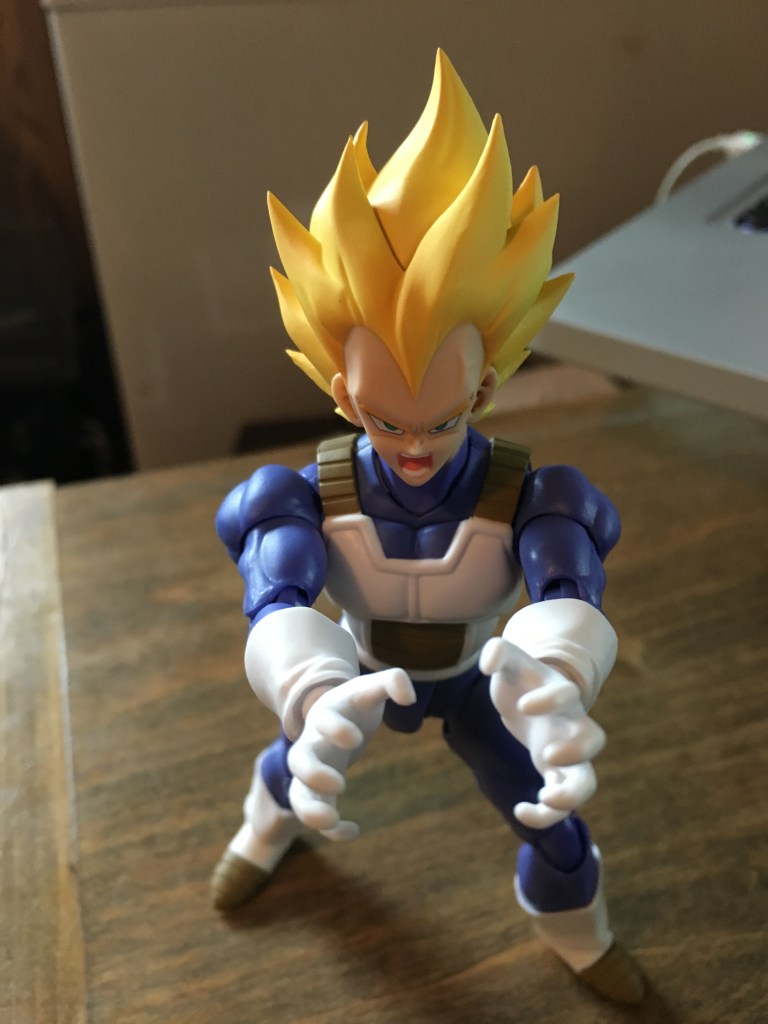
IMG_2172He’s the Prince of all Saiyans. The last survivor to have laid eyes on Planet Vegeta, home world of the mighty warriors and birthplace of the legendary Goku. And he’s also a pretty fine toy. Vegeta, arguably the most popular character to emerge from Dragon Ball Z, has seen his likeness cast in numerous forms of plastic over the years. The Dragon Ball franchise is probably the most recognizable anime franchise around the globe and probably the most beloved. Despite concluding over 20 years ago, Dragon Ball Z remains insanely popular. It has experienced a renaissance over the past few years due in large part to the launch of Dragon Ball Super, the Akira Toriyama blessed true sequel to Dragon Ball Z which basically erases the lackluster Dragon Ball GT from canon. It’s thanks to that series, as well as Giant Bomb’s new Dragon Ball Kai podcast All Systems Goku, that I’m feeling awash in Dragon Ball related nostalgia. And when I get nostalgic, I often turn to toys.
IMG_2162

Final Flash, sort of?

SH Figuarts, a division of Bandai, has been releasing high quality action figures for a few years now. I reviewed each figure in its aborted Teenage Mutant Ninja Turtles line and came away really impressed with the build quality of those figures. That license was reportedly rather expensive for SHF, so I should not be surprised that their Dragon Ball products actually seem more substantial and are even a bit cheaper in price. They’ve been dabbling in the franchise for a few years now, but it’s only just now that I finally bit the bullet on my first DBZ figure and who else was I going to pick other than Vegeta? Truth be told, my options were rather slim at my local comic shop as these figures aren’t stocked like a typical action figure line or the much cheaper Dragon Ball Super figures. I had my choice between Vegeta, Tien, and Kid Goku from Dragon Ball and opted for Vegeta because he was always one of my favorite characters and at $50 he was also the cheapest. That price point is substantial for a lone action figure and it’s the most I’ve ever spent on a DBZ figure, but after having a couple of days to mess around with him, it’s hard not to come away impressed.

Super Saiyan Vegeta comes in at roughly 6″ in height and is depicted in his iconic Cell Saga blue armor attire. He has more points of articulation than is worth mentioning and loads of optional parts. His parts list includes 4 interchangeable face plates, nine different hands, and a set of crossed arms. His wide range in articulation means he’s capable of numerous dynamic poses, though the lack of a display stand of some kind is a bit disappointing (they’re sold separately) as he can’t truly assume his classic Gallic Gun pose or Final Flash. His joints are nice and tight so there’s no flopping around. The paint apps on my figure are all really clean. His face has few paint accents, but his expressions work really well and it kind of plays off of the yellow in his hair this way. His bodysuit has some shading and the armor does as well so it’s not just stark white. There’s no battle damage or anything like that and nothing is removable, but the armor itself is part of the sculpt providing maximum articulation at the slight cost of true likeness.

The SHF line is composed of numerous smaller pieces and the figures can practically be deconstructed if you so desire. This means you can get a little rough with them without fear of breaking anything as it’s more likely the piece will just pop out instead. The hands all popped out rather easily for me. They’re seated on a small peg which is attached to a ball joint. Snapping on a new hand can be a little tricky as that ball behind the pegs wants to move, but it’s still fairly simple. The cross arms piece is a little more tricky as you have to remove Vegeta’s arms just above the bicep. They come apart easy enough, but getting the crossed arms to fit means inserting one side then kind of bending the other arm to make it work. Still, I never felt like I was endangering my figure when putting it on. The end result is a classic Vegeta pose, though it looks slightly unnatural. That may just be due to me knowing it’s one solid piece and overthinking it, so judge for yourself in the picture below. As you can see, SHF did a great job of making sure the blue of the sleeves matches Vegeta’s shoulders.

IMG_2160

Vegeta is not impressed with your fighting ability.

Veneta’s face plates are all relatively easy to remove and re-apply. His “bangs” are attached to his face and including that as part of each face plate helps add depth to his hair and also hide the seem. After struggling with the face plates of the recently released Bucky O’Hare from Boss Fight Studio, it was nice to have no similar issues with the faces here. He comes capable of four different expression: a serious face, a cocky grin, an angry scream, and an angry scream while looking off to the left. I’m not really sure why that last one is included, but I’m not complaining as it’s not like anything is missing (unless you enjoy horrified Vegeta). His screaming faces even have that little vein that shows up in the show whenever Vegeta gets pissed which is a nice touch. The only challenge to the faces is finding a spot to place your fingers as you push another face on – that hair is pretty damn spiky!

Between the numerous hands and the various expressions it’s relatively easy to recreate any scene you wish from the show or manga. The only thing missing is a true Big Bang Attack hand gesture, which if I’m being honest actually is a pretty disappointing omission. He can handle the Final Flash with ease though and it’s possible to kind of contort him into a Gallic Gun, but that one always was a bit odd and a pose more appropriate for a Saiyan Saga Vegeta. It would have also been nice to get a a non-super head, though I personally wouldn’t display him with black hair so I guess I shouldn’t complain. Now if they had wanted to go the extra mile and include removable shoulder pads, tail, and armor “skirts” then that would have been great – basically creating an ultimate Vegeta figure. That would have also added considerable cost to the figure and already being at $50 I can understand why SHF would rather not. If you love all forms of Vegeta though SHF has you covered as they’ve done a Saiyan Saga Vegeta, Majin Vegeta, and a Super Saiyan Blue version as well.

IMG_2161

Hug me!!!

Considering prior to purchasing this Vegeta action figure the only ones I had were made by Bandai, Irwin, and Unifive, it probably comes as no surprise that this is the best Vegeta I’ve ever purchased. Since it’s the most expensive, I guess that makes sense. It’s also given me a bit of an itch to acquire a few more of the Dragon Ball figures released by SHF. I can’t see myself going nuts and trying to collect the whole line, but a few choice figures is not out of the question and I may or may not have already bought a second figure (spoiler alert, I did and you can expect a review of that one in the not too distant future). The only danger is with companion figures. If I decide I really want a Saiyan Saga Vegeta will I then feel the need to pair him with a Nappa which runs around $75? It’s a dangerous game. For now at least I can feel pretty happy with this figure.

The optional power blasts can add a bit of excitement to your display (sold separately).


Dragon Ball – Season 5

images-237What?! I’m actually finishing my look back at the entire series of Dragon Ball AND two entries are being made within a week of one another?! If you’re just stumbling upon this, I started looking back at Dragon Ball back in 2011 and it’s taken me until 2018 to finish it. Not because I needed all of that time to watch the show or go into exhaustive detail, I just plain didn’t do it. Now it’s done though, and we’re upon the final volume as released by FUNimation on DVD, which they chose to refer to as Season 5.
When we left off with Season 4, King Piccolo had just been defeated by the plucky young Goku in sort of gruesome, yet satisfying, fashion. Just before Piccolo truly died though he was able to spit an egg halfway across the world. Referring to it as his son as it traveled through the air, he encouraged it to continue his work and above all, seek revenge for his death. The whole scene was unnoticed by Goku, Tien, and Yajirobe who all were there to witness Goku’s triumph. Goku was beaten up pretty badly though and was in need of some immediate attention so Yajirobe scooped him up and tossed him in his hover car presumably to take to Korin. Meanwhile, Yamcha and Bulma were arriving on the scene with their other friends in tow and were prepared to render aid to Tien, who also took a pretty good beating during the confrontation with Piccolo.

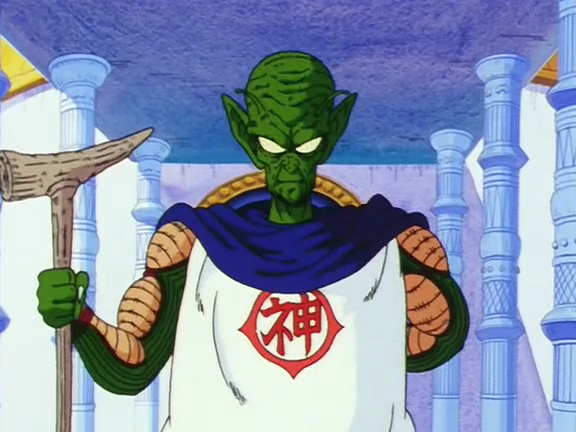
Kami

Season 5 marks the debut of Kami, who will play an important role in the episodes (and series) to come.

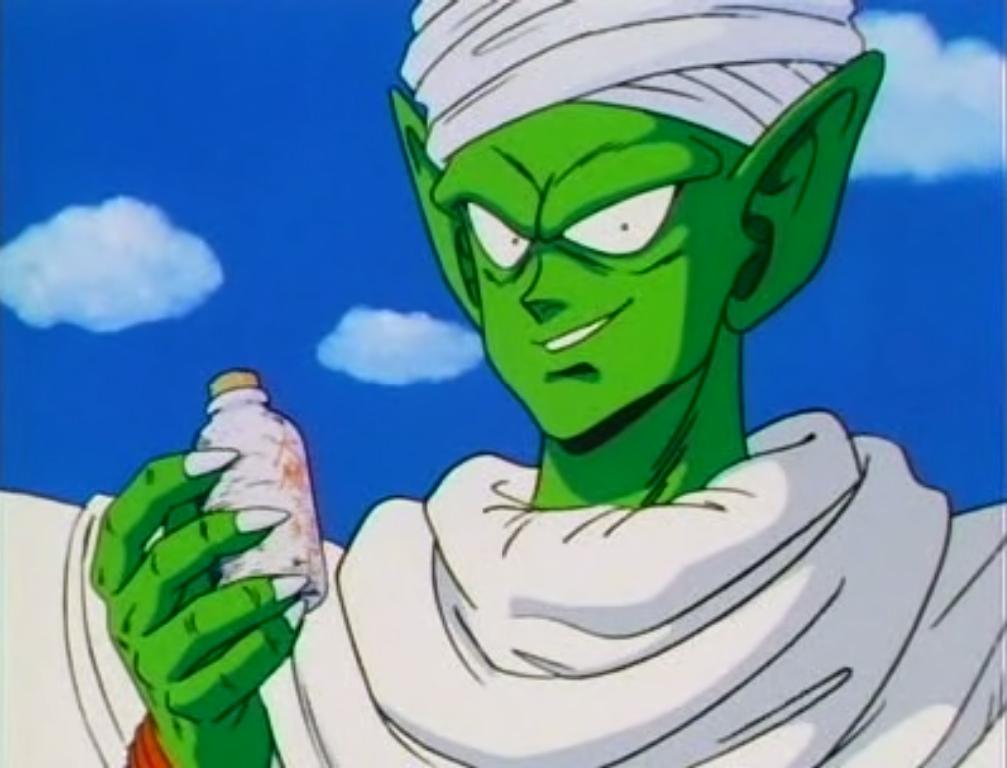
The first several episodes continue to deal with the fall-out. Goku, needing to revive the Eternal Dragon in order to restore his friends to life, journeys to the tallest point of the world, beyond even Korin’s tower, to the lookout. There he meets Mr. Popo, the djinn-like attendant up there. Poor Mr. Popo would later be viewed by network broadcasters as a racial stereotype when Dragon Ball Z Kai started airing in the US and be re-colored a garish neon blue. Here he is presented in his traditional black with red lips. Honestly, I see a genie when I look at him so I don’t really know what Toriyama was going for, but if you see him as racist that’s your right too. Anyways, Goku has to prove himself before Popo in order to meet the guardian of the earth, Kami. When he does he’s stunned to see that Kami looks just like the elder version of Piccolo!

Popo

Mr. Popo’s appearance was deemed controversial enough to edit when airing on the CW as part of Dragon Ball Z Kai.

Again, this is another moment in the series spoiled by the popularity of DBZ. Having seen that series, I know all about Kami and how he and Piccolo used to be one person. Kami, needing to prove himself worthy of being the earth’s guardian, purged himself of any and all malice. That lead to the creation of Piccolo, a collection of every bad aspect of Kami’s personality. Kami is also aware of the existence of Piccolo Jr., and rather than commit infanticide, wants Goku to train with him to face that challenge someday. In exchange for reviving the dragon, Goku agrees to train with Kami for 3 years (apparently, Kami’s race grows up fast). For Goku, the length of the commitment seems daunting, but he’s always eager to get stronger and training under Kami is viewed as a worthwhile opportunity.

2_finalists

Yeah, this is going to happen.

The next half-dozen episodes or so comprise Goku’s training. He’ll enter the Spirit Room, do some fishing, and even journey back in time. Meanwhile, Tien, Yamcha, and the newly resurrected Krillin and Chiaotzu seek out Master Korin to take part in some of the training that worked out so well for Goku. These episodes seek, in some respect, to go back to the more whimsical tone of the show. Even though the main characters are largely training, they end up going on small adventures with fairly low stakes. There’s an emphasis on comedy, particularly with Goku’s time-traveling, but they do suffer from the usual training fatigue this series and the ones to come fall victim to.

At episode 133, we get a three year time jump. This was likely done to accomplish two things:  gloss over Goku’s training with Kami and age-up Piccolo Jr. This leaves us at the latest edition of The World Martial Arts Tournament which will not only showcase the world’s finest but also serve as a reunion for the majority of our cast. The reunion doesn’t just cover the usual gang, but even reaches back to older acquaintances and even some we never saw play out, like Tien and the brutal Mercenary Tao. This is also a re-debut for many of our children characters who now find themselves aged-up into young adulthood. It’s fun to see how the characters, who apparently haven’t seen much or any of each other over the years, react to seeing one another again, but it’s also a little sad for us the viewer as it means we’ve now said goodbye to kid Goku. I’m going to miss that sweet little boy.

piccolo

Piccolo Jr as a bit of an evil look to him that will soften in DBZ.

In his place, naturally, is adult Goku. I must say, it’s pretty cool for a manga and now an anime series to do something as permanent as age-up its child protagonist into an adult. It’s pretty risky, since there’s a chance the young audience that comprises the fanbase will no longer identify with Goku. And there’s also the risk that they just won’t want to see Goku as an adult and prefer he remain a boy. From the creator’s perspective, Toriyama must have felt there was nothing left for a young Goku to accomplish. After all, having adults underestimate a child over and over again gets old and his last major act as a kid was basically saving the world. It’s hard to accomplish something bigger than that. Goku, as a child, even had to deal with trauma in the form of watching his friends and mentor die as well as face the burden of taking a life himself. That’s a pretty full childhood.

Thankfully, as an adult Goku hasn’t lost what made him so endearing as a boy, only his tail (so the moon could come back). He’s still kind-hearted and trusting to a fault and pretty ignorant of the world around him. Age has brought him little wisdom, and he still approaches every challenge with the same youthful eagerness and excitement he always has. Meanwhile, Krillin has grown into a more well-rounded individual who is less devious and less assure of himself, without actually growing much physically. He was over-confident as a boy at times, but now has a more realistic outlook, though we’re still a long way from him being totally outclassed by his peers so this is a Krillin who still feels like he can hang with anyone in a fight. Also re-debuting, is Chi-Chi, who we haven’t seen in quite some time. Chi-Chi, daughter of the Ox King, took a liking to Goku once upon a time and he even agreed to marry her one day. Chi-Chi apparently has not forgotten that promise.

TaoRobot

Tao is back, and he’s had some enhancements.

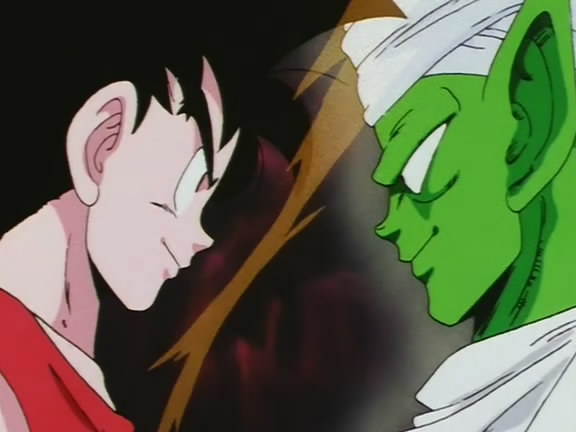
And then there’s Junior. Piccolo Junior, that is, makes his presence known by also entering the contest. He’s not so much there to win as he is to defeat, and then kill, Goku to avenge the death of his “father.” Piccolo Jr. is more of a clone than a true son, from what I gather, though we’ll learn way, way, down the road that he’s part of a race that actually reproduces asexually so maybe it’s a bit murkier than that. Whatever he is, he knows all about the encounter between his father and Goku even though he wasn’t there and had no one to raise him. He mostly looks like his father, though he’s a bit more slight and takes to wearing a cape and turban with giant shoulder pads. He’s convincingly evil, like his dear old dad, which is a far-cry from where he’ll be when DBZ picks up.

The tournament is going to take around 15 episodes to complete, making a pretty long competition. Like most of the tournaments featured in this show, the final match-up feels pre-ordained which does suck some of the suspense out of it all. To add some spice, there’s the new and improved Mercenary Tao who’s now part machine after being nearly killed by Goku in Season 3. He gets put on a collision course with Tien, who apparently doesn’t have fond memories of the brute dating back to his time with Tao’s brother, Master Shen, who would spar with Tien. Tien and Goku also need to have a rematch following Goku’s defeat the last time the two met in competition, and a mysterious fighter named Hero enters the tournament and his identity is in question, until it’s not.

tumblr_o8px3zMhQq1u7487lo1_500

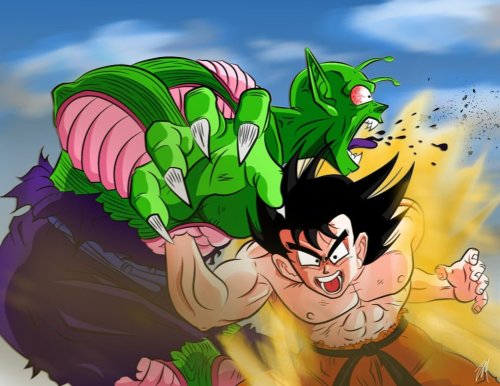
The eventual confrontation between Goku and Piccolo is a pretty satisfying battle.

Of course, the two fighters destine to meet in the finals are none other than Goku and Piccolo Jr. It may not come as a surprise, but it wouldn’t make sense for it to be any other pairing. For Piccolo, it’s an opportunity to not only best Goku in a fight, but to also embarrass him in front of a large audience. For Goku, this is his third trip to the finals of this tournament and a chance to finally win one having fallen to Master Roshi (disguised as Jackie Chun) and Tien previously. Their battle will encompass parts of six episodes, which feels like a make-up for the relatively brief battle between Goku and King Piccolo. To heighten the stakes, Piccolo essentially promises to destroy the world after he finishes off Goku. Goku likely can’t just settle for winning this match as a ring-out or some other technicality likely won’t prevent Piccolo from going on a rampage. He needs to beat him down and make sure he can’t accomplish his goal of total annihilation for earth.

This fight is essentially the grand finale for Dragon Ball. It’s going to rely on some old staples of past fights while also attempting to up the stakes as high as possible. Think huge energy attacks and a literal huge adversary when Piccolo demonstrates his growing abilities. When all is said and done, the show feels almost as if it’s been creatively exhausted. The fighters are so beyond what they were when this show started and it feels impossible to ponder where they go from here. Of course, Toriyama and TOEI weren’t quite there yet as DBZ will prove there’s still something left in the tank, but for now, this conclusion feels complete.

60318228

Goku and Chi-Chi are going to need some time to get reacquainted with each other.

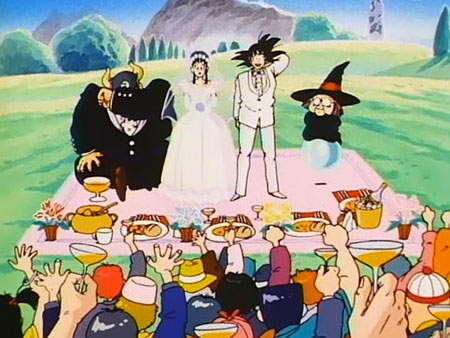
It doesn’t end there though. The last five episodes detail Goku and Chi-Chi’s quest for marriage. They have to embark on some minor adventures for a dress and other wedding planning activities that try to recapture a bit of that old Dragon Ball magic, but sadly come up short. That’s not to say these episodes are bad, but they lack some of the whimsy of the old ones and feel like padding to draw out the season. I’m not really sure why anyone felt the show needed to be 153 episodes instead of 150, but it is what it is. In the end, Goku and Chi-Chi are married and they display as little chemistry together here as they will in DBZ. I’ve always been some-what dissatisfied with their pairing as Goku is almost too child-like to imagine getting married, let alone procreating eventually. Chi-Chi at least gets to be an interesting character, albeit briefly, before becoming a nagging shrew in DBZ. She’ll rarely be in the wrong from here on out, but she’ll often be made to feel like an adversary of sorts for Goku. That’s sort of a problem with the series as a whole though, as the women often feel more like stereotypes than anything.

db5_072010_2_1279680381

In a bit of a surprise, the series ends with a wedding.

Dragon Ball has a some-what muted end, but in a way it’s also satisfying. The World Martial Arts Tournament is a chance for Goku to shine for a final time doing what he does best:  fighting. There’s also a nice send-off for him that hints at a more stable life by having him marry Chi-Chi. The reunion feel of the tournament also allows for basically every one of the secondary characters to have some screen time to not only see what they’re up to, but say goodbye. Of course, the manga continued on after this while the anime would be rebranded as Dragon Ball Z and run for over 200 episodes by itself. I personally like that the two anime properties are separated, albeit slightly, in their naming as Dragon Ball has always had a very different feel than Dragon Ball Z. It’s the more charming of the two and the series more concerned with character creation. Watched separately, Dragon Ball Z lacks that, but it’s largely due to the characters being established by this series, although that’s no excuse for the cookie-cutter villains added in DBZ. In light of that, I suppose it goes without saying that I view Dragon Ball more favorably than I do Dragon Ball Z, even though DBZ is the series I consumed first. Dragon Ball just holds up better on repeated viewings as its humorous tone and smaller stakes are easier to digest rather than every fight being a battle to save the universe. This final volume of episodes is definitely not the best, and in some ways just feels like a lot of fan service, but it is at least fan service done well as if you’ve been along for the ride you’ll likely find yourself smiling a lot while watching these final episodes. It probably wouldn’t make sense to view it without having seen the previous 122 episodes, but for those who have it would make even less sense to skip this final batch of 31. All in all, a satisfying conclusion to a wonderful series.

If you’re looking to enjoy Dragon Ball on your own, your options are unfortunately rather limited. Aside from streaming options, you basically only have the five season sets put out by FUNimation. Even in Japan, the series was only released as a made-to-order set as even there DBZ is more popular than Dragon Ball. The FUNimation sets are limited to strictly DVD and no Blu Ray release is currently planned. The sets themselves are solid, if unspectacular. The transfer is about as good as you would expect of a television program from the 1980s. FUNimation wisely left the aspect ratio alone, having faced some backlash for messing with it for its DBZ box sets. The original audio is also preserved and available. FUNimation obviously re-dubbed the character voices and narration but left the music alone. Dragon Ball benefitted greatly from being dubbed by FUNimation long after it started doing in-house dubs. Their initial dubs were pretty terrible, including Dragon Ball Z, but the Dragon Ball one is pretty fantastic. There’s no “warm-up” period for the actors as they all feel comfortable with their characters from the get-go. If you prefer to hear the characters and understand them as opposed to reading, then you’ll probably be happy with the dub. The sets are short on any sort of worthwhile bonus material, but they at least contain the essentials. These sets were once really cheap, which is how I got them, but now that they’re out of print they aren’t as friendly on the wallet but still reasonable ranging from $20 to $30 per set. I think it’s worth it, and if you’re into anime Dragon Ball almost feels like required viewing. If you’re a fan of Dragon Ball Z or Dragon Ball Super and tend to like them for their large scale confrontations then maybe Dragon Ball isn’t for you, but I think it’s worth giving a try. On the other hand, if your favorite episodes of Dragon Ball Z are the early, pre-Frieza episodes then you’ll probably love Dragon Ball. If you do end up checking it out I hope you enjoy it as much as I do.


Dragon Ball: Season 4

dragon_ball_season_4_600x600_itunes_artwork_by_eddie09-d58sdkjIt sure is taking me a long time to post about the “seasons” of Dragon Ball. I place the word seasons in quotations because these aren’t actual seasons of television, but just how FUNimation chose to label them when releasing the show on DVD. As a result, Season 4 starts during the World Martial Arts Tournament as opposed to before it or at its conclusion, which is a pretty poor way to start a season (though it’s a better start for Season 4 than an ending for Season 3 which was quite abrupt). Thankfully, Season 4 will end at a better spot setting up for the fifth and final volume of Dragon Ball episodes.
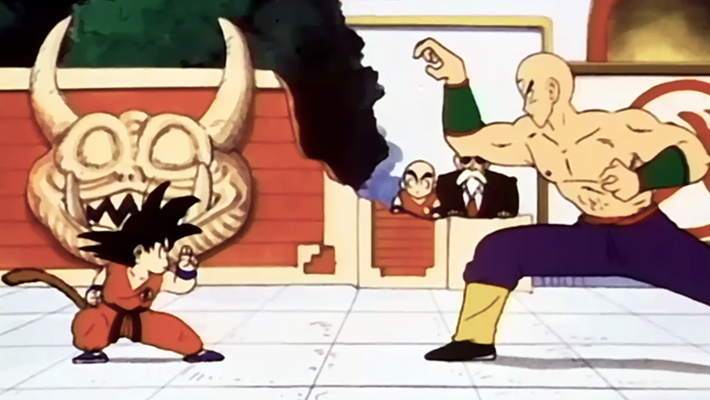
Season 4 has a different feel than its predecessor. While Goku has dealt with loss before and even experienced a desire for vengeance, he’ll be pushed towards a darker path even more so in this volume, but first the tournament. When we left off, Goku and his friends were participating in yet another World Martial Arts Tournament with the plot very clearly setting up a showdown between Goku and his latest rival:  Tien Shinhan. Tien is a student of Master Crane, who is also the older brother of Mercenary Tao, who Goku dispatched in Season 3. As a result, Crane wants to see his brother avenged and is relying on his pupil to do so. In order for the two to meet though, they need to win their respective matches to meet in the finals.

pic_1432979102_1

Some unfinished business from Season 3.

The first 9 episodes deal with the tournament, and throughout it both Goku and Tien will be tested. By its conclusion, they’ll gain a new understanding of each other and Master Roshi will gain some new students, but he’ll also lose one. Setting up what is the main arc of the season is a murder and one that will have a lasting impact on Goku. If you want zero spoilers, then skip ahead, but the murder of Goku’s best friend and one-time rival Krillen is perhaps the darkest moment in Dragon Ball history. Perhaps the only comparable moment is the death of Dende in Dragon Ball Z at the hands of Freeza. Krillen is still basically a child when he’s murdered in Dragon Ball. It happens off-screen, but when Krillen is taking an especially long time in returning to their group’s celebratory dinner Goku runs back to the training ground to retrieve him only to find his lifeless body. It’s an affecting scene to behold as the image is held for an uncomfortably long time. This moment moves Goku to tears, naturally, but it also gives rise to an anger inside of him that is also uncomfortable to see. Up until now, Goku has been our happy-go-lucky protagonist. He’s dealt with loss mostly with sadness and to some degree a lack of comprehension. He’s learned empathy over time, he’s bore witness to how unjust the world can be, and he’s fully equipped now to experience a wide range of emotions at the sight of his best friend’s corpse.

dragon-ball-season-4

He doesn’t look THAT scary.

This sets the stage for the evil King Piccolo to enter our story. Piccolo is an ancient evil that not even Master Roshi could handle. He’s often referred to as a demon, and it took a technique from Roshi’s master Mutaito that cost him his life to seal him away previously:  The Evil Containment Wave. Roshi naturally preaches caution to his young pupil, but Goku is too headstrong and determined to avenge his fallen friend. He will pay for his impatience, as Piccolo isn’t alone. Since he’s rather old and feeble looking, Piccolo has surrounded himself with some powerful adversaries. They’re all named after musical instruments just like their master, and all have a sort of reptilian or demonic appearance:  Piano, Cymbal, Tambourine, and Drum. In order to defeat them, Goku will need to get stronger and he’ll be forced to seek out Master Korin once again.

GokuvsTam-again

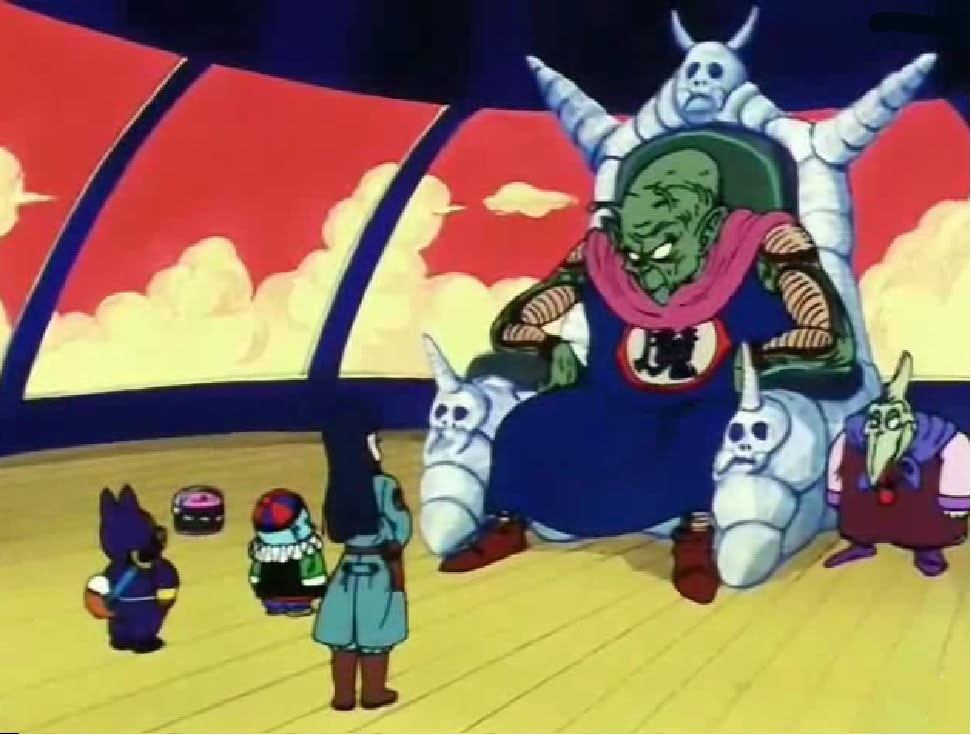
King Piccolo likes his minions scaly and green.

Meanwhile, Master Roshi together with Tien and Chiaotzu, decide they’ll need the help of the Dragon Balls in order to essentially wish away the demon king. While they’re doing that, and Goku is off training, Piccolo’s minions are seeking out the strongest fighters in the world with the goal of killing them to pave the way for King Piccolo to take control over the world (he’s a rather conventional villain, in that respect). Roshi’s plan to assemble the Dragon Balls ends up backfiring and he’s unable (or unwilling) to master the Evil Containment Wave. As a result, Piccolo seizes control of the legendary artifacts and is able to restore his youth, and power. In the process he also kills the Eternal Dragon. Suddenly, death has real consequences in this world with no dragon able to restore life to those who have fallen or will fall.

With King Piccolo fully powered-up, all eyes turn to Goku. His training with Korin puts him into confrontation with the bulbous Yajirobe. Yajirobe is essentially a punch-line in DBZ, like a lot of the main characters from Dragon Ball unfortunately, but here he is not such a push-over. Still, he’s no Goku. There’s some humor to be found in Goku’s training with Korin, but it’s largely a bit of a slog as we’re more eager than usual to see Goku face-off with the evils that stand before him. Once his training is complete, he’s forced into conflict with Piccolo’s minions and eventually the demon king himself.

piccolo daimao

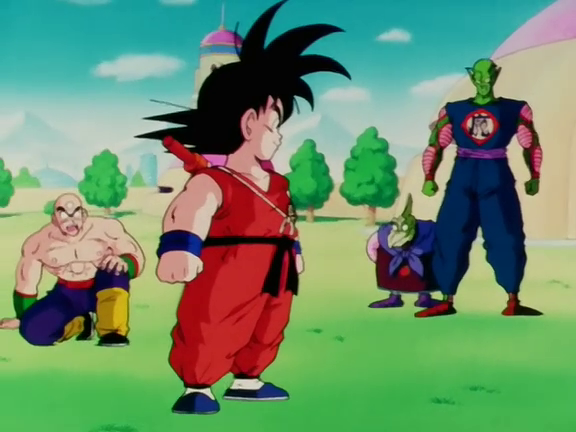
If you’re a fan of Pilaf and his crew, don’t worry, they’re still hanging around.

Some drama is created in the meantime. Tien has mastered the Evil Containment Wave, and with Goku still missing in action, he’s resolved to use it as Piccolo has begun destroying the earth city by city. Using the wave against Piccolo would mean Tien’s death, so it becomes pretty important for Goku to hurry up and get there. Goku and King Piccolo are naturally destined to meet in combat, and surprisingly, their confrontation is pretty short spanning just three episodes, but as I mentioned in the lead-in it’s at least all contained on this set without bleeding over into the next. It does mean a some-what abrupt end to the season as the immediate fall-out is left for Season 5.

Dragon Ball Season 4 marks both a new story-telling device for the show, vengeance, as well as a doubling-down on the previous format. That format is essentially Goku encountering a new foe, getting beaten down, training, and then returning to face the enemy in a rematch now powered-up. It’s a formula that Dragon Ball Z will beat into the ground, but at least here it’s not quite so worn out. Still, the training moments between Goku and Korin are slow, and they’re made even more so because the story did give us an effective motivation earlier for Goku to face Piccolo. It’s both refreshing and sad to see Goku motivated by vengeance. It would be nice if Goku could remain unaffected by the evils of the world, but it’s also unrealistic for a show with such an expansive amount of episodes. Sort of forgotten is how the season begins, with Goku turning an adversary in Tien into a new ally. It’s handled well enough, with Tien’s sense of honor ultimately being the aspect of him that is won over by Goku and his friends. Of course, if you’re like me and you experienced Dragon Ball Z before Dragon Ball then you knew Tien was destined to be an ally, but it was still entertaining to watch.

GokuVsPiccolo.Ep.119

A powered-up Goku is ready to take on the king.

At this point, the show has also improved visually. It’s success likely lead to some increased production budgets by TOEI Animation so the special effects and animation are better than they’ve ever been. The aged King Piccolo is well illustrated and he’s actually a lot more interesting to look at than the youthful version. There’s a moment where he forces an egg out of his mouth to create a new minion and it’s both gross and strangely satisfying to watch the scene play out. The original soundtrack is kept, and while it’s certainly dated, it has a whimsical quality that works really well with Dragon Ball. The benefit of FUNimation dubbing the series after DBZ means these actors have had plenty of time to get a feeling for the roles and everyone sounds mostly great. They’re all familiar if you’ve watched the other dubs, and the continuity is nice and appreciated. If you prefer Japanese audio it’s there as well. The original aspect ratio is also preserved.

Season 1 is still my favorite Dragon Ball season, mostly because it’s just a lot of fun and the ignorant Goku of Season 1 is really entertaining. Season 4 might be my second favorite though. It has some filler, but not as much as Season 3, and the stakes feel high which is also an improvement over both Seasons 2 and 3 and helps to give the confrontation more weight. It’s also satisfying when taken as a whole, and though I wouldn’t recommend it, you could conceivably just jump-in at Season 4 and enjoy it without seeing the previous material. I don’t know that I would call it peak Dragon Ball, but there is a downward slide following it with Season 5 basically feeling like an encore for the show as well as a setup for what’s to come. I promise to not take over four years to get to that one.


Super Dragon Ball Z

Super_Dragon_Ball_Z_CoverartRecently, Bandai-Namco conducted an open beta for its latest game based on the venerable Dragon Ball franchise:  Dragon Ball FighterZ. The game is a 3 on 3 tag-fighter that exists on a 2D plane but contains three-dimensional characters. The art style is done in such a way that it more closely resembles the 2D anime that’s recognized around the world. It’s a fast and beautiful looking fighter and yours truly did check out the beta. Like most open betas where an upcoming game is essentially free to play briefly, it was a bit of a challenge actually getting logged into the servers and paired up with a match. I mostly spent my time in the training area just checking out how the game handles and plays. It’s very similar to the old Budokai games in some respects, mostly the speed and the fact that all of the characters seem to have the same move-list, only the animations for each move are unique from character to character. For example, a traditional Ryu fireball motion for Goku results in his kamehameha wave while the same for Krillin is the destructo disc maneuver.
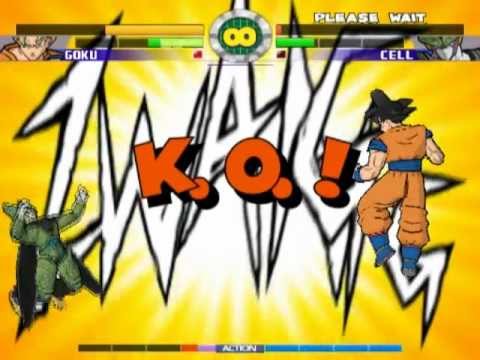
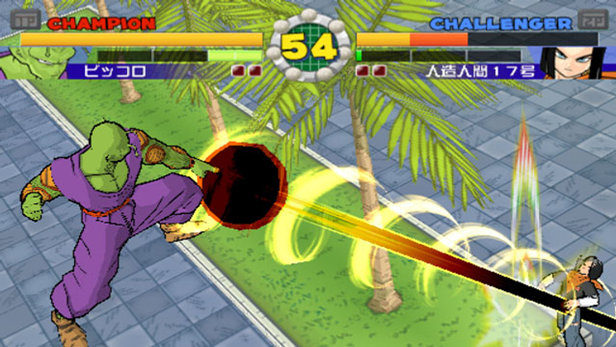
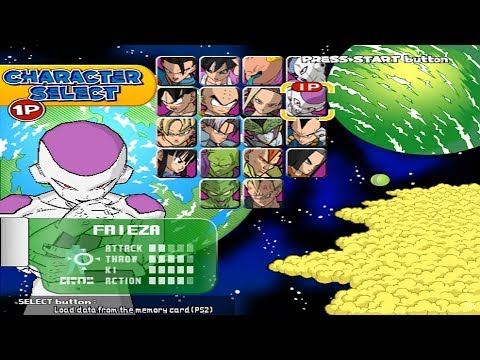
FighterZ seems like it will be a pretty entertaining game, but it’s not what I wanted or expected. The developer, Arc System Works, is best known for Blaz Blue so I expected a more traditional 2D fighting experience with some Dragon Ball styling. Instead, FighterZ is apparently courting a more casual crowd that grew up on those old DBZ games and Super Smash Bros. as opposed to Street Fighter. This naturally lead me back to an old favorite of mine:  Super Dragon Ball Z.

Not to be confused with the currently airing anime Dragon Ball Super, Super Dragon Ball Z is a 3D fighter that plays like a 2D fighter. It was developed by Arika, the company headed by Akira Nishitani who is best known as the brain behind Street Fighter 2. The company is known for its work Capcom on the Street Fighter EX series, a 2.5D fighting game that was relatively popular in the late 90s and early 2000s. As you would expect, a DBZ fighting game developed by the father of Street Fighter plays a lot more like a Street Fighter game than the casual arena brawlers that had become the norm for DBZ. It was released to arcades at the tail end of 2005 in Japan and Europe only before arriving on PS2 in 2006 worldwide. Because it’s not what people were used to out of a DBZ game, it went somewhat overlooked. While I would not consider it on par with the best the Street Fighter series has produced, Super Dragon Ball Z is a pretty damn fine game on its own.

hqdefault-29

End a battle with a super move and you’ll be treated to some manga-inspired word art.

Super Dragon Ball Z has the typical fighting game maneuvers you would expect of a Street Fighter clone. Think hadokens, shoryukens, and so on. Not every character has the same standard set of moves, but they do share some similarities so it’s not as streamlined as simpler games, nor as complex as the most hardcore fighters. The characters are presented in 3D with a cell-shading effect and the default colorization is meant to resemble the original Dragon Ball manga as opposed to the anime. The stages are arena types and characters can move into the foreground and background with relative ease. An action bar at the bottom of the screen controls movement within the foreground and background as well as dashing. Deplete that and you will find your movement severely hindered until it replenishes. It does refill rather quickly, but the gauge prevents characters from endlessly dodging to prolong a match or from spamming dash attacks.

The game’s button layout is a bit unique. The square and triangle buttons are your weak and strong melee attacks while circle is the jump/fly button and X is guard. The shoulder buttons contain both dash attacks and a dedicated throw button. Any fighter that utilizes a dedicated block button takes some getting used to, and the jump/fly dynamic is a bit wonky in execution. It’s mostly used to go after your opponent, as opposed to setting up an attack. The dash buttons are useful for closing the gap quickly with your opponent or just to get you on the same plane as your opponent.

slus-21442-game-ss-2

It may not be the flashiest DBZ game, but your favorite characters will still have their most recognizable moves.

The fighting mechanics are a mix of traditional fighters and DBZ fighters. Projectiles play a large role, but up close combos are also present and a major part of combat. Certain characters function better as ranged attackers versus up close ones and the AI for each character feels rather true to the source material in terms of how they attack the player. There’s a simple health gauge that needs to be depleted to end a round and there’s also an ultimate gauge that gradually fills up during a match. This gauge is expensed when using a character’s best attacks, but unlike other DBZ fighters, there is no charge button to build up ki forcing you to better manage the resources you have. The big moves are also less destructive than in other games. There’s more of an emphasis on dealing out damage gradually as opposed to in big chunks. Being able to dodge properly is the best way of avoiding damage as opposed to blocking and countering and canceling are certainly effective ways to victory.

The game is overall a lot slower and less manic than other DBZ fighters. Characters do not move at crazy speeds and only Frieza can do the popular teleport move in battle. Battles feel a bit more strategic as there’s still an environment to navigate with obstacles to hide behind or toss foes into. Combos are present and they’re more similar to Tekken style combos than Street Fighter ones requiring a series of well-timed button presses. With only two dedicated attack buttons, they’re fairly similar but the timing for each character is a little different and requires some practice. It may be different, and to someone just watching the game it will likely seem less authentic when compared with the anime, but it feels more strategic and ultimately it has its own rewards.

hqdefault-30

Even after unlocking the hidden characters the roster is still on the small side when compared with its contemporaries.

The character roster is much smaller than what fans are used to. At the onset, the characters available are:  Goku, Gohan, Vegeta, Trunks, Piccolo, Krillen, Chi Chi, Androids 16, 17, and 18, Frieza, and Cell. Additional characters can be unlocked and most are just variants of existing characters. The saiyan characters have the ability to go super in battle, and it’s an ability that rapidly depletes stamina so it’s not meant to be a permanent state. Only Super Saiyan level 1 is available, so there’s no going 2, but it does make those characters a bit more interesting than the non saiyans. Of course, every character has pluses and minuses. Piccolo, by virtue of his stretchy limbs, has incredible range and Krillen’s destructo disc can carve through every move in the game. It’s a roster a bit on the small side, but each character feels relevant and the secret characters are also fun too (and some of my favorites).

The game has a standard set of modes including Arcade and training as well as a survivor mode dubbed Z-Survivor. Arcade is a series of seven battles with five of them being random. Each subsequent opponent gets stronger and their strength is represented by a scouter reading before battle, which is kind of neat. The mode always ends with a battle against Frieza followed by a fight with Cell. There are no custom endings for each character, which is a bit disappointing, nor is there really much of an ending at all, but if you’ve seen the anime and played almost every DBZ fighter released then you’ve seen how the story ends more times than you can count. What is interesting is that after each victory you get one of the titular dragon balls. By collecting all seven, you can summon Shenron and make a wish. This is how you get additional characters, and also how you improve your existing ones.

super-dragon-ball-z-4e2609203a69e

Spend enough time collecting dragon balls and eventually you’ll unlock additional characters like cyborg Frieza.

By far, the most interesting aspect of Super Dragon Ball Z is the custom character process. Other games have dabbled with this, but Super Dragon Ball Z really seems to go for it. As you fight with a custom character, your character naturally gets stronger. Once you fill an experience bar, and completing arcade once is more than enough for the first go around, you can learn a new skill. The skills range from increased health to faster action regeneration time as well as to new and better moves. The most powerful attacks are reserved for custom characters, and some of them have to be wished for. This encourages you to pick a character and stick with it. As a bonus, if you max out a character you can then take another character and inherit moves from the previously maxed out character. For those who really want to craft the ultimate character, doing this is necessary since only some characters have the worthwhile Super Cancel ability.

The only real issue with the character customization is that there is little you can actually do while leveling-up your character. It’s only so amusing to beat the arcade mode over and over so if you don’t have a friend to play it can get a little old. The Z-Survivor mode helps out as this is a mode where you’re given one health bar to vanquish 10 foes in succession. After each conquest, a roulette wheel is spun to get a little power-up for the next fight and it’s not hard to stop the wheel on what you want. However, you can’t just repeatedly select the health restore option as it gets worse each time you land on it. It starts off with a 50% health recovery, but after the next round it will drop to 40% and so on. You have to be strategic with the best rewards if you want to survive to the end. If you do manage to defeat all challengers you’ll be confronted with one more and the fun part about that is you’re allowed to wager basically all of the experience you’ve gained throughout the mode in a bid to double it, if you win, of course. It’s definitely more challenging than Arcade mode and it might end up being the mode you spend the most time in.

Super_Dragon_Ball_Z

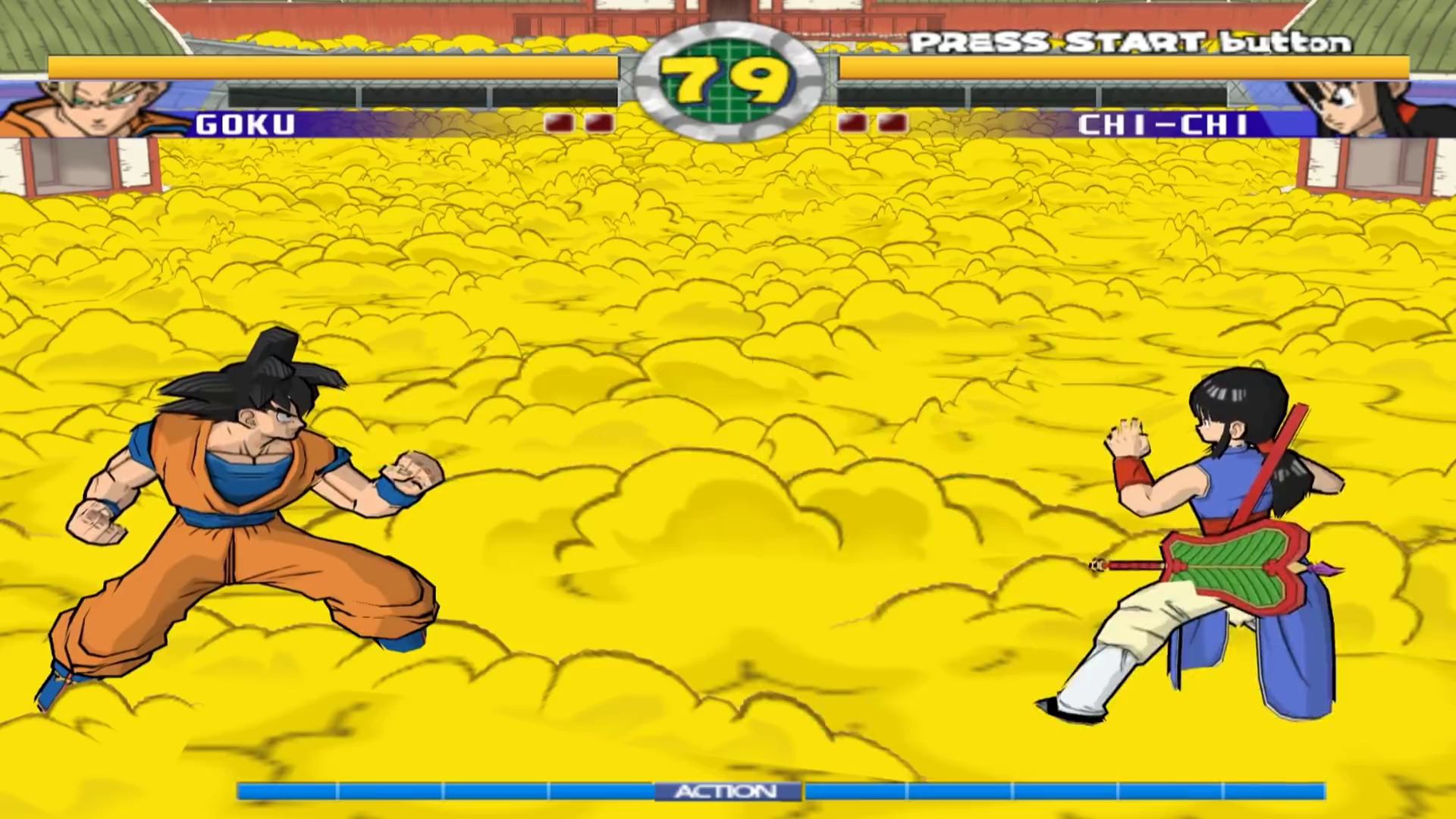
Few DBZ games let you play as Chi-Chi giving fans of that character some added incentive.

Visually the game holds up pretty well. The cel-shading approach helps give it a timeless look, though some characters come off better than others. Goku, for example, has always had a some-what tough time making the jump from flat 2D image to 3D polygon. The stages are, as a whole, more interesting to look at than other DBZ games and the manga approach to its styling helps to add a little extra charm to everything. Sadly for anime purists over here, the soundtrack for the US version is a mix of industrial music that’s designed to resemble the score to the Funimation dub of the show, though it’s an original score and not authentic so even Funimation purists have a reason to be irritated. Other versions utilized some of the actual music from the Japanese anime and I’m sure a lot of US fans would have preferred that. If you hate the manga look though, know that anime colorings do exist in the game so if you want your Future Trunks to sport a royal blue coat instead of teal you can certainly make it happen. Overall, the presentation is solid, though like the gameplay, you won’t get much in the way of flashy big graphical spectacles in the form of massive super moves. At least not on the level of other DBZ fighters.

Since this is a PS2 game, there’s no online mode to easily find other challengers. And even if there were, the servers would undoubtedly be shutdown by now anyway. Having a group of friends who all enjoy the game helps increase the amount of enjoyment you’ll get out of it, but that’s also true of basically every fighting game ever created. It would have been nice if each character had a story and an ending to uncover, but then again, that would work against the drive to just use the same character over and over to make them more powerful. How eager you are to see the secret attacks and unlock the hidden characters will be your primary motivation to revisit this one. If you’ve ever played a DBZ fighting game and wanted it to be more like a traditional fighter, then check out Super Dragon Ball Z. It’s very easy to find a copy for a relative pittance these days so you won’t be risking much by doing so.


Dragon Ball Z: Battle of Gods

Dragon Ball Z:  Battle of Gods (2013)

Dragon Ball Z: Battle of Gods (2013)

I’ve made no secret of the fact that I find Dragon Ball Z to be a pretty overrated anime. Some of that sentiment stems from the fact that it’s considerably more popular than its predecessor, Dragon Ball, despite being the inferior product. Part of that also stems from the fact that Dragon Ball Z fans seem to regard it as the greatest anime of all time, rather than what it really is; the most popular anime of all time. This is not to say I find the show to be a bad one. For awhile during the 1990’s I found myself quite captivated by the show. I was incredibly disappointed that the dub, for many years, ended right in the middle of the Namek Saga with Goku preparing to take on The Ginyu Force (I was also really disappointed when the series finally returned with an all new and quite terrible dub). Little did I know, that I had basically seen the best of the show up to that point. While the Cell Games and Buu Saga have their moments, for the most part the show became almost a self-parody with extended filler sequences and familiar plot lines.

It’s the formula of Dragon Ball Z that makes it a rather pedestrian television program. The characters are all simply constructed and tend to embody one archetype. Each “season” consists of the gang being forced to take on the latest “Most Powerful Being in the Universe” with the same familiar pattern: dispatch weak enemy, hear latest prophecy of doom, be defeated by said enemy, train endlessly, power-up and defeat enemy. The stakes are always the same, and even though characters are killed off several times, they usually find their way back to the land of the living and there are few lasting repercussions on the show (aside from the novel concept that the characters do age over time). It was basically like watching an animated fighting video game: it just moves from one battle to the next with very little connecting tissue in-between. As such, it’s quite easy to take a cynical view towards the show but it still has its moments where it’s genuinely entertaining and even charming.

Beerus and Whis are the latest antagonists to threaten earth.

Beerus and Whis are the latest antagonists to threaten earth.

If one were to be jaded with the prospects of another extension of the Dragon Ball Universe, they’d likely be less interested in yet another Dragon Ball Z film. The show was so successful that it rather logically spawned feature films. These films were little more than cash-grabs and often contained less plot than the show and an even more obvious formula. Thirteen films in all were released based off of Dragon Ball Z with virtually none fitting into the canon of the show’s storyline. Aside from a select few that contained some genuine entertainment value, most are just mediocre with the only contribution they made being the superior animation when compared with the show. As a result, I was not all that enthused to hear that Toei Animation was returning to the series for a new film:  Battle of Gods. The only cause for optimism was that it was announced series creator Akira Toriyama, who had little involvement with the awful Dragon Ball GT, was handling the screenplay and character designs. Toriyama, unlike some of his fans, seems to understand what makes Dragon Ball special. It’s not some super sophisticated anime meant to challenge the likes of Neon Genesis or Cowboy Bebop, it’s strictly intended to entertain with humor and action.

Battle of Gods opens with some familiar characters pondering the awakening of The God of Destruction. Supreme Kai, along with Elder Kai, fear what this god may do now that he’s awoken early while King Kai gives Goku a quick lesson on who this guy is. It’s not a very promising open for the film as it’s pretty much in line with most of the movies and we know Goku and this god are going to have to have a showdown. We’re then taken to this god’s home world and are introduced to Beerus, The God of Destruction, and his attendant Whis. One of the themes of Dragon Ball is to never a judge a book by its cover, and Beerus embodies that concept quite well. He’s basically an anthropomorphized sphinx cat complete with tall ears and a wrinkly cat muzzle on his face. Not only does he look like a cat, but he also embodies one as well. When we first meet him he’s just waking up from a 39 year slumber much in the same way we’d expect any cat to awaken. He’s lethargic, hungry, and summons for Whis almost immediately. Later we’ll see him acting rather petulantly and impatiently while also toying with his prey, further driving home the point that he doesn’t just simply look like a cat, he is one. Whis gives him a refresher on what transpired during his slumber, and he’s quite pleased to learn that Frieza dealt with those insolent Saiyans by destroying their planet. He’s further surprised to learn that one dubbing himself a Super Saiyan defeated Frieza, which reminds him of a dream he had where he encountered a Super Saiyan God. Remembering this, Beerus decides to journey to earth to meet the one who defeated Frieza and to hopefully find out more of this Super Saiyan God.

Beerus and Goku reenacting the infamous WCW Finger Poke of Doom.

Beerus and Goku reenacting the infamous WCW Finger Poke of Doom.

When Beerus arrives he encounters Goku almost immediately, and in true DBZ movie fashion, they fight and Goku is easily outclassed. Unlike other films, Beerus is essentially neither friend nor foe. He isn’t a good guy, but he’s also not really a bad guy. Sure he’s The God of Destruction, but apparently someone has to be. He decides to seek out Vegeta to see if he knows anything of this Saiyan God, since he learned nothing from Goku, and finds the Saiyan prince at his wife’s birthday party. Beerus loses interest in his pursuit of a Super Saiyan God when it turns out Vegeta knows nothing, and not wanting to turn down an opportunity to feast, invites himself to the party. Some hijinks involving some familiar faces for Dragon Ball fans occur at the party and things seem to be going well until Buu hogs all of the pudding, sending Beerus into a rage. Only Vegeta knows just who Beerus is and what he’s capable of, which is why the other party-goers jump to their friend’s defense further irritating Beerus. This causes him to declare that it’s time he destroy earth, just as Goku shows up. The heroes are able to request Beerus give them five minutes to consult The Eternal Dragon on the matter of a Super Saiyan God, and when Shenron reveals the secret of how to produce one, Beerus gets his wish.

Of course, Goku is the one to step-up and challenge him as the very underwhelming Super Saiyan God. If you were expecting a fantastic new transformation then you’ll be let down to see that “God Mode” is essentially a skinny Goku with a bad dye-job giving his hair a reddish hue. He possesses a fiery aura, which looks kind of cool but is also visually distracting, but that’s about it. Goku and Beerus fight, and I won’t spoil the outcome but you can probably guess at the ultimate end result.

The gang's all here.

The gang’s all here.

The plot for the film is rather familiar, and judged solely on that, the film is a disappointment. However, how it navigates the plot is what helps to elevate it above the normal DBZ fare. For one, Toriyama’s humor is sharp, and while there are some in-jokes to be found for longtime fans, the majority of the humor is fairly natural. It’s also refreshing as Beerus is the source for much of it. He’s definitely one of the better villains Toriyama has conceived of and his ambiguous nature and ambivalence towards mortals makes him almost charming, in a way. He plays off of his attendant Whis fairly well, a character who also embodies a notable Toriyama trait in that he’s a supremely powerful male with obvious feminine features. Toriyama’s affinity for food-related humor shows up in both Whis and Beerus as they’re very interested in the different flavors present on earth. Thankfully, we’re spared the often repeated visual of Goku stuffing his face which stopped being funny somewhere around the character’s first visit to King Kai’s planet.

For fans of DBZ’s unique action sequences, the film may be a disappointment. A lot of the time is spent on Beerus interacting with the earthlings at the expense of the big fight scenes the show is known for. When the film does go there, the action is a bit restrained. Some of that is a plus. As the characters grew in power during the show there was basically no way to visually establish they were stronger and faster than they were 100 episodes prior making many fight scenes look visually lazy as the characters “moved too fast for the naked eye.” In Battle of Gods the action is slowed down and there’s a satisfying weight to the blows landed. There’s still a few instances of old standby DBZ staples, but they’re not overused. Despite that though, the action is underwhelming and some curious uses of CG effects didn’t help things.

Goku's "God" form is a bit underwhelming, but at least it's better than Super Saiyan 4.

Goku’s “God” form is a bit underwhelming, but at least it’s better than Super Saiyan 4.

Visually, DBZ never looked better. The animation is smooth and every scene pops with bright colors. Some may have thought the more muted color palette of the manga would be present since Toriyama was so heavily involved but that is not the case. The only criticism I have of the visuals is the just mentioned CG used in the fight scenes. While the characters fly through a city landscape, it’s rather obvious the backgrounds are being drawn by a computer. This is a fairly common effect going back to the 1980’s but I’ve always found it jarring. Less forgivable are the few instances in which the characters themselves are CG animated making them look like they’ve been ripped right out of the latest DBZ video game. It looks silly and something I would recommend they scrap for future features.

Dragon Ball Z has had an up and down relationship when it comes to the english dub. The original Ocean Group dub was a mixed bag, but was miles ahead of the original Funimation dub that followed. Funimation first starting dubbing DBZ over 15 years ago, and all of that time with the series has actually lead to a pretty wonderful english cast. The voice actors, most of whom have been on the series since the beginning, really know their characters. The writers handling the localization also know these characters and they’ve created a very lively and witty script. The language is probably of a PG nature though there’s very little in the way of graphic violence. If you’re a longtime fan of the series who prefers to watch it subtitled, then by all means, watch it subbed but you won’t be missing anything if you go the dub route.

Dragon Ball Z:  Battle of Gods managed to both meet my expectations and also exceed them. The general plot is typical for a DBZ movie and rather boring, but the presentation is excellent (aside from a few visual hiccups) and the film is genuinely entertaining. It’s probably too long by about fifteen minutes, but not long enough to feel like a drag. The way the film is written makes this feel more like Dragon Ball than Dragon Ball Z. For me, I consider that a good thing but those who enjoy DBZ for the over-the-top action may be disappointed. Lastly, the introduction of Beerus was a success as I’m actually interested to see more from him. Apparently, Toei and Toriyama were banking on that as he’s in the recently released Dragon Ball Z: Resurrection F and is also a recurring character in the new television show, Dragon Ball Super.  I have no idea if more Dragon Ball Z is a good thing or not, but I do know that Battle of Gods was a fun nostalgia trip. Time will tell just how long that trip lasts.