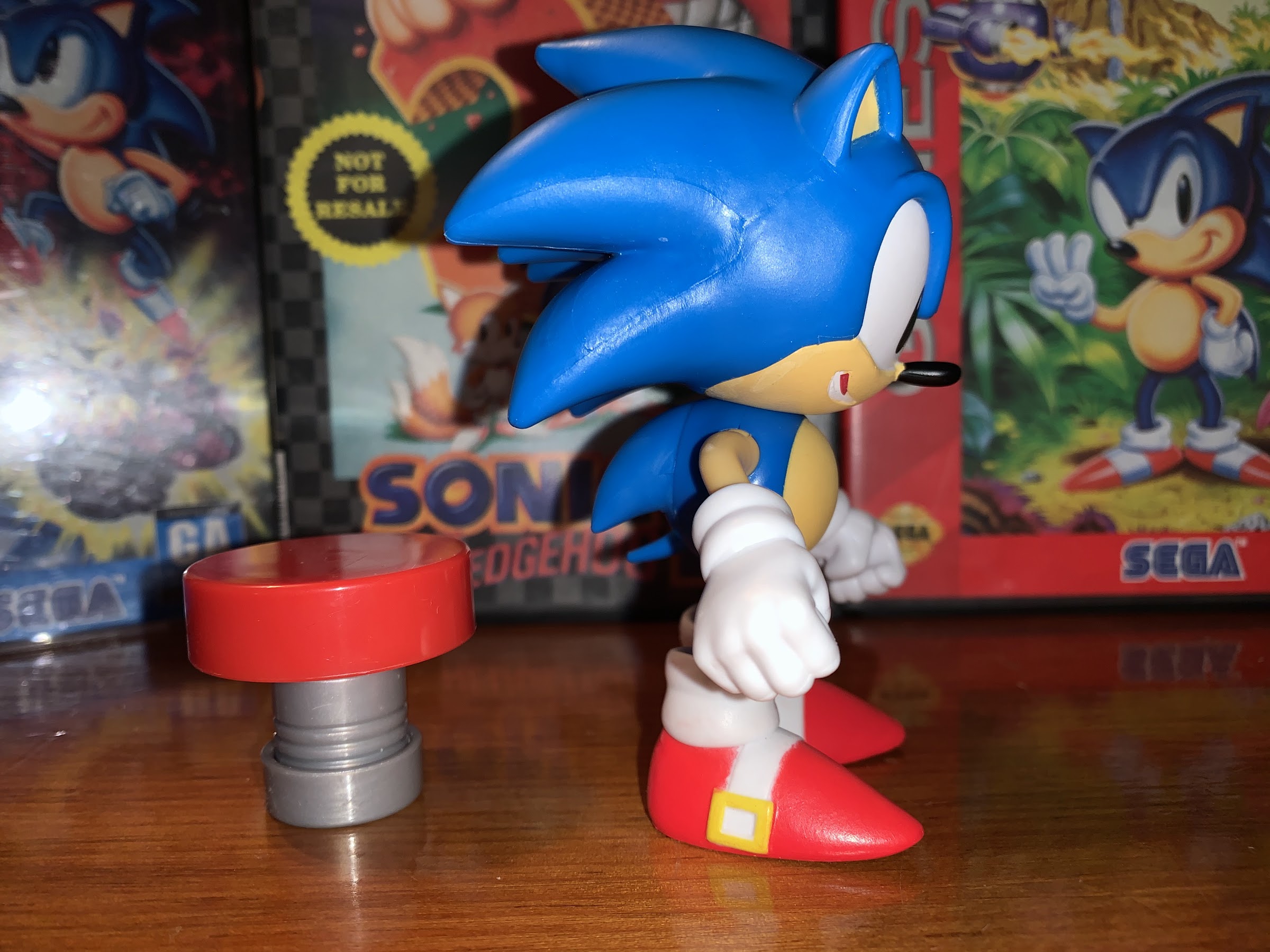
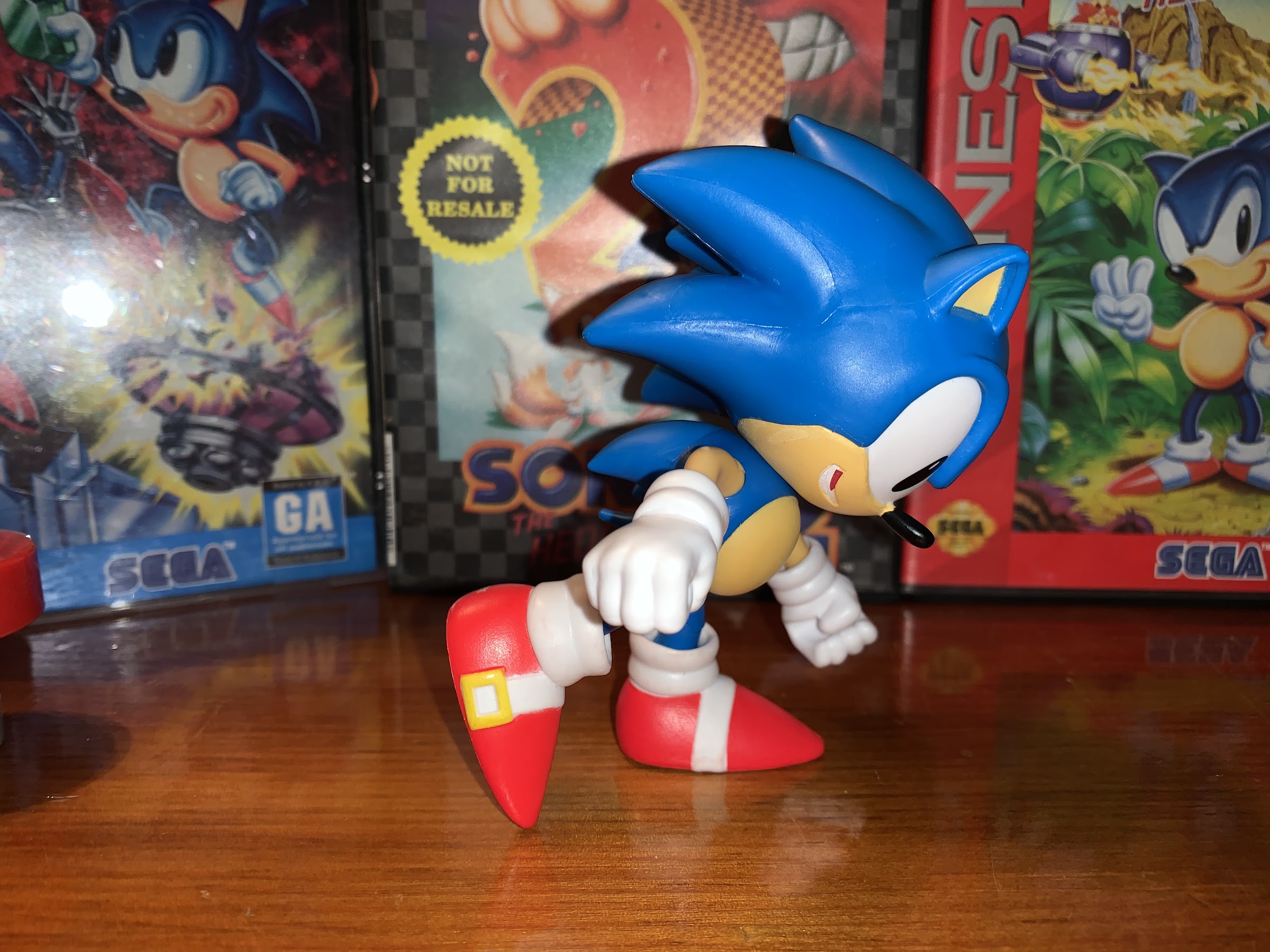
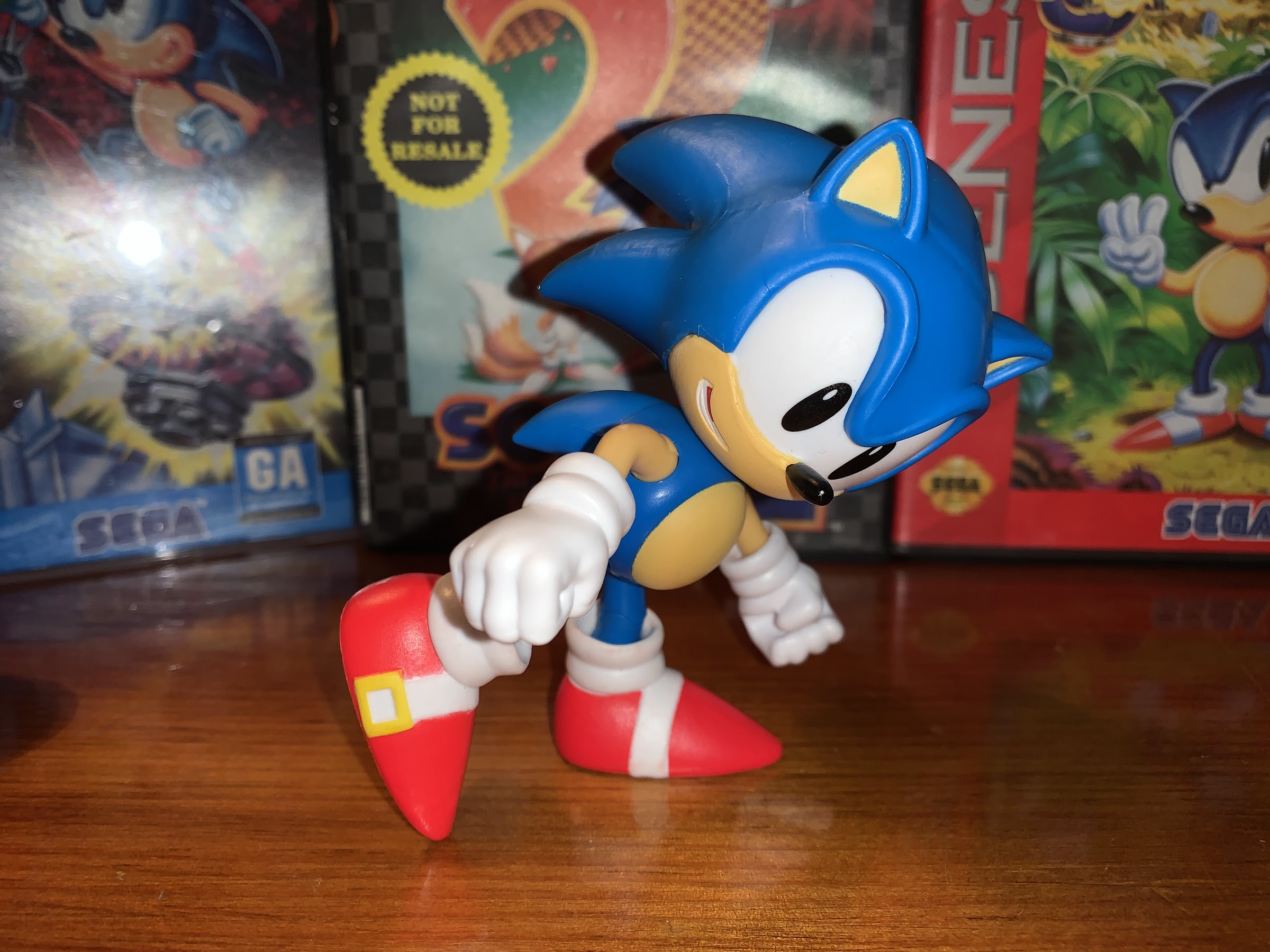
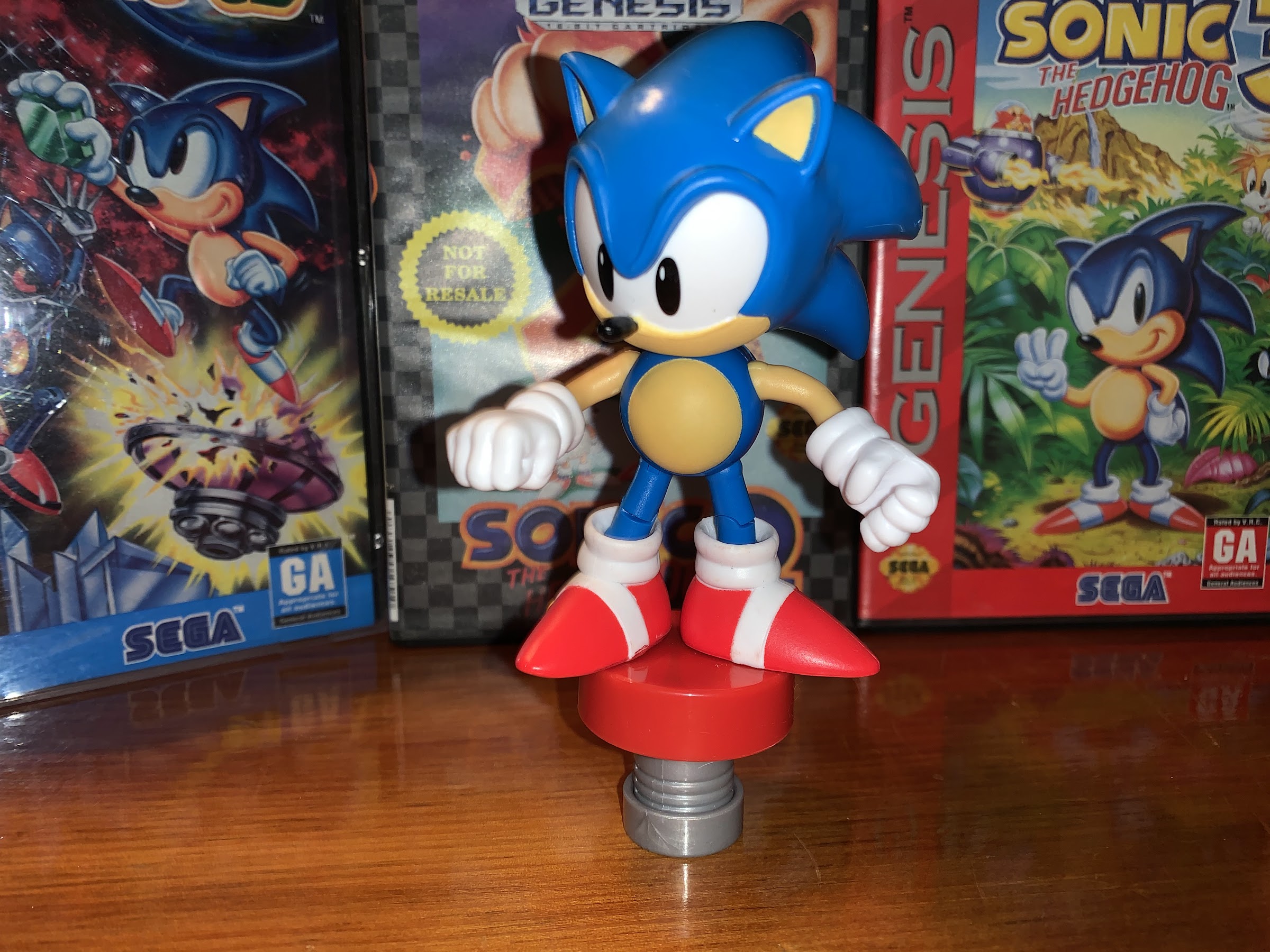
Longtime readers of this blog might have noticed something in my review of the Turtles in Time Bebop and Rocksteady – they were paired up with the Turtles in Time Leonardo and Raphael. I’ve never reviewed those figures and they’ve been out for a long time. Well, I held off. Initially, I just wasn’t convinced I needed them. They’re straight repaints of figures I already have, but those figures feature some dated engineering. And initially, I wasn’t sure how deep I wanted to go on NECA’s video game line. I never got the original comic con exclusive sets, and I thought I might be happy with just select figures from this line. Eventually, the display widened. Another figure I added, but never reviewed, is Leatherhead simply because he was the only missing piece (aside from the Foot Soldier). What changed my mind on the turtles though was an exchange I had with NECA’s Randy Falk on Twitter. It had been noted that re-releases of Slash featured the updated articulation the company introduced with the Turtles in Disguise set so I asked if the current pre-orders for re-releases of the Turtles in Time turtles would feature the same. The answer was “Yes,” and that was enough to get me to pounce.
Leatherhead is the only figure in this line I haven’t reviewed, and I don’t plan to. He’s the same as the toon one, only the quality feels lesser. His joints are super tight and this is basically the only pose he will stand in. He’s mediocre, and I only bought him to complete the set (excluding the Foot Soldier). The pixel deco on his knife is probably the best use of the deco in the entire line though.
NECA’s Turtles in Time line of action figures are specialty shop exclusives that present some familiar figures in pixel-deco to simulate the look of the classic video game, Turtles in Time. The actual turtles are designs by NECA’s Trevor Zammit for the cartoon line, even though they were first released as figures based on the original arcade game. They’re unmistakably Teenage Mutant Ninja Turtles, but I’ve always wondered what the actual reference art was. Their head shapes and expressions strike me more as Playmates inspired, but they’re coloring and body proportions are definitely in-line with the toon. I’ve always liked them, never loved them. I think the Turtles in Disguise look better captures the spirit of the cartoon’s later years, though we could still use some true Season One, or opening credits, turtles.
Anyone who has played the game knows the best strategy vs Slash is to surround him.
Since these sculpts were intended to function as cartoon turtles, they’re basically being repurposed here for Turtles in Time. The look of that game is pretty close to the show as advances in sprite-based graphics since the original arcade game’s release had progressed quite well. The actual expressions worn by these figures though aren’t really representative of the game. Basically, all of the turtles look the same when walking in that game, a sort of neutral, concerned, look. The idle pose is likely what most fans, and certainly I, remember most from the game. Donatello, with his somewhat stoic expression, probably works the best and if you squint Mikey looks close too, though he should be sporting more of a smile. Leo has this weird look in the game where he’s got his head tilted at an angle, and admittedly, it probably wouldn’t translate well to a figure. Raph is practically off model in the game as he has this huge smile that he turns into a pointed “O” mouth expression. That’s the one I miss the most, maybe not so much the weird proportions, but the smirk. This Raph is instead rocking that toothy grimace.
It kind of looks like Donnie’s special move, right?
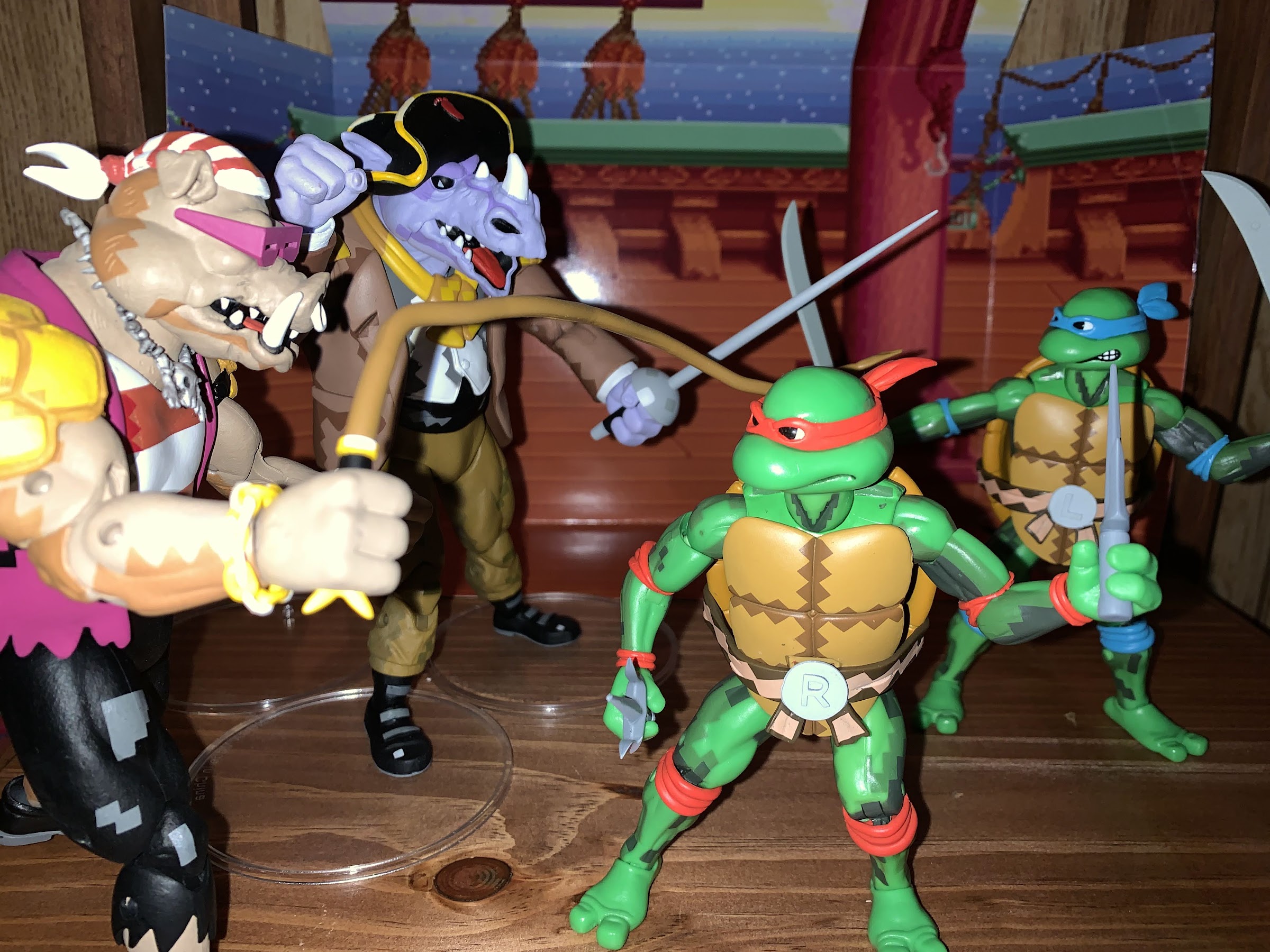
The headsculpts are not perfect for the source material, but the rest of the figure pretty much is. This is that same turtle body we’ve seen for years now and it still looks fine. On it, this time, is the pixel deco from the game. These figures are a bright green with dark green “pixels” painted on. The shell follows the same look with pixels down the middle of the chest and all over the rear shell. The presence of the deco means these figures present best when posed like they would be in the game: frontal view, posed like they’re moving from left to right. A lot of the dark green is on the back of the limbs and from some angles can look like too much. That perception is minimized when on a shelf. Like a Monet, these figures look better from a bit of a distance just like those sprites look better on a CRT television. In addition to the pixel deco, the colored masks and pads are slightly different from the toon release. Donnie, Leo, and Raph basically just have a brighter look, while Mikey is more muted. The original arcade game gave Mikey yellow accents, which was weird, while Turtles in Time corrected that to his traditional orange. The figure is barely orange though and he definitely would benefit from a more saturated look. The paint apps are mostly clean, with some slop here and there, but nothing out of the ordinary. My Donatello does have this odd blob on his inner thigh that looks like glue or something that’s unsightly, though not bad enough for me to try and seek a replacement.
Pay no mind to the use of the Dragon Ball stand.
In terms of accessories, these guys are pretty familiar with one obvious new addition. Each figure comes with their weapon of choice. For three of the turtles, the weapons are the same as the toon release. Mikey’s nunchaku and Donnie’s bo have a lighter paint job, but are otherwise the same. Mikey even retains the spinning ‘chuk effect piece which is always fun to have. Leo’s swords are the same, only painted all gray. Raphael, on the other hand, gets new sais. They’re painted gray with some pixel deco on them shaded in dark gray, but the sculpt is all new. They have a much harder look as opposed to the loopy toon ones. They remind me of classic Playmates sais and I think they look terrific, though not at all accurate to the game. Raph’s sais in the game are these awkward, wide, things where the center blade is barely longer than the other ones. I think the toon sais are a better representation of the game, but I prefer how these ones look, if I’m being honest, so I’m fine with the change. The other inclusions are a set of extra hands for each turtle. The default are gripping hands (Leo and Raph have vertical hinges, Mikey and Don have horizontal) and between the four you get two sets of pointing hands, one set of open hands, and one set of thumb’s up hands. The choices aren’t really reflective of the game, but I’m not really missing anything. Maybe one more set of open hand for a group high five? The only thing I feel we are missing is an effect part for Raph. His attack animation featured a twirling sai at the end and that would have been a neat inclusion. It would basically be the same idea as Mikey’s twirling ‘chuk effect, only pinned into an open hand.
It’s not a pixelized pizza monster, but it will have to do.
The big accessory though is the hoverboard included with each turtle. The board is from the third level in the game, Sewer Surfin’, and each includes a stand. The sculpt looks spot-on to the game and they color coordinate with each turtle. The stand is a simple, and effective, structure that’s just transparent plastic with a ball peg at the top. The board snaps on, and the ball design allows it to tilt in basically any direction. The board is relatively thin so the ball can only sit so far into it which limits the tilt to some degree, but overall I think you get a solid range here. Each board has one foot peg and it’s definitely on the snug side, but once on, the turtle is unlikely to fall. It’s pretty cool, and it’s going to be hard to resist just posing all four on their included board.
These figures definitely do not represent NECA’s finest work.
Lastly, we have the articulation to speak on. These guys articulate exactly the same as the Turtles in Disguise set. If you got the original release for these, then they articulate like the older Target two-packs and comic con releases. The difference is minor as above the waist everything is the same on both, it’s just the hips and ankles that have been altered. NECA swaps the old hips for the new ball and socket joint and it works great here. Nothing is too lose and the range is plenty adequate. The ankles are the new hinge and rocker joint and they too work just fine. My only articulation complaints with these four is just the tightness in the arms. The elbows are a bit scary to get moving and for some reason the right biceps doesn’t sit as flush as the left. It’s especially problematic on my Donatello and I keep having to push it in. Some of the pins in the legs aren’t perfectly aligned either and it’s a little bit of an eyesore in places. Raphael’s belt wasn’t seated properly in the cut-out behind the belt buckle before it was glues so he looks like he’s been stabbed. Worst of all though, is my Leonardo is a pain to stand. I couldn’t figure out why initially, since the others were okay and they’re all essentially the same figure, and then I finally noticed: he has two right feet! I bought these through Big Bad Toy Store and I reached out to them following my discovery. They didn’t have any spare parts, and didn’t offer to replace the figure, but did issue me a refund. That has left me to try and get a new foot/leg from NECA directly and they weren’t any help. They just referred me back to BBTS. In the end, I got a free Leonardo, but I would have preferred to pay full price for a non-defective one. I could put the refund towards a Raph or Michelangelo at BBTS, but they cost slightly more than I paid originally and I’d essentially be spending 28 bucks or so for a little, green, foot. Overall, excluding the foot issue, the articulation is good enough, but there is a part of me that wants to see NECA do a complete redo of the turtle engineering. At the same time though, there’s a reason why these are 25 bucks and not 35.
Yeah, I probably have to display them this way.
The NECA Turtles in Time edition of the famous heroes basically do enough to get the job done, on the surface. They’re not a perfect match to the game, but it’s also obvious what the company is aiming for by virtue of the deco and included hoverboards. They pose as well as any other 1/12 version of the turtles from NECA, but the quality control seems a little lax and that’s something I’ve noticed with this line as a whole. Again, they’re not priced like the company’s Ultimates line of figures so they are a cheaper product, but it’s a shame that shows in the quality as opposed to just a reduced accessory count or something. Three out of the four turtles had what I would consider quality control problems, enough so that I don’t think I’d recommend anyone buy these sight unseen. One thing working in this line’s favor is that these are pretty easy to get ahold of, though they may not be much longer as NECA pivots away from the Turtles in Time figures. They’re all sold separately, single-packed in the Turtles in Time themed box, and should be around 25-28 bucks from most places, though I’ve seen some local shops try to upcharge them more severely. And a few are only offering them in bundles. For this line, it pays to shop around.
When I reviewed the Super7 Donatello last month, I noted how it was one of the longest waits I’ve ever had between the time I ordered something and the time I received it. Well, it’s already been topped. NECA’s Turtles in Time series of action figures based on the Teenage Mutant Ninja Turtles video game is the less celebrated wing of the company’s TMNT figure lines. It’s a specialty shop exclusive that largely consists of repaints of figures that have already appeared in the company’s cartoon line. There are some exceptions, like the Baxter Stockman figure, but largely it’s the most niche line based on the popular IP. The Bebop and Rocksteady set, based on their appearance in the Super Nintendo version of the game, is sort of the capper to the line. It’s the line’s only two-pack and it features two popular characters in amusing pirate attire. It went up for preorder in October of 2020, the same month as Super7’s wave 4 of Teenage Mutant Ninja Turtles, and if I didn’t cancel my preorder and grab this set elsewhere I’d still be waiting. For whatever reason, the online retailer Big Bad Toy Store has been slow to get some NECA product. I’m still waiting for the quarter scale Donatello to come in stock despite that, like this set, being available months ago in other places. When someone pointed out to me that Amazon, of all places, had this set in stock I jumped on it. Sorry BBTS, I’ve waited long enough.
“Say your prayers, toitles!
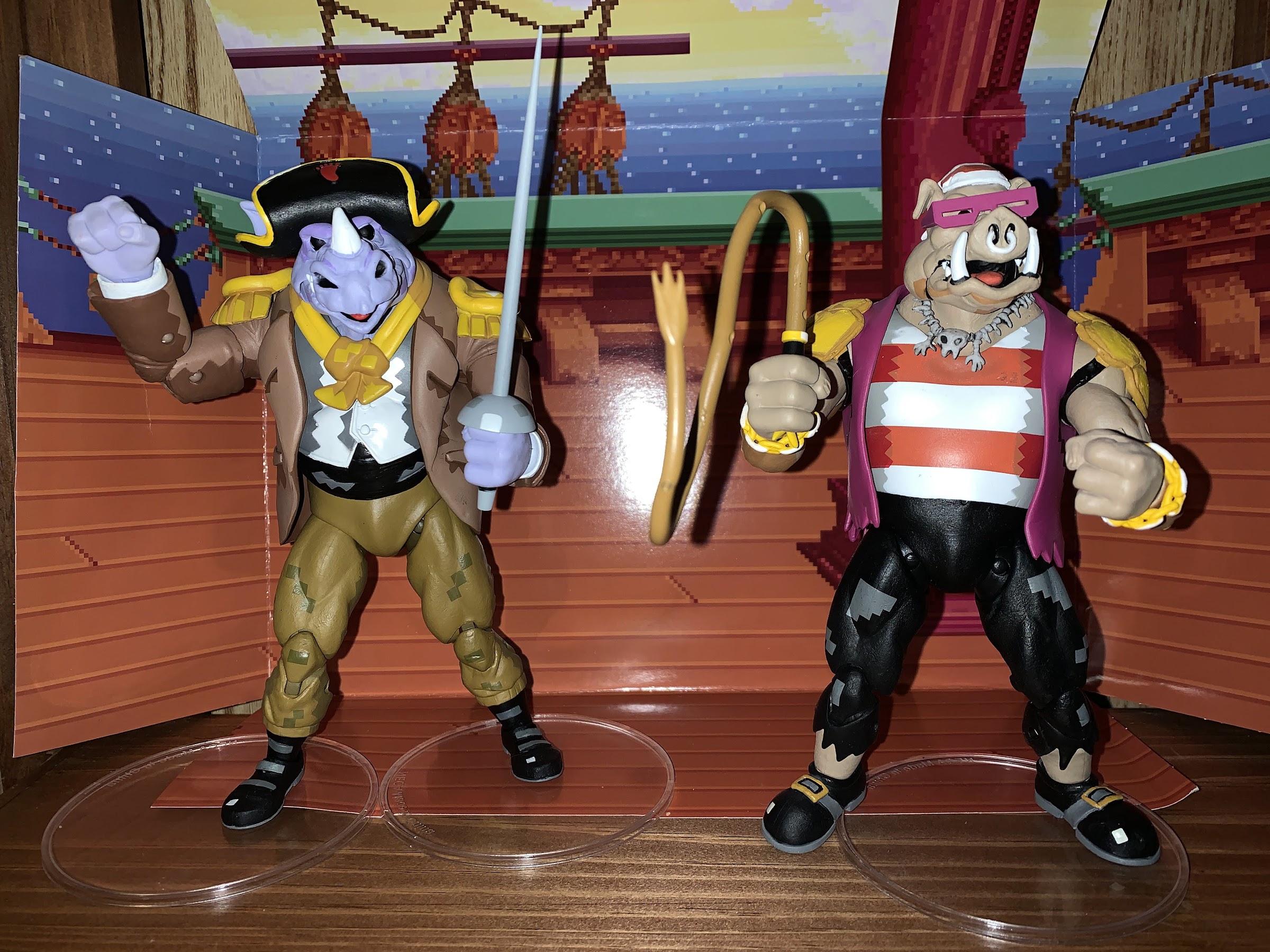
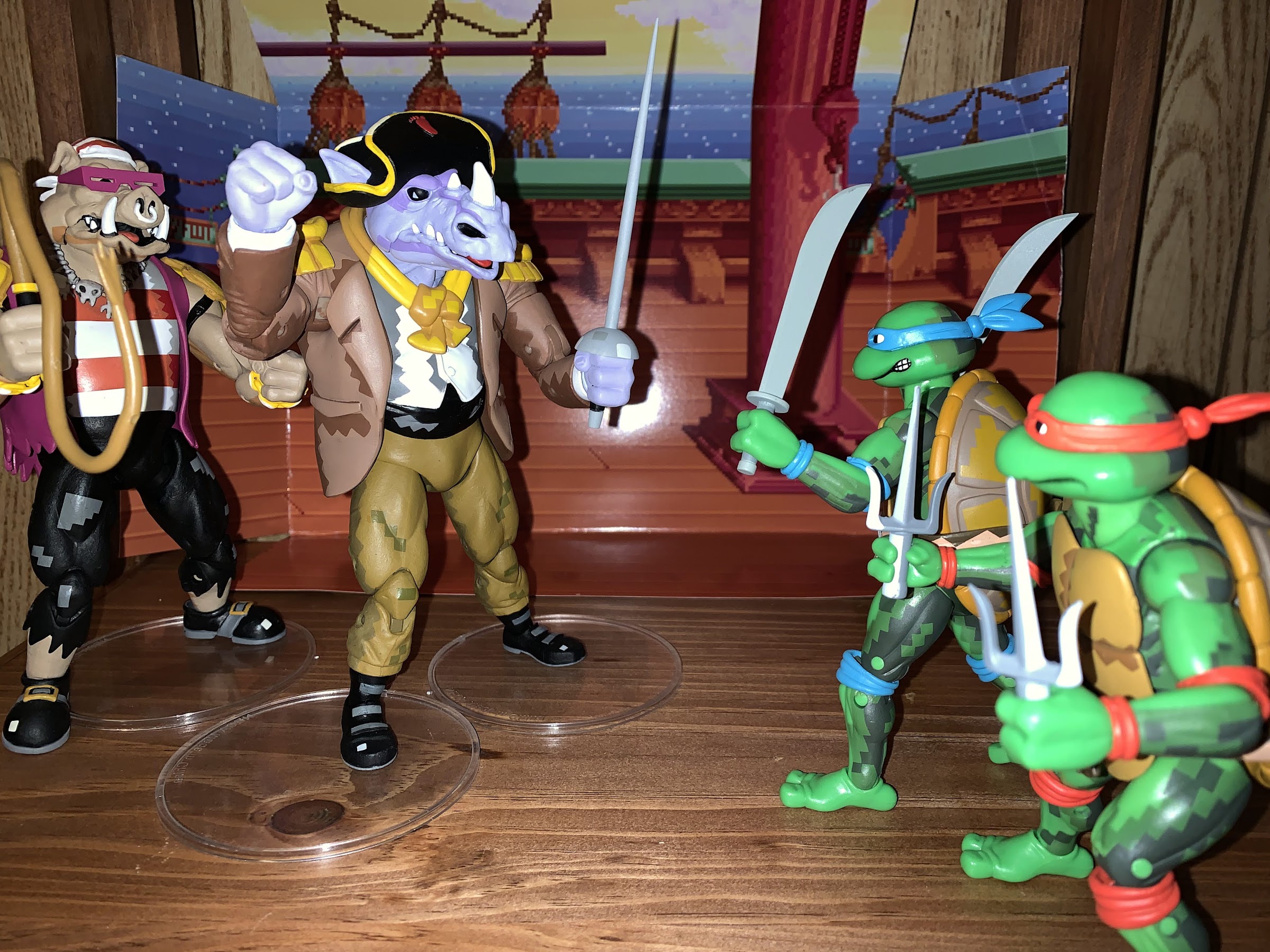
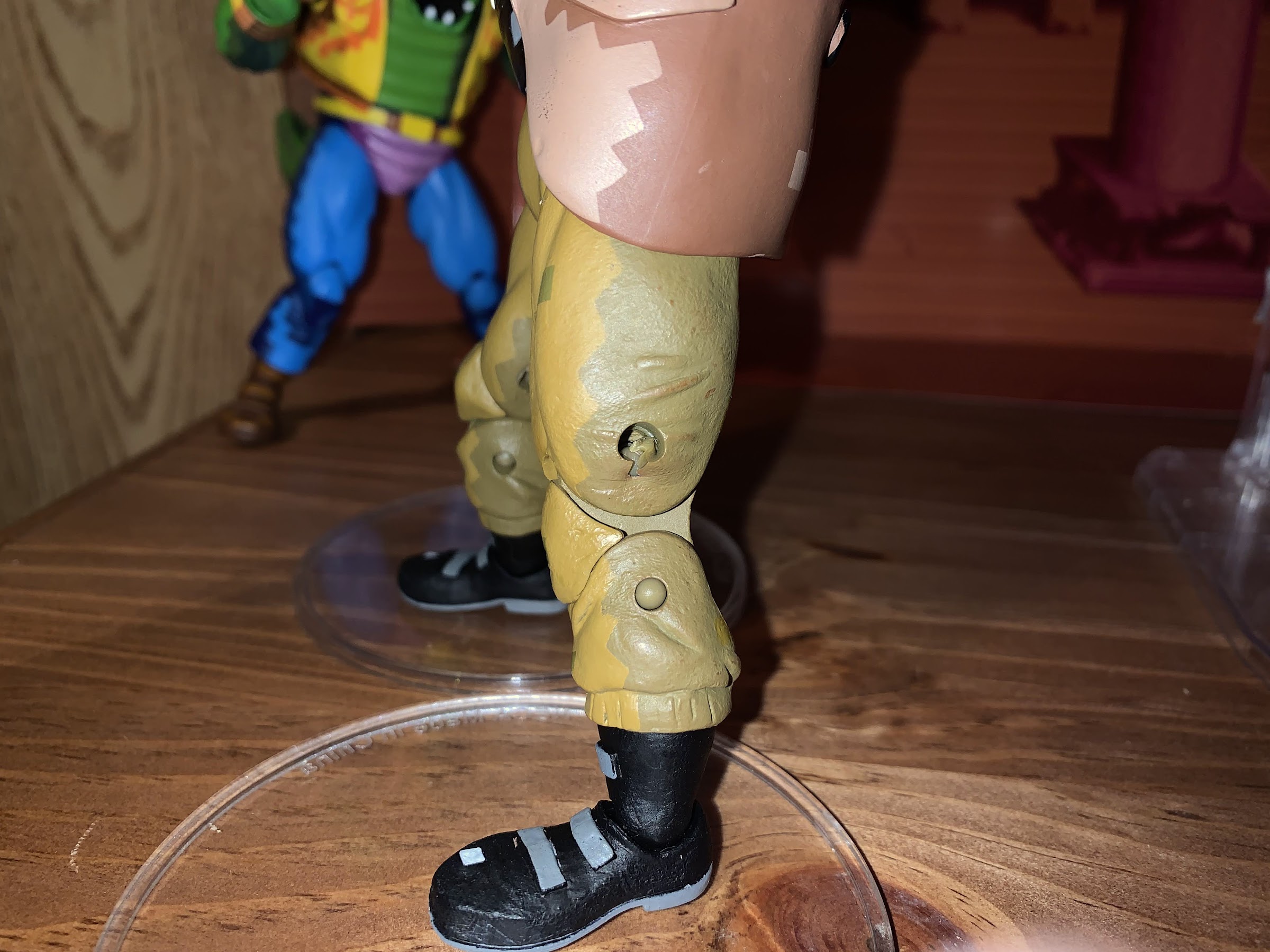
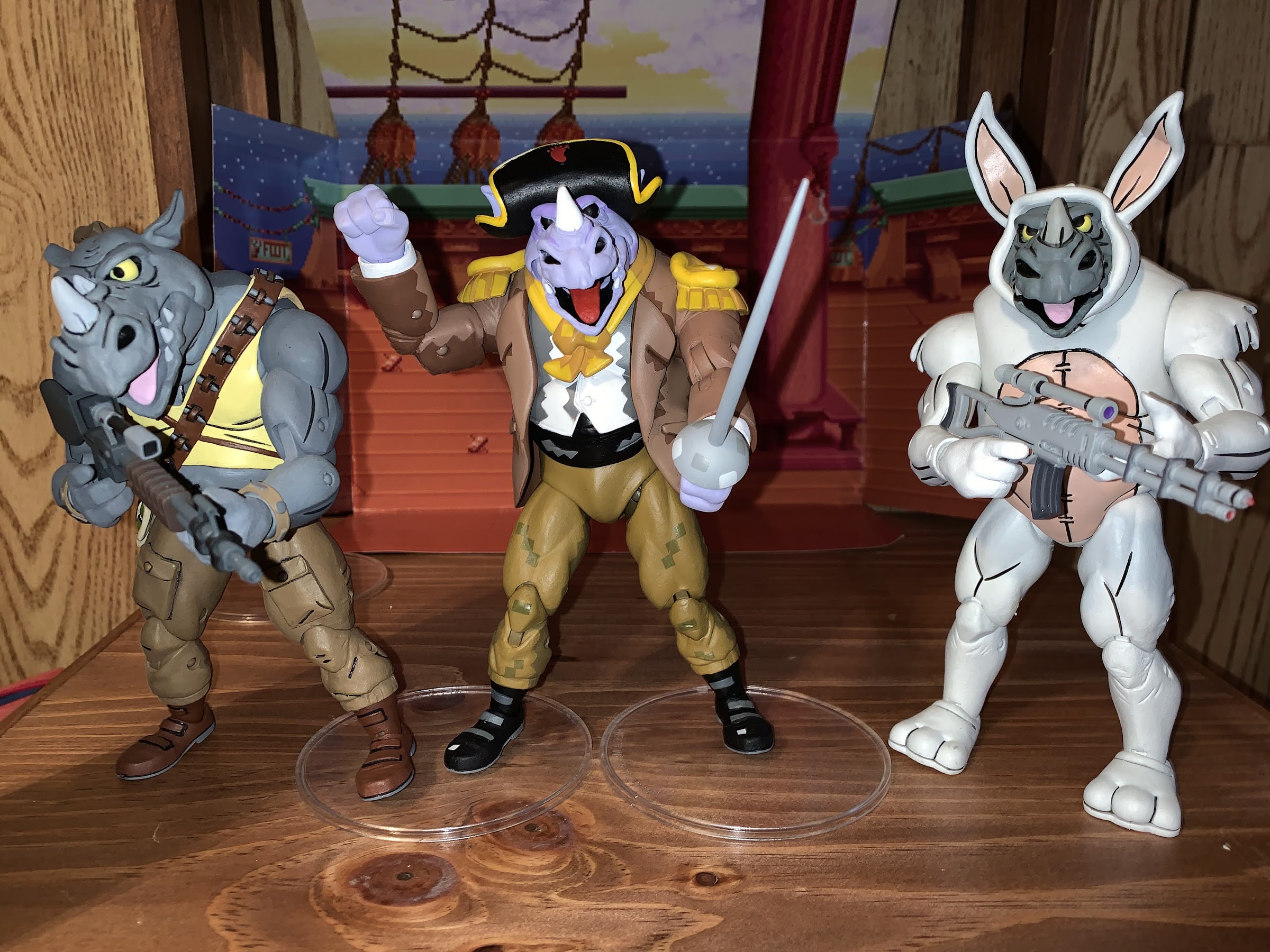
Bebop and Rocksteady are a bit unique for this line. They’re not just repaints, but they’re also not too far removed from the figures we’ve seen in the cartoon line (which came out back in 2019). The actual figures are largely the same and what’s been changed are the soft, plastic, overlays, that NECA uses to differentiate characters. It’s how they can basically use the same molds for Bebop, Rocksteady, and Leatherhead without it being really obvious. Of the two, Rocksteady is the most different. NECA had to add his pirate hat so he actually has new ears. His overlay on his torso is vastly different from the tank top the other figure features as it’s a dashing, captain’s, shirt and coat with ruffled shoulder pads. The arms had to be changed to accommodate this look since he’s now wearing sleeves. Everything else is the same which is a good and bad thing. Good, because the older Rocksteady is one of the best looking figures in this line still. Bad, because that figure used the old hips which are prone to breaking and difficult to pose. This guy is hard to stand and I’m currently using two NECA disc stands to keep him upright.
It’s still pure horror underneath those glasses.
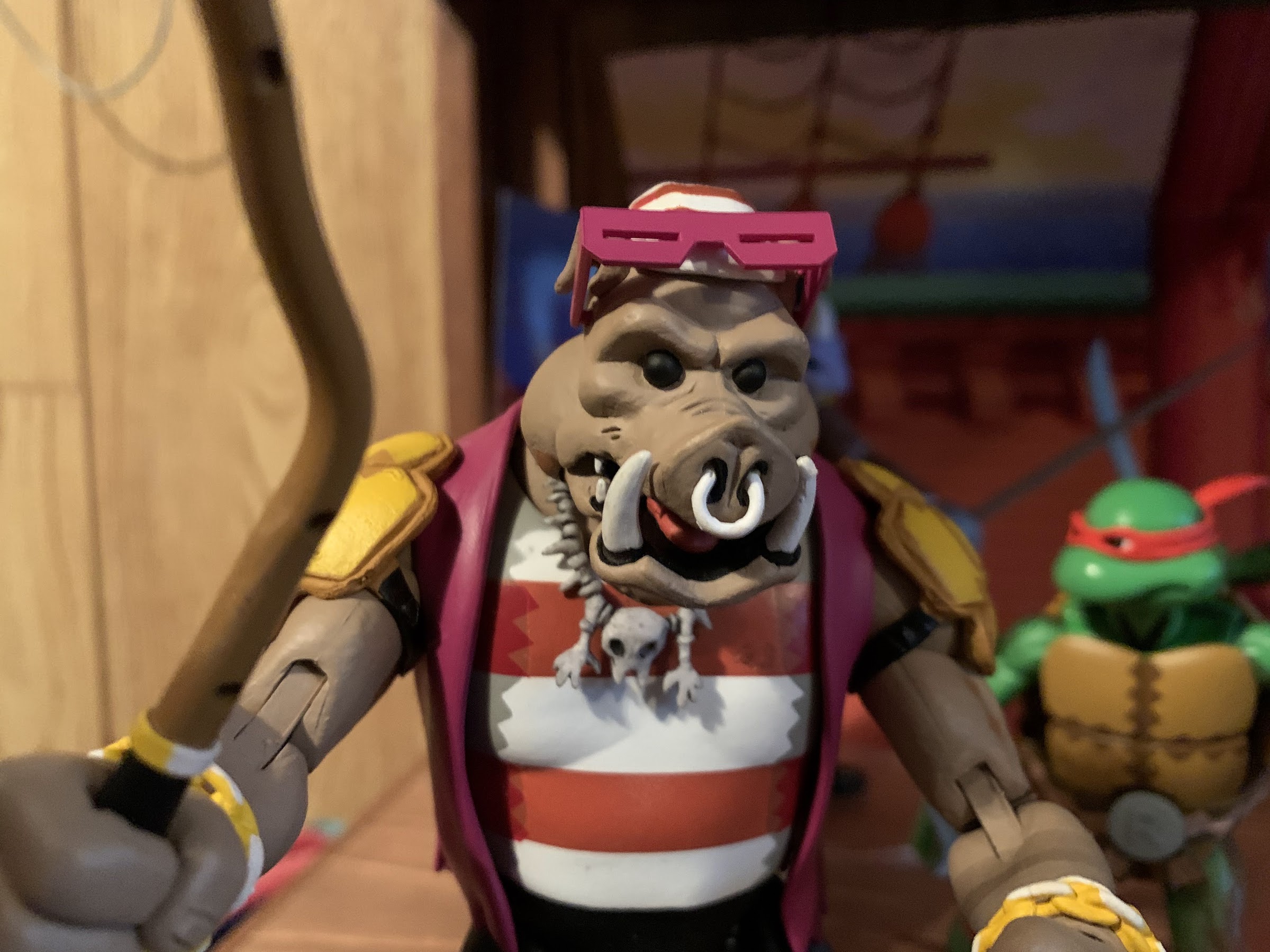
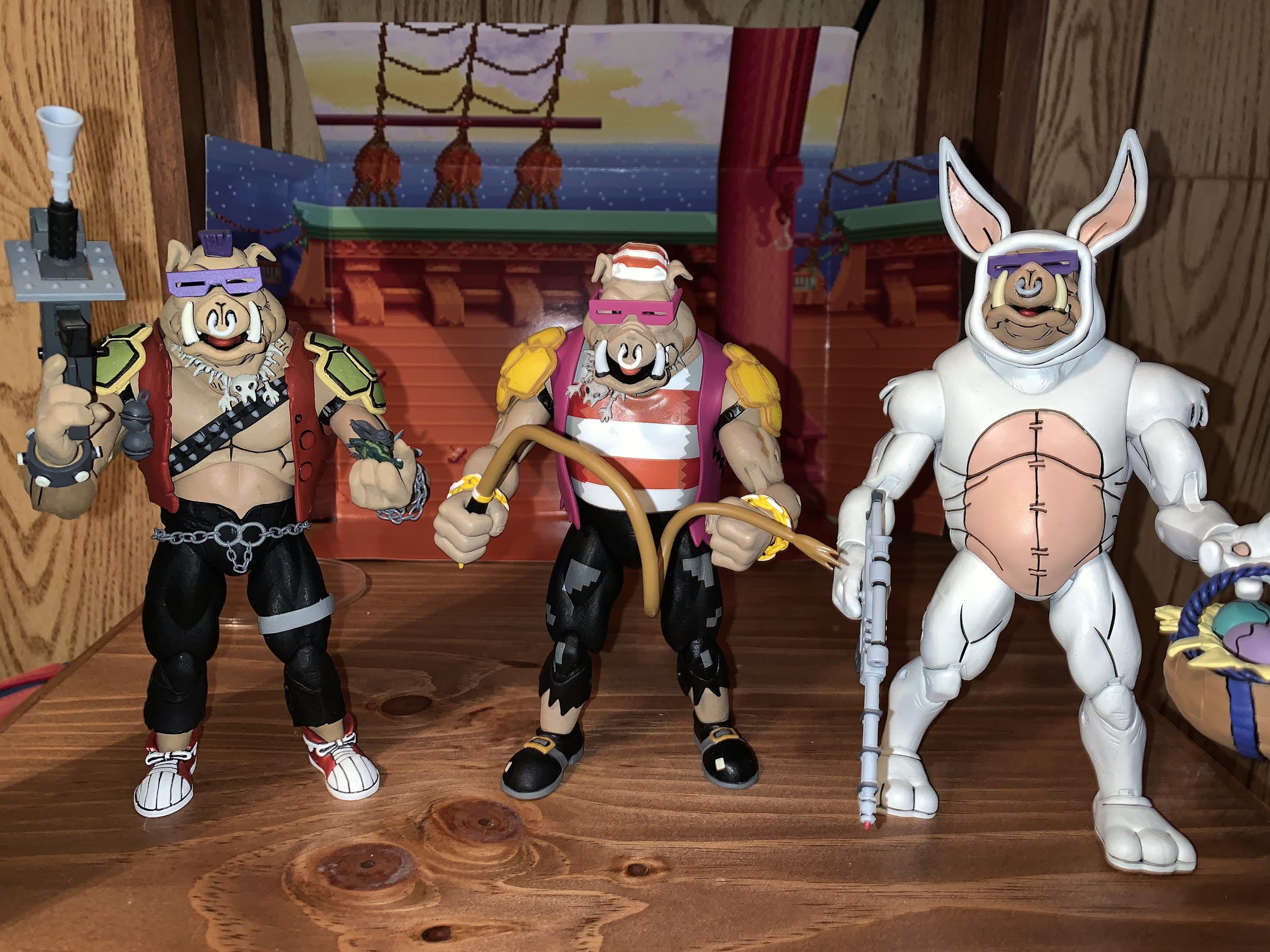
Bebop is also sporting a pirate look, but his look isn’t as drastic a departure as his buddy’s. It’s almost entirely limited to the overlays as he has a new bandana on his head in place of his hair and he’s wearing a striped shirt with a pink vest. The arms are the same, but NECA ditched the real chain-link bracelet in favor of sculpted ones on both wrists. The only real difference comes below the knee as Bebop’s pants end in tatters and his stylish high-tops have been replaced with what look like loafers with a big, yellow, buckle on each. He also doesn’t have a belt any longer, but still has his turtle shell shoulder pads and weird, skeletal, necklace. Unlike Rocksteady, Bebop is easier to stand as the new shoes actually work better than the old ones, though he too can still be a challenge as he’s very top heavy. I think with Rocksteady he’s just even more top heavy and his feet aren’t very large in relation to his body size. My only critique of this look is that Bebop’s shirt and glasses are more of a hot pink than the purple they appear to be in the game. You can also see his purple ponytail in the game, but NECA removed his hair to make room for the bandana on his head. And his eyes are still solid black under the glasses which is a bit of a bummer because his eyes become visible in the arcade game when hit and it would have been cool if we could simulate that as well.
The pixel deco isn’t too intrusive here and actually works pretty well from a distance.
Both figures feature NECA’s pixel deco and I think it looks okay here. With Rocksteady, the effect is played up rather well on his torso. I like how the gray and white on his vest turned out and there’s just enough on his arms and legs. His flesh is purple, which is in keeping with the game. His black hat is basically ignored when it comes to the pixel look which is accurate to the game as well. The paint is clean and sharp and if I have one criticism it’s that there should be some white near his eyes. As it stands, NECA basically painted them all black with a triangle of purple and it’s a bit freaky. Bebop is also well-painted, though his pixelization feels more understated. NECA could have done more with it on his chest, especially, but opted not to. If not for the gray patches on his legs he wouldn’t really appear pixelated at all when on a shelf. I suspect this bothers few though as, if anything, I see more people complaining about the pixel deco than praising it.
This isn’t the most dynamic pair of action figures around. Most will just set them and forget them.
As far as articulation is concerned, these guys are exactly the same as the previous releases. They’re nearly the same base too so they articulate the same, which is to say, not very well. They’re not statues, but the articulation has always been something I’ve had to overlook with these guys. The head is on a ball or ball-hinge and doesn’t offer much range. The jaw on both is articulated and it offers a fair deal of personality, though Bebop can’t really close his mouth all the way. There’s a ball hinge at the shoulder that’s super tight on both figures. The shoulder pads both sport make it difficult to rotate the arms, and with Bebop, it’s basically impossible. There’s a biceps swivel on both and double-jointed elbows. The wrists swivel and hinge though the hinge isn’t very functional with Rocksteady due to the cuffs on his sleeves. There’s probably a diaphragm joint on both, but the overlays render it useless. You get a waist twist with some tilt, but nothing really in the way of an ab crunch. The hips are the old peg system where the peg on the right leg goes through the crotch piece into a cylinder in the left leg to join them. You get a thigh twist at that joint, which is a ball hinge in the top of the leg, with double-jointed knees below that. The feet have a hinge with limited range on both figures and it does rock side to side a bit, but not a whole lot.
That upper peg isn’t doing it’s job and, as a result, a lot of the joiner in between the thigh and calf is visible on Rocksteady.
These guys are a bit of a stressful pair when first opened. A lot of the joints on mine were pretty tight or stuck. I plunged both into a hot water bath before doing much of anything with those hips. It’s basically the same old story where the joints are painted, which causes them to lock-up in shipping, but this old leg system would be tight even without the paint. And there’s a lot of paint on these guys and it looks rather thick in places. You definitely want to exercise caution when breaking them in. And even being careful, I still popped Rocksteady’s arm off at the biceps joint due to the shoulder hinge being so tight, which isn’t typically an area of great concern. It thankfully popped right back on, but it’s become a chronic issue where anytime I try to move a shoulder it will pop off if I’m not mindful of how easy it is to do. I also have an issue with Rocksteady’s left knee. The peg that holds the leg together above the knee looks like it went in at an angle and doesn’t go straight through. There’s more separation there as a result and might be contributing to some of my issues with standing the figure since I need to put the leg perfectly straight in order to hide some of the gap created above his kneecap. It’s not super obvious, but it is obvious enough that it bothers me and I do worry about the joint eventually falling apart.
Obviously, the rabbit one is the best one.
Since these guys are based on one boss battle in the SNES game, it’s probably not a huge surprise that they don’t come with much in the way of accessories. Both only used a single weapon each in the game: a sword for Rocksteady and a whip for Bebop. The sword looks fine. It’s a long, skinny, thing with some pixel deco applied. Rocksteady though doesn’t have the right hinge in his hand to properly wield it, though it’s likely his sleeve would have interfered anyway. Bebop’s whip is very similar to the one that came with the Punk Frog Napolean. It’s soft plastic with a wire inside so you can bend and position it as you see fit. Because of that it doesn’t have much in the way of a deco on it, it’s just brown with a black handle, but it’s fine. In addition to the weapons, both figures come with three sets of hands: fists, gripping, and open “style pose” hands. These are the same as the other releases with the only difference being the lack of a trigger finger hand, which is understandable given the weapons loadout here.
Doing these comparisons has given me new appreciation for those oversized rabbit feet.
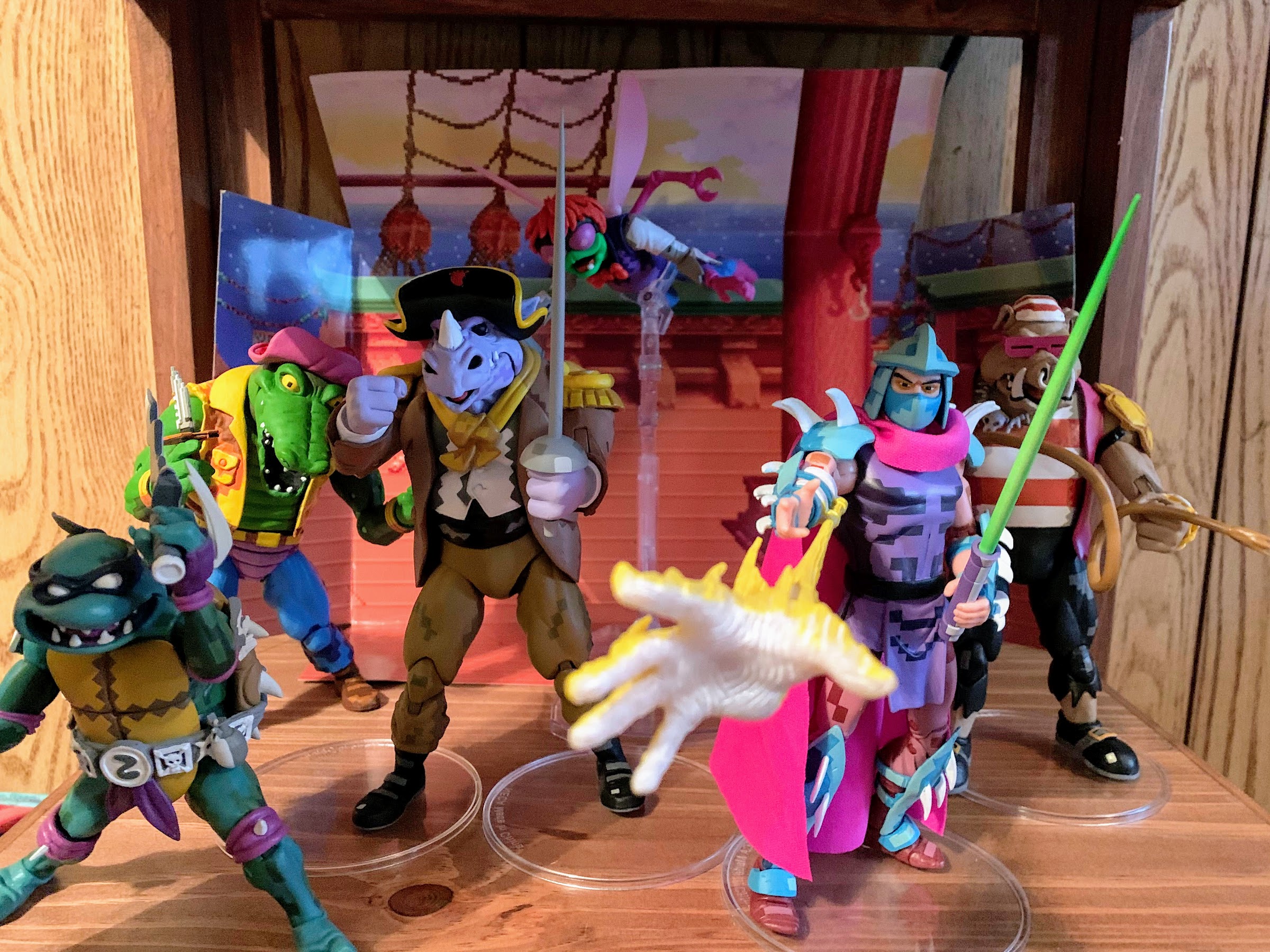
The Turtles in Time version of Bebop and Rocksteady is an okay release. NECA largely handled the look and presentation fine, which is what I assume most collectors are interested in. Anyone hoping for an improvement over the past figures will be let down and I do think NECA missed an opportunity to do just that. This is a fun, silly, version of the characters and the encounter in the game was one of the more memorable ones. It’s a big reason why the SNES version is superior to the arcade one which did not feature the two. Where the figures do come up short is in the articulation and some of the dated engineering. They’re just not fun toys to pose as a result. I suppose it’s a good thing they’re from a video game as most will probably set them in a pose similar to their default sprite and let it be. I do think it’s silly that NECA didn’t at least update the hips. They already have the upper leg pieces from the Triceratons, but they might have needed to do a new crotch piece since that figure was equipped for a tail. Still, Bebop and Rocksteady figure to be among the most popular characters in the line and are a candidate for a re-release so why not re-configure the hips for such?
That’s a lot for the turtles to deal with, but there could always be more.
This two-pack figures to be the last release in the Turtles in Time line for at least a little while. NECA is still planning on releasing a color variation on the Foot Soldier, but no solicitation has been made available and I’m not sure if that release is from Turtles in Time or the original arcade game (chances are, it works for both). There’s also a two-pack (I think) planned based on the first arcade game featuring Traag and Granitor. It was shown long ago at Toy Fair, but it was during NECA’s negotiations with Viacom to bring a cartoon line to retail and once that was secured they basically abandoned the idea of doing the rock soldiers. Since they’ve done them for the toon line, it’s not a huge surprise they’re going back to them in 2022. Like the Foot though, no solicitation has gone out yet so who knows if they’ll actually be released in 2022 (NECA is planning on doing more Mirage Studios inspired figures which is effectively taking the place of the Turtles in Time subline) or if there’s any room on the release calendar. If this is it for Turtles in Time, NECA has definitely given collectors enough for a worthwhile display. They could always come back with Krang or the duo Bebop and Rocksteady took the place of in the SNES version of the game, Tokka and Rahzar, or even Metalhead. It’s easy money to just repaint existing figures with a video game look, so it definitely wouldn’t surprise me to see the line make a comeback some day.
Arcade 1Up has been around for a few years now selling arcade cabinets at a reduced size and also a reduced price. The cabinets are significantly smaller than an actual arcade cabinet, but still plenty large enough to take up a lot of floor space in your home. And while they’re cheaper than the “real thing,” they’re hardly what I would call cheap. Many of the full-size units will set you back over 500 big ones, and newer models have eclipsed the $700 price tag as components become harder to come by and virtually everything has become more expensive. Even when the units were cheaper, I was never able to bring myself to spend hundreds of dollars on what is essentially a novelty item. The cabinets, being smaller than the real thing, are less functional. You can’t physically accommodate four adults for a game of Teenage Mutant Ninja Turtles, for instance. And these are all games that can be experienced in a far more convenient and cheaper manner. Only some of the side-scrolling beat-em-ups are unavailable for purchase these days, but they’re also games not really designed for home consumption. They were made to entertain in bursts and consume quarters, with free play they last less than an hour and have little to no replay value once completed.
There’s nothing particularly practical about what Arcade 1Up sells, but that doesn’t mean it’s worthless. I already used the term novelty when talking about them, and that’s really what they are. They liven up a room at your house, give people something to talk about when they come over for the first time, and do offer some entertainment value. Especially when it comes to skill-based games. And I certainly am willing to spend money on novelty items as I own several mini consoles and recently reviewed the Zelda Game & Watch. I just have a limit on what I want to spend on such a device and on how much room I want to dedicate to one. I’ve often considered buying an arcade cabinet for my bar room at home. I was really close to doing so with an SNK cabinet more than 10 years ago since those can actually swap games. And when a local arcade closed-up shop near me five years ago I strongly considered making an offer on their Simpsons cabinet, but thought better of it in the end. Arcade 1Up has always had some appeal to me, but nothing got me to bite. The Teenage Mutant Ninja Turtles one came the closest because of my love for that IP, but realistically I’d play it a couple of times and then never touch it again. I thought I might take the plunge if Arcade 1Up ever did The Simpsons and they did in 2021, but the $700 price tag was a non-starter for me.
Now isn’t that cute.
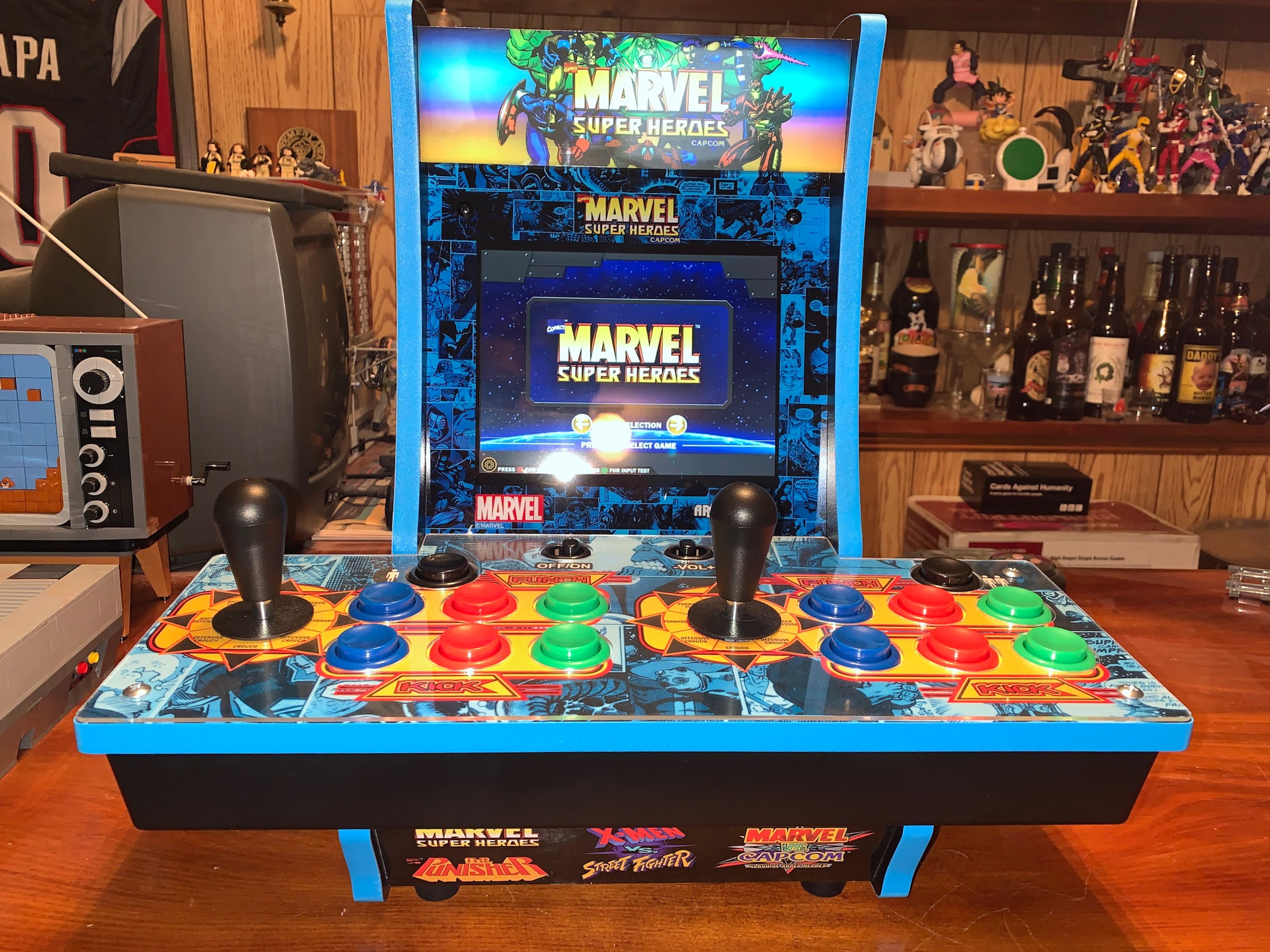
Arcade 1Up seems to know there are lots of folks like me out there that want their product, but are hesitant either due to cost or space concerns. Enter the Counter-Cade! This is a smaller version of an arcade cabinet intended to be placed on a counter, or better yet, a bar. And I have a bar! Aside from a bar-top juke box, I can’t think of a better accessory than a small arcade cabinet. And that’s what the Counter-Cade is, it’s just a small arcade cabinet with a short base. Since they’re even smaller than the normal Arcade 1Up, they’re only suitable for 2 players so no four-player models exist (that I’m aware of) and it looks like many have fewer games loaded on them than the bigger model, which makes sense as Arcade 1Up needs something more than size to entice folks to pony up the big bucks. There’s no wi-fi either, but you can plug in a controller if you find it too small to comfortably accommodate two players (though I tried it and didn’t have much luck). I was interested when I first saw the Counter-Cade, but I wanted it to contain games I’d actually play. My wife seemed to pick-up on this for underneath my Christmas tree was the Arcade 1Up Marvel Super Heroes edition of the Counter-Cade.
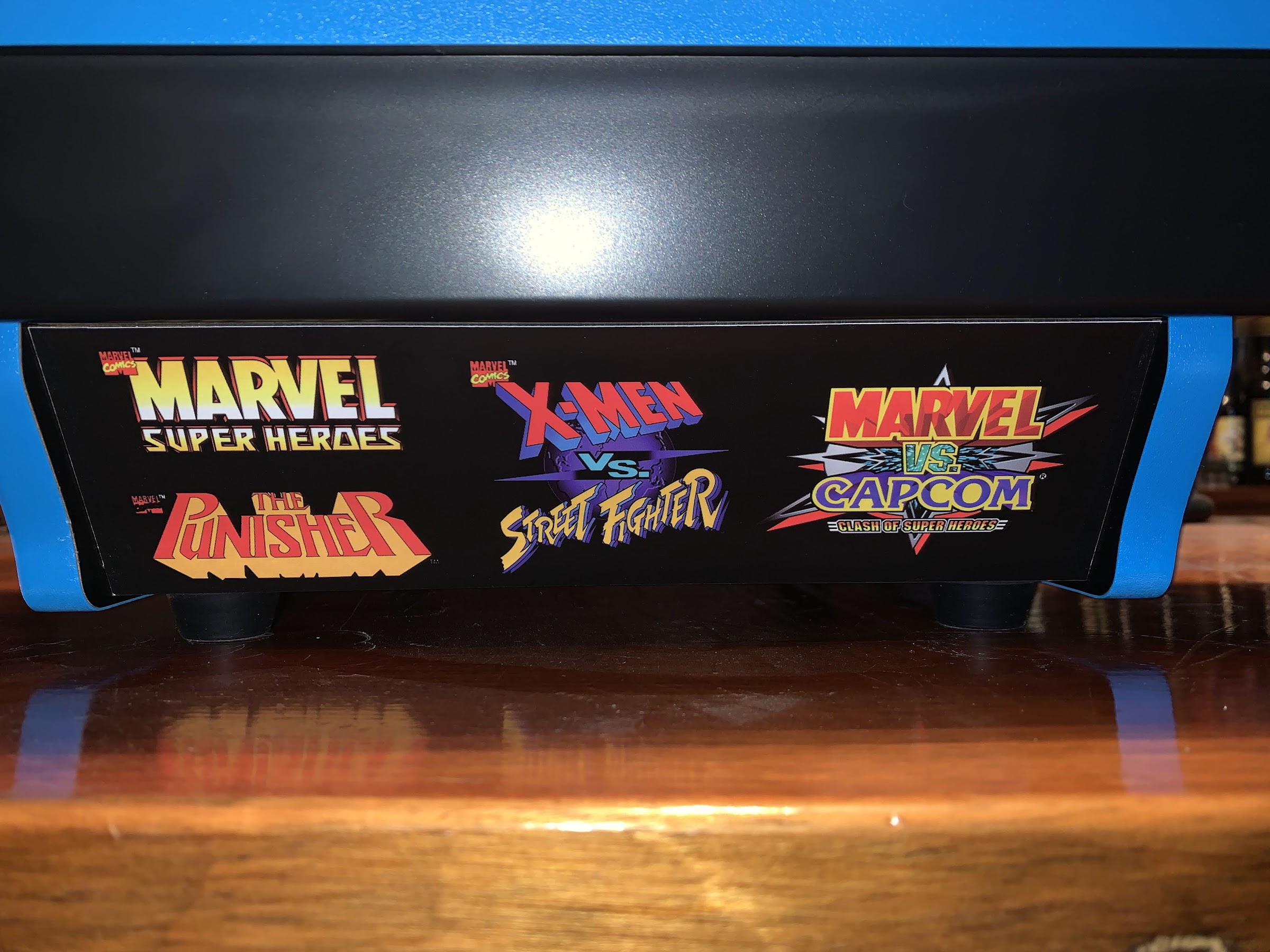
The games that come pre-loaded.
The Marvel Super Heroes Counter-Cade from Arcade 1Up comes with four games pre-loaded onto it: Marvel Super Heroes, X-Men vs Street Fighter, Marvel vs Capcom, and The Punisher. All four are developed by Capcom and obviously contain characters from the world of Marvel Comics. Three of the four are 2D fighters, while The Punisher is a two-player beat-em-up. It’s a solid assortment of games as you get a traditional 2D fighter in Marvel Super Heroes and a pair of tag-fighters. I would have preferred it if Arcade 1Up had made this an X-Men themed unit based on Children of the Atom, but oh well. I’m sure almost everyone would have preferred another “VS” title in place of The Punisher, but I’m okay with it as it gets another style of game into the set.
There’s a USB port on the right side for a controller, though when I plugged in my 8bitdo controller it didn’t map the buttons properly.
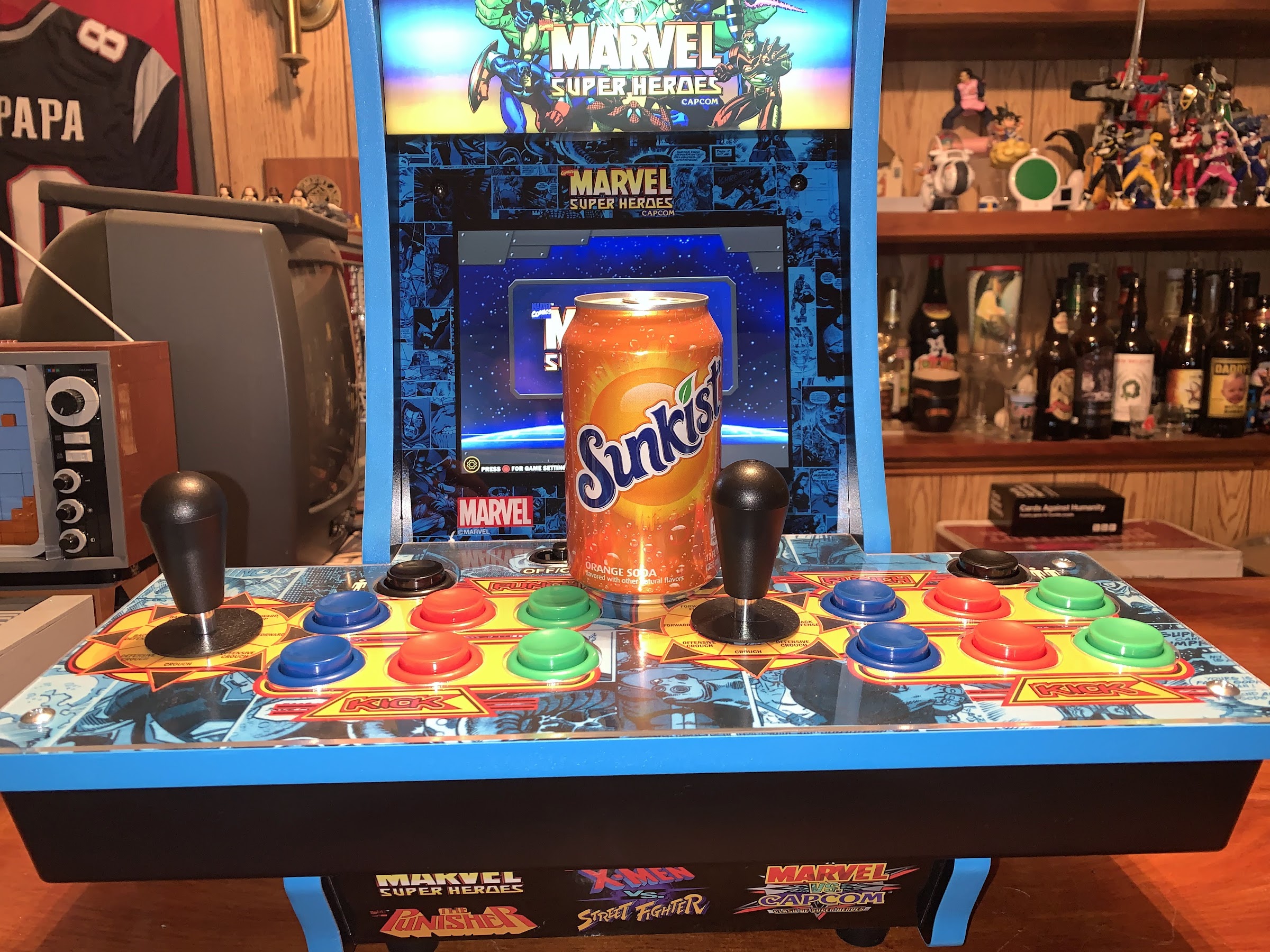
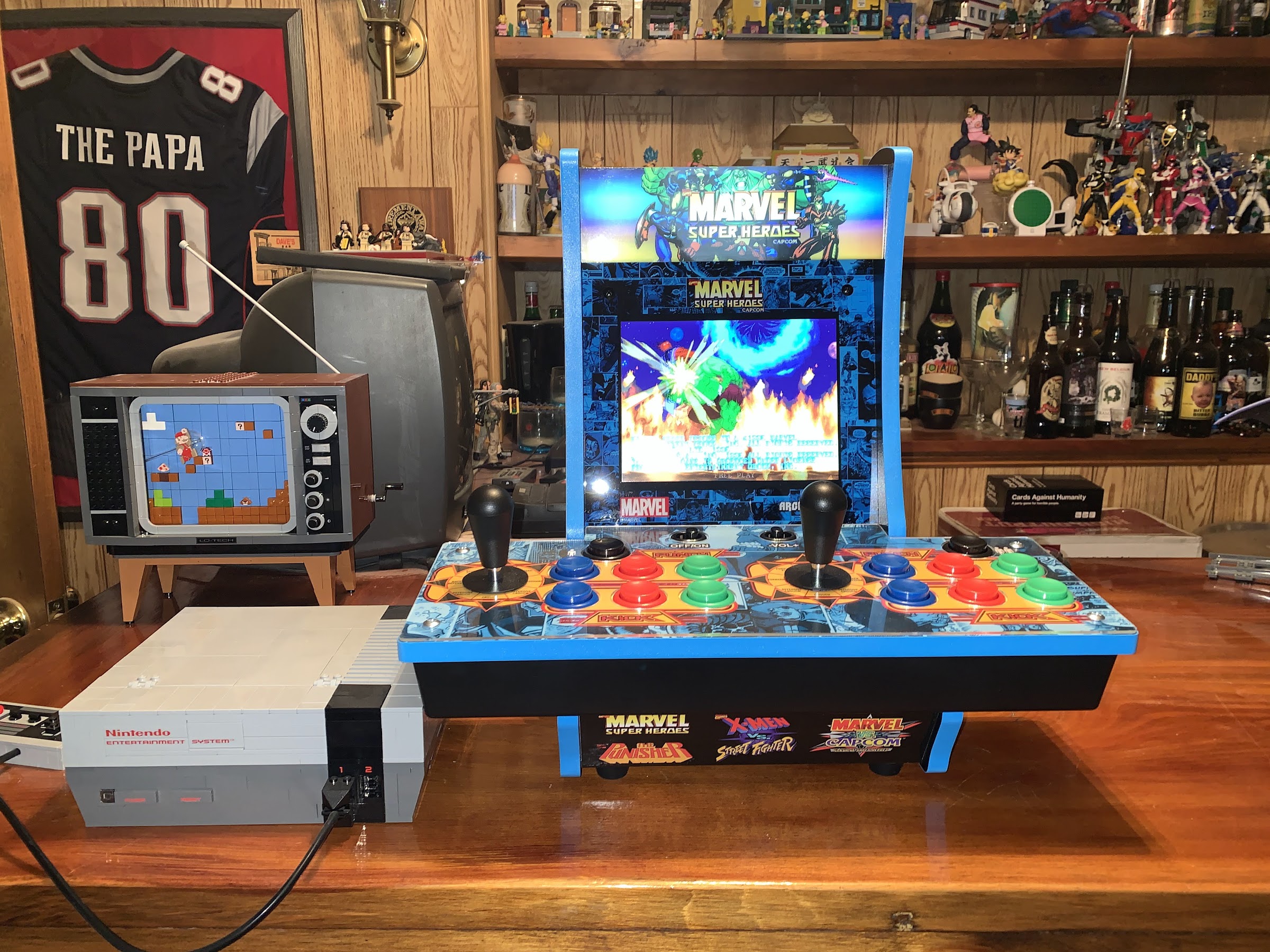
What’s going to sell this unit is the size, price, and game selection. As far as size goes, the cabinet basically takes up a space of 16.5″ wide, 16 1/8″ high, and 13″ depth. That’s me measuring the unit at it’s widest part, which is the platform where the controls are mounted, but that’s roughly the area this thing occupies. It runs off of an AC adapter so you do need to be relatively close to an outlet as the chord is only about 4′ long. The screen is approximately 6.5″ wide x 5″ high and it’s suitable for the software. The colors are vibrant and there’s no taring of the sprites. It’s also pretty loud so if you were worried about the audio I think most will be fine. There is a headphones jack for those who want to game without disturbing others, though the clicky joystick and buttons will prevent truly silent play.
Soda can for scale.
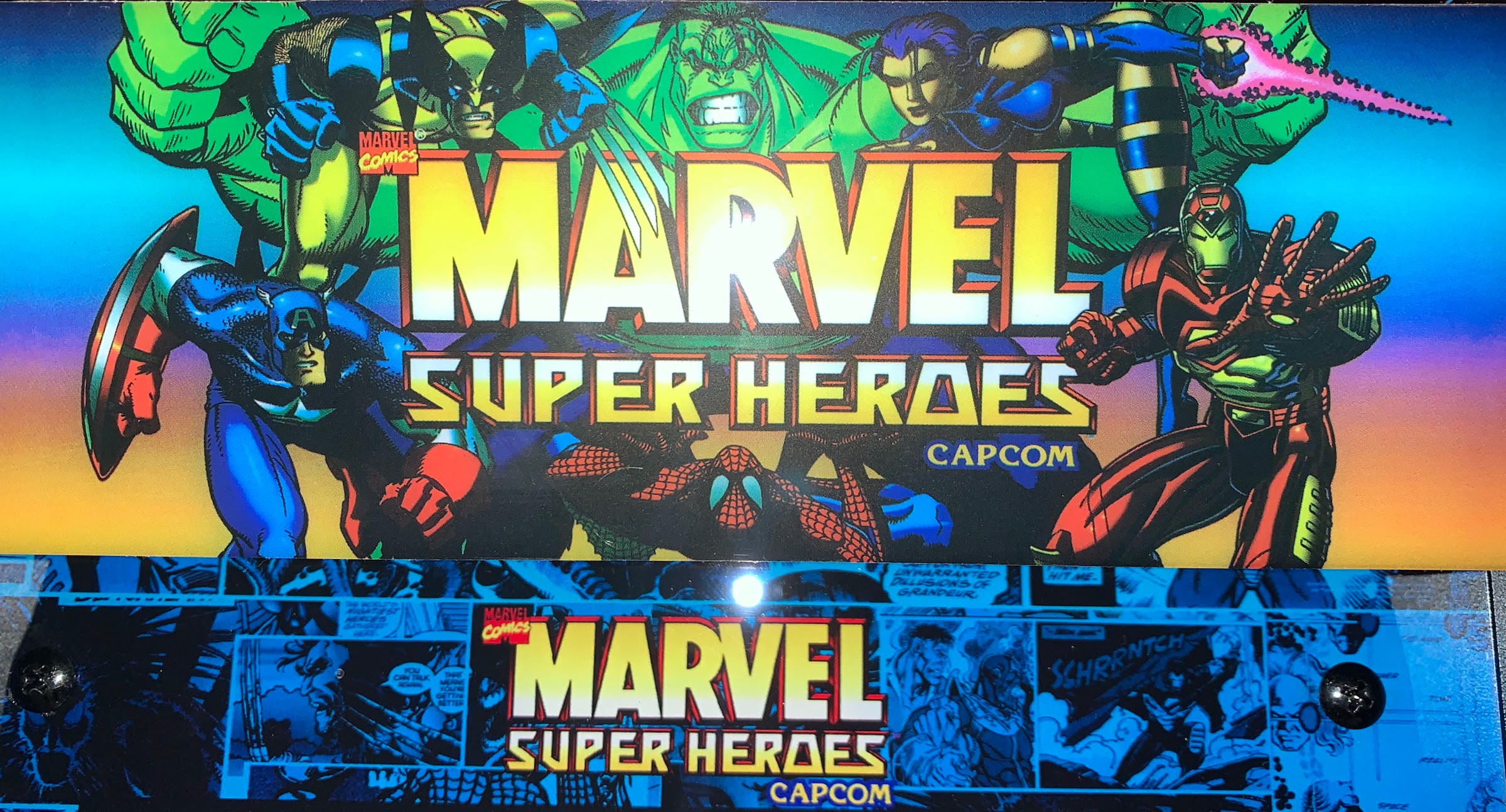
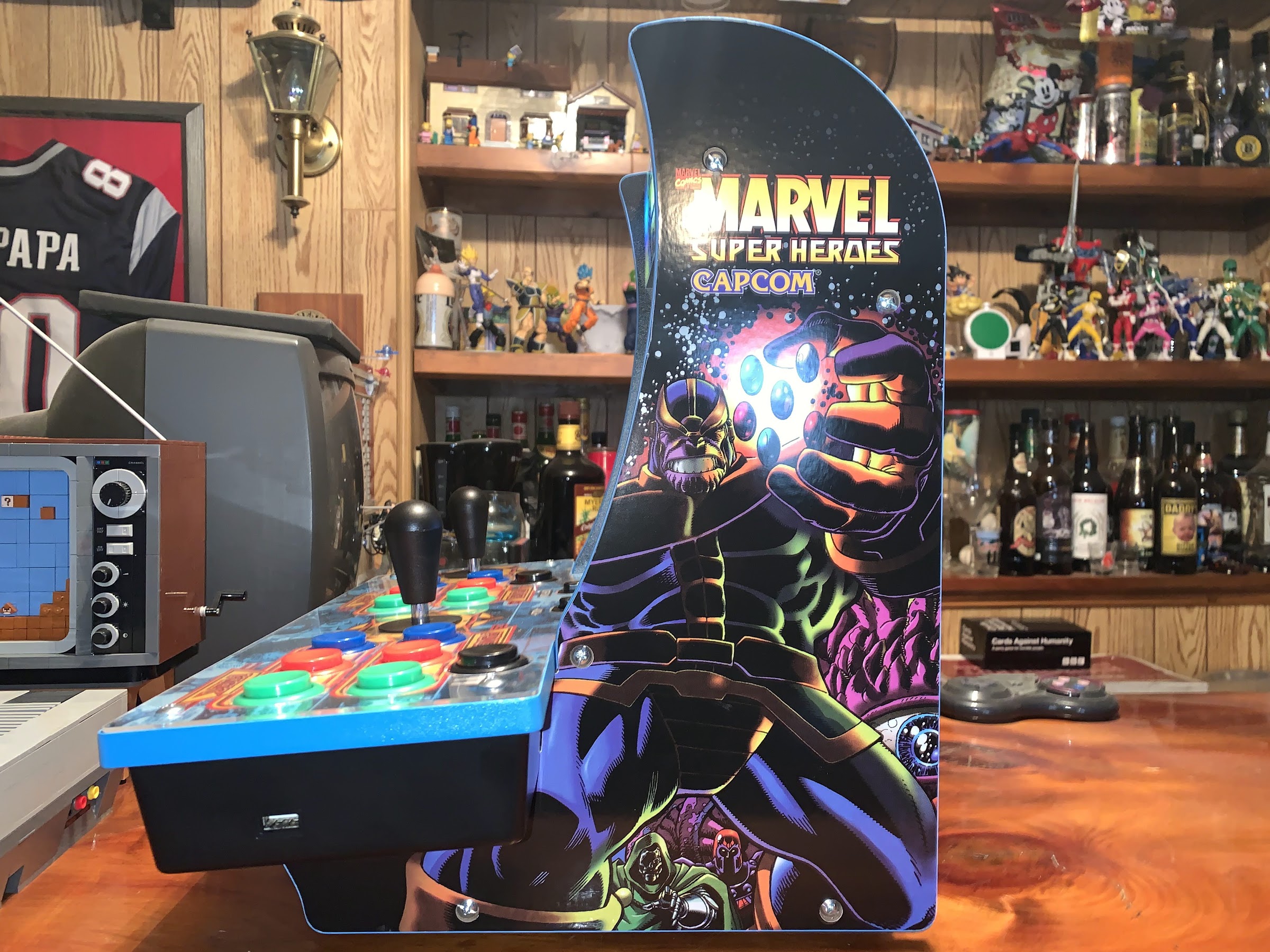
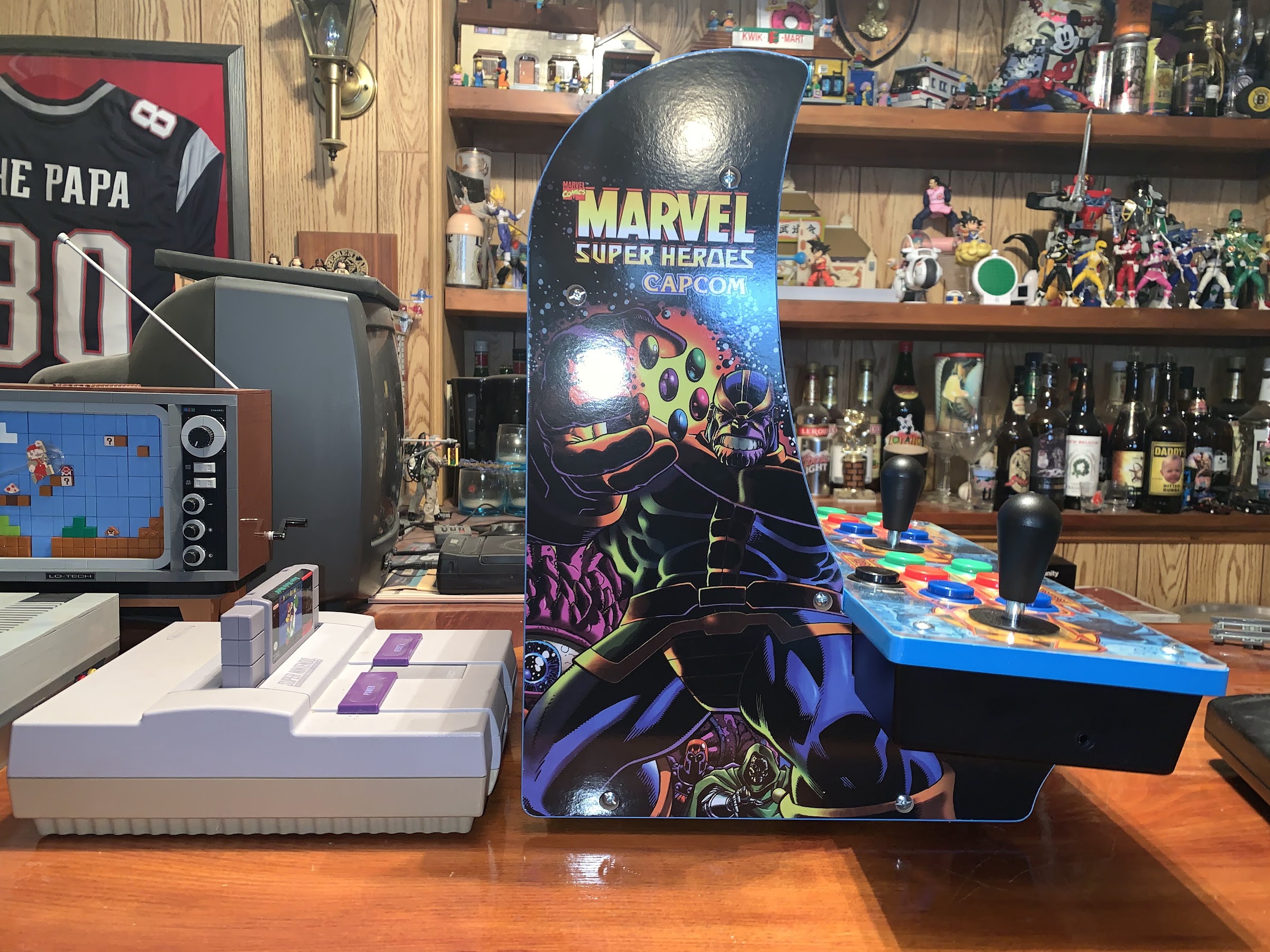
The components outside of the screen seem fine. I don’t know that the joystick is quite on the level with a true Capcom unit, but it’s better than a lot of third party joysticks I used long ago (granted, I have not bought an arcade style controller for about 25 years). There are seven buttons for each player with one of those being a Start or Credit button to enter the game. There are six buttons for actual gameplay, which is all you need for the software present here. The buttons feel okay, I feel like they’re a little soft and could rebound a touch firmer, but are otherwise fine. The theme is Marvel Super Heroes so you get Thanos on each side with blue filtered comic art on the front and platform. The marquee does light up when the unit is on and features the cast from that game so if you were hoping to see Rogue or Ken on the cabinet you’ll be disappointed.
This bad boy is going to live beside my Lego NES.
When the unit is powered on it takes you to a simple screen with the highlighted game displayed. You can cycle through and upon selecting a game a quick controls dashboard is displayed. It’s not entirely useful as it basically just tells you what each button does in the game. It won’t tell you, for instance, how to tag out in the VS titles or how to use grenades in The Punisher which stinks. Once you select a game, the unit basically becomes an arcade cabinet. If you leave it alone you’re effectively in “Attract Mode” for the selected game, which is definitely a fun thing to have in a rec room, even if it isn’t practical from a power consumption point of view. Everything is set to free play and there are no coin slots anyway so you can’t make money off of your friends directly. It’s easy to get out of and into another game and the interface is simple and intuitive enough.
As for the games, well, reviewing each one individually would take some time. Basically, if you’ve played a Capcom fighter then you probably know what to expect. Marvel Super Heroes is the most straight-forward as it’s a one on one fighter starring some of the heroes and villains from the Marvel Universe. It’s always been a little odd in that respect (Shuma-Gorath?), but it’s actually probably better received now than it was in the 90s given how popular the Avengers are now versus then. Still, it was pretty cool to get a dedicated Marvel fighter in 1995 and the fact that it was dedicated to Jack Kirby gives it a little extra sweetness. I don’t consider it a great 2D fighter, but it’s a perfectly fine alternative to Street Fighter 2 for the Marvel fan.
SNES and Genesis model 2 for scale.
The VS games are probably want most fans will play the most. X-Men vs Street Fighter is what got the whole thing rolling. It features a terrific roster from both franchises and it actually feels more focused than the games that followed. If X-Men is your jam, then this might be your favorite from the set. Marvel vs Capcom is very similar, but bigger. This was the last 2 vs 2 fighter as its sequel would up things to 3 on 3 and get almost too big for my liking. You may notice one game was skipped, Marvel vs Street Fighter, but you’re not missing much by going straight to Marvel vs Capcom. This lets other Capcom stars get a chance to shine and help even the sides as it was pretty rough for the World Warriors to have to take on the entire Marvel Universe.
Lastly, we have The Punisher. It’s a perfectly cromulent brawler. Player One controls the Punisher while a second player can join in as Nick Fury. The two will banter a bit (via text) to liven things up while battling through the criminal underworld leading to a final confrontation with the Kingpin. It’s less impressive than the fighters from a presentation aspect and the mechanics of the game are pretty standard: attack, jump, and a special attack that drains life when it connects. Sometimes The Punisher and Fury will be allowed to use guns, usually in response to when the villains do the same, but mostly it’s a melee affair. There’s an abundance of temporary weapons to bash foes with that helps add a little variety, though most are just something to bash a foe with. A playthrough will take most around 45 minutes and when it’s over there likely will be little appetite in venturing forth again. There’s no reason to from a gameplay perspective aside from achieving a better score, it’s just the video game equivalent of chewing gum. At least it’s a longer experience than what Fruit Stripe offers.
One last shot for scale. It’s certainly not small, but definitely not as big as a true stand-up cabinet.
I had a desire to add an arcade machine to my bar room, and this Counter-Cade from Arcade 1Up gets the job done. It’s an attractive piece with a solid selection of games which 3 of the 4 offer incentive to play and replay while the 4th is certainly good for entertaining younger gamers (ignoring the violence). And the other important selling point, maybe the most important, is it’s not ludicrously expensive. The MSRP on this is $229 at most stores and many offered discounts during the holidays. Since this was a gift, I don’t know exactly how much my wife paid, but I know it was less than $200 due to sales and the use of good old Kohl’s Cash. At the high end of $229, I do think it’s a tougher sell, but not terrible. If you really love the games included and want something to bring your room together then I think it’s doable. On sale though, it becomes a much easier call. You’re still better off going in a different direction if your goal is simply to play these games, but as we established earlier, if you’re interested in this set then you’re in it for the novelty more so than the software.
Why do I have a sudden urge to listen to The Misfits…?
Before Nintendo was a famous game developer and console manufacturer, it made toys. Some were electronic, and some were not. On the electronics side, the first video games the company released were the Game & Watch handhelds. The first of these devices looked similar to what would become the Nintendo Entertainment System’s controller. It was a horizontal layout with a directional pad on the left and a command button on the right. In the center of the device was an LCD screen capable of displaying simple games. It also had a clock on it which is where the “Watch” part of Game & Watch comes into play. Over the years, the games would grow in complexity and some even necessitated a second screen and a clamshell design which is pretty similar to what the Nintendo DS would adopt many years later. Come the early 90s, the Game Boy was already available and a hit and the Game & Watch had seemingly outlived its usefulness, but it’s a part of Nintendo’s past that the company seems to enjoy celebrating.
Last year, to celebrate the anniversary of Super Mario Bros. Nintendo released a special edition Game & Watch. Nintendo has seemingly found a market for simple, nostalgia, devices like the Classic series of console releases and the Game & Watch feels like an extension of that. The unit was priced at $50 and came bundled with the original Super Mario Bros. and Super Mario Bros. 2 (the Japanese version) while also including a classic LCD game, clock, and timer. It was a novelty device and one I wasn’t particularly interested in. I loved the original Super Mario Bros. as a kid, but once Super Mario Bros. 3 came out I effectively had no use for the original and it’s a feeling I still have today. The unit did eventually hit the clearance rack, so I wasn’t sure if anymore should be expected, but lo and behold Nintendo did have a release for 2021: The Legend of Zelda.
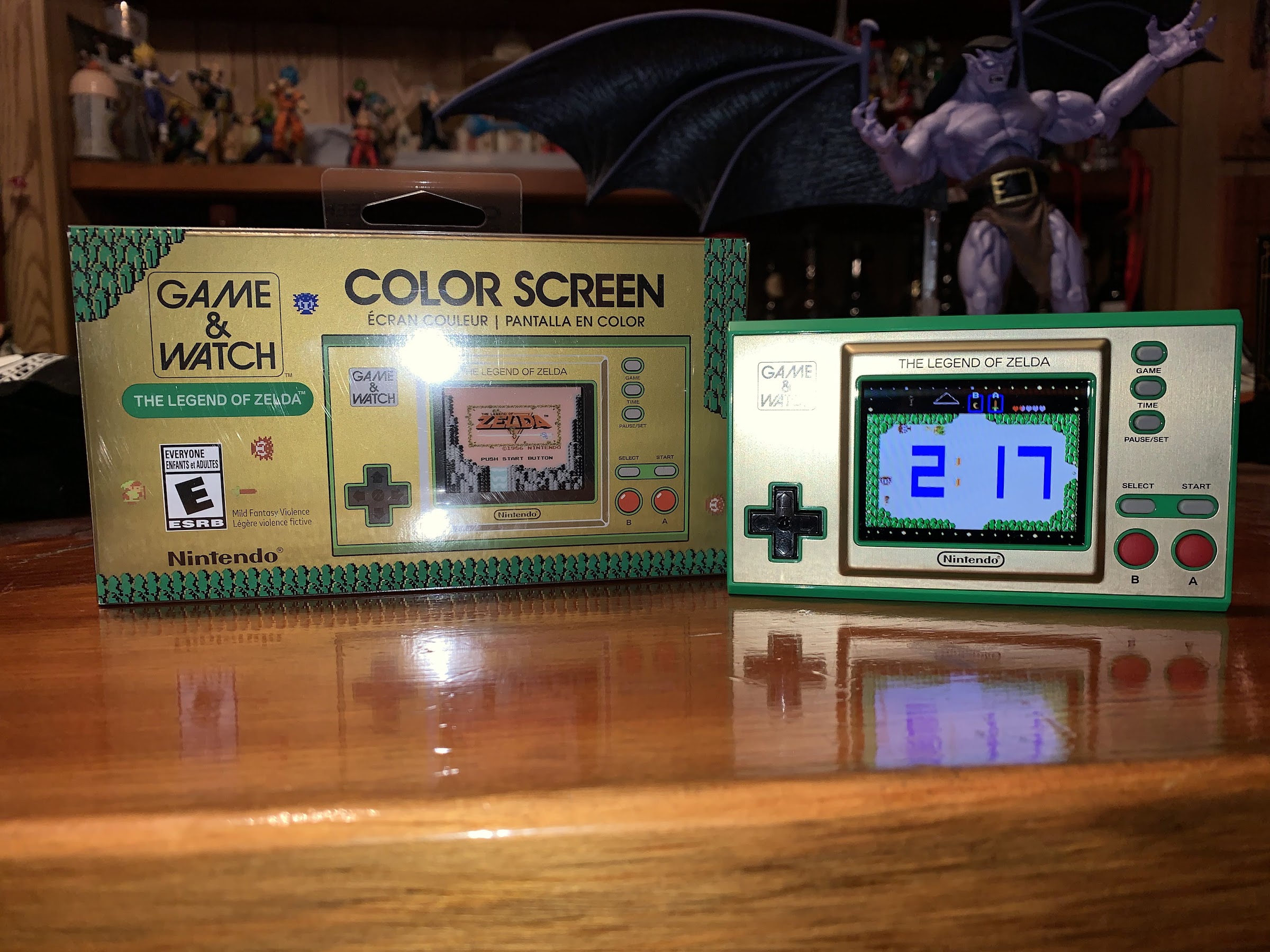
Pay no mind to the gargoyle lurking in the rear.
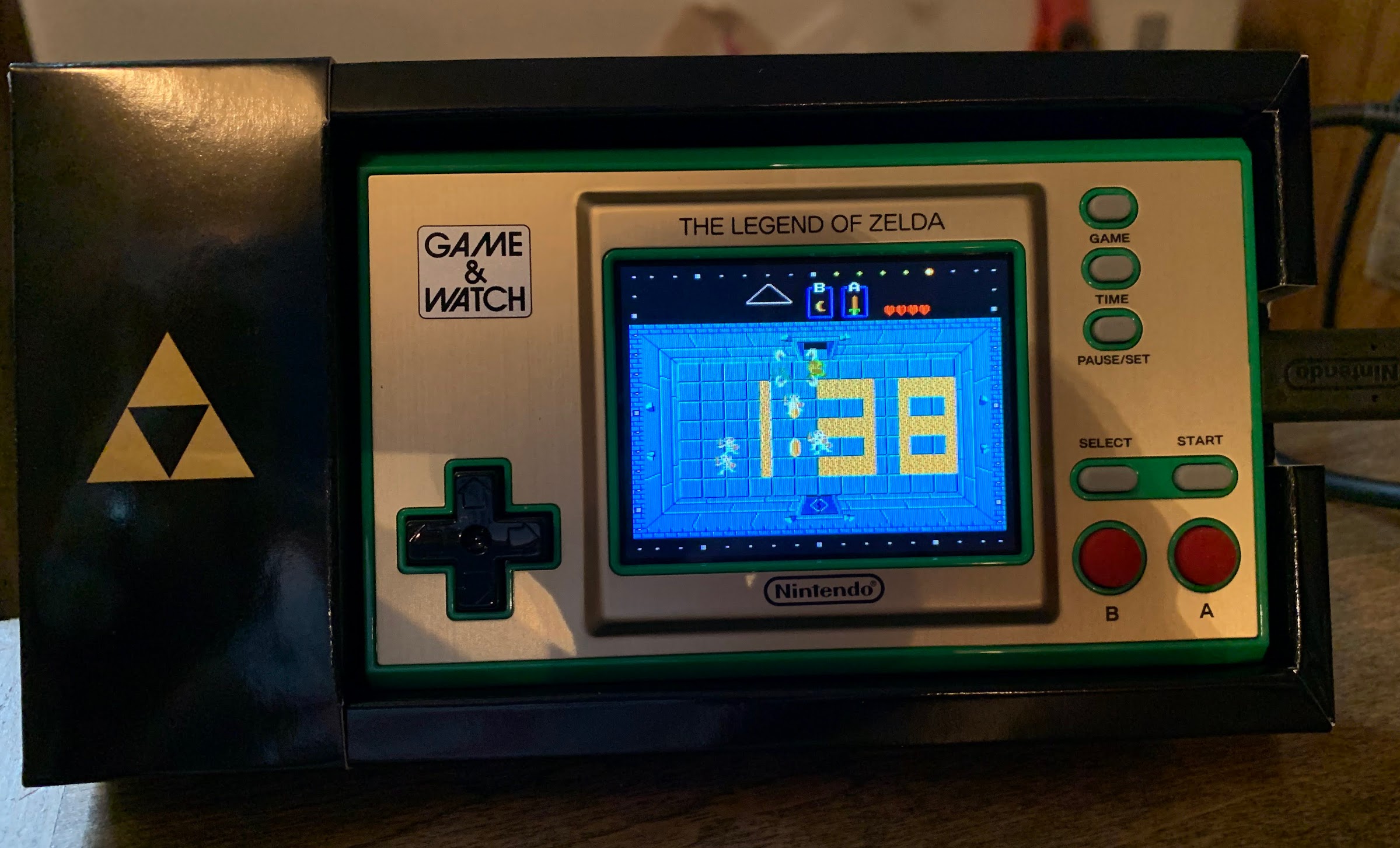
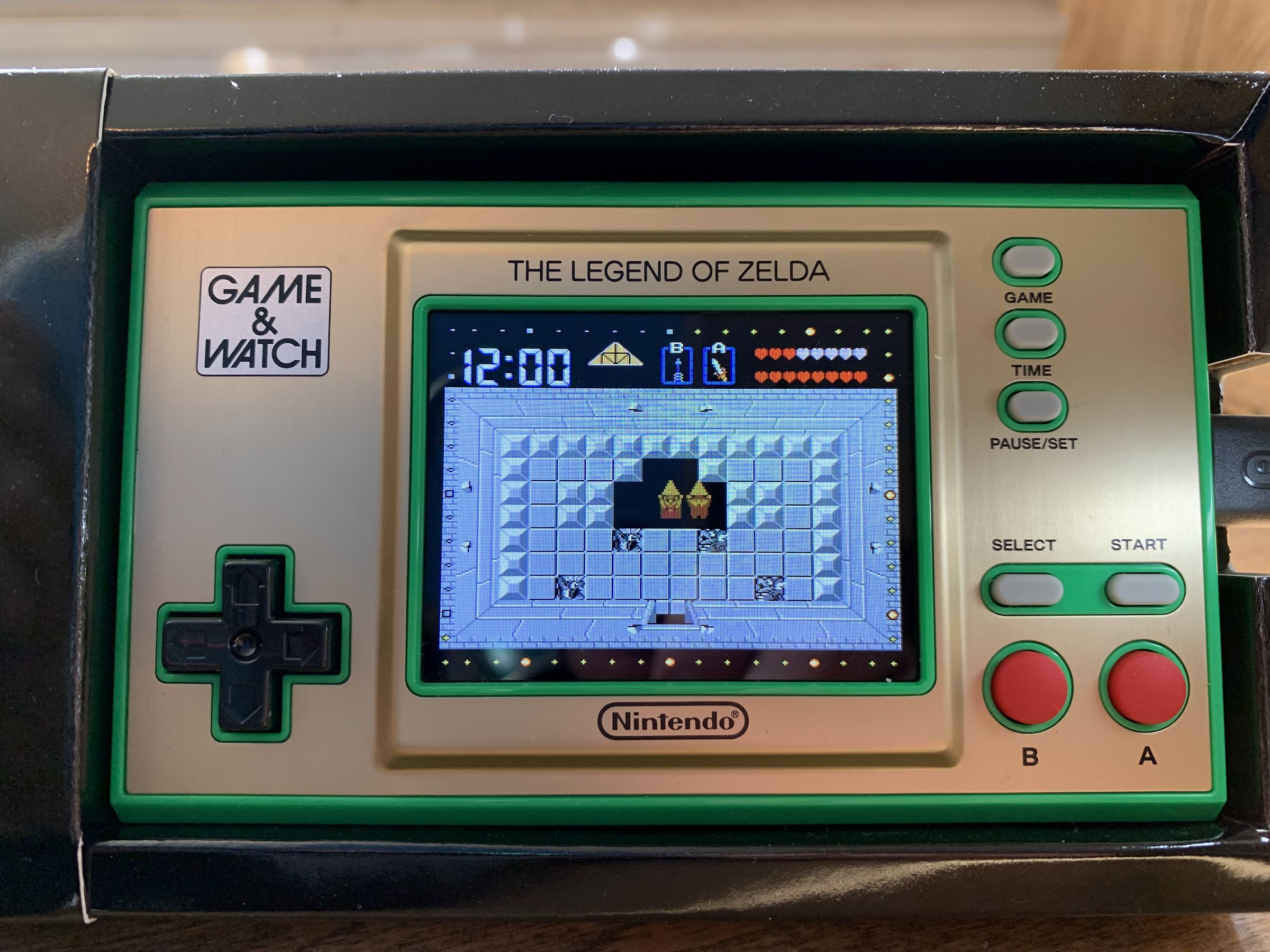
The Legend of Zelda edition of Game & Watch is meant to celebrate the original game’s 35th anniversary. It’s essentially the same, but different, when compared with the Mario edition from 2020. The device itself is rather small and very light, measuring about 4 3/8″ x 2 5/8″ with a color scheme more appropriate for Zelda. The front faceplate is gold while the outer case is green and all of the buttons on the face are ringed with green plastic. The area around the screen is raised and it’s a pretty attractive looking piece, though once handled the toy nature of it all becomes obvious due to the weight and overall feel. The D-pad feels largely like one would expect, but the B and A buttons are rather gummy, like a key on a calculator as opposed to a game controller.
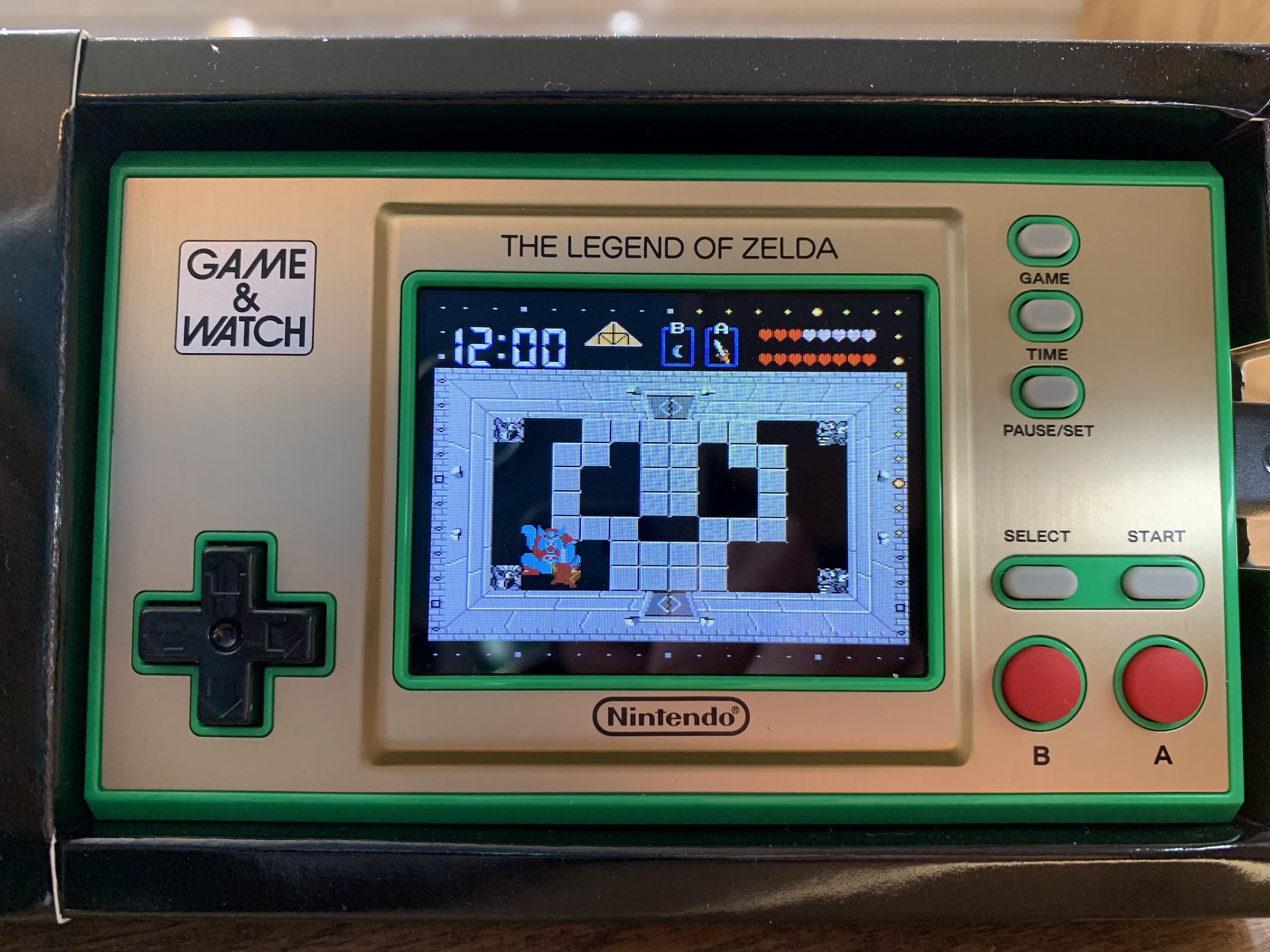
Watch Link conquer Ganon every day!
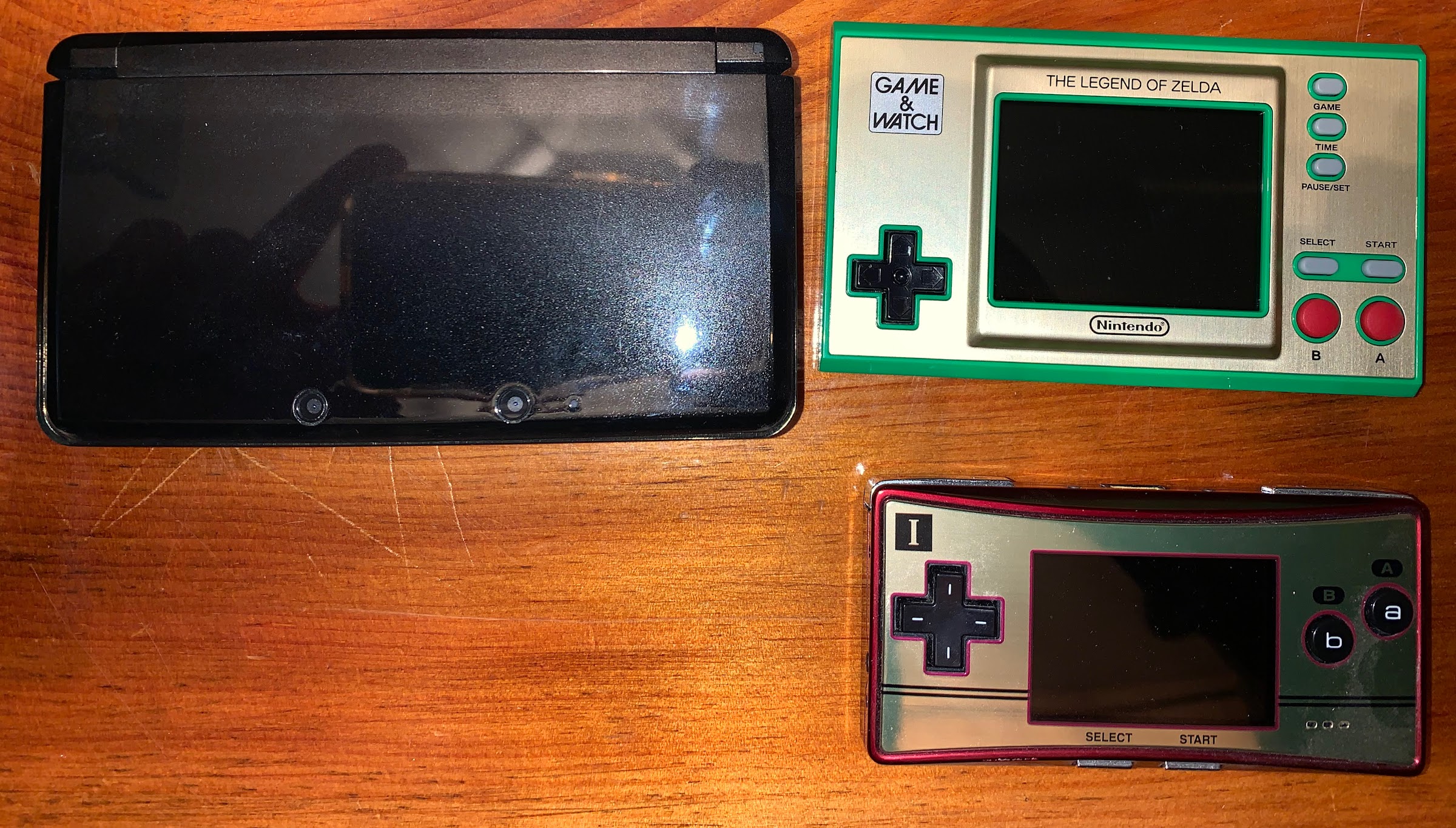
What hasn’t been compromised is the screen. It’s not particularly large, but it is vibrant and certainly a lot better than the old LCD screens on the original Game & Watch devices. It only measures about 2″ x 1.5″ making it comparable to the Game Boy Micro, but still larger. It needs to only display 8 bit games, so it’s not as if the screen is being asked to do much, but it can render all of the games just fine in their native aspect ratio with no compromise to the color palette or resolution. The sound chip is also just fine for these classic games and is even capable of outputting the superior audio found in the Japanese version of these games, as they were Famicom Disk releases outside of the US, so if you’re sick of playing through the original Legend of Zelda you can switch it to Japanese and get a different experience.
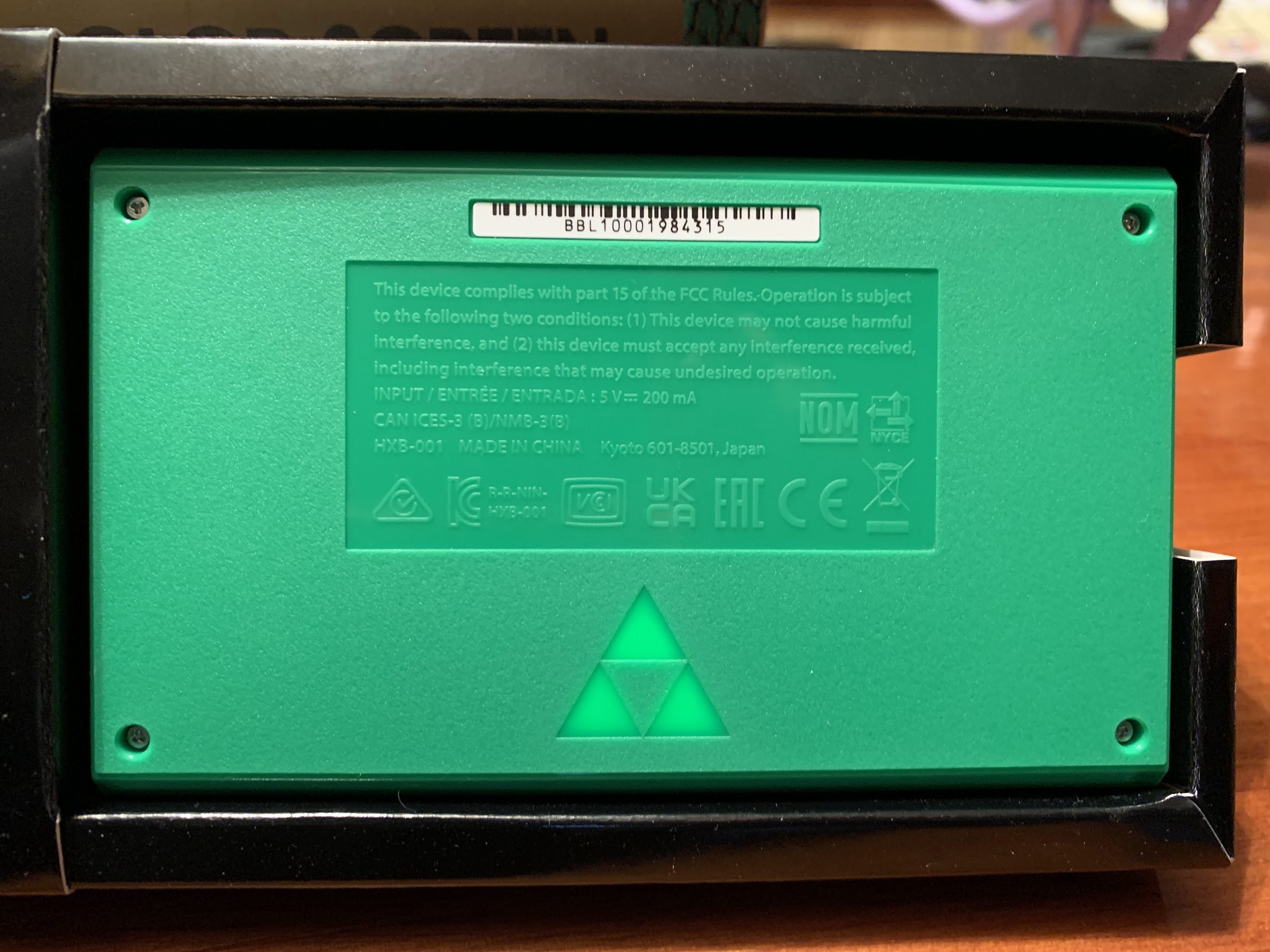
One neat, little, touch is this light-up Triforce on the rear of the system.
Which brings me to the games – just what is included on this thing? Well, you get three games this time around: The Legend of Zelda, Zelda II: The Adventure of Link, and Link’s Awakening. The first two play as you would expect them to as they’re simply emulated versions of the NES and Famicom versions of the games. The third one, and a bit unexpected, is the original Game Boy release of Link’s Awakening. It is a shame that Nintendo didn’t include the DX version released for the Game Boy Color which looked better and also featured an extra dungeon. There’s certainly enough room on the hardware for it which leads me to believe it was a value issue and not a hardware limitation. Nintendo doesn’t want to give too much away at the $50 price tag, but considering that Link’s Awakening has already received a full-fledged remake I don’t think Nintendo would be harming its bottom-line by including the DX version. Oh well.
A size comparison with the first gen 3DS and a Game Boy Micro.
The games play fine though as Nintendo did add the Select button which was missing on the Mario edition. I read some complaints of the device being too small and cramped for a platformer like Super Mario Bros. to be played comfortably, but for Zelda it’s more than adequate. Especially the original game and Link’s Awakening. Zelda II is a bit more of a stretch as that required more twitch movements. It’s still not on the same level as a platformer or run and gun game, but it is noticeably less pleasant to experience. That also could be due to that being the weakest game on this set and what folks are likely to miss is the ability to utilize a save state feature. Exiting a game at any point does essentially pause the game and save your progress, but there’s no way to reload when you die. This is really only an issue with Zelda II as I don’t find the other two games terribly difficult so long as you know where to go, but Zelda II is an all-together different beast. It’s a hard game that I don’t find particularly enjoyable since the player is heavily penalized for dying in a most annoying manner. As such, I don’t intend to play much of Zelda II, it’s more chore than game, but I will play and finish the other two games, one of which I’m nearly finished with as of this writing. One other presentation note is that Link’s Awakening features the ability to toggle between the original aspect ratio and one that fills the screen. It doesn’t look too terrible stretched to fit the screen, but I definitely prefer the original look when playing it.
Since this is a Game & Watch, I should mention the other aspect of the hardware which is the watch. When not playing a game, the unit functions like a clock. Nintendo included a display base with this one that looks pretty slick, but is just made out of cardboard. I question how well it will hold up over time. The clock though displays it over The Legend of Zelda and when left alone Link will roam the screen battling enemies gradually progressing through a modified version of the game over 24 hours. Come noon, he’ll best Ganon and save Zelda which is pretty neat. If at any point you want to control the action you can, and leaving it idle for a few seconds will revert back to AI control. It’s a fun thing to have on a desk or workspace, though it can get mildly distracting.
Zelda will now be saved on a daily basis.
There’s also a timer, or stop watch, function. It’s pretty self explanatory, but like the clock it displays Link in action. This time, the sprites are from Zelda II and it does function like a game all on its own as you try to defeat as many enemies during a given duration. Or, if you just need it to be a timer, you can let the AI duke it out. It’s definitely not a feature I plan to take advantage of, but it’s fun to have it. Also included is the Game & Watch game Vermin. It’s a game where you just slide a character across the screen as it tries to stop some vermin from advancing past. In the original, the player character was Mr. Game & Watch, but it’s been changed to resemble Link for this release. It’s a simple game that has its moments, but largely feels like it’s included as both an homage to the classic handheld and as a reminder of how far we’ve come.
The unit runs on an internal battery and I’m honestly not sure how long it can last. Most these days seem to last anywhere from 2 and a half to 4 hours. I haven’t come close to draining it in my play sessions, but my sessions have been more of the half hour to an hour variety. Nintendo included a USB cable to charge it, though it’s pathetically short. I’ve had it plugged into my laptop since getting it which means the clock will only run while my laptop isn’t in sleep mode. When not connected to a power source, the screen turns off after 3 minutes, but when it does it displays a piece of vintage art from the old game manuals which is pretty cool. There are some other Easter Eggs as well that I won’t spoil, but if you’re curious, they’re not hard to find online. I should note, the unit is capable of keeping track of the clock when powered down, though I assume if you ran the battery down to nothing and left it like that for a bit it might need to be reset like a console would.
This one also has a few surprises up its sleeve.
The Legend of Zelda edition of the Game & Watch is a perfectly fine, novelty, handheld. Nobody needs this and these games are all readily available in probably more convenient options at this point, but if you find yourself charmed by this little device then I think it’s worth the 50 bucks Nintendo is asking for it. Yes, I wish it had proper A and B buttons and the DX version of Link’s Awakening, but those are nitpicks. The absence of save states is more of a bummer because these games don’t have a robust, built-in, save feature so it is more challenging than it needs to be to do something as simple as switch profiles within the games. It’ll save one action session per game, but if I want to let my son play The Legend of Zelda I need to end my game first and I don’t want to go all the way back to the beginning on the map if I was in the middle of a dungeon or had paused my session right outside of one. I also would have gladly paid an extra 10 – 15 bucks for a better display stand. I love how this one looks, being all black with a gold Triforce logo, but it only looks good from a distance as once up close it becomes apparent the thing is a glorified box.
I suspect if you’re interested in this then you have already made up your mind. It’s for the Zelda fan or nostalgic Nintendo fan. It’s also priced on the fringe of impulse buy territory, and if 2020’s model is any indication, it will eventually find itself on sale. I had no issue tracking a unit down for purchase and I’ve seen them on my weekly trips to Target so, for now, this one’s easy to come by. I suspect once it’s gone then it’s gone and it will gradually rise in price on the aftermarket. You’re probably safe to play the waiting game if you want to take advantage of a sale price, though if units start to disappear before that day comes then you may want to just jump on it at $50. I’m happy to have it, and while I don’t know if it will live forever beside my laptop, but I would like to find a permanent home for it because it’s a fun clock to have around. And hey, there’s some good games on it too!
Last year, we took a trip to the Mushroom Kingdom (kind of) and watched the Super Mario Bros. save Christmas from the evil King Koopa. Since Koopa failed, it would make sense for him to attempt the same trick at a later date, especially since he would go on to become “King Dad” and Christmas presumably got a lot more expensive around Koopa Castle (or should it be Kastle?). Well, he apparently did not agree as he’s left Christmas alone ever since, but Cave Christmas? Now that, is apparently appealing!
In the early 90s, if anything was popular either in toy aisles or on gaming consoles it had a cartoon, and Mario was at the forefront of that. He first had The Super Mario Bros. Super Show followed by The Adventures of Super Mario Bros. 3, and concluding with the Super Mario World cartoon. Other popular Nintendo, or Nintendo-adjacent, properties had to settle for a cameo on Captain N The Game Master, but Mario was able to front his own toon. None of these cartoons were any good, and as the franchise marched forward it feels like the budget set by DiC just got smaller and smaller. The live action segments hosted by Danny Wells and Lou Albano were dropped, and the voices of the Mario brothers were replaced with Tony Rosato and Walker Boone, respectively. John Stocker, who saw his character Toad written out for Super Mario World, got to keep working by voicing new addition Oogtar while Tracy Moore (who came onboard for the Super Mario 3 show) and Harvey Atkin (the only one to voice the same character from start to finish) continued to voice Princess Toadstool and King Koopa, respectively.
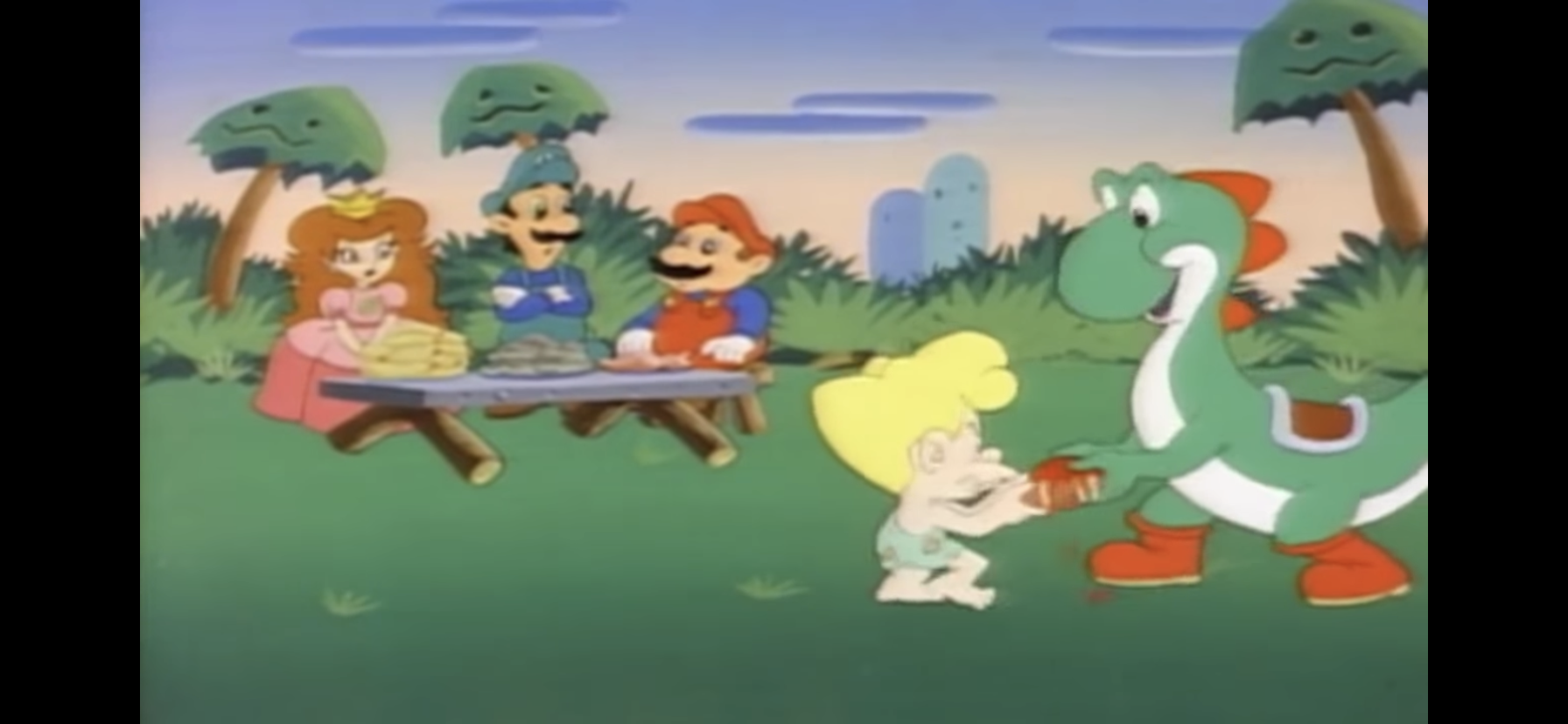
How do we feel about Yoshi’s portrayal in this show? Love it? Hate it? I can’t decide!
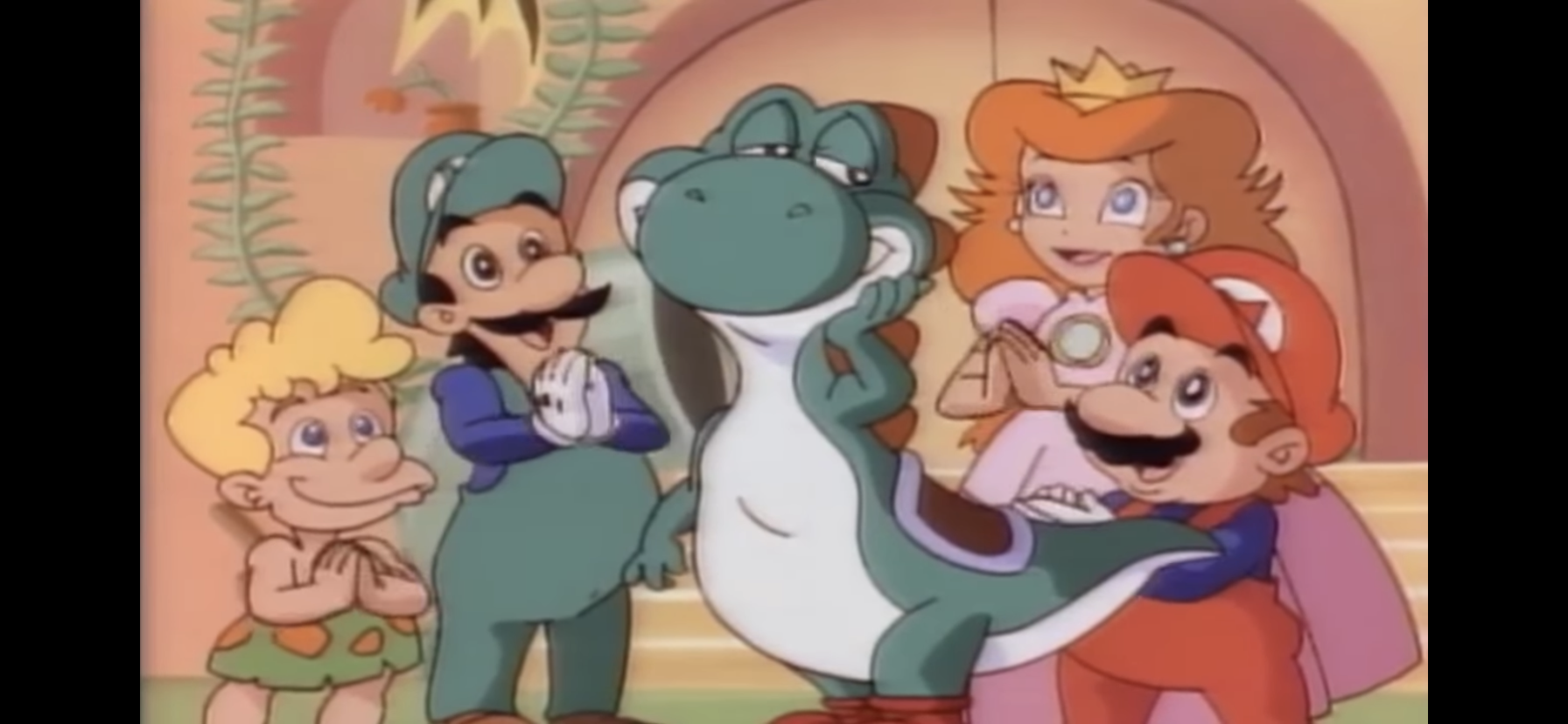
Super Mario World, like the video game it’s based on, is set in the fictitious Dinosaur World. Mario and his friends are vacationing there, only to find King Koopa and his many Koopa kids have followed them. They make friends with the cave people, and Princess Toadstool more or less throws her weight around as royalty to take over, and take-in a young dinosaur named Yoshi (Andrew Sabiston). Each cartoon is little more than 10 minutes in length and DiC wisely dropped the use of song parodies so the syndicated cut and retail releases were able to retain the original music this time around. The show was bundled with Captain N to air as a block and both shows mainly exist to sell video games. There’s not much to the plot of each episode, characters experience little or no growth, and most episodes can be drilled down to a simple formula. Only 13 episodes were produced airing from September 1991 into December of that year. The show didn’t seem to find much success following its initial run as the episode count was likely too small to interest most cable networks. It did receive a DVD release from Shout Factory, and the show today is mostly remembered as being pretty bad with certain aspects of it being enjoyed mostly from an ironic perspective as the character of Yoshi is both annoying and ridiculous, which I guess makes him a tad charming?
The fifth episode for the show is titled “The Night Before Cave Christmas.” It aired before Halloween, but since Cave Christmas is a made-up holiday by Mario I guess it didn’t need to air during the Christmas season? As mentioned before, this is the second, and final, Christmas episode from the Mario universe of cartoons as DiC declined to do one in The Adventures of Super Mario Bros. 3. I’d say it’s a shame we didn’t end up with 3 Christmas cartoons, but considering the first one was pretty terrible, and this one might actually be worse, I guess it’s no real loss.
It looks the show is simply titled Super Mario World, but it’s actually “Super Mario-Super-Mario Super Mario….World.”
The cartoon begins with a brand new theme song. The previous cartoon cheeped out by forgoing a traditional theme for just narration over some video game inspired music, a severe downgrade following the greatness that is “The Plumber’s Rap.” This new theme is a bit of an ear worm, despite not being great. It’s full of tribal drums and has a Caribbean feel to it, though I’m skeptical DiC paid for an authentic singer and probably just had some white dude fake an accent. Mark Mothersbaugh is credited as composing the theme, but I don’t know who actually sang on it. The lyrics are a bit lacking as the song closes by rhyming the word blast with…blast! I’m getting flashbacks to the “Wrap Rap” from last year!
Poor little mammoth…
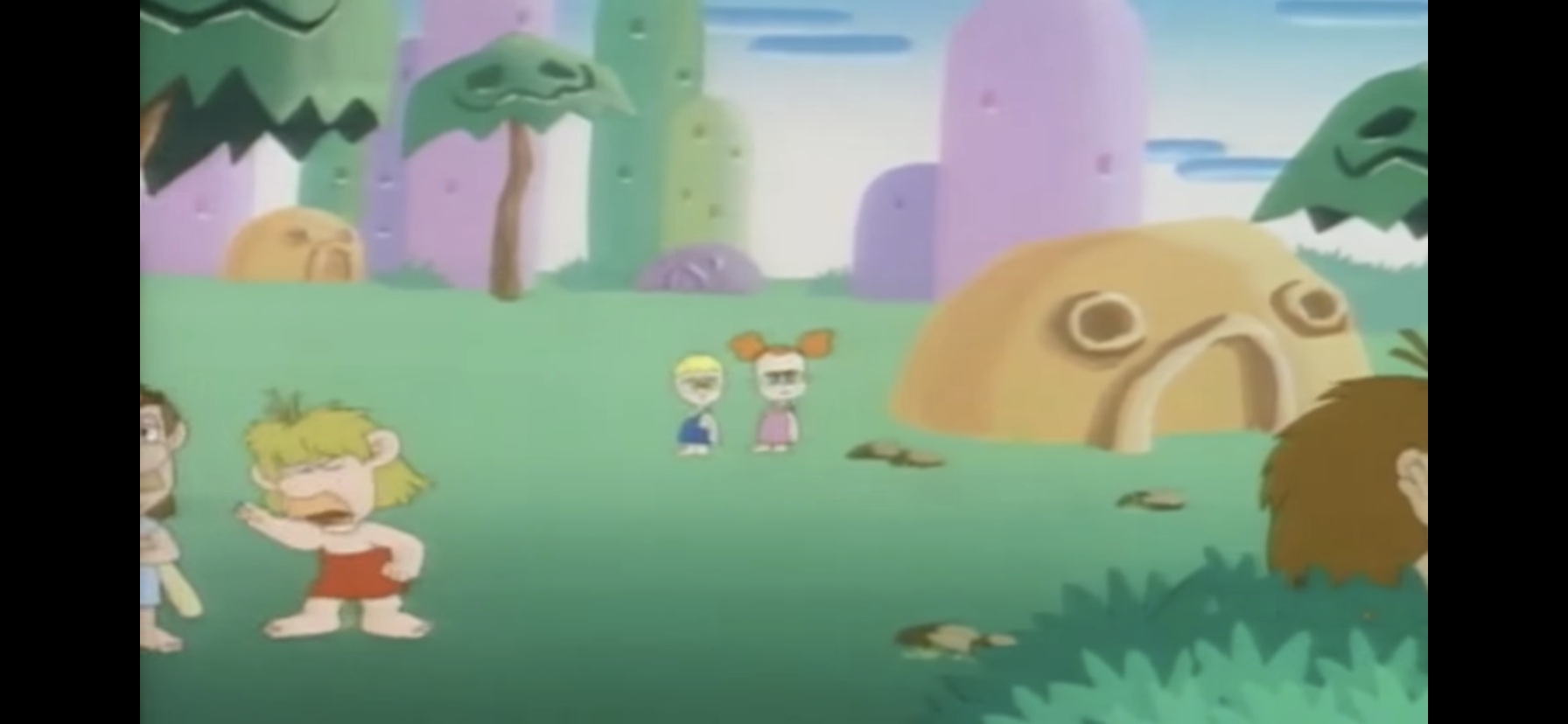
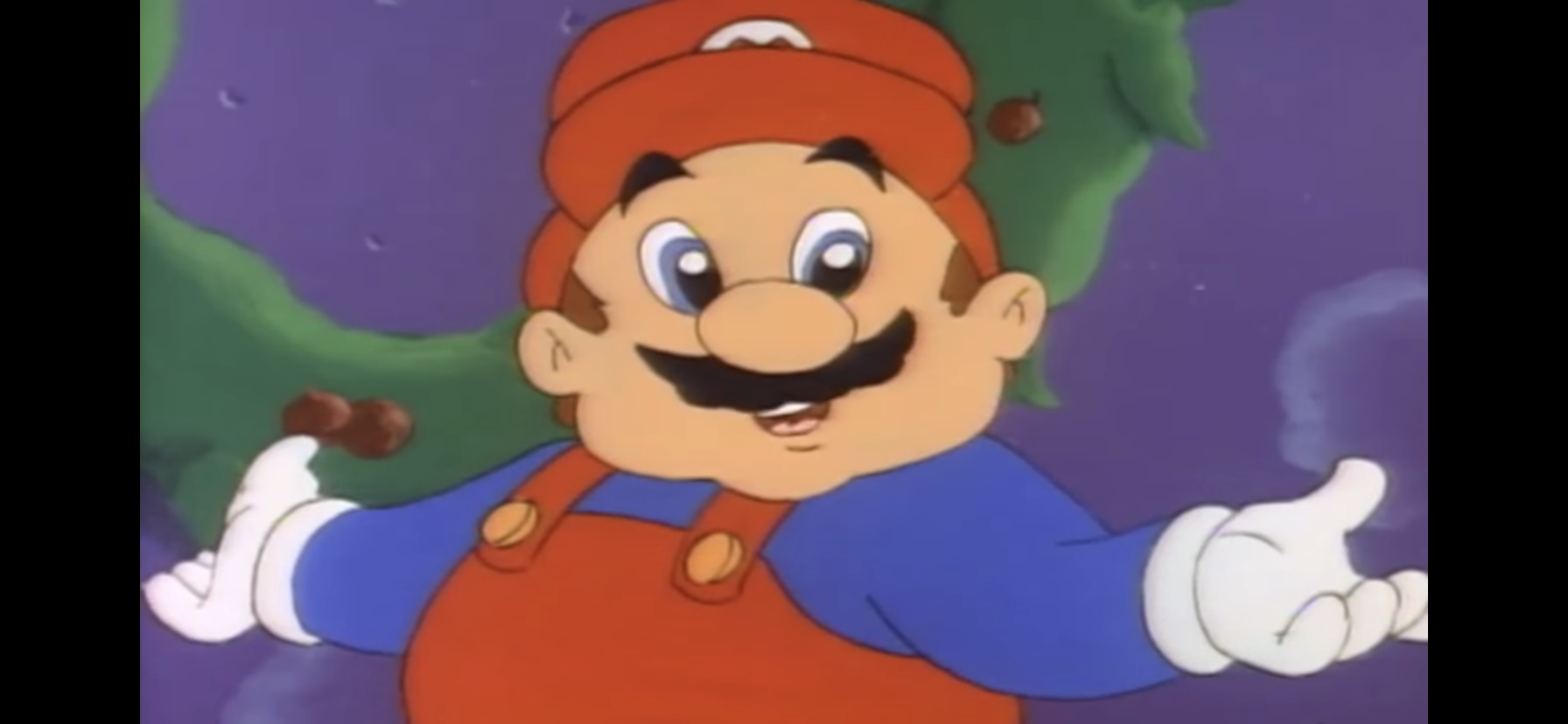
When the cartoon begins, we find Yoshi and Oogtar fighting over some barbecued mammoth ribs, which are pretty small for mammoth ribs (maybe they picked off an infant). Mario starts complaining to Luigi and the Princess about how Oogtar is a pain in the ass who spends all day getting into fights with Yoshi. Luigi points out it’s not just Oogtar, as we pan to see other cave people fighting with each other. One poorly animated boy and girl pair are just hitting each other like Itchy and Scratchy, minus the mallets. Mario then hatches up an idea based on the notion that people start acting really nice to each other around the holidays. Luigi asks if he means Christmas, because it’s currently the middle of August so that doesn’t make much sense. Mario basically responds by reminding him that cave people are stupid and will believe anything they tell them. This cartoon really shines a light on what’s awful about colonialism.
It’s a sparsely populated village.
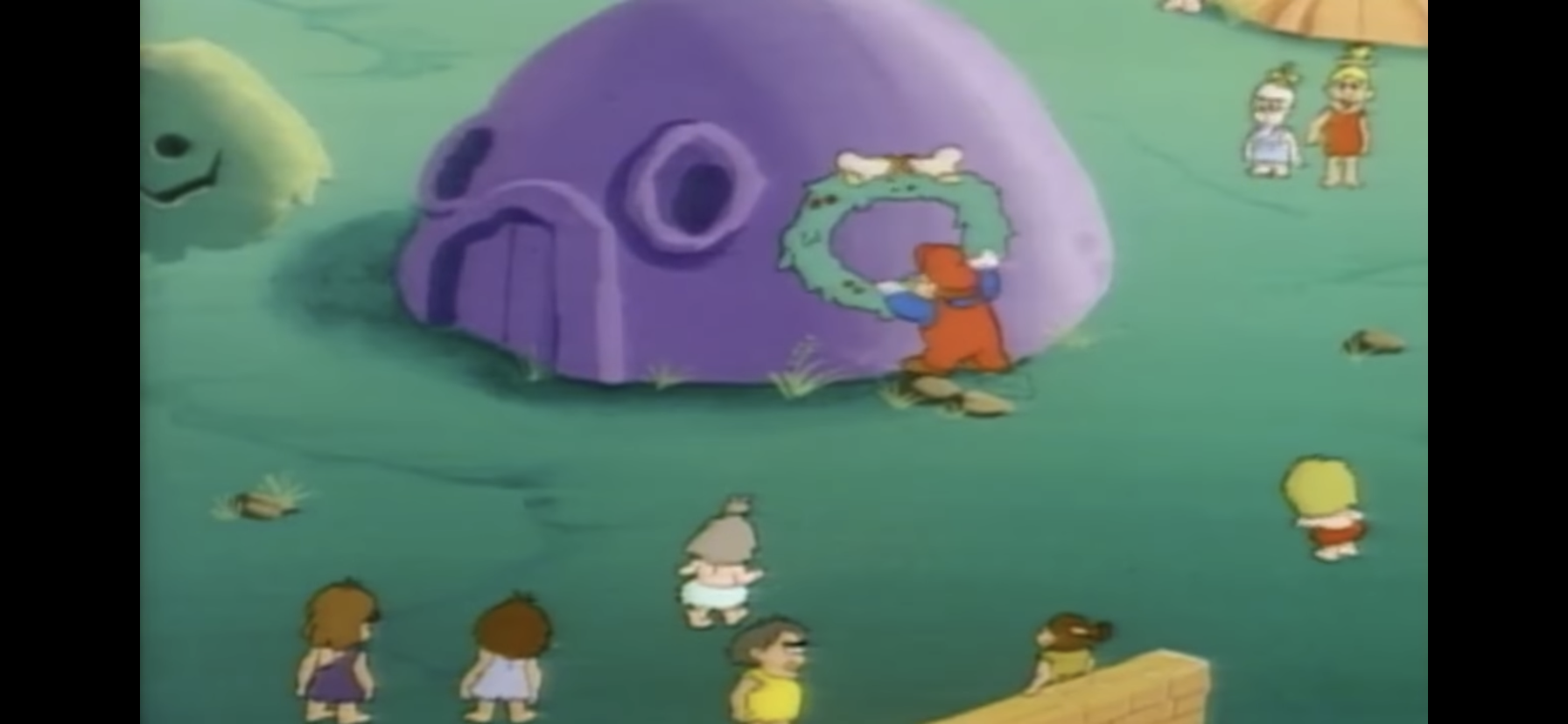
Mario then goes over to the squabbling Yoshi and Oogtar and starts telling them about Christmas. Mostly, he wants to convey the message that good boys and girls are rewarded with treats and presents, and Oogtar immediately becomes nervous because he knows he’s a little piece of shit. Mario christens it Cave Christmas and hangs a big wreath on one of the stone huts and announces, “Merry Cave Christmas!” to all of the onlookers. Nearby, Koopa pops his head out of what I guess is a trash can fashioned out of a stump. Referring to Mario as a “pipe-squeezer” (which got a chuckle out of me), he questions the plumber’s sanity by noting it’s the hottest day of the year before closing the lid and returning to his hiding spot.
The smell of freshly cut evergreen should help cover the smell of body odor and dinosaur shit.
The gang then sets to making the place look like Christmas. Mario and an unnamed cave person cut down a tree, while Oogtar and Yoshi help the Princess collect nuts from nearby trees. Koopa and his son Bully (Dan Hennessey) watch and Bully informs his dad he wants a Christmas tree too. We then go back to town where Princess Toadstool is trying to hang candy canes on a tree (that has a creepy face), but Yoshi keeps eating them as she hangs them. She reminds him about how he needs to be good if he wants presents from Santa, and the dinosaur promptly regurgitates the candy canes back onto the tree. It’s not made to look as gross as it could have. Bully and King Koopa pop out of the garbage stump and Bully takes note of the Princess’s description of Santa and calls the guy a wimp. His dad agrees, but then the garbage dinosaur shows up and tosses the whole stump (which seems very inefficient) into a stone dumpster strapped on his back.
Looks like someone is getting a savage beating for Cave Christmas!
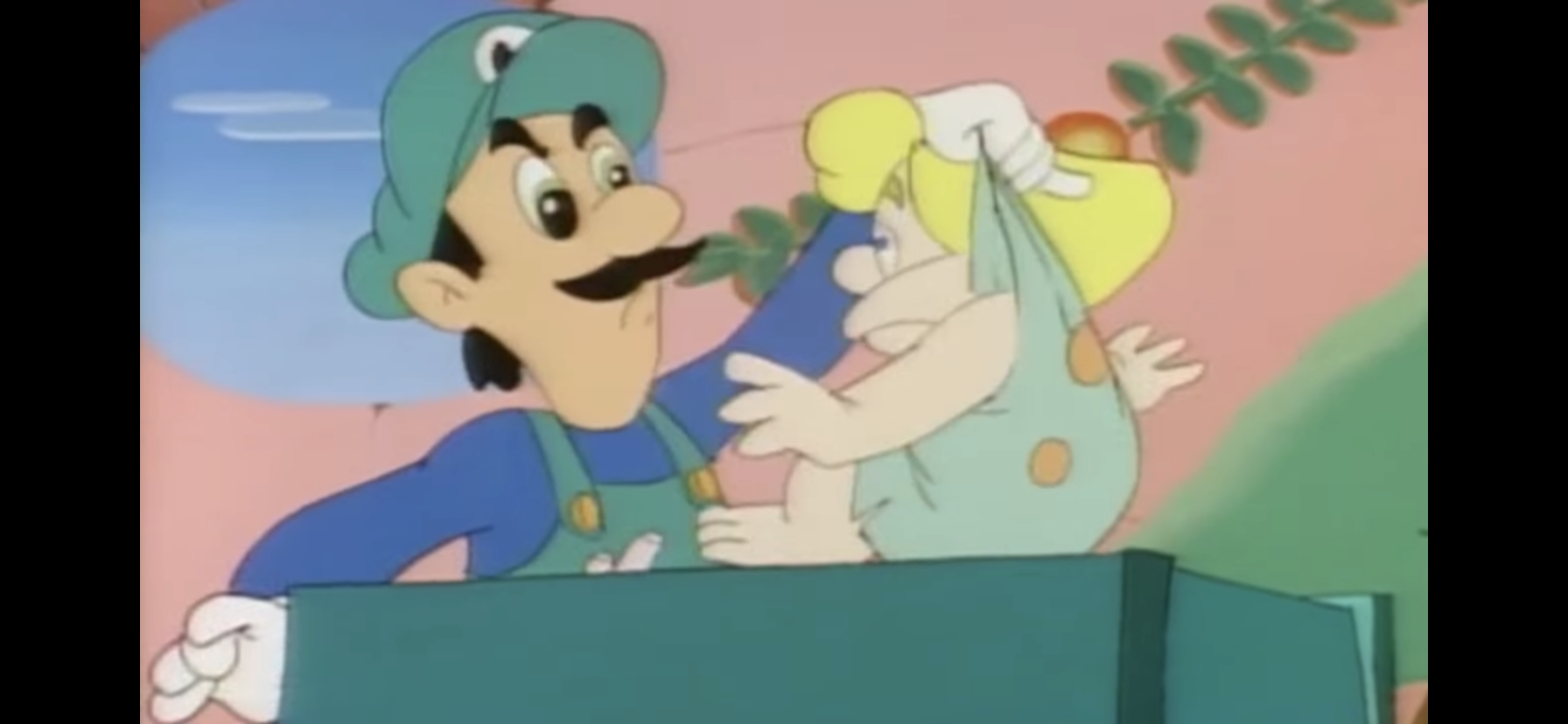
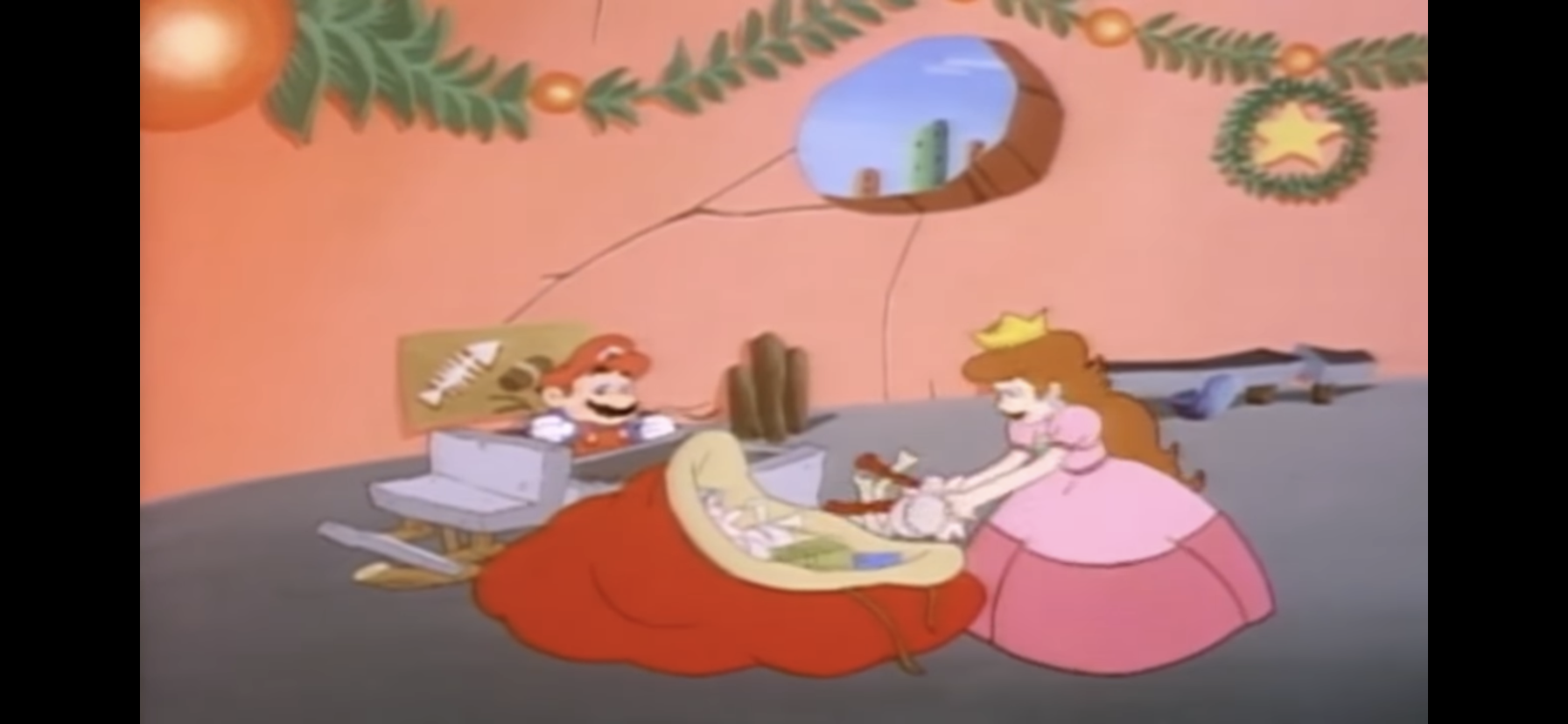
Since there is a severe lack of toy stores in a prehistoric setting, the Marios have to make the toys for Cave Christmas. In a dome, they’re hard at work building shadow boxes and jack-in-the-boxes. Luigi’s emblem on his hat is miss-colored, a frequent occurrence in this show. Oogtar has snuck in though and is trying to get a peek at the presents. Luigi catches him hiding in a jack-in-the-box. He bolts and attempts to hide in a box of dolls, but Luigi picks him up by his shirt and tosses him out the door.
Even the Flintstones had sense enough not to make their sleigh out of stone
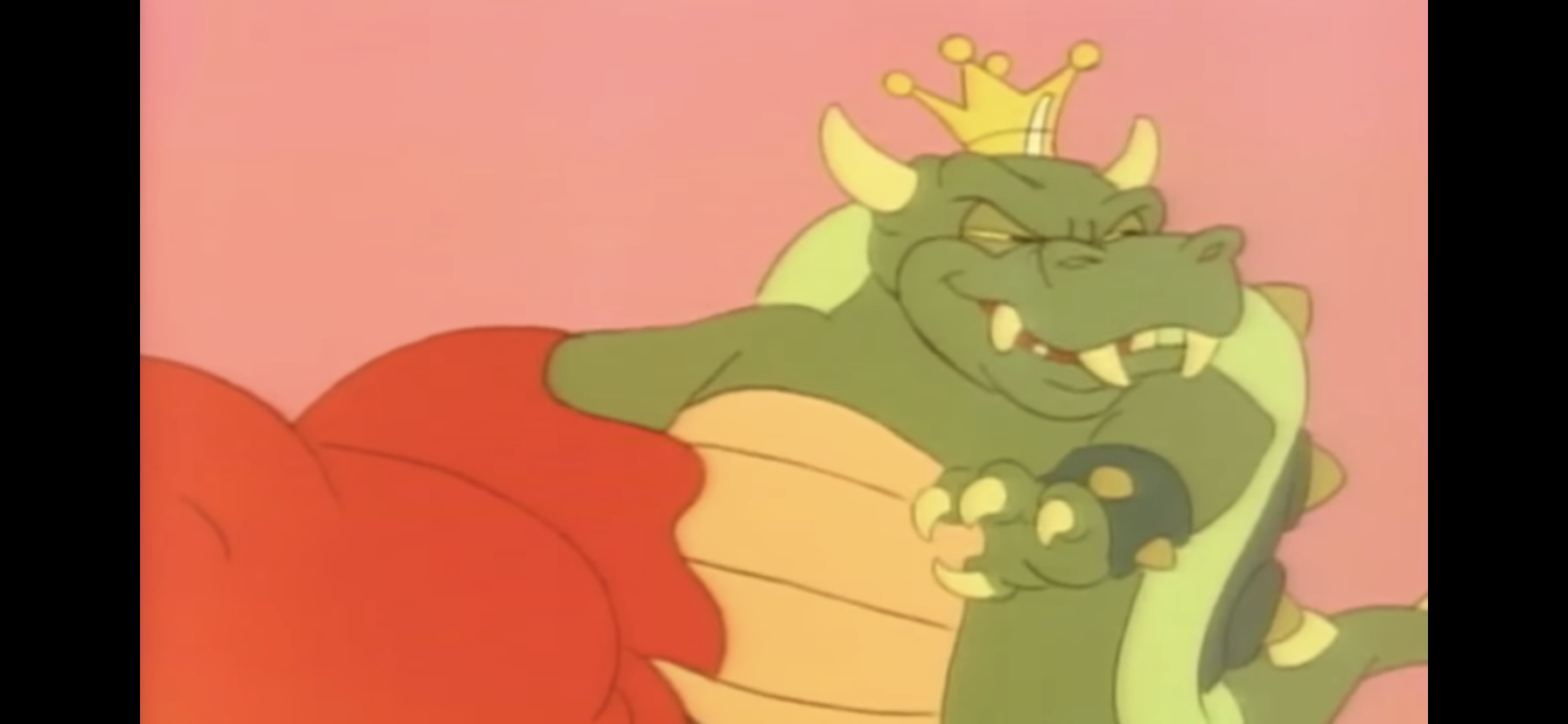
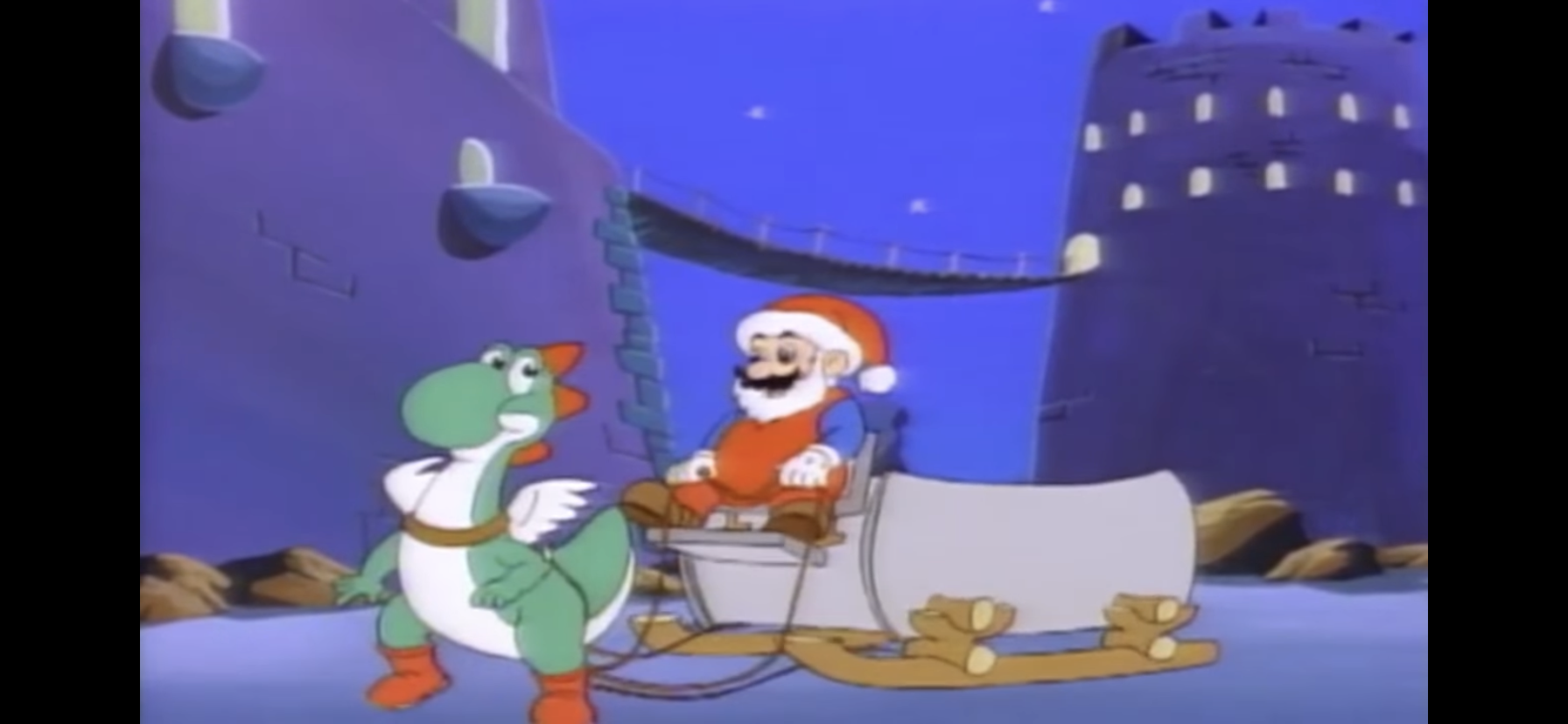
The Princess is then shown piling gifts into Santa’s sack while Mario appears to be constructing the sleigh out of stone and wood. Good luck getting that thing to fly! The Princess remarks how she can’t wait to see all of the kids react to the presents on Cave Christmas morning (she makes sure to include the Cave distinction), but lurking just outside the window is King Koopa once again. He laughs to himself and remarks that the Princess won’t get to see any of that because he plans on stealing the toys so his kids can have a jolly Koopa Christmas (Kristmas?). Considering he is mean and green, I suppose it makes sense for Koops to play the Grinch in our story.
The one true king.
The next day, Mario and Luigi are seen shoving their stone sleigh out the door. Mario expresses joy that its Cave Christmas Eve and prods Luigi by remarking it’s just like being back home, Luigi isn’t buying it though. As they head back inside their makeshift toy factory, Oogtar slips in and heads over to the sack of toys. With an evil look on his face, he lets the audience know he intends to cherry-pick the best toy out of the sack early leaving the crummy stuff for the goody-two-shoes. When he hears someone coming back in, he panics and dives into the sack of toys to hide. He seemed to think it was one of the Mario brothers that were coming, but it’s actually Koopa! Because DiC thinks its audience is stupid, Koopa has to explain out loud that he’s stealing the toys for Koopa Christmas and casually strolls out with the sack of toys and Oogtar inside.
Laughing at Luigi’s hateful gay joke. Apparently, Luigi plays the role of drunk, racist, uncle back in Brooklyn for the holidays.
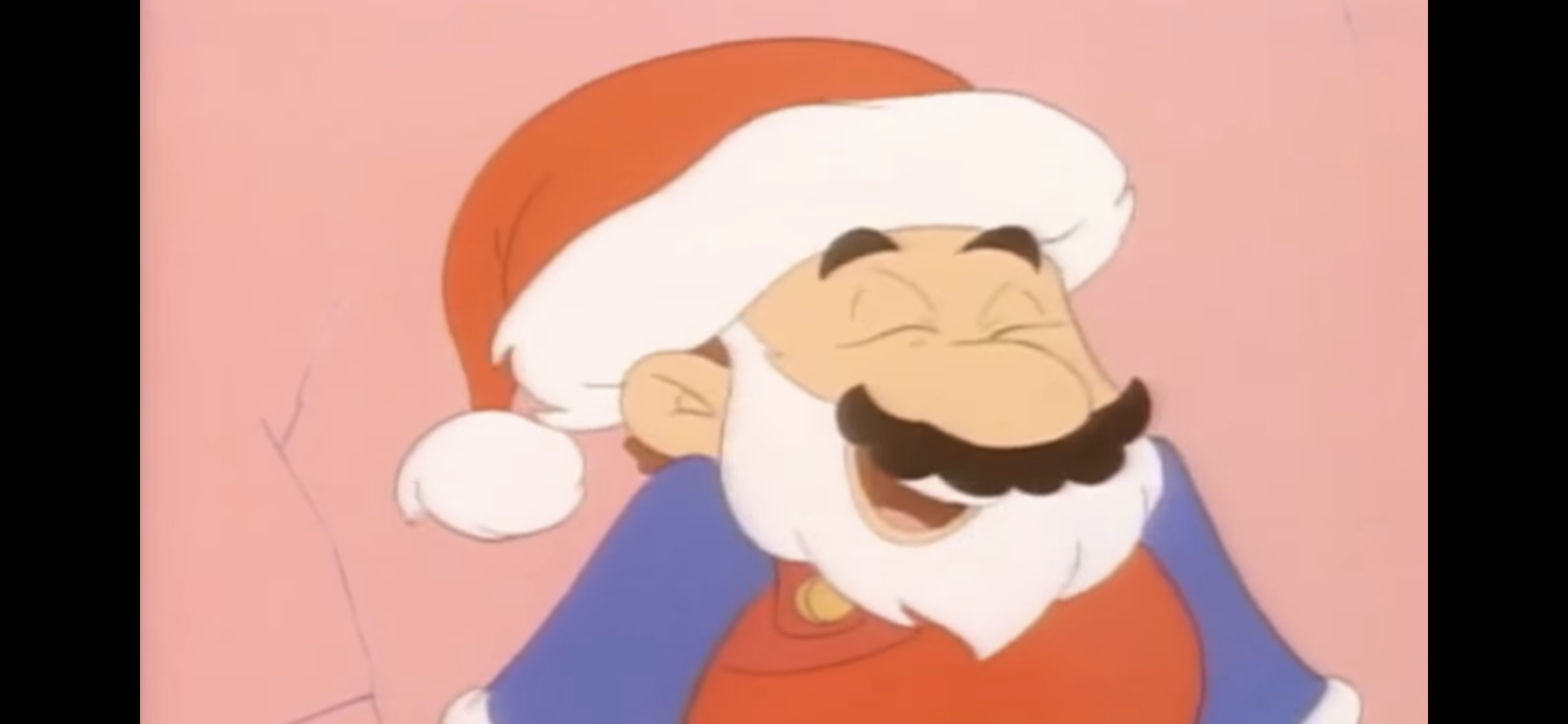
Mario, who this whole time was just standing mere feet away from the cave-napping, is trying on his Santa costume (What? Did you think he’d actually let Luigi play Santa?!) which consists of a hat, white beard (his black moustache is still visible) and a red toga-like garment worn by the cave people which is worn over his red overalls and looks stupid. When he asks how he looks, Luigi tells him he wouldn’t get away with wearing that in Brooklyn. Mario gives a knowing chuckle and I have no idea how I’m supposed to interpret this joke. This is from the early 90s, so it reads like a homophobic joke. Would they attempt such in a kid’s show? Koopa did refer to Mario as a pipe-squeezer earlier…
How dare Koopa steal fake Santa’s present on fake Christmas!
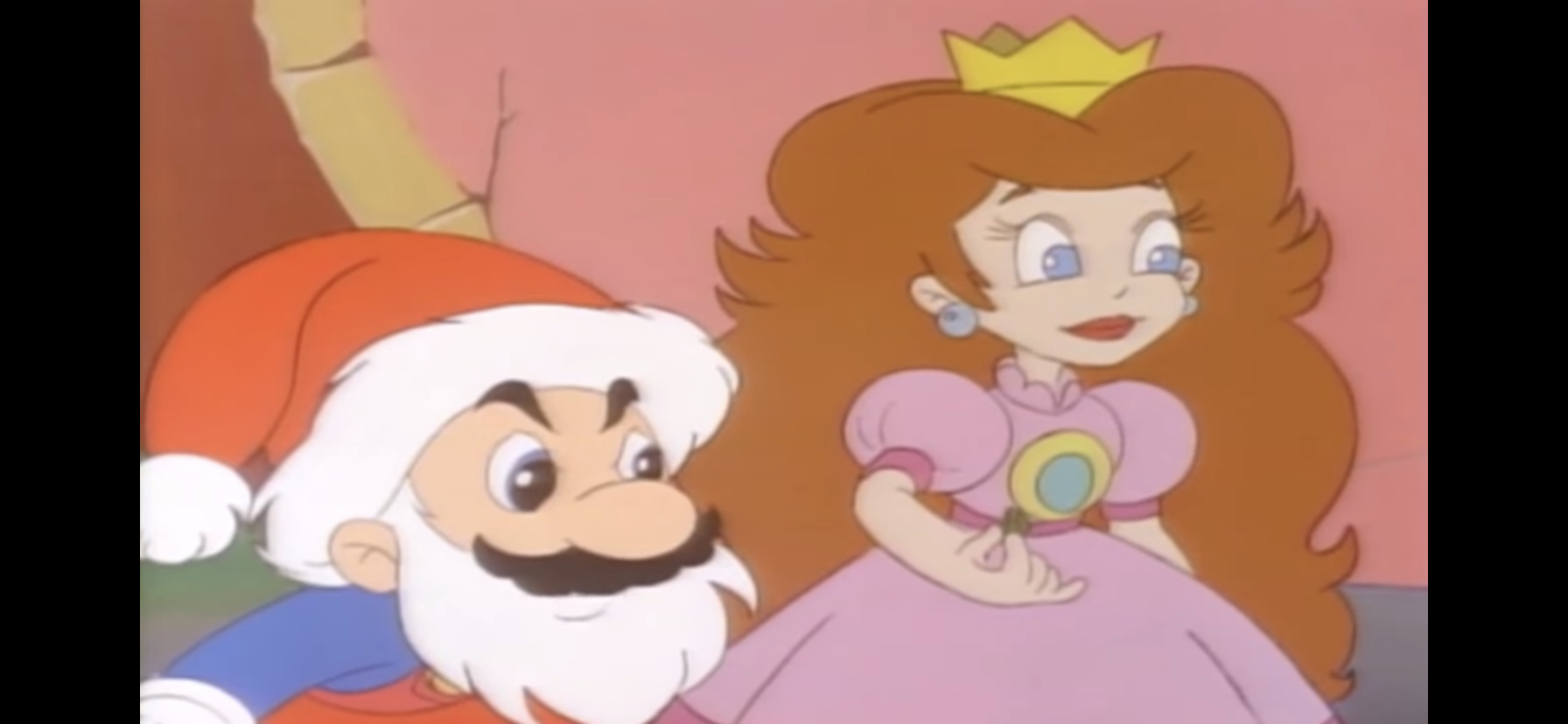
Mario then notices the toys are gone! They run over to the empty place where the massive sack once sat aghast that someone would steal toys on their fake holiday. The Princess announces she knows who is responsible, which is cute of her since we all know who did it. She picks up a scale from the ground and says it belongs to Koopa, and I say, it doesn’t matter. Koopa and his kids are the only bad guys in this entire world! Santa Mario remarks this is somehow worse than what Koopa usually does (I don’t remember enough of this show to know if that tracks or not, but it sure feels like hyperbole) and vows to get them back!
Well, at least this Christmas special got one thing right.
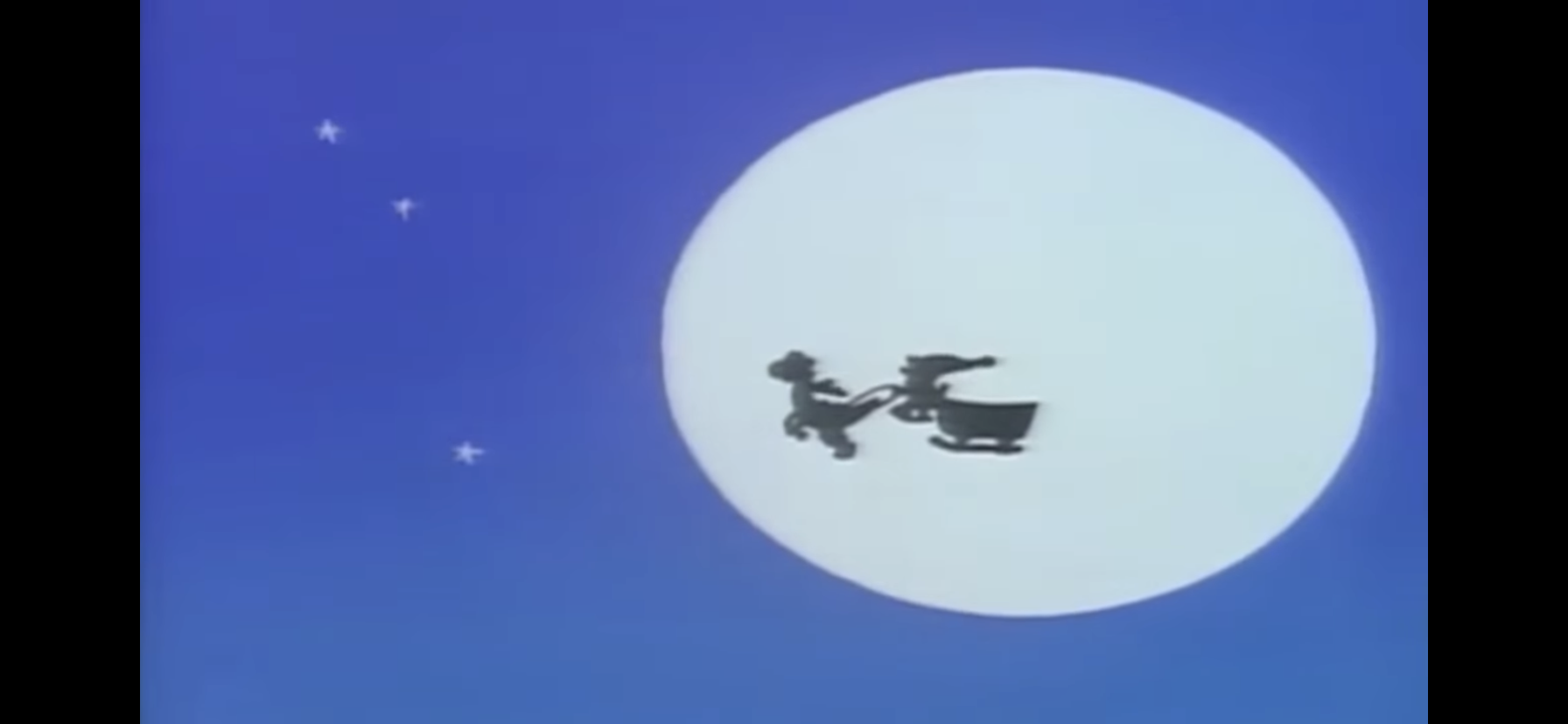
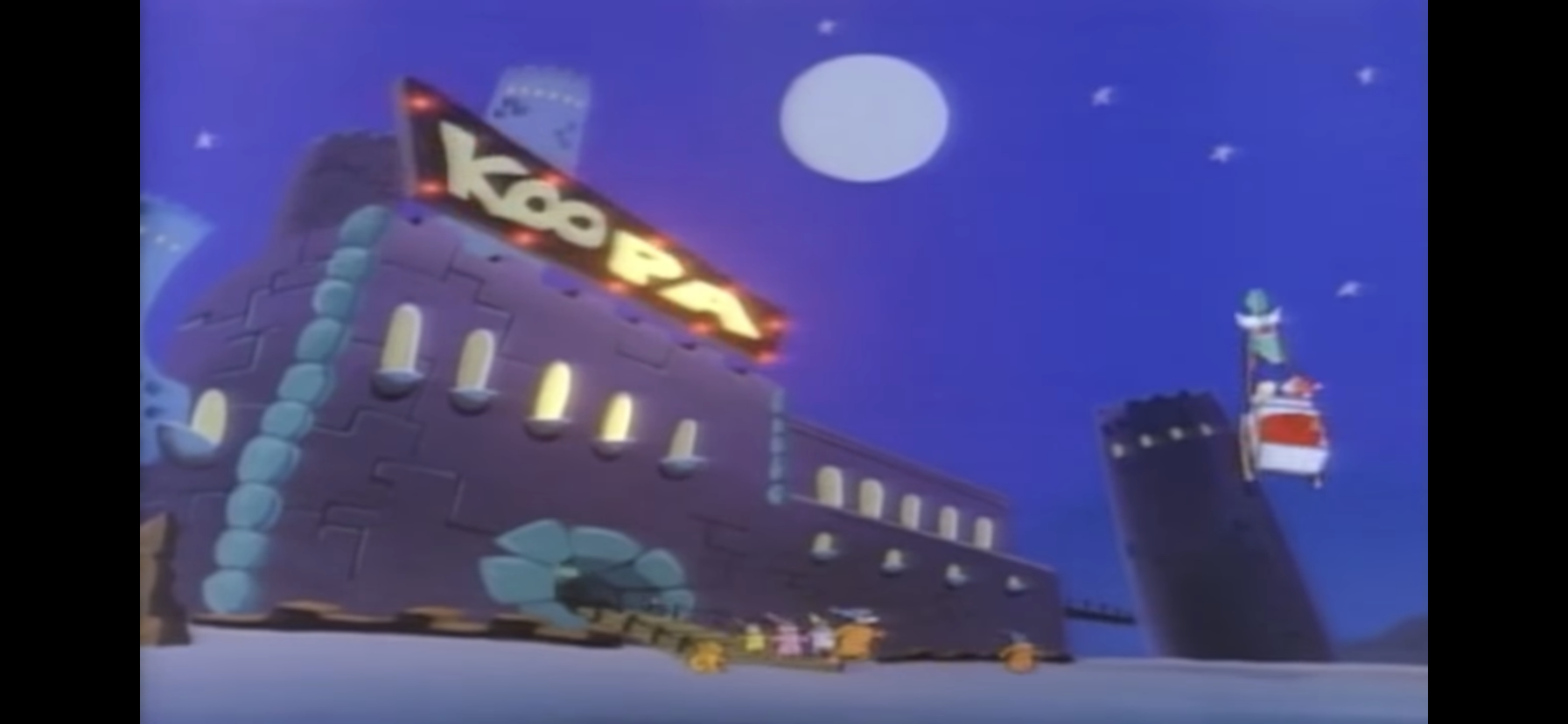
Mario takes off in his one-dinosaur sleigh as poor Yoshi has to pull that stone monstrosity through the air with his wings power-up. They do find time to pass in front of the moon. Meanwhile, Koopa empties the sack of toys back at his “neon” castle and finds Oogtar inside. Oogtar, apparently lacking any sense of danger, is still preoccupied with getting all of the toys and gets into an argument over it with Koopa who intends to give them to his kids. Oogtar grabs one gift and Koops swats him across the room, rather gently unfortunately. Oogtar rips it open, only to find a ba-bomb inside it which he promptly tosses back to Koopa. He shouts he’s glad Koopa isn’t his dad with a gift like that, but aren’t these all gifts Mario and the gang wrapped? Were they trying to murder Oogtar?!
Merry Cave Christmas, Ratgoo!
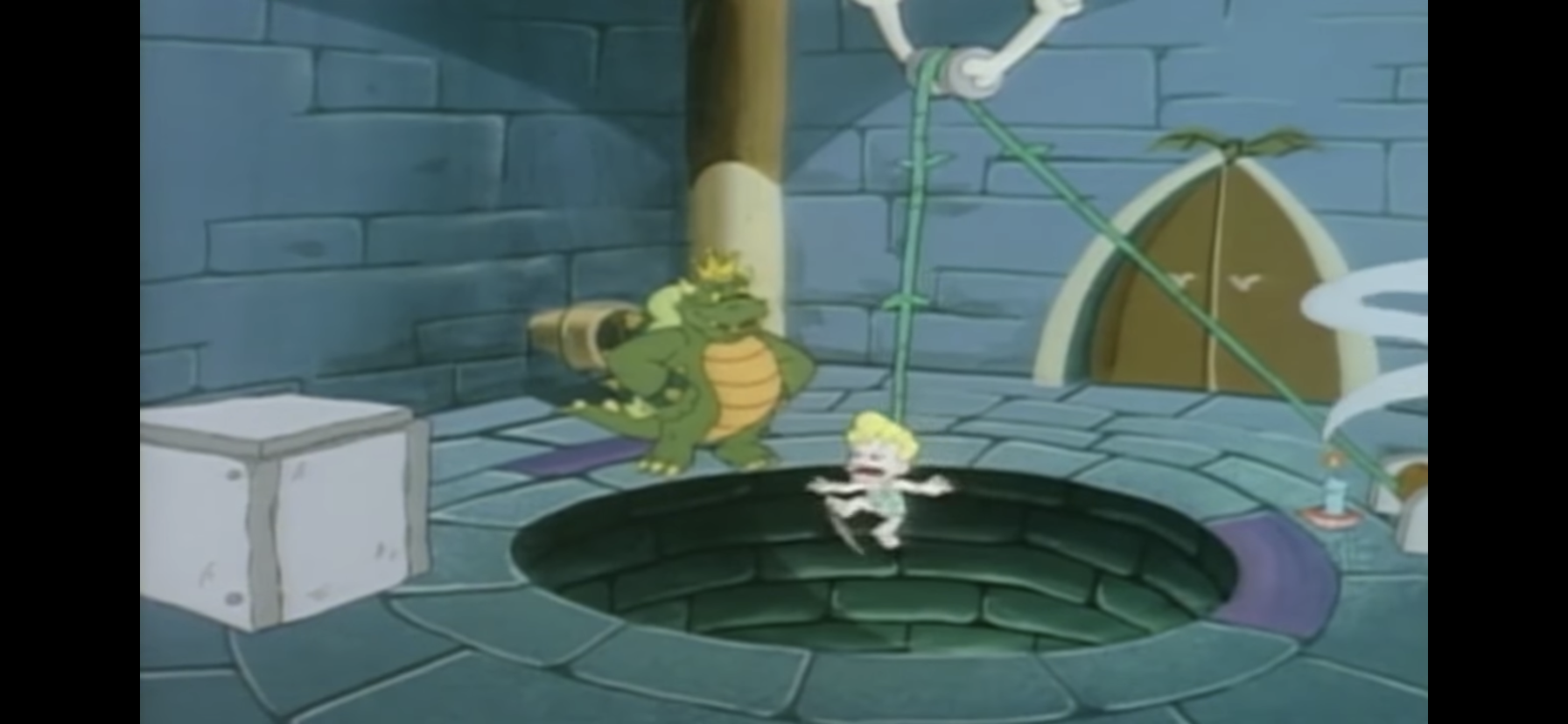
The bomb predictably explodes in Koopa’s face, even though he tried telling it that it’s not supposed to blow until Christmas. Oogtar tries to book it, but Koopa grabs him. He’s got something special planned for Oogtar as he strings him up with a pulley system. The rope is a vine and Oogtar finds himself dangling over a pit in which a hungry dinosaur waits at the bottom. Koopa places a lit candle under the vine and leaves Oogtar to his certain death rather than stay and watch. I’d think he’d want to see the little twerp get it, but I guess he has other plans. As he departs, he chides Oogtar by reminding him that his name spelled backwards is “Rat Goo,” an actual worthwhile zinger for this show! I like this Koopa fellow.
Probably not the most discrete way to travel.
Santa Mario and Yoshi arrive and hear the screams of that little baby, Oogtar, coming from the castle. Mario runs over with his toolbox and spies Oogtar through a barred window. Seeing Oogtar in danger, he then runs to a different window for some reason and pulls out some little dinosaur from his toolbox that he uses to bend the bars. Yoshi, who seemingly lost his wings despite not taking any damage, is then advised to help Santa squeeze through the opening he just created, but he’s still too wide. We get a predictable diet joke out of Yoshi, and Mario informs him that a diet is not in the cards and that he needs to push harder! As Yoshi backs up to get a running star, he sees a terribly off-model Boo ghost and panics, crashing into Mario sending both tumbling into the castle where a horde of mecha-koopas descend upon them.
I’ve always felt the Santa suit could use a cape!
We then go into the chase segment. I think every cartoon in this show features one where the characters go running through the castle, avoiding enemies, all while a song plays in the background. The song is almost unintelligible. It sounds like the Koopa Kids making up a Christmas song. There’s something about a sleigh in there and I can’t make much out. It’s not good. Mario rides Yoshi through part of the castle avoiding catastrophe until they have a trio of the football guys from the video game chasing them down. Mario is able to conveniently find a super feather in a block and becomes caped Santa! He grabs Yoshi and the two fly through a pipe that leads them to Oogtar.
Look at this stupid, smiling, asshole. Hopefully Yoshi is happy because he’s thinking about how he gets to fill Ratgoo’s stocking with dinosaur droppings.
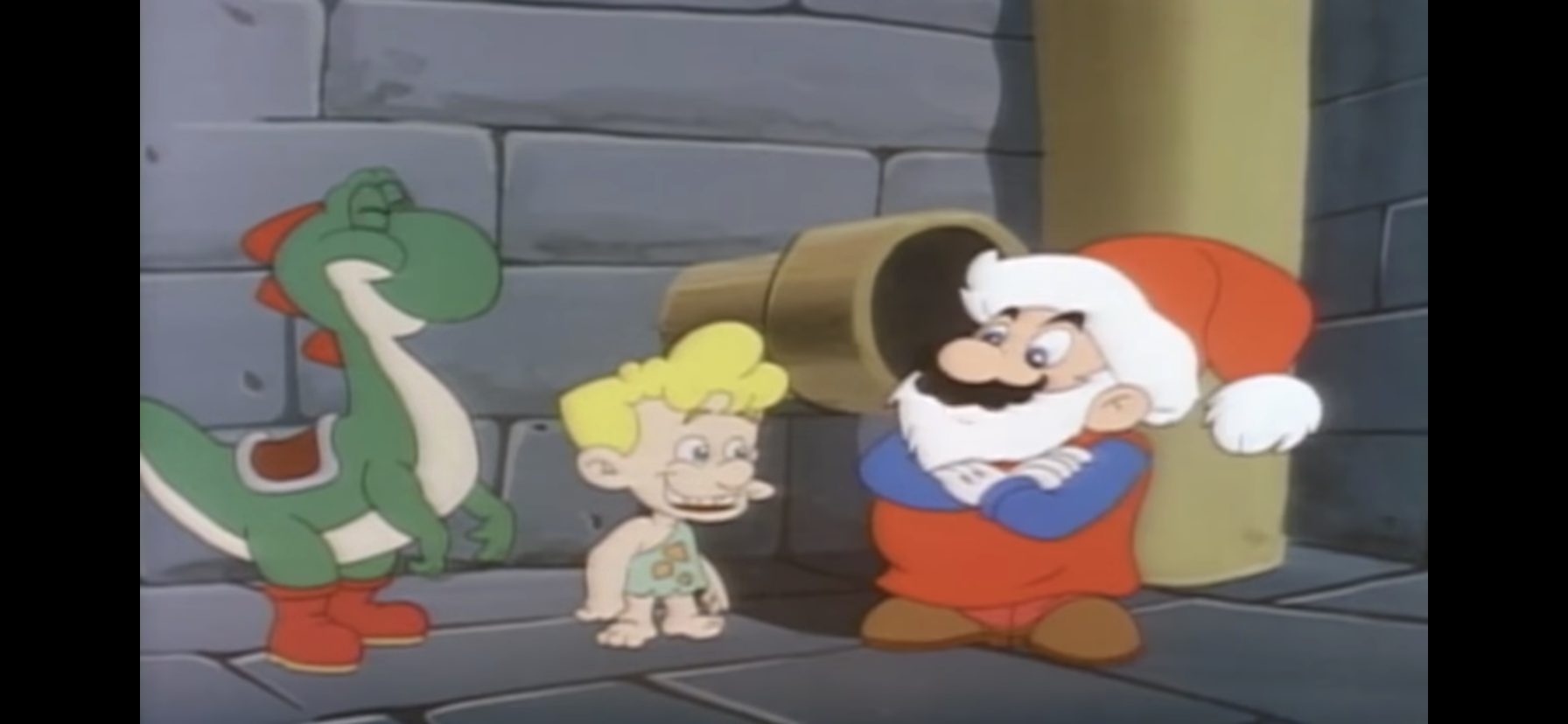
Oogtar, unfortunately, is still dangling over the hungry dinosaur infested pit. The vine breaks and Oogtar heads for doom, but Mario grabs the end of the vine. As Oogtar rises out of the pit, Mario goes in! Narrowly avoiding the chomping jaws of the dinosaur lurking within, Mario is able to fly out of the pit, catch Oogtar, and safely land outside the pit while the poor, endangered, creature in the pit is left hungry. Mario does a “ta-da” pose and a puff of smoke seemingly indicates his cape power wearing off, but when the smoke dissipates the cape is still there. Only when Mario starts laying into Oogtar is his cape finally removed from his model. Oogtar tries to weasel out of the discussion, but Mario points out that he’s already gone through all of Santa’s presents. Oogtar finally cops to being a little shit and Yoshi calls him bad (his eyes are all over the place in this segment too and it’s really distracting). Oogtar then promises to be a good little cave kid for the rest of his life, but Mario notes he’s got his fingers crossed behind his back. Oogtar, astonished, asks Santa how he knew and Mario gives a chuckle that he was once a little “bambino” too. Cave Christmas magic!
There wasn’t much screen time for the Koopalings in this one, which is tragic because they’re easily the best characters in the show.
Mario then comes running out of the castle with the sack of toys, which looks much smaller than before. They’re apparently just going to “yadda yadda” over how he managed to sneak into the throne room and grab them. With Oogtar in the sleigh and Yoshi hitched up, Mario tells him to take off, but there’s one problem – Yoshi doesn’t have any wings! Mario retreats to a nearby castle wall and just starts punching blocks until some wings pop out – the solution was so easy why bother even creating the problem in the first place? With the wings in place on Yoshi, they can finally leave, and just in time too as the threats of Bully Koopa start echoing from inside the castle. The whole Koopa clan races out as Santa’s sleigh lifts off.
Don’t fall for his bullshit, Santa Mario!
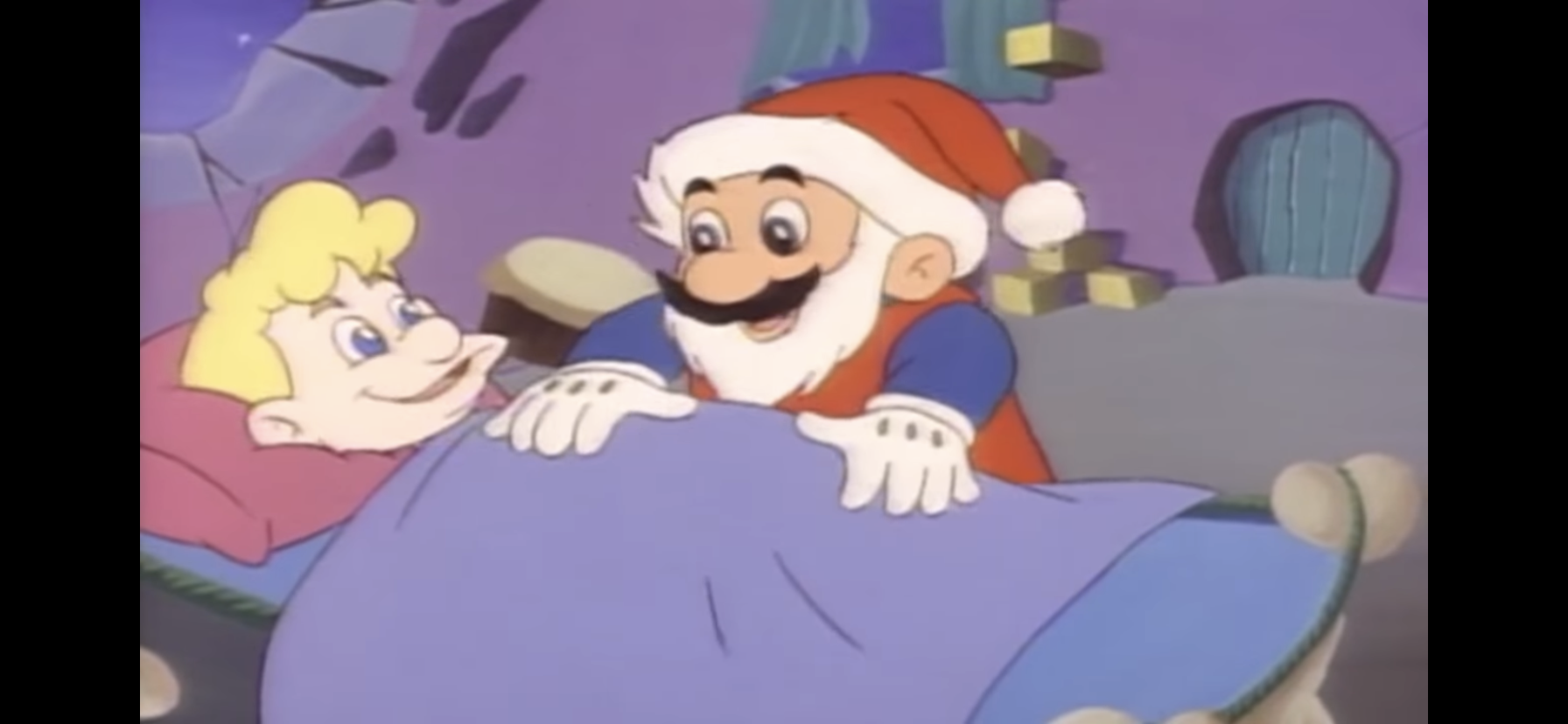
Back at Dome City, Santa Mario tucks Oogtar into bed. Before he can leave, Oogtar grabs Santa’s shirt so he can tell him that he’s been a bad kid and doesn’t deserve any presents. Being saved from the dinosaur is present enough (I bet the town wishes they could trade the presents they’re about to get in exchange for feeding Oogtar to that dino), but if Santa wants to leave Oogtar something it would make him happy. Mario remarks this isn’t like Oogtar, implying this one bit of manipulation on Oogtar’s part erases how terrible he is. Mario, predictably, leaves Oogtar a present before he and Yoshi fly off into the night.
Way to ruin Christmas, Mario.
The next morning, Mario is snoring away in his very uncomfortable looking vine bed still in all of his clothes. As he sleeps, Oogtar slips in with a wrapped gift as he notes Santa didn’t leave Mario anything. He places the gift by Mario’s bed as the plumber wakes up. Oogtar wishes “Mario dude” a merry Cave Christmas. The episode ends with Mario breaking the fourth wall to ask the audience, “Wouldn’t it be nice if every day were Christmas?”
And that is the rare holiday of Cave Christmas. It’s just like regular Christmas, only Santa is a plumber and his stone sleigh is pulled by a winged dinosaur. Also, the toys look pretty lousy. And it’s set in August. I don’t think I thought much of this episode (or this show) as a kid and have almost no memory of this, specific, episode. As an adult, it’s hard for me to ignore the inherent colonialism in the Mario brothers setting up shop in a remote location among the natives and basically brainwashing them in a bid to control them. It’s actually pretty shitty. It’s made worse by the fact that they’re also spreading a religious holiday to these people, though the religious aspect of Christmas is not touched upon at all, for the better.
Get this piece of rat goo the hell away from my holiday!
Even if I accept that I’m reading way too much into this extended video game commercial, there’s no polishing this turd of a Christmas special. Oogtar is unlikable and pretty damn annoying. I really don’t want to see him learn a lesson or have a merry Christmas in the end, I just want him to go away. He also didn’t really learn anything as I get the impression he just goes back to being a shit the next day once Cave Christmas is concluded. He tried to lie to Santa! Beyond that, the episode is poorly scripted, plotted, and paced and almost demeaning to its audience. The good guys have to be stupid in order to not see a giant turtle monster skulking about town stealing their stuff, and they make sure to tell the audience everything that’s happening because no one apparently trusted the kids to understand this stuff. The only positive I can give this thing is Harvey Atkin is still dynamite as Koopa and he even made me chuckle on two occasions.
You got two tries at a Christmas special, Mario, and you blew it! You are hereby cut off! No more Christmas for you!
If you absolutely must journey to Dinosaur World this Christmas then you’ll be pleased to know that all 13 episodes of Super Mario World are available on DVD. And since the show is bad, you can probably find it for very cheap as nostalgia seekers probably impulse bought it when it was new and then were eager to get rid of it. Nintendo also hates these old cartoons and basically just wants nothing to do with them so no one is actively enforcing the copywrite presently and you can find this one streaming online for free. With seemingly every IP under the sun getting locked into exclusive deals with some official streaming service, this one might actually remain free for awhile since Nintendo doesn’t appear interested in even shopping this stuff around. I’m actually a little surprised they aren’t throwing their weight around to wipe this thing from existence, but I guess their inattention to the show is everyone’s gain. Or loss.
Can’t wait until tomorrow for more Christmas? Check out what we had to say on this day last year and beyond:
It’s not often I get to look at a Christmas special from the same year I’m doing The Christmas Spot, but it also helps when that Christmas special premieres in May of the same of year. May?! Yeah, it’s weird, but for the 31st season finale of The Simpsons the show rolled out a Christmas…
Considering how gross a lot of cartoons had become in the 90s, it should come as no surprise that the decade concluded with Mega Babies, a cartoon about literal snot-nosed, super-powered, babies featuring diapers overflowing with excrement in the opening title. Mega Babies was a short-lived production from the Tremblay brothers, Christian and Yvon, who…
Long after the X-Men animated series that originated on Fox Kids had ended, along with basically every other Marvel cartoon at that network, X-Men: Evolution showed up on Kids WB. It’s kind of odd considering WB owned DC and yet they went in on X-Men, but X-Men were still popular and were gearing up for…
When NECA finally received access to the Teenage Mutant Ninja Turtles license to release product at retail, the company decided to focus on three pillars: cartoon, movie, video game. The cartoon product, being the most sought after, was exclusively sold at Target stores in the United States. The movie line, probably nearly as desirable as the cartoon, but not as deep, was to be sold exclusively at GameStop and has since been moved to Walmart. The third pillar, and probably the least desirable, was the video game brand. Those figures were to be sold across various comic and specialty shops. Basically, anyone who sells collector-grade action figures can place an order for these. Which, incidentally, made it possible for a retailer like GameStop to at one point sell both movie and game figures based on the Teenage Mutant Ninja Turtles.
The design of the original cabinet was so bizarre. This odd Baxter fits right in that.
The video game line was always going to be the lease desirable because it’s the most gimmicky. All of the figures feature a pixelized deco to create the illusion that they came out of a video game. Only, this sort of thing is basically impossible to properly replicate since pixels, by their nature, are arranged in a very strict fashion and any three-dimensional object that can bend and move in the third dimension is going to break those rules. It also was a line designed primarily for repaints and re-releases. The turtles themselves had been originally released as a comic con exclusive already along with Shredder and the Foot. They were based on the original Teenage Mutant Ninja Turtles arcade game, but NECA’s line for retail was to be based on Turtles in Time. Still, the turtles didn’t change enough from one game to the next to warrant new sculpting, so instead the pixel deco was modified slightly and each figure came bundled with a surf/hover board based on the bonus level Sewer Surfin’. As for the rest, well most could just be repaints of the cartoon line or re-releases with slight modification. Shredder, for example, had his shoulder pauldrons adjusted while Slash received a new head to differentiate him from his toon counterpart. And since these were priced under the usual NECA Ultimates price point, they tended to just come with a few extra hands and a weapon or two.
It seemed like that was all the line would be. NECA also expressed interest in winding it down in favor of a new line based on the original Mirage Studios source material, even though there were still a few boss characters missing. NECA didn’t want the line to just fizzle out though, so it decided to do a couple of special releases. One is a two-pack of Bebop and Rocksteady which is due any day now, while the other was the line’s first Ultimates release: Baxter Stockman.
The video game version of the character always struck me as a great deal more creepy than the cartoon one.
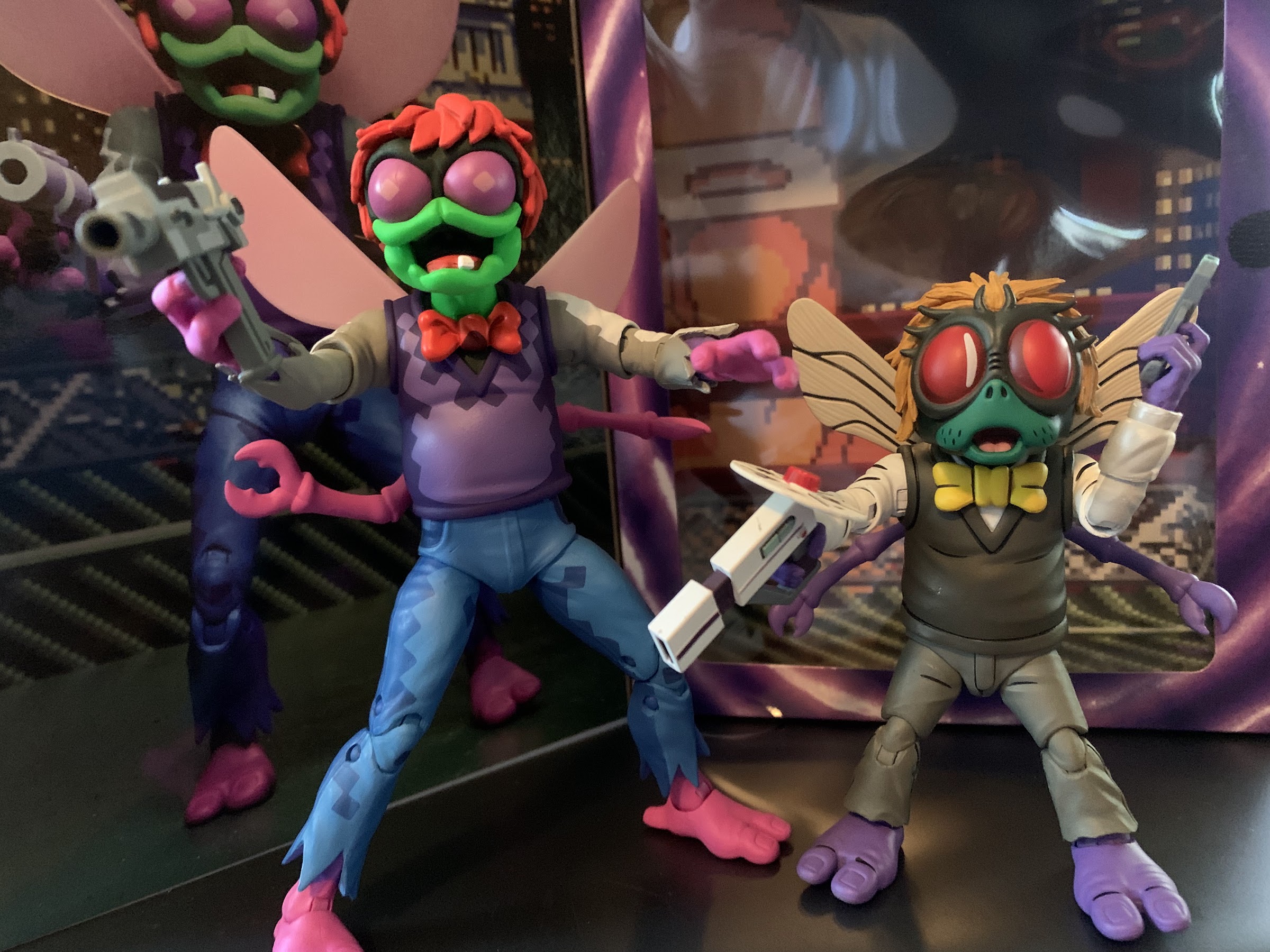
Baxter, like many characters from the game and this line, have a cartoon counterpart. NECA released Baxter alongside Splinter in early 2021 so NECA double-dipping with a game repaint was not a surprise. The only thing was, it didn’t make a ton of sense. Baxter in the cartoon is a diminutive, mutant, fly. He’s a pip-squeak. In the video game though he’s pretty beefy. Maybe because he’s a boss Konami felt he needed some presence because he’s as big as the turtles, if not a little bigger. He also looks just a little different. His head is a bit more grotesque and he has this one, ugly, tooth that makes him look like an old man. NECA could have just faked it and did Baxter up in a different color scheme and called it a day, but most probably would have called them out on it.
Two different interpretations of the same character. I do love how that toon one turned out.
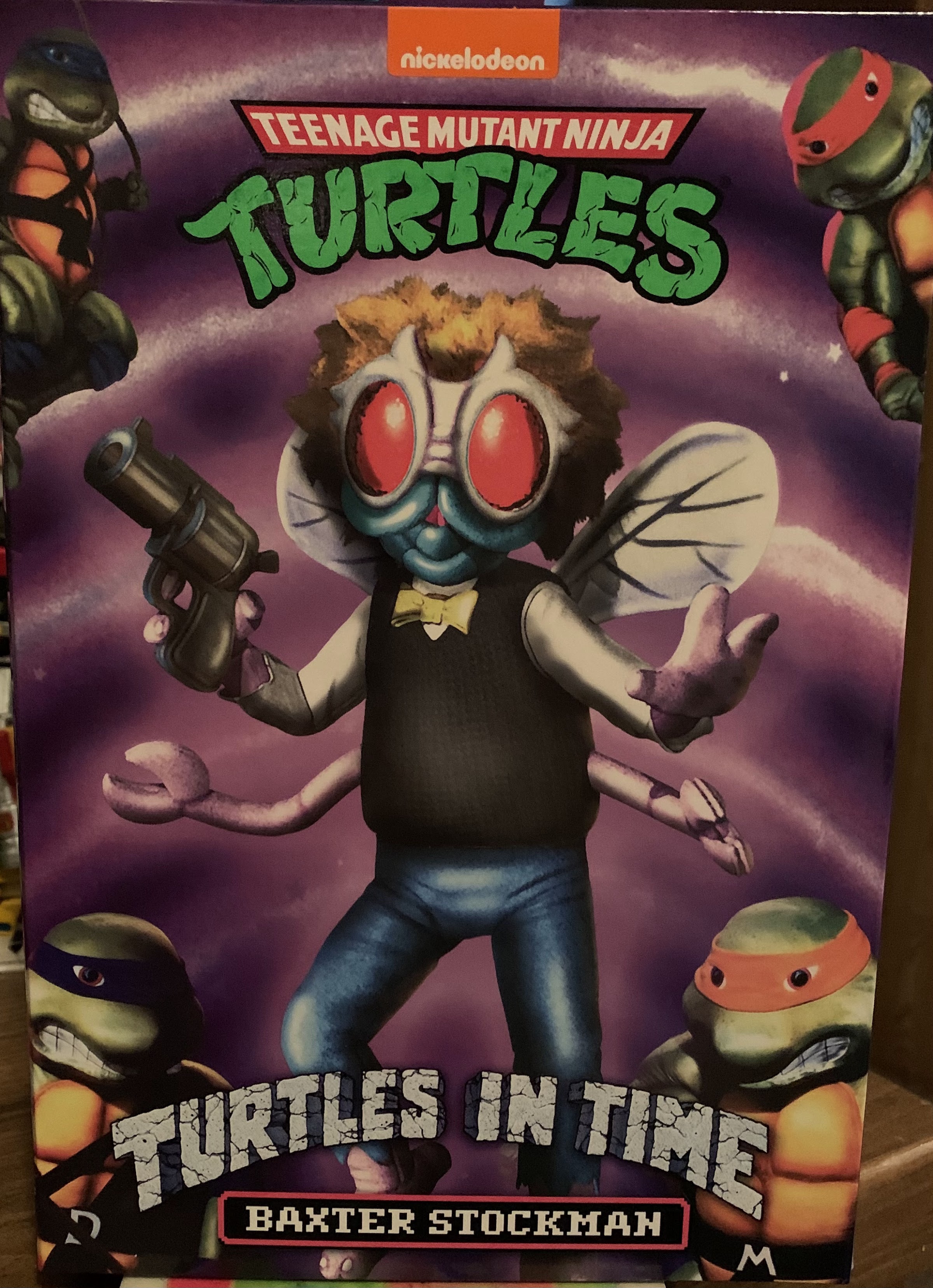
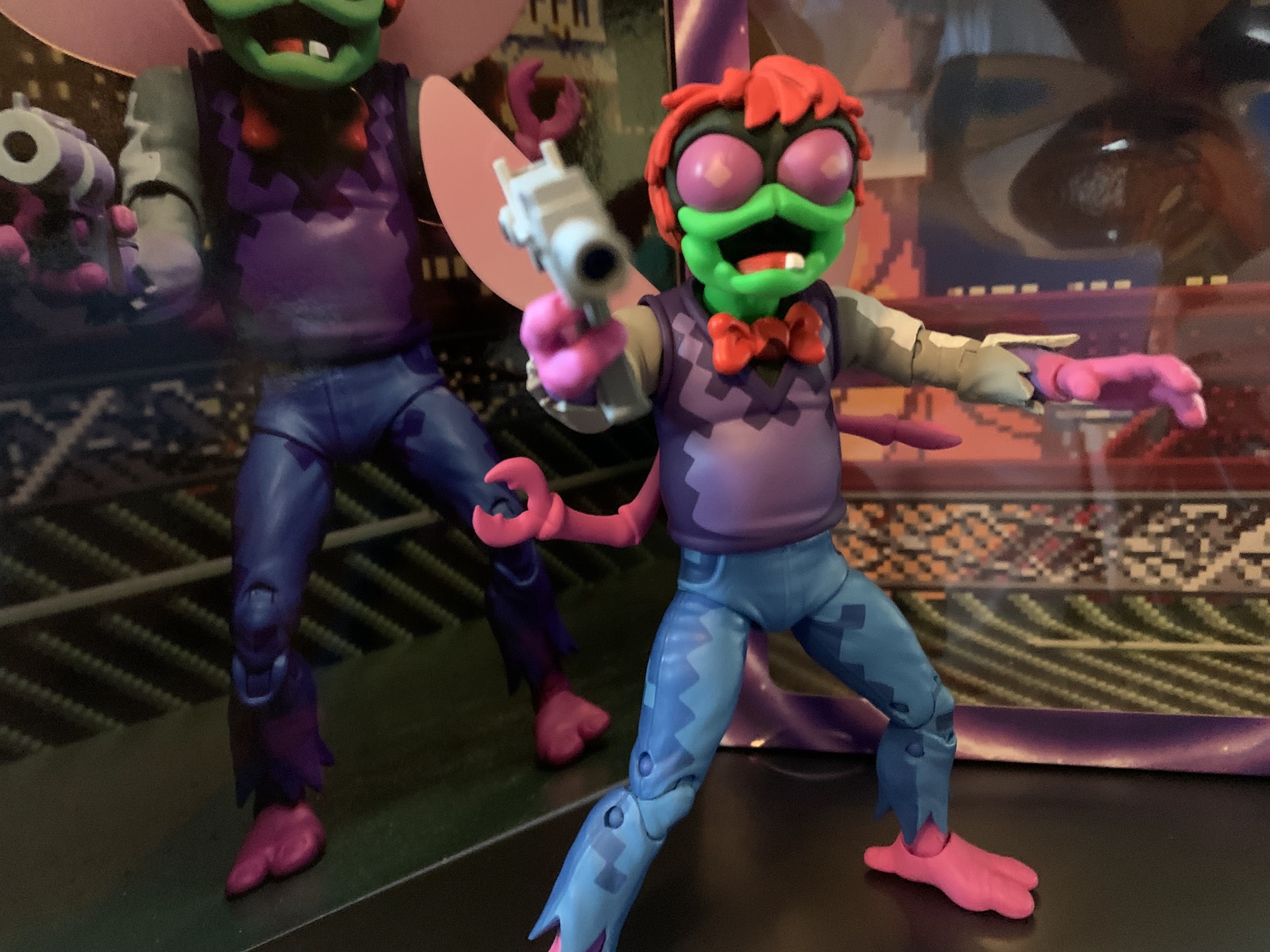
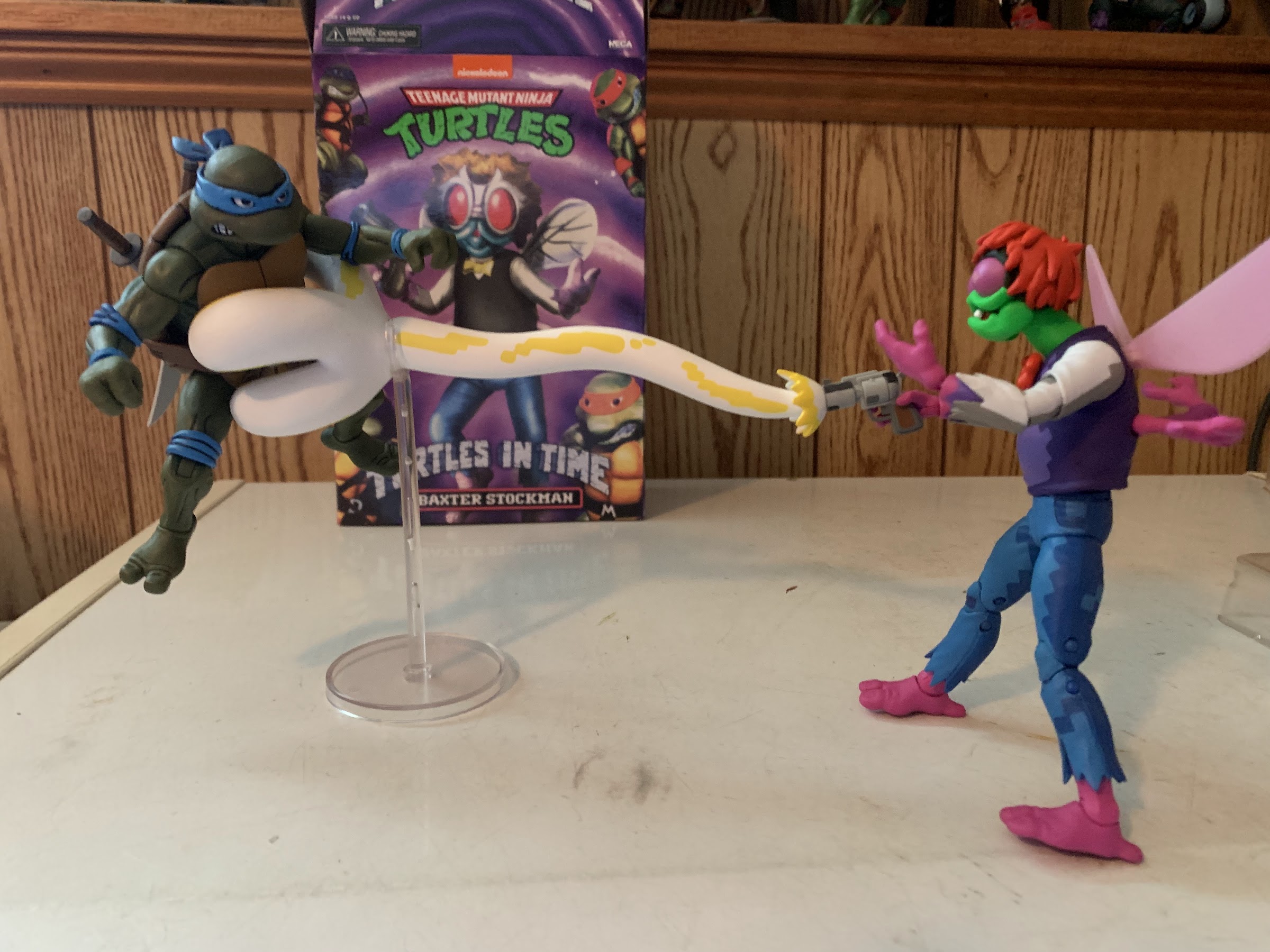
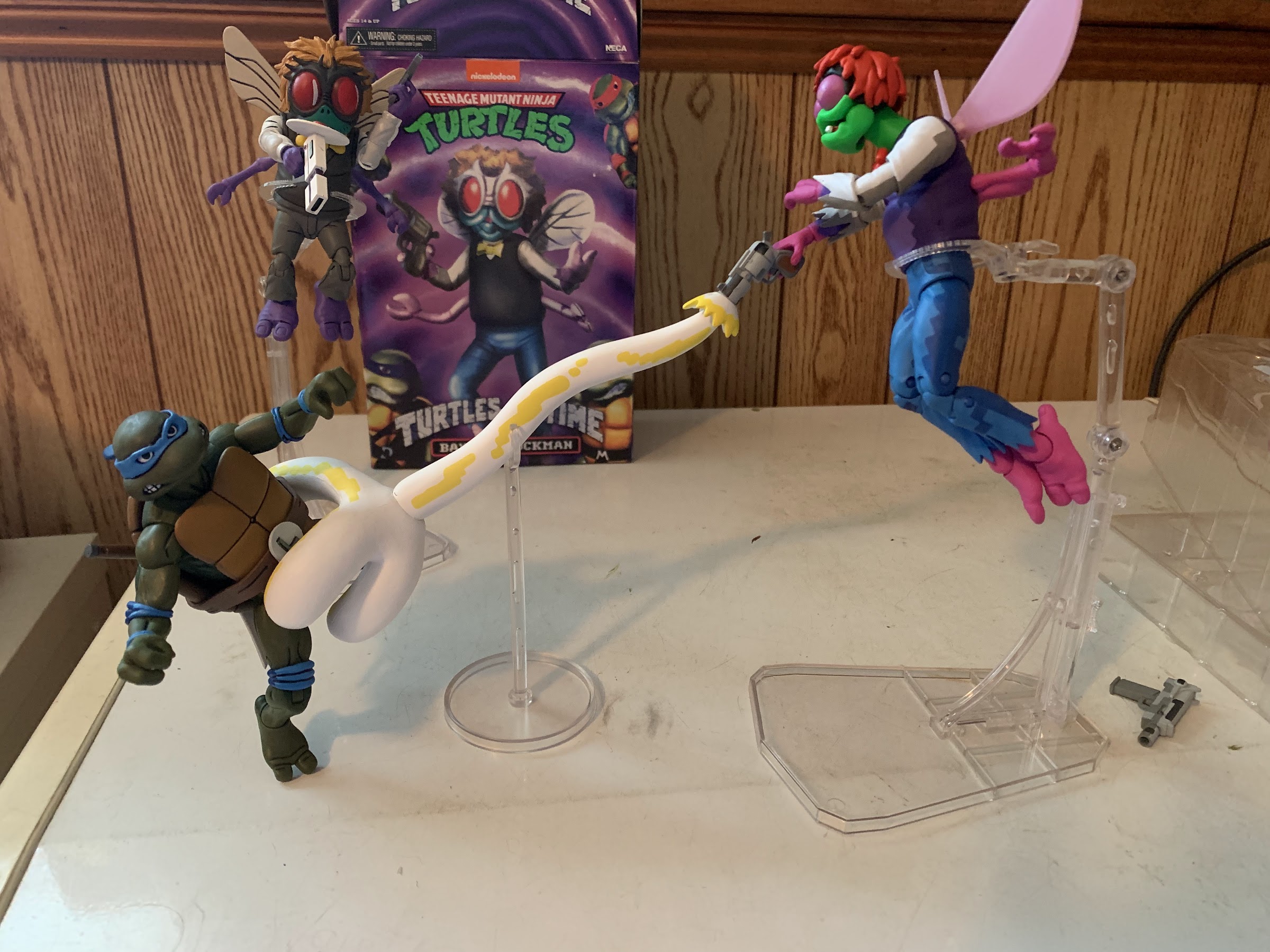
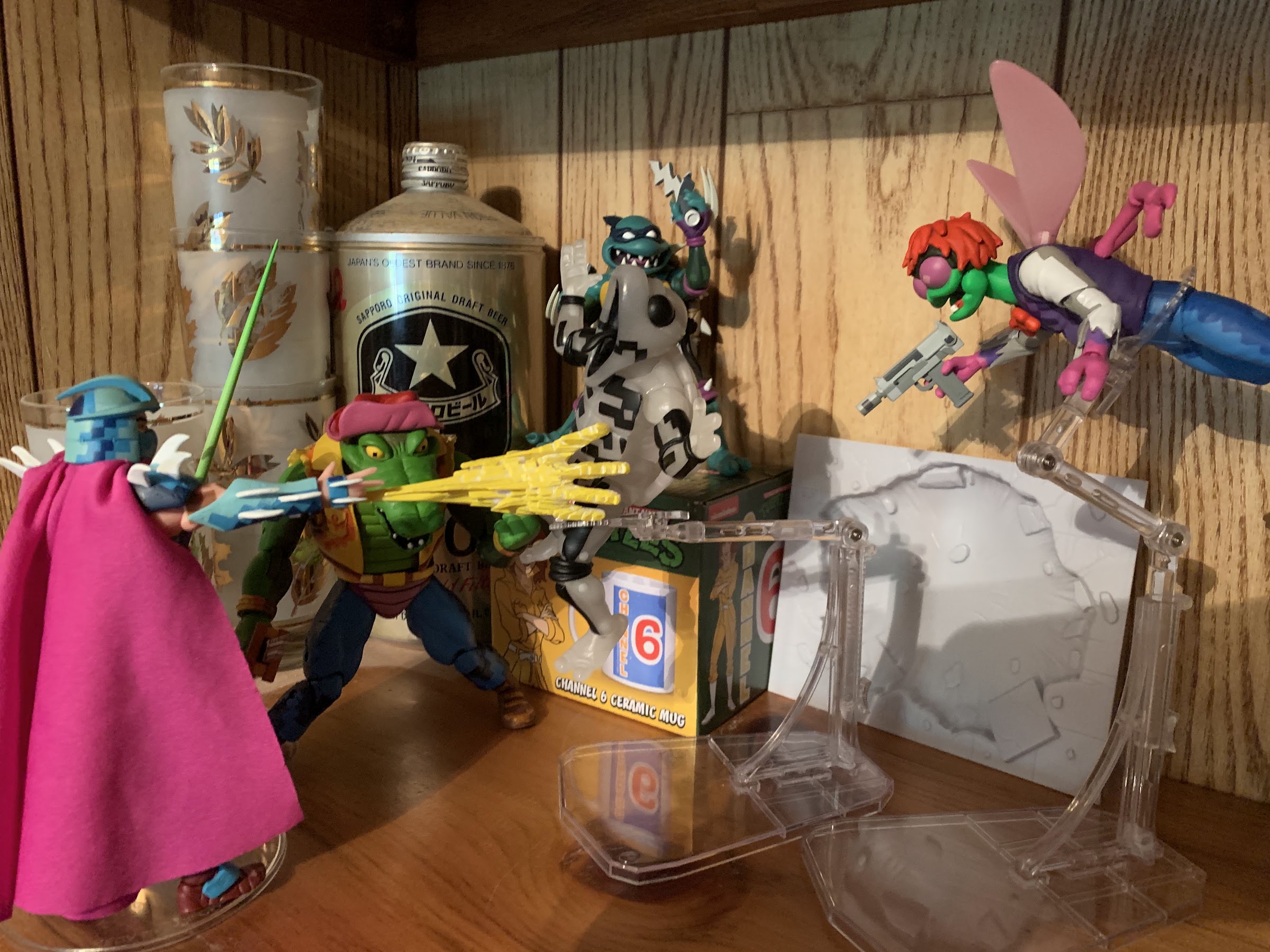
Rather than make Baxter a lesser release, NECA did the opposite. They upped the price to an Ultimates tier which gave the company the freedom to do a new sculpt. Now, some of his parts are probably sourced from other, non-Baxter, figures, but some is also unique. He also got his own, unique, packaging in the Ultimates styled box with the fifth panel for product shots and artwork (and the front of the box is basically NECA’s interpretation of Baxter in the same style as the turtles were presented on the original arcade cabinet). It also meant more accessories! Baxter comes with the usual assortment of extra hands, but he also has two guns, a flight stand, and an effects piece with a stand of its own! It’s quite the package, and it’s nice seeing NECA sink a little extra love into the video game line.
Thank goodness his union kept their dental plan.
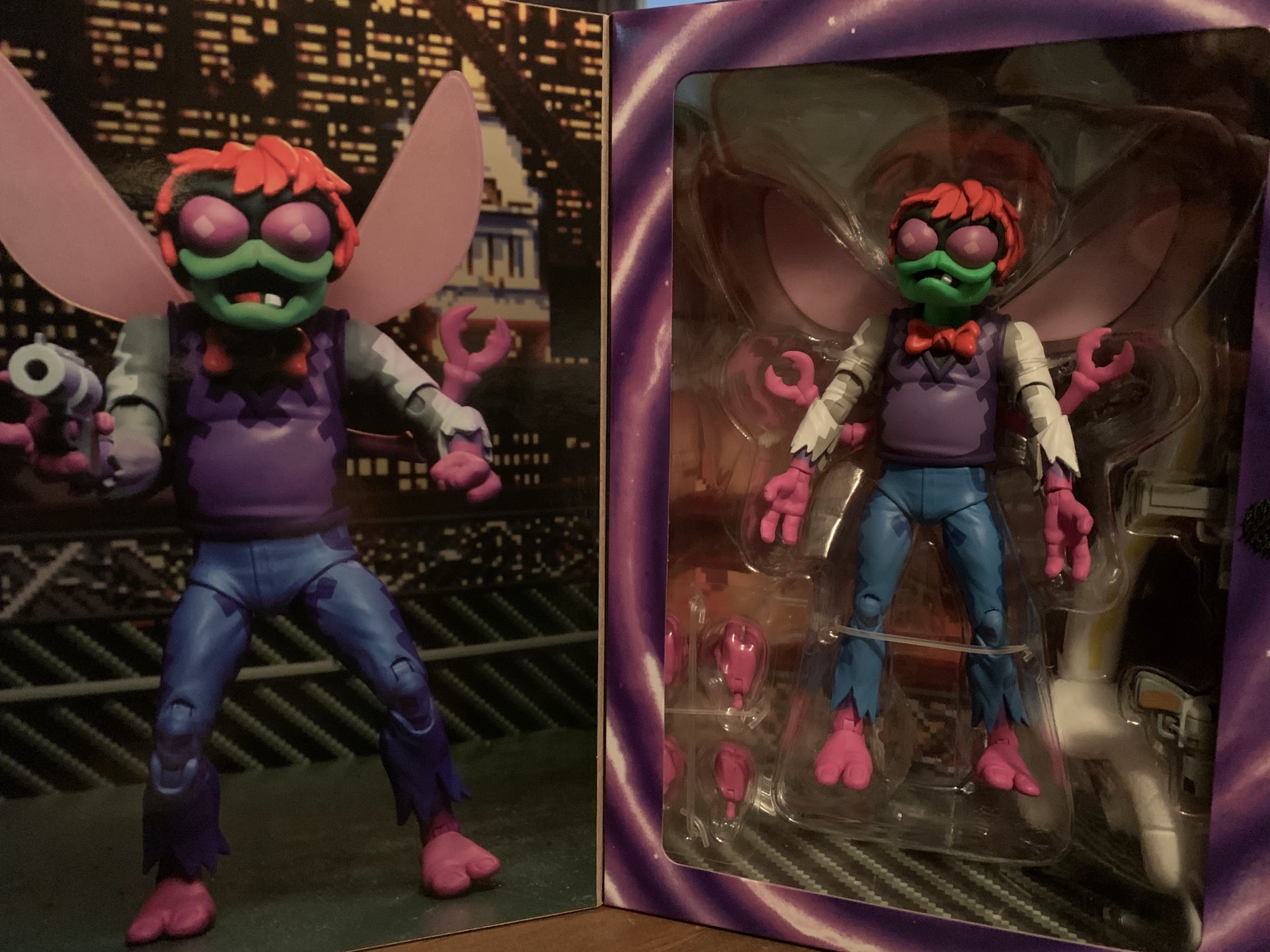
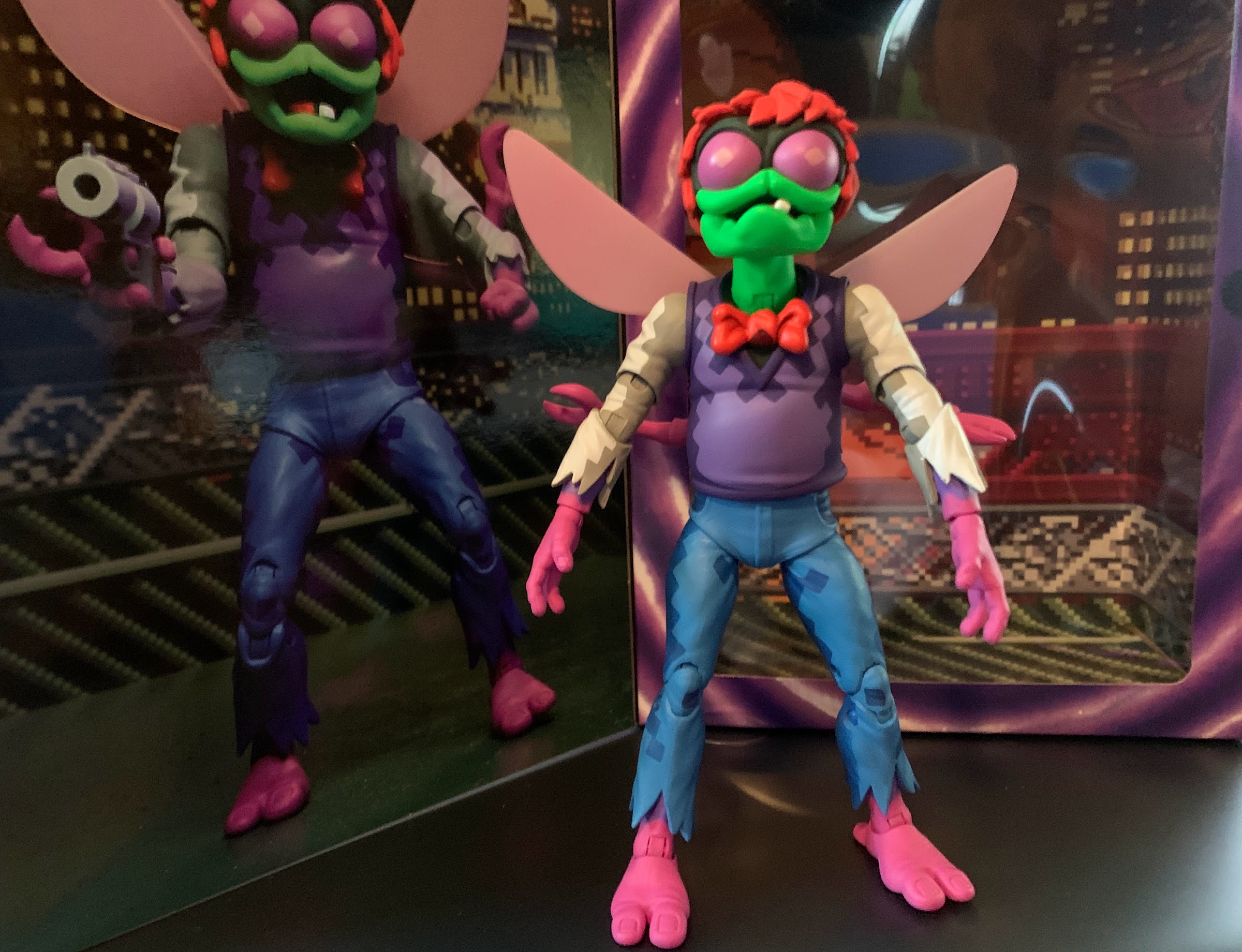
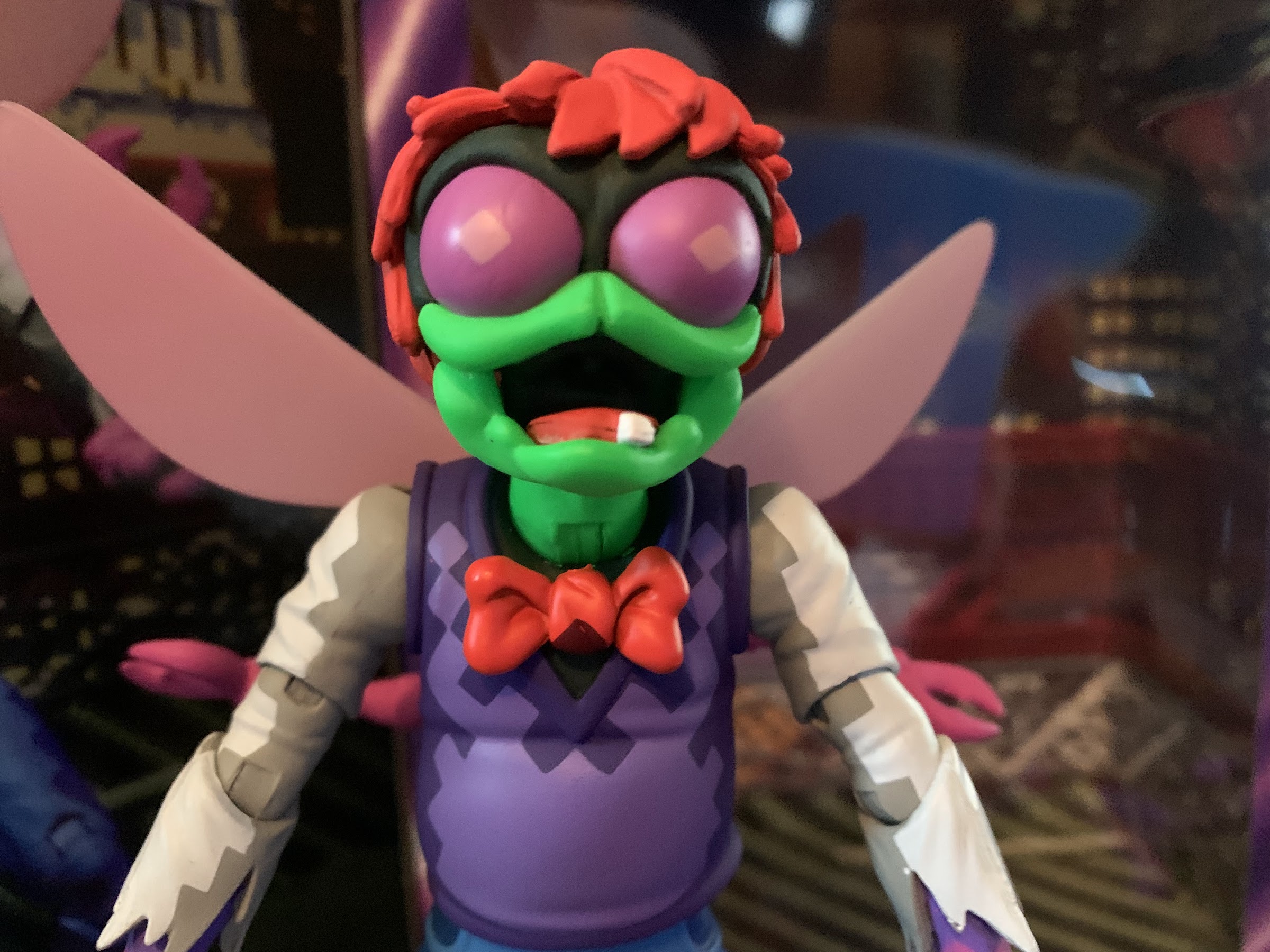
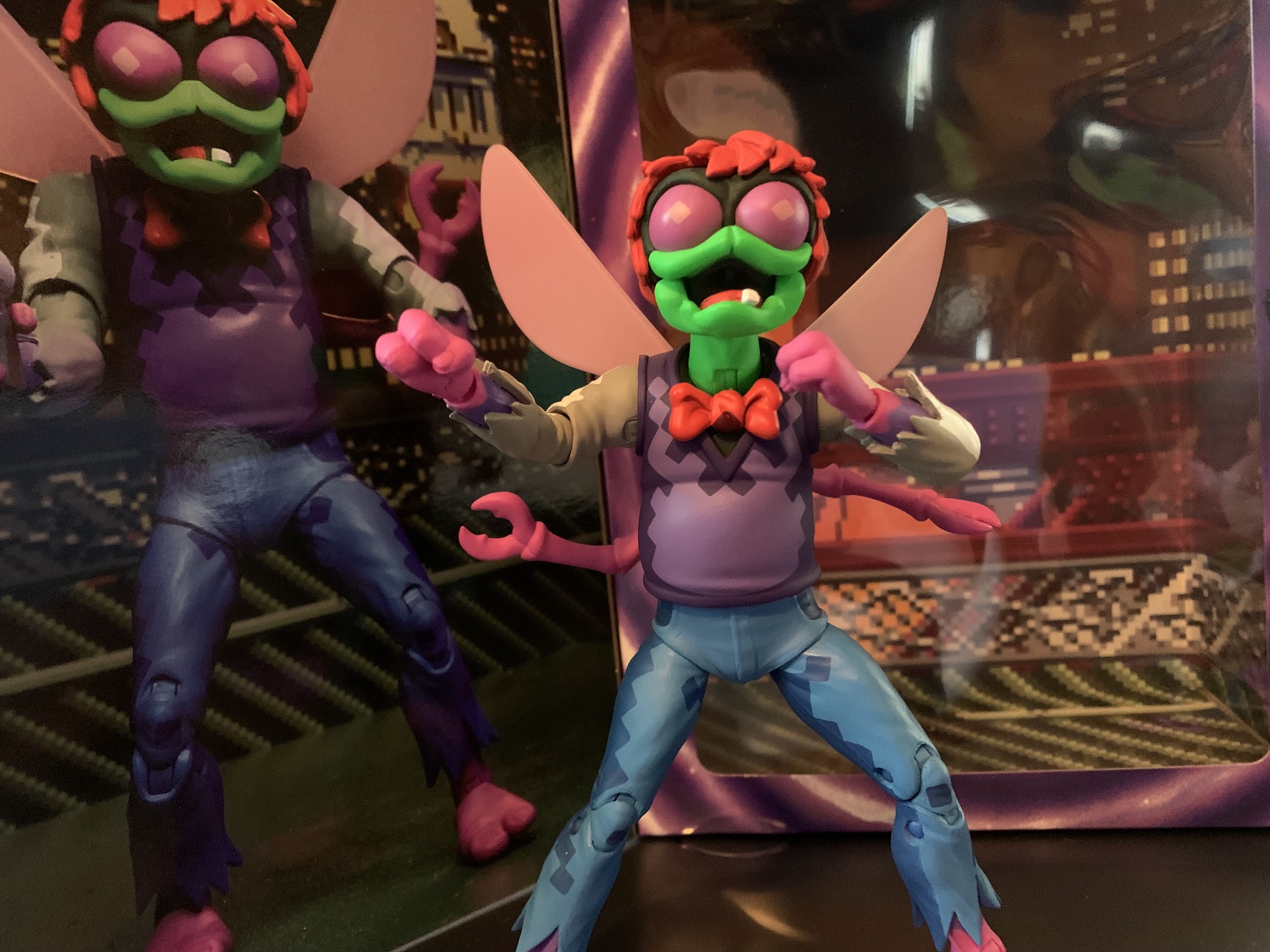
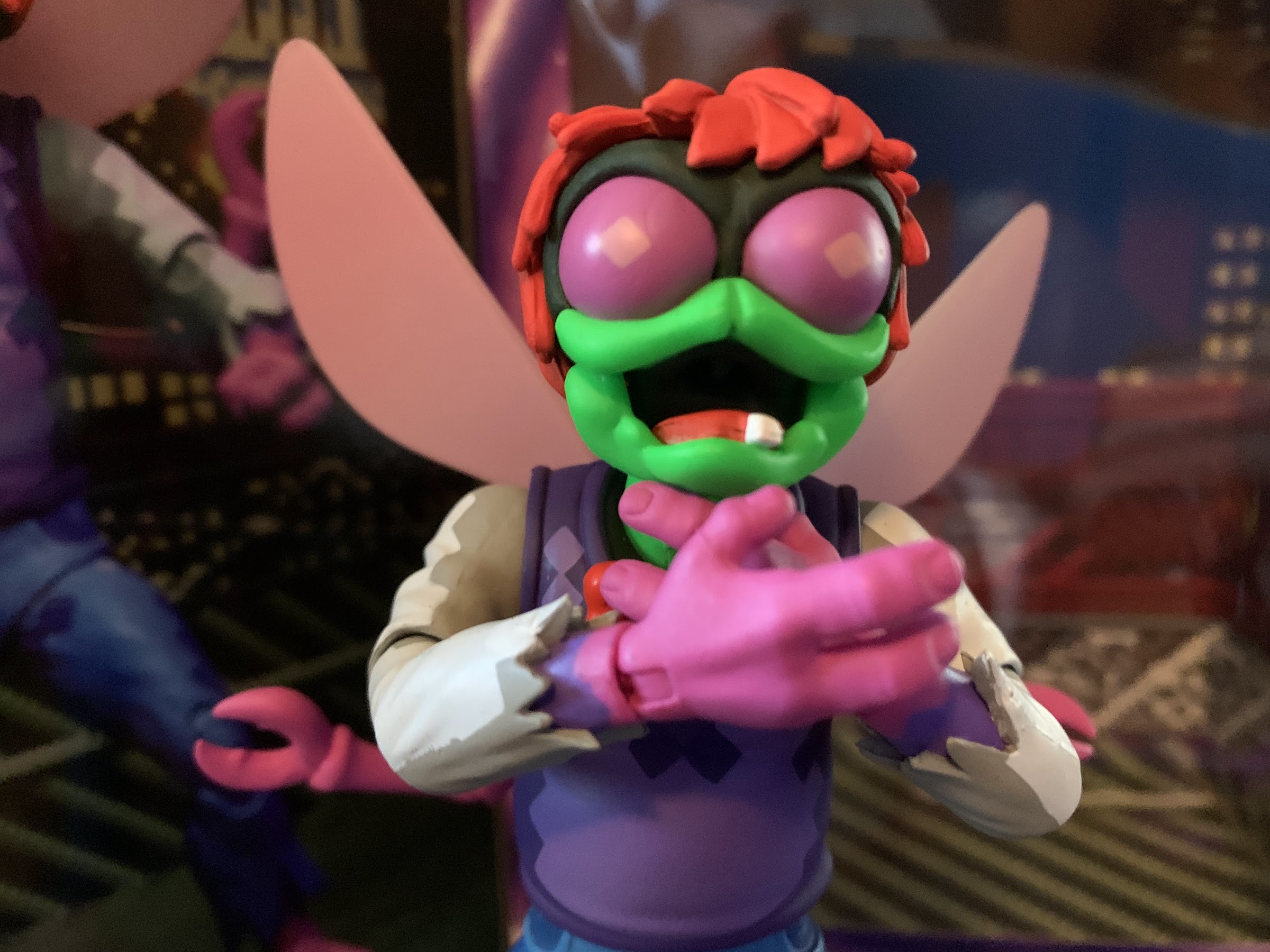
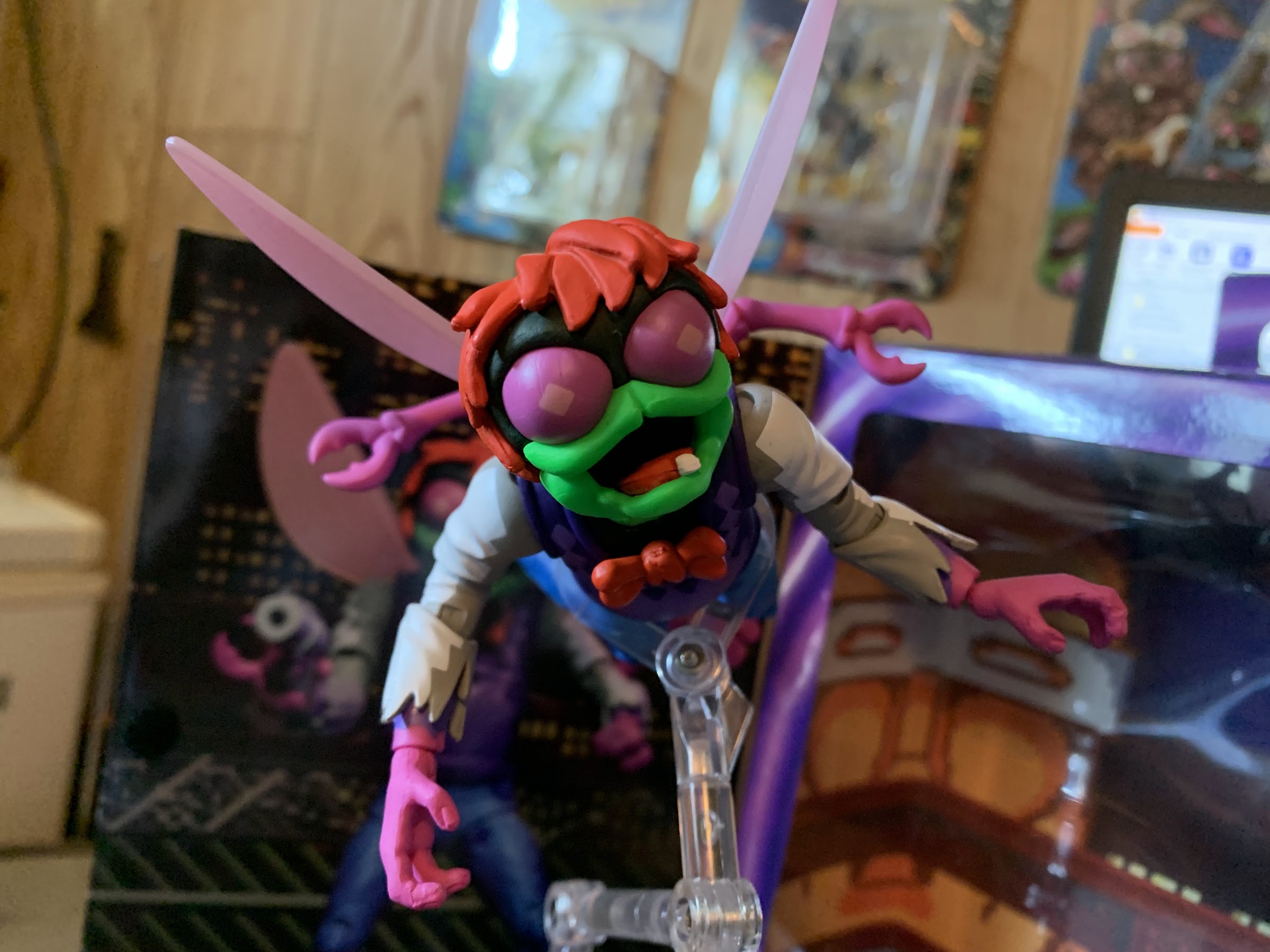
Baxter stands at around six and a quarter inches, making him nearly two inches taller than his cartoon version. He has shaggy, red-orange hair, and bulbous pink eyes and a hideous grin. He has a purple sweater vest and red bowtie to go along with some tattered, white, dress sleeves and blue pants. It’s tough to get a good look at a sprite in a 16-bit video game, but this looks pretty consistent with the arcade game. His flesh is a fuchsia or hot pink which also includes those extra arms on his back. The wings are just lightly sculpted and feature a powdery, pink finish, that are ever so slightly transparent, but functionally not. The pixel paint job seems less intense than some of the other figures released. It’s mostly on the front of his vest and sides of his pants while the gray shading on his sleeves is given a boxy edge. They really didn’t attempt anything on the head, save for the diamond pupils in his eyes, nor is there any on his wings or extra appendages. I think it looks fine and I prefer the pixel effect to be underplayed as opposed to overplayed, and the paint application in general is quite clean. In terms of parts sharing with the cartoon Baxter, I can’t see any. I thought they might have the same pincer arms, but those are different as well. The hands, feet, arms, torso, even the bowtie are all different. He probably shares legs and arms with Vernon from the toon line, and whatever is under the sweater vest as well, but this guy is largely unique.
He’s trying to look tough, but he really could use some more meat on his bones.
All of the ingredients are there for Baxter to be a visual splendor, but I do think he has one obvious flaw. He’s just not chunky enough. The character model in the game was about as tall as the turtles, but noticeably thicker. This Baxter has the height, but he’s pretty thin. I’m sure some of this perception is magnified by the fact that he’s kind of hunched over in the game and squat. Even if I try to scrunch him up though the effect still isn’t achieved. Is it a deal-breaker? Well, almost. I really waffled on this release for a bit as I liked it, but just didn’t think it was a terrific likeness of the video game art. I really only gave in because of availability and my own desire to just get a new toy. Plus, even with the likeness issue, it looked like a fun toy because of all of the stuff. Anybody interested in this figure will just have to decide for themselves if the likeness is good enough or not. I think NECA brings it on themselves here since a lot of their toon figures look like they stepped right out of the television so that’s a standard we’ve come to expect for their TMNT figures, whether they’re based on a cartoon, movie, or video game.
Baxter, I told you not to try to swallow a fistful of sugar cubes.
In the game, Baxter attacks from the air and land so such a character needs to be able to achieve a variety of poses and this Baxter is more than up to the task. He’s pretty loaded when it comes to articulation. His head sits on a ball-peg and has some solid functionality there made even better by the fact that his head sits on a rather large neck with a hinge at the base. This does help him achieve that stooped look he has in the game when on his feet, and if in the air, he’s able to look down at his target just fine. At the shoulders, he has the usual ball-hinges and they have a terrific tolerance for moving around and out to the side. For this guy, NECA used their slightly unusual double-elbows that the cartoon Baxter had. When these elbows are used on a sleeveless character like the movie Casey Jones they look really bizarre, but on a character in a dress shirt like Baxter they look fine. He can bend well past 90 and the arms swivel above the elbow as well. And since you can point that hinge wherever you need it, Baxter can basically bend almost as well as a character with a butterfly joint at the shoulder. He can reach across his chest, achieve two-handed, gun holding positions, or even choke himself! At the wrists, he can rotate and hinge, but all of his hands have in-out, horizontal, hinges which is unfortunate as vertical ones are better for handguns. He has some articulation under his shirt, but it’s not particularly functional as the shirt doesn’t feature a cut anywhere. He can crunch forward slightly, but mostly his waist is available to swivel. At the hips he has ball-joints underneath one of those soft, “diaper,” pieces. I’m happy to report that the diaper appears structurally sound with no cracking or flaking present on mine, though the hips are too loose for my liking. He does have a slight thigh twist there and the standard double-knees. On the rear of the figure, his wings and pincher limbs are the same as cartoon Baxter. They swivel and hinge where they meet the body, but there’s no “elbow” or pinching articulation which is kind of a bummer. Lastly, he has a hinged jaw which I always love on NECA’s figures. They just add so much personality without hindering the sculpt and with Baxter the same is true.
He didn’t like my mocking his toughness earlier, so now he’s got a gun.
Make that two guns.
Baxter’s articulation is pretty impressive. The pincher limbs lacking a little more is basically a nitpick. My only real criticism rests with the loose hips. I’m able to get Baxter to stand, but sometimes the legs kick out to the side and he tumbles over. It’s less an issue with this figure than it was with the frogs because he’s made for a flight stand, but he should still be able to stand on his own without fear of falling. He can definitely achieve basically any pose from the game, be it standing, hovering, or even his damage pose. Beyond that, he can achieve any sort of flying pose you could want. He has no problems lifting his head and looking straight-ahead when flying parallel with the ground. And since virtually none of his joints came stuck and his joints are all cast in the proper colored plastic, he’s really a joy to mess around with. I said the likeness gave me pause, but I’m happy to say my assumption that this guy would be fun was definitely the correct one to make.
Sorry Leo, you’re the sacrificial lamb today.
This is fun, but damn, does it require a lot of space. The surface of my deep freezer is definitely not a permanent solution.
And Baxter is made fun because he has a nice assortment of accessories. In terms of optional hands, he has three sets: fists, open, and trigger/gripping hands. For weapons, he has two guns: a submachine gun, and a revolver. These are taken from the game as the boss fight begins with Baxter wielding the machine gun and then he loses it and switches to the revolver-styled weapon. Of course, that one doesn’t fire bullets, but a gigantic hand thing. When flying, it comes out like a yellow, goopy, slap while on the ground it would form into a fist. NECA provided this hand effect weapon, though it doesn’t match the game. Rather than use a slap or fist, they went with a grabby hand as they likely felt that would work better with the turtle figures. I do wish they had included a fist part to swap as the hand can swivel and probably separate there, but I’m mostly fine with this artistic license the company took. It pegs in rather snugly to either gun, so if you want the machinegun to fire the hand it can. The guns and hand have the same pixel deco as the figure and look fine. NECA also did what they should have done with the toon Baxter and tossed in a flight stand. It’s similar to the one they sell at retail and it’s functional. It’s not my favorite flight stand, but it works. This one has an added hinge which make it better than the retail version so maybe they plan on replacing it with this new model. There’s also a second stand for the hand effect since it’s pretty hefty. It just clips onto the “body” of the effect and helps to keep it suspended in the air. It works for straight-on poses and for angled, flying, poses. The only thing that sucks is the hand is so heavy it doesn’t work great when it’s actually clipped onto a turtle. That makes it even heavier so you have to account for that somehow in how the turtle is positioned, but it’s also so high off the surface that it makes it hard to do that. You almost need a third stand for the victim. It can be finagled, and the accessory is still fun and welcomed, but it can get frustrating trying to achieve the “perfect” pose.
The added functionality to the stand plus Baxter’s excellent head/neck articulation means he can achieve a variety of flying poses.
The Turtles in Time Baxter Stockman is a figure that looks great, even though it doesn’t perfectly match the source material, that’s also a lot of fun to pose. NECA put the effort into this release to make sure it came with everything it needed and the results speak for themselves. I was very close to passing on this one, but I’m glad I changed my mind. Now, my only regret is not having the actual video game turtles to pose with him. I should have them eventually, but for now I basically have a collection of gaming villains ganging up on one electrified turtle. I don’t know which turtle that is, but it sure sucks to be him. As for Baxter, the only other downside is trying to decide how to pose him. I like the two-handed weapon pose, but the hand effect is too fun not to use. On the other hand, pun intended, utilizing that attachment means dedicating some serious shelf space to this one figure as the hand is about seven inches long, not including the gun it has to peg into. These are good problems to have though and I’m very happy with my purchase. Baxter Stockman ended up being a worthy first video game Ultimates release for TMNT and now he’s got me hoping that he won’t be the last!
Chrono Trigger was originally released in 1995, but has been re-released numerous times since.
One of the great hallmarks of the Japanese Role-Playing genre of video games is Chrono Trigger. The 1995 Super Nintendo game was crafted by a dream team of the era’s best RPG developers. Produced by Squaresoft, the title was a collaboration between Square and Yuji Horii, who at the time was best known as the creator of Dragon Quest. The designer for the title was Hironobu Sakaguchi who was credited as the father of Final Fantasy. For RPG fans in the 90s, Squaresoft working on an RPG that was essentially Dragon Quest + Final Fantasy was an RPG fan’s wet dream. How could it be get any better than that? Well, it did, because numerous other talented individuals worked on the title. Akira Toriyama handled (Dragon Quest, Dragon Ball) character designs and a young artist by the name of Tetsuya Takahashi was also part of the art department for the game. Composers Yasunori Mitsuda and Nobuo Uematsu were onboard to provide the music while a trio of Final Fantasy vets, Akihiko Matsui, Takashi Tokita, Yoshinori Kitase, handled the directing duties. A lesser name at the time, Masato Kato (Xenogears, Final Fantasy VII), contributed as a writer on the project and would come to be the main architect of the Chrono Trigger story.
Needless to say, this was a huge project for Squaresoft and the Super Nintendo in the mid-90s and was the spiritual merger of Square and Enix years before that merger would become a reality. Unfortunately though, the game was almost too big and too late arriving in the first quarter of 1995 after the Japanese launch of Sony’s PlayStation and roughly 6 months before that console’s US release. Another obstacle to the game’s success was its price. In the US, the retail price of a new copy of Chrono Trigger was $80, a pretty massive sum of money for a single game that wasn’t part of an established franchise. RPG gamers, particularly in Japan, had reason to be excited for Chrono Trigger and were likely willing to pay such a price, but the casual gamer had no idea what this was and the JRPG subgenre was still finding its footing in the west. All of that is to say, it’s not particularly surprising that, despite largely strong review scores in gaming mags, the game didn’t sell vast quantities when initially released. The production run was likely modest, and many people simply missed it.
It’s easy to see a little Dragon Ball in Toriyama’s designs for Chrono Trigger.
In 1995, I didn’t quite miss Chrono Trigger, but I also didn’t get the full experience. The title was a rental for me, and even though SNES JRPGs aren’t as long as modern ones, a single rental still wasn’t enough time to experience everything the game had to offer. I distinctly remember getting to the point where the character Frog leaves the party, and I don’t believe I made it much farther. The game somewhat quickly came to be regarded as a missed classic. I think this was largely due to the explosion in interest in the genre following the release of Final Fantasy VII, but even a mere 2 years after the SNES release, the game was already hard to come by. Prices on the after-market were routinely $100 or more, and even though we should have still been used to higher priced games, it was hard to justify that kind of expense when brand new PlayStation titles were $50.
For many, their first introduction to Chrono Trigger would come from emulation. Emulators for 8 and 16 bit consoles were becoming popular and many used them as an alternative to paying exorbitant after-market prices for rare games. I know I gave Chrono Trigger another shot on an emulator, but I don’t recall making it very far. For me, there was always a logic hump to get over when it came to playing console games on the PC. I also lost interest because not long after that Squaresoft announced a PlayStation port of Chrono Trigger. The title would be released alongside Final Fantasy IV as Final Fantasy Chronicles in 2001 (ironically, quite late in the lifecycle of the original PlayStation). I was a day one buyer of the bundle and it was in that form that I finally completed a playthrough of Chrono Trigger. Unfortunately, the PSX version of the game wasn’t the best way to experience it. In porting the SNES game to the disc-based PSX a new problem was unleashed: load times. The loading was a necessary evil to enjoying the game as simply going from gameplay to the menu included a load of approximately 5 seconds. It may read as inconsequential in text, but in playing the game it’s annoying and monotonous. Still, it wasn’t all bad for the PSX version as it did include some flashy new animated segments from Toriyama’s Bird Studio and animated by Toei, who also animated Toriyama’s most famous franchise Dragon Ball.
Aside from availability, the big selling point of the PSX release were the new cutscenes.
The PlayStation release was a flawed one, but not so flawed that it could sap all joy from Chrono Trigger. Still, I have wanted to replay the game for years now, but was reluctant to return to that PSX port even though I still own it. And ever since 2008, there really has been no need to as that is when Square-Enix released what many consider to be the definitive version of Chrono Trigger on the Nintendo DS. The DS version kept the good parts of the PSX port but returned the functionality of the SNES version. It also contained improvements in the form of a refined translation and display mode tailored to the DS which basically removed all visual clutter from the main screen and moved it to the bottom one. It also made the game portable, and really the only sacrifice one has to make is the loss of being able to easily play the game on a television. When the DS version came out it slipped under my radar. I was likely just too preoccupied with whatever I was playing at home to grab it. Only recently did I finally rectify that, though similar to the SNES version back in the late 90s, my procrastinating did hurt me in the wallet to some degree though not as badly as it would have in 2000.
My desire to play Chrono Trigger in 2021 stems from the fact that most of my experience with the game was in an inferior form 20 years ago. Since then, the game’s reputation has only managed to grow and many now regard it as the greatest RPG of all-time. The RPG podcast Axe of the Blood God even did a March Madness style bracket for its listeners to vote on that resulted in Chrono Trigger besting the likes of Final Fantasy VII, Skyrim, and The Witcher 3 to be crowned the best ever. Now, one RPG podcast is hardly the final say on any single game, but I found it telling that a subscription-based userbase for an RPG podcast would still settle on Chrono Trigger as one would imagine anyone paying to listen to an RPG podcast is quite likely a diehard RPG enthusiast. And I personally had no real qualms with the result myself as I personally hold Chrono Trigger in very high regard and the end result made me realize that I just need to experience it again for myself.
The DS version really declutters the main screen by moving all of the informative graphics to the bottom screen.
If you’ve read this far and have no idea just what Chrono Trigger is allow me to explain. It’s a pretty traditional JRPG from the 90s. As the player, you control and manage a party of up to 3 characters with more in reserve as you go from town to town in the game talking to non-player characters to find information on where to go. Traveling from these towns to the next destination unfolds over a world map; a zoomed out view of the game’s world where characters can traverse miles in seconds. Upon entering hostile areas, the player will encounter enemies which triggers a battle sequence. Unlike its peers, Chrono Trigger’s transition from exploration to battle is entirely seamless. There’s no change to the art style, no loading of a new screen, the characters just simply pull out their weapons and commence fighting. In battle, characters can attack, use magic, use items, or flee when it’s their turn. Turns are determined by the character’s underlying speed score which affects how quickly their action meter fills. For RPG veterans, they know this as Square’s Active Time Battle System first implemented in Final Fantasy IV and Chrono Trigger makes no real changes to it. Where Chrono Trigger does distinguish itself from Final Fantasy is in the removal of random encounters on the map as enemies will now appear on screen before a battle begins. The other distinguishing trait is in the Tech system, which I’ll get to shortly. For the most part though, the game plays like any other JRPG. When the battle is over, character’s gain experience which contribute to them leveling-up and seeing their base stats improve. They also gain ability points which are applied automatically to their magic and skills and will eventually result in them learning a new ability. Characters can also be outfitted with a weapon and three forms of armor that enhance their native abilities and are gradually replaced overtime as better equipment becomes available.
What sets the wheels in motion is essentially a misunderstanding and an overzealous Chancellor.
That all is pretty conventional, but Chrono Trigger changes this up a bit with its emphasis on time and its Tech system. The word tech is essentially a synonym for magic in other games, though the game doesn’t consider all techs “magic.” They’re the abilities characters learn as they get stronger and the only way to learn a new tech is for a character to participate in combat, which is different from earning experience towards leveling up as inactive characters will still earn experience. Techs come in various forms, some are simply strong physical attacks, others are elemental spells like Water and Fire, and some are support abilities like healing and buffs. Each character has their own unique techs to learn and they basically shape how that character should be used. Some are naturally more physical fighters with the character Ayla in particular lacking a magic attack. Some are magic attackers, some are more of a support character, and a few try to blend both. That part is pretty standard, the part where Chrono Trigger introduces a new wrinkle is in the form of dual and triple techs. Each character will eventually learn a tech that’s compatible with another character. This starts off slowly, but by the end of the game basically every character has a tech that works with another. Learning them is simply a matter of the two characters participating in battle together when they both know the tech needed to create the dual tech. Like standard techs, they take on various forms and can be healing or attacking in nature. Some allow the non-magic users like the previously mentioned Ayla to add an elemental component to an attack, but mostly they’re just high impact moves as the damage output is greater than the sum of its parts. The same is true for triple techs which just incorporate all three active characters.
The Tech system is certainly flashy which helps cover up its lack of depth. Very little player input is required to learn them and it becomes more about balancing risk vs reward. Especially early in the game when the speed of the characters is both slower and more varied. Dual and triple techs are only usable when all of the characters involved have full action gauges so waiting on slower characters means there are moments when characters aren’t doing anything. Towards the end of the game it’s less of an issue as you will likely have access to multiple characters that have maxed out or near maxed out speed. The only added wrinkle is there is one, optional, character that has no dual techs and only a few, hidden, triple techs. Deciding whether or not to utilize that character can be tricky because you’re losing the ability to combine attacks. That character is also entirely offensive in nature which means someone else is going to have to be the healer in the party and usually that character is weaker and not the best choice for dual-teching. By the end of the game though, it’s again rendered somewhat moot as there is at least one character capable of healing that also can dish out plenty of damage.
I know they don’t make any sense, but I do miss the World Map that was prevalent in every JRPG in the 90s.
The main focus of the game’s plot and design revolves around the ability to travel through time. The game begins with the main character, default name Crono, encountering a runaway which leads to the main character getting into a rather sticky situation. It’s not particularly unique for the genre, but it will result in the player getting sent 400 years into the past. As you progress through the game more periods become available. They’re accessible via permanent warps in certain areas and they’ll take you to the future and even further into the past. A key component of advancing the plot involves traveling to the future to obtain something only available there and then going back in time to change something in a later period. Even though you’re essentially playing with the time stream the whole game, it’s still a linear experience for the vast majority of the game. Only towards the end does it open up a bit, as do many of its peers, when the player gains access to a vehicle that both flies and functions as a time machine removing the need to backtrack to specific warp points.
The game is certainly still fun after more than 25 years. The game cycles characters through early on which keeps things fresh and exciting. Level-ups occur at a brisk enough pace and new abilities are added at a suitable pace as well which can become addicting. Seeing each era available in the game also provides incentive to keep going, it’s once you’ve seen them all that the game starts to lose a little steam. Players will naturally gravitate towards a preferred trio only really swapping characters out to make sure abilities aren’t neglected. It’s helpful that you can swap at will, though saving the game is still relegated to the world map and designated save points. By the end of the game, a tedium will start to set in as it becomes apparent that Chrono Trigger’s lack of random encounters doesn’t mean all confrontation is avoidable. Rather it would be more appropriate to describe Chrono Trigger as a game of scripted encounters. Many enemies are onscreen, but completely unavoidable. This becomes annoying in traversing to the various time warps as many will always feature battles in certain spots, even when the party is far beyond the enemy’s talents. One optional string of quests late in the game involves going back and forth between a dinosaur village in two time periods that is just a constant string of fetch quests and backtracking. You will come to know all of the encounters in your way as you battle through them again and again. You may even come to miss random encounters as at least they had some variety as opposed to these scripted ones which never change.
The seamless transitions from exploring to battle are pretty neat, though the non-random encounters aspect of the game has been oversold.
Where the game has not suffered though in the ensuing years rests in its presentation. Toriyama’s digitized character designs are still as charming as ever and the inclusion of the anime cutscenes serve as a reminder of what these sprites represent. The script is mostly light-hearted with plenty of moments of humor. I don’t think anything in this game made me laugh out loud, but it was something I definitely enjoyed for the most part. The score is also a strength, even on tiny DS speakers, though I do feel like it’s missing a signature track similar to how Final Fantasy back in the 90s had its victory theme. The world design is enjoyable though with eras of typical fantasy fare, but also there’s the variety inherent in the future world and prehistory period. The future is quite impressive given the sheer amount of clutter forced into each area. It could have become too messy and busy to look at, but instead remains impressive after all of these years. Certainly, if you’re more of a modern gamer and something like the PlayStation 3 was your first console you may not appreciate the visuals as much as someone who started gaming in the 70s or 80s, but hopefully most will still find them pleasant enough.
And this takes me to my final thoughts and how I view Chrono Trigger as both a product of its time and something that is inherently timeless. Which is to ask, is Chrono Trigger worthy of being viewed as the best RPG ever? I find it hard to argue that it is. I can certainly see how someone who first played it in the 90s can form an attachment to it. It has a terrific team behind it, looks great, sounds great, and it’s just different enough from a Final Fantasy or a Dragon Quest to feel unique. And if you’re into time travel then you really have a recipe for a terrific gaming experience. Where I think it comes up short though is largely in its systems. There’s almost zero customization available to the player as each character has a defined role. Actually, if anything, their roles aren’t defined quite enough as it’s not hard at all to just pick 3 favorites and stick with them. Especially towards the end of the game when all techs have been learned and you can just spam the best dual and triple techs to get past just about every encounter. Enemies basically have just two tricks, they’re either susceptible to physical attacks or magic ones, and not much else. All of the challenge is found in the first 10 hours or so when you’re forced to adapt on the fly, but come the end of the game when it should be getting harder it’s actually getting easier. The final dungeon is almost painfully boring as it’s very linear and offers little or no challenge. I just powered through with the team of Crono, Ayla, and Frog and never had to turn to another character. And I didn’t do any grinding (which is actually another feather in the game’s cap) and was around level 50 come the end. I wasn’t having a bad time with the game or anything like that, but I was certainly ready for it to be over and was reminded why I never embarked on a New Game+ back on the PSX version.
The game boasts an enjoyable cast of characters, though main character Crono is basically just a cipher for the player.
That’s not to say that Chrono Trigger isn’t a competent RPG or an enjoyable experience in 2021. It very much is, and I think a lot of people fell in love with the game because it is so accessible and the presentation is rather flashy for a game form 1995. It’s just not the deep, RPG, experience some might prefer in the genre. I think there’s still a debate over whether or not it’s even the best SNES RPG available. Final Fantasy VI is quite epic in scope with a touch more depth, while Final Fantasy V is very much a systems-focused RPG experience at the expense of story and presentation. In looking at the offerings in the console generation to follow, I still think highly of Final Fantasy VII and I’m also a big proponent for the game’s sequel, Chrono Cross. Then you have games like SuikodenII, Tactics Ogre, Xenogears, and more and I’m reminded that the late 90s and early 2000s really were the golden age of the RPG, the JRPG in particular. And I’m left to honestly wonder if this game can compete with the likes of Skyrim and The Witcher. Those modern titles offer something almost completely different in terms of gameplay, but if I was in one of those annoying scenarios that literally never happen and I had to pick just one RPG to play forever am I picking Chrono Trigger? Am I even considering it? I don’t think so. There is a New Game+ option once the game is over and there are extra endings to uncover, but like the systems, they’re more style than substance. I probably will play through this again since I have the DS version now, but I’m not currently itching to so it may be awhile.
One thing I am certain about in my replay of Chrono Trigger is that the DS version is indeed the way to go. I love making this a portable experience and even though you can’t save at will, at least a DS can be placed into sleep mode to hold your progress. The new display is superior to what came before it with the menu shortcuts on the bottom and the gameplay on the top. I enjoy having the cutscenes even if they don’t add a ton they’re still enjoyable to look at. And from what I can tell, the new translation is superior to what I remember, though admittedly it has been a long time since I looked at the original. The added DS specific content is kind of worthless though. You get a battle arena and a new dungeon that’s just more tedious than anything, but if you’re not tapped out on the game’s combat by the end it’s there. It’s also entirely optional and adding this new content to the game did nothing to harm what had already been created. If you liked Chrono Trigger before, you’ll still like it now. And if you’ve ever enjoyed a classic JRPG, you’ll probably like this as well. It moves at a good clip and it’s very approachable. I would just caution first-time players to not come into it expecting the greatest RPG known to man because that’s an impossible standard for any game to live up to.
Few games have taken me longer to complete than The Legend of Zelda: Majora’s Mask. When it was originally released on the Nintendo 64 in 2000, I did not own a Nintendo 64. I experienced the game in fits and starts at the homes of friends, but never really was I able to sit down and play it by myself. When the game was released on the Nintendo Virtual console in 2009, I bought it and installed it on my Wii, but never finished it. When the Nintendo 3DS came out one of the big titles announced for it was a remake of The Legend of Zelda: Ocarina of Time, which I bought on the day of release. It was all but assumed a remake of Majora’s Mask would follow, but it took Nintendo a few years to make that a reality saving the title until 2015. And at the time of release, I was not in need of a new game so I passed o it initially and I ended up waiting a few years to purchase Majora’s Mask 3D when it was discounted in the summer of 2017 or ’18. And it has taken me since then to finally beat it. I never beat it on the Wii, and I played it irregularly on the 3DS. Sure, I’ve physically spent more hours with games than I have Majora’s Mask, but in terms of the passage of time from the first time I played it to my finishing it I’m not sure anything compares.
Majora’s Mask is in many ways the first true sequel for a game in The Legend of Zelda series. Canonically, the second game in the series is a sequel to the original as Zelda II: The Adventure of Link takes place after the events of the original The Legend of Zelda. However, it’s an entirely different game as Nintendo opted to switch to a side-scrolling perspective and add RPG mechanics to the character progression. About the only thing linking the two was the catchy soundtrack. On the Game Boy, The Legend of Zelda: Link’s Awakening was a sequel to the Super Nintendo title A Link to the Past, but obviously going from the Super Nintendo to the Game Boy necessitated quite a drastic change in playing style. Link’s Awakening ended up being one of the most offbeat Zelda titles, and it also introduced a jump mechanic to the top-down Zelda gameplay popularized by the very first game in the series.
Majora’s Mask though, being a 2000 release, is very much the sequel to Ocarina of Time. The Link character present in both games is the same, and the gameplay engine was recycled. Previously, every Zelda game was constructed from the ground up, but likely lengthy development cycles arising from the technological advances in gaming and simply the cost in crafting a gameplay engine meant Nintendo had a lot of reasons to do a more traditional sequel. It’s something Nintendo really has resisted with Zelda as since Majora’s Mask the only games that qualify as traditional sequels are the DS titles. Because of that reality, some questioned whether or not Majora’s Mask should even be considered a full-fledged Zelda title upon release, which was a bit absurd. It’s an entirely stand-alone game with as much content as basically any other Zelda title up to that point. And since it was built on the back of one of the most popular and critically acclaimed games of all-time it seemed doubly crazy to criticize Nintendo for essentially fast-tracking a Zelda game. If anything, content-starved owners of the Nintendo 64 should have been doing backflips to receive another Zelda game a mere 2 years after the previous one.
Top: N64 original, Bottom: 3D remake.
Majora’s Mask would not be as well received as Ocarina of Time, but you would be hard pressed to find a negative review of the game from 2000. And the same is true of the remake for the 3DS, so why did it take me so damn long to actually finish it? Well, Majora’s Mask is constructed around a time travel gimmick. Ocarina of Time was as well, but Majora’s Mask takes it in a different direction. This game is basically the equivalent of Groundhog Day for video games, only the events of the game unfold over the course of 3 days instead of 1. In it, you once again play as a child version of Link, the Hero of Time. He has ventured away from the kingdom of Hyrule and arrived in the region of Termina when the game begins. Unfortunately, he quickly loses his horse and comes to find out that the town is doomed. The Skull Kid, whom players should remember from Ocarina of Time, has stolen the cursed Majora’s Mask and has used its power to summon the moon to crush Termina. It’s a slow moving moon though, with a creepy visage upon it, that won’t actually strike for 3 days. Link is expected to unseal the power of four lost deities which should stop the moon from crashing into the planet. Unfortunately, there just isn’t enough time to accomplish that goal so Link will need to turn to his trusty ocarina to constantly rewind time to the start of the first day in order to acquire all of the items needed to foil the Skull Kid.
The Skull Kid from Ocarina of Time is back and he’s kind of a dick now.
What this means from a gameplay standpoint is that you’re constantly managing an in-game clock. If left to its own devices, the three days unfold at an equivalent of one gameplay hour equaling one real world minute. If you let the clock run down, you lose and everyone gets destroyed. This means you’re always running around and trying to accomplish as many tasks as possible as going back to the dawn of the first day means the entire world gets reset. Any consumable items you may have acquired like bombs and arrows are lost, as are the contents of any bottles and such. If you had to undertake certain tasks in order to gain access to a dungeon or similar area, you may have to redo them in order to pick up where you left off. The only things you’re allowed to keep when traveling back in time are key items like the bow and hookshot as well as heart containers and masks. This all results in a gameplay experience that is best described as tedious. Just like any other media centered on time travel, there’s always going to be repetition in the plot and it’s a pretty subjective take on how much is too much. Some people consider Back to the Future Part Two the worst film in the trilogy because so much of it is a rehash of the first film, even though it’s by design. And others love it for that very reason.
Link’s first mask will be the Deku mask, but it won’t be the last.
Because of its gameplay style, Majora’s Mask may be one of the most controversial Zelda titles ever released. I know people who can barely tolerate it, and I also know others who think its the best Zelda title ever released. Because the game is a constant loop of three days, every non-player character in the game has a schedule. You know where they will be on any given day at any given time. For some people, I think such a concept is very rewarding. It’s certainly a tad gimmicky, but it’s a gimmick that definitely wasn’t common on consoles in the year 2000. I personally don’t recall encountering such patterns in NPCs until I played an Elder Scrolls game, though in those games it wasn’t a loop of three days, but still characters could be trusted to be in certain places, on certain days, at certain times. And the ability to play with and manipulate time certainly has some charm. Not only can Link rewind time when needed, he can also slow down the passage of time essentially doubling the amount of time available, or he can move forward in time. Being able to do so plays a role in many side quests as they’re dependent on encountering characters at certain times of day, and rather than waiting around, you can simply move forward in time to wherever, and whenever, you need to be.
Every time Link transforms he screams and I can’t decide if it’s a scream born of terror or pain. Maybe both?
All that said, I am not one of those people. While I found a certain thrill in playing with time each time I started up a game of Majora’s Mask, it was something that wore off. Around the time I got to the second, main, dungeon of the game in the mountains I hit a wall. That’s where I left off for years on my Wii version, and it was the first time I put the 3DS version down for an extended length of time. I came and went over the years though and at long last I can finally say I have beaten Majora’s Mask, the 3D version anyway. Which is fine for me as we’ll get into it soon, but this is the superior version of the game. And while I did beat it, I did not accomplish every little thing in this title which is unusual for me when it comes to a Zelda game. Typically I get every item and find every heart piece, but I was content with this one to just get all of the masks. It’s not a hard game so the heart containers really just start to feel like filler at some point, the last few are also incredibly annoying, but that’s another thing we’ll get to in time.
You will gain access to a lot of masks in this game, some of which only have one application, but in the case of the Stone Mask it’s rather memorable.
Being that Majora’s Mask is built on the same engine as Ocarina of Time it should come as no surprise that the two games look pretty similar. That’s true of the original build, as well as the 3D remake. I played this on an original model 3DS and rarely touched the 3D setting. When it occurred to me to do so, I would, but only for cinematics. The remake is largely a cosmetic improvement over the original as all of the polygons have been smoothed over and rounded off better while the muddy textures of the N64 have largely been removed. The original looked okay in 2000, but the remake is pleasant to look at now and likely will remain that way for a lot longer than the 2000 release did. The upgrades are not just cosmetic though as Nintendo implemented a number of quality of life improvements, as it did with the Ocarina of Time remake. The bottom screen serves as your inventory and the ocarina itself is easily accessible now. Better, you can also see all of your songs displayed as you play so you don’t need to memorize anything. Link can equip four items at a time making it less cumbersome to swap things in and out and the Song of Double Time now allows you to select an hour in the future rather than just move time forward in preset intervals. All of the transformation masks have also received tweaks, some more severe than others. The most notable is Zora Link now swims a lot slower, but he can speed-up by consuming magic which feels like more of a downgrade than an improvement, but it is helpful when swimming in tight confines. There are also far more save points now, which is something that’s appreciated for any game.
When transformed, Link can’t use any of his items except for a transformed version of his ocarina. He does, however, gain access to new abilities and items like the Goron powder keg.
The main game asks the player to explore the world of Termina and acquire masks, which serve as the main feature of the gameplay gimmick. The masks largely replace the specialized items we’re used to finding in past Zelda games. The Goron mask, for example, basically gives Link the same “powers” as the hammer from Ocarina of Time while the Zora form has a boomerang attack and gives Link the ability to swim. The other mask, and the first one you get, is the Deku Scrub mask which gives Link the ability to hop across water and utilize the Deku flowers to basically hover a short distance in the air. There are still items to be found in dungeons, but far fewer than the typical Zelda experience. The masks themselves though are visually interesting and thematically as well as each mask is actually inhabited by the spirit of a deceased individual. It’s a bit sad that when Link is wearing one friends of the dead fellow mistake him for their dead friend or relative, which adds a tragic element to the story.
Swimming as Zora Link has been altered so that he swims much slower. This make navigating some tight spaces more manageable, but it’s less fun. Plus it’s still swimming and swimming is always annoying in games.
There are four main dungeons in the game that have to be completed in a specific order. If that makes the game sound short, it’s a bit longer than you think as each dungeon has basically another dungeon that has to be completed first. The first dungeon usually contains an item needed to progress the story or is necessary in opening the location of the dungeon you need to access most. Those four main dungeons each contain the mask of a deity, and assembling all four is needed to stop the moon. Those four masks are unwearable, but that doesn’t mean there is any shortage of masks in the game. There are 20 total masks, the majority of which do very little and are relegated to a specific purpose that once taken advantage of is no longer needed again. Some are neat though, like the one that turns Link’s head into a bomb and allows him to self-destruct thereby giving you infinite bombs. My favorite is probably still the Bunny Hood, a holdover from Ocarina of Time, which just makes Link run much faster. It’s annoying to get, but definitely worth it once acquired. The last mask you can get is basically a bonus item. Dubbed the Fierce Deity mask, it turns Link into an adult version of himself that’s over-powered that turns all boss battles into a mere formality. It’s the type of mask you should probably go after once you’ve beaten the game once, unless you prefer the final boss be a pushover.
Goron Racing is one of those annoying things you have to do and it pretty much sucks.
Which is something that isn’t needed anyway as the game is pretty easy. Even the puzzle elements aren’t particularly tricky and the ones that stumped me the most were usually the ones that required the least amount of thought. I got stuck for a bit in the last dungeon because I simply didn’t kill every enemy in a specific room, but the enemy was a statue that only comes to life if you touch it, which is the type of enemy where the purpose seems to be to avoid touching them! And these two were even situated in lava, so go figure. Combat is by far the most dated aspect of this game as it’s very simplistic and really not a whole lot of fun. Only one enemy will attack Link at a time if you’re locked onto them and the vast majority can be defeated just by smacking them. Others require the player to either deflect or parry a strike, then counter. Most of the bosses have been tweaked from the original release as well to add a weak point that you need to strike in a fairly obvious manner, then smack them around with your sword. Only the underwater boss gave me any trouble, and the final boss was a bit disappointing in how easy it was to fell. I suppose it was better than a boss fight that required a bunch of switching of masks or something, but lackluster combat isn’t a new problem for Zelda and it was even my biggest criticism of Breath of the Wild.
You’ll memorize this friggen song during the last dungeon, whether you like it or not.
I can live with the simple nature of the battle system in this game, but what drove me nuts was just the little things. The camera isn’t great, even when playing with the Circle Pad Pro which allows for manual manipulation of the camera, and it’s something I found myself fighting with more than expected. The targeting system can be finicky, but at least there’s no shortage of health available so that didn’t bother me too much. What would bother me the most are the alternate forms of Link, specifically Goron and Zora Link, as controlling them was such a chore. Goron Link has a rolling ability and there are moments in the game where you have to roll on a track while Zora Link has to swim and swimming is just never any fun in video games. The end of the game features some optional dungeons that drove me insane as it puts the lackluster camera and controls for those two forms in the spotlight and if you want every heart container you just have to soldier through it. The penultimate dungeon also introduced a mechanic where you flip the dungeon upside down which proved incredibly tedious. The last song you learn for Link’s ocarina, The Elegy of Emptiness, also allows Link to make a duplicate of himself for the purpose of standing on a switch. And you can duplicate Link as many times as transformations you have! The problem is you’ll end up doing this over and over as you leave and re-enter the dungeon, which is required to flip it and complete it, and watching those mask transformations and songs over and over is maddening. Nintendo apparently either loves its cinematics too much to make them skippable, or it hates its fans. I don’t know if it rises to the level of the infamous Water Temple, but the overwhelming tedium of this game just wore me down by the time the end arrived.
There are at least a few rewarding side quests in this one, and not just in terms of the item you get at the end.
I have a lot of complaints and mixed feelings when it comes to Majora’s Mask 3D, but in the end I do think it’s a good game and worth playing, I just think reactions to it will be volatile from person to person. It’s a game you can’t be in a hurry to play or else it will frustrate you, but sometimes you’re staring at a red battery light on a handheld and time becomes precious. When I ranked the Zelda games almost five years ago, I called this the seventh best game in the series. When ranking them then, even though I had never finished the game, I was reminded of how a lot of games in this series feature some degree of tedium and gimmicks that overstay their welcome. What distinguishes this game above some of the others is that the gimmick at least feels clever, and that’s a feeling that doesn’t really ware off. Sure, the combat doesn’t impress and the end game starts to feel a bit “samey” when most enemies just require the bow and sword, but there is a charm to the game’s structure and some of the characters are actually memorable, when Zelda plots are often just “meh.” And if you are going to play just one version, the 3D remake is definitely the superior one. While the changes to Zora Link make that last, optional, dungeon super annoying, that’s not enough to outweigh the other quality of life improvements and increased visuals. The only thing that stinks about playing the 3DS version is that you’re confined to a portable. You can certainly do better than the old model 3DS I have, but Nintendo has yet to make 3DS games available on Switch or introduced a 3DS player (there are third party hacks that can accomplish this, but nothing official) so that’s unfortunate, especially because the game contains a fantastic soundtrack. It’s a shame it’s trapped on those tiny speakers, but I suppose you could hook up some nice headphones. It was nice to get a Zelda fix though, especially with Breath of the Wild 2 still without a release date, and at least I can finally say I have beaten Majora’s Mask.
Ever since I was introduced to the character Sonic the Hedgehog via the Genesis game of the same name I’ve found the character just very aesthetically pleasing. And that’s apparently intentional as Sega relied upon tried and true designs like Felix the Cat and Mickey Mouse when it instructed artist Naoto Ohshima to come up with a new mascot that could rival Nintendo’s Mario. Now of course, it’s not necessarily Mario’s design that made him a star, but it certainly can’t hurt. Sega needed to pull gamers away from their Nintendo system with something flashy, and Sonic apparently fit the bill. And like Mario, it turned out his game was pretty good too and a rivalry was born!
Back in the early 90s, there was no shortage of toys at retail. Action figures, which really took off in the 80s, were still going strong and brands like Teenage Mutant Ninja Turtles and Mighty Morphin Power Rangers were raking in revenue. Strangely, the mascot characters from the world of video games largely sat things out. While fighting games like Street Fighter and Mortal Kombat were able to force their way into toy stores, Sonic and Mario instead found themselves relegated to the Happy Meal. Maybe because neither character was really associated with action figure tropes like guns and other weapons their respective parent companies didn’t see a reason to seek out a toy deal that included action figures or maybe producers weren’t interested. There were some non-articulated PVC figurines and even plush options, but no true action figures that I can recall.
Not the usual collector grade packaging I look at.
Today, things have changed and both Sonic and Mario can be found occupying space at retail alongside the likes of Star Wars and He-Man. Interestingly, it’s Jakks Pacific that has the licensing rights for both Mario and Sonic when thirty years ago that might have seemed somehow wrong, though DiC did produce cartoons for both. Nevertheless, Sonic has had a toyline for awhile now and most of those have been focused on bringing the modern Sonic to toy form. When Sega launched the Dreamcast in 1999, it was released alongside a brand new Sonic game titled Sonic Adventure. For that title, Sonic received a slight redesign. He dropped the spherical torso he borrowed from Felix and replaced it with something longer and trimmer. His legs were also lengthened, his shoes were redone, and his eyes made green. It wasn’t particularly radical, but it was noticeable.
The cross-sell seems to contain two additional classic interpretations of characters and one that is definitely not classic.
Sonic’s new look was fine, as far as I was concerned, but I did miss the slightly more chunky iteration of the hedgehog I knew and loved from his days on the Genesis. And even though I’m supposed to have aged out of toys (hah!), my desire for a classic interpretation of Sonic has never fully gone away. Recently, when browsing the toy aisles at my local Target, I came upon the latest from Jakks Pacific: a classic Sonic complete with a bouncing spring. It’s a figure that adheres to my chosen aesthetic for the character, and considering it runs a mere 10 dollars, I decided to purchase it and take a look. Is this the Sonic I was desperate for as a child, but never had the opportunity to purchase? Or, is this just a cheap, piece of crap designed to sucker kids and their parents into making a foolish purchase?
Sonic and his trusty spring! That’s a thing, right?
Sonic comes packaged on a standard blister card. There’s a picture of the character in the top corner and he’s surrounded by a printed, gold, ring. The package affords a good look at the figure within, which is appreciated since it allows for some inspection before purchase. Freeing the hedgehog from his plastic confines is actually a bit tricky since he’s wedged in there pretty tight, but considering this isn’t meant to be resealable packaging one can muscle him out. Once placed on a surface, Sonic stands roughly 4″ tall, probably a tick under, and is mostly head. He’s a fairly light shade of blue, almost teal, and his eyes dominate his visage. He has his long, rounded, nose and trademarked red shoes. He has six spikes on the rear of his head and two more on the back of his spherical mid-section. His little tail pokes out like an extra spike, though curled in the opposite direction of his spikes. He seems to adhere to the design of classic Sonic as presented in the game Sonic Generations. That Sonic was meant to resemble the Genesis era Sonic, but he’s a lighter blue and has yellow buckles on his shoes. I think I would have preferred a slightly darker shade of blue and no buckles, but it’s not a big deal. It’s near enough though that I think the sculpt is fine.
Spikes! I’m going to give them the benefit of the doubt that they counted the amount of spikes present on the model in Sonic 2.
The side view gives you a good look at the iffy paint on the shoes.
Since he’s basically two colors, there isn’t a lot of paint to speak of with Sonic. All of the blue is molded plastic as are the arms in that peach color. The white of the eyes is quite sharp as is the belly, but the rest of the painted areas all feature some fuzzy linework. It bleeds a bit, especially on the mouth, which I don’t know if that’s been painted properly on this figure. It looks like there’s a sculpted line of teeth that I presume should be white, and is, with the rest of the mouth intended to be red? Instead, the white continues past the teeth and there’s just a line of red above it. Perhaps knowing this area would be the most problematic, Jakks declined to include any promo images on the rear of the box that feature the mouth prominently so it’s hard to say what should be going on here. It’s unfortunate since I don’t think an open mouth was even necessary. I always associate classic Sonic with a simple smirk. The white stripes and buckles on the shoes also aren’t terribly clean, but there’s at least no random splotches of paint. For a 10 dollar figure, the paint is fair and is better than some of the Hasbro Power Rangers I’ve purchased recently, so that’s a plus.
He can kind of run. It’s the lack of a head tilt that really hinders the posing.
It looks a little better when you turn the head, but what he really needs is just a plastic base that simulates his legs in motion.
Given the size and design of this figure, there isn’t a ton of opportunities for articulation. Jakks has largely kept things fairly basic in that area. Sonic’s head is on a swivel and can rotate. Since he doesn’t possess a neck, he can’t really do anything else. There’s a tiny bit of play that allows for him to ever so slightly look down, but I think that’s just the head moving on the ball peg that’s likely in there. Sonic’s arms are traditional ball-hinges that can rotate and raise out to the side just fine. His arms are permanently curved as he lacks elbows. The gloved hands can rotate and have some in-out as well as up-down play, though without the aid of hinges. His right hand is a fist, while the left is a gripping hand even though he has nothing to grip. There’s no articulation in the torso at all, which is expected of a character with Sonic’s anatomy, while his legs are on ball-hinges. They can swivel where they meet the torso and can kick forward and back pretty well. Since they’re ball-hinges, you can also rotate them to put Sonic into a split, if that’s your desire. Sonic does have knee hinges while his feet appear to be on ball pegs, like the hands, so they can rotate and have some play in all directions. It’s honestly better articulation than I expected and the only area I wish had more is the head. If he could look up that would have been terrific, but would have probably required a bit of clever engineering considering the lack of a neck. Even though he’s considerably top-heavy, he’s not too difficult to pose. I was able to get him to stand in a slight running pose and I suspect that’s what a lot of people want him to be able to do.
There’s a surprising amount of tension in the spring as the weight of the figure isn’t enough to push it down.
As far as accessories go, there isn’t much to talk about. Sonic comes with one spring platform that does at least have a spring action to it. It’s pretty boring looking though as it’s just a piece of red plastic for the top and gray for the base. A little black paint on the sculpted spring would have made this look a lot nicer, but wouldn’t really change a whole lot either. What’s missing is a power ring, which is made all the more obvious by the fact that he comes with a gripping hand perfectly suited to grasp such a ring. None of the figures in this wave appear to come with one which is bizarre, and it makes that gripping hand feel out of place. I’d much rather he have two fists for a true running pose. The gripping hand isn’t far removed from a fist so it’s not that big of a deal, but how much cost would a plastic, yellow, ring really add to this thing, Jakks? Even better would just be an extra hand with a ring molded into it, but swappable parts isn’t something I expect out of a 10 dollar figure. I also would have preferred a base to the spring. Just a piece of molded plastic for Sonic to stand in that resembles his running animation from the game would have solved some of the posing issues. Jakks could have even put it on wheels if they felt a play element was needed with the figure that would be lost by dropping the spring.
I think you’ll find he doesn’t really scale with much. He’d probably look fine beside one of the Mario figures though if you want to stage your own Mario vs Sonic at the Olympic games.
The Jakks Pacific Classic Sonic the Hedgehog is perfectly fine for what it is. It’s an inexpensive, simply painted, representation of the character’s classic look that does a good enough job with the sculpt to justify its existence. My complaints and criticisms with the figure are, at best, nitpicks and it’s important to remember what this figure is meant to be. It’s a kid’s toy first, collector item second, and that’s probably a distant second. And considering it does a good enough job with the aesthetic, I’d say I’m happy. Prior to getting this, I had been tempted by the Nendoroid Sonic release. That’s a figure modeled more on Sonic’s modern look, but the Nendoroid aesthetic means it works pretty well as a classic interpretation too. It’s also more than four times the price of this figure, so while I’m sure it’s superior, it’s probably not four times superior to this figure. This guy will look fine amongst my classic gaming artifacts and should one of my kids want to play with him, I can at least hand him off with no worries. Now lets see if I can suppress the urge to grab Tails and Knuckles as well.
Sometimes a toy comes along that I just can’t ignore. There’s just something neat about it, or the aesthetic so on point, that I want to own it even if I have little or no attachment to the source material. Such is the case with the Boss Fight Studio release of Sam & Max. I am only aware of the existence of Steve Purcell’s Freelance Police duo. I mostly remember them from advertisements in video game magazines since their point and click adventures were fairly popular back in the day, at least, as popular as that genre ever could be. I’ve seen a little of the animated series that aired on Fox Kids and even covered the Christmas episode in 2019, but that’s the most in depth I’ve ever gone with the property. Still, I always found the duo pleasant to look at and I am drawn to the property as it certainly sounds like something I would enjoy (in particular the graphic novels), but I’ve just never taken the plunge.
When Boss Fight Studio started teasing these figures back in 2018 I mostly had no reaction. When the full reveal took place in February of 2019 I thought they looked nice, but was able to just file it away in the back of my mind. As time went by I’d get more and more looks at these guys and they just started to really captivate me. When they were finally released in late 2020 I was fully onboard and intrigued enough that I knew I wanted them, and I held out until Boss Fight Studio revealed their Christmas deals. Even though these guys weren’t on sale, I used the excuse of free shipping and the desire to add another Bucky O’Hare Storm Toad to grab a pair.
Sam & Max began life as a comic, but has since migrated to other forms of media.
It’s probably a good thing that I wasn’t hooked from the get-go, as you probably noticed in that last paragraph that there was a lengthy development cycle associated with this duo. I don’t know if there were any challenges that pushed things back on the development side. I would guess since these guys are very much their own thing it takes some time to get stuff together at the factory. Boss Fight may have elected to wait for the pre-orders to clear a certain amount before going into full production to ensure profitability. And then, of course, COVID eventually messed things up. In the US, we tend to think of COVID as a 2020 problem, but for toy makers it was a 2019 problem as well when factories in China shut down as the virus spread and didn’t restart for months. And when they did restart it was with skeleton crews that persist to this day. Even big toy producers were hit hard, so a smaller shop like Boss Fight was especially impacted. Patience is a virtue though, and as the old saying goes, good things come to those who wait. Sam and Max have arrived, and hopefully for fans of the property, the wait was worth it.
Both Sam and Max come packaged in a very attractive window box. It features new artwork from Steve Purcell with a comic strip printed on the back. There are some product shots as well as a summary of the items on one side. Max is labeled as 01 and Sam 02 and I do not know if there are any plans for more figures in this line. My guess would be some variants are probably under consideration so that Boss Fight can squeeze a little more value out of these molds, but even if it’s just a duo, it’s a nice little display piece for collectors. And the box is attractive and it’s easy to reseal should you desire to. I’m a big fan of the resealable blister Boss Fight has utilized with Bucky O’Hare, but this is pretty nice too!
Max, resident “Rabbity Thing” and most of his stuff.
Since Max is considered the first figure in the wave, we’ll start with him. He’s rather diminutive and would be even in the smallish Bucky O’Hare line. He’s roughly about 3″ in height not including the ears. Since he’s essentially all white, or a slightly off-white, he has a really clean and simple appearance. The articulation is not overpowering so there’s very little that breaks up the sculpt. Even though the character is fairly simple in design, Boss Fight sculptor Daniel Rheaume should still be credited with nailing the expressions for Max. He comes packaged with an open mouthed, toothy, grin that imparts just a touch of Max’s somewhat maniacal nature. It’s never easy to go from 2D to 3D, but I suspect the video games aided in finding the right way to position the mouth, eyes, and nose on a spherical head.
I enjoy the juxtaposition of the rather violent gun display with the peace sign.
The articulation for Max is fairly basic. His head sits on a ball-joint and can rotate freely with a little bit of room to move up and down. His shoulders are in sockets with hinges and he rotates above the elbow which contains a single hinge. The hands are just pegged in and can rotate. There’s no articulation in the torso or at the waist. His legs are on ball-joints with single-hinged knees. While I like how clean the sculpt is, I do think there’s room for more articulation with this guy. Boss Fight did say they tried to do something with the ankles, but apparently it wasn’t working. It seems strange since we have Bucky O’Hare, a fellow rabbit-thing, to compare to and he has ankle and toe articulation, but maybe they just didn’t like how it looked with Max. The other aspect of the articulation that’s a bit odd concerns the knees. Max is drawn with pronounced kneecaps so I see why Boss Fight sculpted those on, but it does look a bit weird when he bends his knee as the kneecap is attached to the lower leg. This is where a double-joint actually would help the sculpt as the kneecap can kind of exist in-between, but Boss Fight stuck with a single-joint. I think it may have looked better to have the kneecap affixed to the upper leg instead, but it’s not a big deal.
“Hello?! You’ll have to speak up, I’m dealing with a rat problem!”
Less elegant than the gun, but it makes a satisfying crunch!
Max comes with an assortment of accessories to dress him up. Being that he is a mere 3″ and retails for $40, he kind of needs to justify his pricepoint with a lot of stuff and Boss Fight mostly delivers there. For starters, he comes with two extra heads. One has a huge grin and the other features no mouth at all. I will say, I love all 3 heads and choosing a display is tough. I actually like the no-mouth look for comedic reasons, though I can’t see myself going with that. Toy photographers will probably have a lot of fun with it though. Swapping heads is not exactly fun as his head is on there real tight. Heat it up and apply consistent force and you’ll get there. Getting the others on is also trying and requires both heat and patience. It’s a sturdy joint so the risk of breaking anything is probably minimal, but be careful. I did find that after swapping heads for the first time the joint appeared to be more loose. His head is rather heavy relative to the rest of the sculpt and it is just barely supported by the joint. One little touch on either side will cause it to bobble. The ears pop out and in easy enough though as they’re shared with all of the heads. Boss Fight also labeled them so you shouldn’t have any trouble remembering which is left and which is right. The hands are also quite tight and when removing them you will want to make sure you secure the figure’s forearm to prevent applying too much force to the elbow joint. If done incorrectly with a Bucky O’Hare figure, the peg above the elbow will usually just pop out and can be re-inserted, but I do not know if this figure is constructed in a similar manner. His arms are very thin so you definitely want to be as careful as you can. The good news is, switching hands will leave your own fingers a little sore and likely discourage you from putting too much stress on the figure over a short period of time.
The mouthless head works to convey a shocking phone call.
Also useful for when Max wakes up in the morning to find his ears missing.
In addition to the extra heads, Max also features 6 extra hands. He comes packed with dueling trigger fingers, but also has a set of open hands, fists, and one pointing right hand and one “peace sign” left hand. He’s also got some stuff he can hold with those trigger hands like his trusty pistol of German origin and a hammer, because a hammer is always useful. He also has an old rotary phone and I absolutely adore it. It has a spiral chord on it that’s plenty pliable and Max can hold the receiver just fine with his trigger hands. If the actual dial could spin, I’d be doing backflips. I don’t know why, I just think it’s neat. Lastly, there’s a rat. He’s painted really well for a non-articulated little figure and he’s holding up a finger. I’m not sure if he’s supposed to be taunting Max or how the two are supposed to feel about each other, but he looks pretty nice. It’s enough stuff that it makes settling on a shelf pose rather challenging. I like the expression hands like the pointing finger and peace sign, but I also like the accessories he can hold. They’re pretty easy to work into the hands too, which is certainly a plus. I almost feel like the fists are wasted as I don’t see myself ever posing him with those, but it’s always nice to have extras!
Sam is very happy with the size of his gun.
Figure number 2 is the canine shamus Sam! He is much bigger than his little buddy as he stands about 5 1/2″ without his hat. Popping him out of the box immediately feels a lot different than taking Max out. This is a chunky, dense, figure with a pretty intricate sculpt. He comes packaged with an open mouth happy face and he has three pieces of hair/fur sticking up on his head that the hat fits over. His torso is sculpted and painted all around it, even the parts hidden by his suit jacket, which is pretty impressive. No corners were cut here. His dress shirt looks so lifelike that it’s almost a shame to see it hidden under the coat. And the coat itself is soft plastic over his body with the sleeves part of the sculpt. This is a pretty common approach for jacketed characters and it works well here. The tie is soft plastic as well and can be moved and manipulated as needed since it’s attached to the collar which just slips over the ball-joint for his head. If you wanted your Sam to be more casual and ditch the tie you can just slip it off. He certainly looks the part and it’s hard not to be blown away by this sculpt.
He can get a bit angry if you take that gun away.
Sam is articulated a bit more extravagantly than his partner. His head sits on a ball peg that can move around which would typically allow for more up and down movement, though his collar and jacket limits him there. At the shoulders, it looks like his jacket should keep his arms from being able to come out and up at his sides, but it’s engineered really well and the sleeve will actually dip under the shoulder pad in his coat pretty easily. Maybe if you do this a lot there will be some rubbing damage, but you should be safe to pose him however you wish as long as you don’t go nuts. The arms can go all the way around too and there’s the usual single-hinge with a swivel at the elbow and the hands are once again just on pegs. He has a nice ball-joint at the waist so he can not only swivel all the way around, but also tilt forward and back and side-to-side. And the sculpting of the shirt works in tandem with the articulation here and slides easily behind his belt and over it. It’s really satisfying to mess around with. His legs are on a barbell joint and can come out to the side quite a bit, though not a full split. There’s a swivel at the knee and a single hinge. At the feet, he has a hinge and a generous bit of tilt so he can rock side-to-side and swivel. And what I love about both figures is that their feet are nice and big so they’re very easy to stand.
Poor Sam found himself injured. Max was fairly amused by it.
I did have one issue with Sam though, and it was a pretty big issue. His paint looked great and all of his joints were quite free and easy out of the package except for those knees. They just peg into the thigh with the hinge below the peg. I’m not a fan of this method of knee articulation, and it’s something I didn’t like about the Super7 Raphael back when I reviewed that. When I bent a knee on that figure, the peg popped right out without much warning. I wish that had happened with Sam, for when I went to bend his left knee it snapped. There was really no warning either, it was just a quick, clean, break. I then tried the right knee with a little heat from some hot water and a more delicate touch – snap! That one left a bit of the peg still on the lower leg and just for shits and giggles I tried heating that stub up and seeing if I could get that hinge to budge and I had zero success. I then went to YouTube to see if I could find some video reviews and see how people handled theirs on camera and noticed most of the reviewers received a letter with their set basically warning them about tight joints and to just go ahead and heat these guys up. It sounded like Boss Fight wanted them to not even attempt to work the joints at all without first applying heat. They did not include such a letter with my order. I wish they did, but also I have to say every other joint on both Sam and Max worked great right out of the box. It was only these knees that offered any resistance so maybe I’m just unlucky and got a bad Sam.
“Well, no sense letting this go to waste. Think I’ll try a stew.” “Hey!”
I reached out to Boss Fight via email and it took them a couple of days to get back to me. When they did, the rep from their store apologized and promised to get replacement parts out to me soon. It was nice to not have to deal with any condescension as I was half-expecting a lecture on proper action figure handling. Maybe they saw how many orders I’ve place with them over the years without any quality control issues and took me at my word that I know what I’m doing. While waiting for the new parts to arrive, I was able to have a little fun at poor Sam’s expense. Max, to his credit, found it all very amusing.
A week later, Sam’s new legs arrived at no additional cost to me. Each one was in a separate bag and the knee was bent on both probably to make sure the joint was fine. Getting the old stumps off of Sam was pretty easy and getting the new legs on was no trouble at all. All in all, a minor inconvenience that was remedied by the manufacturer and that’s all you can ask of toy makers.
After all of that trauma, Sam deserves a little treat.
Sam comes packaged with a fair amount of accessories, as did Max. He comes packaged with gripping, trigger, hands and in the box are a set of open hands and a set of fists. Removing and swapping hands is easier than it is with Max, largely due to Sam just being a more generously proportioned creation. He also has a pseudo-extra hand in the form of a brown bag puppet with Max’s face on it. I believe this is from an episode of the cartoon, but the bag looks pretty great and has a peg inside of it so it can peg into Sam’s forearm. There’s also a set of orange, melty, popsicles that I take it Sam is a fan of. They’re pretty easy to position in his hand since the stick end is rather small. Lastly, Sam has his massive revolver. The barrel on it is curved slightly to really give it a toon quality and I absolutely love how it turned out. The handle on it is pretty substantial, so you’ll probably end up warming one of Sam’s hands up to fit it in properly. Once you do, chances are you won’t want to take it out.
The “Ooo” mouth works well with the Max puppet accessory.
Sam also comes with a pair of extra heads. His default look is an open-mouthed happy expression and Boss Fight chose to give him the same, but with angry eyes, as one option and another where he’s making an “O” mouth, as if he were talking or whistling. I don’t think of Sam as the angry type, so I’ll probably stick with the happy look. The whistling head is pretty tempting though as it’s quite cute. Popping Sam’s default head off is pretty easy and you’re likely to do it by accident when testing out the range of articulation at his neck. Getting the others on is definitely a struggle. Even just examining the different heads, the opening on the default head appears to be larger and there’s a gradual slope to the front of the opening that would appear to exist to facilitate swapping. The angry head has that as well, while the whistling one just has a hole. You will want to heat the heads up when swapping if you want any chance of getting them on properly. It was still a bit odd as they didn’t seem to “pop” into place even after heating, but just kind of slid on. It’s a real workout for the thumbs.
The Freelance Police stand ready for action!
Sam and Max are mostly what I expected. Swapping parts has never been the strong suit of the Bucky O’Hare line and it isn’t here either. It’s kind of a chore, but I’m still glad to have the extra parts as they do a lot to liven up a display. The issues I had with Sam’s legs was something I did not anticipate, but to Boss Fight’s credit, they rectified it at no cost to me and without hassle. As a wise man once said, no harm, no foul. As for the figures themselves, what we have here is a tremendous representation of the characters in plastic form. Sam is easily the star for me, even with the broken legs, as he looks great and is a lot of fun to mess around with. Max also looks good, but his very basic articulation is a bit of a bummer. He’s kind of pushing it at $40 too, considering he’s a three inch figure. Niche license and a small company often means a bit of sticker shock. I know I had it with Bucky, and Sam & Max fans probably felt it a bit here. I suspect the Sam & Max diehards (and most fans might fall into that category) are okay with the cost. I obviously bought a set and I’m a casual at best fan and the cost didn’t deter me. Other, more casual, fans may want to wait a bit and see if there’s ever a promotion at Boss Fight or one of the third party retailers who are stocking this set. One likely isn’t coming anytime soon, but they probably won’t retail for $80 forever. As for me, I like these figures and I’m further comforted by the fact that I’m supporting a small toy maker that is also local to me. I think Boss Fight Studio runs their business the right way, and I like to support them and I intend to continue supporting them in the future.