Tag Archives: disney

Disney gets the Lego Treatment

maxresdefault-3Lego is one of the most popular toy manufacturers on the planet. They’ve become known for their building block style toys that come in various shapes, sizes, and colors and can be combined to form castles, pirate ships, space crafts, and other fantastic designs. They also have struck gold with their mini figures, simplistic action figures that embody the Lego design and make great pilots, captains, and heroes to pair with the various sets. It used to be you had to buy a construction set to get a figure or two, but for several years now Lego has capitalized on the appeal of its mini figures by releasing them individually in blind bag assortments. Even more recently, Lego has decided to apply a popular license for these blind bag releases. For the past two years, that license was The Simpsons. I was rather fond of this decision and really it got me back into Lego after not buying a set since I was a kid. The Simpsons I feel still had legs and a series three would have been welcomed by me, but Lego has apparently killed that line and decided to go with a new license:  Disney.

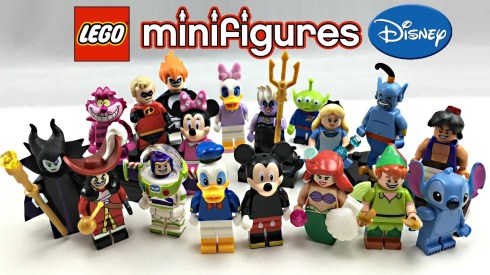
Theming a line of figures on the Disney license is almost as broad as creating a line of “People” figures. The Walt Disney Company has been putting out animated and live action films for nearly a century. The company has its own television station full of original programming, plus it owns Pixar, Marvel, Star Wars, and ABC to name a few. And since Lego already makes Star Wars and Marvel sets, it stands to reason that their Disney themed wave of mini figures could include those franchises if it wanted to. What it really means for Lego is that its first wave of Disney mini figures is an amalgamation of a few popular Disney properties. The first set of 18 Disney figures contains popular Disney creations like Mickey Mouse and Donald, characters from classic animated films like Aladdin and Peter Pan, and also a few Pixar figures to round things out. There are likely fans out there who would have preferred it if Lego stuck to the classic animated films, or maybe even just the Mickey and friends line, but Lego opted to try to please a wide consumer base.

IMG_0256

A motley crew of Disney plastic.

As someone who likes Disney and is married to a woman who LOVES Disney, it meant i had to collect this line with the same vigor as I did with The Simpsons. The wave hit retail on May 1st, though a few lucky individuals probably found them earlier. Like other mini figure waves, this series is released in blind bags so the consumer doesn’t know what they’re buying, unless they’re willing to sit and prod at each bag to feel the figure out. As Lego did with The Simpsons, they’ve chosen to make custom head sculpts for a lot of the Disney characters, basically all of the non-humanoid ones. That means finding Mickey and Minnie when groping a plastic bag is actually pretty easy, same for Sticth as well as the ducks, Donald and Daisy. I actually found the entire wave pretty easy to feel out and went a perfect 18 for 18 with my purchases. Now, if only I had better luck at finding the figures at big box retailers. Stores like Target and Toys R Us sell each figure for 3.99 a piece, but I got stuck hitting up specialty shops that charged 6.99. The things I do for love.


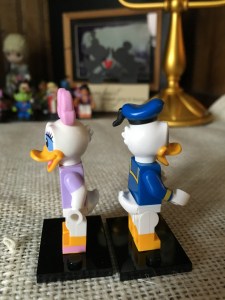
Unlike The Simpsons, these Disney figures are not released alongside any standard Lego sets, which is a bummer. Lego does have a line of Disney centric Lego Friends sets which focus on the various princess characters. The Friends line is Lego’s girl line, because apparently girls can’t handle traditional mini figures and bricks, and it’s clear Lego avoided duplicating characters it had already released as part of that line. The set of 18 is mostly free of the princess characters, with the exception of a mermaid Ariel. Alice from Alice in Wonderland is also included, but I don’t think she’s ever been considered a “princess.” From the Mickey and Friends collection, we have Mickey, Minnie, Donald and Daisy. Any Disney fan immediately sees that list and says “Where’s Goofy?!” He’s missing in action here. The four who are included look pretty good though. Donald and Daisy even have a little duck “butt” piece which is pretty funny but also pragmatic. Mickey is kind of dull though as he comes with no unique pieces or accessories. He doesn’t even have a tail! That’s a problem I’ll address later as it’s a recurring problem. Not the tail, but the lack of accessories to go along with these figures.
IMG_0257

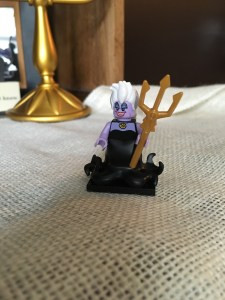
Ursula’s got it going on.

From the Disney animated classics group of films, there’s the following:  Alice, Cheshire Cat, Maleficent, Peter Pan, Captain Hook, Stitch, Ursula, Ariel, Aladdin, and the Genie. All are done fairly well, though characters like Aladdin and Pan suffer from being a bit too conventional and kind of boring in appearance. Genie suffers a little in that he’s fairly unique, but the efforts made to convey that don’t work so well. Instead of getting a more unique sculpt, he’s actually a standard mini figure with add-on pieces to round out his look. He does have a “ghost” lower body which is kind of neat, but he still doesn’t really look all that much like the Genie from Aladdin. Plus Lego got really cheap with his gold cuffs and only painted half of his wrist. Maleficent is unique in that she doesn’t have legs, but a triangular block for a base to simulate her robes. It works pretty well as a visual, though it’s probably not fun for kids to play with. Ursula is definitely the cream of the crop as she gets a uniquely sculpted lower body that looks great. Ariel does as well, but her tail is rather blocky and unappealing to look at. I get that Lego is supposed to be blocky, but there’s just something off with Ariel’s look.
 

IMG_0258

The piece Lego fanatics have been waiting years for:  duck butt.

Pixar is also featured, albeit in a minor way. There aren’t many Pixar characters that would work as Lego mini figures, but Lego did pick some suitable ones. From Toy Story, there’s Buzz Lightyear and the Alien, and from The Incredibles we have Mr. Incredible and his foe Syndrome. Buzz is the star of the four. While he doesn’t quite look like the Buzz we know and love, the unique pieces included give him a lot of personality. The Alien gets a unique head sculpt and looks fine, while Mr. Incredible and Syndrome look about as good as they can, though they’re a little boring. I don’t dislike any of the four, and actually really like Buzz, but I am left wishing Lego had stuck with more conventional Disney properties and gave Pixar its own wave.


With any release like this, it’s easy to zero in on what’s missing. Properties like Pinnochio, Snow White, and The Lion King are synonymous with Disney but not represented here. There’s also a lack of quality accessories that’s kind of disappointing. Mickey comes with none, when he should come with Pluto. He could have come with some clothing type accessories like his sorcerer’s hat, something which is better than nothing. Ursula comes with King Triton’s trident but not his crown, and Ariel comes with an oyster shell with a pink jewel in it. Maybe I need to watch The Little Mermaid again because I don’t remember that amongst her many treasures. I’d rather she come with a fork, I mean, dinglehopper, though a Flounder would have been better. Stitch, Cheshire Cat, and the Alien all come with no accessories, and Aladdin and the Genie both come with the same lamp. Couldn’t Aladdin at least have come with a black Jafar’s lamp? These figures aren’t really all that cheap, the least Lego could do is make sure each character has at least one appropriate accessory to round them out.
IMG_0259

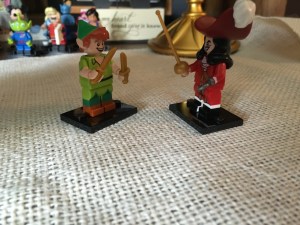
Pan looks kind of bloodthirsty, not that Hook looks like any less of a maniac.

Criticisms aside, I do think this is a pretty solid wave of mini figures and a nice start for the Disney line. I assume there will at least be a wave two and I’m hopeful Lego will explore some Disney sets, especially if they’re based on Disney World or Disneyland. As far as a potential wave 2 is concerned, I would assume some characters are no-brainers. Goofy, Woody, and Jessie seem like locks. Near locks would include Mrs. Incredible, Frozone, and Jafar. If Lego really wants to stick with the films its already touched upon, then characters like King Triton and the Queen of Hearts certainly have a shot as well. I’m hopeful that Pinnochio and Jiminy Cricket get a look, and a Beast and Gaston would be pretty awesome. It’ll probably be nearly a year before we know what’s to come, but until then it will be fun to speculate.

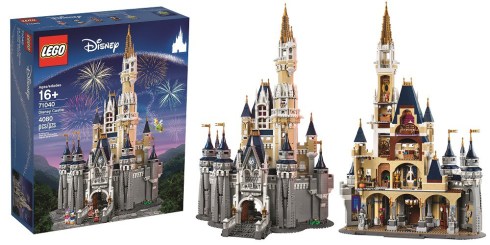
UPDATE:  Well it took Lego a few months to unveil it, they did indeed confirm a Lego version of Disney World’s iconic Cinderella Castle is coming this September. It will retail for $350 (ouch!) and total over 4,000 pieces and come bundled with 5 mini figures. Making her traditional Lego debut will be Tinker Belle and she’s joined by a tuxedo-clad Mickey, a red polka-dot version of Minnie, a pink version of Daisy, and Donald, who appears to be identical to his previously released figure. It looks pretty slick, and it’s hard to argue with the character choices. The castle interior looks like it will be full of easter eggs, and possibly hints for future mini figures, and the only initial piece of criticism I could offer is the depth of the castle looks shallow. It likely would have benefitted from a hinged design to make the base at least appear bigger. Aside from that, it’s a nice piece of eye candy and something I’m going to have to buy for my Disney-obsessed wife.LEGO_71040_fi


The Sword in the Stone

SwordintheStonePoster

The Sword in the Stone (1963)

Walt Disney’s The Sword in the Stone has the distinction of being the final animated film released during Walt Disney’s lifetime. It was also just the second feature completed using the Xerox process introduced with the previous film One-Hundred and One Dalmatians. Given that it was the final animated feature Walt laid eyes on, it’s a bit surprising that the film isn’t more well-known. It’s not considered one of the studio’s classics, being relegated to that second tier of features that isn’t considered worthy of a “Diamond” release on home video. Based on the novel by T.H. White, The Sword in the Stone tells the tale of a young King Arthur and his tutoring by the wizard Merlin to prepare him for when he sits on the throne. There are numerous elements of fantasy and it’s a tale familiar to Disney fans in design as it follows a young misfit’s rise to importance through self-discovery. In a way, it’s like the male-equivalent of a Cinderella.

The story opens with a montage focusing on the death of Uther Pendragon and the tale of his sword which was magically sealed in an anvil and only the true ruler of England can remove it. We’re then soon introduced to our unlikely hero, Arthur, who goes by the name of Wart. Wart is an orphan taken in by Sir Ector and his ambition is to one day squire for his foster brother, Kay. Similar to Cinderella, Wart is treated like a servant by his foster family often forced to clean the kitchen and do household chores while Kay is being steered towards knighthood by his father. Sir Ector dangles the potential of being Kay’s squire as a carrot for Wart, but it would seem the old knight has no real intention of letting the boy actually serve in that capacity, preferring someone of noble birth for his true born son.

images-218

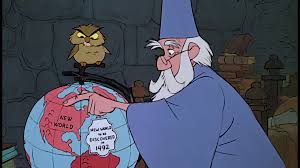
Archimedes, Merlin’s crotchety owl, steals many of the scenes he is in.

Fortunately for young Wart, he has Merlin looking out for him. The old wizard has been to the future and back numerous times and has foreseen the coming of Arthur, right down to where Wart will fall through his roof for their first “chance” encounter. Merlin is not quite a bumbling old wizard, but he is a bit forgetful which at times gets the duo in trouble when he needs to recall the words to an important spell. He is accompanied by his owl, Archimedes, who in true Disney fashion is fully capable of speech. Archimedes is a grumpy sort but incredibly intelligent, often foreseeing the trouble Merlin is about to get himself into. Despite his prickly nature, he is a loyal pet and does look out for Merlin, and eventually, Wart as well.

Merlin is forced to endear himself to Sir Ector in order to serve as Wart’s tutor. He’s permitted to inhabit the old tower outside the keep, which is badly in need of repairs. The bulk of the film consists of Merlin trying to teach Wart lessons that will serve him well as king in the future, often by way of changing Wart into another creature to experience nature from another perspective. This is how the film sources its various gags as Wart becoming a small fish inevitably leads to him being viewed as food by a hungry predator. The best gags probably occur when Merlin changes the two into squirrels and an eager female takes a liking to Wart. These scenes are fairly light and innocuous and Disney tries to incorporate some danger into them, though the characters rarely feel like they’re in true peril. The film also doesn’t take many risks with its humor, often resorting to the simplest of jokes which contributes to the film’s safe tone. The climax of the film actually arrives rather quickly with little fanfare or much teasing of the outcome giving the film a rather abrupt ending. It’s not all together unsatisfying, but the film could have perhaps lingered a little longer with the fallout of Arthur pulling the sword. Once again, this invites a comparison to Cinderella in how that film is essentially over once she puts on the glass slipper and we don’t really see the fallout with her step family.

images-219

The film sources a lot of its humor from the repeating gag of Merlin having some object or knowledge of the future.

Narratively speaking, The Sword in the Stone is a simple tale that’s not likely to offend, but also not likely to delight in the ways some other Disney films do. When the narrative is a bit lacking, these films turn to two important components: their looks and their songs. The Sherman Brothers contributed to the film and it’s not one of their best efforts. Merlin’s song, “Higitus Figitus” sounds like a “Bibbidi, Bobbidi, Boo” knock-off that’s not nearly as charming. The best sequence is probably the villainous Mim’s number “Mad Madam Mim” but it’s not exactly memorable when compared with other Disney tracks. Being that the film was done with Xerox, it’s also not as attractive as Disney’s best, but it is a step-up from Dalmatians. The backgrounds have a bit more personality, though there are scenes of flat, monochrome, backdrops that feel lazy. These are mostly reserved for some of the interior shots as the exterior ones look quite good. They’re not on the same level as Bambi, and The Jungle Book would do better, but they’re perfectly fine to look at. The characters have a sketch quality to them, a hallmark of the Xerox process, but it seems to suit the subject matter of the film better here than others. The film had the opportunity to add some nice visual effects for all of the transforming scenes, but chose the easy way out and just had the characters vanish in a puff of smoke only to reappear as a fish, squirrel, etc.

images-220

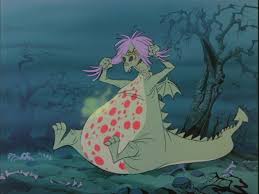
Because every film with swords and wizards needs a dragon.

If you head over to Amazon.com and check out reviews of the Blu Ray release, you will see a lot of negative ones regarding the film’s transfer. I view all of the my movies that I review on Blu Ray on a 55″ LED television and I use a Playstation 4 to watch them. I found my viewing experience to be fine so maybe I’m not as big of an animation snob as I thought. I also do not own the film’s older DVD release so I can’t compare the two. It’s possible people are just sensitive to the scratchy Xerox look now that it’s being presented in high-definition, and being one of the older films, The Sword in the Stone has minimal clean-up in that regard. This film also did not get a Diamond release, so I don’t expect it to look as good as something like The Jungle Book, so maybe expectations should be held in check. Simply put, if you decide to purchase this film and find it’s not up to your standards you can always return it.

The Sword in the Stone is a rather basic entry in the Disney catalogue. It can entertain kids and adults but only so much. It’s probably rare to find the fan that says this is their favorite Disney film, but it’s also probably just as hard to find someone who detests it.


Nausicaä of the Valley of the Wind

220px-Nausicaaposter

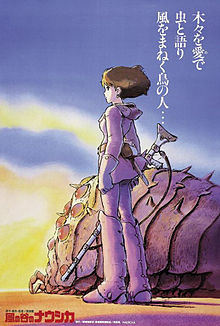
Nausicaä of the Valley of the Wind (1984)

Studio Ghibli is a cultural institution in its native Japan. It’s credited with the anime revival of the 1980’s and for popularizing the form in and outside of Japan. Many of its films have gone on to influence not just anime, but other works of animation as well with its characters even making cameos in Pixar films. Studio Ghibli was officially founded in 1985, but many consider its beginning to be with the film Nausicaä of the Valley of the Wind. Released in 1984, it was directed by Hayao Miyazaki and future Ghibli director Isao Takahata was named producer. The film’s success is essentially what founded Studio Ghibli with most of the crew joining the studio.

Nausicaä is a film that almost didn’t happen. Fresh off his well received directorial debut in Lupin III:  Castle of Cagliostro, Miyazaki was approached to direct another feature length anime picture by Animage. Miyazaki came up with the concept for Nausicaä then, but the studio wasn’t interested and the project was aborted. Miyazaki took Nausicaä to the manga form where he was able to build up a fanbase for the property leading to another opportunity to bring the story to the anime form.

nausicaa-of-the-valley-of-the-wind_592x299

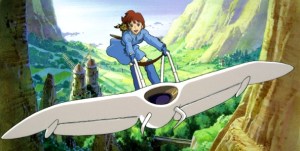
Nausicaä atop her glider.

It’s easy to see why Nausicaä is considered the spiritual beginning for Studio Ghibli. It goes beyond the fact that it’s a feature-length anime production featuring names that would become synonymous with Ghibli. The film, thematically, is very much in line with a great many of Ghibli’s films, most obviously the one’s directed by Miyazaki. The film contains a female protagonist with a Buddhist-like point of view towards nature and the people around her. The film can simply be described as an environmental picture that also strongly endorses pacifism, subject matter that would be covered in other Miyazaki works with the most obvious being Princess Mononoke. The film’s themes are clear and easy for any viewer, even the very young, to pick up on. The film’s themes are so obvious and central to the plot that it’s one of weaknesses as well as Miyazaki would become better skilled at relaying his message in future films with more skill and subtlety. The film’s directness sometimes leads to stilted dialogue and some uninteresting villains.

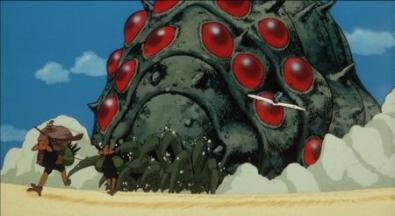
Nausica-of-the-Valley-of-the-Wind-nausicaa-of-the-valley-of-the-wind-27647622-450-247

In the path of an enraged Ohm is not someplace you want to be.

Beyond the film’s sometimes amateur story-telling, there aren’t a lot of negatives to be had. The film focuses on the princess Nausicaä, who lives in a small dessert village on the outskirts of the poisoned forest. Mankind is forced to live in a world dominated by insects with the most formidable being the massive, tank-like Ohm, following an apocalyptic event occurring a thousand years before the events of the film. These insects are hated and feared by most of humanity and the toxic forests they inhabit slowly kill the people who live close by. Warring factions of humanity eventually bring harm to Nausicaä’s home with her people becoming casualties of war when a prison ship crashes on the outskirts of the village. Nausicaä is able to rescue one of the passengers who instructs her to destroy the ship’s cargo: the remains of a Giant Warrior which brought about the apocalypse of a thousand years ago. The owners of the ship, the Tolmeki empire, come after the ship and its contents bring their war to Nausicaä’s doorstep. The princess is pressed into battle and even takes human life in the process, but it’s all for naught. The Tolmekians, lead by a princess of their own named Kushana, wish to revive the Giant Warrior to destroy the poisoned forest. The village priest deems this unwise as doing so would only incite the Ohm who’s massive stampedes have brought great destruction to humanity in the past.

The Tolmekians are also embroiled in conflict with the Pejite people. Kushana, taking Nausicaä as hostage to ensure the cooperation of her people, and her airships encounter the Pejite which allows Nausicaä to escape. Circumstance forces her into working with a Pejite pilot and the two discover an amazing secret beneath the toxic forest. Nausicaä’s journey becomes one of self-discovery for herself and her world. With few people even interested in understanding the Ohm and the forests they dwell in, she finds herself as the only one who can prevent a second cataclysmic event that would surely doom her people as well as others. The machinations of the film’s plot are easy to follow and easy to predict. Still, the end result is not particularly harmed by this as the film presents a satisfying climax and conclusion for the story.

1280x720-nWq

Nausicaä of the Valley of the Wind (1984)

As a protagonist, Nausicaä (voices by Alison Lohman in the english dub) is easy to like and understand. Her sense of adventure is contagious and represented most by her mastery of a unique jet-propelled glider she often zips through the sky on. She has a special empathy with nature which is shown early in the film. She’s fearless and possesses a strong conviction for what is right. She kills early in the film out of rage and self-defense and is affected by it. Through her actions we can see she would make an excellent killer if that was her aim, but chooses a different and noble path. Her closest ally is the sword master Lupa (Patrick Stewart), who also seems to embody a form of pacifism as we don’t see him kill in his parts of the film, though we see him demonstrate his incredible talent with a blade in each hand. Asbel (Shia LaBeouf), the Pejite pilot Nausicaä befriends, is our set-in-his-ways character who learns to see the world through a new lens during his trials. He’s the character most affected by Nausicaä and her outlook on life.

The film is set with many suspenseful moments like daring escapes from doomed aircraft and stunning rescues. Much of the film takes place in the air as the most prevalent piece of technology in the film are the massive airships piloted by the Tolmekians and Pejite. Anyone familiar with Miyazaki’s works know he’s a lover of aviation so it’s not surprising to find it here. When the film is not in the air the setting either shifts to vast desserts or the wondrous toxic forests. The forests are portrayed in cool shades of green and blue with mostly imaginative looking flora, some of which looks like it belongs under the sea. The look of the film is a bit dated, which should be expected of a thirty-year old picture. Still, it’s not unpleasant to look at and it still has some wonderful moments. The audio is also a bit dated, mostly in the sound effects department, but the score (Joe Hisaishi) is easily the part of the film that best stands the test of time. The english dub is also handled well by Disney and the Blu Ray release contains the Japanese audio for purists.

Anime fans owe a great deal to Nausicaä of the Valley of the Wind. Not only did its popularity and success in Japan help to pave the way for future anime releases, but its butchered original western release helped to convince Miyazaki and others to oversea the localization of future films. Studio Ghibli’s famed “no cuts” policy is born from Nausicaä and I think all fans of animation can agree that’s something we’re all happy is in place. It’s hard to separate a film, or any work of art, from its legacy, but in doing so Nausicaä still holds up us a nice picture worthy to rest in the library of Miyazaki and the Studio Ghibli films. As a legacy piece, it’s a fascinating look at the beginnings of a great director and a fun piece of nostalgia for animation buffs around the world.


#2 – Mickey’s Christmas Carol

mickeys-christmas-carol-1983

Mickey’s Christmas Carol (1983)

Mickey’s Christmas Carol marked the return of the most famous cartoon mouse to the big screen for the first time in 30 years. Once a staple of the cinematic experience, Mickey had been pushed aside for other characters (namely Donald Duck) and live-action features. It had been even longer since Mickey, Donald, and Goofy had all appeared in the same short.

Mickey’s Christmas Carol was released in 1983 along with the The Rescuers. As shorts go, it’s actually pretty long, which has helped it over the years in being shown on television because it fits easily into a standard half-hour time-slot. Mickey’s Christmas Carol also goes against one of my personal tenants of Christmas specials which is to avoid adaptations of A Christmas Carol and It’s A Wonderful Life. That’s often the path of the lazy, but Mickey’s Christmas Carol benefits as being one of the earlier adaptations, and for some reason, it just works.

The story is obviously familiar to most people. It’s a pretty straight-forward retelling of the Dickens classic just with Disney characters acting out the parts (only the animal characters though, no humans allowed). The cast features the old popular ones of Mickey, Donald, Goofy, and Minnie while also mixing in cameos from The Winds in the Willow, Silly Symphonies, and Robin Hood, among others. This is also the first short to feature Scrooge McDuck as the character he was born to play. He’s voiced by Alan Young, known to audiences as Wilbur from Mister Ed, who has continued to voice the character even into his 90’s. Another debut is Wayne Allwine as Mickey Mouse, just the third voice actor to portray the character. Clarence “Ducky” Nash also gets a final opportunity to voice Donald Duck, before the character would be passed onto Tony Anselmo. As a result, Mickey’s Christmas Carol feels like a really important short in the company’s history as there’s a lot of historical significance that can be attached to it.

Mickeys_christmas_carol_9large

Gets me every time.

All of that stuff is great, but it wouldn’t matter if the story sucked. Instead, the story is told in a brisk, but not rushed, manner. The shots that need to linger, linger, and the ones that can be hurried along are. The animation is vintage Disney, with Scrooge walking home in the snow from his counting house probably my favorite shot. All of the right emotions hit, and Scrooge’s transformation from miserable miser to benevolent boss is done in a believable way. Just try to suppress the lump in your throat when Mickey is seen crying at the grave of Tiny Tim in the flash-forward. That sight would transform any man!

Mickey’s Christmas Carol has a special place in my heart. It was the lead-off special on a homemade VHS tape my mom made for my sister and I when we were really little. As a result, it’s also probably the Christmas special I’ve seen more than any other. Since Disney is omnipresent on television, Mickey’s Christmas Carol is shown quite frequently around the holidays, so hopefully you didn’t miss it this year. It’s also been released multiple times on DVD and Blu Ray, most recently just two years ago. Though if you really want to own a copy of it, I suggest you pony up the extra dollars for Mickey Mouse: In Living Color Volume 2 so you can also enjoy a bunch of Mickey’s other classic shorts.


#11 – Prep & Landing

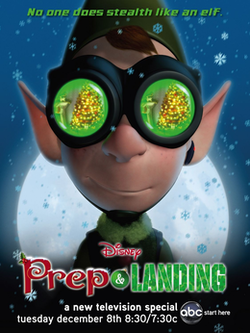
Prep_&_Landing_poster

Disney’s Prep & Landing (2009)

It seems like every year a prominent new Christmas special shows up on television and routinely disappoints. Even Pixar found the going tough when last year they unveiled Toy Story That Time Forgot which I found pretty lackluster. Six years ago though Disney had much better luck with an all knew intellectual property:  Prep & Landing.

It seems like a new Christmas special or film needs to do something different in order to make a mark. The Santa Clause has always been my go-to example as that has become a modern classic by taking a different look at the Santa character. Prep & Landing is similar because it chooses to focus on the elves responsible for prepping a house for Santa on Christmas Eve. It’s a novel concept as no child ever actually sees Santa at work and this special gives them a reason why.

The story follows Wayne (Dave Foley) who has been on the prep and landing team for over 200 years and has just seen his subordinate get promoted. Wayne is one of those quiet professionals who has most likely been most passed over for reassignment because he does such a good job where he is and hasn’t made enough noise about wanting a change. He ends up getting paired with a new, enthusiastic, assistant named Lanny (Derek Richardson) and Wayne basically slacks off and lets Lanny run the show. This causes their assignment to be blown and a storm re-routes Santa away from the house they were supposed to prep. Wayne feels awful since the kid is on the nice list, and resolves to get the house prepped and convince Santa to make the trip.

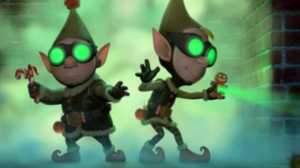
2047586-prep___landing_image__1_

Wayne and Lanny on the job.

Prep & Landing is a CG Christmas cartoon and it looks fantastic. It was basically made in conjunction with the feature film Bolt which is when Disney’s CG really took a leap forward and started to rival Pixar’s. The voice acting is also really good, and there’s lots of little Easter eggs hidden in the background. Prep & Landing was so successful that it’s spawned another half-hour special and two shorts. They’re actually all pretty good, but the first half-hour special is still the best. It’s the creativity that makes it special and the production values are the cherry on top. Since Prep & Landing is still fairly new it’s shown multiple times each Christmas season (and will air on the 17th this year on ABC) and is often paired with the sequel “Naughty vs. Nice.” If you don’t want to wait for it to come on television, or you missed it, there’s also a DVD and a Blu Ray set that contains both specials and the shorts available for purchase.


#17 – A Muppet Family Christmas

Title.mfc

A Muppet Family Christmas (1987)

A Muppet Family Christmas has become an almost mythological Christmas special due to its limited availability. First debuting in 1987, it got tangled up in licensing issues shortly there-after and has been infrequently rebroadcast. It also has been released in very limited fashion with a lot of what first appeared in the special being left behind. And now that Disney has acquired The Muppets, a re-release on DVD or even Blu Ray seems unlikely so long as Disney does not own the rights to the other properties featured in the special.

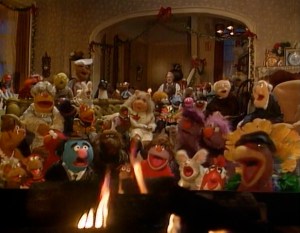
A Muppet Family Christmas was an ambitious special as it sought to combine multiple Jim Henson properties into one special:  The Muppets, Fraggle Rock, and Sesame Street. It starts out rather simply with Fozzie leading the Muppets to his mother’s farm house to surprise her for Christmas. Unknown to him, his mother was planning on heading to Malibu for some fun in the sun for Christmas and has rented her home out to Doc and his dog Sprocket for the holidays. Doc is seeking a nice, quiet, Christmas and he gets anything but that when The Muppets arrive. It turns out, Fozzie also invited the Sesame Street gang which just adds to the overcrowded house, and Kermit and Robin discover that the Fraggles live downstairs. An impromptu concert breaks out with Electric Mayhem and Sesame Street also stages a play. A horrible blizzard descends on the house trapping everyone in there, but when Miss Piggy fails to show up it’s up to Doc to go out and find her.

tumblr_ng7y9ctkzg1qzkq0co4_1280

That’s one packed house.

Aside from the mash-up of properties, the special is most known for its inclusion of several musical numbers. The special is basically over-stuffed with them, especially at the end, and it almost feels like one of those old sing-a-long VHS tapes. The combination of The Muppets and Sesame Street actually works pretty well and lends itself well to some jokes. Henson and his writers weren’t shy about poking fun at their educational property, probably knowing that if they just played it straight the results would be kind of dull. There’s nothing vulgar by any means, or even mildly offensive, so the property isn’t hurt at all by it. The Fraggles are kind of tacked-on, and since they only interact with Kermit and Robin, their segment is a bit dull. As usual, the funnier members of The Muppet clan do the heavy lifting here and mostly succeed at drawing laughs.

At this point in time, A Muppet Family Christmas’s reputation likely exceeds its true value, but it’s still a unique and entertaining Christmas special. At least until you get to the end and the nonstop caroling becomes tiresome. Kids might like that though.

As I mentioned in the lead-in, this one is pretty tough to track down these days and is no longer broadcast on television. An edited DVD was released over ten years ago, but if you want to see it as originally constituted, you may need to turn to Youtube where people (like me) who were fortunate enough to have recorded the original special in ’87 have uploaded it for all to enjoy.


#8 Best in TV Animation: Gargoyles

disney-has-gargoyles-legally-streaming-on-youtube-socialWhen I started this feature I swear I did not intend to list the best cartoons aimed at children, that’s just how it’s worked out so far. I promise the next few are going to trend older. That said, Gargoyles is a pretty terrific show whether you’re 8 or 18. The show borrowed heavily from comics and was obviously influenced by the likes of Batman and X-Men. Like most cartoons geared towards boys, the show featured plenty of action but also contained plenty of drama. It asked a lot of its viewers, opting for a more serialized narrative structure with numerous callbacks to older episodes. Sometimes, plots required multiple episodes to develop and pay-off which is probably one reason why the show aired weekdays as opposed to Saturday mornings (though the final season was moved to Saturdays). Lastly, as a Disney produced and developed cartoon show, the program featured slick animation and stellar production values all around.

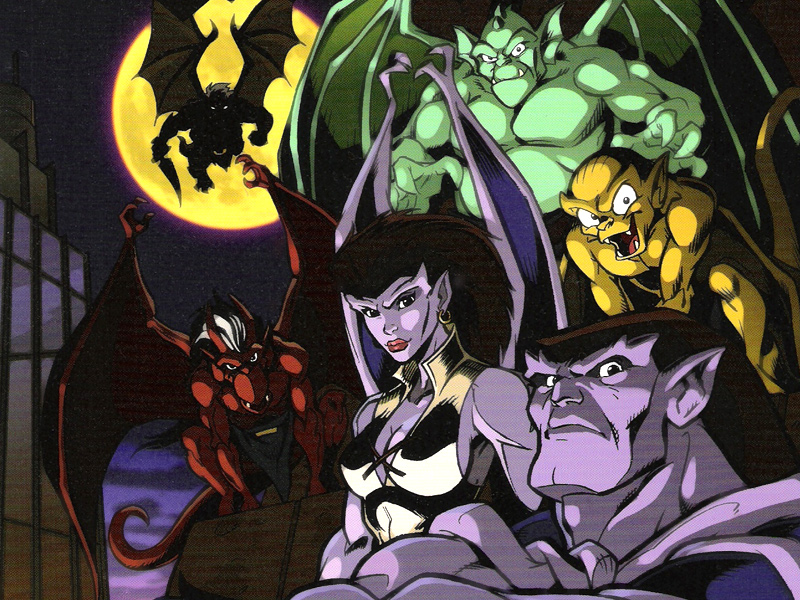
Gargoyles first began airing in 1994 and centered around the character Goliath, the leader of a clan of Gargoyles displaced by time and forced to adapt to life in New York City. The premise for the show was established over the first five episodes and the lore of the world is firmly established here. Gargoyles are beast-like creatures that are active at night, and stone by day. During the middle ages they protected a castle inhabited by humans in Scotland but were betrayed with most of the gargoyles destroyed while they slept. Magic is also a part of this world, and the remaining gargoyles that survived the attack were placed under a spell that would keep them stone until the castle they inhabited rose above the clouds. Of course, this would happen when a man by the name of David Xanatos purchased the castle and placed it atop a skyscraper in New York.

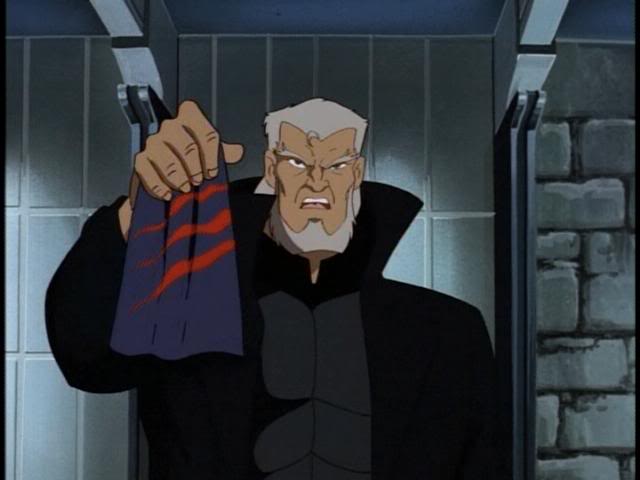
MacBeth is one of the more prominent antagonists in the series.

MacBeth is one of the more prominent antagonists in the series.

Over the resulting episodes, the gargoyles would come to view Xanatos as an enemy, as well as many others. Surviving outside of the curse is Goliath’s old flame, Demona, a female gargoyle who is like the Magneto to Goliath’s Xavier. She wishes to exterminate humanity while Goliath sees value in forging alliances with people and serving as their protectors. Goliath and his clan, consisting of fellow gargoyles Hudson, Broadway, Lexington, Brooklyn, and Bronx, forge a bond with detective Elisa Maza and basically become protectors of New York. They don’t run around like Batman, but their presence draws out and attracts the attention of various foes, many from the past. Some are more interesting than others. Throughout the series, Demona is a worthy foe for the clan. She’s ruthless and cunning, and even though she often finds herself on the losing side the writers manage to maintain her credibility as a villain. MacBeth is another stand-out foe. He and Demona share a bond as a result of a curse and neither one can die unless the other is killed which makes for an interesting dynamic. MacBeth is no friend to Goliath and company, leading to numerous instances where the gargoyles are caught between MacBeth and Demona, who despise one another.

Stylistically, the show is quite dark. This is to be expected since the primary protagonists are only active at night. The gothic influence in the look and music invite comparisons to another well-regarded cartoon; Batman: The Animated Series. So natural was the likeness that Batman producer Bruce Timm was asked about the show more than once and was said to be not a fan of Gargoyles. The tone of the show was certainly quite serious, even melodramatic. The serialized nature of the show and the human/gargoyle dynamic make it seem more comparable to X-Men, particularly the first two seasons. There’s even a beauty and the beast vibe going on (and the allusions were quite literal in one episode) between Elisa and Goliath. Their relationship starts off professional early on and gradually develops into something more. If you’re looking for pay-off though, you’ll have to consult the not safe for work fan-fiction of a few a diehards (you may want to enable safe search between doing a google image search of Elisa and Goliath) scattered across the internet.

Goliath and Elisa share a bond bordering on love that only intensifies as the series goes on.

Goliath and Elisa share a bond bordering on love that only intensifies as the series goes on.

One thing that Gargoyles did that I can appreciate is that it added to its cast. In X-Men, several mutants and other heroes would cameo on various episodes. These characters, like Archangel and Nightcrawler, were members of the team in the comics but would never join the roster on the television show. This used to bug me, though I understand why the show runners would want to try and keep the cast as manageable as possible. Gargoyles expanded its roster during the second season and it was cool to see. Villains were also eliminated or changed while others, like Xanatos, would become grayer as the series progressed.

Where the show opens itself up for criticism is within its tone and scope. Two things that I consider a strength, do sometimes bog it down. The show is so grim at times it feels joyless. There’s moments for comedic relief but not a lot when compared with contemporary programs. The show also became burdened with the lore it created, particularly during the last half of season two, and sometimes the show felt like it was becoming too big for its own good. It’s no surprise that the show kind of fizzled out towards the end and the final third season is rather poor.

Gargoyles earns its place on my list of top animated television shows because it scores very well across the board, even though it doesn’t quite knock-it-out-of-the-park in any one category. Though maybe I should amend that last sentiment because I’ve underplayed how stellar the animation is for a televised program. The first season especially is borderline feature-film worthy, which is something Batman can’t even boast. Gargoyles is a really unique program when compared with the other Disney Afternoon shows and it would be nice to see Disney try to revive the franchise in at least a small way (cough KingdomHeartsThree cough).

If you’re interested in reading more of my thoughts on Gargoyles, you can fine reviews for the three DVD releases here, here, and here as well as read my arguments for why it should be included in a popular gaming franchise here. Enjoy.


The Princess and the Frog

The Princess and the Frog (2009)

The Princess and the Frog (2009)

When Walt Disney unveiled Snow White and the Seven Dwarfs back in the 1930’s, many critics saw the move as a foolish one. Who wanted to pay to see a feature-length cartoon? Apparently, many folks as Snow White became one of the most successful movies of all time. Ever since, Walt Disney Productions has specialized in feature-length animated films with fifty-three produced and released to theaters, not to mention numerous direct-to-video films and television specials. Ever since 2004’s disappointing Home on the Range, all of the Disney films have undergone a major change. The traditional hand-drawn animation of classics such as Snow White, Pinocchio, and Bambi have been abandoned in favor of computer-generated characters. When CG movies started showing up in the 90’s the medium was met with skepticism, but following the success of Pixar’s Toy Story, it became apparent that CG was the future of animation. Still, few could have predicted CG would reduce hand-drawn animation to near extinction. And with Pixar and Disney partnering up, it seemed like Pixar would be the vehicle for CG animated films while Walt Disney Animation Studios would continue to churn out the more traditional stuff. That was not to be.

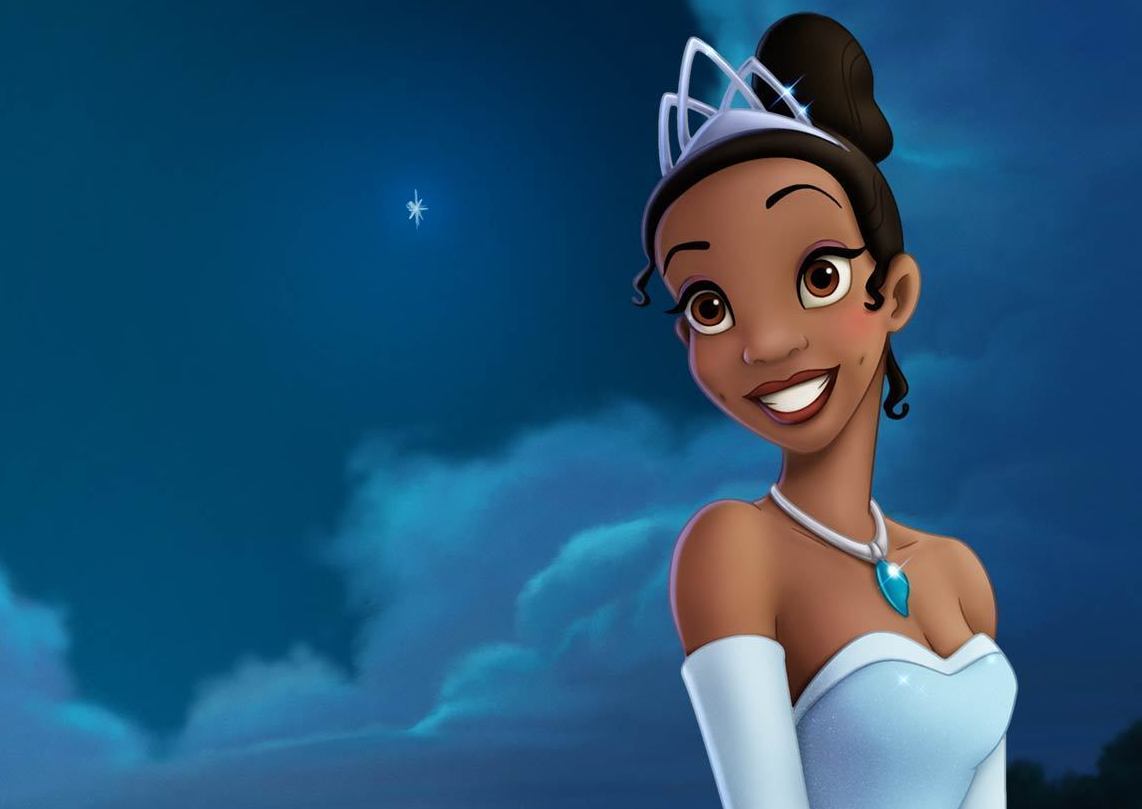
When Disney first announced The Frog Princess in 2007 it came as a surprise. Disney had previously declared 2-D animation dead in ’04 and for a new hand-drawn film to show up just three years later was definitely unexpected. The film, which starred an African-American girl from New Orleans named Maddy, was also met with a whole bunch of criticism from various groups. If Disney had thought a non-white female lead would garner it lots of positive press it was unfortunately mistaken. Having a black lead seemed to place a microscope on the film and the early press package was nit-picked to near death. The setting, the main character’s name, occupation, the ethnicity of the film’s prince – all received some criticism. Even the film’s title was somehow offensive to French people. To Disney’s credit, a lot of the criticisms were taken to heart and applied to the film. The new title became The Princess and the Frog. The main character was given the name Tiana and made a waitress and Oprah Winfrey was hired as a consultant. What was not changed was the setting which the directors felt was important to the story. Other criticisms, such as a black man for the villain, were also kept. This didn’t free Disney from further criticism though, but at least it showed the company was sincere.

Tiana's ethnicity was cause for celebration in some circles, but it also opened her up to more scrutiny than usual.

Tiana’s ethnicity was cause for celebration in some circles, but it also opened her up to more scrutiny than usual.

With the hand-drawn animation decision out of the way, directors Ron Clements and John Musker (Aladdin, The Little Mermaid, The Great Mouse Detective) also wanted to bring back more traits of the old Disney films. The Princess and the Frog was based off of a fairy tale, The Frog Prince, and a retelling The Frog Princess, using elements of both. It was also decided the film would be a broadway-style musical like the films of the 90’s. For the film’s look, producer John Lasseter wanted the animation to draw comparisons to Disney’s Lady and the Tramp, which he considered to be the pinnacle of Disney animation. Many veteran animators who had been laid off following the decision to abandon hand-drawn animation were re-hired, and Disney’s outdated CAPS software was replaced by Toon Boom Harmony. The film was cast, and production was underway.

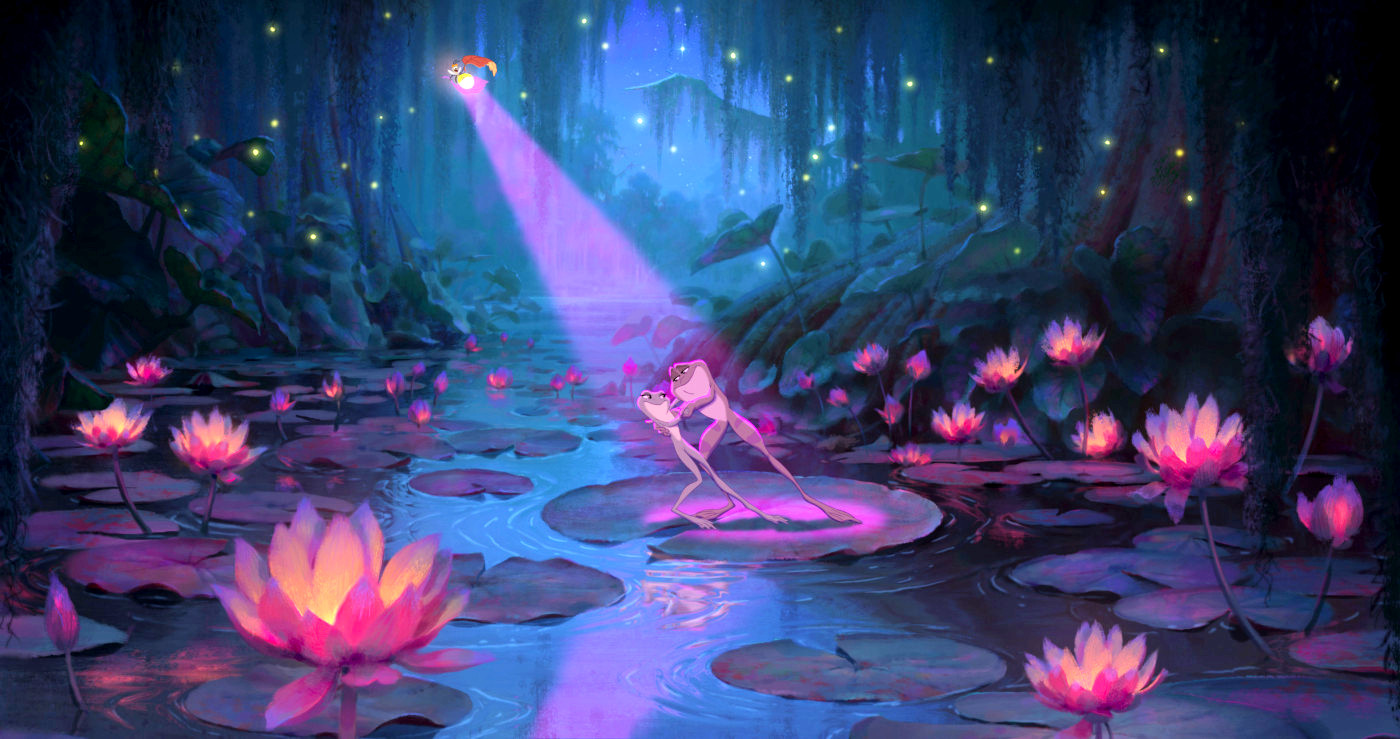
As expected, a modern hand-drawn animated film from Disney looks spectacular. The Princess and the Frog is Disney’s sharpest looking production to date. The animation is warm, fluid, and full of personality. The backgrounds are astonishing and are so much more alive when compared with the animated features that came before it. The film was produced using actual sheets of paper as opposed to having the animators draw on tablets and many of the film’s backgrounds are painted as well. CG effects are applied for smoke, shadows, and other lighting. If the film has one visual drawback, it’s that some of the objects look flat against the expressive backgrounds. This limitation is contained to background characters, but is noticeable at times. Otherwise, the film looks fantastic and is a true love letter to the animated films of old.

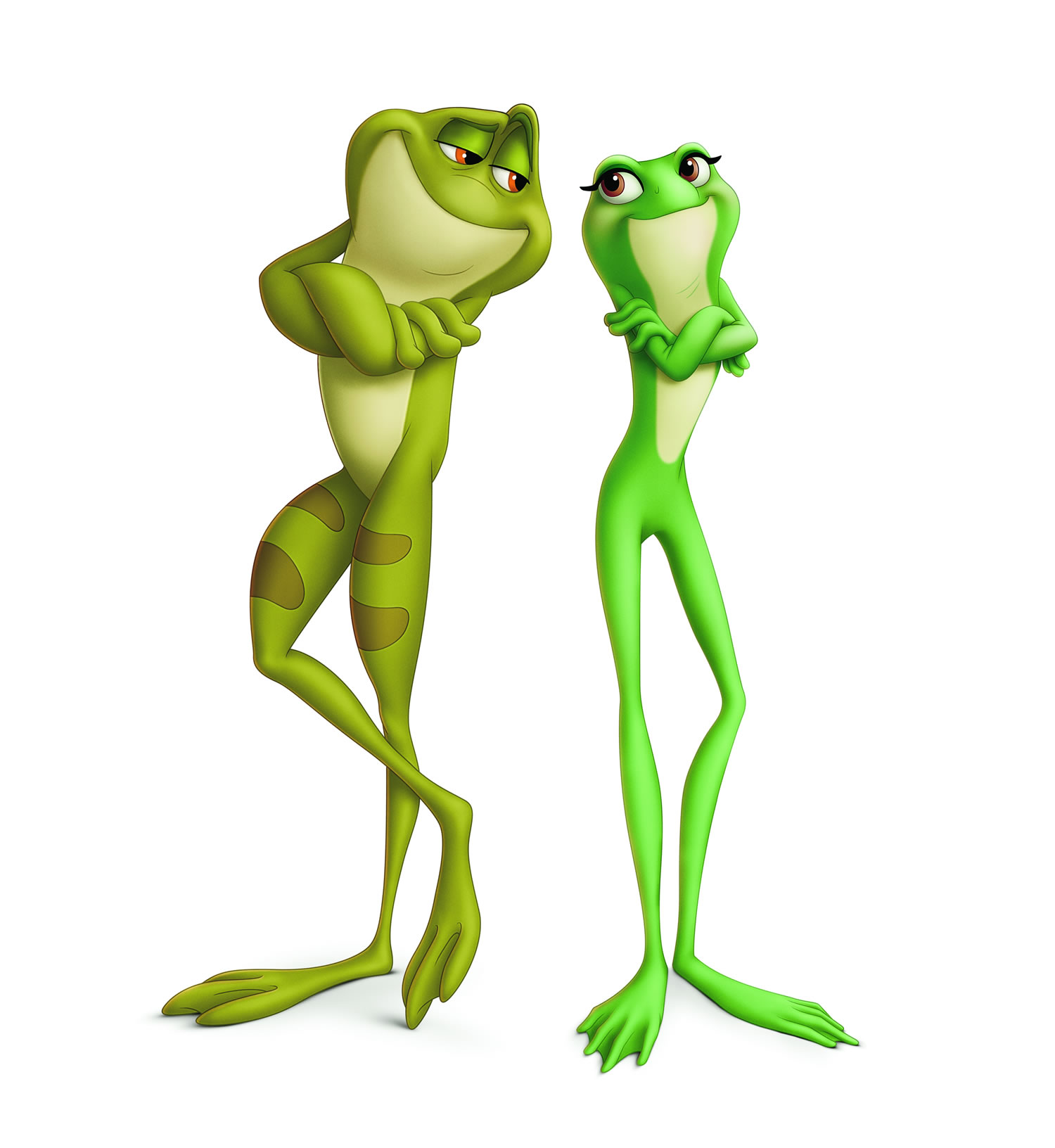
For the frog versions of the two leads, Disney wanted their look to draw from the example set by Jiminy Cricket: make the characters pleasing to look at as opposed to realistic.

For the frog versions of the two leads, Disney wanted their look to draw from the example set by Jiminy Cricket: make the characters pleasing to look at as opposed to realistic.

The plot unfortunately is not the equal of the animation. While the performances of the actors involved is quite good, the actual pacing of the film is pretty ho-hum. Aside from the twist of having the film’s “princess” turned into a frog, it’s fairly predictable. The film’s villain, Dr. Facilier, is basically a bad guy for the sake of being a bad guy. There’s not much depth to him. Tiana is a strong female lead who’s a hard-working girl scraping by with the dream of one day opening her own restaurant. She’s juxtaposed by her best friend, Charlotte, the daughter of the wealthiest man in town who has had everything handed to her. Charlotte’s prime goal in life is to marry a prince so she can be a princess. Clearly, Tiana is expected to fulfill the role of a modern woman (despite the film’s 1920’s setting) while Charlotte is meant to represent the outdated princess of old who is defined by her prince. The film is definitely successful at making Tiana a positive role model for young girls (or really, for any child), but it isn’t done in an organic way. Tiana, either through spoken dialogue or song, is determined to let us know over and over how she has had to work hard for everything she has. And while some of that is intended to be a trait of the character, one does get the feeling the film could have used some more subtlety. Future Disney films would better create a compelling female lead, which isn’t to say that Tiana is a disappointment, she just lacks refinement.

Taken on the whole, the film is an enjoyable adventure thru the Louisiana bayou that feels pretty light-hearted. There’s comedy, and of course, music that is entertaining if nothing else. The fact that the film doesn’t have some big, important, message to convey is forgivable, though the lightness of the tale keeps it from being among the best of the best. The film does shine amongst its predecessors when the film’s music is considered. Written primarily by Randy Newman, it does a good job of taking the audience to New Orleans and the opening number, performed by Newman with vocals by Dr. John, is one of my favorites from any Disney film. I normally loathe the musical parts, and for some of the ones in this film that sentiment remains, but I was surprisingly captivated by a few. They’re not overdone, and unlike the more recent Frozen, I never felt like the music was used as a substitute for dialogue. The film also doesn’t shy away from adding a dangerous element to its villain. Too many parent-centered reviewers will remark that Dr. Facilier is too scary for young kids, but he’s supposed to be scary! What’s the point of a villain that doesn’t come across as a threat to the protagonists? There’s even a death in this film, and I was happy to see there wasn’t some lame cop-out to follow, even though I was expecting one.

There's no denying the film is stunning to behold.

There’s no denying the film is stunning to behold.

The Princess and the Frog was met with positive reviews upon its release and was a financial success. It wasn’t the smashing success of some of the older Disney films, and because of that, the hand-drawn animation wing has been shelved indefinitely. The Blu Ray special features contain numerous interviews with the creators of the film who speak glowingly about hand-drawn animation with an eye towards the future. During the run-up to the film’s release, Disney was boasting that a hand-drawn feature could be expected every two years. The film was released in 2009, and today in 2014, there still hasn’t been another hand-drawn feature from Disney. The Snow Queen, retitled as Frozen, was supposed to be the next hand-drawn feature but was converted to CG and went on to become a massive success for Disney. Who knows if the choice of animation would have had any impact on the finished product. I personally do not feel the general movie-going public is averse to hand-drawn animation or even has a preference. The luster of CG has long since worn off as it has now become the standard. The Princess and the Frog likely did not perform up to expectations at the box office for reasons completely unrelated to its animation style. If anything, the animation style likely drew additional patrons since hand-drawn is no longer the norm. I personally believe the film wasn’t a huge hit because the plot seemed too familiar. Most people have already seen numerous animated fairy tales and a film with the word “princess” in the title probably isn’t going to draw the attention of young boys. Disney’s attempt at creating a modern princess for young girls to look up to effectively alienated them from a large portion of their audience:  young boys. The studio is definitely wise to this as more recent films have opted for a more ambiguous title like the previously mentioned Frozen or Tangled.

It is my sincere hope that The Princess and the Frog is not the last feature-length production from Disney to feature hand-drawn animation. The film is proof that the medium still has a lot to offer and I just find it so much more engaging than CG features. While I love and appreciate much of what Pixar has put out I’ll likely always prefer the hand-drawn look. The sad thing is, as fewer and fewer films and cartoons are done in that style, the people who specialize in it are likely retiring or no longer with us. The younger generation is being raised on CG and lacks the skills to create hand-drawn animation. Hopefully, Disney realizes this and elects to take on the responsibility of keeping the art form alive. Perhaps releasing a hand-drawn feature every other year was too ambitious, but every five years seems like a reasonable goal. With no hand-drawn features announced as of this writing, the future of the medium is very much in question and that’s a shame. The only company that seems to care is Japan’s Studio Ghibli which thankfully continues to output hand-drawn features even with its beloved leader’s, Hayao Miyazaki, retirement. To all lovers of hand-drawn animation, I say treasure The Princess and the Frog, because you may not see another Disney film like it.


Essential Halloween Viewing

When it comes to holiday themed television specials and films, Christmas leads the way with its countless amount. Coming in second is likely Halloween. Unlike Christmas, there usually isn’t some serious undercurrent to Halloween specials. It also feels less sinister when it comes to marketing, even though there’s certainly lots of money to be made off of Halloween by costume and candy suppliers. For the most part, Halloween is just fun and it’s emphasis on scares helps to distinguish it from other holidays. Like many people, I enjoy a good Halloween special whenever the season rolls around, but with so many out there it can be hard to make time for them all in what amounts to only a month. There are some modern ones out there, like the entertaining Toy Story of Terror, but for the most part I like to watch the specials I watched as a kid. Without further adieu, here’s The Nostalgia Spot’s Halloween viewing guide.

Mickey Mouse in “Lonesome Ghosts”

220px-Lonesome_GhostsHere’s an oldie from way back in 1937, something that would have entertained my adolescent grandfather. Since I only discovered it a few years back, it’s not exactly something I remember from my childhood but certainly fits the theme of this blog. In this cartoon, professional ghost exterminators Mickey, Donald, and Goofy investigate paranormal activities in an old house. The twist is that the trio were hired by the ghosts themselves because no one ever enters their haunted house anymore and they’re just plain bored. Less creepy than it is humorous, it’s mostly a slapstick affair as the ghosts play tricks on their would-be exterminators. It’s an entertaining short, and one can’t help but wonder if it maybe partly inspired Ghostbuster, or at least the theme song, especially when Goofy declares, “I ain’t afraid of no ghosts!” The short has been shown on television numerous times over the years as part of Halloween specials. It was also re-released to theaters in the 1960’s and has been released on VHS and DVD as well. The easiest way to see it these days is probably youtube.

Donald Duck in “Trick or Treat”

By the late 40’s and into the 1950’s, Donald Duck was basically the only classic Disney character still receiving new short films. There just wasn’t much money in the format anymore and the budget for each short was scaled back considerably. For the 1952 short “Trick or Treat,” Disney decided to increase the budget to give Donald a proper Halloween special. It has its own theme song and the animation is quite nicely done in comparison with other shorts from around that time. In this one, Donald’s nephews Huey, Duey, and Louie are out trick or treating and come upon their uncle’s house. When the boys knock on his door and request their tricks or treats, Donald (not surprisingly) elects trick. A witch, Witch Hazel, passing by happens to see this and decides to help the boys get their treats out of Donald. Apparently, the Halloween spirit does not include the tricks portion of the ages old phrase. Hazel uses her magic on Donald and a lot of physical comedy follows. Like “Lonesome Ghosts,” this one has been released on VHS and DVD over the years either on Halloween compilations or as a bonus feature with certain films. There’s a chance it could pop up on one of the Disney channels this Halloween, but if you want to see it better head to youtube.

The Real Ghostbusters – “When Halloween Was Forever”

Samhain, the spirit of Halloween!

Samhain, the spirit of Halloween!

A cartoon that centers around four guys (and a ghost) who hunt down paranormal creatures naturally lends itself well to Halloween. Pretty much any episode could qualify for such a holiday, but the episode “When Halloween Was Forever” happens to deal with the holiday directly. This episode features the ghost Samhain, the spirit of Halloween, who decides to freeze time on Halloween night so that it lasts forever. Since Halloween is said to be derived from the Pagan holiday Samhain, it’s a nice touch to name the ghost after it. The Real Ghostbusters was a DIC production and if you’re familiar with any of their cartoons from the 80’s then you likely know what to expect out of the audio and animation. It’s standard for the era, with the soundtrack being appropriately spooky. While no episode of this cartoon can come close to matching the film it was based on, it’s actually not a bad show and time has been far kinder to it than it has the more popular Teenage Mutant Ninja Turtles.

Ren & Stimpy – “Haunted House”

The premise for this one is conventional, Ren and Stimpy stumble upon a creepy looking house and, in need of shelter for the night, decide to head inside. Unbeknownst to them, the house is haunted and a malicious ghost lurks inside who can’t wait to scare them. The twist here is that Ren and Stimpy are seemingly in on the joke as they break the fourth wall and end up impervious to the ghost’s efforts. This naturally frustrates the ghost, to the point that he becomes depressed and suicidal (apparently, ghosts can “die” in Ren and Stimpy’s world). Highlights of the episode include a Psycho shower-scene parody and the previously mentioned fourth-wall breaking remarks (“This looks like a good place to kill 12 minutes!”). There’s also the usual random humor found in a Ren and Stimpy short that people either find amusing or stupid. This one is unlikely to show up on television so anyone looking to watch it will either have to pick it up on DVD or turn to the internet. Be warned, the version found on the official Ren & Stimpy Volume 1 is censored with the Bloody Head Fairy bit removed completely. Apparently it was considered too gruesome after the fact.

Beavis and Butt-Head – “Bungholio:  Lord of the Harvest”

Beavis and Butt-Head on a quest for candy.

Beavis and Butt-Head on a quest for candy.

Sometimes referred to as “Buttoween,” this episode features everyone’s favorite dim-witted duo as they go trick or treating in search of free candy. Since they weren’t even aware Halloween was coming until trick or treaters showed up at their house, the two do not have costumes so Butt-Head covers his head in cheese sauce (“I’m nachos.”) while Beavis wears his underwear on his head (“I’m a nad!”). Beavis eventually has too much sugar and his alter-ego, The Great Cornholio, shows itself. The two soon find themselves on a farm ripped right from a slasher film. Most of the humor comes from watching the two try and get some candy in the first part of the episode, while the second part puts the two in an obvious bad situation that they’re apparently oblivious to. The animation is pretty terrible, but anyone who has seen an episode of Beavis and Butt-Head before should already be aware of this. It’s stupid humor, but it is pretty funny. You either like it or you don’t.

South Park – “Pinkeye”

South Park is more known for its numerous Christmas specials, but early seasons often featured other holiday themed episodes. The first season episode, “Pinkeye,” remains the show’s top Halloween special. In this one, a mishap with worcestershire sauce causes a dead Kenny to turned into a zombie. Kenny, as patient zero, spreads a zombie plague all through-out South Park that a clueless doctor mistakes as a severe case of pinkeye. It’s up to Chef and the boys to put a stop to the zombie menace so they can go trick or treating and get some candy. The episode includes some notable gags such as Cartman’s mom on the cover of Crack Whore Magazine and a memorable parody of Michael Jackson’s “Thriller.” It also features Cartman’s attempt to find a non-offensive Halloween costume.

The Simpsons – “Treehouse of Horror V”

Treehouse of Horror V is best-remembered for its parody of Stephen King's "The Shining."

Treehouse of Horror V is best-remembered for its parody of Stephen King’s “The Shining.”

The Simpsons Halloween special, Treehouse of Horror, has become an annual tradition. With 24 to choose from, some may consider it a daunting task to select only one. As is the case with most things “Simpsons,” the earlier episodes are usually considered the better, and for me, it came down to a choice between Treehouse of Horror II and V. V is just slightly stronger and a little more horror-themed than the more sci-fi II. Treehouse of Horror V features parodies of The Shining, The Sound of Thunder, and Soylent Green. In the first segment, “The Shinning,” the Simpsons are basically dropped into the plot of its source material and includes the memorable line “No beer and no TV make Homer go something, something.” The second segment, “Time and Punishment,” puts a time-traveling toaster in Homer’s hands resulting in Homer unintentionally creating a new present time ruled by Flanders. The third segment, “Nightmare Cafeteria,” has Principal Skinner resort to cannibalism of the student body to cope with budget cuts at Springfield Elementary. If a Treehouse of Horror is able to hit on two out of three, it’s generally considered a good iteration of the venerable television special, but Treehouse of Horror V is the rare one where all three are pretty entertaining. With The Simpsons now being featured on the FXX channel, hopefully a Treehouse of Horror marathon is in the near future. The 25th version of the special is set to air tonight.


Walt Disney’s Sleeping Beauty

Sleeping Beauty (1959)

Sleeping Beauty (1959)

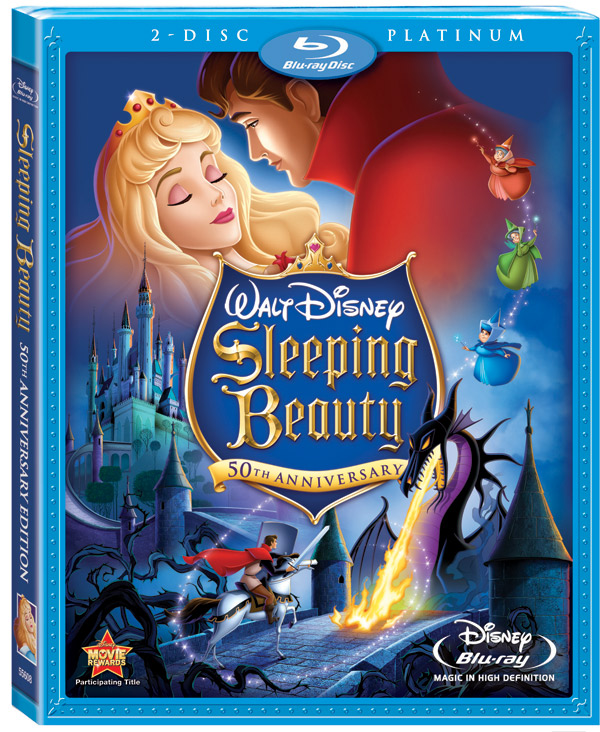
If you played a word association game with random people and asked them to say the first thing that comes to mind when they hear the word Disney I’d be willing to bet that the top three responses would probably be Mickey Mouse, theme parks, and princesses. It’s that third word I’m keying in on for this post as the princess character has seemingly become synonymous with the Disney brand. This is mostly due to the creation of the Disney Princess line of clothing, toys, and such marketed at young girls as well as attractions like the Bibbidi Bobbidi Boutique at the theme parks. This gives off the impression that the Disney films, particularly the golden age unofficially beginning in 1937 and ending in 1967, are overstuffed with princess stories but that’s really not the case. Of the films spanning those forty years, only two star an actual princess; Snow White and the Seven Dwarfs and Sleeping Beauty, with a third, Cinderella, featuring a woman who would end the film a princess by marriage.

In recent times, the princess as a character has become somewhat controversial as many people feel like these characters are poor role models for young girls. Snow White flees her unhappy life in the castle but assures her audience that someday her prince will come and save her. Cinderella, on the other hand, passively escapes her droll existence through her dreams and is too content to wait around for a fairy and a prince to save her from her wicked stepmother. These are admittedly cynical ways to view what are otherwise considered timeless classics. Parents are free to decide what is and what isn’t appropriate for their children but I don’t think kids necessarily take anything from these, aside from maybe that Cinderella has a pretty dress or Snow White a nice singing voice.

As a result of these portrayals, many movie-goers these days want a stronger female lead. And lately, that’s become true with films such as Frozen and even Beauty and the Beast back in the 90s. Unfortunately, in 1959 this trend was still far away when Walt Disney released Sleeping Beauty. If viewers are uncomfortable with the female leads in Cinderella and Snow White and the Seven Dwarfs, well then they really won’t like Aurora.

Some of the backgrounds are truly stunning, but unfortunately give the film a flat look.

Some of the backgrounds are truly stunning, but unfortunately give the film a flat look.

Aurora is the title character of Sleeping Beauty, an animated film more famous for its villain and the castle that inspired the famous one at the entrance to Disneyland than for its lead. Aurora has the misfortune of being cursed at her royal unveiling by the evil fairy Maleficent and is fated to die on her sixteenth birthday. The three good fairies decide to take her into hiding and raise her as a peasant girl in order to hide her from Maleficent and hopefully prevent her curse from becoming reality. Aurora assumes the identity of Briar Rose and lives there until her sixteenth birthday when she meets the charming Prince Phillip, and after sharing a song in the forest, the two decide they’ve fallen in love. Of course, Aurora ends up being lured to that famous spinning wheel by Maleficent where she pricks her finger and falls into a deathlike sleep and only true love’s kiss can ever hope to wake her.

Aurora appears in less than 18 minutes in the film as a result of her coma, leaving most of the screen time to the three fairies; Flora, Fauna, and Merryweather, as well as Maleficent. Aurora has no real personality and is completely defined by her situation and is quite literally dependent on the Phillip character. Phillip, in turn has little personality of his own save for he is a good and just person willing to do what is necessary to save his princess. Maleficent is the true star of the film, though she is pretty much a by-the-numbers villain with a cool look and an even cooler ability to change into a menacing dragon. The good fairies provide some laughs, as do the royal parents of the two leads, but this is a fairly weak Disney film where plot is concerned.

Maleficent has proven over the years that it is she who is the star of Sleeping Beauty.

Maleficent has proven over the years that it is she who is the star of Sleeping Beauty.

For many, these classic Disney animated features are less about the story and more about the look and score. This version of Sleeping Beauty is adapted from the ballet by Tchaikovsky and is appropriately scored. It’s lone drawback from a musical standpoint is the one song sung by the main character, “Once Upon A Dream,” is too similar to Cinderella’s signature “A Dream is a Wish Your Heart Makes” and not as memorable. The scene in which it’s sung is also too similar to Cinderella’s as Aurora dances in the forest with animals of high intelligence. For the visuals, Disney made use of Super Technirama 70, which allows for more detail and complexity in the backgrounds. Walt Disney also wanted the film to separate itself from the previous fairy tales the studio had done and requested his artists employ a sharper look. Aurora’s face is noticeably more angular than Cinderella and Snow White’s rounded look and the backgrounds resemble still paintings as opposed to fully realized environments. The approach comes at a cost as the film has a very flat look to it. The colors are rich though, and I’m reviewing this as a blu ray feature, which help separate it form its peers. This was the last Disney film to use hand-inked cells as the following ones would utilize xerox. I like the direction the studio took, but I do think it needed further refinement to remove that flat look. The image where Aurora is found unconscious after pricking her finger on the spinning wheel is particularly ugly as her body looks like it’s been run-over by a steamroller.

I can't believe this shot made it into the final film. Aurora looks like a piece of paper.

I can’t believe this shot made it into the final film. Aurora looks like a piece of paper.

The standout scene for Sleeping Beauty is unquestionably Maleficent’s battle with Phillip, in which she takes on the form of a massive, black dragon. Prior to that, Phillip is blocked by a massive wall of thorns that are wonderfully illustrated and appropriately vicious looking.  Maleficent’s menacing transformation is foreboding and her green-tinted flames eerie. It’s a classic sequence and among Disney’s top ten. It doesn’t save the film, but is an accomplishment by itself.

When I was a kid, Sleeping Beauty was probably my favorite of the princess movies. That was entirely due to the fact that it had a cool looking dragon at the end while Cinderella and Snow White were boring by comparison. As an adult, I view the prior two films in a much stronger light and even enjoy the both of them. They aren’t my favorite Disney films, but they do charm me. Sleeping Beauty is able engage me visually, but even there it’s a bit of a mixed bag. While I enjoy the art direction and use of color, I find the earlier films from Disney to be overall better visual experiences. As a story, it’s rather bland with uninteresting main characters and little to get attached to. There are some decent funny-points, but nothing gut-busting by any means. Maleficent is the most engaging character defined as much by her interesting visual style as she is by her voice actress, Eleanor Audley, who should have been everyone’s go to voice for evil women. As such, it’s not at all surprising that Disney has chosen to place the spotlight on her for a feature film starring Angelina Jolie. I have not seen the film, but it won’t have to do much to top Sleeping Beauty.