Tag Archives: disney

Castle of Illusion Starring Mickey Mouse (2013)

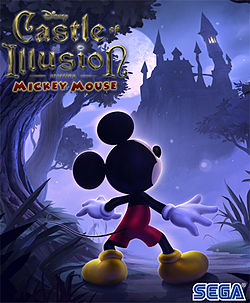
250px-CastleofillusionremakeWhen I was a kid Mickey Mouse was a pretty big video game star. He was always known first and foremost as the official mascot for Disney and its theme parks and for the many cartoons featuring his likeness but he was a frequent star in several video games across multiple consoles. As was often the case back then, Mickey had a different franchise for each of the major consoles. The Sega consoles featured the Illusion series while the Super Nintendo had the Magical Quest games as well as some adventure games for the NES. As the 90’s wound along Mickey started appearing in the same game on both consoles before moving onto the newer machines. Since then his appearances have been cut down, with the Epic Mickey franchise sort of representing a return for Mickey. Even though Mickey was in many games, he never did acquire the reputation of Mario or Sonic (before his reputation was ruined, anyways) and one would be hard-pressed to argue that any of his games were among the best of the era. What they were was usually entertaining and pretty solid.

Mickey was basically a B+ video game star with his hits and misses but his best franchise was probably the Illusion series which appeared on Sega consoles. Developed by Sega, these games were often featured on the Genesis and Game Gear retail boxes as signature games for the consoles. The first was Castle of Illusion and was released for the Mega Drive/Genesis in 1990 with a Game Gear and Master System version to follow in 1991. It starred Mickey as he tried to navigate his way through a castle in order to save his beloved Minnie from the witch, Mizrabel, who was basically the witch/queen from Snow White. A sequel titled Land of Illusion was released for the Game Gear and Master System in 1992 with another sequel to follow on the Genesis titled World of Illusion later that same year. World of Illusion was unique because it starred both Mickey and Donald and featured two-player simultaneous play. Its controls and visuals also represented a noticeable upgrade over the original title and its often viewed as the best of the series.

Castle of Illusion, being an early Genesis title, is somewhat crude by today’s standards. The game’s visuals were never stellar and today they’re almost downright ugly. Mickey has a very jagged, squished look and there isn’t much being animated on him. He’s very sluggish to control and the whole game has kind of a sleepy feel. Still, as an early platformer for the Genesis, it was mostly well received because there wasn’t an obvious Mario clone at the time for the Genesis. Last year Sega released a remake for the Playstation 3 and Xbox 360, and that’s really what this review is about.

The original game was okay looking at the time, but its grainy visuals and squished Mickey haven't aged well.

The original game was okay looking at the time, but its grainy visuals and squished Mickey haven’t aged well.

The 2013 version of Castle of Illusion obviously features greatly enhanced visuals when compared with the original. Mickey looks pretty great and the game is an above average looking title for its respective consoles. It isn’t mind-blowing, but is pleasant. The game mostly follows the same path as the original though it does introduce a castle hub world from which Mickey can access the various levels in the game. It’s a little longer than the original, and the levels are a bit different in spots, but for the most part it’s a pretty faithful remake with better graphics. Sega opted to confine Mickey to a 2D plane when navigating the levels but the boss fights usually occur in a 3D environment, which gives them a different feel when compared to the original game. For the most part, I found the boss fights harder in this game than I did on the original cart while the actual stages might have been a tad easier, with some exceptions.

Unfortunately, Sega did not opt to address what is probably the original game’s biggest short-coming and thats the controls. Mickey is still very floaty and very slow. It took me awhile to get used to Mickey’s timing and early on I had difficulty navigating the easiest jumps as a result. Eventually I got used to it but that doesn’t mean I ever fell in love with it. And these floaty controls get to suck more this time around because Mickey has a third dimension to contend with. Easily the most frustrating point of the game for me was the candy level where Mickey has to jump across floating cookies in a milk river. I felt like I was really fighting with the game to get Mickey onto those cookies and I came close to shutting the game off, but managed to persevere. Some of the collision detection is also confounding, particularly with the game’s second boss the Jack-in-the-Box. I found his boxing glove attack was inconsistent. I basically did the same thing for each attack to avoid it, only sometimes it worked and sometimes it did not. I could never tell what was different as every time it looked like Mickey was basically jumping on top of the glove. The final boss is a little annoying too as she attacks with these ghost things that have a green aura around them making it tough to distinguish between the aura and the ghost (which is also green).
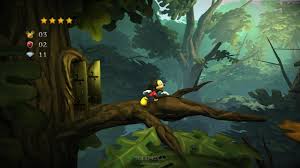
The remake mostly goes for a 2.5D approach and looks well enough for a download only release.

The remake mostly goes for a 2.5D approach and looks nice enough for a download only release.

Castle of Illusion is currently free for Playstation Plus subscribers, which is how I experienced it. My free membership expires this week hence why I didn’t shut it off as I wanted to beat it. I downloaded it mostly because it was free, but also because I had some nice memories of the original and wanted to see what Sega did with it. The original game comes with the download and I can safely say that the remake is probably the better game, though it’s also more frustrating. I can’t really recommend it unless you really loved the original game or have a Playstation Plus membership and can check it out for free. It’s a short game and I managed to beat it in an afternoon. The production values are actually pretty nice and the game’s soundtrack is actually better than I remembered (though I kind of prefer the original game’s old school score). The plot basically exists just because it has to and you’re not going to play this to see what happens to Mickey and Minnie, but I suppose that’s better than nothing. Hopefully Sega and Disney made some money off of this remake and a World of Illusion remake is in the cards. That’s a game I’d pay money to play again.
The Wind Rises

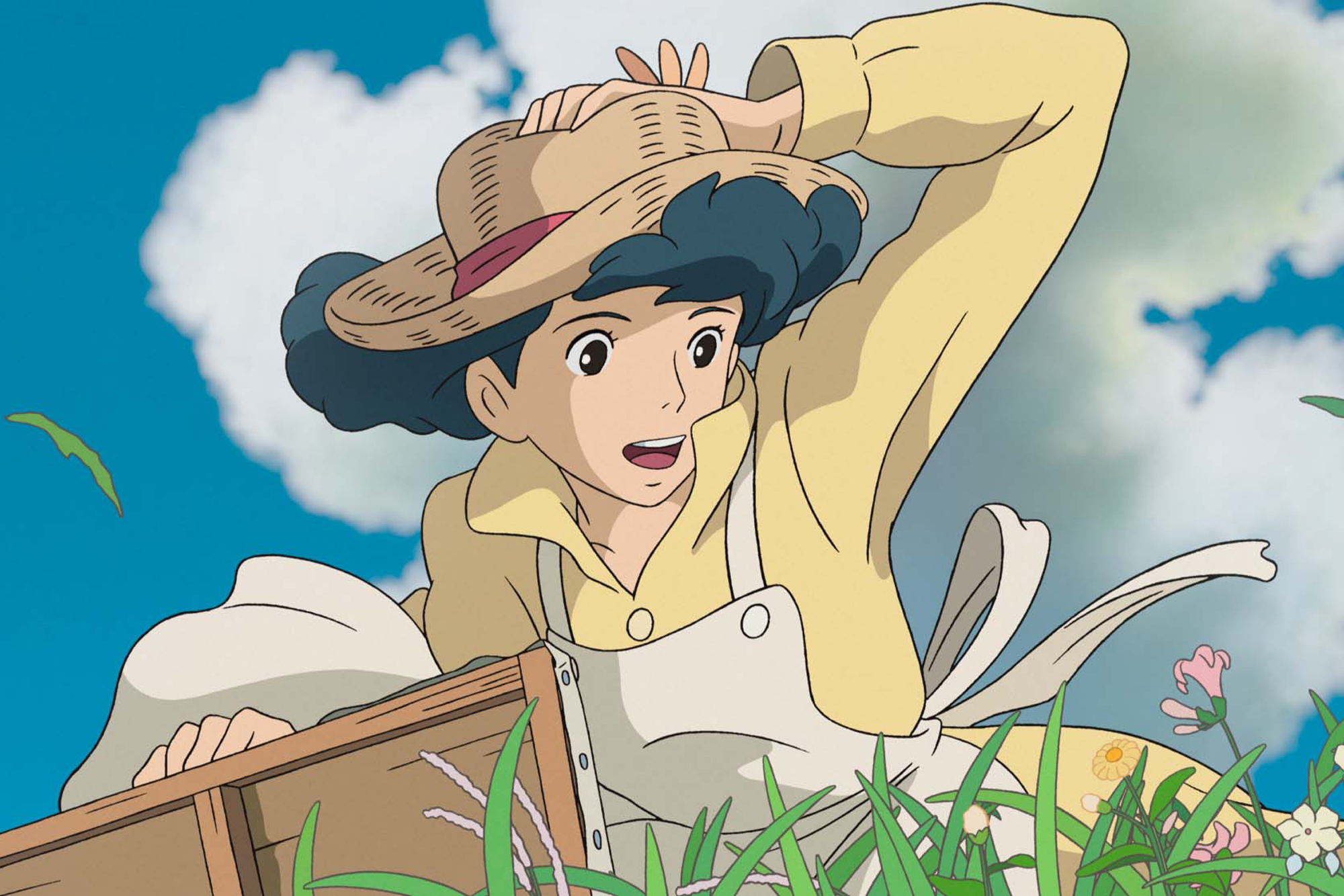
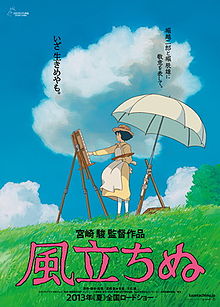
Kaze_Tachinu_poster“The wind is rising!  We must try to live!” – Paul Valéry

The above quote opens the latest release from Studio Ghibli and director Hayao Miyazaki; The Wind Rises.  It’s a quote that is suitable for the film as it implies that change is coming, but we must carry on.  The Wind Rises is to be the last directorial effort from Miyazaki, Japan’s most celebrated director of animated films, and it is an appropriate piece for him to go out on.  The Wind Rises tells the tale of Jiro Horikoshi and his dream to design what he calls beautiful airplanes.  Jiro is based on the airplane designer of the same name who is famous for creating Japan’s Mitsubishi A5M and A6M Zero and the basis for the film was derived from a quote he once gave:  “All I wanted to do was make something beautiful.”  The film has two sides to it with one being a mostly faithful account of Horikoshi’s challenge in developing his first successful airplane and the entirely fictional account of his personal life.  The end result is a tale of hope, triumph, love and life and is perhaps Miyazaki’s finest piece since My Neighbor Totoro.

The film opens with a young Jiro dreaming of flying a plane.  The opening sequence is perhaps the most fun for the animators as Jiro’s dreams are filled with nightmare creatures seemingly stemming from his despondence over his imperfect vision.  The character admits early on to himself that he will never fly because of his eyes, but in a dream meets with Italian airplane designer Giovanni Caprone, who will be a recurring visitor amongst Jiro’s dreams throughout the film offering him guidance on how to be a great engineer.  It’s these dreams that inspire Jiro to be an airplane engineer and the film advances time to show us his journey to become an engineer.

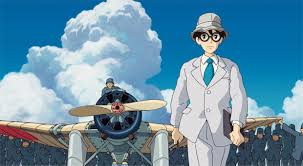
Jiro leading one of his designs to the testing grounds.

Jiro leading one of his designs to the testing grounds.

Jiro is portrayed as a sweet and good-natured man.  He is willing to help those in need, and a chance encounter with a young woman and her maid on a train plays a pivotal role in the film later on.  During the train ride the great earthquake of 1923 strikes and Jiro carries the maid to safety after she breaks a leg.  He seeks nothing in return and doesn’t even share his name with the women before departing.

Jiro lands a job out of school and his employment takes him to Germany where he is introduced to pre World War 2 Germany’s policies.  Being Japanese, he is not trusted by the soldiers as he seeks to learn about Germany’s engineering when it comes to aeronautical design.  Despite this, he is able to learn some techniques and apply them to a new aircraft, which unfortunately crashes during the test run.  To clear his head, his company sends him on a retreat for some rest and relaxation which is where he encounters the young woman he met years earlier on the train, Naoko.  The two fall in love, and though it seems predictable, their scenes are handled with such tenderness and care that the audience is left to root for them, even if it seems as if they’re destined to fall for each other.  Jiro learns there is a dark side to his budding romance as Naoko is afflicted with tuberculosis.  This forces them to move quickly with their life together.  Naoko insists on getting better before discussing marriage, but in time relents once Jiro has to leave for work.

Jiro must deal with failure throughout the film.

Jiro must deal with failure throughout the film.

The last act of the movie involves Jiro and his attempt to finally build a worthy aircraft that his company can sell to the Japanese military, while Naoko wages a silent battle at their home with her illness.  I don’t want to get into too much detail about the film’s plot, but suffice to say it’s a bittersweet tale that includes ups and downs with the story refusing to linger on anything for too long.  In that, it mirrors life which is a constant push and pull.  There are many themes the film likes to go back to.  Early on a supporting character mentions the importance of having a family to go home to, crediting it with helping a man work harder at the office, which is shown later in the film once Jiro is married.  In his dreams, Caproni asks Jiro if he prefers to live in a world with pyramids, or with no pyramids, using this as an explanation for why he would design airplanes that will eventually be used for war.  And all throughout the film, the wind acts as a character itself playing a pivotal role in one of the film’s final scenes.

As this is a work from Studio Ghibli, it hardly needs stating but deserves to be anyways, that this film is gorgeous.  The animation is predominantly hand-drawn, but some computer generated imagery is used for some of the film’s effects.  The film has a bright palette though Jiro is often garbed in white, gray, or a very light lavender, which serves to isolate him from his surroundings.  This suits the character as he is often oblivious to his surroundings, so consumed in his work and willing to overlook the fact that his designs are made for war.  The country-side settings are sure to evoke memories of Totoro, and the film’s whimsical feel and care-free pace further serves to draw comparisons to Miyazaki’s old masterpiece.

The wind is a character of its own, its actions often directly influencing the lives of the human characters in the film.

The wind is a character of its own, its actions often directly influencing the lives of the human characters in the film.

The sound design is excellent, with great use of natural sounding effects and an excellent score from Joe Hisaishi.  The english dub was handled by Disney and the film distributed in North America on their Touschstone label.  The dub is the usual high quality that viewers have come to expect from Disney as the company has handled the majority of Studio Ghibli’s dubs.  Serving as Jiro is Joseph Gordon-Levitt with supporting roles from the likes of Emily Blunt, John Krasinski, and Martin Short, the latter serving as the scene-stealing character Kurokawa, Jiro’s boss throughout the film.

The Wind Rises may be an animated movie, but it’s not for children.  The film’s pace is too slow and plot is too mature to entertain most children.  The film is best described as a drama and should appeal to older fans of Miyazaki’s works.  That said, it’s a wonderful piece of film with fantastic visuals, a compelling plot, and terrific performances.  Hayao Miyazaki may never get the recognition he deserves from international audiences, but anyone involved with film appreciates and respects the work he does.  It’s both wonderful and sad that this movie exists, knowing it is to be the last written and directed by Miyazaki, but in that sense it mirrors the film superbly.  What a truly awesome way to cap off a career!


Gargoyles: Season 2 – Volume 2

Gargoyles:  Season 2 - Volume 2 (2013)

Gargoyles: Season 2 – Volume 2 (2013)

It was a long wait for fans of Disney’s Gargoyles in between DVD releases.  Volume 1 of the second season was released back in 2005 in an attractive three-disc set.  Apparently the sales for the set were not up to Disney’s standards and volume 2 of the set was either pushed back or outright cancelled.  Volume 2 was only recently released this past summer, nearly six years following the release of volume 1 and it was done in a quiet fashion.  Now Disney has its own movie club which it uses as a vehicle for delivering to people DVD sets of their less popular shows as movie club exclusives.  These sets are cheaply done but for fans of the obscure it is currently the only avenue for them to get a physical copy of their beloved programs.  Such was the fate of volume 2 for Gargoyles.  The movie club exclusive contains a minimalist jacket with a gaudy yellow border.  The DVD case itself is like that of a standard DVD with a larger central tab where all three discs are stacked one on top of the other.  The only insert is an ad for the movie club and a number to register the DVD with.  The actual DVDs contain no bonus features of any kind, just the episodes and a mostly ugly DVD menu.  It’s about as bare-bones as it gets, but for fans waiting six years for the episodes, I suppose it’s better than nothing.

The set contains the final 26 episodes for season two.  It starts with the episode “Monsters,” which if one were to look at an official episode list for the show, should have been the final episode of volume 1.  Instead, the episode “Kingdom” was moved to volume 1 for pacing issues with “Monsters” getting pushed back.  That’s because these episodes comprise the World Tour section of season 2 where Goliath, Elisa, Angela, and Bronx are being sent to all parts of the world by the island Avalon for unknown reasons.  As a result, much of season 2 does not include the other characters such as Broadway or even Xanatos.  Often times, Goliath and co. will encounter a villain from back home while on their travels but just as often they’re paired with someone new.  They also encounter many new gargoyles as Goliath gradually learns that gargoyles are alive and well all around the globe.

Angela is added as a member of the main cast in the second half of season two and plays an important role in the development of the Goliath character.

Angela is added as a member of the main cast in the second half of season two and plays an important role in the development of the Goliath character.

Because of the World Tour format, the second half of season 2 is even more episodic than the first half, meaning the episodes function mostly as stand-alone stories.  I suppose one could argue there’s an overall plot since it’s Avalon that is sending them to these destinations, but it’s a fairly loose one.  Having the setting change each episode is an easy way to inject variety into the show, but the format grows stale.  The stories often feel like filler, and as a viewer I just wanted the group to get back home or for Avalon to finally unveil it’s true intentions.  Not all of the episodes follow the Would Tour group, as there are a couple that take place back in Manhattan.  In one such episode, “Pendragon,” the legendary King Arthur and the gargoyle Griff, two individuals encountered by Goliath and co. during their travels, wind up in New York and interact with the remaining members of the Manhattan Clan.  The World Tour basically lasts for 17 additional episodes of volume 2, with the two-part “The Gathering” representing its conclusion.  It’s far too long, and getting through those episodes started to feel like a chore for me (hence why it took me so long to get to reviewing this set) which is never a good feeling for television viewing.

Thankfully, the remaining handful of episodes are pretty interesting, as is the two-part “The Gathering,” though it’s not as grand as some of the series’ other multi-part arcs.  In that story, the god Oberon is attempting to steal the newborn son of Fox and Xanatos for he possesses some unusual abilities for a mortal.  It is interesting to see Xanatos and the gargoyles take on a god, though the resolution felt a little too neat and tidy for my tastes, but I can’t deny the alternative would have worked much better.  We learn some interesting tidbits about some of the supporting characters of the show, which is one of its great strengths.  The writers never miss an opportunity to focus on a secondary character and add importance to it.  As a result, just about any character who ever had even a minor role in a prior story returns at some point, including one background character viewers likely never noticed in “Vendettas.”  This type of writing helps make the show feel more rewarding for loyal viewers and it does add depth to what would otherwise be shallow characters.

The production values for volume 2 are largely the same as that for volume 1, though the DVDs this time around are of a lower quality.  The colors aren’t as rich and sometimes the image can be grainy, but that’s expected considering this was done on the cheap.  There are still episodes where the animation is of a noticeable lower quality, while others more resemble the quality of season one.  The A+ animation is largely reserved for the bigger stories, but even a stand-alone episode here and there (like “Future Tense”) is given a more striking look.  The score remains excellent as well and the voice acting is the usual high quality Disney output.

The alternate future depicted in "Future Tense" is one of the more fun stand-alone episodes in volume 2.

The alternate future depicted in “Future Tense” is one of the more fun stand-alone episodes in volume 2.

While from an episode quality standpoint I enjoyed this set less than the previous two, there are still some excellent stand-out episodes.  I mentioned “Future Tense” already as being a stand-out in terms of production values, but it’s also a really fun story that looks at an alternate future for Manhattan.  “Sanctuary” is one of the better World Tour episodes as it includes MacBeth, Demona, and Thailog.  Thailog also makes an appearance in another strong episode back in New York, “The Reckoning,” which contains the long anticipated confrontation between Angela and Demona.  The Goliath, Angela, Demona triangle is an anchor in a few stories, and the tension between Goliath and Angela over her lineage is done well.  I don’t think it’s giving away anything to reveal that Angela is the biological daughter of Goliath and Demona, but the writers do a good job of explaining Goliath’s and the clan’s view on children, which is that all gargoyles are children of the clan.  Angela, having been raised by humans, has a human’s perspective when it comes to parents and longs for Goliath to acknowledge her as his daughter.  She has similar feelings towards Demona, though they’re obviously complicated by the fact that Demona isn’t the most likable person/gargoyle.

The Goliath/Elisa relationship is handled quite tastefully by the writers of the show.

The Goliath/Elisa relationship is handled quite tastefully by the writers of the show.

Another tension of the series is the obvious affection Goliath and Elisa feel for each other that largely goes unstated between the two.  The conclusion to the set, “Hunter’s Moon,” addresses it for the first time in a very satisfying way.  It’s hard to write such a relationship because it takes care to make it believable that an attractive woman like Elisa would have romantic feelings for Goliath.  The writers sell it well though, and while I’m not sure they could have ever pulled off a full-on romance for the two, they did find a way to get the point across.  That conclusion, by the way, is a three-part story that actually brings everything full-circle for the gargoyles.  It would have been a fine way to end the series, but a thirteen episode season 3 was picked up by ABC for their then Saturday morning block.  Series creator Greg Weisman wrote the premier for that season, dubbed The Goliath Chronicles by ABC, but had no involvement in the remaining twelve episodes.  As a result, they are not considered canon by Weisman and the series actually continued in comic book form years later.  I may look into checking out those comics but I need to know more about them first and if they’re worthwhile.  I’m pretty happy with “Hunter’s Moon” as a conclusion, as I don’t expect a season three set, and I may choose to just leave Gargoyles with how season two ended.

As for this set, it is what it is.  For those who just want the episodes, it’s the only option save for bootlegs that are probably even worse quality.  When it was released last summer, it was available for a short time on eBay through Buena Vista’s store but once those copies were gone the movie club and secondary market were the only options.  The movie club is actually worth looking into for those looking to start a Disney collection.  For those (like me) who already own a ton of Disney DVDs and Blu Rays, it doesn’t make financial sense.  Very quietly though the set moves to the traditional Disney Store website and is available there for twenty bucks.  The secondary market has yet to adjust, it would seem, as the copies are still routinely priced in excess of forty dollars.  Even so, this is likely not going to be produced in large numbers so if you’re a fan of the show it’s probably a good idea to get it while it’s relatively cheap.  Bland set or not, it’s still 26 episodes of a pretty strong show for twenty bucks and if you already have the first two it’s basically a must-have.  Gargoyles is among the elite action cartoons of the 90’s, and for me it ranks among Batman and X-Men as the best of the best.


Disney’s The Little Mermaid

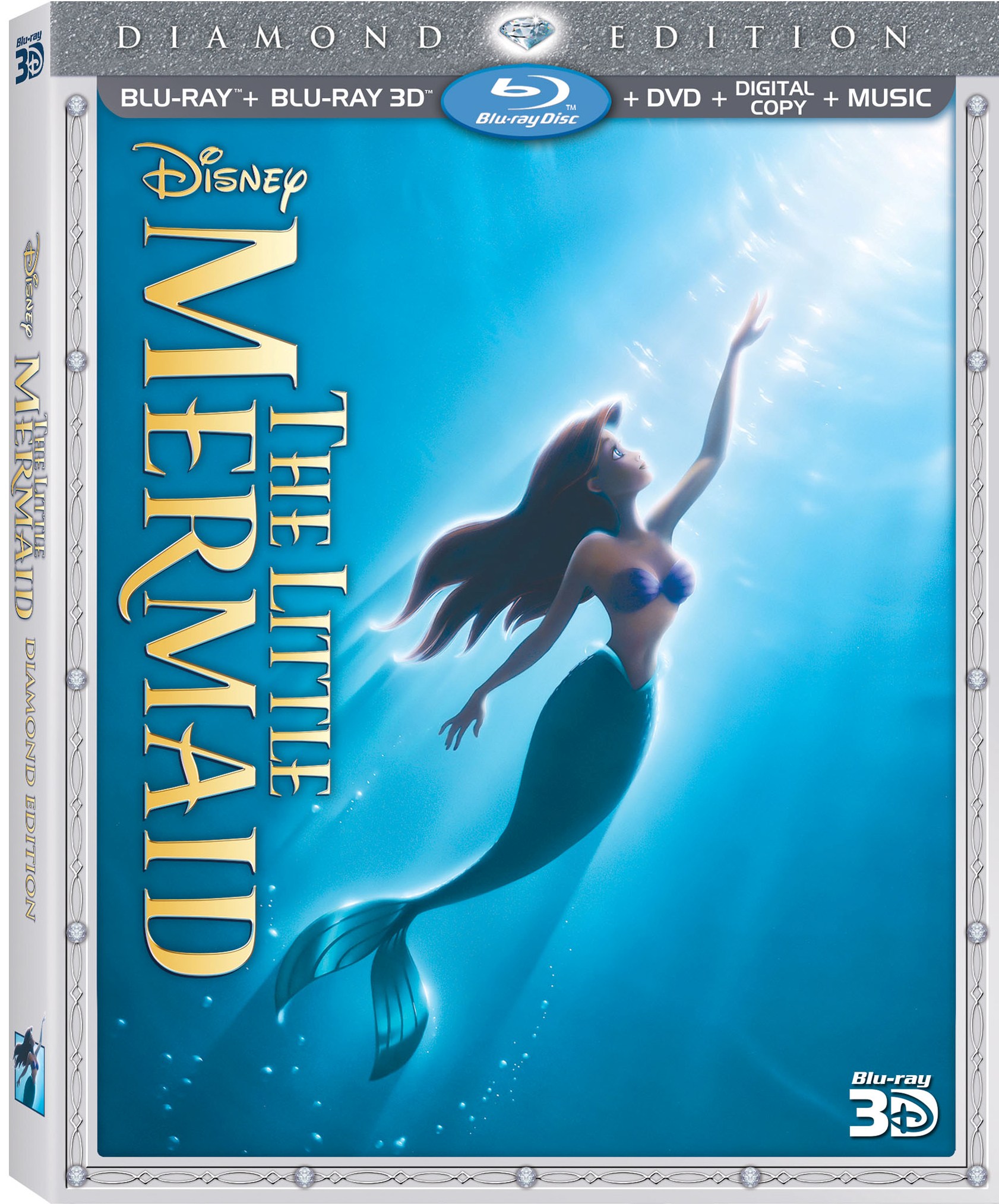
The Little Mermaid (1989)

The Little Mermaid (1989)

Come 1989, Disney was back on top both critically and financially as a movie studio.  Oliver & Company, while not wowing many movie buffs, was a commercial success and one of Disney’s biggest in years while Who Framed Roger Rabbit? was able to secure near universal praise for its combination of animation and live-action.  Even considering the successes enjoyed by those two films, it’s 1989’s The Little Mermaid that is often credited with launching the Disney Renaissance; a new period of creative and commercial success for the venerable studio that utilized a combination of animation and broadway.  After 1989, there was no question who was the king of animation and family entertainment. While it could be argued that Disney was never truly dethroned, it was certainly challenged and the studio struggled to prove that it was still the best at what it did.  There would be challengers in the 90’s, but none that would prove to be worthy adversaries.  Of course, by the close of the decade hand-drawn animation is practically dead and Pixar is a new household name, but the end of the 80’s through to the mid 90’s proved to be traditional animation’s last gasp and one of its finest eras.

The Little Mermaid represents a first for the company, and also a last.  The previously mentioned Oliver & Company, made regular use of music and the broadway element, but it was The Little Mermaid that truly committed to this format.  The music directors for the picture, the late Howard Ashman and Alan Menken, are both veterans of broadway and are credited with steering the The Little Mermaid in this direction.  The film, particularly the first act, is driven by the songs contained within as the film moves from one to another with often little traditional dialogue in between.  This proved so successful that future films adapted this style, but arguably none were as artistically successful as The Little Mermaid in doing so.

The Little Mermaid was the beneficiary of a huge budget, and it shows when compared with the animated films that preceded it.  It was also the first feature-length production to benefit from Disney’s new studio in Lake Buena Vista, FL, then known as Disney MGM Studios (with a theme park to follow, now called Disney’s Hollywood Studios).  It was the last picture to use traditionally drawn animation cells for Disney.  There were numerous amounts of FX added to the picture due to its undersea setting, and some computer effects were used as well here and there.

The Little Mermaid tells the story of Ariel, who finds herself unhappy living under the sea.

The Little Mermaid tells the story of Ariel, who finds herself unhappy living under the sea.

The Little Mermaid, based on the fairy tale by Hans Christian Anderson, tells the story of the young princess, Ariel (voiced by Jodi Benson).  Ariel is the seventh, and youngest, daughter of King Triton (Kenneth Mars), ruler of the seas.  Ariel is a free spirit who is fascinated with the world above which her father forbids her from interacting with.  She is able to sate her curiosity through human artifacts and items found in shipwrecks scattered across the ocean floor until her exploits bring her face to face with a living, breathing human.  Ariel soon finds herself in love with the prince, Eric (Christopher Daniel Barnes), and knowing her father will never allow such a romance to continue, in desperation she turns to the sea witch, Ursula (Pat Carroll), to make her human.  The story is predictable, but satisfying, and Ariel exhibits a lot of the same emotions most sixteen-year-olds are known for which helps make the unbelievable seem believable.  There are several memorable supporting characters to the story.  Flounder (Jason Marin), who does not resemble an actual flounder at all, is Ariel’s companion and the foil to her care-free spirit.  He’s cautious and kind of a worry-wart.  The film makes it seem like he’ll play a large role at first, but he soon fades into the background after the first couple of scenes.  Scuttle (Buddy Hackett), the sea-gull, is Ariel’s guide to the world of humans.  Unknown to Ariel (and Scuttle himself), Scuttle knows practically nothing about humans but she is more than willing to believe anything he says.  Sebastian (Samuel E. Wright), the crab, is the conductor of the royal symphony for King Triton and is also the King’s trusted confident.  Triton charges the Rastafarian crab with keeping an eye on Ariel with the intent being that he’ll get her to forget about the human world.  Sebastian, possessing a big heart, is soon convinced by Ariel’s actions and behavior to aid her in her quest to become human.

The film is home to several excellent supporting characters, with the sea-gull Scuttle likely being a favorite of many.

The film is home to several excellent supporting characters, with the sea-gull Scuttle likely being a favorite of many.

The love story is perhaps the film’s weakest aspect.  The character of Prince Eric is a young man looking for the right girl, though he appears to be in no hurry.  During a thunderstorm at sea, he winds up in the water where Ariel is lurking.  She rescues the prince from drowning and sings to him on a beach while he remains unconscious.  Waking, she flees, and Eric becomes obsessed with finding Ariel.  When Ariel returns as a human, she is without her voice (thanks to a bargain made with Ursula), and the two must fall in love in order for Ariel to remain human.  This being a Disney movie, I don’t think it’s spoiling anything to say that the two do eventually fall in love, though Ariel declares her love for Eric to her father after their first encounter.  It feels rushed, and I suppose it is considering the movie has a run-time of under 90 minutes.  I’ve seen worse when it comes to rushed love stories, but there are many cynics who will roll their eyes at first mention of the word love with this story.

The music, the film’s backbone, is quite good.  I am not a fan of the broadway format, but if a film is going to be overstuffed with songs then they better be good ones.  The Little Mermaid is the beneficiary of three iconic music pieces.  While most other Disney movies seem to only have one or two, The Little Mermaid boasts the trifecta of “Part of Your World”, “Under the Sea”, and “Kiss the Girl.”  “Part of Your World” is Ariel’s big solo number and it’s melody is used during the score as the main theme of the film.  It is returned to many times over, which is good because it’s a simple and very pleasing melody.  “Under the Sea,” the Caribbean sounding up-tempo track, is the film’s most fun moment and song and is likely the favorite of many of the film’s viewers.  “Kiss the Girl” is the slower track and it too boasts an island sound.  Not surprisingly, both are sung by Sebastian.  Ursula gets her own song as well, “Poor Unfortunate Souls,” but I find it to be less lively than the others.  It also drags on for too long.  There are other smaller tracks in the film but they prove to be less memorable, but their bite-sized running time also keeps them from being a distraction.

I probably wouldn’t have much affection for the film if it relied solely on its music.  Thankfully, The Little Mermaid is a fantastic picture to look at (made even better now that it’s available on Blu Ray), and it owes much of that to its setting.  The undersea setting proves to be a visual delight from the first scene.  When the audience isn’t being asked to focus on anything but the visuals, the animators make use of a blur effect to make the film appear as it would if being viewed by the audience if placed underwater.  Once the plot begins, the picture quality is clear and pristine.  Every movement from the characters is accompanied with bubbles and hair is wild and untamed as it floats about.  Most of the locations are depicted with shades of blue giving it a dark, sometimes cold, feeling.  When the picture explodes with color, such as during the “Under the Sea” segment, the juxtaposition with the blues make the picture really come alive and creates a warming effect on the audience.  The above water scenes pale in comparison as the kingdom Eric inhabits is somewhat lacking in personality.  I’m not even sure which part of the world it’s supposed to represent.  The climax of the film is a spectacle to behold with all of its lightning and massive whirlpool.  Ariel and Eric’s confrontation with a colossal Ursula is perhaps rivaled only by Aladdin’s final showdown with the snake Jafar.

The sea witch, Ursula, proves to be another memorable Disney villain.

The sea witch, Ursula, proves to be another memorable Disney villain.

Disney pictures, especially in more recent times, are often criticized for their shallow female leads.  The classic example being Snow White, who confesses in song she’s just waiting for her prince to come and rescue her from her hum-drum life.  Ariel is sometimes criticized in the same way, though perhaps not justifiably.  She’s plucky and strong-willed, and when she wants something she’s willing to make sacrifices in order to achieve her goals.  She is naive, but that comes with being only sixteen.  I do like that it is Ariel, and not Eric, that first takes on the role of rescuer as she saves him from drowning early in the film.  And when it comes time to face Ursula, it’s Eric and Ariel together taking her on.  If there’s room for criticism it’s in Ariel’s perception that she can only be happy if she’s made human and is able to win Eric’s love.  She’s a character with flaws though, which in turn makes her feel more real even if she is part fish. This is in contrast with the Disney princesses of the golden age which were essentially idealized women intended to be presented without flaws. Ariel is even allowed to contort her body into unflattering shapes, something animator Glen Keane was even criticized for doing by the old guard at the company, but something he felt was important to her story.  The film also has some scary moments which may frighten the very young, and Ursula is not some harmless screw-ball villain, but the scare-factor is still pretty minimal.  Parents ultimately know what is best for their kids and the best advice that can be given from an outsider is just watch the film first before exposing your kids to it, if you have concerns.

The Little Mermaid is a crowning achievement for Disney and is justifiably rated highly amongst the studio’s films.  It’s a gorgeous picture with memorable songs and characters that easily stands the test of time.  Despite its lead being a young princess, it’s a film that should have no trouble delighting both boys and girls while keeping the adults who watch it with them suitably entertained.  The Disney Renaissance unofficially began with The Little Mermaid, and I suppose it ended sometime around Mulan or The Emperor’s New Groove.  Amongst the Disney features released in that window, it’s probably second only to Beauty and the Beast.  The Lion King certainly has its admirers, as does Aladdin, but it’s combination of sound and visuals make it number two for me and I wouldn’t argue with anyone who felt it should be number one.


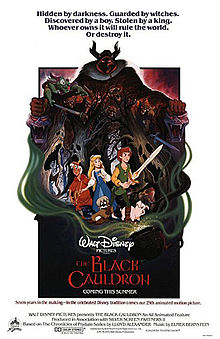
The Black Cauldron

The Black Cauldron (1985)

The Black Cauldron (1985)

The Black Cauldron is one of those movies I wasn’t sure if I had even seen or not.  It’s kind of rare to find a Disney animated movie that I haven’t seen from before 1998, but in the case of The Black Cauldron it would seem I found just such a film.  My only interaction with it had been via the PC game of the same name produced by Sierra around the time the movie came out.  It was a frustrating and terrible game for someone used to Super Mario Bros. and I didn’t like it at all.  Upon doing just some basic research on the film it became obvious why I had never seen it.  The Black Cauldron just may be the most unloved of the Disney animated films to be released.  It was marred by creative differences between those creating the film and Disney Chairman Jeffrey Katzenberg who would have cut the film himself if not for intervention from CEO Michael Eisner.  The film went on to be Disney’s worst performing film at the box office and the film is known less for its merits and more for being Disney’s “rock bottom.”  Because of its failure, it never received a home video release until 1998, more than a decade after its theatrical run.  In spite of all the negativity surrounding the film, I was curious enough to spend a small amount of money on a DVD copy to see it for myself.  I’ve seen plenty of good Disney movies, and I’ve seen some bad ones too, and I was curious to see what made this one possibly the worst of them all.

The Black Cauldron is an adaptation of a Lloyd Alexander book from his Chronicles of Prydain series.  It was directed by Ted Berman and Richard Rich, who together with Art Stevens had previously directed The Fox and the Hound.  I consider The Fox and the Hound to be one of Disney’s weaker offerings, a film with a good heart but a sometimes sloppy execution, so right away I’m not impressed by The Black Cauldron.  The Black Cauldron also makes use of the  xerographic production process that Disney had been using for some time.  It leads to a rough, sometimes sketch-like quality, to the edges of the characters and is a far cry from Disney’s classic look.  For this picture though, which is tonally quite a bit darker than other Disney films, it does add a certain credibility to the look.  Some very early computer-generated effects were utilized as well that surprisingly look pretty fantastic even today.  The effects were used sparingly, mostly for smoke effects, and it really makes the picture pop.  The backgrounds have a very hand-painted look to them that helps add to the mystique of the picture.  The one major drawback I found with the film was with the character animation.  The backgrounds are rich with saturated colors, lots of shadowy holes and dingy dungeons, and the characters look flat against them at times.  There’s often no shading done to the actual characters and it takes away from the overall feeling the scenes are shooting for.  This is a flaw of pretty much all of the Disney animated works from this period, but it’s most obvious here because of the setting where all of the dark areas are lit by torch-fire.  Still, overall I found it to be a very rich experience from a visual point of view, which is certainly a good place to start with any animated movie.

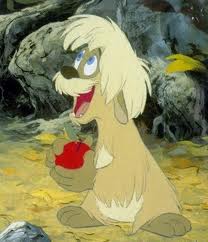
That's Gurgi, whom I kind of hate.

That’s Gurgi, whom I kind of hate.

The score for The Black Cauldron has never really been under fire.  It’s a quality film score and was composed by Elmer Bernstein, which from what I can tell, makes this the only Disney film Bernstein worked on.  The voice acting utilized mostly British talents, and unfortunately, is one of the film’s weak points.  The Horned King, played by John Hurt, sounds appropriately menacing and the creature voices are fairly well done.  The lead, Grant Bardsley as Taran, leaves no lasting impression and I didn’t care for the woman portraying Princess Eilonwy, Susan Sheridan.  I also never really warmed up to the voice of Gurgi, portrayed by John Byner.  It’s not that Byner’s performance was lacking, more that I just didn’t care for the voice they chose to go with for that character (his voice reminded me of Frank Welker’s Slimer from The Real Ghostbusters).

The production values on the whole for The Black Cauldron are pretty good, which is to be expected since it was the most expensive animated film ever produced at the time of its release.  Where the film seems to lack the most is in the plot and pacing of the film.  At a running time of 80 minutes, it’s neither long or short by animation standards.  The general plot revolves around Taran, a teen-aged farm hand who dreams of being a knight, who is tasked with shielding his pig, Hen Wen, from The Horned King.  Hen Wen possesses a special quality that allows her to show her master the future and The Horned King needs her to deduce the location of the black cauldron, an artifact of terrible magic.  Throughout his travels, Taran routinely makes mistakes and overestimates his ability as a warrior landing him in the clutches of The Horned King and his army of goblins and wyverns.  Taran acquires followers along the way, the Princess Eilonwy, the minstrel Ffledwwur Fflam, and the irrepressible Gurgi.  He’ll also encounter witches, pixie like people known as Fairfolk, and, of course, a magic sword.  It’s all rather conventional with The Horned King surrounding himself with an army of incompetent servants who constantly undermine him along the way.  I found Taran to be too cliché to really care about.  The Princess is actually a strong female character, which I could appreciate, while the character of the Minstrel I found completely unnecessary.  Gurgi is intended to be the cute, marketable character who provides some comedic relief.  I already mentioned my dislike for his voice, but I also dislike his look as well.  He looks like a combination of an old man and a shaggy dog which I found off-putting.

Younger audiences may find this one to be a bit too scary.

Younger audiences may find this one to be a bit too scary.

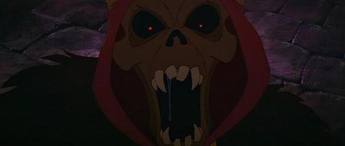
The first half hour, aside from the overuse of fantasy trite, is pretty exciting as Taran finds himself in the clutches of The Horned King, one of Disney’s most horrifying villains and a worthy antagonist.  Upon Taran’s escape, the film lost me as characters seem to be in limbo for the next half hour before the film’s climax.  The climax is actually really well done, with the film’s best animation being saved for these scenes.  There’s even a well-executed “sacrifice” and the film found a way to realistically have the heroes face off with The Horned King that audiences could accept.  Really, if the film could have found a way to make the middle section more interesting it would have gone a long way towards improving the experience as a whole.  There are times for comedic relief along the way, and some of it is contained in the middle parts when the witch characters are introduced.  A lot of film critics seemed to dislike the film for its joylessness when compared with other Disney works, but I actually though the film did a decent enough job of balancing the humor and drama.  It’s certainly a film meant to be more of a thriller than a laugher, but joyless it is not.

The Black Cauldron may or may not be the worst animated film put out by Disney.  I can’t say for sure as I haven’t seen every film the studio produced, but I have a hard time believing it truly is the worst.  The 1970s and 80s for Disney really were dark times for the studio as it struggled to recapture the old Disney magic and The Black Cauldron fits in among those works.  It really is no better or worse than most of Disney’s films from that time period like Robin Hood or The Rescuers.  It has things it does well, and things it does not so well.  Because it is a bit more serious and contains some menacing characters, it’s more similar to some of Disney’s older works than even the modern films.  The Horned King and his minions are characters intended to frighten young children, much like Monstro and Maleficent.  If you’re thinking of buying this for your four-year old, you may want to watch it alone first.  If you’re an older animation fan like myself and you’re curious about this picture, I say give it a look if you have the 10 bucks or so to spend on a DVD.  You’ll likely find a plot that is lacking, but the visual experience makes the minimal investment worthwhile.


Gargoyles: Season 2 Volume 1

Gargoyles_DVD_2The cover of the DVD release of Gargoyles Season 2 dubs it as Volume 1 of the second season.  At first glance, that may seem like a greedy way to release a show to DVD, but that is not the case.  A common practice of children’s animated television was to order 65 episodes as early in the life of the series as possible to make the programming eligible for syndication where more money could be made off of it.  I say “was” because I’m not sure if that is still the case with numerous cable outlets now providing a lot of the entertainment these days.  Gargoyles was not originally broadcast on cable though, which is why season 2 is 52 episodes long, which following the 13 episode first season, gets the series to 65 total episodes.  Sometimes networks are so confident the show will be a hit they go right from the pilot to a 65 episode order.  This was the case for the still popular Batman:  The Animated Series which featured a pretty bankable star in Batman, but Gargoyles was an all new intellectual property so Disney opted to go for a trial run with the first 13 episodes before going all in.

The process of large season orders seems like a win for fans of the show.  After all, a 52 episode season would theoretically allow for a new episode every week for an entire year, though this wasn’t the case for Gargoyles since it was an afternoon program.  It does usually mean shorter wait times between new episodes, but things can get a little erratic since the season will usually begin airing while a lot of episodes are still in production.  There’s also the other downside to a large season such as this which is these episodes need to get produced quickly, and more people are needed for production and story-writing.  The first season of Gargoyles was a tight, neat collection of episodes with high-quality animation for television.  Season 2 sometimes has the feel of “too many cooks in the kitchen” and episodes become more stand-alone in nature.  The animation is still among the best when Gargoyles is compared with its contemporaries, but there are some drop-offs and it’s apparent that the show had multiple teams for animation.  Some episodes feature sharp lines and tight animation while others are more rounded and toon-like with characters often making over-exaggerated gestures (those familiar with X-Men likely have an idea of what I’m talking about).  Which one looks best is a matter of taste though (I prefer the harder look for this program) at least, with the overall animation quality usually pretty strong from episode to episode.

There are some pretty interesting plot twists to find in season two.

There are some pretty interesting plot twists to find in season two.

Inconsistent animation is expected when a show requires a large amount of episodes be produced, but my main concern for Gargoyles was how the writers would respond when tasked with filling so many hours.  The first season largely operated in a serial format with each episode tied to one overall plot.  Some felt more stand-alone than others, but all plots were referenced at one point or another and the overall quality of the story-telling was quite good.  I knew season 2 would have to feature more stand-alone episodes, but thankfully very few feel like throw-away or filler episodes.  Many of these one-shots still contain plot devices that have repercussions on the episodes to follow, such is the case with the conclusion of the episode “The Mirror” when Demona gains a new power.  Many others choose to introduce new villains or allies that will pop up in later episodes, as is the case with the characters Doctor Sevarius and Jeffrey Robbins.  In short, the structure of the show remains rewarding for longtime fans.  This does come at the cost of making the show a little harder to jump into at any point for newcomers, but since it’s no longer on television, this is really no longer a concern.

There are many stand-alone episodes, but there’s also no shortage of multi-part arcs.  The first half of season two contains the four part “City of Stone” and the three part “Avalon.”  Both are heavily reliant on flashbacks as it seems one goal for season 2 was to flesh out the villains even further, specifically Demona and MacBeth.  We learn about their history together and how Demona has survived the centuries and remained largely the same in appearance.  In season one, we the viewers were basically left to assume that gargoyles are extremely long-lived given that Demona was not affected by the Masgus’ spell like the others, but we learn in season 2 that is not the case.  There are lots of other recurring characters in season 2 such as The Pack, Tony Dracon, Derek Maza, Coldstone, and of course Xanatos.  Xanatos is still primarily an adversary of the Manhattan Clan, but he’s also an unlikely ally in several episodes.  One could even suggest that the writers go to this well a bit too often, but such is the case when 52 episodes have to be written in a short amount of time.  Still, I like the role Xanatos plays on this show of the equal opportunist who has his own agenda that isn’t always clear.  By the end of the first half of the season viewers, and even Goliath to some degree, have mostly caught on to Xanatos and the game he plays making me wonder what role he’ll play going forward (as I honestly can’t recall from my days of watching this as a kid).  Xanatos is also paired this time around with Fox, of The Pack, as his love interest which is a rather interesting dynamic.

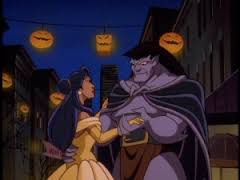
Now where have I seen that dress before?

Now where have I seen that dress before?

Another part of the plot the writers seemed eager to explore in season 2 was the relationship between Elisa and Goliath.  Elisa was Goliath’s main confident, along with Hudson, by season one’s end and he (as well as the other gargoyles) clearly feel a strong sense of protection with her.  In season 2 it’s becoming more obvious that they have a stronger bond than just friends.  Sometimes the show is pretty obvious about it, but for the most part they let it go unstated and attempt to keep things subtle.  It has a nice progression throughout.  Disney fans will also particularly enjoy a scene from the episode “Eye of the Beholder.”

Gargoyles was never a series afraid to introduce characters, and many new villains are brought into the fold in season 2.  New allies, as well.  A pet peeve of mine with X-Men was always how the writers would tease a new character joining the X-Men but would never go through with it.  Towards the end of season 2, the writers chose to add a new member to the clan.  To better introduce this character, the writers shrink the cast down to just Goliath, Elisa, Bronx, and the new-comer for the unofficially titles World Tour episodes.  These episodes spill over into the second part, and series creator Greg Weisman actually bumps up one episode from the second half, “Kingdom,” to serve as the final episode in this collection.  This final episode takes place in New York and we get to see what the rest of the clan is up to with Goliath missing.  This is probably something Weisman regretted not doing originally, as when these aired we went 10 episodes without seeing the other characters which seems much too long.  The World Tour will continue well into the second half though I do not suspect any other episodes were re-arranged as no one affiliated with the show had any say in the release of volume 2, that I know of.

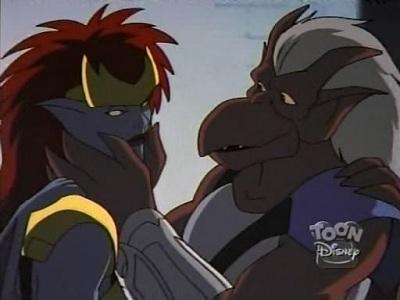
The relationship between Demona and MacBeth is fully revealed in season two.

The relationship between Demona and MacBeth is fully revealed in season two.

Gargoyles:  Season 2 Volume One largely carries over the quality of the first season and only enhances the show’s reputation as one of the better animated programs from the 1990’s.  Season One is probably superior when judged on quality, but the second DVD release for the series obviously boasts more content.  The release itself is also much nicer and includes some bonus features in comparison with the bare-bones season one release.  Unfortunately, season two did not meet the sales expectations of Disney and volume two was never commercially released until just recently.  Volume two is even more sparse than the first season release, and is currently only available to members of Disney’s Movie Club.  I’m not a member of that club, but did find out Buena Vista has an ebay account that basically specializes in selling these exclusives and was able to get one from there.  I don’t know if they restock or not, but that is definitely the best bet for those who want a copy as the secondary market is a little inflated right now.


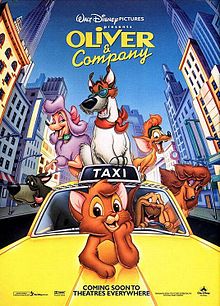
Oliver & Company

Oliver & Company (1988)

Oliver & Company (1988)

Memories are a funny thing.  What we choose to remember and forget really isn’t up to us.  The brain just kind of erases and deletes things as it sees fit without any conscious thought or action.  And when it comes to what we see and how we perceive our world, the brain has more say in that than we are often aware.  The eyes allow one to see, but it’s the brain that has to decode the feed like a receiver and actually tell the body what is there.  As a result, we can often remember things not how we saw them, but how we perceived them.  It gets really interesting when trying to recall a first memory. I have a few that could be considered my first memory and they’re all from around age 2.  The thing is though, I don’t know if these memories are real or if I’ve created them in just trying to reach back or from hearing a story.  It can be kind of wild to really think about it, and perhaps I’m better off just accepting what my brain says are my earliest memories.

One early memory I’m pretty confident in is my first trip to a movie theater.  I don’t know what went into it, where it was, or even what we did when there, but I do know that the first movie I ever saw in a theater was Disney’s Oliver & Company.  Oliver & Company came out in 1988 so I would have been around 4 years old.  Now everyone is used to films coming out on DVD or Blu Ray around six months after a film debuts in theaters.  When I was a kid this was not the case at all.  Some were released in about a year, but with Disney it was several years or not at all.  Disney spent a ton of money on its animated films and many did not turn a profit during the initial theatrical run.  Disney banked on theatrical re-releases to stay afloat so the company was very careful in what it released for the home market.  This philosophy was in place until The Little Mermaid was released and the home video market was thriving.  At that point, Disney had made a bunch of money already off the film and figured to make a whole lot more if it was available for Christmas.  The Little Mermaid was the film that followed Oliver & Company.  As such, Oliver & Company didn’t see a home video release until 1996, long after I stopped caring about Disney movies.

The film starts off like it might be a buddy flick with Oliver and Dodger before the cast is eventually expanded upon.

The film starts off like it might be a buddy flick with Oliver and Dodger before the cast is eventually expanded upon.

Because of Disney’s home video release schedule, when I sat down recently to watch my newly purchased copy of Oliver & Company on Blu Ray it was the first time I had seen the movie since I was four years old and in a theater for the first time.  It was kind of a surreal experience as I watched this film.  There were things I remembered, like Tito’s “Hey man, check it out,” line, and there were things I forgot I remembered like Dodger’s memorable “Why Should I Worry?” song.  There were also many things I had completely forgotten.  Before I sat down to watch the film a second time I could not have even begun to speculate on what the villain looked like.  I probably would not have remembered the name of the little girl (Jenny) and I certainly would not have been able to recall any of the names of the other dogs in the picture.  In many ways I felt like I was seeing the film for the first time, but there was an old familiarity there as well that created a rather warm experience.

Oliver & Company is probably not a film remembered by many.  I wasn’t even aware of the Blu Ray release and I’m someone who is pretty plugged into these kinds of things.  That’s not to say the film isn’t noteworthy for a few reasons.  Most notably, it was the film that basically laid the groundwork for all of the Disney animated features to follow.  Films that would prove to be far more successful than Oliver & Company (not that Oliver & Company wasn’t a success, it just wasn’t as big as the films to follow) like Beauty and the Beast and The Lion King.  It was the first to really utilize that Broadway format of interspersing narrative and song in a very MTV like fashion.  Sometimes the plot feels almost ancillary, as if it exists simply to move the film to the next music video.  I’m not a fan of this approach, and as a result, I tend to prefer Disney’s older films to the modern ones but there are films that are able to succeed with this approach.  Oliver & Company does, but on the most basic level.  It’s harmless entertainment and it has a good heart but there’s no deep undercurrent to the plot or there really aren’t any big visual moments.  The villain of the film is only ever lurking on the periphery.  He’s menacing, but not on the level of any of the big villains to follow.  This is partially due to the film’s short running time (74 minutes) and due to the fact that the story is a fairly simple one.

Marin's Tito ends up being the star of the film.

Marin’s Tito ends up being the star of the film.

The protagonist of the film is a small orange kitten named Oliver trying to find a place for himself in the world.  As indicated by the title, this is an adaptation of Dickens’ Oliver Twist but only loosely so.  There are quite a few celebrities on the cast for this one including a young Joey Lawrence as Oliver.  Billy Joel plays Dodger, a street-wise dog who is basically the alpha of a pack of thieving canines doing the bidding of the mostly harmless thief Fagin, played by Dom DeLuise.   Cheech Marin plays Tito, the wise-cracking chihuahua and Bette Midler is a pampered poodle named Georgette.  The cast does a good job with what they are given with Marin probably showing the best.  The music is obviously a big part of the picture and the opening number “Once Upon a Time in New York City” is performed well by Huey Lewis.  Joel’s number “Why Should I Worry?” is the star of the film.  It starts off as a smooth jazz number before the heat gets turned up.  It’s infectious.  The rest of the musical numbers fall pretty flat though.  Midler’s “Perfect Isn’t Easy” is supposed to be another big number that makes use of some early CAD technology but it just isn’t there.  The film kind of meanders along for the last half of the picture as a result.

Visually the film resembles a lot of the other Disney works that utilize the Xerox technology that debuted with One-Hundred and One Dalmatians.  The edges of the characters are rough and sketch-like.  Some of the backgrounds are as well.  It works when the film is trying to present some of the grimier locations in New York but it doesn’t work for the glitzy Times Square.  Disney’s animation, like its profits, took off after Oliver & Company and the company was willing to invest a bit more into each successive picture.  This isn’t a bad looking movie and it has its own visual charms, but it does lag behind Disney’s better works.

Oliver & Company is a really unremarkable movie but one that does hold a lot of nostalgic value for me.  If I didn’t have such a unique relationship with it I probably would not own it.  That’s not to say that it’s bad or anything.  I did enjoy watching the film for what it is, but it is mostly disposable entertainment.  For adult animation fans, this is hardly essential viewing, but if you have kids that will consume anything Disney then they will have some fun with Oliver & Company.


Dreaming of Kingdom Hearts 3

images-125

UPDATE 3/8/2014: Square-Enix has posted a survey for Kingdom Hearts, and if there is something you want to see in Kingdom Hearts 3 (Gargoyles!), this is the best way to make your voice heard!

Watching Gargoyles these past few weeks has got me thinking about the upcoming PS4/Xbox One game Kingdom Hearts 3.  So far, little information, aside from confirmation the title has been in development, has been released regarding the next entry in the Kingdom Hearts series.  For those unaware, the Kingdom Hearts games were initially conceived as a marriage between Disney and Square’s Final Fantasy.  Several games have been released in the series and, for the most part, they all follow a pattern of having the main character visit various different worlds based on classic and current Disney films.  Gargoyles has got me thinking about how cool it would be to see that world brought to the series as it would seemingly lend itself well to the video game form.  There was a game based on the series created for the Sega Genesis.  It was a late arrival on the Genesis and while it boasted some rather slick animation it was bogged down by poor gameplay mechanics and a repetitive design.  It is my understanding that the only rules for selecting worlds for Kingdom Hearts are that they be from Disney films, but not Disney owned films.  This would eliminate the various Marvel films produced by Disney as well as any future Star Wars ones.  It also appears to apply to Pixar films as well as so far no worlds from a Pixar film have shown up.  It also excludes any worlds from Disney television, but in the case of Gargoyles, this rule could be circumvented by the existence of Gargoyles The Movie:  The Heroes Awaken.  It’s kind of cheating as the direct-to-video movie is just the first five episodes edited into a 90 minute film but lets not get too technical.

Using my own memory, and with help from Wikipedia, I’ve come up with the below list of Disney films to appear as worlds in the Kingdom Hearts series:

  • Sleeping Beauty
  • The Little Mermaid
  • Aladdin
  • The Nightmare Before Christmas
  • Winnie the Pooh
  • Peter Pan
  • Hercules
  • Tarzan
  • Pinocchio
  • The Lion King
  • Steamboat Willie
  • Pirates of the Caribbean
  • Alice in Wonderland
  • Cinderella
  • Snow White
  • Beauty and the Beast
  • Mulan
  • Tron
  • Lilo & Stitch
  • The Hunchback of Notre Dame
  • The Three Musketeers
  • Fantasia

This list may not be exhaustive, and does contain some unusual selections.  “Steamboat Willie” stands out as it’s not a feature-length film, but as Mickey’s most recognizable short, it’s not surprising to see it included.  It also, like pretty much all of Disney’s classic shorts, was originally released to theaters.  The Three Musketeers also stands out as it was a direct-to-video release so it appears their self-inflicted rule does not mean the film needed to be theatrically released.  Square has done a good job of hitting most of Disney’s biggest properties.  There is also a good balance of old and new, but there’s still plenty of room for more.  Below are some thoughts of mine regarding where the franchise could go for its next outing:

Bambi – Bambi the character has already appeared as a summon in the KH series but he’s never had his own world.  As one of the few classic pictures to not have a world, it makes sense for Bambi to step into a larger role.  His world is not particularly unique considering it’s just a forest, but a world created around the forest fire scene from the film’s climax could have some interesting gameplay mechanics.  For one, it would make the world visually interesting and the fire could be the result of one of the film’s antagonists.  Bambi could be an assist character and, together with Sora, they would be tasked with extinguishing the blaze.  The world could either be full of peril due to the fire, or there could be a time limit in place.  Considering Bambi is one of Walt’s greatest achievements, it just makes too much sense to include it eventually.

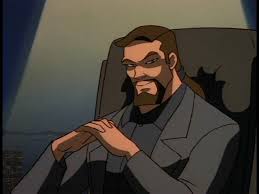
And to think, some at Disney felt The Horned King would be too scary for kids...

And to think, some at Disney felt The Horned King would be too scary for kids…

The Black Cauldron –   The Black Cauldron is, unofficially of course, Disney’s black sheep.  It differs quite a bit in tone from the works that preceded it in that there’s a distinct absence of humor throughout.  A lot of critics disliked the film, and while it appears to have spawned a cult following, it’s still one of the lesser films put out by Disney.  It’s inclusion here is not a defense of the film, I haven’t it seen it in so long that I really can’t offer much of an opinion on it, but it’s world would actually appear to fit in quite well with the KH universe.  The Horned King would make a natural complement for Maleficent and the Fairfolk could be incorporated as well.  The film almost makes too much sense for inclusion, leading me to believe the only reason it has not been is because the film is so obscure.  It’s also possible that Disney doesn’t own any of the characters outright and legal issues may not make it worthwhile to include.

Toy Tinkers – I am an unabashed Donald Duck fan so I wanted to include one of his shorts on this list.  I initially thought “Trick or Treat” would work well because of the Witch Hazel and her special potion that brings inanimate objects to life, but such a world would have a lot in common with Fantasia and Halloweentown.  I settled on “Toy Tinkers” because it would allow the inclusion of a Christmas themed world and a unique gameplay opportunity.  I conceive it as a world in which Sora has been shrunk somehow and is caught in between the fire-fight between Donald and Chip and Dale.  There would be debris raining down and perhaps Sora would help Chip and Dale thwart Donald somehow.  It would be a bit of comedic relief and a fun bit of level design.

This would seem to be a natural conflict for a video game.

This would seem to be a natural conflict for a video game.

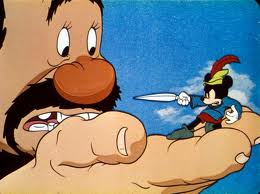
The Brave Little Tailor – My thought process for this level is similar to the above for “Toy Tinkers,” so I consider this an either/or arrangement.  In the short, “The Brave Little Tailor,” Mickey is tasked with defeating a giant.  For KH, the scenario seems obvious and Sora would either replace Mickey or assist him in taking down a giant.  It would feel similar to my “Toy Tinkers” scenario because Sora would be taking on a foe much larger than he, so the two would perhaps feel too alike if they both appeared in the same game.  Nonetheless, it would be fun to challenge the giant and a tailor themed Mickey could be an interesting assist character.  This could also easily be swapped out in favor of a Mickey and the Beanstalk themed level.

Duck Tales – Duck Tales would appear to not be eligible due to the fact that it was a television property, but it sneaks in because it did have a feature-length release, Treasure of the Lost Lamp.  If the level had to be based on that film, then no matter, it could be a pseudo Indiana Jones type of deal with cave exploring with Uncle Scrooge, the nephews, and maybe even Launch Pad.  Classic Duck Tales villains could still be included as well.  Ultimately, I just want to see Scrooge’s giant vault of gold coins included complete with diving board.

Toy Story – Yes, I know and covered it already, it would appear that Pixar films are a no-go when it comes to KH.  However, Pixar’s films have become as much a part of the Disney brand as Mickey and Snow White and their presence is felt throughout Walt Disney World and Disney Land.  And if there is to be one exception made for Pixar, why it has to be Toy Story, no?  It makes too much sense for inclusion as Sora could be transformed into a toy of some kind and have to team-up with Woody and the gang to foil Sid.  The level basically designs itself and there are so many action sequences from the three films that the designers could look to for inspiration.  Come on Square/Disney, it’s time to invite Pixar to the party.  Do it!

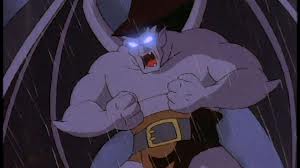
I'd be delighted to see any of the films/shorts from this list incorporated into KH3, but mostly I just want to kick some ass with Goliath by my side.

I’d be delighted to see any of the films/shorts from this list incorporated into KH3, but mostly I just want to kick some ass with Goliath by my side.

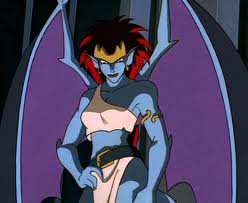
Gargoyles – We’ll end this with what started it in the first place, Gargoyles!  Gargoyles, as primarily an action-adventure cartoon, makes a lot of sense for a video game.  Goliath would be a pretty bad-ass support character and Demona seems like a perfect villain for KH (though MacBeth and Xanatos would work as well).  There would be some fun music to source, and most of the voice cast has maintained a relationship with Disney to this day including Keith David (voice of Goliath) who recently voiced the villain for Disney’s The Princess and the Frog.  Gargoyles would also allow Square to set a level in New York, specifically the skies above New York.  The castle would make for both a great visual and fun setting for an all out battle with Demona or the Steel Clan.  Someone send the developers of Kingdom Hearts 3 a copy of the first season (or the movie, but they would need a VCR on hand to watch it) and then try to stop them from making use of it!

There’s actually plenty of other films Square could source for Kingdom Hearts 3 that I didn’t even bring up.  The Sword in the Stone or Robin Hood seem like natural fits, or perhaps because they’re too conventional they’ve been ignored.  101 Dalmatians also seems like an easy film to incorporate and Cruella De Vil would be a natural as a villain for the series.  And considering it drew inspiration from video games, I feel like I have to mention Wreck-It Ralph.  I actually fully expect a Wreck-It Ralph scenario of some kind to appear in KH3, either as the game world Fix-It Felix Jr. or maybe a Sugar Rush style mini game.  I consider all of my selections as long shots and I’d be surprised to see most of them.  It actually wouldn’t shock me if Disney lifted the embargo on Pixar films and allowed a Toy Story level, just because the property is so popular, and the giant sequence I described (most likely to occur in the form of Mickey and the Beanstalk) also strikes me as a legit possibility for a KH world.  The others are merely dreams or wishes, and as much as it would delight me to see Goliath and crew in Kingdom Hearts 3, I also acknowledge it’s mostly a pipe dream.  Perhaps if I wish upon a star…


Gargoyles: Season One

Gargoyles - The Complete First Season (2004)

Gargoyles – The Complete First Season (2004)

In the early 90’s, Fox cornered the market when it came to television shows for young demographics, particularly boys in that 7-12 age group.  They had hit shows with Batman The Animated Series, X-Men, and Power Rangers and their Saturday morning programming was unrivaled.  Batman, in particular, ushered in an era of cartoons where the writers didn’t feel like they had to dumb-down the show to please its audience.  The stories were mostly grounded within the fantasy world the show created, while X-Men wasn’t afraid of creating serialized episodes that asked more from its viewers.  These weren’t stand-alone episodes with the same throw-away clichés prevalent in most children’s programming.  And while the shows were, first and fore-most, children’s shows they didn’t make adults feel like idiots for watching.

Disney, by contrast, had seen its viewership decline.  The once popular Disney Afternoon programming was mostly content to keep things the same.  Duck Tales and Tailspin were successful early on, and Darkwing Duck was Disney’s own answer to Batman but with a comedic core.  If Darkwing Duck was supposed to reel in Batman viewers then Disney missed the point.  Putting a cape and mask on a character and having him fight crime isn’t what people tuned into Batman for.  Those viewers wanted to see the show take itself seriously, present real threats, and overall just make it a credible show.  Disney needed a show that matched Batman’s tone and not his costume, so they turned to comic book writer Greg Weisman and from that relationship came Gargoyles.

Gargoyles could be described as modern fantasy mixed with Greek tragedy.  Stylistically, the show is reminiscent of the aforementioned Batman and X-Men with similarities to contemporary cartoon Jim Lee’s Wild C.A.T.S.  The color palette is muted with lots of deep violets and blues and plenty of black.  The first season has a split setting between modern-day New York and turn of the first millennium Scotland.  The gargoyles, lead by the hulking Goliath, are a humanoid, bat-like race that spends the daylight hours encased in stone and owns the night.  In 994 Scotland, they’re protectors of a castle inhabited by humans that, for the most part, view the gargoyles in an unfavorable light.  When the gargoyle clan finds itself betrayed by those it trusted, most are smashed to death during the day while the few survivors are magically encased within stone until the castle they inhabit rises above the clouds.

The Manhattan Clan (left to right):  Lexington, Brooklyn, Goliath, Hudson, and Broadway.

The Manhattan Clan (left to right): Lexington, Brooklyn, Goliath, Hudson, and Broadway.

The existence of the extraordinary gargoyle race is all but wiped away from history, but one noted wealthy individual by the name of David Xanatos, is well-aware of their past.  It is he who purchases the castle along with the gargoyles and moves them to Manhattan where he places it atop a massive skyscraper, thus ending the spell placed upon them.  The rest of the first season deals with the gargoyles coming to terms with what happened to them a thousand years ago and finding a way to relate to this new, modern world and find their place in it.  Themes of tragedy, isolation, trust, family, and acceptance help frame the show.  In this there are many similarities to X-Men as both the gargoyles and mutants find themselves as unwelcomed protectors of humanity.  Their isolation, seemingly alone in this world with the exception of their one human ally, Elisa, helps evoke the Batman similarities.

Detective Elisa Maza heads the short list of allies for the Manhattan Clan.

Detective Elisa Maza heads the short list of allies for the Manhattan Clan.

The remaining gargoyles, now known as the Manhattan Clan, are a small group of varying personalities.  Goliath is the unquestioned leader.  He’s noble, proud and a bit stubborn at times.  He’s always learning and isn’t immune to mistakes, but he does everything with purpose and conviction.  Hudson is the elder statesman of the clan and its former leader.  He prefers to stay on the sidelines and leave the fighting to the younger gargoyles.  Brooklyn, Broadway, and Lexington are the younger members of the clan and rookery mates, which is gargoyle speak for siblings.  Brooklyn is a curious sort who seems to model himself after Goliath while Lexington is consumed by modern technology.  The gluttonous Broadway is sometimes relegated to comic relief though the show mostly avoid slapstick and jokes.  Rounding out the clan is the dog-like Bronx who is the only gargoyle incapable of speech and lacking in wings.  Detective Elisa Maza is the sole ally of the gargoyles in season one.  She’s a strong-willed character who is able to give the gargoyles leads on the goings-on of their enemies while also sometimes acting as almost a mentor to Goliath.

Much like the clan itself, the rogues gallery for the show is kept fairly compact for the first season.  It’s dominated by Xanatos, who poses as an ally early on to the clan but is soon revealed as duplicitous and self-serving.  His main weapons are cunning and money, but he also possesses some high-tech weaponry including his own cybernetic army of gargoyles.  He splits time as the main foe for the clan with Demona, Goliath’s former lover who was complicit in the destruction of their clan a thousand years ago.  While her intentions were without malice, her persona is consumed with a bloodlust for humanity as she blames them for their near extinction.  She is the Magneto to Goliath’s Charles Xavier.  Other villains include the sportsmen MacBeth and the television actors turned criminals The Pack, a group of men and women who fashion their personas after wild canines.

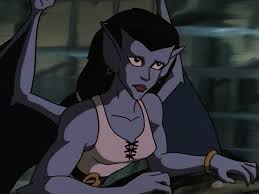
Demona, Goliath's former lover, is one of the primary antagonists for season one and beyond.

Demona, Goliath’s former lover, is one of the primary antagonists for season one and beyond.

The show opens with a very ambitious five-part mini-series titled “Awakening” (it was also released direct-to-video as Gargoyles:  The Movie) that sets up the series.  Right from the start, viewers are able to get a sense of the large-scale story-telling the show is aiming for while also being able to take in the peak of the show’s production values.  The animation quality is a grade above the usual afternoon cartoon fare, making it possibly the best looking cartoon of the mid 90’s.  The score is also exemplary and the voice acting contains notable actors such as Keith David (Goliath, various voices) and Edward Asner (Hudson) as well as numerous vets of various Star Trek programs.  Following the five-part debut, the show mostly settles into stand-alone episodes that also call upon happenings in previous ones.  Each gargoyle, with the exception of Bronx, is basically given his own episode to star in which helps the viewers get better acquainted with each one individually.  It’s similar to the tactic utilized by X-Men in season two and is an effective way to flesh out an ensemble cast.  There are thirteen episodes in total for season one, and pretty much all of them are good.  Some standouts include “Deadly Force,” which stresses the importance of gun safety without being ham-fisted (possibly created because main character Elisa is shown wielding realistic weaponry as opposed to fantasy, laser type devices).  “Her Brother’s Keeper” helps define what family means to the gargoyles and how it’s not so different from what it means to humans.  “Reawakening” is the bookend for the season and is a satisfying conclusion for the show’s first major arch.

Xanatos would be the other main foe for the gargoyles.

Xanatos would be the other main foe for the gargoyles.

What I appreciate most about the show is its commitment to realism.  This is a show starring unreal creatures but it takes them very seriously.  Their culture is defined as is their biology when Goliath points out early on that they can’t fly, merely glide on air currents.  As previously mentioned, Elisa is armed with a realistic handgun as are most of the police force.  Many of the villains do use lasers and other such fantasy fare but they come across as credible, in part due to a willingness to throw around phrases like “Die!” at their targets.  And when it’s called for, the show is not afraid to show blood which helps add severity to a scene.  The show also wasn’t afraid to be a little progressive as it’s revealed (casually) that Elisa is of mixed-race, having a white father and black mother.  And if you’re a fan of keeping movies and television as they were, you’ll be happy to know that the numerous shots of the New York skyline have not been edited to remove the twin towers.  Recent shows like Teenage Mutant Ninja Turtles and Beware the Batman have mostly empty city streets and lifeless scenery, it was refreshing to watch Gargoyles with its fully realized and very much alive New York.

The DVD release for season one is fairly basic.  There are animated menu screens depicting the gargoyles emerging from their stone prisons accompanied by music and sound effects.  The transfer is of good quality for this type of release and the case is a standard DVD case with a hinged insert for the second disc.  Bonus features include the original show pitch by Weisman which is worth a look just to see the original designs of the gargoyles.  There’s also a brief feature on The Gathering of the Gargoyles, a convention that used to be held in the US for fans of the show, that I suppose is worth a look though it’s basically just a bunch of fanboys and girls gushing over the program.  There’s also audio commentary on the fist five episodes, but I have yet to check it out (and probably won’t as it’s just not my kind of thing).

The show did not shy away from placing its characters in real danger.

The show did not shy away from placing its characters in real danger.

Gargoyles felt overlooked during its hey-day and today feels kind of like a forgotten series.  This is due, in part, to Disney’s stubbornness over releasing the entire series on DVD.  Season one was released in 2004 with the first half of season two following in 2005.  The rest of season 2 was in limbo until recently when it was released quietly as part of the Disney Movie Club.  Still remaining are the thirteen episodes from the abbreviated season three, rebranded as The Goliath Chronicles .  While fans would likely appreciate having those thirteen released, all but the season premiere were done without Weisman and thus are not considered canon by him for the show’s storyline, which lived on in comic book form for a short while following the show’s cancellation.  Unlike many cartoons from my youth that I have chosen to revisit, Gargoyles still holds up and impressed me a great deal.  I would love to see Disney revisit the show with Weisman for either a short fourth season or direct-to-video movie to provide additional closure.  Expect to see more of Gargoyles from me as I make my way through both volumes of season 2.


The Best of Pixar

DownloadedFile-22In honor of the recently released to theaters Monsters University, I thought it would be fun to look back on the feature-length films put out by Pixar Animation Studios (in conjunction with Disney) and come up with a top 10.  This proved to be a pretty difficult task and I consider this list, especially the top 5, to be quite fluid.  Pixar has really eclipsed Disney as the premier creator of animated films.  It could be argued that before it, Japan’s Studio Ghibli had knocked Disney off the top of the mountain but Pixar now stands tall over all.  And while their output has dwindled in quality just a tad bit lately, it seems like the studio is likely to maintain that status for at least a few more years.  This list is not going to give each film the space it deserves, or else it would run into the tens of thousands of words.  I also want to add that I do not think Pixar has made a bad film yet, though I also have not seen Cars 2 which has been the worst reviewed film put out by the studio.  I didn’t see it because I didn’t really care for the original, though I didn’t hate it or anything.  I also did see Monsters University this weekend, and while I don’t think it makes their top 10, it was enjoyable entertainment.

10. Brave

Brave is hindered by that fact that it’s one of the more recent films put out by Pixar so it hasn’t had as long of a time to leave a lasting impression (and as you can imagine, nostalgia points count).  Brave is a refreshing take on the princess genre and Merida is a very likable and easy to root for character.  The visuals are splendid and the conflict unique, though the setting and style is perhaps a bit too similar to the previously released Dreamworks film How to Train Your Dragon.  This is a film I plan to revisit and I expect my appreciation for it will only grow from here.

9. The Incredibles

Perhaps a controversial selection as I know The Incredibles is a favorite for many.  For me, I absolutely love the concept of a super hero family and this was probably my most eagerly anticipated work from Pixar.  Perhaps it was the weight of expectations that resulted in my initial disappointment.  It just didn’t resonate with me the way I thought it would.  I very much enjoyed the Mr. Incredible character, but the rest of the family didn’t appeal to me as much.  The film is also a little overstuffed and could have used some trimming.  Every time I re-watch it I wonder if this is the viewing that will make me fall in love with it, but so far that hasn’t happened.  Despite that, I still look forward to the eventual sequel and will continue to enjoy the in-jokes thrown at comic book fans.

8. Toy Story 2

Toy Story was such a smashing success that it made sense for a sequel to follow.  Because these films take so long, Pixar first released A Bug’s Life before getting to Toy Story 2.  Serving as director for all three feature-length films was John Lasseter, who wisely realized he couldn’t expect to continue to direct everything put out by the studio.  Toy Story 2 is an excellent sequel that contains enough of what made the original so memorable without feeling like a re-tread.  Visually, it is far superior to the first.  Some people seem to prefer it to the original, but for me I enjoyed the plot from the first one more and found the end chase more thrilling than the sequence that closes out this one.  This one is still great though, and Jessie’s song is really well done, making Toy Story one of the best franchises in recent memory.

7.  Ratatouille

Remy is one of Pixar's best creations.

Remy is one of Pixar’s best creations.

This where the list starts getting hard for me.  I didn’t have much trouble ranking the first three, but now we’re getting into the films I truly love.  Ratatouille is a clever tale about a rat named Remy, who is one of the most well-crafted of any of Pixar’s leads.  He’s interesting, flawed, likable, and well-acted by the animators and voice actor Patton Oswalt.  This one isn’t as emotionally heavy as some of Pixar’s other films, but it is so much fun and it’s still a treat to experience all of Remy’s highs and lows.  I feel like I could watch this film every day and not get sick of it.

6.  Toy Story

The one that started it all.  Toy Story was a marvel when it was first released in 1995.  At that time, no one really thought computer generated images could captivate in the same way as hand-drawn animation and we were all proved wrong.  While I will always prefer more traditional animation, I both love and appreciate what today’s artists are capable of with CGi.  Toy Story doesn’t look as good now as it did back then (especially the dog and human characters), but that doesn’t detract from the wonderful and clever story about what goes on in the toy box when kids aren’t around.  It’s an easy to grasp concept and one that offers so many possibilities for visual gags and story potential.  The Woody (Tom Hanks) and Buzz (Tim Allen) rivalry is played up so well that it’s a shame it’s not as heated in the sequels.  Toy Story is a modern classic that is sure to delight and captivate audiences for generations to come.

5.  Wall-E

Wall-E is a rather bold film when one considers its audience.  The first act is absent of any dialogue as we explore a ruined earth with only a mute little robot to guide us.  It’s thru director Andrew Stanton and the supremely talented animators at Pixar that we’re able to connect and care about this little robot.  Wall-E, despite being a robot, is able to convey so many human emotions thru just the movement of his telescope-like eyes and limited vocalizations.  The film’s only weakness is how effective these early scenes are in comparison to the easier to follow scenes in space where humans dwell.  Some thumb their noses at the conservationist tone taken by the film, but I found it to be good satire and consider Wall-E a true treasure amongst american animation.

4.  Toy Story 3

I can’t say I was all that excited for another sequel for Toy Story, even though I very much enjoyed the first two.  I was so wrong when I finally sat down and watched Toy Story 3 and found myself completely blown away.  I didn’t realize how much I wanted to see the world of these toys explored with better technology over what was available for the first two.  The world popped and is an absolute feast for the eyes.  That wasn’t exactly a surprise, but the fact that the film had a plot that appealed to me even more than the first two is what truly shocked me.  I fell in love on the first viewing, and the additions of Michael Keaton and Ned Beatty to the all ready stellar cast was the cherry on top.

3.  Monsters Inc.

We have officially entered the splitting hairs section of my list.  1-7 was hard, 1-5 was harder still, and 1-3 feels almost pointless.  On any given day, any of these next three could be cited as my favorite from Pixar, but I’ve settled on this order for today.  Monsters Inc. was the first of the Pixar feature-length films to not be directed by Lasseter.  Pete Docter oversaw this one and would establish an ability to really make an emotional connection with the audience.  Monsters Inc. is kind of like a buddy comedy with leads Mike and Sully (portrayed by Billy Crystal and John Goodman), only in a fantastic setting.  The world of the monsters is fully realized and more than just a little clever.  This is the first CGi film I can recall where so much hair, or fur, was included and the results are spectacular.  It’s the addition of the Boo character though, that puts it over the top and gives it the weight I mentioned earlier.  This film’s ending is so perfect, it gets me every time.  I’m not sure if it’s not my favorite ending to any movie ever.  I love it!

2.  Finding Nemo

A lot of these films were all conceived around the same time.  I get the sense that the powers that be at Pixar decided on a bunch of worlds they wanted to see animated and went off of that.  Finding Nemo is Pixar’s undersea adventure and the results are breathtaking.  The world is so simple yet so complex, it is probably the film that benefitted most in the switch from DVD to Blu Ray of any other I’ve seen.  All of Pixar’s films are incredible looking, but Finding Nemo contains one of the more heart-warming father-son stories contained in any piece of entertainment.  And outside of that plot, the characters encountered along the way are amongst Pixar’s most memorable.  Whether it’s the possessive seagulls, laid-back Crush, or the unforgettable Dory, there’s something amazing in every scene.  I’m so glad that Pixar has chosen to revisit this world, even if it has no chance of matching up to the original.  Though Pixar has proved me wrong before.

1.  Up

The odd paring of the aged Carl with the youthful Russell paid off for Pixar.

The odd paring of the aged Carl with the youthful Russell paid off for Pixar.

If Wall-E was considered a bold move for a family movie, then what does that make Up with its octogenarian for a lead?  I suppose the marketing and merchandising department was disappointed when it found out that Carl Fredricksen (Ed Asner) action figures weren’t likely to generate the kind of revenue Disney is used to, but I like to think they were okay with that once they saw the film.  Up is a wonderful piece of animation, and if Pete Doctor’s previous directorial effort Monsters Inc. is considered weighty, Up is a virtual anvil.  The montage that takes place at the beginning of the film which sums up the life of Carl and Ellie is wonderfully moving, and like Wall-E, done so without any dialogue.  The sequence is masterfully done, and if viewers found it a bit too sad then I hope the rest of the film makes up for it.  The main plot pairs up Carl with the youthfully exuberant Russell.  This odd-couple pairing can be forgiven for being too obvious because it’s executed so well. The emotional response generated by this film seems so authentic, and it’s the rare animated film I can honestly recommend to viewers of all tastes.  And then there’s Dug.  Dug, who resembles no dog from the real world and yet makes me think of every dog I’ve ever met (any nice dog, anyways).  His mannerisms and thoughts are so spot-on it makes it seem like an easy thing to so faithfully convey a dog’s emotions, but it’s really not.  Up is absolutely wonderful, and not just among my favorites put out by Pixar or Disney, but one of my favorite movies of any I’ve seen.  It will take a lot from Pixar to top it, but I hope they like a good challenge.