
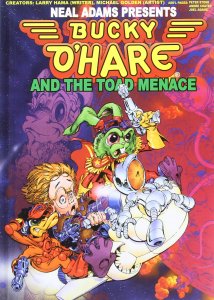
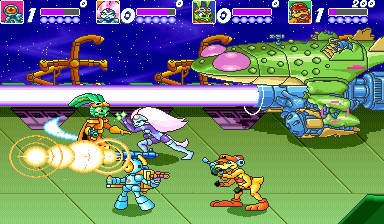
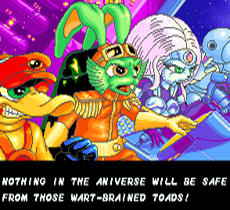
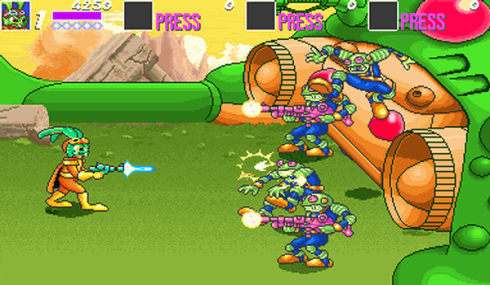
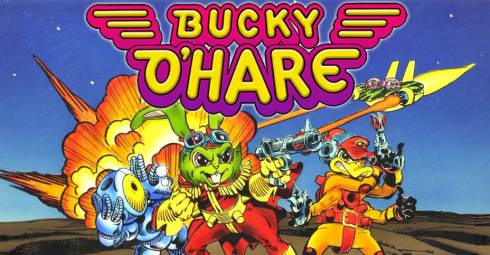
 Bucky O’Hare is best known for the cartoon series Bucky O’Hare and The Toad Wars. It was a short-lived series that spanned a mere 13 episodes. It’s greatest contribution to pop culture seems to be the NES game it spawned under the same name. That show appeared in 1991 and was gone within a year. A few VHS releases followed and eventually a Region 2 DVD in the new millennium, but aside from that the series is gone. Merchandise essentially vanished once the show was cancelled. The game was well received, though I have never seen numbers on how many copies were shipped. It fetches a fairly high price in this day and age on the resale market, but nowhere near the highs of some of the truly obscure NES releases.
Basically, the only official Bucky O’Hare related anything to remain in circulation this whole time has been the graphic novel Bucky O’Hare and The Toad Menace. Likely an intentional play at the name of the cartoon, Bucky O’Hare and The Toad Menace gathers the original run of six Bucky stories and pairs them with the following two from the UK only release of comics by DC Thomson.

Bucky debuted in the pages of Echo of Futurepast
Bucky’s original debut came in 1984 in the debut issue of Echo of Futurepast, a prestige independent comic by Neal Adams’ Continuity Comics. It was an expensive book due to the use of high-quality glossy paper. It was also an independent release and part of the creator boom in the 1980s in which many artists and writers fled from the big publishers for the independents where they could retain control over their own characters and art. The original Bucky stories were written by Larry Hama and illustrated by Michael Golden. Eventually, stand-alone issues were released in 1986 as well as a trade compiling all of the stories. Likely to coincide with the television show was the next run of comics that started in 1992 in the aforementioned DC Thomson run. Those issues were created by a different team of writers and artists though they still utilized Hama’s characters that eventually debuted in the animated series like Al Negator and Bruiser.
Bucky O’Hare and The Toad Menace arrived in 2006 via Vanguard Productions. It was around this time that Neal Adams was trying to resurrect the brand and even commissioned a CG short to try and market the property for either a movie or new show. It went no where, but the trade has remained in print and is currently being sold in various places including through Boss Fight Studio, who as you are likely aware of if you’re reading this, is creating new toys based on the property. The release is a manga styled release, meaning it’s just quite small (about 7″ tall) and in black and white. In 2007, artist Michael Golden did a special release which is just the regular Vanguard release but with a new black and white dust jacket printed by IDW. It was signed by Golden and numbered and bundled with some other stuff to be sold at conventions. It’s the version I have, but in terms of content there was no difference. It’s still the Hama/Golden issues plus two UK issues created by the team of Peter Stone, Andre Coates, and Joel Adams (Neal’s son).

Bucky’s first cover appearance.
The comic is an interesting revisit for fans of the cartoon. It starts off essentially the same; Bucky O’Hare and his crew are being pursued by the Toads and are out-gunned. The forces trailing Bucky and the crew of the Righteous Indignation do not initially know who they’re following, but once they do realize they have a real opportunity to take out their number one enemy. The story beats progress almost the same with the toads attacking and killing the chief engineer of the Righteous Indignation, Bruce, the Berserker Baboon. In the process, they damage the ship’s warp-drive which is powered by a photon accelerator. Elsewhere, on Earth a young boy named Willy DuWitt has created his own photon accelerator. He activates it at the same time Bucky’s crew activates their compromised unit causing a disruption in the space-time continuum which transports Willy to Bucky’s ship and pulls him into the story.
From there, it becomes a rescue mission as Bucky and his gunner, Dead-Eye Duck, visit Willy’s world and while there the toads board their ship and kidnap First Mate Jenny. It’s in the rescue of Jenny that the comic takes a different turn with Bucky and Android First Class Blinky encountering a strange god-like mouse. Following the conclusion of the first six issues, the next two essentially pick-up where the animated series does following the debut introductory story and ends with the introduction of Bruiser, oddly printed on the back of the reverse cover.
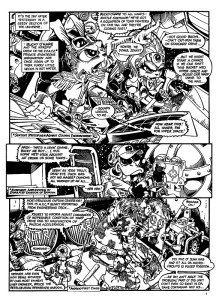
Golden’s artwork is very detailed but also very busy.
As a comic story, it’s easy to see what Hama was going for with Bucky. It’s serious in tone, but also satirical. Bucky makes numerous comments about insurance and unions and he even makes Willy sit down to fill-out some forms before they can welcome him aboard as their new engineer. There are lots of jabs at ineffective bureaucracy, most highlighted by Bucky and his crew of four being the only real Toad resistance in the galaxy. The council that controls the galactic government is shown to basically be in an endless argument about how to deal with the threat and are penny-pinchers to the extreme. They also reside on the planet Genus behind an elaborate network of defense satellites so they’re clearly withdrawn and that’s part of their inaction. The Toads, meanwhile, are shown via a story projected by Blinky to Willy that brings him up to speed on what happened. They created a sophisticated A.I. known as Komplex that was given too much power. It lobotomized its creators, and then convinced the general population to follow its orders. Then the world became industrialized so much so that the surface of the planet is no longer even visible beneath layers of factories. The Toads send their massive tankers all across the galaxy to suck up magma from other worlds leaving them desolate when done.

The first TPB from Continuity to collect the complete Bucky O’Hare works.
The story is very similar to what would follow in the cartoon, but is deployed in a more serious manner. In the cartoon, Bruce gets sucked into the photon accelerator rather than killed by the Toads. Bucky is surprisingly diplomatic in his approach, shedding no tears for their fallen crew-mate. The Toads and Dead-Eye speak freely of their desires to kill each other, and several Storm Toad Troopers do indeed meet their maker. It’s not gratuitous, but it is fun. There are obvious Star Wars influences as well with Dead-Eye even using the term lightsabre and a model Tie Fighter being shown in Willy’s bedroom.
Michael Golden’s artwork is almost hyper-detailed with a lot to process. This trade release is in black and white, and I’m not sure if it’s more cluttered as a result or less so. There’s lots of technological bits in the backgrounds and tons of line-work. It’s sometimes overwhelming, but I still find myself drawn to the actual character designs. They’re just so fun, and there isn’t a design I really don’t like. I do wish the Toad Air Marshall received more attention or some larger panels as he’s often squished into small panels. He’s a little bigger than his cartoon counterpart and wears a large coat, but he’s still covered in various medals. The artwork by Joel Adams is far simpler and there’s a lot more white on those pages. It’s not as detailed though, but still attractive and Adams does a good job of keeping the characters largely on model with Golden’s art.

Bucky’s adventures continued in the UK in 1992 where characters like Pitstop Pete made their debut in print after first appearing in the cartoon.
The mouse character is never named with most fans just referring to him as the Omnipotent Mouse. He’s an interesting character that never made it into the show, perhaps because he was hard to relate to. He feels like a distraction, though his message is largely that of a pacifist. Perhaps that would have been an arc Hama would have pursued had the comic continued with Bucky taking on the role of a pacifist. He’s not presented as being as murderous as Dead-Eye, but he certainly doesn’t seem to have any qualms about taking the life of a toad. There’s some nice tension between Dead-Eye and the witch Jenny that’s not played up in the show, though Dead-Eye expresses some mistrust towards her in both. I also like how cozy Jenny is with Willy as she’s affectionate like a typical cat would be, but when done through a more human-like being it’s rather humorous. Willy’s parents in both media are portrayed as activist hippies more concerned with their own business than paying attention to their son. They can’t relate to his pursuit of science just as he can’t really relate with them. The first six issues end with him getting stuck in Bucky’s world, but the next issue has him back in San Francisco with the detail of how he got back left unexplained.
Since Bucky O’Hare was initially just one part of an anthology comic that contained multiple stories, this release feels a bit shorter than most 8 comic collections. It’s 193 pages, but there are some duplicate pages where a story ends and another picks up as well as character bios. There’s also one page that is just plain duplicated for no reason, a printing error that I’m curious if is still present with more recent printings. The format is not ideal, but it’s not bad either. I think I’d prefer a larger release as that might make the panels feel less busy, but I actually enjoy the black and white look. The first six issues are fairly easy to come by at an okay price-point, but the UK issues are not. Some day I would like to own the entire 20 book run, but for now I have other priorities in life.


If you have ever been curious about the origins of Bucky O’Hare, this is an easy recommend. If you purchase it from Boss Fight Studio it will only set you back 10 bucks, plus shipping. Cheaper alternatives may exist in the used market on eBay and other like websites. It’s a mostly fun, breezy, read with some satisfying parts, and some less satisfying parts. Mostly though, you’ll likely be left wanting to read the other issues that followed. It’s a shame we can’t get reprints of those, but it’s probably a licensing issue between Continuity Comics and DC Thomson. And there also isn’t a tremendous appetite for Bucky O’Hare in 2019, but maybe we can change that.
 It’s been over two years since toy maker Boss Fight Studio announced it had acquired the Bucky O’Hare license from Continuity Comics and intended to do a new line of action figures based on the dormant property. It was about a year later that the first two figures arrived: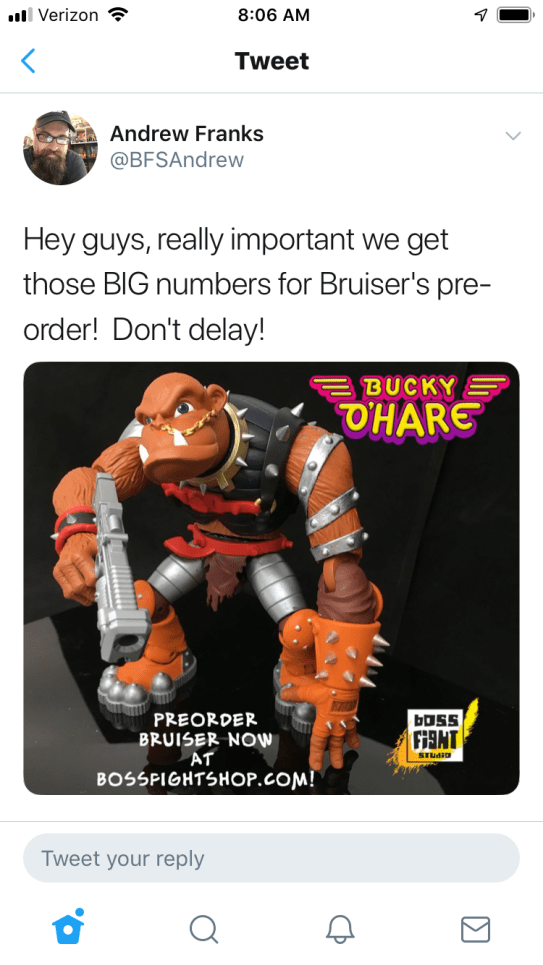


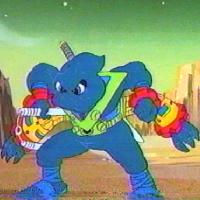
 In case you haven’t noticed or do not frequent this blog, I have quite a passion for Christmas. As a kid, my enthusiasm was directed at the holiday thanks in large part to the toys and such. As an adult, that enthusiasm has been transferred more towards the season and the build-up to Christmas. I like to indulge in it, but once Christmas comes and goes it leaves me feeling rather blue. This year though, December 26 had a bright spot when a package from Boss Fight Studio arrived at my doorstep containing the latest from the toy maker’s Bucky O’Hare line – the Storm Toad Trooper.


 For the better part of three decades, Bucky O’Hare has been largely absent from the public conscious. His television show lasted a mere 13 episodes, likely green-lit thanks to the popularity of other obscure comic turned television sensation the Teenage Mutant Ninja Turtles. His toy line consisted of one wave of 10 figures and two vehicles and no more. Why did Bucky fail? There are a few theories, but the most prevailing is that Hasbro mishandled the toy line packing too many unpopular figures into a case (specifically Toad Air Marshall) at the expense of the most popular characters like Bucky, Dead Eye, and Bruiser. And I can certainly vouch for that to a point, as I only bought a Toad Air Marshall as a kid when he was literally the only character on the pegs. And it wasn’t that the section had been picked over leaving a handful of figures, no it was dozens of Toad Air Marshall action figures. When I got my first Bucky I had to sift through a bunch of them to find him and was elated. I eventually had the whole set, plus the vehicles, though sadly they would be either sold in a yard sale or discarded entirely. I would replace my Bucky many years later as an adult collector, but never the rest of the set.


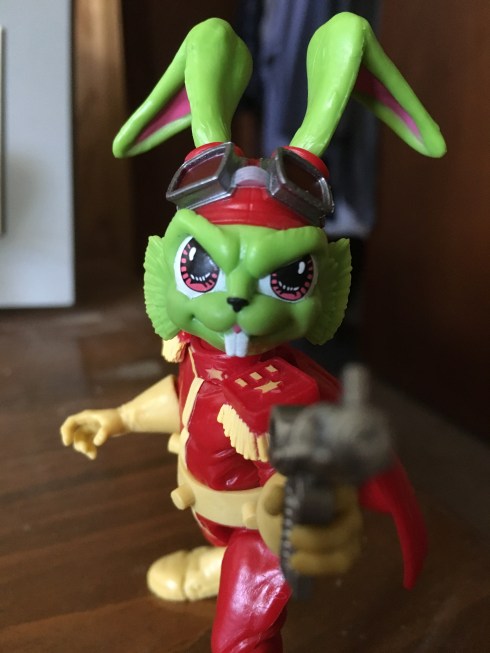 For the debut of the line, Boss Fight Studio settled on Captain Bucky O’Hare himself and First Mate Jenny. The selections may seem obvious, after all, who is going to launch a Bucky O’Hare toy line with out Bucky O’Hare, but Boss Fight Studio deserves some recognition for pairing him with Jenny. Jenny was infamously dropped from the Hasbro line because of the concern of marketing a girl toy to boys. She was supposed to be included in the planned second series, and since she was basically prepared for the first set, completed figures made it through production and into packaging. Some of these would find their way into the hands of collectors, most did not, and Jenny remains the biggest omission from that lone set of figures. Finally, Bucky O’Hare fans have the Jenny figure they were denied back in 1991.


 Jenny is in some ways the more anticipated of the two because of her history. She does not disappoint. She’s nice and shiny and packed with articulation like Bucky. She’s got a huge mount of hair on her head, as she did in both comics and TV, and an abundance of curves. If this property had been more popular we’d probably be partly blaming Jenny for the rise of furries. Her arms and lower legs are really thin, but she doesn’t seem particularly fragile or anything. Her hands are easily swapped out with the extras provided by BFS, and she also has two additional face plates, one of which being a cheeky winking face. She doesn’t have a gun, despite carrying one in the animated series, but has two hands with “psychic energy” resembling Marvel’s Psylocke and two circular energy blasts she can hold. She has four sets of hands as a result, compared with Bucky’s three, and four face plates. Her default features an open mouth, but she also has a smiling one and a toothy smile in addition to the winking face mentioned before. Her hair is obviously quite heavy, but her tail makes posing her rather easy. She’s a bit limited in what she can do as a result, but still looks great. There are some slight paint imperfections on a few of her face plates as she requires finer details, but nothing major.


 Just announced today,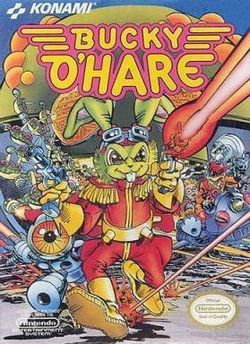


 The Nostalgia Spot