Author Archives: Joe

Gargoyles: Season 2 Volume 1

Gargoyles_DVD_2The cover of the DVD release of Gargoyles Season 2 dubs it as Volume 1 of the second season.  At first glance, that may seem like a greedy way to release a show to DVD, but that is not the case.  A common practice of children’s animated television was to order 65 episodes as early in the life of the series as possible to make the programming eligible for syndication where more money could be made off of it.  I say “was” because I’m not sure if that is still the case with numerous cable outlets now providing a lot of the entertainment these days.  Gargoyles was not originally broadcast on cable though, which is why season 2 is 52 episodes long, which following the 13 episode first season, gets the series to 65 total episodes.  Sometimes networks are so confident the show will be a hit they go right from the pilot to a 65 episode order.  This was the case for the still popular Batman:  The Animated Series which featured a pretty bankable star in Batman, but Gargoyles was an all new intellectual property so Disney opted to go for a trial run with the first 13 episodes before going all in.

The process of large season orders seems like a win for fans of the show.  After all, a 52 episode season would theoretically allow for a new episode every week for an entire year, though this wasn’t the case for Gargoyles since it was an afternoon program.  It does usually mean shorter wait times between new episodes, but things can get a little erratic since the season will usually begin airing while a lot of episodes are still in production.  There’s also the other downside to a large season such as this which is these episodes need to get produced quickly, and more people are needed for production and story-writing.  The first season of Gargoyles was a tight, neat collection of episodes with high-quality animation for television.  Season 2 sometimes has the feel of “too many cooks in the kitchen” and episodes become more stand-alone in nature.  The animation is still among the best when Gargoyles is compared with its contemporaries, but there are some drop-offs and it’s apparent that the show had multiple teams for animation.  Some episodes feature sharp lines and tight animation while others are more rounded and toon-like with characters often making over-exaggerated gestures (those familiar with X-Men likely have an idea of what I’m talking about).  Which one looks best is a matter of taste though (I prefer the harder look for this program) at least, with the overall animation quality usually pretty strong from episode to episode.

There are some pretty interesting plot twists to find in season two.

There are some pretty interesting plot twists to find in season two.

Inconsistent animation is expected when a show requires a large amount of episodes be produced, but my main concern for Gargoyles was how the writers would respond when tasked with filling so many hours.  The first season largely operated in a serial format with each episode tied to one overall plot.  Some felt more stand-alone than others, but all plots were referenced at one point or another and the overall quality of the story-telling was quite good.  I knew season 2 would have to feature more stand-alone episodes, but thankfully very few feel like throw-away or filler episodes.  Many of these one-shots still contain plot devices that have repercussions on the episodes to follow, such is the case with the conclusion of the episode “The Mirror” when Demona gains a new power.  Many others choose to introduce new villains or allies that will pop up in later episodes, as is the case with the characters Doctor Sevarius and Jeffrey Robbins.  In short, the structure of the show remains rewarding for longtime fans.  This does come at the cost of making the show a little harder to jump into at any point for newcomers, but since it’s no longer on television, this is really no longer a concern.

There are many stand-alone episodes, but there’s also no shortage of multi-part arcs.  The first half of season two contains the four part “City of Stone” and the three part “Avalon.”  Both are heavily reliant on flashbacks as it seems one goal for season 2 was to flesh out the villains even further, specifically Demona and MacBeth.  We learn about their history together and how Demona has survived the centuries and remained largely the same in appearance.  In season one, we the viewers were basically left to assume that gargoyles are extremely long-lived given that Demona was not affected by the Masgus’ spell like the others, but we learn in season 2 that is not the case.  There are lots of other recurring characters in season 2 such as The Pack, Tony Dracon, Derek Maza, Coldstone, and of course Xanatos.  Xanatos is still primarily an adversary of the Manhattan Clan, but he’s also an unlikely ally in several episodes.  One could even suggest that the writers go to this well a bit too often, but such is the case when 52 episodes have to be written in a short amount of time.  Still, I like the role Xanatos plays on this show of the equal opportunist who has his own agenda that isn’t always clear.  By the end of the first half of the season viewers, and even Goliath to some degree, have mostly caught on to Xanatos and the game he plays making me wonder what role he’ll play going forward (as I honestly can’t recall from my days of watching this as a kid).  Xanatos is also paired this time around with Fox, of The Pack, as his love interest which is a rather interesting dynamic.

Now where have I seen that dress before?

Now where have I seen that dress before?

Another part of the plot the writers seemed eager to explore in season 2 was the relationship between Elisa and Goliath.  Elisa was Goliath’s main confident, along with Hudson, by season one’s end and he (as well as the other gargoyles) clearly feel a strong sense of protection with her.  In season 2 it’s becoming more obvious that they have a stronger bond than just friends.  Sometimes the show is pretty obvious about it, but for the most part they let it go unstated and attempt to keep things subtle.  It has a nice progression throughout.  Disney fans will also particularly enjoy a scene from the episode “Eye of the Beholder.”

Gargoyles was never a series afraid to introduce characters, and many new villains are brought into the fold in season 2.  New allies, as well.  A pet peeve of mine with X-Men was always how the writers would tease a new character joining the X-Men but would never go through with it.  Towards the end of season 2, the writers chose to add a new member to the clan.  To better introduce this character, the writers shrink the cast down to just Goliath, Elisa, Bronx, and the new-comer for the unofficially titles World Tour episodes.  These episodes spill over into the second part, and series creator Greg Weisman actually bumps up one episode from the second half, “Kingdom,” to serve as the final episode in this collection.  This final episode takes place in New York and we get to see what the rest of the clan is up to with Goliath missing.  This is probably something Weisman regretted not doing originally, as when these aired we went 10 episodes without seeing the other characters which seems much too long.  The World Tour will continue well into the second half though I do not suspect any other episodes were re-arranged as no one affiliated with the show had any say in the release of volume 2, that I know of.

The relationship between Demona and MacBeth is fully revealed in season two.

The relationship between Demona and MacBeth is fully revealed in season two.

Gargoyles:  Season 2 Volume One largely carries over the quality of the first season and only enhances the show’s reputation as one of the better animated programs from the 1990’s.  Season One is probably superior when judged on quality, but the second DVD release for the series obviously boasts more content.  The release itself is also much nicer and includes some bonus features in comparison with the bare-bones season one release.  Unfortunately, season two did not meet the sales expectations of Disney and volume two was never commercially released until just recently.  Volume two is even more sparse than the first season release, and is currently only available to members of Disney’s Movie Club.  I’m not a member of that club, but did find out Buena Vista has an ebay account that basically specializes in selling these exclusives and was able to get one from there.  I don’t know if they restock or not, but that is definitely the best bet for those who want a copy as the secondary market is a little inflated right now.


Oliver & Company

Oliver & Company (1988)

Oliver & Company (1988)

Memories are a funny thing.  What we choose to remember and forget really isn’t up to us.  The brain just kind of erases and deletes things as it sees fit without any conscious thought or action.  And when it comes to what we see and how we perceive our world, the brain has more say in that than we are often aware.  The eyes allow one to see, but it’s the brain that has to decode the feed like a receiver and actually tell the body what is there.  As a result, we can often remember things not how we saw them, but how we perceived them.  It gets really interesting when trying to recall a first memory. I have a few that could be considered my first memory and they’re all from around age 2.  The thing is though, I don’t know if these memories are real or if I’ve created them in just trying to reach back or from hearing a story.  It can be kind of wild to really think about it, and perhaps I’m better off just accepting what my brain says are my earliest memories.

One early memory I’m pretty confident in is my first trip to a movie theater.  I don’t know what went into it, where it was, or even what we did when there, but I do know that the first movie I ever saw in a theater was Disney’s Oliver & Company.  Oliver & Company came out in 1988 so I would have been around 4 years old.  Now everyone is used to films coming out on DVD or Blu Ray around six months after a film debuts in theaters.  When I was a kid this was not the case at all.  Some were released in about a year, but with Disney it was several years or not at all.  Disney spent a ton of money on its animated films and many did not turn a profit during the initial theatrical run.  Disney banked on theatrical re-releases to stay afloat so the company was very careful in what it released for the home market.  This philosophy was in place until The Little Mermaid was released and the home video market was thriving.  At that point, Disney had made a bunch of money already off the film and figured to make a whole lot more if it was available for Christmas.  The Little Mermaid was the film that followed Oliver & Company.  As such, Oliver & Company didn’t see a home video release until 1996, long after I stopped caring about Disney movies.

The film starts off like it might be a buddy flick with Oliver and Dodger before the cast is eventually expanded upon.

The film starts off like it might be a buddy flick with Oliver and Dodger before the cast is eventually expanded upon.

Because of Disney’s home video release schedule, when I sat down recently to watch my newly purchased copy of Oliver & Company on Blu Ray it was the first time I had seen the movie since I was four years old and in a theater for the first time.  It was kind of a surreal experience as I watched this film.  There were things I remembered, like Tito’s “Hey man, check it out,” line, and there were things I forgot I remembered like Dodger’s memorable “Why Should I Worry?” song.  There were also many things I had completely forgotten.  Before I sat down to watch the film a second time I could not have even begun to speculate on what the villain looked like.  I probably would not have remembered the name of the little girl (Jenny) and I certainly would not have been able to recall any of the names of the other dogs in the picture.  In many ways I felt like I was seeing the film for the first time, but there was an old familiarity there as well that created a rather warm experience.

Oliver & Company is probably not a film remembered by many.  I wasn’t even aware of the Blu Ray release and I’m someone who is pretty plugged into these kinds of things.  That’s not to say the film isn’t noteworthy for a few reasons.  Most notably, it was the film that basically laid the groundwork for all of the Disney animated features to follow.  Films that would prove to be far more successful than Oliver & Company (not that Oliver & Company wasn’t a success, it just wasn’t as big as the films to follow) like Beauty and the Beast and The Lion King.  It was the first to really utilize that Broadway format of interspersing narrative and song in a very MTV like fashion.  Sometimes the plot feels almost ancillary, as if it exists simply to move the film to the next music video.  I’m not a fan of this approach, and as a result, I tend to prefer Disney’s older films to the modern ones but there are films that are able to succeed with this approach.  Oliver & Company does, but on the most basic level.  It’s harmless entertainment and it has a good heart but there’s no deep undercurrent to the plot or there really aren’t any big visual moments.  The villain of the film is only ever lurking on the periphery.  He’s menacing, but not on the level of any of the big villains to follow.  This is partially due to the film’s short running time (74 minutes) and due to the fact that the story is a fairly simple one.

Marin's Tito ends up being the star of the film.

Marin’s Tito ends up being the star of the film.

The protagonist of the film is a small orange kitten named Oliver trying to find a place for himself in the world.  As indicated by the title, this is an adaptation of Dickens’ Oliver Twist but only loosely so.  There are quite a few celebrities on the cast for this one including a young Joey Lawrence as Oliver.  Billy Joel plays Dodger, a street-wise dog who is basically the alpha of a pack of thieving canines doing the bidding of the mostly harmless thief Fagin, played by Dom DeLuise.   Cheech Marin plays Tito, the wise-cracking chihuahua and Bette Midler is a pampered poodle named Georgette.  The cast does a good job with what they are given with Marin probably showing the best.  The music is obviously a big part of the picture and the opening number “Once Upon a Time in New York City” is performed well by Huey Lewis.  Joel’s number “Why Should I Worry?” is the star of the film.  It starts off as a smooth jazz number before the heat gets turned up.  It’s infectious.  The rest of the musical numbers fall pretty flat though.  Midler’s “Perfect Isn’t Easy” is supposed to be another big number that makes use of some early CAD technology but it just isn’t there.  The film kind of meanders along for the last half of the picture as a result.

Visually the film resembles a lot of the other Disney works that utilize the Xerox technology that debuted with One-Hundred and One Dalmatians.  The edges of the characters are rough and sketch-like.  Some of the backgrounds are as well.  It works when the film is trying to present some of the grimier locations in New York but it doesn’t work for the glitzy Times Square.  Disney’s animation, like its profits, took off after Oliver & Company and the company was willing to invest a bit more into each successive picture.  This isn’t a bad looking movie and it has its own visual charms, but it does lag behind Disney’s better works.

Oliver & Company is a really unremarkable movie but one that does hold a lot of nostalgic value for me.  If I didn’t have such a unique relationship with it I probably would not own it.  That’s not to say that it’s bad or anything.  I did enjoy watching the film for what it is, but it is mostly disposable entertainment.  For adult animation fans, this is hardly essential viewing, but if you have kids that will consume anything Disney then they will have some fun with Oliver & Company.


Teenage Mutant Ninja Turtles (2012) Season One Review

nick_tmnt_wallpaper1280x1024_02Back in September of 2012, Nickelodeon unveiled the newest incarnation of the Teenage Mutant Ninja Turtles in a one-hour season premiere.  On August 8th, 2013, the first season came to a close with a one-hour season finale.  The symmetrical first season had its ups and downs, but no one can deny it was a smashing success from a commercial standpoint as Nickelodeon has already commissioned a second and third season.  Once again, the Turtles franchise has proven that it’s harder to squish than a cock roach as it rolls on into its fourth decade of cultural relevance.  Such was likely never predicted of the franchise back when it burst onto the scene in the late 1980’s.  I would be willing to bet most adults viewed it as the latest flavor of the month they had to endure to keep their kids happy as toys and various other merchandise was consumed by the millions.  Perhaps more importantly to fans, the first season of Teenage Mutant Ninja Turtles was not only a commercial success, but a creative one as well as it successfully melded the various depictions of the Turtles over the years into an all new show.

I watched and wrote about the season premiere when it first aired and described my reaction as tempered enthusiasm towards the show.  That would eventually be replaced with full-on enthusiasm as I set my DVR to record each new episode (which became a challenge to keep track of as the broadcast schedule was all over the place) to watch at my leisure.  The show got better as the weeks rolled by and the writers seemed to become more comfortable with the characters.  A lot of the humor early on missed the mark but eventually the show found its groove in that department and routinely was able to bring a smile to my face.  The show also introduced a major plot thread that was woven through the entire first season revolving around the alien race known as the Kraang which helped make the show feel more significant for regular viewers.  I’ve always been a big fan of this approach for television over stand-alone episodes.

The Rat King was one of the better redesigns for the show.

The Rat King was one of the better redesigns for the show.

That’s not to say the show didn’t have stand-alone episodes here and there.  And quite frankly, that was when the show was its most uninteresting.  There was a period in the early part of the season where each episode felt like The Villain of the Week where some poor soul would be mutated into a monster the Turtles had to stop.  There was still humor to be found in these episodes and some nice action, but there was little lasting appeal.  Some of these monsters were also severely lacking in the personality department, both in a behavioral sense and visually speaking.  That is definitely one area where the old cartoon still reigns supreme as the villains often had a pretty interesting and fun look to them.  That was probably due to Playmates wanting a fun toy to market, but it worked.  The show did get better as the season went along, with one of my favorite looks for a villain popping up towards the end in the form of a newt with a Punisher-like pattern to his spots.

Overall, when compared with the old cartoon, the show was less reliant on guest spots and was content to rely primarily on a core group of characters.  The Shredder, obviously, was a big part of the first season even if he was secondary to the Kraang threat.  The writers wisely kept him out of action though, which made the episodes where he took up arms against the Turtles extra special.  He’s also a total bad ass when in combat, a far cry from the bumbling Shredder of the 80’s or even the original comic book Shredder who is famously decapitated by Leonardo at the end of the series’ first book.  This Shredder still retains his old look but with more black and bigger blades.  He’s also far more scarred than any other as his face has been badly burned and he appears to be blind in one eye.  Like the old Shredder, this one also has two mutant henchmen:  Dogpound and Fishface.  While these two are not as stupid as Bebop and Rocksteady, they’re not any more successful and are often beaten back by the Turtles.  Baxter Stockman also falls in with the Shredder during season one and provides him with some heightened technology.  Karai, Shredder’s daughter, is also introduced as a bit of tweener villain in that she has a bit of a friendship with Leonardo which serves as the backbone for a series of episodes during the middle part of the first season.  Other characters familiar to longtime fans also show up, such as Leatherhead and the Rat King, sporting new designs and new personalities.  I particularly enjoyed the new design for the Rat King and thought he was among the best of the villains shown off.  I hope to see more of him in the future.

The Karai/Leo subplot was one of the more interesting parts of season one.

The Karai/Leo subplot was one of the more interesting parts of season one.

On the Turtle front, the cast basically stayed the same throughout the first season.  A lot of old favorites were brought back though such as a new take on the Turtle Van which is now a subway car.  The Turtles retain their signature personality traits but they feel more honest this time around.  Raphael, for example, doesn’t just get pissed-off because he’s supposed to and Leonardo is far from being an emotionless robot.  All of them have strengths and weaknesses, and for the most part, they also feel like teenagers.

Of particular enjoyment for long-time fans were all of the little easter eggs and throwbacks inserted into this series.  Metalhead was brought back as a robot constructed by Donatello.  He looks fairly similar to the old one, only much smaller.  There’s even a spot during the episode were one of the bran-like Kraang latches onto his head, which I have to believe is a nod to the original action figure’s sculpted brain.  The leader of the Kraang also inhabits a giant robot body and the antenna on its head evokes images of Krang’s body from the old cartoon.  Little things like that go a long way towards pleasing the older fans and trying to spot them is part of the enjoyment in watching the show for me.  The Technodrome is also introduced during the season finale, and the long-awaited Splinter vs Shredder confrontation takes place as well.  There’s a big reveal in the season finale that I think anyone familiar with the franchise saw from a mile away, but it was still done well and, despite being predictable, is actually a new direction for an old character.

The Donatello/April relationship could have felt forced, but the writers have handled it well and I'm actually curious to see where it goes (expect Casey Jones to eventually butt-in).

The Donatello/April relationship could have felt forced, but the writers have handled it well and I’m actually curious to see where it goes (expect Casey Jones to eventually butt-in).

From an artistic standpoint, the show animates quite well and is far superior to the DC CG cartoons currently airing on Cartoon Network.  The city streets of New York remained pretty barren for the whole of season one with some signs of life in the finale, but otherwise the show looks good.  I like the fact that each turtle has his own shape and anatomy instead of basically looking exactly like the others with the exception of the mask.

All in all, Teenage Mutant Ninja Turtles is a good show that strikes the perfect balance between action and comedy.  The story-telling was also better than could be expected and the writing staff will have a hard time topping season one.  Its start reminds me quite a bit of the 2003 cartoon which, for me anyway, fell off quite a bit in the second season and seasons to follow.  Hopefully this show doesn’t meet the same fate.  Because season one was spread out over so many months, the wait for season two to begin is actually a fairly brief one as its set to kick off in late September.  This version of the Turtles may not be violent like the originals, or say “Cowabunga!” like the old toons, but they have a chance to go down as the best Teenage Mutant Ninja Turtles yet!


Dreaming of Kingdom Hearts 3

images-125

UPDATE 3/8/2014: Square-Enix has posted a survey for Kingdom Hearts, and if there is something you want to see in Kingdom Hearts 3 (Gargoyles!), this is the best way to make your voice heard!

Watching Gargoyles these past few weeks has got me thinking about the upcoming PS4/Xbox One game Kingdom Hearts 3.  So far, little information, aside from confirmation the title has been in development, has been released regarding the next entry in the Kingdom Hearts series.  For those unaware, the Kingdom Hearts games were initially conceived as a marriage between Disney and Square’s Final Fantasy.  Several games have been released in the series and, for the most part, they all follow a pattern of having the main character visit various different worlds based on classic and current Disney films.  Gargoyles has got me thinking about how cool it would be to see that world brought to the series as it would seemingly lend itself well to the video game form.  There was a game based on the series created for the Sega Genesis.  It was a late arrival on the Genesis and while it boasted some rather slick animation it was bogged down by poor gameplay mechanics and a repetitive design.  It is my understanding that the only rules for selecting worlds for Kingdom Hearts are that they be from Disney films, but not Disney owned films.  This would eliminate the various Marvel films produced by Disney as well as any future Star Wars ones.  It also appears to apply to Pixar films as well as so far no worlds from a Pixar film have shown up.  It also excludes any worlds from Disney television, but in the case of Gargoyles, this rule could be circumvented by the existence of Gargoyles The Movie:  The Heroes Awaken.  It’s kind of cheating as the direct-to-video movie is just the first five episodes edited into a 90 minute film but lets not get too technical.

Using my own memory, and with help from Wikipedia, I’ve come up with the below list of Disney films to appear as worlds in the Kingdom Hearts series:

  • Sleeping Beauty
  • The Little Mermaid
  • Aladdin
  • The Nightmare Before Christmas
  • Winnie the Pooh
  • Peter Pan
  • Hercules
  • Tarzan
  • Pinocchio
  • The Lion King
  • Steamboat Willie
  • Pirates of the Caribbean
  • Alice in Wonderland
  • Cinderella
  • Snow White
  • Beauty and the Beast
  • Mulan
  • Tron
  • Lilo & Stitch
  • The Hunchback of Notre Dame
  • The Three Musketeers
  • Fantasia

This list may not be exhaustive, and does contain some unusual selections.  “Steamboat Willie” stands out as it’s not a feature-length film, but as Mickey’s most recognizable short, it’s not surprising to see it included.  It also, like pretty much all of Disney’s classic shorts, was originally released to theaters.  The Three Musketeers also stands out as it was a direct-to-video release so it appears their self-inflicted rule does not mean the film needed to be theatrically released.  Square has done a good job of hitting most of Disney’s biggest properties.  There is also a good balance of old and new, but there’s still plenty of room for more.  Below are some thoughts of mine regarding where the franchise could go for its next outing:

Bambi – Bambi the character has already appeared as a summon in the KH series but he’s never had his own world.  As one of the few classic pictures to not have a world, it makes sense for Bambi to step into a larger role.  His world is not particularly unique considering it’s just a forest, but a world created around the forest fire scene from the film’s climax could have some interesting gameplay mechanics.  For one, it would make the world visually interesting and the fire could be the result of one of the film’s antagonists.  Bambi could be an assist character and, together with Sora, they would be tasked with extinguishing the blaze.  The world could either be full of peril due to the fire, or there could be a time limit in place.  Considering Bambi is one of Walt’s greatest achievements, it just makes too much sense to include it eventually.

And to think, some at Disney felt The Horned King would be too scary for kids...

And to think, some at Disney felt The Horned King would be too scary for kids…

The Black Cauldron –   The Black Cauldron is, unofficially of course, Disney’s black sheep.  It differs quite a bit in tone from the works that preceded it in that there’s a distinct absence of humor throughout.  A lot of critics disliked the film, and while it appears to have spawned a cult following, it’s still one of the lesser films put out by Disney.  It’s inclusion here is not a defense of the film, I haven’t it seen it in so long that I really can’t offer much of an opinion on it, but it’s world would actually appear to fit in quite well with the KH universe.  The Horned King would make a natural complement for Maleficent and the Fairfolk could be incorporated as well.  The film almost makes too much sense for inclusion, leading me to believe the only reason it has not been is because the film is so obscure.  It’s also possible that Disney doesn’t own any of the characters outright and legal issues may not make it worthwhile to include.

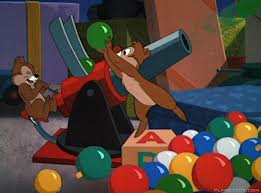
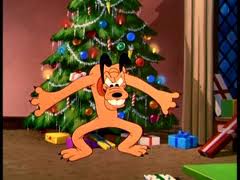
Toy Tinkers – I am an unabashed Donald Duck fan so I wanted to include one of his shorts on this list.  I initially thought “Trick or Treat” would work well because of the Witch Hazel and her special potion that brings inanimate objects to life, but such a world would have a lot in common with Fantasia and Halloweentown.  I settled on “Toy Tinkers” because it would allow the inclusion of a Christmas themed world and a unique gameplay opportunity.  I conceive it as a world in which Sora has been shrunk somehow and is caught in between the fire-fight between Donald and Chip and Dale.  There would be debris raining down and perhaps Sora would help Chip and Dale thwart Donald somehow.  It would be a bit of comedic relief and a fun bit of level design.

This would seem to be a natural conflict for a video game.

This would seem to be a natural conflict for a video game.

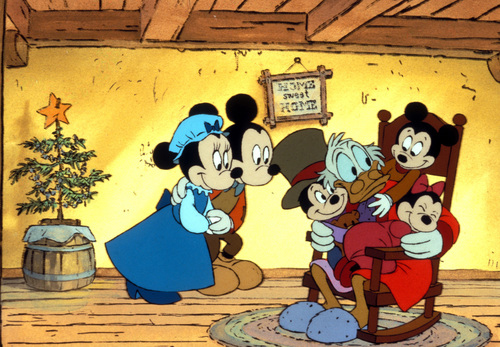
The Brave Little Tailor – My thought process for this level is similar to the above for “Toy Tinkers,” so I consider this an either/or arrangement.  In the short, “The Brave Little Tailor,” Mickey is tasked with defeating a giant.  For KH, the scenario seems obvious and Sora would either replace Mickey or assist him in taking down a giant.  It would feel similar to my “Toy Tinkers” scenario because Sora would be taking on a foe much larger than he, so the two would perhaps feel too alike if they both appeared in the same game.  Nonetheless, it would be fun to challenge the giant and a tailor themed Mickey could be an interesting assist character.  This could also easily be swapped out in favor of a Mickey and the Beanstalk themed level.

Duck TalesDuck Tales would appear to not be eligible due to the fact that it was a television property, but it sneaks in because it did have a feature-length release, Treasure of the Lost Lamp.  If the level had to be based on that film, then no matter, it could be a pseudo Indiana Jones type of deal with cave exploring with Uncle Scrooge, the nephews, and maybe even Launch Pad.  Classic Duck Tales villains could still be included as well.  Ultimately, I just want to see Scrooge’s giant vault of gold coins included complete with diving board.

Toy Story – Yes, I know and covered it already, it would appear that Pixar films are a no-go when it comes to KH.  However, Pixar’s films have become as much a part of the Disney brand as Mickey and Snow White and their presence is felt throughout Walt Disney World and Disney Land.  And if there is to be one exception made for Pixar, why it has to be Toy Story, no?  It makes too much sense for inclusion as Sora could be transformed into a toy of some kind and have to team-up with Woody and the gang to foil Sid.  The level basically designs itself and there are so many action sequences from the three films that the designers could look to for inspiration.  Come on Square/Disney, it’s time to invite Pixar to the party.  Do it!

I'd be delighted to see any of the films/shorts from this list incorporated into KH3, but mostly I just want to kick some ass with Goliath by my side.

I’d be delighted to see any of the films/shorts from this list incorporated into KH3, but mostly I just want to kick some ass with Goliath by my side.

Gargoyles – We’ll end this with what started it in the first place, Gargoyles!  Gargoyles, as primarily an action-adventure cartoon, makes a lot of sense for a video game.  Goliath would be a pretty bad-ass support character and Demona seems like a perfect villain for KH (though MacBeth and Xanatos would work as well).  There would be some fun music to source, and most of the voice cast has maintained a relationship with Disney to this day including Keith David (voice of Goliath) who recently voiced the villain for Disney’s The Princess and the Frog.  Gargoyles would also allow Square to set a level in New York, specifically the skies above New York.  The castle would make for both a great visual and fun setting for an all out battle with Demona or the Steel Clan.  Someone send the developers of Kingdom Hearts 3 a copy of the first season (or the movie, but they would need a VCR on hand to watch it) and then try to stop them from making use of it!

There’s actually plenty of other films Square could source for Kingdom Hearts 3 that I didn’t even bring up.  The Sword in the Stone or Robin Hood seem like natural fits, or perhaps because they’re too conventional they’ve been ignored.  101 Dalmatians also seems like an easy film to incorporate and Cruella De Vil would be a natural as a villain for the series.  And considering it drew inspiration from video games, I feel like I have to mention Wreck-It Ralph.  I actually fully expect a Wreck-It Ralph scenario of some kind to appear in KH3, either as the game world Fix-It Felix Jr. or maybe a Sugar Rush style mini game.  I consider all of my selections as long shots and I’d be surprised to see most of them.  It actually wouldn’t shock me if Disney lifted the embargo on Pixar films and allowed a Toy Story level, just because the property is so popular, and the giant sequence I described (most likely to occur in the form of Mickey and the Beanstalk) also strikes me as a legit possibility for a KH world.  The others are merely dreams or wishes, and as much as it would delight me to see Goliath and crew in Kingdom Hearts 3, I also acknowledge it’s mostly a pipe dream.  Perhaps if I wish upon a star…

Dragon Ball: Season 3

Dragon Ball:  Season 3 (2010)

Dragon Ball: Season 3 (2010)

Apparently I’ve settled into a once a year pattern with Dragon Ball.  I have all five seasons, and I’ve viewed them all, but it’s taking me a long while to write about them.  That’s ok, as sometimes this blog becomes too video game centered and it’s nice to have something like Dragon Ball to fall back on when I want to post about something other than gaming.

Because these seasons are not actual seasons, season 3 of Dragon Ball picks up right where season 2 left off with Goku trying to defeat the evil Mercenary Tao.  In order to do so, he has scaled Korin Tower to enlist the help of Master Korin who’s training is said to make the most formidable warriors even stronger.  With Korin’s help, Goku is confident he can topple Tao and avenge the death of his friend, Bora.  Korin, the dimunitive cat-like creature, seems unwilling to offer much assistance to our young hero and the ensuing “training” Goku goes through contains a heaping dose of comedy for the viewers, which works well following the rather heavy close to season 2.

The over-reaching conflict of the first part of season 3 is still General Red and the Red Ribbon Army.  It is they who hired Tao to take out Goku and eliminate their greatest obstacle in recovering the seven dragon balls.  Goku will have a satisfying encounter with Tao following his training with Korin and then go on to assault the home base of the Red Ribbon Army to put a stop to them once and for all.  It’s here Dragon Ball settles into its pattern of Goku easily dispatching most foes before tasting defeat, training with a powerful warrior, and then returning to topple the previously unstoppable.  There’s a lot of good action pieces, and the whole Dragon Ball gang gets involved which is nice after the Goku heavy season 2.

Sometimes Master Roshi's perversions can be useful.

Sometimes Master Roshi’s perversions can be useful.

Following the end of the Red Ribbon Army conflict, the heroes seek out the help of Fortune Teller Baba in order to find the final dragon ball so that Goku can restore Bora to life.  It turns out that Baba’s services come with a steep price that can either be paid with money or blood, and since Goku has no money, he opts for the latter.  Baba pits Goku and his pals against her warriors, and if he wins, she’ll help him.  Most of the matches here exist for comedic relief as the first combatant for Baba is a vampire and another, invisible opponent, is defeated when Master Roshi’s nose explodes with blood to cover him at the sight at Bulma’s breasts.  There is one serious fight between Goku and a masked man who turns out to be someone very important to Goku and is a mostly entertaining affair.

Following the Baba portion are a bunch of filler episodes of Goku traveling the world and helping people along the way.  These are the most boring sections of Dragon Ball for me as it’s just Goku and he’s usually not given anyone to play off of.  He tends to encounter these overly nice and kind characters and he tends to work better when paired with the impatient types like Bulma and Krillin or the perverse like Roshi.  Along his travels he does encounter Tien Shinhan and Chiaotzu for the first time who will play a bigger role going forward.  They’re depicted as talented and powerful fighters who lack character, which makes them natural foils for Goku.

Chiaotzu, Crane, and Tien Shinhan are the main foes for Goku and his friends during the final act of season 3.

Chiaotzu, Crane, and Tien Shinhan are the main foes for Goku and his friends during the final act of season 3.

The final act of season 3 covers the World Martial Arts Tournament once again, with the natural goal of pitting Goku against his newest rival Tien.  There are several lesser characters inserted into the tournament for comedic relief, but the main players are mostly the same from last the time:  Goku, Krillin, Yamcha, and Jackie Chun, with new-comers Tien and Chiaotzu.  Master Crane is the one who trained Tien and Chiaotzu and it’s revealed early on during the tournament that he is the older brother of Mercenary Tao.  It’s the clear the two did not have much love for each other, but pride dictates that Shen must avenge the death of his brother at the hands of Goku.  This just adds another layer of conflict to the main tease of the tournament.  Unfortunately, because of FUNimation’s arbitrary end points for its seasons, the bulk of the tournament falls to season 4 giving season 3 a mostly unsatisfying conclusion.

Season 3 of Dragon Ball, as defined by FUNimation, might be my least favorite of the five, though season five is also a bit slow.  It’s very top heavy with the early part being fairly entertaining but the last 15 or so episodes are a bit of a slog.  For whatever reason, Dragon Ball (and it’s successors) are bogged down by a lot of filler episodes and a great many of them found their way into season 3.  The seasons preceding it were not absent of them, and the ones to follow aren’t as well, but they just felt less entertaining here.  Hurting it too is the fact that the main enemy, the Red Ribbon Army, is never really billed as a credible threat to Goku outside of Tao.  At no point during Goku’s assault on the RRR HQ am I lead to believe that he might actually fail.  This tends to be one of the problems of the show as Goku’s enemies are either woefully under-powered or obviously over-powered.  The exceptions usually end up being the final matches in the martial arts tournaments, but unfortunately, that falls to season 4.  That said, there are some nice moments on season 3 and there’s also a good dose of comedy.  Some fans could probably skip it entirely if they’re mostly interested in the biggest fights the series has, but if you want the full Dragon Ball experience there’s still some must-see episodes contained here.


Gargoyles: Season One

Gargoyles - The Complete First Season (2004)

Gargoyles – The Complete First Season (2004)

In the early 90’s, Fox cornered the market when it came to television shows for young demographics, particularly boys in that 7-12 age group.  They had hit shows with Batman The Animated Series, X-Men, and Power Rangers and their Saturday morning programming was unrivaled.  Batman, in particular, ushered in an era of cartoons where the writers didn’t feel like they had to dumb-down the show to please its audience.  The stories were mostly grounded within the fantasy world the show created, while X-Men wasn’t afraid of creating serialized episodes that asked more from its viewers.  These weren’t stand-alone episodes with the same throw-away clichés prevalent in most children’s programming.  And while the shows were, first and fore-most, children’s shows they didn’t make adults feel like idiots for watching.

Disney, by contrast, had seen its viewership decline.  The once popular Disney Afternoon programming was mostly content to keep things the same.  Duck Tales and Tailspin were successful early on, and Darkwing Duck was Disney’s own answer to Batman but with a comedic core.  If Darkwing Duck was supposed to reel in Batman viewers then Disney missed the point.  Putting a cape and mask on a character and having him fight crime isn’t what people tuned into Batman for.  Those viewers wanted to see the show take itself seriously, present real threats, and overall just make it a credible show.  Disney needed a show that matched Batman’s tone and not his costume, so they turned to comic book writer Greg Weisman and from that relationship came Gargoyles.

Gargoyles could be described as modern fantasy mixed with Greek tragedy.  Stylistically, the show is reminiscent of the aforementioned Batman and X-Men with similarities to contemporary cartoon Jim Lee’s Wild C.A.T.S.  The color palette is muted with lots of deep violets and blues and plenty of black.  The first season has a split setting between modern-day New York and turn of the first millennium Scotland.  The gargoyles, lead by the hulking Goliath, are a humanoid, bat-like race that spends the daylight hours encased in stone and owns the night.  In 994 Scotland, they’re protectors of a castle inhabited by humans that, for the most part, view the gargoyles in an unfavorable light.  When the gargoyle clan finds itself betrayed by those it trusted, most are smashed to death during the day while the few survivors are magically encased within stone until the castle they inhabit rises above the clouds.

The Manhattan Clan (left to right):  Lexington, Brooklyn, Goliath, Hudson, and Broadway.

The Manhattan Clan (left to right): Lexington, Brooklyn, Goliath, Hudson, and Broadway.

The existence of the extraordinary gargoyle race is all but wiped away from history, but one noted wealthy individual by the name of David Xanatos, is well-aware of their past.  It is he who purchases the castle along with the gargoyles and moves them to Manhattan where he places it atop a massive skyscraper, thus ending the spell placed upon them.  The rest of the first season deals with the gargoyles coming to terms with what happened to them a thousand years ago and finding a way to relate to this new, modern world and find their place in it.  Themes of tragedy, isolation, trust, family, and acceptance help frame the show.  In this there are many similarities to X-Men as both the gargoyles and mutants find themselves as unwelcomed protectors of humanity.  Their isolation, seemingly alone in this world with the exception of their one human ally, Elisa, helps evoke the Batman similarities.

Detective Elisa Maza heads the short list of allies for the Manhattan Clan.

Detective Elisa Maza heads the short list of allies for the Manhattan Clan.

The remaining gargoyles, now known as the Manhattan Clan, are a small group of varying personalities.  Goliath is the unquestioned leader.  He’s noble, proud and a bit stubborn at times.  He’s always learning and isn’t immune to mistakes, but he does everything with purpose and conviction.  Hudson is the elder statesman of the clan and its former leader.  He prefers to stay on the sidelines and leave the fighting to the younger gargoyles.  Brooklyn, Broadway, and Lexington are the younger members of the clan and rookery mates, which is gargoyle speak for siblings.  Brooklyn is a curious sort who seems to model himself after Goliath while Lexington is consumed by modern technology.  The gluttonous Broadway is sometimes relegated to comic relief though the show mostly avoid slapstick and jokes.  Rounding out the clan is the dog-like Bronx who is the only gargoyle incapable of speech and lacking in wings.  Detective Elisa Maza is the sole ally of the gargoyles in season one.  She’s a strong-willed character who is able to give the gargoyles leads on the goings-on of their enemies while also sometimes acting as almost a mentor to Goliath.

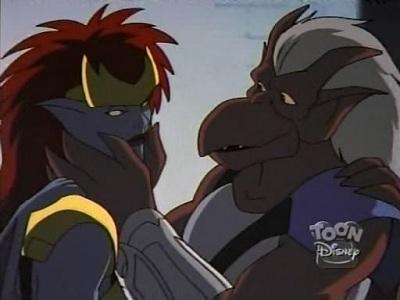
Much like the clan itself, the rogues gallery for the show is kept fairly compact for the first season.  It’s dominated by Xanatos, who poses as an ally early on to the clan but is soon revealed as duplicitous and self-serving.  His main weapons are cunning and money, but he also possesses some high-tech weaponry including his own cybernetic army of gargoyles.  He splits time as the main foe for the clan with Demona, Goliath’s former lover who was complicit in the destruction of their clan a thousand years ago.  While her intentions were without malice, her persona is consumed with a bloodlust for humanity as she blames them for their near extinction.  She is the Magneto to Goliath’s Charles Xavier.  Other villains include the sportsmen MacBeth and the television actors turned criminals The Pack, a group of men and women who fashion their personas after wild canines.

Demona, Goliath's former lover, is one of the primary antagonists for season one and beyond.

Demona, Goliath’s former lover, is one of the primary antagonists for season one and beyond.

The show opens with a very ambitious five-part mini-series titled “Awakening” (it was also released direct-to-video as Gargoyles:  The Movie) that sets up the series.  Right from the start, viewers are able to get a sense of the large-scale story-telling the show is aiming for while also being able to take in the peak of the show’s production values.  The animation quality is a grade above the usual afternoon cartoon fare, making it possibly the best looking cartoon of the mid 90’s.  The score is also exemplary and the voice acting contains notable actors such as Keith David (Goliath, various voices) and Edward Asner (Hudson) as well as numerous vets of various Star Trek programs.  Following the five-part debut, the show mostly settles into stand-alone episodes that also call upon happenings in previous ones.  Each gargoyle, with the exception of Bronx, is basically given his own episode to star in which helps the viewers get better acquainted with each one individually.  It’s similar to the tactic utilized by X-Men in season two and is an effective way to flesh out an ensemble cast.  There are thirteen episodes in total for season one, and pretty much all of them are good.  Some standouts include “Deadly Force,” which stresses the importance of gun safety without being ham-fisted (possibly created because main character Elisa is shown wielding realistic weaponry as opposed to fantasy, laser type devices).  “Her Brother’s Keeper” helps define what family means to the gargoyles and how it’s not so different from what it means to humans.  “Reawakening” is the bookend for the season and is a satisfying conclusion for the show’s first major arch.

Xanatos would be the other main foe for the gargoyles.

Xanatos would be the other main foe for the gargoyles.

What I appreciate most about the show is its commitment to realism.  This is a show starring unreal creatures but it takes them very seriously.  Their culture is defined as is their biology when Goliath points out early on that they can’t fly, merely glide on air currents.  As previously mentioned, Elisa is armed with a realistic handgun as are most of the police force.  Many of the villains do use lasers and other such fantasy fare but they come across as credible, in part due to a willingness to throw around phrases like “Die!” at their targets.  And when it’s called for, the show is not afraid to show blood which helps add severity to a scene.  The show also wasn’t afraid to be a little progressive as it’s revealed (casually) that Elisa is of mixed-race, having a white father and black mother.  And if you’re a fan of keeping movies and television as they were, you’ll be happy to know that the numerous shots of the New York skyline have not been edited to remove the twin towers.  Recent shows like Teenage Mutant Ninja Turtles and Beware the Batman have mostly empty city streets and lifeless scenery, it was refreshing to watch Gargoyles with its fully realized and very much alive New York.

The DVD release for season one is fairly basic.  There are animated menu screens depicting the gargoyles emerging from their stone prisons accompanied by music and sound effects.  The transfer is of good quality for this type of release and the case is a standard DVD case with a hinged insert for the second disc.  Bonus features include the original show pitch by Weisman which is worth a look just to see the original designs of the gargoyles.  There’s also a brief feature on The Gathering of the Gargoyles, a convention that used to be held in the US for fans of the show, that I suppose is worth a look though it’s basically just a bunch of fanboys and girls gushing over the program.  There’s also audio commentary on the fist five episodes, but I have yet to check it out (and probably won’t as it’s just not my kind of thing).

The show did not shy away from placing its characters in real danger.

The show did not shy away from placing its characters in real danger.

Gargoyles felt overlooked during its hey-day and today feels kind of like a forgotten series.  This is due, in part, to Disney’s stubbornness over releasing the entire series on DVD.  Season one was released in 2004 with the first half of season two following in 2005.  The rest of season 2 was in limbo until recently when it was released quietly as part of the Disney Movie Club.  Still remaining are the thirteen episodes from the abbreviated season three, rebranded as The Goliath Chronicles .  While fans would likely appreciate having those thirteen released, all but the season premiere were done without Weisman and thus are not considered canon by him for the show’s storyline, which lived on in comic book form for a short while following the show’s cancellation.  Unlike many cartoons from my youth that I have chosen to revisit, Gargoyles still holds up and impressed me a great deal.  I would love to see Disney revisit the show with Weisman for either a short fourth season or direct-to-video movie to provide additional closure.  Expect to see more of Gargoyles from me as I make my way through both volumes of season 2.


Beware the Batman: “Hunted”

bewarethebatmantitlescreenIt’s hard to imagine a world where Batman isn’t a pop culture force to reckoned with.  He’s arguably the most popular comic book originated character today and easily has had more success than any other comic character in transitioning from one medium to another.  His popularity is not absent of peaks and valleys.  Batman is currently coming off one such peak following the conclusion of his most successful endeavor yet, Christopher Nolan’s Dark Knight trilogy, and DC Comics is looking to keep the fire going with a new animated series:  Beware the Batman.

Batman is, first and foremost, a comic book superhero.  His overall popularity though, is tied more to his forays outside comics.  Batman’s television and film works have a chance at reaching the comic book audience and non alike.  His first exposure of merit was the television show in the 1960’s.  It’s easy to dismiss the campy program today as being inauthentic, but the Batman of the comics at that time wasn’t far removed from Adam West’s portrayal.  It wasn’t until the 70’s that Batman would rediscover his edge, completing the transformation in the 80’s which helped influence his next cultural milestone, Tim Burton’s Batman.  Batman:  The Animated Series would follow, and despite it being a cartoon aimed at younger audiences, it too managed to attract a wide audience and even spawned the theatrically released Batman:  Mask of the Phantasm.  Of course, a cartoon is unlikely to reach the same audience as a film and that has held mostly true, but the cartoons to follow have been even more obvious in their target audience, so much so as to alienate the comic book fans.

Beware the Batman, in response to series such as The Batman and The Brave and the Bold, feels like an attempt to keep comic fans and attract more than just the Saturday morning crowd.  Time will tell if it can duplicate the success of TAS, but it’s nice to see DC give it a shot.  With no clear plans for where Batman is headed on the big screen, it makes sense to try to build a bridge between the two.  The only complication is where do the creators of Beware the Batman take the series that TAS didn’t?  Bruce Timm and Paul Dini, the masterminds behind TAS, piggy-backed off of Burton to establish the look of Gotham, and then created a tone to suit the show.  Visually, it was unique and thematically it was too when compared with its peers.  The show was not afraid to make broad use of Batman’s rogue’s gallery and took chances on lesser villains Killer Croc and Scarface, while also not being afraid to introduce villains like Roland Dagget and Ruper Thorne, gangsters with no sexy gimmick to speak of.  Beware the Batman has been developed by Glen Murakami, a veteran of TAS spin-off Batman Beyond, and is being produced in tandem with Mitch Watson.  Greg Weisman is on board as a writer and he’s done extensive work with other comics and comic TV shows but is probably best known as the creator for Disney’s Gargoyles.

Anarky is expected to play a large role in Beware the Batman.

Anarky is expected to play a large role in Beware the Batman.

The talent appears to be in place to make BTB a success, and the show’s creators have come up with a vision for the program to help differentiate it from its predecessors.  For starters, the show is animated entirely in CG in a style similar to the Green Lantern series already airing.  In terms of color palette, it actually looks similar to TAS as there’s a lot of black and gray.  Batman, himself, is sporting a black and gray costume similar to the one he wore in the final season of TAS (often referred to as The New Animated Series) but with a more triangular head.  Alfred is said to have a larger role in this program, with his past exploits as a secret agent being a central part of the show’s plot.  Batman also has a new sidekick, Katana, a character first conceived in the 80’s who just this year received her own limited series.  Her design is unique to the show and seems to be, in part, due to wanting her to resemble Batman to some degree.  No word on how her presence will affect Robin.  The show’s brain-trust made the decision to avoid The Joker early on, and as a result, Batman’s primary antagonist appears to be Anarky.  Anarky is another 80’s character and in tone he’s similar to Allen Moore’s V from V for Vendetta, though Anarky has been forced to change to mirror whatever the current political climate of the world is.  There’s been little said on how he’ll be portrayed in the show, but it’s definitely a bold choice for what is a “kid’s show.”  If the character appears dumbed-down for television it will likely disappoint the comic book fans who tune in and could turn them off.

Beware the Batman seems to have a solid groundwork to start.  In addition to Anarky, the creators want to continue to use villains not previously seen on television to help further differentiate the show from the ones that came before.  This direction should be commended, as it’s certainly the bravest route, though I do expect some of Batman’s more popular villains will eventually show up if the program is allowed to continue for multiple seasons.  In order for that to happen though, season one needs to be a success.

Batman's look comes across as a mix of old and new.

Batman’s look comes across as a mix of old and new.

The first episode aired today and is titled “Hunted.”  As is the case with most series premieres, the episode is concerned with introducing the main cast of the show to viewers while also giving us a taste for the action and spectacles we can expect going forward. Right off the bat (no pun intended), we’re shown Batman taking down some small-time thugs.  Disappointingly, the firearms used by the enemies look like toy squirt guns and fire lasers.  Beware the Batman is not the first cartoon to eschew realistic firearms, but it looks especially ridiculous here given the otherwise realistic look of the setting (the guns initially were going to look realistic following in the footsteps of TAS, but after the Aurora shooting the show was changed).  Realism does seem like it may be in short supply with this show.  While no one would expect a Batman show to possess a high degree of realism, it does seem like this one will at least be less so than TAS.  The villains in this first episode are Professor Pyg and Mr. Toad.  Professor Pyg is just a fellow with a pig mask, while Mr. Toad is some kind of mutant toad man (that looks more like a frog) with a super-sonic breath attack of some kind.  Professor Pyg arms himself with a saw that can apparently cut through anything except Batman’s gauntlets, and Mr. Toad likes wielding bombs that look like they were taken straight from a Bugs Bunny cartoon.

I’ll never prefer CG animation to traditional hand drawn animation, but the new Teenage Mutant Ninja Turtles cartoon did leave me pleasantly surprised with how it turned out.  That show is not without faults, and those same faults are shared by BTB plus a few more.  It must consume too many resources to create an authentic looking city, because the streets of Gotham are empty aside from the main characters of a scene.  This means during the debut episode’s car chase sequence, the only cars on the road appear to be Batman, his enemy, and the enemy’s target.  The characters also do not animate as well as those on TMNT as they seem stiff.  When Batman runs, his body doesn’t look in sync with itself and he resembles a wind-up toy that’s supposed to mimic running.

Professor Pyg and Mr. Toad add a dash of comic relief while still retaining an element of danger.

Professor Pyg and Mr. Toad add a dash of comic relief while still retaining an element of danger.

Design wise, I already mentioned Batman.  The Batmobile is present in this debut episode and it resembles a Lamborghini and apparently it’s dual flame spouts on the back are meant to distinguish it from its predecessors.  Alfred is a mountain of a man who towers over Bruce Wayne.  His role as a bodyguard is emphasized in this episode with part of the plot revolving around his wanting to protect both Bruce Wayne and Batman, with Batman preferring he only concern himself with Bruce Wayne.  The individual who will become Katana is also shown.  Her design of a small asian woman is unremarkable, though she’s seen driving a red and yellow motorcycle which had me wondering if that was a Robin reference.

The voice work seemed more than capable, though getting used to the new Batman (Anthony Ruivivar) and Alfred (J.B. Blanc) will take some getting used to.  Professor Pyg (Brian George) was the stand-out from a voice acting perspective, his tone adding a layer of menace to an already unsettling looking character.  Simon Stagg was present, and I wonder what role he’ll play going forward.  The previously mentioned Anarky is not seen so apparently they’re holding off on his debut for a later episode.

The plot for this first episode revolves around Pyg and Toad kidnapping billionaires who are not eco-friendly.  Batman has to use some of his detective skills to determine who their targets are before the villains strike next.  There’s also the previously mentioned Alfred conflict, with him also wanting to find his own successor for when he can no longer protect Bruce/Batman.  Batman is shown to be somewhat sloppy, though we’re given no indication of how long he’s been at this whole crime-fighting vigilante business.  The creators of the show in all of the pre-release press boasted about how this show was going to show off Batman’s detective skills, but this episode mostly followed the same formula as TAS with Batman turning to his trusty super-computer to do most of the work for him.  Since much of the plot of this first episode is devoted to setting the series up for future episodes, there’s very little resolution to the Batman conflict with Professor Pyg and Mr. Toad.  We’re also only given a snippet of what drives the villains with hopefully more to come.

Expect Katana's full debut to occur in the coming episodes.

Expect Katana’s full debut to occur in the coming episodes.

Overall, I appreciate the direction the show’s creators are pushing it in, but I’m less in favor of the execution.  Pyg and Toad have potential as villains, though I would have preferred something more grounded for Mr. Toad.  The animation is what it is and unfortunately this is the most cost-effective way to do most shows these days.  I’ll reserve final judgement on the show until more episodes have aired though this debut was more of a C effort.  It’s probably unfair of me to compare this to The Animated Series, but if it can’t approach that level of quality, then what’s the point of it existing?  Hopefully the show is able to carve out its own niche that can be enjoyed by Batman fans of all ages.


The Vita Experiment

images-115It’s been over a year since I purchased a Playstation Vita.  I have made only two dedicated posts on the subject since which may lead people to believe that I have not enjoyed my purchase.  Far from it actually, as the Vita has been getting a lot of attention from me and has probably been played more than my 3DS over that same time frame.  Not all that long ago I made an entry about the Wii U and how it has been a disappointment for me since it’s launch last November.  The Vita has similarly been a disappointment at retail, though for different reasons.  And while I’ve enjoyed my Vita thus far, I’m not anymore optimistic about its future than I am of the Wii U’s.  If anything, I’m more pessimistic since Nintendo has a lot more riding on the Wii U and is further incentivized to make sure it does not fail.  While Sony similarly has invested a great deal in the Vita, I get the sense that Sony could afford to have it fail and move on (though such an admission would likely end Sony’s attempt at penetrating the portable gaming market via a dedicated gaming device).

Not much has changed regarding my opinion of the Vita as a piece of tech since its launch last year.  The device is quite nice and it functions really well.  I have had no problems with my Vita in the year-plus that I’ve owned it.  No game freezing, no glitching, no nothing.  The screen is large and beautiful, the buttons placed well, and the twin analog sticks much appreciated.  I’m not saying they don’t exist, but I have yet to encounter a game that makes annoying use of the front and rear touch panels as developers have, so far, resisted the urge to shoe-horn touch controls into their games.  Just judging the console on its own merits it’s fantastic and easily the best portable gaming device ever created.

Unfortunately, it takes more than cool tech to make or break a console.  The Vita’s biggest obstacle so far has been price.  The Wi-fi edition retails for $250, which is a lot to ask of consumers for a handheld game console.  And that’s not all, memory cards have been obnoxiously priced from the start and easily push the total cost beyond $300 for any new adopters looking to get just one game with their system.  Sony has put out bundles that help trim some of the costs but it’s still a pretty big investment to get into the Vita.  Especially considering that consumers can get a pretty solid gaming experience on the go via their cell phones.  While true that there’s no cell phone equivalent to Uncharted:  Golden Abyss, many consumers seem content to save the money and just play games like that at home.  Combating mobile gaming is not a problem unique to Sony, but Nintendo has done okay with the 3DS since lowering the price which seems inevitable for Sony if it wants the Vita to have a fighting chance.

Some titles have been promoted as a 2 for 1, in that buying one copy of the game earns the ability to play it on the PS3 and the Vita.

Some titles have been promoted as a 2 for 1, in that buying one copy of the game earns the ability to play it on the PS3 and the Vita.

Aside from price, the other make or break aspect of any gaming device is the software.  Namely, the games.  Vita had a respectable launch on that front with several quality portable versions of strong games being made available alongside the aforementioned Uncharted title.  Uncharted has been a successful franchise for Sony on the PS3, though it doesn’t move units like some of the other premier video game franchises and it apparently wasn’t enough to attract a lot of early adopters.  Ever since the launch, the Vita has been spotty on the games front.  Some Vita exclusives like Gravity Rush and Assassin’s Creed:  Liberation have come and gone, and have failed to impress critics.  It feels like every Vita exclusive has scored in that 6.0-7.5 range with reviewers.  They’re good games, but not exactly system sellers.  The rest of the Vita’s catalog has been reduced to ports of console titles.  Some of these ports are done well, like MLB The Show, and work with their PS3 cousins.  One such game, Sly Cooper:  Thieves in Time, even came bundled with the Vita version allowing basically free portable play while others offer discounts when buying both.  Being able to play a console game on the go is certainly neat, but is it worth the added cost of getting a Vita?  Other ports, like last year’s edition of Madden, were done poorly which is inevitable with this sort of thing.  Developers are going to spend the most time on the editions of the game set to make the most money-making the Vita port an after-thought.

This may lead you to wonder what I’ve been playing that has allowed me to enjoy my Vita as much as I have.  Well, I made entries on my first Vita purchases, Rayman Origins and MLB, and my experience with both was positive.  I have since added the Metal Gear Solid HD Collection, which contains the first two Metal Gear titles along with Metal Gear Solid 2 and 3.  I also have Little Big Planet Vita, which is an all new Little Big Planet title created for the Vita and is just as good as the console games.  I also downloaded a PSN exclusive called Dokuro which is an excellent platform-puzzle game.  Lately, I’ve been player Persona 4 Golden, a port of the PS2 game with some added content.  I think my library of Vita games is a decent representation of the console.  Most of it is composed of ports with only two titles unique to the Vita.  Of them all, it’s tough to say what I’ve enjoyed the most.  Playing the two MGS titles in HD and on-the-go was pretty damn cool and I had not played either in quite some time so it was really enjoyable for me.  Rayman Origins is just as good as the console version, which I don’t own, and is a title that works really well on a portable, well enough that I may get the Vita version alone of Rayman Legends when that comes out later this year.  Dokuro was the nice surprise, and is so far the only Vita game I would tell all Vita owners they should get.  It’s fun and it’s cheap which is always a winning combination in my book.  It also sports a unique look with its chalk drawing graphics and the game is pretty meaty as well.  Persona 4 has definitely been the title that I’ve spent the most time with.  I’m currently at the 80 hour mark and still going.  I never played the original so that helps, but even if I had I’d like to think I still would have bought this.  It’s an excellent game, though it’s dated visuals mean it won’t be the type of game you would buy to show off the Vita’s capabilities.

Dokuro, a download-only title in which you play as a skeleton and try to lead a princess to safety, is perhaps the Vita's best exclusive.  And you get to shoot the princess out of a canon.

Dokuro, a download-only title in which you play as a skeleton and try to lead a princess to safety, is perhaps the Vita’s best exclusive. And you get to shoot the princess out of a canon.

I’m nearly finished with Persona 4 so I’m now looking ahead.  I may switch back to the 3DS for a while as I have some games for it to check out, but in looking ahead to my next Vita purchase I’ve basically settled on Muramasa:  The Demon Blade.  Muramasa is yet another port of a console title, this one being a Wii game from a few years ago.  It’s a side-scrolling action title with beautiful hand-drawn visuals.  I never played the Wii version so it will be a new experience for me.  Aside from that, I’m uncertain what’s in store for the Vita.  It had a fairly poor showing at E3 this year, and the only exclusives I’m aware of are a new Killzone and Batman title (with the Batman title being available on the 3DS too, though one would hope the more powerful Vita would be the lead console).  I’m not a fan of the Killzone franchise, and while I’m interested in Batman, I fear it will turn out like AS:  Liberations and just feel like a lesser version of the console franchise.  These games do not seem like they’ll be big system sellers for the Vita, which has lost the PSP’s biggest franchise (in Japan, anyway), Monster Hunter, to the 3DS.  Sony does have plans for the Vita concerning the PS4.  Right now the aim is to have every PS4 game playable on the Vita via remote streaming.  This is a feature the PS3 supports but never made good use of which makes me skeptical that it will be widely available with PS4 titles.  Even if it is, I can’t see it being something that gets a lot of people to buy a Vita.  It can’t hurt, but will people spend over two-hundred dollars for the ability to play their PS4 games on a small screen?  The Wii U can do that with several games but it’s something I’ve only made use of here and there (though I also only play the Wii U here and there to begin with).

The Vita really needs this game to kick some serious ass.

The Vita really needs this game to kick some serious ass.

All of this leads me to one question:  Can I recommend the Vita to gamers?  I feel as if the answer to that question is “Yes,” but with qualifiers.  If you want a good portable gaming device then yes, the Vita is a good and worthwhile system to have around.  I didn’t touch on it much, but there are quite a few indie developers out there making excellent games for the PSN that figure to be made available on the Vita.  There are some good exclusives, and there are console games out there that are the same, if not better, on the Vita.  And if you’re into playing remakes, the Vita seems to be home to many such titles with more to come.  There’s also a plethora of PSOne and PSP titles available on the PSN for download and play on the Vita.  However, anyone thinking about buying a Vita needs to look at the current crop of games and decide if it’s worth buying just for these games alone.  The future is murky and we may have already seen the bulk of Vita’s exclusive third-party titles.  I do believe Sony will support the system at least thru 2014, but if things don’t pick up third-party developers will just use the Vita as a dumping ground for inferior ports of their console games.  And since the Vita, which currently is at least on par with the PS3, will soon be lagging behind the major home consoles those ports will become more expensive to make and may be bypassed all-together.  Someone recently asked me if they should get a Vita for their kids this coming Christmas.  The question was actually phrased as an either/or between a Vita and PSP.  I told them the PSP is not worth investing in at this point, but also to hold off on the Vita since a price-cut may be imminent.  I also slipped in the fact that by Christmas the PS4 will be out and their kids may want that more than a Vita and the difference in price may make the PS4 less expensive if this individual was thinking of getting a Vita for each kid.  That will likely be my response for anyone who asks me if they should get a Vita.  Wait for a price drop, or get a PS4 instead.  The future is just too uncertain for the Vita to give it a full recommendation.


The Best of Pixar

DownloadedFile-22In honor of the recently released to theaters Monsters University, I thought it would be fun to look back on the feature-length films put out by Pixar Animation Studios (in conjunction with Disney) and come up with a top 10.  This proved to be a pretty difficult task and I consider this list, especially the top 5, to be quite fluid.  Pixar has really eclipsed Disney as the premier creator of animated films.  It could be argued that before it, Japan’s Studio Ghibli had knocked Disney off the top of the mountain but Pixar now stands tall over all.  And while their output has dwindled in quality just a tad bit lately, it seems like the studio is likely to maintain that status for at least a few more years.  This list is not going to give each film the space it deserves, or else it would run into the tens of thousands of words.  I also want to add that I do not think Pixar has made a bad film yet, though I also have not seen Cars 2 which has been the worst reviewed film put out by the studio.  I didn’t see it because I didn’t really care for the original, though I didn’t hate it or anything.  I also did see Monsters University this weekend, and while I don’t think it makes their top 10, it was enjoyable entertainment.

10. Brave

Brave is hindered by that fact that it’s one of the more recent films put out by Pixar so it hasn’t had as long of a time to leave a lasting impression (and as you can imagine, nostalgia points count).  Brave is a refreshing take on the princess genre and Merida is a very likable and easy to root for character.  The visuals are splendid and the conflict unique, though the setting and style is perhaps a bit too similar to the previously released Dreamworks film How to Train Your Dragon.  This is a film I plan to revisit and I expect my appreciation for it will only grow from here.

9. The Incredibles

Perhaps a controversial selection as I know The Incredibles is a favorite for many.  For me, I absolutely love the concept of a super hero family and this was probably my most eagerly anticipated work from Pixar.  Perhaps it was the weight of expectations that resulted in my initial disappointment.  It just didn’t resonate with me the way I thought it would.  I very much enjoyed the Mr. Incredible character, but the rest of the family didn’t appeal to me as much.  The film is also a little overstuffed and could have used some trimming.  Every time I re-watch it I wonder if this is the viewing that will make me fall in love with it, but so far that hasn’t happened.  Despite that, I still look forward to the eventual sequel and will continue to enjoy the in-jokes thrown at comic book fans.

8. Toy Story 2

Toy Story was such a smashing success that it made sense for a sequel to follow.  Because these films take so long, Pixar first released A Bug’s Life before getting to Toy Story 2.  Serving as director for all three feature-length films was John Lasseter, who wisely realized he couldn’t expect to continue to direct everything put out by the studio.  Toy Story 2 is an excellent sequel that contains enough of what made the original so memorable without feeling like a re-tread.  Visually, it is far superior to the first.  Some people seem to prefer it to the original, but for me I enjoyed the plot from the first one more and found the end chase more thrilling than the sequence that closes out this one.  This one is still great though, and Jessie’s song is really well done, making Toy Story one of the best franchises in recent memory.

7.  Ratatouille

Remy is one of Pixar's best creations.

Remy is one of Pixar’s best creations.

This where the list starts getting hard for me.  I didn’t have much trouble ranking the first three, but now we’re getting into the films I truly love.  Ratatouille is a clever tale about a rat named Remy, who is one of the most well-crafted of any of Pixar’s leads.  He’s interesting, flawed, likable, and well-acted by the animators and voice actor Patton Oswalt.  This one isn’t as emotionally heavy as some of Pixar’s other films, but it is so much fun and it’s still a treat to experience all of Remy’s highs and lows.  I feel like I could watch this film every day and not get sick of it.

6.  Toy Story

The one that started it all.  Toy Story was a marvel when it was first released in 1995.  At that time, no one really thought computer generated images could captivate in the same way as hand-drawn animation and we were all proved wrong.  While I will always prefer more traditional animation, I both love and appreciate what today’s artists are capable of with CGi.  Toy Story doesn’t look as good now as it did back then (especially the dog and human characters), but that doesn’t detract from the wonderful and clever story about what goes on in the toy box when kids aren’t around.  It’s an easy to grasp concept and one that offers so many possibilities for visual gags and story potential.  The Woody (Tom Hanks) and Buzz (Tim Allen) rivalry is played up so well that it’s a shame it’s not as heated in the sequels.  Toy Story is a modern classic that is sure to delight and captivate audiences for generations to come.

5.  Wall-E

Wall-E is a rather bold film when one considers its audience.  The first act is absent of any dialogue as we explore a ruined earth with only a mute little robot to guide us.  It’s thru director Andrew Stanton and the supremely talented animators at Pixar that we’re able to connect and care about this little robot.  Wall-E, despite being a robot, is able to convey so many human emotions thru just the movement of his telescope-like eyes and limited vocalizations.  The film’s only weakness is how effective these early scenes are in comparison to the easier to follow scenes in space where humans dwell.  Some thumb their noses at the conservationist tone taken by the film, but I found it to be good satire and consider Wall-E a true treasure amongst american animation.

4.  Toy Story 3

I can’t say I was all that excited for another sequel for Toy Story, even though I very much enjoyed the first two.  I was so wrong when I finally sat down and watched Toy Story 3 and found myself completely blown away.  I didn’t realize how much I wanted to see the world of these toys explored with better technology over what was available for the first two.  The world popped and is an absolute feast for the eyes.  That wasn’t exactly a surprise, but the fact that the film had a plot that appealed to me even more than the first two is what truly shocked me.  I fell in love on the first viewing, and the additions of Michael Keaton and Ned Beatty to the all ready stellar cast was the cherry on top.

3.  Monsters Inc.

We have officially entered the splitting hairs section of my list.  1-7 was hard, 1-5 was harder still, and 1-3 feels almost pointless.  On any given day, any of these next three could be cited as my favorite from Pixar, but I’ve settled on this order for today.  Monsters Inc. was the first of the Pixar feature-length films to not be directed by Lasseter.  Pete Docter oversaw this one and would establish an ability to really make an emotional connection with the audience.  Monsters Inc. is kind of like a buddy comedy with leads Mike and Sully (portrayed by Billy Crystal and John Goodman), only in a fantastic setting.  The world of the monsters is fully realized and more than just a little clever.  This is the first CGi film I can recall where so much hair, or fur, was included and the results are spectacular.  It’s the addition of the Boo character though, that puts it over the top and gives it the weight I mentioned earlier.  This film’s ending is so perfect, it gets me every time.  I’m not sure if it’s not my favorite ending to any movie ever.  I love it!

2.  Finding Nemo

A lot of these films were all conceived around the same time.  I get the sense that the powers that be at Pixar decided on a bunch of worlds they wanted to see animated and went off of that.  Finding Nemo is Pixar’s undersea adventure and the results are breathtaking.  The world is so simple yet so complex, it is probably the film that benefitted most in the switch from DVD to Blu Ray of any other I’ve seen.  All of Pixar’s films are incredible looking, but Finding Nemo contains one of the more heart-warming father-son stories contained in any piece of entertainment.  And outside of that plot, the characters encountered along the way are amongst Pixar’s most memorable.  Whether it’s the possessive seagulls, laid-back Crush, or the unforgettable Dory, there’s something amazing in every scene.  I’m so glad that Pixar has chosen to revisit this world, even if it has no chance of matching up to the original.  Though Pixar has proved me wrong before.

1.  Up

The odd paring of the aged Carl with the youthful Russell paid off for Pixar.

The odd paring of the aged Carl with the youthful Russell paid off for Pixar.

If Wall-E was considered a bold move for a family movie, then what does that make Up with its octogenarian for a lead?  I suppose the marketing and merchandising department was disappointed when it found out that Carl Fredricksen (Ed Asner) action figures weren’t likely to generate the kind of revenue Disney is used to, but I like to think they were okay with that once they saw the film.  Up is a wonderful piece of animation, and if Pete Doctor’s previous directorial effort Monsters Inc. is considered weighty, Up is a virtual anvil.  The montage that takes place at the beginning of the film which sums up the life of Carl and Ellie is wonderfully moving, and like Wall-E, done so without any dialogue.  The sequence is masterfully done, and if viewers found it a bit too sad then I hope the rest of the film makes up for it.  The main plot pairs up Carl with the youthfully exuberant Russell.  This odd-couple pairing can be forgiven for being too obvious because it’s executed so well. The emotional response generated by this film seems so authentic, and it’s the rare animated film I can honestly recommend to viewers of all tastes.  And then there’s Dug.  Dug, who resembles no dog from the real world and yet makes me think of every dog I’ve ever met (any nice dog, anyways).  His mannerisms and thoughts are so spot-on it makes it seem like an easy thing to so faithfully convey a dog’s emotions, but it’s really not.  Up is absolutely wonderful, and not just among my favorites put out by Pixar or Disney, but one of my favorite movies of any I’ve seen.  It will take a lot from Pixar to top it, but I hope they like a good challenge.


The E3 Fallout: The Next Generation Gets Less Scary

DownloadedFile-21Prior to E3 2013, I made an entry on how the future of console gaming was looking.  To summarize, it was starting to look pretty bleak.  Even though it was only a couple of week ago, a lot was different.  We had the Wii U already on the market and failing commercially and creatively, the Xbox One was set on controlling all games distributed for it, and the PS4 was still a shadowy figure with unclear motives.  E3 2013 was shaping up to be a heavyweight bout between Microsoft and Sony as both looked to generate positive hype for their debuting machines in the fall.  Microsoft had a lot to answer for following the announcements regarding the policies surrounding the Xbox One and many wondered if Sony was willing to maintain the status quo or go along with Microsoft.  If both companies decided to severely restrict used games then gamers would be forced to accept this new model or give up on console gaming, something that seemed unlikely.  It was a strange feeling heading into E3 which is usually all about debuting new titles and consoles but the focus was squarely on one aspect of the PS4 and Xbox One.

Kind of lost in the shuffle was Nintendo, and with good reason.  The Wii U has done little to captivate the hardcore crowd and heading into E3 Nintendo chose to announce that it wouldn’t be holding a standard E3 press conference.  Nintendo still had a presence, and the company’s diehards were probably content to get a peak at the new Smash Bros. game and a new Mario title for the Wii U.  The recently announced A Link to the Past sequel for the 3DS, A Link Between Worlds, was playable and looks good, but there wasn’t much excitement coming from Nintendo.  The unique features of the Wii U have been all but ignored by Nintendo itself and third party publishers seem indifferent to the console.  I had no idea what Nintendo’s strategy for the Wii U was heading into E3, and yet, I feel like I know even less coming out of it.

Despite being announced by Sony back in February, E3 was actually the fist time the PS4 console was shown.

Despite being announced by Sony back in February, E3 was actually the fist time the PS4 console was shown.

Microsoft came out and confirmed what gamers did not want to hear, that sharing and reselling games on the Xbox One was going to be difficult and the console required a dedicated internet connection to play offline games.  It really didn’t matter what Microsoft showed for games after that, because people were just plain pissed.  The pricing for the console was revealed ($499) and Microsoft showed some games, but the damage was done.  Sony’s conference was basically a confirmation that the freedoms gamers have today will be maintained with the PS4.  Publishers can still place DRM on their games, but any restrictions beyond that are out.  They too showed off some games and even brought a bunch of indie developers out, but it didn’t matter.  The biggest cheers were reserved for simple announcement regarding game sharing.  It was kind of surreal.  The PS4 price was also revealed to be $399, and the console itself was shown for the first time as well (surprise, it’s black!), but gamers were too giddy over the used game policies to notice.

The fallout has been swift and to the point.  Microsoft had egg all over its face and videos from Sony mocking the Xbox One’s policies further drove the point home.  Microsoft made it incredibly easy for Sony to win gamers over, and the company was forced to suck it up and change its approach to give the Xbox One a fighting chance.  Last week Microsoft began to repair the damage that’s been done by basically pushing the reset button on the Xbox One.  There will now be no required internet connect, no stupid one-time sharing rules for games, and no used game fees.  They’re putting the console back on the same level as Sony’s.  Since so much of the emphasis of the Xbox One was placed on the cloud storage feature, it makes me wonder if most games will still require an internet connection, but at least if gamers are getting some benefit out of the feature it may make it more acceptable.

The game formerly known as Final Fantasy Versus XIII is now simply Final Fantasy XV and will be released on PS4 and Xbox One.

The game formerly known as Final Fantasy Versus XIII is now simply Final Fantasy XV and will be released on PS4 and Xbox One.

In a way, we’re right back where we started.  So much of E3 was dominated by the pricing structure of these new consoles that the games were kind of glossed over.  In looking back, there really wasn’t a whole lot to be excited about.  I’ll probably get a PS4 at some point, but I’m looking at the games shown by Sony and I’m kind of at a loss as to what it is I really want to play.  It was cool to learn that Final Fantasy XV is on the way, as well as Kingdom Hearts 3, but not enough was shown of either to get me excited.  I just didn’t see anything, for any of the major consoles, that made me jump up and say “I want to play that!”  As the launch dates for the Xbox One and PS4 approach perhaps I’ll find some games to get excited over.  At least now I know that if I find some of the launch games to be lacking I can always resell them.