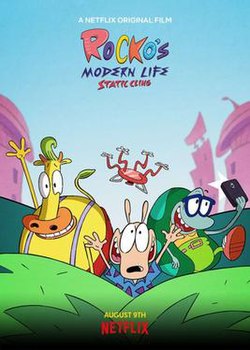
Rocko’s Modern Life: Static Cling

After taking a trip to the past with Rocko’s Modern Life during the spring, it seems only fitting that I also take a look at the Rocko’s Modern Life movie from 2019: Static Cling. To be fair, the term “movie” is definitely used loosely when applied to this piece of media. Static Cling was originally conceived by Nickelodeon as a one hour TV special with commercials so the running time is a tidy 45 minutes. It’s basically a double-episode, but considering Rocko’s Modern Life had never had a special before it’s easily the longest story the show ever committed to.

The special was announced in 2016 by Nickelodeon and it rejoins the original cast, alongside series creator Joe Murray, and gives fans a look at what Rocko (Carlos Alazraqui), Heffer (Tom Kenny), Filburt (Doug Lawrence), and the rest have been up to since. The theme of the special is change as it’s a very metta look at how audiences grapple with the loss of something from their past and seek out nostalgia binges to fill that hole left behind. The special will drive that point home quite literally by having Rocko, who has been lost in space since the events of “Future Schlock,” return to an O-Town that has long since ridden itself of his favorite cartoon: The Fatheads. Rocko is forced to confront this new O-Town and adapt to a new modern without his binky and he finds it impossible. Conversely, he has to watch his two best friends adapt just fine as Heffer and Filburt become immediately enchanted by modern technology. A clerical error by neighbor Ed Bighead (Charlie Adler), whose life has apparently been bliss since Rocko and his friends were blasted off into space, causes the mega-corporation, Conglom-O, to lose all of its paper value thus plunging all of O-Town (since Conglom-O owns everything) into a depression. Rocko is able to convince the head at Conglom-O, Mr. Dupette (Adler), that a way to help the company out would be to produce a new Fatheads TV Special. The only problem is that series creator Ralph Bighead (Joe Murray) hasn’t been seen or heard from in years.
Alternatively known as Static Cling: The Rocko Special.

The early bits of the special unfold in a predictable, but still entertaining, manner. Rocko and the gang are shown adjusting to modern life and the classic opening segment from the TV show is even redone with modern technology now harassing Rocko. There’s also a nice bit of the boys taking in a gritty reboot of Really Really Big Man that’s an obvious parody of Christopher Nolan’s Batman trilogy. Even though the special is basically mocking those who have been begging for this show to return for the last 20 years, there’s still a ton of fan service throughout as basically every character of note returns for a cameo, at the very least.
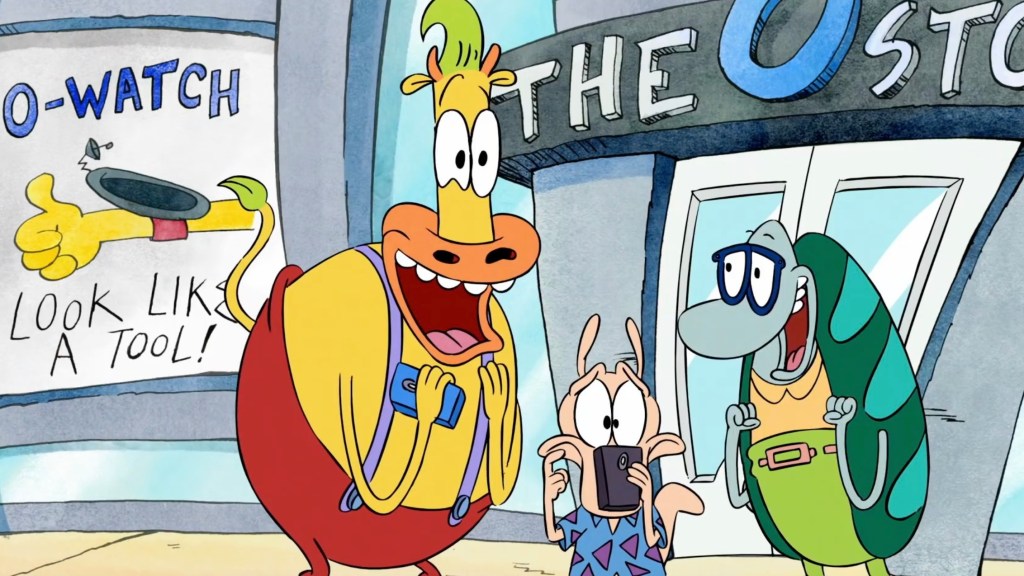
Some of the jokes the special makes are rather easy, but they’re also the type of jokes that pretty much have to be made.

Static Cling was commissioned as a Nickelodeon TV Special initially, but the network wound up passing on it and selling the rights to Netflix. This caused a rather significant delay in getting the special in front of fans. Nickelodeon never offered up a reason why it chose to option the special to Netflix, but many speculate it has to do with the character formerly known as Ralph Bighead. A major plot device in the special is that when Rocko eventually finds Ralph, he finds that Ralph no longer identifies as male and has taken the name Rachel instead. The reaction of Rocko and his friends, and basically everyone in town, is very positive as they basically congratulate Rachel and that’s that. Rachel’s father, Ed, is the only one who has an issue with it resurrecting his line “I have no son!” from the Season Two premiere. Nickelodeon was reportedly supportive of the idea to add a transgender character, and it certainly fits the theme of change, but it’s not the best look for the network that it chose to pass on airing this. Maybe the network found it could make more by selling the distribution rights to Netflix, but how much would the pay-out have been affected if Nickelodeon chose to premiere it on its own network and then pass it off to Netflix? Probably not a lot and it’s a shame it didn’t see this as an opportunity to make a positive social statement.
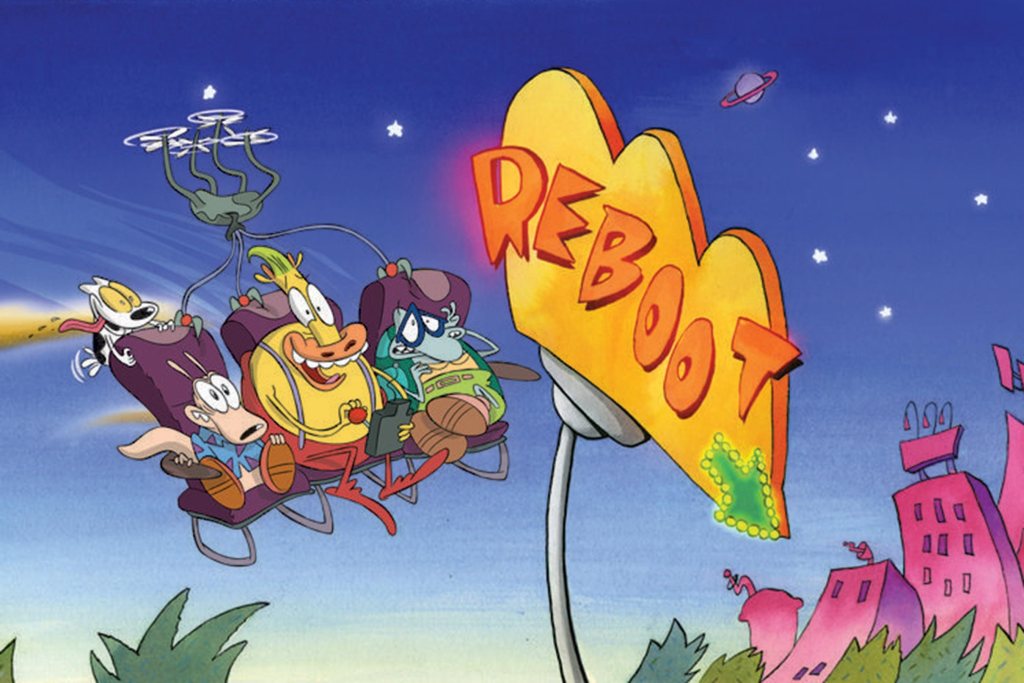
The re-done opening credits gag will likely be a favorite part for many fans.

The look and sound of Static Cling is quite similar to what fans remember from the show, but also a bit different. Cartoons just aren’t made in the same manner they were back in the 90s so Static Cling doesn’t necessarily look like a 90s cartoon. It’s obviously all digital and a bit more “clean” to look at. Some of that Rocko’s Modern Life grime has been lost and this is overall a far less gross version of the show than viewers are used to. Not that Rocko’s Modern Life needed to be gross in order to be funny. The only big change I felt a bit jarring is that Rocko’s fur is a deeper shade of beige than it was before. As mentioned before, basically all of the cast returned to voice the main characters and the side ones as well. Pretty much all of them still sound the same, though Tom Kenny’s Heffer is a bit higher and is the most notable difference.

The Chokey Chicken has undergone a makeover.

Rocko’s Modern Life was able to garner itself a reputation for adult humor during its life as it sometimes found itself censored after airing. Fans hoping for something as titillating as “Leap Frogs” or the infamous moo-milker gag might be a little let down by Static Cling. The Chokey Chicken does get to have its original name restored (it’s mascot has also been slimmed down as it’s become health conscious in this new modern setting) and Really Really Big Man’s magic nipples get some screen time as well. The only borderline lewdness I picked up on was just an emphasis on Mrs. Bighead’s ample bosom. There’s a scene where a fence divides her and Rocko and her breasts hang over it right in Rocko’s face, though he doesn’t seem to notice. She even reaches into her cleavage to pull out an object, though that’s the kind of gag I feel like the original show could have got away with anyway (and maybe did).

Static Cling does an excellent job of giving these characters a reason to exist in the 2010s. The foundation is solid, though I found the last fifteen minutes or so started to drag for me. A lot of the best humor and gags occur early in the special and it doesn’t help that the Rachel Bighead plot feels very similar to Ralph’s debut in “I Have No Son.” It was both disappointing and predictable to see Ed Bighead serves as the conflict once again for Rachel and the character just re-learns the lesson he had already learned back in that old episode. Maybe it could have been more interesting if the opposite had occurred and it was Bev Bighead that took issue with Rachel? Anything to make it feel less redundant would have likely helped, though maybe it didn’t feel redundant to someone who hasn’t seen that episode in 20 years.
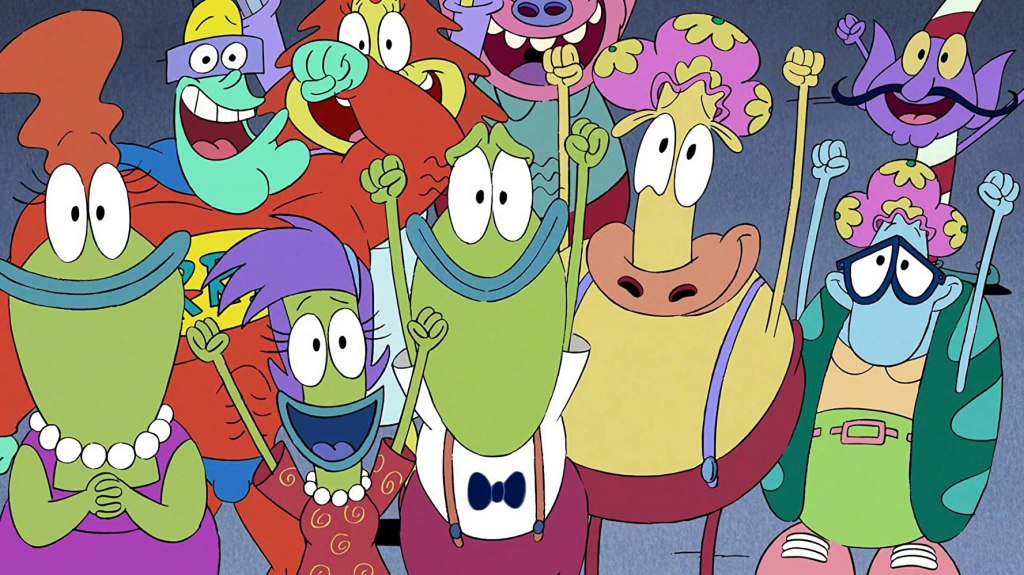
It shouldn’t be glossed over that the inclusion of Rachel is a pretty eventful change, and one that should be celebrated.

Ultimately, Static Cling does have something to say and it’s a worthwhile message. It’s examination of modern fandom and nostalgia is pretty on point, and the overall message that change is necessary is a statement worth saying. The fact that it also contains a positive portrayal of a transgender character is also great as that’s a minority that is still under-represented. It never stoops to cheap trans jokes too, which is a plus, as the production did seek input from the Gay & Lesbian Alliance Against Defamation (GLAAD) during production. It’s also hard not to enjoy Static Cling for the reason it seems to not want the viewer to enjoy it for and that’s just the pure nostalgia trip one gets from interacting with these characters once again. I have no doubt that because of it’s approach to comically infuse cartoon characters into a modern society that Rocko’s Modern Life could make a full comeback and be just as funny in 2020 as it was in 1995. It’s perhaps the cartoon from that era that has aged the best. It doesn’t seem like Joe Murray is interested in a full-blown comeback, but at least we got a little taste of what life would be like for Rocko in the 2010s.


Mighty Morphin Power Rangers: The Movie

In 1995 the Mighty Morphin Power Rangers were at the height of their powers. The show had premiered on Fox Kids in the summer of 1993 and was basically an instant hit. Saban Entertainment churned out 60 episodes for that first season followed by a 52 episode second season which finished airing in early 1995. When it comes to successful children’s properties, most executives want to strike while the property is burning bright so a movie was fast-tracked for summer 1995. It would be a whole different kind of production as the television show was a mash-up of three separate shows. The Power Rangers as teens was all shot in California, while the majority of the action was taken from Super Sentai, a long-running Japanese action-adventure television series. To make things more complicated, the White Ranger was introduced in Season Two even though he was featured in an entirely different season of Sentai which is how you end up with three distinct source productions.

For the movie, 20th Century Fox stepped in and took over for the notoriously cheap Saban Entertainment. Saban was so cheap that by the time the second season ended three actors had been replaced with new ones. Austin St. John, Walter Emanuel Jones, and Thuy Tran had been replaced as the red, black, and yellow rangers when the three tried forming a union to request better wages. The actors reportedly were making $600 per week and we’re being asked to do their own stunts as well. For a hugely successful show, one would think they were justified in requesting a raise. Saban though is run by Haim Saban, the same executive who reasoned that the writers for the wildly successful X-Men cartoon should take a pay cut for the second season because now that the show was a hit, writers should be banging down on his door to write for it. The three original Rangers were replaced by Steve Cardenas, Johnny Yong Bosch, and Karan Ashley while the other three who declined not to unionize (Jason David Frank, Amy Jo Johnson, and David Yost) remained.

The Power Rangers leap onto the big screen with new, armored, costumes.

It’s for that reason that it feels like Fox was just a few months late with the movie. Had the more memorable, and frankly better, characters made it to the big screen it probably would have had more of an impact. Then again, Mighty Morphin Power Rangers isn’t really a film that asks much of its heroes, save for them to mostly look cool and jump around. There’s one memorable line from the Rangers in the entire film, so basically anyone could have played these parts.

With Fox on board it meant someone else got to foot the bill other than Saban. It’s not uncommon for a movie based on a television property to look much better than its small screen counterpart, but for this film it was clear that Fox really wanted to make that point. The Power Rangers have their recognizable costumes, but they’re now padded with armor plating. The villainous Lord Zedd’s (Mark Ginther) exposed brain now throbs with every line of dialogue and his right hand monster, Goldar (Kerry Casey), gets to sport glowing red eyes and re-worked face. The end result is a bit of a mixed bag for the characters we’re familiar with. Zedd looks quite menacing, while the Power Rangers look more like motocross participants and Goldar is actually less menacing than he was on television.

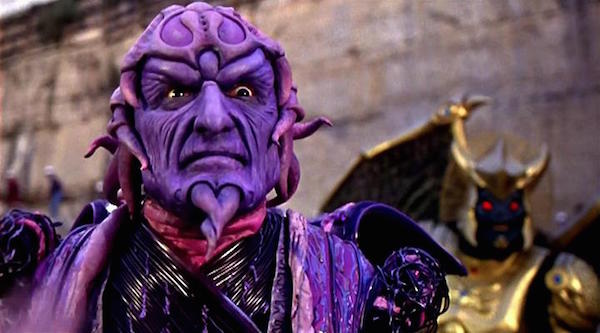
Ivan Ooze is the true star of this one.

What does work is the film’s new lead villain. The basic story is a strange artifact shows up at a dig site that contains the ancient evil Ivan Ooze (Paul Freeman). He apparently caused some trouble many years ago and an older version of the Power Rangers, together with their leader Zordon (Nicholas Bell), defeated him and sealed him away. Zedd is aware of the discovery and sees an opportunity to enlist Ooze’s help to defeat the Power Rangers and take over the world, but Ooze has other ideas. He traps Zedd and his bride, Rita Repulsa (Julia Cortez), in a snowglobe and takes over his operations with his own goal for global domination. He attacks Zordon and lays waste to the command center of the Power Rangers sapping them of their powers. The Rangers are then forced to use the last of their powers to warp to a distant planet to find a greater power in the hope that it will allow them to save Zordon and defeat Ivan Ooze for good.

The film marks the theatrical debut for director Bryan Spicer who worked with John Kamps and Arne Olsen to craft the story and script for the film. It’s a very basic story of a bad guy stripping a hero of their power and forcing them to find a new source to train, power-up, and return. It’s actually very similar to the plot of the first Teenage Mutant Ninja Turtles film in which the heroes lose their surrogate father and have to leave for a period only to come back and save the day. The film is only an hour and thirty-five minutes, but it’s a long hour and thirty-five minutes as there’s a lot of padding to be found. The film begins with a lengthy, and pointless, sky-diving sequence which gives way to an extended roller-blading outing for the Rangers. I guess the idea was to make the heroes look cool while also hitting that magic 90 minute running-time, but there’s a lot of pointless stuff going on.

The Power Rangers also have new, ninja, outfits to show off which means Bandai has more toys it can sell.

The acting presented here is about what you would expect. The Rangers themselves are rather wooden, but they’re also given some of the worst lines to work with. Tommy, played by Jason David Frank, is perhaps miscast as the leader of the bunch since he struggles with basically every line except for “It’s morphin’ time!” I say “perhaps miscast” because I am not sure any of the others really demonstrate anything better. Amy Jo Johnson, who plays Kimberly the Pink Ranger, is probably the best of the bunch, but even she isn’t given a whole lot. Worse is that she and Aisha, the Yellow Ranger, seem to constantly find themselves in peril calling out for help from the male Rangers in virtually every conflict. This is a departure from the show where the girls are freely allowed to kick some ass and even bail out their male comrades. There’s also a romance angle shoe-horned into the relationship of Tommy and Kimberly, but there’s absolutely no chemistry to be found between the two actors.

As is the case with the television show, the real stars of the film are the villains. Lord Zedd and Rita Repulsa are a fun odd-couple pairing, for the brief time they’re around. They make me smile when they’re on screen, and I would have been very disappointed with how they’re written out if not for the presence of Paul Freeman’s Ivan Ooze. Ooze is a ridiculous looking villain, which is perfect for a film like this one that has a bit of a B-movie vibe going for it. He’s funny, flamboyant, and the pile of prosthetics Freeman is forced to wear do not cover-up his face so he’s free to emote and use his facial expressions to further enhance the character. He’s easily the best part of the film and it’s almost a shame he had to endure so many hours in a makeup chair for such a picture.

My children found movie Zordon frightening.

Where the film really takes a turn for the worse is in its desire to elevate the product above the television show. The show is formulaic and repetetive, but it’s not without its charm. The cheap effects are endearing, and the bad rock music soundtrack has a way of worming its way into your ear. Note that I don’t consider the main theme song, “Go, Go, Power Rangers!” as among the bad. That song is perfect for what it is. For the film, licensed music is brought in as is often the case for summer blockbusters. There are songs from The Red Hot Chili Peppers and Van Halen to go along with the techno-rock score that just isn’t nearly as fun as the television soundtrack. It causes the property to have a sense of being in over its head, like it doesn’t belong, when in reality the soundtrack was aiming to do the opposite.

“Mega” is not the way I would describe this Megazord.

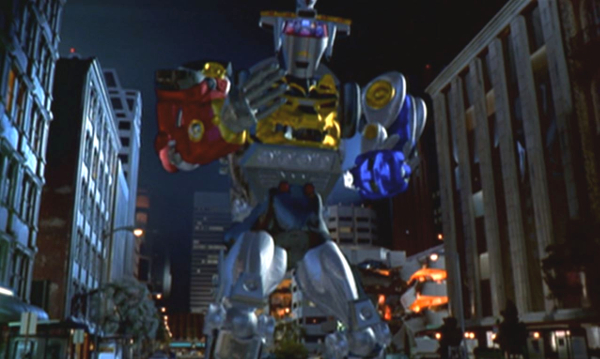
Worse than the soundtrack though, are the effects. There are a great many instances of practical effects in this film, which is what is appropriate for the franchise. Some of them get a little silly, like the White Ranger doing a comical amount of flips through the air. His deployment of his sentient sword, Saba, is also awesomely bad. What can’t be forgiven though is the CG finale. The film only had a budget of roughly $20 million so no one would expect Jurassic Park CG, but where the films errs is in its attempt to make the zords, giant robots piloted by the Power Rangers, entirely CG. Same with the evolved form of Ooze which features a frozen face completely removing the character’s strength. The zords are just brutal to look at and it’s a real shame that the studio didn’t just pour money into making awesome costumes for the stunt performers. The Rangers even get new, more powerful, zords, but kids were likely left underwhelmed at the end result. They do show up in the TV show in a manner fans were accustomed to, and they look light years ahead of what’s presented here.

You would probably believe me if I said this was from a PlayStation game, not a major Hollywood blockbuster.

I decided to watch Mighty Morphin Power Rangers: The Movie largely because my kids have been watching the original show and it’s been a fun trip down memory lane for me. I honestly can’t remember if I had ever sat down and watched this movie beforehand, but if I did I can see why it wasn’t very memorable. I was hoping for more camp and plenty of humor, some intentional and some unintentional, but the film really doesn’t deliver. The only redeeming part of it for me was Ivan Ooze, and when he’s not on screen I’m just not entertained, save for one line by Johnny Yong Bosch when he finds out he’s receiving the powers of a frog. The film was a hit as it reportedly made over $60 million at the box office plus it probably made a bunch more in merchandising. Despite that though, there was no Mighty Morphin sequel. Instead, we got Turbo: A Power Rangers Movie in 1997 which bombed at the box office. The franchise was also rebooted in 2017 as simply Power Rangers, but it didn’t perform well enough to warrant a sequel and rumor has it the film franchise is destined for another reboot. The show is still going though and it seems like the type of series that will last forever at this point. It’s just a shame that its best era received such a dismal feature.


Ghostbusters Plasma Series: Venkman

Bill Murray is the greatest actor of all time. If you want to disagree with me, that’s fine, just know that you’re wrong. Because of my love of toys and Mr. Murray, I’ve always wanted a Bill Murray action figure. It might sound like a weird want to most people, but to a toy enthusiast it probably isn’t. If one were to aspire to own Bill Murray in plastic though, then the easy franchise to look to is Ghostbusters.

The Real Ghostbusters is the toyline that made me an action figure fan for life. I loved that series from Kenner as I had the firehouse, the Ghostbusters, numerous vehicles, and some ghosts. That franchise is based on the cartoon though, and the actual Ghostbusters did not resemble their real-life counterparts even in the slightest. That is almost certainly due to money, as if you’re going to make a cartoon that uses the likeness of actors like Murray and Harold Ramis then it stands to reason that those individuals need to be compensated.

Nostalgia has taken over the toy collecting world though, and actual toys based on the original 1984 hit Ghostbusters have been trickling out for years. There have been some high end ones, and some more mass market friendly releases. I’ve always intended to purchase a Peter Venkman from one of those many lines to satisfy my Murray obsession, but I just never did. For one reason or another, I just either wasn’t enthused with the product or I didn’t like the price. Well, today on a trip to Target for some essentials, I made an impulse buy when I stopped by the toy section as staring at me right in the face was a Peter Venkman from Hasbro’s new Plasma Series of toys.

Hasbro is the latest license holder to acquire Ghostbusters. Previously, Mattel held the license and I believe Diamond Select also had it at one point. Hasbro is a well known toy creator as it currently holds many of pop culture’s biggest licenses such as Marvel and Star Wars. Once upon a time, I was a Marvel enthusiast and was way deep into the Marvel Legends line, but when Hasbro acquired the license from Toy Biz I wasn’t impressed. I left that line around 2006 and I haven’t purchased a Hasbro toy since. For that reason, this purchase was a bit like a homecoming for me. I have nothing against Hasbro as a company, I just don’t have much interest in the licenses they hold. This was the first release that had appealed to me in quite some time, so I was curious to see how Hasbro’s action figures stand up in 2020.

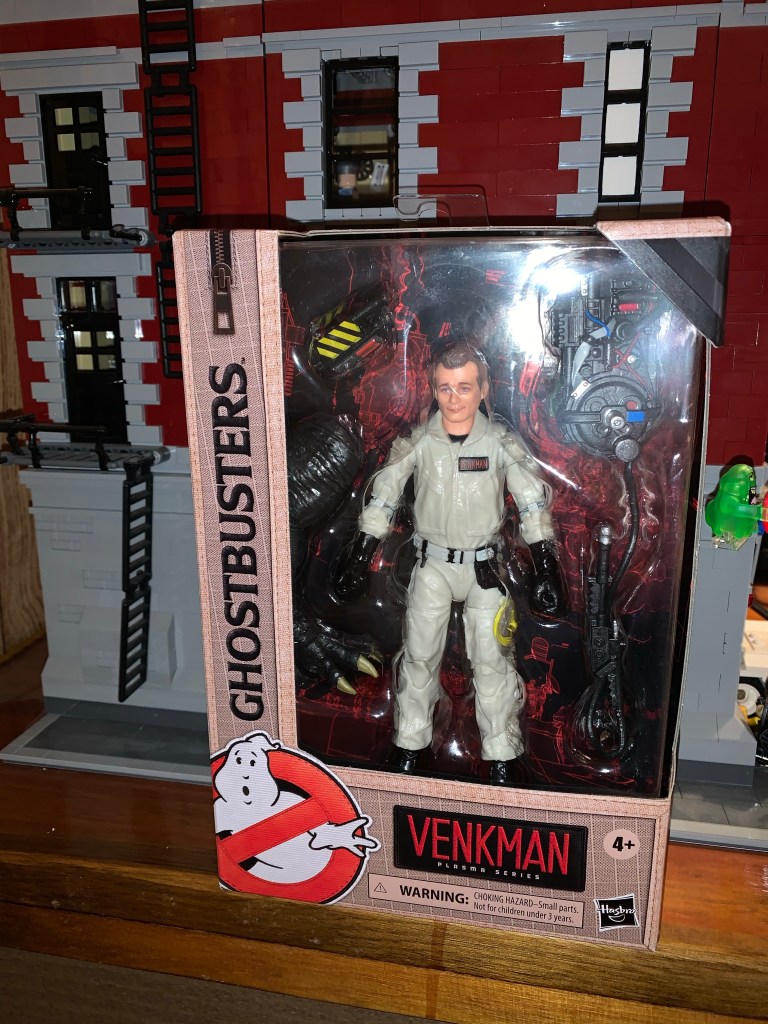
The Ghostbusters Plasma Line all come packaged in an attractive window box display. One side panel features a bit of stylized art of the four Ghostbusters and the rear dispalys the rest of the line. There’s also a brief blurb on the character. For Venkman, the box reads: “The man with the mouth: Peter can convince (almost) anybody of (almost) anything.” Short and to the point, it described the character well enough. Each figure comes with a few accessories as well as a piece of Vince Clortho in demon-dog form. For Peter, it’s the left, front, leg. The other figures in the line include the other three Ghostbusters, Dana in her Zuul attire, and Gozer. The retail at Target was $19.99 so if you want to build your own demonic canine it will cost you around $140. Hopefully you don’t want two.

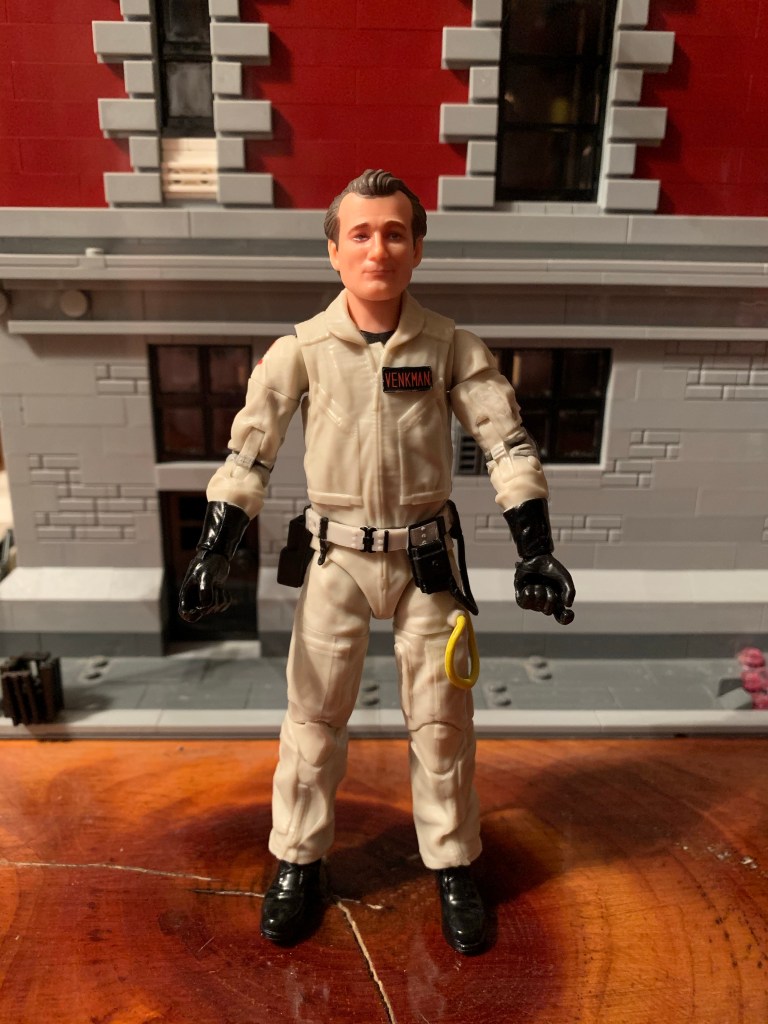
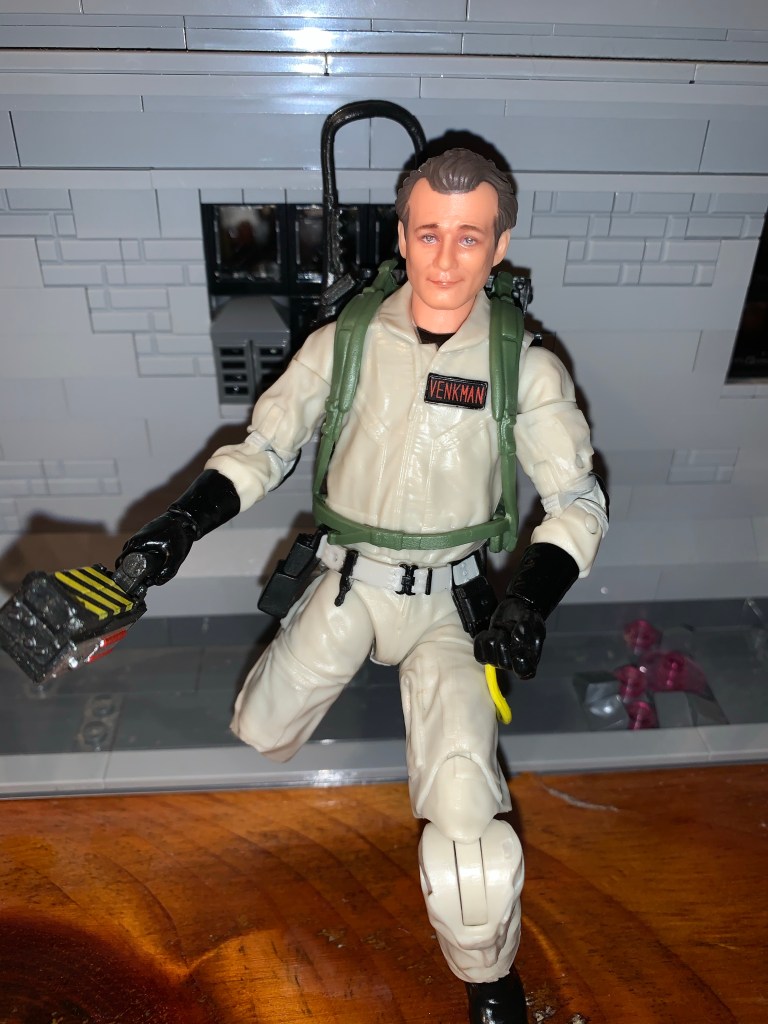
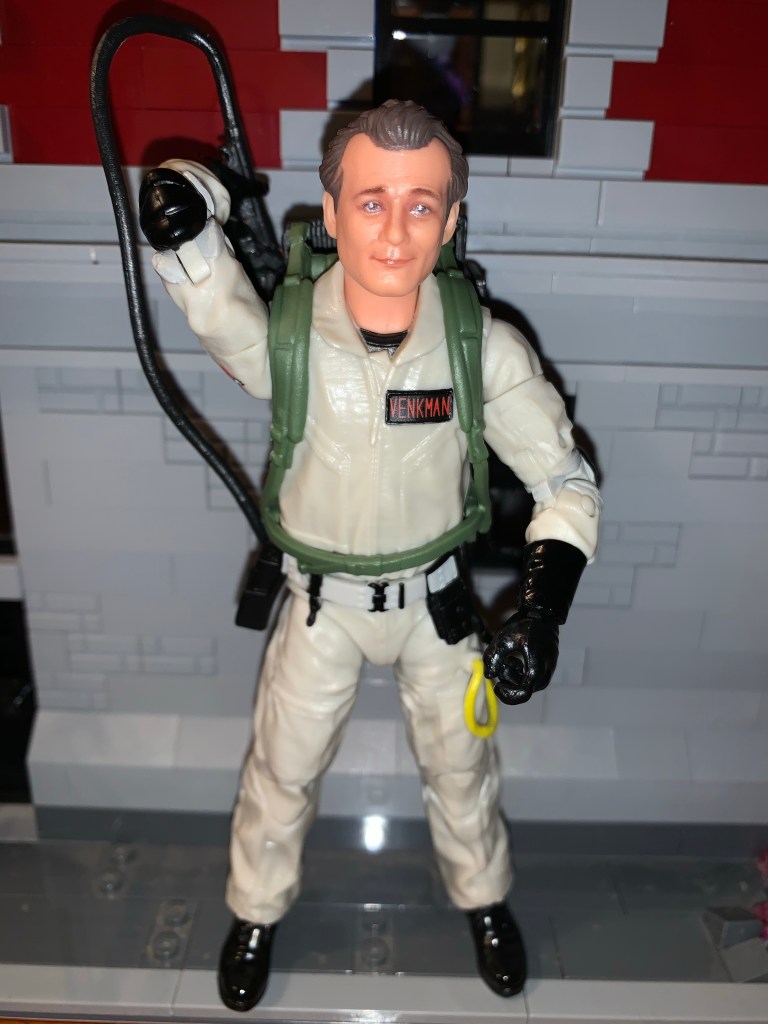
Peter Venkman comes clad in his traditional Ghostbusters outfit from the first film. It’s the khaki one with the logo on the right shoulder complete with black boots and gloves. He stands right around 6″ and possesses a great deal of articulation. His head sits on a ball joint with great range of motion. The shoulders are ball-jointed and there’s a hint of a butterfly joint in there as well for turning the shoulders into the body. It doesn’t do much though. He has a biceps swivel which is a little tight out of the box and double-jointed elbows. At the wrist he has a swivel and a hinge joint to tilt the hands up and down. His torso is on a ball-joint so he has some good motion there that doesn’t detract as much from the sculpt as an ab crunch would, though he lacks traditional waist articulation. The legs are attached via ball-joints with thigh swivels and double-jointed knees. The ankles are on swivels, but with an odd pitch to them so they sort of turn out and up instead of on a straight plane. The feet also rock side to side.

What I understand to be typical of Hasbro is fairly true here in that most of the figure is colored plastic. There’s not a ton of paint work aside from a yellow cable on his belt and the logo on his arm. The face is a solid likeness for Murray, as good as one would expect at this price point. I’ve seen more expensive Venkman figures with lesser face sculpts. He has a cocky smirk which is befitting of the character, though I wish he had a five-o-clock shadow. The uniform looks great and even features the screen accurate detail of Venkman’s pants not being tucked into his boots. He has his walkie talkie affixed to his belt, though it’s non-removable, and the belt itself is a floating piece of plastic which adds a little depth to the look of the figure. The hands are in trigger-finger positions as opposed to a more generic grip. I’m not sure this really adds anything to the figure as the proton pack doesn’t feature a trigger, but the plastic is soft enough that he can hold his accessories with only a little bit of fuss. The lack of paint means he’s fairly glossy to look at. A wash over the uniform might have done some good, and his eyes are particularly shiny, but it’s an attractive enough piece.

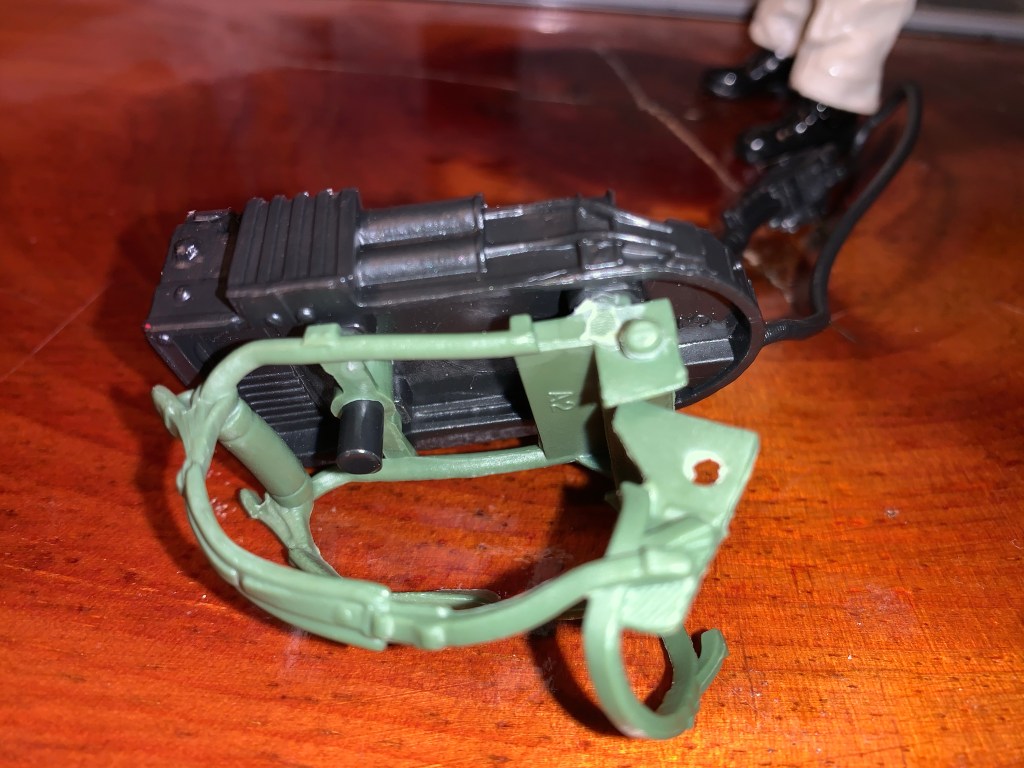
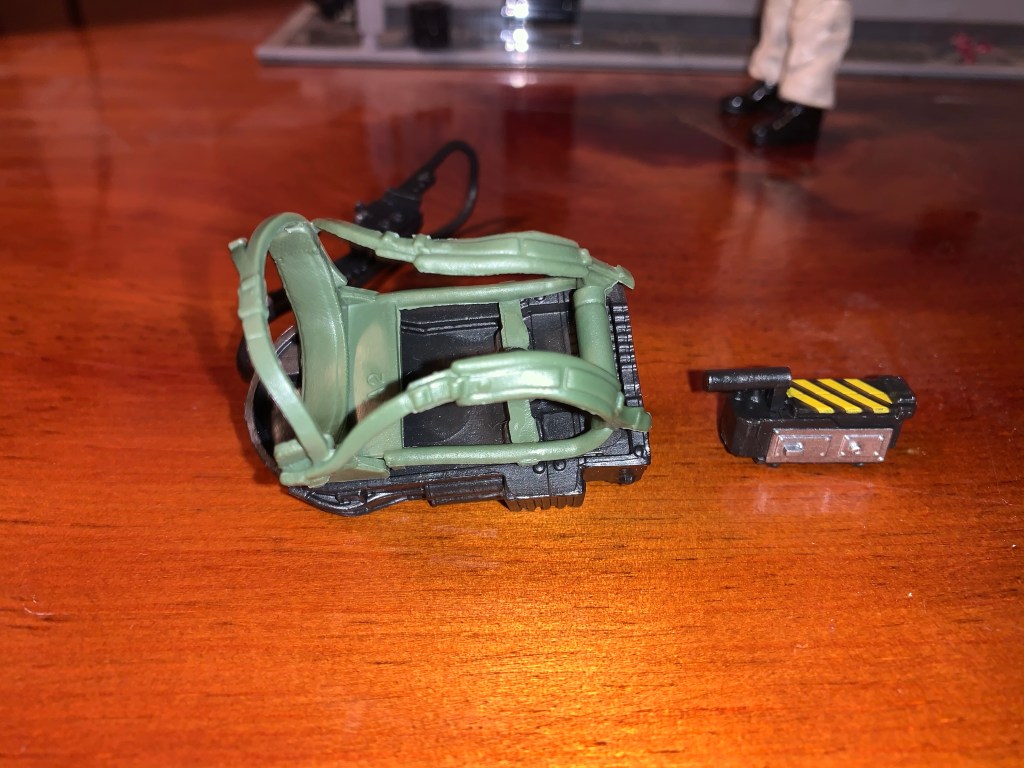
For accessories, Venkman comes with his proton pack and a ghost trap. The proton pack is a really nice sculpt with some paint highlights as well. It’s attached to a harness that features two shoulder straps, a belt, and a peg to fit into Peter’s back. The belt of the proton pack detaches on the left side and it was more than a little troublesome out of the box. It almost looks like it was glued in place which had me doubting myself if I was supposed to even go this route in order to get this thing onto Venkman. I did manage to unfasten it, but I was scared the whole time that the peg would come off with it. It definitely could have been done better and isn’t something that would probably hold up well to repeated removals. The actual blaster portion can be holstered on the side of the pack or held by the figure. It’s on a soft piece of plastic and seems reasonably durable. Venkman has enough articulation that he can hold the end of it in a casual manner, ready across his chest, or point it to bust some ghosts. The other accessory, the trap, looks the part, though it doesn’t do anything. Venkman can hold it, but there isn’t an easy way to clip it onto his belt or anything like that. It also doesn’t have the activation pedal. The only other accessory is the build-a-figure piece which I suppose looks fine, though I’m not about to judge that figure based on one leg.

Positioning and posing Venkman is pretty rewarding. There isn’t much he can’t do that you would want him to do based on what the character does in the film. His feet are a bit small, so he’s a little harder to stand than I expected he would be. The proton pack also adds some weight to the figure, but not enough to make standing him impossible. For the price, he’s as good as expected. The only real shortcoming with the figure is the lack of extra hands as he pretty much needs to be holding his proton blaster to not look stupid. A screaming second head would have also been cool, but not expected or really necessary. I wouldn’t be surprised if Hasbro does a slimed variant in the future.

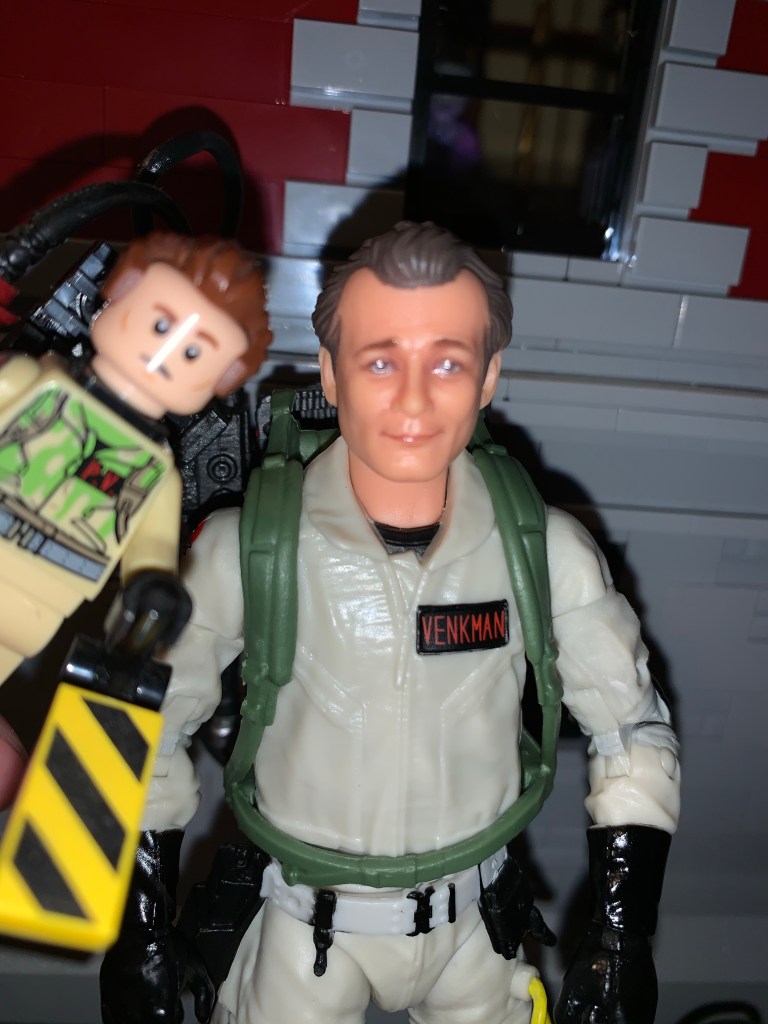
The Plasma Series Venkman is an action figure that gets the job done. I wanted a Bill Murray toy, and was happy to take him in his Ghostbusters attire, and this fit the bill. It’s about what one would expect of a mass market action figure at the $20 price point, but it also doesn’t exactly leave me feeling like Hasbro went above and beyond like NECA often does with its products. It also didn’t leave me with a compulsion to buy the rest of the line, so Peter is going to have to get used to hanging out with the Lego versions of the other Ghostbusters. Maybe if they ever hit clearance I’d revisit it, but probably not. For Ghostbusters enthusiasts, I suspect they’re happy to have an improvement on what Mattel did in the past and at an affordable price point.


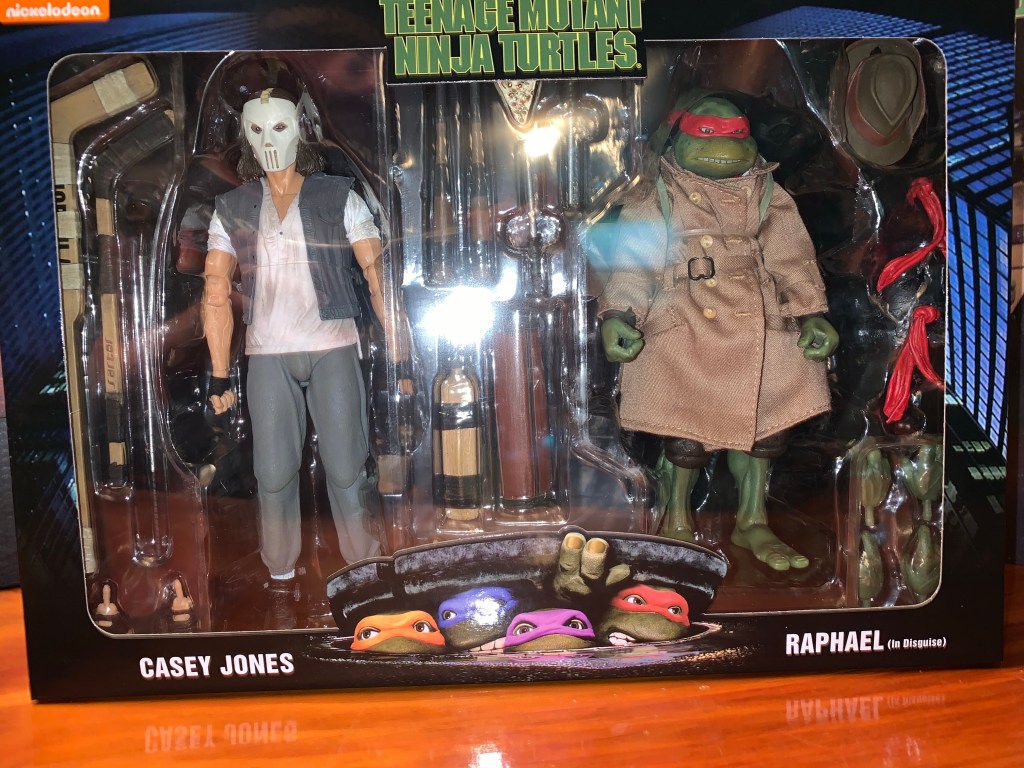
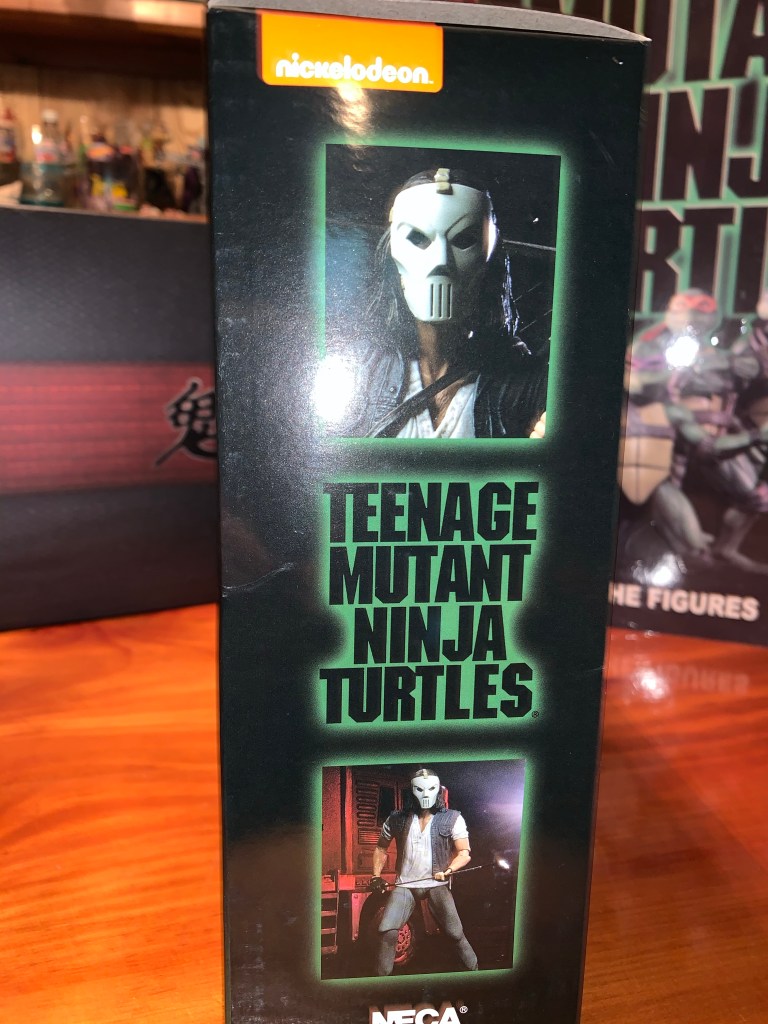
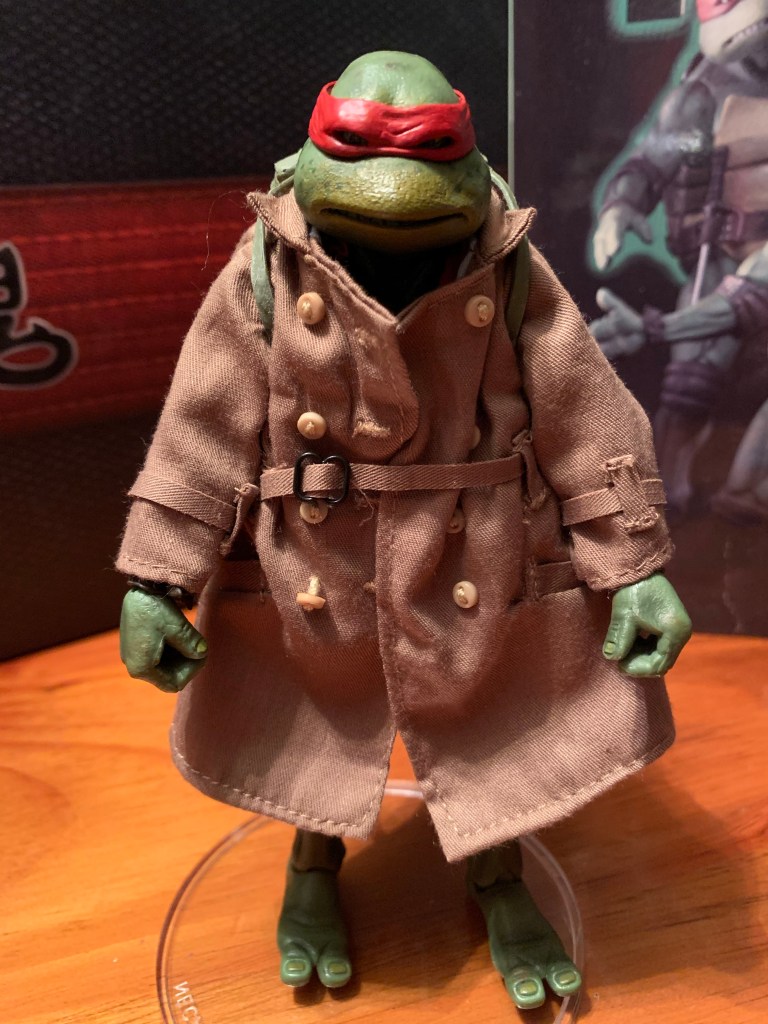
NECA TMNT Casey Jones and Raphael (In Disguise)

“The class is Pain 101. Your instructor’s Casey Jones.”

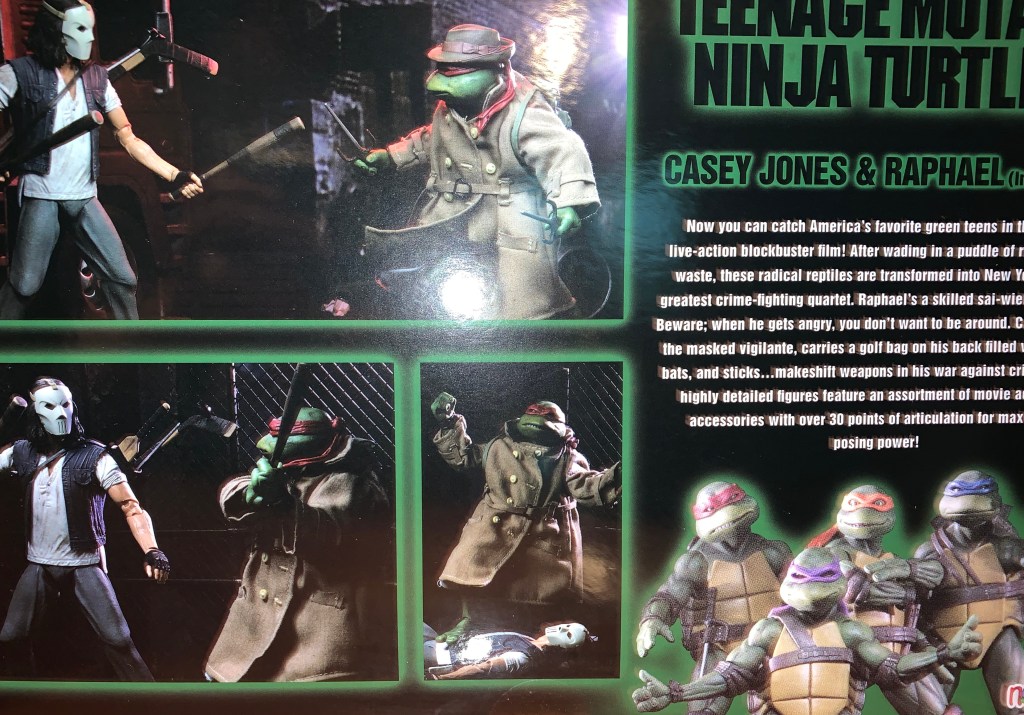
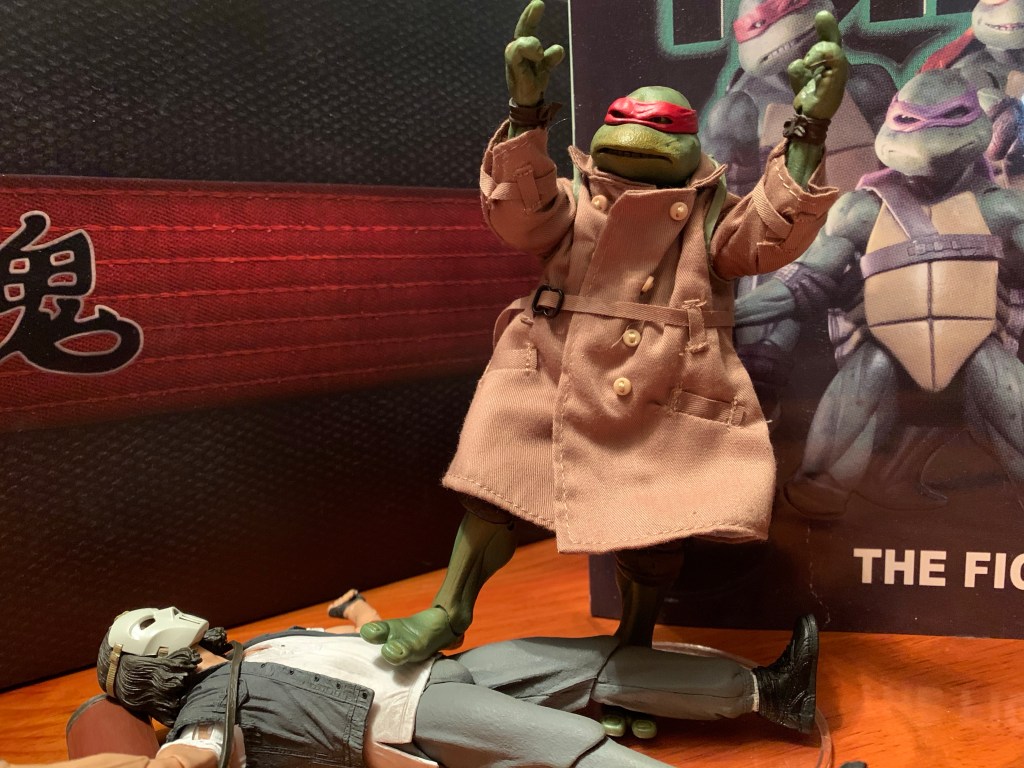
There may not be a more quotable scene from Teenage Mutant Ninja Turtles than the encounter between Casey Jones and Raphael. Raphael, after taking in a movie he appeared unimpressed by, stops a purse-snatching and scares the kids off with a simple gesture to his sai. The kids take shelter in Central Park, where they have a chance encounter with the vigilante Casey Jones. Jones witnessed the attempted thievery, but he’s not as forgiving as Raph. Before he can really lay into the teens with an assortment of sports equipment turned weapons, Raph breaks it up which brings about the memorable encounter.

It was a trip for me as a kid to see my favorite green heroes on the big screen, and it was almost equally as entertaining to see Casey Jones. Played by Elias Koteas, Jones basically leapt from the comics and cartoon and took to live-action effortlessly. His attire was simple: sweatpants, t-shirt, vest, and that trademarked hockey mask. It should have been easy to translate to a film, but the performance of Koteas throughout the film should not be dismissed so easily. He’s an entertaining and even endearing character. There was probably so much more that could have been done with him, but in an effort to tone down the violence from the first film the Casey Jones character was written out of the sequel, I suppose in favor of the much less-celebrated Keno. He did return for Teenage Mutant Ninja Turtles III, but the less said about that film the better.

As has probably been noted in every one of my reviews of NECA’s movie-inspired Teenage Mutant Ninja Turtles line of action figures, this is a notable release because it’s the first of its kind. The movie was not expected to perform well, so Playmates did not support it with any toys. When it did prove a surprise hit, the company went straight to producing toys based on the sequel. That meant the Turtles themselves at least received figures as well as many others, but the characters and designs unique to the first film never did. And it doesn’t look like Casey received a figure for the third film, which is a bit surprising. Fans of Casey Jones have had to wait 30 years for a proper figure, but he’s finally here and fans are left to determine if he was worth the wait.

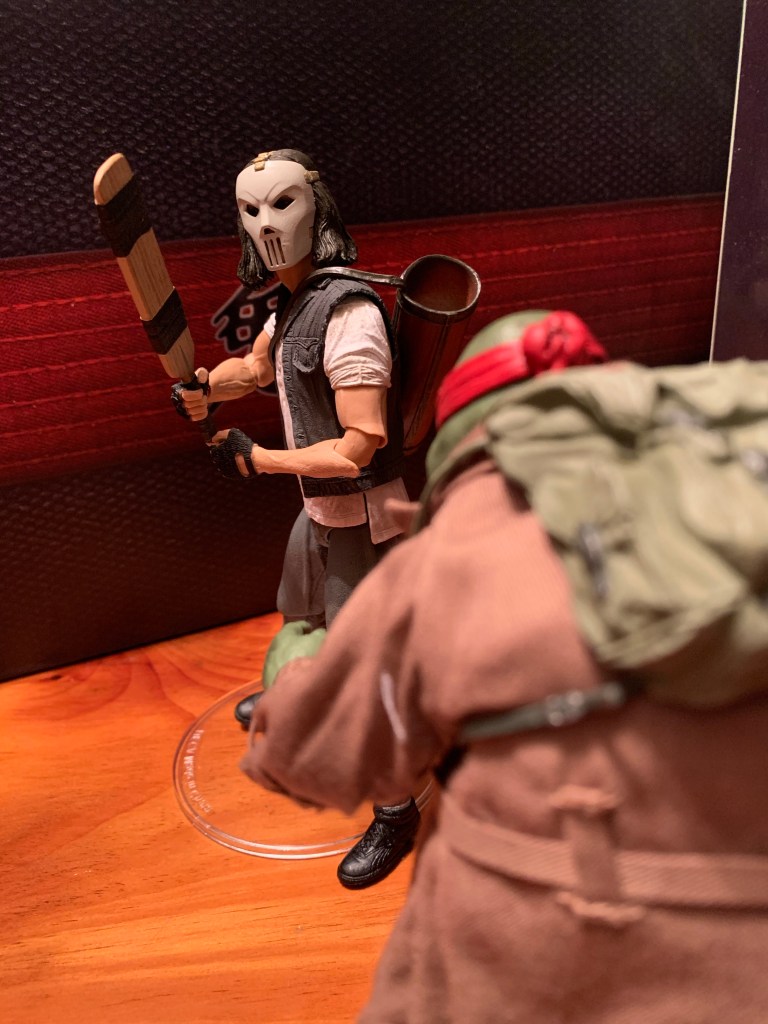
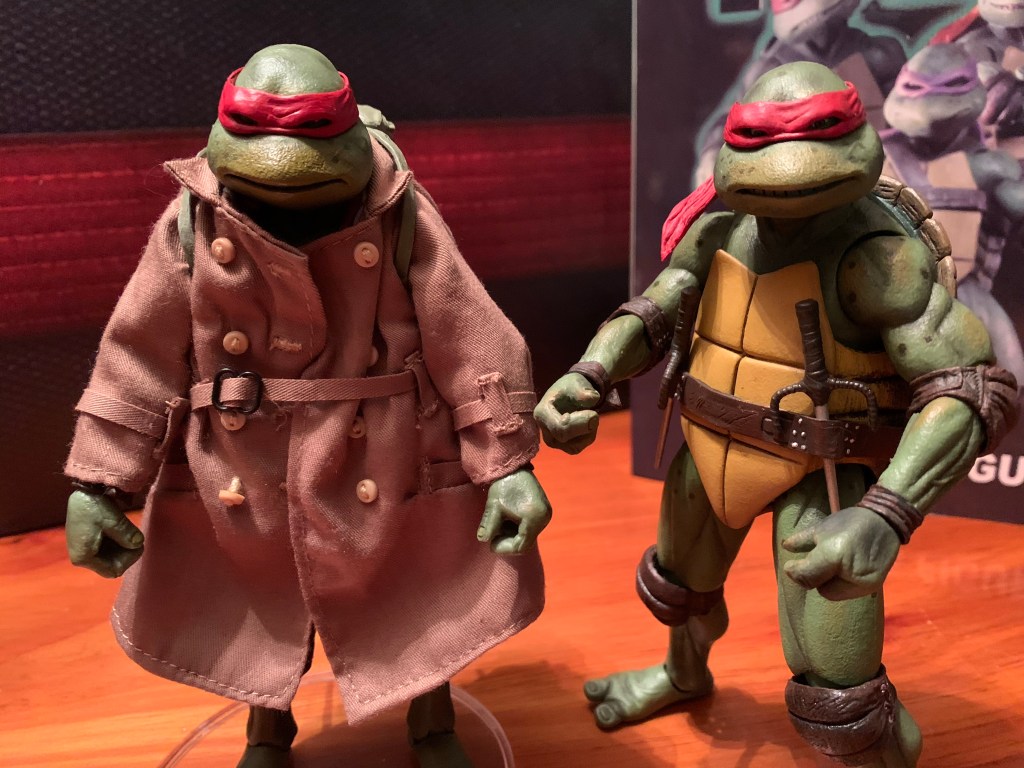
Not to be ignored though, is the fact that Casey Jones is part of the first movie two-pack released by NECA exclusively through Walmart. Along for the ride is Raphael in disguise sporting his trench coat and hat. This Raph is a scaled-down version of the quarter-scale figure, which is also just the regular movie Raphael, but with a coat and hat. It’s a fairly iconic look for the character that deserves a proper action figure and bundling him with Casey Jones makes perfect sense. I suppose there are some out there who would have preferred he come with another all-new sculpt, (April? Tatsu?) but I can’t say I feel cheated or anything.

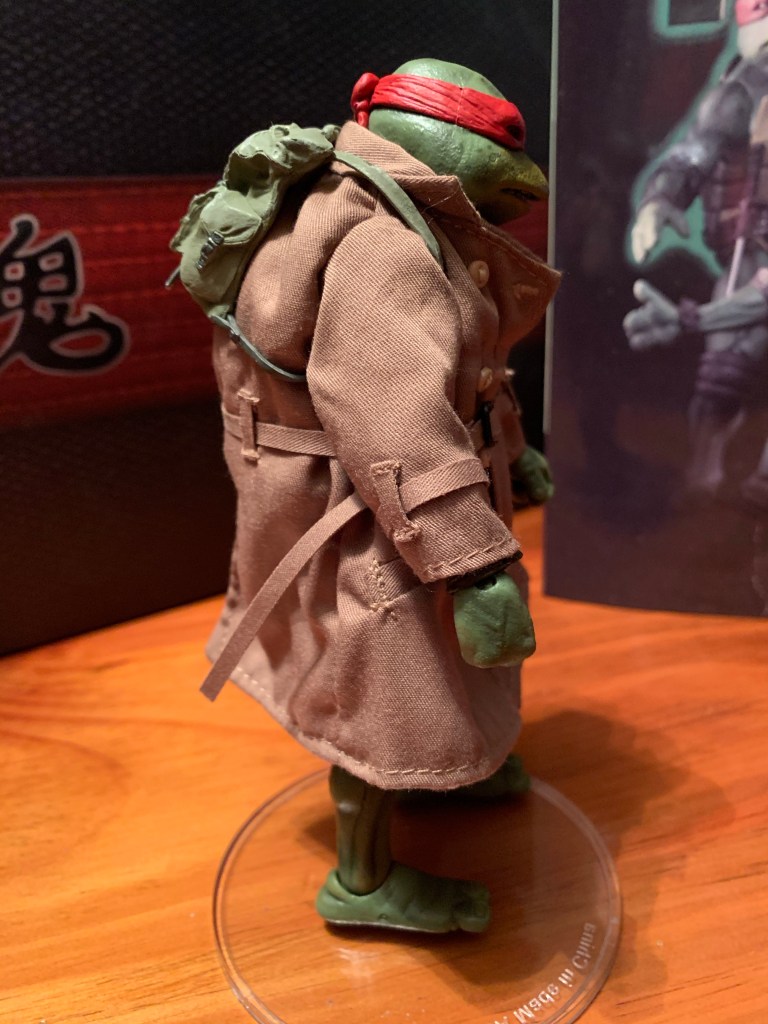
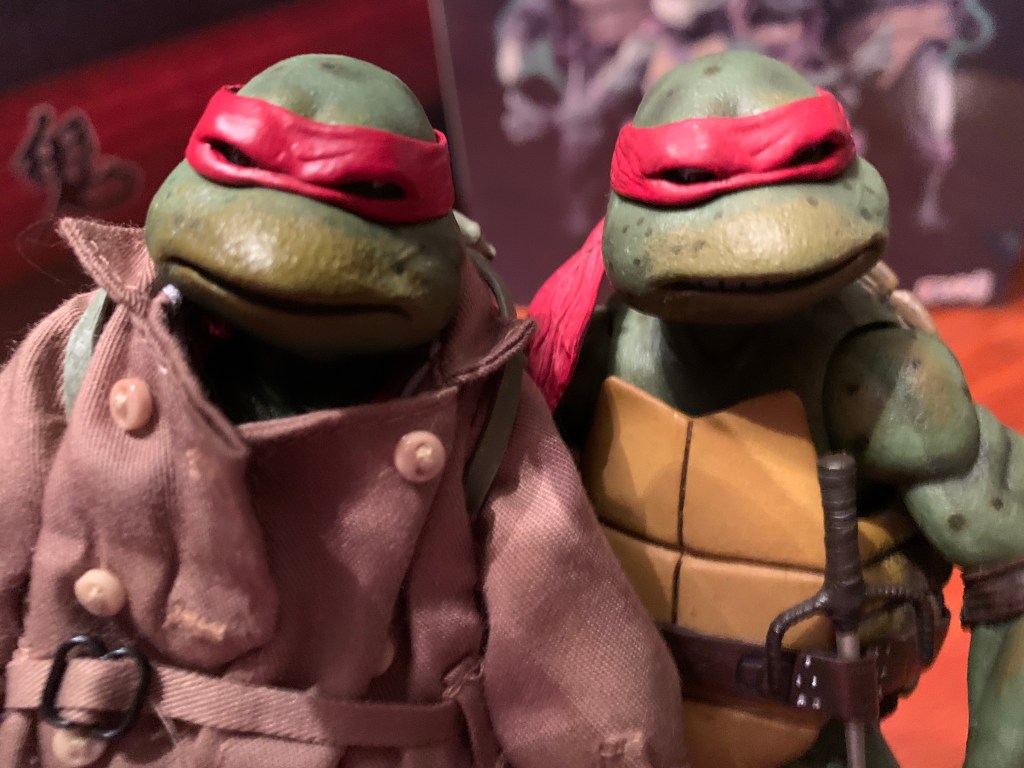
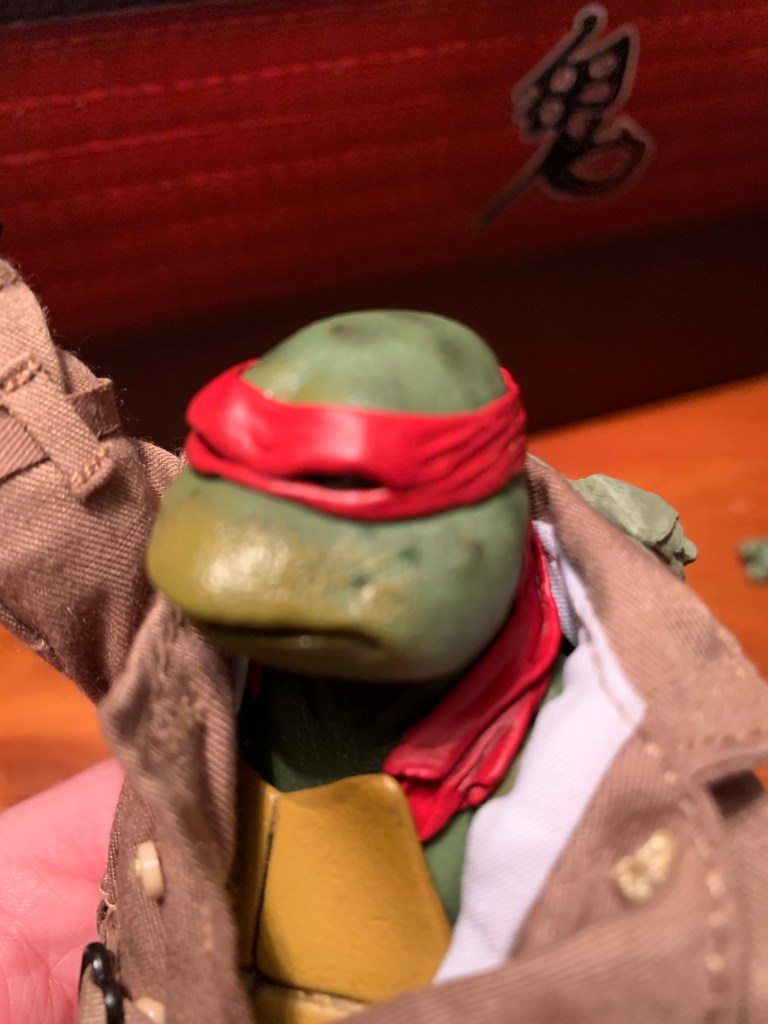
Let’s talk about Raph first before getting to the main event, of sorts. Raphael is the exact same figure released previously as part of a four-pack of Turtles as a San Diego Comic Con exclusive and also released as a single-pack through GameStop last year. NECA has taken the movie line from GameStop to Walmart, in case you were wondering, and the previously released figures should start showing up any day now in two-packs as well. In comparing the figure with my SDCC edition, his face looks a touch lighter to me with a little more yellow mixed-in with the green. The eyes on my original Raph were kind of screwy as well, but this new one looks fine. It might have been neat if he could have had a new head, perhaps one with more teeth such as when he rescues April in the subway, but this is a good likeness of the character. His default mask “tails” is a new piece that diverts the tails around his neck instead of off to one side. He comes with the other two pieces, one going left and one going right, should you wish to swap it out, but I think the default one looks best. The coat is a soft goods coat and it looks really sharp. There’s one loose string on my Raph’s left shoulder, but otherwise the cut looks great. The buttons are non-functioning, but the belt and pockets are real. His hat is soft plastic and there’s a little hole for the knot of his mask. You could, if you wanted, pop out the tail piece and re-insert it through the hat to possibly get it stay on better, but he looks good no matter what you choose to do there. He also has his backpack, which is made of more soft plastic. It’s the biggest hindrance to getting the coat off and I suspect you would either need to cut the straps or pop his arms off to do so, but why would you?

Underneath that coat everything appears to be the same. All of the spots and battle-damage on Raph’s shell all look to be there. This also means all of the articulation is still in place as well. Raph will be restricted by his coat to some degree, though the cloth nature of it means it’s not as restricting as you may have expected. Raphael features a nice, tight, ball-joint at the neck. The default mask tails restricts his mobility a bit, but that’s what the other parts are for. He has ball-joints at the shoulders and elbows, plus hinges at both as well. There’s a forearm swivel and wrist swivel plus a hinge at the hand. Underneath the shell is a torso ball-joint that provides a little movement, but the shell (and coat) don’t allow for this joint to do much. He has ball and hinge joints at the thigh to go along with double-jointed knees. His feet are on a hinge, but there isn’t much movement there. It can also rock side-to-side a bit. This was plenty for the standard release, though for this version I wish the feet had more range of motion as the added bulk of the backpack makes him a challenge to stand. I can get him to stand in some poses, but ultimately I think I’ll use a stand when I place him on a shelf.

As far as accessories go, Raph seems a bit light compared with his box-mate. That’s fine since Raph really doesn’t need much aside from his outfit and trusty sai. That outfit is the star, of course, since it looks and feels fantastic. Despite not featuring a wire inside it, I found the coat easy to move and position. It can be bunched up in places to gain more range of motion at the arms, or allowed to conceal as much of this big turtle in a trench coat as possible. I was even able to get him to properly hold a baseball bat without much hassle. Raph also comes with both sai, even though he was down to one when he met Casey. He comes with gripping hands affixed to his arms, and optional open palms and finger-pointing/optional sai grips as well, just like the standard figure. NECA also tossed in a slice of pizza for good measure since I guess you can never have too many of those, though I kind of wish they had stuck a hole in the middle for his sai even though he didn’t do that until the second film. Or maybe a chewed up apple would have been fun.

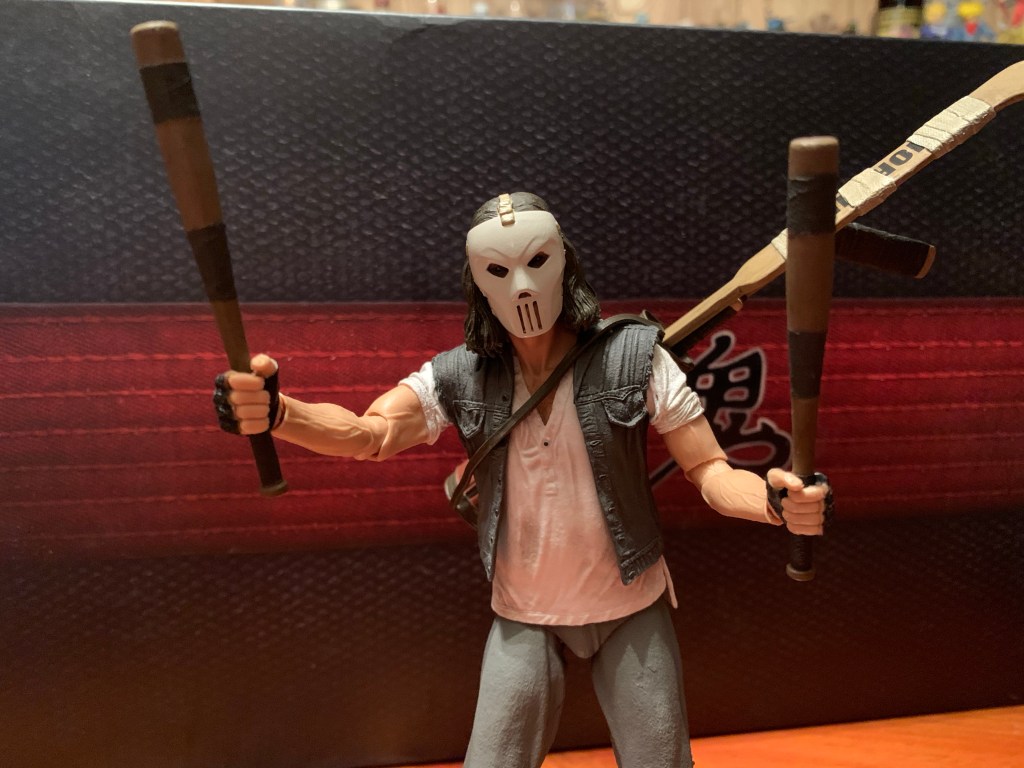
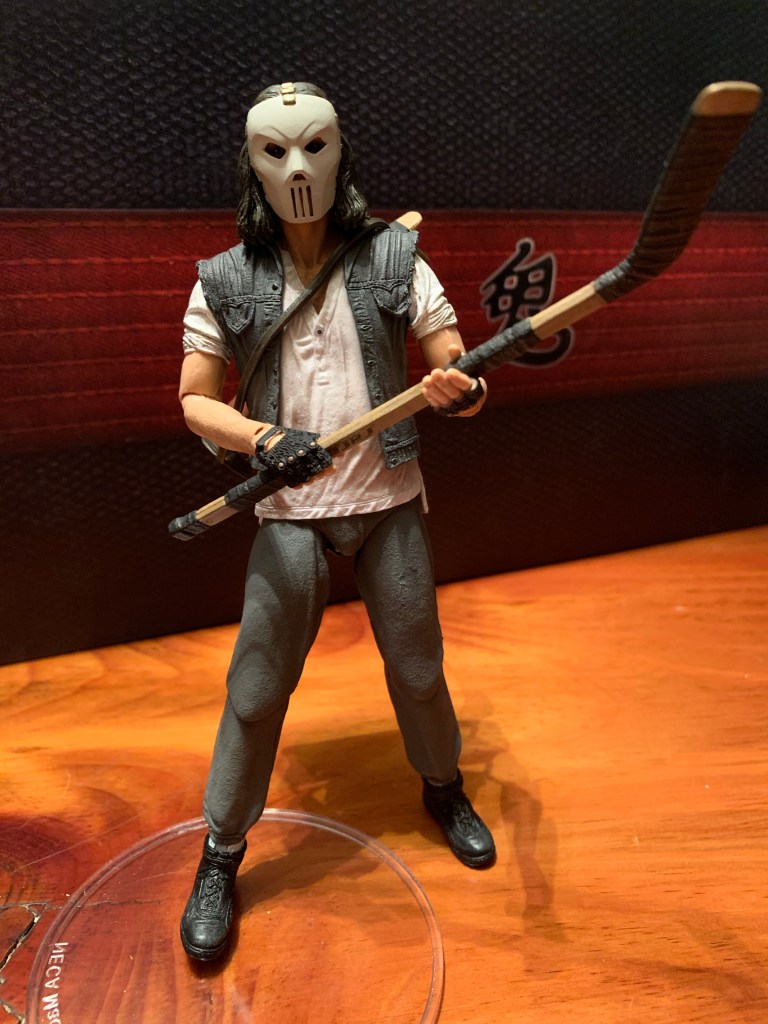
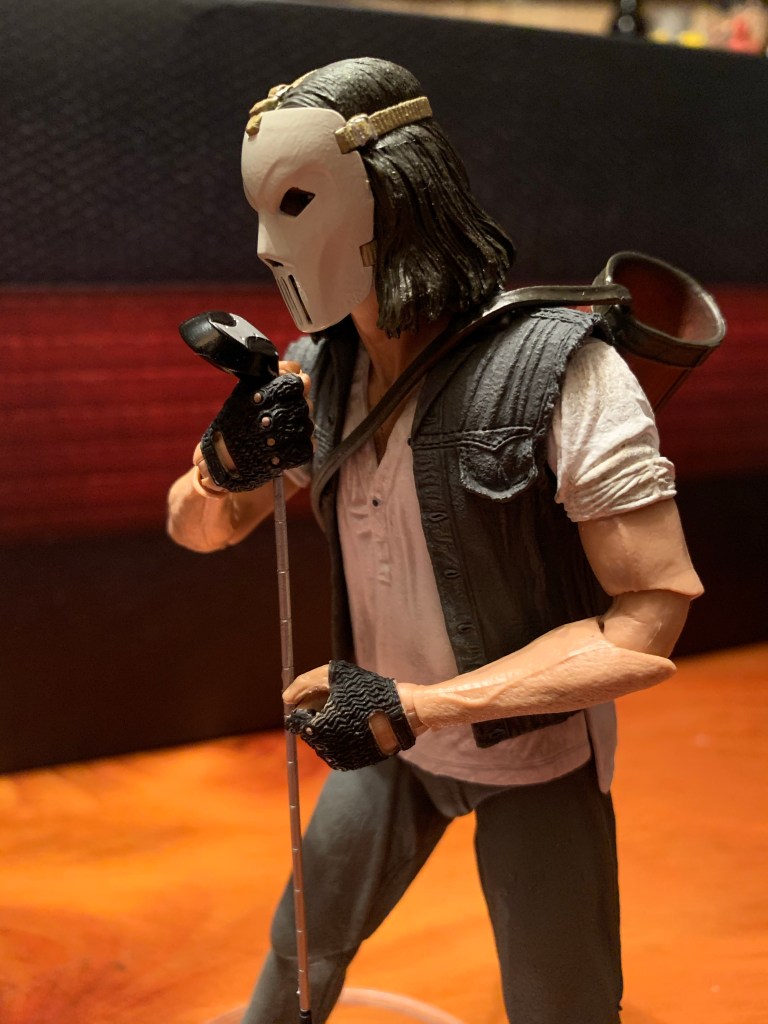
Raphael is pretty sweet, but he’s also a variant of a two-year old figure. What collectors are really excited for is Casey Jones! Casey stands at about seven inches making him roughly half an inch taller than Raph, which feels about right. He’s in his first-appearance attire which includes a non-removable hockey mask. Underneath the mask is indeed a face that vaguely resembles Elias Koteas (you’ll have to search online to see for yourself), but the only way to get it off is to chisel it since it’s glued on. The mask also features pegs, and the straps are part of the sculpt, so your figure will look pretty stupid without a mask. NECA was unable to secure an agreement with Koteas to use his likeness, which is why there’s no unmasked head included. Though let’s be honest, basically everyone is displaying this guy with the mask on anyways, even if he only wears it for a small part of the film. Koteas confirmed on Instagram recently that he has actually given his blessing to NECA to go ahead and do a figure with his face on it, so don’t be surprised if we get an unmasked variant down the road (or a quarter-scale version with a removable mask) as part of another two-pack.

Sounds like we can expect a variant of Casey in the future.

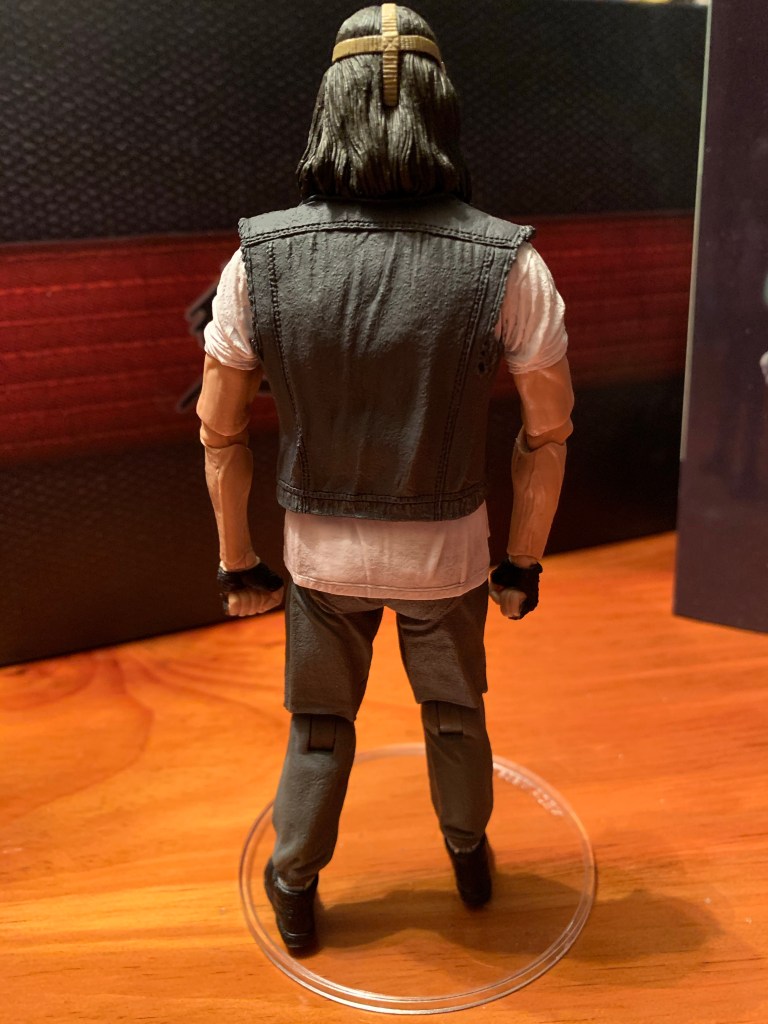
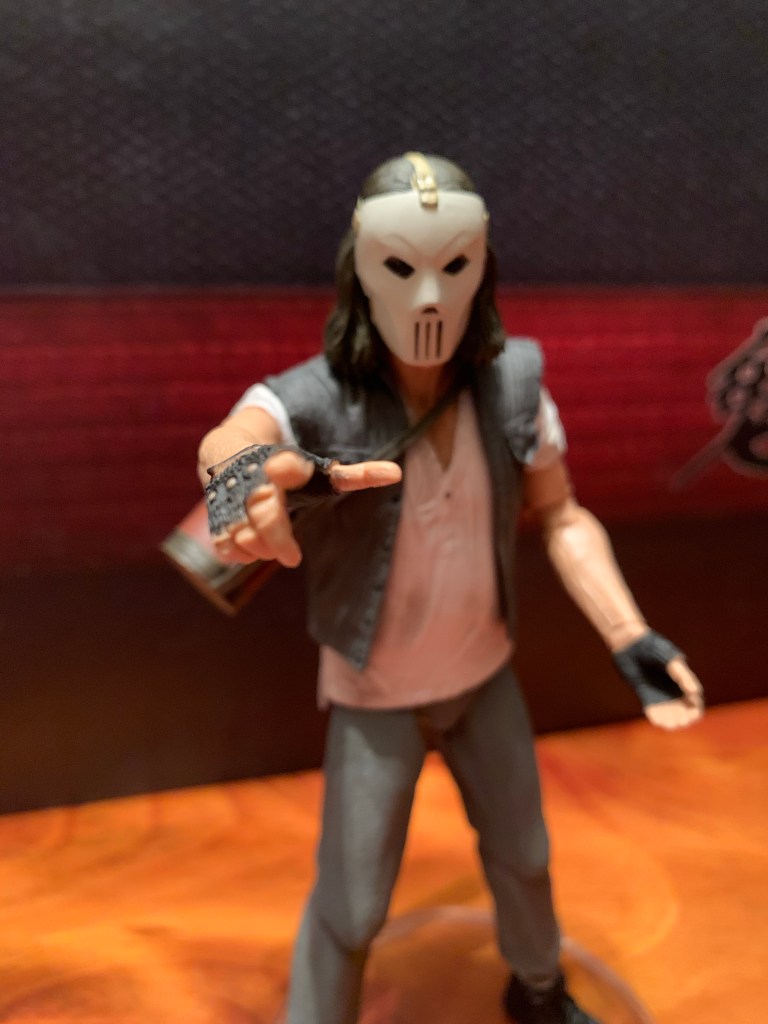
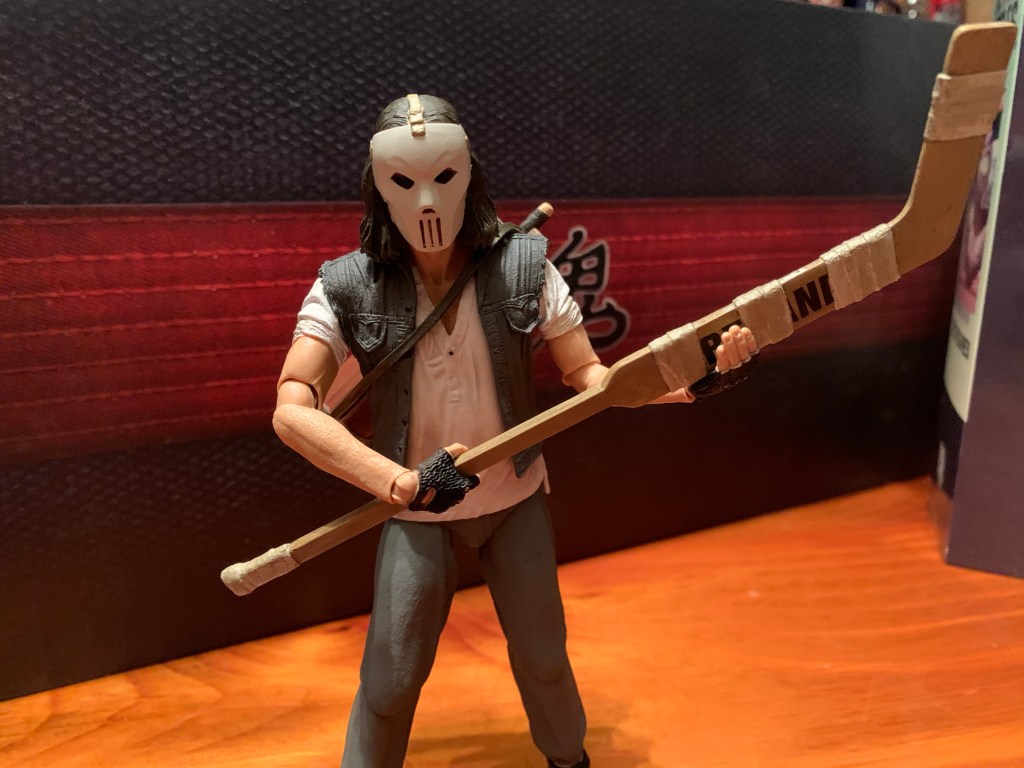
Casey’s sculpt looks to be pretty damn accurate to the screen version. He has a white t-shirt with a vest over it that’s actually a shirt with cut-off sleeves. Both the shirt and vest are a soft plastic, though the sleeves on his arms are sculpted. He’s got his gray sweatpants on and black high-tops to go along with fingerless gloves for added bad-assness. The mask is the star of the show though as it looks great. It’s a thick plastic with a glossy paint-job that looks great. The decision to sculpt it separately with a face underneath also means his eyes looks menacing and the slits over the mouth could be actual cuts in the plastic rather than painted lines. If anything appears to be a touch off, it’s the hair which looks heavy as opposed to the more frizzy appearance it had on film. Hair is notoriously difficult to sculpt though so this barely registers as even a nit-pick. The knees also a look a tad odd, but again, that’s because NECA is trying to recreate a soft cloth like sweatpants in plastic form. NECA opted to make the plastic of the thigh go over the lower leg rather than do a kneecap. It’s tough to say what would look better and I bet the sculptors were left wishing the character had sported knee pads in the film. I’m curious if the expected quarter-scale version will experiment with soft goods for the sweatpants or stick with plastic.

Casey is pretty well loaded with articulation like his little, green, buddy. His head is on a ball-joint and partially restricted by the hair, but nothing that should cause issue. He has ball-jointed shoulders and double-jointed elbows to go along with a forearm swivel and the same swivel-hinge articulation at the wrist enjoyed by Raph. What I can’t determine is if he has any kind of ab crunch as the t-shirt prevents me from figuring that out. He has some waist articulation, but the shirt again prevents much of the movement. His thighs are on ball joints, but he features just a simple hinge at the knee. The ankles can swivel freely and there’s a hinge joint as well that’s quite restrictive. He’s a bit tough to stand as well, especially with the golf bag on, so he’s likely going to end up with a stand as well. He would likely need bigger feet to stand better, but that obviously wouldn’t be screen-accurate. More leg/torso articulation could have possibly helped as well, but then you’re cutting up those sweatpants and shirt even more which would have been less aesthetically pleasing.

The paint job on Casey is simple and effective. The clothing is done with a matte finish, but the shoes have a bit of a shine to him. His laces are painted black as well, which is probably screen-accurate, but I’ve never tried to stare at the character’s shoes. The t-shirt has an understated dark wash applied to it giving it a grimey look which is a nice touch. Casey doesn’t seem like the type who stayed up doing laundry. The only negative with the paint is the hinge piece of the shoulders was left unpainted, so if Casey’s arms are up it will look a bit ugly.

That’s a full bag.

As expected, Casey comes with a lot of goodies. He has his golf bag to store everything in which fits easily over his head and arm. It’s soft plastic so it’s fairly light, but once it’s full of stuff it’s no longer quite so light. The strap is rather thin and doesn’t disconnect so you’ll want to handle with care to not snap it at one end. For weapons, Casey comes with a pair of baseball bats (sadly, no Jose Canseco signature spotted on either), a hockey stick (left-handed, interestingly), a goalie stick, golf club (wood), and of course the infamous cricket bat. The weapons all look great with a paint-wash applied to nearly all of them to give them a weathered look. Most feature athletic tape, and the only one that looks brand new is the golf club. And it should, since that’s from the end of the film when Casey uses it to finish off Tatsu (“I’ll never call golf a dull game again.”) and is a nice touch since NECA could have chosen to omit it given the set is so scene specific. You can also fit everything into the golf bag with some effort, though the giant goalie stick looks a bit ridiculous sticking out of the bag. In the film, he only ever needed room for the two bats and the cricket bat so being able to fit them all wasn’t even a realistic goal, but they pulled it off. Not much to complain about either in terms of screen accuracy. I noted that the hockey stick is left-handed, but it looks like a righty stick on screen. And Casey certainly swings that cricket bat right-handed. The bats also probably could have been lighter in color, but I can’t say either thing is something that bothers me. These weapons are a lot of fun and I’m glad to see that Casey has a full assortment.

Look at all of that stuff!

Casey is going to need some hands to wield those weapons, and he has a bunch. His default hands are simple fists for when he wants to get his hands dirty. He also has two sets of gripping hands. I can’t really tell what’s different about them, the gripping opening might be just a touch larger on one set versus the other, but it’s pretty light. The goalie stick does require a bit more room to wield properly, but I seem to have little trouble regardless. His gripping hands are also really soft so you can bend the fingers around whatever he’s holding. Maybe the extras are just in case of ware and tare? He also has a pointing right hand and a more relaxed open left hand to rest a hockey stick or bat in. It’s a nice assortment and the long pegs and soft nature of the plastic makes swapping them pretty effortless.

Casey Jones is a more than worthy addition to what is perhaps the most impressive line NECA has ever produced. The likeness all of the figures from the first TMNT movie have been incredible, and Casey is no exception. I would be remiss if I didn’t point out the fine work of sculptors Trevor Zammit, Kyle Windrix, and Trevor Grove. And no one should be snoozing on the Raphael in this set either. I was a bit on the fence with him and questioned whether or not I would have purchased a single-carded version of the character in disguise, but now that I have him I’m pretty happy to say that I do. My collection would have been lacking if I had a Casey Jones with no Raph to go along with him. As much as I identify Casey with April, a two-pack of them on a porch swing is certainly not nearly as exciting as the confrontation between mutant hero and vigilante.

If you want to add this two-pack to your movie collection, it can be found exclusively at Walmart for $49.99. It just started showing up last week and is still shipping to stores as I type this. Some areas will just start to receive it this week. It was also offered for purchase online, but basically sold out in seconds as NECA’s TMNT product remains extremely hot. Because of that, this set is not the easiest in the world to find, but it can be done. I’m just a blogger so my toys come from the store just like everyone else and I was able to find a set, so don’t despair if you don’t find one right away. And NECA is certain to keep producing these and I definitely expect at least a Casey re-release some day now that Elias Koteas is onboard. And above all, network with folks, make friends in the collecting community, and don’t feed the scalpers! Good luck!


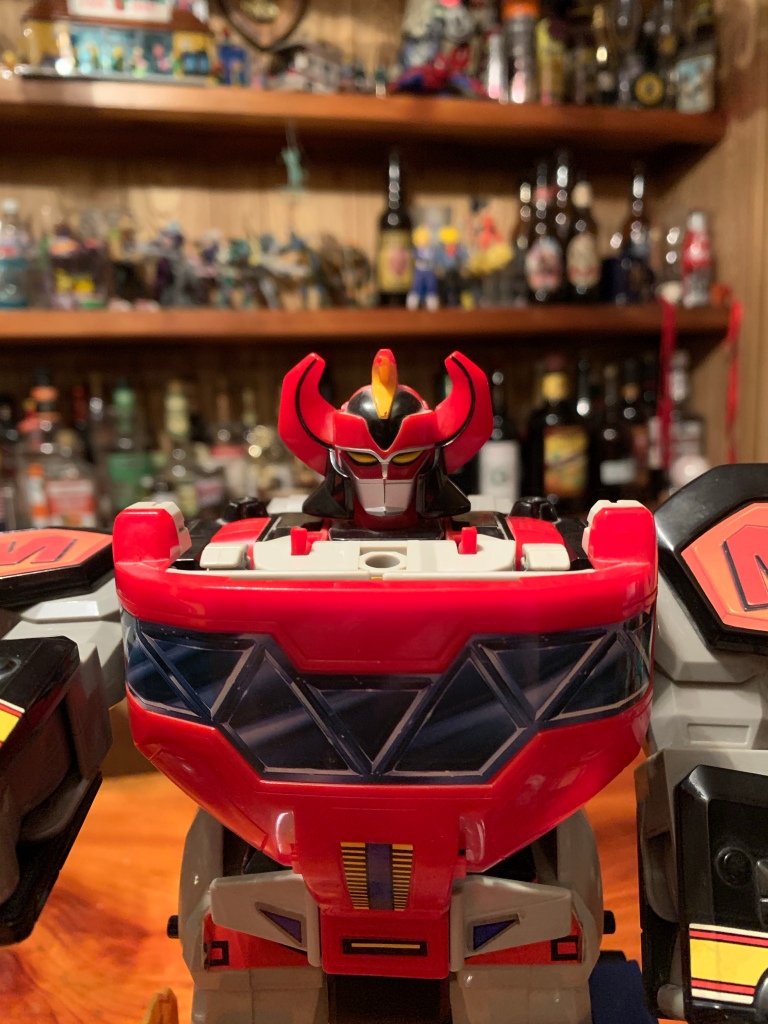
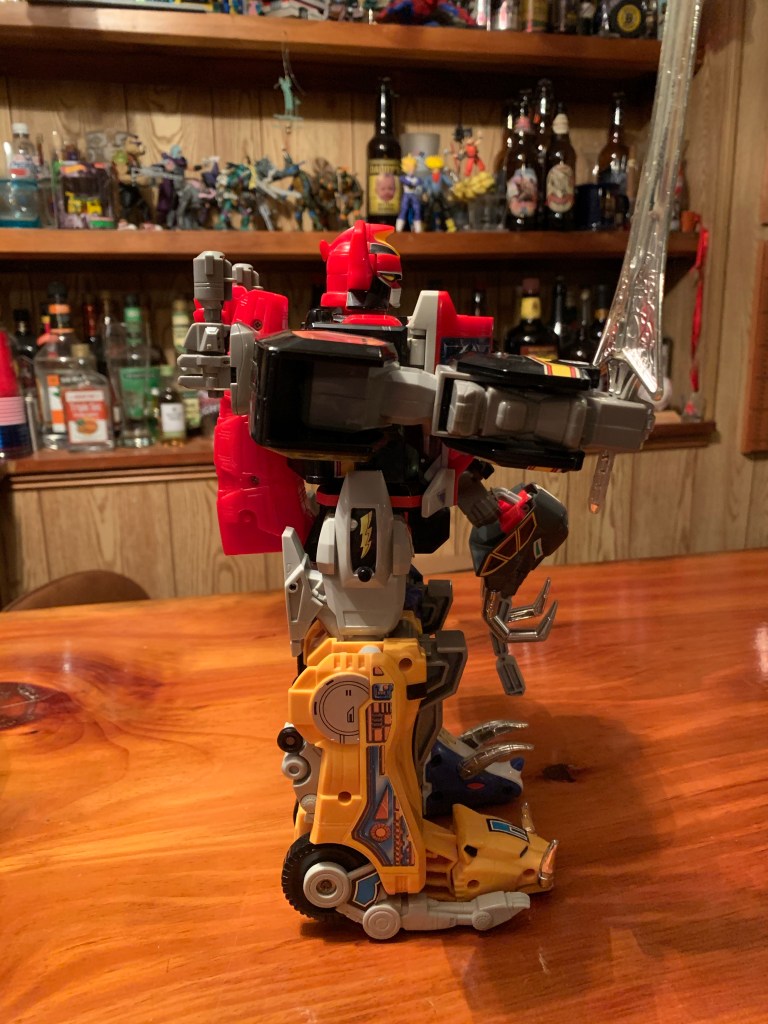
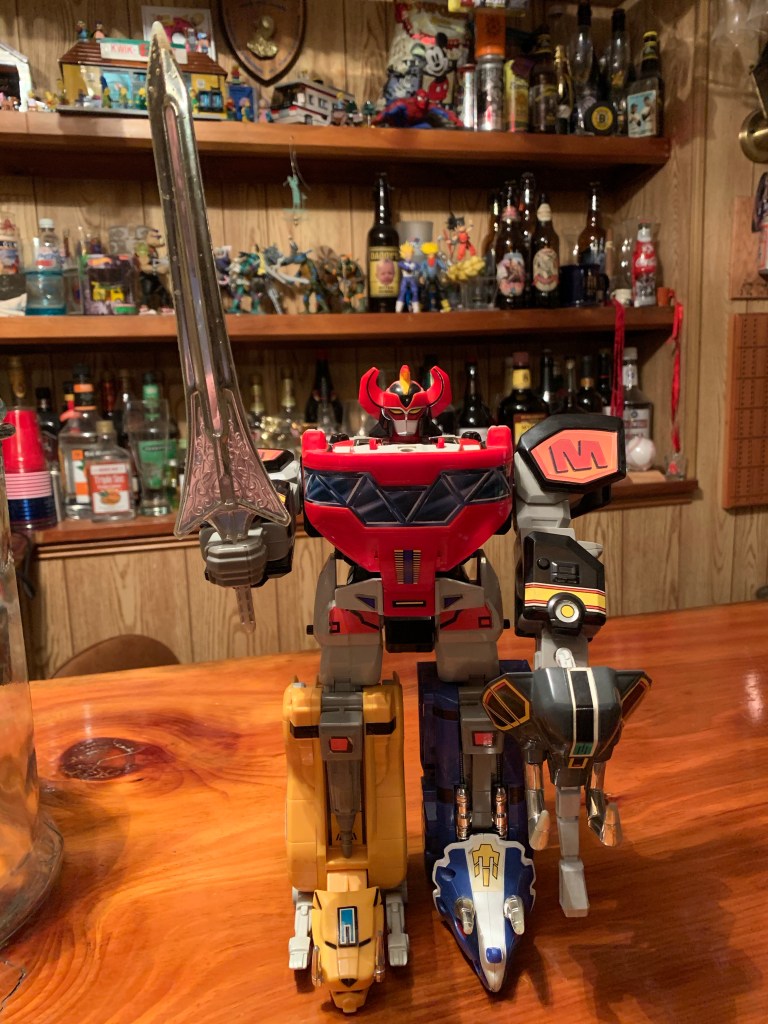
Bandai Mighty Morphin Power Rangers Megazord

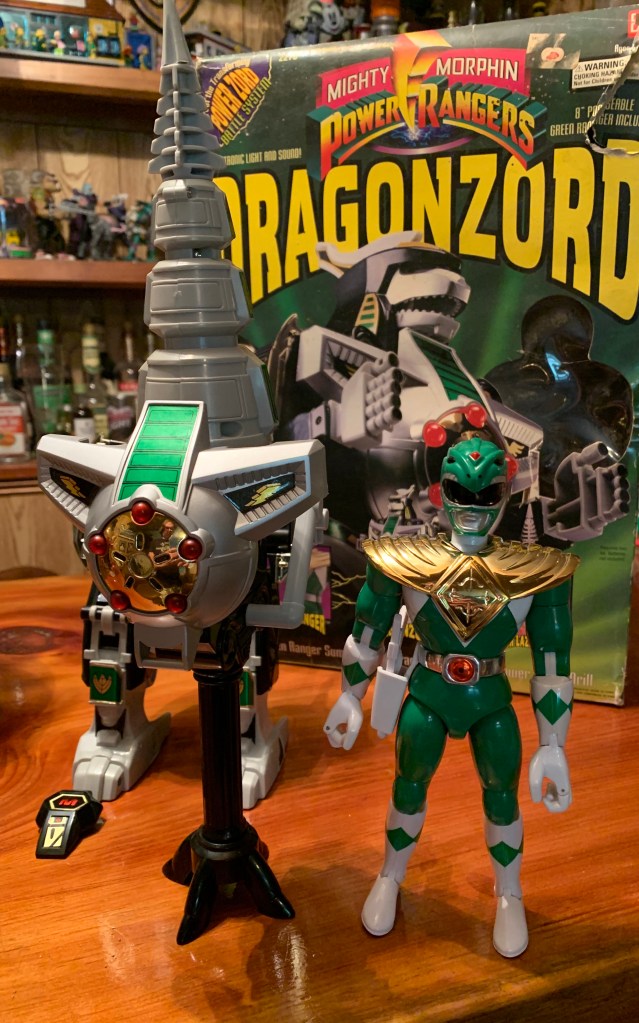
It was now a couple of weeks ago I posted about some toys I always wanted as a kid, but never got. Shortly after, I rectified some of those decades old injustices by purchasing the Dragonzord with Green Ranger from Bandai’s Mighty Morphin Power Rangers line of action figures from 1993. The Dragonzord was my number 2 miss, but number 1 had always been the Deluxe Megazord from that same line. Well, predictably, I have now made peace with the two biggest toy omissions from my youth by securing my own set of Dinozords!

The Megazord was always appealing to me because it was essentially five separate toys that could combine into two additional toys. That’s basically seven toys in one box, and the fact that it was pretty screen accurate made it appeal to me even more. I was just a casual fan of the television show, but those toys were just too awesome to ignore. The demand for the toys was something I couldn’t overcome though, so I learned to go without. As an adult though, I don’t have to.

“We need Dinozord power now!”

I purchased a Megazord secondhand. Unlike the Dragonzord set I acquired, this one did not come with a box, but it did come with all of the parts. In my search for an authentic early 90s Megazord I found it was common to find some missing the sword, shield, and especially the canons that double as feet for the pterodactyl zord. Some also would feature a broken gun on the triceratops zord or missing horns. I assume most of these that were acquired in 1993 were played with and not kept on a shelf so it’s not a surprise that it’s hard to find a fully intact Megazord. It’s also why these things end up being quite expensive. I don’t feel as good about the price I paid for this set as I did the Dragonzord, but it is what it is. I’m actually relieved the seller no longer had the box or else I probably would have had to spend more!

Like the Dragonzord, I had some options when it came to buying a Megazord in 2020. Bandai released two different versions of the Megazord in 2010 as part of the Legacy line of figures. That one, from what I can tell based on video reviews, is very similar to this one. The functionality is virtually identical as both basically transform as it did on television. The standard 2010 version has a pretty ugly sword, but there was an updated version with some diecast parts and a much nicer looking sword. Overall, the 2010 Megazord appears to be a touch smaller, but the thing that bugged me about it is the triceratops zord lost the gun articulation on its tail. It’s a really minor thing, but it irritated me because it’s a clear downgrade. The 2010 version should have been superior in every way to a toy released in 1993! Also like the Dragonzord, there’s a Soul of Chogokin version from Tamashii Nations. It’s fantastic looking and easily the superior Megazord, but it’s also upwards of $300 at this point. There was also a model kit, Mini-Pla, version that’s almost adorably small and still retains the five zords into one (unlike the Build-A-Figure version from the Legacy Collection line that’s just an action figure) that I would have loved to consider, but it’s long since sold out and now fetches around 200 bucks on the secondary market. Ultimately, it was the 93 Megazord that vexed me as a kid so it was the 93 Megazord that I should acquire.

On their own, they’re merely okay, but put them together…

In case you’re not familiar with the Megazord concept, please allow me to present this refresher. The Megazord is the combination of the five Dinozords. Each of the five original Power Rangers was aligned with a prehistoric beast and each Ranger controlled what is essentially a giant robotic representation for each beast. They are: Tyranosaurus, Pterodactyl, Triceratops, Sabre-toothed Tiger (sic), and Mastodon. In nearly every episode, the monster of the day the Power Rangers are fighting grows to roughly the size of a skyscraper, so the Rangers attack via their zords. They can attack separately, though rarely do. Instead, they combine their beasts into one massive robot: the Megazord.

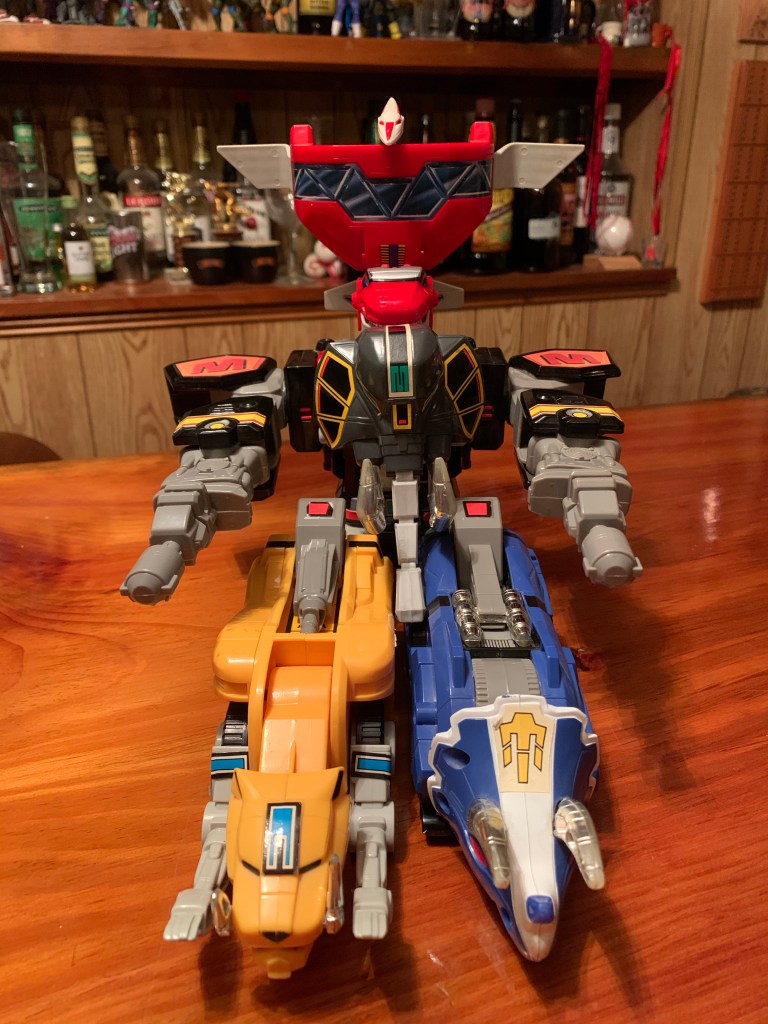
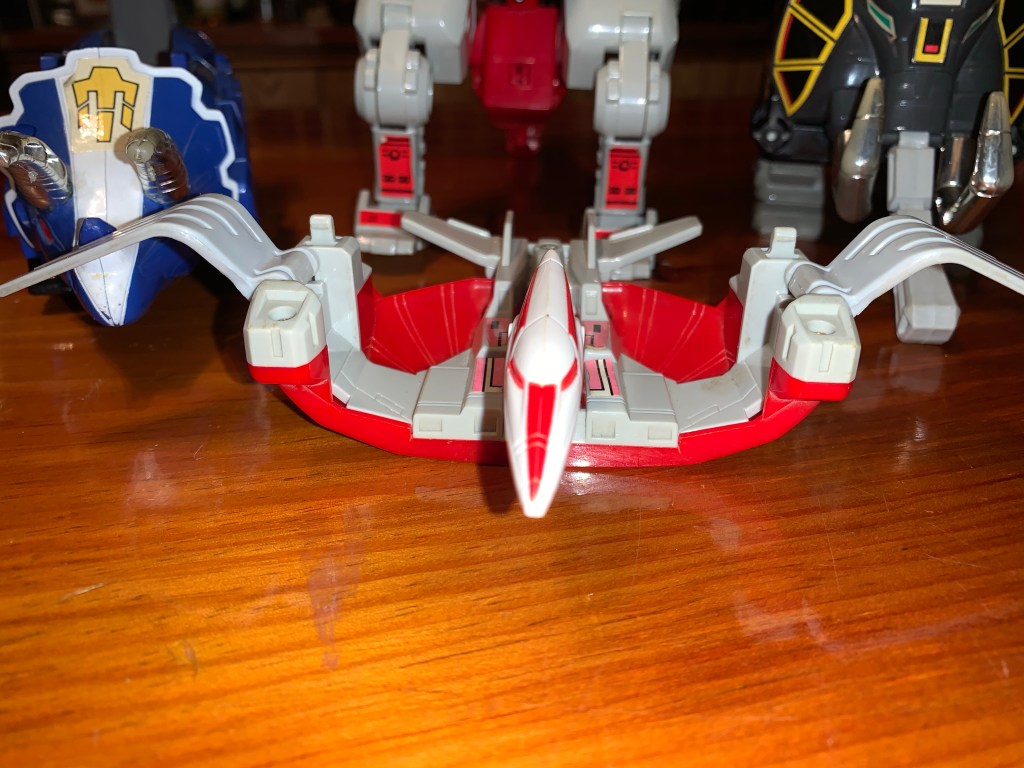
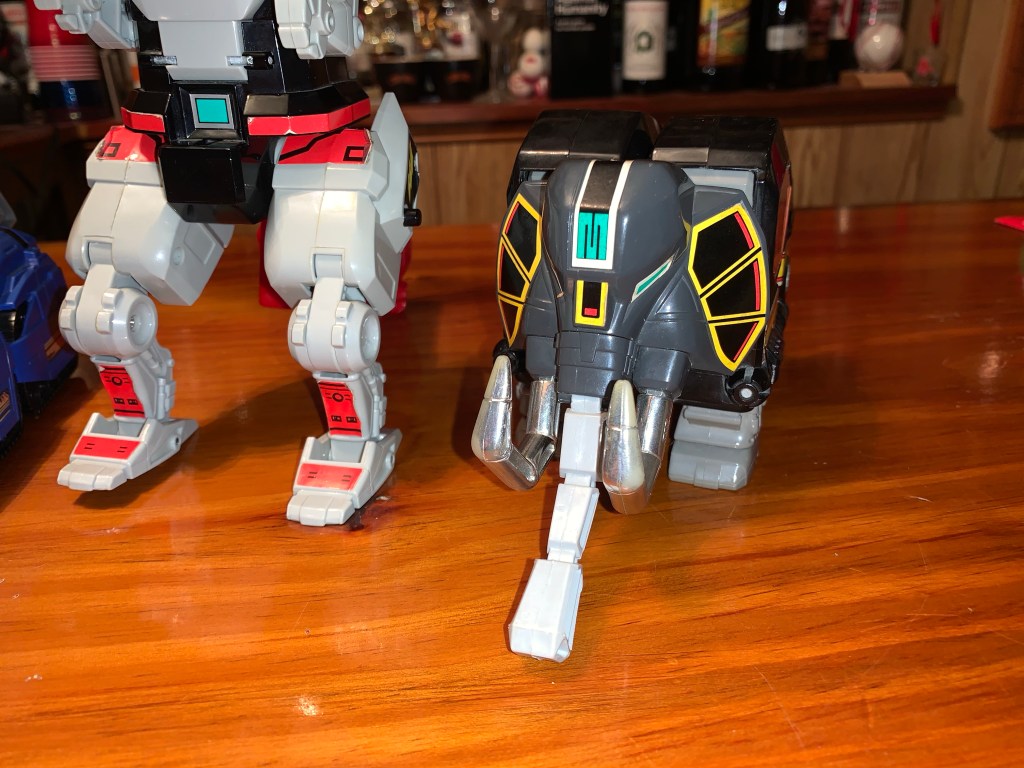
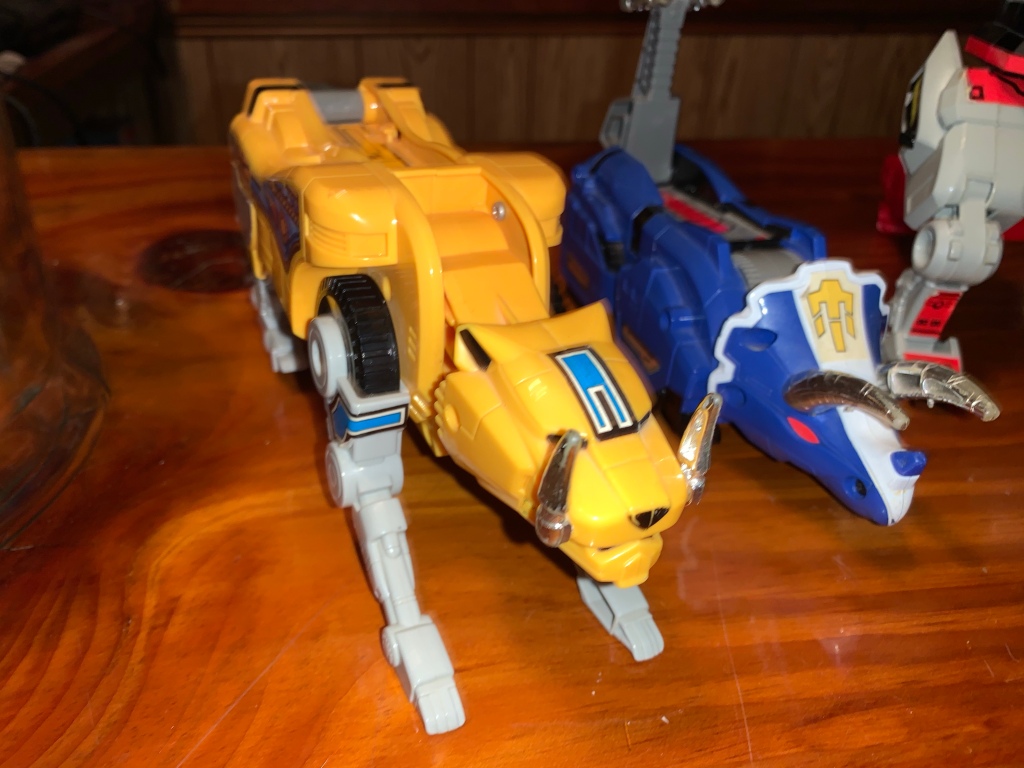
The Megazord actually has two forms: tank mode and battle mode. Tank mode is the less elegant version as it’s basically just the Megazord, but sitting down without a head. The T-Rex serves as the body, and the sabre-toothed tiger and triceratops form the right and left legs respecitively. The mastodon zord loses its head and wraps around the T-Rex to form the arms of the Megazord while the pterodactyl zord just sort of rides on the thing. The feet of the pterodactyl become the canons which attach to the mastodon arms, while the mastodon head sits on the T-Rex chest and the whole thing rolls similar to a tank.

There’s the face you know and love!

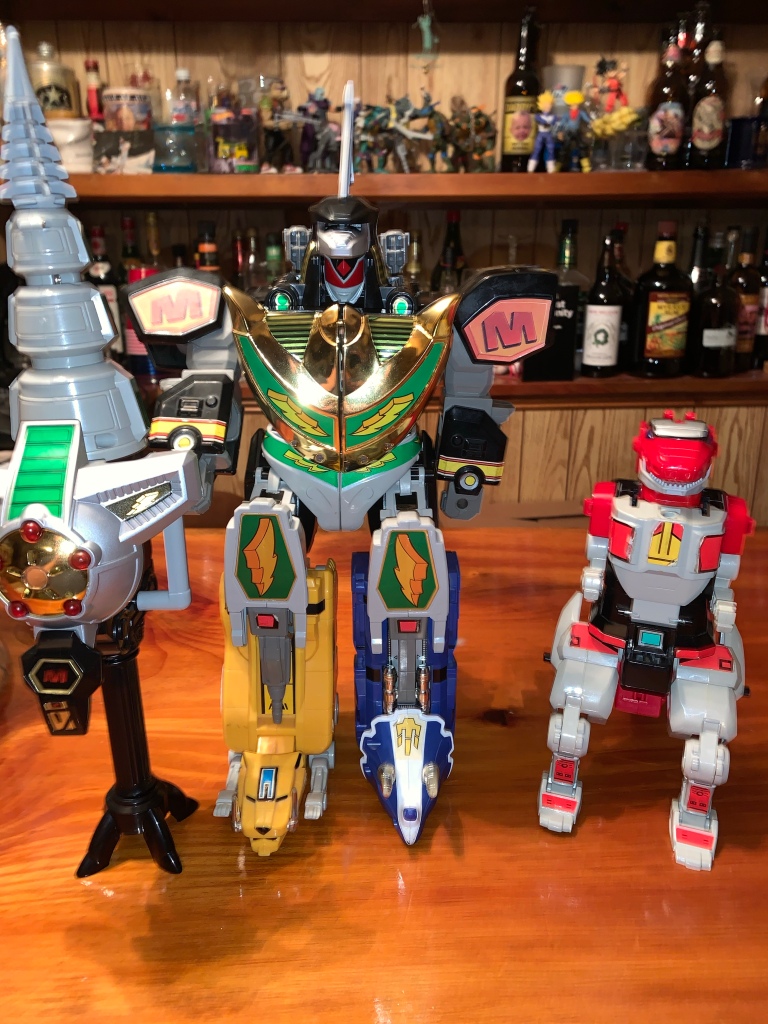
When the Power Rangers want to switch to the more memorable battle mode, the tank basically just stands up. The mastodon head is removed and the pterodactyl becomes a chest plate. The T-Rex head folds down and into its chest revealing the Megazord’s head and hands pop out of the arms. The canons from before are affixed to the Megazord’s back and look like boosters or something. The Megazord can attack with its fists, or rely on the power sword. The mastodon head can also be utilized as a shield, though it rarely was used in the show in this fashion.

Both transformations are essentially identical in how they occur with the toy as they do on television. This is probably due to the designer of the Megazord having to account for future toys down the road. At least, that’s what I assume. The show really only takes liberties in that once the models combine on the show, they’re swapped out with a costumed actor and the proportions change slightly. The most notable being the head of the costumed performer is much larger than what ends up on the toy. The only other aspect of the toy that isn’t entirely screen accurate is the T-Rex tail, which kind of just disappears on TV but is folded up the back of the toy. And the actor is able to move in a far more graceful manner than the toy. The Megazord is basically only articulated at the shoulders and hips and they’re just hinge joints. The lack of ball-jointed shoulders and basic elbow articulation really limit the available poses for the toy as it basically can only assume one position on your shelf.

This version of the Megazord is composed almost exclusively of colored plastic. This means there’s less opportunity for paint-slop and chipping over the years. The graphics and highlights are all done with stickers so when buying secondhand you’re at the mercy of whomever originally put these stickers on. Like the Dragonzord, the stickers aren’t 100% screen accurate, but it’s really only noticeable when doing a direct comparison. It doesn’t look like the original toy asked too much of parents and kids when it came to applying them and my unit looks as good as one could expect of a toy from 1993. It was clearly loved and enjoyed by a kid long ago and it shows. The sword is quite attractive as it has a shiny paint-app and is probably the portion of the figure that would be most likely to show ware. Same for the similar chrome portions of the other zords, namely the mastodon tusks and triceratops horns.

Whether you have instructions or not, transforming the Megazord is rather easy since you can basically just watch the show. The individual zords offer limited play. The mastodon and triceratops basically just sit there, though the triceratops has wheels. The pterodactyl also doesn’t do much, but since it’s a flier it doesn’t have to. The little canons can clip to it like feet, but they look stupid and I don’t recall seeing them in the show. The saber-toothed tiger has solid articulation though and it can emulate a running motion while also featuring moveable fangs. It’s a shame Bandai didn’t go the extra step of putting a hinged jaw on this one. The tyranosaurus has about as much function as you would expect, though it’s a little disappointing that it’s mouth has a big, red, wad, of plastic for the throat that makes it look odd. The connections are easy to utilize and pull apart just as easily, but they also won’t just fall off. The only complicated part is the mastodon which basically splits down the middle and clips around the T-Rex. Both of the leg zords are super simple, especially the triceratops which just has to fold its tail in and bend its neck, and even kids should be able to handle it.

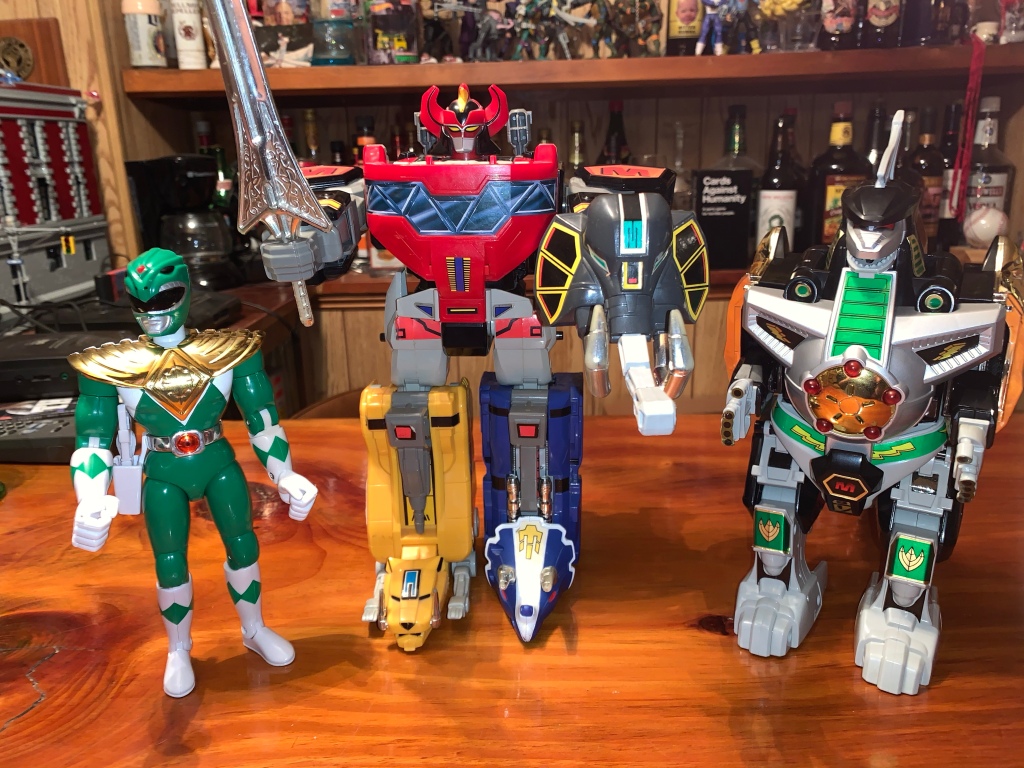
In hand, the Megazord has some nice weight to it. It stands about ten and a half inches tall and is noticably larger than the Dragonzord, which is about nine and a quarter inches to the top of the head. Since it’s all plastic, it does get a bit creaky. The joints on mine are still fairly tight and I have no issues getting the Megazord to hold its arms out forward, basically it’s lone pose. On the individual zords, the tails of the triceratops and saber-tooth tiger are loose and getting them to stand in a blasting pose is a balancing act. The T-Rex tail is also a bit loose and doesn’t stay locked in place for very long. That’s also partly due to the toy needing to be bent forward at a pretty extreme angle so the legs don’t interfere with the tail. The little flaps that are the pterodactyl’s wings are also fairly loose, but they also don’t have to do much. All of the connections though are really satisfying and it’s a lot of fun to plug and play. It makes a nice clicking sound when things are put together and it’s really impressive what Bandai achieved since it seems like there’s little chance of forcing something into place at the risk of breaking it.

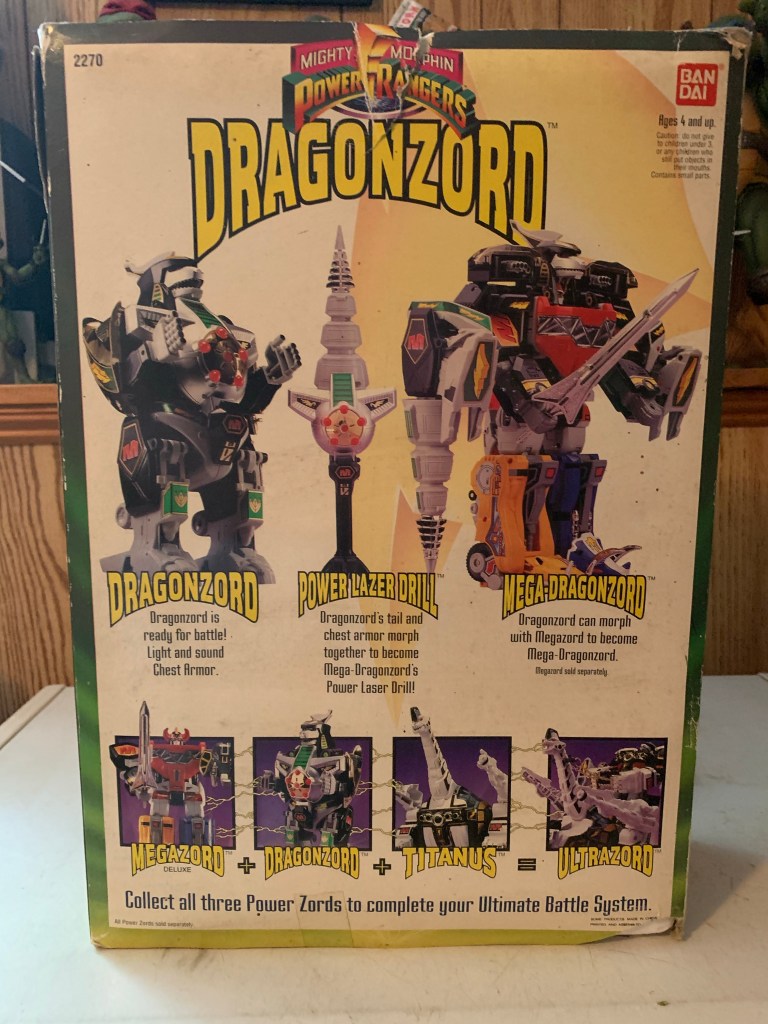
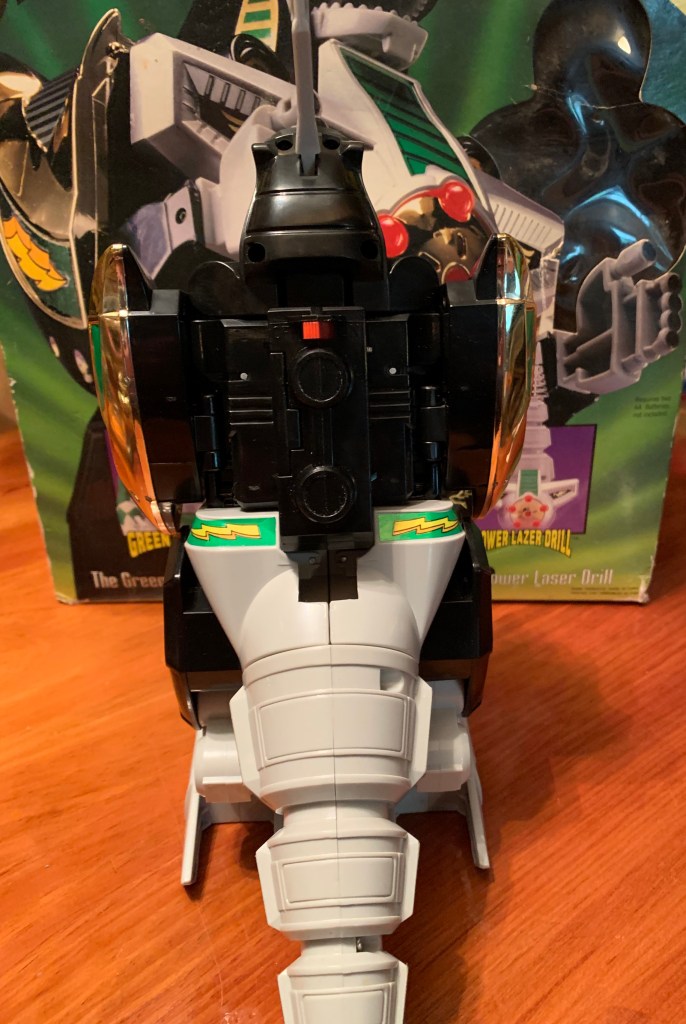
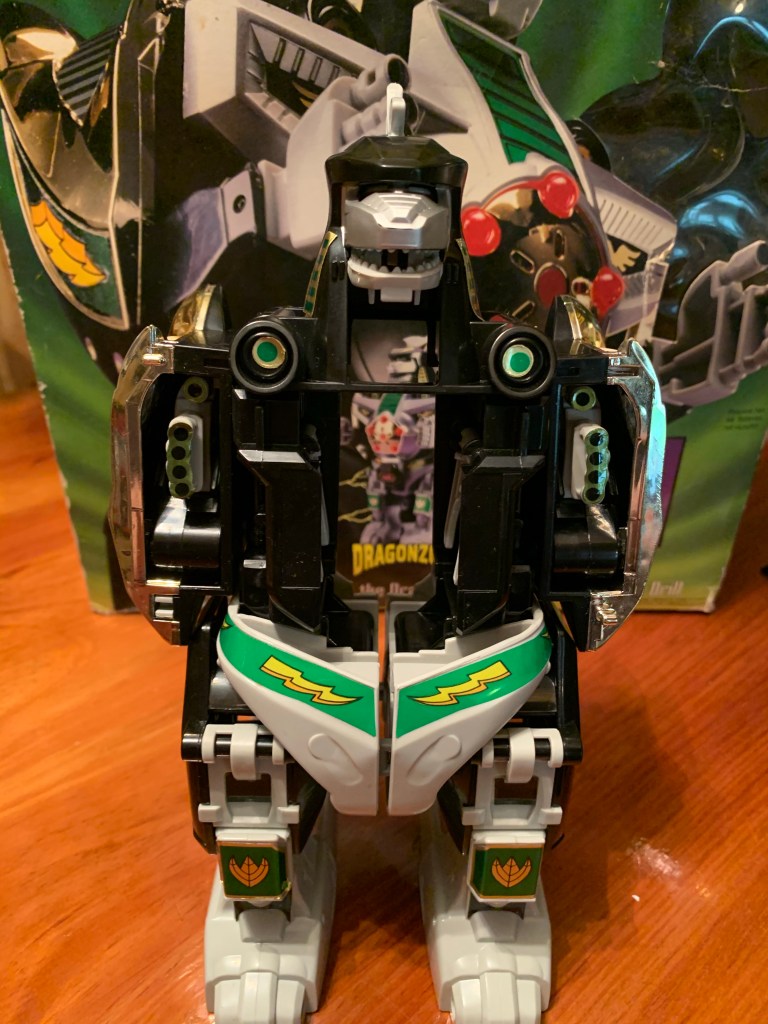
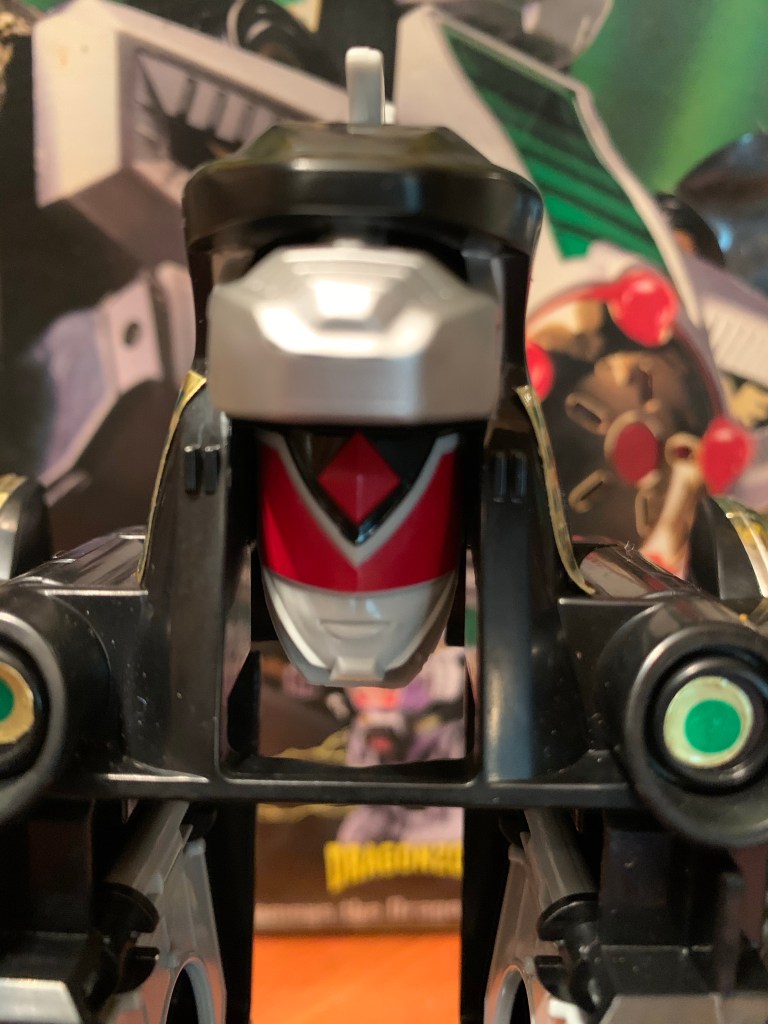
Of course, the fun doesn’t end here. If you have the Dragonzord, you can take advantage of that as well. The Dragonzord has a battle mode in which it basically assumed the role of the T-Rex zord in the Megazord construction. The mastodon becomes the arms as the chest piece is removed and the Dragonzord arms fold in to make a new chest piece. A face can then fall down from the Dragonzord head while the legs of the Megazord serve the same purpose here. The T-Rex and pterodactyl are free to do whatever they wish, and in the show the T-Rex would often fight alongside the Dragonzord in this battle mode, though in toy form the scale is way off. The Dragonzord’s tail also combines with the former chest piece and the included shaft to make the Power Lance, or Power Lazer Drill (as the box refers to it as). It’s pretty neat to behold, and like the Megazord the transformation process is really satisfying. The only thing I don’t like about it is the drop-down face on the Dragonzord has nothing behind it so it kind of just swings there. And while the lance is pretty cool looking, it’s functionally useless since it’s so huge. It has a handle that basically just rests in the hand of the zord, but the zord itself can’t actually wield the thing. Modern iterations make this aspect work better by fudging with the scale just like the show does by including an extra lance for play purposes.

If you wish to leave your Megazord intact though, you can still combine it with the Dragonzord to from the Mega-Dragonzord. This one is a bit less interesting as it’s basically the Dragonzord with the chest and tail removed and draped over the top of the Megazord. The tail can clip onto one of the sides, as can the discarded chest piece of the Dragonzord, though it basically just looks cool. This version of the character was deployed more like a tank in the show as it would just shoot a giant laser at the enemy as opposed to battling with fists and sword or whatever. It’s also this version that can combine with the unfortunately named carrier zord, Titanus, to form the Ultrazord. It’s another tank-like mode and the only change is the chest of Titanus is clipped onto the chest of the Mega-Dragonzord as it’s placed inside the carrier zord. I never really cared for the Ultrazord as a kid, so I have little compulsion to go after a Titanus so you probably shouldn’t expect a review of that one to come.

I don’t see myself getting a Titanus to form the Ultrazord.

There’s no doubt in my mind that had I been able to collect this line as a kid I would have loved the hell out of it. These are some of the best toys of the early 90s and it’s no surprise they ended up being incredibly popular. I could see myself transforming and de-transforming these things constantly and swapping in all manner of other action figures I had laying around as bad guys, maybe even big stuffed animals. I was also the type of kid that could busy himself for long stretches of time just playing with my action figures so imagination was never an issue. Not that these toys even require much since they’re so similar to what was presented in the show.

Acquiring both the Megazord and the Dragonzord has certainly scratched an itch for me. I don’t think it’s going to lead to much more from me where Power Rangers are concerned, but who knows? My kids have really taken to it, and I read Hasbro is looking to release a Megazord later this year so I may need to keep an eye out for that if my kids remain interested. In looking at the other iterations that have come, I’m certainly tempted to by the Soul of Chogokin version, but I likely won’t be able to justify the expense and take on another line of collecting. That’s fine though, because I have what I always wanted. It may have taken nearly three decades, but I finally have a Megazord!


Rocko’s Modern Life Season 4

It’s an accepted part of life that all good things must come to an end. Bad things have endings too, but the only endings that are usually painful are the good things. And for Rocko’s Modern Life, it certainly was a good thing that ended perhaps before it needed to. After 52 episodes (100 segments) creator Joe Murray felt it was time to move on. It should be said that it was more of a personal decision in that he just didn’t have anything more to say with the show. He even stepped back some taking on the role of executive producer for the final season allowing Stephen Hillenburg to assume the role of creative director. Murray encouraged the network, Nickelodeon, to continue the show without him, but the network decided not to renew it for a sixth season. This was pretty typical of Nickelodeon as it often didn’t go beyond this type of episode count with its Nicktoons, or really any shows. As a result, Rocko’s Modern Life is one of those shows that feels like it went out on top. There were likely many more stories that could be told with these characters, but they’ll have to remain untold.

The fourth season of Rocko’s Modern Life continues to explore the setting of O-Town and life in the 90s for the main cast. Rocko (Carlos Alazraqui) once again is forced to tackle the mundane and the insane like managing conflicts between friends, rude neighbors, love, ghosts, and even a bout a hypnosis. His gluttonous best friend, Heffer, (Tom Kenny) takes on the role of co-star for many segments and even gets to assume a larger role at times than the star. Filbert (Mr. Lawrence) returns as a married turtle and will get to experience fatherhood this season while the Bigheads (Charlie Adler) are still around to make life miserable for neighbor Rocko.

A theme of the final season seems to be an emphasis on side characters. In this one, Rocko teaches Heffer’s mom how to drive.

The fourth season might be the best looking season of the show. I don’t know if anything changed on the production end, or if it was a case of the masters being better stored, but the DVD release really pops. The colors are deeper than they were on the first three seasons and the animation is quite fluid. It’s perhaps not as gross as the prior seasons, and that could be Hillenburg’s influence as creative director this season. There’s still moments that are somewhat gag-inducing, but it’s definitely not a defining characteristic.

Seeing Heffer, Rocko, and Filbert as O-Town High students doesn’t make much sense, but it does give us one of my favorite scenes from the show involving Filbert and some potato chips.

On the flip-side, this season seems to feature less continuity. We’ll see Filbert become a father in the early season episode “From Here to Maternity,” but afterwords his life doesn’t seem to change a whole lot. There will be times the gang goes to his trailer and it looks like he lives alone. I understand not wanting to be restricted by this development (it would be tiresome to write into every episode who is watching the kids), but there is a disconnect. Similarly, the dog Earl taken in by Bev Bighead seems to disappear this season and there’s a confusing flashback episode in which Rocko, Filbert, and Heffer are depicted as high school students even though Rocko moved to the US during adulthood. These aren’t really things that prevent one from enjoying the show, I just liked the continuity on display in the past seasons since so few cartoons contain such.

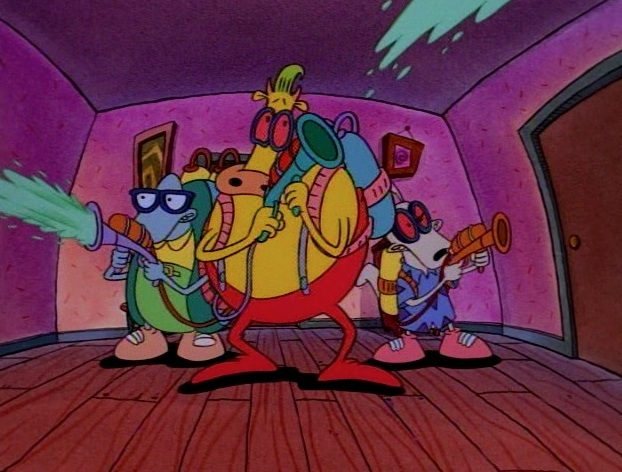
This season seems to feature a couple of movie parodies, including this obvious Ghostbusters one.

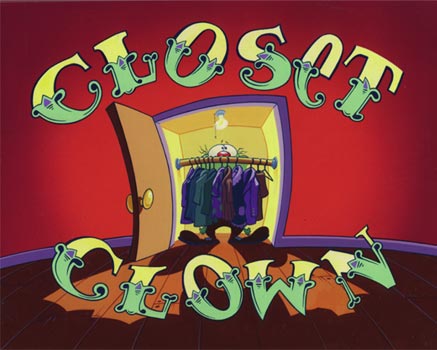
The show is still wildly funny in many places. I think a lot of fans consider season three of the show to the peak for it, but it’s hard to find any real drop-off with season four. “Sailing the Seven Zzz’s” might be the show’s funniest episode. The plot concerns Ed Bighead and his somnambulism in which he thinks he’s a pirate and makes nights miserable for Rocko. Heffer and Filbert see this as an opportunity to mess with him, and it gets pretty wacky. And speaking of Ed, he basically assumes a starring role in several episodes of this season. My favorite might be “Closet Clown” where we find out Ed enjoys playing a clown, but hides it from everyone. It’s yet another episode of the show that might be dealing with a sensitive subject, such as closeted individuals, but doing it in a very funny, natural, way.

There are a few segments that don’t work as well as others. “Dumbells” gives Gladys the Hippo (Adler) a starring role alongside Rocko in which she gets addicted to the thrill of the childhood prank ding, dong, ditch. It’s okay, but not really an interesting way to shine a light on a one-note character from prior seasons. “Wallaby on Wheels” is another episode where Rocko is trying to impress a girl (he seems to finally be over Melba) that feels a bit too familiar. The same could be said for one of the broadcast finale segments, “Turkey Time.” That one is depicting Rocko’s introduction to Thanksgiving and he invites a turkey home for dinner not realizing the intent is to serve it for dinner. It plays a lot like the episode where Heffer brings an elk home for the same reason. “Turkey Time” then gets extra redundant when everyone in town finds out about Rocko having a party and invites themselves over, which is the same plot as “Rocko’s Modern Christmas.” It does feature one of the racier jokes in the season though when Heffer brings out a turkey for the party and Rocko’s living room is basically decked out like a strip club.

Closet Clown is a funny episode, but might also be scratching the surface of a bigger societal issue.

Speaking of racy jokes, you can’t have a discussion about Rocko’s Modern Life without a discussion of censorship. This season contained one episode that was essentially banned after its initial airing and that’s “Heff in a Handbasket.” In it, Peaches returns whom viewers should remember from “To Heck and Back.” Peaches is the lord of the underworld and he’s tasked with acquiring Heffer’s soul, since he outwitted him before. It’s nothing too salacious and it’s a very silly episode where Peaches rigs a game show designed to steal Heffer’s soul, only Heffer is so stupid that he keeps messing it up. It’s a funny episode, so it’s a shame it got kicked off the air, and I guess it got the boot simply because part of it is set in a version of Hell.

Unlike a lot of cartoons, Rocko’s Modern Life did get a proper series finale. The segment “Future Schlock” is the intended finale, though the Thanksgiving episode aired after it to line-up with the actual holiday. Most of the episode takes place in the future when Filbert’s kids find a banana in the refrigerator of Rocko’s abandoned house and bring it to their eldery-looking (but only 38 year old) father to find out why anyone would put a banana in the refrigerator. Much of the episode from there is a flashback, but I enjoy the fact that it displays Filbert’s contempt for Heffer which is something that seemed to be rising with each season (though Filbert in general got a bit nastier, see him try to sacrifice Rocko for a wig in the segment “Rug Birds”). The show ends with the whole gang getting mistakenly blasted-off into space and the Netflix special Static Cling from 2019 actually picks up where the episode leaves off and you’ll definitely hear my thoughts on that before the summer is through.

The plot for the final episode is set in motion by an old banana.

The DVD for the fourth season of Rocko’s Modern Life is a lot like the other three. It’s essentially just the episodes presented in broadcast order. It would have been nice if they could have been arranged in production order for this season, since it has a proper ending, but it’s not a big deal. The only special feature is a video recording of a fan event from 2012. Hosted by voice acting legend Rob Paulsen, it’s a gathering of the main cast of the show for a reading of “Wacky Delly Part 1” and it’s quite a bit of fun. After the script is read, they also talk about the show and share their thoughts on everything. It’s crazy to think this was recorded 8 years ago at this point, but everyone sounds great and I enjoyed it more than I thought I would.

If you liked Rocko’s Modern Life or have all three seasons up to this point, then there’s absolutely no reason not to own season four. It’s a little different, but still plenty hilarious, wacky, and silly. Some characters get more of a spotlight shined on them so if you had a favorite side character from before then maybe you’ll be pleasantly surprised by their inclusion here. There’s just a great chemistry between the characters in the show and the people behind the image that shines through. Joe Murray and his team can be proud that they created a cast that could work in almost any setting because they’re interesting, funny, and even sympathetic. Reliving this fourth season has me wishing even more than I already was for more content down the road. I don’t know that any will ever come, but it doesn’t hurt to hope.


Bandai Mighty Morphin Power Rangers Dragonzord

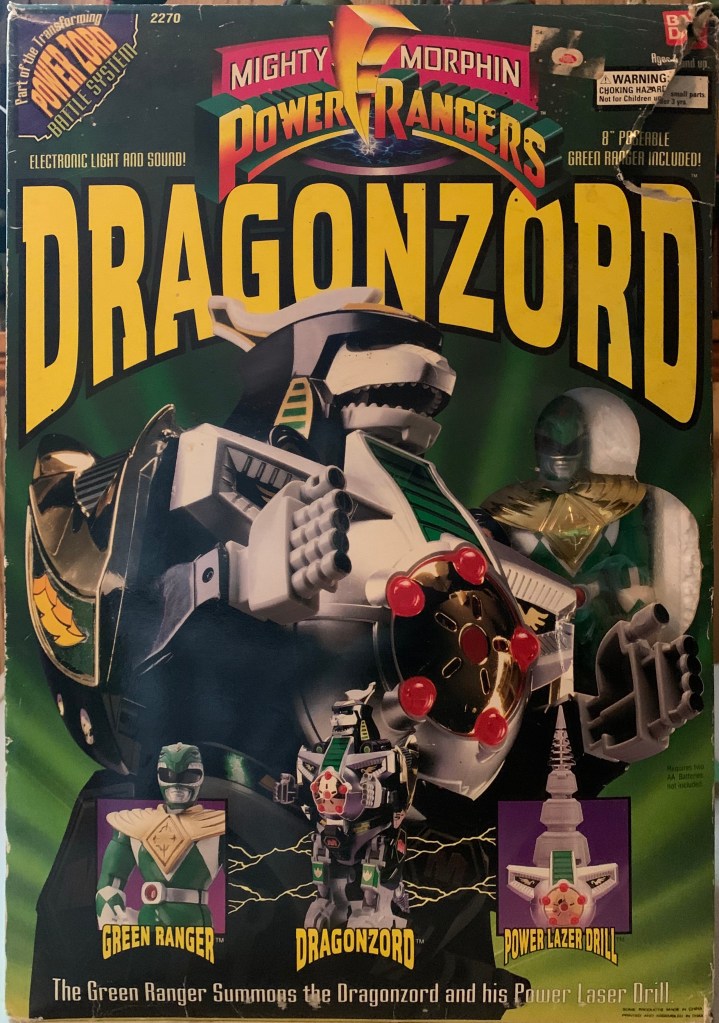
So a week ago I did a post that I titled The Toys that Got Away. It was about toys that I had pined for as a child, but for one reason or another, was unable to ever acquire. It wasn’t intended to be a sympathy piece or anything, because I had an awesome childhood and rarely was left wanting, and was intended to be a shared experience piece as everyone can likely recall a toy or other item that they wanted really bad at one point in time, but never attained. Well, the thing with toys is that they never go away. Sure, they disappear from store shelves (and in the case of toy stores, sometimes the very shelves disappear) and eventually go out of production, but there’s almost always a robust after-market for even the most obscure of toys. And once a kid becomes an adult, they usually have access to more money and that’s certainly the case for me so after making that post I went out and did the predictable: I bought a Dragonzord.

Back in 93, I found myself a fan of the show Mighty Morphin Power Rangers. Many kids at the time could claim the same and Bandai was unprepared for the show’s popularity. And that’s important because Bandai handled the distribution of toys which meant that come Christmas 1993 a lot of kids wondered why there were no Power Rangers under the tree. I was definitely one of those kids, to a point, but I think my fandom took hold more in 1994. That’s when I found a flyer for the Dragonzord which came bundled with an 8″ Green Ranger action figure. I hung onto that advertisement for months telling anyone who would listen that I wanted that for my birthday when the summer came around. I figured that was enough time for my mom or grandmother to find it somewhere, but alas I was wrong. I couldn’t tell you what I did get, probably some Genesis games, maybe some X-Men toys, but I did not get a Dragonzord.

It’s been 26 years and I’ve hung onto that. Not that it has haunted me or anything, but any time I encounter the Power Rangers franchise I inevitably think about those old toys I was unable to acquire. Recently, I’ve started watching the original series on Netflix with my own kids and they seem to like it. The show is just as insane as I remember and it often feels like it’s making up the rules of the setting as it goes along. As an adult, it’s really easy to now notice when the old footage from Japan is spliced into the American production. It’s still pretty fun, in a good-bad way, but more than anything it just constantly reminds me how much I felt I had missed out when it came to the toys.

After doing some light research, I decided to just go for it. Going after a Dragonzord in 2020 presents more options. Bandai reissued the big guy as part of its Legacy line and Tamashii Nations has also released one semi-recently as part of its Soul of Chogokin premium collector line. There’s even a mini-one from a separate line of model kits that was really tempting, but in the end I felt I had to just get the one I had wanted as a kid. Maybe I’ll be tempted to upgrade at a later date with a more modern one, but I feel like I’d be doing my inner child a disservice by not getting the one I had wanted all those years ago.

I was able to score a Dragonzord complete in box on eBay along with the coveted Green Ranger (aka the best Ranger). I feel a little crazy in doing it since I don’t consider myself a Power Rangers fan. I have no idea where I’ll end up putting this thing, but I finally have a Dragonzord.

Before this guy arrived I tried to keep my expectations in check. This is, after all, a toy from the early 90s and it’s not going to compare to what I’m used to buying these days. It’s also the Dragonzord, a character that was pretty stationary in the show. He’s got stubby arms and basically no neck. He can kind of walk and has a tail with a drill-bit at the end, but mostly he’s supposed to just stand there and look cool (unless you have a Megazord to combine him with). And then there’s also the fact that this is a used toy with stickers that have already been applied that likely aren’t going to look great now.

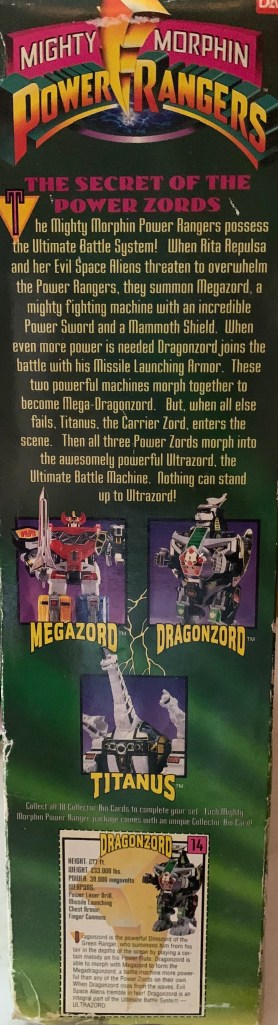
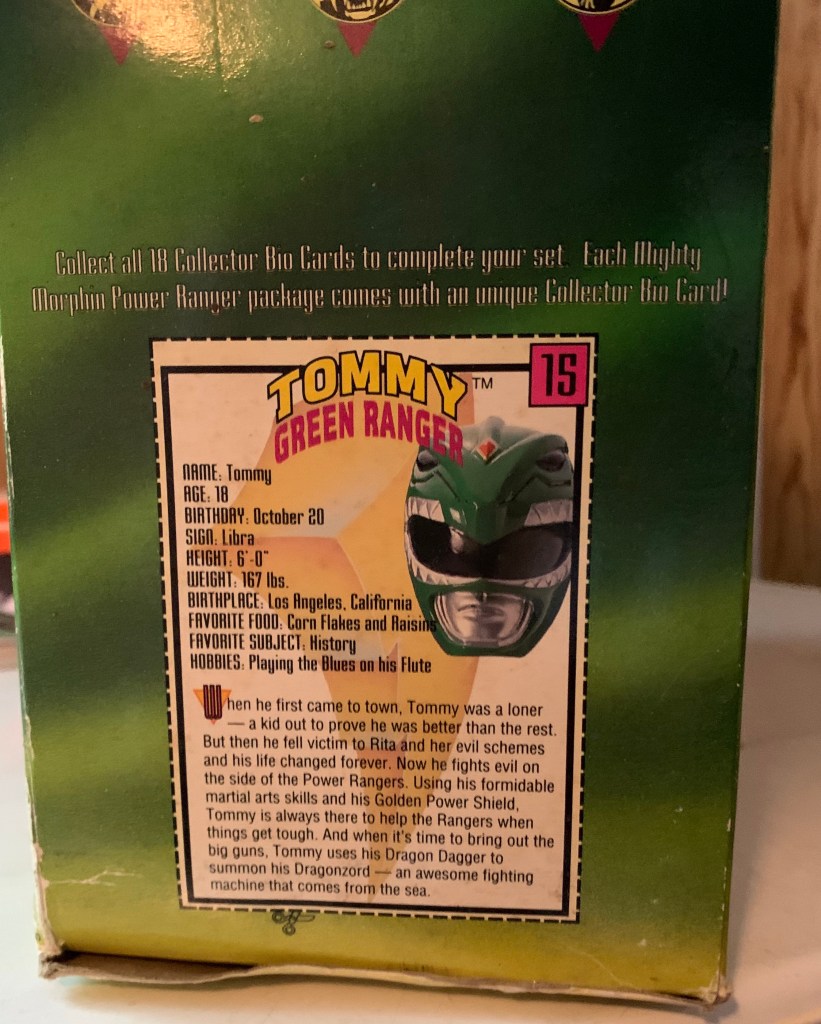
The box the figures come in is pretty intense looking. Mine, being used and supposedly stashed in an attic, is pretty beat-up, but the graphics are all intact. There’s even some bios on the side of the box and, of course, advertisements for the rest of the line on the rear. It’s a pseudo-window box release as there’s a space for the Green Ranger to peek through, so buyers knew they were getting the figure as well. To see the main event though, you have to open the box up.

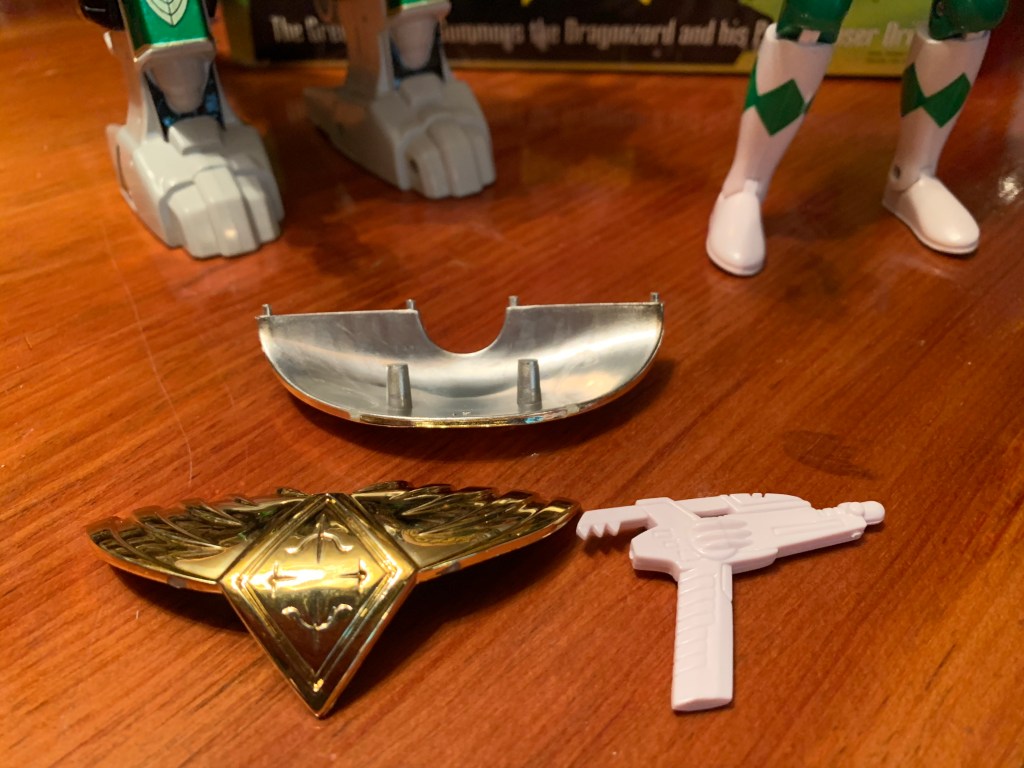
The Dragonzord comes packaged without his chest piece and everything is housed tightly in styrofoam. There are instructions for how to piece the thing together and also how to integrate it with other sets. There would have been a sticker sheet as well, but that’s not the case with a used set. His tail is in one pice, and there’s also a stand, base, and handle for the Power Lance for use when combined with the Megazord set. The Green Ranger comes with his golden shield on so he looks cool in the box. I assume his blade-blaster was holstered as well originally.

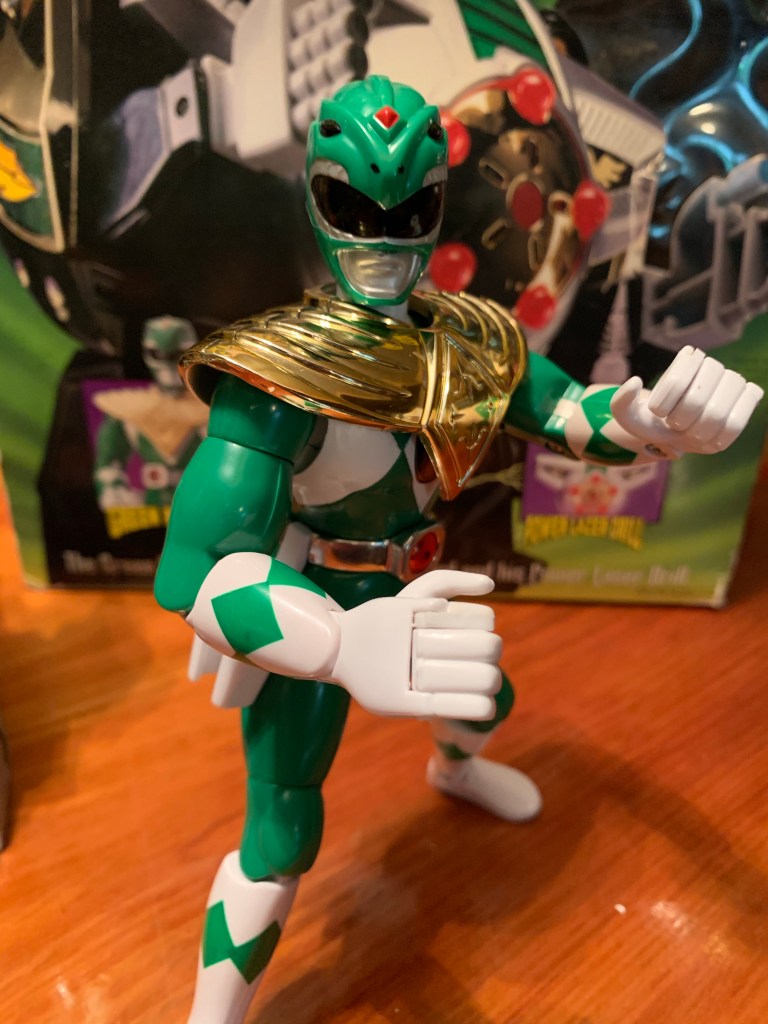
The Green Ranger stands a little over eight inches tall – let’s call it eight and a quarter. In 1994 this line represented a new era in terms of articulation, though by today’s standards it’s not quite as good. Tommy is articulated with a balljoint at the neck that actually sits below the neckline and in the figure’s chest. Mine is a little loose, but he holds a pose no problem and has a good range of motion there. His shoulders, on the other hand, are nice and tight and they’re on balljoints as well. He has a bicep swivel, and hinges at the elbows, wrist, and knuckles. The thumbs are frozen in place, and the index finger on each hand is a separate piece to give him trigger-finger poses. His legs are on balljoints with swivels above the knee. The knee is a standard hinge joint and there’s a hinge joint at the ankle as well. Excepting the neck, all of the joints are good and tight on my figure so he can hold any pose I can put him in. He doesn’t have quite enough articulation to achieve a wealth of posing options as he’s really harmed by the lack of waist and torso articulation, but if I had a team of Rangers I could probably get a decent display out of them.

The sculpt for this figure is the same sculpt Bandai used for all of Rangers. For the males, it’s fine, but for the females it looked worse. He’s got some bulk to him, but nothing outlandish. A lot of the figure is molded plastic, save for the white diamonds on the body and the green ones on the gloves and boots. The only other paint is reserved for the helmet and it’s nice and clean. The shield is a hard, light, plastic and it clasps together at the top seam. It can easily be removed and if done so the chest features a power coin design, something Bandai did with all of these figures even though no such design is featured in the show. For the Green Ranger, the coin image also looks like Titanus for some reason, as opposed to the Dragonzord or the emblem he has in the show. Students of the show will also notice that the Green Ranger isn’t 100% accurate as he’s missing the gold bands around his biceps, and his gloves and boots should have gold trim. The green diamonds should also be triangles. This is Bandai just being cheap as they copied the same design as the other Rangers, just switching in green. Even still, he looks the part enough and is an attractive piece. The only other negative is those hands are a bit annoying. Articulated fingers were a bad idea, but we didn’t know it at the time. It can be more challenging than it should be to get the blaster into one of the hands and have it look right. The blaster is also unpainted, but that was pretty common of accessories back in the 90s. Also of note, there’s no dragon dagger! Oh well.
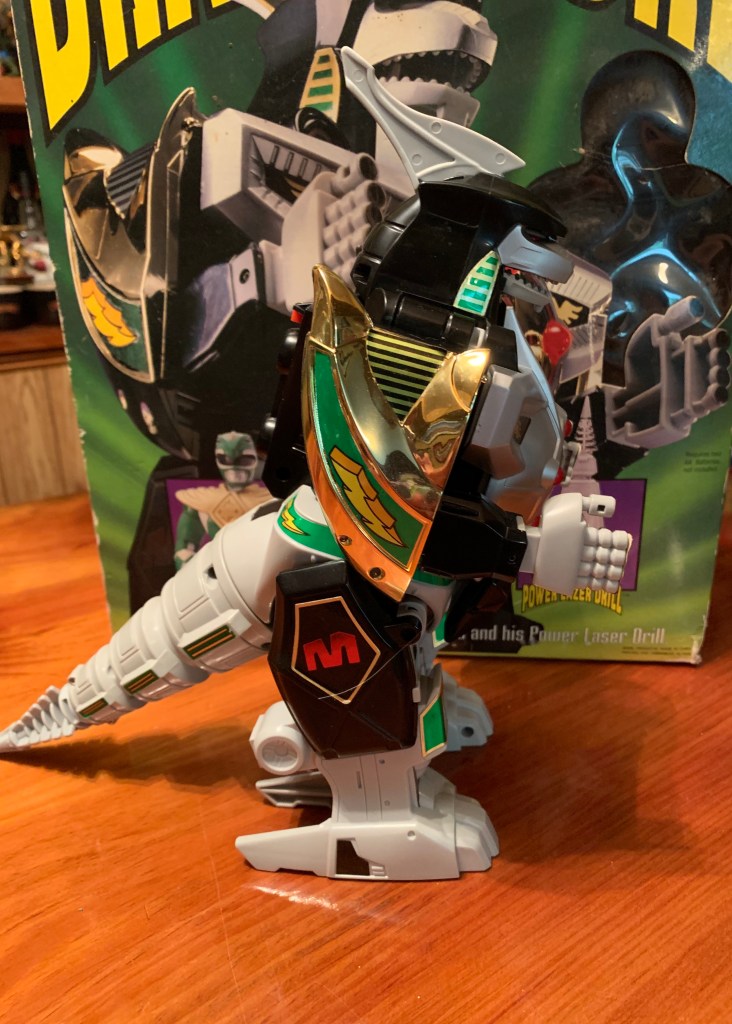
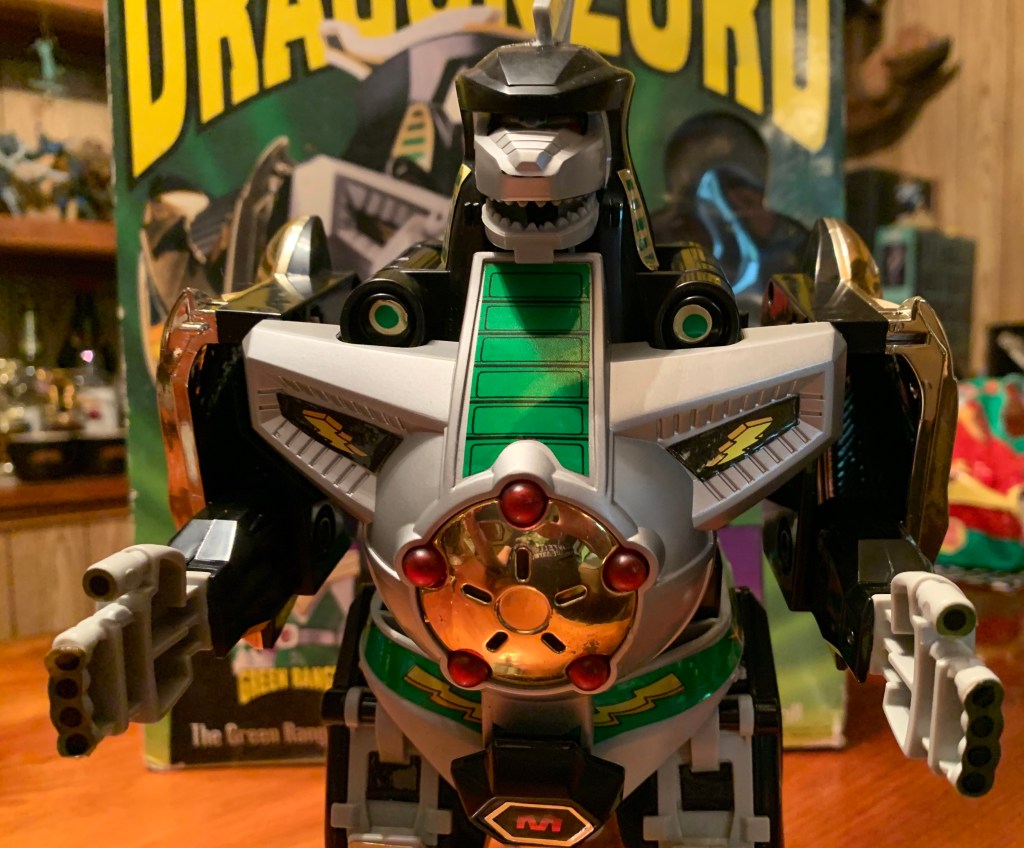
Now lets talk about the big guy. The Dragonzord is only slightly taller than the Green Ranger as he’s just a tick under eleven inches. Future zords in this line would come with tiny representations of the Ranger pilot, which actually would have made a lot of sense for this figure had Bandai thought of it since the Green Ranger sometimes stood on the Dragonzord’s head. The Dragonzord has a lot of stickers that I thankfully did not have to put on. Some have taken a beating and could use some glue, but all in all this guy looks pretty nice for an almost 30 year old toy. As anticipated, there isn’t a whole lot of articulation to speak of. He basically can move his legs only. The drill-tip of the tail can spin, and if you disengage the arms from the body you can kind of gain a little articulation there, but that’s pretty much it. The horn on his head can also slide back and forth as I think it’s supposed to position straight-up for the fighting mode transformation. He’s basically a dragon-shaped tank so he’s not supposed to do much aside from just stand there and look cool.
The Dragonzord disassembles pretty easily, and I presume attaching him to the Megazord components would be just as easy. Everything clicks together in a very satisfying manner, and the designer took care to make sure parts can only go in a certain way to keep things simple. Popping off the tail is a cinch and from there the whole body basically splits in two with the chest piece sliding out from there. The chest piece is battery operated and is supposed to blink and make Dragonzord sounds, but mine arrived with two batteries that long ago burst inside it so mine does not function. With the chest piece out, you can also drop open the Dragonzord’s mouth to reveal a robotic face underneath for when it’s combined with some of the Megazord parts to go into its fighting mode. It’s in that mode that it’s supposed to use the Power Lance, which is just the chestpiece affixed to a separate part and the tail attaches to the top. It’s a very cumbersome-looking weapon, but it’s still pretty cool. The whole unit has some nice weight to it. It’s a bit creaky, but doesn’t feel cheap.

That’s a big lance.

As a toy in 2020, this thing is actually still pretty cool. There’s not a whole lot that can be done to improve the Dragonzord. The tail isn’t entirely accurate as it’s supposed to be longer with more segmented parts, but then the Power Lance would look even more ridiculous. Modern toys basically just include extra pieces for the tail that get discarded when the lance is formed, but Bandai was likely looking to keep the extra pieces at a minimum since kids tend to lose them (plus they add cost). Some of the sculpting could be better, like the hands of the Dragonzord which feature stickers for the missile portions. For the most part though, this looks like the thing from my television so there’s little to nitpick. The Green Ranger could obviously have better articulation and a paint-job that better matches the show, but even he still looks pretty cool. Never underestimate the appeal of a shiny, golden, shield.

As a result, I have no regrets about picking this guy up. I do wish I had inquired with the seller regarding the electronics as that wasn’t disclosed in the listing, but I honestly don’t know if it would have stopped me from buying it. I could always buy another chest piece as loose parts show up on eBay from time to time anyway. And since this is an old toy, I don’t feel as much anxiety when I let my kids play with it. The only worry I have is that shield on the Green Ranger getting broken. Mostly, now I just wish I had a Megazord to combine with this one!


The Toys that Got Away

My whole life I have loved toys. Anytime I had money as a kid I wanted to spend it on a new toy, for my birthday I always wanted more toys, and when it came time to write Santa a letter I asked for more toys. Most kids like toys, that’s a given, but I feel like many mix in some other loves as well. Maybe arts and crafts, movies, books, comics, etc. And I liked a lot of that stuff too, but not enough to sacrifice even a tiny fraction of my toy allotment. As an adult, my love continues though I’m not as single-minded when it comes to my pursuits and hobbies. Though even now, few things thrill me in such a unique way as a brand new toy.

For a kid with a middle-class upbringing, I really wasn’t left wanting for too much. My parents usually delivered around the holidays and I had a grandmother that seemed to enjoy buying me toys as much as I enjoyed receiving them. It also helped that I liked action figures and they usually weren’t too expensive. Most Teenage Mutant Ninja Turtles cost less than a Barbie, and I never really got into more expensive properties like Transformers and Lego. Sure, I had a few from both lines here and there, but for the most part I focused on one major franchise.

Even though I rarely lacked for anything, inevitably there’s always something that remains elusive. Either the toy was hard to find or it arrived at an inopportune time, but there are a few items that vexed me as a child enough to still leave a lasting imprint. Now that I’m an adult, there’s sometimes a temptation to try and fill that void now that I have the means, even though I know doing such is often fleeting. A recent reintroduction of a certain property to my life has recalled some of these feelings though and is serving as the genesis for this post, and I’ll save those for last. This post though is about the toys I never got as a kid, but am sorely tempted to seek out now.

Venom II – Toy Biz 1992

Toy Biz had the comic book figure on lockdown in the 80s and 90s. It even held both the Marvel and DC license at the same time, before it eventually became owned by Marvel through one of the venerable comic book company’s many bankruptcy filings. Toy Biz no longer exists now, but it was best known for its Marvel action figures and the first line was simply referred to as Marvel Super Heroes. As part of that line’s second series, a Venom action figure was introduced. It came with a plastic spider that resembled the insignia on Venom’s chest. It could be inserted into a rather large hole on the figure’s back and squeezing it caused black goo to ooze from a hole on the figure’s chest. Eventually, a running change would be made to replace the spider with a generic red plunger that was instead intended to just use water instead of slime. The lame gimmick, combined with the giant hole it required exist in the figure, made this Venom kind of shitty.

Toy Biz rectified this with a new figure in 92. I recalled seeing it for what felt like a year on the back of other card-backs, but never could find it in stores. This Venom was leaner with a bit more articulation. It’s gimmick was a tongue-flicking action controlled by a little button on the figure’s back which was simple and didn’t detract much from the sculpt. It also came with a chest attachment that I guess was meant to create the illusion of a living costume, but it was kind of dumb. Venom would become my favorite Marvel character, due mostly to my dad taking me to a flea market where he bought me a copy of Lethal Protector #1. When the Spider-Man cartoon arrived in 94, it meant more Venom action figures so even though I really wanted this one, the sting of never finding him was mostly removed. This is the only toy on this list that I did seek out as an adult. Since I have him now, I can say if I had been able to find one in 92 it probably would have been one of my favorite toys for a long time, at least until the Venom II from the cartoon line with removable mask.

Monty Moose – Teenage Mutant Ninja Turtles (1993)

I had a lot of Teenage Mutant Ninja Turtles toys as a kid, most of which are now gone which is unfortunate (kids, don’t let your parents throw away your old action figures!). That line was fairly easy to collect because it was well distributed and also pretty affordable. When the first figures came out, they retailed for $3.99 in my area – that’s a mere two visits from the Tooth Fairy! Because for a few years Turtles were all I wanted I usually cleaned-up at Christmas and birthdays and as a result there were only a few I didn’t get that I really wanted. Some of them included really popular characters like Baxter Stockman and the Rat King, but for some reason the only one that bothers me a little today is Monty Moose.

Monty even got featured in a commercial, though he never made it into the cartoon.

I don’t know what it was about Monty Moose I found so appealing. Moose are kind of funny looking in general, and Monty Moose certainly looked a bit odd with his huge antlers and long snout. I also really liked the blue and red color combo as a kid, so he was just eye-catching to me. And I saw him in a store on one occasion. It was an Osco Drug, which I don’t think even exists anymore. For those who don’t remember, Osco Drug is basically like a CVS or Walgreen’s and it was a store that was never known for its toy selection. My mom and I had to go into one for a prescription for some reason, it wasn’t our usual pharmacy, and we walked down the toy aisle and I saw Monty Moose staring back at me. I tried to get my mom to buy it for me, but I think my birthday was coming up so she was in no mood to buy me a toy with that on the horizon. My birthday would come and go and I had to beg my mom to take me back to that specific store now that I had some birthday money. She thought it was silly to go to a pharmacy, of all places, to spend birthday money, but she took me and of course the figure was gone. I’d never see him again.

Batman Returns Batmissile Batmobile – Kenner 1993

Despite being a bit dark, the Tim Burton Batman films were a merchandising behemoth for DC and Warner Bros. I had a few toys from the first film and the supplemental series Kenner produced in-between, but what really caught my attention was the Batmobile from Batman Returns. If you recall, in the film, the Batmobile demonstrates a new ability to shed the sides of the vehicle to take on the form of a skinny, missile-like, vehicle to fit through a narrow alley. Kenner made a Batmbile that could do the same with the push of a button, and when I saw the commercial I immediately wanted it.

I do wonder how well this thing actually worked.

I had that toy on my Christmas list for 1993, and when Christmas morning came there was indeed a Batmobile under the tree. Only it was the wrong one. I was never one to complain about gifts, so I was happy to have a Batmobile. This was one was a re-release of the first film’s Batmobile with pop-up machine guns. It was pretty cool, just not what I wanted. It was somewhat overshadowed though by another gift that year – a Sega Genesis. Sometime after the holiday, I even saw the Batmobile that I yearned for at the toy store. I had some money and nearly bought it, but I did the smart thing and decided to be happy with what I had and put that cash towards something else. And I feel good about the decision even now and I mostly have it on this list because I’m still curious if the gimmick worked well or not.

Mighty Morphin Power Rangers Green Ranger and Dragonzord – Bandai 1993

And now we get to the real deal. Recently, my son has shown an interest in Power Rangers largely thanks to his best friend having some affection for the property. We’ve watched around ten episodes or so of the original run, and it’s stirring some memories. Painful memories.

Power Rangers burst onto the scene in the late summer of 1993. Saban Entertainment had found it hard to sell the property to American broadcast networks for years, and maybe because of that there was skepticism that the property would be a success. Whatever the reason, the show ended up being a smash hit, but Bandai of America was woefully unprepared to meet the demand for toys. Which sucked because the toys were awesome! The Rangers themselves were huge, around 9 or 10 inches, with loads of articulation. I had never seen an action figure with finger articulation before, and it blew my mind! I wanted them, but I wasn’t quite sure how much since the show was pretty new. I was also at an age where it was almost taboo to like it. I was supposed to be growing out of toys, but I found them way too compelling.

When these came out, I thought they were the most incredible action figures imaginable.

I didn’t get any Power Rangers toys in 1993 and I spent much of 94 chasing them without much luck. I would eventually get a Power-Morphing Green Ranger, but that was nearly all I got. What I really wanted was the deluxe Green Ranger who came bundled with the Dragonzord. I even found a page from a flyer sitting outside at my grandmother’s house advertising the set. I carried that thing around and clung to it reminding my mom and grandma that I really wanted that toy, but try as they might, it just didn’t happen.

He’s practically a statue, but damn does he looks cool.

I never once saw that toy in a toy store. To this day, I’ve never seen it in person. None of my friends had it, and because of that I still kind of want it. Looking at the set now, I still think that Green Ranger is pretty slick. The Dragonzord impresses me less, but he’s still a delightfully, chunky, robot dragon and robot dragons are pretty awesome on their own. It doesn’t do much beside just look cool, but that’s basically all I ask of my toys in this day and age.

Mighty Morphin Power Rangers Deluxe Megazord – Bandai 1993

As much as I wanted that Green Ranger and Dragonzord, I think the toy I wanted most that I never was able to my hands on was the Deluxe Megazord from the same line. Tommy the Green Ranger was my favorite of the Power Rangers for the time I watched this show (basically up to the first movie), so I naturally wanted the best toy based on him along with the zord. The White Ranger was cool too, but not as cool as the Green Ranger. The Megazord though, was just too awesome to ignore. It was five robots that combined into one massive robot – how awesome is that?! Yes, I realize this made the toy very similar to Voltron, but the Voltron toy from the 80s didn’t impress me much because it didn’t really look like the cartoon. It had to fudge with the scale of the lions a bit to work in real life, and that’s the type of thing that would bother me as a kid.

Now you can re-enact that same transforming sequence you see every episode!

The Megazord, however, seems like it was designed to be a toy from the very start. The toy basically imitated the transforming sequence from the show to perfection. The only compromise really was in the articulation of the finished product. The show would feature models to assemble the Megazord, but once formed it then swapped that out for a guy in a costume who would battle the monster of the week. He could obviously move in ways a clumsy toy could not, but that seemed like a small price to pay for such accuracy.

Robots that combine to form bigger robots are arguably the greatest toys ever made.

Unlike with the Green Ranger/Dragonzord set, I did actually see the Megazord in the flesh. A kid in my class brought one into school, maybe for show and tell or something, and he showed it to me at his desk. Cruelly, he wouldn’t let me touch it, but he at least demonstrated the transformation including both the robot and tank modes. I was floored by it and I wanted it so bad, but it was just so impossible to find! I never saw the thing in stores and I’m sure my grandmother likely never did as well.

I was able to get the Red Dragon Thunderzord (left), but never did get the rest.

When the showed moved on from the original zords, the toy supply improved. For Christmas, my grandmother was finally successful when it came to Power Rangers and she was able to get me the Red Dragon Thunderzord as well as some of the roleplay toys (blaster and morpher). The Red Dragon was pretty cool, and if I’m being honest, a better toy than the Dragonzord would be. I was never able to get the other zords though to form the new Megazord, and by the following Christmas the fad had passed for me. I would put all of my energy towards video games at that point, leaving toys behind for a few years.

In 2010, Bandai re-released the original Megazord, now often referred to as the Dino Megazord. It was almost an exact recreation of the 93 toy with a few changes to make the set cheaper to produce. The wheels were removed from the Triceratops and Sabre-toothed tiger, as well as the articulation on their guns. Otherwise though, it’s basically the same. It retailed for $75 and I am kicking myself now for not just buying it then. The 93 version, if you can find one in good condition, easily fetches thrice that on eBay and the re-releases are expensive too. I was tempted to buy one when I was first on my own, but got cold feet and didn’t really know what I would do with. Maybe my son or daughter will become obsessed and force my hand, or maybe Bandai will re-release it again when the show turns 30 in three years and I’ll finally take the plunge. Or maybe the Megazord is just a toy destined to haunt me for the rest of my days.


Donald Duck Turns 86!

It’s June 9, and that means I can’t let the day go by without acknowledging that it is the birthday of my favorite animated character: Donald Duck. Donald Duck debuted in the 1934 short The Wise Little Hen and it wasn’t long before he joined Mickey and the gang becoming one of the most popular characters in the world. The past few years, I’ve marked the occasion with a post about one of the four Walt Disney Treasures releases of The Chronological Donald Duck. Well, I’ve run out of them! I’ve shared my thoughts on all four volumes now, so this year I’m giving you a quick post about some of the Donald Duck merchandise I’ve acquired over the past year.

Now it should be said, the best way to celebrate Donald Duck these days is via Disney+. Not to sound like a commercial, but Disney+ is the most convenient way to get your Donald fix as there are a handful of classic shorts, movies that feature Donald, episodes of Disneyland also featuring Donald, and even an exclusive series definitely worth watching called Legend of the Three Caballeros. To celebrate Donald’s birthday, Disney even added a Donald Duck section to Disney+ to make it easier to find stuff featuring everyone’s favorite waterfowl. It was long overdue too, as finding Donald shorts was a pain on the platform.

Everyone in my family knows I’m nuts for that duck, so Donald themed gifts are an easy way to my heart. The only challenge is getting to them before I do. This clock I keep on my nightstand is something I bought for me, and I actually bought it nearly 10 years ago so unlike everything else this one is not from the past year. I just felt it was worth sharing. It’s a sculpture featuring the classic black and white Donald from 1934 alongside a more modern Donald. It was commissioned to celebrate his 65th birthday and the actual clock is a pocket watch which is removable. It even came with a thick, gold colored, chain if you wish to sport it as a traditional pocket watch. I have only done so on one such occasion: my wedding. You’re damn right I was repping Donald on my wedding day.

This key-shaped ornament is something I acquired a year to the day. It was an item sold on Donald’s birthday last year in celebration of his 85th birthday. Some other merch was available too, like pins, but I’ve resisted the temptation to become a Disney pin collector. These keys are something the Disney Store turns to often to get people into the store. Basically, they’re first come, first serve and you have to buy them. I don’t remember what it cost, but apparently Disney collectors love them as there was a huge line before opening the day these came out by me. I was almost in trouble too as my kids had seen the advertisement for this thing ahead of time and I told them, “Sure, we’ll go get the special Donald key.” When we arrived to see that line I had to start preparing them for the possibility we might get shut out. We were fortunate though and managed to receive one of the last ones and it’s hung on my wall ever since.

These slippers were a Christmas gift from my wife and kids last year. They’re by a company called Happy Feet, and I liked them so much that I got my wife some for Valentine’s Day (Santa also brought some for my kids). Happy Feet makes two styles of slippers: big, puffy, character head ones like these, and also a zipper slipper that’s a more conventional slipper shape, but has a removable toe section. They’re called Zlipperz and they’re pretty neat. They do have Donald ones and I may have to grab a pair of those eventually to pair with these. These ones are super comfortable, though with the weather heating up I’m wearing them less and less. I’m sure they’ll wait patiently for me to turn to them this Fall when the weather cools.

Lastly, how about some Christmas in July June? These are some ornaments that were released for Christmas 2019 and if you read this blog regularly you know how I feel about Christmas. The one on the left is a traditional globe-styled ornament in a heavy-duty box. The ornament features redrawn images from the classic Christmas short Toy Tinkers starring Donald Duck alongside Chip and Dale. The middle ornament is a tin lunchbox with artwork from the latest edition of DuckTales adorning it. It opens to reveal a tiny thermos as well. Donald is featured on both the lunch box and the thermos and both also have a little eyelet to attach a hook to hang from a tree. It has yet to hang from one of my trees though as I actually got this after the holidays when it was on sale (FYI – right now is prime Christmas ornament buying season as Hallmark makes room for the coming year). And on the right, we have another commemorative ornament celebrating Donald’s 85th birthday. It’s double-sided with one side featuring a sculpture of a black and white Donald and the other featuring a modern interpretation. A circular medallion featuring the number 85 is affixed to the string from which it’s supposed to hang. Beware though, this sucker is pretty heavy for an ornament and can tumble easily from a Christmas tree.

That’s but a small piece of the Donald Duck collection in my home. It’s a collection I’m always looking to add to so hopefully 2020 brings more Donald my way. The next big year for Donald will probably be 2024 when he turns 90 and I expect there to be a whole bunch of new items then. And at that point we can begin the countdown to Donald’s 100th. I’m already saving now as I need to be at a Disney park for that one!


Dragon Ball: Advanced Adventure

In the West, it took awhile for Dragon Ball to make an imprint with US audiences. It was localized and brought over in the mid-90s in the hopes of making money in syndicated markets. There were over 200 episodes, so the reasoning was sound, but it just didn’t take off. It wasn’t until the property showed up years later on Cartoon Network that things changed and the rest is history. The gap though meant that a lot of other media associated with the brand was missing. Kids were getting hooked on the Cartoon Network broadcast and looking for other ways to engage the product, but other than a lone PlayStation fighter based on the sequel series (that was out of print at that point, plus terrible), there wasn’t much to turn to.

Eventually Infogrames stepped in and started producing titles based on Dragon Ball Z. The license would eventually switch to Atari when Infogrames went under and now is held by Bandai Namco. A quick search engine lookup of Dragon Ball Z video games will return dozens of titles now. What is still lacking though are games based on the original series: Dragon Ball.

Let’s get to it!

If you’re only familiar with Dragon Ball Z, then you’re really missing out! Dragon Ball tells the story of Goku starting when he has a chance encounter with a young woman named Bulma in the midst of a search for the mystical Dragon Balls. Goku is just a kid at the start of the series, but by its end he’ll be an adult setting the stage for Dragon Ball Z. Unlike its more famous sequel series, Dragon Ball is more of an adventure-driven show with a generous dose of slapstick humor. Even though it is not as combat-driven as Dragon Ball Z, there’s still plenty of martial arts action especially during the many episodes that take place during the World Martial Arts tournament. The show was originally given the same sort of trial run that DBZ received in syndicated markets, but disappeared even quicker. Once DBZ took off, FUNimation returned to the original series and re-dubbed the few episodes that had been dubbed previously as well as the rest of the series. It aired on Cartoon Network in its entirety, though it didn’t have much staying power beyond that.

Before DB: AA the only Dragon Ball game released in the US was this abomination.

With the showing receiving a renewed push, Atari did turn to the property for video games, the first of which was Dragon Ball: Advanced Adventure. Advanced Adventure is a Dimps developed title, who was responsible for the Budokai games on home consoles, and it was released in Japan by Banpresto in 2004. Atari, somewhat surprisingly, waited until 2006 to release it in the West. As the title implies, this is a Game Boy Advance game based on the original Dragon Ball. It begins where the series starts and concludes with the battle against King Piccolo. My first thought when I saw the date was maybe Atari waited until Cartoon Network aired all of the episodes covered by the game, but the series finished broadcasting in 2003 so I’m at a loss as to why it waited so long. It’s also strange that the game did not include the Piccolo Jr. Saga especially in light of the fact that one could basically be covered with a few battles. Maybe Dimps just didn’t want to have to make more sprites for an adult Goku? Who knows?

Most of the game unfolds in a side-scrolling fashion.

Dragon Ball: Advanced Adventure is an interesting title as it combines a few different genres of gaming. The game’s story mode places the player in control of Goku who has to battle his way through various levels to advance the story. It begins like a platformer with an influence from the beat-em-up genre. Goku can run left and right and jump as well. Double-tapping either left or right will result in Goku breaking out into a sprint which is needed to evade certain enemies (think Indiana Jones) and clear certain gaps. He can also wall-jump, which is handy to know as the game doesn’t tell you he can do this. It’s a bit like Super Metroid in that to wall jump you have to first contact the wall at the height of a jump then quickly press the direction away from the wall and the jump button simultaneously. If you never liked that style of wall-jump then rest assured you could play the whole game without using it if you wanted.

Simple cut scenes are used to advance the story or start a boss fight.

When Goku encounters an enemy, he usually has to dispatch them with a flurry of attacks rather than bop them on the head or dispatch them quickly with a simple attack. Pressing the attack button in rapid succession causes Goku to dispense with simple combos, the majority of standard enemies will be felled by this. Adding in directional inputs can trigger Goku to utilize his famous Power Pole to flip enemies over his head or add some distance to his strikes. The A button causes Goku to jump and he can attack from the air as well with a jump kick or a diving kick. The jump kick doubles as a means of deflecting rockets back at enemies, while on the ground pressing up+B causes Goku to twirl his Power Pole which can deflect bullets.

Goku can make use of the trusty Flying Nimbus in a few levels. Only Goku can fly on the magic cloud.

Other stages in the game will place Goku on his flying Nimbus cloud in an auto-scrolling manner. This is hardly unique as many platformers do the same, but some levels will basically cause the game to turn into a one on one fighting game. In this mode, Goku and his opponent will have a break meter below their health. Repeatedly taking damage causes it to deplete and only when it’s depleted will a character take actual damage. The game still largely feels the same, though Goku ditches his Power Pole, but does pick up the ability to hover jump by twirling his tail. Goku can also launch his opponent into the air to deliver additional damage resulting in them being slammed into the ground. If this mode were released as a dedicated fighting game it would likely be met with a lukewarm reception. As a diversion in a beat-em-up title though it serves its purpose and gives the tournament portions of the story some added importance.

There’s a lot of stuff to collect in this game.

Throughout the story mode, Goku is tasked with finding special items. Many of these are easy to uncover and many more are all but mandatory. These items will be expand Goku’s health meter and even the length of his Power Pole strike. Goku will also learn the much beloved Kamehameha wave. At first, it does very little, but the charge bar for it will be expanded as the game moves along. Once completed, Goku’s charge meter (activated by holding R) will expand to four portions and a full blast results in a big, blue, Kamehameha. Goku can also use this meter to unleash a twirling Power Pole attack with the simple press of the L button. It consumes one “brick” of the meter and will need to be recharged. When Goku has a full meter, he can perform a super move by holding R and pressing L which is a big attack that comes in real handy during one-on-one fights as it can be aimed in different directions. During regular gameplay, the special move works similar to a grab attack as Goku will dash forward and if he connects will then pummel his opponent as he flurries all around them.

Most of the Dragon Ball story is covered in this game, though there are some omissions and deviations here and there.

The main story mode will probably take around 2 and a half hours to complete. Several levels have exploratory components so one could conceivably spend more time in them than the average person, though many also feature gates on the first play-through. Even though the game isn’t terribly long, it’s a game best experienced with short bursts of play as the action can get repetitive. Adding to the repetitive nature of the gameplay is the fact that enemies respawn quite liberally which can become rather annoying, especially in sections with heavy platforming. The game is fairly average in terms of difficulty. Health items are plentiful enough to keep most going and I often found myself amassing a dozen or so extra lives. I’d then hit a troubling spot and maybe reduce them to six or so before moving on and eventually building my stock back up. Most of my deaths came against boss characters later in the game, many of which required some trial and error on my part. I also do not have an instruction manual for this game and the story mode doesn’t tell you about the ability to deflect certain attacks so I had to figure a lot out on my own. Defeating most bosses was largely an exercise in figuring out the best way to deal damage as some require a bit of possum to defeat effectively. Many more though just require some straight-forward bashing and liberal use of Goku’s ultimate attack.

Beating the game and finding the right items means playing as extra characters like Krillin and Tien. It also means being able to play as some pretty bizarre ones as well.

Completing the game will unlock some bonus modes, the most notable is the ability to replay the story mode as Krillin. In extra mode, the player can switch between Goku and Krillin on the fly and replay stages in any order to access areas that were previously inaccessible before. You’ll also quickly gain the ability to use Goku’s super jump which is needed to find special items and was previously only usable at designated points. Krillin plays very similar to Goku, but obviously lacks the Power Pole. Instead, he can use the Solar Flare technique to temporarily stun nearby enemies. He also has a dashing kick attack that’s quite useful in closing in on enemies, though as far as I can tell he can’t deflect bullets. Pretty much every enemy encountered in the game can also be unlocked after beating the game with Krillin and finding their portrait in extra mode. Many of these extra characters are useless, but some (like King Piccolo or Tien) are pretty interesting because they’re both strong and can do something Goku and Krillin can’t: fly.

Initiating the “battle and chase” quality of the fighting mode is a key component to having success.

If you’re really into the one on one battles in the game, there’s also a one on one mode. After beating the game once, you’ll have access to six fighters, but a few more can be unlocked including one who doesn’t even appear in the story mode. There’s also a boss rush mode and a collection of mini games that you’ll probably never want to play. There’s a lot to unlock and experience in Dragon Ball: Advanced Adventure, but you’ll likely grow tired of the game long before you experience it all.

Send them high into the sky, then bash them back down to Earth!

That’s not to say that Dragon Ball: Advanced Adventure isn’t worthy of your time. I quite enjoyed my time with the title and would deem it a mostly pleasant experience. It’s simple and easy to pick-up, but there’s a bit of hidden depth to discover as well. A lot of the early parts of the game’s story mode can be overcome with button mashing or spamming Goku’s stronger moves, but the game introduces enough curveballs in its later stages to keep you on your toes. And since it’s based on the original Dragon Ball it has a certain charm to it that any Dragon Ball Z game would lack. The actual cut scenes and such are pretty bare bones, and the game makes some changes to the story as well and chooses to omit certain things. It does have some speech elements, enough so that the voice cast received a credit, so the production values are certainly there. The sprite work is quite pleasing to the eye, and the music is good enough, though I’m actually not certain how much of it is based on the actual anime.

Seriously, GameStop?!

I played this game on my Game Boy Micro with an actual cartridge. It’s probably not the best way to experience it since this game requires the use of all of the Game Boy Advance’s buttons. It’s probably best experienced on a Nintendo DS or the original GBA as the layout is far more optimal. I often couldn’t play this for more than a half hour or so without my knuckles starting to ache a bit. The small screen on the Micro can make the one on one battles a bit tougher as well as I found myself jerking the unit around.

The boss battles will often keep you on your toes.

Of course, if you want to play Dragon Ball: Advanced Adventure in 2020 you may find it a bit difficult. Since the game arrived after the release of the DS it likely wasn’t manufactured in large quantities. It’s far easier, and cheaper, to acquire the Japanese version as a result and the cartridge alone will probably set you back between 40 and 60 dollars. After stalking eBay a bit for this one and missing out, I actually found it on GameStop’s website and was able to acquire it there. I wasn’t sure what to expect, but I did receive a genuine US edition of the game, just without a box or manual. It also came with some gunk inside it that may or may not have originated from a pizza that I had to clean out. Clearly, GameStop does not inspect the games it resells at all so buyer beware. After cleaning it with some rubbing alcohol, I was momentarily dismayed when my first playthrough ended with the game freezing about 20 minutes into it, but all subsequent playthroughs have been issue free so maybe the alcohol had not completely evaporated when I first booted it up.

The game is mostly fun, but the allure of playing as extra characters will only take you so far.

If you’re looking to experience Dragon Ball in video game form, I do recommend Dragon Ball: Advanced Adventure. The somewhat high cost of entry for a genuine copy of the game is off-putting, so I would recommend checking out some videos or something before diving in. There were Dragon Ball games released on the DS and Nintendo Wii that are considerably cheaper to acquire, though I find them to be a bit less fun. I probably would not recommend the Wii game, but Dragon Ball Origins for the DS is perfectly fine. If accessibility isn’t an issue though, then Advanced Adventure is the way to go. It’s fun, breezy, and will hold your attention for 6 to 8 hours which is solid for what is largely an old school action platformer. Plus it’s Dragon Ball, what more could you want?