Category Archives: Video Games

The Legend of Zelda – Ocarina of Time

The Legend of Zelda:  Ocarina of Time (1998)

The Legend of Zelda: Ocarina of Time (1998)

I never set out to make an entry on all of these Zelda titles, it just sort of happened.  It’s basically the end result of me not having any new titles to play on my portable gaming devices so I’ve revisited some classics.  I’ve already made entries on the first two Zelda titles, so naturally I should make one for the third game in the series:  A Link to the Past.  But wait!  This isn’t an entry on A Link to the Past, but the next game in the series (for home consoles):  Ocarina of Time.  That’s because I can’t play A Link to the Past on my 3DS (though I could have dusted off the old Gameboy Advance, I suppose) and never played the 3DS version of the Ocarina of Time:  Master Quest.  I played thru the normal quest on the 3DS version when it was released in 2011, and I have played the Nintendo 64 version (on a Gamecube) of the Master Quest as well, so this was far from a new experience.  And since the original version and the 3DS remake are largely the same, this can be considered an entry on both.

Ocarina of Time is considered by many to be the best in the series.  It’s usually a debate between that and A Link to the Past with the sides mostly split on age lines.  People who were introduced to the Zelda franchise during its formative years will mostly lean towards A Link to the Past, while those introduced to the franchise via Ocarina of Time naturally are slanted towards that.  And even though the two may not look all that similar, the core experience is very much the same between the two.  The player controls Link who must battle thru various dungeons collecting useful tools and items along the way.  There’s lots of wandering, conversing with non-player characters, and general adventure along the way.  The player also isn’t expected to just hack and slash their way to the end as there are lots of puzzles to challenge and frustrate as well.  Regardless of what position you may take on which game is superior, know that both are excellent and enjoyable games that should be experienced by all serious gamers.

The Legend of Zelda:  Ocarina of Time 3D (2011)

The Legend of Zelda: Ocarina of Time 3D (2011)

Ocarina of Time is regarded as a near perfect gaming experience, so if you’re expecting this to be a contrarian take, look elsewhere.  And while it does earn its reputation, it also has its share of flaws.  This game is nearly 15 years old, which blows my mind.  There are many games of that age that are still considered an excellent experience today, but naturally some things age less gracefully than others.  Ocarina of Time is perhaps most notable for being Link’s first foray into the world of 3D.  Transitioning from 2D to 3D is a challenge and it’s one that has stymied other famous franchises of the same era.  While Mario was able to adapt, gaming’s other titan of the 16-bit era, Sonic, still struggles with it to this day.  Both of those characters were transitioning from side-scrollers to the 3D platform genre, while Link had the benefit of moving from that top-down perspective of the first and third Zelda titles which is actually a much easier transition.  Both Mario and Sonic were expected to jump and navigate various platforms in their games, while Link didn’t have that expectation.  Because of that, Nintendo didn’t even see fit to provide a jump button in Ocarina of Time; Link just does it automatically when he needs to.  Instead of the camera being positioned directly above Link, it’s moved behind him but still retains a high angle in many sections of the game.  Where age starts to rear its ugly head is with this camera.

The camera is often the make or break portion of any game from the late 90’s.  It still can be problematic in modern games but it seems to happen far less.  For Ocarina of Time, Nintendo opted to not give the player total control of the camera as some games do.  The players has one camera button at his or her disposal which automatically centers the camera behind Link in most cases.  There’s also the Z-Targeting lock-on button that fixes the camera on an enemy and puts Link into a sort of battle mode.  This works fine in open spaces, but some of the dungeons in the game can get cramped and in those areas the player is often left to battle the camera.  There’s one section in the game that has Link in a maze trying to avoid sentries like one Solid Snake.  This moment is brief in the grand scheme of things, but it’s still an utter failure of game design that feels shoe-horned into the experience.  The camera is very limited and almost stuck to Link’s back.  Trying to peer around a corner is cumbersome and, if you’re like me, you’ll probably just say “screw it” and plow ahead.  The automatic jump can also be a problem at times.  I do appreciate that Nintendo did not want to turn Link into Mario and have him bounce all over the place, but not giving the player control over that aspect of the character does create a disconnect of sorts.  I can’t think of any other way to describe it other than it just feels weird.  It also creates the problem of Link jumping to his death on occasion by accident (usually brought on by shoddy camera work).  In many games where jumping is relegated to a button press, simply running off a ledge causes the character to fall and grab onto the ledge.  When approaching a ledge very slowly and carefully in Ocarina of Time, the same is true, but give Link any kind of speed and he takes a leap of faith no matter what lies below.

A nice comparison shot of the two versions.

A nice comparison shot of the two versions.

Another flaw, I suppose, resides with the lock-on system and enemy AI.  When Link is locked onto an enemy all other enemies around him will back off making the game a series of one-on-one contests.  This is obviously something that was implemented deliberately by Nintendo, but it’s still kind of odd.  Though I suppose it’s no less odd than turn-based battles in role-playing games.  A lot of the dungeons are also fairly clever.  They make it obvious to the player where to go, but leave it up to the player to figure out how to get there.  There are moments though where I felt cheated and the only way to progress is to strike an object that 99% of the time has no function.  This forces the player to resort to smacking everything and anything with Link’s sword at times.  There are also a few boss encounters that rely on magic power or a specific disposable item, and if you run out, you’re out of luck and either have to reset or let the enemy kill you.  And then there’s Navi.  Oh, how I despise Navi.  Navi is this little fairy that accompanies Link and is supposed to give him advice when needed.  She’s also a targeting reticule and a means of selecting which enemy to combat.  She’s also incredibly annoying.  I hate her existence.  She’s insulting as her primary function is to state the obvious, as if Nintendo didn’t think we were capable of getting thru this game on our own.  If you try to run off and do side quests, expect to be interrupted by Navi every ten minutes or so to remind you to head to the game’s next dungeon.  And each time she does you get to hear this annoying, high-pitched voice shout “Hey!”  In the 3DS version she’s even worse as she’ll pop in to tell you to take a break if you’ve been playing for long stretches.  She doesn’t seem to recognize when the system goes into sleep mode so you may actually have only been playing for a few minutes before she starts barking.  Nintendo, all too often, pulls crap like this with its games and it drives me nuts that features like Navi can’t be toggled on and off.
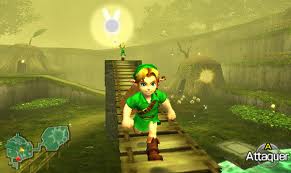
Young Link in the 3DS version.

Young Link in the 3DS version.

Those are my main sources of irritation when it comes to Ocarina of Time, the rest of the game is pretty awesome, to put it simply.  Yes, there’s still some age-related items in terms of the game’s presentation and mechanics.  Link certainly doesn’t handle as smoothly as more modern titles.  He can feel a bit stiff, and combat is mostly a hack and slash affair, but it gets the job done and is easily forgiven.  The visuals on the Nintendo 64 version have not aged gracefully, but are not horrid either.  The 3DS is a noticeable improvement here as it ups the visual quality to something akin to an early generation Gamecube title.  It won’t knock your socks off, and Hyrule still seems woefully underpopulated, but it’s far better than the original.  A lot of the enemies Link will encounter are lifted from the older games and it’s fun to see them presented here.  The iron knuckles are most intimating now, and the poes possess a lot of character.  The stalfos, one of the easier enemies in prior games, are far more challenging this time around and more menacing too.

A lot of the fun experienced in a Zelda game comes from the items and power-ups Link acquires over the course of his adventure.  Many make their return in Ocarina of Time and are engaging in this new 3D world.  Link can now toss bombs and even lock onto enemies when doing so.  The hookshot doesn’t just allow him to get over gaps in the area but turns him into an elven Spider-Man of sorts!  The hammer also takes on new meaning as it’s basically a giant cavalry hammer, though I feel like it’s underutilized in Ocarina of Time.  Some of the items are only usable by child Link, and others by adult Link. The boomerang is one such item, but there’s always an item that levels the playing field.  In this case, the hookshot used by adult Link can stun enemies and retrieve certain items just like the boomerang.  The ocarina is, naturally, an important item in the game and it allows Link to play songs.  A majority of these songs function as a quick travel feature and transport Link to another area.  Others are used for puzzles.  The mechanic worked so well that it’s basically been included in some form in all of the games to follow.

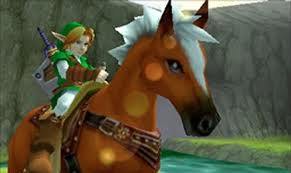
Ocarina of Time marked the debut of Epona, Link's trusty stead.

Ocarina of Time marked the debut of Epona, Link’s trusty stead.

As was the case with the previous titles, the game is somewhat light on plot.  It’s fairly straight-forward but there is a story present with the best portion of it devoted to giving the antagonist, Ganondorf, a backstory.  The inclusion of time travel is kind of neat but not really fully utilized as the game basically exists in two parts, the young Link portion and the adult Link portion.  There’s only one dungeon that requires the player to tackle it with both Links and only a few instances of Link doing something in the past to affect something in the future.  Link’s method of time travel is a bit cumbersome, so I suppose it’s a good thing the game doesn’t require the player to constantly travel back and forth, but I do feel like it could have been exploited further.  Boss battles are usually rewarding, but not often challenging.  There’s often a specific way to defeat each boss, and once the player figures it out, it becomes easy.  I’d be hard-pressed to pick out the most challenging boss as few stand out in that regard, though the most interesting boss encounter may belong to Phantom Ganon of the Forest Temple.

Even though the boss fights aren’t all that challenging, the game does present a challenge elsewhere.  The traditional quest is fairly painless, but the Master Quest ups the ante by making enemies much stronger.  This kind of slants the game a little as it becomes much harder early on when Link only has a small amount of hearts.  Once that’s built up it basically normalizes.  The only other changes with the Master Quest involve the dungeons being mirrored which does kind of throw you off but is easy to adapt to.  The gold skultulas are also harder to find but the heart pieces remain in the same locations.  The 3DS version takes the mirroring concept one step further and turns the whole game into a mirror-mode of the original quest.  I actually found that harder to adapt to than the dungeons as Hyrule Field is now flipped over so what was once east is now west.  Link’s handedness even changes from being a southpaw to a righty in the Master Quest.

Link and Sheik enjoying a jam session.

Link and Sheik enjoying a jam session.

Aside from the Master Quest and visual upgrade, the 3DS version does present some other modifications to the original game.  Most notable is the use of the touch screen for items.  Items can be mapped to the face buttons as well as two additional touch “buttons” which prove useful for certain types of items.  This also reduces the clutter on the top screen as Link’s health and magic is kept on the bottom screen.  There some drawbacks to the 3DS version though, such as the cramped space.  Z-Targeting is now L-Targeting and it can get awkward due to the dimensions of the 3DS.  Tight quarters also tend to feel even more claustrophobic on the 3DS screen and the gyro-controls for first-person view and aiming is just a so-so addition to the game.  The ending credits do have an updated song that’s fully orchestrated (something the N64 was incapable of capturing) which was a nice surprise upon completion.  All in all, if you’re looking to play this game for the first time there’s no obviously better version.  I would probably just go with whatever is easier to obtain, or if you know you want to play this primarily in front of your television, the original is more than sufficient.  You could also look up gameplay on a video sharing sight to decide if the visuals are a big enough reason to select one over the other.  And I guess if you love the whole 3D thing, that’s a factor too (I played the game in its entirety with the 3D feature turned off).

Ocarina of Time, no matter how or when you choose to experience it, is an excellent gameplay experience.  It holds up remarkably well, not just when age is considered, but just in how easy it is to come back to.  I’m mostly a one and done kind of gamer, meaning I beat a game once and that’s enough for me.  With Ocarina of Time, I’ve played thru and beaten it multiple times and each time the journey is an enjoyable one.  My only real concern with the game is for people who have never played it.  They may approach it thinking it’s a perfect game, but it’s not.  The game had some flaws when it was released in 1998 and some other flaws have been exposed due to age.  No one should approach any game expecting perfection though as there is no such game, just as there is no perfect movie or perfect book.  Our opinions and tastes are too broad as a people to ever declare any one game perfect.  We can only apply such absolutes in the broadest of strokes and at the highest categorical level:  Food is great.  Oxygen is excellent.  Zelda is fantastic.  Yeah, that sounds about right.


Zelda II: The Adventure of Link

Zelda II:  The Adventure of Link (1987)

Zelda II: The Adventure of Link (1987)

What?  Three Zelda entries in a row?!  I guess I’m on a roll.  This one should come as no surprise though, since I mentioned I just finished up playing the original Legend of Zelda on my 3DS, and what’s a more logical next step?  Why, Zelda II of course!  I received a free copy of Zelda II along with the original (and several others) as part of the 3DS Ambassador program that was launched by Nintendo in 2011.  I mostly have kept myself busy during my daily commute to and from work with retail 3DS games.  I’ve also spent time with my Vita (what’s that?) so I haven’t had much reason to play those free games Nintendo bestowed upon me.  I currently don’t have any unfinished 3DS games though so it made sense to finally start digging thru these titles, especially since Nintendo has updated them since they were released to include that ever so lovely save state feature made famous by illegal emulators in the late 1990’s.

The Legend of Zelda is an unquestioned classic.  It is beloved.  People today who pick it up having never experienced it might not quite get it, but anyone willing to invest the time will be able to at least appreciate the game for what it is and what it means to the franchise as a whole.  Zelda II, on the other hand, is often regarded as the worst entry in the series (developed by Nintendo) and is sometimes the target of much hate from the Zelda faithful.  It’s the black sheep of the franchise, the Jan Brady of Zelda games, because it’s so different from other games in the series and no one loves it.  That’s somewhat of an embellishment as the game does have its share of fans (or as some like to call them, apologists) but you would be hard pressed to find someone willing to argue it’s among the elite.

In theory, there actually isn’t a whole lot different about Zelda II when compared with its predecessor.  The player still controls the hero Link as he journeys across Hyrule collecting items to help him in his quest to recover the Triforce of Courage.  The music still kicks ass.  Link will encounter some familiar enemies like keese, stalfos, and moblins as they seek to avenge the defeat of their master Ganon, whom Link bested in the original game.  Where things change though, is in how the player interacts with Hyrule this time around.

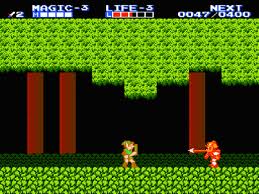
No longer do gamers have to stare down at the top of Link's head.

No longer do gamers have to stare down at the top of Link’s head.

In the original Legend of Zelda, Link was viewed from a top-down perspective; kind of like over-looking a chess board.  For a Nintendo game the map was pretty large and the enemies would come onto the screen and Link could run up and stab them or take them down from a distance either with his sword or other means.  In Zelda II, the player controls Link from a more traditional side-scrolling perspective.  He plays more like a Belmont than a Mario, but he’s a pretty solid jumper considering this is his first go-around at platform action.  He still attacks with his sword and can block certain attacks with his shield.  When his health is full he can shoot little beams out of his sword which can damage some enemies.  It’s kind of surprising that fans seemed to be so put off by this change in perspective given that this was only the second game in the series.  It’s not as if it was much of an established property at this point.

Switching to a side-scrolling style of gameplay was just the beginning.  The RPG was just starting to gain momentum in the gaming world and Nintendo saw Zelda II as an opportunity to introduce some RPG elements into one of their games.  Link no longer travels the world in search of heart containers to increase his health (though there are still a few) or relies on getting a better sword to increase his damage output.  Instead he gains experience points for defeating enemies and at certain intervals he’s able to level-up one of three attributes:  Life, Magic, and Attack.  Life should be thought of more as defense as it doesn’t increase Link’s health meter, just reduces how much damage he takes.  Magic more clearly is tied to actual magic points, but upgrading the stat doesn’t visually impact the magic meter.  Attack is rather self-explanatory and increases how much damage Link can inflict with a single sword swipe.  There are a limited amount of magic containers and health containers that permanently increase each attribute respectively, but there’s no master sword for Link to find.  There’s also a world map which is similar to one from a Dragon Quest or Final Fantasy game.  When Link is roaming the world map enemies can appear on screen and attack him, which bring the player to a side-scrolling area to face off with some monsters, or run away.

Link can converse with the townsfolk, some of whom will help him out by refilling his life or magic.

Link can converse with the townsfolk, some of whom will help him out by refilling his life or magic.

The magic itself is also something that’s new.  Link is able to travel to towns now and interact with the locals, most of which have nothing of interest to share with the hero.  Hidden in each one though is a wizardly looking character who can teach Link a magic spell.  Link will come to rely on these throughout the game, some more than others.  Some examples are a shield spell that reduces the damage Link receives from enemies, and a jump spell that lets him jump higher.  All spells, except for the life spell which restores some of Link’s health, last for one screen.  The more powerful spells, naturally, consume more magic than others.  Interestingly, enemies no longer drop rupees or hearts (there’s no need for currency in this Hyrule) but will drop magic potions from time to time making magic one of the few ways Link can restore his health.  The game also has an extra life system, like most games, which perhaps makes up for the lack of restorative items.  There is still the occasional fairy hiding in a dungeon or roaming the world map that can fully restore Link’s health, but that’s it.

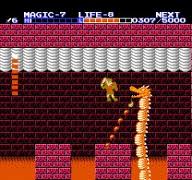
This approach is one reason why Zelda II is often regarded as the hardest game in the series.  That’s just one contributing factor to the difficulty though.  The main contributor early on is simply in how the game plays.  It takes some getting used to because Link is armed with perhaps the world’s worst sword.  The thing is tiny and Link’s attack range, simply put, blows.  In order to attack, Link needs to get in pretty close.  Having full health and the beam attack can be useful, but the beam doesn’t travel very far and most of the enemies in the game are immune to it anyways.  Most gamers will adapt though and eventually the game becomes easier.  Link even learns some additional moves, the downward thrust and upward thrust, which help to open things up.  Just when you’re starting to feel like you have this game figured out though it takes it to another level.  The first couple of dungeons (palaces, actually) are pretty straight-forward.  The game gets much harder around palace 3 or so.  Older enemies get stronger, and new, more powerful ones are introduced.  Most will come to loathe the blue knucklehead, an armored knight who throws knives and has a tendency to want to back away from Link making it hard to get in close.  And just when you’re getting used to taking them out, a bigger lizard like one will take it’s place or a jumping bird one that’s truly a pain in the ass.  Link also suffers from that same affliction that has killed many a Belmont in that he gets pushed backwards if struck by an enemy.  The game exploits this by filling the air with flying skulls and flaming eyeballs to get in Link’s face while he’s trying to jump across some laval pools.  The game will utilize pretty much every cheap trick in the book to try and kill you.  The player can continue as many times as he or she likes but doing so brings Link back to the beginning of the game and takes away his current experience points, which is really annoying if you’re deep into a palace or nearing a level-up.  The only aspect of the game that isn’t very challenging are the boss encounters.  It’s actually strange for that to be but most of the bosses in this game just aren’t any harder than the regular enemies.  I’d be hard-pressed to even name which one was the hardest since none of them are all that difficult to conquer, so long as you know what you’re doing.

Some of the boss fights are pretty lame.

Some of the boss fights are pretty lame.

The game plays differently, and is definitely harder than the first game in the series, but there are other areas where the game seems to invite criticism.  Just like the original Zelda, Zelda II has the hero traversing dungeons and finding new items that help Link to advance further in the game.  In the original Legend of Zelda, many of these items had multiple uses like the bow or the boomerang.  In Zelda II, many end up being single use items that have no impact on the gameplay.  There were some duds in the fist game like the raft and ladder, but just about every item in Zelda II is like the raft (which makes a return!) and essentially does nothing.  The magic spells kind of make up for this, but most of them are kind of dull too.  The game is also pretty lazy in the dungeon layouts.  The original game was too, but Zelda II is an even bigger offender with some palaces having the same room repeat upwards of three times!  And there’s “puzzles” like the thirsty woman in town with a water fountain right next to her house.  It’s not exactly thought-provoking.  And just to add one more kind of oddity with the game is the absence of Ganon.  He only appears if the player receives a game over, otherwise he doesn’t show his pig face.  Other games in the series do not feature Ganon too, but most of the main ones do, though I can’t say it bothers me to have a different antagonist this go-around (not that there’s much of an in game storyline).

Zelda II:  The Adventure of Link is certainly a memorable title, though some would say for the wrong reasons.  It’s legacy is defined by the fact that it was such a change from the first game in the series and for its punishing difficulty.  If not for the save state feature on my 3DS version of the game, I likely wouldn’t have had the patience to make it all the way thru this one. It’s not really in the running for hardest game on the NES, but it’s definitely in the top 20, maybe top 10.  As a video game, it’s actually a pretty solid title.  For all of the things people didn’t like, there are some good ideas that would be carried over into future Zelda titles.  It wouldn’t bother me in the least to even see Nintendo revisit some of the RPG mechanics of this game for a future Zelda title, or even to attempt a brand new side-scroller.  I think there’s a better game to be found than what’s here.  As a Zelda game, this one definitely is lacking but not because it’s different.  It’s just missing something, that special ingredient, that makes a Zelda game truly special.  Zelda fans certainly owe it to themselves to experience the title, just don’t expect to find a new favorite.


The Legend of Zelda (The Animated Series)

Title screen from the Zelda cartoon (1989).

Title screen from the Zelda cartoon (1989).

Back in the 1980’s you could not get away from Nintendo.  The Nintendo Entertainment System was flying off store shelves and Super Mario was turned into a household name.  It only made sense that Mario and other Nintendo properties would have a lot of marketing power.  There were toys, pencils, lunch boxes, cereal, soda and so on.  It was Mario Mania!  Not surprisingly, Nintendo licensed the stomper of koopas for television and it wasn’t long before kids were sitting down in front of the tube to watch the Super Mario Bros. Super Show.  Hosted by former WWF personality Captain Lou Albano, as Mario, and Danny Wells (Luigi), the Super Mario Bros. Super Show began with two in a live-action setting before leading into a cartoon.  The live-action segments are probably the best remembered parts of the show because they’re quite absurd by any standard, especially for people who didn’t live through it.  The theme song was also pretty memorable, “The Plumber’s Rap,” and the ending theme “Do the Mario!” has enjoyed a second life on youtube.

The show only ran from September 1989 to December of the same year but since it aired every weekday afternoon it spawned 65 episodes worth of content.  It would be replaced with new Mario cartoons that didn’t feature the live-action segments and were based on later games in the Super Mario Bros. series.  They would be featured with another Nintendo cartoon, Captain N:  The Game Master, as part of the Nintendo Power Hour on Saturday mornings.  Before that though, Mario was on five times a week in live-action form, and four times in cartoon form.  The cartoon was mostly based on the American version of Super Mario Bros. 2 but with some differences.  The creators wisely left out the whole vegetable tossing angle in favor of fire flowers and the antagonist of the series was King Bowser Koopa instead of Wart.  It was basically an adventure type of show where Mario, Luigi, Toad, and the Princess Toadstool would travel to different parts of the Mushroom Kingdom while foiling the schemes of Koopa.  There would often be a musical number and many episodes were parodies of popular movies and stories.  It was a very gimmicky show, like a lot of cartoons from that era, and it’s one that really hasn’t aged that well.

Remember these guys?

Remember these guys?

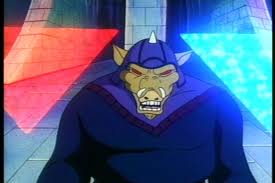
Now the show aired five days a week, but the Super Mario Bros. cartoon only aired four days a week.  That’s because every Friday Mario took a day off and made room for another hero:  Link.  Link, of course, is the hero of the Legend of Zelda games who was also pretty popular at that time.  The Zelda cartoon was different in tone from the Mario one.  Yes, it was still geared towards kids but it shunned a lot of the tired chase sequences and movie parodies that were commonplace in the Mario cartoon.  The show revolves around Link, the hero of Hyrule, as he defends the castle and its coveted Triforce of Wisdom from the forces of the evil sorcerer Ganon.  The show is based off of the first Zelda game with some references made to its sequel as well.  Link is pretty clearly modeled after the character illustrations from those booklets and wields the same dinky little sword he has in Zelda II.  Ganon, on the other hand, looks to be more of a concept.  In both games, he’s pictured as a big green/blue pig who does have some magical powers.  In the show, he has more of a wizardly look with an ugly pig-like face.  He’s actually more menacing looking this way, but he’s not going to get in there and mix things up with Link.  He’d rather stand back and let his minions do the fighting, who are not surprisingly incompetent.  He’s in possession of the Triforce of Power (the show makes no mention of the Triforce of Courage) and has an endless supply of Moblins and Stalfos.

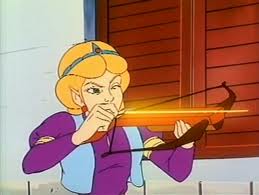
Other characters include a fairy named Spryte, who is likely modeled after the generic fairies from the Zelda games.  She is kind of the Tinker Bell to Link’s Pan in that she likes Link, but he only has eyes for the princess Zelda.  Zelda appears in each episode and is portrayed in a way that probably surprised viewers at the time.  Zelda shuns the traditional princess attire and instead sports trousers and tunic much like Link.  She’s not the typical damsel in distress and seems pretty capable of taking care of herself.  She does have a snotty side, and because she’s the target of many of Ganon’s schemes, she does often require saving from her “hero.”

Zelda is not afraid to get her hands dirty.

Zelda is not afraid to get her hands dirty.

The portrayal of Link in this series is what many fans dislike about the show most.  Link, in the games, really had no personality.  Even in the modern games, he doesn’t have much of a personality so I don’t know what fans were expecting from the character, it just wasn’t this.  Link is a brash, cocky, and kind of lazy character.  He views his title of “hero” as a job and one that just gets in the way of his pursuit of Zelda.  Not an episode goes by where Link doesn’t beg the princess for a kiss, and because viewers need a reason to tune in, he never gets one.  He’s also been given a catch phrase, “Excuuuuuse me, princess!”  Some day I would like to watch the entire series and count how many times Link says that line (according to Wikipedia, it was 29 times).  The show only produced 13 15-minute Zelda cartoons, but I’m willing to bet that Link easily averaged more than two occurrences of that catch phrase an episode.  Sometimes the line makes sense, and sometimes it’s just shoe-horned into the script.  It even occurs during the opening credits.  Link may have said that stupid line more often than Michelangelo said “Cowabunga” on the TMNT cartoon, on a per episode basis.

Ganon and the two things he covets most.

Ganon and the two things he covets most.

Anyways, that aside, the show is of a better quality than the Mario cartoons, though that isn’t saying much.  In general, each episode features Ganon executing a new plan to capture the Triforce.  Some of these are more clever and entertaining than others.  There’s one where Ganon goes Robin Hood and to sneak into a magic contest, there’s another where a Zelda clone infiltrates Hyrule, and there’s even a frog prince story-line where Link finds himself the victim of a magic spell (and if you’re wondering, no, Zelda doesn’t break the curse with a kiss).  That said, there isn’t anything in the writing to this show that’s going to impress.  It’s pretty standard fare for the period.  One thing I can appreciate though is the attempt of the writers to explain a few loose ends from the video game.  Namely, how can Link carry so much crap around with him?  Apparently, he has a magic pouch that causes items to shrink down to micro size to fit in.  Throughout the series he and Zelda will often pull out items from the games like the boomerang, bow, and bombs.  Other enemies make appearances too like the octoroks and just about every boss character from the original game.  If you’re watching it to spot items from the game, you’ll have some fun with the show.

Animation wise, the show is mostly crap.  It’s not awful to look at but this is a DiC produced show and DiC liked to put out lots of licensed cartoons on the cheap.  They would get a large amount of cartoons made in a short amount of time so that the shows could go direct to syndication and exist for a few years and bounce around several channels.  I think, on average, the animation here is better than what’s in the Mario cartoons but that’s not saying a whole lot.  The audio is okay though and the Zelda theme is used throughout, which doesn’t hurt it.  Link’s voice, when he’s not saying that regrettable line, is all right.  Ganon is voiced by Len Carlson who should be familiar to fans of 80’s and early 90’s cartoons as he got around.  He uses a shrill voice for Ganon that works for this portrayal of the character.  Zelda is voiced by Cynthia Preston and I always enjoyed her voice.  I don’t really know why but I was drawn to it as a kid.  Maybe because Link sexualized her and I wasn’t accustomed to seeing that in other kid shows of the time.

She's such a tease.

She’s such a tease.

The Legend of Zelda cartoon is not something that is remembered because it’s a wonderful companion piece to the video games, it’s remembered for nostalgic purposes only and is a kind of humorous reminder of how games were marketed back in the day.  A lot of fans prefer the Zelda themed episodes of Captain N to this show because Link was more of a hero type in that show than he is here.  That show really isn’t any better on the whole as it was just another marketing tool (and all of these old cartoons are basically shunned by Nintendo today) to move video games.  This isn’t a show that most adults can turn on and digest over an hour as it’s pretty damn bad.  It’s kind of funny to laugh at, and I can say I do enjoy it more than the Mario cartoons, but if I didn’t watch it as a kid there’s no way I’m making it thru more than one episode.  The complete series was released by Shout a few years ago and can probably be had on the cheap for those looking to experience it.  Those that have never seen it would probably be better off just watching some clips on the internet as opposed to spending real money on the series.


The Legend of Zelda

The Legend of Zelda (1986)

The Legend of Zelda (1986)

It likely comes as no surprise that the author of a blog titled The Nostalgia Spot enjoys playing old games.  I love having old consoles laying around the house, either hooked up to a television set or even just sitting in a closet waiting for a rainy day.  It’s almost a sort of nostalgic high to snap a cartridge into a Sega Genesis or hear that familiar spring when pushing a cart into place on a Nintendo Entertainment System.  Because so many of these systems are existing in a closet or attic, it can be a bit of a chore to relive the old days but thankfully digital distribution is here to make things easier.  Sure, nothing is better than the original experience.  Often times if there’s an old game I feel like I missed out on I’m more apt to find a used copy on the internet than download it.  The one exception is in the portable realm.  Nintendo is one such company that has released a lot of its old titles for download onto portable gaming systems.  I’d actually argue the company hasn’t released enough.  It has a tendency to focus on old portable games when selecting new ones to release and not enough on old NES or SNES games.  A lot of the classics are available though, and that’s why I’ve been spending a lot of quality time with an old favorite recently:  The Legend of Zelda.

I’ve actually had a copy of The Legend of Zelda on my 3DS for awhile now.  I bought the system at launch only for Nintendo to drop the price dramatically not long after due to lackluster sales.  To avoid ticking off the early adopters Nintendo released 20 free games to these “Ambassadors,” as they called them.  They were ten NES games and 10 Gameboy Advance games.  Among those ten was The Legend of Zelda.  Initially these releases were bare-bones lacking some of the features of the typical downloadable games.  As the games were released to the public though, Ambassadors were able to re-download them for free with the save state feature.  The feature is certainly a nice one to have, especially for a game like The Legend of Zelda which popularized the save feature in console games.  The feature was rather crude by today’s standards, but the re-release fixes that and allows the user to save whenever he or she wishes, which is a necessity for gaming on the go.

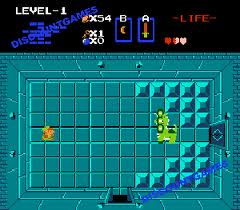
The boss of the first (and 8th) dungeon is a cake-walk.

The boss of the first (and 8th) dungeon is a cake-walk.

For the most part, I don’t blog about the all-time classic titles, there’s just enough of that stuff all over the web.  Sometimes a game becomes so old though that people tend to forget about just how good it is.  No one I know would say The Legend of Zelda is a bad game, bust most would the caveat that it’s “good for its era.”  That is just not true.  This is a title that does not need to get by on reputation.  Before playing it I had spent a few weeks playing a recent RPG released for the 3DS:  Paper Mario Sticker Star.  The Paper Mario series is a pretty good one, but Sticker Star is not a very good game.  It’s far from awful, but it’s so tedious and needlessly gimmicky that I just found it tiresome.  I saw it thru to the end but really wanted to wash the stink away.  I didn’t have a new game lined up, so I dug into those ambassador titles and settled on The Legend of Zelda.  Now, I’d be lying if I said it was easy to jump right into.  There’s always a bit of a culture shock when going back nearly 30 years with an old game.  That’s when one realizes just how used to today’s comforts they’ve become.  With The Legend of Zelda we’re talking about an early generation NES game.  It’s not even considered good looking for an NES game.  The backgrounds are pretty sparse, all of the dungeons look the same (save for the color), and Link (the protagonist, for those unaware) doesn’t have much personality.  Pretty much the entire plot to the game was contained in the booklet that came with it, so don’t expect much in the presentation department.  This is just a really simple looking game.
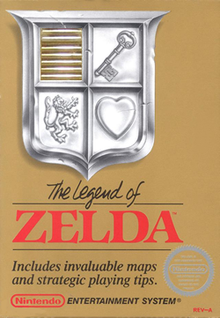
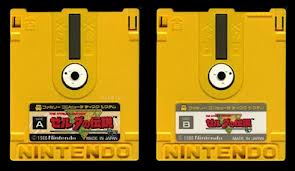
Pretty much everyone is familiar with the gold NES cart, but fewer are aware that in Japan the game was originally released for the Famicom Disk attachment.  This was never released in other parts of the world, which is what necessitated the inclusion of a battery for saving in the American cart.

Pretty much everyone is familiar with the gold NES cart, but fewer are aware that in Japan the game was originally released for the Famicom Disk attachment. This was never released in other parts of the world, which is what necessitated the inclusion of a battery for saving in the American cart.

Despite that though, it really didn’t take me long to get sucked in.  It actually didn’t take me as long as I would have guessed.  Once I got my feet wet and found that first dungeon I was off and running.  Things started coming back to me, I started getting used to how to approach each enemy again, and I started to have fun.  Lots of fun.  This game has no business being this good still.  It’s also crazy how similar it is to every game in the franchise.  It’s easy to forget where the series started when chasing down Ganondorf or watching Link turn into a wolf, but the same basic game design has remained the same since 1986.  It’s funny to me, and a bit misguided, how Nintendo has tried to give gamers a new experience by adding some silly gimmick to recent Zelda titles but has never really attempted to change the experience.  Majora’s Mask is probably the lone exception on console games, while the portable titles have mixed things up to some degree while maintaining a familiar interface.  Though even there, Nintendo has still muddled things with gimmicks like touch controls or trains.  Nintendo consistently fails to realize that it often implements change, like touch controls or the waggle controls on the Wii edition of Twilight Princess, for the sake of doing so and rarely addresses the actual gameplay experience.  Whether gamers are pressing a button or flicking their wrist, they’re still making Link swing a sword.

Tangent aside, it’s actually a great deal of fun to be reminded of where the series started.  I always liked this title back on the NES, and the sequel only reinforced that, so I suppose it shouldn’t surprise me that I still like it.  The game probably would be less fun for someone who has never played it.  There are so many little things one has to do to make it thru to the end that the game just doesn’t even clue you in on.  Throughout the game there are these old hermits living in caves that offer advice.  Some of it is cryptic but does have value.  Some of it seems like nonsense, a mistranslation perhaps.  Then there are other secrets that just have no indication whatsoever.  The entrance to Level 8 is one such thing where Link has to burn a random bush on the overworld map.  Most bushes aren’t affected by the candle item Link has to use to burn this one particular bush down, but the player is still expected to figure it out somehow.  I suppose this bush isn’t completely inconspicuous, but others are.  There are a few hidden stores or caves that a player isn’t going to find without help.  And that may have been the idea as there were numerous tip hotlines and the like for games back in the 1980’s.  Nintendo would get in on the action with Nintendo Power though this game arrived before that.  And Zelda games weren’t the only offender, but it’s something that really isn’t heard of in modern games.  We’d consider it poor design.  In other words, if this is your first time playing this game, expect to be in need of a walkthrough at some point.

The ones in blue are a pain to deal with.

The ones in blue are a pain to deal with.

Aside from some confusing moments, the game actually isn’t too difficult provided you know what you’re doing.  If one never upgraded the sword or Link’s armor then the game would get really hard.  I actually got the magic sword one dungeon later than I could have and that last dungeon with the mid-level sword was a bastard.  The game takes some getting used to in order to figure out just how close Link needs to get in order to defeat enemies.  Early on I found myself taking unnecessary hits but once I found my bearings I was okay.  Most of the enemies move faster than Link, and since this was before the invention of his spin attack, it can be challenging to keep them at bay.  The boomerang becomes Link’s best friend and remains so for most of the game as it freezes enemies on contact.  Keeping Link’s health maxed out is also a tremendous asset as that lets him shoot beams out of his sword.  Some enemies though are just plain hard to defeat without taking damage.  The wizrobes are probably the most challenging as they take 3 hits with the magical sword to defeat.  Striking them also doesn’t interrupt their movement or attack, and they can teleport all over the screen.  Needless to say, getting out of a room full of them without taking any damage is a true challenge.  The boss encounters, on the other hand, are all pretty easy as long as you know what you’re doing.  The final boss, Ganon naturally, can only be killed with a silver arrow and it’s entirely possible to reach him without ever finding said arrows making survival an impossibility.

Ultimately, I’m making this entry because I’ve been surprised with how much enjoyment I’ve been able to squeeze out of this title recently.  If you’re a younger gamer who never played the original Legend of Zelda then I suggest you do.  There are many options for playing it in this day and age as it’s been re-released more times than I can remember.  The easiest way to get it is via download from Nintendo and I think it only costs five bucks, but I’m not certain.  This is one title that has withstood the test of time, Zelda II on the other hand…


Catching up with ESPN NFL 2K5

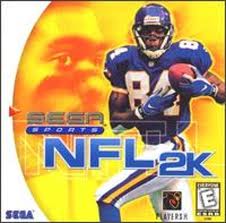
images-72It used to be that the world of sports video games was a free-for-all.  While various movie, television, and comic book licenses were sold off to developers, seemingly anyone could produce a football, baseball, basketball, or hockey title and pony up the dough to get a professional league’s endorsement of their product.  Before that happened though, publishers had to first find out there was value in that.  It used to be that most sports games were just about the sport.  Most of the games on the NES and before were just called Baseball or Football while other publishers would get a little more creative and gives gamers a title like Blades of Steel.  Eventually publishers saw the value of marketing with star power, but before they went the route of acquiring full league licenses they tried the marque player route that put Larry Bird on our 2600.  I don’t know what the first game to get a full league license was, but I do know that the first one I played was World Series Baseball on the Sega Genesis.  All of the teams I was familiar with were now present as were the different players.  Licensing agreements between leagues and their respective player’s unions made this possible (even though some mega stars liked to opt-out of these agreements and annoy gamers throughout the country; I’m looking at you, Michael Jordon) and sports games became more authentic as a result.  This was the status quo for a long time and for some leagues it still is.  For football though, that’s no longer the case and hasn’t been for a long time.

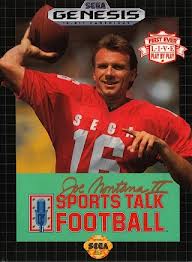
This was basically the cover of every sports game pre 1994, just swap out the athlete with another.

This was basically the cover of every sports game pre 1994, just swap out the athlete with another.

EA Sports has been the king of the virtual football world for a long time now.  Originally Tecmo held that honor with its popular line of Tecmo Bowl games but when those failed to evolve EA, partnered with John Madden, stepped in.  EA’s games thrived during the 16 bit era, especially on the Genesis which performed exceptionally well in the United States.  There were other competitors, most notably Acclaim and eventually Sony’s 989 Studios, but Madden was generally regarded as the best.  When EA announced that it would not support Sega’s new Dreamcast console it was a mighty blow to the doomed machine.  Sega had more or less won the 16 bit wars with sports titles but now found itself without its star general.  Sega did what only Sega could do:  develop its own NFL game.

Visual Concepts and Take-Two Interactive led the way with the inaugural NFL 2K in the late summer of 1999.  Sega showed off an impressive demo at E3 earlier that year that had caught the eye of many gridiron gamers but few really expected Sega to deliver a game in its inaugural year that was worthy of challenging Madden.  Sega had put out a few football titles on the Genesis but making a football game in the 3D era was totally different. The naysayers were proven wrong as NFL 2K was a critical and commercial success for the fledgling Dreamcast, and even though it wouldn’t be enough to save the console, it proved worthy of hanging around.  It’s timing was perfect too as Acclaim’s Quarterback Club was growing stale, and 989’s NFL Gameday had completely fallen off.  Madden was left to run unopposed for the most part, and needed a worthy adversary to prevent it from sharing the same fate as its vanquished foes.

Though it may be hard to imagine today, Madden was mostly geared towards casual players back then.  The game was at its best, and most fun, when dropping back to launch a deep ball down the sideline to Moss.  No longer confined to the world of two-dimensional sprites, Madden was fully realized in 3D but the oddly proportioned and stiff animating player models left something to be desired.  NFL 2K was the shiny new muscle car parked next to the Madden station wagon.  It was faster, leaner, and more explosive.  Running the deep post with Moss was now even more fun than it was before, and things like running the ball and rushing the passer no longer felt like chores between pass plays.  Madden wanted you to have fun, NFL 2K wanted you to experience NFL football.

Go ahead, try and stop him.

Go ahead, try and stop him.

The debut game was not perfect, and a lot of the front end needed some polish, but the presentation shined in other areas.  Commentary from the fictitious duo of Dan Stevens (Terry McGovern) and Peter O’Keefe (Jay Styne) felt vibrant and alive even without the name recognition.  A sports ticker scrolled by to update the player on other games and replays were used judiciously.  When dropping back to pass, the player no longer had to call up the button assignments for receivers, they were already present.

Visually, the game was a tour de force when compared with Madden.  Madden did a good job with player faces, but 2K topped them everywhere else.  They were better proportioned, but mostly they just plain moved better.  Madden was always stiff and steering a running back thru the defense felt like steering a boat.  In 2K, players were quick and cutting left and right.  When the gap between blockers was minimal they turned their bodies to squeeze thru the tiny hole.  When the ball was in the air receivers would leap over defenders if they had to in order to pull it down while a tiny scat-back would get blown up if trying to truck a stout middle linebacker.

Playing the game was also fast and just generally more entertaining.  Passing the ball was a true blast as so many weapons were made available to the player.  Quarterbacks were not restricted to the play called as far as how the ball would travel thru the air.  If the player wanted to lob it, he could.  If he wanted to put a little extra mustard on the throw to zip it into tight coverage, he could.  Maximum Passing meant players could intentionally under or over throw targets with a flick of the analog stick.  Have an agile receiver running outside with a corner over him?  Under throw him so only he has a play on the ball.  Have a tall receiver streaking towards the back corner of the end zone?  Take advantage of his height and toss it up.  He may not come down with it, but neither will the defender.  Knowing how to pass the ball to each receiver is a must for continued success.  If your stone-handed blocking fullback is open in the flat it’s best to lob him a softy than toss him a bullet that will probably bounce of his face-mask.  Knowing your personnel is equally important in the running game as scat-backs like Warrick Dunn are not likely to find much success between the tackles.  Get those guys in space where they can spin and juke their way to pay-dirt and leave the stiff arms and truck maneuvers for the likes of Mike Alstott.  NFL 2K also proved that defense could be fun.  Playing the line and rushing the passer was a game of cat and mouse.  You may find initial success with a certain technique but offensive lines will adapt and double you if necessary.  Playing in the secondary and trying to stick to a receiver was extremely difficult and only for the true pros, but hanging back and making plays on the ball with a safety was both rewarding and fun.

NFL 2K was here to stay, and though Madden routinely topped it in sales, EA wasn’t pleased to have legitimate competition.  EA was especially perturbed when 2K5 (now dubbed ESPN NFL football) was released for only 20 bucks.  This was the last straw and soon EA locked up the NFL license (along with the NCAA, Arena League, and others) and basically put an end to Sega’s annual football game.  This was especially unfortunate as 2K5 was a godsend for football fans.
The addition of the ESPN license meant full animated game intros hosted by a virtual Chris Berman.

The addition of the ESPN license meant full animated game intros hosted by a virtual Chris Berman.

Earlier games in the series had their own issues.  Not all would be solved but by the time 2K5 came around a lot of them would be.  Earlier games featured an over-powered run game.  Perhaps VC and Sega really wanted to make running the ball as fun as passing, but by making it so effective they messed up the balance.  Changing the blocking patterns and playing up to the difference in backs (power vs finesse) helped to solve this.  The dreaded suction-blocking was also less of a problem come 2K5.  Suction-blocking is a fan-coined term that described the game’s programmed blocking animation that forces a defender to engage.  Even when controlling a defender manually, it was something the game forced upon those who played.  Madden was plagued by it too and would be for some time longer but 2K found a way to nearly eliminate it come 2K5 (though it was still hard to disengage from a blocker).  Earlier games were light on options and Madden seemed to always trump 2K in this department, but 2K5’s franchise mode was quite robust and a series of challenges in the ESPN 25th Anniversary section kept gamers busy.  Other additions, like the virtual Crib and first-person football, were there for those who wanted it but were mostly duds.
ESPN NFL 2K5 is kind of like the NFL equivalent to WWF No Mercy.  A lot of football fans to this day still feel it’s the best of the best.  I was a 2K guy and before the series went multi-platform I rarely played a football game.  Madden never felt right to me, and the most fun I had with a football game was NFL Blitz.  NFL 2K2 was my first taste of the series and I was hooked.  To this day, I’ve only owned two versions of Madden with all coming after the exclusivity agreement.  Neither entertained me as much as 2K5 did, though the inaugural Madden on the Wii did entertain me for quite a while.

Visually, the game is no longer a tour de force but is far from ugly.

Visually, the game is no longer a tour de force but is far from ugly.

With the NFL season winding down, I’ve been going back to 2K5 recently to see how it holds up.  A lot of the flaws I remember still jump out at me.  Lead blockers can be annoyingly dumb.  Perhaps it’s because of the whole suction-blocking thing getting blown up, but a lot of the times a blocking fullback will run right by a blitzing linebacker or defensive end and head straight for the next level.  This does my running back no good since he doesn’t have a chance to get into the secondary when a guy is already all over him at the line scrimmage.  Receivers tend to be too stone-handed with 3 or 4 drops a game from my receiving corps being a common sight.  I know guys are going to, on occasion, drop an easy one but it seems to happen too often.  Defensive backs are also really good in man coverage.  While receivers are not omniscient, they don’t know the ball has been thrown in their direction if they haven’t actually turned to look, corners seem to know exactly when to break off their assignment whether they’re watching the QB or trailing a receiver.  It makes it hard to find the “gimme” completions and even check-downs can be an adventure (why do so many check-downs to backs in the flat or receivers running out patterns result in incompletions?!?).  There’s also the matter of the near game-breaking QB evasion moves initiated by flicking the right stick.  Even statues like Drew Bledsoe can shrug off what looked like a sure sack and as a result I rarely use it because it feels cheap.

Not everything VC brought to the table proved to be a good idea.

Not everything VC brought to the table proved to be a good idea.

A lot of this stuff would be rectified by now as most are AI problems.  And at least it goes both ways.  The CPU will miss out on some easy completions because of receivers that can’t make a clean catch.  And your team will also have some pretty sticky cover guys of its own to roll out.  Since the 2k series was shelved, Madden has adopted a lot of what made the series great including guided passes and placing more emphasis on animations.  2K is still fast though, even compared with the current games, and still a blast to play.  I love approaching the line, checking the coverage, and adjusting the play on the fly.  I wish there were more robust audible options, but the hot routes make the majority of plays incredibly customizable.  If a defender is playing way off the line I’m happy to check into a short pattern and if I notice a corner has no safety help on a speedy receiver I’ll audible to a fly or slant pattern.  The adaptive AI reduces the presence of money plays which dogged older football games.  Sure, most will still have a few go-to plays for certain situations but good gamers will experience the full playbook as opposed to a handful of the same plays.  Few things are as rewarding in gaming as executing a perfect stop-and-go with an expertly timed pump-fake followed by a deep lob over the top.

My head tells me that the recent versions of Madden have likely trumped ESPN NFL 2K5 at this point.  The game came out over 8 years ago so surely it’s been improved upon by now.  My heart though won’t allow me to admit it.  When I play Madden I enjoy it but it doesn’t pull me in.  When I turn on 2K5 for a game I can’t stop at just one.  Not even the dated rosters can dim my enjoyment of this one though it does sadden me that the series was cut down in its prime.  There is hope though as EA’s license agreement with the NFL will expire at the end of this year and it was announced that Take-Two will revive its long-dormant NFL franchise in 2014.  It seems hard to believe that the developers could come in and create an exceptional football game after 10 years without the NFL license, but that just puts Take-Two and Visual Concepts in the same position they were in back in 1999 and we all know how that turned out.


THQ Wrestling Games: End of an Era

200px-THQ_logo_2011.svgJust last week an auction took place in which all of the assets held by video game publisher/developer THQ were sold off as part of a bankruptcy filing.  Several games the company was known for will either cease to be or exist in a new form and smaller developers now find themselves being assimilated into much larger publishers.  Not to be forgotten are all the jobs that will be lost either by THQ no longer existing or by layoffs from the purchasing parties.  As someone who has been part of an acquisition I can say it’s not a fun experience and there’s lots of uncertainty for those involved.

What’s is certain is that THQ will no longer be in business, and as such, it’s partnership with World Wrestling Entertainment has come to an end.  THQ’s involvement with wrestling games predates the WWE license acquisition and fans have been enjoying THQ branded wrestling games for well over a decade at this point.  For the WWE, its license is now in the hands of Take-Two and 2K Sports who will only be the third publisher to hold the much coveted property.  What remains uncertain, is if developer Yukes will have any involvement with future games.  It’s entirely possible that Take-Two won’t want to ruin a profitable arrangement and hire Yukes to develop the successor to WWE ’13.

Such questions will be answered eventually, most likely at E3 if not sooner, but now is a time for reflection.  THQ’s wrestling games provided hours upon hours of enjoyment for myself and other gamers out there, but which games will THQ be remembered most for?  And also, which were the best and most ground-breaking titles?  The following is one man’s opinion on the five best wrestling games released by THQ:

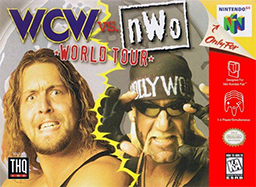
WCW_vs._nWo_-_World_Tour_Coverart5. WCW vs nWo: World Tour (1997)

For most gamers, myself included, this was the first wrestling game any of us experienced that made us feel like we were part of the action.  Developed by Asmik Ace Entertainment and AKI, World Tour introduced to American audiences a whole new way to experience a wrestling game.  Prior games were little more than brawlers with a few noticeable moves and contemporary games like WCW Nitro and WWF Warzone were overly complicated and seemed inauthentic.  World Tour sacrificed some realism for entertaining gameplay and made use of a grapple system that allowed players to access various moves.  The whole system was rather simple and each wrestler essentially controlled the same, but the experience was truly captivating and horribly addicting.  I never owned this game for I didn’t own a Nintendo 64 at the time, but I rented it several times and always had a blast with it.  The sequel, WCW vs nWo:  Revenge is basically the same game just with a fresher coat of paint, so World Tour gets the nod on this list for being the originator.  This was the start of a very profitable relationship for AKI and THQ.

4. WWF Smackdown:  Here Comes the Pain (2003)

The console wars of the 32 bit era never approached the fever pitch that was the 16 bit era, but Playstation vs N64 was still a pretty solid rivalry.  Playstation tended to have the more mature games while the N64 had the classic Nintendo franchises to keep people happy.  One thing N64 gamers had over PSX gamers was wrestling games as the ones put out by THQ easily trumped the best Acclaim had to offer.  This rivalry extended into the wrestling word as it pitted WCW vs WWF who were in a dogfight to establish supremacy over television thru the now famous Monday Night Wars.  Eventually, WWF would overtake WCW and soon THQ would jump ship and partner with WWF to bring the WWF experience to console gamers.  THQ handed the license over to AKI and basically told them to turn Revenge into a WWF game, while Playstation gamers were asked to trust in a mostly unknown developer called Yukes.  Yukes was popular in Japan for its wrestling games over there, and soon their fast-paced brand of wrestling action was available state-side as WWF Smackdown.  Smackdown was an instant success and offered an almost completely different experience from the slower-paced AKI games.  The first game was rather bare bones while the second introduced a robust single player game and create-a-wrestler.  The series really cemented itself though with the Playstation 2 title Here Comes the Pain.

Previous Smackdown titles eschewed the grapple mechanics of the AKI games and opted to allow players to skip the grapple and initiate moves from a standing position.  Here Comes the Pain slowed things down just a touch and brought in a linking grapple system that helped lend a new level of authenticity to the matches and open up the move-sets.  This major addition to the gameplay combined with a wide selection of match type makes Here Comes the Pain the best of the original Smackdown series.

In Day of Reckoning 2, submission holds did more than just inflict pain.

In Day of Reckoning 2, submission holds did more than just inflict pain.

3.  WWE Day of Reckoning 2 (2005)

Into the era of the Playstation 2, Xbox, and Gamecube, THQ continued to opt for a different WWE themed franchise for each console.  While the Playstation brand held onto the Smackdown series, new ones were created for Xbox and Gamecube.  Xbox was given the lackluster Raw games while Gamecube got a new Wrestlemania themed one.  It wasn’t much better, but eventually it would be scrapped and Yukes would be called upon to create a new themed franchise which was dubbed Day of Reckoning.  Day of Reckoning was sort of the spiritual successor to the popular AKI games from the N64 days.  DoR put the emphasis on grapples and introduced a new system where submission moves took on new meaning.  This was the result of the inclusion of a stamina meter and limb-targeting.  The single player was also the most involved of any to date and even carried over (in a narrative sense) from the first game.  The game also looked excellent and sported an excellent create-a-wrestler mode.  If it was lacking in anything it was a defining match type.  Still, this one is a dark horse candidate for best of all time.

2.  WWF No Mercy (2001)

Some fans, to this day, still proclaim WWF No Mercy the best wrestling game ever created.  That’s high praise, especially if one steps outside the WWF/WWE/WCW games and includes the excellent Fire Pro series.  Undeniably, a huge reason for such claims is nostalgia and the good memories many have of the game.  No Mercy was the sequel to the first WWF/THQ game Wrestlemania 2000, which was basically WCW vs nWo: Revenge with a palette swap.  No Mercy brought a more robust single player game, new match types, and still retained the same tried and true gameplay that just wouldn’t get old.  There was also a nice rivalry between this game and Smackdown 2.  Fans of Smackdown pointed out how their game had Hell in a Cell and TLC match types while No Mercy fans held fast to the simulation cred the AKI games had garnered.  Whatever side you were on, you had a great game and No Mercy is still a fun experience today.  If you want more thoughts from me on No Mercy, check out this entry I made last year on the subject.

1.  WWE Smackdown vs Raw 2006 (2005)

The Buried Alive match was something fans had been asking for for a long time.

The Buried Alive match was something fans had been asking for for a long time.

The Smackdown vs Raw games were part of a new directive from THQ.  Someone wisely figured out that THQ was only competing against itself by putting out multiple WWE games a year.  While hardcore fans loved it and may have bought multiple games, most picked a series and stuck with it and the development costs just didn’t make it worthwhile.  So it was a sad day when franchises like Day of Reckoning came to an end with the Smackdown vs Raw series taking over.  It was basically a continuation of the standard Smackdown series, but overtime that game became more sophisticated, more varied, to the point where it resembled the original titles in the series in name only.  The gameplay was still quicker than the sluggish AKI games, but not cartoonishly so.  Each wrestler had various different grapples they could initiate which was just the starting point for unleashing pain upon the opposition.  Now games truly started to emulate the television product.  Yukes found a way to make a realistic wrestling sim while also keeping it fun to play.  A bunch of new takes on old matches, and new additions like the Buried Alive match, also enhanced the fun factor.  The GM Mode, while never truly realized, was also a fun diversion and the create-a-belt feature is superior to the current one in WWE ’13.

So have all of the games to follow these been inferior?  Not necessarily.  If I lined them all up and played them for an hour each I’m not sure which game I’d enjoy the most, it’s just that the current games have done little to advance the genre.  In that respect, maybe it’s a good thing for gamers that the WWE license is changing hands.  It might be nice to see what a developer new to the franchise could come up with.  If Take-Two intends on releasing a WWE themed game this year, it may opt to reach an agreement with Yukes for at least one more game since development on WWE ’14 was likely already underway.  And in turn, Take-Two could hand the license off to one of its development teams to get cracking on a game for 2014.  Time will tell, but Take-Two has its hands full if it wants to make fans forget about the glory days of THQ.


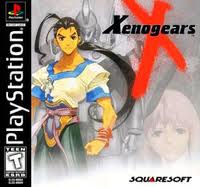
Greatest Games: Xenogears

Xenogears (1998)

Xenogears (1998)

For me, all of my entries in my “Greatest Games” subcategory have been building towards this one.  My intention with the series was to present some of the games I felt were among the best I had ever played while shying away from the obvious choices.  After all, plenty has been said about A Link to the Past or Super Metroid.  While I made entries about Chrono Cross and Twisted Metal Black I was constantly looking ahead to that one game I preferred above all others.

Xenogears arrived during the RPG boom of the late 1990’s.  Developed by Squaresoft under direction from Tetsuya Takahashi, the game was originally supposed to be Final Fantasy VII but it became too dark and too sci-fi in nature to continue as such.  Takahashi was allowed to continue with the project as opposed to seeing it outright canceled but at a much reduced budget (more on that later).  Many Final Fantasy collaborators contributed to the project including executive producer Hironobu Sakaguchi.  When the game was complete, most of the staff would go on to develop Chrono Cross before eventually departing Square with Takahashi to form Monolith Software.

The game begins with our hero Fei in a rather innocent setting.

The game begins with our hero Fei in a rather innocent setting.

Takahashi was nothing if ambitious when creating Xenogears.  It was conceived as being just a part of a much larger narrative and is in fact titled as Episode V in the game’s credits.  The narrative focus of the game is epic in scope with a lot of talking points and several cut scenes, some of which are done with CG and others in full animation.  It’s a long game, one that will take most players around fifty hours to complete on the first play-through.  It’s story focuses on the young Fei Fong Wong, a typical RPG lead in that he has no family and knows very little about his past.  The plot will see Fei discover his true purpose, which is of course a significant one, as he journeys across the globe with a cast of characters out to save the world.  The story is nothing new in setup, but how Xenogears approaches it helps to differentiate it from the flock.  There are many religious undertones to the game’s narrative, some of which nearly scared Square out of an international release.  The game takes itself very seriously and though there are moments where comedy is utilized they’re not frequent.  The game has been criticized for being too pretentious, but it is a fairly enjoyable experience even if it can be hard to understand.

Part of the reason many consider Xenogears to be so pretentious is due to the fact that it tries to be too many things.  There are elements and themes taken from classic philosophy as well as modern sci-fi conventions found in the likes of Blade Runner.  The plot of the game seems to bounce around in focus with lots of twists and turns.  It’s fairly common for games in this genre to start off with one goal and finish with something completely unrelated, but Xenogears takes it to a new level.  The game does a good job of remaining interesting the whole way through but perhaps it would have benefited from a tighter structure.

Giant robots called gears play an important role in Xenogears.

Giant robots called gears play an important role in Xenogears.

The gameplay for Xenogears incorporates a lot of genre staples but also introduces some new concepts.  Players travel from town to town either on foot or via transportation and can talk and engage with non-player characters along the way which is often necessary to advance the plot.  Battles are initiated via random encounters on the overworld map or in dungeons.  Once a battle is commenced, the player takes control of a party of up to three individuals chosen beforehand or dictated by the game.  From there it’s a variation of the Final Fantasy Active Time Battle system where a speed score dictates the order and frequency of each character’s attacks.  When it’s the player’s turn, the options are also fairly straight-forward and include attack, defend, run, item, or magic.  The magic command is usually called ether or spirit but functions in the same way as a typical magic attack in most RPGs would.  When the player selects a standard attack is where things change.

In Xenogears, each character has a certain amount of attack points that can be used per turn.  At the beginning of the game there are six per character, but it increases over time.  Each face button on the Playstation controller corresponds with an attack command and has a point value:  triangle is one, square is two, X is three, and circle cancels or ends the attack.  A player can combine the buttons in any way up to the maximum available or use as few as one.  Certain attack combinations will trigger deathblow animations where the character will execute a more powerful move.  Performing the necessary sequence over and over is the only way to learn them but the game keeps track for you in the menu so you don’t have to guess.  The buttons do not have to be entered with any sort of speed so it’s not like a rhythm game or a fighter.  If the player chooses to use fewer than the available attack point total then the remainder goes into a bank for the rest of the confrontation.  As the player accumulates additional attack points, combos become available.  Combos basically allow the player to chain deathblow attacks in one turn allowing for a massive amount of damage to be unleashed.  As a result, most encounters (particularly boss encounters) end up being a balancing act where the player has to decide if it’s better to go all out from the start or build a character (or characters) up to unleash a giant combo.

Cut scenes like this nearly kept the game from getting a release outside of Japan.

Cut scenes like this nearly kept the game from getting a release outside of Japan.

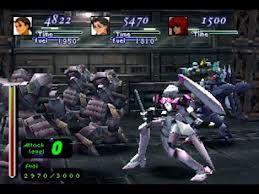
That’s just one half of combat as Xenogears’ main feature is that of gear combat.  Gears are giant robots piloted by the game’s protagonists and allow the player to take on much larger foes.  Each character has access or will gain access to a gear during the course of play.  The gears basically mirror the character they’re paired with so the ones effective at dealing out the most damage on foot will be the same in their gear.  Even certain magic attacks are unusable by the gears while some are only usable on foot.  One of the more unique characters in the game, Billy utilizes guns and so his gear does as well.  On foot, each attack button corresponds to a different gun and the same is true in his gear, though it uses different ammunition.  Gear battle is very similar to character battle but has some notable differences.  For one, the player can only use two combinations of attack buttons but instead of having attack points each gear has a supply of fuel.  Each attack consumes fuel with triangle attacks consuming the least and X attacks consuming the most.  As a gear attacks, its attack level goes up.  At level one, triangle deathblows can be used.  At level 2, square deathblows become available, and so on.  There are four levels a gear can reach:  1, 2, 3, and Infinity.  Infinity is the most powerful and only becomes available late in the game.  It’s also not attainable simply by performing four non deathblow attacks in succession.  Instead, there is just a chance a gear can reach infinity when in level 3 and certain gears have a better chance of doing so than others.  Infinity opens up the best deathblows and lasts for three turns so when a gear is able to reach it it usually swings the tide of battle.

The character Elly is a central figure of the Xenogears plot.

The character Elly is a central figure of the Xenogears plot.

Gears also present some challenges not felt when fighting with the human characters.  I mentioned the fuel already which can run out.  If a gear runs out of fuel then it can’t attack, which presents a problem.  Each gear can use a turn to charge which replenish fuel but not a significant amount (unless the player equips a gear with charge-boosting items) and is not something one wants to rely on.  Gears also cannot replenish their hit points easily in battle.  Gears can be equipped with restorative items but they consume a lot of fuel.  Often times, this will cause the player to wait as long as possible to use such an item but then they find themselves in a situation where the gear is now low on fuel exchanging one problem for another.  Basically, the game forces the player to think a little differently when engaged in gear combat and that helps keep the game fresh.  The game is pretty much divided into equal parts gear combat and non-gear combat which does help to keep things interesting.

Outside of combat, character customization is pretty standard.  Each character can be equipped with stat-boosting items and armor with the best items becoming available towards the game’s conclusion.  Only some characters utilize weapons in combat just as only some have magic attacks.  Most will fit into the attack role or the support role with a few select characters performing adequately in both roles.  The game does do a good job of making the characters feel different.  I mentioned Billy earlier as one such character due to his use of firearms.  Another, Maria, always attacks with her gear even while on foot and another character has no gear at all, she can just grow to tremendous heights instead.  As character participate in battle they earn experience points and level up, in turn becoming stronger.  Gears do not receive any benefits from their pilot leveling up.  Instead, they can be upgraded through-out the game with better equipment including engines and frames which increase the gear’s stats as well as its hit points.

A lot of the combat takes place in gears.

A lot of the combat takes place in gears.

There are other things to keep players interested in the game.  Outside of battle players can search the world for players of the game Speed.  Speed is a real-world card game (when I was a kid we called it Spit) where the determining factor of who wins is who plays the fastest.  Defeating these players will often net a useful item and certain secret items can only be obtained via this mini game.  Another mini game is a gladiator type of coliseum where the battles take place in real-time.  The player can select from basically every gear in the game and compete in a fast-paced one on one battle.  It kind of reminds me of the Dragon Ball Z fighting games in that the characters zip around pretty fast and alternate between melee attacks and long-range energy projectiles.  At any rate, both mini games offer decent distractions and are entertaining in their own right.

Visually the game is a fairly solid performer given its era.  The designers opted to use sprites for the characters instead of polygons and while they animate nicely they are quite pixellated.  Backgrounds tend to be on the sparse side and the texture mapping is average.  Backgrounds are a hybrid of 2D and 3D and most areas can be rotated via the shoulder buttons on the controller.  It’s a bit odd watching the game try to rotate around a 2-dimensional character but it does help for timing jumps (something else that helps differentiate the title from a typical RPG, albeit in a minor way).  When the game transitions to gear battle everything becomes rendered in 3D.  The gears are fairly solid-looking and each has its own visual personality.  Attack animations are pretty understated when compared with other games from the genre.  There’s very little in the way of “wow” moments but nothing is really off-putting either.  If anything, the sprite-based approach helps in the long run as many games that opted to use polygons look woefully dated by today’s standards.  The score is quite good and on-par with Final Fantasy’s best, though some of the sound effects are a bit lackluster.  The FMV and anime sequences are not numerous but that helps give them added impact when they do show up.

Xenogears tends to take itself quite seriously.

Xenogears tends to take itself quite seriously.

There is one other thing I have yet to mention about this game that many view as a glaring negative. I mentioned how the project was an ambitious one but I have yet to mention that it was so ambitious it went over budget.  If a Final Fantasy game runs over budget at Square it’s probably not that big of a deal but when an unestablished title does it presents a problem.  Since there was no money left a large section of the game had to be cut, but since the title is so narrative heavy, it could not just be annexed from the game.  Instead, when the player reaches the point in the game where the cuts took place (early in disc 2) they’re treated to a mostly black screen with the exception of Fei seated in a chair.  Here a seemingly endless amount of text is displayed as Fei takes on the role of narrator and explains to the gamer what took place next.  Other characters speak as well, but the presentation remains the same with the exception of a couple of gameplay rendered shots.  The scenarios being described were supposed to be playable but unfortunately are not.  And this section goes on for a good 45 minutes or so.  I remember the first time I reached this point of the game (I’ve played through it multiple times) it was really late at night and I just wanted to go to sleep but had to keep going and going to get through it.  The game does give you the option to save a couple of times so at least there’s that.

Xenogears may not be visually impressive by today's standards, but it still has its moments.

Xenogears may not be visually impressive by today’s standards, but it still has its moments.

As a result, the game feels like it never got what it deserves, which is what every game deserves:  to be completed.  Xenogears sold modestly well but with the creators behind it all leaving to form Monolith it basically ended the possibility of there ever being a true sequel.  Xenosaga was initially conceived as being a part of the Xenogears lineage, but either legal decisions forced that to change or an artistic change was made.  Xenogears presents a pretty open and shut story with little room for a natural sequel, but I would love to see Square return to it as a remake.  The game could be left as is or it could be cleaned up completely with an all new engine.  Some pacing issues could be addressed, but most importantly, the portions of the game cut could finally be restored either thru a new gameplay section or via fully animated cut scenes.  Since Takahashi no longer works for Square, it would have to be done without him but considering the ground work has been laid already it wouldn’t be that difficult.  Xenogears deserves to be experienced the way it was initially conceived and I would personally prefer to see it remade over Final Fantasy VII, a remake many people have been hoping for.  Maybe it will happen one day (though probably not), but even if it never does Xenogears remains my favorite game of all-time.  I know it’s not the greatest game ever made, but it doesn’t have to be in order to win me over.

For those who have never played it, second-hand copies of Xenogears can still be found fairly regularly on auction sites like eBay.  Square-Enix also released the game onto the Playstation Store so Playstation 3 owners can experience the game that way.


WWE ’13 – The Attitude Era

WWE '13 (2012)

WWE ’13 (2012)

Let it be known, nostalgia sells!  Too many of us overgrown children have disposable income to throw at DVD collections and old toys and publishers are well aware of this.  Just look no further than this year’s entry in the WWE video game catalog:  WWE ’13.  Now, there’s nothing nostalgic about the title but the focus of the game’s single player mode is the now much celebrated Attitude Era of the WWE.  I’ve spoken fondly of it in the past, but that’s definitely my favorite era for the then WWF, even surpassing Hulkamania for me in terms of pure enjoyment.  Vince McMahon’s promotion was arguably never more popular or culturally significant at any other point in time, including today.  It made a lot of sense to revisit it (even if it seems strange to almost ignore the current product by doing so) and without it I’m not certain I would have purchased the game.

This review is going to mostly focus on the Attitude Era mode, but before diving into it I will provide an overview of the rest of the game.  This is the second game since THQ/Yukes dropped the Smackdown vs Raw title and refined the gameplay.  I didn’t play last year’s game, but the differences from the last Smackdown vs Raw and this one are minor.  They brought back the limb targeting system and modified the chain grapple slightly.  The changes are mostly superficial, but not to the detriment of the gameplay.  The havok engine the game makes use of was overhauled to a point as well.  The ring now reacts better to what’s going on, as do objects in the field of play.  Though overall, the visual quality looks to have taken a slight step back.  The audio is kind of all over the place in terms of levels, and the new dynamic camera system is wretched (but thankfully something you can turn off).  The create modes are unchanged.  Some moves have been returned to the game and some have disappeared.  It’s pretty disappointing that the create-a-finisher mode is still as limited as it was when it first debuted several years ago now.  There’s also a create-an-arena that is new but not very exciting.  I haven’t checked out the create-a-scenario but I suspect it hasn’t been improved upon much, if at all.  WWE Universe mode is also back for the third year in a row.  Expect more of the same.

Fans get to relive some of the biggest feuds from the Attitude Era, including Hart vs Michaels.

Fans get to relive some of the biggest feuds from the Attitude Era, including Hart vs Michaels.

The gameplay is solid enough, and it’s probably one of the better grapplers put out by Yukes, but I’m only interested in the Attitude Era.  The Attitude Era mode basically replaces the single player storylines from past games.  It’s divided into multiple parts that put the focus on a different wrestler from the era.  The scenarios are:  DX, Stone Cold, The Brothers of Destruction, The Rock, Mankind, and Wrestlemania XV.  The first scenario starts off in the summer of 1997 and the scenario ends after Wrestlemania XV.  Once complete though, some bonus challenges open up featuring wrestlers such as Edge, The Godfather, and Lita.  I was rather impressed with how many old wrestlers were included in this mode considering some of them are no longer with the company.  Expect to take on the British Bulldog, the Road Warriors, and even Vader as you progress through the scenario.  During each match, the game will also assign special objectives that unlock additional content along the way.  Most of these objectives refer back to the real match and encourage you to recreate it as best as possible.  None stand out to me as being particularly challenging so expect to unlock them all with little trouble.

Since the Attitude Era has, until now really, been something only fans recognize it makes it difficult to get a consensus on when it started and ended.  Some think it started as far back as “Austin 3:16,” while others maintain it was the infamous Montreal Screwjob.  THQ decided to go with the formation of Degeneration X when Shawn Michaels and Triple H turned their backstage “Kliq” into an actual onscreen stable.  The game also constantly references the Monday Night Wars, the ratings battle between WWF’s Raw and WCW’s Nitro, as an ongoing storyline throughout the Attitude Era.  DX ends up being pretty well represented in the game, with the only notable exclusion being Chyna (probably due to her being an adult film actress now).  Even Mike Tyson is present for Wrestlemania XIV, which makes sense given that he was inducted into the WWE’s Hall of Fame earlier this year.

The roster includes expected stars such as The Rock, as well as some of the era's lesser stars like Ken Shamrock.

The roster includes expected stars such as The Rock, as well as some of the era’s lesser stars like Ken Shamrock.

The characters THQ chose to focus on for the era were logical.  They were certainly the most recognizable  from the era.  A lot of the big matches are covered including Michaels vs Hart at Survivor Series ’97, the inaugural Hell in a Cell match, the more famous Undertaker vs Mankind Hell in a Cell match, and the mode culminates in Austin vs Rock.  The only matches I missed that weren’t included was the Monday night match between Mick Foley and Terry Funk (who’s not included in the game unless you want to pay for him as Chainsaw Charlie) which took place in between the Austin vs Dude Love Pay-Per-View bouts; and the Austin vs Undertaker Buried Alive match at Rock Bottom ’98.  In the case of the second one, Yukes probably didn’t feel like coming up with a Buried Alive match again (they did at least bring back the I Quit match for the Rock vs Mankind feud) or the WWE felt like it wasn’t appropriate for their audience.  That last excuse seems unlikely as the game doesn’t shy away much from the content of the era.  There are some annoying inconsistencies though with the liberties taken by THQ.  For instance, Billy Gun is able to use his Bad Ass gimmick but Road Dogg can’t say the word “ass” as part of his intro.  The raunch is mostly absent though beyond a few utterances of the phrase “suck it.”  Austin’s middle finder is annoyingly censored, and the audio is as well whenever a character says “WWF” (it sounds like a lot of the audio was lifted directly from broadcast tapes excepting Jim Ross and Jerry Lawler’s commentary) which is distracting, but not as distracting as if they were saying WWE instead.

Current stars, like Triple H, are also depicted as their Attitude Era selves.

Current stars, like Triple H, are also depicted as their Attitude Era selves.

The game mode makes frequent references to WCW and its Nitro program but focuses solely on Raw.  It would have been cool to bounce back and forth considering WWE owns all of the WCW stuff at this point, plus a lot of WCW’s wrestlers from that era eventually ended up in WWE.  Perhaps THQ will one day give fans a WWE vs WCW game.  It’s also a little disappointing that the scenario ends before the end of the Attitude Era.  Like the start date, the end is hard to define but most everyone would agree that Wrestlemani XV is not the endpoint.  It’s more logical end would either be the start of the Invasion storyline, the introduction of the nWo into WWE programming, or Wrestlemania XIX where Stone Cold wrestled his final match.  Perhaps THQ is saving that for future downloadable content, a sequel, or maybe it was just too burdensome to pull off.  In order to accurately depict that era wrestlers such as the Dudley Boys, Hardys, and Kurt Angle would have to be included and all are currently with TNA Impact Wrestling.  TNA has in the past allowed its wrestlers to appear on WWE programs, usually limited to Hall of Fame related stuff, so maybe those guys could appear in a WWE game, but maybe at an unattractive price for THQ.

Regardless of the mode’s shortcomings, it was by and large a fun experience for me to take a trip down memory lane with some of my favorite characters from yesterday.  The mode got a lot right, and I appreciated the subtle details such as making all of Foley’s alter-egos their own selectable character, same for making the Hunter Hearst Helmsley character different from Triple H.  There is quite a bit of content in the scenario, though probably not enough to make purchasing the game solely for the Attitude Era mode a wise one.  I think I’ll get enough mileage out of the rest of the game to make it worthwhile, but I still have yet to fully dive into the other modes.  I’m glad to see the WWE and THQ recognizing that there’s a large market for the Attitude Era and hopefully this isn’t the last we see of it.


The Wii U and Gaming in the HD Era

Last Sunday, Nintendo unleashed upon the world its latest console:  the Wii U.  For some, the Wii U is the beginning of the latest era of gaming while others simply view it as Nintendo’s entry into the current HD generation of consoles.  Regardless of your opinion, this is a new console and new consoles are something to get excited about.

I had made the decision to reserve a Wii U for myself awhile back so picking up the deluxe bundle on launch day was no problem.  I also picked up a new Pro controller and a copy of New Super Mario Bros. U.  As far as console launches go, the Wii U appears to have had a mostly successful one.  When I picked up mine it was around 1 o’clock and the Best Buy I went to was already sold out of the deluxe bundle.  The sales receptionist I spoke with wasn’t certain, but did think they still had a couple of the standard bundles in stock.  For those unaware, the deluxe version comes with more internal memory (32 GB vs 8), a copy of Nintendo Land, a charging dock for the GamePad, and comes in black as opposed to white.  For the extra fifty bucks, it seemed like a smart choice to me though for those stuck with the smaller unit know that the Wii U works with most external HDD so expanding upon that 8 GB of memory shouldn’t be too difficult.

If I had to use one word to sum-up the GamePad, it would be: Big.

The Wii U is quite similar to its predecessor in terms of looks.  It’s fairly small and plain looking.  It still makes use of a sensor bar and Wii remotes and the main home screen remains mostly unchanged.  The big change obviously comes in the Wii U’s GamePad, a combination of a tablet and a standard controller.  It has four face buttons, twin analog sticks, and four shoulder buttons including two triggers.  It has a slot for a stylus as well as home, power, and TV buttons.  The TV button allows you to pair your GamePad with your television and use it as a second remote.  It’s functional and kind of neat for when you have your GamePad on your lap.  The controller is fairly large, but light.  It’s nearly the same size as the console itself.  It’s light feel is welcomed, but it does make the controller feel a bit cheap.  Shaking it causes the buttons to rattle, and the shoulder triggers are not analog meaning there’s no sensitivity to them (pushing it all the way in or slightly has the same in-game effect) which is a bit of a letdown.  The touchscreen though is large and quite nice with very good picture quality.  It doesn’t seem to be quite as good as the Playstation Vita’s OLED screen, but gets the job done.  It communicates with the Wii via wireless and infrared and there’s no noticeable lag.

The Yoshi’s Fruit Cart game is one of the more interesting ones on Nintendo Land.

How the GamePad functions with the Wii U is obviously what will make or break the system.  Nintendo Land is the game that’s supposed to put the GamePad’s features front and center which makes it almost a required purchase for early adopters.  Nintendo Land is basically a collection of mini games each one based on a different Nintendo property.  Some of these IPs are pretty well known, like Zelda, while others not so much, such as Balloon Fight.  I’m not a big fan of mini game collections so I haven’t really got into Nintendo Land.  There is some cool stuff in there though.  The Ninja Battle game has you aiming your GamePad at the TV and sliding your finger towards the screen to toss ninja stars.  The Yoshi Cart game has you draw a line on the GamePad for your cart to follow to pick up fruit on the way while avoiding obstacles.  The catch is that the fruit and obstacles only appear on the TV screen while the GamePad is blank.  Games like the Zelda adventure are mostly straight forward.  The GamePad can be used to view the scenery by physically moving it, or the player can just look at the screen.  Nintendo Land seems to just scratch the surface without really showing anything revolutionary.  It will be interesting to see how Nintendo makes use of the GamePad in their classic franchises.

Baby Yoshi returns in NSMBU.

There’s no wondering when it comes to Mario though, since he has a new game at launch.  New Super Mario Bros. U is pretty similar to the previous entries in the series, GamePad or no GamePad.  I’m only a few levels deep, so I can’t say if it’s better or worse than the other entries in the series yet.  I can say that I like the Super Mario World inspired layout, and I like the inclusion of Yoshi even if he’s added as he was in the Wii game where he can only be used in certain levels.  I haven’t tried any multiplayer with it, so I can’t even comment really on the GamePad’s use there but in the single player game it’s really only used as a second screen.  Such a feature does have its uses as you don’t even need the television on to play the game, but it is disappointing that Nintendo couldn’t find a way to make use of its new toy with its flagship series.

It’s pretty nice that Nintendo has finally entered the HD era, but what isn’t nice is that they’ve also adopted a lot of what makes this era of gaming so frustrating.  The Wii U is the victim of the dreaded day one update, which means the second you plug in that new console it’s going to prompt you to update the operating system.  Ditto for both Nintendo Land and NSMBU.  The OS update took me well over an hour to update and install, while the Nintendo Land update took around a half an hour and NSMBU around 15 minutes.  That’s pretty damn annoying and one of the things that makes me long for the days of old.  Also complicating things, is the Wii U is the victim of severe loading times.  Changing screens takes around 15 seconds on the unit and booting up a game is far from seamless.  I don’t know if this is something that can be improved upon with future updates or if we’re just going to have to deal with it.

The Wii U has some things going for it, but it’s definitely not the revolution that the Wii was.  Playing the Wii for the first time felt incredibly fresh and new, while I didn’t get the same feeling when playing the Wii U.  It’s certainly fun, and there’s probably better software out there (like Scribblenauts Unlimited) for showing off the GamePad, but right now the console is far from a must buy.  Get it if you love Nintendo or want to have the latest thing, otherwise most will be fine waiting for the first big Nintendo game on it or price drop.


Wreck-It Ralph

Disney hasn’t made many movies recently that interested me in the least.  They tend to focus on obvious children’s movies now-a-days and leave the family genre to Pixar.  Which for the company is viable strategy since it owns Pixar and allows it to hit multiple demographics.  This makes Wreck-It Ralph an exception.  Wreck-It Ralph is the video game/non video game film from Disney Studios that is sure to appeal to adults who grew up in the 80’s and 90’s with its many references to classic games.  The film was unveiled in great detail at this year’s E3 and was one of the highlights of the show.  And even though I loved the film’s premise, I was concerned it would be a mostly shallow experience where most of the enjoyment for older viewers would come from cheap cameos of popular video game characters.  I’m happy to report that after seeing the film I was pleasantly surprised.

Perhaps I should have had more faith.  After all, John Lasseter is the one spear-heading Disney Studios these days and his track record from Pixar is stellar.  Directing the film is Rich Moore who is mostly known for his work with the Futurama franchise, a show that I adore (at least the first four seasons).  And the voice cast for Wreck-It Ralph is pretty good too with John C. Reilly as the voice of Ralph, Jane Lynch as Calhoun, and Jack McBrayer as Fix-It Felix Jr.  Other notable cast members include Sarah Silverman as Vanellope von Schweetz and Ed O’Neill as Mr. Litwak, the arcade owner.  I guess the only reason I was down on the film is because the trailers were pretty poor.  Outside of the group therapy session that everyone has probably seen by now, it looked like any old kid’s movie.  Instead though I found the writing to be clever, the video game references well placed, and a lot of the humor was derived from situations and expressions as opposed to simple jokes.  There are some corny jokes, such as the many that are derived from the name for one of the games, Hero’s Duty, but they’re seldom annoying.

An “in game” shot of Ralph and Felix from “Fix-It Felix Jr.”

The film opens with narration from the protagonist (antagonist?) of the film, Ralph himself.  We’re given the backstory to his game about how he’s the bad guy who smashes a building in a Donkey Kong fashion and it’s Fix-It Felix who, as the player, has to set everything right.  When he does, the tenants of the building Ralph was smashing bestow him with a medal and toss Ralph off the building into a pile of mud.  When the day is done and the arcade is closed, Ralph is left alone to live in the dump while Felix and the rest stay in the building and the other characters shower him with praise and pie.  Ralph isn’t just narrating this sequence, as it’s soon revealed he’s at a group meeting for video game bad guys.  Here is where we get our first round of cameos with notable characters being Zangief, Clyde, Bowser, and Kano, among others.  Ralph is tired of being a bad guy, while the group is designed to make bad guys feel good about being bad guys.  Ralph gets little out of confessing his desires to be the good guy and as everyone exits the meeting it’s revealed it was taking place in the center of a map from Pac-Man and everyone is animated with pixels, Pac-Man style.

A look at the video game transportation system.

After the meeting, we’re shown how this whole video game world works.  The characters inhabit their own arcade cabinets and while people are playing them they’re expected to perform.  When the arcade is closed they’re free to come and go as they please.  They leave their games by traveling through the power chord into the surge protector, which is kind of like a giant train station.  It’s in these scenes where more on-screen cameos take place.  I don’t want to spoil anything so look for yourself and see who you can spot.  Sonic the Hedgehog makes an appearance as a public service announcement and it’s him that lets us know that if characters die while outside of their game they won’t re-spawn.  After the meeting, Ralph passes through the surge protector and back to his game, depressed.  The inhabitants of the apartment building are throwing a party celebrating the 30th anniversary of Fix-It Felix Jr. and Ralph, awkwardly, gets himself invited where everything goes wrong.  An exchange takes place between Ralph and Gene, one of the other characters, that results in Ralph decrying that he’ll prove he’s a good guy by winning a medal somehow.  If he does, Gene promises to let him move out of the dump and into the penthouse .

Ralph and Vanellope, who needs Ralph’s help to win a race so she can be added to the roster of selectable characters for her game.

The rest of the film involves Ralph going off in search of a medal.  He ends up in a shooter game where Lynch’s Calhoun comes from and then gets dumped into a candy-themed kart-racer where he meets Silverman’s Vanellope.  The movie turns into a tale of friendship, redemption, and corruption as everything is not what it seems in this candy land.  Vanellope ends up being a fun addition to the cast and Silverman seems to really enjoy voicing her.  She’s likely to be the favorite of many movie-goers.  Felix has to go out looking for Ralph when he doesn’t show for his game, which threatens to get it unplugged for good, and Calhoun has to follow him to the racer in chase of an alien bug that followed Ralph and threatens to ruin the game.  Other video game lyngo is introduced that should be fun for fans and there’s lots visual delights involving licensed candy and treats.

The film is likely to entertain mostly in its visuals.  It looks great and the video game centric stuff is a lot of fun.  The older games tend to have a pixellated quality to the animation while the modern games are super slick.  A lot of the characters from the older games animate in a jerky fashion too which helps set the older games apart from the newer ones.  Ralph and Felix are immune to this for some reason, though I suppose it has more to do with the designers thinking viewers would get sick of the quirk if the title character was animated in such a fashion.  There’s plenty of in jokes for gamers too, ranging from ones that almost everyone will get to more nuanced ones (a very famous “code” makes an appearance) that will alienate some, but not to their detriment.  I was really impressed with the lore crafted by the writers in setting the rules for this video game universe.  It’s so much fun that I would love to see more films set in it, but I’m not sure if this one would benefit from a direct sequel.

The film is fairly long for an animated one, coming up roughly 15 minutes shy of two hours , but it’s well-paced.  The plot stays interesting and the animation is top notch.  Above all, the writing is solid and it should keep kids and adults alike entertained.  Wreck-It Ralph is a winner and it’s easily the best video game movie ever made, even if it’s not based on an actual game.