Author Archives: Joe

#4: Danzig – 4p

hqdefault-32In case anyone is wondering, no, I did not put this album at number 4 on my list because of its title.  It just worked out that way.  If anything, I’ve depressed this album on my list though I’ve tried not to.  I love this album, and sometimes after listening to it I feel it’s my all time favorite.  It possesses the most variety of any Glenn Danzig release, past or present.  The production is probably the best that Danzig ever saw, be it the vocals, guitar, or drums.  It’s moody, dark, personal, angry, violent – all of the components possessed by a Glenn Danzig fronted band.  And yet, I didn’t always feel that way…

I did not get this album when it came out (appropriately) in 1994.  I didn’t even know who or what Danzig was at the time.  I was too busy playing Sega Genesis and listening to Aerosmith to care.  It wasn’t until late 1997 or early 1998 that I was even aware of who Glenn Danzig was.  It was at that time that I was turned on to The Misfits by my closest friend (whom I owe a great deal to when it comes to music).  Before then The Misfits were just a band with a cool logo I saw on many t-shirts worn by the punk rock kids in my school.  The first song to grab me was “Attitude” off of the Collection II release put out by Caroline.  From that moment on I began to consume everything Misfits.  Their limited, and often repetitive, discography was soon in my possession.  And while I enjoyed it, it often felt like a cruel joke that before I was even born, The Misfits as I enjoyed them, were disbanded.

Finding the re-formed Misfits of the mid-90’s to be a cheap imitation of the real thing, I soon turned my attention to Danzig (I was at the time unaware that the Glenn Danzig fronted band Samhain existed between The Misfits and Danzig).  Wanting to find something current to enjoy, I went to the store with the intent of purchasing a Danzig record in hopes that it would captivate me as much as The Misfits had.  I settled on Danzig 4p, soley because it was the cheapest (10 bucks) and the track list was at least interesting.  Song titles such as “Brand New God” and “I Don’t Mind the Pain” were intriguing and gave me the impression that this would be more dangerous and mature than anything The Misfits had produced.

Upon popping that CD into my stereo when I got home I was met with mixed

Danzig 4p was the last Danzig record to feature the original lineup. Left to right: John Christ, Chuck Biscuits, Glenn Danzig, Eerie Von.

emotions.  The Misfits were fast, aggressive punk rock with a campy horror theme.  This was not.  The opening track, “Brand New God,” was fast and brutal with a slow bridge in the middle that soon brought the track back around to the speed metal it opened with.  A solid effort, in my mind.  After that though, the album descends into mid-tempo and even slower.  “Cantspeak” and “Going Down to Die” contained nothing even faintly resembling anything The Misfits did.  I was let down, and filed the album away.

I did not give up on Danzig after my initial purchase of 4p.  I went back and bought the debut album and allowed the stripped-down rock to grow on me.  I would soon acquire the entire back catalogue liking each album more than the ones I had bought previously.  At some point, probably when I had finally realized and accepted that this band could not be The Misfits, I came back to 4p with eyes open.  I realized how terrible my approach was initially, and musically speaking, it was one of the best things I ever did.

As I mentioned in the opening paragraph, 4p represents many peaks for not just the band, but for the artist Glenn Danzig.  The opening salvo fired by “Brand New God,” is like the ultimate red herring.  Aside from that bridge, it’s direct, simple and unapologetic in its delivery.  It bleeds into track 2, “Little Whip,” which begins quietly before exploding into a monster riff and machine-gun drumming.  The album’s violent beginning descends into its softest spot, the melancholy “Cantspeak” (sic).  Said to be influenced by politics and the general state of the world, “Cantspeak” represents perhaps Glenn Danzig at his most vulnerable.  The back-mask guitar (the inverse of the album’s closer, “Let it be Captured”) gives it a creepy gloom accentuated by the distorted vocals on the chorus.  The verse contains Glenn’s softest vocal delivery, bordering on falsetto.  It is a song that is both beautiful and depressing.

The album meanders along with this approach of dark and gloom.  “Going Down to Die” is one of Danzig’s greatest vocal achievements.  With his velvety croons dressing up the verse, he bellows out the big chorus to tremendous effect.  The bleak “Dominion” closes out the first half and is one of the few songs to follow a simple verse-chorus-verse-chorus-solo-outro pattern.  With it nestled amongst atypical material it comes across as refreshing.

Just when it appeared the album had settled into a distinct sound, “Bringer of Death” brings it back to where it started.  Opening with air raid sirens and machine-gun fire, the song is an uncompromising track focused on the devil, God, and war, and how the three are all intertwined.  Its structure mirrors that of the opening track, right down to the slow bridge before crashing through the outro.  The intermission, “Sadistikal” (sic) follows and provides a hint for the industrial elements Danzig would soon embark on following this release.  It’s not quite a song, but a feeling, designed to make the listener uncomfortable and introspective.  “Son of the Morning Star” follows and returns the album to a slower, quieter state.  The following two tracks present more of a mix, effectively combining the slow and fast in creating perhaps the most radio friendly tracks on the album.  The closer, “Let it be Captured,” is an all out power ballad.  “Going Down to Die” is one of Glenn Danzig’s best vocal performances, but “Let it be Captured” is the best.  The lyrical content is both sweet and sad as Danzig allows himself to appear in a weakened state.  He almost howls throughout the final parts of the song.  A sorrowful wail where the song’s title is repeated over and over.  A hidden track appears on track 66.  It’s basically a hymn and one of those cool, experimental type of hidden tracks that seem to have vanished from today’s releases.

In the end, Danzig 4p is one of the artist’s all-time best.  And for someone who has been releasing music since the 70’s, that’s high praise.  It is an album that both hits the listener in the mouth and drags it down to the darkest depths.  In many ways it is the peak for the original lineup of the band Danzig.  John Christ is employed to great effect on guitar with both hard-hitting riffs and melodic ones.  His delivery proves he is more dynamic than the previous three studio albums had lead many to believe.  He doesn’t get as many opportunities to shine with solos, but when he does he delivers.  Chuck Biscuits is relentless on drums, his best performance ever captured on a

Despite general disinterest on the part of MTV and radio, Danzig was able to establish a strong cult following. 1993-94 represents the band’s peak in popularity culminating in two top 100 singles and two gold records.

recording.  Always a highlight of the band, Biscuits sets the tone on many songs with the highlight performance probably coming on “Bringer of Death.”  Eerie Von, an often forgotten component on bass, is given more room to breath on this album.  His no frills approach suits the work.  And then of course there’s the central figure, Glenn Danzig, on vocals giving his best performance ever.  He howls, wails, and croons his way through the twisting and turning record.  Never again would his voice be this strong on a Danzig release.  Lyrically he was willing to explore more with this album than on previous ones.  The familiar heaven and hell elements were present, but now he was adding in more of an S&M vibe.  Some of the songs are more personal and the pervasive machoism of the previous releases relents some in favor of vulnerability.  Even in some of the slower songs on past records, the protagonist of the songs was usually in control, the only exception being the well-received “Sistinas” from Danzig III.

Danzig hit all of the right notes on 4p and it ends up being a wonderful note for the original lineup to go out on.  Following 4p, Glenn Danzig would leave the Def American label and begin the twilight era of his career composed of uneven releases, multiple labels, and frequent lineup changes.  This isn’t to say that Danzig 4p represents a swan song of sorts for the artist as quality has been put out since, but it was an end of an era and one many fans remember fondly.  And even so, Danzig 4p is an often overlooked album by both Danzig fans and hard rock fans in general.  Which in many ways represents the album’s sound of both tragedy and triumph.

Top Tracks

  • Cantspeak
  • Going Down to Die
  • Let it be Captured

#5: Tool – Ænima

Tool - Ænema (1996)

I was in junior high when Tool’s Ænima hit both the airwaves and stores in September of 1996.  Up to that point I was still trying to find my musical identity.  I knew it wasn’t as a fan of pop and hip hop styled music.  I had always gravitated towards rock with some of my early interests being Aerosmith and Guns N’ Roses.  I was also getting into punk rock and was enjoying the likes of Operation Ivy and NOFX.  Tool was different.

I had heard some songs and seen a few videos for Tool before Ænima.  “Sober” and “Prison Sex” were uncommon plays on local rock stations and the band had established a following.  Interestingly, it seems like both of those songs would become more popular with the success of Tool’s third album (though second full-length) Ænima.

My first experience with Ænima was the title track.  It was a modest hit across the airwaves even in its butchered, censored form.  From its opening not quite grunge but not quite metal guitar riff to the tribal drum beats and Maynard’s grunts, it’s a song almost designed to incite a riot.  Mid-way through the tempo changes up and the script the song appeared to be following is abandoned.  This is not a typical radio song.  Maynard lists off the things he despises about the LA culture as the song builds towards its climax.  And just when it builds the listener to a froth it abruptly ends.  I can remember feeling out of breath the first few times I heard the song.  It was like a drug.  And much to my delight, the song Ænima provided just a taste of what was included on the LP.

My best friend would get the album before me and we would listen to it on repeat.

Pretentious, brilliant, and yet unafraid to inject humor into the mix. That's Tool.

We’d laugh as the humorous moments and rock out to the head-banging tracks.  It was not long before I was able to scrounge up enough cash to get my own copy.  Since it’s become a favorite of mine.  I own everything Tool has put out and I don’t think the band has ever come close to matching the perfection of Ænima.  Opitate was a good introduction for the band and Undertow let the world know that this was a band that could not be dismissed.  Ænima cemented Tool’s reputation as one of the top acts in its genre, be that hard rock or metal.  Since then, Tool has gone in a different direction.  This isn’t surprising as none of Tool’s albums sound the same, though the most recent two, Lateralus and 10,000 Days, are the most alike.

At any rate, Ænima combines the best elements of Tool to create a perfect album.  There are dirty, crunchy riffs along with clean melodious moments.  Frontman Maynard James Keenan’s vocals are as dynamic as they come.  Subtle and cryptic, soaring and beautiful, distorted and angry, aggressive and direct.  This duality serves the band well and adds a layer of mystique and danger to everything  the band does.  None of the topics seem safe.  The title track yearns for armageddon, “Eulogy” crucifies a martyr with not-so subtle jabs at Scientology, “Pushit” describes a relationship seemingly destined to end in a murder-suicide, and even a simple filler track, “Die Eier von Satan,” tricks the audience into thinking it’s listening to a Nazi rally.  This, of course, is the band’s brand of humor taking center stage as in reality it’s a Hitler sound-a-like (Marko Fox) reading off a recipe for cookies.

One never knows what Maynard will look like when attending a live show.

The subject matter of the songs is really a post all its own.  The rhythms provided by drummer Danny Carey are complex and off-time leading to the album’s sense of unease.  Guitarist Adam Jones’ work on the album is vital to its success.  Sometimes credited along with Maynard as the creative force behind Tool, he weaves a tapestry of taste and aggression.  The guitar finds the right tone, the right mood, in every song and either works in sync with the drumming and bass or in contrast to create something unique all its own.  Jones avoids flash without being understated.  Tool proves with Ænima that it’s a fully functioning band with no one component drowning out the other.

When it all comes down to it, Ænima is a hard album to pick a top track from.  Everything on this album is designed to work with one another.  From the simplest segue to the abum’s bloated close, “Third Eye.”  It’s an album designed to be listened to from track one through fifteen.  It’s a colossal, roller-coaster of an album, and if I am to simply exclude personal taste and affection, it’s the top album from the 1990’s.

Top Tracks

  • Eulogy
  • H.
  • Ænima

Bucky O’Hare’s on DVD

The title card for Bucky O'Hare and the Toad Wars.

During the late 80’s and much of the 90’s many anthropomorphic characters came along to ride the wave of popularity launched by the Teenage Mutant Ninja Turtles.  There were many imitators, most of them failures, but Bucky O’Hare was different.

Bucky could at least boast that he was conceived before the famed heroes in a half-shell.  Created in the late 70’s by comic artist Larry Hama, Bucky pre-dates the turtles by almost a decade though he never saw print until the mid 80’s so who knows how much he changed in between.  Like the turtles, Bucky was green and the hero of his own book.  Unlike the turtles, Bucky’s world existed in a parallel universe and his adventure was a space opera, not unlike a certain movie created by George Lucas.

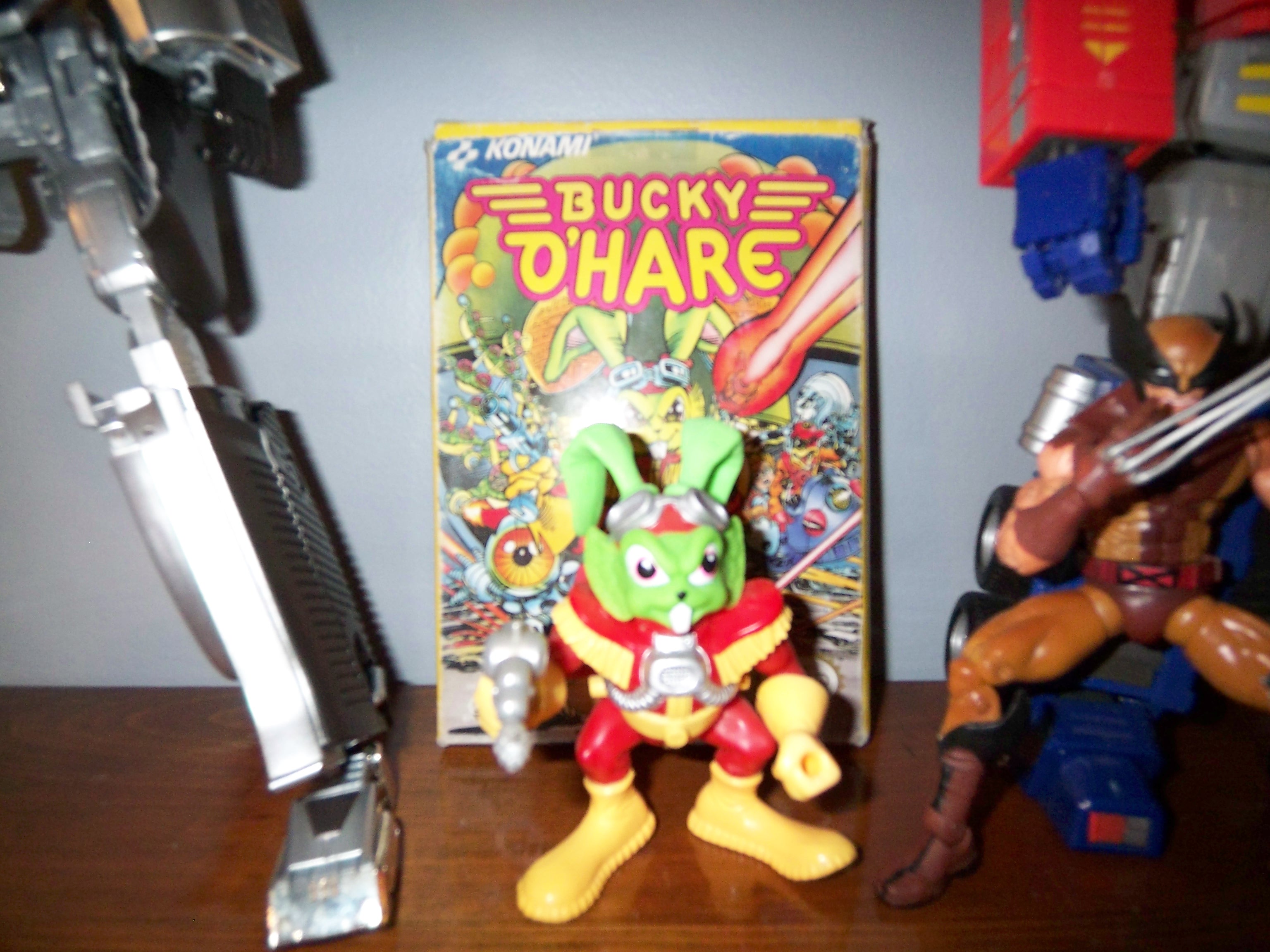
The funky fresh rabbit himself along with his video game.

The Star Wars parallels are actually quite numerous.  A small and perhaps arrogant government is overthrown by an evil empire.  Here that empire is composed entirely of toads.  Instead of a Death Star, their main source of offense is the bulbous toad mother ship (which also gets destroyed after the series’ first major story arch before being re-built) which houses an army of storm troopers and Tie fighter-like toad double bubbles.

Humans do not exist in this “Aniverse,” but unlikely hero Willy DuWitt finds himself accidentally transported to the Aniverse when his home-made photon accelerator malfunctions.  Willy is the stereotypical nerd.  He’s picked on by bullies and mostly an outcast even though he’s a smart and good kid.  Smart would be an understatement as his IQ passes the line of absurd on more than one occasion during the course of the animated series as he’s able to repair pretty much anything.

The animated series is where most of my Bucky acumen lies.  I do have a copy of the original trade paperback that spawned the series.  The two mediums are pretty similar to one another.  There are a few character differences here and there, most notably the characters of Bruiser and Toadborg (the series’ Darth Vader) who were added for television.  The cartoon also caters more to its target demographic, children, to the detriment of older viewers.

That approach may be what doomed the series to only one season of 13 episodes.

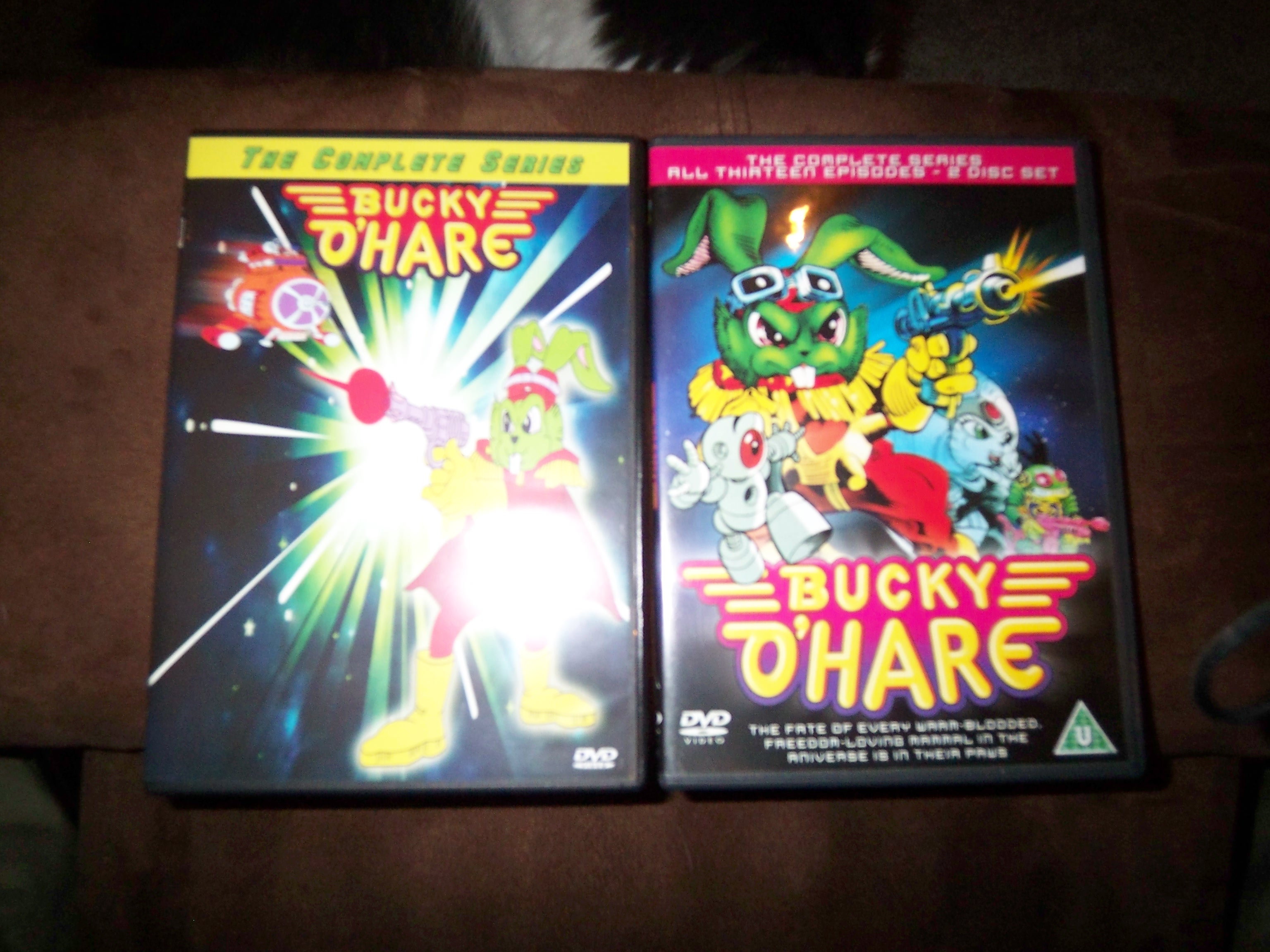
Side by Side, the two DVD releases. Region 1 on the left, 2 on the right.

The plot lines were fairly mature for a cartoon with a dose of politics thrown in that must have been boring for most kids.  At the same time, the short running time of each episode forced the writers to cram a lot into each episode, in effect, dumbing things down in the process.  Even the opening story line which occurs over the series’ first three episodes feels rushed at many points.  In episode 4, “Home, Swampy, Home,” Bucky journeys to see his mentor with the visit culminating in one not so subtle line and no on screen appearance.

The back covers for both releases. 1 on the left, 2 on the right.

Perhaps this was a case of the writers and directors making do with what they had.  They tried to cut out the superfluous stuff to keep things moving and to give each episode its own beginning, middle, and end.  At the same time, it would be interesting to see how someone else would tackle the source material if given the chance.

At any rate, Bucky O’Hare really appealed to me as a kid and I was devastated when the series was quietly cancelled.  I had every action figure and vehicle put out by Hasbro, as well as other assorted pieces of merchandise.  Bucky even had a fairly popular NES game that was affectionately referred to as the Konami Mega Man.  Though like most games of its era, it was brutally difficult.

Bruce, we hardly knew ye.

The series made use of what I always considered a great gimmick to hook new viewers, and that is to kill off a character in the first episode.  That sacrificial lamb here is the ship’s engineer, Bruce, the Beetlejuician Beserker Baboon.  The berserker baboons are a race of ape-men that strike fear into the hearts of toads everywhere.  One of the series’ better episodes has an amusing and clever plot device where the toads develop special goggles that make all baboons look pathetic to help them overcome their crippling fear.  Anyway, Bruce’s death is a Saturday morning kind of death in that no one ever says he’s dead and the circumstances were vague.  Here he gets sucked into the ship’s photon accelerator (its engine) which partially exists in another dimension.  Bruce makes an appearance in a later episode as a pseudo ghost existing between two worlds.  Either way, the gimmick works to attract new viewers because it creates a sense of danger that doesn’t exist in most cartoons.  X-Men also did this extremely well with the death of Morph in its second episode.

A portion of the show's cast, minus Blinky and Willy.

The cast of characters is standard fare.  There’s first mate Jenny, the telekinetic cat,who’s a pseudo romantic interest for Bucky though there isn’t much chemistry between the two.  She, along with Deadeye, are really the only characters given fully fleshed out back stories in their own episodes.  Her powers are also a secret to everyone except Willy.  Deadeye is the ship’s gunner and a former pirate.  He also has four arms, which I guess makes him twice as cool.  He’s a typical shoot first and ask questions later character which gives him a rough persona, an easy one for young boys to gravitate towards.  Blinky is the ship’s robot (actually, android first class, or AFC for short) distinguished by his large, lone eye that takes up most of his “face.”  Bruiser is a space marine and younger brother to Bruce who joins the crew to avenge him by squishing some toads.  I already talked about Willy, but he takes over as the crew’s engineer after Bruce’s departure.  He is able to travel between worlds at will, though in the comic he was trapped in the Aniverse.  The creators also don’t let him wield a real gun, he has to make do with a squirt gun.  It’s a tough life.

Bucky is the captain of the Righteous Indignation, one of only two ships in the United Animal Front’s underfunded fleet, though a third is added in one episode.  Bucky is the hero of his people, the hares of Warren, who is well known for his incredible jumping ability.  One of my favorite moments in the series occurs in episode 4, where after masquerading as a broken down old man to gain entry to a toad slave camp, Bucky outs himself to make a daring leap to a control tower to the shock and delight of his peers.

The Toad Air Marshall, along with Frix and Frax, are typical inept villains.

What’s a hero without a colorful cast of villains?  The Toad Air Marshall is the bumbling commander of the toad forces who’s schemes seem to always be thwarted by O’Hare and his crew.  He answers to Komplex, a toad computer program gone rogue who exists almost exclusively on a computer monitor.  Toadborg is a cyborg and the favored servant of Komplex.  Once a normal toad he was converted to machine.  He towers over the rest and is seemingly indestructible.  He may not be as brainless as the Air Marshall, but he consistently under-estimates Bucky and Co. which ultimately dooms him to failure just like his peer.  The twins Frix and Frax are the Air Marshall’s incompetent subordinates.  Instead of doing their boss’s bidding they spend most of their time watching Toad TV and drooling over the girls of “Warts Illustrated.”  Lastly, there’s Al Negator the sleazasaur (a purple bi-pedal crocodile-like race) who’s a mercenary for hire, though seemingly only the toads are interested (he does briefly get hired by Bucky to be the ship’s new engineer, but he quickly betrays them).

Bucky O’Hare has mostly vanished since his show was axed.  There was a limited

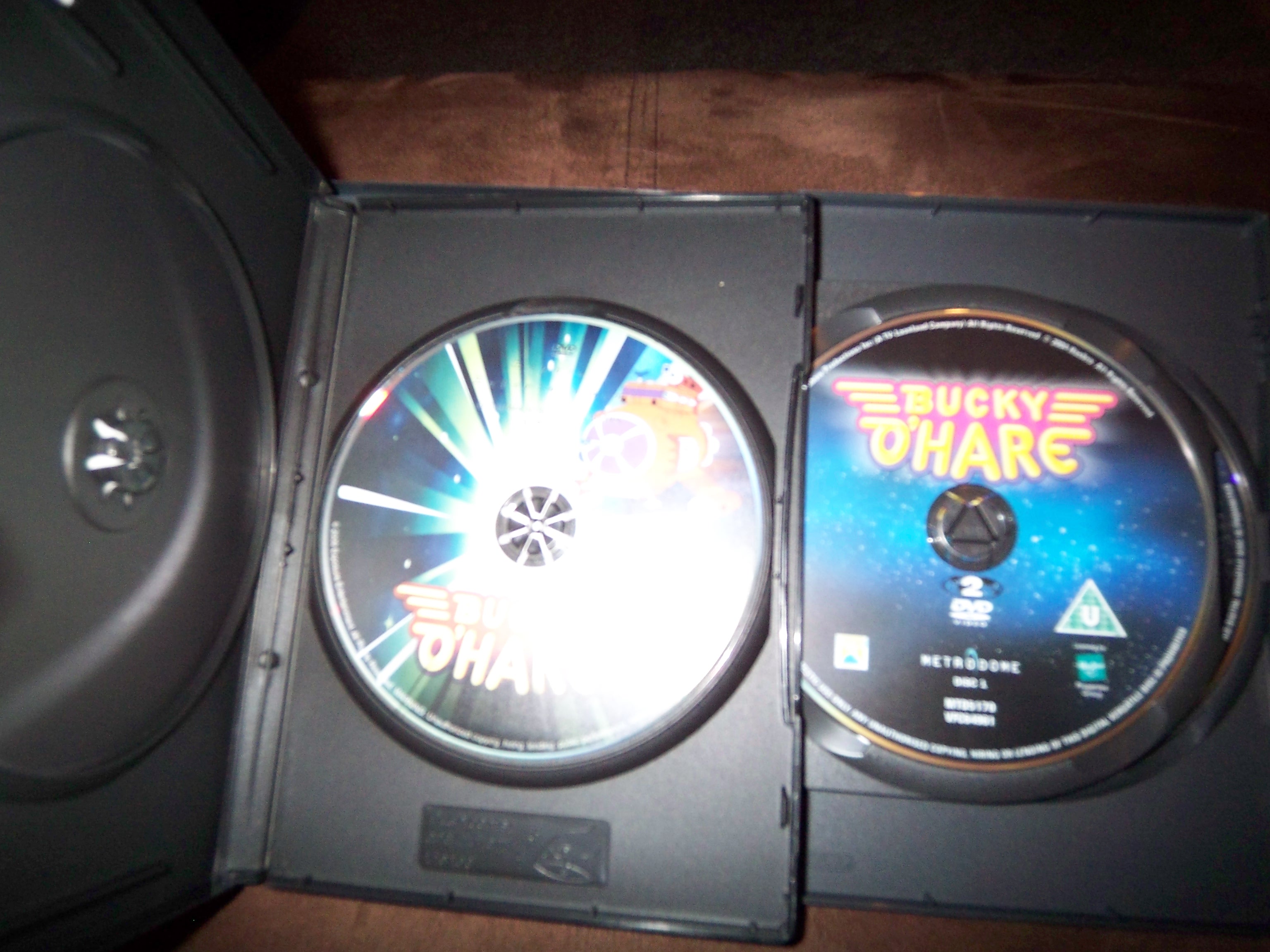
A comparison of the disc artwork, Region 1 left, 2 right.

comic run in Europe but nothing in the US.  Some of the episodes from the series, formally titled Bucky O’Hare and the Toad Wars, were released on VHS but the entire series was missing in action for a long time.  The series was released several years ago on DVD for those in the Region 2 market, but the rights for Region 1 distribution were tied up in disinterest until last year when a 2-disc set was very quietly released by Exposure Entertainment.  And by quiet I mean as quiet as possible.  Good luck finding the set in stores or even online.  There’s a few sellers on amazon.com selling copies for jacked-up prices.  I was able to score one on eBay for twenty bucks, which is probably an over-pay but I’m a sucker.

Toadborg may be purple, but believe me, you don't wanna mess with this guy (toad).

I am so bitten by the nostalgia bug when it comes to Bucky O’Hare that I actually own both versions of the DVD.  I bought a cheap DVD player a few years ago with an easy to bypass region code for the sole purpose of watching Bucky O’Hare.  In terms of packaging, the European release is by far the more attractive of the two.  It contains artwork from the TPB on the front and back covers and is all together more professional looking.  The American release looks like something created in clip art.  When I first saw it I thought it was a bootleg.  Bucky adorns the cover and is squished to fit inside its borders.  There’s a very plain and unattractive yellow bar at the top of the cover that reads “The Complete Series” in green block font.  The discs of the American release feature the show’s logo amongst a star burst with the Righteous Indignation at 2 o’clock.  The Euro release is a much simpler, but more professional looking, logo on a space background.  Neither one contains the subtitle. “and the Toad Wars,” which I found kind of odd.  The menus are not very interesting looking on either, but again, the Region 2 release comes across as being a bit more professional looking.  Neither one contains any bonus features or even an insert.  It’s just the episodes.  The menus also make liberal use of the show’s catchy theme song, probably the part of the show most people remember the best, almost to the point of ruining it.

Ultimately, this is a show only worth pursuing by those that have fond memories of it.  In re-watching them I’m able to see why I liked the show as a kid, and for me, that’s enough to make it enjoyable.  If I had not seen it and remembered it so fondly I’d probably be bored.  It’s not very intellectually stimulating, though it is smarter than a lot of its peers but not enough to hold the attention of an adult.  There is a heart to the show that does give it some charm.  I’d like to think that makes it the kind of show you can tolerate if your kid loves it and would consider it one of the better shows you have to endure for the sake of your children.  There is a definite drop-off in quality on disc two.  Not literally as all the episodes are pretty drab looking, just in writing.  The first few episodes flow together nicely while the remainder are more of the stand-alone variety.

The show did not get a proper final episode as it was cancelled before getting that chance.  An arcade beat-em-up was released following the show’s demise which served as an end for the series though it was hardly satisfying for those willing to spend the quarters to see it through.  The final episode did however wrap-up the lone season’s main plot line of Bucky’s quest to save his home planet of Warren, so there is a pay-off for those willing to see it through.

CG was not a good look for Captain O'Hare.

I would love to see Bucky get a shot at a comeback but he represents one of the longest of long shots.  Shocker Toys tried to put out a line of Bucky Shockini-styled action figures a few years ago.  They acquired the license and even released some promising prototypes but then quietly scrapped the whole thing.  Neal Adams, one of Bucky’s co-creators, has tried in vane to stir-up interest in either a new cartoon series or for a film.  He even self-financed a CGI short to use as an advertisement.  It was not well received.  And it certainly can’t be a good sign if Bucky’s DVD is nearly impossible to get a hold of.   In an era where even the most obscure and forgotten cartoons of yesterday are easy to come by Bucky is still forgotten.  No matter, Bucky’s popularity (or lack there of) won’t ruin my good memories of the show.  I’m glad I have these DVD’s, suspect quality and all, so I can revisit the season anytime I wish.


The State of MLB Video Games

The Show franchise stands as the best of the current crop of MLB games.

2010 was the first year since 2002 where I did not purchase a new video game baring the Major League Baseball license.  I’m not sure if there was one particular reason but I was surprised with myself that I just did not have the desire to get a new one.  Perhaps this ties in with my previous post about my feelings on video games in general and my lack of interest, but I always felt that my baseball obsession was enough to overcome that.  Maybe it was because the home town team, the Boston Red Sox, had just completed a rather drab off season and appeared to be stuck in neutral as the season approached.  Or maybe it was just the product itself hadn’t advanced enough in a year to warrant another purchase.

Whatever the reason, my apathy towards the idea of purchasing a new baseball title did not return completely this year.  In all likelihood, I will make a new purchase in 2011 and it will likely be for the latest title in the MLB The Show series put out each year by Sony.

The Show has been my franchise of choice over the past few years ever since Take Two Entertainment acquired the exclusive third party publishing rights to the MLB brand, thus putting a dagger into my preferred franchise of the time EA Sports’ MVP Baseball*.  This agreement did not apply to first party publishers so Sony was able to keep putting out a new game each year, which was a great thing because Take Two’s title has been consistently mediocre each and every year.

A great franchise that died too early.

*I always felt the consumer lost out big time with the exclusive rights deals brokered for sports games in the middle part of the last decade.  Take Two’s acquisition was largely a response to EA securing exclusive publishing rights to the NFL brand, thus killing off Take Two’s fantastic NFL 2k series and leaving gamers with Madden as their lone option.  In the span of a year, my two favorite sports titles were no more.

The Show has risen in quality over the years and has even surpassed the level of the final MVP game, though who knows where that franchise would have been now had it been allowed to exist.  The Show shamelessly ripped off MVP’s pitcher meter, a system where the player has to time his or her button presses with the release points of a pitcher’s delivery for optimal pitch execution.  This is a good thing as the pitch meter has been the single best addition to the baseball video game since the behind the plate hitting camera.  The Show has been able to add considerable depth to its franchise mode, clean up some annoying bugs, and give gamers the highly addicting Road to the Show game mode where players create a character and try to achieve Hall of Fame status over their career.

The first baseball game I ever bought and one of the best all-time.

The only problem with what I just stated is that most of those additions were either made or perfected for 2007’s game.  Since then, little has changed aside from incremental boosts to the game’s visuals and gameplay balance.  The last few years the game has felt like a $60 roster update.  If the same is true of this year’s title than Sony can safely assume that I won’t be purchasing the game in 2012, I’ll get my fix this year and let that title last me a couple of years.  So without further adieu, here is how I think this title can be restored to glory (bare in mind, I did not play last year’s game so if anything I propose was added for 2010 that’s why):

  • Better franchise mode – This is kind of a loaded suggestion but I’ll spell out exactly what I mean.  The current franchise mode is pretty solid, it lasts longer than most gamer’s attention spans and gives the player control over GM duties as well as Ownership duties.  There’s just one major issue that has bugged the Hell out of me over the years and that’s the ability to negotiate with players on your roster at any time.  Presently, the user signs a player to a given contract and the player plays out that contract to its end, barring early retirement.  I want to be able to approach said player in the final year of his deal about signing an extension, rather than waiting until the end of the season.  This better allows me, the gamer, to better manage how many expiring contracts I have to deal with at year’s end.  Since players cannot be predicted to re-sign no matter how much money is thrown at them, a year in which 3 or 4 core players are up for free agency can be devastating.  Also, let’s improve the feedback received when negotiating with players in free agency.  As I said before, their whims are impossible to predict since they won’t always just take the most money (no matter how crazy an offer you make them, it’s no guarantee of anything) which is fine, humans should be hard to predict.  I just want a sense of how interested the player is in my offer.  It’s a mechanism that has existed in virtually every game the last 8 years and even exists in The Show when working on trades.
  • Attrition and Improvement – For me, even though players come and go the franchise mode feels very static.  For the most part, the superstars of today will still be superstars 10 game years from now, which just isn’t realistic.  A 40 year old Tim Lincecum shouldn’t be firing 97 mph fastballs consistently nor should Albert Pujols find himself leading the league in home runs.  At the same time, those hot-shot rookies with A ratings for potential do not tend to get any better.  This pretty much destroys the minor league system and affects gameplay balance because while I, the user, know that minor leaguers do not improve no matter what the scouting report says, the AI still assumes they will and overvalues them in trades.  As a result, the game is interesting only so long as I can keep restocking my roster with real Major League players as opposed to the ones generated by the game for the annual draft.  This grossly affects gameplay balance in later years as most divisions seem to be won by 85 – 90 win ball clubs while mine win 110+.  And that’s with me simulating the outcomes of 99% of the games, so it’s not like I’m physically playing the game and just beating up on the computer controlled clubs on the field.
  • Waiver system – The Show has been good about adapting the various GM roles to the video game system but one has been omitted for too long and that’s the waiver wire beyond July 31st.  In the real world, players can be traded freely up until the non-waiver deadline of July 31st.  After that, any team wishing to move someone has to put that player on waivers at which point every team in baseball can put in a claim on him.  If a team claims the player the team that currently owns the player’s rights can either pull the player back off of waivers, allow the claiming team to take the player, or work out a trade with the team who claimed the player.  If multiple teams put in a claim then the team with the worst record is rewarded with the claim.  If no team claims the player then he has been cleared through waivers and the current team is now free to trade him to any club interested.  This system is not in the game, so after the July 31st trade deadline passes no trades can be made.  This should be an easy fix.
  • 40 – Man Rosters and Options – Right now, there is no way for me to view who is on my 40-man roster which determines who is eligible for the Major League team and who is protected from the Rule 5 Draft.  The only way to know who is on the 40 is to individually look at each player, which is tedious and time consuming.  There’s also no way to see how many options remain on a player.  Options allow the front office to freely shuttle the player back and forth between the big league club and the minor league affiliates.  And there’s no way to sign free agents to minor league contracts.  Again, easy fixes.
  • More Customization – When I create a player, particularly a pitcher, I want to be able to fully customize his pitches.  MVP did this so why can’t The Show?  Particularly, I want to determine pitch movement.  Using the normal clock format is easy.  I want my guy’s curveball to break 11 to 5, or 10-4.  Maybe my guy’s cutter breaks down more than horizontal, so let me do that too.
  • Manage Mode – Right now manage mode is way too detailed.  That’s better than being on the other end but how about some middle ground?  In MVP, manage mode was done on an at-bat basis, in The Show it’s on a pitch basis.  To me, manage mode should be an alternative to just simulating the game that allows me some input.  The Show seems to think of it as simply an alternative to swinging the bat and throwing the ball, that you just watch and put on plays on a per pitch basis.  The end result being games take just as long this way as they do playing, actually they’re probably even longer.
  • Playoffs – Another simply one would be to let me tell the CPU that I want to go with a 3 or 4 man pitching rotation in the Playoffs.  Also, have the AI do the same.  I shouldn’t be facing the opposing team’s 5th starter in the ALCS, that’s just stupid.  Of course, I can pick who starts each game so it’s not like right now I’m forced to throw a 4th or 5th starter, but it’s just annoying having to keep changing it.  The simple solution would be to allow the gamer to leave spots in the pitching rotation empty.  Right now, the game won’t let you play or sim a game without a valid 5-man rotation, which is stupid.  Even if it’s the regular season I should be allowed to have a 4 man rotation if I think it will work, the consequences be damned!  And let’s make game 7 of the World Series feel different from a game played in May.  If the CPU’s starter is a bit shaky early on the manager should have a quick hook.  I want to get a sense that the AI is going all-in to try and win the game as opposed to living to play another day.

I think that’s enough for one entry.  I’m almost certain I’ve forgotten about some other annoyance I have with the franchise but if most or all of the above were inserted for a new game I’d be pretty content.  At least give me the sense as a consumer that I’m not paying for the same game over and over.  Gimmicks don’t work and I don’t care if players sweat more realistically this time around.  I just want a great simulation of the game of baseball.  The developers have come close over the years to giving me just that, but so far no one has hit one out of the park and I’m beginning to think no one will.


#6 – Children of Bodom: Hatebreeder

Children of Bodom: Hatebreeder (1999)

Children of Bodom burst onto the extreme metal scene in 1997.  After getting onto the bill as a support act for Dimmu Borgir, Bodom was able to draw major label interest from Nuclear Blast who would soon agree to distribute their demo LP, Something Wild.  The album would prove to be a modest success but the seed had been planted and by the release of their second album, Hatebreeder, Children of Bodom was a popular name in heavy metal circles.

Hatebreeder was released in 1999 and was met with great success in their native Finalnd, as well as in other parts of Europe.  Children of Bodom have released four full-length albums since, with a fifth due out in March, to critical acclaim and increased popularity but have not come close to eclipsing their sophomore effort.

Bodom, as it was constructed during the "Hatebreeder" years.

Hatebreeder represents a technical fury of speed and melody.  The actual sub-genre that Bodom fits into has never been clearly defined.  Metal is of course noteworthy for having numerous and excessive amounts of sub-genres and Bodom has been labeled as melodic, neo-classical, death, black, and probably others I’m forgetting.  Their exact genre is not important, most fans of heavy metal can get into this record.

The main selling point for Bodom is the guitar playing of frontman Alexi Laiho and the keyboards of Janne Wirman.  Laiho combines the best aspects of Randy Rhoads and Yngwie Malmsteen to create his signature sound.  Complicated leads and blistering solos are not uncommon, but he also knows when to focus on melody over speed lending a bit of taste to the guitars on the record.  Wirman is the perfect complement to Laiho as his keys contain the same technical bliss as the guitars.  Some of the album’s best moments involve Laiho and Wirman trading off leads or playing in sync with one another.

The rest of the band proves functional and gets the job done.  The only drawback for some on the album are the lyrics and vocals.  The lyrics, from what is decipherable, are mostly metal cheese and Laiho’s vocals are the growling kind associated with extreme metal.  His vocals are even lower on this album as opposed to later releases where his grunts became more of a rasp.  The lyrics are a bit less campy here than some of the stuff that would follow.

This live album, recorded during the "Hatebreeder" tour, cemented Bodom's reputation as one of the most technically impressive bands around as they reproduced their studio sound live without the addition of overdubs.

Some of the highlights of Hatebreeder include the first track, “Warhearts,” as it sets the tone for the rest of the record.  The title track contains one of the better choruses and one of the album’s signature moments when Laiho and Wirman duel during the song’s outro.  “Towards Dead End” is a popular track amongst fans and live crowds, but the absolute best track may be reserved for the album’s closer and lone single, “Downfall.”  From it’s epic intro to big solo, the song packs the thunder and energy that best defines the Children of Bodom sound making this the band’s signature track.

It remains to be seen if Children of Bodom will become a band known for peaking too early.  While the albums that followed have varied in terms of quality, I personally think none have come close to matching the quality found on Hatebreeder.  Despite the fact that the band has been around for over a decade, the band members are still very young so anything is possible.  Even if they never make another album as good as Hatebreeder it won’t change the fact that we already have some great material.  There are many bands that wish they could say they had released an album of Hatebreeder’s quality.  Bodom could put their instruments away today and leave the metal community feeling pretty good about the music they left behind.

Top Tracks

  • Bed of Razors
  • Hatebreeder
  • Downfall

Video Games – A Fading Interest

Who didn't have one of these?

My generation is the one that grew up with a Nintendo in every household.  It was rare to encounter someone as a kid who didn’t know who Mario was or what the “blood code” was.  Sure there was the occasional classmate who’s parents were opposed to video games, but they were the ones with the biggest obsession.  For them a Nintendo was some kind of forbidden fruit, you never knew if they were your friend or just using you to feed their addiction.

I received my first Nintendo Entertainment System when I was four.  It was a Christmas gift from my grandparents and quite a happy time for me.  It was the Super Mario Bros./Duck Hunt bundle edition with two controllers and a light gun.  I don’t know how much time I spent with it, but I know it was a lot.  I was never very good at Super Mario.  I knew where all the warp zones were but my methodical pace always doomed me on the longer stages in World 8.  As for Duck Hunt, I could hold my own for a few levels but once things got fast and furious I had that plastic gun barrel up against the glass to avoid hearing that incessant dog laugh at my poor shooting.

My NES collection never got very big.  I can still remember every game I owned.  Aside from the Mario bundle, I had Teenage Mutant Ninja Turtles (which was incredibly hard), Battle Toads (which was brutally hard), Super Mario Bros. 3, and Dr. Mario.  My sister had some terrible Barbie game, but that was it.  I’d rent games often and play other games at friend’s or cousin’s houses so I was readily familiar with Zelda, Mega Man, and the other usual suspects.  I also had a Game Genie, which was awesome because it made me feel like less of a failure.  Looking back, I’m not sure if I ever legitimately beat any NES games.  Usually just reaching certain levels was a huge accomplishment, like getting past the water level in TMNT or level 3 in Battle Toads (the one on the hover bikes, that was a game that was still impossible even with Game Genie).  Frustration ruined my persistence, so I would just get mad at a game and then go play with my action figures or something.

I had even less Super Nintendo games.  I had to wait a little while before my parents

would get me one, and it was one of my favorite Christmas gifts.  It was like a scene

My friends and I would spend hours after school watching this fatality over and over. It's kind of surprising none of us turned out to be a serial killer.

from A Christmas Story where I begged my parents for months and then didn’t notice it hidden behind a dining room chair until my dad pointed it out to me.  Aside form the pack-in Super Mario World, the only other SNES games I would ever get would be Mario Paint, Turtles in Time, and the horribly disappointing Spider-Man and the X-Men.  I remember thinking there was no way a game starring both Spidey and the X-Men could be anything less than unbelievable, but it was utter garbage.  I should add, by this time I was at least respectable at video games and managed to completely beat Super Mario World and destroy the very easy Turtles in Time, even on the hard difficulty!  And while I liked the SNES, I was at an age where I never had enough of my own money to buy games and the following Christmas I got a Sega Genesis.  From that point on, my parents and relatives would only ever buy me Sega games for some reason.  Oh well.

I only wanted the Genesis for Mortal Kombat, because the Super Nintendo version was censored while the Genesis version had a code that would enable blood and the gory fatalities.  My friends and I got quite a bit of milage out of that game!

One of my first Playstation games, and one I loved.

It was around that time where games became my favorite past time.  I moved on from Genesis to Playstation, camped out on launch night for a Playstation 2, and acquired just about every major console that has followed (with the notable exceptions being the two X-Box consoles).  I don’t know how many games I’ve owned over the years, but it’s a significant amount.  There’s been plenty who have owned more, but many hours of my life have been spent with a controller in hand.

I’ve now reached the point where they’re losing their luster.  This past year I only purchased three games on my own, Red Dead Redemption, Smackdown vs Raw, and Rock Band 3, the latter I only got because I wanted to see if I could learn anything by using the new keyboard (to be determined).  Outside of Red Dead Redemption, games just aren’t holding my attention any longer.  I can’t put my finger on it, but I think it’s a host of things that have lead to my indifference.

Great games can still hold my attention as I did spend many hours with Red Dead Redemption as I did just about everything there was to do in that game.  That used to be the norm for me though.  Over the last few years I’ve amassed a sizable collection of games that have gone neglected.  Off the top of my head, I can think of several games that I have played 3 or fewer times, among them would be Mad World, Battalion Wars, Dissidia, and Uncharted 2.  Most of these are actually pretty good games.  Uncharted 2 is celebrated as one of the best games to come out in the last few years.  I received it as a gift in 2009 and never even played it until this past fall.  Even when I play it, I know it’s pretty good and something that I should enjoy but I just haven’t gone back to it.  I’m actually going to force myself to resume playing it in the next few days along with Super Mario Galaxy 2, which I’ve probably completed about 50% of and I’ve had it since June.  Since getting Rock Band 3 at Christmas time, I’ve only played that once.  I probably played the first Rock Band only 3 or 4 times, I can’t remember.

I also have a DSi and a PSP, both of which I rarely play.  Recently I’ve made myself pick up the DS again as I have a train ride as part of my commute each morning that lasts about 45 minutes.  As a result, I’ve hit the 90 hour mark on Final Fantasy Tactics A2 and am pretty much sick of it.  If not for my commute I would have never put that much time into it as the game is too easy and the plot is atrocious.  I have a bunch of games I’ve spent little time with that I’ll have to pick up (maybe Final Fantasy III) in its place.

I've spent many hours with this game, only because it was there in front of me.

Things do not look any different going forward.  The 3DS will be the next big piece of hardware to launch and I won’t be partaking in that.  I can’t justify getting in line for one when I’ve barely touched the handhelds I do have.  Mass Effect 2, many outlets pick for best game of 2010, gets a PS3 release tomorrow and I am intrigued.  Since I don’t own an Xbox 360 I’ve never played a Mass Effect game but have heard good things.  I won’t let myself buy a copy though until I’ve at least beat Uncharted 2, I don’t want to see it “go to waste” by never beating it.  I have reasonably high hopes for ME2 as I enjoy the RPG genre and haven’t played a new one in some time.  Final Fantasy XIII did not sound appealing to me so I skipped it, first time I’ve done that ever (not including the online only Final Fantasy XI) with a Final Fantasy title.  My thirst for an RPG was some-what quenched last winter when I borrowed a copy of Final Fantasy XI for the Gameboy Advance, which I played mostly on the train.  I also fired up my PS2 and played through one of my favorite games of all-time, Xenogears, this past summer.  I know ME2 shares little in common with Japanese RPG’s but that’s okay, I also enjoy the American ones such as Fallout 3 and Elder Scrolls.

Beyond Mass Effect 2 though there is virtually nothing on the horizon I am looking forward to.  As someone who does enjoy Batman, I’ll probably end up with a copy of the Arkham Asylum sequel which is supposed to come out in the fall.  I’ll keep an eye on the Dragon Age sequal and the Oblivion follow-up but I’m not excited for either one.  It’s a time of transition for me where my free time seems more valuable now than it did when I was a teenager.  I can remember coming home from school and playing Playstation until dinner time, even doing the mundane such as level grinding in a Final Fantasy title or flying through a fighting game with every character just to unlock a new costume or something pointless.  Stuff like that just doesn’t interest me anymore.  Every game today comes with a list of unlockable trophies or achievements for people to spend time on and most of them are just stupid and require little skill, just a lot of free time.  It can get to the point where playing a game feels like a chore.

Perhaps this game will give me reason to get excited once again.

The thing that really irks me is the downloadable content some games provide.  Normally such a thing would be welcomed, but as I mentioned before, this year I purchased the latest Smackdown vs Raw game (a guilty pleasure) and was sickened to see what some of the downloadable content was.  Most of it is the kind of stuff that would be unlockable in a game by completing a certain task, or something that would be given from the start such as the ability to augment the wrestler’s abilities in-game.  Now that stuff is something the user has to pay for.  It’s a small fee but the fact that it exists disgusts me enough to consider forgoing purchasing any future games in the series.  I can remember getting WWF Attitude when it came out.  Every wrestler in the game had 4 attires, now most only have one and if you want more you have to pay more.  It’s just nickel and diming by the publisher.  Perhaps if the product was of exceptional quality I could forgive such a practice but it’s not.  Every year content is removed from the game to be re-added years later as something new and exciting.  It’s pathetic.

At least I'll always have Xenogears.

I suppose I should be happy my interest is waning as this opens up time, and money, for me to pursue other things.  It is what it is, I suppose.  Maybe something will come along that will re-ignite my interest again, but I don’t know.  I thought the long-await Starcraft 2 would be such a game, but Blizzard’s decision to release each campaign scenario separately just left a sour taste in my mouth.  That and the game is virtually unchanged from the first, which was released in 1998.  Diablo 3, which probably won’t be released until 2012 anyways, looks to be the same – an old game with a fresh coat of paint.  I guess that’s the root of my disinterest, every game just feels like something I’ve played before.  Video games are incredibly expensive to develop these days and publishers are afraid to take chances as a result – I get that.  It’s still disappointing though that with all of this technology we’re left playing games where the visuals are shiny and new but the game underneath it is 10 years old.  I still have most of the games I bought and played 10 years ago, so why spend $60 on something I’ve already played?  Forget Uncharted, where’s my copy of Chrono Trigger?!


#7- Edguy: Mandrake

Edguy's "Mandrake" was the band's final studio album release for their original label AFM Records.

When I first conceived of this list I gave some though to splitting up the two albums featuring vocalist Tobias Sammet but figured that would defeat the purpose.  If Avantasia comes in at #8 and Edguy at #7 then so be it.

Edguy is, of course, Tobias Sammet’s principal band.  He along with Jens Ludwig, Dirk Sauer, Tobias Exxel, and Felix Bohnke have been putting out albums since 1997.  In its infancy, Edguy was a pretty by the numbers power metal outfit coming out of Germany, a hot bed for that kind of music during the time.  With obvious influences being drawn from the likes of Iron Maiden, The Scorpions, and Helloween, Edguy was carving a name for itself in the metal community.  Coming off their best album to date, Theater of Salvation, Edguy took a little break for Sammet to explore musically and record the first two Avantasia records.  During this time, they re-recorded their initial demo, The Savage Poetry, for a major label release and got some much needed R&R.  When they re-grouped sometime in early 2001 they began crafting their best album to date, Mandrake.

Mandrake was released later in 2001 and represents the pinnacle of Edguy’s power

Edguy - not to be taken seriously.

metal roots.  The album contains everything a power metal fan would dream about, combining speed and melody for a pulse-pounding sixty minutes.  There are breaks here and there where the band slows things down and each of those tracks is woven flawlessly into the tapestry of melodic metal.  “Wash Away the Poison” represents the best of Edguy’s ballads up to this point as it manages to dodge the cheesy hooks and lyrics of their previous ones.  Instead of feeling like the token ballad of the album, it works well with the other songs and earns its place.  Other songs such as “Painting on the Wall” settle for mid-tempos and the bonus track that appears on almost every release, “The Devil and the Savant,” finds a way to make use of those Europe influenced synthesizers without ruining the track.

The boys in Edguy very much enjoy having fun on stage.

Where the album shines brightest though is on the opener “Tears of a Mandrake.”  It’s a bombastic mid-tempo epic that has become a staple in the live show.  It is one of those songs where the chorus leaves a lasting impression.  Not to be outdone, is the album’s big number, “The Pharaoh,” which comes in at a running time of  10 and half minutes that never feels that long.  A lot of epics end up being long just for the sake of being long, but “The Pharaoh” is wonderfully crafted with multiple time changes and new hooks as it twists and turns its way towards a satisfying conclusion.  Sammet’s high-flying vocals work well with this song, and the twin guitar attack adds a spice to the mix.

The album also knows when to bring the noise, so to speak, with the head-banging “Nailed to the Wheel” providing some nice, crunchy, riffs.  And an Edguy album wouldn’t be an Edguy album without a little bit of that quirky humor the band is known for.  “All the Clowns” is a light, catchy song that only Edguy could get away with on a metal release.  “Save Us Now” contains the most ridiculous of Sammet’s lyrics as he refers to drummer Felix Bohnke as a high speed alien drum bunny.

Perhaps the band realized it could never make another power metal album as good as Mandrake and that is why it has never tried to since.  After the release of Mandrake, Edguy would go on to sign with major label Nuclear Blast where it has released three albums since.  Each successive album has contained more rock elements with the old power metal sound slowly fading away.  That’s not a criticism as each of the following albums has been good in its own right.  Mandrake though does represent an end of an era for the band and that era went out on one gloriously high note.

Top Tracks

  • Tears of a Mandrake
  • The Pharaoh
  • All the Clowns

#8 – Avantasia: The Scarecrow

Tobias Sammet's Avantasia - The Scarecrow

Ranking my favorite albums has reminded me just how much I love them.  Avantasia’s The Scarecrow is no exception as it’s an album I simply cannot get enough of.

For those unfamiliar with the Avantasia name, it’s the side project of Edguy frontman Tobias Sammet.  Avantasia was initially conceived as a metal opera that borrowed heavily from the speed metal genre and incorporated multiple vocalists and guest musicians.  Two albums were released early last decade under the heading The Metal Opera and were well received by fans and critics alike.

The Scarecrow was never intended to be the third Avantasia record.  Sammet had felt he had done all he could with speed metal but there was still a desire to create music outside of his main band Edguy.  He joined forces with famed rock/metal producer Sascha Paeth to begin construction on his third solo effort.  At some point during the writing process, Sammet decided to release his latest effort under the Avantasia banner.

Avantasia boasts a large cast of musicians.

The Scarecrow is not a metal opera but it does share many similarities with its predecessors.  The album makes use of multiple vocalists though this time around their roles are not as clearly defined.  With the first two albums, each vocalist played a character where as here they represent different emotions with the only exceptions being Jorn Lande’s Mephistopheles type character and Alice Cooper’s Toy Master.  In addition to Lande and Cooper there are vocal performances by Avantasia vets Bob Catley and Michael Kiske as well as new comers Roy Khan and Amanda Somerville.  Sammet is the only vocalist to be featured on every song.

While Sammet has moved away from speed metal, there are still a couple of tracks familiar to Avantasia fans.  “Shelter From the Rain” is very much a song in the same style as old Helloween tracks (hence why ex-Helloween vocalist Michael Kiske is featured) and there aren’t many Avantasia tracks faster than “Another Angel Down.”  “The Devil in the Belfry” also brings some speed towards the end of the album but represents the last of such tracks.  The majority of the album falls into a mid-tempo groove.  Some songs come across as almost pop rock such as the singles “Lost in Space” and “Carry Me Over.”

Avantasia is the creation of german heavy metal vocalist and song writer Tobias Sammet, who also handles bass duties on the album.

The title track is the album’s biggest number coming in at over 11 minutes.  It starts off slow and works its way towards a big outro.  Perhaps it isn’t as central a piece as Sammet intended but it does work, though it takes a few listens for its impact to be felt.  “The Toy Master” features Alice Cooper on lead vocals and is a really atmospheric track drizzled in personality.  Cooper does a great job bringing life to the character and the song features some of Sammet’s more imaginative lyrics.  “I Don’t Believe In Your Love” is another song that comes across as more rock than metal but is punctuated by excellent pacing.

The only track that comes across as a dud for me, and the reason why this album isn’t higher on my list, is Sammet’s duet with Amanda Somerville, “What Kind of Love?”  It’s the signature ballad of the record and while I have no issues with ballads, this one falls flat.  It comes across as cheesy and overdone.  Some of Sammet’s vocals are a bit over the top and Somerville’s lack subtlety.  It’s not awful, but is worth skipping over when listening to the album as a whole.

One song doesn’t hold this album down though or keep it from being the best Avantasia record to date, which is saying something.  The first two Metal Opera albums had some excellent material though each one contained more filler than The Scarecrow.  The Scarecrow had two follow-up albums released in 2010, and of the two, The Wicked Symphony comes in as a close second to The Scarecrow.

With Avantasia, Tobias Sammet runs the risk of outdoing his main band Edguy.  With five albums under his belt it’s debatable which band has the better discography at this point.  I would probably still take Edguy’s catalogue over Avantasia but it’s not an easy decision.  Hopefully Sammet has the energy and the desire to keep on supporting both bands as I don’t think Avantasia has come close to running its course just yet.  Sammet has found a nice niche for himself in straddling the line between rock and metal and there’s more room to explore.  The Scarecrow is an easy recommendation for music fans of many tastes.

Top Tracks

  • Another Angel Down
  • The Toy Master
  • Devil in the Belfry

Wrasslin’

I’ve always had this theory that for most males there exists a time in their life where the world of professional wrestling seems really appealing.  And by professional wrestling I am of course speaking of Vince McMahon, Hulk Hogan, steel chairs and that sort of stuff.

Eat your vitamins, do your pushups, and take your steroids, Brother!

For my generation this theory is easy to understand.  When I was a kid in the 80’s Hogan was the biggest star in wrestling along with Macho Man Randy Savage and The Ultimate Warrior.  These muscle bound larger than life characters seemed like super heroes to me.  Combine that with the theatrics and violence of the WWF and you had a recipe for success.  I was young enough to consider the possibility that what was happening before me was real and not scripted.

At some point things get old.  As I got older I was more aware that the whole thing was fake.  The most obvious being The Undertake and his dead man persona being lead around by the bulbous Paul Bearer who supposedly controlled him via an urn he carried everywhere.  I’m not sure if anyone could be expected to fall for that.  And after awhile the storylines begin to repeat themselves.  For a show that has no off season it does pretty well to keep things going but eventually roadblocks are hit and things get a feeling of “haven’t we been here before?”

Though the word was never used on WWF programming, The Undertaker was basically a zombie.

I suppose the nail in the coffin of my early wrestling fandom was Hogan departing the WWF for WCW, continuing a mass exodus of talent from one brand to the other.  WCW had this stigma about it, I don’t even recall what it was specifically, but for some reason I could not even consider watching it.  The WWF was left with Shawn Michaels and Bret Hart as the only legitimate main event talent.  I remember one title match later on at Wrestlemania featured The Undertaker against Psycho Sid.  Anyone who can remember how awful Sid was in the ring can understand why that was a huge low point.

It wasn’t long after that the WWF figured out it’s audience had outgrown it, so they had to “grow up” with it.  I use that term loosely as growing up just meant increasing the amount of cleavage and profanity across the board.  The thumbs up was replaced with the crotch chop and the squeaky clean baby-face was no longer in vogue.  Now the biggest name in the game was a foul-mouthed, beer swigging, anti hero.

Stone Cold Steve Austin brought me back in late 1997 which began the second act of my wrestling obsession.  This time it was more intense than ever, partly because I was able to make it through two hours of Raw each week.  In what is now known as the Attitude Era, the WWF gave its wrestlers more freedom to be themselves which helped get rid of the stupid gimmicks that had dominated the scene.  In hindsight though, this just meant everyone was some tough badass.  The bad guys weren’t much different from the good guys, it was just all about who was with the character of Vince McMahon, and who wasn’t.

Stone Cold liked beer, middle fingers, and hitting Vince McMahon with steel chairs.

Stone Cold kicked off the era and The Rock sustained it.  I suppose the era ended when the whole WCW invasion angle began.  Or maybe it ended with Stone Cold went heel.  In reality, it was mostly on life support until The Rock departed for good to pursue his movie career.  Mick Foley, a guy who never would have been popular in another era, was also gone and Stone Cold had left earlier due to health reasons.  Shawn Michaels would make a surprising return and the Undertake was still kicking around but the whole thing was done and over with.

I lost interest long before any of that stuff took place.  I don’t remember exactly when I tuned out but it was sometime around the Austin “What?” gimmick.  I hated that, but it was probably just the last straw.  At some point I realized I was watching out of habit as opposed to enjoyment and other things began dominating my free time.  What doomed it for me was the same thing that had doomed it before, it just grew stale.  After two or three years of intense interest on my part I realized I had seen it all.  Little actually surprised me and the actual wrestling matches usually weren’t entertaining enough on their own to keep around.

Stone Cold and The Rock would face each other many times during the Attitude Era.

I have never gotten back into it.  Now the WWE trends young once again and a whole new generation is getting hooked.  It seems to be doing well, though there also seems to be less instance of the wrestling world reaching into the mainstream.  John Cena is the biggest name but I don’t see his image in other places as often as I used to see Hogan, Rock, and Austin.

That said, this is The Nostalgia Spot and my affinity for such things does affect my long abandoned wrestling interest.  I’ve made a few DVD purchases over the years, but most of them were for the matches.  I have the three disc Mick Foley set which is just entertaining.  While it’s not even close to being all inclusive, it does contain a lot of his wild matches that still resonate today.  For pure technical wrestling, I have the Eddie Guerrero and recently released Chris Jericho sets.  Both guys made their name in WCW where I tuned in infrequently so for me there was a lot of new on these sets.  Both guys are in-ring acrobats, though Jericho was one of the best characters ever.  For pure nostalgia though I have the Stone Cold set.

Steve Austin was not a great in-ring performer.  Often derided by wrestling purists, he mostly was a brawler and his arsenal did not possess anything even remotely flashy.  I do think he was an underrated worker though, and for someone who was arguably the biggest wrestler of all-time, he was willing to put guys over during his matches (keyword being during).  He’d take chair shots to the head, let guys work him over, and took numerous bumps on the unforgiving concrete.  He didn’t go as far as Foley, but he certainly wasn’t some wimp.  And when the situation called for him to shed some blood and blade during a match he gushed.

The legacy of Stone Cold Steve Austin.

Re-living his matches was actually better than I thought.  The actual purchase of his DVD set was one of those purchases where I regretted it immediately after its completion as I felt it would not do what I wanted it to do.  Which is to say, I wanted to get that old rush of excitement I would get when Austin dominated the screen.  While it wasn’t quite the same, it was still there.  As a result, the best matches are on discs 2 and 3 when Austin was wrestling under the Stone Cold gimmick as opposed to his earlier days.  Before that gimmick, he was pretty boring.  A boring wrestler with an ordinary repertoire is not much fun to watch.  If I have one complaint about the set it’s with the lead-ins by Austin before each match.  It’s as if he wasn’t sure if he was supposed to be in character or not.  As a result, sometimes he comes across as Stone Cold, and other times he sounds like he’s being candid.  He also doesn’t touch upon any of his real-life antics when his star was fading.  Austin famously wouldn’t let anyone get a clean victory over him and had a couple of walk-outs on the WWE.  Though expecting him to go into such detail on his own DVD set might be asking for too much.

The current face of the now WWE, John Cena. He pretty much sucks, but apparently the kids like him.

Even though my interest in the television product is now non-existent, I still enjoy the videogames.  Which is kind of amusing to me because overall my interest in videogames is at an all time low for me.  I just like creating my own characters and scripting my own events in these games.  They’re pretty fun to actually play, though inherently flawed.  I don’t buy a new one every year but when I do I get a lot of milage out of it.  I’m still waiting for the perfect wrestling game to be made, but that’s probably another post by itself.

I do not anticipate ever getting back into wrestling full time.  As my post started out I mentioned I think every guy has his wrestling phase or phases and that’s it.  Sure some are lifers who are hooked on the soap opera routine.  And there’s something to be said of having a new episode to watch every week, something only soap operas really offer.  Because of the nature of the game it will always be able to stick around.  It’s overall popularity will rise and fall with the times but there’s always a new generation ready to get into it.  I often wonder if the current more PG approach the WWE takes will eventually change over as its audience, once again, gets older.  I’d actually be surprised if it didn’t.


eBay and the Free Market

When the internet came along it changed everything.  Such a statement is usually hyperbole but in the case of the internet its impact could not be overstated.  I’m sure most people remember their first internet enabled PC.  I do.  I was in the seventh grade and while this was my first PC it wasn’t my first experience with the internet.  My best friend growing up had such a toy for awhile.  His dad was a tech-minded person that always wanted to have the latest and greatest so they had all of that stuff.  I had already seen a good amount of what the internet had to offer a 12 year old boy, and it was mostly porn.  For a kid at that age, having the ability to access adult media was like having a key to the Garden of Eden.  And back then all that was really available were still pictures.  They would be labeled something generic such as “big boobs” or “lesbians” and you’d sit around for a couple of minutes waiting for the thing to load.  And it was awesome.  I can’t imagine what the kids of today must feel with high-speed connections and streaming video.  Talk about sensory overload.

Of course, the internet isn’t just for pornography.  Arguably, one of the internet’s greatest gifts to mankind is that glorious website full of people’s unwanted junk, eBay.  Depending on how you engage eBay, it’s either the greatest thing ever or a necessary evil.  As someone who never sells on eBay and doesn’t have to deal with the myriad of fees and obvious favoritism towards buyers, I love it.  Sure when I lose out on an auction with three seconds to go I utter every curse I can think of at my screen but in the end I always come back.

Since eBay’s obvious successes many have tried to imitate it.  Amazon lets people sell their stuff on its site, though not auction style.  Craig’s List is even more open serving as more of an online classifieds section, just hope the people you meet on there aren’t maniacs.  I don’t think any other sites have done as good a job as eBay though.  The auction format is fantastic as it allows demand to dictate the price.  Unless you’re completely inept when it comes to listing an item you’re going to get a fair price for your it.  Granted, it’s not always apparent at the time and some sellers may even try to manipulate the price of their item by having dummy bidders jack it up.  And even after the auction has run its course, some sellers may feel like they got the short end of the stick, but that’s not really true.

Baseball cards were huge when I was a kid.  My cousins and I would make pilgrimages to the local convenience store for packs of cards.  We would tear through them tossing aside the mediocre players in search of our favorite stars or anything that said “Rookie,” because you never knew who the next big star would be.  At the time, numerous price guides existed that kids would read as gospel.  If the magazine says the card is worth fifty bucks then its worth fifty bucks.  Over the years though, people soon realized that 99% of baseball cards were worthless.  Over-produced and cheap to begin with, the demand was never there.

Most people still have a card mentality when it comes to their wares but really an item is only as valuable as the market dictates.   And in this case, eBay is the market.  If you own a rare piece of music and want to know what it’s worth, don’t consult a price guide just look it up on eBay and see what it’s going for.  That’s what you can expect, give or take, your item to fetch if you were to sell it that day.

Whenever I’m in the market for something of that nature, I like to first do my homework by letting a few auctions go just to gauge an item’s worth.  Sometimes though an item is so rare it becomes difficult to do so.   Just today I was tempted to place a bid on a trinket of sorts I had been eye-balling for years.  Just another piece of music memorabilia.  The problem was the seller started the bidding at $350.  Now, I would expect this particular item to go for a couple hundred, but $350 was on the extreme end.  It had been a long time since I had seen one of these so I really had little to fallback on in terms of pricing and old eBay auctions are only viewable for about 90 days so it’s not like I could go back through their archives to figure it out.  I decided to wait it out and see what happened and, lo and behold, the auction expired with no one placing a bid.  The market had decided that, while this piece is rare and normally in demand, $350 was just an unreasonable price.  The decision to not bid was a wise one on my part.  While I don’t have an item I covet, I also didn’t needlessly pay a premium for said item and if I’m patient I may be rewarded down the line.

Instances like the one described above make me shake my head.  Why would a seller post an item at anything other than zero to kick off their auction?  Well, I know why and it’s because they have a pre-conceived idea of what the item’s worth is and are afraid to sell it for less.  Perhaps the person paid close to what they’re offering it for and are trying to avoid taking a loss, which is inherently foolish.  As someone who collects vinyl I can safely say it’s actually not the greatest investment.  Sure there’s a lot of records out there worth a lot of money but I’m going to let you in on a secret – it almost never appreciates.  If you go out and spend $500 on a rare piece of vinyl today, chances are that five years from now it’s going to be worth about $500 give or take a few bucks for inflation.  Even in today’s crummy economy, most of these items are still selling for what they commanded a few years ago.  So long as the item is kept in good condition, it is unlikely to depreciate but appreciation cannot be expected.  That’s why it’s inherently foolish to make hobby type purchases as investments.  The only instance where something like a record will increase in value is if you do something to increase its value, like getting it autographed for example.

In a perfect world, eBay wouldn’t allow listers to place a starting bid on an item.  It just defeats the purpose.  If a seller truly wants to sell their item that’s what they should do.  Guaranteed, even your most useless piece of junk will get at least one person’s attention who’s willing to buy it for a pittance.  If you’re scared that your item isn’t worth what you think it is then don’t list it.  Or do what everyone else does and gouge people with shipping costs.