Author Archives: Joe

X-Men Season 1 (Part 3)

The Cure

Rogue takes center stage in "The Cure."

I talked about this plot in my review of X-Men: The Last Stand.  It’s an excellent story line for the X-Men and works especially well with X-Men the animated series because of its focus on the Rogue character.  The cure refers to a cure for mutants and raises all kinds of social issues when extended to the real world.  If there was a “cure,” for example, for homosexuality would some homosexuals want to take it?  Never mind the outrage from certain parties if anything like that was ever referred to as a cure.

For the X-Men, the existence of such a cure brings about a mixed response.  There’s the outraged part displayed by Wolverine, while Cyclops is more empathetic.  These reactions make sense considering the characters.  Wolverine’s mutant healing ability and sharp senses only give him an advantage over other individuals.  Cyclops, on the other hand, can’t open his eyes unless they’re protected by ruby lenses.  It must suck only seeing the world in shades of red, plus imagine the expense of having to replace a pair of busted glasses!

Rogue, rather predictably, ends up being the member of the team most interested in a cure as her powers prevent her from having skin to skin contact with another person.  Her sexual frustration must be unmatched, considering she surrounds herself with beautiful people who prefer to wear skin-tight spandex.

Xavier is the one who relays the message from Muir Island, which is the reason for his presence there.  A Dr. Adler is the one claiming to have a cure, and Xavier wanted to investigate though his psychic powers warn him of a great danger.  Rogue takes off to investigate on her own, where she ends up tangling with the villains Pyro (given an accurate Australian accent) and Avalanche, who both previously had made cameos in the episode “Slave Island.”  Cable also gets involved, and Angel has a small part as well.  He is depicted in his X-Men red and white uniform, but makes no mention of ever being a member of the team.  The episode forces Rogue to consider her life and what she would be giving up if she did not have her powers.  As with most of the season one episodes, the main plot is wrapped up but a teaser ending is inserted, this one featuring the menacing Apocalypse.  All in all, this is one of the better episodes from season one from a writing standpoint and ends up being far more successful in its handling of the cure plot device than the film.  If it has one failing, it’s with the Angel character who is revealed to be funding Dr. Adler’s project as he wishes to be normal.  His mutation grants him flight through the presence of two feathered wings on his back, it seems like if he wished to be normal he could just have them amputated.  I feel like this could have easily been resolved if someone just asked him and he said they always grow back or something, but I suppose I’m being nit-picky.

Come the Apocalypse

Apocalypse as he appeared in the animated series.

Given how the previous episode ended, it’s no surprise this one would properly introduce Apocalypse to the animated universe.  This episode marks the first time the X-Men tangle with Apocalypse, both on and off-screen.  Apocalypse is referred to by Xavier as a mutant driven completely mad by his own powers, where as Apocalypse is quick to point out to a human that he is “as far beyond mutants as they are beyond you.”

Apocalypse was revealed to be the one behind Dr. Adler’s cure.  Adler was revealed in the last episode to be the shape-shifting mutant Mystique, and we find out in this episode the machine that supposedly cures mutants actually turns them into slaves of Apocalypse.  After first using the machine on Angel, Mystique disguises herself as his alter ego Warren Worthington to convince some locals the cure works, which leads to three no-named characters submitting to the process giving Apocalypse his four horsemen: War, Pestilence, Plague, and Death.  Angel is now Death, and referred to as Archangel, and Apocalypse unleashes his horsemen on Washington.

The X-Men are forced to respond and the episode is a fairly action oriented one.  They’re able to drive Apocalypse off when Rogue absorbs Archangel’s powers and, in her words, takes the evil away that Apocalypse created.  Archangel thanks the X-Men but sets off on his own at the episode’s conclusion.

The Four Horsemen of Apocalypse.

Apocalypse is portrayed well, and the plot allowed the writers to work in the Archangel character through Apocalypse even though the character’s motivations were the opposite of his comic book counterpart (who sought out Apocalypse’s help to regain his wings).  Apocalypse is portrayed faithfully, though for some reason the creative minds behind the show chose to give him a purple and blue color scheme instead of the black and blue one from the comics.  I definitely find this color scheme off-putting but I suppose the complaint is superficial.  The only real hole with the episode, and most episodes dealing with Apocalypse, is the resolution.  Apocalypse is shown as being indestructible in many scenes, and whenever he flees it seems superficial.  He appears capable of completely annihilating the X-Men but never does.

Days of Future Past (Parts 1 and 2)

Bishop

Season one’s second two-parter takes the popular story from the comic book and attempts to adapt it for the television cartoon.  The end result is a story that has the same basic premise, but differs pretty drastically from the original.  In the comic, the central character was Kitty Pryde which obviously presents an instant obstacle since she isn’t a part of this version of the X-Men.  Kitty mentally travels back in time and inhabits her younger counterpart, here the character Bishop is used in her place and he literally travels back in time.  We’re shown his future world where the Sentinels are in charge of everything.  Bishop is a mutant working as a tracker for the Sentinels who hunts down renegade mutants.  Wolverine, the sole remaining X-Man, is his most recent capture.  When the Sentinels inform him he is of no more use to them, Bishop is forced to team-up with Wolverine and two unnamed mutants to allude the Sentinels capture.  It is then that they meet-up with Forge and Bishop learns of their plans to travel back in time to prevent an assassination they believe is the root cause for this bleak world.  Bishop ends up convincing Forge that he should go instead of this older version of Wolverine and winds up back in the 90’s, but with no recollection of why he’s there.

It’s here the episode gets going as Bishop knows he has to stop an assassination attempt on Senator Kelly, but can’t remember who the assassin is.  He only knows that it is a member of the X-Men.  He tries taking them all out, but is understandably over-matched.  The X-Men confirm his story, or at least confirm he believes he’s telling the truth, when Xavier scans his mind with Cerebro.  Bishop ends up being pursued by the futuristic super Sentinel Nimrod, and we get to see the X-Men tangle with him.

It is revealed that Mystique was actually the assassin Bishop was after.

Part 1 ends with Bishop declaring Gambit is the assassin.  Bishop is convinced and Gambit is understandably outraged.  Once again, the writers are calling into question Gambit’s loyalty to the X-Men’s cause and do so effectively.  The X-Men leave Gambit, Bishop, and Wolverine behind to go and try to prevent this assassination attempt.  We discover that Mystique and her crew are behind the attempt with Apocalypse pulling the strings (though he’s mentioned in name only).  Rogue and Mystique have a confrontation where Mystique drops a proverbial bombshell on her, and we learn it was her shape-shifting into Gambit that lead Bishop to believe he was the assassin.

In the end, Bishop is sent back to his time where we see nothing has changed even though the assassination attempt is thwarted.  Senator Kelly is kidnapped in the closing moments, and it is revealed in a chilling way that Magneto is the culprit.  This two-parter is the first time the writers explore the concept of time travel and it’s done in a fun and amusing way.  The episodes have great build-up and the conclusion is satisfying.  The scenes between Wolverine, Bishop, and Gambit interject some nice humor to the mix and we get to see the entire team of X-Men in action as well.  So while the story-line wasn’t exactly faithfully adapted from the source material, it doesn’t offend the purists either.

The Final Decision

The season one finale pits the X-Men against the Sentinels as they try to save a senator who distrusts all mutants in the face of insurmountable odds.  We see early on in the episode that Magneto was indeed behind Kelly’s abduction and that he intends to kill him in an attempt to bring about war between mutants and humans.  The Sentinels, composed entirely of plastics to better equip them against Magneto, rescue Kelly and leave Magneto broken and bloodied (a rare sight for a Saturday morning cartoon) for the X-Men to find.  We then find out that the Sentinels have plans for Kelly.  Their creator, Bolivar Trask, had sent them to rescue Kelly in an effort to get his backing for more funding, but the massive Sentinel factory that is Master Mold overrides Trask’s commands.  Declaring that mutants are humans, Master Mold aims to rid the world of all life to protect humanity from itself and Trask is powerless to stop him.  He wishes to replace Kelly’s brain with a robotic one.  Kelly points out the insanity of such a plan that Master Mold dismisses, for he is quick to point out that he (it) is incapable of being insane as that is a human failing.

How do you stop a gigantic robot? Fly a plane into him.

The X-Men track down Henry Gyrich to learn where Trask has hidden Master Mold and the Sentinels.  At the same time, Trask calls Gyrich to let him know what has transpired.  Now that the Sentinels are no longer a threat limited to mutants, Gyrich tells the X-Men Trask’s location but warns them that going there is a veritable suicide mission as Trask has created thousands of the mutant hunting robots.  This leads to a scene back at the mansion where the X-Men argue amongst themselves if they should go after Kelly, with Cyclops being the major voice for it and Gambit the one most opposed.  Magneto emerges, battered, to inform them they’re fools to go after Kelly.  Xavier declares this must be done and heads for the Blackbird.  The others soon follow, including Jubilee, who initially is intercepted by Wolverine.  Declaring she has to go because she’s an X-Man and it means more to her than anything else, Wolverine relents and agrees with her sentiment.  Gambit is the last to rise from his seat and head for the Blackbird.  Magneto watches the X-Men leave, remarking rather ominously to himself, “The brave are always the first to die.”

The scene is emotionally heavy, and the mood is lightened some when the X-Men storm Trask’s mountain compound.  Some comedic relief takes place as the Sentinels inspect a present left behind by Gambit, and while Cyclops, Wolverine, and he enter.  I particularly enjoy the scene where Wolverine attempts to save Gambit by sacrificing himself and Gambit’s reaction to Wolverine’s intention.  The major uplifting scene occurs when Magneto rescues Xavier, and we see the X-Men’s nemesis join in.

The X-Men are victorious in the end, and Magneto departs without incident.  This proves to be their ultimate victory in more ways than one.  The Sentinels are seemingly vanquished, and they gain a new ally in Senator Kelly.  In the closing moments we see Kelly’s mutant acceptance platform vaults him into the White House, where his first act as president is to issue a full pardon to Dr. Henry McCoy, aka, Beast.  This presents a huge pay-off for viewers as the X-Men routinely dealt with failure throughout the show’s first season and rarely experienced so complete a victory.  A cliff-hanger teasing the villain Mr. Sinister is included at the end effectively giving viewers something to look forward to.

Season one proved a great success, both creatively and commercially for Fox Kids and Marvel Entertainment.  X-Men ended up being more than just the usual action hero spectacle as it had a very strong emotional core.  The civil rights premise of the show was the main focal point for many of the season’s plots.  This direction would be de-emphasized in later episodes, probably because the writer’s felt they had done all they could there.  When those issues are at the forefront is when X-Men is at its best.  Season one also did a wonderful job of giving a lot of face-time to each member and wasn’t nearly as Wolverine-heavy as a lot of other adaptations.

Season One is probably the overall best, but Season Two is every bit as good.  I plan on going through them all so be sure to check back in the coming weeks for more thoughts on X-Men.


X-Men Season 1 (Part 2)

Captive Hearts

Episode 5 of the inaugural season of X-Men introduced the audience to everyone’s favorite love triangle:  Cyclops, Jean, and Wolverine.  Cyclops and Jean are romantically linked and by all accounts are very much in love.  Wolverine lusts for Jean, and while she comes across as sympathetic to his feelings, her heart lies with Cyclops.

The meat of the episode involves Jean and Cyclops getting kidnapped by The Morlocks while out on a date.  The Morlocks’ leader, Callisto, views Cyclops as a weapon and wishes to make him her husband to strengthen her position as leader of The Morlocks.  Xavier has Storm lead a team of X-Men (Wolverine, Gambit, and Rogue) into the sewers where The Morlocks reside to rescue their comrades.  This brings in another conflict for the plot as Storm is forced to face her claustrophobia.

This episode is often derided as Season 1’s worst.  The Morlocks are an uninteresting villain and it seems like even a small team of X-Men should be able to handle them with relative ease.  The whole claustrophobia angle was definitely uninteresting for me as a younger viewer and as an adult it still feels kind of forced.  And as good as the writer’s for this show were, they never were able to appropriately handle Wolverine’s affection for Jean.  He comes across like a teenager who can’t get the girl he wants and the whole angle would become way over-played throughout the show.

And ultimately, kids didn’t want to see Wolverine like this, they just want to see the bad ass side.  Though I do like his tough love approach for Storm and her claustrophobia.  In the end though, a rare dud for the early seasons of X-Men.

Cold Vengeance

After not wanting to deal with Jean’s adoration of Cyclops, Wolverine flees to the arctic region of Northern Canada for some solitude.  In his quest for inner peace, he is confronted by his old nemesis Sabretooth who puts a tribe of local eskimos in between their feud.

This was the show’s first Wolverine centered episode, and while he would end up with more solo episodes than any other character, the writers never over did it (which is something the people over at Fox could learn to understand).  This episode depicts a vulnerable Wolverine once again.  As a man who’s life is plagued by violence and tragedy, he just wants to get away but his past is always there to haunt him.  Sabretooth is a good villain for Wolverine and serves to remind the viewer what Wolverine could have become had he given into his more primal nature.

The tribe gives Wolverine an outlet to be at ease and we’re able to understand what it is about them Wolverine so admires.  The young tribesman who views Wolverine as a threat is perhaps over done but serves a purpose.  Really, the only downer about this episode is there isn’t much of a payoff.  Plus, we see Wolverine act a little too wimpy when he tells Sabretooth, “I don’t want to fight you.  I don’t care who started it.”  That’s not the Wolverine anyone wants to see, plus it’s too much of a role reversal from the blood thirsty Wolverine we saw just two episodes ago in “Deadly Reunions.”

In the end, their fight is slightly more interesting this time around, but it is still obvious the censors prevented it from being anything worthwhile (there’s one really odd exchange with Sabretooth throwing snow in Wolverine’s eyes that just screams “edit!” all over it).  Thankfully, the episode doesn’t leave Wolverine as some shamanistic man of peace and he is pretty much back to his old self soon after.

Slave Island

This episode contains several cameos of other mutants, some of which would become major players in future episode plots.

Throughout the previous episode there were a couple of scenes showing the X-Men receiving information about the island nation of Genosha and its apparent acceptance of mutants.  Cyclops selects Storm, Gambit, and Jubilee to go check it out.  At the episode’s conclusion, they’re shown being gassed in their hotel room and captured by a Sentinel and a small band of solders.

This episode picks up right where that one left off, and Storm, Gambit, and Jubilee are imprisoned in a mutant work camp.  This episode introduces the mutant power suppressing collars.  All of the mutants wear them and a controller deactivates them during the day so the mutants can use their powers to construct a dam.  It is said if the mutants tamper with the collars they’ll explode though later episodes would prove that to be an empty threat.  Storm tries to rally the mutants into a rebellion and the controller reactivates the collar forcing her capture.  As punishment, she is placed in “the box” where her claustrophobia pretty much drives her mad.

This episode features numerous cameos from other mutants.  It also introduces Cable, who’s past is apparently different from his comic book past.  Here he’s after The Leader, who is apparently behind the whole operation on Genosha, and who he supposedly served under as a marine.  Cable will go on to display little knowledge of the X-Men in both this episode and the following.  Similar to the situation with Magneto, in future seasons Cable will be portrayed more faithfully as the time-traveling son of Cyclops and Jean.  He is given this really cool gun though that seemingly turns anything it hits into a bomb.

What helps keep this episode interesting is the seed it plants in the viewer’s head regarding the Gambit character.  How much of a team player is he?  The swerve is nicely set-up, and in the end we find out he’s an X-Man through and through, but there is a moment of doubt.  Jubilee gets her first taste of action and she’s actually used effectively.  It’s no secret most fans have a strong dislike of the Jubilee character.  This is actually one of the few episodes that doesn’t feature much from Wolverine.  His role is reduced to just a brief cameo showing his return from his trip in the previous episode.  Xavier also takes off unannounced to visit his old friend Moira MacTaggert  and to investigate a future plot device.

The Sentinel creation process is also shown for the first time, introducing the character Master Mold, a giant Sentinel that manufactures the rest and the reason for the dam’s construction.  The Sentinels continue to be de-powered by the writers since their original appearance, and the X-Men are able to dispatch them with relative ease.  The dam gets destroyed calling into question if Master Mold was destroyed as well, while Trask and Gyrich make their escape to show up in a later episode.

The Unstoppable Juggernaut

The X-Men will need all the help they can get to stop the Juggernaut.

At the end of “Slave Island,” the victorious X-Men return to find their mansion destroyed and the Professor missing.  They immediately set out to try and find the individuals responsible which leads Wolverine and Jubilee to a construction yard where a young mutant from Russia makes his debut.  Colossus, depicted in street clothes as opposed to his costume from the comics, is suspect number 1 for the X-Men.  We the viewers, of course, know Colossus is a good guy and wouldn’t smash a mansion just for the fun of it.  Wolverine determines the same, and Colossus is cleared.

Not for long though, as he’s shown getting arrested later on for an apparent bank robbery.  The case of mistaken identity leads Wolverine and Jubilee to another robbery, where they find their real mansion-masher, the Juggernaut.

Unlike Magneto, the X-Men are shown as being all too familiar with the Professor’s jealous step-brother.  All of the X-Men, and Colossus, are forced to take him on in the city streets where they use team work to win the day.  Beast also makes a cameo during a jail break scene where Rogue and Storm free Colossus.

In the end, the X-Men are successful and subdue the Juggernaut.  Colossus helps in the rebuilding of the mansion but declines an invite to join the team.  The episode works as a fun way to show all of the X-Men in battle against a worthy foe.  Juggernaut is an amusing villain who is well written and also well-voiced.  A solid, action-packed episode.


X-Men Season 1 (Part 1)

When I was a kid it sometimes felt like my whole life was spent waiting for Saturday morning, because once 11 AM hit I was locked onto the television for that is when my beloved X-Men graced the set.  From 1992-1997, 76 episodes were produced and aired.  The creators of the show took a modern cast of X-Men and found a way to work them into both classic and current stories.  It must have been a writer’s dream to have 20+ years of comic book plot-lines already written to pick and choose from.  Sure some would necessitate re-working, but there were lots of interchangeable parts throughout the years and finding a replacement on the current X-Men for someone like Kitty Pryde proved relatively simple.

X-Men was my favorite cartoon and nostalgia demands that it still is.  When the series ended its run in ’97 it all but vanished from television.  At some point, Disney acquired the rights for the program and the show started popping up on their channels but in odd time slots.  By then I was in my teens or early twenties and not willing to commit to watching much of anything on TV.  For awhile it seemed like the show would never get a proper DVD release, even during the rise of retro television releases it seemed like the X-Men were forgotten.  This lead me to eventually purchase a bootleg set off of eBay.  The episodes were recorded off of television and probably transferred from a VHS.  The quality was terrible and the DVD’s often crashed.  Disney had a poor track record with their cartoon releases, most notably with the series Gargoyles in which they released only the first two seasons, so optimism for a true release was not very high.

X-men: Volume 1 (2009)

Finally in 2009 things changed.  Presumably to capitalize on the upcoming X-Men Origins: Wolverine film, Buena Vista Home Entertainment began releasing the series on DVD.  By May of 2010, the entire run has seen release across 5 two disc volumes.  The sets themselves are pretty bare bones.  There’s no special features, commentary, or anything added.  The only notable aspect of each release is the original cover art for each set.  The studio also chose to release the episodes in air date order.  For long time fans, this came as a disappointment because a few episodes from seasons 3 and 4 ended up getting passed over initially and bumped to later seasons (the most obvious being “No Mutant is an Island”).  Beggars can’t be choosers, and I’m just happy to finally have the episodes in a watchable format.

Which brings me to the review portion of this post.  I want to review the whole series, just for the fun of it and because I can.  Some basic info before diving in must be explained first.  The X-Men that exist in this show consist of Cyclops, Wolverine, Storm, Rogue, Gambit, Beast, Jean Grey, and Jubilee.  Professor Charles Xavier oversees everything and the team remains stable through out the show’s run (much to my ire as a child).  Season 1 kicks off with one additional member of the X-Men, Morph, who was made for TV but adapted from the old comic book villain/sometimes hero Changeling.  The audience is lead to believe these X-Men are a little green when it comes to the covert mission they undertake in the season’s first 2 episodes.  It’s later shown these X-Men are not familiar with Magneto and the other villains they end up facing, with the only exception being the Juggernaut.  This ignoring of the history of the characters would be corrected in later seasons when flashbacks would depict the original X-Men (Cyclops, Jean, Iceman, Angel, and a human looking Beast) battling Magneto.  Who knows why the change was made but it does make some scenes in the first season a bit off for longtime fans of the comic.

That said, season 1 is probably the show’s best.  The writers took a continuous approach with each episode picking up where the previous one left off.  Season 2 would follow a similar format but as the show went along more self-contained episodes would be featured with two-parters and mini series popping up.  I enjoy the format of the first two seasons the most as it makes for a much more rewarding experience.  In the end, it matters little so long as the quality is there.

The animation should be mentioned as well, before I delve into the plots of each episode.  The X-Men are brightly colored and take their looks from the works of Jim Lee.  The characters are obviously not as detailed and the sex appeal of the female members is toned down slightly but the influence is obvious.  The backgrounds are a bit drab in comparison with the characters but there is at least some variety thrown in as the X-Men battle at night, during the day, in the sewers, caves, industrial parks, and so on.  The animation is a bit stiff though, and the animators were limited in how they could depict violence.  Wolverine’s claws are reserved for attacking machinery only, all weapons seem to always be set for stun, and getting hit by a bolt of lightning from Storm apparently isn’t all that bad.  The characters were however able to freely use the word “death” which is actually kind of a big deal for a kid’s program.  This, in part, allowed the writers to create a mature and dramatic atmosphere even with the PG level of violence.

Night of the Sentinels (Parts 1 and 2)

The show begins with a two part episode.  The first episode focuses on introducing the audience to the X-Men and the conflict that exists between mutants and humans.  The opening shot depicts Sabretooth wreaking havoc on a downtown locale through a news broadcast on the television of two concerned foster parents.  They begin talking about a mutant, who needs help, and we soon learn they’re speaking of their foster child Jubilee.  Jubilee is a young girl (who’s supposed to be Chinese, but looks American in the show) coping with being a mutant.  She overhears her parents and, hurt, she decides to run off to the mall.

Here is where the X-Men are introduced.  Not long after Jubilee’s arrival she is attacked by a giant, mutant-hunting robot.  It just so happened that Rogue and Storm were both shopping that day and jump to assist.  Gambit, shown flirting with a cashier as he buys stacks of playing cards, soon joins the fun.  He’s wise-cracking and ends up being an instant hit for most young boys watching the show.  Cyclops finishes the job as Jubilee runs into him and passes out.  She wakes to find herself in the mansion of the X-Men.  She sneaks out of bed and looks in on the remaining X-Men that have yet to be introduced.  Wolverine is saved for last as Jubilee finds herself in the Danger Room where Gambit and Wolverine are sparring against each other.  Thinking her hero Gambit is in real danger, she unleashes a blast of fireworks from her hands and subdues Wolverine, eliciting laughter from the other X-Men.

X-Men don't cut and run, or do they?

It is soon revealed the Jubilee was attacked because her name was obtained by the robot, soon revealed to be a Sentinel, via the Mutant Registration Center.  Professor X deduces that this program, supposedly designed to help mutants, has ulterior motives and the X-Men are deployed to check our their headquarters.  Before doing so we’re given a look at the inherit conflict that exists between Wolverine and his peers.  Going by the motto of “I go where I wanna go,” Wolverine intends to set off by himself to find Jubilee, who has run away, where as Cyclops has him slated as part of the infiltration team.  They argue, and eventually Wolverine does what he wants and the X-Men set off without him.

It ends up mattering little as Wolverine soon rejoins them after he was unable to pick up Jubilee’s trail (he got bit by a dog, too).  The X-Men chat as they make their way in about their individual pasts in a casual tone, which helps give a little more back story.  Beast, Morph, Wolverine, and Storm enter the compound and some of the show’s more memorable lines are featured (“So I’ll buy him a new door!”) and everything appears to be going smoothly.

Then the army shows up, and the X-Men find themselves with a fight on their hands.  As they’re running for their jet, the Blackbird, Morph utters the fateful line of “Smooth sailing all the way,” which seems to only provoke the Sentinels into attacking.  This memorable exchange then takes place:

Wolverine: “Hey tin woodsman, I’m sending you back to Oz!  In pieces…”

Morph: “Wolverine! Fall back!”

"Wolverine! Fall back!"

This is actually shown later on in a flashback, and it is revealed that Morph bites the dust.  This, to me, is a really effective way to get viewers attached to a new show.  Up to this point, Morph was depicted as an extremely likable piece of comedic relief.  It is assumed that most of the viewers liked him right away, so when he gets killed off it has weight even though we’re only in the show’s second episode.  Wolverine is profoundly affected, and we get a shot of him punching Cyclops about as violently as one can right in the gut over his anger that the team left Morph and Beast behind.  Beast was captured, and would spend the remainder of season 1 incarcerated.  It’s interesting to see these characters cope with not only the loss of a teammate, but failure.  Their first mission was a disaster, and Jubilee is still missing and probably in danger.

The X-Men are able to locate the Sentinels’ base and launch an attack.  Jubilee was being held captive and is obviously delighted to be rescued.  The X-Men have an easier time with the Sentinels this time out and are able to force their handlers, Bolivar Trask, and Henry Guyrich, to flee.

Jubilee ends up joining the team in the end, while Cyclops is left to wrestle with the fact that he ordered the team to retreat and leave behind some of their own.  In just two episodes, the show proves it will have an emotional weight that will separate it from the usual kid’s programming.  I still think these two episodes represent the best debut episodes for any show and it is easy to see why the show was a ratings behemoth early on.

Enter Magneto

The third episode gives longtime fans exactly what they want and newcomers are introduced to what they suspect will be the main villain of the series.  Magneto has long been at odds with Xavier.  Xavier wishes for peace between mutants and humans while Magneto views that as an impossibility and believes a war is brewing.  As I mentioned in my lead-in, the X-Men will exhibit little to no knowledge of who Magneto is.  Xavier explains their past but not in great detail.

Awesome VHS box art.

This episode also introduces the conflict that is Wolverine and Sabretooth.  An early scene shows Beast at a hearing for his involvement in the raid of the Mutant Registration head quarters (now defunct, thanks to the X-Men’s efforts) where he is denied bail.  Sabretooth bursts through the wall, apparently outraged by the judge’s decision.  Sabretooth finds himself getting blasted by cops, and when Cyclops calls on Wolverine to assist he refuses.  It isn’t revealed why Wolverine hates him, and he doesn’t enjoy the fact that Cyclops brings him to the mansion for care.  Comatose, Sabretooth lies in the infirmary when Wolverine shows up.  A stand-off ensues where Xavier tells Wolverine if he removes Sabretooth from the premises he’s no longer welcome.  The confrontation is broken up when Magneto attacks a military base, prompting Wolverine to ask of Xavier, “How come we’re supposed to trash your old enemy, but we gotta go easy on mine?”

Magneto was earlier introduced trying to free Beast from prison as the episode opened.  Beast, stating he and Xavier believe it is better for their cause if he goes through the courts, declined.  Now at the military base, Cyclops, Storm, and Wolverine are tasked with bringing him down.  Magneto initiates a launch sequence of nuclear missiles and leaves the X-Men nearly incapacitated.  Storm, initially planning to sacrifice herself by detonating the warheads overseas, is telepathically given insight from Xavier on how to use her powers to disarm them.  She does so, and all is well as the X-Men save the day.

Deadly Reunions

More awesome VHS box art!

Episode 4 picks up right where 3 left-off, with the conflict of Wolverine and Sabretooth left very much unresolved.  Wolverine gives some insight in regards to their past when he mentions that Sabretooth wasted (take that to mean whatever you want, I suppose) some friends of his for no reason.  He takes off, and Magneto soon attacks a chemical plant prompting Cyclops, Storm, and Rogue into action (Jean and Gambit are apparently occupied elsewhere) leaving Jubilee behind with Sabretooth.  Predictably, Sabretooth is able to dupe Jubilee into releasing his restraints and proving Wolverine right.

The conflict at the chemical plant is resolved somewhat quickly and in an unsatisfactory manner.  As Magneto takes out the X-Men, Xavier shows up and uses his telepathy to traumatize Magneto into fleeing after making him relieve some violent moments of his childhood.  Fans of the comic know that Magneto was imprisoned for being a Jew during World War 2, though the cartoon does not make that entirely clear.  We just see images of Magneto as a child in a war-torn environment.

Cyclops ends up getting poisoned by some sort of radioactive smoke, forcing Rogue to give him mouth to mouth.  This ends up being kind of a fun way to show the audience Rogue’s mutant power stealing abilities as she’s soon uncontrollably firing blasts from her eyes.  Storm’s claustrophobia is also shown as she’s paralyzed with fear when a wall comes down on her.  The wall is made of brick but her injuries are strangely superficial.

Back at the mansion, Wolverine shows up just in time to save Jubilee from Sabretooth.  It is revealed that Sabretooth was working for Magneto and was tasked with sneaking into the mansion to get a look at the place.  Wolverine and Sabretooth duke it out in a very kid’s show kind of way as the two just trade-off pinning each other down with Sabretooth grasping Wolverine’s wrists to prevent his claws from doing any damage.  Wolverine gets the upper hand before the X-Men storm in.  Xavier, assuming Wolverine initiated the conflict, begins to scold him granting Sabretooth an opening to take a swipe at Wolverine’s abdomen.  Jubilee blasts him through a wall and Sabretooth chooses to flee once outside the mansion while the X-Men get Wolverine to the infirmary.  In the closing moments, Xavier is shown realizing his willingness to trust any and all mutants is not always the wise course of action.  He apologizes to an unconscious Wolverine as the show closes with Magneto vowing revenge to no one.  The episode ends up being emotionally captivating, but with little pay-off.  Magneto’s seemingly easy defeat by Xavier undermines the character and, strangely, he is not shown again until the season’s final episode.


Nintendo 3DS (aka – Helpless in the face of new Technology)

Where were you today?  Anybody who is anybody was at their favorite place to pickup video games to snag the brand new Nintendo handheld, the 3DS.  See what they did there?  It has two screens, like the DS (Dual Screen) but now it’s in 3D!

I’m actually not sure what kind of hype has been generated by this device.  There was a line at Gamestop this morning when I arrived to pickup my reserved piece of hardware, but not a huge one.  The associate claimed the store had sold out roughly 80% of their allotted stock through pre-sales and anticipated a day one sell out.  It’s in their best interest though to drum up interest in a product so I don’t know how much of that was embellishment.

The Nintendo DS has been a really popular system, the best selling handheld of all time, and the country seems to be nuts over this 3D thing.  The launch lineup stinks though, and I haven’t seen any commercials running on television.  Also, the price is pretty steep ($250, which is more than a Wii) and the economy is still lagging.  March has always seemed like a funny time of year to launch new hardware, but it seems fairly standard for the handheld market for some reason.  Maybe with spring beginning companies think people will want to get outside and bring their games with them.  At any rate, smarter people than me are making these decisions.

Not only does it play games, it also functions as a very expensive paper weight!

At first, I was going to bypass the 3DS as I’m really not the target demographic.  I don’t play a lot of portable games and I could not care less about 3D.  Actually, I kind of hate 3D when applied to films.  I consider it a useless gimmick.  There’s nothing gained from it and the films cost even more to see.  However, the 3DS does present a significant upgrade in terms of power over the existing Nintendo DS.  I’m not going to list out the specs, but if the DS was some where around the graphical power of a Nintendo 64, the 3DS is closer to a Playstation 3 or Xbox 360.  It’s actually the most powerful console released by Nintendo when one considers that the Wii is actually rather under-powered.  It isn’t quite up to par with the big home consoles (more on that later) but the upgrade over the DS is quite obvious.  I ended up getting bit by the technology bug, and all of a sudden found myself wanting this thing so I threw my DSi onto eBay (FYI – you’ll do a lot better with eBay than you would trading in your old handheld to Gamestop) and put the proceeds towards a 3DS.

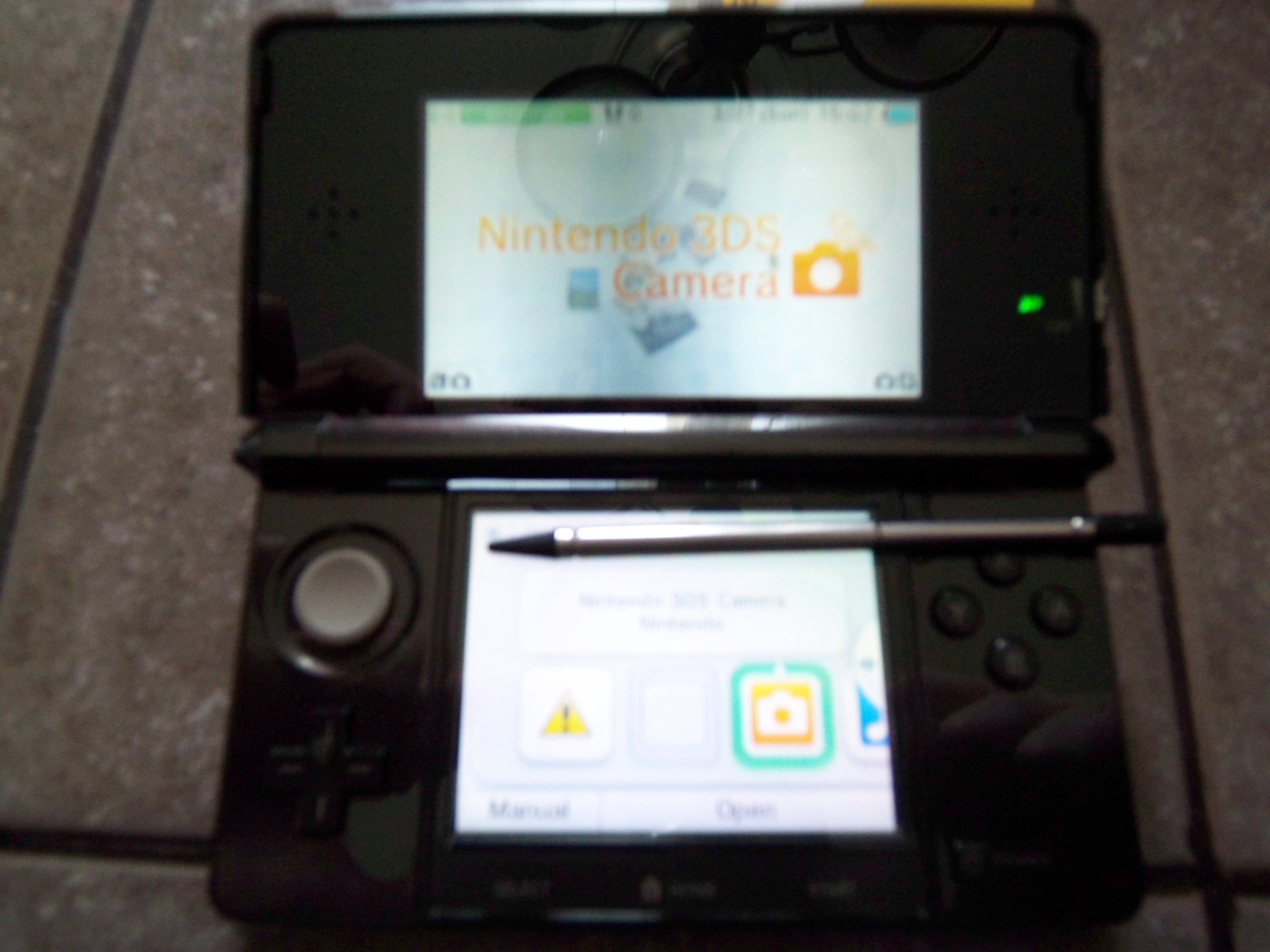
An open view of the 3DS with a fully extended (giggidy) stylus.

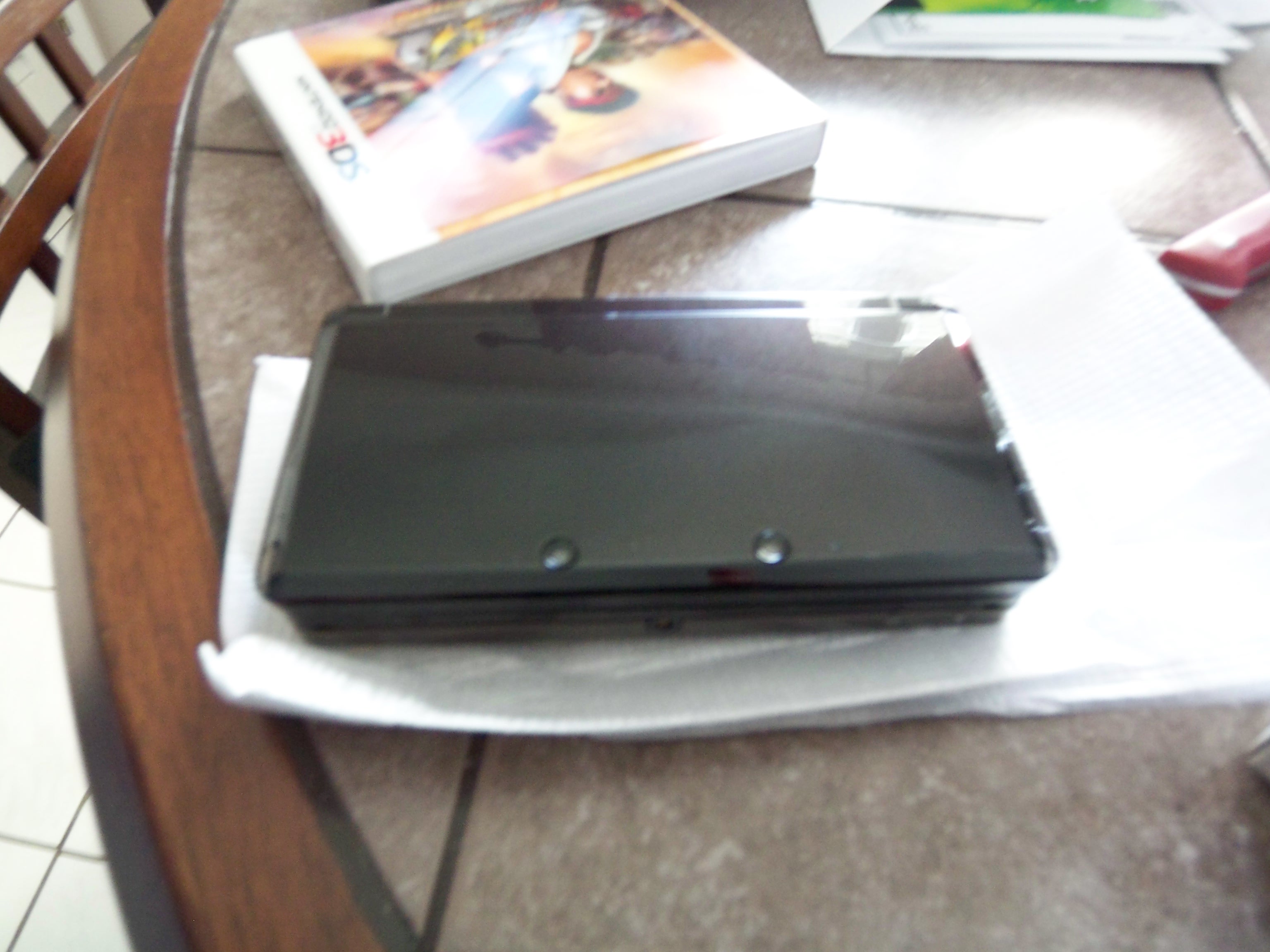
The 3DS is a bit thicker than the DSi, comparable to the Gameboy Advance SP.

I took a lot of photos (which probably is obvious by now) of what is essentially a shinier DS.  The 3DS is a bit thicker but actually slightly smaller than the DSi (and quite a bit smaller than the DS XL).  It comes in two colors, black and aqua, and I opted for the more masculine black.  The glossy finish makes it appear like more of a toy when compared to the matte finish of the DSi.  I prefer the matte but I’m not really complaining.  The base is actually a graphite color, which I never noticed in the press release images and it’s kind of cool.  The traditional clamshell design is back and it’s appropriately snappy.  The top piece is just slightly larger than the base, which makes it easier to open.  The button layout should be pretty familiar.  It’s the typical Super Nintendo button layout of A, B, X, Y, L, R, start, select.  A ‘Home’ button has been added which brings the system from a game right to the dashboard and there’s a Wi-Fi slider switch on the right hand side.  The biggest addition is obviously the slider on the top piece for the 3D effect.  Here you can slide it all the way down to shut the function off or adjust the intensity.  The other big addition is the new analog slider which will presumably be the preferred method of game control.  The slider has a smooth concave design and nice resistance.  It’s bigger than the Sony PSP analog nub and the concave design is much better than Sony’s textured convex one.  The stylus returns for touch screen control and is telescoping this time around.  This allows it to be housed vertically within the system like the original DS, but can extend to the size of the DSi’s stylus.

The 3DS comes with a lot of manuals.

The two screens are where most of the 3DS tech resides.  The smaller, bottom screen is touch sensitive like the DS, but it’s received a boost in resolution.  The larger top screen is where the 3D effect is used.  The picture is nice and bright and though the resolution is better than the DS, it’s not anything mind blowing.  The system comes with a 2 GB SD card pre-loaded which looks like it will be used as a memory card would be.  Game data is stored to it as well as Mii data.  The 3DS dashboard is very similar to the one on the DSi and Wii.  It’s simple and easy to navigate.

The charging dock.

The 3D effect works and actually works pretty well.  It’s glasses-free which means it is a bit rigid in terms of what angle the system is held at and distance from the face.  The system can no longer be held vertically as the 3D effect only works when it is held horizontally.  I don’t really anticipate this adding much, if anything, to gameplay but if 3D is something you like the 3DS does deliver.  And if it’s something you don’t care for it can be shut off, which will also extend battery life (the effect is created by running two screens, one on top of the other, which naturally puts more of a strain on the battery).  I did not find the 3D to be too uncomfortable, though after playing the AR Games my eyes did feel a bit strained and I was happy to put the system down.

Get used to this sight, it's a 3DS charging.

I already mentioned the stylus and SD card, the other things included in the box are a charging station, AC adapter, numerous manuals, and some cards for the pre-loaded AR game.  The boost in power of the 3DS comes with a price in terms of battery life (and the previously mentioned $250 sticker).  I haven’t fully tested it out, but with the screen at the default level of brightness and both 3D and Wi-Fi enabled, the battery life supposedly tops out at less than 4 hours.  This is a far cry from the 8-10 of the DS and makes the system far less portable than its predecessor.  It’s kind of interesting considering Nintendo for years refused to add a backlight to the Gameboy’s screen because they felt battery life is the most important part of a handheld.  Apparently there has been a change in philosophy within the company.  I actually prefer this approach, though I must confess less than 4 hours per charge is pretty disappointing.

The charging station is supposedly the make-up for the crappy battery.  Once plugged in the 3DS can be simply placed on it for charging.  A full charge takes roughly 3 hours (according to the manual) and the station will automatically shut-off once the 3DS is fully charged to prevent over-charging.  The system can also be charged the traditional way of just plugging it into an outlet via the AC adapter.  Presumably there will be a market for third party add-ons such as car chargers and extra battery packs.

The 3DS comes with a colossal manual that I admittedly did not read much of.  There’s also a couple handy quick start guides (I say a couple because there’s a french one and a spanish one too) that tells you pretty much all you need to know.  There’s no extra stylus or pack-in game, but there is some software pre-loaded onto the 3DS that is arguably better than any of the games you’ll find at retail for the time being.

Face Raiders. I know it's blurry but at least this gives you an idea of what the flying face helmets look like, only when they come at you they're coming out whatever background is in your camera's sights. So if your 3DS is aimed at a toilet, they'll come busting out of there.

3DS games are basically the same size as DS ones, only they have a little nub to prevent people from jamming them into the old hardware.

The first game I tried out is called Face Raiders.  The 3DS contains 3 cameras, two rear facing and one front facing, and uses them all for this game.  First, you use the front facing camera to take a picture of yourself (or if you prefer to photograph someone else, you can use the rear facing cameras) and watch as the game puts it onto some weird flying helmet.  The system was able to tell me after I snapped a picture of myself that I was a young adult male.  Pretty smart, but when I took a picture of my cat it came up with all question marks.  The game itself uses the rear facing cameras and the 3D effect to make it look like you’re being attacks by these weird flying faces.  They’ll cause your environment to “break” and try to kiss you for some reason.  Apparently you do not want to be kissed by your evil doppelganger or weird cat monster, so you shoot them as they approach.  Sometimes bombs will pop up that you can acquire and use to clear the screen.  After awhile, a boss head appears that continues to summon the smaller ones until you blast it straight to Hell.  The whole time the 3DS is forcing you to spin around in 360 degrees to find the enemies as they attack you.  It’s pretty neat, though I couldn’t help but wonder how someone confined to a bed or wheelchair would be able to enjoy it.

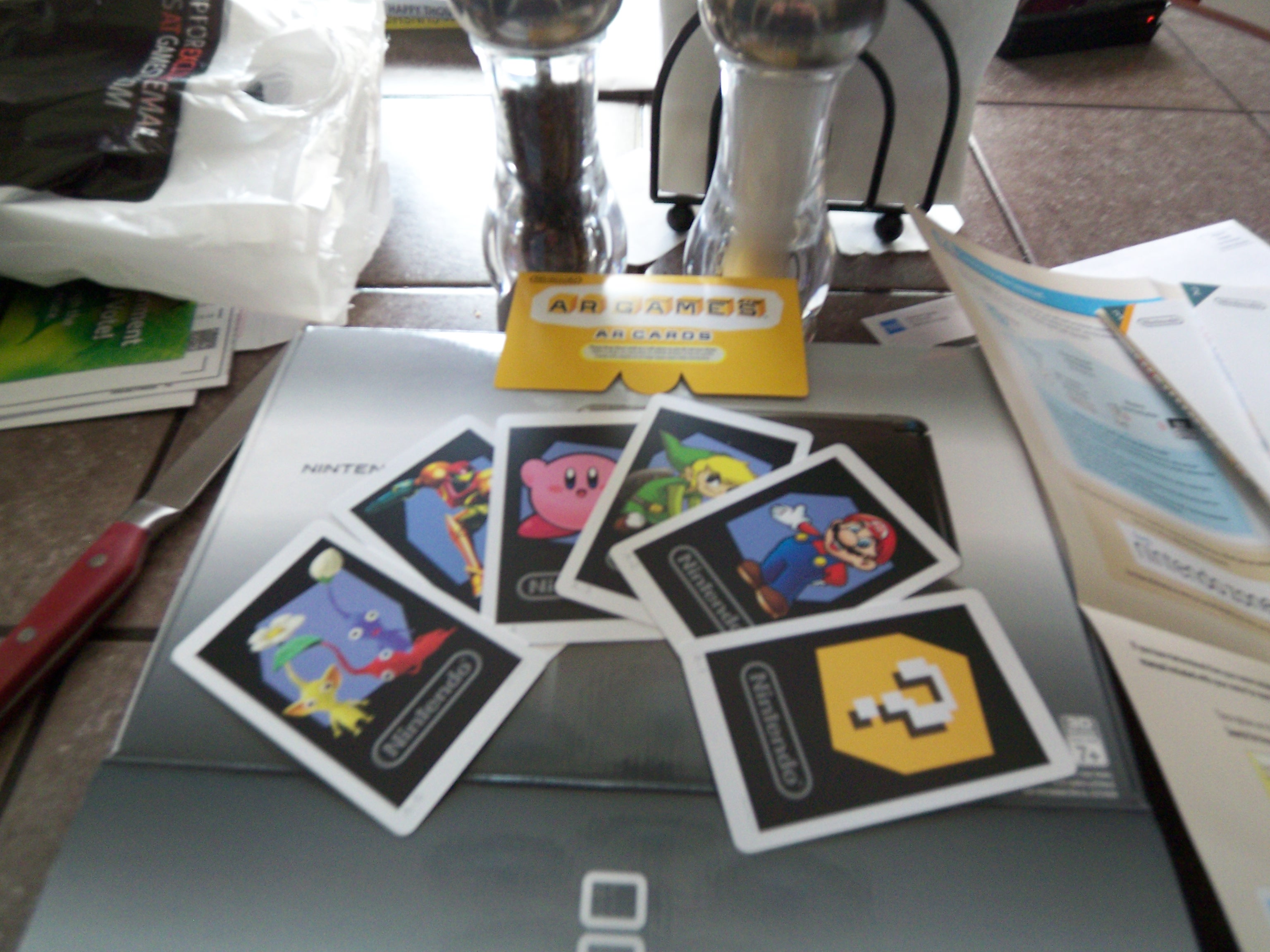
The included cards for AR Games. They come housed in a sleeve similar to what most gift cards come in.

The other pre-loaded game is called AR Games and uses the cards I mentioned.  The 3DS comes with six cards, a question mark block, Mario, Link, Kirby, Samus, and some Pikmin.  The system uses the rear facing cameras once again and focuses on the question mark card and creates the environment it lies on into a game.  There’s an archery game where the terrain fluctuates forcing you to hit stationary and moving targets.  A pool type of game where you strike a ball and try to get it into a goal in one shot, a fishing game, and some gimmick stuff.  The character cards are one of those gimmicks where placing the card beside the question mark card makes them “come to life” as three dimensional characters you can pose and take pictures of.  It’s stupid, but the other games are kind of cool.  They are a bit glitchy though and numerous times as I was trying to move around to get a better angle at a target (or the boss dragon monster that rises out of the card after so many targets have been cleared) the system yelled at me that it lost the card in its camera (the question mark card has to be visible at all times).

3DS cases are a bit slimmer than the DS ones.

The interior of a 3DS game case, pretty exciting.

The only actual game I purchased today was (duh!) Super Street Fighter 4.  I say “duh!” because all of the other games are either mediocre or terrible.  It’s really not saying much when a two year old game is far and away the best available for a brand new system but that’s how it is likely to be until at least the fall when the Ocarina of Time remake hits stores.  Nintendo does have three first-party games at launch; Pilot Wings, Nintendogs + Cats, and Steel Diver.  Pilot Wings is basically a glorified tech demo and probably just as dull as the ones released for the SNES and N64, respectively.  Nintendogs is basically the same as the previous ones, only with better graphics and in 3D.  Steel Diver is kind of a throwback game.  It’s a left to right shooter where you take control of a sub.  Supposedly it’s not bad, but kind of ho-hum and would have probably been better received as a cheaper downloadable game.  Apparently the third party publishers were not interested in capitalizing on the lackluster offerings from Nintendo as their titles are spectacularly bad.  Aside from Street Fighter, there isn’t really anything of interest that I’m aware of.  EA has a version of Madden available that’s supposedly rushed and terrible.  They also ported The Sims 3 over so if you have yet to experience that maybe it’s a worthwhile investment.  There’s a couple of racing games and some generic platformers as well.  The best may be Super Monkey Ball 3D, it’s probably just like the previous ones so if you want to experience that franchise again go for it.

My Mii.

I actually own Street Fighter 4 for the PS3.  I never picked up the “Super” version that came out last year that featured additional characters because I was never interested (I’d just end up using Akuma anyways).  It’s a good game with a nice visual style that lives up to the Street Fighter name.  It’s just that it’s been available for home consoles for two years now, so there isn’t much new to be experienced.  The 3D effect does little for the game because of its perspective.  There is a 3D mode that I haven’t tried because it places the camera over your character’s shoulder, which sounds awkward.  It’s this lack of newness that almost lead me to pick up a 3DS without even bothering with any games.  The 3DS is fully backwards compatible with the DS library, so I’d be able to play the DS games I still have until a worthwhile piece of software came out but I caved at the last minute.

I tried to take some pictures of SF4, but they came out blurry. If you really want to see the game there's about a million high quality images online somewhere.

So now that I have Super Street Fighter 4 3D what do I think?  Well, it’s pretty much the same experience as the console version, which is to say it’s a very good fighting game.  I tried initially using the analog slider but found it to be too imprecise for a fighter and switched over to the D-pad.  The D-pad is of the same quality as the DS one, just placed lower on the console.  I found it a little uncomfortable after one trip through arcade mode so it’s probably not the best game for long stretches of play.  Since the system is limited because of the button layout, some commands have been moved to the touch screen.  On “Lite” mode, moves can be stored here.  I played as Ken and the default settings were to have his super combo and ultra combo mapped to the left side, and his heavy hadoken and heavy hurricane kick (I’m not going to try to spell out its Japanese name) were mapped to the right.  The face buttons default to the same layout as the home console version, which is they have the light and medium attacks and the heavy ones are mapped to the shoulder buttons.  I found trying to perform a heavy hadoken the manual way near impossible as it’s just too awkward to make a quarter circle motion with my left thumb and hit the left shoulder button at the end so the touch screen move was welcomed.  The ultra combos require all three punch or kick buttons to be pressed, which is nearly impossible on the 3DS, so I was happy to use the touch screen here as well.  The “Pro” control mode allows you only to map attack buttons to the touch screen, including L+M+H commands, if you find having actual moves too easy.  I can see that working fine, but since smudges on my touch screen drive me nuts I’ll probably stick with Lite.  I also re-mapped the buttons so that the medium attacks were on the shoulders and the heavy on the console’s face.  This made it possible for me to execute EX moves and also kept the light attacks on the face to execute quick throws.

Akuma vs Some Red Guy

I’d say overall the control scheme works well enough.  The D-pad can be a bit cumbersome.  While I found it easy enough to perform quarter-circle motions, the more complex ones, such as the dragon uppercut, were far less responsive which again makes the “Lite” control mode a bit more desirable.  The graphics are very nice looking, the fighters anyways.  They’re obviously not as detailed as the ones featured on the home consoles, but the reduced screen size makes it hard to notice.  The backgrounds suffer though as basically all of the background animations have been removed.  I can live with this, but it would have been nice if Capcom had adjusted the appearance of the backgrounds to better conform with this approach as it just looks weird to see onlookers frozen in place.  There is a pretty robust online mode and if someone is nearby with a 3DS and a copy of the game they can challenge you.  Also, if you have a buddy who doesn’t have a game they can download a demo of it from your 3DS, which is pretty cool and a feature I hope a lot of games make use of.

Super Street Fighter 4 is a solid game, but I do long for something better for the 3DS.  For now, the system receives a grade of incomplete.  The tech is certainly nice, and the look and feel of the system is in line with previous models, it just lack quality software.  In time, that will most definitely change since Nintendo is bound to unleash various Mario, Metroid, and Zelda titles.  There’s also a system update on the horizon that will grant access to an online store and internet browser.  I’m not sure why both weren’t ready for launch, but just like with everything else, it’s on the way.  The store promises to have both original titles as well as 3D remakes of classic Nintendo titles.  Of the announced ones, I’m most looking forward to the 3D version of the Gameboy classic Link’s Awakening, as I’ve never played it and always wanted to.  The Ocarina of Time remake will undoubtedly kick ass, and the Super Mario Bros. title is apparently some kind of Super Mario Bros. 3 tie-in which has me all kinds of excited.  In conclusion, the 3DS is pretty cool even if the whole 3D thing isn’t really your bag, but it’s safe to hold off for now until the good software starts coming out.


Mortal Kombat Demo Impressions

Mortal Kombat!!!!

As some of you may or may not know, Warner Bros. has a new Mortal Kombat game coming out this April for Xbox 360 and Playstation 3.  The new game, simply titled Mortal Kombat, is an attempt to bring the series back to its roots while still maintaining some of the modern touches of the more recent titles.

The demo was released a week ago for those who subscribe (and pay extra money) for Sony’s Playstation Plus program.  For the rest of us, it was unlocked this past weekend for a free download.

First, some background.  When the first Mortal Kombat game dropped in the early 90’s I begged my parents for a Sega Genesis for Christmas so that I could experience it in it’s uncensored glory.  One of the neighborhood kids got the Super Nintendo version that fall when the game was released and my friends and I spent many afternoons playing it, but always dreaming about getting our hands on the much hyped Genesis version.  It was rumored that the Genesis version of the game contained a code to unlock the censors put in place by Midway.  Nintendo, wanting to keep its family friendly image, had the developers replace the blood with gray, misty, sweat.  Many of the signature fatalities were removed, including Sub-Zero’s head rip and Kano’s heart pull, and even certain simple moves were removed because of the violence factor.  It was lame, and to a group of 10 year olds it was extremely lame.  We wanted blood!

The problem was, nobody had a Sega Genesis.  Before Mortal Kombat, the Genesis was the system kids received when the stores were sold out of Super Nintendo.  Sure it had some cool games, like Sonic the Hedgehog and Outrun, but it was kind of clunky and the controller only had three buttons.  Plus, the SNES had better graphics and all of the big Nintendo franchises everyone grew up with.  I had just received a Super Nintendo the previous Christmas, so getting my parents to give me a Genesis seemed like a long shot at best.

In the end, my parents proved themselves awesome that Christmas and got me the Genesis II and grandma took care of the rest with a copy of Mortal Kombat.  I remember calling my best friend at the time, Saad, that morning to see if he knew the blood code.  He didn’t, but he called around for me and eventually was able to produce the code and directions on where to enter it.  That code, ABACABB – Get over here! – proved a success and I was soon reveling in bloody goodness.  It was probably the next day I had my buds over, none of them were fortunate enough to get the Genesis+MK combo for Xmas, and we began a ritual that would last months.  We just played that game constantly and over time we figured out the various fatalities (I wrote them all down in the game’s instruction booklet, these are the kinds of things kids today don’t have to do thanks to the internet).  To this day, my favorite is still Sub-Zero’s.

Mortal Kombat (2011)

Now, almost 20 years later, I find myself getting excited over a new Mortal Kombat game.  I actually wasn’t even all that excited until I played the demo and found it to be a very satisfying experience.  The demo includes four characters: Sub-Zero, Scorpion, Mileena, and Johnny Cage.  You select a character, difficulty setting, and then the game pits you against each one.  After the fourth character is felled, the demo teases a Goro fight before going into a trailer hyping the full version of the game.

First off, the game looks pretty nice.  That’s kind of a given in this day and age but I like the character designs.  They stick close to the original designs of each character while adding a modern touch.  Sub-Zero’s costume is given some armor and nice textures, while Scorpion’s takes the skeleton imagery from his Ultimate Mortal Kombat 3 appearance and builds on it.  Mileena is absurdly sexy and curvaceous while her costume is sort of a hybrid of her original MK2 look and her MK3 costume.  Johnny Cage’s costume differs very little from his MK2 appearance.  The graphics are fully rendered in 3D, but the game is strictly a 2D fighter.  For anyone that played the 3D fighters in the series’ past, this is a welcome move.

The classic special moves are all here from Scorpion’s spear to Sub-Zero’s freeze blast.  Though while the early games were methodical and special move oriented, this one is pretty fast and if you can’t string combos together you won’t last.  I first tried out my old standby, Sub-Zero, but found his special moves kind of slow and switched to Scorpion, my consistent backup.  I liked him so much that I haven’t even tried the other two, though I plan to.  Scorpion moves quickly, like all of the characters, but his moves work well with my style.  His teleport punch is still present and can be done while airborne.  I found it the perfect counter anytime my opponent tried a projectile attack.  Most of his combos leave the opponent momentarily stunned and wide open for his lack grab move or demon fire.  And his fatality, where he slashes his opponent up with his sword, was pretty damn cool.

I was able to breeze through the four opponents on the Medium difficulty setting, but received a healthy challenge when I bumped it up to hard though I still managed to get through all four without using a continue.  I am not at all concerned about the game being too easy though, because the next Mortal Kombat game that is too easy will be the first.

The game, despite my overall good impressions, is not perfect.  Scorpion’s teleport punch is very effective, perhaps too effective.  The game also has a special attack called an X-Ray that is initiated after a meter is filled.  This meter is not hard to fill within a round, and the move is executed just by pressing two shoulder buttons simultaneously and does massive damage if it connects.  Scorpion’s is a teleport attack and really easy to pull off.  I think the move is intended to give a player who’s getting beat a last resort option, but I found myself using it to finish my opponent off when it got down to about a third of its health.  I felt a little guilty using it, as I’d wager I was successful with the attack 4 out of every 5 attempts.  It might not be a bad idea to tone it down for the final release.

Aside from that though, I came away very encouraged.  I suppose this is what a successful demo strives to accomplish as I went into it not planning on making the purchase when the game gets released to seriously considering it.  I’d be even more likely to get it if I hadn’t just spent 60 bucks on Marvel Vs Capcom 3 a few weeks ago.  The game doesn’t come out until April 19th so I’ll have plenty of time to experiment further with the demo and come to an ultimate conclusion.


“I hope they make it dark”

That line is bound to surface anytime a new spin-off of a comic book is announced for television and film.  I don’t know where it started, perhaps following the success of Tim Burton’s Batman, but it’s one line that drives me crazy.

First of all, what does it really mean when fans say they hope an upcoming project is “dark”?  Do they want a visually dull image?  A bleak, depressing atmosphere?  Hardcore violence?  Or all of the above?

Spider-Man is a teenager who goes through lots of ups and downs, but to call the tone of the book dark is inaccurate.

I think the word has become interchangeable for a lot of people with the word mature.  And in some ways, it makes sense.  Typically, when a comic is translated over to the world of television it is done so as a cartoon and marketed towards children.  When that happens some elements are understandably lost.  Most mainstream comics trend towards an audience a little older than the target demographic of a cartoon series.  That and a cartoon costs a lot more to create than a book and television producers are forced to hit as a broad of an audience as possible.  So while Marvel or DC may think it’s okay to show death in a book catered more towards teenagers, Disney television probably wants to avoid the subject in order to please the parents of six-year olds.

I’ve always found it odd how kid’s shows handle death, which is to say, few ever die.  The idea for this post sprung up as a result of seeing a user comment posted on a story about the upcoming Ultimate Spider-Man cartoon.  The word “dark” and the user hoping the cartoon is that way was beyond stupid, since the comic is pretty light-hearted and colorful (or at least it was when I read it in the mid 2000’s), though it did get me to think about a certain character.  In the comic, the character Gwen Stacy is killed by the villain Carnage (in the Ultimate version, I’m aware it’s traditionally Green Goblin that gets her) off screen, but Peter is shown stumbling upon her corpse.  Carnage kills by sucking out the life force from its victims in the Ultimate-verse, and Gwen’s corpse looks almost mummified when Peter finds it and the artist gives us a full-page shocking view of her grim visage and contorted limbs.  I don’t know what network is looking to air the cartoon, but I suspect this won’t be included.  That is understandable, but what I’m curious about is if the networks will even go as far as to even kill the character?

TMNT #1

That was sort of a tangent, but to get back to the post’s initial premise, I most often see this particular subject line associated with the Teenage Mutant Ninja Turtles.  Whenever a new television series or film is either announced or speculated upon, there’s always a vocal group of fans wishing the new iteration would be dark like the comic books.  The turtles began as a black and white comic book where most of the characters spoke little and actually used their weapons.  It was a modest success for creators Peter Laird and Kevin Eastman but turtle-mania didn’t kick off until it was adapted for television and a younger audience.  The original TMNT was kind of a spoof comic, one need only read the ridiculous title, so the fact that it became this big hit is rather amazing.  The creators behind it were able to get kids to take it serious, and as a result made boat-loads of cash.

The television version of the turtles from the series that started in 1987.

The TMNT cartoon was noticeably lighter in tone.  Raphael, a mean-spirited bad ass in the comic, was made sarcastic and jokey while Michelangelo was more of a goof ball.  Donatello, smart in the books, was made into some kind of super scientist while Leonardo mostly maintained his persona from the books, though with less overall intensity.  The cartoon would have never worked in black and white, so it was made appropriately bright but the streets and sewers of New York were given a little grime.  The turtles were also given individual colored bandanas and pads instead of all sporting red bandanas with brown pads.  Shredder was chosen as the main antagonist and he was pared with a personified alien brain-like creature named Krang, who was loosely based off a race of aliens from the comic called Utroms.  Shredder was given an army of robotic foot soldiers (so that the turtles could freely hack them up) as well as a pair of mutants of his own, Bebop and Rocksteady, who served as comedic relief.

The show started off as a five-episode mini series adapted from the plot from the books about how reporter April O’Neil (now sporting a yellow jumpsuit and a more fashionable hairstyle) is introduced to the TMNT.  Shredder is shown as a legitimate threat and his origins are revealed as Hamato Yoshi’s rival.  Yoshi would be banished from Japan as a result of Shredder’s, where he would mutate into Splinter (in the books, Splinter was Yoshi’s pet and Yoshi ends up getting murdered by Shredder, the networks understandably didn’t want murder in their cartoon).  The mini series proved a success, and a series was launched but changes were made.  Michelangelo’s nunchaku were deemed too violent (but Leonardo’a katanas apparently were not) so the character was rarely seen with them.  Eventually they would be removed and the character sported the “Turtle Hook” instead.  This weapon was just a grappling hook and was as lame as it sounds.  Shredder was also dumbed-down and made a comedic villain.  He was of little threat and the main theme for the program was four turtles having a good time, kicking butt, and eating pizza.

The designs for the 2003 cartoon series struck a nice balance between the original looks of the comic book and the 1987 approach of the original cartoon series.

I don’t necessarily find the mass-market turtles more appealing than the grim and gritty originals, but this was the iteration of the turtles that morphed them into media giants as opposed to indie heroes.  Any network or film house looking to do something with the TMNT is not interested in making an R-rated, or even PG-13, product to satisfy a vocal minority.  The best fans can hope for is something more in-line with the first film based off the TMNT, which returned the old personalities of the turtles while keeping the colored masks.  Most of the film took place at night and all of the sci-fi elements of the cartoon were removed.  The following films were more hokey and kid-friendly, but that first one was actually pretty spot-on.  That said, I think most want to appeal to families and hoping for that much may be out of the question.  The last film released, simply titled TMNT, definitely went for the kids though there was some edge kept to the characters.  The movie was mostly undone by a terribly boring plot and slightly off-putting character designs (the turtles looked more like frogs than turtles).

I suppose the statement I am trying to make is that darker isn’t always better.  It’s also terribly overdone when every superhero has to be some sort of fly-by-night bad ass in every film.  Dark is a terrible direction for a character like Spider-Man or Superman, and the term shouldn’t be interchangeable with mature.  Yes, there are a few story-lines within the Spider-Man canon that are darker than others, but the overall mood of the franchise has always been kind of happy.  Spidey wears a colorful costume and cracks jokes while knocking bad guys around.  Sam Raimi turned him into a moody cry-baby for Spider-Man 3 and we all saw how well that worked.


X-Men: The Last Stand


X-Men: The Last Stand (2006)

I’m going to get it out of the way early and just say that this isn’t a very good movie.  I even debated with myself whether or not I even wanted to dedicate a blog post to the subject but since I had already done so for the first two I might as well see it through.

Director Brett Ratner seems to shoulder most of the blame from fans for the movie’s failure.  Truth to be told, there’s plenty of blame to go around.  From a questionable screenplay to a down-right poor script, there was little praise to be found for the finale to the trilogy begun by Bryan Singer.

I suppose I will point out the strengths of the film first.  The new characters added to the roster of mutants included original X-Men Beast and Angel.  Beast was portrayed on screen by Kelsey Grammer, who was pretty much every fan’s choice to portray the character.  His look remained faithful to the comic, being that he was blue and hairy.  His lines contained the appropriate poetic dashes and the emotions exhibited by Grammer were much appreciated by the fan base.  Angel, played by Ben Foster, ended up being just a minor plot device, which was a bit disappointing.  Kitty Pryde was re-cast with Ellen Page and her role was expanded.  Page plays the wide-eyed Pryde with an appropriate amount of fear and youthful exuberance.

"I'm the Juggernaut, bitch!" - Yes, that line really appeared in the movie.

Some minor villains were added to the mix, namely Callisto and Multiple Man, but the major addition to Magneto’s Brotherhood was Juggernaut, portrayed on-screen by Vinnie Jones.  The choice to bring Juggernaut into the mix was one born of good intentions, but the pay-off was rather lackluster.  Jones is physically intimidating, but the costume looks like it’s made of foam, instead of steel.  His character is also merely a thug with no connection to any of the other characters.  In the comics, Juggernaut was the jealous step brother of Charles Xavier.  I will concede it was probably wise to make this version of the Juggernaut a mutant, as opposed to a human who obtained his powers magically.

The plot ended up being a mash-up of the Phoenix plotline and “The Cure.”  Phoenix was hinted at in X2 by showing Jean Grey (Famke Janssen) becoming consumed by fire when using her powers in the film’s climactic scene, while “The Cure” is a story that should translate well to the screen.  I’ll go into more depth on the film’s execution of the Phoenix soon, but first I want to focus on “The Cure.”  In the comics, “The Cure” was the generic name attributed to a drug that would cleanse a mutant of their powers.  It was used in the television series as well.  It’s a suitable plot because it forces the mutants to confront their differences from humanity and gives them the option to take the easy way out.  To take the drug is to concede defeat in the quest for mutant equality.  Of course, it’s not so black and white.  A mutant like Rogue cannot touch another person without doing harm, while a mutant like Beast can never enjoy a quiet stroll through the park without attracting unwanted attention.  For mutants like Storm or Iceman, they can easily pass for human and their mutant abilities are quire clearly no curse as they’re given access to unbelievable powers, to the point where it is hard to feel sympathy for them.

The film drops the ball with this plot device.  The existence of a cure is dismissed by most of the X-Men, while Rogue is, not surprisingly, tempted by it.  Angel’s father, Warren Worthington II, is the one behind it as he is clearly embarrassed and hurt over his son’s perceived deformity.  It’s never explained why Angel would need to take a drug to get rid of his wings, the audience is left to assume it’s not as simple as just having them removed.  Regardless, there’s little weight and the cure ends up being turned into a weapon by the government to use against violent mutants.  The cure as a weapon does add a more believable form of danger to the action scenes, but since the weapons aren’t aimed at the X-Men it kind of defeats the purpose.

Jean's crazy "Phoenix eyes."

Phoenix is introduced early as Jean Grey’s alter ego.  The Phoenix is apparently a part of her psyche that was sealed away long ago by Xavier to protect Jean.  When the personality manifests, she becomes a violent and all powerful entity that seeks only to be thrilled.  When she uses her powers her skin turns ashen and her eyes black.  She doesn’t hurl fireballs like her comic counterpart, but instead appears to rip her opponents apart at the atomic level.  The special effect used to show this resembles a turning to ash effect to keep some aspect of the Phoenix name relevant.

Phoenix’s first act is to take out Jean’s lover, Cyclops.  Emotionally, this carries little weight since Cyclops was practically written out of X2.  Here it was done because actor James Marsden wanted to take on a bigger role in Bryan Singer’s Superman Returns and Fox chose to accommodate his wishes.  When Jean comes to her senses and realizes she killed her man there’s a decidedly muted reaction before Jean goes into full-on Phoenix mode for the rest of the film.

One of my biggest issues with this film is how Charles Xavier is portrayed in the wake of Phoenix’s revival.  When it is revealed that Xavier had locked away portions of Jean’s mind as a child, the X-Men vocalize their disapproval.  Xavier’s reaction is not appropriate or consistent with the character we saw in the first two films.  Instead of defending his actions as unfortunate but necessary, he displays a great amount of anger and takes a very defensive position.  He becomes irrational, and his desired course of action is to find Jean and re-implant the psychic barriers that had broken away.  It makes the audience feel as if it were duped into thinking this was a benevolent man out to make the word a better place for mutants and humans.  He’s become a villain, and the point is driven home all too clearly with one of the film’s final scenes.

Phoenix becomes a pawn the two sides fight over, with Magneto wanting to harness Jean’s powers for his own benefit.  Phoenix ends up killing Xavier, and we get another memorial scene behind the mansion that is surprisingly small.  This is followed by the X-Men going after Magneto, who attacks a compound where the source of the mutant cure resides, the mutant Leach whose power negates mutant abilities.  There’s a battle, and the end result is Magneto gets hit with some cure darts and Wolverine is forced to kill Jean, cue another memorial scene.

The film was not without some bright spots, most notably the spot-on casting decision to go with Kelsey Grammer as Dr. Henry McCoy, aka, The Beast.

The film portrays Wolverine, once again, as a leader of X-Men.  In this particular film his attitude is all but gone and the character feels neutered to the point that no one is surprised when he sobs like a child after Jean’s demise.  Halle Berry’s Storm ends up being the X-Men’s true leader and her character is all right, certainly not a weakness.  The young mutants are pressed into action with mixed results.  Iceman is given a rivalry with former X-Man Pyro which results in a predictable fire vs ice stand-off.  Rogue is shown as a jealous lover over Bobby’s relationship with Kitty which pushes her towards taking the cure.  The film ends on a cliff-hanger, where a de-powered Magneto is shown using a hint of his lost powers, but by the time this scene rolls around no one in the audience cares.

The film carried on the tradition of sub par special effects.  For a big budget franchise like the X-Men, the special effects have surprisingly never been a selling point.  The studio chose to take a stab at The Danger Room this time around and the result makes it clear why Singer chose to never attempt this.  The film is rather short and moves at a brisk pace, so it is at least not guilty of being boring.  It’s just lacking in depth, and following the weighty X2, it was an unwelcome change.  The film just ends up being irrelevant, and effectively killed the franchise.


Samhain

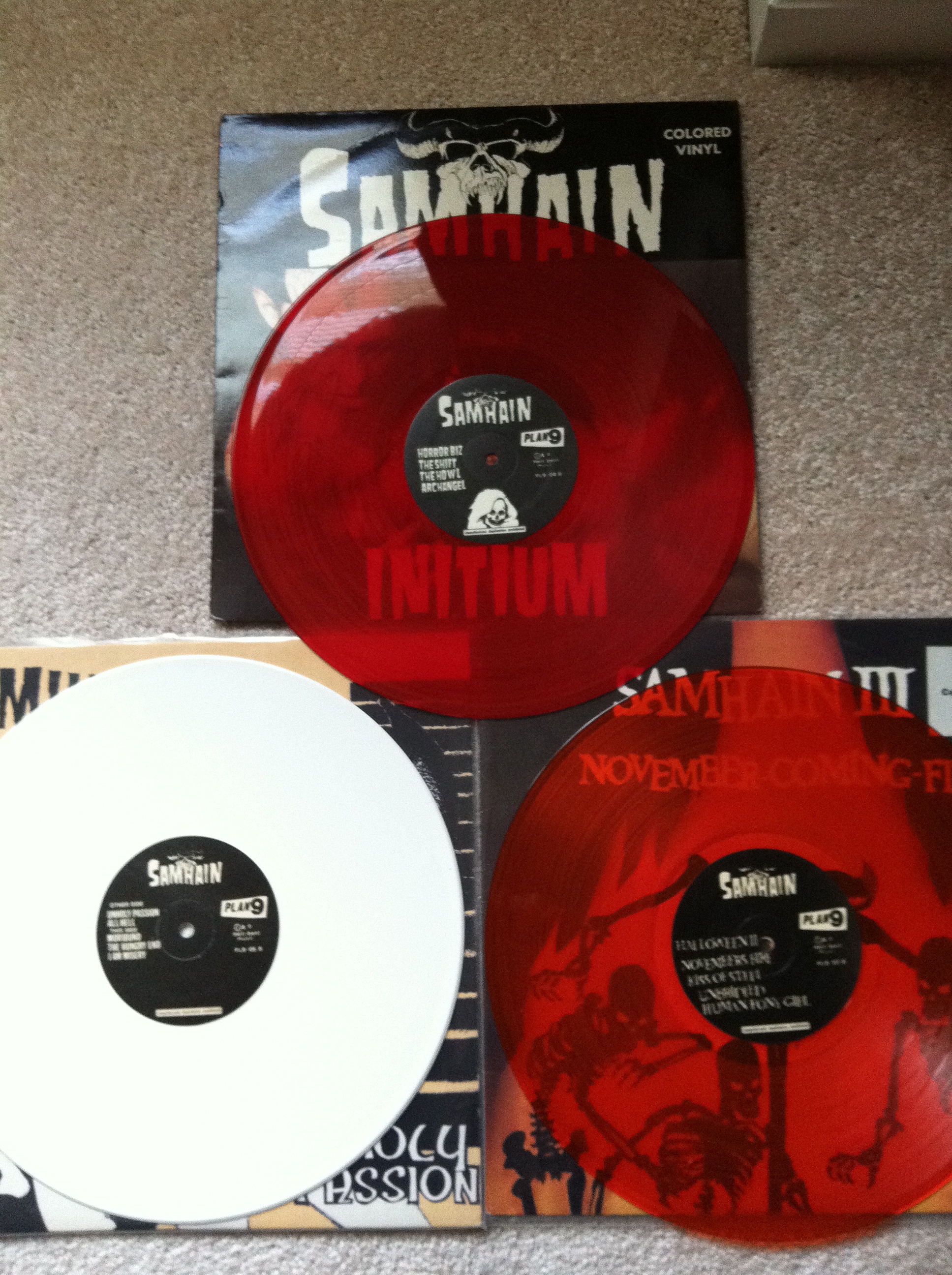
Samhain is a little known band that existed for only a short while from 1983 to 1987 but a band that I am quite fond of.  Samhain is the Glenn Danzig fronted band that was formed after the demise of The Misfits and would eventually be signed to the Def American label and become Danzig.  In its brief existence, Samhain put out two full length albums and one EP.  A final LP, Final Descent, would be released posthumously in 1990.  Even including that last album, the entire Samhain catalog can be listened to in under a couple of hours.

A lot of casual fans of either The Misfits or Danzig, myself included at one time, were not even aware of the existence of Samhain.  Samhain was never as highly regarded as The Misfits and did not have the means of reaching as broad an audience as Danzig.  Like with The Misfits, Samhain played the smallest venues in the country and all of their releases were put out on Glenn Danzig’s Plan 9 label with backing from Caroline Records.  The band logically serves as the bridge from The Misfits to Danzig, merging horror, punk, goth, and metal to create its signature sound.  There really isn’t another band quite like Samhain, and it served as an outlet for Glenn Danzig to try out new ideas.

Originally, the band was conceived as a side project from The Misfits, but when the The Misfits disbanded in 1983, it became a full-time band.  Some of the final Misfits tracks were initially conceived by Danzig as Samhain tracks, specifically, “Death Comes Ripping” and “Bloodfeast.”  The first LP, Initium, featured only three full-time members; Danzig, bassist Eerie Von, and drummer Steve Zing.  Von was a good friend and classmate of Misfits guitarist Doyle who had often followed the band around and served as their photographer for a number of years.  Zing was from Lodi, NJ and grew up in the same neighborhood as a lot of the guys from The Misfits.  Lyle Preslar, of Minor Threat, played most of the guitars on Initium and was to be in the band but he split over creative differences.


Initium (1984), the band would sometimes cover themselves in blood for live performances.


Initium begins with an effects laden track of the same name that Glenn speaks over announcing his rebirth.  It was Glenn signifying on recording the end of his previous band and the start of a new one.  Hokey, but effective, it leads immediately into the song “Samhain” which also occupies the slot of track 1 on the CD release.  The punk attitude is still present but the image conjured up by the band is noticeably darker.  The lyrical content is not much of a step-up from the ghouls and ghost imagery of The Misfits but the delivery is noticeably more serious and dangerous in tone.  The album’s cover sports the three main members drenched in blood as if they just emerged from an unholy womb.

The album makes use of ambient sound effects and occasional chimes which give it a gothic quality.  Some songs sound like they could have been pulled off by The Misfits, most notably the up-tempo and kind of silly “All Murder, All Guts, All Fun” or the catchy “He-Who-Cannot-Be-Named.”  One track, “Horror Biz,” is a remake of The Misfits classic “Horror Business.”  Its main difference from the original is the more aggressive drum track laid down by Zing and a more methodical vocal delivery by Danzig.  Where Samhain separates itself from its predecessor is with moody tracks like “The Howl” or the engaging closer “Archangel.”  “The Howl” creates a mood of unease as it tells its tale of murder in a cliche house on a hill.  “Archangel” contains two bass tracks and the only thing resembling a guitar solo on the record.  It’s mid-tempo and easily the album’s brightest (or darkest) moment.  It is also noteworthy for being one of the only songs Glenn Danzig breaks out his guitar for on stage, freeing up the other guitarist to play the additional bass track.

Unholy Passion (1985) – original release, the second pressing would contain some maroon colored covers.

After Initium, Pete Marshall would be added as the permanent guitar player.  Marshall would take the stage name of Damien for his tenure with Samhain and played on the follow-up EP, Unholy Passion.  The original release of Unholy Passion contained only four new songs and included another Misfits remake, this time “All Hell Breaks Loose” would be re-recorded and re-titled “All Hell.”  The new tracks picked up where Initium left off and continued to explore a more goth-infused brand of punk rock.  It’s almost a toss-up over which song is the standout track, the death-laden groove punk title track or the roller coaster closer “I Am Misery.”  The latter contains some of Glenn Danzig’s more imaginative lyrics as he, as the title implies, takes on the personification of misery.  Subsequent versions of the EP would be released alongside an additional track, titled “Misery Tomb” which just contained the wails and some of the ambient noise from “I Am Misery” remixed with the song’s bass track.  The CD version of Initium would also be re-released in 1987 with the Unholy Passion EP added on, but with over-dubbed guitars by Glenn (presumably to avoid having to pay Damien royalties).  The first release of Final Descent would also contain the Unholy Passion tracks tacked on.  Even though the EP runs just a little over 15 minutes, it may be start to finish my favorite Samhain release.  For me, this is where the Samhain sound was perfected and would carry over into the following release.  Though if quantity plays a role in defining my favorite Samhain album, then the third Samhain release would take the crown.


Samhain III – November-Coming-Fire (1986). From my personal collection of the colored vinyl edition.


Samhain III – November-Coming-Fire was released in 1986.  It was the band’s second full length album and is probably their most popular.  For this release the band welcomed a new drummer, London May formerly of Reptile House, who helped to refine the Samhain sound.  There’s lots of reverb throughout the record along with a steady stream of background “fuzz” which helps give the album a great deal of character.  Stylistically, it is not too different from the previous EP though it does contain more variety.  Some of Samhain’s fastest tracks, as well as its slowest, appear on this record which clocks in at just under 29 minutes.  It contains yet another Misfits remake, this time “Halloween II,” which takes the old experimental track and turns it into a fully realized song.  The guitar is crunchy and the pace almost takes on a slow gallop.  It would become a crowd pleaser even into the Danzig years.

Some other standouts include the aggressive first song (second track following the instrumental intro) “In My Grip” and the rollicking “November’s Fire.”  The most popular track may be “Mother of Mercy” thanks to the band Metallica who included it on their version of Guitar Hero a couple of years ago.  My personal favorite moment for the album is the ballad-like “To Walk the Night” which carries over into the up-tempo “Let the Day Begin,” the latter features probably the album’s catchiest chorus.

Colored edition of the initial vinyl release for NCF.

It was after “November-Coming-Fire” that Glenn Danzig signed onto a major label and Samhain became the band Danzig.  Glenn was able to retain Eerie Von as his bass player but Rubin, wanting to create some sort of a supergroup, paired the two with drummer Chuck Biscuits.  John Christ would eventually be added as the guitar player and ended up playing on Samhain’s last LP, Final Descent.  Biscuits also contributed drums for one track, “Death…In Its Arms” for that release while a drum machine was used for the rest.  Final Descent was released on CD in 1990 and showed off a more metallic edge with some influences from the blues genre.  The track “Descent” is a powerful opener that shows off the heavier sound while the previously mentioned “Death…In Its Arms” is more of a plodder with a groove reminiscent of later Danzig works.

Final Descent (1990). Released three years after Samhain’s disbanding, it was originally titled Samhain Grim.

In 2000 the long-awaited Samhain Box Set was release by E-Magine Records on Danzig’s own evilive label.  For that release Final Descent received additional tracks including early arrangements for the Danzig songs “Twist of Cain” and “Possession,” as well as an earlier version of the band’s Elvis cover song “Trouble.”  They were joined by a second version of “Lords of the Left Hand” which was much faster than the previous one.  A live album was also added as a fifth CD and contained nearly an hour’s worth of material from 1985-1986.  Some bootlegs were also rounded up and mashed together onto a VHS which features a few songs from the band’s final performance as Samhain.

Samhain burned bright during its brief existence and created a memorable catalog of music.  It clearly was a transition period both musically and in general for the band’s members.  Some of that sense of creativity and experimentation was lost when the band became Danzig so it’s no telling where Samhain would have ended had it not been for the influence of Rick Rubin.  Rubin of course would end up overseeing some great records put out by Danzig so it isn’t as if it was a bad thing the direction of the band was interrupted, merely something to ponder.  When Danzig left the American label for Hollywood Records to put out Danzig 5 – Blackacidevil, he was quoted as saying this is where he thought Samhain was progressing to.  I am not sure I completely agree with him there as I think some of the motivation for that statement was to calm the masses over Danzig’s new industrial sound.  I think it is fair to assume that Samhain would have continued exploring other effects and sounds but I’m not convinced the band was heading in so drastic a direction.  I’m quite thankful for the internet and the E-Magine releases of the Samhain albums as it allowed me to get acquainted with this interesting and often overlooked band.  I suppose The Misfits were more accessible for fans, but I find the Samhain music more rewarding with the Danzig era stuff being my preference.  As I continue to amass old vinyls from Glenn Danzig’s past, I’ve gone back to Samhain and I think I’ll continue to do so off and on for the rest of my days.

One last picture, the colored vinyl releases for each of the first 3 Samhain albums. Clockwise from top: Initium, November-Coming Fire, Unholy Passion.


#1: Danzig II – Lucifuge

Danzig II – Lucifuge (1990)

My choice for my favorite album of all time should come as no surprise to anyone who knows me personally.  I’ve already expressed my admiration for all things Glenn Danzig previously, but this should drive that point home.  It may seem like an odd choice, but this is my list where the only criteria is enjoyment, so deal with it.

Danzig II – Lucifuge is a great record.  I suppose considering that I’m ranking it as the best kind of speaks for itself.  It’s a marriage of hard rock and blues that stands out amongst the Danzig catalog.  Glenn Danzig is a musician that has touched on several genres including rock, metal, industrial, and even classical.  It is perhaps one of Danzig’s greatest strengths that as a listener you know you’re in for a new experience each time he releases a new album.  That’s not to say he hasn’t had his missteps along the way, but Danzig II is not one of them.

Released in 1990 after a solid debut in 1988 on producer Rick Rubin’s newly created Def American label (the first Danzig record was actually Def American’s first ever release), Danzig II was meant to build off the first one and take the band to new heights.  Because of the imagery associated with the band, parent company and distributor Geffen Records refused to have their name appear on any of the releases and the band found airplay hard to come by on both radio and MTV.  There was a lack of buzz at the label as a result, so Ruben took a more hands off approach with the band’s sophomore effort than he did with the first one.  This gave Glenn Danzig almost total control over how the album sounded and it’s easy to hear the difference in approach between this record and its predecessor.

An image from the “Devil’s Plaything” video, perhaps my all time favorite song. When Danzig dusted this one off for the 2008 tour the place went nuts, prompting a remark after the song from Glenn that went something like, “I guess you guys liked that one.”

Rubin went for a stripped down rock approach on the first Danzig LP.  On this one, the direction has never been clearly stated but it seems like Glenn and the boys wanted to introduce some more blues elements.  That influence is most notably felt on the acoustic sing-along “I’m The One,” a throw-back track to the old blues guitar men and early country artists.  There’s still plenty of rock and the album’s opener “Long Way Back From Hell” is a perfect example of that.  It begins with a dive riff that goes into an up-tempo chorus.  Right away, it sounds faster than anything that was present on the debut album.  Danzig’s vocals are in top form as he belts out the chorus and asks the listener if they wish to join him and the band on this devilish voyage.  “Snakes of Christ” slows things down a bit and places Christianity in the band’s crosshairs.  It’s songs like this that helped to earn the album a parental advisory, despite an absence of profane language.

There are quite a few songs with unique sounds on this record for the band.  “Tired of Being Alive” doesn’t quite sound like anything Danzig had done before that or since.  It’s pretty much straight up rock with a real catchy riff.  The chorus features some layered vocals that also was a departure in sound.  “Blood and Tears” was Glenn Danzig’s first real ballad, a quiet number with a big chorus and one of the album’s standout tracks.  “777,” the original title track before Glenn opted for Lucifuge, experiments with melding acoustic guitars with electric ones giving the chorus a real “twangy” sound.  “Pain in the World” is a big Sabbath-like song that has a slow, plodding pace before going into a big, guitar driven outro.  It sounds almost out of place at first, but becomes an acquired taste that gives the album greater variety.

The cover for the LP version, an homage to The Doors.

The album was released across three formats, cassette, CD, and LP, with the CD featuring a different cover than the other two.  The CD booklet on the original release had a neat gimmick where it folded out into the shape of an inverted cross which probably delighted parents across the country.  It was also the album that gave us the classic Danzig logo of a ram skull head mounted on an inverted cross.

For me, Danzig II is sonic perfection.  It features some of Glenn’s best riffs and vocals and all of the songs pack a punch.  The subject matter has become standard fare for Danzig but in 1990 the rebellion and challenges against firmly entrenched institutions was fresh.  A lot of the songs have become staples in the Danzig set-list over the years and it’s cited by many fans as their favorite record.  And for someone with over 30 years in the music industry, such praise should not be taken lightly.

Top Tracks

  • Long Way Back From Hell
  • Devil’s Plaything
  • Blood & Tears

Baseballs and Dragons

Since finishing Mass Effect 2 I have been in video game limbo.  This isn’t anything new or entirely unwelcome, but when I don’t have my attention focused on a narrative I inevitably look towards the horizon and the next thing that will occupy my free time.  There are two games set for release on March 8th that I’ve got my eye on, MLB The Show 2011 and Dragon Age II.  Conveniently enough, both recently had demos released on the Playstation Network and a small portion of my time this weekend was spent checking each one out.

MLB The Show 2011

I took last year off when it came to the MLB franchise so I’m kind of eager to get a new one.  Traditionally, whatever MLB game I purchase on an annual basis ends up being a huge part of my spring and summer as I’ve been known to log over 100 hours managing rosters, developing players, and winning championships in a virtual world.  Last year was the first time in a long time that I did not buy a new MLB game.

Despite not playing last year’s game, this year’s version of The Show doesn’t look much different.  The demo is a rematch of last fall’s World Series pitting the Texas Rangers against the San Francisco Giants at the Giants’ home ballpark.  The demo lasts four innings and disables most of the game’s options (including the tutorials, more on that to follow) so that you’re basically just being exposed to the gameplay.  Upon first impression the familiar theme for the franchise is still here and the ballpark looks slightly improved over the 2009 version.  There’s still aliasing issues and once your eyes move past the walls everything looks pretty amateurish  That would be forgivable with most parks but San Fran’s is located right in the bay and some time should have been devoted to at least making the water look like water.

Graphics for a baseball game aren’t really a focal point, and for the most part, the game looks good enough.  The character models look like the actual players and the animations for each batter’s stance are nearly spot-on.  The demo intends to highlight the two biggest additions to this year’s game: analog control.  Traditionally, pitching and hitting are both done primarily with a button press, but this year the developers have moved both actions to the right analog stick.  The problem is, the in game “how to play” menus instruct you to view the tutorials in order to understand how the analog controls work, which as I mentioned before, are not available in the demo.  Why Sony chose to disable to the tutorials is a legitimate question indeed as it is probably a good idea to tell the player how the game is supposed to be played.

Anyways, I was unable to fully grasp how the pitching works, resulting in me throwing numerous wild pitches and even hitting a batter.  I hated my experience with the pitching so much that I gave up and just kept switching sides so I was always controlling the hitting team.  This really didn’t prove much more fun, as the new analog hitting is cumbersome.  You pull back on the stick to “load up” and then push forward to swing.  You direct the location of your swing with the left stick, and the motion feels unnatural.  Also, it takes just a fraction of a second longer to push a stick forward as opposed to pushing a button, which throws off the timing.  As a result, I was often cheating on fastballs and unless a breaking ball was hung I was dead on arrival.

The full version game features the classic controls option, but my experience with the demo was so unsatisfactory that it has all but squashed my excitement for it.  If a demo could be this half-assed and thoughtless it makes me wonder what the quality of the full version game is like.  I’m questioning whether or not I want to bother with it now, so if that was the aim of Sony when they released the demo, good job!

Dragon Age II

Normally I would brush off such disappointment but considering that Dragon Age II is getting released the same day it makes it tempting to just bypass The Show all together.  The first one, Dragon Age Origins, was a title long in the making that eventually was released in 2009.  Developed by Bioware, it was a spiritual sequel to their Baldur’s Gate franchise and placed the player in a medieval fantasy setting in control of a custom hero and his or her band of followers.  It was a solid first entry for the series though it wasn’t without its flaws.  Visually, it was just average and gameplay wise was pretty much the same as past games, like the previously mentioned Baldur’s Gate and Neverwinter Nights.  To better acclimate it for consoles, the camera was positioned behind the player instead of overhead and commands were issued from a command wheel activated by pressing a trigger.  There were shortcuts for spells and abilities mapped to the face buttons as well as a quick heal option.  It was an admirable attempt but lacked the precision of the PC version.  To reflect this, Bioware made the game more action heavy and the result was an inconsistent difficulty level.  Some dungeons and enemies were a breeze and others frustratingly difficult because micro-managing your squad of four proved cumbersome.

Bioware has set out to remedy this by focusing even more on action for the sequel.  Right off the start, players will notice the main character is more restricted.  In the first game, the player had a choice of 4 classes and several different races to choose from.  In this game you have the choice of three classes; warrior, mage, and rogue.  You can select your gender but are limited to the human race.  That is because Bioware wants to tell a more specific story this time around where as with Origins your experience was different depending on where your character came from.

Regardless of what class you choose, attacks are now done with button inputs.  In the previous games you selected an enemy to attack and your character attacked that enemy until it was either defeated or you input another command.  Now, one press of the X button equates to one attack.  Characters seem to move quicker giving a better sense of control over what happens.  I got the sense that I could actually avoid attacks rather than having everything decided by a behind the scenes calibration.  I don’t know if that sense is illusion or not, but mission accomplished.

I didn't know they had access to breast implants in the Dragon Age world. Maybe they're magical enhancements?

The demo is suitably long enough to give you a sense of what you’re in for.  After playing an initial scenario, the game thrusts you forward in the game’s plot to let you dabble with more experienced characters.  The tech trees are more robust and leveling up looks like it will offer more options this time around.  The graphics are improved as well and some characters from the first game have received make overs.  The characters are still a bit over the top for my taste though.  Every female has a tiny waste and giant breasts while all of the guys are suitably ripped.  Isabela, returning from Dragon Age Origins as a recruitable character this time around, is especially ridiculous looking.  If I didn’t know better I would assume she was heading off to film a porno, not fight off the dark spawn.

That’s a minor quibble though and something that is prevalent in both video games and comic books.  The game plays better than the first one, which was already an enjoyable experience.  Combine that with Bioware’s gifted story-telling and I’m pretty much ready to embark on my own journey come March 8th.  After playing the first game as a rogue, I think I am going to try the mage this time around.  I enjoyed playing as one in the demo and see no reason to pick a different class.  I did leave it on my hard drive in case I wish to come back and try out one of the other classes.  As for The Show, that has already been deleted.