
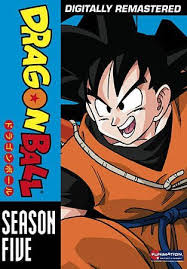
 What?! I’m actually finishing my look back at the entire series of Dragon Ball AND two entries are being made within a week of one another?! If you’re just stumbling upon this, I started looking back at Dragon Ball back in 2011 and it’s taken me until 2018 to finish it. Not because I needed all of that time to watch the show or go into exhaustive detail, I just plain didn’t do it. Now it’s done though, and we’re upon the final volume as released by FUNimation on DVD, which they chose to refer to as Season 5.
When we left off with Season 4, King Piccolo had just been defeated by the plucky young Goku in sort of gruesome, yet satisfying, fashion. Just before Piccolo truly died though he was able to spit an egg halfway across the world. Referring to it as his son as it traveled through the air, he encouraged it to continue his work and above all, seek revenge for his death. The whole scene was unnoticed by Goku, Tien, and Yajirobe who all were there to witness Goku’s triumph. Goku was beaten up pretty badly though and was in need of some immediate attention so Yajirobe scooped him up and tossed him in his hover car presumably to take to Korin. Meanwhile, Yamcha and Bulma were arriving on the scene with their other friends in tow and were prepared to render aid to Tien, who also took a pretty good beating during the confrontation with Piccolo.

Season 5 marks the debut of Kami, who will play an important role in the episodes (and series) to come.
The first several episodes continue to deal with the fall-out. Goku, needing to revive the Eternal Dragon in order to restore his friends to life, journeys to the tallest point of the world, beyond even Korin’s tower, to the lookout. There he meets Mr. Popo, the djinn-like attendant up there. Poor Mr. Popo would later be viewed by network broadcasters as a racial stereotype when Dragon Ball Z Kai started airing in the US and be re-colored a garish neon blue. Here he is presented in his traditional black with red lips. Honestly, I see a genie when I look at him so I don’t really know what Toriyama was going for, but if you see him as racist that’s your right too. Anyways, Goku has to prove himself before Popo in order to meet the guardian of the earth, Kami. When he does he’s stunned to see that Kami looks just like the elder version of Piccolo!
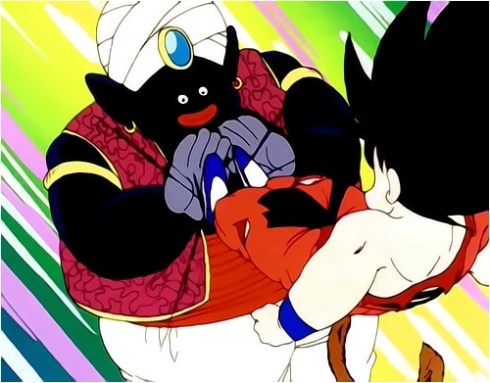
Mr. Popo’s appearance was deemed controversial enough to edit when airing on the CW as part of Dragon Ball Z Kai.
Again, this is another moment in the series spoiled by the popularity of DBZ. Having seen that series, I know all about Kami and how he and Piccolo used to be one person. Kami, needing to prove himself worthy of being the earth’s guardian, purged himself of any and all malice. That lead to the creation of Piccolo, a collection of every bad aspect of Kami’s personality. Kami is also aware of the existence of Piccolo Jr., and rather than commit infanticide, wants Goku to train with him to face that challenge someday. In exchange for reviving the dragon, Goku agrees to train with Kami for 3 years (apparently, Kami’s race grows up fast). For Goku, the length of the commitment seems daunting, but he’s always eager to get stronger and training under Kami is viewed as a worthwhile opportunity.
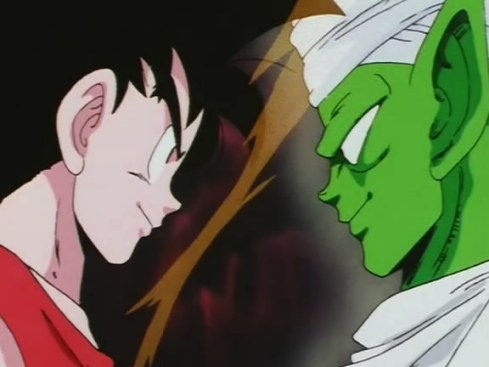
Yeah, this is going to happen.
The next half-dozen episodes or so comprise Goku’s training. He’ll enter the Spirit Room, do some fishing, and even journey back in time. Meanwhile, Tien, Yamcha, and the newly resurrected Krillin and Chiaotzu seek out Master Korin to take part in some of the training that worked out so well for Goku. These episodes seek, in some respect, to go back to the more whimsical tone of the show. Even though the main characters are largely training, they end up going on small adventures with fairly low stakes. There’s an emphasis on comedy, particularly with Goku’s time-traveling, but they do suffer from the usual training fatigue this series and the ones to come fall victim to.
At episode 133, we get a three year time jump. This was likely done to accomplish two things: gloss over Goku’s training with Kami and age-up Piccolo Jr. This leaves us at the latest edition of The World Martial Arts Tournament which will not only showcase the world’s finest but also serve as a reunion for the majority of our cast. The reunion doesn’t just cover the usual gang, but even reaches back to older acquaintances and even some we never saw play out, like Tien and the brutal Mercenary Tao. This is also a re-debut for many of our children characters who now find themselves aged-up into young adulthood. It’s fun to see how the characters, who apparently haven’t seen much or any of each other over the years, react to seeing one another again, but it’s also a little sad for us the viewer as it means we’ve now said goodbye to kid Goku. I’m going to miss that sweet little boy.

Piccolo Jr as a bit of an evil look to him that will soften in DBZ.
In his place, naturally, is adult Goku. I must say, it’s pretty cool for a manga and now an anime series to do something as permanent as age-up its child protagonist into an adult. It’s pretty risky, since there’s a chance the young audience that comprises the fanbase will no longer identify with Goku. And there’s also the risk that they just won’t want to see Goku as an adult and prefer he remain a boy. From the creator’s perspective, Toriyama must have felt there was nothing left for a young Goku to accomplish. After all, having adults underestimate a child over and over again gets old and his last major act as a kid was basically saving the world. It’s hard to accomplish something bigger than that. Goku, as a child, even had to deal with trauma in the form of watching his friends and mentor die as well as face the burden of taking a life himself. That’s a pretty full childhood.
Thankfully, as an adult Goku hasn’t lost what made him so endearing as a boy, only his tail (so the moon could come back). He’s still kind-hearted and trusting to a fault and pretty ignorant of the world around him. Age has brought him little wisdom, and he still approaches every challenge with the same youthful eagerness and excitement he always has. Meanwhile, Krillin has grown into a more well-rounded individual who is less devious and less assure of himself, without actually growing much physically. He was over-confident as a boy at times, but now has a more realistic outlook, though we’re still a long way from him being totally outclassed by his peers so this is a Krillin who still feels like he can hang with anyone in a fight. Also re-debuting, is Chi-Chi, who we haven’t seen in quite some time. Chi-Chi, daughter of the Ox King, took a liking to Goku once upon a time and he even agreed to marry her one day. Chi-Chi apparently has not forgotten that promise.
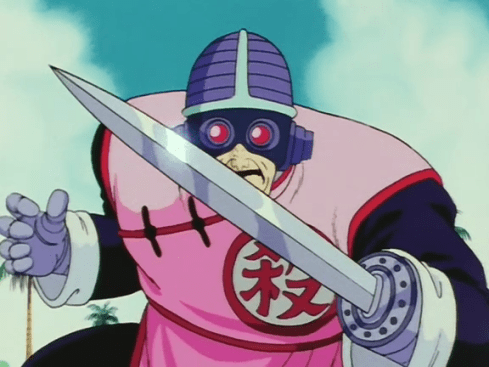
Tao is back, and he’s had some enhancements.
And then there’s Junior. Piccolo Junior, that is, makes his presence known by also entering the contest. He’s not so much there to win as he is to defeat, and then kill, Goku to avenge the death of his “father.” Piccolo Jr. is more of a clone than a true son, from what I gather, though we’ll learn way, way, down the road that he’s part of a race that actually reproduces asexually so maybe it’s a bit murkier than that. Whatever he is, he knows all about the encounter between his father and Goku even though he wasn’t there and had no one to raise him. He mostly looks like his father, though he’s a bit more slight and takes to wearing a cape and turban with giant shoulder pads. He’s convincingly evil, like his dear old dad, which is a far-cry from where he’ll be when DBZ picks up.
The tournament is going to take around 15 episodes to complete, making a pretty long competition. Like most of the tournaments featured in this show, the final match-up feels pre-ordained which does suck some of the suspense out of it all. To add some spice, there’s the new and improved Mercenary Tao who’s now part machine after being nearly killed by Goku in Season 3. He gets put on a collision course with Tien, who apparently doesn’t have fond memories of the brute dating back to his time with Tao’s brother, Master Shen, who would spar with Tien. Tien and Goku also need to have a rematch following Goku’s defeat the last time the two met in competition, and a mysterious fighter named Hero enters the tournament and his identity is in question, until it’s not.
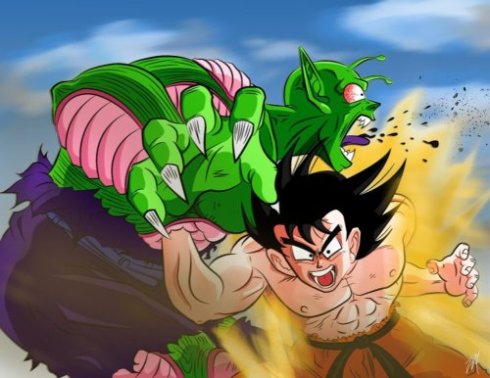
The eventual confrontation between Goku and Piccolo is a pretty satisfying battle.
Of course, the two fighters destine to meet in the finals are none other than Goku and Piccolo Jr. It may not come as a surprise, but it wouldn’t make sense for it to be any other pairing. For Piccolo, it’s an opportunity to not only best Goku in a fight, but to also embarrass him in front of a large audience. For Goku, this is his third trip to the finals of this tournament and a chance to finally win one having fallen to Master Roshi (disguised as Jackie Chun) and Tien previously. Their battle will encompass parts of six episodes, which feels like a make-up for the relatively brief battle between Goku and King Piccolo. To heighten the stakes, Piccolo essentially promises to destroy the world after he finishes off Goku. Goku likely can’t just settle for winning this match as a ring-out or some other technicality likely won’t prevent Piccolo from going on a rampage. He needs to beat him down and make sure he can’t accomplish his goal of total annihilation for earth.
This fight is essentially the grand finale for Dragon Ball. It’s going to rely on some old staples of past fights while also attempting to up the stakes as high as possible. Think huge energy attacks and a literal huge adversary when Piccolo demonstrates his growing abilities. When all is said and done, the show feels almost as if it’s been creatively exhausted. The fighters are so beyond what they were when this show started and it feels impossible to ponder where they go from here. Of course, Toriyama and TOEI weren’t quite there yet as DBZ will prove there’s still something left in the tank, but for now, this conclusion feels complete.

Goku and Chi-Chi are going to need some time to get reacquainted with each other.
It doesn’t end there though. The last five episodes detail Goku and Chi-Chi’s quest for marriage. They have to embark on some minor adventures for a dress and other wedding planning activities that try to recapture a bit of that old Dragon Ball magic, but sadly come up short. That’s not to say these episodes are bad, but they lack some of the whimsy of the old ones and feel like padding to draw out the season. I’m not really sure why anyone felt the show needed to be 153 episodes instead of 150, but it is what it is. In the end, Goku and Chi-Chi are married and they display as little chemistry together here as they will in DBZ. I’ve always been some-what dissatisfied with their pairing as Goku is almost too child-like to imagine getting married, let alone procreating eventually. Chi-Chi at least gets to be an interesting character, albeit briefly, before becoming a nagging shrew in DBZ. She’ll rarely be in the wrong from here on out, but she’ll often be made to feel like an adversary of sorts for Goku. That’s sort of a problem with the series as a whole though, as the women often feel more like stereotypes than anything.

In a bit of a surprise, the series ends with a wedding.
Dragon Ball has a some-what muted end, but in a way it’s also satisfying. The World Martial Arts Tournament is a chance for Goku to shine for a final time doing what he does best: fighting. There’s also a nice send-off for him that hints at a more stable life by having him marry Chi-Chi. The reunion feel of the tournament also allows for basically every one of the secondary characters to have some screen time to not only see what they’re up to, but say goodbye. Of course, the manga continued on after this while the anime would be rebranded as Dragon Ball Z and run for over 200 episodes by itself. I personally like that the two anime properties are separated, albeit slightly, in their naming as Dragon Ball has always had a very different feel than Dragon Ball Z. It’s the more charming of the two and the series more concerned with character creation. Watched separately, Dragon Ball Z lacks that, but it’s largely due to the characters being established by this series, although that’s no excuse for the cookie-cutter villains added in DBZ. In light of that, I suppose it goes without saying that I view Dragon Ball more favorably than I do Dragon Ball Z, even though DBZ is the series I consumed first. Dragon Ball just holds up better on repeated viewings as its humorous tone and smaller stakes are easier to digest rather than every fight being a battle to save the universe. This final volume of episodes is definitely not the best, and in some ways just feels like a lot of fan service, but it is at least fan service done well as if you’ve been along for the ride you’ll likely find yourself smiling a lot while watching these final episodes. It probably wouldn’t make sense to view it without having seen the previous 122 episodes, but for those who have it would make even less sense to skip this final batch of 31. All in all, a satisfying conclusion to a wonderful series.
If you’re looking to enjoy Dragon Ball on your own, your options are unfortunately rather limited. Aside from streaming options, you basically only have the five season sets put out by FUNimation. Even in Japan, the series was only released as a made-to-order set as even there DBZ is more popular than Dragon Ball. The FUNimation sets are limited to strictly DVD and no Blu Ray release is currently planned. The sets themselves are solid, if unspectacular. The transfer is about as good as you would expect of a television program from the 1980s. FUNimation wisely left the aspect ratio alone, having faced some backlash for messing with it for its DBZ box sets. The original audio is also preserved and available. FUNimation obviously re-dubbed the character voices and narration but left the music alone. Dragon Ball benefitted greatly from being dubbed by FUNimation long after it started doing in-house dubs. Their initial dubs were pretty terrible, including Dragon Ball Z, but the Dragon Ball one is pretty fantastic. There’s no “warm-up” period for the actors as they all feel comfortable with their characters from the get-go. If you prefer to hear the characters and understand them as opposed to reading, then you’ll probably be happy with the dub. The sets are short on any sort of worthwhile bonus material, but they at least contain the essentials. These sets were once really cheap, which is how I got them, but now that they’re out of print they aren’t as friendly on the wallet but still reasonable ranging from $20 to $30 per set. I think it’s worth it, and if you’re into anime Dragon Ball almost feels like required viewing. If you’re a fan of Dragon Ball Z or Dragon Ball Super and tend to like them for their large scale confrontations then maybe Dragon Ball isn’t for you, but I think it’s worth giving a try. On the other hand, if your favorite episodes of Dragon Ball Z are the early, pre-Frieza episodes then you’ll probably love Dragon Ball. If you do end up checking it out I hope you enjoy it as much as I do.
 It sure is taking me a long time to post about the “seasons” of Dragon Ball. I place the word seasons in quotations because these aren’t actual seasons of television, but just how FUNimation chose to label them when releasing the show on DVD. As a result, Season 4 starts during the World Martial Arts Tournament as opposed to before it or at its conclusion, which is a pretty poor way to start a season (though it’s a better start for Season 4 than an ending for Season 3 which was quite abrupt). Thankfully, Season 4 will end at a better spot setting up for the fifth and final volume of Dragon Ball episodes.






 The Nostalgia Spot