Tag Archives: dragon ball

Dragon Ball: Season 4

dragon_ball_season_4_600x600_itunes_artwork_by_eddie09-d58sdkjIt sure is taking me a long time to post about the “seasons” of Dragon Ball. I place the word seasons in quotations because these aren’t actual seasons of television, but just how FUNimation chose to label them when releasing the show on DVD. As a result, Season 4 starts during the World Martial Arts Tournament as opposed to before it or at its conclusion, which is a pretty poor way to start a season (though it’s a better start for Season 4 than an ending for Season 3 which was quite abrupt). Thankfully, Season 4 will end at a better spot setting up for the fifth and final volume of Dragon Ball episodes.

Season 4 has a different feel than its predecessor. While Goku has dealt with loss before and even experienced a desire for vengeance, he’ll be pushed towards a darker path even more so in this volume, but first the tournament. When we left off, Goku and his friends were participating in yet another World Martial Arts Tournament with the plot very clearly setting up a showdown between Goku and his latest rival:  Tien Shinhan. Tien is a student of Master Crane, who is also the older brother of Mercenary Tao, who Goku dispatched in Season 3. As a result, Crane wants to see his brother avenged and is relying on his pupil to do so. In order for the two to meet though, they need to win their respective matches to meet in the finals.

pic_1432979102_1

Some unfinished business from Season 3.

The first 9 episodes deal with the tournament, and throughout it both Goku and Tien will be tested. By its conclusion, they’ll gain a new understanding of each other and Master Roshi will gain some new students, but he’ll also lose one. Setting up what is the main arc of the season is a murder and one that will have a lasting impact on Goku. If you want zero spoilers, then skip ahead, but the murder of Goku’s best friend and one-time rival Krillen is perhaps the darkest moment in Dragon Ball history. Perhaps the only comparable moment is the death of Dende in Dragon Ball Z at the hands of Freeza. Krillen is still basically a child when he’s murdered in Dragon Ball. It happens off-screen, but when Krillen is taking an especially long time in returning to their group’s celebratory dinner Goku runs back to the training ground to retrieve him only to find his lifeless body. It’s an affecting scene to behold as the image is held for an uncomfortably long time. This moment moves Goku to tears, naturally, but it also gives rise to an anger inside of him that is also uncomfortable to see. Up until now, Goku has been our happy-go-lucky protagonist. He’s dealt with loss mostly with sadness and to some degree a lack of comprehension. He’s learned empathy over time, he’s bore witness to how unjust the world can be, and he’s fully equipped now to experience a wide range of emotions at the sight of his best friend’s corpse.
dragon-ball-season-4

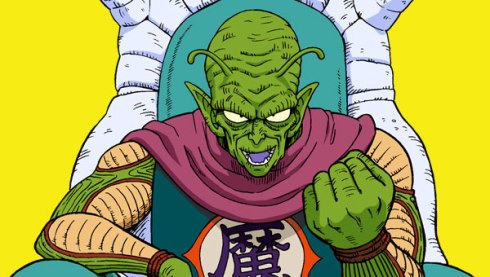
He doesn’t look THAT scary.

This sets the stage for the evil King Piccolo to enter our story. Piccolo is an ancient evil that not even Master Roshi could handle. He’s often referred to as a demon, and it took a technique from Roshi’s master Mutaito that cost him his life to seal him away previously:  The Evil Containment Wave. Roshi naturally preaches caution to his young pupil, but Goku is too headstrong and determined to avenge his fallen friend. He will pay for his impatience, as Piccolo isn’t alone. Since he’s rather old and feeble looking, Piccolo has surrounded himself with some powerful adversaries. They’re all named after musical instruments just like their master, and all have a sort of reptilian or demonic appearance:  Piano, Cymbal, Tambourine, and Drum. In order to defeat them, Goku will need to get stronger and he’ll be forced to seek out Master Korin once again.

GokuvsTam-again

King Piccolo likes his minions scaly and green.

Meanwhile, Master Roshi together with Tien and Chiaotzu, decide they’ll need the help of the Dragon Balls in order to essentially wish away the demon king. While they’re doing that, and Goku is off training, Piccolo’s minions are seeking out the strongest fighters in the world with the goal of killing them to pave the way for King Piccolo to take control over the world (he’s a rather conventional villain, in that respect). Roshi’s plan to assemble the Dragon Balls ends up backfiring and he’s unable (or unwilling) to master the Evil Containment Wave. As a result, Piccolo seizes control of the legendary artifacts and is able to restore his youth, and power. In the process he also kills the Eternal Dragon. Suddenly, death has real consequences in this world with no dragon able to restore life to those who have fallen or will fall.

With King Piccolo fully powered-up, all eyes turn to Goku. His training with Korin puts him into confrontation with the bulbous Yajirobe. Yajirobe is essentially a punch-line in DBZ, like a lot of the main characters from Dragon Ball unfortunately, but here he is not such a push-over. Still, he’s no Goku. There’s some humor to be found in Goku’s training with Korin, but it’s largely a bit of a slog as we’re more eager than usual to see Goku face-off with the evils that stand before him. Once his training is complete, he’s forced into conflict with Piccolo’s minions and eventually the demon king himself.
piccolo daimao

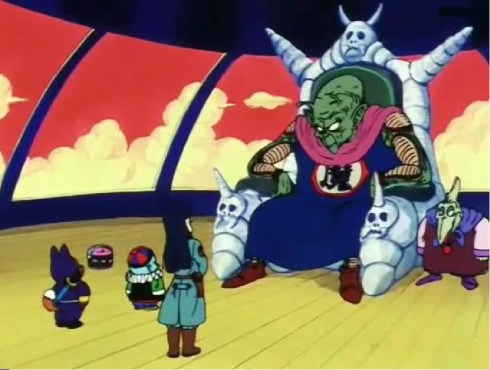
If you’re a fan of Pilaf and his crew, don’t worry, they’re still hanging around.

Some drama is created in the meantime. Tien has mastered the Evil Containment Wave, and with Goku still missing in action, he’s resolved to use it as Piccolo has begun destroying the earth city by city. Using the wave against Piccolo would mean Tien’s death, so it becomes pretty important for Goku to hurry up and get there. Goku and King Piccolo are naturally destined to meet in combat, and surprisingly, their confrontation is pretty short spanning just three episodes, but as I mentioned in the lead-in it’s at least all contained on this set without bleeding over into the next. It does mean a some-what abrupt end to the season as the immediate fall-out is left for Season 5.

Dragon Ball Season 4 marks both a new story-telling device for the show, vengeance, as well as a doubling-down on the previous format. That format is essentially Goku encountering a new foe, getting beaten down, training, and then returning to face the enemy in a rematch now powered-up. It’s a formula that Dragon Ball Z will beat into the ground, but at least here it’s not quite so worn out. Still, the training moments between Goku and Korin are slow, and they’re made even more so because the story did give us an effective motivation earlier for Goku to face Piccolo. It’s both refreshing and sad to see Goku motivated by vengeance. It would be nice if Goku could remain unaffected by the evils of the world, but it’s also unrealistic for a show with such an expansive amount of episodes. Sort of forgotten is how the season begins, with Goku turning an adversary in Tien into a new ally. It’s handled well enough, with Tien’s sense of honor ultimately being the aspect of him that is won over by Goku and his friends. Of course, if you’re like me and you experienced Dragon Ball Z before Dragon Ball then you knew Tien was destined to be an ally, but it was still entertaining to watch.

GokuVsPiccolo.Ep.119

A powered-up Goku is ready to take on the king.

At this point, the show has also improved visually. It’s success likely lead to some increased production budgets by TOEI Animation so the special effects and animation are better than they’ve ever been. The aged King Piccolo is well illustrated and he’s actually a lot more interesting to look at than the youthful version. There’s a moment where he forces an egg out of his mouth to create a new minion and it’s both gross and strangely satisfying to watch the scene play out. The original soundtrack is kept, and while it’s certainly dated, it has a whimsical quality that works really well with Dragon Ball. The benefit of FUNimation dubbing the series after DBZ means these actors have had plenty of time to get a feeling for the roles and everyone sounds mostly great. They’re all familiar if you’ve watched the other dubs, and the continuity is nice and appreciated. If you prefer Japanese audio it’s there as well. The original aspect ratio is also preserved.

Season 1 is still my favorite Dragon Ball season, mostly because it’s just a lot of fun and the ignorant Goku of Season 1 is really entertaining. Season 4 might be my second favorite though. It has some filler, but not as much as Season 3, and the stakes feel high which is also an improvement over both Seasons 2 and 3 and helps to give the confrontation more weight. It’s also satisfying when taken as a whole, and though I wouldn’t recommend it, you could conceivably just jump-in at Season 4 and enjoy it without seeing the previous material. I don’t know that I would call it peak Dragon Ball, but there is a downward slide following it with Season 5 basically feeling like an encore for the show as well as a setup for what’s to come. I promise to not take over four years to get to that one.

Dragon Ball Z: Battle of Gods

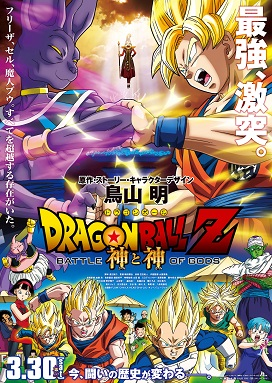
Dragon Ball Z:  Battle of Gods (2013)

Dragon Ball Z: Battle of Gods (2013)

I’ve made no secret of the fact that I find Dragon Ball Z to be a pretty overrated anime. Some of that sentiment stems from the fact that it’s considerably more popular than its predecessor, Dragon Ball, despite being the inferior product. Part of that also stems from the fact that Dragon Ball Z fans seem to regard it as the greatest anime of all time, rather than what it really is; the most popular anime of all time. This is not to say I find the show to be a bad one. For awhile during the 1990’s I found myself quite captivated by the show. I was incredibly disappointed that the dub, for many years, ended right in the middle of the Namek Saga with Goku preparing to take on The Ginyu Force (I was also really disappointed when the series finally returned with an all new and quite terrible dub). Little did I know, that I had basically seen the best of the show up to that point. While the Cell Games and Buu Saga have their moments, for the most part the show became almost a self-parody with extended filler sequences and familiar plot lines.

It’s the formula of Dragon Ball Z that makes it a rather pedestrian television program. The characters are all simply constructed and tend to embody one archetype. Each “season” consists of the gang being forced to take on the latest “Most Powerful Being in the Universe” with the same familiar pattern: dispatch weak enemy, hear latest prophecy of doom, be defeated by said enemy, train endlessly, power-up and defeat enemy. The stakes are always the same, and even though characters are killed off several times, they usually find their way back to the land of the living and there are few lasting repercussions on the show (aside from the novel concept that the characters do age over time). It was basically like watching an animated fighting video game: it just moves from one battle to the next with very little connecting tissue in-between. As such, it’s quite easy to take a cynical view towards the show but it still has its moments where it’s genuinely entertaining and even charming.

Beerus and Whis are the latest antagonists to threaten earth.

Beerus and Whis are the latest antagonists to threaten earth.

If one were to be jaded with the prospects of another extension of the Dragon Ball Universe, they’d likely be less interested in yet another Dragon Ball Z film. The show was so successful that it rather logically spawned feature films. These films were little more than cash-grabs and often contained less plot than the show and an even more obvious formula. Thirteen films in all were released based off of Dragon Ball Z with virtually none fitting into the canon of the show’s storyline. Aside from a select few that contained some genuine entertainment value, most are just mediocre with the only contribution they made being the superior animation when compared with the show. As a result, I was not all that enthused to hear that Toei Animation was returning to the series for a new film:  Battle of Gods. The only cause for optimism was that it was announced series creator Akira Toriyama, who had little involvement with the awful Dragon Ball GT, was handling the screenplay and character designs. Toriyama, unlike some of his fans, seems to understand what makes Dragon Ball special. It’s not some super sophisticated anime meant to challenge the likes of Neon Genesis or Cowboy Bebop, it’s strictly intended to entertain with humor and action.

Battle of Gods opens with some familiar characters pondering the awakening of The God of Destruction. Supreme Kai, along with Elder Kai, fear what this god may do now that he’s awoken early while King Kai gives Goku a quick lesson on who this guy is. It’s not a very promising open for the film as it’s pretty much in line with most of the movies and we know Goku and this god are going to have to have a showdown. We’re then taken to this god’s home world and are introduced to Beerus, The God of Destruction, and his attendant Whis. One of the themes of Dragon Ball is to never a judge a book by its cover, and Beerus embodies that concept quite well. He’s basically an anthropomorphized sphinx cat complete with tall ears and a wrinkly cat muzzle on his face. Not only does he look like a cat, but he also embodies one as well. When we first meet him he’s just waking up from a 39 year slumber much in the same way we’d expect any cat to awaken. He’s lethargic, hungry, and summons for Whis almost immediately. Later we’ll see him acting rather petulantly and impatiently while also toying with his prey, further driving home the point that he doesn’t just simply look like a cat, he is one. Whis gives him a refresher on what transpired during his slumber, and he’s quite pleased to learn that Frieza dealt with those insolent Saiyans by destroying their planet. He’s further surprised to learn that one dubbing himself a Super Saiyan defeated Frieza, which reminds him of a dream he had where he encountered a Super Saiyan God. Remembering this, Beerus decides to journey to earth to meet the one who defeated Frieza and to hopefully find out more of this Super Saiyan God.

Beerus and Goku reenacting the infamous WCW Finger Poke of Doom.

Beerus and Goku reenacting the infamous WCW Finger Poke of Doom.

When Beerus arrives he encounters Goku almost immediately, and in true DBZ movie fashion, they fight and Goku is easily outclassed. Unlike other films, Beerus is essentially neither friend nor foe. He isn’t a good guy, but he’s also not really a bad guy. Sure he’s The God of Destruction, but apparently someone has to be. He decides to seek out Vegeta to see if he knows anything of this Saiyan God, since he learned nothing from Goku, and finds the Saiyan prince at his wife’s birthday party. Beerus loses interest in his pursuit of a Super Saiyan God when it turns out Vegeta knows nothing, and not wanting to turn down an opportunity to feast, invites himself to the party. Some hijinks involving some familiar faces for Dragon Ball fans occur at the party and things seem to be going well until Buu hogs all of the pudding, sending Beerus into a rage. Only Vegeta knows just who Beerus is and what he’s capable of, which is why the other party-goers jump to their friend’s defense further irritating Beerus. This causes him to declare that it’s time he destroy earth, just as Goku shows up. The heroes are able to request Beerus give them five minutes to consult The Eternal Dragon on the matter of a Super Saiyan God, and when Shenron reveals the secret of how to produce one, Beerus gets his wish.

Of course, Goku is the one to step-up and challenge him as the very underwhelming Super Saiyan God. If you were expecting a fantastic new transformation then you’ll be let down to see that “God Mode” is essentially a skinny Goku with a bad dye-job giving his hair a reddish hue. He possesses a fiery aura, which looks kind of cool but is also visually distracting, but that’s about it. Goku and Beerus fight, and I won’t spoil the outcome but you can probably guess at the ultimate end result.

The gang's all here.

The gang’s all here.

The plot for the film is rather familiar, and judged solely on that, the film is a disappointment. However, how it navigates the plot is what helps to elevate it above the normal DBZ fare. For one, Toriyama’s humor is sharp, and while there are some in-jokes to be found for longtime fans, the majority of the humor is fairly natural. It’s also refreshing as Beerus is the source for much of it. He’s definitely one of the better villains Toriyama has conceived of and his ambiguous nature and ambivalence towards mortals makes him almost charming, in a way. He plays off of his attendant Whis fairly well, a character who also embodies a notable Toriyama trait in that he’s a supremely powerful male with obvious feminine features. Toriyama’s affinity for food-related humor shows up in both Whis and Beerus as they’re very interested in the different flavors present on earth. Thankfully, we’re spared the often repeated visual of Goku stuffing his face which stopped being funny somewhere around the character’s first visit to King Kai’s planet.

For fans of DBZ’s unique action sequences, the film may be a disappointment. A lot of the time is spent on Beerus interacting with the earthlings at the expense of the big fight scenes the show is known for. When the film does go there, the action is a bit restrained. Some of that is a plus. As the characters grew in power during the show there was basically no way to visually establish they were stronger and faster than they were 100 episodes prior making many fight scenes look visually lazy as the characters “moved too fast for the naked eye.” In Battle of Gods the action is slowed down and there’s a satisfying weight to the blows landed. There’s still a few instances of old standby DBZ staples, but they’re not overused. Despite that though, the action is underwhelming and some curious uses of CG effects didn’t help things.

Goku's "God" form is a bit underwhelming, but at least it's better than Super Saiyan 4.

Goku’s “God” form is a bit underwhelming, but at least it’s better than Super Saiyan 4.

Visually, DBZ never looked better. The animation is smooth and every scene pops with bright colors. Some may have thought the more muted color palette of the manga would be present since Toriyama was so heavily involved but that is not the case. The only criticism I have of the visuals is the just mentioned CG used in the fight scenes. While the characters fly through a city landscape, it’s rather obvious the backgrounds are being drawn by a computer. This is a fairly common effect going back to the 1980’s but I’ve always found it jarring. Less forgivable are the few instances in which the characters themselves are CG animated making them look like they’ve been ripped right out of the latest DBZ video game. It looks silly and something I would recommend they scrap for future features.

Dragon Ball Z has had an up and down relationship when it comes to the english dub. The original Ocean Group dub was a mixed bag, but was miles ahead of the original Funimation dub that followed. Funimation first starting dubbing DBZ over 15 years ago, and all of that time with the series has actually lead to a pretty wonderful english cast. The voice actors, most of whom have been on the series since the beginning, really know their characters. The writers handling the localization also know these characters and they’ve created a very lively and witty script. The language is probably of a PG nature though there’s very little in the way of graphic violence. If you’re a longtime fan of the series who prefers to watch it subtitled, then by all means, watch it subbed but you won’t be missing anything if you go the dub route.

Dragon Ball Z:  Battle of Gods managed to both meet my expectations and also exceed them. The general plot is typical for a DBZ movie and rather boring, but the presentation is excellent (aside from a few visual hiccups) and the film is genuinely entertaining. It’s probably too long by about fifteen minutes, but not long enough to feel like a drag. The way the film is written makes this feel more like Dragon Ball than Dragon Ball Z. For me, I consider that a good thing but those who enjoy DBZ for the over-the-top action may be disappointed. Lastly, the introduction of Beerus was a success as I’m actually interested to see more from him. Apparently, Toei and Toriyama were banking on that as he’s in the recently released Dragon Ball Z: Resurrection F and is also a recurring character in the new television show, Dragon Ball Super.  I have no idea if more Dragon Ball Z is a good thing or not, but I do know that Battle of Gods was a fun nostalgia trip. Time will tell just how long that trip lasts.


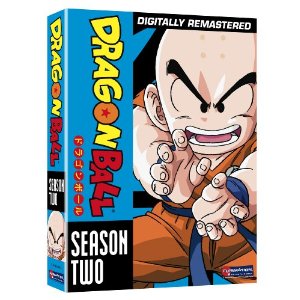
Dragon Ball – Season Two

Dragon Ball – Season Two

Last Summer I acquired the entire series of Dragon Ball on DVD when amazon.com was having a big sale on anime.  I had seen some of the series, but not all of it, and what I had seen was edited for television.  I had always wanted to revisit the series as the little of it I saw was charming, but just never got around to it.  That sale presented the perfect opportunity and by summer’s end I had seen every episode.  In December of last year, I made my first entry on the subject and promised to review the entire series on a season by season basis.  My initial idea was to post one review a month, but as is plainly obvious considering it is now past Memorial Day, that didn’t happen.  Better late than never!

Season one ended with Goku striking out on his own to find his grandpa’s four-star dragon ball.  By taking Goku and sending him off on another adventure, it brings the series back to how it started, only this time Goku is flying solo.  Let’s get it out of the way up front:  season one of Dragon Ball is the best season.  Everything is new and fresh from Goku’s indomitable will to Master Roshi’s inappropriate advances towards the show’s female characters.  That’s not to say the rest of the series is lackluster, not at all, but some of the shine does ware off.  Akira Toriyama must subscribe to the theory that you should stick with what got you there.  He’ll re-use a lot of the same gags and gimmicks, and while Roshi’s perverted nature is usually pretty funny, the more dramatic elements become tiresome (such as when a villain disappears in a cloud of smoke and the heroes foolishly think it’s dead, oh yeah, that one will be used a lot).

While Toriyama is comfortable sticking with what he knows, changing the show’s focus to just Goku is a pretty bold move.  He has essentially removed the entire supporting cast from season one (I should point out, the “seasons” are pretty much arbitrarily broken out by Funimation for the localization process and DVD releases and aren’t true seasons in the literal sense) and is relying on Goku to carry the show.  That doesn’t mean Goku is going to go it alone entirely.  Along his travels he’ll meet several new friends and many new foes.  Some exist to better serve the plot, and some for comic relief, but there are some pretty good characters introduced in season two that will make a lasting impression on the series and our hero.

General Blue; he’s basically a massive douche.

The major conflict of season two revolves around Goku V.S. the Red Ribbon Army.  The Red Ribbon Army (RRA) was introduced at the tail end of season one and is an organization after the dragon balls(what else?).  Emperor Pilaf was the main villain in the first part of season one and he too was after the dragon balls, but at no point does the audience consider him a threat.  He’s a bumbling sort of villain used mostly for comedic relief.  Even Goku has trouble remembering who he is and clearly doesn’t take him seriously.  The Red Ribbon Army, on the other hand, is well equipped to give our hero fits and is considerably more dangerous than Pilaf.  Early on, that won’t be quite as clear as they feel out Goku and learn (slowly) that conventional means will have little to no effect on him.

While some of their membership is quite nefarious, others are here to make us laugh.  When Goku’s travels lead him to a remote mountain village he agrees to help free their chief, who has been captured by the RRA.  This brings him to Muscle Tower, where he has to work his way from the bottom to the top in true video game fashion.  Along the way he encounters various foes, including the imbecile Ninja Murasaki.  Initially Murasaki seems like a foe worthy to take on Goku, but over the course of several episodes we realize that isn’t the case.  Their encounter is best described as slapstick and there’s some nice visual gags (particularly when Murasaki has a painful encounter with Goku’s power pole).

Along the way Goku encounters his first android.  Dragon Ball Z fans know the androids as homicidal robots created by Dr. Gero with the sole purpose to kill Goku, but Goku’s first android encounters go much different.  One is the Arnold Schwarzenegger inspired Major Metallitron.  He’s pretty much a rampaging killing maching, but Android 8 ends up being a gentle giant.  The Frankenstein-inspired 8 is quickly dubbed Eighter by Goku and they become fast friends.

Muscle Tower ends up being little trouble for our hero (hope that isn’t spoiling anything), but when Goku doesn’t find his beloved 4-star dragon ball, he seeks out Bulma once more.  This brings the old gang together for The General Blue Saga.  This saga further brings along the RRA and introduces the pirate robot too.  The heroes (Goku, Krillen, and Bulma) go on a wild run thru the maze-like undersea base of the RRA and there’s a lot of action and a healthy dose of comedy.  The saga runs perhaps a touch too long but it’s good to have Bulma and Krillen back in the fold for a few episodes.  As the name of the saga implies, General Blue is the main adversary here and he has enough tricks that he can put up a fight against Goku, something few have managed up to this point.  His “threat” is kind of short-lived and he soon ends up as another slapstick villain, especially when he and Goku end up in Penguin Village where things get a bit weird.

Mercenary Tao ends up being Goku’s most formidable opponent yet.

The last part of the season has Goku off on his own once more.  The RRA send the famed Mercenary Tao after him this time, who actually proves to be a very capable opponent for the young hero.  Here, Toriyama will employ an effective tool for the first time to get the viewer emotionally invested in the conflict:  death.  Tao is a cold-blooded killer with no redeeming qualities, and Goku figures this out pretty quickly.  He’s a true threat, and the season ends with Goku setting off on a strange quest of sorts to gather enough strength to make sure he can stop Tao for good.

Season two contains a lot of the charms that made season one so enjoyable.  Goku is off on his own for a large portion of it, but he’s never truly alone as other allies fill the void.  Few of these allies are as entertaining as Bulma or Master Roshi, but it’s nice to change things up.  Of the new characters, I find Blue, Tao, and Korin the most interesting though Korin only appears in the season’s finale.  Season three is probably a little better as Goku’s conflict with the Red Ribbon Army gets ratcheted up a notch and the next round of the World’s Martial Arts tournament begins again.  Season two establishes Dragon Ball as a fun and pretty consistent television show.  Don’t watch it for depth, just watch it for the sheer enjoyment of it.