Tag Archives: catwoman

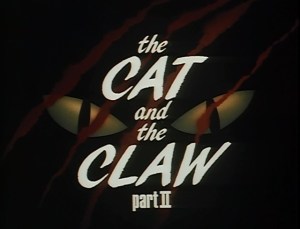
Batman: The Animated Series – “The Cat and the Claw – Part II”

3366254-the+cat+and+the+claw+part+2Episode Number:  16

Original Air Date:  September 12, 1992

Directed by:  Dick Sebast

Written by:  Sean Catherine Derek and Laren Bright

First Appearance(s):  None

“The Cat and the Claw: Part I” was the big kick-off for Batman: The Animated Series. It was also the introduction of Catwoman, Batman’s closest foil, and portrayed her as a Robin Hood of sorts robbing from the rich to benefit the poor, neglected animals of Gotham. Her acts aren’t quite so noble as that, as she lives a pretty pampered lifestyle in a Gotham penthouse with an assistant on hand 24/7 so not all of those riches are going to the animals. It also introduced the relationship between Batman and Catwoman in which Catwoman has an attraction to Batman while Bruce Wayne has his eye on Catwoman’s alter-ego Selina Kyle.

Red_Claw_3

Ever remove the label from a can of Chef Boyardee?

Not to be forgotten, is the true villain of both episodes:  Red Claw. Red Claw is a soviet terrorist who has infiltrated Gotham and stolen a biological weapon in which she utilizes to hold all of Gotham at ransom. Catwoman is brought into the fold by virtue of the fact that a company Red Claw is conspiring with has seized a piece of land once intended as a sanctuary for large cats. Batman, naturally, just wants to make sure Gotham isn’t destroyed.

The episode picks up where the previous one left off. Catwoman has been followed back to her apartment by a member of the Red Claw gang and her identity is now known to her adversaries. Batman is tipped off about the gang’s intention of knocking off the plague weapon which is coming through Gotham on a train (seems to be some security flaws). Batman isn’t able to prevent the theft, obviously or else we wouldn’t have much of an episode, but he does get to come face to face with Red Claw.

The following day, Bruce and Selina are out to try and have a date once more when Bruce’s car is assailed by a member of the Red Claw gang. There’s a fun chase that ensues with the Red Claw car just trying to run Bruce and Selena off the road while Bruce gets to demonstrate his Batman driving skills as they eventually get away (Bruce can afford the repair bill). This was all the result of Red Claw knowing Catwoman’s identity, and since Selina has no idea about Bruce, she kind of figures out that they’re onto her. Bruce also notices traces of cat hair left behind by Selina and apparently this is good enough for him to know that she’s Catwoman.

CatClaw2

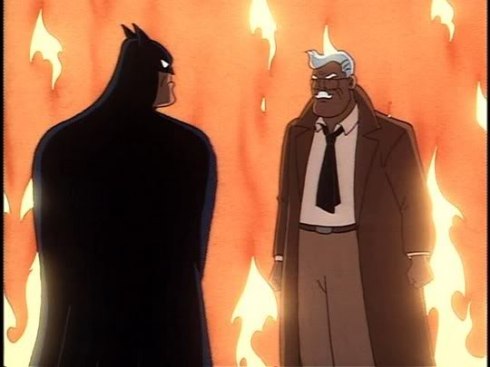
Thanks for the help, Batman. Next time, can you stop the bad guys with less fire?

The rest of the episodes ends up being a Batman/Catwoman team-up. Catwoman is portrayed as rather cocksure, as she was in the previous episode, and careless as a result, necessitating help from Batman. They both end up captured and have to escape from Red Claw. There’s some nice action sequences and their escape is actually pretty thrilling, even if it doesn’t seem in doubt. Red Claw proves to be rather ruthless, but just as ineffective as most Batman villains. A confrontation between her and Catwoman is setup, but doesn’t really pay off. Catwoman  is also teased to have some special connection with not just her pet Isis, but cats as a whole. I don’t recall this playing a role in a future episode, but I could be mistaken.

People hoping for a Batman/Catwoman pairing following this episode were probably let down by its ending. After the mess with Red Claw is cleaned up, Catwoman escapes and flees to her penthouse. Unknown to her, Batman has already been there to advise her assistant, Maven, to flee since Red Claw is looking for Selina. He’s there waiting for her and when she tries to turn on the charm to get out of the predicament he coldly slaps a pair of handcuffs on her while he suggests this hurts him more than it hurts her.

30-1

Just kidding, want to come over to my place?

Trying to portray Batman’s arrest of Catwoman as some noble act feels kind of silly. I know they only have so much time to work with, but Bruce’s affection for Selena could best be summed up as a simple crush. They never get to know each other, though I suppose a life-harrowing event such as the car chase might leave more than a mark. I touched on it in the last episode, but Batman breaks the law all of the time in small ways and is able to justify it. Selina seems like she does the same and perhaps Batman could have steered her into a better direction. Nevertheless, he’s not willing to bend.

Some have voiced displeasure with Catwoman as a whole and how the show handled her. Even Bruce Timm has suggested they could have done a better job with her and it’s hard to disagree. I wish she wasn’t so incapable of taking care of herself across two episodes, always needing help from Batman. I also think they couldn’t decide if she should be an anti-hero or a true villain and tried to have it both ways, which feels noncommittal and isn’t particularly satisfying. She’ll pop up again, but her future appearances seem to only exacerbate that aspect of her character.

Just as was the case with Part I, Part II does look great and the colors, animation, and style are some of the best the show would produce. I love the sequence of Catwoman just narrowly sliding under a closing steel door and the fire effects, perhaps dated, are still pretty spectacular. All of this leads me to render a verdict of style over substance in the case of “The Cat and Claw” as a whole, and especially Part II. Part I was decent setup, but the payoff wasn’t. At least they had the foresight to utilize a throw-away villain like Red Claw when the focus was going to be put on Batman and Catwoman. It just felt too early for those two to team-up and for Batman to figure out her identity. And for a character as prominent and popular as Catwoman I don’t think it would have been too risky to plan on featuring her in 2 or 3 episodes before this.


Batman: The Animated Series – “The Cat and the Claw – Part I”

Cat_and_Claw-Title_CardEpisode Number:  15

Original Air Date:  September 5, 1992

Directed by:  Kevin Altieri

Written by:  Sean Catherine Derek and Laren Bright

First Appearance(s):  Catwoman, Red Claw

This may be episode number 15, but it’s actually the very first episode of Batman: The Animated Series by air date. Airing as a special prime time sneak peak, “The Cat and the Claw – Part One” featured the debut of a very popular Batman foil – the not so villainous Catwoman. Like The Penguin, Catwoman was fresh off of starring in Batman Returns where she was played by Michelle Pfeiffer. Also like The Penguin, Catwoman was a regular on the Batman television series from the 1960s and was a featured villain in Batman: The Movie. In terms of Batman adversaries, few were as well known to audiences as Catwoman.

Catwoman_BTASUnlike The Penguin and Joker, Catwoman was not made an existing villain in this series. This episode marks her debut to both the television audience and to this version of Batman as well. They have never crossed paths before their meeting here, though one gets the impression that Catwoman has been up to this sort of thing for quite some time. She’s quite good at getting around and breaking and entering and even has little cat-shaped caltrops to make use of. Her outfit is very similar to Batman’s and I suppose that’s intentional. She even has a yellow-gold belt. Really, the only difference is she lacks a cape. This version of Catwoman is less an adversary and more another aspect of how Batman could operate. While he may be a vigilante out to do what’s right while largely adhering to the law of the land, Catwoman plays more fast and loose with the law and is willing to break it, going as far as thievery, if the ends are justified by the means. Batman’s ultimate goal is also to help the good people of Gotham by reducing crime, where as Catwoman is basically an animal rights activist who may or not prefer animals (in particular, cats) to people.

The episode opens with Catwoman (Adrienne Barbeau) out on the prowl. She’s after something and we get a look at how she operates. At her side is her trusty cat Isis whom has been trained to infiltrate locations and even deactivate traps. Catwoman is after a diamond necklace, but she attracts the attention of our hero. She and Batman have a playful little chase and it’s impressed upon us almost immediately that the Batman ignites something within Catwoman. Catwoman is able to elude Batman, in part because he stopped to save her precious cat from becoming roadkill. He seems willing to let her off and try another time.

291

Attaboy Bruce!

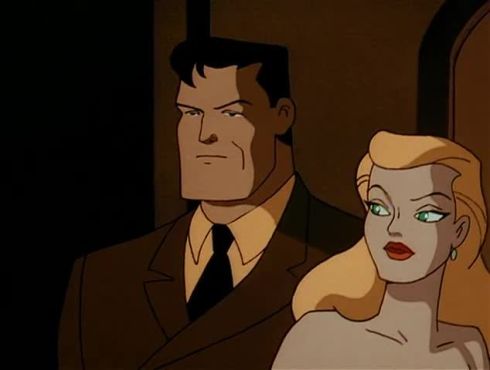
The Batman/Catwoman dynamic isn’t anything new, and it’s not surprising to see them go this route. Also not surprising, is that Bruce Wayne and Selina Kyle, Catwoman’s real life persona, are destined to meet. Wayne is attending a charity auction where a date with Gotham’s most eligible bachelors is what’s up for bid. Kyle grossly outbids the other ladies for the services of Bruce and he’s immediately smitten with the blond bombshell. Kyle is disinterest though, as she was only doing it for the charity which is an animal charity. We’re given insight into Catwoman’s motivations for her thievery. Rather than enriching herself, it would seem her aim is a bit like Robin Hood (in her mind), though instead of giving to the poor she’s donating to animal rights groups.

Before Bruce and Selina can formalize plans for their date, that Bruce insists upon having, gunfire is heard and Batman is forced to spring into action (this seems to happen a lot to poor Bruce). Batman has to deal with some terrorists, and upon doing so is informed by Commissioner Gordon that a terrorist known as Red Claw is believed to be operating in Gotham.

batman-the-animated-series-season-1-episode-15-the-cat-and-the-claw-part-1

They would make for a nice looking couple.

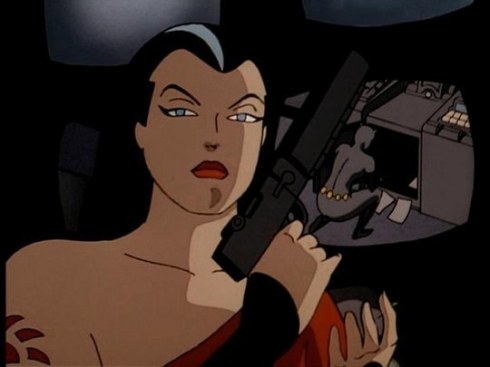
The next day, Bruce shows up for his date just as Selina is informed by her lawyer that a proposed sanctuary for large cats is being acquired by a corporation that intends to bulldoze the preserve and put up a resort. Selina is irate, but Bruce happens to know the CEO of the corporation, Multigon International, and arranges a face-to-face between he and Selena. It’s fruitless, and Selina storms out angry alongside Bruce. As they leave, Red Claw appears to inform the CEO of Multigon, Stern, to keep an eye on Ms. Kyle. Red Claw is somewhat shadowed but we see Red Claw (Kate Mulgrew) is actually a woman and a pretty tough looking one at that.

The-Cat-And-The-Claw-Pt-1-batman-the-animated-series-16815876-540-405

Sort of forgotten in the debut of Catwoman is the real villain of the episode – Red Claw.

Selina and Bruce agree to end their date prematurely, since she’s not much in the mood following their meeting with Stern, and agree to try again tomorrow. That night, Catwoman returns to Multigon to do some sleuthing. She’s able to get in, but not undetected. Soon she’s swarmed by guards and manages to reach the rooftop only to find herself in a precarious situation on the edge of the building. Naturally, Batman is there to make the save. They have another playful exchange, though Batman gets serious with her and demands she unmask. Catwoman feigns being hurt by Batman’s rejection, which causes Batman to react sympathetically giving Catwoman an opening to flip him over her shoulder and escape.

Back at her apartment, Selina boasts to her assistant Maven that the night was a success, but we’re soon shown an individual affiliated with Red Claw has traced her back to her apartment. He utters an ominous warning for us, the viewers, before the episode ends.

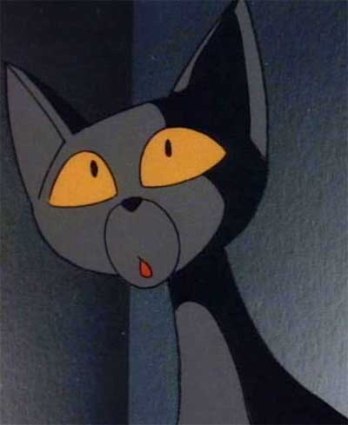
Isis_cat

Isis is a bit of a scene-stealer.

The first part of “The Cat and the Claw” successfully introduces us to this version of Catwoman and the role she’ll play in Batman’s rogues gallery. Her intentions are mostly good, but her means are unlawful. You could argue Batman’s are as well since he routinely sneaks into places he’s not welcome and performs search and seizures outside of the law, but Catwoman’s willingness to steal is apparently the line for Batman. The little we see of Red Claw, a villain created for this show, depicts her as a pretty ruthless terrorist and we’ll have to wait for Part Two to see just how far she can be pushed. This show seems to clearly love having sympathetic villains, so this turn for Catwoman isn’t too surprising. She bares no real resemblance to the character we had just seen in Batman Returns, aside from the general look of her costume and whip accessory. I am left wanting to see more of the Selina character. I’d like to know more about what brought her to where she is, but we’re never really going to get that from this show unfortunately. I also do like the dynamic at play with Batman where Catwoman clearly has the hots for the caped crusader while Batman knows he needs to keep his distance. That’s in contrast to Bruce Wayne’s obvious interest in Selina Kyle, while she seems completely uninterested in Bruce as a potential partner. It’s not a unique setup, but it is effective at creating some drama. It’s also easy to see why this was picked as the premiere, because in addition to the familiar villain, the episode also looks great. Lots of sharp blacks and great animation, especially with Catwoman’s adorable little cat Isis. We’ll have to wait for Part Two to see how this all plays out.


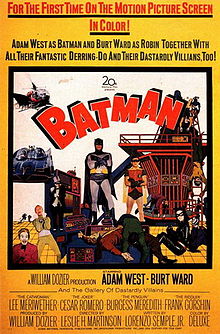
Batman: The Movie

Batman:  The Movie (1966)

Batman: The Movie (1966)

The Batman character certainly has changed a lot over the past 50 years. Sure, under the mask he’s still Bruce Wayne, his parents are still dead, and he can usually be found prowling the streets of Gotham City by night accompanied by a juvenile in a red and yellow costume. Many things have changed though. For one, Bruce Wayne is no longer content to be a millionaire so he’s jumped into the billionaire ranks. The blue and gray spandex Batman used to wear is now often black and gray and even armor-plated, depending on the artist. Robin, thankfully, isn’t parading around in tights either or a bright yellow cape (no wonder why he’s usually the one getting picked off as opposed to Batman) and sometimes he even gets to be an adult. Mostly though, the tone of the work has changed. A lot of writers have received credit for turning Batman into a more serious and mature character during the 70’s and 80’s with most of it going to Frank Miller, but the change was actually rather gradual. In order for a character to survive decades upon decades and remain relevant, he has to change with the times as the general tastes of the public are always evolving.

In 1965, Batman was faced with becoming irrelevant. His comic book sales were down and he hadn’t appeared in a film reel in decades. Television was still pretty new, and pretty limited, but the idea to give the caped crusader a shot at television came up and by 1966 Batman was more than relevant once again; he was a star! Starring Adam West and Burt Ward as the dynamic duo, Batman appeared twice a week (a rarity at the time) on television in a serialized nature, often with the first night’s program continuing into the second’s. The show was a hit with children mostly, but also adults who grew up reading the Batman comics. Color TV was new at the time, and Batman was presented in eye-popping color for those fortunate enough to have a color set. The jazz-infused soundtrack was catchy, and the wild cast of villains gave the show a new flavor each week. Stars were born, of course, with classic comic villains such as The Joker and The Penguin seeing their star burn even brighter while villains mostly abandoned by the books, such as Catwoman and The Riddler, found a new lease on life. The show was basically a farce, with Batman and Robin presented in an ever serious manner oblivious to the ridiculous circumstances they would find themselves in week after week. The supporting cast of Commissioner Gordon (Neil Hamilton) and Chief O’Hara (Stafford Repp) were equally oblivious while the villains came across as the only ones in on the joke. Batman and Robin would find themselves in dire situations often, but would always get out of it either thru ingenuity, sheer coincidence, or via an oddly situation specific “Bat” gadget. This was Batman in the 60’s and it’s what people wanted.

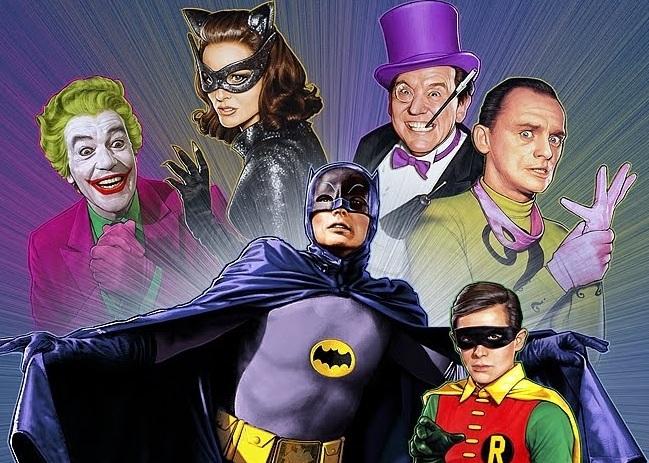
Look out, caped crusaders! The Joker, Catwoman, Penguin, and Riddler have joined forces!

Look out, caped crusaders! The Joker, Catwoman, Penguin, and Riddler have joined forces!

When the show was first conceived, it was decided that a movie would be created to help launch the program. Plans changed, however, when the network involved surprisingly picked up the show with production needing to start immediately to meet a January air date. The movie was back-burnered for awhile in order to focus on the television show, but filming resumed in the early spring to make a summer release possible. This ended up being a boon for the show, and the film as well, as Batman took off and created great anticipation for the film. The increased budget for a feature also meant that new gadgets and vehicles, such as the Batcopter and Batcycle, could be created for the film and then used again for the television show. In order to make the film feel bigger than the show, four villains were present instead of the usual one: Joker, Penguin, Riddler, and Catwoman. The only complication was Julie Newmar, Catwoman on the show, was unavailable so the part had to be recast and went to Lee Meriwether. Cesar Romero, Burgess Meredith, and Frank Gorshin were able to play their roles as Joker, Penguin, and Riddler, respectively, and the rest of the television cast was available for the film as well.

The style of the television show was incorporated into the film. The art direction is distinctly pop for the era. There’s an abundance of bright, primary colors. When the characters are put into a more realistic setting, such as Batman during the infamous bomb segment, they stand-out against the background and appear as out of place as a man in a batsuit should (though the extras in the shots carry on as if this is business as usual). The action sequences are surprisingly kept to a minimum, but when a fight breaks out expect many haymakers and somersaults (the editors saved the famous “pow” animations for the film’s climactic battle). The Batman theme is present but in small doses. The film’s main theme is perhaps relied upon a bit too heavily as it’s used for every long shot of Batman and Robin in their various vehicles used throughout the film.

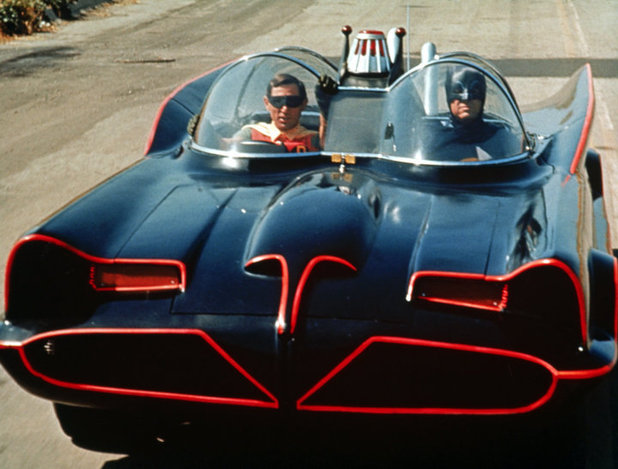
Still the coolest Batmobile ever created.

Still the coolest Batmobile ever created.

The plot from the film is rather rudimentary. The four villains have teamed up to kidnap the world leaders using a bizarre dehydrating ray that reduces any human it touches into a pile of dust to be rehydrated later. The protagonists deduce their foes’ motives thru absurd means presented as deductive reasoning but are either lazy writing or an attempt at humor. Batman is the straight man while Robin is more of a hot-head (and possibly a sociopath who wants to murder alcoholics). The villains are as over-the-top as their TV personalities. Gorshin and Romero present their characters as cackling madmen with The Riddler having the added flaw of feeling compelled to leave Batman and Robin clues in the form of riddles. The film actually draws attention to how similar the two villains became once they hit television, but both actors perform so well in their roles it’s mostly forgiven. Meredith is a delight as The Penguin. He waddles everywhere and gets so much personality out of that long cigarette holder always stuck between his teeth. Meriwether’s Catwoman is basically the same as Newmar’s with her always feeling compelled to use the word “perfect” when describing something she approves of, but drawing it out into a long “purrrrrfect” because she is, after all, a crazy cat-person. Catwoman also gets to have an alter-ego in the form of Miss Kitka, who seduces Bruce Wayne to lure him into a trap so that he may be used as bait for Batman. As a kid, I found it odd how easily Batman is able to see thru a disguise The Penguin uses later in the film, but he’s blind to Catwoman’s. Apparently, even Batman sometimes ends up thinking with the wrong head from time to time.

The special effects in the film will impress no one accustomed to the movies of today. When Batman is attacked by a shark early in the film it’s clearly made of rubber and its teeth leave no imprint on Batman or draw blood. A scene of some ducks in the water are obviously decoys, and every character who throws a punch whiffs by about six inches on their target. And who could forget the climbing scenes? Scene thru the lens of today, these shortcomings just add to the campy charm. The comical bomb Batman is forced to dispose of is cheeky and the ray-gun effects are delightfully cliche.

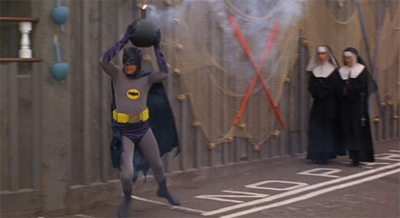
Some days, you just can't get rid of a bomb (I had to do it!).

Some days, you just can’t get rid of a bomb (I had to do it!).

The film is a farce, an exercise in the absurd, and it is entertaining. I grew up watching the television show in syndication during the 80’s. I suspect my generation may be the last who can say that as I assume most kids today have never seen Adam West as Batman and I wonder if they would appreciate it. Perhaps if this is the fist Batman they’re exposed to they’ll see what the kids of the 60’s saw, or maybe they’ll just see a very ordinary looking man in gray and blue spandex. Batman was fun for me as a kid with all of the different villains and bat-gadgets and as an adult I find it funny and charming. It’s not really clever comedy, but I wouldn’t call it stupid either. The Batman premise is one that’s far-fetched and unrealistic, and the writers approach the character as such. While writers and filmmakers today are more interested in a realistic portrayal of a masked vigilante, it’s kind of fun to see the character portrayed in the only manner he could actually exist. The entire 1960’s television series is finally set for release this holiday season in a massive, and expensive, box set. That might be overload but for anyone seeking out just a taste of the Batman from 1966, the movie represents a good, and cheap, snap-shot. The blu ray from which this review is for, looks great considering the film’s age. The colors pop as they should, the picture is sharp, and there’s quite a bit of extra content. The film doesn’t look as old as it really is, which is often the best compliment one can give to such an old movie. This was my first Batman on television and I would go on to enjoy Tim Burton’s take on the character and fall in love with The Animated Series. I never lost my affection for this Batman though, and even though I view it in a different way than I did as a five year old, I am still charmed by it. Hopefully, I’m not the only one.


Batman Returns

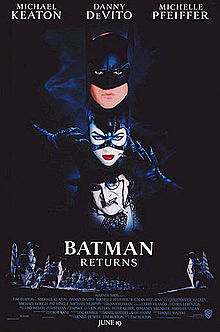
Batman Returns (1992)

Batman Returns (1992)

It’s December 1st, and it’s time to inject a little Christmas into this blog once again.  Last year, I went pretty light on the X-Mas related topics and I intend to do a little more this year.  I’ll start off slow with a pseudo-Christmas movie in the form of Batman Returns.

Batman Returns is the 1992 sequel to the mega-successful Batman.  All of the major players return from that film including Tim Burton as director and Michael Keaton as Batman.  The only notable omissions are Billy Dee Williams as Gotham City District Attorney Harvey Dent; Kim Basinger’s reporter/photographer Vicki Vale, and Robert Wuhl as reporter Alexander Knox.  All three characters are absent from the film and were not re-cast.  The Vale character was presumably removed so as not to force Batman/Bruce Wayne to settle down, while the other two must have been cut for time (Williams was reportedly disappointed he never got to play Two Face).

The major additions to the cast are, of course, the villains.  Going with a “more is better” philosophy, Batman Returns includes three major villains compared to Batman’s one.  Created for the film is Max Shreck, played by Christopher Walken.  He’s a real-world villain in that he has no gimmick or special abilities, he’s just a greedy, corporate, jerk who values money more than human life and has ties to both of the other comic book based villains. Michelle Pfeiffer plays Selina Kyle, aka Catwoman.  Catwoman serves the dual role of being a foe for Batman, and a love interest for Bruce Wayne.  Also joining the part is Danny DeVito as Oswald Cobblepot/The Penguin, a monstrous take on the old Batman villain.  The two “super” villains have a sympathetic angle to play, which I’ll get to in a few paragraphs, and in 1992 both felt like logical inclusions for the big sequel.

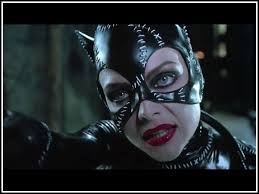
The red of Catwoman's lips really pop in all of her scenes due to the muted palette of the film's sets.

The red of Catwoman’s lips really pop in all of her scenes due to the muted palette of the film’s sets.

The film is virtually identical in look to its predecessor with Gotham taking on aspects of film noir.  The technology is modern, or post modern, but with the stylings of the 1930’s and 40’s dominating the landscape, with a touch of goth too.  The noir angle is played upon even further with a majority of the film’s colors being black and white.  It’s demonstrated in the film’s leads with both Catwoman and The Penguin having a near white complexion to go along with the black and white shades of their respective costumes.  This makes what little color appear really jump out, such as the crimson of Catwoman’s lipstick or the yellow of Batman’s logo.  Batman, and the other good guys, are depicted with warm, natural flesh tones while the villain Shreck is noticeably pale, but not to the same degree as the other villains.  He makes up for that with his bone white hair.  The buildings and structures around Gotham are also mostly confined to shades of black and white, as are all of Batman’s gadgets and vehicles.  Combining this stylistic choice with the setting of a snowy Christmas time and Batman Returns comes across as a very cold movie, even when compared with the already bleak feeling of the first film.

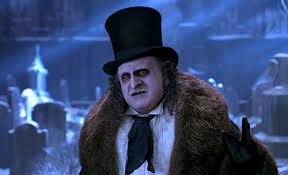
DeVito's Penguin is mostly monstrous but he's able strike a sympathetic tone at times.

DeVito’s Penguin is mostly monstrous but he’s able strike a sympathetic tone at times.

As was the case with the first film, for better or worse, the villains are meant to be the main driving force of the film.  It’s a good thing they’re well-developed as Batman Returns arguably leans even harder on its villains than Batman did with The Joker.  Shreck is meant to be the irredeemable villain and serves as a foil to both Bruce Wayne and The Penguin.  The Penguin is not a nice guy himself, but Shreck proves to be the true monster of the film when he coldly tries to murder his secretary, Selina Kyle.  Shreck is the owner of a department store and he’s seeking the approval of the mayor (and Bruce Wayne as an investor) to build a new power plant.  In a sort of goofy Tim Burton type of plot, Shreck’s new power plant will actually syphon power from Gotham and when Kyle figures this out (while working late in an effort to be a better employee) is when Shreck shoves her out of a window.  Burton’s twist on Catwoman occurs here, as the meek Selina Kyle is seemingly resurrected when a host of cats attend to her corpse.  The scatter-brained screw-up becomes the headstrong and vengeful Catwoman.  Kyle is played fairly straight, while Catwoman is intended to represent her ego gone wild which apparently has an S&M twist.  Catwoman, clothed in skin-tight leather and armed with a whip, also has the benefit of nine lives.  She’s over the top but it works for the picture.  Cobblepot, and his family’s rejection of him, is what opens the film.  He was a hideous and monstrous baby (who apparently has a taste for cats) and his upper class parents wanted nothing to do with him so they tossed his carriage into the sewer where he was apparently raised by penguins underneath an abandoned zoo.  At first his motivations seem are simply to find out his origins while his gang of circus thugs terrorize Gotham.  It’s his encounter with Shreck that changes his outlook and sets his sights on being mayor of Gotham.  Shreck, needing a new mayor to get his plant approved, thinks he can turn Cobblepot into a sympathetic figure who could win election on that alone (never mind his hideous appearance) and soon the two turn to villainy in order to make The Penguin look good in the eyes of Gotham’s voters.

Naturally, their dealings put them in conflict with Batman as everything becomes twisted and murky.  The Penguin, together with Shreck, emerges as a viable candidate for mayor while Catwoman seeks vengeance against Shreck.  She starts by attacking his department stores which puts her in conflict with Batman.  With Batman as a common foe, this pairs up Penguin and Catwoman who then concoct a plan to frame Batman and turn Gotham against him.  It’s a fairly clever pot and Burton should be commended for being able to get this trio of villains to fit together well and the framing angle makes for good drama.  Unfortunately, Burton has never been one for realism.  We don’t mind when that takes the form of a monster baby killing a cat or a man in a bat costume gliding over the entire city, but he leaves lots of loose ends in his plots and asks the audience to simply overlook them.  The framing plot, for example, is never really resolved.  Batman is made to look like he kills the Ice Princess, a mini celebrity of sorts, and by exposing The Penguin as a bad guy (but not as the person truly behind the murder) is apparently good enough for Gotham and it’s police department (to make it even more convoluted, the people don’t even know that it’s Batman that made The Penguin look like a bad guy as he hacks into a PA system while Cobblepot is making a speech, using pre-recorded taunts).

Once The Penguin is exposed, the film’s climax is put into motion where The Penguin, now abandoned by Shreck, decides to murder the first-born sons of Gotham’s wealthy elite, including Shreck’s son Chip.  He has his circus gang abduct the kids from their cribs and personally attempts to abduct Chip, but Max volunteers in his place.  Batman, of course, saves the day which just angers The Penguin even more forcing him to send his penguin army into the city to fire off a bunch of rockets and level a chunk of the city.  Catwoman, having also been betrayed and “killed” by The Penguin, is drawn out after Shreck and all three collide for a fitting resolution.

Batman and Catwoman play off each other quite well in their few scenes together.

Batman and Catwoman play off each other quite well in their few scenes together.

A great deal of the film rests on the Catwoman and Batman conflict.  With the characters in costume, their encounters become a fun bit of violent flirting, with all of the flirting basically on the part of Catwoman.  As Selina and Bruce, the two have a sometimes warms romance that develops a bit quickly with Bruce as the aggressor.  The two have a nice scene together where they both figure out each has a dual identity which is resolved during the final scene pairing Batman and Catwoman.  The film’s end suggests that Catwoman was to play a role in a future film, but perhaps because both Keaton and Pfeiffer were uninterested in continuing in their roles, this Catwoman would never surface again.

Batman Returns shares a lot of similarities with its predecessor, one of which being a rather major flaw in that sometimes each film doesn’t necessarily feel like a Batman film.  Batman Returns is even more guilty of this as the Batman character is really pushed aside in favor of the villains.  Perhaps Burton felt like he had more freedom to do this since the previous movie covered Batman’s origin, but we really learn nothing new about the main character.  In one respect, it does help to add more importance and excitement to the scenes that actually feature a costumed Batman, but it feels like their could have, or should have been, more from our hero.  The plot does mostly work though, even with the bloated cast, but it clearly had to make sacrifices somewhere and it’s debatable those sacrifices were worthwhile.

The Batmobile's ability to down-size into the Bat Missile was one of the big spectacles of Batman Returns.

The Batmobile’s ability to down-size into the Bat Missile was one of the big spectacles of Batman Returns.

The first film set a fairly high-standard for special effects and gadgets that Batman Returns is able to live up to.  The big spot occurs with the Batmobile once again, this time with it transforming into the Bat Missile.  Batman also debuts his ski boat during the closing moments of the film which serves as an interesting take on the more traditional bat boat seen in the comics and television series.  There’s also the previously mentioned gliding scene for Batman as he makes greater use of his cape.  Catwoman has some pretty spectacular death scenes as well and there’s plenty of fire and explosions throughout.  There are a few moments that scream “Tim Burton” that look kind of stupid, notably the penguin army and the final shot of a villain’s corpse at the end.  Some people are unwilling to forgive Burton for the campy penguin army, though I also kind of viewed it as Burton’s nod to the campy origins of the television show, and when viewed in that light, it doesn’t really bother me as much.  As a Christmas movie, there isn’t much here.  The film just happens to take place at Christmas, something Burton is quite fond of doing.  It does give the set designers a chance to play with snow which is kind of cool, and the only real mention of the holiday occurs during the final scene.

All in all, Batman Returns is an entertaining film with quite a number of flaws.  It’s pacing isn’t always ideal and the attention to detail is lacking where the plot is concerned.  The Batman character at times feels ignored, but the film is elevated by the performance of the villains and the way all of the major characters intertwine.  Pfeiffer’s Catwoman is a fun take on the character even if it isn’t that radical a departure from other portrayals.  The sexually aggressive Catwoman plays off of the more stoic, and sometimes naive, Batman rather well with the only drawback to those encounters being that they make Batman look pathetically boring.  DeVito received a Razzie nomination for his take on The Penguin which I never understood.  DeVito’s Penguin isn’t as overly campy as the character had been in the past, he has his moments but he’s mostly well done and I still enjoy this take on the character.  The makeup crew should be commended as it’s sometimes hard to believe it’s DeVito underneath all of the prosthetics.  Walken’s Shreck is perhaps the star, as he’s just so good in this role.  Shreck is hate-inducing, and he’s able to needle the audience in just about every scene he’s in.  The score, provided once again by Danny Elfman, is also adequate as are all of the other sound effects used in the film.  It’s the classic case of a flashy and big-budgeted film trying to compensate for some underlying problems, which are more obvious this time around than they were with the film before.  Batman Returns is far from being among the worst Batman films produced, but it’s also not really one of the best either.


The Dark Knight Rises

The Dark Knight Rises (2012)

I mentioned in my look at Batman’s best films that I had gone into total lockdown mode for The Dark Knight Rises.  I got off of social media, stayed away from review sites, and just basically blocked the world out where Batman was concerned.  I wanted to walk into this film with an unformed opinion.  I wanted to be outside the hype.  The first two Christopher Nolan directed Batman films are fantastic.  That’s not to say they are instantly in the running for best movies ever, but in the world of entertainment (and comic book adaptations especially) they are certainly worthy of the highest praise.  The hype surrounding The Dark Knight was intense, and the film actually lived up to it.  I assumed the hype could only grow louder for the trilogy’s conclusion.

It’s a poorly kept secret in Hollywood that trilogies often end badly.  I won’t cite examples as I don’t want to distract from the review of this film, but I’m sure most people reading this can think of at least one trilogy that lost a lot of luster in the third and final act.  And I don’t consider this a spoiler since it’s been stated numerous times by both Nolan and Batman himself, Christian Bale, that this is it for the two of them where Batman is concerned.  And since it was reportedly never a sure thing that Nolan would even return for a third film I’m going to take the both of them at their word.  Warner Bros. may back a truckload of money up to both of their doorsteps but I think this is it.  And if you’re a concerned fan fearing that Batman may end up like Spider-Man (there I go, making an example), worry not:  The Dark Knight Rises delivers.

If you’re concerned about spoilers, this is a spoiler-free review.  Basically all of mine are, even for films that are over ten years old.  With that said, I’m going to talk about the plot to some degree and anything in the trailers or that is considered common knowledge (basically anything I knew going in) is on the table.  If you want as pure an experience as possible though, I do recommend doing what I did and avoid all reviews until after you’ve seen it.  If you’re a Batman fan or just a fan of either of the other two films, you should definitely see this.

Easily the most iconic image of Bane from the “Knightfall” arc.

The movie starts out in a similar manner to The Dark Knight; by introducing the main antagonist for the film.  In this case we have Bane, played by Tom Hardy.  For those of you unfamiliar with Bane, you don’t need to know anything about him going in.  For those who do, know that this is a much better incarnation than what was presented in Batman & Robin, though I imagine that goes without saying.  Many writers of comics, television, and even video games have often chosen to focus on the brawn that is Bane.  That’s to be expected as Bane first and foremost exists as a physical threat to Batman.  He is someone Batman can’t simply engage in a one on one fight and expect to beat, unlike most of his rogue’s gallery.  However, Bane has a tactical side to his character which makes him especially deadly.  The film wishes to display Bane in that light, though don’t worry, he still possesses impressive brute strength.  The character was introduced in the “Knightfall” story arc from the 90’s, which makes Bane a rather recent addition to Batman’s rogue’s gallery when compared with others.  Some of that persona is adapted here, and some of the plot from that arc is as well, which kind of surprised me though I suppose it shouldn’t have.

In the comics Bane is a big guy made bigger when he pumps a fictional type of steroid into his noggin called venom.  In this film there is no such serum and the many tubes going into the character’s head are not needed.  He does sport a mask, though it looks more like a gas mask than the luchador style one he wears in the comics.  The mask does serve a purpose, though the film never makes it clear.  I assume he can survive without it since a guy’s got to eat.  There’s no way he can get a physique like that living off a liquid diet.  The mask necessitates his speech to be dubbed.  Early viewings of the initial teaser for the film left several fans complaining about how inaudible Bane’s speech was.  I assume Nolan wanted to go a realistic route with the character, but pressure from the audience did apparently bring about change.  He’s not always clear in the picture, but his voice is quite loud and almost jarringly so.  It reminds me of Shredder’s voice from the first Teenage Mutant Ninja Turtles film.  It may not be realistic, but it beats the alternative.

In the trailers we are shown not just Bane, but Catwoman (Anne Hathaway) as well.  Her lines to Bruce Wayne at a costume ball recall some of the sentiments being thrown about in the Occupy Wall Street movement from last summer.  And yes, that is part of the film’s central plot, to a degree.

Campy? Perhaps, but given the source material I think they did all right.

After Bane is introduced in a most menacing fashion, we are taken back to Gotham where eight years have passed since the death of Harvey Dent.  Bruce Wayne has become a recluse and all of those years playing Batman have taken a toll as well.  The cast from the previous films is returned.  Gary Oldman is back as Commissioner Gordon and Michael Caine as Alfred.  Morgan Freeman is there as well and there’s a couple of new comers in officer Blake (Joseph Gordon-Levitt) and Miranda Tate (Marion Cotillard).  The three veterans of the films are just as good as always, with Caine especially being effective as Alfred.  I feared the Alfred character would get too preachy, and almost too omnipotent much like Rosemary Hariss’ Aunt May in the Spider-Man films, but my fears proved unfounded.  The new-comers serve a nice role with the Blake character mirroring Gordon’s from Batman Begins.

Tate is an ally to Bruce in his corporate life, which we soon learn is not going well.  With Gotham now at peace and organized crime all but exterminated, there’s no need for Batman so Wayne tried devoting all of his resources at Wayne Tech to making the world a better place.  In doing so he has stymied profits but Tate seems to share his outlook.  Selina Kyle, aka Catwoman, makes her presence felt early on as well by swiping some jewelry from Wayne which gets her into the story.

I was on the fence about the Catwoman character being used here and thought the film may become too crowded, but again my fears are mostly unfounded.  While there are a couple of scenes between Batman and Catwoman that border on camp, the film soon remembers what it is and distances itself from any such thing.  In the comics, Catwoman is known for being a tweener in that she isn’t really a villain but isn’t necessarily a hero either.  In TDKR she’s played pretty much the same way.  Her character is definitely adapted in part from Frank Miller’s Year One arc, which was used as a basis for Batman Begins, minus the prostitution angle (which DC has always tried to distance itself from). Her character views herself as a sort of Robin Hood, though her motives are entirely selfish.  She gets herself mixed up with Bane, which is how she stays in the picture.  And her presence doesn’t crowd anything or take away from the film’s hero, Batman.  He’s in this one just the right amount, and his heroic appearances are staged exceptionally well.

Gordon-Levitt’s Blake is a welcomed addition to the cast.

The main plot for the film involves Bane trying to basically pick up where Ras al Ghul left off and bring down Gotham.  He infiltrates the corporate sector, the market, and even the physical infrastructure of Gotham itself (as evidenced in the trailer).  Make no mistake, he’s a real threat to the city in an even bigger way than Ras could have hoped to be and his motives and actions help tie the trilogy together.  A lot of TDKR harkens back to Batman Begins which helps maintain a feeling of continuity and in the end makes for a better pay-off for longtime fans.

That’s the film, in a nutshell, but how does it fare as entertainment and how does it stack up with the other two films in the trilogy?  To put it simply, The Dark Knight Rises is a hard film to watch.  I don’t say that because it’s long (approximately two hours and forty-five minutes) but because it’s pretty bleak.  For most of the film’s running time there’s not a lot of reason for optimism.  The Dark Knight was a pretty dreary movie at times, but even that had little moments of triumph throughout.  The Dark Knight Rises has fewer of those moments which make it one exhausting movie to watch.  I went back for seconds and thirds on The Dark Knight during it’s theatrical run, once is enough for me with this film (though I’ll definitely be a day one buyer when it hits stores).

Oh yeah, expect to see some new “toys.”

Don’t confuse my proclamation that this is a hard film to watch as a criticism.  Some films are truly brilliant but hard to sit thru.  Think Schindler’s List or Grave of the Fireflies, though certainly not on that scale.  There is a real danger to this film.  I think part of it is born from knowing that this is the final film in this trilogy, and possibly this “universe,” which makes it feel like anything is fair game.  I would like to think though, that even without knowing that, I’d still feel the same unease I felt throughout this film.  Bane is a truly monstrous individual on a different level than The Joker.  That doesn’t make him better, just different.  Many were likely worried about how Nolan could possibly move on after The Joker but he found a way.  I found myself hating him and I really was hoping he’d get his due in the end, which is an emotion I never really felt towards The Joker.

The Dark Knight Rises is a very good film and quite exceptional, though it doesn’t top Batman Begins for sheer entertainment value and will probably wind up behind The Dark Knight for most.  There’s no shame in that and I feel quite confident in saying that Christopher Nolan’s Batman trilogy will go down as one of the all-time greats.  There’s certainly no comparison as far as comic book movies go, and I doubt it will ever be as beloved as the original Star Wars trilogy, but from start to finish this is the most consistent.  The films are connected not just by style and the names attached but in theme and narrative.  The Dark Knight Rises is a grueling experience at times, but is the pay-off the fans wanted.  I feel slightly stupid for even having my doubts about this one, but Christopher Nolan once again delivers a fantastic piece of art.  I will never doubt that man again.


Batman’s Top 10 Feature Length Films

No other super hero has taken to the big screen as well as The Dark Knight.

I didn’t do an official count, but I am going to go out on a limb and say that Batman has had more movies made featuring him than any other comic book superhero.  Over the years he’s been featured in both live action and animated films, wide release and direct to home video.  Some of these films have been among the handful of movies I’ve enjoyed above all others, while others have been truly dreadful.  When a character has been around as long as Batman, that’s bound to happen.  He’s not only had great and terrible films made about him, but he’s also had great comic book stories and poor ones, fantastic television moments and truly embarrassing ones.

Recently though, it’s been mostly good films that have found their way to audiences worldwide.  And I’m not just talking about the much praised Christopher Nolan directed projects, but also some of the smaller ones that never made it to theaters.  Today we are on the eve of the release for the third and final film in the Nolan trilogy.  You may have heard of it, it’s called The Dark Knight Rises and it figures to take in money hand over fist for the next several weeks and make the executives at Warner Bros. very happy, and even more wealthy than they already are.  It probably doesn’t even have to be a good movie for it to be a cash cow, just look at the much maligned Spider-Man 3, which made more money than either of its two superior predecessors.  Hype is a powerful thing.

As most are looking forward to The Dark Knight Rises I am looking back.  I started to reflect on the films that came before it to feature Batman and decided it would be fun to make a top 10 list.  For some only familiar with the live-action stuff, it may be surprising to know that there have been more than 10 Batman films made, but that man gets around.  Truth be told, there are even a couple I haven’t seen such as the Batman Vs Dracula one that was taken from the The Batman universe.  I just never got into that show as it was geared towards a younger audience but if someone thinks I’m really missing out on something special feel free to let me know in the comments section.  Otherwise, let’s take a look at number 10…
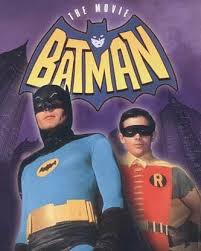
Batman: The Movie (1966)

10.  Batman:  The Movie

It was actually a tough call between this and Batman Forever.  Batman Forever tends to get lumped in with Batman & Robin since they both share the same director.  While Batman & Robin is one of the worst movies I’ve had the misfortune of seeing, Batman Forever is merely average.  It’s quite different in tone from the Burton directed pictures, and whether that’s a good thing or not is a matter of taste.  I’m not really a fan and I don’t think anyone who skips Batman Forever is really missing out, but it does contain an entertaining performance from Jim Carrey as The Riddler, even if he’s just playing the same screwball he was playing in every other movie at the time.

Batman The Movie, on the other hand, is a truly unique entry among the Batman films.  Based on the television series starring Adam West, it’s basically the definition of camp.  It exists purely to entertain movie-goers of all ages and never takes itself all that seriously (with the exception of Burt Ward’s rather intense portrayal of Robin, which is kind of an in-joke in and of itself).  For fans of the show, this was like the ultimate as the best of Batman’s rogue’s galleries team up to take down the caped crusader.  The plot is rather hokey, but the film isn’t short on laughs.  Fans who take their Batman stories very seriously probably find this one off-putting, but this was more or less Batman in the 1960’s.  The comics were geared towards six-year-olds and at least the television show made an attempt to appeal to adults as well which actually helped keep Batman relevant.  This one’s a guilty pleasure and is placed here for nostalgic value, if nothing else.

9. Batman:  Mystery of the Batwoman

Mystery of the Batwoman is the third feature length film based on Batman:  The Animated Series and the second that was direct-to-video.  It was the only one based on the relaunched version of the animated series which featured new character designs and improved animation.  I prefer the style of the first three seasons as opposed to this one, but it’s not too off-putting.  Mystery of the Batwoman is exactly what the title implies; a mystery story.  There’s a new vigilante in town and Batman has to deduce the identity of this female who has borrowed his image.  The film features a few “names” in prominent roles such as Kelly Ripa and Kyra Sedgwick while the usual cast is excellent, as always.  The villains featured in the film include The Penguin and Bane and this mysterious Batwoman apparently has a bone to pick with them, among others.  Not surprisingly, her methods are more ruthless than Batman’s which is what drives Batman to try and figure out her identity and put a stop to her activity.  The film’s mystery proves to be pretty satisfying, and as a whole it’s an entertaining story.  The minimalist production values tend to make it feel more like an extended episode of the show though which is why it doesn’t place higher.
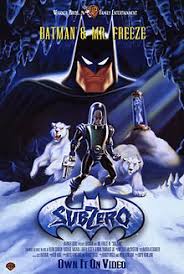
I’m still amazed at how awesome (cool?) Bruce Timm and Co. were able to make Mr. Freeze.

8.  Batman & Mr. Freeze:  SubZero

SubZero is the second film based on The Animated Series and was the first to go direct-to-video.  Unlike Mystery of the Batwoman, it’s production values are more on par with Mask of the Phantasm, the only animated Batman film to receive a true theatrical release.  Mr. Freeze was a surprise star in the television show and it was clear that the writers really enjoyed working with him so it’s no surprise to see him receive the movie treatment.  As was the case in the excellent episode “Heart of Ice,” Freeze is driven to crime in an effort to save his beloved wife, Nora, whom he has cryogenically frozen until he can find a way to cure her of the illness that threatens her life.  Once again, the writing crew prove they’re up to the task of creating a worthwhile Mr. Freeze story but unfortunately the film sort of feels like an extended version of the “Heart of Ice” episode, and an inferior take.  Despite feeling like a retread, it’s still an engaging film and I’d love to see more from Freeze in a future feature film.

7. Batman Returns

Tim Burton’s Batman was a huge success with movie goers when it was released in 1989, so a sequel was pretty much a foregone conclusion.  Burton’s Batman brought the caped crusader back to his roots.  The work of writers such as Neal Adams started to bring some semblance of maturity back to the character in the 70’s, while the work of Frank Miller in the 80’s really drove it home.  This Batman, portrayed by popular comic actor Michael Keaton, was the strong silent type not interested in bantering with his foes.  The first film featured an iconic performance from Jack Nicholson as The Joker, and the feeling going into Returns must have been more is better as the sequel featured three prominent villains.  Fans were used to both The Penguin and Catwoman, but created for the film was Christopher Walken’s Max Shreck who is perhaps the film’s true villain.  In keeping with the style of the first film, both Catwoman and Penguin feature unique designs that represented quite the departure from what fans were used to.  Catwoman comes across as a cat-obsessed dominatrix while The Penguin is a truly hideous creature.

Perhaps Burton felt like the Batman character was explored and developed enough in the first film, because he’s kind of brushed aside here.  The focus of the film is placed squarely on the villains as we learn what brought them to this state.  Burton is also more comfortable here interjecting his brand of humor into the franchise, more so than he did with the first.  Both The Penguin and Catwoman are pretty ridiculous, but the film plays them straight.  It starts to fail though in the final act as even the most forgiving members of the audience will find it hard to accept an army of penguins packing serious heat.  DeVitio (who actually received an undeserved Razzie nomination) and Pfeiffer are both memorable in their roles, but even they can’t carry a Batman movie that’s light on Batman.  A fun, but ultimately flawed experience.
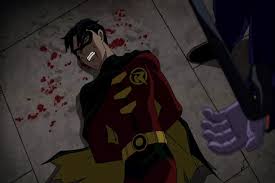
This one’s not for the kids.

6. Batman:  Under the Red Hood

I was pretty surprised to see Warner Bros. was releasing an animated Batman film that did not feature Kevin Conroy in the leading role, or would include The Joker but no Mark Hamill.  To me, so long as neither actor is demanding an absurd wage for their services, Conroy and Hamill should be the voice of Batman and Joker, respectively, until they can no longer do it.  That said, both Bruce Greenwood and John DiMaggio do an acceptable job as Batman and The Joker in Under the Red Hood, an animated film that adapts parts of popular comic plots such as “A Death in the Family,” “Hush,” and “Under the Hood.”

It’s that first story that attracted me to this direct-to-video feature and the one that made it most interesting.  For those not in the know, “A Death in the Family” is the iconic story where Robin is murdered by The Joker.  It was one of those rare stories where comics crossed over into the mainstream as it was a pretty big deal to see Robin go down.  Under the Red Hood starts off like a mystery, but it’s one that is solved almost immediately.  Batman and Nightwing (Neil Patrick Harris) both encounter the new vigilante/villain Red Hood and are unsure of his motives.  He appears to be positioning himself as an adversary for crime boss Black Mask, and doing a good job of it.  As I said, the mystery is revealed fairly early in the film, and the second act deals with Batman confronting this new foe.  The animation is fluid and quite enjoyable to behold, and the opening scene featuring the murder of Robin is appropriately disturbing and graphic.  The film’s signature scene though is not the death of the boy wonder, but the climax which features Batman, Red Hood, and The Joker in a memorable stand-off.  The true motivation for the Red Hood is revealed and it serves as a believable and some-what heartbreaking reveal.  It’s really that climax that pushes this one up to the position of number 6 on this list.

5. Batman Beyond:  The Return of the Joker

I’ve mentioned before how I wasn’t a believer when I first heard about Batman Beyond.  It seemed too gimmicky and totally unnecessary; a cheap way to go after the younger crowd.  Were there really no stories left to tell for Bruce Wayne?  I was proven wrong though and Batman Beyond, while not as good as the series it followed, proved to be a worthwhile entry into the Batman canon.  The Return of the Joker though, ended up being one of the best Batman stories every brought to animation which is something I don’t think anyone could have predicted.

One of Batman Beyond’s major weaknesses as a series was the absence the classic rogue’s gallery.  A few good villains would be created to battle this new Batman, and even Mr. Freeze would make an appearance, but few could hold a candle to some of Batman’s most memorable foes.  One who was missed perhaps the most was The Joker.  How can you have Batman without The Joker?  I think most fans suspected his presence would one day be felt, but as the actual Joker who terrorized Bruce Wayne’s Batman so long ago?  That seemed crazy, but The Return of the Joker proved it could be done.  Sure there was a sci-fi explanation for how The Joker could still be around and the film took some liberties in getting the audience to buy into the explanation, but at the end of the day, we were willing to believe anything if it meant the return of perhaps Batman’s greatest foe.  And this Joker, once again played by Mark Hamill, is an even darker take on the character.  He’s even more sadistic than before and kind of pissed off to boot.  The production values are no better than an episode of the television series, but no one cares when the plot is this well executed.  If I have one complaint with the film it’s that the final encounter between Batman and The Joker isn’t quite as satisfying as it probably should have been, but the film makes up for it by showing us the final confrontation between the original Batman and Joker which was just as excellent as it should have been.
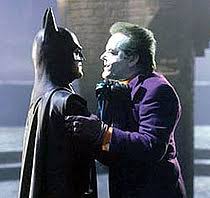
Now there’s a dynamic duo.

4. Batman (1989)

I’ve already done a full review for this one, so I won’t get into too much detail here.  Simply stated, this was the film that proved Batman could be a box office juggernaut and appeal to both kids and adults.  Perhaps more so adults with this dark and gritty take on the caped crusader.  The choice of Michael Keaton as Batman was much maligned at the time, but he easily won crowds over.  The look of the film was particularly striking and would go on to influence The Animated Series in a major way.  Jack Nicholson’s Joker was so good that, as hard as it may be to believe now, many people felt like no one could ever come close to matching it.  This one may not hold up as well today when compared with the Nolan films, but this Batman is still pretty unique and the one most like the Dark Knight featured in Frank Miller’s work.

3. Batman:  Mask of the Phantasm

Last year I dubbed Mask of the Phantasm as the definitive take on the character to make it to film.  I also said that is not to be confused with best film to feature Batman.  Mask of the Phantasm, quite simply, fully captures the essence of the character in a way that not even Christopher Nolan’s works can match.  The film focuses on the early challenges faced by Bruce Wayne as he struggles with keeping to the promise he made to his deceased parents and the graveyard scene is the most memorable scene, for me, from any Batman film.  I love this movie, so much that I made a full entry on it last year shortly after my verdict on the definitive Batman film.  If you like Batman, you absolutely owe it to yourself to track this one down.
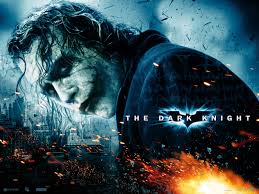
Well done, Mr. Ledger.

2. The Dark Knight

Considering the work done by the other directors and actors featured on this list, it’s pretty high praise to award the top two spots (yeah, that’s right, hope I didn’t ruin the surprise) to the team of Christopher Nolan and Christian Bale.  Of course, The Dark Knight owes a great deal of its success to the late Heath Ledger who’s turn as The Joker is already one of the most memorable performances in a comic book movie to date.  Batman Begins was a successful movie, but it wasn’t the massive hit The Dark Knight turned out to be.  A great deal of that probably is due to the aura the film garnered after Ledger’s demise and word of mouth of the actor’s fantastic performance.  It cannot be understated;  Heath Ledger’s Joker is phenomenol!

That said, The Dark Knight is not a perfect movie.  It’s certainly very good, excellent even, but Batman has seen better.  Part of that is due to the same thing that harmed Batman Returns, which is a de-emphasis of the Batman character.  Nolan explored Batman in great depth in Batman Begins, so he probably felt like that afforded him a lot of freedom with this picture.  Nolan also approached this one as a crime drama and often cited the popular heist film Heat when discussing the picture.  Batman still has a strong presence, as both himself and his alter ego Bruce Wayne, but the scenes with The Joker are just so good, so memorable, that they over-shadow the rest of the film.

I do find Bale’s performance to be noticeably worse in this one than the previous film.  Some of that is some quentionable dialogue in the script, but a big piece of it is the dreaded bat voice.  In Batman Begins, Bale uses a lower and slightly throaty voice when speaking as Batman.  In The Dark Knight, the voice is almost distorted and Batman sounds like he’s auditioning for a death metal band.  It doesn’t work, especially when Batman is asked to have full conversations with characters, and really detracts from many of the film’s most critical scenes.  I also feel like the Two-Face part of the story was rushed and the resolution still leaves a sour taste in my mouth.

Criticisms aside, you can’t be number 2 on this list and be a bad film.  The Dark Knight is an engrossing crime flick and is tremendously entertaining.  Its faults are forgivable, and its biggest fault is that it’s just not as good as the number one film on this list.

There’s just no topping this.

1. Batman Begins

When Christopher Nolan was brought on to reboot the Batman franchise many people had no idea what to expect.  Nolan, at that time, was best known for Memento, a really cool and engaging film but not one that could easily be applied to the Batman franchise.  The often rumored to be in development Batman 5 never got off the ground, and Warner Bros. wisely decided to distance itself from the catastrophe that was Batman & Robin.

A fresh start is really what the doctor ordered, and by doing so it gave Nolan a chance to do what no director had really done before:  tell a complete origin story.  Batman Begins is exactly what Batman needed.  The film goes into meticulous detail to explain to the audience how Batman came to be and what truly motivates him.  His morals and methods are fully defined for the first time and the film is focused fully on Batman with no villain to steal the spotlight.  Nolan’s universe is grounded and absent of most of the characters we’re used to seeing which gives the film it’s own sense of authenticity.  Christian Bale proves to be worthy of dawning the cape and cowl, but some of the supporting cast really steal the show.  Michael Caine is perfectly cast as Alfred, the closest thing to a maternal figure Bruce has, and Gary Oldman is easily my favorite actor to portray Jim Gordon.  Rachel Dawes, an assistant to Gotham’s D.A. and childhood friend to Bruce, is created to help the Bruce Wayne character feel more real.  Played by Katie Holmes, she’s a strong female type that actually works pretty well in that role.  My only major complaint with the film is when they try to force a romantic undertone to Rachel and Bruce’s relationship which just lacks any chemistry and feels unnecessary.

Batman Begins is the best Batman film created thus far.  It just hits all of the right notes and I still get chills when I watch the film’s final scene.  Will it remain the best?  As I sit and type this up we are just over 3 hours away from the release of The Dark Knight Rises.  I have intentionally avoided all press related to the film.  I do not know how it has been received by critics, I do not intend to speak to anyone tomorrow about it as I want to experience it in a pure way to form my own opinions. I’ve never taken a film this serious, and I’m not sure why I am now.  I think it’s because I just haven’t been excited by the few trailers I’ve seen or the concepts I’ve heard that the film is supposed to contain.  I fear I’m already approaching it with too much of an opinion, and I want to distance myself from that.  I have tickets to see it in IMAX this Sunday, and I’ll try to post a review that night for anyone who is interested.  Regardless, I fully expect this trilogy of Batman movies to be among the best trilogies comic book fans, or movie fans in general, have ever received.  I doubt very much it will top Batman Begins as a stand-alone experience, but so long as it’s on par that’s all anyone can ask for.