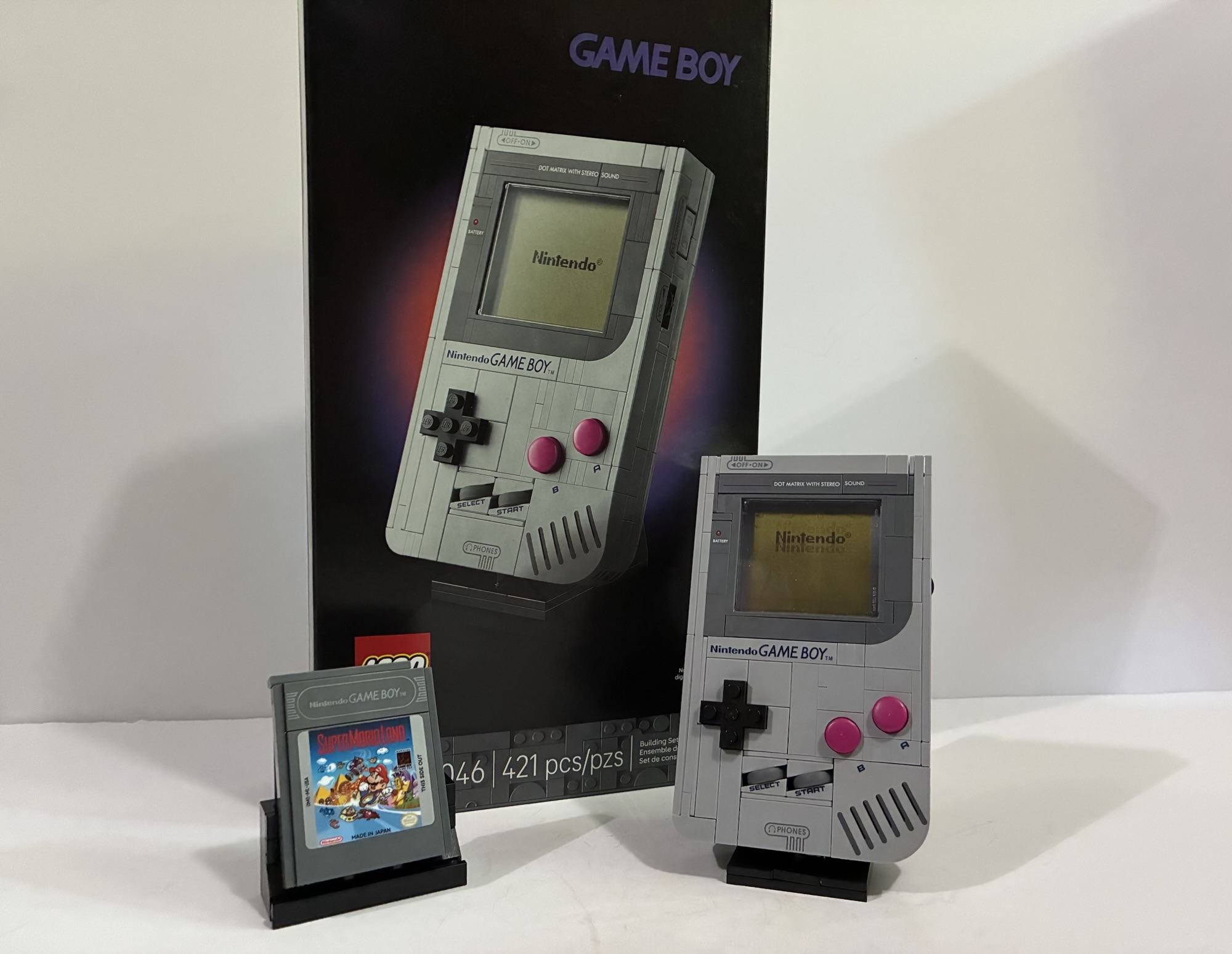
Lego and Nintendo have teamed up on another iconic console.
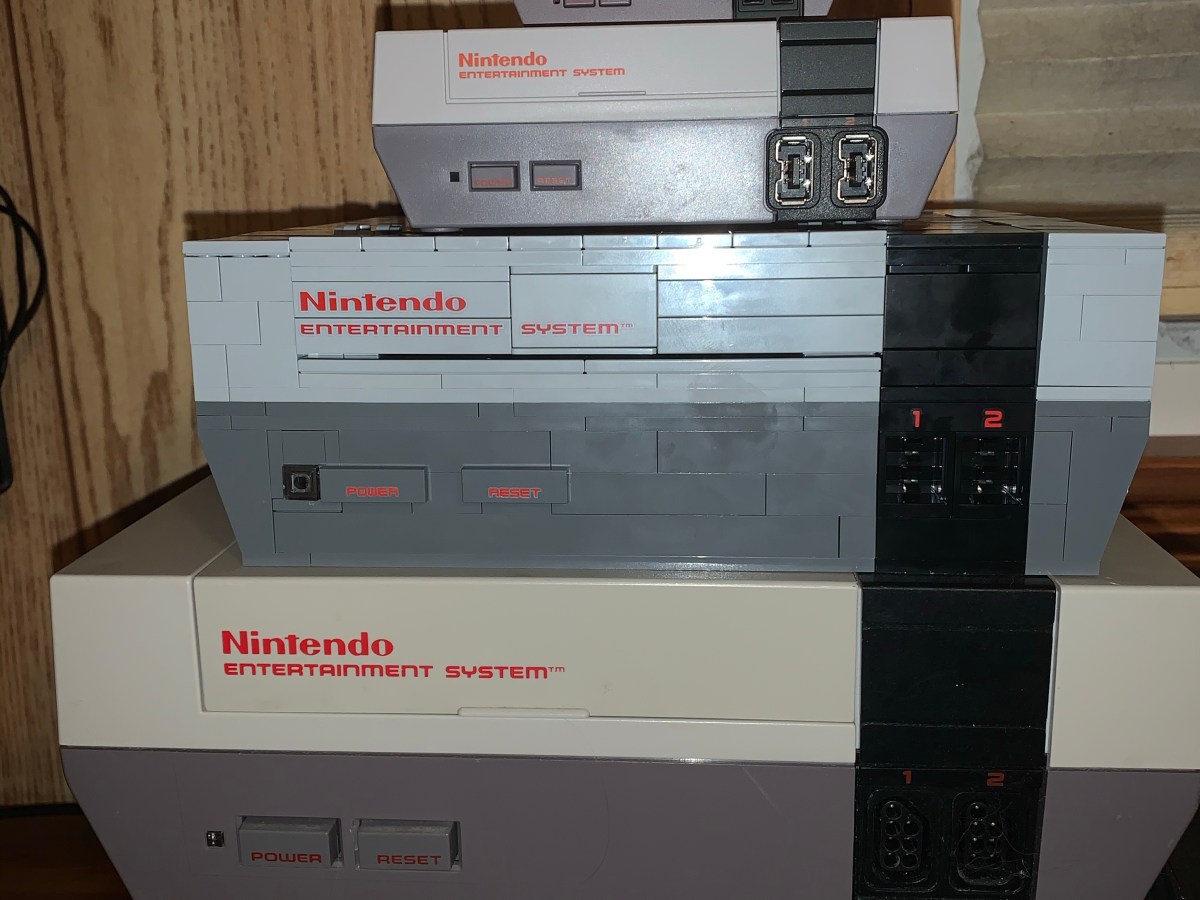
It was five years ago that Lego released its brick version of the Nintendo Entertainment System. The scaled-down replica of the famous video game console came with a buildable game cartridge of Super Mario Bros. as well as a controller and a television. It was a fun set that was released in tandem with the roll out of a much bigger Lego and Nintendo collaboration. When I finished that set, I was wondering where Lego would take the license next? Obviously, I knew the company was focused on creating interactive sets for its Super Mario figure that had some built-in electronics. That, being more for the kids, was only so interesting. What really got my brain turning was how Lego would continue to celebrate Nintendo games and hardware?
I do not have an original Game Boy, so this comparison will have to do.
It hasn’t gone as expected. The Lego NES seemed like the sort of thing that was primed for add-ons or even reissues. The company could have easily sold stand-alone controllers for those who want their console to resemble a two-player experience and they could have done more game cartridges. The challenge there would be in mocking up the television to accommodate them. The mechanism that scrolls the first level of Super Mario Bros. isn’t quite so simple as being something that can be dropped in and pulled out. It would have been fun to be able to change it to Zelda, Metroid, or some other classic title, but Lego was apparently content with what it had done for it hasn’t gone back to the concept in five years. Until now.
The Nintendo Game Boy was first launched in Japan in 1989. I guess to celebrate its 36th anniversary, Lego has decided to release a near 1:1 replica of the handheld device in Lego form. Considering that it’s one of the best selling consoles of all time, it makes sense to honor the Game Boy in this fashion. It’s original, blocky, design also lends itself rather well to the Lego form factor. The set was unveiled during the summer of 2025 and has since been released. It appears it was to have a street date of October 1st, but a few outlets broke street date either purposefully or by accident. Mine arrived on September 25th and gave me something to do with my morning coffee the next day.
The set comes with two “games.”
The Lego Game Boy is a breezy build consisting of only 421 pieces. It’s much smaller than the NES and also far less expensive as it will set you back around $60. Since the Game Boy was a handheld device, it didn’t make sense to include something like a television to expand the experience and brick count. You get a Game Boy, two games, a stand for the Game Boy, and a stand for the game not in use. Pretty simple and also pretty expansive. There’s not much else that Lego could have included aside from more games. No one needs a Light Boy or Lego versions of the cords an original might require. They could have made Lego versions of attachments like the camera or printer, but since those came much later I don’t think it would have made sense. This set is a tidy one and it accomplishes its goal in celebrating the original hardware.
Games swap in and out, but if you want to change the screen you need to remove the battery cover.
The dimensions of an actual model 1 Game Boy are H5.875″xW3.5″xD1.25″ while its Lego counterpart is 5.5×3.5×1.125. I do not own an original Game Boy, the only Game Boy I currently own is the Micro, but it does feel similar to what I remember in-hand. It’s not as heavy as I recall, but the chunkiness of the device is quite close. The look is also impressive. From a distance, a savvy gamer would be able to tell there’s something a bit off just by looking at it, but a casual person might confuse it for the real thing. Up close that’s obviously not the case as the seem lines are apparent and the directional pad is clearly a Lego piece. Lego did a great job approximating the colors of the original device and the button placement. It has the one rounded corner and the gray border around the screen follows a similar shape, as it should. Even the faux screen looks like the old yellow-green screen from the original hardware.
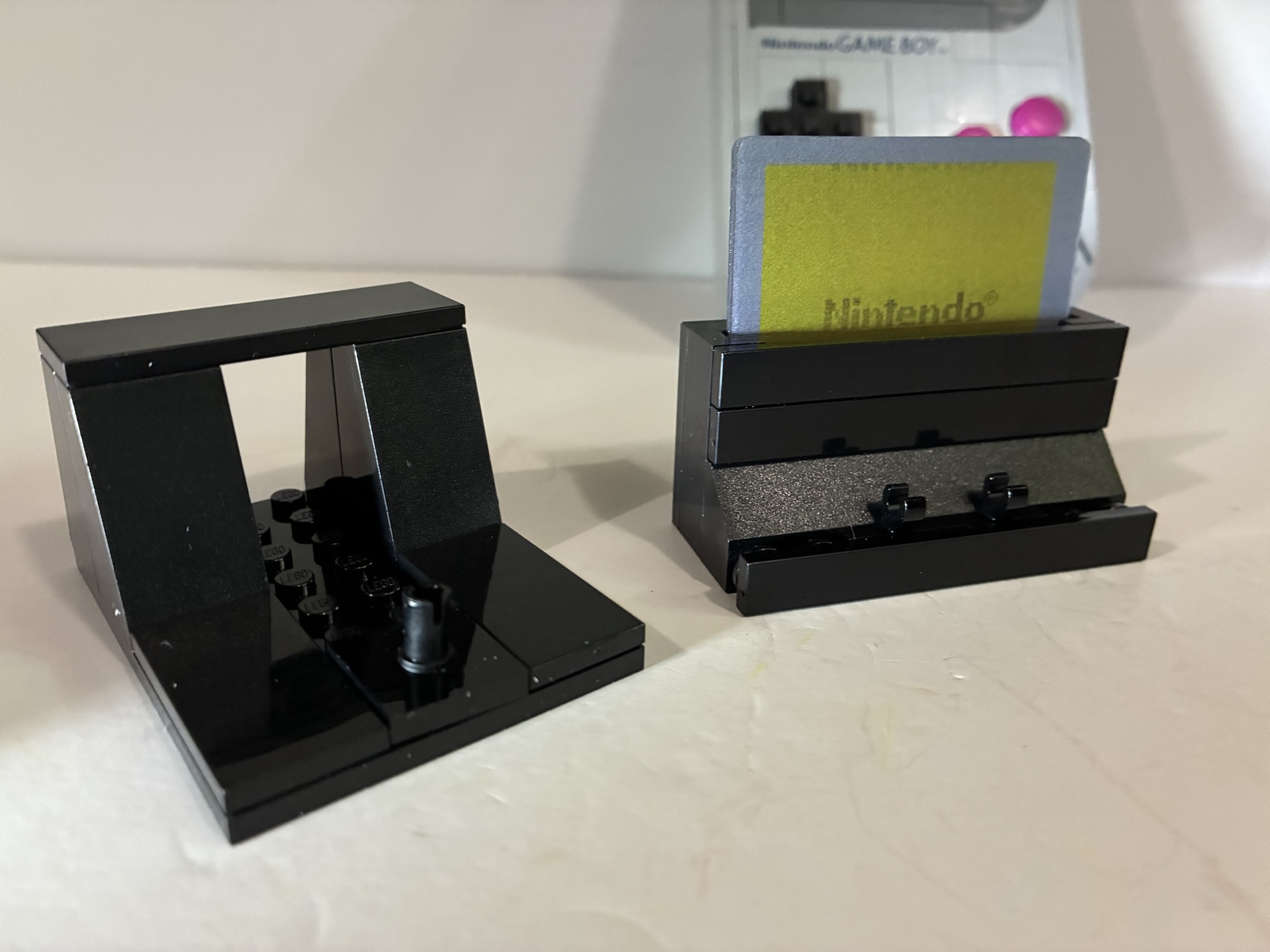
The set also comes with stands for both the unit and games.
For the presentation, Lego opted to forego stickers entirely for the Game Boy. All of the graphics you see in the pictures are printed onto actual bricks including the vent on the front and the “battery compartment” on the rear of the system. It’s definitely appreciated, especially for something people will want to hold. Lego also prioritized making the Game Boy have a tactile presence as well. The directional pad is only partly held down by bricks and is floating atop some rubber pieces so it actually pushed in when pressed. The Start and Select buttons are Lego, rubber, tires and the A and B buttons have some depth to them as well. For the volume and contrast, a Lego gear was inserted. It looks the part, and provides more immersion. Even the on-off switch was done with a sliding piece that really clicks into place.
A comparison between games from the Lego NES and this Game Boy set.
Included with the Game Boy are two build-able “games”: Super Mario Land and The Legend of Zelda: Link’s Awakening. This is where we encounter our only stickers in the entire set as both game labels are done with decals. They’re large compared to most Lego stickers I encounter which helps to make them easy to apply. The top of the game with the Nintendo logo is another printed brick. Assembling them is a breeze, but made fun by having you build a replica of the circuit board that would appear inside the game. There’s some great attention to detail with Zelda, in particular. I wish I had an original Game Boy cart for comparison as the shape seems to be just a touch off. It feels like the proportions are off just a slight amount. It still looks pretty good, all things considered.
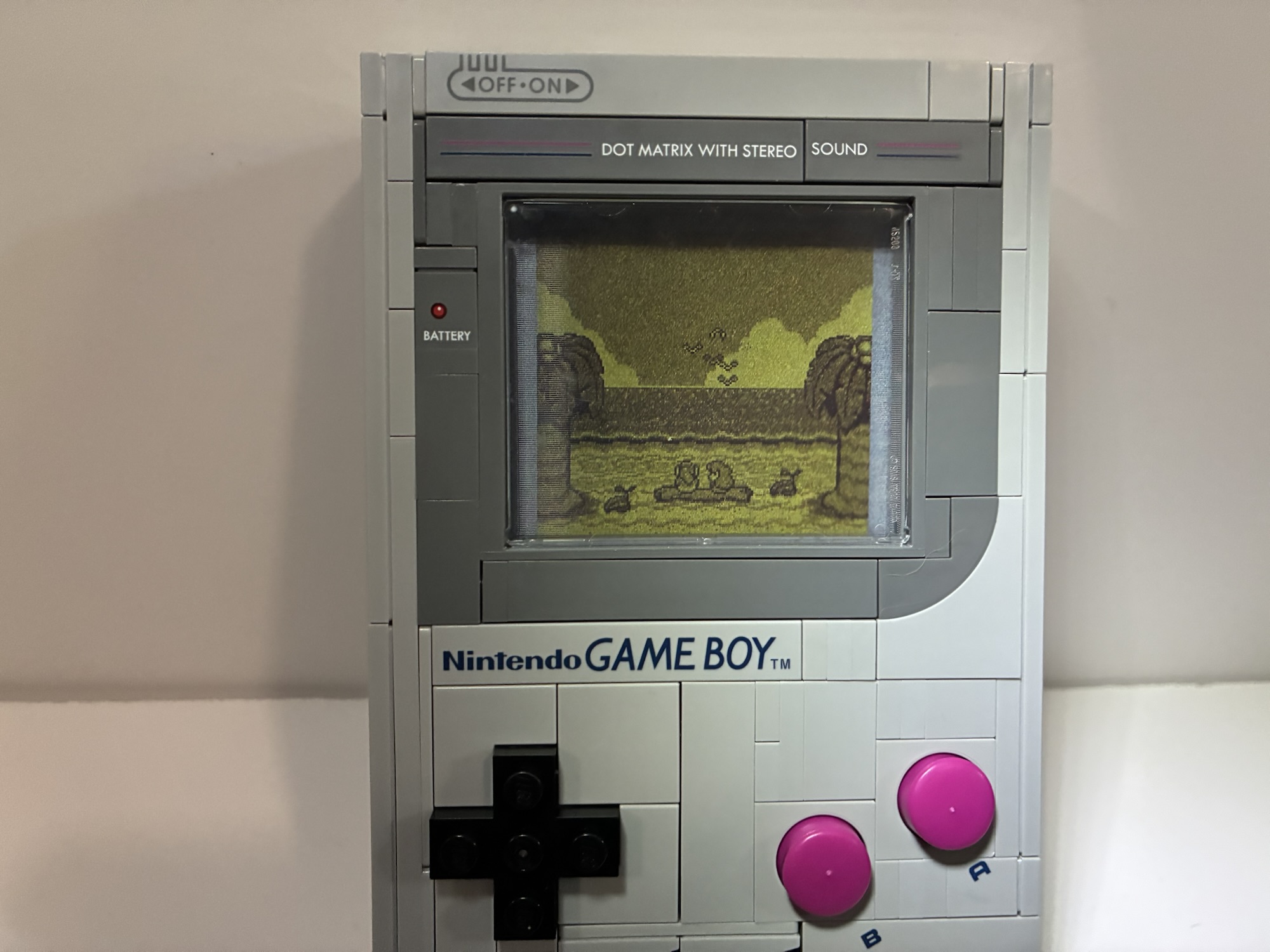
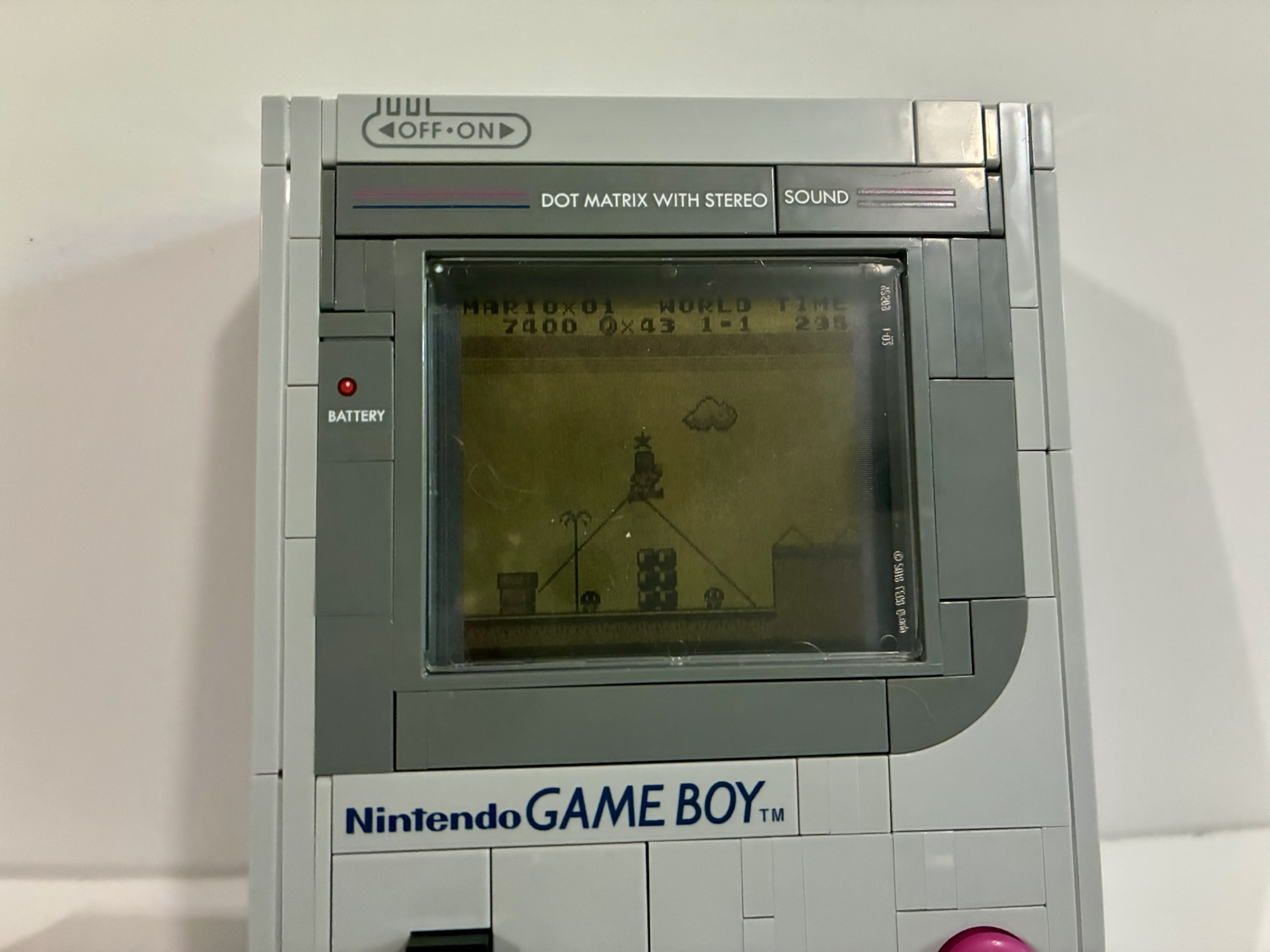
Each game has its own screen.
In addition to the buttons, the play feature here is the screen. Lego included three lenticular screens to swap in and out of the system. The basic one is the Game Boy start-up screen which simply reads Nintendo. In addition to that, there’s a screen for each game if you want to get specific. For Super Mario Land, it’s Super Mario bouncing into a question mark block. For Zelda, you get an image from one of the “cinematic” moments in the game of Link and a girl (I forget who this girl is, I don’t think it’s Zelda) seated on a log. The games are easy to remove and insert as is the screen. You do have to pop the “battery compartment” off to access the screen, but it’s not particularly cumbersome or tricky. The stands are a very basic construction using all black pieces. The Game Boy one is a bit sturdier and seems to work just fine. The game stand includes a slot for the unused screens and Lego assumes you will always have one game in the system at all times.
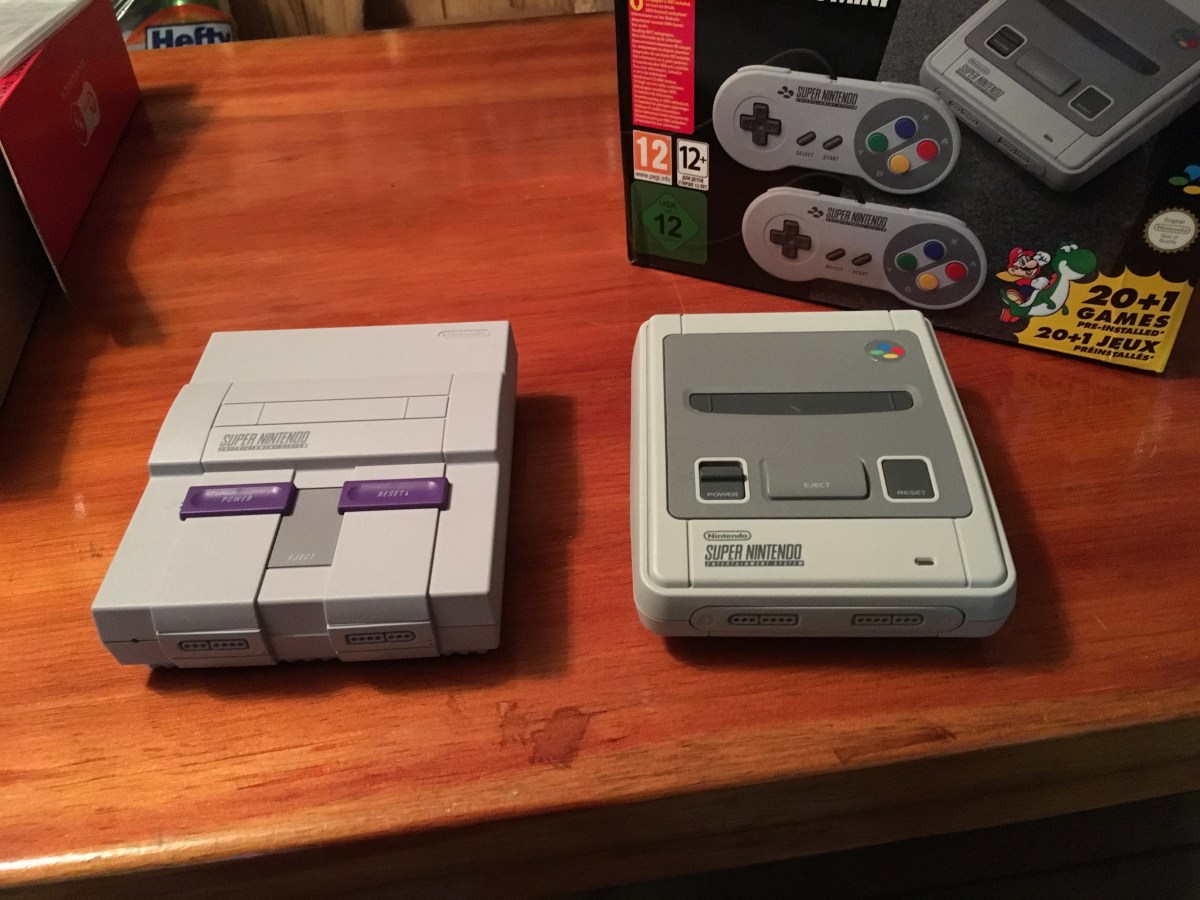
What are the chances a Super NES is added to this display in the not too distant future?
The Lego Game Boy is a fun addition to this small assortment of Lego video game consoles. It makes for a nice display piece amongst your game collection and visitors are likely to be tickled by it if they pick it up and mess around. The generous amount of printed bricks really helps sell the look of the device and the included games are nice to have. While some would argue the most impactful games were Tetris and Pokémon, Super Mario Land was pretty important in the early days of the console’s life and Link’s Awakening is the best game for the system. And both are wholly owned by Nintendo so no additional licensing fees required. Lego could easily continue this with other iterations on the Game Boy with different games. There was the Game Boy Pocket, Game Boy Color, and multiple versions of the Game Boy Advance. Considering what we saw out of the NES, I wouldn’t expect much to follow, but it’s likely only a matter of time until we see a Lego Super Nintendo.
Enjoyed this look at the Lego Game Boy? Here’s some other stuff that might interest you:
There’s something almost cathartic about assembling a Lego set. It can be hot and sticky in my house in the middle of the summer, but if I’m fiddling with a Lego set I almost don’t even notice. Considering how unbearably hot and humid it’s been in the north east this summer, it’s a shame I…
If you read this blog even semi-regularly, you’ve probably seen me talk about the NES Classic already. When it came out I ranked the 30 games bundled with the device and also speculated on what could be included on a likely SNES Classic. What I didn’t do was actually come out and review the device.…
So the SNES Classic is out and has been for a week. As expected, it’s been rather difficult to get one if you weren’t fortunate enough to land a pre-order (which was also rather difficult to obtain). Scalpers are out in full force, and based on the few bits of feedback I’ve received from some…
It’s the latest from Hasbro’s Marvel vs Capcom Gamerverse line!
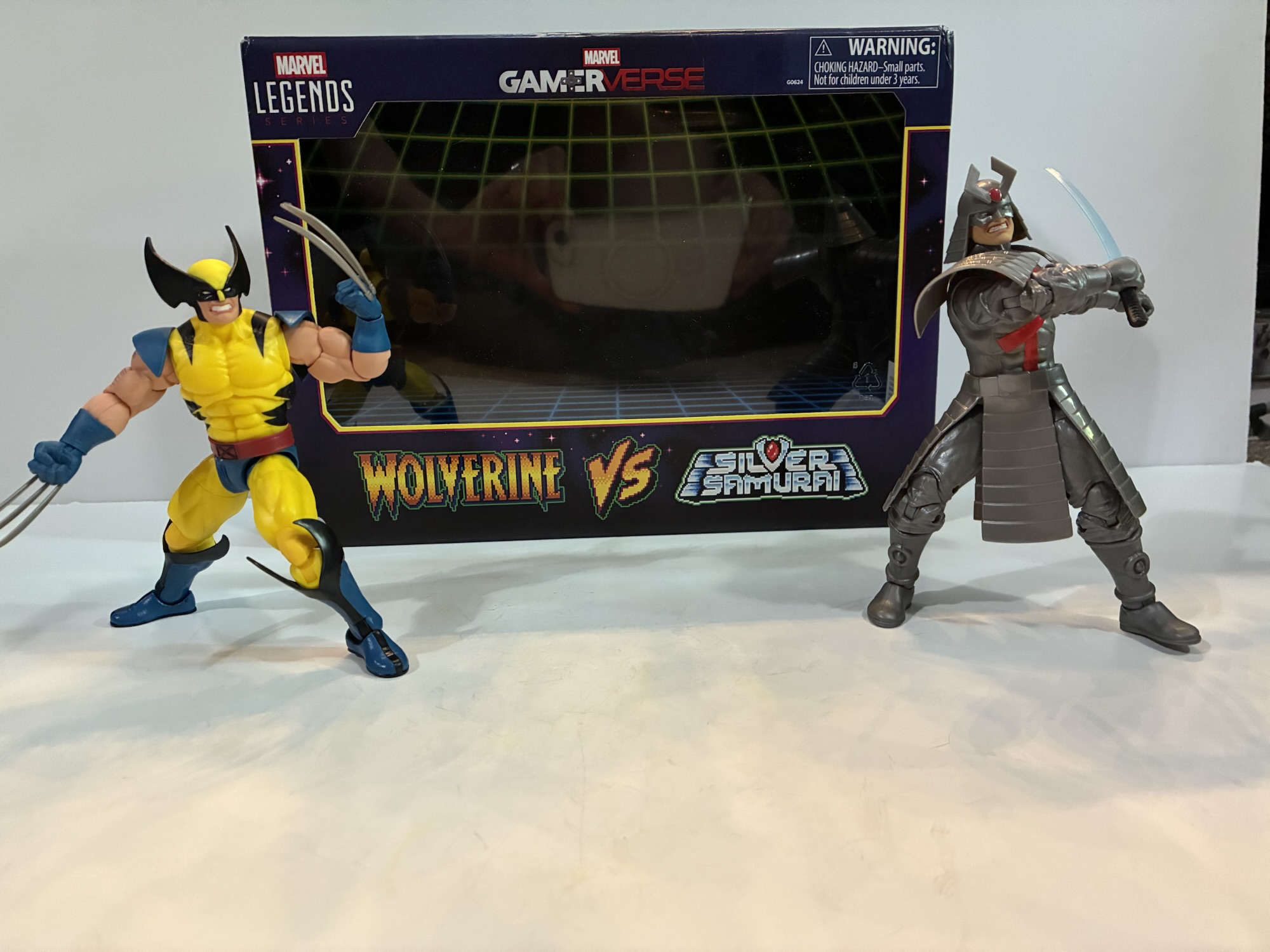
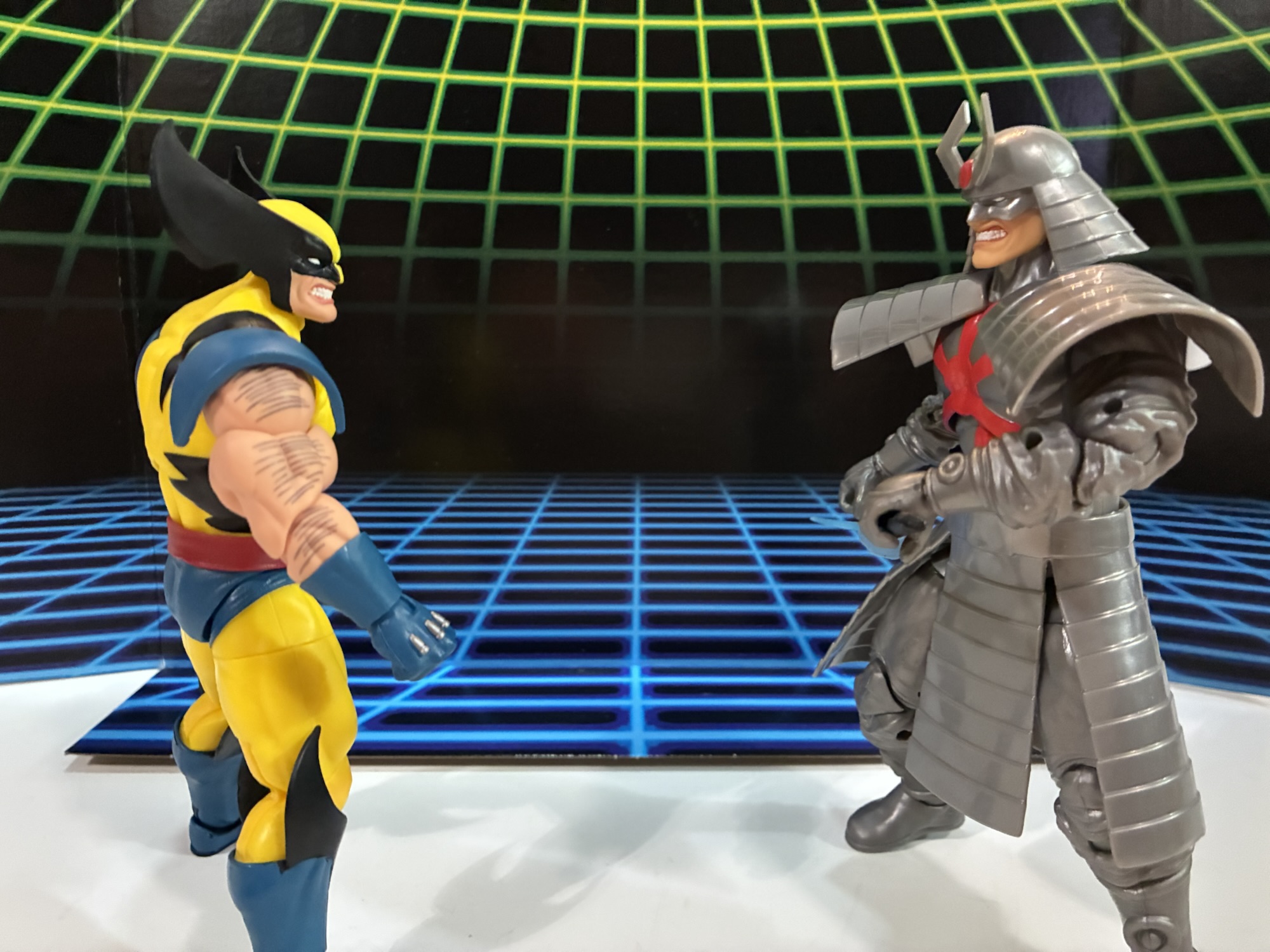
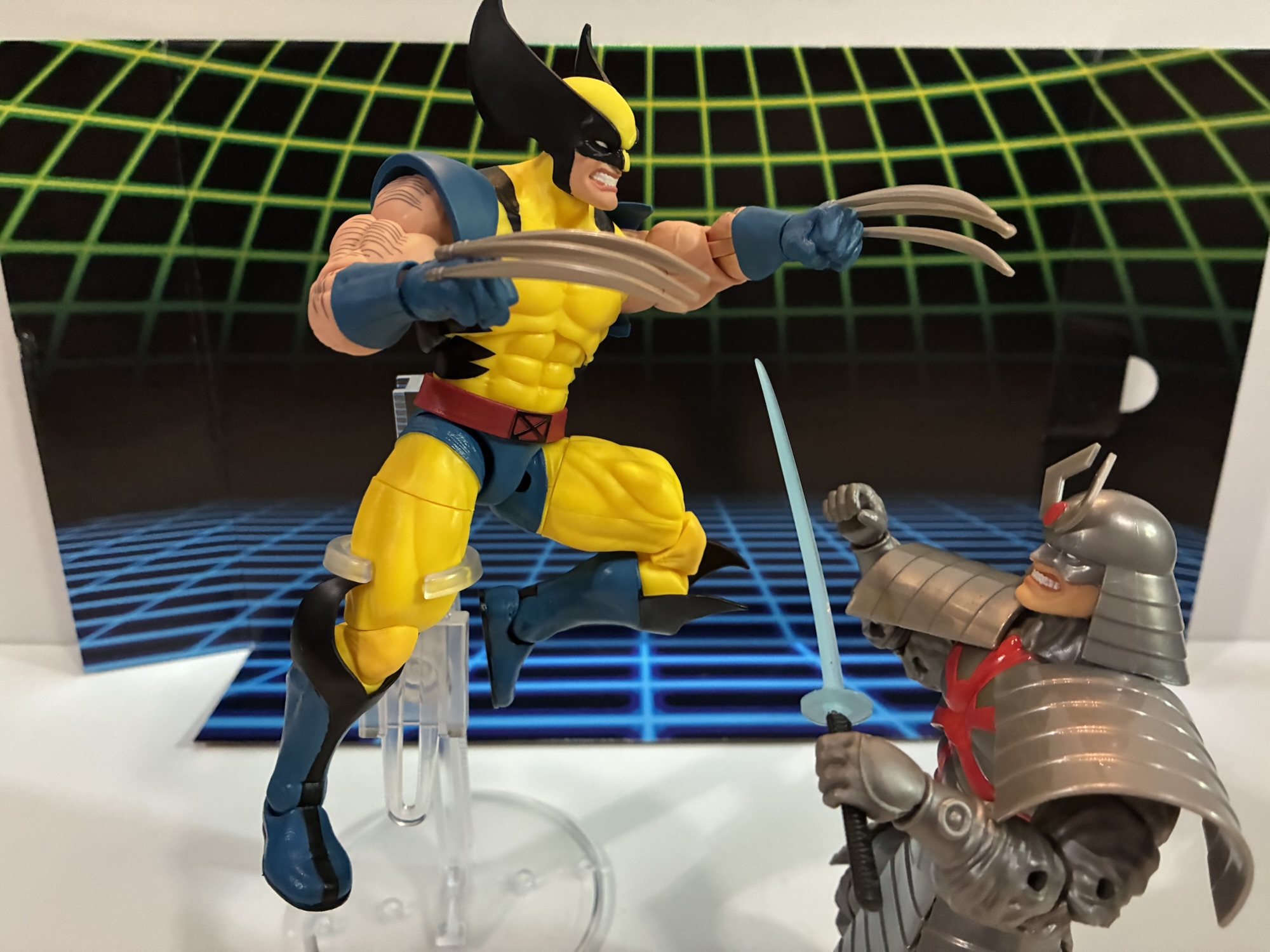
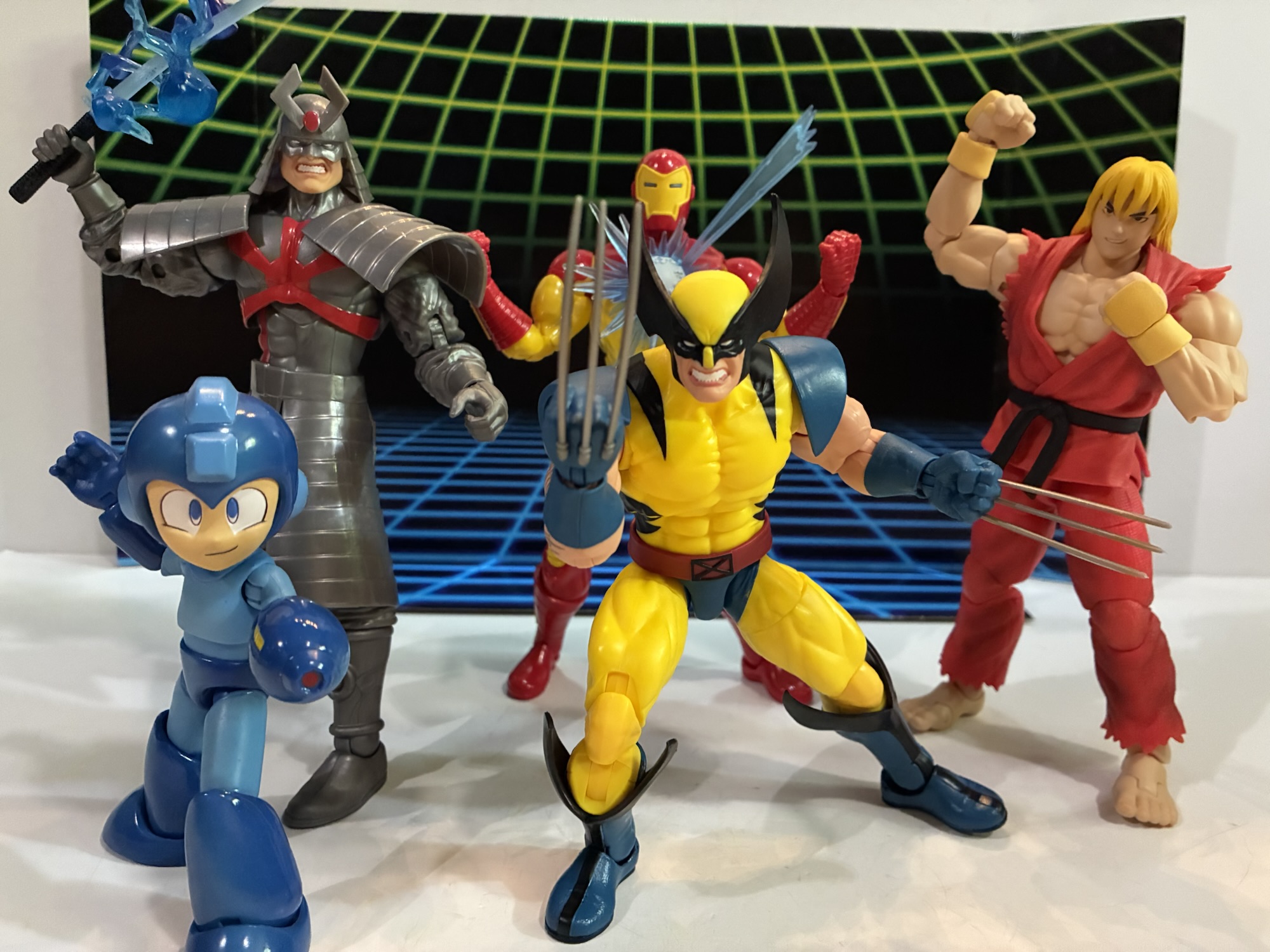
Video game inspired action figures are quite the hot ticket right now. I’m not entirely sure why that is, but maybe some of that is owed to Jada Toys and how well received their line of Ultra Street Fighter 2 action figures have been received. Hasbro, for their part, has had a “Gamerverse” subline of Marvel Legends for quite awhile now, but it has mostly centered on the Spider-Man games released for the PlayStation. This year, Hasbro decided it wanted a piece of the Marvel vs Capcom pie without actually saying that outright. Gamerverse has now pivoted to that beloved franchise, though strictly the Marvel side. Despite having a previous relationship with Capcom via its Power Rangers x Street Fighter line a few years ago, Hasbro has shown no interest in actually engaging the licensor for these figures instead releasing a series of two-packs and one-offs of Marvel characters from that line of games. Most of them have not been of much interest to me, but there was one I could not ignore: Wolverine vs Silver Samurai.
One of these figures is more desirable than the other.
I have enjoyed the Capcom fighters going back to X-Men: Children of the Atom in arcades. The hyper fast fighting games were a sight to behold and it felt awesome to finally be able to take control of the X-Men in a setting that felt worthy of them. The games only became more popular when they were eventually paired with Street Fighter, then eventually it expanded to include all of Marvel and all of Capcom. The designs from those games always came across as rather unique for the Marvel characters and many years ago Toy Biz made a half-hearted attempt at characters in that style with a series of two-packs sold at KB Toy Stores. They weren’t great and I never actually bought any, but I’ve always wanted figures that match the art style presented in those games.
“Let’s go, bub!”
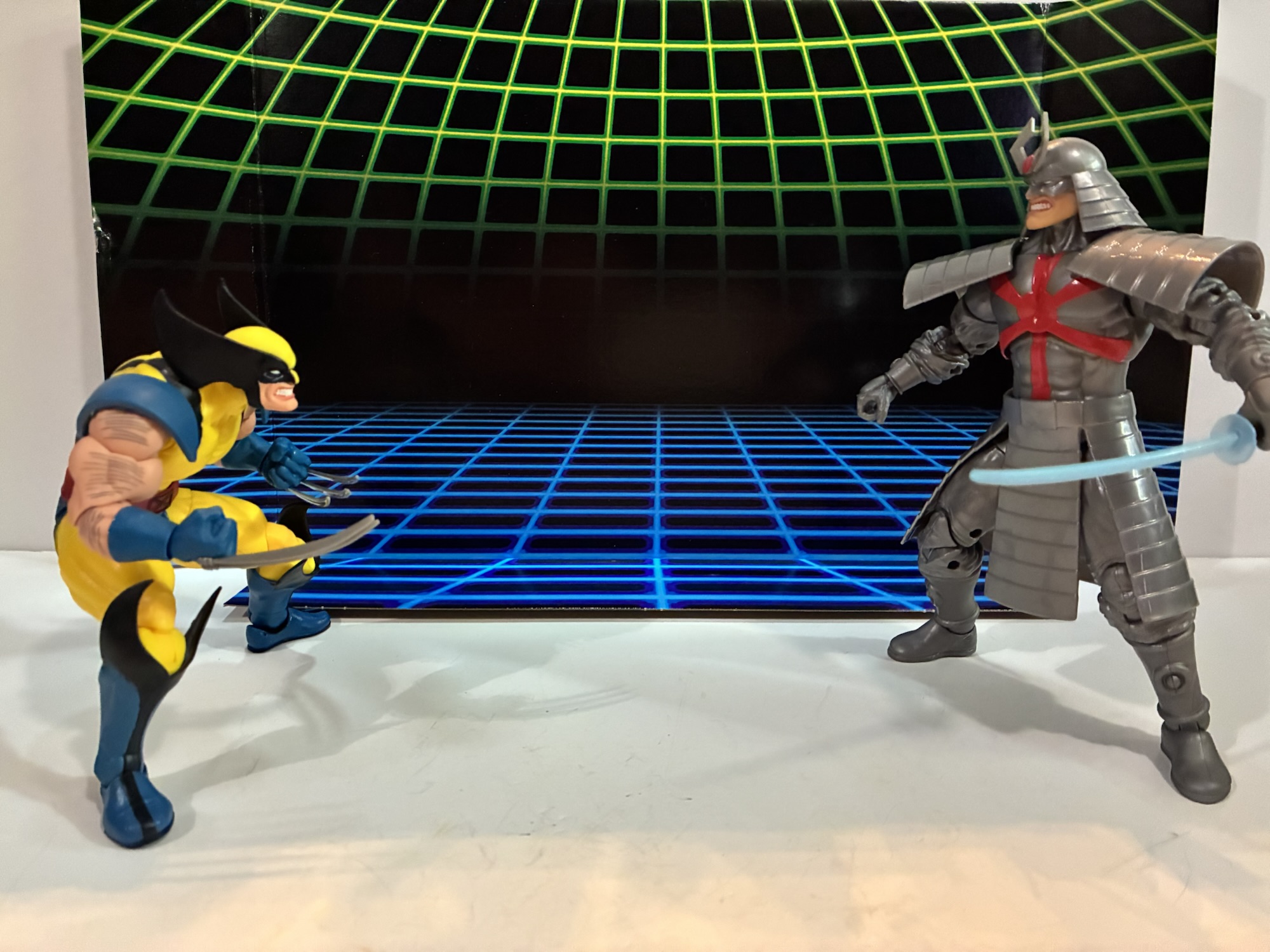
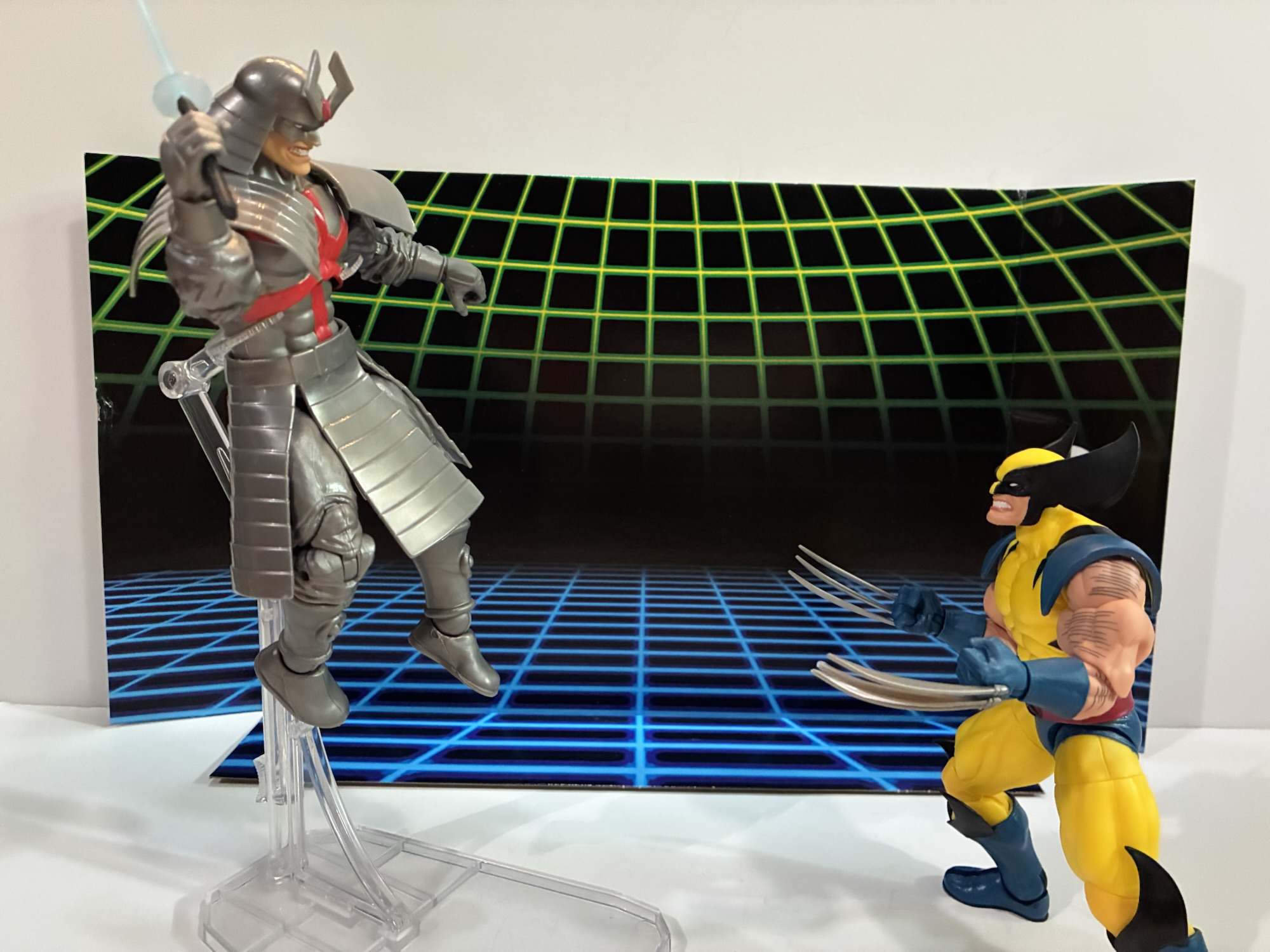
For Hasbro’s collection, we get the usual mixed bag from the company. Some of the figures in the line do a really good job of matching the games, while others very much do not. And considering most of the releases are two-packs, it probably comes as little surprise that one figure in each set appears to get more love than the other. That is certainly the case with this two-pack featuring Wolverine and Silver Samurai. Wolverine practically looks like he was yanked off the side of the arcade cabinet with his bulky frame and elongated claws and mask fins. Silver Samurai…just looks like the previous Legends release, but in a muted color. I’ll say upfront I do not care about Silver Samurai at all. He’s always been a D tier Wolverine adversary for me and his figure doesn’t offer much. I got this for Wolverine, and considering the set comes at the inflated sticker price of $60, there’s a good chance I way overpaid for a Wolverine figure. Now, I’m going to help you decide if you should do the same.
The presence of dark gray lines on the chest appear to be entirely random.
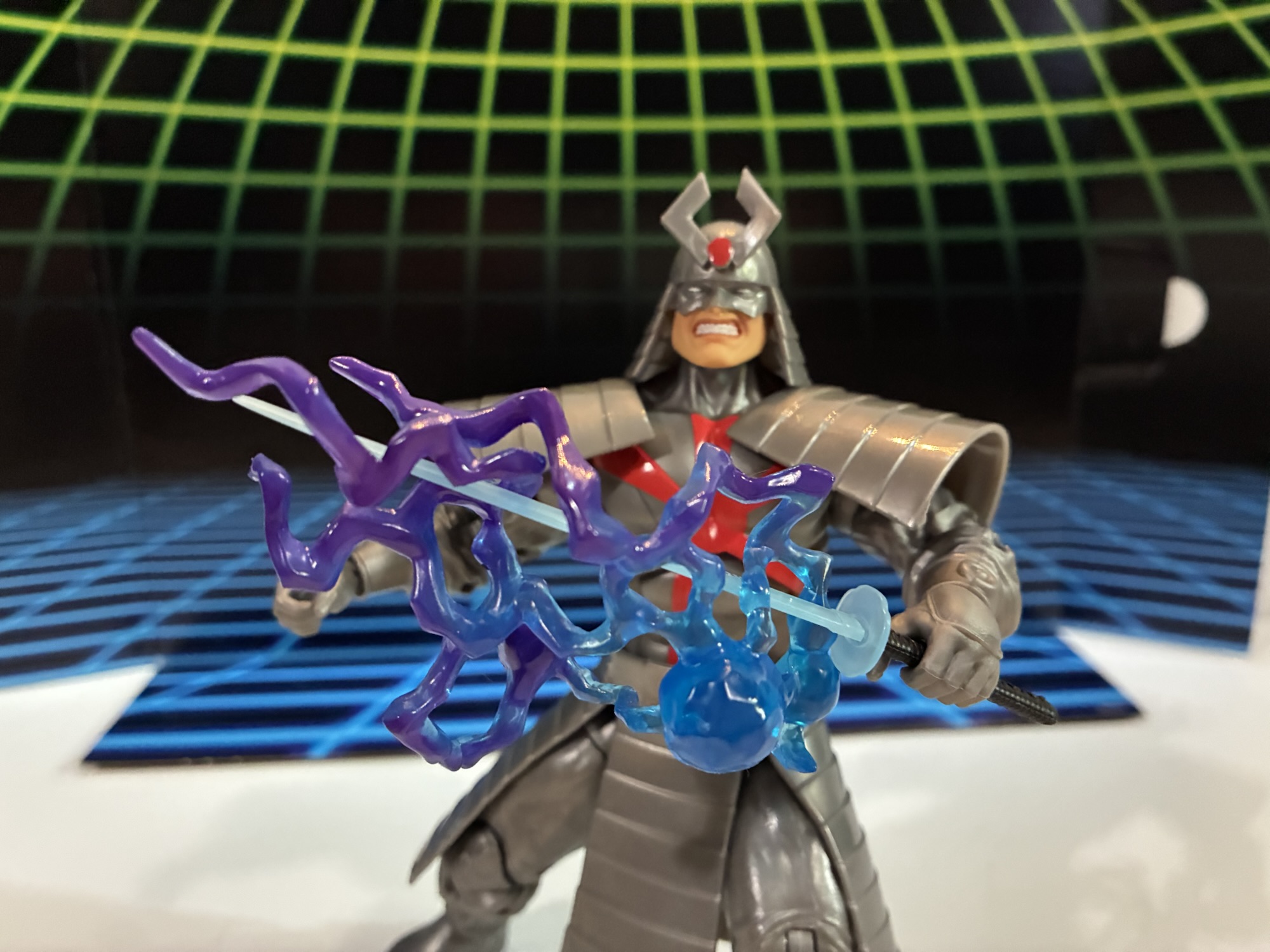
We might as well get the Silver Samurai out of the way. As best as I can tell, this figure is mostly a straight re-release of the prior Legends figure, but with a new torso and expression. The previous figure had a riveted look to the armor where as this one is pretty smooth. Both the arms and legs feature pinned joints owing to their age so if that’s something that bothers you then you may be disappointed here. The color this time around is a very bland gray. The only paint on this guy is reserved for the exposed part of his face, the white of his eyes, and the red on his crest and sun pattern on his chest. The rest of the figure is that lame attempt at metallic plastic Hasbro likes to use. All it does is create random lines or swirls in the plastic while adding zero luster. The chest on my figure almost looks cracked, but it’s just streaks in the plastic. The character in the game was damn near white by default with gray-blue shading. Hasbro didn’t bother to try and match that sprite or the art from the booklet and instead gave us this ugly lump of plastic.
He looks like a kid posing for a Little League picture.It’s fine.Looks cool, but it’s a little heavy for the blade.
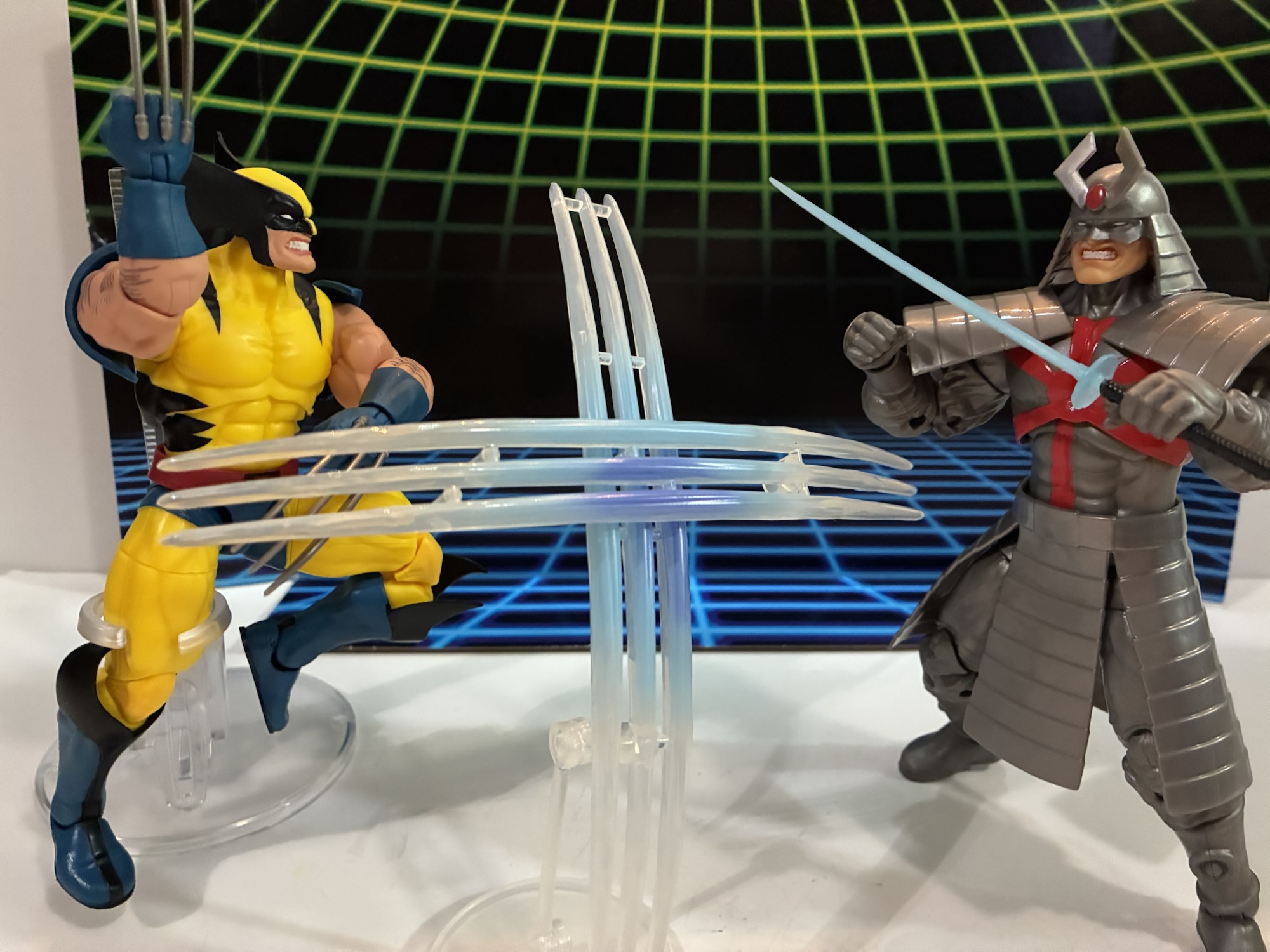
For articulation, the Samurai is also not up to snuff. He’s very basic with a ball-hinged head, hinged-ball shoulders, bicep swivel, double-jointed elbows, ball-jointed diaphragm, waist cut, ball-socket hips, thigh cuts, double-jointed knees, boot swivel, ankle hinge and rocker. His wrist hinges are at least the proper vertical hinge for sword wielding, but his lack of a butterfly joint means he can’t hold his sword with two hands in a convincing fashion. You can get two hands onto it, but it looks kind of dumb. The shoulder pads are pegged into his traps and are annoying to deal with and tend to pop off a lot. For accessories, he has his katana which is done in a translucent blue plastic. It looks fine, but mine has some black paint on the blade. It’s also very flimsy which stinks because he also has an effect part for the sword that looks pretty cool. It’s bubbly and done with blue translucent plastic with hits of a dark blue or purple. The swords slots through it, but the weight of the part will cause it to droop. He also has his energy shuriken made out of translucent orange plastic and a flimsy plastic stand to peg into it. The weight can be a bit tricky to get it balanced because the stand is so poor, but it can be done. However, Jada this is not.
Bring it on!
Which brings us to the real reason I wanted this set: Wolverine. What attracted me to this figure wasn’t just the stylization on display, but also some engineering choices Hasbro made. They have not, to my knowledge, made an action figure like this Wolverine and some of the choices they made are ones that I’ve been wanting from them for years. We’ll get to that with the articulation portion, but first the elephant in the room must be addressed: this is a big Wolverine.
He’s a pretty big Wolverine.
Wolverine stands at just a touch under 6″. Wolverine runs taller in those games, probably because his sprite is always crouched, but if you wanted to slide him into your comic collection this may pose too big a hurdle to climb. The X-Men animated Wolverine by comparison comes in at 5.75″. Is slightly less than a quarter of an inch a big deal? Kind of, considering that older Wolverine is probably a little on the tall side as well (mostly owing to the really long neck of that sculpt). What really stands out as different though is just how much bigger all around this new Wolverine is. Line up any part of the body and compare it to the prior one and it’s a stark contrast. His biceps, thighs, fists, are all quite a big larger. It’s almost as if this Wolverine is in a different scale from its predecessors. Marvel Legends is thought of as a 1:12 scale line while this Wolverine almost feels like it’s in between 1:12 and 1:10 scale (I guess that would be 1:11). He’s a little big for 1:12, but not quite 1:10.
Even though he has a single hinge at the elbow, the range is pretty much the same as the prior double-jointed version.
As for the sculpt, this thing is entirely brand new. We have the new head with the exaggerated fins, or ears, or whatever those things are on his mask. He has just the one expression which features a gritted teeth look like the cabinet art. The body is also entirely new with the much beefier proportions. The shoulder pads are separate and looped onto the peg going into the torso as opposed to pegged into the shoulder itself. The black on the torso is painted and not sculpted in while the fins are black plastic. The face also appears to be painted onto black plastic and the opacity is not as thick as it needed to be. The left side of my figure’s face has some black showing through, which is a shame. The overall proportions and sculpt are all very nice, but other paint issues include a yellow speck on the left side of my figure’s abdomen and some blue smudging on the left thigh. The middle claw on the left hand (geez, everything is on the left side) has some excess plastic around the tip which I’ll need to trim. Silver Samurai’s left pauldron has a similar issue as well which I failed to note earlier. The knees also suffer from miscolored plastic, a frequent issue with Legends in the pin-less era, as they’re noticeably darker than the yellow used for the thigh and shin. It may also bother some to know that the back of his ankles feature a black rectangle since the figure is using black, plastic, for the ankle hinges. Unlike other Wolverine designs, the black trim on the boots doesn’t continue onto and down the center of the back of the boot so it does create an eyesore, but better it be there than on the front.
The effect part is whatever, but the torso articulation is aces. This twisting crouch wasn’t possible on older figures.
From a quality control standpoint, this Wolverine certainly doesn’t have a premium feel, but even with the minor paint imperfections I still think it looks pretty good overall. I love the sculpt, I really love the elongated claws, and I’m really happy with what we’re about to talk about next: the articulation. Hasbro did some good stuff here while also making some trade-offs. How the overall package is received will be somewhat subjective, but what is present works pretty well. They did keep the hinged-neck joint. Wolverine being a croucher needs a lot of range to look up and down and Hasbro has yet to find a better way to pull that off so it’s here once again. We lose the nuance of a double ball, but the joint at least does what it set out to do. The joint some will likely miss is the butterfly joint. Instead, Hasbro has gone with a ball peg shoulder which is the sort of joint McFarlane is known for utilizing. Import companies use the same, but they’ll affix it to a hinged apparatus inside the torso to get that butterfly joint, but here we just get the up and down, in and out, that the ball peg affords which isn’t a ton. They either didn’t have room in the chest for the joint, or didn’t want to cut up the sculpt. Considering it means we don’t have those silly low shoulders many Legends figures suffer from, I’ll consider it a worthy trade-off. Wolverine can still cross his claws in front of his face and has some room to rear back with his arm. Would I have made the trade to cut out a little more on the back so he could really reach back? Yeah, probably, but I am otherwise okay with the range.
It’s too bad stands weren’t included with this set.
The arms also contain another surprise: single-hinged joints at the elbow. Ordinarily, this is something to be frowned upon, but given that it’s Wolverine it’s honestly a nonissue. The arms are always so bulky that even the old, double-jointed, Wolverine can barely bend his elbow past 90 degrees. This one can’t either, but the single joint is cut in such a way that it’s far more pleasing to look at so I consider it an improvement. There’s also a bicep swivel which is more like an import figure in that the piece is floating independent of the elbow. It’s basically just a cover over a straight peg. The elbow also swivels since it pegs into whatever is under the bicep and the wrists feature the standard swivel and hinge.
I wouldn’t come in high, if I were you, Samurai.
The torso is where I was most eager to get my hands on this guy. Most of the old Wolverine figures go with an ab crunch, a big old hinge right in the middle of the figure and a standard waist cut below it. Some of the newer ones use a ball-joint in the diaphragm and retain the ab crunch below it, but at the expense of waist articulation. The thinking from Hasbro is you get rotation in the diaphragm and bend at the waist, but why settle for that if you don’t have to? For this Wolverine, Hasbro went with the ball-jointed diaphragm and paired it with a ball-jointed waist. You know, like all of those import companies making figures that articulate better than the rest. The result is you get forward and back tilt at both spots plus rotation. He crunches forward very well, arches back a decent amount, and can twist and turn with the best of them. And somewhat to my surprise, there’s very little gapping on display at both the waist and diaphragm. They did a really good job with this torso and there’s no reason why it shouldn’t become the default approach going forward. And since it’s a bit large and doesn’t feature any sculpted costume details, I suspect we’ll see it reused for other characters in the future.
Tag!
The rest of the articulation below the waist is your standard ball-socket hips, thigh cut, double-jointed knees, and ankles with hinges and rockers. There’s no boot swivel which is a bit of a surprise. It looks like the boot is a separate piece so I can’t fathom why it doesn’t just peg-on. Like the gloves, it’s possible the boot is just a sleeve glued into place. It’s not a huge omission, but if it could be there with no impact to the budget then why not go for it? For accessories, Wolverine comes with a set of fists and two slash effects. The slash is done on transparent plastic with some blue shading in the center. One can peg onto an included stand, the same, cheap, style one as Silver Samurai’s, and the other slash can then slot over that one to form an X. Wolverine has multiple attacks that make such a pattern with his claws in the game, plus his super move which just makes a big X on the screen that he jumps in front of. It’s a decent accessory, but I wish we got more for the price. Wolverine could really use a stand of his own to sell that effect part and I would have loved a second portrait. A yelling head would have been great or an unmasked one.
Wolverine (and Ken) most definitely wins.
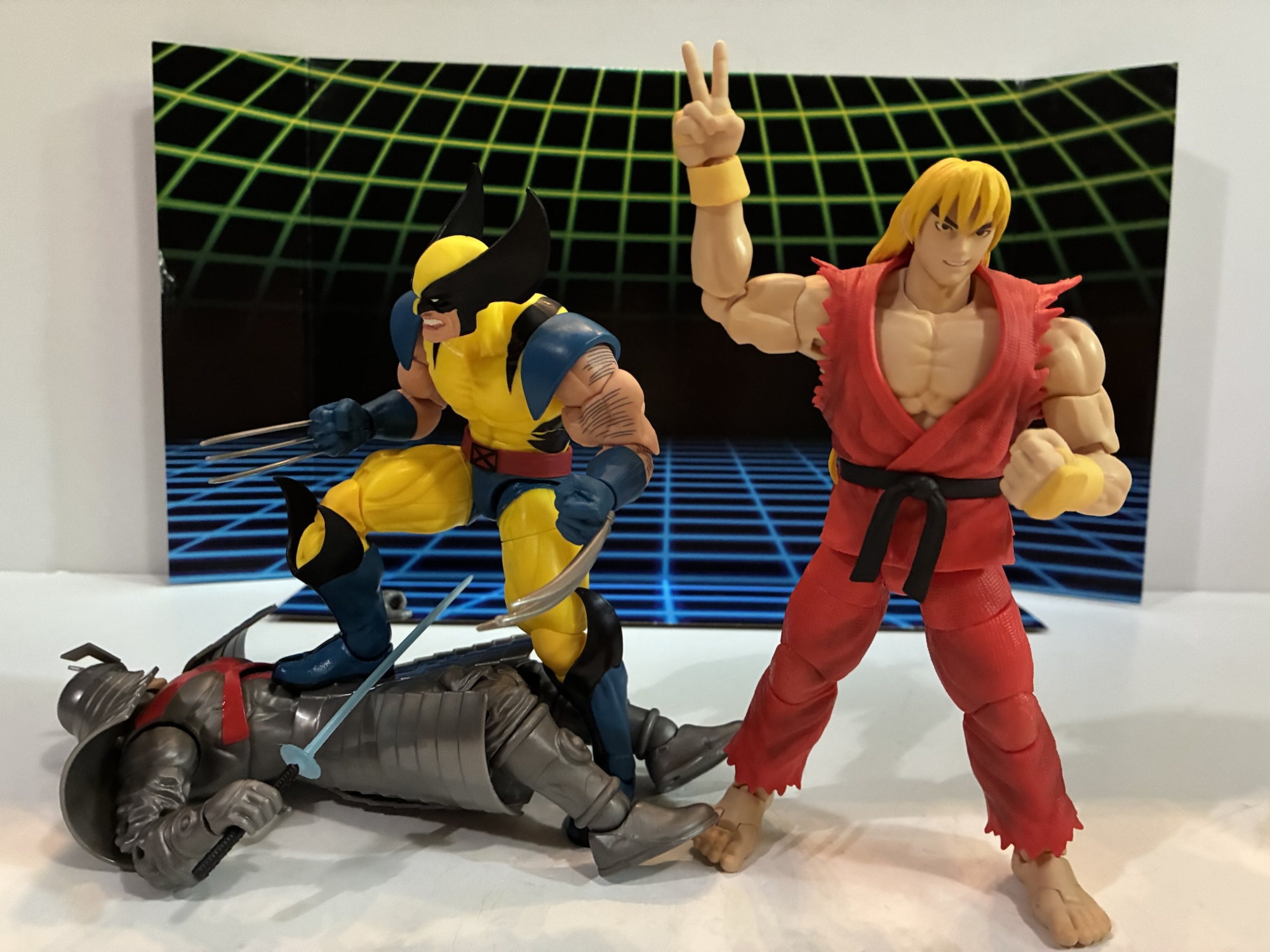
This is a hard set to rate. Subjectively, I love this Wolverine. I love the proportions, I love the new articulation, and I just love messing around with him. He’s not one of those overly gummy Hasbro releases and I like that they went for it in making this sculpt really evoke the game. On the other hand, I can’t ignore the minor problems with the paint and I’ve heard of others having similar issues. Those knees are also an eyesore and the accessories are just okay. If we’re to split the price of the set between the two figures, he’s a little iffy at $30. I’d still recommend him at that price, but I wouldn’t feel like I’m getting a real steal or anthing.
Unfortunately, Wolverine is not a $30 figure. He’s sold in a $60 set with a thoroughly mediocre Silver Samurai. By Legends standards, there is nothing special about this Silver Samurai. Nothing interesting about the presentation, the articulation, and the accessories do not overcome that. I like the sword effect part, but I don’t know if I can use it since it’s so heavy. The shuriken is fine and at least it’s from the game. He has no extra parts and I find he looks dumb with two gripping hands at all times. Couldn’t we get one extra set of hands? His articulation isn’t good enough for a sword wielder and he doesn’t look like the character art or sprite. He’s a total dud for me.
One thing is for sure, Marvel vs Capcom fans are eating good!
Is this set worth $60? Absolutely not. This Wolverine is good, ignoring the scale issues it’s easily Hasbro’s best Wolverine. Considering I don’t really care for the proportions on the MAFEX Wolverine it might even be my favorite Wolverine of all time. It’s still not worth $60 or even $40. And if he’s not worth that then what’s Silver Samurai worth? I honestly wouldn’t pay $20 for him, or even $10. I just plain don’t like the figure so it’s worthless. Despite that, I think this set will sell well because Wolverine is, in case you haven’t heard, very popular and toy collectors get pretty geeked up about new articulation schemes. Even though nothing this Wolverine does is truly new, just new for Hasbro and Marvel Legends. And I’m having fun with it, so while I think it’s stupid to pay $60 for this Wolverine, I don’t hate myself for doing exactly that.
If you liked this review then maybe you’ll like these as well:
The toyline of my dreams was announced last October. In celebration of the 30th anniversary of the television series X-Men, Hasbro is doing a dedicated line of Marvel Legends with figures based on the look of the show. The show was obviously inspired by the designs of Jim Lee, but there are differences in the…
One of my most anticipated releases of 2025 came out of no where. I was a kid during the early 90s and into video games so I know a thing or two about Street Fighter. Street Fighter II was everywhere and is pretty much the reason why the one-on-one fighting game became a huge genre…
We just had 11 consecutive weeks of action figure reviews on Super7’s line of figures based on The Simpsons. Things were getting pretty negative in that sphere as that line went out with a whimper. I don’t like reviewing bad figures and it’s mostly because everything I review here I buy for my own collection.…
One of my most anticipated releases of 2025 came out of no where. I was a kid during the early 90s and into video games so I know a thing or two about Street Fighter. Street Fighter II was everywhere and is pretty much the reason why the one-on-one fighting game became a huge genre for arcades and home consoles. I actually never owned a copy of that game which kind of surprises me to this day, but it’s mostly because I always had access to it via cousins and friends. Plus, not long after the game took off the copycats started showing up and I found myself lured in by the violence on display in Mortal Kombat. That ended up being my fighting game franchise of choice until later in the decade when I found myself the unexpected owner of a Sony PlayStation. A lot of the franchises I had grown up with in gaming just weren’t available on Sony’s machine early on, but Street Fighter was. Street Fighter Alpha ended up being the third game I’d get for my PlayStation (after Doom and Twisted Metal) and thus it became my most played game in the franchise so these character designs stand out for me the most. Still, I didn’t think I’d be all that interested in an action figure line should one surface.
Ken comes with a solid spread of accessories for the price.
The past couple of years, Jada has been making waves with its figures based on Ultra Street Fighter II. I’ve basically admired them from afar, but otherwise haven’t been that tempted to dive-in because I just don’t need that kind of collection in my life. Then along came Storm Collectibles and its Storm Arena line. Storm was known to me for its many video game-based toy lines, but they were always in a weird scale and pretty damn expensive. Still, they looked so good that I’ve considered getting one just to basically try them out, but I’ve never pulled the trigger. The Arena line is a new one for them and it’s more of a true 1:12 scale line. Their own lines were always billed as 1:12, but they were way bigger. For the Arena line, Storm secured the Street Fighter license from Capcom and went with looks based on Street Fighter Alpha 3, which was pretty much the same as the first Alpha game. And the best part of all was the price of $26. I may not have benefitted directly in buying a Jada figure, but I have to believer their line and pricing are huge reasons why this line from Storm is being priced so low.
I suspect Marvel vs Capcom fans will have real interest in this line.
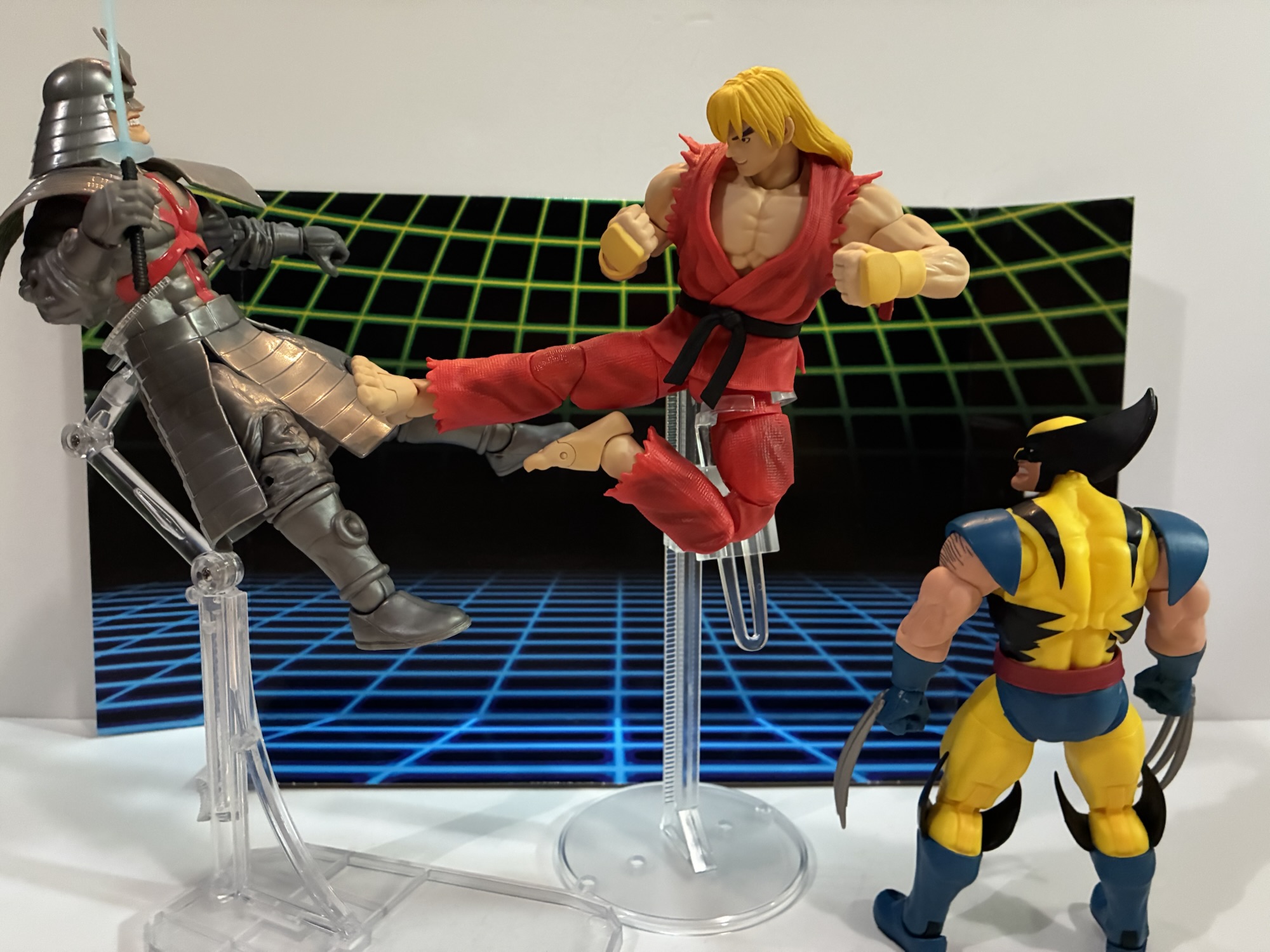
Ken is the first release in the line which works for me as I always preferred him to Ryu. At least stylistically, Ryu’s hyper Hadoken super move was definitely way easier to pull-off than Ken’s Shoryuken based super, but not without its uses. Packaging for the line is very similar to most import offerings like S.H.Figuarts and MAFEX as it’s a window box with some game art. There is a lot of plastic used to protect the figure inside so the window is obscured, but I’ll take it over a figure with smeared paint. Ken stands at about 6.125″ to the top of his head which is a pretty decent height for what is probably the most basic sized character in the line. I’m fairly certain this same body is used for Ryu and it might be in use for the upcoming Dan.
I’ve always gotten the impression that Ken is one cocky S.O.B.
Ken is very true to his appearance in the Alpha series. There is more an anime look to the design and he has his long hair which is tied off with a red ribbon. The gi is pretty much the same as his look in other games as it’s red with a black belt. It’s also sleeveless and he wears some yellow gloves. The basic design for these figures is colored plastic throughout, a soft, rubber, overlay for the torso, a soft rubber overlay for the upper part of the gi, and soft, rubbery, hands and hair. Paint is mostly reserved for the face and gloves, but there’s also some light shading all throughout the red. The gi is also textured and Storm did a nice job of matching the shades of red between the mixed media. The figure absorbs light well despite not having a real painted finish. It doesn’t have a plastic look and does have a more premium look than something like Marvel Legends despite basically being the same price.
If you’re of a Hadoken person you’ll need to get Ryu.
The price of admission may be relatively cheap, but that doesn’t mean Storm is skimping on accessories. Ken comes with two portraits – neutral and a smirk. The neutral expression has almost a hint of a smile and exudes cockiness, which feels appropriate for Ken. The smirk is a nice companion, though mine had a black dot on the chin. I normally leave my set as-is for my reviews, but I was so annoyed by it that I’ve already fixed it (a Magic Eraser sheet did the job). For hands, Ken has a set of fists, Hadoken posed, a right peace gesture, and a left “come here” gesture. There’s also an effect piece for his Shoryuken attack. It’s an acrylic piece that fits over his fist and has a nice yellow to orange to red gradient. If you want the Hadoken you have to get Ryu. I wouldn’t be surprised if alternate colorways crop up with different effect parts. There’s also an included stand, though it’s not a great one. It’s a disc with a post that plugs in and on that post is a sliding piece that’s ratcheted. The sliding piece can accept an acrylic clamp that’s similar to a doll stand. It works off of pressure as the further you slide it into the holster the tighter the clamp. There’s also a black, metal, version included though I’m not sure what advantage that offers over the plastic one. Mine also has a rubber piece over one side of the clamp, but not the other. I’ve hear some people didn’t get the black piece at all. The stand works, but it can be a challenge to balance. I’ve had Ken take a couple of tumbles because the weight wasn’t distributed properly. The base could stand to be heavier or bigger.
The stand can be a little tricky to balance, but it works.
Criticisms of the stand aside, it is still a stand that works and it’s included along with an alternate portrait, two extra sets of hands, and an effect part all for $26. Most Marvel Legends only come with an extra set of hands and maybe another head. This is a nice spread for the price and Storm is giving collectors pretty much all that they need for a Ken display. A Hadoken would have been nice, but that would also mean we would need another stand for that. They did opt to make the hair non-removable from the heads so if there’s one critique it could be that one of the heads could have had a different shape to the hair and if they were interchangeable it would add to the display options.
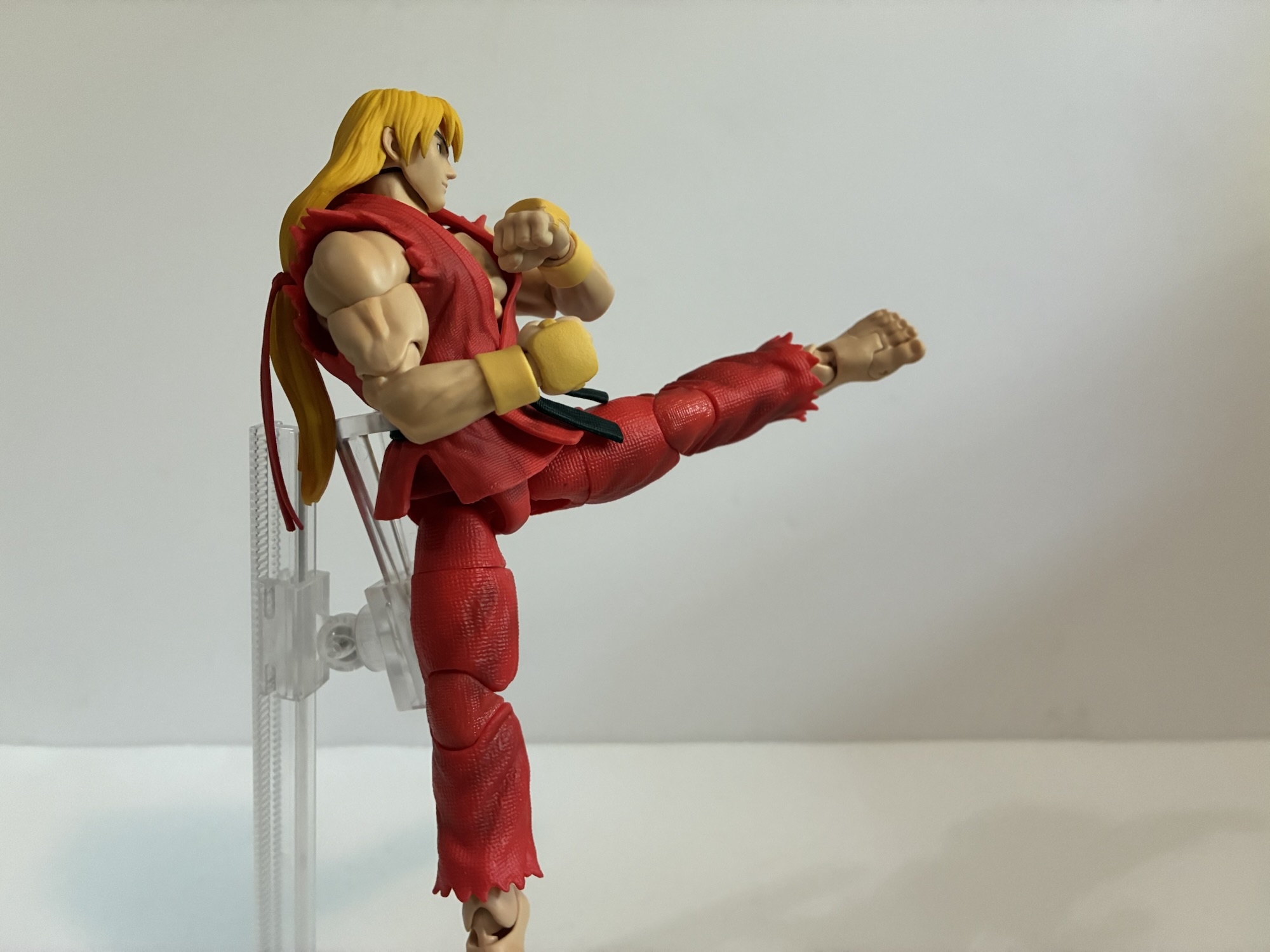
He’s going to hit all of those “Ken” poses.
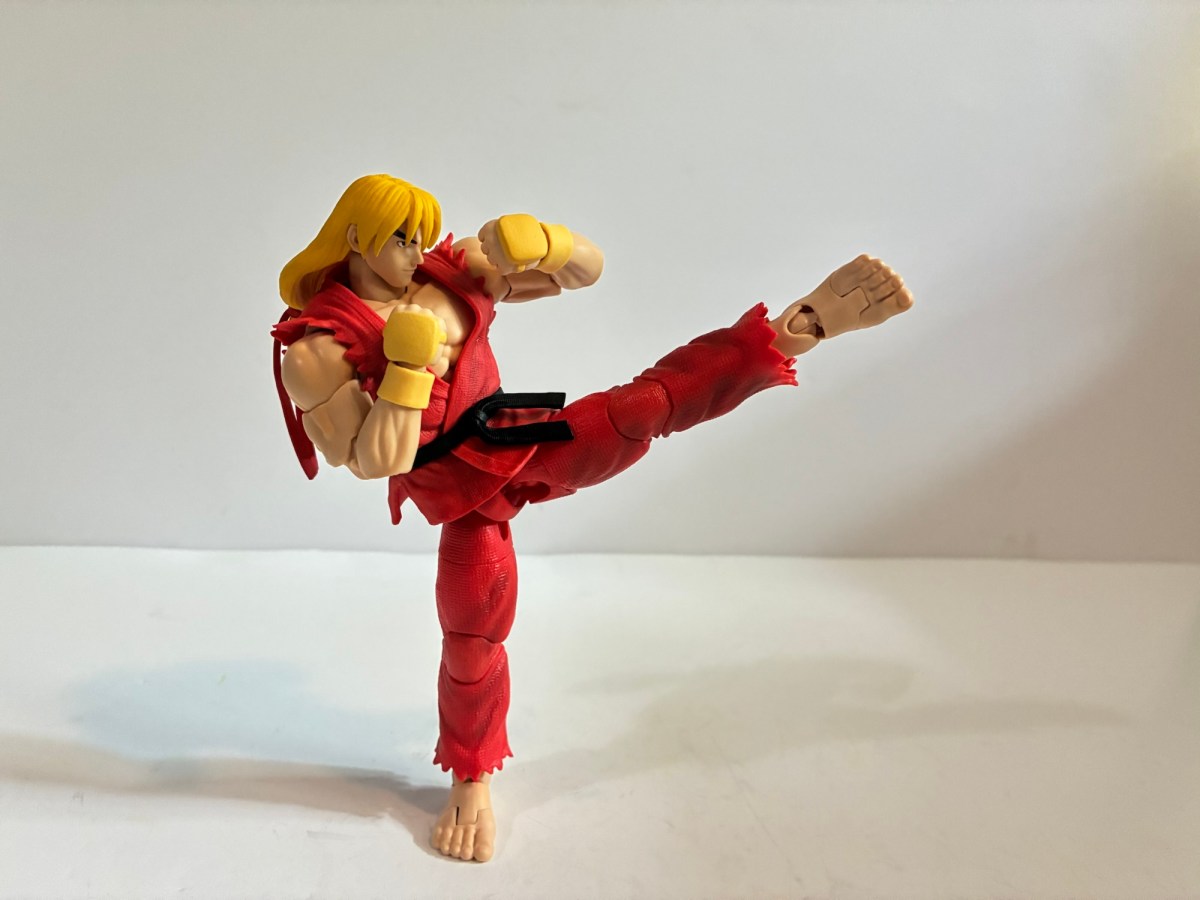
The look and accessories are great, but the real selling point of a Storm figure for me is the articulation. Storm has a good reputation in this area and it’s what I was most excited to test out with this figure. The articulation points are even more than what one would expect of a super articulated line: double ball peg head, ball neck, hinged ball shoulders, butterfly, bicep swivel, double-elbows, ball-hinged wrists, diaphragm ball joint, waist ball, ab crunch, ball and socket drop-down hips, thigh swivel, double knees, ankle swivel, ankle hinge, ankle rocker, toe hinge. Range everywhere is pretty damn good. The head can’t look up as well as maybe some would want, but it’s because of the long hair. Storm took advantage of the character to design to get as much articulation into the figure as possible. The ab crunch is an example as it would be pretty ugly on a shirt-less figure, but with Ken it’s a non-issue. They actually were going to use it on the famously shirtless Sagat, but scrapped it because fans thought it was ugly. The gi is removable on Ken which will allow you to really push some of the joints to the extreme, but again, Storm took advantage of the design to make it work as best as it could with the gi on. Taking it off reveals an odd sculpt that tapers in dramatically at the waist to make sure the figure isn’t overly bulky with it on. You can do it, but it will look kind of stupid. I had a tough time with it so I didn’t end up taking any shirtless pics of Ken, but you can certainly find them in other reviews if you wish.
What are you doing? You’re both Capcom, you need to unite against the Marvel!
The articulation is as advertised. Ken can hit all of his signature poses without much of an issue. The classic Hadoken pose does require some fiddling, but it is doable. He can also kick super high and hit the splits. The drop-down hips are on a big hinge and there’s no looseness. I don’t know that it adds much, but it’s not as annoying as other drop-down hips nor does it feel fragile like some other figures in my collection. This guy feels very sturdy and the joints are all smooth. There’s no looseness anywhere and nothing was even remotely stuck on mine. The aesthetics of the joints are all plus with perhaps the only thing close to an eyesore being the feet. There’s a little gap between the ankle and feet which provides for excellent range on the hinge, but might be too much of a gap for some. I’m personally okay with it, but the cut-up look of the bare feet in general might turn some off.
This won’t be my last purchase in this line.
I find it hard to believe though that the feet would be a dealbreaker for anyone. I can’t think of anything with this figure that would be a deal breaker for an action figure collector. If you don’t care about Ken or Street Fighter Alpha then, yeah, you probably won’t feel compelled to buy this. Or maybe you will? I thought I didn’t care enough to take a look, but the allure of this one was too strong. This is a really well-constructed action figure at an incredible price. The price has ticked up since it was originally announced, but not substantially. I think Big Bad Toy Store has it for $28 now because of rising costs associated with tariffs and other such nonsense. Hopefully it doesn’t get worse and hopefully this isn’t some introductory price to lure us in. Sagat is more expensive, but he’s substantially larger and that’s the same sort of thing Jada does with its line too. This figure really is a contender for figure of the year. I don’t think Storm could have done much better, or any other company. I’m not all-in on this line, but I’m definitely getting Ryu and Sagat and I’ll keep my eyes on it. I’d love to see Akuma, Blanka, and some others and I’m sure they’ll be announced at some point. Dan is currently up for preorder and we’ve seen Charlie and Chun-Li as well. If Storm can deliver on this level of quality at this price with the rest I don’t see many other toy lines beating it.
This Ken figure may be from Street Fighter Alpha 3, but I think Marvel vs Capcom fans will be very interested as well:
We just had 11 consecutive weeks of action figure reviews on Super7’s line of figures based on The Simpsons. Things were getting pretty negative in that sphere as that line went out with a whimper. I don’t like reviewing bad figures and it’s mostly because everything I review here I buy for my own collection.…
90’s nostalgia has taken me on a ride of late. I could blame X-Men ’97, but it could just be me getting older and having more fondness for the decades that have come and gone. It’s not a bad thing, but it can be bad for the wallet. Lately, I started looking at my somewhat…
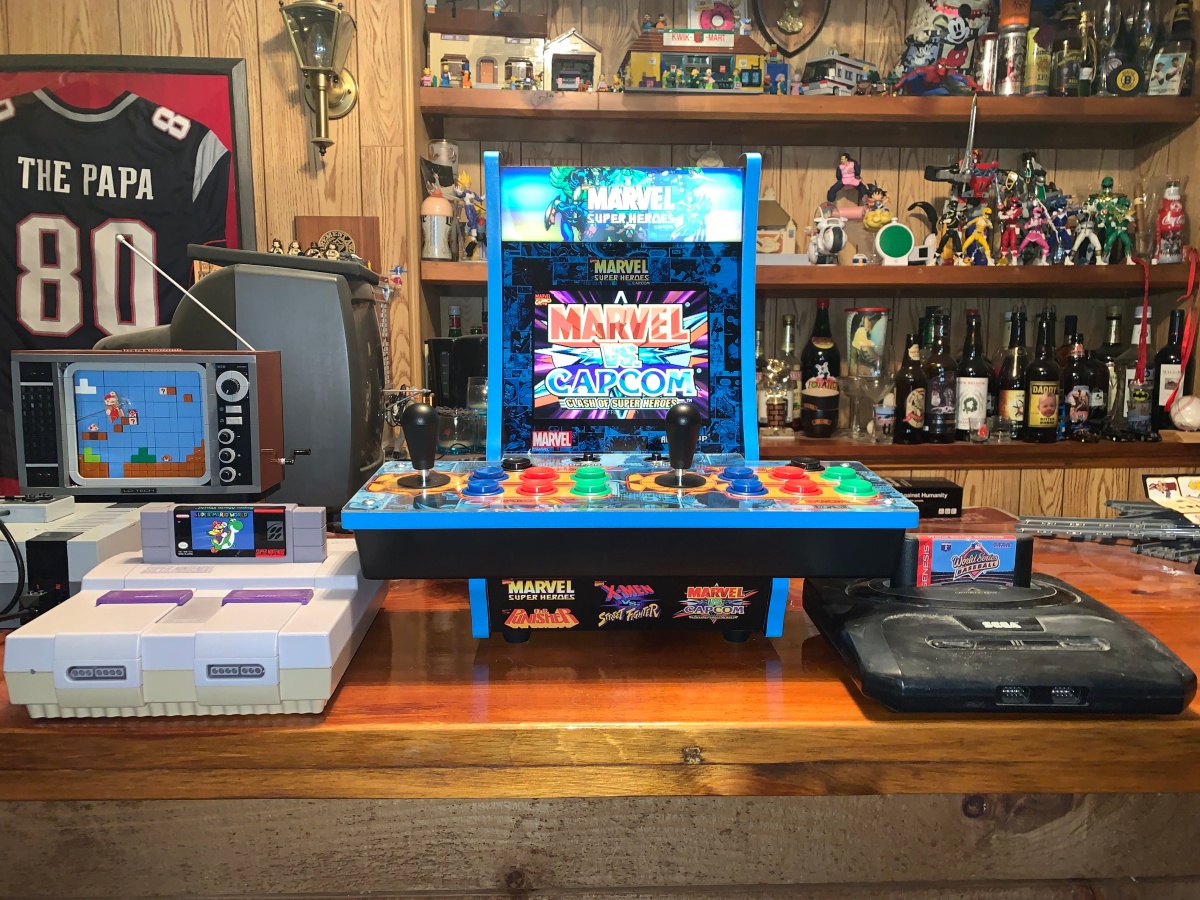
Arcade 1Up has been around for a few years now selling arcade cabinets at a reduced size and also a reduced price. The cabinets are significantly smaller than an actual arcade cabinet, but still plenty large enough to take up a lot of floor space in your home. And while they’re cheaper than the “real…
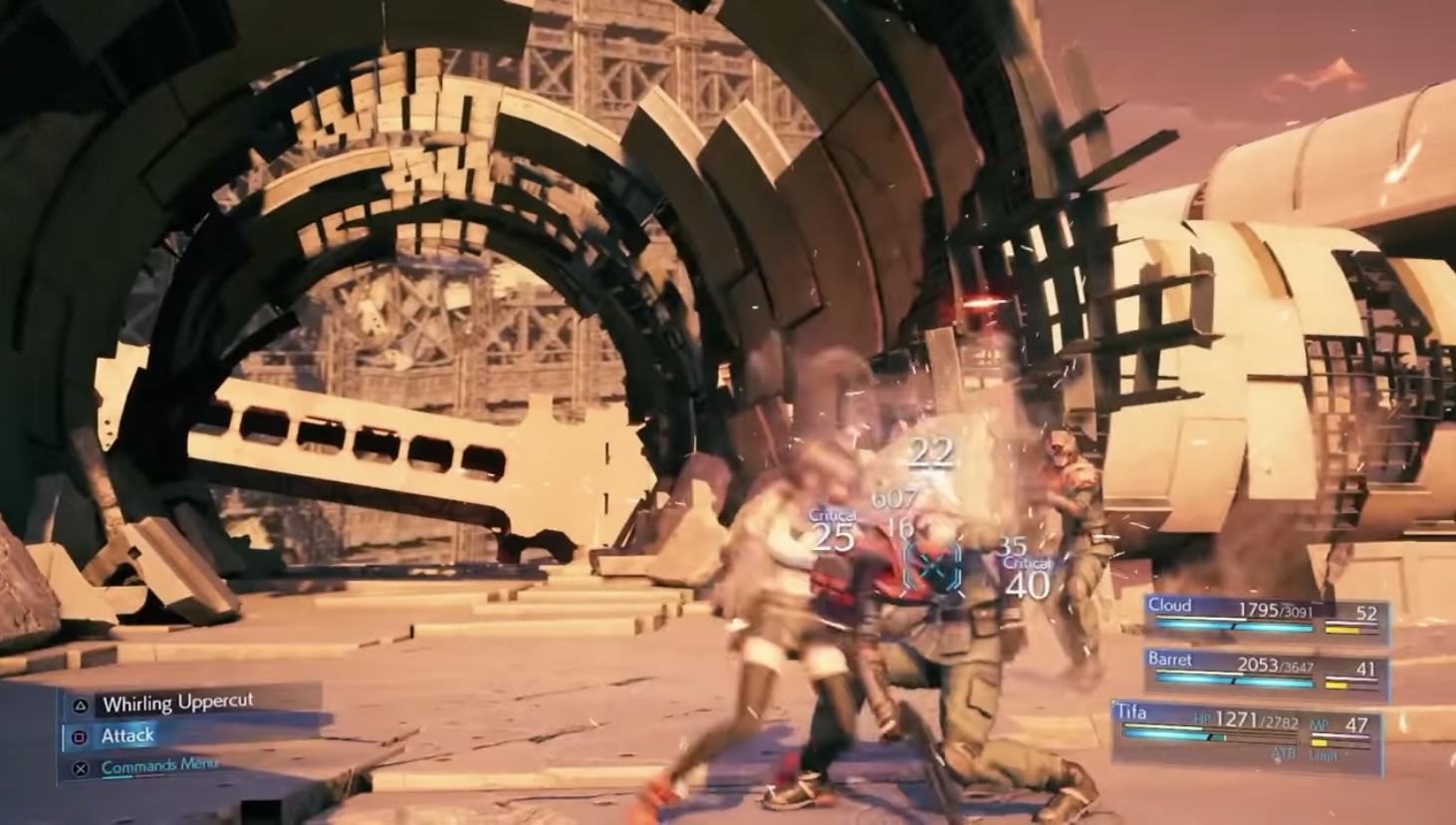
My video game reviews are rarely timely. I just don’t have the available free time to plow through a video game like I once did, especially not a lengthy role-playing game. Nonetheless, the subject of a Final Fantasy VII remake has been a big one to me and I would be remiss if I didn’t collect my thoughts on the subject here in this space. It was nearly a year ago that I did just that with part one of a projected three-part project that is the Final Fantasy VII remake. That first part basically covered the Midgar portion of the story from the original game taking what was probably an eight hour experience and turning it into a 60 hour one. The second part of that journey arrived the same day as my review of the first and I think most had an idea of where it would leave off relative to the main story, and most were right. It has taken me the better part of eight months to work my way through this second chapter, titled Final Fantasy VII Rebirth, and I have some thoughts to share.
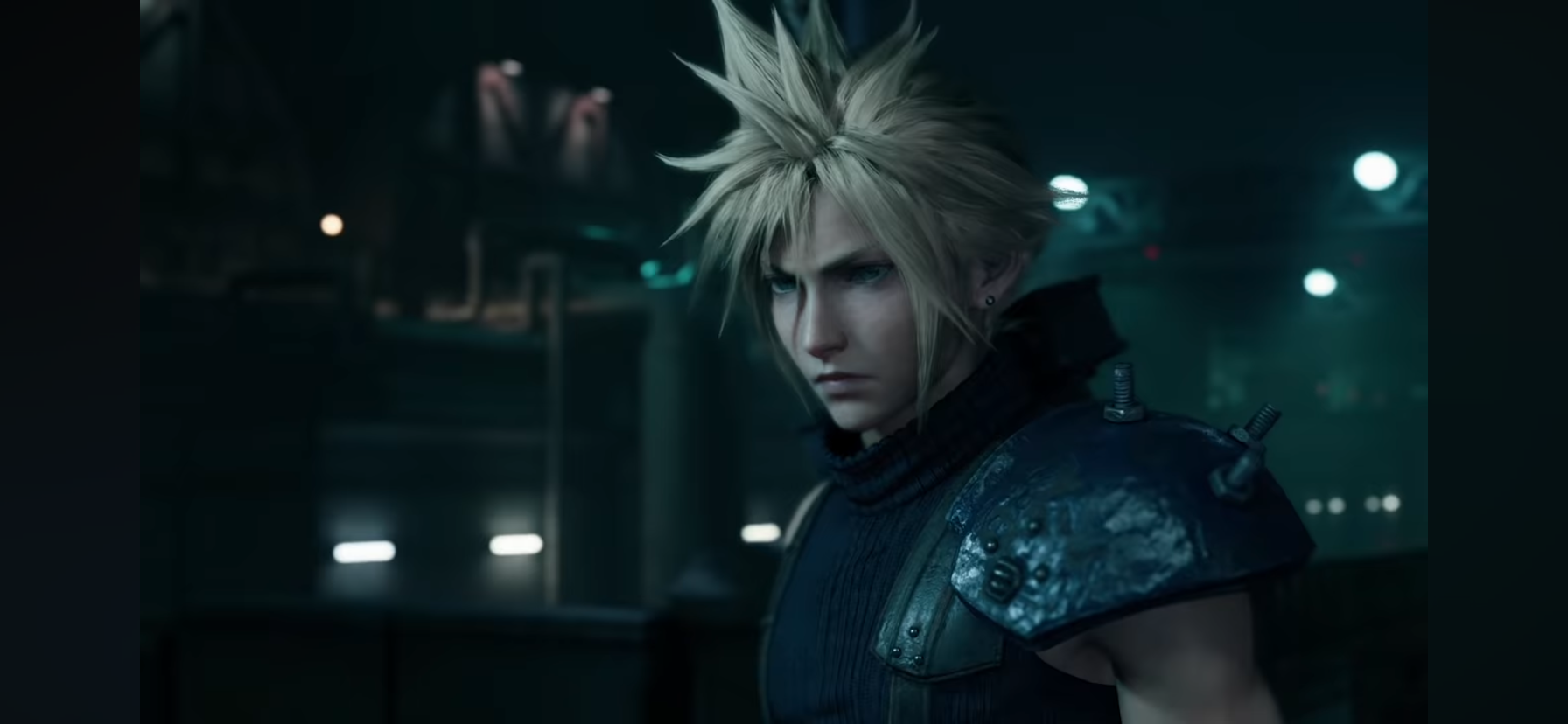
As is probably the case with every article, blog, etc. on the subject, spoilers are ahead for those who did not experience the original Final Fantasy VII or Final Fantasy VII Remake. I’ll not spoil this game outright, at least not without warning, so if you’re looking for a delayed opinion on a game you’re considering for yourself then you’re safe for now. The game picks up right where Remake left off and our heroes are fleeing Midgar and planning their next move following the destruction that took place and their encounter with the big baddie of the game: Sephiroth. Remake ended on a controversial note. Basically, it was revealed that what we’re playing is a remake in a meta sense, but only Sephiroth is aware. Final Fantasy VII happened. Sephiroth lost and the planet was spared. Now, he gets to try again by toying with the whispers of fate, as it were. In a way, it’s not important to the player if this is a redo or all happening for the first time, except for the fact that it was revealed at the end of Remake that Zack (Caleb Pierce) is alive. If you’ve played the original, or the prequel game Crisis Core, then you know Zack should be very much dead. He died saving Cloud and that inspired Cloud to basically become Zack, in a sense. With him alive it’s confirmation that Sephiroth (Tyler Hoechlin) has indeed altered history and anything can happen from here.
This guy showing up at the end of Remake certainly raised a few eyebrows.
That little detail may have caused a few fans to raise their pitchforks at the game’s conclusion, but if you thought this meant that the experience going forward would be vastly different then put those pitchforks away. Oh, there are indeed some changes, but the events of Rebirth largely follow in the footsteps of the original game. With just a whole lot more. How does one take a 40 hour experience and stretch it across three modern games? Why, with padding of course! Final Fantasy VII Rebirth is a long game and it took me just shy of 130 hours to roll credits on it. I did not do everything in this game either. I started off trying to keep up with every nook and cranny offered up by the experience, but at some point I decided if I ever wanted to beat this thing that I needed to play in a more focused manner. You see, this game has a mini game for seemingly everything. They add considerable padding to the experience especially if you want to get the top score and receive the best reward. The game is also structured in that there are a series of areas you visit which are fairly vast on their own. Each one comes with a bunch of tedium to extend them: encounter every enemy, find a bunch of special areas, tame a chocobo, beat a unique boss, etc. There is a flow to it, so it’s not a truly tedious experience, but there will be times when the game just plain doesn’t respect your time.
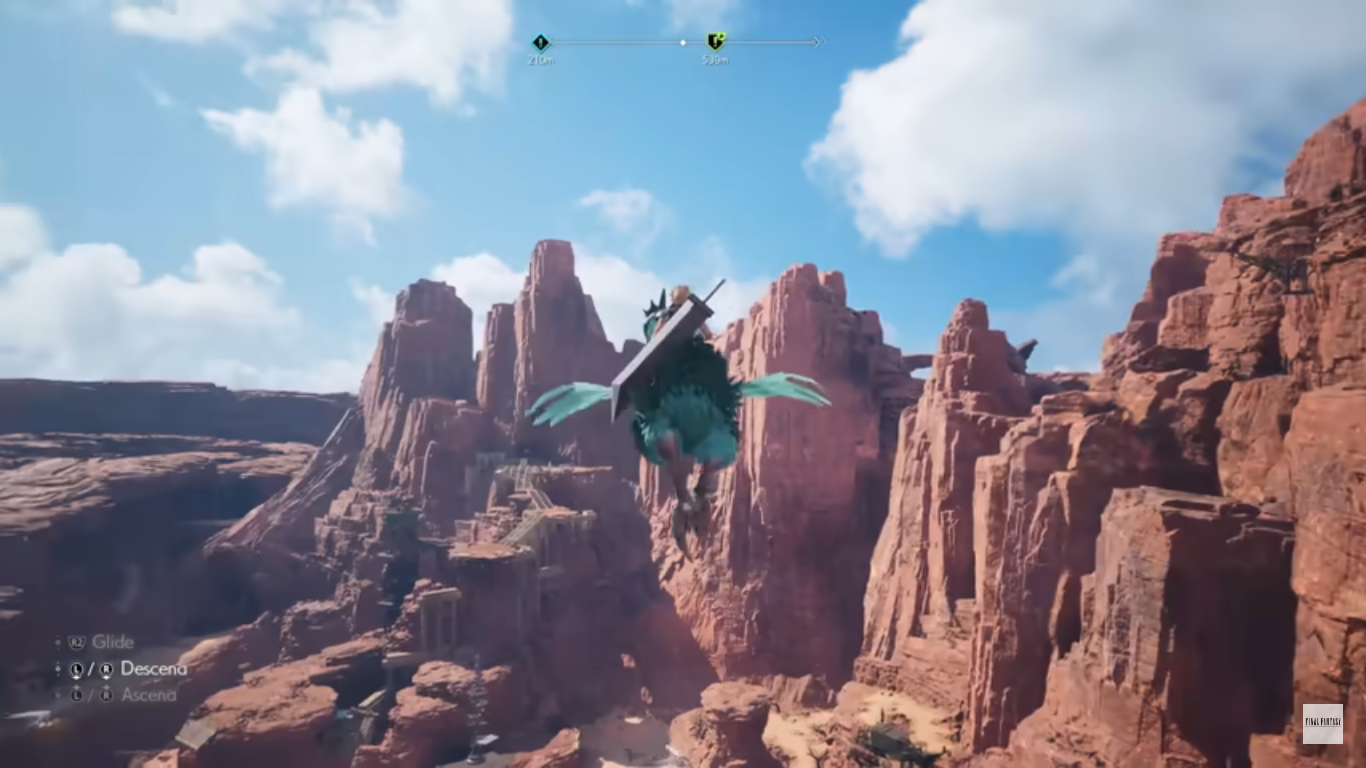
If you felt Remake needed more chocobos then you’ll be happy with Rebirth.
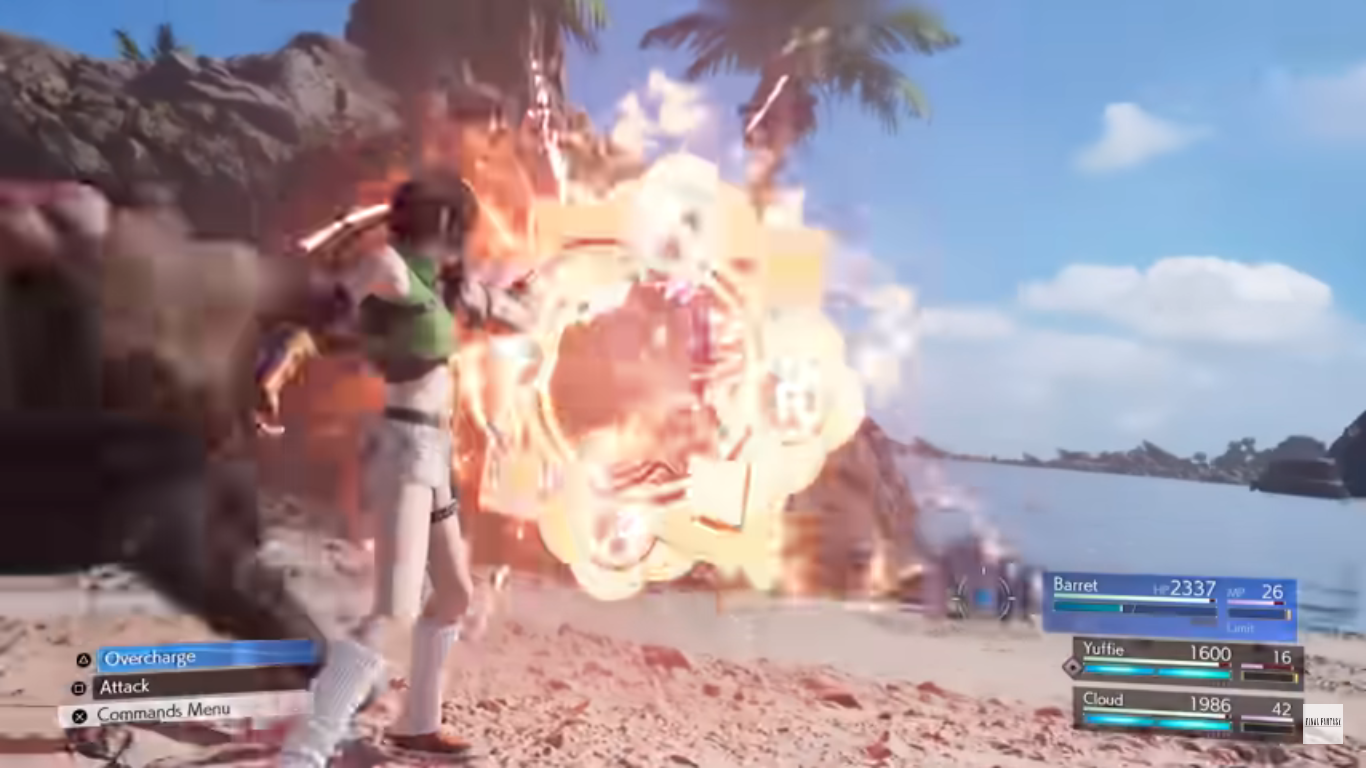
A game that is going to require such an investment of time better be fun to play. If you enjoyed the combat system in Remake, then you’ll be happy with Rebirth. Your characters all basically start over though. Same with your materia, the equip-able orbs that allow your characters to access spells and special abilities. Nothing is carried over from the prior game even though these are supposed to be all combined. The combat is still an action game. You can pause (technically, slow down time to a near pause) combat to issue commands to your characters, but there’s no turn-based option available. Combat is basically still mostly mashing the attack button, accumulating ATB bars, and then using them to unleash special moves and spells. Your party will grow quite a bit larger this time around with the additions of Red XIII (Max Mittelman), Yuffie (Suzie Yeung), and Cait Sith (Paul Tinto), but you can only take three into battle at any given time. There’s no swapping in reserves, though there is a reserve action available when things gets dire.
There are new faces in Rebirth, but like Red XIII in Remake, some are more like teases of things to come.
Every character plays a little different to make them unique. Our returning fighters in Cloud (Cody Christian), Aerith (Briana White), Tifa (Britt Baron), and Barret (John Eric Bentley) still control the same. Yuffie, who was part of the Intergrade DLC for Remake, is a hybrid melee/ranged attacker who relies on speed and is largely unchanged from that game. Red XIII was introduced in Remake, but not playable. In this one, he’s an attack/support character and his special ability is tied to his Vengeance gauge. It builds up during combat and at any point Red XIII can go into a Vengeance mode which makes him stronger, faster, and opens up new moves. Cait Sith is more of a wild card character with moves tied to chance. Cait is the small, anthropomorphic, cat and he rides an oversized moogle. The moogle can be called upon and used to dish out damage and most of Cait Sith’s abilities are tied into it.
The weapon system this time around has been altered. Rather than each weapon needing to level up via a grid type system, each character just has their own progression board of sorts to unlock abilities through. The weapons now just have a special ability and equipping the weapon and using that ability a set amount of times allows the character to learn it permanently. Weapons also have their own materia slots and their own pool of equip-able abilities. This does mean that the evergreen nature of the weapons in the last game is sort of lost. You’re far more likely to just run with the latest and greatest weapon acquired unless said weapon specializes in magic when you want the character to focus on melee attacks. The board each character has will modify base stats and also allow for the learning of magic abilities that do not require MP. It’s a unique grid for each character, so it’s not like Final Fantasy X‘s sphere grid where everyone is on the same thing, but a different starting area.
Synergy skills allow characters to team-up to unleash potent attacks in battle.
A key component of these new grids (which the game refers to as folios) is the ability to unlock Synergy skills. Synergy skills are basically team-up moves and they have to be unlocked. When a character uses an ability in battle, they fill a separate ATB bar. Once two characters have filled the required amount of ATB bars for their move, they can then use it. These moves often do a tremendous amount of damage, but also have other special functions. Many are focused on dealing extra damage to foes that have already been staggered. The Refocus ability, which grants an extra ATB gauge in battle, is also now tied to Synergy skills. Others speed up the limit gauge or leave the characters in a state where they have unlimited MP for a short while. They’re pretty useful and when it comes to harder boss fights they can be the key to turning the tide in one’s favor so it pays to make sure your favorite characters to play as have learned a Synergy skill or two.
The Gold Saucer now feels more like the experience it was supposed to be in the original game.
The presentation for Rebirth is, as you would have probably expected, quite lovely. There’s a variety of environments on display and characters animate and emote exceptionally well. The soundtrack is as good as ever making liberal use of the original game with some new twists thrown in. Voice acting is also very good and at no point will you feel like Square Enix cheaped out anywhere. About the only thing that can feel limiting is when reaching the edge of a map and encountering the ever annoying message that you cannot pass further. The locations though are technically connected so you could basically walk the entire map which I would not recommend. At some point water travel will become a possibility making it even more obvious that this is all one big area.
As most probably imagined, there are more summons to go around in this one.
There is a lot to do and a lot to see in Rebirth. I have no idea how fast this game could be completed if one ignored a lot of that extra stuff, or how much harder it would be. I played on normal and encountered plenty of challenging fights. Some of the hardest will be the summons. In order to acquire a summoned creature, you have to first beat them. You do so via Chadley, who returns from the first game, and his combat simulator. There are special shrines scattered about a region that if encountered can weaken the summoned creature, but most will still put up a good fight. Once acquired, they can only be used when the summon gauge pops up in battle, which does seem to happen far more often this time around than in Remake. Once summoned, they hang around, deal some damage, and have their own abilities that anyone in the party can tap into. Once their time is up, or the summoner is defeated, they unleash their ultimate attack and vanish. There isn’t a whole lot of strategic value to them, they almost feel like window dressing and something the game has to have since it was a part of the original. It’s still fun seeing them for the first time, at least.
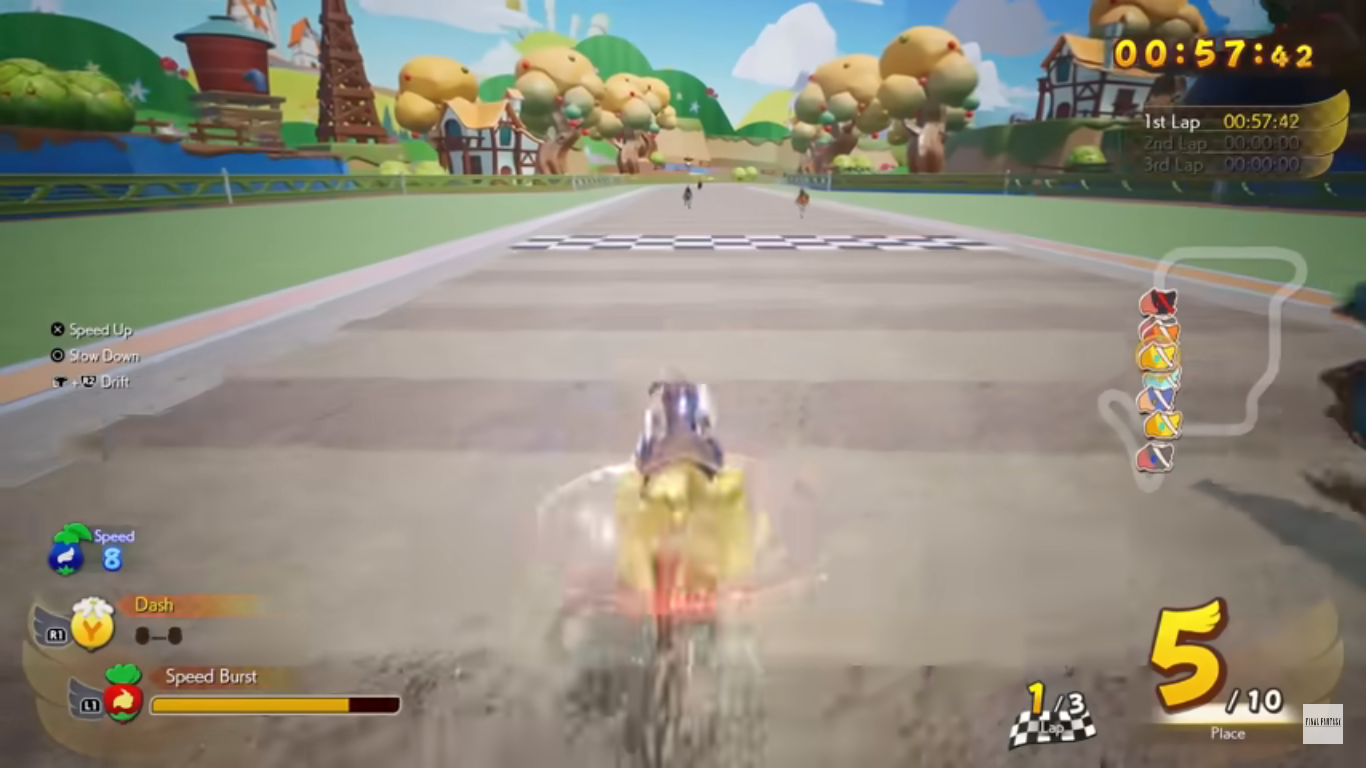
The other distractions all vary in quality. Some I enjoyed, some I couldn’t wait to be done with. Chocobo racing is back only now it’s more like Mario Kart. It’s also not entirely optional, but also not super difficult. There were times I was pretty annoyed though, but those instances may have been in the optional races. There’s also a card game that Cloud can partake in called Queen’s Blood. It takes a little getting used to, but the game does a solid job of bringing the player along as more complicated cards are introduced. I did manage to complete that entire side quest without too much trouble. It’s probably the best of the many mini games which largely do not impress, but also don’t really annoy. The only one I truly detested was the piano playing mini game. I just can’t get accustomed to it and never even managed a B playing a part. I got the impression even back in the demo that it was going to be way too time consuming to get good at so I didn’t bother. Thankfully, there are no moments in the game where you’re required to play piano and actually play it well. There are some moments where you do have to play and it’s a bit awkward, but we can’t all be winners.
It’s back!
Final Fantasy VII Rebirth is basically more of the same when compared with Remake, just a whole lot more. It’s probably way longer than it should be and I can think of plenty of ways it could have been cut down. Anytime I was forced to watch Cloud crawl through something or walk slower I couldn’t help but think this could be going a lot faster. Why do I need to control an airplane that isn’t even being piloted by one of my characters to get to a new area when it could just be captured with a quick cut scene? A lot of side quests are fetch quests that don’t add anything to the narrative, and I really hated that a series of items you collect all throughout the game just leads to an optional, high level, area I have no desire to see through. There’s a crafting element included, but it adds very little to the experience other than an excuse to just put a bunch of collectible crap on every map. The game is, for me, undoubtedly a more complete experience than Remake, but at almost every step of the way there’s this feeling that the designers are just trying to stretch this experience out to the game’s detriment.
The game is so similar to Remake that any issues one had with that game will carryover to this one. I still don’t love the combat system. I don’t hate it, but I still feel like this game is stuck between a subpar action game and a JRPG. It’s not going to satisfy action game fans or JRPG fans entirely, instead it tries to meet them all halfway. It would have been so easy to make it an optional turn-based game, but Square Enix refused. And yeah, you can pause and issue commands or switch to another character on the fly, but the game is still bad at letting you truly dictate to your party members what you want them to do. There was one optional fight where I had to take out a certain enemy first. The problem was, the other enemies in the fight were all weaker. The challenge is basically you have to fight against the game because you can’t reliably get your party members to focus on the target and the target alone. I had to redo it several times because someone would end up taking out one of those lesser enemies first resulting in a failure. Even doing the fight solo was a pain as it’s very easy to accidentally switch targets and the auto-targeting sucks.
And now we do have to talk about it. The big thing. Spoilers ahead!
Do you feel that pit in your stomach upon seeing this? If you do, it’s a totally normal reaction.
As all likely guessed, this game ends with the City of the Ancients and Sephiroth’s attack. The death of Aerith is quite possibly the most famous death in the history of video games. I am struggling to even come up with anything close to it. This game totally blows it by doing what it spends too much of the game doing: it drags it out. The impact of the moment is completely lost because of how drawn out the process is. It also intentionally muddles things too by turning to something I think many are sick of: the Multiverse.
Yes, we’re going full multiverse in this one. It’s basically hinted at throughout the game as there are short sequences where we’ll check in on Zack who is watching over both Aerith and Cloud. Aerith is in some sort of coma, while Cloud has apparently succumbed to mako poisoning. Biggs is also alive, and the game waits until the end to reveal what’s going on which is essentially that Sephiroth is trying to unite a whole bunch of multiverses. I suppose it’s not the game’s fault that Marvel has gone headlong into this type of story-telling over the past few years, but it’s a trope that I’m personally so sick of. It’s not adding to the experience of Final Fantasy VII and just feels like change for the sake of change. I still expect the events of the final game to play out largely as expected, only instead there will probably be some additional final encounter with Sephiroth. Maybe it will bring in other Final Fantasy universes and Sephiroth will team-up with Kefka while Cloud and Squall race to find Tidus for one massive, shark-jumping, finale! I doubt that, and I hope we’re not heading for something that ridiculous, but I’ve gone from slightly intrigued by the possibilities presented at the end of Remake to downright soured.
There will be more battles with Sephiroth to come, but what shape will they take?
The remake of Final Fantasy VII was never going to be easy. Redoing the game with prettier graphics might have satisfied many, but also would have felt pointless. The game does at least benefit from having the player spend more time with these characters. They’re far more fleshed out, their personalities more apparent, and I genuinely enjoy spending time with them. I am invested in their journey, even if aspects of it frustrate me. Aerith was done dirty. Not because she was killed off, but because it wasn’t allowed to resonate like it should have. Perhaps the fallout in whatever comes next (I’m guessing it will be called Reunion) will find a way to rectify that. And at least they didn’t chicken out, which I was a little afraid would happen and this new timeline would lead to one where Aerith doesn’t die. Not because I want her dead or anything, far from it as she’s a delightful character, but because her death should hurt and it shouldn’t be something we can ignore.
All this is to say that I have complicated feelings on this game. I did with Remake, and I still do with Rebirth. Chances are, I’ll feel the same way when all is said and done. Can I recommend it? Yeah, sure, if you have 100 hours to spend on a game. If you don’t then I totally understand. I find the task a daunting one and I’m nearing a point in my life where I don’t really want a game to last that long. As a fan of the original Final Fantasy VII, it is nice to see these characters from a different angle and experience them in a new way. I can’t compare the two games because they’re such different experiences, but the best thing I can say about Rebirth is that I don’t regret the 130 hours I’ve spent with it. I just don’t really want to spend any more time with it.
Check out some of my other Final Fantasy thoughts below:
It took a long time for it to be realized, and a long time for me to play it. It’s debatable which Final Fantasy title is best and nostalgia will always play a big role. For many, Final Fantasy VII was the first Final Fantasy game they played. Previously, only three titles had made it…
Over the years I’ve talked a lot about Final Fantasy but I’ve never posted a game review for any of the numeric titles in the long-running series. Well that ends today as I post my thoughts on the somewhat recently released Final Fantasy X HD Remaster. One opinion I have stated on more than one…
In the gaming community, a popular topic of conversation seems to always stem around remakes. They’re fairly popular and have become more so due in large part to the rising price of game development and the profitable business known as nostalgia. Games cost a ton of money these days to develop, and with little change…
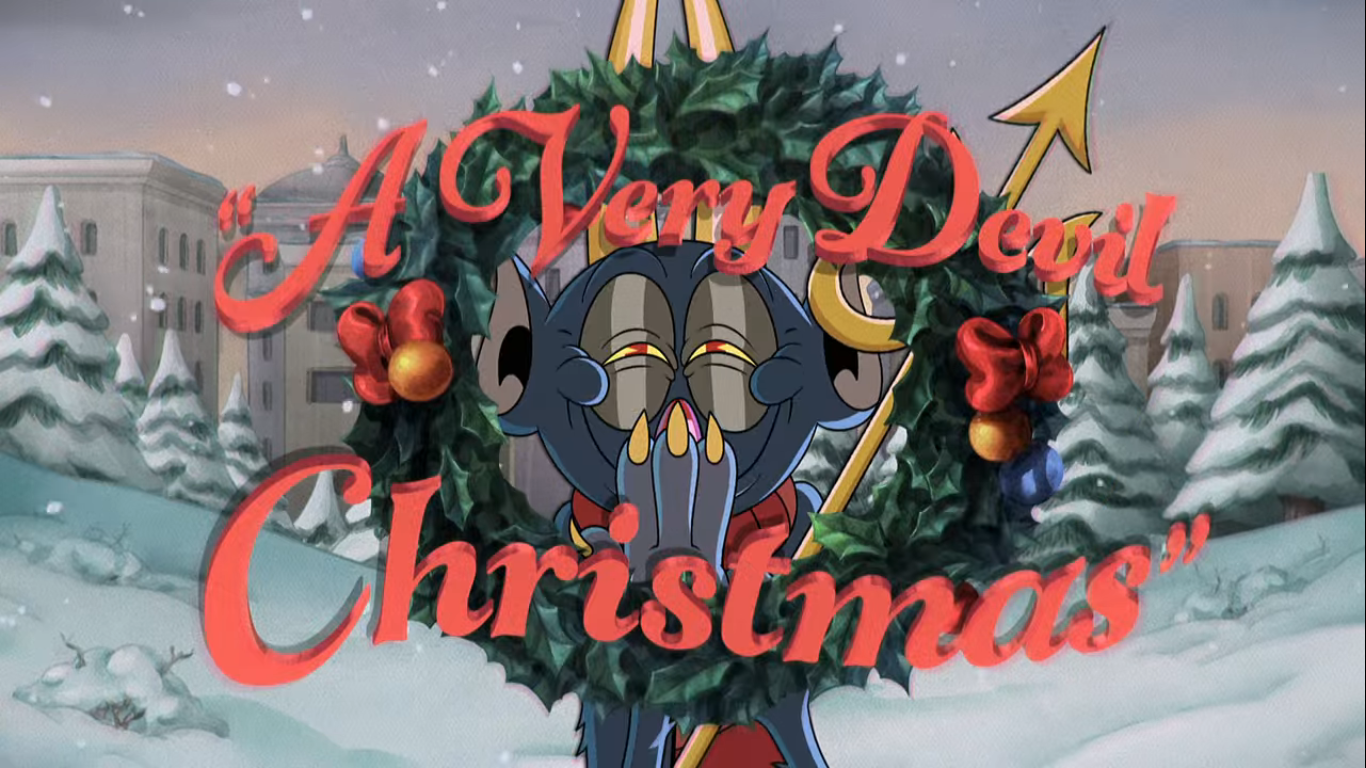
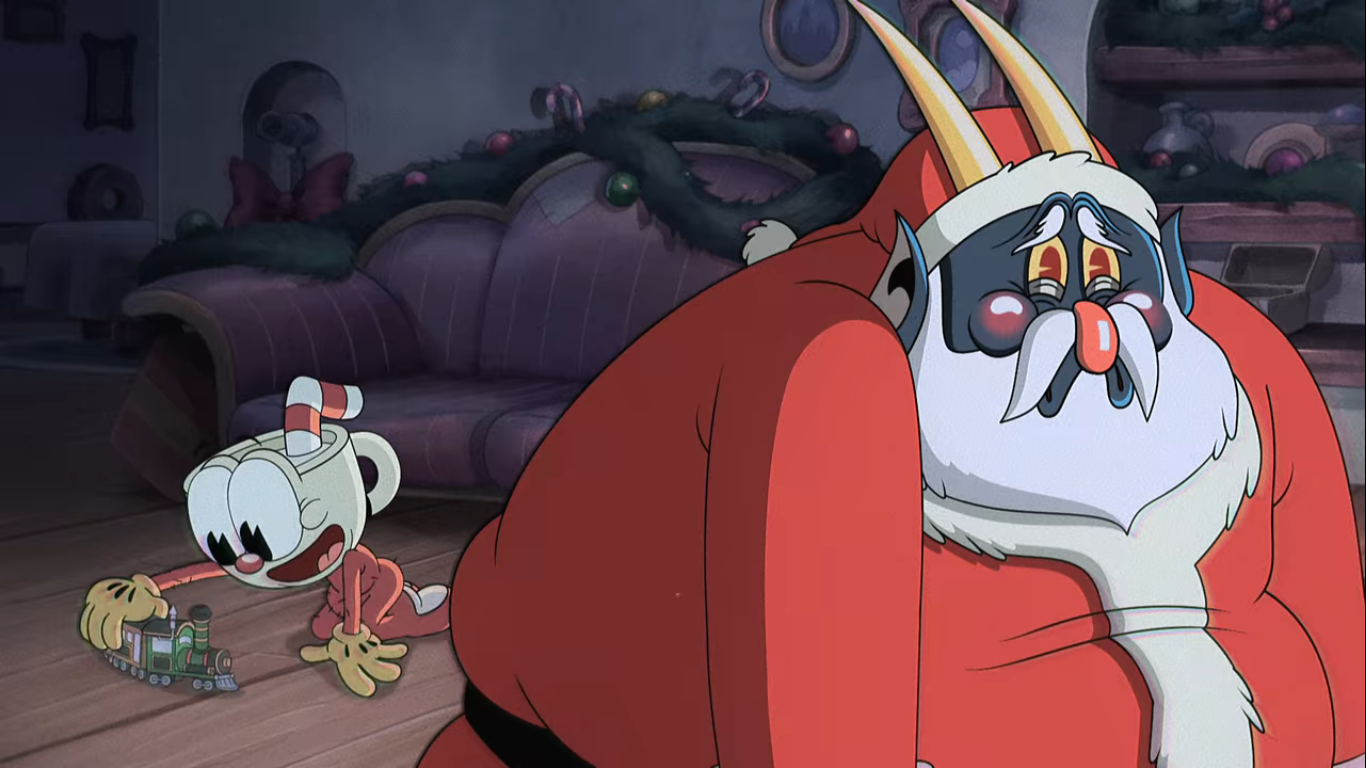
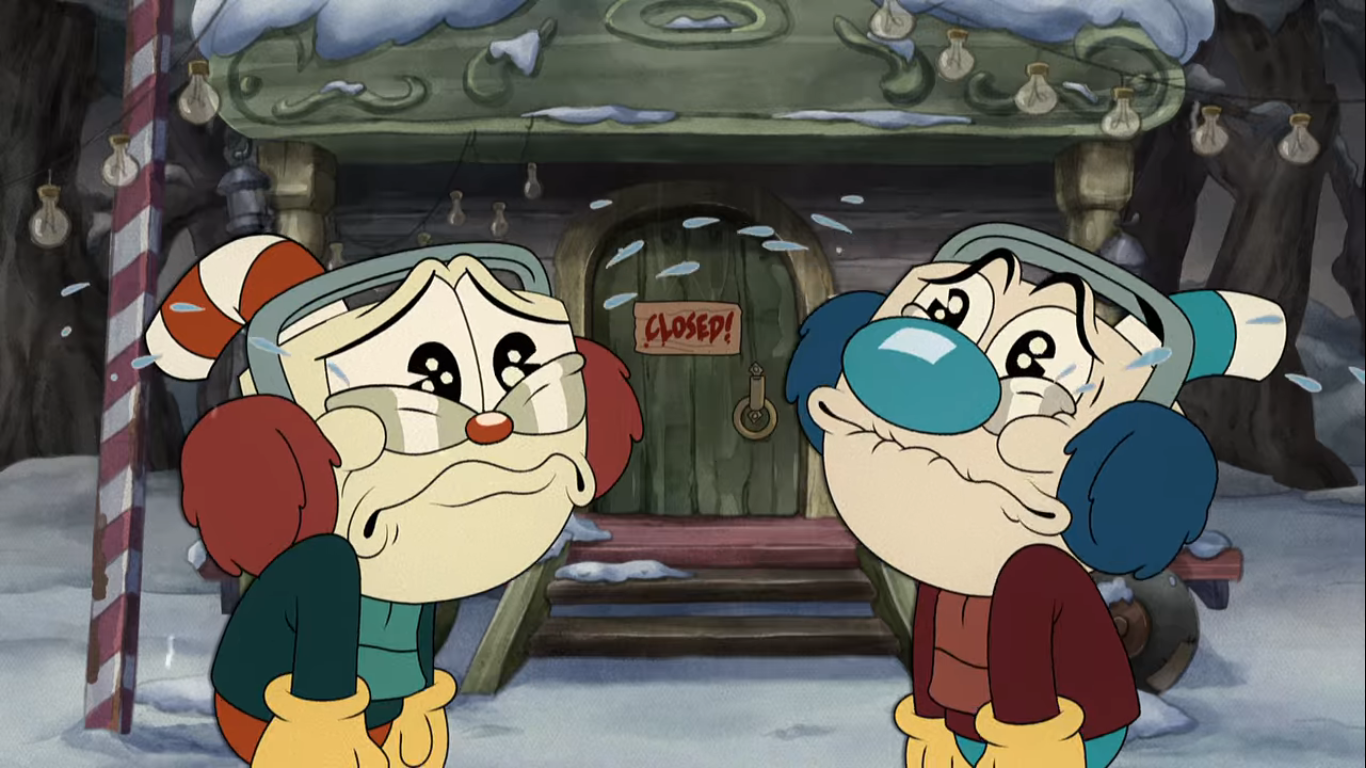
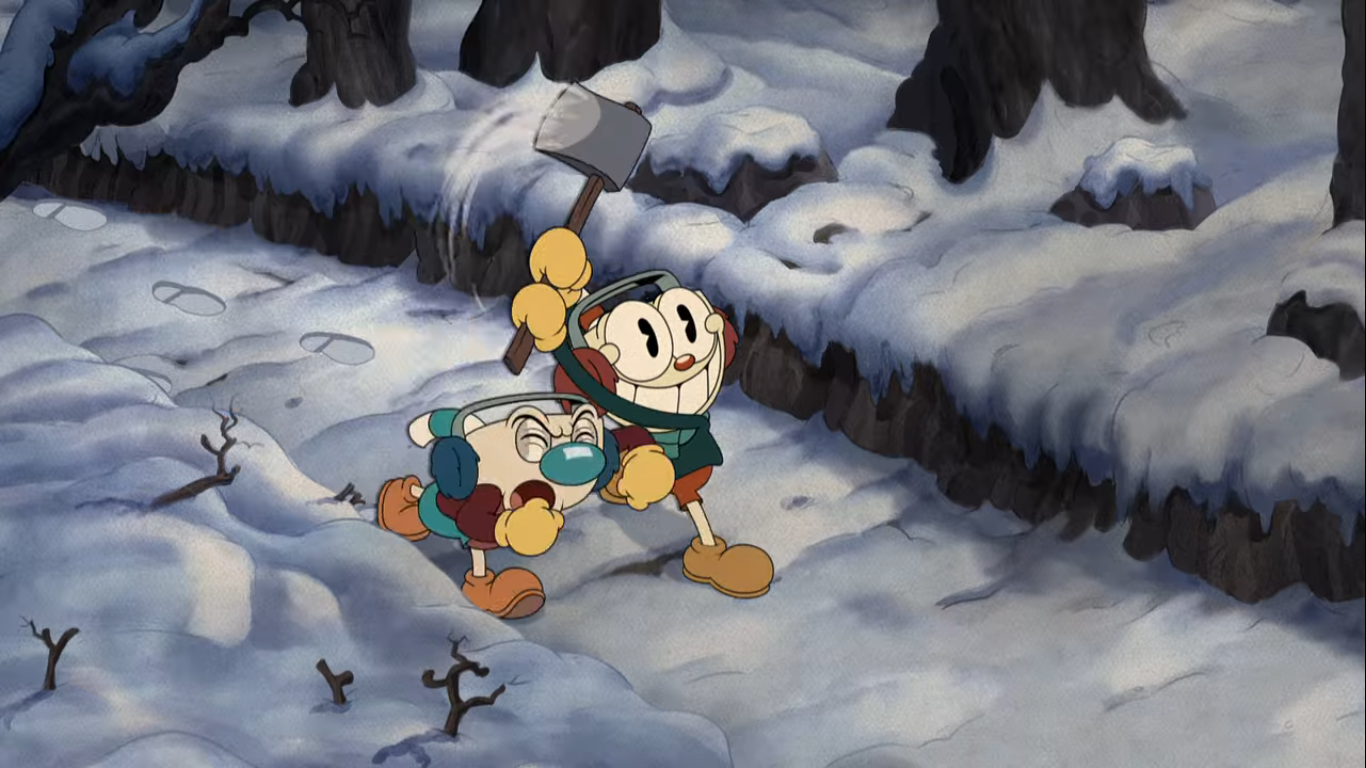
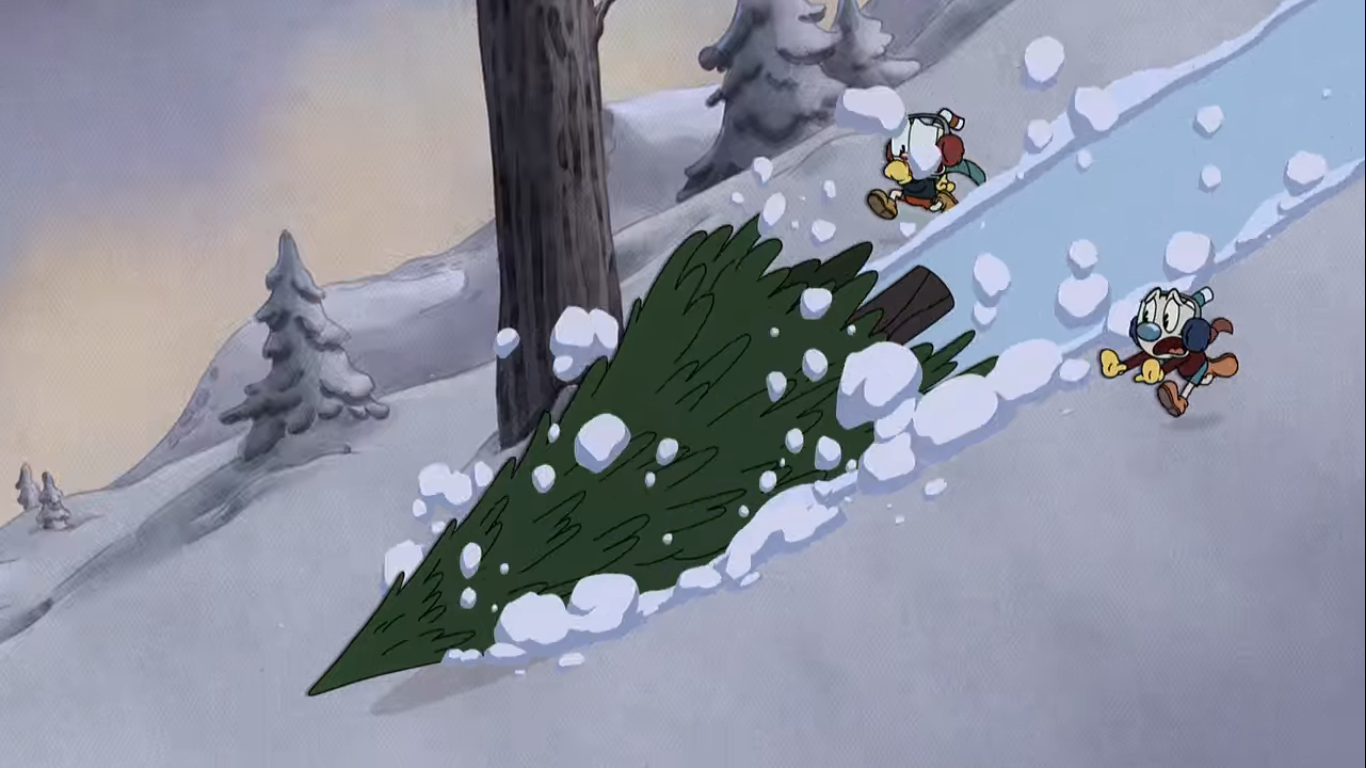
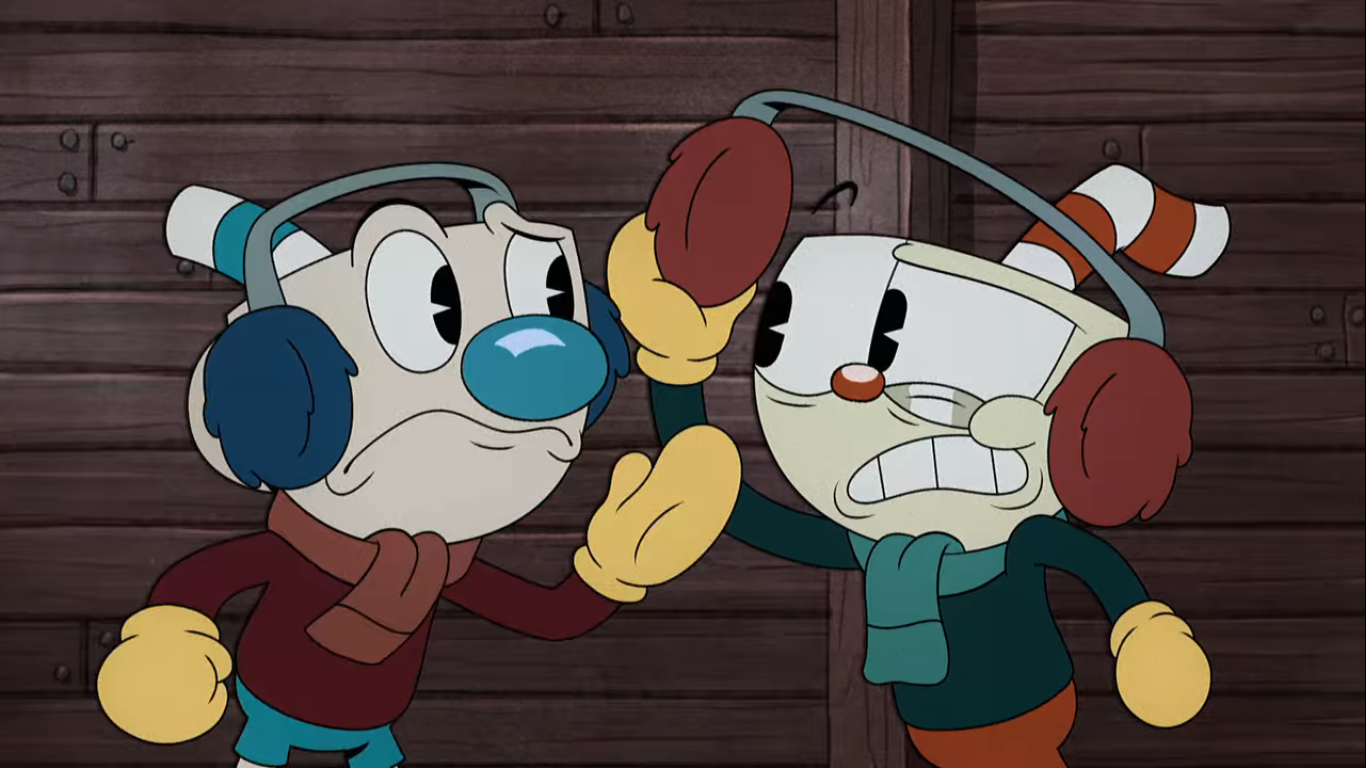
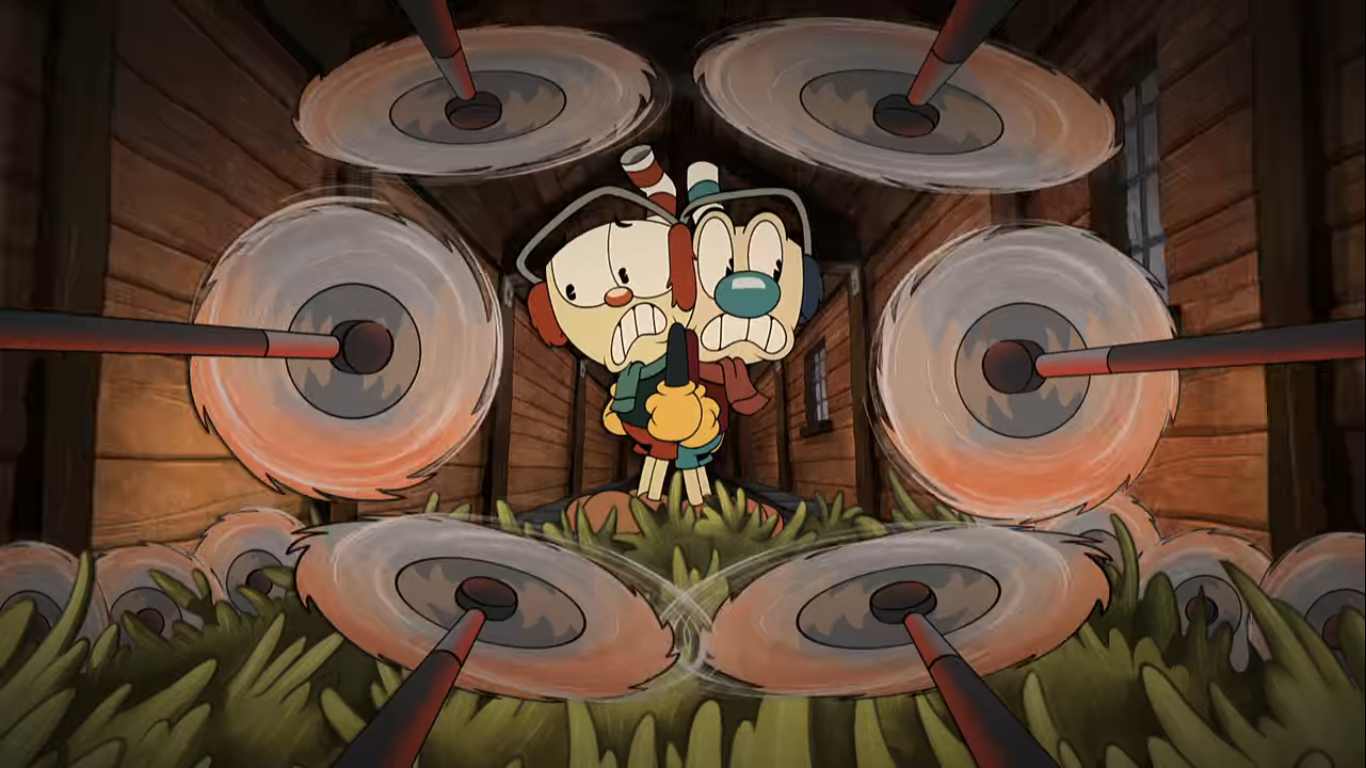
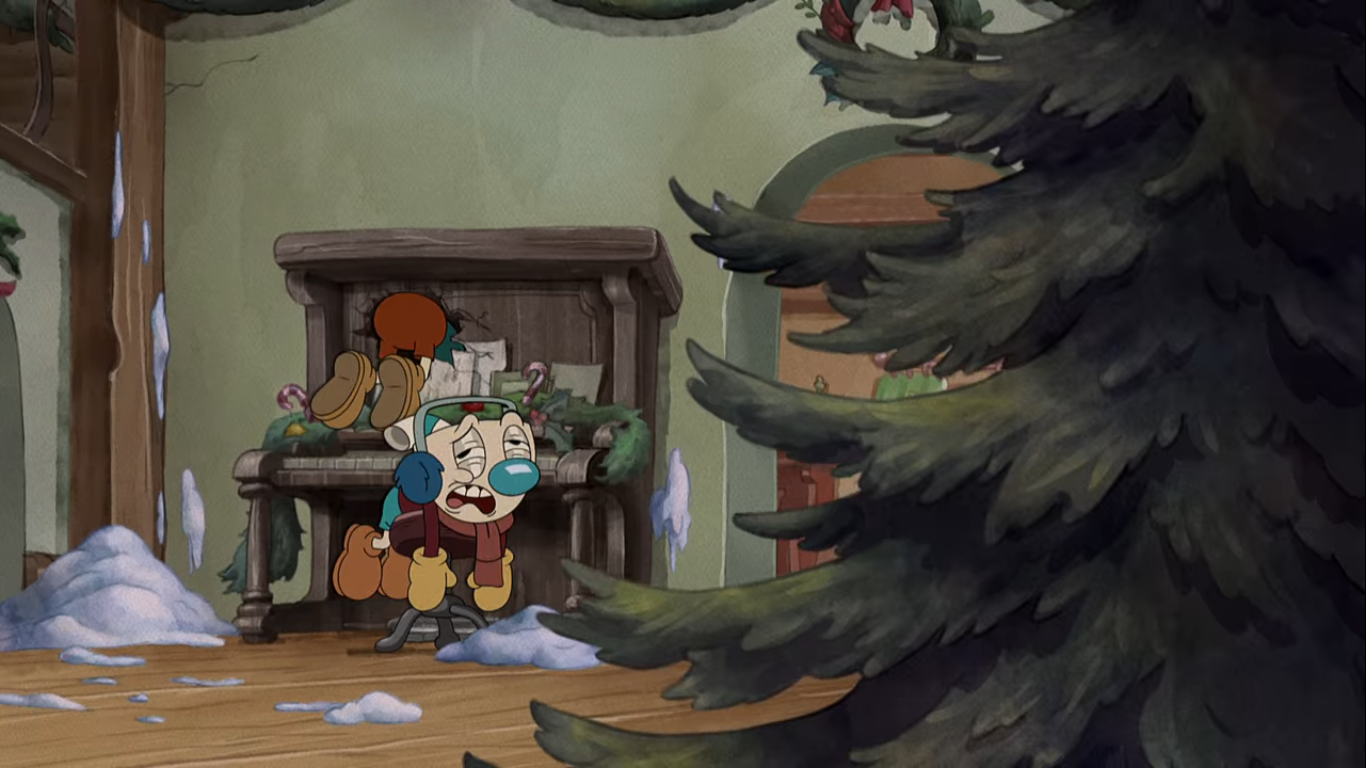
I told you we would probably take a look at the other Christmas episode from The Cuphead Show!, though maybe you expected a buffer. I considered it, but why not pair them up just like the creators and Netflix already did? This second Christmas episode comes right after the first. Titled “A Very Devil Christmas,” it feels more like a typical Christmas special from an animated series. It’s extra long, has a different approach to the production of the episode, and tells a story that takes place on Christmas Eve involving devils, elves, and Santa.
Wait? Devils?! Yes, this one, as you could have probably guessed based on the title, stars The Devil himself. The Devil is the main villain for the video game and show and he gets to star in his own stand-alone episode for Christmas. It’s rather unconventional for a show to make the star of its Christmas episode Satan himself, but The Cuphead Show! isn’t always typical so why should its Christmas episode be? Plus, we got the one starring Cuphead and Mugman out of the way already opening the door for The Devil to take center stage.
Ready for some wholesome Christmas entertainment starring The Devil?!
And it’s a great move. The Devil, played by Luke Millington-Drake, is a fantastic character. The portrayal here reminds me of one part Futurama‘s Robot Devil and one part Family Guy‘s Stewie Griffin. Millington-Drake and Dan Castellaneta (who plays the Robot Devil) almost seem to be using the same affectation for their respective characters. It’s fun. It gives The Devil this somewhat stuck-up persona, but also with a certain element of childishness as well. He’s a brat and that makes sense for a cartoon devil who is unlikely to be shown flaying the flesh from the bones of the damned. And in this episode he is going to be very childish indeed. The Devil is going to set his sights on a toy choo choo. He wants it for Christmas, but he has some issues with The Naughty List he will need to address if he hopes to receive such a gift. It’s pretty much a true solo outing as well as Mugman will not be featured at all and there’s just a brief instance of Cuphead. This is The Devil’s Christmas and he is going to soak up the spotlight.
Just a taste of what The Devil has to offer.
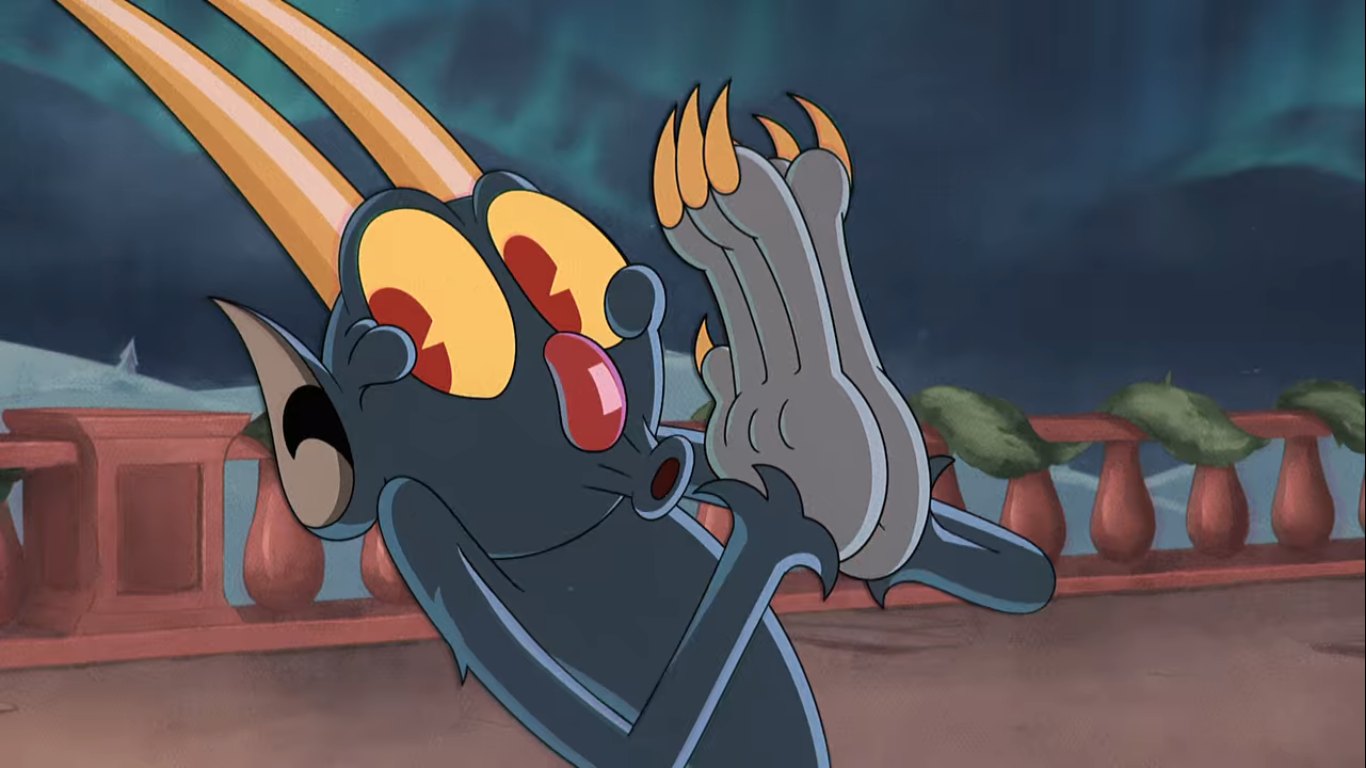
The episode begins with an original composition. It’s a rather idyllic piece of holiday scenery of people (well, what passes for people in this universe) walking through a downtown area. The snow is falling, people seem happy, and there’s lots of winter activities taking place. And there’s also The Devil. He’s dressed for the cold with a festive scarf, though aside from that he’s completely naked. He’s at the park leaning on a large tree and observing the goings on. With a wistful smile he lets out a contented sigh and taps the ice on a nearby pond with the tip of his trident. It creates a crack which runs through the ice to a group of individuals ice skating in a circle holding hands. The crack spreads around them and the ice gives way plunging them into the cold, cold, water.
He’s a real showman.
The Devil lets out a giggle and breaks into a song titled “Brings Out the Devil in Me.” And it’s a song all about how Christmas brings out the best in people, but it brings out the worst in him, which is why he loves it! As he sings, it’s treated sort of like a montage of chaos The Devil spreads about town. Some of the stuff is harmless pranks, like photo-bombing a family portrait, while other stuff may actually cause fatalities. His final act, and the big finale of the sequence, is he winds up a little toy soldier that waddles into traffic, pops the tire of a car that strikes it, which causes that car to crash into the giant town Christmas tree setting it ablaze. The Devil gets to preen in the streets while the fire department races to put it out.
The Devil and Sammy Sandwich agree: being nice sucks an egg!
The delightful toot of a toy train snaps The Devil out of his moment of joy. It’s coming from a nearby store window and he races over to it, shoves the little brats who were standing there first out of the way, and presses his face to the glass to take it in. It’s a modest little train, an engine and two cars, but it’s self-propelled and quite charming. The Devil simply adores it, but his concentration is broken by the cries of another child. This boy, Sammy Sandwich (Dave Wasson), is a literal sandwich and he’s begging his mother for a train, but he mostly just wants a spaceship for Christmas. His mom (April Winchell), a submarine sandwich, seems irritated at the requests of her son and we get to hear about how Sammy didn’t get anything last year. He was on The Naughty List, the mere mention of such perplexes The Devil, for gluing his sister’s face to the floor. Sammy pleads that he’s been nice this year so he should get something, but the conversation is over. The Devil, who was rather happy with how awful this child sounded, quietly asks him as his mother is leading him away about this whole Naughty and Nice List business. The kid gives him a quick rundown, letting him know that he detests having to be nice, leaving The Devil with something to think about.
Henchman is right to be afraid.
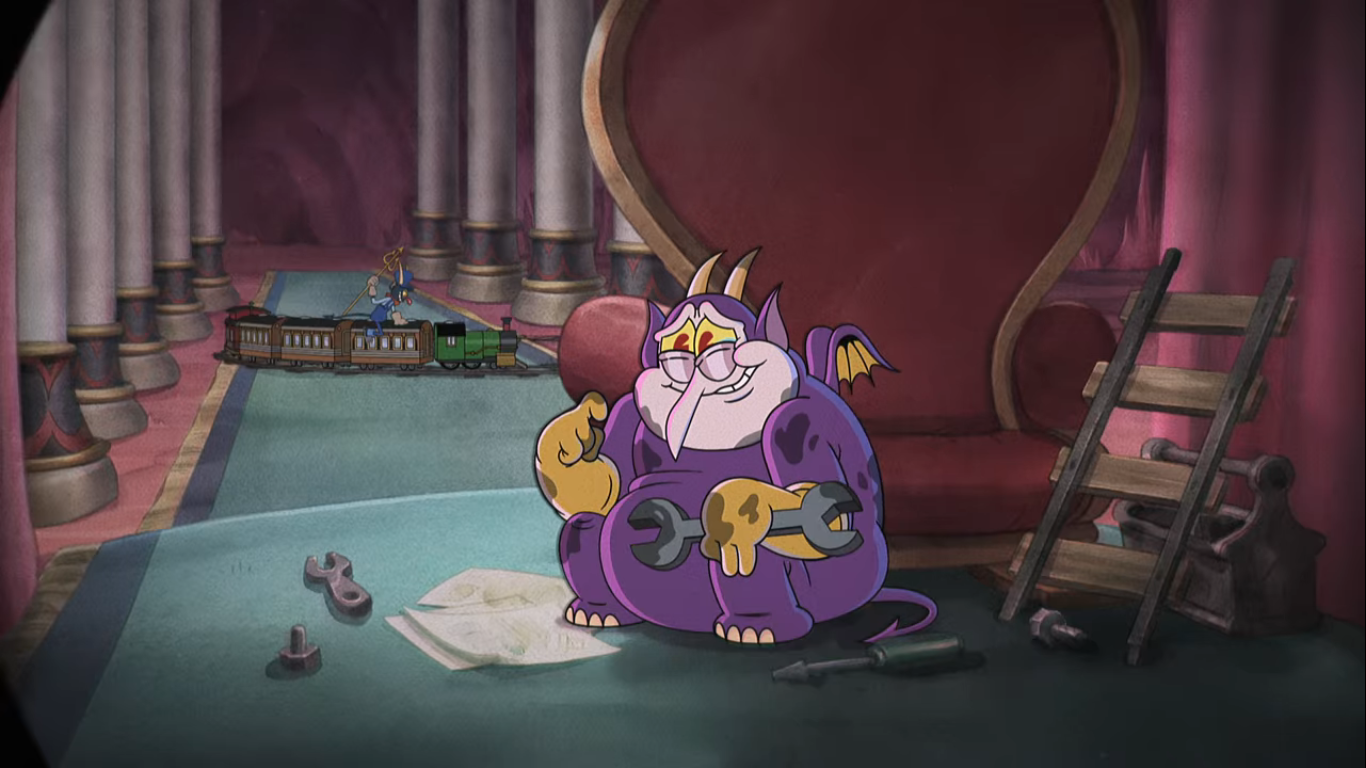
In Hell, The Devil’s minions are all seated at a long table debating something or other. Henchman sits near the head of the table and there’s also the character of Stickler (Andrew Morgado), a blue-skinned demon with a nasally voice who exists just to remind The Devil about things he doesn’t want to hear about. Stickler is in the midst of complaining about someone always eating his lunch out of the community refrigerator, but none of the little imps are coming clean. Henchman (Dave Wasson), who is a round, purple, imp much larger than the rest, remarks that despite living in a fiery Hell hole, they should all exhibit good manners. The debate is ended by the arrival of The Devil who takes his position at the head of the table. He asks of his minions what it would take to get someone like him onto Santa’s Nice List. Everyone goes quiet and most adopt an expression of fear. The imp beside Henchman tries to quietly ask how their boss even came to know about the list, but before Henchman can answer The Devil nukes the little imp to oblivion. The Devil then asks Henchman to explain why he withheld such information from his boss. He has to carefully tell him that he didn’t think it was his kind of list on account of him being evil and all. The Devil takes offense and when he asks in return if he’s saying that he can’t be evil and on The Nice List at the same time Henchman just remarks, “Well, yeah.” The Devil just puffs out his chest and turns away from the table seemingly intending to prove them all wrong. And since it is Christmas Eve, there is only one person who can get him onto The Nice List at this hour.
Oh! I’ve seen this before!
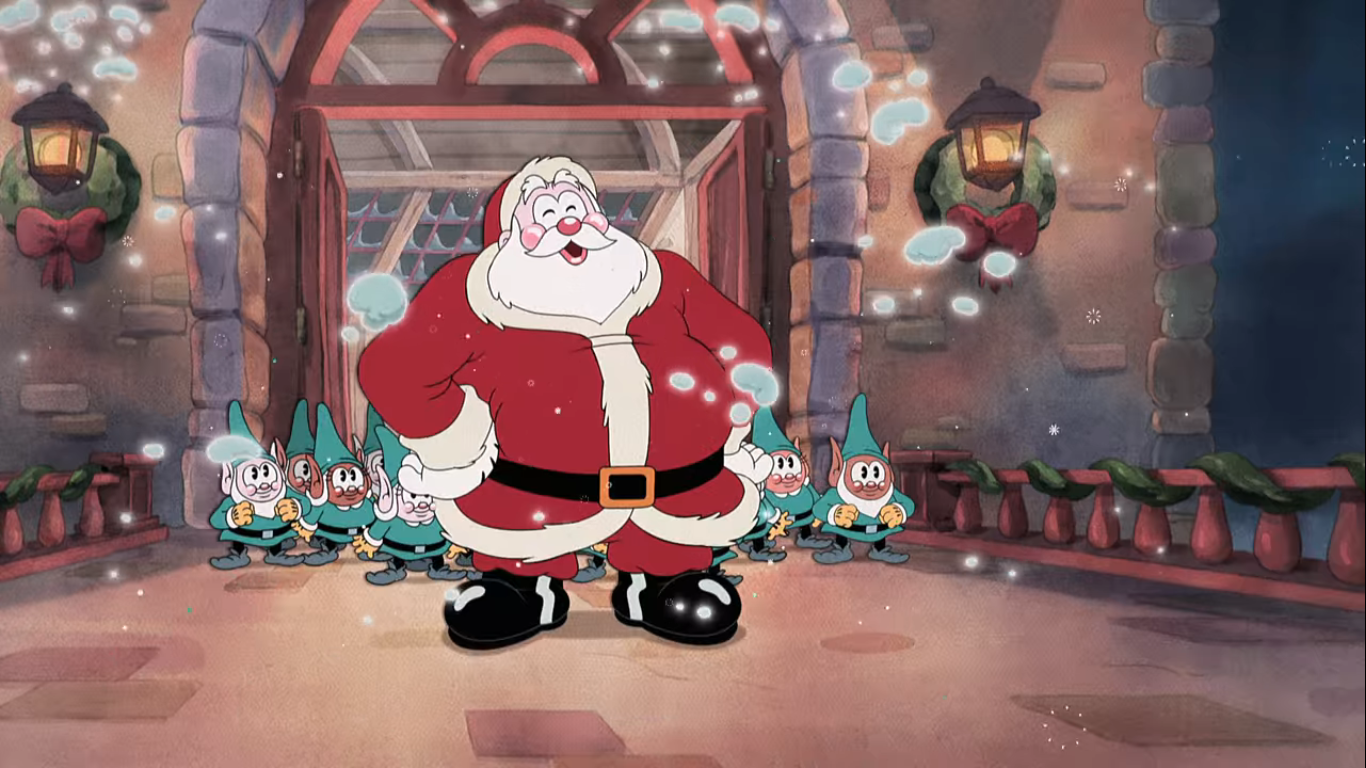
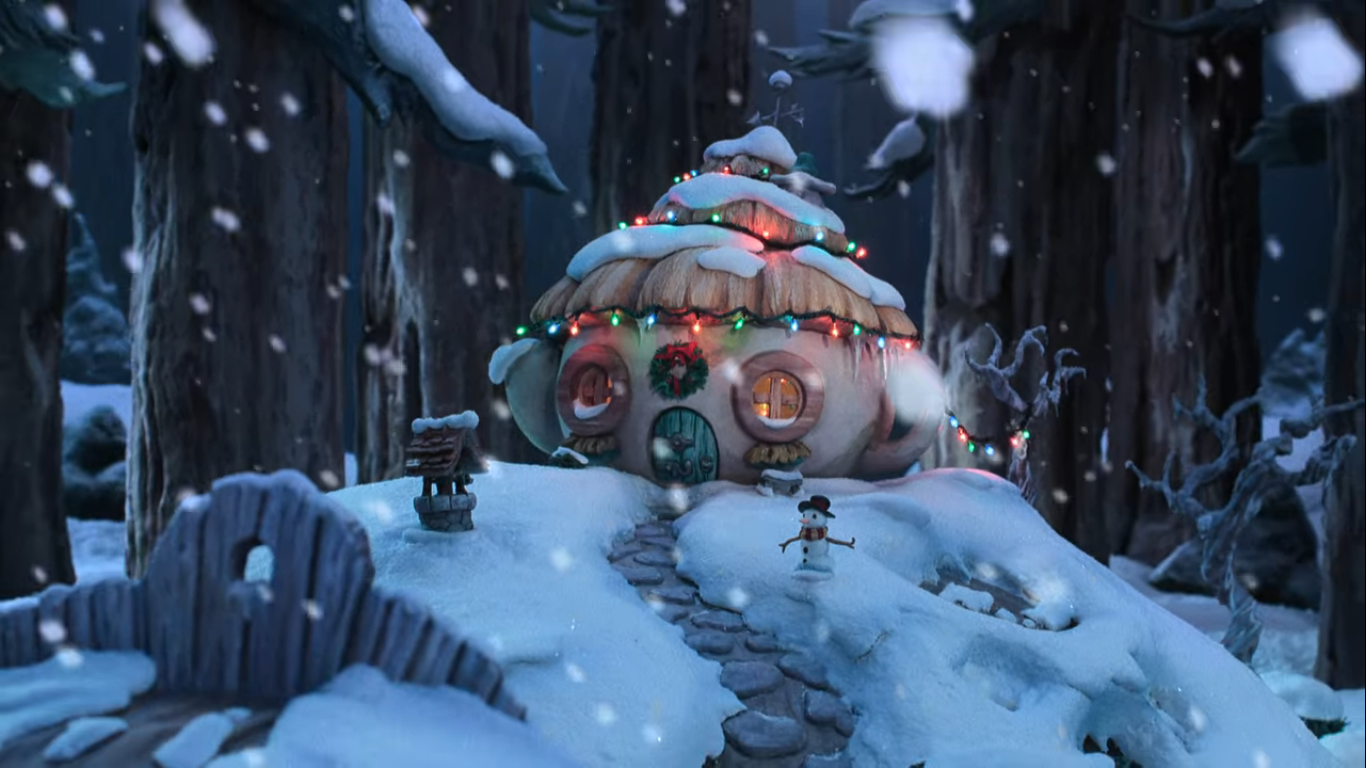
The Devil taps his trident on the floor and disappears in a puff of purple smoke. The scene shifts to an exterior shot of Santa’s Workshop at The North Pole. It’s done with a physical model, but there are elves (voiced by Wasson, Grey Delisle, and Cosmo Segurson) animated over it as they ride atop reindeer or walk to the shop itself. It’s also clearly an homage to the Silly Symphonies short Santa’s Workshop as it’s staged almost exactly the same way as the first shot in that classic short. The elves even appear to be modeled after the same from it. The elves are all singing (an original composition titled “The Elf Song”) and working with cheer to make Christmas happen until Santa (Fred Tatsciore) enters. He also resembles the Santa from that short and he’s an appropriately jolly fellow. He encourages his minions to keep up the good work before disappearing into his office.
Even The Devil gets a thrill out of sitting on Santa’s lap.
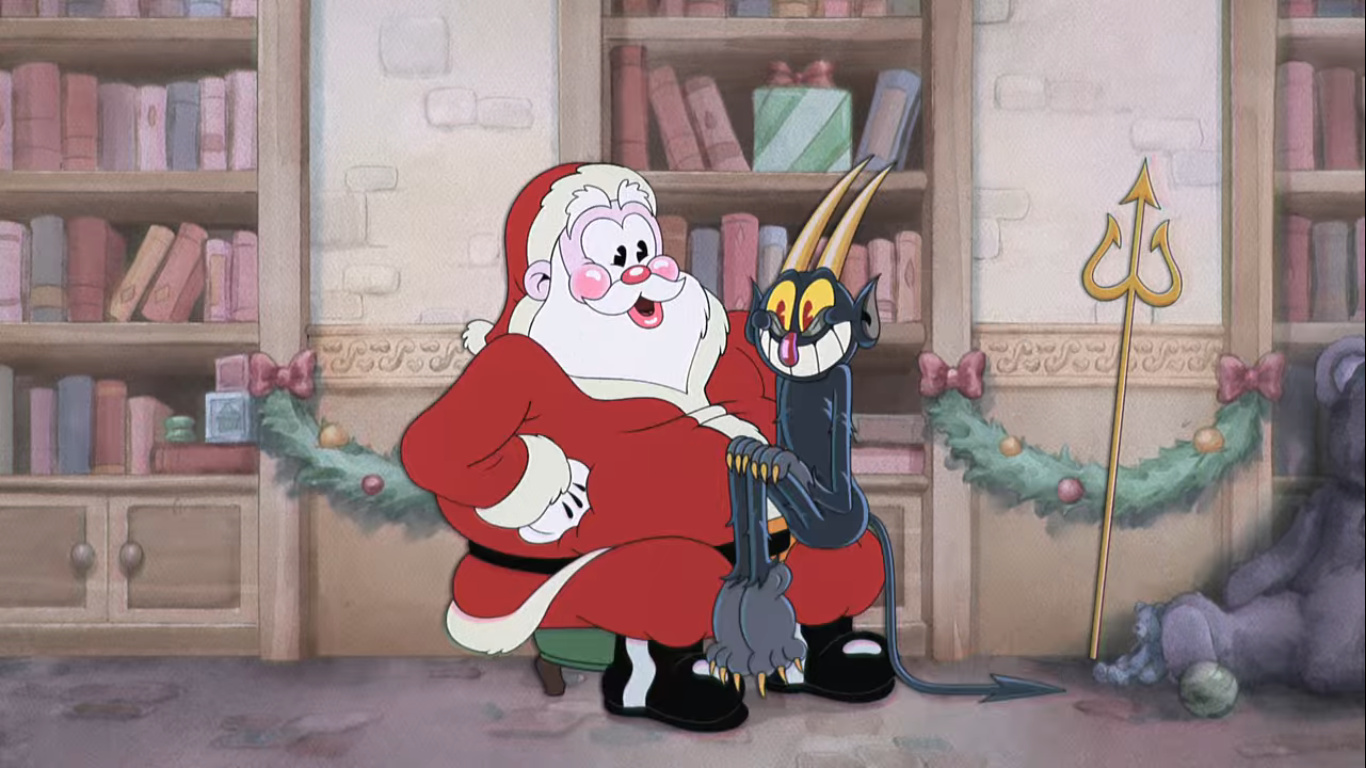
Once there, Santa finds himself face to face with The Devil himself! Seated at the big man’s desk, The Devil addresses him as Nicholas and lets him know that he’s here to put in a request for Christmas. Santa seems to have no idea who he is and even remarks that he’s a hairy boy. Santa, being the good-natured sort that he is, invites The Devil to whisper in his ear what he wants for Christmas. The Devil is surprised, but also a little disappointed and asks him, “Aren’t you going to…you know?” as he gestures towards the ground. Santa realizes what he wants and pulls up a stool so that The Devil can sit on his lap and whisper to him properly what he wants for Christmas. He does so and Santa thinks he says “Too too,” but The Devil corrects him that he wants a choo choo. Santa laughs and tells him it won’t be a problem, but he just has to do one thing first: consult The List!
For The Devil, this is like that feeling you would get when handing over a bad report card to an unsuspecting parent.
Santa looks over his Nice List while The Devil stands off to the side looking rather anxious. Santa seems almost embarrassed that he can’t find his name and asks him to confirm it. The Devil tells him it’s “Devil,” which Santa assumes to be a surname. When he can’t find that he asks to know his first name which he responds is “The.” Makes sense. Santa still can’t locate it, and there’s a good reason for that obviously. He then opens up The Naughty List and practically jumps out of his suit. Not only is The Devil present there, it’s number one! He’s been number one on that list since time began! This won’t do and Santa has to firmly tell The Devil he won’t be getting that too too, I mean, choo choo for Christmas. The Devil, feeling sad, sinks into Santa’s chair as a sad violin plays. Santa can’t bare to see another being in distress, even if he is The Devil, and makes him an offer: if The Devil can be nice until midnight, he’ll give him his too too. Choo choo.
The man has a drinking problem. Don’t meet your heroes, kids.
The Devil enthusiastically agrees to Santa’s proposal and heartily shakes his hand. He vows to be nice and prove to Santa that he’s worthy of that choo choo. With another puff of smoke, he vanishes back to town with confidence and bravado. Almost immediately, a little old mouse woman (Winchell) asks him if he can spare some change. The Devil recoils with an “Ew!” and blasts the little, old, women with his trident murdering her on the spot. We smash cut to an angry Santa demanding to know what happened from behind his desk. The Devil can only offer that he was off to a good start, which Santa points out was about ten seconds. He stands and grumpily remarks that he needs a drink. He walks over to a globe and it opens up revealing what you probably expected: cookies and milk. He pours himself a glass and tells The Devil that he’s likely to remain on The Naughty List forever. The Devil erupts with anger at this suggestion complete with a wall of flame behind him. Santa just shakes his head with a “tisk tisk” and adds “Threatening Santa,” to the list of naughty behavior exhibited by The Devil. At that point the horned one collapses at Santa’s feet. Groveling over his too too (Santa has to correct him this time), he begs him to give him another chance. Santa tells him there is one other way onto The Nice List, but it comes at a cost. The Devil is willing to do anything.
Nothing bad will come of this.
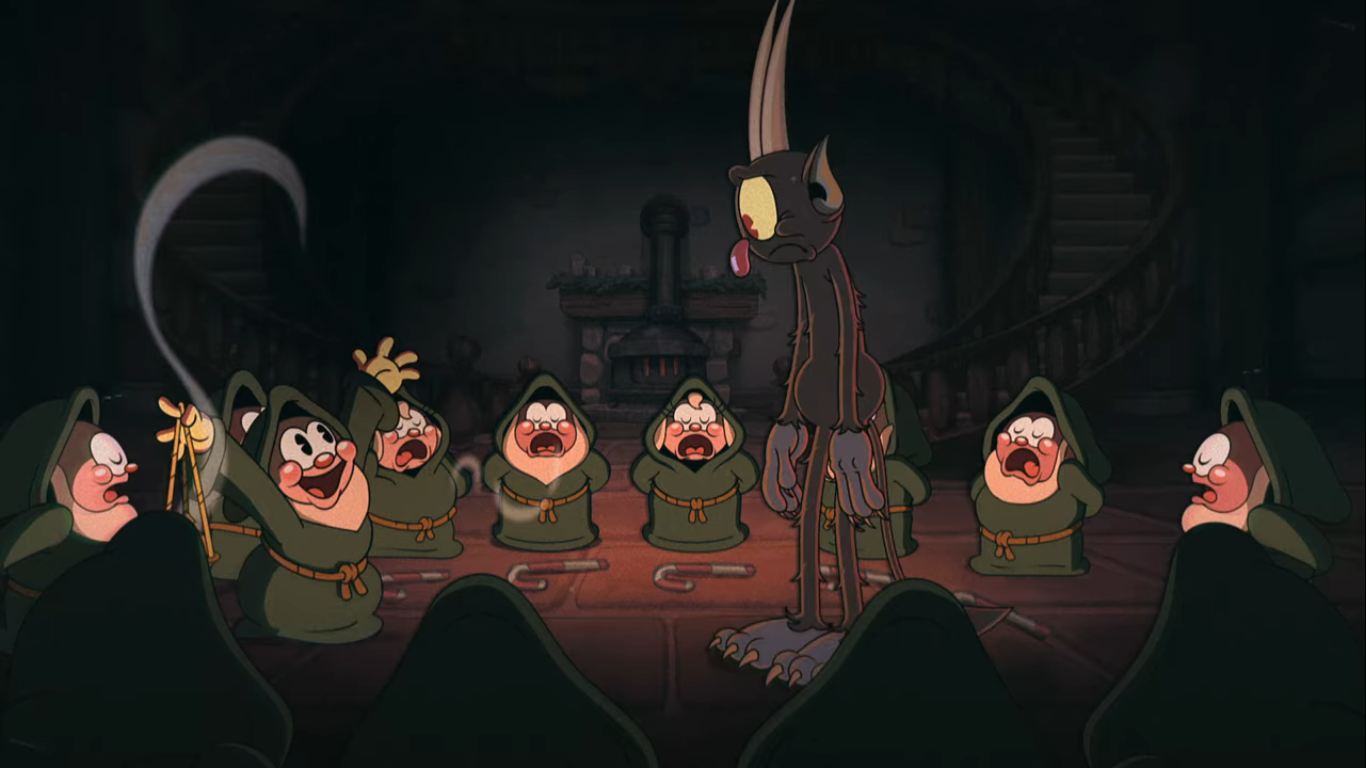
We cut to outside the work shop, but we can hear chanting from within. Inside, the elves are all dressed in robes like druids as they prepare an ancient ritual. A circle has been created on the floor of the darkened workshop fashioned out of peppermint sticks. One of the elves then leads The Devil into the circle, smiles at him, and departs. They all toss back their hoods to reveal lit candles and Santa enters, in a hooded, red, robe, and begins a new chant. Up until this point, they have just been chanting “Fa la la la” in a monotone fashion. Now it sounds more like Latin which the subtitles say is “Decatus, seasonem, holly jolly om.” Google says that simply translates to decadence season. Santa stops chanting and his eyes glow a light blue. He blows some sparkly dust at The Devil which blots out all of the candles. When the dust dissipates, the light returns and the elves return to their traditional song as they filter away with Santa seemingly gone. The Devil is left standing in the circle, confused, left to remark “What the heck was that?!”
Could it be another Disney homage?
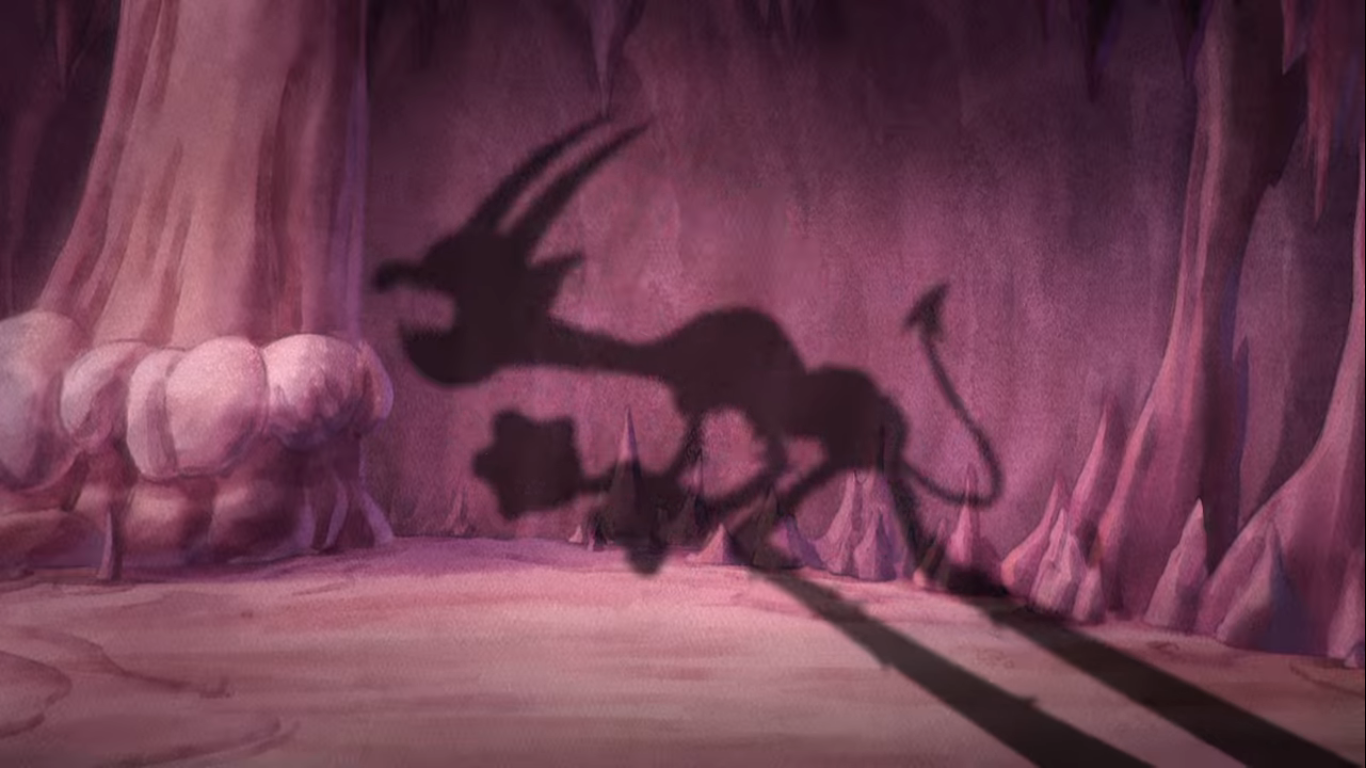
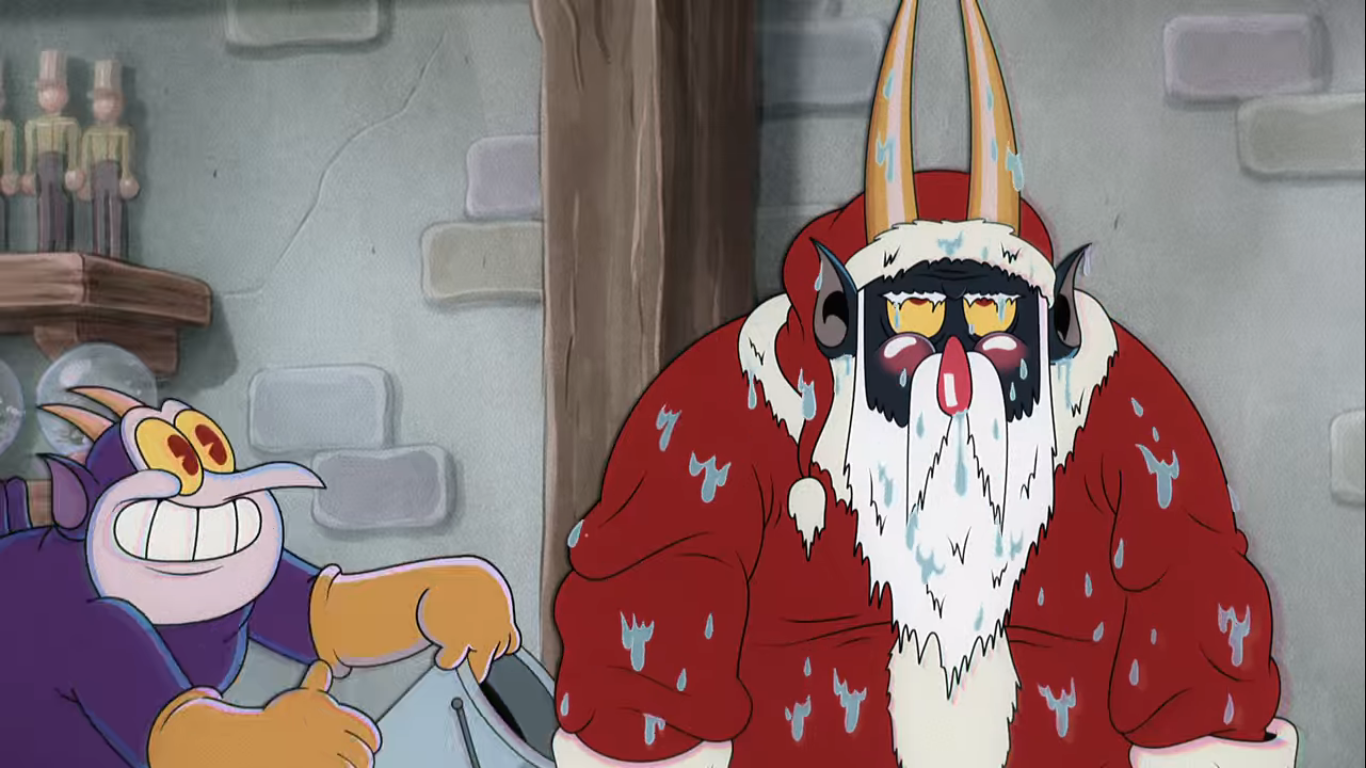
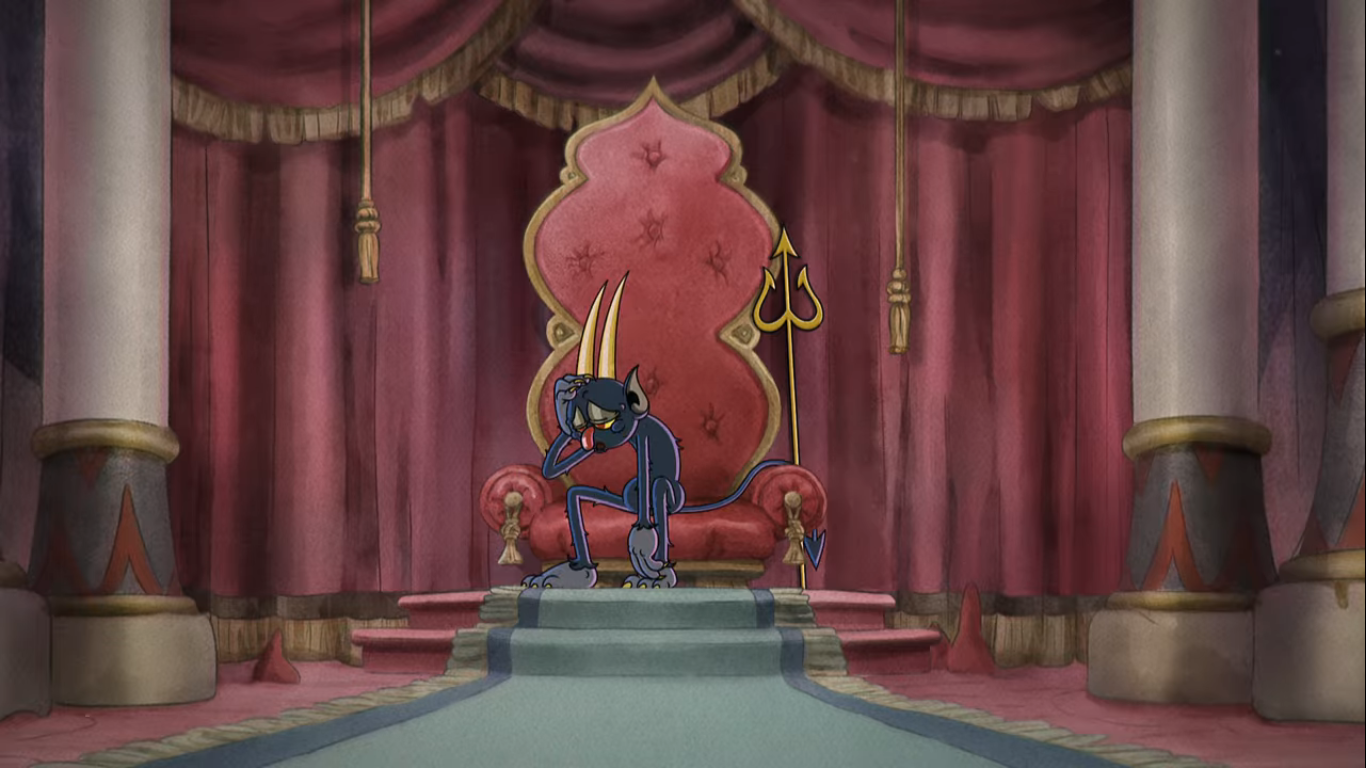
The Devil returns to his throne room in Hell left to feel the whole trip north was a waste of time. As he looks at his nails, his hand begins to swell. It looks like a surgical gloves that’s been inflated and soon his other hand does the same. The Devil is quite alarmed and even appears to be in some pain as he drops to the floor. There’s a cut which just shows The Devil’s shadow on the wall as he writhes and contorts. He ends up at a vanity, clutching it as his cheeks enlarge, a white beard sprouts from his chin, and his flesh rips apart to make room for a big, red, coat. When the transformation is complete, The Devil can only look at himself, the now spitting image of Santa Claus, and exclaim “Ho ho ohh no!”
Why Mr. Devil, that is a very different look for you!
The Devil is left to stare at his new visage in the mirror in horror. His only thought is to get back to The North Pole and make Santa fix this. Before he can get his pitchfork though, some imps pass by still complaining about stolen lunches. The Devil, understandably not wanting anyone to see him, has to duck for cover. He sneaks his way into the throne room, but before he can get his pitchfork, Henchman enters with the vacuum. The Devil tries to duck for cover behind the throne, but he’s spotted. Initially, Henchman thinks he’s in the presence of the real Santa, but once he gets a closer look at this Santa he realizes it’s actually The Devil. And, once again, his first inclination is wrong as he thinks his boss has been Santa this whole time, but The Devil has to correct him and explain the situation. When Henchman asks (what we’re likely all wondering) why The Devil doesn’t just create a choo choo with his magic, The Devil angrily corrects him that creating an object for himself is not the same as receiving it as a present. That’s basically what this is all about: The Devil, having never been the recipient of a gift, wants one for Christmas.
The big guy you were expecting?
The Devil is forced to return to The North Pole and he takes a very excited Henchman along with him. When they get there, they find the elves are loading the sleigh and singing their working song once again. Upon seeing Devil Santa, they all exclaim with glee “Santa!” and move in for a hug or something. The Devil is grossed out and starts pushing them away with the handle of his pitchfork, so at least he’s not stabbing anyone. He tells them that he’s not Santa, he’s looking for Santa, but he’s soon interrupted by a loud and drawn out, “Ehmmm!”
Does every immortal being have a Stickler among their underlings?
It’s Stickler, only it’s not Sitckler, but an elf that looks, talks, and behaves exactly like the Stickler we know from Hell. This one steps forward to inform The Devil that he is, in fact, now Santa Claus which means he needs to undertake all of Santa’s Christmas Eve responsibilities. The Devil has no interest in doing that, but Stickler tells him that he must. In fact, if he does not deliver all of the presents to children on The Nice List by midnight he’ll not only never be on The Nice List himself, but be stuck as Santa Claus for all eternity. When he says that, the camera zooms in on The Devil’s face while the word “eternity” echoes in his brain. Only, it’s not an echo, as when the closeup ends we see Stickler is just repeating the word over and over for dramatic effect until The Devil barks at him to knock it off.
He’s just here to help.
Unbothered, Stickler resumes informing The Devil of the other conditions he must satisfy this evening. There’s a list of rules and rule number one is reciting the reindeer roll call. The Devil has no idea what that is, but Henchman is happily willing to inform him of the proper roll call and receives applause from the elves upon finishing it. Rule number two is that Santa must remain jolly at all times and must never lose his temper. As Stickler informs The Devil of this, he’s wagging his finger at him which causes The Devil to explode with rage. He blasts Stickler into nothingness with his pitchfork, realizes that it was a bad idea, then simply undoes it by tapping the end of the pitchfork on the ground. Once returned to the world of the living, Stickler simply moves on to rule number 3 which is that every kid on The Nice List must receive their present. The Devil reluctantly accepts this with a “How many kids can their possibly be on The Nice List?” Stickler lets the list unfold in response. It rolls across the floor, out onto the balcony, off the balcony, and then over all of the hills in the background. The Devil just explodes in fiery rage again declaring that he will burn someone, but Henchman douses his flames with a bucket of water. A soggy Devil sullenly thanks him for the reminder about remaining jolly.
That’s gonna be a problem…
We’re not done, as there is a rule number four which is that Santa must consume all cookies and milk left out for him. Henchman cheekily replies that it shouldn’t be a problem and shakes The Devil’s belly like a bowl full of jelly prompting him to inform him “Do. Not. Touch!” Henchman recoils in fear while Stickler takes The Devil by the hand to tell him the final rule: all presents must be delivered by midnight. The Devil dismisses the hand of Stickler and continues onto the sleigh to the roar of applause from the elves. The Devil arrogantly informs Stickler it won’t be a problem, but once out of sight he confesses to Henchman that he can’t possibly fulfill all of these tasks and that he fears being stuck like this forever! Henchman reassures him that everything will be fine and encourages his boss to go out and deliver those presents. Unfortunately for The Devil, he doesn’t even know the solution to the first rule. Instead of calling out the reindeer by name, he simply demands that they fly in a threatening manner. The reindeer, in a way, do as they’re told, but not before first detaching from the sleigh. With the reindeer gone, all hope appears to be lost, but The Devil has one friend he can turn to.
He’s no Rudolph, but Henchman gets the job done.
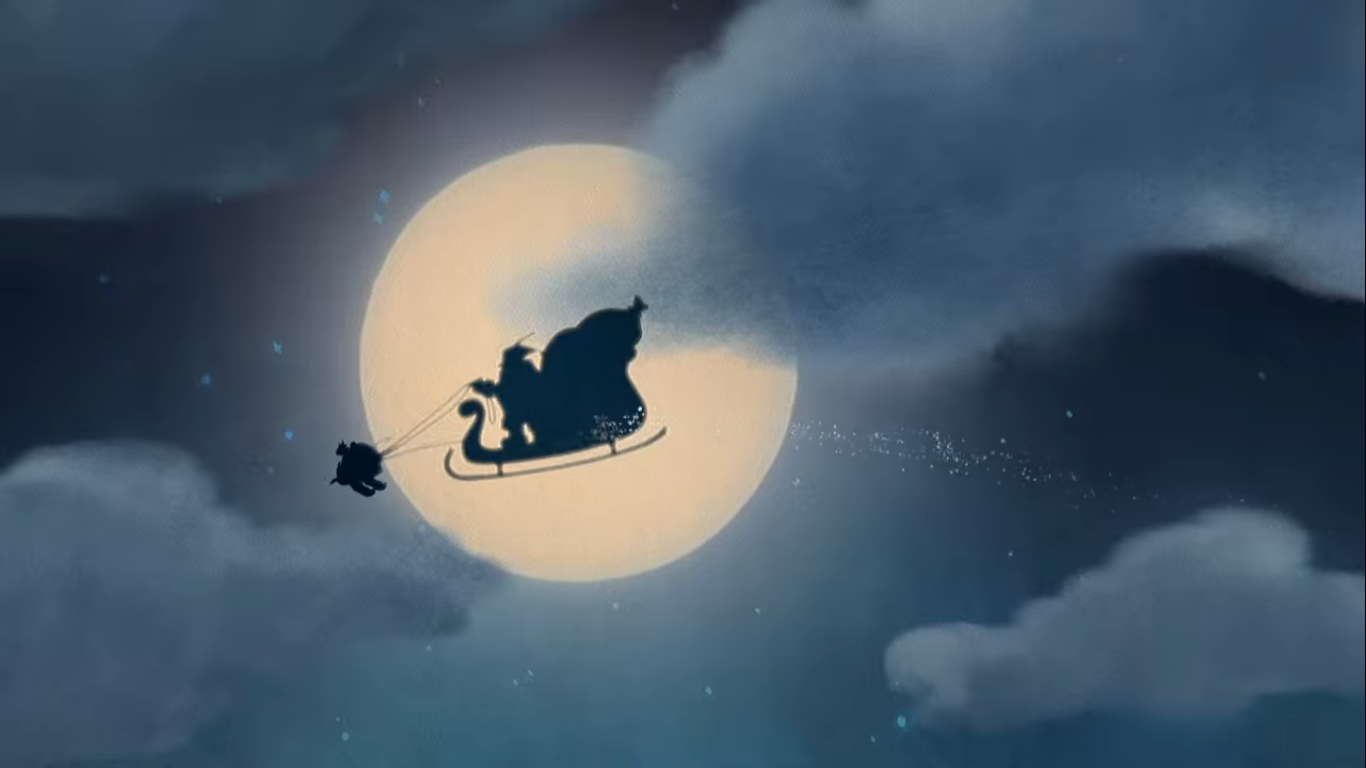
This is now a one-imp open sleigh as Henchman giddily takes the place of the reindeer to pull the sleigh through the sky. I guess it’s not a big deal that he couldn’t get rule number one down since Stickler said nothing. Henchman giddily leads The Devil to his first house. He approaches the chimney and deposits the presents down it without much care prompting Henchman to remind him to be more gentle. He takes the suggestion in stride before trying to squeeze down the chimney itself. It doesn’t go well so Henchman reminds him to use his pitchfork. The Devil does and materializes by the Christmas tree inside. There he drops the soot-covered gifts under the tree and then turns to the milk and cookies. He devours them with glee before returning to the sleigh feeling rather triumphant and orders Henchman to take him to the next house.
So many moon shots!
Tchaikovsky’s “Trepak” ushers in a montage of The Devil delivering gifts to the many houses on his list. Things do not go as well as the first house. He falls off a roof and gets tangled in Christmas lights causing himself to get electrocuted at one house. At another he gets mauled by dogs while another features a whole litter of kittens expecting gifts. They have all left out their own plate of milk and cookies which The Devil is now far less enthusiastic about consuming. We then go into a sequence of quicker shots. The sleigh flies past the moon in one direction, we get a little scene, then it flies past going in the other direction. There may be a record number of moon shots in this one. All the while there’s The Devil continuing to eat cookies and it’s clearly getting harder and harder to eat any more. During this, we do get a couple of cameos. A gift is delivered to the corpse of Telephone (Wasson) who had his soul taken from him by The Devil in, I believe, the very first episode. The gift is his soul and he springs back to life in triumph upon receiving it. We also see Sammy Sandwich who gets his spaceship. His sister, who is still glued to the floor, gets some glue dissolver.
I know what The Devil is getting for Christmas: Diabetes.
When the montage is over, The Devil is left groaning on the sleigh covered in crumbs and his belly massive and overstuffed. Henchman is there to offer encouragement as they’re nearly done. He’s looking forward to the part where The Devil gets to call out “Merry Christmas to all and to all a good night,” upon completion of their work, but The Devil insists that he won’t be saying that. He then asks how many houses are left? Henchman consults the list and is happy to inform his boss that only one remains. His smile is soon replaced by a grave expression, but whatever is bothering him he doesn’t relay to his boss.
The last house on the list belongs to him!
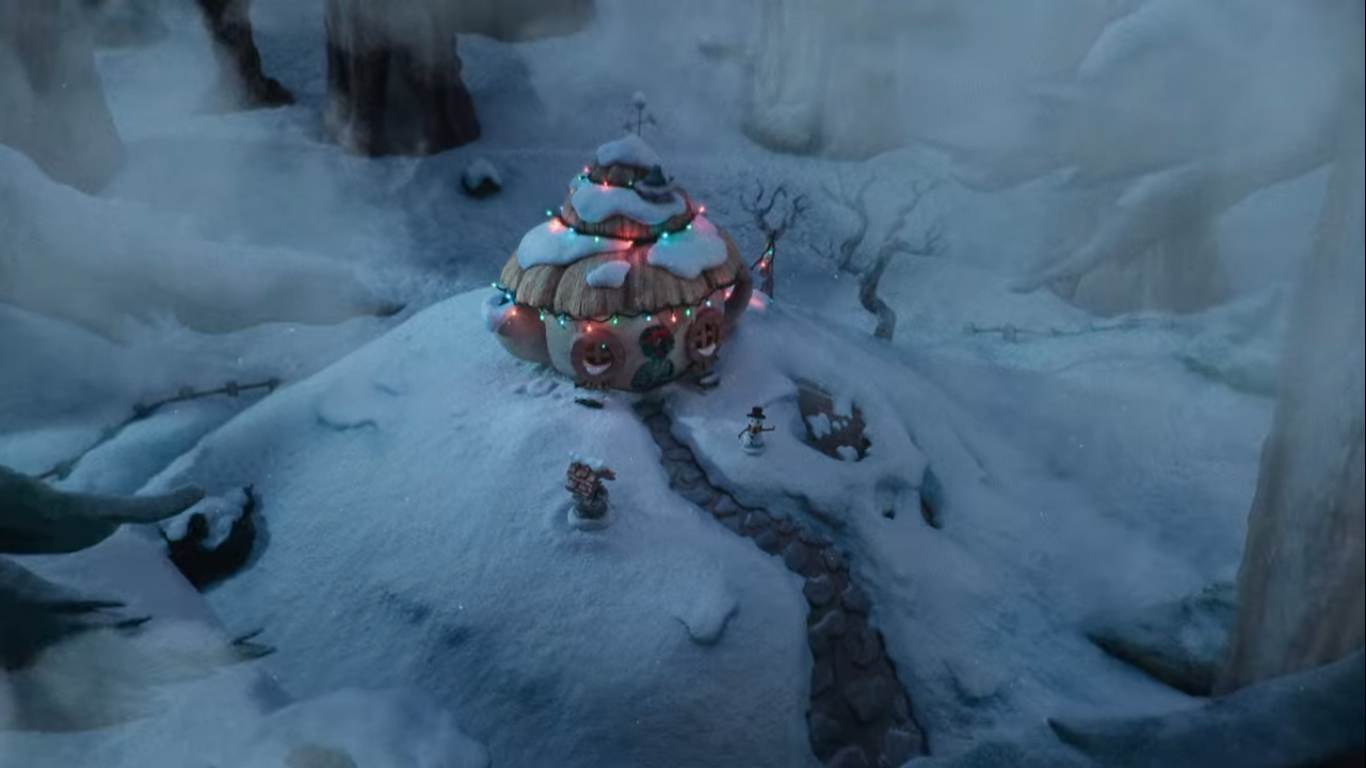
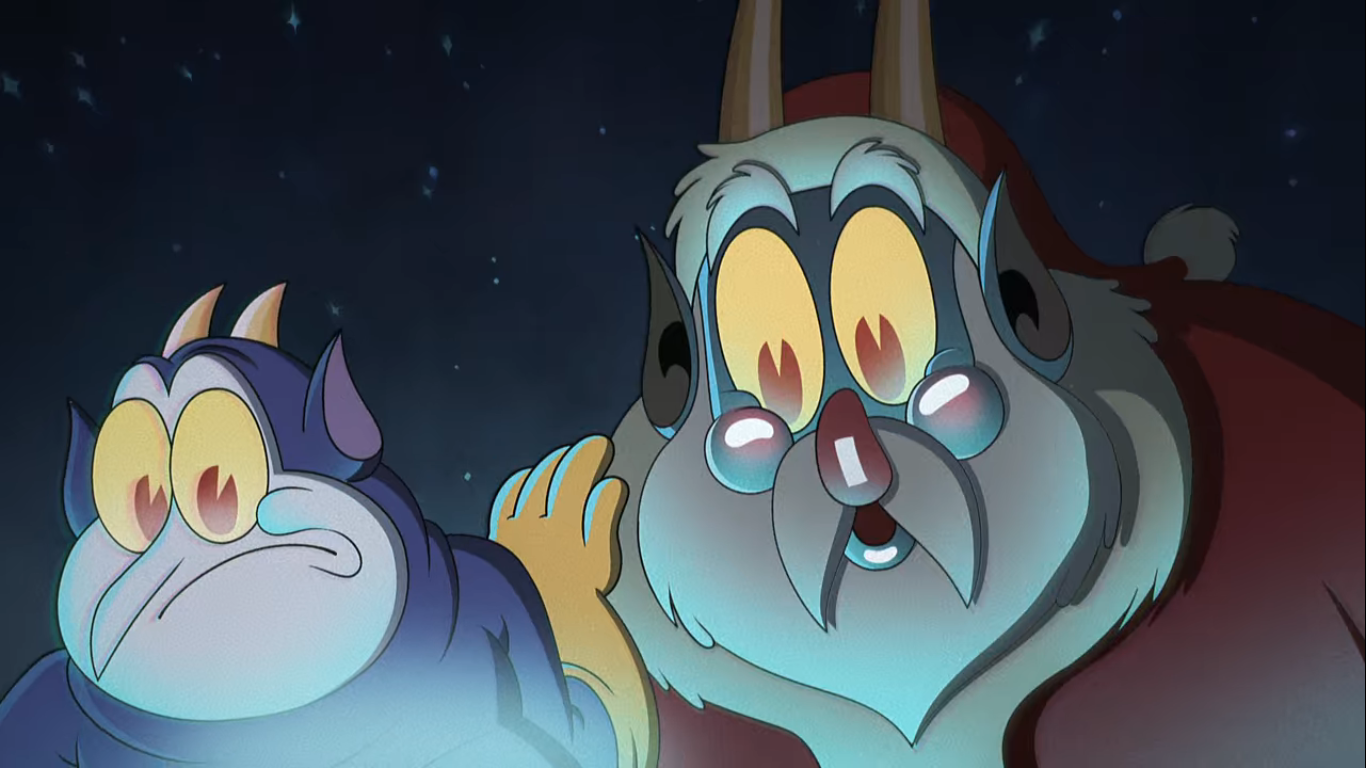
The Devil soon realizes why his henchman may have been wary about this last stop and that’s because he can see it through the clouds: the home of Cuphead and Mugman. This immediately causes the flames to rise once more prompting Henchman to remind him of his jolly requirement. They land on the roof of the massive kettle and Henchman immediately starts trying to pump his boss up. He reminds him that he’s Santa and that every kid on The Nice List deserves a present, even Cuph—. The Devil cuts him off before he can finish that sentence remarking that if he even hears the name of Cuphead he’s going to throw up.
And to add further insult to injury, The Devil has to give Cuphead the thing he wants most!
The Devil disappears in a puff of smoke and reappears in the living room of Cuphead and Mugman. If you watched the previous episode, or read yesterday’s entry here, then you’re not wondering why Cuphead’s tree looks the way that it does all burnt to a crisp. The Devil hates that he’s here and wants nothing to do with this final house. He really wants nothing to do with it when he finds out that the gift he’s supposed to leave for Cuphead is the very same train that he himself wants! The Devil almost can’t bring himself to do it. He contemplates simply stealing the train for himself. Yeah, that will teach Cuphead a lesson and shouldn’t naughty children be taught lessons? Even hard ones like not getting what you want at Christmas?
Just take it!
The Devil’s contemplations are interrupted by a sound like the coo of a dove. It’s little Cuphead (Tru Valentino)! All dressed in his cute red pajamas wondering what Santa brought him. The Devil tries to play it cool, but he’s clearly uncomfortable. Cuphead remarks that he wasn’t sure if Santa was coming and then adds he hasn’t always been nice this year. When he says it’s hard to be nice all of the time and is looking for reassurance on the subject, The Devil practically breaks down with a “You have no idea!” and stuffs his face with milk and cookies in response. Cuphead then adds that even if he wasn’t good enough to get a present this year, just meeting Santa has made this the best Christmas ever. The Devil is flattered, and sort of ashamed, and he finally agrees to give Cuphead his present. He can’t bare to look at him though as he dangles the train out with his back turned. Cuphead has to pull rather firmly, and thank Santa more than once, before he can finally pry it loose. He’s pretty much overjoyed though and The Devil will have to live with the knowledge that he contributed to his mortal enemy’s best Christmas ever. As he hears the train give out a toot, it’s almost enough to make The Devil take it back, but instead he sadly walks over to his pitchfork to prepare to leave, but before he can, Cuphead has one final message: Merry Christmas, Santa. He sighs in return, and replies with the same, before vanishing.
Did all this niceness pay off?!
On the roof, Santa Devil looks dreadful. Henchman carefully asks how it went in there and The Devil only sighs in return. He’s practically doubled over by the sleigh when he confesses how awful it felt to do something nice. The realization then sets in – The Devil did something nice! Henchman pulls open the list and goes to the bottom. The two stare for a moment, but when nothing happens a sadness overtakes them. Then the list glows! Magically, the name The Devil appears at the bottom in big, bold, cursive, letters! The two clasp hands and jump up and down with glee as Henchman cries out “You did it!” The Devil announces that it’s time to return to The North Pole – there’s a choo choo with his name on it just waiting for him there!
Well, look whose back.
The two return to the work shop and are greeted by a mass of cheering elves. Even Stickler Elf is seen clapping, though his facial expression never changes. The Devil drinks it all up and even receives a compliment from Stickler Elf. He begins to boast about how when he sets his mind to something he can do anything, and as he does Henchman notices a change taking place. He calls out attention to the swirling, blue, mist gathering about The Devil which encircles him like a Christmas tree. When the dust tree pops, The Devil is himself again! The mist then swirls a short distance away and soon materializes Santa Claus looking just as he did before the weird ritual from earlier.
Time for the fat man to pay up!
At the sight of the real Santa, Henchman looks like he’s about to burst. He keeps his cool though as Santa congratulates The Devil on a job well done. He even declares it a Christmas miracle that he was able to deliver all of the presents in time. Now, it’s time to collect as The Devil informs Santa he’s ready for that choo choo now as he rubs his hands together. Santa laughs and says he’s receiving something that’s better than a choo choo. The Devil falls for this and his eyes swell at the thought of something better than a choo choo only for Santa to inform him that his gift this year is the joy of being nice!
The Devil may be pissed, but I think Henchman just had the time of his life.
As you can imagine, this does not go over well with The Devil. Not at all. He does his exploding fire thing as he declares the idea stupid. He points to Santa and his elves and calls them all stupid before announcing to Henchman that they are leaving. As he drags Henchman away, the imp waves happily shouting “Bye Santa!” The two disappear in a puff of smoke to return to Hell. Honestly, I think The Devil took that better than any of us expected. Santa, on the other hand, looks hurt as he turns to Sitckler Elf and shrugs. The elf returns the shrug and we fade to black.
Oh to be miserable on Christmas, is there no worse a fate?
The blackness is interrupted by the opening of a refrigerator. The camera is placed inside the fridge and we see The Devil’s sullen face staring in. There’s a bag marked “Stickler” and The Devil pulls a sandwich out of it answering the question of who has been stealing everyone’s lunch. He begins consuming the sandwich as he slinks over to his throne and drops into it. He puts his head in his hand and bemoans his plight, how even when he does what he’s supposed to he still doesn’t get what he wants. Oh woe, is The Devil!
The Devil gets his happy ending after all!
A tooting of a train horn breaks the sound of sad music. The Devil’s head pops up to behold a toy train right there in his throne room! It’s not the train he wanted, it’s even better! It’s a larger train, a ride-on, and it has four cars instead of two! The Devil is overjoyed and magics up an engineer’s uniform and hops into the center of the circular track declaring that this train makes an even better noise than the one he wanted! He jumps on the first car and rides around the track in triumph. The camera zooms out and we can see behind the throne. Henchman is there, covered in soot with a bunch of tools and some instructions strewn about. He has a look of happiness on his face as it’s clear he’s the one who got the train for The Devil. He says “Merry Christmas, boss,” as this one fades to black.
Such a sweet little demon.
And that is how The Devil had a merry Christmas! It’s such a farcical concept on its face: Satan wants a choo choo for Christmas and is willing to help Santa in order to get onto The Nice List. I suppose some would find that immediately distasteful – Satan, and Santa?! The character of The Devil is so charming and funny that we forget about how insane a premise this is almost immediately. Even his outbursts are played for laughs, though he definitely murders some folks in this one (that poor, little, old mouse) for no real reason other than he’s just a bad guy. I suppose if you want to find a moral in this one, it’s that Christmas can bring out the best in anyone. Even The Devil.
The animation is top notch even if it’s not hand drawn. I love the many expressions we see from The Devil and Henchman throughout their night. The town looks lovely with this Christmas coating upon it, almost Rockwell-esq. The music sprinkles in some public domain stuff, mostly from The Nutcracker, but also makes liberal use of its own original compositions. Composed by Dave Wasson and Ego Plum, the two originals are unmistakably Christmas tunes even if they don’t directly adapt a more well known song. The cartoon is also not long enough for us to get sick of them and aside from their first instance in the show, they’re mostly confined to instrumentals. I love the homage to Santa’s Workshop and I was repeatedly dazzled by the many, many, moon shots in this one.
The Devil does get a happy ending, but on the way he was made to suffer. Perhaps nothing was more painful than making his most detested foe happy on Christmas.
And it’s funny! This is one of the funniest and most entertaining Christmas specials I’ve had the pleasure of watching. It’s not even reliant on the viewer being familiar with The Cuphead Show! as pretty much everyone knows who The Devil is. It certainly helps to be familiar with it when the scene does shift to take place in the home of Cuphead, but knowing who he is and why the tree looks as it does only adds a little to the scene. For newcomers, they can easily understand that ordinarily The Devil and Cuphead are at odds with each other and that’s pretty much all you need to know. The cartoon does have to cheat a little in that scene for every gift we saw up to that point was fully wrapped. For Cuphead’s house, they’re all unwrapped so that The Devil can see that Cuphead is getting the toy he covets himself. They could have just had it fall out of a box or something, but I’m not bothered by it. It’s basically one of the few nits I can pick with this one, and I had to hunt for it.
If you can’t tell, I really like this Christmas special from The Cuphead Show! It is high on my list of modern Christmas specials alongside Prep & Landing, Duck the Halls, and the DuckTales Christmas episode “Last Christmas!” Coincidentally, all of those are Disney creations and this cartoon, while not made by Disney, references a classic Disney short within it. If you have never seen this one I recommend you check it out regardless of whether or not you’re familiar with Cuphead or The Cuphead Show! It’s streaming on Netflix, which is full of other Christmas episodes and specials from other properties, so it’s not a bad one month sub for Christmas season if you ordinarily are not a subscriber. I plan to watch this one again before the holiday arrives – toot toot!
Can’t wait until tomorrow for more Christmas? Check out what we had to say on this day last year and beyond:
When two billion dollar organizations butt heads, it can be hard to know who to root for. Take Disney, somewhat of an “evil” overlord when it comes to content, which seemingly owns everything these days and likes to throw its weight around when it comes to copyright claims. And then there’s Fox, owned by the…
In 1964, Arthur Rankin and Jules Bass unleashed a Christmas Classic upon the world in the form of Rudolph the Red-Nosed Reindeer. The special basically put the company on the map and put it on the path to holiday domination for decades to come. Despite that, few of the specials that followed Rudolph truly hit…
Not every Looney Tunes or Merrie Melodies star had to be inherently funny. Sure, most of them were and that’s often what many cartoon enthusiasts will point to the Warner catalog of cartoons as having over Disney, but it wasn’t some hard and fast rule. That’s why when a guy by the name of Chuck…
What’s next for a video game that looks like a cartoon? Why, a cartoon! Novel concept, huh? Cuphead is a 2017 video game created by Jared and Chad Moldenhauer heavily inspired by animation from the 1930s. It’s basically a hand drawn video game and a fully playable one, at that. It made waves when it was first unveiled and seemed to instantly become one of the most anticipated video games in recent memory. It attracted so much attention (and additional funding) that the Moldenhauers and Studio MDHR decided to expand upon the game from its original boss rush premise to something closer to a full-fledged platforming experience with the addition of run n’ gun levels. Upon release it received quite a great deal of praise for its animation and a lot of notoriety for its punishing difficulty. The game has since been released across several platforms and also received a downloadable add-on, Delicious Last Course, which also received a physical release alongside the main game.
Once Cuphead was a bonafide success, it was basically a no-brainer to commission an animated series. Netflix, along with King Features Syndicate, did just that with The Cuphead Show! releasing in 2022 on the streaming platform. It has since released three “seasons” totaling 36 episodes, though in typical Netflix fashion, all of the seasons were part of the same initial episode order. We’re now two years removed from the finale airing without word of another batch of episodes being ordered so I guess that’s all she wrote, but with a streaming show it’s not uncommon for years to lapse in between seasons.
Brothers Cuphead (center left) and Mugman (center right) spend most of their time getting into and out of trouble.
The show is about Cuphead (Tru Valentino) and brother Mugman (Frank Todaro), two rubber-hosed miscreants with cups for heads who get into mischief all throughout Inkwell Isles where they live. Early on, they get on the bad side of the Devil himself with Cuphead losing a game in which the cost was his very soul, so the boys have to spend a great deal of time (and episodes) avoiding the Devil at all costs. The show is animated with modern technology, the puppet-like stuff utilized by most, despite the video game being hand drawn. Despite that, it does a reasonable job of approximating the look of a hand drawn cartoon and is one of the best looking animated shows on Netflix (or pretty much any streamer, for that matter). Like the game, there are filters applied and some desaturation techniques to make the show look aged while the soundtrack (provided by Ego Plum) is appropriately jazzy. There is a throughline to the show involving the plot surrounding Cuphead’s deal with the Devil and the ghostly Chalice (Grey DeLisle) character, but for the most part episodes can be consumed in a stand-alone fashion. This helps to make The Cuphead Show! feel almost like a relic in this age of serialized story-telling, even in kids shows.
As part of the third batch of episodes, we received not one, but two Christmas episodes. This one, “Holiday Tree-dition” is the first of those two and the shorter of the two. Most of the episodes are half episodes while some are stretched out to a half hour or longer. It’s quite common for cartoons with that type of setup to devote two segments to Christmas, but with this episode we’re looking at a pretty typical running time for the show. The other one starring the Devil gets the double-length treatment.
The home of Cuphead, Mugman, and Elder Kettle is done using real assets like a stop-motion production.
The show begins with the standard intro. When I first booted this program up with my kids, I was surprised the show didn’t just use the theme from the video game, but after hearing this new intro I could see why. This one pops. It’s jazzy, bouncy, and fun and one of those intros that is rarely skipped in my house. The episode is introduced with its own lovely title card before we’re shown the outside of Elder Kettle’s home where Cupman and Mugman reside. The opening shot is done with real assets. They’re models and I assume this is an homage to what the Fleischer Studios used to do back in the day where they’d have a live-action setting and animate over it.
They’re all bundled up to go get a Christmas tree!
Inside the giant teapot we find Elder Kettle (Joe Hanna) in his cozy confines welcoming us with a jaunty Christams tune! Mugman and Cuphead are going to join in on the fun as the trio sings an original diddy about Christmas trees. It would seem getting the tree each year is a big deal in this house and as the trio sing they put on cold weather clothing, Elder Kettle grabs an axe, and they head out the door to go get their tree. I feel inclined to point out now that the inhabitants of Inkwell Isle are a mix of anthropomorphized animals and objects. Cuphead and Mugman are somewhat unique in that they have human bodies, albeit toony ones, with a cup for a head that’s filled with what looks to be milk. Elder Kettle, is just a giant kettle with rubber hose arms and legs. I don’t know if his relationship with the boys is ever explained. He’s a fatherly figure, though more grandfatherly I suppose, but I don’t know if there’s a mother in the equation here.
I fear for what will happen to these two if they don’t come back with five bucks and a tree.
Anyway, as the trio marches off to get a tree, Elder Kettle starts to drift back out of scene. Cuphead and Mugman soon notice he’s gone, and when they turn around they see him going back into the house. They run over and bang on the door and Elder Kettle answers. It would seem he’s decided that he no longer wants to be held responsible for the Christmas tree. He’s retiring, so to speak, and entrusts the boys with the task. Now, even though he was seen carrying an axe moments ago, Elder Kettle is not going to entrust the boys with actually cutting down a tree. Instead, he gives them a ten dollar bill and instructs them to go to Porkrind’s and buy one. Porkrind is going to ask for ten, but Elder Kettle instructs his boys to only offer five bucks. He seems to suggest that they’ll enjoy having some change leftover, but then also tells them in no uncertain terms that they are to come home with change so I guess he didn’t intend for them to do anything with it.
I’m starting to think that Elder Kettle stayed home because he wants nothing to do with trying to negotiate with Porkrind.
Cuphead and Mugman then head to Porkrind’s as instructed. There we see Porkrind (Cosmo Segurson) overseeing his tree lot and reenforcing that all of the trees cost ten bucks. Porkrind, if you could not guess it for yourself, is a big pig-man with an eyepatch. I guess you would not have assumed the eyepatch part, but probably the pig part. Everyone at the lot seems fine with the price, but that’s not going to stop Mugman from attempting to haggle. Cuphead stands behind him as both a supportive voice and to play “the kid” in the relationship while Mugman is like the bartering father. He suggests to Porkrind that five dollars would be a fair price for a tree and to add to the verbal suggestion he holds up five fingers. Since Mugman is a cartoon character, he only possesses four digits on each hand so he has to use two hands to do so. Plus, since he’s wearing mittens, his fingers have to rip through the mittens for added emphasis. Porkrind seems unwilling to haggle though and tells Mugman the price was ten bucks last year, it’s ten bucks this year, and he’s even willing to say they’ll be ten bucks next year. That doesn’t stop Mugman from trying as he does the typical bad barterer maneuver of just going up a dollar on his offer hoping Porkrind is willing to give a little. He does not. Actually, he ups the price to fifteen. Mugman can’t believe it, and then some little light bulb guy (Keith Ferguson) accepts the fifteen dollar offer. Mugman tries to negotiate back to ten, but there’s a problem: Porkrind is all out of trees.
We’re only a few minutes into the cartoon and Christmas is already ruined!
With no tree, but still ten bucks in their pocket, the boys decide there is only one maneuver left: cry. They throw a fit as Porkrind heads into his trailer fearing their Christmas is ruined, only for the pig-man to pop back out. No, he’s not feeling sympathetic for them or anything, instead he just suggests they cut down their own tree. Naturally, to do so they’ll need an axe. I guess going back to the house for the one Elder Kettle had is out of the question, so instead they opt to buy one from Porkrind. The price? Ten bucks!
Cuphead should not allowed to handle sharp objects.
Even though the boys managed to spend all of Elder Kettle’s money, when they were only supposed to spend five, and also still lack a tree, they seem rather happy as they march off into the woods. Cuphead is even swinging the axe around irresponsibly, but Mugman is apparently used to such as he manages to duck every swing and still keep a smile on his face. As they stroll though the woods, they walk by various trees which Mugman dismisses for pretty obvious reasons since they’re all pretty ugly. One tree which has the idyllic Christmas tree shape is dismissed as being too desperate because it was also juggling snow balls. The boys begin to feel like they’ll never find a good tree, which of course occurs just as they’re walking by a perfectly good tree.
Behold! The perfect tree!
With the tree found the only thing left to do is cut it down. This presents a problem because, like brothers often do, the two boys fight over who gets to actually wield the axe and chop this sucker down. As they fight over it, the axe gets thrown by accident and it cleanly slices through the trunk of the tree. That is a damn fine axe. You can complain all you want about Porkrind’s pricing, but at least he’s selling a quality product. The tree then falls over and lands on the boys, but they emerge from the pine looking no worse for ware. Instead, they have a different problem. The tree has started to move, and soon they find themselves running down the side of a mountain in pursuit of a runaway Christmas tree!
It’s just a little snow-covered. It’s still good! It’s still good!
The boys have little trouble in catching up with the tree, but as they run alongside it and try to jump on, something always gets in the way be it a big boulder or a random snowman popping out of the ground. Both finally make a jump for it, but they collide in midair. When the two hit the ground they’re rolling and soon end up in a massive snowball before getting smashed apart. Now they’re running, but Cuphead can’t locate the tree. That’s because it’s sliding behind them, but faster than they can run, and it takes them both out. This works out though because now they’re on the tree, but it’s still racing down the hill in an out of control manner. The good news is the hill finally ends, the bad news is that it ends in a cave full of sleeping bears.
What?
At first, the bears appear like they’ll remain sleeping and it will fall on the boys to somehow get the tree out of there quietly, but before they can do anything the bears all suddenly wake up with a roar! From outside the cave, we see the tree get tossed out. Then we hear the sound of pummeling before a bear emerges holding both Cuphead and Mugman by the back of their shorts. He gives them the boot, but they end up landing on their tree which is sliding somewhere. Cuphead remarks that those bears were pretty mad while Mugman sees an opportunity for a pun and says “Yeah, we barely escaped with our lives!” As he does so he nudges Cuphead looking for some feedback on his joke, but Cuphead couldn’t hear him.
This should give the video game designers an idea on how to punish the player.
And that’s because they’re in a sawmill! Mugman doesn’t realize it at first as he keeps repeating his joke only for Cuphead to say “What?” Finally, they notice where they are just as a bunch of wild saw blades appear. There’s a pretty menacing, personified, furnace (Dave Wasson) full of saw blades that waits for them at the end of a conveyor belt. It’s laughing too, but whatever it planned to do it either doesn’t or we just don’t get to see it because we cut to an exterior shot of the mill. It literally spits the tree out, with the boys still atop it, and they sail into the night sky past a full moon holding each other and screaming.
There’s no Santa to be found, but we’re still getting in a moon shot.
The tree returns to Earth and is once again in motion. It’s all bent and mishapen and Mugman is in some serious distress over the quality of their tree. When he declares that things can’t possibly get any worse, Cuphead responds in the only way a cartoon character can, “Wanna bet?” It would seem they’re heading for a cliff and when the tree goes off of it, it hangs in the air a second allowing the boys to scream before it drops. When it hits the ground it does so with a bounce. It pops open, like an umbrella, and returns to its former glorious shape! The boys aren’t out of the woods yet though (well, technically they are out of the woods, but you know what I mean) as the bounce and pop of the tree has basically turned it into a rocket sailing through the sky.
Cuphead appeared to get the worst of that.
At home, Elder Kettle opens the front door and wonders aloud where the boys are. That’s their cue to come rocketing in like Goofy after the ski jump! Elder Kettle is barely able to jump out of the way as the tree crashes through the front door. When he peaks his…head…into the house, we see Cuphead has crashed into the piano while Mugman landed on the stool. As for the tree, it’s right where it’s supposed to be in its tree stand in the middle of the room.
What a glorious tree!
The trio look on with awe and it immediately transitions to a decorated tree. Elder Kettle announces that the boys get to do the honor of lighting it. He holds up two ends of an electrical chord and the boys cheerfully plug it in. The tree lights up a glorious hue, but then the cable sparks. The spark travels down the chord leaving blackness in its wake until it arrives at the tree and the whole thing goes up with a puff of smoke leaving a smoldering husk behind.
Oh, well, I guess this is more fitting for them.
Once again, Cuphead and Mugman are reduced to tears. As they cry into Elder Kettle’s…waist?..the two wail that they ruined Christmas. Now is the moment where some traditional Christmas special wisdom is brought in. Elder Kettle tells the boys that Christmas isn’t about a tree, it’s about who you spend the holidays with. He adds that whatever tree they have will be just fine. Then he adds, bluntly, “Even if it is burnt to a crisp.” The trio then rejoin in their Christmas tree song and march once around the tree before standing and looking upon it together. We get an external shot of the house all lit up for Christmas and that’s the end.
This holiday edition of The Cuphead Show! is plenty fine. It’s just a fun romp about the two main characters setting out in search of the perfect tree to keep their family tradition alive and encountering problems along the way. Its a silly, absurd, sort of cartoon with a lot of fun quips and visual delights. It’s not the most inventive and it’s pretty easy to predict the next story bit as the cartoon moves along, even the non-traditional ending felt like a foregone conclusion. The only real surprise was that there was no payoff for Elder Kettle’s threats about not returning with change. I was expecting a Home Alone style ending where we hear the outraged scream of Elder Kettle looking for his five bucks before smashing to credits.
So the tree sucks, at least everything else is looking rather nice and festive.
Even if this feels almost by-the-numbers for a silly Christmas adventure, “Holiday Tree-ditions” manages to entertain with its audio and visual presentation. I really love the cast for this show and feel like they found the perfect voices for both Cuphead and Mugman. There’s also a smattering of Christmas music in the background as well as a lovely, fast-paced, instrumental version of the Christmas tree song which accompanies the duo’s journey down the mountain on their tree. The animation is really expressive and this is the sort of cartoon that rewards people like me who pause it constantly in search of good screen caps because it allows for one to appreciate all of the facial expressions in use. My only critique of the visual presentation is that maybe we should have seen Cuphead and Mugman’s condition degrade throughout the episode since they do get smacked around pretty good.
If you would like to check out this episode of The Cuphead Show! then I think your only avenue is via Netflix. I’m not sure if it’s been sold outside of the streaming giant or not. If the episode seems a bit too light for your taste, then you could always check out the other Christmas episode from the show which is much longer. Maybe we’ll even cover it here very soon…
Can’t wait until tomorrow for more Christmas? Check out what we had to say on this day last year and beyond:
We touched on it a bit just a few days ago when we talked about The Justice League, and we’re going to do it again! What is “it?” Why, the launch of The WB, of course! The network fronted by Warner Bros. was a newcomer in the mid 90s and was here to challenge the…
Back in 1929 Walt Disney launched the Silly Symphonies series of cartoon shorts. Unlike the Mickey Mouse shorts that were growing popular at the time, Silly Symphonies did not center on just one character or even a group of characters, but rather were fairly self-contained. Some shorts that became popular, like The Three Little Pigs,…
Nickelodeon in the late 1980s was a network on the rise. Cable was expanding to more and more households each and every day and Nick was able to seize the youth market almost from the get-go. Prior to that, broadcast networks dominated children’s programming, but restricted it to certain parts of the broadcast schedule. And…
90’s nostalgia has taken me on a ride of late. I could blame X-Men ’97, but it could just be me getting older and having more fondness for the decades that have come and gone. It’s not a bad thing, but it can be bad for the wallet. Lately, I started looking at my somewhat tidy Marvel shelf and the figures from X-Men and Spider-Man which all refer back to their 90s animated counterparts and I felt like I had a hole. And that hole’s name is Iron Man.
This portrait is the only aspect of the figure that is dedicated to recreating the 90s animated series look.
X-Men was my jam when it aired on Fox Kids and Spider-Man was firmly situated in second place. On another channel though was Iron Man. It never sunk its claws into me like the other two shows, but I watched a fair amount of it. I can’t recall a single plot and only remember characters, but I liked it enough to find the accompanying toy line enticing. I never did go deep on it though. While the show was called Iron Man, my favorite character was War Machine. War Machine felt like a more 90s appropriate Iron Man. The name is inelegant and a bit stupid, but kids loved an armored dude covered in guns. I allowed myself to get his action figure and it would be the only figure I would get from that toy line. And he was cool, I just never felt like I needed any other characters.
Well, okay, mullet Tony is also pretty much lifted from the cartoon as well.
Despite that, I do love me some 90s Iron Man. The aesthetic, that is. The modular suit works for me even if it’s kind of stupid. He definitely does not look like a guy in an iron suit. He looks like any other superhero, but with some iron plating in places. No matter, I like what I like and what I like is this look for Iron Man. I did get the Toy Biz Marvel Legends version that came in a two-pack with The Mandarin and it was probably one of my last Toy Biz Legends. I’ve resisted the urge where modern figures are concerned, but obviously I decided to give in.
This guy is definitely more at home in a Marvel vs Capcom display.
In 2022 Hasbro released a retro Iron Man that’s at least an approximation of the animated series look. It’s at least the closest version they’ve felt inclined to release, though it’s mostly a repaint of a more comic accurate modular Iron Man. It’s also less an animated Iron Man and more a Marvel Super Heroes or Marvel vs Capcom 2 version of the character and if that wasn’t obvious by looking at the figure the big gun certainly drives the point home. Like X-Men and Spider-Man, Hasbro has found success releasing Iron Man figures on retro cards that harken back to the 90s. This guy is released on such a card, but also in an oversized box similar to the Pulse Con animated Venom from a few years ago. Only in this case, the box just repeats the art of the retro card with a fake window rather than go with original artwork. Inside the box is the figure on said retro cardback as well as another box for his big, freakin’, gun.
One thing I don’t like about the sculpt is this red hinge.
This Iron Man stands a tick over 6.5″ to the top of his dome. He’s a very glossy yellow and red with almost every part of the figure being colored plastic. It’s an aesthetic that I think works for both the animated series and the video game sprites this deco is based off of. As far as animated Iron Man goes, there’s actually not much to tie it back to that source aside from the default head. It has the full yellow facemask with some yellow piping on top that is consistent for the look of the show’s first season. It’s also really large which is a Marvel Legends trend that has cropped up over the past few years. Comic book characters, if anything, tend to have smaller heads than a real person would since it helps make their usually impressive physiques look even more so. Hasbro apparently sees things differently and whatever they use for their proportions likely wouldn’t agree with an actual Marvel artist.
He has hands for the repulsor blasts, but no blast effects for them.
Aside from that head though, most of this figure matches up with the video game Iron Man. The knock-off Superman logo on the chest is from the game and that’s the clearest tie there. The shoulders should be bigger and scalloped really for both, but the smooth appearance of the figure is certainly closer to that of the video game. The only aspect of the figure that doesn’t really tie back to anything is the angled cut of the “pants.” Some of the artwork from the cutscenes in Marvel Super Heroes makes it look like that angle may be present. Some of those scenes also include the yellow piping on the head so consistency isn’t really its strong point. All that is to say that if you want a true, animated, Iron Man then this is suboptimal. In that, it’s similar to a lot of the animated figures Hasbro has released over the years as rarely are they 100% accurate to the source. If this guy is going on your Marvel vs Capcom shelf though, then it’s pretty damn close if you’re looking to match his first appearance in that franchise. He’s definitely not as beefy as that character sprite. This is very much a Marvel Legends Iron Man with a video game deco and accessories.
It’s light on the Capcom, and that’s the wrong War Machine, but it’s a decent start to an MvC display.
And if you’re screaming at me “Wait! What about the head?” then don’t worry, I’m getting to it. Hasbro included a second head that omits the yellow piping and features a faceshield that matches the shape of the one featured in the game. It basically ends just below the mouth so Iron Man as a red chin. It’s a repaint of the head from the original release of this body and it looks fine. Actually, it looks better than the new head as it doesn’t seem to be as out of scale. Pop this on your figure and you get the true Marvel vs Capcom 2 Iron Man. It’s also the same style of helmet the character wore during his appearance on the Spider-Man cartoon, though the rest of the body was pretty different. We also get a Tony Stark head featuring his mullet hairdo from the cartoon. It’s…fine? He looks like Charles Bronson to me and it too is oversized, but if mullet Tony is your jam then here you go.
Did I mention this figure comes with a very big gun?
The other accessories in the box are hands and effect parts. For hands, we get fists, open, and gripping. The open hands feature pegholes for blast effects, but none are included. They at least painted the rim of the ports yellow so it looks okay. On the gripping hands, the blast holes are filled and painted over. Even though Iron Man doesn’t have blast effects for his traditional, blasting, pose he does have some effect parts. The first is a burst effect that plugs into his chest opening. In the video game he can fire a beam from this spot so I guess this is like a charging effect before that beam emits. The other effect part is for his fist to plug into for his victory pose from Marvel vs Capcom 2. It’s molded for his right fist, but you can squeeze the left one in there if you prefer. Both effects are molded in blue, translucent, plastic with white shading. The burst effect looks pretty nice, while the victory pose effect has the white applied too heavily. It looks more like a sea creature or something and some of the “spikes” are bent and warped.
Iron Man: “To me, proton canon!”
Now, that obviously isn’t everything included with this guy. Oh no, we still need to talk about that gigantic gun of his. The box labels it a “plasma cannon,” but all who have played the video games from where this came know it as the proton canon. It’s Iron Man’s big attack as this giant gun comes out of no where and sends a massive beam across the screen. Hasbro definitely wanted to get the size of this thing right as it’s about 6.5″ long making it roughly the same size as Iron Man himself. It’s around 3″ wide from the widest parts. Since no 6.5″ action figure would stand a chance at holding this thing, Hasbro included a 3″ clear, plastic, stand for it to plug into so that Iron Man can basically fake holding it on his shoulder.
Mega Man: “Oh no! After he hits me with that there won’t be anything left for Dr. Light to repair!”
The canon itself is mostly gray plastic, but with darker gray paint applied in parts. There’s a hit of metallic pink on the front and a few places where red is applied for lights or buttons. The one thing not painted that should have been is the targeting reticle that Iron Man looks through. There’s a sculpted bull’s eye on it, but it’s unpainted. It’s probably mostly a hollow piece, but there is some heft to it. The stand plugs in without effort and works as intended. It’s not particularly challenging getting Iron Man into the proper position to look like he’s firing the weapon and the gripping hands are able to grasp it securely.
Mega Man: “Heh, heh…”
Hasbro also included yet another effect part in the form of a blast effect for this gun. If you’ve played the games this thing comes from, then you know it unleashes a devastating beam effect not unlike something one would see out of an anime character. The blast effect Hasbro included is…less than adequate. They included a blue version of the same effect they included for the retro card Apcalypse’s gun. You know, that gun that’s probably a fifth of the size as this one? This dinky little blue thing looks ridiculous when plugged into the center of the gun. There are peg holes all around the center and if this thing was meant to go in one of them (and there were more of the effects) it might look passable, but as-is it looks stupid. And what sucks is the diameter of the peg on the effect means it’s too big to be used with Iron Man’s hands and feet. I wouldn’t have expected Hasbro to include a gigantic beam here, but how about a charging effect? Or just a half sphere or something? I can’t see anyone displaying this canon with this blast effect. You know that popular Bart Simpson meme with the “At Least You Tried” cake? I’m not even willing to give Hasbro that much credit here.
Iron Man: “Sigh….damnit…”
We should probably talk about the articulation on the actual figure before we wrap this one up. Iron Man articulates like most Marvel Legends figures save for the lack of a butterfly joint. The arms and legs are pinless and the torso uses the old style of ab crunch that’s just a big hinge. I do like that the yellow panels on the sides of his thighs come over the thigh cut so the whole piece rotates with the joint when usually Hasbro would just cut right through it. The waist twist is just a standard twist so it gets ugly real fast when you rotate more than one click. Which is a bit of an issue all around with this guy. Very little would be described as smooth as the shoulders, elbows, knees, ab crunch, and waist almost feel ratcheted. The shoulders especially feel like they’re fighting back when moved which is a touch unsettling. I also don’t like how Hasbro did the shoulders as the red caps are cut into for the shoulder hinge. It looks fine on top as the hinge is red, but that also means the underside is red so anytime his arms are lifted it looks goofy. They could have simply pegged the red parts in to avoid this. I’d consider a big red hinge in the armpit uglier than yellow and red pegs in the arms and legs, but I guess Hasbro disagrees.
Animated friends unite to take on evil!
Retro Iron Man is a flawed Marvel Legends release as most are, but not one that is critically flawed or anything. I think most Legends collectors will likely be satisfied with this take on Iron Man. I personally wish the shoulders were done differently and that the heads were more proportional. I also would have scrapped the fist accessory for some repulsor blast effects, or better yet, a better effect for the proton canon. The effect included for that is laughably bad to the point where it would have almost been better to not include one at all. Yeah, we would have complained about the lack of one and would have been justified in doing so, but that would somehow feel less insulting.
He’s not without his flaws, but I’ll allow him to end this with a victory pose.
If you are a fan of the 2D fighting games from the 90s and want an Iron Man for such a display, this gets the job done. I don’t know if there are any third party beam effects that would pair well with this one, but I’m almost tempted to try and tack-on the fist effect to the end. Even a piece of paper with the beam printed on it would look better than the included one if positioned right. The only other drawback to this release is the price tag of $40. A repainted Iron Man with a big gun warrants a $15 mark-up over the standard Marvel Legends figure? Eh, that’s a hard sell, which is why it took me so long to take the plunge (thank you Amazon gift card) as I don’t know if it’s really worth it. If it had a worthwhile blast effect then sure, but you’re going to need to dedicate additional blast effects you may have laying around or dedicate time and/or money into coming up with something better to really make this guy be all that he can be and that sucks. If you do want him though, Amazon still has this one for MSRP. Maybe the patient will score it on clearance at some point too.
For someone who isn’t a Marvel Legends collector, I sure have reviewed quite a few at this point:
When I was a kid, my dad took me to some local convention or trade show. I have no idea why because my dad wasn’t the type who would go to such an event. He liked car shows, but from what I can remember this was more of a hobby show. It was early in…
It is Halloween and that means it’s time for costumes, candy, and spooky fun. It’s also Halloween 2022, a pretty important date if you grew up loving those mutants who ran around in colorful spandex fighting for a better tomorrow. That’s because 30 years ago on this very night, the animated series X-Men premiered on…
Last year, Hasbro celebrated the 30th anniversary of X-Men, the animated series that premiered on Halloween 1992 and would become a ratings hit shortly thereafter for the Fox Kids Network. It was responsible for getting a lot of kids into the X-Men and Marvel comics in general and the first, prime, benefactor of that rise…
We just had 11 consecutive weeks of action figure reviews on Super7’s line of figures based on The Simpsons. Things were getting pretty negative in that sphere as that line went out with a whimper. I don’t like reviewing bad figures and it’s mostly because everything I review here I buy for my own collection. Why would I want to buy a bad figure? That line let me down and I need a pick-me-up to run this Thursday. Enter Jada Toys and their shiny, new, Mega Man figure!
Jada is a company I have had little interaction with. I bought my kid a remote controlled car years ago that was made by Jada. It was a great toy, fairly inexpensive, and it worked really well for what it was. I have a good impression of Jada as a result, but it’s not like that product should lend itself well towards action figures. That’s a whole different ballgame. Less complicated in some respects, but also more so in other ways. Jada, possibly because the action figure market has expanded over the years, decided to get into that sphere and it has targeted licenses that have been underserved of late – mainly video games and food mascots. It’s an odd combo, but people like both things and there’s a ton of much beloved food mascots out there that have interested folks. None have really appealed to me, but they look so good that I’ve been tempted. Jada’s partnership with video game developer Capcom is where the most popular figures appear to be coming from. Street Fighter II has been the focus and again, not something that appeals to me, but still tempting because they look so good and have received a lot of positive buzz. Finally, and most recently, Jada has released figures for a license I do have interest in and that is Mega Man.
Two heads, an extra set of hands, weapon, and effect part – see! It doesn’t have to be difficult!
When it comes to the video games, I am a casual Mega Man fan at best. If I had to pick a favorite game in the series, it would probably be Mega Man X for Super Nintendo. Is that sacrilege to choose a game from the X franchise over the classic one? I have no idea, but it is what it is. In the 80s, Mega Man games were popular, but also hard. I had friends who owned them, but I never owned one myself because I sucked at them. Even so, television shows like Captain N: The Game Master had me convinced Mega Man was a Nintendo mascot. I’m not sure at what point I realized that wasn’t the case. Even though I’m not a huge fan of the games, I always really liked the character designs from the series, both the classic series and the X one. I watched the DiC animated show and considered getting into that toyline long ago, but never did. I’ve often been tempted by the many model kits and such out there, but I’ve never taken the plunge.
The box art definitely goes with a more late 90s vibe to the artwork, but the figure is pretty much classic Mega Man.
Jada made it easy to finally buy my first Mega Man action figure. Not only have their figures been well received so far, they’re also cheap. The figures in the Mega Man line will only set you back 20 bucks a piece. I think they’re considered 1:12 scale with the characters running small, but $20 for such a scale is almost unheard of now. And it’s not like Jada is scaling back on quality. These things are fully articulated, well-painted, and come with a suitable amount of accessories. And it’s all for a licensed toy line! Is this just entry level pricing and we’re being setup for increases to follow? I don’t know, and I almost hate praising a company for their low prices as that could signal to them they have some room to raise them, but it’s a pretty stark contrast between what Jada is selling for $20 and what a company like Hasbro is selling for $25 and up.
He can run!
Mega Man comes in a box that’s adorned with game art. The actual artwork for Mega Man on the front seems to come from the Mega Man 7 or 8 era as he has a very anime look to him. It’s not the little, chubby, guy from the 8-bit era nor is it the hideous artwork from the US releases. It’s an attractive, tidy, box so if you like to keep things in-box it should serve you well as it’s also quite sturdy. Mega Man stands approximately 4 5/8″ to the tip top of his helmet. He’s a little guy, but if you’re buying this figure for your Marvel vs Capcom display then it will serve you well when it comes to scale. As he is known as the blue bomber, Mega Man is composed of different shades of blue. His torso, legs, and sleeves are a light blue while the boots, helmet, and forearms are a dark blue. The dark blue parts are also glossy which meshes well with the artwork. The light blue portions of the helmet as well as the facial features are painted and look nice. There’s a hint of blue shading on the light blue parts and the light just plays on it very well. It’s a nice looking figure with a good in-hand feel.
He can kick!
Mega Man’s accessories are perhaps not substantial, but better than adequate. We get two heads: a smile and an angry expression. Both are suitable for the character and I have a hard time choosing between the two. I suppose the smiling one when not in use can double as an extra life power-up. Mega Man also has four hands: a set of fists, a right curled gesture and a left wide open hand. I’m surprised the non fist hands are different, but the curled hand is intended to pair with the Mega Buster while the splayed hand is probably meant to harken back to some classic poses. And speaking of, we have a Mega Buster! Both of Mega Man’s forearms are connected to the bicep via a hinged peg and can be removed and swapped with the Mega Buster. The Mega Buster is a nice, glossy, blue with the yellow power indicator on it. You can rotate it any which way so it looks fine on either the left or right arm, though I always picture Mega Man with buster on the left arm. Lastly, to round things out we get an effect part. It’s a translucent, yellow, fireball with an acrylic stand. The stand has two joints in it and you’re supposed to basically put almost two right angles into it in order to get it to the right height. It works well though giving us a spread of two heads, four hands, a weapon, and a power effect. Who knew it was so hard to get that kind of spread with an action figure?
He can slide!
As you may recall, when I pointed out the affordable price for this figure I also mentioned there was no cut to the articulation budget as a result. Mega Man can do just about anything you need him to. The head is on a double ball peg so Mega Man can rotate, look down, and tilt. His range looking up isn’t great, but he does have a ball-jointed diaphragm. That joint will allow him to bend forward and back which should provide for the up range you need at the head. That joint also rotates and tilts a bit to the side with a waist swivel below. Shoulders are simple ball-hinges. Elbows are single hinges and that’s where you’ll get your bicep swivel. Hands rotate and hinge horizontally. Hips are simple ball sockets and Mega Man can do splits and kick better than 90 degrees forward. There is a thigh twist there while the knees are single-hinged and bend about 90 degrees. Ankles hinge back quite far, but not much forward and the ankle rockers work surprisingly well given the unique shape of the boots.
And he can go “pew pew!”
Mega Man moves very well. Even without butterfly joints, he gets solid range at the shoulders for Mega Buster poses. He can rest the curled hand on top of the buster or under it when firing straight out in front of his body, he just can’t achieve that when aiming out to the side. He can do running poses and he’s really good at standing on one leg thanks to the oversized feet so if you want to recreate some Mega Man Soccer you should have no problem. All of the joints are nice and tight too. The only joints that felt a little too tight were the knees as those hinged-peg style knees can be a little scary to move when tight. I didn’t need to heat anything up though to get things moving. I’ve had this guy living on my desk for over a month now and I’m constantly having fun fiddling with him and finding different poses.
If you want this figure for your Marvel vs Capcom display then it should fit in nicely.
This Mega Man figure from Jada Toys is a delight. It is a really fun toy to handle and behold and it comes with just about everything you need. There is very little to critique with it as a result. A neck joint might have helped with the head range and if they could have included mirror image versions of the two style pose hands that would have also been great. Otherwise, what else is there? An action stand? Maybe they could have worked a peg hole somewhere into the figure so it could use the effect part stand? I also have one fist that’s glossy while the other hands appear to have a matte coating on them. I’m guessing it’s an error, but not a particularly impactful one.
All that is to say whatever issues I have with this figure are nitpicks at best. For 20 bucks, I dare you to find a better value in the current action figure market. There are unlicensed figures of similar quality to this figure that cost considerably more. This isn’t from some huge company either. I don’t know how Jada is doing it, but I hope it continues. This Mega Man line is not one I’m going to go all-in on or anything as I’m not a big enough fan of the franchise. I’ll cherry pick my favorites, and at 20 bucks I won’t be waiting for a discount or anything. I’m tempted by Ice Man, but I’ll definitely get Cut Man and I’m very interested in seeing what they do with Guts Man. And if they do an X I’ll definitely grab him. This is a great line and if you have even a passing interest in Mega Man I urge you to give it a try. This toyline is going to be on a lot of “Best of” lists at the end of 2024.
Not a lot of video game inspired toys on this blog, but there’s still plenty of fun here:
The toyline of my dreams was announced last October. In celebration of the 30th anniversary of the television series X-Men, Hasbro is doing a dedicated line of Marvel Legends with figures based on the look of the show. The show was obviously inspired by the designs of Jim Lee, but there are differences in the…
Longtime readers of this blog might have noticed something in my review of the Turtles in Time Bebop and Rocksteady – they were paired up with the Turtles in Time Leonardo and Raphael. I’ve never reviewed those figures and they’ve been out for a long time. Well, I held off. Initially, I just wasn’t convinced…
Arcade 1Up has been around for a few years now selling arcade cabinets at a reduced size and also a reduced price. The cabinets are significantly smaller than an actual arcade cabinet, but still plenty large enough to take up a lot of floor space in your home. And while they’re cheaper than the “real…
It took a long time for it to be realized, and a long time for me to play it. It’s debatable which Final Fantasy title is best and nostalgia will always play a big role. For many, Final Fantasy VII was the first Final Fantasy game they played. Previously, only three titles had made it to US shores, but it seemed like each new game was more popular than the last. I know for me personally, I had quite a few friends who were into what we then knew as Final Fantasy III so whatever was next in the franchise would be on my radar and the radar of many I knew. When the company then known as Squaresoft pivoted from Nintendo to Sony, it felt like one of the first major “gets” for the new PlayStation console. And when images started circulating in gaming magazines of those initial summons it basically blew everyone away. I’m guessing a lot of people just saw the media and bought into the hype based on that and were pretty damn confused when they actually sat down to play it. No matter, the hype was real as Final Fantasy VII was a big seller for Square and Sony catapulting both the company and franchise into new heights.
Cloud is back, which means so is Sephiroth.
Back in 2005, Squaresoft created a demo for the PlayStation 3 and opted to use familiar characters in order to demonstrate the power of the new console. Bad move. Did they learn nothing from Nintendo and their Gamecube demo? When fans saw Cloud and Sephiroth battling like never before it just created more hunger for a remake. Fans clamored for one for years, but Square Enix was mum on the topic or would flat-out say there are no plans. The call for a remake eventually became too impossible to ignore and it was finally announced that one was on the way in 2015. It would still be another 5 years before the game was released, and it turned out, only one third of the game was made and released. Sort of like how the original had 3 discs, the remake will be 3 separate games. It’s disappointing, more because we are now on the eve of the second game being released and it’s been four years, but that’s the reality of modern game design. It’s expensive and time-consuming and Square Enix knows it has a hit on its hands so it’s going to extract every dollar it can. I guess the story will finally be concluded in 2028 when we’re all wondering when the PlayStation 6 will be released (or apparently already playing it if Sony is to be believed).
To create the remake, Square turned to a lot of the folks responsible for the original game. Tetsuya Nomura, who was a writer and character designer on the original, was given the title of director for the remake. This came as a surprise to him since he was knee deep in the long-delayed Kingdom Hearts 3 at the time, which probably explains why Naoki Hamaguchi and Motomu Toriyama alse receive a direction credit. Kazushige Nojima returns as writer and Toriyama receives credit for that as well. Legendary composer Nobuo Uematsu returned to write the main theme while Masashi Hamauzu and Mitsuto Suzuki are primarily responsible for any new compositions.
Get ready to experience the game again, only much flashier this time.
As someone who fell in love with Final Fantasy VII back in 1997, I have been on team re-make for decades now. The original is still very playable and quite good, but the visuals are supremely dated in a mostly not-quaint way. I have far more affection for classic sprite-based game design from the 16 bit era than I do the chunky polygons of the PSX era. Even in ’97, it felt like we were all lying to ourselves when we said these games were a definite visual upgrade to what we had before. They definitely were when looking at the cinematics, but those are essentially just CG movies inserted onto the disc. As video game visuals, they’re kind of fake. The battle engine graphics were fine though. Some quality of life improvements certainly couldn’t hurt either.
Square also seemed to feel that Sephiroth was going to need to have more presence this time around. It’s not a bad thing.
Square Enix apparently felt that a straight remake wouldn’t work. Gamers today don’t want traditional, turn-based, role-playing experiences according to whatever market data they have. I disagree, and it sure seems like the Persona series is doing quite well for itself with a more traditional battle system, but it is what it is. FFVII Remake takes a more action-oriented approach to its gameplay. Before release, there was some talk of the game being able to be played in both ways, but it was over-stated. In battle, which still restricts the player to a team of 3 party members max, you’re free to move around the field, attack, block, and dodge. The only relic of the original game is there is still an Active Time Battle system in place. Basically, you can do basic actions all of the time, but in order to perform other functions you need to wait on that ATB meter. Each character has two reserves of ATB and most abilities, spells, or items need just one store, but a few require two. Summons still exist, but they can only be used in certain fights and are basically restricted to boss battles. You know you can use one because a Summon Meter will just appear on screen. Once filled, any member of the party can initiate a summon provided they have the materia equipped (each character is limited to one summon and said summon can only be equipped to one character). Once summoned, the creature stomps around the battle field and any character can use one of their ATB stores to make the beast attack. Once it’s timer runs out, it then unleashes the ultimate attack we know and love from the original game and takes off.
Get ready for a new action-oriented experience.
Speaking of materia, that system is back and works mostly in the same fashion as before. Each character can equip a weapon and one piece of armor which may have one or more slots for materia. Materia is how characters equip spells and abilities and successfully defeating enemies in battle will earn players both experience and AP. AP is what materia uses to “level up,” and doing so will allow the Fire materia to learn Fira and ultimately Firaga, the best version of the fire spell. Once mastered, materia no longer spawns another version of itself which is a disappointment so players will have to scour the region for freebies or purchase additional sets if they want multiple characters to equip the same set.
The weapon system has been overhauled to add its own level-up component. Each weapon a character uncovers has a special ability tied to it and using that ability allows the character to eventually learn that ability. Once learned, the character can use that ability with or without the weapon. It’s a bit like the old Job System in that learning the abilities associated with a certain job would allow the base version of the character to make use of them, only now you don’t have to pick and choose which abilities to equip, but instead have access to all. The weapons also earn their own ability points which can be spent to unlock features for the weapon like Attack +3 or critical hit modifiers and such. This helps keep even the earliest weapons viable throughout the game as their attack, defense, and other stat modifiers can continually improve. And every weapon earns “experience” even when not in use. It’s not the Sphere Grid though, so each weapon still has a specialty and basically every character will have a weapon that’s more conducive to defense or magic use, though nothing radical enough to change a character’s obvious archetype (i.e. Aerith will always be more suited to magic and healing than physical combat).
One aspect of the remake most are likely to appreciate is the expanded role of characters like Biggs and Wedge.
The story of the game is essentially an expanded version of the Midgar portion of the original. You’ll be exposed to more regions of the city and there will be lots of little quests (yes, many of the “fetch” variety) for the player to take part in for one of the dwellers below the plate above. You’re still Cloud (Cody Christian), ex-Soldier and merc for hire by the eco-terrorist group Avalanche. Its Midgar chapter is spearheaded by Barret (John Eric Bentley), a fiery single father willing to go to great lengths to topple the Shinra Corporation which he blames for killing the planet. Tifa (Britt Baron), Cloud’s childhood friend, is part of the group as are non-player characters Jessie, Wedge, and Biggs. During their journey they’ll meet Aerith (Briana White), a flower sales person who belongs to an ancient race known as, appropriately enough, the Ancients and of course there’s the villain, Sephiroth (Tyler Hoechlin).
Sephiroth didn’t play a huge role in the original game’s Midgar portion, but he does here. I suppose from a practically standpoint, Square Enix didn’t want to force players to wait a dozen years to tangle with the legendary swordsman so inserting more encounters into the early part of the game isn’t as crazy as it sounds. What is a bit more crazy is that this FFVII Remake is not a direct remake of the original game. If you haven’t played it and don’t want any sort of spoilers then STOP READING! I intend this review to be both a review of the game and a reaction piece, so you have been warned.
This is a remake of the Midgar portion of the original so all of the familiar faces you would expect to find will be found, but oddly the game doesn’t make them all playable like Red XIII here.
The game is more like a remake of assets, but it exists in conjunction with the original game. For those completely new to Final Fantasy VII, it might be more confusing, but also possibly less. That’s because it takes awhile for the game to more explicitly tell you that the original story (game) already happened, and this story is Sephiroth trying to change the outcome. Throughout the game these shadowy ghosts will keep appearing and it’s unclear what it is they’re doing, but is later explained that they’re the shadows of destiny and they’re fighting to maintain the proper timeline. Sephiroth is trying to destroy them since he, and I guess it’s another spoiler for a 27 year old game, is defeated in the end of that game. Approaching the remake this way does have a practical element at play in that players who did play the original will have something new to look forward to. Whether this is the approach those players wanted is a matter of debate, or more like discourse.
The debate used to be Aerith or Tifa, but after Remake Jessie has inserted herself into the conversation!
Aside from those new plot elements, the game is quite linear in nature. That was true of the original, especially the Midgar portion, so I suppose it’s not a surprise here. It still doesn’t change the fact that it feels restrictive and there are definitely portions of the game that feel like padding. Square Enix was trying to turn what was 7-10 hours max into a full, gaming, experience so some padding was bound to happen. When I finished the game I was at the 42 hour mark and I felt like I had squeezed everything out of the game that I could in one playthrough. As an experience, there were times I was quite invested, and times when I was not. The fact that I had a 7 month gap between sessions at one point probably doesn’t bode well, but in the game’s defense, that gap was primarily due to Tears of the Kingdom so it’s not a massive insult to be sidelined because of that game.
Yuffie is the star of the Intergrade portion and I think I might like playing as her more than Cloud.
Since I am reviewing the Intergrade version, I should say a few words on that. This version primarily adds a new intermission starring Yuffie (Suzie Yeung) which sees her journey to Midgar in order to hook-up with Avalanche to steal some materia from Shinra. She is still her young, plucky, self and is a pretty true to her origins portrayal. It’s referred to as an intermission, but it’s set pretty early in the events of the main story so the title is a bit misleading. It’s essentially more of the same though and provides players an early glimpse at a character they otherwise would not have encountered until the sequel. The game does add a new mini game via a sort of board game Yuffie can challenge folks to called Fort Condor. It’s more like a real-time-strategy/tower defense game in practice with the “board” just affecting how many units the player can have and what magic is available. The game uses an ATB system and the units available have their own cost. They’re not finite though as you have 4 available units at any one time and using one just sends it to the back of the line. There’s a triangle strategy element applied to the units, and the first player to destroy the other’s main base is the victor. There’s also a timer for each game and if it hits zero then the first player to take out an outpost (each player has a base and two outposts) wins. It’s fine, and the games are pretty quick, but it’s also frustrating because once you place a unit that’s it. It does what it wants and sometimes you just want your units to concentrate on the base or an outpost, but they’ll get distracted by enemy units.
Intergrade also introduce this tower defense/RTS mini game that’s not too bad.
The actual sequence with Yuffie adds a little something to the story. Mostly, it brings in some elements from Final Fantasy VII‘s expanded universe and I’m not sure how well that will be received since most of those games were bad. It’s also a vehicle for the villainous Scarlet (Erin Cottrell) as she gets more facetime. Playing as Yuffie is a bit different, and she has one party member who works in tandem with her. I found playing as Yuffie to be mostly entertaining. There are things to figure out about how she attacks and how her abilities play a role in her actions. It’s probably a 5-6 hour experience and is, once again, pretty linear. Actually, it starts off more open than it finishes which is a bit odd. Completing it will unlock an additional epilogue to the main game so it’s worth experiencing, though the epilogue doesn’t contain anything essential so no worries about feeling lost if you don’t play it. There are undoubtedly going to be references to Intergrade going forward, but probably not anything that can’t be explained quickly in the games to come.
There’s no doubt the game improves upon the scope of the original, but some changes (like summons being the domain of boss battles only) feel restrictive and lacking in creativity.
I feel like I’ve told you a lot about how this game operates, but I don’t think I’ve really told you how I feel about it. It’s taken me a long time to figure that out. The initial demo left me feeling almost more perplexed than before, and after spending over 40 hours with this one I still can’t say if I even like this battle system or not. I like RPGs of all varieties and I like action games, but I like my Final Fantasy to be traditional. And I really like my Final Fantasy VII to feature a traditional, turn-based, battle system. I fell off of the series with Final Fantasy XII and that game’s battle system made it a chore. I finished it, but I never wanted to play it again. Since then, they’ve become more action focused and thus more vapid. Yes, you can take a less action approach with this game, but it’s essentially just putting the game on auto-pilot while you interrupt it here and there to cast a spell or something. It does not make the game a turn-based experience and it will likely drive you to just interact with it more because the AI is mediocre. More than anything, I just find it frustrating how non-committed Square Enix has been to just giving fans the remake they wanted. They resisted for years to even consider it, but then when they finally did, decided to do something else. It’s not as bad as a bait and switch just using the name Final Fantasy VII to sell a brand new game, but it sure is annoying.
Barret is still a foul-mouthed bad ass, as he should be.
There are things that I like about the game that have been improved upon. We get to see a lot more of Avalanche and the characters are given time to show nuance. That aspect of the remake has been well-served by the expanded approach. The visuals are obviously terrific and I think these redesigns for the main cast are superior to what we got in every other piece of Final Fantasy VII media. The score is still catchy and there’s an epic feel to a lot of the major moments of the story and it’s the music that really helps sell that. The voice acting is great and overall I feel like I have a much larger attachment to these characters than I did back in ’97. That might make a certain moment to come more impactful, if it happens at all. The odd approach to the narrative means we don’t know what’s next. We have an idea, but we don’t know for certain. I don’t know how I feel about that. I’m not someone totally resistant to change and mixing up the story a bit is okay, but basically doing it like a multiverse story feels almost played out at this point. I know this one was in development for a long time so it might just be bad luck that we’ve been inundated with multi-verse angles in media, but it is what it is. I just hope the story doesn’t turn out like Kingdom Hearts where it becomes so convoluted and up its own ass that I end up ceasing to care. And if a certain death gets undone it will feel cheap.
One piece of legitimate criticism of the game would be that if it wants to be an action game it could be a lot better in the action department.
Final Fantasy VII Remake is a hard game to assess. It should be able to stand on its own merits, but Square Enix chose not to allow it to by tying it to the original game in the way that it did. It’s one part remake, and in a way one part sequel, or parallel story. Complete newcomers to Final Fantasy VII won’t have the same experience as those who played the original. They can read about it on a wiki or something, but it’s not exactly the same. Their enjoyment will hinge more on the battle system and other mechanics – and you either like them or you don’t. There’s definitely an element of style over substance here. My major critique of this era of Final Fantasy is that these action-oriented battles aren’t on par with actual action games. They just feel like mediocre action titles with some RPG window dressing. Some of that is due to the RPG nature of the game where enemies, bosses especially, can unleash attacks for which there’s no real defense. They’re just going to happen. The best moments of the game’s battle system, for me, was when these were kept to a minimum and I felt like I had more agency over what was going on. There’s a boss battle late in the game which does a good job of incorporating the environment and provides for cover. More of that, please.
Where will the story take our hero? Normally with a remake we’d know, but not this time.
If you’re a big fan of Final Fantasy VII, you’re probably going to play this. You actually probably already have since it’s four years old. I waited for the PS5, and when the original came out in 2020, I was also hopeful the sequels would come faster and that I could just hold out for the complete experience. When it became obvious that was going to take somewhere in the neighborhood of 10 years, I abandoned that notion. At least I waited long enough to get the Yuffie story. I do plan on playing the next game, Rebirth, and unless I absolutely hate it I can’t see myself skipping the finale whenever it arrives. Hopefully the chances Square Enix is taking with the story at least pay off, but I know there’s no way to shake the feeling that every time I play this I’ll just be lamenting what could have been?
I did a lot more video game posts, and Final Fantasy especially, in the early days of this blog. Here’s a few, hopefully they haven’t aged horribly:
It’s been a long time since I discussed the possibility of a Final Fantasy VII remake. After mentioning it here and there in other posts, I made a dedicated post on the subject six years ago. And six years ago isn’t even the start of all of this hype, so it’s safe to say this…
In the gaming community, a popular topic of conversation seems to always stem around remakes. They’re fairly popular and have become more so due in large part to the rising price of game development and the profitable business known as nostalgia. Games cost a ton of money these days to develop, and with little change…
Over the years I’ve talked a lot about Final Fantasy but I’ve never posted a game review for any of the numeric titles in the long-running series. Well that ends today as I post my thoughts on the somewhat recently released Final Fantasy X HD Remaster. One opinion I have stated on more than one…
When I was a kid, Christmas was a big deal. Obviously, it’s a big deal for any kid that celebrates it, but it was an especially big deal for my grandmother on my mother’s side (Grandma). I wasn’t really aware of it, but she felt like she was in competition to get my sister and I the best stuff when it came to the holiday. It’s what she looked forward to the most. Unbeknownst to me at the time, but in the summer of 1995 my Nana, that’s my grandmother on my dad’s side, was already planning on giving me my own television for Christmas. Now, my mom has just one sibling, but my dad has eight. Nana had to figure out her own system for the holidays because she had nearly 20 grandkids to buy presents for. It kind of went when you’re little you get toys, and when you’re a teen, you get cash. It was that sweet spot in the middle where she tried to get you something nice, and in 1995, getting a TV was pretty damn nice even if it was a modest 13″ device. And because of the expense of the holiday, Nana had to plan that stuff out all year so she was in position to get the best deals she could.
To bring this on topic, me getting a TV meant Grandma had to really step up her game so the second the Sears Wish Book started showing up she had me seated at a table picking through it looking for the best possible item. I was pointing to little things here and there and I could tell she was getting uncharacteristically frustrated at my modest selections. She prodded me for something “big,” and in my memory, right after she said that I flipped the page and saw it staring right at me: the Sony PlayStation. At that point, PlayStation was brand new and retailed for $300. My mom immediately said “No,” but Grandma was quiet. I could tell the wheels were turning as she stared at that glossy print. Then came the bargaining. “Well,” she started, “between clothes and toys that’s probably pretty close to what I spend on each grandchild at Christmas.” Right then and there, I knew it was locked-in. Grandma had made up her mind and my mother was not going to talk her out of it. It would be the only thing I got that Christmas that came from a store. Grandma did knit me a blanket and I still have that blanket to this very day even though I haven’t had a grandma for over 10 years. And that PlayStation? Yeah, I still have that too.
Twisted Metal, the show, has settled on John Doe as its lead – a goofball smuggler who has somehow survived 20 years in this hellscape.
The funny thing about that PlayStation is, in my mind, it was an unattainable thing like a NeoGeo or a Sega CD. I never thought I’d have one prior to that day, so I didn’t even know what games were really on it. I asked “Santa,” even though I had long outgrown that, for Doom because I had played it a bit at a friend’s house on his PC and GamePro gave it a perfect score. Outside of that, I was clueless. When I did get that PlayStation, I was surprised to see it came with a demo disc. It had a few playable demos on it – I recall Jumping Flash having a level and you could try and three fighters from Battle Arena Toshinden could be tried out. In addition to those, there were video demos and one of those was Twisted Metal. It turns out, I’m not that into Doom, so I quickly spent whatever money I had collected between report cards and the holidays to get another game and Twisted Metal was the one I settled on. I loved it! And I loved the sequel even more when it came out. Twisted Metal Black is one of my all-time favorites, so yeah, you can consider me a fan of the series.
The uneasy relationship between John and Quiet is going to be relied upon as the pairing that anchors the show.
And since I’m such a fan, you would think I would have been excited when it was announced that the video game was being adapted for television. Truth be told, I could not have cared less. I assumed it would be hot garbage. How do you turn a glorified demolition derby into compelling television without it being just that – a glorified, now scripted, demolition derby? I’m no poet or anything, but at the height of my fandom in middle school I even tried turning the first game into a story and gave up. Even I, who enjoyed doing all kinds of fanfic and stuff like that, couldn’t make it work for an audience of one. There are definitely some colorful characters associated with the franchise and the story mode in Twisted MetalBlack was fairly entertaining, but I just didn’t see how it could work.
Then it got some decent names attached to it. The game was adapted for television by the team of Rhett Reese, Paul Wernick, and Michael Jonathan Smith. Reese and Wernick have worked together on films such as Zombieland, Deadpool, and their respective sequels. Reese even got started working with Disney writing films like Dinosaur and Monsters, Inc. That’s a pretty interesting resume, and Zombieland certainly feels like it might work with cars. Anthony Mackie was attached to star and the supporting cast was announced to include Stephanie Beatriz, Thomas Haden Church, Neve Campbell, and the duo of Joe Seanoa (better known to wrestling fans as Samoa Joe) and Will Arnett as Sweet Tooth with Arnett providing the voice for the character. I was forced to admit that I was intrigued, so when the show dropped on Peacock this summer I decided to take it for a spin.
Twisted Metal is set 20 years after the Apocalypse. The show doesn’t go into great detail about what happened, but essentially there was a massive failure in the power grid. I don’t know if it was a global catastrophe, or just related to the United States, but essentially everything went to Hell. Cities were sectioned off and the presumably wealthy and powerful remained inside the walled off municipalities while the rest of humanity was left to fight over the scraps. John Doe (Mackie) is a milk man. He basically does deliveries of various products between cities which makes him a target for vandals and such. It’s not an easy life, but it’s the only one he knows as he’s been doing it since he was a kid. He has no memory of his family or who he is, he just has a partially burnt picture to remind him of the life he once had.
Neve Campbell plays the mysterious Raven, who like a lot of characters in this show, seems to just be borrowing the name of someone from the games without being a true adaptation.
In the very first episode, John is given a special task by Raven (Neve Campbell), the head of the San Francisco city, to retrieve an item for her in New Chicago. The journey is essentially a suicide mission, but if John pulls it off in 10 days he’ll be invited inside to live out the rest of his days in relative peace. He gets a little taste of life on the inside as a show of sorts before accepting the job and we’re off and running. Along the way, he’ll meet Quiet (Stephanie Beatriz), a mute woman who was previously traveling with her brother until they ran afoul of Agent Stone (Thomas Haden Church). He’s the self-appointed lawman that’s going to bring the country back to law and order and his methods are brutal and fascist. He’s been able to amass a following though, which includes the duo of Mike (Tahj Vaughans) and Stu (Mike Mitchell). And then, of course, there’s Sweet Tooth who resides in Vegas and is someone no one wants to cross paths with.
Thomas Haden Church gives one of the best performances in the series as the uncompromising lawman Agent Stone.
Through circumstance, John and Quiet are going to end up an unlikely duo and that’s the foundation of the show. It’s basically an odd couple pairing that’s also a bit like a buddy cop road trip. Quiet and John are going to clash. John is a rather cheerful sort who wants everyone to like him, while Quiet is…quiet. She would rather not speak, though we’ll quickly learn that’s by choice. She’s had a tough go of things so it’s understandable that she would have a hard time relating to John, but she has her own priorities as well. And since our co-leads are male and female, there’s going to be some sexual tension to play up as well. It’s all very conventional, which is the show’s greatest failing. The dialogue is not nearly as inventive as we’ve seen in other projects by Reese and Wernick. Maybe that’s because the actors in those films did more ad-libbing? They want there to be a lot of jokes and witty remarks from our leads, but it all feels contrived. There’s not a natural chemistry between our leads, but it does at least get better. Oddly, the tipping point for me was the show’s eighth episode which is all about John’s car – go figure.
Come one, give us more of the clown!
What might frustrate viewers is the character of Sweet Tooth. He’s basically the star of the video game franchise and he’s introduced quickly in this show, but then disappears for long stretches. He’ll eventually get a pairing of his own (and I’m not talking about Harold, though he’s here too) that actually does work. I don’t want to spoil anything, but he finds himself riding with a character he plays off of well. Sweet Tooth is an aspiring performer and if people respond in an inauthentic way to his art he, well, kills them. He’s the type of character that others need to walk around on eggshells with even if he appears to be friendly with them. It’s pretty conventional stuff, but it works to create tension and at least with him I wasn’t always certain what was going to come next. The portrayal is great, there just isn’t enough of it.
As for the rest, there’s not a ton from the video games for viewers to latch onto. And that’s a good thing, as a direct adaptation would have failed spectacularly. There are plenty of references and even characters from the games, but they’re all changed-up quite a bit. They play more like homages, and in some cases the connection is little more than a name (wait till you see why they call him Mr. Slam). John Doe could be the same John Doe that’s in Twisted Metal Black, but his backstory is completely different. His car, which he named Evelyn, vaguely resembles some of the Roadkill vehicles from the series, but he’s basically a brand new character. As for Quiet, I’m not sure if she is modeled after anyone. If she is, it’s not obvious. Along the way, there are other vehicles that will certainly remind viewers of the same from the games. The show doesn’t just stick to the games most fans view favorably, meaning you will see some references to the 989 games so I suppose that’s good for those who grew up with Twisted Metal 3 and 4.
The presumed wealthy have been able to wall themselves off from the rest of the world and inside it’s basically like nothing happened.
The look of the show is very much in-line with other post-apocalyptic films and TV shows, though it’s merely window-dressing. This setting appears to have plenty of gas available and the characters have little issue finding food. They didn’t want it to be play like a survival genre show like The Last of Us, so I get it, but for some it may be irritating. It appears to have a solid budget as most episodes take place in a completely different location from the previous one. For a show based on a video game about car combat, there isn’t a ton of that throughout, but they did save some fireworks for the finale. And when it wants to, it can be a pretty cool exhibition of stunt driving and practical effects. Explosions, flipped cars, plenty of gruesome kills. You’re going to see a lot of people get killed in various and bloody ways. It’s all done with a pretty light tone which is what one would expect from Reese and Wernick. There’s a lot of jokes, many of which are of the obvious variety, but some genuine laughs can be found too. It’s probably not a great ratio though as I’d say 1 out of 4 one-liners land as intended. Some of the corny remarks are certainly intended to be just that, but plenty are not and will likely induce a groan or two.
Mike Mitchell’s Stu is perhaps the most sympathetic character of the first season and the one that’s easiest to root for. He was great.
Twisted Metal is definitely a show that’s probably better than it has any reason to be, but is it good? I waffled on that one as I watched each of the 10 episodes over the course of two weeks. Rarely when an episode ended did I feel compelled to jump into the next one, which is how I was able to spread it out. I can’t tell if the actors were just handed subpar material to work with, or if they’re just not getting it. I poked fun at the humor elements, but even the dramatic stuff can fall flat. It did at least get better and I was satisfied with where it ended up. Outside of the Sweet Tooth stuff, it just took until really that 8th episode before it became something I wanted to watch as opposed to something I was just killing time with. There’s one episode that’s essentially a bottle episode where John and Quiet are stuck inside a fast food joint for the entire duration of the episode. I felt like that was supposed to be the most important episode of the season, but it just didn’t land, and again, it’s because the leads just didn’t gel in a satisfying manner. There’s a way too on the nose metaphor about letting go in that episode that is supposed to land as a poignant moment, but for me it just looked like amateur hour. And even after 10 episodes, I’m still not sure if I’m sold on the John/Quiet pairing. And while I liked the performance of Beatriz probably more than any other actor in the show, I felt Quiet too often changed gears. She went from angry, tortured, woman who refused to speak to a quip-machine way too quickly and often for me. It’s like the show was only interested in the opposites attract aspect of their leads for a little while and then decided they should both essentially be the same and bounce one-liners off each other.
If there is a second season, it sounds like we’re for more of this and less ball pit shenanigans.
The first season ends with a setup for a second season. And if that second season comes to fruition, it looks like it could be more like the video games than this season. I don’t know if that’s necessarily a good thing, but I suppose they’ve earned the right to try. Per Peacock, where this show is streaming, it supposedly had a strong debut and the critical reception seems to be at an acceptable level. The budget for the first season was around $45 million and unless Peacock locked-in the cost for a second season with the talent involved, it stands to reason a season two will cost a little more than that. Is it enough? I have no idea as I don’t think anyone can figure out what streaming shows merit additional seasons and what don’t. And presently there are some pretty big strikes taking place over that issue so who knows? If you want some light entertainment (with gory violence) or are just curious to see how Twisted Metal could work as a show it’s probably worth a look. With each episode being about a half hour, it doesn’t take long to get through it. It just sucks that it takes a while to get going so some may not see it through to the end. As for me, I don’t regret spending approximately five hours of my life in this world and there was some enjoyment in spotting the references. It’s probably about as good as an adaption of the game could be and I think it does a reasonable job of finding the game’s ton as something between the wackiness of Twisted Metal 2 and the dark and grim Black. I’m not really that curious on where the show goes from here, but it definitely left me wanting a new, and good, Twisted Metal video game. Make it happen, Sony!
If you’d like to read some dated thoughts on Twisted Metal, or maybe a Twisted Metal-adjacent toy review, then check these out:
The vehicular combat genre of games has been around for almost as long as video games have. They either take the form of a more traditional tank battle or a more outlandish game of chicken with machine guns and rocket launchers. As such, tracing its origins proves quite difficult. For me, the vehicular combat genre…
If you frequent this blog you may have noticed that I do not post many negative reviews. That’s because, for the most part, I’d rather talk about things I like and enjoy and not things that irritate me or make me mad. There have been some exceptions. I set out to review all of the…
Look through my various toy reviews and you’ll probably notice that I’m not much of a Marvel guy. That wasn’t always the case for me though as I was huge into Marvel Legends once upon a time. I basically stopped around the time Hasbro was awarded the Marvel license. I felt there was a dip…