Category Archives: Music

Danzig (1988)

danzig-180417e0-c57b-438b-b499-e0062a80bee4If I’m going to make an entry for every Danzig release it makes sense to start with the debut self-titled album from 1988.  I’ve already written about the series of events that led to the formation of Danzig in the late 80’s and how the band ended up on the Def American label.   To re-hash quickly:  Rick Rubin wanted to sign metal bands, liked Samhain, gave Glenn Danzig a four album deal.  Simple enough.

The first record was recorded in 1987 and released in 1988.  The demon skull that had been the logo for Samhain was carried over as the logo for Danzig.  The cover of the record, and the approach, is simple and straight-forward; all black with the skull featured prominently across the front and back cover.

This is the album Rick Rubin allegedly had the most influence over.  This makes sense considering the band was a new property for the label and getting off to a good start would go a long way towards securing future success.  Rubin is famous for his stripped-down, no frills approach when taking on rock and metal acts.  He is reportedly a big fan of AC/DC and that was what he wanted to do with Danzig.  He wanted the guitars to be a feature point and the drums to contain minimal fills.  The vocals would be up front and feature little studio polish.  The bass was kind of left behind, either because Rubin didn’t feel it was essential or didn’t care for bassist Eerie Von’s playing.

John Christ was called upon a lot to set the stage for most of the tracks.  His guitar playing is at times stiff but the edge with which he plays compliments the tracks here.  His play is often aggressive and the solos are varied.  This is really his debut record as a guitar player and he makes a good impression.  Chuck Biscuits is kind of held back a little and would offer some stand-out performances on future releases, but what’s here is solid.  He does have a few standout moments, particularly on “Am I Demon,” and overall accomplishes what Rubin intended.  Danzig’s vocals are clear, though a bit under-stated for him.  He only has a few opportunities to really belt out a chorus and the vocals aren’t as high in the mix as one would expect given he is the focal point of the act.  Kind of like with Biscuits, Glenn would have better performances in the future but what is here is good, but not mind-blowing.

That good but not great line is an easy way to summarize the album as a whole.  The album includes some now classic tracks but there’s an air of restraint about the whole thing, which is odd considering how intense previous Glenn Danzig albums had been.  “Twist of Cain” is the opener, and is now a long-time crowd pleaser.  It’s a meandering hard rock number with a lot of metal cliches in the lyrics.  It’s mid-tempo, like most of the tracks on this album, and while I love the song I’ve always felt the drums lacked punch.  Particularly the opening.  The riff would become the standard Danzig riff.  Variations on it will appear all through-out future albums, but none ever top the original.  Songs like “Not of This World” and “Am I Demon” bring a little more speed to the table and when played live would often be sped-up even further.  Again, there’s an energy in these tracks but it feels like the band is holding back.

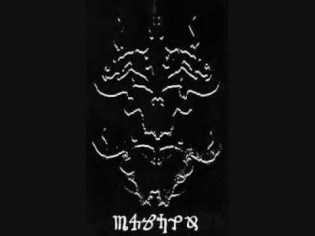
The Danzig logo was allegedly lifted from the cover of an obscure comic by Marvel called Crystar: Crystal Warrior, though Glenn insists to this day that he designed the logo. Here’s the cover, you decide.

The songs that were never intended to be fast numbers work the best under this approach.  “Soul on Fire” is probably the most complex song on the album, and quite possibly the best.  It settles into a nice groove and Glenn gets his croon going for the verse.  The chorus has a nice drum pattern, and if you listen closely you’ll notice a saxophone (or something sounding like a sax) buried under the mix which is pretty unique for a Danzig record.  The outro throws in some faster riffing and adds nice variety to the song.  “She Rides” is a slow brooder.  Really cheesy, but really effective.  I hear it used to be popular at strip clubs, which isn’t surprising.  The album’s closer “Evil Thing” is one of the few tracks that doesn’t feel like it’s being held back by anything.  Danzig’s wails sometime degenerate into snarls and the drums bring a great ferocity to the tempo.  It’s a track with more personality than most.  The future hit “Mother” also appears on this album, but one can see why it wasn’t a hit initially since it kind of just exists on this record as almost filler.  I should note for any Metallica fans out there, that James Hetfield has an uncredited role on back-up vocals on “Twist of Cain” and “Possession.”

The first Danzig album is a solid but under-stated debut for the new band.  So much so that one questions why producer Rick Rubin would opt for such an approach when something bolder might have worked better.  This album did come out during MTV’s highly influential peak and the band wasn’t able to produce a video that fit their criteria, which likely harmed sales.  Had the video for “Mother” been in-line with their standards perhaps it takes off in 1988 as opposed to 1993.  That’s not a criticism of the band though, as the band should conduct itself however it wishes and caving to corporate pressure isn’t very “metal.”  Missteps aside, this is a good album and an essential piece for any Danzig fan, there’s just better stuff ahead.

Top Tracks:

  • Twist of Cain
  • Soul on Fire
  • Evil Thing

Danzig

By now, it should be obvious that a post on this blog  titled “Danzig” is not going to be about the former port city in Poland.  Danzig is my favorite band and I make no attempt to hide that simple fact.  I could try to explain why I love Danzig so much but I’m sure I would find it difficult to adequately convey what it is I so admire about the man/band.  I’ll keep it simple and say I’m drawn to the rebellious nature of the music and Glenn Danzig’s infectious croons.  It doesn’t bother me that Danzig isn’t more beloved by music fans, though I steadfastly believe there’s a Danzig song out there for everyone.  I take pride in my extensive knowledge of all things Danzig so I thought it would be fitting to add to this blog a one-stop Danzig information center.  And by that I don’t mean stats on Glenn Danzig’s height or witty posts about piles of bricks in front of his house, I’m strictly talking about the music.  What are the albums worth checking out?  The best songs, lineups, and so forth?  Those are the questions I want to answer.

I will throw in some background information since this is the lead-in post.  Danzig is a band, but it’s Glenn Danzig’s band.  He writes all of the music and calls the shots.  Glenn grew up in Lodi, New Jersey and first began making a name for himself with the horror punk group The Misfits which got its start in the late 1970’s.  The Misfits were first conceived as a pretty straight-forward American punk band, but would later adopt the horror gimmick which gave the band a marketable identity.  The Misfits weren’t around for very long but made a lasting impression.  Unfortunately for those in the band, a lot of the success came well after the band’s demise in 1983 but the band’s influence can be felt all over the punk and metal genre.

Glenn’s next band was Samhain.  I already made an entry on Samhain so I won’t say too much about that band here.  Simply put, Samhain was a darker take on The Misfits with more influences from goth and metal.  Glenn wanted to do something a bit more serious while still keeping some of that horror camp The Misfits were known for.  Samhain was also short lived, for it was as Samhain that Glenn and the boys garnered the attention of record producer Rick Rubin who would sign the band in 1987 to his newly created Def American label.  It was at that time the band would be re-titled Danzig.

The man himself, circa 1992.

The Misfits and Samhain were both plagued by lineup changes throughout their existance.  Initially, Danzig was conceived as a super group with Glenn as the focal point.  The label would bring in difference musicians to play with Glenn to keep things fresh.  The initial lineup wasn’t full of names, but it had talent.  Eerie Von was the lone holdover from Samhain on bass, largely because he and Glenn were good friends.  Von wasn’t a gifted bass player, but bass was never a part of the production Rubin focused on so he put up little fight in letting Glenn retain Eerie.  Rubin brought in veteran drummer Chuck Biscuits to play on the first record.  Biscuits is a goofy guy with an even goofier name but one Hell of a drummer.  He was good enough that both Glenn and Rick saw no reason to make any changes for the following records, there was no point.  The ever persistent John Christ was hired to play guitar after auditioning numerous times to be in Samhain and Danzig.  I’m not sure what won him the job, perhaps it was a lack of options, but Christ’s style would fit the band’s early sound quite well.  What probably was supposed to be a one record deal ended up lasting for the duration of the band’s contract with American Recordings.

The first Danzig record was released in 1988.  Produced by Rubin, it featured a stripped-down sound with Rubin emphasizing on capturing the band’s live sound in studio.  He would force the band to get their parts recorded in one take and there was very little post-production and mastering.  The album was not a hit, and even though it would contain the track “Mother” the song wouldn’t garner much airplay initially.  Part of that was due to the Satanic imagery of the song’s video, making MTV wary of playing it without some censorship put in place.  It was this image that would also lead to the parent label, Geffen Records, from ever having it’s name or logo featured on a Danzig record despite being the distributor.  All of this mystique seemed to amuse Glenn and probably ended up helping create a dangerous image that attracted a younger audience.

Because the band was not an overnight success, Rubin would lose some interest and devote less time to producing the follow-up records.  The band’s second album, Lucifuge, would follow in 1990 and Danzig III: How the Gods Kill in ’92.  By now the band had gained a strong underground following, culminating in a sold-out Halloween show at Irvine Meadows during the How the Gods Kill tour.  Four tracks from that show, plus three new studio tracks including an Elvis cover, would comprise the 1993 Thrall: Demonsweatlive EP which was released alongside a slightly remixed version of “Mother” with a new video.  This video would receive airplay on MTV and it soon became a modest hit, propelling the band’s debut record and EP to gold status.

The band would follow-up the success of “Mother” with Danzig 4p in 1994.  4p would do well but not as well as the label was hoping for.  The single “Cantspeak” cracked the Top 100, making Danzig technically a 2-hit wonder, and the tour was fairly successful.  The band would also be asked to play on the main stage of the inaugural Ozzfest and did a support tour with Metallica as well, during which Glenn would join the guys on stage in some cities to do some classic Misfits tracks.

Danzig would prove disastrous for Disney’s image.

It was also around this time that the band began to fall apart.  Chuck Biscuits’ drug problems became too much to contend with and he would be replaced by new comer Joey Castillo for the 4p tour.  Glenn had long wanted to replace John Christ on guitar and by ’94 the feeling had become mutual and the two agreed to part ways following the tour.  It was at this time that Eerie Von also chose to leave, citing burn-out and being genuinely disappointed that the other guys were leaving.  The label, now known as American Recordings, was also showing little or no interest in re-upping on a new deal so Glenn shopped his talents around and was able to land a seven figure deal from start-up Hollywood Records.  This marriage would last only one album, the much maligned Blackacidevil, as the band’s parent company Disney wanted nothing to do with a band that was often associated with Satanism.  The deal would be terminated, and what would follow would be several years of legal battles between Glenn and Disney.

It wouldn’t be until 1999 when Danzig would resurface.  Now on Emagine Records, the band still consisted of Glenn and Joey Castillo on drums, but also had Josh Lazie on bass and Jeff Chambers on guitar.  This lineup would record Danzig 6:66 Satan’s Child, an album built up as a return to form for Danzig but ultimately would not meet those expectations.  Following the album’s completion, Chambers was replaced by Todd Youth (allegedly because he didn’t fit the band’s image) and Lazie would leave of his own accord and be replaced by Howie Pyro.  The first leg of the Satan’s Child tour featured a mini Samhain reunion and would prove to be the highlight of the tour.

With the collapse of the Emagine label, Danzig would self produce everything and seek out distribution deals.  He inked one such deal with Spitfire for the 2002 follow-up to Satan’s Child, Danzig 777 I Luciferi.  The same lineup as the previous tour recorded this one, but all would be replaced afterwards.  Circle of Snakes would follow in 2004, the tour for which featured a guest appearance by former Misfits guitarist Doyle.  Together he and the band would play a short set of Misfits songs during the Danzig set.

Now in his mid 50’s, Danzig proved with “Deth Red Sabaoth” that he’s not done yet.

Circle of Snakes would be the last album for Danzig for quite some time.  During his hiatus he would put out a classical album, Black Aria II, the follow-up to his original collection of classical music put out in 1992.  2007 saw the release of the long-awaited and much anticipated Lost Tracks of Danzig, a two-disc set spanning the band’s entire existence containing mostly unheard tracks.  It wasn’t until 2010 when a new Danzig record would be released, the well-received Deth Red Sabaoth, which may end up being the final proper Danzig album.  Only time will tell.  It so far has lead to a mini resurgence for the band.  Not only did it sell well, but Danzig even found himself on the soundtrack to the blockbuster hit The Hangover, introducing his song “Thirteen” to a whole new audience.  The band also has a new song featured on the sequel’s soundtrack set for release on May 24th, titled “Black Hell.”

It’s my intention to post a review for each Danzig record, the major releases and the smaller ones including both Black Aria records.  I’ve already posted reviews for Danzig II and Danzig 4, so check back for a review of the 1988 self-titled record in the near future.  I haven’t decided if I’ll just review them all chronologically or not, but eventually they’ll all be posted and hopefully readers find them both interesting and useful.

Listen to Danzig!


Kamelot Abandoned

It was announced officially on April 21st that vocalist Roy Khan was leaving the

Former Kamelot vocalist Roy Khan.

band he had fronted for the last 13+ years, Kamelot.  This did not come as a surprise for fans.  Khan had bowed out of touring just a week before Kamelot was to kick off the first leg of its tour in support of its new album, Poetry for the Poisoned, due to what he called exhaustion.  No reason was given beyond that and the band was forced to scramble to find a replacement for the tour.  After initially announcing the tour would go on with Michael Eriksen of Circus Maxima, the band decided to cancel it out-right and resume touring in the spring.  Khan would release another message a few months later to update the fans on his health.  Included in that message was a snippet where Khan stated he was evaluating his future in the music industry.  Rumors began to circulate that Khan was done, had embraced a new religion, and no longer wished to be associated with Kamelot.

Those fears were unfortunately met.  No one knows the real reason for his departure, it could be religiously motivated, he could just wish to spend more time with his family, or it could be something else entirely.  In the end, it doesn’t matter much to the remaining members of Kamelot and its fan-base.  Kamelot was steadily gaining fans and growing into a medium-sized act that could attract a healthy crowd outside of the US, and a modest one within the US (which is about as much as any metal band can hope for in the States).  This undoubtedly is a set-back.

Replacing a lead vocalist is the hardest thing to do for an established act.  Even in a situation like Kamelot’s where another member of the band is the unquestioned leader, it still proves trying because most listeners identify with the frontman.  He’s the person always, appropriately enough, placed in front for pictures and press materials.  He is the one who engages the audience through a microphone, and it’s often the vocals and lyrics most listeners notice first.

A departing vocalist can sometimes derail a band, and sometimes it can help.  Iron Maiden is a good example of both.  Like Kamelot, the leader of the band is not the vocalist but bassist Steve Harris.  The first two Iron Maiden records featured Paul Di’Anno on vocals.  Di’Anno was not a good vocalist by traditional standards, but he had a certain attitude and high range to suit the band’s early sound.  Di’Anno was dismissed after touring was completed for the album Killers, and he was soon replaced with former Samson vocalist Bruce Dickinson.  The rest is history.

Replacing Bruce Dickinson proved to be an impossible task for Iron Maiden.

Iron Maiden would experience tremendous success with Dickinson, but by the time the 90’s rolled around Dickinson was experiencing exhaustion (sound familiar?) and wanted to stretch his creative wings so he departed following 1992’s Fear of the Dark LP and tour.  Iron Maiden would attempt to replace him with Wolfsbane frontman Blaze Bayley, but the move wasn’t a popular one.  There was no replacing Dickinson in the minds of Maiden fans, and the band’s popularity was reduced to next to nothing in the 90’s.  Fortunately for the band’s health and the fans, Dickinson returned in 1999 and Iron Maiden is currently enjoying a second golden age for itself.

Other bands have found mixed results.  Van Halen famously replaced David Lee Roth with Sammy Hagar in 1985 and found success early on, but it soon tapered as the 80’s ran into the 90’s.  Nightwish more recently replaced its front-woman, Tarja Turunen with Swedish vocalist Anette Olzon.  One album has been released with Anette and it has sold well, the next album will be an important one to see if Olzon’s success is sustainable.

It remains to be seen what will become of Kamelot.  The band announced it has begun searching for a new permanent vocalist.  Currently the band is on tour with Rhapsody of Fire frontman Fabio Lione as a stand-in so it is unlikely the band will begin auditioning new members until the tour’s completion.  Guitarist and founder Thomas Youngblood hinted that he was interested in finding a vocalist that could sing in a higher register than Khan.

A new vocalist is actually not a new thing for Kamelot.  The Iron Maiden parallels are strong with this band, as the first two Kamelot albums featured a different vocalist, Mark Vanderbilt.  Khan was brought in to replace him for the band’s third release, Siege Perilous, and the band began to garner more and more attention with each successive album.

Early on, Khan was able to hit higher notes, but beginning with the album Epica he noticeably sang in a lower tone.  This was not necessarily a bad thing.  Roy Khan delivers his vocals with extreme, measured precision.  His voice is filled drama and his theatric flair compliment the band’s approach extremely well.  He also composes most of the band’s lyrics, and for the last decade has established himself as one with the band’s identity.  Replacing such a unique presence will not be easy, but I wish the rest of the band much luck in doing so.

Kamelot – “Abandoned”:


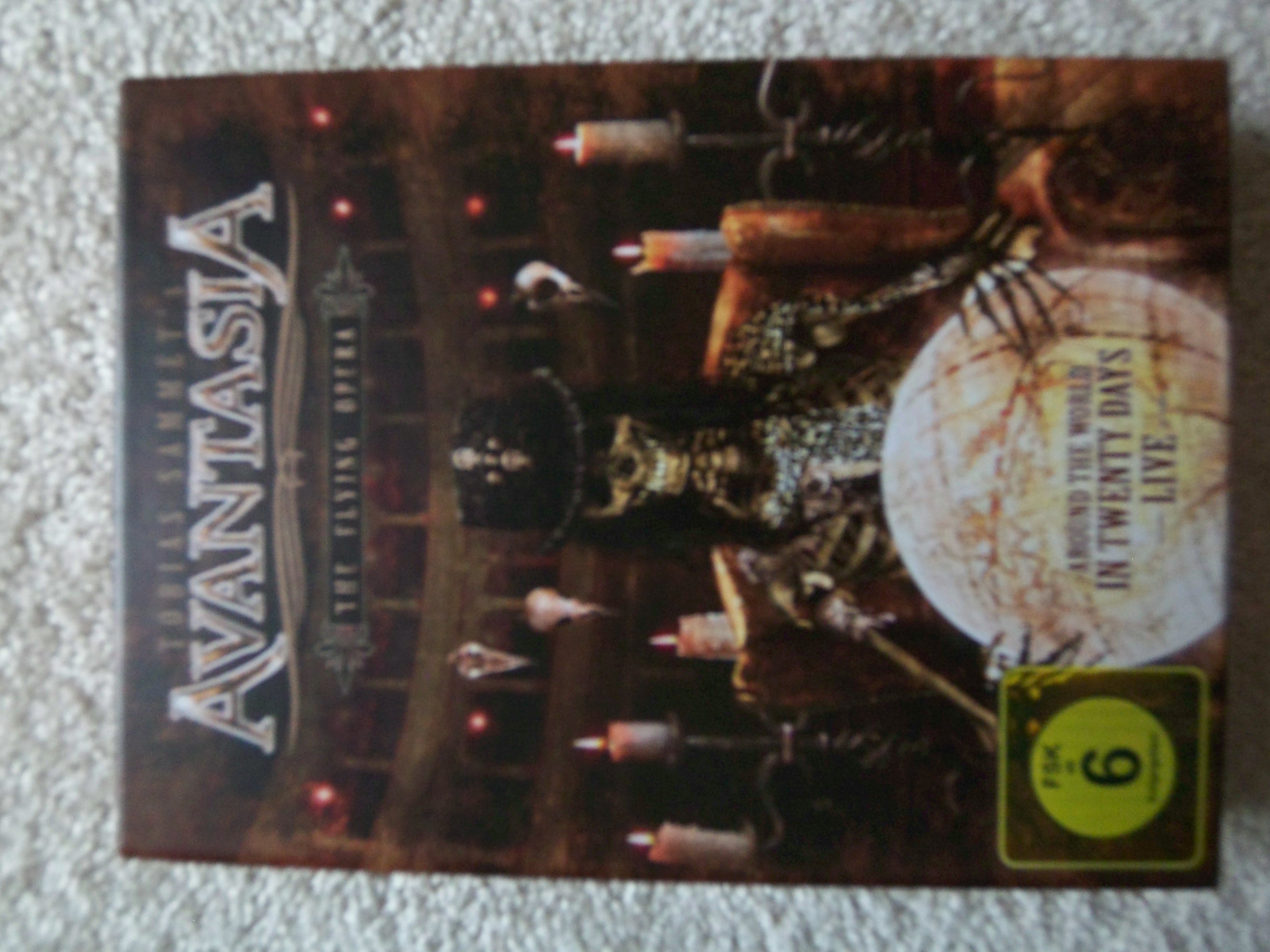
Avantasia – The Flying Opera DVD+CD Review

Avantasia - The Flying Opera: Around the World in 20 Days (2011)

When it was announced in 2008 that Avantasia was going to hit the road and bring its majestic metal brilliance to the masses I was overcome with joy.  Initially.  Then I remembered that I live in the US and was overcome with despondence.  Then I brightened up again for surely Tobi would arrange to have these massive shows filmed!  Then I despaired when I found out the release would be on indefinite hold while Tobi took care of his duties to Edguy and worked on new Avantasia material.

This vicious cycle finally came to a close this week when Avantasia – The Flying Opera: Around the World in 20 Days arrived at my door!  For those not wise to European Power Metal, Avantasia is the brainchild of Edguy frontman Tobias Sammet and features a huge ensemble cast of characters that deliver the most bombastic cuts of music you will ever hear.  I previously wrote about Avantasia’s third album, The Scarecrow, in my top 10 feature.  These shows were done the summer following the release of that album and feature most of the musicians that appeared on that record.

Avantasia is such a big production that it seemed impossible to take it on the road, and that was the feeling Tobias had as well.  Too many pieces, too many schedules to accommodate.  But as he elaborates on the included documentary, the promoters behind Germany’s massive Wacken Open Air festival called to make an offer for Avantasia to headline (when Tobi declined, they went to Iron Maiden, Iron Maiden was their second choice!) the festival, and that’s what got the ball rolling.  Yes he initially declined, but after talking it over with Avantasia guitarist and super producer Sascha Paeth, Tobi was convinced it could happen and made arrangements to headline the festival’s second night.

Avantasia would end up playing a handful of festivals and some other one-off shows in pretty much all parts of the world except North America.  I am not angry by that at all, America doesn’t support metal.  It comes with the turf.  Our music scene is shit and our culture worships disposable beats and giant egos.

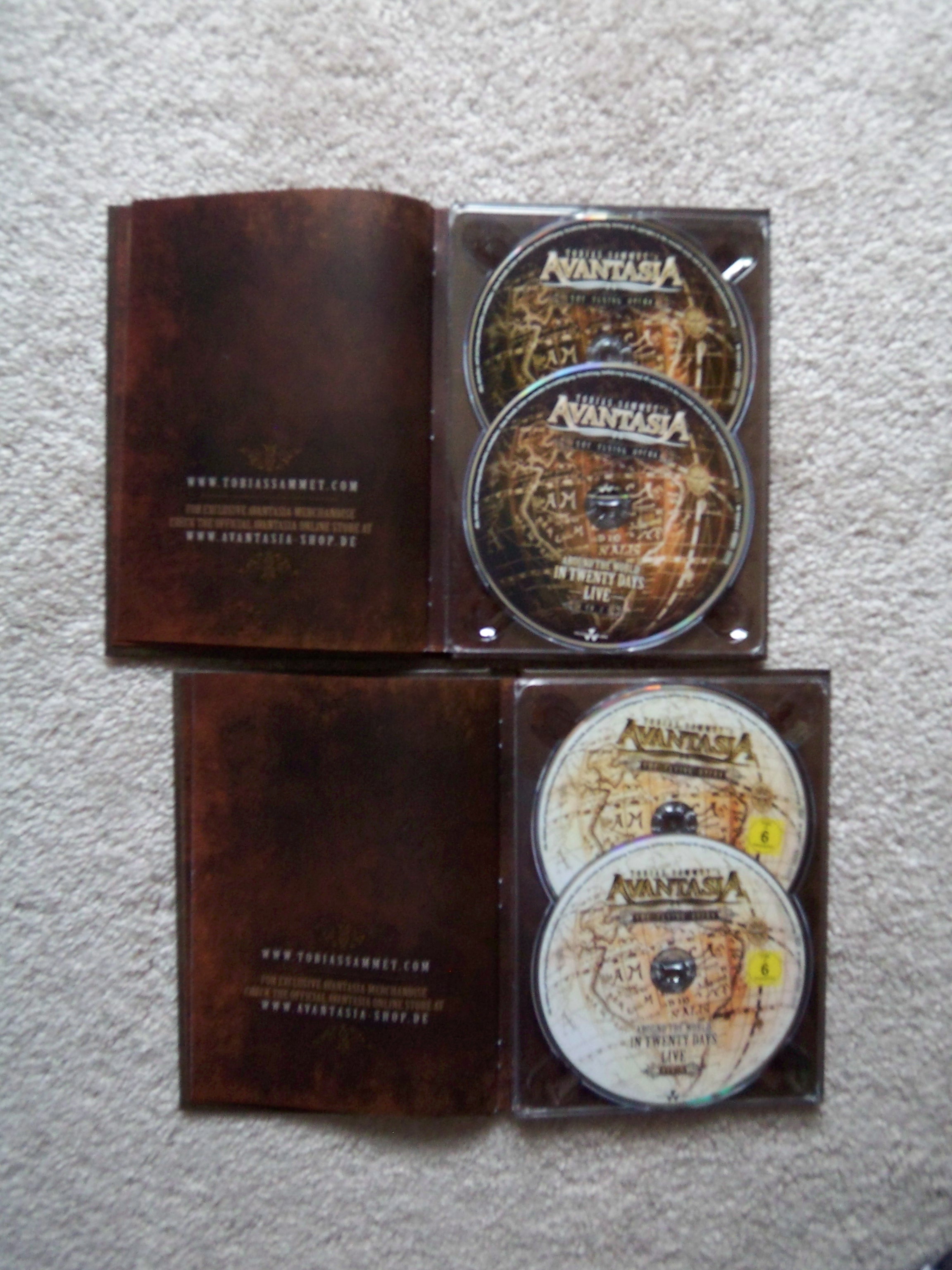
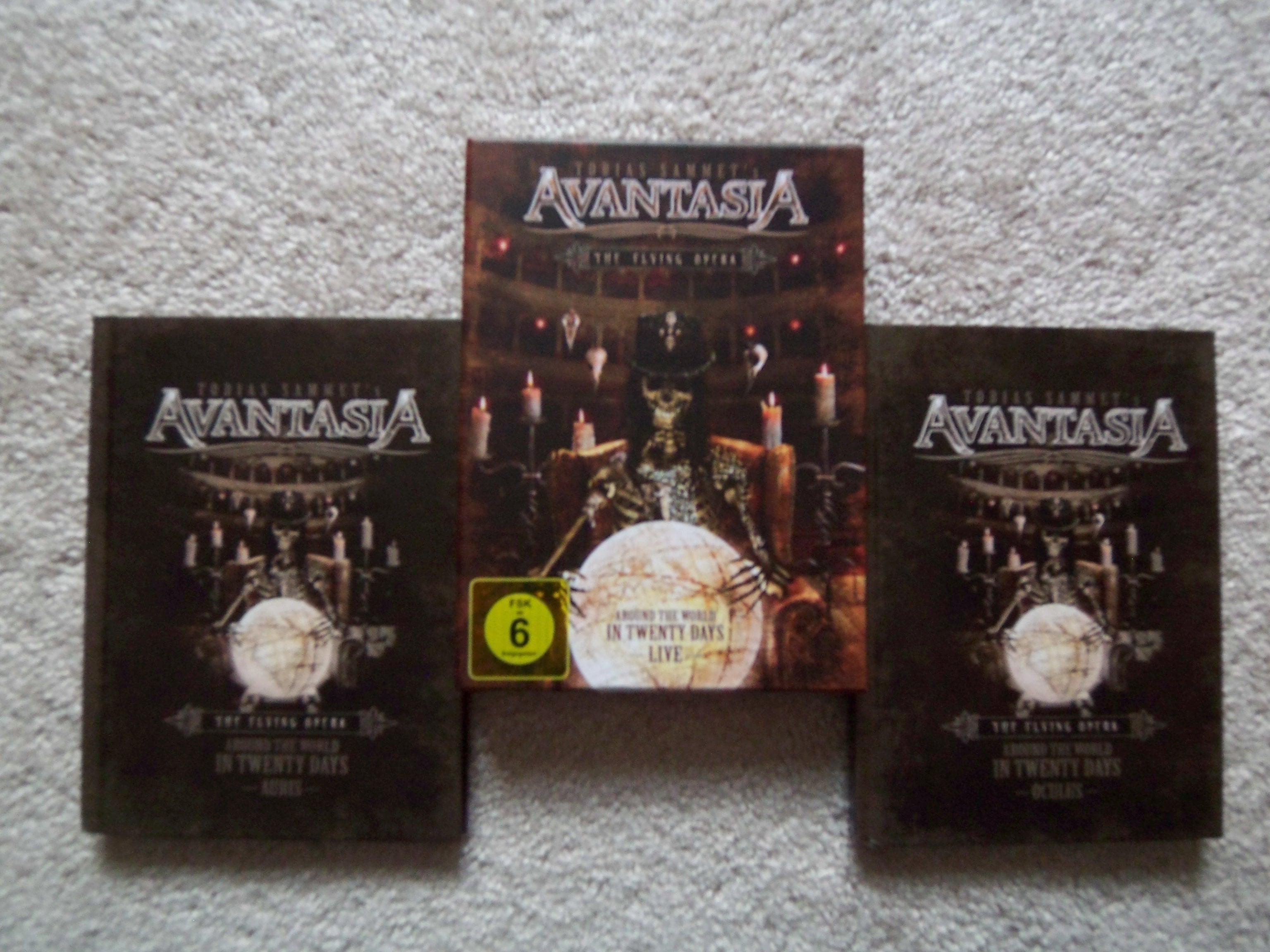
And inside look at both digi-books. CD top, DVD bottom.

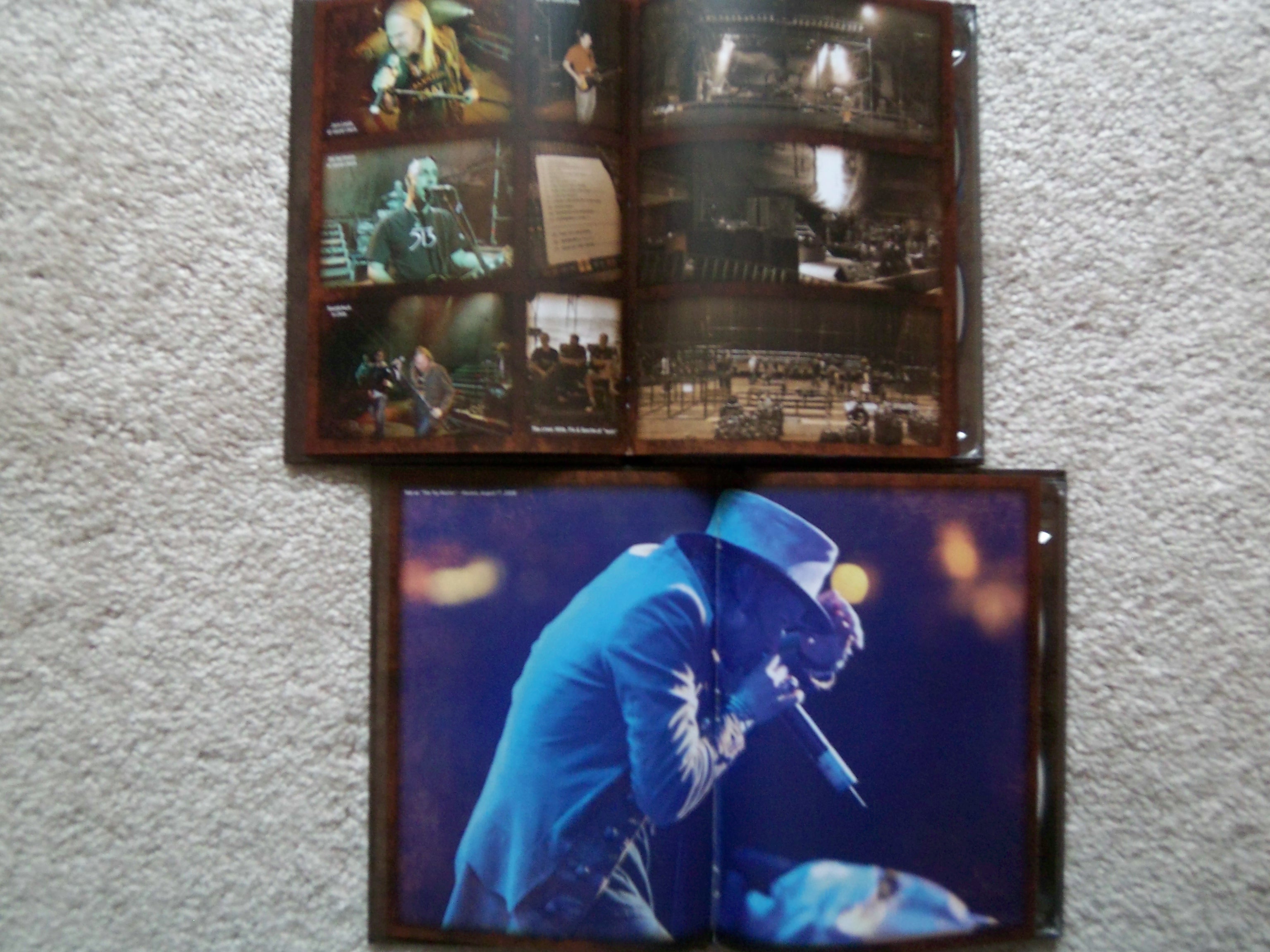
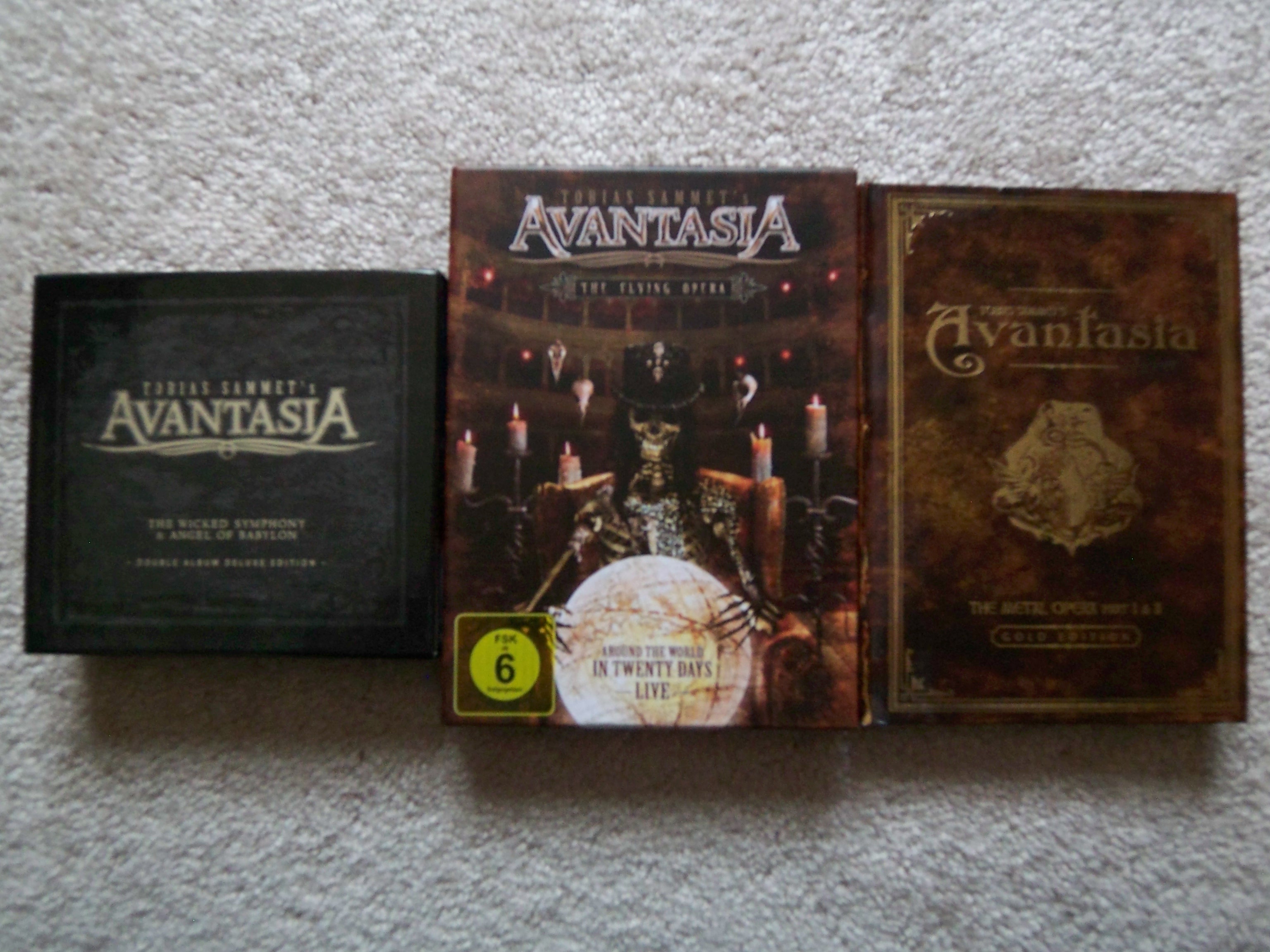
The shows at Wacken and Masters of Rock in the Czech Republic were filmed for a DVD release and this is it.  It took forever to get the thing out, nearly three years, but I am happy to report it was worth the wait.  It has only been released in Europe thus far, so if you want it you’ll have to go through an import shop (like I did) or through Nuclear Blast’s webstore, but they’ll kill you on shipping.  I was able to score a copy of the deluxe edition for 40 bucks.  That’s two DVD’s and two CD’s in a fabulous (yes, I said fabulous in a metal DVD review) digi-book style packaging.  The digi-books contain numerous photos of the band’s trek around the globe for the tour.  It also contains an exhaustive credits section for each performance.  Sadly, there are no liner notes from Tobi like the ones included in the gold version of The Metal Opera and special edition of The Wicked Symphony/Angel of Babylon set.  Tobi is often a fun read as he’s quite candid and has a good sense of humor so that omission is not only disappointing, it’s actually rather surprising.

A look at the photography.

The meat of the set is of course the concert footage.  The footage features performances from both Wacken and Masters of Rock.  Presumably, the editors took the best from each show to put the package together.  I also believe Kai Hansen was not on hand for the Wacken performance so that’s another reason to include footage from Masters.  The footage from Wacken is noticeably better.  The stage is bigger and lighting is much brighter than the comparably dank Masters of Rock stage.  It almost looks like there’s a slight fuzz to the picture from the Masters of Rock footage when compared to Wacken.  It probably wouldn’t be as noticeable if the show didn’t switch from one to the next on the fly.  Thus said, it isn’t horrible but definitely noticeable.

The audio for both is quite excellent, and I suppose that’s the important part.  The guitars and bass sections are at the appropriate level and all of the vocalists give excellent performances.  It’s hard to say who shines the brightest as there are so many great moments.  The ageless Bob Catley is used somewhat sparingly, but he really steals the spotlight for “The Story Ain’t Over.”  Jorn Lande is predictably powerful, though he does struggle slightly during the faster parts of “The Scarecrow.”  Olli Hartmann is excellent on backing vocals and really nails his leads on “I Don’t Believe in Your Love.”  Andre Matos sings his own parts on the songs from The Metal Opera, and also handles all of Michael Kiske’s parts.  The exclusion of Kiske is a disappointment, but also expected as that guy never tours (until 2010 when he did do a few shows with Avantasia that I really wish could have been added to this set at the last minute).  Kai Hansen puts down the axe to take over Alice Cooper’s role on “The Toy Master” and absolutely nails it.  Tobi is his usual self as sort of the ring leader of the whole thing.  He’s out there for every song and does a nice job.  He does struggle noticeably on “Another Angel Down” but that’s a really difficult song to sing and he doesn’t let it drag him down.  I should point out, there is at least one instance where it is obvious Tobi over-dubbed his vocals, and that’s on the high parts during “Farewell” as the audio isn’t perfectly synced with the video.  I’m always a little disappointed when a musician feels the need to cover-up the live aspect.  The original audio is available on youtube should anyone choose to try and find it, and it wasn’t that bad, his voice gives out on one of the highs not unlike what he experienced during “Another Angel Down.”

For the band, it’s Paeth and Hartmann that shine the most as the lead axe-men.  Paeth is an excellent guitar player and anybody that’s listened to the Avantasia albums he’s played on is well aware of that fact.  Hartmann, on the other hand, is a nice surprise on lead as before this (as Tobi points out) most of us only knew of him as a vocalist.  He rips it up here and both guys add some nice touches to dress-up the old songs with out seeming showy.

Side by side, the special editions of "Wicked Symphony/Angel of Babylon," "The Flying Opera," and "The Metal Opera."

The set-list is quite good though likely the thing fans will most obsess over.  It’s definitely Scarecrow heavy but most of the old classics are included.  Considering, aside from a couple one-offs, that none of these had been played live before nothing actually feels old.  Some will likely lament the fact that The Metal Opera Part II is under represented in the set-list, and they’ll be right.  Only one song is played in full, “No Return,” while the chorus to “The Seven Angels” is sung medley style to close out the show.  It’s hard to figure where another track from that album would fit though.  I suppose “Chalice of Agony” could have been included at the expense of another fast song.  “Anywhere” is a great power ballad, but would seem redundant after the inclusion of “Farewell” and “Inside.”  For the 2010 tour Tobi did dust-off “In Quest For,” but at the expense of the superior “The Story Ain’t Over” so maybe he did the right thing this time out.

As far as the best performance goes, it’s really hard to pick.  “Promised Land” is excellent and “The Scarecrow” has that big, epic feel it kind of lacked in the studio.  I already mentioned Mr. Catley’s fantastic performance on “The Story Ain’t Over,” and I really enjoy “Farewell.”  The closer is great too, a medley of “Sign of the Cross” with everyone on stage that goes into “The Seven Angels.”  Bottom-line, there is no bad performance.  I think fans will be very pleased in that regard.

Digi-book 1 (Auris), slip case, digi-book 2 (Oculus).

Disc 2 contains a documentary of the tour.  It runs around an hour and it’s mostly Tobi talking about the experience and serves as a brief history of the whole Avantasia project.  It’s informative, but a bit underwhelming.  There’s no interviews with the other people involved and doesn’t really do a good job of making the viewer understand what it was like to be on tour with the band.  It’s one of those things most will watch once and then put it aside.  The special features just include the three Avantasia music videos:  “Lost in Space,” “Carry Me Over,” and “Dying for an Angel.”  As I mentioned before, some clips from last year’s tour would have made for great special features, or the footage that wasn’t used for disc 1 so that fans would have the entire Wacken and Masters of Rock footage.

The second digi-book contains another photo-booklet and two CD’s of the performance.  It’s just the audio from the DVD’s but it’s still pretty fantastic.  It’s crystal clear, just like the DVD, and makes for a nice companion piece.  I’ve been listening to it non-stop all week and I’m the type of person who gets bored with live albums real fast.  I believe there’s a standard edition of the The Flying Opera that is just the DVD, but if you’re interested in this do yourself a favor and just get the combo pack.  You get the snazzy packaging and two CD’s.  Of course, I’m an Avantasia fanatic so take that for what it’s worth.

Ultimately, if you’re an Avantasia fan you should definitely get your hands on this collection.  Especially if you’re like me and had no shot of seeing the actual show as this is likely as close as you’ll get.  Yes it is disappointing that it took so long to get the thing released, and once done, a tour featuring Kiske had passed us by and they skimped on the extras.  As they say, beggars can’t be choosers.  This has just vaulted to the top of my favorite concert DVD’s list over the likes of Maiden, Opeth, Kamelot, and assorted others, where it likely will remain for a long time to come.

The full setlist:

  • Twisted Mind
  • The Scarecrow
  • Another Angel Down
  • Prelude/Reach Out for the Light
  • Inside
  • No Return
  • The Story Ain’t Over
  • Shelter From the Rain
  • Lost in Space
  • I Don’t Believe In Your Love
  • Avantasia
  • Serpents in Paradise
  • Promised Land
  • The Toy Master
  • Farewell
  • The Sign of the Cross/The Seven Angels (Medley)

Samhain

Samhain is a little known band that existed for only a short while from 1983 to 1987 but a band that I am quite fond of.  Samhain is the Glenn Danzig fronted band that was formed after the demise of The Misfits and would eventually be signed to the Def American label and become Danzig.  In its brief existence, Samhain put out two full length albums and one EP.  A final LP, Final Descent, would be released posthumously in 1990.  Even including that last album, the entire Samhain catalog can be listened to in under a couple of hours.

A lot of casual fans of either The Misfits or Danzig, myself included at one time, were not even aware of the existence of Samhain.  Samhain was never as highly regarded as The Misfits and did not have the means of reaching as broad an audience as Danzig.  Like with The Misfits, Samhain played the smallest venues in the country and all of their releases were put out on Glenn Danzig’s Plan 9 label with backing from Caroline Records.  The band logically serves as the bridge from The Misfits to Danzig, merging horror, punk, goth, and metal to create its signature sound.  There really isn’t another band quite like Samhain, and it served as an outlet for Glenn Danzig to try out new ideas.

Originally, the band was conceived as a side project from The Misfits, but when the The Misfits disbanded in 1983, it became a full-time band.  Some of the final Misfits tracks were initially conceived by Danzig as Samhain tracks, specifically, “Death Comes Ripping” and “Bloodfeast.”  The first LP, Initium, featured only three full-time members; Danzig, bassist Eerie Von, and drummer Steve Zing.  Von was a good friend and classmate of Misfits guitarist Doyle who had often followed the band around and served as their photographer for a number of years.  Zing was from Lodi, NJ and grew up in the same neighborhood as a lot of the guys from The Misfits.  Lyle Preslar, of Minor Threat, played most of the guitars on Initium and was to be in the band but he split over creative differences.


Initium (1984), the band would sometimes cover themselves in blood for live performances.


Initium begins with an effects laden track of the same name that Glenn speaks over announcing his rebirth.  It was Glenn signifying on recording the end of his previous band and the start of a new one.  Hokey, but effective, it leads immediately into the song “Samhain” which also occupies the slot of track 1 on the CD release.  The punk attitude is still present but the image conjured up by the band is noticeably darker.  The lyrical content is not much of a step-up from the ghouls and ghost imagery of The Misfits but the delivery is noticeably more serious and dangerous in tone.  The album’s cover sports the three main members drenched in blood as if they just emerged from an unholy womb.

The album makes use of ambient sound effects and occasional chimes which give it a gothic quality.  Some songs sound like they could have been pulled off by The Misfits, most notably the up-tempo and kind of silly “All Murder, All Guts, All Fun” or the catchy “He-Who-Cannot-Be-Named.”  One track, “Horror Biz,” is a remake of The Misfits classic “Horror Business.”  Its main difference from the original is the more aggressive drum track laid down by Zing and a more methodical vocal delivery by Danzig.  Where Samhain separates itself from its predecessor is with moody tracks like “The Howl” or the engaging closer “Archangel.”  “The Howl” creates a mood of unease as it tells its tale of murder in a cliche house on a hill.  “Archangel” contains two bass tracks and the only thing resembling a guitar solo on the record.  It’s mid-tempo and easily the album’s brightest (or darkest) moment.  It is also noteworthy for being one of the only songs Glenn Danzig breaks out his guitar for on stage, freeing up the other guitarist to play the additional bass track.

Unholy Passion (1985) – original release, the second pressing would contain some maroon colored covers.

After Initium, Pete Marshall would be added as the permanent guitar player.  Marshall would take the stage name of Damien for his tenure with Samhain and played on the follow-up EP, Unholy Passion.  The original release of Unholy Passion contained only four new songs and included another Misfits remake, this time “All Hell Breaks Loose” would be re-recorded and re-titled “All Hell.”  The new tracks picked up where Initium left off and continued to explore a more goth-infused brand of punk rock.  It’s almost a toss-up over which song is the standout track, the death-laden groove punk title track or the roller coaster closer “I Am Misery.”  The latter contains some of Glenn Danzig’s more imaginative lyrics as he, as the title implies, takes on the personification of misery.  Subsequent versions of the EP would be released alongside an additional track, titled “Misery Tomb” which just contained the wails and some of the ambient noise from “I Am Misery” remixed with the song’s bass track.  The CD version of Initium would also be re-released in 1987 with the Unholy Passion EP added on, but with over-dubbed guitars by Glenn (presumably to avoid having to pay Damien royalties).  The first release of Final Descent would also contain the Unholy Passion tracks tacked on.  Even though the EP runs just a little over 15 minutes, it may be start to finish my favorite Samhain release.  For me, this is where the Samhain sound was perfected and would carry over into the following release.  Though if quantity plays a role in defining my favorite Samhain album, then the third Samhain release would take the crown.


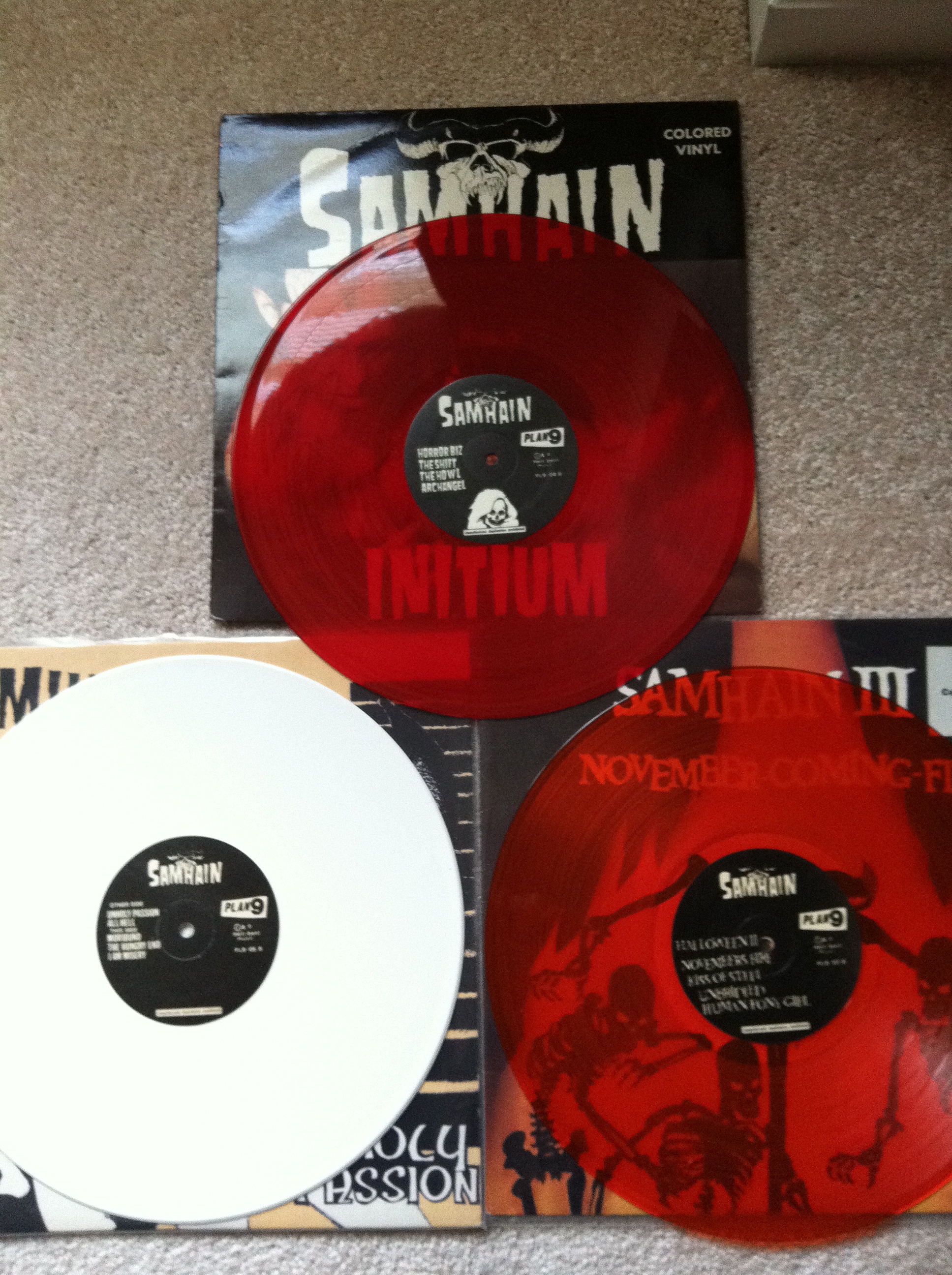
Samhain III – November-Coming-Fire (1986). From my personal collection of the colored vinyl edition.


Samhain III – November-Coming-Fire was released in 1986.  It was the band’s second full length album and is probably their most popular.  For this release the band welcomed a new drummer, London May formerly of Reptile House, who helped to refine the Samhain sound.  There’s lots of reverb throughout the record along with a steady stream of background “fuzz” which helps give the album a great deal of character.  Stylistically, it is not too different from the previous EP though it does contain more variety.  Some of Samhain’s fastest tracks, as well as its slowest, appear on this record which clocks in at just under 29 minutes.  It contains yet another Misfits remake, this time “Halloween II,” which takes the old experimental track and turns it into a fully realized song.  The guitar is crunchy and the pace almost takes on a slow gallop.  It would become a crowd pleaser even into the Danzig years.

Some other standouts include the aggressive first song (second track following the instrumental intro) “In My Grip” and the rollicking “November’s Fire.”  The most popular track may be “Mother of Mercy” thanks to the band Metallica who included it on their version of Guitar Hero a couple of years ago.  My personal favorite moment for the album is the ballad-like “To Walk the Night” which carries over into the up-tempo “Let the Day Begin,” the latter features probably the album’s catchiest chorus.

Colored edition of the initial vinyl release for NCF.

It was after “November-Coming-Fire” that Glenn Danzig signed onto a major label and Samhain became the band Danzig.  Glenn was able to retain Eerie Von as his bass player but Rubin, wanting to create some sort of a supergroup, paired the two with drummer Chuck Biscuits.  John Christ would eventually be added as the guitar player and ended up playing on Samhain’s last LP, Final Descent.  Biscuits also contributed drums for one track, “Death…In Its Arms” for that release while a drum machine was used for the rest.  Final Descent was released on CD in 1990 and showed off a more metallic edge with some influences from the blues genre.  The track “Descent” is a powerful opener that shows off the heavier sound while the previously mentioned “Death…In Its Arms” is more of a plodder with a groove reminiscent of later Danzig works.

Final Descent (1990). Released three years after Samhain’s disbanding, it was originally titled Samhain Grim.

In 2000 the long-awaited Samhain Box Set was release by E-Magine Records on Danzig’s own evilive label.  For that release Final Descent received additional tracks including early arrangements for the Danzig songs “Twist of Cain” and “Possession,” as well as an earlier version of the band’s Elvis cover song “Trouble.”  They were joined by a second version of “Lords of the Left Hand” which was much faster than the previous one.  A live album was also added as a fifth CD and contained nearly an hour’s worth of material from 1985-1986.  Some bootlegs were also rounded up and mashed together onto a VHS which features a few songs from the band’s final performance as Samhain.

Samhain burned bright during its brief existence and created a memorable catalog of music.  It clearly was a transition period both musically and in general for the band’s members.  Some of that sense of creativity and experimentation was lost when the band became Danzig so it’s no telling where Samhain would have ended had it not been for the influence of Rick Rubin.  Rubin of course would end up overseeing some great records put out by Danzig so it isn’t as if it was a bad thing the direction of the band was interrupted, merely something to ponder.  When Danzig left the American label for Hollywood Records to put out Danzig 5 – Blackacidevil, he was quoted as saying this is where he thought Samhain was progressing to.  I am not sure I completely agree with him there as I think some of the motivation for that statement was to calm the masses over Danzig’s new industrial sound.  I think it is fair to assume that Samhain would have continued exploring other effects and sounds but I’m not convinced the band was heading in so drastic a direction.  I’m quite thankful for the internet and the E-Magine releases of the Samhain albums as it allowed me to get acquainted with this interesting and often overlooked band.  I suppose The Misfits were more accessible for fans, but I find the Samhain music more rewarding with the Danzig era stuff being my preference.  As I continue to amass old vinyls from Glenn Danzig’s past, I’ve gone back to Samhain and I think I’ll continue to do so off and on for the rest of my days.

One last picture, the colored vinyl releases for each of the first 3 Samhain albums. Clockwise from top: Initium, November-Coming Fire, Unholy Passion.


#1: Danzig II – Lucifuge

Danzig II – Lucifuge (1990)

My choice for my favorite album of all time should come as no surprise to anyone who knows me personally.  I’ve already expressed my admiration for all things Glenn Danzig previously, but this should drive that point home.  It may seem like an odd choice, but this is my list where the only criteria is enjoyment, so deal with it.

Danzig II – Lucifuge is a great record.  I suppose considering that I’m ranking it as the best kind of speaks for itself.  It’s a marriage of hard rock and blues that stands out amongst the Danzig catalog.  Glenn Danzig is a musician that has touched on several genres including rock, metal, industrial, and even classical.  It is perhaps one of Danzig’s greatest strengths that as a listener you know you’re in for a new experience each time he releases a new album.  That’s not to say he hasn’t had his missteps along the way, but Danzig II is not one of them.

Released in 1990 after a solid debut in 1988 on producer Rick Rubin’s newly created Def American label (the first Danzig record was actually Def American’s first ever release), Danzig II was meant to build off the first one and take the band to new heights.  Because of the imagery associated with the band, parent company and distributor Geffen Records refused to have their name appear on any of the releases and the band found airplay hard to come by on both radio and MTV.  There was a lack of buzz at the label as a result, so Ruben took a more hands off approach with the band’s sophomore effort than he did with the first one.  This gave Glenn Danzig almost total control over how the album sounded and it’s easy to hear the difference in approach between this record and its predecessor.

An image from the “Devil’s Plaything” video, perhaps my all time favorite song. When Danzig dusted this one off for the 2008 tour the place went nuts, prompting a remark after the song from Glenn that went something like, “I guess you guys liked that one.”

Rubin went for a stripped down rock approach on the first Danzig LP.  On this one, the direction has never been clearly stated but it seems like Glenn and the boys wanted to introduce some more blues elements.  That influence is most notably felt on the acoustic sing-along “I’m The One,” a throw-back track to the old blues guitar men and early country artists.  There’s still plenty of rock and the album’s opener “Long Way Back From Hell” is a perfect example of that.  It begins with a dive riff that goes into an up-tempo chorus.  Right away, it sounds faster than anything that was present on the debut album.  Danzig’s vocals are in top form as he belts out the chorus and asks the listener if they wish to join him and the band on this devilish voyage.  “Snakes of Christ” slows things down a bit and places Christianity in the band’s crosshairs.  It’s songs like this that helped to earn the album a parental advisory, despite an absence of profane language.

There are quite a few songs with unique sounds on this record for the band.  “Tired of Being Alive” doesn’t quite sound like anything Danzig had done before that or since.  It’s pretty much straight up rock with a real catchy riff.  The chorus features some layered vocals that also was a departure in sound.  “Blood and Tears” was Glenn Danzig’s first real ballad, a quiet number with a big chorus and one of the album’s standout tracks.  “777,” the original title track before Glenn opted for Lucifuge, experiments with melding acoustic guitars with electric ones giving the chorus a real “twangy” sound.  “Pain in the World” is a big Sabbath-like song that has a slow, plodding pace before going into a big, guitar driven outro.  It sounds almost out of place at first, but becomes an acquired taste that gives the album greater variety.

The cover for the LP version, an homage to The Doors.

The album was released across three formats, cassette, CD, and LP, with the CD featuring a different cover than the other two.  The CD booklet on the original release had a neat gimmick where it folded out into the shape of an inverted cross which probably delighted parents across the country.  It was also the album that gave us the classic Danzig logo of a ram skull head mounted on an inverted cross.

For me, Danzig II is sonic perfection.  It features some of Glenn’s best riffs and vocals and all of the songs pack a punch.  The subject matter has become standard fare for Danzig but in 1990 the rebellion and challenges against firmly entrenched institutions was fresh.  A lot of the songs have become staples in the Danzig set-list over the years and it’s cited by many fans as their favorite record.  And for someone with over 30 years in the music industry, such praise should not be taken lightly.

Top Tracks

  • Long Way Back From Hell
  • Devil’s Plaything
  • Blood & Tears

Collections

For me, collecting things is as much a hobby as it is a compulsion.  For those that are considered hoarders, I suppose it most certainly is a compulsion and one without logic as hoarders tend to keep everything and anything.  My collections have at least always been relatively specific.

An extremely small portion of my Marvel action figure collection: Moon Knight, Bobby Drake, Deadpool, Iceman, Venom.

Like most boys, my earliest collection was baseball cards.  For many kids in the 80’s this was a big hobby.  As we gathered and amassed cards of our favorite athletes we would often speculate how much they would be worth one day, certainly more than what we paid to acquire them.  The card market ended up collapsing though and most of those cards are worthless.  I was never real big into it so I never amassed a large assortment, just a tin canister’s worth and a binder.

My next collection would be one that would last a long, long time for me:  action figures.  As a kid, they were toys first, and a collection second.  I played with them and got lots of milage out of various Teenage Mutant Ninja Turtles, Ghostbusters, and X-Men for much of my youth.  I don’t know at what age it became more of a hobby than a toy, I’d speculate when I was around 10 or so, but for a little while longer I continued to buy new ones even though I didn’t actually play with them.

My most recent (and final?) action figure purchase; The Monarch and Dean Venture. And yes, that is a Glenn Danzig doll in the background.

Eventually I became more interested in other things, music and video games mostly, and spent my limited income there.  Around the time I started working part time jobs I got the itch to pick up where I left off.  I’m not sure why, though I think it mostly had to do with the quality of action figures released in the late 90’s and early 2000’s compared with what I had growing up.  In the mid 90’s, Todd McFarlane’s company got into the action figure market and revolutionized it.  The company’s philosophy was that a better looking figure could be created without radically increasing costs.  They spent just a little more time than the other companies creating better and more detailed molds and the results blew the competition away.  Marvel’s parent company Toy Biz would eventually catch up and start producing their Spider-Man Classics, and eventually Marvel Legends, line with a similar philosophy.  The figures were now a bit bigger and more detailed and while McFarlane was willing to sacrifice articulation for visuals, Toy Biz crammed as many movable parts into their toys as they could reasonably accommodate.

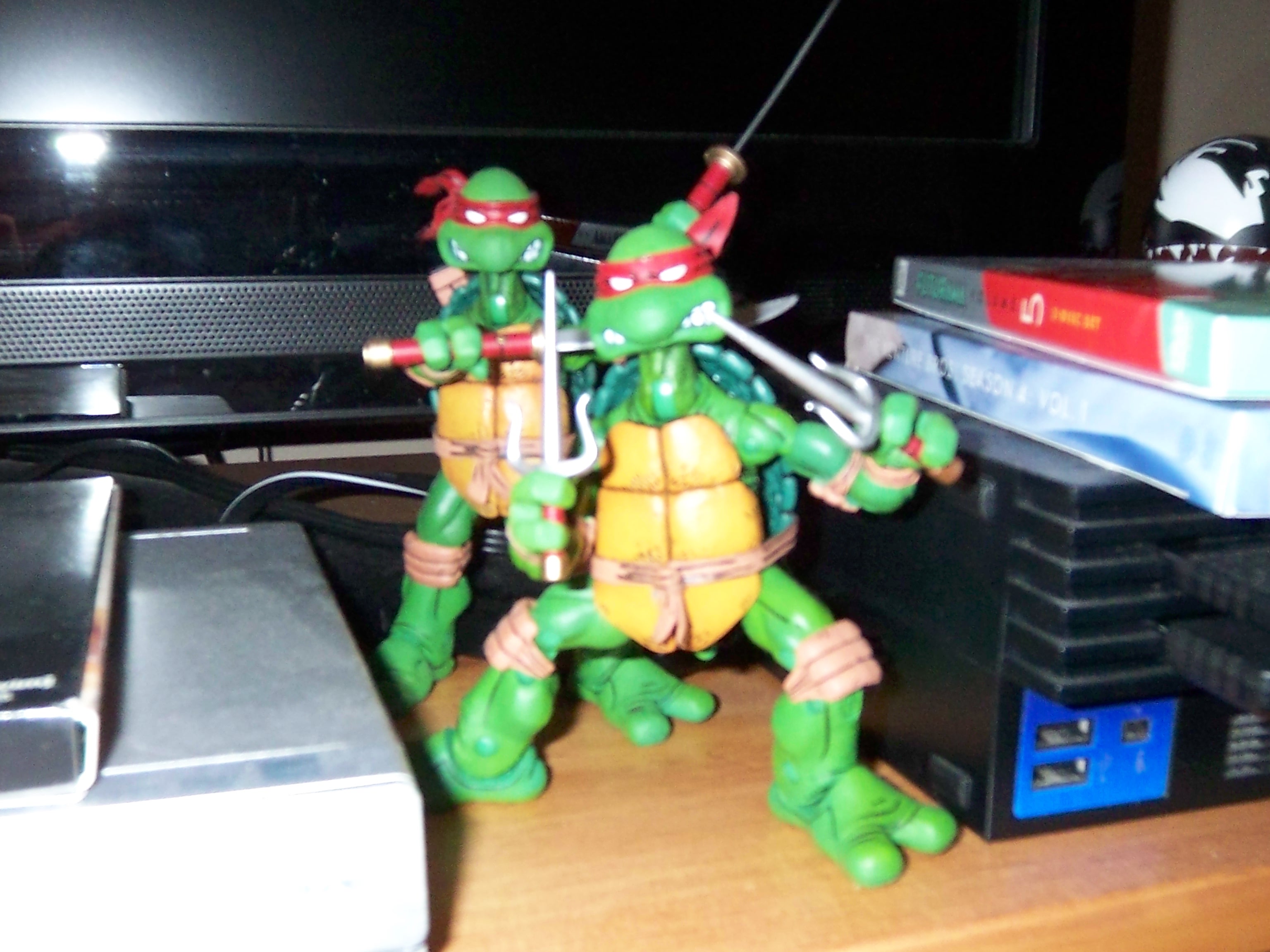
Leo and Raph from Neca's incredible TMNT line. If that line was re-launched there's a good chance I'd jump right back in.

That explains why I got into collecting Marvel toys again, but just before that I had started amassing a collection of Dragonball Z action figures put out by Irwin.  My thought process here is that I got into DBZ as a teenager and before that any cartoon I watched religiously was always accompanied by a consumption of the toy lines put out.  For some reason I really wanted a physical representation of the characters from that show to adorn my shelf space.  Irwin’s toys were pretty basic too, relatively cheap, and not the most visually stunning but I bought them anyways.  They would improve as the line continued until the company went bankrupt and the license was sold to Jakks Pacific, who all but ruined it.

The Marvel Legends line would meet a similar fate.  I collected these ones for a good 4 years or so before the line succumbed to poor quality at the hands of Hasbro.  At

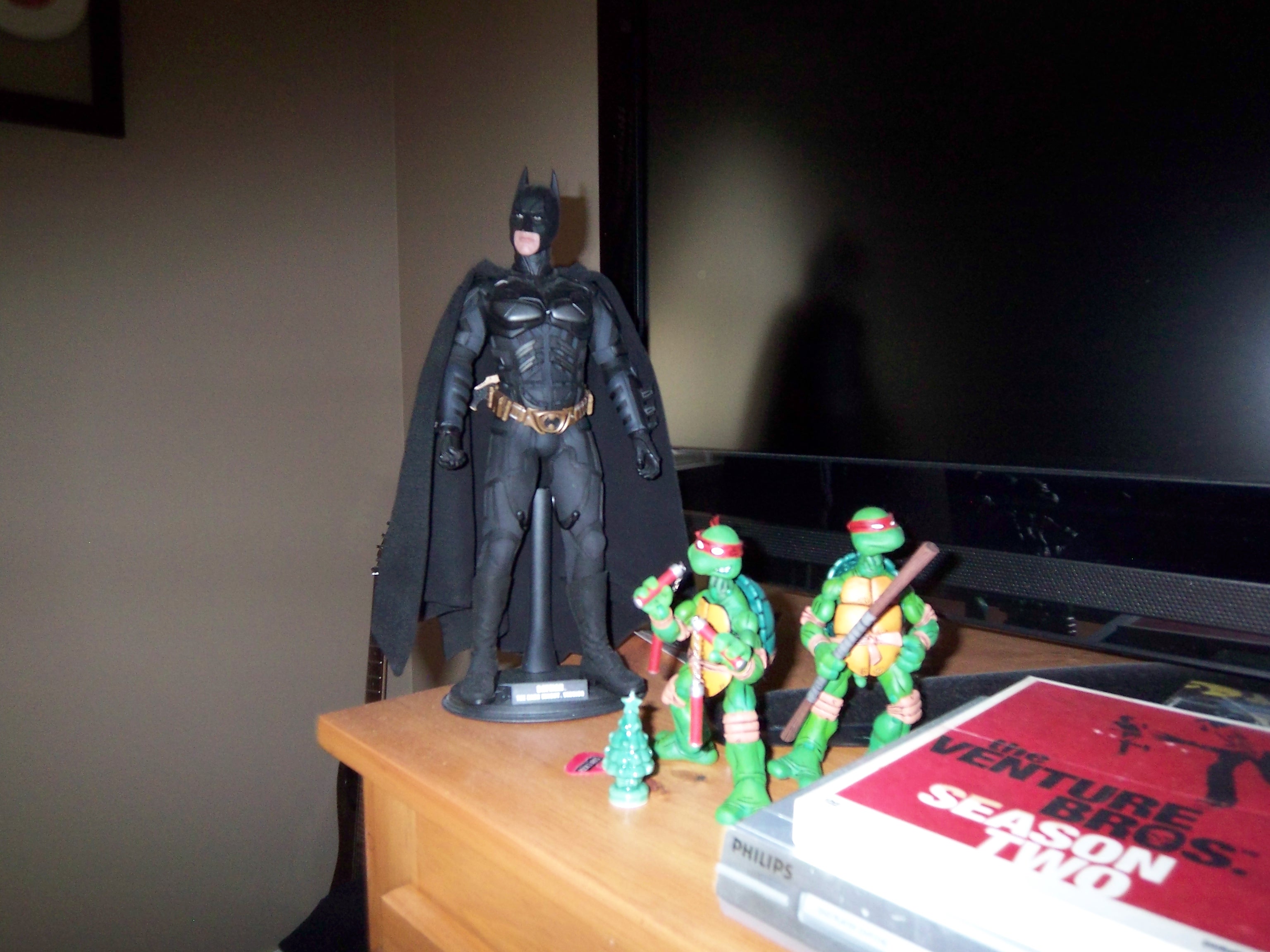
Hot Toys take on The Dark Knight, along with Don and Mike.

first I bought sparingly, only grabbing the characters I really liked and that looked good.  The first one I bought was Magneto from series 3, and the next one may have been Gambit.  I passed on a lot of them though because I either didn’t care about the character (such as The Hulk and Toad) or thought the figure looked crummy (like Wolverine from series 3).  I removed all of them from the package, as I wanted to pose them on a desk or shelf, and wasn’t doing it because I thought it was some smart investment.  I just did it for enjoyment.

As a result, I have cases full of action figures in my basement.  As I got more and more into it, I eventually started buying everything.  Also, Toy Biz would start packaging each figure in a series with a piece of a larger figure to assemble (marketing genius) so I ended up buying entire series to assemble a sentinel, Apocalypse, Giant Man, and a few others until plastic became too expensive for the trend to continue.  I also sparingly bought from other series, such as the Mini Mates and Spider-Man lines.  And when Toynami unveiled its Futurama line I bought those as well, but I eventually stopped due to a combination of rising costs and lack of space to display all of these things.

Now my action figure lust is all but gone.  I made one action figure purchase in 2010, buying The Monarch and Dean Venture together from the show The Venture Bros.   The rest of the figures in that line are just too expensive to justify purchasing (20 bucks a figure) and I would have no place to put them anyways.  Before that I think my last action figure purchase was a Batman put out by Hot Toys in 2008.

Even though my thirst for action figures has seemingly been quenched, I have found another hobby to focus my attention (and money) on:  Danzig.  I am a huge Danzig fan, one step into my home and you’ll find an image of Glenn Danzig on my wall.  From there, his presence is everywhere.

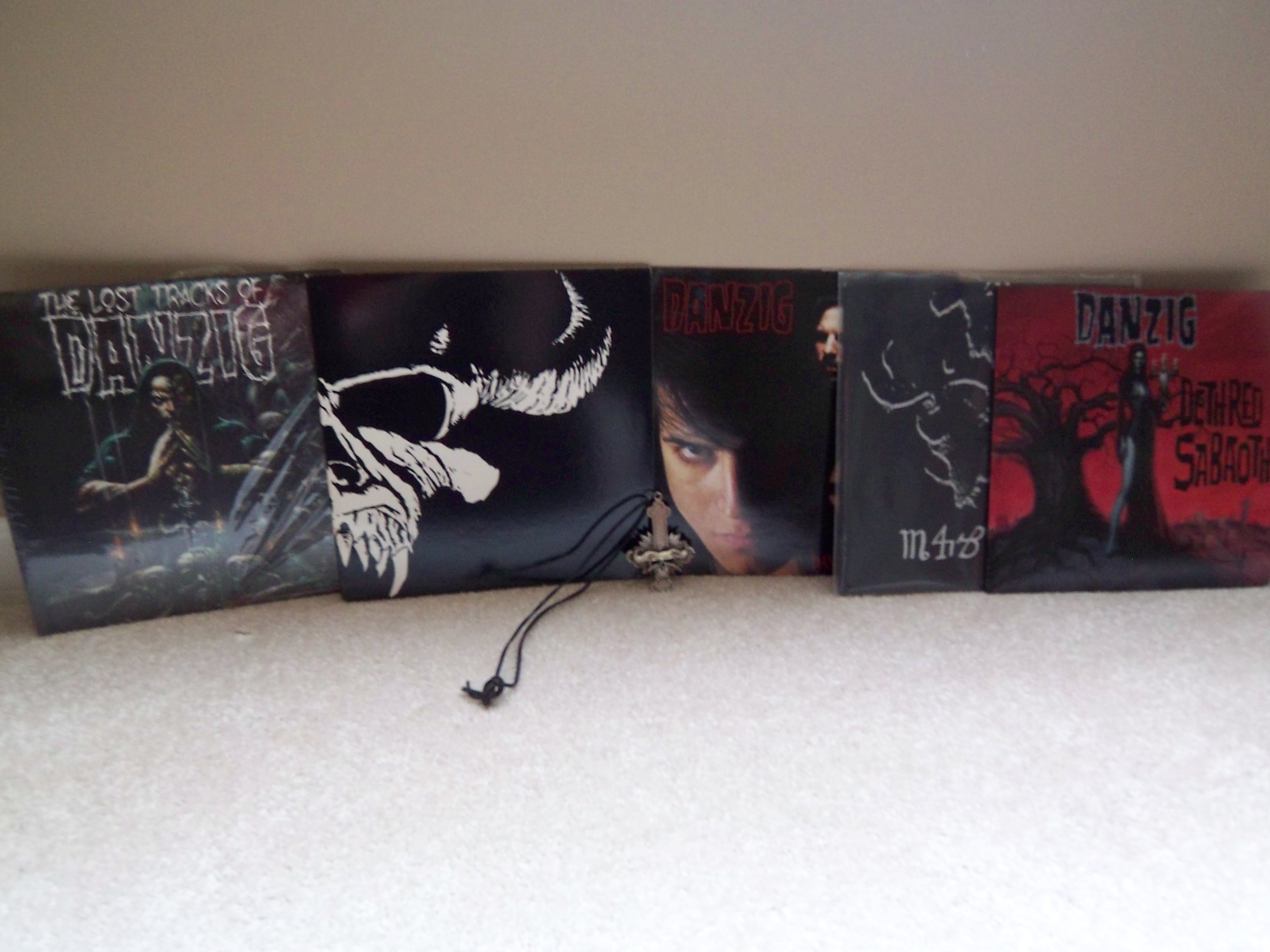
Most of my Danzig LP's, along with the Lucifuge pendant.

My focus when it comes to Danzig resides mostly with LP’s.  It started with a purchase of The Misfits’ 3 Hits From Hell years ago.  I had just gotten my first real job and wanted to acquire a rare piece of vinyl, just to have.  The hobby was reignited when I purchased my first home last year and suddenly found myself with lots of

The Misfits "3 Hits From Hell" on white autographed by Glenn Danzig (obtained by me). One of 400. This was my first Misfits record purchase.

wall space to cover with records.  I quickly purchased two more records, Halloween and the Glenn Danzig solo release Who Killed Marilyn?, and was able to get both signed by Mr. Danzig before he played in Boston last summer.  I also picked up copies of the new record, Deth Red Sabaoth, on vinyl and CD as well as the 7″ for the single On A Wicked Night.  In 2011, I have so far added a copy of Horror Business on yellow, The Lost Tracks of Danzig on blue, and original releases of Danzig, Danzig II, and Danzig 4p, with a copy of Danzig 7 on its way.  To finish off the Danzig LP’s, I need to acquire copies of Danzig III, Danzig 6, and Circle of Snakes.  Unfortunately, Danzig 5: Blackacidevil has never been released on vinyl, and I’m not sure if I want to add a copy of the EP Thrall: Demonsweatlive to my collection as well.  Whether or not I do will largely depend on the going rate on ebay, though I have yet to see one surface.  Danzig 6:66 Satan’s Child looks like it will be the hardest to come by.  It had a very limited, European only, release on vinyl picture disc.  It’s one of the least popular Danzig records so that may depress its value, but considering the rarity, who knows?  Danzig III: How the Gods Kill has proven to be a bit of a rarity on ebay as well, though I just barely missed out on one a few weeks ago.  I’ll be able to get one eventually, I just have to be patient.

Glenn Danzig's "Who Killed Marilyn?" on purple vinyl, autograph obtained by me. One of 500.

I’m pretty well set on the Misfits stuff.  I am mostly interested in the colored versions of the 7″ singles and EP’s put out by the band.  The only one I don’t have that I really want is a copy of the Bullet single on red.  It’s going to be an expensive acquisition so I’m sort of just biding my time.  The thing that will help me out there is that the 1st pressing of the record on black is actually harder to find, so the red edition isn’t quite as in demand as others.  I’m also looking into the Samhain stuff.  There are numerous editions of the first LP, Initium, and a couple editions of the subsequent releases Unholy Passion and November-Coming Fire.   With Samhain, like the Misfits, I’ll target the colored editions.  The first two releases are available on red, and NCF on orange.

The Misfits' single "Halloween" with insert. Autograph obtained by me.

There’s a white version of Initium but it may be out of my desired price range.  I still need to check out more auctions to see what I’m in for, though with NCF the orange ones are fairly common on ebay and I already have an established price range.

Aside from the records, I have targeted other Danzig related items.  Last summer I purchased the special edition of Deth Red Sabaoth that came with a Danzig urn.  Kind of stupid but undeniably unique.  I also recently acquired an original Lucifuge cross-necklace like the one that appears on the cover of Danzig II: Lucifuge.  It’s totally impractical as a piece of jewelry but completely awesome.

My most recent Misfits purchase, a copy of "Horror Business" on yellow. I love that the original price sticker of $1.99 is still on it.

I haven’t decided what exactly I am going to do with all of these records.  I have framed and hung on my wall the Misfits ones and also have Black Aria on my wall because I love the cover art.  I also love displaying the colored records but for the 12″ ones it’s not as practical.  The blue Lost Tracks and red Deth Red Sabaoth would look great displaying them the way I display the 7″ records but will consume a lot of wall space.  I’m thinking of just getting the standard LP frames and arranging a Danzig wall with the records in a 3X3 grid in order of continuity.  I don’t have enough records to do so, yet, but it’s an idea.  I currently do not even own a record player so I don’t buy these to listen to them (I have CD for that) so I’m not concerned with having access to them at all times.  Even so, If I choose to hang them I’ll probably get some generic record sleeves and keep the vinyl someplace else to avoid placing stress on the LP sleeves.  Some of the older pieces have enough ware on them as it is.

My budding record collection is my current hobby, but what will follow is anyone’s guess.  There’s a finite amount of material out there, though I could always expand my criteria and own every edition of every Glenn Danzig related item out there, but currently have no plans to do so.  I am also totally screwed when the day comes I welcome a woman into my home on a permanent basis.  There’s good chance she won’t tolerate skulls and inverted crosses on the wall of her bedroom.


UPDATE – The Danzig vinyl collection is basically complete:


#2: Guns N’ Roses – Appetite for Destruction

Guns N' Roses - Appetite for Destruction (1987)

I’m nearing the end of my list of my ten favorite albums and coming in at number 2 is an album that could easily be number 1.  I am speaking of an album that could, and perhaps, should be at or near the top of many lists, rock n’ roll’s most recent and perhaps last masterpiece, GNR’s Appetite for Destruction.  Appetite… is the biggest selling debut album for a rock band, though success was not found over night.  It took a good year after the release for Guns N’s Roses to become a household name.  Some credit for this is given to the band’s exposure opening for Aerosmith after the album’s release while more credit is probably given to MTV’s repeated airing of “Sweet Child o’ Mine,” the album’s third single and the band’s lone #1 hit.

I think a lot of the album’s success had to with timing.  In 1987 the glam rock thing was still prevalent but dying a slow death.  The androgynous look of the bands, while at first shocking and rebellious, had become stale and people were recognizing it as the fad that it was.  It was shallow and unsustainable, so it comes as no

The intended cover for Appetite was rejected by the label, though it did appear in the album's booklet and inner sleeve.

surprise that a band was able to capitalize on its downfall.  Guns N’ Roses was a product of that scene.  Formed in LA as a merger of the two bands Hollywood Rose and L.A. Guns, the band toiled away on the club scene for years before finally getting a record deal with Geffen.  Sick of the current scene, the band strayed from the pack and took a hard rock approach that toed the line of heavy metal.  Frontman Axl Roses’s screeching vocals and guitarist Slash’s talking leads gave the band its signature sound.  The combustible nature of the band was obvious to all onlookers and its self-destructive behavior lead many to predict a short lifespan for its members.  This made many labels wary of signing the band as no one knew how long it would last.

While Axl and Slash gave the band an identity, it was arguably guitarist Izzy Stradlin that solidified the group and gave it direction.  It’s Stradlin that receives the most song-writing credits and is often cited by Axl as the driving influence of the band.  Stradlin would also be the first to depart of his own free will following the band’s follow-up LP’s, but here his presence is felt.

The looked like no one and they sounded like no one.

The album’s opening track, “Welcome to the Jungle,” was like a salvo aimed directly at the glam crowd and pop rock that dominated the landscape.  Axl’s tortured screams and vocal lines were direct and impossible to ignore, and the accompanying video took a tongue in cheek approach at criticizing the current MTV generation.  Axl doesn’t so much as sing the song’s lyrics as he does spit them out.  Venomous and biting, they tare through the sonic wall created by the guitars and sustained by the rhythm section.  Everything comes down and breaks into a lighter, almost optimistic mid-section that caves in on itself quickly.  Track two and the album’s first single, “It’s So Easy,” is a track offensive to most but represents the band’s experiences with groupies and suck-ups.

The album is not titled Appetite for Destruction because it sounds cool, but because it describes the band’s existence.  Songs about drugs and consumption were not there to glorify the lifestyle like glam intended, but were just honest portrayals of the self-destructive behaviour that nearly killed the members of the band in the years to follow.  Violence and anger give way to some tender moments.  The album’s most popular track and seminal ballad, “Sweet Child o’ Mine,” is very much a love song that was admittedly hastily constructed.  When Axl sings the line “Where do we go now?” he wasn’t describing the relationship between the song’s characters, but honestly didn’t know where to go with the song.  The riff was a warm-up riff used by Slash and nothing he even intended to record but Axl liked it and the song made the record.  Success is like that sometimes.

Tracks like the aforementioned “It’s So Easy” and “Mr. Brownstone” show off Axl’s vocal dexterity. Axl has become known for being a singer with multiple voices and

Axl Rose not only established himself as one of rock's greatest frontmen, but also as one of its most volatile personalities.

on those tracks he goes with his deeper voice instead of his high-pitched rasp.  The effect works well, especially as the song builds towards a thrilling climax where Axl is able to unleash his scream.  For me, “Nightrain” is one of the standout tracks.  It’s kind of an old school rocker but finds a nice rhythm as it weaves its way through its 4 and a half minute duration.  “Think About You” is the forgotten track of the album, a really infectious and up beat song about an old flame that features great lead work by Slash.  The album’s closer is the one most often cited by critics as the jewel of the album, “Rocket Queen” features the most complex time changes of the album.  It starts off as an egotistical rant that leads into a second act of surprising sweetness.

Sex, drugs, and rock n’ roll all dominate the GNR landscape.  It’s kind of sad that after Appetite… GNR was pretty much finished.  Urged by Geffen Records to get as much material out of the band as possible before it self-destructed, burn-out inevitably set in.  Sure the double LP Use Your Illusion sold quite well and produced some famous tracks, but it pales in comparison with Appetite for Destruction.  After UYI, the band would only release one more album, the dreadful collection of covers known as The Spaghetti Incident.  By then the band members weren’t really on speaking terms with Axl, and all of them would eventually be dismissed by Axl whom earlier had managed to get them all to sign over the naming rights of the band to him.  Chinese Democracy was released in 2008 after numerous delays but everyone seems to recognize it as the Axl Rose solo album that is is.  It, not surprisingly, can’t hold a candle to Appetite for Destruction and isn’t even worthy of comparison.

Often seen with his signature top hot and sunglasses, Slash gave the band a unique sound on guitar that has withstood the test of time.

It took a perfect storm to create Appetite for Destruction.  A collection of hungry, disillusioned youths created the album over many years.  Other bands would follow with a similar profile, most notably Nirvana.  Like Guns N’ Roses, Nirvana achieved great success early on and was inevitably undone by the weight of expectation.  Nevermind was a great critical and cultural success, but ultimately not as impactful stylistically on the genre as Appetite… was, even if the media decided to make up a whole new label to place Nirvana and other similar bands under.  Success and excess bread laziness which is why the band had such a hard time coming up with new material following the album’s release.  In the end it doesn’t matter.  Even if the band had never released another track, Appetite for Destruction had already secured their legacy as one of the greatest hard rock acts to ever be.  It contained everything that makes rock n’ roll so unique and so special.  It’s rebellious, uncompromising, fast, slow, and everything in between.  It sounded like no other and nothing to follow has sounded quite like it.  There’s no filler and no one track that rises above them all.  It is, in almost every way, absolutely perfect.  A truly amazing achievement.

Top Tracks

  • Nightrain
  • Think About You
  • Mr. Brownstone

#3: Opeth – Still Life

Opeth - Still Life (1999)

Opeth is not my favorite band, but Opeth is what I consider the most important band in heavy metal music today.  Not content to hold themselves to one genre or one sound, Opeth is a trend-setter  that has been putting out material for over 15 years with no signs of slowing down.

Opeth is the rare band that contains none of the original members.  Formed in 1990 by Dave Isberg in Stockholm, Opeth started off as a traditional death metal band.  Not long into its life, bassist and former band-mate of Isberg’s Mikael Åkerfeldt joined.  Apparently the rest of the band hadn’t been consulted when Isberg approached Åkerfeldt about joining Opeth and this lead to a lot of in-fighting with the end result being everyone leaving the band with the exception of Isberg and Åkerfeldt.  After a few directionless years, Isberg would eventually exit of his own accord leaving Åkerfeldt with song writing and vocal duties.

By now Åkerfeldt had switched to guitar and combined with his good friend Peter Lindgren to form Opeth’s twin guitar attack.  Under Åkerfeldt’s direction, the band became more than just another death metal outfit and soon began incorporating acoustic guitars and 70’s type melodies in their songs.  They kept enough of the death metal elements to keep their street cred intact and were signed to Candlelight Records in 1994, releasing their first album Orchid in 1995.

Opeth’s debut was met with critical acclaim, as was the follow-up Morningrise.  Opeth had established an identity for itself in the metal word.  Long songs that twisted and wound their way through complex melodies and time changes marked by the duality of Åkerfeldt’s vocals which switched from brutal death growls to high melodious tones at the drop of a hat.  The band received a bigger budget for its third release, and settled on drummer Martin Lopez, which lead to an overall better production sound.  The result was the band’s breakthrough album My Arms, Your Hearse; an album that further refined the Opeth sound and provided the blue print for every subsequent release.

Opeth as it appeared in 1999. Since then, only Åkerfeldt and Mendez are still with the band.

It was as a firmly established and confident band that Opeth took to the studio to record its fourth and perhaps greatest album, Still Life, in 1999.  The lineup from the previous release was still in tact, and bassist Martin Mendez was now on board.  Opeth was on a new label, Progressive, and received producer credit on the album as well along with producer Fredrik Nordström who had worked with the band on My Arms, Your Hearse.  Still Life was conceived as a concept album about a man returning to his home, after being banished as a heretic, to reclaim his long-lost love, Melinda.  Melinda has since been brainwashed by the cult that has taken hold of the village and the protagonist tries to release her from her enslavement.

Keeping with tradition, the album’s running time exceeds the one hour mark despite only containing seven tracks.  The album’s opener and fan favorite, “The Moor,” clocks in at nearly eleven and a half minutes making it the longest song on the album.  It opens with a sweet yet haunting acoustic guitar melody that distorts and devolves into low-tuned electric riffing. Åkerfeldt’s grunts come in, tortured and screaming, to add a coat of unease to the song’s mood.  True to Opeth form, it changes up at the bridge and brings back the acoustic parts before reverting back to the death sounds for the song’s frenetic outro.  The second track, “Godhead’s Lament”, picks up right where “The Moor” leaves off with high-tuned lead guitar riffing and guttural screams.  The song builds upon itself until it reaches the chorus where Åkerfeldt’s “clean” vocals come in to layer personality onto a surprisingly light and catchy chorus.  The song becomes an acoustic talker before coming back to the electric guitars and ends on an extended version of the earlier chorus.

By the time the album hits track 3, over 20 minutes have elapsed and first-time listeners are breathless and clueless about what could possibly follow.  Opeth evokes its inner psychedelic rock persona for parts of the next three tracks as Åkerfeldt leaves no doubt about his singing ability beyond the death grunts.  So melodious and soothing are some of the songs in the album’s middle that it almost seems as if Opeth wanted to remind everyone of their roots, so they unleash the well-titled “Serenity Painted Death” on track six before closing things out with the ten minute “White Cluster.”

At the album’s close the listener is not left wondering if Still Life is a good album, they’re left to wonder if it’s the best album they’ve ever heard.  The pacing, variety, complexity all combine to create an unforgettable experience.  The most incredible aspect of the band is that there are many who consider Still Life to be the band’s second, third, or even fourth best release.  The follow-up, Blackwater Park, is every bit as good if not as ground-breaking, while 2005’s Ghost Reveries is perhaps the band’s most technically impressive record to date.

Not content to just put out great records, Opeth has also firmly established itself as one of the best live acts in music today.  Their brilliance live nearly renders their live DVD’s and CD’s irrelevant, because they sound almost exactly like the studio

Opeth is composed of many great musicians, but it is guitarist and vocalist Mikael Åkerfeldt at its creative heart.

releases.  Though that may render the live recordings a bit boring, Opeth is definitely not a band to miss when they come around on tour.  Of all the bands I have had the pleasure of seeing live, Opeth is second only to Iron Maiden, and that’s only because of Maiden’s well publicized stage props.

Opeth is at present enjoying its highest profile ever.  Not only is the band metal’s most talented but also one of the most commercially successful.  Of course, this isn’t felt in the US as much as it is in other parts of the world.  The band is working on its next album with the goal being to have it released at some point in 2011.  I fully expect it to be every bit as good as their previous efforts, including the ground-breaking Still Life.  So long as Opeth continues to meld death and beauty, talent and taste, they will remain metal’s most significant recording act.

Top Tracks

  • The Moor
  • Godhead’s Lament
  • Serenity Painted Death

    #4: Danzig – 4p

    hqdefault-32In case anyone is wondering, no, I did not put this album at number 4 on my list because of its title.  It just worked out that way.  If anything, I’ve depressed this album on my list though I’ve tried not to.  I love this album, and sometimes after listening to it I feel it’s my all time favorite.  It possesses the most variety of any Glenn Danzig release, past or present.  The production is probably the best that Danzig ever saw, be it the vocals, guitar, or drums.  It’s moody, dark, personal, angry, violent – all of the components possessed by a Glenn Danzig fronted band.  And yet, I didn’t always feel that way…

    I did not get this album when it came out (appropriately) in 1994.  I didn’t even know who or what Danzig was at the time.  I was too busy playing Sega Genesis and listening to Aerosmith to care.  It wasn’t until late 1997 or early 1998 that I was even aware of who Glenn Danzig was.  It was at that time that I was turned on to The Misfits by my closest friend (whom I owe a great deal to when it comes to music).  Before then The Misfits were just a band with a cool logo I saw on many t-shirts worn by the punk rock kids in my school.  The first song to grab me was “Attitude” off of the Collection II release put out by Caroline.  From that moment on I began to consume everything Misfits.  Their limited, and often repetitive, discography was soon in my possession.  And while I enjoyed it, it often felt like a cruel joke that before I was even born, The Misfits as I enjoyed them, were disbanded.

    Finding the re-formed Misfits of the mid-90’s to be a cheap imitation of the real thing, I soon turned my attention to Danzig (I was at the time unaware that the Glenn Danzig fronted band Samhain existed between The Misfits and Danzig).  Wanting to find something current to enjoy, I went to the store with the intent of purchasing a Danzig record in hopes that it would captivate me as much as The Misfits had.  I settled on Danzig 4p, soley because it was the cheapest (10 bucks) and the track list was at least interesting.  Song titles such as “Brand New God” and “I Don’t Mind the Pain” were intriguing and gave me the impression that this would be more dangerous and mature than anything The Misfits had produced.

    Upon popping that CD into my stereo when I got home I was met with mixed

    Danzig 4p was the last Danzig record to feature the original lineup. Left to right: John Christ, Chuck Biscuits, Glenn Danzig, Eerie Von.

    emotions.  The Misfits were fast, aggressive punk rock with a campy horror theme.  This was not.  The opening track, “Brand New God,” was fast and brutal with a slow bridge in the middle that soon brought the track back around to the speed metal it opened with.  A solid effort, in my mind.  After that though, the album descends into mid-tempo and even slower.  “Cantspeak” and “Going Down to Die” contained nothing even faintly resembling anything The Misfits did.  I was let down, and filed the album away.

    I did not give up on Danzig after my initial purchase of 4p.  I went back and bought the debut album and allowed the stripped-down rock to grow on me.  I would soon acquire the entire back catalogue liking each album more than the ones I had bought previously.  At some point, probably when I had finally realized and accepted that this band could not be The Misfits, I came back to 4p with eyes open.  I realized how terrible my approach was initially, and musically speaking, it was one of the best things I ever did.

    As I mentioned in the opening paragraph, 4p represents many peaks for not just the band, but for the artist Glenn Danzig.  The opening salvo fired by “Brand New God,” is like the ultimate red herring.  Aside from that bridge, it’s direct, simple and unapologetic in its delivery.  It bleeds into track 2, “Little Whip,” which begins quietly before exploding into a monster riff and machine-gun drumming.  The album’s violent beginning descends into its softest spot, the melancholy “Cantspeak” (sic).  Said to be influenced by politics and the general state of the world, “Cantspeak” represents perhaps Glenn Danzig at his most vulnerable.  The back-mask guitar (the inverse of the album’s closer, “Let it be Captured”) gives it a creepy gloom accentuated by the distorted vocals on the chorus.  The verse contains Glenn’s softest vocal delivery, bordering on falsetto.  It is a song that is both beautiful and depressing.

    The album meanders along with this approach of dark and gloom.  “Going Down to Die” is one of Danzig’s greatest vocal achievements.  With his velvety croons dressing up the verse, he bellows out the big chorus to tremendous effect.  The bleak “Dominion” closes out the first half and is one of the few songs to follow a simple verse-chorus-verse-chorus-solo-outro pattern.  With it nestled amongst atypical material it comes across as refreshing.

    Just when it appeared the album had settled into a distinct sound, “Bringer of Death” brings it back to where it started.  Opening with air raid sirens and machine-gun fire, the song is an uncompromising track focused on the devil, God, and war, and how the three are all intertwined.  Its structure mirrors that of the opening track, right down to the slow bridge before crashing through the outro.  The intermission, “Sadistikal” (sic) follows and provides a hint for the industrial elements Danzig would soon embark on following this release.  It’s not quite a song, but a feeling, designed to make the listener uncomfortable and introspective.  “Son of the Morning Star” follows and returns the album to a slower, quieter state.  The following two tracks present more of a mix, effectively combining the slow and fast in creating perhaps the most radio friendly tracks on the album.  The closer, “Let it be Captured,” is an all out power ballad.  “Going Down to Die” is one of Glenn Danzig’s best vocal performances, but “Let it be Captured” is the best.  The lyrical content is both sweet and sad as Danzig allows himself to appear in a weakened state.  He almost howls throughout the final parts of the song.  A sorrowful wail where the song’s title is repeated over and over.  A hidden track appears on track 66.  It’s basically a hymn and one of those cool, experimental type of hidden tracks that seem to have vanished from today’s releases.

    In the end, Danzig 4p is one of the artist’s all-time best.  And for someone who has been releasing music since the 70’s, that’s high praise.  It is an album that both hits the listener in the mouth and drags it down to the darkest depths.  In many ways it is the peak for the original lineup of the band Danzig.  John Christ is employed to great effect on guitar with both hard-hitting riffs and melodic ones.  His delivery proves he is more dynamic than the previous three studio albums had lead many to believe.  He doesn’t get as many opportunities to shine with solos, but when he does he delivers.  Chuck Biscuits is relentless on drums, his best performance ever captured on a

    Despite general disinterest on the part of MTV and radio, Danzig was able to establish a strong cult following. 1993-94 represents the band’s peak in popularity culminating in two top 100 singles and two gold records.

    recording.  Always a highlight of the band, Biscuits sets the tone on many songs with the highlight performance probably coming on “Bringer of Death.”  Eerie Von, an often forgotten component on bass, is given more room to breath on this album.  His no frills approach suits the work.  And then of course there’s the central figure, Glenn Danzig, on vocals giving his best performance ever.  He howls, wails, and croons his way through the twisting and turning record.  Never again would his voice be this strong on a Danzig release.  Lyrically he was willing to explore more with this album than on previous ones.  The familiar heaven and hell elements were present, but now he was adding in more of an S&M vibe.  Some of the songs are more personal and the pervasive machoism of the previous releases relents some in favor of vulnerability.  Even in some of the slower songs on past records, the protagonist of the songs was usually in control, the only exception being the well-received “Sistinas” from Danzig III.

    Danzig hit all of the right notes on 4p and it ends up being a wonderful note for the original lineup to go out on.  Following 4p, Glenn Danzig would leave the Def American label and begin the twilight era of his career composed of uneven releases, multiple labels, and frequent lineup changes.  This isn’t to say that Danzig 4p represents a swan song of sorts for the artist as quality has been put out since, but it was an end of an era and one many fans remember fondly.  And even so, Danzig 4p is an often overlooked album by both Danzig fans and hard rock fans in general.  Which in many ways represents the album’s sound of both tragedy and triumph.

    Top Tracks

    • Cantspeak
    • Going Down to Die
    • Let it be Captured