Category Archives: Film

Where, oh Where, is Yorick Brown?

Y: The Last Man (Issue 23, Vertigo)

With a new film in the Ghost Rider series set for release in the upcoming weeks, it got me to thinking about the comic book medium and how it has translated to the big screen.  Hollywood has always been interested in comics.  This interest for a long time was reserved really for the super elite characters of Superman and Batman.  Over the last two decades though, that has changed tremendously.

I suppose it started in the 80’s to some degree.  During that decade we were treated to such cinematic gold as The Punisher and Howard the Duck.  They were, of course, something far less than gold and today are only viewed by those looking for a laugh.  I can sort of see why a production company would think the Punisher character would work for a movie.  Especially considering that this was the time when the action hero picture was making big bucks.  I have no idea how Howard the Duck ever received the green light.  It was a terrible idea, and the results were pretty terrible as well.

I suppose we have Fox’s X-Men, and to a lesser extent Blade, to thank for this wave of comic book films.  X-Men seemed to do just enough to satisfy critics and fans of the comic, and in turn, it made quite a bit of money.  This made Marvel Comics, which had struggled financially during a lot of the 90’s, all kinds of happy as it quickly began licensing all of its franchises for films.  At the time I think a lot of people expected little to come from these agreements, but it seems like the opposite occurred.  Not only did the X-Men make it to film, but Spider-Man, The Fantastic Four, The Punisher (again), Daredevil, and more.  Some of these sucked, but it seems like most actually made money so the studios keep going back again and again.  Not to be out done by its chief rival, DC also got into the game with not just Batman and Superman films, but Catwoman, Watchmen and Green Lantern.  We’ve even seen the less popular titles make it to film as well such as Hell Boy, Road to Perdition, and V for Vendetta.

If you’re reading this then it’s probably safe to assume you like both comic books and film, so I’m going to assume most are aware of the relative quality of the above pictures.  There’s some good ones in there and some even bring about good debates, but there’s also a lot of garbage.  You’re probably also aware that even Marvel’s Man-Thing character managed to get a movie during this period, it just didn’t play in theaters.  That’s a pretty obscure character and when you combine that with Ghost Rider and Thor it almost seems crazy that there are people who think these characters can make a good movie.  I know Thor is kind of a classic character in the Marvel Universe.  I’ve never been a fan so maybe I’m biased but I look at a character like Thor and I just don’t see a good film.  I don’t even really see an interesting character.  Thor works best when he’s paired with other characters, not when he’s the star.  As for Ghost Rider, well, at least he looks cool (when not played by Nicholas Cage).  Which leaves me with one big question:  Where is Yorick Brown?

Has any comic series come along in the last 20 years that is better equipped to make the leap to the big screen than Brian K. Vaughan’s Y: The Last Man?  I would argue no and for several reasons:

One, the main character is not a super hero.  Yorick is just a college-age kid who happens to be the last man alive.  He’s an amateur escape artists so that gives him a unique set of skills to be worked into the main plot, but there’s nothing flashy about him.  This means no awkward looking costumes and no big, expensive special effects.  In other words, he’s cheap!

Two, the main character fits right into the target demographic.  He’s young and he’s male, isn’t that who the studios are trying to attract?  Make him played by a cute actor and now suddenly the women want to see the movie.  This is easy!  He’s also a pretty charming character with a quick wit not, unlike Peter Parker, but also has some pretty common insecurities when it comes to women.  If anything, he’s too perfect for film.

Three, the story is unique and interesting.  All of the men on the planet suddenly drop dead except one.  There are so many questions that initial premise creates, enough to last a full trilogy.  It also avoids the whole over-played super villain character.  We don’t have to deal with some misguided scientist who accidentally gave himself super powers but warped his own mind in the process.  No one is out for world domination, and the antagonists are relatively unknown.  There’s an ultra feminist cult that shows up from time to time, but they’re not the main villain.

Four, it’s a pretty small cast.  There’s Yorick and his two female companions Agent 355 and Dr. Allison Mann.  They meet quite a few people on their trek across the globe, but there aren’t many re-occurring characters.  This means no awkward, giant cast like with X-Men or the upcoming Avengers flick.

Ampersand, a star just waiting to be born!

Five, there’s a monkey!  Americans love monkeys, and Yorick’s other companion is Ampersand, a male capuchin monkey who happens to be the only other living, male mammal on the planet.  He also throws poop.

Yorick’s search for answers plays out across 60 issues like a good adventure story.  I suppose that’s another plus for Hollywood, this story has a beginning and an end.  It’s not an on-going book like most comics and it’s been over for quite a while.  60 issues sounds a like a lot to fit into a trilogy, but they’re pretty action and scenery driven books easily classified as light reading.  I think I breezed through most of the story in about a weekend.  And given that it’s 60 issues it allows the director and screenplay writers to break it up into thirds.  It was released in 10 graphic novels after the main run, which is how I experienced it, and if I was to write a screenplay for the first movie I’d focus on the first three books.  Some stuff would obviously be trimmed out, book 4 seems like an obvious one to see some cutting down, but I think it would be fairly easy to adapt the entire run over three films.

Which is actually the answer to my question.  As much as I’d like to think I am, I’m not smarter than the studio heads of the major production companies.  Anyone who even looked at a summary for Y: The Last Man knows it could be adapted for film and that it would have a chance to do well.  That’s why the rights to the film property have already been secured by New Line Cinema, which is a sister company of Vertigo, the comic book company that ran Yorick’s story.  Unfortunately, New Line isn’t one of the biggest in the game and it’s their bottom-line that’s preventing the biggest obstacle.  Vaughan has done a screenplay for a potential film, and D.J. Caruso was attached to direct, but one major obstacle has reared its rather ugly head.  New Line is hell-bent on doing Y: The Last Man as a stand-alone movie, while Caruso and Vaughan see it as a trilogy.  It would seem like the compromise would be to do the film the way Vaughan and Caruso wish to, and if it makes money, to go ahead with two more, but I guess things aren’t that simple.

I know exactly what you're thinking, "You mean to tell me there's ninjas too?! Why hasn't this happened?!"

As of right now, that’s where we stand.  Things were moving pretty quickly for Yorick for awhile, but not much has been said since 2008.  Caruso has since walked away and no replacement has been announced.  There was talk of potentially turning the comic into a television series, but I don’t think such talk was ever serious.  I could see it working for TV in a one hour format, but would fear that it would never reach the end.  If the show was a success, there would be a temptation to just run with it until people got sick of it, meaning new story-lines would be created on the fly.  And if it failed, we’d just end up with a season or two and not the complete tale.  I still think a trilogy is the best way to go about it, and I’m puzzled that New Line thinks it won’t make money on a trilogy.  There’s just no way to condense a 60 issue comic into a two hour film and do it right.  I also don’t think a studio could get away with the Watchmen approach of one giant movie.

It’s really too bad, as I think Yorick Brown could be a minor star on film.  Because the book was put out by Vertigo, it hasn’t reached the audience it would have if done by Marvel or DC.  And if it had been done by Marvel, it would undoubtedly have been made into a film by now.  It’s plot line is thought-provoking and quite interesting.  Mostly, the story is just fun and that translates to any medium.  Maybe the studio will budge on its demands in time and let a film-maker do it the way he or she wants to.  Kick-Ass and other off-beat comic films have done well and made their studios money, so it seems like eventually Yorick will have his story told as well.  The wait is killer though, and the longer it goes the possibility that The Last Man will be forgotten starts to seem more and more likely.


Batman: Mask of the Phantasm

Batman: Mask of the Phantasm (1993)

In case you missed it, a couple of weeks ago I made a post on what I considered to be the definitive Batman film.  I ran thru just about all of the movies, be they theatrically released, direct to video, live-action, animated, whatever.  There was no real criteria, just that it had to be feature-length (admittedly arbitrary, since most of the animated flicks run just over an hour) and they had to be about Batman.  Surprising (to me), it was only my second post on Batman films in general, my first being a review of the first Burton film.  That just seemed funny to me, as in general I think Batman is the super hero who has made the best transition from comic to film.  Since Batman is about to become a very big topic with a new video game just released and a new movie on the way, it’s probably a safe bet he’s about to receive more love from me in the coming months.

If you didn’t read my post on the definitive Batman film, then spoiler-alert, I decided on 1993’s Mask of the Phantasm and it seems only appropriate that I dedicate a full post to its greatness.  It seems like a kind of contrarian take these days, but it wasn’t that long ago when most die-hard fans considered MOTP the best Batman film.  Nolan’s Batman Begins and its sequel, The Dark Knight, have kind of tempered the adoration once directed at MOTP, but why is that?  Obviously, it’s because as a culture we tend to value live-action over animation.  And while I love animation there is a very good reason for this.  Animated features tend to run around 85 minutes or so, as the process is both time-consuming and expensive and probably harder to direct.  A more fully realized plot is accommodated by live-action where a feature can run over 2 hours.  MOTP is no exception as its run time is a tidy 76 minutes.  It was also done with a very modest budget.  The animation really isn’t much of an improvement over the television show it’s based on.  There was a choir added to the main Batman theme, and some brief CG effects, but that’s it.  It does appear that the animation is better, but it could be my eyes deceiving me.

The film’s main villain, who’s mask kind of reminds me of the Punisher’s famous skull logo.

That said, those are among the few complaints I can levy against MOTP.  The animation may not be on par with the Disney features from the same period, but it still has style and is unquestionably “Batman” in its approach.  The animators were fond of using black paper for backgrounds which adds to the film’s overall dark visual tone.  Since almost all of the scenes take place at night, this makes a lot of sense.  The only really new character is the one the title alludes to, the Phantasm.  Though the character is actually never referred to by that name during the film, we can assume that’s its name.  The character resembles the grim reaper, though I prefer the Joker’s observation comparing it to the Ghost of Christmas Future.  The character generates a cloud of smoke and sports a cape and cowl, causing it to be confused with Batman which serves as the basis for the plot.

The plot being, some mob guys are being targeted and killed by a new vigilante.  We, the viewing audience, are cued into the fact that it’s a new vigilante in town that is responsible but the general public of Gotham are lead to believe that Batman is behind this.  No one is mourning the loss of these guys, but councilman Arthur Reeves (Hart Bochner) pleads to Commissioner Gordon that they can’t allow Batman to operate in this fashion.  Gordon, of course, sides with Batman and knows he can’t be behind this.  Meanwhile, Batman is left to deduce who this new vigilante is and what is the motivation for this latest attack.

This is around the time Bruce realizes he has a choice to make, Batman or her.

Along the way we get to see more executions, my particular favorite occurs in a cemetery, and an old flame of Bruce Wayne’s resurfaces in Gotham.  Andrea Beaumont (Dana Delany) has come to Gotham to settler some financial matters with Reeves and has a chance encounter with Batman at the cemetery where her mother (and Bruce’s parents) are buried.  As the plot of the film advances we’re treated to flashbacks of a young Bruce before he became Batman and how Andrea came into his life.  The two met at that same cemetery, and though Andrea had to play the role of aggressor, the two end up falling in love.  This caused the young Bruce much inner turmoil as after Andrea witnesses him take on some thugs and put his life on the line he realizes he can’t have it both ways.  He has to choose, be the vigilante anti-hero he thinks he needs to be to avenge his parents, or be Andrea’s beloved.

This leads to the film’s best scene.  A desperate Bruce on his knees before the headstone of his parents in the rain begging them for a sign.  He tells them he doesn’t know what to do, that their death no longer hurts as much as it used to, and that he never could have expected to be happy again.  It’s a rather poignant and heart-felt moment that gives great insight to the Bruce Wayne character.  Kevin Conroy, the voice actor of Bruce Wayne/Batman, gives a convincing performance and cements himself as the definitive voice of Batman that all future actors will be weighed against.  We, as the audience, also get a glimpse of just how misguided Bruce is.  He wants to avenge the deaths of his parents by cleaning up Gotham, but as human beings we know there’s no way a parent would wish that kind of life for their child.  A promise is a promise though, and Bruce is loathe to break his until Andrea strolls up behind him.  He takes that as his sign, and we’re left to wonder how this could have come to an end.

Those questions are answered when we’re introduced to Andrea’s father, Carl (Stacy Keach), a money manager of some regard who has become involved with Salvatore Valestra (Abe Vigoda).  Things seem fine, though we know Valestra to be a crime boss, until Beaumont becomes indebted to the thug.  Things get ugly, and the Beaumonts are forced to flee Gotham leaving Bruce behind with lots of questions and more heart ache.

Now the Phantasm is after an old and sickly Valestra and the crime boss is forced to make a proverbial deal with the devil; enter the Joker.  The Joker’s (Mark Hamill) portrayal is consistent with that of the animated series only with a touch more malice to suit the feature film’s tone.  He has some connections with the Valestra crew from his past, and loves to put his nose in Batman’s plans anyways.  What could have felt like the writers just tossing in the Joker for star power, turns out to work exceedingly well.

This one’s not afraid to get a little bloody.

I’ll spare you the rest of the plot details, and say that they include Batman’s detective work to find out who is under the mask of the Phantasm and a reunion with Andrea.  The film culminates in a showdown between the major players of the film in a most satisfying way.  There’s also an electric chase sequence between Batman and the Gotham PD that’s a joy to behold.  The mature tone and emphasis on plot makes this film incredibly engrossing, so much so that kids are not likely to enjoy it as much as adults.  And even though it received a PG rating, it’s actually fairly graphic as we see liberal amounts of blood and even a tooth sent flying after a well-placed Batman punch.  The film is not afraid to kill off characters, like the animated series probably would be, and Batman is even allowed to ditch that dorky helmet he had to wear for television when riding his bat-cycle.

All in all, Mask of the Phantasm is an excellent character study for our favorite caped crusader.  We’re not bogged down with the nitty gritty of his well-told origin and instead are shown a portion of Bruce’s life that is sometimes glossed over.  It’s really introspective to see just what Bruce was giving up when he fully committed himself to the Batman character.  And even though we feel bad for him, it’s riveting to see tragedy dumped on him.  And while the mystery isn’t too difficult to figure out, it’s still rewarding and comes across as logical.  This is just a really well made movie with more depth than a lot of the other Batman films put together.  If you never saw it, do yourself a favor and check it out.


The Definitive Batman Film

It's taken awhile, but on October 18th the greatest Batman story ever told makes its way to animation.

On the eve of the latest Batman film release (and video game), I thought it would be fun to look back at the films that have already been released.  After all, it wouldn’t be much fun to try and determine what the best Batman video game is considering most have been subpar.  It would be Arkham Asylum with a runner up of….?  I guess there were some okay 16 bit games, but nothing mind blowing.  It sounds like the soon to be released Arkham City is just as good so at least Asylum will have some company on the rather short good Batman video game list.

Arkham City will be the Batman related item that moves the most units tomorrow, but not to be forgotten is the direct to DVD feature film Batman: Year One.  Year One is of course an adaptation of the popular comic seres by Frank Miller that ran in the late 80’s.  Year One is perhaps the most celebrated Batman mini series, and certainly is the definitive take on the caped crusader’s origin.  Many elements from the plot of the book was incorporated into Batman Begins and, to a lesser extent, the animated series.  I’m curious how well it will hold up considering Batman’s origin has become a well told tale over the years.  As great as the book was, do we really need another origin story?  That fact alone will likely make it problematic to review as it will be hard to judge the film on its own merits.

Regardless, Batman has had his origin told many times to varying degrees of success over the years.  Plenty of other stories have also made it to film in either a live action medium or an animated one.  There’s been some great Batman movies, and there’s also been some stinkers, but which one is the definitive Batman movie?  There are quite a few contenders, so lets start whittling them down.

Let’s start with the first, often referred to as Batman: The Movie based on the television series staring Adam West in the titular role.  As entertaining as the movie can be, lets throw it out right away as the definitive Batman flick because it is not at all representative of the character.  Charming, but no Batman.

Yeah it's not Bruce Wayne in the costume, but this movie is not one to be missed.

Animation should not be discounted just because it’s not live action, which seems to command more respect in the US, and Batman has had some great animated portrayals.  One of those excellent features is Batman Beyond: The Return of the Joker.  What could have easily been written off as a marketing gimmick turned out to be a nice series and the direct to video film was the high point for the Batman Beyond franchise.  As good as it is, it’s not a true portrayal of the Bruce Wayne character, so it’s out of the running.  If you haven’t seen it though, check it out.  It can likely be had for a few bucks on the second-hand market.

Two other animated features that skipped theaters include SubZero and Mystery of the Batwoman.  SubZero focuses on the villain Mr. Freeze, a villain failed by the comic books until Bruce Timm and Paul Dini got a hold of him and made him a truly tragic villain.  The film is a good one, but is over-shadowed by the stand-alone episode from the animated series “Heart of Ice.”  Mystery of the Batwoman puts Batman into the role of detective, something the films have a tendency to gloss over at times.  It’s a fun little title, but not really noteworthy.  It’s out.

Lastly, two other films can be written off right away, and I’m talking about the two Joel Schumacher directed features Batman Forever and Batman and Robin.  Batman and Robin was a mess with a bloated cast and oppressive visual style.  It’s a wretched abortion of a film and one of the worst pieces of crap I’ve ever had the misfortune of watching.  Batman Forever is merely subpar.  By comparison with its sequel, it’s positively exquisite.  It did have some fans, notably Roger Ebert who didn’t enjoy any of the other Tim Burton produced/directed films, but I hesitate to say it’s good.  It certainly isn’t memorable, and was another Burton helmed project that put most of the focus on the villains and not on the Batman character.

If you’re keeping count, that leaves us with six feature films to choose from:  Batman, Batman Returns, Mask of the Phantasm, Batman Begins, The Dark Knight, and Under the Red Hood.  This is where things get tricky.

Michael Keaton - still my favorite Batman.

First of all, to be the definitive Batman film it has to focus a lot of its attention on the Batman character.  Three of the above mentioned films are origin stories, so Batman, Batman Begins, and Mask of the Phantasm are all up for consideration.  The Dark Knight spends a lot of time on the Joker, but unlike Burton’s Batman, the character doesn’t dominate the screen.  He’s actually not on screen as much as you probably remember, but his presence is felt all throughout the film.  While it’s not an origin tale, TDK does deal with an important part of the Batman character, namely the issue of escalation and how to deal with it.  Under the Red Hood is similar in that it focuses on an important aspect of Batman, how he deals with his greatest failure, the death of Robin.  The film that doesn’t really tell us much about Batman is the second Burton directed picture, Batman Returns.  In that, the villains dominate the landscape and while we learn Bruce is a bit lonely, there’s not a whole lot there.  The lack of acting for the character is what drove Michael Keaton away from the role.  The film is still entertaining, but the definitive Batman?  No way.

The next one to fall out of contention is Under the Red Hood.  While it does a good job of combining aspects of classic tales like A Death in the Family and The Killing Joke, it doesn’t quite hit it out of the park.  The mystery of the film is solved pretty quickly by anyone with half a brain, but the climax of the film is pretty spectacular, it’s the getting to that point that is less so.  The film kind of meanders a bit and stalls out before recovering.  I also felt that there could have been even more exposition on the part of Batman and insight into how he coped with Robin’s death.  It’s a good film, and wonderfully animated, and it was also nice to see some new voice actors take on Batman and the Joker.  It is not, however, the definitive Batman movie.

And then there were four…

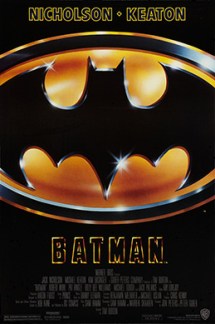
I did a rather exhaustive review on Batman several months ago.  To summarize, I found it to be a good film that had an interesting take on the character.  This Batman was more vengeful and less honorable than other portrayals.  And while the Joker may have dominated a large chunk of the movie, Batman’s origin story was presented well, though with the odd twist that the Joker was the man responsible for the murders of Thomas and Martha Wayne.  The film is also noteworthy for setting a few trends for later movies, namely the black armored costume worn by Batman.  The more realistic take would be used in every live-action film to follow, as would Batman’s arsenal of “wonderful toys.”

The only Batman film to receive two thumbs up by At the Movies with Siskel and Ebert. Surprised?

Mask of the Phantasm may be the most criminally under-appreciated Batman movie of all time.  For a long time, the hardcore crowd would cite this as their favorite Batman movie and it also received a two thumbs up approval from critics Siskel and Ebert.  It was released on the big screen, and had modest success.  It told another version of Batman’s origin, and even showed us how close Bruce came to giving up the cape and cowl in a truly great scene where he falls to his knees at his parents’ grave begging for forgiveness.  His motivation is for love, as he tells his parents he never expected to be happy again when he made the promise to avenge their deaths.  Unfortunately for Bruce, as is often the case, things don’t work out with his love interest.  All of these details are presented through flashbacks as Batman tries to figure out the identity of a new villain, the mysterious Phantasm.  I have some complaints with the film, but they’re mostly superficial.  One is the Phantasm doesn’t have a very strong presence in the film, but that’s mostly due to time constraints.  Another is that the animators take a lot of liberties in how the Phantasm is portrayed in order to protect the character’s identity.  The reveal scene comes across a little funny as a result.  Mostly though, the film just plain works and Kevin Conroy and Mark Hamill are forever etched into my brain as the voice of Batman and Joker.  There’s also a different take on the Joker’s origin shown which is kind of cool.  Or at least, it shows the Joker before he became the Joker.

Batman Begins is the much celebrated beginning of the Christopher Nolan trilogy set to conclude with The Dark Knight Rises next summer.  If Burton’s Batman could be criticized for focusing too much on the Joker, Nolan’s could be criticized for not establishing a truly compelling villain for Batman to battle.  The origin presented is exhaustive and focuses on all of the aspects the other films ignored.  This mostly included Bruce’s training in the far east under Ra’s al Ghul and his early exploits in the Batman costume.  We get to see everything that lead to Batman’s creation with an incredible attention to detail.  Nolan covers everything, and Christian Bale helps erase the stain of George Clooney (though I still prefer Keaton).  As I mentioned though, the villains come up a bit short and I’ve never really been sold on the Tumbler as the new Batmobile.  As an origin tale though, it is perhaps unrivaled.

"Bat voice" aside, Bale has proven himself a capable Dark Knight.

The Dark Knight is without question Batman’s greatest box office triumph.  Most of the films based on Batman have done well, but nothing like The Dark Knight.  A lot of that success is due to Heath Ledger’s Joker, a truly charismatic and effective portrayal of the clown prince of crime that delighted seemingly everyone.  It’s hard to imagine that people were wondering if he could top Nicholson’s Joker, but Ledger practically erased that character from existence.  The movie is big, and the plot remains interesting through to the end.  There are some minor quibbles to be had though.  One, Bale’s “bat voice” seems worse this time around compared with Begins.  It’s distracting and should be axed for the new movie.  Another is the rush-job placed on Two Face.  Such a great villain really deserved his own film.  The portrayal wasn’t bad, but felt wasted.  As a Batman character study, we see just how far the character will go and what ends justify the means.  It raises good questions about just how intimidating Batman can be when he’s not willing to really bust up the bad guys.

Another worthy debate, best Joker: Nicholson, Ledger, or Hamill?

Four great films, and not just great Batman films at that.  How do I narrow it down from here?  It won’t be easy as an argument can really be made for each, but one to me clearly has the weakest argument of the four.  Three of these films deal with Batman’s origin story, and the one that comes up short is the inaugural Batman from 1989.  This origin story was unique, for sure, but the changes made don’t really suit the character.  I’m talking mostly about the whole Joker as the killer angle.  It helped add more emotion to the main conflict of the film, but forced the film into killing off Batman’s greatest villain!  A true shame as the sequels could have used him, though Warner Brothers likely had zero interest in paying Nicholson for a sequel.  It was a good movie for the time and integral in moving Batman away from his more kid-friendly persona established by the television series, but it’s been topped.

As great as The Dark Knight is, I’m afraid it too has to go.  If we’re looking to establish what is the definitive Batman film, I feel an origin story is always going to have a leg-up on anything else.  Something emotionally heavy like the death of Robin could perhaps have trumped it, but not the death of Rachel Dawes.  A fantastic film and one of my all-time favorites, but it’s not the definitive Batman film.

So that leaves two.  The animated and surprisingly emotive Mask of the Phantasm and the fantastic rebirth of the character in Batman Begins.  Mask of the Phantasm has the whole animation stigma working against it.  I personally view both mediums with equal weight, but it can’t be ignored that the animation isn’t particularly jaw-dropping.  What works for TV is a little less impressive on the big screen.  Still, the animators do a great job of portraying emotion and the quality of the voice acting is phenomenal.  Begins has a strong cast, and features great direction.  The origin of Batman is extremely well told, as is the origin for soon to be Commissioner Gordon.  It’s unfortunate how The Dark Knight kind of overshadows it now, as I’ve rarely had a better movie going experience than when I watched this one for the first time.

I suppose the easy way out would be to say there are two definitive Batman movies, one live action and one animated.  There’s no conclusion in that though, and I hate cop-outs.  Maybe it’s the contrarian in me, but I feel the definitive Batman film is…

Mask of the Phantasm.

The origin story is perfectly told, not in terms of specificity but in how it shapes the Batman character.  It is the only Batman movie to effectively use a romantic interest for Bruce that enhances the picture, and doesn’t feel like something that was included because a director felt Batman needed a love interest.  And as much as I like Begins, I’m not sure I ever truly buy into the fact that I’m watching Batman.  When I watch Mask of the Phantasm though, I know I’m watching Batman.  Animated or not, this is Batman how he’s supposed to be and if you’ve ignored this movie or forgotten about it, you’re missing out.


X-Men in Film – Epilogue

I ran through the three core X-Men films earlier this year.  To summarize, I found the first was okay, the second good, and the third poor.  And even though I more or less enjoyed the first two, I was never comfortable with the setting or the approach taken by director Bryan Singer.  In my lead-in, I mentioned I wanted to post my own thoughts on how I feel the studio should have gone about in bringing the franchise to the big screen.  Considering this weekend is the opening weekend for the Matthew Vaughn directed X-Men: First Class, it seems like now is a good time to do this entry.

First off, I did not make an entry for the X-Men spin-off X-Men Origins: Wolverine and that’s because I never saw it.  Not only did it look poor, but the plot also sounded bland.  It was not well-received by critics or by friends of mine whose opinions I trust so I saw no reason to see it.  And the suggestions to follow in regards to how I would have approached the series do not mean I think I could do better.  Far from it, I am no director and I’ve never had anything published.  I’m just a jaded fan.  And for the most part, I think die hard fans are bad for this sort of exercise.  They tend to be more rigid and regimented and incapable of distinguishing what’s important from what isn’t where a plot or character is concerned.  A neutral party is better able to look at the source material and identify the key components that makes the franchise important and bring those components out within the new medium.  Unfortunately, I think those who handled the X-Men did a poor job of that and even though I’m a fan I’m going to try to be objective.  Below are the components I believe would make for a good X-Men film:

Civil Rights – At it’s core the X-Men represent a civil rights story, and Bryan Singer and Fox acknowledge this.  One of the core conflicts is Professor X as a Martin Luther King Jr. figure to Magneto’s Malcolm X.  Both have the same goal but aspire to reach that goal through very different means.  The other conflict is human society vs mutants, what the canon refers to as homo sapiens and homo superior (a term coined by Magneto).  In the first film, the conflict outside of the good guys vs the bad guys is the Mutant Registration Act, a bill introduced by Senator Robert Kelly.  Kelly mistrusts mutants and wants to see each one register with the federal government so that the government knows what each mutant is capable of and where they are at all times, similar with sex offenders and common criminals.  Law abiding mutants of course bristle at this as it forces them out of the closet, so to speak, when some would rather live quiet lives and keep their mutant abilities private.

Graydon Creed worked so well for the animated series, it's hard to imagine him not working for a film franchise.

This a solid starting point for the franchise, but the initial plot gets lost in Magneto’s hijinks.  Kelly is removed from the picture early on negating his influence on the bill and it doesn’t pass, though that is irrelevant.  What Singer and company failed to do was create a hostile environment for mutants.  At no point do we get a sense of the contempt and fear humans have towards them.  We get a taste of it in X2 when Bobby Drake “comes out” to his family, but little else.  I wanted to see more fear from the general populace and from the government as well.  That’s why I think the films should have looked closer at the 1990’s animated series for inspiration.  Henry Guyrich and Bolivar Trask would have made for good secondary characters.  Perhaps the sentinel project could have been referenced in the first and carried over into the second film.  The sentinels from the comics likely wouldn’t have worked on film, but a military styled task force charged with controlling mutants could have stood in.  The Friends of Humanity could have also been used to give us the extreme end of the spectrum from the societal perspective.  Graydon Creed is a great character and one that’s easy to hate for audiences.  The villain of X2, William Stryker, could have been incorporated into the FoH as well in his priest persona as opposed to a military one.  Ultimately this would have better portrayed the X-Men as selfless heroes protecting a society that hates and fears them, as the main antagonist would still have been Magneto and his Brotherhood.

Small Squad – Another aspect the existing films recognized was the need to keep the X-Men small.  In the 90’s, the team became bloated and trying to carry that over to the films would have proved impossible.  The films reduced the X-Men to four actual team members; Cyclops, Jean, Storm, and Wolverine with Xavier and Rogue also in roles requiring extensive character development.  And while I think this is a solid foundation, the ball was still dropped in terms of developing these characters.  Wolverine was the obvious focus for character development as he’s been the most popular character for a long time now.  Jean exists as the strong female lead and to get between Cyclops and Wolverine.  The Wolverine character was handled mostly well (though I feel strongly a short actor should have played him) but Cyclops was butchered.  He comes across as the jealous, petty boyfriend rather than the victim.  Cyclops should be strong and honor bound where his duty is concerned, the obvious good guy where as Wolverine is a villain who happens to be fighting for the good guys.  Perhaps I’m in the minority, but I got the sense that the films wanted us to root for Wolverine to win the girl and to dislike, and even distrust, Cyclops.  Storm wasn’t developed hardly at all, and only once Halle Berry won an Academy Award did the writers see fit to give her more screen time.  Storm has an interesting back story in that she was perceived by her people as a goddess and perhaps would have worked better as a character recruited by Xavier, rather than just a secondary female member of the team.

I love you Beast but you just don't work on screen.

I have always felt Beast should have been included.  He is a good example of a mutant who can’t hide amongst people like most of the X-Men can.  The problem with the Beast character is that his look does not translate well to live action.  Would fans accept a non-blue Beast?  Probably not.  Iceman perhaps could have been a better choice as a fourth member given his character doesn’t need too much development as he’s the practical joker and a kid at heart.  The Iceman character as he exists in the current franchise is a throw-away, anyone could have been used in that role.  Nightcrawler is another great character that needed to get onto film, but I think Singer had it right in waiting for film #2 to introduce him, though I think the character needed more development.

One think I would not change is how the films utilized Rogue.  I’m a fan of introducing the X-Men as an already existing product and bring the audience along by having it introduced to the X-Men through the eyes of a new recruit, such as Rogue.  Rogue provides a good example of how super powers aren’t all they’re cracked up to be, something at the core of the X-Men mythos.  This aspect of her character makes her more interesting than the classic juvenile characters Kitty Pryde and Jubilee.

Wolverine – I said a lot about Wolverine in my initial post on the subject, so I’ll try to be brief.  In short, I feel Wolverine is best served as a secondary character.  He’s the prickly member of the team who doesn’t always feel like a member of the team because of his lone wolf nature.  Ideally, he wouldn’t be in the first film as his introduction to the team could have been handled in a second film.  One thing I really liked about Marvel’s Ultimate X-Men was how it introduced Wolverine as a mercenary hired by Magneto to infiltrate the X-Men, but he eventually is won over by Xavier (and Jean) and betrays Magneto.  That could have been used for the films but Fox would have never allowed an X-Men movie to be shot without Wolverine, he’s too important from a marketing perspective.  Therefore, keeping him off to the side and antagonistic would have worked best.  Ultimately, I want a character with a giant chip on his shoulder that Xavier and Cyclops constantly have to fight with to get him to stay the course.  When Magneto and his goons are raising Hell, Wolverine should be the one abandoning ranks to go after Sabretooth as opposed to working within the system.  As an audience, we should love his ferocity and his bad ass nature but feel frustrated with his obvious character flaws.

The Villains – Magneto is the obvious choice as the main arch rival for the X-Men, there’s really no other choice.  And I do like that the current films didn’t make the mistake the original Batman did and kill off the hero’s main adversary in the first film.  As long as Xavier is around, Magneto needs to be as well.  His Brotherhood was fine as well though it needs to be as big as the X-Men.  If the X-Men are 4 then the Brotherhood should be 4, not including Magneto himself.  Sabretooth and Mystique are good choices as well, but Toad kind of sucks.  If the films needed a slapstick villain he could have been used there, but otherwise I’d prefer Avalanche or Pyro.  Juggernaut is an interesting possibility as well and one that would have been worth exploring.  He presents obvious visual problems in bringing him to live-action (the look he sported in The Last Stand would not do) and balance issues as he’s a load to take down.  I like the step brother parallel though with Xavier, but he can’t be a mutant which also is an issue.  The magical nature of his powers wouldn’t fit the setting I imagine for an X-Men film franchise so his abilities would have to come from a suit.  Perhaps he could wear some sort of mammoth battle suit serving as a pre-cursor to the government’s own sentinel program.  Or he could be some sort of metal monstrocity created by Magneto.

The reality warping mutant Proteus represents a case of risk vs reward. In the hands of the right director, he'd end up an extremely memorable villain.

As the franchise would likely form a trilogy, new villains would be introduced.  I like the idea of keeping Magneto involved in all, but keeping him on sidelines at times would give the films some variety.  I already mentioned the sentinels and Friends of Humanity as potential villains.  Could they carry a film?  Possibly.  Other villains that could work include The Hellfire Club, who are also featured in the latest film.  They could be another Magneto, a villain seeking mutant supremacy but through different means.  While Magneto is confrontational, The Hellfire Club works behind the scenes and infiltrates the economy.  High-born and intelligent, they would pose a different kind of threat.  A really bold director could also turn to Proteus, the reality warping mutant.  His powers could be explained as being mental, an extreme take on Xavier’s, and his general origin could be kept intact (imprisoned bastard yearning for acceptance from his father).  His powers would be a visual delight, and his plight easy to grasp.  He’d function as a sympathetic villain, and also plant the seed in the audience’s mind that perhaps mutant control is necessary.

If a film must have a Wolverine-centric villain and plot, then I think Omega Red could be fun.  The Weapon X project would be introduced, and the Omega Project could be the Soviet equivalent.  After tangling with him in the past, Wolverine is angered to learn he’s been revived by the Soviets and takes off to stop him.  It would give the audience more insight into the mind of Wolverine after seeing him mostly as an ass in the first film, and the X-Men would come to his aid for a feel good moment.  Red is a visually interesting villain, and his death syphon makes him more than formidable.

The Plots –  The plots of the existing films can be simplified as:  Mutant Registration Act, “God Loves, Man Kills”, and The Cure.  The second was of course augmented to basically remove the God component from the original story, but all the same.  The Phoenix Saga was also worked into the third film.  I mentioned earlier that I feel the Stryker character as a priest could be worked into the cast of reoccurring characters.  The Cure plot is an interesting one and one I like because of its obvious societal parallels.  Phoenix I can do without.  I know it’s an iconic story but it’s overplayed.  One thing the films didn’t tackle was the The Legacy Virus which could be worked into all of the films as a pervasive thing and another reason humans fear mutants.

To summarize, the basic approach I’d take for a three film trilogy would probably go something like this:

1 – Mutant Registration Act, Government exploring ways to control mutants, Magneto as a mutant terrorist attacking government agencies (Cyclops, Jean, Wolverine, Iceman, Rogue as X-Men.  Sabretooth, Mystique, Juggernaut, Avalanche and Pyro as Magneto’s Brotherhood)

2 – Sentinel Initative unveiled to control mutants, Moira’s son Proteus escapes, Magneto is courted by The Hellfire Club (Nightcrawler is introduced after the X-Men save him from the FoH early on)

3 – Wolverine leaves the X-Men to confront Omega Red, X-Men are forced into a confrontation with The Hellfire Club, Rescue Wolverine, Magneto watches from the sidelines (Colossus introduced as part of the Wolverine side plot, some of Wolverine’s Weapon X buddies could be brought in as well such as Maverick and Silver Fox).

I’m not married to that, but it’s a start.  I’d aim to end the trilogy with Magneto posing as an immediate threat, perhaps him forming a film equivalent of his mutant haven Avalon.  What’s not developed is how The Hellfire Club would pose a threat.  Perhaps they would be behind the introduction of the Legacy Virus as a means of planting fear into the hearts of humanity.  I would also consider having their political connections leading to an abolishment against the Mutant Registration Act which would portray them as being a group with some positive benefit, but with ill methods.  Magneto would also reject their assistance as he wouldn’t care for their methods, preferring something more direct.  I’d also look for a way to introduce Storm, though at this moment I’m not sure how it would be done properly.  Either way, my head is swarming with other ideas such as building up the FoH.  Nightcrawler could be held hostage because of his connection to Creed and demonic appearance, which makes him an easy target for Stryker.  That could easily be turned into a much bigger plot.

As of right now, X-Men: First Class has an 87% rating on RottenTomatoes.com and has been fairly well received.  The general consensus seems to be that while it’s nothing special, it’s an entertaining enough summer film.  Unfortunately, that’s been the story of the X-Men on film; good but not great.  I’m waiting for the Batman Begins of X-Men to be created.  Because of the social commentary contained within the franchise, there’s no reason why the X-Men can’t be something bigger than just a comic book movie.  The franchise is currently broken, and even though it’s kind of the lazy way out, it needs to be blown up and redone.  First Class can’t cure its ills and a truly great X-Men film is still nothing more than a fantasy.


“I hope they make it dark”

That line is bound to surface anytime a new spin-off of a comic book is announced for television and film.  I don’t know where it started, perhaps following the success of Tim Burton’s Batman, but it’s one line that drives me crazy.

First of all, what does it really mean when fans say they hope an upcoming project is “dark”?  Do they want a visually dull image?  A bleak, depressing atmosphere?  Hardcore violence?  Or all of the above?

Spider-Man is a teenager who goes through lots of ups and downs, but to call the tone of the book dark is inaccurate.

I think the word has become interchangeable for a lot of people with the word mature.  And in some ways, it makes sense.  Typically, when a comic is translated over to the world of television it is done so as a cartoon and marketed towards children.  When that happens some elements are understandably lost.  Most mainstream comics trend towards an audience a little older than the target demographic of a cartoon series.  That and a cartoon costs a lot more to create than a book and television producers are forced to hit as a broad of an audience as possible.  So while Marvel or DC may think it’s okay to show death in a book catered more towards teenagers, Disney television probably wants to avoid the subject in order to please the parents of six-year olds.

I’ve always found it odd how kid’s shows handle death, which is to say, few ever die.  The idea for this post sprung up as a result of seeing a user comment posted on a story about the upcoming Ultimate Spider-Man cartoon.  The word “dark” and the user hoping the cartoon is that way was beyond stupid, since the comic is pretty light-hearted and colorful (or at least it was when I read it in the mid 2000’s), though it did get me to think about a certain character.  In the comic, the character Gwen Stacy is killed by the villain Carnage (in the Ultimate version, I’m aware it’s traditionally Green Goblin that gets her) off screen, but Peter is shown stumbling upon her corpse.  Carnage kills by sucking out the life force from its victims in the Ultimate-verse, and Gwen’s corpse looks almost mummified when Peter finds it and the artist gives us a full-page shocking view of her grim visage and contorted limbs.  I don’t know what network is looking to air the cartoon, but I suspect this won’t be included.  That is understandable, but what I’m curious about is if the networks will even go as far as to even kill the character?

TMNT #1

That was sort of a tangent, but to get back to the post’s initial premise, I most often see this particular subject line associated with the Teenage Mutant Ninja Turtles.  Whenever a new television series or film is either announced or speculated upon, there’s always a vocal group of fans wishing the new iteration would be dark like the comic books.  The turtles began as a black and white comic book where most of the characters spoke little and actually used their weapons.  It was a modest success for creators Peter Laird and Kevin Eastman but turtle-mania didn’t kick off until it was adapted for television and a younger audience.  The original TMNT was kind of a spoof comic, one need only read the ridiculous title, so the fact that it became this big hit is rather amazing.  The creators behind it were able to get kids to take it serious, and as a result made boat-loads of cash.

The television version of the turtles from the series that started in 1987.

The TMNT cartoon was noticeably lighter in tone.  Raphael, a mean-spirited bad ass in the comic, was made sarcastic and jokey while Michelangelo was more of a goof ball.  Donatello, smart in the books, was made into some kind of super scientist while Leonardo mostly maintained his persona from the books, though with less overall intensity.  The cartoon would have never worked in black and white, so it was made appropriately bright but the streets and sewers of New York were given a little grime.  The turtles were also given individual colored bandanas and pads instead of all sporting red bandanas with brown pads.  Shredder was chosen as the main antagonist and he was pared with a personified alien brain-like creature named Krang, who was loosely based off a race of aliens from the comic called Utroms.  Shredder was given an army of robotic foot soldiers (so that the turtles could freely hack them up) as well as a pair of mutants of his own, Bebop and Rocksteady, who served as comedic relief.

The show started off as a five-episode mini series adapted from the plot from the books about how reporter April O’Neil (now sporting a yellow jumpsuit and a more fashionable hairstyle) is introduced to the TMNT.  Shredder is shown as a legitimate threat and his origins are revealed as Hamato Yoshi’s rival.  Yoshi would be banished from Japan as a result of Shredder’s, where he would mutate into Splinter (in the books, Splinter was Yoshi’s pet and Yoshi ends up getting murdered by Shredder, the networks understandably didn’t want murder in their cartoon).  The mini series proved a success, and a series was launched but changes were made.  Michelangelo’s nunchaku were deemed too violent (but Leonardo’a katanas apparently were not) so the character was rarely seen with them.  Eventually they would be removed and the character sported the “Turtle Hook” instead.  This weapon was just a grappling hook and was as lame as it sounds.  Shredder was also dumbed-down and made a comedic villain.  He was of little threat and the main theme for the program was four turtles having a good time, kicking butt, and eating pizza.

The designs for the 2003 cartoon series struck a nice balance between the original looks of the comic book and the 1987 approach of the original cartoon series.

I don’t necessarily find the mass-market turtles more appealing than the grim and gritty originals, but this was the iteration of the turtles that morphed them into media giants as opposed to indie heroes.  Any network or film house looking to do something with the TMNT is not interested in making an R-rated, or even PG-13, product to satisfy a vocal minority.  The best fans can hope for is something more in-line with the first film based off the TMNT, which returned the old personalities of the turtles while keeping the colored masks.  Most of the film took place at night and all of the sci-fi elements of the cartoon were removed.  The following films were more hokey and kid-friendly, but that first one was actually pretty spot-on.  That said, I think most want to appeal to families and hoping for that much may be out of the question.  The last film released, simply titled TMNT, definitely went for the kids though there was some edge kept to the characters.  The movie was mostly undone by a terribly boring plot and slightly off-putting character designs (the turtles looked more like frogs than turtles).

I suppose the statement I am trying to make is that darker isn’t always better.  It’s also terribly overdone when every superhero has to be some sort of fly-by-night bad ass in every film.  Dark is a terrible direction for a character like Spider-Man or Superman, and the term shouldn’t be interchangeable with mature.  Yes, there are a few story-lines within the Spider-Man canon that are darker than others, but the overall mood of the franchise has always been kind of happy.  Spidey wears a colorful costume and cracks jokes while knocking bad guys around.  Sam Raimi turned him into a moody cry-baby for Spider-Man 3 and we all saw how well that worked.


X-Men: The Last Stand


X-Men: The Last Stand (2006)

I’m going to get it out of the way early and just say that this isn’t a very good movie.  I even debated with myself whether or not I even wanted to dedicate a blog post to the subject but since I had already done so for the first two I might as well see it through.

Director Brett Ratner seems to shoulder most of the blame from fans for the movie’s failure.  Truth to be told, there’s plenty of blame to go around.  From a questionable screenplay to a down-right poor script, there was little praise to be found for the finale to the trilogy begun by Bryan Singer.

I suppose I will point out the strengths of the film first.  The new characters added to the roster of mutants included original X-Men Beast and Angel.  Beast was portrayed on screen by Kelsey Grammer, who was pretty much every fan’s choice to portray the character.  His look remained faithful to the comic, being that he was blue and hairy.  His lines contained the appropriate poetic dashes and the emotions exhibited by Grammer were much appreciated by the fan base.  Angel, played by Ben Foster, ended up being just a minor plot device, which was a bit disappointing.  Kitty Pryde was re-cast with Ellen Page and her role was expanded.  Page plays the wide-eyed Pryde with an appropriate amount of fear and youthful exuberance.

"I'm the Juggernaut, bitch!" - Yes, that line really appeared in the movie.

Some minor villains were added to the mix, namely Callisto and Multiple Man, but the major addition to Magneto’s Brotherhood was Juggernaut, portrayed on-screen by Vinnie Jones.  The choice to bring Juggernaut into the mix was one born of good intentions, but the pay-off was rather lackluster.  Jones is physically intimidating, but the costume looks like it’s made of foam, instead of steel.  His character is also merely a thug with no connection to any of the other characters.  In the comics, Juggernaut was the jealous step brother of Charles Xavier.  I will concede it was probably wise to make this version of the Juggernaut a mutant, as opposed to a human who obtained his powers magically.

The plot ended up being a mash-up of the Phoenix plotline and “The Cure.”  Phoenix was hinted at in X2 by showing Jean Grey (Famke Janssen) becoming consumed by fire when using her powers in the film’s climactic scene, while “The Cure” is a story that should translate well to the screen.  I’ll go into more depth on the film’s execution of the Phoenix soon, but first I want to focus on “The Cure.”  In the comics, “The Cure” was the generic name attributed to a drug that would cleanse a mutant of their powers.  It was used in the television series as well.  It’s a suitable plot because it forces the mutants to confront their differences from humanity and gives them the option to take the easy way out.  To take the drug is to concede defeat in the quest for mutant equality.  Of course, it’s not so black and white.  A mutant like Rogue cannot touch another person without doing harm, while a mutant like Beast can never enjoy a quiet stroll through the park without attracting unwanted attention.  For mutants like Storm or Iceman, they can easily pass for human and their mutant abilities are quire clearly no curse as they’re given access to unbelievable powers, to the point where it is hard to feel sympathy for them.

The film drops the ball with this plot device.  The existence of a cure is dismissed by most of the X-Men, while Rogue is, not surprisingly, tempted by it.  Angel’s father, Warren Worthington II, is the one behind it as he is clearly embarrassed and hurt over his son’s perceived deformity.  It’s never explained why Angel would need to take a drug to get rid of his wings, the audience is left to assume it’s not as simple as just having them removed.  Regardless, there’s little weight and the cure ends up being turned into a weapon by the government to use against violent mutants.  The cure as a weapon does add a more believable form of danger to the action scenes, but since the weapons aren’t aimed at the X-Men it kind of defeats the purpose.

Jean's crazy "Phoenix eyes."

Phoenix is introduced early as Jean Grey’s alter ego.  The Phoenix is apparently a part of her psyche that was sealed away long ago by Xavier to protect Jean.  When the personality manifests, she becomes a violent and all powerful entity that seeks only to be thrilled.  When she uses her powers her skin turns ashen and her eyes black.  She doesn’t hurl fireballs like her comic counterpart, but instead appears to rip her opponents apart at the atomic level.  The special effect used to show this resembles a turning to ash effect to keep some aspect of the Phoenix name relevant.

Phoenix’s first act is to take out Jean’s lover, Cyclops.  Emotionally, this carries little weight since Cyclops was practically written out of X2.  Here it was done because actor James Marsden wanted to take on a bigger role in Bryan Singer’s Superman Returns and Fox chose to accommodate his wishes.  When Jean comes to her senses and realizes she killed her man there’s a decidedly muted reaction before Jean goes into full-on Phoenix mode for the rest of the film.

One of my biggest issues with this film is how Charles Xavier is portrayed in the wake of Phoenix’s revival.  When it is revealed that Xavier had locked away portions of Jean’s mind as a child, the X-Men vocalize their disapproval.  Xavier’s reaction is not appropriate or consistent with the character we saw in the first two films.  Instead of defending his actions as unfortunate but necessary, he displays a great amount of anger and takes a very defensive position.  He becomes irrational, and his desired course of action is to find Jean and re-implant the psychic barriers that had broken away.  It makes the audience feel as if it were duped into thinking this was a benevolent man out to make the word a better place for mutants and humans.  He’s become a villain, and the point is driven home all too clearly with one of the film’s final scenes.

Phoenix becomes a pawn the two sides fight over, with Magneto wanting to harness Jean’s powers for his own benefit.  Phoenix ends up killing Xavier, and we get another memorial scene behind the mansion that is surprisingly small.  This is followed by the X-Men going after Magneto, who attacks a compound where the source of the mutant cure resides, the mutant Leach whose power negates mutant abilities.  There’s a battle, and the end result is Magneto gets hit with some cure darts and Wolverine is forced to kill Jean, cue another memorial scene.

The film was not without some bright spots, most notably the spot-on casting decision to go with Kelsey Grammer as Dr. Henry McCoy, aka, The Beast.

The film portrays Wolverine, once again, as a leader of X-Men.  In this particular film his attitude is all but gone and the character feels neutered to the point that no one is surprised when he sobs like a child after Jean’s demise.  Halle Berry’s Storm ends up being the X-Men’s true leader and her character is all right, certainly not a weakness.  The young mutants are pressed into action with mixed results.  Iceman is given a rivalry with former X-Man Pyro which results in a predictable fire vs ice stand-off.  Rogue is shown as a jealous lover over Bobby’s relationship with Kitty which pushes her towards taking the cure.  The film ends on a cliff-hanger, where a de-powered Magneto is shown using a hint of his lost powers, but by the time this scene rolls around no one in the audience cares.

The film carried on the tradition of sub par special effects.  For a big budget franchise like the X-Men, the special effects have surprisingly never been a selling point.  The studio chose to take a stab at The Danger Room this time around and the result makes it clear why Singer chose to never attempt this.  The film is rather short and moves at a brisk pace, so it is at least not guilty of being boring.  It’s just lacking in depth, and following the weighty X2, it was an unwelcome change.  The film just ends up being irrelevant, and effectively killed the franchise.


X2: X-Men United (2003)

X2: X-Men United (2003)

The first X-Men film was a commercial success and a sequel was naturally just assumed.  In light of the first film’s success, director Bryan Singer was given almost free reign over the sequel with a bigger budget and a longer runtime.  When it hit theaters in May of 2003 it was met with critical praise and raked in the dough, beginning a trend where suddenly sequels were topping their prequels.  The X-Men found themselves in the conversation over what was the greatest super hero brought to film.  Spider-Man 2 would kind of quiet that discussion, but in general, it seems X2 is highly regarded by fans of both the comic and of the first film.

Anticipating a trilogy from the beginning, Fox wisely had locked up the key cast members for multiple films.  This proved especially smart considering between the first two films, Halle Berry became an Academy Award winning actress and found the role of Storm well beneath her by the time X-Men 2 came around.  To sort of appease her, X2 would expand upon Storm’s role from the first film, where she was mostly an after thought, and put her in more of a leadership role this time around.  Her role would be increased even more when it came time to film X-Men 3.

The cast for X2 was even larger than the one for the first film.

Considering Wolverine is such a dominating, yet polarizing, figure it makes sense to start off with his character.  When the first X-Men film ended, Wolverine was taking off to check out a location he believed would turn out to be the Weapon X facility.  It is actually never referred to by the film as the Weapon X project but it’s the same thing; the place where Wolverine obtained his fantastic skeleton.  Finding little to appease his curiosity, he returns to the X-Men where the film’s plot takes off.  In the first film Wolverine was an outcast, in this one he’s forced into a leadership role when the mansion gets attacked while everyone else is away.  We get to see a little bit of Wolverine’s berserker persona as he takes out numerous military types.

It is refreshing to see a hero go all out with little regard to human life, and that is how Wolverine approaches the encounter at the mansion.  There’s no negotiation or even the slightest hint of mercy and it’s one of the cooler scenes in the film.  Beyond that though, Wolverine is portrayed as a bit of a reluctant guardian to Iceman, Rogue, and Pyro for a good portion of the film.  His character is a little jokey, with a dry sense of humor that is probably brought out too much.  Wolverine would be better served to be shown a little more irritable, and more of a loner.  He does run off during the film’s climax to seek out answers regarding his past, which was a smart move, but his toughness is kind of undone by his over the top reaction to Jean’s death (and if I just spoiled anything for you I don’t care, you’ve had almost 8 years to see the thing).

Ultimately, Wolverine’s past isn’t completely revealed, a wise move considering the comics had always resisted doing the same (though they have since given us the Wolverine Origin books).  His character is again consumed by boyish lust anytime Jean is present.  Another aspect of the character that I think was focused on too much in the films.  Especially in X2 where Cyclops is barely in the film so the whole love triangle aspect is kind of irrelevant.

The film’s main villain is Colonel William Stryker, played by Brian Cox.  Comic book fans know Stryker as an evangelist who believes mutants are the work of Satan.  He was introduced in the excellent graphic novel God Loves, Man Kills which was created in 1982.  When fans learned that both Stryker and Nightcrawler would be included in X2, it seemed to make a lot of sense.  After all, Nightcrawler is known for both his demonic appearance and his faith.  The two characters play off one another quite well.  Perhaps Singer got cold feet over the idea of tossing religion into the mix, or maybe they just felt Stryker would work better for their story as a military man.  As a military man, he is given access to the president where he’s able to get clearance to raid Xavier’s mansion.  He’s also given access to an imprisoned Magneto where he’s able to utilize some sort of drug that functions as both a truth serum and mind control device.

This mind control drug sets up the film’s first scene, where Nightcrawler attempts to assassinate the president against his will.  Though I suppose assassinate maybe the wrong word as I’m pretty sure Stryker wanted the president alive, but who knows?  This leads to the X-Men seeking out Nightcrawler which gets him involved in the plot.

Nightcrawler was a welcomed addition to the roster of mutants.

Nightcrawler, played by Alan Cumming, is the big addition to the cast of mutants for X2.  He’s long been a fan favorite and was a welcomed addition for the sequel.  He’s played pretty much how one would expect, the only real addition to his character the film makes are the scars that appear all over his body.  These are the result of self-mutilation, with Nightcrawler claiming he carves an angelic symbol into his flesh for every sin he commits.  Otherwise, his look is pretty much identical to his classic comic book look, save for the costume.  Here he’s given a black trench coat and striped pants.  The coat makes sense considering that someone of Nightcrawler’s appearance would probably try to conceal it as much as possible.  He still has his teleportation powers, though if he leaves behind a stinky odor the film doesn’t let us know, he just disappears into a puff of blue/black smoke.  He’s also shown to be able to stick to walls during his attack on the White House.  Singer chose to show this using wires instead of special effects and the results are mixed.  His trademark faith is represented and on display most prominently during a conversation he has with Storm.  Storm is shown to be quite bitter towards humanity, something not really consistent with her character, while Nightcrawler displays an inner peace and instructs her to have faith.  This of course leads to a moment later in the film where Storm expresses faith in Nightcrawler and it is as corny as it sounds.

The basic plot is a little hokey, but works given the film’s setup.  Stryker detests mutants and fate saw fit to give him a mutant son.  He sought out Xavier’s help to “cure” him, which Xavier told him was impossible, so he took the boy home.  The boy’s name is Jason and he is basically the movie version of the character Mastermind, a villain capable of creating powerful illusions to corrupt his foes.  Stryker claims his son resented he and his wife and drove her to suicide.  He’s kept his boy restrained ever since and aims to use him to get to Xavier.  Obtaining all of the X-Men’s secrets from Magneto, Stryker creates his own Cerebro.  His intention is to use Xavier to kill all of the world’s mutants with his Cerebro.  It is explained that Xavier’s telepathic powers are so adept that he can kill with a thought when connected to Cerebro.

Mystique springs Magneto using an ingenious plan of seducing and drugging one of

Magneto seemed a little more dangerous this time out, but still looks like he belongs in a retirement home.

Magneto’s guards while at a bar and injecting him with iron.  Magneto rips the iron from the poor sap’s body and uses it to create his escape.  Which is where the “X-Men United” part comes into play, as the X-Men are forced to team-up with Magneto and Mystique to stop Stryker.

The cast is particularly large for this sequel, which might explain why Cyclops is taken captive early in the film.  There’s some timing issues as well that harm the film’s credibility.  Jean and Storm take the X-Jet to Boston to find Nightcrawler early on and are away when the mansion is attacked.  In the amount of time it takes them to fly back to New York, Wolverine and the rest drive from NY to Boston to the home of Bobby Drake (Iceman).  Apparently, Jean and Storm decided to take the scenic route.  Also, an awful lot happens in the amount of time it takes Jason to lead Xavier to the false Cerebro which makes it hard to take the film’s threat very seriously.

The acting is pretty solid overall.  I was especially surprised by the Iceman and Rogue characters, portrayed by Shawn Ashmore and Anna Paquin, as teen romance is hard to pull off on-screen without looking corny.  The two handle their roles, and sometimes silly, dialogue quite well.  Not award winning stuff or anything, just not a low point.  Aaron Stanford does a good job portraying Pyro, the young mutant that doesn’t buy into Xavier’s methods and ends up siding with Magneto.  He is the focal point of one of the film’s more memorable scenes.

Patrick Stewart is called upon less in this film as Charles Xavier, but he is always up to the task.  Ian McKellen is a more convincing and ruthless Magneto, which I enjoyed, though he still looks like a harmless old man most of the time.  Famke Janssen reprises her role as Jean Grey and her on-screen chemistry with Hugh Jackman’s Wolverine is capable, if a bit over dramatic.  During the course of the film Singer teases the Phoenix plot line several times, setting the stage for the third film (which he would not direct).

Deathstrike ends up being the latest disposable villain utilized by Singer.

The film ultimately works given the set-up created by the first film.  The characters behave in a logical way and remain consistent.  There isn’t any dead weight and ultimately my main gripe is with the film’s other villain, Lady Deathstrike played by Kelly Hu.  She’s actually never given a name by the film and is merely a silent lackey for Stryker.  I believe she has just one line in the whole film.  She’s also given Wolverine’s healing factor and her own adamantium skeleton, which is teased throughout the film before being revealed before the big fight scene with Wolverine.  She is brain-washed by Stryker so we never learn anything about her.  Like Sabretooth in the first film, this villain apparently has no history with Wolverine.  Where as in the comics she despises him and is out for blood.  She was never a great villain, and following this film the comics would even start to adopt this look for her where he claws are retractable, but still feels wasted here.

There’s a lot of little bits of fan service sprinkled throughout the film.  We get our first glimpse of Hank McCoy on a television show in human form.  There’s also the computer screen accessed by Mystique which contains files labeled Omega Red and Nathaniel Essex, among others.  Several X-Men receive cameos during the mansion attack, most notably Colossus who apparently is not Russian in the film-verse.

In the end, I can’t complain too much with this film.  I would have liked to have seen a more true to the comics portrayal of Stryker as I think he’s a fascinating subject and one that would add considerable weight to the plot.  His character in X2 feels interchangeable, Singer could have used someone less important and achieved the same effect.  This would have saved Stryker for another and more worthy story.  The cast is also too big, which is something the first film struggled with.  It’s hard to say where things could have been done better but it is a shame that Cyclops had to be pretty much written out of the film all together.  The addition of Nightcrawler did work, and it’s a shame Alan Cumming could not be convinced to reprise the role for the sequel (not that it would have made it much better) as he added a nice dimension to the team.  If anything, too much time was spent on the Bobby Drake side-story where he “comes out” as a mutant to his parents.  The whole scene is full of cliches and the X-Men present come across as being extremely (no pun intended) defensive.  So while the film works, I’d still like to blow the whole thing up and start from scratch.  For now though, this is the best X-Men film we’ve received, I just think there’s a better one that has yet to be made.


X-Men (2000)

X-Men (2000)

The X-Men hit the big screen in the summer of 2000.  And while their arrival wasn’t a colossal hit like Batman or Superman, it was a critical and commercial success for Marvel and 20th Century Fox and served as the successful first entry for a whole new movie franchise.  Fans seemed genuinely satisfied with the big screen adaptation of their favorite mutant heroes, even though the picture contained some obvious flaws.

Casting is always a big deal for a well-established franchise making the leap from one medium to the motion picture one.  X-Men was no exception and while the casting of Patrick Stewart as Professor Charles Xavier was a fanboy’s wet dream, an aussie for Wolverine and a natural brunette for Jean Grey left many unsatisfied.  That was before the movie’s release and the general perception after the dust had settled seemed like most of the fears going in about the casting were alleviated.  Hindsight is 20:20 though, and hindsight tells us that the casting was far from perfect.

Wolverine was going to be the focal point during casting and the character who would be the most challenging to find an actor for.  This is not due to the character’s many emotional complexities.  While the Wolverine character has evolved from a trash-talking tough guy to a character with legitimate depth, he still isn’t an overly difficult person to portray from an acting standpoint.  When a director chooses an actor for a role, looks should be secondary to general ability.  Especially when looking for a lead actor as any shortcomings with his ability will be hard to hide.  The Wolverine character is a short, stocky, hairy Canadian with an aggressive disposition.  The hairy aspect and accent can be accounted for easily, but the stature and build is something an actor can’t accommodate if he’s 6’2″ and long-limbed.  Director Bryan Singer clearly felt that the character’s height and build were not essential, so Hugh Jackman received the part.  Jackman was able to bulk up, especially for the later films, and at least look the part of a tough guy, but his height and smooth talking delivery made him less than ideal.  Following the film’s release it seemed that most fans were happy with this Wolverine but I personally have never been among them.  Wolverine to me has always been a character with a tremendous chip on his shoulder and his short stature is a big part of that.  It’s always been an easy target for his foes to go after with arch-enemy Sabretooth often referring to him as “runt.”  A rough and more gravelly voice would also suited the character better than Jackman’s delivery, though I’m willing to concede that part of my opinion is heavily influenced by voice actor Cal Dodd who portrayed him in the 90’s animated series.

Hugh Jackman as Wolverine.

Beyond the appearance of the character, I’ve never been all together satisfied with Wolverine’s personality on screen.  Part of this is due to the director being unfamiliar with the source material.  In the comics, Wolverine is a loner who is difficult to work with.  His teammates tolerate him because, as he is often willing to point out, he is the best at what he does.  The movie franchise asks Wolverine to be more noble and a leader for the X-Men, which just doesn’t suit the character.  The downside to this is the affect it has on the Cyclops character, who is reduced to a childish brat insecure over the inclusion of Wolverine in the X-Men.  Cyclops merely serves as Wolverine’s foil in the first film, and then hardly even appears in the sequel and is hastily killed off in the third film.

A large part of the film’s plot focuses on the pairing of outsiders Wolverine and Rogue.  In this film Rogue is portrayed by Anna Paquin, who at the time was a teenager and portrayed a girl on the run trying to find a way to cope with being a mutant.  Rogue is used in the same manner as Kitty Pryde and Jubilee from the comics.  The relationship Wolverine and her develop is close to the one he has with Jubilee in the 90’s comics and cartoon.  They both feel like outcasts who only have each other once they end up at the intimidating X-Men facilities.  Rogue is an excellent character for the franchise because her powers clearly make her an outcast and are as much a curse as they are a blessing.  She is incapable of skin to skin contact with other humans and mutants.  When touching a human, she drains their energy and can leave them comatose.  With mutants the same occurs but she also absorbs their special powers for a short time.  She also can gain access to the memories of those she touches, though the film doesn’t really make good use of this.

The decision by the film makers to reduce Rogue to a teenager did not initially sit well with movie goers.  If the purpose of the character was just to have a young person trying to cope with their identity, why not use Kitty Pryde?  The answer of course lies in the fact that Rogue’s abilities make her a more sympathetic character and her abilities end up being a focal point of the film’s conflict.  While the decision to force this role on Rogue didn’t initially sit well with me, I do think it works out well though the execution could have used some work.

Famke Janssen and Halle Berry were the other leading female roles.  For Janssen this meant a dye job for her hair to play the redheaded Jean Grey.  Her hair naturally does not look right but it is nit-picking.  She’s a capable actress and the casting is suitable.  Berry required a wig to play the snow-haired Storm.  Berry would see her star become much brighter following roles she took after X-Men so she wasn’t cast as a big name at the time.  Her part is largely ignored by the film and a general weakness throughout the franchise as it was never able to adequately deal with a large cast.  The size of the X-Men in this first film seems like a good choice, but Singer proved incapable of even managing a meager squad of five which made the decision to include more mutants in the sequel all the more puzzling.

As with most of the characters, the film makers chose to go in a different direction with the look for Mystique. In this particular case, most of the male-dominated fan base didn't seem to mind.

The villain chosen to oppose the X-Men was, naturally, Magneto.  Ian McKellen was chosen to portray the X-Men’s most dangerous foe and he was given a band of mutants to lead as his Brotherhood (the film wisely dropped the tag line of “evil mutants” from the name).  Assisting Magneto was the shape-shifting Mystique, feral Sabretooth, and the…sticky?… Toad.  Wolverine may have been the focus for fans when it came to casting, but easily the most difficult role to cast falls on Magneto.

Magneto is nearly impossible to cast given his age and appearance in the comics.  He was a young boy during World War 2 who found himself imprisoned by the Nazis for being Jewish.  As a result of this early form of prejudice on his life, Magneto has hatred for humanity who further hates him for being a mutant.  He feels humans cannot create peace among themselves, so why assume they could ever co-exist with mutants, whom he views as homo-superior.  This viewpoint on life makes Magneto comic’s greatest, and most engaging villain.  Unfortunately, comic artists do not feel an old man is a suitable villain for the X-Men.  In the 60’s Magneto could be portrayed as a middle-aged man and still look fearsome, but a holocaust survivor in the year 2000 is not a formidable looking man.  McKellen is suitably aged to portray such a character, but he is not very threatening.  The comics in the 90’s chose to portray Magneto as a man in his physical prime.  The only aspect of his appearance that makes him appear old is his silver hair.  The film makers, probably rightly, felt they could not cast a young man in this role and simply give him white hair.  The comic book audience would have been satisfied by the casual movie goers would have probably felt insulted.  The film could have tried to go with one of the gimmicks proposed by the comics to explain Magneto’s appearance, but probably felt that would be too confusing or too silly.  And while I do feel that Ian McKellen is an excellent actor, he does come up short as Magneto, through no fault of his own.

This guy was around for the Holocaust. Seriously.

Magneto’s henchmen are mostly undeveloped and serve merely as goons.  Rebecca Romijn’s Mystique gets the most face time and is incorporated well into the plot.  Toad is best left as a simple henchman and his updated appearance works for the film, as the comic’s version of Toad was always subpar.  Sabretooth is the biggest casualty on the villain side.  Tyler Mane was chosen on looks alone, and the character is given minimal lines, just one silly threat.  His talons are cheap looking, and his character has no history with the Wolverine character, a huge swing and a miss by the film makers.  Perhaps they felt the movie had too much going on to make Wolverine and Sabretooth arch enemies, but if that’s the case then why go with Sabretooth?  They could have easily replaced him with another brute from the X-Men’s long line of villains and made everyone happy.  The fight sequence between Wolverine and Sabretooth should have been a highlight point for the film, instead it’s severely lacking and results in a quick “death” (with comics, one can never be sure) for Sabretooth.

Beyond casting, the other major bane of contention for any comic book film is the look.  While characters like Superman and Spider-Man were able to mostly keep their comic book, others were not.  Batman is notable in this regard as his costume went from blue and gray to all black.  Since he was able to keep his defining “horns” and cape, it seemed to work just fine.  The X-Men mostly favored bright colors in the comics and Singer felt that would not translate well to the big screen, and probably rightly so.  Instead the costume designers went with all black.  Storm was able to keep her cape, and Cyclops his visor, but everything else was mostly dropped.  And while yellow and blue spandex would have looked silly, these black costumes aren’t exactly fashionable either.  It would have been nice to see more of an attempt to re-create the comic look.  Cyclops and Jean could have been given cowls and the costumes could have contained at least some color.  Wolverine’s costume has a hint of the stripes from his comic counterpart but dropped the mask.  I don’t know if the film could have pulled off a mask on Wolverine, but I would have liked to have seen some test shots to confirm that.  These outfits come across as mostly pointless.  The costumes should give the team an identity but they kind of do the opposite.  Wolverine, for example, comes across better in his street clothes than he does in costume.

Singer didn't think much of the yellow and blue, so black leather became the choice for the costumes.

The plot for the movie focuses on mutant oppression and one senator’s attempt at creating mutant control.  The Mutant Registration Act would force all mutants to register as mutants with the federal government and would force them to identify themselves and face public persecution.  The merits of the act, presented by Senator Robert Kelly (played by Bruce Davision) are easy to understand; some mutants possess enormously destructive abilities and the government feels it needs to know who these people are in order to safeguard the general public.  The argument against this is that most mutants have committed no crime, but are being treated as if they are criminals.  It also calls into question the right to privacy and ends up being very un-American.  This is a plot lifted directly from the comics and one that was also the focal point for the animated series’ first season.  It’s an excellent choice for the film, but like most of the aspects of the film, it is not exploited as well as it should be.

Kelly’s backing of the bill makes him an easy target for mutant terrorist Magneto and he quickly sets out to abduct the senator.  Magneto has created a machine that draws on his own powers of magnetism and, somehow, can turn normal humans into mutants.  He tests it out on the senator and the end result is that Kelly becomes some sort of amorphous creature that can’t even hold itself together.  The machine is physically taxing on Magneto and if he plans to use it on all of New York it will likely result in his death.  Learning that the X-Men possess a mutant capable of mimicking his abilities, he and his followers set-out to abduct Rogue.  The X-Men need to work together as a team to save her and all of New York.

Could the Sentinels have been successfully incorporated into the plot? Maybe, but probably not as giant mutant hunting robots.

The part of the plot that does not work is Magneto’s plan.  It’s campy and poorly executed.  The Mutant Registration Act is kind of forgotten until the film’s conclusion and could have been a much bigger part of the plot.  In the animated series, a young Jubilee is registered by her well-meaning foster parents which makes her a target of the Act’s secret backers, the Sentinels.  The Sentinels are mutant hunting robots created by Bolivar Trask and are sent out to abduct dangerous mutants for imprisonment.  The X-Men learn of this and set out to destroy the files held by the organization behind mutant registration which lead to them being branded as mutant terrorists as well.  This film’s plot never puts the X-Men at odds with humanity.  In the comics the general public often views Magneto and the X-Men in the same manner, but here the X-Men aren’t really given a public identity.  What could have been a movie about social injustice with no clearly defined path of right or wrong turns into a summer popcorn flick with little depth.  There’s no one on the X-Men who questions why they should risk their lives to protect people who hate and fear them.  Critics new to the X-Men ended up being somewhat impressed by the depth here, but veterans of the franchise felt it to be shallow and in no way represents the complexities inherent in not only the comics, but also a cartoon crafted for children.

I’ll likely save my further suggestions for how the X-Men could have been better treated by the film industry for another post, but here it is obvious things could have been handled much better all the way around.  My review here is of a negative tone, but despite that I can acknowledge that the movie can be an enjoyable experience.  If one goes into it with no expectations and takes it on face value alone, it’s pretty good.  It doesn’t rival previous comic book adaptations like Superman and Batman, but it doesn’t come close to matching the futility of The Punisher or Judge Dredd.  For me, the film feels like a wasted opportunity and really setback the X-Men film franchise.  Because any sequel had to remain consistent with this one, they’ve never been able to realize their full potential.  A lot of people were happy when it was announced that Bryan Singer would oversee the upcoming X-Men First Class and blame the poor quality of the third film on his departure.  I personally have never felt that Bryan Singer was the right choice to helm the X-Men.  The X-Men, more than most comic to film franchises, needed someone who was very familiar with the source material to do it justice.  Singer merely scratches the surface of what makes the X-Men so unique, but ends up leaving most fans wondering “what could have been?”


Mutants! Mutants! Mutants!

Comic book characters seem to go through peaks and valleys where their cultural impact is affected.  Take Superman, for instance.  Superman was a force to be reckoned with back in his hey-day.  Not only was he a popular comic book, but he had live action television shows, cartoons, serials, and eventually feature films about him.  His popularity probably peaked when Richard Donner brought him to the big screen in 1978.  “You will believe a man can fly,” was the popular tag line on every poster and the film spawned three sequels of varying quality.  Ever since his last television show was canceled though, Lois and Clark: The Adventures of Superman, he’s faded away.  DC Comics and Bryan Singer tried to bring him back in 2006 with the feature film Superman Returns, but the film was a disappointment and Superman has been in limbo ever since.

For many, this is still the first image that comes to mind when thinking of Superman.

Spider-Man is another good example.  He was mostly relegated to the comic book world with a few tries at television.  There were the cartoons and a short lived live action series and made for TV movie but nothing to really push Spidey into the mainstream.  That changed in 2002 with the release of Sam Raimi’s Spider-Man which was a great success at the box office.  The sequel did even better and Spider-Man was all of a sudden the world’s most popular comic book character.  It’s tough to stay on top, and Spider-Man 3 derailed the webbed one’s momentum.  Now the public awaits a new Spider-Man movie set to release in 2012 and both Marvel and Sony hope it can reignite the franchise.  Time will tell.

Right now, the unquestioned king of the comic book mountain is Batman.  Batman has probably been the most consistent character in terms of maintaining his appeal.  He’s always been popular since his creation in the late 30’s, though he’s always kind of played second fiddle to Superman.  He did have a successful television show starring Adam West in the 1960’s which helped him to cross over into the mainstream even further.  There was a bit of a lull for the caped crusader in the 70’s as writers struggled to find the right way to portray him and TV and film were disinterested.  As I mentioned in my last post, Batman took off once again in the 80’s following the release of Frank Miller’s The Dark Knight Returns, which helped influence Tim Burton’s two Batman films.  And while two poor outings for him on the silver screen in the 90’s dimmed his star a bit, along came Christopher Nolan to put Batman back on the top.  It seems impossible to expect the upcoming sequel to The Dark Knight to equal or surpass its predecessors, but Nolan and Co. will surely give it their best.

Always lurking on the periphery of main stream super stardom has been Marvel’s most famous team, the X-Men.  The X-Men were created in the 1960’s by Stan Lee and Jack Kirby, but was soon turned over to other writers to craft the stories.  Lee admits the X-Men were born from burn out, to a point, as Lee had run out of ways for characters to gain super powers.  The solution was to make the X-Men born with super powers as a result of a genetic mutation.  To make things a little more interesting, their leader was placed in a wheel chair and made the most powerful mutant in the world.  The back drop ended up being civil rights, where mutants were considered to be something less than human by society and struggled for equality.

The X-Men as they appeared in the 1960's.

The premise was strong, but the execution wasn’t always up to the task as the X-Men were mired in obscurity for much of their existence.  Marvel would in effect cancel the series after issue #66, choosing to re-print older stories up through issue #93.  In 1975 the famed Giant Sized X-Men #1 was released and got the X-Men rolling.  This issue introduced the soon to be most popular (and sometimes most hated) X-Men of them all, Wolverine, to a broader audience.  From that point on the X-Men began to rise steadily in popularity throughout the 80’s behind the writing of Chris Claremont and leading eventually to the books illustrated by new comer Jim Lee.  The series peak coincided with the launch of a second series, simply titled X-Men, in 1991.  The inaugural issue is still the best selling comic book of all time, totaling sales of over 8 million copies (I personally had two).

During this time Marvel tried to bring the X-Men to an even bigger audience.  In the late 80’s an attempt was made to get the X-Men on tv and a pilot was produced titled “Pryde of the X-Men.”  The plot for the single episode was new comer Kitty Pryde being integrated into the lives of the X-Men (Xavier, Cyclops, Nightcrawler, Dazzler, Storm, Colossus, and Wolverine) when Magneto and his cronies storm the gates and steal Cerebro’s core.  The show wasn’t picked up and no reason was given why.  And while the show looked great for its era, it was a bit campy and was probably most well known for making Wolverine Australian.  It ended up being a good thing that the show wasn’t picked up, as it sent Marvel back to the drawing board and an X-Men cartoon was eventually created and shown on Fox.  It was, for awhile, the number one rated kid’s program on Fox (until the Power Rangers came along) and had a long run totaling 76 episodes over 5 years.

Marvel spent much of the 90’s trying to find a way to get their characters to the big

The X-Men received a huge boost in popularity in the early 90's, leading this issue to sell over 8 million copies and become the best selling single comic book of all time.

screen.  X-Men was the most popular book put out by the company but it also presented the toughest challenge in terms of a big screen adaptation.  Managing a large cast of characters was the first obstacle, and the next was probably trying to find a way to make yellow and blue spandex look good on the film.  As most know, it took a long time but a script was eventually agreed upon and Bryan Singer was chosen to direct.  Singer, admittedly, was not a fan of the book or even a comic fan at all which didn’t sit well with fans.  Of course, the fanboys would be holding their breath until the part of Wolverine was cast.  The honor eventually fell to then unknown Australian actor (irony!) Hugh Jackman.    Reactions were mostly negative but Jackman’s performance would, more or less, win fans over when the film debuted in 2000.  Critics mostly approved of the inaugural film though few were effusive in their praise.  The end result being a movie that was considered good, but not great.

The X-Men finally made their way onto the big screen in 2000.

The X-Men ended up getting three films, pretty standard these days for a movie franchise, plus a Wolverine spin-off.  This summer, the fourth movie in the series will be released.  It’s a prequel titled X-Men First Class and will attempt to provide a more in depth back story for both Charles Xavier and Magneto.  The first trailer hit the web this week and reactions have been mixed.  The film takes place in the 60’s and appears to depict the inaugural formation of the team, lead by both Xavier and Magneto.  At some point, the two personalities will clash to the point that the two become enemies.  Since it tries to stay within the same world as the other X-Men films, none of the team members from those films (except a younger Beast) are a part of the team.  It remains to be seen if a compelling cast of mutants could be found to carry the film, but I have a feeling it’s going to lean heavily on the Xavier/Magneto dynamic and probably relegate the others to minimal roles.

I plan on looking at the three already released films in more depth in future posts, as well as the animated series.  I am of the opinion that while the films were mostly solid entertainment, they ultimately end up being a disservice to the franchise and have left the series in a bad spot.  Perhaps the upcoming film will change my opinion but my expectations have been set pretty low.


Batman (1989)

Batman_(1989)_theatrical_poster

Batman (1989)

Batman has had a love/hate relationship with the world of film.  He made his debut on the big screen in old serials that used to play in movie houses in the 40’s.  It wasn’t until 1966 that he got his first shot at a true feature length movie.  Based on the popular television series starring Adam West and Burt Ward, it was a silly take on the caped crusader.  For those of us who grew up on the 1990’s animated series, the film and television show do not come across as authentic, but Batman had a pretty light tone in the comic book world then.

Frank Miller is often credited with bringing Batman back to the shadows with his graphic novel, The Dark Knight Returns.  Other stories would soon follow, such as Death in the Family and The Killing Joke, all serving to steer Batman in a more serious direction.

It is no surprise that Batman’s return to the big screen in 1989 would follow the same path in terms of tone and visuals.  Audiences were ready to put the days of Adam West behind them and embrace Batman in a new way.  The super hero genre was mostly stagnant at the time and a lot of obstacles were present for Batman, but the project went ahead.  While the critical response was mixed, the film proved to be a box office hit for Warner Bros.

Tim Burton was an odd choice at the time, and even in hindsight, still looks like an

It’s hard to imagine where Batman would be today if not for Frank Miller’s 1986 portrayal of the character.

odd choice for the director of a Batman film.  Burton’s biggest hits at the time were Pee Wee’s Big Adventure and Beetlejuice, two movies that contained extraordinary visuals but hardly the type associated with Batman.  If movie goers were puzzled by this choice they were even more weary of the studio’s choice to sport the cape and cowl.  That honor fell to comedic actor Michael Keaton who had worked with Burton before playing the starring role in Beetlejuice.  In hindsight, it’s amusing how much controversy existed over this casting decision given how much fans missed Keaton when he left the franchise.

To pull off the role, the costume designers outfitted Keaton with a rubber batsuit featuring sculpted muscles to give him an imposing look.  The camera is also kept in close on Batman and rarely is he shown in full.  This helps to disguise the actor’s average height which proves to be a good move.  In the few scenes where Batman is shown in full frame he does look less imposing, particularly when running along side co-star Kim Basinger.

For the most part, once people saw what Keaton looked like in costume they soon realized the only quality a Batman actor needed to possess was a good jaw.  Keaton’s Batman ended up being a man of few words.  When he spoke it was barely above a whisper and direct.  During the film’s climax we do see a more emotional Batman which comes across well and helps add to the scene’s impact.

Keaton also plays Batman’s alter ego in a similar fashion to how most productions, past and present, have.  Which is to say he tries to distinguish the two in terms of behavior and even vocal tone.  Keaton is able to do so with subtlety and never resorts to playing Wayne in an over the top, playboy, manner.  Keaton’s Wayne is charming with a mostly light demeanor when around company.  In his scenes with Basinger’s Viki Vale, he does let on that there’s a dark side to him.

As long as your mouth looks good in the mask, you can play Batman.

Keaton is partly able to portray Bruce Wayne this way because in this world Wayne is an unseen force.  The people of Gotham know his name but not his face and the film doesn’t reveal much about Bruce Wayne’s business life.  Early on in the film a party is held at Wayne Manor that is attended by most of the film’s secondary characters, including one of Gotham’s most notable journalists, Alexander Knox (Robert Wuhl).  In one of the film’s more comedic scenes, Knox and Vale are walking around Wayne’s art exhibits and cracking jokes about the trust fund baby.  When Keaton’s Wayne saunters into the room and joins the conversation both reporters are unaware of who he even is.  The scene ends with an awkward introduction and a seemingly aloof Wayne promises to get Knox a grant for his research.

Of course, Batman wouldn’t be much of a hero if he didn’t have a foil to make him

For a long time, many thought there was no one who could top Nicholson’s portrayal of the iconic villain.

look good.  Enter Jack Nicholson as the Joker.  Nicholson was the big name hired to give the movie instant credibility.  He was also a favorite for the role by Batman co-creator Bob Kane, much to the disappointment of Joker-hopeful, Robin Williams.  Nicholson’s Joker comes across as a hybrid of Cesar Romero’s Joker from the 1966 series and the comic book character’s more sinister takes.  He is a bit more menacing and focused in the film and he’s given a back story as mob underling Jack Napier.  We’re shown his transformation in one of the film’s earlier scenes, which Batman is given a hand in.  The Joker in the comics is famous for not having a true back story so this was a bit of a surprise.  Napier is also later revealed to be the gunman responsible for the deaths of Thomas and Martha Wayne giving Batman and the Joker an interesting dynamic as both are responsible for the other’s existence.

The Joker here is over the top, as any Joker would be.  He is obsessed with his own disfigured appearance and fancies himself an artist, an interesting but in the end irrelevant aspect of his personality.  He’s equipped with joke-type weapons; an acid spitting flower, electro-shock joy buzzer, and an absurdly long barreled revolver.  His main mode of attack is reminiscent of some of his comic exploits with Joker gas.  Here he’s poisoned all of the city’s cosmetics with his Joker poison that will leave it’s users disfigured, much like himself.  This is, of course, preceded by a fit of uncontrollable laughter.

The Tim Burton films ended up being the main source of inspiration for the animated Batman that ran during the 1990’s.

Since Gotham’s police force is riddled with corruption and incompetence, it falls on Batman to deduce who the Joker is, what his ultimate goal is, and just how to stop him.  It’s an okay plot and serves to please casual audiences.  For the Batman die-hards, having Joker cast as the murderer of Batman’s parents was an unwelcome turn.  Nicholson’s Joker ends up being the dominant personality in the film, almost forcing Batman to the rank of supporting character (Nicholson did receive top-billing at the box office, though that has more to do with his star power and contract than anything).  The film also ends with Batman getting his revenge and the Joker finished.  Considering that Batman and the Joker have always been intertwined in the comics, this also was not welcome as it removed the Joker as a possible villain for all future films.  Batman was also portrayed as a killer, something most of the comic books tried to avoid.  Considering that The Dark Knight Returns was the primary source of inspiration though, this wasn’t that hard to accept.

Visually speaking, dark was the theme.  Few scenes occur in broad daylight and most of the interior shots are shadowed, particularly the ones taking place in Wayne Manor.  Some duality is used as Viki Vale’s apartment is bathed in light with a white theme.  When Bruce and Viki change rooms during the dinner scene at Wayne Manor, they move from a dark dining hall to a cozy and warmly lit kitchen, drawing a parallel between the Bruce Wayne most assume and the one he truly is.  The Batcave is portrayed as just that, a cave, and Gotham is given a gothic theme.  This approach often leads to the film being classified as a noir, though some critics (most notably Roger Ebert) disagree with the label.

Batman is outfitted with an array of gadgets (a fact captured so well in the film’s

Burton’s take on the Batmobile was more tank than hot rod, something both the comics and future films were quick to adopt.

most memorable line) and vehicles.  The Batmobile is jet-black and armored.  It’s also voice activated and apparently perfectly capable of driving itself.  Batman’s suit is also entirely black and armored, the only dash of color are the yellow/gold of his symbol and utility belt.  He has an assortment of bombs, grappling hooks, and batarangs that he uses throughout the film, though he’s not afraid to engage in straight-up fisticuffs when the situation calls for it.  He saves his biggest toy for the end when he brings out the Bat Wing, or Bat Plane as some call it.  Designed to look like his logo, the Bat Wing is a stealth plane he uses to take out the Joker’s gas-filled parade balloons.  Strangely, it is felled by a single shot from Joker’s elongated .38.

Prince was brought in to craft the film’s soundtrack and the results are mixed at best.  Prince’s blend of funk and pop work in contrast to the film’s dark mood.  His songs are mostly reserved for scenes involving the Joker so it isn’t as noticeable, though it still comes across as unnecessary Hollywood indulgence.  Danny Elfman is given the score and produces arguably his most iconic work.  The Batman theme was an instant hit and was carried over into the television product that would follow.

The film ends up coming together fairly well.  There are definitely some aspects that work better than others, but the cast is competent and the directing effective.  This a film full of personalities that could have lead to Burton over playing his hand but he keeps most everything in check.  The film’s most glaring weaknesses reside fully in its screen play and plot.  Ultimately, Batman needed more Batman and less Joker.  The romantic angle served as an okay subplot, so the seemingly happily ever after ending felt odd and was made even more odd when the sequel rolled around and Viki Vale was no where to be found.  Batman works best as a loner, and perhaps a noble break-up would have worked better (something Nolan would attempt with Batman Begins).

Batman’s Gotham was retro before the term was even invented.

Ultimately, I decided to make this entry because I do feel that this film has been over-shadowed by the recent Batman films.  In truth, the newest films are the best Batman movies created, and I would even rank the animated feature Mask of the Phantasm ahead of the Burton films.  I do think there are things this film did better than the recent ones though, most notably the Batman voice and Bruce Wayne character.  In this film, since the origin of Batman was revealed through sporadic flashbacks, we’re allowed to see how quietly disturbed Bruce Wayne is without him having to come out and say it.  In many ways, Michael Keaton is still the best Batman even if Christian Bale’s Batman possesses a more believable look.  Burton also doesn’t waste time trying to explain to the audience how Batman acquired his talents or where his money is coming from which helps keep the film from becoming too bloated.  Some things need no explanation.

This Batman, like really all of the other Batmans, exists in his own world separate

1989’s Batman isn’t perfect, but it is a quality film.

from every other one.  Films based on well established properties do best when they do not seek to simply mirror the original medium.  Here the audience is given the tone of The Dark Knight Returns, but not the plot.  The plot is, for better or worse, a unique one among Batman stories and this Batman is different in attitude from other Batman portrayals.  When taken at face value, this is an interesting and enjoyable take on the character.  The sequel, Batman Returns, would contain even less Batman and as a result is an inferior film.  The two that followed that one were so abysmal they’re not even worth discussing.

As production is about to begin on the third film in the latest Batman franchise, it’s a good time to go back and revisit what the past has given us.  1989’s Batman is not a perfect movie or the caped crusader’s best, but for a long time it was the best live action Batman on film and should not be forgotten.