Category Archives: Film

Angry Video Game Nerd: The Movie

Angry Video Game Nerd:  The Movie (2014)

Angry Video Game Nerd: The Movie (2014)

For over ten years, James Rolfe’s Angry Video Game Nerd character has been entertaining viewers with humor-laden rants on “classic” video games and movies via that amazing thing known as the internet. The videos first appeared on his own website before migrating to Youtube where they gained a following that seems to still be growing. Today, the videos are contained and published on Rolfe’s own website, cinemassacre.com, along with his other films and humor shorts. Over the years Rolfe has added other characters to his stable including Board James and the Bullshit Man, but it’s the Nerd who is easily the most popular of them all.

The Nerd videos successfully tap into nostalgia by invoking memories of frustrating evenings spent with a terrible game just rented from the local video store. Everyone who grew up in the 80’s and 90’s who played video games can probably recall a few bad decisions that lead to tossed controllers or broken toys. For most kids of that era, picking a game at the rental store was like tossing darts. You could judge them only on so little. Some games would print screenshots on the back of the box while some would force you to go off of the cover art alone, which was often purposely misleading. I know I personally encountered many duds, usually selecting a game based on a license I was familiar with through television or film. That’s how I ended up getting stuck with Road Runner on the NES for a weekend. If you’ve never played Road Runner on the NES consider yourself lucky. Watching someone else slog through these games has proven to be entertaining, and Rolfe is able to blend in other elements to keep things fresh and entertaining. What once were simply clips of gameplay with cuts to the Nerd’s reactions have grown into elaborate skits and battles to the death with the likes of Bugs Bunny and R.O.B.

James Rolfe is the Angry Video Game Nerd; a beer-swilling, profanity-spewing, victim of bad games.

James Rolfe is the Angry Video Game Nerd; a beer-swilling, profanity-spewing, victim of bad games.

As the years have gone one, it has become harder to find games worthy of the Nerd’s time. One game though has been saved, the infamous E.T. for the Atari 2600, which is the so-called worst game ever. This was a game Rolfe and his friend and collaborator Kevin Finn decided could not be confined to the usual ten minute internet video and instead announced that they were pursuing a feature-length film for the Nerd. They attempted to get backing from actual production studios based in Hollywood, but when that didn’t work, they turned to crowd-funding and were able to come away with enough cash to make the film a reality. It took a long time for the movie to be filmed, edited, and eventually released, but hopefully the wait was worth it for those involved and those who were eager to see it.

When it was announced this summer that Angry Video Game Nerd: The Movie would receive a limited theatrical release, I was on my honeymoon, and as a result, missed out on the ticket pre-sale. The film was released digitally in the fall, but I opted to just wait for the Blu Ray which arrived the week before Christmas at my residence. As a fan of the web series, I was intrigued at how Rolfe and company would turn a ten minute video into a feature-length film. Would the Nerd prove interesting enough a character to command my attention for nearly two hours? And how would the production come across given the budget?

Well, I would say that, for the most part, the film works. The premise of the film is that everyone and their grandmother wants the Nerd to review E.T. (known as Eee Tee in the movie for obvious reasons), but because he has such bad memories of the game from his childhood, the Nerd refuses. A video game company, Cockburn Industries, takes note of the Nerd’s popularity and how his videos have actually lead to a demand for the bad games he reviews. They decide to green-light a sequel to Eee Tee and get the Nerd to review it, at which point he’ll condemn it and people will buy it. Cockburn sends one of their executives, Mandi (played by Sarah GlennDanzig, I mean, Sarah Glendening) to befriend the Nerd and his associate, Cooper (Jeremy Suarez), and get the Nerd to agree to a review. She poses as a nerd herself, and by getting Cooper and the Nerd to make a friendly wager over whether or not the Atari landfill story is true or not, finds a way to get the Nerd to agree to a review. She organizes a search team to scope out the landfill area in New Mexico, while those involved soon find themselves attracting the attention of a military group charged with protecting the secret of Area 51, which is located nearby. It’s all pretty crazy, but essentially the Nerd and his friends spend time illuding these military types and getting caught in a massive conspiracy theory surrounding the game and its ties to the existence extraterrestrial life. There are aliens, a massive god-like monster being, and even Howard Scott Warshaw himself (the creator of the actual E.T. 2600 game), along with a whole bunch of other stuff I’d rather not spoil.
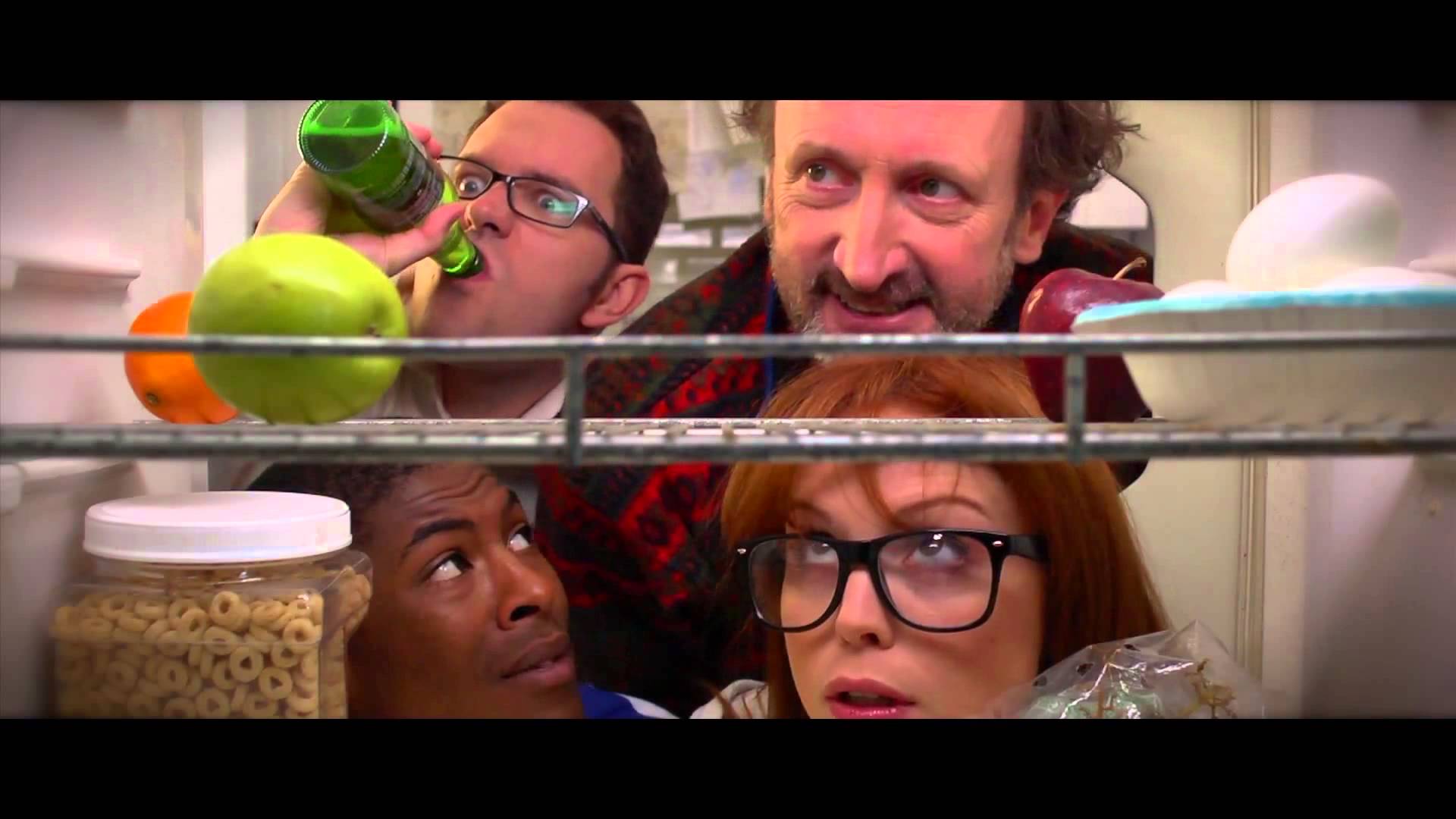
Some of the actors joining Rolfe include (clockwise from top right) Time Winters, Sarah Glendening, and Jeremy Suarez.

Some of the actors joining Rolfe include (clockwise from top right) Time Winters, Sarah Glendening, and Jeremy Suarez.

The plot of the film is supposed to be “out there” with purposely telegraphed twists and over-the-top characters. The villainous General Dark Onward (Stephen Mendel) is especially creative as he’s a paraplegic with a tank for a lower body who has a penchant for losing limbs. Time Winters is entertaining playing the required illusive genius who clues the group in on the secret of Eee Tee while Helena Barrett plays a capable right-hand woman to Dark Onwardby the name of McButters. The actors are mostly veterans of small productions like soap operas and commercials who mostly handle themselves well. The script they’re given is full of silly, corny, lines that they sell well. One of my concerns going into the film was how Rolfe would stand-up amongst professional actors. Any concerns I had were remedied early on as Rolfe clearly knows how to both write for his venerable character and how to portray him. If there’s a weakness in the script, it’s with the Mandi character and McButter. Perhaps not accustomed to writing dialogue for women, Rolfe and Finn’s script for the two aims for cheese but often misses the mark. Their cat-fight scene meant to induce laughter instead brings about groans.
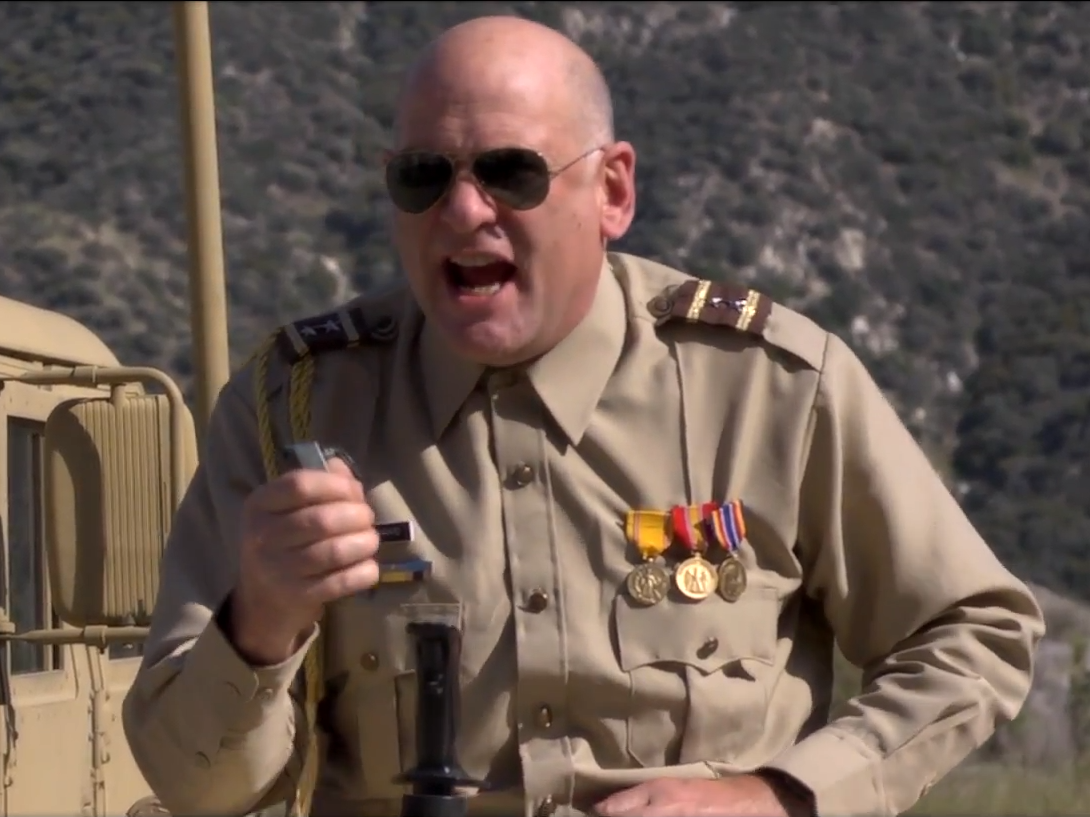
General Dark Onward is probably the most ambitious character in the film.

General Dark Onward is probably the most ambitious character in the film.

The production is noticeably done on the cheap, but it doesn’t limit the film’s scope or imagination which is all that matters. There are lots of easter eggs buried in both the plot devices and the way certain effects are handled (including an obvious homage to one of the worst films of the 1990’s, Teenage Mutant Ninja Turtles III). Rolfe opted primarily for practical effects in lieu of computer generated ones. The films makes frequent use of miniatures, which aren’t really designed to trick the viewer, but are instead meant to amuse. Some of them are quite spectacular and I found it enjoyable watching these scenes and trying to imagine what the crew went through bringing them to life. There are some computer effects, like a Mario inspired lava sequence, and they impressed me in their scope. The soundtrack was handled by Bear McCreary, whom fans of The Walking Dead should recognize. His score makes liberal use of video game sound effects from that era as well as the Angry Video Game Nerd theme song by Kyle Justin. It’s the film’s strongest point, and while not the type of soundtrack I’d seek out, it perfectly suits the film and enhances the viewing experience.

Angry Video Game Nerd: The Movie should satisfy fans of the Nerd and gaming culture alike. It’s also clearly a love-letter to classic sci-fi and adventure pictures and the influences of films like Raiders of the Lost Arc and Godzilla are easy to spot. The plot is large and as captivating as a film based on the Angry Video Game Nerd could possibly be. If I had one last nitpick with the movie it’s that the Nerd doesn’t get enough of an opportunity to really get angry, but I suppose it was necessary to present a slightly more humanized version of the character in order to get it to work on film. I enjoyed the movie, and the loads of bonus content contained on the Blu Ray gave me something fun and interesting to check out after the film was over. Watching an independent film come to life is a rewarding experience. The film obviously means a great deal to those involved with it and their enthusiasm is contagious. This is a film that would be hard to hate, so it’s a good thing it turned out as well as it did.


Home Alone 2: Lost in New York

Home Alone 2:  Lost in New York (1992)

Home Alone 2: Lost in New York (1992)

Home Alone, the John Hughes produced and Christopher Columbus directed film that dominated the holiday season of 1990, demanded a sequel. The film starred ten-year old Macaulay Culkin as Kevin McCallister, who was eight according to the film’s script. Considering the star was already two years older than the character he was playing, and getting older every day, a sequel had to be written, produced, and filmed rather quickly. The problem, of course, is that Home Alone is the sort of movie that really shouldn’t have a sequel, but given the economics of film-making, it was going to have to make do with one.

A friend of mine and I had a disagreement over the Home Alone series. I consider the original a Christmas Classic. It’s not a perfect movie, by any means, but it is entertaining and I enjoy my annual viewings almost as much now as I did when I was young. As for the sequel, well, I’ve never had much love for it. Even when I saw it in the theater as a kid I knew what it was:  a cash-grab, carbon-copy of the original. I never saw much use for it after that initial viewing. My friend, on the other hand, considers the sequel the superior film (we both consider the franchise concluded with Home Alone 2) which I strongly disagreed with. Having not really spent much time with it over the years, I wasn’t well-equipped to defend my position. When browsing the Christmas section at a local store, I happened upon the Home Alone and Home Alone 2 Blu Ray combo-pack and decided now would be a good time to revisit this film and either reaffirm my position or discover a new holiday favorite.

Kevin is back to make the adults of New York look like fools.

Kevin is back to make the adults of New York look like fools.

As I mentioned in the intro, the writers for Home Alone 2 were being put in a tough spot. The plot for Home Alone, of a family rushing off on a vacation to Paris forgets their son at home, is ridiculous on the surface but presented in a way that makes it believable enough for a comedy. Now what isn’t easy is convincing an audience that it could happen again. To forget one’s child at home is a pretty serious infraction. Most of us would jump to conclusions and suggest that anyone who did that is not fit to be a parent, but as I said, the first film does a well-enough job convincing us that the McCallisters aren’t the worst parents in the world. If they were to forget young Kevin again though…

Home Alone 2:  Lost in New York takes Kevin out of the home and drops him in New York City. Leaving him at home again was out of the question, so a new location had to be picked. And in order for Kevin to be left behind once again, a new variation had to be found.

How does Kevin wind up in New York? Well, let’s start from the beginning. Pretty much everyone who worked on the first film returned for the sequel including the cast, writers, and other talents that made the first film such a huge success. And once again, the McCallisters and their extended family are preparing to head out on vacation for the holidays. It’s been one year since the events of the first film and everyone is in Chicago to spend the night before flying off to Miami in the morning. Before the family can take off though, they have to attend a Christmas recital that Kevin and Buzz are both singing in. When Buzz, standing behind Kevin onstage, acts out during Kevin’s solo the younger McCallister is embarrassed and slugs his older brother in response, which somehow collapses the scaffolding on the stage. Back at home, both boys are expected to apologize to the family and make-up before everyone can go to bed and rest-up for the morning. Kevin, feeling that he’s done nothing wrong, refuses to apologize and insists he’s still being dumped on by the family. He and his mother exchange words, and everyone goes to bed angry with one another.

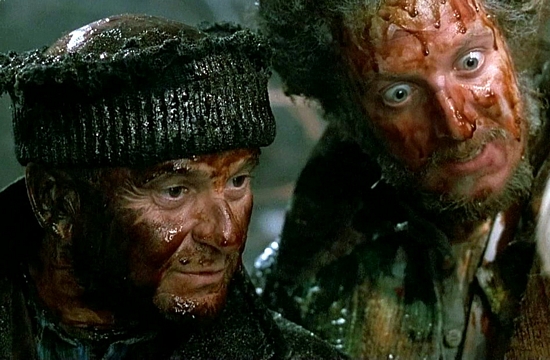
Of course, these guys are back too and somehow bump into Kevin in the middle of the city.

Of course, these guys are back too and somehow bump into Kevin in the middle of the city.

This, of course, is basically how the first film started with only minor modifications and everything here is presented worse than it was in the prior film. Kevin is angry, and rightfully so. In the first film we could see that he’s kind of a pain in the ass and could understand the family’s position. Here it’s just stupid. Buzz’s actions during the recital get a huge reaction from the crowd, and even Uncle Frank concludes they were “pretty god-damned hilarious,” which is just over the top. It’s not that funny, and no reasonable person would be angry with Kevin, and it makes me feel like my intelligence is being insulted. Also of annoyance to me, is the fact that Kevin is ten years old in this film, despite it only being a year after the events of the first movie when Kevin was eight. Now, normally this wouldn’t be that big of a deal but in both movies Kevin makes it a point to remind people how old he is on multiple occasions. Why didn’t they just make him nine? It just bothers me. And Kevin and his mom’s conversation prior to him going to bed is so similar to the first movie it hardly seems worth having. He even wishes to have a vacation without his family and she basically challenges him to make it happen, like she did in the first film when he said he didn’t want to see her again for the rest of his life. Does no one in this family learn anything?!
The setup of the movie is lazy at best, awful at worst, but it’s not going to make or break the film. So how does Kevin wind-up in New York? He gets separated from his family at the airport while fishing through his dad’s carry-on for batteries for his Talkboy (in stores this holiday season!) and then mistakes another man in the same coat as his dad for his dad. Like the first movie, it’s a mad dash to the gate for the family to make the flight so they lose track of Kevin. They get on the correct flight, but Kevin winds up on a flight to New York thanks to a collision with a worker at the terminal. Kevin, who seems like a smart and crafty young boy, gets on the plane and never notices that his rather large family is missing. Meanwhile, no one on the correct flight thinks to double-check and make sure Kevin is there. Considering this has happened before, why wouldn’t they?! Instead, it’s not noticed until the family is at baggage claim.

Meanwhile, Kevin checks into a fancy hotel in New York quite happy to have ditched his family. He makes fools of the adults running the hotel, and thanks to the large amount of cash in his dad’s luggage, has no trouble seeing the sights and having fun. Unfortunately, the Wet Bandits are in New York too, and somehow in a city of millions end up running into Kevin. Marv is quite eager to tell anyone their new master plan of knocking off a toy store on Christmas Eve, and Kevin decides it’s up to him to stop them (apparently the police can’t be trusted) by luring them to his uncle’s vacant house full of booby traps.

They should probably be dead at this point.

They should probably be dead at this point.

What does this movie get right? Not much, I’m afraid. I’ve already expressed my displeasure in the ridiculous setup but I can say the film does improve once Kevin is in New York. This is where the writers actually do a decent job of making Kevin’s actions believable. As he did in the first film, he takes advantage of adults who just think of him as a kid and is able to utilize his VCR and Talkboy in ways that trick adults into thinking they’re being scolded or even shot at. It is just as far-fetched as anything else, but feels smarter and does produce laughs. The main event, so to speak, is Kevin’s repeat encounter with the burglars from the first film. Here the writers are challenged to top what they did in the first film and the director is expected to make the visuals stand-up. Unfortunately, their attempts to top the first end up being just as lazy as the first scenes. Variations of the paint can, blow torch, and other gags are repeated. A few new ones are added, but few are all that memorable. Instead they end up being more absurd. While the damage sustained by the two in the first film certainly would have resulted in lasting damage, many of the traps in this one would have ended in death. Of course they don’t, but they’re certainly harder to believe.

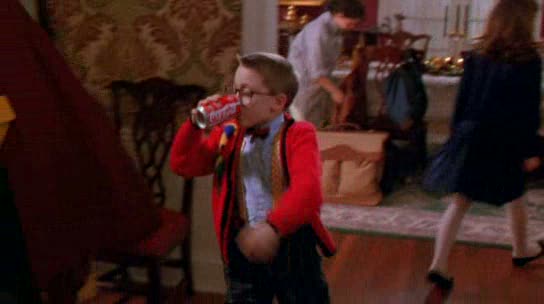
When a sequel is so similar to the movie it's following you look for any difference between the two, like Fuller's new affinity for Coke instead of Pepsi.

When a sequel is so similar to the movie it’s following you look for any difference between the two, like Fuller’s new affinity for Coke instead of Pepsi.

There’s also a B story at play, much like Kevin’s encounter with his elderly neighbor in the first film, only now it’s with a homeless pigeon lady in the park. It’s very derivative of the first, though I will say the acting of Brenda Fricker is not the reason why. Which brings up a larger point of contention that I have with this film:  the acting. If I’m going to accuse the writers of being lazy with this film I could certainly say the same of the actors and actresses present as well. The established ones seem to just phone it in or ham it up. Macaulay Culkin is pretty terrible, especially in the early scenes of the film. The actors aren’t presented with great material to work with, but they still don’t exactly step up to the plate. At least the John Williams score is still good.

In conclusion, I cannot agree with my friend that Home Alone 2 is superior to the original Home Alone. Everything about it feels too familiar and the gags just aren’t as funny the second time around. There’s nothing plausible about it and the only reason the film exists is because it had to. It was a major box office success, not on the level of the first but it still basically printed money. And that’s really all the film was supposed to do. I’m sure everyone working on it expected it to be worse than the first but were happy to take home some nice checks. Watch this one only if you’ve seen the first one too many times and just need something else to watch. Even after you do, you’ll likely end up wishing you just watched Home Alone instead.


Batman: The Movie

Batman:  The Movie (1966)

Batman: The Movie (1966)

The Batman character certainly has changed a lot over the past 50 years. Sure, under the mask he’s still Bruce Wayne, his parents are still dead, and he can usually be found prowling the streets of Gotham City by night accompanied by a juvenile in a red and yellow costume. Many things have changed though. For one, Bruce Wayne is no longer content to be a millionaire so he’s jumped into the billionaire ranks. The blue and gray spandex Batman used to wear is now often black and gray and even armor-plated, depending on the artist. Robin, thankfully, isn’t parading around in tights either or a bright yellow cape (no wonder why he’s usually the one getting picked off as opposed to Batman) and sometimes he even gets to be an adult. Mostly though, the tone of the work has changed. A lot of writers have received credit for turning Batman into a more serious and mature character during the 70’s and 80’s with most of it going to Frank Miller, but the change was actually rather gradual. In order for a character to survive decades upon decades and remain relevant, he has to change with the times as the general tastes of the public are always evolving.

In 1965, Batman was faced with becoming irrelevant. His comic book sales were down and he hadn’t appeared in a film reel in decades. Television was still pretty new, and pretty limited, but the idea to give the caped crusader a shot at television came up and by 1966 Batman was more than relevant once again; he was a star! Starring Adam West and Burt Ward as the dynamic duo, Batman appeared twice a week (a rarity at the time) on television in a serialized nature, often with the first night’s program continuing into the second’s. The show was a hit with children mostly, but also adults who grew up reading the Batman comics. Color TV was new at the time, and Batman was presented in eye-popping color for those fortunate enough to have a color set. The jazz-infused soundtrack was catchy, and the wild cast of villains gave the show a new flavor each week. Stars were born, of course, with classic comic villains such as The Joker and The Penguin seeing their star burn even brighter while villains mostly abandoned by the books, such as Catwoman and The Riddler, found a new lease on life. The show was basically a farce, with Batman and Robin presented in an ever serious manner oblivious to the ridiculous circumstances they would find themselves in week after week. The supporting cast of Commissioner Gordon (Neil Hamilton) and Chief O’Hara (Stafford Repp) were equally oblivious while the villains came across as the only ones in on the joke. Batman and Robin would find themselves in dire situations often, but would always get out of it either thru ingenuity, sheer coincidence, or via an oddly situation specific “Bat” gadget. This was Batman in the 60’s and it’s what people wanted.

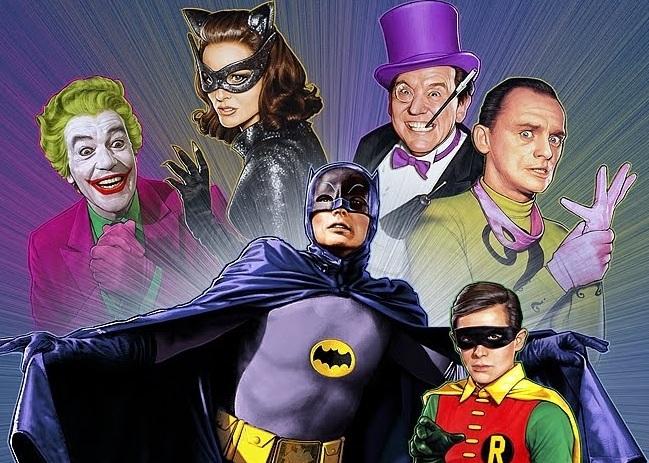
Look out, caped crusaders! The Joker, Catwoman, Penguin, and Riddler have joined forces!

Look out, caped crusaders! The Joker, Catwoman, Penguin, and Riddler have joined forces!

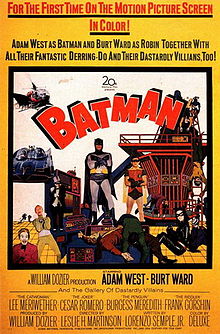
When the show was first conceived, it was decided that a movie would be created to help launch the program. Plans changed, however, when the network involved surprisingly picked up the show with production needing to start immediately to meet a January air date. The movie was back-burnered for awhile in order to focus on the television show, but filming resumed in the early spring to make a summer release possible. This ended up being a boon for the show, and the film as well, as Batman took off and created great anticipation for the film. The increased budget for a feature also meant that new gadgets and vehicles, such as the Batcopter and Batcycle, could be created for the film and then used again for the television show. In order to make the film feel bigger than the show, four villains were present instead of the usual one: Joker, Penguin, Riddler, and Catwoman. The only complication was Julie Newmar, Catwoman on the show, was unavailable so the part had to be recast and went to Lee Meriwether. Cesar Romero, Burgess Meredith, and Frank Gorshin were able to play their roles as Joker, Penguin, and Riddler, respectively, and the rest of the television cast was available for the film as well.

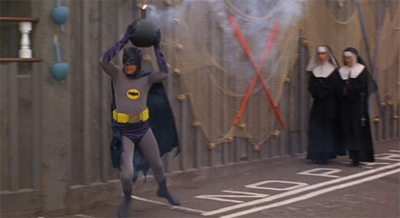
The style of the television show was incorporated into the film. The art direction is distinctly pop for the era. There’s an abundance of bright, primary colors. When the characters are put into a more realistic setting, such as Batman during the infamous bomb segment, they stand-out against the background and appear as out of place as a man in a batsuit should (though the extras in the shots carry on as if this is business as usual). The action sequences are surprisingly kept to a minimum, but when a fight breaks out expect many haymakers and somersaults (the editors saved the famous “pow” animations for the film’s climactic battle). The Batman theme is present but in small doses. The film’s main theme is perhaps relied upon a bit too heavily as it’s used for every long shot of Batman and Robin in their various vehicles used throughout the film.

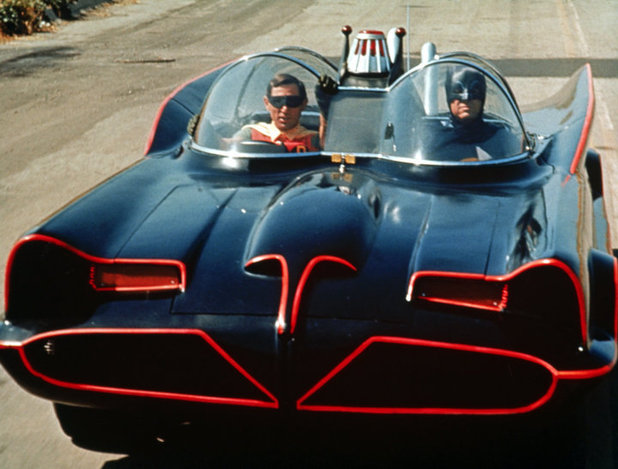
Still the coolest Batmobile ever created.

Still the coolest Batmobile ever created.

The plot from the film is rather rudimentary. The four villains have teamed up to kidnap the world leaders using a bizarre dehydrating ray that reduces any human it touches into a pile of dust to be rehydrated later. The protagonists deduce their foes’ motives thru absurd means presented as deductive reasoning but are either lazy writing or an attempt at humor. Batman is the straight man while Robin is more of a hot-head (and possibly a sociopath who wants to murder alcoholics). The villains are as over-the-top as their TV personalities. Gorshin and Romero present their characters as cackling madmen with The Riddler having the added flaw of feeling compelled to leave Batman and Robin clues in the form of riddles. The film actually draws attention to how similar the two villains became once they hit television, but both actors perform so well in their roles it’s mostly forgiven. Meredith is a delight as The Penguin. He waddles everywhere and gets so much personality out of that long cigarette holder always stuck between his teeth. Meriwether’s Catwoman is basically the same as Newmar’s with her always feeling compelled to use the word “perfect” when describing something she approves of, but drawing it out into a long “purrrrrfect” because she is, after all, a crazy cat-person. Catwoman also gets to have an alter-ego in the form of Miss Kitka, who seduces Bruce Wayne to lure him into a trap so that he may be used as bait for Batman. As a kid, I found it odd how easily Batman is able to see thru a disguise The Penguin uses later in the film, but he’s blind to Catwoman’s. Apparently, even Batman sometimes ends up thinking with the wrong head from time to time.

The special effects in the film will impress no one accustomed to the movies of today. When Batman is attacked by a shark early in the film it’s clearly made of rubber and its teeth leave no imprint on Batman or draw blood. A scene of some ducks in the water are obviously decoys, and every character who throws a punch whiffs by about six inches on their target. And who could forget the climbing scenes? Scene thru the lens of today, these shortcomings just add to the campy charm. The comical bomb Batman is forced to dispose of is cheeky and the ray-gun effects are delightfully cliche.

Some days, you just can't get rid of a bomb (I had to do it!).

Some days, you just can’t get rid of a bomb (I had to do it!).

The film is a farce, an exercise in the absurd, and it is entertaining. I grew up watching the television show in syndication during the 80’s. I suspect my generation may be the last who can say that as I assume most kids today have never seen Adam West as Batman and I wonder if they would appreciate it. Perhaps if this is the fist Batman they’re exposed to they’ll see what the kids of the 60’s saw, or maybe they’ll just see a very ordinary looking man in gray and blue spandex. Batman was fun for me as a kid with all of the different villains and bat-gadgets and as an adult I find it funny and charming. It’s not really clever comedy, but I wouldn’t call it stupid either. The Batman premise is one that’s far-fetched and unrealistic, and the writers approach the character as such. While writers and filmmakers today are more interested in a realistic portrayal of a masked vigilante, it’s kind of fun to see the character portrayed in the only manner he could actually exist. The entire 1960’s television series is finally set for release this holiday season in a massive, and expensive, box set. That might be overload but for anyone seeking out just a taste of the Batman from 1966, the movie represents a good, and cheap, snap-shot. The blu ray from which this review is for, looks great considering the film’s age. The colors pop as they should, the picture is sharp, and there’s quite a bit of extra content. The film doesn’t look as old as it really is, which is often the best compliment one can give to such an old movie. This was my first Batman on television and I would go on to enjoy Tim Burton’s take on the character and fall in love with The Animated Series. I never lost my affection for this Batman though, and even though I view it in a different way than I did as a five year old, I am still charmed by it. Hopefully, I’m not the only one.


The Princess and the Frog

The Princess and the Frog (2009)

The Princess and the Frog (2009)

When Walt Disney unveiled Snow White and the Seven Dwarfs back in the 1930’s, many critics saw the move as a foolish one. Who wanted to pay to see a feature-length cartoon? Apparently, many folks as Snow White became one of the most successful movies of all time. Ever since, Walt Disney Productions has specialized in feature-length animated films with fifty-three produced and released to theaters, not to mention numerous direct-to-video films and television specials. Ever since 2004’s disappointing Home on the Range, all of the Disney films have undergone a major change. The traditional hand-drawn animation of classics such as Snow White, Pinocchio, and Bambi have been abandoned in favor of computer-generated characters. When CG movies started showing up in the 90’s the medium was met with skepticism, but following the success of Pixar’s Toy Story, it became apparent that CG was the future of animation. Still, few could have predicted CG would reduce hand-drawn animation to near extinction. And with Pixar and Disney partnering up, it seemed like Pixar would be the vehicle for CG animated films while Walt Disney Animation Studios would continue to churn out the more traditional stuff. That was not to be.

When Disney first announced The Frog Princess in 2007 it came as a surprise. Disney had previously declared 2-D animation dead in ’04 and for a new hand-drawn film to show up just three years later was definitely unexpected. The film, which starred an African-American girl from New Orleans named Maddy, was also met with a whole bunch of criticism from various groups. If Disney had thought a non-white female lead would garner it lots of positive press it was unfortunately mistaken. Having a black lead seemed to place a microscope on the film and the early press package was nit-picked to near death. The setting, the main character’s name, occupation, the ethnicity of the film’s prince – all received some criticism. Even the film’s title was somehow offensive to French people. To Disney’s credit, a lot of the criticisms were taken to heart and applied to the film. The new title became The Princess and the Frog. The main character was given the name Tiana and made a waitress and Oprah Winfrey was hired as a consultant. What was not changed was the setting which the directors felt was important to the story. Other criticisms, such as a black man for the villain, were also kept. This didn’t free Disney from further criticism though, but at least it showed the company was sincere.

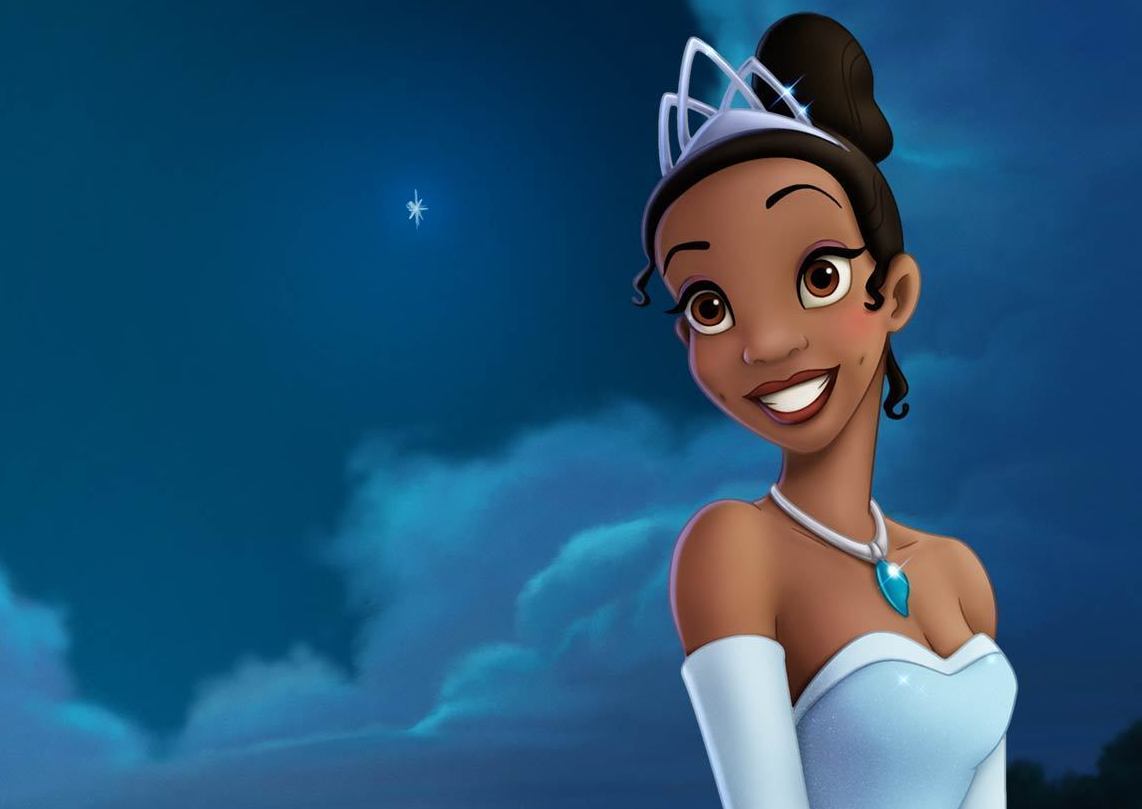
Tiana's ethnicity was cause for celebration in some circles, but it also opened her up to more scrutiny than usual.

Tiana’s ethnicity was cause for celebration in some circles, but it also opened her up to more scrutiny than usual.

With the hand-drawn animation decision out of the way, directors Ron Clements and John Musker (Aladdin, The Little Mermaid, The Great Mouse Detective) also wanted to bring back more traits of the old Disney films. The Princess and the Frog was based off of a fairy tale, The Frog Prince, and a retelling The Frog Princess, using elements of both. It was also decided the film would be a broadway-style musical like the films of the 90’s. For the film’s look, producer John Lasseter wanted the animation to draw comparisons to Disney’s Lady and the Tramp, which he considered to be the pinnacle of Disney animation. Many veteran animators who had been laid off following the decision to abandon hand-drawn animation were re-hired, and Disney’s outdated CAPS software was replaced by Toon Boom Harmony. The film was cast, and production was underway.

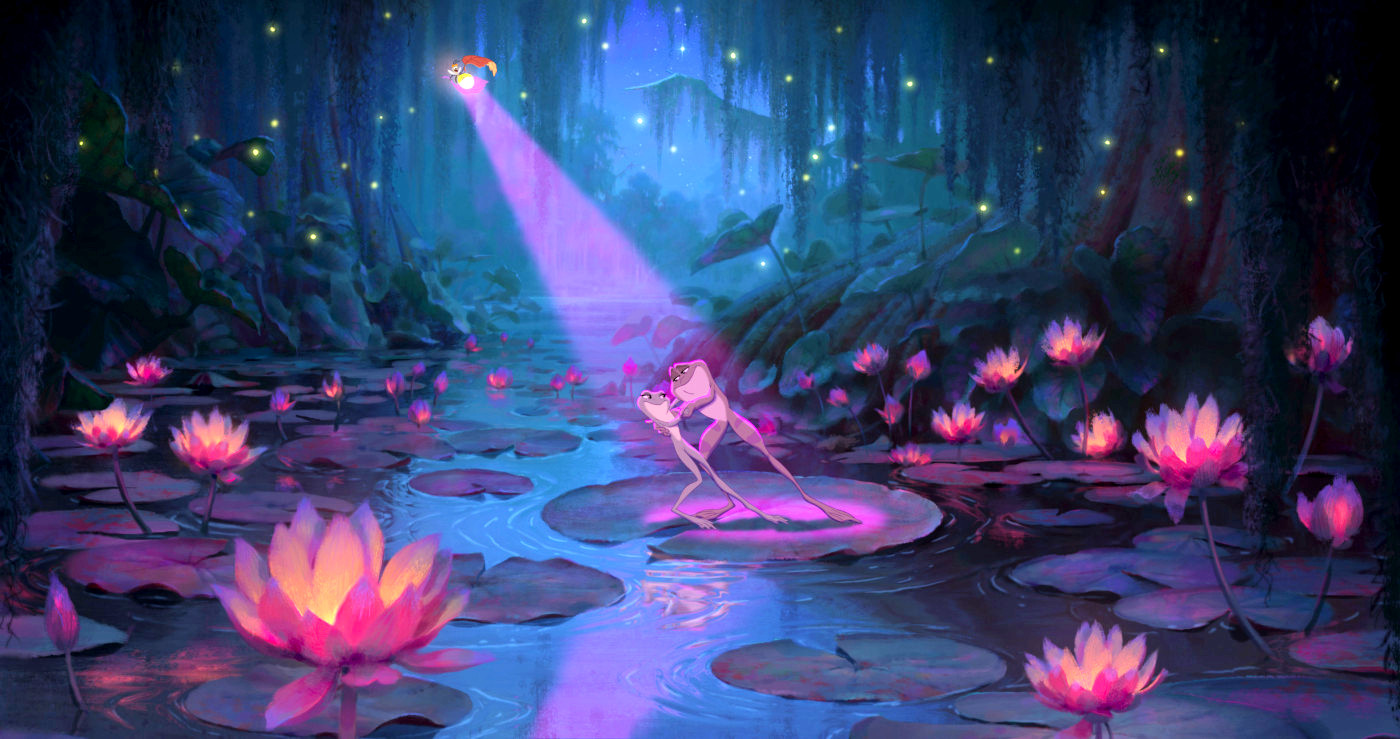
As expected, a modern hand-drawn animated film from Disney looks spectacular. The Princess and the Frog is Disney’s sharpest looking production to date. The animation is warm, fluid, and full of personality. The backgrounds are astonishing and are so much more alive when compared with the animated features that came before it. The film was produced using actual sheets of paper as opposed to having the animators draw on tablets and many of the film’s backgrounds are painted as well. CG effects are applied for smoke, shadows, and other lighting. If the film has one visual drawback, it’s that some of the objects look flat against the expressive backgrounds. This limitation is contained to background characters, but is noticeable at times. Otherwise, the film looks fantastic and is a true love letter to the animated films of old.

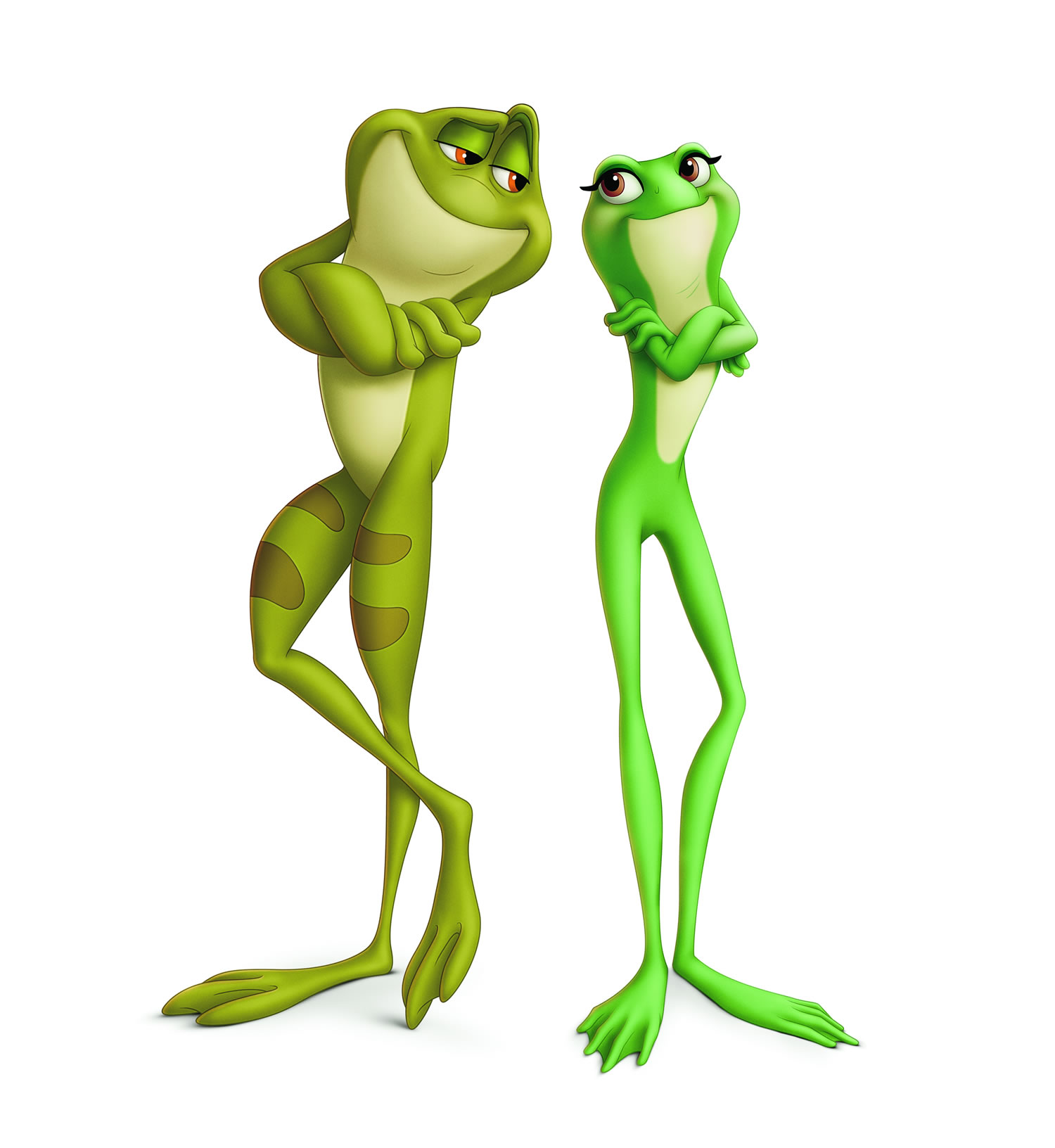
For the frog versions of the two leads, Disney wanted their look to draw from the example set by Jiminy Cricket: make the characters pleasing to look at as opposed to realistic.

For the frog versions of the two leads, Disney wanted their look to draw from the example set by Jiminy Cricket: make the characters pleasing to look at as opposed to realistic.

The plot unfortunately is not the equal of the animation. While the performances of the actors involved is quite good, the actual pacing of the film is pretty ho-hum. Aside from the twist of having the film’s “princess” turned into a frog, it’s fairly predictable. The film’s villain, Dr. Facilier, is basically a bad guy for the sake of being a bad guy. There’s not much depth to him. Tiana is a strong female lead who’s a hard-working girl scraping by with the dream of one day opening her own restaurant. She’s juxtaposed by her best friend, Charlotte, the daughter of the wealthiest man in town who has had everything handed to her. Charlotte’s prime goal in life is to marry a prince so she can be a princess. Clearly, Tiana is expected to fulfill the role of a modern woman (despite the film’s 1920’s setting) while Charlotte is meant to represent the outdated princess of old who is defined by her prince. The film is definitely successful at making Tiana a positive role model for young girls (or really, for any child), but it isn’t done in an organic way. Tiana, either through spoken dialogue or song, is determined to let us know over and over how she has had to work hard for everything she has. And while some of that is intended to be a trait of the character, one does get the feeling the film could have used some more subtlety. Future Disney films would better create a compelling female lead, which isn’t to say that Tiana is a disappointment, she just lacks refinement.

Taken on the whole, the film is an enjoyable adventure thru the Louisiana bayou that feels pretty light-hearted. There’s comedy, and of course, music that is entertaining if nothing else. The fact that the film doesn’t have some big, important, message to convey is forgivable, though the lightness of the tale keeps it from being among the best of the best. The film does shine amongst its predecessors when the film’s music is considered. Written primarily by Randy Newman, it does a good job of taking the audience to New Orleans and the opening number, performed by Newman with vocals by Dr. John, is one of my favorites from any Disney film. I normally loathe the musical parts, and for some of the ones in this film that sentiment remains, but I was surprisingly captivated by a few. They’re not overdone, and unlike the more recent Frozen, I never felt like the music was used as a substitute for dialogue. The film also doesn’t shy away from adding a dangerous element to its villain. Too many parent-centered reviewers will remark that Dr. Facilier is too scary for young kids, but he’s supposed to be scary! What’s the point of a villain that doesn’t come across as a threat to the protagonists? There’s even a death in this film, and I was happy to see there wasn’t some lame cop-out to follow, even though I was expecting one.

There's no denying the film is stunning to behold.

There’s no denying the film is stunning to behold.

The Princess and the Frog was met with positive reviews upon its release and was a financial success. It wasn’t the smashing success of some of the older Disney films, and because of that, the hand-drawn animation wing has been shelved indefinitely. The Blu Ray special features contain numerous interviews with the creators of the film who speak glowingly about hand-drawn animation with an eye towards the future. During the run-up to the film’s release, Disney was boasting that a hand-drawn feature could be expected every two years. The film was released in 2009, and today in 2014, there still hasn’t been another hand-drawn feature from Disney. The Snow Queen, retitled as Frozen, was supposed to be the next hand-drawn feature but was converted to CG and went on to become a massive success for Disney. Who knows if the choice of animation would have had any impact on the finished product. I personally do not feel the general movie-going public is averse to hand-drawn animation or even has a preference. The luster of CG has long since worn off as it has now become the standard. The Princess and the Frog likely did not perform up to expectations at the box office for reasons completely unrelated to its animation style. If anything, the animation style likely drew additional patrons since hand-drawn is no longer the norm. I personally believe the film wasn’t a huge hit because the plot seemed too familiar. Most people have already seen numerous animated fairy tales and a film with the word “princess” in the title probably isn’t going to draw the attention of young boys. Disney’s attempt at creating a modern princess for young girls to look up to effectively alienated them from a large portion of their audience:  young boys. The studio is definitely wise to this as more recent films have opted for a more ambiguous title like the previously mentioned Frozen or Tangled.

It is my sincere hope that The Princess and the Frog is not the last feature-length production from Disney to feature hand-drawn animation. The film is proof that the medium still has a lot to offer and I just find it so much more engaging than CG features. While I love and appreciate much of what Pixar has put out I’ll likely always prefer the hand-drawn look. The sad thing is, as fewer and fewer films and cartoons are done in that style, the people who specialize in it are likely retiring or no longer with us. The younger generation is being raised on CG and lacks the skills to create hand-drawn animation. Hopefully, Disney realizes this and elects to take on the responsibility of keeping the art form alive. Perhaps releasing a hand-drawn feature every other year was too ambitious, but every five years seems like a reasonable goal. With no hand-drawn features announced as of this writing, the future of the medium is very much in question and that’s a shame. The only company that seems to care is Japan’s Studio Ghibli which thankfully continues to output hand-drawn features even with its beloved leader’s, Hayao Miyazaki, retirement. To all lovers of hand-drawn animation, I say treasure The Princess and the Frog, because you may not see another Disney film like it.


The Adventures of Ichabod and Mister Toad

The Adventures of Ichabod and Mister Toad (1949)

The Adventures of Ichabod and Mister Toad (1949)

Walt Disney was a household name in the 1930’s due in large part to the success of characters such as Mickey Mouse and Donald Duck, as well as for being really the only producer of feature-length animated films. Snow White and the Seven Dwarfs was a massive success for the company, and though its follow-ups are well-regarded today, they struggled to turn to a profit at the time. With the onset of World War II, the company found its resources spread quite thin making war propaganda films for the government with little time and money available to produce more feature-length animated tales. Thus, the company resorted to shorter “package” films where two stories not really worthy of feature-length treatment were packaged together as one feature and released to the public. Some of these, such as Fun and Fancy Free, would mix live-action and animation in presenting its multiple tales. And others, like The Adventures of Ichabod and Mister Toad, would simply combine two animated shorts into one feature-length experience.

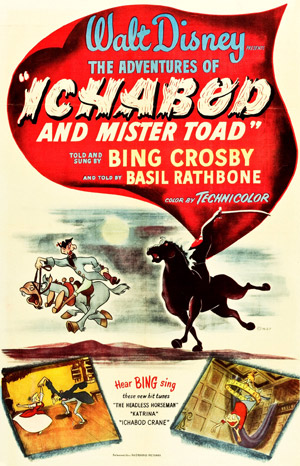
The Adventures of Ichabod and Mister Toad was released in 1949. The two were seemingly paired as a result of both stories being British in origen, though both were considered for feature-lenght treatment at one point or another. The Mister Toad portion, based on the story The Wind in the Willows by Kenneth Grahame, was a natural fit for Disney as it already starred several anthropomorphic characters and had an easy to adapt plot line. The Ichabod portion, based on The Legend of Sleepy Hollow by Washington Irving, was a tougher piece to adapt to a feature length, and while its source material may seem too scary by today’s standards, would slide in rather seamlessly given the presentation of recent films Pinocchio and Fantasia. And given the eventual release date of October 5th, it possessed the Halloween spirit movie-goers likely would be looking for.

For various reasons, neither tale was able to secure a feature-length production and release. The Wind in the Willows was especially affected by the war and budget, with the finished product omitting numerous planned sequences adapted from the novel. This release would end up being the last of package films, as the follow-up Cinderella would get the Disney company back on track. Over the years, Ichabod would become a regular on television around Halloween time, while Mr. Toad would be immortalized as an attraction at both Disneyland and Walt Disney World (though in the case of the latter, Mr. Toad’s Wild Ride has since been demolished). Children today may not be familiar with Disney’s version of Ichabod as the sequence is rarely shown on television. And if they’re at all familiar with the characters from Mr. Toad, it’s likely thru their many cameos in Mickey’s Christmas Carol or the previously mentioned theme park ride. However, those of an older generation seem to remember this feature quite fondly just judging by the ratings it has accumulated around the internet. In perusing them, it seems most viewers have a stronger connection to the Ichabod sequence than the Mr. Toad one, likely due to the television airings during the 1980’s, but do have a fondness for Mr. Toad and his compadres.

I recently purchased the feature on Blu Ray. Given that Halloween is just around the corner, it made sense for Disney to get a truckload of copies onto retail shelves. It was modestly priced, which makes sense given that it’s only 68 minutes long and the release is light on special features. I had seen both sequences from the feature as a child, but really didn’t recall much. I am not sure if I saw them together or spread apart. My memory was slightly stronger when it came to the Ichabod portion, probably due to the scary visuals and the unique look of the Ichabod character. Given that I only vaguely recalled viewing these two shorts as a kid, watching them on Blu Ray felt more like watching them for the first time. My reaction was muted at best.

Toad, together with his partner in crime, Cyril.

Toad, together with his partner in crime, Cyril.

The Adventures of Mister Toad is up first. A brief live-action sequence introduces the tale as a camera pans around a library and settles on the book the story is adapted from. Basil Rathbone is our narrator and the narrators chosen for both shorts is where Disney paid for any sort of name recognition. They are both used quite differently though with Rathbone just introducing the tale and interjecting some thoughts and explanations throughout the story. Toad and the rest of the cast are fully voiced and are appropriately presented with British accents. This is actually somewhat noteworthy as most of the early Disney films were set in Europe but the characters possessed American accents. The story obviously centers on the Toad character who’s a carefree toad of wealth (and debt) consumed by a passion for anything trendy, which at the moment is motor cars. His plainly named associates either approve of his actions or disapprove while all try to keep him out of trouble. He ends up being taken advantage of and framed which lands him jail for Christmas, and the most exciting part of the short centers around his escape and attempt to clear his name. Despite the brief running time, I found the sequence to be rather slow-moving, and at times, downright boring. The film takes time to set-up the story, but the characters are drawn in the broadest of strokes and little time is really needed to establish who they are. It’s easy to tell right form the start that Toad is a compulsive and sheltered individual. His exuberance makes him the most interesting of the small cast, and he’s certainly likable as a lead.

The voice acting is mostly adequate but I couldn’t help but feel that some of the voices chosen did not suit the character. Few of the voices seem like they should be coming from the characters, with the most jarring being the horse, Cyril, who had me wishing he was a silent character. The animation could also be described as adequate which I suppose is expected given the studio’s financial situation at the time. It’s basically on par with the theatrical shorts the company was known for as opposed to the feature-length pictures. All in all, I found it hard to care about the characters as presented, and when the sequence was over I was ready for it to end.

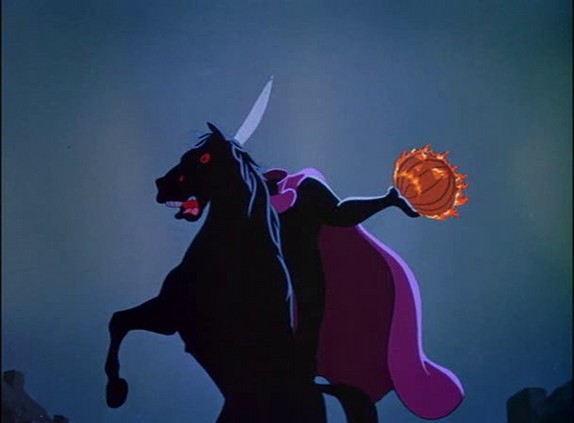
The Headless Horseman is the true star of the second act.

The Headless Horseman is the true star of the second act.

The Sleepy Hollow portion follows and was the sequence I was most interested in. While I was curious to see how The Wind in the Willows was adapted, I never had a strong affinity for Mr. Toad. The Legend of Sleepy Hollow is also a story I’m more familiar with, as I assume most people are. Ichabod’s last ride and the specter of the Headless Horseman have been recounted numerous times in popular media either as a direct adaptation or as a spiritual retelling. It’s a timeless tale and little effort is needed to convey the doom possessed by the Horseman. It’s really quite hard to make a headless knight riding a black stallion not look scary.

This segment is narrated, and sung, by Bing Crosby as a true narrator. If you’re looking for an example, think Boris Karloff from How the Grinch Stole Christmas. Crosby narrates the entire portion and sings at times. Ichabod and the characters do not actually speak, instead Crosby narrates the whole damn thing. It’s not the approach I would have taken if I were placed in the director’s chair, but there’s no reason why this shouldn’t work either.

As was the case with the Mister Toad sequence, the Ichabod portion suffers from pacing issues as well. This is partly to be expected as anyone familiar with the story knows the Headless Horseman shows up at the end. Leading up to it we’re essentially shown how Ichabod is basically a conman who’s motivated by wealth and food. He’s the local school teacher, and despite being a rather ugly looking fellow, is able to woo the local women with his singing voice and charm. When a wealthy individual comes to town with a fetching daughter by the name of Katrina, Ichabod sets his sights on a new prize. This puts him in competition with a local man by the name of Brom Bones, who is basically a lunkhead (he must have been inspiration for the much later Disney character, Gaston, from Beauty and the Beast) who is outsmarted by Ichabod when trying to court Katrina. It’s at a Halloween party hosted by Katrina’s father that Brom gets the idea to tell the tale of the Headless Horseman in an effort to scare Ichabod, who is revealed to be a superstitious man at the very same party. Given how slow-moving the story is, I found it lazy that Ichabod’s superstitious ways were not revealed throughout the picture in a more subtle fashion. Anyways, it’s when Ichabod leaves the party the he encounters the ghostly horseman.

If they had just committed to the horror, and left comedy to Toad, the Sleepy Hollow segment would have been better for it.

If they had just committed to the horror, and left comedy to Toad, the Sleepy Hollow segment would have been better for it.

The sequence where Ichabod is chased by the Headless Horseman is easily the highlight for both pictures. The setting is chilling and the Horseman looks particularly menacing. Ichabod, seated atop a very unimpressive horse, is forced to run for his life and the music and animation does a decent enough job of allowing the audience to share in his terror. There are some disappointments to be had, however. As mentioned during the Mr. Toad portion, the animation is merely serviceable and not feature-length quality. As a result, there is really no use of shadows or shading on Ichabod who pops too much against the background. Perhaps feeling the ride was too scary, some comedy was also added to the chase which really disrupts the mood. It’s basically screwball comedy not unlike what would appear in a Bugs Bunny cartoon and feels woefully out of place. At the end of the picture, there are some scenes that also detract from what should have been a more ambiguous ending, which also felt like a cop-out.

Overall, I was unimpressed by The Adventures of Ichabod and Mister Toad. As someone who loves and appreciates animation from all eras, I can easily forgive the films technological short-comings there as I wasn’t expecting it to be up to Disney’s usual standards from that era. I can’t really excuse either film for the pacing issues, and if given the chance, I probably wouldn’t have purchased this had I seen it first. The DVD release for the film a few years ago at least included a Mickey Mouse short that for some reason isn’t included here. And while I have all of the Mickey Mouse cartoons on DVD already, it would be nice for others if it had been included on the Blu Ray too. If you happen to be in the mood for a re-telling of The Legend of Sleepy Hollow, I’d suggest looking elsewhere (or scanning the various Disney channels to see if they show their version for free) this Halloween. As for The Adventures of Mister Toad, the weasel characters for the film inspired the same for Who Framed Roger Rabbit?, an immensely more enjoyable film. And if you really want to see the characters from the original, just wait for Mickey’s Christmas Carol which undoubtedly will start showing up on television before Thanksgiving arrives.


The Ghostbusters Get the Lego Treatment

IMG_0052It’s been thirty years since Ghostbusters first hit the big screen ushering in a new era of special effects-laden blockbusters.The film made unlikely heroes out of middle-aged comedians Dan Aykroyd, Bill Murray, and Harold Ramis while lesser known Ernie Hudson got a taste of stardom. The film was immensely successful and soon a cartoon was spun-off from its success which lead to even more opportunities for merchandise. Lots and lots of merchandise.
Ghostbusters is one of those rare franchises that has a lot of appeal for both kids and adults. Many have tried to achieve the same thing, but aside from those that can lean heavily on nostalgia, most fail to achieve the same level of success. The adults had the films, which kids enjoyed as well, while the cartoon was aimed directly at adolescents. The personalities of the main characters were unique to whatever version was being watched with only the broader traits (such as Egon being the brainy Ghostbuster) carrying over.
I was introduced to the Ghostbusters via the cartoon, and as a child, probably assumed it came first. When Ghostbusters 2 arrived in theaters it was a pretty big deal. I liked the films, though my assortment of toys were obviously born from the cartoon. I can recall having at least three of the Ecto vehicles, the firehouse, and numerous action figures. I also remember a Transformers-inspired Volkswagon Beetle that turned into a grasshopper. Sadly, once the Teenage Mutant Ninja Turtles arrived the Ghostbusters began to lose the battle for my attention, and my parents’ money. Most, if not all, of those old toys have been either sold, given away, or tossed, though my love for the original film (and to a lesser extant, its sequel) still exists.

The finished product.

The finished product.

This weekend, Ghostbusters is back in theaters for those who wish to see it on the big screen. If the lure of the theater isn’t your cup of tea, then might I suggest celebrating 30 years of ghost-busting goodness with Lego?
Earlier this year, as part of the 30 year anniversary celebration, Lego released the infamous Ecto-1 in Lego form along with mini figures of the four Ghostbusters: Peter, Ray, Egon, and Winston. The set was the result of a fan vote on sets created by avid Lego builders. A firehouse was part of the original fan-set, but sadly Lego passed (with no indication the franchise would be revisited, but who knows?). The Ecto-1 is a solid overall set for Lego collectors and Ghostbusters fans. Its external likeness is nearly spot-on and likely only the most avid Ghostbusters fans can spot any shortcomings. This set is obviously of the Ecto-1 vehicle from the first film, and not the more flashy edition from Ghostbusters 2. It took me a full evening to assemble, and once completed I was more than satisfied with the end result.
The fours figures feature a reasonable likeness to the characters they’re meant to resemble. Lego figures are rather limited in what they can do, but little touches such as the lines on Venkman’s face and Egon’s hair do a solid job of giving these figures some character. I would have preferred to see Lego attempt a receding hairline on Pete, and Winston looks more like Billy Dee Williams than Ernie Hudson, but oh well. Their proton packs are a combination of several Lego pieces and have to be assembled. The end result looks pretty good and Lego’s approach proved accurate. The trap, on the other hand, is just so-so but clearly Lego didn’t want to spend extra cash on creating a unique piece of plastic for one lone set. There’s also a build-able stand to display the figures which is a nice touch considering the majority of those who purchase this will likely be adult collectors.

The fab four ready for some bustin'!

The fab four ready for some bustin’!

When it comes to the actual vehicle in the set, Lego surprises with numerous unique pieces. This means no stickers, which is always a welcomed trait for a Lego set. The doors for the Ecto-1 all have printed Ghostbuster logos on them and even the license plates are sticker-free. The general shape of the Ecto-1 is captured quite well, and the mass of junk on top seems accurate enough. There’s a hose piece that’s a little odd, but it was on the original so it’s here as well! There’s really very little to nitpick here as even the rear wheels are covered by the frame of the vehicle. The only real issue with the car is the scale. It’s slightly under scale to the figures and can only hold three figures, seated single file, at a time. Since most are likely to display the characters on their stand, this isn’t that big of an issue and probably the right move. A vehicle that could actually hold all four figures may have ended up being out of scale for the opposite reason.
All in all, this is a great little set. It will set you back around fifty bucks which is pretty much on par for similar Lego collections, though may be just a tad too pricey for impulse buyers. For those that want to see their beloved Ghostbusters in Lego form, this is damn near perfect. Hopefully Lego reconsiders and comes thru with a firehouse (that’s to scale with the Ecto-1) so I can finally replace the toy one I sold at a yard sale so long ago.


The World and The Land: A Disney Comparison

orl-disneyland-vs-disney-world-castles-pictureIt has been a long time between posts for me. Never since I started this blog have I only made one post for an entire month, but my personal life left little time for leisure throughout the month of June. Without getting into too much detail, I spent the end of June and the start of July honeymooning in Disneyland: The Happiest Place on Earth.  As a dweller of the east coast, I have been fortunate enough to vacation in Disney World several times as both a kid and adult (it’s actually where I “popped the question” to my now wife) but I had never left the east coast for the west and visited the original park, Disneyland.

Growing up, Disneyland was sold to me as the lesser Disney World. As such, I never had any desire to really see Disneyland if Disney World was better. When vacationing at Disney World, the cast members there love sharing the fact that the entire Disneyland park (and the new park, California Adventure) could fit inside the parking lot of Disney World’s Magic Kingdom. The common thing I heard from people who had been to both was that Disneyland was something to do on a weekend, while Disney World was a destination worthy of a week’s investment. Recently though I became interested in the historical aspect of Disneyland. As many know, Disneyland was the original park and its construction was orchestrated by Walt Disney himself, while Disney World was in the early planning stages when Disney passed away in 1966. And while many attractions are shared between the two resorts, Disneyland does have a few unique rides and also still has some of the older rides that have vanished from Disney World over the years. When it came time to settle on a honeymoon, going back to Disney World was certainly an option for my wife and I but we both had a desire to do something at least a little different. It seemed like the right time to hop on a plane bound for California and check out the original and see for ourselves which was best. In the end, we came to find the two were comparable, but also different enough to possess their own charm. It didn’t seem right to necessarily pit the two against each other, which is why this post is merely a comparison and not a contest. After a week (with a five day park hopper pass) at the Disneyland Resort, this is the impression it left upon me:

Size

A map of Disney World, Disneyland is said to be able to fit in the Magic Kingdom's parking lot.

A map of Disney World, Disneyland is said to be able to fit in the Magic Kingdom’s parking lot.

The first thing that comes to mind when comparing the two resorts is size. Disneyland started off as one theme park with Sleeping Beauty’s castle serving as the central hub for park goers looking to experience the wonder of Fantasyland, the thrill of Adventureland, and the mystique of Tomorrowland. Since 2001, California Adventure has existed opposite Disneyland on the site of the original Disneyland parking lot. Loosely inspired by Disney World’s Hollywood Studios park, California Adventure is home to Pixar and the unique Paradise Pier and Cars Land attractions. Disneyland covers approximately 160 acres with California Adventure an additional 67 acres. By comparison, Disney World’s four parks and several hotels occupy 40 square miles, with the Magic Kingdom totaling 107 acres, Hollywood Studios 135, Epcot 300, and Animal Kingdom a whopping 500 acres. There are also two water parks at Disney World and both have a Downtown Disney area but it should be clear that it’s an apples and oranges comparison when it comes to size.

The size of Disney World was the main draw for Disney as he wanted an area with limitless potential. As a result, Disney World still has tremendous room for expansion should the need or desire arrive while Disneyland is basically locked in. The added size means more room for guests and more variety, but it also means a heavier reliance on transportation. Get used to waiting in lines for a bus at Disney World, while Disneyland’s compact size means everything, including most hotels, is within walking distance. The size of each resort is both a pro and a con, and Disney World at least gives patrons multiple options for park hopping via the shuttle lines, monorail, or ferry boats (the only exception being Animal Kingdom, which is basically isolated from the other three parks). I love the variety of Disney World, but I also really loved going back and forth between Disneyland and California Adventure throughout the day, gaming the fast pass system or just trying to avoid whichever park was more crowded.

Rides and Attractions

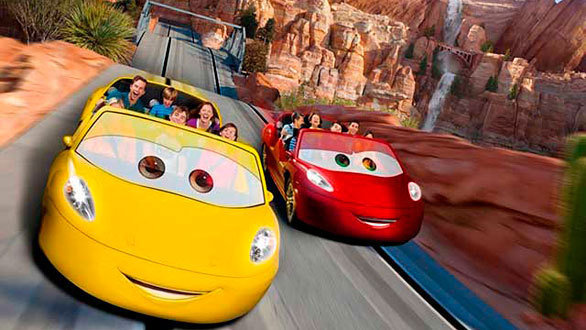
Disneyland's current biggest attraction:  Radiator Springs Racers.

Disneyland’s current biggest attraction: Radiator Springs Racers.

The size of both resorts is obviously of no consequence if there’s nothing worth seeing and experiencing at the parks. To make comparing the two easy, many rides are duplicated across the parks while some of the seemingly unique rides share the same technology or format as a ride at the other park.

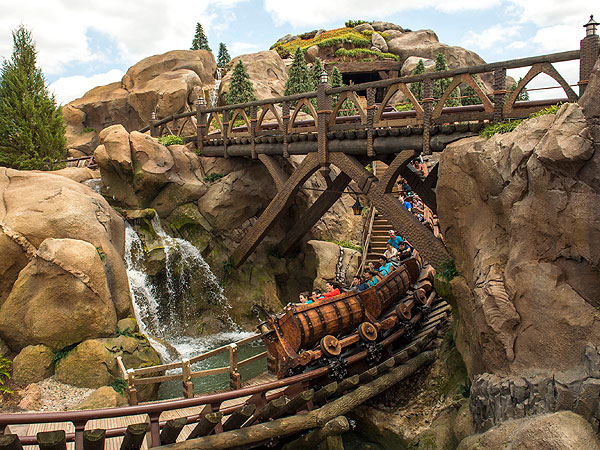
Disneyland and The Magic Kingdom are the easiest to compare as The Magic Kingdom is essentially the sister park to Disneyland. They have the same layout and general design with a castle serving as the central hub of everything. In Disneyland, it’s Sleeping Beauty Castle while The Magic Kingdom is home to the colossal Cinderella’s Castle. Cinderella’s Castle is the representation of the size difference between the two resorts as it dwarfs Sleeping Beauty Castle. When it comes to the surrounding lands, the only major difference is the northern most land at each. In Disneyland there’s Mickey’s Toon Town while Disney World boasts a larger version of Fantasyland (and at one point in time, had its own Toon Town). Originally, many of the classic Disneyland dark rides existed at Disney World, such as Snow White’s Scary Adventure and Mr. Toad’s Wild Ride. These have been replaced at Disney World in favor of an additional Dumbo ride, a small Goofy coaster, and the new Seven Dwarves Mine Train, a ride unique to Disney World.

And here's Disney World's newest ride:  The Seven Dwarfs Mine Train.

And here’s Disney World’s newest ride: The Seven Dwarfs Mine Train.

The dark rides are mostly for kids. As an adult, I find myself only riding them to escape the heat. Between the two parks, the only one to really leave an impression on me is the Disneyland version of Peter Pan’s Flight which seemed faster and appeared to be kept in better shape than its Disney World counterpart. Disneyland has some unique dark rides such as the Monsters Inc. ride and Alice in Wonderland, but none are difference makers. As for the rides the two parks share, I prefer Splash Mountain at Disney World to the one at Disneyland. Disney World’s version has a bigger car and a bigger drop at the end. Disney World’s Space Mountain is a bit better, though I’m personally not a fan of the ride. A lot of people prefer Disneyland’s version of Pirates of the Caribbean, but I don’t find either ride compelling. Disneyland has a newly refurbished Big Thunder Mountain that’s noticeably smoother than Disney World’s, and therefore better. The original Tower of Terror at Disney World is a more immersive ride experience, but I actually preferred the shorter and quick to the point version at California Adventure. Disneyland also has the superior version of Buzz Lightyear thanks to the non-mounted gun, though both versions of Buzz pale in comparison to Toy Story Mania, which is the same experience at each park.

The unique rides offer the best way for the two parks to stand out. I haven’t been on the newest ride at Disney World, the Seven Dwarfs Mine Train, but it does look pretty rad. A unique ride at Disneyland that I wasn’t able to experience is the Finding Nemo Submarine Voyage due to an expansive refurbishment going on right now. The ride is a rebranding of the old submarine ride that also existed at Disney World and was pretty hokey, so I can’t say with any certainty that it’s a worthwhile experience. Seemingly unique rides like the Indiana Jones ride at Disneyland, exist at Disney World but under a different theme, in this case the DINOSAUR ride at Animal Kingdom. Of the two, I prefer Indy but the experience is pretty comparable. Another one is Epcot’s Test Track, which basically exists at Cars Land as Radiator Springs Racers. Again, if given the choice between the two, I’ll take the Disneyland version because of the fun theme though Test Track offers a bit more thrills than its counterpart and both are awesome. The two resorts also each sport their own roller coaster: California Screamin’ at California Adventure and Rock n’ Roller Coaster at Hollywood Studios. Both start off with a bang and contain sharp turns and an inverted loop. The Rock n’ Roller Coaster is indoors and features an Aerosmith theme while Screamin’ is outdoors, is longer, and overlooks the Paradise Pier area. Of the two, again I side with Disneyland as California Screamin’ offers the overall better experience. And for some reason it’s not very popular and boasts consistently short wait times. Animal Kingdom has the safari ride which is obviously an experience unique to that park. It also has the Expedition Everest ride which also does not have a Disneyland counterpart and is a pretty thrilling experience.

Both parks feature shows and fireworks displays to entertain guests when they’re not eating or enjoying the rides. Every night at Disney World’s Magic Kingdom, there’s “Wishes” the fireworks show. It’s a love letter to the Disney films of old (and some new) that will stir the emotions of anyone with fond memories for such films. The outdoor spectacular “Fantasmic” at Hollywood Studios is something to be seen if you’re a kid or adult. One part water show, one part broadway, and one part fireworks, it’s probably the best thing going at either resort. Not to be outdone, Disneyland has the Magical Fireworks each night which are entertaining but not quite on the same level as “Wishes.” Disneyland also has its own version of “Fantasmic,” but without a dedicated amphitheater setting, it’s not as grand, but gets the job done. California Adventure boasts “The Wonderful World of Color” which is basically a laser water show out in front of Mickey’s Fun Wheel. It’s unique and pretty neat to experience, and the special Glow With the Show edition of the famous Mickey Ear Hat is a fun, albeit pricey, addition to the experience. It’s not quite on the same level as “Fantasmic,” but is something visitors to Disneyland should go out of their way to experience at least once.

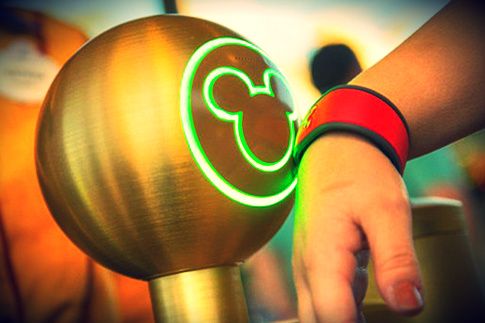
Making its debut in 2013, Disney World's Magic Band is the new fast pass.

Making its debut in 2013, Disney World’s Magic Band is the new fast pass.

One huge difference between the two resorts is the Fast Pass system. At Disneyland, patrons are able to visit kiosks throughout the parks and essentially reserve time in the future to experience a certain ride or attraction. For most rides, it means avoiding a line and returning to the attraction in an hour or so (for the mega-popular Radiator Springs Racers, it may mean returning to the ride in several hours) at no additional cost. The downside to this is that only certain rides are equipped for Fast Pass with some popular rides like The Matterhorn or Toy Story left off. The system was in place at Disney World for years until recently when Disney introduced the Magic Band and Fast Pass Plus. Basically, now park goers decide before they even enter the park what rides they want to fast pass and for when. The downside is that each person gets only three fast passes per day so if you want to experience an entire park in a day you’re going to have to wait in some uncomfortable lines. Especially if you have kids that want to go on Peter Pan, Dumbo, It’s a Small World, Splash Mountain, Big Thunder Mountain, etc. On one hand, it’s convenient to be able to decide ahead of time what rides you want to go on (you can also make changes at the locations in the park or via a smart phone app), but only having three and being limited to one park per day kind of sucks. It would be nice if they added one or two more, or at least let you spread the three across parks, but I don’t know if Disney really has any incentive to do so (aside from the potential to sell more park hoppers).

Dining and Accommodations

Epcot; otherwise known as my home away from home.

Epcot; otherwise known as my home away from home.

Disney World, being true to its name, is expansive and boasts numerous Disney brand hotels. It’s one of the main advantages the resort has over Disneyland for The Walt Disney Company was able to control all of the land surrounding the parks. By contrast, Disneyland is literally surrounded by tons of hotels, all but three are independently owned by non-Disney corporations. For the consumer, this means some very reasonably priced rooms, but a lack of Disney flair.

Even though Disney owns nearly all of the hotels in Disney World, it is possible to stay onsite without breaking the bank. The “value” hotels are fairly priced and offer free transportation to the park via shuttle. The moderate and premium resorts will make a dent on your wallet, but offer better locations and grounds. Conversely, if you want to stay at a Disney hotel at Disneyland expect to pay, at minimum, $300 a night for a bland room. I did stay at the Disneyland Hotel, and even though I can freely admit it’s overpriced, it is a really great hotel for Disney fans. Nearly everything in the hotel room is adorned with a Mickey Mouse head and the swimming pool boasts a monorail themed water slide. Ultimately, a room usually just ends up being a place to sleep but if you want to go nuts both resorts have plenty to offer, but Disneyland on the cheap pretty much can’t be done at a Disney hotel.

While I feel both resorts compare quite favorably with one another in most areas, one they do not on is dining. As far as dining and food go, Disney World is hands-down the better experience and that’s almost entirely due to Epcot. Both resorts offer the same old stuff in the parks and at the hotels, but Epcot’s World Showcase is the only place where you can sample all kinds of different cuisine and get a stiff drink too. California Adventure offers beer, wine, and frozen margaritas, but both the wife and I found the margaritas and mixed drinks to be a little on the weak side. By contrast, even hint at Epcot’s La Hacienda that you want a little kick to your margarita and you’ll be going home in a wheelbarrow. My wife and I very much enjoyed Disneyland, but on more than one occasion we both voiced our disappointment at the lack of an Epcot.

Final Words

fantasmicIn the end, Disney is Disney and if you like the Disney experience you’ll love Disney World and Disneyland. It’s charming and familiar and both feature a lot of the same rides, attractions, merchandise, and so on. If you just want to go and enjoy the rides, you’ll have a blast but if you only have a day to spend there then Disneyland will let you see more. If you’re interested in the history of Disney, both parks offer very well done tours including Disneyland’s Walk in Walt’s Footsteps which takes you inside Walt Disney’s private apartment atop the Main Street firehouse. Disneyland will also provide the more casual experience, with cast members heading to and from work a common site outside the park. Disney World will go the extra mile to make you feel as if you’ve left the country and entered another world. The workers seem more devoted to maintaining the illusion at Disney World and it definitely attracts a more diverse workforce. My wife and I will never forget the dinner and waitress who served us at Be Our Guest following our engagement at Disney World. She was superb!

Because I live in the northeast, Disney World will likely be my preferred destination for a Disney vacation for as long as I live here. It’s more of a destination and it’s designed to be seen and experienced in a week as opposed to a weekend. That’s a not a slight against Disneyland, they just serve different purposes. I loved my Disneyland experience and I recommend anyone who loves Disney and has never been there to make the trip out to California. See and experience where it all started, just know you’ll probably only need a three day pass (with park hopper) as opposed to a five day one. And if you’ve never been to either resort, well then I just feel sorry for you.


Walt Disney’s Sleeping Beauty

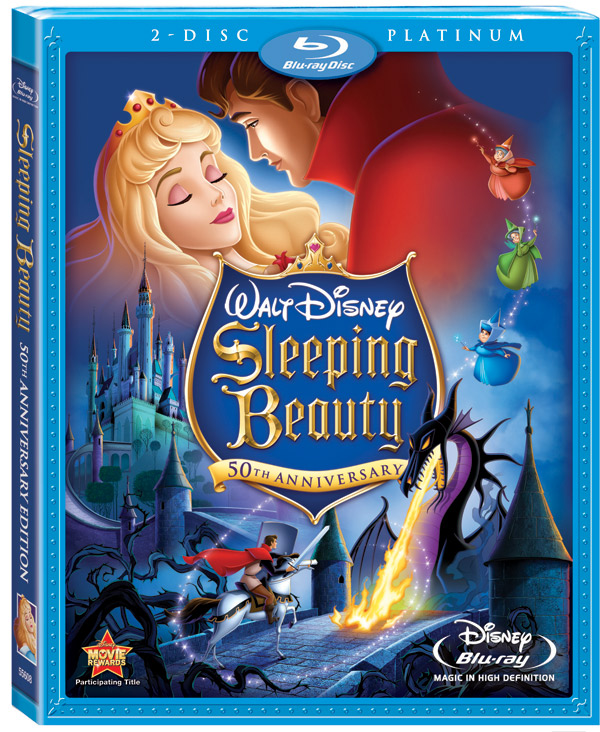
Sleeping Beauty (1959)

Sleeping Beauty (1959)

If you played a word association game with random people and asked them to say the first thing that comes to mind when they hear the word Disney I’d be willing to bet that the top three responses would probably be Mickey Mouse, theme parks, and princesses. It’s that third word I’m keying in on for this post as the princess character has seemingly become synonymous with the Disney brand. This is mostly due to the creation of the Disney Princess line of clothing, toys, and such marketed at young girls as well as attractions like the Bibbidi Bobbidi Boutique at the theme parks. This gives off the impression that the Disney films, particularly the golden age unofficially beginning in 1937 and ending in 1967, are overstuffed with princess stories but that’s really not the case. Of the films spanning those forty years, only two star an actual princess; Snow White and the Seven Dwarfs and Sleeping Beauty, with a third, Cinderella, featuring a woman who would end the film a princess by marriage.

In recent times, the princess as a character has become somewhat controversial as many people feel like these characters are poor role models for young girls. Snow White flees her unhappy life in the castle but assures her audience that someday her prince will come and save her. Cinderella, on the other hand, passively escapes her droll existence through her dreams and is too content to wait around for a fairy and a prince to save her from her wicked stepmother. These are admittedly cynical ways to view what are otherwise considered timeless classics. Parents are free to decide what is and what isn’t appropriate for their children but I don’t think kids necessarily take anything from these, aside from maybe that Cinderella has a pretty dress or Snow White a nice singing voice.

As a result of these portrayals, many movie-goers these days want a stronger female lead. And lately, that’s become true with films such as Frozen and even Beauty and the Beast back in the 90s. Unfortunately, in 1959 this trend was still far away when Walt Disney released Sleeping Beauty. If viewers are uncomfortable with the female leads in Cinderella and Snow White and the Seven Dwarfs, well then they really won’t like Aurora.

Some of the backgrounds are truly stunning, but unfortunately give the film a flat look.

Some of the backgrounds are truly stunning, but unfortunately give the film a flat look.

Aurora is the title character of Sleeping Beauty, an animated film more famous for its villain and the castle that inspired the famous one at the entrance to Disneyland than for its lead. Aurora has the misfortune of being cursed at her royal unveiling by the evil fairy Maleficent and is fated to die on her sixteenth birthday. The three good fairies decide to take her into hiding and raise her as a peasant girl in order to hide her from Maleficent and hopefully prevent her curse from becoming reality. Aurora assumes the identity of Briar Rose and lives there until her sixteenth birthday when she meets the charming Prince Phillip, and after sharing a song in the forest, the two decide they’ve fallen in love. Of course, Aurora ends up being lured to that famous spinning wheel by Maleficent where she pricks her finger and falls into a deathlike sleep and only true love’s kiss can ever hope to wake her.

Aurora appears in less than 18 minutes in the film as a result of her coma, leaving most of the screen time to the three fairies; Flora, Fauna, and Merryweather, as well as Maleficent. Aurora has no real personality and is completely defined by her situation and is quite literally dependent on the Phillip character. Phillip, in turn has little personality of his own save for he is a good and just person willing to do what is necessary to save his princess. Maleficent is the true star of the film, though she is pretty much a by-the-numbers villain with a cool look and an even cooler ability to change into a menacing dragon. The good fairies provide some laughs, as do the royal parents of the two leads, but this is a fairly weak Disney film where plot is concerned.

Maleficent has proven over the years that it is she who is the star of Sleeping Beauty.

Maleficent has proven over the years that it is she who is the star of Sleeping Beauty.

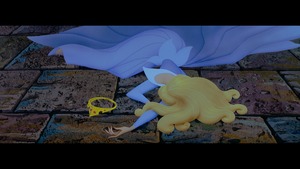
For many, these classic Disney animated features are less about the story and more about the look and score. This version of Sleeping Beauty is adapted from the ballet by Tchaikovsky and is appropriately scored. It’s lone drawback from a musical standpoint is the one song sung by the main character, “Once Upon A Dream,” is too similar to Cinderella’s signature “A Dream is a Wish Your Heart Makes” and not as memorable. The scene in which it’s sung is also too similar to Cinderella’s as Aurora dances in the forest with animals of high intelligence. For the visuals, Disney made use of Super Technirama 70, which allows for more detail and complexity in the backgrounds. Walt Disney also wanted the film to separate itself from the previous fairy tales the studio had done and requested his artists employ a sharper look. Aurora’s face is noticeably more angular than Cinderella and Snow White’s rounded look and the backgrounds resemble still paintings as opposed to fully realized environments. The approach comes at a cost as the film has a very flat look to it. The colors are rich though, and I’m reviewing this as a blu ray feature, which help separate it form its peers. This was the last Disney film to use hand-inked cells as the following ones would utilize xerox. I like the direction the studio took, but I do think it needed further refinement to remove that flat look. The image where Aurora is found unconscious after pricking her finger on the spinning wheel is particularly ugly as her body looks like it’s been run-over by a steamroller.

I can't believe this shot made it into the final film. Aurora looks like a piece of paper.

I can’t believe this shot made it into the final film. Aurora looks like a piece of paper.

The standout scene for Sleeping Beauty is unquestionably Maleficent’s battle with Phillip, in which she takes on the form of a massive, black dragon. Prior to that, Phillip is blocked by a massive wall of thorns that are wonderfully illustrated and appropriately vicious looking.  Maleficent’s menacing transformation is foreboding and her green-tinted flames eerie. It’s a classic sequence and among Disney’s top ten. It doesn’t save the film, but is an accomplishment by itself.

When I was a kid, Sleeping Beauty was probably my favorite of the princess movies. That was entirely due to the fact that it had a cool looking dragon at the end while Cinderella and Snow White were boring by comparison. As an adult, I view the prior two films in a much stronger light and even enjoy the both of them. They aren’t my favorite Disney films, but they do charm me. Sleeping Beauty is able engage me visually, but even there it’s a bit of a mixed bag. While I enjoy the art direction and use of color, I find the earlier films from Disney to be overall better visual experiences. As a story, it’s rather bland with uninteresting main characters and little to get attached to. There are some decent funny-points, but nothing gut-busting by any means. Maleficent is the most engaging character defined as much by her interesting visual style as she is by her voice actress, Eleanor Audley, who should have been everyone’s go to voice for evil women. As such, it’s not at all surprising that Disney has chosen to place the spotlight on her for a feature film starring Angelina Jolie. I have not seen the film, but it won’t have to do much to top Sleeping Beauty.


The Wind Rises

Kaze_Tachinu_poster“The wind is rising!  We must try to live!” – Paul Valéry

The above quote opens the latest release from Studio Ghibli and director Hayao Miyazaki; The Wind Rises.  It’s a quote that is suitable for the film as it implies that change is coming, but we must carry on.  The Wind Rises is to be the last directorial effort from Miyazaki, Japan’s most celebrated director of animated films, and it is an appropriate piece for him to go out on.  The Wind Rises tells the tale of Jiro Horikoshi and his dream to design what he calls beautiful airplanes.  Jiro is based on the airplane designer of the same name who is famous for creating Japan’s Mitsubishi A5M and A6M Zero and the basis for the film was derived from a quote he once gave:  “All I wanted to do was make something beautiful.”  The film has two sides to it with one being a mostly faithful account of Horikoshi’s challenge in developing his first successful airplane and the entirely fictional account of his personal life.  The end result is a tale of hope, triumph, love and life and is perhaps Miyazaki’s finest piece since My Neighbor Totoro.

The film opens with a young Jiro dreaming of flying a plane.  The opening sequence is perhaps the most fun for the animators as Jiro’s dreams are filled with nightmare creatures seemingly stemming from his despondence over his imperfect vision.  The character admits early on to himself that he will never fly because of his eyes, but in a dream meets with Italian airplane designer Giovanni Caprone, who will be a recurring visitor amongst Jiro’s dreams throughout the film offering him guidance on how to be a great engineer.  It’s these dreams that inspire Jiro to be an airplane engineer and the film advances time to show us his journey to become an engineer.

Jiro leading one of his designs to the testing grounds.

Jiro leading one of his designs to the testing grounds.

Jiro is portrayed as a sweet and good-natured man.  He is willing to help those in need, and a chance encounter with a young woman and her maid on a train plays a pivotal role in the film later on.  During the train ride the great earthquake of 1923 strikes and Jiro carries the maid to safety after she breaks a leg.  He seeks nothing in return and doesn’t even share his name with the women before departing.

Jiro lands a job out of school and his employment takes him to Germany where he is introduced to pre World War 2 Germany’s policies.  Being Japanese, he is not trusted by the soldiers as he seeks to learn about Germany’s engineering when it comes to aeronautical design.  Despite this, he is able to learn some techniques and apply them to a new aircraft, which unfortunately crashes during the test run.  To clear his head, his company sends him on a retreat for some rest and relaxation which is where he encounters the young woman he met years earlier on the train, Naoko.  The two fall in love, and though it seems predictable, their scenes are handled with such tenderness and care that the audience is left to root for them, even if it seems as if they’re destined to fall for each other.  Jiro learns there is a dark side to his budding romance as Naoko is afflicted with tuberculosis.  This forces them to move quickly with their life together.  Naoko insists on getting better before discussing marriage, but in time relents once Jiro has to leave for work.

Jiro must deal with failure throughout the film.

Jiro must deal with failure throughout the film.

The last act of the movie involves Jiro and his attempt to finally build a worthy aircraft that his company can sell to the Japanese military, while Naoko wages a silent battle at their home with her illness.  I don’t want to get into too much detail about the film’s plot, but suffice to say it’s a bittersweet tale that includes ups and downs with the story refusing to linger on anything for too long.  In that, it mirrors life which is a constant push and pull.  There are many themes the film likes to go back to.  Early on a supporting character mentions the importance of having a family to go home to, crediting it with helping a man work harder at the office, which is shown later in the film once Jiro is married.  In his dreams, Caproni asks Jiro if he prefers to live in a world with pyramids, or with no pyramids, using this as an explanation for why he would design airplanes that will eventually be used for war.  And all throughout the film, the wind acts as a character itself playing a pivotal role in one of the film’s final scenes.

As this is a work from Studio Ghibli, it hardly needs stating but deserves to be anyways, that this film is gorgeous.  The animation is predominantly hand-drawn, but some computer generated imagery is used for some of the film’s effects.  The film has a bright palette though Jiro is often garbed in white, gray, or a very light lavender, which serves to isolate him from his surroundings.  This suits the character as he is often oblivious to his surroundings, so consumed in his work and willing to overlook the fact that his designs are made for war.  The country-side settings are sure to evoke memories of Totoro, and the film’s whimsical feel and care-free pace further serves to draw comparisons to Miyazaki’s old masterpiece.

The wind is a character of its own, its actions often directly influencing the lives of the human characters in the film.

The wind is a character of its own, its actions often directly influencing the lives of the human characters in the film.

The sound design is excellent, with great use of natural sounding effects and an excellent score from Joe Hisaishi.  The english dub was handled by Disney and the film distributed in North America on their Touschstone label.  The dub is the usual high quality that viewers have come to expect from Disney as the company has handled the majority of Studio Ghibli’s dubs.  Serving as Jiro is Joseph Gordon-Levitt with supporting roles from the likes of Emily Blunt, John Krasinski, and Martin Short, the latter serving as the scene-stealing character Kurokawa, Jiro’s boss throughout the film.

The Wind Rises may be an animated movie, but it’s not for children.  The film’s pace is too slow and plot is too mature to entertain most children.  The film is best described as a drama and should appeal to older fans of Miyazaki’s works.  That said, it’s a wonderful piece of film with fantastic visuals, a compelling plot, and terrific performances.  Hayao Miyazaki may never get the recognition he deserves from international audiences, but anyone involved with film appreciates and respects the work he does.  It’s both wonderful and sad that this movie exists, knowing it is to be the last written and directed by Miyazaki, but in that sense it mirrors the film superbly.  What a truly awesome way to cap off a career!


RoboCop (1987)

220px-Robocop_filmIt’s not that I’m against remakes, I just don’t always see why they’re necessary.  I understand why they happen though.  Movie-making is high risk, big budget stuff and it’s hard to get a major studio to back an unknown.  Remakes of known commodities are easier to predict and therefore are seen as less risky.  That doesn’t mean I have to like them, though.

RoboCop is an action film released in 1987 on Orion pictures.  It was directed by Paul Verhoeven who was kind of like the poor man’s James Cameron in the 1980’s.  It was not a star-studded picture, nor was it a big-budget Hollywood blockbuster, but it garnered a positive reception when released and spawned a franchise.  RoboCop came out in that odd period for action films where they were all R-rated violent affairs but would end up being marketed towards kids.  RoboCop earned an X rating on account of its violence and required several cuts to get down to an R rating, but that didn’t stop the studio from licensing the character for toys and comic books.  The film has since been restored for the home video market, first on DVD and more recently on Blu Ray, and while the violence present in the film would likely not earn an X or NC-17 rating today it’s still a strong R due to its graphic death scenes.

Special effects were certainly the name of the game in the 80’s when it came to action films, but RoboCop does possess a strong narrative to back the action up.  The story isn’t terribly unique as it involves a crime-riddled city (in this case, a futuristic Detroit) where cops struggle on a daily basis to restore order.  Officer Murphy finds himself in a pretty unsatisfactory situation on his first day in Detroit and ends up getting himself killed.  The weapons manufacturer that owns the Detroit PD has him converted into the first cyborg cop and they send him out to clean up the city.  Murphy’s memory is wiped in the process, and a lot of the film deals with him trying to reconcile the shadows of his past with his new life as he searches for an identity.  The other main vehicle for the plot involves two corporate executives at OCP, the employer of the police force and creator of RoboCop, as one executive is pushing an all-robot edition version of RoboCop called ED-209, and the other is behind the RoboCop property.  Woven throughout the story are little snippets of news broadcasts which provide more context for the current state of Detroit.  Verhoeven has a very dark sense of humor as his view of this potential future is certainly pessimistic.  There are also little bits of black comedy throughout such as when an orbiting “peace station” malfunctions and fires its laser cannon at a community or when a guy gets sufficiently blown away by a malfunctioning robot and a character calls for a paramedic.

The costume designers and makeup artists did a superb job in turning Weller into RoboCop.

The costume designers and makeup artists did a superb job in turning Weller into RoboCop.

Even without the solid plot, RoboCop would have been worth checking out for the visual effects and costume designs when it came out.  Today it looks a bit dated in places, specifically with the ED-209 character who was created using stop-motion techniques.  RoboCop was probably one of the last mainstream action movies to utilize the technique as computer generated imagery was just coming into form at the time.  Some shots looks better than I expected, but others make it plainly obvious that ED-209 is a glorified muppet.  The other effects are mostly practical ones with lots of exploding splatter wounds and excellent costume and makeup work.  RoboCop looks great and is entirely believable given the context of the film.  Even when his helmet is removed and Murphy’s face is exposed the effects are convincing.  Peter Weller does a good job of giving just enough humanity to the RoboCop character and manages to play the role of a robot without sounding too corny.  Kurtwood Smith, who younger readers are likely to recognize from his role of Red on That 70’s Show, is a scene stealer as the sadistic Clarence Boddicker and is the type of villain most will love to hate.

The film's R rating didn't prevent RoboCop from making the leap to Saturday morning in 1988.

The film’s R rating didn’t prevent RoboCop from making the leap to Saturday morning in 1988.

Nearly 25 years after its release, RoboCop holds up well, quite well actually.  Because of its hokey title and premise it’s easy to overlook RoboCop as just another sci-fi action romp from the 80’s.  I’ve seen it several times, both the theatrical cut and the uncut version, and I tend to forget in between viewings just how good the film is.  I’m hesitant to call it amazing, but I can’t think of an action film from that era that I’d prefer to watch over RoboCop, which brings me to the new film that just came out this week.  I have no plans to see it, not because of some anti-remake principle, but just because it doesn’t look very good.  Without the vision of Paul Verhoeven, RoboCop likely will be just another action piece.  Considering super hero films are so popular these days, I fully expect the new RoboCop to have a super hero feel to him complete with all of the cliches of the genre.  For any adult that finds the RoboCop concept appealing, I’d recommend to them they just seek out the 1987 original.  It’s not hard to come by and pretty cheap.  I think I paid ten dollars for my blu ray copy and while the release is extremely light on special features, it contains the full uncut film in HD (the restored scenes are not HD quality though) and that’s really what’s most important.  The only purpose the new film has is to restore RoboCop as a kid-friendly franchise.  The R-rated RoboCop was pretty easy to market to kids, so a PG-13 one figures to be even easier (Orion and MGM would realize RoboCop was too profitable to keep as an R-rated franchise for the third film, RoboCop 3).  It will be interesting to see how audiences respond to the new RoboCop, but even if it’s a flop, we still have the 1987 movie to turn to.