Tag Archives: super nintendo

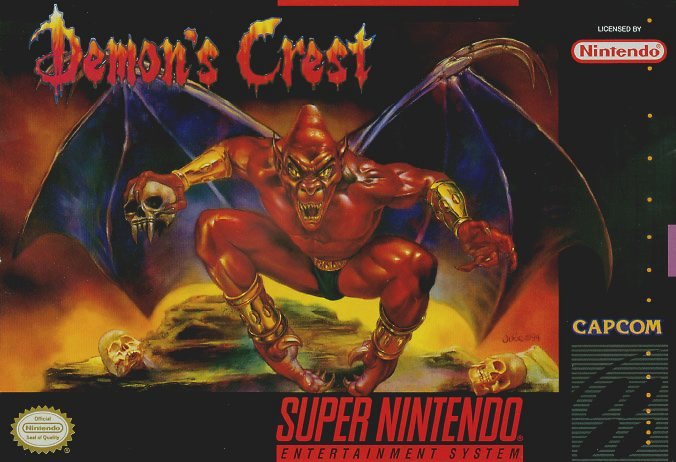
Demon’s Crest

Demon's Crest (1994)

Demon’s Crest (1994)

There is something about the 16bit era of gaming that I just find inherently charming. This is the era where games started to grow up, tell complex stories, but without losing site of what makes games fun. The visuals, music, sound effects, pacing – it was like gaming nirvana. That’s not to say it’s been all downhill since; far from it, actually, but I always enjoy going back to these games. And when I can find a good, quality game from that era that I’ve never played? Well, that’s just divine.

Demon’s Crest is one such game. Released by Capcom late in the Super Nintendo’s life-cycle, Demon’s Crest has garnered a reputation as a cult classic. Because of its late arrival, few people actually picked up a copy and experienced it in 1994. The Gargoyle franchise also has never been one of great importance for Capcom. For those unaware, Demon’s Crest is the third game in the Gargoyle trilogy which started on the GameBoy. The main character of these games, Firebrand, is that annoying red, flying enemy from the Ghosts ‘N Goblins games thrust into a starring role. The storyline for these games isn’t all that interesting or important, but credit Capcom for spinning off a seemingly random enemy into its own franchise. Since the end of the 16bit era and the dawn of the retro era, Demon’s Crest has become one of those handful of SNES carts that fetches over 100 bucks routinely on the secondary market. Thankfully, the Virtual Console exists so these games can be experienced by anyone with a Wii/Wii U console and a game like Demon’s Crest can get the recognition it deserves.
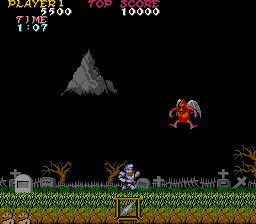
Cap com apparently saw something in this little, red, demon to warrant giving him his own game.

Cap com apparently saw something in this little, red, demon to warrant giving him his own game.

Demon’s Crest is essentially a side-scrolling platform game, but it’s a hybrid title in that it incorporates elements from the run and gun genre and the RPG. As Firebrand, the player explores various stages from the ground, in the air, and underwater. At the start, Firebrand can shoot a fireball as his lone attack, cling to walls, and fly through the air. The flying mechanic is neat and doesn’t feel cheap, as it often does in many games like Super Mario Bros. 3. By pressing the jump button while in air, Firebrand deploys his wings and can hover indefinitely. He can move side-to-side but cannot gain altitude (a power-up later in the game allows him to ascend in the air from a flying position). He can still attack, and pressing the jump button again causes him to drop and re-pressing the button at anytime while falling will initiate the process all over again.

After the first level is completed, the player gains access to a world map not unlike what is seen in the Final Fantasy titles from that era. Firebrand can fly to any stage from here and the game can essentially be completed at any point, though playing thru every stage multiple times is encouraged to collect power-ups and explore every nook and cranny. Firebrand is on a quest to recover various crests, each one grants him a new power. The earth crest, the only one that basically can’t be missed, removes Firebrands wings but gives him access to a dash move and a ground-hugging projectile. The water crest lets Firebrand breath underwater, the air crest lets him fly freely, and the best crests are basically a jack-of-all trades kind of power. Additional projectile attacks for Firebrand’s normal form can also be found, along with other power-ups, bottles for storing potions, and vellum for spells. The goal is to conquer the enemy Phalanx, but the secondary goal is to collect everything and get the best ending plus additional content in the form of power-ups and additional boss battles.

Some of the game's bosses dominate the screen.

Some of the game’s bosses dominate the screen.

At first, the game seems like it’s going to be massive, but it can be completed in an afternoon, especially if you’re not after the best, ultimate, ending. There’s an element of trial and error at play, as the game intends for the player to acquire new powers to advance past certain spots. The game is forgiving in this regard as it grants unlimited continues and you can always quit to the map if a scenario seems too difficult. The levels are not simply “go right” kind of levels. They encourage exploration in all directions, and additional gargoyle powers will open up new sections so re-playing levels is practically essential to completing the game. Uncovering new powers is addicting and fulfilling and I was always eager to try out each new one I found.

Acquiring these new special abilities make the game easier, which is welcomed since the game is fairly challenging. No, Demon’s Crest is not among the most difficult of games to grace the SNES (like the title it’s spun-off from) but it isn’t a breeze. Most of the early challenge involves getting used to Firebrand’s controls. He handles easy enough, but the mind needs to be trained in order to best utilize the hover/flying ability. There are usually numerous enemies at ground level and in the air to contend with, and learning to dodge is the best way to succeed. The game is also fairly cryptic in that it doesn’t explicitly tell you what your new powers are capable of. As a result, the player has to experiment a little which may lead to some deaths here and there, but it’s not too bad. The game is fairly generous with restorative items and the in-game currency allows the player to stockpile health potions and the like. There are also some mini games to spend time on, though nothing exciting. The boss fights are usually a test to figure out what the best approach/power to use is. Some boss fights will seem impossible without the right ability, but once found, they’re a piece of cake. The hardest bosses are a challenge no matter what. They’re not controller-tossing hard, but will offer a nice test for the player.

Acquiring new crests opens up new forms and powers for Firebrand.

Acquiring new crests opens up new forms and powers for Firebrand.

The music in the game is heavily reminiscent of other gothic-inspired titles, most notably Castlevania. It’s tempo is slower and Demon’s Crest finds it’s own sound. It’s not on Castlevania’s level, but it’s very enjoyable. As a later era SNES title, the game is pretty nice to look at. Firebrand is nice and big without dominating the screen. Many of the boss characters have a lot of personality or take up the entire height of the screen. The regular enemies, the canon fodder, are a little boring though and the game gets bogged down at times when a lot is going on. Sometimes the slowdown is actually helpful, but it is a weak point of the game. The controls are quite good, but there’s some missed opportunities to be found here. The shoulder buttons are not utilized when they could have at least been devoted to cycling thru Firebrand’s gargoyle forms. It gets tiresome having to constantly pause the game to switch relics, and many boss encounters require this very thing. The spells available to Firebrand are also fairly useless, and the only potion worth spending money on is the best one which restores all of Firebrand’s health.

When it comes to old games, I always prefer to experience them as they were intended: on their original console. When that is not possible (or in this case, too expensive), the Virtual Console is more than adequate. I played the game exclusively on the Wii U Gamepad utilizing the Gamepad’s screen instead of a television. The game plays just fine, and the ability to save is definitely welcomed. The original cart only provides a password save functionality, and while the game isn’t terribly long, it’s one I chose to experience in one or two hour at most sessions. It probably took me around six hours to finish the game, with some additional time spent after the fact going back and finding the items I missed to tackle the secret boss. This strikes me as being a pretty average game for the era in terms of length making it comparable to Super Metroid and Super Mario World.

Demon’s Crest is an excellent example of a forgotten classic. It’s probably not a top 10 game on the SNES, but that’s only because the SNES has arguably the greatest library of games of any console. Demon’s Crest is a unique blend of several genres, and its setting and style help set it apart from many of its contemporaries. If it sounds like something you would enjoy, I can’t recommend it enough as it’s worth the 8 bucks Nintendo is charging. And if you’re on the fence, I still say give it a shot because it’s a game that’s just inherently fun. Hopefully, this re-release on the Virtual Console makes Capcom some money and inspires them to revisit the Gargoyle series. A modern take on the franchise would be a most welcomed thing, indeed.

Ranking the Mario Games – Conclusion

Part 1

Part 2

Part 3

images-155There’s certainly very little suspense with these kinds of things.  Anyone familiar with the Super Mario franchise can figure out at this point which two games are going to top my list, whether people disagree or not is another story.  Rather than dive right into these last two games, I think it is important to point out just how many of the games that I’ve talked about could have been number one.  Super Mario 64 seems like an easy one to argue in favor of.  What the original Super Mario Bros. did for the 2D side-scroller, Super Mario 64 did for the 3D platformer.  Only the games to follow in that genre have really done very little to deviate from the Super Mario 64 style of gameplay.  Sure the worlds have gotten bigger, and the graphics have certainly improved, but the core mechanics are still mostly in play.  Super Mario Galaxy 2 could also be argued as top dog.  The inventive gameplay of the Galaxy franchise has a ton of appeal, and Galaxy 2 is bigger and harder than its predecessor.  In a world where Mario games seem to be getting easier and easier, it’s nice to know some of the games are trying to hang onto some semblance of difficulty.  And of course Super Mario Bros. 3 will always have a claim to best Mario title on the planet.  It’s the game that really expanded on the Mario world for the first time giving gamers tons of variety in terms of level design, power-ups, boss fights, and basically every other aspect of the game.  Many of the titles today still borrow heavily from Super Mario Bros. 3, and I feel like I could go on for another two-thousand words on the subject and it still wouldn’t feel like enough.

In short, Mario has had a lot of great adventures over the years.  As overexposed as he tends to get, it can sometimes be easy to lose sight of just how important the character has been to gaming.  A lot of people my age claim to have outgrown Mario, but I don’t think that’s possible.  You can’t outgrow fun, just lose touch with it.

2.  Super Mario Galaxy (2007, Nintendo Wii)

For the first time ever, Mario gets to spend an entire game in space.

For the first time ever, Mario gets to spend an entire game in space.

Super Mario Galaxy wasn’t the first title to take Mario into space, but it’s definitely the most memorable.  Galaxy is basically the sequel to Super Mario Sunshine and Super Mario 64 before it as Nintendo decided Mario’s 3D adventures were ready to continue on the Wii.  Many people were curious how the Wii’s motion controls and Mario would meld, as I think many assumed Nintendo would use the game as a way to showcase what the console was capable of.  Instead, the developers for the game mostly downplayed the Wii’s motion controls in favor of a fairly traditional scheme.  Mario was still controlled via analog stick and he could bounce around just as he could in the two previous 3D games.  The only addition for the Wii was a spin attack that could be initiated with a simple flick of the wrist.  The Wii remote could also function as a pointer and could fire star bits.  These star bits could momentarily stun enemies but it mostly was just a tack-on feature.  I assume most forgot the feature even existed while playing.

Where Nintendo sought to distinguish Galaxy from the prior Mario games was to place an emphasis on gravity.  Mario would travel from galaxy to galaxy, planet to planet, and encounter all kinds of unique situations.  Some levels had Mario sticking to tennis court sized planets that were still large enough to apparently have a gravitational pull.  This could lead to some really disorienting experiences with Mario basically upside down or sideways but the game’s camera was so well crafted, and Mario so weighty, that it rarely felt as bad to the player as it looked.  I know initially I was skeptical at just how good a game could be that focused so much on trying to disorient the player but Galaxy proved me way wrong.  Running and jumping from planet to planet, sometimes within a level, was pure joy. The only comparable experience I can even compare it to are those warm, fuzzy feelings I had when playing Super Mario 64 for the first time.  Mario handles so well and the level design is so spectacular that it’s hard to not constantly wonder what’s next while enjoying the present.

I think Donald Duck tried this once.  It didn't go too well for him, from what I recall.

I think Donald Duck tried this once. It didn’t go too well for him, from what I recall.

Since this is a Mario game, there are numerous power-ups available to experiment with.  Of the new ones, the best and most enjoyable is definitely the bee suit which allows Mario to fly for short bursts.  Bee Mario flys just by holding down the A button, but he can ascend for so long before he needs to “recharge.”  It’s all pretty quick, but the ability to fly is curbed just enough to keep the player from flying constantly.  For more intense flight, there’s a special power star that lets Super Mario impersonate Superman.  It only exists in kind of a bonus level, but is fun while it lasts.  Some of the new power-ups are duds, like spring Mario who can do nothing but bounce which gets frustrating, and there’s some sequences where Mario has to balance on a giant ball.  For the first time in a 3D Mario title, the fire flower makes an appearance as does its opposite, the ice flower.  Both are kind of interesting in that they function very much like an invincibility star in that they only bestow Mario with special abilities for a brief period of time.  This does lend itself well to some puzzle situations, but it is a little disappointing to not be able to remain as fire Mario until damage is taken.

Mario gets shot out of canons (pipes) quite frequently in this one.

Mario gets shot out of canons (pipes) quite frequently in this one.

From a technological standpoint, Super Mario Galaxy is a star.  The Wii was never considered a powerhouse by any means, but Galaxy looks great.  The environments are varied, the color pallet is gorgeous, and many of the enemies dwarf Mario, especially Bowser.  The music is high quality as well, composed mostly of orchestral instruments giving it a very “Zelda” feel.  The plot for the game is basically the same as always, though the character of Rosalina is introduced which makes things slightly more interesting.  The game’s storyline may not be enough to get gamers to keep coming back, but the numerous objectives and hidden stars will.  As with Super Mario 64, each level has stars for Mario to collect and after collecting a certain amount challenge stars begin to appear.  This is where the game really turns up the difficulty and gives Mario vets a true challenge.  It’s probably not as hard as its sequel, but it strikes a very nice balance between challenging and frustrating.  That, along with all of the other positives I’ve cited, is why Super Mario Galaxy is the best of the 3D Mario titles to date.

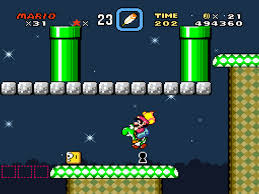
1. Super Mario World (1990, Super Nintendo)

The layout of the world according to Mario.

The layout of the world according to Mario.

The mark of a truly special game is one that is inherently fun.  There are many games where aspects of them fit this description.  Mindlessly rampaging in any of the Grand Theft Auto titles is always a blast, political correctness be damned.  When it comes to multi-player, I’m not sure I’ve ever had more fun with a  game than I did with Super Bomberman and three of my buddies.  Both of those games contain moments of pure joy, but neither is able to achieve that and hold it for the entire duration of the full game.  Super Mario World is a game that is non-stop entertainment from start to finish.  Expertly crafted level design, colorful visuals, and tweaks to the Mario formula helped introduce a legion of fans to the Super Nintendo making Super Mario World not just the best Mario game, but the best pack-in game of all time.

Super Mario World was not the leap forward for Mario that Super Mario Bros. 3 was.  It didn’t have to be as that game was nearly perfect itself.  It only needed to improve upon it and give gamers a reason to play Super Mario World other than its inherent “newness.”  Obviously, that’s easier said than done as many developers have tried to improve upon a game like Super Mario Bros. 3 and failed.  When it came time to create Super Mario World, it would seem Nintendo took a back to basics route when comparing it with its predecessor.  Power-ups were de-emphasizd as the game only included two permanent power-ups (aside from the mushroom) for Mario and Luigi:  the venerable fire flower and the shiny new super feather.  The fire flower worked the same as always, but the feather gave Mario a yellow cape and the ability to fly.  Rather than have the cape mimic the raccoon tail, it worked in an entirely different manner.  Mario still had to run to take-off, but once airborne Mario zoomed to the top of the screen before dive-bombing back to the ground below.  This could double as an attack, but if the player so desired Mario could be made to “parachute” his cape for extended flight.  It took some getting used to, but once mastered a player could easily soar Mario over an entire level.

Mario's dino-buddy Yoshi, was the most talked about addition to the Mario universe.

Mario’s dino-buddy Yoshi, was the most talked about addition to the Mario universe.

The other major gameplay addition was Yoshi.  Yoshi functioned as a power-up himself, giving Mario not only an extra hit but also giving him a new attack.  Atop Yoshi, Mario could direct his dino servant to devour all kinds of enemies.  As a bonus, certain turtle shells gave Yoshi special abilities such as fireballs or his own ability to fly.  Mario could also use Yoshi to reach higher places or travel over certain terrain.  Green Yoshi was the standard, but different colored Yoshi’s existed in the secret Star Road area that had limited power-up potential, but also an exploitable skill (the blue Yoshi, for example, would sprout wings and fly with any turtle shell in his mouth, while green Yoshi could only do so with a blue shell) that had its own advantages.

The storyline for the game was really no different, other than the fact that Mario is on vacation in Dinosaur Land.  Mario still has to topple Bowser’s seven children before facing him to save the princess.  Where the game stands out is in its scope.  Super Mario World is appropriately titled.  It may not seem huge compared to today’s games, but at the time it seemed massive.  Each world is distinct and varied as well, and they’re full of hidden exits and secret levels.  This made Super Mario World both challenging and highly replayable.  Some staples of future Mario games were introduced in this one, such as the Ghost House or Wiggler enemy.  Furthermore, the game was hard.  It eased the player in with the deceptively tame first world but the difficulty increases as the game moves on.  There are plenty of scrolling levels, levels with small platforms for Mario to negotiate, and levels requiring some puzzle solving to escape.  The boss encounters with the koopalings were also more varied, and the final showdown with Bowser was satisfying as well.  And if the main game was too simple for some, the Special Zone provided its own brand of torture with many having their own personal nightmare level among one of them.

Secrets abound in Super Mario World.

Secrets abound in Super Mario World.

Aside from the bells and whistles, Mario also handled better than ever and the score was another strong addition to the Mario universe.  The main melody is used throughout, though I was also most fond of the subtle bongo notes introduced whenever Yoshi shows up (a trend that has continued over the years).  If the game has short-comings, it’s that there are less mini games when compared with Super Mario Bros. 3.  The lack of more power-ups is also a slight mark against the title when holding it up to the others, but it’s the gameplay that matters most.  Always.  When it comes to Super Mario World, there just isn’t a better Mario game on the planet.  Everything that came before it was refined and improved upon to craft the perfect platformer.  Nintendo wisely chose to not truly follow-up on the title for well over a decade because it couldn’t be topped.  There was nothing left for Mario and Nintendo to prove with this genre.  And over twenty years later, Mario still hasn’t appeared in a better game.


Spider-Man and the X-Men in Arcade’s Revenge

Spider-Man and the X-Men in Arcade's Revenge (1992)

Spider-Man and the X-Men in Arcade’s Revenge (1992)

Expectations influence just about everything we come in contact with.  Expectations can help lead to a more fulfilling experience when those expectations are met.  Other times, they can help make the bad seem worse when something fails to meet though expectations.  When I was a kid and I heard there was going to be a video game featuring a team-up between Spider-Man, possibly the most popular character ever created by Marvel Comics, and the X-Men, easily the hottest comic at the time, I was giddy with anticipation.  This seemed like a no lose situation and Spider-Man and the X-Men in Arcade’s Revenge vaulted to the top of my list of must own Super Nintendo games along with Teenage Mutant Ninja Turtles IV:  Turtles in Time.  One of those games would turn out well and provide me with hours of entertainment, that game was not Spider-Man and the X-Men.

What went wrong?  Well, let’s backtrack a bit first and see how this all came together and if my expectations were even justified.  At the time of the game’s release, Spider-Man had already been enjoying a run on the Sega Genesis and Game Boy as a platform star.  Perhaps star is a bit strong as his games weren’t really great, but they also weren’t particularly awful.  The best was definitely The Amazing Spider-Man vs The Kingpin for the Genesis.  The game was pretty difficult, at times frustratingly so, but it did a great job of making use of the Spider-Man license.  It was also quite popular and one of the best-selling titles at the time.  The X-Men, on the other hand, really only had the one NES game titled The Uncanny X-Men.  It was horrible and it tricked many uninformed gamers into renting or buying it with it’s X-Men branding.  Arguably, the best games for both franchises were the arcade beat-em-ups Spider-Man:  The Video Game and X-Men.  The Spider-Man game came first in 1991 and for some reason it isn’t as well loved and remembered as the X-Men game that followed in ’92.  It was a typical brawler allowing up to four players to join in and included playable characters Spider-Man, Black Cat, Hawkeye, and Sub-Mariner.  It’s selling feature was a more platform inspired design where the camera would zoom out allowing the players to take on gigantic enemies including a super-sized Venom at the end of the first stage.  The X-Men game was similar, but it’s defining characteristic (aside from the comical mistranslations) was the double-monitor cabinet allowing up to six players at once.  Both games were hard as they were designed to suck quarters out of its audience but they were a lot of fun, especially with a group of friends.

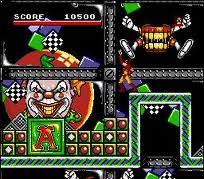
I hate these stupid clowns and their stupid stage.

I hate these stupid clowns and their stupid stage.

It would seem to me that a track record was in place that at least suggested a console game featuring these two franchises could be great.  If I had been a little wiser as a kid and more aware I would have taken note of the LJN logo on the box and realized right away the game was going to be a giant turd, but sadly I just wasn’t.  Before I get into what the game did wrong I suppose I should point out what it did right.  First of, Spider-Man is represented fairly well given that he is able to stick to walls, shoot webs, and even make use of his spider-sense in the game.  The roster for the X-Men side is pretty solid as well as it features the obvious choice of Wolverine along with Cyclops, Storm, and Gambit.  Wolverine has an interesting dynamic to him as he retains his mutant healing power but it only works when his claws are retracted.  The game is packed with villains too like Apocalypse, Shocker, Juggernaut, and Carnage.  Arcade is kind of a weird choice for the main villain, but at least his Murderworld offers a lot of possibilities for level-design.

That’s basically it as far as what Spider-Man and the X-Men gets right, and unfortunately it’s a pretty small list.  So what makes this game suck so hard?  Well, lets first start with the presentation.  I’m usually not one to have much of an opinion on the audio within a game.  I expect it to do its job and often times I have to make it a point to touch upon it when doing these reviews because I tend to overlook it.  Here it’s easy to not overlook because the sound is so bad.  The score is okay at times, though certain levels (Wolverine’s) feature an annoying soundtrack.  It’s the FX that really bug me though as they just sound like, for lack of a better word, shit.  A lot of the characters, good and bad, let out a scream when they die that sounds fuzzy and distorted.  The machine sounds are just as bad and Spidey’s web blasts sound like they could be grenades.  The graphics are also piss-poor.  The characters are really small, except Storm but I’ll get to her later, and lacking in any sort of detail.  Wolverine even looks like he only has two claws on each hand while Gambit doesn’t have a face.  Some of the villains are almost unrecognizable, especially Apocalypse who looks like a blue bug or something.

Hey Gambit, where's your face?

Hey Gambit, where’s your face?

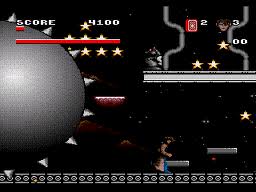
Perhaps what bugged me more than anything as a kid was just how un-super these super heroes felt.  Spider-Man and the X-Men is a pretty hard game made so mostly because these characters can’t seem to take a punch.  They die so easily and it’s a frustrating experience.  I get that it’s hard to make a super hero game because on one hand the super heroes need to be super powerful, but the game also needs some challenge.  That’s why we have super villains though, and Wolverine shouldn’t be getting annihilated by a jack-in-the-box with a tommy gun.  The X-Men games that would follow on the Genesis were hard, but at least those X-Men felt like powerful super heroes (well, for the most part), these ones are push-overs.  The level designs are also fairly lacking.  Spider-Man’s are just weird looking and kind of confusing as they’re intended to be maze-like.  The player is supposed to use his spider-sense to navigate but it just gets tiresome.  Cyclops’ stages feature an annoying mine cart premise where touching the tracks means death.  Gambit has to outrun a giant deathball and might be the best levels, which isn’t saying much.  Wolverine is in a circus and there’s nothing noteworthy about the first stage while the second stage he has to outrun the Juggernaut.  It’s basically the same concept as the Gambit stages, though at least LJN incorporated something from the comics to make it feel relevant.  Storm’s stages are quite different and probably everyone’s most hated as she has to navigate a flooded laboratory.  They’re swimming levels, but unfortunately Storm’s mutant powers over the weather don’t let her breath underwater.  Just about everyone hates the underwater Sonic the Hedgehog levels for the same reason, this is worse times ten.

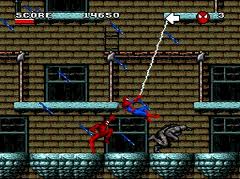
The red guy is Carnage. That gray blob?  He's Rhino.  I think.

The red guy is Carnage. That gray blob? He’s Rhino. I think.

If the player manages to actually beat all of the levels then they get to take on Arcade as Spider-Man.  You kind of have to be a glutton for punishment to even make it that far as the game is both really hard and really bad.  That’s the worst combination.  As a kid, I never had much success and never made it past any character’s second stage so making it all the way to Arcade wasn’t in the cards.  Playing this game was a depressing endeavor as a game featuring a team-up between these two should have been awesome.  I remember a few years after I got it Toys R Us started their first trade-in program where people could trade in games they no longer wanted for store credit.  I grabbed my copy of Spider-Man and the X-Men and, thinking I’d get maybe 15 or 20 bucks, was offered only four.  I elected not to trade it in but in hindsight I should have taken the four Jeffry Dollars.  I could have used it for some Fruit Stripe gum or something.