Tag Archives: playstation

Roger Ebert and the Great Debate: Video Games as Art

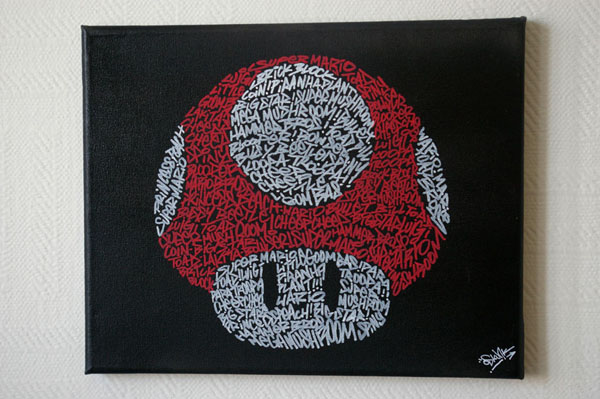
super-mario-mushroom-artNearly three years ago a blog entry popped up on famed film critic Roger Ebert’s site that ignited a response from the gaming community in a way usually only reserved for the likes of pro-censorship groups and individuals.  The title of this blog, Video Games Can Never Be Art, was a bold statement that seemed to cut to the core of many gamers and industry types.  It has attracted nearly 5,000 responses and spawned numerous rebuttals of various kinds.  Ebert, who passed away recently, never showed much desire to revisit the topic over the years preferring to let those words just hang in the air.

I do wish Ebert had chosen another title for his post as the absolute tone it takes seems foolhardy to me for someone so well learned.  The title is actually a quote and one he had given earlier intended as more of a throw-away line in a much larger discussion.  Ebert chose to return to it because it received more attention than he anticipated and elected not to change it, but did acknowledge its weakness.  Her clarified his opinion to something more along on the lines of that video games are not art presently, and no one currently alive will live to see them regarded as such.  That is definitely a much better argument as it’s impossible to predict where tastes are heading.

However the argument is to be phrased, gamers around the globe seemed to take it personally that their chosen recreation could be perceived as something other than art.  Most of this stems from the fact that many who elected to respond to the piece apparently did not get past the title.  Again, Ebert is partially blamed for that but it is important to understand where he is coming from before forming a proper rebuttal.  Ebert’s opinion resides on the game itself.  Components of a game are considered forms of art.  Still images, music, animation – these are all considered artwork.  I don’t know if it was asked of him, but Ebert would probably consider the directors of some games as artists of some kind.  He also expressed a sense of surprise in how his statement was received, noting that the likes of Michael Jordan and Bobby Fischer never seemed to take it personally that their games are not considered art.
DownloadedFile-15

It’s this lack of understanding of where Ebert is coming from that makes a great many of the responses to his opinion ill-conceived.  So many want to focus on the parts of a game that Ebert would consider a form of art and fail to understand that it’s the game that Ebert is declaring as non-art.   Another thing hampering Ebert’s argument is the fact that he openly declares he does not play modern games and had no desire to do such, thus we’re left to assume what first comes to mind for Ebert when the topic is brought up is Pong as opposed to Bioshock.  That’s not entirely relevant though, as is playing a game of virtual tennis any more or less artistic than shooting bad guys in high definition?  Neither is art, but modern gamers would immediately point to the story contained in a title like Bioshock, to which Ebert would point out that it ceases to be a game and is a representation of another form of art.  In other words, if your argument for games as art is that it’s an interactive story then Ebert considers it a representation of a novel or film and not really a game.  He does not, however, go on to say such games are forms of artwork so if there was hope for a compromise between the two camps it seems that door was shut.

On that level, I tend to side with Ebert on this one.  I love video games.  There have been times in my life where games have been my primary source for entertainment and it’s possible I’ll enter another phase later on where they will be again.  Video games will probably be a part of my life for its duration which certainly separates me from Ebert and is perhaps something he forgot.  When Ebert was born television was still fairly new and the only way to see a film was to go to a theater.  Video games were never a part of his life save for maybe on the periphery at times.  And even tough they have been a large part of my life, there still is no singular game that can stack up as art when compared with works from other accepted classes of art such as music, film, and poetry.

In order for a game to transcend into art it needs to incorporate the game itself into its argument.  Okami is a delightful game to look at, but physically playing it is not a remarkable experience when ignoring the visual style and plot.  Heavy Rain is an example of film-quality story-telling and a game I enjoyed very much, but it too falls into that representation of a film category Ebert mentioned.  In that game, the actual game components are fairly minimal and oftentimes are the biggest hindrance to enjoying the game as simply controlling the characters is awkward and, at times, a chore.  Many of the other games often cited by gamers in the comments section are too preoccupied with the game’s narrative and their emotional response to it.  Separate that narrative though and could it exist on its own and still instill such a response?  Or strip away the player control and just watch the “game,” how much does the emotional response change?  While I’m sure it would be affected in some way, probably not as much as some people would like to think.

Ico (2001)

Ico (2001)

In searching my brain I could only come up with one game I’m even tempted to make an argument for as one that toes the line between game and art:  Ico.  Ico, at its core, is not remarkable in a sense that it should be considered art.  It’s a fairly basic three-dimensional platform game.  The player controls the main character and has to negotiate jumps, push blocks, and fight enemies with a stick or sword all while attempting to defeat an ultimate bad guy and escape the castle.  Where it hits on a different level is through the non-player character Yorda.  Yorda is a helpless girl that needs to be lead through the castle and protected by Ico.  It’s the interactions with her that make this game different.  In order to progress, the player must take Yorda’s hand and guide her through certain scenarios.  This simple gameplay convention is remarkable in that it adds a semi-tangible element to a non-tangible experience.  When interacting with a game, we as gamers can only interact by ingesting the story being fed to us and with a controller in our hands.  This act of reaching out and grasping Yorda by the hand is an extension of that controller and it’s a simple mechanic that imparts so much.  We’re now a caretaker and this girl is entrusting us with her life.  She speaks a different language so there is no other way to communicate with her.  The game’s setup of giving us control of a character marked for death, has already made this an us against the world type of game, but in Yorda we have another purpose.  She isn’t so much an ally as a goal.  As a player, how much do we actually care for the main character?  And yet, I know when the evil shadow monsters are dragging Yorda down to a dark demise because I failed to protect her it’s not the same as when Ico misses a jump and falls to his death.

Ultimately, I do not know if I would go so far as to proclaim Ico a work of art, but I do know it’s one game (perhaps the only) where the act of playing it caused me to experience something I may not have while engaging other forms of art.  It is a remarkable experience and one I recommend others try.  I’ve played other games that borrow heavily from Ico, most recently Dokuro on the Playstation Vita, but none are able to resonate the way Ico does (not to say that Dokuro is a bad game, it’s quite the opposite, if you have a Vita you should absolutely have a copy).  In the end, I guess I side with Ebert on this one.  I recognize that many aspects of a game are forms of art, or collaborative art.  I think someone like Hideo Kojima is an artist of some renown even if his chosen work is not on par with other forms of art.  Where I differ with Ebert is that I do entertain the notion that in my lifetime games may take on a higher purpose.  They’ll never be as highly regarded as film or sculpture, but there is a movement towards games as art that probably can’t be stopped.  As long as they continue to become a larger part of society appreciation for them will continue to grow.  In the meantime, whether a video game is considered an important work of art or not is irrelevant to me.  If it’s a good game, taking into account there are many ways for a game to be good, I’ll enjoy it no matter what it’s place in the great debate may be.

As a postscript to this entry, I did want to offer my thoughts on Roger Ebert’s recent passing.  Ebert was a part of my youth through his television show with fellow critic Gene Siskel.  As a kid, I gravitated more towards Siskel when it came to criticism but as I got older I sided with Ebert more and more.  His website was a weekly ritual for me as I checked out his thoughts each Thursday on the latest releases.  He was always eager to champion the cause of animation, notably the works of Studio Ghibli, and it’s something about him I really appreciated.  Even though I didn’t agree with all of his reviews, I like to think we had similar tastes when it came to film and regardless of how he scored the film I could often tell if I would like it or not simply by reading his review.  There were even times where I felt like he was speaking for me instead of to me.  His review of Batman Begins so well captured my response to the movie and phrased it in a way I could never hope to.  He was a brilliant writer, and his blog was oftentimes more entertaining than his film criticism.  Since he lost the ability to speak, that blog became his outlet and he was not shy about putting his innermost thoughts on the internet for all to consume.  As a result, myself and many readers felt connected to Ebert in a way different from other mainstream writers, be they reporters or other critics.  I felt like I knew him without ever meeting him and was extremely sad to hear about his passing.  I will miss him.

DownloadedFile-14


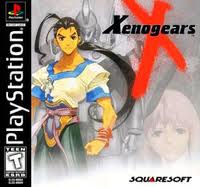
Greatest Games: Xenogears

Xenogears (1998)

Xenogears (1998)

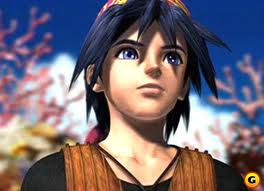
For me, all of my entries in my “Greatest Games” subcategory have been building towards this one.  My intention with the series was to present some of the games I felt were among the best I had ever played while shying away from the obvious choices.  After all, plenty has been said about A Link to the Past or Super Metroid.  While I made entries about Chrono Cross and Twisted Metal Black I was constantly looking ahead to that one game I preferred above all others.

Xenogears arrived during the RPG boom of the late 1990’s.  Developed by Squaresoft under direction from Tetsuya Takahashi, the game was originally supposed to be Final Fantasy VII but it became too dark and too sci-fi in nature to continue as such.  Takahashi was allowed to continue with the project as opposed to seeing it outright canceled but at a much reduced budget (more on that later).  Many Final Fantasy collaborators contributed to the project including executive producer Hironobu Sakaguchi.  When the game was complete, most of the staff would go on to develop Chrono Cross before eventually departing Square with Takahashi to form Monolith Software.

The game begins with our hero Fei in a rather innocent setting.

The game begins with our hero Fei in a rather innocent setting.

Takahashi was nothing if ambitious when creating Xenogears.  It was conceived as being just a part of a much larger narrative and is in fact titled as Episode V in the game’s credits.  The narrative focus of the game is epic in scope with a lot of talking points and several cut scenes, some of which are done with CG and others in full animation.  It’s a long game, one that will take most players around fifty hours to complete on the first play-through.  It’s story focuses on the young Fei Fong Wong, a typical RPG lead in that he has no family and knows very little about his past.  The plot will see Fei discover his true purpose, which is of course a significant one, as he journeys across the globe with a cast of characters out to save the world.  The story is nothing new in setup, but how Xenogears approaches it helps to differentiate it from the flock.  There are many religious undertones to the game’s narrative, some of which nearly scared Square out of an international release.  The game takes itself very seriously and though there are moments where comedy is utilized they’re not frequent.  The game has been criticized for being too pretentious, but it is a fairly enjoyable experience even if it can be hard to understand.

Part of the reason many consider Xenogears to be so pretentious is due to the fact that it tries to be too many things.  There are elements and themes taken from classic philosophy as well as modern sci-fi conventions found in the likes of Blade Runner.  The plot of the game seems to bounce around in focus with lots of twists and turns.  It’s fairly common for games in this genre to start off with one goal and finish with something completely unrelated, but Xenogears takes it to a new level.  The game does a good job of remaining interesting the whole way through but perhaps it would have benefited from a tighter structure.

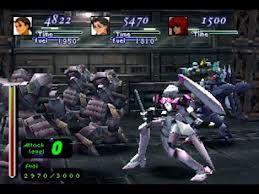
Giant robots called gears play an important role in Xenogears.

Giant robots called gears play an important role in Xenogears.

The gameplay for Xenogears incorporates a lot of genre staples but also introduces some new concepts.  Players travel from town to town either on foot or via transportation and can talk and engage with non-player characters along the way which is often necessary to advance the plot.  Battles are initiated via random encounters on the overworld map or in dungeons.  Once a battle is commenced, the player takes control of a party of up to three individuals chosen beforehand or dictated by the game.  From there it’s a variation of the Final Fantasy Active Time Battle system where a speed score dictates the order and frequency of each character’s attacks.  When it’s the player’s turn, the options are also fairly straight-forward and include attack, defend, run, item, or magic.  The magic command is usually called ether or spirit but functions in the same way as a typical magic attack in most RPGs would.  When the player selects a standard attack is where things change.

In Xenogears, each character has a certain amount of attack points that can be used per turn.  At the beginning of the game there are six per character, but it increases over time.  Each face button on the Playstation controller corresponds with an attack command and has a point value:  triangle is one, square is two, X is three, and circle cancels or ends the attack.  A player can combine the buttons in any way up to the maximum available or use as few as one.  Certain attack combinations will trigger deathblow animations where the character will execute a more powerful move.  Performing the necessary sequence over and over is the only way to learn them but the game keeps track for you in the menu so you don’t have to guess.  The buttons do not have to be entered with any sort of speed so it’s not like a rhythm game or a fighter.  If the player chooses to use fewer than the available attack point total then the remainder goes into a bank for the rest of the confrontation.  As the player accumulates additional attack points, combos become available.  Combos basically allow the player to chain deathblow attacks in one turn allowing for a massive amount of damage to be unleashed.  As a result, most encounters (particularly boss encounters) end up being a balancing act where the player has to decide if it’s better to go all out from the start or build a character (or characters) up to unleash a giant combo.

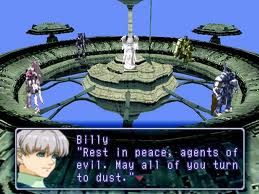
Cut scenes like this nearly kept the game from getting a release outside of Japan.

Cut scenes like this nearly kept the game from getting a release outside of Japan.

That’s just one half of combat as Xenogears’ main feature is that of gear combat.  Gears are giant robots piloted by the game’s protagonists and allow the player to take on much larger foes.  Each character has access or will gain access to a gear during the course of play.  The gears basically mirror the character they’re paired with so the ones effective at dealing out the most damage on foot will be the same in their gear.  Even certain magic attacks are unusable by the gears while some are only usable on foot.  One of the more unique characters in the game, Billy utilizes guns and so his gear does as well.  On foot, each attack button corresponds to a different gun and the same is true in his gear, though it uses different ammunition.  Gear battle is very similar to character battle but has some notable differences.  For one, the player can only use two combinations of attack buttons but instead of having attack points each gear has a supply of fuel.  Each attack consumes fuel with triangle attacks consuming the least and X attacks consuming the most.  As a gear attacks, its attack level goes up.  At level one, triangle deathblows can be used.  At level 2, square deathblows become available, and so on.  There are four levels a gear can reach:  1, 2, 3, and Infinity.  Infinity is the most powerful and only becomes available late in the game.  It’s also not attainable simply by performing four non deathblow attacks in succession.  Instead, there is just a chance a gear can reach infinity when in level 3 and certain gears have a better chance of doing so than others.  Infinity opens up the best deathblows and lasts for three turns so when a gear is able to reach it it usually swings the tide of battle.

The character Elly is a central figure of the Xenogears plot.

The character Elly is a central figure of the Xenogears plot.

Gears also present some challenges not felt when fighting with the human characters.  I mentioned the fuel already which can run out.  If a gear runs out of fuel then it can’t attack, which presents a problem.  Each gear can use a turn to charge which replenish fuel but not a significant amount (unless the player equips a gear with charge-boosting items) and is not something one wants to rely on.  Gears also cannot replenish their hit points easily in battle.  Gears can be equipped with restorative items but they consume a lot of fuel.  Often times, this will cause the player to wait as long as possible to use such an item but then they find themselves in a situation where the gear is now low on fuel exchanging one problem for another.  Basically, the game forces the player to think a little differently when engaged in gear combat and that helps keep the game fresh.  The game is pretty much divided into equal parts gear combat and non-gear combat which does help to keep things interesting.

Outside of combat, character customization is pretty standard.  Each character can be equipped with stat-boosting items and armor with the best items becoming available towards the game’s conclusion.  Only some characters utilize weapons in combat just as only some have magic attacks.  Most will fit into the attack role or the support role with a few select characters performing adequately in both roles.  The game does do a good job of making the characters feel different.  I mentioned Billy earlier as one such character due to his use of firearms.  Another, Maria, always attacks with her gear even while on foot and another character has no gear at all, she can just grow to tremendous heights instead.  As character participate in battle they earn experience points and level up, in turn becoming stronger.  Gears do not receive any benefits from their pilot leveling up.  Instead, they can be upgraded through-out the game with better equipment including engines and frames which increase the gear’s stats as well as its hit points.

A lot of the combat takes place in gears.

A lot of the combat takes place in gears.

There are other things to keep players interested in the game.  Outside of battle players can search the world for players of the game Speed.  Speed is a real-world card game (when I was a kid we called it Spit) where the determining factor of who wins is who plays the fastest.  Defeating these players will often net a useful item and certain secret items can only be obtained via this mini game.  Another mini game is a gladiator type of coliseum where the battles take place in real-time.  The player can select from basically every gear in the game and compete in a fast-paced one on one battle.  It kind of reminds me of the Dragon Ball Z fighting games in that the characters zip around pretty fast and alternate between melee attacks and long-range energy projectiles.  At any rate, both mini games offer decent distractions and are entertaining in their own right.

Visually the game is a fairly solid performer given its era.  The designers opted to use sprites for the characters instead of polygons and while they animate nicely they are quite pixellated.  Backgrounds tend to be on the sparse side and the texture mapping is average.  Backgrounds are a hybrid of 2D and 3D and most areas can be rotated via the shoulder buttons on the controller.  It’s a bit odd watching the game try to rotate around a 2-dimensional character but it does help for timing jumps (something else that helps differentiate the title from a typical RPG, albeit in a minor way).  When the game transitions to gear battle everything becomes rendered in 3D.  The gears are fairly solid-looking and each has its own visual personality.  Attack animations are pretty understated when compared with other games from the genre.  There’s very little in the way of “wow” moments but nothing is really off-putting either.  If anything, the sprite-based approach helps in the long run as many games that opted to use polygons look woefully dated by today’s standards.  The score is quite good and on-par with Final Fantasy’s best, though some of the sound effects are a bit lackluster.  The FMV and anime sequences are not numerous but that helps give them added impact when they do show up.

Xenogears tends to take itself quite seriously.

Xenogears tends to take itself quite seriously.

There is one other thing I have yet to mention about this game that many view as a glaring negative. I mentioned how the project was an ambitious one but I have yet to mention that it was so ambitious it went over budget.  If a Final Fantasy game runs over budget at Square it’s probably not that big of a deal but when an unestablished title does it presents a problem.  Since there was no money left a large section of the game had to be cut, but since the title is so narrative heavy, it could not just be annexed from the game.  Instead, when the player reaches the point in the game where the cuts took place (early in disc 2) they’re treated to a mostly black screen with the exception of Fei seated in a chair.  Here a seemingly endless amount of text is displayed as Fei takes on the role of narrator and explains to the gamer what took place next.  Other characters speak as well, but the presentation remains the same with the exception of a couple of gameplay rendered shots.  The scenarios being described were supposed to be playable but unfortunately are not.  And this section goes on for a good 45 minutes or so.  I remember the first time I reached this point of the game (I’ve played through it multiple times) it was really late at night and I just wanted to go to sleep but had to keep going and going to get through it.  The game does give you the option to save a couple of times so at least there’s that.

Xenogears may not be visually impressive by today's standards, but it still has its moments.

Xenogears may not be visually impressive by today’s standards, but it still has its moments.

As a result, the game feels like it never got what it deserves, which is what every game deserves:  to be completed.  Xenogears sold modestly well but with the creators behind it all leaving to form Monolith it basically ended the possibility of there ever being a true sequel.  Xenosaga was initially conceived as being a part of the Xenogears lineage, but either legal decisions forced that to change or an artistic change was made.  Xenogears presents a pretty open and shut story with little room for a natural sequel, but I would love to see Square return to it as a remake.  The game could be left as is or it could be cleaned up completely with an all new engine.  Some pacing issues could be addressed, but most importantly, the portions of the game cut could finally be restored either thru a new gameplay section or via fully animated cut scenes.  Since Takahashi no longer works for Square, it would have to be done without him but considering the ground work has been laid already it wouldn’t be that difficult.  Xenogears deserves to be experienced the way it was initially conceived and I would personally prefer to see it remade over Final Fantasy VII, a remake many people have been hoping for.  Maybe it will happen one day (though probably not), but even if it never does Xenogears remains my favorite game of all-time.  I know it’s not the greatest game ever made, but it doesn’t have to be in order to win me over.

For those who have never played it, second-hand copies of Xenogears can still be found fairly regularly on auction sites like eBay.  Square-Enix also released the game onto the Playstation Store so Playstation 3 owners can experience the game that way.


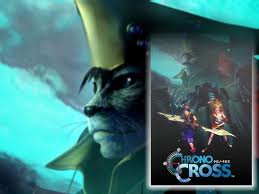
Greatest Games: Chrono Cross

Chrono Cross (1999)

I have been intentionally avoiding the topic of video games of late.  I felt like this blog was getting too video game oriented when it’s meant to capture more.  I think the break has been long enough and so I return to my Greatest Games feature with the latest addition, Squaresoft’s Playstation masterpiece:  Chrono Cross.

Chrono Cross was burdened by hype from the get-go.  One of the most fondly remembered games from the 16 bit era is Square’s Chrono Trigger, the time-traveling RPG that won over many gamers in 1995.  It came late in the Super Nintendo lifecycle and at a time when the RPG was starting to get a bit stale.  It changed things up though thru it’s then innovative battle system and time traveling dynamic which made the game feel extremely fresh.  Those who played it loved it, and those who found out about it much later felt like they really missed out driving the after-market prices of SNES game carts to unexpected heights.  Squaresoft would wisely capitalize on this by re-releasing Chrono Trigger for the Playstation with Final Fantasy IV as part of the Final Fantasy Chronicles compilation.  They would also develop and release a sequel in 1999 called Chrono Cross.

By the time Chrono Cross arrived the fans who had missed out on Chrono Trigger had caught on and expectations were high.  The game was well met by critics when first released, becoming one of only seven titles reviewed by Gamespot to receive a perfect score.  Other outlets were eager to praise the title and it was one of the best reviewed games of 1999 and is still the 8th best reviewed title for the Playstation behind games such as Metal Gear Solid and Gran Turismo 2 and ahead of genre-mate Final Fantasy VII.  Even with all of that praise though, it still feels like Chrono Cross gets overshadowed by the game it followed.  Chrono Trigger has been re-released numerous times for both home consoles and portables.  Chrono Cross, on the other hand, has never been re-released in the US and only recently was made available on the Playstation Network in Japan.  The game sold pretty well, but it didn’t move a real noteworthy amount of units (though most RPG’s don’t).  It feels like the game is still fighting for recognition, even when few are there to put it down.

Serge, the game’s primary protagonist.

Chrono Cross is my preferred game of the Chrono series.  That’s not a knock against Chrono Trigger, a truly wonderful and memorable game, but Cross is just a tiny bit better.  The scope of the game is enormous.  There are over 45 characters for the player to recruit and use and a select few have hidden special moves that can be used in conjunction with other characters.  The game encourages repeat playings as it’s impossible to recruit all of the game’s characters in one play-through.  The game’s plot does not take the player across millions of years but it does include parallel worlds.  In an interesting twist, the game’s main character is alive in one world but died as a small child in the other.  In sort of typical Japanese RPG plot-lines, nothing is what it seems and things do get a bit convoluted by the game’s end but it’s an engrossing and worthwhile story to experience.

The gameplay is similar to Chrono Trigger and other Japanese RPG’s, but it is different in several key areas.  Chrono Cross felt remarkably progressive when it first came out as the game did away with genre staples such as experience points and random encounters.  Instead of experience points, characters get progressively better after performing actions in battle up to a certain point.  There’s a cap placed on the player that can only be extended by defeating a boss character and gaining a “star.”  There’s also no magic points, or mana, and these stars serve as a fuel of sorts to summon creatures to aid in battle.  Magic and special abilities are all labeled as elements, and they are one-time use in battle.  If you want your character to cast Aqua Ball twice you simply equip the spell twice.  Each character has an element grid that grows with the character.  Characters have their own unique abilities at certain levels and are free to equip anything else.

A look at the game’s battle scenario. Not bad for a game that’s over 10 years old!

To go along with this element system is a color coded element field.  The field exists on every battle and is comprised of three parts.  There are six element colors that can affect the field and using any of the six adds it to the field and bumps one off.  For example, if three consecutive red elements are used between the player and enemy, then the whole field is red.  Each character has an innate elemental color associated with him or her which makes them more proficient with that color and weak to its opposite.  When the field is in that character’s favor, that character gets a boost in stats and all elements of that color are more potent.

Standard attacks use attack points.  At the onset of a turn, a character has seven stamina points to use.  Using any kind of element uses up seven while physical attacks are tiered and consume 1, 2, or 3 points.  The player can use all seven up on physical attacks or elements.  Elements can be used at any time, but if the player only has two stamina points remaining then he’ll end that turn with negative 5 stamina points which will likely impact the character’s next turn.  It becomes a management tool and sometimes the player will be tempted to go all out and exhaust his or her characters in an effort to deal a killing blow.  And since the element field is affected by everyone who uses elements it affects how the player uses all of the characters in the party (three total).

The battle system encourages tactical thinking, more so than most Final Fantasy games.  And because the roster of available characters is so large it gives the player lots of freedom to swap characters in and out of the main party.  Usually who’s in it will be determined by the environment as it’s good to have an opposite aligned character to deal out major damage, though going too heavy on the opposite element means your characters are more susceptible to the enemies as well.  These kinds of trade-offs are not foreign to gamers, but it works to great effect in Chrono Cross and keeps even the more mundane enemy encounters amusing.

If you’re a fan of the genre and never played this one then you’re really missing out.

As I mentioned earlier, the plot can get a bit murky but overall it’s pretty fun and will keep most gamers entertained.  The game pulls the old switcheroo midway through by having the main character change rather drastically which gives the game a new feel.  The art direction and visuals were quite stunning in 1999 and hold up surprisingly well today.  A lot of games from the Playstation era cannot say the same.  There’s many lush environments, especially early in the game, and there’s liberal use of FMV for the more spectacular moments.  The audio is also fantastic.  Sure the characters don’t talk and it’s a pretty text-heavy title, but the soundtrack is exceptional and one of the best of all time.  Above all, it’s just a fun game.  This is the Japanese RPG perfected and the genre’s popularity maybe well behind us at this point but it’s still fun to go back and relive the classics.  New games are great and all, but there’s nothing like firing up an old classic and if you’re going to play an older RPG, Chrono Cross is the one to reach for.


What to Make of E3 2012?

If you’re even remotely into video games then you know that every June the Electronic Entertainment Expo (better known as E3) takes place in LA and all of the major players in the video game world unveil to the public what they have in store for the masses.  Often times E3 is the first chance for gamers to get a look at the next big “thing” from the major developers, be that thing a new console or the return of a beloved franchise.  This year’s E3 promised to reveal more about Nintendo’s next machine, the Wii U, and the public figured to get its first look at the latest in long-running franchises like Halo and Super Mario Bros.  As for surprises, well it was entirely possible, though not likely, we’d get some info on the successors to the Playstation 3 and Xbox 360 and maybe a new 3DS.  Now that E3 2012 is in the books, what did I think of it?  I’m glad you asked!

Microsoft/Sony

I’m lumping these two together for reasons that will be obvious once I’m done.  Both console publishers weren’t expected to unveil new hardware at E3 and instead would aim to boost their current market share.  Microsoft, predictably, threw a bunch of Kinect stuff at the attendees since that’s presently making them a boatload of money even if the “hardcore” gaming community couldn’t care less about it.  There was Halo 4 though, which was the game most Xbox fans were interested in.  As the first Halo not developed by Bungie, there is some uncertainty surrounding it but it seems like most were satisfied.  Beyond that it was mostly third party games that were spotlighted and some kind of fancy touch-screen junk.  Ho-hum.

Sony was expected to tout the Vita to PS3 connectivity in hopes of boosting the Vita’s severely lacking sales.  Sony’s presentation ended up looking like a business meeting at times and was a total snooze-fest.  They did talk up the connectivity of the Vita and PS3, but really didn’t get behind the Vita like I thought they would.  Like Microsoft, the emphasis was on third-party releases but Sony did flash some new exclusives such as The Last of Us and the latest from Heavy Rain developer, Quantic Dream; a new title similar to Heavy Rain called Beyond:  Two Souls.  I was surprised at how shitty 2012 looks for the Vita as the best titles coming to the handheld are PS3 ports like Sly Cooper: Thieves in Time and Guacamelee, making me feel less secure in my purchase.

Studio Ghibli is being used to help develop a game? You bet I want in on that!

If you can’t tell, I was pretty unimpressed with the offerings Sony and Microsoft made.  The game that excited me most on their machines was probably Ni No Kuni, the Level 5 and Studio Ghibli collaboration for the PS3 that’s already out in Japan.  I already knew enough about that title though, so it wasn’t like E3 was some big unveiling for it.  Plus it’s a JRPG which doesn’t attract much attention these days.  There was really nothing from Square-Enix, which surprised me, other than their produced revival of Tomb Raider which got a lot of people talking (IGN gave it the title of best game of E3), but I just can’t get excited about a Tomb Raider game.  Microsoft and Sony essentially punted on E3, and with next year’s E3 expected to showcase their new machines, I suppose it’s understandable.

Nintendo

Nintendo had the most to gain with E3 2012 so I expected the Big N to pull out the big guns.  After all, E3 marked the best opportunity for the company to sell the public on its latest console the Wii U, while also pumping up the money-printer known as the 3DS.

Before I get to the Wii U, let’s look at the 3DS.  Interestingly, around this time last year the handheld was floundering and Nintendo was already contemplating a price cut which it would eventually implement.  That price reduction, along with some better software, propelled the 3DS to the top of the sales charts.  Nintendo may be losing money on each unit sold right now, but it’s better than having them sit on the store shelves.  It was thought that Nintendo would show off a 3DS Lite, or as media reports before the show appeared to leak, a 3DS XL which would basically combine the existing hardware with the Circle Pad Pro attachment.  These reports proved erroneous, for now anyways, as Nintendo did not have a new 3DS to show off.  This probably has a lot to do with the current model both selling well and at a loss.  Why sink more R&D into it now?  Nintendo will likely wait for sales to slow down before unveiling a new SKU.

Ghost-busting, Luigi style.

As for the games, well the 3DS didn’t show off much new, and instead finally gave the public a glimpse into games it had already announced but had yet to really show off.  These games included both a new entry in the Paper Mario franchise and a sequel to the decade-old Luigi’s Mansion.  Both were on display at E3 this year and both pretty much delivered what I think most gamers were expecting.  Neither one appears to break the mold much, and Paper Mario:  Sticker Star has some weird sticker gimmick that I’m not sure I like, but gameplay-wise both titles appear solid.  Luigi’s Mansion:  Dark Moon is perhaps slightly more interesting just because it’s a franchise Nintendo has yet to exploit.  The first game, released as a Gamecube launch title, was a solid enough title but one that felt like it needed a sequel to fully realize its potential.  It’s surprising a sequel has taken this long and hopefully it’s a more complete game this time out.

I hope you like coins…

The big, new, title for the 3DS announced just before E3 is New Super Mario Bros. 2.  New Super Mario Bros. is one of the DS’s all-time best sellers, while New Super Mario Bros. Wii is one of the all-time best sellers period, so it’s no surprise the game is returning in 2012.  NSMB2 looks to be more of the same.  Nintendo is bringing back the leaf power-up, much as it did with Super Mario 3D Land, though this time it’s function is identical to it’s original powers in Super Mario Bros. 3, complete with P Meter and all.  It’s also incorporating the Wii version’s simultaneous play, as two players can play as Mario and Luigi at the same time, which sounds like more fun than it looks.  This edition also places emphasis on coin collecting (one of the new power-ups, a gold fire flower, lets Mario turn pretty much everything into coins) with the goal being to collect a million over the course of the game.  It’s unclear if that’s some sort of requirement or just a challenge, but it’s not something that has me excited at all.  Coin collecting, and collecting things in general in platformers, is mundane.  I don’t mind a few hidden items, like the star coins, which are usually some-what challenging to get, but just grabbing coins is often an after-thought.  The games are so easy that the player doesn’t really have to go out of their way to get coins and yet will still end up with over 100 lives.  I’ve recently been playing a lot of the Super Nintendo classic Super Mario World and I wish Nintendo would look to that title for inspiration.  The challenge in that game was finding numerous secret exits and extra levels which was far more gratifying than coin collecting.  NSMB2 does at least return the Koopalings, something I wish had been included in Super Mario 3D Land, so that’s a plus.

It also wasn’t enough to have just one new entry in the New Super Mario Bros. franchise as Nintendo also showed off New Super Mario Bros. U, the lead title for the new Wii U console.  It’s basically what you would expect, though Nintendo hopes to high-light the Wii U’s new controller.  By doing so, the Wii U game uses the Wii remotes for general play, but one person can use the new controller to add items to the levels, kind of like a Dungeon Master or something.  The game will have co-op play and will have a different set of levels than the 3DS game plus Yoshi and a new suit; the flying squirrel.

Mario’s new suit: The Flying Squirrel. At least it makes more sense than the raccoon tail.

That little segue brings me to the Wii U and why I really couldn’t care less at this point.  If you weren’t aware, the Wii U’s main selling point is this new controller.  It’s basically like a DS only with one screen and two analog sticks.  The touchscreen on it will be used differently for each game.  In ZombiU, it’s used to display little puzzles like key-code readers for doors and it’s designed to get the player to look away from the screen while hoards of zombies are descending upon the player to enhance the excitement.  In Batman: Arkham City, it just displays Batman’s gadgets and instead of selecting them with a touch of a button you use the touchscreen.  It’s also used to steer his remote bat-a-rang and control his de-encoder device.  A new title called Nintendo Land figures to show off other uses for the controller (the game is basically the Wii U’s version of Wii Sports, though marketed better by using Nintendo characters) but Nintendo hasn’t committed to it as a pack-in title, which would be a huge mistake, in my opinion.

If the uses for the controller do not wet your appetite, then I’m afraid there isn’t much going for the Wii U.  For me, it just doesn’t sound all that interesting.  It’s basically taking the DS experience to the home console.  And it’s being reported a single charge will only get you about 2 and a half hours of gameplay out of the controller which will make owning two a necessity for anyone looking to game for that length of time.  Also hurting it is the fact that some titles, like Arkham City and Mass Effect 3, will have been available for quite some time on other consoles by the time they’re released.  Do the additions to Arkham City make you want to buy it again?  I think for most the answer will be “no.”  And it’s also being reported that the Wii U may not even be as powerful as the 360 and PS3.  All of this tells me that Nintendo needs to get its big franchises onto this thing fast if it expects to move a bunch of units, because I don’t see any system sellers for it right now.

Wreck-It Ralph

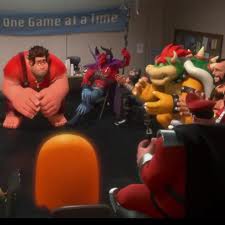
I love this concept, hopefully it’s utilized well.

Have you heard about this one?  E3 isn’t known for movie reveals, but there’s also never been a movie like Wreck-It Ralph.  Best described as video game’s Who Framed Roger Rabbit?, Wreck-It Ralph is an animated feature from Disney that’s like a love letter to gaming.  The main character (voiced by John C. Reilly), is the antagonist in a Donkey Kong-like game who is sick of being the bad guy.  The trailer features a visually amusing gag of Ralph sitting in a therapy session with some of gaming’s biggest villains including Bowser and M. Bison.  The CG-animated film is directed by Rich Moore who was the lead director on the first several seasons of Futurama which certainly bodes well for the film.  I love the concept, but honestly found the trailer underwhelming.  The jokes just weren’t very funny, but I’ll refrain from passing judgement until I actually see it.  The film is currently set for a November release.

All in all, I think E3 2012 was one of the least interesting E3’s in recent memory.  Perhaps if Nintendo had yet to unveil the Wii U it would have been more exciting, but we already saw this thing in action a year ago and this year it was all about the launch-window software, which really didn’t impress.  Nintendo also didn’t unveil any pricing, which has me concerned, as I’m sure the company doesn’t want to sell this thing at a loss like it currently is doing for the 3DS.  I’m expecting a bare-bones release, as in one controller and no pack-in games, for around $300.  Any higher and Nintendo is crazy.

And if Nintendo failed to seize the moment, Microsoft and Sony weren’t willing to steal the spotlight.  Neither company really unveiled anything new and preferred to rest on its laurels.  Sure this year’s E3 was the public’s first look at Halo 4 and The Last of Us, but I think we all have a reasonable expectation of what they’ll play like.  There were no new games shown that have me excited, and the most interesting for me was Beyond:  Two Souls but that one is still a long way off.  2012 started off with a bang, but the fall looks to be easier on the wallet, I’ll leave you to decide if that’s a good thing or not.


Playstation Vita (Helpless in the Face of New Technology II)

I didn’t go back and look, but I think I mentioned the Playstation Vita in three posts and in all three I said I wasn’t going to get one at launch.  I had purchased a 3DS at launch last year and it didn’t turn out to be the best purchasing decision of my life.  The software at launch was terrible and the entry price pretty steep.  Roughly six months later Nintendo would slash the price of the unit by a significant margin.  As an early adopter, dubbed a Nintendo Ambassador, I received ten free NES games and ten free GBA games but if given the choice I might have just chosen the cheaper unit.  And the 3DS isn’t a bad system at all.  I’ve enjoyed it now that the software has caught on and even purchased the new add-on.  It seemed unwise to be an early adopter again, especially for a Playstation product.  I’m not sure if any Playstation console has had a good launch lineup and they’re always expensive.

I could have said it until I was blue in the fact, but the simple fact of the matter is, when new technology comes out I can’t help myself.  And when I got a glimpse of what Uncle Sam was sending me as a refund I found it harder and harder to make excuses.  I lasted over a week, so I guess I can be proud of that, but as of March 4th I am an owner of a Playstation Vita.

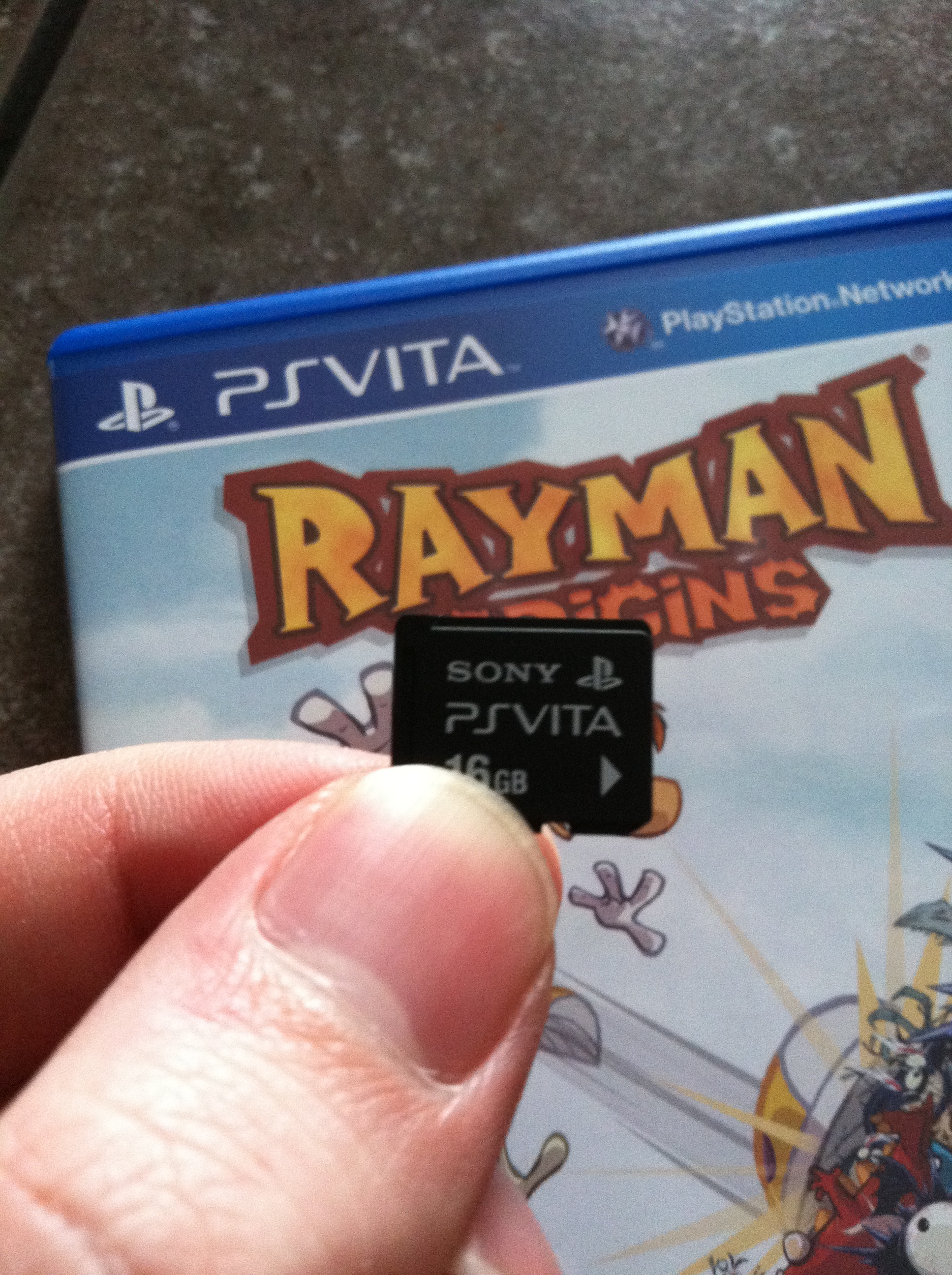
Vita game cart. Pretty small, as you can see.

Now, I said Sony consoles tend to have expensive and poorly supported system launches and in one way the Vita is no exception.  The Vita is expensive.  There’s no way around it.  I’m a bachelor with a home and a good job.  I have no kids and my living expenses aren’t too cumbersome.  I have disposable income to throw at video games, but even so, it still didn’t entirely sit right to spend $350 on a new handheld system.  What did my $350 get me?  Well, it got me a Wi-Fi enabled Vita ($250), a 16 GB ($60) memory card, and one game ($40).  The price tag of the Vita itself isn’t awful.  It’s the same price the 3DS launched at but the Vita is the far more powerful system which makes it seem reasonable.  However, the 3DS came with a 2 GB SD card and most of the games save directly to the game’s cartridge.  There were also some pre-loaded games, nothing great but it’s something.  The Vita comes with nothing.  There’s a USB chord, an AC adapter, and some documentation.  There are some augmented reality cards that I admittedly haven’t even done anything with, but I’m not expecting much entertainment from them.  There’s no onboard memory though, and that’s the Vita’s biggest hurdle.

The memory cards are a joke.  Sixty dollars for 16 GB of memory?  That’s obscene.  And you need a memory card to play just about every game and there isn’t any onboard memory to download games to.  It looks like most of the games will require between 4,000 KB and 5,000 KB for save files.  This isn’t a scientific observation, merely what I saw on the back of each game case I looked at.  The packaging for the memory card itself says you can expect to hold 4 to 8 complete games on it, so if you’re planning on acquiring most of your games digitally you may want to go even larger.

Even smaller than the the games; the Vita's stupidly expensive memory cards.

Because of the costly memory, I suspect most will just buy game cartridges.  The cartridges are small, thumb-shaped cards.  Most will set you back $40, but there are some for $50 like Uncharted: Golden Abyss.  I picked up Rayman Origins and that cost me $40.  The cases are small but proportionately similar to a Blu Ray case.  In the case of Rayman, there was nothing inside the case except the actual game.  There is a clip for an instruction booklet, so maybe other games come with one, but this one only comes with an electronic booklet.  It’s kind of strange to have a case even this size for one tiny cartridge but whatever.  For Rayman, the load times are pretty minimal and I’m not sure how they compare with the PS3 version.  I would expect this type of medium would have pretty quick load times and would certainly be faster than the PSP’s UMD format.  I don’t know why they lack their own means of storage for game saves and have never seen it addressed.  It seems to me like they should be able to do that, but maybe I’m underestimating just how much space these games take up.

The Vita itself is an impressive piece of tech.  Which makes sense, because if it wasn’t I wouldn’t have bought it.  I’m going to skimp on the features since they’ve been covered elsewhere, but the screen is an OLED screen with touch capabilities.  There’s a second touch “panel” on the back of the system as well.  There’s cameras on the front and back and all of the buttons from the PSP are returned.  The biggest additions are the analog sticks.  The PSP’s nub is no more as the Vita features twin mini sticks that feel very similar to the PS3’s.  They do not double as buttons like the PS3 ones, which is unfortunate as that’s the only setback for the Vita.  Without the additional triggers and buttons the PS3 has, it will make certain ports trickier than others but the addition of a second analog stick is pretty significant.  And the quality of the hardware is exceptional.  The unit is larger than a PSP, but is surprisingly light.  It’s thin and very portable if you carry a messenger bag (or purse, if you’re a woman) but it’s probably not going to fit in most pockets.  And you probably wouldn’t want to try anyways without a screen protector or some kind of case.  I didn’t spring for one but I might have to eventually.

I mentioned earlier I got the Wi-Fi model.  For another $50 there’s a 3G one with service through AT&T that costs a monthly fee.  I have no interest in a monthly fee for my handheld gaming device so deciding which one to get was a no-brainer.  The device is also equipped with Blue Tooth and I assume it can be connected to certain headsets.  It also can communicate with the PS3 and the two can share a PSN account.  I checked out the remote play feature, as I never tried it with my PSP, and found it worked fine.  It basically turns your Vita into your PS3, but not all games can be accessed (for me, no games could be).  I think all of the PSOne Classics are supposed to work with the Vita, but might not yet.  Some games available across both platforms will be able to communicate with each other and some of the early releases include both a Vita version and a PS3 version.  Most of them will require a double purchase though.  It would be nice if buying the PS3 version of MLB The Show got you a discount for the Vita version, but I don’t expect Sony to go that far to please the consumer (edit: after publishing this I looked on both amazon and Gamestop’s websites and saw that if you buy both versions it will cost you $80, which is a $20 saving which is better than having to spend $100).  I’ll probably buy both versions of that one as I’m eager to test out the cross platform features with that particular title.

I spent multiple hours with Rayman Origins and found the Vita pretty comfortable.  Surprisingly, my left thumb is a bit tender which I would not have expected but it isn’t bad.  The buttons are all easy to reach though the shoulder buttons are slightly awkward, but not too bad.  Visually, the Vita (and Rayman Origins) does not disappoint.  The OLED screen is bright and vibrant offering a better picture than most plasma TVs.  It has to be seen to be truly appreciated.

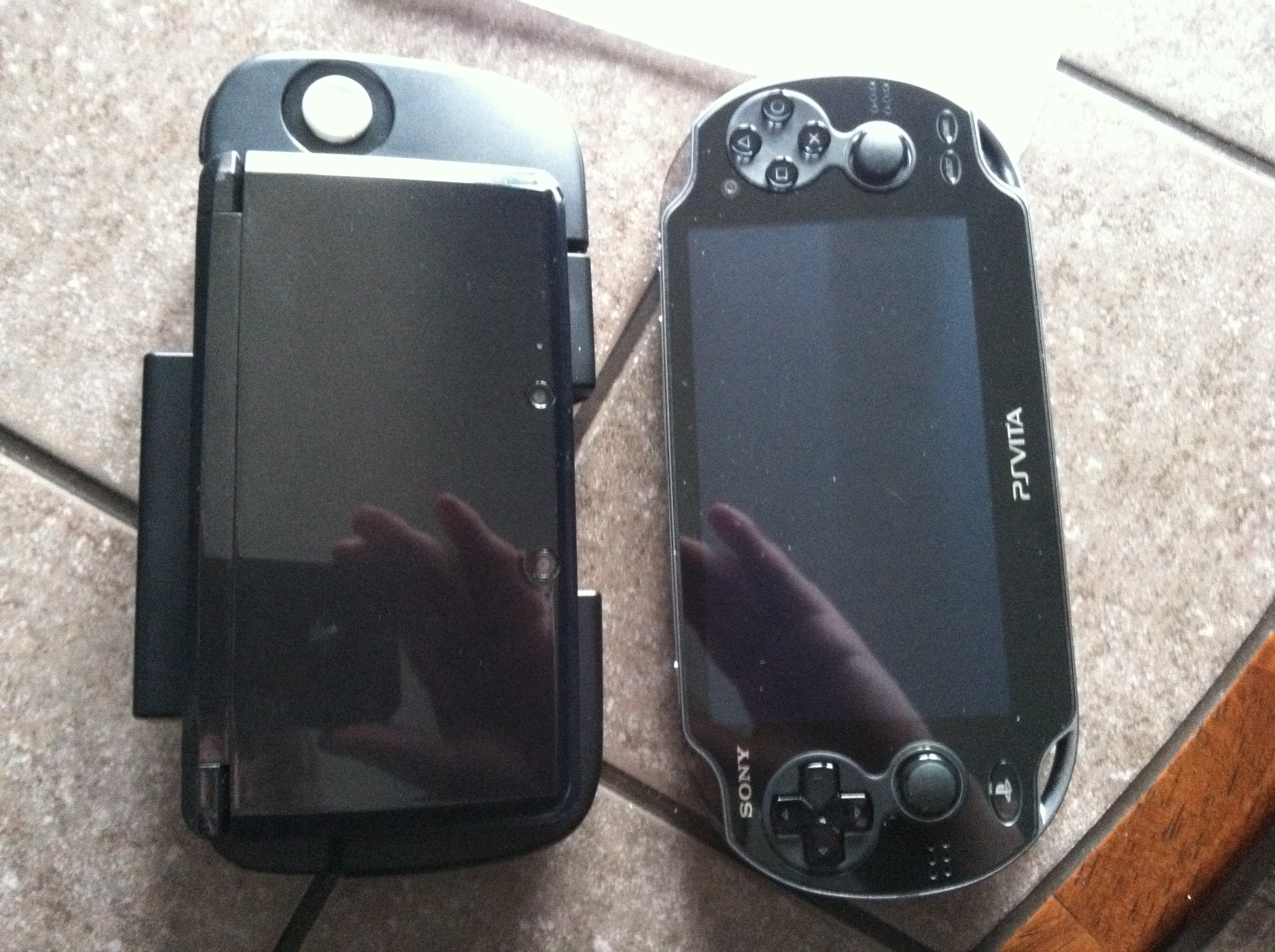
The Vita, side by side with a Circle Pad Pro equipped 3DS. Neither is very portable.

It helps when the game is gorgeous too.  Rayman Origins is a direct port of the critically acclaimed PS3/360/Wii title from last year.  It’s an old school 2D platformer that will test your jumping abilities with lots of timing based challenges.  The gameplay is tried and true, and though I’m only a short way into it, I’m impressed.  Visually though it’s one of the most appealing games I’ve ever played and it doesn’t appear to have suffered one bit in being ported from consoles to the Vita.  It looks like a living cartoon.  Some cel-shaded games, like Super Paper Mario, came close to achieving such a feat but none have managed to pull it off like Rayman Origins.  The art style reminds me of 90’s era cartoons like Ren & Stimpy and Rocko’s Modern Life.  There’s a “zany-ness” to everything and a lot of the movements of the characters are exaggerated.  There’s more screaming than speaking, and the whole thing just seems crazy.  If you haven’t played it, and like platform games, definitely check it out.  It can be found for about $30 new for home consoles and is the type of game developers should be rewarded for making.

So for $350 I got an excellent game and a new handheld with (hopefully) plenty of memory.  I feel okay about it, but the other risk one takes on when buying a new system at launch is long-term support.  The Vita got off to an okay start in Japan, but shortly after launch sales were ground to a halt.  I haven’t seen sales figures for the US launch yet, but most of the stores I’ve been to over the last week or so are not over-flowing with units.  I’ve even seen a few sell-outs, so it would seem that the Vita is off to a good start.  I’ll be curious to see if it can maintain that momentum as the PSP wasn’t a huge success in the US, certainly not compared with Japan.

Whether it survives or not will depend largely on price and software.  The price is already out there and quite an obstacle, but if it’s moving units then maybe I’m placing too much emphasis on it.  That other problem most Sony systems face at launch is not an issue for the Vita.  There are plenty of good, and even great, games available right now.  Some, like Rayman Origins, are ports of console titles and some, like Uncharted, are all new.  For the system to flourish, developers will have to continue to support the Vita with both new titles and ports.  Some games are perfect to see ported to a handheld, especially sports titles.  If that’s all that’s out there though then gamers might get bored.  If given the choice, more often than not gamers will take a home console game over a portable.  A pick-up and play title like Rayman Origins is a rare exception, as I think that’s a game that works great for a portable.  A more in depth experience like Arkham City though is best on a home machine.

So I guess I’m happy with the Vita, for now.  I have so many games to play now, it’s borderline obscene.  It may actually be a week or more before the Vita even accompanies me on the train as I’m currently splitting my time between Tactics Ogre for the PSP and Resident Evil Revelations for the 3DS.  I will get MLB for the Vita though, and at that point I may not be able to resist playing it during my commute, but after that I have no idea what my next Vita game will be.  I guess I’ll have to start paying attention to all of these games.  I have a problem.


Greatest Games: Castlevania: Symphony of the Night

Castlevania: Symphony of the Night (1997)

There are several core genres of video games, but few games can actually be summed up as one genre.  A game can be called a role-playing game, but there’s a big difference between Chrono Trigger and Baldur’s Gate.  The same can be said for platform games, as few will confuse Super Mario Bros. with Ratchet and Clank.

The Castlevania series has long struggled with genres.  The original game is often described as a hybrid action-adventure title.  Famous for its great, but punishing, gameplay it’s no surprise it spawned several sequels.  The first of which, Castlevania II: Simon’s Quest, was a radical departure.  For that title, Konami decided to take the non-linear gameplay fans seemed to enjoy so much about the first game, and expand upon it by introducing many RPG elements.  Simon’s Quest was an ambitious title, but probably one that had more failures than successes.  As a result, Konami would simplify the many sequels and slowly work its way towards something more complex.

With new hardware and many more attempts are crafting quality Castlevania games, it was time for Konami to get bold once more.  The arrival of the 32 bit era brought about realistic opportunities for 3D gameplay design.  Not 3D as we know it today (the optical illusion), but 3D polygons instead of hand-drawn 2D sprites as a visual and gameplay style.  If Konami was attempted to explore this style with Castlevania, it wisely held off and stuck with what worked.  Symphony of the Night was born on the Playstation and unveiled to the world in 1997 in a very quiet manner.  Because it was not 3D, and was up against the massive hype-machine known as Final Fantasy VII, it was overlooked initially.  Review outlets were generally impressed by the title, though some would probably like a do-over as even many of those old reviews look like they were done as after-thoughts.

In Symphony of the Night, players will take control of Alucard; son of Dracula!

No matter, Symphony of the Night would receive its due eventually.  SotN took Simon’s Quest and married it with Nintendo’s Super Metroid.  This has lead some fans to affectionately refer to the title as “Metroidvania,” which should not be mistaken as an insult.  SotN sees the player dropped into a familiar setting; Dracula’s Castle.  Only this castle is different than before.  The player can explore it at will as the game doesn’t merely force the player to go left to right.  There are many ledges and secret rooms to find and explore and roadblocks, especially early in the game, are quite frequent forcing the player to back-track.  This emphasis on exploration made the game more than just an action title and really put the focus on the adventure aspect.

In the starring role this time was a familiar, and yet unfamiliar, face.  Alucard, son of Dracula, is the primary protagonist.  The first scene of the game teases a starring role for Richter Belmont, but Alucard is the one who will receive the majority of the playing time.  Alucard plays very differently from the other protagonists to appear in a Castlevania game before him.  As a half-vampire, he’s far more powerful than any Belmont.  He can dash, leap to impressive heights, and change his form.  He has spells at his disposal, input like fighting game commands, and can be built up to god-like levels.  As he kills enemies, Alucard gains experience and levels up.  When the game first starts off he’s fairly weak and most of the player deaths experienced in the game will come in the first hour or so.  As the player “level grinds” and explores more weapons and abilities will be found.  Alucard does not use the traditional whip, but can use pretty much every other type of weapon one can think of.  Most will include various swords and spears but tough guys can also roll with just their fists if they wish.

And since Alucard is the son of the game’s main antagonist, many storyline possibilities are opened up.  While this game came before story became a major point of emphasis in video games, it manages to weave an interesting tale.  SotN sets out to finally bring all of the previous games together under one massive narrative.  Old questions are answered, and new ones born, and for longtime fans it’s a very satisfying experience.  The only drawback is with the voice acting.  Voice acting was ever growing in popularity at the time, but few did it well.  SotN is no exception in that regard and the original release features some atrocious acting.  It’s not used a lot, thankfully, but is pretty groan-inducing.  Ports of the game have improved upon it, though I can’t say how much since I’ve never bothered to play them (I still have my PSX copy).

Symphony of the Night takes a traditional visual approach for the series and even returns many familiar foes.

Visually, the game is a delight!  Alucard’s sprite has smooth animation and nice effects to go with it.  The game makes liberal use of all of the 2D tricks perfected in the 16 bit era and enhances them.  There are some polygons in the game, but they’re mostly used to dress up the background.  Because of this approach, the game holds up quite well to this day.  Some of those old Playstation and Nintendo 64 games that were much heralded in their day cannot say the same thing.  This is still a pretty game, by any standard.  And since it’s a Castlevania title, the soundtrack must be mentioned.  It contains many of the old tracks made famous by the series, but also has a ton of new compositions that all suit the game’s mood.  The synth-metal approach to many of them is a great deal of fun to listen to and there are numerous elements of techno, classical, and other genres blended in.  This is still my all-time favorite video game soundtrack.

The game controls tighter than any previous Castlevania title.  Perhaps it’s because of Alucard’s inhuman nature, but he is much more nimble than any Belmont before him.  This makes controlling him a more enjoyable experience, but also makes the game much easier.  As I mentioned before, the early part of the game can be a challenge as Alucard is de-powered early on, but as you level up and find new weapons and spells the game becomes increasingly easier.  There are a couple of items that practically break the game because of how over-powered they are.  You can, of course, choose not to use them but it’s hard to resist.  There are many boss battles though, and most are fun affairs and offer some of the game’s best challenges.  There are also multiple endings as this is one of those games where just when you think you’ve finished, more is revealed.  Get to 100% completion and the castle gets literally flipped upside down and the game practically starts over again!  There’s also a code to play the entire game as Richter, and later ports include a third character as well; Maria Renard.

Fans looking for a more traditional experience could take control of Richter Belmont in lieu of Alucard via code in the original release.

When I first set out to cover my favorite games I mentioned I was going to mostly stay away from the consensus classics.  Symphony of the Night is probably one of those classics, but to me it has always felt overlooked which is why I chose to include it.  It was largely ignored by audiences when it was first released but as time went on gamers went back to it.  I was one such gamer who first ignored it.  I don’t even remember there being much coverage for it at the time, but I eventually made the time for it and picked up a used copy.  And even though I grabbed that used copy a couple years later, I was still ahead of a lot of people to even be able to find a used copy for cheap money!  Now that black-label game is considered a collector’s item, and while it doesn’t go for huge money in the secondary market, it’s not likely to be found in a bargain bin.

Symphony of the Night, for me, represents Castlevania at its absolute best.  Some long-time fans think it’s too easy to be the best of the best, and since the main gameplay does not feature a whip of any kind it can turn off some traditionalists.  It’s still the most fun I’ve ever had with a Castlevania title and the one I remember most fondly.  Several of the new handheld games have copied the style of SotN but I’m not sure any have truly improved upon it.  Oh, those games are good, but the crown still belongs to the game almost no one played when it was first released nearly 15 years ago.


Twisted Metal (2012)

Twisted Metal (2012)

If you frequent this blog you may have noticed that I do not post many negative reviews.  That’s because, for the most part, I’d rather talk about things I like and enjoy and not things that irritate me or make me mad.  There have been some exceptions.  I set out to review all of the Danzig releases which meant reviewing the good and the bad.  I also reviewed the X-Men trilogy which meant having to review the less than stellar third film.  Otherwise, I think most reviews have been fairly positive, especially the video game ones.  I suppose there’s a first time for everything, but it does pain me that my first negative video game review on this blog is going to be about a franchise I adore; Twisted Metal.

Twisted Metal made its return to livingrooms across the globe this past Valentine’s Day.  I recently made an entry in my Greatest Games feature praising the last home entry in this series, Twisted Metal Black, which came out over 10 years ago.  The new game, simply titled Twisted Metal, was announced a couple of years ago at E3 in grand fashion complete with a live-action Sweet Tooth driving his famous ice cream truck onto the stage during Sony’s conference.  Long-time fans of the series had been nearly driven insane wondering when, if, Sony would return to one of its oldest franchises.  The wait was long, but it did have an end, unfortunately it wasn’t really worth the effort.

Twisted Metal is not a bad game in the strictest sense.  Visually it’s quite nice to look at though not breath-taking.  The textures on the scenery are minimalist but that’s because the game was built for speed and there’s little need for gorgeous textures when the player is going to spend the majority of the game zipping around the various levels.  The cars look great, though from an artistic standpoint they do seem to lack in personality when compared with the older games.  Perhaps that’s nostalgia getting the best of me and an over-compensation on my part considering the drivers are no longer unique (more on that to come), but it is the impression that I get.  The soundtrack features a mix of original compositions that mostly trend towards hard rock and some licensed tracks featuring a return of Rob Zombie (which is actually kind of odd, considering he was only featured on the much-maligned third and fourth entries in the series).  It’s been quite a long time since I’ve driven around a war zone with “Dragula” booming through my television speakers.

The game mechanics of Twisted Metal remain largely unchanged as well.  You still drive around blasting opponents with fire, power, homing, and all sorts of other missiles all the while relying on powered-up special attacks.  A lot of the vehicles have a familiar feel as well.  Sweet Tooth (the truck, not the character) still handles like a bath tub on wheels and Dark Side has a punishing ram attack.  Some vehicles return with new special attacks this time out, such as Roadkill’s mini gun and Junkyard Dog’s Taxi.  This one even includes a helicopter for the player to try out, something that was to be included in Black but had to scrapped at the eleventh hour.

Cut scenes are done with live actors. Also, Mr. Grimm isn’t dead.

If a lot of the game is more of the same, why am I threatening a negative review?  Well, a lot of reasons really.  While the gameplay is fairly consistent with prior games, there’s a different feel to the physics this time out.  It’s as if the development team decided the more chaotic the battles, the better.  Now it seems like only the slightest bump or the most insignificant weapon can send your vehicle bouncing around like a tennis ball.  This causes vehicles to get hung-up on walls and proves especially annoying during the games racing levels.  You read that correctly, there are racing levels this time around and they are atrocious.  Twisted Metal was never designed to be a racing game and that is more than evident when it tries to be one.  The levels are still wide open but force you to travel through gates or checkpoints along the course.  The thing is, there is no set course so the whole thing becomes an exercise of trial and error as you try to figure out which way the game wants you to drive.  The final race is particularly annoying as it has you speed over ramps and rooftops where one error spells doom.  And passing through all of the checkpoints first is something only required of you, the player, the AI controlled opponents are free from that restriction.  This is a pretty big deal for the final race because finishing in first is meaningless, it just reveals on your map where the final, mobile, checkpoint is.  Activating this final checkpoint causes all of the other cars to explode, which means if one of the AI cars activates it first, you lose.  And since they don’t have to pass through all of the checkpoints it really becomes a crap shoot.  If there’s one silver lining for the racing levels it’s that there are only three, but you’re likely going to hate all of them.

And that wasn’t the only way the team “spiced” things up with the single player, there’s also electric cage and endurance matches.  Electric cage match sounds pretty cool, but it’s not.  Again, it just turns into another gameplay tweak that’s annoying, not enjoyable.  In these levels a laser cage surrounds an area for a set amount of time.  While inside it, you’re fine but leave it and a timer is activated.  Once that timer reaches zero you begin to take damage.  Every minute or so, the cage vanishes and reappears at another part of the level setting off a mad dash to find it.  One of these levels occurs in an amusement park and the serpentine like roads make it a challenge to find the damn thing once it re-spawns.  It just doesn’t add anything enjoyable to the experience.  The endurance rounds are actually okay.  These require the player to kill a certain amount of enemies while keeping a large number of them on the map throughout.  This creates a more chaotic experience that actually works.  I still prefer the more traditional levels, but this one’s okay.

Since the game only has three characters, each one can drive whatever vehicle he or she chooses.

Then there’s the Juggernaut levels.  The Juggernaut is a semi with a full trailer armed to the teeth.  It also spawns a new enemy every thirty seconds.  In these levels you have to kill the Juggernaut as well as all other combatants.  Later levels introduce a second Juggernaut and a more powerful version at that.  These levels are okay and do prove challenging and serve as a sort-of mid-point boss fight for the three single player scenarios.  The true boss battles comprise their own level, though usually play out in stages.  The first one was pretty cool and pits the player against two over-sized monster trucks. The second, a battle against a mech-like enemy, was annoying.  Part of the reason for its annoyance is the inclusion of the dreaded electric cage for a portion.  The final boss, a Sweet Tooth themed one, is much better.  It’s both over-the-top and inventive and a good way to close out the third and final story.

And yes, that is also correct, there are only three single player stories.  This has been known for awhile and dreaded by me.  My hope was that since only three existed they would be more involved and longer than before.  Instead, they’re shorter than what was in Black and can be completed in less than an hour a piece.  They kind of form one long story and have to be played in succession from Sweet Tooth, to Mr. Grimm, and to Dollface.  Sweet Tooth is pretty much the same Sweet Tooth from Black.  In his scenario we get to see the origins of this Sweet Tooth and what he hopes to get from Calypso when he wins.  The story unfolds in three parts, an intro movie, a middle, and an end.  These are done with live actors instead of CGi.  It’s actually not bad, and Sweet Tooth’s story, while predictable, was entertaining.  Grimm’s was less so, and Dollface’s more like Grimm’s.  There are a couple of ending movies that serve as epilogues that bring the focus back to Sweet Tooth, which proves to be a good thing.  This game’s Calypso is also very different from previous ones.  He kind of looks like Jack Black from The White Stripes and is some sort of entrepreneur and has his own company.  He still bestows wishes on the victors but I found him less entertaining this time around.  The twists were all very predictable and thus less amusing.

The single-player was a tack-on thing and definitely feels that way.  It’s a shame, because I loved playing through each one in Black.  Sure the writing wasn’t anything fantastic in that game but it was entertaining.  This game’s primary focus is on multi-player, something I rarely engage in.  I’ve never touched the online component of most of my games including Red Dead Redemption, Uncharted 2, Mortal Kombat, Smackdown vs Raw, and so on.  Because this one includes such a small amount of content, I’ll pretty much have to give it a shot.  It could be good, but right now the servers are all messed up leading to numerous network connection errors.  This appears to be a wide-spread issue and a patch is set for release next week.  Online is still playable for the truly determined, I’m just not among them.

I suppose that makes this verdict incomplete, but in truth, no amount of multi-player action can change my mind at this point.  Online matches may help alleviate the notion that I just wasted sixty bucks but it won’t change the fact that, as a single player game, Twisted Metal isn’t very good.  There’s not much content and the gameplay engine just isn’t up to par with past efforts.  I looked forward to the return of this franchise more than any other and I’m really disappointed it could not meet my expectations.  Now, if you’ll excuse me, I’m gonna go fire up Twisted Metal Black and try to recapture those glory days long since passed.


Greatest Games: Twisted Metal Black

Twisted Metal Black (2001)

The vehicular combat genre of games has been around for almost as long as video games have.  They either take the form of a more traditional tank battle or a more outlandish game of chicken with machine guns and rocket launchers.  As such, tracing its origins proves quite difficult.  For me, the vehicular combat genre as I know it originated with a surprising title; Super Mario Kart.

Super Mario Kart was primarily a go-kart racing game with characters from Nintendo’s Super Mario series of games.  It was a wacky take on the genre, but it also was more than just a racing game.  Around the time it came out, competitive gaming was becoming more and more popular.  Either at the arcades with fighting games or on the computer with death match modes in first-person shooters.  Nintendo, recognizing this, implemented a battle mode in Super Mario Kart that dropped the racers into an arena with the goal of being the last man standing.  Players used the various power-ups to target their opponents with turtle shells and banana peels in an effort to incapacitate their opponents.  Three strikes and you were out.  This mode proved highly addictive and whenever I got together with friends to play Super Mario Kart we pretty much always played battle mode and hardly ever touched the main game.

Other publishers must have taken note, because it wasn’t long until games started showing up that relied almost entirely on this battle mode concept introduced by Super Mario Kart.  It especially exploded during the Playstation era.  By the time that era came to a close the market was saturated with games of varying quality including licensed games like WWE Crush Hour, which was the breaking point for the genre.  It has been de-emphasized by publishers and developers alike and it remains to be seen if it can ever become a major genre again.

Super Mario Kart may have been the originator, but the title most cite as the launching point for the modern genre of car combat is Twisted Metal.  Twisted Metal was one of Sony’s earliest first-party titles for the Playstation, arriving in stores roughly two months after the system’s launch in North America.  Original launch units of the Playstation included a video demo of the game as part of the pack-in demo disc along with games like Tekken and Warhawk.  Critically, it wasn’t well received for the most part but gamers seemed to enjoy it well enough.  For me, it was the first game I ever bought for my brand new Playstation game console and an early favorite.

The original Twisted Metal, in its original case too. Sony would eventually ditch these cases in favor of standard jewel ones.

Had I seen the initial reviews I may have never purchased it.  My introduction to the Playstation seemed to happen fast and came out of no where.  My grandmother on my mother’s side lived for Christmas when I was younger.  She would get all of those gigantic wish catalogs put out by the major department stores and have me and my sister pick through them to make our Christmas list.  She always wanted to be the one to get us that gift we wanted most.  That year I remember picking through one such catalog with her and pointing out things I wanted.  They must have been all little things like action figures and movies and I remember her almost getting frustrated.  She asked me if there was something big I wanted and I turned the page and saw “Sony Playstation $299.99” on the bottom right-hand corner.  I pointed to that, almost as a joke because to an 11 year old a $300 system seems way too big.  My mom had a similar reaction but then my grandmother started to reason it.  She more or less agreed to get it for me with the caveat that it would be the only thing I’d get.  I knew next to nothing about the Playstation, only that it was new and seemed exotic compared to my Genesis and Super Nintendo and was more than happy to concede other gifts in exchange for a hot new console.  Little did I know, my grandmother had been notified that my nana (dad’s mother) had told my mom she was giving me a television for Christmas which was like declaring war with grandma.  I got caught in the cross-hairs of a grandmother battle and reaped the benefits.

Because I really knew nothing about the Playstation, I had no idea what games to get.  For Christmas that year my parents gave me Doom, a familiar title to me since I had played it on my friend’s PC a few times.  There was no Mario or Sonic though to fall back on, all I had was that demo disc.  Twisted Metal looked pretty cool, so I bought it with some Christmas money.  Not long after I got Street Fighter Alpha, but all I would really play for the next six months (until my birthday) was Twisted Metal.  I would end up beating it with every character, I’d play my friends in death match, and just enjoyed the Hell out of it.  Twisted Metal 2 would arrive the following year and improve upon the original in almost every way.  Then something terrible would happen.

Singletrac, the developer of Twisted Metal, would leave Sony over a contract dispute.  Twisted Metal was owned by Sony though, so they just handed it off to internal studio 989 who was best known for crafting Sony’s licensed sports games.  989 would release the next two Twisted Metal games and both were disasters.  Singletrac put out the acceptable Rogue Trip and other studios were putting out car combat games that now surpassed the Twisted Metal brand.

This was unacceptable.  When Singletrac folded and some of the key members went on to form Incognito, Sony gobbled them up and immediately handed them the Twisted Metal franchise in an effort to bring it back.  And bring it back they did, for that team basically erased everything 989 had done with one game; Twisted Metal Black.

Levels became more expansive in Twisted Metal Black.

Released on the Playstation 2 in the summer of 2001, Twisted Metal Black returned the series to the more gritty atmosphere present in the original game.  The cartoonish antics of the sequel were gone and few righteous characters remained.  All of the drivers of the various cars were now mental patients.  Some were noble, like the driver of the police SUV Outlaw, but even the noble ones were twisted somehow.  The levels throughout the game depicted a bleak and desolate world on the brink of ruin.  Calypso was still the ring-leader and organizer of the Twisted Metal competition, but it was unclear if he still possessed super natural powers in most of the story modes (he did) and he came across as just some sick freak looking to get off on the misfortunes of others.  All of the characters had their own tragic back-story.  Each would narrate it him or herself with an opening video, a mid-point video revealing what led them to a mental institution, and an ending.  Calypso was never given a voice.

The main title menu opened with a still image of exploding cars with the opening notes of The Rolling Stones’ “Paint it Black” playing.  It was creepy and the song suited the game’s mood quite well (the full song played over the ending credits making this one of the few games where I always watch the ending credits).  Graphically, the game was exceptional.  Up until that point, few games had really done a good job of showing off what the Playstation 2 could do.  The best we had at that point was a demo for Metal Gear Solid 2 that came bundled with the game Zone of the Enders.  Twisted Metal Black had smooth visuals with lots of detail.  The levels were huge and expansive.  Each car had lots of little touches sprinkled on them as well be it riveted plates or bullet holes.  Missile launchers would roll out when equipped and any first-time player was wowed when Sweet Tooth’s ice cream truck transformed into a mech-like killer clown.  Gameplay was fast and the controls tight.  A twin analog stick approach made quick turns easy to pull off and arcade physics meant cars weren’t flipping over constantly.  Each car handled differently giving the game a great deal of variety and just about all of the special weapons had their uses.

Sweet Tooth's re-vamped special attack remains as the stand-out visual image from Twisted Metal Black.

The cast included a nice amount of familiar faces and new entrants.  Some old cars, like Outlaw, were completely different from the car that had preceded it.  Some of the returning ones also had new special attacks like Darkside’s ram attack, a great improvement over the old laser weapon.  My favorite was Roadkill, who now sported a charge-up homing missile weapon.  All of the special weapons had two methods of deployment, a standard one and a more technical one.  The technical one was harder to pull off, but dealt more damage and figuring them out was part of the fun.  Every car also had an energy bar for special attacks like freeze balls and shields that could easily change the tide of battle when deployed properly.  A lot of the levels also had hidden areas or visual gags that were fun to exploit.  There were hidden characters too that had to be found throughout the game, some were harder than others.

While the game is head and shoulders above all others in its genre, it did have a couple minor short-comings.  One thing none of the Twisted Metal games ever got right was enemy AI.  Each level is supposed to be a free-for-all but it always felt like the AI was programmed to go after the player and not each other.  While this does enhance the game’s difficulty, it always felt a little cheap.  The game’s final boss also wasn’t the best.  While he was difficult, he didn’t seem to really test the player’s skills.  I have always felt that a good boss battle is like a final exam meant to test how much the player has learned over the course of the game.  This game’s final boss is a helicopter and the approach to beating him is completely different from the approach taken to go after virtually every other enemy.  Vehicles that do not have some kind of missile attack as a special weapon are at an extreme disadvantage too as they have to rely mostly on weak homing missile pick-ups.  And since vehicles can’t really adjust their aim it makes targeting the final boss a pain.  Every encounter just ends up being a case of driving around waiting for either the special weapon to regenerate or for some homing missiles to appear.

Twisted Metal's mascot Sweet Tooth now finds his head permanently aflame.

Aside from that though, I really have few complaints with Twisted Metal Black.  The gameplay is so tight and so fun that I’ve never truly gotten sick of it.  The storylines for each car are also interesting in their own right which lead me to beating it with every single driver.  Death match was just as fun as ever too, though it would have been nice if all of the single player levels were available.  An online edition of Twisted Metal Black was released later on for free for early adopters of Sony’s online network.  I never played it but it always made sense to bring Twisted Metal to the internet.  This Tuesday, the latest game in the series arrives.  Simply titled Twisted Metal, it actually puts more emphasis on the online component.  It was initially conceived as an online only game but Sony was impressed with it so much they decided to make it a full game and had developer Eat, Sleep, Play (made up of ex Incognito/Singletrac members) craft a story mode.  It sounds like the story mode will mostly be an after-thought and only focus on three participants which has me feeling rather disappointed.  I hope to be pleasantly surprised though.  Twisted Metal also appears to be taking the Mario Kart approach of letting the player pick the car’s driver and then choose the vehicle.  This must be how the game can supply all of the old favorites while only having three storylines.

Regardless of how the new Twisted Metal turns out, I can’t imagine it topping Twisted Metal Black.  Sure it will look better, it might even control better, but if the total package exceeds Black’s I’ll be shocked.  This Greatest Games feature I’m doing is not in any particular order, but if it was, Twisted Metal Black would be a strong number two.  I love this game and I’ll never get rid of my copy.  For those who missed out, the new Twisted Metal is being released with a download code to get the original Twisted Metal Black which is one of the best bonus features in gaming history.  You now have no excuse for missing this one.