Tag Archives: animation

The Best in Televised Animation – Introduction

ARCHIVAL PHOTOProbably 90% of the posts here could be separated into two broad categories:  video games and animation. Thus it would come as no surprise to anyone who has spent even a small sum of time browsing this blog that I love animation, especially the classic hand-drawn kind. I’ve never given much thought as to why I enjoy animation so much. I would guess it’s because animation can do anything, even things live-action cannot. It can imitate real life or do the exact opposite. It’s often a haven for comedy and a natural destination for characters who began life as a comic book.

Animation has spent considerable time on the big screen and on television. As film, animation often takes the form of a general audience picture running around ninety minutes. It of course began life as a short subject often pre-empting a more traditional picture, then Walt Disney came along and decided animation could go feature-length. On television, animation often occupies children’s programming, but select shows have broken through as animated sitcoms and adults-only comedy acts. Trying to narrow down the best animated films and television shows is quite a tall task, which is why this feature is going to concern itself with television for now. This I envision will be a long-running feature. I’ve settled on what I consider to be the ten best animated programs, but there’s always the possibility I could continue to add to it even after I do a write-up on my ten favorites. It’s also possible I never finish. The possibilities are endless!

Before getting to my top 10, I wanted to make an introductory post on the feature and use it as an opportunity to highlight the shows that just missed the cut. My list does not exclude the animation aimed at children and my top ten is almost half kid’s shows and half adult programs. I tried to approach all of them with the same basic questions:  Is the show entertaining? Is the medium used well? Is the artwork pleasing to the eye while suiting the show’s needs? Naturally, the list will be influenced by the era I grew up in, the 80’s and 90’s, so the shows that came before that time are unfairly penalized (though in my opinion, most of the cartoons from that era are garbage). I also didn’t include the package shows like Looney Tunes. I loved those cartoons growing up, but they’re theatrical shorts

With that out of the way, it’s time to hit on the ones that just missed my list. One of the first cartoons I can remember watching daily as a kid is DuckTales. DuckTales was extremely pleasing to the eyes, like just about all of the Disney cartoons from that era, and featured a fun, engaging plot with likable characters and a catchy soundtrack. It holds up pretty well today, but is obviously aimed at children. The show could get redundant as well as the premise for most episodes was Scrooge having to thwart the Beagle Boys, but as far as children’s entertainment goes, it’s hard to beat DuckTales.

Spider-Man has made numerous appearances on television, but the oddest looking is probably the best.

Spider-Man has made numerous appearances on television, but the oddest looking is probably the best.

DuckTales was an adventure program, and another adventure program that’s still fun to this day is Dragon Ball. Hailing from Japan, Dragon Ball tells the tale of Goku who travels the world in search of the seven magic dragon balls. The plot gets more complicated than that as the show moves along, but it’s packed with equal parts action and humor. Since it arrived in the states after its sequel series, Dragon Ball Z, anime dubbing was able to improve and english speaking audiences were treated to a wonderful dub, something that was rare during the 90’s. Dragon Ball Z is the more popular show, but it doesn’t hold a candle to the quality of Dragon Ball.

Superheroes have seen a great many takes on their comics in the world of televised animation. One such character has received numerous adaptations: Marvel’s Amazing Spider-Man. Two adaptations stand-out for the wall crawler, the simply titled Spider-Man from the 1990’s and the more recent Spectacular Spider-Man. The 90’s Spider-Man was a great introduction for kids unfamiliar with the character. It hit on lots of Spidey’s most famous stories from the comics, and even though it was for children, it took itself very seriously. Sometimes too seriously. Spectacular Spider-Man distinguished itself with a unique look. It’s style was a bit off-putting at first, but the animation was crisp and the show packed a ton of energy. Sadly, it was a casualty of the Marvel purchase by Disney and an inferior Spider-Man program took its place.

Superhero shows were quite popular in the 90’s, but one stood out amongst the crowd for its satirical take on the genre. I am, of course, talking about The Tick. The Tick closed out the mega-popular Fox Saturday Morning block of programming and was a particularly zany take on the superhero genre. It was probably too weird and too out there for a lot of kids, but it’s definitely a show that works better on older audiences. So obvious was this fact that Fox attempted a live-action sitcom starring the dim-witted blue hero starring Patrick Warburton. It was not a success.

The Tick was a breath of fresh air coming on the heels of numerous melodramatic superhero cartoons.

The Tick was a breath of fresh air coming on the heels of numerous melodramatic superhero cartoons.

In the world of adult cartoons, Family Guy is pretty popular these days. It was roughly animated when it first showed up, but the increased ratings lead to better production and the show looks much better these days. Unfortunately, like another very famous adult cartoon that I’ll get to much later, its current output is far less creative than the first couple of seasons. Family Guy really only had 2 and a half seasons of good content before the formula became too obvious and the characters unlikable. An even more vulgar program for older audiences, Beavis and Butt-head dominated a small chunk of the 90’s. It was impossible to find a teen that didn’t know who those two were. The show was a lot sharper than most gave it credit for, though the animation was as crude as it comes. It would make a Hell of a nice time capsule kind of show.

When it comes to cartoons not aimed primarily at children though, all present cartoons owe a great deal to The Flintstones. The Flintstones were basically a stone-aged take on The Honeymooners and the first primetime cartoon. It’s premise is clever, and the setting is a good example of one that works far better in animation that it ever could have as live-action (just watch The Flintstones movie if you’re not convinced of that). It’s also a show hurt by the age of your humble writer. I grew up watching The Flintstones in syndication when it aired as just another cartoon among many others. I enjoy it for what it is, but it doesn’t engage me enough to make my top ten. It very nearly did though just on its laurels, but I wanted to go with the programs that I personally enjoy the most, because after all, it is my list.

All of those shows I just mentioned were good at one point or another, though truthfully, other than The Flintstones, it wasn’t hard for me to leave any of them off my list. The ten I have picked as the best really are ten shows I enjoy quite a lot and I look forward to doing write-ups on them as I find time. And now, a few others I considered for this post:  Rugrats, Teenage Mutant Ninja Turtles (2012, 2003), Rocko’s Modern Life, Sealab 2021, Batman Beyond, and Bob’s Burgers.
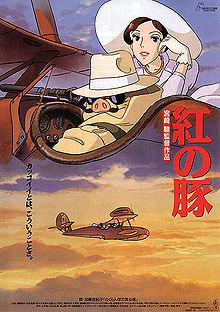

Porco Rosso

Porco Rosso (1992)

Porco Rosso (1992)

It almost seems pointless at this point to sing the praises of Studio Ghibli and its famous director, the great Hayao Miyazaki. The internet is dotted with support for his brilliance and his films are readily available on US soil thanks to an agreement between Studio Ghibli and The Walt Disney Company. Even so, it’s still worthwhile repeating that Miyazaki is a supremely gifted director with an apparent synergy with the animation medium. Many of his works are animated films because that’s just what Miyazaki does. They could have easily been shot in live-action and more obviously marketed towards adults. Some possess such fantastic imagery that it’s clear to see why they are animated, while a film such as The Wind Rises, Miyazaki’s most recent and possibly his last, is essentially a drama well-grounded in reality that just happens to be animated.

Porco Rosso is one of Miyazaki’s older works. Debuting in Japanese cinemas in 1992, it tells the tale of a former Italian flying ace turned bounty hunter cursed to live out the rest of his life with the face of a pig. Like The Wind Rises, it romanticizes the role of the pilot and easily could have been a live-action piece (though the pig-faced Porco may not have played as well as an actual person). And like many of Studio Ghibli’s films, it’s now available via Disney Blu Ray which is how I had the pleasure of experiencing it.

The film opens with Porco battling sky pirates: pirates that choose to attack luxury cruise ships via seaplane. The setting is post World War I and Porco has apparently been hired by the ship owners to keep the pirates away. We immediately get a sense of the film’s tone as the pirates are pretty bad at what they do and Porco is quite nonchalant in his attitude towards them. He combats them via a seaplane of his own, a beat-up old red thing that has trouble getting off the water, and has little trouble foiling their plans and freeing their hostages. There’s an obvious lack of danger throughout the sequence despite the bullets flying through the air but it doesn’t harm the enjoyment of the scene. Following this confrontation, we’re shown a little more of the setting. The pirates, looking to rid themselves of Porco once and for all, have turned to an American named Curtis. Curtis sees this as an opportunity for fame and fortune as he yearns for a career in Hollywood. He also would like to woo Porco’s longtime friend and proprietor of a local establishment frequented by pirates and pilots alike, Gina.

Preparing for take-off.

Preparing for take-off.

Curtis is an interesting character from a westerner’s point of view. Some may call his portrayal unflattering, or even offensive, as he does not possess any obvious virtues. I found it interesting to see how an American is stereotyped outside of the country and found the character pretty amusing. He is a skilled pilot and represents some sense of danger in an otherwise light-hearted film, and is a natural foil for the care-free Porco.

After a confrontation with Curtis that leaves Porco’s plane in need of repairs, Porco is forced to head back to his homeland of Italy where he is wanted for desertion. Porco’s mechanic Piccolo is introduced, along with his family and a large contingent of locals, and proves to be a very entertaining addition to the cast. What could have been a slow and boring part of the film turns into a strength. Some credit should go to the english translators who are able to come up with snappy dialogue to suit the original tone of the scenes as well as fit the mouth-flaps of the animated characters. The film builds towards a confrontation between Porco and Curtis, one Porco seems disinterested in, and plays upon the notion of pilot’s honor. There’s also a bit of a romantic angle thrown in that feels tacked on but isn’t focused on enough to be a distraction.

Porco and Fio are a natural movie pairing. I'd dog the two for being too typical an odd couple if they didn't work so well together onscreen.

Porco and Fio are a natural movie pairing. I’d dog the two for being too typical an odd couple if they didn’t work so well together onscreen.

The star of the film is clearly the Porco character, not just because of his prominence in the title but in his personality as well. He’s a flawed human but an inherently interesting one. He’s funny, boorish, yet charming. The english version features Michael Keaton as the voice of Porco. At first, I wasn’t sure his voice suited the character but I warmed to it quickly. Keaton is almost deadpan in his delivery at times, but he’s able to lend his charisma to the character through the excellent script and his superb delivery. The rest of the cast features some names familiar to those who have watched a lot of anime. Gina is played by Susan Egan, who has done a lot of work in the field of animation and is a consummate pro. Brad Garrett, who also seems to be amassing a lot of voice credits, plays the leader of the seaplane pirates and Kimberly Williams-Paisley portrays Piccolo’s granddaughter Fio with charming exuberance. Joe Hisaishi is once again the composer who utilizes a lot of period pieces to help enhance the film’s setting. The main Porco theme is one of my favorite works he’s composed as its perky nature suits the tone of the film perfectly.

Even the "bad guys" in this film are likable.

Even the “bad guys” in this film are likable.

The animation, as always, is breath-taking. The colors are rich and are only more so on the Blu Ray medium. I particularly love the shade of red used for Porco’s seaplane and the understated blues of the ocean water. Milan is drawn wonderfully and a sequence featuring Porco racing through the city’s canals is probably the most technically impressive of the whole film. The level of detail shown in the plane components was something I found myself appreciating and it’s quite clear that Miyazaki has a love for airplanes.

The film moves at a comfortable pace, wrapping up in just over 90 minutes. It’s tone never wavers as it’s quite high-spirited and inherently fun. I don’t know if I was just turned off by Porco’s look going in, but I wasn’t really excited to watch this film at first but it quickly won me over. It compares quite favorably to My Neighbor Totoro in that it isn’t a deeply serious film with a lot on the line. It’s really just a good old-fashioned adventure full of likable characters, captivating action, and gorgeous visuals.


Walt Disney’s One Hundred and One Dalmatians

One Hundred and One Dalmatians (1961)

One Hundred and One Dalmatians (1961)

If one were to research, even briefly, the history of Walt Disney Animation Studios one would find many successes as well as many failures, some of which by films considered classics today. Snow White and the Seven Dwarfs was the big break-through for the studio and it set a precedent for feature-length animation. Following that picture though, war broke out in Europe and suddenly Disney’s audience was much harder to reach. Perhaps the charm of a feature-length animated picture had worn off following Snow White’s success as well, for the the next several films put out by Disney failed to meet expectations. Following a series of “package films” in the 1940’s, Disney returned to prominence, and profitability, with Cinderella in 1950. The follow-up, Alice in Wonderland, performed poorly at the box office, but the next several films fared much better all the way up to Sleeping Beauty, that is. Sleeping Beauty bombed, despite being the most expensive film the studio ever put out. It was such a disaster that many around Walt Disney were suggesting the company get out of animation, which was something Disney refused to entertain. He was able to acknowledge that their current process needed change. While films like Peter Pan and Lady and the Tramp had been profitable, the profit margin on those films wasn’t what the studio needed to keep going. Success was also being found on television and with live-action films as well as the recently opened Disneyland theme park. Disney probably did not need animation, but it’s what the studio had been founded on.

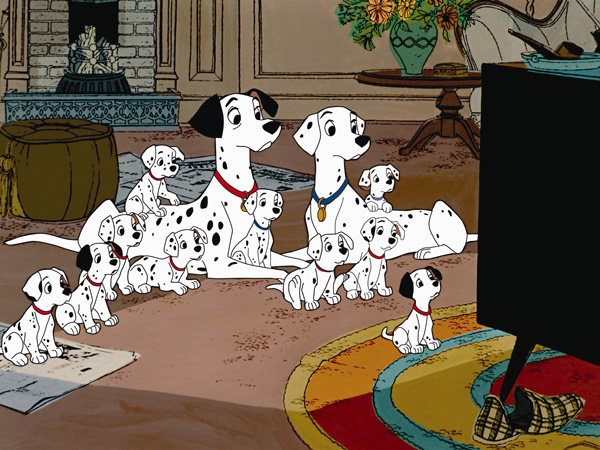
The Pongos, most of them anyways.

The Pongos, most of them anyways.

One Hundred and One Dalmatians was a big film for Disney. While it can’t be said with certainty that had the film failed Disney would have abandoned animation, it’s probable to assume things would have turned out much differently. It’s a good thing then that the film not only was a hit with movie-goers and critics but also a hit when it came to the bottomline. Utilizing Xerox, the film ended up being much cheaper to produce than its predecessors leading to a very healthy profit margin. Instead of being one of the last animated features from the company, it ended up being the first of many achieved through the Xerox process.

It’s well-known that Walt Disney was fond of recalling that the success of his company all started with a mouse, but despite that Walt’s most favorite animal was clearly the dog. One Hundred and One Dalmatians was the studio’s second feature to utilize canines as the lead protagonists, and much like Lady and the Tramp, the film serves as a window to the unseen world of dogs that we humans are oblivious to. Adapted from the book A Hundred and One Dalmatians by Dodie Smith, the film tells the tale of a dalmatian named Pongo, his “pet” human Roger, and how they came to be romantically linked with Perdita and Anita and proud parents of fifteen puppies. Everything would have been quite lovely had it not been for Cruella De Vil, Anita’s old classmate with an appetite for fur that can only be sated by dalmatian coats. The story is one of suspense, with some elements of mystery and plenty of humor added in. It works well with its modest 79 minute running time which foregoes the usual Disney musical style.

Several scenes in the film feature simple, almost one color backgrounds.

Several scenes in the film feature simple, almost one color backgrounds.

Stylistically the film is rather serious in tone, but from the point of view of dogs. It opens with Pongo deducing he and Roger’s lives as bachelors needs to end and he is outwardly searching for a mate for his pet (while also taking care to make sure his own needs are met). Unlike the dogs in Lady and the Tramp who seem to define their lives based on their loyalty to their masters, Pongo clearly views himself as the master in this relationship. He respects the needs of Roger, to a point, but when his puppies go missing later in the film he clearly implies that humans can’t solve their problems. Lady and the Tramp chose to emphasize that its story was from the point of view of dogs by keeping the camera at dog level, rarely straying far enough from the ground to even glimpse the visages of the humans Jim Dear and Darling. One Hundred and One Dalmatians is more straight-forward and positions its shots in a more traditional manner. The backgrounds are minimalist, a drastic change from the prior films from Disney, and it opts to use more flat colors with little to no shading. The film is also the most contemporary of any Disney film prior as its modern setting is quite different from the fantasy worlds many of the Disney films exist in. This even allows the story-tellers to utilize satire when depicting television and how the characters interact with it.

They don't come meaner than Cruella.

They don’t come meaner than Cruella.

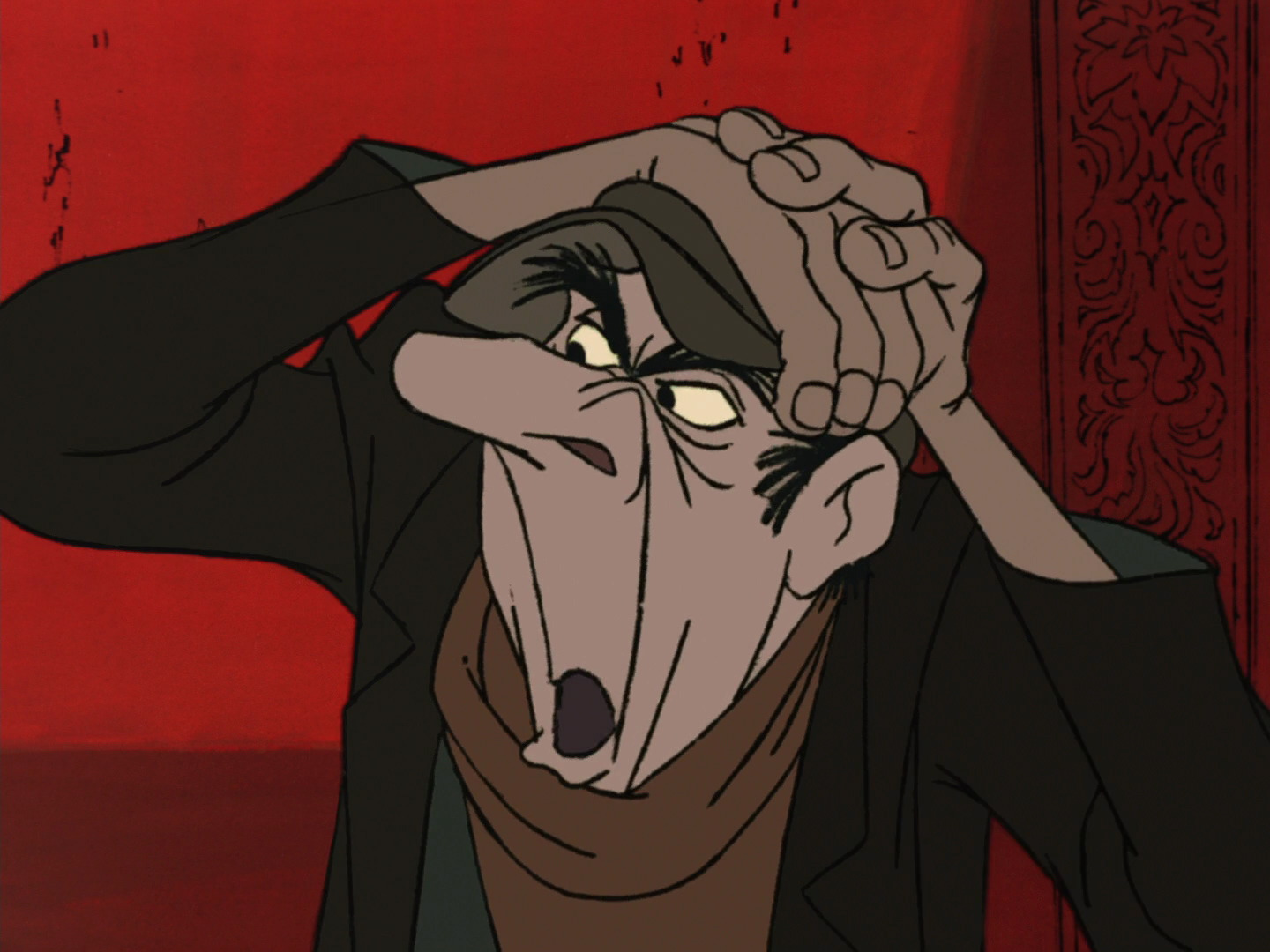
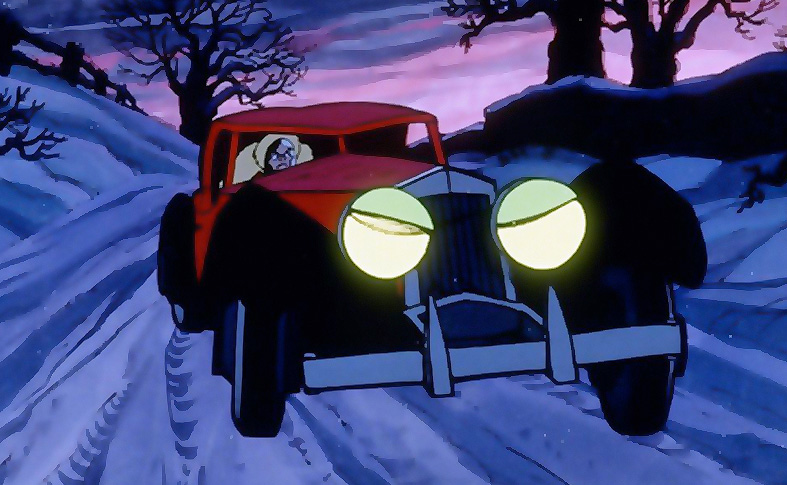
Cruella De Vil, and her lackeys Horace and Jasper, is one of Disney’s finest villains. Her motivations are clear, rational considering her character, and easy to despise. Even those who do not consider themselves dog-lovers likely would not support someone in their quest to slaughter puppies for their fur. She is strikingly wicked looking, with sharp angles and manic eyes. Her face appears to be stretched to its limit to cover her skull, and her two-toned hair has become a hallmark of the character. She barges into the home of Anita and Roger, her fur coat slipping from her bony shoulders and the smoke-trail from her cigarette permeates the air and appears to be a character all its own. She drives an enormous vehicle like the biggest asshole you’ll ever encounter on the road and is prone to violent outbursts. Her voice actress, Betty Lou Gerson, is absolutely perfect with her performance and it is hard to imagine anyone else doing a better job with the role. Horace and Jasper are her henchman. They handle the puppy-napping and were to also handle the slaughter but they’re typical, stupid, lazy, cohorts and are easily out-maneuvered by the film’s protagonists. They’re also mindless servants to television with their eyes constantly glued to the box and whatever rubbish is presented on it.

The pencil lines left behind by Xerox are easy to see in Roger's sleeves.

The pencil lines left behind by Xerox are easy to see in Roger’s sleeves.

The film is a success where profit and entertainment is concerned, but it must be said that this all came with a cost. The Xerox process, conceived of by Ub Iwerks, had its drawbacks when compared with the old process of drawing, inking, and painting each animation cell by hand. Naturally, the advantage was in cost as now the drawings by the animators were simply copied to cel by Xerox, eliminating the need for inking. Then they could go right to paint, and time was also saved by simply copying one image of a puppy several times over for the scenes involving the whole lot. The most obvious drawback to this process was the inability of Xerox to smooth out a pencil line during the copying, giving each character a rough, scratchy, look. Prior films were recognizable by the softness of the lines but also the rich, colored, outline each character possessed. Lady and the Tramp is my pick as the best looking of the Disney pictures. The characters pop even when placed on busy and highly-detailed backgrounds. Of course, the other drawback was that the entire inking staff was laid off, which meant hundreds of women lost their jobs in an era where work was hard to come by for women. Walt Disney Studios famously employed women almost exclusively for inking and painting, mostly due to prejudices of the time. They let men handle the drawing and decision-making when it came to creating the pictures. It obviously takes talent to ink and paint animation, but it was also thought-of as being a lesser position to artist. Still, the only other positions for women at the time were with the telephone company and service industries so it must have hurt when Disney shut-down inking. Walt Disney himself was not a fan of Xerox and disliked the look of the picture. Over the years, the process was improved upon but it would be decades before the pictures started to resemble the old films, which all came long after Disney’s passing. Art Director for Dalmatians, Ken Anderson, was said to be saddened by Walt’s opinion of the film’s look, though according to him Walt unofficially gave the art of the film his blessing shortly before he passed away.

Evil women drive evil cars.

Evil women drive evil cars.

One Hundred and One Dalmatians is a significant film for several reasons for Walt Disney Animation Studios. It’s the film that saved animation but also the film that changed it forever. Having recently viewed the Blu Ray release, I can say the film is actually more enjoyable than I remembered it from my childhood. The characters, despite mostly being dogs, are believable and their world is fun and fascinating. Visually, the film does suffer when compared with what came before it, but it also includes a wonderful car chase sequence that creatively utilized actual three-dimensional models to achieve its look. Even though the art is not as wonderful as it could have been, the film is animated superbly. The dogs walk like dogs, the humans display great personality with their mannerisms, and the action scenes are engrossing on their own. What little use the film makes of musical numbers is done quite well, with Cruella’s theme being one of the most memorable of all the Disney villain themes. One Hundred and One Dalmatians was the last great picture released by Walt Disney during his lifetime and it’s one fans will continue to treasure for years to come.

The Princess and the Frog

The Princess and the Frog (2009)

The Princess and the Frog (2009)

When Walt Disney unveiled Snow White and the Seven Dwarfs back in the 1930’s, many critics saw the move as a foolish one. Who wanted to pay to see a feature-length cartoon? Apparently, many folks as Snow White became one of the most successful movies of all time. Ever since, Walt Disney Productions has specialized in feature-length animated films with fifty-three produced and released to theaters, not to mention numerous direct-to-video films and television specials. Ever since 2004’s disappointing Home on the Range, all of the Disney films have undergone a major change. The traditional hand-drawn animation of classics such as Snow White, Pinocchio, and Bambi have been abandoned in favor of computer-generated characters. When CG movies started showing up in the 90’s the medium was met with skepticism, but following the success of Pixar’s Toy Story, it became apparent that CG was the future of animation. Still, few could have predicted CG would reduce hand-drawn animation to near extinction. And with Pixar and Disney partnering up, it seemed like Pixar would be the vehicle for CG animated films while Walt Disney Animation Studios would continue to churn out the more traditional stuff. That was not to be.

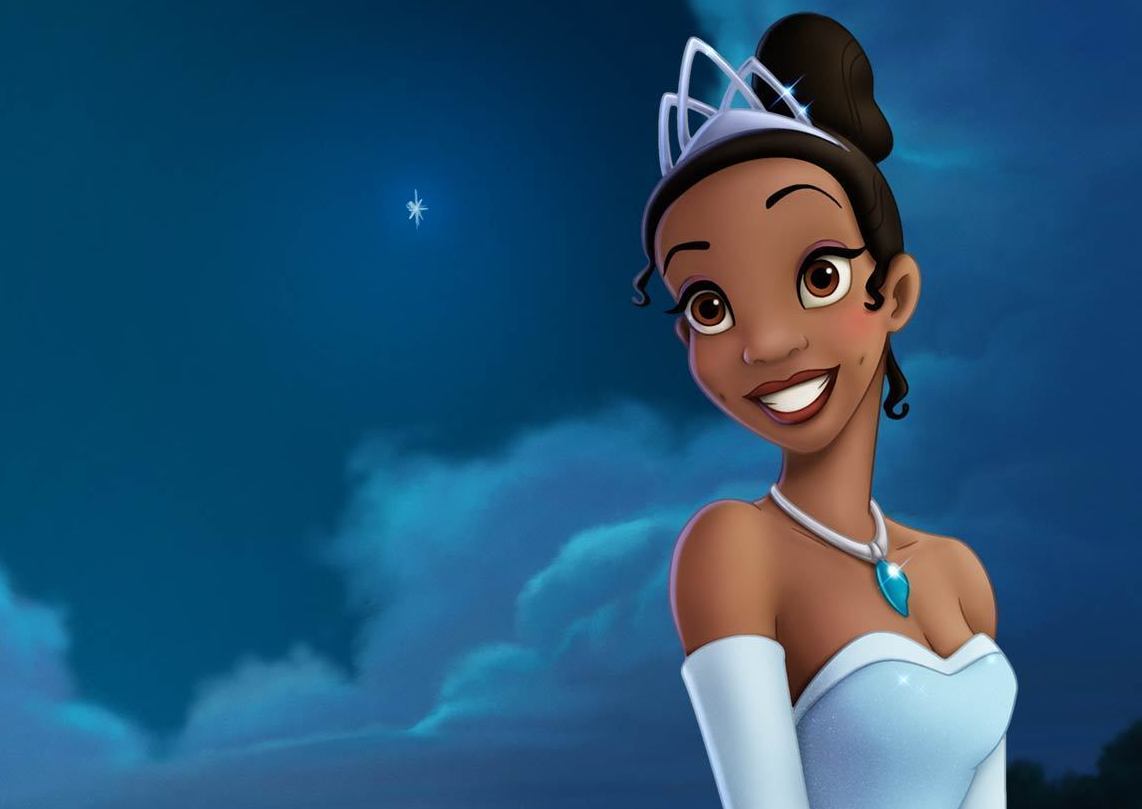
When Disney first announced The Frog Princess in 2007 it came as a surprise. Disney had previously declared 2-D animation dead in ’04 and for a new hand-drawn film to show up just three years later was definitely unexpected. The film, which starred an African-American girl from New Orleans named Maddy, was also met with a whole bunch of criticism from various groups. If Disney had thought a non-white female lead would garner it lots of positive press it was unfortunately mistaken. Having a black lead seemed to place a microscope on the film and the early press package was nit-picked to near death. The setting, the main character’s name, occupation, the ethnicity of the film’s prince – all received some criticism. Even the film’s title was somehow offensive to French people. To Disney’s credit, a lot of the criticisms were taken to heart and applied to the film. The new title became The Princess and the Frog. The main character was given the name Tiana and made a waitress and Oprah Winfrey was hired as a consultant. What was not changed was the setting which the directors felt was important to the story. Other criticisms, such as a black man for the villain, were also kept. This didn’t free Disney from further criticism though, but at least it showed the company was sincere.

Tiana's ethnicity was cause for celebration in some circles, but it also opened her up to more scrutiny than usual.

Tiana’s ethnicity was cause for celebration in some circles, but it also opened her up to more scrutiny than usual.

With the hand-drawn animation decision out of the way, directors Ron Clements and John Musker (Aladdin, The Little Mermaid, The Great Mouse Detective) also wanted to bring back more traits of the old Disney films. The Princess and the Frog was based off of a fairy tale, The Frog Prince, and a retelling The Frog Princess, using elements of both. It was also decided the film would be a broadway-style musical like the films of the 90’s. For the film’s look, producer John Lasseter wanted the animation to draw comparisons to Disney’s Lady and the Tramp, which he considered to be the pinnacle of Disney animation. Many veteran animators who had been laid off following the decision to abandon hand-drawn animation were re-hired, and Disney’s outdated CAPS software was replaced by Toon Boom Harmony. The film was cast, and production was underway.

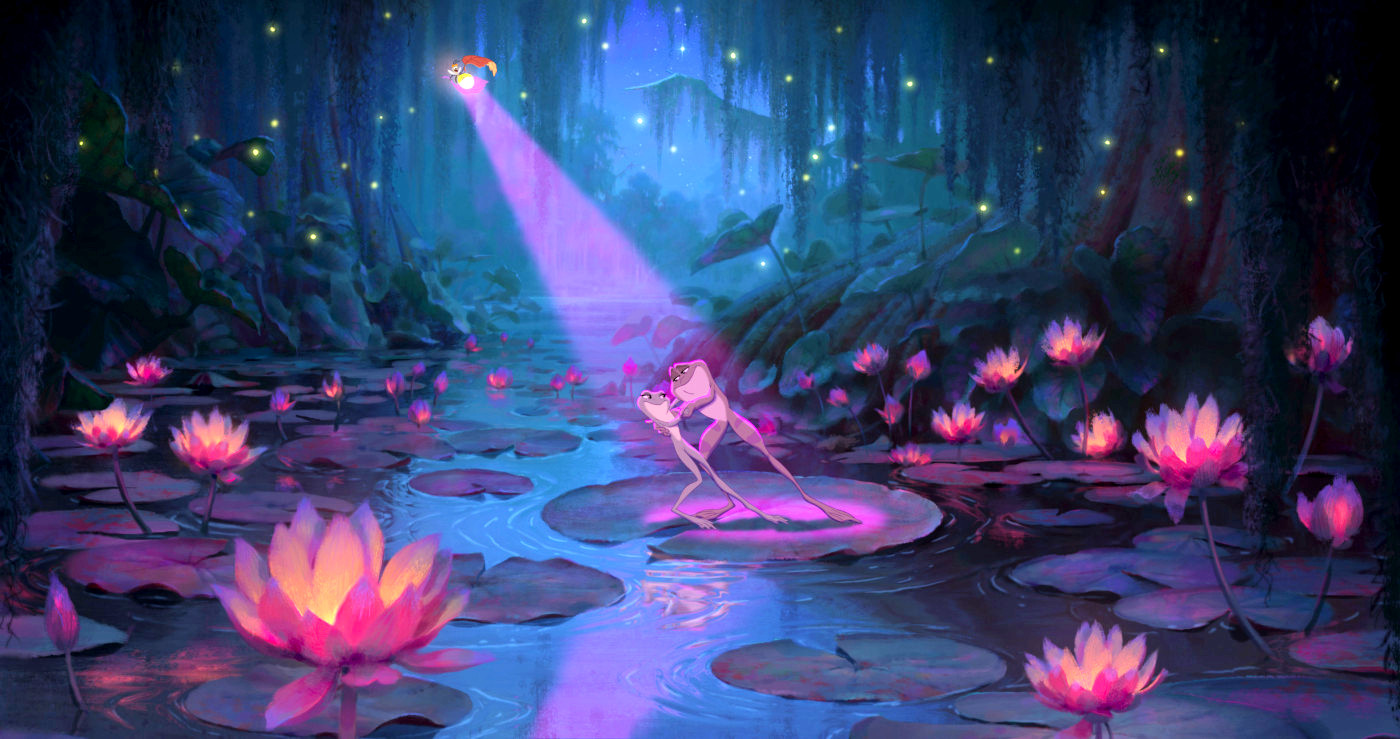
As expected, a modern hand-drawn animated film from Disney looks spectacular. The Princess and the Frog is Disney’s sharpest looking production to date. The animation is warm, fluid, and full of personality. The backgrounds are astonishing and are so much more alive when compared with the animated features that came before it. The film was produced using actual sheets of paper as opposed to having the animators draw on tablets and many of the film’s backgrounds are painted as well. CG effects are applied for smoke, shadows, and other lighting. If the film has one visual drawback, it’s that some of the objects look flat against the expressive backgrounds. This limitation is contained to background characters, but is noticeable at times. Otherwise, the film looks fantastic and is a true love letter to the animated films of old.

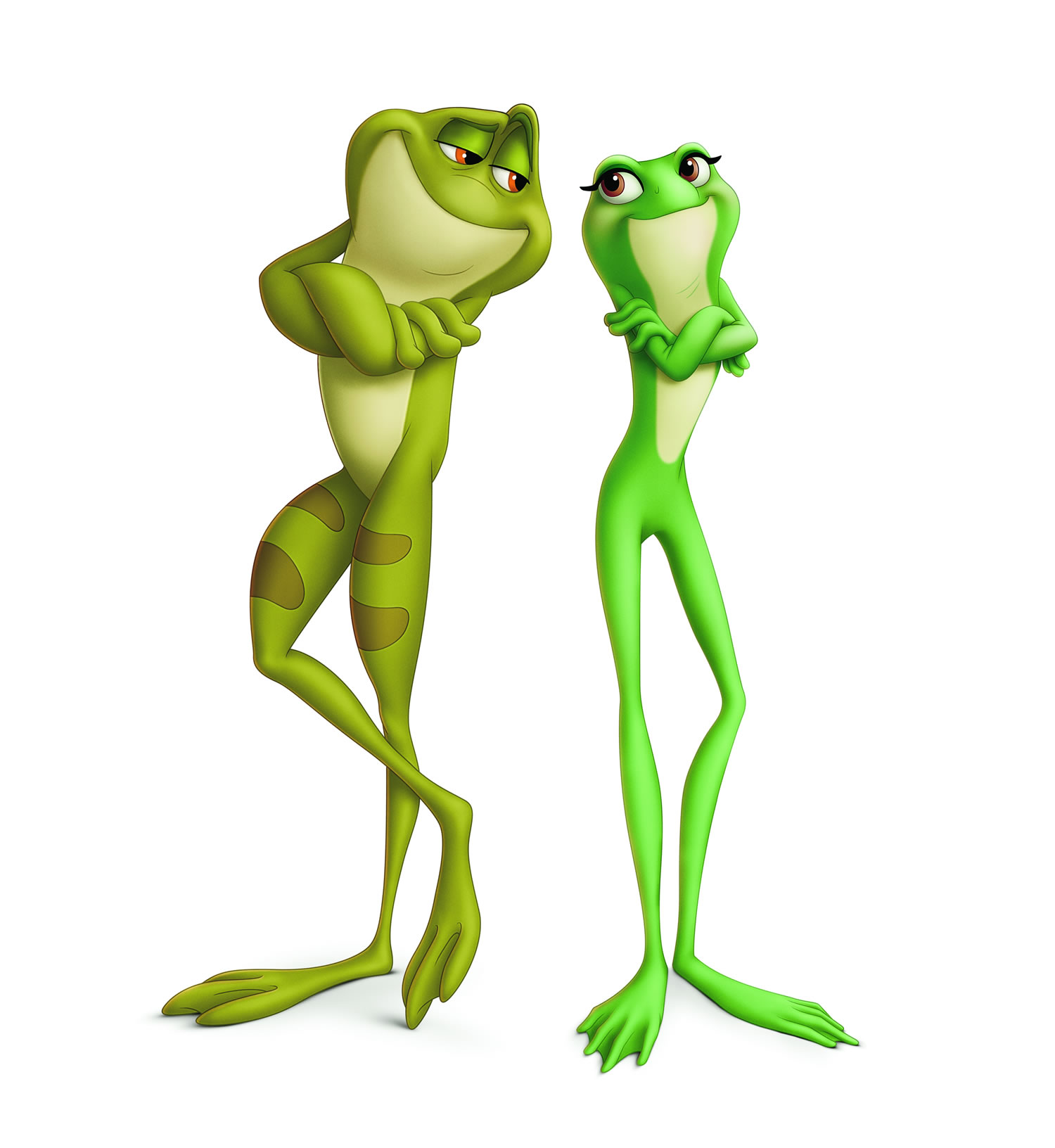
For the frog versions of the two leads, Disney wanted their look to draw from the example set by Jiminy Cricket: make the characters pleasing to look at as opposed to realistic.

For the frog versions of the two leads, Disney wanted their look to draw from the example set by Jiminy Cricket: make the characters pleasing to look at as opposed to realistic.

The plot unfortunately is not the equal of the animation. While the performances of the actors involved is quite good, the actual pacing of the film is pretty ho-hum. Aside from the twist of having the film’s “princess” turned into a frog, it’s fairly predictable. The film’s villain, Dr. Facilier, is basically a bad guy for the sake of being a bad guy. There’s not much depth to him. Tiana is a strong female lead who’s a hard-working girl scraping by with the dream of one day opening her own restaurant. She’s juxtaposed by her best friend, Charlotte, the daughter of the wealthiest man in town who has had everything handed to her. Charlotte’s prime goal in life is to marry a prince so she can be a princess. Clearly, Tiana is expected to fulfill the role of a modern woman (despite the film’s 1920’s setting) while Charlotte is meant to represent the outdated princess of old who is defined by her prince. The film is definitely successful at making Tiana a positive role model for young girls (or really, for any child), but it isn’t done in an organic way. Tiana, either through spoken dialogue or song, is determined to let us know over and over how she has had to work hard for everything she has. And while some of that is intended to be a trait of the character, one does get the feeling the film could have used some more subtlety. Future Disney films would better create a compelling female lead, which isn’t to say that Tiana is a disappointment, she just lacks refinement.

Taken on the whole, the film is an enjoyable adventure thru the Louisiana bayou that feels pretty light-hearted. There’s comedy, and of course, music that is entertaining if nothing else. The fact that the film doesn’t have some big, important, message to convey is forgivable, though the lightness of the tale keeps it from being among the best of the best. The film does shine amongst its predecessors when the film’s music is considered. Written primarily by Randy Newman, it does a good job of taking the audience to New Orleans and the opening number, performed by Newman with vocals by Dr. John, is one of my favorites from any Disney film. I normally loathe the musical parts, and for some of the ones in this film that sentiment remains, but I was surprisingly captivated by a few. They’re not overdone, and unlike the more recent Frozen, I never felt like the music was used as a substitute for dialogue. The film also doesn’t shy away from adding a dangerous element to its villain. Too many parent-centered reviewers will remark that Dr. Facilier is too scary for young kids, but he’s supposed to be scary! What’s the point of a villain that doesn’t come across as a threat to the protagonists? There’s even a death in this film, and I was happy to see there wasn’t some lame cop-out to follow, even though I was expecting one.

There's no denying the film is stunning to behold.

There’s no denying the film is stunning to behold.

The Princess and the Frog was met with positive reviews upon its release and was a financial success. It wasn’t the smashing success of some of the older Disney films, and because of that, the hand-drawn animation wing has been shelved indefinitely. The Blu Ray special features contain numerous interviews with the creators of the film who speak glowingly about hand-drawn animation with an eye towards the future. During the run-up to the film’s release, Disney was boasting that a hand-drawn feature could be expected every two years. The film was released in 2009, and today in 2014, there still hasn’t been another hand-drawn feature from Disney. The Snow Queen, retitled as Frozen, was supposed to be the next hand-drawn feature but was converted to CG and went on to become a massive success for Disney. Who knows if the choice of animation would have had any impact on the finished product. I personally do not feel the general movie-going public is averse to hand-drawn animation or even has a preference. The luster of CG has long since worn off as it has now become the standard. The Princess and the Frog likely did not perform up to expectations at the box office for reasons completely unrelated to its animation style. If anything, the animation style likely drew additional patrons since hand-drawn is no longer the norm. I personally believe the film wasn’t a huge hit because the plot seemed too familiar. Most people have already seen numerous animated fairy tales and a film with the word “princess” in the title probably isn’t going to draw the attention of young boys. Disney’s attempt at creating a modern princess for young girls to look up to effectively alienated them from a large portion of their audience:  young boys. The studio is definitely wise to this as more recent films have opted for a more ambiguous title like the previously mentioned Frozen or Tangled.

It is my sincere hope that The Princess and the Frog is not the last feature-length production from Disney to feature hand-drawn animation. The film is proof that the medium still has a lot to offer and I just find it so much more engaging than CG features. While I love and appreciate much of what Pixar has put out I’ll likely always prefer the hand-drawn look. The sad thing is, as fewer and fewer films and cartoons are done in that style, the people who specialize in it are likely retiring or no longer with us. The younger generation is being raised on CG and lacks the skills to create hand-drawn animation. Hopefully, Disney realizes this and elects to take on the responsibility of keeping the art form alive. Perhaps releasing a hand-drawn feature every other year was too ambitious, but every five years seems like a reasonable goal. With no hand-drawn features announced as of this writing, the future of the medium is very much in question and that’s a shame. The only company that seems to care is Japan’s Studio Ghibli which thankfully continues to output hand-drawn features even with its beloved leader’s, Hayao Miyazaki, retirement. To all lovers of hand-drawn animation, I say treasure The Princess and the Frog, because you may not see another Disney film like it.


The Adventures of Ichabod and Mister Toad

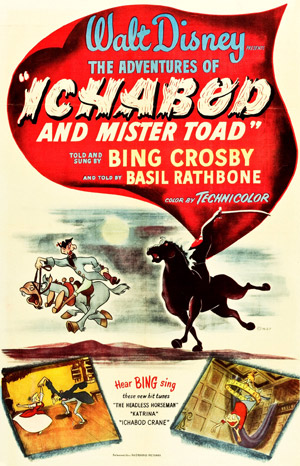
The Adventures of Ichabod and Mister Toad (1949)

The Adventures of Ichabod and Mister Toad (1949)

Walt Disney was a household name in the 1930’s due in large part to the success of characters such as Mickey Mouse and Donald Duck, as well as for being really the only producer of feature-length animated films. Snow White and the Seven Dwarfs was a massive success for the company, and though its follow-ups are well-regarded today, they struggled to turn to a profit at the time. With the onset of World War II, the company found its resources spread quite thin making war propaganda films for the government with little time and money available to produce more feature-length animated tales. Thus, the company resorted to shorter “package” films where two stories not really worthy of feature-length treatment were packaged together as one feature and released to the public. Some of these, such as Fun and Fancy Free, would mix live-action and animation in presenting its multiple tales. And others, like The Adventures of Ichabod and Mister Toad, would simply combine two animated shorts into one feature-length experience.

The Adventures of Ichabod and Mister Toad was released in 1949. The two were seemingly paired as a result of both stories being British in origen, though both were considered for feature-lenght treatment at one point or another. The Mister Toad portion, based on the story The Wind in the Willows by Kenneth Grahame, was a natural fit for Disney as it already starred several anthropomorphic characters and had an easy to adapt plot line. The Ichabod portion, based on The Legend of Sleepy Hollow by Washington Irving, was a tougher piece to adapt to a feature length, and while its source material may seem too scary by today’s standards, would slide in rather seamlessly given the presentation of recent films Pinocchio and Fantasia. And given the eventual release date of October 5th, it possessed the Halloween spirit movie-goers likely would be looking for.

For various reasons, neither tale was able to secure a feature-length production and release. The Wind in the Willows was especially affected by the war and budget, with the finished product omitting numerous planned sequences adapted from the novel. This release would end up being the last of package films, as the follow-up Cinderella would get the Disney company back on track. Over the years, Ichabod would become a regular on television around Halloween time, while Mr. Toad would be immortalized as an attraction at both Disneyland and Walt Disney World (though in the case of the latter, Mr. Toad’s Wild Ride has since been demolished). Children today may not be familiar with Disney’s version of Ichabod as the sequence is rarely shown on television. And if they’re at all familiar with the characters from Mr. Toad, it’s likely thru their many cameos in Mickey’s Christmas Carol or the previously mentioned theme park ride. However, those of an older generation seem to remember this feature quite fondly just judging by the ratings it has accumulated around the internet. In perusing them, it seems most viewers have a stronger connection to the Ichabod sequence than the Mr. Toad one, likely due to the television airings during the 1980’s, but do have a fondness for Mr. Toad and his compadres.

I recently purchased the feature on Blu Ray. Given that Halloween is just around the corner, it made sense for Disney to get a truckload of copies onto retail shelves. It was modestly priced, which makes sense given that it’s only 68 minutes long and the release is light on special features. I had seen both sequences from the feature as a child, but really didn’t recall much. I am not sure if I saw them together or spread apart. My memory was slightly stronger when it came to the Ichabod portion, probably due to the scary visuals and the unique look of the Ichabod character. Given that I only vaguely recalled viewing these two shorts as a kid, watching them on Blu Ray felt more like watching them for the first time. My reaction was muted at best.

Toad, together with his partner in crime, Cyril.

Toad, together with his partner in crime, Cyril.

The Adventures of Mister Toad is up first. A brief live-action sequence introduces the tale as a camera pans around a library and settles on the book the story is adapted from. Basil Rathbone is our narrator and the narrators chosen for both shorts is where Disney paid for any sort of name recognition. They are both used quite differently though with Rathbone just introducing the tale and interjecting some thoughts and explanations throughout the story. Toad and the rest of the cast are fully voiced and are appropriately presented with British accents. This is actually somewhat noteworthy as most of the early Disney films were set in Europe but the characters possessed American accents. The story obviously centers on the Toad character who’s a carefree toad of wealth (and debt) consumed by a passion for anything trendy, which at the moment is motor cars. His plainly named associates either approve of his actions or disapprove while all try to keep him out of trouble. He ends up being taken advantage of and framed which lands him jail for Christmas, and the most exciting part of the short centers around his escape and attempt to clear his name. Despite the brief running time, I found the sequence to be rather slow-moving, and at times, downright boring. The film takes time to set-up the story, but the characters are drawn in the broadest of strokes and little time is really needed to establish who they are. It’s easy to tell right form the start that Toad is a compulsive and sheltered individual. His exuberance makes him the most interesting of the small cast, and he’s certainly likable as a lead.

The voice acting is mostly adequate but I couldn’t help but feel that some of the voices chosen did not suit the character. Few of the voices seem like they should be coming from the characters, with the most jarring being the horse, Cyril, who had me wishing he was a silent character. The animation could also be described as adequate which I suppose is expected given the studio’s financial situation at the time. It’s basically on par with the theatrical shorts the company was known for as opposed to the feature-length pictures. All in all, I found it hard to care about the characters as presented, and when the sequence was over I was ready for it to end.

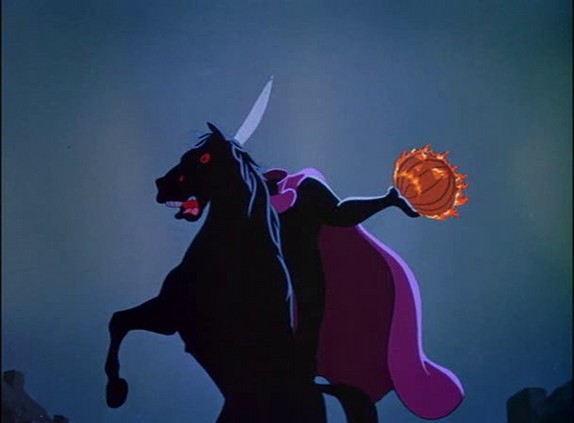
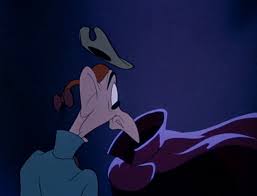
The Headless Horseman is the true star of the second act.

The Headless Horseman is the true star of the second act.

The Sleepy Hollow portion follows and was the sequence I was most interested in. While I was curious to see how The Wind in the Willows was adapted, I never had a strong affinity for Mr. Toad. The Legend of Sleepy Hollow is also a story I’m more familiar with, as I assume most people are. Ichabod’s last ride and the specter of the Headless Horseman have been recounted numerous times in popular media either as a direct adaptation or as a spiritual retelling. It’s a timeless tale and little effort is needed to convey the doom possessed by the Horseman. It’s really quite hard to make a headless knight riding a black stallion not look scary.

This segment is narrated, and sung, by Bing Crosby as a true narrator. If you’re looking for an example, think Boris Karloff from How the Grinch Stole Christmas. Crosby narrates the entire portion and sings at times. Ichabod and the characters do not actually speak, instead Crosby narrates the whole damn thing. It’s not the approach I would have taken if I were placed in the director’s chair, but there’s no reason why this shouldn’t work either.

As was the case with the Mister Toad sequence, the Ichabod portion suffers from pacing issues as well. This is partly to be expected as anyone familiar with the story knows the Headless Horseman shows up at the end. Leading up to it we’re essentially shown how Ichabod is basically a conman who’s motivated by wealth and food. He’s the local school teacher, and despite being a rather ugly looking fellow, is able to woo the local women with his singing voice and charm. When a wealthy individual comes to town with a fetching daughter by the name of Katrina, Ichabod sets his sights on a new prize. This puts him in competition with a local man by the name of Brom Bones, who is basically a lunkhead (he must have been inspiration for the much later Disney character, Gaston, from Beauty and the Beast) who is outsmarted by Ichabod when trying to court Katrina. It’s at a Halloween party hosted by Katrina’s father that Brom gets the idea to tell the tale of the Headless Horseman in an effort to scare Ichabod, who is revealed to be a superstitious man at the very same party. Given how slow-moving the story is, I found it lazy that Ichabod’s superstitious ways were not revealed throughout the picture in a more subtle fashion. Anyways, it’s when Ichabod leaves the party the he encounters the ghostly horseman.

If they had just committed to the horror, and left comedy to Toad, the Sleepy Hollow segment would have been better for it.

If they had just committed to the horror, and left comedy to Toad, the Sleepy Hollow segment would have been better for it.

The sequence where Ichabod is chased by the Headless Horseman is easily the highlight for both pictures. The setting is chilling and the Horseman looks particularly menacing. Ichabod, seated atop a very unimpressive horse, is forced to run for his life and the music and animation does a decent enough job of allowing the audience to share in his terror. There are some disappointments to be had, however. As mentioned during the Mr. Toad portion, the animation is merely serviceable and not feature-length quality. As a result, there is really no use of shadows or shading on Ichabod who pops too much against the background. Perhaps feeling the ride was too scary, some comedy was also added to the chase which really disrupts the mood. It’s basically screwball comedy not unlike what would appear in a Bugs Bunny cartoon and feels woefully out of place. At the end of the picture, there are some scenes that also detract from what should have been a more ambiguous ending, which also felt like a cop-out.

Overall, I was unimpressed by The Adventures of Ichabod and Mister Toad. As someone who loves and appreciates animation from all eras, I can easily forgive the films technological short-comings there as I wasn’t expecting it to be up to Disney’s usual standards from that era. I can’t really excuse either film for the pacing issues, and if given the chance, I probably wouldn’t have purchased this had I seen it first. The DVD release for the film a few years ago at least included a Mickey Mouse short that for some reason isn’t included here. And while I have all of the Mickey Mouse cartoons on DVD already, it would be nice for others if it had been included on the Blu Ray too. If you happen to be in the mood for a re-telling of The Legend of Sleepy Hollow, I’d suggest looking elsewhere (or scanning the various Disney channels to see if they show their version for free) this Halloween. As for The Adventures of Mister Toad, the weasel characters for the film inspired the same for Who Framed Roger Rabbit?, an immensely more enjoyable film. And if you really want to see the characters from the original, just wait for Mickey’s Christmas Carol which undoubtedly will start showing up on television before Thanksgiving arrives.


Lego Simpsons

lego-simpsons-minifigs-01When I was a kid, the coolest and most colossal Lego sets were often pirate ships or castles. These things required hours upon hours to assemble and cost a lot of money. My parents, when looking to spend money on me at Christmas or for a birthday, opted for video games or a bicycle as a “big” present, not massive Lego sets. I had a cousin who was rather fortunate when it came to gifts. He usually had all of the best stuff before anyone else, be they new Ghostbusters vehicles, gaming consoles, and so on. He also had some of these massive Lego sets but anytime I would visit his home they were always just partially assembled, as if construction was started one day and then forgotten. I always wanted to get my hands on such a set (the commercials made them seem like they contained endless amounts of fun) but the closest I ever got was a lone keep that came with a dragon. It was rather small, but I liked it plenty and got many hours of enjoyment out of it. Prior to that, I only ever had a general set of Legos. They were housed in a hard, red, plastic case and I would just build whatever. There was an included book that contained plans for numerous objects but rarely did I ever make use of it. Typically, I would build a pick-up truck or Jeep but then wouldn’t want to disassemble it to create anything else.

Among those bricks was a lone Lego mini figure. This was the 1980’s so the mini figure might have been new, or maybe not. I had other generic Legos before this collection and never had I come across a little figure before. He was rather plain: a black shirt and blue pants with a black baseball cap. I thought he was pretty cool though and started noticing these more and more in toy stores and commercials. I especially liked that I could rip him apart and even take off his head without breaking him. It seemed absurd but was a lot of fun especially when I would later get mini figures dressed as knights and armed with swords to apply a purpose for figure decapitation. Over the years the mini figure has become quite popular and in the last dozen years or so the mini figure is no longer just a generic pirate or knight, it’s Luke Skywalker or Batman. The mini figure is now sold both with sets and separately, and for a brand, having a Lego version of one of your characters is like a new rite of passage. Lego, because of its popularity, is able to strike deals amongst rivals so that consumers are able to pit Lego Superman against Lego Hulk. Lego has spread to video games, and most recently, to film. The brand has never been more popular than it is today which is why we now have The Simpsons in Lego form.

I’m not sure how the agreement started, if those behind The Simpsons reached out first to Lego or vice versa, but The Simpsons entered the Lego universe in 2014 in both television and the material world. An episode of The Simpsons aired this past May featuring the show’s many characters in a Lego setting. Interestingly, these Lego versions of the Springfield residents were more faithful to the Lego brand than the actual Lego product which arrived at retailers a couple of weeks before the episode. The Lego version of The Simpsons characters are unique, though represent a new trend not solely reserved for The Simpsons brand, in that they make use of the standard mini figure body but have unique head pieces. This creates a more aesthetically pleasing mini figure, though it does disappoint the Lego purists out there. In my hunt for these, I encountered one girl who was a Lego fan, not really a Simpsons fan, who wanted a couple of Marge figures thinking her hair would just be a Lego piece that attached to the usuall Lego head piece. She was likely disappointed to find that it wasn’t when she got home.

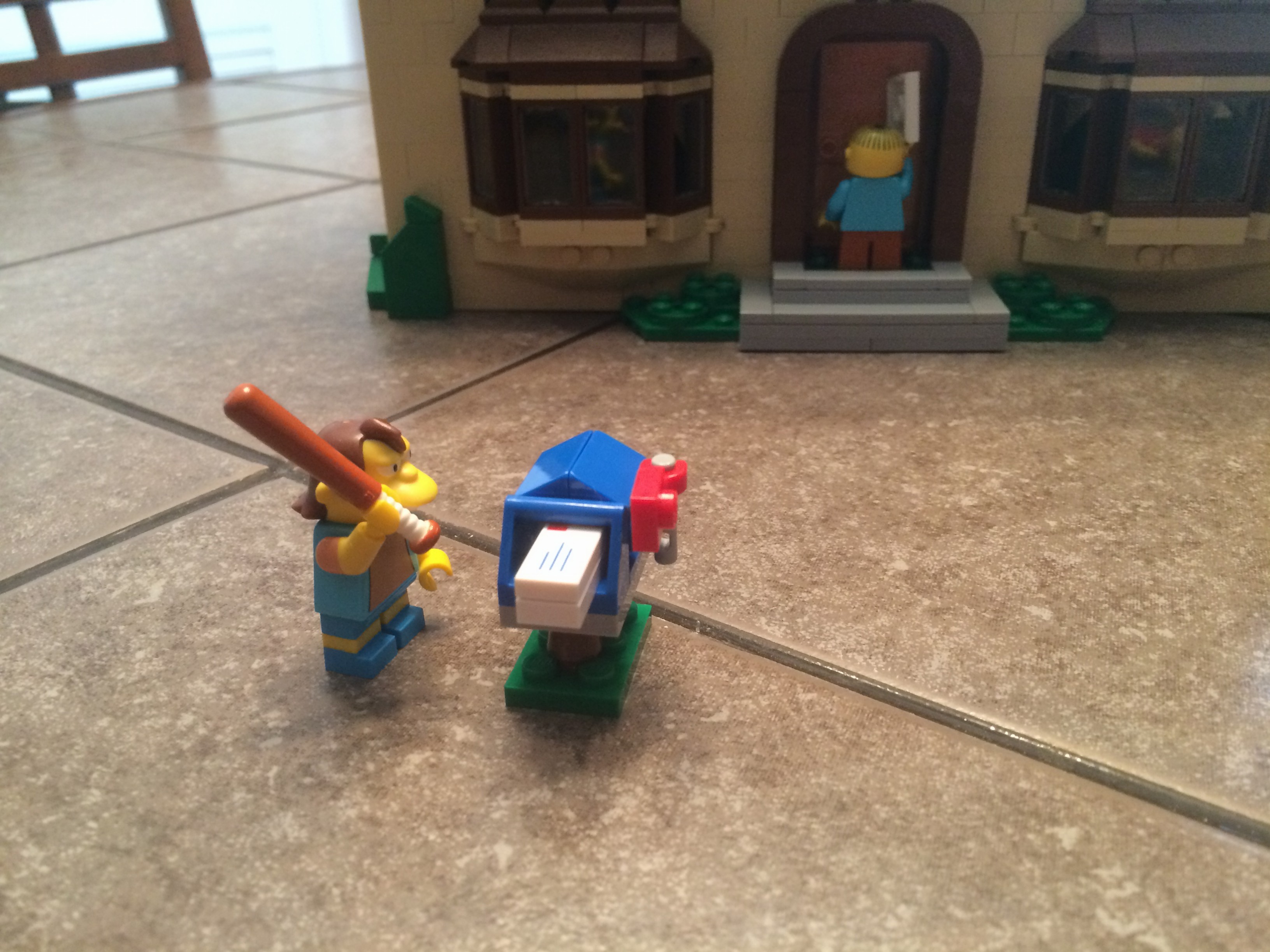
Nelson doing what Nelson does.

Nelson doing what Nelson does.

Lego put out sixteen figures in May, and they are a collection of usuals and some that may have surprised fans:  Homer, Marge, Bart, Lisa, Maggie, Grandpa, Ned Flanders, Milhouse, Ralph, Nelson, Chief Wiggum, Apu, Mr. Burns, Krusty, Itchy, and Scratchy. A pretty solid collection, especially when one considers Lego’s policy of no alcohol references which may have played a role in not having a Moe or Barney. Itchy and Scratchy are the sort of oddball choices given that they’re cartoon characters in the show, but few are likely to complain. Because the show’s cast is so massive, there’s going to be characters missing and it would have been impossible to satisfy fans with just one wave (I’m not aware of a planned second wave, but these seemed to sell well so it wouldn’t be a surprise to see more). Wiggum could certainly use some help on the force, while Flanders is missing his boys, and what’s a Burns without a Smithers? There’s tons of characters people likely want, so hopefully if a wave two does come around Lego doesn’t waste slots on variants of Homer and Bart.

Each mini figure comes in a plastic pouch that conceals the identity of the figure inside. Retailing for about four dollars, some may be willing to give in to chance and pick them blind but anyone with some extra time and a little determination can prod at the bags and figure out who’s in each one. The head sculpts of the figures make this easy, but also the included accessories. Bart’s skateboard is pretty easy to pick out, as is Nelson’s baseball bat. The hardest ones for me were Ralph and Milhouse as both characters are the same size and their accessory is a flat square Lego piece. This meant finding the head, and being extra certain. I ended up with three Ralphs before I found a Milhouse. The accessories are pretty cool though. The piece that comes with Ralph and Milhouse is a bit overused, but they’re all printed differently and contain some classic show references such as Ralph’s “I Choo Choo Choose You” valentine and Grandpa comes with his newspaper with the headline “Old Man Yells at Cloud.” Homer comes with a unique donut piece and TV remote and Burns has a transparent Lego head piece with Blinky the fish printed on it. Maggie has Bobo the teddy bear, and Itchy and Scratchy each come with an instrument of violence. All of the figures look really good, the only one that looks off to me is Wiggum because he should be morbidly obese. Instead, he uses the same body as every other figure with no attachments to make him look fatter. Homer, since his shirt is white, has a line printed on him to mark his bulging stomach, but since Wiggum wears dark blue, the same technique doesn’t really work.

If Lego had stopped there with The Simpsons it still would have been cool, but they didn’t. Enter The Simpsons House!

IMG_0153

Consisting of over 2500 pieces, the home of The Simpsons is a large set that is a site to behold. I couldn’t resist the call

The Couch.

The Couch.

of it, even if it was excessive, and purchased my own set. The set contains bricks to construct the house and also Homer’s famous pink car complete with dents. Included with the set is another version of The Simpson family plus another Flanders. Each figure differs slightly from the stand-alone ones; Homer is dressed for work and Marge has an apron, Ned is dressed for grilling while Bart is missing his slingshot from his back pocket. Most also have half-closed eyes while Maggie has a more neutral expression compared with her other figure’s concerned look. The differences are minor, and while some may see this as a missed opportunity to get more figures, Lego pretty much had to include a set of the family in both the house set and the retail figures. Perhaps the addition of Flanders could have been re-evaluated. Lego could have just made him exclusive to the house set and put someone else in the mini figure release. The only thing I feel they really messed up on was not including Lego versions of Santa’s Little Helper and Snowball II. Both pets are featured on the box as part of the family but are strangely absent from the set.

The cut-away view of the house.

The cut-away view of the house.

Lego had a somewhat difficult task of creating a three-dimensional set of an animated home. Early in the show’s life, the house didn’t seem to always have a defined layout but over the years the animators and artists have clarified this more. The first floor is pretty standard though: through the front door is a short hallway with a closet at the end and stairs on the right. To the left is the den, to the right the dining room. Up from the den is the living room which has an entryway on the top right which goes into the kitchen which wraps around to connect with the dining room. On a few occasions there’s been a bathroom on the first floor as well as a rumpus room. There’s also a basement entrance somewhere and the door to the garage. Lego, perhaps fearing the set would be much too large, chose not to really adapt the true layout of the house and attempted to just hit on the important stuff.

The other side of the cut-away. The room on top is removable.

The other side of the cut-away. The room on top is removable.

From the outside, the house looks pretty great, almost perfect. There’s the bay windows on the front, the ancient TV antennae on the roof, and even the chimney looks good. Veteran viewers will notice that while the garage is in the right place, the house doesn’t wrap around behind it like on the show. This becomes a bit of an issue when constructing the second floor as it’s pretty cramped. Aside from that though, the house looks great. Inside on the first floor there are just two rooms: the kitchen on the left and living room on the right. The living room is kind of an amalgamation of the den and living room from the show. The famous couch and TV are present (modeled after the old tube TV from the earlier seasons) from the living room, while the rug and piano are there from the den. Missing is the fireplace since the chimney is on the other side of the house and there’s no ceiling fan, as well as other things. There’s a closet of sorts tucked behind the stairs where

Marge can store her vacuum, and the sailboat picture is above the couch where it should be. Breaking from logic though, is the entryway to the garage being right in the living room with no door to separate it. This doesn’t make much sense and is kind of disappointing. Over in the kitchen, the color scheme is pretty faithful to the show between the two-toned floor and the pink and orange cabinets. The included table is kind of odd looking but more odd is the absence of a fridge. How are The Simpsons supposed to live without a refrigerator? Plus that ugly green fridge is kind of iconic, isn’t it? The kitchen is also pretty cramped, especially with the table in it, but space had to be sacrificed in order to make the living room larger.


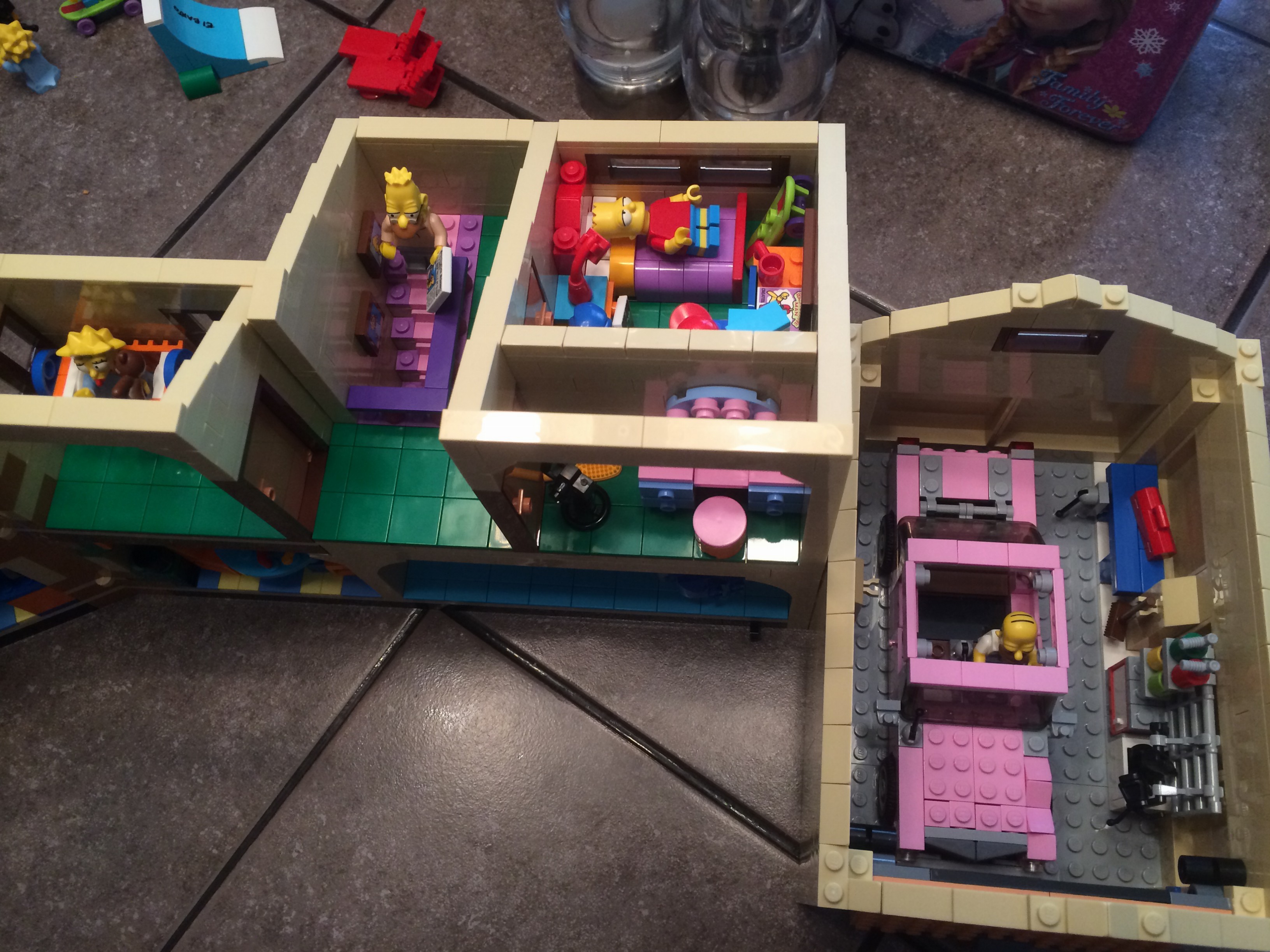
A bird's eye view of Bart's room and part of Lisa's, as well as the garage. Grandpa is apparently over for a visit.

A bird’s eye view of Bart’s room and part of Lisa’s, as well as the garage. Grandpa is apparently over for a visit.

On the second floor, the biggest casualty is Maggie as she doesn’t get her own room. Instead, she gets a crib in Homer and Marge’s bedroom. Bart and Lisa’s rooms are done rather well with Bart’s shining brighter because his personality is captured well. Homer and Marge have a larger room but it’s strangely empty and doesn’t connect to the bathroom. The second floor should have two bathrooms, but there’s only one and it’s too small to even get a bathtub. The roof rests right on top of the house and garage as opposed to snapping on so that users can easily remove it to access the rooms underneath. Bart’s room and the top of the stairs also just rest on top of the second floor so it too can easily be lifted out to access the living room while the whole house can open vertically for a cut-away look at everything. The garage is roomy enough to fit the car in comfortably, and even includes numerous power tools for Homer to neglect. Outside the house is the mailbox as well as Ned’s grill. There’s also two lawn chairs and Bart has a skateboard ramp. The wife and I assembled the entire house over the course of about a week. We didn’t do construction on it daily and took our time though impatient builders could likely put this thing together in a day with some determination. The instructions were easy enough to follow and thankfully only a few stickers are involved (I assume hatred for stickers is pretty much universal amongst Lego builders).

We're all filthy perverts for looking at this.

We’re all filthy perverts for looking at this.

It’s easy to nitpick this set because it’s not all that faithful to the show and the show has been around for over twenty years. Fans of The Simpsons are intimately familiar with how the house is supposed to look so it must have been intimidating for Lego to even tackle it. Inaccuracies and all, this is a set worth investing the time in for Simpsons enthusiasts. Lego did do a good job of getting the smaller details right like Bart’s half-open desk drawer and the “Property of Ned Flanders” sticker adorning the air conditioner hanging off the house. It’s my hope that Lego does not stop here. We already have an Apu mini figure so how about a Kwik-E-Mart? And it would be a shame if The Android’s Dungeon were not created, at the very least, as a Comic Con exclusive or something (I assume Moe’s Tavern is a no-go considering the alcohol policy). Lego could easily milk this franchise for a lot more, so we’ll see what the future holds, but if this is all we get then at least it looks cool and The Simpsons have a place to sleep and watch TV.


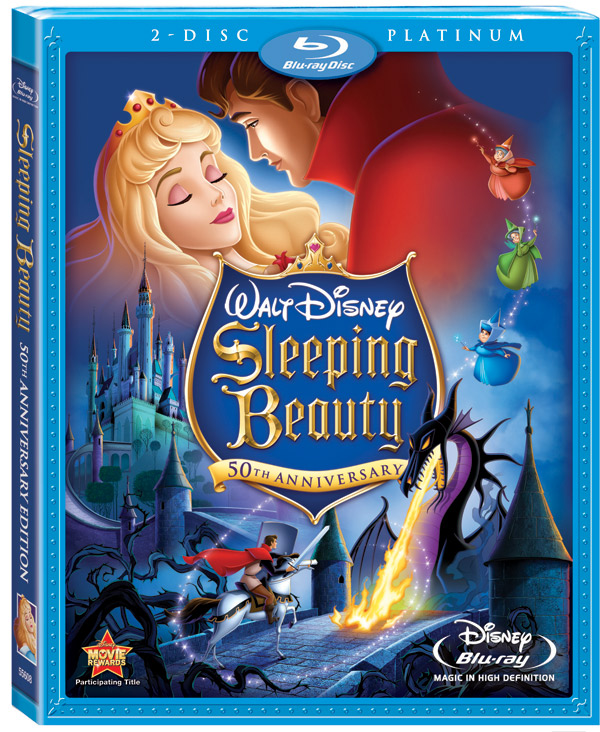
Walt Disney’s Sleeping Beauty

Sleeping Beauty (1959)

Sleeping Beauty (1959)

If you played a word association game with random people and asked them to say the first thing that comes to mind when they hear the word Disney I’d be willing to bet that the top three responses would probably be Mickey Mouse, theme parks, and princesses. It’s that third word I’m keying in on for this post as the princess character has seemingly become synonymous with the Disney brand. This is mostly due to the creation of the Disney Princess line of clothing, toys, and such marketed at young girls as well as attractions like the Bibbidi Bobbidi Boutique at the theme parks. This gives off the impression that the Disney films, particularly the golden age unofficially beginning in 1937 and ending in 1967, are overstuffed with princess stories but that’s really not the case. Of the films spanning those forty years, only two star an actual princess; Snow White and the Seven Dwarfs and Sleeping Beauty, with a third, Cinderella, featuring a woman who would end the film a princess by marriage.

In recent times, the princess as a character has become somewhat controversial as many people feel like these characters are poor role models for young girls. Snow White flees her unhappy life in the castle but assures her audience that someday her prince will come and save her. Cinderella, on the other hand, passively escapes her droll existence through her dreams and is too content to wait around for a fairy and a prince to save her from her wicked stepmother. These are admittedly cynical ways to view what are otherwise considered timeless classics. Parents are free to decide what is and what isn’t appropriate for their children but I don’t think kids necessarily take anything from these, aside from maybe that Cinderella has a pretty dress or Snow White a nice singing voice.

As a result of these portrayals, many movie-goers these days want a stronger female lead. And lately, that’s become true with films such as Frozen and even Beauty and the Beast back in the 90s. Unfortunately, in 1959 this trend was still far away when Walt Disney released Sleeping Beauty. If viewers are uncomfortable with the female leads in Cinderella and Snow White and the Seven Dwarfs, well then they really won’t like Aurora.

Some of the backgrounds are truly stunning, but unfortunately give the film a flat look.

Some of the backgrounds are truly stunning, but unfortunately give the film a flat look.

Aurora is the title character of Sleeping Beauty, an animated film more famous for its villain and the castle that inspired the famous one at the entrance to Disneyland than for its lead. Aurora has the misfortune of being cursed at her royal unveiling by the evil fairy Maleficent and is fated to die on her sixteenth birthday. The three good fairies decide to take her into hiding and raise her as a peasant girl in order to hide her from Maleficent and hopefully prevent her curse from becoming reality. Aurora assumes the identity of Briar Rose and lives there until her sixteenth birthday when she meets the charming Prince Phillip, and after sharing a song in the forest, the two decide they’ve fallen in love. Of course, Aurora ends up being lured to that famous spinning wheel by Maleficent where she pricks her finger and falls into a deathlike sleep and only true love’s kiss can ever hope to wake her.

Aurora appears in less than 18 minutes in the film as a result of her coma, leaving most of the screen time to the three fairies; Flora, Fauna, and Merryweather, as well as Maleficent. Aurora has no real personality and is completely defined by her situation and is quite literally dependent on the Phillip character. Phillip, in turn has little personality of his own save for he is a good and just person willing to do what is necessary to save his princess. Maleficent is the true star of the film, though she is pretty much a by-the-numbers villain with a cool look and an even cooler ability to change into a menacing dragon. The good fairies provide some laughs, as do the royal parents of the two leads, but this is a fairly weak Disney film where plot is concerned.

Maleficent has proven over the years that it is she who is the star of Sleeping Beauty.

Maleficent has proven over the years that it is she who is the star of Sleeping Beauty.

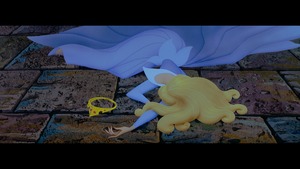
For many, these classic Disney animated features are less about the story and more about the look and score. This version of Sleeping Beauty is adapted from the ballet by Tchaikovsky and is appropriately scored. It’s lone drawback from a musical standpoint is the one song sung by the main character, “Once Upon A Dream,” is too similar to Cinderella’s signature “A Dream is a Wish Your Heart Makes” and not as memorable. The scene in which it’s sung is also too similar to Cinderella’s as Aurora dances in the forest with animals of high intelligence. For the visuals, Disney made use of Super Technirama 70, which allows for more detail and complexity in the backgrounds. Walt Disney also wanted the film to separate itself from the previous fairy tales the studio had done and requested his artists employ a sharper look. Aurora’s face is noticeably more angular than Cinderella and Snow White’s rounded look and the backgrounds resemble still paintings as opposed to fully realized environments. The approach comes at a cost as the film has a very flat look to it. The colors are rich though, and I’m reviewing this as a blu ray feature, which help separate it form its peers. This was the last Disney film to use hand-inked cells as the following ones would utilize xerox. I like the direction the studio took, but I do think it needed further refinement to remove that flat look. The image where Aurora is found unconscious after pricking her finger on the spinning wheel is particularly ugly as her body looks like it’s been run-over by a steamroller.

I can't believe this shot made it into the final film. Aurora looks like a piece of paper.

I can’t believe this shot made it into the final film. Aurora looks like a piece of paper.

The standout scene for Sleeping Beauty is unquestionably Maleficent’s battle with Phillip, in which she takes on the form of a massive, black dragon. Prior to that, Phillip is blocked by a massive wall of thorns that are wonderfully illustrated and appropriately vicious looking.  Maleficent’s menacing transformation is foreboding and her green-tinted flames eerie. It’s a classic sequence and among Disney’s top ten. It doesn’t save the film, but is an accomplishment by itself.

When I was a kid, Sleeping Beauty was probably my favorite of the princess movies. That was entirely due to the fact that it had a cool looking dragon at the end while Cinderella and Snow White were boring by comparison. As an adult, I view the prior two films in a much stronger light and even enjoy the both of them. They aren’t my favorite Disney films, but they do charm me. Sleeping Beauty is able engage me visually, but even there it’s a bit of a mixed bag. While I enjoy the art direction and use of color, I find the earlier films from Disney to be overall better visual experiences. As a story, it’s rather bland with uninteresting main characters and little to get attached to. There are some decent funny-points, but nothing gut-busting by any means. Maleficent is the most engaging character defined as much by her interesting visual style as she is by her voice actress, Eleanor Audley, who should have been everyone’s go to voice for evil women. As such, it’s not at all surprising that Disney has chosen to place the spotlight on her for a feature film starring Angelina Jolie. I have not seen the film, but it won’t have to do much to top Sleeping Beauty.


The Wind Rises

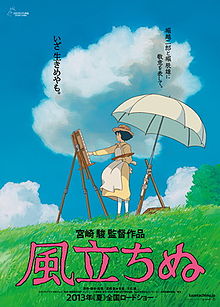
Kaze_Tachinu_poster“The wind is rising!  We must try to live!” – Paul Valéry

The above quote opens the latest release from Studio Ghibli and director Hayao Miyazaki; The Wind Rises.  It’s a quote that is suitable for the film as it implies that change is coming, but we must carry on.  The Wind Rises is to be the last directorial effort from Miyazaki, Japan’s most celebrated director of animated films, and it is an appropriate piece for him to go out on.  The Wind Rises tells the tale of Jiro Horikoshi and his dream to design what he calls beautiful airplanes.  Jiro is based on the airplane designer of the same name who is famous for creating Japan’s Mitsubishi A5M and A6M Zero and the basis for the film was derived from a quote he once gave:  “All I wanted to do was make something beautiful.”  The film has two sides to it with one being a mostly faithful account of Horikoshi’s challenge in developing his first successful airplane and the entirely fictional account of his personal life.  The end result is a tale of hope, triumph, love and life and is perhaps Miyazaki’s finest piece since My Neighbor Totoro.

The film opens with a young Jiro dreaming of flying a plane.  The opening sequence is perhaps the most fun for the animators as Jiro’s dreams are filled with nightmare creatures seemingly stemming from his despondence over his imperfect vision.  The character admits early on to himself that he will never fly because of his eyes, but in a dream meets with Italian airplane designer Giovanni Caprone, who will be a recurring visitor amongst Jiro’s dreams throughout the film offering him guidance on how to be a great engineer.  It’s these dreams that inspire Jiro to be an airplane engineer and the film advances time to show us his journey to become an engineer.

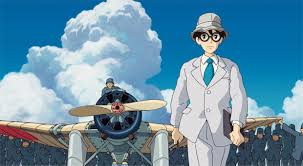
Jiro leading one of his designs to the testing grounds.

Jiro leading one of his designs to the testing grounds.

Jiro is portrayed as a sweet and good-natured man.  He is willing to help those in need, and a chance encounter with a young woman and her maid on a train plays a pivotal role in the film later on.  During the train ride the great earthquake of 1923 strikes and Jiro carries the maid to safety after she breaks a leg.  He seeks nothing in return and doesn’t even share his name with the women before departing.

Jiro lands a job out of school and his employment takes him to Germany where he is introduced to pre World War 2 Germany’s policies.  Being Japanese, he is not trusted by the soldiers as he seeks to learn about Germany’s engineering when it comes to aeronautical design.  Despite this, he is able to learn some techniques and apply them to a new aircraft, which unfortunately crashes during the test run.  To clear his head, his company sends him on a retreat for some rest and relaxation which is where he encounters the young woman he met years earlier on the train, Naoko.  The two fall in love, and though it seems predictable, their scenes are handled with such tenderness and care that the audience is left to root for them, even if it seems as if they’re destined to fall for each other.  Jiro learns there is a dark side to his budding romance as Naoko is afflicted with tuberculosis.  This forces them to move quickly with their life together.  Naoko insists on getting better before discussing marriage, but in time relents once Jiro has to leave for work.

Jiro must deal with failure throughout the film.

Jiro must deal with failure throughout the film.

The last act of the movie involves Jiro and his attempt to finally build a worthy aircraft that his company can sell to the Japanese military, while Naoko wages a silent battle at their home with her illness.  I don’t want to get into too much detail about the film’s plot, but suffice to say it’s a bittersweet tale that includes ups and downs with the story refusing to linger on anything for too long.  In that, it mirrors life which is a constant push and pull.  There are many themes the film likes to go back to.  Early on a supporting character mentions the importance of having a family to go home to, crediting it with helping a man work harder at the office, which is shown later in the film once Jiro is married.  In his dreams, Caproni asks Jiro if he prefers to live in a world with pyramids, or with no pyramids, using this as an explanation for why he would design airplanes that will eventually be used for war.  And all throughout the film, the wind acts as a character itself playing a pivotal role in one of the film’s final scenes.

As this is a work from Studio Ghibli, it hardly needs stating but deserves to be anyways, that this film is gorgeous.  The animation is predominantly hand-drawn, but some computer generated imagery is used for some of the film’s effects.  The film has a bright palette though Jiro is often garbed in white, gray, or a very light lavender, which serves to isolate him from his surroundings.  This suits the character as he is often oblivious to his surroundings, so consumed in his work and willing to overlook the fact that his designs are made for war.  The country-side settings are sure to evoke memories of Totoro, and the film’s whimsical feel and care-free pace further serves to draw comparisons to Miyazaki’s old masterpiece.

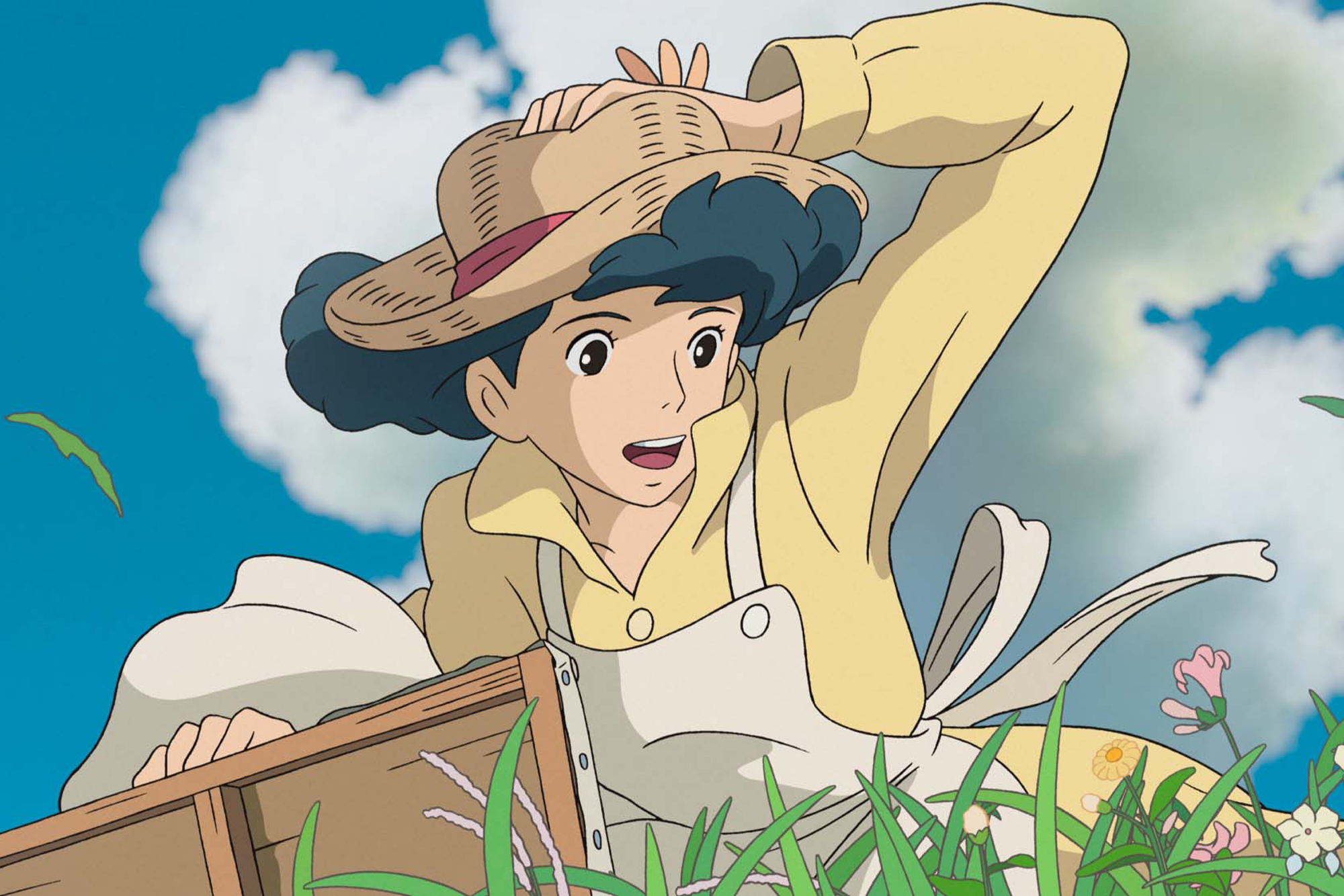
The wind is a character of its own, its actions often directly influencing the lives of the human characters in the film.

The wind is a character of its own, its actions often directly influencing the lives of the human characters in the film.

The sound design is excellent, with great use of natural sounding effects and an excellent score from Joe Hisaishi.  The english dub was handled by Disney and the film distributed in North America on their Touschstone label.  The dub is the usual high quality that viewers have come to expect from Disney as the company has handled the majority of Studio Ghibli’s dubs.  Serving as Jiro is Joseph Gordon-Levitt with supporting roles from the likes of Emily Blunt, John Krasinski, and Martin Short, the latter serving as the scene-stealing character Kurokawa, Jiro’s boss throughout the film.

The Wind Rises may be an animated movie, but it’s not for children.  The film’s pace is too slow and plot is too mature to entertain most children.  The film is best described as a drama and should appeal to older fans of Miyazaki’s works.  That said, it’s a wonderful piece of film with fantastic visuals, a compelling plot, and terrific performances.  Hayao Miyazaki may never get the recognition he deserves from international audiences, but anyone involved with film appreciates and respects the work he does.  It’s both wonderful and sad that this movie exists, knowing it is to be the last written and directed by Miyazaki, but in that sense it mirrors the film superbly.  What a truly awesome way to cap off a career!


Mickey Mouse: In Living Color, Volume 2

175px-DisneyTreasures03-mickeycolorAs the 1930’s came to an end and Disney transitioned into the 40’s, Mickey Mouse saw his starring roles in cartoon shorts dwindle.  He was, more or less, unofficially retired by the time the decade came to a close and relegated to hosting duties on television and as the official mascot of the Disney brand.  There were several factors contributing to the decreased screen-time for the world’s most famous mouse.  For one, Disney had moved on to feature-length productions and was producing fewer cartoon shorts.  And when Disney was producing shorts, Donald Duck was usually the star, not Mickey Mouse.  As the Disney brand grew, Mickey was not surprisingly delegated as the face of the company.  As such, Disney felt that Mickey needed to be a role model.  While the Mickey who starred in numerous black and white shorts could be kind of mischievous and a bit of a trickster, this new Mickey needed to embody a more wholesome image.  Donald Duck could be the bad boy, and as a result, the funnier of the two characters which made creating shorts for him a natural process.  Donald Duck could be the hero or the villain of any cartoon he starred in, while Mickey was forced to be the straight man.  Another reason why Mickey made fewer appearances in animation is because he was voiced by Walt Disney himself.  As the Disney empire grew, Walt found himself too busy to voice Mickey.  Eventually, he would hand over the voicing duties to sound effects man Jimmy MacDonald because of his too busy schedule.

As a result, this final set of Mickey Mouse cartoons is much shorter than its predecessors.  It’s also not as good as the first Mickey Mouse:  In Living Color collection, but still contains some classic material and worthwhile bonus features.  Disc one includes the last of Mickey’s original run while disc two contains some of his more prominent starring roles and last theatrical short.  The set captures Mickey’s twilight years, and includes material from his three most prominent voice actors: Disney, MacDonald, and Wayne Allwine.  The set is, if nothing else, a nice piece of history for one of animation’s most famous characters.  The animation is top-notch Disney, as one would expect, making even the lesser shorts still fun to watch.

images-187This may be a lesser set when compared with the previous one, but there are still some classic shorts to be found on disc one.  Mickey often finds himself paired with other characters, such as Pluto, Donald, and Goofy.  in “Tugboat Mickey,” Mickey, Donald, and Goofy spend their time repairing an old boat and little goes right.  There’s plenty of slapstick humor in the same style as other shorts that grouped this trio together.  In “The Pointer,” Pluto and Mickey are out hunting and soon find themselves nose to nose with a bear.  Pluto probably gets equal screen time as Mickey and arguably steals the short.  This is common for Mickey though as the guest stars tend to generate the most laughs.  A personal favorite of mine for nostalgic reasons is “Mickey and the Seal.”  I remember watching this one as a kid and it involves Mickey being followed home from the zoo by a seal pup.  They get into some humorous situations as Mickey is unaware the seal followed him which climaxes is in a very entertaining bath tub scene.  There are some duds though, such as “The Nifty Nineties” and “The Simple Things.”  “The Nifty Nineties” is basically a love letter to the 1890’s.  It contains some nice music and pretty backgrounds, but it’s just really boring.  Nothing happens.  “The Simple Things” is another Mickey and Pluto short, and also the last Mickey Mouse short until the 1990’s.  It’s not so bad in a vacuum, but a lot of the gags are recycled from older Mickey, Pluto and Donald cartoons and have become worn out at this point.

There are some curious inclusions amongst the cartoons as well.  Namely, there are a few Pluto cartoons here that would have made more sense as part of the Pluto collections.  Perhaps Disney felt it needed to include more content on this one, but “Pluto’s Party” and “Pluto’s Christmas Tree” would have been more at home on the Pluto sets, but I can’t say I’m disappointed they’re here.  It’s actually more of a hindrance to the Pluto sets that they weren’t also included there.  The short, “Plutopia,” included on this set actually also shows up on The Complete Pluto, Volume Two as well.

Still breathtaking more than 70 years later.

Still breathtaking more than 70 years later.

In addition to the short-form cartoons are the longer feature appearances of Mickey.  Included on disc one, is “The Sorcerer’s Apprentice” from Fantasia and “Mickey and the Beanstalk” from Fun and Fancy Free.  These end up being about three to four times the length of a typical cartoon short, and are essential to the Mickey Mouse legacy.  “The Sorcerer’s Apprentice” kind of goes without saying, but for the record I will state it’s an iconic piece of American animation and possibly Mickey’s most famous appearance.  “Mickey and the Beanstalk” is less known, but important because it was the unofficial passing of the torch for the voice of Mickey from Walt Disney to Jimmy MacDonald as portions of the cartoon feature Mickey voiced by Disney and portions by MacDonald.  For a long time, it was thought that this was the last time Disney voiced Mickey, but it was actually revealed by MacDonald to film critic and set host Leonard Maltin that Walt reprised the role of Mickey for the intros to the Mickey Mouse Clubhouse television show.  Those intros, five in total, are included as a bonus feature on this set and are impossibly cool for fans of Disney and Mickey Mouse history.

The Prince and the Pauper is hardly a classic, but it's nice to have it included all the same.

The Prince and the Pauper is hardly a classic, but it’s nice to have it included all the same.

Disc two contains more special features as well as Mickey’s most recent cartoons.  The long-form shorts “Mickey’s Christmas Carol” and “The Prince and the Pauper” are featured.  I’ve written more than once on this blog about “Mickey’s Christmas Carol” so I won’t go into much detail here, but there’s some bonus content with some animators who worked on it which is worth checking out.  It’s a neat cartoon for many reasons, but also because it’s the first time Mickey Mouse was voiced by Wayne Allwine, who would eventually go on to become the longest running voice of Mickey Mouse until his death in 2009.  The cartoon also features the Uncle Scrooge character voiced by Allen Young, who would of course go on to voice Scrooge in the very successful DuckTales series.  The cartoon is also the last time Donald Duck was voiced by his original voice actor, Clarence Nash, making “Mickey’s Christmas Carol” one of the most historically significant cartoons ever produced by the Disney company.  “The Prince and the Pauper” is another twenty-four minute short.  Coincidentally, it was released to theaters with The Rescuers Down Under while “Mickey’s Christmas Carol” was released with The Rescuers (Disney apparently likes to group its mouse characters together).  It’s a fairly unremarkable short but does feature some nice animation, though its brightness contrasts it with the muted pallet of “Mickey’s Christmas Carol” in a way that kind of puts me off.  It is notable for being the last time Disney used the Xerox process for its animation, a process that had been in use since 101 Dalmatians.

Runaway Brain feels like it's mostly been forgotten, which is a shame because it's great fun.

Runaway Brain feels like it’s mostly been forgotten, which is a shame because it’s great fun.

The last short include on the collection is, up until very recently, the last Mickey Mouse short, “Runaway Brain.”  Released in 1995 along with A Goofy Movie, it features Mickey and Minnie (voiced by Allwine’s real-life wife Russi Taylor) and marks the debut of mad scientist Dr. Frankenollie (named after longtime Disney animators Frank Thomas and Ollie Johnston), who is voiced in the short by Kelsey Grammar.  The plot involves Mickey forgetting his anniversary with Minnie and trying to make up for it by volunteering for a science experiment to earn money for a Hawaiian vacation.  Mickey ends up as a mindless beast and it’s a pretty entertaining cartoon short.  It served as a nice way for Mickey to bow out of animation, though starting in 2013 new Mickey Mouse shorts have been in production featuring a new style and approach in terms of both look and content.

Mickey Mouse: In Living Color, Volume Two isn’t quite as good as Volume One, but there’s enough here that any Disney fan should own it.  More than anything, this set is a piece of Disney history as it documents the changing look of Mickey Mouse as well as the men who gave voice to him.  There’s a little bit of sadness to it as well, as Mickey quietly exited the world of animation with little fanfare or celebration.  It seems like he deserved better, and it’s too bad that generations of kids have grown up without new Mickey Mouse cartoons.  The most recent shorts produced actually aren’t bad, and the few I’ve seen I’ve enjoyed but it doesn’t seem like they get much attention.  Disney would do well to make an effort to keep Mickey’s animation presence alive and well by celebrating his legacy more and pushing his current shorts.  Kids today deserve to know Mickey Mouse as more than a theme park attraction and brand.

Mickey Mouse:  In Living Color, Volume Two

  • Society Dog Show
  • The Pointer
  • Tugboat Mickey
  • Pluto’s Dream House
  • Mr. Mouse Takes a Trip
  • The Little Whirlwind
  • The Nifty Nineties
  • Orphan’s Benefit (1941)
  • Mickey’s Birthday Party
  • Symphony Hour
  • Mickey’s Delayed Date
  • Mickey Down Under
  • Mickey and the Seal
  • Plutopia
  • R’Coon Dawg
  • Pluto’s Party
  • Pluto’s Christmas Tree
  • The Simple Things
  • The Sorcerer’s Apprentice
  • Mickey and the Beanstalk
  • Mickey’s Christmas Carol
  • The Prince and the Pauper
  • Runaway Brain


Christmas Time in South Park

Christmas Time in South Park (2007)

Christmas Time in South Park (2007)

South Park famously began as a video Christmas card, so it should come as no surprise that the television series (which just concluded its 17th season) has spawned many Christmas specials of its own.  Series creators Trey Parker and Matt Stone actually haven’t done a new one since 2004’s Woodland Critter Christmas, but still have output seven Christmas specials which have been conveniently compiled for the DVD release Christmas Time in South Park.  The first run of Christmas specials for the show actually felt connected to one another as they all explored the spirit of Christmas:  what is it?  What does Christmas mean?  Of course, this being South Park, don’t expect a lot of feel-good and overly sentimental holiday themes as is found in most Christmas specials, though surprisingly some of these episodes echo their tamer counterparts and some even have a good heart at the center of the story.

Lets talk about these episodes, and specifically, the DVD release of Christmas Time in South Park.  The DVD case and menus echo those Little Golden Book releases you may remember from your childhood.  The menus are animated and the characters will berate you for taking too long to select a feature.  The cursor of your DVD player, naturally, is represented by a smear of Mr. Hankey leavings.  All seven Christmas specials are featured in chronological order.  Unfortunately, all seven are also censored like their season release counterparts (for South Park’s older episodes, uncensored versions do not exist as no one anticipated there being a huge market for full seasons of TV shows) which means you’ll be hearing beeps whenever the characters utter a colorful phrase.  Also missing, is the short that started it all:  The Spirit of Christmas.  This seems like a huge and careless omission to me.  Why go through the effort of putting out a compilation of Christmas specials and leave out the very first one? My only guess is that the studio felt that The Spirit of Christmas was too strong a selling point for releases like South Park:  The Hits and its inclusion would harm other DVD sales.  Quite possibly, it was just forgotten as this DVD was slapped together quickly to cash-in on the holiday season.

The first Christmas special, and the one that introduced Mr. Hankey to the world.

The first Christmas special, and the one that introduced Mr. Hankey to the world.

At least there are still seven, mostly excellent, Christmas episodes for your viewing pleasure.  The first being Mr. Hankey the Christmas Poo.  This was South Park’s first Christmas special and apparently Parker and Stone wanted to create a new Christmas icon for the world they created so they turned to a talking piece of shit.  Parker and Stone hold nothing back when it comes to Mr. Hankey.  He’s disgusting, and they don’t want you to forget that so we get bits of him leaving poo trails everywhere he goes and even bathing in Mr. Mackey’s coffee, while he sips it.  The framework of the episode is Kyle feeling excluded from all of the Christmas excitement on account of him being Jewish.  Simultaneously, Kyle’s mother (the Jewish community) is upset about the inclusion of the nativity in a school Christmas play.  Her complaining to the mayor sets off a chain reaction where in response the devout Catholics in town demand to see Santa removed from the play, hippies want to get rid of Christmas trees, epileptics demand the removal of Christmas lights, and the virgins (presumably) want to get rid of mistletoe.  The show is clearly poking fun at all of the people that get uptight over Christmas, and Mr. Hankey is called on to save the day.  That the town needs to listen to crap in order to see the error of its ways is probably a commentary on something too.  Everyone thinks Kyle is insane for seeing and believing in Mr. Hankey, until the boys find out Chef does as well.  Once everyone believes, Mr. Hankey reminds everyone that Christmas is a time to be nice to one another, forget about all of the bad stuff in the world, and bake cookies.  Kyle is released from the nut house, and Kenny lives to see the end credits for the first time.  It’s a wacky Christmas special, that may still be the show’s best, with tons of gross-out and hilarious moments.

Merry Christmas, Charlie Manson! is the second season’s Christmas special and it’s subversive in a different way.  Rather than try to be absurd and gross people out with singing poop, Parker and Stone decided to use an unlikely character and have him saved by Christmas.  Enter mass-murderer Charlie Manson, faithfully depicted with a swastika tattooed on his forehead.  Cartman and his mom are heading to Nebraska to visit family for Christmas, and the boys have been invited along.  Kyle is allowed to go presumably because his family is Jewish and couldn’t care less that it’s Christmas while Kenny’s family is sending him on a  mission to bring back leftovers.  Stan’s mom is the only one who has a problem with her son being away from the family at Christmas, so Stan sneaks out and tells the Cartmans that his family is dead.  When the boys get to Nebraska (after a long and torturous car ride full of singing) they find that a house full of Cartmans is a horrible place to be as all of them basically act just like their own Eric Cartman.  They soon find out that Cartman has an incarcerated Uncle Howard, as he breaks out of jail and (stupidly) returns to hide-out in his parent’s basement.  He brings along his buddy, Charlie Manson, whom the boys are ignorant of.  When no one will take them to the mall to see Mr. Hankey, Manson offers to do it himself to avoid sitting and watching Christmas specials all day.  At the mall though, he watches a poop version of How the Grinch Stole Christmas and begins to see the light.  He gets his tattoo altered into a smiley face, and takes the kids home, but not before attracting the attention of the local police.  They’re soon all trapped in the house as Uncle Howard takes the family hostage.  Manson, now full of Christmas spirit, convinces Howard to surrender and even reminds Stan that Christmas is a time for family.  The episode ends with the characters from the episode in Manson’s jail cell wishing him a merry Christmas, Charlie Brown style.  As Stan reminds us, this is some pretty fucked up shit right here.

If you don't like his special, he has some balls you can suck.

If you don’t like his special, he has some balls you can suck.

Season Three’s Christmas special is Mr. Hankey’s Christmas Classics.  It’s just a collection of songs, some traditional and some new, sung by the characters of South Park.  It’s kind of a love it or hate it episode, and one I’m not really fond of.  However, Mr. Hankey instructs the audience during the intro that if we don’t like it we can suck his tiny little balls.  As small as they may be, I don’t want to suck any poo balls so I’ll cease to speak of this episode right here.

Season Four brings us A Very Crappy Christmas and it could basically be re-titled as The Story of South Park.  That’s because in it the boys actually create and animate The Spirit of Christmas just like their creators.  Following the events of the first two Christmas specials, the people of South Park now understand that Christmas is a time for being merry and spending with one’s family.  The commercialism is gone, and the boys are pretty pissed off about not getting presents so they go looking for a strangely absent Mr. Hankey.  They find their favorite piece of crap has been MIA because he now has a wife and turds of his own.  As the boys lament the absence of what they perceive to be the Christmas spirit, they get the idea to make their very own Christmas special.  The mayor, who needs the commercialism to spur the economy, agrees to fund their little project.  Nothing goes right, but when Kyle channels his own inner Christmas spirit (and the Rankin/Bass feature Twas the Night Before Christmas) he gets everyone back on track.  Most of the episode is a parody of Twas the Night Before Christmas while also containing numerous in-jokes for longtime South Park fans.  In the end, they’re able to show the town The Spirit of Christmas and everyone realizes that Christmas is about one thing:  presents.  Everyone starts shopping immediately and the town’s economy is saved.  Yay!

The Hankey family expands in A Very Crappy Christmas.

The Hankey family expands in A Very Crappy Christmas.

Season Five was the first to not feature a Christmas episode, but season six restored order with Red Sleigh Down, a parody of Black Hawk Down and the conclusion of what I see as the Christmas story started in season one.  In it,  Cartman desperately wants some slick new toy but realizes he’s been far too naughty to hope to get anything from Santa so he goes all out to be nice at the last minute.  His scheming leads him to believe that if he helps Santa bring Christmas to Iraq that will be enough, so he enlists the help of Stan and Kyle (Kenny’s been dead all season) and eventually Mr. Hankey in order to do so.  Mr. Hankey is thrilled at Cartman’s Christmas spirit and agrees to help by taking the boys to the North Pole aboard the Poo-Choo Express (it’s just as disgusting as you imagine).  Santa agrees that Christmas should be brought to Iraq, and the boys watch from the North Pole as Santa’s sleigh is shot down by an RPG over Iraq.  Now feeling guilty and terrified by the prospects of no more Christmas presents, the boys enlist the help of the one man who can save Santa:  Jesus.  They all take Santa’s back-up sleigh to Iraq where Jesus becomes a one-man death machine as he takes out numerous soldiers to save Santa.  Their escape goes wrong when Jesus is shot from behind and dies in Santa’s arms.  They’re able to escape, but not before a vengeful Claus does finally bring Christmas to Iraq.  Back in South Park, the townspeople have been distracted by the speech impediment of Jimmy who’s attempting to recite The Twelve Days of Christmas, an episode-long gag.  Santa lights the town tree and addresses the crowd telling them that Christmas should be a day to reflect on the sacrifice one man-made to save Christmas:  Jesus.  And with that, the spirit of Christmas is modified once again in the South Park canon to be a day dedicated to Jesus.

Santa and Jesus team-up in Red Sleigh Down.

Santa and Jesus team-up in Red Sleigh Down.

With the spirit of Christmas now fully defined, Parker and Stone decided to take the boys on a Christmas adventure to Canada, of all places.  The new Canadian Prime Minister has decided that all Canadian born children be returned to Canada, which means Kyle’s adopted brother Ike is required to go.  Kyle enlists the help of his friends to go appeal to the Prime Minister, though they’re all reluctant to risk missing Christmas.  They go anyway, and in Canada they find a world not unlike Oz where the locals instruct them to “follow the only road.”  Just like The Wizard of Oz, the boys encounter other Canadian citizens looking to appeal to the Prime Minister about something, while the villainous Scott, from the Terence and Philip special, makes a return.  In the end, they discover the new Prime Minister is actually Saddam Hussein in hiding, and his new laws are overturned while the boys do in fact miss Christmas.  Cartman is unable to see the bright-side in Kyle getting his brother back, while Stan laments on missing out on a Christmas adventure, oblivious to what just happened.  It’s Christmas in Canada is not one of my favorites, and it’s probably the weak link on this DVD, though I do know more than one person who finds the episode hilarious.  I think I would like it more if it had more to do with Christmas.  It’s not really a Christmas special, just an episode that takes place during Christmas.

"It's Critter Christmas, dude, it sucks ass!"

“It’s Critter Christmas, dude, it sucks ass!”

This brings me to the last episode on the DVD, and so far, the last Christmas episode South Park has done:  Woodland Critter Christmas.  Seemingly out of ideas for a Christmas special, Parker and Stone decide to just completely subvert the idea of a Christmas special.  In this episode we have an innocent sounding narrator tell the story of a boy trying to help a group of talking woodland critters so that they can have a merry Christmas.  The critters are intentionally made to seem sterile and innocent while the episode is also intended to appear to be a cookie-cutter Christmas special with little thought or effort (the main character has no name, all of the animals names are just the name of the animal with a long “e” sound at the end, such as Deery the deer, Rabbity the rabbit, and so on).  Of course, the catch is that these animals are trying to bring about the birth of their lord and saviour.  Porcupinie has been impregnated by their god, but a mean old mountain lion wants to kill her, so the boy (Stan) is enlisted to help.  He succeeds by killing the mountain lion, who also happened to be a mother to three cubs, only to find out the critters worship Satan and the porcupine is set to deliver the anti-christ.  The tables are turned and soon Stan is left trying to prevent the coming of the anti-christ and he’ll receive help from Santa and a little thing called abortion.  Woodland Critter Christmas basically sets out to be the most obscene Christmas special one could dream up.  It’s almost as if Parker and Stone just wanted to top their prior specials in terms of shock-appeal and perhaps because they haven’t thought up a way to top this one is why we haven’t seen any new Christmas specials from South Park.  If this is the type of thing you can laugh at, then Woodland Critter Christmas should do the trick.  It’s ridiculous, but also pretty damn hilarious.

These specials are a big part of my memories growing up, even into college.  It seemed like each one was a topic of conversation when it originally aired because people generally couldn’t believe what they just saw.  South Park has had a lot of moments like that over the years, and for whatever reason, Christmas seems to bring out the best in it.  I love the sappy, sentimental Christmas specials that dominate the air during this time of year, but sometimes it’s nice to watch something that is decidedly less reverential towards the holiday season.  South Park does the trick, and Christmas Time in South Park is a convenient release and a suitable way to get my laugh on during the month of December.