Mickey Mouse: In Living Color, Volume 2

175px-DisneyTreasures03-mickeycolorAs the 1930’s came to an end and Disney transitioned into the 40’s, Mickey Mouse saw his starring roles in cartoon shorts dwindle.  He was, more or less, unofficially retired by the time the decade came to a close and relegated to hosting duties on television and as the official mascot of the Disney brand.  There were several factors contributing to the decreased screen-time for the world’s most famous mouse.  For one, Disney had moved on to feature-length productions and was producing fewer cartoon shorts.  And when Disney was producing shorts, Donald Duck was usually the star, not Mickey Mouse.  As the Disney brand grew, Mickey was not surprisingly delegated as the face of the company.  As such, Disney felt that Mickey needed to be a role model.  While the Mickey who starred in numerous black and white shorts could be kind of mischievous and a bit of a trickster, this new Mickey needed to embody a more wholesome image.  Donald Duck could be the bad boy, and as a result, the funnier of the two characters which made creating shorts for him a natural process.  Donald Duck could be the hero or the villain of any cartoon he starred in, while Mickey was forced to be the straight man.  Another reason why Mickey made fewer appearances in animation is because he was voiced by Walt Disney himself.  As the Disney empire grew, Walt found himself too busy to voice Mickey.  Eventually, he would hand over the voicing duties to sound effects man Jimmy MacDonald because of his too busy schedule.

As a result, this final set of Mickey Mouse cartoons is much shorter than its predecessors.  It’s also not as good as the first Mickey Mouse:  In Living Color collection, but still contains some classic material and worthwhile bonus features.  Disc one includes the last of Mickey’s original run while disc two contains some of his more prominent starring roles and last theatrical short.  The set captures Mickey’s twilight years, and includes material from his three most prominent voice actors: Disney, MacDonald, and Wayne Allwine.  The set is, if nothing else, a nice piece of history for one of animation’s most famous characters.  The animation is top-notch Disney, as one would expect, making even the lesser shorts still fun to watch.

images-187This may be a lesser set when compared with the previous one, but there are still some classic shorts to be found on disc one.  Mickey often finds himself paired with other characters, such as Pluto, Donald, and Goofy.  in “Tugboat Mickey,” Mickey, Donald, and Goofy spend their time repairing an old boat and little goes right.  There’s plenty of slapstick humor in the same style as other shorts that grouped this trio together.  In “The Pointer,” Pluto and Mickey are out hunting and soon find themselves nose to nose with a bear.  Pluto probably gets equal screen time as Mickey and arguably steals the short.  This is common for Mickey though as the guest stars tend to generate the most laughs.  A personal favorite of mine for nostalgic reasons is “Mickey and the Seal.”  I remember watching this one as a kid and it involves Mickey being followed home from the zoo by a seal pup.  They get into some humorous situations as Mickey is unaware the seal followed him which climaxes is in a very entertaining bath tub scene.  There are some duds though, such as “The Nifty Nineties” and “The Simple Things.”  “The Nifty Nineties” is basically a love letter to the 1890’s.  It contains some nice music and pretty backgrounds, but it’s just really boring.  Nothing happens.  “The Simple Things” is another Mickey and Pluto short, and also the last Mickey Mouse short until the 1990’s.  It’s not so bad in a vacuum, but a lot of the gags are recycled from older Mickey, Pluto and Donald cartoons and have become worn out at this point.

There are some curious inclusions amongst the cartoons as well.  Namely, there are a few Pluto cartoons here that would have made more sense as part of the Pluto collections.  Perhaps Disney felt it needed to include more content on this one, but “Pluto’s Party” and “Pluto’s Christmas Tree” would have been more at home on the Pluto sets, but I can’t say I’m disappointed they’re here.  It’s actually more of a hindrance to the Pluto sets that they weren’t also included there.  The short, “Plutopia,” included on this set actually also shows up on The Complete Pluto, Volume Two as well.

Still breathtaking more than 70 years later.

Still breathtaking more than 70 years later.

In addition to the short-form cartoons are the longer feature appearances of Mickey.  Included on disc one, is “The Sorcerer’s Apprentice” from Fantasia and “Mickey and the Beanstalk” from Fun and Fancy Free.  These end up being about three to four times the length of a typical cartoon short, and are essential to the Mickey Mouse legacy.  “The Sorcerer’s Apprentice” kind of goes without saying, but for the record I will state it’s an iconic piece of American animation and possibly Mickey’s most famous appearance.  “Mickey and the Beanstalk” is less known, but important because it was the unofficial passing of the torch for the voice of Mickey from Walt Disney to Jimmy MacDonald as portions of the cartoon feature Mickey voiced by Disney and portions by MacDonald.  For a long time, it was thought that this was the last time Disney voiced Mickey, but it was actually revealed by MacDonald to film critic and set host Leonard Maltin that Walt reprised the role of Mickey for the intros to the Mickey Mouse Clubhouse television show.  Those intros, five in total, are included as a bonus feature on this set and are impossibly cool for fans of Disney and Mickey Mouse history.

The Prince and the Pauper is hardly a classic, but it's nice to have it included all the same.

The Prince and the Pauper is hardly a classic, but it’s nice to have it included all the same.

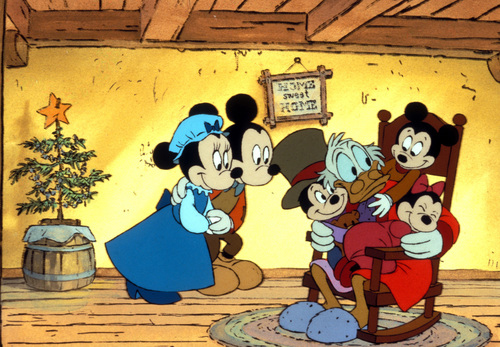
Disc two contains more special features as well as Mickey’s most recent cartoons.  The long-form shorts “Mickey’s Christmas Carol” and “The Prince and the Pauper” are featured.  I’ve written more than once on this blog about “Mickey’s Christmas Carol” so I won’t go into much detail here, but there’s some bonus content with some animators who worked on it which is worth checking out.  It’s a neat cartoon for many reasons, but also because it’s the first time Mickey Mouse was voiced by Wayne Allwine, who would eventually go on to become the longest running voice of Mickey Mouse until his death in 2009.  The cartoon also features the Uncle Scrooge character voiced by Allen Young, who would of course go on to voice Scrooge in the very successful DuckTales series.  The cartoon is also the last time Donald Duck was voiced by his original voice actor, Clarence Nash, making “Mickey’s Christmas Carol” one of the most historically significant cartoons ever produced by the Disney company.  “The Prince and the Pauper” is another twenty-four minute short.  Coincidentally, it was released to theaters with The Rescuers Down Under while “Mickey’s Christmas Carol” was released with The Rescuers (Disney apparently likes to group its mouse characters together).  It’s a fairly unremarkable short but does feature some nice animation, though its brightness contrasts it with the muted pallet of “Mickey’s Christmas Carol” in a way that kind of puts me off.  It is notable for being the last time Disney used the Xerox process for its animation, a process that had been in use since 101 Dalmatians.
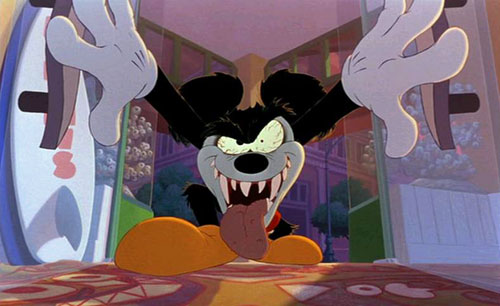
Runaway Brain feels like it's mostly been forgotten, which is a shame because it's great fun.

Runaway Brain feels like it’s mostly been forgotten, which is a shame because it’s great fun.
The last short include on the collection is, up until very recently, the last Mickey Mouse short, “Runaway Brain.”  Released in 1995 along with A Goofy Movie, it features Mickey and Minnie (voiced by Allwine’s real-life wife Russi Taylor) and marks the debut of mad scientist Dr. Frankenollie (named after longtime Disney animators Frank Thomas and Ollie Johnston), who is voiced in the short by Kelsey Grammar.  The plot involves Mickey forgetting his anniversary with Minnie and trying to make up for it by volunteering for a science experiment to earn money for a Hawaiian vacation.  Mickey ends up as a mindless beast and it’s a pretty entertaining cartoon short.  It served as a nice way for Mickey to bow out of animation, though starting in 2013 new Mickey Mouse shorts have been in production featuring a new style and approach in terms of both look and content.

Mickey Mouse: In Living Color, Volume Two isn’t quite as good as Volume One, but there’s enough here that any Disney fan should own it.  More than anything, this set is a piece of Disney history as it documents the changing look of Mickey Mouse as well as the men who gave voice to him.  There’s a little bit of sadness to it as well, as Mickey quietly exited the world of animation with little fanfare or celebration.  It seems like he deserved better, and it’s too bad that generations of kids have grown up without new Mickey Mouse cartoons.  The most recent shorts produced actually aren’t bad, and the few I’ve seen I’ve enjoyed but it doesn’t seem like they get much attention.  Disney would do well to make an effort to keep Mickey’s animation presence alive and well by celebrating his legacy more and pushing his current shorts.  Kids today deserve to know Mickey Mouse as more than a theme park attraction and brand.

Mickey Mouse:  In Living Color, Volume Two

  • Society Dog Show
  • The Pointer
  • Tugboat Mickey
  • Pluto’s Dream House
  • Mr. Mouse Takes a Trip
  • The Little Whirlwind
  • The Nifty Nineties
  • Orphan’s Benefit (1941)
  • Mickey’s Birthday Party
  • Symphony Hour
  • Mickey’s Delayed Date
  • Mickey Down Under
  • Mickey and the Seal
  • Plutopia
  • R’Coon Dawg
  • Pluto’s Party
  • Pluto’s Christmas Tree
  • The Simple Things
  • The Sorcerer’s Apprentice
  • Mickey and the Beanstalk
  • Mickey’s Christmas Carol
  • The Prince and the Pauper
  • Runaway Brain


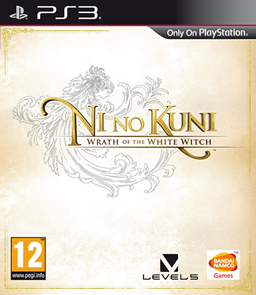
Ni no Kuni: Wrath of the White Witch

NiNoKuniI normally only write about old games, but sometimes a game comes along that evokes the spirit of the games of yesterday and I feel compelled to write about it.  It doesn’t hurt that said game is a collaborative effort between developer Level-5 and the great animation super power Studio Ghibli.  I am, of course, speaking of Ni no Kuni:  Wrath of the White Witch, a role-playing game for the Playstation 3 that came out nearly a year ago in the US.  Translated literally as Second Country, Ni no Kuni is a Japanese RPG that borrows heavily from the games of old such as Final Fantasy and Dragon Quest, with a touch of Pokémon for good measure.  The game tasks the player with guiding the main character Oliver into a parallel world on a quest to not only save that world from an evil wizard, but also save his mother.  There’s swords and sorcery, dungeons and dragons, and all of the familiar tropes of the genre.  It’s a fun trip down memory lane for those of us old enough to remember when seemingly every RPG followed the same path, but there is enough infusion of modern elements to give the game a fresh feeling.  Top it off with the unparalleled presentation afforded by Ghibli, and Ni no Kuni is easily one of the top games of 2013.
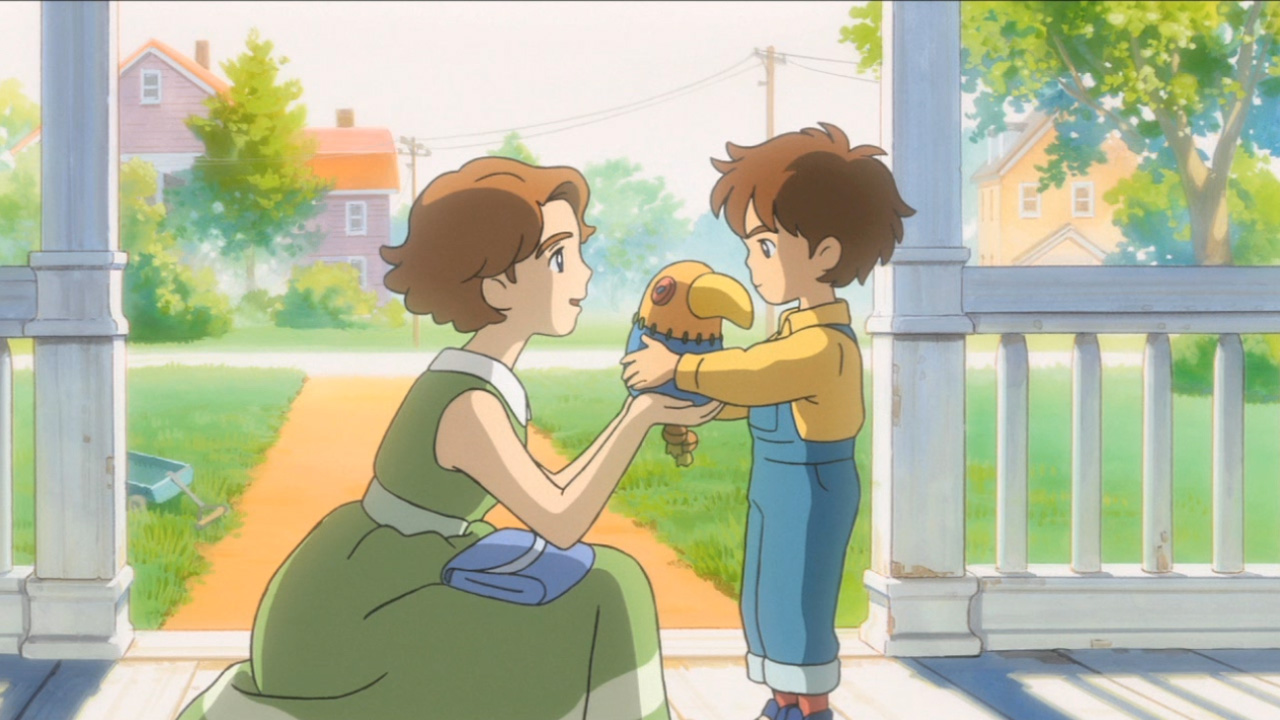
Ni no Kuni, at its core, is a story about a boy and his love for his mother.  Aww!

Ni no Kuni, at its core, is a story about a boy and his love for his mother. Aww!

The plot for Ni no Kuni is, like its gameplay, a mixture of traditional and non-traditional.  The main character, a kid named Oliver, is the typical unlikely hero destined to save the world from evil.  The non-traditional part is how the story begins with Oliver being rescued from an innocent mishap with a go-kart by his mother, who tragically loses her life in the process.  It’s a seemingly ordinary piece of tragedy and it plunges the main character into depression, something not many video games are willing to deal with.  Much of the story centers around depression, or similar emotions, and Oliver is beckoned to help heal their broken hearts while healing his own in the process.  Not long after Oliver becomes withdrawn, his stuffed animal Mr. Drippy soon comes to life as Drippy, High Lord of the Fairies, and he takes Oliver to a parallel world to not only save his mother, but save Drippy’s world from the evil dark djinn Shadar.  Oliver’s world, a 1950’s looking America, and Drippy’s share an unseen bond in that people in one world are linked to people in the other by their spirit.  Oliver’s mom in this other world was a powerful sage, and by defeating Shadar, Oliver hopes to uncover what happened to his mother’s spirit-sister and hopefully save his mom in the process.  The story unfolds over roughly 50 hours of gameplay with Oliver becoming a wizard himself and visiting every corner of this other world making friends and toppling enemies while uncovering the mysteries of the past.  It’s very rewarding, and I was quite happy with how the major parts of the story resolved itself, though a lot of the plot is resolved before the game’s final act which made the last parts of the game less impactful.  It’s a minor complaint, but the story could have been tied together a little better.
The environments are some of the most breath-taking every displayed in a video game.

The environments are some of the most breath-taking every displayed in a video game.

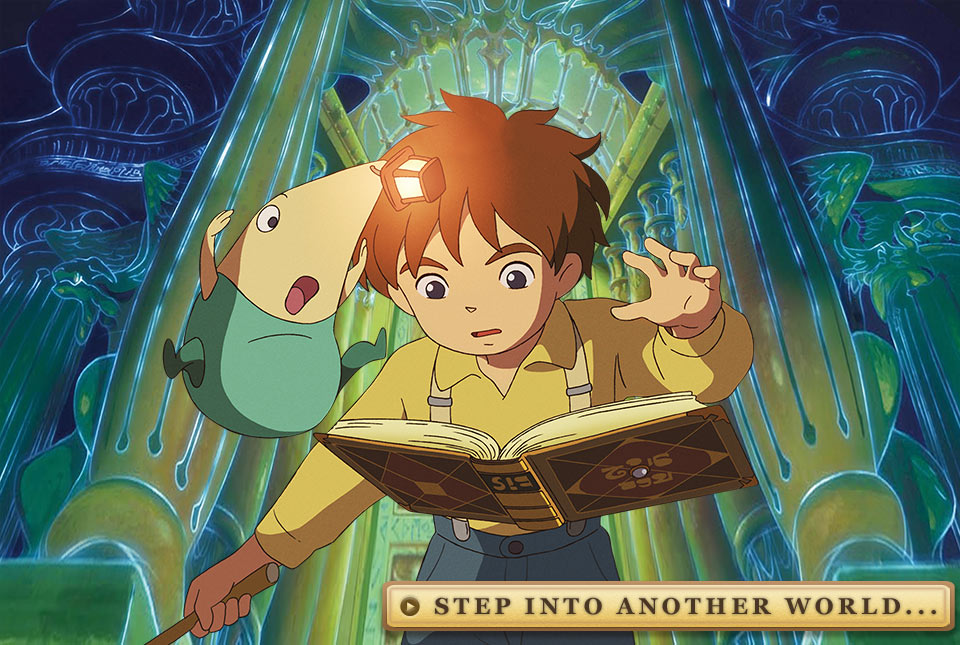
The thing that will stand out strongest to individuals playing Ni no Kuni for the first time are unquestionably the visuals.  This game looks just like a Studio Ghibli film brought to a video game console.  When I first heard about the game I was more than a little intrigued as I am a big fan of Ghibli’s films.  This game exceeded my lofty expectations and really pushes the artistic merit of gaming.  It also pushes the power of the PS3 and it shows.  Some textures are slow to populate and there’s definitely numerous instances of pop-in especially on the over world, but this is all easily forgiven considering just how superb the game looks.  The color palette is varied though slightly muted which actually adds a great deal of charm and gives the game an old feel.  Ghibli opted for near pastel shades over more striking primary colors in many places, but where they go bright it really shows.  The vegetation in several spots really pops and gives the environment a lush quality.  The water effects are some of the most natural I’ve ever seen, and the special effects are suitable and effective without being over-the-top.  The character designs are mostly kept simple, and in the case of the many creatures, perhaps too simple.  The main cast looks great though, and I really liked the look of the White Witch herself and her astral cloak that has a life all its own.  Further adding to the presentation is some excellent voice acting by a mostly British cast and a truly wonderful score from the master Joe Hisaishi.  Ni no Kuni is easily on my short list of favorite video game scores and it’s absolutely feature film quality.

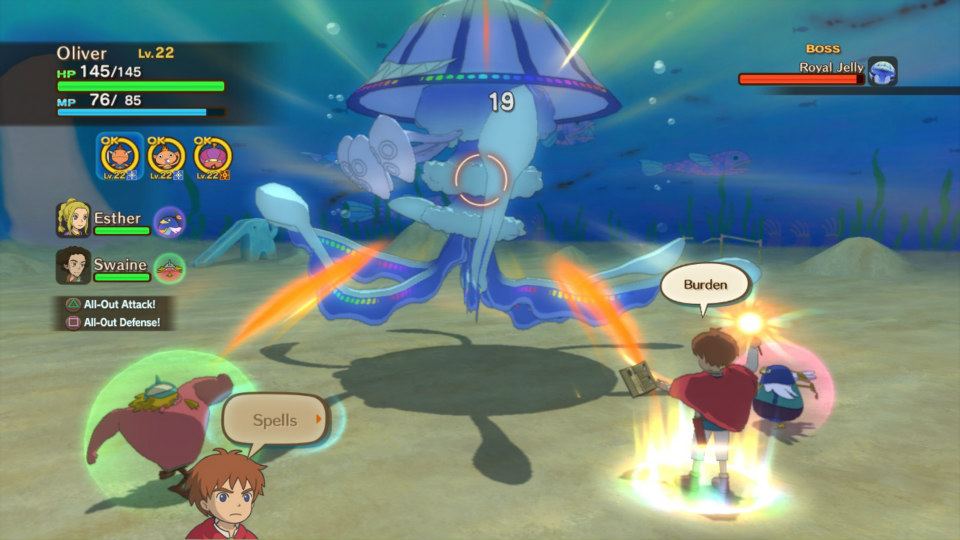
Battles can feel chaotic at first, but eventually most gamers will find a rhythm.

Battles can feel chaotic at first, but eventually most gamers will find a rhythm.

All of the bells and whistles though would be for naught if the gameplay didn’t stack up, and thankfully it does.  Ni no Kuni, as I said earlier, is a mix of old and new concepts for the JRPG genre.  Oliver and his companions still have hit points and magic points and get stronger through participating in battles and gaining experience points.  As they level up they learn new skills and gain better base stats like strength, dexterity, and so on.  The battles take place in “dungeons” and on a world map where enemies are visible and some will attack and some will run away.  Where Ni no Kuni tries to incorporate some of the elements of modern JRPGs is with the battle system.  It’s not a turn-based battle, making it similar to Final Fantasy XII and Xenoblade.  The party is limited to three members during the game, with the player controlling only one at a time.  When controlling Oliver or one of his companions, the player is free to move around the battle field and position the character to attack up close or from far away and can switch at any time to one of the other characters.  Where Level-5 looks to separate Ni no Kuni from a game like Xenoblade is with the familiar system.  Taking a page out of Pokémon, Oliver is able to capture the monsters he encounters and use them as familiars.  These familiars basically do the fighting for Oliver, and each character can enter battle with up to three familiars.  These familiars share hit points and mana with their human overlords, but level-up independently and are able to evolve at certain points.  Each familiar can evolve twice, with the second evolution presenting a choice for the player to make which usually takes on the form of picking a water type vs a fire type evolution or something similar.  The familiars interject some variety to the mix and helps to keep the playing experience unique for each individual who picks up the game.  Level-5 also did a good job of making several viable familiars lessening the occurrence of over-powered creatures likely to dominate every gamer’s party.

Complementing the impressive game engine are some wonderful pieces of traditional animation from Studio Ghibli.

Complementing the impressive game engine are some wonderful pieces of traditional animation from Studio Ghibli.

The battle system has its own quirks that everyone has to get used to, and the choice to go with a live battle system means the A.I. is going to be controlling two of the party’s characters at all times.  Naturally, this is less than ideal and Ni no Kuni’s artificial intelligence is pretty limited.  Each character can be set to behave a certain way, but there’s still no way to tell the A.I. to forego using mana on weak enemies or to focus on fire spells because the enemy is vulnerable to it over some other elemental property.  Often times I found myself using the setting that commands my partners to not use any special abilities, or else they’d blow through all of their mana after just a handful of enemy encounters.  There’s also no way to select the tactics when out of battle, which is an oversight that should be corrected in a sequel.  Another annoyance for me were the more theatrical attacks.  Certain spells and such trigger special animations during battle and these are fine when initiated by the player, but when initiated by the A.I. it becomes annoying because it cancels any commands I had issued which can be deadly if it was a healing item or spell I had pulled up.  There’s also the whole taming of new familiars, which definitely could use some tweaking.  It’s one thing to make it hard to catch the elite creatures in the game, but just about every familiar is overly difficult to tame and that’s because it’s all predicated on chance.  Sometimes when beating an enemy, instead of dying, they’ll get little hearts over their heads prompting the player to initiate a series of commands that will make the creature a new familiar for the party.  The chance of most any creature going into this state is usually less than 10%.  There are quests in the game that require Oliver to tame certain creatures and these were my most hated tasks due to how random the whole system is.  Outside of battle, navigating the world is pretty seamless but there are unpolished aspects.  The game doesn’t let you get ahead of it at any time.  If you know you have to cast a certain spell on a certain individual or object you can’t just walk up and do it, you have to engage it first so that Drippy can tell Oliver he needs to cast Give Heart or some other spell.  The game has a tendency to think everyone playing it is pretty slow, or just stupid, and overly explains how to do certain things.  The thing I found most annoying though are these special treasure chests spread all over the world that can only be opened by having one of the characters shoot them.  That doesn’t bother me, but the fact that the party has to be standing on a specific spot to do it drove me nuts.  The chest could be perfectly visible from where I had Oliver positioned, but because it wasn’t the exact spot the game wanted to be at, I couldn’t interact with the chest.  Each one of these chests was a piece of trial and error as I slowly moved Oliver around until an exclamation point popped up over his head.

The game's many familiars and deploying them properly are often the difference between success and failure for Oliver.

The game’s many familiars and deploying them properly are often the difference between success and failure for Oliver.

The battle system is not perfect but it’s far from broken and it contains enough depth to remain interesting.  It does take getting used to though, which makes Ni no Kuni the rare game where the beginning is more difficult than the end.  Especially because early on the player will only have Oliver and one or two familiars at his or her disposal.  With such limited options, it basically means most battles will require proper defense to make it through.  During battle, a well-timed attack can stop an enemy dead in its tracks.  It also can cause a special gold “glim” to appear, which when obtained, triggers an ultimate attack or special move.  What the game doesn’t convey properly early on is that well-timed defense is actually a better strategy for getting these glims to appear, and for the first couple of boss fights, these gold glims are tide-turners.  Later on in the game Oliver and his familiars will have access to a wide range of spells and abilities capable of striking from a distance making these super moves less important, but early it can be a challenge to topple a boss character.  After that though, the game is basically as hard or as easy as the player wants to make it.  As is typical of the genre, the world map opens up gradually as the game progresses by giving the player new modes of transportation to utilize, starting with sea and then ultimately air travel.  Once the seas open up though, the player can find some tucked-away areas where certain enemies frequent that grant boatloads of experience points.  If at any point a player finds the game too hard, they can simply go off and level-grind their way through it.  Spend enough time leveling-up, and the game becomes a breeze.  Even without doing so, the game is far from difficult.  Once the main campaign is bested, some more difficult challenges await but a Ruby Weapon you will not find.

Oliver and his friends are sure to leave an impression on anyone who plays Ni no Kuni and sees the story through to its conclusion.

Oliver and his friends are sure to leave an impression on anyone who plays Ni no Kuni and sees the story through to its conclusion.

Ultimately, what separates Ni no Kuni from its peers is the story and presentation.  The tale of a heart-broken young boy just trying to save his mother against all odds is touching and sobering.  In a world of fantastic creatures and unbelievable happenings, it’s a grounded premise that anyone can relate to.  The general presentation for the rest of the game is truly unparalleled.  Other games possess greater raw processing power and more detailed texture maps, but as far as artistic presentation goes I’m not sure I’ve enjoyed or been more impressed by any other game’s visuals than Ni no Kuni’s.  It’s beautiful, and I often found myself getting lost in the scenery more than once.  The battle system took time to grow on me, and there’s no doubt I would have preferred a more traditional turn-based approach, but it does possess its own charms and once I felt comfortable with it the game opened up for me.  The game is designed to entertain gamers of all ages, meaning it does have to cater to younger gamers at times.  It probably holds your hand too tight, with the same explanation for what the Veil spell does popping up every time it’s cast, but such annoyances are minor quibbles of an otherwise excellent game.  The game is a true JRPG, a genre that may finally be making a comeback, which means it has all of the charms and all of the annoyances inherent in the genre.  There are tons of fetch-quests to go on, the story unfolds in a strictly linear fashion, and there’s probably way more text in this game than anyone cares to read, but it’s also a grand tale that unfolds in a satisfying manner with lots to see and explore.  If this is a genre you’ve always loved, then Ni no Kuni is a game that should not be missed.  And if you’re new to it, Ni no Kuni is a great place to start.


Gargoyles: Season 2 – Volume 2

Gargoyles:  Season 2 - Volume 2 (2013)

Gargoyles: Season 2 – Volume 2 (2013)

It was a long wait for fans of Disney’s Gargoyles in between DVD releases.  Volume 1 of the second season was released back in 2005 in an attractive three-disc set.  Apparently the sales for the set were not up to Disney’s standards and volume 2 of the set was either pushed back or outright cancelled.  Volume 2 was only recently released this past summer, nearly six years following the release of volume 1 and it was done in a quiet fashion.  Now Disney has its own movie club which it uses as a vehicle for delivering to people DVD sets of their less popular shows as movie club exclusives.  These sets are cheaply done but for fans of the obscure it is currently the only avenue for them to get a physical copy of their beloved programs.  Such was the fate of volume 2 for Gargoyles.  The movie club exclusive contains a minimalist jacket with a gaudy yellow border.  The DVD case itself is like that of a standard DVD with a larger central tab where all three discs are stacked one on top of the other.  The only insert is an ad for the movie club and a number to register the DVD with.  The actual DVDs contain no bonus features of any kind, just the episodes and a mostly ugly DVD menu.  It’s about as bare-bones as it gets, but for fans waiting six years for the episodes, I suppose it’s better than nothing.

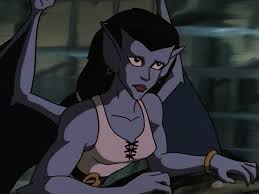
The set contains the final 26 episodes for season two.  It starts with the episode “Monsters,” which if one were to look at an official episode list for the show, should have been the final episode of volume 1.  Instead, the episode “Kingdom” was moved to volume 1 for pacing issues with “Monsters” getting pushed back.  That’s because these episodes comprise the World Tour section of season 2 where Goliath, Elisa, Angela, and Bronx are being sent to all parts of the world by the island Avalon for unknown reasons.  As a result, much of season 2 does not include the other characters such as Broadway or even Xanatos.  Often times, Goliath and co. will encounter a villain from back home while on their travels but just as often they’re paired with someone new.  They also encounter many new gargoyles as Goliath gradually learns that gargoyles are alive and well all around the globe.

Angela is added as a member of the main cast in the second half of season two and plays an important role in the development of the Goliath character.

Angela is added as a member of the main cast in the second half of season two and plays an important role in the development of the Goliath character.

Because of the World Tour format, the second half of season 2 is even more episodic than the first half, meaning the episodes function mostly as stand-alone stories.  I suppose one could argue there’s an overall plot since it’s Avalon that is sending them to these destinations, but it’s a fairly loose one.  Having the setting change each episode is an easy way to inject variety into the show, but the format grows stale.  The stories often feel like filler, and as a viewer I just wanted the group to get back home or for Avalon to finally unveil it’s true intentions.  Not all of the episodes follow the Would Tour group, as there are a couple that take place back in Manhattan.  In one such episode, “Pendragon,” the legendary King Arthur and the gargoyle Griff, two individuals encountered by Goliath and co. during their travels, wind up in New York and interact with the remaining members of the Manhattan Clan.  The World Tour basically lasts for 17 additional episodes of volume 2, with the two-part “The Gathering” representing its conclusion.  It’s far too long, and getting through those episodes started to feel like a chore for me (hence why it took me so long to get to reviewing this set) which is never a good feeling for television viewing.

Thankfully, the remaining handful of episodes are pretty interesting, as is the two-part “The Gathering,” though it’s not as grand as some of the series’ other multi-part arcs.  In that story, the god Oberon is attempting to steal the newborn son of Fox and Xanatos for he possesses some unusual abilities for a mortal.  It is interesting to see Xanatos and the gargoyles take on a god, though the resolution felt a little too neat and tidy for my tastes, but I can’t deny the alternative would have worked much better.  We learn some interesting tidbits about some of the supporting characters of the show, which is one of its great strengths.  The writers never miss an opportunity to focus on a secondary character and add importance to it.  As a result, just about any character who ever had even a minor role in a prior story returns at some point, including one background character viewers likely never noticed in “Vendettas.”  This type of writing helps make the show feel more rewarding for loyal viewers and it does add depth to what would otherwise be shallow characters.

The production values for volume 2 are largely the same as that for volume 1, though the DVDs this time around are of a lower quality.  The colors aren’t as rich and sometimes the image can be grainy, but that’s expected considering this was done on the cheap.  There are still episodes where the animation is of a noticeable lower quality, while others more resemble the quality of season one.  The A+ animation is largely reserved for the bigger stories, but even a stand-alone episode here and there (like “Future Tense”) is given a more striking look.  The score remains excellent as well and the voice acting is the usual high quality Disney output.

The alternate future depicted in "Future Tense" is one of the more fun stand-alone episodes in volume 2.

The alternate future depicted in “Future Tense” is one of the more fun stand-alone episodes in volume 2.

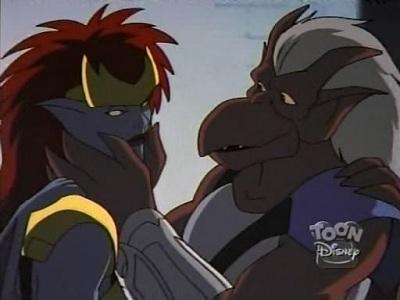
While from an episode quality standpoint I enjoyed this set less than the previous two, there are still some excellent stand-out episodes.  I mentioned “Future Tense” already as being a stand-out in terms of production values, but it’s also a really fun story that looks at an alternate future for Manhattan.  “Sanctuary” is one of the better World Tour episodes as it includes MacBeth, Demona, and Thailog.  Thailog also makes an appearance in another strong episode back in New York, “The Reckoning,” which contains the long anticipated confrontation between Angela and Demona.  The Goliath, Angela, Demona triangle is an anchor in a few stories, and the tension between Goliath and Angela over her lineage is done well.  I don’t think it’s giving away anything to reveal that Angela is the biological daughter of Goliath and Demona, but the writers do a good job of explaining Goliath’s and the clan’s view on children, which is that all gargoyles are children of the clan.  Angela, having been raised by humans, has a human’s perspective when it comes to parents and longs for Goliath to acknowledge her as his daughter.  She has similar feelings towards Demona, though they’re obviously complicated by the fact that Demona isn’t the most likable person/gargoyle.

The Goliath/Elisa relationship is handled quite tastefully by the writers of the show.

The Goliath/Elisa relationship is handled quite tastefully by the writers of the show.

Another tension of the series is the obvious affection Goliath and Elisa feel for each other that largely goes unstated between the two.  The conclusion to the set, “Hunter’s Moon,” addresses it for the first time in a very satisfying way.  It’s hard to write such a relationship because it takes care to make it believable that an attractive woman like Elisa would have romantic feelings for Goliath.  The writers sell it well though, and while I’m not sure they could have ever pulled off a full-on romance for the two, they did find a way to get the point across.  That conclusion, by the way, is a three-part story that actually brings everything full-circle for the gargoyles.  It would have been a fine way to end the series, but a thirteen episode season 3 was picked up by ABC for their then Saturday morning block.  Series creator Greg Weisman wrote the premier for that season, dubbed The Goliath Chronicles by ABC, but had no involvement in the remaining twelve episodes.  As a result, they are not considered canon by Weisman and the series actually continued in comic book form years later.  I may look into checking out those comics but I need to know more about them first and if they’re worthwhile.  I’m pretty happy with “Hunter’s Moon” as a conclusion, as I don’t expect a season three set, and I may choose to just leave Gargoyles with how season two ended.

As for this set, it is what it is.  For those who just want the episodes, it’s the only option save for bootlegs that are probably even worse quality.  When it was released last summer, it was available for a short time on eBay through Buena Vista’s store but once those copies were gone the movie club and secondary market were the only options.  The movie club is actually worth looking into for those looking to start a Disney collection.  For those (like me) who already own a ton of Disney DVDs and Blu Rays, it doesn’t make financial sense.  Very quietly though the set moves to the traditional Disney Store website and is available there for twenty bucks.  The secondary market has yet to adjust, it would seem, as the copies are still routinely priced in excess of forty dollars.  Even so, this is likely not going to be produced in large numbers so if you’re a fan of the show it’s probably a good idea to get it while it’s relatively cheap.  Bland set or not, it’s still 26 episodes of a pretty strong show for twenty bucks and if you already have the first two it’s basically a must-have.  Gargoyles is among the elite action cartoons of the 90’s, and for me it ranks among Batman and X-Men as the best of the best.


Space Dandy – Live With the Flow, Baby

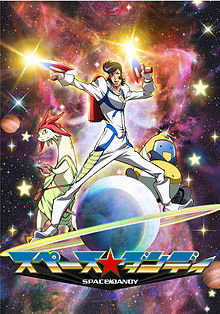
Space_Dandy_promotional_imageA new anime series premiered last night on Cartoon Network’s Toonami block:  Space Dandy.  Space Dandy is the latest series from Shinichiro Watanabe (which is how it got my attention, it also didn’t hurt that Toonami used a Misfits song in the TV spots leading up the premier), best known for  being the director of Cowboy Bebop and Samurai Champloo.  I never got into Samurai Champloo (never really tried to, either), but I love Cowboy Bebop and consider it the finest anime series I’ve ever experienced.  Granted, my experiences with anime have decreased in volume over the years.  As a kid and teen I took in quite a bit.  I’m familiar with pretty much all of the big ones from the 80’s and 90’s such as Akira, Neon Genesis Evangelion, Dragonball, Fist of the North Star, and so on.  Like any medium, there are good and bad representatives.  There are also common threads amongst the various programs.  Most anime certainly shares similarities in look and appearance.  There are also certain tricks that have become cliché since, like the screaming hero jumping through the air, still frames with nothing but a mouth moving, mouths going from being really small to really large, etc.  Even so, it’s not fair to generalize and say that anime is either good or bad, or that someone is an anime fan or non fan.  Anyone with an open mind can find anime they like and don’t like, just as they can with live-action movies and television shows.

All of that was a long-winded way of saying that the success Watanabe has had in the past has little baring on Space Dandy.  Cowboy Bebop is among the greats, and holding Space Dandy up to that standard seems unfair, and yet they invite comparisons due to the Watanabe connection.  They also share other similarities.  For one, Space Dandy takes place in space (big shocker there) and the main character, Dandy, is an alien hunter.  That is quite similar to the space bounty hunter profession of the Bebop crew.  And like the Bebop crew, Dandy doesn’t appear to be very good at his job.  He’s alone on his space ship when the episode begins accompanied only by his robot assistant QT.  We soon learn QT is out-dated and becoming obsolete and the spaceship is in need of some repair as well.  Dandy’s occupation as a space hunter is to apprehend unclassified aliens, and then turn them in for profit.  I presume they need to be alive, but I’m not positive.

Expect to see lots of T&A with this program.

Expect to see lots of T&A with this program.

That’s the basic premise.  Where Space Dandy seeks to differentiate itself from prior Watanabe programs is with its look and humor.  Space Dandy is riddled with sophomoric humor.  The first episode opens with Dandy debating the merits of ass-men and boob-men before going to his favorite hang-out, the Hooters parody simply known as BooBies.  The show is accompanied by a narrator, who informs us that Dandy hopes to one day own his very own BooBies.  This narrator is really a third character, and the other characters in the show break the fourth wall more than once to acknowledge him.  The narrator is forgetful and provides updates throughout the show and fills in some of the back story, which in the first episode, almost seems irrelevant.

Dandy himself is rather dim-witted and perverted.  He’s a slow thinker, though he’s not obviously dumb like a Homer Simpson or Peter Griffen.  He’s also really self-absorbed and appears to have an obsession with his own hair.  He’s also a pretty lousy shot and poor judge of situations.  He’s not mean-spirited though, which makes him likable.  QT is similarly incompetent at its job, some of that due to the fact that its obsolete.  QT, despite being a robot, also doesn’t seem to mind being lazy.  Other characters introduced in the first episode include an alien from Betelgeuse with an unpronounceable name (he looks like some kind of space cat, so Dandy dubs him Meow against his will) and a mysterious ape-like scientist named Dr. Gel.  Dr. Gel is an ominous figure in the debut episode who is pursuing Dandy as he is the key to a war raging on.  Gel answers to a strange monarch-like figure with a flaming skull for a head and pilots a spaceship that contains the head of the Statue of Liberty with a ball-gag in its mouth.  Clearly it’s a reference to Planet of the Apes though I do wonder if it will have any relevance beyond that or if it’s just a visual gag (no pun intended).

The main goal of the show appears to be to induce laughter.  The tone is very silly and the neon colors and up-beat electronic music add to the feeling.  The plot of the first episode mostly exists to introduce the characters and then show us just how bad Dandy is in action.  It ends on an apocalyptic note, and I wonder how the second episode will open.  It’s possible there will be an absence of continuity from one episode to another though I personally doubt that.  It’s impossible to judge a series based on one episode, but Space Dandy did not make an overly strong impression on me.  It seems fun enough, but I do wonder if it will have much staying power.  It may prove too silly for my taste, but I am comforted by the fact that it took a few episodes for Cowboy Bebop to hook me so it’s possible Space Dandy will require the same.  To make myself stick with it, I’ve programmed my DVR to record it each week.  Maybe I’ll have reason to revisit this topic in a few months.


Fighting the Post-Xmas Blues with the PS4

images-180Every year it’s the same.  The Christmas decorations and merchandise show up in stores in early October, in homes right around Thanksgiving, and everything is pretty festive come December.  Then like a rush, it comes and goes and we all settle in for a cold winter (unless you live in a warm climate, in which case I hate you right now) and wait to do it all over again come the fall.  I love Christmas, and I’ve talked about that at length in other posts, and whenever it’s over I get the post-Christmas blues.  A friend and I used to refer to December 26th as the most depressing day of the year, because it’s the furthest away from Christmas one can be.  My adoration for the holiday is not rooted in the fact that I have to wait another year for gifts.  Certainly, that was a big part of it as a child, but as an adult I’ve just come to appreciate the season even more and that special connection I have with it via my childhood.  Now I appreciate the lead-in to Christmas more than the actual holiday.  I like seeing the specials on television, I enjoy having decorations all over my home (I don’t decorate for any other holiday, though my Danzig/Misfits theme could be considered a Halloween one, if it wasn’t year round), and I even kind of like the stupid songs on the radio and in every store.

Whenever Christmas leaves, though, I get the blues.  Each year it seems to be slightly worse.  This year it took me a good week to shake it though sitting here and thinking about it brings the ache back.  The only way to combat the post-Christmas blues is the same today as it was when I was a kid:  with new stuff!  Namely, the stuff I received for Christmas.  As a kid, this worked pretty damn well and while I was bummed Christmas was over I at least had a ton of new action figures, games, and movies plus no school until after New Year’s.  As an adult, the material things are less important and less fun (I typically use Christmas as an opportunity to refresh my wardrobe), but this year I did receive a most excellent present:  Playstation 4.

I was actually quite proud of myself for not buying the PS4 when it launched.  Part of that was I did kind of expect to receive it as a gift from my bride-to-be, but part of it also was me trying to be more financially responsible.  I had a Disney World vacation in September to budget for, plus a wedding in the new year (and the bill for the engagement ring), and an expensive summer to recover from that included a new water heater and central AC condenser.  2013 was an expensive year and I actually did a good job of not buying a bunch of video games and records and such.  It still wasn’t easy to resist the call of new hardware though, but I am glad to say the wait was worth it.

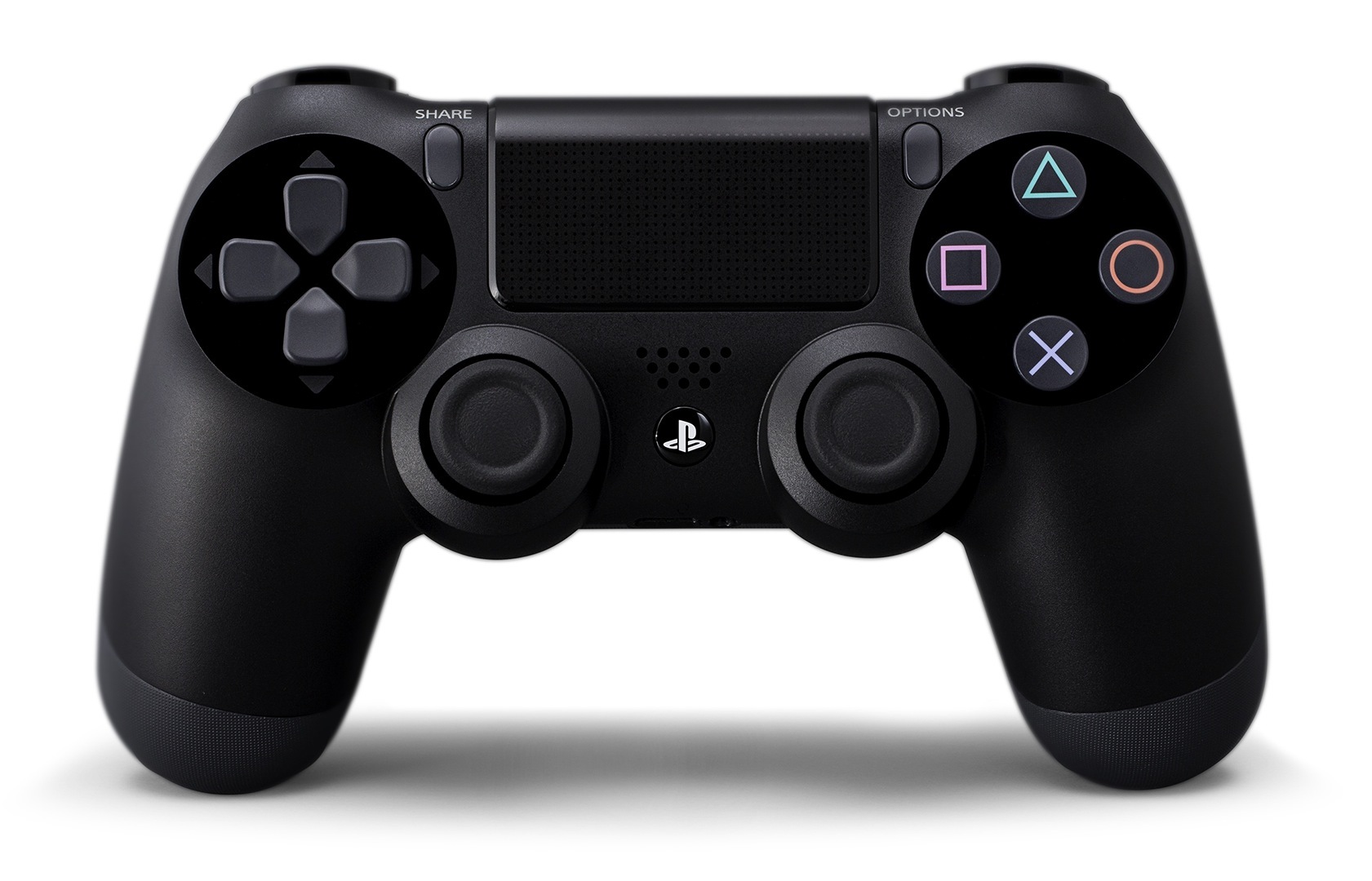
A new controller for a new generation.

A new controller for a new generation.

Getting a new console like the PS4 is less fun than others.  Not because it’s inferior or anything, but because it’s so ordinary.  With consoles like the Wii and the Wii U, there’s excitement over the new input device but with the PS4 it’s just a more powerful PS3.  It’s a modern console and works in a modern function.  I did not get the camera, so I can’t talk about how that works, but everything else is pretty much as expected.  There’s a new interface that modifies the cross-media bar of the PS3, but not drastically so.  It’s nicer to look at and there’s more emphasis placed on the Playstation Network features though not at the expense of the actual game loaded into the system.  That, and any downloaded titles and demos, are front and center so jumping right into a game is seamless and easy.  The new setup is different enough from the old one that first-time users will have to actually pay attention to what they’re doing, but it soon becomes second nature.

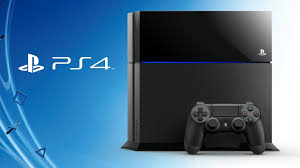
Really, the PS4’s most distinguishing features are it’s physical look and dimensions.  The new console is pretty sleek looking and reminds me of the technology from the Mass Effect series.  It’s black with about 2/3 of the console having a matte finish, and the remaining third a glossy one.  There’s a single stripe that runs through it that glows when the console is on or in standby mode.  There’s a couple of USB ports on the front for controller charging, and the only two buttons are almost impossible to see.  They’re actually just touch panels, one for power and one for disc ejection, and are placed amongst the stripe running through the console.  I couldn’t even find the power button with my eyes the first time I hooked up the console and brushed it accidentally.  The console is also quite small and tidy.  It’s smaller than basically all of the prior Playstation consoles, save for the PSOne and the PS2 Slim.  It’s practically tiny when placed beside my model one PS3 and much smaller than its direct competitor, the Xbox One (it dwarfs the Wii U though).  The size is perfect for me as it just barely fits into my entertainment stand beside the Wii U with both laying horizontally.  Like the PS2 and 3, the PS4 can be displayed vertically.  Sony recommends users buy their stand if opting to do so, though the console seems pretty stable to me without it.  The console runs quiet and runs cool as well.  I have played it in marathon sessions for five to six hours at a time and it’s only ever warm to the touch, not hot, so it appears to be well ventilated.

The biggest change for the PS4 resides in the controller.  The dual shock controller was first introduced by Sony during the PSX era and has received only minimal modifications since.  The new dual shock 4 represents the biggest change for the venerable controller, though it still retains its traditional shape.  The handles have been elongated and the body of the controller is a touch thicker.  The face buttons, including the directional ones, are ever so slightly closer together.  The directional buttons feel better, which is great considering the Playstation console has always had the best d-pad, and the analog sticks are now closer to the rest of the controller.  The new ridges added to each stick does help keep one’s thumb in place (and makes them basically the same stick as what’s on the Wii), and both still retain button functionality.  The handles of the controller have a satisfying grip texture to them, and the R2 and L2 buttons are better shaped for human fingers.  The start and select buttons are gone, replaced with an options button and a big touch panel that also acts as a button.  It remains to be seen if the touch functionality of this over-sized button will have any worthwhile applications, but it’s there for developers to utilize.  The Playstation button has been moved in between the sticks to accommodate this touch pad, and a Share button (for social media integration, if that’s your thing) and speaker have been added.  The console also comes with a headset that can be plugged into the underside of the controller.  I haven’t used it, but it’s a nice feature to have.

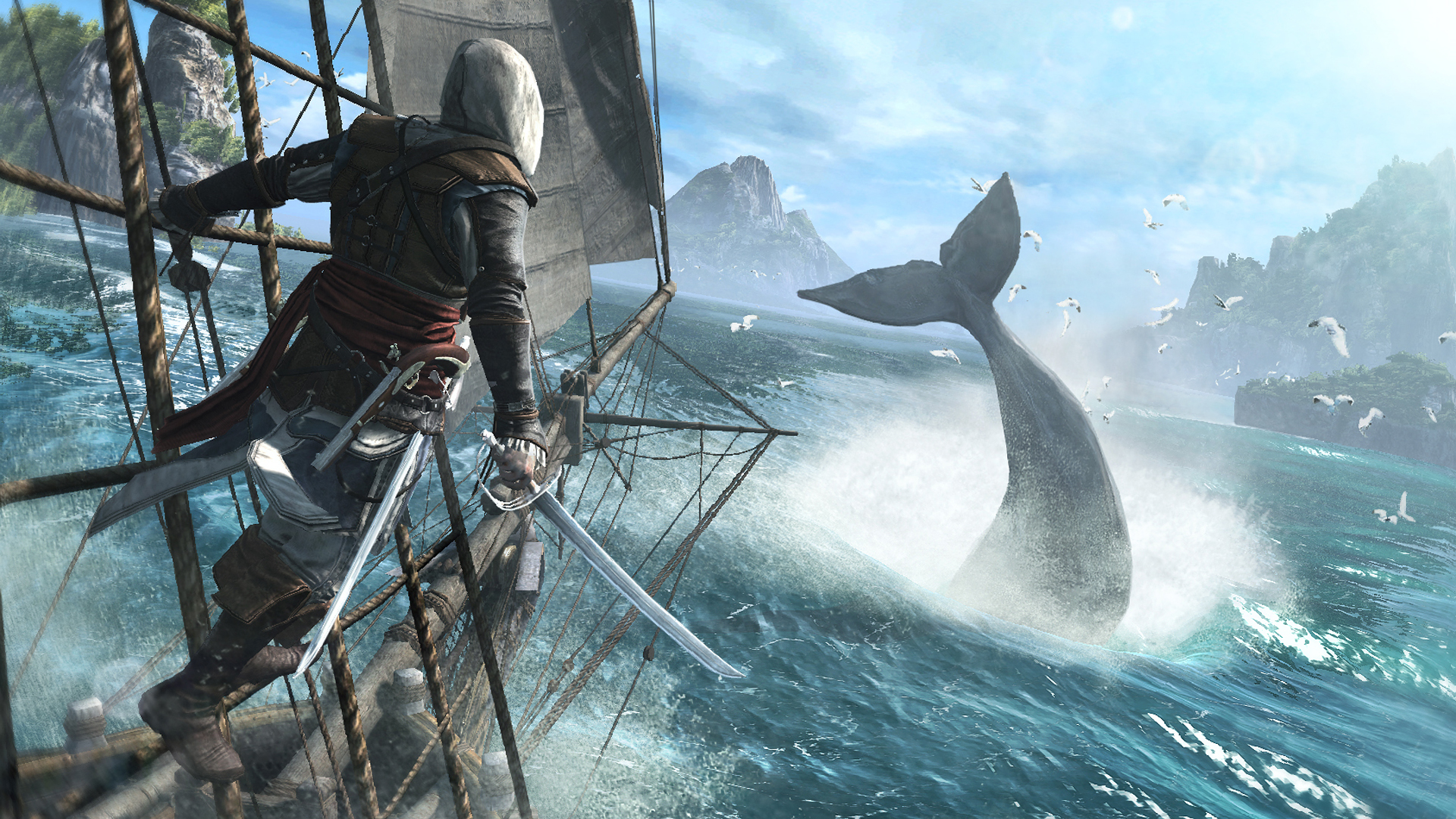
The high seas have never looked better.

The high seas have never looked better.

The dual shock 4 truly feels like a home run for Sony.  It’s an improvement in pretty much every way from the dual shock 3 and its updates are both practical and tasteful (well, maybe not the touch pad but we’ll see).  The only negative I have found with it is the battery life.  Like the dual shock 3, the dual shock 4 contains a non-removable rechargeable battery.  Unlike the PS3, the PS4 can charge controllers when it’s in standby mode. Unlike the dual shock 3, the dual shock 4 cannot be charged by plugging it into a non PS4 device such as a PC or cable box.  With the dual shock 3, I could often go days in between charges but with the 4 I find I’m plugging it into the console whenever my gaming is finished for the day.  I haven’t ridden it down to nothing yet, but I would estimate the battery only lasts 6-7 hours on a full charge.  That’s suitable for one gaming session, though there are some who may not agree, but if I were to forget to plug it into the PS4 when I’m done for the day I’d be regretting it the next time I went to play.  Part of this issue will be rectified by getting a second controller (I’m holding out for the colored ones), but it is disappointing to see the battery life so poor.  Some users have also complained that the rubber of the analog sticks wares out quickly.  I just inspected mine which has logged probably around 30 hours at this point, and the heavily used left stick looks no different from the little used right one.  Maybe some people are just getting duds or are really hard on analog sticks.

Thief is looking like it will be my second PS4 game, hopefully it doesn't disappoint.

Thief is looking like it will be my second PS4 game, hopefully it doesn’t disappoint.

The only other fault I currently find with the Playstation 4 right now is a problem all too common, it seems, with new consoles:  the games.  Now, I should state that I am not a first-person shooter fan.  If I was, I’d probably be having a good time with the new Kill Zone game.  Since I’m not, I have Assassin’s Creed 4.  The Assassin’s Creed series is a popular and well known one published by Ubisoft.  I have previously played Assassin’s Creed 2 and enjoyed it, but when it was over I was not itching to play another.  AC4, which I am around 25 hours into, is a better game.  It’s a good game, it’s just not a “wow” game.  It was developed for and is available on the Xbox 360 and PS3, so it’s visuals on the PS4 are not a true representation for what the console can output.  It’s a great looking game, just not a great leap over what I’m used to.  And like AC2, there are little things about AC4 that bug me.  There are too many missions where I’m asked to just follow somebody and eavesdrop on their conversation.  AC has always been an action game masquerading as a sneaking one.  The sneaking mechanics just aren’t anything special, especially considering that I just finished up Dishonored a few weeks ago, and the enemy AI is downright shoddy when it comes to sneaking around.  The fighting is fun, though it can get annoying during big conflicts such as ship-boarding when Edward (the main character) starts attacking the wrong guy.  Or when he goes into one of his long kill sequences only to get struck from behind by another enemy.  Controlling him out and about the various locales is equal parts fun and frustrating.  He can scale almost anything, and often will start climbing something you don’t want him to.  Sometimes the game calls for quick decisions and Edward makes the wrong one by jumping to an unintended spot or assassinating the wrong enemy.

Assassin’s Creed 4 may be flawed, but it’s also really fun.  It can aggravate me greatly at times, but I’m also hopelessly addicted to it so clearly it’s doing something right.  It’s a meaty game too, which is great because nothing else currently available for the console interests me in the least.  The next game I have my eye on is Thief, which drops next month so I should be all set.  Especially considering I still have last generation games to play including The Last of US, Ni No Kuni, and Skyward Sword (which I received for Christmas in 2011, and have yet to play, which is embarrassing).  I’ll be plenty busy the next few months with or without PS4.  I look forward to more games though, and the PS4 has made an excellent first impression on me.  Hopefully the various developers comes through and the PS4 ends up with a library of games that rivals its predecessors.


Scrooged

Scrooged (1988)

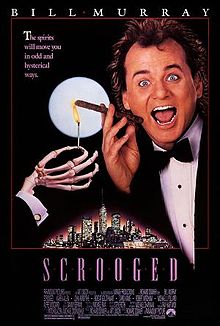
Scrooged (1988)

Richard Donner is known primarily for being the director who convinced you that a man could fly, but he also directed and produced the first Christmas movie I ever saw where the lead character was something more than despicable.  In a way, Scrooged is kind of a precursor to a film like Bad Santa where the audience isn’t supposed to like or even feel much empathy for the lead role.  And even though Scrooged is a take on A Christmas Carol, the leading male in the Scrooge-like role just seems far more unlikable than any Scrooge I ever bore witness to.

The Scrooge in this film is played by Bill Murray, an actor who has made an awful lot of money portraying selfish, sarcastic, and cynical characters that audiences are able to embrace because that character offers some redeeming qualities.  Murray’s Peter Venkman in Ghostbusters ultimately embraces his hero role and puts his life on the line for the city of New York.  Groundhog Day’s Phil Connors is quite the unlikable character at the film’s onset, but throughout the movie he’s redeemed and becomes a better person in the end.  In Scrooged Murray plays Frank Cross, a television executive whose ambition in life is entirely career oriented.  Unlike many depictions of Scrooge, he’s not necessarily out solely for financial gain (though that’s definitely a part of it, and he’s pretty cheap) as his main ambition appears to be to rise to the top of the career ladder.  He’s ruthless, self-centered, and shows no empathy for the people around him.  As a television executive, he approves a television spot for an upcoming live edition of A Christmas Carol that has an apocalyptic feel opting to lure in viewers through fear and intimidation rather than on the strength of the program he’s pushing.  He shows no regard for his loyal secretary, Grace (played by Alfre Woodard and the film’s Bob Cratchit), and makes her work late with no Christmas bonus, and when one of his subordinates (Bobcat Goldthwait’s Eliot Loudermilk) disagrees with his absurd TV spot he has him fired.  Usually we can laugh at a Bill Murray character even when he’s a jerk.  With Frank Cross, we can’t even laugh at him because he’s too good at being mean.

Carol Kane's character is likely to draw the most laughs.

Carol Kane’s character is likely to draw the most laughs.

I am an unabashed Bill Murray fan.  I love him in pretty much any role.  I don’t know exactly what it is about Murray that appeals to me so much.  He’s obviously a great actor whose range still seems to surprise people whenever he takes on a more dramatic role.  He’s best known for comedies and I certainly have a nostalgic affinity for Ghostbusters.  He also reminds me of my own father so that can’t hurt.  With that said, even I find it hard to watch the first half hour of Scrooged.  Frank Cross is a terrible person and he gets away with so much.  His brother James (John Murray, Bill’s real-life brother) is willing to forgive his short-comings to a fault, while ex-girlfriend Claire (Karen Allen) almost seems to ignore his numerous flaws.  We never quite see how the two characters broke-up, just a hurt Claire proposing they take a break when Frank once again chooses his career over her, and we get the sense that Frank just shrugged his shoulders and forgot to ever follow-up on that break.  I watched the film recently with my fiancé who remarked that she kind of hated the movie while we were in its early stages and I couldn’t blame her.  I do wonder if perhaps Murray and Donner felt like Murray was too likable as an actor at this stage in his career and that they needed to over-do just how awful Frank is to counteract that.  The film does benefit some from this overly cruel Scrooge as the character is redeemed by the film’s conclusion, but I still get the sense the Cross character was overdone.  Not only is he too cruel, he’s not always believable in his cruelty.  And it’s somewhat surprising that this character even could be redeemed.

The film's makeup effects are still impressive today.

The film’s makeup effects are still impressive today.

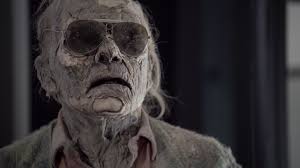
The film was initially hyped as a special effects bonanza.  Given that the film was released in 1988, these effects are not impressive by today’s standards.  The effects are mostly put to use with the film’s ghosts.  Just like in A Christmas Carol, Frank is visited by three spirits, the ghosts of Christmas past, present, and future.  All take on an appearance and character to better suit this film’s setting of 1980’s New York.  The first ghost, played by David Johansen, is a cab driver who takes Frank on a tour of his past giving the audience insight into his childhood and past relationship with Claire.  Christmas Present is played by Carol Kane and she is portrayed as a violent fairy-type.  She repeatedly strikes Frank and is likely to be the character who induces the most laughs.  The Ghost of Christmas Future is depicted as a Grim Reaper-like figure whose main twist is a television screen for a face (and his “body” is revealed as a mass of screaming souls that looked revolting in the 80’s but kind of cheesy now).  A lot of makeup effects are in use with the ghosts, and the best is probably reserved for the Marley character played by John Forsythe.  His decomposing body is grossly, and convincingly, portrayed on-screen with lots of gray and a dusty, flaky, texture.

Eliot doesn't respond well to being fired.

Eliot doesn’t respond well to being fired.

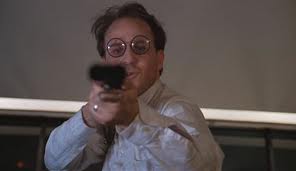
For the film’s comedy, it tends to rely on a grab bag of tricks as opposed to resorting to one style.  A lot of the “humor” in the film’s early scenes are of the dark variety as the audience is asked to laugh at the misfortune of others.  It’s horribly mean-spirited, and some won’t find any laughs at all.  As the film moves along the humor becomes more dialogue and situation specific with less of a mean tone.  There’s also physical comedy, notably from the Ghost of Christmas Present and later in the film when Goldthwait’s Eliot goes off the deep-end.  It’s not a rip-roaringly funny film, but the laughs are spread around well once it gets past the early parts.  The score is done by Danny Elfman and it’s a pretty typical Elfman type of score.  People seem to either love or loathe Elfman but I’ve never had anything against him and find his score suitable here.

Since this is a take on A Christmas Carol, Frank is shown the error of his ways and comes around by the film’s conclusion.  Just like how his cruelty felt overdone, the big redemption scene feels similar as Frank hi-jacks the live television production of A Christmas Carol to share his new-found appreciation for Christmas with the world. It’s uncomfortably funny and drawn out, but does provide the happy ending most were probably hoping for.  The film’s beginning and its end make it feel like the film is a lot longer than its 101 minutes running-time, but by the time it did end my fiancé had come around and proclaimed it “cute.”  I suspect most viewers will have the same experience.  Scrooged is too flawed a film to be a true Christmas classic, but it is well acted and differs enough from other clones of the source material to make it a worth-while viewing experience.  Those looking for something a little less saccharine in their Christmas movies will probably get the most out of Scrooged.


Christmas Time in South Park

Christmas Time in South Park (2007)

Christmas Time in South Park (2007)

South Park famously began as a video Christmas card, so it should come as no surprise that the television series (which just concluded its 17th season) has spawned many Christmas specials of its own.  Series creators Trey Parker and Matt Stone actually haven’t done a new one since 2004’s Woodland Critter Christmas, but still have output seven Christmas specials which have been conveniently compiled for the DVD release Christmas Time in South Park.  The first run of Christmas specials for the show actually felt connected to one another as they all explored the spirit of Christmas:  what is it?  What does Christmas mean?  Of course, this being South Park, don’t expect a lot of feel-good and overly sentimental holiday themes as is found in most Christmas specials, though surprisingly some of these episodes echo their tamer counterparts and some even have a good heart at the center of the story.

Lets talk about these episodes, and specifically, the DVD release of Christmas Time in South Park.  The DVD case and menus echo those Little Golden Book releases you may remember from your childhood.  The menus are animated and the characters will berate you for taking too long to select a feature.  The cursor of your DVD player, naturally, is represented by a smear of Mr. Hankey leavings.  All seven Christmas specials are featured in chronological order.  Unfortunately, all seven are also censored like their season release counterparts (for South Park’s older episodes, uncensored versions do not exist as no one anticipated there being a huge market for full seasons of TV shows) which means you’ll be hearing beeps whenever the characters utter a colorful phrase.  Also missing, is the short that started it all:  The Spirit of Christmas.  This seems like a huge and careless omission to me.  Why go through the effort of putting out a compilation of Christmas specials and leave out the very first one? My only guess is that the studio felt that The Spirit of Christmas was too strong a selling point for releases like South Park:  The Hits and its inclusion would harm other DVD sales.  Quite possibly, it was just forgotten as this DVD was slapped together quickly to cash-in on the holiday season.

The first Christmas special, and the one that introduced Mr. Hankey to the world.

The first Christmas special, and the one that introduced Mr. Hankey to the world.

At least there are still seven, mostly excellent, Christmas episodes for your viewing pleasure.  The first being Mr. Hankey the Christmas Poo.  This was South Park’s first Christmas special and apparently Parker and Stone wanted to create a new Christmas icon for the world they created so they turned to a talking piece of shit.  Parker and Stone hold nothing back when it comes to Mr. Hankey.  He’s disgusting, and they don’t want you to forget that so we get bits of him leaving poo trails everywhere he goes and even bathing in Mr. Mackey’s coffee, while he sips it.  The framework of the episode is Kyle feeling excluded from all of the Christmas excitement on account of him being Jewish.  Simultaneously, Kyle’s mother (the Jewish community) is upset about the inclusion of the nativity in a school Christmas play.  Her complaining to the mayor sets off a chain reaction where in response the devout Catholics in town demand to see Santa removed from the play, hippies want to get rid of Christmas trees, epileptics demand the removal of Christmas lights, and the virgins (presumably) want to get rid of mistletoe.  The show is clearly poking fun at all of the people that get uptight over Christmas, and Mr. Hankey is called on to save the day.  That the town needs to listen to crap in order to see the error of its ways is probably a commentary on something too.  Everyone thinks Kyle is insane for seeing and believing in Mr. Hankey, until the boys find out Chef does as well.  Once everyone believes, Mr. Hankey reminds everyone that Christmas is a time to be nice to one another, forget about all of the bad stuff in the world, and bake cookies.  Kyle is released from the nut house, and Kenny lives to see the end credits for the first time.  It’s a wacky Christmas special, that may still be the show’s best, with tons of gross-out and hilarious moments.

Merry Christmas, Charlie Manson! is the second season’s Christmas special and it’s subversive in a different way.  Rather than try to be absurd and gross people out with singing poop, Parker and Stone decided to use an unlikely character and have him saved by Christmas.  Enter mass-murderer Charlie Manson, faithfully depicted with a swastika tattooed on his forehead.  Cartman and his mom are heading to Nebraska to visit family for Christmas, and the boys have been invited along.  Kyle is allowed to go presumably because his family is Jewish and couldn’t care less that it’s Christmas while Kenny’s family is sending him on a  mission to bring back leftovers.  Stan’s mom is the only one who has a problem with her son being away from the family at Christmas, so Stan sneaks out and tells the Cartmans that his family is dead.  When the boys get to Nebraska (after a long and torturous car ride full of singing) they find that a house full of Cartmans is a horrible place to be as all of them basically act just like their own Eric Cartman.  They soon find out that Cartman has an incarcerated Uncle Howard, as he breaks out of jail and (stupidly) returns to hide-out in his parent’s basement.  He brings along his buddy, Charlie Manson, whom the boys are ignorant of.  When no one will take them to the mall to see Mr. Hankey, Manson offers to do it himself to avoid sitting and watching Christmas specials all day.  At the mall though, he watches a poop version of How the Grinch Stole Christmas and begins to see the light.  He gets his tattoo altered into a smiley face, and takes the kids home, but not before attracting the attention of the local police.  They’re soon all trapped in the house as Uncle Howard takes the family hostage.  Manson, now full of Christmas spirit, convinces Howard to surrender and even reminds Stan that Christmas is a time for family.  The episode ends with the characters from the episode in Manson’s jail cell wishing him a merry Christmas, Charlie Brown style.  As Stan reminds us, this is some pretty fucked up shit right here.

If you don't like his special, he has some balls you can suck.

If you don’t like his special, he has some balls you can suck.

Season Three’s Christmas special is Mr. Hankey’s Christmas Classics.  It’s just a collection of songs, some traditional and some new, sung by the characters of South Park.  It’s kind of a love it or hate it episode, and one I’m not really fond of.  However, Mr. Hankey instructs the audience during the intro that if we don’t like it we can suck his tiny little balls.  As small as they may be, I don’t want to suck any poo balls so I’ll cease to speak of this episode right here.

Season Four brings us A Very Crappy Christmas and it could basically be re-titled as The Story of South Park.  That’s because in it the boys actually create and animate The Spirit of Christmas just like their creators.  Following the events of the first two Christmas specials, the people of South Park now understand that Christmas is a time for being merry and spending with one’s family.  The commercialism is gone, and the boys are pretty pissed off about not getting presents so they go looking for a strangely absent Mr. Hankey.  They find their favorite piece of crap has been MIA because he now has a wife and turds of his own.  As the boys lament the absence of what they perceive to be the Christmas spirit, they get the idea to make their very own Christmas special.  The mayor, who needs the commercialism to spur the economy, agrees to fund their little project.  Nothing goes right, but when Kyle channels his own inner Christmas spirit (and the Rankin/Bass feature Twas the Night Before Christmas) he gets everyone back on track.  Most of the episode is a parody of Twas the Night Before Christmas while also containing numerous in-jokes for longtime South Park fans.  In the end, they’re able to show the town The Spirit of Christmas and everyone realizes that Christmas is about one thing:  presents.  Everyone starts shopping immediately and the town’s economy is saved.  Yay!

The Hankey family expands in A Very Crappy Christmas.

The Hankey family expands in A Very Crappy Christmas.

Season Five was the first to not feature a Christmas episode, but season six restored order with Red Sleigh Down, a parody of Black Hawk Down and the conclusion of what I see as the Christmas story started in season one.  In it,  Cartman desperately wants some slick new toy but realizes he’s been far too naughty to hope to get anything from Santa so he goes all out to be nice at the last minute.  His scheming leads him to believe that if he helps Santa bring Christmas to Iraq that will be enough, so he enlists the help of Stan and Kyle (Kenny’s been dead all season) and eventually Mr. Hankey in order to do so.  Mr. Hankey is thrilled at Cartman’s Christmas spirit and agrees to help by taking the boys to the North Pole aboard the Poo-Choo Express (it’s just as disgusting as you imagine).  Santa agrees that Christmas should be brought to Iraq, and the boys watch from the North Pole as Santa’s sleigh is shot down by an RPG over Iraq.  Now feeling guilty and terrified by the prospects of no more Christmas presents, the boys enlist the help of the one man who can save Santa:  Jesus.  They all take Santa’s back-up sleigh to Iraq where Jesus becomes a one-man death machine as he takes out numerous soldiers to save Santa.  Their escape goes wrong when Jesus is shot from behind and dies in Santa’s arms.  They’re able to escape, but not before a vengeful Claus does finally bring Christmas to Iraq.  Back in South Park, the townspeople have been distracted by the speech impediment of Jimmy who’s attempting to recite The Twelve Days of Christmas, an episode-long gag.  Santa lights the town tree and addresses the crowd telling them that Christmas should be a day to reflect on the sacrifice one man-made to save Christmas:  Jesus.  And with that, the spirit of Christmas is modified once again in the South Park canon to be a day dedicated to Jesus.

Santa and Jesus team-up in Red Sleigh Down.

Santa and Jesus team-up in Red Sleigh Down.

With the spirit of Christmas now fully defined, Parker and Stone decided to take the boys on a Christmas adventure to Canada, of all places.  The new Canadian Prime Minister has decided that all Canadian born children be returned to Canada, which means Kyle’s adopted brother Ike is required to go.  Kyle enlists the help of his friends to go appeal to the Prime Minister, though they’re all reluctant to risk missing Christmas.  They go anyway, and in Canada they find a world not unlike Oz where the locals instruct them to “follow the only road.”  Just like The Wizard of Oz, the boys encounter other Canadian citizens looking to appeal to the Prime Minister about something, while the villainous Scott, from the Terence and Philip special, makes a return.  In the end, they discover the new Prime Minister is actually Saddam Hussein in hiding, and his new laws are overturned while the boys do in fact miss Christmas.  Cartman is unable to see the bright-side in Kyle getting his brother back, while Stan laments on missing out on a Christmas adventure, oblivious to what just happened.  It’s Christmas in Canada is not one of my favorites, and it’s probably the weak link on this DVD, though I do know more than one person who finds the episode hilarious.  I think I would like it more if it had more to do with Christmas.  It’s not really a Christmas special, just an episode that takes place during Christmas.

"It's Critter Christmas, dude, it sucks ass!"

“It’s Critter Christmas, dude, it sucks ass!”

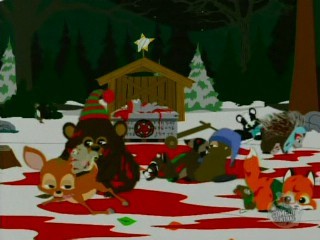
This brings me to the last episode on the DVD, and so far, the last Christmas episode South Park has done:  Woodland Critter Christmas.  Seemingly out of ideas for a Christmas special, Parker and Stone decide to just completely subvert the idea of a Christmas special.  In this episode we have an innocent sounding narrator tell the story of a boy trying to help a group of talking woodland critters so that they can have a merry Christmas.  The critters are intentionally made to seem sterile and innocent while the episode is also intended to appear to be a cookie-cutter Christmas special with little thought or effort (the main character has no name, all of the animals names are just the name of the animal with a long “e” sound at the end, such as Deery the deer, Rabbity the rabbit, and so on).  Of course, the catch is that these animals are trying to bring about the birth of their lord and saviour.  Porcupinie has been impregnated by their god, but a mean old mountain lion wants to kill her, so the boy (Stan) is enlisted to help.  He succeeds by killing the mountain lion, who also happened to be a mother to three cubs, only to find out the critters worship Satan and the porcupine is set to deliver the anti-christ.  The tables are turned and soon Stan is left trying to prevent the coming of the anti-christ and he’ll receive help from Santa and a little thing called abortion.  Woodland Critter Christmas basically sets out to be the most obscene Christmas special one could dream up.  It’s almost as if Parker and Stone just wanted to top their prior specials in terms of shock-appeal and perhaps because they haven’t thought up a way to top this one is why we haven’t seen any new Christmas specials from South Park.  If this is the type of thing you can laugh at, then Woodland Critter Christmas should do the trick.  It’s ridiculous, but also pretty damn hilarious.

These specials are a big part of my memories growing up, even into college.  It seemed like each one was a topic of conversation when it originally aired because people generally couldn’t believe what they just saw.  South Park has had a lot of moments like that over the years, and for whatever reason, Christmas seems to bring out the best in it.  I love the sappy, sentimental Christmas specials that dominate the air during this time of year, but sometimes it’s nice to watch something that is decidedly less reverential towards the holiday season.  South Park does the trick, and Christmas Time in South Park is a convenient release and a suitable way to get my laugh on during the month of December.


A Mickey Mouse Christmas

Mickey Mouse has appeared in many Christmas themed specials and shorts over the years.  I suppose that should be expected of a character who has been around for over 80 years.  I don’t think he’s appeared in more Christmas specials than any other popular character (the boys in South Park actually had a nice streak going on of a Christmas special nearly every year) but he’s certainly in the discussion.  Many of Mickey’s Christmas exploits took place on the big screen in the form of shorts, but have since become television staples during the Christmas season.  Rather than make an individual post here and there on certain ones, I’ve decided to make one long post that hits on the ones I’m most familiar with.  This list isn’t exhaustive as I’m sure there are more modern television specials that I’m not familiar with, but consider this a good start.  The following list is in chronological order, starting with the earliest.  They’re all available on DVD in some fashion, and the old shorts can be found on youtube as well (Disney is pretty lax with its old shorts when it comes to youtube, probably because the Treasures line of DVDs is out of print)

Mickey’s Good Deed (1932)

The original version was in black and white, but colorized versions exist today.

The original version was in black and white, but colorized versions exist today.

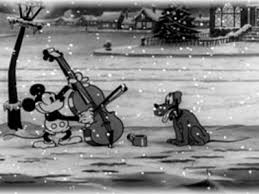
Mickey’s rise to fame nearly coincided with The Great Depression.  As such, it’s a pretty common site to see Mickey depicted poor and penniless.  In Mickey’s Good Deed, he’s a street performer looking to make a buck.  As far as we know, his only possessions are his cello and Pluto.  After a day of playing, Mickey and Pluto look to score some dinner and find that passer-byes have been tossing nuts and bolts into Mickey’s cup instead of coins.  Down on their luck, Mickey has a mishap that leads to the destruction of his cello, while a rich pig offers to buy Pluto for his bratty kid.  Mickey, of course, refuses but he soon happens upon a family of poor cats.  Wanting to give them a good Christmas, Mickey reluctantly sells his dog, dresses up as Santa, and gives the cat family a nice Christmas.  Pluto, meanwhile, is miserable as he’s abused by the bratty boy pig leading to the father tossing him out and spanking his kid.  Pluto is able to happen upon a despondent Mickey and we get a nice, happy ending.  It’s a cute little Christmas short that unfortunately is never shown on air because of one instance of perceived racist imagery.  A little balloon the Santa Mickey carries appears to depict a blackface character portrait on it.  This means the short is relegated to the vault section on the release Mickey Mouse In Black and White Volume 2.  Despite that, it’s actually been released here and there on VHS and DVD, including a colorized version on the most recent release Holiday Celebration with Mickey and Pals.

Toy Tinkers (1949)

It's all-out war when Chip and Dale sneak into Donald's house.

It’s all-out war when Chip and Dale sneak into Donald’s house.

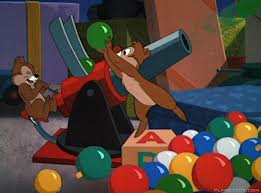
I’m cheating here, because this is actually a Donald Duck short and does not feature Mickey, but who cares?  This Christmas themed short pits Donald versus perhaps his most famous antagonists:  Chip and Dale.  While out chopping down a Christmas tree, the mischievous chipmunks take notice and follow Donald back to his home where they see a nice, warm environment and bowls full of nuts.  The duo slip in and immediately start using the toys around the tree to transport the nuts out of there.  Donald, not one for charity, takes note and a full-scale battle breaks out over the nuts with the two using pop guns and toy cannons on each other.  It’s a silly, and fun short where Donald is mostly punished for his cruelty (and because it’s more fun to see Donald lose his temper) and things mostly work out for Chip and Dale.  Unlike Mickey’s Good Deed, this one will pop up from time to time on the Disney channel during the holiday season.  Otherwise, it can be found on some compilation releases and the Treasures release The Chronological Donald Volume 3.

Pluto’s Christmas Tree (1952)

Pluto is very protective of his Christmas tree.

Pluto is very protective of his Christmas tree.

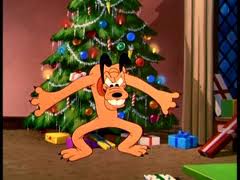
Despite what it’s title suggests, Pluto’s Christmas Tree is actually considered a Mickey Mouse short instead of a Pluto one, for some reason.  It’s also one of the few shorts to feature Jimmy Macdonald as Mickey Mouse, as Walt found he didn’t have the time to voice the character any longer.  Pluto’s Christmas Tree is actually fairly similar to Toy Tinkers.  Mickey and Pluto set out to get a Christmas tree and they settle on one that happens to be occupied by Chip and Dale.  Once inside the house, Chip and Dale immediately start to make themselves comfortable in the Christmas tree while Pluto takes notice.  Pluto tries, in vain, to point out the chipmunks to Mickey who just sees Pluto’s antics as the usual.  Eventually he can’t take it anymore and attacks the tree, finally revealing the chipmunks to Mickey who basically has the opposite reaction as Pluto.  The short ends with Christmas carols, where the chipmunks take issue with Pluto’s singing voice.  This is another wildly entertaining Chip and Dale story mostly full of slapstick humor.  This one is really easy to get ahold of as it’s been released several times on VHS and DVD and is one of the most well-received Disney shorts.

Mickey’s Christmas Carol (1983)

Not a Christmas season goes by where I don't watch this one numerous times.

Not a Christmas season goes by where I don’t watch this one numerous times.

Mickey’s Christmas Carol is fairly recent compared with the other shorts.  It’s also quite easy to catch on television or find on DVD and was even recently rereleased on Blu Ray (along with Pluto’s Christmas Tree, among others) this year.  It’s the classic Dickens’ tale with Mickey as Bob Cratchit and Minnie as his wife.  Scrooge McDuck is, naturally, the film’s Scrooge while other Disney characters show up in supporting roles.  As far as takes on A Christmas Carol go, this one is my favorite as it’s both funny and poignant and the inclusion of Disney characters somehow makes it more relatable.  The recent re-release does make it all the more obvious that one giant Christmas release from Disney is necessary.  Mickey’s Christmas Carol is also how many were first introduced to the longest running voice of Mickey Mouse, Wayne Allwine (who passed away in 2009), and also marks the final performance of the original Donald, Clarence “Ducky” Nash.

Mickey’s Once Upon a Christmas (1999)

Once Upon a Christmas is far from timeless, but it is nice to see all of the Disney characters together at Christmas time once again.

Once Upon a Christmas is far from timeless, but it is nice to see all of the Disney characters together at Christmas time once again.

Once Upon a Christmas is a traditionally animated direct-to-video collection of three shorts starring Donald, Goofy, and Mickey.  It’s shown annually on television still and represents the modern Mickey Mouse and friends.  The first short, titled Stuck on Christmas, stars Donald and his nephews Huey, Dewey, and Louie and is a take on the story of What if Christmas Were Every Day?  In it, the three boys wish it could be Christmas every day and are then forced to deal with the consequences.  It’s a bit like Groundhog Day, in that the boys need to be considerate of others and have the perfect day to undo the spell.  The second short, A Very Goofy Christmas, stars Goofy and his son Max as Goofy tries to prove to Max that there is a Santa Claus after their neighbor Pete informs him there’s no such thing.  The third short, Mickey and Minnie’s The Gift of the Magi, once again depicts Mickey as rather poor as both he and Minnie try to scrounge up some money to buy each other the perfect Christmas gift with both discovering the only thing that matters is having each other.  The animation on all three is pretty well done and it’s kind of fun to see modernized versions of the characters.  Aside from the Mickey short, the others tend to run a bit too long and run out of steam towards the end.  It’s a solid Christmas special but falls short of being a classic due mostly to the pacing issues.

Mickey’s Twice Upon a Christmas (2004)

Another direct-to-video Christmas special, Mickey’s Twice Upon a Christmas is naturally the sequel to Once Upon

The CG look for the characters just doesn't do it for me, and as you can see here, the backgrounds suffer too.

The CG look for the characters just doesn’t do it for me, and as you can see here, the backgrounds suffer too.

a Christmas, though the stories contain no obvious references to the previous ones.  Differing itself from its predecessor, Twice Upon a Christmas is entirely computer animated and the results are something less than spectacular.  The characters are mostly harmed by the transition to 3D models which makes sense considering they were never drawn for such a look to begin with.  This collection also contains five shorts which does address the pacing issues from the first set.  The shorts are:  Belles on Ice, Christmas: Impossible, Christmas Maximus, Donald’s Gift, and Mickey’s Dog-Gone Christmas.  The first one stars Minnie and Daisy as competitive figure skaters and is easily the worst of the set.  There just isn’t much to it.  Christmas: Impossible stars Huey, Dewey, and Louie as they sneak into Santa’s workshop to get on the nice list.  It’s kind of cute, but the CG really shows its limitations as the should-be wondrous Santa’s workshop is really unimpressive looking.  Christmas Maximus stars Goofy and Max, who’s now returning home for the holidays from college with his new sweetheart.  It’s only slightly better than Belles on Ice but is ultimately forgettable.  I also found Max’s look to be really off-putting for some reason.  Donald’s Gift is a rather simple Donald tale where his grumpiness and overall bad demeanor nearly ruin Christmas for his family, but he redeems himself in the end.  I’m a Donald sucker, so I was entertained by this one but it can’t hold a candle to Donald’s classic shorts.  Mickey’s Dog-Gone Christmas is definitely the strongest of the collection as Pluto runs away to the North Pole after Mickey gets mad at him.  There he befriends Santa’s reindeer and adopts the moniker Murray (Murray Christmas, get it?!) and even gets to fly.  The reindeer characters are entertaining, and the CG look actually works for Pluto, though I still prefer the traditional look.  Eventually Pluto is reunited by Santa with his depressed owner and everyone’s happy in the end.  Overall, this is a weak collection and the CG makes it hard to watch.  Check it out if you happen to catch it on TV, but don’t feel like you need to go out of your way to see it.


Teenage Mutant Ninja Turtles (4Kids): The Christmas Aliens

images-166In 2003, Fox and 4Kids Entertainment launched a brand new Teenage Mutant Ninja Turtles cartoon series.  This series was the first re-launch for the TMNT after a long hiatus from both film and television and was an attempt at introducing the Turtles to a whole new generation.  One of the consultants for the show was TMNT co-creator Peter Laird and his Mirage Studios.  Something everyone seemed to be in agreement on was that this new show would borrow more heavily from the original comic book run of the Turtles while still keeping a general audience in mind.  This is, of course, in stark contrast to the original cartoon which all but abandoned the comics as both Laird and Kevin Eastman felt it was impossible to adapt that for a children’s show.  It would be easy to point to that decision as a mistake, but really that original show gave the world a whole separate take on the Turtles that proved endearing, if nothing else.

The 2003 series was more mature, but still pretty much directed at kids.  It took a lot from the old comics but also did its own thing.  Eventually, it would more or less go off on its own, especially once it hit the Fast Forward seasons towards the end of its run.  I can’t pretend to be an expert on the series as I really only watched the first season before eventually losing interest.  The show seemed to be fairly successful, though not a huge hit, with kids.  There was a new toy line and I’m sure the show’s success had some part in the decision to do the feature-length TMNT film.

The source material for this episode.

The source material for this episode.

Something unique to this series is that it contains what is, so far, the only animated Christmas special the Turtles have ever done.  It seems crazy to me that there was a never a Christmas episode during the original cartoon run, but I checked, and there isn’t!  The new series has also yet to do one, but it wouldn’t shock me to see one pop up eventually.  The only Christmas special featuring the TMNT so far is the live-action “We Wish You a Turtle Christmas” and if you’ve never seen it, DON’T WATCH IT!  The 4Kids series decided for its third season to adapt the Michelangelo (then Michaelangelo) Micro Series story for its first episode, “The Christmas Aliens.”  Having read that issue, I was interested in checking this episode out as that story is one of my favorites from the comics as it puts Michelangelo in the starring role as he attempts to make sure a donation of Christmas toys gets to a local orphanage.

Each episode of the series opens with a scene from later on in the episode, usually with a turtle or turtles in some kind of trouble.  This one opens with Michelangelo driving a truck as he’s being chased by some crooks before the opening credits hit.  The opening song for this show is one of its weak points.  I don’t care for the song on the new series, but it’s at least a throwback to the old series so I give it some points.  This one is just lazy.  When we get to the episode it shows Michelangelo strolling through the park on Christmas Eve.  The other guys are back at home in the sewer decorating for the evening’s festivities while Mike befriends some kids in the park and finds a stray kitten he dubs Klunk.  It doesn’t take long for Mikey to stumble upon a toy store that’s in the process of being robbed.  Apparently, this season’s hottest toy is a Christmas Alien doll (I believe in the comics it was intended to be a parody of the then mega-popular Cabbage Patch Kids) and it’s sold out everywhere.  A delivery truck loaded with them is the target of the thieves, but Mikey overhears the truck driver tell the crooks it’s intended for a local orphanage.  The crooks obviously don’t care as they make off with the truck and Mikey feels compelled to stop them.

That's one weird looking Santa.  I can't imagine he smells all that great as well.

That’s one weird looking Santa. I can’t imagine he smells all that great as well.

At the lair, various other characters start piling in.  I actually can’t name any of them since I didn’t watch the show regularly, except for Usagi Yojimbo who arrives with two other characters via some kind of portal.  All of the Turtles’ friends are here though to celebrate Christmas and some mischief is made.  Casey tries in vain to score a kiss under the mistletoe from April, while everyone tries their luck at beating the resident superhero in an arm-wrestling contest.  Everything has to be put on hold though as they all wait for Michelangelo to get home.

Meanwhile, Michelangelo has to contend with a bunch of crooks and even the police as he overtakes the delivery truck and heads for the orphanage.  The majority of the episode is a chase sequence, first with Mikey hanging onto the truck as he tries to take it over, then with more bad guys, and eventually the police.  The animation shows its limitations here as the truck looks extremely heavy.  It strikes parked cars and other moving vehicles and goes right through them without even the slightest wobble.  It’s an okay sequence, but not a very exciting one.  The Michelangelo character in this series is enjoyable though, and Klunk is supremely cute as he hides in Mike’s coat and pops his head out to take a look.

Michelangelo is eventually able to lose his pursuers and wind up back at the lair.  Everyone is ready to scold him for being late, but he of course explains himself and everyone heads to the orphanage.  The Turtles don elf costumes while Splinter goes as Santa and all the kids get their alien dolls.  We get a final lesson on giving, and everyone feels like a good person in the end.

Elf Mike and Klunk.

Elf Mike and Klunk.

As Christmas specials go, this is a solid entry.  It’s not too sentimental, there’s no silly drama, and everyone ends up with a good feeling when all is said and done.  There’s some light humor that is, while not inventive, at least amusing.  Michelangelo is a good choice for the lead role in this one as he’s always been the one that’s easiest to relate to.  His child-like state of mind doesn’t need to be exaggerated any further to make the story work.  In the comics, Klunk stayed around and would show up in future issues.  I don’t know if that was the case here or not but I never mind the addition of a kitten to story.  This episode was released on DVD as a Michelangelo’s Christmas Rescue and if you stumble upon it in your travels it wouldn’t be a horrible pick-up.  The running time is only around 22 minutes so definitely don’t pay too much should you come across it.  Since Nickelodeon launched the new series last year, episodes from this show are no longer on television so don’t expect to find it airing on any channels this season.  As always, there’s youtube if you really want to watch it.


Batman Returns

Batman Returns (1992)

Batman Returns (1992)

It’s December 1st, and it’s time to inject a little Christmas into this blog once again.  Last year, I went pretty light on the X-Mas related topics and I intend to do a little more this year.  I’ll start off slow with a pseudo-Christmas movie in the form of Batman Returns.

Batman Returns is the 1992 sequel to the mega-successful Batman.  All of the major players return from that film including Tim Burton as director and Michael Keaton as Batman.  The only notable omissions are Billy Dee Williams as Gotham City District Attorney Harvey Dent; Kim Basinger’s reporter/photographer Vicki Vale, and Robert Wuhl as reporter Alexander Knox.  All three characters are absent from the film and were not re-cast.  The Vale character was presumably removed so as not to force Batman/Bruce Wayne to settle down, while the other two must have been cut for time (Williams was reportedly disappointed he never got to play Two Face).

The major additions to the cast are, of course, the villains.  Going with a “more is better” philosophy, Batman Returns includes three major villains compared to Batman’s one.  Created for the film is Max Shreck, played by Christopher Walken.  He’s a real-world villain in that he has no gimmick or special abilities, he’s just a greedy, corporate, jerk who values money more than human life and has ties to both of the other comic book based villains. Michelle Pfeiffer plays Selina Kyle, aka Catwoman.  Catwoman serves the dual role of being a foe for Batman, and a love interest for Bruce Wayne.  Also joining the part is Danny DeVito as Oswald Cobblepot/The Penguin, a monstrous take on the old Batman villain.  The two “super” villains have a sympathetic angle to play, which I’ll get to in a few paragraphs, and in 1992 both felt like logical inclusions for the big sequel.

The red of Catwoman's lips really pop in all of her scenes due to the muted palette of the film's sets.

The red of Catwoman’s lips really pop in all of her scenes due to the muted palette of the film’s sets.

The film is virtually identical in look to its predecessor with Gotham taking on aspects of film noir.  The technology is modern, or post modern, but with the stylings of the 1930’s and 40’s dominating the landscape, with a touch of goth too.  The noir angle is played upon even further with a majority of the film’s colors being black and white.  It’s demonstrated in the film’s leads with both Catwoman and The Penguin having a near white complexion to go along with the black and white shades of their respective costumes.  This makes what little color appear really jump out, such as the crimson of Catwoman’s lipstick or the yellow of Batman’s logo.  Batman, and the other good guys, are depicted with warm, natural flesh tones while the villain Shreck is noticeably pale, but not to the same degree as the other villains.  He makes up for that with his bone white hair.  The buildings and structures around Gotham are also mostly confined to shades of black and white, as are all of Batman’s gadgets and vehicles.  Combining this stylistic choice with the setting of a snowy Christmas time and Batman Returns comes across as a very cold movie, even when compared with the already bleak feeling of the first film.

DeVito's Penguin is mostly monstrous but he's able strike a sympathetic tone at times.

DeVito’s Penguin is mostly monstrous but he’s able strike a sympathetic tone at times.

As was the case with the first film, for better or worse, the villains are meant to be the main driving force of the film.  It’s a good thing they’re well-developed as Batman Returns arguably leans even harder on its villains than Batman did with The Joker.  Shreck is meant to be the irredeemable villain and serves as a foil to both Bruce Wayne and The Penguin.  The Penguin is not a nice guy himself, but Shreck proves to be the true monster of the film when he coldly tries to murder his secretary, Selina Kyle.  Shreck is the owner of a department store and he’s seeking the approval of the mayor (and Bruce Wayne as an investor) to build a new power plant.  In a sort of goofy Tim Burton type of plot, Shreck’s new power plant will actually syphon power from Gotham and when Kyle figures this out (while working late in an effort to be a better employee) is when Shreck shoves her out of a window.  Burton’s twist on Catwoman occurs here, as the meek Selina Kyle is seemingly resurrected when a host of cats attend to her corpse.  The scatter-brained screw-up becomes the headstrong and vengeful Catwoman.  Kyle is played fairly straight, while Catwoman is intended to represent her ego gone wild which apparently has an S&M twist.  Catwoman, clothed in skin-tight leather and armed with a whip, also has the benefit of nine lives.  She’s over the top but it works for the picture.  Cobblepot, and his family’s rejection of him, is what opens the film.  He was a hideous and monstrous baby (who apparently has a taste for cats) and his upper class parents wanted nothing to do with him so they tossed his carriage into the sewer where he was apparently raised by penguins underneath an abandoned zoo.  At first his motivations seem are simply to find out his origins while his gang of circus thugs terrorize Gotham.  It’s his encounter with Shreck that changes his outlook and sets his sights on being mayor of Gotham.  Shreck, needing a new mayor to get his plant approved, thinks he can turn Cobblepot into a sympathetic figure who could win election on that alone (never mind his hideous appearance) and soon the two turn to villainy in order to make The Penguin look good in the eyes of Gotham’s voters.

Naturally, their dealings put them in conflict with Batman as everything becomes twisted and murky.  The Penguin, together with Shreck, emerges as a viable candidate for mayor while Catwoman seeks vengeance against Shreck.  She starts by attacking his department stores which puts her in conflict with Batman.  With Batman as a common foe, this pairs up Penguin and Catwoman who then concoct a plan to frame Batman and turn Gotham against him.  It’s a fairly clever pot and Burton should be commended for being able to get this trio of villains to fit together well and the framing angle makes for good drama.  Unfortunately, Burton has never been one for realism.  We don’t mind when that takes the form of a monster baby killing a cat or a man in a bat costume gliding over the entire city, but he leaves lots of loose ends in his plots and asks the audience to simply overlook them.  The framing plot, for example, is never really resolved.  Batman is made to look like he kills the Ice Princess, a mini celebrity of sorts, and by exposing The Penguin as a bad guy (but not as the person truly behind the murder) is apparently good enough for Gotham and it’s police department (to make it even more convoluted, the people don’t even know that it’s Batman that made The Penguin look like a bad guy as he hacks into a PA system while Cobblepot is making a speech, using pre-recorded taunts).

Once The Penguin is exposed, the film’s climax is put into motion where The Penguin, now abandoned by Shreck, decides to murder the first-born sons of Gotham’s wealthy elite, including Shreck’s son Chip.  He has his circus gang abduct the kids from their cribs and personally attempts to abduct Chip, but Max volunteers in his place.  Batman, of course, saves the day which just angers The Penguin even more forcing him to send his penguin army into the city to fire off a bunch of rockets and level a chunk of the city.  Catwoman, having also been betrayed and “killed” by The Penguin, is drawn out after Shreck and all three collide for a fitting resolution.

Batman and Catwoman play off each other quite well in their few scenes together.

Batman and Catwoman play off each other quite well in their few scenes together.

A great deal of the film rests on the Catwoman and Batman conflict.  With the characters in costume, their encounters become a fun bit of violent flirting, with all of the flirting basically on the part of Catwoman.  As Selina and Bruce, the two have a sometimes warms romance that develops a bit quickly with Bruce as the aggressor.  The two have a nice scene together where they both figure out each has a dual identity which is resolved during the final scene pairing Batman and Catwoman.  The film’s end suggests that Catwoman was to play a role in a future film, but perhaps because both Keaton and Pfeiffer were uninterested in continuing in their roles, this Catwoman would never surface again.

Batman Returns shares a lot of similarities with its predecessor, one of which being a rather major flaw in that sometimes each film doesn’t necessarily feel like a Batman film.  Batman Returns is even more guilty of this as the Batman character is really pushed aside in favor of the villains.  Perhaps Burton felt like he had more freedom to do this since the previous movie covered Batman’s origin, but we really learn nothing new about the main character.  In one respect, it does help to add more importance and excitement to the scenes that actually feature a costumed Batman, but it feels like their could have, or should have been, more from our hero.  The plot does mostly work though, even with the bloated cast, but it clearly had to make sacrifices somewhere and it’s debatable those sacrifices were worthwhile.

The Batmobile's ability to down-size into the Bat Missile was one of the big spectacles of Batman Returns.

The Batmobile’s ability to down-size into the Bat Missile was one of the big spectacles of Batman Returns.

The first film set a fairly high-standard for special effects and gadgets that Batman Returns is able to live up to.  The big spot occurs with the Batmobile once again, this time with it transforming into the Bat Missile.  Batman also debuts his ski boat during the closing moments of the film which serves as an interesting take on the more traditional bat boat seen in the comics and television series.  There’s also the previously mentioned gliding scene for Batman as he makes greater use of his cape.  Catwoman has some pretty spectacular death scenes as well and there’s plenty of fire and explosions throughout.  There are a few moments that scream “Tim Burton” that look kind of stupid, notably the penguin army and the final shot of a villain’s corpse at the end.  Some people are unwilling to forgive Burton for the campy penguin army, though I also kind of viewed it as Burton’s nod to the campy origins of the television show, and when viewed in that light, it doesn’t really bother me as much.  As a Christmas movie, there isn’t much here.  The film just happens to take place at Christmas, something Burton is quite fond of doing.  It does give the set designers a chance to play with snow which is kind of cool, and the only real mention of the holiday occurs during the final scene.

All in all, Batman Returns is an entertaining film with quite a number of flaws.  It’s pacing isn’t always ideal and the attention to detail is lacking where the plot is concerned.  The Batman character at times feels ignored, but the film is elevated by the performance of the villains and the way all of the major characters intertwine.  Pfeiffer’s Catwoman is a fun take on the character even if it isn’t that radical a departure from other portrayals.  The sexually aggressive Catwoman plays off of the more stoic, and sometimes naive, Batman rather well with the only drawback to those encounters being that they make Batman look pathetically boring.  DeVito received a Razzie nomination for his take on The Penguin which I never understood.  DeVito’s Penguin isn’t as overly campy as the character had been in the past, he has his moments but he’s mostly well done and I still enjoy this take on the character.  The makeup crew should be commended as it’s sometimes hard to believe it’s DeVito underneath all of the prosthetics.  Walken’s Shreck is perhaps the star, as he’s just so good in this role.  Shreck is hate-inducing, and he’s able to needle the audience in just about every scene he’s in.  The score, provided once again by Danny Elfman, is also adequate as are all of the other sound effects used in the film.  It’s the classic case of a flashy and big-budgeted film trying to compensate for some underlying problems, which are more obvious this time around than they were with the film before.  Batman Returns is far from being among the worst Batman films produced, but it’s also not really one of the best either.