Category Archives: Video Games

Super Mario 3D Land

Super Mario 3D Land (2011)

The Nintendo 3DS had a sluggish launch and one I think I’ve chronicled fairly well here.  Early on it was really a lack of quality software that kept sales slow (and a rather large sticker price) until the arrival of Ocarina of Time 3D.  Not long after that title arrived, Star Fox 64 3D hit stores and represented another quality title.  Throughout that, Nintendo was able to supplement the true 3DS titles with some quality Virtual Console titles.  The problem was, we had already played these games before.  Sure, both Zelda and Star Fox received a nice visual boost but that merely hid the fact that both titles were nearly 15 years old.

Finally, the first Triple A, original, game has arrived and who else could it be in the starring role?  It’s Mario, and he’s back in his first original handheld game since 2006’s New Super Mario Bros. and his first ever original portable title in the third dimension.  And by third dimension, I mean both the game engine and that feature that is supposed to be the main selling point of Nintendo’s latest handheld, the stereoscopic 3D.

Super Mario 3D Land is a title that is right up my alley.  It’s an all new Mario adventure, but it features several nods to the old-school games, primarily Super Mario Bros. 3.  If Nintendo is going to focus on one game to emulate, why not SMB 3 which is in the running for greatest game of all time.  The homages to that title are numerous, the most obvious one being the inclusion of the tanooki suit.  Whenever Mario finds the brown leaf power-up he is given a cute, cuddly, tanooki suit that grants him a tail attack and a hover ability.  The suit is absurd looking, even more so today than it was on the NES, but it’s just as useful as it used to be.  Well, it does lack a true flying ability and initially lacks the stone-form ability as well.  The tail attack is certainly nice to have for those of you used to playing Super Mario Galaxy where Mario has a similar spin attack by default.  The hover ability is also a great safety net for those tough platforming sections and is needed to get some of the games numerous star coins.

Mario showing off his new boomerang suit.

If Mario only had the one power-up though, that would be pretty disappointing.  New to the Mario-verse this time around is the boomerang suit.  Like SMB 3’s hammer bros. suit, the boomerang suit outfits Mario as a boomerang brother.  He’s able to throw one boomerang at a time, that will always come back to him which can be useful for setting up return strikes on enemies.  It also can be used to grab items like other power-ups and star coins.  Also returning is Mario’s trusted fire flower.  You would think the boomerang suit would render the fire flower obsolete but it does hold some advantages, namely that Mario can shoot up to two fireballs in succession and their range is much farther than the boomerang.  There are also some Zelda-like puzzles in the game where Mario can use his fire power to light some beacons.  Unfortunately, Nintendo didn’t take the opportunity to throw in another SMB 3 homage and have the fire flower give Mario an orange suit, instead it’s the traditional white and red.

As for the gameplay, this is pretty much a mix of old and new.  The game certainly has a Galaxy feel to it, minus the funky the gravity.  I would say it plays most like a cross between the New Super Mario Bros. games and the Galaxy ones.  Each level has three hidden star coins to find and a certain quota is needed to advance in the game and to unlock bonus levels.  There are 8 worlds with 5 to 6 levels within each one.  Each world ends with either a trek through Bowser’s castle or an air ship battle with a returning Boom Boom from SMB 3 or Pom Pom, which I assume is his sister.  For some reason, Nintendo chose to go this route for this game rather than to resurrect the Koopa kids from SMB 3.  The boss battles are fairly painless, with the exception of the final Bowser confrontation which caused me to continue numerous times.

Outside of that though, the game is pretty easy.  Most gamers will max out Mario’s extra lives before arriving at World 8 .  Most of my deaths were the result of poorly timed jumps on my part or intentional because I missed a star coin.  The difficulty would have been the number one source of criticism for me if not for the Special Worlds.  The Special Worlds open up once the game is finished and represent a second game.  Opening up the Special Worlds also unlocks the tanooki suit’s stone-form ability and even lets you play as Luigi.  Some of the Special Worlds, like the castles, are just harder versions of the normal level but many are new levels entirely.  Some also include a shadow Mario to pester you and force you to move quickly.  The game will keep track of your speed runs for Street Pass purposes, meaning when you walk past someone who also has this game the system will exchange your best times and give you something to try to beat.

Practice your jumping because this game is loaded with sections like this.

The other criticism I have to levy at this game is the use of 3D.  Many media outlets are praising this game for its use of 3D, but I reckon most are just drinking the Nintendo kool-aid.  Yes, in this game 3D is practically required in some parts which makes this the first game to accomplish such a feat.  How ever, it still fails to elevate the 3D effect beyond a gimmick.  Most of the places where 3D is necessary are self-contained rooms and make for awkward optical illusions for target jumping.  Otherwise, I found it just made negotiating jumps even more difficult.  I did force myself to play with it on at all times, unless I found a section where it was really just pissing me off (like the final battle with Bowser) and shut it off out of frustration.  3D just isn’t a natural thing for the human eye and it just makes Mario feel hard to control.

And hard to control is what has always been in the background for the 3D Mario adventures.  Mario controls well-enough, but he’ll never control as tightly on a 3D plane as he does on a 2D one.  This game made me appreciate the approach the Galaxy franchise took as the use of gravity in those games cut down on death by falling.  Very few of my deaths are actually caused by enemies and mostly are caused by missing platforms.  Nintendo also took away Mario’s ability to double and triple jump for this game, but I found that to be a good thing as it allowed for section with lots of repeated jumping.  Mario can still do a long jump, but for some reason my ability to pull it off consistently seemed spotty.  I never got a great hang of it, but also never encountered a spot where I absolutely had to use it.  Mario can also do a quick side-flip, but I often found myself pulling that off by accident which would only lead to trouble.  He also has a power-up backflip that has its uses.

Annoyances aside, this is a great game.  Yes Mario could control better and 3D is still mostly a stupid gimmick, but he controls well-enough and you can always shut the 3D off if you please.  The main game is pretty easy to get through, but the Special Worlds will test the skills of most gamers.  And this isn’t a game where you should be settled with just beating it.  No, any gamer who picks this one up should aim to collect all of the star coins as that’s where the true challenge lies.  The game is just fun to play and takes me back to the days when I played games for the simple pleasure of it, not to advance a narrative.  Hopefully Super Mario 3D Land is just the beginning in a long line of quality original games to hit the 3DS.  It’s been a long wait.


Skyrim Impressions

The Elder Scrolls V: Skyrim (2011)

It’s been just over two weeks since my life was hi-jacked by a little (big) game called Skyrim.  It’s not just been my life either as apparently millions of gamers across the country are watching their free time dwindle away into nothing.  I figured I might as well post my impressions, since a full-fledged review is out of the question for such a massive title (by the time I finish this thing it will be considered out-dated), but first some background.

The full title for Skyrim is actually The Elder Scrolls 5: Skyrim.  Developed by Bethesda, The Elder Scrolls franchise began on the PC in 1994.  It was never on my radar and I’m not certain if I was ever aware of its existence before 2002 when the third numbered game in the franchise was released on the Xbox.  The Elder Scrolls III: Morrowind also never captured my imagination.  While I longed to play a fantasy epic that could match the freedom of pen and paper RPG’s (without the geeky-ness) I found myself put off by Morrowind’s first-person perspective.  I also was able to get my high fantasy fix from Bioware’s Neverwinter Nights series, and while I found that game a bit clunky, I really hadn’t played anything better.  It wasn’t until when the fourth game in the series, Oblivion, arrived on PS3 in 2007 that I actually decided to give the franchise a shot.

Oblivion arrived at a perfect time for me.  I had only owned a Playstation 3 for a few months and nothing compelling had been released for it.  I probably was spending more time with the Wii at that point.  I was also in the midst of an RPG drought and needed a fix.  In the summer of 2006 I even resorted to going way back and getting a new copy of Baldur’s Gate II to try and slake my thirst but found the game so massive that I lost focus.  When I initially purchased Oblivion I wasn’t certain I was going to like it.  I’ve never enjoyed the first-person perspective in video games and tried to play the game in third-person but it was so clunky that I succumbed to the first-person.  While I still do not particularly care for it, I was able to deal with it and even grow used to it.  I played as an assassin and ended up spending over 100 hours with Oblivion, finishing every quest.  While the game had warts, it was certainly a compelling and entertaining 100+ hours that I did not regret.  When Skyrim was announced last December, it immediately vaulted to the top of my most wanted games list.

Like its predecessor, Skyrim also comes at a good time.  Not because of a lack of quality software, far from it, this fall is turning into one of the best fall’s in video game history, but because it’s been 5 years since the original release of Oblivion.  I’m ready for a new fantasy epic and nothing in between has really satisfied me.  Dragon Age tried, but couldn’t live up to its lofty expectations.  And even though my journey through the world of Skyrim was delayed almost immediately by a 10 day vacation I had planned starting on the 12th of November, I’ve still managed to log 40 hours with the game already.  I was purposely holding off until I reached my favorite quests from Oblivion, the Dark Brotherhood, before posting impressions.  Well, I found the Skyrim version of the Dark Brotherhood on Wednesday night and it’s only been my reluctance to put the game down (and the Thanksgiving holiday) that has kept me from making this entry.

Skyrim has, so far, managed to meet my expectations though not eclipse them.  Fundamentally it’s the same game as Oblivion but with a few new twists and upgraded graphics.  What’s new?  Well for one, the skill system has been refined.  You still improve your various skills (one-handed combat, archery, pick pocket, etc.) by performing actions related to that skill, but now increasing skills leads to building levels.  Once your level increases, you’re able to select a perk related to one of the many skills or schools of magic in the game.  In order to select a perk from, for example, the archery skill tree your skill level in archery must meet or exceed the perk’s requirements.  If your skill isn’t at the necessary level for a perk you want you can wait and save that skill point for when you can get the perk you want.  It’s not a giant change but it works for the better.  There are still ways to exploit the system if you so choose, but the skill point system helps to keep you check to some degree so even though you might manage to get your sneak skill to 100, you still need to level up several times to get the best sneak perks.

Combat has also received a few changes, though nothing major.  Supposedly the melee combat has been improved upon but it still feels floaty and unsatisfying to me.  As a result, I stick to bows and magic and only pull out a dagger when in close for a backstab attempt.  Magic seems much more interesting to me this time around in both a superficial and tactical way.  I’ve stuck with the destruction school of magic (fireballs and the like) and that’s my go-to method of combat when not sneaking around and picking off bandits with the bow.  In Oblivion I managed to rise to the rank of Arch Mage with the Mage’s Guild despite hardly ever using any magic but this time around I plan on investing some time with it.  At some point I’ll branch out to a second and third school but so far destruction has served me well.

While there are no character classes to choose from, I’ve basically stuck with what would be considered the assassin from Oblivion.  That is, I spend most of my skill points on sneaking skills while also investing quite a bit in archery.  I’ve thrown a couple points into light armor and lock-picking but have thus far neglected the pick pocket tree. My main approach to combat is to not be seen.  I get a triple damage modifier with the bow, and a 15 times damage modifier with a dagger, so I stick to the shadows.  When drawn into actual combat, I often switch to magic or run.  I also still end up doing a lot of the run backwards and shoot technique, even if it’s clumsy.  Despite that 15x multiplier on daggers, I still usually stick with bows.  Daggers usually only deal around 10 base damage, while a good bow and arrow for me totals over 40, so that 15x is quite deceiving.  I have yet to figure out if added enchantments are also multiplied or are just tacked on at the end.  As in, I have a bow that adds 10 frost damage to an attack, but I don’t know if that 10 frost damage is multiplied as well.

I don't think it's friendly...

There’s another major addition to the game that most people are probably already aware of as it’s one of the selling points:  Dragons.  Dragons roam the skies of Skyrim and can attack at a moment’s notice once certain quest obligations have been fulfilled.  When they do, they take precedence.  It’s interesting to watch any and all NPC’s immediately shift their attention to dealing with a dragon threat when the winged beast makes its presence known.  I’ve so far only encountered the standard dragons and the blood dragons, but there are more powerful ones lurking.  I’ve found that taking them down is easiest when there’s something to distract it.  Anything that keeps the dragon’s focus away from me is welcome, and if that means my trusty mount has to take one for the team, so be it.  I think I’ve killed five or six at this point, so it’s not like they attack all the time.  I’ve even had one circle a few times and then move along apparently not even interested in starting a fight with me.  The battles are fun though, and the inclusion of dragons is both welcomed and awesome.

As I mentioned, in order to see a dragon certain quest obligations must be met, but fear not as they don’t take a whole lot of time.  To say I’ve scratched the surface of the game’s main story-line would be an overstatement.  When the game first starts your character finds him or herself a prisoner headed for the block.  This is a spoiler free blog entry, but I don’t think it’s spoiling much to say your character avoids that fate and is able to escape.  That escape represents your first quest, and the next (for me, I’m not sure if it’s the same for everyone as there is a branching point to the first quest) was to speak to a local person and then head to Whiterun as a sort of ambassador.  It’s at Whiterun that you inform the Jarl there of the returned dragon threat and the Jarl organizes a little dragon hunt.  Completing that quest is what triggers the random dragon encounters, and also earns your character its first shout power.  Shouts are like magic, but have different restraints put on them in terms of how often they can be used.  Some recharge faster than others.  These shout techniques are found all through-out Skyrim, I so far have found 5, though the first one is given to you.  Killing a dragon causes your character to absorb the dragon’s soul which unlocks shout abilities.  So you can locate one of these shouts at any given time, but if you don’t have a stored dragon soul you won’t be able to unlock it.  To be honest, I haven’t found the shouts all that useful up to this point and often forget to use them.  Perhaps that’s because few suit my chosen battle technique but I still find their inclusion to be a positive thing.

That's a giant, one strike from that club sent my character soaring through the air like a baseball. He did not get up.

Aside from the main quest, there are dozens of other quests and tasks to soak up your time.  I probably have over 20 active quests right now, but thankfully none have a time constraint placed upon them.  I’ve done several for the Dark Brotherhood and so far have not been let down.  The Dark Brotherhood seems to always have very entertaining missions and their approach complements my play style perfectly.  As a result, I’ve neglected the other two factions that I’ve so far uncovered, that being Skyrim’s version of the Mages Guild and Thieves Guild.  In Skyrim, the wizard college appears to have taken the place of a proper guild.  I’ve done a couple tasks for them and have only just opened up the thieves ones.  Once I have finished with the Dark Brotherhood, I’ll probably focus on the mage ones and continue to build up my magic prowess while also investing some skill points in the more thief oriented skill trees before I dive into those quests.  I’ve also encountered several dungeons and old keeps to raid and clear along the way.  Some contain treasure, some almost nothing, but it’s the journey that is most rewarding.  I’ve also encountered all kinds of wildlife from lowly wolves to deadly sabre cats and giants.  Death is all around you at all times in Skyrim and it helps to be alert to anything.

And while there’s been an awful lot of enjoyment on my end so far, there’s also been some frustrations as well.  With any game of this size, there’s always the concern for glitches.  I’ve heard of many reports of glitches cropping up but so far my experience has been glitch free.  It has not been without technical problems though.  The framerate has become an increasing issue the longer I play.  I’m not sure if it’s because of the marathon sessions I’ve been having with the game or because my save file has become massive (which is rumored to cause problems for the PS3), but there have been many instances of clipping and severe slowdown at times.  I’ve also had the game freeze up on me a few times, one of which was quite an inconvenience as I had just felled a particularly nasty adversary, so I make it a point to save often.  Bethesda is set to release a patch in the near future that will hopefully help to combat these issues.  My last play session ended when the slowdown became too much to bare.  I had been playing for over 4 hours and I’m hopeful that’s the main reason why the performance had begun to lag.  If that isn’t the case and it’s because my save file has become too large I fear it could be a game breaker.  We’ll see.

One area where "Skyrim's" visuals outshine a lot of the competition: horses.

Outside of technical problems, the other areas where Skyrim comes up a bit short are common with that of Oblivion and reside in the AI department.  Sometimes the non player characters are just stupid and it’s especially noticeable for a sneaky character.  Example, I’m in the bowels of a ship and there are two corsairs in a room adjacent to the one I occupy.  I fire an arrow into the room killing one of the two outlaws.  This alerts the second one that danger is near by and she immediately starts looking around the room, but since she doesn’t find anyone, she says to herself, “Oh, must have been my imagination.”  Yes, darling, it was your imagination that killed your buddy who was sitting across from you at the table, and it’s your imagination that is about to end your virtual life as well.  Visually, Skyrim is mostly a pleasure to look at but character animations still leave something to be desired.  It’s very noticeable if you play in third-person as your character moves quite stiffly.  He also doesn’t really conform to the terrain and always has a floating quality to his walking and running.  Other characters seems to animate a bit better, but facial animations are almost non existent.  Everyone looks like a hand puppet with really only their mouth and chin properly animated.  Overall, the people of Skyrim are better to look at than those of Oblivion, but still retain those robotic traits.  Animals animate much better, though are some-what of a mixed bag.  Rabbits and fox tend to suffer from that same floaty thing people do, and some bears just don’t look much like bears, but the horses, dragons, and walrus-like creatures are quite convincing.

Flaws aside, this game has been quite a blast to experience.  It doesn’t reinvent the wheel but it has improved upon Oblivion enough for me to say that Skyrim is the better game, and I have yet to even finish it.  There’s still so much more for me to do and I can’t wait to experience everything this game has to offer.  The one issue lurking in the shadows does revolve around the frame-rate.  Certainly if that does develop into a game breaker I’ll be sure to update this entry, but for now Skyrim comes fully recommended.  Don’t sleep on this one!


Greatest Games: Resident Evil 2

Resident Evil 2 (1998)

Recently I was having a conversation with someone about all things Resident Evil.  I recalled fondly the survival horror component of the original titles, the horrid controls, and lackluster voice acting.  We recalled the cheap scares, scarce ammo, and the at times punishing difficulty.  We remembered it all, the good and the bad.

Resident Evil arrived when developers were still trying to get a hang on this whole 3D thing.  In the original, you could play as Chris or Jill, agents for an elite combat force known as S.T.A.R.S. and were tasked with navigating your way through a treacherous old mansion.  Both characters handled like tanks.  Left and right on the Playstation’s d-pad would pivot the character while up or down would move the character.  Holding down a button would make the character run and while running it was possible to turn slightly, though to make a hard 90 degree turn you had to bring the character to a complete stop.  One of the shoulder buttons would ready the character’s weapon and the action button would make them fire.  There was no lock on technology of any kind, you pointed and shot in all directions.  Running and gunning Contra style was out, your agent had to stop if he/she wanted to fire off a few rounds at a zombie or two.

The controls were a gigantic obstacle for players.  Most of the game’s difficulty stemmed from trying to maneuver amongst the many enemies that filled the rooms.  Other than the zombies, most of the enemies were far quicker and agile than either Chris or Jill.  It would have been easy to just pull out the biggest guns and have at it, but ammo was so scarce the game practically encouraged you to run away from most encounters.  That’s where the survival component came into play.  Only when backed into a corner was it wise to pull out a bazooka or flame thrower.  And using anything other than a pistol on a zombie was a rookie mistake.  Health was scarcer than ammo and often you were forced to gamble when in a caution state and hope for the best rather than use a precious can of first aid spray.

Resident Evil had many warts, but it managed to be so compelling in spite of them.  Likely because the only game to come close to matching its atmosphere was the under the radar Alone in the Dark for the PC.  The first RE wasn’t really a critical darling, but managed to sell well and hype for an eventual sequel was running high.

The new protagonists for Resident Evil 2, Leon Kennedy and Claire Redfield.

Enter Resident Evil 2.  Released in 1998 for the Playstation, Resident Evil 2 kept what worked in the first game and also kept a lot of what didn’t.  Namely, the controls were just as cumbersome as always and the voice acting wasn’t much better (though it at least wasn’t laughably abysmal).  Maybe because gamers and reviewers had grown accustomed to the game’s controls, the sequel was able to garner better reviews.  The visuals were improved and Raccoon City was a more varied setting for new comers Leon and Claire.  The main game was shorter, but a new mechanic was added that encouraged replaying the game multiple times.  Each character had an A and B game, depending on which character was used first.  For example, if Leon was chosen from the onset, completing his game would open up Claire’s B game.  Some items crossed-over, meaning if you didn’t pick them up in Leon’s game Claire could get them.  There was also one room that could only be accessed in the B game if certain conditions were satisfied in the A game.  The B game was also a great deal harder.  Beating both A and B games with an “A” ranking on one would open up a third scenario where you played as an Umbrella trooper named Hunk in a more action-oriented environment.  Beating the game 6 times opened up a fourth scenario where you played as a piece of tofu who could only wield the knife (more of an achievement than a viable gameplay mode).

The game looked better than the original, and holds up quite well today for a Playstation title.  The presentation was more “Hollywood” than the previous game with FMV sequences and other scripted events that heightened the drama of the game’s rather B-movie quality plot.  There were big boss encounters and moments that really made you jump in your seat.

Vicious enemies, close quarters, crappy pistol. Good luck!

While it wasn’t all that much different from the original game, I found RE2 far more enjoyable.  I’m not really sure what it is, maybe it just had to do with me spending more time with the sequel.  With the first game, I only ever rented it with friends.  As such, I never quite got a good grasp of the controls and found the game frustrating.  With RE2, I fell for the hype and picked it up when it was released.  I played through the A game easily enough though it would take me awhile compared to later play-throughs (probably close to 5 hours).  The B game though, that was a challenge!  That’s the one that had the big trench coat guy who would pop up from time to time to scare the crap out of you (and dish out some pain as well).  My first attempt at it was also with Claire who I found more difficult to play as given her unique weapons compared with Leon’s (her bow gun had only one use, pinning crows to the walls).  The boss fight with RE2’s version of the Tyrant character from the first game was especially difficult.

I stuck with RE2 though, and eventually I was blazing through the game in about 2 hours.  It was always rewarding to see my play improve.  When I first started playing the game I’d try to shoot my way through, but repeated attempts had me weaving in between zombies and other enemies and using as little ammo as possible.  Tyrant?  No problem.  I memorized the location of every key or other special item and unlocked the bonus games.  I beat RE2 almost as thoroughly as one could, outside of beating the Tofu game (that one is beyond my skill, though I admittedly never gave it much of a try).

The enjoyable part about it is that I didn’t really play the game to unlock those additional game modes.  I didn’t keep playing for some silly achievement or virtual trophy, I played it just because it was fun.  It’s the amount of enjoyment I received from playing this game that has earned it a place in my top 10.  Future games in the series have far surpassed it from a technical standpoint.  Controls have been improved and the plot has taken the protagonists all over the world.  Truthfully, the best game in the franchise is probably Resident Evil 4, but the game I’ve enjoyed the most has definitely been Resident Evil 2.


The Greatest Games I’ve Ever Played

When discussing a particular favorite of mine I tend to cite something as “one of my all-time favorites” and let that statement hang in the air.  Recently I began playing just such a title and got to thinking about this more in depth; what are the best games I’ve ever played?

Those N64 graphics really have not aged well.

When I get into a gaming lull, such as what I’m in at the moment, it’s easy for me to get down on the current crop of games.  Nostalgia has a funny way of tinting things and convinces us things were always better than they are now.  That certainly can be true for a lot of things though often times it’s a false impression.  With games, I hear it quite frequently whenever a new wrestling game is discussed.  Fans cling to the old THQ game WWF No Mercy and often cite that game’s greatness when discussing the faults of whatever the latest release is.  And while that game is a good one, and probably did some things better than the current generation, it truly was surpassed long ago as the greatest grappler of all time, if it ever even truly held that distinction (I suppose that’s an argument for another time).

That said, this current generation of consoles hasn’t produced a whole lot I would consider to be among my favorites of all time.  Perhaps it’s not fair to assume more games like that should be released when it’s challenging for the truly great in any medium to come along.  How many new movies that come out in a given year can be considered among the medium’s all-time best?  One, if any, probably.

So how many games have been released for the PS3/Wii/360 will I remember as some of my favorites?  A few.  There’s Red Dead Redemption, which ended up being a lot more than just Grand Theft Auto Cowboy.  Mass Effect 2 is certainly in the running and the super hero genre has never received a game better than Batman: Arkham Asylum.  There might even be a few more, but that’s a solid start.  And here’s hoping Skyrim enters the discussion in a month or so.

Maybe some of my favorites have been released this life cycle, but I’m not ready to anoint any of them yet.  Plus this is a blog that caters to nostalgia and while I may post game reviews for new titles, a feature like this one should focus on the oldies.

Sorry, but you're only 9 years old! Check back next year.

I made a list of what I considered my favorite games of all time.  Off the top of my head, my list totaled over 20 but I wanted to limit this feature to a top 10 of sorts.  I immediately cast aside anything that wasn’t at least 10 years old.  A solid decade is enough time for an opinion to be formed and take root.  This meant some of favorites did get cut-off.  One of which, Warcraft III, just barely missed out as that one is only 9 years old.  Another was Metal Gear Solid 3.  I suppose I could have just replaced it with one of the two games that came before it, but I felt like my heart wouldn’t really be in it, so no MGS in my top 10.

I also eliminated any obvious selections, so no Ocarina of Time.  Why?  Because there’s probably already a million other blogs and review sites out there telling you the game is a classic.  What’s one more really going to add to things?  In addition to knocking off the Zelda franchise, this also knocked out the traditional Mario titles.  It’s not that I don’t love me some Super Mario World, it’s just been talked about enough.

Despite that criteria, my list isn’t going to be full off obscure titles.  There’s some that could be classified that way and a few obvious ones.  Once I established my criteria for this feature I began weighing each game amongst the pack.  I already had a couple that I knew had to be included, but some tough decisions had to be made for others.  I basically just picked them apart and started crossing off the games with the most faults until I got my 10.

The last two were particularly difficult.  I can’t even remember which game I was stacking this one up against, but number 11 became Klonoa 2: Lunatea’s Veil.  As great as the game is, I realized my biggest argument for keeping it on the list over the game it was duking it out with was because of it’s obscurity, which seemed like the wrong reason.  I love the game so much though, that I figured I’d show it some love in this intro piece.

Klonoa 2: Lunatea's Veil (2001)

Klonoa 2 is the Playstation 2 sequel to a game that was released in 1998 on the original Playstation.  Published by Namco, Klonoa 2 is one of the first 2.5D platformer titles, meaning the graphic’s engine renders everything in full 3D but the gameplay is more like a 2D side-scrolling platform title.  This is the type of approach Capcom would take with its Viewtiful Joe franchise and Nintendo would implement for New Super Mario Bros.  I don’t know if Klonoa was the first of its kind to utilize this, but it was definitely the first game of its type that I played.

Klonoa is a typical platform character in that he’s furry and cute but it’s kind of hard to figure out just what kind of animal he is.  His design has a little spunk to it with a backwards hat and giant shorts.  He has two big floppy ears that allow him to hover momentarily and extend jumps.  The main gameplay mechanic centers on Klonoa’s ring.  The ring (which he holds with his hand because it’s huge) shoots out a grappling hook-like beam that grabs enemies.  Klonoa can then hurl those enemies as a weapon or use them for a double jump.  Some enemies or objects will have propellers or something that allow Klonoa to do other things with them as well.

Instead of being a left-to-right and collect everything type of game, Klonoa tends to focus more on puzzles than anything else.  Often there’s switches that need to be activated in a certain manner that isn’t always clear.  Early on in the game things are pretty simple but the challenge factor gets upped the further you progress.  It never becomes truly difficult, but is often satisfying.  There are boss encounters that often play with the perspective.  Usually Klonoa is on a bridge or a ring and the boss will be in the center giving the game more of a 3D feel at times while still maintaining the classic 2D “invisible wall” restrictions.  The game is also quite colorful and a joy to behold.  Namco went with a cel-shading look which was growing in popularity at the time and it works very well with the game’s visual style.  The story line isn’t anything ground-breaking, but it’s presented well with nice cutscenes throughout.  Namco chose not to dub any of the characters so they chirp in Japanese (or what I think is Japanese, I suppose it could just be gibberish) and it actually works as these types of games usually end up with some horrendous voice acting.

Look how cute he is with his backwards hat and giant zipper!

That’s a quick and dirty overview of Klonoa 2 but what’s most important to know is that the game is just plain fun.  It’s a true joy to play and the level design is on par with Mario’s best.  And really, outside of Mario’s best, this is one of my favorite platforming games of all time.  I’d easily take it over any of the 3D platformers put out by Rare and Insomniac.  It can be had for less than $20 on eBay so if you’re itching for a good platforming experience definitely check it out.

So be on the look-out for my official top 10 greatest games I ever played feature.  I’ll have plenty more to say on the subject.  This feature will differ from my top 10 albums list as I don’t plan on actually numbering them.  I don’t know what order I’ll even post them in but I’ll try to break up titles that may be similar to one another (I did restrict myself to only one game per franchise, so things shouldn’t get too repetitive).  I do, however, have a favorite game of all time and I will save that one for last.  And lastly, if you’re curious, most of these games will be from the Playstation era.  I didn’t plan it out that way, it’s just how it ended up.  Even though when I think of old games my mind immediately goes to the original Nintendo and 16 bit systems.  I guess in 10 years if some other 20-somethin’ blogger decides to make a similar list it will be populated by Xbox and PS2 games, if not 360 and PS3.


Star Fox 64…3D!

Fox pilots his way into the world of 3D.

There’s no denying that the Nintendo 3DS got off to a rocky start, rocky enough that a significant price cut has already taken place less than 6 months after the initial launch of the system.  The 3DS has struggled not because it’s a bad machine, but because the software has been pretty weak.  The eshop wasn’t ready at launch and the closest thing to a killer app the system had was a port of a 2 year old fighting game.  Well, the times are finally changing.

In June the 3DS received its first big Nintendo release, The Legend of Zelda – Ocarina of Time 3D, and now here in September we have number 2, Star Fox 64 3D.  Now, the contrarian is going to argue just how great these titles could possibly be considering both are re-makes of Nintendo 64 games that are each over 10 years old.  And in the case of Star Fox, we’re talking about a remake of a remake as the original was a remake of the original Star Fox for Super Nintendo.  And really, it’s tough to argue the point.  Yes, both are remakes and while the graphics have received a complete overhaul the games themselves are still largely the same.  OOT benefited by having the Master Quest added to the package which had previously only been released for Gamecube as a bonus for those who pre-ordered Wind Waker.  Star Fox 64 3D is still largely the same as well, but there are a few additions worth covering.

A screen shot from the original "Star Fox 64."

First, the game can be played with a new control scheme that utilizes the system’s built in gyroscope technology.  This means you control Fox by moving the 3DS around instead of using the circle pad.  It’s kind of interesting to mess around with, but if anyone claims to prefer this scheme over the circle pad I’ll probably give them a pretty queer look.  It’s just not very intuitive, and I have yet to use it in game beyond the tutorial.  Star Fox also has a new gameplay mode simply called 3DS.  It’s basically an easy version of the N64 game.  Enemies are easier, continues are allowed, and Fox can take more damage.  The one cool addition is the ability to select what world you go to next, rather than letting the game dictate what path you’re on.*  It’s an easier way to experience every level in the game instead of figuring out how to beat each level in order to advance in a different way.

*For those who never played the original, the game advances depending on how you finish a level.  There’s a designated easy and hard finish for each level and opting for the hard way is the only way to experience the game’s true ending.

And a screen shot from the same level in "Star Fox 64 3D," notice a difference?!

The last big addition is obviously the 3D.  I will say, of all the 3DS games I’ve played so far Star Fox 64 makes the best use of the effect that I’ve seen.  Using 3D actually adds to the experience, in a minor way.  It helps you more easily judge what enemies are closest and prevents the enemy polygons from overlapping as much giving you a clearer picture.  That said, I still tend to opt to play with the effect turned off as I just find it too distracting.  I also tend to move the 3DS too much which causes a blurring effect when the 3D is turned on.  Which also renders those special 3DS controls useless if you wish to have the 3D visuals turned on.

Outside of those changes the game is basically the same experience.  That is to say, it’s a lot of fun and presents a satisfying challenge.  On Nintendo 64 mode, the game goes old school and ‘Game Over’ means what it says as there are no continues.  The game does save after each level so you can leave and come back, but it only has one available save slot.  There is however a handy ‘Guest’ mode that allows a friend to play on your 3DS without saving over your game.

The visual upgrade is quite nice and gives the game a nice, clean, look.  Let’s face it, the visuals of the Playstation/Nintendo 64 era have aged rather poorly.  I’d argue even worse than the 16 bit era, so the enhanced graphics are quite welcomed.  The gameplay is fast and frenetic and you may get pissed from time to time.  The good thing though is that practice makes perfect.  I never owned any Star Fox game before this one because I was always terrible at them, but it didn’t take me long to beat this one (not the hard route, mind you).  In fact, that is one of the downsides to this game as the single player game is very short and will take most gamers a little more than an hour at most.  It’s a game that’s made to be replayed though and one that expects you to come back and try to beat your best score.

This game is loaded with epic boss encounters.

There is a multiplayer component as well, but I haven’t tried it.  It’s kind of cool in that you only need one gamecart to play with friends, the downside is that it’s local Wi-Fi only.  Why Nintendo continues to screw up online play in their games is one of the great mysteries of life.   This makes the multiplayer a negative.  Another negative for the game is the voice acting, it’s horrible.  I don’t care for any of the voices, maybe I’m just picky, but I find them awful.  Another negative, and this is going to sound kind of odd, are the ending credits.  They last nearly 10 minutes!  That might not seem like a big deal but this is a portable system.  If you finish the game while riding on the train you’re kind of out of luck for the next 10 minutes while the ending credits slowly trickle by.  I never understand why some games force the player to watch the entire credit sequence, it doesn’t make me appreciate all the hard work these individuals did, it just makes me resent them.*

*Upon paying more attention the next time through, I noticed that you do get the option to skip the credits right away.  Not sure if you’re SOL if you miss that and I think you miss out on the little story-line bit at the end, though no one is likely to play this game for its plot.

The cons for this game are, in the end, pretty minor.  If you’re someone who enjoys arcade-like flight simulators or someone who enjoyed the previous incarnations of Star Fox I’m willing to bet you’ll enjoy this take.  Really, the biggest con for this game is that it’s a remake and I’d understand if some people just aren’t all that enthusiastic about re-buying a game they may have already played to death (especially for those who picked up the Virtual Console version for their Wii).  If you’re in the mood though for some Star Fox action, Star Fox 64 3D delivers.  Now Nintendo, let’s see an awesome, all new, original game for the 3DS please!


Call Me “Ambassador!”

Yesterday was the first day of September and for most probably just another Thursday, however, this wasn’t any ordinary Thursday.  This was the first day of the Nintendo 3DS Ambassador program!  That means that for all of those impatient suckers out there (like me) who bought the 3DS at launch earlier this year when the software was terrible, some old Nintendo games are now available for free via the eShop.  This was done to make consumers feel better about paying $250 for something that just got marked down to $170.  Really, Nintendo had no obligation to do anything for early adopters but it’s certainly not a bad PR move to throw your loyal fans a bone, and that’s what they’ve done.

Ten classic Nintendo games have been made available to those of us lucky enough to be called ambassadors.  Truthfully, the term classic is probably a bit much for some of these titles as I’ve never heard anyone pine for a downloadable version of Yoshi recently.  Regardless, I downloaded everything and made some time last night and today to fire each title up for some nostalgic gameplay or to try a title I missed out on.  I’ve actually been looking forward to them as I’m in a dry spell when it comes to new portable games.  While the games play faithfully enough (perhaps too faithfully) they also haven’t benefited from the usual enhancements Nintendo makes to their virtual console titles.  For the re-release of Link’s Awakening a Virtual Console menu was added that included a save state feature, similar to what most emulators have (not that I would know anything about that…) that proved quite convenient.  It’s really nice for a portable to have the ability to save the game at any time.  It’s also convenient for those really difficult old school games as you end up with a handy restore feature when you screw up.  Cheating?  Perhaps, but I’ll never beat Zelda II without it.

There is some good news though.  Nintendo plans on releasing all 10 of these titles to the general public at a later date with not only the restore feature added but two player functionality as well.  At that time ambassadors will be able to re-download the games for free to get the full experience making these current ones just a tide-me-over kind of deal.  I don’t know when the “true” versions will be available though (possibly not until next year) which is too bad.  In addition to these current titles, Nintendo plans on releasing 10 Gameboy Advance titles as well for ambassadors.  Unlike the NES games, these ones apparently won’t be available to new 3DS owners.  Wanna know what I think about the current games?  Read on:

Super Mario Bros. – What’s there to say about the classic Nintendo platformer that hasn’t already been said?  Well, for one it controls a little funky.  I don’t know if it’s the 3DS or just sloppy emulation but it feels off.  The display is also 4:3 which makes Mario and enemies seem tiny on the 16:9 format screen.  It’s playable, but not perfect.

Balloon Fight – This is a game that needs two-player and unfortunately, that’s not available at this time.  It’s a simple, fun title that I never played on the NES.  You flap around suspended from a pair of red balloons and pop the balloons of enemies, then take them out before they can refill their balloons.  Again though, the 3DS controls hinder the experience.  Flying requires rapid tapping of the B button which makes it hard to keep the 3DS steady and thus hard to follow.  It’s still fun, but not something I’ll be playing much.

Donkey Kong Jr. – Mario as a villain!  That’s one of the attractions of this re-working of the Donkey Kong formula.  Definitely old school, but a faithful port.  It’s not a game I was ever a huge fan of but I’m going to make an effort to give it some a chance.

The Legend of Zelda – Hey!  A real classic!  This one is another faithful port and one not hindered at all by the 3DS’s controls.  This old game holds up fairly well though younger gamers may find it too difficult.  I’d definitely welcome the save state feature but it’s not a killer here.

Zelda II: The Adventures of Link – Because one Zelda title is never enough.  Here’s a game that would benefit greatly from the save state feature.  The port is faithful, right down to the “I am error” guy, so if you like the original you’ll like this one.  I’m on record as stating I’ve never been real fond of this title.  It’s difficultly is due to the poor controls and Link has never felt worse to play as.  When the updated version gets released with save state I’ll make an honest effort to beat it.  No promises though!

Metroid – Link isn’t the only one celebrating an anniversary this year.  For some reason, Nintendo hasn’t said much about Samus’ milestone but whatever.  Metroid still plays well today, though it would be nice to replace the archaic password feature with the save state feature (I’m aware I must sound like a broken record at this point).  The only disappointment in regards to this title is that it likely means the re-make Zero Mission won’t be included as one of the GBA downloads.  The excellent Metroid Fusion will be though.  Even without the save state feature, this one is probably my favorite of the freebies.

Wrecking Crew – Here’s an obscure Mario game.  It’s kind of a puzzler where Mario tries to smash everything in the level without getting hit by a personified wrench thing.  I remember playing this as a kid, but not for any great length of time.  When I realized that it wasn’t anything like SMB I probably turned it off.  This is a game that works pretty well and isn’t hindered by any of the VC shortcomings, as a single player experience anyways.  A surprising little gem that will likely benefit from being a free release.

NES Open – An obscure golf game starring the Mario brothers.  If I hadn’t just spent the past month playing Let’s Golf 3D I probably would have been more interested in this one.  It’s just too old and unwieldy for me.  I doubt I’ll play much of this one.

Ice Climbers – This game is mostly pointless without 2-player support.  A good port of an old game.  Those who liked it as kids might get a kick out of it, but I have little use for it.

Yoshi – A puzzle game, though not a particularly endearing one.  It’s amusing for short bursts and I actually prefer it to Dr. Mario but it’s no Tetris.  By virtue of the fact that it’s a puzzler makes it very playable though and Father Time has been pretty kind to it.  I can see myself playing this one for a while when I’m bored with a 3DS in my hand.

So those are my impressions of the initial batch of Nintendo Ambassador games.  With more on the way there’s reason for optimism if you were an early adopter of the Nintendo 3DS.  The more modern GBA games will probably trump the NES ones and while it would have been cool to get a real classic like Super Mario Bros. 3, I’m not surprised Nintendo would want to hold that one back for a paid release (or a 3D remake).  At the very least, this gives me something to do until Star Fox drops later this month.


Sonic CD and the CDX

There was a pretty significant chunk of my life where the Sega Genesis was my favorite console.  I got it primarily for some uncensored Mortal Kombat brutality but soon got hooked onto the system’s other franchises, franchises like Sonic the Hedgehog.  My first Genesis was the Model 2 which included the pack-in game Sonic the Hedgehog 2 and I played the Hell out of it.  Soon after, one of my rare non Christmas or birthday acquisitions would be Sonic the Hedgehog 3 and was probably the first game I ever beat 100% by collecting all of the Chaos Emeralds in all three game modes (Sonic, Tails, and Sonic with Tails).

The elusive Sega CD. It may be huge, but I do confess I think it looks pretty sleak. Of course, this picture doesn't include all of the wires needed to operate both the Genesis and the Sega CD at the same time.

I loved that blue Hedgehog and his two-tailed companion, even Knuckles was pretty cool.  I also played and beat the original Sonic game and continued on with the franchise through the Dreamcast days.  One game that I never did get a chance to play though was Sonic CD.  Sonic CD was, of course, the flagship title for Sega’s CD add-on to the Genesis.  The attachment was not only expensive, it was also terrible and cumbersome.  Don’t believe me, then check out what The Nerd had to say about it a few years ago.  Sure there are some worthwhile games out there, but sadly they were quite few and far between.  I don’t even remember asking my parents for one because that’s a big request.  To get that for Xmas would mean I’d probably get nothing else, and since the software wasn’t very compelling, I learned to make do without.

That meant I could never play Sonic CD, for not only did I never get a Sega CD, I didn’t even know anyone who did.  Feeling nostalgic, I decided I needed to play this game.  I know quite a bit about the Sega CD and that it can be a pretty spotty attachment.  I still have my old Genesis, but I didn’t want to dedicate the shelf space for it and it’s parasitic attachment.  Sonic CD did get released on a compilation a few years back on the Gamecube, Sonic Gems Collection, but it was pretty buggy.  Still, the cheap price tempted me on the resale market until I remembered Sega’s final Genesis revision:  CDX.

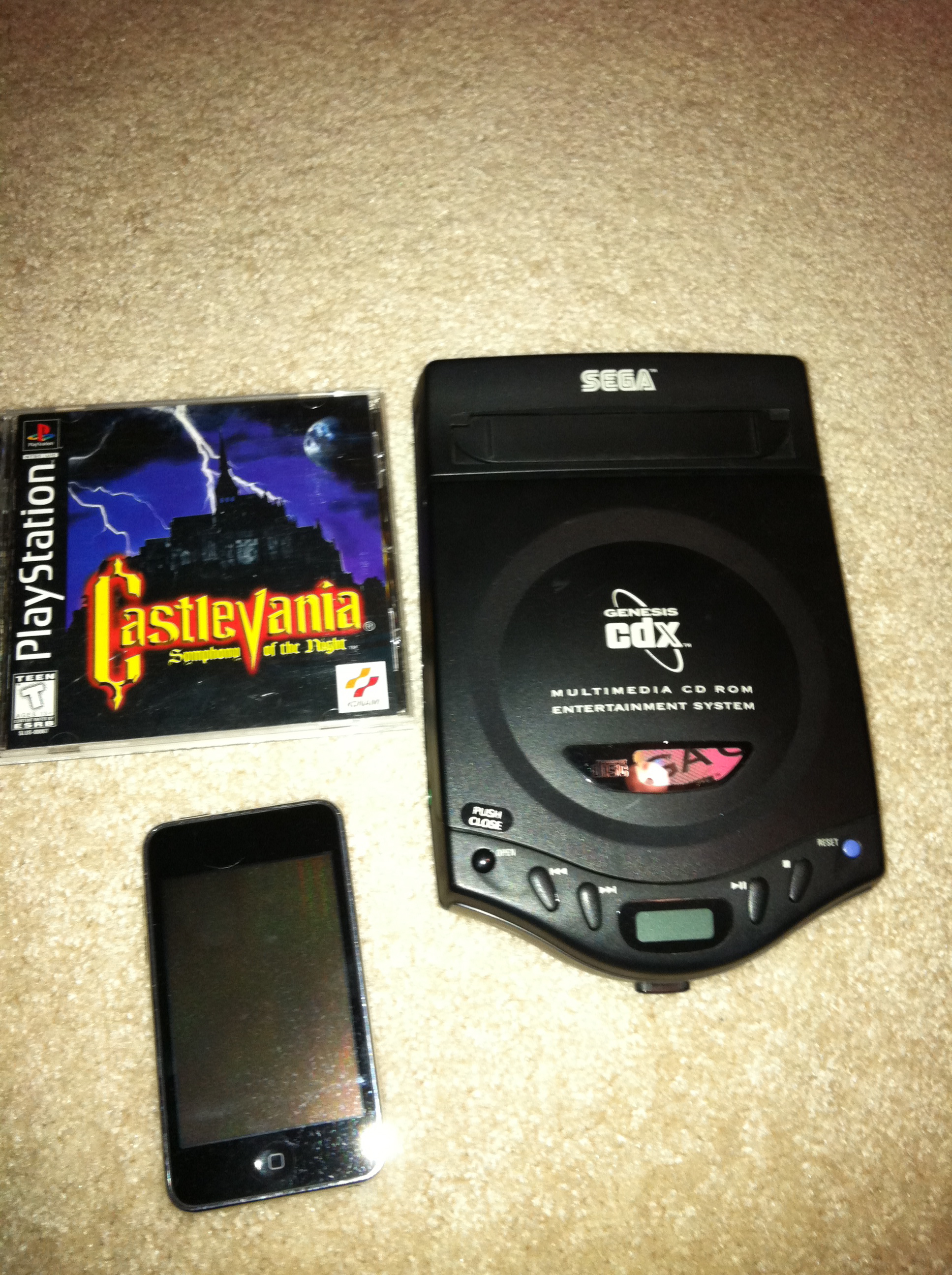
The CDX, and for size comparison, a standard Playstation CD jewel case and a more current portable music device, the iPod Touch.

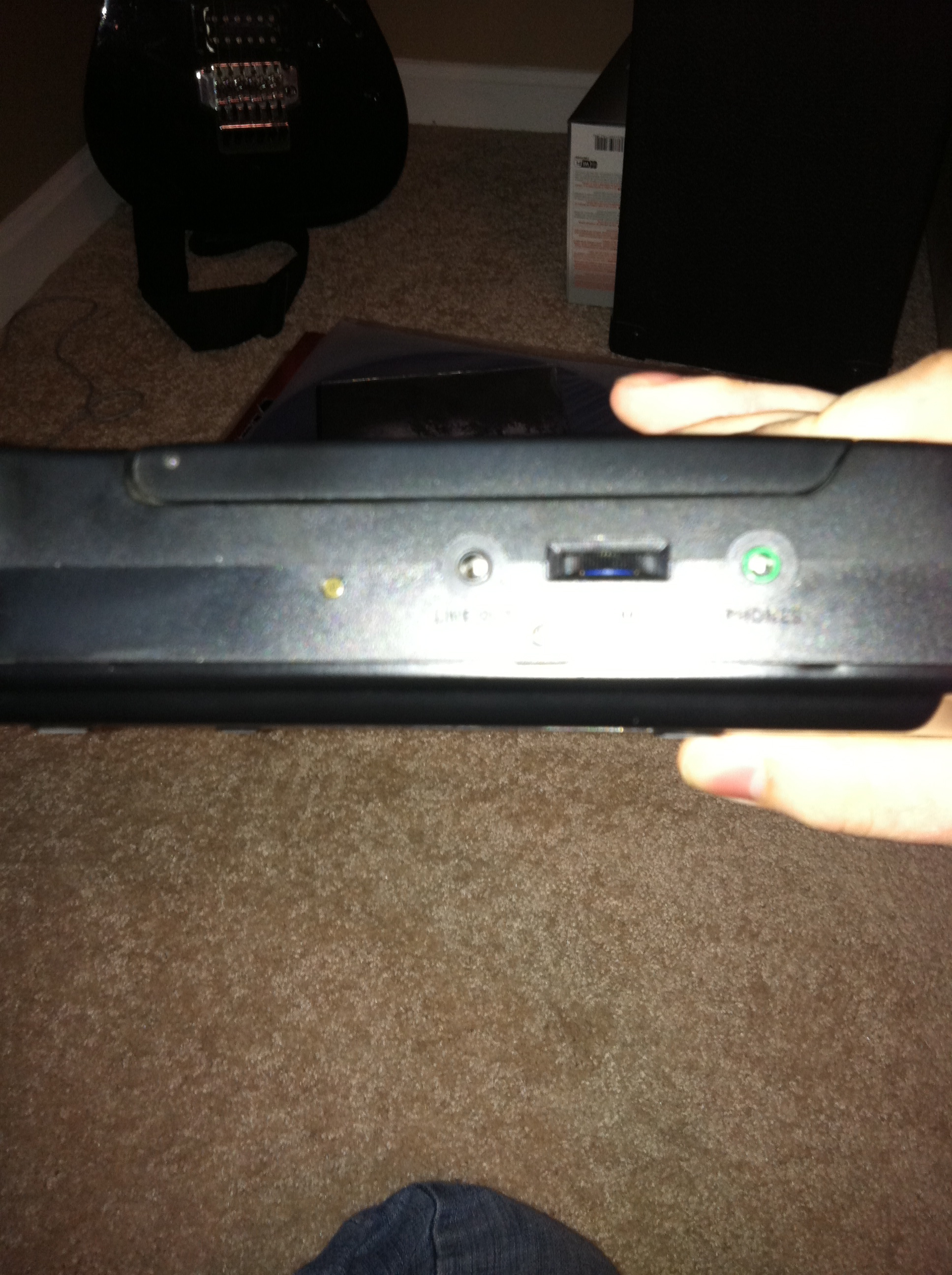
The CDX came out late in the Genesis’ life cycle.  It combined the hardware of the Genesis with the Sega CD in a compact case meant to also function as a portable CD player.  Like most mid-90’s portable CD players, it was really bulky and was not at all shy about sucking the juice from AA batteries making it extremely impractical.  Considering it’s 2011 though, I couldn’t care less about that part of the package and found myself very interested in it’s compact size and functionality.

To eBay I went, only to find that a CDX wasn’t going to come cheap, but like with a lot of things, once I decide I want it there’s no turning back.  After missing out on a few auctions I finally came away with one in pristine condition last week along with 2 copies of Sonic CD, the original (in jewel case) and the re-release that came packaged with the CDX.

Since getting it last week I’ve played and beaten Sonic CD.  Was it worth the 15 year wait?  Probably not.  I had often heard fans cite Sonic CD as the best of the 2D Sonic titles (which I suppose would make it the best Sonic title) and I didn’t come away with that impression.  My favorite is still Sonic 3, especially once added to Sonic & Knuckles.  Sonic CDreminds me quite a bit of the first Sonic game.  In this one Sonic is flying solo and Robotnik is once again up to no good.  This time he’s got a new toy for Sonic to deal with, Metal Sonic!  Metal Sonic makes his first appearance early on and kidnaps Sonic’s girl,

The original Sega CD cases were similar in size to a standard DVD case but made of plastic like a CD jewel case. They were also thicker but just as fragile making it easy to see why DVDs never came in a similar package. The above Sonic CD is the one that came with the CDX which is similar to a digi-pack release only with no room for the booklet.

Amy, giving Sonic even more motivation to kick some ass.  The play mechanics are traditional Sonic, though he does have a couple of new moves.  The spin dash returns from Sonic 2 and he can also rev-up in a standing position.  I never really found much of a use for it as the spin dash puts Sonic into an invulnerable rolling position, but it’s nice to have.  The bonus stage is from a behind the hedgehog perspective once again, only this time you’re guiding Sonic over a pseudo race track to smash these flying saucer type things.  Smash them all in the alloted time and get a time stone.  The time stones are part of the lore of the game’s setting which allows Sonic to do something he’s never been able to do before – time travel.  In each non boss battle zone, Sonic can travel backwards or forwards in time.  This is mostly a gimmick, but it does add variety to the levels so you can experience them in a slightly different way on repeat play-throughs.  Otherwise, it’s possible to make it through the entire game without ever accessing this feature.

Just because the game didn’t live up the hype for me, doesn’t mean I didn’t enjoy it.  The level design is cool and the gameplay tried and true Sonic.  I did find the boss battles too easy though, and the confrontation with Metal Sonic was really anti-climatic.  The game also experienced more slow-down than other games.  In all Sonic titles, it’s not uncommon for the game to stutter a bit when Sonic takes damage and loses a large amount of rings.  I found it more frequent with Sonic CDand sometimes the enemy sprites would disappear when this happened as well.  I suppose that’s the trade-off when switching to CD.  I’ve also heard the CDX is more prone to this sort of thing than the Sega CD was, though that was usually in reference to FMV sequences but I’m still leaving it open as a possibility.  The soundtrack is nice, though the poppy up-tempo “Sonic Boom”

The CDX is much smaller than the Genesis and Sega CD combo, but for a portable CD player it's still pretty bulky.

title song isn’t really my kind of thing.  I also miss the classic invincibility music from the first two Sonic games.  I didn’t beat the game completely, which is to say, I didn’t achieve the best ending.  By going back in time in each zone, Sonic can create a good future for the zone by destroying a robot generator.  I didn’t do that for each level, and I didn’t get all of the time stones  I plan on giving it a shot, even if the FMV animated endings are all pretty lame.

This isn’t the end for me and the Sega CDX though.  Not only did I get Sonic CD, I also got the two Ecco the Dolphin games and a compilation title.  There are a few select other Sega CD games I want to check out, and I also plan to make use of that Genesis port in the not so distant future.  It’s a pretty cool little device and I plan on getting my money’s worth with it.  This also isn’t the end of nostalgic video game topics.  Not only can you expect further Sega Genesis and CD titles to pop up on here, but I’ve also decided to get into Neo Geo and plan on having a lot to say about it.


Beat the Game

CNN of all places ran an interesting article the other day in their tech section regarding how often players finishes the video games they happen to purchase (you can read it here).  The title of the article kind of says it all as it asks why people don’t finish video games, conceding that not finishing them is already the norm.  There are some numbers thrown out suggesting less than 20% of gamers will play a game to completion, but there’s no hard data given.  The only example used is Red Dead Redemption which the article states that only 10% of people who purchased it played it through to completion.

Even though it was cited by many publications as the best game of 2010, the majority of gamers who purchased Red Dead Redemption never saw the game's conclusion.

A number of reasons are given.  One being that many gamers are only interested in multi-player (certainly true for many first-person shooters and PC games) so they ignore the single player modes.  Another is the short-attention span we seem to have developed as a culture where instant gratification is the name of the game.  One theory that surprised me centered on the average age of gamers; as we get older we have less time and my generation is really the first that grew up in an era where video games were a big piece of entertainment.  The premise didn’t shock me as for me it’s absolutely true, what shocked me was that the average age of gamers according to the article is 37!  There’s got to be some noise in whatever study was conducted to determine that.  I could accept low 30’s, but I personally don’t know anyone who is 37 or older and regularly plays games.  I’m guessing cell phone games are partly responsible.

Either way, a lot of these reasons seem viable as well as many others (we certainly have an over-saturated market when it comes to games these days) and got me to thinking about my own habits.  My first reaction was to consider myself an exception as I feel like I do finish most of the games I purchase, but I decided to do some research.  I tallied up all of the games I have owned at some point during this current generation.  I’m certain I probably forgot about a game or two here or there that I sold, but for the most part I tend to hang onto my games.  The consoles I own that I included in this elementary study include Playstation 3, Wii, DS, 3DS (including eshop Gameboy Color game Link’s Awakening), and the PSP.  I found my initial reaction was correct as it does appear to be the case that I finish more games than not, but my completion rate wasn’t as high as I would have thought.  The results by console:

PS3 – 68%  Wii – 46%  DS/3DS – 38%  PSP- 50%  Overall – 54% (33 out of 61)

Clearly, my PS3 has gotten more love than the rest, or it just has had the better games.  The PSP may have come in second, but I only have 4 games for that system so I wouldn’t read much into it.  Clearly, I’m not getting much out of the DS.  For the 3DS, I only have the two over the counter games I’ve mentioned before, Super Street Fighter 4 and Ocarina of Time.  For SSF4, I never beat it with every character so I do not consider it complete, but I have spent quite a bit of time with the game (19 hours to be exact).  For the regular DS though, I’ve only finished 3 games out of 9, and one was Castlevania Dawn of Sorrow where I stopped after getting the first (and worst) ending.  For whatever reason, portable games just don’t hold my interest.  Since I began taking the train to work over a year ago though I have spent more time playing portable games so my completion rate is bound to rise.  Of the games I own but have not beat, I would like to return to both Final Fantasy III and Dragon Quest V.  Neither game really grabbed me to the point where I was sucked in but I also didn’t dislike either one and would like to see them through.

I need to give this game another chance before giving up on ever completing it.

The Wii also had a poor showing, coming in at under 50%.  In the case of the Wii, it’s mostly just a lack of quality software and the novelty of waggle controls wearing off.  Some of the Wii games I have that I never finished (and actually barely played) include Madworld and Battalion Wars.  I don’t think either would ever be confused for great games, though both supposedly have strengths, I just never found the time to give them much of a chance.  One game I have not finished but am almost certain to some day is Super Mario Galaxy 2.  I loved the first one and demolished it, but the second just didn’t hook me.  Not because it’s bad, but just because the newness wore off.  I think I’m on the second to last level so whenever I put my mind to it I will finish it.  Another that I really need to give another chance is Metroid Prime 3.  Metroid is a great series, but I just don’t like first-person shooters.  However, I feel like I need to give the game a fair chance.  I think I’ve only played it twice and only faced one boss which certainly isn’t enough time to truly evaluate the title.  On the other hand, I could just download Super Metroid from the Wii Shop…

Obviously, I’ve finished more Playstation 3 titles than any other.  And some titles I excluded as they weren’t the kind you truly “beat” (MLB games, Warhawk, etc.) but there’s still some room for improvement.  There’s some games in there I need to revisit such as Little Big Planet and the Grand Theft Auto 4 add-ons, though at this point it seems unlikely.  One game I consider in progress is Infamous 2.  I received it as a gift just about 2 months ago and started playing it maybe a month ago (before that my time was being swallowed up by Zelda) so the jury is still out.  I will say it hasn’t sucked me in like the first one did.  It’s basically a carbon copy of the first game, just in a new setting with a couple new super powers for the protagonist to make use of.  One game I considered not finished is the last Smackdown vs Raw game and only because I didn’t play through all of the single player season modes.  I’ve done basically everything else in the game except finish one or two of those modes, but unfinished is unfinished.

Fortunately, or unfortunately, my completion percentage is what it is.  I suppose if I’m getting enough satisfaction out of the majority of the games I purchase then all is well.  Part of me does and always will feel like I wasted my money if I don’t beat a game, but I also recognize I just don’t have the time.  That’s not to say I couldn’t make the time if I really put my mind to it but then how much fun would I really be having?  Needless to say, I woudln’t expect these numbers to get any better for the majority of gamers.  If anything they’ll just continue to get worse and the only way they’ll improve is if the average length of games continues to shrink to the point where we’re beating games in one sitting.  I don’t really care, so long as the big “epic” titles do not vanish all together in place of 5 hour campaigns and paper thin narratives.


The Legend of Ganondorf

Who wouldn't want to play as this guy?!

In my write-up on the Legend of Zelda franchise I made note of the fact that the series is dangerously close to becoming stale.  Ever since the iconic Ocarina of Time, the games that have come after have mostly followed the same mold.  There’s something to be said for not fixing what isn’t broken, but like a movie with a sequel that continues to reuse the same plot it becomes less interesting.  In a way it’s like the economic concept of diminishing returns.  One way Nintendo could put a new spin on the franchise would be to take a look at long-time nemesis Ganondorf, thus I propose that he should receive his own game:  The Legend of Ganondorf!

Ganondorf still sounds strange to me.  When I was a kid the main baddie for Link to overcome was named Ganon and he looked like a pig.  He was the final boss in the first Zelda game and a plot device in the sequel before returning as the main villain for A Link to the Past.  It was also as Ganon that he appeared on animated series the Super Mario Brothers Super Show and Captain N: The Game Master.  It wasn’t until Ocarina of Time that he was given a more human-like appearance and referred to as Ganondorf.  Once he undergoes a transformation during the game’s final boss encounter the game refers to him simply as Ganon.  It was also in that game we learned that Ganondorf belongs to a race of desert people known as the Gerudo.  The Gerudo are thieves by trade, and their race only includes one living male at a time who reigns as their king.  Being that Nintendo is a family friendly company, the game doesn’t go into much detail how a race of people could survive with only one male living at a time but we can let our imaginations run wild.

It doesn't matter how many years go by, this is still the first image that comes to mind when I hear the name Ganon.

That’s an image Nintendo should abandon with a Ganondorf title.  A game focusing on his origins could take some risks that maybe Zelda would not normally.  The main character would likely need to be ruthless and cunning to survive in such a world and the plot could add a dangerous component to being the Gerudo’s only male.  It could be shown that the notion of only one male being born every ‘X’ amount of years is a piece of romantic fiction perpetrated by outsiders.  In reality, it could be that the Gerudo priestesses are sacrificing low born males and only keeping one around intentionally.  That could then go in one of two ways, it could be that the male chosen to live is of significant birth and prophesied to be something special.  Or it could be they select a sickly youth who will be easier to control – a puppet king.

Regardless, the setting would be a more lethal one than anything Link has ever faced.  And since Ganondorf and the Gerudo are thieves the plot would advance in an anti-hero fashion.  This particular game would serve as a prequel to the Ganondorf we see in Ocarina of Time and the plot would revolve around him proving himself worthy to the Gerudo and amassing power.  The ultimate conclusion of the game would be for Ganondorf to acquire the Triforce of Power and claim Hyrule as his kingdom (the part of OOT where Link is in a magically induced state of sleep).

As Ganondorf would progress through the game he'd gain new powers, like animating the dead. More Stalfos please!

The character of Ganondorf and the setting would make the game pretty interesting in its own right, which would make it easy for Nintendo to just take this set-up and throw it into a Zelda game.  That would be too easy though.  Ganondorf should not play like Link, and separating the two would be an important point for the gameplay.  Since he’s a thief a stealth component would serve him well.  Dungeons would require a young Ganondorf to steal his way through undetected and emerge from the shadows to take down his foes.  As his powers increase the gameplay would shift to a more action oriented one where a bold and confident Ganondorf is unafraid to emerge from the shadows and take on all comers.  Ganondorf is depicted in OOT as wielding a single weapon, but a little creative liberty would be welcomed if the developers chose to give him dual blades instead (as seen in Wind Waker).  Ganondorf’s combat could be more rhythm based as opposed to Link’s, which is just push attack and dodge occasionally.  This would give the game an action component.  The biggest design decision the developers would face would be whether or not to include a jump function.  Giving the player character the seemingly simple jump command tends to open up the game to plat-forming elements.  There are pros and cons to this and I have no preference to either side.  Certainly doing so would help separate the title from the main Zelda franchise.

I’m sold on the idea and think it’s one Nintendo absolutely should explore.  It’s no secret the company is struggling right now.  The Wii luster has long since worn off and the system has become barren.  The 3DS has struggled to make an impact in the market due to a number of reasons and is already receiving its first price cut this month.  The Wii is dead, but the 3DS has some nice software on the horizon.  The problem is that a lot of it is unoriginal ports like Star Fox 64 and Metal Gear Solid 3.  A shiny new original franchise based on Ganondorf would immediately grab the spotlight.  If pulled off well it would no doubt help move systems as well and the 3DS hardware is more than capable.  Of course, Nintendo could still pursue the title but earmark it for their new console the Wii U, maybe even make it a launch title.  There’s easily enough here to make a good game though, and we Zelda fans would love to get an in depth look at the main antagonist of the franchise.  Free Ganondorf!


The Legend of Zelda – A Retrospective

In playing the recently released Ocarina of Time 3D, I began to reflect on The Legend of Zelda series as a whole.  I was initially going to post a review and impressions of the game, but there’s lots of places to find that (and if you really want my opinion, it’s good) and I thought looking at the series as a whole would be more interesting.  It’s often said that Ocarina of Time is not just the best in the series, but the best game of all time.  I tend to shy away from anointing anything the best ever and just stick to favorites.  In that regard, no Zelda title is my all-time favorite (a post for a later day) but there are a few among my favorites.

If Mario is Nintendo’s official mascot, then Link is its most professional.  Mario finds himself in many 5 star games, but he also shows up in lots of junk as well.  Link, and the Zelda franchise as a whole, is remarkably consistent in terms of quality (ignoring those regrettable CD-I games) and each Nintendo console’s best game is often times a Zelda title.  A retrospective on the topic is only as good as its author, unfortunately, this author hasn’t played every Zelda game under the sun.  I’ve played all of the core titles in some part (and I’ll note which ones I never finished), but a lot of the handhelds have been ignored by me for one reason or another (the number one reason being I don’t play a lot of handheld games).

Where it all started...

It almost seems unfair to compare the original Legend of Zelda with the more modern titles.  After all, it’s an 8-bit game that’s over 20 years old at this point, so only the most devoted nostalgic gamers would cite it as the best in the series.  It did, however, lay the ground work for just about every title that has followed.  Whether that title made use of the overhead perspective, or just the dungeon crawl and find various items component.  Really, no Zelda title has followed a different path and if there’s one major criticism that can be laid at the franchise’s feet it’s that the basic gameplay has not changed in 25 years.  That’s both a criticism and a testament for just how good the original game was that it’s still relevant.  And the original is still remarkably playable.  Some NES games have suffered terribly over the years but I like to believe that young gamers today could still play the original Zelda and find some enjoyment.

This just didn't feel right.

Zelda II was and is still the black sheep of the franchise.  The full title was Zelda II:  The Adventure of Link, and as the title implies, it focused mostly on the series’ protagonist, Link.  The story line picked up right where the first game left off, and now Zelda is in a coma of some sort and Link needs to wake her.  I don’t remember much else about the plot, save that Ganon is involved and he taunts you from the “Game Over” screen, which you will see, a lot.  It’s a side scrolling action-adventure RPG.  Link moves from left to right (save for an overworld map screen) and can jump around.  As he defeats enemies he gains experience points and levels up, where the player can choose what abilities to upgrade; health, magic, and attack.  This game is easily the hardest in the series.  Link has this puny little sword which means he needs to get close to enemies to attack.  At full health, he can shoot beams from it but once damage is sustained that feature is disabled.  Some enemies can only be attacked from a standing or crouching position too, and switching between the two is cumbersome.  I never liked this game much as a kid, and never progressed very far in it.  Whenever I played it I always ended up being reminded of how much I liked the first game.

It makes sense then to learn that I loved the next game in the franchise, A Link to the Past.  Released for the Super Nintendo in 1992 (1991 in Japan), A Link to the Past brought the series back to its roots.  Gone was the side-scrolling, jumping, experience points dribble of Zelda II and back was the overhead, sword slashing, bomb dropping, awesomeness of the original.  With the move to the SNES, the game was obviously much prettier to look at.  Link could do more things like run and magically traverse worlds.  The game was difficult as well, but not frustratingly so, especially if you found the various heart containers strewn about the world to increase Link’s health.  Again, the plot was rather ho-hum, but it did serve as a prequel to the original which was kind of neat.  Almost everything introduced in this game has been carried forward such as multi-level dungeons, the master sword, hookshot, and musical instrument concept.  The parallel world concept also makes frequent appearances in future titles as well.

Ahh, much better.

A Link to the Past is one of the best games on the Super Nintendo and in the running as for my affections as favorite title.  I’ve played and re-played this game more times than I can count and am always entertained.  It’s one of the few titles to receive a direct sequel as well, the Gameboy’s Link’s Awakening takes place following A Link to the Past.  I mentioned in an earlier post that I never played that game when it first came out or even when it was re-released for the Gameboy Color, but I do have it on my 3DS.  I haven’t finished it yet but from what I’ve played it’s an excellent little game.  It maintains the same basic approach to gameplay as ALTTP but introduces some new stuff such as a couple of side-scrolling screens and the ability to jump on command, two things unique to this game and Zelda II.  It remains the only portable-only Zelda title I’ve played extensively.  My experience with the DS games was only for a short burst and neither really appealed to me, Spirit Tracks and Phantom Hourglass.  I found them a little too gimmicky but admittedly did not give either a chance.  The whole train thing of Spirit Tracks conjured up bad memories of Wind Waker’s sailing sessions and was an instant turn-off.  Like Link’s Awakening, I probably should not have ignored the other Gameboy titles Oracle of Ages and Oracle of Seasons, as I’ve heard nothing but good things.  The lone Gameboy Advance title, The Minish Cap, was positively received but I just never got around to playing it.  Maybe some day.

A whole new perspective on life.

After that handheld tangent, the next game in the series to grace a home console is the now infamous Ocarina of Time.  Released originally for the Nintendo 64 in 1998, it was an instant classic with many review outlets giving it a perfect score.  Gameplay-wise, it took the basic formula of ALTTP and switched it to 3D.  Link still traveled around the world of Hyrule entering dungeons and collecting many familiar items while solving puzzles along the way all in an effort to save the kingdom and defeat Ganon (now called Ganondorf).  The two-world concept was even brought back as there’s a past world and a future, semi-apocalyptic Hyrule where the player plays as an adult Link.  Young Link and adult Link played the same, but certain items were unique and usable to each.  It didn’t make much sense in the game why adult Link couldn’t use a boomerang, but he had the hookshot to make up for it so no one really cared.

Visually is where the game differed most from its predecessor.  Now in full 3D, the camera is positioned behind Link for the majority of the experience.  To make combat easier, Nintendo came up with the Z-targeting feature that would appear in numerous copy-cat games where pressing the trigger underneath the N64’s controller caused Link to lock-on to an opponent.  When locked on, he would focus on that enemy making attacking much easier.  Also, other enemies will not attack Link while he’s locked onto an enemy.  Unrealistic?  Of course, but good for gameplay.  Link could still perform his spin attack from ALTTP, but now he also had a jump attack that did major damage when compared with his normal sword strikes.  Multiple items could be mapped to the C buttons making switching between them much easier than in previous titles.  To further keep things simple, Nintendo opted to go for an auto-jump as opposed to making a jump button.  It works, for the most part, though there are times when you wish Link was a little less inhibited.

So what did the game introduce as new?  Lots, really.  Many things were mostly expanded upon, such as the fishing game from Link’s Awakening, and Hyrule was now much bigger with more places to explore.  The Zora race of fish folk were expanded upon and brought into the story.  Link gets a horse to ride around on.  And the musical instrument concept was greatly expanded upon as the game’s title suggests.  Link could learn multiple songs on his Ocarina that all had different functions.  Some transported him to places, others turned night into day, and so forth.  It’s a fun mechanic that has shown up in later titles.  The 3D perspective has proven to be quite popular and has been the go-to method of display ever since for major console releases.

The praise heaped on OOT has been well placed.  It’s a great game, nearly flawless.  If I had one major complaint with the title it’s with the annoying companion character.  Yes, I’m talking about Navi.  Navi is a fairy that follows Link around and offers advice, unfortunately, that advice is often not wanted and far too obvious to be useful.  And when she wants to be heard an annoying “Hey!” sound byte is played.  She’s even more annoying in the new 3DS version of the game as she’ll pop in to suggest the player take a break after a half hour or so of gaming.  Nintendo, stubborn as always, has refused to make her optional and every time I hear that annoying high-pitched voice I want to throw my 3DS across the room.

This is what we thought Wind Waker would look like...

Ocarina of Time was a tough act to follow.  When Nintendo introduced its next console, the Gamecube, to the masses it was accompanied with a high-res demo of Link battling Ganondorf that left everyone’s mouth agape.  We all thought this was a preview of what the next Zelda title would look like, and we were all fooled.  Wind Waker was announced roughly a year later and it looked nothing like OOT.  Everything was now cartoony, and Link was sporting big goofy eyes and a tuft of blond hair.  Everyone was pissed.  When the game finally came out in 2002 it became obvious that the game was actually quite the visual spectacle.  Animations were smooth and the frame-rate crisp.  While many still could not love the style of the visuals, they were at least forced to admit it was a pretty impressive title.

...and this is what we got instead.

While the visuals were easily forgiven, gameplay could not be.  Wind Waker is probably the easiest and most accessible Zelda title ever released.  OOT wasn’t brutally difficult by any means (even the Master Quest version can’t compare with Zelda II in terms of difficulty) it was still challenging.  Wind Waker was pathetically easy, to the point of boredom.  Compounding this boredom was the new sailing mechanic that had Link traveling across this flooded Hyrule via boat.  One section of the game requires a ton of sailing, and that’s the part where I basically checked out.  I never finished this one.  While I didn’t hate it, I certainly didn’t like it.  I didn’t find the dungeons to be an improvement over OOT and the gameplay was so simple I found myself getting tired while playing it.  Next to Zelda II, this is my least favorite in the series.  It was still well-received by critics, but it’s my opinion that was a combination of reputation and over-compensation for the visuals.  Many reviewers wanted to tell the reader to look past the visual style.  I did, and I didn’t find much beneath them.

I realize I skipped Majora’s Mask.  Not intentionally, but probably because that title has always felt like a side-story to me and not a full-fledged Zelda title.  It was the direct sequel to OOT and featured a new gameplay mechanic, masks.  Link would acquire new masks throughout the game that granted him different abilities.  The backdrop to the story was that the moon was going to obliterate the land of Termina in a couple of days, and Link needs to save the day with his trusty ocarina and new masks.  The player has to constantly play with time as the game takes place over 72 hours, jumping back and forth to avoid armageddon.  It’s a pretty cool approach and definitely changes things up from OOT.  It does get understandably tedious at times, especially when you’re close to completing an objective but run out of time and have to start all over again.  I never played the game on N64 and had to download it for the Wii.  I like the game, but I don’t love it.  As a result, I’ve yet to beat it despite having it for 2 years now though I do intend to return to it, some day.

Following the backlash Nintendo received over Wind Waker’s visual style, Nintendo returned the series to a more realistic look with 2006’s Twilight Princess.  Developed for the Gamecube and released on the Wii as well, Twilight Princess was the visual treat many fans had wanted.  Gameplay wise, it was mostly an OOT re-tread which seemed okay for most fans and reviewers.  Instead of the ocarina mechanic, Link now could transform into a wolf and enter a spirit world called the Twilight Realm.  Unfortunately, this felt kind of gimmicky and the wolf parts of the game weren’t nearly as interesting as the traditional stuff, though not painfully so.

Wolf Link in the Twilight Realm. Kind of trippy.

The rest of the game would have felt ho-hum, but the visual approach did a lot to add weight to the series.  Navi’s replacement Midna actually had some personality and was an enjoyable plot component as opposed to a nuisance.  The darker tone the series undertook earned the series it’s first ever Teen rating and added a sense of dread.  Truthfully, it’s a very enjoyable game and in many ways improves upon OOT, it just wasn’t the same leap forward as ALTTP and OOT were when jumping to a new system.  The Wii controls worked for the most part, but weren’t as immersive as Nintendo seemed to promise.  Some even prefer the more traditional control scheme found on the Gamecube version.

I don’t know which Zelda title is my favorite, but it’s obviously between A Link to the Past and Ocarina of Time.  My nostalgic core likely prefers ALTTP, but I can’t ignore the brilliance of OOT.  It doesn’t matter much in the end, both are deserving of the praise they receive.  I’m hopeful that this fall’s Skyward Sword is the leap forward Twilight Princess was not.  With true one to one motion controls, it could be pretty cool to swing Link’s sword around but if it’s the same basic experience I’ll be a little disappointed.  I’m ready for Zelda to tread new ground but am also confident that Nintendo will provide a worthwhile experience.  It will either be a great game or an all-time classic, and neither sound bad to me.