Category Archives: Video Games

Call Me “Ambassador!”

Yesterday was the first day of September and for most probably just another Thursday, however, this wasn’t any ordinary Thursday.  This was the first day of the Nintendo 3DS Ambassador program!  That means that for all of those impatient suckers out there (like me) who bought the 3DS at launch earlier this year when the software was terrible, some old Nintendo games are now available for free via the eShop.  This was done to make consumers feel better about paying $250 for something that just got marked down to $170.  Really, Nintendo had no obligation to do anything for early adopters but it’s certainly not a bad PR move to throw your loyal fans a bone, and that’s what they’ve done.

Ten classic Nintendo games have been made available to those of us lucky enough to be called ambassadors.  Truthfully, the term classic is probably a bit much for some of these titles as I’ve never heard anyone pine for a downloadable version of Yoshi recently.  Regardless, I downloaded everything and made some time last night and today to fire each title up for some nostalgic gameplay or to try a title I missed out on.  I’ve actually been looking forward to them as I’m in a dry spell when it comes to new portable games.  While the games play faithfully enough (perhaps too faithfully) they also haven’t benefited from the usual enhancements Nintendo makes to their virtual console titles.  For the re-release of Link’s Awakening a Virtual Console menu was added that included a save state feature, similar to what most emulators have (not that I would know anything about that…) that proved quite convenient.  It’s really nice for a portable to have the ability to save the game at any time.  It’s also convenient for those really difficult old school games as you end up with a handy restore feature when you screw up.  Cheating?  Perhaps, but I’ll never beat Zelda II without it.

There is some good news though.  Nintendo plans on releasing all 10 of these titles to the general public at a later date with not only the restore feature added but two player functionality as well.  At that time ambassadors will be able to re-download the games for free to get the full experience making these current ones just a tide-me-over kind of deal.  I don’t know when the “true” versions will be available though (possibly not until next year) which is too bad.  In addition to these current titles, Nintendo plans on releasing 10 Gameboy Advance titles as well for ambassadors.  Unlike the NES games, these ones apparently won’t be available to new 3DS owners.  Wanna know what I think about the current games?  Read on:

Super Mario Bros. – What’s there to say about the classic Nintendo platformer that hasn’t already been said?  Well, for one it controls a little funky.  I don’t know if it’s the 3DS or just sloppy emulation but it feels off.  The display is also 4:3 which makes Mario and enemies seem tiny on the 16:9 format screen.  It’s playable, but not perfect.

Balloon Fight – This is a game that needs two-player and unfortunately, that’s not available at this time.  It’s a simple, fun title that I never played on the NES.  You flap around suspended from a pair of red balloons and pop the balloons of enemies, then take them out before they can refill their balloons.  Again though, the 3DS controls hinder the experience.  Flying requires rapid tapping of the B button which makes it hard to keep the 3DS steady and thus hard to follow.  It’s still fun, but not something I’ll be playing much.

Donkey Kong Jr. – Mario as a villain!  That’s one of the attractions of this re-working of the Donkey Kong formula.  Definitely old school, but a faithful port.  It’s not a game I was ever a huge fan of but I’m going to make an effort to give it some a chance.

The Legend of Zelda – Hey!  A real classic!  This one is another faithful port and one not hindered at all by the 3DS’s controls.  This old game holds up fairly well though younger gamers may find it too difficult.  I’d definitely welcome the save state feature but it’s not a killer here.

Zelda II: The Adventures of Link – Because one Zelda title is never enough.  Here’s a game that would benefit greatly from the save state feature.  The port is faithful, right down to the “I am error” guy, so if you like the original you’ll like this one.  I’m on record as stating I’ve never been real fond of this title.  It’s difficultly is due to the poor controls and Link has never felt worse to play as.  When the updated version gets released with save state I’ll make an honest effort to beat it.  No promises though!

Metroid – Link isn’t the only one celebrating an anniversary this year.  For some reason, Nintendo hasn’t said much about Samus’ milestone but whatever.  Metroid still plays well today, though it would be nice to replace the archaic password feature with the save state feature (I’m aware I must sound like a broken record at this point).  The only disappointment in regards to this title is that it likely means the re-make Zero Mission won’t be included as one of the GBA downloads.  The excellent Metroid Fusion will be though.  Even without the save state feature, this one is probably my favorite of the freebies.

Wrecking Crew – Here’s an obscure Mario game.  It’s kind of a puzzler where Mario tries to smash everything in the level without getting hit by a personified wrench thing.  I remember playing this as a kid, but not for any great length of time.  When I realized that it wasn’t anything like SMB I probably turned it off.  This is a game that works pretty well and isn’t hindered by any of the VC shortcomings, as a single player experience anyways.  A surprising little gem that will likely benefit from being a free release.

NES Open – An obscure golf game starring the Mario brothers.  If I hadn’t just spent the past month playing Let’s Golf 3D I probably would have been more interested in this one.  It’s just too old and unwieldy for me.  I doubt I’ll play much of this one.

Ice Climbers – This game is mostly pointless without 2-player support.  A good port of an old game.  Those who liked it as kids might get a kick out of it, but I have little use for it.

Yoshi – A puzzle game, though not a particularly endearing one.  It’s amusing for short bursts and I actually prefer it to Dr. Mario but it’s no Tetris.  By virtue of the fact that it’s a puzzler makes it very playable though and Father Time has been pretty kind to it.  I can see myself playing this one for a while when I’m bored with a 3DS in my hand.

So those are my impressions of the initial batch of Nintendo Ambassador games.  With more on the way there’s reason for optimism if you were an early adopter of the Nintendo 3DS.  The more modern GBA games will probably trump the NES ones and while it would have been cool to get a real classic like Super Mario Bros. 3, I’m not surprised Nintendo would want to hold that one back for a paid release (or a 3D remake).  At the very least, this gives me something to do until Star Fox drops later this month.


Sonic CD and the CDX

There was a pretty significant chunk of my life where the Sega Genesis was my favorite console.  I got it primarily for some uncensored Mortal Kombat brutality but soon got hooked onto the system’s other franchises, franchises like Sonic the Hedgehog.  My first Genesis was the Model 2 which included the pack-in game Sonic the Hedgehog 2 and I played the Hell out of it.  Soon after, one of my rare non Christmas or birthday acquisitions would be Sonic the Hedgehog 3 and was probably the first game I ever beat 100% by collecting all of the Chaos Emeralds in all three game modes (Sonic, Tails, and Sonic with Tails).

The elusive Sega CD. It may be huge, but I do confess I think it looks pretty sleak. Of course, this picture doesn't include all of the wires needed to operate both the Genesis and the Sega CD at the same time.

I loved that blue Hedgehog and his two-tailed companion, even Knuckles was pretty cool.  I also played and beat the original Sonic game and continued on with the franchise through the Dreamcast days.  One game that I never did get a chance to play though was Sonic CD.  Sonic CD was, of course, the flagship title for Sega’s CD add-on to the Genesis.  The attachment was not only expensive, it was also terrible and cumbersome.  Don’t believe me, then check out what The Nerd had to say about it a few years ago.  Sure there are some worthwhile games out there, but sadly they were quite few and far between.  I don’t even remember asking my parents for one because that’s a big request.  To get that for Xmas would mean I’d probably get nothing else, and since the software wasn’t very compelling, I learned to make do without.

That meant I could never play Sonic CD, for not only did I never get a Sega CD, I didn’t even know anyone who did.  Feeling nostalgic, I decided I needed to play this game.  I know quite a bit about the Sega CD and that it can be a pretty spotty attachment.  I still have my old Genesis, but I didn’t want to dedicate the shelf space for it and it’s parasitic attachment.  Sonic CD did get released on a compilation a few years back on the Gamecube, Sonic Gems Collection, but it was pretty buggy.  Still, the cheap price tempted me on the resale market until I remembered Sega’s final Genesis revision:  CDX.

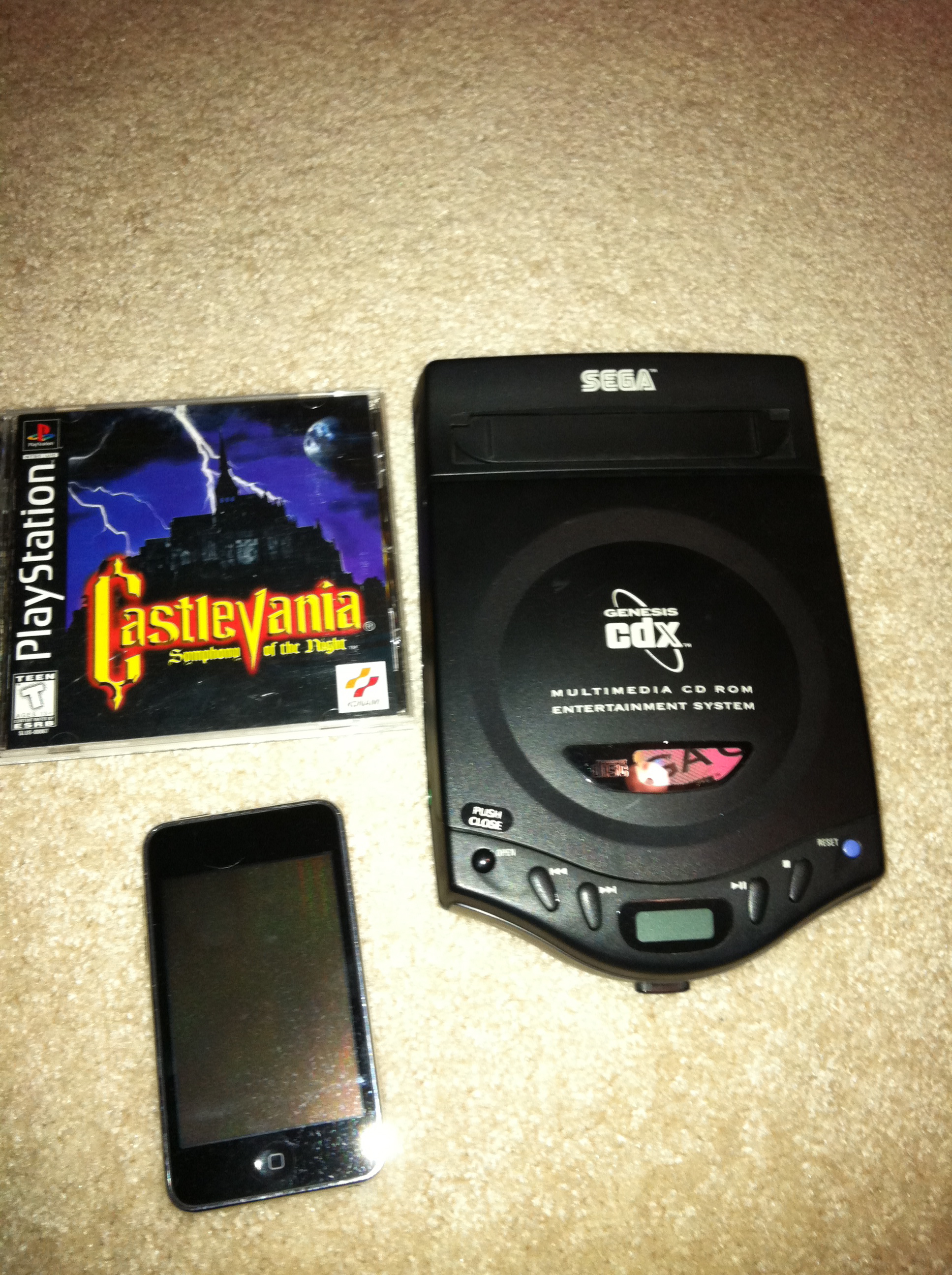
The CDX, and for size comparison, a standard Playstation CD jewel case and a more current portable music device, the iPod Touch.

The CDX came out late in the Genesis’ life cycle.  It combined the hardware of the Genesis with the Sega CD in a compact case meant to also function as a portable CD player.  Like most mid-90’s portable CD players, it was really bulky and was not at all shy about sucking the juice from AA batteries making it extremely impractical.  Considering it’s 2011 though, I couldn’t care less about that part of the package and found myself very interested in it’s compact size and functionality.

To eBay I went, only to find that a CDX wasn’t going to come cheap, but like with a lot of things, once I decide I want it there’s no turning back.  After missing out on a few auctions I finally came away with one in pristine condition last week along with 2 copies of Sonic CD, the original (in jewel case) and the re-release that came packaged with the CDX.

Since getting it last week I’ve played and beaten Sonic CD.  Was it worth the 15 year wait?  Probably not.  I had often heard fans cite Sonic CD as the best of the 2D Sonic titles (which I suppose would make it the best Sonic title) and I didn’t come away with that impression.  My favorite is still Sonic 3, especially once added to Sonic & Knuckles.  Sonic CDreminds me quite a bit of the first Sonic game.  In this one Sonic is flying solo and Robotnik is once again up to no good.  This time he’s got a new toy for Sonic to deal with, Metal Sonic!  Metal Sonic makes his first appearance early on and kidnaps Sonic’s girl,

The original Sega CD cases were similar in size to a standard DVD case but made of plastic like a CD jewel case. They were also thicker but just as fragile making it easy to see why DVDs never came in a similar package. The above Sonic CD is the one that came with the CDX which is similar to a digi-pack release only with no room for the booklet.

Amy, giving Sonic even more motivation to kick some ass.  The play mechanics are traditional Sonic, though he does have a couple of new moves.  The spin dash returns from Sonic 2 and he can also rev-up in a standing position.  I never really found much of a use for it as the spin dash puts Sonic into an invulnerable rolling position, but it’s nice to have.  The bonus stage is from a behind the hedgehog perspective once again, only this time you’re guiding Sonic over a pseudo race track to smash these flying saucer type things.  Smash them all in the alloted time and get a time stone.  The time stones are part of the lore of the game’s setting which allows Sonic to do something he’s never been able to do before – time travel.  In each non boss battle zone, Sonic can travel backwards or forwards in time.  This is mostly a gimmick, but it does add variety to the levels so you can experience them in a slightly different way on repeat play-throughs.  Otherwise, it’s possible to make it through the entire game without ever accessing this feature.

Just because the game didn’t live up the hype for me, doesn’t mean I didn’t enjoy it.  The level design is cool and the gameplay tried and true Sonic.  I did find the boss battles too easy though, and the confrontation with Metal Sonic was really anti-climatic.  The game also experienced more slow-down than other games.  In all Sonic titles, it’s not uncommon for the game to stutter a bit when Sonic takes damage and loses a large amount of rings.  I found it more frequent with Sonic CDand sometimes the enemy sprites would disappear when this happened as well.  I suppose that’s the trade-off when switching to CD.  I’ve also heard the CDX is more prone to this sort of thing than the Sega CD was, though that was usually in reference to FMV sequences but I’m still leaving it open as a possibility.  The soundtrack is nice, though the poppy up-tempo “Sonic Boom”

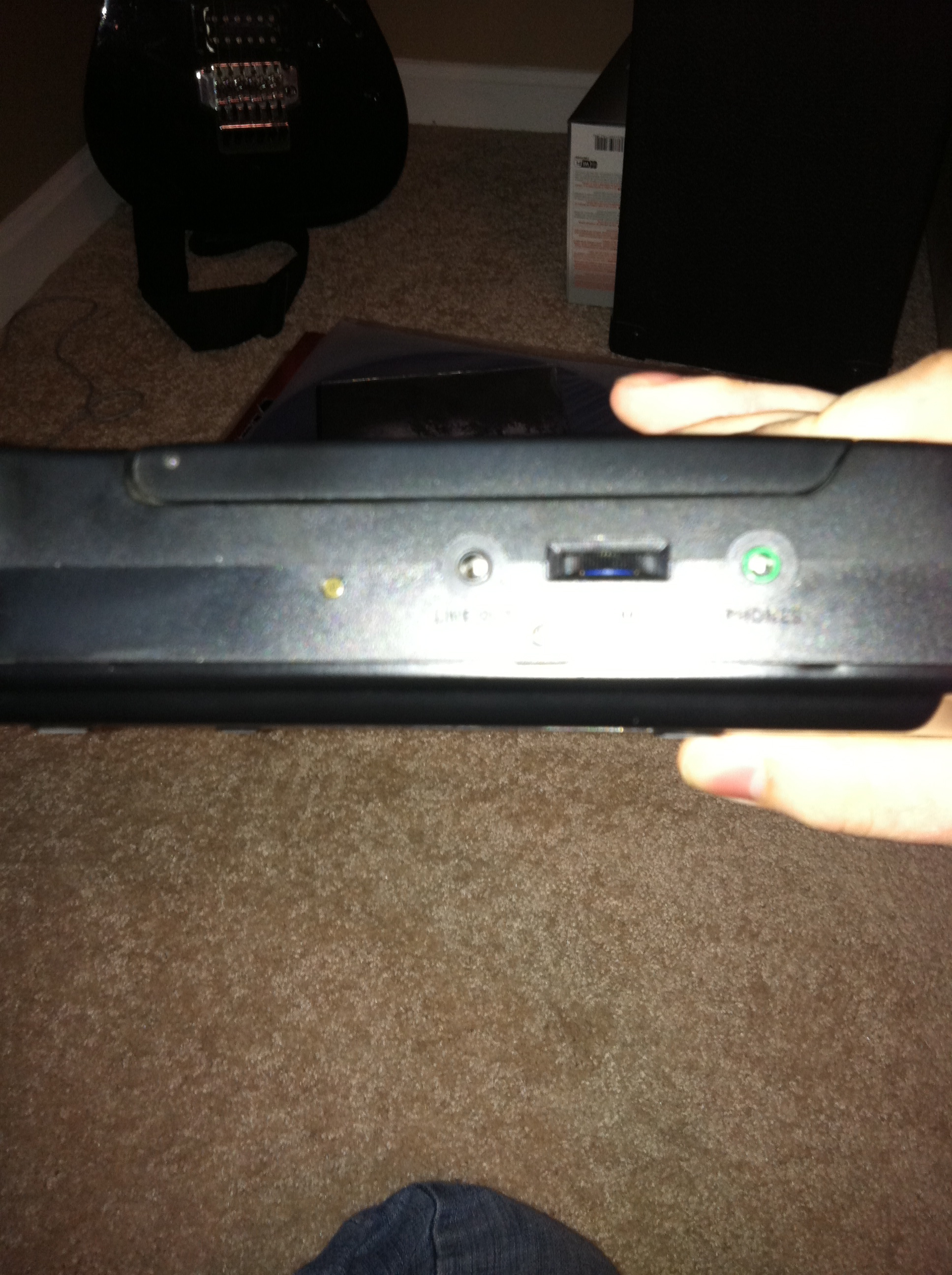
The CDX is much smaller than the Genesis and Sega CD combo, but for a portable CD player it's still pretty bulky.

title song isn’t really my kind of thing.  I also miss the classic invincibility music from the first two Sonic games.  I didn’t beat the game completely, which is to say, I didn’t achieve the best ending.  By going back in time in each zone, Sonic can create a good future for the zone by destroying a robot generator.  I didn’t do that for each level, and I didn’t get all of the time stones  I plan on giving it a shot, even if the FMV animated endings are all pretty lame.

This isn’t the end for me and the Sega CDX though.  Not only did I get Sonic CD, I also got the two Ecco the Dolphin games and a compilation title.  There are a few select other Sega CD games I want to check out, and I also plan to make use of that Genesis port in the not so distant future.  It’s a pretty cool little device and I plan on getting my money’s worth with it.  This also isn’t the end of nostalgic video game topics.  Not only can you expect further Sega Genesis and CD titles to pop up on here, but I’ve also decided to get into Neo Geo and plan on having a lot to say about it.


Beat the Game

CNN of all places ran an interesting article the other day in their tech section regarding how often players finishes the video games they happen to purchase (you can read it here).  The title of the article kind of says it all as it asks why people don’t finish video games, conceding that not finishing them is already the norm.  There are some numbers thrown out suggesting less than 20% of gamers will play a game to completion, but there’s no hard data given.  The only example used is Red Dead Redemption which the article states that only 10% of people who purchased it played it through to completion.

Even though it was cited by many publications as the best game of 2010, the majority of gamers who purchased Red Dead Redemption never saw the game's conclusion.

A number of reasons are given.  One being that many gamers are only interested in multi-player (certainly true for many first-person shooters and PC games) so they ignore the single player modes.  Another is the short-attention span we seem to have developed as a culture where instant gratification is the name of the game.  One theory that surprised me centered on the average age of gamers; as we get older we have less time and my generation is really the first that grew up in an era where video games were a big piece of entertainment.  The premise didn’t shock me as for me it’s absolutely true, what shocked me was that the average age of gamers according to the article is 37!  There’s got to be some noise in whatever study was conducted to determine that.  I could accept low 30’s, but I personally don’t know anyone who is 37 or older and regularly plays games.  I’m guessing cell phone games are partly responsible.

Either way, a lot of these reasons seem viable as well as many others (we certainly have an over-saturated market when it comes to games these days) and got me to thinking about my own habits.  My first reaction was to consider myself an exception as I feel like I do finish most of the games I purchase, but I decided to do some research.  I tallied up all of the games I have owned at some point during this current generation.  I’m certain I probably forgot about a game or two here or there that I sold, but for the most part I tend to hang onto my games.  The consoles I own that I included in this elementary study include Playstation 3, Wii, DS, 3DS (including eshop Gameboy Color game Link’s Awakening), and the PSP.  I found my initial reaction was correct as it does appear to be the case that I finish more games than not, but my completion rate wasn’t as high as I would have thought.  The results by console:

PS3 – 68%  Wii – 46%  DS/3DS – 38%  PSP- 50%  Overall – 54% (33 out of 61)

Clearly, my PS3 has gotten more love than the rest, or it just has had the better games.  The PSP may have come in second, but I only have 4 games for that system so I wouldn’t read much into it.  Clearly, I’m not getting much out of the DS.  For the 3DS, I only have the two over the counter games I’ve mentioned before, Super Street Fighter 4 and Ocarina of Time.  For SSF4, I never beat it with every character so I do not consider it complete, but I have spent quite a bit of time with the game (19 hours to be exact).  For the regular DS though, I’ve only finished 3 games out of 9, and one was Castlevania Dawn of Sorrow where I stopped after getting the first (and worst) ending.  For whatever reason, portable games just don’t hold my interest.  Since I began taking the train to work over a year ago though I have spent more time playing portable games so my completion rate is bound to rise.  Of the games I own but have not beat, I would like to return to both Final Fantasy III and Dragon Quest V.  Neither game really grabbed me to the point where I was sucked in but I also didn’t dislike either one and would like to see them through.

I need to give this game another chance before giving up on ever completing it.

The Wii also had a poor showing, coming in at under 50%.  In the case of the Wii, it’s mostly just a lack of quality software and the novelty of waggle controls wearing off.  Some of the Wii games I have that I never finished (and actually barely played) include Madworld and Battalion Wars.  I don’t think either would ever be confused for great games, though both supposedly have strengths, I just never found the time to give them much of a chance.  One game I have not finished but am almost certain to some day is Super Mario Galaxy 2.  I loved the first one and demolished it, but the second just didn’t hook me.  Not because it’s bad, but just because the newness wore off.  I think I’m on the second to last level so whenever I put my mind to it I will finish it.  Another that I really need to give another chance is Metroid Prime 3.  Metroid is a great series, but I just don’t like first-person shooters.  However, I feel like I need to give the game a fair chance.  I think I’ve only played it twice and only faced one boss which certainly isn’t enough time to truly evaluate the title.  On the other hand, I could just download Super Metroid from the Wii Shop…

Obviously, I’ve finished more Playstation 3 titles than any other.  And some titles I excluded as they weren’t the kind you truly “beat” (MLB games, Warhawk, etc.) but there’s still some room for improvement.  There’s some games in there I need to revisit such as Little Big Planet and the Grand Theft Auto 4 add-ons, though at this point it seems unlikely.  One game I consider in progress is Infamous 2.  I received it as a gift just about 2 months ago and started playing it maybe a month ago (before that my time was being swallowed up by Zelda) so the jury is still out.  I will say it hasn’t sucked me in like the first one did.  It’s basically a carbon copy of the first game, just in a new setting with a couple new super powers for the protagonist to make use of.  One game I considered not finished is the last Smackdown vs Raw game and only because I didn’t play through all of the single player season modes.  I’ve done basically everything else in the game except finish one or two of those modes, but unfinished is unfinished.

Fortunately, or unfortunately, my completion percentage is what it is.  I suppose if I’m getting enough satisfaction out of the majority of the games I purchase then all is well.  Part of me does and always will feel like I wasted my money if I don’t beat a game, but I also recognize I just don’t have the time.  That’s not to say I couldn’t make the time if I really put my mind to it but then how much fun would I really be having?  Needless to say, I woudln’t expect these numbers to get any better for the majority of gamers.  If anything they’ll just continue to get worse and the only way they’ll improve is if the average length of games continues to shrink to the point where we’re beating games in one sitting.  I don’t really care, so long as the big “epic” titles do not vanish all together in place of 5 hour campaigns and paper thin narratives.


The Legend of Ganondorf

Who wouldn't want to play as this guy?!

In my write-up on the Legend of Zelda franchise I made note of the fact that the series is dangerously close to becoming stale.  Ever since the iconic Ocarina of Time, the games that have come after have mostly followed the same mold.  There’s something to be said for not fixing what isn’t broken, but like a movie with a sequel that continues to reuse the same plot it becomes less interesting.  In a way it’s like the economic concept of diminishing returns.  One way Nintendo could put a new spin on the franchise would be to take a look at long-time nemesis Ganondorf, thus I propose that he should receive his own game:  The Legend of Ganondorf!

Ganondorf still sounds strange to me.  When I was a kid the main baddie for Link to overcome was named Ganon and he looked like a pig.  He was the final boss in the first Zelda game and a plot device in the sequel before returning as the main villain for A Link to the Past.  It was also as Ganon that he appeared on animated series the Super Mario Brothers Super Show and Captain N: The Game Master.  It wasn’t until Ocarina of Time that he was given a more human-like appearance and referred to as Ganondorf.  Once he undergoes a transformation during the game’s final boss encounter the game refers to him simply as Ganon.  It was also in that game we learned that Ganondorf belongs to a race of desert people known as the Gerudo.  The Gerudo are thieves by trade, and their race only includes one living male at a time who reigns as their king.  Being that Nintendo is a family friendly company, the game doesn’t go into much detail how a race of people could survive with only one male living at a time but we can let our imaginations run wild.

It doesn't matter how many years go by, this is still the first image that comes to mind when I hear the name Ganon.

That’s an image Nintendo should abandon with a Ganondorf title.  A game focusing on his origins could take some risks that maybe Zelda would not normally.  The main character would likely need to be ruthless and cunning to survive in such a world and the plot could add a dangerous component to being the Gerudo’s only male.  It could be shown that the notion of only one male being born every ‘X’ amount of years is a piece of romantic fiction perpetrated by outsiders.  In reality, it could be that the Gerudo priestesses are sacrificing low born males and only keeping one around intentionally.  That could then go in one of two ways, it could be that the male chosen to live is of significant birth and prophesied to be something special.  Or it could be they select a sickly youth who will be easier to control – a puppet king.

Regardless, the setting would be a more lethal one than anything Link has ever faced.  And since Ganondorf and the Gerudo are thieves the plot would advance in an anti-hero fashion.  This particular game would serve as a prequel to the Ganondorf we see in Ocarina of Time and the plot would revolve around him proving himself worthy to the Gerudo and amassing power.  The ultimate conclusion of the game would be for Ganondorf to acquire the Triforce of Power and claim Hyrule as his kingdom (the part of OOT where Link is in a magically induced state of sleep).

As Ganondorf would progress through the game he'd gain new powers, like animating the dead. More Stalfos please!

The character of Ganondorf and the setting would make the game pretty interesting in its own right, which would make it easy for Nintendo to just take this set-up and throw it into a Zelda game.  That would be too easy though.  Ganondorf should not play like Link, and separating the two would be an important point for the gameplay.  Since he’s a thief a stealth component would serve him well.  Dungeons would require a young Ganondorf to steal his way through undetected and emerge from the shadows to take down his foes.  As his powers increase the gameplay would shift to a more action oriented one where a bold and confident Ganondorf is unafraid to emerge from the shadows and take on all comers.  Ganondorf is depicted in OOT as wielding a single weapon, but a little creative liberty would be welcomed if the developers chose to give him dual blades instead (as seen in Wind Waker).  Ganondorf’s combat could be more rhythm based as opposed to Link’s, which is just push attack and dodge occasionally.  This would give the game an action component.  The biggest design decision the developers would face would be whether or not to include a jump function.  Giving the player character the seemingly simple jump command tends to open up the game to plat-forming elements.  There are pros and cons to this and I have no preference to either side.  Certainly doing so would help separate the title from the main Zelda franchise.

I’m sold on the idea and think it’s one Nintendo absolutely should explore.  It’s no secret the company is struggling right now.  The Wii luster has long since worn off and the system has become barren.  The 3DS has struggled to make an impact in the market due to a number of reasons and is already receiving its first price cut this month.  The Wii is dead, but the 3DS has some nice software on the horizon.  The problem is that a lot of it is unoriginal ports like Star Fox 64 and Metal Gear Solid 3.  A shiny new original franchise based on Ganondorf would immediately grab the spotlight.  If pulled off well it would no doubt help move systems as well and the 3DS hardware is more than capable.  Of course, Nintendo could still pursue the title but earmark it for their new console the Wii U, maybe even make it a launch title.  There’s easily enough here to make a good game though, and we Zelda fans would love to get an in depth look at the main antagonist of the franchise.  Free Ganondorf!


The Legend of Zelda – A Retrospective

In playing the recently released Ocarina of Time 3D, I began to reflect on The Legend of Zelda series as a whole.  I was initially going to post a review and impressions of the game, but there’s lots of places to find that (and if you really want my opinion, it’s good) and I thought looking at the series as a whole would be more interesting.  It’s often said that Ocarina of Time is not just the best in the series, but the best game of all time.  I tend to shy away from anointing anything the best ever and just stick to favorites.  In that regard, no Zelda title is my all-time favorite (a post for a later day) but there are a few among my favorites.

If Mario is Nintendo’s official mascot, then Link is its most professional.  Mario finds himself in many 5 star games, but he also shows up in lots of junk as well.  Link, and the Zelda franchise as a whole, is remarkably consistent in terms of quality (ignoring those regrettable CD-I games) and each Nintendo console’s best game is often times a Zelda title.  A retrospective on the topic is only as good as its author, unfortunately, this author hasn’t played every Zelda game under the sun.  I’ve played all of the core titles in some part (and I’ll note which ones I never finished), but a lot of the handhelds have been ignored by me for one reason or another (the number one reason being I don’t play a lot of handheld games).

Where it all started...

It almost seems unfair to compare the original Legend of Zelda with the more modern titles.  After all, it’s an 8-bit game that’s over 20 years old at this point, so only the most devoted nostalgic gamers would cite it as the best in the series.  It did, however, lay the ground work for just about every title that has followed.  Whether that title made use of the overhead perspective, or just the dungeon crawl and find various items component.  Really, no Zelda title has followed a different path and if there’s one major criticism that can be laid at the franchise’s feet it’s that the basic gameplay has not changed in 25 years.  That’s both a criticism and a testament for just how good the original game was that it’s still relevant.  And the original is still remarkably playable.  Some NES games have suffered terribly over the years but I like to believe that young gamers today could still play the original Zelda and find some enjoyment.
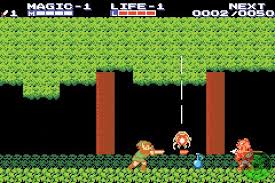
This just didn't feel right.

Zelda II was and is still the black sheep of the franchise.  The full title was Zelda II:  The Adventure of Link, and as the title implies, it focused mostly on the series’ protagonist, Link.  The story line picked up right where the first game left off, and now Zelda is in a coma of some sort and Link needs to wake her.  I don’t remember much else about the plot, save that Ganon is involved and he taunts you from the “Game Over” screen, which you will see, a lot.  It’s a side scrolling action-adventure RPG.  Link moves from left to right (save for an overworld map screen) and can jump around.  As he defeats enemies he gains experience points and levels up, where the player can choose what abilities to upgrade; health, magic, and attack.  This game is easily the hardest in the series.  Link has this puny little sword which means he needs to get close to enemies to attack.  At full health, he can shoot beams from it but once damage is sustained that feature is disabled.  Some enemies can only be attacked from a standing or crouching position too, and switching between the two is cumbersome.  I never liked this game much as a kid, and never progressed very far in it.  Whenever I played it I always ended up being reminded of how much I liked the first game.

It makes sense then to learn that I loved the next game in the franchise, A Link to the Past.  Released for the Super Nintendo in 1992 (1991 in Japan), A Link to the Past brought the series back to its roots.  Gone was the side-scrolling, jumping, experience points dribble of Zelda II and back was the overhead, sword slashing, bomb dropping, awesomeness of the original.  With the move to the SNES, the game was obviously much prettier to look at.  Link could do more things like run and magically traverse worlds.  The game was difficult as well, but not frustratingly so, especially if you found the various heart containers strewn about the world to increase Link’s health.  Again, the plot was rather ho-hum, but it did serve as a prequel to the original which was kind of neat.  Almost everything introduced in this game has been carried forward such as multi-level dungeons, the master sword, hookshot, and musical instrument concept.  The parallel world concept also makes frequent appearances in future titles as well.
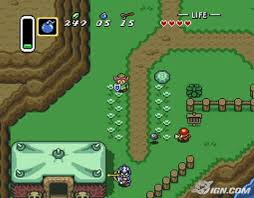
Ahh, much better.

A Link to the Past is one of the best games on the Super Nintendo and in the running as for my affections as favorite title.  I’ve played and re-played this game more times than I can count and am always entertained.  It’s one of the few titles to receive a direct sequel as well, the Gameboy’s Link’s Awakening takes place following A Link to the Past.  I mentioned in an earlier post that I never played that game when it first came out or even when it was re-released for the Gameboy Color, but I do have it on my 3DS.  I haven’t finished it yet but from what I’ve played it’s an excellent little game.  It maintains the same basic approach to gameplay as ALTTP but introduces some new stuff such as a couple of side-scrolling screens and the ability to jump on command, two things unique to this game and Zelda II.  It remains the only portable-only Zelda title I’ve played extensively.  My experience with the DS games was only for a short burst and neither really appealed to me, Spirit Tracks and Phantom Hourglass.  I found them a little too gimmicky but admittedly did not give either a chance.  The whole train thing of Spirit Tracks conjured up bad memories of Wind Waker’s sailing sessions and was an instant turn-off.  Like Link’s Awakening, I probably should not have ignored the other Gameboy titles Oracle of Ages and Oracle of Seasons, as I’ve heard nothing but good things.  The lone Gameboy Advance title, The Minish Cap, was positively received but I just never got around to playing it.  Maybe some day.

A whole new perspective on life.

After that handheld tangent, the next game in the series to grace a home console is the now infamous Ocarina of Time.  Released originally for the Nintendo 64 in 1998, it was an instant classic with many review outlets giving it a perfect score.  Gameplay-wise, it took the basic formula of ALTTP and switched it to 3D.  Link still traveled around the world of Hyrule entering dungeons and collecting many familiar items while solving puzzles along the way all in an effort to save the kingdom and defeat Ganon (now called Ganondorf).  The two-world concept was even brought back as there’s a past world and a future, semi-apocalyptic Hyrule where the player plays as an adult Link.  Young Link and adult Link played the same, but certain items were unique and usable to each.  It didn’t make much sense in the game why adult Link couldn’t use a boomerang, but he had the hookshot to make up for it so no one really cared.

Visually is where the game differed most from its predecessor.  Now in full 3D, the camera is positioned behind Link for the majority of the experience.  To make combat easier, Nintendo came up with the Z-targeting feature that would appear in numerous copy-cat games where pressing the trigger underneath the N64’s controller caused Link to lock-on to an opponent.  When locked on, he would focus on that enemy making attacking much easier.  Also, other enemies will not attack Link while he’s locked onto an enemy.  Unrealistic?  Of course, but good for gameplay.  Link could still perform his spin attack from ALTTP, but now he also had a jump attack that did major damage when compared with his normal sword strikes.  Multiple items could be mapped to the C buttons making switching between them much easier than in previous titles.  To further keep things simple, Nintendo opted to go for an auto-jump as opposed to making a jump button.  It works, for the most part, though there are times when you wish Link was a little less inhibited.

So what did the game introduce as new?  Lots, really.  Many things were mostly expanded upon, such as the fishing game from Link’s Awakening, and Hyrule was now much bigger with more places to explore.  The Zora race of fish folk were expanded upon and brought into the story.  Link gets a horse to ride around on.  And the musical instrument concept was greatly expanded upon as the game’s title suggests.  Link could learn multiple songs on his Ocarina that all had different functions.  Some transported him to places, others turned night into day, and so forth.  It’s a fun mechanic that has shown up in later titles.  The 3D perspective has proven to be quite popular and has been the go-to method of display ever since for major console releases.

The praise heaped on OOT has been well placed.  It’s a great game, nearly flawless.  If I had one major complaint with the title it’s with the annoying companion character.  Yes, I’m talking about Navi.  Navi is a fairy that follows Link around and offers advice, unfortunately, that advice is often not wanted and far too obvious to be useful.  And when she wants to be heard an annoying “Hey!” sound byte is played.  She’s even more annoying in the new 3DS version of the game as she’ll pop in to suggest the player take a break after a half hour or so of gaming.  Nintendo, stubborn as always, has refused to make her optional and every time I hear that annoying high-pitched voice I want to throw my 3DS across the room.

This is what we thought Wind Waker would look like...

Ocarina of Time was a tough act to follow.  When Nintendo introduced its next console, the Gamecube, to the masses it was accompanied with a high-res demo of Link battling Ganondorf that left everyone’s mouth agape.  We all thought this was a preview of what the next Zelda title would look like, and we were all fooled.  Wind Waker was announced roughly a year later and it looked nothing like OOT.  Everything was now cartoony, and Link was sporting big goofy eyes and a tuft of blond hair.  Everyone was pissed.  When the game finally came out in 2002 it became obvious that the game was actually quite the visual spectacle.  Animations were smooth and the frame-rate crisp.  While many still could not love the style of the visuals, they were at least forced to admit it was a pretty impressive title.

...and this is what we got instead.

While the visuals were easily forgiven, gameplay could not be.  Wind Waker is probably the easiest and most accessible Zelda title ever released.  OOT wasn’t brutally difficult by any means (even the Master Quest version can’t compare with Zelda II in terms of difficulty) it was still challenging.  Wind Waker was pathetically easy, to the point of boredom.  Compounding this boredom was the new sailing mechanic that had Link traveling across this flooded Hyrule via boat.  One section of the game requires a ton of sailing, and that’s the part where I basically checked out.  I never finished this one.  While I didn’t hate it, I certainly didn’t like it.  I didn’t find the dungeons to be an improvement over OOT and the gameplay was so simple I found myself getting tired while playing it.  Next to Zelda II, this is my least favorite in the series.  It was still well-received by critics, but it’s my opinion that was a combination of reputation and over-compensation for the visuals.  Many reviewers wanted to tell the reader to look past the visual style.  I did, and I didn’t find much beneath them.

I realize I skipped Majora’s Mask.  Not intentionally, but probably because that title has always felt like a side-story to me and not a full-fledged Zelda title.  It was the direct sequel to OOT and featured a new gameplay mechanic, masks.  Link would acquire new masks throughout the game that granted him different abilities.  The backdrop to the story was that the moon was going to obliterate the land of Termina in a couple of days, and Link needs to save the day with his trusty ocarina and new masks.  The player has to constantly play with time as the game takes place over 72 hours, jumping back and forth to avoid armageddon.  It’s a pretty cool approach and definitely changes things up from OOT.  It does get understandably tedious at times, especially when you’re close to completing an objective but run out of time and have to start all over again.  I never played the game on N64 and had to download it for the Wii.  I like the game, but I don’t love it.  As a result, I’ve yet to beat it despite having it for 2 years now though I do intend to return to it, some day.

Following the backlash Nintendo received over Wind Waker’s visual style, Nintendo returned the series to a more realistic look with 2006’s Twilight Princess.  Developed for the Gamecube and released on the Wii as well, Twilight Princess was the visual treat many fans had wanted.  Gameplay wise, it was mostly an OOT re-tread which seemed okay for most fans and reviewers.  Instead of the ocarina mechanic, Link now could transform into a wolf and enter a spirit world called the Twilight Realm.  Unfortunately, this felt kind of gimmicky and the wolf parts of the game weren’t nearly as interesting as the traditional stuff, though not painfully so.

Wolf Link in the Twilight Realm. Kind of trippy.

The rest of the game would have felt ho-hum, but the visual approach did a lot to add weight to the series.  Navi’s replacement Midna actually had some personality and was an enjoyable plot component as opposed to a nuisance.  The darker tone the series undertook earned the series it’s first ever Teen rating and added a sense of dread.  Truthfully, it’s a very enjoyable game and in many ways improves upon OOT, it just wasn’t the same leap forward as ALTTP and OOT were when jumping to a new system.  The Wii controls worked for the most part, but weren’t as immersive as Nintendo seemed to promise.  Some even prefer the more traditional control scheme found on the Gamecube version.

I don’t know which Zelda title is my favorite, but it’s obviously between A Link to the Past and Ocarina of Time.  My nostalgic core likely prefers ALTTP, but I can’t ignore the brilliance of OOT.  It doesn’t matter much in the end, both are deserving of the praise they receive.  I’m hopeful that this fall’s Skyward Sword is the leap forward Twilight Princess was not.  With true one to one motion controls, it could be pretty cool to swing Link’s sword around but if it’s the same basic experience I’ll be a little disappointed.  I’m ready for Zelda to tread new ground but am also confident that Nintendo will provide a worthwhile experience.  It will either be a great game or an all-time classic, and neither sound bad to me.


Nintendo 3DS – 3 Months Later

It was nearly 3 months ago that Nintendo released its latest handheld, the 3DS, a more powerful version of their Nintendo DS with all new stereoscopic 3D capabilities.  I’m no techie, but I’d say graphically the system is on par with the Wii, perhaps better, which is what drew me in and I was able to convince myself that I needed to buy this thing.

I picked up Super Street Fighter 4 with my shiny new 3DS and looked forward to what the system had in store for me.  I wasn’t real excited to be picking up another copy of SF4, but I ended up enjoying it quite a bit.  I logged a fair amount of hours with it during my morning and evening commutes and found the portable take to be pretty satisfying.  I never did venture online, as that would most likely lead to frustration, and stuck with the single player experience.  The 3D offered nothing, even made the game worse, but I’m of the rare sort that didn’t pick up the system for its 3D capabilities.

I did tire of SF4 roughly after a month’s use and found myself ready for a new game.  Unfortunately, the 3DS library thus far has been putrid.  This is often the fate of early adopters but the 3DS seems especially barren when it comes to games.  Making things worse, the Nintendo eShop wasn’t ready at launch so there wasn’t even anything interesting to download.

It's been a long wait, but the wait is over June 19th.

Thankfully, this drought appears to be nearing an end.  The eShop finally launched this month with a free version of an enhanced port of the NES classic Excitebike.  I downloaded and can confirm it plays just as well as it always has but with some slight visual enhancements to the color palette.  The 3D effects are even adequate which is a nice surprise.  At the end of the day though, it’s still Excitebike, a 20 year old game that’s free for a reason.  Released shortly thereafter for the price of $5.99 was The Legend of Zelda: Link’s Awakening DX which I also snatched up.  I had never played the Gameboy or Gameboy Color edition of the game (I have no idea why) so I was actually pretty eager to check it out.  It looks and plays the same, but has picked up a handy save state feature which makes it even more convenient, and offers a quirky off-beat adventure when compared with other Zelda games.  I’m not too deep into it, but so far I’m liking it.

The big game on the horizon, set for release this Sunday, is the remake of The Legend of Zelda: Ocarina of Time, arguably the finest video game ever crafted and the inspiration for this post.  I plan on sinking my teeth into that one and expect it will be an improvement over the Nintendo 64 original, I just hope I don’t suffer any Zelda burn-out by playing Link’s Awakening and Ocarina of Time so close together.  It’s the game that pushed over the edge when trying to make a purchasing decision on the 3DS and it’s been a long wait.

If that was the only game to look forward to though then things wouldn’t be much better.  The eShop is likely to continue to see enhanced remakes of classic games but that can’t sustain a system.  Thankfully, last week’s Electronics Entertainment Expo (E3) had a lot to reveal about the 3DS, and these are the games I’ll be keeping an eye on in 2011 and beyond:

Star Fox 64 3D – Sure it’s another remake of an N64 game, but like Ocarina of Time, it’s a beloved game.  It’s also one I missed the first time around so I have some extra interest in it.  Unlike with most 3DS games, I can see the 3D effect actually adding something to the gameplay.  The very nature of the game makes it a good candidate for a portable system, and it promises to have enhanced visuals while retaining the tried and true gameplay.

Paper Mario 3DS – I haven’t been able to confirm if this one is a new game or a remake too, but from the little I’ve seen it looks all new.  The first two Paper Mario games, spiritual successors to the excellent Super Nintendo game Super Mario RPG, were addictive and unique RPG experiences.  Paper Mario 2 was a game I could not put down.  Super Paper Mario for the Wii, and the Mario & Luigi titles for the Gameboy Advance and DS, both have their merits but neither has been able to eclipse the original Paper Mario games.  The unique visual style could also make for an interesting 3D experience.

Resident Evil: Revelations – The first 3DS title from the Resident Evil franchise arrives this summer and is based on The Mercenaries mini game from the last few Resident Evil titles.  I never cared for them, or for Resident Evil 5 for that matter, because it focuses too much on action.  I like the methodical pace and creep factor of the original Resident Evil titles.  Resident Evil 4, probably the best in the franchise, struck a nice balance between action and survival horror.  Revelations looks to bring the series back to its roots with Resident Evil veteran Jill Valentine back in the lead role.  Can survival horror work on a portable?  We’ll find out, though probably not until 2012.

Kid Icarus Uprising – I don’t really know what to expect from this game, other than it’s the first Kid Icarus game since the NES days and that alone makes it intriguing.  The game looks gorgeous and has been in development for quite some time so there are no worries about a rush job.  It will likely offer a rich experience that combines traditional platforming with some on rails type of flying levels mixed in.

Super Mario 3D – It’s kind of a given that Mario will show up on a new Nintendo

Tanooki Mario is coming back!

console at some point.  It’s also kind of sad he’s rarely available for a system launch anymore.  Nintendo aims to make up for Mario’s March absence this fall with an all-new Mario adventure.  Super Mario 3D will attempt to combine the gameplay and presentation of the excellent Super Mario Galaxy franchise with old school Mario gameplay.  Look no further for evidence of that than with the return of the Tanooki suit from Super Mario Bros. 3.  The levels are also shorter with a clear path and all end with the familiar flag-pole leap.  It’s Mario, so it’s bound to be good.

Luigi’s Mansion 2 – Not to be outdone by his more famous brother, Luigi returns in his ghost-sucking franchise and was one of the surprises at E3.  Luigi once again finds himself in a haunted mansion and armed with his ghost vac and flashlight.  The cowardly plumber will also have some sort of Ghostbusters-like lightning attack to hold ghosts in place so he can suck them up.  Traditional Mario gameplay meets Ghostbusters?  I’m on board!

And that’s not all.  There’s also versions of Mario Kart and Super Smash Bros. on the way.  There will probably be some Mario sports titles as well and maybe even a new entry in the New Super Mario Bros franchise at some point.  Best of all, most of these games are arriving in 2011 giving the 3DS one of the best lineups of any system this fall.  And the 3DS needs it because Sony’s PSP Vita is hot on its heels with some impressive hardware and software due for that one.  The spring has been lousy, but this summer and fall look to make up for it.


Heavy Rain

Heavy Rain (2010)

I had been meaning to play the 2010 game Heavy Rain for quite some time, but had yet to get around to it.  Part of me was hesitant about doing so because it had been compared loosely with those old point and click adventure games from the 80’s and those never appealed to me.  As a result, I put it off and never got around to purchasing it until recently when I saw it for 20 bucks at a local store.  Having just finished my first play-through the other night, my initial reaction is that this is one of the most unique experiences I’ve ever had with a video game.

For those unaware, Heavy Rain is probably best described as either an adventure game or a crime noir.  It was released for the Playstation 3 in February of 2010 to very favorable reviews earning an aggregate score of 89.3% on Gamerankings.com.  It does share some things in common with point and click adventures but not as much as I had been lead to believe.  For the most part, the player still controls an on-screen character through mostly conventional means.  The left analog stick changes the direction the character is facing and squeezing the R2 trigger makes the character walk similar to how the old Resident Evil games used to control.  The character can approach objects in the environment and some can be interacted with by pressing a button indicated by an on-screen icon.  Often instead of the button input being the typical “X” or “Square” it’s a direction on the right analog stick.

Visually the game is a mixture of average and exceptional. The exceptional part refers to the characters and the life-like way they're able to emote.

After that though the game gets less typical.  At any point in time, squeezing the L2 button will make a bunch of text pop up on the screen with one of the face buttons beside it indicating a thought.  Pressing the associated button will let the player listen in on the character’s internal thoughts.  This is sometimes used to help cue the player on what to do next but most of the time it’s just to add color to the context of the situation and enhance the experience.  Actions will play out on-screen and button commands will pop up that the player has to follow in order to progress, or not.  Often times inaction is also acceptable and even desirable as all responses will advance the story.  These scenes range from simple conversations to intense physical confrontations between characters.  For the conversations, missing a cue can lead to failing to pick up a piece of valuable information, while in a fight missing the cue or hitting the wrong button can lead to failure, including death.

That’s the basic gameplay and most of the scenarios occur in pretty small areas.  There’s very little running around and trying to figure out what to do next, the game just unfolds in scenes.  There are a couple scenarios where you’re asked to drive or shoot a gun but they handle like the other scenes, just with less reaction time.  I went with the hard setting which affects the type of inputs required.  I think the easiest setting mostly limits the commands to simple one button presses.  I was asked to do motions with the right analog stick, half-circle motions and funny “hook” motions.  Sometimes the game asks you to tilt the controller (like when driving) or jerk it in a certain direction quickly.  For the triggers and face buttons, some are simple presses, others require pressing and holding the buttons in a certain sequence or tapping rapidly.  Usually the required input corresponds with what the character is being asked to do on-screen and adds a surprising amount of depth and immersion for the player.  I was expecting the controls for this game to be a necessary evil to move the plot forward but they really add a lot to the experience.

Ethan Mars will be asked to do some very bad things if he ever wants to see his son again.

If the plot wasn’t any good though the controls would probably get old, but thankfully Heavy Rain plays out like a true crime drama.  The main protagonist and first character you’ll control is Ethan Mars.  After losing a son in an unfortunate accident Ethan finds himself in a state of severe depression and estranged from his wife.  When his son Shaun goes missing he finds himself at the end of his rope.  It’s soon learned that his son was abducted by the Origami Killer and Ethan must go through several trials sent to him by the killer in order to get him back.  Meanwhile, the local police have enlisted an FBI agent, Norman Jayden, to help track down the killer.  As Jayden, the player will use sophisticated equipment to play detective and try to find the killer while navigating through a series of red herrings and Jayden’s own substance abuse.  Local private investigator Scott Shelby is also working hard on the case and is the third character the player will control.  Shelby is a former cop working on his own leads to find Shaun.  Madison Paige is the fourth and final character the player gets to control.  She’s a journalist suffering from insomnia who kind of stumbles into Ethan’s life.  She’ll end up working with Ethan to try and find Shaun.  The Origami Killer slowly drowns his victims over a period of time, and depending on the amount of rain that falls, Shaun will die.  This adds a sense of urgency to the plot as the game bounces from scene to scene, character to character.

Some of the tasks the player will be asked to do can be described as atypical.

The truly unique part of Heavy Rain is that there is no right way to get to the game’s conclusion, and no game over along the way.  Any or all of the characters could die over the course of the game, including Ethan’s son Shaun, and no two games will be the same.  The trials Ethan goes through are both trials of skill and morals.  Each completed one gets Ethan a clue to Shaun’s location.  Some are brutal and for me conjured memories of the movie Se7en.  The more that are completed the easier it is to find Shaun but some players may find certain ones abhorrent and refuse to complete them.  That’s understandable and know that it’s still possible to save Shaun without completing all of them.  Ethan may end up with enough information to figure it out or one of the other characters will come to Shaun’s rescue.  It’s also possible for all of them to figure it out, which is what occurred in my game.  I suppose that is the most desirable outcome.

I played this game straight-up, meaning no help or re-do’s.  There were a couple of scenarios that didn’t go the way I wanted them to but I resisted the urge to reset and go again.  I think this game is best played as if it were life or death, and in the game of life there are no extra lives.  There were a few moments I thought I really screwed up and was going to get someone killed but I was always able to wiggle out of it.  These moments of high anxiety are where the game shines brightest as I found myself really invested in what happened to the characters.

It’s not a real long game, maybe 8-10 hours each time through, but the pacing is spot-on.  The game started a little slow as the characters were worked into the plot but once it got going I didn’t want to put the controller down.  When I had to though, I found it hard to jump right back in knowing how emotionally taxing the experience was going to be.  This is a game I recommend players beat in 2 to 3 sittings, though if you can do it in one then more power to you.  The game does have a “twist” in the plot that some apparently did not care for.  I was neither shocked nor put off.  For a game that really tries to not be a game, the twist did feel a little cheap as the game did kind of cheat in order to make it happen.  I’d explain more but I don’t want to spoil anything.

Heavy Rain is the only video game I’ve ever played that transcends the genre.  That doesn’t mean it’s my favorite or the greatest game ever, but it does make it one of the most significant.  The argument of whether video games can be art is a fashionable one currently and for those on the affirmative side of that question Heavy Rain is probably the best thing going for them.  I do think it’s a title any serious gamer should play, and if you do choose to pick it up make sure you see it through to the end.


Finish Him!

I posted a few weeks ago about the Mortal Kombat demo and came away mostly impressed.  Well the game was released on the 19th of April and I became a first day buyer.  Since then I’ve logged many hours with the release and have come away with these impressions.

First off, this is Mortal Kombat the way it should be.  It’s modernized for today’s audience but retains a lot of what made the franchise unique when it debuted nearly 20 years ago.  That is to say, there was an obvious style present in both how the game looks and how it plays.  Mortal Kombat has always differed from other games of its genre by including over-the-top characters with over-the-top powers.  Whether it’s Sub-Zero’s freezing powers or Liu Kang’s dragon abilities, there’s nothing realistic at all about the game.  And with today’s hardware this is magnified even more so.  The male fighters are hulking monsters and the women buxom and scantily clad and as the fights progress you’ll see clothing shred and chunks of flesh go missing.

Gameplay wise, all of the old moves are here along with some new ones.  The developers abandoned the multi-stance styles embraced by the more recent games which helps keep things loose and simple.  Some characters still have weapons, like Scorpion, but they’re integrated into his standard moves.  The X-Ray meter at the bottom of the screen functions a lot like Street Fighter’s super combo meter.  As it fills, the player can use it to enhance basic moves to give them added punch.  Or, the player can let the meter fill further opening up combo breakers at level 2, and finally X-Ray attacks at level 3.  I talked about these destructive X-Ray moves in my demo impressions, and the same criticism is still present though some of my fears were alleviated.  The moves are still ultra powerful, and most of them are fairly easy to land, but the AI is not afraid to use them which helps equalize things.  Really, my only major complaint is the unbalanced nature of some of them.  The characters that incorporate a teleport move of some kind into their X-Ray attack are at a far greater advantage than some of the others.

The basic gameplay still centers around super moves and combos.  The pace of the fights are akin to something mid tempo, and the best fighters are able to string together super moves with combos.  There’s also a grab button, and the franchise’s trademark block button as well.  Blocking is something that is beneficial to master given the abundance of characters with quick hitting teleport moves.  Also, most X-Ray attacks can be blocked as well, which is something that always seems to turn the tide of battle.

X-Ray attacks are quite brutal.

There are multiple game modes available to spend some time on.  There’s the standard ladder tournament that pits the player against seven fighters and three boss battles consisting of Shang Tsung, Goro/Kintaro, and Shao Kahn.  Shang Tsung is a regular playable character, so perhaps it’s a stretch to call him a boss, but he’s present in every ladder tournament so I guess that makes him a boss.  The second boss is random and is either Kintaro or Goro and both guys are as most remember them; cheap.  Neither is as bad as Kahn though, who’s quick dash attacks and ability to no-sell the moves directed at him make him extremely annoying.  He also has an attack where he throws his maul across the screen.  If it hits, the player becomes staggered and is left open to attack.  When Kahn is feeling especially mean, he’ll double or triple up on the attack and leave the player character helpless to do anything about it.  To beat him one typically has to resort to the old cheap tactic of launching projectile attacks.  Kahn will often pause to taunt randomly which helps.  After he’s defeated, the player is rewarded with an ending cinematic for the chosen character that’s narrated over.  These cinematics are done with still images which is kind of disappointing, and they’re quite brief and few are memorable.

If one wants to really experience the Mortal Kombat story, then the appropriately titled story mode is where to be.  Story mode is long, and takes the player through the whole Mortal Kombat mythos but with a new twist.  As the player, you’ll switch characters depending on the plot and have to take on 1 on 2 matches at times.  The story is campy, and some of the voice acting and writing is terrible, but it’s mostly a good time.  Some of the matches are absurd, but it’s beatable and you’ll unlock a couple of new characters along the way.

The other modes include a new tag match and the challenge matches.  The challenge matches are difficult and often contain gimmicks to make them even harder.  The tag match is a welcome addition, though it isn’t very flashy like a Marvel vs Capcom title.  As you play these modes you’ll earn “koins” that can be spent in the game’s bonus section, The Krypt.  There’s hundred of items to unlock here, but most of it is junk like concept art.  There’s hidden fatalities and extra costumes as well, but they’re harder to find.

By the end of most matches both characters will find themselves a bloody mess.

And fatalities are the name of the game when it comes to Mortal Kombat.  Yes, they’re a gimmick but they’re so much fun.  They’ve never been better too, and some of them are insane.  My vote for best belongs to Noob Saibot, but everyone will have their own favorite.  Each character has two, plus a stage fatality, and some of a third “klassic” fatality depending on where the game is purchased.  I bought the game at Best Buy and received Sub-Zero’s classic costume and fatality, the old head rip.  Babalities are also back and this time around they’re a lot funnier than the old ones as each baby will perform an action that usually results in crying.  It’s a humorous and non-violent way to end a match.

All in all, Mortal Kombat is pretty much exactly what I expected, and exactly what I wanted.  While Street Fighter will likely always be the king of the fighting genre, Mortal Kombat has its own niche and there’s no reason why people can’t be fans of both.  I plan to log many more hours with this one and maybe if PSN ever gets back online I’ll test my abilities against the rest of the world.  It’s not a flawless victory for Warner Bros., but it’s pretty damn good.


Final Fantasy Grudge Match

I woke up this morning and did my usual Saturday routine of grabbing some breakfast, a warm beverage, and sat down with my laptop to see what’s going on in the world.  I ended up at ign.com and checked out their review for the new Final Fantasy IV re-make on Sony’s PSP.  The game is yet another re-release of the Super Nintendo classic only this time with enhanced visuals and added content in the form of the episodic sequel released on the Wii from a year ago.  This isn’t about that particular game though, more about the comments made by reviewer Colin Moriarty regarding the quality of today’s Final Fantasy titles.  I both agree and disagree with some of the comments he made (which, to summarize, was that early Final Fantasy titles are the best and the present day titles subpar) but it got me thinking; what is the best game in the Final Fantasy series?

I have played most of the Final Fantasy games.  I haven’t played them all, and I can cite the ones I have never played as the original game, II, and the most recent Final Fantasy XIII.  I do not consider the on-line only games as being part of the same canon, but for what it’s worth, I have not played them either.  Of the ones I have played, the only one I never beat was the Final Fantasy III re-make on the DS (I still plan on doing so, one of these days), though I’ve never encountered anyone willing to argue that title is the best in the series.  I’ve also played many of the spin-off games, including the excellent Final Fantasy Tactics and the less than excellent Final Fantasy X-2.  Needless to say, I’m only going to look at the ones I have played and beaten and I’m not going to include the spin-offs, for as good as Tactics is, it’s just Ogre Battle with a Final Fantasy theme.

For my money, this becomes a contest between four games:  IV, VI, VII, and X.  Final Fantasy V is a lot of fun because of its job system, which was introduced in III and refined for V.  I had a lot of fun with that one on emulation before it was released in the US, and then again when it received a release for the Playstation alongside VI.  As fun as it was though, I couldn’t help but feel like the game’s plot was really chiche and the villain was not a viable threat, or even interesting.  Final Fantasy IX holds a special place in the hearts of many fans for its throwback approach.  Following three titles that blurred the line between fantasy and sci-fi, IX fully embraced that old fantasy feel of the first five titles.  One of the Playstation’s last hurrahs, it was a visual delight and the cast charming, but for me it doesn’t have the same scope as the premier titles in the franchise.  The item system also didn’t feel as if much time was spent on it by the developers to create a truly deep experience.

That said, the four titles I mentioned previously are the cream of the crop.  The fans of the other titles number far fewer than the ones for these four.  It’s time to take a look at each one…

Final Fantasy IV was released for the Super Nintendo in 1991.  It is not only note-worthy for being one of the best in the franchise, but also for the great confusion it caused gamers in the US when it was released as Final Fantasy II.  The true NES sequels of the original Final Fantasy were never released in the US, so Squaresoft decided to call IV Final Fantasy II in the states.  At the time it wasn’t confusing, but when Square decided to call Final Fantasy VII the seventh title in the franchise in all territories, American fans were left wondering how they missed IV, V, and VI.

Final Fantasy IV is the rare game where the player starts off playing as the villain.  The main protagonist, Cecil, is a dark knight who has committed unspeakable atrocities.  As someone who likes anti-hero characters, this gave the game instant appeal for me.  Of course, Square doesn’t keep the player in the role of the villain all game and Cecil eventually has a re-awakening.  From that point on, he has big purple hair and refers to himself as a paladin.  Lame.

The game was the first to introduce the Active Time Battle system, which made the game feel less turn-based.  It was also the last title to let the player control a party of five.  The gameplay is pretty much classic Final Fantasy.  There are summons, white magic, black magic, ninjutsu, and other familiar attack types.  Characters adhere to one strict class and become more powerful as they gain levels.  The game is very linear, and features a traditional good vs evil plot.  Atypically, the game feature space travel and the final dungeon is housed on the moon.  There’s very little in the way of customization, which must have seemed like a radical departure for Japanese fans going from III’s job system to this one.  Pre-programmed plot events dictate who will be available as a party member and who won’t where as future titles would often give the player a choice of who to send out into the fray.

Despite it’s limitations, the story is a memorable one.  It’s engaging watching Cecil sort out his emotions.  The plot events, while linear, allow the game developers to script some memorable action scenes.  The script is also surprisingly whitty, though some of that is due to the game’s original poor translation making the phrase “spoony bard” a popular one amongst gamers.  In typical Final Fantasy fare, the true enemy is revealed late in the game and takes away some of the excitement of the closing moments.  Nonetheless, the re-released PSX version contains a challenging and rewarding end boss fight (the US SNES one was dumbed-down) and the experience is overall a memorable one.

Final Fantasy VI also received a numeral change when it was originally released on the SNES in the US as Final Fantasy III.  Final Fantasy VI has also been re-released several times by Squaresoft over the years but has never received a sequel or a remake, despite being often cited as the best of the series.  Released in 1994, it represented an obvious visual upgrade over the two previous titles.  It also opted for a steam punk type of setting over the traditional fantasy one and is really the only title in the series to not feature a true leading role.  This is quite appropriate considering VI has the largest cast of available characters in the series totaling 14.

Outside of those differences, the core gameplay sticks to what Final Fantasy IV popularized.  Each character has their own specialized class that draws from popular character classes of the previous games.  There are some notable departures such as Edgar’s tech abilities and Relm’s drawing ones, but for the most part every character fits into the traditional mage, monk, warrior mold.  The plot is pretty interesting, and features the player as part of a resistance movement to take down an evil empire and introduces one of the most memorable villains of the series, Kefka, who’s one sadistic bastard.

The game is fairly linear, though once the player reaches the world of ruin it becomes more open-ended.  At that point the player can choose to track down more party members and scour some dungeons or go right after Kefka.  There’s also a moment where the player can lose a party member permanently, which is kind of cool even if it’s easily avoided.

Spells in this game could be learned by anyone, though certain characters were more well-suited for magic than others.  Magic was learned by attaching an esper to a character and as battles were won AP was earned which went towards learning spells.  The better spells naturally took longer to learn.  The espers also served as the game’s summons and could be called upon once per battle to unleash havoc on the opposition or bestow beneficial effects on the party.  Their use in that regard was nonessential, but the customization abilities were quite enjoyable.  This customization allowed the player to assemble his or her favorite party any way they wanted to.  The game did expect the player to use everyone at least a little bit though as certain dungeons would require up to 3 parties of 4 complete.

Final Fantasy VII was the first title in the series to be released in the US with its proper name.  It was also the first Final Fantasy game to not be released on a Nintendo console with Square electing to go with Sony’s Playstation due to its use of CD’s rather than a cartridge medium.  This allowed Square to include FMV sequences and true orchestral quality audio.

Final Fantasy VII is without question the biggest release in the franchise’s history.  Met with unfathomable hype, it was finally released in 1997 and met with much praise.  It was also big, encompassing three discs and taking most gamers over 40 hours to complete.  It’s 3D visuals were somewhat blocky at the time, and have not aged too well.  The battle graphics were much better and the CG sequences, at the time, jaw-dropping.  The dialogue was also more mature, especially whenever Barrett spoke, and the mood of the game was a bit darker than previous titles.

You can't have a blog post about Final Fantasy VII without including a shot of the most famous death in video game history.

The setting was again more of a tech heavy one as opposed to a traditional fantasy one, and this time around there was definitely more of a sci-fi element.  The esper system was gone and replaced with the materia one.  I’m still not exactly sure what materia is, but it was equipable like the espers and granted the character the ability to cast spells.  Each piece of materia has five levels and AP was earned to increase those levels.  These levels were denoted by stars on the menu, and the level determined how many times a spell or summon could be used in battle.  When a piece of materia maxed out at level five, it could be used an unlimited amount of times in battle and would spawn a level 1 duplicate.  This made leveling up unique pieces of materia (such as most summons) vital to create a super party of characters.

Each character now could only be equiped with one piece of armor and one weapon, and these determined how much materia a character could hold.  Some weapons and armor contained materia slots that were linked together, which could be exploited to great effect in battle.  Some of it was simple, linking the fire materia with the “all” materia turned the fire spell into an attack all spell.  Or you could join elemental materia with attack materia to grant that attacks elemental properties to an ability like mug.  Magic based materia often lowered base attack power when equiped, this discouraged players from turning their brutes into a jack of all trades.  And like with VI, certain characters were just obviously more well-suited to using magic than others resulting in greater damage from spells and summons.

The summons were a true spectacle of the time as using one initiated an FMV sequence where the summoned monster would unleash an awesome attack.  These did grow tiresome though after awhile, particularly the ultimate summon Knights of the Round, which was the best way to attack the game’s hidden bosses but lasted several minutes.  Future games would wisely introduce a way to skip some of these more over-the-top animations.

The plot of the game involved a struggle between the game’s main protagonist Cloud, against his former idol Sephiroth.  Cloud begins the game as a moody brat but becomes more likable as the game progresses.  The player is able to watch him grow into a leader.  There are also several flashback sequences, and one very notable death, along the way.  The look of the characters would prove quite popular, and the success of the game would eventually lead to several spin-offs and pseudo-sequels though it has yet to receive a true re-release or remake.  Due to its great success there’s been a bit of a backlash movement against the title by some fans since this was the jumping on point for many.  The success of VII proved to Japanese developers that RPG’s were viable in the States and the release of following titles became events as opposed to just another release.  To this day it is still one of the more dynamic released in the franchise as the materia system granted a great amount of freedom and flexibility to the user second only to the job system of earlier games.

Final Fantasy X marked more firsts for the franchise, most notably the first title for the Playstation 2 and the first to feature fully voiced characters.  These two things resulted in a gorgeous looking game with a more engaging set of characters.  The main hero, Tidus, winds up in a foreign land through supernatural means and ends up joining up with a band of heroes on a sort-of pilgrimage.  The voice acting is pretty solid, though some people find certain characters off-putting.

There were other firsts though, and one was a big departure for the series; the removal of the overworld map.  In past games whenever the player left a town or dungeon they would end up on a big map screen.  From here certain vehicles could be used liked the airship or a chocobo.  Now everything was linked together removing this map screen.  I remember at the time such a concept was hard to fathom, though I suppose for new-comers to the series it was completely logical.  The end result was uncomfortable for the purists, but ultimately created a better visual experience for the player and the world felt more intimate.  There was still an airship, but now the player didn’t pilot it freely and instead just used it as a means of quick travel.

The summons in this game played a bigger role.  Only one character, Yuna, could actually summon them now and when doing so the summoned beast was a playable character.  The other party members would be removed from battle temporarily as the summoned monster took over for a couple of rounds often culminating in the use of one awesome attack.  Characters leveled up via the sphere grid, where abilities and magic were learned.  As characters gained sphere points they could move along the grid and unlock abilities.  This allowed for a lot of customization, but like in previous games certain characters were naturally pushed in a specific direction.

The battle system received it’s first major overhaul since Final Fantasy IV.  Now the order of attack was displayed in a corner and this could be affected by certain spells and actions.  It added a more strategic element to the approach for the player though it admittedly made things easier knowing when the enemy was going to attack.  Party members could also be switched in and out of battle at any moment which was pretty neat, but also made it so that the player could go through the game barely touching certain characters.

The plot was definitely more melodramatic this time around with an obvious focus on the relationship between Tidus and Yuna.  There’s a bit of a tragic element thrown in, and I enjoyed the ambiguous ending.  The high production values enhanced the quality of the story, and Blitz Ball may be the best mini game in any Final Fantasy title.

Those are the contenders for best Final Fantasy.  My run downs, despite totaling 2600 words, are actually pretty brief and do not come close to touching upon everything these games do well and not so well.  It’s actually a pretty hard choice, and I began writing this with one title in mind but am finding myself changing my mind.  Regardless, for me this is actually a battle of two and not four.

Final Fantasy IV is a landmark title for the franchise due to its inclusion of the ATB system and impressive narrative.  The following titles really were just taking what IV did and adding to it right up through Final Fantasy IX.  As compelling a narrative it possesses, I did note that it’s a bit restricted which brings it down a bit.  Perhaps some of that is due to hardware limitations but so be it.  It’s also strictly a linear experience and represents the least customization for the player.  For these reasons, it is clearly not the best of the best.

Final Fantasy X is sort of a re-defining for the franchise.  It took that old ATB system and thew it out and gave the player a truly epic experience.  The sphere grid gave the player a lot to tinker with but did away with some of the more fun aspects of older games of finding new spells and abilities about the world.  Like IV, it too is quite linear and the path for most of the game is pretty clear.  It possesses another one of those villain-swaps at the end that derail some the game’s momentum, and though a great game, it ultimately falls short of the immortality other games in the series have achieved.  Though I will say, it does not deserve to be lumped in with the less than stellar Final Fantasy XII and XIII.

Which leaves two, Final Fantasy VI and VII.  On one hand, there’s VI with its engrossing story and great cast of characters and truly memorable villain.  On the other, there’s VII with it’s massive scope, excellent materia system, and stellar production values (for their time).  For me, it really is an either or type of argument.  I enjoy both immensely.  VI is easy to get into as the first part of the game keeps throwing things at the player and moves at a rapid pace.  The story is easy to follow and the gameplay is tried and true Final Fantasy.  It does perhaps prove a bit too easy, and as great as Kefka is, he goes down with a whimper in the end.  VII has a more convoluted narrative that gets murky at times but for those willing to dig deep it proves quite satisfying in the end.  The characters all have distinct personalities, despite numbering fewer than the 14 present in VI.  For my money, the materia system is still my favorite in any Final Fantasy, just narrowly beating out the job system from V.  It keeps the customization without making every character feel the same.  And while it does not take a great deal of skill to finish the game, beating the hidden bosses requires a great deal of savvy and a huge investment of time.

In the end, I don’t know that I truly prefer one over the other.  Both are great, near flawless experiences.  The strengths of VI are unique to VI, as are its faults, and the same can be said of VII.  Despite both being Final Fantasy titles, it really does feel like comparing apples and oranges.  I can conceivable pick one today, and tomorrow feel like my opinion has changed and writing this has made me want to play through the both of them all over again.  I set out to pick the best one though, and I’m not going to wimp out after over 3200 words.  So with that said, gun to my head, the best title in the Final Fantasy franchise is…

Final Fantasy VII.

And the winner is...


Nintendo 3DS (aka – Helpless in the face of new Technology)

Where were you today?  Anybody who is anybody was at their favorite place to pickup video games to snag the brand new Nintendo handheld, the 3DS.  See what they did there?  It has two screens, like the DS (Dual Screen) but now it’s in 3D!

I’m actually not sure what kind of hype has been generated by this device.  There was a line at Gamestop this morning when I arrived to pickup my reserved piece of hardware, but not a huge one.  The associate claimed the store had sold out roughly 80% of their allotted stock through pre-sales and anticipated a day one sell out.  It’s in their best interest though to drum up interest in a product so I don’t know how much of that was embellishment.

The Nintendo DS has been a really popular system, the best selling handheld of all time, and the country seems to be nuts over this 3D thing.  The launch lineup stinks though, and I haven’t seen any commercials running on television.  Also, the price is pretty steep ($250, which is more than a Wii) and the economy is still lagging.  March has always seemed like a funny time of year to launch new hardware, but it seems fairly standard for the handheld market for some reason.  Maybe with spring beginning companies think people will want to get outside and bring their games with them.  At any rate, smarter people than me are making these decisions.

Not only does it play games, it also functions as a very expensive paper weight!

At first, I was going to bypass the 3DS as I’m really not the target demographic.  I don’t play a lot of portable games and I could not care less about 3D.  Actually, I kind of hate 3D when applied to films.  I consider it a useless gimmick.  There’s nothing gained from it and the films cost even more to see.  However, the 3DS does present a significant upgrade in terms of power over the existing Nintendo DS.  I’m not going to list out the specs, but if the DS was some where around the graphical power of a Nintendo 64, the 3DS is closer to a Playstation 3 or Xbox 360.  It’s actually the most powerful console released by Nintendo when one considers that the Wii is actually rather under-powered.  It isn’t quite up to par with the big home consoles (more on that later) but the upgrade over the DS is quite obvious.  I ended up getting bit by the technology bug, and all of a sudden found myself wanting this thing so I threw my DSi onto eBay (FYI – you’ll do a lot better with eBay than you would trading in your old handheld to Gamestop) and put the proceeds towards a 3DS.

An open view of the 3DS with a fully extended (giggidy) stylus.

The 3DS is a bit thicker than the DSi, comparable to the Gameboy Advance SP.

I took a lot of photos (which probably is obvious by now) of what is essentially a shinier DS.  The 3DS is a bit thicker but actually slightly smaller than the DSi (and quite a bit smaller than the DS XL).  It comes in two colors, black and aqua, and I opted for the more masculine black.  The glossy finish makes it appear like more of a toy when compared to the matte finish of the DSi.  I prefer the matte but I’m not really complaining.  The base is actually a graphite color, which I never noticed in the press release images and it’s kind of cool.  The traditional clamshell design is back and it’s appropriately snappy.  The top piece is just slightly larger than the base, which makes it easier to open.  The button layout should be pretty familiar.  It’s the typical Super Nintendo button layout of A, B, X, Y, L, R, start, select.  A ‘Home’ button has been added which brings the system from a game right to the dashboard and there’s a Wi-Fi slider switch on the right hand side.  The biggest addition is obviously the slider on the top piece for the 3D effect.  Here you can slide it all the way down to shut the function off or adjust the intensity.  The other big addition is the new analog slider which will presumably be the preferred method of game control.  The slider has a smooth concave design and nice resistance.  It’s bigger than the Sony PSP analog nub and the concave design is much better than Sony’s textured convex one.  The stylus returns for touch screen control and is telescoping this time around.  This allows it to be housed vertically within the system like the original DS, but can extend to the size of the DSi’s stylus.

The 3DS comes with a lot of manuals.

The two screens are where most of the 3DS tech resides.  The smaller, bottom screen is touch sensitive like the DS, but it’s received a boost in resolution.  The larger top screen is where the 3D effect is used.  The picture is nice and bright and though the resolution is better than the DS, it’s not anything mind blowing.  The system comes with a 2 GB SD card pre-loaded which looks like it will be used as a memory card would be.  Game data is stored to it as well as Mii data.  The 3DS dashboard is very similar to the one on the DSi and Wii.  It’s simple and easy to navigate.

The charging dock.

The 3D effect works and actually works pretty well.  It’s glasses-free which means it is a bit rigid in terms of what angle the system is held at and distance from the face.  The system can no longer be held vertically as the 3D effect only works when it is held horizontally.  I don’t really anticipate this adding much, if anything, to gameplay but if 3D is something you like the 3DS does deliver.  And if it’s something you don’t care for it can be shut off, which will also extend battery life (the effect is created by running two screens, one on top of the other, which naturally puts more of a strain on the battery).  I did not find the 3D to be too uncomfortable, though after playing the AR Games my eyes did feel a bit strained and I was happy to put the system down.

Get used to this sight, it's a 3DS charging.

I already mentioned the stylus and SD card, the other things included in the box are a charging station, AC adapter, numerous manuals, and some cards for the pre-loaded AR game.  The boost in power of the 3DS comes with a price in terms of battery life (and the previously mentioned $250 sticker).  I haven’t fully tested it out, but with the screen at the default level of brightness and both 3D and Wi-Fi enabled, the battery life supposedly tops out at less than 4 hours.  This is a far cry from the 8-10 of the DS and makes the system far less portable than its predecessor.  It’s kind of interesting considering Nintendo for years refused to add a backlight to the Gameboy’s screen because they felt battery life is the most important part of a handheld.  Apparently there has been a change in philosophy within the company.  I actually prefer this approach, though I must confess less than 4 hours per charge is pretty disappointing.

The charging station is supposedly the make-up for the crappy battery.  Once plugged in the 3DS can be simply placed on it for charging.  A full charge takes roughly 3 hours (according to the manual) and the station will automatically shut-off once the 3DS is fully charged to prevent over-charging.  The system can also be charged the traditional way of just plugging it into an outlet via the AC adapter.  Presumably there will be a market for third party add-ons such as car chargers and extra battery packs.

The 3DS comes with a colossal manual that I admittedly did not read much of.  There’s also a couple handy quick start guides (I say a couple because there’s a french one and a spanish one too) that tells you pretty much all you need to know.  There’s no extra stylus or pack-in game, but there is some software pre-loaded onto the 3DS that is arguably better than any of the games you’ll find at retail for the time being.

Face Raiders. I know it's blurry but at least this gives you an idea of what the flying face helmets look like, only when they come at you they're coming out whatever background is in your camera's sights. So if your 3DS is aimed at a toilet, they'll come busting out of there.

3DS games are basically the same size as DS ones, only they have a little nub to prevent people from jamming them into the old hardware.

The first game I tried out is called Face Raiders.  The 3DS contains 3 cameras, two rear facing and one front facing, and uses them all for this game.  First, you use the front facing camera to take a picture of yourself (or if you prefer to photograph someone else, you can use the rear facing cameras) and watch as the game puts it onto some weird flying helmet.  The system was able to tell me after I snapped a picture of myself that I was a young adult male.  Pretty smart, but when I took a picture of my cat it came up with all question marks.  The game itself uses the rear facing cameras and the 3D effect to make it look like you’re being attacks by these weird flying faces.  They’ll cause your environment to “break” and try to kiss you for some reason.  Apparently you do not want to be kissed by your evil doppelganger or weird cat monster, so you shoot them as they approach.  Sometimes bombs will pop up that you can acquire and use to clear the screen.  After awhile, a boss head appears that continues to summon the smaller ones until you blast it straight to Hell.  The whole time the 3DS is forcing you to spin around in 360 degrees to find the enemies as they attack you.  It’s pretty neat, though I couldn’t help but wonder how someone confined to a bed or wheelchair would be able to enjoy it.

The included cards for AR Games. They come housed in a sleeve similar to what most gift cards come in.

The other pre-loaded game is called AR Games and uses the cards I mentioned.  The 3DS comes with six cards, a question mark block, Mario, Link, Kirby, Samus, and some Pikmin.  The system uses the rear facing cameras once again and focuses on the question mark card and creates the environment it lies on into a game.  There’s an archery game where the terrain fluctuates forcing you to hit stationary and moving targets.  A pool type of game where you strike a ball and try to get it into a goal in one shot, a fishing game, and some gimmick stuff.  The character cards are one of those gimmicks where placing the card beside the question mark card makes them “come to life” as three dimensional characters you can pose and take pictures of.  It’s stupid, but the other games are kind of cool.  They are a bit glitchy though and numerous times as I was trying to move around to get a better angle at a target (or the boss dragon monster that rises out of the card after so many targets have been cleared) the system yelled at me that it lost the card in its camera (the question mark card has to be visible at all times).

3DS cases are a bit slimmer than the DS ones.

The interior of a 3DS game case, pretty exciting.

The only actual game I purchased today was (duh!) Super Street Fighter 4.  I say “duh!” because all of the other games are either mediocre or terrible.  It’s really not saying much when a two year old game is far and away the best available for a brand new system but that’s how it is likely to be until at least the fall when the Ocarina of Time remake hits stores.  Nintendo does have three first-party games at launch; Pilot Wings, Nintendogs + Cats, and Steel Diver.  Pilot Wings is basically a glorified tech demo and probably just as dull as the ones released for the SNES and N64, respectively.  Nintendogs is basically the same as the previous ones, only with better graphics and in 3D.  Steel Diver is kind of a throwback game.  It’s a left to right shooter where you take control of a sub.  Supposedly it’s not bad, but kind of ho-hum and would have probably been better received as a cheaper downloadable game.  Apparently the third party publishers were not interested in capitalizing on the lackluster offerings from Nintendo as their titles are spectacularly bad.  Aside from Street Fighter, there isn’t really anything of interest that I’m aware of.  EA has a version of Madden available that’s supposedly rushed and terrible.  They also ported The Sims 3 over so if you have yet to experience that maybe it’s a worthwhile investment.  There’s a couple of racing games and some generic platformers as well.  The best may be Super Monkey Ball 3D, it’s probably just like the previous ones so if you want to experience that franchise again go for it.

My Mii.

I actually own Street Fighter 4 for the PS3.  I never picked up the “Super” version that came out last year that featured additional characters because I was never interested (I’d just end up using Akuma anyways).  It’s a good game with a nice visual style that lives up to the Street Fighter name.  It’s just that it’s been available for home consoles for two years now, so there isn’t much new to be experienced.  The 3D effect does little for the game because of its perspective.  There is a 3D mode that I haven’t tried because it places the camera over your character’s shoulder, which sounds awkward.  It’s this lack of newness that almost lead me to pick up a 3DS without even bothering with any games.  The 3DS is fully backwards compatible with the DS library, so I’d be able to play the DS games I still have until a worthwhile piece of software came out but I caved at the last minute.

I tried to take some pictures of SF4, but they came out blurry. If you really want to see the game there's about a million high quality images online somewhere.

So now that I have Super Street Fighter 4 3D what do I think?  Well, it’s pretty much the same experience as the console version, which is to say it’s a very good fighting game.  I tried initially using the analog slider but found it to be too imprecise for a fighter and switched over to the D-pad.  The D-pad is of the same quality as the DS one, just placed lower on the console.  I found it a little uncomfortable after one trip through arcade mode so it’s probably not the best game for long stretches of play.  Since the system is limited because of the button layout, some commands have been moved to the touch screen.  On “Lite” mode, moves can be stored here.  I played as Ken and the default settings were to have his super combo and ultra combo mapped to the left side, and his heavy hadoken and heavy hurricane kick (I’m not going to try to spell out its Japanese name) were mapped to the right.  The face buttons default to the same layout as the home console version, which is they have the light and medium attacks and the heavy ones are mapped to the shoulder buttons.  I found trying to perform a heavy hadoken the manual way near impossible as it’s just too awkward to make a quarter circle motion with my left thumb and hit the left shoulder button at the end so the touch screen move was welcomed.  The ultra combos require all three punch or kick buttons to be pressed, which is nearly impossible on the 3DS, so I was happy to use the touch screen here as well.  The “Pro” control mode allows you only to map attack buttons to the touch screen, including L+M+H commands, if you find having actual moves too easy.  I can see that working fine, but since smudges on my touch screen drive me nuts I’ll probably stick with Lite.  I also re-mapped the buttons so that the medium attacks were on the shoulders and the heavy on the console’s face.  This made it possible for me to execute EX moves and also kept the light attacks on the face to execute quick throws.

Akuma vs Some Red Guy

I’d say overall the control scheme works well enough.  The D-pad can be a bit cumbersome.  While I found it easy enough to perform quarter-circle motions, the more complex ones, such as the dragon uppercut, were far less responsive which again makes the “Lite” control mode a bit more desirable.  The graphics are very nice looking, the fighters anyways.  They’re obviously not as detailed as the ones featured on the home consoles, but the reduced screen size makes it hard to notice.  The backgrounds suffer though as basically all of the background animations have been removed.  I can live with this, but it would have been nice if Capcom had adjusted the appearance of the backgrounds to better conform with this approach as it just looks weird to see onlookers frozen in place.  There is a pretty robust online mode and if someone is nearby with a 3DS and a copy of the game they can challenge you.  Also, if you have a buddy who doesn’t have a game they can download a demo of it from your 3DS, which is pretty cool and a feature I hope a lot of games make use of.

Super Street Fighter 4 is a solid game, but I do long for something better for the 3DS.  For now, the system receives a grade of incomplete.  The tech is certainly nice, and the look and feel of the system is in line with previous models, it just lack quality software.  In time, that will most definitely change since Nintendo is bound to unleash various Mario, Metroid, and Zelda titles.  There’s also a system update on the horizon that will grant access to an online store and internet browser.  I’m not sure why both weren’t ready for launch, but just like with everything else, it’s on the way.  The store promises to have both original titles as well as 3D remakes of classic Nintendo titles.  Of the announced ones, I’m most looking forward to the 3D version of the Gameboy classic Link’s Awakening, as I’ve never played it and always wanted to.  The Ocarina of Time remake will undoubtedly kick ass, and the Super Mario Bros. title is apparently some kind of Super Mario Bros. 3 tie-in which has me all kinds of excited.  In conclusion, the 3DS is pretty cool even if the whole 3D thing isn’t really your bag, but it’s safe to hold off for now until the good software starts coming out.