Category Archives: Film

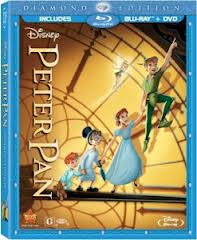
Walt Disney’s Peter Pan

Walt Disney's Peter Pan (1953)

Walt Disney’s Peter Pan (1953)

The story of the boy who shunned time and refused to grow up is a timeless one that has captured the hearts of many who experienced it.  Michael Jackson was famously said to be obsessed with the story.  He probably took things too far.  Walt Disney was another individual who found the story captivating and the producer within knew he could market it to a wide audience.  He was so eager to get Peter Pan into production that it was originally planned as the follow-up to the hugely successful Snow White and the Seven Dwarfs but the technology of the time wasn’t where it was needed in order to fulfill Disney’s vision.  Disney also had a harder than expected time of securing the rights to create the film.  All of this meant putting Peter Pan off for a little while and it would eventually see release in 1953 making it the 14th film in the Disney Classics series.  It was also the last Disney film to be released via RKO while later pictures would be released through Disney’s own Buena Vista Distribution.

Watching old films from my youth can be enjoyable for many reasons.  There’s the intrinsic nostalgia value of seeing something I remember fondly.  There’s also the feeling of a new discovery.  Peter Pan falls into the latter as it wasn’t a film I was exposed to much as a child.  VHS tapes could be pretty pricey when I was a kid, especially Walt Disney releases that tried to make things seem more special with better packaging and a heightened sense of tradition.  The whole vault concept was around then too, which for those unaware, is the concept by Disney of only supplying stores for a set amount of time with a given film before ceasing production.  I remember the commercials would make it seem like these films would never be released again, which of course wasn’t true as most have been released multiple times since.  As a kid, I never owned Peter Pan or saw it in theaters but I was exposed to it.  It’s possible I had only seen it once before watching it recently following its latest release on Blu Ray.  This kind of viewing experience is almost more fun as I get to approach the film almost for the first time where I’m more apt to take notice of the things I wouldn’t have as a kid.  For the most part, only the film’s opening scene felt familiar to me.  I attribute that to a poor attention span as a child.  Even something with a running time under 80 minutes is a long period for a child to sit still.  More often than not, when a movie was put on in front of me I’d watch the first twenty minutes before being inspired to play.  Only the most exciting moments could hold my attention.

Peter's grand entrance.

Peter’s grand entrance.

The film opens with the audience being introduced to the Darling family.  The Mr. and Mrs. are getting ready for a party while the children are getting ready for bed.  Mr. Darling is presented as a bit of a neurotic while Mrs. Darling is calm and together.  The eldest of their children, Wendy, is a bit of a romantic with a love of fairy tales, especially Peter Pan.  She has two younger brothers, John and Michael.  John is the brainier of the two with a very naive sense of the world around him as illustrated by his willingness to fight pirates and Indians.  Michael is the youngest and most impressionable.  They’re all of a good nature with Wendy being the most strong-willed and the boys the most impressionable.  Nana, the nurse dog, may be a canine but embodies the characteristics of a nanny.  She dotes on the children and tries, in vain, to keep the nursery clean and organized.  She is only slightly anthropomorphized in that she doesn’t speak or display any ability to maneuver in a way unfamiliar to a dog but is obviously of a human intelligence.  A series of events leads to Mr. Darling getting short with the children and expressing a need to his eldest that she grow up.  Wendy, unlike 99.9% of young girls, is heartbroken when her father informs her it’s time she move out of the nursery and into her own bedroom.

Peter Pan is introduced soon after as the Mr. and Mrs. leave for a party with the children tucked in for the night.  Peter is presented as a boy of about twelve who embodies all of the characteristics of a child but heightened in a way to make them obvious.  He’s brash, egocentric, and almost incapable of anything resembling empathy.  He takes no situation seriously and is used to getting his way.  He’s also fun-loving, care-free, and eager to share the fun experiences of life with other children.  He has no desire to mature and grow up and seeks only to play for the rest of his days.  With him is Tinker Bell, his pixie companion, as the two are attempting to retrieve Pan’s shadow which somehow ended up in the Darling household.  The children are delighted to meet the real Peter Pan, and when he proposes they join him in Never Land, the boys are most excited to go.  Wendy is a bit more reserved but the thrill of flying and seeing Never Land is too much for her to ignore.

Captain Hook is consumed by his need for vengeance against Peter Pan, who famously chopped off his hand.  I wonder what he was called before that happened?

Captain Hook is consumed by his need for vengeance against Peter Pan, who famously chopped off his hand. I wonder what he was called before that happened?

The setting of London is presented always at night giving it a cold and charmless quality.  Never Land is almost always presented during the day and is bright and colorful.  It’s populated by a host of interesting characters that are both charming and menacing though rarely scary.  Even the film’s chief villains, the pirates, are presented in a colorful manner.  The man-eating crocodile, who seems to only have an interest in Captain Hook, is more funny than frightening and even the youngest of children are unlikely to be scared by this film.

Captain Hook is the film’s primary antagonist.  He embodies all of the characteristics of a traditional Disney villain.  He’s mean-spirited, hot-tempered, cowardly, and manipulative.  The film suggests a mutiny may play out early in the film as Hook has kept the ship docked in Never Land as he has become obsessed with getting revenge against Pan, the boy who chopped off his hand and fed it to the crocodile.  His first mate, Mr. Smee, is his most loyal servant that is ceaselessly bossed around by Hook.  The film hints that he may be a decent person but never expressly confirms that.  Also joining the supporting cast are the Lost Boys who all dress in animal-like costumes and follow Pan whole-heartedly.  There are Indians on the island of Never Land as well who appear to engage in a friendly rivalry with the Lost Boys until the chief’s daughter, Tiger Lily, goes missing.  Perhaps the most interesting member of the supporting cast is none other than Tinker Bell.  Tinker Bell has become a popular character with young girls in recent years, even starring in her own series of direct-to-video movies.  I’ve never seen any of those films for what I hope are obvious reasons, so I don’t know how she is portrayed in them but I assume it is not how she is portrayed in Peter Pan.  Young fans of the character may be surprised to see she is a jealous, brat of a pixie.  Her actions can, in part, be blamed on Peter who she clearly has strong affection for but he is dubious of such feelings.  She is almost instantly jealous of Wendy and the attention Peter gives her.  Tinker Bell is so jealous and spiteful of Wendy that at one point she attempts to trick the Lost Boys into killing her.  Her actions actually cast her as a minor villain to Hook’s role of primary antagonist.  Only by redeeming herself in the end does she avoid the label of true villain

Tinker Bell has become a star since her debut in "Peter Pan," despite being a very unlikable character.

Tinker Bell has become a star since her debut in “Peter Pan,” despite being a very unlikable character.

The story plays out rather expectedly with Wendy eventually seeing the faults in Peter’s view of the world and accepts the responsibility of growing up.  There’s a spectacular confrontation between Pan and Hook, while the stubborn character of George Darling sees the beauty in viewing the world through the eyes of a child.  It’s a nice little tale on the wonders of youth that doesn’t beat the audience over the head with the notion of being a responsible adult.  As with pretty much all Disney films, the exquisite visuals are set to song at times with most of the songs fitting into the narrative of the story as opposed to the broadway approach of the recent animated outputs.  The only exception to this rule is the film’s most famous song, “You Can Fly!,” which occurs during the flight from London to Never Land.  It’s a fun, uplifting, tune that is very much in the same style as all of the Disney songs from that era with a choir of individuals used for the vocals.  It has that old, fuzzy, quality to the vocals but still manages to sound clear.  “A Pirate’s Life” is probably the other well-known song from the film, with the “What Made the Red Man Red?” being known for more dubious reasons (more on that to follow).  As someone who doesn’t often enjoy the song portions of Disney films, I can say these are not too intrusive but I did grow bored with most of the sequences, the only exception being the flying scene.  “You Can Fly!” is the kind of uptempo song I can get into and enjoy and the scene is just long enough that it doesn’t overstay its welcome.

The film is not without controversy, as illustrated by this image.

The film is not without controversy, as illustrated by this image.

Over the years Peter Pan has become noteworthy for reasons beyond its visuals or story.  The portrayal of the Indians has become somewhat of a touchy subject as it contains many of the old Hollywood stereotypes.  When first encountered they greet others with the tired expression “How?,” and often charge into a scene with the battle-cry formed by shouting while patting their mouths repeatedly with an open palm.  Their skin is of a reddish tint, some being obviously exaggerated, and the children hold a negative view of the Indians.  At least John and Michael do, while the Lost Boys basically view them as playmates.  The film early on teases that Indians are a savage and stupid lot, but this is the viewpoint of the naive John and the film dispels this notion by having him humorously outsmarted by the Indians while he explains their stupidity to the other boys.  For anyone who grew up being able to view old Looney Tunes shorts on television, the portrayal of Indians in this film is far from shocking.  This was commonplace for the era and as recently as the early 90’s this kind of thing was shown during children’s programming.  I learned in school at a very early age that this was not an honest portrayal of Native Americans, and kids today might not even be familiar with the old “How?” greeting, but some unfamiliar with this film who buy it for their kids may be caught by surprise.  To add a little extra shock value is the musical number “What Made the Red Man Red?” which is certainly not politically correct by today’s standards.  I find it hard to get worked up by the number though, considering the most popular sport in the country today has a team in the nation’s capital called the Redskins.  Beyond the reference to color, I didn’t pick anything out of the song that sounds particularly offensive, but I’ve never read the lyrics either.  Apparently it suggests they became red as a result of blushing in their pursuit of women or something.  Unquestionably, if the film were made today the song wouldn’t exist and it’s possible the Indians wouldn’t be included at all.  If it sounds like something that would bother you then by all means look elsewhere for entertainment.  There are plenty of other animated films out there with less controversial material.

On the whole, Peter Pan is a mostly enjoyable film and, controversy aside, a fairly harmless one at that.  It doesn’t set out to make any bold, life-affirming statements and exists primarily as entertainment.  As far as visual entertainment goes, it’s well done though it lacks a definitive visual moment such as Monstro from Pinocchio or the forest fire in Bambi.  The flying sequence comes close, but falls a bit short of iconic status.  It makes up for this with its signature song, “You Can Fly!,” and by having a very even presentation with no wasted scenes.  At a running time of just 76 minutes, it doesn’t overstay its welcome and has a neat and tidy presentation.  It’s an entertaining movie, more so for children than adults, but it does possess the ability to charm even older audiences.  I don’t love it like I do some of the other Disney animated features, but it’s something I can watch from time to time and it’s a film that’s worthy of the term “classic.”
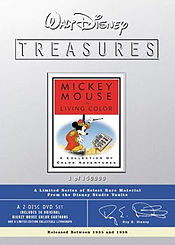
Mickey Mouse: In Living Color

Mickey Mouse:  In Living Color

Mickey Mouse: In Living Color

I love classic cartoons.  They just seem to be so much more developed than present day television shorts.  There’s an emphasis placed on the score and plot while not forgetting the laughs.  The most iconic of cartoon characters from this era include Bugs Bunny and Daffy Duck, but is any more well known than Mickey Mouse?  The mouse that built an empire, Mickey was Disney’s original star.  While he ruled the world in the 20’s during his black and white career, he was eclipsed later on by other characters, most notably brand-mate Donald Duck.  Mickey was eclipsed more out of choice than anything.  He became the Disney brand which necessitated him becoming a more wholesome character.  Early portrayals had him playing the role of the trickster at times, but he evolved into more of a straight man (err, mouse) with Donald becoming the more devious character.

As a result, while he wasn’t the most watched cartoon character in the 1930’s he still received all-star quality toons.  When Disney set out to re-release collections of their classic shorts they wisely lead off with this set, Mickey Mouse:  In Living Color which covers the years 1935-1938.  Some of Mickey’s most famous shorts are contained on this set and all appear uncut (save for a minor audio change in “Clock Cleaners”).  Either Disney wanted to create strong demand for these collections, or the company failed to predict how popular they would become because now they can be hard to come by.  They’re worth it though for animation buffs and I’m going to tell you why.

I currently own three sets from the Walt Disney Treasures line.  This one as well as Donald Duck Volume 2 and Mickey Mouse: In Black and White Volume 2.  Picking a favorite is an exercise in futility, and this one is a great starting point for anyone.  It features a total of 26 shorts (listed at the end of this post) all starring Mickey with many featuring Donald, Goofy, Minnie and Pluto.  Perhaps starring is too strong a word as some of the ensemble pieces feature equal screen time for the trio of Mickey, Donald and Goofy and some feature very little of Mickey.  There’s also an easter egg short that’s kind of amusing as it was sponsored by Nabisco so it’s basically an extended commercial (and may have been the first Mickey cartoon to give him pupils).

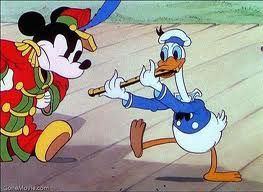
Mickey and Donald are often friends but also often adversaries.

Mickey and Donald are often friends but also often adversaries.

A few feature Mickey playing off of Donald.  As I mentioned earlier, Mickey became relegated to the role of straight-man with Donald being relied upon for the comedy aspect.  Mickey’s most famous cartoon (other than “Steamboat Willy”) is probably “The Band Concert” where Donald tries to ingratiate himself to Mickey to hilarious results.  There’s also solo cartoons like “Thru the Mirror” which puts Mickey into the book “Through the Looking-Glass” and has him interacting with personified objects.  Fans of the 8 bit and 16 bit era Mickey video games will recognize several scenes from some of these cartoons.  “Thru the Mirror” is a visual delight and one of the stronger cartoons on the set.  For pure comedy there’s “Moose Hunters” which features the trio going after a moose and failing spectacularly.  Another I adore, partly because I had this cartoon on VHS as a kid, is “Mickey’s Trailer” which again features Donald and Goofy.  In this one, Goofy is towing Mickey’s camper while Mickey and Donald are inside.  Goofy, predictably “goofs up” and it leads to some amusing physical comedy.  There’s also a great sequence where Mickey has to get Donald out of bed and relies on the trailer’s technology to assist him.  Another nostalgic favorite for me is “On Ice” which used to be included, in quick clips, with the Mickey’s Christmas Carol broadcasts from the 80’s.  In it, Mickey teaches Minnie how to skate while Goofy tries to ice fish and Donald plays a prank on Pluto.  It’s one of the funnier cartoons included.

Some of these shorts offer a nice glimpse at the era from which they’re from.  In the 30’s, the nation was still coming out of The Great Depression and the short “Moving Day” reflects that as Mickey and Donald face eviction from their landlord.  “Mickey’s Polo Team” features several caricatures of popular actors from that period including the likes of Charlie Chaplin and Harpo Marx.  This  particular toon should be a real treat for film buffs out there and adds another dimension to the viewing experience.  Another short I was familiar with before picking up this set was “Brave Little Tailor.”  This one is another visual treat as it pits Mickey against a giant.  The plot is setup when the king confuses Mickey’s boast of killing seven flies in one blow with killing seven giants with one blow.  Mickey attempts to correct the viewpoint but when he finds out Princess Minnie is his reward if he solves the kingdom’s giant problem he finds it hard to say no.

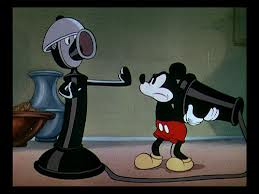
Mickey Mouse in "Thru the Mirror."

Mickey Mouse in “Thru the Mirror.”

The set comes housed in a tin with images printed on both sides.  Later sets would replace the back print with an insert instead which is actually beneficial as these tins are susceptible to shelf ware.  Leonard Maltin is the host on all of them and there’s a mini documentary included where he goes over Mickey in the 30’s.  He’s also present to educate the masses since these cartoons are not always politically correct.  There’s smoking in some, even by the protagonists, and some jokes that may be considered tasteless.  This set is fairly harmless in that regard when compared with others.  Other sets contain episodes dubbed as “From the Vault” that usually contain images that could be considered racist.  This one contains no such section which is a good thing as those Vault sections contain a mandatory word of caution from Maltin that can’t be skipped.  It just becomes annoying whenever you want to watch those episodes and you have to sit through it each time.  I did mention that there is one edit on “Clock Cleaners” and that’s because some people insisted a Donald Duck line contained the word “fuck,” which was an absurd claim to make since Disney would have never tried to get away with such in the 30’s, let alone now.  Nevertheless, the line was replaced to avoid confusion but it has been released uncut in other sets.  I don’t consider it a big deal though and it’s not something that should affect anyone’s purchasing decision.

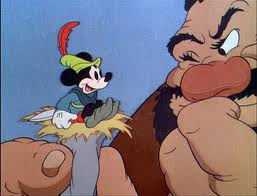
Mickey gets to take on a giant in "Brave Little Tailor."

Mickey gets to take on a giant in “Brave Little Tailor.”

This is a wonderful collection of cartoons and anyone who enjoys the medium should try and track down a copy.  Even though these sets only exist in standard definition, the visual quality is very good.  Especially considering these cartoons are over 70 years old.  Some are better than others, but there aren’t any that appear to have deteriorated too bad.  Mickey’s face is pretty much always white and doesn’t appear dirty.  The only one that seemed a little rough around the edges to me was “On Ice,” but it was nothing that could dampen the viewing experience.  This is a fun set to watch and it’s great to experience the joy of these shorts as an adult and I’m sure kids today would still get a kick out of them.  To a lot of children Mickey is just a logo, a character that is featured prominently at Disney’s theme parks, but few have experienced him as a cartoon star.  This set is from an era where Mickey was king of the cartoon world, and it’s not hard to see why.

As promised, here’s the full list of the cartoons included as part of this collection:

  • The Band Concert
  • Mickey’s Garden
  • On Ice
  • Pluto’s Judgement Day
  • Mickey’s Fire Brigade
  • Thru the Mirror
  • Mickey’s Circus
  • Mickey’s Elephant
  • Mickey’s Grand Opera
  • Mickey’s Polo Team
  • Alpine Climbers
  • Moving Day
  • Mickey’s Rival
  • Orphans Picnic
  • Hawaiian Holiday
  • Moose Hunters
  • The Worm Turns
  • Magician Mickey
  • Mickey’s Amateurs
  • Clock Cleaners
  • Lonesome Ghosts
  • Mickey’s Parrot
  • Boat Builders
  • The Whalers
  • Mickey’s Trailer
  • Brave Little Tailor

The Nightmare Before Christmas

Tim Burton's "The Nightmare Before Christmas" (1993)

Tim Burton’s “The Nightmare Before Christmas” (1993)

There was a time when I had no idea that The Nightmare Before Christmas was a Disney property.  When I first saw it around Halloween of 1993 during its original theatrical run, it was credited to Touchstone Pictures, which unknown to me at the time, was a spin-off of Disney.  Disney used Touchstone to market to older audiences and when the executives got a look at how creepy the imagery of Nightmare was they decided it was best to distance it from the Disney brand.  That’s not to say they expected failure or anything, on the contrary, Disney hoped to cash in on the Henry Selick directed picture due to its unique animation style.  That was another thing I wouldn’t become aware of for years.  The picture, often marketed as Tim Burton’s The Nightmare Before Christmas, was directed by Mr. Selick.  Burton crafted the story and worked on the character designs, script, and screenplay but had little involvement in the actual production.  This was due to him being a pretty hot commodity at the time and a certain Batman picture demanded a lot of his time.  Also, he had little desire in overseeing the tedious process of stop motion animation.  And who can blame him?  It’s a process that would drive many a person insane!

I remember being unsure of the film before first seeing it as a kid.  The adults taking us kids seemed more excited about it, though I’m not sure why.  Maybe it was the concept of marrying Halloween and Christmas into one film, or perhaps it was the visual style that is unique, if nothing else.  I think it was that visual style that initially put me off.  Not because it looked scary, but because Jack didn’t look like a skeleton in the traditional sense.  There’s a silliness to the look of the characters that’s lacking in true scares.  The vampires are a good example as they’re pear shaped and corny.  The look of most of the weird characters resembles that of Beetlejuice, one of Burton’s other popular films of the era.  I was way into X-Men at the time and preferred a realistic look to my characters, so I guess it’s not that surprising in hindsight why I had my reservations about the picture.

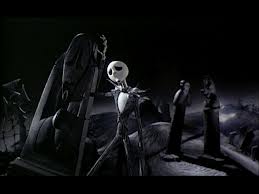
The film's protagonist, Jack The Pumpkin King, is bored and depressed over the whole Halloween thing and turns to Christmas for help.

The film’s protagonist, Jack The Pumpkin King, is bored and depressed over the whole Halloween thing and turns to Christmas for help.

Of course, they proved to be unfounded as myself and everyone I went with that day enjoyed the film immensely.  I’ve stated many times in my reviews of other properties that I care little for musicals and that was true of child me as well.  The Nightmare Before Christmas is heavy on song, more so than the traditionally animated Disney pictures of that time, and yet I still found it enjoyable.  There’s a humor to a lot of the film that’s present in the songs as well.  Most especially the “What’s This?” sequence where Jack is observing the differences between Halloween Town and Christmas Town (“The children are throwing snowballs instead of throwing heads,”).  That’s not to say they don’t get annoying, as sometimes the characters seem to break into song for the sake of doing so (such as when Jack explains Christmas Town to the rest of the gang), and I’m left wishing they’d just talk like regular folks instead.  The quality of the songs seems to vary too.  Danny Elfman was in charge of the film’s music (and also provided Jack’s singing voice) so I suppose he can be forgiven since he isn’t known as a Broadway composer.

Even though the film is a musical, it’s the visuals that make or break it.  And since the film has proven immensely popular ever since its release, it would seem to be that the visual style was accepted by the general public.  Selick has proven to be a master of the stop motion technique, and though films since have surpassed Nightmare in terms of animation quality, this film still holds up quite well today.  The characters animate very well and, for the most part, and lack the floaty quality many seem to have in the old Rankin/Bass Christmas specials.  Selick and his team don’t settle for the easy way in most scenes as characters tend to always be moving in some way as opposed to remaining still.  The only noticeable shortcut, if you will, seems to be the facial expressions of the non Jack characters.  Jack famously had over 400 heads to show various expressions while minor characters presumably had only one, save for maybe a back-up or two.  Sally had to use the same head so as not to disturb her hair, which would have caused a nightmare for the animators.  I suppose then it’s not surprising the lead character is bald.

While Halloween Town is presented in mostly black and white, Christmas Town is the exact opposite.

While Halloween Town is presented in mostly black and white, Christmas Town is the exact opposite.

The animation helps set Nightmare apart from other Disney fare, but the general look of the settings is also quite unique.  Halloween Town is very much rooted in German Expressionism.  There’s hardly a straight building in the town as everything juts out at seemingly impossible angles.  Several characters live in towers and crowded spaces.  Halloween Town seems pretty small in general, with mostly barren land surrounding it.  I suppose some would describe it as “gothic” (which would explain why so many goth girls in my high school seemed obsessed with Jack and Sally), but that seems lazy.  There’s very little color used as it’s mostly shades of gray.  And where color is present it’s often found in minor accents on the characters as opposed to the setting.  In contrast, Christmas Town is an explosion of primary colors and the objects Jack takes from it contrast nicely when they’re present in Halloween Town.  Watching the scene in Christmas Town almost makes one think a Dr. Seuss film would be a good idea for Henry Selick to oversee (as opposed to those wretched live-action films).

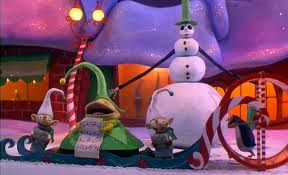
Jack playing Santa.

Jack playing Santa.

Tim Burton may get too much credit for Nightmare’s success, but one thing that can’t be taken away from him is the success of the film’s plot.  Dreaming up a world where each holiday has its own world separate from reality is pretty neat, but then taking the next step of having one wage war on the other is quite clever indeed.  Though Halloween Town doesn’t wage war on Christmas Town, they do seek to take over its holiday for at least one year.  Jack is a character of good intentions, but he lies to himself about what it is he’s doing without thinking about the implications this will have on Christmas Town, and Santa Claus to be specific.  He, for example, sees nothing wrong with sending off Boogie’s henchmen to kidnap Santa.  This makes him selfish, as he’s only thinking about curing his own seasonal depression, and short-sighted since he fails to predict the villainous Oogie Boogie’s eventual involvement.  And yet, we as the viewer know that he’s inherently good and he does set things right in the end.  The romance between Jack and Sally feels a bit forced, but I guess expecting for more development in that area out of a children’s moving may be asking too much.

The film settles in at 76 minutes, which is not uncommon for stop motion.  It doesn’t feel that short to me, maybe that’s due to my tepid response to the musical pieces, but it doesn’t feel long or anything.  And I give credit to all involved with the property that no stupid sequels exist such as Jack visits Easter Land or Valentine Town.  There are some spin-off video games and such, though I’ve never experienced any of them.  The unique dual holiday format of the film makes it extremely marketable for Disney, so perhaps that’s good enough for them to not seek out a sequel.

I watched The Nightmare Before Christmas this year for the first time in many years.  I was curious how I would respond to it after so long.  Despite being almost shunned by Disney for most of its life, it very much feels like a Disney picture, though Burton’s involvement is obvious as well.  Some of the songs made my eyes roll, but the visual effects are too charming to resist.  I enjoy the film’s humor and the fact that it separates itself from other holiday films and specials, but also makes sure to harken back to them at times with tongue firmly planted in cheek (“My what a brilliant nose you have!”).  While I don’t disagree with Disney’s decision to originally release the film through Touchstone, I don’t think it’s overly scary for young kids.  Most will recognize the film for what it is, but as always, parents know their kids best and might prefer to watch it first before showing it to the really young.  The film probably doesn’t rank as one of Disney’s best, but it is a fun film to revisit during this time of year, and I regret not purchasing it sooner.


Wreck-It Ralph

Disney hasn’t made many movies recently that interested me in the least.  They tend to focus on obvious children’s movies now-a-days and leave the family genre to Pixar.  Which for the company is viable strategy since it owns Pixar and allows it to hit multiple demographics.  This makes Wreck-It Ralph an exception.  Wreck-It Ralph is the video game/non video game film from Disney Studios that is sure to appeal to adults who grew up in the 80’s and 90’s with its many references to classic games.  The film was unveiled in great detail at this year’s E3 and was one of the highlights of the show.  And even though I loved the film’s premise, I was concerned it would be a mostly shallow experience where most of the enjoyment for older viewers would come from cheap cameos of popular video game characters.  I’m happy to report that after seeing the film I was pleasantly surprised.

Perhaps I should have had more faith.  After all, John Lasseter is the one spear-heading Disney Studios these days and his track record from Pixar is stellar.  Directing the film is Rich Moore who is mostly known for his work with the Futurama franchise, a show that I adore (at least the first four seasons).  And the voice cast for Wreck-It Ralph is pretty good too with John C. Reilly as the voice of Ralph, Jane Lynch as Calhoun, and Jack McBrayer as Fix-It Felix Jr.  Other notable cast members include Sarah Silverman as Vanellope von Schweetz and Ed O’Neill as Mr. Litwak, the arcade owner.  I guess the only reason I was down on the film is because the trailers were pretty poor.  Outside of the group therapy session that everyone has probably seen by now, it looked like any old kid’s movie.  Instead though I found the writing to be clever, the video game references well placed, and a lot of the humor was derived from situations and expressions as opposed to simple jokes.  There are some corny jokes, such as the many that are derived from the name for one of the games, Hero’s Duty, but they’re seldom annoying.

An “in game” shot of Ralph and Felix from “Fix-It Felix Jr.”

The film opens with narration from the protagonist (antagonist?) of the film, Ralph himself.  We’re given the backstory to his game about how he’s the bad guy who smashes a building in a Donkey Kong fashion and it’s Fix-It Felix who, as the player, has to set everything right.  When he does, the tenants of the building Ralph was smashing bestow him with a medal and toss Ralph off the building into a pile of mud.  When the day is done and the arcade is closed, Ralph is left alone to live in the dump while Felix and the rest stay in the building and the other characters shower him with praise and pie.  Ralph isn’t just narrating this sequence, as it’s soon revealed he’s at a group meeting for video game bad guys.  Here is where we get our first round of cameos with notable characters being Zangief, Clyde, Bowser, and Kano, among others.  Ralph is tired of being a bad guy, while the group is designed to make bad guys feel good about being bad guys.  Ralph gets little out of confessing his desires to be the good guy and as everyone exits the meeting it’s revealed it was taking place in the center of a map from Pac-Man and everyone is animated with pixels, Pac-Man style.

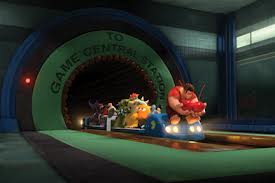
A look at the video game transportation system.

After the meeting, we’re shown how this whole video game world works.  The characters inhabit their own arcade cabinets and while people are playing them they’re expected to perform.  When the arcade is closed they’re free to come and go as they please.  They leave their games by traveling through the power chord into the surge protector, which is kind of like a giant train station.  It’s in these scenes where more on-screen cameos take place.  I don’t want to spoil anything so look for yourself and see who you can spot.  Sonic the Hedgehog makes an appearance as a public service announcement and it’s him that lets us know that if characters die while outside of their game they won’t re-spawn.  After the meeting, Ralph passes through the surge protector and back to his game, depressed.  The inhabitants of the apartment building are throwing a party celebrating the 30th anniversary of Fix-It Felix Jr. and Ralph, awkwardly, gets himself invited where everything goes wrong.  An exchange takes place between Ralph and Gene, one of the other characters, that results in Ralph decrying that he’ll prove he’s a good guy by winning a medal somehow.  If he does, Gene promises to let him move out of the dump and into the penthouse .

Ralph and Vanellope, who needs Ralph’s help to win a race so she can be added to the roster of selectable characters for her game.

The rest of the film involves Ralph going off in search of a medal.  He ends up in a shooter game where Lynch’s Calhoun comes from and then gets dumped into a candy-themed kart-racer where he meets Silverman’s Vanellope.  The movie turns into a tale of friendship, redemption, and corruption as everything is not what it seems in this candy land.  Vanellope ends up being a fun addition to the cast and Silverman seems to really enjoy voicing her.  She’s likely to be the favorite of many movie-goers.  Felix has to go out looking for Ralph when he doesn’t show for his game, which threatens to get it unplugged for good, and Calhoun has to follow him to the racer in chase of an alien bug that followed Ralph and threatens to ruin the game.  Other video game lyngo is introduced that should be fun for fans and there’s lots visual delights involving licensed candy and treats.

The film is likely to entertain mostly in its visuals.  It looks great and the video game centric stuff is a lot of fun.  The older games tend to have a pixellated quality to the animation while the modern games are super slick.  A lot of the characters from the older games animate in a jerky fashion too which helps set the older games apart from the newer ones.  Ralph and Felix are immune to this for some reason, though I suppose it has more to do with the designers thinking viewers would get sick of the quirk if the title character was animated in such a fashion.  There’s plenty of in jokes for gamers too, ranging from ones that almost everyone will get to more nuanced ones (a very famous “code” makes an appearance) that will alienate some, but not to their detriment.  I was really impressed with the lore crafted by the writers in setting the rules for this video game universe.  It’s so much fun that I would love to see more films set in it, but I’m not sure if this one would benefit from a direct sequel.

The film is fairly long for an animated one, coming up roughly 15 minutes shy of two hours , but it’s well-paced.  The plot stays interesting and the animation is top notch.  Above all, the writing is solid and it should keep kids and adults alike entertained.  Wreck-It Ralph is a winner and it’s easily the best video game movie ever made, even if it’s not based on an actual game.


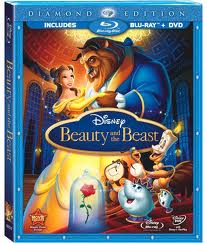
Walt Disney’s Beauty and the Beast

Beauty and the Beast (1991)

Recently I made an entry on the much beloved Disney classic Pinocchio.  In that entry I professed my love for the Disney classics, the films, the characters, the shorts – love em!  When I picked up Pinocchio recently on Blu Ray I also grabbed several others.  I did it in part for some free tickets to Finding Nemo 3D but mostly I did it out of my love for nostalgia.  My modest Disney Blu Ray collection now includes seven films and it’s a mixture of old and modern.  After getting re-acquainted with Pinocchio, I thought it would be interesting to take a look at a more modern, but perhaps equally loved, film:  Beauty and the Beast.

Beauty and the Beast came along during Disney’s renaissance period that began in the late 1980s with The Little Mermaid.  Prior to that film, Disney films had experienced a noticeable drop in quality.  Once praised for being good quality, family entertainment, most of the newer films were regarded as children’s movies that adults had to stomach in order to keep the little ones happy.  Disney was also being challenged by Universal Pictures and their animated films which were suddenly the biggest thing in animation.  To reinvigorate the brand, Disney went back to the its roots and started adapting classic stories and fables for its feature-length films.  The films were also heavily influenced by broadway.  Disney films always contained some element of song but now the films contained full musical numbers featuring elaborate choreography and big moments.  The Little Mermaid was a rousing success, as were many of the films that followed throughout the 90s.

Beauty and the Beast arrived two years later and was met with even more praise by critics.  Beauty and the Beast is perhaps best known now for being the first animated film nominated for an Academy Award for best picture.  It didn’t win, but just being nominated was a big achievement for the genre.  It followed in the same style as The Little Mermaid combining a classic story with state-of-the-art animation and catchy musical numbers.  I saw it as a kid, and my family had a copy of the VHS, though I always kind of associated it with Cinderella and considered it more of a “girl’s movie.”  That’s what young boys do, and as an adult I’m not much concerned with those things.  I was eager to see it again and hoped to perhaps see what made so many kids and adults enjoy it twenty years ago.

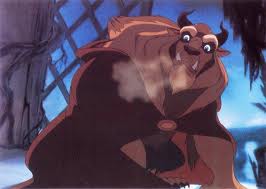
I’ve always enjoyed the Beast’s look.

Now, I mentioned in my Pinocchio review that I prefer the older style of Disney films in their approach to song.  I can’t deny some of the songs from the modern films are catchy and well put together, but I just hate how they disrupt the flow of the narrative.  Beauty and the Beast is not immune to this malady, but I knew that going in so I just tried to enjoy the songs for what they were.  As a spectacle, “Be Our Guest” is quite impressive and even pretty entertaining to watch.  The inhabitants of the Beast’s castle are fun to behold as they’re mostly animated inanimate objects.  There’s Lumiere the candlestick holder and Cogsworth the clock as well as many others.  Mrs. Pott’s reciting of the title song is also delivered quite well and actually doesn’t completely halt the narrative.  Some of the musical numbers I didn’t care for though include the opening to the film which includes the song “Belle.”  It’s a little silly and kind of drags.  Another one that people seem to enjoy is “Gaston” where the villainous character of the same name is celebrated.  It’s kind of amusing for a bit, but like “Belle” just drags on too long.  I guess I’ll just never like the broadway approach.

At any rate, the musical numbers aren’t going to make or break the film for me.  The film’s plot is going to play a much large role, and as far as tales go, Beauty and the Beast is a good one.  I’m sure most are familiar with it, but the gist of it is an unkind prince was cursed to take on the form of a beast.  If he can’t find love he’ll remain that way forever.  Enter Belle, the beauty component of the title, whom the Beast imprisons in his cursed castle.  Not only was the Beast cursed, but so too were all of his servants who really got the short end of the stick.  While Beast is large and fearsome, others end up as footstools and dressers.  It’s actually Belle’s father who first stumbles upon the Beast’s castle (how the villagers did not know of its existence is a plot-hole best left alone) while running from some wolves.  The Beast does not take kindly to strangers, so he locks up the poor old man in a dungeon.  When Belle comes to find him, she trades her freedom for his.  The Beast, naturally thinking she may be the one to break the curse, agrees to keep her at the castle.

The ballroom scene is one of Disney’s most breathtaking sequences ever committed to celluloid.

What follows is a gradual melting of the Beast’s heart as Belle learns to see the gentle soul within.  Back in the village, the vain Gaston is plotting to make Belle his trophy wife and when Belle’s father returns with tales of a hideous beast he sets out to kill him.  It’s a fairly predictable plot, especially if you’re familiar with the old tale in one of its many forms, but it’s executed well.  The voice acting is especially good and I can’t recall a single performance that I didn’t like.  The Beast (played by Robby Benson) is the star for me as his delivery contains the perfect amount of savagery and humanity.  Others seem to really enjoy the over-the-top performance of Richard White as Gaston but I found him a bit too cliché for my taste.  I think he could have been toned down a little and still would have worked just as well.

As far as animation goes, the work put out by Disney is routinely praised as top-notch and Beauty and the Beast is no exception.  The animation is fluid and the color palette vibrant.  The lighting, the textures, the motion – it’s all stellar.  The Blu Ray release has been visually enhanced as well though to mixed results.  The outdoor scene that opens the film is almost too bright and colorful, but the darker and bolder scenes in the Beast’s castle never looked better.  There’s also a new scene included with a new song that was cut from the original release.  I didn’t find it to be anything special (obviously, since I don’t care for the musical numbers) but it doesn’t harm the film in any way.

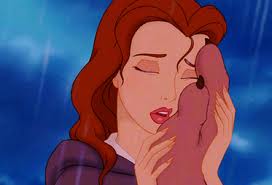
With these films I’m mostly taken aback by just the sheer quality of the animation.  Watching Belle’s hair flow or her dress rustle is gorgeous.  I have such great admiration for hand-drawn animation, and while I do love the stuff Pixar puts out, it’s just not the same as good old hand-drawn art.  I’ll never out grow it!

The film may be predictable, but that doesn’t mean it isn’t still moving.

Comparing the modern works to the ones from long ago is actually quite difficult considering the approach.  They’re all-together different and really the only comparisons that are easy to make are the technical ones regarding the animation.  Beauty and the Beast is certainly more flashy than those old films, but I don’t know that automatically makes it the better looking film.  I’ve really enjoyed watching the classics and each time I watch them I notice something new to appreciate.  Beauty and the Beast, and the other Disney works from that era, did bring the company back into the world of family entertainment.  That sounds kind of unattractive in a sense, the term family entertainment, but I take it to mean entertainment for all ages.  You don’t need kids to enjoy the Disney classics, and you don’t need them to enjoy Beauty and the Beast.  I’ll always be partial to the older films, but this is a good one on its own merit and one of the better films to come out of the 90s, animated or otherwise.  The little boy version of me would probably be somewhat surprised to hear me say that, though he’d probably be shocked to know I can’t wait for the eventual Blu Ray release for The Little Mermaid!


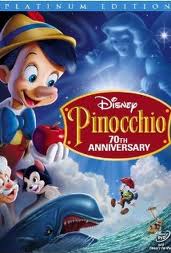
Walt Disney’s Pinocchio

Pinocchio (1940)

Back in the 1930’s, Walt Disney captured the hearts of movie-goers across the globe with Snow White and the Seven Dwarves, the first attempt at a theatrical length animated film.  Snow White was a rousing success and proved that animation had a place in the film scene.  Before Snow White, animation was mostly relegated to shorts set to music.  Mickey Mouse helped bring spoken dialogue to animation before Snow White, but for grander tales Disney turned to new characters and old stories.

Pinocchio was the follow-up to Snow White and was based on an old italian children’s story.  Compared to the english translations of the Pinocchio stories, the film wasn’t that long in following.  The tone of the story for Walt’s take was much different as the original Pinocchio is almost unlikable.  He’s basically a bad kid and while the Pinocchio of the film runs astray, it’s mostly through ignorance.

I spent the better part of a week this past summer in Walt Disney World, so I’ve been on a major kick.  Disney makes a ton of money off of park admissions but they make even more on the general good feelings relayed to the patrons that translates into merchandise sales.  As a lover of traditional hand-drawn animation, I have a great appreciation for the Disney classics.  I like some more than others, and I like some of the modern classics as well, but the old ones have a certain charm.  Pinocchio is one of my favorites though, and it was one I had not seen in decades until I found a new copy of the Blu Ray release hanging around a store (it has, per Disney’s rather annoying policy, re-entered the dreaded Vault for the time being so after market prices are obscene) and snatched it up once I saw how much even amazon.com was listing it for.

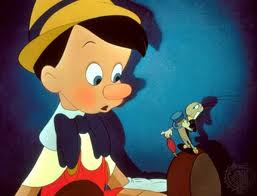
Pinocchio and his “conscience,” Jiminy Cricket.

I can’t imagine the pressure that the production staff was under following Snow White.  Production began before Snow White’s completion so starting out the only pressure put upon them was by Walt himself, which apparently was fairly immense since his ambition knew no bounds.  Pinocchio was supposed to be the third feature-length release following Bambi, but delays on Bambi moved Pinocchio up.  Snow White was, and is, a marvel of animation but Pinocchio is just plain better.  Pinocchio himself, is mostly responsible for this.  Pinocchio, as most probably know, is a wooden marionette for much of the film and he moves and behaves just as one would expect.  His rear end tends to rise when he walks, his limbs flop around, and he often exploits his ability to rotate his head 360 degrees.

Not to be done outdone, the supporting cast is done awfully well.  Geppetto, particularly in the scene where he’s frightened by a sound in his house early in the film, is wonderfully animated.  His knees are rattling and he’s clearly on edge.  Figaro, the cat, is reminiscent of Pluto in his mannerisms and behaves mostly as a cat would be expected to.  He’s very curious and approaches new objects cautiously.  Even when the story calls for the character to behave with human emotion, it still seems authentic.  Monstro, the massive whale in the film’s final act, is quite impressive and frightening.  He has a real hand drawn look, like a moving canvas, the way the water interacts with him is so impressive.

I love how Figaro the cat is animated. So many of his mannerisms remind me of my own cat.

There are other trick shots and fantastic pieces throughout the film.  Pinocchio’s reflection in Cleo’s fish bowl is a particular treat, and the sequence where Lampwick turns into a donkey is done so well it’s unsettling.  His hands gnarl into hooves as he paws at Pinocchio in desperation.  Of course, the film’s most iconic scene is where Pinocchio’s nose extends until it becomes a full tree limb on his face.  The attention to detail throughout this film is a wonder, even 70 years later.  It’s just incredible to behold and an obvious labor of love.

I confess I have a love/hate relationship with the music in Disney films.  The score and effects are always excellent, it’s where the characters break out into song that I never fell in love with.  A lot of these scenes break the narrative for me, especially in the modern classics where the sequences are obviously influenced some by music video.  In Pinocchio, the songs are worked into the narrative as seamlessly as could be done.  That’s due in part to Pinocchio being an impressionable youth which makes it believable that adults might turn to song to drive a point home.  The songs are not overdone, and quite nice too.  The film is most known for “When You Wish Upon A Star,” the unofficial song of Disney at this point, and it’s such a wonderful and perfect song for this film.  There’s something extremely affecting about the melody and the vocals by Cliff Edwards (as Jiminy Cricket) just accent it so well.

And what would Pinocchio be without its wonderful narrative?  The story of a puppet brought to life by the wishes of a lonely old man who longs to be a real boy.  There’s such a warmth to the Geppetto character when he interacts with Pinocchio.  Jiminy Cricket is an excellent sidekick for Pinocchio and an interesting concept as Pinocchio’s conscience.  The story is certainly a fantasy, but it’s handled with such care that we as the audience are able to buy into it.

Possibly the most memorable scene from the film, Lampwick’s transformation.

Pinocchio himself is handled well.  He is, in many ways, what one would expect of a puppet suddenly brought to life.  He’s impressionable and curious, a blank slate of sorts, which is why he needs the Jiminy character.  We see him go astray and get into trouble, but we know he possesses a sweetness to his personality which never makes him unlikable, only misguided.  And when the plot calls for him to rise to the occasion, we get to see the real Pinocchio.  We root for him and wish for him to succeed in becoming a real boy.

It seems one can’t have a conversation about Pinocchio without talking about the fear injected into the film.  A lot of the older Disney films were willing to use fear as a story-telling device.  Pinocchio’s imprisonment is quite unsettling, and the scene with Lampwick is one of the scariest things I ever saw as a kid.  It succeeds both visually and thematically as being a frightening scene as the formerly cocky Lampwick is reduced to a whimpering child.  The whole sequence is sort of a lesson to kids, be a good kid or become a jackass, and perhaps there’s an element of propaganda or audience manipulation in place.  It works with the film though.  The film is not so scary that kids shouldn’t watch it, just maybe more at the seven or eight year old mark as opposed to three or four.

Is this Walt’s best? I sure think so.

The film’s pay-off is certainly rewarding following the scarier scenes and the fantastic escape from Monstro.  It’s conclusion is joyous and sweet and may even leave you with a misty eye or two.  It’s a fitting end for such an incredible picture.  If you become too engrossed with the plot to really take notice of the animation splendors before you, the Blu Ray includes an hour-long documentary on the making of Pinocchio that’s quite informative.  The scope of this film is just breath-taking and there’s no doubt in my mind that this is Disney’s ultimate high point.  It’s a perfect marriage of amazing technical feats with a delightful narrative.  There’s no superlative that can do it justice.  It’s a title truly deserving of the “classic” label.

I’ve acquired quite a few Disney films over the years and some of the collections of animated shorts.  I’ll probably turn to them for posts from time to time so expect more Disney themed posts in the months to come.


The Dark Knight Rises

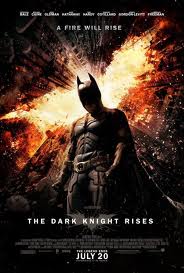
The Dark Knight Rises (2012)

I mentioned in my look at Batman’s best films that I had gone into total lockdown mode for The Dark Knight Rises.  I got off of social media, stayed away from review sites, and just basically blocked the world out where Batman was concerned.  I wanted to walk into this film with an unformed opinion.  I wanted to be outside the hype.  The first two Christopher Nolan directed Batman films are fantastic.  That’s not to say they are instantly in the running for best movies ever, but in the world of entertainment (and comic book adaptations especially) they are certainly worthy of the highest praise.  The hype surrounding The Dark Knight was intense, and the film actually lived up to it.  I assumed the hype could only grow louder for the trilogy’s conclusion.

It’s a poorly kept secret in Hollywood that trilogies often end badly.  I won’t cite examples as I don’t want to distract from the review of this film, but I’m sure most people reading this can think of at least one trilogy that lost a lot of luster in the third and final act.  And I don’t consider this a spoiler since it’s been stated numerous times by both Nolan and Batman himself, Christian Bale, that this is it for the two of them where Batman is concerned.  And since it was reportedly never a sure thing that Nolan would even return for a third film I’m going to take the both of them at their word.  Warner Bros. may back a truckload of money up to both of their doorsteps but I think this is it.  And if you’re a concerned fan fearing that Batman may end up like Spider-Man (there I go, making an example), worry not:  The Dark Knight Rises delivers.

If you’re concerned about spoilers, this is a spoiler-free review.  Basically all of mine are, even for films that are over ten years old.  With that said, I’m going to talk about the plot to some degree and anything in the trailers or that is considered common knowledge (basically anything I knew going in) is on the table.  If you want as pure an experience as possible though, I do recommend doing what I did and avoid all reviews until after you’ve seen it.  If you’re a Batman fan or just a fan of either of the other two films, you should definitely see this.

Easily the most iconic image of Bane from the “Knightfall” arc.

The movie starts out in a similar manner to The Dark Knight; by introducing the main antagonist for the film.  In this case we have Bane, played by Tom Hardy.  For those of you unfamiliar with Bane, you don’t need to know anything about him going in.  For those who do, know that this is a much better incarnation than what was presented in Batman & Robin, though I imagine that goes without saying.  Many writers of comics, television, and even video games have often chosen to focus on the brawn that is Bane.  That’s to be expected as Bane first and foremost exists as a physical threat to Batman.  He is someone Batman can’t simply engage in a one on one fight and expect to beat, unlike most of his rogue’s gallery.  However, Bane has a tactical side to his character which makes him especially deadly.  The film wishes to display Bane in that light, though don’t worry, he still possesses impressive brute strength.  The character was introduced in the “Knightfall” story arc from the 90’s, which makes Bane a rather recent addition to Batman’s rogue’s gallery when compared with others.  Some of that persona is adapted here, and some of the plot from that arc is as well, which kind of surprised me though I suppose it shouldn’t have.

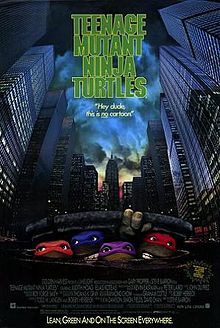
In the comics Bane is a big guy made bigger when he pumps a fictional type of steroid into his noggin called venom.  In this film there is no such serum and the many tubes going into the character’s head are not needed.  He does sport a mask, though it looks more like a gas mask than the luchador style one he wears in the comics.  The mask does serve a purpose, though the film never makes it clear.  I assume he can survive without it since a guy’s got to eat.  There’s no way he can get a physique like that living off a liquid diet.  The mask necessitates his speech to be dubbed.  Early viewings of the initial teaser for the film left several fans complaining about how inaudible Bane’s speech was.  I assume Nolan wanted to go a realistic route with the character, but pressure from the audience did apparently bring about change.  He’s not always clear in the picture, but his voice is quite loud and almost jarringly so.  It reminds me of Shredder’s voice from the first Teenage Mutant Ninja Turtles film.  It may not be realistic, but it beats the alternative.

In the trailers we are shown not just Bane, but Catwoman (Anne Hathaway) as well.  Her lines to Bruce Wayne at a costume ball recall some of the sentiments being thrown about in the Occupy Wall Street movement from last summer.  And yes, that is part of the film’s central plot, to a degree.

Campy? Perhaps, but given the source material I think they did all right.

After Bane is introduced in a most menacing fashion, we are taken back to Gotham where eight years have passed since the death of Harvey Dent.  Bruce Wayne has become a recluse and all of those years playing Batman have taken a toll as well.  The cast from the previous films is returned.  Gary Oldman is back as Commissioner Gordon and Michael Caine as Alfred.  Morgan Freeman is there as well and there’s a couple of new comers in officer Blake (Joseph Gordon-Levitt) and Miranda Tate (Marion Cotillard).  The three veterans of the films are just as good as always, with Caine especially being effective as Alfred.  I feared the Alfred character would get too preachy, and almost too omnipotent much like Rosemary Hariss’ Aunt May in the Spider-Man films, but my fears proved unfounded.  The new-comers serve a nice role with the Blake character mirroring Gordon’s from Batman Begins.

Tate is an ally to Bruce in his corporate life, which we soon learn is not going well.  With Gotham now at peace and organized crime all but exterminated, there’s no need for Batman so Wayne tried devoting all of his resources at Wayne Tech to making the world a better place.  In doing so he has stymied profits but Tate seems to share his outlook.  Selina Kyle, aka Catwoman, makes her presence felt early on as well by swiping some jewelry from Wayne which gets her into the story.

I was on the fence about the Catwoman character being used here and thought the film may become too crowded, but again my fears are mostly unfounded.  While there are a couple of scenes between Batman and Catwoman that border on camp, the film soon remembers what it is and distances itself from any such thing.  In the comics, Catwoman is known for being a tweener in that she isn’t really a villain but isn’t necessarily a hero either.  In TDKR she’s played pretty much the same way.  Her character is definitely adapted in part from Frank Miller’s Year One arc, which was used as a basis for Batman Begins, minus the prostitution angle (which DC has always tried to distance itself from). Her character views herself as a sort of Robin Hood, though her motives are entirely selfish.  She gets herself mixed up with Bane, which is how she stays in the picture.  And her presence doesn’t crowd anything or take away from the film’s hero, Batman.  He’s in this one just the right amount, and his heroic appearances are staged exceptionally well.

Gordon-Levitt’s Blake is a welcomed addition to the cast.

The main plot for the film involves Bane trying to basically pick up where Ras al Ghul left off and bring down Gotham.  He infiltrates the corporate sector, the market, and even the physical infrastructure of Gotham itself (as evidenced in the trailer).  Make no mistake, he’s a real threat to the city in an even bigger way than Ras could have hoped to be and his motives and actions help tie the trilogy together.  A lot of TDKR harkens back to Batman Begins which helps maintain a feeling of continuity and in the end makes for a better pay-off for longtime fans.

That’s the film, in a nutshell, but how does it fare as entertainment and how does it stack up with the other two films in the trilogy?  To put it simply, The Dark Knight Rises is a hard film to watch.  I don’t say that because it’s long (approximately two hours and forty-five minutes) but because it’s pretty bleak.  For most of the film’s running time there’s not a lot of reason for optimism.  The Dark Knight was a pretty dreary movie at times, but even that had little moments of triumph throughout.  The Dark Knight Rises has fewer of those moments which make it one exhausting movie to watch.  I went back for seconds and thirds on The Dark Knight during it’s theatrical run, once is enough for me with this film (though I’ll definitely be a day one buyer when it hits stores).

Oh yeah, expect to see some new “toys.”

Don’t confuse my proclamation that this is a hard film to watch as a criticism.  Some films are truly brilliant but hard to sit thru.  Think Schindler’s List or Grave of the Fireflies, though certainly not on that scale.  There is a real danger to this film.  I think part of it is born from knowing that this is the final film in this trilogy, and possibly this “universe,” which makes it feel like anything is fair game.  I would like to think though, that even without knowing that, I’d still feel the same unease I felt throughout this film.  Bane is a truly monstrous individual on a different level than The Joker.  That doesn’t make him better, just different.  Many were likely worried about how Nolan could possibly move on after The Joker but he found a way.  I found myself hating him and I really was hoping he’d get his due in the end, which is an emotion I never really felt towards The Joker.

The Dark Knight Rises is a very good film and quite exceptional, though it doesn’t top Batman Begins for sheer entertainment value and will probably wind up behind The Dark Knight for most.  There’s no shame in that and I feel quite confident in saying that Christopher Nolan’s Batman trilogy will go down as one of the all-time greats.  There’s certainly no comparison as far as comic book movies go, and I doubt it will ever be as beloved as the original Star Wars trilogy, but from start to finish this is the most consistent.  The films are connected not just by style and the names attached but in theme and narrative.  The Dark Knight Rises is a grueling experience at times, but is the pay-off the fans wanted.  I feel slightly stupid for even having my doubts about this one, but Christopher Nolan once again delivers a fantastic piece of art.  I will never doubt that man again.


Batman’s Top 10 Feature Length Films

No other super hero has taken to the big screen as well as The Dark Knight.

I didn’t do an official count, but I am going to go out on a limb and say that Batman has had more movies made featuring him than any other comic book superhero.  Over the years he’s been featured in both live action and animated films, wide release and direct to home video.  Some of these films have been among the handful of movies I’ve enjoyed above all others, while others have been truly dreadful.  When a character has been around as long as Batman, that’s bound to happen.  He’s not only had great and terrible films made about him, but he’s also had great comic book stories and poor ones, fantastic television moments and truly embarrassing ones.

Recently though, it’s been mostly good films that have found their way to audiences worldwide.  And I’m not just talking about the much praised Christopher Nolan directed projects, but also some of the smaller ones that never made it to theaters.  Today we are on the eve of the release for the third and final film in the Nolan trilogy.  You may have heard of it, it’s called The Dark Knight Rises and it figures to take in money hand over fist for the next several weeks and make the executives at Warner Bros. very happy, and even more wealthy than they already are.  It probably doesn’t even have to be a good movie for it to be a cash cow, just look at the much maligned Spider-Man 3, which made more money than either of its two superior predecessors.  Hype is a powerful thing.

As most are looking forward to The Dark Knight Rises I am looking back.  I started to reflect on the films that came before it to feature Batman and decided it would be fun to make a top 10 list.  For some only familiar with the live-action stuff, it may be surprising to know that there have been more than 10 Batman films made, but that man gets around.  Truth be told, there are even a couple I haven’t seen such as the Batman Vs Dracula one that was taken from the The Batman universe.  I just never got into that show as it was geared towards a younger audience but if someone thinks I’m really missing out on something special feel free to let me know in the comments section.  Otherwise, let’s take a look at number 10…

Batman: The Movie (1966)

10.  Batman:  The Movie

It was actually a tough call between this and Batman Forever.  Batman Forever tends to get lumped in with Batman & Robin since they both share the same director.  While Batman & Robin is one of the worst movies I’ve had the misfortune of seeing, Batman Forever is merely average.  It’s quite different in tone from the Burton directed pictures, and whether that’s a good thing or not is a matter of taste.  I’m not really a fan and I don’t think anyone who skips Batman Forever is really missing out, but it does contain an entertaining performance from Jim Carrey as The Riddler, even if he’s just playing the same screwball he was playing in every other movie at the time.

Batman The Movie, on the other hand, is a truly unique entry among the Batman films.  Based on the television series starring Adam West, it’s basically the definition of camp.  It exists purely to entertain movie-goers of all ages and never takes itself all that seriously (with the exception of Burt Ward’s rather intense portrayal of Robin, which is kind of an in-joke in and of itself).  For fans of the show, this was like the ultimate as the best of Batman’s rogue’s galleries team up to take down the caped crusader.  The plot is rather hokey, but the film isn’t short on laughs.  Fans who take their Batman stories very seriously probably find this one off-putting, but this was more or less Batman in the 1960’s.  The comics were geared towards six-year-olds and at least the television show made an attempt to appeal to adults as well which actually helped keep Batman relevant.  This one’s a guilty pleasure and is placed here for nostalgic value, if nothing else.

9. Batman:  Mystery of the Batwoman

Mystery of the Batwoman is the third feature length film based on Batman:  The Animated Series and the second that was direct-to-video.  It was the only one based on the relaunched version of the animated series which featured new character designs and improved animation.  I prefer the style of the first three seasons as opposed to this one, but it’s not too off-putting.  Mystery of the Batwoman is exactly what the title implies; a mystery story.  There’s a new vigilante in town and Batman has to deduce the identity of this female who has borrowed his image.  The film features a few “names” in prominent roles such as Kelly Ripa and Kyra Sedgwick while the usual cast is excellent, as always.  The villains featured in the film include The Penguin and Bane and this mysterious Batwoman apparently has a bone to pick with them, among others.  Not surprisingly, her methods are more ruthless than Batman’s which is what drives Batman to try and figure out her identity and put a stop to her activity.  The film’s mystery proves to be pretty satisfying, and as a whole it’s an entertaining story.  The minimalist production values tend to make it feel more like an extended episode of the show though which is why it doesn’t place higher.

I’m still amazed at how awesome (cool?) Bruce Timm and Co. were able to make Mr. Freeze.

8.  Batman & Mr. Freeze:  SubZero

SubZero is the second film based on The Animated Series and was the first to go direct-to-video.  Unlike Mystery of the Batwoman, it’s production values are more on par with Mask of the Phantasm, the only animated Batman film to receive a true theatrical release.  Mr. Freeze was a surprise star in the television show and it was clear that the writers really enjoyed working with him so it’s no surprise to see him receive the movie treatment.  As was the case in the excellent episode “Heart of Ice,” Freeze is driven to crime in an effort to save his beloved wife, Nora, whom he has cryogenically frozen until he can find a way to cure her of the illness that threatens her life.  Once again, the writing crew prove they’re up to the task of creating a worthwhile Mr. Freeze story but unfortunately the film sort of feels like an extended version of the “Heart of Ice” episode, and an inferior take.  Despite feeling like a retread, it’s still an engaging film and I’d love to see more from Freeze in a future feature film.

7. Batman Returns

Tim Burton’s Batman was a huge success with movie goers when it was released in 1989, so a sequel was pretty much a foregone conclusion.  Burton’s Batman brought the caped crusader back to his roots.  The work of writers such as Neal Adams started to bring some semblance of maturity back to the character in the 70’s, while the work of Frank Miller in the 80’s really drove it home.  This Batman, portrayed by popular comic actor Michael Keaton, was the strong silent type not interested in bantering with his foes.  The first film featured an iconic performance from Jack Nicholson as The Joker, and the feeling going into Returns must have been more is better as the sequel featured three prominent villains.  Fans were used to both The Penguin and Catwoman, but created for the film was Christopher Walken’s Max Shreck who is perhaps the film’s true villain.  In keeping with the style of the first film, both Catwoman and Penguin feature unique designs that represented quite the departure from what fans were used to.  Catwoman comes across as a cat-obsessed dominatrix while The Penguin is a truly hideous creature.

Perhaps Burton felt like the Batman character was explored and developed enough in the first film, because he’s kind of brushed aside here.  The focus of the film is placed squarely on the villains as we learn what brought them to this state.  Burton is also more comfortable here interjecting his brand of humor into the franchise, more so than he did with the first.  Both The Penguin and Catwoman are pretty ridiculous, but the film plays them straight.  It starts to fail though in the final act as even the most forgiving members of the audience will find it hard to accept an army of penguins packing serious heat.  DeVitio (who actually received an undeserved Razzie nomination) and Pfeiffer are both memorable in their roles, but even they can’t carry a Batman movie that’s light on Batman.  A fun, but ultimately flawed experience.

This one’s not for the kids.

6. Batman:  Under the Red Hood

I was pretty surprised to see Warner Bros. was releasing an animated Batman film that did not feature Kevin Conroy in the leading role, or would include The Joker but no Mark Hamill.  To me, so long as neither actor is demanding an absurd wage for their services, Conroy and Hamill should be the voice of Batman and Joker, respectively, until they can no longer do it.  That said, both Bruce Greenwood and John DiMaggio do an acceptable job as Batman and The Joker in Under the Red Hood, an animated film that adapts parts of popular comic plots such as “A Death in the Family,” “Hush,” and “Under the Hood.”

It’s that first story that attracted me to this direct-to-video feature and the one that made it most interesting.  For those not in the know, “A Death in the Family” is the iconic story where Robin is murdered by The Joker.  It was one of those rare stories where comics crossed over into the mainstream as it was a pretty big deal to see Robin go down.  Under the Red Hood starts off like a mystery, but it’s one that is solved almost immediately.  Batman and Nightwing (Neil Patrick Harris) both encounter the new vigilante/villain Red Hood and are unsure of his motives.  He appears to be positioning himself as an adversary for crime boss Black Mask, and doing a good job of it.  As I said, the mystery is revealed fairly early in the film, and the second act deals with Batman confronting this new foe.  The animation is fluid and quite enjoyable to behold, and the opening scene featuring the murder of Robin is appropriately disturbing and graphic.  The film’s signature scene though is not the death of the boy wonder, but the climax which features Batman, Red Hood, and The Joker in a memorable stand-off.  The true motivation for the Red Hood is revealed and it serves as a believable and some-what heartbreaking reveal.  It’s really that climax that pushes this one up to the position of number 6 on this list.

5. Batman Beyond:  The Return of the Joker

I’ve mentioned before how I wasn’t a believer when I first heard about Batman Beyond.  It seemed too gimmicky and totally unnecessary; a cheap way to go after the younger crowd.  Were there really no stories left to tell for Bruce Wayne?  I was proven wrong though and Batman Beyond, while not as good as the series it followed, proved to be a worthwhile entry into the Batman canon.  The Return of the Joker though, ended up being one of the best Batman stories every brought to animation which is something I don’t think anyone could have predicted.

One of Batman Beyond’s major weaknesses as a series was the absence the classic rogue’s gallery.  A few good villains would be created to battle this new Batman, and even Mr. Freeze would make an appearance, but few could hold a candle to some of Batman’s most memorable foes.  One who was missed perhaps the most was The Joker.  How can you have Batman without The Joker?  I think most fans suspected his presence would one day be felt, but as the actual Joker who terrorized Bruce Wayne’s Batman so long ago?  That seemed crazy, but The Return of the Joker proved it could be done.  Sure there was a sci-fi explanation for how The Joker could still be around and the film took some liberties in getting the audience to buy into the explanation, but at the end of the day, we were willing to believe anything if it meant the return of perhaps Batman’s greatest foe.  And this Joker, once again played by Mark Hamill, is an even darker take on the character.  He’s even more sadistic than before and kind of pissed off to boot.  The production values are no better than an episode of the television series, but no one cares when the plot is this well executed.  If I have one complaint with the film it’s that the final encounter between Batman and The Joker isn’t quite as satisfying as it probably should have been, but the film makes up for it by showing us the final confrontation between the original Batman and Joker which was just as excellent as it should have been.

Now there’s a dynamic duo.

4. Batman (1989)

I’ve already done a full review for this one, so I won’t get into too much detail here.  Simply stated, this was the film that proved Batman could be a box office juggernaut and appeal to both kids and adults.  Perhaps more so adults with this dark and gritty take on the caped crusader.  The choice of Michael Keaton as Batman was much maligned at the time, but he easily won crowds over.  The look of the film was particularly striking and would go on to influence The Animated Series in a major way.  Jack Nicholson’s Joker was so good that, as hard as it may be to believe now, many people felt like no one could ever come close to matching it.  This one may not hold up as well today when compared with the Nolan films, but this Batman is still pretty unique and the one most like the Dark Knight featured in Frank Miller’s work.

3. Batman:  Mask of the Phantasm

Last year I dubbed Mask of the Phantasm as the definitive take on the character to make it to film.  I also said that is not to be confused with best film to feature Batman.  Mask of the Phantasm, quite simply, fully captures the essence of the character in a way that not even Christopher Nolan’s works can match.  The film focuses on the early challenges faced by Bruce Wayne as he struggles with keeping to the promise he made to his deceased parents and the graveyard scene is the most memorable scene, for me, from any Batman film.  I love this movie, so much that I made a full entry on it last year shortly after my verdict on the definitive Batman film.  If you like Batman, you absolutely owe it to yourself to track this one down.

Well done, Mr. Ledger.

2. The Dark Knight

Considering the work done by the other directors and actors featured on this list, it’s pretty high praise to award the top two spots (yeah, that’s right, hope I didn’t ruin the surprise) to the team of Christopher Nolan and Christian Bale.  Of course, The Dark Knight owes a great deal of its success to the late Heath Ledger who’s turn as The Joker is already one of the most memorable performances in a comic book movie to date.  Batman Begins was a successful movie, but it wasn’t the massive hit The Dark Knight turned out to be.  A great deal of that probably is due to the aura the film garnered after Ledger’s demise and word of mouth of the actor’s fantastic performance.  It cannot be understated;  Heath Ledger’s Joker is phenomenol!

That said, The Dark Knight is not a perfect movie.  It’s certainly very good, excellent even, but Batman has seen better.  Part of that is due to the same thing that harmed Batman Returns, which is a de-emphasis of the Batman character.  Nolan explored Batman in great depth in Batman Begins, so he probably felt like that afforded him a lot of freedom with this picture.  Nolan also approached this one as a crime drama and often cited the popular heist film Heat when discussing the picture.  Batman still has a strong presence, as both himself and his alter ego Bruce Wayne, but the scenes with The Joker are just so good, so memorable, that they over-shadow the rest of the film.

I do find Bale’s performance to be noticeably worse in this one than the previous film.  Some of that is some quentionable dialogue in the script, but a big piece of it is the dreaded bat voice.  In Batman Begins, Bale uses a lower and slightly throaty voice when speaking as Batman.  In The Dark Knight, the voice is almost distorted and Batman sounds like he’s auditioning for a death metal band.  It doesn’t work, especially when Batman is asked to have full conversations with characters, and really detracts from many of the film’s most critical scenes.  I also feel like the Two-Face part of the story was rushed and the resolution still leaves a sour taste in my mouth.

Criticisms aside, you can’t be number 2 on this list and be a bad film.  The Dark Knight is an engrossing crime flick and is tremendously entertaining.  Its faults are forgivable, and its biggest fault is that it’s just not as good as the number one film on this list.

There’s just no topping this.

1. Batman Begins

When Christopher Nolan was brought on to reboot the Batman franchise many people had no idea what to expect.  Nolan, at that time, was best known for Memento, a really cool and engaging film but not one that could easily be applied to the Batman franchise.  The often rumored to be in development Batman 5 never got off the ground, and Warner Bros. wisely decided to distance itself from the catastrophe that was Batman & Robin.

A fresh start is really what the doctor ordered, and by doing so it gave Nolan a chance to do what no director had really done before:  tell a complete origin story.  Batman Begins is exactly what Batman needed.  The film goes into meticulous detail to explain to the audience how Batman came to be and what truly motivates him.  His morals and methods are fully defined for the first time and the film is focused fully on Batman with no villain to steal the spotlight.  Nolan’s universe is grounded and absent of most of the characters we’re used to seeing which gives the film it’s own sense of authenticity.  Christian Bale proves to be worthy of dawning the cape and cowl, but some of the supporting cast really steal the show.  Michael Caine is perfectly cast as Alfred, the closest thing to a maternal figure Bruce has, and Gary Oldman is easily my favorite actor to portray Jim Gordon.  Rachel Dawes, an assistant to Gotham’s D.A. and childhood friend to Bruce, is created to help the Bruce Wayne character feel more real.  Played by Katie Holmes, she’s a strong female type that actually works pretty well in that role.  My only major complaint with the film is when they try to force a romantic undertone to Rachel and Bruce’s relationship which just lacks any chemistry and feels unnecessary.

Batman Begins is the best Batman film created thus far.  It just hits all of the right notes and I still get chills when I watch the film’s final scene.  Will it remain the best?  As I sit and type this up we are just over 3 hours away from the release of The Dark Knight Rises.  I have intentionally avoided all press related to the film.  I do not know how it has been received by critics, I do not intend to speak to anyone tomorrow about it as I want to experience it in a pure way to form my own opinions. I’ve never taken a film this serious, and I’m not sure why I am now.  I think it’s because I just haven’t been excited by the few trailers I’ve seen or the concepts I’ve heard that the film is supposed to contain.  I fear I’m already approaching it with too much of an opinion, and I want to distance myself from that.  I have tickets to see it in IMAX this Sunday, and I’ll try to post a review that night for anyone who is interested.  Regardless, I fully expect this trilogy of Batman movies to be among the best trilogies comic book fans, or movie fans in general, have ever received.  I doubt very much it will top Batman Begins as a stand-alone experience, but so long as it’s on par that’s all anyone can ask for.


The Amazing Spider-Man and Reboots

The Amazing Spider-Man (2012)

There are two big superhero movies set to hit theaters this summer.  One, The Dark Knight Rises, figures to close out a trilogy that could go down as the best superhero trilogy ever conceived to this point (and one of the all-time best trilogies in general).  The other, The Amazing Spider-Man, hopes to launch a new franchise that could one day be among the best.  The two films are not very similar, but The Amazing Spider-Man hopes to do for Spider-Man what Batman Begins did for Batman.  That’s a tall order and complicating things is the fact that not a lot of time has elapsed between the original Spider-Man film franchise and this new one Sony is looking to start.

How much time needs to pass between two films based on the same property before a reboot can be introduced?  A reboot refers to a new beginning for a character.  The Amazing Spider-Man will ignore the three previous Spider-Man films directed by Sam Raimi.  When it hits theaters it will have been 5 years since Spider-Man 3 was in theaters.  For Batman Begins, 8 years had elapsed between that film and the most recent Batman film before it, Batman & Robin.  In the case of both, these new films are arriving after the last one was poorly received, though to different degrees.  Batman & Robin was panned by critics and filmgoers alike.  There is almost nothing positive that can be said about it.  It was the sequel to Batman Forever, a film that received a mixed reaction, and was also the fourth film in a line of movies but introduced its third actor to play the starring role.  There was little continuity in that series following Batman Returns and every film seemed to be worse than the one that preceded it.

For Spider-Man, Spider-Man 3 returned the same cast and crew as the previous two.  The first film was received warmly and accomplished what it set out to do, and the second was roundly praised as one of the best comic-to-film adaptations ever.  Spider-Man 3 had a lot to live up to, and though it was not as good as the first two, it actually has a “fresh” rating on rottentomatoes.com, albeit barely so.  It wasn’t a terrible film, but it was a mess of a movie that encountered numerous problems.

What the Hell were they thinking?

I’m not sure if it was the intention from the start, but it felt like going into Spider-Man 3 that this could be the endpoint for the Rami directed movies.  The third one rounds out a trilogy and there seems to be a natural tendency to view films within a franchise in groups of three.  I’m not sure why, but that tends to be the reality of things.  The main actors were originally signed for three films so a potential fourth one was likely to get expensive.  As such, both Raimi and Sony/Marvel tried to cram everything into Spider-Man 3 they ever wanted to address on film.  From the onset, Raimi and star Tobey Maguire had mentioned they liked The Sandman and wanted to get him into a film.  There was also the Green Goblin plot which developed over the course of the first two films that had to be addressed in the third.  And then there was Sony and Marvel (and to a certain extent, the fans) who wanted to see Venom make his big screen debut.  If they had bothered to do any fan research though, I think they would have found most fans would not have wanted Venom in this film and would have preferred to see him introduced slowly across multiple films like he wan in both the comics and television show.

It’s no surprise then that Spider-Man 3 became a bloated mess.  Raimi tried to bring everything full circle for Peter Parker by revealing another piece of the puzzle where Uncle Ben’s murder was concerned.  And not content to let Mary Jane and Peter have a conflict free movie, he put a lot of focus on their relationship and tried to create a love triangle with Harry, the New Goblin (who looked ridiculous).  And then they had to get Gwen Stacey in for some reason, and introduce Eddie Brock and the black costume.  The fact that the movie actually does have a coherent plot is some-what commendable, even if it’s not a good one.

The film made a ton of money riding on the strength of the franchise more so than on the merits of the film itself.  The ending tied up some loose ends for the trilogy, mostly the Green Goblin story, but left things open where MJ and Peter were concerned.  I hated this ending, though the film did such a good job of making both Peter and MJ unlikable that I really didn’t care what became of their relationship once the credits began to roll.  Because it did make so much money, there was some speculation that Raimi and the main cast would return for a fourth film.  Things appeared to be moving in that direction until Sony abruptly cut ties with all involved.  This actually was met with a positive reaction by the fan-base, or seemed to be.  Fans actually seemed on board with a reboot of sorts for Spider-Man, partly because the existing films seemed to lose their way with all the melodrama thrown into the films, and because the Venom character was so thoroughly botched.

The new leads: Emma Stone and Andrew Garfield

A fresh start was definitely in order, but I’m not sure if The Amazing Spider-Man is what fans had in mind.  This new film is copying the Batman Begins formula perhaps too much by re-telling Spider-Man’s origin.  When Begins came out it had been well over a decade since Batman in 1989 and his origin really wasn’t explored in as great of detail as Begins set out to do.  With Spider-Man that’s not the case.  This film does give film-goers a look at Peter’s parents, which was never addressed in the previous trilogy, but it also goes through the whole bitten by a spider thing again.  I don’t speak for everyone, but I have no interest in seeing that re-hashed.  The film’s main villain is going to be The Lizard, who supposedly would have been the villain had Raimi’s franchise continued for a fourth film as well.  He’s another scientist with good intentions who has a horrible accident that leads to him becoming a super-villain.  That type is quite common in the Spider-Man universe, but The Lizard may be one of the most boring.  The film could portray him differently than most mediums, but for the most parts he’s just a mindless rampaging creature that tests Spider-Man physically, not so much intellectually.  He’s been around for a long time so he’s had other portrayals, but that’s the basic one.

If this isn’t the reboot fans were looking for, then what was?  Well, I think fans would have been happy to see a new actor dawn the red and blue tights without an origin story.  The film could have still ignored the Raimi trilogy and laid the groundwork for a new one.  It makes sense to go with a villain that wasn’t captured in the first three films already to provide some added freshness, though I’m not sure The Lizard was the right one.  Ideally, Eddie Brock would be in it to set the stage for Venom in a later film, but a main villain would be needed for the first one.  A grounded, real world type of villain might have worked best just to get away from the whole science gone wrong angle.  He may have shown up in Daredevil already, but The Kingpin could have been utilized again, maybe even the Spider Slayers?  The plot could show how Spider-Man, portrayed as a teen out having a good time stopping muggings and other petty crimes, confronts an enemy far more dangerous than anything he’s confronted before.  Kingpin could even have a lackey to beat the tar out of Spider-Man, someone like Hammerhead, Tombstone, or The Rhino.

The new costume has a Ben Reilly feel to it. That's not a good thing.

Or my concerns could amount to nothing.  It’s not impossible that The Amazing Spider-Man turns into a great movie, though I don’t consider it likely.  Maybe I’m just being pessimistic, but this thing looks dead in the water.  I expect it to do well at the box office, but perhaps not so well critically.  This may just end up being the example of what not to do when rebooting a franchise.  It has a “too soon” feeling already, and if a large chunk of the film’s run time is spent going over things the previous films already covered people may react negatively.  Then again, maybe the casual movie-goer doesn’t care and just wants to be entertained.  Spider-Man bouncing around and wailing on a CGi Lizard may delight audiences, and a lot of people seem to like Emma Stone who plays Gwen Stacy (whom has the misfortune of expectation as comic fans will basically just be waiting for her to die).  The trailer is linked below, so you can form your own early opinion on the film.  Mine seems obvious, but in the interest of spelling things out, I don’t expect this to end well.


Teenage Mutant Ninja Turtles (1990)

Teenage_Mutant_Ninja_Turtles_(1990_film)_posterHollywood loves to go after us folks who are suckers for nostalgia.  We’re easy targets as it doesn’t take much to lure someone in with a touch of nostalgia.  Especially today.  We live in a world of 24 hour news networks and the internet puts information at our fingertips at all times.  The media’s tactics haven’t changed either, there’s still a lot of doom and gloom coming over the airways, especially in trying economic times.  It’s easy to let nostalgia take over as for most it’s the act of bringing one back to their childhood, which for many, was a happier time.  The sad truth though is that Hollywood usually lets us down when it revitalizes an old product.  Over the years we’ve seen movies based on Transformers and G.I Joe, none of which proved very satisfying.  If you want to indulge in a bit of a nostalgia, your best bet is to seek out an old television show or movie on home video.

Teenage Mutant Ninja Turtles is a great start for anyone looking to recapture that nostalgic magic.  The original film arrived at the height of Turtle-mania when every kid in school was seemingly sporting a Teenage Mutant Ninja Turtles lunchbox, backpack, or pencil set.  It was inescapable.  Recently I acquired the new compilation of TMNT comics and had a blast looking through them for the first time.  It really got me to thinking about the Turtles from my youth, the animated and the live action.  I thought that after reading the original books that it was a good time to go back and check out the original film.  I always had held the impression that it was pretty faithful to the comics and wanted to confirm that.  Instead I came away thinking it was a success because it combined both the animated series and the comics in a truly harmonious way.

It’s hard to consider Teenage Mutant Ninja Turtles a comic to film adaptation because it’s quite obvious that without the cartoon, this movie never happens.  The comic may have started this whole thing, but it was the cartoon (and probably the toys) that reached the biggest audience.  And it was that audience comprised mostly young boys that made the Turtles into such a big thing in the late 80’s and early 90’s.  Even if the writers wanted to adapt the comic for film, they would have never secured enough funding without targeting the cartoon’s audience.  This put the developers behind the film into a position where they could take from both mediums while adding their own touch.

The similarities between the comic and film are quite apparent.  The Turtles themselves live in a sewer that looks like a sewer, unlike the TV show.  There’s a damp and dank feel to the scenes shot in their sewer home that’s certainly comforting from the couch.  The Turtles’ origin is also mostly intact.  Splinter was now always a rat, like the comic, and Oroku Saki murdered his master Hamato Yoshi.  The only difference is the removal of Saki’s brother, Nagi, who in the comic feuded with Yoshi over the love of a woman.  The removal of Nagi just shortens the story slightly and doesn’t lessen the impact of Saki’s actions against Yoshi.  The writers even decided to make it slightly more personal by having Splinter get some licks in on the would-be Shredder, who responds by slicing his right ear off.

“I bet he never has to look for a can opener!”

The Shredder may actually be the most faithfully adapted character from the comics to film.  It was pretty much a given that the writers were not going to use the bumbling screw-up Shredder that the cartoon possessed, but they also ditched that Shredder’s design.  Not that there was much separating the two Shredders visually, but the film’s Shredder is basically lifted from the pages of Mirage comics.  He sports a red suit and all of the appropriate blades are in place (save for his right hand which is missing the two hand blades for some reason).  They even toss a cape on Shredder for his first big scene, some weird zebra-print thing that they wisely ditch for when Shredder finally confronts the Turtles.  Shredder also gets to show his lack of honor, when he tries to sneak a dagger into Splinter which is reminiscent of him pulling a grenade on the Turtles in the comics.  The writers do give the character a bit more depth.  In the comics we really don’t know much about Shredder’s operation in NYC.  In the film we see it’s a process where kids are brought in at a young age and brainwashed by the Shredder into thinking of their order as a family.  They presumably graduate to pickpockets as they get older until the best show they can handle being full-fledged members of the Foot.  And the foot soldiers themselves are pretty faithful in appearance to the comics.

Don and Mike have a close relationship with one another.

As for the Turtles, they’re pretty much a mash-up of the two mediums.  Leonardo is the most faithful to his comic book counterpart, which makes him pretty faithful to his cartoon persona as well.  No turtle really changes as little as Leo when moving from one medium to the next.  Here he is the unquestioned leader of the Turtles, and serves as an extension to Splinter.  He’s also a bit uptight when compared to his brothers, but not to a fault.  Raphael is definitely more similar to his comic approach.  He’s the hot head and loner of the group, only here that loner quality is amplified for dramatic effect.  Splinter laments how hard he tries to get Raphael to let go of his anger and to let others in.  We get the impression that it’s a constant battle, but Raphael grows and changes in a believable way as the film moves along.  Michelangelo is the turtle who most clearly takes after his cartoon character than the comic book one.  He’s a goof ball and has a hard time being serious about anything.  His lingo isn’t quite so surfer heavy as the cartoon but he’s always expressive and exhuberant.  Donatello, on the other hand, doesn’t really fit the mold of either portrayal.  In the comic book he’s a quiet gear head, a bit introverted though not a loner like Raph.  In the cartoon he’s basically a genius and his genius is practically a super power.  In the film, he’s got more of a goofy side and comes off as kind of a dork.  He struggles to come up with the interjections that Mike is so fond of but other things come much quicker.  He seems pretty intellectual though not showy.  His sense of humor also comes across as a coping mechanism.  He’s arguably the most developed character and that might have to do with his voice actor being the biggest “name” in the film, Corey Feldman.  Either way, this is my favorite take on the Donatello character.  It should also be noted, that the Turtles do bring their strong affection for pizza from the cartoon to the big screen (and Dominoes paid a lot of money to make sure we knew it was their pizza the Turtles preferred).

As for the supporting characters, April (Judith Hoag) is not surprisingly a news reporter instead of a lab assistant.  This just works better and suits the plot.  The writers are able to work her old VW into the story, as well as her antiques store from the comics.  Casey Jones (Elias Koteas) also shows up and his portrayal is pretty spot on.  He plays off of Raph and the other turtles quite well and makes for a good addition to the story.  The romance angle between him and April does feel a bit forced and unnecessary though.  April’s boss Charles and his son Danny (who apparently loves Sid Vicious) serve as a minor subplot to the tale as well, and as far as I know, were created just for the film.

The plot of the movie borrows quite heavily from issues 1, 2, and the Raph micro issue for its plot.  It’s mostly the issue #1 but with the Shredder on the offensive as opposed to the Turtles.  Certainly it’s a lot easier for parents to buy into these characters as appropriate for their kids if they don’t come across as blood thirsty creatures out for revenge.  The writers take what Eastman and Laird already had done, and do a good job of turning it into a different story.  The film, at its heart, is basically a father-son tale with emphasis placed on the Turtles and Splinter as well as Danny and Charles.  There’s certainly an element of brotherly love as well, as the Turtles learn to rely on each other as they’re basically all they have.  It’s a nice approach that I find charming.

Jim Henson has plenty of reasons to smile in this picture.

The visuals are what people remember most about this film.  It was a risk taking the Turtles to live-action as anthropomorphic creatures rarely play well in that form.  New Line Cinema wisely recruited Jim Henson’s Creature Shop to create the turtle costumes and what a great job they did.  The Turtles stylistically combine the comic and cartoon look, keeping the comics understated belts but keeping the cartoon’s color-specific bandanas.  The design of the Turtles is pretty spot-on, they look like turtles!  To achieve the proper look, the masks were outfitted with some sophisticated animatronics for facial expressions and mouth movements.  It’s quite impressive the range of emotions exhibited by the Turtles through-out the film.  I’m not sure if they had to swap out masks for the actors for certain scenes or if each head was capable of sadness, joy, anger, etc.  It is obvious that they had at least one other mask for the fight sequences.  Those masks full of gears were probably pretty heavy and tough to backflip in, so during the fight scenes the Turtles are noticeably sporting slimmer heads with static expressions.  It’s really noticeable if you’re looking for it and not really jarring.  The director does a good job of hiding each turtle’s mouth if they had to speak during one of these sequences.  The most obvious scene is Mikey’s nunchaku duel with a foot solider as his head there is an almost entirely different shape.

I have a home movie where members of my family can be seen watching this scene in the background. Everyone busts up laughing over Don’s “It’s a Kodak moment,” line. The reaction of people laughing at that moment is way funnier than the actual line.

Script-wise, the performance is a mixed bag.  There’s lots of one-liners and puns and plenty of them are groan inducing.  This is the downside of watching a movie geared towards kids.  There are a couple of bright spots though.  I do love Mikey’s line for the pizza guy (“Wise men say, forgiveness is divine, but never pay full price for a late pizza.”) and Casey’s misunderstanding of the word claustrophobic is quite amusing as well.  And even though it may be a tad on the cheesy side, Splinter’s “Cowabunga!” is pretty awesome too.  The film’s score is mostly up-beat pop tunes.  It’s nothing special, but the main theme is pretty damn catchy.

When I watch this movie it’s pretty much an experience of pure joy.  I can notice its short-comings but really few of them bother me.  A lot of fans, as the kids of 1990 become the adults of 2012, have gone on to really embrace the original comics and are aching for a true to comic film, but it’s never going to happen.  No studio is interested in making a TMNT movie that alienates the kids in the audience.  And even if one did I really don’t see how the Turtles could better be adapted for the big screen.  Teenage Mutant Ninja Turtles is, by no means, a perfect film.  However, it is the perfect Teenage Mutant Ninja Turtles film and needs no improvement.