Category Archives: Film

12 Films of Christmas #4: National Lampoon’s Christmas Vacation

nationallampoonschristmasvacationposter

National Lampoon’s Christmas Vacation (1989)

In yesterday’s post, I mentioned how Home Alone director Chris Columbus was booted off of another Christmas flick due to conflicts with the star and that landing on Home Alone was a pretty good Christmas rebound. Unfortunately, the film he was dismissed from was one of the few this blog thinks is a superior Christmas movie:  National Lampoon’s Christmas Vacation. Now to be fair, it’s said that Columbus left this film due to disagreements with lead actor Chevy Chase. We all know that’s lingo for fired, basically, as the studio wasn’t going to side with a director of his stature over Clark W. Griswold. Even if, rumor has it, that Chase was a pain in the ass to work with going back to his days on Saturday Night Live.

Chase is very much the star here as most of the scenes revolve around him. When he’s not around the house, we very rarely get a look at what the rest of the Griswold family is up to. Essentially, we experience virtually everything through Clark, which isn’t unlike the previous Vacation films that came before it. It’s one reason why producer and writer John Hughes didn’t have any interest in directing the film as he viewed it as an outlet for Chase and little else.

Which is kind of a shame because, whatever your thoughts on Chevy Chase happen to be, the film works because Chase is so convincing as Clark Griswold. Unlike the previous Vacation movies, this one keeps the Griswolds at home as Clark is hell-bent on having the perfect family Christmas. He invites his parents and in-laws to stay on holiday at their home and carefully orchestrates everything from the tree to the decorations and probably even the menu. Of course, this being a Vacation film, nothing goes the way Clark plans. He forgets a saw when they set out for a tree, he can’t get his elaborate lights display to work properly, he spends a day locked in the attic, his cousin-in-law Eddie shows up, and worst of all, he doesn’t get a Christmas bonus thanks to his cheap boss, Frank Shirley (Brian Doyle Murray).

main

Clark and Ellen are back for this third installment in the Vacation series.

Everything that goes wrong for Clark does so for a reason; to make the audience laugh. Some of the gags are painfully awkward, like when Clark gets caught flirting with a lingerie clerk by son Rusty (Johnny Galecki) or when engaging in a dangerous game of road rage in the opening scene. Others are spectacles of physical comedy with Clark taking a pretty good beating at times by falling off the roof or crashing his sleigh into Wal-Mart. Most of the gags hit home, and the film does a good job of raising the laugh factor as the film goes on. The best is definitely reserved for Christmas Eve, when basically everything blows up in Clark’s face. Some of the bits are a little less interesting, like the sledding sequence which feels like a time filler, or Clark’s day-dreaming of a swimming pool.

24f3e5b0-4182-4d0f-b902-eaba1e4b84ae

The film opens with a pretty neat little animation of Santa having a hard time making a delivery to the Griswold family.

As was the case with the first film, Cousin Eddie (Randy Quaid) is a scene stealer as Clark’s hick cousin-in-law. Eddie has little comprehension of how he’s perceived by others and is devoid of shame. He has no problem emptying his chemical toilet in the middle of the street while swigging a beer in his bathrobe. He’s also pretty selfish, though not maliciously so, which makes him hard to resent. Nevertheless, it’s easy to see why Clark wants nothing to do with him even if he is well-meaning, as he is at the film’s climax.

And that climax really is a work of Christmas comedy gold. Everyone has Christmas horror stories, but hopefully not like this. And when Clark finds out he’s been enrolled in the Jelly of the Month Club (“It’s the gift that keeps on giving the whole year ’round”) and goes on his rant he creates one of the most quotable moments of any Christmas film. It’s almost a shame that there’s some filler between that scene and Eddie’s “gift” as the momentum the film built up to that point is stellar. The film ends some-what abruptly, but I suppose that’s a good thing as we don’t need to see the family open burnt presents and try to pick up the pieces following the trashing of the house on Christmas Eve.

3f16cb05f6f96823c0e1d065e16150b3_view

“Merry Christmas! Shitter was full!”

There’s a lot of fine role-players in this film. Both Rusty and wife Ellen (Beverly D’Angelo) play the patient, straight-role to Chase while daughter Audrey (Juliette Lewis) is more combative with her father, but not in an over-the-top sense that steals any scenes or derails the film. Doris Roberts and E.G. Marshall are excellent as Ellen’s parents who always point out what Clark gets wrong and not what he gets right. Nicholas Guest and Julia-Louise Dreyfus are scene-stealers as Clark’s neighbors, who put up with his crap for most of the film until the damn runneth over. They’re portrayed as snotty yuppy types and we’re supposed to root against them, even though they never do anything wrong or even mean. In that, the film is sort of mean-spirited in how it treats them, but I laugh at their misfortune anyways.

Christmas Vacation is, simply put, the perfect Christmas comedy. It spreads the laughs around throughout the brisk 97 minute runtime and does a good job of relying on each supporting actor in equal measures, while putting a rather large load onto the shoulders of Chevy Chase. And at this point, Chase has the Clark Griswold character nailed and it’s hard to separate the actor from the character as a result. This one is definitely worthy of annual viewing, just make sure to catch it on a premium network or home media format as the edited one that airs on Freeform is a disaster.


12 Films of Christmas #5: Home Alone

home_alone_poster

Home Alone (1990)

Yesterday we looked at a film that shone a spotlight on how one man can make a difference in the many lives he comes in contact with. Today, we’re looking at a film where an eight-year old boy comes to realize he doesn’t need anyone to make it in this world. Of course we’re talking about Home Alone: the family comedy without the family. Home Alone was released in 1990 to much success. While hardly a critical darling, it raked in the money as kids everywhere lined up to see Kevin McCallister take on two bumbling bandits and show that kids do indeed rule. The film also made a household name out of Macaulay Culken who would have a short reign in the public spotlight before puberty uncomfortably ruined all of that.

Home Alone is a Chris Columbus directed picture that feels like a John Hughes directed one. That’s because Hughes produced it. And it’s probably thanks to Hughes that John Freaking Williams was brought on to score the picture. That’s a factoid that always marvels me, this little picture aimed at children had a Williams score. Even though Home Alone manages to elevate itself out of similar, but lesser films, like Problem Child it probably didn’t pitch any better, so for Williams to sign-on to do it just boggles my mind. And to make it even more incredible, Williams wasn’t even the first choice!

Home Alone was also Columbus’s second attempt at directing a major Christmas production. He was originally supposed to direct National Lampoon’s Christmas Vacation, but he apparently didn’t get along with Chevy Chase. Home Alone feels like a decent consolation prize for dealing with Chevy. The film is very much a comedy, relying heavily on physical comedy and the uncomfortable situations Kevin puts the adults around him into.

home-alone-gun

I don’t know if there’s a studio in America that would even try to get away with a scene like this in 2016.

The premise of the film is pretty ridiculous. Kevin’s family, including several members of his extended family, are all going to Paris for Christmas and he, being the black sheep of the clan, gets left behind. I don’t think we ever find out what Kevin’s parents do for work, but the fact that it’s his dad paying for everyone to go to Paris makes it seem pretty laughable that he seems upset with Kevin for using his new fish hooks to make Christmas ornaments. I don’t think a package of three cost as much as a dollar in 1990. Anyway, a power outage and a mad dash to the airport, plus a nosey neighbor, all contribute to Kevin being left home alone. The local police, and Kevin’s own youthful imagination, even make it impossible for anyone to confirm that he’s all right when his mom calls from Paris. This is definitely one of those films that would partially break with cell phones introduced.

Meanwhile, Kevin basically thinks he made his family disappear. He goes on with life, pretty happy at first doing what probably most kids would do. He eats ice cream for dinner, watches R rated films (Angels with Filthy Souls), and goes through his older brother’s room. Eventually, he starts trying to be more responsible as he realizes he actually has to do things now, they don’t just happen. When some burglars start nosing around (Joe Pesci and Daniel Stern as Harry and Marv) is when Kevin starts to get scared, and actually miss his family. He even seeks out a local Santa about getting his family back, in a scene that is sort of touching, especially if you try to put yourself in the Santa character’s shoes.

04-2

Oh yeah, that’s the one.

The proverbial money shot is obviously the climax in which the Wet Bandits storm Kevin’s house full off booby traps. As far as physical comedy goes, the entire sequence is actually pretty spectacular. It’s easy to forget how hilarious it all was upon the first viewing since this is a film most people reading this have probably viewed a hundred times by now. In particular, the blow torch scene is genius. Some may scoff at an actor like Pesci reducing himself to such a role, but his facial expressions are gold. Stern is arguably just as good as the more aloof of the two bandits.

The film also takes time to highlight the Christmas holiday, and Christmas naturally has a way of making things all better in the end. Home Alone is a terrific ride, even if it’s a bit formulaic and gag-reliant. It was a magic that really couldn’t be duplicated. While several sequels have been made (only one featuring the main cast of the original), none have come close to harnessing whatever it is that made the original feel so refreshing. It’s the type of film that can’t be duplicated, which means a remake is coming to theaters in 2021.


12 Films of Christmas #6: It’s A Wonderful Life

its_a_wonderful_life_movie_poster

It’s A Wonderful Life (1946)

I’m going to follow-up perhaps the raunchiest Christmas movie with one of the sappiest on record. Frank Capra’s It’s A Wonderful Life is about as well known as Dickens’ A Christmas Carol, at this point. It’s certainly the most adapted, or parodied, Christmas plots other than A Christmas Carol. Beavis and Butt-Head even have their own take on it! Now I’m not one for corn, or sentimentality, when it comes to Christmas films, but I have my moments. And if I’m going to feature one of the classics on this list it might as well be It’s A Wonderful Life.

The story of how It’s A Wonderful Life became a Christmas institution is probably pretty well known. To recap, the film was a dud when it was first released and studios viewed it as a sign that director Frank Capra was losing his touch. The film would eventually fall into the public domain and Ted Turner, of all people, gave it a second life when he started featuring it on his cable channels at Christmas time. Now it’s one of those event viewings on television during the Christmas season and always gets a premium time-slot.

Where It’s A Wonderful Life sets itself apart is in showing how bleak and depressing one man’s life can become. It’s a story about unfulfilled dreams and ambition. George Bailey (James Stewart) is a dreamer. He’s going to grow up and do all of these wonderful things, but along the way he’s constantly challenged to do the right thing and sacrifice his own goals in the process. He can never enlist in the armed forces because he lost hearing in one ear when  he saved his kid brother from drowning. It’s his brother Harry (Todd Karns) who becomes the decorated Navy pilot instead. He wants to get out and see the world and desperately doesn’t want to end up like his father running an old Building and Loan. When his dad passes away suddenly, it’s George to the rescue who takes over the family business. Even a run on that same Building and Loan screws up his honeymoon as George has to use his own cash he received for getting married to cover all of the withdrawals and forego his honeymoon.

snow-300x225

A man at the end of his rope.

That’s not to say that George’s life is a waste, it’s just easy to see how one person could feel like fate is dumping on him. He does get the girl, Mary (Donna Reed), and as a local business man is able to establish Bailey Park, an area of affordable housing in contrast to the slums managed by his rival, Henry Potter (Lionel Barrymore). He and Mary have three children, and George seems to be a rather well-liked individual, a borderline local celebrity.

Most of the picture takes place in the form of a flashback. It’s being viewed by two angels, one of which is Clarence (Henry Travers), who is to be George’s guardian angel. This also makes It’s A Wonderful Life the rare secular film to find its way onto my television at this time of year. See Clarence is an angel who has yet to earn his wings. If he can save George, he’s promised them. And when things take a turn for the worse, and Potter is in position to seize the Building and Loan, George is ready to take his own life by jumping off a bridge. To prevent that from happening, Clarence jumps instead and George springs to the rescue. In order to convince George he has a life worth living, Clarence decides to show George what the world would be like had he never been born.

images-225

“Merry Christmas, movie house!”

You probably know the rest. Naturally, everyone George knows seems to be worse off, or even dead. George has an epiphany and is back home in time for Christmas. And lets not forget, this is a list of films about Christmas. Visually speaking, George running through the streets of Bedford Falls in the falling snow screaming “Merry Christmas!” to everything and every one he sees is about as timeless as it gets. A film that spends a great deal of time focusing on the depressing parts of one man’s life turns into a rather feel-good movie in the end that sits dead-center in one’s throat.

Being an old film, it naturally doesn’t possess the visual charms of modern pictures. There are colorized versions out there but they’re kind of unnatural looking. Stewart makes George a very compassionate character. We don’t always have to love him as a viewer, but it’s always easy to get inside his head. And since he seems to be harmed most by just doing what’s right, it makes him easy to root for. Stewart is particularly effecting during a scene where he has to beg Potter for money that his uncle lost, right after telling Potter off earlier in the day when he tried to hire him away from the Building and Loan. It’s an uncomfortable scene, and George is doing something we wish he wasn’t, but we admire him for having the capacity to do it.

its-a-wonderful-life-bell

“OMG IT’S CHRISTMAS!!”

There are of course some aspects of the film that could have been improved. It’s a bit long, coming in at 130 minutes and if you watch it on television with full commercials it becomes quite a chore. There’s plenty of scenes that could have been shortened for time, but this was Capra’s baby and likely no one was telling him how to cut his film. I also wish there was some closure in regards to Potter, who actually ends the film by enriching himself on George’s money that his uncle lost. I’m not saying they had to go full Saturday Night Live and set a mob on Potter, but a nice heart attack or even a public shaming would have been sweet. Since George is featured in almost every scene in the film, there’s not a lot of time spent on character development for the supporting cast. I feel like the Mary character is only just touched upon as she settles in as a maternal archetype more than anything. At the film’s conclusion it almost feels like a quiz to see which faces can be recalled from earlier in the film. I don’t need to know everyone’s life story, but it feels like at least a few of those faces could have been fleshed out. Though if it made the picture any longer then I’m fine with things the way they are!


12 Films of Christmas #7: Bad Santa

mv5bmja4njg1mdcwn15bml5banbnxkftztywmzaxnjm3-_v1_ux182_cr00182268_al_

Bad Santa (2003)

I’m not sure if it has become obvious or not at this point, but I definitely prefer the atypical Christmas films. So many are overly corny, overflowing with sentimentality that often renders the viewer immune to it by the film’s climax. Or at least, that’s how it works for me.

It should come as no surprise then that I think rather highly of Terry Zwigoff’s Bad Santa, a black comedy that centers on a chain smoking, alcoholic, butt-sex craving crook that also happens to play Santa around the holidays. Billy Bob Thornton stars as Willie, who together with his partner Marcus (Tony Cox), pose as Santa and his elf every year at a popular department store with the sole aim of ripping it off come Christmas. The cast is pretty star-studded for a comedy, featuring the late John Ritter, the also late Bernie Mac, Lauren Tom, and Cloris Leachman. Ritter and Mac are particularly hilarious in their small, but central roles (Ritter’s facial expressions in one scene alone are particularly memorable) as store manager and security, respectively. Lauren Graham, not really known for comedy, is also effective in the role of Sue, a character drawn to Willie on account of a Santa fetish who seems oblivious or unconcerned about Willie’s vices.

tnznv0ytoog1bfqxuibeq4flmzieprzp_640x360_53848131757

Thornton really does a good job of looking like a real piece of shit in almost every scene he’s in.

The supporting cast is great, but Thornton is the real star as Willie. He’s a pretty terrible human being, but has a tiny shred of decency in him which makes him likable in spite of his shortcomings. His banter with Cox, a lot of which feels improvised, is a one-liner’s delight as the two trade insults at various parts of the film. Thornton really shines though when he’s opposite child actor Brett Kelly, who plays a dim-witted but well-meaning kid who lets Willie shack up with him and his senile grandma (Leachman) while his dad is in prison and mom in heaven. Willie never even asks the kid for his name (he finds out when the kid hands him his report card in search of praise that his name is Thurman Merman), but their unlikely friendship gives the film a touch of heart as Willie finds himself looking out for the kid, even though he doesn’t want to. A lot of the scenes featuring the two actors were never intended for the film. After the producers got a look at the initial cut, they requested Zwigoff shoot some additional scenes that make Willie at least somewhat likable, fearing audiences just wouldn’t care about the character. Normally, meddling produces are a bad thing in my book, but some of the film’s funniest scenes were shot and added following this directive. For that reason, I suggest viewing the theatrical cut first before checking out Zwigoff’s cut (if you have the Blu Ray release, Badder Santa, both are included).

tony-cox-bad-santa

Some of the film’s funniest lines were reserved for Tony Cox’s, Marcus.

The film never loses site of what it sets out to do, or forgets that its title is Bad Santa. While Willie does find some redemption in the film’s climax, he remains strongly a bad human being for the film’s duration driving the black comedy at its most vulgar. This isn’t a film for everyone, but if you like your comedy un-PC and need a break from the sappy Christmas films and TV specials, then Bad Santa has what you need. The sequel, just released this year, is more of the same. Given that over a dozen years elapsed between films, this feels right as I personally enjoyed catching up with these characters after all of the elapsed time, however improbable the plot seemed. If you’re on the fence this year about seeing Bad Santa 2, I can safely recommend it under the caveat that if you liked the first one then you’ll probably find plenty to laugh at with the sequel. Although it should go without saying, the original is the better of the two.


12 Films of Christmas #8: The Nightmare Before Christmas

220px-the_nightmare_before_christmas_poster-2

The Nightmare Before Christmas (1993)

Is it a Christmas movie? Is it a Halloween movie? Can a film be both? That seems to be the big question surrounding Tim Burton’s multi-holiday classic The Nightmare Before Christmas. Released on Disney’s Touchstone label (because the company was too scared to be directly associated with the film at first) around Halloween 1993, The Nightmare Before Christmas has been content to be accepted by both holidays, but lets not kid ourselves, it’s a Christmas movie.

It’s right there in the title! The Nightmare Before Christmas! The tale about how the fictional residents of Halloweentown usurped the Christmas holiday from Santa Claus for their very own. It’s a Christmas movie that looks like a halloween one, and it’s been charming audiences for decades now through its unique visual style and stop-motion animation. And that animation, even that screams “Christmas” thanks to holiday classics synonymous with the genre like Rudolf the Red-Nosed Reindeer. The Henry Selick directed picture (which can’t be said enough since so many still mistakenly attribute the film’s direction to Tim Burton) leans heavy on its visual and theatrical elements so much that I can’t help but wonder if it was traditionally animated if it would have the same impact.

a49047d73e5644961b123aa48790d5c8

The one and only, Jack the Pumpkin King!

The stop-motion style proves ideal in crafting a character such as Jack Skellington, the spindly skeleton suffering a severe case of seasonal depression, or midlife crisis if that’s possible for someone undead. His movements aren’t always fluid, but still seem appropriate given how we can practically see his various joints. Some creative liberties were taken with his head-sculpt which is soft, and round as opposed to resembling an actual skull. Some of the denizens of Halloweentown are rather unremarkable to behold, but all fit into the film’s visual style.

The film is a unique and visual treat, and the very Burton voice cast (featuring frequent collaborators like Paul Reubens, Catherine O’Hara, and Danny Elfman) is more than up for the challenge of bringing these characters to like. The film’s score, provided by Elfman, is fantastic and manages to capture the feeling of both Halloween and Christmas all in one. The broadway styled bits are where the film falters slightly, and what holds it back from being ranked alongside some of the Disney films from the same decade. Still, The Nightmare Before Christmas has its share of memorable tunes and can easily be sung along to.

open-uri20150608-27674-2cm6zr_5f33d4dc

Everyone’s favorite trick or treaters. Or least favorite since they are little punks.

I did a full review of this film a few years ago, which is why this entry has chosen to focus on what makes the film unique among other Christmas films. Don’t fret too much over which holiday the film best aligns itself with, just use that as an excuse to watch the film around both holidays. It’s always worked in my household.


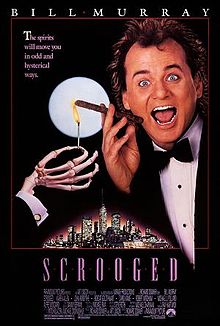
12 Films of Christmas #10: Scrooged

scrooged_film_poster-2

Scrooged (1988)

All right, so I’ve commented on my disdain for A Christmas Carol adaptations, and yet here we are at entry number 10 and I’m already writing about a second such adaptation. There will be no more, but it does seem crazy. That’s because I can’t separate my dislike of A Christmas Carol from my love of Bill Murray.

I may sound like an elitist teen with this one, but I loved Bill Murray before it was cool, damnit! I don’t know why, but I’ve always had a fondness for the guy. I’m too young to have grown up with him on Saturday Night Live and I experienced Caddyshack well after its release. If I had to guess, the first movie I saw with Murray must have been Ghostbusters, which I assume is true for most men my age. Peter Venkman was my favorite character in that movie, but I don’t know if that was because of the character or if it was simply because that was my favorite Ghostbuster from The Real Ghostbusters animated series, which I was exposed to before the film. Either way, I probably would have liked Venkman the most because that’s really what the film is going for. I would love Murray in just about any role he played to the point where it seems impossible to conceive that there are people who don’t like Bill Murray. Everyone must love Bill Murray!

All that being said, Scrooged does test my love of Murray. There are moments in Scrooged where Murray is as unlikable as he could possibly be. He’s essentially playing Ebenezer Scrooge in this film, even if his character goes by another name (Frank), so we’re not supposed to like him, but Murray’s approach to the character is just so abrasive at times it makes me hate the man. He changes on a dime, will get real loud for no reason, and it’s pretty incredible that anyone is still around by the time the picture concludes to embrace him during his redemption arc. I’m also left to wonder if his character just went back to being an asshole on Boxing Day, it honestly wouldn’t surprise me.

scrooged1-2

Few product placements scream “Eighties!” louder than a can of Tab.

Richard Donner directed this one and it seems his goal was to really take the Scrooge character and modernize him. Not only did this mean giving Scrooge a reason to exist in 1980’s society, but making him appropriately hateable in a world where horrible people are routinely featured on television. To do so, the character of Frank Cross really had to be amplified to ridiculous levels to make him seem despicable enough. The film spends so much time on him that it really has little room for the Cratchit character, Frank’s secretary Grace (Alfre Woodard). The ending sequence where Frank comes to embody the spirit of the season is also just as over the top as Frank’s scenes of misery. The presentation is so uneven and jarring that it’s hard to take at face value.

scrooged-1-1000

Johansen apparently landed this role through his friendship with Murray. Does that mean Murray is a fan of the New York Dolls?

Despite all of that, Scrooged is made worthwhile through its humor and special effects. Even though Murray’s portrayal of Frank is hard to like, it doesn’t mean it isn’t funny. It’s dark humor, which helps elevate the film above the usual Christmas fair. Other comedies have improved on this approach, but it doesn’t render Scrooged dated. The visual effects have also held up really well. They’re mostly practical effects, with the makeup for Frank’s old boss Lew Hayward (John Forsythe), playing the Jacob Marley character, being the best. David Johansen is a scene-stealer as the Ghost of Christmas Past, and Karen Allen is her usual sweet, likable self as Claire, Frank’s old love.

If you want to read more about Scrooged, I did a full write-up on the film a few years ago. Feel free to peruse it and see if I contradicted myself in some way or if my opinion has changed at all. We only have one Bill Murray Christmas movie, and we must treasure it, warts and all.


12 Films of Christmas #11: The Santa Clause

220px-the_santa_clause

The Santa Clause (1994)

A successful formula for any would-be Christmas film to adopt is that of shining a new light on the character of Santa Claus. Anytime a film can make Santa more believable to the viewer is usually something worthy of exploration. A lot of films, books, and other media have attempted to add to the Santa mythos which mostly originated in the classic poem Twas the Night Before Christmas, and the ones that have done it the best are the most memorable.

The Santa Clause is just such a picture which set out to answer many of the questions children have about the character. For the life of many a youngster, Santa is someone believed in without question at first. After all, who wants to have doubts about a nice guy who leaves you presents for just being a good boy or girl (with the “good” part being highly subjective and a very low bar to clear)? As adolescents get older, they naturally become more inquisitive and thats when the questions about Santa Claus start to show up. How do reindeer fly? How can one man visit every kid on earth in a single night? How does he fit all of those toys in his sleigh?

The Santa Clause actually has one answer for just about every question a kid could have about Santa:  magic. It’s a rather easy explanation, but given the unbelievable nature of the character it’s often the best we have. The Santa Clause, in typical 90’s fashion, relies upon visual effects to make these answers entertaining beyond the whole “it’s magic, stupid!” Like many films from that era, the effects have not aged as well as maybe was expected.

15994bb3-cb03-4f6d-a97b-3e502ce95f67

Charlie and Scott take Santa’s sleigh for a spin after accidentally killing him. Not many Christmas movies begin by killing Santa.

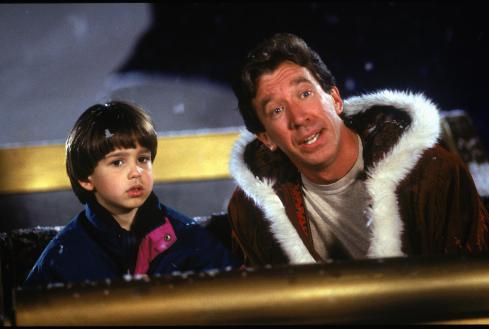
Tim Allen stars as Scott Calvin, a toy developer with a son who doesn’t believe in Santa Claus. Charlie, played by Eric Lloyd, has been lead to believe by his mother Laura (Wendy Crewson) and step-father Neil (Judge Reinhold) that Santa is not real, which naturally irritates Scott. Scott is a bit of an absentee father, partly because of the divorce, and because he works a lot. Charlie doesn’t have much faith in his father, and he clearly dreads spending Christmas Eve with his old man. Not much goes right, but Scott does succeed in restoring his son’s faith in Santa, and himself, when the real Santa falls off his roof to his own demise and Scott, unwittingly, picks up the mantle for himself.

the-santa-clause-6

Scott unwillingly morphing into Santa. I’d probably freak out if my kid tried to sit on that guy’s lap.

Scott’s first adventure as Santa is when we get to see the magic at work. Scott and the audience share in the experience as neither knows how any of this stuff is supposed to work – Santa can’t really be real, can he? When Scott picks up an empty sack, presents appear inside. It hovers and directs him to a chimney to slide down. When no chimney exists, a septic exhaust is used and a fireplace magically appears inside the house. I remember these effects delighting my family and I when the film first came out, but viewed at now they do leave something to be desired. The illusion isn’t destroyed, but parents showing this one to their modern kids may be disappointed in their reaction.

The rest of the film mostly takes place after Christmas as we lead-up to the next one. No one believes Charlie’s account of what happened, which causes his mother and step-father to think Scott is brainwashing the kid and to seek sole custody. Meanwhile, Scott is physically transforming into Santa whether he likes it or not (he read the Santa Clause after the first one died, and apparently he would need a really good attorney to get out of it) which only strengthens his ex-wife’s argument for sole custody. This makes Laura (Charlie’s mom) and Neil the villains of the film, even if they’re only looking out for Charlie. It’s a Christmas movie, so everything comes together at the end, but this is one of those plots where the viewer knows what really happened and has to be frustrated by the actions of those who aren’t in the know.

Tim Allen is essentially allowed to be himself in his role as Scott Calvin/Santa Claus. He’s basically no different than Tim Taylor from Home Improvement, and even does his trademarked grunt at one point in the film. How much you like the film will probably hinge on your affection for Allen. I think I mostly liked him when I was younger, but the years haven’t been kind to Allen’s style of humor. I find him irritating in many scenes now, and his punchlines are often punch-less. As an adult, I find myself identifying more with the stiffs around him than the Scott character. He’s not all bad, but I hesitate to call his performance a strength.

sleigh

By the film’s conclusion Scott is all-in on this Santa thing.

The other aspect of this film that annoys me is the end, and to some degree, the Charlie character. The end of the film just goes on way too long and we’re kind of done with the Christmas cheer before Charlie starts shaking his snow globe. The Charlie character also can’t help but be annoying throughout the picture. Some of his actions are defensible, because he’s a kid, others are not and seem to betray the intelligence we see out of Charlie in other parts. By and large, Lloyd is a pretty good actor, but the director asks him to get sad and cry at one point which he clearly wasn’t up to the task for.

The Santa Clause is still recent enough to be considered modern, and it can probably be described as a modern classic. It brings enough to the table as far as a Santa story goes (even if parts of the plot mirror the Flintstone’s Christmas Special) to be memorable. If you’re easier on the effects and overall 90’s look and style of the picture (I for one, find the techno-junk look of Santa’s sleigh off-putting) then you probably like this film a lot more than I do. And if you’re a fan of Tim Allen, then it might even be your favorite Christmas movie.


The 12 Films of Christmas #12: The Muppet Christmas Carol

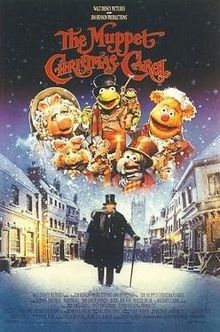
muppet_christmas_carol

The Muppet Christmas Carol (1992)

The bare minimum a Christmas television special or film can do to inject some Christmas cheer is to do an adaptation, or parody, of a popular public domain Christmas treasure like Dickens’ A Christmas Carol. In general, these are lazy and trite and form the foundation of the worst holiday dreck imaginable. Just tune into the Hallmark Channel at this time of year to find several variations on familiar stories, all of which bring nothing to the table other than sentimentality. So it is with some trepidation that I include one such work in this 12 Films of Christmas featurette, but hear me out.

The Muppet Christmas Carol starring Michael Caine and those wonderful puppets manages to be a worthwhile endeavor not because it does anything to shake up a familiar story, but because it tells that story with the charm and wit of The Muppets. When it comes to these types of Christmas stories, we likely all have our preferred vehicle of delivery. For me personally, it’s Mickey’s Christmas Carol which is one of my favorite holiday shorts. If I’m going to go feature-length though, I’m likely to turn to The Muppets if I want to hear about old Scrooge.

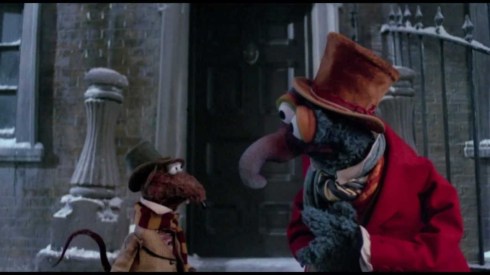
Caine stars as main character, Ebenezer Scrooge, and his supporting cast is made up of mostly Muppets. Kermit is his foil as the poor, but kind-hearted, Bob Cratchit and Robin stands in for Tiny Tim. That makes Miss Piggy Emily Cratchit, naturally. Stadler and Waldorf play the Marley brothers and are predictably hilarious in their role. Gonzo and Rizzo the rat are used as narrators and exist outside the story, despite occupying a physical presence on screen. They’re the main source of the physical comedy and the film made a star out of Rizzo, a mostly bit part in Muppet films and television specials prior to this. Fozzy, Animal, Beaker, and all of the other familiar gang show-up for spot roles throughout. The Muppets are all playing the role of someone from the original work, but still possess their own personality and character traits. In other words, Fozzy is still Fozzy even if his character is referred to by another name.


4be19790ab8dd48e069752acfac873d4-jpg

Michael Caine is a natural at playing alongside the Muppets.

Caine is relied upon to carry the picture and act convincingly beside his non-human cast mates. For roles that correlate directly to Scrooge, a human actor is cast so it’s not as unbelievable as it could have been. For instance, Isabelle is played by Meredith Braun and Scrooge’s nephew Fred by Steven Mackintosh. Only Caine is really asked to do any heavy lifting and he’s surprisingly emotive and effective as a Scrooge. There may have been some expectations that a Muppet version of A Christmas Carol would just be a straight comedy, but the film doesn’t shy away from the dramatic moments. In fact, it probably does so to its detriment as the film sometimes spreads the laughs out too far apart. Some plodding occurs during Scrooge’s journey that likely will turn off younger viewers, and even some older ones. The redemptive portion of the film also feels rushed and the audience is denied in savoring Scrooge’s turn at the end. Perhaps this was done to keep the film under a 90 minute runtime, but if that was the goal, then other parts of the film should have been trimmed instead to allow more time for the fun at the end.

maxresdefault-5

Rizzo and Gonzo are the true show-stealers in this picture as the duo is easily responsible for the most laughs.

From a production standpoint, the film is a true star as the sets, puppets, and costumes all look fantastic. It’s obviously no surprise that a Muppets work would come out looking so well. The production department did a great job in giving the film a true big screen feel when compared with the various TV properties of the Muppets and their made for TV films. The film is in part a musical, like most Muppet productions, and the songs are actually on the light side. I personally consider that a positive, but others may not feel the same way.

In the end, The Muppet Christmas Carol succeeds because it brings its own heart and spunk to a dated work. Other films, like Disney’s A Christmas Carol, just try to retell the same story and possess no charm, and ultimately have no real reason to exist. At least with The Muppets you’re getting that Muppet brand of humor to add a dash of color to A Christmas Carol, ultimately making it worth your time each holiday season.


The 12 Films of Christmas

Last year I did an advent calendar sort of deal where I counted down the best Christmas television specials from December 1st through Christmas. Naturally, I wanted to do the same this year but with Christmas themed films instead!

Unfortunately, Christmas movies are pretty terrible. Sure, there are countless amounts of terrible Christmas television specials, but there are also enough that narrowing it down to 25 really wasn’t that hard. I even left out some that I genuinely like and make it a point to watch annually, especially repeat Christmas episode from long-running series. When I sat down to come up with 25 films I found it pretty trying. Now, I’m not an actual expert on Christmas movies, but I have seen a lot of them, but definitely not all of them. I’d love to say that I’m the foremost expert on them, but I’m not. Still, my original list of 25 was really shitty on the back-end. Since it was so poor, and my free time is even less than it was a year ago, I decided to go with a Twelve Days of Christmas spoof and do 12 Films of Christmas.

Starting tomorrow, you will see one entry per day on a Christmas movie I think is worth an annual viewing. That doesn’t mean they’re all great movies, but they work when viewed in that sweet spot between Thanksgiving and Christmas. I also created some rules for myself. All of the films I’m posting on were theatrically released, so if you’re a lover of those Hallmark Channel movies you’ll be disappointed to know that not one of them is among my twelve (they suck anyway). I also decided that each film needed to be, unquestionably, a Christmas movie. This is perhaps a controversial stance as it eliminates from contention films that take place during Christmas, but aren’t really Christmas movies. To be specific, there’s no Die Hard. Same for Batman Returns, though I don’t think that omission would cause much controversy. Other than that though, anything goes. I’m ranking these films based on pure enjoyment, not the amount of Christmas spirit contained therein or the presence of Santa Claus. I have no affection for the Jesus aspect of Christmas either, so don’t expect much of him in these films either.

So if you want to read about Christmas movies, check back tomorrow for number 12 and continue visiting each day for another film. I don’t make any money off of this site and I’m just doing it for the enjoyment of it and I hope you too enjoy reading about the dozen Christmas films to follow.635850679509887126969022607_wjud-dot-net

#12. The Muppet Christmas Carol

#11. The Santa Clause

#10. Scrooged

#9. Gremlins

#8. The Nightmare Before Christmas

#7. Bad Santa

#6. It’s a Wonderful Life

#5. Home Alone

#4. National Lampoon’s Christmas Vacation

#3. Miracle on 34th Street

#2. Elf

#1. A Christmas Story


Disney gets the Lego Treatment

maxresdefault-3Lego is one of the most popular toy manufacturers on the planet. They’ve become known for their building block style toys that come in various shapes, sizes, and colors and can be combined to form castles, pirate ships, space crafts, and other fantastic designs. They also have struck gold with their mini figures, simplistic action figures that embody the Lego design and make great pilots, captains, and heroes to pair with the various sets. It used to be you had to buy a construction set to get a figure or two, but for several years now Lego has capitalized on the appeal of its mini figures by releasing them individually in blind bag assortments. Even more recently, Lego has decided to apply a popular license for these blind bag releases. For the past two years, that license was The Simpsons. I was rather fond of this decision and really it got me back into Lego after not buying a set since I was a kid. The Simpsons I feel still had legs and a series three would have been welcomed by me, but Lego has apparently killed that line and decided to go with a new license:  Disney.

Theming a line of figures on the Disney license is almost as broad as creating a line of “People” figures. The Walt Disney Company has been putting out animated and live action films for nearly a century. The company has its own television station full of original programming, plus it owns Pixar, Marvel, Star Wars, and ABC to name a few. And since Lego already makes Star Wars and Marvel sets, it stands to reason that their Disney themed wave of mini figures could include those franchises if it wanted to. What it really means for Lego is that its first wave of Disney mini figures is an amalgamation of a few popular Disney properties. The first set of 18 Disney figures contains popular Disney creations like Mickey Mouse and Donald, characters from classic animated films like Aladdin and Peter Pan, and also a few Pixar figures to round things out. There are likely fans out there who would have preferred it if Lego stuck to the classic animated films, or maybe even just the Mickey and friends line, but Lego opted to try to please a wide consumer base.

IMG_0256

A motley crew of Disney plastic.

As someone who likes Disney and is married to a woman who LOVES Disney, it meant i had to collect this line with the same vigor as I did with The Simpsons. The wave hit retail on May 1st, though a few lucky individuals probably found them earlier. Like other mini figure waves, this series is released in blind bags so the consumer doesn’t know what they’re buying, unless they’re willing to sit and prod at each bag to feel the figure out. As Lego did with The Simpsons, they’ve chosen to make custom head sculpts for a lot of the Disney characters, basically all of the non-humanoid ones. That means finding Mickey and Minnie when groping a plastic bag is actually pretty easy, same for Sticth as well as the ducks, Donald and Daisy. I actually found the entire wave pretty easy to feel out and went a perfect 18 for 18 with my purchases. Now, if only I had better luck at finding the figures at big box retailers. Stores like Target and Toys R Us sell each figure for 3.99 a piece, but I got stuck hitting up specialty shops that charged 6.99. The things I do for love.


Unlike The Simpsons, these Disney figures are not released alongside any standard Lego sets, which is a bummer. Lego does have a line of Disney centric Lego Friends sets which focus on the various princess characters. The Friends line is Lego’s girl line, because apparently girls can’t handle traditional mini figures and bricks, and it’s clear Lego avoided duplicating characters it had already released as part of that line. The set of 18 is mostly free of the princess characters, with the exception of a mermaid Ariel. Alice from Alice in Wonderland is also included, but I don’t think she’s ever been considered a “princess.” From the Mickey and Friends collection, we have Mickey, Minnie, Donald and Daisy. Any Disney fan immediately sees that list and says “Where’s Goofy?!” He’s missing in action here. The four who are included look pretty good though. Donald and Daisy even have a little duck “butt” piece which is pretty funny but also pragmatic. Mickey is kind of dull though as he comes with no unique pieces or accessories. He doesn’t even have a tail! That’s a problem I’ll address later as it’s a recurring problem. Not the tail, but the lack of accessories to go along with these figures.

IMG_0257

Ursula’s got it going on.

From the Disney animated classics group of films, there’s the following:  Alice, Cheshire Cat, Maleficent, Peter Pan, Captain Hook, Stitch, Ursula, Ariel, Aladdin, and the Genie. All are done fairly well, though characters like Aladdin and Pan suffer from being a bit too conventional and kind of boring in appearance. Genie suffers a little in that he’s fairly unique, but the efforts made to convey that don’t work so well. Instead of getting a more unique sculpt, he’s actually a standard mini figure with add-on pieces to round out his look. He does have a “ghost” lower body which is kind of neat, but he still doesn’t really look all that much like the Genie from Aladdin. Plus Lego got really cheap with his gold cuffs and only painted half of his wrist. Maleficent is unique in that she doesn’t have legs, but a triangular block for a base to simulate her robes. It works pretty well as a visual, though it’s probably not fun for kids to play with. Ursula is definitely the cream of the crop as she gets a uniquely sculpted lower body that looks great. Ariel does as well, but her tail is rather blocky and unappealing to look at. I get that Lego is supposed to be blocky, but there’s just something off with Ariel’s look.


IMG_0258

The piece Lego fanatics have been waiting years for:  duck butt.

Pixar is also featured, albeit in a minor way. There aren’t many Pixar characters that would work as Lego mini figures, but Lego did pick some suitable ones. From Toy Story, there’s Buzz Lightyear and the Alien, and from The Incredibles we have Mr. Incredible and his foe Syndrome. Buzz is the star of the four. While he doesn’t quite look like the Buzz we know and love, the unique pieces included give him a lot of personality. The Alien gets a unique head sculpt and looks fine, while Mr. Incredible and Syndrome look about as good as they can, though they’re a little boring. I don’t dislike any of the four, and actually really like Buzz, but I am left wishing Lego had stuck with more conventional Disney properties and gave Pixar its own wave.


With any release like this, it’s easy to zero in on what’s missing. Properties like Pinnochio, Snow White, and The Lion King are synonymous with Disney but not represented here. There’s also a lack of quality accessories that’s kind of disappointing. Mickey comes with none, when he should come with Pluto. He could have come with some clothing type accessories like his sorcerer’s hat, something which is better than nothing. Ursula comes with King Triton’s trident but not his crown, and Ariel comes with an oyster shell with a pink jewel in it. Maybe I need to watch The Little Mermaid again because I don’t remember that amongst her many treasures. I’d rather she come with a fork, I mean, dinglehopper, though a Flounder would have been better. Stitch, Cheshire Cat, and the Alien all come with no accessories, and Aladdin and the Genie both come with the same lamp. Couldn’t Aladdin at least have come with a black Jafar’s lamp? These figures aren’t really all that cheap, the least Lego could do is make sure each character has at least one appropriate accessory to round them out.

IMG_0259

Pan looks kind of bloodthirsty, not that Hook looks like any less of a maniac.

Criticisms aside, I do think this is a pretty solid wave of mini figures and a nice start for the Disney line. I assume there will at least be a wave two and I’m hopeful Lego will explore some Disney sets, especially if they’re based on Disney World or Disneyland. As far as a potential wave 2 is concerned, I would assume some characters are no-brainers. Goofy, Woody, and Jessie seem like locks. Near locks would include Mrs. Incredible, Frozone, and Jafar. If Lego really wants to stick with the films its already touched upon, then characters like King Triton and the Queen of Hearts certainly have a shot as well. I’m hopeful that Pinnochio and Jiminy Cricket get a look, and a Beast and Gaston would be pretty awesome. It’ll probably be nearly a year before we know what’s to come, but until then it will be fun to speculate.

UPDATE:  Well it took Lego a few months to unveil it, they did indeed confirm a Lego version of Disney World’s iconic Cinderella Castle is coming this September. It will retail for $350 (ouch!) and total over 4,000 pieces and come bundled with 5 mini figures. Making her traditional Lego debut will be Tinker Belle and she’s joined by a tuxedo-clad Mickey, a red polka-dot version of Minnie, a pink version of Daisy, and Donald, who appears to be identical to his previously released figure. It looks pretty slick, and it’s hard to argue with the character choices. The castle interior looks like it will be full of easter eggs, and possibly hints for future mini figures, and the only initial piece of criticism I could offer is the depth of the castle looks shallow. It likely would have benefitted from a hinged design to make the base at least appear bigger. Aside from that, it’s a nice piece of eye candy and something I’m going to have to buy for my Disney-obsessed wife.LEGO_71040_fi