Author Archives: Joe

Baseballs and Dragons

Since finishing Mass Effect 2 I have been in video game limbo.  This isn’t anything new or entirely unwelcome, but when I don’t have my attention focused on a narrative I inevitably look towards the horizon and the next thing that will occupy my free time.  There are two games set for release on March 8th that I’ve got my eye on, MLB The Show 2011 and Dragon Age II.  Conveniently enough, both recently had demos released on the Playstation Network and a small portion of my time this weekend was spent checking each one out.

MLB The Show 2011

I took last year off when it came to the MLB franchise so I’m kind of eager to get a new one.  Traditionally, whatever MLB game I purchase on an annual basis ends up being a huge part of my spring and summer as I’ve been known to log over 100 hours managing rosters, developing players, and winning championships in a virtual world.  Last year was the first time in a long time that I did not buy a new MLB game.

Despite not playing last year’s game, this year’s version of The Show doesn’t look much different.  The demo is a rematch of last fall’s World Series pitting the Texas Rangers against the San Francisco Giants at the Giants’ home ballpark.  The demo lasts four innings and disables most of the game’s options (including the tutorials, more on that to follow) so that you’re basically just being exposed to the gameplay.  Upon first impression the familiar theme for the franchise is still here and the ballpark looks slightly improved over the 2009 version.  There’s still aliasing issues and once your eyes move past the walls everything looks pretty amateurish  That would be forgivable with most parks but San Fran’s is located right in the bay and some time should have been devoted to at least making the water look like water.

Graphics for a baseball game aren’t really a focal point, and for the most part, the game looks good enough.  The character models look like the actual players and the animations for each batter’s stance are nearly spot-on.  The demo intends to highlight the two biggest additions to this year’s game: analog control.  Traditionally, pitching and hitting are both done primarily with a button press, but this year the developers have moved both actions to the right analog stick.  The problem is, the in game “how to play” menus instruct you to view the tutorials in order to understand how the analog controls work, which as I mentioned before, are not available in the demo.  Why Sony chose to disable to the tutorials is a legitimate question indeed as it is probably a good idea to tell the player how the game is supposed to be played.

Anyways, I was unable to fully grasp how the pitching works, resulting in me throwing numerous wild pitches and even hitting a batter.  I hated my experience with the pitching so much that I gave up and just kept switching sides so I was always controlling the hitting team.  This really didn’t prove much more fun, as the new analog hitting is cumbersome.  You pull back on the stick to “load up” and then push forward to swing.  You direct the location of your swing with the left stick, and the motion feels unnatural.  Also, it takes just a fraction of a second longer to push a stick forward as opposed to pushing a button, which throws off the timing.  As a result, I was often cheating on fastballs and unless a breaking ball was hung I was dead on arrival.

The full version game features the classic controls option, but my experience with the demo was so unsatisfactory that it has all but squashed my excitement for it.  If a demo could be this half-assed and thoughtless it makes me wonder what the quality of the full version game is like.  I’m questioning whether or not I want to bother with it now, so if that was the aim of Sony when they released the demo, good job!

Dragon Age II

Normally I would brush off such disappointment but considering that Dragon Age II is getting released the same day it makes it tempting to just bypass The Show all together.  The first one, Dragon Age Origins, was a title long in the making that eventually was released in 2009.  Developed by Bioware, it was a spiritual sequel to their Baldur’s Gate franchise and placed the player in a medieval fantasy setting in control of a custom hero and his or her band of followers.  It was a solid first entry for the series though it wasn’t without its flaws.  Visually, it was just average and gameplay wise was pretty much the same as past games, like the previously mentioned Baldur’s Gate and Neverwinter Nights.  To better acclimate it for consoles, the camera was positioned behind the player instead of overhead and commands were issued from a command wheel activated by pressing a trigger.  There were shortcuts for spells and abilities mapped to the face buttons as well as a quick heal option.  It was an admirable attempt but lacked the precision of the PC version.  To reflect this, Bioware made the game more action heavy and the result was an inconsistent difficulty level.  Some dungeons and enemies were a breeze and others frustratingly difficult because micro-managing your squad of four proved cumbersome.

Bioware has set out to remedy this by focusing even more on action for the sequel.  Right off the start, players will notice the main character is more restricted.  In the first game, the player had a choice of 4 classes and several different races to choose from.  In this game you have the choice of three classes; warrior, mage, and rogue.  You can select your gender but are limited to the human race.  That is because Bioware wants to tell a more specific story this time around where as with Origins your experience was different depending on where your character came from.

Regardless of what class you choose, attacks are now done with button inputs.  In the previous games you selected an enemy to attack and your character attacked that enemy until it was either defeated or you input another command.  Now, one press of the X button equates to one attack.  Characters seem to move quicker giving a better sense of control over what happens.  I got the sense that I could actually avoid attacks rather than having everything decided by a behind the scenes calibration.  I don’t know if that sense is illusion or not, but mission accomplished.

I didn't know they had access to breast implants in the Dragon Age world. Maybe they're magical enhancements?

The demo is suitably long enough to give you a sense of what you’re in for.  After playing an initial scenario, the game thrusts you forward in the game’s plot to let you dabble with more experienced characters.  The tech trees are more robust and leveling up looks like it will offer more options this time around.  The graphics are improved as well and some characters from the first game have received make overs.  The characters are still a bit over the top for my taste though.  Every female has a tiny waste and giant breasts while all of the guys are suitably ripped.  Isabela, returning from Dragon Age Origins as a recruitable character this time around, is especially ridiculous looking.  If I didn’t know better I would assume she was heading off to film a porno, not fight off the dark spawn.

That’s a minor quibble though and something that is prevalent in both video games and comic books.  The game plays better than the first one, which was already an enjoyable experience.  Combine that with Bioware’s gifted story-telling and I’m pretty much ready to embark on my own journey come March 8th.  After playing the first game as a rogue, I think I am going to try the mage this time around.  I enjoyed playing as one in the demo and see no reason to pick a different class.  I did leave it on my hard drive in case I wish to come back and try out one of the other classes.  As for The Show, that has already been deleted.


X2: X-Men United (2003)

X2: X-Men United (2003)

The first X-Men film was a commercial success and a sequel was naturally just assumed.  In light of the first film’s success, director Bryan Singer was given almost free reign over the sequel with a bigger budget and a longer runtime.  When it hit theaters in May of 2003 it was met with critical praise and raked in the dough, beginning a trend where suddenly sequels were topping their prequels.  The X-Men found themselves in the conversation over what was the greatest super hero brought to film.  Spider-Man 2 would kind of quiet that discussion, but in general, it seems X2 is highly regarded by fans of both the comic and of the first film.

Anticipating a trilogy from the beginning, Fox wisely had locked up the key cast members for multiple films.  This proved especially smart considering between the first two films, Halle Berry became an Academy Award winning actress and found the role of Storm well beneath her by the time X-Men 2 came around.  To sort of appease her, X2 would expand upon Storm’s role from the first film, where she was mostly an after thought, and put her in more of a leadership role this time around.  Her role would be increased even more when it came time to film X-Men 3.

The cast for X2 was even larger than the one for the first film.

Considering Wolverine is such a dominating, yet polarizing, figure it makes sense to start off with his character.  When the first X-Men film ended, Wolverine was taking off to check out a location he believed would turn out to be the Weapon X facility.  It is actually never referred to by the film as the Weapon X project but it’s the same thing; the place where Wolverine obtained his fantastic skeleton.  Finding little to appease his curiosity, he returns to the X-Men where the film’s plot takes off.  In the first film Wolverine was an outcast, in this one he’s forced into a leadership role when the mansion gets attacked while everyone else is away.  We get to see a little bit of Wolverine’s berserker persona as he takes out numerous military types.

It is refreshing to see a hero go all out with little regard to human life, and that is how Wolverine approaches the encounter at the mansion.  There’s no negotiation or even the slightest hint of mercy and it’s one of the cooler scenes in the film.  Beyond that though, Wolverine is portrayed as a bit of a reluctant guardian to Iceman, Rogue, and Pyro for a good portion of the film.  His character is a little jokey, with a dry sense of humor that is probably brought out too much.  Wolverine would be better served to be shown a little more irritable, and more of a loner.  He does run off during the film’s climax to seek out answers regarding his past, which was a smart move, but his toughness is kind of undone by his over the top reaction to Jean’s death (and if I just spoiled anything for you I don’t care, you’ve had almost 8 years to see the thing).

Ultimately, Wolverine’s past isn’t completely revealed, a wise move considering the comics had always resisted doing the same (though they have since given us the Wolverine Origin books).  His character is again consumed by boyish lust anytime Jean is present.  Another aspect of the character that I think was focused on too much in the films.  Especially in X2 where Cyclops is barely in the film so the whole love triangle aspect is kind of irrelevant.

The film’s main villain is Colonel William Stryker, played by Brian Cox.  Comic book fans know Stryker as an evangelist who believes mutants are the work of Satan.  He was introduced in the excellent graphic novel God Loves, Man Kills which was created in 1982.  When fans learned that both Stryker and Nightcrawler would be included in X2, it seemed to make a lot of sense.  After all, Nightcrawler is known for both his demonic appearance and his faith.  The two characters play off one another quite well.  Perhaps Singer got cold feet over the idea of tossing religion into the mix, or maybe they just felt Stryker would work better for their story as a military man.  As a military man, he is given access to the president where he’s able to get clearance to raid Xavier’s mansion.  He’s also given access to an imprisoned Magneto where he’s able to utilize some sort of drug that functions as both a truth serum and mind control device.

This mind control drug sets up the film’s first scene, where Nightcrawler attempts to assassinate the president against his will.  Though I suppose assassinate maybe the wrong word as I’m pretty sure Stryker wanted the president alive, but who knows?  This leads to the X-Men seeking out Nightcrawler which gets him involved in the plot.

Nightcrawler was a welcomed addition to the roster of mutants.

Nightcrawler, played by Alan Cumming, is the big addition to the cast of mutants for X2.  He’s long been a fan favorite and was a welcomed addition for the sequel.  He’s played pretty much how one would expect, the only real addition to his character the film makes are the scars that appear all over his body.  These are the result of self-mutilation, with Nightcrawler claiming he carves an angelic symbol into his flesh for every sin he commits.  Otherwise, his look is pretty much identical to his classic comic book look, save for the costume.  Here he’s given a black trench coat and striped pants.  The coat makes sense considering that someone of Nightcrawler’s appearance would probably try to conceal it as much as possible.  He still has his teleportation powers, though if he leaves behind a stinky odor the film doesn’t let us know, he just disappears into a puff of blue/black smoke.  He’s also shown to be able to stick to walls during his attack on the White House.  Singer chose to show this using wires instead of special effects and the results are mixed.  His trademark faith is represented and on display most prominently during a conversation he has with Storm.  Storm is shown to be quite bitter towards humanity, something not really consistent with her character, while Nightcrawler displays an inner peace and instructs her to have faith.  This of course leads to a moment later in the film where Storm expresses faith in Nightcrawler and it is as corny as it sounds.

The basic plot is a little hokey, but works given the film’s setup.  Stryker detests mutants and fate saw fit to give him a mutant son.  He sought out Xavier’s help to “cure” him, which Xavier told him was impossible, so he took the boy home.  The boy’s name is Jason and he is basically the movie version of the character Mastermind, a villain capable of creating powerful illusions to corrupt his foes.  Stryker claims his son resented he and his wife and drove her to suicide.  He’s kept his boy restrained ever since and aims to use him to get to Xavier.  Obtaining all of the X-Men’s secrets from Magneto, Stryker creates his own Cerebro.  His intention is to use Xavier to kill all of the world’s mutants with his Cerebro.  It is explained that Xavier’s telepathic powers are so adept that he can kill with a thought when connected to Cerebro.

Mystique springs Magneto using an ingenious plan of seducing and drugging one of

Magneto seemed a little more dangerous this time out, but still looks like he belongs in a retirement home.

Magneto’s guards while at a bar and injecting him with iron.  Magneto rips the iron from the poor sap’s body and uses it to create his escape.  Which is where the “X-Men United” part comes into play, as the X-Men are forced to team-up with Magneto and Mystique to stop Stryker.

The cast is particularly large for this sequel, which might explain why Cyclops is taken captive early in the film.  There’s some timing issues as well that harm the film’s credibility.  Jean and Storm take the X-Jet to Boston to find Nightcrawler early on and are away when the mansion is attacked.  In the amount of time it takes them to fly back to New York, Wolverine and the rest drive from NY to Boston to the home of Bobby Drake (Iceman).  Apparently, Jean and Storm decided to take the scenic route.  Also, an awful lot happens in the amount of time it takes Jason to lead Xavier to the false Cerebro which makes it hard to take the film’s threat very seriously.

The acting is pretty solid overall.  I was especially surprised by the Iceman and Rogue characters, portrayed by Shawn Ashmore and Anna Paquin, as teen romance is hard to pull off on-screen without looking corny.  The two handle their roles, and sometimes silly, dialogue quite well.  Not award winning stuff or anything, just not a low point.  Aaron Stanford does a good job portraying Pyro, the young mutant that doesn’t buy into Xavier’s methods and ends up siding with Magneto.  He is the focal point of one of the film’s more memorable scenes.

Patrick Stewart is called upon less in this film as Charles Xavier, but he is always up to the task.  Ian McKellen is a more convincing and ruthless Magneto, which I enjoyed, though he still looks like a harmless old man most of the time.  Famke Janssen reprises her role as Jean Grey and her on-screen chemistry with Hugh Jackman’s Wolverine is capable, if a bit over dramatic.  During the course of the film Singer teases the Phoenix plot line several times, setting the stage for the third film (which he would not direct).

Deathstrike ends up being the latest disposable villain utilized by Singer.

The film ultimately works given the set-up created by the first film.  The characters behave in a logical way and remain consistent.  There isn’t any dead weight and ultimately my main gripe is with the film’s other villain, Lady Deathstrike played by Kelly Hu.  She’s actually never given a name by the film and is merely a silent lackey for Stryker.  I believe she has just one line in the whole film.  She’s also given Wolverine’s healing factor and her own adamantium skeleton, which is teased throughout the film before being revealed before the big fight scene with Wolverine.  She is brain-washed by Stryker so we never learn anything about her.  Like Sabretooth in the first film, this villain apparently has no history with Wolverine.  Where as in the comics she despises him and is out for blood.  She was never a great villain, and following this film the comics would even start to adopt this look for her where he claws are retractable, but still feels wasted here.

There’s a lot of little bits of fan service sprinkled throughout the film.  We get our first glimpse of Hank McCoy on a television show in human form.  There’s also the computer screen accessed by Mystique which contains files labeled Omega Red and Nathaniel Essex, among others.  Several X-Men receive cameos during the mansion attack, most notably Colossus who apparently is not Russian in the film-verse.

In the end, I can’t complain too much with this film.  I would have liked to have seen a more true to the comics portrayal of Stryker as I think he’s a fascinating subject and one that would add considerable weight to the plot.  His character in X2 feels interchangeable, Singer could have used someone less important and achieved the same effect.  This would have saved Stryker for another and more worthy story.  The cast is also too big, which is something the first film struggled with.  It’s hard to say where things could have been done better but it is a shame that Cyclops had to be pretty much written out of the film all together.  The addition of Nightcrawler did work, and it’s a shame Alan Cumming could not be convinced to reprise the role for the sequel (not that it would have made it much better) as he added a nice dimension to the team.  If anything, too much time was spent on the Bobby Drake side-story where he “comes out” as a mutant to his parents.  The whole scene is full of cliches and the X-Men present come across as being extremely (no pun intended) defensive.  So while the film works, I’d still like to blow the whole thing up and start from scratch.  For now though, this is the best X-Men film we’ve received, I just think there’s a better one that has yet to be made.


Collections

For me, collecting things is as much a hobby as it is a compulsion.  For those that are considered hoarders, I suppose it most certainly is a compulsion and one without logic as hoarders tend to keep everything and anything.  My collections have at least always been relatively specific.

An extremely small portion of my Marvel action figure collection: Moon Knight, Bobby Drake, Deadpool, Iceman, Venom.

Like most boys, my earliest collection was baseball cards.  For many kids in the 80’s this was a big hobby.  As we gathered and amassed cards of our favorite athletes we would often speculate how much they would be worth one day, certainly more than what we paid to acquire them.  The card market ended up collapsing though and most of those cards are worthless.  I was never real big into it so I never amassed a large assortment, just a tin canister’s worth and a binder.

My next collection would be one that would last a long, long time for me:  action figures.  As a kid, they were toys first, and a collection second.  I played with them and got lots of milage out of various Teenage Mutant Ninja Turtles, Ghostbusters, and X-Men for much of my youth.  I don’t know at what age it became more of a hobby than a toy, I’d speculate when I was around 10 or so, but for a little while longer I continued to buy new ones even though I didn’t actually play with them.

My most recent (and final?) action figure purchase; The Monarch and Dean Venture. And yes, that is a Glenn Danzig doll in the background.

Eventually I became more interested in other things, music and video games mostly, and spent my limited income there.  Around the time I started working part time jobs I got the itch to pick up where I left off.  I’m not sure why, though I think it mostly had to do with the quality of action figures released in the late 90’s and early 2000’s compared with what I had growing up.  In the mid 90’s, Todd McFarlane’s company got into the action figure market and revolutionized it.  The company’s philosophy was that a better looking figure could be created without radically increasing costs.  They spent just a little more time than the other companies creating better and more detailed molds and the results blew the competition away.  Marvel’s parent company Toy Biz would eventually catch up and start producing their Spider-Man Classics, and eventually Marvel Legends, line with a similar philosophy.  The figures were now a bit bigger and more detailed and while McFarlane was willing to sacrifice articulation for visuals, Toy Biz crammed as many movable parts into their toys as they could reasonably accommodate.

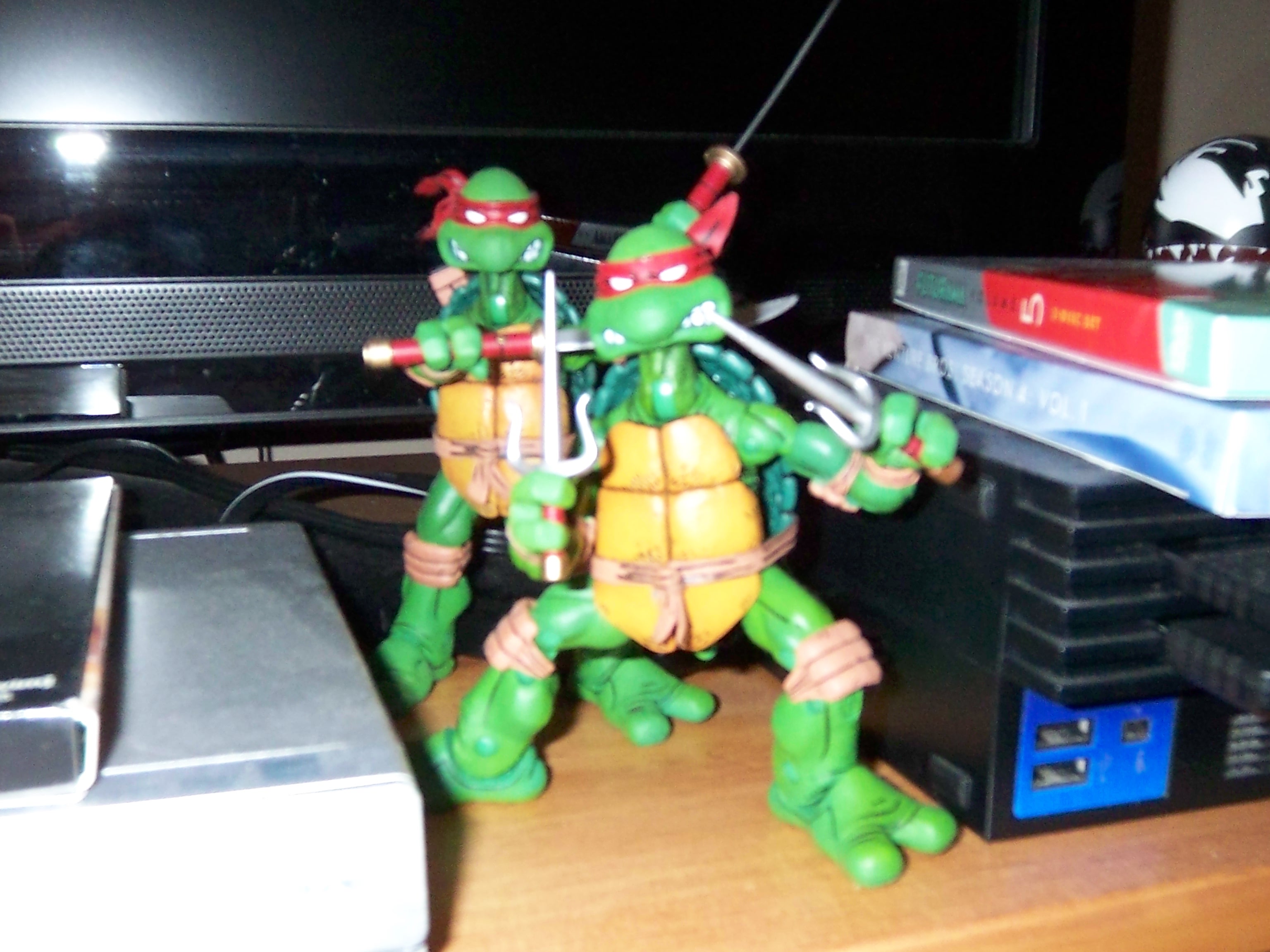
Leo and Raph from Neca's incredible TMNT line. If that line was re-launched there's a good chance I'd jump right back in.

That explains why I got into collecting Marvel toys again, but just before that I had started amassing a collection of Dragonball Z action figures put out by Irwin.  My thought process here is that I got into DBZ as a teenager and before that any cartoon I watched religiously was always accompanied by a consumption of the toy lines put out.  For some reason I really wanted a physical representation of the characters from that show to adorn my shelf space.  Irwin’s toys were pretty basic too, relatively cheap, and not the most visually stunning but I bought them anyways.  They would improve as the line continued until the company went bankrupt and the license was sold to Jakks Pacific, who all but ruined it.

The Marvel Legends line would meet a similar fate.  I collected these ones for a good 4 years or so before the line succumbed to poor quality at the hands of Hasbro.  At

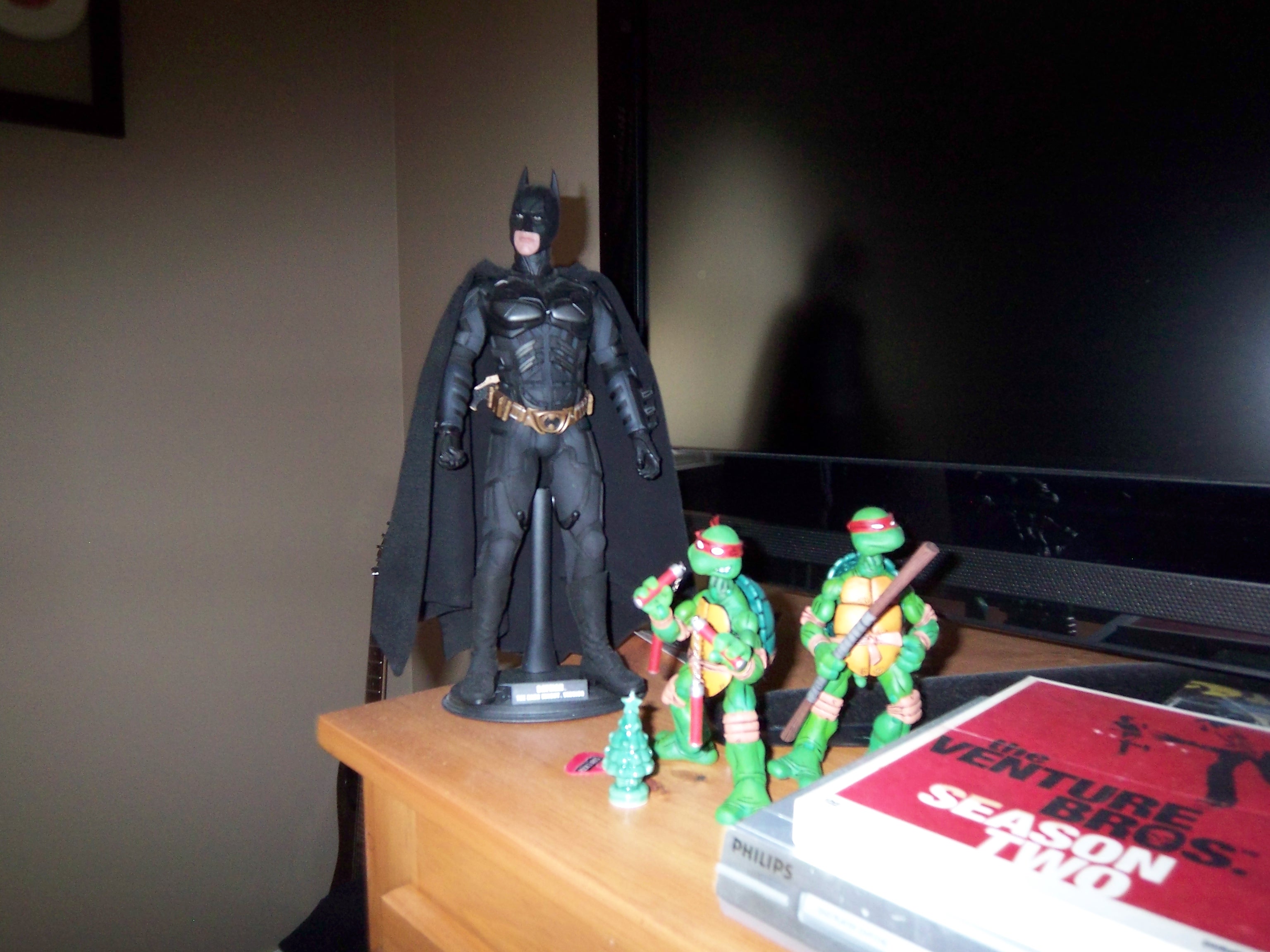
Hot Toys take on The Dark Knight, along with Don and Mike.

first I bought sparingly, only grabbing the characters I really liked and that looked good.  The first one I bought was Magneto from series 3, and the next one may have been Gambit.  I passed on a lot of them though because I either didn’t care about the character (such as The Hulk and Toad) or thought the figure looked crummy (like Wolverine from series 3).  I removed all of them from the package, as I wanted to pose them on a desk or shelf, and wasn’t doing it because I thought it was some smart investment.  I just did it for enjoyment.

As a result, I have cases full of action figures in my basement.  As I got more and more into it, I eventually started buying everything.  Also, Toy Biz would start packaging each figure in a series with a piece of a larger figure to assemble (marketing genius) so I ended up buying entire series to assemble a sentinel, Apocalypse, Giant Man, and a few others until plastic became too expensive for the trend to continue.  I also sparingly bought from other series, such as the Mini Mates and Spider-Man lines.  And when Toynami unveiled its Futurama line I bought those as well, but I eventually stopped due to a combination of rising costs and lack of space to display all of these things.

Now my action figure lust is all but gone.  I made one action figure purchase in 2010, buying The Monarch and Dean Venture together from the show The Venture Bros.   The rest of the figures in that line are just too expensive to justify purchasing (20 bucks a figure) and I would have no place to put them anyways.  Before that I think my last action figure purchase was a Batman put out by Hot Toys in 2008.

Even though my thirst for action figures has seemingly been quenched, I have found another hobby to focus my attention (and money) on:  Danzig.  I am a huge Danzig fan, one step into my home and you’ll find an image of Glenn Danzig on my wall.  From there, his presence is everywhere.

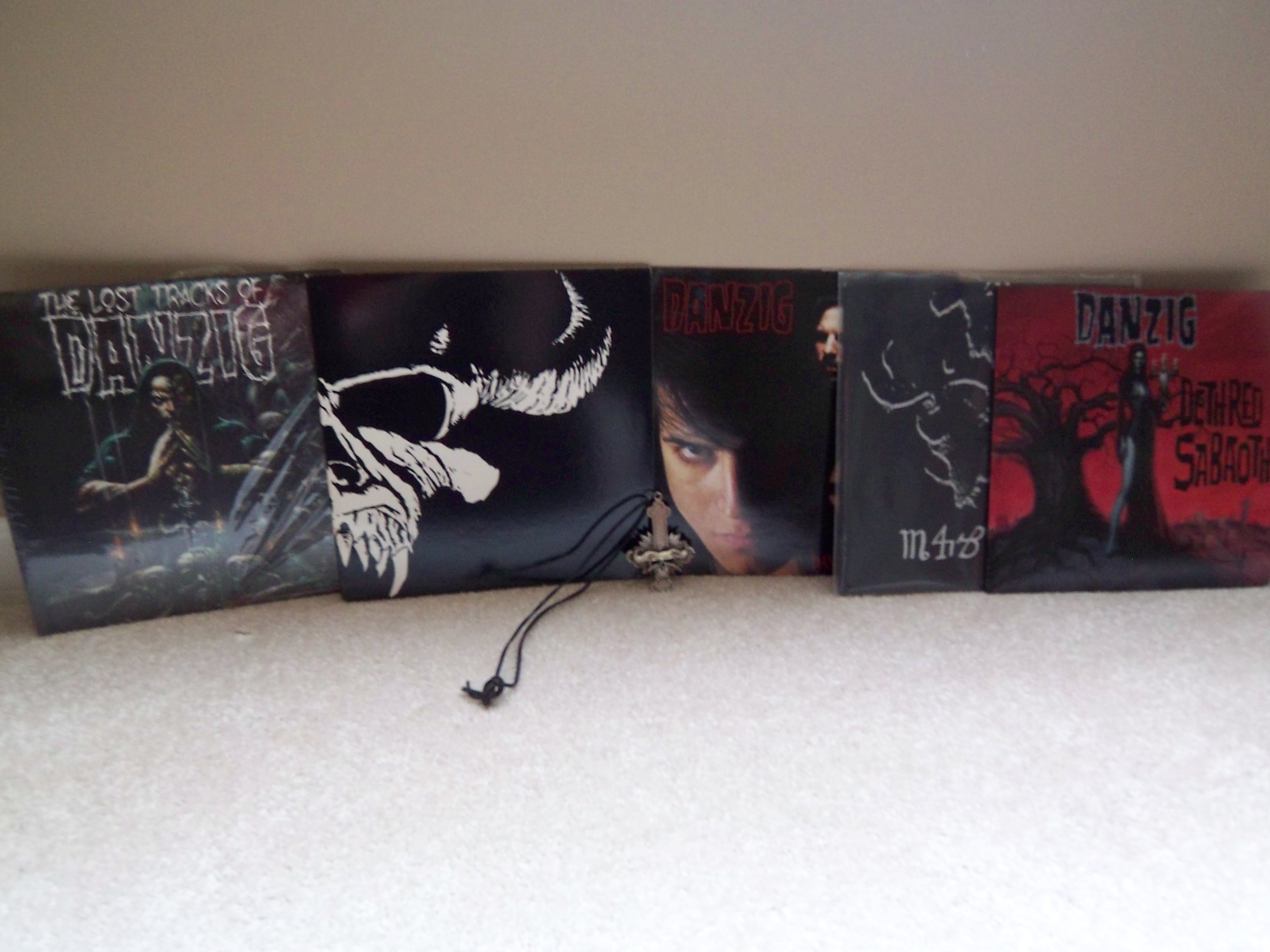
Most of my Danzig LP's, along with the Lucifuge pendant.

My focus when it comes to Danzig resides mostly with LP’s.  It started with a purchase of The Misfits’ 3 Hits From Hell years ago.  I had just gotten my first real job and wanted to acquire a rare piece of vinyl, just to have.  The hobby was reignited when I purchased my first home last year and suddenly found myself with lots of

The Misfits "3 Hits From Hell" on white autographed by Glenn Danzig (obtained by me). One of 400. This was my first Misfits record purchase.

wall space to cover with records.  I quickly purchased two more records, Halloween and the Glenn Danzig solo release Who Killed Marilyn?, and was able to get both signed by Mr. Danzig before he played in Boston last summer.  I also picked up copies of the new record, Deth Red Sabaoth, on vinyl and CD as well as the 7″ for the single On A Wicked Night.  In 2011, I have so far added a copy of Horror Business on yellow, The Lost Tracks of Danzig on blue, and original releases of Danzig, Danzig II, and Danzig 4p, with a copy of Danzig 7 on its way.  To finish off the Danzig LP’s, I need to acquire copies of Danzig III, Danzig 6, and Circle of Snakes.  Unfortunately, Danzig 5: Blackacidevil has never been released on vinyl, and I’m not sure if I want to add a copy of the EP Thrall: Demonsweatlive to my collection as well.  Whether or not I do will largely depend on the going rate on ebay, though I have yet to see one surface.  Danzig 6:66 Satan’s Child looks like it will be the hardest to come by.  It had a very limited, European only, release on vinyl picture disc.  It’s one of the least popular Danzig records so that may depress its value, but considering the rarity, who knows?  Danzig III: How the Gods Kill has proven to be a bit of a rarity on ebay as well, though I just barely missed out on one a few weeks ago.  I’ll be able to get one eventually, I just have to be patient.

Glenn Danzig's "Who Killed Marilyn?" on purple vinyl, autograph obtained by me. One of 500.

I’m pretty well set on the Misfits stuff.  I am mostly interested in the colored versions of the 7″ singles and EP’s put out by the band.  The only one I don’t have that I really want is a copy of the Bullet single on red.  It’s going to be an expensive acquisition so I’m sort of just biding my time.  The thing that will help me out there is that the 1st pressing of the record on black is actually harder to find, so the red edition isn’t quite as in demand as others.  I’m also looking into the Samhain stuff.  There are numerous editions of the first LP, Initium, and a couple editions of the subsequent releases Unholy Passion and November-Coming Fire.   With Samhain, like the Misfits, I’ll target the colored editions.  The first two releases are available on red, and NCF on orange.

The Misfits' single "Halloween" with insert. Autograph obtained by me.

There’s a white version of Initium but it may be out of my desired price range.  I still need to check out more auctions to see what I’m in for, though with NCF the orange ones are fairly common on ebay and I already have an established price range.

Aside from the records, I have targeted other Danzig related items.  Last summer I purchased the special edition of Deth Red Sabaoth that came with a Danzig urn.  Kind of stupid but undeniably unique.  I also recently acquired an original Lucifuge cross-necklace like the one that appears on the cover of Danzig II: Lucifuge.  It’s totally impractical as a piece of jewelry but completely awesome.

My most recent Misfits purchase, a copy of "Horror Business" on yellow. I love that the original price sticker of $1.99 is still on it.

I haven’t decided what exactly I am going to do with all of these records.  I have framed and hung on my wall the Misfits ones and also have Black Aria on my wall because I love the cover art.  I also love displaying the colored records but for the 12″ ones it’s not as practical.  The blue Lost Tracks and red Deth Red Sabaoth would look great displaying them the way I display the 7″ records but will consume a lot of wall space.  I’m thinking of just getting the standard LP frames and arranging a Danzig wall with the records in a 3X3 grid in order of continuity.  I don’t have enough records to do so, yet, but it’s an idea.  I currently do not even own a record player so I don’t buy these to listen to them (I have CD for that) so I’m not concerned with having access to them at all times.  Even so, If I choose to hang them I’ll probably get some generic record sleeves and keep the vinyl someplace else to avoid placing stress on the LP sleeves.  Some of the older pieces have enough ware on them as it is.

My budding record collection is my current hobby, but what will follow is anyone’s guess.  There’s a finite amount of material out there, though I could always expand my criteria and own every edition of every Glenn Danzig related item out there, but currently have no plans to do so.  I am also totally screwed when the day comes I welcome a woman into my home on a permanent basis.  There’s good chance she won’t tolerate skulls and inverted crosses on the wall of her bedroom.


UPDATE – The Danzig vinyl collection is basically complete:


#2: Guns N’ Roses – Appetite for Destruction

Guns N' Roses - Appetite for Destruction (1987)

I’m nearing the end of my list of my ten favorite albums and coming in at number 2 is an album that could easily be number 1.  I am speaking of an album that could, and perhaps, should be at or near the top of many lists, rock n’ roll’s most recent and perhaps last masterpiece, GNR’s Appetite for Destruction.  Appetite… is the biggest selling debut album for a rock band, though success was not found over night.  It took a good year after the release for Guns N’s Roses to become a household name.  Some credit for this is given to the band’s exposure opening for Aerosmith after the album’s release while more credit is probably given to MTV’s repeated airing of “Sweet Child o’ Mine,” the album’s third single and the band’s lone #1 hit.

I think a lot of the album’s success had to with timing.  In 1987 the glam rock thing was still prevalent but dying a slow death.  The androgynous look of the bands, while at first shocking and rebellious, had become stale and people were recognizing it as the fad that it was.  It was shallow and unsustainable, so it comes as no

The intended cover for Appetite was rejected by the label, though it did appear in the album's booklet and inner sleeve.

surprise that a band was able to capitalize on its downfall.  Guns N’ Roses was a product of that scene.  Formed in LA as a merger of the two bands Hollywood Rose and L.A. Guns, the band toiled away on the club scene for years before finally getting a record deal with Geffen.  Sick of the current scene, the band strayed from the pack and took a hard rock approach that toed the line of heavy metal.  Frontman Axl Roses’s screeching vocals and guitarist Slash’s talking leads gave the band its signature sound.  The combustible nature of the band was obvious to all onlookers and its self-destructive behavior lead many to predict a short lifespan for its members.  This made many labels wary of signing the band as no one knew how long it would last.

While Axl and Slash gave the band an identity, it was arguably guitarist Izzy Stradlin that solidified the group and gave it direction.  It’s Stradlin that receives the most song-writing credits and is often cited by Axl as the driving influence of the band.  Stradlin would also be the first to depart of his own free will following the band’s follow-up LP’s, but here his presence is felt.

The looked like no one and they sounded like no one.

The album’s opening track, “Welcome to the Jungle,” was like a salvo aimed directly at the glam crowd and pop rock that dominated the landscape.  Axl’s tortured screams and vocal lines were direct and impossible to ignore, and the accompanying video took a tongue in cheek approach at criticizing the current MTV generation.  Axl doesn’t so much as sing the song’s lyrics as he does spit them out.  Venomous and biting, they tare through the sonic wall created by the guitars and sustained by the rhythm section.  Everything comes down and breaks into a lighter, almost optimistic mid-section that caves in on itself quickly.  Track two and the album’s first single, “It’s So Easy,” is a track offensive to most but represents the band’s experiences with groupies and suck-ups.

The album is not titled Appetite for Destruction because it sounds cool, but because it describes the band’s existence.  Songs about drugs and consumption were not there to glorify the lifestyle like glam intended, but were just honest portrayals of the self-destructive behaviour that nearly killed the members of the band in the years to follow.  Violence and anger give way to some tender moments.  The album’s most popular track and seminal ballad, “Sweet Child o’ Mine,” is very much a love song that was admittedly hastily constructed.  When Axl sings the line “Where do we go now?” he wasn’t describing the relationship between the song’s characters, but honestly didn’t know where to go with the song.  The riff was a warm-up riff used by Slash and nothing he even intended to record but Axl liked it and the song made the record.  Success is like that sometimes.

Tracks like the aforementioned “It’s So Easy” and “Mr. Brownstone” show off Axl’s vocal dexterity. Axl has become known for being a singer with multiple voices and

Axl Rose not only established himself as one of rock's greatest frontmen, but also as one of its most volatile personalities.

on those tracks he goes with his deeper voice instead of his high-pitched rasp.  The effect works well, especially as the song builds towards a thrilling climax where Axl is able to unleash his scream.  For me, “Nightrain” is one of the standout tracks.  It’s kind of an old school rocker but finds a nice rhythm as it weaves its way through its 4 and a half minute duration.  “Think About You” is the forgotten track of the album, a really infectious and up beat song about an old flame that features great lead work by Slash.  The album’s closer is the one most often cited by critics as the jewel of the album, “Rocket Queen” features the most complex time changes of the album.  It starts off as an egotistical rant that leads into a second act of surprising sweetness.

Sex, drugs, and rock n’ roll all dominate the GNR landscape.  It’s kind of sad that after Appetite… GNR was pretty much finished.  Urged by Geffen Records to get as much material out of the band as possible before it self-destructed, burn-out inevitably set in.  Sure the double LP Use Your Illusion sold quite well and produced some famous tracks, but it pales in comparison with Appetite for Destruction.  After UYI, the band would only release one more album, the dreadful collection of covers known as The Spaghetti Incident.  By then the band members weren’t really on speaking terms with Axl, and all of them would eventually be dismissed by Axl whom earlier had managed to get them all to sign over the naming rights of the band to him.  Chinese Democracy was released in 2008 after numerous delays but everyone seems to recognize it as the Axl Rose solo album that is is.  It, not surprisingly, can’t hold a candle to Appetite for Destruction and isn’t even worthy of comparison.

Often seen with his signature top hot and sunglasses, Slash gave the band a unique sound on guitar that has withstood the test of time.

It took a perfect storm to create Appetite for Destruction.  A collection of hungry, disillusioned youths created the album over many years.  Other bands would follow with a similar profile, most notably Nirvana.  Like Guns N’ Roses, Nirvana achieved great success early on and was inevitably undone by the weight of expectation.  Nevermind was a great critical and cultural success, but ultimately not as impactful stylistically on the genre as Appetite… was, even if the media decided to make up a whole new label to place Nirvana and other similar bands under.  Success and excess bread laziness which is why the band had such a hard time coming up with new material following the album’s release.  In the end it doesn’t matter.  Even if the band had never released another track, Appetite for Destruction had already secured their legacy as one of the greatest hard rock acts to ever be.  It contained everything that makes rock n’ roll so unique and so special.  It’s rebellious, uncompromising, fast, slow, and everything in between.  It sounded like no other and nothing to follow has sounded quite like it.  There’s no filler and no one track that rises above them all.  It is, in almost every way, absolutely perfect.  A truly amazing achievement.

Top Tracks

  • Nightrain
  • Think About You
  • Mr. Brownstone

Mass Effect 2

Mass Effect 2

I mentioned in an earlier post that one of the few video games I was excited to play was Mass Effect 2.  I don’t own an Xbox 360 so I had to wait until the Playstation 3 version was released this past month to experience the game.  I’ve had it for a few weeks and just finished my first play through last night so I figured I would post my impressions of the game.

Overall, my experience was a good one.  Bioware is a pretty consistent developer and when it tackles an RPG you kind of know what you’re in for.  Ever since Baldur’s Gate on the PC their RPG’s have taken the same path.  Sure the perspective has changed from an overhead view to a behind the character view, and with Mass Effect the genre has switched from medieval fantasy to sci-fi space opera.  The only real difference is the switch from primarily close-quarters hack and slash combat to gun play.  In Baldur’s Gate/Neverwinter Nights/Dragon Age combat is done via clicking the mouse or pressing an attack button with little consideration for the player’s dexterity with a controller.  This may seem like a small thing, but in ME the player actually has to aim the weapon and weather you hit or miss is entirely dependent on you, not some behind the scenes calculations done by the game.  Even in those older games if you chose to go with a bow and arrow instead of a sword the only thing you had to do was click your mouse over your intended target and the game did all of the work.  The approach of ME would be considered a more action based approach and one that I favor.  The old method worked well when the games were trying to emulate a Dungeons & Dragons experience but are kind of dated now.  At least now when I miss a target I know I missed the target.

Because of this approach to combat, the leveling system is rather simplistic.  In other games as your character advances in level you’re usually given a pool of ability points that will improve your character in one of 8 or so possibilities.  They’re pretty generic across all games, usually Strength, Dexterity, Intelligence, and so on.  In ME2 there

You have the option to recruit several squad members in Mass Effect 2. Some of them are displayed here, left to right: Thane, Miranda, Shepard, Grunt, and Jack (Subject Zero).

are no such statistics and instead your character starts off able to put ability points into his talents you select at the start of your game.  The talents available depend on what class you go with.  I always prefer stealth and assassin type characters so my Commander Shepard is a male Infiltrator.  As such he began the game with access to two ammo types, a tactical cloak, incinerate, AI hacking (ability to commandeer robotic enemies), and the generic squad leader type of thing.  Later in the game, you get the ability to add another talent dependent on if you do your squad members’ specific loyalty quest.  This adds another possibility depending on whom you recruit.  I went with the fortification talent which allows my Shepard to increase his defense for a short duration.

I mentioned my Shepard is male and had I wanted it to be so he could have been a she.  This has no effect on gameplay outside of the romance options.  It’s become some-what common in Bioware games to give the player a possible romantic interest

Play your cards right and your Commander Shepard can get laid, though don't expect to see anything more beyond this, you pervert.

in each game.  Usually they’re pretty liberal and give you male and female options no matter what gender your character is but here it’s hetero all the way.  Yes, there is a pseudo lesbian relationship should you choose to pursue it but it’s basically a one night stand type of deal and I don’t think it is something that will carry over into Mass Effect 3.  As far as I know, the female Shepard has two choices for a boy-toy, Jake and the alien Garrus, while a male Shapard gets his pick of three lovely ladies in Miranda, Jack, and Mass Effect 1 holdover Tali.  Tali is the alien option if that’s your fetish while Miranda is the babe and Jack is the hardened but secretly vulnerable option.  I went with the babe and romanced her throughout the game giving me a corny sex scene to enjoy before the final mission.  And in case you’re wondering, no, you don’t see anything beyond what’s present on daytime television.

Anyways, the bulk of the game is spent on your ship the Normandy as you traverse solar systems in search of quests.  The main objective is to assemble a crew, acquire what is called the Reaper IFF, and complete the “suicide mission” to take out the enemy.  The main story-line only consists of about 4 missions and, if you wish, the game could be completed fairly quickly.  If you go the speedy route though you risk failure as it is entirely possible to beat the game but have your Shepard meet the reaper as a result.  The opposite is also true and that suicide label they place over the fateful mission can be brushed aside.  In my first attempt I lost one squad member during the final mission.  It occurred off-screen so I re-loaded a save and changed my team around until I was able to keep everyone alive and have a nice clean save to import into Mass Effect 3.  The survival rate depends on if they’re loyal to you and how you deploy them.  You’re given decisions such as picking an engineer for a specific task and someone to be a squad leader for a secondary strike force.  Choose someone not fit for a given role and they run the risk of dying.  Also, while you and two squad mates take on the final boss the rest of your team is left to hold position.  There’s a random chance the less hardy characters will perish during this, which is what happened to me.  So I put the character who died into my squad and re-played the final boss fight and was able to achieve the “perfect” ending.

If the game had sucked, I would have never made it that far and thankfully the game is a lot better than suck, it’s pretty awesome.  While the version I played was released this year, I still consider this a 2010 release.  Given that, it’s probably my second favorite game from 2010 behind only Red Dead Redemption.  They’re both totally different experiences though so it does little to compare the two.  ME2 is pretty

Shepard has access to biotech powers, though what powers you have depends on your character class and how you invest your squad points.

simple in its execution.  You always lead a team of three and you have free choice over who is in your squad (unless you’re doing a character specific loyalty mission, then that character needs to be in your squad).  You only can play as Shepard but you can issue commands to the other two in your squad.  The commands are pretty simple but get the job done.  You can tell them to stay close or go ahead and give them specific places to stand.  You also have access to their weapon and tech wheels and are able to micro-manage fights if you desire.  I was a mostly hands-off squad leader when it came to weapons, but I would direct my squads bio-tech powers where necessary.  For the most part the AI is competent, though they’re not afraid to cross in front of you when you’re firing which can get annoying.  Especially when you’re trying to score a head-shot with a sniper rifle.

The tech powers I’ve alluded to function like magic in other Bioware games.  Some are even just like old spells such as incinerate, which is basically a fireball.  Whenever a character uses one there’s a cool down period of a few seconds where no other tech powers can be used.  The ammo powers do not apply and they last until you switch them out.  I was quite fond of my Shepard’s cryo ammo, a cold based attribute that would freeze enemies after a few hits.  I’d equip that to my sub-machine gun, which was by default adept at cutting through armor, and enjoyed great success that way.  My Shepard also had a cloaking device which made him invisible for a quick duration.  This was good if I found myself getting blasted and needed to get away.  It’s best use though is that when firing from a cloaked position your attack goes up, especially if you invest enough squad points to max it out (20 squad points are needed to get an ability to level 4, the highest it can go).  By the end of the game I was using my cloak as an offensive weapon, constantly cloaking and firing my sniper rifle to score 1-hit kills on most enemies.

The sniper rifle was easily my favorite weapon and preferred method of combat.  It didn’t work well in close-quarters but that’s a given.  The only downside is the best sniper rifle available to me can only hold 13 shots maximum, so running out of ammo was a constant annoyance.  In this game you don’t necessarily use ammo, instead you gather cooling clips that cool down your weapon.  It functions the same as ammo though.  Enemies drop these clips but not always, so you never had to buy ammo but running out mid-mission does occur.  The second best sniper rifle is a semi-auto gun that can hold 50-something rounds but it’s counter-balanced by its weakness against armored foes.  This isn’t a drawback early in the game but by the game’s end most enemies are shielded in some way.  You can outfit Shepard with pieces of armor that increase ammo capacity but usually only by 5 or 10% making it ultimately not worth it.  I’d rather equip something more beneficial.

The DLC (included with the PS3) allows your Shepard to reconnect with Liara from the first game. If you romanced her in the first game and do not pursue a relationship in Mass Effect 2 you can presumably pick up where you left off with her in Mass Effect 3.

Shepard has four weapons at all times and the ones available depend on Shepard’s class.  My Shepard had a standard pistol (I assume all have this no matter the class), a fully-automatic machine gun, a sniper rifle, and the heavy weapon slot.  The heavy weapon is common to all Shepard’s and what’s available depends on what you’ve found or invested in.  I mostly stuck with the collector particle beam.  All of them are potent though, and you have to find special heavy ammo to use them on any given mission.  This encourages you to only use them when absolutely necessary.  Other weapons in the game include shotguns and assault rifles, which my Shepard could not use but certain squad members could.  Each weapon category has 2 to 3 options that you find or purchase over the course of the game.  Each one has 4 upgrades that increase damage output or ammo capacity.

Shepard can also customize his armor.  There are full outfits available (such as the Blood Dragon armor if you have a Dragon Age save on your machine) or just pieces that can be mixed and match.  Early in the game the outfits are probably the way to go, especially if you have access to the Dragon armor, but once you’ve compiled enough pieces you’ll probably want to mix and match.  You can also customize the color and details of the armor for a unique look.

Equipment and upgrades can be found or purchased.  The game’s currency is credits, and you find credits during missions and are awarded credits for completing missions.  Upgrades can be researched at the Normandy and consume resources.  There are four resource types in the game that can be found during missions, but in order to get all of the upgrades you’ll have to mine for them on planets.  The mining mini game is boring but ultimately not very time consuming.  I was able to stockpile more than enough of each of the four resources to research everything I needed to.  As you add crew members they’ll give Shepard suggestions on upgrades that you can research.  Researching the available Normandy upgrades leads to a better survival rate during the last mission.

Your crew can be as big or as small as you want it to be, it’s your choice.  I chose to recruit everyone and complete each one’s loyalty quest.  Having a loyal crew member gives them access to their best abilities for you to invest squad points in and also

In addition to playing well, Mass Effect 2 is visually impressive.

gives them a second attire.  If you want to pursue a romance you also need that individual to be loyal to Shepard.  There are a couple of moments in the game where your loyalty to certain crew members will be tested.  Choose unwisely and you will lose the loyalty of a crew member and the chance for romance.  An un-loyal crew member is far more likely to perish during the game’s final mission than a loyal one.

The loyalty quests were pretty much universally entertaining.  Some are better than others, but they all provide insight into the character’s history.  You can also speak with your crew members at any time on the Normandy, but some are more tight-lipped than others.  Getting them to open up is when the loyalty mission becomes available.  Your Yeoman, Kelly, will also inform you if someone wants to talk to you.  Some loyalty missions can be failed, and doing so will prevent that character from ever being loyal to you, so be careful.

If you lose the loyalty of a crew member you will need a high paragon or renegade score to win their loyalty back.  Whether you are high in one or the other depends on the choices you’ve made throughout the game.  In general, paragon choices are more honorable and heroic, while renegade ones are ruthless and bad ass.  I went the renegade route.  These two roles should not be confused with good and evil, though there is at least one choice that I can think of that could qualify as such.  Nonetheless, the choice is yours.  You have a meter for each that fills as you make choices dependent on that role.  They are independent of each other though, meaning if you do something to increase your paragon score it will not decrease your renegade score.  For the most part, it doesn’t matter which one you’re high in so long as you have a high score in one, though I did find that I could not win Tali’s loyalty (after losing it) with a max renegade score but could do so with the character of Legion.  This leads me to believe if you lose Tali’s loyalty only a high paragon score can win her back and maybe the inverse is true of Legion.  Certain crew members seem to respond better to renegade vs paragon.  Grunt is a good example who seems to value the directness and toughness of a renegade Shepard.

Ultimately, I had a really good time with this game.  It took me just over 40 game hours to beat it but it didn’t feel that long.  I played on the normal difficulty setting and found it to be a suitable challenge.  Certain areas were harder than others but nothing overwhelming.  The hardest areas were just the ones not geared towards my style of play, such as areas with swarming melee enemies better suited for a shotgun wielding Shepard.  I died here and there, but the game’s auto-save is pretty generous so dying was rarely frustrating and often just pointed out that my approach was wrong.  The biggest flaw this game has is a minor one, the load times.  The load times are too long for a game released in 2010 and too frequent, especially on the Normandy.  Changing floors necessitates a lengthy load which gets annoying.  They’re probably 25-30 seconds in length, which doesn’t sound like much, but is noticeable.  I never saw mention of the loading times in reviews so I assume the length is pretty consistent across all platforms and would be longer if you chose not to install it to your hard drive.  The game also froze up on me maybe half a dozen times, which is unusual for my PS3.

Jack is one of the more interesting characters. She's a psycho who prefers tattoos over clothing.

I enjoyed the combat in the game and also the supporting characters.  The combat gave me a suitable number of options when approaching a given situation, though I would suggest a greater variety in abilities for the sequel.  The same can be said for the available weapons.  The characters are well done from an aesthetic standpoint and a personality one.  The two downloadable ones are noticeably less interesting than the ones created for the game initially but that is to be expected.  The character of Zaed, for example, is a throw-away.  Some abilities and strengths overlap amongst the characters which makes many of them interchangeable.  I assume that was the goal but I wouldn’t mind seeing a greater variety here as well.  The voice acting is very good for each one as well.  The odd exception is the voice actor for Shepard (the male one, at least) which is pretty spotty.  I assume that’s because they tried to make him kind of neutral sounding, except when picking an obvious renegade or paragon option, but it is distracting and could be improved upon.

Mass Effect 3 has vaulted to the top of my list for most anticipated title of 2011.

Mass Effect 2 may not have reignited my passion for video gaming but it did at least create an interest in this series.  It’s both a refreshing and familiar style of gaming for Bioware and one that I found more entertaining than Dragon Age.  I’m looking forward to Mass Effect 3 and am quite eager to continue my Commander Shepard’s journey.  I don’t know where it will lead but I’m sure I’ll enjoy the ride.


#3: Opeth – Still Life

Opeth - Still Life (1999)

Opeth is not my favorite band, but Opeth is what I consider the most important band in heavy metal music today.  Not content to hold themselves to one genre or one sound, Opeth is a trend-setter  that has been putting out material for over 15 years with no signs of slowing down.

Opeth is the rare band that contains none of the original members.  Formed in 1990 by Dave Isberg in Stockholm, Opeth started off as a traditional death metal band.  Not long into its life, bassist and former band-mate of Isberg’s Mikael Åkerfeldt joined.  Apparently the rest of the band hadn’t been consulted when Isberg approached Åkerfeldt about joining Opeth and this lead to a lot of in-fighting with the end result being everyone leaving the band with the exception of Isberg and Åkerfeldt.  After a few directionless years, Isberg would eventually exit of his own accord leaving Åkerfeldt with song writing and vocal duties.

By now Åkerfeldt had switched to guitar and combined with his good friend Peter Lindgren to form Opeth’s twin guitar attack.  Under Åkerfeldt’s direction, the band became more than just another death metal outfit and soon began incorporating acoustic guitars and 70’s type melodies in their songs.  They kept enough of the death metal elements to keep their street cred intact and were signed to Candlelight Records in 1994, releasing their first album Orchid in 1995.

Opeth’s debut was met with critical acclaim, as was the follow-up Morningrise.  Opeth had established an identity for itself in the metal word.  Long songs that twisted and wound their way through complex melodies and time changes marked by the duality of Åkerfeldt’s vocals which switched from brutal death growls to high melodious tones at the drop of a hat.  The band received a bigger budget for its third release, and settled on drummer Martin Lopez, which lead to an overall better production sound.  The result was the band’s breakthrough album My Arms, Your Hearse; an album that further refined the Opeth sound and provided the blue print for every subsequent release.

Opeth as it appeared in 1999. Since then, only Åkerfeldt and Mendez are still with the band.

It was as a firmly established and confident band that Opeth took to the studio to record its fourth and perhaps greatest album, Still Life, in 1999.  The lineup from the previous release was still in tact, and bassist Martin Mendez was now on board.  Opeth was on a new label, Progressive, and received producer credit on the album as well along with producer Fredrik Nordström who had worked with the band on My Arms, Your Hearse.  Still Life was conceived as a concept album about a man returning to his home, after being banished as a heretic, to reclaim his long-lost love, Melinda.  Melinda has since been brainwashed by the cult that has taken hold of the village and the protagonist tries to release her from her enslavement.

Keeping with tradition, the album’s running time exceeds the one hour mark despite only containing seven tracks.  The album’s opener and fan favorite, “The Moor,” clocks in at nearly eleven and a half minutes making it the longest song on the album.  It opens with a sweet yet haunting acoustic guitar melody that distorts and devolves into low-tuned electric riffing. Åkerfeldt’s grunts come in, tortured and screaming, to add a coat of unease to the song’s mood.  True to Opeth form, it changes up at the bridge and brings back the acoustic parts before reverting back to the death sounds for the song’s frenetic outro.  The second track, “Godhead’s Lament”, picks up right where “The Moor” leaves off with high-tuned lead guitar riffing and guttural screams.  The song builds upon itself until it reaches the chorus where Åkerfeldt’s “clean” vocals come in to layer personality onto a surprisingly light and catchy chorus.  The song becomes an acoustic talker before coming back to the electric guitars and ends on an extended version of the earlier chorus.

By the time the album hits track 3, over 20 minutes have elapsed and first-time listeners are breathless and clueless about what could possibly follow.  Opeth evokes its inner psychedelic rock persona for parts of the next three tracks as Åkerfeldt leaves no doubt about his singing ability beyond the death grunts.  So melodious and soothing are some of the songs in the album’s middle that it almost seems as if Opeth wanted to remind everyone of their roots, so they unleash the well-titled “Serenity Painted Death” on track six before closing things out with the ten minute “White Cluster.”

At the album’s close the listener is not left wondering if Still Life is a good album, they’re left to wonder if it’s the best album they’ve ever heard.  The pacing, variety, complexity all combine to create an unforgettable experience.  The most incredible aspect of the band is that there are many who consider Still Life to be the band’s second, third, or even fourth best release.  The follow-up, Blackwater Park, is every bit as good if not as ground-breaking, while 2005’s Ghost Reveries is perhaps the band’s most technically impressive record to date.

Not content to just put out great records, Opeth has also firmly established itself as one of the best live acts in music today.  Their brilliance live nearly renders their live DVD’s and CD’s irrelevant, because they sound almost exactly like the studio

Opeth is composed of many great musicians, but it is guitarist and vocalist Mikael Åkerfeldt at its creative heart.

releases.  Though that may render the live recordings a bit boring, Opeth is definitely not a band to miss when they come around on tour.  Of all the bands I have had the pleasure of seeing live, Opeth is second only to Iron Maiden, and that’s only because of Maiden’s well publicized stage props.

Opeth is at present enjoying its highest profile ever.  Not only is the band metal’s most talented but also one of the most commercially successful.  Of course, this isn’t felt in the US as much as it is in other parts of the world.  The band is working on its next album with the goal being to have it released at some point in 2011.  I fully expect it to be every bit as good as their previous efforts, including the ground-breaking Still Life.  So long as Opeth continues to meld death and beauty, talent and taste, they will remain metal’s most significant recording act.

Top Tracks

  • The Moor
  • Godhead’s Lament
  • Serenity Painted Death

    X-Men (2000)

    X-Men (2000)

    The X-Men hit the big screen in the summer of 2000.  And while their arrival wasn’t a colossal hit like Batman or Superman, it was a critical and commercial success for Marvel and 20th Century Fox and served as the successful first entry for a whole new movie franchise.  Fans seemed genuinely satisfied with the big screen adaptation of their favorite mutant heroes, even though the picture contained some obvious flaws.

    Casting is always a big deal for a well-established franchise making the leap from one medium to the motion picture one.  X-Men was no exception and while the casting of Patrick Stewart as Professor Charles Xavier was a fanboy’s wet dream, an aussie for Wolverine and a natural brunette for Jean Grey left many unsatisfied.  That was before the movie’s release and the general perception after the dust had settled seemed like most of the fears going in about the casting were alleviated.  Hindsight is 20:20 though, and hindsight tells us that the casting was far from perfect.

    Wolverine was going to be the focal point during casting and the character who would be the most challenging to find an actor for.  This is not due to the character’s many emotional complexities.  While the Wolverine character has evolved from a trash-talking tough guy to a character with legitimate depth, he still isn’t an overly difficult person to portray from an acting standpoint.  When a director chooses an actor for a role, looks should be secondary to general ability.  Especially when looking for a lead actor as any shortcomings with his ability will be hard to hide.  The Wolverine character is a short, stocky, hairy Canadian with an aggressive disposition.  The hairy aspect and accent can be accounted for easily, but the stature and build is something an actor can’t accommodate if he’s 6’2″ and long-limbed.  Director Bryan Singer clearly felt that the character’s height and build were not essential, so Hugh Jackman received the part.  Jackman was able to bulk up, especially for the later films, and at least look the part of a tough guy, but his height and smooth talking delivery made him less than ideal.  Following the film’s release it seemed that most fans were happy with this Wolverine but I personally have never been among them.  Wolverine to me has always been a character with a tremendous chip on his shoulder and his short stature is a big part of that.  It’s always been an easy target for his foes to go after with arch-enemy Sabretooth often referring to him as “runt.”  A rough and more gravelly voice would also suited the character better than Jackman’s delivery, though I’m willing to concede that part of my opinion is heavily influenced by voice actor Cal Dodd who portrayed him in the 90’s animated series.

    Hugh Jackman as Wolverine.

    Beyond the appearance of the character, I’ve never been all together satisfied with Wolverine’s personality on screen.  Part of this is due to the director being unfamiliar with the source material.  In the comics, Wolverine is a loner who is difficult to work with.  His teammates tolerate him because, as he is often willing to point out, he is the best at what he does.  The movie franchise asks Wolverine to be more noble and a leader for the X-Men, which just doesn’t suit the character.  The downside to this is the affect it has on the Cyclops character, who is reduced to a childish brat insecure over the inclusion of Wolverine in the X-Men.  Cyclops merely serves as Wolverine’s foil in the first film, and then hardly even appears in the sequel and is hastily killed off in the third film.

    A large part of the film’s plot focuses on the pairing of outsiders Wolverine and Rogue.  In this film Rogue is portrayed by Anna Paquin, who at the time was a teenager and portrayed a girl on the run trying to find a way to cope with being a mutant.  Rogue is used in the same manner as Kitty Pryde and Jubilee from the comics.  The relationship Wolverine and her develop is close to the one he has with Jubilee in the 90’s comics and cartoon.  They both feel like outcasts who only have each other once they end up at the intimidating X-Men facilities.  Rogue is an excellent character for the franchise because her powers clearly make her an outcast and are as much a curse as they are a blessing.  She is incapable of skin to skin contact with other humans and mutants.  When touching a human, she drains their energy and can leave them comatose.  With mutants the same occurs but she also absorbs their special powers for a short time.  She also can gain access to the memories of those she touches, though the film doesn’t really make good use of this.

    The decision by the film makers to reduce Rogue to a teenager did not initially sit well with movie goers.  If the purpose of the character was just to have a young person trying to cope with their identity, why not use Kitty Pryde?  The answer of course lies in the fact that Rogue’s abilities make her a more sympathetic character and her abilities end up being a focal point of the film’s conflict.  While the decision to force this role on Rogue didn’t initially sit well with me, I do think it works out well though the execution could have used some work.

    Famke Janssen and Halle Berry were the other leading female roles.  For Janssen this meant a dye job for her hair to play the redheaded Jean Grey.  Her hair naturally does not look right but it is nit-picking.  She’s a capable actress and the casting is suitable.  Berry required a wig to play the snow-haired Storm.  Berry would see her star become much brighter following roles she took after X-Men so she wasn’t cast as a big name at the time.  Her part is largely ignored by the film and a general weakness throughout the franchise as it was never able to adequately deal with a large cast.  The size of the X-Men in this first film seems like a good choice, but Singer proved incapable of even managing a meager squad of five which made the decision to include more mutants in the sequel all the more puzzling.

    As with most of the characters, the film makers chose to go in a different direction with the look for Mystique. In this particular case, most of the male-dominated fan base didn't seem to mind.

    The villain chosen to oppose the X-Men was, naturally, Magneto.  Ian McKellen was chosen to portray the X-Men’s most dangerous foe and he was given a band of mutants to lead as his Brotherhood (the film wisely dropped the tag line of “evil mutants” from the name).  Assisting Magneto was the shape-shifting Mystique, feral Sabretooth, and the…sticky?… Toad.  Wolverine may have been the focus for fans when it came to casting, but easily the most difficult role to cast falls on Magneto.

    Magneto is nearly impossible to cast given his age and appearance in the comics.  He was a young boy during World War 2 who found himself imprisoned by the Nazis for being Jewish.  As a result of this early form of prejudice on his life, Magneto has hatred for humanity who further hates him for being a mutant.  He feels humans cannot create peace among themselves, so why assume they could ever co-exist with mutants, whom he views as homo-superior.  This viewpoint on life makes Magneto comic’s greatest, and most engaging villain.  Unfortunately, comic artists do not feel an old man is a suitable villain for the X-Men.  In the 60’s Magneto could be portrayed as a middle-aged man and still look fearsome, but a holocaust survivor in the year 2000 is not a formidable looking man.  McKellen is suitably aged to portray such a character, but he is not very threatening.  The comics in the 90’s chose to portray Magneto as a man in his physical prime.  The only aspect of his appearance that makes him appear old is his silver hair.  The film makers, probably rightly, felt they could not cast a young man in this role and simply give him white hair.  The comic book audience would have been satisfied by the casual movie goers would have probably felt insulted.  The film could have tried to go with one of the gimmicks proposed by the comics to explain Magneto’s appearance, but probably felt that would be too confusing or too silly.  And while I do feel that Ian McKellen is an excellent actor, he does come up short as Magneto, through no fault of his own.

    This guy was around for the Holocaust. Seriously.

    Magneto’s henchmen are mostly undeveloped and serve merely as goons.  Rebecca Romijn’s Mystique gets the most face time and is incorporated well into the plot.  Toad is best left as a simple henchman and his updated appearance works for the film, as the comic’s version of Toad was always subpar.  Sabretooth is the biggest casualty on the villain side.  Tyler Mane was chosen on looks alone, and the character is given minimal lines, just one silly threat.  His talons are cheap looking, and his character has no history with the Wolverine character, a huge swing and a miss by the film makers.  Perhaps they felt the movie had too much going on to make Wolverine and Sabretooth arch enemies, but if that’s the case then why go with Sabretooth?  They could have easily replaced him with another brute from the X-Men’s long line of villains and made everyone happy.  The fight sequence between Wolverine and Sabretooth should have been a highlight point for the film, instead it’s severely lacking and results in a quick “death” (with comics, one can never be sure) for Sabretooth.

    Beyond casting, the other major bane of contention for any comic book film is the look.  While characters like Superman and Spider-Man were able to mostly keep their comic book, others were not.  Batman is notable in this regard as his costume went from blue and gray to all black.  Since he was able to keep his defining “horns” and cape, it seemed to work just fine.  The X-Men mostly favored bright colors in the comics and Singer felt that would not translate well to the big screen, and probably rightly so.  Instead the costume designers went with all black.  Storm was able to keep her cape, and Cyclops his visor, but everything else was mostly dropped.  And while yellow and blue spandex would have looked silly, these black costumes aren’t exactly fashionable either.  It would have been nice to see more of an attempt to re-create the comic look.  Cyclops and Jean could have been given cowls and the costumes could have contained at least some color.  Wolverine’s costume has a hint of the stripes from his comic counterpart but dropped the mask.  I don’t know if the film could have pulled off a mask on Wolverine, but I would have liked to have seen some test shots to confirm that.  These outfits come across as mostly pointless.  The costumes should give the team an identity but they kind of do the opposite.  Wolverine, for example, comes across better in his street clothes than he does in costume.

    Singer didn't think much of the yellow and blue, so black leather became the choice for the costumes.

    The plot for the movie focuses on mutant oppression and one senator’s attempt at creating mutant control.  The Mutant Registration Act would force all mutants to register as mutants with the federal government and would force them to identify themselves and face public persecution.  The merits of the act, presented by Senator Robert Kelly (played by Bruce Davision) are easy to understand; some mutants possess enormously destructive abilities and the government feels it needs to know who these people are in order to safeguard the general public.  The argument against this is that most mutants have committed no crime, but are being treated as if they are criminals.  It also calls into question the right to privacy and ends up being very un-American.  This is a plot lifted directly from the comics and one that was also the focal point for the animated series’ first season.  It’s an excellent choice for the film, but like most of the aspects of the film, it is not exploited as well as it should be.

    Kelly’s backing of the bill makes him an easy target for mutant terrorist Magneto and he quickly sets out to abduct the senator.  Magneto has created a machine that draws on his own powers of magnetism and, somehow, can turn normal humans into mutants.  He tests it out on the senator and the end result is that Kelly becomes some sort of amorphous creature that can’t even hold itself together.  The machine is physically taxing on Magneto and if he plans to use it on all of New York it will likely result in his death.  Learning that the X-Men possess a mutant capable of mimicking his abilities, he and his followers set-out to abduct Rogue.  The X-Men need to work together as a team to save her and all of New York.

    Could the Sentinels have been successfully incorporated into the plot? Maybe, but probably not as giant mutant hunting robots.

    The part of the plot that does not work is Magneto’s plan.  It’s campy and poorly executed.  The Mutant Registration Act is kind of forgotten until the film’s conclusion and could have been a much bigger part of the plot.  In the animated series, a young Jubilee is registered by her well-meaning foster parents which makes her a target of the Act’s secret backers, the Sentinels.  The Sentinels are mutant hunting robots created by Bolivar Trask and are sent out to abduct dangerous mutants for imprisonment.  The X-Men learn of this and set out to destroy the files held by the organization behind mutant registration which lead to them being branded as mutant terrorists as well.  This film’s plot never puts the X-Men at odds with humanity.  In the comics the general public often views Magneto and the X-Men in the same manner, but here the X-Men aren’t really given a public identity.  What could have been a movie about social injustice with no clearly defined path of right or wrong turns into a summer popcorn flick with little depth.  There’s no one on the X-Men who questions why they should risk their lives to protect people who hate and fear them.  Critics new to the X-Men ended up being somewhat impressed by the depth here, but veterans of the franchise felt it to be shallow and in no way represents the complexities inherent in not only the comics, but also a cartoon crafted for children.

    I’ll likely save my further suggestions for how the X-Men could have been better treated by the film industry for another post, but here it is obvious things could have been handled much better all the way around.  My review here is of a negative tone, but despite that I can acknowledge that the movie can be an enjoyable experience.  If one goes into it with no expectations and takes it on face value alone, it’s pretty good.  It doesn’t rival previous comic book adaptations like Superman and Batman, but it doesn’t come close to matching the futility of The Punisher or Judge Dredd.  For me, the film feels like a wasted opportunity and really setback the X-Men film franchise.  Because any sequel had to remain consistent with this one, they’ve never been able to realize their full potential.  A lot of people were happy when it was announced that Bryan Singer would oversee the upcoming X-Men First Class and blame the poor quality of the third film on his departure.  I personally have never felt that Bryan Singer was the right choice to helm the X-Men.  The X-Men, more than most comic to film franchises, needed someone who was very familiar with the source material to do it justice.  Singer merely scratches the surface of what makes the X-Men so unique, but ends up leaving most fans wondering “what could have been?”


    Mutants! Mutants! Mutants!

    Comic book characters seem to go through peaks and valleys where their cultural impact is affected.  Take Superman, for instance.  Superman was a force to be reckoned with back in his hey-day.  Not only was he a popular comic book, but he had live action television shows, cartoons, serials, and eventually feature films about him.  His popularity probably peaked when Richard Donner brought him to the big screen in 1978.  “You will believe a man can fly,” was the popular tag line on every poster and the film spawned three sequels of varying quality.  Ever since his last television show was canceled though, Lois and Clark: The Adventures of Superman, he’s faded away.  DC Comics and Bryan Singer tried to bring him back in 2006 with the feature film Superman Returns, but the film was a disappointment and Superman has been in limbo ever since.

    For many, this is still the first image that comes to mind when thinking of Superman.

    Spider-Man is another good example.  He was mostly relegated to the comic book world with a few tries at television.  There were the cartoons and a short lived live action series and made for TV movie but nothing to really push Spidey into the mainstream.  That changed in 2002 with the release of Sam Raimi’s Spider-Man which was a great success at the box office.  The sequel did even better and Spider-Man was all of a sudden the world’s most popular comic book character.  It’s tough to stay on top, and Spider-Man 3 derailed the webbed one’s momentum.  Now the public awaits a new Spider-Man movie set to release in 2012 and both Marvel and Sony hope it can reignite the franchise.  Time will tell.

    Right now, the unquestioned king of the comic book mountain is Batman.  Batman has probably been the most consistent character in terms of maintaining his appeal.  He’s always been popular since his creation in the late 30’s, though he’s always kind of played second fiddle to Superman.  He did have a successful television show starring Adam West in the 1960’s which helped him to cross over into the mainstream even further.  There was a bit of a lull for the caped crusader in the 70’s as writers struggled to find the right way to portray him and TV and film were disinterested.  As I mentioned in my last post, Batman took off once again in the 80’s following the release of Frank Miller’s The Dark Knight Returns, which helped influence Tim Burton’s two Batman films.  And while two poor outings for him on the silver screen in the 90’s dimmed his star a bit, along came Christopher Nolan to put Batman back on the top.  It seems impossible to expect the upcoming sequel to The Dark Knight to equal or surpass its predecessors, but Nolan and Co. will surely give it their best.

    Always lurking on the periphery of main stream super stardom has been Marvel’s most famous team, the X-Men.  The X-Men were created in the 1960’s by Stan Lee and Jack Kirby, but was soon turned over to other writers to craft the stories.  Lee admits the X-Men were born from burn out, to a point, as Lee had run out of ways for characters to gain super powers.  The solution was to make the X-Men born with super powers as a result of a genetic mutation.  To make things a little more interesting, their leader was placed in a wheel chair and made the most powerful mutant in the world.  The back drop ended up being civil rights, where mutants were considered to be something less than human by society and struggled for equality.

    The X-Men as they appeared in the 1960's.

    The premise was strong, but the execution wasn’t always up to the task as the X-Men were mired in obscurity for much of their existence.  Marvel would in effect cancel the series after issue #66, choosing to re-print older stories up through issue #93.  In 1975 the famed Giant Sized X-Men #1 was released and got the X-Men rolling.  This issue introduced the soon to be most popular (and sometimes most hated) X-Men of them all, Wolverine, to a broader audience.  From that point on the X-Men began to rise steadily in popularity throughout the 80’s behind the writing of Chris Claremont and leading eventually to the books illustrated by new comer Jim Lee.  The series peak coincided with the launch of a second series, simply titled X-Men, in 1991.  The inaugural issue is still the best selling comic book of all time, totaling sales of over 8 million copies (I personally had two).

    During this time Marvel tried to bring the X-Men to an even bigger audience.  In the late 80’s an attempt was made to get the X-Men on tv and a pilot was produced titled “Pryde of the X-Men.”  The plot for the single episode was new comer Kitty Pryde being integrated into the lives of the X-Men (Xavier, Cyclops, Nightcrawler, Dazzler, Storm, Colossus, and Wolverine) when Magneto and his cronies storm the gates and steal Cerebro’s core.  The show wasn’t picked up and no reason was given why.  And while the show looked great for its era, it was a bit campy and was probably most well known for making Wolverine Australian.  It ended up being a good thing that the show wasn’t picked up, as it sent Marvel back to the drawing board and an X-Men cartoon was eventually created and shown on Fox.  It was, for awhile, the number one rated kid’s program on Fox (until the Power Rangers came along) and had a long run totaling 76 episodes over 5 years.

    Marvel spent much of the 90’s trying to find a way to get their characters to the big

    The X-Men received a huge boost in popularity in the early 90's, leading this issue to sell over 8 million copies and become the best selling single comic book of all time.

    screen.  X-Men was the most popular book put out by the company but it also presented the toughest challenge in terms of a big screen adaptation.  Managing a large cast of characters was the first obstacle, and the next was probably trying to find a way to make yellow and blue spandex look good on the film.  As most know, it took a long time but a script was eventually agreed upon and Bryan Singer was chosen to direct.  Singer, admittedly, was not a fan of the book or even a comic fan at all which didn’t sit well with fans.  Of course, the fanboys would be holding their breath until the part of Wolverine was cast.  The honor eventually fell to then unknown Australian actor (irony!) Hugh Jackman.    Reactions were mostly negative but Jackman’s performance would, more or less, win fans over when the film debuted in 2000.  Critics mostly approved of the inaugural film though few were effusive in their praise.  The end result being a movie that was considered good, but not great.

    The X-Men finally made their way onto the big screen in 2000.

    The X-Men ended up getting three films, pretty standard these days for a movie franchise, plus a Wolverine spin-off.  This summer, the fourth movie in the series will be released.  It’s a prequel titled X-Men First Class and will attempt to provide a more in depth back story for both Charles Xavier and Magneto.  The first trailer hit the web this week and reactions have been mixed.  The film takes place in the 60’s and appears to depict the inaugural formation of the team, lead by both Xavier and Magneto.  At some point, the two personalities will clash to the point that the two become enemies.  Since it tries to stay within the same world as the other X-Men films, none of the team members from those films (except a younger Beast) are a part of the team.  It remains to be seen if a compelling cast of mutants could be found to carry the film, but I have a feeling it’s going to lean heavily on the Xavier/Magneto dynamic and probably relegate the others to minimal roles.

    I plan on looking at the three already released films in more depth in future posts, as well as the animated series.  I am of the opinion that while the films were mostly solid entertainment, they ultimately end up being a disservice to the franchise and have left the series in a bad spot.  Perhaps the upcoming film will change my opinion but my expectations have been set pretty low.


    Batman (1989)

    Batman_(1989)_theatrical_poster

    Batman (1989)

    Batman has had a love/hate relationship with the world of film.  He made his debut on the big screen in old serials that used to play in movie houses in the 40’s.  It wasn’t until 1966 that he got his first shot at a true feature length movie.  Based on the popular television series starring Adam West and Burt Ward, it was a silly take on the caped crusader.  For those of us who grew up on the 1990’s animated series, the film and television show do not come across as authentic, but Batman had a pretty light tone in the comic book world then.

    Frank Miller is often credited with bringing Batman back to the shadows with his graphic novel, The Dark Knight Returns.  Other stories would soon follow, such as Death in the Family and The Killing Joke, all serving to steer Batman in a more serious direction.

    It is no surprise that Batman’s return to the big screen in 1989 would follow the same path in terms of tone and visuals.  Audiences were ready to put the days of Adam West behind them and embrace Batman in a new way.  The super hero genre was mostly stagnant at the time and a lot of obstacles were present for Batman, but the project went ahead.  While the critical response was mixed, the film proved to be a box office hit for Warner Bros.

    Tim Burton was an odd choice at the time, and even in hindsight, still looks like an

    It’s hard to imagine where Batman would be today if not for Frank Miller’s 1986 portrayal of the character.

    odd choice for the director of a Batman film.  Burton’s biggest hits at the time were Pee Wee’s Big Adventure and Beetlejuice, two movies that contained extraordinary visuals but hardly the type associated with Batman.  If movie goers were puzzled by this choice they were even more weary of the studio’s choice to sport the cape and cowl.  That honor fell to comedic actor Michael Keaton who had worked with Burton before playing the starring role in Beetlejuice.  In hindsight, it’s amusing how much controversy existed over this casting decision given how much fans missed Keaton when he left the franchise.

    To pull off the role, the costume designers outfitted Keaton with a rubber batsuit featuring sculpted muscles to give him an imposing look.  The camera is also kept in close on Batman and rarely is he shown in full.  This helps to disguise the actor’s average height which proves to be a good move.  In the few scenes where Batman is shown in full frame he does look less imposing, particularly when running along side co-star Kim Basinger.

    For the most part, once people saw what Keaton looked like in costume they soon realized the only quality a Batman actor needed to possess was a good jaw.  Keaton’s Batman ended up being a man of few words.  When he spoke it was barely above a whisper and direct.  During the film’s climax we do see a more emotional Batman which comes across well and helps add to the scene’s impact.

    Keaton also plays Batman’s alter ego in a similar fashion to how most productions, past and present, have.  Which is to say he tries to distinguish the two in terms of behavior and even vocal tone.  Keaton is able to do so with subtlety and never resorts to playing Wayne in an over the top, playboy, manner.  Keaton’s Wayne is charming with a mostly light demeanor when around company.  In his scenes with Basinger’s Viki Vale, he does let on that there’s a dark side to him.

    As long as your mouth looks good in the mask, you can play Batman.

    Keaton is partly able to portray Bruce Wayne this way because in this world Wayne is an unseen force.  The people of Gotham know his name but not his face and the film doesn’t reveal much about Bruce Wayne’s business life.  Early on in the film a party is held at Wayne Manor that is attended by most of the film’s secondary characters, including one of Gotham’s most notable journalists, Alexander Knox (Robert Wuhl).  In one of the film’s more comedic scenes, Knox and Vale are walking around Wayne’s art exhibits and cracking jokes about the trust fund baby.  When Keaton’s Wayne saunters into the room and joins the conversation both reporters are unaware of who he even is.  The scene ends with an awkward introduction and a seemingly aloof Wayne promises to get Knox a grant for his research.

    Of course, Batman wouldn’t be much of a hero if he didn’t have a foil to make him

    For a long time, many thought there was no one who could top Nicholson’s portrayal of the iconic villain.

    look good.  Enter Jack Nicholson as the Joker.  Nicholson was the big name hired to give the movie instant credibility.  He was also a favorite for the role by Batman co-creator Bob Kane, much to the disappointment of Joker-hopeful, Robin Williams.  Nicholson’s Joker comes across as a hybrid of Cesar Romero’s Joker from the 1966 series and the comic book character’s more sinister takes.  He is a bit more menacing and focused in the film and he’s given a back story as mob underling Jack Napier.  We’re shown his transformation in one of the film’s earlier scenes, which Batman is given a hand in.  The Joker in the comics is famous for not having a true back story so this was a bit of a surprise.  Napier is also later revealed to be the gunman responsible for the deaths of Thomas and Martha Wayne giving Batman and the Joker an interesting dynamic as both are responsible for the other’s existence.

    The Joker here is over the top, as any Joker would be.  He is obsessed with his own disfigured appearance and fancies himself an artist, an interesting but in the end irrelevant aspect of his personality.  He’s equipped with joke-type weapons; an acid spitting flower, electro-shock joy buzzer, and an absurdly long barreled revolver.  His main mode of attack is reminiscent of some of his comic exploits with Joker gas.  Here he’s poisoned all of the city’s cosmetics with his Joker poison that will leave it’s users disfigured, much like himself.  This is, of course, preceded by a fit of uncontrollable laughter.

    The Tim Burton films ended up being the main source of inspiration for the animated Batman that ran during the 1990’s.

    Since Gotham’s police force is riddled with corruption and incompetence, it falls on Batman to deduce who the Joker is, what his ultimate goal is, and just how to stop him.  It’s an okay plot and serves to please casual audiences.  For the Batman die-hards, having Joker cast as the murderer of Batman’s parents was an unwelcome turn.  Nicholson’s Joker ends up being the dominant personality in the film, almost forcing Batman to the rank of supporting character (Nicholson did receive top-billing at the box office, though that has more to do with his star power and contract than anything).  The film also ends with Batman getting his revenge and the Joker finished.  Considering that Batman and the Joker have always been intertwined in the comics, this also was not welcome as it removed the Joker as a possible villain for all future films.  Batman was also portrayed as a killer, something most of the comic books tried to avoid.  Considering that The Dark Knight Returns was the primary source of inspiration though, this wasn’t that hard to accept.

    Visually speaking, dark was the theme.  Few scenes occur in broad daylight and most of the interior shots are shadowed, particularly the ones taking place in Wayne Manor.  Some duality is used as Viki Vale’s apartment is bathed in light with a white theme.  When Bruce and Viki change rooms during the dinner scene at Wayne Manor, they move from a dark dining hall to a cozy and warmly lit kitchen, drawing a parallel between the Bruce Wayne most assume and the one he truly is.  The Batcave is portrayed as just that, a cave, and Gotham is given a gothic theme.  This approach often leads to the film being classified as a noir, though some critics (most notably Roger Ebert) disagree with the label.

    Batman is outfitted with an array of gadgets (a fact captured so well in the film’s

    Burton’s take on the Batmobile was more tank than hot rod, something both the comics and future films were quick to adopt.

    most memorable line) and vehicles.  The Batmobile is jet-black and armored.  It’s also voice activated and apparently perfectly capable of driving itself.  Batman’s suit is also entirely black and armored, the only dash of color are the yellow/gold of his symbol and utility belt.  He has an assortment of bombs, grappling hooks, and batarangs that he uses throughout the film, though he’s not afraid to engage in straight-up fisticuffs when the situation calls for it.  He saves his biggest toy for the end when he brings out the Bat Wing, or Bat Plane as some call it.  Designed to look like his logo, the Bat Wing is a stealth plane he uses to take out the Joker’s gas-filled parade balloons.  Strangely, it is felled by a single shot from Joker’s elongated .38.

    Prince was brought in to craft the film’s soundtrack and the results are mixed at best.  Prince’s blend of funk and pop work in contrast to the film’s dark mood.  His songs are mostly reserved for scenes involving the Joker so it isn’t as noticeable, though it still comes across as unnecessary Hollywood indulgence.  Danny Elfman is given the score and produces arguably his most iconic work.  The Batman theme was an instant hit and was carried over into the television product that would follow.

    The film ends up coming together fairly well.  There are definitely some aspects that work better than others, but the cast is competent and the directing effective.  This a film full of personalities that could have lead to Burton over playing his hand but he keeps most everything in check.  The film’s most glaring weaknesses reside fully in its screen play and plot.  Ultimately, Batman needed more Batman and less Joker.  The romantic angle served as an okay subplot, so the seemingly happily ever after ending felt odd and was made even more odd when the sequel rolled around and Viki Vale was no where to be found.  Batman works best as a loner, and perhaps a noble break-up would have worked better (something Nolan would attempt with Batman Begins).

    Batman’s Gotham was retro before the term was even invented.

    Ultimately, I decided to make this entry because I do feel that this film has been over-shadowed by the recent Batman films.  In truth, the newest films are the best Batman movies created, and I would even rank the animated feature Mask of the Phantasm ahead of the Burton films.  I do think there are things this film did better than the recent ones though, most notably the Batman voice and Bruce Wayne character.  In this film, since the origin of Batman was revealed through sporadic flashbacks, we’re allowed to see how quietly disturbed Bruce Wayne is without him having to come out and say it.  In many ways, Michael Keaton is still the best Batman even if Christian Bale’s Batman possesses a more believable look.  Burton also doesn’t waste time trying to explain to the audience how Batman acquired his talents or where his money is coming from which helps keep the film from becoming too bloated.  Some things need no explanation.

    This Batman, like really all of the other Batmans, exists in his own world separate

    1989’s Batman isn’t perfect, but it is a quality film.

    from every other one.  Films based on well established properties do best when they do not seek to simply mirror the original medium.  Here the audience is given the tone of The Dark Knight Returns, but not the plot.  The plot is, for better or worse, a unique one among Batman stories and this Batman is different in attitude from other Batman portrayals.  When taken at face value, this is an interesting and enjoyable take on the character.  The sequel, Batman Returns, would contain even less Batman and as a result is an inferior film.  The two that followed that one were so abysmal they’re not even worth discussing.

    As production is about to begin on the third film in the latest Batman franchise, it’s a good time to go back and revisit what the past has given us.  1989’s Batman is not a perfect movie or the caped crusader’s best, but for a long time it was the best live action Batman on film and should not be forgotten.


    The State of WWE Games

    The flagship title for the past several years of WWE centered video games.

    I thought about making this title “The State of Wrestling Games” but what would be the point?  The Fire Pro series has been shelved, and THQ has exclusive rights to the WWE, which pretty much has a monopoly on the wrestling world.  Yeah, there’s that organization called TNA floating around but it has done nothing to even dent the WWE behemoth.  Plus I never played the lone TNA video game, though I heard it was pretty terrible.

    By default, this ends up being a topic on WWE related games.  Now, I posted at length about my current WWE and wrestling related affections earlier.  Which is to say, while I enjoy the spectacle and talent it takes to produce a fun night of professional wrestling, I am not an active fan of the WWE.  I also mentioned in that post, as well as others, that I still find the video games appealing, mostly because of their create aspects and because the gameplay usually delivers an overall solid experience.

    Unlike the NFL or MLB, which used to have multiple publishers putting out an annual game, the WWE (or then, WWF) always had one publisher working on their games.  Early on it was Acclaim which produced the bulk of the 8-bit and 16-bit games like “Superstars” and “Royal Rumble.”  During the Playstation dominated era, THQ, together with Japanese developer Aki, emerged as the big play-maker in the wrestling video game world with their hits based on the WCW brand, “World Tour” and “Revenge.”  This prompted the WWF to ditch their longtime partner and switch to THQ.

    Initially THQ maintained the same strategy with the WWF that it did with WCW,

    Acclaim was never considered a great publisher, but they can at least take credit for popularizing the create a superstar mode, first introduced in WWF Warzone.

    which was to use different development houses for the different platforms available.  For the Playstation, the developer Yukes was used which had a successful Japan only series under its belt called “Toukon Retsuden” while Aki was left as the Nintendo 64 developer.  Yukes was given the Smackdown title, while Aki would go with a PPV name for its game, “Wrestlemania 2000” and the following “No Mercy.”  This approach created a sort-of false competition.  While THQ ultimately won no matter which game consumers sided with, there was a great debate each year over which title was superior.  Both were  very different experiences.  The Smackdown series was faster with more animations present despite being on the inferior Playstation hardware while the N64 games were more methodical and featured the tried and true WCW game engine.  Despite not being a very realistic (and I know how silly that sounds on the surface given that “real” is hardly the way most would describe the world of pro wrestling) experience in-ring, the N64 games were given the label of being a simulation based experience.  The Smackdown series was viewed as a more arcade experience, meaning it was more about entertainment than authenticity.

    For many fans, WWF No Mercy is still the benchmark for all wrestling games.

    I was a Playstation guy so naturally my bias was slanted towards the Smackdown series.  For me, after spending many many hours with the WCW games, it was a breath of fresh air.  The first game was unrealistically fast, but the approach was more appropriate in terms of emulating what was seen on television.  In the N64 games, just about every move was preceded with a tie-up, meaning the two wrestlers grappled each other’s shoulders and would execute moves from there.  While a fun and useful gameplay mechanic, it didn’t look realistic.  At the same time though, in a Smackdown game a guy could get blasted with a steel chair and then get right back up.  Slow moving characters like Mankind zoomed around the ring and practically ran up the turnbuckle.  The N64’s more methodical pace, while too slow for some characters, was more authentic.

    Regardless, I do feel both titles helped push the other.  When it was announced that “No Mercy” would have a ladder match, Yukes responded by not only adding one to their game, but also added the Hell in a Cell match and casket match.

    After “No Mercy,” THQ dropped Aki in a cost-cutting move.  THQ gave Yukes the Playstation consoles as well as the Gamecube for their games.  For the Playstation 2, the Smackdown brand was continued while the Gamecube had a Wrestlemania based series followed by the “Day of Reckoning” series.  The Gamecube games tried to emulate the Aki developed games and while the early titles were dismissed, the “Day of Reckoning” series was mostly well received.  Anchor was given the Xbox and made two lackluster games released under the Raw subtitle.  Again, to cut costs, THQ consolidated everything under Yukes after a few years and decided to focus solely on the Smackdown game, now titled Smackdown vs Raw.

    This is how it has been for the last few years and will likely continue, with occasional off-shoots like “WWE Legends” or the upcoming “WWE All-Stars.”  To say things have grown a bit stagnant would be an understatement.  While there was never true competition at the publisher level within the WWE games (though there certainly was when WCW and ECW were viable brands), there was at least some at the developer level.  Now that Yukes focuses mostly on one game released across all consoles that sense of competition is all but gone.

    I have not been an annual purchaser of the Smackdown vs Raw brand, preferring to

    Considered by many to be the finest entry in the series, WWE Smackdown: Here Comes the Pain introduced a more simulation style of gameplay while still retaining some of the speed that gave the previous games their identity. This one helped erase the stain of developer Aki's departure from THQ.

    take a year or two off because each installment is usually pretty similar to the previous one.  Even with that approach, there’s still a lot of of stagnation from one release to the next (that I play).  I’m going to now focus on this past year’s release, the 2011 version of Smackdown vs Raw.

    From a gameplay perspective, it is unchanged.  The only change I can notice is that some moves have been removed, and some new ones added.  It definitely does not feel balanced as more moves were removed than added.  And given the storage capacity of today’s disc mediums (especially the Playstation 3’s Blu Ray), there doesn’t seem to be a logical reason to remove any moves unless of course it is just to re-introduce them in a later game as something “new.”  Match-wise, I do not see any additions here either.  The last new match was added a couple of year’s ago and was the Inferno match, which to put mildly, sucks.  Smackdown 2 added a casket match, which no longer exists (admittedly, it was terrible), while the first game introduced the “I Quit” match which was actually pretty interesting and I don’t why it was ever removed.  The special referee match is also gone which allowed the player to play as a wrestler serving as a ref.  If for nothing else, this match should still exist for story-line possibilities  in the game’s story designer.  One of the cooler matches the series added was the Buried Alive match.  In this match the combatants brawled in a no holds barred setting, with the ultimate goal being to get your opponent into a casket on the stage and then bury them.  It was a suitable replacement for the casket match and one that actually worked well.  There was a gameplay mechanic that let the user perform a “casket finisher” which was the only thing that needed refinement.  Which is to say, they just needed more finishers animated so that nearly everyone wasn’t just performing a powerbomb.  Unfortunately, the match no longer exists.

    Smackdown vs Raw 2006 introduced the Buried Alive match. Despite being well received it has vanished from the series.

    A match that has never worked well is the tables match.  And since the tables match is still fairly common for the television product (unlike the previously mentioned buried alive match) so it has remained in the games for awhile now.  Early on it was even worse, the matches would usually last about 30 seconds as it was fairly easy to put an opponent through a table.  Now it’s more challenging.  If you manage to get a table set-up and perform a move that would put an opponent through it (like a suplex, for example) the table will often buckle but not break if the opponent hasn’t been significantly weakened.  The AI will often reverse other moves designed to put it through.  What annoys me is that the ability to stand on a table has been removed from both the weapon-based table (found under the ring or laying at ring-side during a tables match) and the announcer’s table.  The announcer’s table is more annoying because that one is big, normally allowing for both wrestlers to stand on it at the same time.  In past games it was possible, but no longer.  It’s a fairly common site at a pay-per view event to see a wrestler go through an announcer’s table (usually spanish) but in the game it can only happen via a top rope move.  Superficial complaint?  Of course, but if it was possible last year why isn’t it this year?  The game used to have a few stock animations for the regular tables for this, usually powerbombs and piledrivers with a few special moves thrown in.  At least now it is possible to perform standing moves beside a table to put someone through, but if my character does not have a directional based finisher (as in, one that allows the user to control the direction the opponent is being thrown as a result of the move) he can’t use it to put someone through a table.  This means no Rock Bottoms through the table, or Stone Cold Stunners, or the majority of created finishers.  My favored created wrestler has what is basically “The Dominator”* as his finishing move, which is one that most would think would be something that could be easily performed through a table, but no luck.

    *For those unfamiliar with the former WCW and Attitude era WWF/E wrestler Faarooq, The Dominator is basically a side powerbomb.  Instead of the opponent landing on his back, he lands on his stomach/face.

    A feature added in 2006, GM mode, is also no longer present.  A suitable replacement has never been introduced.  For those that skipped that version, the GM mode gave the user control of one brand, Smackdown or Raw, and put it in competition with the other brand.  You created the card for each event and were allowed to cultivate rivalries between wrestlers that could be monitored.  Keeping a rivalry going as long as possible made the crowd more interested leading to a bigger payoff in the form of ratings when the two combatants squared off.  Keep a rivalry going too long though and the crowd would get bored with it.  You could simulate everything or actually play the matches which gave you a chance to affect the outcome.  It was a fun mode but was over once you beat the other brand over the course of a year.  Ever since experiencing it I wanted the developer to take it one step further.  Perhaps the WWE balked on such an idea, but I wanted it to be a realistic portrayal of the actual television product.  Meaning it could be scripted, instead of existing in the “kay-fabe” world.  You would operate as a director, perhaps to give the mode a plot set-up you would be Vince McMahon’s hand-picked commissioner/GM/whatever challenged to generate better ratings and attendance for the product.  You would still have to manage superstar personalities and egos.  Perhaps Triple H doesn’t want to lose to Chris Jericho, which makes him unhappy leading to a subpar performance and bad matches.  You would have to somehow placate his ego to make him happy again.  Happy wrestlers mean more inspired wrestlers which lead to better matches and better fan reactions.  Not only would you pick the card and winners and losers, you would also have story-lines to choose from.  Maybe Big Show is injured and needs some R&R, so you pick the “run over by car” plot to get him off TV for a few months.  And then when he comes back he gets to seek revenge on his mystery attacker.  The mode would basically combine the GM mode with the story designer mode, it would just add goals.  It could even keep the Smackdown vs Raw angle and give you control over only one show with Vince wanting to see which show could get the best ratings.
    In older games you could do stuff like climb the Titantron, create your own title belt, or ride the Undertaker's motorcycle. Not so anymore...

    This is the part where  I nit-pick the current game even more.  As I mentioned before, I love the create aspects of wrestling games.  Naturally, I use almost exclusively created wrestlers so anything that makes my guy more authentic is awesome.  The ability to use custom soundtracks for entrances was a great addition sparked by the addition of hard drives in most consoles.  Now any song I can think of my guy can enter to.  This year’s game attempted to let the user create an entrance movie from clips and stock animations.  The clips can be from a saved match.  This sounds good, but doesn’t work very well.  For one, the clips all have to come from one match and you have to either manually save them after a big spot or pick from the highlights the game selects after the match has concluded.  You can’t mix and match the two.  Being limited to one match makes the resulting video look redundant.  My guy is just beating on John Cena in all of his clips.  There’s no logical explanation for this limitation other than THQ/Yukes is lazy and/or greedy.  It’s also buggy, as in my only attempt all of the clips I saved resulted in my character appearing as a sort-of mashup of his various different attires.  His body is his default attire, but for some reason his head ended up as his attire 3 head.  Considering it was a pain-staking process to create the spots and save each one down, I never tried it again.  He has his own entrance video, it just looks pretty stupid but I guess it’s still better than seeing the generic WWE logo on the big screen.

    Another thing that disappoints me is the underwhelming story designer.  On the
    One of the biggest complaints early on with the Smackdown series was the inability defend belts at any time. This would eventually be rectified but has since been removed once again. Fans have stated it's an important feature, but Yukes seemingly doesn't care.

    surface, the story designer sounds like something that was created just for me.  As a kid, I like many others, would create story-lines in my head and play them out endlessly.  Usually this resulted in me creating a PPV card for my various rivalries to be settled.  Now I can make this come to life.  The only problem is the small amount of animations at my disposal.  I have so far only made one scenario (“Masked Kane Returns” on the servers) and it takes place over a year.  By the end of it I felt like I was all out of animations to use and had already re-used several.  In THQ’s defense, I made my story linear meaning I omitted the branching category of animations but even there, there aren’t a lot of variety.  Specifically speaking, there needs to be more “attack” animations.  Say after a match, I want Kane to run in and chokeslam Edge, I can’t do that.  I can have him run-in and punch him or hit him with a chair, but he can’t perform his finisher.  A simple “finisher” animation where the character runs in and does his finishing move seems like an easy thing to code.  There needs to be more match-interrupting attacks too, there are basically two.  I need my guy to get screwed out of a few matches, how about one where he gets hit with a title belt or the opponent uses the ropes for a leverage pin?  Maybe a crooked ref moment a-la Survivor Series ’97?  There needs to be more beat-up animations as well.  I want to have a guy taken out of commission for a month or so, my only options are the chair beating or car rundown.  A simple “throw through table” would work, or con-chairto (guy’s head gets smashed between two chairs).  Adding on this premise, an animation that puts a guy in a wheelchair or on crutches would also be effective for when he comes back, is searching for his mystery attacker, etc.  This may seem like a lot to ask, but the truth is that Yukes didn’t really add anything to this mode from year one to year two, which is unacceptable.  I’d like to create more scenarios but I don’t know if I can do so without feeling like I just created the same thing.  The creator also really needs more ways to end a match.  Right now, the person playing is told what needs to happen in order for a match to be completed.  There are people who are really good at the game, and it’s also not the hardest game ever created, so simply stacking the decks in the AI’s favor to make the player lose is not feasible.  Plus, if I want them to lose they’re told so before the match begins, which isn’t much fun.  The alternative is to have a match end once they’ve inflicted a certain amount of damage on the CPU controlled wrestler(s).  Then an animation can be triggered showing the player get screwed out of a win.  I want more options to end a match.  Say I schedule a Hell in a Cell match, how about the match ends when both opponents are on top of the cell after the AI wrestler has taken X amount of damage?  A cut-scene could then trigger where someone gets thrown off the cell and is hurt so bad the match ends.  Or in a ladder match there could be an option for the match to end just before the player removes the belt/briefcase from its hanging position over the ring.  This could again trigger some sort of cut scene where the player is forced to lose.  In the end, the player still has to “win” the match and as the creator I get to insure that the script continues on the way I want it to.

    At the end of the day, THQ only cares about making money. As long as people keep buying their WWE games they'll continue to add and remove features, only to bring them back and re-sell them as "new and improved," to screw consumers out of a worthwhile gaming experience.

    As someone not interested in the TV product, I don’t really care who is on the active roster.  I do care when some guys are just hastily added.  For last year’s game, my ire is directed at Yukes and their version of WWE Legend Stone Cold Steve Austin.  I would like to create a scenario centered on him, but his character is so terrible I’m not sure it’s worth it.  And he’s terrible strictly because Yukes is lazy (and they used a horrible actor to motion capture his entrance).  For one, he has only one attire which is his standard black boots and black trunks.  Ever since 1997 Austin has always entered the ring at least sporting his trademark vest.  Not present.  Backstage he would usually sport denim shorts and a Stone Cold t-shirt of some kind.  In any story I create for him he’ll have to wear his black trunks and black boots, and only that regardless of his environment, which will look pretty dumb and redundant.  Am I nit-picking?  Of course, but if Yukes is going to take the time to add the character at least do it right, or don’t do it at all.  Why would I ever pay money to download additional wrestlers if the ones in the game are this shoddy?

    This post turned into more of a rant than I anticipated.  Truth be told, I’ve spent countless hours with WWE games over the years including the 2011 version, but I am nearing the point of burn-out.  Without real change for next year’s game I don’t see myself buying it.  And that goes for the following year.  I do not regret my most recent purchase but it certainly hasn’t turned out the way I had hoped, but unfortunately it mostly turned out the way I expected it to.  I was mostly drawn in by the scenario editor, but knew it would be severely limited (you also pretty much can’t make one where a created wrestler is the focal point, since it limits you to how many times a created wrestler can be used – it’s stupid) and would only scratch the surface of what I wanted it to be.  Perhaps the genre is just dying a slow death.  If only the Fire Pro series could get some funding for a big, over the top, release.  At least with Fire Pro the gameplay is there, it was just alway lacking the bells and whistles.  I can deal without big entrances and that sort of crap, but how about simple chair shots and tables?  Nope.  Wrestling fans still gobble up the latest game but I am left to wonder if wrestling fans will ever get the game they truly want, let alone the one they truly deserve.  Smackdown vs Raw has become the Madden of wrestling games, much to the delight of THQ, and much to the ire of fans across the globe.