Author Archives: Joe

X-Men Season 3 (Part 2)

Season 3 continues on.  Again, this is in episode order and not broadcast order (FYI – the DVD’s released by Buena Vista are in broadcast order).  We’ve got the Dark Phoenix to contend with, another Cyclops episode, and the return of Omega Red, but first…

Savage Land, Strange Heart (Parts 1 and 2)

Sauron, in human form, having a "snack."

We’ve got another Storm episode, a two-parter at that.  Storm has not been a big player up this point in season 3.  She was basically the lone member of the X-Men who didn’t have much involvement with the Phoenix saga, and following that arc’s completion, she remained on the sidelines.  Storm is an all right secondary character with some cool powers, but as a lead actress she’s pretty boring.

“Savage Land, Strange Heart” does little to dispel that sentiment.  Just like with Storm’s other episode, “Whatever It Takes,” she’s going to find herself possessed by a powerful being that wants her for her body (because of her powers, perverts).  This time it’s some god named Garokk who has a nice cult following going on in the Savage Land.

The other big player in this two-parter is the dinosaur-like mutant Sauron.  Now in his human form, he flees the Savage Land in hopes of never becoming Sauron again.  He’s sort of a vampire in that he feeds on the energy of other humans to sustain him.  If he feeds off of a human, no problem, but once he gets a taste of mutant energy he becomes Sauron.  He falls in with this Garokk cult, and ends up encountering the X-Men on the mainland and drags Storm back to the Savage Land where all Hell breaks loose.

I’m going off of memory, but I believe it’s Wolverine, Beast, Jubilee, and Rogue that give chase.  Once in the Savage Land, Storm’s powers awaken Garokk so that he can free himself from his idol form and take on more of a humanoid one.  Sauron ends up coming around and helps the X-Men put a stop to him once he realizes that the entire Savage Land is in danger.  Doing so helps Storm regain control of herself, and everyone is happy.  We also get a reminder about what’s going on with Jean at Muir Island, in case we forgot, which actually would have been pretty easy since the whole plot has basically been ignored, which is what I like to do with these two episodes.  For some reason, this episode has two titles, the other being “Savage Land, Savage Heart.”

The Dark Phoenix Saga (Parts 1-4)

Dark Phoenix looking pretty pissed.

The precursor, “The Phoenix Saga,” was basically the necessary evil we had to get through in order to get to the seminal “Dark Phoenix Saga.”  “The Dark Phoenix Saga” is one the most well known comic book stories and certainly the most well-known involving the X-Men.  The television adaptation ended up being pretty faithful to the comic book version, but with one rather significant alteration that I’ll get to when the time comes.  The timing of it would harm the initial broadcast though as few episodes separated it from the original Phoenix plot-line and since both have a weighted, dramatic feel to them it does lessen the impact a bit.

The general plot of the saga is that Jean is back on earth and apparently healthy, but the Phoenix force still dwells inside of her.  It refuses to leave, claiming it hungers to experience more human emotions.  The Phoenix force now speaks independently of Jean (with its own voice actor as well) and battles for control of Jean’s body.

A new group of foes has entered the mix as well, The Hellfire Club (referred to as the Inner Circle club for TV).  Lead by Sebastian Shaw, these wealthy figures clad in old english attire seek the power of the Phoenix for their own use.  Their own telepath, the White Queen Emma Frost, felt the presence of the Phoenix on earth and retells her story to the rest of the Inner Circle members.  They hatch a plan to utilize her powers along with Jason Wyngarde (known as Mastermind in the comics) and his power of illusion to seduce Jean Grey and bring her under their control.

Meanwhile, Jean Grey fights to control her own mind as she is assaulted by Wyngarde and Frost telepathically.  The mutant Dazzler is introduced as a night club singer, and when Gambit drags Cyclops out for a little fun an overzealous Dazzler (after being rescued by Cyclops from a back alley beat down) plants a kiss on his lips.  Of course, Jean happens to witness this which is the trigger that pushes her to Wyngarde and the Inner Circle, where they make her their Black Queen.

The X-Men assemble and go after Jean by locating the Inner Circle’s mansion.  All of the X-Men soon find themselves incapacitated, all except Wolverine.  What was a bit more violent in the comics turns into kind of a slapstick routine as Wolverine single-handedly makes his way through the mansion to locate and rescue his comrades.  It’s still pretty amusing though.  By now, the Phoenix has experienced too much and has beaten down Jean’s psychic defenses and sees through the illusions of Wyngarde.  She takes off but Wyngarde gives chase and Phoenix exposes him for the fraud he is by bringing down the illusions he cast upon himself to reveal a plain looking old man.  Cyclops tries to reason with her, but she proclaims herself the Dark Phoenix, dons a red costume, and takes off.

Thus ends the Inner Circle’s role in this tale after two episodes.  They were interesting, but we all wanted to see Phoenix in action.  Jean is able to regain some control of her own mind, but she’s been reduced to a child-like state and has returned to her childhood home.  Beast and Xavier devise a helmet of sorts that they believe will be able to subdue Jean.  They set up a trap for her when Xavier is able to pick up on where she’s going, and the X-Men go toe to toe with Phoenix.  Beast is able to get the device on Phoenix, allowing Jean some momentary control where she begs Wolverine to kill her.  He can’t, and Phoenix breaks free.  Xavier does some silly psychic stuff, and Jean once again has control of her body and mind, but all is not well.

During the time when the X-Men were trying to sort out how to approach Phoenix, the entity left earth to feed on a star which destroyed an entire solar system.  This got the attention of the Shi’Ar and at the end of episode 3 Lilandra and her royal guard show up to proclaim Phoenix must die.  Xavier invokes the right of mortal combat sacred to the Shi’Ar, and the X-Men leave with them to battle for Jean’s freedom.

Leading up to the climactic battle, we get some good dialogue between characters regarding the morality of destroying an innocent to vanquish and evil entity.  Lilandra and Xavier struggle being on opposite sides of the debate and even Jean shows some reluctance in continuing to live not knowing how she could hope to contain Phoenix.  She puts on her old X-Men costume, a nice touch, and the X-Men are sent to the moon to do battle with the Shi’Ar Imperial Guard.

The X-Men hold their own for a time, but eventually they’re over-matched against the Shi’Ar.  Jean and Cyclops find themselves alone and resign to the fact that their situation looks bleak.  They, more or less, say their goodbyes and make one final run.  When Cyclops goes down, Phoenix awakens.

The Phoenix seems to always rise from the ashes.

Seeing the immediate danger Phoenix poses, and knowing his X-Men will surely perish if they continue this folly, Xavier realizes the Shi’ar way is their only option and urges his X-Men to rise and take out Phoenix.  Wolverine finds himself in position to deliver the killing blow, and once again, says he can’t.  Cyclops coordinates an attack where he delivers the killing blow, but it isn’t enough.  Jean regains control after the attempt and begs Cyclops to end it while she has control.  He can’t (sense a theme?) and she blasts him away in frustration and takes off to where the Shi’Ar cannon is targeting.  Lilandra senses what Jean is doing, and fires the cannon vanquishing her once and for all.

This is where the story ended in the comics, but for Saturday morning television the writers apparently decided they couldn’t kill off Jean.  The Phoenix force cannot die, but is now removed from Jean.  It apologizes for the damage it has done and tells the X-Men one may give up their “flame” in order to restore Jean.  After Cyclops and Wolverine argue over who gets to die for Jean, the Phoenix informs them it can take a smaller portion from many to restore her to life.  The X-Men join hands and Jean is restored, everyone is happy, the end.

As I said in the lead in, the adaptation for TV is actually quite faithful to the comics.  The big difference being Jean’s survival in the end.  The saga does start a bit slow but the final two episodes are good entertainment.  It’s just too bad the writers repeat themselves so much.  We already find it hard to believe that any member of the X-Men, especially Wolverine, would kill Jean but they try to tease it over and over and it just doesn’t work.  The dramatic plot comes across as a bit too much at times especially considering we just dealt with Jean’s “death” at the conclusion of the first Phoenix Saga.  Still, as a whole, it’s pretty enjoyable.  While I would have preferred to see a little more boldness out of the writing staff I can understand what kind of restraints they must have been under.

Orphan’s End

Son and father.

After the big ensemble it required to do The Dark Phoenix Saga, we get a much smaller one here with “Orphan’s End.”  As the title implies, it’s about Cyclops once again and the only other X-Men member featured is Storm (sporting a pony tail, just to change things up I guess).  Corsair of the Starjammers arrives on earth at the mansion of the X-Men fleeing from someone.  Cyclops and Storm agree to help him in his escape though they’re a bit unsure of what’s going on.

They soon find out Corsair is fleeing the Shi’Ar, and when Cyclops sees a picture of himself and his brother in Corsair’s locket, they soon realize how they relate to one another.  Cyclops tells the Shi’Ar pursuers to “back off” basically and continues to help Corsair wanting an explanation for what happened.  We’re filled in on Cyclops’ back story, as well as Corsair’s, and all seems well for a moment between father and son until Cyclops learns Corsair is wanted for kidnapping.  Thus begins the first swerve.

As the plot moves along, Cyclops and Storm will change sides multiple times.  First they’re helping Corsair, then the Shi’Ar, then Corsair, and so on.  Corsair ends up being in the right, and the pursuers are phonies.  He’s trying to protect a girl, a political thing, and the pursuers want her dead because she witnessed some crime they’re trying to cover-up.  The X-Men and Starjammers prevail in the end, and the crooked cops get their due.  Unfortunately, by this point the episode is nearly over so we just get a quick scene of Cyclops inviting Corsair into the mansion to talk for a while before he takes off, to which Corsair accepts.  The story-line of Cyclops and Corsair finding out their relation to one another is far more interesting than the rest of the plot.  It’s too bad it gets kind of pushed to the background.  Still, not a bad episode.  It’s too bad Havok never gets an episode to find out Cyclops is his brother.

Love in Vain

This is another one of those episodes where the less said, the better.  This is one of the worst episodes of the show, maybe even worse than “Whatever It Takes” and definitely worse than the two Mojo episodes.  Rogue’s old boyfriend, Cody, returns seeking to rekindle their romance from when Rogue put him in a coma with a kiss.  Now he’s immune to her powers and Rogue is positively delighted.  It turns out, there’s a good reason for this.

Cody has been infected by some parasitic alien colony that washed up on earth.  I think they’re supposed to be a take on the Brood, from the comics, but do not resemble them at all.  They’re just green and kind of resemble the aliens from Alien.  They try to infect all the X-Men and succeed in infecting Wolverine but his healing factor saves him.  Why am I even going into this much detail?  The X-Men win, Cody turns into a bug, and Rogue is sad but still has Gambit.  It’s a bad episode, don’t bother.

A Deal With the Devil

This is another episode that would get dropped from season 3 and moved to season 5.  It’s the return story for Omega Red.  The current Soviet government needs Red’s help in recovering a nuclear armed submarine.  Red knows the access codes and can also survive in the radioactive environment.  Red agrees to help them, but only if he can be accompanied by two X-Men he seeks vengeance against; Wolverine and Storm.

Trapped on a submarine with Omega Red, good luck with that!

Xavier reluctantly allows Wolverine and Storm to participate in this ridiculous premise (once Red is within the sub, he’ll have access to nuclear weapons, great idea!) though neither Wolverine and Storm seem particularly thrilled by this.  Red is supposed to be armed with a fail-safe device, but once aboard the sub he effortlessly removes it and takes control of the operation.  We get a game of cat and mouse from here, where Red holds all the power but is also trapped under water.  While Storm and Wolverine contend with Omega Red on the sub, Xavier and Rogue coordinate how to stop it from below.  Rogue is able to ruin the sub, causing it to sink even further into a chasm, while Storm and Wolverine make their escape.  They disarm the nuclear warheads, and Omega Red is left stranded miles below sea level never to be seen again.

Aside from the absurd premise, the episode is all right and I always thought Omega Red made for a good visual on television.  It’s not a great episode by any stretch, which makes it easy to understand why there was no rush to get it to television.

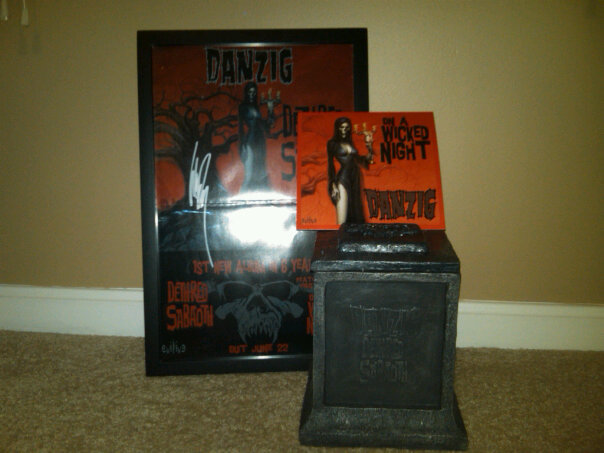

Danzig – Deth Red Sabaoth

Danzig – “Deth Red Sabaoth” (2010)

It’s been just over a year since Danzig released its most recent (and perhaps final) album, Deth Red Sabaoth.  As the years have dragged on Danzig releases have become some-what few and far between.  Not including 2007’s The Lost Tracks of Danzig, there had not been a proper Danzig release since 2004’s Circle of Snakes.  It probably comes as no surprise that six years is the longest gap between Danzig releases.  Is it age, disinterest, the music industry, or something else that lead to such a long break period for the band?  As with most things, it’s probably a combination of those and more that made Danzig fans wait six years for a new album, but thankfully, the wait was worth it.

It’s a rather poorly kept secret that Danzig albums have not been as consistent since the band’s departure from American Recordings.  And for my money, one of the worst albums in that span was the previous album to DRS, Circle of Snakes.  The production was muddy, the melodies and lyrical subject matter uninspired.  Sure there was a track here and there that worked, but as a whole the album was a throw-away.

The special edition release, complete with a Danzig urn.

Deth Red Sabaoth returns Tommy Victor (Prong) on guitar and brings Johnny Kelly (Type O Negative, Seventh Void) in on drums.  Bass duties were filled by Glenn Danzig himself (with former Samhain drummer Steve Zing handling bass duties for the touring band) along with drums for the track “Black Candy.”  Danzig self-produced the album and went for a lo-fi sound with unmastered vocal tracks and an all analog approach (which, surprisingly, is making a bit of a comeback as the Foo Fighters recently did the same).  The end result is perhaps the heaviest album Danzig has ever done.  There’s really no “Sistinas” or “Blood and Tears” on this one as most of the tracks are thick and heavy.

The album’s opener, “Hammer of the Gods,” is a blistering track slightly reminiscient of “Am I Demon?” from the first album.  The guitars have chop with dashes of pinch harmonics thrown in.  The chorus has a nice melody, and a slow bridge in the middle helps to usher in a frenetic final act for the song.  A good crowd pleaser and natural opener.  The second track, “The Revengeful,” carries the momentum forward with an even more liberal use of pinch harmonics.  The track has a nice, bouncy, groove to it with some classic Danzig cheese lyrics.

In addition to the CD release, Deth Red Sabaoth was also released on vinyl in 3 versions; black, picture, and red.

The first single of the album, “On A Wicked Night,” is one of the rare soft moments from the album.  One of those throw-back start slow and pick up tracks, it’s pretty catchy though it is one place where the vocals could have used some re-mastering.  It’s also repetitive, but the run time is short enough to keep it from becoming too monotonous.   My personal favorite track on the album, “Deth Red Moon,” has more melody than most of the tracks and strikes a nice balance.  The addition of a shaker on the chorus adds nice texture and it would have been a natural choice for a single as well.

Other standouts include the bluesy “Ju Ju Bone” and the ultra-heavy “Black Candy,” which is sure to rattle your dash board.  The album’s closer, “Left Hand Rise Above,” is similar in structure to “Without Light, I Am” from Danzig 7, only without the extended outro.  A great song for Glenn Danzig to really bellow and a good note to go out on.

The album is not without some low points though.  The two-part “Pyre of Souls” drags on a bit as the same riff is used through-out the entire duration of the song.  Not a bad track, but one where I’m always ready for it to end.  “Night Star Hel” is heavy but without much melody, though the extended instrumental outro does redeem it some and would kill live.  The low-fi production is both a strength and a hindrance.  There are some tracks where I wish some touching up had been done.  The guitar riffs are mostly solid, but Victor’s solos can be a chore at times.  He opts for a frenetic style that can comes across as noodling.  This shred approach sounds great on some tracks, but on others it doesn’t work as well and it would have served better to use some restraint.  I consider this more a criticism of Glenn than Victor, since he makes the  calls for how he wants the solos to sound.

If there’s another weakness of the album it’s that there isn’t a true all-time classic found on here.  I really enjoy “Deth Red Moon” but it’s not a top 10 Danzig track, maybe not even a top 20.  It’s an album that borders on greatness but never quite achieves it.

That said, Deth Red Sabaoth is finally that return to form so many fans had been longing for since Danzig 4.  It’s a very enjoyable record and one no Danzig fan should miss.  I picked this album up the day before its official release and it hasn’t left my car CD player since.

Top Tracks

  • Hammer of the Gods
  • Deth Red Moon
  • Left Hand Rise Above

X-Men Season 3 (Part 1)

Season 3 of X-Men is where things started to get murky in regards to what constitutes a season.  Many episodes were aired out of order, and some didn’t appear on television until season 4 started airing.  There was also more of a focus on mini series and two-parters with one-shot episodes mixed in.  There was less obvious continuity for these one-shots and most functioned as stand alone tales, with some referencing older episodes (such as the return of Morph in “Courage,” for example).  I personally felt a drop-off in terms of quality as there seemed to be less focus among the writing team.  Some episodes were character driven, some action, and some just served to show us an animated take on a comic book plot.  That said, on to the episodes!

Out of the Past (Part 1 and 2)

Season 3 began with a bang on prime time television with this episode.  I’m unsure of how much the episode draws from the comic books as the main villain here is an alien entity called the Spirit Drinker.  Whether he first appeared in the comics or was made up for the show, I cannot say.  I’m not even certain it has a gender, or a body.  It looks like it’s made up of light and is mostly transparent.  Kind of a bizarre villain.

The main attraction for viewers was the television debut of Lady Deathstrike.  Her origin was altered slightly to give her and Wolverine a romantic past (as if the guy didn’t have enough heart ache) but for the most part she’s the same as her comic counterpart, just with less cleavage (this is a kid’s show, after all).

Lady Deathstrike. The censors forced the animators to give her a white shirt to cover up that plunging v-neck.

The animation is different, though it did not pose a preview of things to come as this animation house was used sparingly by the series.  The colors are richer and there’s more motion from the characters, some needless, but overall it’s an improvement over the usual stiff animation present in the rest of the series.  Some coloring errors are made, such as Gambit’s cowl in the first part.  Wolverine looks especially bad ass and is practically a Jim Lee picture come to life.  It’s too bad the majority of the series couldn’t have a similar look.

Plot wise, the episodes are just okay.  As I mentioned, the Spirit Drinker is the main foe so while Deathstrike wants Wolverine’s head they have to do the classic unlikely allies routine to save the Morlocks.  The Spirit Drinker is freed from an alien spaceship by Wolverine and proceeds to eat the souls of the Morlocks and Deathstrike’s Reavers, before getting Jubilee as well.  Xavier has some sort of psychic meltdown that leads to him being able to read the alien writing on the ship to discover it’s actually a prison ship.  There’s a rather humorous scene where Xavier screams and just sounds rather odd doing so.

In the end, the X-Men work together and find a way to both hurt and kill the Spirit Drinker, while Xavier warns of the visions he received from the space craft and we’re left with an image of a burning earth with the phrase “Coming Soon – The Phoenix Saga!”

The Phoenix Saga (Parts 1 through 5)

A month after part 2 of “Out of the Past” aired, the promised Phoenix Saga debuted on week day afternoon television.  This was much appreciated as the saga is 5 episodes long, and waiting a week between episodes would have proved torturous.  That is, they would have if the saga was any good.

I never really liked the stories where the X-Men go cosmic.  Writer Cris Claremont on the other hand, loved that stuff and he was responsible for the arc in the comics.  “The Phoenix Saga” has always been less celebrated than it’s follow-up, “The Dark Phoenix Saga,” and with good reason.  This one is just less interesting.  We see the power of The Phoenix inhabit Jean early on after the X-Men return from a space mission (the sequence of the X-Men breaking into NASA is very reminiscent from their adventure in “Night of the Sentinels”) that Xavier sent them on for an unknown reason (even to him).  Phoenix seems pretty cool, but Jean soon passes out and we have to wait until the end of episode 3 to see her do anything again.

The TV audience gets introduced to some new faces from the comics in this series, mainly the Shi’ar.  Xavier meets his soul mate of sorts, Lilandra, and we also get to meet Banshee who’s now dating Moira.  Other cameos include Black Tom and the Shi’ar Imperial Guard, of which only Gladiator stands out.  He’s his usual mohawked, Superman knock-off self and is basically there to show us how powerful he is (by throwing the Juggernaut across the Atlantic) and then to show us how powerful Phoenix is (when she tosses him into orbit).

Probably the most interesting part of the arc occurs when the X-Men meet the Starjammers.  The space pirates are lead by Corsair, whom Jean discovers is actually Christopher Summers, the father of Cyclops.  Corsair is an interesting character because he’s easy to relate to.  The Shi’ar emperor murdered his wife, and he’ll risk the whole fate of the universe for revenge.

Cyclops is rounding first and heading for second!

Shi’ar Emperor D’Ken is the main antogonist.  He wants the sacred M’Kraan Crystal to unlock its powers and grant him immortality.  The Crystal, once unlocked, will destroy the universe but like most villains, D’Ken doesn’t seem to care about that minor technicality.  In atypical fashion though, D’Ken succeeds and gets all that he wanted and more.  In order to stop the Crystal from sucking the whole universe into its being, the Phoenix must seal it and bury it within the heart of the sun so that no mortal may ever reach it.  Doing so will apparently destroy Jean (even though Phoenix appears to be the embodiment of flame, but whatever), so we get a very teary farewell that also feels rather rushed.  It’s kind of odd that the conclusion of a plot that took up 5 episodes would be rushed, but just watch it.  Cyclops proves inconsolable back on earth once everything is wrapped up, and Lilandra is set to be crowned empress now that her brother D’Ken is gone, trapped within the M’Kraan Crystal for all eternity.  Xavier gives us a piece of foreshadowing when he reminds Cyclops that the Phoenix is known for rising from the ashes anew.  Wolverine says “Jean!” and cries, by now we’re all sick of hearing him say that.

Basically, I don’t care much for this saga.  The plot is just too “out there” for me and what could have been a great moment for the show (the death of Jean) was botched.  It didn’t help that hardly any of the future episodes dealt with Jean’s absence.  One would think losing someone like her would cast a black cloud over the team for at least a few episodes, but no.  And the one that dealt with this the most, “No Mutant is an Island,” was delayed until season 4!

No Mutant is an Island

This is that episode that was meant to deal with the fall out from The Phoenix Saga, but as I also mentioned, it wasn’t shown until season 4.  I don’t really know why, production delays are the given excuse, but it’s too bad as by the time it hit television it was both confusing and without impact.

Remember how I mentioned Cyclops, who didn’t get his own origin tale in season 2 like a lot of the X-Men did, would get his due in later seasons?  This is one of them.  In this episode Cyclops returns to the orphanage he was adopted from after leaving the X-Men.  His grief over Jean’s death has left him unfit to command (in his eyes) and this is where his heart takes him.  He reconnects with an old friend, Sarah, who is now in charge of the orphanage.  Sarah is teased as a potential love interest for Cyke, and if this show were made for adults it’s likely the two would have had at least a one-night stand where Cyclops seeks the comfort of an old friend in his time of need.

Sarah informs him that a wealthy local man has adopted all of the mutant children, and Cyclops meets the last of them, Rusty.  Cyclops doesn’t trust the motives of this gentleman, and of course, he’s proven right when it’s discovered the kids are being programmed to hate all humans by some crazed purple-skinned guy.

The plot kind of loses me once the kids take over.  It seems the episode would have been stronger had it focused solely on Cyclops but I understand the writers needed to put him in danger to prove the character could still function as a leader.  It works to some degree, though the main foe was pretty lame and seemed like a pretty weak threat.  At the end of the episode Cyclops, predictably, returns to the X-Men where he finds out that Xavier has found Jean, alive and on earth.

Obsession

Archangel will even risk destruction of the Statue of Liberty to get at Apocalypse.

Archangel returns for this one-shot.  We hadn’t heard from Warren Worthington since season 1 when Rogue freed him from Apocalypse’s control by sucking the evil out of him with her powers.  Here, as the title implies, we see an obsessive Archangel franticly searching for a way to destroy Apocalypse.  His researchers discover a lone scroll that indicates Apocalypse has a point of weakness on his back that Archangel eagerly sets out to exploit.  His tangles with Apocalypse gets the attention of the X-Men, who step in and prevent Apocalypse from destroying the blue-skinned mutant and take him back to the mansion.

Archangel is something less than grascious and he soon takes off to resume his fight, with Rogue in tow.  Rogue understands his pain because of the experiences she felt when touching him, and decides she has to help.  The four boys of the X-Men take off in pursuit as well, and the plot takes them to the ship of Apocalypse.  Beast establishes some weird bond with the ship’s AI, who assists him in setting a trap for Apocalypse.

Such a thing is impossible though, as Apocalypse proves he’s one step ahead by issuing an override command that forces the ship to abandon the trap.  He also reveals he planted that scroll for Archangel’s researchers to find, apparently just to screw with him.  Archangel goes ballistic, and the only casualty ends up being the ship leaving Beast in an odd state of mourning.  Archangel is still consumed with rage, and once Rogue insists it’s not the way for him to live, he feels abandoned and takes off.  The episode offers a welcome glimpse into the mind of the Archangel character.  At the end it made me wish we saw more from him, but alas, he goes into hiding until season 5.

Longshot

Another episode that got pushed to season 4, this was also another done by the Philippines animation studio that handled “Out of the Past.”  As a result, it looks great (though Wolverine’s hair is a bit outlandish), but the episode is a true dud.  Mojo’s episode in season 2 was one of my least favorites, and this one is no better.  Longshot, trying to escape from Mojo, ends up on earth.  He encounters Wolverine and Jubilee, who develops a crush on him (apparently she digs mullets) and gets herself involved in the conflict between he and Mojo.

The rest of the episode plays out like some bad reality TV game show, where the X-Men once again have to tangle with Mojo’s men in order to win the game and save the girl.  The predictable happens, and the less said the better.  Thankfully, this is the last we see of both Longshot and Mojo.

Cold Comfort

More awesome animation from the Philippines, and this time they get to animate for a story worth seeing.  I’ll admit, I’m biased towards this episode because Iceman was my favorite member of the X-Men growing up, so when the title of this episode displayed on the screen I geeked out like crazy.  It just had to refer to Iceman, and sure enough, within moments he makes his presence felt.

Here's Bobby!

Iceman is faithfully portrayed as a cocksure prick, and that’s why us Iceman fans love him.  He attacks some government base, which attracts the attention of the X-Men due to his mutant signature.  Xavier, Cyclops, Wolverine, and Beast go off to confront him, which leads to Iceman’s capture.  We get a nice piece of backstory, and the show acknowledges for the first time that the original X-Men consisted of Cyclops, Jean, Angel, Beast, and Iceman.  They also throw in Lorna Dane, aka Polaris, for the sake of the plot as we learn she and Iceman left the team to be together.  They also left because Iceman couldn’t get along with Cyclops and Xavier as their respective personalities clashed in a big way.  Iceman was the youngest and most chid-like of the group, and Xavier was unable to reach him.

Jubilee learns all of this, and then overhears Iceman telling Beast he’s just trying to find Lorna, who disappeared not long ago leaving behind a trashed house.  Iceman fears the worst, but Beast and the X-Men won’t let him go until they know more.  Jubilee is sympathetic and springs him loose, she also has a crush on him (probably a good thing that this episode and “Longshot” aired out of order given the overlap in plot) and tags along as they go after another government building.

Here they meet X-Factor; Havok, Strong Guy, Wolfsbane, Quicksilver, and Multiple Man.  The boys show up and we get a little X-Men vs X-Factor action where the X-Men demonstrate their superior tactical abilities.  Forge soon shows himself and explains to Xavier that he set this whole thing up as a means of testing his new team.  X-Factor is a mutant super group formed by the government to deal with mutant issues.  Lorna also shows up and we find out she left Iceman of her own will, and has also fallen in love with Havok.  The writers also teased the audience by showing how Havok and Cyclops are immune to each other’s powers.  That’s a trait common to mutant siblings, but apparently the two of them are unable to put two and two together.

In the end, like most cameo characters, Iceman is offered a place on the team but declines.  At least his reasons are mostly logical when he remarks he’d just piss everyone off within an hour (not his actual words).  Jubilee is bummed, and so am I, as Iceman rides off into the sunset.  Unfortunately, “Cold Comfort” would be the only episode to feature the arctic mutant but it’s one more than Thunderbird got!


The Wolverine

There was a period of time, probably begun somewhere in the 80’s and carried through all or most of the 90’s, where arguably the most popular character in comics was Wolverine. While the big franchises like Batman and Superman faded from the public spotlight and before Spider-Man broke through to the mainstream, Wolverine was featured all across Marvel and his likeness plastered everywhere comic books were featured.  True he never quite burst through the way the previously mentioned heroes either did or would to the point where any person walking the streets of America could identify him, but he came close.

For my generation, he was probably the most popular superhero of my youth.  I find it curious that he came to occupy such a place.  Wolverine couldn’t fly, stick to walls, or shoot lasers out of his eyes.  He wasn’t a vigilante out fighting for justice like many other heroes, didn’t have an alter-ego, or a ton of money.  He’s a guy with blades extending from his fists.  Sure he’s more complex than that, but show someone an image of Wolverine and that’s what they see.  They don’t know about the regenerative capabilities, the bad ass nature, the unbreakable skeleton.  They just see a guy in brightly colored spandex with some knives attached to his gloves.

Wolverine's first appearance from 1974.

Originally, that’s all Wolverine really was.  Debuting in the pages of The Incredible Hulk, Wolverine was a pest the Hulk had to deal with.  Sporting yellow and blue, he came at the Hulk with some savagery but ultimately was bested.  Somehow, what probably was intended as a mostly one-off character would find himself re-designed and re-imagined.  The following year, he was brought back only this time to join the X-Men in the infamous Giant Sized issue from 1975.  It wasn’t until here that his character began to develop beyond what the reader had seen.  Eventually he would be revealed as an older guy with a brooding personality unafraid of using lethal means when tackling a villain.  His claws were unbreakable and part of his body, not his gloves, and his origins a mystery to not only his teammates, but himself.  Frank Miller would get a chance to further refine the character in a mini series in the early 1980’s.  His portrayal of Wolverine was so popular that a lot of the characteristics he brought to the table would find themselves in his future Batman books.  Soon every superhero was a brooding anti-hero prone to moments of violence.

It’s rather amazing that this character’s humble beginnings could lead this far.  Surely creators Len Wein and John Romita Sr. never envisioned he’d end up this big, but Wolverine would become an example of how good character development is paramount in comic books.  The powers and abilities of a super hero are often times the focus, but a cool power or even a cool costume can only take one so far.  Wolverine’s original look was kind of lame.  The whiskers on the mask especially, and were quickly removed for his X-Men appearance.  The mask itself is iconic now, with those big “horns” coming off the eyes the main characteristic.  The colors have changed from time to time, though yellow and blue, and tan and brown, remain his best looks.  I personally prefer the tan and brown John Byrne costume, just because it’s a little less traditional than the yellow and further differentiates him from the rest of the X-Men.

My preferred look for Wolverine.

What probably attracted me to Wolverine at first was his attitude.  My first introduction to the character was through the 1990’s X-Men cartoon (my season 3 posts are coming!) where it was established early on that Wolverine has his own set of rules.  He doesn’t like taking orders, goes where he wants to go, and is even prone to wild mood swings.  He’s also fiercely loyal to his friends and their cause and is sometimes seen in a protector mode, though he’d probably be loathe to admit it.  And even though the censors presented an obvious obstacle, the writers and directors of the show were able to portray him as a savage brawler when provoked.

That’s all well and good, but without something more I doubt I’d have seen Wolverine as anything but a complementary piece to the X-Men.  His back story was what was most intriguing.  The secretive Weapon X project that grafted the unbreakable adamantium to his bones was revealed early on.  After that, it was all a mystery.  Wolverine not only had no idea where he came from, he didn’t even know his own age or what his birth name was.  He went by Logan, though how he came upon that was also a mystery, and was plagued by visions of the past that were either real or imaginary.  He had lots of old foes, some of whom he couldn’t even remember why he hated.  He thinks Sabretooth, for example, killed an old lover but he was never certain.  Tragedy would also prove to be close at his heels at every step, his old lovers often found themselves dead, like the ill-fated Mariko.  And there was his pursuit of teammate Jean Grey, always doomed to fail, but I think most readers were like me and rooted for Wolverine over the dull Cyclops.

Since the 90’s, Wolverine’s origins have mostly been revealed.  I always felt this was a huge mistake and actually have never read the series Wolverine Origins.  He also became way over-exposed leading to a backlash of sorts.  At some point, everyone stopped saying Wolverine was their favorite character and changing their tune, because it wasn’t “cool” to like what everyone liked.  Marvel (and soon Fox) forced him down everyone’s throat and his presence dominated the X-Men books.  In a truly unwise move a few years ago, Marvel even made him leader of the X-Men for a television show titled Wolverine and the X-Men which left many fans gagging.

As for me, Wolverine was never my favorite but I did like him.  I suppose he was my favorite member of the cartoon X-Men, but I’ve always liked him for what he was.  He’s a great addition to an ensemble like the X-Men and serves a vital role.  The other aspects of his origins add depth and were always a good “rainy day” plot device if nothing else was going on in the books or show.  It’s rather unfortunate that modern day writers and business types have forgotten how best to utilize him, especially his rather heroic movie portrayals, but that’s what happens when money is involved.  Wolverine’s success is both unlikely and typical, a product of his times.


The Legend of Zelda – A Retrospective

In playing the recently released Ocarina of Time 3D, I began to reflect on The Legend of Zelda series as a whole.  I was initially going to post a review and impressions of the game, but there’s lots of places to find that (and if you really want my opinion, it’s good) and I thought looking at the series as a whole would be more interesting.  It’s often said that Ocarina of Time is not just the best in the series, but the best game of all time.  I tend to shy away from anointing anything the best ever and just stick to favorites.  In that regard, no Zelda title is my all-time favorite (a post for a later day) but there are a few among my favorites.

If Mario is Nintendo’s official mascot, then Link is its most professional.  Mario finds himself in many 5 star games, but he also shows up in lots of junk as well.  Link, and the Zelda franchise as a whole, is remarkably consistent in terms of quality (ignoring those regrettable CD-I games) and each Nintendo console’s best game is often times a Zelda title.  A retrospective on the topic is only as good as its author, unfortunately, this author hasn’t played every Zelda game under the sun.  I’ve played all of the core titles in some part (and I’ll note which ones I never finished), but a lot of the handhelds have been ignored by me for one reason or another (the number one reason being I don’t play a lot of handheld games).

Where it all started...

It almost seems unfair to compare the original Legend of Zelda with the more modern titles.  After all, it’s an 8-bit game that’s over 20 years old at this point, so only the most devoted nostalgic gamers would cite it as the best in the series.  It did, however, lay the ground work for just about every title that has followed.  Whether that title made use of the overhead perspective, or just the dungeon crawl and find various items component.  Really, no Zelda title has followed a different path and if there’s one major criticism that can be laid at the franchise’s feet it’s that the basic gameplay has not changed in 25 years.  That’s both a criticism and a testament for just how good the original game was that it’s still relevant.  And the original is still remarkably playable.  Some NES games have suffered terribly over the years but I like to believe that young gamers today could still play the original Zelda and find some enjoyment.

This just didn't feel right.

Zelda II was and is still the black sheep of the franchise.  The full title was Zelda II:  The Adventure of Link, and as the title implies, it focused mostly on the series’ protagonist, Link.  The story line picked up right where the first game left off, and now Zelda is in a coma of some sort and Link needs to wake her.  I don’t remember much else about the plot, save that Ganon is involved and he taunts you from the “Game Over” screen, which you will see, a lot.  It’s a side scrolling action-adventure RPG.  Link moves from left to right (save for an overworld map screen) and can jump around.  As he defeats enemies he gains experience points and levels up, where the player can choose what abilities to upgrade; health, magic, and attack.  This game is easily the hardest in the series.  Link has this puny little sword which means he needs to get close to enemies to attack.  At full health, he can shoot beams from it but once damage is sustained that feature is disabled.  Some enemies can only be attacked from a standing or crouching position too, and switching between the two is cumbersome.  I never liked this game much as a kid, and never progressed very far in it.  Whenever I played it I always ended up being reminded of how much I liked the first game.

It makes sense then to learn that I loved the next game in the franchise, A Link to the Past.  Released for the Super Nintendo in 1992 (1991 in Japan), A Link to the Past brought the series back to its roots.  Gone was the side-scrolling, jumping, experience points dribble of Zelda II and back was the overhead, sword slashing, bomb dropping, awesomeness of the original.  With the move to the SNES, the game was obviously much prettier to look at.  Link could do more things like run and magically traverse worlds.  The game was difficult as well, but not frustratingly so, especially if you found the various heart containers strewn about the world to increase Link’s health.  Again, the plot was rather ho-hum, but it did serve as a prequel to the original which was kind of neat.  Almost everything introduced in this game has been carried forward such as multi-level dungeons, the master sword, hookshot, and musical instrument concept.  The parallel world concept also makes frequent appearances in future titles as well.

Ahh, much better.

A Link to the Past is one of the best games on the Super Nintendo and in the running as for my affections as favorite title.  I’ve played and re-played this game more times than I can count and am always entertained.  It’s one of the few titles to receive a direct sequel as well, the Gameboy’s Link’s Awakening takes place following A Link to the Past.  I mentioned in an earlier post that I never played that game when it first came out or even when it was re-released for the Gameboy Color, but I do have it on my 3DS.  I haven’t finished it yet but from what I’ve played it’s an excellent little game.  It maintains the same basic approach to gameplay as ALTTP but introduces some new stuff such as a couple of side-scrolling screens and the ability to jump on command, two things unique to this game and Zelda II.  It remains the only portable-only Zelda title I’ve played extensively.  My experience with the DS games was only for a short burst and neither really appealed to me, Spirit Tracks and Phantom Hourglass.  I found them a little too gimmicky but admittedly did not give either a chance.  The whole train thing of Spirit Tracks conjured up bad memories of Wind Waker’s sailing sessions and was an instant turn-off.  Like Link’s Awakening, I probably should not have ignored the other Gameboy titles Oracle of Ages and Oracle of Seasons, as I’ve heard nothing but good things.  The lone Gameboy Advance title, The Minish Cap, was positively received but I just never got around to playing it.  Maybe some day.

A whole new perspective on life.

After that handheld tangent, the next game in the series to grace a home console is the now infamous Ocarina of Time.  Released originally for the Nintendo 64 in 1998, it was an instant classic with many review outlets giving it a perfect score.  Gameplay-wise, it took the basic formula of ALTTP and switched it to 3D.  Link still traveled around the world of Hyrule entering dungeons and collecting many familiar items while solving puzzles along the way all in an effort to save the kingdom and defeat Ganon (now called Ganondorf).  The two-world concept was even brought back as there’s a past world and a future, semi-apocalyptic Hyrule where the player plays as an adult Link.  Young Link and adult Link played the same, but certain items were unique and usable to each.  It didn’t make much sense in the game why adult Link couldn’t use a boomerang, but he had the hookshot to make up for it so no one really cared.

Visually is where the game differed most from its predecessor.  Now in full 3D, the camera is positioned behind Link for the majority of the experience.  To make combat easier, Nintendo came up with the Z-targeting feature that would appear in numerous copy-cat games where pressing the trigger underneath the N64’s controller caused Link to lock-on to an opponent.  When locked on, he would focus on that enemy making attacking much easier.  Also, other enemies will not attack Link while he’s locked onto an enemy.  Unrealistic?  Of course, but good for gameplay.  Link could still perform his spin attack from ALTTP, but now he also had a jump attack that did major damage when compared with his normal sword strikes.  Multiple items could be mapped to the C buttons making switching between them much easier than in previous titles.  To further keep things simple, Nintendo opted to go for an auto-jump as opposed to making a jump button.  It works, for the most part, though there are times when you wish Link was a little less inhibited.

So what did the game introduce as new?  Lots, really.  Many things were mostly expanded upon, such as the fishing game from Link’s Awakening, and Hyrule was now much bigger with more places to explore.  The Zora race of fish folk were expanded upon and brought into the story.  Link gets a horse to ride around on.  And the musical instrument concept was greatly expanded upon as the game’s title suggests.  Link could learn multiple songs on his Ocarina that all had different functions.  Some transported him to places, others turned night into day, and so forth.  It’s a fun mechanic that has shown up in later titles.  The 3D perspective has proven to be quite popular and has been the go-to method of display ever since for major console releases.

The praise heaped on OOT has been well placed.  It’s a great game, nearly flawless.  If I had one major complaint with the title it’s with the annoying companion character.  Yes, I’m talking about Navi.  Navi is a fairy that follows Link around and offers advice, unfortunately, that advice is often not wanted and far too obvious to be useful.  And when she wants to be heard an annoying “Hey!” sound byte is played.  She’s even more annoying in the new 3DS version of the game as she’ll pop in to suggest the player take a break after a half hour or so of gaming.  Nintendo, stubborn as always, has refused to make her optional and every time I hear that annoying high-pitched voice I want to throw my 3DS across the room.

This is what we thought Wind Waker would look like...

Ocarina of Time was a tough act to follow.  When Nintendo introduced its next console, the Gamecube, to the masses it was accompanied with a high-res demo of Link battling Ganondorf that left everyone’s mouth agape.  We all thought this was a preview of what the next Zelda title would look like, and we were all fooled.  Wind Waker was announced roughly a year later and it looked nothing like OOT.  Everything was now cartoony, and Link was sporting big goofy eyes and a tuft of blond hair.  Everyone was pissed.  When the game finally came out in 2002 it became obvious that the game was actually quite the visual spectacle.  Animations were smooth and the frame-rate crisp.  While many still could not love the style of the visuals, they were at least forced to admit it was a pretty impressive title.

...and this is what we got instead.

While the visuals were easily forgiven, gameplay could not be.  Wind Waker is probably the easiest and most accessible Zelda title ever released.  OOT wasn’t brutally difficult by any means (even the Master Quest version can’t compare with Zelda II in terms of difficulty) it was still challenging.  Wind Waker was pathetically easy, to the point of boredom.  Compounding this boredom was the new sailing mechanic that had Link traveling across this flooded Hyrule via boat.  One section of the game requires a ton of sailing, and that’s the part where I basically checked out.  I never finished this one.  While I didn’t hate it, I certainly didn’t like it.  I didn’t find the dungeons to be an improvement over OOT and the gameplay was so simple I found myself getting tired while playing it.  Next to Zelda II, this is my least favorite in the series.  It was still well-received by critics, but it’s my opinion that was a combination of reputation and over-compensation for the visuals.  Many reviewers wanted to tell the reader to look past the visual style.  I did, and I didn’t find much beneath them.

I realize I skipped Majora’s Mask.  Not intentionally, but probably because that title has always felt like a side-story to me and not a full-fledged Zelda title.  It was the direct sequel to OOT and featured a new gameplay mechanic, masks.  Link would acquire new masks throughout the game that granted him different abilities.  The backdrop to the story was that the moon was going to obliterate the land of Termina in a couple of days, and Link needs to save the day with his trusty ocarina and new masks.  The player has to constantly play with time as the game takes place over 72 hours, jumping back and forth to avoid armageddon.  It’s a pretty cool approach and definitely changes things up from OOT.  It does get understandably tedious at times, especially when you’re close to completing an objective but run out of time and have to start all over again.  I never played the game on N64 and had to download it for the Wii.  I like the game, but I don’t love it.  As a result, I’ve yet to beat it despite having it for 2 years now though I do intend to return to it, some day.

Following the backlash Nintendo received over Wind Waker’s visual style, Nintendo returned the series to a more realistic look with 2006’s Twilight Princess.  Developed for the Gamecube and released on the Wii as well, Twilight Princess was the visual treat many fans had wanted.  Gameplay wise, it was mostly an OOT re-tread which seemed okay for most fans and reviewers.  Instead of the ocarina mechanic, Link now could transform into a wolf and enter a spirit world called the Twilight Realm.  Unfortunately, this felt kind of gimmicky and the wolf parts of the game weren’t nearly as interesting as the traditional stuff, though not painfully so.

Wolf Link in the Twilight Realm. Kind of trippy.

The rest of the game would have felt ho-hum, but the visual approach did a lot to add weight to the series.  Navi’s replacement Midna actually had some personality and was an enjoyable plot component as opposed to a nuisance.  The darker tone the series undertook earned the series it’s first ever Teen rating and added a sense of dread.  Truthfully, it’s a very enjoyable game and in many ways improves upon OOT, it just wasn’t the same leap forward as ALTTP and OOT were when jumping to a new system.  The Wii controls worked for the most part, but weren’t as immersive as Nintendo seemed to promise.  Some even prefer the more traditional control scheme found on the Gamecube version.

I don’t know which Zelda title is my favorite, but it’s obviously between A Link to the Past and Ocarina of Time.  My nostalgic core likely prefers ALTTP, but I can’t ignore the brilliance of OOT.  It doesn’t matter much in the end, both are deserving of the praise they receive.  I’m hopeful that this fall’s Skyward Sword is the leap forward Twilight Princess was not.  With true one to one motion controls, it could be pretty cool to swing Link’s sword around but if it’s the same basic experience I’ll be a little disappointed.  I’m ready for Zelda to tread new ground but am also confident that Nintendo will provide a worthwhile experience.  It will either be a great game or an all-time classic, and neither sound bad to me.


A Game of Thrones

***WARNING***

SPOILERS AHEAD – IF YOU HAVEN’T READ THE BOOK OR SEEN ALL OF SEASON 1 OF THE TELEVISION SERIES YOU MAY NOT WISH TO READ FURTHER.  DON’T SAY I DIDN’T WARN YOU.

The cover of the book, A Game of Thrones.

I recognize this post doesn’t necessarily fit my nostalgia theme, but I could probably say that about nearly half of my entries.  In truth, I’ve always had a love for epic fantasy set in a medieval setting since I was young.  I’m not sure when I was first introduced to the setting, if it as a movie, video game, or book, but it seems only natural that I have found enjoyment in George R.R. Martin’s A Song of Ice and Fire series of books.

I will shamelessly admit that I had no knowledge of the series until HBO began airing its show, Game of Thrones, this past winter.  And even then, it was thru word of mouth and encouragement from friends and co-workers that I check it out for I’m too cheap to spring for HBO as part of my cable package.

It turns out it was with good reason I was encouraged to partake of the series for I’ve enjoyed my time in the fictitious Westeros and parts beyond thus far.  I decided I’d rather experience the book before viewing the show and purchased the four volume set off of amazon.com with due haste.  I plowed through the first book, A Game of Thrones, in a weekend and have since completed reading A Clash of Kings and A Storm of Swords.  To say I’m hooked would be an understatement.  I have also viewed most of the first season for GOT with the exception of the final two episodes.  I’m in no hurry to see them, since I know what happens, and I have enjoyed reading the reactions viewers had to a certain even that took place in episode 9.

Veterans of the series no doubt know exactly what scene I speak of.  That would be the be-heading of the likable Lord Eddard “Ned” Stark, the perceived main character of the first book and television show.  Those caught unaware have reacted with a range of emotions, mostly shock and disbelief, with a vocal minority expressing outrage and refusing to watch another minute (an empty threat, as it turns out, for the following episode was the most watched episode of the season).

I admit, I was pretty shocked when I read that fateful chapter myself.  The book strongly hinted at it early on when the characters encountered a dead dire wolf, the sigil of House Stark, slain when the antlers of a stag caught it in the throat.  The stag is the sigil of House Baratheon, the house of King Robert, who summons Ned to court  to take on the responsibilities as hand of the king.  Ned helped Robert win the crown and as an act of friendship accepts the offer, for he fears the king’s life is in danger.  This would prove true when Robert would end up skewered by a boar on a hunting expedition.  It looked like an accident, but the devious House Lannister was behind a plot to get the king so drunk he’d never stand a chance against a wild boar.

Sean Bean as Eddard Stark.

No matter, the issue of Stark’s death is the one I want to focus on.  I noted the obvious piece of foreshadowing, one even the characters note for the reader, and still the act of Ned’s death is a shock.  Before Ned is executed he is lead to believe he will be spared if he begs the newly crowned King Joffrey for mercy and admits his crime (of which he committed no crime when speaking out against Joffrey, for Joffrey was not the true heir to the throne).  Before that though, we were shown how cruel and merciless Joffrey is, a truly wretched child with no redeeming qualities.  There was no way he would spare poor old Ned, and predictably, after Ned confessed to false crimes Joffrey ordered the be-heading take place.

There’s more though!  Shortly before Ned is arrested a conversation takes place between Ned and the queen Cersei in which the fateful line is spoken by the queen, “When you play the game of thrones you win or you die.”  By now we have seen what is needed to win:  treachery, deceit, dishonor, cunning – all traits not possessed by Ned Stark.  In fact, all of the things he stands against.  When Robert’s youngest brother Renly approaches him shortly after the king’s death about supporting his claim to the throne, Ned refuses instead telling him that the next in line is Renly’s older brother, Stannis, thus losing a valuable ally.  Stannis had long since fled King’s Landing and was of no use to Ned at that moment.  Had he accepted Renly’s offer much would have been averted.  Had he the stomach to tell Robert while he was on his death-bed that Joffrey was not his true son (all of Robert’s children were the product of incest between his queen and her twin brother Jaime, a fact which Ned had recently uncovered) Cersei and her children would have been executed or banished.  Ned would not dishonor his friend on his deathbed, instead choosing to record the king’s last will and testament and putting in the phrase “rightful heir” in place of Joffrey’s name.

In an environment such as King’s Landing, a piece of paper is only useful to wipe one’s ass with.  It did Ned little good and he found himself arrested for treason when he proclaimed Joffrey was not the rightful heir.  So why then, are we as readers and viewers shocked when Ned dies?

It’s strictly a case of blind faith.  Martin, up to this point, has portrayed Ned as the central figure of the story even though several other characters are granted their own chapters.  Ned doesn’t even get the first chapter of the book to himself, but his presence soon dominated the story.  HBO also used the likeness of Ned’s actor Sean Bean, in virtually all of its promotion for the series.  No author would kill off the story’s main character, especially not in the first book.

It’s this devotion that kept me wondering how Ned was going to get out of it even as his head separated from his body.  It’s a harsh lesson for all as we quickly realize honor and decency will get you no where in this fictitious world and that no man (or woman) is safe.

The following books remind us of that again and again.  Though nothing is quite as impactful as the death of Ned, there are moments that come close.  I won’t spoil them, but I will say there are also moments of triumph to follow as well.  Martin successfully puts doubt into the mind of the reader that their favorite character will make it out alive making each turn of the page both exciting and dreadful.  Ned’s death was necessary to set the tone for the series and those hooked before his death should not abandon the series (and as I mentioned earlier, it appears few have).  Digest what happened, take some time to cool off if need be, and return when ready.  There are many months before season 2 begins where a great many characters will experience victory and death.  Such is the way of the world.


In Flames – Sounds of a Playground Fading

In Flames - Sounds of a Playground Fading (2011)

Nothing destroys credibility as quickly as popularity.  In Flames emerged from the Swedish metal scene as pioneers of the melodic metal sound.  After screwing around with lineups for a few years and recording a couple EP’s, the band put it all together and gained notoriety with 1995’s The Jester Race.  Their breakout, Whoracle, followed in 1997 containing memorable tracks such as “Episode 666” and “The Hive.”  1999’s Colony further refined their sound and cemented the band at the top of the extreme metal hierarchy.  The bands blend of crushing death metal with Iron Maiden inspired riffing and guitar harmonies were the next big thing in the European metal scene.

Of course, this type of sound has never played all that well in America, but around the same time nu-metal bands like Slipknot suddenly made it okay for a vocalist to sing with a rasp on mainstream radio.  It’s not surprising that the next album from In Flames, Clayman, would contain some influence of that style.  The harshness of the vocals was toned down and some “bouncy” riffs were thrown in.  The band opted to shift its focus away from the twin guitar attack of founding member and principle song writer Jesper Stromblad and Bjorn Gelotte and instead focus on crafting a catchy chorus.  Vocalist Anders Friden went with more of a rasp as opposed to a death grunt for the majority of his vocals and even worked in more “clean” vocals than he had done in the past.  His lyrics also strayed from the more abstract and towards more personal, everyday kind of emotions that listeners could better identify with.  The result was In Flames’ most accessible album.  The songs were undeniably catchy, though longtime fans felt like a part of the band’s core sound had been lost.

The band has often felt a little disconnected ever since.  The follow-up to Clayman, Reroute to Remain, stands as the band’s most experimental record.  The production was slick, almost too polished, and the band explored more vocal effects for a lot of the album’s choruses.  The album that followed, Soundtrack to Your Escape, is considered by most fans to be the band’s worst.  Uninspired riffs and bland production marred the release as almost all semblance of what In Flames pioneered in the 90’s was removed.

Thankfully, the band came back strong in 2006 with Come Clarity.  That album has become a polarizing one with many long-time fans dismissing it, but for my money, it brought back enough of the band’s old sound while moving everything forward.  Unfortunately the follow-up, A Sense of Purpose, was too conservative and ended up sounding like a collection of leftovers from the Come Clarity sessions.

Which brings us to today, the eve for the release of In Flames’ latest record Sounds of a Playground Fading.  The album’s title evokes bad memories of lousy Korn records, but after a few listens I can at least safely say there’s little Korn found on this one.  That’s not to say all semblance of that bouncy, new millennium In Flames sound is gone, but the album is not an embarrassment.  The fans that left with Clayman and Reroute aren’t going to be brought back though, as the sound In Flames is going with definitely trends modern.

Sounds of a Playground Fading is not without merit.  It strikes me as the band’s most experimental since Reroute.  Some of the production techniques the band picked up there are employed here but with more subtlety so as not to over-indulge.  This is the band’s first record without Stromblad so there was a lot to be concerned with going in but I think they did well by their old mate.

The opening track has a nice acoustic intro.  I expected it to explode into a monster riff but the song mostly eases the listener into a quick, jerky one.  Anders’ vocals are pretty consistent with what he’s done on the last few albums.  They’re at their best when they have a ferocity to him, usually obtained with slight distortion and some layering.  Longtime fans will probably mostly agree that “The Puzzle” is the album’s best track as it captures the most of the old death metal sound.  The vocals on the chorus are intense and there’s a nice bridge section for the guitars to show off a bit.  Gelotte handles most of the lead work, I’m unsure how much new/old comer Nicolas Engelin contributed there or if he mostly handled rhythm duties, but there are some nice harmonies mixed in.  Mostly they’re just for show and nothing really approaches the complexity of the old stuff.  One of the other standout tracks, “A New Dawn,” is a good example of the band trying new sounds as the song successfully brings in string instruments to accentuate the chorus.

There are some dull tracks that could be classified as typical newer In Flames.  The first single, “Deliver Us,” is one of those tracks that just doesn’t do a whole lot.  The chorus is catchy enough, but not more so than some of their more modern tracks. “All for Me” has a disjointed melody that just doesn’t work for me.  “The Attic” is less a song and more an intermission, and the album’s closer “Liberation” will be a polarizing one.  I read one listener describe it as reggae but I wouldn’t go that far.  It does contain perhaps Ander’s most natural sounding vocals when compared with any other track.  I honestly can’t decide if like it or not, but I suppose I don’t hate it and for curiosity’s sake alone it’s better than the last few In Flames album closers.  It’s also not the worst track, as that title goes to “The Jester’s Door,” some sort of spoken-word thing that degenerates into a Nine Inch Nails knock-off.

In the end I think the fan-base for In Flames will remain divided.  Fans that enjoyed the last few albums will probably enjoy Sounds of a Playground Fading while those who only care for the band’s more extreme sound will find little to enjoy outside of a track or two.  Those types will especially find tracks such as “Where the Dead Ships Dwell” off-putting because it’s almost pop rock melody.  The newness of the album is still very strong so it’s hard to say where it will fit in ultimately with the rest of the band’s catalogue.  The first half of the album is definitely stronger as I find myself losing focus during the second half.  I feel comfortable saying it’s at least better than A Sense of Purpose but won’t threaten to overtake any of the band’s best works, Come Clarity included.

Top Tracks

  • The Puzzle
  • Fear is the Weakness
  • A New Dawn

Nintendo 3DS – 3 Months Later

It was nearly 3 months ago that Nintendo released its latest handheld, the 3DS, a more powerful version of their Nintendo DS with all new stereoscopic 3D capabilities.  I’m no techie, but I’d say graphically the system is on par with the Wii, perhaps better, which is what drew me in and I was able to convince myself that I needed to buy this thing.

I picked up Super Street Fighter 4 with my shiny new 3DS and looked forward to what the system had in store for me.  I wasn’t real excited to be picking up another copy of SF4, but I ended up enjoying it quite a bit.  I logged a fair amount of hours with it during my morning and evening commutes and found the portable take to be pretty satisfying.  I never did venture online, as that would most likely lead to frustration, and stuck with the single player experience.  The 3D offered nothing, even made the game worse, but I’m of the rare sort that didn’t pick up the system for its 3D capabilities.

I did tire of SF4 roughly after a month’s use and found myself ready for a new game.  Unfortunately, the 3DS library thus far has been putrid.  This is often the fate of early adopters but the 3DS seems especially barren when it comes to games.  Making things worse, the Nintendo eShop wasn’t ready at launch so there wasn’t even anything interesting to download.

It's been a long wait, but the wait is over June 19th.

Thankfully, this drought appears to be nearing an end.  The eShop finally launched this month with a free version of an enhanced port of the NES classic Excitebike.  I downloaded and can confirm it plays just as well as it always has but with some slight visual enhancements to the color palette.  The 3D effects are even adequate which is a nice surprise.  At the end of the day though, it’s still Excitebike, a 20 year old game that’s free for a reason.  Released shortly thereafter for the price of $5.99 was The Legend of Zelda: Link’s Awakening DX which I also snatched up.  I had never played the Gameboy or Gameboy Color edition of the game (I have no idea why) so I was actually pretty eager to check it out.  It looks and plays the same, but has picked up a handy save state feature which makes it even more convenient, and offers a quirky off-beat adventure when compared with other Zelda games.  I’m not too deep into it, but so far I’m liking it.

The big game on the horizon, set for release this Sunday, is the remake of The Legend of Zelda: Ocarina of Time, arguably the finest video game ever crafted and the inspiration for this post.  I plan on sinking my teeth into that one and expect it will be an improvement over the Nintendo 64 original, I just hope I don’t suffer any Zelda burn-out by playing Link’s Awakening and Ocarina of Time so close together.  It’s the game that pushed over the edge when trying to make a purchasing decision on the 3DS and it’s been a long wait.

If that was the only game to look forward to though then things wouldn’t be much better.  The eShop is likely to continue to see enhanced remakes of classic games but that can’t sustain a system.  Thankfully, last week’s Electronics Entertainment Expo (E3) had a lot to reveal about the 3DS, and these are the games I’ll be keeping an eye on in 2011 and beyond:

Star Fox 64 3D – Sure it’s another remake of an N64 game, but like Ocarina of Time, it’s a beloved game.  It’s also one I missed the first time around so I have some extra interest in it.  Unlike with most 3DS games, I can see the 3D effect actually adding something to the gameplay.  The very nature of the game makes it a good candidate for a portable system, and it promises to have enhanced visuals while retaining the tried and true gameplay.

Paper Mario 3DS – I haven’t been able to confirm if this one is a new game or a remake too, but from the little I’ve seen it looks all new.  The first two Paper Mario games, spiritual successors to the excellent Super Nintendo game Super Mario RPG, were addictive and unique RPG experiences.  Paper Mario 2 was a game I could not put down.  Super Paper Mario for the Wii, and the Mario & Luigi titles for the Gameboy Advance and DS, both have their merits but neither has been able to eclipse the original Paper Mario games.  The unique visual style could also make for an interesting 3D experience.

Resident Evil: Revelations – The first 3DS title from the Resident Evil franchise arrives this summer and is based on The Mercenaries mini game from the last few Resident Evil titles.  I never cared for them, or for Resident Evil 5 for that matter, because it focuses too much on action.  I like the methodical pace and creep factor of the original Resident Evil titles.  Resident Evil 4, probably the best in the franchise, struck a nice balance between action and survival horror.  Revelations looks to bring the series back to its roots with Resident Evil veteran Jill Valentine back in the lead role.  Can survival horror work on a portable?  We’ll find out, though probably not until 2012.

Kid Icarus Uprising – I don’t really know what to expect from this game, other than it’s the first Kid Icarus game since the NES days and that alone makes it intriguing.  The game looks gorgeous and has been in development for quite some time so there are no worries about a rush job.  It will likely offer a rich experience that combines traditional platforming with some on rails type of flying levels mixed in.

Super Mario 3D – It’s kind of a given that Mario will show up on a new Nintendo

Tanooki Mario is coming back!

console at some point.  It’s also kind of sad he’s rarely available for a system launch anymore.  Nintendo aims to make up for Mario’s March absence this fall with an all-new Mario adventure.  Super Mario 3D will attempt to combine the gameplay and presentation of the excellent Super Mario Galaxy franchise with old school Mario gameplay.  Look no further for evidence of that than with the return of the Tanooki suit from Super Mario Bros. 3.  The levels are also shorter with a clear path and all end with the familiar flag-pole leap.  It’s Mario, so it’s bound to be good.

Luigi’s Mansion 2 – Not to be outdone by his more famous brother, Luigi returns in his ghost-sucking franchise and was one of the surprises at E3.  Luigi once again finds himself in a haunted mansion and armed with his ghost vac and flashlight.  The cowardly plumber will also have some sort of Ghostbusters-like lightning attack to hold ghosts in place so he can suck them up.  Traditional Mario gameplay meets Ghostbusters?  I’m on board!

And that’s not all.  There’s also versions of Mario Kart and Super Smash Bros. on the way.  There will probably be some Mario sports titles as well and maybe even a new entry in the New Super Mario Bros franchise at some point.  Best of all, most of these games are arriving in 2011 giving the 3DS one of the best lineups of any system this fall.  And the 3DS needs it because Sony’s PSP Vita is hot on its heels with some impressive hardware and software due for that one.  The spring has been lousy, but this summer and fall look to make up for it.


X-Men Season 2 (Part 3)

In the previous entry I said I was in no rush to finish these, but I’m feeling inspired today so I’m posting this just one day after the last.  This also is the final entry for season 2.  After this season, the show becomes a little less focused and some production delays screw up the continuity, but that’s all stuff reserved for future posts.

Beauty and The Beast

Beast with his beloved Carly.

This is the last episode for season 2 that deals specifically with one character.  While the other episodes in this format mostly gave us origin tales, this one chooses to focus on how difficult it is to be a mutant with a physical abnormality.  This one, as the titles alludes, is about Beast.  At this time in the series, Beast was still kind of an unknown character for a lot of viewers due to his incarceration for the majority of season 1.  He had some lines in previous season 2 episodes but was always more of a background character.  This episode shows that Beast is more than just the smart, fuzzy one.  His mutant powers made him one of the more boring X-Men, but this episode proves there’s a lot of depth hidden under that blue exterior.

Beast is also the only member of the team who has a job beyond being a member of the X-Men.  He’s a doctor, and a surgeon apparently, and he’s been working on a cure for a type of blindness at a local hospital.  The patient about to undergo his experimental procedure is a woman by the name of Carly.  The show is not so subtle in showing us that there’s a mutual affection shared between the two characters and we worry for Beast and how Carly may receive him once her vision is restored.

The Friends of Humanity, finding out a mutant works at the hospital, stage a violent protest outside forcing Beast to intervene and save Carly.  This gets the attention of the X-Men and Wolverine, in particular.  He lets Cyclops know that he’ll handle the FoH “delicately” and takes off.  Meanwhile, back at the hospital, we find out Carly’s father is a bigot and demands Beast be kept away from his daughter.  Beast reluctantly agrees though Carly is heart-broken.  If the episode has one fault, it’s that Carly’s father is portrayed a little too over the top.  We could empathize with him since Beast’s mere presence does put Carly in danger, but his complaints to the hospital staff are more of the “he’s a filthy mutant” variety.

Following Beast’s removal from the surgery, we get a look at him in a vulnerable state.  Jean tries to console him, but he can’t be reached.  Throughout the series Beast is portrayed as a good-natured and easy-going individual.  The insults his appearance attracts are always brushed aside and even in combat he appears rather gentle.  Here he’s down and laments the unfairness his appearance brings and is even moved to tears.  He confirms his love for Carly to Jean and the viewing audience, and vows to protect her by staying away, to which Jean responds “Maybe you should let her decide.”

After his self-confidence returns, Beast shows up at the hospital to see the results of Carly’s surgery.  It was a success, and she is delighted to finally see her beloved Hank but her father soon ruins everything.  As Beast takes his leave, the FoH strike and abduct Carly sending Beast into a rage.  He leaves, not before scolding Carly’s father, and tells him he’s going after her and he better come with him if he wants to see her alive again.

Creed's a jerk.

Meanwhile, Wolverine has gone undercover as John Logan to infiltrate the FoH base we saw back in the first episode of season 2.  Sporting an A’s cap (I’m not sure if this means Wolverine is a fan of the A’s or that A’s fans hate mutants), Wolverine makes it look like a mutant beat him up and left him for dead outside the building.  The FoH, naturally, take him in where he plays up his hatred of mutants for their leader, Graydon Creed.  Wolverine apparently feels like he knows Creed, and says he may have worked with his old man mining in Kentucky, to which Creed responds by informing him his family all lived in Canada.  “So was I, bub,” is Wolverine’s remark to himself as the scene changes.

The X-Men have been summoned by Beast to help him deal with the FoH, Wolverine also requests they bring the portable Cerebro projector.  Wolverine reveals himself to Creed and frees Carly, while Beast arrives and goes on a rampage that leaves him in a sad state, forcing Wolverine to haul him out in a visually amusing way.  Just as things look bleak, Cyclops, Jean, and Jubilee arrive with the projector that projects a holographic image of Sabretooth with a narrated biography.  Creed loses it, as everyone is informed of Sabretooth’s birth name; Graydon Creed Senior (I can forgive the writers for changing Sabretooth’s name from Victor to Graydon for the ease of simplicity).  Upon hearing this stunning news, the FoH back off and leave Creed to his own madness.

Beast and Carly then have a teary farewell.  Despite Jean’s suggestion to let Carly decide what to do, Beast takes it upon himself to inform her it’s too dangerous for them to be together, and reluctantly, she goes along with it.  Her father shows up again but this time to shake Beast’s hand and thank him for all that he’s done for his daughter.  This, in a way, closes the book on the mutants rights angle of the show as the FoH would only reappear one more time in a much later season.  It’s too bad, because I always felt that was a strength of the program but maybe the writers felt they could never top this episode, and there’s a good chance they were right.  “Beauty and The Beast” may be a bit melodramatic, but it’s very good at what it does.  One of the show’s best.

Mojovision

Perhaps the writers felt the last two episodes were a bit too weighty and needed to lighten the mood.  Enter Mojo, the X-Men’s outer-dimensional slapstick villain.  Mojo is a television producer from another world with a grotesque appearance and a thirst for ratings.  Feeling his current show starring Longshot (with an odd cameo from Psylocke) is slipping, Mojo seeks new stars which leads him to earth and the X-Men.

The bulbous one himself, Mojo.

While shopping for a new TV, the X-Men are soon graced by Mojo’s appearance who offers them a show on his network.  The X-Men are appropriately confused and uninterested, which just pisses Mojo off and he sends the six-armed Spiral to retrieve the mutants.  Six X-Men are brought to Mojo’s universe:  Cyclops, Jean, Wolverine, Beast, Rogue, and Storm.  Jubilee is shown in at least one shot but that appears to be just a continuity error.  The X-Men are then inserted into Mojo’s television products where they battle with some androids in a danger room like arena.  Cyclops and Storm are up first as they find themselves in a Miami Vice type setting, only without the pastels.  They get overwhelmed and then Beast and Rogue are tossed into a spaceship that ends up getting sent into the sun.  Jean and Wolverine are thrown into a city battling with more droids where Jean uses her telekinetic powers to overtake the controls and free the X-Men.  Mojo throws a tantrum, and the X-Men escape.  We get a couple of lessons about how violence should not be a form of entertainment, but it sounds rather hollow coming from a super hero action cartoon that certainly makes use of some violence to stay popular.

I’ve never liked Mojo, so I’m biased going into this episode.  I prefer the real world setting for the X-Men, and this is anything but that.  I’m just glad it was only a one-shot, but it does derail some of season 2’s momentum, even though another Xavier/Magneto snippet is included at the end as the two witness the power of Sauron.  At least it’s more entertaining than “Whatever It Takes.”

Reunion (Parts 1 and 2)

After giving us bits and pieces of Xavier and Magneto in the Savage Land and teasing more encounters with Sinister, everything comes to a head in this two-part season finale.  Magneto and Xavier did well to avoid the mutates for this long, but eventually find themselves captured when they team up with a local named Ka-Zar to free his people.  Ka-Zar does not have any love for Magneto, and blames him for the Savage Land’s state as we learn he created the mutates long ago.  They raid his former citadel, but Xavier and Magneto get captured and Ka-Zar is forced to flee.

Meet Ka-Zar, he's anything but bashful.

Meanwhile, the Cyclops, Jean, and Wolverine are off looking for Morph following a distressful sounding voice message from the shape-shifter.  Wolverine vows to bring him home and hurt whomever is after Morph.  They find him working in a one-man play of Jekyll and Hyde where his mutant powers create a stirring performance.  The X-Men confront him after the show, and after playing dumb a moment, he warns them to stay away because “He” is always watching.  Morph’s warnings end up being not without merit, as Sinister and the Nasty Boys strike leading to the capture of Jean Grey.  Morph slips into his evil Morph persona and departs with Sinister.

Back at the Savage Land, it’s revealed that Sinister is whom the mutates have been referring to as Master.  This comes as something less than a shock but it’s appropriate.  He reveals his machine that enhances mutant powers by taking from others.  He uses the machine to amplify Vertigo’s powers via Magneto.  Sauron then shows up and uses his hypnotic powers to coerce Xavier into sending a false distress call to the X-Men to lure them into a trap.  The X-Men aren’t dumb though, and can tell something is wrong, but they head off anyway, all except Jubilee.

As part 2 begins, the X-Men arrive in the Savage Land and find that they’re without powers.  The mutates attack almost immediately along with the Nasty Boys and are able to overwhelm the powerless X-Men rather easily.  Only Wolverine is able to escape, as he is quick to point out there’s nothing mutant about his adamantium claws, though how he survives a tumble down a waterfall is anyone’s guess.

Much to no one's surprise, it turns out that the Master is actually Mr. Sinister.

As a result of the confrontation, it falls on Wolverine to same his comrades and he soon comes in contact with Ka-Zar.  The two decide to team up, after fighting a little, and head for the citadel.  The predictable happens and in a way it mirrors the conclusion of “Till Death Do Us Part 2” in that the X-Men tangle with the bad guys, and Morph overcomes Sinister’s control when someone tells him he’s still a member of the X-Men.  Sinister gets blown into a million pieces and tossed into the sea.  This isn’t enough to kill him, but it should keep him out of commission for a while.

Magneto and Charles bid farewell, and we find out that Xavier intends to remove the device Sinister implanted within Morph though he warns that the psychological damage could take years to undo.  This is code for “don’t expect to see Morph a member of the team going forward” much to everyone’s chagrin.

In the end, it’s a satisfying way to wrap up a season-long plot, though some of it did feel a little too similar to the previous season finale and the events of the season’s opening plot.  It’s a good action packed finale though, and following it we would see very little of both Magneto and Mr. Sinister going forward.  This makes sense with Magneto considering the human/mutant conflict would be de-emphasized making his character unnecessary as a villain.  The writers must have just felt burnt out with Sinister, as his future appearances are mostly of the henchman variety.

I’ve said it a few times now, but I’ll say it once more:  season 2 is either the best season for the show or the runner-up to season 1.  It’s quite good as a character study.  It’s less action oriented than other seasons but there’s a lot of depth here that’s uncommon for a kid’s show.  Even today when I watch these episodes I’m left with a sense of satisfaction at their conclusion.  Since the show was so limited in what it could in regards to fight scenes, it made a lot of sense for the writers to focus on character development over intense battles.  There’s a lot of good stuff in later seasons, but this was undeniably the show’s peak and one of the best comic to TV adaptations ever.


X-Men Season 2 (Part 2)

Hopefully there aren’t people out there eagerly anticipating my reviews for the X-Men animated series because I’m sure taking my time in making these entries.  It’s been almost a month since my last entry on the subject, but I’m in no rush.  This entry continues on with the next few episodes of season 2, one of the shows strongest seasons it would have.  The further into the season the show travels, the more character specific the episodes get.  This next one deals with everyone’s favorite Canadian:

Repo Man

Vindicator (also known as Guardian in the comics) and Alpha Flight make their first and only appearance of the series in "Repo Man."

Wolverine’s past catches up with him a lot, as it did in the previous episode “Red Dawn,” but here the show gives the viewers its first glimpse into Wolverine’s origin.  Early in the episode, Wolverine is set up in the Canadian wilderness into thinking he’s to meet a friend named Heather only to be ambushed by Alpha Flight.  Alpha Flight was never a popular comic for Marvel, so to put it simply, Alpha Flight is the Canadian version of the Avengers.  We find out Wolverine was once a member and that the team seeks to bring him back.  Lead by Vindicator, the team attacks Wolverine only to find him a more than formidable match.  Once the word “lab” is mentioned, a flashback is triggered showing us how Wolverine came to possess his adamantium skeleton.

The flashback gives us as much detail as can be permitted on a Saturday morning cartoon.  Anyone who read the “Weapon X” one-shot knows that it was originally filled with a brutal and bloody rampage by Wolverine that obviously can’t be depicted here.  Wolverine was also naked and feral and here he’s shown a little more aware of what’s going on, though still pretty pissed off.  It accomplishes the same goal.

Wolverine is eventually subdued by Alpha Flight (not even Wolverine can take on a whole squad of super heroes) and we find out Department H (the organization behind Alpha Flight) is after Wolverine’s skeleton.  We then get introduced to the Heather character, wife of Vindicator (James), and treated to another flashback from when Wolverine came upon the couple after escaping the lab.  While the two tag a deer, Wolverine attacks but gets a couple of rounds of tranquilizers (Fox wasn’t going to permit shotguns for obvious reasons) imbedded in his shoulder and as he goes down we get a montage of Wolverine gaining his sanity.  We then see him putting on the yellow and blue for the first time and taking the name Wolverine.

Apparently everyone at Department H is still sore about Wolverine’s defection.  The rest of the team is well-meaning and was lead to believe Wolverine was going to re-join the team.  The man in charge though, Jason,  intends to extract his skeleton by any means necessary in order to find out how the procedure could be duplicated.  Obviously, this would mean the end for old Wolverine and most everyone comes to their senses and helps Wolverine off the carving station.  Vindicator never comes around, but when Wolverine has him pinned and readies a killing blow he relents as a favor to Heather.  He closes by letting everyone else know they’re not friends and that he’s never coming back.  Hard to blame the guy for being rubbed the wrong way.

Overall, this is an effective way to tell Wolverine’s tale.  It also keeps the other X-Men out of the story so that they continue to remain in the dark about what he’s been through in his past.  As a result, we don’t see much of the others save for one brief scene and a little snippet of Magneto and Xavier as they escape from the mutate Vertigo.  This is also a good Wolverine episode as he’s portrayed in a manner I think most people prefer.  That is as a gruff and tough fighter with a couple of good one-liners.  This would also be Alpha Flight’s only appearance on the show, which is probably a good thing.

X-Ternally Yours

It’s kind of surprising that the creators of the show would give the two biggest fan favorites back to back episodes.  I’m of course referring to Wolverine and Gambit, and after getting Wolverine’s back story in the previous episode we’re treated to Gambit’s here.  Though I’m not sure treated is the right word.

The inspiration for this episode undoubtedly came from the plot contained in this book but was altered severely to fit the Saturday morning guidelines.

The episode begins well enough with Gambit getting a cryptic phone call that spooks him so much he accidentally lets Cyclops get wasted in the Danger Room.  He informs the team he has to leave because someone is going to kill his brother.  Rogue, Jean, and Wolverine end up giving chase and Gambit’s trail leads them down into the Louisiana bayou.  Here a battle has been waging for years between the Thieves and Assassins guilds.  Apparently, Gambit is a former member of the Thieves Guild and at one time was engaged to the assassin, Bella Donna.  Bella Donna trades Gambit’s brother Bobby for Gambit’s hand in marriage, which of course is not what it seems.  When Gambit places the wedding band on his finger, he finds that Bella Donna holds some power over it that’s able to subdue him.  The members of the X-Men that went after him arrive and tangle with some thieves and we get a cool shot of Wolverine wedging a thief’s head between two claws in a threatening manner.

Unfortunately, from here things get kind of silly.  The assassins and thieves pay tribute to some god-like entity by presenting it with a tithe every ten years.  This being bestows powers on the guild that honors it in the most appropriate way.  Break the covenant, and lose your life.  Bella Donna sets up the thieves with a fake tithe and intends to get the thieves exterminated.  The X-Men are able to foil the plot when Jean reveals the double cross to the External using her telepathic powers and Bella Donna is stripped of her powers, her life spared at the request of Gambit.

I rarely like it when the X-Men goes too sci-fi with its plots, and this is a case of that.  This plot with the being the External, to my knowledge, has no basis in the comic canon and I’m not certain where the idea sprung from.  The writers clearly felt the guild wars as they appeared in the comic were too violent for Saturday morning and needed a new plot device, but I think they could have done better.  It’s not season two’s worst episode, but it’s in the conversation.

Time Fugitives (Parts 1 and 2)

“Time Fugitives” brings back everyone’s favorite time traveling mutant from season one, Bishop, and also gives us a more comic accurate depiction of the mutant Cable.  It’s a two-parter (come to think of it, I don’t think Bishop has any one-shots) where the first part is Cable watching the events of the first episode, and in the second he tries to rectify it.

The basic plot is that Bishop returned to the future following “Days of Future Past” to find it unchanged.  The Sentinels were no longer in power, but a mutant plague is affecting the population and killing millions.  Forge sends Bishop back to find out its origins and put a stop to it.

The plague is depicted in a similar visual fashion to Apocalypse's techno-organic virus from the comics, though its properties are different.

In the present, the plague is just starting to show itself and the Friends of Humanity are claiming mutants carry the plague and must be quarantined.  The X-Men’s resident chemist Beast, is asked to speak on the subject at a hearing where Graydon Creed intends to infect Beast with the plague, only to get stopped by Bishop.  In order to put on a spectacle for the television cameras, Creed infects himself and flees the scene.  The X-Men are able to pick up on this while watching a taping of the event, and follow Creed to a hideout where the true cause of the plague is revealed:  Apocalypse.

His motives are not entirely clear, but Apocalypse has long sought the destruction of all humankind so a fatal disease is within the realm of plausibility for the character.  Creed is disheartened to learn he was duped by a mutant, to which Apocalypse gives us this great quote, “I am as far beyond mutants, as they are beyond you!”

The X-Men destroy his plague, but an angry Apocalypse ends up destroying the X-Men.  This causes a temporal storm, which is displayed as a bunch of tornadoes in Cable’s time that will re-write history.  Cable possesses some kind of omniscient computer that looks like a piece of quartz that tells him all of this, and episode one ends with him struggling with the notion that in order to save his world, he has to help Apocalypse destroy a past one.

"The name's Cable - remember it!"

Episode two takes Cable and inserts him into the events of episode one.  Initially, it is suggested by his computer that killing Bishop will accomplish his goal, but Cable is reluctant to kill someone he considers a good man.  He tries reasoning, but Bishop isn’t buying it, and soon shows up at the hearing where Beast is attacked.  Before this, he’s shown going through some files on the X-Men (he notes that he’s familiar with Cyclops and Jean Grey), and has the computer stop on Wolverine for an unannounced reason.  At the hearing, he makes a B-line for Wolverine and teleports the two out of there.  The same events unfold as the previous episode with the X-Men stumbling upon Apocalypse’s lab.  This time Cable and Wolverine show up and Cable allows Wolverine to get infected with the plague virus.  Bishop is shown enraged, thinking Cable just killed him, but Wolverine’s healing powers soon cure him.  Cable informs Apocalypse that they now have the anti-bodies to cure his plague, frustrated, Apocalypse leaves as the X-Men destroy the lab.

As I mentioned in the first paragraph, I like that this episode gives us a more comic accurate portrait of Cable.  He’s first shown fighting Apocalypse in the distant future, and while in the past it’s revealed the Cable is the son of Cyclops and Jean.  The show never explains how Cable came to exist, in this episode or any future ones, but at least it is no longer ignoring the character’s back story like it did in season one.  Bishop proves once again to be a fun character, he’s a well-meaning hot head whose a little bit of a screw up.  I’m in favor of any episode that works in the Friends of Humanity, and the writers prove once again that they have a good grasp on the Apocalypse character.  If I have one complaint, it’s that Apocalypse just kind of gives up and leaves at the end of part 2 with no explanation put forth as to why he wouldn’t simply take out the X-Men as he had in part 1.  Regardless, this is another good time travel tale that rivals the first.

A Rogue’s Tale

After taking a few episodes off, Sinister once again makes his presence felt by setting up the events in "A Rogue's Tale."

After taking a bit of a diversion with the “Time Fugitives” two-parter, season 2 returns to the character study format and gives us this episode which details Rogue’s back story.  Mystique is seen early on meeting with a shadowed Mr. Sinister who reveals to her Xavier’s absence allowing her an opening to take back her daughter.  This leads to a confrontation between the X-Men and Mystique’s New Brotherhood, where a chance encounter with a blond girl sends Rogue into a frenzy.

Tormented by visions of this girl, Rogue goes berserk back at the mansion.  The specter claims she took her life and informs Rogue where she can find her and silence her.  Rogue soon ends up at a hospital and finds the girl in a coma.  No one knows her identity.  Mystique is there to torment Rogue further, and at her encouragement, Rogue absorbs her powers and memories triggering a flashback.

Poor Ms. Marvel...

In the flashback, we find out how Rogue came to know Mystique.  After taking in the runaway, Mystique exploited Rogue’s powers in a confrontation with the heroine Ms. Marvel.  The flying and seemingly indestructible Ms. Marvel found herself locked in Rogue’s energy draining grasp.  At Mystique’s command, Rogue was ordered not to let go despite her pleas to do otherwise, and the end result left Ms. Marvel in a coma and Rogue with her powers permanently.  Ms. Marvel’s persona was also trapped in Rogue’s mind, and seeing that Mystique could not help her, she fled and soon found Charles Xavier who would help seal away Ms. Marvel and put an end to Rogue’s torment.

Now, as a result of Mystique’s mind games, Ms. Marvel’s persona was free and with Mystique’s shape-changing powers now absorbed by Rogue, her persona is able to take full control of body and mind.  Jean intervenes, and together the two battle in Rogue’s mind.  The viewer is left with a series of conflicted emotions.  The heroine Ms. Marvel was only doing her duty when she first encountered a young Rogue, and the fate that befell her was unfortunate and unjust.  However, we’ve come to know Rogue to be a hero herself and it’s tough to root against her.  Ms. Marvel (revealed to be Carol Danvers), is shown as both angry and sad as she screams at Rogue “You stole my life!” with tears streaming down her face.  She wants revenge, and justifiably so, and when Jean’s attempts to calm her spirit prove ineffective, she and Rogue find a way to seal her away once again.

Rogue is understandably torn up, and tells Mystique she’ll never be her daughter again.  Despite her villainous ways, it’s hard not to feel some sympathy for Mystique as Rogue flies off and leaves her behind once more.  In the end, Rogue is shown visiting the still comatose Ms. Marvel at the hospital and informs a nurse that her name is Carol Danvers.  As Rogue departs, a tiny smile creases the face of Ms. Danvers just before the credits roll on an extremely satisfying episode of X-Men.