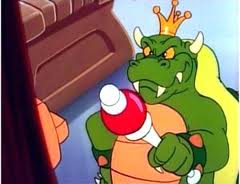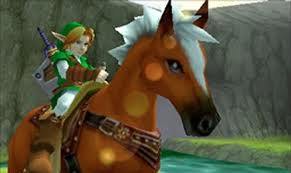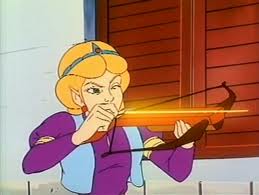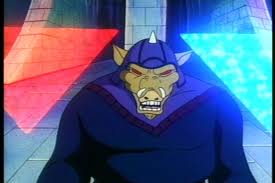
Tag Archives: zelda

Ranking the Zelda Games – Part 1

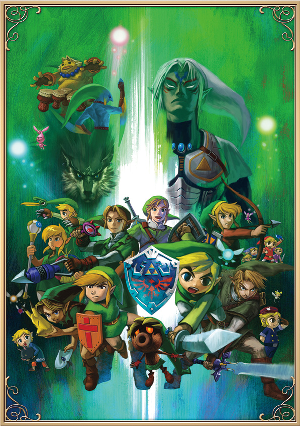
link_hyrule_historiaIf Mario is to video games what Budweiser is to beer, then Zelda is like the Alchemist Brewery. If you’re not a beer enthusiast that’s to say that Zelda is like fine wine to Mario’s table offering. And if you’re not a wine person, well I’m just saying that while Nintendo is best known for Mario, it’s Zelda that is their true flagship offering. Ever since The Legend of Zelda debuted in 1986 for the NES, it’s been the franchise that Nintendo is most apt to make sure isn’t over-exposed and benefits from long development cycles to best ensure a quality product is delivered. That’s not a slight against Mario, it’s just he has way more spin-offs and lesser outings than Link tends to (not that he’s immune from the occasional Hyrule Warriors or Crossbow Training).

To celebrate thirty years of Zelda, it seems like a good time to take a look back at the main entries in the series and rank ’em! I did it with Mario, so why not Link? The same criteria applies. I’m only ranking the main entries so Hyrule Warriors is out. I also choose to not acknowledge those horrible and forgettable entries on the CDi console. Portable entries do count, and where a remake exists I’ll acknowledge it, but for the most part, I’m ranking the originals. The era in which the game was released is also factored, though more weight is given to the games that are just plain more entertaining to play. So while some may argue that the original should be considered the best because it laid the foundation for all of the rest, I would argue that’s not enough to guarantee a number one ranking. Many of these games I’ve reviewed before, and where I have I’ll link to my original review so you can pick through what I said and criticize me for contradicting myself in places.

Before I really dive in, I would just like to say that a truly awful Zelda game has not been released in the main series. While some are definitely better than others, even the worst are playable. We’re definitely grading on a curve here. Essentially, what I’m saying is if you don’t like my criticism of your favorite Zelda game just remember I’m not saying it’s actually a bad game. So let’s get this thing going. Between the home consoles and the portables, I count a total of 15 games – 8 on consoles, 7 on portables. That doesn’t count remakes and it doesn’t count the side entries (Four Swords, Tri Force Heroes, etc.) and it obviously doesn’t include the as yet released Breath of the Wild. Now that I’ve established that, let’s see what the number sixteen, and worst Zelda game, happens to be…
rnn6qo7un0zzeasc7tjp

What could be more fun than sailing?

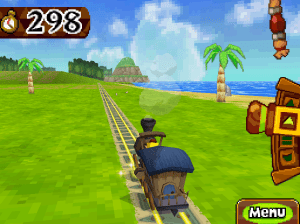
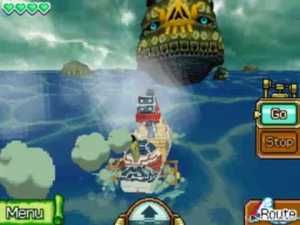
15. Spirit Tracks (Nintendo DS 2009) – Not surprisingly, our first entrant is a portable. Perhaps surprising to some, is that it’s not an infamous sequel on the NES. That’s because Spirit Tracks manages to be annoying, and kind of ugly. For Zelda on the DS, Nintendo thought it would be a great idea to force a stylus-based control scheme on the player. I can’t put into words how awful a decision that was. For the portables especially, Nintendo loves adding gimmicks to Zelda games. For whatever reason, Nintendo associates gimmicks with innovation, which I’d argue is a terrible mindset as a game developer. Regardless, the gimmick fails. The DS also isn’t powerful enough to do justice to the Wind Waker inspired visuals. To top it off, there’s also a really boring train mechanic added to the gameplay that’s topped only by Wind Waker’s sailing as most boring form of transportation featured in a Zelda title. I said before that a truly bad Zelda game has never been released on a Nintendo console, but Spirit Tracks is a game I would not recommend to casual gamers. Only Zelda enthusiasts need apply.
hqdefault-5

Maybe Nintendo should just get it out of their system and release Link’s Sailboat Training.

14. Phantom Hourglass (Nintendo DS 2007) – Given what I said about Spirit Tracks, it’s probably no surprise that Phantom Hourglass ranks beside it. Truthfully, there’s little separating the two as the control scheme is my major beef with both entries. Spirit Tracks just happens to have the more annoying train junk, while Phantom Hourglass has a slightly less cumbersome version of the sailing featured in Wind Waker. I’d also like to point out how wrong reviewers were when both games came out. Zelda has such a strong reputation that fans and professional reviewers alike seem to overlook things. As a result, if you look back on the review scores both games received you may be surprised at how high they are. I bet if you had most of those reviewers sit down today and replay these games they’d probably agree they were little over enthusiastic at the time their review was first published.
knight

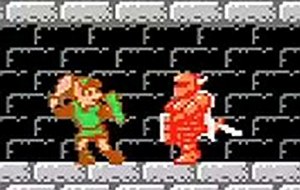
I chose this image to illustrate how pathetically small Link’s sword is. As a male, he should be embarrassed to be seen in public with that thing.

13. The Adventure of Link (NES 1987) – Ahh here it is, the black sheep of the Zelda family. The Adventure of Link, like the American Super Mario Bros. 2, was Nintendo attempting to radically change their IP with its first sequel. Wanting to approach Zelda in a whole new manner, The Adventure of Link (often referred to simply as Link) was a side-scrolling action RPG that is unlike anything that has followed in the Zelda canon. As such, it’s hard to rank amongst the other games which all follow a pretty standard formula. Link is not the 13th best Zelda game because it’s different though. In fact, my main criticism with the Zelda franchise is that it needs to take more chances (and stupid gimmicks don’t count) or risk becoming stale. Link is simply ranked here because it has a lot of warts. It’s control scheme is subpar as Link’s range of attack is brutally short. It’s also a very difficult game, but with a surprisingly easy final boss, and it’s unforgiving nature is something no other title in the series shares. With some better tuning and balancing, Link could be a stellar title and it’s the type of game I’d like to see Nintendo take another stab at. It’s also worth mentioning that it’s a rare direct sequel in the Zelda timeline (not that it’s in-game storyline is remotely satisfying, making the sequel bit more of a novelty than anything).
the-legend-of-zelda-skyward-sword-nintendo-wii-preview-screenshots-2

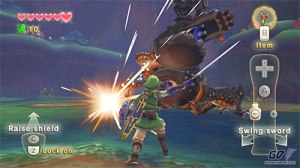
Nintendo released a legitimately beautiful game and decided to clutter with the screen with a bunch of garbage.

12. Skyward Sword (Wii 2011) – Here it is, our first controversial entry! While the DS games may have their fans, most probably rank them towards the bottom of the pile in terms of Zelda games. And Zelda II is as close to being universally disliked as a Zelda game gets, but Skyward Sword? IGN gave it a perfect rating when it came out! Luckily, this isn’t IGN.com and it’s my list and I say that Skyward Sword is modern Zelda at its worst. Nintendo has been trying to make Zelda “grow up” and be a more epic style of game seemingly ever since the backlash received by Wind Waker when it first debuted at E3. Nintendo’s solution for Skyward Sword was to make the game slower and overly pretentious with its storyline. I don’t think I’ve encountered a game with a more dull opening few hours than Skyward Sword. For all of the things Nintendo does well, crafting a compelling storyline is just not one of them. Skyward Sword is boring, and the motion controls are terrible. I couldn’t stand them. Criticize me if you wish, but I couldn’t even finish this game and yet I’m still rendering a verdict. I won’t call it a terrible game, but I will say it’s a game that I hated. Since I like to be positive when it comes to my reviews of games and art alike, I will say the visual style is wonderful and I’m impressed with what Nintendo achieved with the aging Wii hardware. Here’s hoping Breath of the Wild is better.

the_legend_of_zelda_the_wind_waker_hd_screenshot_link_windfall_island

So have we collectively decided that Toon Link doesn’t look stupid?

11. The Wind Waker (Gamecube 2003) – All right, so we’re following up one controversial entry with another, but hear me out on this one. We’ve already reached the part of our list where the games are getting much closer in quality, and few would even be considered average games by traditional measures. Though in some respects, Wind Waker still trends more towards that “OK” range than that “Wow!” one. It’s a game with a funny legacy. When the Gamecube was first unveiled it was accompanied by a tech demo that featured a Link vs Ganondorf battle that largely resembled the visual style of Ocarina of Time. Most gamers took this as an indication of what the next Zelda title would look like. Then Nintendo unveiled Wind Waker with its cel-shaded toon look, and gamers revolted. By the time it was released in early 2003 opinions had softened some and it seemed like there was an over-correction to the initial backlash and the game was largely praised. It seems to be a common favorite for many, but for me, I consider it mostly a doldrum affair. It looks fine, it runs fantastic, and the controls are more precise than the N64 games that preceded it, I just find it boring. The modern Zelda titles, much like the modern Mario ones, are not known for their challenge, but Wind Waker takes things too far by being the easiest Zelda game in existence. The combat is especially trite as the parry system is just far too powerful. And then there’s the sailing…The sailing is painfully boring, but most people already know that and even the game’s adorers acknowledge that low point. The game is flashy though, and I think that’s a big reason why so many people enjoy it, but I just don’t have much fun when I play it. At least there’s no Navi though!

427393-legend_of_zelda___oracle_of_ages__the_60

Link gets to be a fish in this one, which is certainly different.

10. Oracle of Ages (Gameboy Color 2001) – When the Gameboy Color came out, it was announced that Zelda would be coming to the console by way of Capcom, who had a solid working relationship with Nintendo. Three games were to come that would interact with one another. Three games eventually became two, and the delays were severe enough that by the time Oracle of Ages and Oracle of Seasons made it to retail most gamers ended up playing them not on their Gameboy Color, but on their Gameboy Advance. Oracle of Ages was to be the more puzzle-oriented of the two, and it’s main gimmick was a time-traveling one that was also similar to the light and dark worlds found in A Link to the Past. The visuals and play style were very similar to the Gameboy title Link’s Awakening, which had also been re-released for the Gameboy Color. The look and feel of the game though was more rooted in traditional Zelda, but did carry on the tradition of the handheld games not featuring Ganon as the main antagonist. When the games launched, I expected to enjoy Ages more for its supposed puzzle-oriented approach, but I actually found it kind of lacking. The time puzzles felt rather ordinary, especially considering Ocarina of Time had tread similar ground, and the game started to become a bit of a grind towards the end. An enjoyable game, to be sure, but perhaps not as good as it could have been.
632078-920670_20050111_003

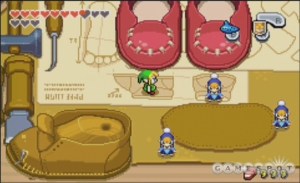
I think I would have liked this game more if Link was shrunk at the beginning and stayed that way so he could hang out with shoe gnomes.

9. The Minish Cap (Gameboy Advance Japan 2004, NA 2005) – The Minish Cap represents Link’s lone, non port, outing for the Gameboy Advance, a relatively underrated console in the grand scheme of things. It borrows heavily from The Wind Waker in terms of looks, a trend that would continue on the DS, while retaining much of the gameplay style of the Gameboy titles that preceded it. And like most of the handheld games, it features a gameplay gimmick that sometimes works and sometimes does not. In this one, Link’s hat is sentient and has the power to shrink him when he stands on specific platforms. As Minish Link, he can reach places he normally cannot. The game itself is tried and true top-down Zelda, and it’s mostly enjoyable. The gimmick overstays its welcome by the time the end arises, and stand-in villain Vaati is no Ganon, but it’s a fun, unremarkable kind of game. As such, it doesn’t really stand out amongst the Zelda library, for good or bad. If it had chosen to do more with itself it probably would have placed higher as the game looks, and handles, quite well. Re-used boss fights from older games and the same basic setup as others is what harms it more than anything. It also strikes to the core of my main point of criticism with the franchise as Nintendo is content to think whatever new gimmick it has added to the series is the basis for which it should be judged as far as originality is concerned, never mind that the same boss fights are recycled over and over.


The Legend of Zelda: A Link Between Worlds

images-194One of the greatest games of all time has to be The Legend of Zelda:  A Link to the Past for the Super Nintendo.  Following the misstep that was Zelda II:  The Adventure of Link, Nintendo put out what I consider the true sequel to the original Zelda.  A Link to the Past took the gameplay model established in the original game and expanded upon it tenfold.  A parallel world, new items and power-ups, a much better and more powerful gameplay engine.  Simply put, A Link to the Past was Zelda perfected and no title in the franchise has exceeded it, though some have come close.  As is the case with most Zelda games, A Link to the Past did not have a direct sequel (unless you count Link’s Awakening for the Gameboy) and subsequent games in the franchise basically function as a retelling of the Zelda legend.  That is, until now, with the release of A Link Between Worlds last fall for the 3DS.  Creating a direct sequel now for A Link to the Past could be viewed as an immense challenge on the part of Nintendo, or a sign that the company is running out of ideas and looking to cash-in on a classic game.  As far as I’m concerned, an all new Zelda title for the 3DS is a good thing regardless of what ties it has to other games, but I won’t deny it tickled me to go back to the Hyrule I knew over twenty years ago.

As best as I can tell, A Link Between Worlds takes place generations after the events of A Link to the Past.  The map layout is the same though and fans of the old game should feel right at home in this one.  Plot wise, it’s basically tried and true Zelda:  an evil wizard kidnaps the princess and wreaks havoc across the land and only Link can reunite the three components of the triforce and save the day.  Replacing the dark world from the first game is Lorule, an alternate Hyrule that uses a similar color palette to the familiar dark world but is broken apart with large chasms sealing off routes.  The game is quite pleasing to the eyes without being a graphical powerhouse.  Character and enemy designs from A Link to the Past are recreated here with more detail and more color.  The soundtrack is upbeat containing many familiar tunes as well as some new compositions.  It often suits the setting exceptionally well, and rarely ever does a Zelda soundtrack disappoint.

Link's newest ability allows him to become a painting on a wall and move around on it.

Link’s newest ability allows him to become a painting on a wall and move around on it.

A Link Between Worlds not only looks familiar, but also plays familiar.  Link obtains most of the items from the first game with really only one or two new ones playing any kind of significant role.  Link is controlled with the circle pad this time around instead of a directional pad, which is to be expected and functions fine, though I did find it challenging to be precise with projectile weapons, something I don’t remember being a problem in A Link to the Past.  There’s some emphasis placed on the early dungeons to show multiple levels at once for Link to traverse, presumably to take advantage of the 3D, but is mostly abandoned quickly.  I did not play the game in 3D, but I suppose it’s fine for those who like it.  As one can probably deduce from that statement, there are no 3D-specific puzzles in this game such as the ones found in Super Mario 3D Land that force the player to switch on the function, which is fine by me.

Where A Link Between Worlds looks to separate itself from other Zelda titles is with the merge ability Link acquires early in the game.  Merge allows Link to become a painting and move along walls.  He can go behind some objects this way or slip through cracks and around corners, as well as apply the power in other creative ways.  It did take me some getting used to, but overall I found it to be an enjoyable addition to the game and one of the better gimmicks to be featured in a Zelda game.  Utilizing the power is easy, but it does take some time to get one’s brain trained in a way to make use of it.  There were a few times I was stumped on how to reach a treasure chest or other location only to realize the solution was pretty obvious once my mind caught up and applied the merge ability correctly.  Aside from that, most of the other challenges and puzzles should feel familiar to Zelda veterans as they’ll know when to use the hookshot or drop a bomb.

Veterans of A Link to the Past should feel right at home here.

Veterans of A Link to the Past should feel right at home here.

The setup for A Link Between Worlds is basically identical to A Link to the Past.  The game starts off in Hyrule with Link having to make his way through three early dungeons before a confrontation at Hyrule Castle opens up a path to Lorule.  Link is able to traverse worlds via fissures that appear in walls and various structures that require him to merge with the surface and slide in.  As these fissures are found, they’ll appear on the map permanently and some areas are only reachable by exploiting them.  Surprisingly, only one dungeon requires the player to bounce between worlds which is something I thought would be exploited further.

The other heavily advertised feature of A Link Between Worlds is the non-linear nature of the game’s dungeons.  Once the player reaches Lorule, they can conquer the dungeons in any order they wish (save for one, which requires an item obtained from beating another) before heading off to Lorule Castle for the final battle.  This feature is enabled by having all of the traditional Zelda items available to Link from the get-go.  Very early in the game, a merchant by the name of Ravio opens up shop in Link’s house.  Here Link can rent any item for a small fee and hang onto it until he falls in battle.  Link can rent as many items as are available, so if the player enters a dungeon that requires the ice rod, for example, the player can simply go rent it if he hasn’t already.  Most players, myself included, will probably rent every item right away and risk having to rent them all again should a game over screen rear its ugly head.  Making the game non-linear in this way is kind of fun, but does lessen the reward for getting through a dungeon.  Each one still has something for the player to find, but not really on the same level as the usual.  It would have been nice if Nintendo added more items to the game for players to find to make-up for this, but oh well.

Many of the game's bosses feel familiar too.

Many of the game’s bosses feel familiar too.

A Link Between Worlds has one other distinguishing feature when compared with its predecessor:  it’s exceptionally easy.  Aside from Zelda II, no Zelda title really has a reputation for being a hard game, but most of them are challenging and have at least one dungeon that sends gamers running to the nearest FAQ.  A Link Between Worlds contains no such dungeons and most Zelda veterans will never see a game over screen when playing it.  I do not consider myself an exceptional gamer, but I did not die once while playing this game.  In addition to that, I had no trouble finding every heart piece, each of the lost maimais (little squid-crab hybrids hidden around Hyrule and Lorule), or toppling the game’s gauntlet scenario twice.  The dungeon puzzles are clever at times, but aren’t likely to leave gamers stumped for any significant length of time.  As for the enemies, I think many are made easier this time around because just about all of them can be taken down with the sword.  Even some enemies from A Link to the Past, such as those statues with a central eye, that required a certain item to fell can be taken down with the sword.  It’s also the type of game that starts off harder than it finishes, mostly because adding hearts remedies any challenging enemies or bosses weak.  Most of the bosses also are retreads of past ones, so there’s less trial and error.  Also making every item available at the start contributes to an easier game.  All of them consume stamina when used, which regenerates over a short period of time, so players can spam the powerful fire rod if they so desire and most enemies are susceptible to the freezing powers of the boomerang and hookshot (and if they aren’t, there’s the ice rod).

Difficulty issues aside, A Link Between Worlds is an enjoyable Zelda title that I was sad to see end.  It’s about as long as most handheld Zelda titles.  Playing at a very deliberate pace and obtaining all items, chests, and so on, the game lasted exactly 20 hours and 2 minutes for me according to the logs on my 3DS.  It was a fairly swift 20 hours with most of the game’s dungeons lasting anywhere from 15 minutes to a half hour at most.  A lot of my time was spent roaming Hyrule and Lorule and at least an hour was spent on the Octorok baseball mini-game.  Once the game is finished a harder hero mode becomes available.  I haven’t tried it, but apparently the only difference between that and the regular game is that enemies do more damage, which should help to make the game at least a little more challenging.  If Nintendo set out to eclipse A Link to the Past then it came up short, and from that perspective A Link Between Worlds is a disappointment.  As a Zelda game though, it’s great entertainment and something all 3DS owners should pick up.


The Adventures of Super Mario Bros. 3

The Adventures of Super Mario Bros. 3 (1990)

The Adventures of Super Mario Bros. 3 (1990)

It seems to me that video game cartoons are much less popular today than they were when I was young.  Then again, I don’t have any kids so I’m not often watching children’s programming so I could be mistaken.  I’m sure Pokemon is still kicking around some network and Sonic may be running in syndication, but that’s all I can come up with off the top of my head.  When I was young there were several video game adaptations for the small screen.  Just going off the top of my head I can come up with Dragon Lair, Super Mario, Zelda, Captain N (not a strict adaptation of a game, but comprised almost entirely of characters from popular games), Sonic, Battletoads, Mega Man, Street Fighter, and Mortal Kombat.  I’m almost positive I’m forgetting some but that’s still a pretty solid sample for comparison.  Maybe it’s because so many popular games these days seem to be of the M and T rated variety that we don’t see many cartoon adaptations.  Or maybe it’s because companies like Nintendo are still shell-shocked from less than stellar cartoons based on their properties.  If that is the case, then we can lay a lot of the blame on The Adventures of Super Mario Bros. 3.

The Adventures of Super Mario Bros. 3 was, naturally, based on the video game Super Mario Bros. 3.  It was also the sequel of sorts to the more popular Super Maro Bros. Super Show which featured Mario cartoons that took place in a world based off of Super Mario Bros. 2 (the American version).  That show is mostly remembered for the live-action Mario and Luigi and the songs the welcomed viewers and saw them off (Do the Mario!).  The Super Mario Bros. 3 adaptation contained no live actors and no such songs.  The opening is simply a narrator talking over an animated sequence that sets up the series.  There’s no continuity from one episode to the next and each one runs a little over 10 minutes with 26 total episodes.  The retail release is three discs worth of content and I would be surprised if any of the discs is filled to near capacity.  Mario and Luigi had their voice actors recast to Walker Boone and Tony Rosato but the rest of the cast remains intact.  The animation style is also slightly different, most notably Mario is a little trimmer and the Koopa Troopa design from the previous show was scrapped.

The Koopa Kids are probably the best thing going in this show.

The Koopa Kids are probably the best thing going in this show.

The biggest changes from the previous show to this one occurred with the villains and the location.  Location wise, this is a more faithful depiction of the Mushroom Kingdom from the game complete with numerous warp pipes and floating blocks.  For the villains, King Koopa is still the antagonist but now he’s accompanied by his seven Koopa Kids.  The Koopalings resemble their video game counterparts in design but all have different names.  Allegedly, this was due to the series being developed before Nintendo had provided the names.  The characters, for the most part, have pretty stupid and unimaginative names.  Morton Koopa Jr. is now just called Big Mouth, because he has a (you guessed it) big mouth.  There’s a Bully Koopa, Cheatsy, and Wendy is now Kootie Pie.  It’s not very important what their names are but I’ll give credit to the writers for mostly giving each of the seven a distinct personality (with the exception of the twins Hip and Hop, who are basically the same).  The ones that end up standing out include Cheatsy, who’s cunning seems to surpass his father’s as he is often able to manipulate him (usually with flattery).  Cookie is the evil genius of the kids and is definitely the most insane.  And Kootie Pie, being Koopa’s only daughter, is not surprisingly a spoiled brat and her father is a slave to her whims.

Apparently the eyes are fully-functioning on the frog suit.  Does that mean Mario can see out of them?  I must know!

Apparently the eyes are fully-functioning on the frog suit. Does that mean Mario can see out of them? I must know!

The Koopa Kids are perhaps the only bright spot of this program.  Well, that and the power-ups.  Super Mario Bros. 3 is famous for its numerous power-ups and they’re all represented here, for the most part.  For some reason I get a giddy thrill from seeing them used in the show from the common raccoon tail to the absurd frog suit.  Even Koopa gets in on the action in the series finale which is certainly noteworthy.  The rest of the show though is comprised of tired writing and simple plots.  Not much has changed from the previous show and the majority of the episodes follow the same formula of the Mario Bros. having to foil one of Koopa’s attempts at taking over the Mushroom Kingdom.  There’s usually a chase sequence or montage set to a parody of a licensed song which had to be removed from the DVD release.  There is one exception in the episode “Recycled Koopa” which contains a song called “Trash City USA” (2:05 mark in video link).  It sounds suspiciously like the Glenn Danzig song “Spook City USA” and I wonder if it was intended by someone as a parody of that.  Since the song is so obscure it wouldn’t surprise me if it snuck past the legal team (at the time the episode was produced, the song only existed as a B side to the single “Who Killed Marlyn?” which was not exactly a wide release).  There’s also the requisite episode where things get turned around and Mario and Luigi have to be saved by the Princess and Toad.  There’s also a celebrity appearance by Milli Vanilli in one episode, “Kootie Pie Rocks.”  This may be the most hilarious episode in hindsight.

Koopa is backed, armed with an assortment of magic wands this time around.

Koopa is backed, armed with an assortment of magic wands this time around.

This series also establishes the existence of the home world of the Mario brothers as The Real World.  This means several episodes take place on earth and in places like New York and Venice.  There’s even one episode where each koopaling takes over a continent.  This labeling of this world as The Real World bugs the crap out of me.  This show isn’t like Teenage Mutant Ninja Turtles with characters often breaking the fourth wall, instead that’s how the characters view this supposed real world.  What does that make the Mushroom Kingdom then?  The fake world?  I’m surprised the princess would stand for that!

Because of the short run-time, plots are often resolved quickly and haphazardly.  It’s clear the writers had little respect for children as the show is fairly thoughtless.  The animation isn’t anything to get excited over either.  For the most part, it’s fairly typical of its era but there are other shortcuts that bother me.  Most notably, whenever a character morphs into another form there’s no transition animation, it just happens, which is utter laziness.  Unfortunately, the transfers by Shout! Factory for the DVD release are atrocious.  Some episodes are okay while others drop out and look worse than what can be found on the internet.  Supposedly the master tapes for the series no longer exist, so I don’t know what the source was for the DVD, but clearly it sucked and no attempt was made for the episodes that are really bad.  The last two episodes on the set are especially bad and should have never been released in such a state.

I bought this set when I found it on sale and did so only for nostalgic purposes.  I liked the show enough when I was a kid but my memory of it wasn’t strong.  It didn’t last long as it was quickly replaced by a Super Mario World themed cartoon.  Even though the set was relatively cheap, it still wasn’t worth the purchase.  Don’t make the same mistake I did, just let this one pass, as your memories of the show are likely much better than the actual product.


The Legend of Zelda – Ocarina of Time

The Legend of Zelda:  Ocarina of Time (1998)

The Legend of Zelda: Ocarina of Time (1998)

I never set out to make an entry on all of these Zelda titles, it just sort of happened.  It’s basically the end result of me not having any new titles to play on my portable gaming devices so I’ve revisited some classics.  I’ve already made entries on the first two Zelda titles, so naturally I should make one for the third game in the series:  A Link to the Past.  But wait!  This isn’t an entry on A Link to the Past, but the next game in the series (for home consoles):  Ocarina of Time.  That’s because I can’t play A Link to the Past on my 3DS (though I could have dusted off the old Gameboy Advance, I suppose) and never played the 3DS version of the Ocarina of Time:  Master Quest.  I played thru the normal quest on the 3DS version when it was released in 2011, and I have played the Nintendo 64 version (on a Gamecube) of the Master Quest as well, so this was far from a new experience.  And since the original version and the 3DS remake are largely the same, this can be considered an entry on both.

Ocarina of Time is considered by many to be the best in the series.  It’s usually a debate between that and A Link to the Past with the sides mostly split on age lines.  People who were introduced to the Zelda franchise during its formative years will mostly lean towards A Link to the Past, while those introduced to the franchise via Ocarina of Time naturally are slanted towards that.  And even though the two may not look all that similar, the core experience is very much the same between the two.  The player controls Link who must battle thru various dungeons collecting useful tools and items along the way.  There’s lots of wandering, conversing with non-player characters, and general adventure along the way.  The player also isn’t expected to just hack and slash their way to the end as there are lots of puzzles to challenge and frustrate as well.  Regardless of what position you may take on which game is superior, know that both are excellent and enjoyable games that should be experienced by all serious gamers.

The Legend of Zelda:  Ocarina of Time 3D (2011)

The Legend of Zelda: Ocarina of Time 3D (2011)

Ocarina of Time is regarded as a near perfect gaming experience, so if you’re expecting this to be a contrarian take, look elsewhere.  And while it does earn its reputation, it also has its share of flaws.  This game is nearly 15 years old, which blows my mind.  There are many games of that age that are still considered an excellent experience today, but naturally some things age less gracefully than others.  Ocarina of Time is perhaps most notable for being Link’s first foray into the world of 3D.  Transitioning from 2D to 3D is a challenge and it’s one that has stymied other famous franchises of the same era.  While Mario was able to adapt, gaming’s other titan of the 16-bit era, Sonic, still struggles with it to this day.  Both of those characters were transitioning from side-scrollers to the 3D platform genre, while Link had the benefit of moving from that top-down perspective of the first and third Zelda titles which is actually a much easier transition.  Both Mario and Sonic were expected to jump and navigate various platforms in their games, while Link didn’t have that expectation.  Because of that, Nintendo didn’t even see fit to provide a jump button in Ocarina of Time; Link just does it automatically when he needs to.  Instead of the camera being positioned directly above Link, it’s moved behind him but still retains a high angle in many sections of the game.  Where age starts to rear its ugly head is with this camera.

The camera is often the make or break portion of any game from the late 90’s.  It still can be problematic in modern games but it seems to happen far less.  For Ocarina of Time, Nintendo opted to not give the player total control of the camera as some games do.  The players has one camera button at his or her disposal which automatically centers the camera behind Link in most cases.  There’s also the Z-Targeting lock-on button that fixes the camera on an enemy and puts Link into a sort of battle mode.  This works fine in open spaces, but some of the dungeons in the game can get cramped and in those areas the player is often left to battle the camera.  There’s one section in the game that has Link in a maze trying to avoid sentries like one Solid Snake.  This moment is brief in the grand scheme of things, but it’s still an utter failure of game design that feels shoe-horned into the experience.  The camera is very limited and almost stuck to Link’s back.  Trying to peer around a corner is cumbersome and, if you’re like me, you’ll probably just say “screw it” and plow ahead.  The automatic jump can also be a problem at times.  I do appreciate that Nintendo did not want to turn Link into Mario and have him bounce all over the place, but not giving the player control over that aspect of the character does create a disconnect of sorts.  I can’t think of any other way to describe it other than it just feels weird.  It also creates the problem of Link jumping to his death on occasion by accident (usually brought on by shoddy camera work).  In many games where jumping is relegated to a button press, simply running off a ledge causes the character to fall and grab onto the ledge.  When approaching a ledge very slowly and carefully in Ocarina of Time, the same is true, but give Link any kind of speed and he takes a leap of faith no matter what lies below.

A nice comparison shot of the two versions.

A nice comparison shot of the two versions.

Another flaw, I suppose, resides with the lock-on system and enemy AI.  When Link is locked onto an enemy all other enemies around him will back off making the game a series of one-on-one contests.  This is obviously something that was implemented deliberately by Nintendo, but it’s still kind of odd.  Though I suppose it’s no less odd than turn-based battles in role-playing games.  A lot of the dungeons are also fairly clever.  They make it obvious to the player where to go, but leave it up to the player to figure out how to get there.  There are moments though where I felt cheated and the only way to progress is to strike an object that 99% of the time has no function.  This forces the player to resort to smacking everything and anything with Link’s sword at times.  There are also a few boss encounters that rely on magic power or a specific disposable item, and if you run out, you’re out of luck and either have to reset or let the enemy kill you.  And then there’s Navi.  Oh, how I despise Navi.  Navi is this little fairy that accompanies Link and is supposed to give him advice when needed.  She’s also a targeting reticule and a means of selecting which enemy to combat.  She’s also incredibly annoying.  I hate her existence.  She’s insulting as her primary function is to state the obvious, as if Nintendo didn’t think we were capable of getting thru this game on our own.  If you try to run off and do side quests, expect to be interrupted by Navi every ten minutes or so to remind you to head to the game’s next dungeon.  And each time she does you get to hear this annoying, high-pitched voice shout “Hey!”  In the 3DS version she’s even worse as she’ll pop in to tell you to take a break if you’ve been playing for long stretches.  She doesn’t seem to recognize when the system goes into sleep mode so you may actually have only been playing for a few minutes before she starts barking.  Nintendo, all too often, pulls crap like this with its games and it drives me nuts that features like Navi can’t be toggled on and off.

Young Link in the 3DS version.

Young Link in the 3DS version.

Those are my main sources of irritation when it comes to Ocarina of Time, the rest of the game is pretty awesome, to put it simply.  Yes, there’s still some age-related items in terms of the game’s presentation and mechanics.  Link certainly doesn’t handle as smoothly as more modern titles.  He can feel a bit stiff, and combat is mostly a hack and slash affair, but it gets the job done and is easily forgiven.  The visuals on the Nintendo 64 version have not aged gracefully, but are not horrid either.  The 3DS is a noticeable improvement here as it ups the visual quality to something akin to an early generation Gamecube title.  It won’t knock your socks off, and Hyrule still seems woefully underpopulated, but it’s far better than the original.  A lot of the enemies Link will encounter are lifted from the older games and it’s fun to see them presented here.  The iron knuckles are most intimating now, and the poes possess a lot of character.  The stalfos, one of the easier enemies in prior games, are far more challenging this time around and more menacing too.

A lot of the fun experienced in a Zelda game comes from the items and power-ups Link acquires over the course of his adventure.  Many make their return in Ocarina of Time and are engaging in this new 3D world.  Link can now toss bombs and even lock onto enemies when doing so.  The hookshot doesn’t just allow him to get over gaps in the area but turns him into an elven Spider-Man of sorts!  The hammer also takes on new meaning as it’s basically a giant cavalry hammer, though I feel like it’s underutilized in Ocarina of Time.  Some of the items are only usable by child Link, and others by adult Link. The boomerang is one such item, but there’s always an item that levels the playing field.  In this case, the hookshot used by adult Link can stun enemies and retrieve certain items just like the boomerang.  The ocarina is, naturally, an important item in the game and it allows Link to play songs.  A majority of these songs function as a quick travel feature and transport Link to another area.  Others are used for puzzles.  The mechanic worked so well that it’s basically been included in some form in all of the games to follow.

Ocarina of Time marked the debut of Epona, Link's trusty stead.

Ocarina of Time marked the debut of Epona, Link’s trusty stead.

As was the case with the previous titles, the game is somewhat light on plot.  It’s fairly straight-forward but there is a story present with the best portion of it devoted to giving the antagonist, Ganondorf, a backstory.  The inclusion of time travel is kind of neat but not really fully utilized as the game basically exists in two parts, the young Link portion and the adult Link portion.  There’s only one dungeon that requires the player to tackle it with both Links and only a few instances of Link doing something in the past to affect something in the future.  Link’s method of time travel is a bit cumbersome, so I suppose it’s a good thing the game doesn’t require the player to constantly travel back and forth, but I do feel like it could have been exploited further.  Boss battles are usually rewarding, but not often challenging.  There’s often a specific way to defeat each boss, and once the player figures it out, it becomes easy.  I’d be hard-pressed to pick out the most challenging boss as few stand out in that regard, though the most interesting boss encounter may belong to Phantom Ganon of the Forest Temple.

Even though the boss fights aren’t all that challenging, the game does present a challenge elsewhere.  The traditional quest is fairly painless, but the Master Quest ups the ante by making enemies much stronger.  This kind of slants the game a little as it becomes much harder early on when Link only has a small amount of hearts.  Once that’s built up it basically normalizes.  The only other changes with the Master Quest involve the dungeons being mirrored which does kind of throw you off but is easy to adapt to.  The gold skultulas are also harder to find but the heart pieces remain in the same locations.  The 3DS version takes the mirroring concept one step further and turns the whole game into a mirror-mode of the original quest.  I actually found that harder to adapt to than the dungeons as Hyrule Field is now flipped over so what was once east is now west.  Link’s handedness even changes from being a southpaw to a righty in the Master Quest.

Link and Sheik enjoying a jam session.

Link and Sheik enjoying a jam session.

Aside from the Master Quest and visual upgrade, the 3DS version does present some other modifications to the original game.  Most notable is the use of the touch screen for items.  Items can be mapped to the face buttons as well as two additional touch “buttons” which prove useful for certain types of items.  This also reduces the clutter on the top screen as Link’s health and magic is kept on the bottom screen.  There some drawbacks to the 3DS version though, such as the cramped space.  Z-Targeting is now L-Targeting and it can get awkward due to the dimensions of the 3DS.  Tight quarters also tend to feel even more claustrophobic on the 3DS screen and the gyro-controls for first-person view and aiming is just a so-so addition to the game.  The ending credits do have an updated song that’s fully orchestrated (something the N64 was incapable of capturing) which was a nice surprise upon completion.  All in all, if you’re looking to play this game for the first time there’s no obviously better version.  I would probably just go with whatever is easier to obtain, or if you know you want to play this primarily in front of your television, the original is more than sufficient.  You could also look up gameplay on a video sharing sight to decide if the visuals are a big enough reason to select one over the other.  And I guess if you love the whole 3D thing, that’s a factor too (I played the game in its entirety with the 3D feature turned off).

Ocarina of Time, no matter how or when you choose to experience it, is an excellent gameplay experience.  It holds up remarkably well, not just when age is considered, but just in how easy it is to come back to.  I’m mostly a one and done kind of gamer, meaning I beat a game once and that’s enough for me.  With Ocarina of Time, I’ve played thru and beaten it multiple times and each time the journey is an enjoyable one.  My only real concern with the game is for people who have never played it.  They may approach it thinking it’s a perfect game, but it’s not.  The game had some flaws when it was released in 1998 and some other flaws have been exposed due to age.  No one should approach any game expecting perfection though as there is no such game, just as there is no perfect movie or perfect book.  Our opinions and tastes are too broad as a people to ever declare any one game perfect.  We can only apply such absolutes in the broadest of strokes and at the highest categorical level:  Food is great.  Oxygen is excellent.  Zelda is fantastic.  Yeah, that sounds about right.


The Legend of Zelda (The Animated Series)

Title screen from the Zelda cartoon (1989).

Title screen from the Zelda cartoon (1989).

Back in the 1980’s you could not get away from Nintendo.  The Nintendo Entertainment System was flying off store shelves and Super Mario was turned into a household name.  It only made sense that Mario and other Nintendo properties would have a lot of marketing power.  There were toys, pencils, lunch boxes, cereal, soda and so on.  It was Mario Mania!  Not surprisingly, Nintendo licensed the stomper of koopas for television and it wasn’t long before kids were sitting down in front of the tube to watch the Super Mario Bros. Super Show.  Hosted by former WWF personality Captain Lou Albano, as Mario, and Danny Wells (Luigi), the Super Mario Bros. Super Show began with two in a live-action setting before leading into a cartoon.  The live-action segments are probably the best remembered parts of the show because they’re quite absurd by any standard, especially for people who didn’t live through it.  The theme song was also pretty memorable, “The Plumber’s Rap,” and the ending theme “Do the Mario!” has enjoyed a second life on youtube.

The show only ran from September 1989 to December of the same year but since it aired every weekday afternoon it spawned 65 episodes worth of content.  It would be replaced with new Mario cartoons that didn’t feature the live-action segments and were based on later games in the Super Mario Bros. series.  They would be featured with another Nintendo cartoon, Captain N:  The Game Master, as part of the Nintendo Power Hour on Saturday mornings.  Before that though, Mario was on five times a week in live-action form, and four times in cartoon form.  The cartoon was mostly based on the American version of Super Mario Bros. 2 but with some differences.  The creators wisely left out the whole vegetable tossing angle in favor of fire flowers and the antagonist of the series was King Bowser Koopa instead of Wart.  It was basically an adventure type of show where Mario, Luigi, Toad, and the Princess Toadstool would travel to different parts of the Mushroom Kingdom while foiling the schemes of Koopa.  There would often be a musical number and many episodes were parodies of popular movies and stories.  It was a very gimmicky show, like a lot of cartoons from that era, and it’s one that really hasn’t aged that well.

Remember these guys?

Remember these guys?

Now the show aired five days a week, but the Super Mario Bros. cartoon only aired four days a week.  That’s because every Friday Mario took a day off and made room for another hero:  Link.  Link, of course, is the hero of the Legend of Zelda games who was also pretty popular at that time.  The Zelda cartoon was different in tone from the Mario one.  Yes, it was still geared towards kids but it shunned a lot of the tired chase sequences and movie parodies that were commonplace in the Mario cartoon.  The show revolves around Link, the hero of Hyrule, as he defends the castle and its coveted Triforce of Wisdom from the forces of the evil sorcerer Ganon.  The show is based off of the first Zelda game with some references made to its sequel as well.  Link is pretty clearly modeled after the character illustrations from those booklets and wields the same dinky little sword he has in Zelda II.  Ganon, on the other hand, looks to be more of a concept.  In both games, he’s pictured as a big green/blue pig who does have some magical powers.  In the show, he has more of a wizardly look with an ugly pig-like face.  He’s actually more menacing looking this way, but he’s not going to get in there and mix things up with Link.  He’d rather stand back and let his minions do the fighting, who are not surprisingly incompetent.  He’s in possession of the Triforce of Power (the show makes no mention of the Triforce of Courage) and has an endless supply of Moblins and Stalfos.

Other characters include a fairy named Spryte, who is likely modeled after the generic fairies from the Zelda games.  She is kind of the Tinker Bell to Link’s Pan in that she likes Link, but he only has eyes for the princess Zelda.  Zelda appears in each episode and is portrayed in a way that probably surprised viewers at the time.  Zelda shuns the traditional princess attire and instead sports trousers and tunic much like Link.  She’s not the typical damsel in distress and seems pretty capable of taking care of herself.  She does have a snotty side, and because she’s the target of many of Ganon’s schemes, she does often require saving from her “hero.”

Zelda is not afraid to get her hands dirty.

Zelda is not afraid to get her hands dirty.

The portrayal of Link in this series is what many fans dislike about the show most.  Link, in the games, really had no personality.  Even in the modern games, he doesn’t have much of a personality so I don’t know what fans were expecting from the character, it just wasn’t this.  Link is a brash, cocky, and kind of lazy character.  He views his title of “hero” as a job and one that just gets in the way of his pursuit of Zelda.  Not an episode goes by where Link doesn’t beg the princess for a kiss, and because viewers need a reason to tune in, he never gets one.  He’s also been given a catch phrase, “Excuuuuuse me, princess!”  Some day I would like to watch the entire series and count how many times Link says that line (according to Wikipedia, it was 29 times).  The show only produced 13 15-minute Zelda cartoons, but I’m willing to bet that Link easily averaged more than two occurrences of that catch phrase an episode.  Sometimes the line makes sense, and sometimes it’s just shoe-horned into the script.  It even occurs during the opening credits.  Link may have said that stupid line more often than Michelangelo said “Cowabunga” on the TMNT cartoon, on a per episode basis.

Ganon and the two things he covets most.

Ganon and the two things he covets most.

Anyways, that aside, the show is of a better quality than the Mario cartoons, though that isn’t saying much.  In general, each episode features Ganon executing a new plan to capture the Triforce.  Some of these are more clever and entertaining than others.  There’s one where Ganon goes Robin Hood and to sneak into a magic contest, there’s another where a Zelda clone infiltrates Hyrule, and there’s even a frog prince story-line where Link finds himself the victim of a magic spell (and if you’re wondering, no, Zelda doesn’t break the curse with a kiss).  That said, there isn’t anything in the writing to this show that’s going to impress.  It’s pretty standard fare for the period.  One thing I can appreciate though is the attempt of the writers to explain a few loose ends from the video game.  Namely, how can Link carry so much crap around with him?  Apparently, he has a magic pouch that causes items to shrink down to micro size to fit in.  Throughout the series he and Zelda will often pull out items from the games like the boomerang, bow, and bombs.  Other enemies make appearances too like the octoroks and just about every boss character from the original game.  If you’re watching it to spot items from the game, you’ll have some fun with the show.

Animation wise, the show is mostly crap.  It’s not awful to look at but this is a DiC produced show and DiC liked to put out lots of licensed cartoons on the cheap.  They would get a large amount of cartoons made in a short amount of time so that the shows could go direct to syndication and exist for a few years and bounce around several channels.  I think, on average, the animation here is better than what’s in the Mario cartoons but that’s not saying a whole lot.  The audio is okay though and the Zelda theme is used throughout, which doesn’t hurt it.  Link’s voice, when he’s not saying that regrettable line, is all right.  Ganon is voiced by Len Carlson who should be familiar to fans of 80’s and early 90’s cartoons as he got around.  He uses a shrill voice for Ganon that works for this portrayal of the character.  Zelda is voiced by Cynthia Preston and I always enjoyed her voice.  I don’t really know why but I was drawn to it as a kid.  Maybe because Link sexualized her and I wasn’t accustomed to seeing that in other kid shows of the time.

She's such a tease.

She’s such a tease.

The Legend of Zelda cartoon is not something that is remembered because it’s a wonderful companion piece to the video games, it’s remembered for nostalgic purposes only and is a kind of humorous reminder of how games were marketed back in the day.  A lot of fans prefer the Zelda themed episodes of Captain N to this show because Link was more of a hero type in that show than he is here.  That show really isn’t any better on the whole as it was just another marketing tool (and all of these old cartoons are basically shunned by Nintendo today) to move video games.  This isn’t a show that most adults can turn on and digest over an hour as it’s pretty damn bad.  It’s kind of funny to laugh at, and I can say I do enjoy it more than the Mario cartoons, but if I didn’t watch it as a kid there’s no way I’m making it thru more than one episode.  The complete series was released by Shout a few years ago and can probably be had on the cheap for those looking to experience it.  Those that have never seen it would probably be better off just watching some clips on the internet as opposed to spending real money on the series.


The Legend of Zelda

The Legend of Zelda (1986)

The Legend of Zelda (1986)

It likely comes as no surprise that the author of a blog titled The Nostalgia Spot enjoys playing old games.  I love having old consoles laying around the house, either hooked up to a television set or even just sitting in a closet waiting for a rainy day.  It’s almost a sort of nostalgic high to snap a cartridge into a Sega Genesis or hear that familiar spring when pushing a cart into place on a Nintendo Entertainment System.  Because so many of these systems are existing in a closet or attic, it can be a bit of a chore to relive the old days but thankfully digital distribution is here to make things easier.  Sure, nothing is better than the original experience.  Often times if there’s an old game I feel like I missed out on I’m more apt to find a used copy on the internet than download it.  The one exception is in the portable realm.  Nintendo is one such company that has released a lot of its old titles for download onto portable gaming systems.  I’d actually argue the company hasn’t released enough.  It has a tendency to focus on old portable games when selecting new ones to release and not enough on old NES or SNES games.  A lot of the classics are available though, and that’s why I’ve been spending a lot of quality time with an old favorite recently:  The Legend of Zelda.

I’ve actually had a copy of The Legend of Zelda on my 3DS for awhile now.  I bought the system at launch only for Nintendo to drop the price dramatically not long after due to lackluster sales.  To avoid ticking off the early adopters Nintendo released 20 free games to these “Ambassadors,” as they called them.  They were ten NES games and 10 Gameboy Advance games.  Among those ten was The Legend of Zelda.  Initially these releases were bare-bones lacking some of the features of the typical downloadable games.  As the games were released to the public though, Ambassadors were able to re-download them for free with the save state feature.  The feature is certainly a nice one to have, especially for a game like The Legend of Zelda which popularized the save feature in console games.  The feature was rather crude by today’s standards, but the re-release fixes that and allows the user to save whenever he or she wishes, which is a necessity for gaming on the go.

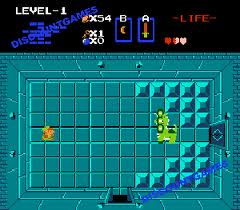
The boss of the first (and 8th) dungeon is a cake-walk.

The boss of the first (and 8th) dungeon is a cake-walk.

For the most part, I don’t blog about the all-time classic titles, there’s just enough of that stuff all over the web.  Sometimes a game becomes so old though that people tend to forget about just how good it is.  No one I know would say The Legend of Zelda is a bad game, bust most would the caveat that it’s “good for its era.”  That is just not true.  This is a title that does not need to get by on reputation.  Before playing it I had spent a few weeks playing a recent RPG released for the 3DS:  Paper Mario Sticker Star.  The Paper Mario series is a pretty good one, but Sticker Star is not a very good game.  It’s far from awful, but it’s so tedious and needlessly gimmicky that I just found it tiresome.  I saw it thru to the end but really wanted to wash the stink away.  I didn’t have a new game lined up, so I dug into those ambassador titles and settled on The Legend of Zelda.  Now, I’d be lying if I said it was easy to jump right into.  There’s always a bit of a culture shock when going back nearly 30 years with an old game.  That’s when one realizes just how used to today’s comforts they’ve become.  With The Legend of Zelda we’re talking about an early generation NES game.  It’s not even considered good looking for an NES game.  The backgrounds are pretty sparse, all of the dungeons look the same (save for the color), and Link (the protagonist, for those unaware) doesn’t have much personality.  Pretty much the entire plot to the game was contained in the booklet that came with it, so don’t expect much in the presentation department.  This is just a really simple looking game.

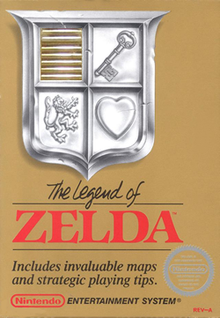
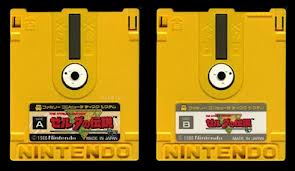
Pretty much everyone is familiar with the gold NES cart, but fewer are aware that in Japan the game was originally released for the Famicom Disk attachment.  This was never released in other parts of the world, which is what necessitated the inclusion of a battery for saving in the American cart.

Pretty much everyone is familiar with the gold NES cart, but fewer are aware that in Japan the game was originally released for the Famicom Disk attachment. This was never released in other parts of the world, which is what necessitated the inclusion of a battery for saving in the American cart.

Despite that though, it really didn’t take me long to get sucked in.  It actually didn’t take me as long as I would have guessed.  Once I got my feet wet and found that first dungeon I was off and running.  Things started coming back to me, I started getting used to how to approach each enemy again, and I started to have fun.  Lots of fun.  This game has no business being this good still.  It’s also crazy how similar it is to every game in the franchise.  It’s easy to forget where the series started when chasing down Ganondorf or watching Link turn into a wolf, but the same basic game design has remained the same since 1986.  It’s funny to me, and a bit misguided, how Nintendo has tried to give gamers a new experience by adding some silly gimmick to recent Zelda titles but has never really attempted to change the experience.  Majora’s Mask is probably the lone exception on console games, while the portable titles have mixed things up to some degree while maintaining a familiar interface.  Though even there, Nintendo has still muddled things with gimmicks like touch controls or trains.  Nintendo consistently fails to realize that it often implements change, like touch controls or the waggle controls on the Wii edition of Twilight Princess, for the sake of doing so and rarely addresses the actual gameplay experience.  Whether gamers are pressing a button or flicking their wrist, they’re still making Link swing a sword.

Tangent aside, it’s actually a great deal of fun to be reminded of where the series started.  I always liked this title back on the NES, and the sequel only reinforced that, so I suppose it shouldn’t surprise me that I still like it.  The game probably would be less fun for someone who has never played it.  There are so many little things one has to do to make it thru to the end that the game just doesn’t even clue you in on.  Throughout the game there are these old hermits living in caves that offer advice.  Some of it is cryptic but does have value.  Some of it seems like nonsense, a mistranslation perhaps.  Then there are other secrets that just have no indication whatsoever.  The entrance to Level 8 is one such thing where Link has to burn a random bush on the overworld map.  Most bushes aren’t affected by the candle item Link has to use to burn this one particular bush down, but the player is still expected to figure it out somehow.  I suppose this bush isn’t completely inconspicuous, but others are.  There are a few hidden stores or caves that a player isn’t going to find without help.  And that may have been the idea as there were numerous tip hotlines and the like for games back in the 1980’s.  Nintendo would get in on the action with Nintendo Power though this game arrived before that.  And Zelda games weren’t the only offender, but it’s something that really isn’t heard of in modern games.  We’d consider it poor design.  In other words, if this is your first time playing this game, expect to be in need of a walkthrough at some point.

The ones in blue are a pain to deal with.

The ones in blue are a pain to deal with.

Aside from some confusing moments, the game actually isn’t too difficult provided you know what you’re doing.  If one never upgraded the sword or Link’s armor then the game would get really hard.  I actually got the magic sword one dungeon later than I could have and that last dungeon with the mid-level sword was a bastard.  The game takes some getting used to in order to figure out just how close Link needs to get in order to defeat enemies.  Early on I found myself taking unnecessary hits but once I found my bearings I was okay.  Most of the enemies move faster than Link, and since this was before the invention of his spin attack, it can be challenging to keep them at bay.  The boomerang becomes Link’s best friend and remains so for most of the game as it freezes enemies on contact.  Keeping Link’s health maxed out is also a tremendous asset as that lets him shoot beams out of his sword.  Some enemies though are just plain hard to defeat without taking damage.  The wizrobes are probably the most challenging as they take 3 hits with the magical sword to defeat.  Striking them also doesn’t interrupt their movement or attack, and they can teleport all over the screen.  Needless to say, getting out of a room full of them without taking any damage is a true challenge.  The boss encounters, on the other hand, are all pretty easy as long as you know what you’re doing.  The final boss, Ganon naturally, can only be killed with a silver arrow and it’s entirely possible to reach him without ever finding said arrows making survival an impossibility.

Ultimately, I’m making this entry because I’ve been surprised with how much enjoyment I’ve been able to squeeze out of this title recently.  If you’re a younger gamer who never played the original Legend of Zelda then I suggest you do.  There are many options for playing it in this day and age as it’s been re-released more times than I can remember.  The easiest way to get it is via download from Nintendo and I think it only costs five bucks, but I’m not certain.  This is one title that has withstood the test of time, Zelda II on the other hand…


The Wii U and Gaming in the HD Era

Last Sunday, Nintendo unleashed upon the world its latest console:  the Wii U.  For some, the Wii U is the beginning of the latest era of gaming while others simply view it as Nintendo’s entry into the current HD generation of consoles.  Regardless of your opinion, this is a new console and new consoles are something to get excited about.

I had made the decision to reserve a Wii U for myself awhile back so picking up the deluxe bundle on launch day was no problem.  I also picked up a new Pro controller and a copy of New Super Mario Bros. U.  As far as console launches go, the Wii U appears to have had a mostly successful one.  When I picked up mine it was around 1 o’clock and the Best Buy I went to was already sold out of the deluxe bundle.  The sales receptionist I spoke with wasn’t certain, but did think they still had a couple of the standard bundles in stock.  For those unaware, the deluxe version comes with more internal memory (32 GB vs 8), a copy of Nintendo Land, a charging dock for the GamePad, and comes in black as opposed to white.  For the extra fifty bucks, it seemed like a smart choice to me though for those stuck with the smaller unit know that the Wii U works with most external HDD so expanding upon that 8 GB of memory shouldn’t be too difficult.

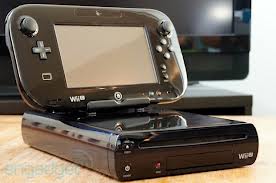
If I had to use one word to sum-up the GamePad, it would be: Big.

The Wii U is quite similar to its predecessor in terms of looks.  It’s fairly small and plain looking.  It still makes use of a sensor bar and Wii remotes and the main home screen remains mostly unchanged.  The big change obviously comes in the Wii U’s GamePad, a combination of a tablet and a standard controller.  It has four face buttons, twin analog sticks, and four shoulder buttons including two triggers.  It has a slot for a stylus as well as home, power, and TV buttons.  The TV button allows you to pair your GamePad with your television and use it as a second remote.  It’s functional and kind of neat for when you have your GamePad on your lap.  The controller is fairly large, but light.  It’s nearly the same size as the console itself.  It’s light feel is welcomed, but it does make the controller feel a bit cheap.  Shaking it causes the buttons to rattle, and the shoulder triggers are not analog meaning there’s no sensitivity to them (pushing it all the way in or slightly has the same in-game effect) which is a bit of a letdown.  The touchscreen though is large and quite nice with very good picture quality.  It doesn’t seem to be quite as good as the Playstation Vita’s OLED screen, but gets the job done.  It communicates with the Wii via wireless and infrared and there’s no noticeable lag.

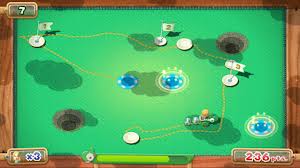
The Yoshi’s Fruit Cart game is one of the more interesting ones on Nintendo Land.

How the GamePad functions with the Wii U is obviously what will make or break the system.  Nintendo Land is the game that’s supposed to put the GamePad’s features front and center which makes it almost a required purchase for early adopters.  Nintendo Land is basically a collection of mini games each one based on a different Nintendo property.  Some of these IPs are pretty well known, like Zelda, while others not so much, such as Balloon Fight.  I’m not a big fan of mini game collections so I haven’t really got into Nintendo Land.  There is some cool stuff in there though.  The Ninja Battle game has you aiming your GamePad at the TV and sliding your finger towards the screen to toss ninja stars.  The Yoshi Cart game has you draw a line on the GamePad for your cart to follow to pick up fruit on the way while avoiding obstacles.  The catch is that the fruit and obstacles only appear on the TV screen while the GamePad is blank.  Games like the Zelda adventure are mostly straight forward.  The GamePad can be used to view the scenery by physically moving it, or the player can just look at the screen.  Nintendo Land seems to just scratch the surface without really showing anything revolutionary.  It will be interesting to see how Nintendo makes use of the GamePad in their classic franchises.

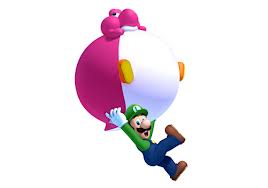
Baby Yoshi returns in NSMBU.

There’s no wondering when it comes to Mario though, since he has a new game at launch.  New Super Mario Bros. U is pretty similar to the previous entries in the series, GamePad or no GamePad.  I’m only a few levels deep, so I can’t say if it’s better or worse than the other entries in the series yet.  I can say that I like the Super Mario World inspired layout, and I like the inclusion of Yoshi even if he’s added as he was in the Wii game where he can only be used in certain levels.  I haven’t tried any multiplayer with it, so I can’t even comment really on the GamePad’s use there but in the single player game it’s really only used as a second screen.  Such a feature does have its uses as you don’t even need the television on to play the game, but it is disappointing that Nintendo couldn’t find a way to make use of its new toy with its flagship series.

It’s pretty nice that Nintendo has finally entered the HD era, but what isn’t nice is that they’ve also adopted a lot of what makes this era of gaming so frustrating.  The Wii U is the victim of the dreaded day one update, which means the second you plug in that new console it’s going to prompt you to update the operating system.  Ditto for both Nintendo Land and NSMBU.  The OS update took me well over an hour to update and install, while the Nintendo Land update took around a half an hour and NSMBU around 15 minutes.  That’s pretty damn annoying and one of the things that makes me long for the days of old.  Also complicating things, is the Wii U is the victim of severe loading times.  Changing screens takes around 15 seconds on the unit and booting up a game is far from seamless.  I don’t know if this is something that can be improved upon with future updates or if we’re just going to have to deal with it.

The Wii U has some things going for it, but it’s definitely not the revolution that the Wii was.  Playing the Wii for the first time felt incredibly fresh and new, while I didn’t get the same feeling when playing the Wii U.  It’s certainly fun, and there’s probably better software out there (like Scribblenauts Unlimited) for showing off the GamePad, but right now the console is far from a must buy.  Get it if you love Nintendo or want to have the latest thing, otherwise most will be fine waiting for the first big Nintendo game on it or price drop.