Tag Archives: x-men

#10 The Best in TV Animation: X-Men

SF.Graz.1.0317––HANDOUT ART OF THE X–MEN CARTOON SERIES.

When I settled on doing a top ten for animation on television there were eight entrants I felt rather strongly about, and a ninth I was pretty content with. The tenth spot was the wildcard and a number of programs were considered, but since this is my list (and it’s not exactly an original topic) I decided I should use this spot to highlight a personal favorite of mine, so I went with X-Men. That’s a pretty flimsy lead-in but it’s not as if X-Men is undeserving of praise. I’ve wrote about the series quite a bit, even going so far as to do a mini review for each of the show’s 76 episodes during this blog’s first year of existence. At the time, I was using the show as a device to keep me posting but I was also reliving what was probably my favorite show as a kid.

X-Men launched on the Fox network in October of 1992, and at the time, was another attempt to re-ignite Marvel’s television properties. Prior to its debut, a pilot had been produced in the late 80’s called “Pryde of the X-Men” which focused on a much different cast of mutants. It was never picked up, and Marvel’s television properties were fading from memory. The same could be said for superhero cartoons in general, as only recently did Batman return to animation shortly before X-Men debuted. X-Men was the best-selling comic at the time, so it made sense for a cartoon to finally break through. Before X-Men (and Batman), cartoons based on comic book heroes tended to be pretty generic and bland. They usually took the form of the hero, or heroes, taking on the villain of the week and toppling whatever hair-brained scheme had been concocted by said villain to take-over the world or just cause general mayhem. Other shows, like Teenage Mutant Ninja Turtles, were just severely watered-down aspects of the source material intended to move action figures, which in the 80’s became frequently attached to various cartoon properties (He-Man being the best example of a cartoon existing solely to sell toys).

Wolverine and Gambit were likely to two most popular characters on the show, but that didn't stop the writers from developing many others.

Wolverine and Gambit were likely to two most popular characters on the show, but that didn’t stop the writers from developing many others.

X-Men was different. This was a show that, while aimed at children, wanted to bring legitimacy to the medium. The show placed its brightly colored heroes against the backdrop of an easy to grasp civil rights movement. Enemies were no longer defined as simply bad guys but were colored with shades of gray and given real motivations for their actions. Magneto was the prime example. Had “Pryde of the X-Men” been picked up, Magneto would have just been another super villain with a motley crew of evil mutants willing to do his bidding and match up against the heroic X-Men. In the Fox show, he was a Holocaust survivor which had convinced him that humanity could not accept the differences within its own kind, and therefore, could never accept anyone outside humanity. In this case, that was mutant-kind, often referred to as homo-superior by Magneto. Mutants often took the form of normal looking people but with special gifts. We the audience took those gifts to be super powers, and in the case of the X-Men, most could be described as such. They did often come with costs that were more obvious for certain individuals. Cyclops could not open his eyes without a special visor or else risk destroying anything in his line of sight. Rogue could not even touch another person skin-to-skin without putting them in a coma. And Beast was simply covered in blue fur. This take, later admitted by creator Stan Lee as a lazy way to explain how the X-Men got their powers, freed the writers from having to come up with yet another experiment gone wrong origin story for every mutant under the sun.

This civil rights narrative is what framed the first two seasons of the show. The opening plot revolved around an organization funded by the government who would pose as friends to mutants but was really secretly creating a database of mutants from which it could target them and, though only hinted at during the show since it was for kids, cull them from society. The X-Men could not simply fight this opponent and beat them into submission, but had to convince the United States government that this was the wrong course of action. As a child, some of this went over my head. When Beast was put on trial in episode three I did not understand why the X-Men did not simply break him out of jail. Such would have likely been the course of action in many of the show’s contemporaries with the plot either being resolved at the episode’s conclusion or just dropped entirely. Instead, Beast spent the bulk of the first season in jail awaiting a formal trial before finally being pardoned after the X-Men were able to win-over at least one prominent political figure.
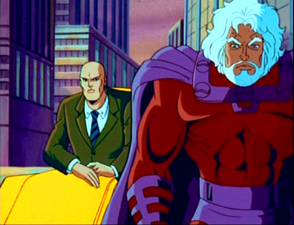
Magneto was easily the show's most successful attempt at blurring the lines between hero and villain.

Magneto was easily the show’s most successful attempt at blurring the lines between hero and villain.

After the first season, it seemed like all was right with the world but the show once more took a more sophisticated approach. With mutants gaining more legal freedoms, bigoted members of society sprung up to do what they felt the government failed to do. Once more, the show mirrored society in that the X-Men couldn’t hope to ever win over everybody to their side. The show would lose touch with this narrative after season two, instead opting to take the show in a more sci-fi direction while focusing on more condensed plots, but in those two seasons X-Men did a lot to legitimize the superhero genre outside of the comic book world. It’s the strength of those two first seasons, merely 26 episodes, that vaults the X-Men into this position, but the show also got a lot else right.

For starters, the voice cast (comprised of Canadian voice actors mostly unknown to American audiences) did an excellent job with the often weighty material. The show could, at times, be joyless and very melodramatic and the scripts would often contain superhero jargon that probably read poorly, but the actors were able to step up and deliver. Some characters, like the perennially wooden Storm, were always lacking but others shined very bright. For me, I will always hear Cal Dodd’s voice in my head whenever I read a line from Wolverine. His raspy, quiet, delivery perfectly suited the sometimes explosive Wolverine. When the show needed him to get loud and angry, Dodd was able to come through time and time again. David Hemblen’s Magneto was another highlight. This show is one of the few that actually depict the Austrian Magneto with an accent, something even the films chose to ignore. George Buza’s Beast was so good that it obviously formed the template for the Kelsey Grammer version of the character that appeared in X-Men 3. The soundtrack was also a standout, mixing orchestral instruments with electronic aspects that suited the show’s somewhat futuristic-like setting. The theme song should be considered a cartoon classic at this point.
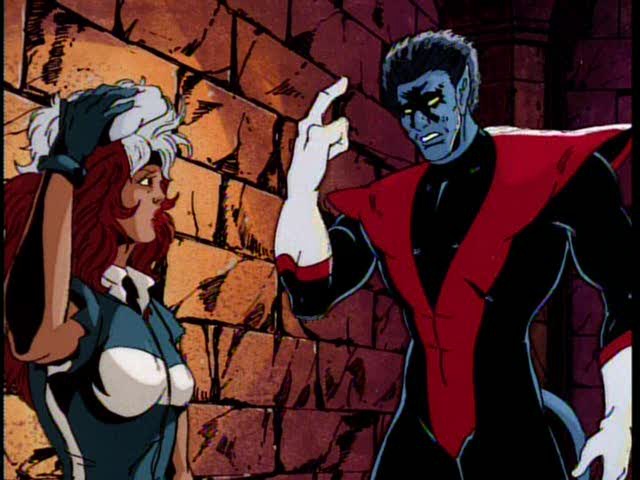
The show never added to its core cast of X-Men, but that didn't stop other fan-favorites from appearing in the show, like Nightcrawler.

The show never added to its core cast of X-Men, but that didn’t stop other fan-favorites from appearing in the show, like Nightcrawler.

Visually, the show adopted the look of Jim Lee’s X-Men quite well with some minor alterations. Most of what makes up the Jim Lee style was still retained though, with the men having bulging physiques and the woman looking like super models. Even the extras in society tend to look idealized. It’s a legitimate criticism of Lee’s work but I’m sure the animators were happy that the vast majority of characters were basically the same shape. There is enough detail in the work that the show looks quite nice in still-shots. The animation, especially in the first season when the budget presumably was at its smallest, could be stiff at times. The animators were obviously under some constraints as well as to what kind of violence could be depicted. After the first season though, the animation improved noticeably. X-Men was not the best looking of its kind, but it certainly was not among the worst. I enjoyed it far more than I would Spider-Man, which came in 1994 and featured some primitive, and mostly ugly, computer-enhanced imagery as well as a softer color palette.

X-Men was able to leave a mark on the world of cartoons. It’s solid production values combined with its mature approach to story-telling is what makes it standout amongst other Saturday morning fare. X-Men is still the gold standard for the super hero ensemble show, and still stands as the best thing Marvel has ever done on television. X-Men took risks in a world where risk-taking is often frowned upon. Most people think kids want a mindless program where the hero always wins and everything is wrapped up in 22 minutes. Children are capable of so much more and the success of X-Men is proof of that.

If you want to read more about the X-Men animated series, there’s plenty to be found on this blog. In addition to numerous posts that summarize and review every episode, I also made an entry on what I considered to be the best episodes the show ever produced.


Gargoyles: Season 2 Volume 1

Gargoyles_DVD_2The cover of the DVD release of Gargoyles Season 2 dubs it as Volume 1 of the second season.  At first glance, that may seem like a greedy way to release a show to DVD, but that is not the case.  A common practice of children’s animated television was to order 65 episodes as early in the life of the series as possible to make the programming eligible for syndication where more money could be made off of it.  I say “was” because I’m not sure if that is still the case with numerous cable outlets now providing a lot of the entertainment these days.  Gargoyles was not originally broadcast on cable though, which is why season 2 is 52 episodes long, which following the 13 episode first season, gets the series to 65 total episodes.  Sometimes networks are so confident the show will be a hit they go right from the pilot to a 65 episode order.  This was the case for the still popular Batman:  The Animated Series which featured a pretty bankable star in Batman, but Gargoyles was an all new intellectual property so Disney opted to go for a trial run with the first 13 episodes before going all in.

The process of large season orders seems like a win for fans of the show.  After all, a 52 episode season would theoretically allow for a new episode every week for an entire year, though this wasn’t the case for Gargoyles since it was an afternoon program.  It does usually mean shorter wait times between new episodes, but things can get a little erratic since the season will usually begin airing while a lot of episodes are still in production.  There’s also the other downside to a large season such as this which is these episodes need to get produced quickly, and more people are needed for production and story-writing.  The first season of Gargoyles was a tight, neat collection of episodes with high-quality animation for television.  Season 2 sometimes has the feel of “too many cooks in the kitchen” and episodes become more stand-alone in nature.  The animation is still among the best when Gargoyles is compared with its contemporaries, but there are some drop-offs and it’s apparent that the show had multiple teams for animation.  Some episodes feature sharp lines and tight animation while others are more rounded and toon-like with characters often making over-exaggerated gestures (those familiar with X-Men likely have an idea of what I’m talking about).  Which one looks best is a matter of taste though (I prefer the harder look for this program) at least, with the overall animation quality usually pretty strong from episode to episode.

There are some pretty interesting plot twists to find in season two.

There are some pretty interesting plot twists to find in season two.

Inconsistent animation is expected when a show requires a large amount of episodes be produced, but my main concern for Gargoyles was how the writers would respond when tasked with filling so many hours.  The first season largely operated in a serial format with each episode tied to one overall plot.  Some felt more stand-alone than others, but all plots were referenced at one point or another and the overall quality of the story-telling was quite good.  I knew season 2 would have to feature more stand-alone episodes, but thankfully very few feel like throw-away or filler episodes.  Many of these one-shots still contain plot devices that have repercussions on the episodes to follow, such is the case with the conclusion of the episode “The Mirror” when Demona gains a new power.  Many others choose to introduce new villains or allies that will pop up in later episodes, as is the case with the characters Doctor Sevarius and Jeffrey Robbins.  In short, the structure of the show remains rewarding for longtime fans.  This does come at the cost of making the show a little harder to jump into at any point for newcomers, but since it’s no longer on television, this is really no longer a concern.

There are many stand-alone episodes, but there’s also no shortage of multi-part arcs.  The first half of season two contains the four part “City of Stone” and the three part “Avalon.”  Both are heavily reliant on flashbacks as it seems one goal for season 2 was to flesh out the villains even further, specifically Demona and MacBeth.  We learn about their history together and how Demona has survived the centuries and remained largely the same in appearance.  In season one, we the viewers were basically left to assume that gargoyles are extremely long-lived given that Demona was not affected by the Masgus’ spell like the others, but we learn in season 2 that is not the case.  There are lots of other recurring characters in season 2 such as The Pack, Tony Dracon, Derek Maza, Coldstone, and of course Xanatos.  Xanatos is still primarily an adversary of the Manhattan Clan, but he’s also an unlikely ally in several episodes.  One could even suggest that the writers go to this well a bit too often, but such is the case when 52 episodes have to be written in a short amount of time.  Still, I like the role Xanatos plays on this show of the equal opportunist who has his own agenda that isn’t always clear.  By the end of the first half of the season viewers, and even Goliath to some degree, have mostly caught on to Xanatos and the game he plays making me wonder what role he’ll play going forward (as I honestly can’t recall from my days of watching this as a kid).  Xanatos is also paired this time around with Fox, of The Pack, as his love interest which is a rather interesting dynamic.

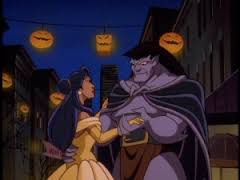
Now where have I seen that dress before?

Now where have I seen that dress before?

Another part of the plot the writers seemed eager to explore in season 2 was the relationship between Elisa and Goliath.  Elisa was Goliath’s main confident, along with Hudson, by season one’s end and he (as well as the other gargoyles) clearly feel a strong sense of protection with her.  In season 2 it’s becoming more obvious that they have a stronger bond than just friends.  Sometimes the show is pretty obvious about it, but for the most part they let it go unstated and attempt to keep things subtle.  It has a nice progression throughout.  Disney fans will also particularly enjoy a scene from the episode “Eye of the Beholder.”

Gargoyles was never a series afraid to introduce characters, and many new villains are brought into the fold in season 2.  New allies, as well.  A pet peeve of mine with X-Men was always how the writers would tease a new character joining the X-Men but would never go through with it.  Towards the end of season 2, the writers chose to add a new member to the clan.  To better introduce this character, the writers shrink the cast down to just Goliath, Elisa, Bronx, and the new-comer for the unofficially titles World Tour episodes.  These episodes spill over into the second part, and series creator Greg Weisman actually bumps up one episode from the second half, “Kingdom,” to serve as the final episode in this collection.  This final episode takes place in New York and we get to see what the rest of the clan is up to with Goliath missing.  This is probably something Weisman regretted not doing originally, as when these aired we went 10 episodes without seeing the other characters which seems much too long.  The World Tour will continue well into the second half though I do not suspect any other episodes were re-arranged as no one affiliated with the show had any say in the release of volume 2, that I know of.

The relationship between Demona and MacBeth is fully revealed in season two.

The relationship between Demona and MacBeth is fully revealed in season two.

Gargoyles:  Season 2 Volume One largely carries over the quality of the first season and only enhances the show’s reputation as one of the better animated programs from the 1990’s.  Season One is probably superior when judged on quality, but the second DVD release for the series obviously boasts more content.  The release itself is also much nicer and includes some bonus features in comparison with the bare-bones season one release.  Unfortunately, season two did not meet the sales expectations of Disney and volume two was never commercially released until just recently.  Volume two is even more sparse than the first season release, and is currently only available to members of Disney’s Movie Club.  I’m not a member of that club, but did find out Buena Vista has an ebay account that basically specializes in selling these exclusives and was able to get one from there.  I don’t know if they restock or not, but that is definitely the best bet for those who want a copy as the secondary market is a little inflated right now.


Gargoyles: Season One

Gargoyles - The Complete First Season (2004)

Gargoyles – The Complete First Season (2004)

In the early 90’s, Fox cornered the market when it came to television shows for young demographics, particularly boys in that 7-12 age group.  They had hit shows with Batman The Animated Series, X-Men, and Power Rangers and their Saturday morning programming was unrivaled.  Batman, in particular, ushered in an era of cartoons where the writers didn’t feel like they had to dumb-down the show to please its audience.  The stories were mostly grounded within the fantasy world the show created, while X-Men wasn’t afraid of creating serialized episodes that asked more from its viewers.  These weren’t stand-alone episodes with the same throw-away clichés prevalent in most children’s programming.  And while the shows were, first and fore-most, children’s shows they didn’t make adults feel like idiots for watching.

Disney, by contrast, had seen its viewership decline.  The once popular Disney Afternoon programming was mostly content to keep things the same.  Duck Tales and Tailspin were successful early on, and Darkwing Duck was Disney’s own answer to Batman but with a comedic core.  If Darkwing Duck was supposed to reel in Batman viewers then Disney missed the point.  Putting a cape and mask on a character and having him fight crime isn’t what people tuned into Batman for.  Those viewers wanted to see the show take itself seriously, present real threats, and overall just make it a credible show.  Disney needed a show that matched Batman’s tone and not his costume, so they turned to comic book writer Greg Weisman and from that relationship came Gargoyles.

Gargoyles could be described as modern fantasy mixed with Greek tragedy.  Stylistically, the show is reminiscent of the aforementioned Batman and X-Men with similarities to contemporary cartoon Jim Lee’s Wild C.A.T.S.  The color palette is muted with lots of deep violets and blues and plenty of black.  The first season has a split setting between modern-day New York and turn of the first millennium Scotland.  The gargoyles, lead by the hulking Goliath, are a humanoid, bat-like race that spends the daylight hours encased in stone and owns the night.  In 994 Scotland, they’re protectors of a castle inhabited by humans that, for the most part, view the gargoyles in an unfavorable light.  When the gargoyle clan finds itself betrayed by those it trusted, most are smashed to death during the day while the few survivors are magically encased within stone until the castle they inhabit rises above the clouds.

The Manhattan Clan (left to right):  Lexington, Brooklyn, Goliath, Hudson, and Broadway.

The Manhattan Clan (left to right): Lexington, Brooklyn, Goliath, Hudson, and Broadway.

The existence of the extraordinary gargoyle race is all but wiped away from history, but one noted wealthy individual by the name of David Xanatos, is well-aware of their past.  It is he who purchases the castle along with the gargoyles and moves them to Manhattan where he places it atop a massive skyscraper, thus ending the spell placed upon them.  The rest of the first season deals with the gargoyles coming to terms with what happened to them a thousand years ago and finding a way to relate to this new, modern world and find their place in it.  Themes of tragedy, isolation, trust, family, and acceptance help frame the show.  In this there are many similarities to X-Men as both the gargoyles and mutants find themselves as unwelcomed protectors of humanity.  Their isolation, seemingly alone in this world with the exception of their one human ally, Elisa, helps evoke the Batman similarities.

Detective Elisa Maza heads the short list of allies for the Manhattan Clan.

Detective Elisa Maza heads the short list of allies for the Manhattan Clan.

The remaining gargoyles, now known as the Manhattan Clan, are a small group of varying personalities.  Goliath is the unquestioned leader.  He’s noble, proud and a bit stubborn at times.  He’s always learning and isn’t immune to mistakes, but he does everything with purpose and conviction.  Hudson is the elder statesman of the clan and its former leader.  He prefers to stay on the sidelines and leave the fighting to the younger gargoyles.  Brooklyn, Broadway, and Lexington are the younger members of the clan and rookery mates, which is gargoyle speak for siblings.  Brooklyn is a curious sort who seems to model himself after Goliath while Lexington is consumed by modern technology.  The gluttonous Broadway is sometimes relegated to comic relief though the show mostly avoid slapstick and jokes.  Rounding out the clan is the dog-like Bronx who is the only gargoyle incapable of speech and lacking in wings.  Detective Elisa Maza is the sole ally of the gargoyles in season one.  She’s a strong-willed character who is able to give the gargoyles leads on the goings-on of their enemies while also sometimes acting as almost a mentor to Goliath.

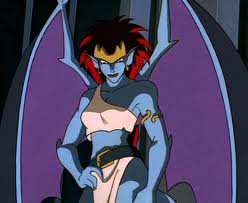
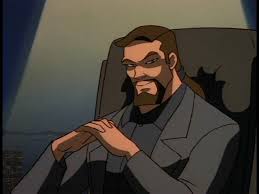
Much like the clan itself, the rogues gallery for the show is kept fairly compact for the first season.  It’s dominated by Xanatos, who poses as an ally early on to the clan but is soon revealed as duplicitous and self-serving.  His main weapons are cunning and money, but he also possesses some high-tech weaponry including his own cybernetic army of gargoyles.  He splits time as the main foe for the clan with Demona, Goliath’s former lover who was complicit in the destruction of their clan a thousand years ago.  While her intentions were without malice, her persona is consumed with a bloodlust for humanity as she blames them for their near extinction.  She is the Magneto to Goliath’s Charles Xavier.  Other villains include the sportsmen MacBeth and the television actors turned criminals The Pack, a group of men and women who fashion their personas after wild canines.

Demona, Goliath's former lover, is one of the primary antagonists for season one and beyond.

Demona, Goliath’s former lover, is one of the primary antagonists for season one and beyond.

The show opens with a very ambitious five-part mini-series titled “Awakening” (it was also released direct-to-video as Gargoyles:  The Movie) that sets up the series.  Right from the start, viewers are able to get a sense of the large-scale story-telling the show is aiming for while also being able to take in the peak of the show’s production values.  The animation quality is a grade above the usual afternoon cartoon fare, making it possibly the best looking cartoon of the mid 90’s.  The score is also exemplary and the voice acting contains notable actors such as Keith David (Goliath, various voices) and Edward Asner (Hudson) as well as numerous vets of various Star Trek programs.  Following the five-part debut, the show mostly settles into stand-alone episodes that also call upon happenings in previous ones.  Each gargoyle, with the exception of Bronx, is basically given his own episode to star in which helps the viewers get better acquainted with each one individually.  It’s similar to the tactic utilized by X-Men in season two and is an effective way to flesh out an ensemble cast.  There are thirteen episodes in total for season one, and pretty much all of them are good.  Some standouts include “Deadly Force,” which stresses the importance of gun safety without being ham-fisted (possibly created because main character Elisa is shown wielding realistic weaponry as opposed to fantasy, laser type devices).  “Her Brother’s Keeper” helps define what family means to the gargoyles and how it’s not so different from what it means to humans.  “Reawakening” is the bookend for the season and is a satisfying conclusion for the show’s first major arch.

Xanatos would be the other main foe for the gargoyles.

Xanatos would be the other main foe for the gargoyles.

What I appreciate most about the show is its commitment to realism.  This is a show starring unreal creatures but it takes them very seriously.  Their culture is defined as is their biology when Goliath points out early on that they can’t fly, merely glide on air currents.  As previously mentioned, Elisa is armed with a realistic handgun as are most of the police force.  Many of the villains do use lasers and other such fantasy fare but they come across as credible, in part due to a willingness to throw around phrases like “Die!” at their targets.  And when it’s called for, the show is not afraid to show blood which helps add severity to a scene.  The show also wasn’t afraid to be a little progressive as it’s revealed (casually) that Elisa is of mixed-race, having a white father and black mother.  And if you’re a fan of keeping movies and television as they were, you’ll be happy to know that the numerous shots of the New York skyline have not been edited to remove the twin towers.  Recent shows like Teenage Mutant Ninja Turtles and Beware the Batman have mostly empty city streets and lifeless scenery, it was refreshing to watch Gargoyles with its fully realized and very much alive New York.

The DVD release for season one is fairly basic.  There are animated menu screens depicting the gargoyles emerging from their stone prisons accompanied by music and sound effects.  The transfer is of good quality for this type of release and the case is a standard DVD case with a hinged insert for the second disc.  Bonus features include the original show pitch by Weisman which is worth a look just to see the original designs of the gargoyles.  There’s also a brief feature on The Gathering of the Gargoyles, a convention that used to be held in the US for fans of the show, that I suppose is worth a look though it’s basically just a bunch of fanboys and girls gushing over the program.  There’s also audio commentary on the fist five episodes, but I have yet to check it out (and probably won’t as it’s just not my kind of thing).

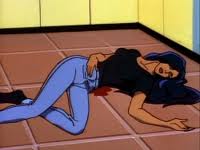
The show did not shy away from placing its characters in real danger.

The show did not shy away from placing its characters in real danger.

Gargoyles felt overlooked during its hey-day and today feels kind of like a forgotten series.  This is due, in part, to Disney’s stubbornness over releasing the entire series on DVD.  Season one was released in 2004 with the first half of season two following in 2005.  The rest of season 2 was in limbo until recently when it was released quietly as part of the Disney Movie Club.  Still remaining are the thirteen episodes from the abbreviated season three, rebranded as The Goliath Chronicles .  While fans would likely appreciate having those thirteen released, all but the season premiere were done without Weisman and thus are not considered canon by him for the show’s storyline, which lived on in comic book form for a short while following the show’s cancellation.  Unlike many cartoons from my youth that I have chosen to revisit, Gargoyles still holds up and impressed me a great deal.  I would love to see Disney revisit the show with Weisman for either a short fourth season or direct-to-video movie to provide additional closure.  Expect to see more of Gargoyles from me as I make my way through both volumes of season 2.


Spider-Man and the X-Men in Arcade’s Revenge

Spider-Man and the X-Men in Arcade's Revenge (1992)

Spider-Man and the X-Men in Arcade’s Revenge (1992)

Expectations influence just about everything we come in contact with.  Expectations can help lead to a more fulfilling experience when those expectations are met.  Other times, they can help make the bad seem worse when something fails to meet though expectations.  When I was a kid and I heard there was going to be a video game featuring a team-up between Spider-Man, possibly the most popular character ever created by Marvel Comics, and the X-Men, easily the hottest comic at the time, I was giddy with anticipation.  This seemed like a no lose situation and Spider-Man and the X-Men in Arcade’s Revenge vaulted to the top of my list of must own Super Nintendo games along with Teenage Mutant Ninja Turtles IV:  Turtles in Time.  One of those games would turn out well and provide me with hours of entertainment, that game was not Spider-Man and the X-Men.

What went wrong?  Well, let’s backtrack a bit first and see how this all came together and if my expectations were even justified.  At the time of the game’s release, Spider-Man had already been enjoying a run on the Sega Genesis and Game Boy as a platform star.  Perhaps star is a bit strong as his games weren’t really great, but they also weren’t particularly awful.  The best was definitely The Amazing Spider-Man vs The Kingpin for the Genesis.  The game was pretty difficult, at times frustratingly so, but it did a great job of making use of the Spider-Man license.  It was also quite popular and one of the best-selling titles at the time.  The X-Men, on the other hand, really only had the one NES game titled The Uncanny X-Men.  It was horrible and it tricked many uninformed gamers into renting or buying it with it’s X-Men branding.  Arguably, the best games for both franchises were the arcade beat-em-ups Spider-Man:  The Video Game and X-Men.  The Spider-Man game came first in 1991 and for some reason it isn’t as well loved and remembered as the X-Men game that followed in ’92.  It was a typical brawler allowing up to four players to join in and included playable characters Spider-Man, Black Cat, Hawkeye, and Sub-Mariner.  It’s selling feature was a more platform inspired design where the camera would zoom out allowing the players to take on gigantic enemies including a super-sized Venom at the end of the first stage.  The X-Men game was similar, but it’s defining characteristic (aside from the comical mistranslations) was the double-monitor cabinet allowing up to six players at once.  Both games were hard as they were designed to suck quarters out of its audience but they were a lot of fun, especially with a group of friends.

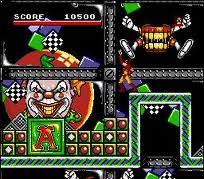
I hate these stupid clowns and their stupid stage.

I hate these stupid clowns and their stupid stage.

It would seem to me that a track record was in place that at least suggested a console game featuring these two franchises could be great.  If I had been a little wiser as a kid and more aware I would have taken note of the LJN logo on the box and realized right away the game was going to be a giant turd, but sadly I just wasn’t.  Before I get into what the game did wrong I suppose I should point out what it did right.  First of, Spider-Man is represented fairly well given that he is able to stick to walls, shoot webs, and even make use of his spider-sense in the game.  The roster for the X-Men side is pretty solid as well as it features the obvious choice of Wolverine along with Cyclops, Storm, and Gambit.  Wolverine has an interesting dynamic to him as he retains his mutant healing power but it only works when his claws are retracted.  The game is packed with villains too like Apocalypse, Shocker, Juggernaut, and Carnage.  Arcade is kind of a weird choice for the main villain, but at least his Murderworld offers a lot of possibilities for level-design.

That’s basically it as far as what Spider-Man and the X-Men gets right, and unfortunately it’s a pretty small list.  So what makes this game suck so hard?  Well, lets first start with the presentation.  I’m usually not one to have much of an opinion on the audio within a game.  I expect it to do its job and often times I have to make it a point to touch upon it when doing these reviews because I tend to overlook it.  Here it’s easy to not overlook because the sound is so bad.  The score is okay at times, though certain levels (Wolverine’s) feature an annoying soundtrack.  It’s the FX that really bug me though as they just sound like, for lack of a better word, shit.  A lot of the characters, good and bad, let out a scream when they die that sounds fuzzy and distorted.  The machine sounds are just as bad and Spidey’s web blasts sound like they could be grenades.  The graphics are also piss-poor.  The characters are really small, except Storm but I’ll get to her later, and lacking in any sort of detail.  Wolverine even looks like he only has two claws on each hand while Gambit doesn’t have a face.  Some of the villains are almost unrecognizable, especially Apocalypse who looks like a blue bug or something.

Hey Gambit, where's your face?

Hey Gambit, where’s your face?

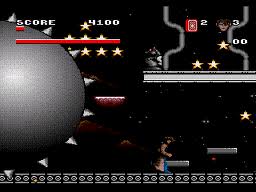
Perhaps what bugged me more than anything as a kid was just how un-super these super heroes felt.  Spider-Man and the X-Men is a pretty hard game made so mostly because these characters can’t seem to take a punch.  They die so easily and it’s a frustrating experience.  I get that it’s hard to make a super hero game because on one hand the super heroes need to be super powerful, but the game also needs some challenge.  That’s why we have super villains though, and Wolverine shouldn’t be getting annihilated by a jack-in-the-box with a tommy gun.  The X-Men games that would follow on the Genesis were hard, but at least those X-Men felt like powerful super heroes (well, for the most part), these ones are push-overs.  The level designs are also fairly lacking.  Spider-Man’s are just weird looking and kind of confusing as they’re intended to be maze-like.  The player is supposed to use his spider-sense to navigate but it just gets tiresome.  Cyclops’ stages feature an annoying mine cart premise where touching the tracks means death.  Gambit has to outrun a giant deathball and might be the best levels, which isn’t saying much.  Wolverine is in a circus and there’s nothing noteworthy about the first stage while the second stage he has to outrun the Juggernaut.  It’s basically the same concept as the Gambit stages, though at least LJN incorporated something from the comics to make it feel relevant.  Storm’s stages are quite different and probably everyone’s most hated as she has to navigate a flooded laboratory.  They’re swimming levels, but unfortunately Storm’s mutant powers over the weather don’t let her breath underwater.  Just about everyone hates the underwater Sonic the Hedgehog levels for the same reason, this is worse times ten.

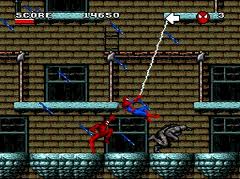
The red guy is Carnage. That gray blob?  He's Rhino.  I think.

The red guy is Carnage. That gray blob? He’s Rhino. I think.

If the player manages to actually beat all of the levels then they get to take on Arcade as Spider-Man.  You kind of have to be a glutton for punishment to even make it that far as the game is both really hard and really bad.  That’s the worst combination.  As a kid, I never had much success and never made it past any character’s second stage so making it all the way to Arcade wasn’t in the cards.  Playing this game was a depressing endeavor as a game featuring a team-up between these two should have been awesome.  I remember a few years after I got it Toys R Us started their first trade-in program where people could trade in games they no longer wanted for store credit.  I grabbed my copy of Spider-Man and the X-Men and, thinking I’d get maybe 15 or 20 bucks, was offered only four.  I elected not to trade it in but in hindsight I should have taken the four Jeffry Dollars.  I could have used it for some Fruit Stripe gum or something.